

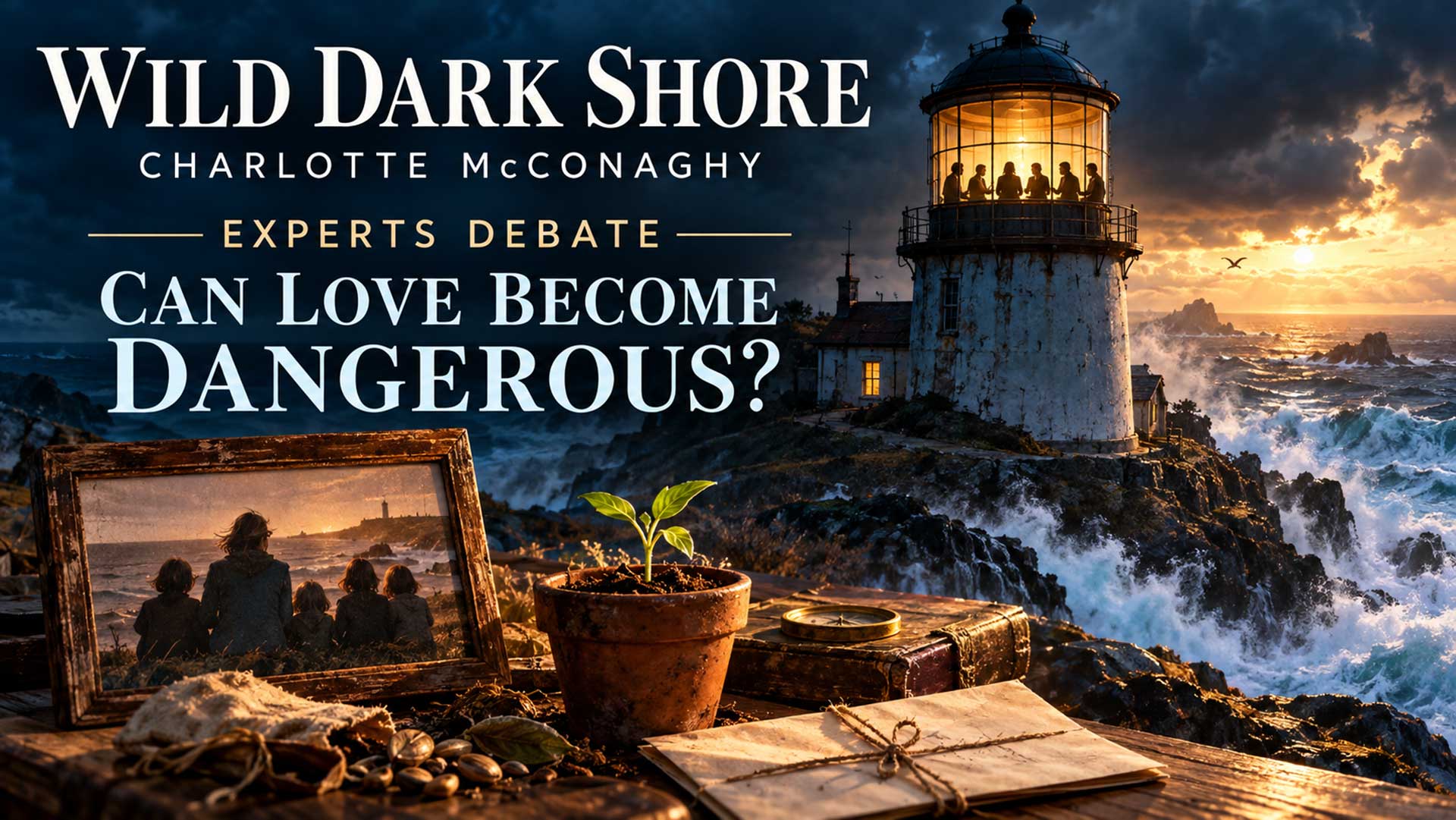
Introduction
When Love Isn't Enough: What Wild Dark Shore Asks Us to Confront
How far would you go to protect someone you love?
Would you break the law? Hide the truth? Sacrifice your own happiness?
Would you give your life?
And what if the very things you did out of love ended up hurting the people you were trying to protect?
In Charlotte McConaghy's Wild Dark Shore, a grieving father raises his three children on a remote island where rising seas threaten a precious seed vault. When a mysterious woman washes ashore, the family's fragile existence begins to unravel.
Dominic wants to keep his children safe. Fen struggles with wounds that love alone cannot heal. Raff carries anger he cannot easily express. Young Orly finds wonder in a natural world that may be disappearing. And Rowan's extraordinary courage raises a question that reaches far beyond the island.
When does love help us become better people—and when can it lead us terribly astray?
McConaghy's novel is both an intimate family story and a meditation on ecological loss. But its deepest questions do not end when we close the book.
They follow us into our own lives.
Parents want to protect their children, but can protection become control?
We want to honor those who sacrifice for us, but should love ever become a debt?
We want to save the natural world, but who decides what deserves to survive?
And perhaps most urgently: How do we teach our children to hope when we cannot honestly promise them a safe future?
To explore these questions, we imagine an extraordinary gathering on Shearwater Island.
Trauma researcher Judith Herman, moral psychologist Paul Bloom, developmental psychologist Alison Gopnik, grief writer Megan Devine, botanist Robin Wall Kimmerer, and climate scientist Katharine Hayhoe come together for five conversations.
Their different fields offer different ways of understanding the novel. Herman's work on trauma and recovery helps frame questions of safety and accountability. Gopnik's research into how children learn challenges our assumptions about parental control. Hayhoe's climate research and communication brings scientific perspective to the question of hope.
But these conversations are not lectures.
The experts disagree. They challenge one another. They question whether good intentions are enough, whether sacrifice should be celebrated, and whether hope can survive without certainty.
And throughout their discussions, one small question keeps returning:
What does love ask of us when we cannot save everything?
This article is a fictional thought experiment inspired by Wild Dark Shore. The conversations are imagined, informed by the participants' published ideas, and do not represent actual interviews, quotations, participation, or endorsements. Some settings, letters, and objects are invented as literary devices. The discussion includes major spoilers.
(Note: This is an imaginary conversation, a creative exploration of an idea, and not a real speech or event.)
Topic 1: Can Good People Do Terrible Things for Love?
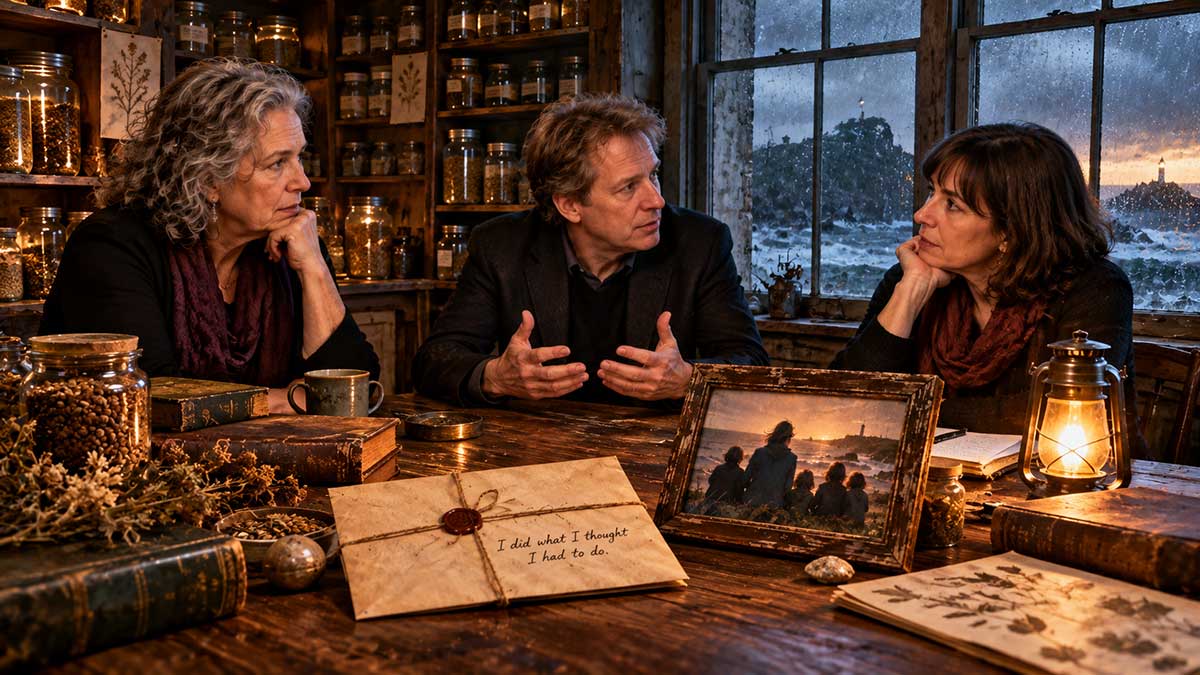
Shearwater Island. The final evening before evacuation.
Wind presses against the walls of the seed vault. Beyond the windows, the Southern Ocean rises and falls beneath a bruised sky. Shelves of carefully labeled seeds stand in long rows, some already packed for departure.
At the center of a wooden table lies a sealed envelope. Beside it sits a photograph of Dominic Salt with his three children.
Three guests have gathered: Judith Herman, whose work examines trauma and justice; Paul Bloom, a psychologist who studies morality and empathy; and Alison Gopnik, whose research explores how children learn and develop.
The moderator opens the envelope.
Moderator: I want to begin with something Dominic Salt might have written.
He unfolds a sheet of paper.
Moderator: "I did what I thought I had to do to protect my children."
He looks around the table.
Moderator: I suspect nearly every parent in the world could understand that sentence.
Alison Gopnik: Of course. Protecting your children is one of the most powerful motivations human beings have.
Paul Bloom: And one of the most dangerous, under certain circumstances.
Alison Gopnik: That was quick.
Paul Bloom: Well, we haven't even started, and you've already given us the problem. You said protecting children is a powerful motivation. You didn't say it makes people morally reliable.
Moderator: Dominic imprisoned Hank. He believed he was protecting his family. Many readers sympathize with him. Others find what he did indefensible.
Judith, can a person commit a serious wrong while sincerely believing he's acting out of love?
Judith Herman: Certainly. But I would be cautious about starting with Dominic's sincerity.
Moderator: Why?
Judith Herman: Because sincerity tells us what he believed about himself. It tells us very little about the experience of the people affected by his actions.
We have a child who has been harmed. We have a father responding to that harm. And we have a man being held captive.
Those are three separate moral realities. We shouldn't allow the father's love to swallow the other two.
Paul Bloom: I agree. And I would push it further. The more emotionally compelling Dominic's motives become, the more tempted we are to excuse his actions.
We imagine our own children in danger. We feel his fear. Then, almost without noticing, we move from "I understand why he did it" to "I might have done the same thing" to "Perhaps it was justified."
Those are three very different statements.
Alison Gopnik: But there's a danger in the opposite direction, too. We can sit here in relative safety and imagine that a frightened parent should behave like a philosopher calmly working through a moral equation.
Paul Bloom: I don't expect calm. I expect accountability.
Alison Gopnik: Those aren't mutually exclusive. But if we're going to understand Dominic, we have to understand what fear does to a parent's perception of the world.
A parent doesn't merely see a threat. They see all the possible futures in which their child suffers.
Moderator: And suddenly anything that prevents those futures seems acceptable?
Alison Gopnik: It can. That's the trap.
Parenthood gives us enormous responsibility, but very little control over the ultimate outcome. Some parents respond to that contradiction by trying to control more and more.
Paul Bloom: Which is why love needs moral boundaries.
Moderator: Let me make this personal. Suppose someone seriously harmed your child. You had the opportunity to lock that person away, and you believed doing so would prevent further harm.
Would you?
For a moment, nobody answers.
Paul Bloom: I can tell you what I might feel like doing. I would probably want to hurt him.
Moderator: You would admit that?
Paul Bloom: Of course. I'm not claiming moral superiority over Dominic. Anger and revenge are entirely human responses.
But the fact that I might desperately want to do something is precisely why I shouldn't automatically trust my judgment.
Judith Herman: And we should ask what the child needs while the adults are consumed by these emotions.
Moderator: Fen.
Judith Herman: Yes.
Imagine being a young person who has already experienced a profound violation of trust. Then imagine discovering that the adults around you have made another enormous decision, supposedly for your benefit, without asking what you want.
That can create a terrible contradiction. You are being protected, but you are not being given control over your own life.
Alison Gopnik: That's important. We often think of protecting children as keeping danger away from them.
But children also need to develop the capacity to make choices, form judgments, and eventually direct their own lives.
Moderator: Yet Fen is still a child.
Alison Gopnik: Yes. Autonomy doesn't mean abandoning a child to danger. It means providing safety while respecting the child's growing agency.
If your child is frightened, you don't simply hand them every decision. But neither do you treat them as an object whose life you can manage without their participation.
Paul Bloom: I want to challenge something, though.
Suppose Fen wants Hank punished severely. Suppose she says she never wants him released.
Would respecting her autonomy mean doing exactly what she asks?
Judith Herman: No. That's an important distinction.
A survivor should have meaningful choices, truthful information, and a voice in decisions that affect their safety and recovery. But we should not place the responsibility for punishment on the survivor.
That would be another burden.
Moderator: So we shouldn't ask Fen to decide Hank's fate?
Judith Herman: We should listen to her needs. We should not require her to become judge, jury, or executioner.
Paul Bloom: Good. Then we're separating three things: what Fen needs, what Dominic feels, and what Hank deserves.
Moderator: Which Dominic may have confused.
Paul Bloom: Precisely.
Rain begins tapping against the glass. The moderator turns over the photograph. On the back, someone has written the children's names: Raff, Fen, Orly.
Moderator: Alison, I want to ask you something about parenting.
Dominic lost Claire. He brought his children to this isolated island. He was frightened of losing anyone else.
Is it possible that he was protecting his children partly because he couldn't bear another loss himself?
Alison Gopnik: Absolutely possible. And that possibility should make us compassionate toward him, but also more alert to the danger.
Sometimes a parent says, "I'm doing this for you," when part of what they mean is, "I cannot endure what might happen to me if something happens to you."
Moderator: That sounds almost selfish.
Alison Gopnik: It's human. Parents love their children, and they are terrified of losing them. Those feelings are intertwined.
But the child should not become responsible for keeping the parent emotionally intact.
Judith Herman: There's another consequence. A child can begin to feel that telling the truth will hurt the parent.
Moderator: So Fen might hide what she's feeling to protect Dominic?
Judith Herman: It's a possibility. Children sometimes learn to manage the emotional reactions of adults around them. They may withhold anger, fear, or distress because the adults already seem overwhelmed.
That is why a parent's response matters so much.
Paul Bloom: And it suggests something uncomfortable. Dominic's dramatic act of protection might have made it harder for his children to speak freely.
Moderator: Because they would know what he was capable of doing for them?
Paul Bloom: Or what he was capable of doing because of them.
Those aren't the same thing.
The room grows quiet.
Moderator: That distinction is painful.
A child might think, "My father loves me so much that he did something terrible."
And then perhaps, "If I hadn't been hurt, he wouldn't have done it."
Judith Herman: Exactly. Which is why the adults must make something unmistakably clear: the child did not cause the adult's choices.
The responsibility for harmful behavior belongs to the person who committed it. And the responsibility for Dominic's response belongs to Dominic.
Fen should not have to carry either burden.
Moderator: What would you want Dominic to say to her?
Judith Herman: I wouldn't presume to script a survivor's recovery. But I would want him to acknowledge that his choices were his own, that her safety matters, and that she does not owe him gratitude for everything he did in her name.
Alison Gopnik: And I would want him to listen without immediately trying to solve her feelings.
Paul Bloom: I'd want him to admit he was wrong where he was wrong.
Moderator: Even if he still believes he saved her?
Paul Bloom: Especially then.
Doing something beneficial doesn't erase everything harmful you did along the way.
Moderator: Let me push back.
Imagine Hank is dangerous. Imagine releasing him could put Fen at risk again. Are you saying Dominic should simply open the door?
Paul Bloom: No. That's a false choice.
The alternatives aren't indefinite private imprisonment or reckless release.
Judith Herman: Safety planning, seeking outside help when available, maintaining boundaries, and preventing further access to the person harmed are all different from taking punishment into one's own hands.
Of course, Shearwater's isolation makes ordinary options difficult. We should take that seriously.
Moderator: So circumstances matter.
Judith Herman: Deeply. But difficult circumstances do not make every action equally defensible.
Alison Gopnik: And Dominic's obligation isn't only to protect Fen from Hank. It's to preserve the kind of family life in which Fen can regain confidence and independence.
Moderator: I keep thinking about something. We admire parents who say, "I'd do anything for my child."
But perhaps "anything" is the dangerous word.
Paul Bloom: It is.
I'd rather hear a parent say, "There are things I desperately want to do for my child that I will refuse to do, because they are wrong."
Alison Gopnik: Or, "I love my child enough to recognize that my fear is not always wisdom."
Judith Herman: And, "I will not make my child responsible for the actions I take."
The moderator sets the photograph beside the letter.
Moderator: There's another question readers have raised about this novel.
Can Hank be forgiven?
Paul Bloom: That's a different question from whether he should be held accountable.
Moderator: But people often treat forgiveness as the final chapter of healing.
Judith Herman: And that can be profoundly unfair to survivors.
Forgiveness is not a prerequisite for recovery. Neither is reconciliation.
A person may choose forgiveness, refuse it, or change their feelings over time. None of those choices determines whether their suffering was real or whether they deserve support.
Moderator: Suppose Hank genuinely regrets what he did.
Judith Herman: Regret may matter to his moral development. But remorse does not entitle him to access to Fen, to her attention, or to her forgiveness.
Paul Bloom: Nor does refusing forgiveness make Fen cruel.
Alison Gopnik: I think we should also distinguish forgiveness from the ability to go on living.
A child shouldn't have to resolve every moral question about someone who harmed them before being allowed to have a future.
Moderator: That's interesting. We often imagine healing as a moment when everything is finally settled.
Judith Herman: Real recovery is rarely that tidy.
The goal is not to produce a morally satisfying ending for everyone watching. It is to help the person harmed regain safety, connection, and agency.
Moderator: Then perhaps we're asking the wrong question when we ask whether Hank deserves forgiveness.
Paul Bloom: What would the right question be?
Moderator: Whether Fen can live freely without having to decide what kind of person Hank ultimately becomes.
Judith Herman: That is a much better place to begin.
Outside, the wind changes direction. Somewhere below them, a metal door rattles.
Moderator: I want to return to Dominic before we finish.
We have spent most of this conversation identifying what he did wrong.
But I don't want readers to leave believing that one terrible choice cancels every good thing a person has ever done.
Can Dominic still be a good father?
Paul Bloom: I don't find that question especially useful.
Moderator: Why not?
Paul Bloom: Because "good father" sounds like a final verdict. As though we're placing him on a scale and deciding whether the good outweighs the bad.
I'd rather ask what he does next.
Does he acknowledge the harm? Does he stop making excuses? Does he change?
Alison Gopnik: And does he allow his children to become people whose choices he cannot control?
That's one of the hardest parts of parenting.
When children are small, you can pick them up and carry them away from danger. As they grow, you have to learn a different kind of love.
You remain available. You offer guidance. But you gradually surrender the fantasy that you can design their lives.
Moderator: And for Dominic, surrendering control might feel like risking another death.
Alison Gopnik: Yes.
Which is why it would require real courage.
Judith Herman: I would add that accountability is not the opposite of compassion.
We can recognize Dominic's grief, fear, and devotion without making them excuses.
In fact, holding him accountable may be the most respectful way to recognize that he is capable of making different choices.
Moderator: So redemption, if we want to use that word, wouldn't come from convincing everyone he meant well.
Paul Bloom: No. It would come from what he learns and changes.
Moderator: Let me try one last question.
If Dominic were sitting here, what would each of you say to him?
The three experts look toward the empty chair at the end of the table.
Alison Gopnik: I'd tell him that his children are not problems he can solve.
They are people he has the extraordinary privilege of helping grow.
And growing means that one day they will make choices he doesn't understand, take risks he wouldn't choose, and build lives beyond his reach.
His job is not to prevent that future. It's to help them become ready for it.
Paul Bloom: I'd tell him that love is a motive, not a moral permission slip.
He may have acted from genuine devotion. That doesn't settle whether his actions were right.
If he wants to be the father his children need, he must be willing to examine what he did without hiding behind how much he loves them.
Judith Herman: I'd ask him to listen to Fen.
Not to what he imagines she needs. Not to what would relieve his guilt.
To Fen herself.
And then I'd tell him that he does not have to become a perfect man overnight.
But he must stop making his children responsible for his fear.
The moderator looks at the photograph again.
Moderator: I wonder whether Dominic would find any of that comforting.
Paul Bloom: Probably not.
Alison Gopnik: Sometimes the most useful truths aren't comforting at first.
Moderator: Then perhaps I should ask a different question.
Would any of you tell him that he is beyond hope?
Judith Herman: No.
Paul Bloom: Certainly not.
Alison Gopnik: No. But hope would have to involve change.
The moderator folds the letter and places it back in its envelope.
Moderator: When I first read Dominic's story, I thought the great question was how far a father should go to protect his children.
Now I'm wondering whether the more difficult question is how far a father must be willing to change for them.
No one speaks for a moment.
Judith Herman: There is a difference between being the person who saves a child and being someone a child can safely come to.
Sometimes the second requires more courage.
Alison Gopnik: And much more patience.
Paul Bloom: And a willingness to be wrong.
The storm has not stopped, but the lights inside the seed vault remain steady.
Moderator: Then maybe love's greatest test isn't whether we would do anything for someone.
Maybe it's whether we can recognize the things we must never do, even for someone we love.
He puts the photograph back on the table, facing the empty chair.
Moderator: And whether, after making a terrible mistake, we have the courage to become someone they can trust again.
Beyond the window, the dark sea continues to rise.
Inside, the letter remains sealed.
Editorial disclosure: This is a fictional thought experiment inspired by Charlotte McConaghy's Wild Dark Shore. The experts' dialogue is imagined, drawing on broad themes in their published work. These are not actual statements, interviews, or endorsements by the individuals portrayed.
Topic 2: Can a Parent's Unhealed Grief Become a Child's Burden?
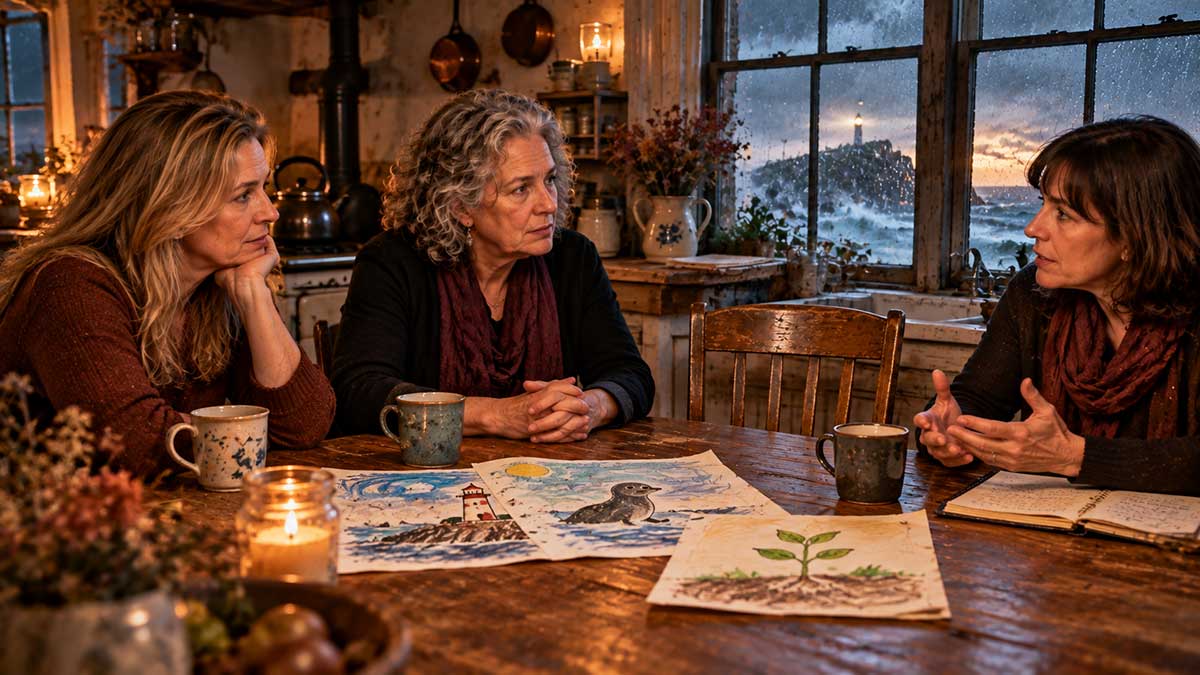
Shearwater Island. Later that evening.
The storm has moved closer. Wind rattles the windows of the old kitchen adjoining the seed vault. A kettle sits on the stove, and a small pile of children's drawings rests beneath a glass paperweight.
At the table are developmental psychologist Alison Gopnik, grief writer Megan Devine, and trauma researcher Judith Herman.
The moderator stands beside an empty chair.
Moderator: I want to begin with something that may sound cruel.
What if Dominic Salt brought his children to Shearwater Island not only to protect them from the world, but also because he couldn't bear to face the world after Claire died?
Megan Devine: Why would that be cruel?
Moderator: Because it suggests that a father who loved his children might have made a life-changing decision partly for himself.
Megan Devine: Of course he did. Parents are human beings. Grief doesn't make you stop having needs.
What concerns me is how quickly we turn that observation into an accusation.
Alison Gopnik: I agree with Megan, but I think there's a question we shouldn't avoid. Dominic's grief may help explain why he chose isolation. It doesn't tell us whether that isolation was good for his children.
Moderator: So we can sympathize with his decision and still question it?
Alison Gopnik: We have to. That's part of taking children seriously as people rather than treating them as extensions of their parents.
Judith Herman: And there's a difference between a family choosing a difficult life together and children having no meaningful way to express what that life is doing to them.
Moderator: Let's talk about the children.
Raff is angry. Fen turns toward the animals. Orly seems almost painfully sensitive to the island's living and dying creatures.
Three children. One dead mother. One grieving father.
Why don't they grieve in the same way?
Megan Devine: Why would they?
She looks toward the empty chair.
Megan Devine: We have this strange expectation that grief should look recognizable. Crying, sadness, withdrawal. Something we can identify and then help someone move through.
But grief isn't a uniform response. Two people can lose the same person and experience entirely different losses.
For one child, losing a mother might mean losing the person who made ordinary mornings feel safe. For another, it might mean losing the person who understood them without explanation.
And for a third, the loss might become a question they don't yet have the language to ask.
Moderator: What kind of question?
Megan Devine: "Will everyone I love disappear?"
Alison Gopnik: Or, "If someone disappears, did I do something wrong?"
Children are extraordinarily good at finding patterns and explanations. That's part of how they learn.
But when something terrible happens, that same capacity can lead them toward explanations that place too much responsibility on themselves.
Moderator: So Orly might believe that if he could understand death, he could somehow prevent it?
Alison Gopnik: Perhaps. We shouldn't diagnose a fictional child from a handful of behaviors. But curiosity can certainly become one way of approaching frightening uncertainty.
And I would be careful not to treat his love of plants and animals as merely a symptom of grief. It may also be a genuine passion.
Judith Herman: That's an important distinction. We can become so interested in explaining a child's behavior through trauma that we stop seeing the child.
Moderator: Meaning?
Judith Herman: Fen's attachment to animals may provide comfort and connection. It may reflect something about her temperament, her experiences, or her sense of safety.
But if every choice she makes is interpreted as evidence of damage, then even her sources of strength become symptoms.
Megan Devine: Exactly.
Sometimes a girl loves animals because animals are wonderful.
Alison smiles.
Alison Gopnik: That may be the most sensible thing anyone has said tonight.
Moderator: But isn't there a risk of overlooking pain if we take everything at face value?
Judith Herman: Certainly. The answer is not to stop paying attention. It's to remain curious without deciding in advance what another person's behavior means.
Moderator: Then let me ask about Dominic.
A parent loses a spouse. The children are grieving. The parent is grieving. Someone has to keep the family functioning.
Should Dominic have hidden his sadness?
Megan Devine: No.
Moderator: You answered that rather quickly.
Megan Devine: Because the idea that children must never see a parent grieve is both unrealistic and potentially isolating.
If everyone knows something terrible has happened and the adults insist everything is fine, children may learn that grief is something shameful or dangerous.
Alison Gopnik: I agree, but there's an important qualification.
A child seeing a parent cry is not the same as a child being asked to take care of the parent's emotional well-being.
Moderator: Where is the line?
Alison Gopnik: Consider two sentences.
A father says, "I miss your mother today. I'm sad, and it's okay to be sad. I'm going to talk with someone who can help me."
Then consider, "You're the only thing keeping me alive. I don't know what I'd do without you."
Both sentences may come from love and grief.
But the second gives a child a responsibility no child should have to carry.
The moderator slowly sits down.
Moderator: That second sentence is something people say all the time.
Megan Devine: Yes. Often with the best intentions.
And sometimes we even praise it. We hear a grieving parent say, "My children are the only reason I get out of bed," and we find it moving.
Moderator: Isn't it moving?
Megan Devine: It can be. Children can give people a reason to keep participating in life.
But imagine being the child who hears that.
Now your father's survival seems to depend on whether you're happy, whether you're safe, whether you stay close.
That's an enormous weight.
Judith Herman: And children may respond by concealing their own distress.
They notice that their parent is fragile. They begin monitoring the parent's mood. They avoid saying things that might cause additional pain.
Eventually, the child can become the emotional caretaker.
Moderator: Even when nobody explicitly asks them to?
Judith Herman: Yes. Families communicate through much more than words.
Moderator: Suppose Raff sees Dominic struggling and decides not to tell him how angry he is about Claire's death.
Is that love?
Megan Devine: It might be an attempt at love.
But a child shouldn't have to disappear emotionally to protect a parent.
Alison Gopnik: And anger itself isn't necessarily a problem to eliminate.
Children need room to have feelings that are inconvenient for adults.
If a father is frightened by his son's anger because it reminds him of his own helplessness, he may try to suppress it.
But then the child loses an opportunity to learn that difficult emotions can exist within a secure relationship.
Moderator: What would a better response sound like?
Alison Gopnik: Perhaps something as simple as, "I know you're angry. You can be angry with me. I'm still here."
Megan Devine: And without adding, "After everything I've done for you."
Moderator: That changes the entire meaning, doesn't it?
Megan Devine: Completely.
The first says, "Our relationship can survive your feelings."
The second says, "Your feelings are hurting me, and you owe me something different."
Rain strikes the window harder. Judith glances toward the darkened hallway.
Judith Herman: There's another layer to Dominic's situation.
He has already experienced a devastating loss. Now he lives with the possibility of losing his children.
Fear of further loss can make control feel like safety.
Moderator: We discussed that in the previous conversation.
Judith Herman: Yes, but here the question is different.
What happens to a family when everyone must organize their lives around one person's fear?
Moderator: You mean Dominic's fear.
Judith Herman: Potentially. Imagine children learning that their father's anxiety increases whenever they leave his sight.
They may begin restricting themselves, not because they believe the world is dangerous, but because they don't want to frighten him.
Alison Gopnik: And that can interfere with one of the fundamental tasks of childhood: exploring the world.
Moderator: Yet Shearwater really is dangerous.
Alison Gopnik: Of course. We mustn't confuse freedom with recklessness.
But even in dangerous circumstances, children need opportunities to develop competence and judgment.
You can teach a child how to recognize a storm without teaching them to fear every cloud.
Megan Devine: That's a beautiful distinction.
Moderator: Let me challenge all three of you.
You keep describing what Dominic should have done differently.
But he's alone on an isolated island, raising three children after losing his wife. There isn't a therapist down the street. There isn't a neighbor bringing dinner.
Isn't it unfair to judge him by standards that assume an entire support system?
Megan Devine: Yes, if we ignore his circumstances.
Judith Herman: And no, if we use those circumstances to excuse every consequence.
Moderator: Explain that.
Judith Herman: Isolation limits options. It may increase fear and strain. We should acknowledge that.
But understanding the pressure on a parent doesn't require us to pretend the children were unaffected.
Compassion for Dominic and concern for his children can exist together.
Alison Gopnik: I would go further. This is why the idea that parents should be entirely self-sufficient is so damaging.
Human children have never been raised solely through the efforts of one perfectly competent adult. They benefit from networks of relationships.
Moderator: But Dominic doesn't have that network.
Alison Gopnik: Which makes his situation tragic, not admirable as a model of ideal parenting.
Megan Devine: And perhaps he doesn't need to be the heroic father who manages everything.
Perhaps he needs permission to be a grieving man who requires help.
Moderator: From whom?
Megan Devine: That's the hard question. There may be no easy answer on Shearwater.
But needing help is not a personal failure.
And even when practical help is limited, honesty can change the emotional atmosphere of a family.
Moderator: What would honesty look like?
Megan Devine: "I don't know how to do this without your mother. I'm learning. Sometimes I get things wrong. But my sadness is not yours to fix."
The moderator looks down at the children's drawings.
Moderator: I wonder whether Dominic ever said anything like that.
Alison Gopnik: We don't know.
Moderator: But suppose he did. Suppose he told his children he was frightened and lonely.
Would that really be enough?
Judith Herman: No single conversation is enough.
Children need patterns of safety. They need to see that the adult can acknowledge a mistake, respond to their needs, and seek support where possible.
Trust develops through repeated experiences.
Moderator: And if the parent keeps making mistakes?
Alison Gopnik: Then repair matters.
Parents are going to get things wrong. Every parent does.
What's important is whether they can recognize the mistake and respond differently.
Megan Devine: But I want to be careful here. We shouldn't turn grief into another parenting performance.
"Grieve correctly. Speak correctly. Repair correctly. Make sure your children emerge emotionally healthy."
That's another impossible standard.
Alison Gopnik: I agree. Yet we can still describe better and worse ways of responding.
Megan Devine: Certainly. I just don't want a grieving parent to leave this conversation believing that every sad moment is damaging their children.
Moderator: That's worth emphasizing.
Judith Herman: Yes. Sadness itself is not the enemy.
What matters is whether children have enough safety, connection, and freedom to experience their own emotions.
The kettle begins to whistle.
The moderator rises, turns off the stove, and pours tea into four mismatched cups.
Moderator: I want to ask a question that isn't in my notes.
What if the children are doing better than Dominic thinks?
Alison Gopnik: That's entirely possible.
Moderator: What if Raff's anger is not a sign that he's falling apart? What if Fen's connection with animals is a source of strength? What if Orly's fascination with seeds is not an escape from death, but an expression of his love for life?
Alison Gopnik: Then Dominic needs to see them as they are, rather than only as children who have suffered.
Judith Herman: Recovery involves more than reducing symptoms. It involves restoring the possibility of meaningful life.
Megan Devine: And grief doesn't erase joy.
People can miss someone terribly and still laugh, fall in love, grow curious, or have an unexpectedly wonderful afternoon.
Moderator: Could a grieving parent feel guilty when their children are happy?
Megan Devine: Certainly. Happiness can sometimes feel like betrayal after a death.
But love isn't a loyalty test.
A child enjoying life doesn't mean they've forgotten the person who died.
Moderator: What if Dominic sees Orly laughing and thinks, "How can he laugh when Claire is gone?"
Megan Devine: Then Dominic might need to ask himself why he believes remembering Claire requires continued suffering.
Alison Gopnik: Children often move between intense emotions and ordinary play more readily than adults expect.
That doesn't mean their grief is shallow.
Judith Herman: Nor should we demand that they demonstrate grief in a particular way to prove their love.
Moderator: I think there's something here that reaches far beyond this novel.
Parents sometimes want their children to share their sadness, their fears, even their convictions, because it makes them feel connected.
But perhaps children have a right to experience the world differently.
Alison Gopnik: More than a right. It's part of what makes them separate people.
Moderator: Even if the father feels left behind?
Alison Gopnik: Especially then.
The moderator looks toward the empty chair.
Moderator: Let me ask each of you one final question.
If you could give Dominic one piece of advice about raising his children after Claire's death, what would it be?
Judith Herman: I would tell him to make room for their experiences without deciding what those experiences ought to be.
Let Raff be angry without treating him as a threat.
Let Fen define what safety and trust mean to her.
Let Orly love his seeds and creatures without assuming every attachment must be explained by loss.
And make sure they know that the adults' responsibilities belong to the adults.
Alison Gopnik: I'd tell him that his children don't need him to construct a world in which nothing can hurt them.
They need him to help them develop the capacities to live in a world where uncertainty exists.
He can offer shelter, guidance, and love.
But he cannot live their lives for them.
Megan Devine: I'd tell him something simpler.
He is allowed to miss Claire.
He is allowed to have terrible days.
He is allowed to wish she were still there.
But his children are allowed to have good days, too.
They don't have to remain sad to prove they loved their mother.
And neither does he.
The moderator remains silent for a long moment.
Moderator: There's something I've been wondering throughout this conversation.
What if Dominic believes that becoming happy again would mean leaving Claire behind?
Megan Devine: Then perhaps he needs to discover that love can continue without requiring pain to remain unchanged.
You don't have to stop missing someone in order to participate in life.
Moderator: Could he tell his children that?
Megan Devine: I hope so.
Moderator: How?
Megan thinks for a moment.
Megan Devine: Maybe something like this:
"I will always miss your mother. Some days I may be sad. But you don't have to be sad with me. You can go outside. You can laugh. You can fall in love with the world. And when you come home, I'll still be here."
Alison looks toward the window, where the first faint break in the clouds has appeared.
Alison Gopnik: And perhaps one day the children will teach him how to do the same.
Judith Herman: Provided he allows them to.
Moderator: So the greatest gift Dominic can give his children isn't a life without grief.
Megan Devine: No.
Moderator: It's permission to have a life that is larger than their grief.
The wind begins to ease.
The moderator reaches for the children's drawings. One shows the island lighthouse beneath an enormous blue sky. Another shows a seal. The third is a careful drawing of a tiny green plant.
He places them beside the empty chair.
Moderator: I think I understand something now.
Dominic brought his children to Shearwater because he wanted to keep them safe.
But perhaps what they needed most wasn't a place where nothing could reach them.
Perhaps they needed a father who could let life reach them again.
The kettle sits quiet on the stove.
Outside, the ocean remains dangerous, but somewhere beyond the kitchen window, morning is still possible.
Editorial disclosure: This conversation is fictional and inspired by Charlotte McConaghy's Wild Dark Shore. The imagined remarks draw on broad themes in the participants' published work; they are not actual quotations, interviews, or endorsements. The dialogue is not intended to diagnose the novel's characters or provide individualized mental health treatment.
Topic 3: Who Gets to Decide What Deserves to Survive?
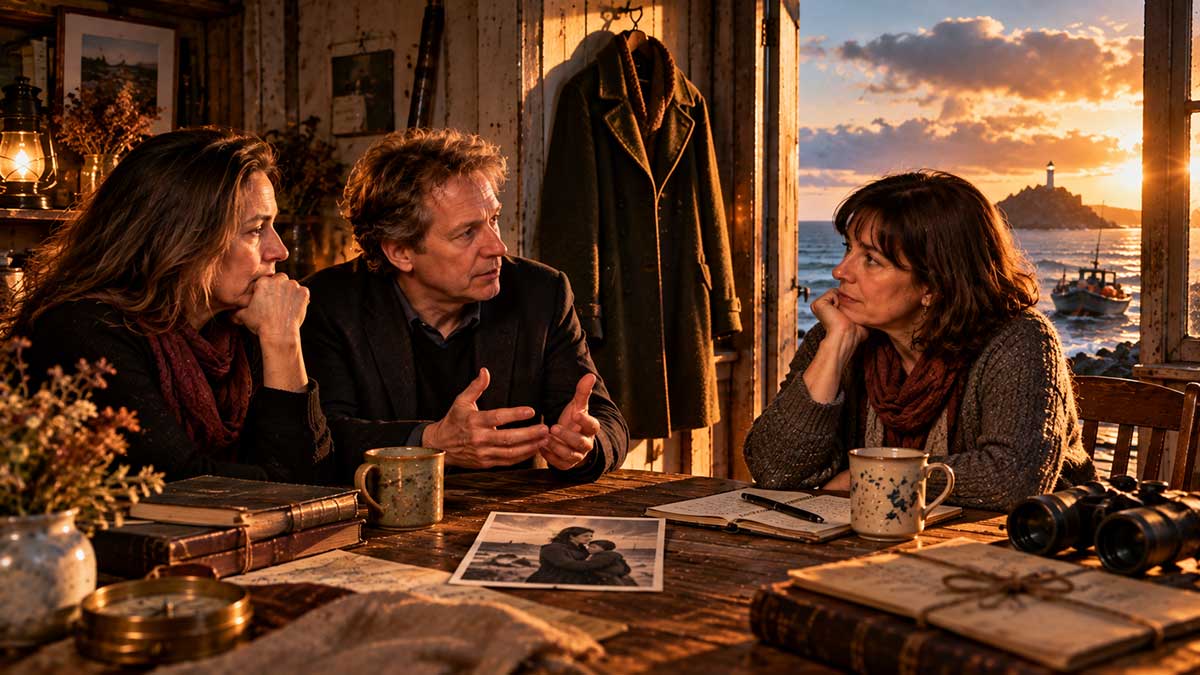
Shearwater Island. The last hours before evacuation.
The storm has passed, leaving the seed vault strangely quiet. Water seeps beneath a door at the far end of the corridor. Outside, the Southern Ocean glitters beneath a pale morning sky.
On a wooden table, the moderator has arranged five paper envelopes.
Wheat. A medicinal plant. A rare wildflower. Coastal grass. An unidentified species.
Robin Wall Kimmerer, botanist and author of Braiding Sweetgrass, examines the envelopes. Climate scientist Katharine Hayhoe stands beside a map of the island. Psychologist Paul Bloom sits at the table, studying the small evacuation boat visible through the window.
Moderator: I have a problem for you.
Paul Bloom: That sounds ominous.
Moderator: Five seed packets. Room for only three on the evacuation boat.
You have ten minutes to decide which survive.
Katharine Hayhoe: Why only three?
Moderator: Limited space.
Katharine Hayhoe: How limited?
Moderator: Very.
Katharine Hayhoe: What's the boat's actual capacity? What else are we carrying? Are these the only surviving samples? Do we know their viability?
Paul Bloom: Katharine, he's trying to give us a moral dilemma.
Katharine Hayhoe: And I'm trying to determine whether it's a real dilemma.
Robin smiles.
Robin Wall Kimmerer: I was going to ask what plants they are. A packet marked "medicinal plant" tells us remarkably little.
Moderator: All right. You've both made your point. But suppose we have no time to investigate. Three packets. Which ones?
Paul Bloom: Wheat.
Moderator: That was quick.
Paul Bloom: People need to eat.
Robin Wall Kimmerer: So do the creatures who depend on the coastal grass.
Paul Bloom: I'm aware of that. But if we're genuinely forced to choose, we need priorities. A staple crop with known food value seems like an obvious candidate.
Katharine Hayhoe: Except that we don't know whether this particular wheat variety has unique genetic traits. We don't know whether the medicinal plant contains compounds that could be valuable in the future. We don't know whether the grass stabilizes an entire coastal ecosystem.
Paul Bloom: We know almost nothing, apparently.
Katharine Hayhoe: Which is often how difficult decisions begin.
Moderator: Let me explain why I chose these envelopes.
In Wild Dark Shore, young Orly loves plants with an intensity that adults sometimes struggle to understand. The seed vault exists to preserve life for a future nobody can guarantee.
The novel asks us to consider what happens when we can no longer save everything.
And I keep returning to one question.
Who gave us the authority to decide which living things deserve to continue existing?
Robin Wall Kimmerer: Perhaps that's the first assumption we should question.
Moderator: That we have the authority?
Robin Wall Kimmerer: That the world consists of objects awaiting our judgment.
When we ask which plants deserve to survive, we position ourselves as the judges of their worth.
But plants are not merely resources waiting to become useful to us. They are participants in living communities.
Paul Bloom: That's a beautiful way of describing ecology, but it doesn't solve the problem.
Robin Wall Kimmerer: I haven't claimed it does.
Paul Bloom: We have five packets and three spaces. Unless you intend to draw lots, somebody has to make a decision.
Robin Wall Kimmerer: Yes. And I would rather make that decision with humility than with the assumption that human usefulness is the only value worth considering.
Moderator: Paul, let me challenge you. Why should wheat come first?
Paul Bloom: Because if preserving wheat helps prevent starvation, that matters enormously.
I'm not saying flowers are worthless. I'm saying that in a genuine emergency, consequences matter.
Suppose one choice could help feed thousands of people, while another preserves a flower whose ecological role is uncertain.
I don't think it's irrational to favor the food crop.
Robin Wall Kimmerer: But you're assuming that we know the consequences.
Paul Bloom: We have to make decisions using the information available.
Robin Wall Kimmerer: Certainly. Yet the history of ecology repeatedly teaches us that relationships matter.
A flower may support pollinators. Those pollinators may support other plants. A grass may hold soil in place, shelter organisms, or help maintain a coastline.
The value of a species is not always visible when you hold its seeds in your hand.
Katharine Hayhoe: And there is another complication. Conservation decisions rarely involve choosing a single species in isolation.
We have to consider habitats, genetic diversity, ecological functions, vulnerability, feasibility, and the risks of losing something that cannot be recovered.
Moderator: Then perhaps the rare flower should come first?
Katharine Hayhoe: Not necessarily.
Rarity alone doesn't tell us whether preserving this particular packet is the most effective intervention.
We need to know whether the species exists elsewhere, whether the seeds can germinate, and whether there will be a suitable habitat for it.
Paul Bloom: Thank you. That's what I've been trying to say. We need evidence, not just affection.
Robin Wall Kimmerer: I don't think affection and evidence are enemies.
Paul Bloom: They can be.
Robin Wall Kimmerer: They can also lead us to ask questions we would otherwise neglect.
The moderator picks up the envelope marked "rare wildflower."
Moderator: Suppose Orly chose this one simply because he thought it was beautiful.
Would that be a foolish reason?
Paul Bloom: As the sole reason in a life-or-death allocation? Potentially, yes.
Moderator: Even if that beauty made him care enough to save it?
Paul Bloom: Caring is valuable. But caring about something doesn't automatically make it the best priority.
We all have attachments. The challenge is that our attachments are selective.
A child may adore a flower and feel nothing for a fungus that plays a much more important ecological role.
Robin Wall Kimmerer: That's true.
Paul Bloom: You're agreeing with me?
Robin Wall Kimmerer: On that point, yes.
Paul laughs.
Robin Wall Kimmerer: Love of nature must deepen into knowledge. We should learn the names and relationships of the beings around us, not assume that what catches our eye is all that matters.
But I would never dismiss Orly's affection as childish.
It may be the beginning of responsibility.
Moderator: Explain that.
Robin Wall Kimmerer: Consider what happens when a child kneels beside a plant and asks why its leaves are shaped a certain way.
That curiosity may lead to learning about soil, insects, weather, roots, and the living community surrounding it.
Affection opens the door. Knowledge helps us understand what lies beyond it.
Katharine Hayhoe: That's an important point for climate communication, too.
People rarely devote sustained effort to protecting something they feel no connection to.
Information matters. But information alone doesn't always move people to act.
Paul Bloom: I agree that motivation matters. My objection is to confusing motivation with moral justification.
Moderator: So Orly's love for the flower might inspire him to study it, but shouldn't automatically determine whether it gets the last space on the boat.
Paul Bloom: Exactly.
Robin Wall Kimmerer: And I would ask whether the adults who dismiss his flower have studied it any more carefully than he has.
The moderator sets the envelope down.
Moderator: That seems fair.
Let me change the problem.
Suppose the unknown packet contains the seeds of a plant that could someday produce a medicine capable of saving millions of lives.
Would that change your decision?
Paul Bloom: Obviously.
Moderator: But we don't know that.
Paul Bloom: Then we have to estimate probabilities.
Katharine Hayhoe: And recognize the limits of those estimates.
Moderator: Now suppose the unknown plant turns out to have no medical value, no agricultural value, and no obvious ecological function.
Does it still deserve to exist?
Robin Wall Kimmerer: Yes.
Paul Bloom: I would distinguish two questions.
Does it have value? And should we prioritize saving it over other things?
Those are not identical.
Robin Wall Kimmerer: Agreed.
Moderator: Robin, why does it have value if it does nothing for us?
Robin Wall Kimmerer: Why should doing something for us be the condition of its existence?
The room becomes quiet.
Robin Wall Kimmerer: A forest is not valuable only when we harvest its timber. A bird does not need to sing for human enjoyment to justify its life.
I understand that conservation requires practical decisions. I have worked with plants long enough to know that resources are limited.
But there is a profound difference between saying, "We cannot save everything," and saying, "Everything we cannot use is expendable."
Paul Bloom: I don't disagree.
Moderator: You don't?
Paul Bloom: No. I haven't argued that useless things are worthless.
I'm arguing that when choices have consequences, we should think carefully about those consequences.
Suppose saving the unknown plant means losing a crop variety that could improve food security for vulnerable communities.
Would you still choose the unknown plant?
Robin Wall Kimmerer: Not automatically.
Paul Bloom: Then we're closer than we sound.
Robin Wall Kimmerer: Perhaps. But I would want us to remember the cost of the choice we didn't make.
Moderator: Why?
Robin Wall Kimmerer: Because moral seriousness includes grief.
Sometimes we make the best decision available and still lose something irreplaceable.
We should not confuse necessity with the absence of loss.
Katharine moves to the window. The evacuation boat rocks against its mooring.
Katharine Hayhoe: There's something else I want to challenge.
We're talking as though conservation is always a desperate final choice between a few surviving seeds.
But in the real world, many of the decisions that determine what survives happen long before the emergency.
Moderator: Such as?
Katharine Hayhoe: Whether we protect habitats. Whether we reduce emissions. Whether we support conservation research. Whether communities have the resources to adapt.
And whether we act while options are still available.
Paul Bloom: In other words, prevention is better than triage.
Katharine Hayhoe: Exactly.
Moderator: But isn't the world already in an ecological emergency?
Katharine Hayhoe: In many ways, yes. Climate change and biodiversity loss are serious, ongoing threats.
But that doesn't mean every future outcome is fixed.
The amount of warming matters. The extent of habitat destruction matters. The actions we take matter.
We cannot reverse every loss. Yet we can still prevent many others.
Moderator: So the mistake would be believing that because some things are already lost, nothing else is worth saving.
Katharine Hayhoe: Yes. That belief can become a reason not to act.
Paul Bloom: There's a psychological problem there, too.
People can become overwhelmed when they realize they can't help everyone or save everything.
They may conclude that partial success is meaningless.
Moderator: And you disagree?
Paul Bloom: Strongly.
If you can save three lives instead of five, saving three still matters.
If you can preserve part of an ecosystem rather than all of it, that achievement isn't worthless.
We shouldn't let the perfect become the enemy of the possible.
Robin Wall Kimmerer: True. But we should also be careful about who bears the losses.
Moderator: What do you mean?
Robin Wall Kimmerer: A conservation decision may look efficient on paper while disregarding the people who live with a landscape, depend on it, or have cared for it across generations.
Ecological knowledge doesn't reside only in laboratories.
Communities possess knowledge of local plants, seasonal changes, and relationships that may be invisible to outside decision-makers.
Katharine Hayhoe: And conservation works better when the people affected are meaningfully involved.
Moderator: Then perhaps our problem isn't simply which seeds to save.
It's who gets to make the decision.
Paul Bloom: Yes, though consultation doesn't eliminate the need to choose.
Moderator: You really won't let us escape the dilemma.
Paul Bloom: Someone has to keep us honest.
The moderator glances at the five envelopes.
Moderator: Then let's make the decision.
Three packets. No more questions.
Katharine Hayhoe: I still want to know what's in the boat.
Paul Bloom: Katharine.
Katharine Hayhoe: I'm serious.
She points through the window.
Katharine Hayhoe: Look at it. We're treating those three spaces as if they were a law of nature.
What else is being transported?
Moderator: Food, equipment, personal belongings, research records.
Katharine Hayhoe: How much of it is essential?
Moderator: Some of it.
Katharine Hayhoe: All of it?
Moderator: Probably not.
Robin Wall Kimmerer: Are there smaller containers? Could the seeds be divided into viable samples?
Paul Bloom: That depends on the species and how the seeds must be stored.
Katharine Hayhoe: Exactly. Let's find out.
Moderator: You're changing the rules.
Katharine Hayhoe: No. I'm questioning the rules you gave us.
Moderator: But suppose the capacity really is fixed.
Katharine Hayhoe: Then we choose. We use the best evidence available, acknowledge uncertainty, and accept responsibility.
But first we should make sure we're not surrendering possibilities that still exist.
Robin picks up the unidentified packet.
Robin Wall Kimmerer: I wonder what Orly would do.
Paul Bloom: He'd probably try to carry all five.
Moderator: That's exactly what I was thinking.
Paul Bloom: Which might be impractical.
Robin Wall Kimmerer: Or it might be the question we forgot to ask.
Moderator: How do we save more?
Robin Wall Kimmerer: Yes.
Children are sometimes less willing to accept the boundaries adults have learned to live within.
That doesn't mean every boundary can be overcome.
But occasionally it means the adults have stopped looking for another way.
The moderator opens one of the empty wooden boxes beside the table.
Moderator: There's room in here for several smaller envelopes.
Paul Bloom: Provided they're packed properly.
Katharine Hayhoe: Then let's check.
For several minutes, the conversation stops.
Katharine examines the storage records. Robin studies the packets. Paul clears unnecessary objects from a transport box.
The moderator watches them work.
Moderator: I have to admit something.
I expected a philosophical argument.
Paul Bloom: You got one.
Moderator: Yes, but now you're packing seeds.
Katharine Hayhoe: Philosophical arguments are useful. So are working hands.
Robin Wall Kimmerer: Especially when they work together.
The moderator holds up the rare flower packet.
Moderator: I want to return to Orly.
What do you think this boy understands that adults sometimes forget?
Robin Wall Kimmerer: That loving something is not foolish simply because it cannot promise to repay you.
Paul Bloom: I'd say he reminds us that moral concern begins with noticing.
But noticing is only the beginning. We still have to decide what to do.
Katharine Hayhoe: And I'd say he hasn't yet learned to mistake despair for wisdom.
Moderator: That's an interesting phrase.
Katharine Hayhoe: Adults sometimes speak as though expecting the worst makes them more realistic.
But realism means taking the evidence seriously, including evidence that our choices can make a difference.
Moderator: So hope doesn't require pretending every species can be saved.
Katharine Hayhoe: No. It requires recognizing that what we do next still matters.
Robin carefully places the unidentified seeds into a smaller protective envelope.
Moderator: One final question.
Suppose that despite everything we've done, we still have to leave one packet behind.
How do we decide?
Paul Bloom: We make the best judgment we can with the information available.
Katharine Hayhoe: We consider the likely consequences, the uncertainties, and the possibility of preserving information or recovering the species elsewhere.
Robin Wall Kimmerer: And we remember what we've lost.
Moderator: Even if remembering hurts?
Robin Wall Kimmerer: Especially then.
Grief can remind us that the world is not a collection of disposable things.
But grief must not be the end of our relationship with the living.
Outside, a gull passes the window.
Moderator: I think I finally understand the difference between your positions.
Paul wants us to make responsible choices.
Katharine wants us to make those choices using evidence, while expanding the possibilities wherever we can.
And Robin wants us to remember that whatever we choose, the lives we cannot save are not worthless.
Paul Bloom: That's fair.
Katharine Hayhoe: I can live with that.
Robin Wall Kimmerer: So can I.
The moderator looks at the packets now resting inside the transport box.
Moderator: Then perhaps the most dangerous sentence in conservation isn't "We can't save everything."
Perhaps it's "We can't save everything, so why bother?"
Katharine Hayhoe: Yes.
Paul Bloom: Because the difference between saving nothing and saving something is enormous.
Robin Wall Kimmerer: And because the world is still giving us reasons to care.
The moderator closes the box, leaving the lid unlatched until the contents can be checked.
Moderator: One last thing.
If Orly were standing here, watching us choose which seeds to carry, what would you tell him?
Paul Bloom: I'd tell him that caring about every living thing doesn't mean he can protect every living thing.
And that making a difficult choice doesn't make him a bad person.
Katharine Hayhoe: I'd tell him to keep asking questions. Learn the science. Find other people who care. Don't assume that a problem is impossible just because it's difficult.
Robin Wall Kimmerer: I'd ask him to remember the plants he leaves behind.
Not so he must carry their loss as a lifelong burden.
But so that wherever he goes, he remembers that he belongs to a world filled with lives beyond his own.
Moderator: And if he asks whether his little flower matters?
Robin rests her hand on the packet.
Robin Wall Kimmerer: I'd tell him that its beauty is already a reason to notice it.
Then I'd invite him to learn everything else it might teach us.
The moderator lifts the transport box.
It is heavier than he expected.
Moderator: We began with five packets and three spaces.
We haven't solved every problem.
But we've found room for more than we thought.
Katharine Hayhoe: That's a good beginning.
The door opens. Fresh salt air moves through the vault.
Beyond the island, the sea is still rising.
The experts carry the seeds toward the waiting boat.
And for this morning, at least, the question is no longer only what must be abandoned.
It is what they can still carry together.
Editorial disclosure: This is a fictional conversation inspired by Charlotte McConaghy's Wild Dark Shore. The dialogue draws on broad themes in the experts' published work but does not represent their actual words, participation, or endorsements. The seed-packet dilemma and the experts' actions are invented for this thought experiment.
Topic 4: Must Love Prove Itself Through Sacrifice?
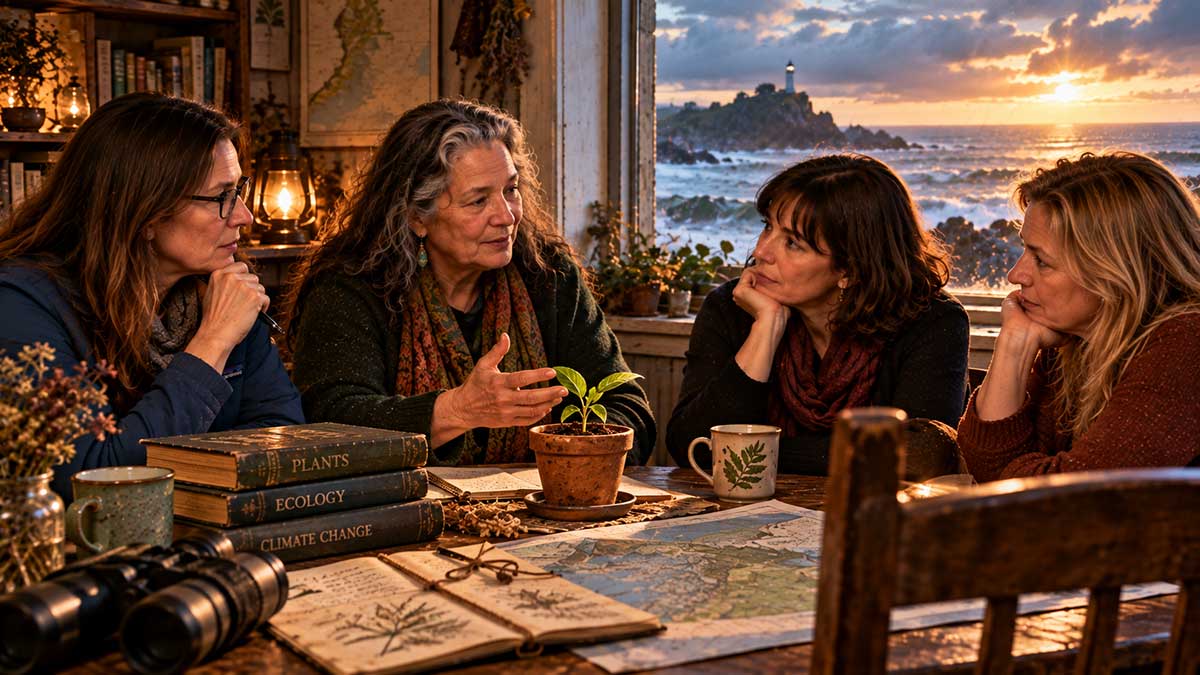
Shearwater Island. The morning of the evacuation.
The storm has passed, but the sea continues to rise.
Inside the lighthouse, a dark green wool coat hangs beside the door. It belonged to Rowan.
The evacuation boat is nearly loaded. Through the window, three figures move along the shoreline, carrying the final crates from the seed vault.
Megan Devine stands near the coat. Paul Bloom sits at a small wooden table. Alison Gopnik examines a photograph of the island's inhabitants, taken before everything changed.
The moderator enters with a notebook.
Moderator: I want to begin with a confession.
When I first finished Wild Dark Shore, I thought Rowan's sacrifice was beautiful.
Then I imagined Orly growing up.
And I wasn't so sure anymore.
Megan Devine: What changed?
Moderator: I began wondering what it would feel like to know someone had died saving your life.
Not just for a day or a year.
For the rest of your life.
Paul Bloom: You seem to be assuming that the death would become a burden.
Moderator: Wouldn't it?
Paul Bloom: It might. But that's not inevitable. We should distinguish the act itself from the meaning other people attach to it afterward.
Alison Gopnik: And we should distinguish what adults imagine a child ought to feel from what the child actually experiences.
Moderator: Let me ask the question directly.
Was Rowan's death an act of extraordinary love?
Paul Bloom: It can reasonably be understood that way.
Megan Devine: But I want to know why that's our first question.
Moderator: Because she sacrificed her life.
Megan Devine: Yes. She died. And almost immediately, we're asking what her death proves.
Moderator: Isn't that natural?
Megan Devine: Very natural. We want to find meaning in terrible things.
But there's a danger in rushing to turn someone's death into a lesson.
A person has died. People who loved her are devastated. Before we decide what her death teaches us, perhaps we should acknowledge what has been lost.
Moderator: Rowan herself.
Megan Devine: Exactly.
Not simply a brave woman. Not simply the person who saved someone.
A whole human being who had thoughts, desires, fears, contradictions, and a future she might have wanted.
Alison Gopnik: That's important. Children can absorb the stories adults tell about the dead.
If Rowan becomes nothing more than the person who gave her life for Orly, then Orly may grow up knowing her primarily through the meaning adults assign to her death.
Paul Bloom: But we shouldn't go too far in the other direction.
There are genuinely admirable sacrifices. Someone who risks their life to save another person may be acting with extraordinary courage.
We don't need to deny that because the outcome is tragic.
Megan Devine: I haven't denied it.
I'm questioning why admiration so often becomes an obligation imposed on the living.
Moderator: Let's explore that.
Suppose Dominic tells Orly, "Rowan died so that you could live."
Is that wrong?
Paul Bloom: Not necessarily. It may be a factual description of what happened.
Megan Devine: But what does a nine-year-old hear?
Moderator: That someone loved him enough to die for him.
Megan Devine: Perhaps.
Or he hears, "Someone is dead because I am alive."
The moderator looks toward the coat.
Alison Gopnik: And children may construct causal explanations that adults never intended.
An adult might mean, "You were loved."
A child might hear, "I caused a death."
Paul Bloom: Then the solution is to communicate carefully, not to hide the truth.
Alison Gopnik: I agree.
But communication isn't a single sentence. It's an ongoing relationship in which the child can ask questions, express feelings, and revisit the event as they grow.
Moderator: What should Dominic say instead?
Megan Devine: I would begin by removing the debt.
"Rowan made a choice because she cared about you. You did not make her die. And you don't have to earn the life you have."
Moderator: You don't have to earn the life you have.
He repeats the sentence slowly.
Moderator: That sounds simple. But I wonder how many adults believe it.
Paul Bloom: Not enough, perhaps.
We have a tendency to think of gratitude as creating obligations.
If someone does something enormous for us, we feel compelled to respond with something equally enormous.
Moderator: But how do you repay a life?
Paul Bloom: You can't.
And that's precisely why treating it as a debt is a mistake.
Alison Gopnik: Imagine Orly becoming a young man who believes he must accomplish something extraordinary because Rowan died for him.
He might feel guilty for being ordinary.
Moderator: For having an ordinary job?
Alison Gopnik: Or for making mistakes. For wasting an afternoon. For falling in love with someone his family dislikes. For choosing a life that doesn't seem important enough.
The belief that your existence must justify another person's death can become an impossible standard.
Megan Devine: And grief already contains enough pain without adding an obligation to become exceptional.
Moderator: But isn't there something noble about wanting to make the most of a life someone saved?
Paul Bloom: Certainly. The problem isn't gratitude. It's compulsion.
There's a difference between saying, "Her actions inspire me to live well," and saying, "I have no right to live unless I achieve something worthy of her sacrifice."
Moderator: One is love. The other is a sentence.
Megan Devine: Yes.
And I would add that "living well" doesn't have to mean doing something impressive.
Sometimes living well means making breakfast, caring for a friend, growing old, or having a perfectly uneventful Tuesday.
Outside, the boat's engine briefly starts, then falls silent.
Moderator: I want to challenge something else.
Why are we so moved by someone who dies for love?
Why do we sometimes seem less moved by someone who spends forty years living for it?
Alison Gopnik: Because dramatic moments are easier to turn into stories.
A single act has a beginning, a crisis, and a resolution.
Parenting is different. It consists of thousands of ordinary interactions, many of which seem unimportant at the time.
Moderator: Such as?
Alison Gopnik: Sitting beside a child who can't sleep.
Answering the same question for the twentieth time.
Apologizing when you've been impatient.
Letting a teenager make a choice you wouldn't make.
These things rarely look heroic.
But they shape a life.
Paul Bloom: I agree with the general point, though I wouldn't want to suggest that dramatic sacrifice is merely a storytelling trick.
Some acts really are extraordinary.
Megan Devine: And some quiet acts require extraordinary courage.
Paul Bloom: Absolutely.
Megan Devine: Think of someone who has lost a person they love and still gets up each morning to care for the living.
They don't have a single heroic moment.
They have hundreds of days when they would rather not face the world, and they face it anyway.
Moderator: Dominic.
Megan Devine: Perhaps. Though I wouldn't want to romanticize his suffering either.
Moderator: You're difficult to satisfy.
Megan smiles faintly.
Megan Devine: I'm suspicious of stories that require pain to become beautiful before we consider it worthy of attention.
Moderator: Then let me make the question harder.
Suppose Rowan had a choice.
She could save Orly at the cost of her own life, or she could preserve her own life while Orly died.
Wouldn't saving him be the morally right choice?
Paul Bloom: We have to be careful. You've created a hypothetical in which we know the outcomes with certainty.
Real emergencies rarely offer that clarity.
But if we accept your assumptions, many people would regard saving the child as profoundly admirable.
Moderator: Would it be obligatory?
Paul Bloom: That's a different question.
Moderator: Answer it.
Paul Bloom: I don't think we can casually declare that a person is morally required to die whenever doing so could save another life.
There are circumstances in which we admire someone for going beyond what duty demands.
Moderator: So if Rowan had chosen to live, she wouldn't necessarily have been a bad person?
Paul Bloom: Correct.
Megan Devine: I want that stated clearly.
We must not turn admiration for someone who died into condemnation of someone who survives.
Alison Gopnik: Especially when we talk about mothers and caregivers.
Moderator: Why especially them?
Alison Gopnik: Because our culture often treats self-erasure as evidence of good parenting.
A mother is praised for never putting herself first. A father is praised for working himself to exhaustion. A caregiver is praised for giving everything until nothing remains.
But a child's well-being doesn't require the disappearance of the adult's own humanity.
Moderator: Yet parents do sacrifice for their children.
Alison Gopnik: Of course. Sacrifice is part of caring for someone.
But there's a difference between making sacrifices and believing that your needs, desires, and identity no longer matter.
Paul Bloom: And that distinction is relevant to Rowan.
We can recognize the courage of her action without suggesting that her life had value only because she gave it up.
Moderator: That may be the sentence I've been looking for.
The moderator opens his notebook.
Moderator: Let me read you something I wrote last night.
"Perhaps the tragedy isn't that Rowan died for love. Perhaps it's that we are tempted to remember her death more vividly than her life."
Megan Devine: I think that's worth sitting with.
Moderator: Do you agree?
Megan Devine: I agree that people can disappear behind the stories we tell about how they died.
But I wouldn't tell grieving people which memories they're allowed to find meaningful.
Some may need to remember her courage. Others may remember her laughter, her mistakes, or the ordinary moments that made her herself.
There should be room for all of it.
Alison Gopnik: And for Orly, the story may change over time.
At nine, he may need reassurance that he wasn't responsible.
At sixteen, he may become angry that Rowan died.
At thirty, he may understand her choice differently.
Moderator: Angry with her?
Alison Gopnik: Why not?
Children are allowed to have complicated feelings about the people they love.
Megan Devine: That's something we rarely give survivors permission to say.
You can be grateful someone saved you and furious that they're gone.
You can admire their courage and wish they had made a different choice.
Those feelings don't cancel one another.
Paul Bloom: And they don't change the moral character of the original act.
Moderator: I wonder if Orly might someday say, "I wish you hadn't saved me."
The room falls silent.
Megan Devine: If he said that, I would want someone to listen before correcting him.
Moderator: Even though the statement is heartbreaking?
Megan Devine: Especially then.
It may express guilt, anger, longing, or a wish that the impossible could be undone.
We don't help someone by immediately telling them how grateful they ought to be.
Alison Gopnik: And we shouldn't interpret a single painful statement as the entirety of what a child believes.
Moderator: What would you tell him?
Megan Devine: I'd ask what he means.
Perhaps he wishes Rowan were alive. Perhaps he feels responsible. Perhaps he's tired of being told that he has a special destiny.
We can't know until we listen.
Paul Bloom: I'd want him to understand that another person's choice does not make him morally responsible for the outcome.
Alison Gopnik: And that his life belongs to him.
Moderator: Even though someone else gave up theirs to preserve it?
Alison Gopnik: Especially then.
The moderator closes his notebook.
Moderator: There's a question about Rowan herself that I think we've avoided.
What if she didn't want to die?
Megan Devine: Why would we assume she did?
Moderator: Because we call it a sacrifice.
Megan Devine: A person can make a courageous choice while desperately wanting to survive.
Those aren't contradictions.
Paul Bloom: In fact, the willingness to accept a terrible personal cost may be part of why we admire the action.
Moderator: Then perhaps when we say her death was beautiful, we're forgetting that she may have been frightened.
Megan Devine: And that she may have wanted a thousand ordinary tomorrows.
Alison Gopnik: A life she didn't get to live.
Moderator: That changes the way I see the ending.
I don't want to take away the meaning of what she did.
But I don't want to make her death sound like something she was born to accomplish.
Paul Bloom: Then don't.
We can honor an act without claiming it was destiny.
Moderator: And we can mourn the life that was lost.
Megan Devine: Yes.
Through the window, the sun breaks through a long bank of clouds. The sea remains restless, but the island is briefly illuminated.
Moderator: I want to return to something Alison said earlier.
That we celebrate dying for love more readily than living for it.
Suppose Rowan had survived.
Suppose she and Orly grew old together as friends. Suppose she spent the next forty years doing nothing especially dramatic.
Would that have been a lesser love story?
Alison Gopnik: Not at all.
Paul Bloom: No.
Megan Devine: I think it might have been a wonderful one.
Moderator: Even if nothing heroic happened?
Megan Devine: Especially if nothing heroic needed to happen.
The moderator looks at Rowan's coat.
Moderator: Then perhaps what makes her death tragic is not only that she lost her life.
It's that she lost the chance to express her love in all those ordinary ways.
Alison Gopnik: Yes.
And Orly lost the chance to receive it.
Paul Bloom: Which is why we should be careful about calling any death a happy ending.
Moderator: Even when it saves someone?
Paul Bloom: We can be grateful for the life saved and still recognize the death as a terrible loss.
Both can be true.
The moderator walks to the door and gently lifts Rowan's coat from its hook.
Moderator: One final question.
If Rowan could speak to Orly now, what do you think she would want him to know?
Megan Devine: We can't know what Rowan would say.
Moderator: I know. But what would you hope he could hear?
Megan considers the question.
Megan Devine: That he is allowed to be happy.
That he is allowed to have days when he doesn't think about her.
That forgetting to be sad is not the same as forgetting someone.
And that he doesn't have to turn his life into a monument.
Alison Gopnik: I would hope he understands that growing up means discovering who he is, not trying to become the person he imagines Rowan would have wanted.
He can love plants. He can change his mind. He can make mistakes.
He can become ordinary, extraordinary, or something nobody expected.
Paul Bloom: And I'd want him to know that gratitude doesn't require repayment.
A gift freely given is not a debt that must be settled.
Moderator: Even a gift as enormous as life?
Paul Bloom: Especially one that cannot be repaid.
The moderator folds Rowan's coat over his arm.
Moderator: When we began, I asked whether great love requires great sacrifice.
I think I was asking the wrong question.
Alison Gopnik: What would you ask now?
Moderator: How can we honor someone who gave everything without teaching the people they saved that they owe everything in return?
No one answers immediately.
Megan Devine: Perhaps by remembering that Rowan's life mattered before her final act.
Paul Bloom: And that Orly's life matters regardless of what he does with it.
Alison Gopnik: And by giving him the freedom to live it.
Outside, someone calls from the boat. It is time to leave.
The moderator opens the lighthouse door. The wind has softened.
Moderator: There's one thing I wish Rowan could have had.
Megan Devine: What's that?
Moderator: A long, uneventful life.
He looks toward the brightening horizon.
Moderator: A life where nobody needed her to be a hero.
For a moment, the three experts stand together in silence.
Then they walk toward the waiting boat, carrying the seeds, the research records, and Rowan's coat.
Not because her death needs to be made beautiful.
But because her life was worth remembering.
Editorial disclosure: This is a fictional thought experiment inspired by Charlotte McConaghy's Wild Dark Shore. The dialogue draws on broad themes in the experts' published work but does not represent their actual statements, participation, or endorsements. The imagined reflections on Rowan and Orly are literary interpretations, not claims about the author's intentions.
Topic 5: Can We Raise Hopeful Children Without Lying to Them?
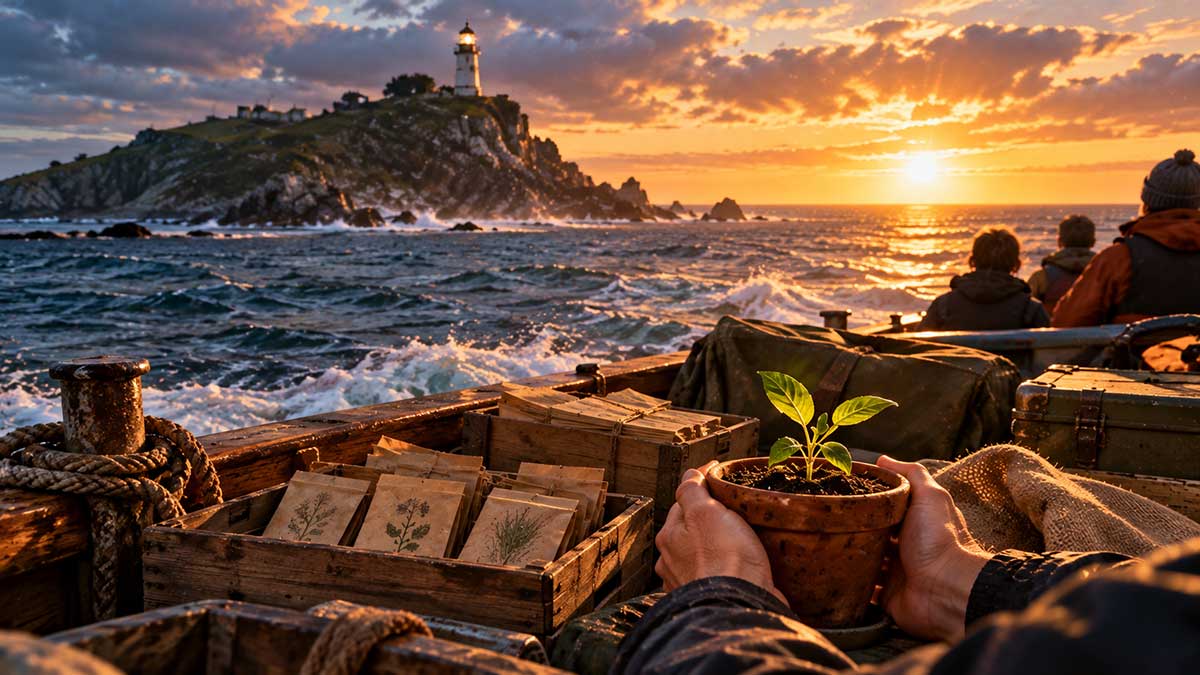
Shearwater Island. The morning of the evacuation.
The storm has passed. A pale sun rises over the Southern Ocean, illuminating the island's battered coastline. The sea has taken part of the lower path, and the seed vault will soon be abandoned.
Inside the lighthouse, a small clay pot rests on the windowsill. A green shoot has emerged from the soil.
Katharine Hayhoe, climate scientist; Robin Wall Kimmerer, botanist and author; Alison Gopnik, developmental psychologist; and Megan Devine, grief writer, have gathered for one final conversation.
The moderator stands beside the window, looking at the seedling.
Moderator: I have one last question before we leave.
Suppose Orly walks into this room, sees the water rising outside, and asks us something no adult wants to hear.
"Is the world going to be okay?"
He turns toward the experts.
Moderator: What do we tell him?
Katharine Hayhoe: I'd ask what he means by okay.
Moderator: He's nine years old, Katharine.
Katharine Hayhoe: Nine-year-olds can ask remarkably sophisticated questions.
Does he mean the island? His family? The plants? The planet?
Those are different questions, and they have different answers.
Moderator: All right. Suppose he means the planet.
Will it be okay?
Katharine Hayhoe: The planet will continue to exist. The question is what happens to the living systems and communities that depend on it.
Climate change is already causing serious harm. Some losses are irreversible on human timescales.
But the future isn't a single predetermined outcome. Every additional increment of warming matters, and so do the actions that influence it.
Moderator: That sounds scientifically responsible.
But would it comfort a frightened child?
Megan Devine: Why must comfort be the first objective?
Moderator: Because he's frightened.
Megan Devine: Then perhaps we should begin by acknowledging that.
A child asks whether the world will be okay, and we immediately start constructing an answer that will make the fear disappear.
But what if the fear is reasonable?
Alison Gopnik: I agree that we shouldn't dismiss it. But children also need a sense that the adults around them are capable of responding.
There's a difference between saying, "Everything will be fine," and saying, "There are serious problems, and people are working on them. You don't have to solve them alone."
Moderator: Robin?
Robin Wall Kimmerer: I would ask Orly to show me what he's worried about.
Perhaps he'd take us to a patch of coastal grass being swallowed by the sea.
Perhaps he'd show us a bird's nest.
Or perhaps he'd point to this seedling and ask whether it has a future.
Moderator: And what would you say?
Robin Wall Kimmerer: I'd tell him that living things have always faced uncertainty.
But I would also tell him that the relationships we build with the living world matter.
We can learn what a plant needs. We can care for the soil. We can protect the places where life continues.
The future is not something we merely wait to receive.
Katharine Hayhoe: I agree with that last point. But I want to be careful.
Individual care matters, yet the scale of environmental change requires collective action.
We cannot tell a child that planting a seed will solve climate change.
Robin Wall Kimmerer: Of course not.
Katharine Hayhoe: Because children can turn that into another burden.
They recycle a bottle, plant a tree, and then discover the world is still warming.
They may conclude that they failed.
Moderator: So even teaching children to care can become dangerous?
Alison Gopnik: If we make them responsible for outcomes they cannot control, yes.
We discussed something similar with Dominic.
A child should not feel responsible for keeping a grieving parent alive.
Nor should a child feel personally responsible for saving the planet.
Moderator: But how do we encourage responsibility without creating guilt?
Alison Gopnik: By distinguishing participation from control.
Children can contribute to meaningful activities. They can learn, experiment, cooperate, and see that their actions have consequences.
But they shouldn't be told that the entire future rests on their shoulders.
Megan Devine: And we should allow them to have ordinary childhoods.
A child can care deeply about the environment and still want to play, laugh, and spend an afternoon doing absolutely nothing productive.
Moderator: That sounds almost irresponsible when the world is in danger.
Megan Devine: Does it?
Why should the existence of suffering mean that joy becomes a luxury we must earn?
The moderator looks at the seedling.
Moderator: I think about Orly.
He's already lost so much. Claire. Rowan. The island he loves.
And now we're asking him to care about a future that may contain more loss.
Wouldn't it be kinder to tell him everything will be all right?
Megan Devine: Kinder for whom?
Moderator: For him.
Megan Devine: Or for the adult who can't bear to see him frightened?
The moderator doesn't answer.
Megan Devine: False reassurance can make us feel useful for a moment.
But when the promised safety doesn't arrive, the child is left with both the original loss and the knowledge that the adults weren't truthful.
Katharine Hayhoe: There's another problem. Telling children that everything will be fine can imply that no action is necessary.
And telling them that everything is doomed can imply exactly the same thing.
Moderator: That's interesting. Optimism and despair leading to the same result.
Katharine Hayhoe: Yes. If the future is guaranteed to be wonderful, why act? If the future is guaranteed to be terrible, why act?
The scientific reality is that choices matter.
Moderator: Then what is hope?
Katharine Hayhoe: I would distinguish hope from a prediction.
Hope doesn't mean we know the outcome will be good.
It means recognizing that meaningful possibilities remain and choosing to work toward them.
Alison Gopnik: Children are remarkably suited to exploring possibilities.
They learn by asking questions, trying things, discovering that some approaches fail, and trying something different.
But adults can interfere when we insist that every experiment must succeed.
Moderator: Because failure becomes frightening?
Alison Gopnik: Yes.
If every failed attempt to grow a plant is treated as evidence that the future is hopeless, the child loses the freedom to experiment.
Robin Wall Kimmerer: And plants are wonderful teachers of patience.
A seed doesn't grow because we demand it.
We prepare the soil. We provide water and light. We pay attention.
Then we discover what happens.
Moderator: But sometimes it doesn't grow.
Robin Wall Kimmerer: Sometimes it doesn't.
Moderator: And sometimes the ocean takes the entire garden.
Robin Wall Kimmerer: Yes.
She looks toward the window.
Robin Wall Kimmerer: Love does not guarantee survival.
But the possibility of loss does not make caring meaningless.
Moderator: That sounds beautiful, Robin. But I want to challenge it.
Suppose Orly spends years protecting a rare plant, only to watch it disappear.
What exactly has his love accomplished?
Robin Wall Kimmerer: Perhaps he helped it live longer. Perhaps he learned something that can help another species. Perhaps he built relationships with people who share his care.
Or perhaps he simply gave attention to a living thing while it was here.
Not every meaningful relationship produces a measurable victory.
Katharine Hayhoe: I agree. But I would also want him to understand the difference between a loss that couldn't be prevented and one that might have been.
We shouldn't use acceptance to avoid responsibility.
Robin Wall Kimmerer: Nor should we use responsibility to deny that some losses are beyond our control.
Moderator: There's our disagreement.
Katharine says, "Act because the future can change."
Robin says, "Care even when the future cannot be changed."
Katharine Hayhoe: I wouldn't disagree with Robin.
Robin Wall Kimmerer: Nor I with Katharine.
Moderator: That's disappointing. I was hoping for an argument.
Alison Gopnik: You have two people describing different parts of the same problem.
Megan Devine: And I would add a third.
When the thing you tried to save is lost, you're allowed to grieve.
You don't have to immediately identify the positive lesson.
Moderator: So hope doesn't mean refusing sadness.
Megan Devine: No. That would be another form of denial.
Moderator: Let me ask something personal.
What do we do when a child asks a question we genuinely cannot answer?
Not because we're withholding information.
Because nobody knows.
Alison Gopnik: We can say, "I don't know."
Moderator: Just like that?
Alison Gopnik: Yes.
Then we can add, "Let's see what we can learn."
Children don't require adults to be omniscient.
They benefit from seeing adults approach uncertainty with curiosity rather than panic.
Katharine Hayhoe: And when science does provide an answer, we should use it.
Uncertainty isn't an excuse to ignore what we already know.
Moderator: So honesty means being clear about both knowledge and its limits.
Katharine Hayhoe: Exactly.
Megan Devine: And emotional honesty means not pretending that facts eliminate fear.
You can understand the science and still be frightened.
Moderator: I think I see the difficulty.
We want to give children facts without overwhelming them, hope without deceiving them, and responsibility without burdening them.
Is that even possible?
Alison Gopnik: Not perfectly.
Moderator: That's reassuring.
Alison laughs.
Alison Gopnik: Parenting isn't a system in which every input produces a predictable result.
Children are people, not projects.
You respond to the child in front of you. You make mistakes. You adjust.
Moderator: And if you don't know what to say?
Alison Gopnik: Sometimes you can simply sit beside them.
Megan Devine: That's often underestimated.
We assume that every painful question requires a brilliant answer.
But a child who is frightened may need to know that someone is willing to stay with them while the question remains unanswered.
The moderator pulls a chair toward the windowsill.
Moderator: Then let's try something.
Imagine Orly is sitting here.
He places a small empty chair beside the seedling.
Moderator: He asks, "If the island is disappearing, why should I plant anything?"
What would you say?
Robin Wall Kimmerer: I'd ask him where he wants to plant.
Moderator: Even though the island is disappearing?
Robin Wall Kimmerer: Perhaps we plant somewhere else.
Perhaps we carry the seed with us.
The end of one place does not mean the end of every possibility.
Katharine Hayhoe: And I'd help him understand what conditions the plant needs to survive.
Hope becomes stronger when it's connected to knowledge.
Alison Gopnik: I'd let him try.
I wouldn't take the seed from his hand and insist on doing it correctly.
Moderator: Even if he makes a mistake?
Alison Gopnik: Especially then.
Megan Devine: And if it doesn't grow, I'd let him be disappointed.
Moderator: You wouldn't tell him to plant another immediately?
Megan Devine: Not unless he wanted to.
Sometimes we rush people toward the next hopeful thing because their disappointment makes us uncomfortable.
Moderator: So you would let him mourn a seed?
Megan Devine: Why not?
If it mattered to him, it mattered.
The moderator studies the small green shoot.
Moderator: I keep thinking about something from our first conversation.
Dominic believed that love meant protecting his children from danger.
But we concluded that love also means allowing them to become independent.
Now we're saying something similar about the world.
We cannot protect everything.
But we can teach children how to care for what remains.
Katharine Hayhoe: And how to work with others to prevent further loss.
Robin Wall Kimmerer: And how to recognize that the living world is not merely a collection of things we own.
Megan Devine: And how to remain open to joy, even after loss.
Alison Gopnik: And how to make choices that belong to them.
Outside, a voice calls from the boat. The tide is rising again.
Moderator: We have to leave.
Before we go, I want each of you to answer one question.
What is the most important thing we can give a child facing an uncertain future?
Katharine Hayhoe: A truthful understanding of the world, along with the knowledge that collective action can make a difference.
Not a promise that everything will be fine.
A reason to participate.
Robin Wall Kimmerer: A sense of belonging.
Children should know they are part of a living community, connected to plants, animals, soil, water, and other people.
When you know you belong, caring becomes more than an obligation.
It becomes a relationship.
Alison Gopnik: The freedom to discover.
We cannot build the future for children. We can help them develop the curiosity, judgment, and resilience to shape it themselves.
Megan Devine: Permission to be human.
To be frightened. To be sad. To be angry.
And to be happy without feeling guilty.
Children shouldn't have to become symbols of hope for adults who have lost their own.
The moderator looks at the empty chair.
Moderator: That's the part I hadn't considered.
We keep asking children to give us hope.
But perhaps our responsibility is to help them discover their own.
He lifts the clay pot from the windowsill.
Moderator: One final question.
Suppose Orly asks, "Will this seedling survive?"
Katharine Hayhoe: We don't know yet.
Robin Wall Kimmerer: But we can learn what it needs.
Alison Gopnik: And let him help care for it.
Megan Devine: And whatever happens, he won't have to face it alone.
The moderator holds the small plant carefully.
Moderator: I think that's the answer I've been looking for.
Not "Everything will be okay."
Not "Everything is doomed."
Something much simpler.
"We don't know everything that will happen. But we know what we can do today. And we'll do it together."
The experts gather their belongings.
The last crates of seeds are already aboard the evacuation boat. The island behind them is changing, and none of them knows whether anyone will return.
At the doorway, the moderator stops.
Moderator: I want to ask one more thing.
If we cannot guarantee the future, what exactly are we promising our children?
Alison looks toward the waiting boat.
Alison Gopnik: That we will help them learn to live.
Katharine Hayhoe: That we will not surrender the future before it arrives.
Robin Wall Kimmerer: That they belong to a world still worthy of love.
Megan Devine: And that they don't have to earn our love by being brave.
The moderator nods.
Moderator: Then perhaps that's enough.
He steps outside.
The four experts follow him down the path toward the shore.
Behind them, the lighthouse stands against the brightening sky. The sea will continue to rise. Some seeds will never germinate. Some places will be lost.
But in the moderator's hands, a small green plant bends toward the sunlight.
It is not a guarantee.
It is something alive.
And for now, they will carry it together.
Editorial disclosure: This is a fictional conversation inspired by Charlotte McConaghy's Wild Dark Shore. The experts' dialogue is imagined and informed by broad themes in their published work. It does not represent their actual statements, participation, or endorsements. The evacuation setting and seedling are fictional literary devices.
Final Thoughts
Perhaps Love Was Never Meant to Give Us Control
There is a moment in life when we begin to understand something our younger selves could hardly imagine.
We can love someone with all our hearts and still be unable to protect them from everything.
We can be devoted parents and still make mistakes.
We can do our best for someone and discover that our best intentions caused pain.
We can sacrifice years of our lives for those we love and still have to accept that their lives belong to them.
And we can care deeply about the world while knowing that some things we treasure will disappear.
This is the difficult territory Charlotte McConaghy explores in Wild Dark Shore.
But after listening to these five imagined conversations, I find myself returning not to the island's destruction, but to the people who must learn how to live beyond it.
Dominic's story reminds us that love does not automatically justify our actions. A parent's fear can be understandable without every response to that fear being right. Sometimes the most loving thing we can do is admit that we were wrong and give those we love the freedom we were afraid to allow.
His children remind us that grief should never become an inheritance they are required to carry.
A child can miss a mother and still laugh.
A daughter can love her father and still disagree with him.
A son can appreciate everything his parents have done without being obligated to live the life they imagined for him.
And a family can remember someone who has died without making happiness feel like betrayal.
Then there is Rowan.
Her courage is moving. Her death is heartbreaking.
Yet perhaps the best way to honor someone who gave their life is not to demand extraordinary achievements from the person who survived.
Perhaps it is to let that person live.
To have ordinary mornings. To make mistakes. To fall in love. To grow older. To experience happiness without apologizing for it.
A life saved through love should not become a life imprisoned by gratitude.
And what of the seeds?
I keep thinking about those tiny, seemingly insignificant things.
Some may grow into plants that feed people. Others may become flowers that nobody notices. Some may never germinate at all.
Yet their uncertainty does not make them meaningless.
We often judge our efforts by whether they succeed. Did we save the relationship? Did we protect our children? Did we preserve what mattered?
But perhaps love cannot always be measured by the outcome.
Sometimes love means making a responsible choice when every option involves loss.
Sometimes it means accepting that we cannot repair everything.
And sometimes it means asking whether the limits we have accepted are truly the limits of what is possible.
What I Would Tell Orly
If I could speak to Orly after everything he has experienced, I would not tell him that the world will be all right.
I cannot know that.
I would not tell him that he must accomplish something extraordinary to justify Rowan's sacrifice.
He owes no one such a debt.
And I would not tell him that he has to save every plant, every animal, or every person he loves.
That is more responsibility than any child—or any adult—should carry.
Instead, I would tell him this:
You are allowed to love the world even though you cannot save all of it.
You are allowed to miss the people who are gone and still find happiness with the people who remain.
You are allowed to plant something without knowing whether it will grow.
And you are allowed to live an ordinary, beautiful life.
I think that is what makes the ending of Wild Dark Shore so meaningful to me.
The island may be disappearing, but love does not have to disappear with it.
It can change.
It can become less possessive, less fearful, less demanding.
It can become something gentler—and perhaps stronger.
A father's willingness to listen.
A child's freedom to grow.
A community's decision to protect what it can.
A person grieving without giving up on life.
A small seed carried into an unknown future.
We may never be able to promise our children that nothing terrible will happen.
But perhaps we can offer them a promise that is both more honest and more enduring:
Whatever tomorrow brings, you do not have to face it alone.
And perhaps that is where real hope begins.
Not in knowing that everything will turn out as we wish.
But in choosing to love, to learn, and to care for one another—without demanding guarantees.
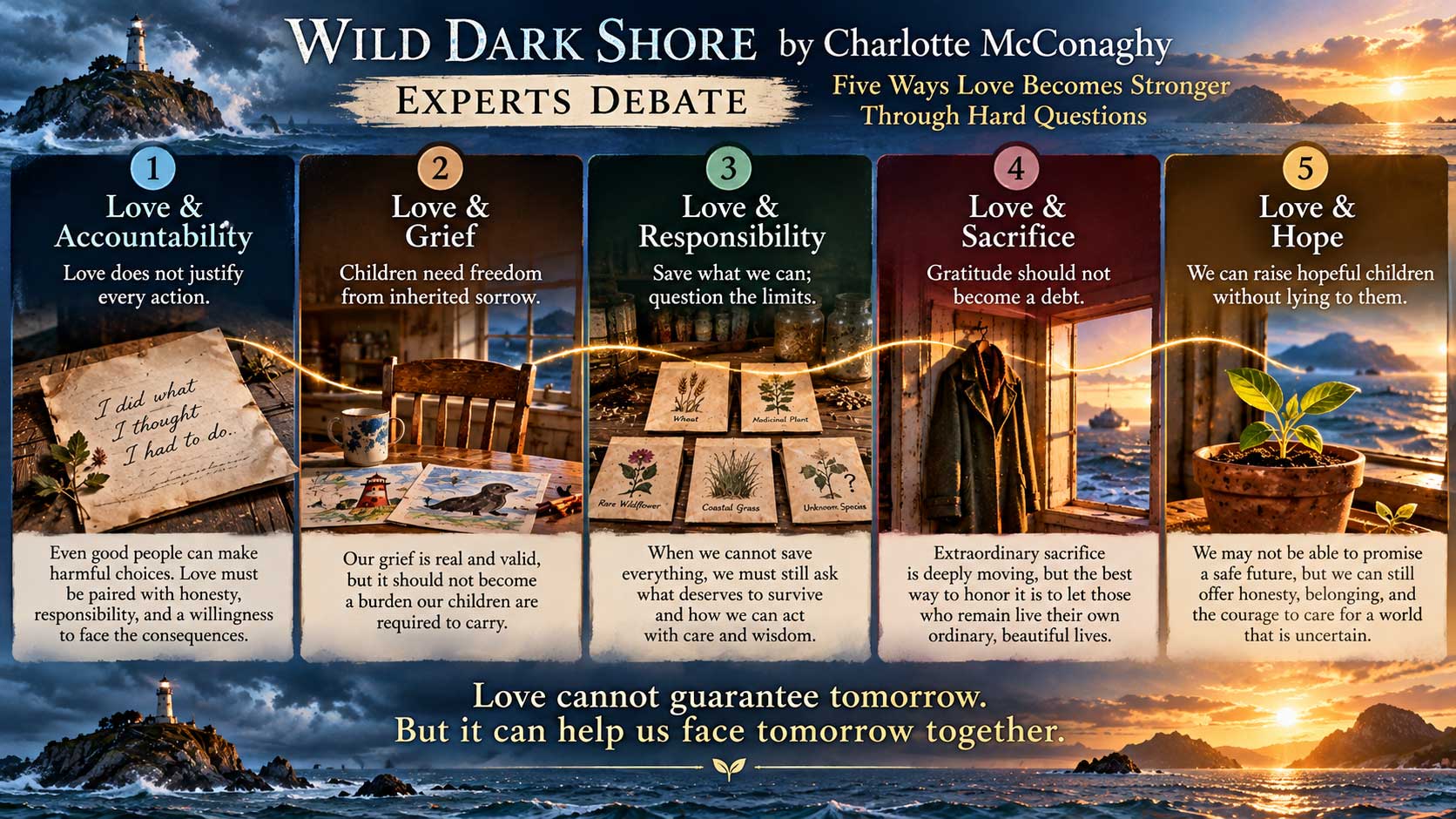
Short Bios:
Judith Herman — Trauma, Recovery, and Justice
Judith Lewis Herman is a psychiatrist and influential researcher whose books Trauma and Recovery and Truth and Repair examine psychological trauma, recovery, and justice. Her work provides an important perspective on Fen's safety, autonomy, and the distinction between understanding harmful behavior and excusing it.
Official professional information: Harvard Psychiatry.
Paul Bloom — Morality, Empathy, and Difficult Choices
Paul Bloom is a psychologist and author of Against Empathy and The Sweet Spot. His work explores moral judgment, emotional reasoning, and the complexities of human motivation. In these imagined conversations, he questions whether powerful feelings—including parental love—necessarily lead to good decisions.
Official website: Paul Bloom.
Alison Gopnik — Parenting, Childhood, and Freedom
Alison Gopnik is a developmental psychologist at the University of California, Berkeley, and author of The Gardener and the Carpenter. Her research examines how children learn and why parenting should nurture their development rather than attempt to control their futures.
Official profile: UC Berkeley.
Megan Devine — Grief Without Forced Consolation
Megan Devine is a writer, grief educator, and author of It's OK That You're Not OK. Her work challenges the expectation that grief must follow a prescribed timeline or produce an uplifting lesson. Her perspective helps explore Dominic's loss, Rowan's death, and the freedom to continue living without denying sorrow.
Official website: Refuge in Grief.
Robin Wall Kimmerer — Ecology, Reciprocity, and the Living World
Robin Wall Kimmerer is a botanist, writer, member of the Citizen Potawatomi Nation, and author of Braiding Sweetgrass. Her work brings scientific and Indigenous perspectives together to explore our relationships with plants, ecosystems, and the responsibilities that accompany belonging to the natural world.
Official website: Robin Wall Kimmerer.
Katharine Hayhoe — Climate Science and Practical Hope
Katharine Hayhoe is an atmospheric scientist, chief scientist at The Nature Conservancy, and author of Saving Us. Her research and public communication emphasize the realities of climate change, the importance of informed action, and the possibility of constructive hope without denying scientific evidence.
Official website: Katharine Hayhoe.
All six experts are real people, but their appearances and conversations in this article are entirely fictional. Their published research and ideas provide intellectual inspiration, not authorization or endorsement. Charlotte McConaghy and the experts did not participate in creating these imagined dialogues.
Leave a Reply