

Introduction By Anne Carson (imagined as the moderator)
What happens when a monster refuses to die?
More than two thousand years ago, the Greek poet Stesichoros told the story of Geryon, a red, extraordinary creature killed by the great hero Herakles. The hero's victory became legendary. But the monster's feelings, dreams, and memories were largely left untold.
In my novel Autobiography of Red, I imagined another possibility. What if Geryon survived? What if he grew up, fell in love with Herakles, experienced heartbreak, discovered photography, and eventually learned to see his wings differently?
In this imaginary conversation, I have invited Geryon, Herakles, Ancash, and Stesichoros to a mountain house overlooking a Peruvian volcano.
Across five conversations, we explore questions that reach far beyond mythology. Who decides who is a hero and who is a monster? Why do we continue loving people who hurt us? Can art help us live with painful memories? What does freedom look like when we no longer depend on another person's approval?
And perhaps the most important question: Must a life be extraordinary to be worth living?
Our conversation begins with a monster who was never given the opportunity to tell his side of the story.
(Note: This is an imaginary conversation, a creative exploration of an idea, and not a real speech or event.)
Topic 1: Who Is the Real Monster?
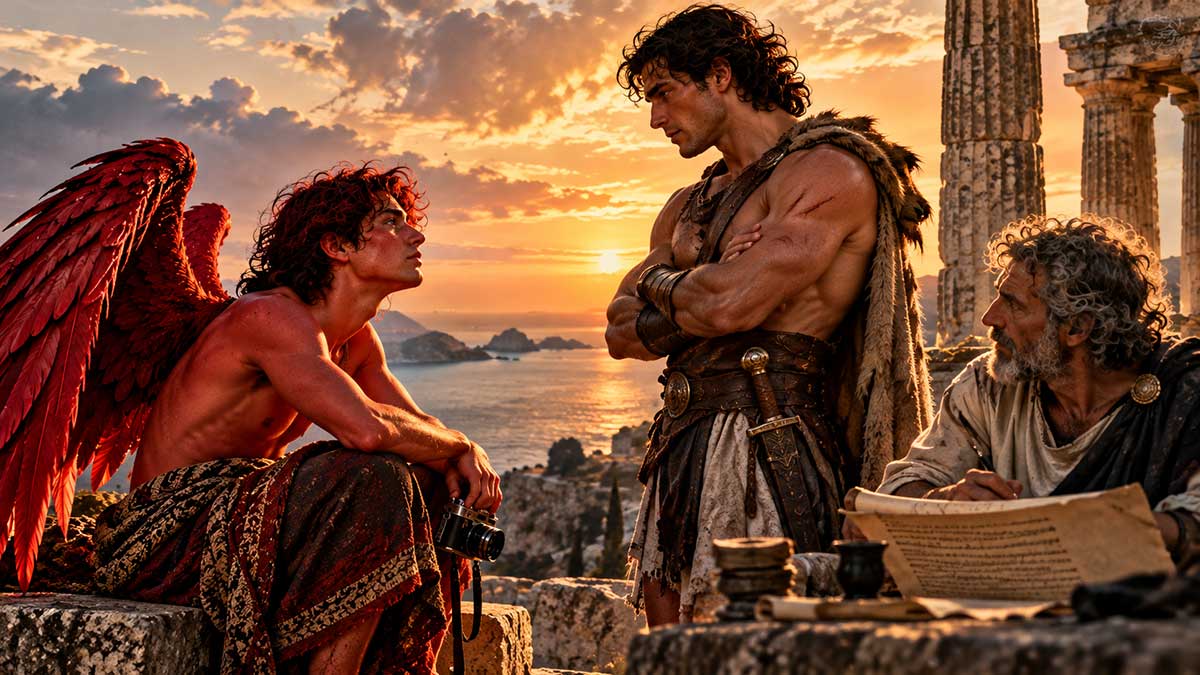
When the Hero Finally Hears the Monster's Story
The volcano had disappeared behind a curtain of evening clouds, leaving only a faint red glow above the mountains. Inside the house, the five guests sat around a wooden table. Geryon's camera rested beside his elbow. Stesichoros had opened his manuscript, its ancient pages illuminated by a small lamp.
Stesichoros: "I feel I must begin with a correction. I did not call Geryon a monster simply to insult him. In the ancient world, a creature with three bodies, extraordinary strength, and a herd of magnificent red cattle was not an ordinary man. He belonged to the realm of myth."
Geryon: "Did he have a mother?"
Stesichoros: "Of course. Callirhoe, according to the tradition."
Geryon: "Did she love him?"
Stesichoros: "I would assume so."
Geryon: "Did he love his cattle?"
Stesichoros: "That is not something the surviving fragments tell us."
Geryon: "Did he have a favorite one?"
Stesichoros lowered his manuscript.
Stesichoros: "A favorite cow?"
Geryon: "Perhaps one that followed him everywhere. Perhaps one that was sick when it was born, and he stayed awake all night keeping it warm. Perhaps he had a name for it."
Herakles: "You're inventing things."
Geryon: "Yes. Isn't that what poets do?"
Ancash laughed softly. Even Stesichoros smiled.
Anne Carson: "I think Geryon has discovered something interesting. We know the hero's assignment. We know the monster's appearance. We know who wins. But we know remarkably little about what the monster wanted."
Stesichoros: "My poem was not a biography."
Geryon: "Neither was my death."
Herakles: "You're speaking as though I murdered an innocent farmer. The ancient Geryon was a formidable creature. Taking his cattle was one of my twelve labors. I wasn't wandering around looking for somebody to kill."
Ancash: "But you went to his home."
Herakles: "Under orders."
Ancash: "And took what belonged to him."
Herakles: "That was the labor."
Ancash: "I understand. I'm asking what made it right."
Herakles leaned back.
Herakles: "You cannot judge every ancient myth by modern standards."
Anne Carson: "Perhaps not. But we can ask what happens when we change the point of view. From your perspective, Herakles, the journey ends in victory. From Geryon's perspective, a stranger arrives, kills him, and takes everything he owns."
Herakles: "In that version, I sound terrible."
Geryon: "You sound like someone who arrived without asking permission."
Herakles: "You really enjoy making me the villain."
Geryon looked down at his camera.
Geryon: "No. That's the strange part. I spent years trying not to."
The room grew quiet.
Anne Carson: "Tell us what you mean."
Geryon: "When I was young, I thought there must be something wrong with me. Other people seemed to know how to live inside their bodies. They walked into rooms without wondering what everyone would notice first. They could fall in love without worrying that love was some kind of temporary mistake."
Herakles: "I never thought you were a mistake."
Geryon: "I know."
Herakles: "Then why say it?"
Geryon: "I said I worried about it. I didn't say you told me."
Herakles opened his mouth, then closed it.
Geryon: "When you met me, I thought you saw something beautiful. For a little while, I stopped feeling like a creature that needed to apologize for existing."
Herakles: "I did see something beautiful."
Geryon: "Then you left."
Herakles: "People leave relationships, Geryon. That doesn't make them monsters."
Geryon: "I didn't say it did."
Herakles: "It feels like that's what everyone here wants me to admit."
Ancash: "Maybe nobody needs you to admit you're a monster. Maybe they need you to stop defending yourself long enough to hear what happened."
Herakles turned toward him.
Herakles: "You know, you weren't there when we first met."
Ancash: "No. I wasn't."
Herakles: "You don't know how young we were. How confused. How intensely he felt everything. Sometimes I couldn't tell whether Geryon loved me or whether he had made me responsible for keeping the entire universe from falling apart."
Geryon stared at the table.
Anne Carson: "That's a difficult accusation. Geryon, do you think there's truth in it?"
A long silence followed.
Geryon: "Yes."
Herakles looked surprised.
Geryon: "I think I wanted you to save me."
Herakles: "From what?"
Geryon ran a finger along the edge of his camera.
Geryon: "From being myself."
Nobody spoke.
Geryon: "I was a boy with red skin and wings. I had things happen to me when I was young that I didn't know how to talk about. I carried those things everywhere. Then you came along, and suddenly there was somebody who wanted to touch me, kiss me, spend time with me. I thought perhaps that meant everything before you had been a misunderstanding."
Anne Carson: "That love could erase the past?"
Geryon: "Something like that."
Herakles: "I couldn't have done that."
Geryon: "I know that now."
Herakles: "I didn't know you expected it."
Geryon: "Neither did I."
Stesichoros closed his manuscript halfway.
Stesichoros: "There is something troubling about this conversation. In my story, Herakles kills Geryon with an arrow. The action is visible. We know when it happens. We know who is responsible. But here, the injury is invisible, and both men seem uncertain where it began."
Anne Carson: "Which may be closer to the way human suffering actually works."
Stesichoros: "Yet surely we must distinguish suffering from wrongdoing. If one person loves more deeply than another, the difference is tragic, but not necessarily unjust."
Ancash: "I agree."
Herakles looked relieved.
Ancash: "But there's another question. When you realize someone is vulnerable, what responsibility do you have for the way you treat them?"
Herakles: "You cannot make yourself love someone more than you do."
Ancash: "No."
Herakles: "You cannot promise forever when you don't believe in forever."
Ancash: "No."
Herakles: "Then what exactly should I have done?"
Ancash considered this.
Ancash: "Perhaps told the truth earlier. Perhaps listened when he was hurting. Perhaps stopped treating his need for closeness as something embarrassing."
Herakles: "I did care about him."
Ancash: "I believe you."
Herakles: "Then why does it feel like I'm on trial?"
Geryon: "Maybe this is what it feels like when you're not the person telling the story."
Herakles looked at him.
For the first time that evening, he had no immediate answer.
Outside, the wind pushed against the shutters. Anne rose and closed one of the windows before returning to her chair.
Anne Carson: "Stesichoros, I want to ask you something. In the ancient story, Herakles is called a hero. Does that mean he is good?"
Stesichoros: "Not necessarily. Greek heroes were rarely examples of perfect morality. They were extraordinary figures whose deeds shaped the world. Their greatness could coexist with violence, pride, and terrible mistakes."
Anne Carson: "And Geryon is called a monster. Does that mean he is evil?"
Stesichoros: "Not necessarily."
Geryon: "So the hero doesn't have to be good, and the monster doesn't have to be bad."
Stesichoros: "That is a fair observation."
Geryon: "Then the names don't tell us very much."
Stesichoros: "They tell us what kind of story we are entering."
Geryon: "Exactly."
Anne smiled slightly.
Anne Carson: "Perhaps the labels tell us more about the storyteller's interests than about the characters themselves."
Stesichoros: "You make that sound like a crime."
Anne Carson: "No. A responsibility."
Stesichoros: "A poet cannot tell every story."
Anne Carson: "Of course not. But a poet can sometimes notice whose story has been left untold."
Stesichoros studied her.
Stesichoros: "And that is why you gave him an autobiography."
Anne Carson: "That is one way to read it."
Geryon: "I began making my autobiography when I was five."
Herakles: "Five? What could you possibly have had to say at five?"
Geryon: "A great deal."
Herakles: "About what?"
Geryon: "Things I was afraid of. Things I saw. Things I couldn't explain."
Herakles: "Most children draw pictures."
Geryon: "I drew pictures."
Herakles: "So why call it an autobiography?"
Geryon thought for a moment.
Geryon: "Perhaps I wanted proof that I was there."
Herakles frowned.
Geryon: "Have you ever felt something so strongly that you wondered whether it was real? Something frightening, or beautiful, or shameful? And everyone around you behaved as though nothing had happened?"
Herakles: "I suppose."
Geryon: "When I made a picture, the thing existed outside me. I could look at it. I didn't have to keep carrying it in exactly the same way."
Anne Carson: "An autobiography can be an attempt to make a life visible, even to the person living it."
Stesichoros: "But every autobiography is selective. You cannot include everything."
Geryon: "No."
Stesichoros: "Then you, too, are choosing which story gets told."
Geryon: "Yes."
Stesichoros: "And perhaps leaving things out that might change our judgment."
Geryon: "Of course."
Stesichoros: "Then why should we trust your version more than Herakles'?"
Geryon considered the question carefully.
Geryon: "I don't think you have to."
Stesichoros raised his eyebrows.
Geryon: "I just think you should be allowed to hear it."
Ancash nodded.
Ancash: "There's a difference between demanding that someone believe you and asking that they listen."
Herakles: "Listening doesn't mean agreeing."
Geryon: "I know."
Herakles: "And it doesn't mean accepting responsibility for everything another person felt."
Geryon: "I know that too."
Herakles: "Then what do you want from me?"
Geryon looked at him for a long time.
Geryon: "I used to want you to tell me I was beautiful."
Herakles' expression softened.
Geryon: "Then I wanted you to tell me you were sorry."
Herakles: "And now?"
Geryon: "I'm trying to find out."
Herakles looked away.
Stesichoros turned a page in his manuscript, then stopped.
Stesichoros: "I wonder whether I have misunderstood something about the purpose of a story."
Anne Carson: "What is that?"
Stesichoros: "I believed the task was to make events memorable. To give people something they could carry from one generation to the next. Herakles defeats Geryon. The hero completes his labor. The world remembers."
Geryon: "And the monster disappears."
Stesichoros: "Yes."
Geryon: "But he didn't disappear."
Stesichoros: "In your version, no."
Geryon: "He grew up. He fell in love. He made mistakes. He took photographs. He went to Argentina. He went to Peru. He saw a volcano."
Stesichoros: "And he learned to fly."
Geryon glanced at Ancash.
Geryon: "Eventually."
Stesichoros: "Then perhaps the problem was never that the original story ended."
Anne Carson: "What was it?"
Stesichoros: "That we mistook the ending of one story for the ending of a life."
The room fell silent.
Herakles reached for his glass of water, but did not drink.
Herakles: "Can I ask Geryon something?"
Anne Carson: "Of course."
Herakles: "If you could go back to the day we met, knowing everything that happened afterward, would you still want to meet me?"
Geryon looked startled.
He had expected another defense, perhaps another explanation. Not this.
Geryon: "I don't know."
Herakles nodded slowly.
Geryon: "There were beautiful things."
Herakles: "I remember."
Geryon: "And terrible things."
Herakles: "I remember some of those too."
Geryon: "For a long time, I thought I had to choose. Either you were wonderful and everything was my fault, or you were terrible and everything was yours."
Anne Carson: "And now?"
Geryon: "I think perhaps two people can love each other and still fail each other."
Herakles looked down.
Geryon: "I think someone can be kind one afternoon and careless the next. I think a person can make you feel more alive than you've ever felt and still leave you terribly lonely."
Ancash: "And neither experience cancels the other."
Geryon: "No."
Herakles: "Then perhaps I wasn't a hero."
Geryon shook his head.
Geryon: "I don't need you to stop being a hero."
Herakles: "What do you need?"
Geryon: "I need to stop being the monster."
Stesichoros looked at the young man across from him.
Stesichoros: "You understand that in the ancient myth, the monster is extraordinary. He is powerful. He is unlike anyone else."
Geryon: "Yes."
Stesichoros: "There is no shame in being extraordinary."
Geryon smiled sadly.
Geryon: "There is when everyone is afraid of you."
Anne watched him.
Anne Carson: "Geryon, when you were a child, did you believe you were a monster before other people treated you as one?"
Geryon was quiet for so long that Anne wondered whether he would answer.
Geryon: "I don't remember."
He looked toward the dark window.
Geryon: "I remember being red. I remember my wings. I remember wanting to be held. I remember wanting people to stop looking at me."
Anne Carson: "Those are different things."
Geryon: "I know. But when you're young, they get mixed together."
Ancash: "Being different and being unwanted."
Geryon: "Yes."
Ancash: "They aren't the same."
Geryon: "I know that now."
Herakles leaned forward.
Herakles: "For what it's worth, I never thought your wings were ugly."
Geryon looked at him.
Geryon: "You never asked what they felt like."
Herakles hesitated.
Herakles: "What did they feel like?"
Geryon thought about the question.
Geryon: "Heavy, sometimes. Especially when I was trying to hide them."
Herakles: "And when you weren't?"
Geryon glanced toward the volcano.
Geryon: "That's a different story."
Ancash smiled faintly.
Stesichoros closed his manuscript completely.
Stesichoros: "I have one last question, Geryon."
Geryon: "Yes?"
Stesichoros: "If I were to write your story again, what would you want me to change?"
Geryon looked at the ancient poet, then at Herakles, then at the camera resting beside his hand.
Geryon: "I don't think I would ask you to make me brave."
Stesichoros: "No?"
Geryon: "Or beautiful. Or innocent. Or victorious."
Stesichoros: "Then what?"
Geryon: "I'd ask you to let me speak before you killed me."
Stesichoros lowered his eyes.
For several moments, nobody moved.
Then Herakles spoke, more quietly than before.
Herakles: "I think I would have liked to hear what you said."
Geryon looked at him.
Geryon: "You had the chance."
Herakles accepted the words without answering.
Anne reached for the manuscript and turned it so that its pages faced Geryon.
Anne Carson: "Perhaps that's where a different kind of story begins. Not when the hero disappears, and not when the monster becomes a hero, but when both are allowed to be more than the names they were given."
Geryon touched the edge of the ancient page.
Geryon: "I spent so much of my life wondering whether I was the kind of person someone could love."
Herakles looked up.
Geryon: "I never thought to ask whether I liked the person I was becoming when I tried to make someone love me."
The question seemed to surprise even Geryon.
Ancash studied him thoughtfully.
Ancash: "That's a difficult thing to discover."
Geryon: "Yes."
Herakles: "Are you saying loving me made you someone you didn't like?"
Geryon shook his head.
Geryon: "I'm saying I sometimes forgot I existed when you weren't looking at me."
Herakles stared at him.
Outside, a faint orange line appeared along the volcano's distant ridge.
Stesichoros opened his manuscript once more, found a blank space near the bottom of a page, and picked up his pen.
Anne Carson: "What are you writing?"
Stesichoros: "A question."
Anne Carson: "Which question?"
The poet paused.
Stesichoros: "If a monster survives the hero, who teaches him how to live?"
Geryon looked toward the window.
Geryon: "Perhaps nobody."
He rested his hand on his camera.
Geryon: "Perhaps that's something he has to discover for himself."
Herakles watched him, then spoke almost reluctantly.
Herakles: "But you weren't alone when you were discovering it."
Geryon turned back.
Herakles: "I was there. At least for part of it."
Geryon: "Yes."
Herakles: "And not everything between us was terrible."
Geryon: "No."
Herakles: "I don't want you to remember me only as the person who hurt you."
Geryon looked at him with an expression that was neither anger nor forgiveness.
Geryon: "Then perhaps you should tell me what you remember."
Herakles drew a slow breath.
Herakles: "I remember a boy who looked at everything as though it might disappear. I remember wanting to make him laugh. I remember thinking he was the strangest, most beautiful person I'd ever met."
Geryon's eyes lowered.
Herakles: "And I remember being frightened by how much he needed me."
Geryon did not answer immediately.
Then he looked up.
Geryon: "I think I was frightened too."
The volcano glowed beyond the window. Ancash remained quiet, listening as the two men regarded one another across the table, each holding memories the other had never entirely known.
Anne left the silence undisturbed.
For the first time that evening, neither Geryon nor Herakles seemed eager to decide which of them had been right.
They were beginning to discover how differently two people could remember the same love.
Topic 2: Why Do We Love People Who Hurt Us?

When the Heart Refuses to Follow What the Mind Knows
Herakles was still looking at Geryon.
"I think I was frightened too," Geryon had said, and the words seemed to have unsettled him more than any accusation.
Herakles: "You never seemed frightened of loving me."
Geryon: "That wasn't what frightened me."
Herakles: "What was?"
Geryon: "How easily you could stop."
Herakles leaned back in his chair. Outside, the volcano had vanished into darkness, but the last of the sunset still colored the clouds above it.
Herakles: "You say that as though I turned something off. Like a lamp."
Geryon: "Didn't you?"
Herakles: "No. I was sixteen. I wanted to see the world. I wanted to meet people. I wanted things I didn't even have names for yet."
Geryon: "I wanted you."
Herakles: "I know."
Geryon: "That was the problem."
Anne Carson: "Was it a problem that you wanted him, or that you wanted him to want the same future?"
Geryon considered this.
Geryon: "I don't think I knew there was a difference."
Stesichoros: "There rarely is, at fourteen. The beloved becomes the future. One does not imagine growing older and meeting other people. One imagines growing older with that person."
Herakles: "That's a beautiful idea, but it can be terrifying when you're the person being imagined."
Ancash: "Why?"
Herakles: "Imagine someone looking at you and seeing the next fifty years. You can barely imagine next Tuesday, and suddenly you're responsible for somebody's entire life."
Ancash: "Did Geryon ask you to be responsible for his entire life?"
Herakles: "Not in those words."
Geryon: "What words did I use?"
Herakles thought for a moment.
Herakles: "You asked when I'd come back. Where I was going. Whether I'd call. Whether I was happy. Whether something was wrong when I was quiet."
Geryon: "Those sound like ordinary questions."
Herakles: "They were ordinary questions. It was the fear behind them."
Geryon: "You could hear that?"
Herakles: "Every time."
Geryon looked down.
Herakles: "Sometimes I felt that if I answered incorrectly, your whole day would collapse."
Geryon: "Sometimes it did."
Herakles: "You see?"
Geryon: "Yes. But I wonder if you understand what it felt like from my side."
Herakles: "Tell me."
Geryon turned the camera in his hands.
Geryon: "Before I met you, I was accustomed to people noticing what was strange about me. The wings. The red skin. The way I spoke. Sometimes they were curious. Sometimes they were cruel. But either way, I felt like something being examined."
Herakles: "I never examined you."
Geryon: "No. You kissed me."
Herakles smiled faintly at the memory.
Geryon: "You kissed me as though there was nothing unusual about it. And afterward, I spent hours trying to remember exactly how it happened. The light. Where your hands were. What you said."
Anne Carson: "As though the memory were something you could preserve."
Geryon: "I was afraid that if I forgot one detail, the whole thing might disappear."
Ancash: "And if it disappeared?"
Geryon: "Then perhaps it had never been real."
Herakles' smile faded.
Herakles: "Geryon, it was real."
Geryon: "I know that now."
Herakles: "I loved you."
The words hung in the room.
Geryon looked at him.
Geryon: "Did you?"
Herakles: "Yes."
Geryon: "Then why was leaving so easy?"
Herakles' expression changed.
Herakles: "It wasn't easy."
Geryon: "You made it look easy."
Herakles: "Perhaps I wanted it to look easy."
Anne Carson: "Why?"
Herakles: "I thought if I hesitated, he'd ask me to stay. And if he asked me to stay, I might. And then I'd resent him for it."
Ancash: "So you chose to hurt him once rather than risk hurting him later?"
Herakles: "Something like that."
Ancash: "Did it work?"
Herakles gave a humorless laugh.
Herakles: "Apparently not."
Stesichoros: "This is an old human problem. One person believes love means remaining. Another believes love must permit departure. Both claim to be defending love."
Anne Carson: "And both may be defending themselves."
Herakles: "Are you saying I left out of fear?"
Anne Carson: "I'm asking whether the freedom you wanted was entirely different from the freedom Geryon wanted."
Herakles: "He wanted us to be together."
Anne Carson: "Perhaps. But he wanted freedom from feeling unwanted. You wanted freedom from feeling responsible for another person's happiness."
Herakles looked at Geryon.
Herakles: "That sounds unfair to both of us."
Geryon: "It sounds rather accurate."
Ancash had been studying the two men quietly.
Ancash: "Can I ask something? Geryon, when you met Herakles again in Buenos Aires, what did you hope would happen?"
Geryon hesitated.
Geryon: "I told myself I didn't hope for anything."
Ancash: "And what did you actually hope?"
Geryon: "That he would look at me and realize he'd made a mistake."
Herakles lowered his eyes.
Geryon: "I imagined he would see me standing there, older, different, and suddenly remember everything. He would understand that he'd loved me more than he knew."
Herakles: "I was happy to see you."
Geryon: "I know."
Herakles: "Very happy."
Geryon: "That was almost worse."
Herakles: "How could that be worse?"
Geryon: "You were happy to see me, but you didn't seem to need me. You could be delighted that I was there and perfectly content if I left."
Herakles: "Isn't that healthier than needing someone desperately?"
Geryon: "Perhaps. But it felt like discovering that the house I'd been living in for years was only a place you'd visited once."
Stesichoros looked up from his manuscript.
Stesichoros: "That is a rather terrible image."
Geryon: "It was a terrible feeling."
Herakles: "But you had a life. You traveled. You took photographs. You met people. Surely you weren't spending every day thinking about me."
Geryon: "No."
Herakles: "Then why speak as though you were?"
Geryon: "I wasn't thinking about you every day. But sometimes I'd hear a voice, or see someone walking ahead of me, and for a moment I'd think it was you."
Herakles: "That happens to everyone."
Geryon: "Yes. That's what makes it so strange. The world can be enormous, and one person can still appear in every corner of it."
Anne Carson: "Perhaps love changes the way we notice things. The person may leave, but the habits of attention remain."
Stesichoros: "In ancient poetry, longing is often described as a force that enters the body. Something that shakes the limbs, weakens the knees, disturbs sleep. The lover is no longer entirely in command."
Herakles: "That sounds more like an illness."
Stesichoros: "Many poets have noticed the resemblance."
Ancash: "But there's something missing from that description."
Stesichoros: "What?"
Ancash: "The other person. We talk about longing as though it's something beautiful happening inside the lover. But the person being longed for has a life too."
Geryon looked at Ancash.
Ancash: "When we traveled together, I could see how you looked at Herakles."
Geryon: "I know."
Ancash: "Sometimes I felt that if he entered a room, everyone else disappeared."
Geryon: "I'm sorry."
Ancash: "I didn't say it to make you apologize."
Geryon: "But I should."
Ancash paused.
Ancash: "I liked you, Geryon. I liked the way you looked at things. I liked how seriously you took a photograph of something most people would walk past. I liked that you could spend ten minutes considering the color of a wall."
Herakles: "He once spent twenty minutes photographing a tomato."
Geryon: "It was an interesting tomato."
Ancash: "I believe it."
They laughed, and the tension softened for a moment.
Ancash: "But sometimes I felt that you couldn't see me. You were looking at Herakles, or looking at yourself through Herakles, and I was simply standing nearby."
Geryon's smile disappeared.
Geryon: "I didn't realize."
Ancash: "I know."
Geryon: "Why didn't you tell me?"
Ancash: "Would you have heard me?"
Geryon thought for a long time.
Geryon: "Probably not."
Ancash: "That's what I thought."
Anne Carson: "There's an interesting pattern here. Herakles felt that Geryon couldn't see his need for freedom. Geryon felt that Herakles couldn't see his pain. And Ancash felt that neither of you could see him."
Herakles: "You make us sound terribly selfish."
Anne Carson: "Perhaps love sometimes narrows our vision before it enlarges it."
Stesichoros: "That would explain a great deal of poetry."
Geryon: "I thought loving someone meant seeing them more clearly than anyone else."
Ancash: "Sometimes it means seeing what you desperately want to see."
Herakles reached for his glass.
Herakles: "Can I ask you something, Ancash?"
Ancash: "Of course."
Herakles: "Did you love him?"
Ancash did not answer immediately.
Geryon looked at him, startled.
Ancash: "I cared for him. I was drawn to him. I wanted to know him better."
Herakles: "That's not quite an answer."
Ancash: "It's the answer I have."
Herakles: "You sound like you're avoiding the question."
Ancash: "Perhaps I'm refusing to make a promise about a feeling that was still becoming something."
Anne watched Ancash with interest.
Anne Carson: "That may be one of the differences between desire and love. Desire can arrive suddenly. Love may require time to discover what it actually is."
Herakles: "I don't agree. I knew I loved Geryon almost immediately."
Geryon: "And then you stopped."
Herakles: "You keep returning to that."
Geryon: "I know."
Herakles: "Why?"
Geryon took a slow breath.
Geryon: "Perhaps I'm still waiting for an explanation that will make it hurt less."
Herakles looked at him for a long moment.
Herakles: "What if there isn't one?"
Geryon said nothing.
Herakles: "What if I loved you, and then I wanted a different life? What if I didn't know how to explain it without hurting you? What if I was young and selfish and frightened and didn't have the wisdom everyone at this table seems to expect me to have had?"
Geryon: "Then that's what happened."
Herakles: "Would that be enough?"
Geryon: "I don't know."
Herakles: "What do you want me to say?"
Geryon looked at him.
Geryon: "Something you haven't rehearsed."
Herakles was silent.
Outside, a gust of wind rattled the shutters.
Herakles: "I remember the day I decided to leave."
Geryon's fingers tightened around his camera.
Herakles: "You were talking about something. I can't remember what. Perhaps a photograph. You were so excited that you kept interrupting yourself."
Geryon: "I used to do that."
Herakles: "You still do."
Geryon almost smiled.
Herakles: "And I remember looking at you and feeling two things at once. I loved the way you were talking. I loved how alive you seemed. But I felt this sudden fear that I was going to spend the rest of my life being the person who made you happy."
Geryon: "Was that so terrible?"
Herakles: "It wasn't the happiness. It was the responsibility."
Geryon: "You could have told me."
Herakles: "I know."
Geryon: "We could have talked."
Herakles: "Perhaps."
Geryon: "Instead, you decided for both of us."
Herakles looked down.
Herakles: "Yes."
The admission was so quiet that Geryon almost missed it.
Herakles: "I did."
Stesichoros rested his hands on the manuscript.
Stesichoros: "In the ancient story, the hero makes a decision, and the monster has no say in the outcome."
Herakles glanced at him.
Stesichoros: "I wonder whether that is why the myth still troubles us."
Herakles: "I didn't kill him."
Stesichoros: "No. But you have spent much of this evening explaining why your decisions were necessary. Geryon has spent much of it explaining what those decisions felt like."
Herakles: "I cannot undo the past."
Stesichoros: "Nobody is asking you to."
Geryon: "I think I was."
Everyone turned toward him.
Geryon: "Not literally. I know you can't go backward. But every time I imagined seeing you again, I imagined a conversation where you'd finally say the right thing. And somehow, if you said it, everything that happened would become different."
Anne Carson: "Did you believe the past could be changed?"
Geryon: "Not the events. The meaning."
Anne Carson: "And could it?"
Geryon looked at Herakles.
Geryon: "Perhaps a little."
Herakles leaned forward.
Herakles: "Then let me try."
He stopped, searching for words.
Herakles: "I loved you. I was young, and I wanted more of the world than I knew how to ask for. I was afraid of how much you needed me. And instead of telling you that, I made leaving seem simple."
Geryon listened without moving.
Herakles: "It wasn't simple. And I was careless with your feelings."
Geryon's eyes filled, but he did not look away.
Herakles: "I'm sorry for that."
No one spoke.
Geryon: "Thank you."
Herakles waited.
Herakles: "Is that all?"
Geryon: "What do you mean?"
Herakles: "I thought perhaps you'd feel better."
Geryon gave a small, surprised laugh.
Geryon: "I do."
Herakles: "You don't look better."
Geryon: "I didn't know I was supposed to."
Anne Carson: "An apology can acknowledge an injury. It cannot erase the years that followed."
Ancash: "And it shouldn't have to."
Herakles: "Then what is forgiveness supposed to accomplish?"
Ancash: "Perhaps forgiveness isn't something that accomplishes a result. Perhaps it's something people decide, in their own time, when they're ready."
Stesichoros: "Or something they never decide."
Geryon: "I don't know whether I've forgiven you."
Herakles nodded.
Geryon: "But I don't think I want to spend the rest of my life waiting to feel differently."
Herakles: "About me?"
Geryon: "About myself."
Herakles looked confused.
Geryon: "When you left, I thought it proved something about me. That I wasn't lovable enough. That I was too strange, too needy, too much of whatever I was."
Herakles: "It didn't prove any of those things."
Geryon: "I know. But knowing something and believing it are different."
Anne Carson: "And perhaps that's why love can remain painful long after the relationship ends. The person has gone, but the question they awakened remains."
Geryon: "Am I enough?"
Anne Carson: "Perhaps."
Geryon: "I spent years hoping Herakles would answer it."
Ancash: "And if he said yes?"
Geryon: "I would have felt better."
Ancash: "For how long?"
Geryon thought.
Geryon: "I don't know."
Ancash: "Would you have believed him the next day? Or would you have needed him to say it again?"
Geryon looked down.
Geryon: "Probably again."
Ancash: "And the day after?"
Geryon nodded.
Ancash: "That's a great deal of responsibility to place in someone else's hands."
Geryon: "Yes."
Herakles: "That's what I was trying to tell you."
Ancash: "Perhaps. But you were trying to escape the responsibility. I'm asking whether Geryon ever needed to give it to you."
Herakles fell silent.
Geryon studied Ancash.
Geryon: "You make it sound simple."
Ancash: "It isn't."
Geryon: "How do you stop needing someone to tell you you're worth loving?"
Ancash considered the question.
Ancash: "I don't think you stop wanting to be loved. I think you begin to notice that your life continues on the days when nobody tells you."
Geryon: "That sounds lonely."
Ancash: "Sometimes it is."
Geryon: "And that's freedom?"
Ancash: "Perhaps part of it. The part where loneliness doesn't mean you've disappeared."
Stesichoros looked toward the window.
Stesichoros: "In the old stories, heroes are often granted immortality. Their names survive for thousands of years. Yet here we are, discussing a boy who wanted something far more ordinary."
Anne Carson: "What did he want?"
Stesichoros: "To be loved without fearing that love would vanish."
Geryon: "I think everyone wants that."
Herakles: "But nobody can promise it."
Geryon: "No."
Herakles: "People change."
Geryon: "Yes."
Herakles: "Feelings change."
Geryon: "Yes."
Herakles: "Then perhaps the only honest thing is to accept that."
Geryon looked at him.
Geryon: "I think that's easy to say when you're the person whose feelings changed first."
Herakles opened his mouth, then closed it.
Anne Carson: "There's something important in that distinction. The person who leaves often experiences the relationship as a decision already made. The person who is left may experience it as a question that remains unanswered."
Herakles: "So what should the person who leaves do?"
Anne Carson: "Perhaps recognize that the two people may not arrive at the ending at the same time."
Herakles: "And wait?"
Anne Carson: "Not necessarily. But honesty and kindness need not end when romantic commitment does."
Herakles looked toward Geryon.
Herakles: "I wish I'd known that."
Geryon: "So do I."
The silence that followed was gentler than the earlier ones.
Ancash rose to refill the water glasses. When he reached Geryon, he noticed the camera lying beside his hand.
Ancash: "You haven't taken a single photograph tonight."
Geryon: "I haven't seen anything I wanted to photograph."
Ancash: "Really?"
Geryon: "Not yet."
Ancash glanced toward the window.
Ancash: "The volcano is beautiful."
Geryon: "It's too dark."
Ancash: "Perhaps that's why it's interesting."
Geryon smiled.
Geryon: "You sound like me."
Ancash: "I've been listening."
The words seemed to surprise Geryon.
Geryon: "You have."
Ancash sat down.
Geryon: "I don't think I listened to you very well when we traveled together."
Ancash: "Sometimes you did."
Geryon: "And sometimes I was too busy wondering whether Herakles was looking at me."
Ancash: "Yes."
Geryon: "I'm sorry."
Ancash nodded.
Ancash: "Thank you."
Geryon: "Is that all?"
Ancash laughed.
Ancash: "What were you expecting?"
Geryon: "I don't know. Perhaps you'd feel better."
Herakles laughed first, then Geryon, and finally the others.
Anne Carson: "It seems we have discovered that apologies are rather disappointing things."
Stesichoros: "Not disappointing. Human. They are small compared with the injuries they address."
Ancash: "But sometimes small things matter."
Geryon looked at him.
Geryon: "Do you think people can love each other without hurting each other?"
Ancash took his time answering.
Ancash: "I think people can learn to hurt each other less. I think they can tell the truth sooner. Listen more carefully. Admit when they're afraid."
Herakles: "And sometimes leave?"
Ancash: "Yes."
Geryon: "And sometimes stay?"
Ancash: "Yes."
Stesichoros: "You make love sound like a series of difficult decisions."
Ancash: "Perhaps it is."
Anne Carson: "And perhaps that is why the poets have never managed to finish writing about it."
Herakles looked at Geryon.
Herakles: "Do you still love me?"
The question arrived so unexpectedly that everyone turned toward him.
Geryon looked startled.
Geryon: "Why do you want to know?"
Herakles: "I suppose I want to understand what all these years have meant."
Geryon: "To you?"
Herakles: "To us."
Geryon looked toward the dark window.
Geryon: "I don't know whether the feeling I have now is love, or memory, or something that doesn't have a name."
Herakles: "That sounds like avoiding the question."
Geryon: "Perhaps I'm refusing to make a promise about a feeling that's still becoming something."
Ancash smiled.
Herakles recognized the borrowed words and laughed softly.
Herakles: "Fair enough."
Geryon turned back toward him.
Geryon: "I know that I loved you. I know there were days when being with you made the world seem almost unbearably beautiful. I know there were nights when losing you felt like losing the world itself."
Herakles listened.
Geryon: "But I don't think I want to spend the rest of my life proving that the love was real by continuing to suffer from it."
Herakles lowered his eyes.
Herakles: "I never wanted you to suffer."
Geryon: "I believe you."
Herakles: "And I don't want you to forget me."
Geryon smiled sadly.
Geryon: "I don't think that's possible."
Herakles: "Then what happens now?"
Geryon considered the question.
Geryon: "I don't know."
He looked at Ancash, then at Stesichoros, then at Anne.
Geryon: "But for the first time, that doesn't frighten me quite as much."
Anne studied him.
Anne Carson: "What has changed?"
Geryon looked down at his hands.
Geryon: "I used to think the saddest thing that could happen was for someone to stop loving me."
Anne Carson: "And now?"
Geryon: "I think it might be sadder to spend my whole life waiting for them to begin again."
Herakles sat very still.
Outside, the clouds had begun to separate. Through a narrow opening, the volcano's summit appeared against the night sky.
Geryon picked up his camera and raised it toward the window.
Herakles: "What are you photographing?"
Geryon: "The volcano."
Herakles: "You said it was too dark."
Geryon: "It was."
Herakles: "What changed?"
Geryon adjusted the lens.
Geryon: "The clouds moved."
He pressed the shutter.
The small click seemed unusually clear in the quiet room.
Ancash leaned forward.
Ancash: "May I see?"
Geryon turned the camera toward him.
Ancash studied the image for a moment.
Ancash: "It's beautiful."
Geryon looked at the photograph.
For once, he did not immediately wonder whether Herakles agreed.
He simply looked.
And after a moment, he smiled.
Topic 3: What Happens When the Monster Learns to Fly?

The Difference Between Being Loved and Becoming Free
Geryon was still looking at the photograph.
The volcano appeared almost black against the night sky, its summit outlined by a thin ribbon of orange light. Most of the mountain had disappeared into darkness, yet somehow the photograph seemed more alive than the view through the window.
Ancash: "There's something strange about that picture."
Geryon: "What's strange?"
Ancash: "You photographed a volcano, but you made the darkness look like the most interesting part."
Geryon: "Perhaps it is."
Herakles: "I don't understand photography. You spend half your life trying to capture things that are right in front of you."
Geryon: "And you spend half your life leaving things that are right in front of you."
Herakles laughed.
Herakles: "I walked into that one."
Anne Carson: "Perhaps we should allow Herakles a moment to recover."
Stesichoros: "In my day, we had poetry. Much less equipment."
Geryon: "And yet you still managed to kill me."
Stesichoros: "With considerably fewer words than you've used tonight."
Everyone laughed, including Geryon.
Ancash continued studying the photograph.
Ancash: "May I ask you something?"
Geryon: "Of course."
Ancash: "Why do you photograph the volcano from so far away?"
Geryon: "What do you mean?"
Ancash: "You have wings."
The laughter faded.
Geryon looked at him.
Ancash: "You could photograph it from above."
Geryon: "It's dark."
Ancash: "It wasn't dark this afternoon."
Geryon: "I didn't have my camera with me."
Ancash: "You always have your camera with you."
Geryon glanced down.
Geryon: "You're becoming very difficult."
Ancash: "I've been told."
Herakles: "He's right, though. You could get photographs nobody else could take."
Geryon: "I suppose."
Anne Carson: "Then why haven't you?"
Geryon ran his thumb across the camera's strap.
Geryon: "I don't know."
Ancash: "I think you do."
Geryon looked at him.
Ancash: "You can fly, but part of you still thinks your wings are something you should hide."
For a moment, Geryon seemed ready to disagree.
Then he lowered the camera.
Geryon: "Sometimes I forget they're there."
Herakles: "How can you forget something that large?"
Geryon: "The same way you forget your hands until you hurt one."
Stesichoros: "Or the same way a person forgets he is alive until someone tells him he might die."
Anne looked at Stesichoros.
Anne Carson: "That's rather beautiful."
Stesichoros: "I am a poet."
Geryon: "A dangerous occupation, apparently."
Stesichoros smiled.
Ancash: "When I first saw your wings, I couldn't understand why you wanted to conceal them."
Geryon: "You didn't grow up with them."
Ancash: "No."
Geryon: "When you're a child, you want to be like everyone else. You want to walk into a room without people staring. You want to sit in a chair without having to arrange your body differently. You want to buy a shirt without wondering where your wings are supposed to go."
Herakles: "I never thought about the shirts."
Geryon: "Nobody does."
Herakles: "That must have been miserable."
Geryon: "Sometimes. But the shirts weren't the worst part."
Anne Carson: "What was?"
Geryon: "Knowing that people had already decided something about me before I opened my mouth."
Stesichoros looked down at his manuscript.
Stesichoros: "I suppose I contributed to that."
Geryon: "You gave them a name for me."
Stesichoros: "A monster."
Geryon: "Yes."
Stesichoros: "But extraordinary creatures were not always considered evil in the ancient world. They could inspire wonder."
Geryon: "Wonder is not always pleasant when you're the one being wondered at."
Stesichoros: "I see."
Geryon: "Imagine sitting at dinner while everyone discusses whether you're frightening or beautiful, dangerous or miraculous, human or something else. And all you want is for someone to pass the bread."
Ancash smiled.
Ancash: "That sounds familiar."
Herakles: "You don't have wings."
Ancash: "No. But I've been the stranger in enough places to know what it feels like when people notice your difference before they notice you."
Anne Carson: "Perhaps being seen and being examined are not the same experience."
Geryon: "Exactly."
Herakles: "But surely being admired is better than being feared."
Geryon: "Sometimes admiration feels like another kind of distance."
Herakles: "How?"
Geryon: "When someone calls you extraordinary, you wonder whether they'll still want you around when you're ordinary."
Herakles considered that.
Geryon: "What if I'm tired? What if I'm boring? What if I have a bad day? What if I don't want to be a beautiful red-winged creature? What if I just want to sit quietly and eat breakfast?"
Ancash: "Then I would ask whether you wanted eggs."
Geryon looked at him.
Ancash: "And whether you wanted coffee."
Geryon: "I don't always drink coffee."
Ancash: "Then I'd have to get to know you better."
Geryon smiled.
Anne Carson: "That may be a more difficult kind of love than admiration."
Herakles: "Why?"
Anne Carson: "Admiration can happen at a distance. Knowing someone requires remaining interested after the extraordinary has become familiar."
Stesichoros: "The ancient poets would have found that terribly inconvenient."
Geryon: "You would have had to write about breakfast."
Stesichoros: "I would have lost my audience."
Ancash: "Perhaps not. I'd rather hear what a hero eats for breakfast than how many people he killed."
Herakles: "Eggs, if anyone is interested."
They laughed again.
Geryon looked toward the window, where the volcano remained visible against the stars.
Geryon: "I used to think that if someone loved me enough, I would stop feeling strange."
Anne Carson: "Did it happen?"
Geryon: "For a little while."
Herakles: "When we were together?"
Geryon: "Yes."
Herakles: "And then?"
Geryon: "Then you would leave the room, and I'd be strange again."
Herakles lowered his eyes.
Geryon: "I don't say that to blame you. I think I was asking love to do something it couldn't do."
Ancash: "Make you comfortable inside your own body?"
Geryon: "Yes."
Ancash: "Perhaps someone can help."
Geryon: "You did."
Ancash looked surprised.
Geryon: "When you saw my wings, you didn't ask what was wrong with them. You asked what they could do."
Ancash: "I remember."
Geryon: "Nobody had ever asked me that quite so directly."
Herakles: "I knew you could fly."
Geryon: "Knowing isn't the same as being curious."
Herakles nodded slowly.
Geryon: "Ancash told me about winged beings connected with volcanic fire. He made my wings seem like something that belonged to a story larger than my embarrassment."
Stesichoros: "A different mythology."
Ancash: "Perhaps."
Stesichoros: "And you believed it?"
Geryon: "I didn't know whether to believe it. But for the first time, I wondered whether my wings might mean something other than what I'd always assumed."
Anne Carson: "Which raises an interesting question. If someone gives you a new story about yourself, have they freed you, or simply replaced one story with another?"
Ancash leaned back.
Ancash: "That's a fair question."
Stesichoros: "Indeed. I called him a monster. You suggested he might be connected to something sacred. Both descriptions came from someone else."
Geryon: "I thought about that."
Anne Carson: "And?"
Geryon: "I think the difference was that Ancash didn't tell me what I was. He made me curious about what I might be."
Anne smiled.
Anne Carson: "That's a meaningful distinction."
Herakles: "But why did it take someone else to make you curious?"
Geryon considered this.
Geryon: "Perhaps when you've spent your whole life looking at yourself from one angle, you forget there are others."
He lifted the camera.
Geryon: "That's why I like photography."
Stesichoros: "Explain."
Geryon: "You can photograph the same mountain a hundred times. Morning, evening, winter, summer, from the road, from the valley. The mountain hasn't necessarily changed. But every photograph tells you something different."
Anne Carson: "And none tells you everything."
Geryon: "No."
Stesichoros: "Then perhaps an autobiography is like that."
Geryon: "What do you mean?"
Stesichoros: "A person spends a lifetime photographing himself from different angles. Each picture is true in some way. None is complete."
Geryon looked at the ancient poet with new interest.
Geryon: "That's rather good."
Stesichoros: "I occasionally have a useful thought."
Herakles: "So which photograph is the real person?"
Geryon: "Perhaps all of them."
Herakles: "Even the ones you don't like?"
Geryon: "Especially those."
Herakles looked at him.
Herakles: "Would you keep a photograph of yourself crying?"
Geryon: "I have."
Herakles: "Why?"
Geryon: "It happened."
Herakles: "But why would you want to remember it?"
Geryon: "I don't think photographs are always about remembering what we want. Sometimes they're about admitting what was there."
Anne rested her hands on the table.
Anne Carson: "Can art make suffering beautiful?"
Geryon frowned slightly.
Geryon: "I don't like that question."
Anne Carson: "Why?"
Geryon: "It makes suffering sound useful."
Stesichoros: "Poets have transformed suffering into beauty for thousands of years."
Geryon: "Yes. But that doesn't mean the suffering was necessary."
Stesichoros paused.
Geryon: "If someone hurts you, and afterward you write a beautiful poem, that doesn't make the hurting good."
Ancash: "Nor does it mean you should be grateful."
Geryon: "Exactly."
Herakles: "Then what does the art accomplish?"
Geryon studied the photograph on his camera.
Geryon: "Sometimes it gives you a place to put something."
Herakles: "Put what?"
Geryon: "A feeling you can't carry all day."
He turned the camera so Herakles could see.
Geryon: "Look at this mountain. It's dark. You can barely see the volcano. But there's a little light along the edge."
Herakles: "I see it."
Geryon: "If I had taken the photograph an hour earlier, it would have looked completely different. If I waited until morning, different again."
Herakles: "Yes."
Geryon: "But this is what it looked like when I was here."
Anne Carson: "A record of a moment."
Geryon: "Yes. The moment doesn't have to last forever. I don't have to hold it in my head and worry that it will disappear."
Ancash: "You can let it become a photograph."
Geryon: "And then I can go on living."
Herakles stared at the image.
Herakles: "Is that what you were doing with us?"
Geryon looked at him.
Herakles: "When we were young. All those photographs. All those things you wanted to remember."
Geryon: "Perhaps."
Herakles: "Were you trying to make sure I couldn't disappear?"
Geryon was quiet.
Geryon: "I think I was trying to make sure I didn't disappear when you did."
Herakles looked away.
The wind outside had grown stronger. Ancash rose and placed another piece of wood in the small stove near the wall.
Stesichoros: "There is something that troubles me."
Anne Carson: "Only one thing?"
Stesichoros: "At present."
He turned toward Geryon.
Stesichoros: "You speak of accepting your wings, of telling your own story, of discovering freedom. Yet all evening, you have spoken about yourself in relation to Herakles."
Geryon looked at him.
Stesichoros: "What would remain of your story if Herakles had never existed?"
The question settled over the table.
Herakles looked uncomfortable.
Herakles: "I don't think that's fair."
Geryon: "No. It's a good question."
He looked toward the volcano.
Geryon: "There would have been my mother. My brother. School. The things that frightened me. The things I loved."
Stesichoros: "And?"
Geryon: "My camera."
Ancash: "And your wings."
Geryon: "Yes."
Stesichoros: "Would you have learned to fly?"
Geryon considered this.
Geryon: "I don't know."
Stesichoros: "Then perhaps Herakles was necessary."
Geryon: "Necessary for what?"
Stesichoros: "For you to become who you are."
Geryon shook his head.
Geryon: "I don't think I want to believe that."
Stesichoros: "Why?"
Geryon: "It would mean the pain had to happen."
Anne Carson: "And perhaps it didn't."
Geryon: "Perhaps I could have learned to fly without having my heart broken."
Ancash: "I think you could have."
Herakles: "You might never have come to Peru."
Geryon: "That's true."
Herakles: "You might never have met Ancash."
Geryon: "That's true too."
Herakles: "Then something good came from what happened."
Geryon: "Yes. But that doesn't mean what happened was good."
Herakles thought about this.
Geryon: "If a house burns down and flowers grow where it stood, the flowers are beautiful. But you don't have to thank the fire."
Stesichoros looked toward the stove.
Stesichoros: "That's an unusually severe judgment of fire, considering where we're sitting."
Ancash: "Fire is complicated."
Anne Carson: "And the volcano?"
Ancash: "The volcano destroys things. It creates new ground. People live near it. Some fear it. Some depend on it."
Geryon: "Perhaps that's why I like it."
Herakles: "You like dangerous things?"
Geryon: "I like things that don't pretend to be simple."
Anne looked at him thoughtfully.
Anne Carson: "When you flew near the volcano, what did you feel?"
Geryon stopped moving the camera strap.
Geryon: "At first?"
Anne Carson: "At first."
Geryon: "Terrified."
Herakles: "You were afraid of falling?"
Geryon: "Of course."
Herakles: "But you have wings."
Geryon: "Having wings doesn't mean you know how to trust them."
Ancash smiled faintly.
Geryon: "I remember the wind. I remember how far away the ground seemed. I remember thinking that if something went wrong, nobody could catch me."
Anne Carson: "And then?"
Geryon: "Then I realized nobody was holding me up."
Stesichoros: "That sounds rather frightening."
Geryon: "It was."
Ancash: "But?"
Geryon: "But I was still in the air."
Herakles leaned forward.
Herakles: "Was it beautiful?"
Geryon looked at him.
Geryon: "Yes."
Herakles: "More beautiful than anything you'd seen?"
Geryon considered this.
Geryon: "Different."
Herakles: "How?"
Geryon: "When I was with you, I felt beautiful when you looked at me."
Herakles lowered his eyes.
Geryon: "When I was flying, nobody was looking."
Ancash: "I was."
Geryon smiled.
Geryon: "You were very far away."
Ancash: "I could still see you."
Geryon: "Yes. But I couldn't see your face. I couldn't tell whether you were impressed, frightened, or bored. And for once, I didn't need to know."
Anne leaned back.
Anne Carson: "Perhaps that's the difference."
Herakles: "Between what?"
Anne Carson: "Between feeling beautiful in someone else's eyes and experiencing something beautiful from within your own life."
Stesichoros: "You make love sound unnecessary."
Geryon: "No."
He answered so quickly that everyone looked at him.
Geryon: "Love isn't unnecessary."
Stesichoros: "Then what have you discovered?"
Geryon: "That love isn't the only thing that makes a life worth living."
Herakles watched him.
Geryon: "I still want to be loved. I still want someone to know me. I still want to sit across from someone at breakfast and have them ask whether I want eggs."
Ancash laughed softly.
Geryon: "But I don't want to disappear every time that person leaves the room."
Herakles: "I never wanted you to disappear."
Geryon: "I know."
Herakles: "I wish I could have made you feel that way."
Geryon: "You couldn't."
Herakles looked wounded.
Geryon: "Not entirely. That's what I'm trying to say."
For a while, nobody spoke.
Then Stesichoros opened his manuscript.
Stesichoros: "I would like to return to something from our first conversation."
Anne Carson: "Go ahead."
Stesichoros: "Geryon asked me to let him speak before I killed him."
Geryon: "I remember."
Stesichoros: "I've been thinking about that. I wondered what I might have written if I had allowed the monster a final speech."
Herakles: "Ancient heroes usually get the final speeches."
Stesichoros: "Indeed. That is part of the problem."
He turned toward Geryon.
Stesichoros: "What would you have said?"
Geryon: "Before you killed me?"
Stesichoros: "Yes."
Geryon looked toward the window.
Geryon: "I suppose I would have asked why."
Stesichoros: "Why what?"
Geryon: "Why I had to die so someone else could be a hero."
Stesichoros lowered his eyes.
Geryon: "And perhaps I would have asked whether there was another way for the story to end."
Herakles: "The labor required the cattle."
Geryon: "You could have asked."
Herakles: "You might have refused."
Geryon: "Probably."
Herakles: "Then what?"
Geryon shrugged.
Geryon: "We would have had to talk."
Ancash laughed.
Ancash: "The twelve labors of Herakles would have been a much longer book."
Stesichoros: "And a considerably less exciting one."
Anne Carson: "I'm not so sure. We have spent an entire evening discussing what might have happened if the hero had listened."
Herakles: "I still think I would have won."
Geryon: "Perhaps."
Herakles: "I was very strong."
Geryon: "Yes."
Herakles: "And very determined."
Geryon: "Yes."
Herakles: "You don't sound impressed."
Geryon: "I think I've spent enough of my life being impressed by you."
Herakles stared at him.
Then, unexpectedly, he laughed.
Herakles: "Fair enough."
Stesichoros closed his manuscript.
Stesichoros: "There is something almost offensive about this new version of the myth."
Anne Carson: "What is that?"
Stesichoros: "The hero is no longer the most interesting person."
Ancash: "Perhaps he never was."
Herakles: "I'm sitting right here."
Geryon: "We know."
Herakles: "Apparently I'm surrounded by people determined to destroy my reputation."
Anne Carson: "Only your monopoly on the story."
Herakles shook his head, smiling.
Herakles: "I suppose I can survive that."
Geryon looked at him.
Geryon: "So can I."
The words settled quietly between them.
Anne glanced toward the volcano.
Anne Carson: "Geryon, may I ask you one final question?"
Geryon: "Of course."
Anne Carson: "If you no longer need Herakles to tell you that you're beautiful, and you no longer need Stesichoros to rewrite your story, what do you need?"
Geryon looked down at the camera in his hands.
For a long time, he said nothing.
Geryon: "I think I need to keep living."
Anne Carson: "What does that mean?"
Geryon: "Tomorrow morning, I'll wake up. I'll probably be hungry. I'll take photographs. Perhaps I'll walk somewhere I've never been. Perhaps I'll meet someone interesting. Perhaps I'll have a terrible day."
Stesichoros: "And your wings?"
Geryon: "They'll still be there."
Anne Carson: "Will you fly?"
Geryon: "Maybe."
Herakles: "You don't sound very excited about it."
Geryon: "I am."
Herakles: "Then why maybe?"
Geryon smiled.
Geryon: "I don't have to fly every day to know I can."
Ancash nodded slowly.
Ancash: "That's something I hadn't thought about."
Geryon: "What?"
Ancash: "When I first saw your wings, I wanted you to use them. I thought flying would change everything."
Geryon: "It changed something."
Ancash: "Yes. But perhaps I was making the same mistake everyone else made."
Geryon: "What mistake?"
Ancash: "Thinking your wings were the most important thing about you."
Geryon looked at him.
Ancash: "I thought I was seeing you differently. But perhaps I was still seeing the wings first."
Geryon: "You were kind."
Ancash: "I tried to be."
Geryon: "And you helped me."
Ancash: "I'm glad."
Geryon: "But you're right. Sometimes I don't want to fly. Sometimes I want to sit somewhere and listen to people talking."
Ancash: "Or photograph a tomato."
Geryon: "Especially a tomato."
Herakles laughed.
Herakles: "I still don't understand the tomato."
Geryon: "You don't have to."
Anne smiled.
Anne Carson: "Perhaps that's another kind of freedom. Allowing someone else not to understand everything about you."
Stesichoros looked thoughtful.
Stesichoros: "Then perhaps I have spent this evening trying to solve the wrong problem."
Geryon: "What problem?"
Stesichoros: "I thought I needed to decide whether you were a monster or a hero."
Geryon: "And?"
Stesichoros: "Perhaps you are neither."
Geryon: "What am I?"
The ancient poet looked at him for a long moment.
Stesichoros: "A person whose story is still being written."
Geryon smiled.
Geryon: "I like that."
Herakles: "It's not a very impressive title."
Geryon: "I don't need an impressive title."
Herakles: "You used to."
Geryon: "Yes."
Herakles: "What changed?"
Geryon looked toward the window.
Geryon: "I think I got tired of trying to become someone worth remembering."
Anne Carson: "And now?"
Geryon: "I'd rather become someone who enjoys being alive."
Nobody answered immediately.
Outside, the night had become clear. The volcano stood beneath a sky filled with stars, its summit glowing like a small ember.
Geryon rose from his chair.
Herakles: "Where are you going?"
Geryon: "Outside."
Herakles: "To fly?"
Geryon: "No."
Herakles: "Then what?"
Geryon: "I want to look at the stars."
He picked up his camera, then hesitated.
Geryon: "Actually, I think I'll leave this here."
Anne Carson: "No photograph?"
Geryon: "Not tonight."
Stesichoros: "Why?"
Geryon considered the question.
Geryon: "Sometimes I want to remember something without turning it into anything else."
He placed the camera gently on the table.
Ancash rose.
Ancash: "Would you like company?"
Geryon looked at him.
Geryon: "Yes."
Ancash walked beside him to the door.
Herakles watched them.
Herakles: "Geryon?"
Geryon turned.
Herakles: "I'm glad you're alive."
Geryon stood still.
For a moment, the words seemed to reach some distant place inside him.
Geryon: "Thank you."
Herakles looked as though he wanted to say more, but this time he let the words remain enough.
Geryon stepped outside with Ancash.
The mountain air was cold. Above them, the stars stretched across the sky, and far away, the volcano glowed in the darkness.
For a few minutes, they stood without speaking.
Then Ancash glanced toward Geryon.
Ancash: "Are you happy?"
Geryon considered the question.
Geryon: "Right now?"
Ancash: "Right now."
Geryon looked up at the stars.
Geryon: "I think so."
Ancash smiled.
Ancash: "That's good."
Geryon folded his wings comfortably against his back.
Geryon: "It's strange."
Ancash: "What is?"
Geryon: "For so long, I thought happiness would arrive when something enormous happened. When someone loved me forever. When I stopped being afraid. When I finally understood everything."
Ancash: "And now?"
Geryon: "Now I'm standing outside in the cold, looking at stars, and I don't particularly want to be anywhere else."
Ancash looked toward the volcano.
Ancash: "Perhaps that's enough."
Geryon smiled.
Geryon: "For tonight."
They stood together beneath the enormous sky.
Inside the house, Stesichoros opened his manuscript to a blank page.
Anne watched him pick up his pen.
Anne Carson: "What are you writing?"
Stesichoros: "I thought I might give the monster a different ending."
Anne Carson: "What kind?"
Stesichoros considered this.
Stesichoros: "One in which he survives."
Anne looked through the window at Geryon and Ancash standing beneath the stars.
Anne Carson: "But he already has."
Stesichoros followed her gaze.
Outside, Geryon was laughing at something Ancash had said. His wings shifted gently in the mountain wind.
The ancient poet put down his pen.
For the first time, he seemed content to leave the page unfinished.
Final Thoughts By Anne Carson (imagined as the moderator)
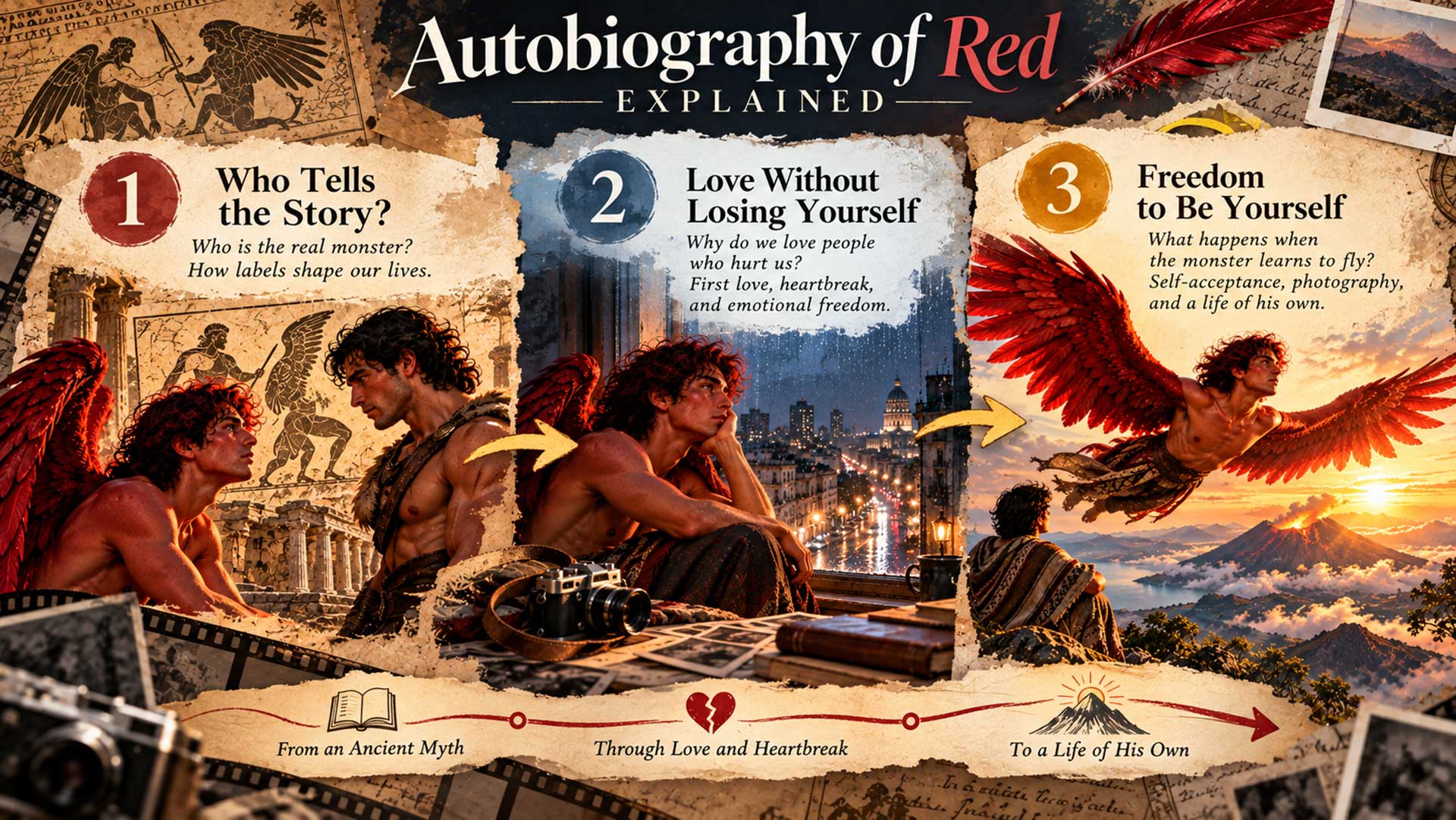
When we began, Geryon was a monster in an ancient poem, Herakles was a celebrated hero, and Stesichoros was the poet who decided how their story would end.
But something changed as they began listening to one another.
We discovered that heroes can hurt people without intending to, that love can be genuine without lasting forever, and that being different does not make someone less worthy of belonging.
Geryon's wings became more than a symbol of his strangeness. They represented possibilities he had never allowed himself to imagine. His photographs reminded us that painful experiences can become part of a story without becoming its entire meaning.
Yet the most surprising discovery came at the end.
Geryon did not need another heroic victory. He did not need Herakles to return, Stesichoros to rewrite history, or the world to recognize his greatness.
He wanted to enjoy being alive.
A morning with sunlight through the window. A conversation with someone who listened. A photograph worth taking. Bread shared around a table.
Perhaps the deepest freedom is not becoming someone extraordinary, but discovering that we never had to prove our worth in the first place.
The ancient story ended when the hero killed the monster.
Our imaginary conversation ends with Geryon sitting down to breakfast.
And perhaps that is the more remarkable ending.
Short Bios:
Anne Carson (2026 Nobel Prize in Literature Winner): Canadian poet, essayist, translator, and classicist who won the 2026 Nobel Prize in Literature for her innovative approach to literature and classical mythology. Her acclaimed 1998 verse novel Autobiography of Red reimagines the Greek myth of Geryon as a moving exploration of first love, heartbreak, identity, and self-discovery. She serves as the fictionalized moderator of this imaginary conversation.
Geryon: The red-winged protagonist of Autobiography of Red. Sensitive, observant, and passionate about photography, he struggles with childhood trauma, first love, and the challenge of accepting himself. His journey transforms the ancient monster into a complex individual with a life of his own.
Herakles: The celebrated hero of Greek mythology, reimagined in Carson's novel as Geryon's charismatic first love. His desire for freedom and his difficulty understanding Geryon's emotional needs reveal the complicated relationship between affection, responsibility, and heartbreak.
Ancash: A young Peruvian man whom Geryon encounters through Herakles. Curious, perceptive, and connected to the volcanic landscape, he helps Geryon reconsider the meaning of his wings and the possibilities of his own life.
Stesichoros: An ancient Greek lyric poet, traditionally associated with the Geryoneis, which recounts the myth of Herakles and Geryon. In this fictional conversation, he confronts the limitations of heroic storytelling and considers what happens when the monster is allowed to speak.
Leave a Reply