
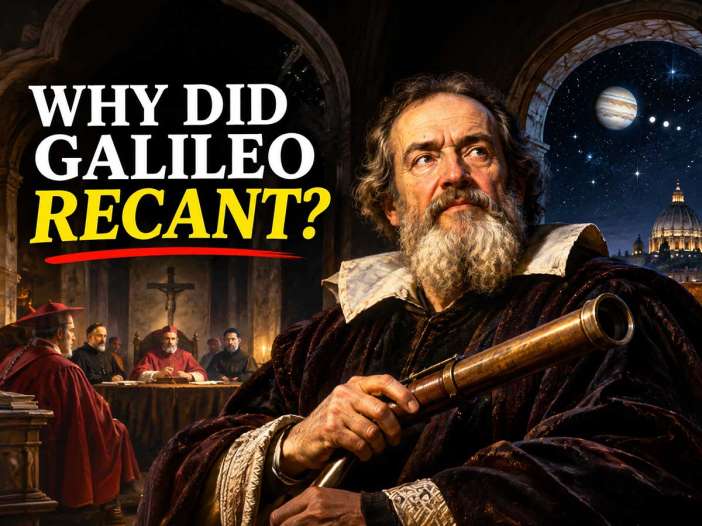
Introduction - Galileo Galilei and the Courage to Question Everything
Galileo Galilei changed humanity's view of the universe, but when authorities demanded that he renounce the ideas he had defended, he recanted. Was that a failure of courage, an act of survival, or something more difficult to judge? Nearly four centuries later, his story challenges us to ask a deeply personal question: What would we do if defending what we believed to be true threatened our freedom, reputation, and the people we loved?
Born in Pisa in 1564, Galileo became one of the central figures in the transformation of modern science. His investigations of motion, his improvements to the telescope, and his astronomical observations challenged influential assumptions about the natural world. In 1610, he published Sidereus Nuncius, commonly known as Starry Messenger, describing observations of the Moon and four satellites orbiting Jupiter. Yet the real Galileo was neither an infallible genius nor a man who proved every one of his theories correct. As the Stanford Encyclopedia of Philosophy's study of Galileo explains, his scientific achievements existed alongside mistaken arguments, including his incorrect explanation of ocean tides.
What fascinates me most is the young man behind those discoveries. Before he became a historical symbol, Galileo was a curious student, an ambitious mathematics professor, and a father with financial responsibilities. He enjoyed debate, questioned established explanations, and sometimes defended his own ideas with excessive confidence. I wanted to meet that Galileo, the one who could laugh at a joke, become impatient with a weak argument, and admit that investigating nature required more than simply being certain he was right.
Our imaginary conversation begins in Padua, where Galileo is teaching mathematics and investigating motion. From there, we move to a cold winter night in 1610, when he invites me to look through his telescope. We examine the Moon, Jupiter's satellites, and the excitement of discovering that the heavens are more complicated than traditional explanations suggested. But our conversation takes an unexpected direction when I ask whether a man who wanted everyone else to question authority was equally willing to question himself.
That question becomes much more serious when we meet again in Rome in 1633. Galileo, a Catholic who did not regard scientific investigation as an enemy of faith, has become entangled in a dispute involving astronomy, biblical interpretation, and Church authority. Following the publication of his Dialogue Concerning the Two Chief World Systems, he faces the Roman Inquisition. On June 22, 1633, he formally abjures the condemned Copernican position. Yet the historical account of Galileo's trial and later work reveals that his scientific life did not end with his condemnation. His story raises a question that remains relevant whenever personal conviction collides with institutional authority: How should we judge someone whose public decisions were made under extraordinary pressure?
But perhaps the most unexpected part of this interview concerns someone who never became famous for scientific discoveries. Galileo's daughter Virginia, known in religious life as Sister Maria Celeste, maintained an affectionate correspondence with her father. Her surviving letters reveal concern for his health, household, food, spiritual welfare, and daily difficulties. The Galileo Project's biography of Maria Celeste introduces a thoughtful, resourceful woman whose relationship with her father reveals a more intimate dimension of his life. She was not simply the daughter of a famous scientist. She was a person with her own faith, responsibilities, intelligence, and capacity for love.
Our final meeting takes place in Galileo's later years at Arcetri. Maria Celeste has died, Galileo has lost his sight, and his movements remain restricted. Yet he has continued investigating mathematics and motion, publishing Two New Sciences in 1638. As we sit together, I find myself less interested in asking whether history should call him a hero or a coward. I want to ask what he learned from being mistaken, what gave him reasons to continue working, and what his relationship with his daughter meant when public recognition could offer little comfort.
This five-part imaginary interview is not an attempt to place perfect words in Galileo's mouth or turn his life into a simple victory of science over religion. It is an invitation to meet a remarkable, imperfect human being. Through curiosity, discovery, conflict, affection, and perseverance, we explore a question that extends far beyond astronomy: Can we remain faithful to the search for truth without becoming prisoners of our own certainty?
Fictional Conversation and Historical Accuracy Disclaimer
This article is a fictional historical interview created for ImaginaryTalks.com. Nick Sasaki did not meet or interview Galileo Galilei. All conversations, personal exchanges, humor, scene details, and imagined reflections are creative reconstructions, not authentic quotations or endorsements.
The article draws upon documented events in Galileo's life, his scientific writings, historical scholarship, and surviving correspondence involving his daughter Maria Celeste. Historical facts are distinguished from fictional dialogue wherever necessary. The dialogue does not establish Galileo's undocumented private feelings, motivations, or final wishes.
Galileo's observations of Jupiter's satellites and the phases of Venus challenged important elements of traditional astronomy, but did not independently prove the complete Copernican system. His tidal explanation was mistaken. The familiar story that he declared "And yet it moves" after his recantation is not established as a historical fact.
The letter-and-telescope motif is a literary symbol. It does not claim that these objects were historically arranged together in the scenes described. The purpose of this imaginary conversation is to encourage thoughtful engagement with history, scientific inquiry, faith, human relationships, and intellectual humility.
Topic 1 - The Boy Who Dared to Question Everything
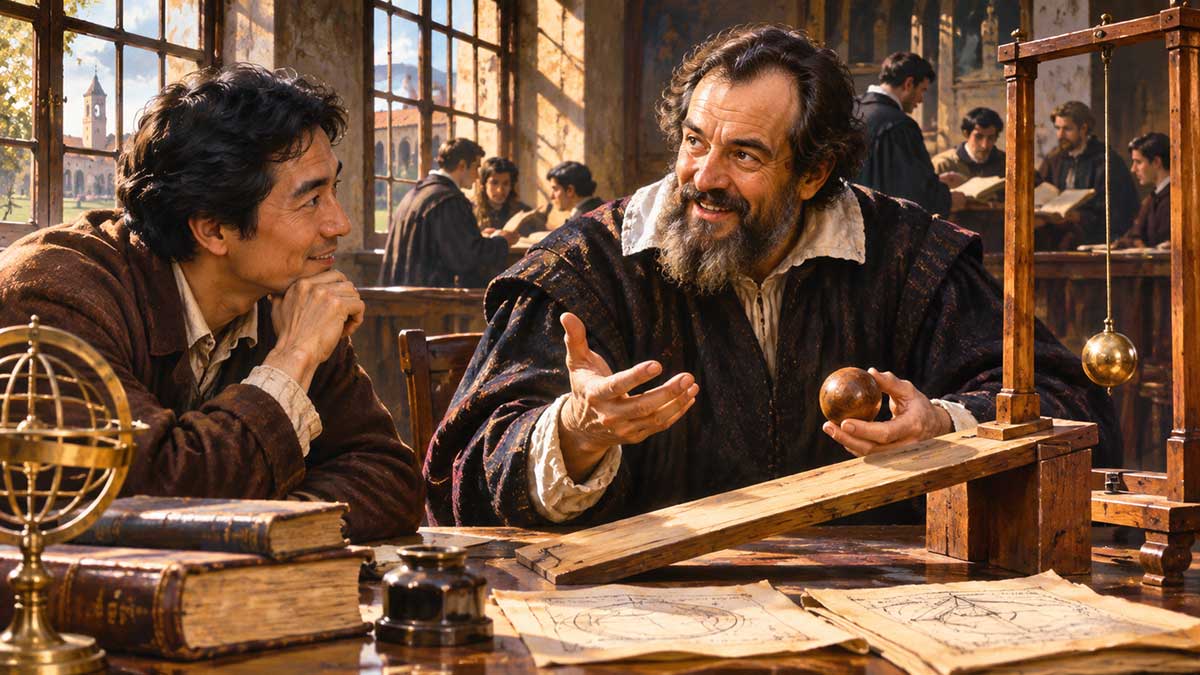
Golden sunlight streams through the tall windows of a university teaching room. Wooden tables are crowded with books, mathematical diagrams, brass instruments, and a small pendulum suspended from a wooden frame. Beyond the door, students exchange animated arguments in the corridor.
Galileo Galilei, forty years old, stands beside a table, adjusting an experimental apparatus. His dark hair is beginning to gray, his eyes are lively, and his expression suggests a man who has just discovered something interesting.
Nick Sasaki enters and notices the swinging pendulum.
Nick Sasaki
Galileo, I have a question before we even begin.
Galileo Galilei
Looking up with a smile.
Excellent. Then you have come to the right room.
Nick Sasaki
Do you ever look at something without trying to measure it?
Galileo Galilei
Of course.
Nick Sasaki
Really?
Galileo Galilei
Sometimes I look at my dinner.
Nick Sasaki
Laughing.
And you don't calculate anything?
Galileo Galilei
Only how much remains and whether I can persuade someone to bring me more.
They laugh. Galileo gestures toward a chair.
Galileo Galilei
Sit, Nick. But be careful where you place your elbows. I have spent the morning arranging those instruments, and I would prefer not to begin again.
Nick Sasaki
You know, I have a feeling your students are either fascinated by you or completely exhausted.
Galileo Galilei
Both, I should hope. An education ought to require some effort.
Question 1 - Where Did Your Curiosity Begin?
Nick Sasaki
Galileo, when people hear your name, they think of telescopes, planets, and a man challenging the greatest authorities of his time.
But I'm curious about the boy before all that.
Were you always asking difficult questions?
Galileo Galilei
I was certainly curious, but I would hesitate to describe myself as a child destined to overturn the heavens.
I grew up in Pisa, in a family where learning and artistic interests were valued. My father, Vincenzo, was a musician and a serious thinker about the principles of music.
He did not regard every inherited explanation as beyond examination.
Nick Sasaki
Your father questioned established musical theories, didn't he?
Galileo Galilei
He investigated relationships between musical sounds and the physical properties of strings.
Such questions can be examined through observation and experiment.
That was an important example for a young man to encounter.
Nick Sasaki
So he wasn't simply saying, "Respect the experts and don't ask questions."
Galileo Galilei
Laughing.
My father respected knowledge. That is not the same as believing every person who claims to possess it.
Nick Sasaki
I like that distinction.
You originally studied medicine at the University of Pisa.
How did you end up choosing mathematics?
Galileo Galilei
Mathematics attracted me through its clarity and its usefulness in examining nature.
Medicine was a respectable profession, and my family had practical reasons to favor it. But I became increasingly interested in geometry, mechanics, and the mathematical description of physical things.
Nick Sasaki
Did your father approve?
Galileo Galilei
My choice was not necessarily the most reassuring one for a family concerned about income.
A young man may be delighted by geometry. His relatives may prefer that geometry provide him with a living.
Nick Sasaki
Laughing.
That hasn't changed in four hundred years.
Parents still ask their children, "That's wonderful, but how are you going to make money?"
Galileo Galilei
Then perhaps parents possess a wisdom that survives every scientific revolution.
Nick Sasaki
But what was it about mathematics that excited you?
Galileo Galilei
It offered a way to move beyond vague explanations.
Consider a moving object. We can describe its motion with words, but we can ask further questions.
How far does it travel? How does its speed change? What relationship can we discover between distance and time?
A mathematical investigation demands precision.
Nick Sasaki
So instead of asking only why something happens, you wanted to know exactly how it happens.
Galileo Galilei
Yes. And whether the explanation agrees with what nature actually does.
Nick Sasaki
Did you ever feel that curiosity was a burden?
Galileo Galilei
A burden?
Nick Sasaki
You know, when everyone else is satisfied with an answer, but your mind won't leave it alone.
Galileo Galilei
Smiling.
That sounds less like a burden than an excellent afternoon.
Question 2 - Why Challenge Ideas Everyone Respected?
Galileo picks up a small wooden ball and places it beside an inclined board.
Nick Sasaki
Let's talk about Aristotle.
For centuries, scholars had studied his explanations of motion and the natural world.
What made you question ideas that so many educated people respected?
Galileo Galilei
Aristotle was an extraordinary thinker. It would be foolish to dismiss his contributions merely to appear original.
But admiration for a philosopher should not prevent us from examining his conclusions.
Nature is not obliged to behave according to what an ancient author wrote.
Nick Sasaki
That's a great sentence.
Did you get into trouble saying things like that?
Galileo Galilei
One does not always become popular by informing learned gentlemen that their favorite explanation may be mistaken.
Nick Sasaki
Laughing.
I can see that.
But let me challenge you a little.
You enjoyed arguing, didn't you?
Galileo Galilei
Certainly. A good argument can be delightful.
Nick Sasaki
And winning one?
Galileo Galilei
Grinning.
Even more delightful.
Nick Sasaki
There it is!
Galileo Galilei
But a victory achieved through a poor argument is hardly a scientific achievement.
Nick Sasaki
Still, I wonder whether your competitive nature ever got in the way.
Did you sometimes become so determined to prove another scholar wrong that you struggled to reconsider your own position?
Galileo pauses, turning the wooden ball between his fingers.
Galileo Galilei
That is a fair question.
A person who argues vigorously must be careful not to confuse confidence with demonstration.
I would like to think that evidence guided my conclusions. Yet I cannot claim that ambition or pride never influenced my conduct.
Nick Sasaki
I appreciate that.
It's easy to admire someone who challenges authority. But I think the harder test comes when someone challenges us.
Galileo Galilei
Indeed. We may discover that our own cherished ideas have become authorities in our minds.
Nick Sasaki
Now, about these experiments.
People tell a famous story about you dropping two objects from the Leaning Tower of Pisa to prove that heavier things don't necessarily fall faster.
Did that really happen?
Galileo Galilei
Stories often become more dramatic as they travel.
What matters scientifically is the question itself: how do bodies fall, and what can careful reasoning and experiment tell us about their motion?
A tower makes a splendid picture, but a picture is not evidence that a particular demonstration occurred.
Nick Sasaki
Laughing.
You're refusing to give me the famous scene.
Galileo Galilei
I am trying to give you something better.
A question worth investigating.
He gestures toward the inclined board.
Galileo Galilei
Suppose we study motion in a way that allows us to examine its changes more carefully.
Rather than accepting a general statement, we seek measurable relationships.
That is where the interesting work begins.
Nick Sasaki
And what happens when an experiment doesn't agree with what you expected?
Galileo Galilei
Then we must examine the experiment, our assumptions, and our reasoning.
Perhaps the apparatus is inadequate. Perhaps the measurements are mistaken.
Or perhaps the expectation itself must change.
Nick Sasaki
That's a lesson I wish more people learned.
Sometimes we're so attached to being right that we forget we're supposed to be learning.
Galileo Galilei
Smiling.
You are becoming quite dangerous, Nick.
Nick Sasaki
Why?
Galileo Galilei
You have begun questioning the questioner.
Question 3 - How Much Did Ambition Shape Your Life?
The university bells ring in the distance. Galileo moves several books aside, making room for a small plate of bread and cheese.
Nick Sasaki
Now we're getting somewhere.
You know, Galileo, when people talk about great scientists, they sometimes make it sound like they lived entirely for ideas.
But you had bills to pay.
Galileo Galilei
A most unpleasant subject.
Nick Sasaki
Laughing.
You had family responsibilities, students, professional ambitions.
You needed income.
How did you balance your scientific curiosity with ordinary life?
Galileo Galilei
Not always easily.
My family depended upon financial support, and academic appointments offered both opportunities and obligations.
I taught mathematics, investigated practical problems, and sought ways to improve my circumstances.
A scholar may love knowledge deeply and still need to purchase bread.
Nick Sasaki
And apparently cheese.
Galileo Galilei
Holding up a piece.
Especially cheese.
Nick Sasaki
What did you enjoy most about teaching in Padua?
Galileo Galilei
The intellectual activity. The opportunity to work with students, pursue mathematical questions, and discuss ideas with people who possessed genuine curiosity.
Padua offered a stimulating environment.
My work included teaching, research, and practical mathematical applications.
Nick Sasaki
Did you want to become famous?
Galileo Galilei
I wished my work to be recognized.
Recognition can bring opportunities to continue one's investigations.
And yes, there is personal satisfaction in being regarded as capable.
Nick Sasaki
So you weren't pretending to be completely indifferent to success.
Galileo Galilei
Why should I pretend?
An ambitious person need not be ashamed of ambition. The question is what he does with it.
Nick Sasaki
That's interesting.
But did you ever worry about failure?
Galileo Galilei
Naturally.
An academic career is uncertain. A mathematical idea may prove difficult to develop. A patron may withdraw support.
One must make decisions without knowing their consequences.
Nick Sasaki
And now you have children too.
Does being a father change how you think about your future?
Galileo Galilei
It makes practical matters more pressing.
My daughter Virginia is still very young, and I have responsibilities beyond my own interests.
I cannot simply follow every intellectual curiosity without considering those who depend upon me.
Nick Sasaki
I think that's something readers will connect with.
They may never discover moons around Jupiter, but they know what it's like to have dreams and responsibilities pulling at them.
Galileo Galilei
And the two need not always be enemies.
Responsibilities can give purpose to ambition.
But they can certainly make decisions more difficult.
Nick Sasaki
Can I ask something personal?
Galileo Galilei
You have been asking personal questions since you entered the room.
Nick Sasaki
Laughing.
Fair enough.
Do you think you would still study nature if nobody ever praised your work?
Galileo Galilei
He considers the question.
I believe curiosity would remain.
But I would be dishonest to say that encouragement, recognition, and the opportunity to communicate discoveries have no importance.
Knowledge grows through conversation and examination.
A discovery kept entirely to oneself has a different life from one shared with others.
Nick Sasaki
So you want people to see what you've discovered.
Galileo Galilei
Certainly.
And I want them to examine it.
Nick Sasaki
Even when they disagree?
Galileo Galilei
Especially when they disagree intelligently.
Nick Sasaki
There's that competitive side again.
Galileo Galilei
Laughing.
You seem determined to make me confess to enjoying an argument.
Nick Sasaki
I think you confessed about twenty minutes ago.
They laugh together.
For a moment, the conversation pauses. Galileo glances toward the instruments on his table.
Nick Sasaki
You know what I find fascinating about you?
It's not simply that you're willing to question accepted ideas.
It's that you seem genuinely excited by the possibility that the world might be different from what you expected.
Galileo Galilei
That is one of the great pleasures of investigation.
We begin with a question, examine nature, and sometimes discover something that changes our thinking.
Nick Sasaki
But what if you discover something so surprising that people refuse to believe you?
Galileo Galilei
Then one must examine the evidence carefully and communicate it as clearly as possible.
Nick Sasaki
And if they still refuse?
Galileo Galilei
Smiling.
Then perhaps one needs better evidence.
Or a better instrument.
Galileo reaches into a wooden case and lifts a polished glass lens.
Nick Sasaki
What's that?
Galileo Galilei
A lens.
Nick Sasaki
I can see that.
Galileo Galilei
Then your powers of observation are improving.
Nick Sasaki
Laughing.
Very funny.
What are you planning to do with it?
Galileo Galilei
For the moment, nothing extraordinary. Lenses are useful objects, and their optical properties deserve investigation.
Nick Sasaki
You know, I have a feeling that someday you're going to point an instrument at the sky and find something nobody expects.
Galileo Galilei
He raises an eyebrow.
An ambitious prediction.
Nick Sasaki
Well, I've learned something from you.
Galileo Galilei
And what is that?
Nick Sasaki
Never assume the world has finished surprising us.
Galileo smiles and returns the lens to its case.
Galileo Galilei
On that point, Nick, we agree completely.
Outside, the students' voices rise again as the next lecture approaches. Galileo gathers his papers, still discussing an experiment he hopes to improve.
Nick follows him toward the door, curious about the questions that will one day lead this energetic professor from the motion of ordinary objects to the extraordinary discoveries awaiting him in the night sky.
Fictional Interview Disclaimer
This conversation between Nick Sasaki and Galileo Galilei is a work of historical fiction. The imagined meeting, dialogue, humor, and private reflections are fictional, informed by documented elements of Galileo's education, family, teaching career, scientific investigations, and intellectual interests. The 1604 scene is set before his documented telescopic discoveries of 1609–1610. The Leaning Tower experiment is treated as an uncertain historical tradition rather than an established event. No dialogue in this interview should be presented as an authenticated quotation from Galileo.
Topic 2 - The Night the Universe Changed
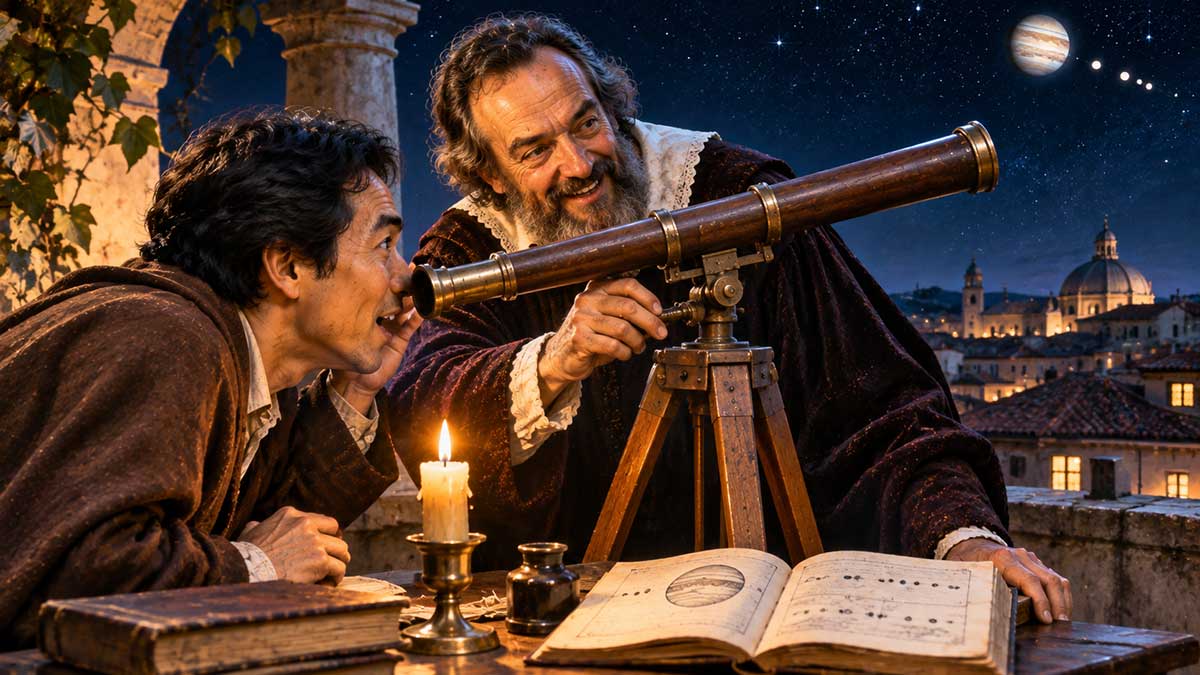
The rooftops of Padua lie beneath a deep blue sky. A few windows glow with candlelight, but most of the city has fallen quiet. On an imagined observing terrace beside his residence, Galileo Galilei adjusts a wooden telescope pointed toward Jupiter.
A notebook rests on a small table, its pages covered with tiny circles, dots, and carefully drawn lines. A candle flickers beside it. The cold air carries the distant sound of a church bell.
Nick Sasaki steps onto the terrace, pulling his coat tightly around himself.
Nick Sasaki
Galileo, I have to ask you something.
Galileo Galilei
Without looking away from his telescope.
Only one question tonight? How disappointing.
Nick Sasaki
Why couldn't we do this in the afternoon?
Galileo Galilei
Laughing.
You are welcome to examine Jupiter in daylight, Nick. I suspect you will find the experience rather unsatisfying.
Nick Sasaki
I'm beginning to understand why your students need patience.
Galileo Galilei
And warm clothing. Come here. I want to show you something.
Nick approaches the telescope and bends awkwardly to look through it.
Nick Sasaki
I can't see anything.
Galileo Galilei
Move your eye slightly.
Nick Sasaki
Still nothing.
Galileo Galilei
A little to the left.
Nick Sasaki
Galileo, I thought you were going to show me the universe. So far, you've shown me a very uncomfortable piece of wood.
Galileo Galilei
Laughing heartily.
The universe is under no obligation to make itself convenient for you.
He adjusts the instrument.
Galileo Galilei
Now. Look carefully.
Nick leans forward again.
Nick Sasaki
Oh!
He falls silent.
Galileo Galilei
You see it?
Nick Sasaki
Yes.
That's Jupiter?
Galileo Galilei
Indeed.
Nick Sasaki
It's beautiful.
Galileo Galilei
And we have scarcely begun.
Question 1 - What Did You Feel When You First Saw the Moon?
Nick Sasaki
Galileo, before we talk about Jupiter, I want to go back a few months.
In 1609, you began using an improved telescope to study the heavens.
What was it like when you first examined the Moon?
Galileo Galilei
Extraordinary.
With the naked eye, the Moon presents a familiar face. People have observed it for thousands of years.
But through the telescope, details appear that ordinary sight cannot distinguish.
I saw patterns of light and shadow, bright regions and dark ones, irregular boundaries that suggested elevations and depressions.
Nick Sasaki
Mountains and valleys?
Galileo Galilei
That was my interpretation.
The changing shadows suggested that the lunar surface was not the perfectly smooth sphere described in traditional accounts of the heavens.
Nick Sasaki
So something people thought was perfect turned out to have an uneven surface.
Galileo Galilei
Yes. The observations challenged the notion that heavenly bodies must possess an entirely different kind of physical perfection from earthly things.
Nick Sasaki
Did you immediately think, "Everything we've been taught is wrong"?
Galileo Galilei
Certainly not everything.
A discovery should make us reconsider particular claims, not discard all previous knowledge in a fit of excitement.
Nick Sasaki
Laughing.
That sounds surprisingly restrained coming from you.
Galileo Galilei
I am capable of restraint.
Nick Sasaki
For how long?
Galileo Galilei
That depends upon the quality of the opposing argument.
They laugh.
Nick Sasaki
But seriously, did you worry that the telescope might be misleading you?
Galileo Galilei
Of course, the instrument required careful examination.
Lenses introduce distortions. Observations must be repeated, and what appears through an instrument must be interpreted cautiously.
But when the patterns of light and shadow changed in ways consistent with an uneven surface, the explanation became increasingly persuasive.
Nick Sasaki
I love that.
You didn't simply look once and announce that you'd solved the mystery.
Galileo Galilei
A single glance can inspire a question. Establishing an answer requires more work.
Nick Sasaki
And you improved the telescope yourself?
Galileo Galilei
I learned of an optical instrument developed elsewhere and worked to construct instruments with greater magnification and usefulness.
I did not invent the first telescope.
But improving an instrument can open possibilities its earlier makers never fully explored.
Nick Sasaki
That's an interesting lesson.
Sometimes the great discovery isn't inventing something completely new. It's recognizing what an existing invention might allow us to see.
Galileo Galilei
Precisely.
And sometimes it requires the patience to look again when others believe there is nothing more to discover.
Question 2 - What Happened When Jupiter Revealed Its Moons?
Galileo turns to his notebook and opens it to a page filled with small dots arranged beside a larger circle.
Galileo Galilei
Now, Nick, look at these drawings.
Nick Sasaki
They're tiny.
Galileo Galilei
The objects themselves are rather far away.
Nick Sasaki
Laughing.
Fair point.
What am I looking at?
Galileo Galilei
Jupiter, and several small points of light near it.
At first, I considered them fixed stars.
But as I observed them on successive nights, their positions changed.
Nick Sasaki
Changed how?
Galileo Galilei
They appeared on different sides of Jupiter and at different distances from it.
Their movements did not fit the expectation that they were ordinary fixed stars.
Gradually, the evidence suggested that these bodies were moving around Jupiter itself.
Nick Sasaki
So you discovered that Jupiter had moons.
Galileo Galilei
Four satellites, yes.
Nick Sasaki
That must have been incredible.
Did you realize how significant it was?
Galileo Galilei
I recognized that it challenged an important assumption.
If bodies could revolve around Jupiter, then it was not necessary for every celestial body to revolve around Earth.
Nick Sasaki
That sounds obvious to us now.
But at the time, it was revolutionary.
Galileo Galilei
It was certainly significant.
Yet we must be precise.
The existence of Jupiter's satellites did not, by itself, demonstrate that Earth travels around the Sun.
It showed that the heavens contained arrangements more varied than some traditional models allowed.
Nick Sasaki
I'm glad you made that distinction.
Sometimes people tell the story as though you looked through the telescope one night and proved the entire Copernican system.
Galileo Galilei
That would make a wonderfully brief scientific career.
One observation, one conclusion, and then a comfortable retirement.
Nick Sasaki
Laughing.
You'd have hated retirement.
Galileo Galilei
I suspect I would have found something to investigate before breakfast.
Nick Sasaki
What did you feel during those nights when the dots kept changing positions?
Galileo Galilei
Excitement. Curiosity. The desire to observe again.
Each night offered another piece of evidence.
There is a particular satisfaction in watching a pattern emerge from observations that initially seem puzzling.
Nick Sasaki
Were you nervous that you might be wrong?
Galileo Galilei
One must remain aware of that possibility.
But uncertainty is not always unpleasant. Sometimes it is precisely what makes an investigation exciting.
Nick Sasaki
You know, I can picture you waking up in the morning and wishing the Sun would hurry up and set.
Galileo Galilei
Laughing.
There were certainly nights when the heavens proved more interesting than sleep.
Nick Sasaki
And then you published your discoveries in Starry Messenger.
Galileo Galilei
Yes, in 1610.
I wished to communicate the observations and their significance.
Nick Sasaki
You named the moons in honor of the Medici family.
That was a smart career move, wasn't it?
Galileo Galilei
Smiling.
A scholar who wishes to continue his investigations must sometimes consider the practical value of patronage.
Nick Sasaki
So the man studying Jupiter was still thinking about his salary.
Galileo Galilei
Jupiter may possess satellites, Nick, but it has never offered to pay my household expenses.
Both laugh.
Question 3 - What Happens When People Refuse to Believe What You See?
The wind grows colder. Galileo closes his notebook, but Nick remains beside the telescope.
Nick Sasaki
Galileo, here's what fascinates me.
You observed something extraordinary. You documented it. You published your findings.
But not everyone accepted your conclusions.
How did you deal with that?
Galileo Galilei
There were several kinds of objections.
Some concerned the reliability of telescopes. Others concerned the interpretation of observations.
And some reflected a reluctance to reconsider long-established ideas.
Those objections should not all be treated as identical.
Nick Sasaki
That's fair.
A person questioning your instrument isn't necessarily afraid of the truth.
Galileo Galilei
Exactly.
An investigator should welcome serious examination.
But criticism must engage with the evidence.
Nick Sasaki
Did you ever get impatient with people who disagreed?
Galileo Galilei
Giving Nick a knowing look.
Have you learned nothing about me from our previous conversation?
Nick Sasaki
Laughing.
I knew you were going to say that.
Galileo Galilei
I confess that patience was not always my greatest virtue.
But disagreement can be useful when it forces us to clarify our reasoning.
Nick Sasaki
Let me ask about Venus.
Your later observations showed that Venus goes through phases, rather like the Moon.
What did that tell you?
Galileo Galilei
The full range of phases was inconsistent with the traditional Ptolemaic arrangement.
It supported the conclusion that Venus travels around the Sun.
But one must distinguish that observation from a complete demonstration of Earth's motion.
Nick Sasaki
Since Tycho Brahe's system could explain those phases too?
Galileo Galilei
Yes. In that arrangement, Venus revolves around the Sun, but Earth remains stationary.
Nick Sasaki
So even with extraordinary evidence, there were still important questions to settle.
Galileo Galilei
Certainly.
Science does not progress merely by collecting observations. We must determine which explanations account for them most successfully.
Nick Sasaki
Now I'm going to ask you something difficult.
You wanted people to question Aristotle and other respected authorities.
But were you equally comfortable when someone questioned your own conclusions?
Galileo folds his hands and studies Nick for a moment.
Galileo Galilei
You do enjoy returning to this subject.
Nick Sasaki
I learned from a very argumentative teacher.
Galileo Galilei
Laughing.
Then perhaps I deserve the inconvenience.
A scientist should be willing to examine objections to his own position.
But I would not pretend that doing so is always easy.
We become attached to explanations, especially those we have spent years developing.
Nick Sasaki
And sometimes being right becomes part of our identity.
Galileo Galilei
Yes.
Which is why evidence must remain more important than personal satisfaction.
Nick Sasaki
But did you always live up to that principle?
Galileo Galilei
Smiling faintly.
You are asking whether I have ever been stubborn.
Nick Sasaki
I think I already know the answer.
Galileo Galilei
Then why ask?
Nick Sasaki
Because I want to hear you admit it.
They laugh.
Galileo Galilei
I have defended my ideas vigorously. Whether every argument I have made deserves equal confidence is another matter.
Nick Sasaki
That's what makes this interesting.
You were challenging other people's certainty, but you had to deal with your own certainty too.
Galileo Galilei
A difficult task for any thinker.
Nick Sasaki
There's another question I've been wanting to ask.
Did you believe studying the heavens brought you closer to God, or did your discoveries ever make you question your faith?
Galileo Galilei
I did not regard the study of nature as an enemy of faith.
The natural world is worthy of careful investigation.
If an interpretation of Scripture appears to conflict with a well-established physical demonstration, then we must consider whether we have interpreted the passage correctly.
Nick Sasaki
So you didn't think faith required you to ignore what you observed.
Galileo Galilei
No.
But questions concerning nature, Scripture, and authority can become difficult when people disagree about who has the right to interpret them.
Nick Sasaki
Did you ever worry that your discoveries might bring you into conflict with religious authorities?
Galileo Galilei
Scientific disagreement can have consequences beyond the investigation itself.
I would prefer that questions about the heavens be examined through observation and reasoning.
But I cannot assume everyone will approach them in the same way.
Nick looks once more through the telescope.
Nick Sasaki
You know what's strange?
When I look at Jupiter through this little instrument, I feel something wonderful.
The universe seems larger than I thought.
But I can see how that same discovery might make someone else uncomfortable.
Galileo Galilei
A new observation can be delightful to one person and unsettling to another.
Nick Sasaki
And sometimes the disagreement isn't really about what we see.
It's about what accepting it might mean.
Galileo Galilei
That is possible.
But we must still examine each objection on its merits.
Nick Sasaki
Fair enough.
He steps away from the telescope and looks up at the night sky.
Nick Sasaki
Galileo, I think I finally understand why you love doing this.
You look at something familiar, and suddenly it becomes mysterious again.
Galileo Galilei
Smiling.
That is a fine description of scientific curiosity.
Nick Sasaki
But I have a feeling the hardest part of your story isn't going to be discovering what's out there.
Galileo Galilei
Oh?
Nick Sasaki
It's going to be what happens when people disagree about what your discoveries mean.
Galileo Galilei
Then we shall have some interesting conversations ahead of us.
Nick Sasaki
I suspect we will.
And next time, I want to ask you about something more difficult than Jupiter.
Galileo Galilei
More difficult than Jupiter?
Nick Sasaki
Faith, authority, and what happens when defending an idea puts your future at risk.
Galileo looks toward the dark rooftops of Padua.
Galileo Galilei
Then perhaps we should meet somewhere warmer.
Nick Sasaki
Laughing.
Agreed. And preferably somewhere with dinner.
Galileo Galilei
Now that is a proposal supported by excellent reasoning.
The two men laugh as Galileo carefully covers the telescope.
Above them, Jupiter continues its silent movement across the winter sky. Its moons follow their paths, indifferent to the arguments human beings will make about them.
For Galileo, the observations are only the beginning. The more difficult questions concern what people will do with the evidence, and whether he himself will remain as willing to be questioned as he is to question others.
Fictional Interview Disclaimer
This conversation between Nick Sasaki and Galileo Galilei is a work of historical fiction. The imagined meeting, dialogue, humor, and private reflections are fictional. Galileo's telescopic observations of the Moon and Jupiter in 1609–1610, his publication of Sidereus Nuncius in 1610, and his subsequent observations of Venus are historically documented. The phases of Venus did not independently establish heliocentrism, and Jupiter's satellites did not conclusively prove Earth's motion. Galileo's views on faith and scientific investigation are represented through fictional dialogue informed by his historical writings, not authenticated quotations.
Topic 3 - When Truth Became Dangerous
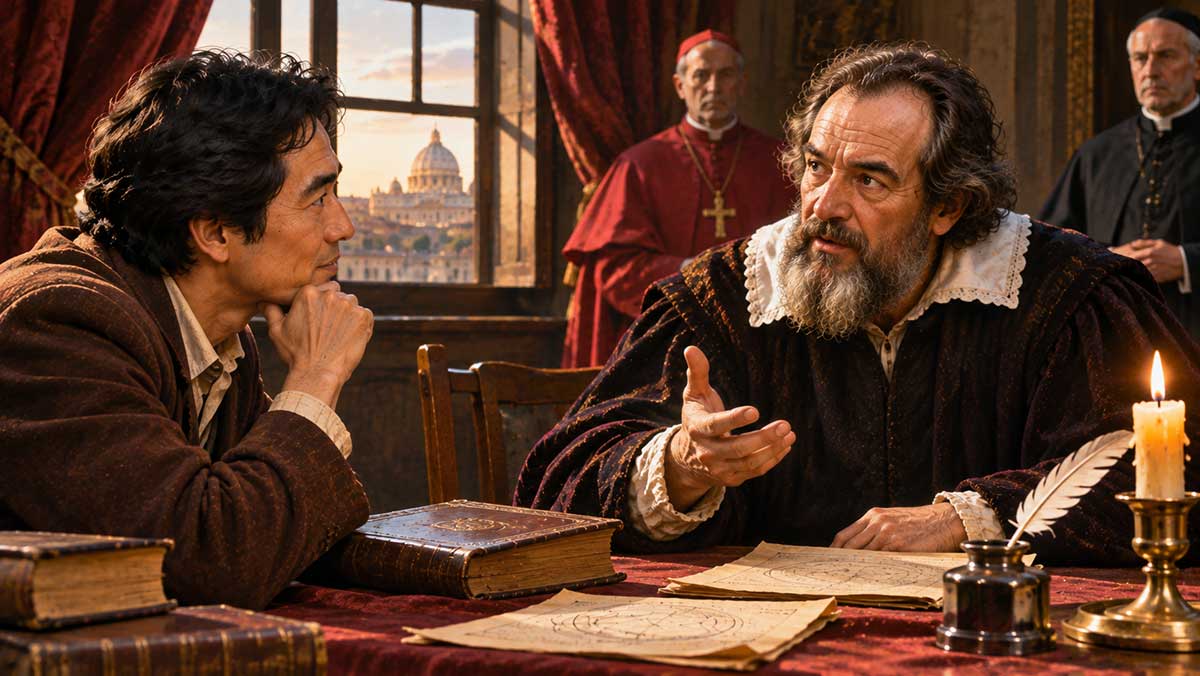
The sunlight is fading behind the buildings of Rome. Inside an imagined private room, heavy curtains soften the golden light. A wooden table holds an inkstand, folded documents, and a copy of Galileo Galilei's controversial book, Dialogue Concerning the Two Chief World Systems.
Galileo, now sixty-nine, sits beside the table. His beard has turned gray, and his expression is more guarded than when Nick Sasaki last visited him in Padua. Yet the familiar intelligence and humor remain in his eyes.
Nick enters quietly. He notices the book and pulls up a chair.
Nick Sasaki
Galileo, it's good to see you again.
Galileo Galilei
Nick! You have chosen a rather unfortunate time to visit Rome.
Nick Sasaki
I was going to say the same thing.
They exchange a tired smile.
Nick Sasaki
I see your book is still causing trouble.
Galileo Galilei
It has attracted more attention than I would have wished.
Nick Sasaki
That's saying something. The Galileo I remember enjoyed attention.
Galileo Galilei
Smiling faintly.
I prefer attention from readers who appreciate my arguments.
Nick Sasaki
And you've discovered that not everyone does.
Galileo Galilei
A discovery I might have made without publishing several hundred pages.
Nick laughs, then notices how weary his friend looks.
Question 1 - Did Science Ever Threaten Your Faith?
Nick Sasaki
Galileo, there's something I've wanted to ask you for years.
People in the future will describe your conflict as science against religion. They'll picture you on one side and the Church on the other.
But you believe in God. You're Catholic.
Did your discoveries ever make you feel that science and faith were enemies?
Galileo Galilei
No. I have never regarded the investigation of nature as an attack upon God.
The natural world is worthy of study. We can examine its motions and relationships through observation, mathematics, and reason.
I do not believe that doing so requires abandoning faith.
Nick Sasaki
Then where did the conflict begin?
Galileo Galilei
Partly in disagreements about how Scripture should be interpreted when discussing physical questions.
I have argued that biblical passages are not always intended to teach us the mathematical arrangement of the heavens.
But questions about interpretation involve authorities who possess responsibilities very different from those of a mathematician.
Nick Sasaki
So when you said Earth moves around the Sun, some people heard more than a scientific claim.
Galileo Galilei
Yes. They heard a challenge to interpretations they considered authoritative.
Nick Sasaki
Were there Church leaders who supported you?
Galileo Galilei
Certainly. I have known educated and sympathetic churchmen, including men interested in astronomy.
The Church is not composed of people who all think alike.
Nick Sasaki
And Pope Urban VIII was once friendly toward you.
Galileo Galilei
Cardinal Maffeo Barberini, before becoming pope, showed interest in my work. Our relationship has a history more complicated than a simple disagreement.
Nick Sasaki
That makes what happened harder to comprehend.
You weren't attacking Christianity. You were trying to explain nature.
Galileo Galilei
I was defending conclusions I believed the evidence supported.
But I must distinguish my intentions from how others interpreted my conduct.
Nick Sasaki
Let me ask you something personal.
When you look through a telescope and see Jupiter's moons, do you feel you're discovering something about God's creation?
Galileo Galilei
I find no contradiction in admiring creation and investigating its workings.
The more carefully we study nature, the more extraordinary its order may appear.
Nick Sasaki
I love that.
I believe faith and the search for truth should be able to exist together.
But here's the difficulty. What happens when someone sincerely believes that your scientific interpretation threatens something sacred?
Galileo Galilei
Then we must examine the arguments with patience.
We should distinguish what has been demonstrated from what remains uncertain.
And we must be careful not to confuse our interpretation of a text with the physical behavior of nature itself.
Nick Sasaki
You said patience.
Galileo raises an eyebrow.
Galileo Galilei
I recognize that expression.
Nick Sasaki
I'm wondering whether you always practiced what you just recommended.
Galileo Galilei
He laughs softly.
You have traveled all the way to Rome to question my patience?
Nick Sasaki
Among other things.
Question 2 - Did Your Confidence Make the Conflict Worse?
Nick Sasaki
Galileo, I've always admired your willingness to challenge accepted ideas.
But you could be pretty sharp with people who disagreed with you.
Do you think your confidence sometimes made your difficulties worse?
Galileo Galilei
I have argued forcefully. I do not deny that.
But we must distinguish an argument's manner from its truth.
An unpleasant man may be correct, and a courteous man may be mistaken.
Nick Sasaki
Absolutely.
But if you make someone feel foolish, they may stop listening before you've explained your evidence.
Galileo Galilei
That is possible.
Nick Sasaki
Let's talk about your Dialogue.
You created three characters to discuss the competing systems of the universe.
Salviati argues strongly for Copernican ideas. Sagredo listens and considers the arguments. Simplicio defends traditional positions.
Why that format?
Galileo Galilei
A dialogue allows readers to examine arguments from different perspectives.
It can make difficult subjects more accessible than a purely technical treatise.
Nick Sasaki
And sometimes more entertaining.
Galileo Galilei
I hope so.
Nick Sasaki
But Simplicio often looks foolish.
Did you consider how people defending the traditional view might react?
Galileo Galilei
I intended to examine arguments, but I recognize that readers may interpret a character's presentation as ridicule.
Nick Sasaki
Some people later suggested that the pope felt personally mocked.
Galileo Galilei
I cannot claim to know precisely how every passage was received or what each person believed about my intentions.
Nick Sasaki
Fair answer.
Now, here's a question I don't think you're going to enjoy.
Galileo Galilei
You have already asked several.
Nick Sasaki
Laughing.
Your explanation of the tides.
You argued that the motion of Earth could explain the rising and falling of the seas.
But that explanation was wrong.
Galileo Galilei
His expression becomes more serious.
I considered the tides an important physical argument for Earth's motion.
Nick Sasaki
And you rejected the idea that the Moon might be involved.
Galileo Galilei
I was not persuaded by explanations that attributed the tides to lunar influence.
Nick Sasaki
But what if the Moon really does play the central role?
What if your own explanation doesn't fit the observations?
Galileo leans back, considering the challenge.
Galileo Galilei
Then the explanation must be examined critically.
An argument does not become correct merely through the confidence of the person presenting it.
Nick Sasaki
That's what I wanted to hear.
But would you have been willing to admit it publicly?
Galileo Galilei
That is more difficult to answer.
I have invested considerable thought in the problem.
A person can become attached to an explanation through years of work.
Nick Sasaki
I think that's something we all struggle with.
We want other people to question their beliefs, but when someone questions ours, suddenly we're not so enthusiastic.
Galileo Galilei
Smiling.
You are becoming rather skilled at using my principles against me.
Nick Sasaki
I had an excellent teacher.
Galileo Galilei
An irritating one, apparently.
They laugh, and for a moment the tension in the room eases.
Nick Sasaki
Galileo, I don't think your mistakes make your discoveries less remarkable.
Actually, they make your story more meaningful.
You were a human being trying to find the truth, not someone who possessed every answer.
Galileo Galilei
A scientist must be judged by the strength of his reasoning and evidence, not by the expectation that he can never err.
Nick Sasaki
Then let's turn to something much harder than a scientific mistake.
Question 3 - What Did Recanting Mean to You?
Outside, the bells of a nearby church begin to ring. Nick waits until the sound fades.
Nick Sasaki
Galileo, in 1616, you were warned against holding or defending the Copernican position.
Years later, you published your Dialogue, and now you've been brought before the Roman Inquisition.
You're being required to renounce the position you've defended.
I don't want to pretend I know what you're feeling.
But how do you approach a decision like that?
Galileo Galilei
With great difficulty.
The proceedings concern my writings, my obedience to ecclesiastical authority, and the position I have defended.
My circumstances are serious.
Nick Sasaki
Are you afraid?
Galileo looks toward the window.
Galileo Galilei
I would be foolish to disregard the consequences.
I am an old man, Nick. My health is not what it was when we first met in Padua.
I have work I wish to continue and people whose welfare matters to me.
Nick Sasaki
Some people in the future may say that if you truly believed Earth moved, you should have refused to recant, whatever the consequences.
What would you say to them?
Galileo Galilei
I would ask them to consider the circumstances before judging a decision they have never been required to make.
It is easy to demand courage from another person when one does not bear the consequences.
Nick Sasaki
That's a fair challenge.
But let me ask the other side.
If someone publicly renounces an idea they privately believe is true, doesn't that risk giving authority the victory?
Galileo Galilei
A public declaration has consequences. I do not dismiss them.
But the physical behavior of the heavens is not determined by what any individual is compelled to say.
Nick Sasaki
So you distinguish between the universe and the arguments people make about it.
Galileo Galilei
Yes.
But I must be careful about what I claim to have demonstrated and what I am permitted to defend.
Nick Sasaki
Do you feel you've been defeated?
Galileo Galilei
In this proceeding, I have not prevailed.
That is plain enough.
But whether a person's entire intellectual life can be measured by a single judgment is another question.
Nick Sasaki
I keep thinking about something.
When we met in Padua, you were so full of energy. You laughed about your students, your salary, and your experiments.
Then you showed me Jupiter's moons.
You were like a child discovering something wonderful.
And now here you are, worrying about what will happen if you continue defending your conclusions.
Galileo Galilei
Life has a habit of presenting questions for which mathematics offers little assistance.
Nick Sasaki
Do you regret writing the Dialogue?
Galileo Galilei
I cannot easily separate the value I place upon scientific inquiry from the consequences of publishing my arguments.
I might reconsider certain choices of presentation.
But that is not the same as declaring every question I pursued unworthy of investigation.
Nick Sasaki
And what about the people who love you?
Are you thinking about them?
Galileo Galilei
Of course.
My family is not separate from the consequences of my decisions.
Nick Sasaki
Your daughter Maria Celeste has been writing to you.
Galileo Galilei
Yes.
Nick Sasaki
What does she say?
Galileo's expression softens.
Galileo Galilei
She is concerned for my health and circumstances.
She writes with affection and religious devotion.
Her letters contain the ordinary concerns of a daughter who wishes her father well.
Nick Sasaki
Does that help?
Galileo Galilei
It is a comfort to know that someone cares about the person, not merely the controversy.
Nick Sasaki
You know, Galileo, that may be one of the most important things you've told me today.
The world is arguing about whether you're right or wrong.
But your daughter is worried about whether you're eating, sleeping, and taking care of yourself.
Galileo Galilei
Quietly.
Those are not insignificant questions.
Nick Sasaki
No. They're not.
For a few moments, neither speaks.
Nick Sasaki
Can I ask one last thing?
Galileo Galilei
You may.
Nick Sasaki
When you look back on this period, what do you hope people will recognize about you?
Galileo Galilei
I hope they will examine my work carefully.
They should recognize what the observations establish, question arguments that are inadequate, and continue investigating what remains uncertain.
Nick Sasaki
And what about Galileo the man?
Galileo Galilei
He smiles faintly.
Perhaps they might remember that a mathematician is still a human being.
Nick Sasaki
With an ego.
Galileo Galilei
Naturally.
Nick Sasaki
And a family.
Galileo Galilei
Yes.
Nick Sasaki
And people who love him.
Galileo Galilei
After a pause.
Yes, Nick.
Nick rises from his chair and notices a folded letter resting near the book.
Nick Sasaki
Is that from Maria Celeste?
Galileo Galilei
It is.
Nick Sasaki
Next time we meet, I'd like to hear more about her.
Not just what she wrote during your trial.
I'd like to know what she's like. What makes her laugh. What you admire about her.
Galileo Galilei
His face brightens slightly.
Then we may have a much more pleasant conversation.
Nick Sasaki
I hope so.
And Galileo?
Galileo Galilei
Yes?
Nick Sasaki
Whatever happens here, I hope you keep asking questions.
Galileo Galilei
He looks at the book on the table.
There are still many questions worth investigating.
Nick leaves the room as evening settles over Rome.
The controversy surrounding Galileo's work will continue. The judgment of 1633 will place severe restrictions upon his life, but it will not bring his scientific investigations to an end.
And beyond the public arguments, another part of his life waits to be explored: the relationship between a father and a daughter whose surviving letters reveal affection, faith, humor, and the ordinary human concerns that history can so easily overlook.
Fictional Interview Disclaimer
This conversation between Nick Sasaki and Galileo Galilei is historical fiction. The private meeting, dialogue, humor, and Galileo's personal reflections are imagined rather than documented quotations. Galileo's Catholic faith, his scientific writings, the 1616 restrictions, his 1632 Dialogue, his incorrect tidal explanation, and the 1633 proceedings are grounded in historical records. His formal abjuration occurred on June 22, 1633; the imagined conversation is situated around that period without claiming to reproduce his actual private thoughts. The familiar phrase "And yet it moves" is not presented as an authenticated statement. References to Maria Celeste reflect the documented existence and character of her surviving correspondence, not invented quotations from her letters.
Topic 4 - The Daughter Who Saw Beyond the Genius
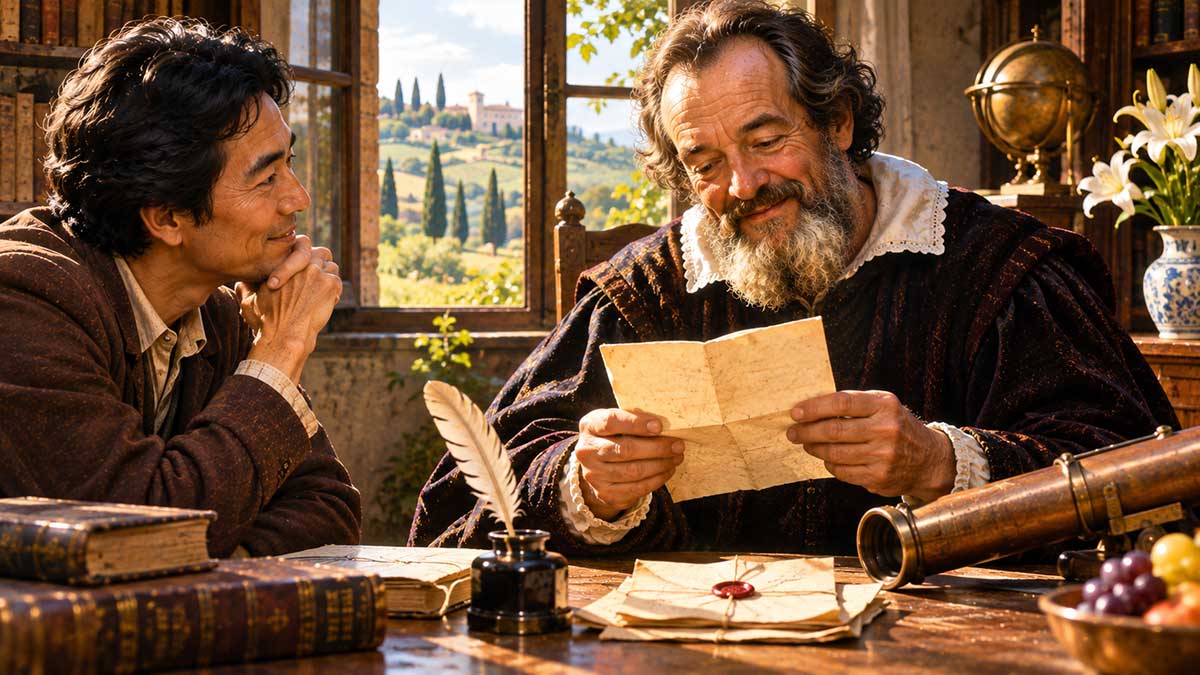
The morning sun falls gently across the hills surrounding Il Gioiello, the villa where Galileo Galilei lives under house arrest. Olive trees stir in the breeze. Inside his study, books and mathematical manuscripts share a wooden table with a small telescope, a bowl of fruit, and several carefully folded letters.
Galileo, approaching seventy, is seated near the window. His hair and beard have turned silver, but his eyes remain alert. When Nick Sasaki enters, Galileo is reading a letter with a faint smile.
Nick Sasaki
Galileo! It's good to see you.
Galileo Galilei
Nick! Welcome to Arcetri.
Nick Sasaki
I have to say, the view is beautiful.
Galileo Galilei
It is a pleasant place, though I would prefer to have greater freedom to come and go.
Nick Sasaki
I can understand that.
Nick notices the letter.
Nick Sasaki
You were smiling when I walked in. Good news?
Galileo Galilei
A letter from my daughter, Maria Celeste.
Nick Sasaki
Ah! The famous Maria Celeste.
Galileo Galilei
Laughing.
Famous? She would be surprised to hear that.
Nick Sasaki
Well, I've been looking forward to hearing about her.
Galileo Galilei
Then you have chosen a subject dear to me.
Question 1 - Who Was Maria Celeste Beyond the Letters?
Nick Sasaki
Galileo, everyone knows you as the scientist who studied the heavens. But today I want to know about the father.
Tell me about Maria Celeste. What is she like?
Galileo Galilei
She is intelligent, devoted, thoughtful, and remarkably capable.
Her religious life requires discipline and responsibility, yet she finds time to concern herself with my affairs.
She writes about her duties, her health, the needs of her convent, and the practical matters of daily life.
Nick Sasaki
So she's not simply sitting in a convent praying all day.
Galileo Galilei
Smiling.
A convent has work enough to occupy many hands.
She manages responsibilities, helps others, and deals with the ordinary difficulties that accompany communal life.
Nick Sasaki
Does she have your curiosity?
Galileo Galilei
She has an attentive mind and considerable practical intelligence.
I would not insist that she share every one of my scientific interests. She has her own concerns and abilities.
Nick Sasaki
I like that.
Sometimes when we talk about famous people, we describe everyone around them only through their relationship to the famous person.
But Maria Celeste has her own life.
Galileo Galilei
Indeed.
And she takes that life seriously.
Nick Sasaki
What makes her laugh?
Galileo smiles more broadly.
Galileo Galilei
She can find amusement in the small absurdities of everyday life.
Her letters sometimes contain details that would seem insignificant to someone searching only for great historical events.
But those are often the details I enjoy most.
Nick Sasaki
Like what?
Galileo Galilei
An unexpected difficulty in preparing something, an amusing misunderstanding, some minor domestic complication.
Life provides sufficient comedy without requiring us to invent it.
Nick Sasaki
Laughing.
That sounds like something you would say.
Galileo Galilei
Perhaps she inherited some of my appreciation for human foolishness.
Nick Sasaki
Or perhaps you inherited it from her.
Galileo Galilei
Laughing.
An intriguing hypothesis. I shall investigate.
Nick Sasaki
Now, she entered religious life when she was young.
Was that difficult for you?
Galileo Galilei
It was part of the circumstances of our family and society.
Virginia and her sister entered the convent at San Matteo. Virginia took the name Maria Celeste.
Her religious commitments are sincere, and I respect the seriousness with which she fulfills them.
Nick Sasaki
Do you wish you could spend more time together?
Galileo Galilei
Naturally, I value opportunities to see her.
We live near one another now, though her convent life and my restrictions shape what is possible.
Our correspondence remains important.
Nick Sasaki
It's interesting. You've spent your life studying things millions of miles away, but some of the people you love most are separated from you by walls and rules.
Galileo Galilei
Distance is not always measured in miles, Nick.
Nick Sasaki
That's beautiful.
Galileo glances at the letter in his hand.
Galileo Galilei
And affection can remain strong across a distance.
Question 2 - What Did Her Letters Mean During Your Trial?
Nick Sasaki
Galileo, I remember seeing one of Maria Celeste's letters when we met in Rome.
You were facing the Inquisition, and everything seemed uncertain.
What was it like to receive a letter from someone who cared about you as her father, not as a famous scientist?
Galileo Galilei
It was a comfort.
The public controversy concerned my writings and my obedience to authority.
But Maria Celeste's letters concerned my health, my circumstances, and the practical difficulties of my life.
She expressed affection and offered encouragement.
Nick Sasaki
Did she understand what you were going through?
Galileo Galilei
She understood that I was experiencing a serious difficulty.
Her religious devotion shaped the way she responded. She offered prayers and encouragement.
She could not remove the circumstances, but she could express her concern.
Nick Sasaki
Sometimes that's all someone can do.
They can't solve your problem. They can't change the judgment. They can't make the world behave differently.
But they can remind you that you're loved.
Galileo Galilei
Yes.
And that reminder is not a small thing.
Nick Sasaki
I read that she even offered to take on some of your assigned penitential prayers.
Galileo Galilei
Her willingness to help reflects her devotion and affection.
She was concerned that the obligations placed upon me might be difficult given my age and health.
Nick Sasaki
That's remarkable.
Here you are, one of the most famous thinkers in Europe, and your daughter is worried about whether you're physically able to fulfill those prayers.
Galileo Galilei
Smiling gently.
A daughter may notice difficulties that public admirers overlook.
Nick Sasaki
Did she ever tell you to stop arguing with people?
Galileo Galilei
Laughing.
You seem disappointed that she has not joined your campaign to reform my temperament.
Nick Sasaki
I was hoping to find an ally.
Galileo Galilei
I suspect you would find that she understands my faults quite well.
Nick Sasaki
And loves you anyway.
Galileo Galilei
Quietly.
Yes.
Nick looks at the small telescope resting beside the letters.
Nick Sasaki
Can I tell you something?
Galileo Galilei
Of course.
Nick Sasaki
When we first met, I was fascinated by your scientific mind.
I wanted to know how you questioned Aristotle, how you studied motion, how you discovered Jupiter's moons.
But sitting here today, I'm realizing there's another Galileo.
A father whose daughter worries about him.
A man who enjoys a funny story in a letter.
Someone who needs encouragement just like the rest of us.
Galileo Galilei
I have never claimed to be free from ordinary human needs.
Nick Sasaki
No, but history sometimes makes people look that way.
Galileo Galilei
Then history should occasionally pay closer attention to correspondence.
Nick Sasaki
Laughing.
That's a good answer.
Question 3 - What Did Fatherhood Teach You That Science Could Not?
Galileo sets the letter carefully on the table. Nick notices how gently he handles it.
Nick Sasaki
Galileo, you've spent your life trying to explain the physical world through mathematics.
But being a father brings questions that can't be settled with an experiment.
What have your children taught you?
Galileo Galilei
Responsibility, certainly.
One must consider their welfare, their circumstances, and their futures.
Children are not mathematical problems. They possess their own characters, desires, and difficulties.
Nick Sasaki
And you can't control everything that happens to them.
Galileo Galilei
No.
A parent may make decisions, offer assistance, and hope for the best.
But the lives of children cannot be arranged with the certainty of a geometrical demonstration.
Nick Sasaki
That must be frustrating for a man who likes finding precise answers.
Galileo Galilei
Smiling.
It can be.
But I do not think affection would be improved by treating another person as an equation.
Nick Sasaki
That's interesting.
You have three children, Virginia, Livia, and Vincenzio.
Do they all have different personalities?
Galileo Galilei
Certainly. Each has a distinct character and circumstances.
It would be a mistake to assume that one child can stand in for the others.
Nick Sasaki
Do you ever worry that your scientific work took time away from your family?
Galileo considers the question.
Galileo Galilei
My work has demanded considerable attention, and my family circumstances have not always been simple.
I have responsibilities that require practical decisions.
It would be dishonest to claim that every decision has been easy or that I have always balanced my obligations perfectly.
Nick Sasaki
I think every parent can relate to that.
We want to provide for our children, but providing often means spending time away from them.
Then we wonder whether we're giving them what they truly need.
Galileo Galilei
There is no simple formula for such matters.
Nick Sasaki
And that's coming from Galileo Galilei.
Galileo Galilei
Laughing.
You sound delighted to discover that mathematics has limitations.
Nick Sasaki
Only when it comes to raising children.
Galileo Galilei
Then we agree.
Nick Sasaki
What do you admire most about Maria Celeste?
Galileo Galilei
Her devotion, her intelligence, her resourcefulness, and the care she shows for others.
She attends to matters that might seem ordinary but are essential to daily life.
Nick Sasaki
And what do you hope she knows about you?
Galileo Galilei
That I value her affection and concern.
And that I recognize the seriousness with which she fulfills her responsibilities.
Nick Sasaki
Have you told her that?
Galileo smiles.
Galileo Galilei
You ask questions that are more difficult than the motion of planets.
Nick Sasaki
Laughing.
I'm beginning to think that's my specialty.
The room grows quiet. Sunlight has moved across the table, illuminating the letter beside the telescope.
Nick Sasaki
Galileo, there's something I keep thinking about.
That telescope helped you see things nobody had recognized before.
But this letter shows something different.
It reminds me that a person can be famous throughout Europe and still need the affection of someone close to him.
Galileo Galilei
Fame and affection are not the same thing.
Nick Sasaki
No.
And I wonder whether we sometimes spend so much time trying to accomplish something extraordinary that we overlook the ordinary things that make life meaningful.
Galileo Galilei
I would not call affection ordinary in the sense of being insignificant.
It may be common to human life, but that does not diminish its value.
Nick Sasaki
I like that.
You know, Galileo, I think Maria Celeste would enjoy meeting you in one of your more argumentative moods.
Galileo Galilei
She has had sufficient opportunity to know her father's character.
Nick Sasaki
Then she deserves a medal.
Galileo Galilei
Laughing.
Perhaps two.
Nick rises and walks toward the window. Beyond the garden, the hills of Arcetri stretch beneath the morning sun.
Nick Sasaki
It's peaceful here.
Galileo Galilei
There are pleasant aspects to the place.
And there is still work to be done.
Nick Sasaki
Scientific work?
Galileo Galilei
Naturally.
Did you expect me to spend the rest of my days discussing my feelings?
Nick Sasaki
Laughing.
I was hoping for a little of both.
Galileo Galilei
Then you are a demanding guest.
Nick Sasaki
Galileo, before I go, may I ask one more question?
Galileo Galilei
You may.
Nick Sasaki
When you think about your life, what gives you the greatest satisfaction?
Your discoveries? Your books? Your family?
Galileo looks toward the telescope, then at the letter.
Galileo Galilei
Those are different kinds of satisfaction.
Scientific discovery brings the pleasure of learning something about nature.
Affection brings the pleasure of knowing and caring for another person.
I see no reason to diminish one in order to honor the other.
Nick Sasaki
That's a wonderful answer.
Galileo folds the letter and places it beside his books.
Galileo Galilei
Come back soon, Nick.
There are questions about motion I wish to discuss.
Nick Sasaki
I will.
And next time, I want to hear about what you're working on now.
Galileo Galilei
Excellent. A subject on which I can speak at considerable length.
Nick Sasaki
Laughing.
That sounds like the Galileo I know.
The two friends exchange a warm farewell.
On the table, the letter remains beside the telescope. One represents the scientific investigations that made Galileo famous. The other reflects a relationship sustained through affection, concern, faith, and ordinary acts of care.
Neither object can tell the whole story of his life.
In the years ahead, Galileo will experience profound personal loss. Maria Celeste will die in April 1634, and his own health will decline. Yet his scientific work will continue, raising a final question that neither fame nor condemnation can settle.
What does it mean to keep searching for truth when life has taken away so much?
Fictional Interview Disclaimer
This conversation between Nick Sasaki and Galileo Galilei is historical fiction. The imagined meeting, dialogue, humor, and Galileo's personal reflections are fictional rather than authenticated quotations. Galileo's residence at Il Gioiello, his house arrest, his three children, and Maria Celeste's surviving correspondence are historically documented. Her letters provide evidence of affection, religious devotion, practical assistance, and concern for her father's health. The scene is placed before her death in April 1634, and the later loss is mentioned only by the retrospective narrator. No invented words are presented as quotations from Maria Celeste's surviving letters or from Galileo's missing replies.
Topic 5 - He Recanted, But Did He Surrender?
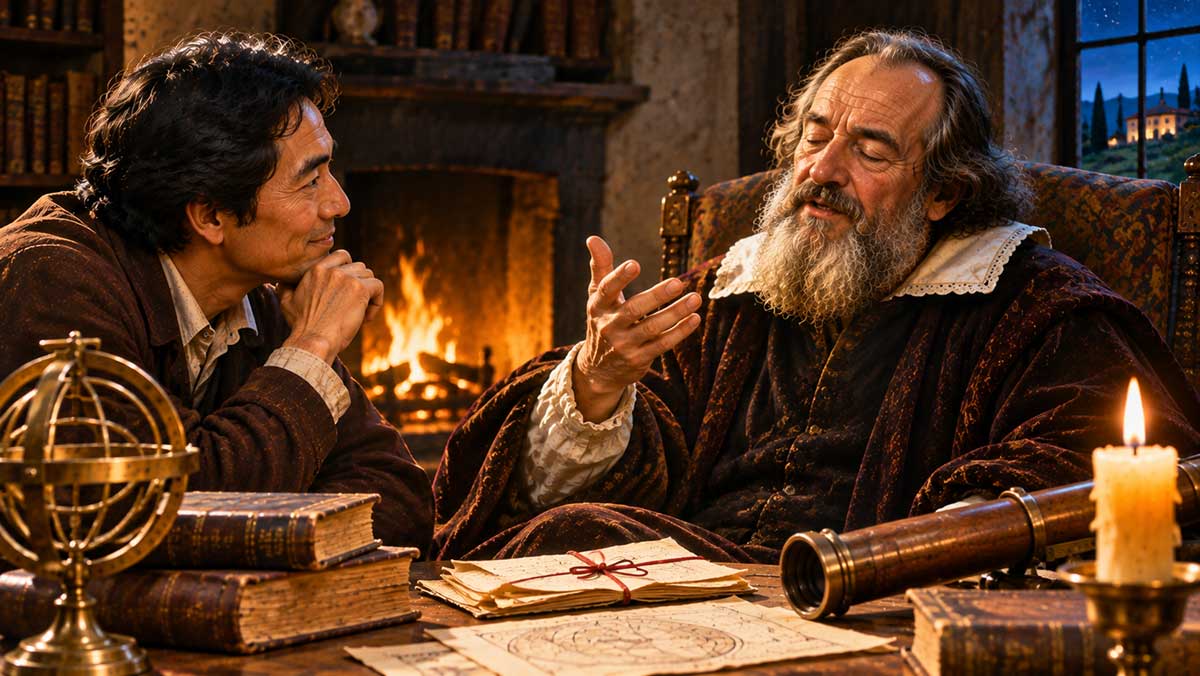
Arcetri, near Florence. An autumn evening, 1640.
The last sunlight slips behind the Tuscan hills. Inside Il Gioiello, a small fire warms Galileo Galilei's study. Manuscripts lie scattered across a wooden table, beside mathematical diagrams, a globe, and a telescope that has not been used for some time.
Galileo is seventy-six years old. His once-sharp eyesight has failed, but his mind remains active. He sits in a high-backed chair, listening to the distant sounds of the countryside.
There is a gentle knock at the door.
Galileo Galilei
Come in.
Nick Sasaki
Galileo? I hope I'm not interrupting.
Galileo Galilei
His face brightens.
Nick! Come closer. My eyes can no longer distinguish visitors, but I recognize that voice.
Nick Sasaki
It's good to see you, my friend.
Galileo Galilei
I wish I could say the same.
Nick pauses, then Galileo laughs.
Galileo Galilei
Come now, Nick. Surely you have not lost your appreciation for a joke.
Nick Sasaki
Laughing.
Not at all. I just wasn't expecting you to make that one before I sat down.
Galileo Galilei
Old age has not made me entirely respectable.
Nick takes a chair beside him.
Nick Sasaki
I'm glad to hear that.
Galileo Galilei
And I trust you have brought some interesting questions.
Nick Sasaki
I have. But I was hoping you might have a few answers.
Galileo Galilei
Then you have come to the wrong man.
They laugh together.
Question 1 - How Did You Continue After Condemnation?
Nick Sasaki
Galileo, when people look back at your life, they'll talk about the trial of 1633.
They'll remember that you were forced to recant.
Some may assume that was the end of your scientific career.
But it wasn't.
You published Two New Sciences in 1638.
How did you keep going?
Galileo Galilei
My circumstances changed greatly after the trial, but my interest in mathematical and physical questions did not disappear.
I had spent many years investigating motion, mechanics, and the strength of materials.
There remained problems I wished to examine and ideas I wished to organize.
Nick Sasaki
So the trial didn't destroy your curiosity.
Galileo Galilei
No.
Curiosity is not something one can simply put away at the command of another person.
But one must distinguish the desire to investigate from the practical freedom to publish or travel.
My restrictions were real.
Nick Sasaki
What was the hardest part?
Galileo Galilei
The limitations upon my movements and activities were burdensome.
My health was declining, and my sight gradually failed.
I depended increasingly upon the assistance of others.
Nick Sasaki
That must have been difficult for someone who spent his life observing the world.
Galileo Galilei
It was a serious loss.
But mathematics is not confined entirely to what the eyes can see.
Reasoning, memory, discussion, and the assistance of colleagues remain valuable.
Nick Sasaki
Tell me about Two New Sciences.
What did you most want people to learn from it?
Galileo Galilei
The work concerns the strength of materials and the mathematical study of motion.
It brings together investigations developed over many years.
I wished to present arguments that could be examined and developed by others.
Nick Sasaki
You know what strikes me?
You lost your freedom to travel, and eventually your eyesight.
But you were still asking questions.
Galileo Galilei
A question does not cease to be interesting merely because the person asking it has grown old.
Nick Sasaki
Laughing.
That's very you.
But let me challenge you.
Do you think you were still trying to prove something to the people who condemned you?
Galileo Galilei
My work has always involved both intellectual curiosity and a desire to communicate my findings.
It would be artificial to pretend that recognition never mattered to me.
But the problems themselves were worthy of investigation.
Nick Sasaki
So it wasn't simply revenge.
Galileo Galilei
Scientific inquiry is a poor instrument for revenge.
One might spend years developing an argument only to discover that nature refuses to cooperate.
Nick Sasaki
Laughing.
And nature doesn't care whether you're angry.
Galileo Galilei
Precisely.
Question 2 - What Did the Losses of Later Life Change?
The fire crackles softly. Nick notices a small bundle of letters resting near the manuscripts.
Nick Sasaki
Galileo, the last time we sat together in this room, you told me about Maria Celeste.
You showed me her letters.
I remember how your face changed when you spoke about her.
Galileo becomes quiet.
Nick Sasaki
She died later that year, in 1634.
I'm sorry, my friend.
Galileo Galilei
Thank you, Nick.
Nick Sasaki
Would you feel comfortable telling me about her?
Not the famous letters or the history books.
Just what you remember.
Galileo rests his hands upon the arms of his chair.
Galileo Galilei
Her letters remain precious to me.
They remind me of her concern, her devotion, and the many ordinary matters that occupied her attention.
She was capable and affectionate.
Nick Sasaki
What do you miss most?
Galileo Galilei
After a pause.
The opportunity to hear from her again.
A letter may contain news of some small difficulty, a concern about health, or an expression of affection.
Such things become precious when the person who wrote them is gone.
Nick Sasaki
I think that's one of the hardest parts of losing someone.
It's not just the big moments.
It's knowing there won't be another ordinary conversation.
Galileo Galilei
Yes.
The ordinary conversations are not always ordinary to those who have shared them.
Nick Sasaki
Do you remember how we laughed about her knowing your stubborn side?
Galileo Galilei
Smiling faintly.
I remember.
Nick Sasaki
I still think she deserved a medal.
Galileo Galilei
Perhaps she deserved an entire collection.
They laugh softly.
Nick Sasaki
You know, Galileo, I've been thinking about something.
When we were younger, we talked about your ambition.
You wanted recognition. You wanted people to examine your discoveries.
Now, after everything you've experienced, does success mean something different?
Galileo Galilei
Age and loss change the circumstances in which we judge our lives.
Scientific achievement remains meaningful.
But I would not measure the value of a person solely by public recognition.
Nick Sasaki
What about faith?
Has your relationship with God changed through these years?
Galileo Galilei
My religious commitments remain part of my life.
I do not regard scientific investigation and faith as necessarily opposed.
But suffering and loss raise questions that cannot be answered by a mathematical demonstration.
Nick Sasaki
Do you find comfort in prayer?
Galileo Galilei
Prayer belongs to the religious life I have known.
I would hesitate to offer a simple explanation for every sorrow.
Nick Sasaki
I appreciate that.
Sometimes people try to explain away grief, as though finding the right words will make it disappear.
Galileo Galilei
Affection does not cease when the person we love is no longer with us.
But neither does that affection remove the reality of loss.
Nick looks toward the window, where the last traces of daylight have vanished.
Nick Sasaki
Galileo, can I ask something else?
Galileo Galilei
Of course.
Nick Sasaki
Do you ever feel angry about losing your sight?
Galileo Galilei
It has deprived me of something I valued deeply.
I would not pretend otherwise.
But I remain interested in the work that can still be done.
Nick Sasaki
That's what amazes me.
You could spend every day thinking about what you've lost.
Yet you're still discussing mathematics with your students and colleagues.
Galileo Galilei
I have not become a saint, Nick.
There are difficulties, frustrations, and limitations.
But an investigator who can no longer observe directly may still reason, question, and communicate.
Nick Sasaki
Smiling.
And argue?
Galileo Galilei
Especially argue.
They laugh.
Question 3 - What Should Future Generations Learn From You?
The room has grown darker. A servant enters briefly to add wood to the fire, then withdraws. Galileo turns toward Nick's voice.
Nick Sasaki
Galileo, I want to ask you one final question.
And this one matters to me.
Hundreds of years from now, people will remember your telescope, Jupiter's moons, the trial, and your recantation.
Some will call you a hero of science.
Others may use your story to criticize religion.
But I wonder whether both interpretations might miss something important.
What would you want future generations to learn from your life?
Galileo Galilei
I would hope they learn to investigate nature carefully.
To distinguish observation from interpretation.
To test arguments rather than accepting them solely through authority.
And to recognize that even a persuasive explanation must remain open to examination.
Nick Sasaki
Including your own explanations?
Galileo Galilei
Certainly.
Nick Sasaki
Then let's talk about your mistakes.
You defended an incorrect explanation of the tides.
You could be impatient with critics.
You sometimes argued with more confidence than the evidence justified.
If you could speak to your younger self, what would you tell him?
Galileo Galilei
He smiles.
First, I would advise him to listen carefully before beginning another argument.
Nick Sasaki
Laughing.
That would have saved everyone a great deal of trouble.
Galileo Galilei
Perhaps.
But I would not advise him to abandon difficult questions merely to avoid disagreement.
Nick Sasaki
So you still believe in challenging authority.
Galileo Galilei
Authority deserves examination when it makes claims about nature.
But challenging authority is not the same as rejecting every established idea.
A person must consider the evidence.
Nick Sasaki
And what about courage?
People will debate whether you were courageous when you defended Copernican ideas or whether you failed when you recanted.
How should they think about that?
Galileo Galilei
I would not presume to instruct every person how to judge courage.
Circumstances differ.
The decision to resist may carry grave consequences. The decision to comply may carry consequences of another kind.
Nick Sasaki
But did you surrender?
Galileo remains silent for a moment.
Galileo Galilei
I made a public abjuration.
That is part of my history.
But my work on mathematical and physical questions continued.
Those facts may both be considered.
Nick Sasaki
I think that's important.
Sometimes we want historical figures to be perfect.
We want them to make every courageous decision, win every argument, and never be afraid.
But that's not how human beings live.
Galileo Galilei
No.
And it is dangerous to confuse admiration with the belief that a person can never be mistaken.
Nick Sasaki
You know what I find most inspiring about you?
It's not that you were right about everything.
You weren't.
It's that you kept asking questions.
Even after the trial.
Even after losing people you loved.
Even after losing your sight.
Galileo Galilei
Curiosity has accompanied me through many circumstances.
But I have depended upon other people as well.
My family, friends, students, and colleagues have all played their parts.
Nick Sasaki
I'm glad you said that.
We tend to celebrate one famous person and forget everyone who helped make their work possible.
Nick notices the telescope and the letters resting near it.
Nick Sasaki
Galileo, there's something I've wanted to ask since our last visit.
When the world was arguing about whether you were right or wrong, what did it mean to have someone like Maria Celeste who cared about you simply as her father?
Galileo turns slightly toward the table.
Galileo Galilei
It meant that my life contained relationships beyond the arguments for which I became known.
Her affection was not dependent upon the success of a scientific theory.
Nick Sasaki
That's beautiful.
And I think it's something people need to hear.
We can spend our lives trying to prove something, accomplish something, or earn recognition.
But the people who love us often care about something much simpler.
Whether we're well.
Whether we're safe.
Whether we're happy.
Galileo Galilei
Those concerns deserve respect.
Nick Sasaki
Galileo, if you could leave one thought with a young person who's afraid to question what everyone else believes, what would it be?
Galileo Galilei
I would encourage careful investigation.
Ask questions, examine evidence, and learn the strongest arguments on every side.
Do not mistake confidence for certainty.
And do not assume that disagreement proves either courage or wisdom.
Nick Sasaki
That's a lesson worth remembering.
Nick rises slowly.
Nick Sasaki
Well, my friend, I think I've taken enough of your evening.
Galileo Galilei
You have taken a considerable portion of it.
Nick Sasaki
Laughing.
You could have told me to leave.
Galileo Galilei
And deprive myself of an argument?
Never.
Nick laughs and reaches for Galileo's hand.
Nick Sasaki
Thank you for everything.
For the questions, the laughter, and the conversations.
Galileo Galilei
Thank you, Nick.
You have been an unusually persistent visitor.
Nick Sasaki
I'll take that as a compliment.
Galileo Galilei
You may.
Nick Sasaki
And Galileo?
Galileo Galilei
Yes?
Nick Sasaki
I hope you keep asking questions.
Galileo smiles.
Galileo Galilei
I still have a few.
Nick moves toward the door, then pauses.
Nick Sasaki
One last thing.
Galileo Galilei
I should have expected that.
Nick Sasaki
If you could look through your telescope one more time, what would you want to see?
Galileo considers the question.
Galileo Galilei
Perhaps Jupiter.
It was a most interesting companion during those winter nights in Padua.
Nick Sasaki
And its moons?
Galileo Galilei
Naturally.
I would be curious to know whether they are keeping to their accustomed paths.
Nick Sasaki
Laughing softly.
Some things never change.
Galileo Galilei
Fortunately, Nick, many things do.
The friends exchange a final farewell.
Outside, the Tuscan sky is filled with stars. Galileo can no longer see them, but the questions they inspired remain alive in his mind and in the work of those who follow him.
His life contains extraordinary discoveries and serious mistakes, moments of public conflict and private affection, confidence and vulnerability.
The telescope changed how humanity could observe the heavens. The letters from Maria Celeste remind us that the man behind those discoveries lived within a world of family, friendship, faith, and loss.
Galileo's story leaves a question for every generation:
Can we defend what we believe, admit when we are mistaken, and remain curious enough to keep learning?
Fictional Interview Disclaimer
This conversation between Nick Sasaki and Galileo Galilei is historical fiction. The imagined meeting, dialogue, humor, personal reflections, and final exchange are fictional, not authenticated historical quotations. Galileo's 1633 condemnation and abjuration, subsequent house arrest, continued scientific work, publication of Two New Sciences in 1638, later blindness, and the death of his daughter Maria Celeste in April 1634 are historically documented. His private emotional responses, imagined advice to future generations, and conversation about his daughter are literary interpretations rather than verified statements. The symbolic placement of Maria Celeste's letters beside a telescope is fictional and is not presented as a documented historical arrangement.
Final Thoughts - The Truth Galileo Left Me Questioning

When I began this imaginary conversation with Galileo Galilei, I expected to meet a man who would teach me about courage. I thought we would talk about challenging authority, defending scientific discoveries, and refusing to surrender to accepted beliefs. We did discuss all those things. But as our conversations continued, I discovered that the question of courage was far more difficult than I had expected.
I was especially struck by Galileo's relationship with certainty. He wanted people to examine evidence rather than accept explanations solely through authority. Yet he could be impatient with critics and deeply committed to arguments that later proved mistaken. His incorrect tidal theory is a valuable reminder that even extraordinary thinkers can become attached to their own explanations. The Stanford Encyclopedia of Philosophy's discussion of his scientific work makes clear that Galileo's legacy includes both remarkable advances and significant errors. I believe there is a lesson here for all of us: The willingness to challenge others is incomplete without the willingness to reconsider ourselves.
Our conversation about faith left me with another important reflection. I believe humanity belongs to one family under one God, and I hope that religious belief and the honest investigation of nature can help us grow closer to truth rather than divide us. Galileo's life reminds me that a person's faith cannot always be inferred from a conflict with religious authorities. He was Catholic, and his disagreement concerned questions of evidence, interpretation, and institutional authority. We do not have to agree with every conclusion Galileo reached to recognize the value of asking questions sincerely and listening carefully to those who disagree.
Then came the trial. I found myself wondering what I would have done in Galileo's position. Would I have defended my convictions at any cost? Would I have considered my age, health, family, and the possibility of continuing meaningful work? It is easy to celebrate courage from the safety of another century. It is much harder to know how we would respond under the same pressures. Galileo's formal recantation was real, and so was the work he continued afterward. I do not think we need to erase either fact to appreciate the human difficulty of his circumstances.
Yet the part of this interview that moved me most was not the telescope, the trial, or the arguments about Earth's motion. It was Maria Celeste. Her surviving letters reveal a daughter who cared deeply about her father's everyday life. She worried about his health, managed practical concerns, sent him provisions, and expressed affection through the ordinary details of correspondence. The Library of Congress collection of letters to Galileo preserves an extraordinary connection to this personal history. Reading about their relationship reminded me that the people who love us often see something beyond our achievements and failures.
I keep returning to the image of a letter beside a telescope. One represents Galileo's desire to investigate distant worlds. The other represents a relationship close to his heart. I do not believe we must choose which matters more. Scientific discoveries can transform human knowledge, and personal love can transform the meaning of an individual life. Both deserve our attention. Perhaps our mistake is thinking that greatness must be measured only by what the world remembers, rather than by the kindness, responsibilities, and relationships that shape our days.
Galileo's later years brought losses that scientific accomplishment could not prevent. Maria Celeste died in 1634, and Galileo eventually became blind. Yet he continued working on mathematical questions, and Two New Sciences appeared in 1638. The Galileo Project's historical chronology helps place these achievements and losses within the final years of his life. What stays with me is not a claim that he conquered every hardship. He did not. It is the possibility that a meaningful life can continue after disappointment, mistakes, and changes we never wished to experience.
If I could take one lesson from these five conversations, it would be this: Seek truth with courage, but carry your convictions with humility. Question authority, but be willing to question yourself. Pursue meaningful work, but never forget the people whose affection makes life precious. Galileo helped humanity look more carefully at the heavens. His life invites us to look more carefully at ourselves and at one another. And perhaps that is where a different kind of discovery begins.
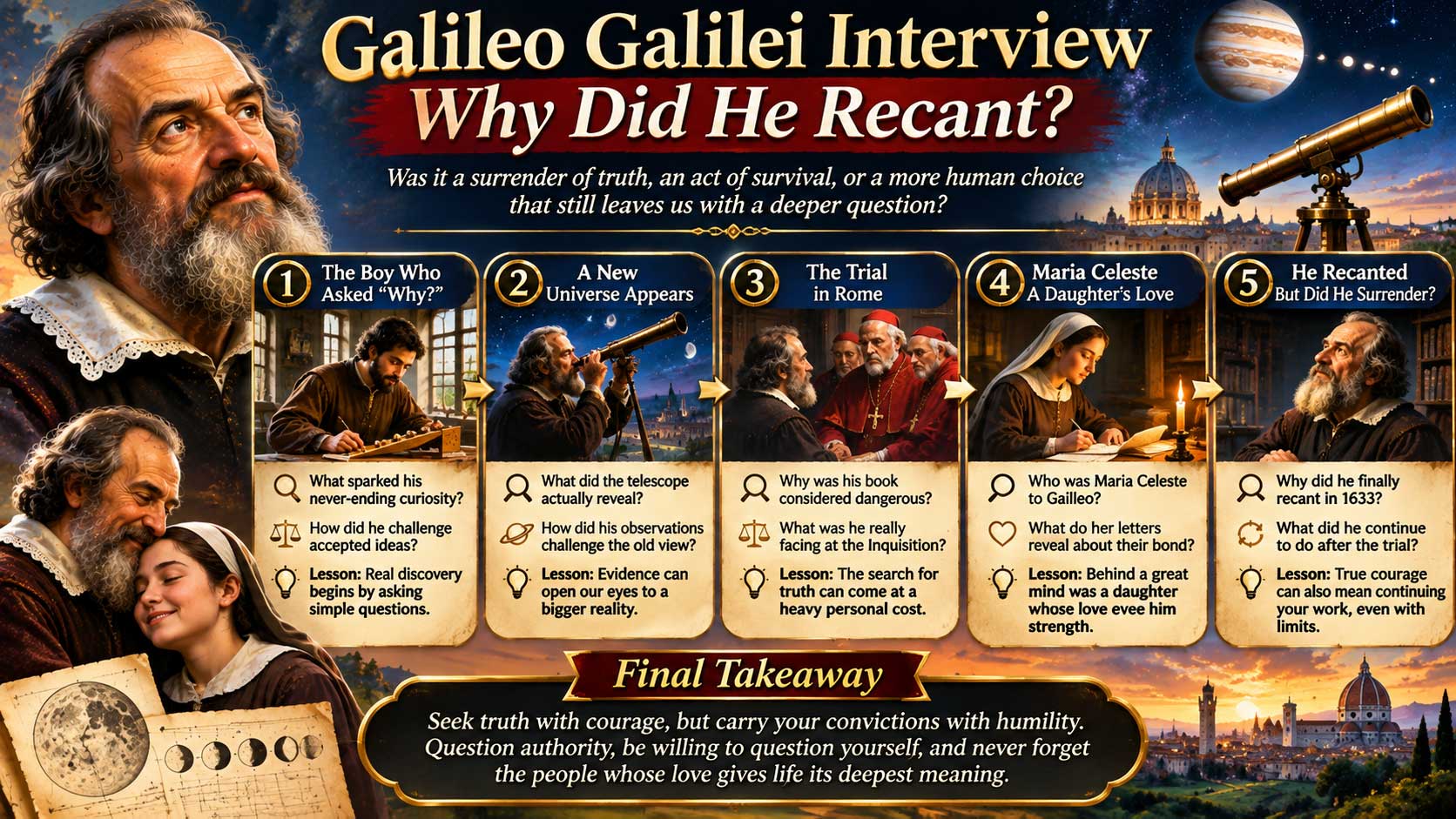
Short Bios:
Galileo Galilei (1564–1642)
Galileo Galilei was an Italian mathematician, natural philosopher, and astronomer whose investigations contributed to the development of modern science. Born in Pisa, he taught mathematics at the universities of Pisa and Padua before serving the Medici court in Florence. He improved telescope technology and made influential observations of the Moon, Jupiter's four large satellites, Venus, and other celestial phenomena.
His writings challenged established explanations of motion and astronomy. Following the publication of Dialogue Concerning the Two Chief World Systems in 1632, Galileo was tried by the Roman Inquisition in 1633 and placed under house arrest. He continued scientific investigations, publishing Two New Sciences in 1638. His life and intellectual contributions are examined in the Stanford Encyclopedia of Philosophy's Galileo biography and the Rice University Galileo Project.
Sister Maria Celeste (Virginia Galilei, 1600–1634)
Maria Celeste was Galileo's eldest daughter, born Virginia Galilei in Padua. She entered the convent of San Matteo in Arcetri and became a Franciscan nun. Her surviving letters to her father reveal her intelligence, religious devotion, affection, practical abilities, and concern for his health and welfare.
Her correspondence offers an intimate perspective on Galileo's family life, particularly during the difficult years surrounding his trial and house arrest. She died in April 1634. Readers can learn more through the Galileo Project's Maria Celeste biography and explore her historical correspondence.
Nick Sasaki - Imaginary Interviewer
Nick Sasaki is the creator of ImaginaryTalks.com, a creative platform that brings historical figures, philosophers, scientists, writers, and influential thinkers into fictional conversations about enduring human questions.
Through historically informed storytelling, Nick explores curiosity, faith, compassion, intellectual humility, personal responsibility, and the possibility of greater human connection. His guiding vision is that people can learn from different traditions and perspectives without losing their own convictions.
In this imaginary interview, Nick approaches Galileo as a friend rather than a prosecutor or admirer seeking perfect answers. His questions explore the relationship between scientific inquiry and faith, the limits of certainty, the difficulty of moral choices, and the importance of love and human connection beyond public achievement.
Leave a Reply