

Publication and Rights Notice
This is an unofficial, non-commercial work of fan fiction. It is not authorized, sponsored, or endorsed by J.K. Rowling, Warner Bros., or the other holders of rights in the Harry Potter franchise.
Elements of the Harry Potter setting, including Hogwarts and characters from the original books, belong to their respective rights holders. The new story material is presented here as a fan-created work. No ownership of the underlying franchise is claimed.
This edition is intended for free sharing, without a purchase requirement or paid access. It is not a licensed commercial edition, and its preparation does not establish permission to sell, print commercially, or distribute through retail channels.
For readers: This is Book Three of The Marauders’ Untold Years. It follows The Secrets Beneath Hogwarts (Book One) and The Marauders and the Moonlit Kingdom (Book Two).
Edition prepared November 2026. No ISBN has been assigned.
Prologue: The Name That Still Exists
The first thing Cassian Vale forgot was a promise.
It was a small promise, made on an ordinary Tuesday: he would meet Master Orrel beneath the west clock after supper and carry the repaired register back to the archive. There was nothing unusual about the task. The clocks of Asterfell were unreliable, the registers were older than the people who guarded them, and apprentices were forever being sent from one end of the city to the other with things they were forbidden to open.
Yet when Cassian found the note in his coat pocket, he knew two things at once. The handwriting was his. He had never seen the note before.
Meet me where the seventh lamp goes dark, it read.
Below the sentence stood his signature, complete with the ridiculous flourish he had added to the final letter when he was thirteen and believed a proper signature ought to look like a sword.
Cassian held the paper closer to the lantern. He could recall learning the flourish. He could recall his mother laughing at it. He could not recall taking out his pen, writing the message, or deciding what the seventh lamp meant.
Outside the window, Asterfell's artificial evening deepened. The great ceiling above the hidden city shifted from violet to indigo, and the first false stars appeared. They were beautiful, those stars, and Cassian had loved them since childhood. Tonight they seemed too orderly, like pinholes made by someone who wished to see inside.
He went straight to Master Orrel.
The old archivist was seated behind a desk with one short leg, holding a cup of tea in one hand and a broken quill in the other. He had been Cassian's teacher for six years. He had corrected his handwriting, trusted him with the silver cabinets, and once stood beside him in the Mirror Fortress when the world seemed likely to come apart.
“Master Orrel,” Cassian said, “did you ask me to repair a register?”
Orrel blinked. “Which register?”
“The one from the west room. The one we discussed yesterday.”
“I haven't assigned anyone to the west room.”
Cassian waited for the joke to reveal itself. Orrel did not smile.
“You told me the binding had split,” Cassian said. “You said it had to be mended before the next inventory.”
“Then you have misunderstood me.”
“I was there. We were standing beside the blue cabinet. You dropped your spectacles, and I found them behind the stool.”
Orrel touched his spectacles. “I did lose these yesterday.”
“You see?”
“Yes,” Orrel said slowly. “But I don't remember you being there.”
The words were not cruel. That made them worse.
The office door closed behind Cassian with a soft click that sounded final enough to be a judgment. He stood in the corridor and tried to decide what frightened him more: that Orrel had spoken truthfully, or that for one terrible instant Cassian had suspected his old teacher of lying. He could describe the day at the fortress down to the stitching on the satchel. Orrel could describe the same day. Between their stories lay the exact space where gratitude ought to have been.
At the end of the passage a novice was repairing an enchanted noticeboard. Its announcements kept rearranging themselves into alphabetical order, and each time she straightened one of them, three others slid sideways. She looked at Cassian and frowned.
“You helped me carry the blue cabinet last winter,” she said.
“Yes. You dropped a drawer full of silver keys.”
“I know somebody helped me,” she said carefully. “I remember the keys rolling under the stairs.”
“Then you remember me.”
She looked away. “I'm sorry.”
He wanted to tell her there was nothing to apologize for. Instead he asked her to write down what she remembered. She fetched a scrap of wrapping paper, recorded the fallen keys and the cabinet, and hesitated over the name of the person who had helped. Cassian supplied it. She copied the letters slowly, like a student practicing a foreign word. The ink stayed on the page.
“Keep that,” Cassian told her. “If it changes, or if you stop knowing why you wrote it, tell Master Orrel.”
“Are you in trouble?”
“I don't know yet.”
She tucked the paper into her apron. A few steps later he heard her call after him, not by name, but with urgency: “You should tell somebody who believes you.”
Cassian walked on. It was such small advice, and it felt like the most valuable thing anyone had given him all day.
Cassian pulled the note from his pocket. “I found this.”
Orrel read it twice. He turned the paper over. Then he looked up at Cassian with the cautious expression adults wore when they feared a young person might be ill.
“Where did you get this?”
“I wrote it. I think.”
“Why would you write a note to yourself?”
“That's what I'm trying to find out.”
Orrel pushed his chair back. “Sit down.”
Cassian remained standing.
The archivist opened a thick ledger, the one used to record who had been granted access to the west room. His finger traveled down the page, paused, and returned to the beginning.
“Strange,” he murmured.
Cassian leaned forward. His own name was missing.
There was a narrow space between two entries. The lines of the ledger were continuous, the dates ran in order, and the ink had not been scraped away. Yet the space was precisely wide enough for a name.
“That's where I signed,” Cassian said.
“Perhaps.”
“Master Orrel.”
The old man closed the book.
Cassian felt a sudden anger, sharp enough to steady him. “You know me.”
“Of course I know you.”
“Then tell me what I did at the Mirror Fortress.”
Orrel answered at once. He spoke of the false voices, the dangerous reflections, the children from Hogwarts who had come to help, and the families who had survived. Cassian listened as his teacher described every detail, until the story reached the moment when Cassian himself had carried the satchel marked with seven lines.
Orrel stopped.
“Who carried it?” Cassian asked.
“I remember the satchel.”
“Who carried it?”
Orrel's eyes filled with helplessness. “I don't know.”
Cassian had imagined many frightening things in his life. He had imagined the city going dark, the fortress opening again, his mother not coming home from the market. He had never imagined someone remembering his courage and forgetting that it belonged to him.
He left the office before Orrel could see his hands shaking.
The seventh lamp stood in a passage beneath the old archive. Cassian counted them as he walked. One, two, three. At the fourth lamp he met a baker carrying a tray of warm star pastries. At the fifth, a woman asked him to help lift a box. He did. She thanked him and called him “young man,” though she had known him by name for years.
The sixth lamp burned steadily.
The seventh was dark.
A small envelope lay on the floor beneath it.
Cassian did not touch it at first. He knelt and examined the seal: seven fine lines, the last drawn across the others like a boundary. He had seen that mark in Asterfell's oldest records. He had carried it through the Mirror Fortress. He knew it meant that there were limits even to those who claimed the right to command.
He opened the envelope.
Inside was a single sheet, covered in his own writing.
I agreed to help preserve the names. I did not agree to surrender them.
For one instant, a memory flashed through him: a man in dark gloves, a table of documents, a polite voice asking him to sign, and a question that sounded so reasonable he had answered without hesitation.
Then the memory vanished.
Cassian pressed the page against the wall. He could feel the stone through the paper.
“I'm here,” he said aloud.
The passage gave back his words in a faint echo.
He hurried home. His mother opened the door before he knocked and smiled with such immediate recognition that he almost wept. He asked her to say his name. She laughed and said it. He asked her again. She stopped laughing but said it again, holding his face between her hands.
At home, his mother made tea and set out the almond biscuits she always kept for visitors. Cassian had not been a visitor in that house since he was old enough to open the kitchen door, but tonight she watched him with the same worried courtesy she used for strangers who arrived carrying bad news.
“Tell me something I used to do,” he said.
“You used to hide the broken cups behind the flour tin.”
“That was once.”
“It was a very productive afternoon.”
He tried to smile. “Something I wouldn't know how to invent.”
She considered him. “When you were six, you wanted to learn the song your grandmother sang while making bread. You could never remember the middle verse, so you replaced it with a verse about a dragon that ate the baker's hat. You sang that version for a year.”
Cassian remembered the dragon. He remembered the warmth of the kitchen and the dusting of flour on his mother's sleeves. He asked her to sing. Her voice was imperfect, lower than it had been when he was small, and the second verse still ended on a note that made him laugh. He listened with a concentration that embarrassed them both.
“What if tomorrow you know the song and not the boy you sang it to?” he asked.
She set her cup down. “Then tell me again. And if you cannot, I will find someone who can.”
“Will that be enough?”
“I don't know,” she said. He loved her more for refusing to pretend. “But I will not let a missing certainty make me stop trying.”
After she had gone upstairs, Cassian wrote the words of the dragon verse on a fresh sheet. He did not mistake the paper for a cure. He simply wanted one more witness to the person he had been.
That night he wrote to Professor Thistlewick at Hogwarts. He described the letter, the ledger, the missing promise, and the dark seventh lamp. He included the name of the stolen Unwritten Archive, which the Hogwarts students had once helped him protect and which someone had taken before the mystery was solved.
He sealed the warning with his own name written three times.
Far from Asterfell, in a private room lined with Black family records, Adrian Voss opened a register that had never belonged there. Its cover was cracked, and its pages carried the scent of old dust and rain. On the title page, in a hand older than the house itself, were the words: Roll of Apprentices, Unwritten Archive.
Voss found Cassian Vale's entry.
Beside it he made one narrow black stroke.
He observed the change without pleasure. Pleasure, he believed, interfered with accurate measurement.
On the other side of the room, a clock ticked thirteen times.
Back in Asterfell, Cassian checked his warning before sending it.
The sentences remained. The account of the seventh lamp remained. The plea for help remained.
His signature had disappeared.
Chapter 1: The Year James Wants

James Potter had decided that sixth year would be boring, and he intended to work very hard at it.
He announced this over breakfast on the first morning of September, while Sirius Black was trying to persuade a piece of toast to stand upright on its crust.
“Boring,” Sirius repeated. “You?”
“Completely.”
“You lasted eleven seconds.”
“Eleven?”
“You were making the toast salute.”
“That was you.”
“Precisely. And you were watching with professional interest.”
Across the table, Remus Lupin turned a page of his book. “I give him until Thursday.”
“Wednesday,” Peter Pettigrew said.
James pointed his fork at them. “Astonishing lack of faith.”
“It's not lack of faith,” Remus said. “It's evidence.”
The Great Hall glittered with the familiar brightness of a new term. First-years still looked startled by the enchanted ceiling. Older students were comparing timetables, summer stories, and the changing arrangements of the Quidditch teams. Someone at the Hufflepuff table had brought an enormous tin of biscuits, which was being passed along with the solemnity of a sacred object.
James wanted all of it. He wanted difficult classes and arguments over the last pudding. He wanted wet afternoons on the Quidditch pitch and evenings spent making his friends laugh until Remus threatened to leave the room. He wanted to stop being the sort of boy whose life was always interrupted by ancient curses.
The last two years had been full of wonders, but wonder had a habit of leaving scars. He could still remember the Clockheart, the Moonwell, and the terrible feeling of discovering that cleverness was no guarantee of wisdom. He could remember his own voice when he had humiliated Severus Snape, and the uncomfortable knowledge that part of him had enjoyed it.
He had made choices he was proud of. He had made others he wished he could take back.
This year, he thought, he might try being an ordinary person.
Sirius finally got the toast to stand. It bowed toward the staff table and collapsed into the marmalade.
“Your first failure of the year,” James told him.
“First experiment,” Sirius corrected. “There is a difference.”
Peter laughed. He had changed since their adventures, though it was difficult to explain how. He still went pink when someone praised him, still sometimes spoke after the conversation had moved on, and still seemed astonished when the others waited to hear what he had to say. But he no longer apologized before every observation.
A small silver leaf rested inside the pocket of his robes. James had seen him check for it on the train, not with the panic of someone afraid of losing a valuable object, but with the care of someone touching a memory. Peter had received it after the Moonlit Kingdom, and none of them treated it as a charm that could solve every problem. It mattered for what it reminded him of.
Remus closed his book when the morning post arrived. He watched the owls with an attention that looked casual until James noticed his hands were clasped beneath the table. The previous year's events had left Remus more guarded about certain subjects. He was generous with his friends, quick to help younger students, and stubbornly private whenever a question approached the limits of what he wished to share.
James had once believed that friendship meant knowing everything about a person. He was less sure now.
Across the table Lily Evans was laughing with Mary Macdonald. James thought about asking her to watch Quidditch practice, then decided she had more interesting things to do than admire his flying. The decision cost him very little. He would have considered that a sign of progress if Sirius had not immediately stolen his toast.
An owl dropped a letter near Sirius's plate. Sirius caught it before it landed in the marmalade.
The envelope was black-edged, with a narrow silver crest.
James watched Sirius's expression close.
“Family?” he asked.
“Apparently,” Sirius said.
He slid the letter into his pocket without opening it.
James could have asked what it said. He could have made a joke, taken it away, or insisted that Sirius had no reason to hide anything from him. Instead, he passed the plate of eggs.
“Eat,” he said. “We've got McGonagall first.”
Sirius looked at him for a moment. “You're becoming dreadfully sensible.”
“It's a medical condition.”
“Can it be cured?”
“Not before Thursday,” Remus said.
The four of them laughed, and for a few minutes James felt that his plan was working.
The next morning James discovered that a quiet year required a kind of courage for which he had made no preparations. In Potions, Snape worked three benches away, bent over a cauldron whose fumes smelled of burned oranges. James saw him correct the angle of a younger student's stirring hand without looking up. The younger boy thanked him. Snape nodded once, plainly more comfortable with ingredients than gratitude.
For a moment James remembered a different corridor, a different crowd, and the way he had once performed cruelty to make people laugh. The memory did not become less ugly when he reminded himself that Snape had been cruel in return. He could not mend it by making a grand apology at the wrong moment, with an audience waiting to applaud.
When the lesson ended, a boy from Ravenclaw knocked over an entire tray of measured powders. The class drew back as a silver dust began creeping toward the flames. James reached for his wand, ready to make a spectacle of solving everything, then saw Lily already directing two students away from the spill.
“Cover the burners,” she said. “Not the powder.”
James followed her instruction. Remus shut the nearest window before the draft carried the dust across the room. Peter found the labeled tin into which the spilled ingredient could safely be transferred. Slughorn arrived in time to congratulate them all and deliver a long speech on the usefulness of composure.
Outside, Lily gave James a sideways look. “You didn't attempt to save the entire dungeon single-handed.”
“I'm trying an experimental method,” he said. “Listening.”
“Dangerous. It might become a habit.”
He laughed, then watched her leave. He had wanted her to notice him for years. It surprised him that being helpful without demanding attention felt better than anything clever he could have said.
By afternoon, the plan had acquired its first complication.
The Quidditch pitch was sodden from a passing shower. James had called an informal practice, which was a grand name for three people trying to keep their brooms steady in a crosswind and one first-year enthusiastically offering advice from the stands.
“Higher!” the first-year shouted.
James went higher.
“Not that high!”
James went lower.
Sirius, who had come to watch, shouted, “The boy's a natural strategist!”
James flew a wide circle and let the rain sting his cheeks. From above, Hogwarts looked like a place no danger could ever reach. Its towers rose against the clouds; its windows glowed with ordinary life. Students crossed the lawns below like moving dots on a painted map.
He knew that appearance was false. He loved it anyway.
After practice he found Lily Evans in the entrance hall, trying to gather a stack of books that had escaped from her arms. A younger student was helping her, and James stopped himself from sweeping in as if the situation required a hero.
He picked up the book nearest his shoe.
“Here,” he said.
“Thank you,” Lily replied.
Her eyes narrowed slightly, as though she had expected a speech.
James handed her the book and stepped aside.
“That's all?” she asked.
“Were you expecting a poem?”
“I was expecting you to explain how you saved the library.”
“I've retired.”
“From what?”
“Being unbearable.”
Lily gave him a look that might have been amusement. “A difficult profession to leave.”
“I'm told the benefits are excellent.”
She tucked the books under her arm. “Good luck, Potter.”
He watched her go, oddly pleased that he had not tried to make the moment larger than it was.
Later that afternoon, James took the unfinished map to a classroom overlooking the courtyard. Its ink moved in small, uncertain lines. Peter had developed a careful system for checking corridors against the castle's actual layout; Remus had written the names of passages in a tiny, exact hand; Sirius had drawn a ridiculous crown over a broom cupboard and insisted it was the headquarters of a secret kingdom.
James held the parchment against the window.
“There's a staircase missing,” Peter said.
“Staircases move,” Sirius replied.
“This one doesn't,” Peter said. “I checked it four times.”
Remus studied the empty section. “Perhaps the map isn't finished there.”
“Perhaps the castle has decided to be uncooperative,” Sirius said.
James watched Peter measure the blank space with a ruler. “You noticed it before we did.”
Peter shrugged. “It's just a gap.”
“It's a gap none of us saw.”
Peter looked pleased, then embarrassed by his own pleasure. He bent over the parchment again.
James had never thought of their map as a record of how much they depended on one another. He had called it their masterpiece, and in his mind that had usually meant a triumph of cleverness and mischief. Looking at the four different kinds of handwriting, he began to see something else.
It was the first thing they had made that none of them could have completed alone.
A bell rang. They packed the parchment away, leaving the unexplained blank untouched.
James did not know that, elsewhere in the castle, a letter had arrived describing another blank space, one precisely large enough for a missing name.
At supper, Peter described an incident in Charms involving a teacup that had become convinced it was a goose. Sirius suggested the cup might be right. Remus asked whether it had migrated. James laughed so hard he nearly spilled his pumpkin juice.
Then he saw Regulus Black across the hall.
Regulus sat among the Slytherins, pale and composed. He was speaking to an older student, but his gaze moved briefly toward the Gryffindor table. For an instant, his eyes met Sirius's.
Sirius looked away first.
The letter remained unopened in his pocket.
Later, in the dormitory, James found Sirius sitting on the windowsill with the envelope in his hands. The room smelled of wet wool, ink, and the faint burnt odor left by one of their unsuccessful experiments with a self-heating kettle.
“Want company?” James asked.
Sirius shrugged. “You're already here.”
James sat on the nearest bed.
For a long time they listened to rain strike the glass.
“Regulus?” James asked eventually.
Sirius nodded.
“You don't have to tell me.”
“That's a novelty.”
“I'm trying it out.”
Sirius turned the envelope over. “He wrote that things at home are changing. He didn't say how. He never says how.”
James considered offering a solution. There was no shortage of possible solutions, most of them useless. He thought of the Potter house, of the way his parents had welcomed Sirius at Christmas the year before, and of the strange fact that being safe himself had not made Sirius stop worrying about his brother.
“He knows where to find you,” James said.
“Does he?”
“Yes.”
The dormitory had grown quiet. Remus was downstairs returning a book; Peter was trying to rescue a sock that had become attached to the inside of his trunk by an overly ambitious sticking charm. Sirius held the black-edged envelope against the window and watched the rain soften its silver crest.
“Regulus once tried to teach me the correct way to write our family motto,” he said. “He was seven. He corrected the way I held the quill, the shape of the letters, the ink, the desk, and, eventually, me.”
“Sounds like a thorough education.”
“He was furious when I smudged the parchment. Then he copied the whole thing again so nobody would know I'd spoiled it.” Sirius turned the envelope over. “That's what people never understand. He wasn't always the boy who sits with them.”
James said nothing. Sirius had already said more than he usually permitted himself.
“Do you think I left him?” Sirius asked.
“You left a house that hurt you.”
“That wasn't the question.”
“No,” James admitted. “I think he may feel left. That's different from saying you should have stayed.”
Sirius pressed his thumb against the unopened flap. At last he broke the seal. James looked away, giving him the small privacy of not being watched while he read. There was no cry of anger, no dramatic declaration. Sirius simply folded the letter, put it carefully inside a book, and sat very still.
“Do you want to tell me?” James asked.
“Not yet.”
“Fine.”
“James?”
“Yes?”
“If I start acting like the worst of my family, tell me.”
“I will,” James said. “But not every mistake makes you one of them.”
Below them, Peter shouted that the sock had won. Sirius laughed, unexpectedly and for real, and went to help him.
Sirius looked out at the grounds. “Knowing where to find someone isn't the same as coming.”
James had no answer to that.
By the time Remus and Peter returned, Sirius had tucked the letter away. Peter was carrying four chocolate biscuits wrapped in a napkin, and Remus was complaining about a new reading assignment. The evening settled around them again, warm and imperfect.
James took out a blank sheet of parchment and wrote a list across the top.
Things to accomplish this year.
He added: Win Quidditch matches. Finish the map. Pass exams. Keep friends out of mortal danger.
After a moment he crossed out the last item and wrote: Ask for help before doing anything stupid.
Sirius leaned over his shoulder. “That list will never survive.”
“It has survived thirty seconds.”
“A school record.”
Across the castle, in an office filled with maps and old papers, Professor Thistlewick opened a letter that had traveled farther than most owls could fly.
She read it once, then again.
The letter described a missing name, a dark seventh lamp, and a stolen Archive. At the bottom, where the sender's signature should have been, the paper was blank.
Thistlewick held the parchment to the light.
A faint impression remained in the fibers, as if a pen had pressed hard enough to leave a mark after the ink was gone.
She stood, took the letter, and went to find Albus Dumbledore.
James Potter's boring year had lasted one day.
Chapter 2: A Letter Without a Sender

Professor Thistlewick did not like unanswered letters. She disliked letters that answered themselves even more.
She placed the sheet from Asterfell on Dumbledore's desk and waited while he read it.
The Headmaster's office was crowded with instruments that clicked, hummed, and occasionally produced small clouds of colored smoke. A silver object on a shelf was turning slowly without any visible support. Somewhere behind a portrait, a former headmaster was snoring with impressive determination.
Dumbledore examined the blank signature.
“Is the sender alive?” he asked.
“I believe so.”
“Do you know who wrote it?”
“I know who ought to have written it.”
“That is not quite the same thing.”
“No,” Thistlewick said. “It is not.”
She told him about Cassian Vale, the young apprentice who had helped the Hogwarts students during the Asterfell crisis. Cassian had briefly attended Hogwarts during that period, but had since returned to his apprenticeship. His absence the previous year had been natural enough. The difficulty was that now even those who worked beside him were beginning to lose the connections that made his name meaningful.
Dumbledore laid the letter flat. “The Unwritten Archive was never recovered.”
“No.”
“And the missing seventh line?”
“Still missing from the record we possess.”
He looked toward the window. “Then we should begin with what we know, rather than what we fear.”
Thistlewick approved of that answer. She had come expecting no less, but she was relieved to hear it.
“Will you speak to the boys?” she asked.
“If we must. For the moment, I would prefer to know whether the same pattern has reached the school.”
It had.
Lily Evans first noticed the invitations in the library. They were printed on thick cream paper, each with a small seal of seven lines and a heading that promised access to neglected branches of magical history.
A fourth-year student named Nora Fenwick was showing one to a friend.
“It says the Society of the Seventh Seal is holding a discussion on old agreements,” Nora said. “They want students with an interest in family history.”
“Then why send it to me?” asked her friend. “My family isn't magical.”
“Maybe that's the point.”
Lily, seated at the next table, looked up.
“May I see that?” she asked.
Nora handed it over. The language was polished and respectful. It offered a place in a society where students from different backgrounds could contribute to the study of old records. Lily might have found it appealing if she had not recognized the shape of the seal.
Seven lines. The last one crossing the others.
She remembered Asterfell, the inscriptions she had studied there, and Cassian carrying a satchel with the same mark.
“Who gave you this?” she asked.
“A boy from Ravenclaw. He said Professor Slughorn knows about the society.”
“Have you signed anything?”
“Not yet.”
Lily handed back the paper. “Then wait.”
Nora frowned. “Why?”
“I'm not sure. That's why I'd like you to wait.”
Lily spent the next hour comparing invitations. The language differed slightly from one to another. Some students were asked to contribute stories about their families. Others were asked to list the people who had helped them enter the magical world. A few were invited to sign a register confirming that they wished their experiences to be preserved.
By the time she finished, Lily had a troubling pattern. The invitations seemed unusually interested in students who had arrived at Hogwarts without generations of magical relatives behind them.
One invitation had been folded into the shape of a little bird. Lily unfolded it so carefully that Mary, sitting opposite her in the library, asked whether it might explode.
“Not in the usual sense,” Lily said.
Mary read the first paragraph aloud. It welcomed students whose families had been absent from traditional histories, promising that their experiences would be treated as valuable contributions. “That's rather good,” she admitted. “It's the kind of thing somebody should have been doing years ago.”
“I know.” Lily spread the invitations side by side. “That's what worries me.”
Nora returned after supper with a second student, a first-year who had been asked to name the person at Hogwarts who made her feel safest. The girl had written her sister's name on a rough sheet at home and brought it to compare against the Society's form.
“Is the Society bad?” the girl asked Lily.
“We haven't established that,” Lily said. “You're allowed to find the invitation interesting. You're allowed to decide against joining. You shouldn't have to give anyone names before you know what they plan to do with them.”
“But they said the names would be preserved.”
“Preserved for whom?” Mary asked gently.
The girl considered that question and had no answer. Lily made a list of the invitation versions, taking care not to copy the private names the students had disclosed. She asked each of them to keep the original document and to tell a professor if anyone pressured them to sign. Nora confessed that she had nearly agreed to a meeting simply to avoid seeming ungrateful.
“You don't owe anyone your family's story for offering you a chair,” Lily said.
After the students left, Mary gathered the notes. “You've built a map of their questions.”
“Not quite,” Lily answered. “I've built a map of the questions they hope no one asks.”
She brought her notes to the common room that evening, where James was trying to persuade Peter that a map of Hogwarts ought to include the quickest routes to the kitchens.
“It ought to include the quickest routes out of detention,” Sirius said.
“It already does,” Remus replied.
“Then it's a masterpiece.”
Lily stopped beside their table. “Potter. Do you remember this symbol?”
James took the invitation.
He recognized it immediately, and his stomach tightened.
“Asterfell,” he said.
Peter leaned forward. “Cassian's satchel.”
Sirius took one look and stopped smiling.
“Where did you get that?” James asked.
“From students who have been invited to a history society.”
“Who runs it?”
“That's what I'm finding out.”
James read the invitation again. He could feel the old impulse rising, the delicious pull of a mystery that might be solved by a secret passage, a daring entrance, and a little rule-breaking. He could already hear Sirius proposing a midnight visit.
Instead, he put the paper down.
“We should show this to Thistlewick,” he said.
Sirius stared. “Who are you, and what have you done with James?”
“I'm serious.”
“That's my job.”
“Lily found the invitations,” James said. “We don't know what they mean. And we have enough experience with old magic to know guessing can be dangerous.”
Lily looked surprised, then thoughtful.
“I was going to speak to a teacher,” she said. “I wanted to know whether any of you recognized the seal first.”
“We do,” Peter said quietly. “But it doesn't tell us what they're doing.”
“No,” Lily agreed. “It doesn't.”
Remus took out a clean sheet of parchment. “Then perhaps we should start by writing down what it does tell us.”
They worked together for nearly an hour. Lily brought the invitations she had collected. Remus arranged them by wording. Peter noticed that the request for signatures appeared only on certain versions. Sirius argued that the society's name sounded like something invented by a man who wished to look mysterious at dinner parties.
Their notes occupied nearly the whole table. Sirius had made a column headed MOST LIKELY TO BE A SELF-IMPORTANT FOOL, which Remus had crossed out and replaced with UNVERIFIED. Peter had drawn small circles around three repeated phrases, one of them appearing only on the forms that requested names.
“Look at the wording,” Peter said. “They don't ask whom you love. They ask whose story you would trust the Society to keep.”
“That sounds more formal,” James replied.
“And easier to answer without thinking.” Peter pressed his fingertip against the page. “Maybe that is the point.”
Lily copied the phrase into her notebook, leaving the names blank. She was careful not to take possession of stories that had been offered to Nora in confidence. James watched her make that choice. Once he might have taken the papers straight to the nearest professor and called it decisive. Now he saw that evidence could be protected without being passed from hand to hand.
Remus looked up. “We need a way to compare the documents without collecting everybody's private details.”
“Make copies with the names covered,” Peter suggested.
“Or let the students read the wording to us,” Lily said. “They can keep their own paper.”
Sirius, who had been unusually quiet, tapped the crossed-out heading. “And we should see who profits from asking questions that sound like kindness.”
They divided the tasks. Lily and Mary would speak with students who wanted help. Remus would compare the language against older agreements in the library. Peter would catalogue the variations without preserving the names. James would tell Thistlewick what they had found. Sirius volunteered to learn where the Society met, and after an argument in which he displayed an impressive range of creative definitions of 'learning,' agreed not to enter the meeting alone.
It was a smaller plan than anything James would once have proposed. It was the first one that made him feel they might deserve to be trusted.
James listened more than he spoke.
When they reached the end of the evidence, Lily gathered her notes.
“I'll speak to the students again,” she said. “They may tell me things they wouldn't tell four boys who arrive looking for a secret society.”
“That seems unfair,” Sirius said.
“It's accurate,” Lily replied.
James smiled. “Let us know what you find.”
Lily hesitated. “You really aren't going to investigate on your own?”
“Not tonight.”
“That's almost disappointing.”
“I can do something foolish tomorrow if you'd prefer.”
“I think I'd prefer you didn't.”
She left with the invitations tucked safely inside her books.
Sirius watched her go. “You've changed your entire personality to impress Evans.”
James threw a cushion at him.
“No,” Remus said, catching the cushion before it hit an inkwell. “He's trying not to repeat the worst parts of his old personality. There's a difference.”
James looked at him, grateful and slightly embarrassed.
The following afternoon, Thistlewick met the group in an unused classroom. Lily attended with them. The professor listened to their account without interrupting, then showed them the unsigned letter from Asterfell.
Peter read the first sentence and went pale.
“Cassian,” he said.
Thistlewick studied him. “You recognize the handwriting?”
“I recognize the way he describes things. He always wrote as if he expected the paper to argue back.”
James read the warning. The missing signature troubled him more than any threat in the text.
“Is he safe?” he asked.
“I don't yet know,” Thistlewick answered. “Dumbledore and I are making inquiries.”
“Can we help?”
Thistlewick's office smelled of dust, dried lavender, and the peculiar metallic scent of old magical instruments. On the mantelpiece stood a clock with twelve hands, none of which agreed about the time. A glass cabinet held fragments of the Asterfell seal. James recognized one from the Mirror Fortress, a thin silver plate scratched with seven parallel lines.
He stopped in front of it.
“Cassian carried one of those,” he said.
Thistlewick looked up from the unsigned letter. “He did.”
“He was frightened, but he still went back.”
“I remember.”
James turned. “Then how can anyone forget him?”
“That,” Thistlewick said, “is what concerns me.”
She placed the letter on the desk and set a plain brass weight on one corner. The parchment resisted. It lifted in a draft that did not touch the other papers, as though trying to fold itself away from their attention.
“Read the final paragraph again,” she said.
James did. The sentences were ordinary enough: a warning about the seventh lamp, a reference to the stolen Archive, and a plea for help. The final line contained no name.
Sirius leaned over his shoulder. “Could someone have removed the signature with a charm?”
“A conventional charm would leave different traces,” Thistlewick said. “This has been removed from the relationship between the writer and the document. The paper still remembers pressure. It does not recognize the hand that made it.”
Remus frowned. “Can paper recognize anyone?”
“Magical contracts can. So can invitations, records, portraits, and certain doors. Most of the time you never notice the recognition taking place.”
Peter stared at the blank line. “What happens when it stops?”
Thistlewick did not answer immediately.
“Suppose you found a photograph of your mother,” she said. “You would know the face. You might remember the day the photograph was taken. Now suppose the certainty that this was your mother disappeared. The picture would remain. The memory would remain. But the connection between them would be gone.”
James felt the room grow colder.
“Cassian's mother,” he said. “Does she remember him?”
“We do not know.”
“Then we should go to Asterfell.”
“You should stay here.”
Sirius made an indignant noise.
Thistlewick raised a hand. “You are not being dismissed. You are being asked to help without assuming that the most dangerous part must belong to you.”
James thought of his promise to have a quieter year. He had made it only yesterday. It already seemed like something said by a younger person.
“What can we do?” he asked.
Thistlewick studied him with something close to approval.
“Tell me what you remember of the Archive. Every detail. No embellishments, no guesses presented as facts.”
Sirius opened his mouth.
“And no jokes until we have finished,” she added.
Sirius shut it again.
For the next hour they worked through their memories. Remus reconstructed the seven-line seal from the old records. Peter remembered the order in which the lanterns had gone dark. Sirius recalled a Black family medallion and the masked visitor who had appeared at the Winter Masquerade. James described the stolen satchel, the Mirror Fortress, and Cassian's stubborn refusal to abandon the people trapped inside.
As they spoke, Thistlewick wrote their accounts in separate columns.
James noticed that she never combined two memories merely because they seemed to fit. When he offered a theory about the masked visitor, she marked it with a question rather than a conclusion.
“That's frustrating,” he said.
“Good,” she replied. “Frustration is often the price of not being fooled.”
When they finally left, James could still see the empty signature line whenever he closed his eyes. He had once believed that forgetting meant losing a story. Now he knew a story could remain complete and still lose the person who belonged inside it.
“You can tell me anything else you remember about the Archive. You can bring me evidence. You will not attempt to recover Cassian alone.”
Sirius opened his mouth.
“Mr. Black,” Thistlewick said, without looking at him, “that includes creative interpretations of the word alone.”
Sirius closed his mouth.
James nodded. “Understood.”
Thistlewick seemed almost disappointed to have so little argument.
The next evening, a second letter arrived.
It contained no greeting, no signature, and only a few hurried lines.
If the names are gone, look where the map refuses to show the room.
At the bottom was a crude sketch of a rectangle left deliberately blank.
James read the message twice. Then he turned toward the dormitory stairs, where their unfinished map lay hidden beneath a loose floorboard.
For the first time that year, he was afraid the map might know something they did not.
Chapter 3: The Map Knows Where

The trouble with drawing a map of Hogwarts, Sirius Black maintained, was that Hogwarts did not always agree to be drawn.
“Yesterday,” he said, “that staircase led to the third floor.”
“Today it leads to the third floor,” Remus replied.
“Not the same third floor.”
“There is only one third floor.”
“Tell that to the staircase.”
James spread their parchment across the dormitory floor. The map was a patchwork of precise lines, stubborn blanks, and annotations written in four different hands. Some passages had been traced by walking them. Others had been coaxed into appearing through charms they had discovered, adapted, or invented during years of wandering the castle.
Peter sat cross-legged beside a stack of notes. The silver leaf rested near his elbow, safe inside a folded cloth.
James pointed to the empty shape near the edge of the parchment.
“This was here after the Moonlit Kingdom,” he said. “It hasn't changed.”
“Perhaps the room doesn't exist,” Sirius suggested.
“Then why is there a blank?”
“To annoy us.”
Remus examined the message from Asterfell. “Cassian said to look where the map refuses to show the room. That doesn't mean the room is here.”
“It might mean the Archive is connected to a place the map can't describe,” Peter said.
James looked up. “Go on.”
Peter shifted a little, but did not retreat from the attention.
“We keep asking it to tell us what a place is,” he said. “What if it can only tell us where things are?”
Sirius frowned. “That's what a map does.”
“Exactly.”
The simplicity of the observation silenced them.
James had been treating the blank as a failure, an absence of information that ought to be filled by more clever magic. Peter was suggesting that the parchment might be doing precisely what it was capable of doing. It could show where someone stood, where a corridor ran, or where a stairway turned. It could not explain why a person had gone there, what they remembered, or whether they still recognized a friend.
“We can test it,” James said.
Sirius grinned. “At last.”
Their first experiment involved a chair, an invisibility charm, and a small brass bell. Sirius hid the chair beneath the charm. The map continued to show the object in the room. James moved the chair behind a screen. Its position shifted. Remus recorded the result.
The second experiment involved a portrait passage that opened only when someone recited a poem. The map showed the corridor while it was accessible and a closed wall when it was not. It did not explain the poem or the portrait's reasons for demanding it.
The third experiment was Sirius's idea.
“No,” Remus said before hearing it.
“You haven't heard it.”
“I know your face.”
“That's a cruel thing to say to a friend.”
Sirius proposed attaching a small tracking charm to James's left shoe, then sending the shoe around the castle by a series of levitation spells.
“Why my shoe?” James asked.
“Because you have two.”
“An argument of astonishing depth.”
Peter said, “We should mark it as an object, not a person. Otherwise we'll confuse the test.”
They marked it as an object.
Within minutes, the shoe had escaped into the corridor, struck a suit of armor, and somehow acquired a flock of enchanted paper birds that followed it like devoted admirers. The birds chirped whenever it changed direction.
James and Sirius chased it past two classrooms, around a corner, and straight into Professor McGonagall.
The shoe landed neatly at her feet.
The birds arranged themselves on her shoulders.
McGonagall looked down at the shoe. Then at the boys. Then at the birds.
“Mr. Potter,” she said.
“Professor.”
“Is there a reason your footwear is attending lessons without you?”
“Independent study.”
The paper birds chirped.
“Mr. Black?”
“Excellent initiative, Professor.”
“Detention would be an excellent initiative too.”
Remus arrived carrying the map folded inside a book. Peter followed with the bell. McGonagall surveyed the entire group and sighed.
“I had hoped,” she said, “that this year might be quieter.”
“So had I,” James replied, with complete sincerity.
For one dangerous moment, the corner of her mouth moved.
“Retrieve the shoe. Remove the birds. And if I see any article of clothing traveling independently through my corridors again, I shall assume you are volunteering to polish every suit of armor in the castle.”
They obeyed.
Back in the dormitory, the four boys collapsed in laughter.
The map had tracked the shoe correctly. It had not identified the birds as admirers, nor had it recorded McGonagall's opinion of the experiment. It knew positions. It did not know intentions.
Later, while Sirius attempted to pick paper feathers out of his hair, Remus set their results in a neat row. He labeled the first three tests and left space for a fourth. Peter had spent the walk back from McGonagall's encounter reconstructing the exact route of the runaway shoe from memory. It had passed through three rooms and a staircase that had moved beneath it. Every position on the map matched what they had observed.
“Then it's dependable,” James said.
“Within the limits of the tests,” Remus replied. “It doesn't tell us whom to trust.”
Peter looked at the blank rectangle. “Nor can it tell us what somebody feels when they enter a room.”
Sirius picked a paper bird off his shoulder. “You're both ruining a perfectly good invention with qualifications.”
“An invention that nearly got us detained,” Remus said.
“Only nearly. That's the important measurement.”
James folded the parchment halfway, then opened it again. The blank region had been there for months, but only now did he understand how dangerous his impatience could be. A line that refused to appear might mark an unfinished spell, a room shielded from observation, or a boundary the map was never meant to cross. Treating those possibilities as identical would not make him brave. It would make him careless.
“Let's record what it doesn't do,” he said.
Sirius stared as if James had suggested dismantling the Quidditch goalposts. Peter, however, began a second page at once. He wrote that the map recorded movement and location only where their working charms could reach. It could not verify memory, identity, motive, permission, or the locations of people beyond the grounds. The last rule earned a pointed underline from Remus.
“That's not a defeat,” Peter said, looking at James. “It tells us where to ask another question.”
James smiled. “And when to stop asking the map.”
Peter tapped the blank region.
“Maybe Cassian's message is telling us the same thing. Don't ask the map to remember him. Ask it where he went.”
James considered the idea.
“We don't know whether he's at Hogwarts.”
“No,” Peter said. “But perhaps something from the Archive was brought here. A person can be somewhere else and still leave a trail.”
Remus opened the letters and placed them beside the parchment. “If the Archive's records were moved, the blank might show where their magic crosses a place the map can describe.”
Sirius leaned forward. “So we look for the edge, not the middle.”
“Exactly,” Peter said.
They tried a different charm, one that asked the map to show the boundary of the unexplained absence rather than fill it. A thin line appeared, faint as pencil beneath water. It curved toward a part of the castle they had mapped only imperfectly.
James's pulse quickened.
Then he remembered Thistlewick's warning.
“We tell her,” he said.
Sirius made a theatrical noise of despair.
“We do,” James repeated. “Before we follow it.”
Remus nodded. Peter looked relieved.
They copied the new boundary onto a separate sheet and prepared to take it to the professor. James was rolling the map when Lily knocked on the dormitory door from the landing outside, having sent a first-year to fetch them.
In the morning, Peter proposed a safer test of the new boundary. He persuaded a seventh-year to lend them a small enchanted compass whose needle followed the nearest passage with a stable northward orientation. They checked it in three ordinary corridors, where it behaved correctly, and then brought it to the landing nearest the unexplained blank.
There the needle shivered, turned once, and pointed directly at the stone floor.
“Perhaps it likes the cellar,” Sirius whispered.
“Or there's a fold in the passage below us,” Remus said.
James knelt to make a chalk mark beside the base of the wall. The chalk left a line that seemed complete until he stood again. From a different angle, a narrow gap appeared in the stroke. They tried it twice more. Each mark fractured in the same place. No door opened. No voice spoke to them. That, James decided, was the useful result: they had found a boundary, not an invitation.
When a younger student came around the corner, he erased the marks. The boy looked frightened by the sight of four older students kneeling beside a wall, so Sirius offered him a biscuit and told him they were conducting a very dull inspection of castle masonry. The boy took the biscuit and escaped.
Peter noted the compass reading. Remus wrote down the exact hour. James copied the observations onto a separate sheet for Thistlewick, omitting the spellwork that would make it too easy for another student to try the experiment alone.
“Do you think Cassian was here?” Sirius asked.
“No,” James said. “I think something connected to his warning has left a mark here.”
“An improvement,” Remus said.
“On what?”
“On pretending we've solved it.”
She was holding one of the society's invitations.
“I think you need to see this,” she said when they joined her in the common room.
The invitation belonged to Nora Fenwick, the fourth-year who had first shown Lily the society's seal. The cream paper still carried the same polite wording. At the bottom was a signature written in neat blue ink.
Lily placed a second sheet beside it: Nora's ordinary handwriting from an assignment.
The letters did not match.
“Perhaps someone forged it,” Sirius said.
They tried the map after midnight, when the dormitory was quiet enough to hear the rain ticking against the windows.
Peter held the parchment flat while Remus traced the blank rectangle with the end of his wand. Sirius had brought a handful of stolen biscuits, claiming that no serious investigation should proceed without provisions. James had brought an ink bottle and three fresh quills.
“Before we start,” Remus said, “we agree not to force the map to show us anything.”
Sirius sighed. “You take all the pleasure out of discovery.”
“Discovery is more pleasant when it doesn't bite.”
Peter touched the edge of the rectangle. “It's not a room. At least, it doesn't behave like one. The surrounding corridors move when the castle changes, but this stays exactly the same size.”
James leaned closer. “Like a hole cut out of the parchment.”
“Like something the map refuses to describe,” Peter said.
Sirius tapped the blank with his wand. “Reveal your secrets.”
Nothing happened.
“Excellent,” Remus said. “We've exhausted the scholarly approach.”
Sirius tried a second charm. The parchment produced a tiny drawing of a boot, which marched across the blank rectangle and kicked his wand tip.
Peter laughed so hard he had to cover his mouth.
“It's developed your manners,” James said.
“Or yours,” Sirius replied.
The boot vanished. The rectangle remained.
James studied the parchment for several minutes. “What if we stop asking what the room is and ask what happens around it?”
Peter nodded at once. “We can record where the dots disappear.”
They spent the next hour marking the paths of students and teachers who passed near the fourth-floor corridor. Most continued normally. One dot paused, vanished for three seconds, and reappeared farther along the hall.
“Who was that?” James asked.
Remus read the name. “A caretaker.”
“Could be a hidden staircase,” Sirius said.
“Could be a cupboard,” Peter answered. “Or a door that doesn't stay put.”
James looked at him. “You should lead the next survey.”
Peter blinked. “Me?”
“You're the one who sees the pattern.”
Sirius tossed him a biscuit. “Promotion. You now outrank the rest of us in matters of suspicious rectangles.”
Peter caught it and grinned.
They went to the corridor the next afternoon, walking separately so they would not attract attention. The fourth floor was full of ordinary school noises: shoes on stone, distant laughter, the squeak of a badly oiled hinge. Nothing about it suggested an ancient Archive.
Peter stopped beside a faded tapestry.
“Here,” he said.
James looked at the wall. “There's nothing here.”
“That's what I mean. The map says someone disappeared at this spot. But there's no door.”
Sirius pressed his palm against the stone. It was cold and solid.
Remus examined the mortar. “The castle has hidden passages. That doesn't mean this one is dangerous.”
“No,” James said. “But Cassian's letter mentioned a place the map refused to show.”
A group of second-years approached. The four boys stepped aside and pretended to be arguing about homework. One of the younger students glanced at the tapestry and frowned.
“Wasn't there a door there yesterday?” she asked her friend.
Her friend shrugged. “Probably. It's Hogwarts.”
The children hurried away.
James looked at Peter.
Peter did not smile. “It was there,” he said. “Someone else saw it.”
They returned to the dormitory without touching the wall again. That evening Peter added a small mark beside the blank rectangle, not a name or a guess, only a question mark.
James found himself thinking about how easy it was to mistake an empty space for nothing at all. A missing door, a missing signature, a missing name. The absence was visible only when someone cared enough to notice what should have been there.
“That was my first thought,” Lily answered. “So I asked Nora to write her name again.”
“And?”
“She wrote the same name that's on the invitation.”
James looked from one sheet to the other. “Then what's wrong?”
Lily swallowed.
“Nora says that signature belongs to her. Her friend says it doesn't. She remembers helping Nora choose the pen. She remembers sitting beside her when she signed. But when she looks at the invitation, she says she has never met the person whose name is written there.”
For a moment nobody spoke.
Peter touched the folded map in James's hand.
“The name is still there,” he said softly.
James looked at the ink. It had not vanished. The signature was clear, the paper undamaged, the words entirely legible.
Somewhere between the name and the person, something had been cut.
And for the first time, James understood why Cassian had been so frightened.
Chapter 4: The Society of the Seventh Seal
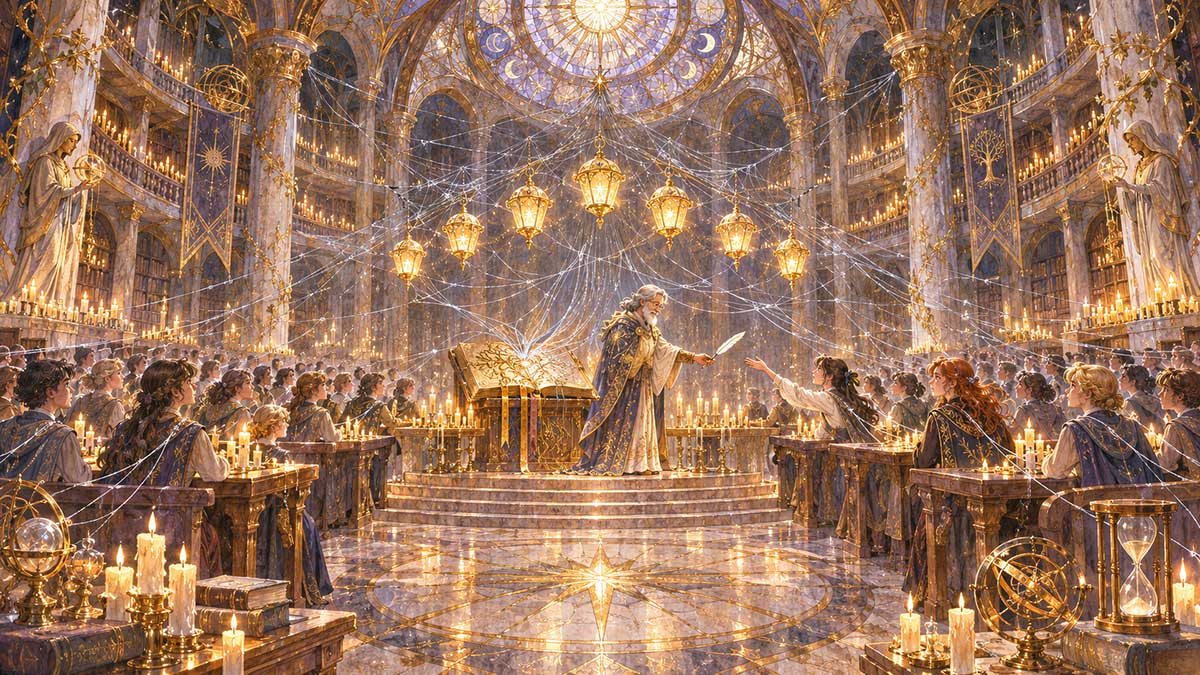
Lily Evans had expected the Society of the Seventh Seal to meet in a cellar.
That would have been easier. A cellar suggested secrecy, and secrecy gave a sensible person permission to ask difficult questions. Instead, the society had been given a bright classroom near the Charms corridor, with freshly polished desks, a vase of late roses, and a plate of biscuits that appeared to be genuinely good biscuits.
Nora Fenwick stood beside Lily at the door, worrying the corner of her invitation between two fingers.
“You needn't come in,” Lily said.
“I want to know what happened to my friend.”
“Then we go in together.”
Inside, an older Ravenclaw was arranging quills in a straight line. Two Hufflepuffs were arguing about the date of an obscure treaty. A third-year girl had brought a notebook covered in sketches of magical plants. Nothing about the room suggested a conspiracy. That was what troubled Lily most.
At the front stood a narrow man with dark gloves and the careful posture of someone who never leaned against furniture he did not own. He was speaking to Professor Slughorn.
“My dear Voss,” Slughorn said, “I do hope you will keep the discussion accessible. These youngsters have quite enough difficult theory on their timetables.”
“Of course, Professor. Our purpose is to preserve neglected knowledge, not to impress anyone with it.”
The man turned. His eyes passed over the students, lingering on each for no more than a heartbeat.
“Adrian Voss,” he said. “Welcome.”
Before Voss began his lecture, Nora reached for the biscuit plate and put it back without taking anything. Lily had seen that gesture before, in students who were unsure what they were allowed to accept. The school offered warmth freely, but belonging could still feel like something granted on sufferance.
“Have you come here before?” Lily asked.
“Once. Last Thursday, when they were getting the room ready.” Nora tried to straighten the edge of her sleeve. “They asked if anyone knew how to repair the old display case. I did, because Dad taught me to mend picture frames, and Mr. Voss listened. Not the sort of listening teachers do when they're already thinking about what they'll say next.”
Lily remembered her first weeks at Hogwarts, the thrill of discovering a place where she could name things she had once had to hide. She could see why the room mattered to Nora. That made Lily more determined not to let Voss own it.
A Hufflepuff boy introduced himself as Daniel Vale and offered to share his notes from the previous meeting. “You missed the argument about whether a historical treaty can be moral if it was legal,” he told Lily. “It got rather heated. I thought that meant we were finally having a useful meeting.”
“What did Voss say?”
“That the answer depended on who had preserved the papers.” Daniel tapped the cream register with the end of his quill. “He said records are safer than memories.”
“Safer for whom?” Lily asked.
Daniel looked at the register, troubled. “That part didn't come up.”
Near the windows, Slughorn was still smiling at Voss. Their conversation sounded like a professor indulging a promising alumnus, full of old acquaintances and agreeable references. Lily wondered whether the society's danger, if it was dangerous, depended less on secret rooms than on ordinary people trusting someone who knew how to be charming.
When Voss took his place at the front, the students quieted. He thanked Daniel for the debate the week before. He thanked Nora for helping with the display case. He used their names without consulting a list.
That, Lily realized, was part of the invitation. Every person in the room had been made to feel seen before anyone had been asked what they were willing to give away.
Lily took a seat near the front. Nora sat beside her. Voss began with an entertaining account of a wizard who had signed away his right to complain about his neighbor's singing, only to discover the neighbor owned a choir of enchanted frogs. Several students laughed. Voss allowed the laughter to finish before he spoke again.
“Words can bind,” he said. “But a signature is more interesting than a word. It tells the world not simply what you believe, but who has agreed to believe it.”
Lily wrote that sentence down.
A student raised his hand. “Can a signature be taken back?”
“Some can,” Voss replied. “Others require the agreement of everyone concerned.”
“That's rather unfair.”
“History often is.”
He placed a cream-colored register on the desk. It had a seven-line seal embossed in the cover.
“Those who wish to contribute to our study may enter their names here. Nothing is required tonight. We prefer willing participants.”
Lily glanced at Nora. The girl had gone pale.
“Is that the same register?” Lily whispered.
“I don't know,” Nora said. “I remember a table. I remember a pen. I can't remember who was standing beside me.”
At the back of the classroom, a girl Lily recognized from Ravenclaw was staring at the register with a puzzled frown. Her friend spoke to her, and she answered politely, as though addressed by a stranger.
Lily raised her hand.
“Miss Evans,” Voss said. He had not been introduced to her.
“How do you know my name?”
“Professor Slughorn speaks highly of your work.”
Slughorn beamed. Lily did not.
“Do you keep copies of the signatures?” she asked.
“For the integrity of our records, naturally.”
“Where?”
“In a secure collection.”
“Who can read them?”
“A small number of qualified researchers.”
“Would a student be able to withdraw a signature?”
Voss smiled, a courteous movement that did not change his eyes. “We would certainly discuss the request.”
“That isn't the same as yes.”
A silence settled over the room. Slughorn cleared his throat.
“My dear Lily, I think our guest means only that old magical agreements can be difficult to alter.”
“Then perhaps students should be told exactly what they're agreeing to.”
A Ravenclaw at the back raised his hand before Voss could answer.
“My grandfather collects old oaths,” he said. “He says a signature is binding only when you know the terms.”
“An admirable grandfather,” Voss replied.
“Then may we see the terms?”
The question changed the room. Several students leaned forward. Daniel set down his quill. The register lay on the desk in full view, but suddenly Lily could see how carefully its cover had been positioned: the embossed seal faced the students, and the clasp faced Voss.
“I would never ask a scholar to inspect a binding text without context,” Voss said.
“Is that a no?” asked the Ravenclaw.
“It is a promise that we will examine the history before the document.”
Nora shifted beside Lily. “He does explain things very well,” she whispered. “Maybe there is a reason.”
“Maybe,” Lily said. “A reason still needs explaining.”
She took out a fresh page and drew the seal, marking the points she could actually see rather than completing the pattern from memory. She had almost filled in the seventh stroke automatically. Instead she left an empty space. Evidence, she reminded herself, included knowing what had not been shown.
Slughorn stepped forward to rescue the discussion with a story about a nineteenth-century potion maker whose contract had obliged him to supply green ink to an entire village. The students laughed again. Voss's register remained closed.
Lily watched the older man's gloved hand rest beside it. He had not lost his temper. He had simply made the question seem premature, and an extraordinary number of intelligent students appeared relieved to have permission to stop asking.
“An excellent principle,” Voss said. “One I endorse completely.”
He closed the register. Lily noticed he did not invite anyone to inspect its earlier pages.
After the meeting, the room filled with cheerful conversation. Voss accepted questions about obscure spells and historical treaties. He gave a Hufflepuff student a reading recommendation and asked a first-year about her favorite subject. He was very good at seeming interested.
Lily waited until Slughorn was called into the corridor. Then she approached Voss.
“The seven-line symbol,” she said. “Where does it come from?”
“Several places.”
“Asterfell?”
His hands remained still. “You have traveled widely for someone so young.”
“I've seen it before.”
“Then you know that a symbol can survive long after its original meaning is forgotten.”
“Some meanings shouldn't be forgotten.”
“No,” Voss said softly. “They shouldn't.”
For an instant, she thought he looked almost curious. Then he reached for the register and placed it in a leather case.
“Good evening, Miss Evans.”
In the corridor Nora caught Lily's sleeve.
“He knew you were coming.”
“He knew my name.”
“No. When you asked about the signatures, he looked at you as if he had been waiting for the question.”
Lily could not tell whether Nora was right. She could tell that the register had been taken away before anyone could read it.
They found the Ravenclaw girl outside the library. Her name was Mira Bell, and she was holding a stack of books against her chest. Beside her stood another girl, Alice, whose eyes were red from crying.
“Tell Lily,” Alice said.
Mira looked uncomfortable. “I don't know what there is to tell.”
“We've been friends since first year.”
“I know that's what you say.”
“You were at my house this summer.”
“I remember the house,” Mira replied. “I remember your mother. I remember someone showing me the garden.” Her voice began to shake. “I can't make the person in that memory be you.”
Alice stepped back as though struck.
Lily reached for Mira's hand, then stopped herself. “May I?”
Mira nodded.
“Do you remember signing anything?”
“A paper at a meeting. I thought it was a list of students interested in history.”
“Did anyone explain what it might do?”
“No.”
Lily looked from one girl to the other. The damage was not a vanished memory. It was something colder: all the facts remained, but the love that joined them could not find its way home.
She promised to speak to Thistlewick immediately. She did not promise that she could fix it. She had begun to understand the cruelty of promises made without knowing their cost.
That night, she wrote two lists. One contained the students who had received invitations. The other contained the people they had once trusted most. She noticed how often the first list included Muggle-born students or children whose families had few connections in the magical world.
At the bottom of the page she wrote a question.
Why would anyone want a child to forget who stood beside them?
She had scarcely put down her quill when an envelope slid beneath the common-room door. It was addressed to her in precise black ink.
The next meeting began with a demonstration of a spell that made old ink visible beneath newer writing. It was the sort of thing Lily might have loved under different circumstances. A sixth-year Ravenclaw passed around a faded invitation from a wizarding salon two centuries earlier, and when the charm touched the parchment, delicate blue letters appeared under the formal black script. The hidden message was a joke about the host's dreadful soup.
The class laughed. Nora Fenwick laughed too, a little too eagerly, and Lily felt her suspicion grow less comfortable. The society did not behave like a trap. It behaved like a place where clever students could ask questions without being told they were showing off.
Adrian Voss stood at the window, hands clasped behind his back. He had not introduced himself as a teacher. He called himself a custodian of neglected histories, and he seemed content to let the students do most of the talking.
“Why do people keep records?” he asked.
“To remember,” said a Hufflepuff.
“To prove they were right,” another student offered.
“To keep other people from changing the story,” Lily said.
Voss turned toward her. “An interesting answer, Miss Evans. Who decides which version is the true one?”
“Evidence,” Lily replied.
“And when evidence is incomplete?”
“Then you say it's incomplete.”
Voss smiled. “A modest principle. I wish more historians practiced it.”
For a moment she liked him. That irritated her more than she wanted to admit.
After the meeting, Nora lingered over a table of old photographs. In one, a group of young witches stood beneath a painted archway. A charm made their faces turn toward the viewer as if waiting to be greeted.
“I've never seen anything like this at home,” Nora said. “My parents have photographs, of course, but they don't move. Sometimes I feel as though I belong to two different worlds and neither knows what to do with the other.”
Lily considered telling her to leave the society at once. She had no proof that its invitation was dangerous, and Nora was smiling for the first time in days.
“It's good to find people who are curious,” Lily said carefully. “Just don't sign anything until you've read it properly.”
Nora held up the invitation. “They only ask for a memory. Something about a person who helped you become who you are.”
“That's more than only a memory.”
“I was thinking of my dad. He learned to say the names of all the things in my schoolbooks, even the ones he couldn't pronounce.” Nora's smile faltered. “Would it be wrong to write about him?”
“No,” Lily said. “It would be wonderful to write about him. But the story belongs to you. You get to decide who hears it and what they do with it.”
Across the room, Voss watched them. His expression was thoughtful rather than angry, and Lily could not tell whether he had heard.
That evening she found James in the common room, trying to mend a quill that had bitten Sirius on the thumb.
“You look worried,” James said.
“It's a society for students who feel like outsiders,” Lily replied. “They make everyone feel welcome. That's the clever part.”
James set down the quill. “Perhaps some of them mean it.”
“I think they do.”
“Then we have to find out which part is false without treating everyone who joined as foolish.”
“We need a way to ask people what happened without making them think we've decided they're victims,” Lily said.
James slid his bitten quill away from Sirius, who was trying to encourage it to attack again. “What if you asked them what they liked about the meetings first?”
“That sounds like an interrogation pretending to be friendly.”
“Only if you're pretending.” James leaned forward. “You said Nora likes the place. What does she like? Who else goes? What's actually happening when nobody's signing anything?”
Lily considered him. “That's almost sensible.”
“I keep hoping you'll notice.”
“I said almost.”
Peter looked up from the hearthrug, where he had been sorting little squares of parchment into columns. “Don't put everyone's names on the same list.”
“Why not?” Sirius asked.
“Suppose somebody takes it,” Peter said. “They would know which students you suspect of being hurt, which students you think are connected to the society, and who might be willing to talk. If the invitations are dangerous, one list would hand the whole thing to whoever wrote them.”
Lily looked down at her notes. She had done exactly that.
“Separate lists,” she said. “Keep the names somewhere safe. Record what each person has agreed to tell us.”
“And give them a chance to change their minds,” Peter said. “It's their story.”
James glanced from Peter to Lily. “We've got a plan, then.”
“A beginning,” Lily corrected. “We tell Thistlewick what we've found. We don't investigate alone, and we don't use the map to follow students who haven't asked for our help.”
Sirius made an unhappy noise. “You take all the interesting methods away.”
“Only the ones that turn us into the people we're trying to stop,” Lily said.
The words landed more quietly than she expected. James reached for a clean parchment and wrote three headings: People who want to speak. Documents we have seen. Questions we cannot answer.
He left most of the page blank.
For the first time that evening, Lily felt that a blank space could be a sign of care, not ignorance.
Lily looked at him with surprise. She had expected a joke or a promise to expose the whole thing by breakfast.
“That's exactly it,” she said.
Sirius's quill bit James. He yelped, and Lily laughed before she could stop herself. The sound startled them both.
“Glad to be of service,” James said, holding his thumb under a stream of water from his wand.
Lily left still worried about Nora, but no longer entirely alone with the worry.
Inside was a fresh invitation to the Society of the Seventh Seal.
Beneath her name, someone had written: We hope you will consider contributing your own story.
Chapter 5: The Family Ledger
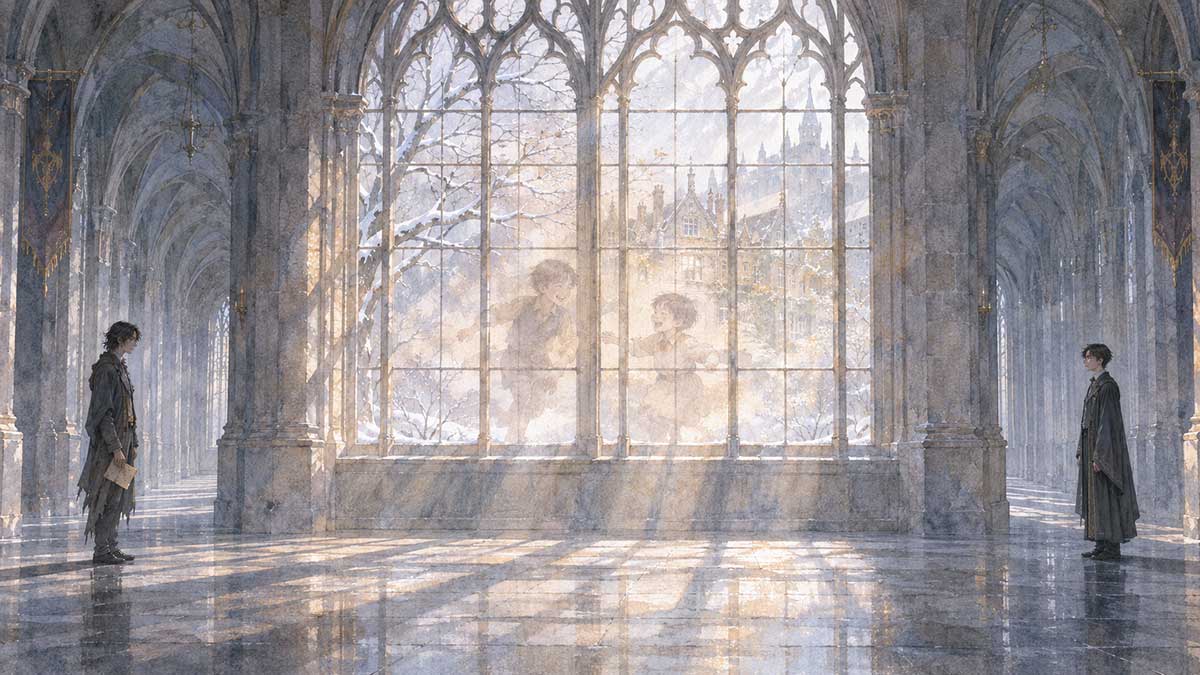
Sirius Black could walk through Hogwarts without thinking about the name on its doors, its walls, or its ancient stones. He could not walk past Regulus without remembering the house they had both left behind in different ways.
He waited near the library one cold afternoon, leaning against a window that rattled whenever the wind changed direction. Students passed with books under their arms. A group of second-years ran past arguing about a missing frog. Sirius ignored them all.
Regulus emerged carrying a slim volume bound in green cloth. He stopped when he saw his brother.
“Are you following me?”
“I was thinking of making it a hobby.”
“Find a different one.”
“Reg.”
Regulus looked away. Sirius hated that small movement. It was something they had both learned at home: how to end a conversation without being the one who walked away.
“I need to see a family ledger,” Sirius said. “One of the older ones. The private collection.”
Regulus gave a short laugh. “You want access to Mother's records?”
“Not her letters. The agreements. Transfers. Anything that mentions the Unwritten Archive.”
The name caught Regulus's attention, though he hid it quickly.
“Why?”
“People are being hurt.”
“People are always being hurt.”
“That's a useful philosophy if you never intend to help them.”
Regulus's face hardened. “You came to ask a favor. Try sounding as though you want one.”
Sirius breathed out slowly. He had promised himself he would not begin with an insult. He had lasted less than a minute.
“I'm asking you,” he said. “Please.”
Regulus's eyes flickered. For a moment he looked younger, almost like the boy who had once waited outside Sirius's bedroom with a stolen biscuit and a whispered question about whether the shouting downstairs would stop.
“I can't give you the ledger,” Regulus said.
“Can't or won't?”
“Both.”
“Someone has taken records from Asterfell. They may have passed through our family's collection. If you can tell me who handled them, we might find the person doing this.”
“You don't know what you're asking.”
“Then tell me.”
Regulus stepped closer. “You walked out. You decided none of it was yours anymore. You can't come back whenever a family connection becomes convenient.”
Sirius felt the words land. He had left the Black house and found shelter with James's parents. He had never stopped knowing Regulus was still inside it.
“I didn't leave you,” he said.
Regulus looked at him with sudden anger. “You left the house. I was in it.”
The last winter Sirius had spent at Grimmauld Place, he had gone into Regulus's room after a shouting match with their mother. Regulus had been sitting on the floor, polishing his school shoes with a cloth so worn it left more lint than shine.
“Come downstairs,” Sirius had told him. “They're gone out.”
Regulus had not looked up. “They'll come back.”
“Then we'll be out when they do.”
“And what happens when they ask where we went?”
At sixteen, Sirius had believed the hardest part of leaving was opening the door. He had not known what it would mean to watch his younger brother stay behind it.
Now, in the Hogwarts corridor, he heard that question again. What happens when they ask?
“I thought you knew I wanted you out too,” he said to Regulus, quieter than before.
“I knew what you wanted.” Regulus's grip tightened on his book. “You never asked what I would have to do to survive afterward.”
“Reg, you could have written.”
Regulus gave him a look that was almost pity. “A letter doesn't arrive in our house without someone deciding it should.”
The admission was so small Sirius might have missed it. Regulus seemed to recognize what he had said, and his face shut at once.
“Forget it,” he muttered.
“I won't.” Sirius stepped back rather than toward him. “I won't ask you to hand me anything you can't safely give. But if there's a way to warn me without using your name, I'll listen.”
Regulus stared at the floor between them. The corridor clock struck the quarter-hour. Neither boy moved.
“I didn't say I had a warning,” Regulus said at last.
“No.” Sirius swallowed. “You didn't.”
For one moment they were two brothers who had once hidden beneath a reading table and made each other laugh. Then footsteps sounded at the far staircase and Regulus turned toward them before Sirius could look.
“Don't make it obvious,” Regulus said.
He walked away without telling Sirius what, if anything, he intended to do.
The corridor seemed to narrow.
Sirius could have said that Regulus had been welcome to come with him. He could have said that their parents had made the house impossible to live in. Both statements were true. Neither answered what Regulus had said.
“I'm here now,” Sirius replied.
Regulus tightened his grip on the green book. “Not for the reasons that matter.”
He walked away before Sirius could answer.
Sirius did not follow. He remained by the window until the glass turned cold beneath his hand.
At dinner, James noticed he was unusually quiet.
“Did you speak to him?”
“Yes.”
“Did he help?”
“No.”
“Do you want to tell me what happened?”
Sirius stabbed a potato. “He said I had no right to ask anything of the family I left.”
James considered that. “That must have hurt.”
“I told him people were being harmed. He didn't care.”
“Did he say he didn't care?”
“He said people are always being hurt.”
James let the silence sit between them.
“I don't know what he's thinking,” Sirius said. “He used to tell me things.”
“Maybe he's afraid to.”
“Of me?”
“Of what happens if he tells you.”
Sirius looked across the hall toward the Slytherin table. Regulus was sitting with two older boys. He was laughing at something one of them had said, but the laugh seemed to arrive a little late.
The next morning Sirius returned to the library corridor carrying a copy of Lily's notes. He had asked permission to use them. Lily had agreed on the condition that he not threaten anyone, break into the Black archive, or call her investigation “a clever little project.”
Regulus was alone when Sirius found him.
“I said no,” Regulus began.
“I know. Read this.”
Sirius held out the notes.
Regulus did not take them.
“A girl remembers spending the summer with her best friend,” Sirius said. “She remembers the house, the garden, and the mother who made them tea. She can't recognize the friend. This is happening at school.”
Regulus's eyes moved to the papers.
“The records you're protecting may have helped someone do it.”
“That's an accusation.”
“It's a warning.”
Regulus took the notes at last. He read them without speaking. When he finished, he returned the pages carefully, aligning their corners.
“You should give this to a professor.”
“I have.”
“Then leave it there.”
“Regulus.”
“There are things you don't know about the people who want these records.”
“Tell me what they are.”
“I can't.”
Sirius heard the old answer again, and this time it frightened him more than it angered him.
“Are you involved?” he asked.
Regulus's expression closed. “Goodbye, Sirius.”
He left with quick, even steps.
Sirius watched him disappear around the corner. He wanted to run after him, seize his arm, demand an answer. Instead he carried the notes to Professor Thistlewick, who listened carefully and asked him to repeat Regulus's exact words.
“You did the right thing bringing this here,” she said.
“I didn't do anything.”
“You gave him a chance to help. You brought us evidence. You did not force him.”
Sirius stared at the carpet. “I wanted to.”
“I know.”
Thistlewick did not tell him that Regulus would change his mind. She did not promise the brothers would be reconciled. Sirius was grateful for that, though he wished she had been able to.
That evening, he received another black-edged envelope. This one was not from Regulus. It bore the crest of the Black family and contained a single line in his mother's hand: You have no authority to inquire into the private records of this house.
Sirius read it twice and tossed it into the fire.
The flames turned green for an instant.
Then, from inside the burning envelope, a small strip of parchment curled free. Sirius caught it with the end of a poker before it vanished. On it was a date, a transfer reference, and three initials.
The strip was scarcely wider than a ribbon. Its edges had been blackened by the flames, and the date appeared only when Sirius held it away from the fire. When he moved it closer, the ink disappeared.
He called for James but stopped himself before shouting the name. The common room was almost empty, and the Black family seal still lay in the grate. If the warning had been hidden deliberately, its sender might be in danger. If it was another trap, rushing his friends into the room would serve whoever had set it.
He carried the parchment upstairs and pressed it beneath a clear glass paperweight. The transfer reference began with the same marks he had seen in Lily's sketch of the seven-line seal, but the numbers were incomplete. Below them were three initials. One pair was A.V. The others might have belonged to a clerk, a witness, or someone who had nothing to do with the theft.
He copied the marks twice, then compared the copies. The second was wrong. He tried again until he could reproduce the shapes without guessing.
Peter found him an hour later with three sheets of paper spread across the bed.
“That looks like homework someone set as a punishment,” Peter said.
“It's a Black family transfer reference.”
“From your mother?”
“The envelope was.” Sirius looked at the charred strip. “I'm not sure this was.”
Peter did not reach for it. “Did you tell Professor Thistlewick?”
“I was about to.”
“Good. Then perhaps we should tell her the part you're not telling me.”
Sirius raised an eyebrow.
“You think Regulus sent it,” Peter said. “Or arranged for someone else to send it.”
“I don't know.”
“That's a useful thing to say.”
Sirius stared at him. It was not the reassurance he had wanted. It was better. He folded the cleanest copy and wrote a note to Thistlewick describing where the strip had come from. He did not write Regulus's name as a certainty.
When he left for her office, he locked the original in the dormitory trunk. He left the paperweight on top of it. The thing weighed almost nothing, and yet it seemed to have changed how he stood in the room.
Sirius remembered the Black family library as a place where the books were more welcome than the children.
The shelves rose to a ceiling painted with constellations. Some volumes were chained to their stands, and others whispered insults when a hand approached without the correct family ring. Regulus had once been small enough to crawl beneath the reading table, where the books could not see him. Sirius had brought him sweets and told him stories about a dragon that ate portraits of unpleasant relatives.
Their mother had caught them laughing. She had not been angry about the sweets. She had been angry that Sirius had made Regulus laugh at a family portrait.
He had not thought of that afternoon in years. Now, after the exchange outside the library, it returned with such force that he could almost smell the polish on the old floor.
He took the memory to James, who was sitting on the windowsill in the dormitory, repairing a tear in the map.
“Regulus used to be funny,” Sirius said.
James looked up. “I believe you.”
“You sound surprised.”
“I'm trying not to sound anything.”
Sirius sat on the bed. “He wasn't always like this. He used to ask me questions about everything. Why our mother hated certain families. Why the portraits spoke differently when visitors came. Why some names had been scratched out of the family tree.”
“What did you tell him?”
“Mostly that our relatives were mad.”
“And now?”
“Now he thinks they're right.”
James let the map rest. “Perhaps he thinks agreeing with them will keep him safe.”
Sirius looked sharply at him. “That's an excuse.”
“It might be an explanation. They're different things.”
For a moment Sirius wanted to be angry with James too. It would have been easier than admitting how badly he missed his brother.
“I keep thinking I should have taken him with me when I left,” he said.
“Would he have come?”
Sirius said nothing.
James did not fill the silence. He had learned that silence could be a form of loyalty when it left someone room to speak.
Later, Sirius returned to the Black family ledger he had found referenced in the archive notes. The entries were arranged by household, property, and obligation. Asterfell appeared in the margin of one page beside a date long before either brother was born. The next line had been altered, the original ink scraped thin enough to leave a pale scar.
He made a careful copy rather than taking the page. He had been tempted to tear it out, to carry proof back to his friends, but he knew that removing it might destroy the only clue they had.
At the bottom of the page was a symbol he recognized from the Winter Masquerade: a small dark medallion marked with a narrow silver edge. It was the same shape as the ornament worn by the masked visitor who had vanished before anyone could learn a name.
The page was not part of the Black family's locked household collection. It was a faculty-supervised copy of an older public index, one that listed which private holdings had once been consulted by the Unwritten Archive. Thistlewick had obtained it after Sirius brought her the strip from the fire. Her condition for allowing him to examine the copy had been clear: no entry in this book proved who currently possessed the item it described.
Sirius had agreed to that condition with less patience than he now wished he had shown. He searched for the transfer reference, then for the initials. Several names had been copied from records already missing by the time the index was made. Asterfell appeared twice, once beside a date so old the ink looked brittle, and once on the edge of a later entry where a clerk had drawn a small questioning mark.
“What does the mark mean?” Sirius asked.
Thistlewick glanced over his shoulder. “It means the clerk had a question. It is not our license to invent an answer.”
“Everyone keeps telling me what we don't know.”
“Then you are receiving a valuable education.”
Sirius almost laughed. Thistlewick's face softened briefly.
“If you find a connection to your family, Mr. Black, that does not make you responsible for every decision they have made.”
“It doesn't make me innocent of ignoring them either.”
“Those are different questions. You are allowed to answer them separately.”
He returned to the index after she left. Near the transfer reference, a few strokes had been scraped away. Under raking lamplight he could see the groove of the original line, but not enough letters to identify a signer. His wand could reveal neither the missing ink nor the intentions of whoever had removed it.
He made himself check the source note for the medallion before deciding what it meant. It was an image a clerk had copied from an object, not a portrait, a signature, or a witness's statement.
He wrote that distinction in the margin of his own notes. A clue could be real without being a conclusion.
Sirius stared at it until the candle burned low.
A Black family record did not prove that the Blacks had stolen the Archive register. It proved that someone in the family had known of its movement. That was enough to frighten him.
He folded the copy into his pocket. Before leaving, he looked once more at the scraped line and imagined Regulus reading the same page with entirely different hopes.
When he returned to the dormitory, Peter was awake, working through a list of possible routes into the old archive rooms.
“Any luck?” Peter asked.
“Maybe.” Sirius placed the copied symbol beside the map. “I found a reason to keep looking.”
Peter studied it. “You don't look pleased.”
“I'm not.”
Peter did not ask whether Sirius wanted to talk about his family. Instead he moved a stack of books aside so Sirius could sit.
Sirius thought of the sweets beneath the reading table. He sat down and began to explain what he had found.
A.V.
Someone in the Black household had wanted him to see it.
Chapter 6: The Word That Cannot Be Unsaid

Severus Snape did not believe in forgiving words.
He believed in knowing exactly what they meant, where they had come from, and how they could be used. A word could be a spell. A word could open a door. A word could make a person turn away from you in a crowded courtyard and never look back.
He had spent months wishing that one particular word had never left his mouth.
In the library, he bent over a page of Asterfell inscriptions. He had copied them during the first great adventure, when he and Lily had still been able to stand beside one another without measuring the distance. The seven-line seal appeared in the margin. Beneath it was a phrase he had once translated incorrectly and Lily had corrected with irritating ease.
He remembered her laughing, not at him, but at the absurdity of the old scribe's grammar.
He closed the notebook.
“Mr. Snape.”
Adrian Voss stood on the other side of the table, gloved hands folded.
“I believe you have an interest in old binding agreements.”
“Who told you?”
“Your work speaks for itself.”
“Then it can speak without me.”
Voss sat down anyway. “The trouble with young scholars is that they often think every offer conceals an insult.”
“The trouble with older scholars is that they often think a compliment conceals a contract.”
Voss's mouth moved slightly. “A fair observation.”
He placed a narrow slip of parchment beside Snape's book. On it was an inscription that Severus recognized at once. Not from Hogwarts. From Asterfell.
“Where did you get this?”
“A private collection.”
“That isn't an answer.”
“It is the answer I can give you.”
Snape looked down. The inscription described a bond between a name and a recollection. He read it twice. A third time.
“You're translating it incorrectly,” he said.
“Am I?”
“It doesn't say to remove the memory.”
“Go on.”
“It says to remove the path by which a person reaches it.”
The word in the inscription was an old one. Severus had seen it translated as thread, path, or joining, depending on which century's grammar the translator preferred. In the first Asterfell text he and Lily had studied, the scribe had used the same word for the line between two names in a family record.
“You've brought me only the middle of the passage,” Severus said.
“Is the middle insufficient?” Voss asked.
“The beginning would tell me who is bound. The ending would tell me how the agreement stops.”
“And if those sections are missing?”
“Then you can't claim to know what the text permits.”
Voss appeared to enjoy the answer. “You've a precise mind, Mr. Snape.”
Severus hated compliments that arrived at the moment someone wanted something from him. He hated that this one pleased him.
He traced the line without touching the parchment. The old script made a distinction between remembering that a person had once been present and feeling that the person belonged inside the memory. It was a distinction he understood more intimately than he wished.
“Suppose someone took the path away,” he said. “What remains?”
“The truth of the event,” Voss replied.
“Truth without meaning can be cruelty.”
“Meaning changes. The event stays.”
“That's not an answer to what happens to the person.”
Voss lowered his voice. “I am interested in the possibility that two people might be freed from what they have become to one another. Surely you can see the attraction of that.”
Severus saw it. He saw Lily walking past him without the guarded look she had worn since the courtyard. He saw himself free of the moment he could never unsay. The image was so beautiful and so repulsive that he looked away.
“You said the text needed an ending,” he told Voss. “Where is it?”
“Perhaps we could find it together.”
For several seconds Severus was tempted to accept. Then he turned the fragment over and noticed an impression in the parchment, as if a second sheet had been laid over it and signed. The impression formed the beginning of a name, then disappeared at the torn edge.
Someone had already tried this magic on a real person. Voss had not mentioned that.
Severus closed his notebook over his own notes. He would need to decide whether the fragment was evidence of harm or an opening into knowledge he had always wanted. He found that he was capable of wanting both answers.
Voss regarded him with interest. “Precisely.”
Snape felt the first cold movement of unease. He understood enough about memory charms to know that what Voss described was not ordinary forgetting. The event remained, but the person who remembered it might no longer know what to do with it.
“Why would anyone want that?” he asked.
“There are many reasons. Some people would give a great deal to be free of a painful association.”
Severus kept his face still.
“An insult,” Voss continued. “A betrayal. An error that has become the only thing another person sees when they look at you.”
Snape's hand tightened around his quill.
Voss had not spoken Lily's name. He did not need to.
“What you're describing is interference,” Snape said.
“An intervention. There is a difference.”
“Not to the person who doesn't consent.”
“Consent is an interesting subject,” Voss replied. “People consent to things they do not fully comprehend every day. That is why the law has scholars.”
Severus wanted to ask whether a single word could be disconnected from the person who had said it. He wanted to know whether Lily could remember the afternoon in the courtyard without hearing the insult when she thought of him. He wanted to know whether he could approach her again without seeing that expression on her face.
Instead he asked, “What do you want?”
“Your expertise. Nothing more at present.”
Voss rose. “If you decide to continue this discussion, you know where to find the Society.”
After he had gone, Snape sat without moving. The parchment slip remained on the table. He could have returned it. He could have burned it. He slipped it into his notebook.
Later, he saw Lily in the corridor with James Potter.
They were not holding hands. They were arguing over a page of notes, and Lily was speaking with the focused impatience she used when someone had missed an obvious point. Potter listened, asked a question, and then changed what he had written.
Severus had expected Potter to laugh at her or make some show of being clever. The absence of that behavior annoyed him more than its presence would have.
Lily noticed him. For a heartbeat her expression softened with recognition. Then it became guarded.
“Severus,” she said.
“Evans.”
Potter said nothing.
Snape looked at the page in Lily's hand. “The third line is wrong.”
Lily glanced down. “I know. I'm checking it.”
“Then check the original inscription, not the copy.”
“Where would I find the original?”
Snape nearly told her. He knew where Voss had obtained the fragment. Or at least he knew enough to suspect it. Instead he said, “You should know.”
He walked away before she could answer.
In the dungeons, a younger Slytherin asked whether he had heard about the society's new register. Severus told him to keep away from it.
“Why?” the boy asked.
“Because people who ask for your name without explaining what they'll do with it are not interested in history.”
The boy laughed, thinking it a joke. Severus did not correct him.
That night, alone in his dormitory, he opened the notebook to Voss's inscription. Beneath it he wrote a translation, then crossed it out. He tried again.
The text did not promise to undo what had happened. It promised to make a connection unreachable.
He pictured Lily looking at him without pain. For a moment the thought felt like mercy.
Then he pictured Lily looking at him without the ability to choose what she remembered.
He closed the book so sharply the ink bottle trembled.
Outside, footsteps passed his door. Someone was laughing. He recognized the voice of a boy who had once admired him, and he felt a sudden, irrational wish to erase every word he had ever spoken to that boy as well.
He sat in the dark until the wish passed.
In the morning, an envelope waited inside his textbook. No one had seen it placed there.
The note contained a time and a room number. Beneath them was a sentence in Voss's precise handwriting.
Severus spent the following Saturday in the library with a book he did not need to read.
He had opened it to a chapter on historical binding spells, but his eyes kept returning to the same paragraph. The spell described there could preserve the terms of an agreement after the people who made it had died. It was elegant, precise magic. It was the sort of thing he had once shown Lily with excitement, expecting her to ask questions he had not considered.
Now he had no one to show.
Across the room a group of students was laughing over a Charms assignment. A red-haired girl passed the doorway. Severus looked up too quickly, then looked away when he saw it was not Lily.
He hated that he still did that.
He tried to reconstruct their last argument in his mind. The scene always changed at the same point. In some versions he said nothing. In others he apologized before she turned away. Once, in a particularly foolish version, he found a perfect sentence that made her understand every humiliation he had felt that afternoon.
None of those versions had happened.
The word he had used was still there. He could remember the sound of it and the look on her face. No amount of explanation made it smaller.
He shut the book and went to the courtyard. Lily was there with Mary, pinning notices about the Society of the Seventh Seal to a board. They were asking students to report any invitation that requested personal memories or signatures.
Severus stopped several yards away.
Mary noticed him first. Her expression hardened. Lily followed her gaze.
“What do you want?” Lily asked.
He had prepared a warning about the Asterfell inscriptions. He had practiced it on the walk down. Now the words sounded like an excuse to approach her.
“The society's translation is wrong,” he said.
Lily looked at the notice. “Which part?”
“The seventh clause. They're treating the keeper as the owner of the bond. In the older script, the keeper is forbidden to claim it.”
“Do you have a copy?”
“Yes.”
“Then give it to Professor Thistlewick.”
Mary finished securing the notice and stepped down from the bench. Severus had always disliked the way she looked at him now. It was easier to call the expression contempt than to consider what she remembered of the boys he had chosen to stand beside.
“Are you going to give her the copy?” Mary asked.
“I said I have one.”
“You didn't answer.”
Lily laid a hand against the corner of the notice to stop it curling. “You can leave it with the professor without involving me, Severus. You don't need my permission to do the right thing.”
He almost replied that he had come because she was the only one who would understand the translation. The sentence would have been partly true and partly an attempt to make her responsible for what he did next. She had taught him to recognize that sort of imprecision long ago.
“It's incomplete,” he said. “Voss has the middle of the inscription. I don't know where the rest is.”
“Then tell Thistlewick that too,” Lily said. “Don't fill the missing sections with what you want them to mean.”
Mary looked from one to the other. “And if he offers you a way to change what someone remembers, don't mistake that for an apology.”
Severus felt the rebuke before he allowed himself to consider it. He glanced at Lily. She was watching him steadily, without triumph.
“I know,” he said.
Did he? He wanted to believe so. In the library he had asked Voss for the missing ending. He had not asked what had happened to the person whose name was pressed into the torn parchment.
“There's a mark on the reverse,” he said at last. “An impression. It might have been a signature.”
Lily's eyes sharpened. “Whose?”
“I don't know.”
“That's worth telling the professor.”
For the first time in the exchange, there was something like the old rhythm of their work together: question, limit, correction. It lasted only a moment. Severus had no right to ask it to last longer.
“I will,” he said.
He did not wait to see whether she believed him. His promise was not evidence until he had done what it required.
He hesitated. “I thought you should know.”
“I do now.”
The exchange was almost painfully civil. Lily had listened to the warning. She had not invited him back into her life. He understood the difference, but part of him still resented it.
“I could help translate the rest,” he said.
“Then help Thistlewick.”
Mary returned to pinning the notices. Lily did not move closer.
Severus turned to leave, then stopped.
“I know an apology doesn't change what I said.”
Lily's face grew still. “No. It doesn't.”
“I was angry.”
“I know you were.”
He waited, hoping she would say more. She did not.
“That's all,” he said.
He walked away with the unpleasant certainty that he had done one useful thing and repaired nothing.
That evening he copied the original seventh clause onto a clean sheet of parchment for Thistlewick. He made three copies, checking each mark against the source. His hand was steady. His thoughts were not.
Near the bottom of the page he wrote a question he did not intend to send: If a memory can be removed, can a wound be removed with it?
He stared at the sentence for a long time.
Then he folded it beneath the translations instead of destroying it. He had not yet decided what kind of person he would become, and the question frightened him less than the answer he suspected he wanted.
Some mistakes cannot be forgiven. They can, however, be made unreachable.
Severus folded the paper and put it away. He did not tear it up.
Chapter 7: The Girl Who Forgot Her Friend

By Friday, Alice had begun carrying a notebook of proof that she and Mira were friends.
She showed it to Lily between classes: photographs from their first year, a pressed flower from the summer garden, a ticket stub from a village fair, and a drawing Mira had made of the two of them on the Hogwarts Express. Each object meant something to Alice. To Mira, they were evidence of events she could recall without feeling that Alice had been there.
The notebook had acquired a ribbon to hold its swollen pages closed. Alice kept smoothing the ribbon with her thumb, as though neatness might persuade the evidence to arrange itself into a cure.
Lily followed her to the empty window seat outside Charms. A gust of rain rattled the glass. On the other side of the corridor, Mira was speaking to a Hufflepuff prefect about homework, her shoulders relaxed in a way Alice had not seen for days. Alice watched her with an expression that was half relief and half a fresh wound.
"She laughs with everyone else," Alice said. "I think that's the part I can't bear. I know she isn't doing it to hurt me. I know it."
"You can know something and still be hurt by it," Lily said.
Alice opened the notebook to a photograph in which Mira was fastening a crooked birthday crown onto Alice's head. "I keep wanting to ask her the same question until she gives me the answer I remember. But each time I ask, I can see her trying harder. I hate watching her apologize for something that was done to her."
A first-year crossed the corridor carrying a jar of blue beetles. The lid slipped. For a moment both girls were occupied helping to recapture the glittering insects, and the ordinary panic of chasing six fast-moving beetles brought a breath of laughter out of Alice. She looked almost ashamed of it.
"You're allowed to laugh," Lily said.
"It feels disloyal."
"To what?"
Alice regarded the photograph. "To the friend I had last week."
Lily wanted to say the friend was still there. Mira's face and habits were unchanged, and the story of their friendship remained written in the same years. Yet the thing that made those years theirs had been tampered with. Promising Alice an easy return would mean pretending the harm was smaller than it was.
"You don't have to decide what your friendship is today," Lily told her. "Neither does Mira."
Alice retied the ribbon. When the bell rang, she stood up slowly, taking the notebook with her instead of hurrying after the girl across the corridor.
“I remember the fair,” Mira said, touching the ticket. “There was a man selling sweets that changed flavor whenever you sneezed.”
“You sneezed six times,” Alice replied.
Mira smiled faintly. “That sounds like me.”
“Then why don't you remember me?”
Mira's smile vanished. “I want to.”
The words were so simple that Lily had to look away.
On Thursday night, Alice had come to Lily's dormitory with two photographs and the expression of someone trying very hard not to panic.
“The first one was taken on the train,” she said. “Our first journey to Hogwarts. The second was last Christmas. I was at her house, and her father burnt the pudding. You can see him in the background trying to hide the dish.”
Lily held the photographs beneath the lamplight. In one, two eleven-year-old girls leaned together, grinning so widely that they kept falling out of the picture. In the other, they sat in a kitchen with paper crowns on their heads while an embarrassed man carried a blackened plate past the window.
“Did Mira see these?”
“She described everything. She knew what happened after the second photograph. She said we went outside to feed the birds. But when I asked who she was with, she said she couldn't tell.”
Alice sat on the edge of the bed. Her hands were trembling so badly that the photographs knocked together.
“She was there when my father died,” she said. “Mira stayed with me for two nights. Her mother sent soup, and she sat on the floor outside my room when I couldn't bear anybody talking. I know that happened. She knows it happened. Now she looks at me as if I borrowed somebody else's coat.”
Lily set the photographs down.
“Has Mira spoken to you since?”
“She says she wants to be kind to me. Can you imagine? She wants to be kind.”
The bitterness in Alice's voice startled them both. Alice covered her mouth.
“I know she can't help it,” she whispered. “I know she's frightened too. I hate that I keep asking her to prove she loves me.”
“You don't have to ask her tonight,” Lily said.
“Then what do I do?”
Lily thought of all the clever answers she had been collecting. The seals and signatures seemed suddenly very far away.
“Eat something. Sleep if you can. Tomorrow we ask Professor Thistlewick for a room where nobody will stare.”
Alice nodded, without looking convinced.
After she left, Lily found Mary in the common room and asked whether she would sit with Mira during breakfast. Mary agreed, then hesitated.
“People are saying Mira is pretending,” she said. “That she wants to get away from Alice without being cruel.”
“She's not pretending.”
“I know. But the story is spreading.”
Lily looked around the room. Students who had never spoken to Mira were already discussing her as if her suffering were a puzzle set for their amusement.
“Then we tell them to stop,” Lily said.
Mary folded her arms. “Good. I was hoping you would say that.”
At breakfast the next morning, a boy from Ravenclaw made a joke about conveniently forgetting his homework. Alice went white. Before Lily could speak, Peter, who had been passing with a tray, stopped beside the table.
“Don't,” he said.
The boy laughed. “Don't what?”
“Make her the joke.”
He said it softly. There was no wand in his hand, no friends gathering behind him to make the words bigger. The boy looked at Alice, muttered an apology, and turned away.
Peter walked on, nearly dropping his porridge when Sirius called to him from the Gryffindor table.
Lily watched him go. It struck her that the four boys were changing in ways their loudest reputations did not record.
Later, when Mira arrived for the meeting, Alice held out the notebook and then pulled it back.
“I've been carrying these,” she said. “I thought they might help. You don't have to look.”
Mira gazed at her. “May I?”
Alice opened it.
They sat side by side, still separated by something no photograph could cross.
She had arranged a meeting in a small classroom with Professor Thistlewick's permission. James and Remus had brought their notes. Peter had brought the copied boundary from the map. Sirius had been told to remain quiet unless he had something useful to say, a restriction he considered personally offensive.
Thistlewick examined the girls' accounts. She did not attempt a general Memory Charm. The problem was not a memory that had been removed. It was a connection that had been damaged.
“We may be able to restore the association,” she said, “but I won't try a counter-charm until we're certain how the original agreement was made.”
Mira sat very still. “Will it hurt?”
“I don't know,” Thistlewick answered. “And that means we proceed carefully.”
James respected her for saying it. He had once thought confidence was a kind of kindness. Now he could see how frightening a confident lie might be.
Lily laid out the invitations. “Mira signed a register. Nora saw one like it. The Society claims the signatures preserve stories. I think the register is being used to separate people from the stories they share.”
Remus pointed to a copied inscription. “If the seventh line limits what a keeper can claim, perhaps we can invoke it to restore the bond.”
“Perhaps,” Thistlewick said. “But the phrase is incomplete.”
James leaned over the parchment. “This part could mean return what was taken.”
“Or return what was given,” Remus replied.
“Either way, we need the person who signed to accept the connection again.”
“Not necessarily,” said a voice from the doorway.
Severus Snape stood with his hands at his sides. His expression suggested he regretted arriving before he had even crossed the threshold.
Lily stiffened. “Who asked you here?”
“Professor Thistlewick.”
“I asked him to examine the inscription,” Thistlewick confirmed. “He has worked with related material.”
James felt his old irritation rise. He knew that expression on Snape's face, the one that said everyone else had failed to understand something obvious. James had spent years answering it with mockery.
Snape looked at the parchment. “Potter's translation is wrong.”
Sirius shifted in his chair.
James kept his voice level. “Which part?”
“Return isn't the verb. Recognize is. The line doesn't command a thing to go back. It asks whether the person can recognize what is offered.”
James examined the inscription. He saw it then: the small change in the final character, a mark he had mistaken for an ornamental stroke.
“You're right,” he said.
Snape blinked.
“Explain the rest,” James added. “We don't have time to argue about who noticed it first.”
The room became very quiet.
Snape looked toward Lily, then away. He took the quill James offered and rewrote the phrase in careful, angular letters.
“It requires an offer,” he said. “The person who still holds the connection offers it. The person whose recognition has been damaged must accept it freely. The spell cannot command them to care.”
Thistlewick studied the revised text. “That fits what we know. But we will attempt only the smallest possible restoration, with both students' permission.”
She turned to Alice and Mira. “You may refuse.”
Alice nodded at once. Mira hesitated.
“What if I don't feel anything?” she asked.
“Then nothing about you has failed,” Lily said. “We can try again another day.”
Mira looked at Alice. “I want to try.”
Thistlewick moved the chairs away from the open classroom door. She asked Mary to keep other students from entering and invited James to stand near the windows rather than crowding the two girls. Her first instruction to Alice was not a spell but a question.
"What will you do if Mira says stop?"
Alice swallowed. "Stop."
"What if she says it just as you feel the connection returning?"
For a dreadful instant Alice's answer did not come. Mira watched her, not accusingly, but with a patience that made the silence worse.
"I'll stop then too," Alice said at last. "I don't want to win you back if you have no choice."
Mira pressed her hands together. "I want to know why I remember every silly thing we did and feel as if someone has described somebody else's childhood. But I need you to believe me if it doesn't work."
"I do." Alice drew a ragged breath. "I am learning how."
From his place by the window Peter looked down at the small strip of parchment in his pocket. On it he had written the names of people who would notice if he failed to return to dinner. He had started the list as a joke in second year. James, Sirius, Remus. Three names, each written over several times as the ink faded. He had been embarrassed by how often he checked it when he felt left behind.
The room quieted. Thistlewick checked each girl's consent once more, this time separately. Lily understood the care now. A person whose willingness had already been used against her deserved to hear that she was allowed to refuse.
Alice moved her chair closer but did not touch her.
Thistlewick traced the corrected line in the air. It glowed for a moment like a thread held against sunlight. Alice took a breath and began describing a memory from their first year: the two of them hiding under a staircase during a storm, sharing a stolen biscuit, and laughing when the thunder made a suit of armor sneeze.
Mira listened. She remembered the staircase. She remembered the biscuit. She remembered the ridiculous sneeze.
“I was frightened,” Mira whispered.
“Yes,” Alice said. “You said the castle sounded angry.”
“And you told me castles were too old to stay angry for long.”
Alice's face crumpled. “I did.”
The thread of light moved between them. It did not flare or explode. It simply tightened, like a knot pulled gently into place.
Mira reached for Alice's hand.
“You were there,” she said.
Alice nodded, unable to speak.
Mira began to cry. “You were there.”
Lily turned toward the window. She had spent days gathering evidence and asking questions, but she had not been prepared for the quiet sound of two people finding each other again.
James felt a strange relief that had nothing to do with having solved a problem. He looked at Snape, who was watching the girls with a fixed expression.
“Thank you,” James said.
Snape looked at him as though the words were a trap.
“You found the mistake,” James continued. “They needed that.”
Sirius made no joke. Remus quietly gathered the notes. Peter wiped his eyes with the back of his sleeve and pretended he had something in them.
The light disappeared, but Mira did not let go of Alice's hand.
“What do you remember?” Thistlewick asked gently.
Mira gave a shaky laugh. “The staircase. The storm. The biscuit. She was so cross that it had gone stale, and then she ate her half anyway.”
Alice began to laugh through her tears.
“And your father,” Mira said suddenly. “I remember sitting outside your room. I remember being worried that if I knocked you'd think I wanted you to stop crying.”
Alice pressed her free hand against her face.
“I wasn't trying to make you stop,” Mira continued. “I just didn't want you to be alone.”
“I know,” Alice whispered. “You told me.”
Mira looked down at their joined hands. “It's still strange. There are pieces missing. But I know you now. I know why I wanted to stay.”
Thistlewick did not pronounce the restoration complete. She asked each girl to describe what she had consented to and whether she wished to continue speaking.
“Yes,” Mira said. “But I want no more magic today.”
“Then there will be no more magic today,” the professor replied.
Thistlewick made a note beneath the record of Mira's recovery. “This is a single severance,” she explained when Lily asked why their work had helped. “The record interrupted an existing bond once. It did not bind the interruption to the Archive itself. Two people, present together, have now freely recognized their connection. That recognition matters more than the things they remembered.”
“Can every bond return that way?” Lily asked.
“No. A relationship held under an active keeper's claim may be pulled apart again each time someone begins to accept it. In that case, the claim must be broken or answered at a cost. And a connection struck repeatedly can be injured again before the people involved have had the time to recover. We cannot tell families that a remembered story is a cure.”
Lily wrote down the distinction. The rules were narrower than she wanted them to be, and all the more worth stating precisely.
Lily took the notebook from the desk and placed it between them. Alice closed it without looking at the pictures. For once, she did not need the proof.
In the corridor afterward, James found Peter studying the door to the empty classroom.
“You were good with that boy at breakfast,” James said.
Peter blinked. “What boy?”
“The one making jokes.”
“Oh.” Peter looked uncomfortable. “I just thought Alice must have heard enough of that.”
“She has.”
“Didn't do much.”
James glanced toward the classroom where Alice and Mira were still sitting together.
“It mattered,” he said.
Peter looked down at his shoes, then smiled.
Across the corridor, Sirius was attempting to persuade Remus that a celebratory feast should be considered medical treatment. Remus informed him that the infirmary had more than enough reasons to distrust his understanding of medicine.
For a moment, James could see the whole group as Lily might: four boys pretending that nothing serious had happened, each trying in his own imperfect way to make the afternoon ordinary again.
He hoped that, someday, ordinary would be possible for Alice and Mira too.
Lily approached Snape after the girls had left.
“You helped them,” she said.
“I corrected a translation.”
“You knew what it meant.”
“Apparently.”
She waited, but he offered nothing more. The distance between them remained. Lily was grateful for what he had done and saddened by how little it changed.
Later, James found her outside the classroom.
“You were right to investigate,” he said.
“So were you, about asking Thistlewick.”
He smiled. “That's two sensible decisions in one week. I may need to lie down.”
Lily almost laughed. Then she grew serious.
“Don't mistake this for everything being fixed,” she said. “Mira remembers Alice now. We still don't know who harmed her or how many others there are.”
“I know.”
“And don't expect me to be impressed simply because you didn't insult Severus.”
“I don't.”
She studied him. “Good.”
They walked toward the stairs together, speaking about the names on Lily's lists. James asked questions and wrote down the answers. He did not notice when she began walking a little more slowly so they would have time to finish the conversation.
At the end of the corridor, Peter caught up with them carrying a note from Thistlewick. It was an inventory of the society's known records, compiled after the professor's inquiries.
One entry had been marked with a question: Black-bound ledger, seven-line seal, removed from room before inspection.
Below it was a witness's description.
The cover bore a faint mark like the outline of a missing name.
James read the line twice. He thought of Cassian's unsigned letter, and of Alice's desperate notebook of proof.
Someone was keeping the names. Someone else was paying the price.
Chapter 8: Questions, Not Passwords
The first question on the door was not a question anyone sensible would answer.
WHAT HAVE YOU NEVER TOLD THE PERSON YOU TRUST MOST?
Sirius stared at the words, which had appeared across the wood in a thin, impatient hand.
“Well,” he said, “that's a dreadful way to welcome guests.”
The door stood in an unused classroom on the fourth floor. Or rather, it had stood there for three days, according to a portrait who insisted that it had not existed the week before. Thistlewick had asked the boys to look at it without touching it, an instruction James had repeated so often that Sirius had begun repeating it in his sleep.
“Don't answer,” James said.
“I wasn't going to.”
“You were drawing breath.”
“I do that occasionally.”
Remus was examining the frame. “There's no keyhole. No hinges on this side, either.”
Peter knelt by the threshold. A narrow line ran along the floor, not dust but something like ink pressed into the stone. It curved away from the door and disappeared under the wall.
“That's like the edge we found on the map,” he said.
James crouched beside him. Peter had been the first to see the difference between a map that failed to show a room and a map that honestly admitted it could not. James was beginning to discover how often his friend's quiet observations arrived after everyone else's dramatic theories had exhausted themselves.
Before anyone could test the line, footsteps sounded in the corridor.
Professor Thistlewick came around the corner carrying a box of papers. She stopped when she saw the door.
“You haven't touched it?”
“No,” James said.
Sirius added, “We've been exceptionally obedient. I may need to lie down.”
“An unprecedented condition, Mr. Black.”
She put the box down and studied the words. Her face tightened, but she did not look surprised.
“It's asking for a confession,” Remus said.
“It's asking for an answer,” Thistlewick corrected. “That is not quite the same thing.”
She took a blank sheet from the box and held it against the writing. For an instant the question appeared on the paper, then vanished.
“Some old agreements were made by speaking,” she said. “Others were made by signing. The Unwritten Archive used a stranger method. It responded to questions. Not passwords. Questions.”
To test the theory, Thistlewick brought a small practice slate from the Ancient Runes cupboard. The slate was dull gray, marked with a harmless listening charm that accepted only explicitly stated instructions. She placed it on the table beside a sheet of fresh parchment.
"Tell the slate your favorite subject," she asked Sirius.
"Flying."
The slate remained gray. Remus suppressed a smile. "That isn't on the timetable."
"It's the only subject worth learning."
Thistlewick touched the slate. "You may record the answer to this question for the purpose of today's demonstration. Sirius, do you agree?"
Sirius nodded. A pale line appeared, repeating the word Flying. The professor wiped it away with her sleeve.
"Now ask a question that contains its own instruction," she said.
Remus considered. "If I tell you who I trust, will you keep the answer safe?"
The slate brightened before anyone spoke. Its surface formed a small, eager spiral.
"There," Thistlewick said. "It hears a promise embedded in the question, but it cannot know whether the person understands what keeping means. A deceptive keeper can build an entire agreement out of such ambiguities."
Peter leaned over the desk. "Then even refusing to answer might matter, if the question says refusal is an answer."
"Precisely."
"That's a terrible way to ask anything," Sirius said.
James looked at the slate. "Unless you're trying to get something the other person would never agree to give."
Thistlewick covered it with cloth. They all watched the outline of the spiral fade beneath the fabric, slowly enough to suggest an appetite rather than a mechanism.
"The Archive's real protections were written to prevent that kind of ownership," she said. "The danger is not the act of asking. It is hiding a claim inside the answer."
James remembered the doors of Asterfell, where words could carry the weight of an oath. “If you answer, it lets you in?”
“Sometimes. And sometimes it decides you've agreed to something you haven't been allowed to read.”
Sirius took a step away from the threshold.
“Good,” Thistlewick said. “You are learning.”
“Don't spread it around.”
Thistlewick opened her box. Inside were copies of invitations from the Society of the Seventh Seal, notes from Lily's interviews, and an old fragment of parchment that looked almost transparent. Seven lines crossed its surface. The final line ran against the others.
“The seventh clause,” she said, touching it with one gloved finger, “was meant to limit what a custodian could demand. A person could give information without surrendering ownership of the relationships behind it. At least, that's how the surviving words have been read.”
“Then why does the society use the same mark?” Peter asked.
“That's what we need to establish.”
She looked at the four boys, and James noticed the tiredness around her eyes. The professor had been working with the islands affected by the Moonlit Kingdom, and now another old magic was reaching toward the school. He wanted to ask whether she was afraid. He suspected she would tell him the truth.
The first time Peter had encountered the moving door alone, he had been carrying a stack of library books that obscured his view of the corridor.
A voice had asked, from the blank wall, “Who first invited you to stay?”
He had stopped so abruptly that the books slid sideways in his arms.
There had been no visible door, only a strip of pale mortar between two stones. Yet Peter had heard the question quite clearly. It sounded like an ordinary adult asking him to confirm his name before entering an office.
He had opened his mouth.
Then he had thought of the way the map had refused to show the space, and of Mira looking at Alice without recognizing her. He closed his mouth, walked away, and found Remus.
Remus listened without laughing.
“Did it ask for your name?” he asked.
“No. It asked who invited me.”
“Was there any reason you would have answered?”
Peter shifted the books against his chest. “It sounded as if I was supposed to.”
Remus's expression grew troubled. “That's the point, I think.”
Now, standing with the others before the solid wooden door, Peter understood how little protection a warning could offer. A person did not need to agree to something foolish on purpose. They only needed to be tired, or lonely, or afraid of being rude.
He watched the words on the wood change as Sirius looked at them, and noticed that the letters did not flow evenly. One word lingered longer than the rest, its tail sinking into the grain as though the question had been copied from a document.
“Professor,” he said, “the writing isn't being invented by the door. It's coming through it.”
Thistlewick stepped closer. “What makes you say that?”
Peter pointed with his quill, careful not to touch the wood. “That word at the end. It was there before the question changed. The letters move, but the mark beneath them stays. Like a page somebody's written on more than once.”
Thistlewick held her paper against the frame again. A faint shadow of the older word appeared through the sheet.
“An impression,” she murmured. “A copied form. Very good, Mr. Pettigrew.”
James smiled at Peter. Peter tried to look as if his pulse were not hammering.
“What does it mean?” Sirius asked.
“It means the door may be connected to a register elsewhere,” Thistlewick said. “The question is only the visible end of a longer process.”
Remus looked at the dark grain. “So somebody could be keeping a record of every answer.”
“And perhaps of every person who declined to answer.”
Sirius turned sharply. “I haven't agreed to anything.”
“No,” Thistlewick said. “You have made that clear. It is still useful information to whoever is studying us.”
James felt a sudden desire to cover the door with a curtain, as though hiding it would end its curiosity.
“Let's move,” he said. “If it wants to watch us, it can watch us leaving.”
For once, Sirius did not object.
“Could the door make someone forget a friend?” James asked.
“Not by itself,” Thistlewick said. “A door is only a place to ask. What matters is the agreement that follows.”
Remus glanced toward the words. “The question changes depending on who's standing here, doesn't it?”
Thistlewick nodded. “It may.”
Sirius tried looking away, then back. The letters changed.
WHO WOULD YOU LEAVE BEHIND TO SAVE YOURSELF?
His smile disappeared.
James saw the change but did not ask what the door had shown him. He knew enough of the Black family to guess that some questions could hurt before they were answered.
“Can we destroy it?” Peter asked.
“Perhaps,” Thistlewick said. “But if this is a surviving part of the stolen Archive, breaking it may destroy evidence. I would rather learn who brought it here.”
The professor asked James to fetch Lily's latest notes from the library. He went willingly, relieved to have a task that did not require being brave.
Lily was seated beneath a high window, surrounded by scraps of parchment. She had arranged the invitations in neat columns, though several had been crossed out and rearranged.
“You look pleased,” she said when James approached.
“Thistlewick has found a door that asks embarrassing questions. Naturally, we're having a wonderful afternoon.”
Lily's pen stopped.
“Questions?”
He explained. She listened without interrupting, then pushed one of her pages toward him.
“I've been comparing the signatures,” she said. “Some students signed a register. Others answered a question aloud before their names were added. The wording isn't identical, but the idea is.”
James read a copied line: Whom do you owe your place here?
“That's a cruel question to ask someone who feels they don't belong,” he said.
“Yes,” Lily replied. “And it sounds kind when it's asked by someone promising to help.”
They sat in silence for a moment.
“Do you think Slughorn knows?” James asked.
“I think he knows about a history society. I don't think he knows what it does with the answers.”
“Then we should tell him.”
“We should bring him something he can't explain away as student gossip.”
James smiled faintly. “You make it sound as if we've done this before.”
“We have,” Lily said. “You just used to skip the part where we gathered proof.”
Back at the classroom, Thistlewick placed the copied question beside the door. The ink on the wood flickered, as though recognizing a relative.
Peter leaned forward.
“Professor,” he said, “what happens if somebody answers without knowing it's an agreement?”
“That,” she said, “is the danger.”
The door's question changed again. This time the letters were smaller.
WHO GAVE YOU PERMISSION TO BE HERE?
The boys waited.
For a long moment the silence had weight.
Peter watched a sliver of pale dust drift down the wood. He could hear students on the staircase below, someone laughing at a joke that had nothing to do with ancient contracts. From somewhere beyond the wall came a scratch, as if the point of a quill had reached the bottom of a page.
Sirius took one step back.
Remus looked at him but said nothing.
James wanted to press his ear to the frame. If there was a person beyond it, they might hear him coming. If there was a room, perhaps it contained the ledger and every name they had been trying to find. The thought was so enticing that it frightened him.
“Professor,” he said, “can we mark this place so no one else answers?”
Thistlewick drew a line of blue light across the floor, well away from the ink beneath the threshold. The light resolved into a warning that directed students to the nearest stairway, without repeating any of the door's questions.
“This will alert the staff,” she said. “It won't stop anyone determined to cross.”
“Someone could still find it by accident,” Peter said.
“Yes.”
“Then we need people watching the corridor.”
“Not students standing here to be questioned,” Thistlewick answered. “Teachers, changing shifts, with strict instructions not to engage the door. You may report sightings. You are not to conduct another experiment by yourselves.”
Remus drew a rough plan of the fourth-floor approaches in his notebook. Three staircases connected to the corridor. A maintenance passage ended behind a tapestry, and the nearest portraits could gossip with one another without ever approaching the door.
"Could the portraits report movement?" he asked.
Thistlewick considered. "They can report what they see. No one is to ask them to repeat the door's questions."
"What about the students who might have answered already?" Lily asked. She had followed the group with Mary and was standing well behind the warning line. "The Society used schedules. If the door appears in the same corridor after certain meetings, there may be names we need to contact first."
James began to suggest a list of all the Society's members. Lily shook her head before he could finish.
"A list isn't harmless simply because we're the ones keeping it. I don't want to hand the next keeper a perfect record of every frightened person in the school."
Peter looked up. "Then we ask them whether they want to speak. Individually."
"And let them choose what we write down," Mary said.
Thistlewick wrote the arrangement on a plain sheet of parchment: staff observation, voluntary interviews, a separate sealed account for each student's testimony. No student would need to reveal the name of someone they loved to make a report.
Sirius surveyed the stone wall where the door had vanished. "We're doing more paperwork to stop a monster made of paperwork."
"Sometimes it matters whose hand holds the quill," Remus said.
James stared at the thin blue barrier. Beyond it waited a chamber that seemed to know too much about them already. He wanted to charge through the wall and find the ledger. Instead he wrote down the three staircases and agreed to leave the watch to the professors.
Sirius put a hand over his heart. “Our reputation for independent inquiry suffers another blow.”
Remus gave him a look. “Your reputation may recover.”
The professor took the box of papers, and the four boys followed her away. James was last. He looked back once and saw the wooden surface become ordinary stone, the warning shining over an empty wall.
Whatever lay beyond had chosen to hide.
For the first time that afternoon, James was grateful they had not succeeded in opening it.
In the deserted corridor, no one remained to answer.
Yet behind the wall where the door had been, something turned a page.
Chapter 9: The Seventh Line
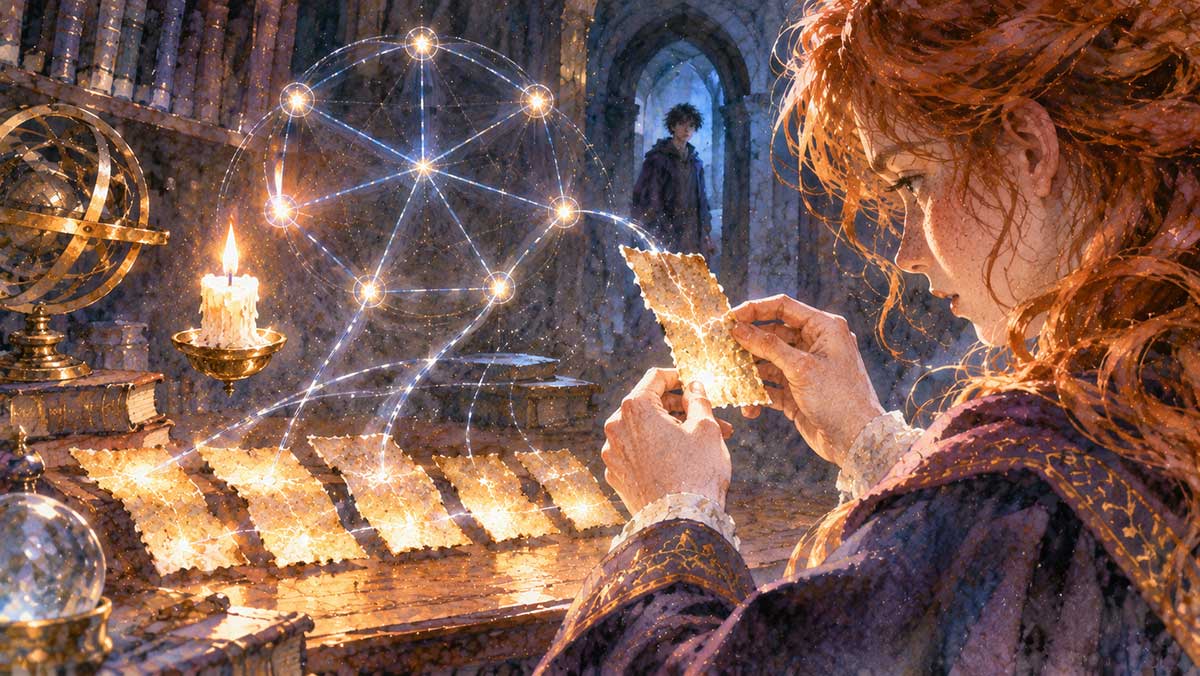
Lily had spent much of her life being told that certain doors were not meant for her.
At first they had been ordinary doors: rooms where adults discussed things children could not know, cupboards containing birthday presents, a locked school office whose window she once climbed through to retrieve a lost exercise book. At Hogwarts the doors were stranger. Some opened to the right password. Others opened to the right person. A few, she suspected, opened only when they thought they were being watched.
The Society of the Seventh Seal had found a new way to make a door seem welcoming.
Its members did not say that Muggle-born students were outsiders. They said those students possessed valuable stories. They offered to preserve the first friendships that had helped them feel at home. They invited them to contribute to a history no old wizarding family could claim as its own.
Lily disliked how attractive the invitation sounded.
She spread the documents across a library table. Mary Macdonald sat opposite her, reading a list of names.
“Nora's friend still remembers studying with her,” Mary said. “She remembers the books and the room and the argument they had about a spell. She just can't connect those things to Nora.”
“Does she know she's forgotten?”
“She knows something is wrong. That's worse, I think.”
Lily touched the edge of a parchment. “A Memory Charm removes or changes what someone remembers. This is different. The facts remain, but the link between the facts and the person is damaged.”
Mary looked at her. “Can that be repaired?”
“We've repaired one connection already.”
“That's not what I asked.”
Lily met her eyes. “I don't know whether every connection can be repaired.”
She hated saying it. Yet she was learning that an honest uncertainty was kinder than a false promise.
Mary closed her notebook. “I've been thinking about that promise the society makes. They say they're preserving stories so nobody can lose them.”
“It's a lovely way of describing something terrible,” Lily said.
“Not everyone who signed was tricked in the same way. Nora said the woman who interviewed her was kind.”
“Kind people can repeat a dangerous procedure without knowing what it does.”
Mary looked unconvinced. “And some people know perfectly well.”
Lily agreed. It troubled her that the invitations seemed to have been written with such care. They knew how to find someone who felt newly welcomed or recently abandoned. They knew which questions sounded like an interest in a person's life rather than a request to own it.
Earlier that morning, Lily had found Nora waiting beside the trophy case. Nora had once loved the Society's meetings. She had defended its promise of a place where awkward students could speak without ridicule. Now she stood rigid, clutching her book bag so tightly that the seam had begun to split.
"People think all of us helped him," Nora said without greeting. "They look at me in the dining hall and whisper. Some people didn't know anything. Some of us thought we were making a record of stories so nobody would be forgotten."
"I know," Lily said.
"You don't. Not completely. I signed my name. I asked other people to come. Alice came because I said it was safe."
Lily did not offer absolution. "Would you be willing to tell Thistlewick what you saw? Only what you know. She will let you stop."
Nora looked down at the floor. "If I tell her, everyone will know I was foolish."
"People may say things," Lily admitted. "But you won't be left to face them alone."
Nora drew out an invitation, creased into quarters. It listed no guests, only an instruction to bring a story about someone who had once made you feel welcome. Across the lower edge a different hand had added a small mark: seven narrow strokes, the last almost erased.
"Voss never held this one," Nora whispered. "A boy gave it to me after a meeting. He said it was a reward for recruiting another person. I didn't understand why it had the same mark as the register."
"Do you remember the boy?"
"His face. I don't know his name. I don't want you hunting him down because I said something."
Lily folded the invitation without touching the inked strokes. "We'll take it to the professor. You can describe him there if you choose."
They had walked together toward Thistlewick's office, at the pace Nora set. Lily kept the invitation in her bag until she could show it to the professor, without copying the names Nora had mentioned.
She opened another folder. Inside was a copy of a letter from a younger student who had joined the society during the autumn. The student described the relief of being asked what had made Hogwarts feel like home. The interviewer had listened attentively and thanked her for sharing a memory of her older sister bringing her books to the train.
Three weeks later the younger girl had forgotten why the sister's letters mattered.
“Her sister still writes,” Lily said. “The girl reads every letter as if it comes from someone who has been told to check on her.”
Mary unfolded the latest letter from the younger girl, with identifying details hidden beneath a strip of paper. The handwriting slanted toward the bottom of the page, as though the writer had been hurrying to finish before losing her nerve.
"She says her sister puts a spoon in the wrong drawer every time she visits," Mary told them. "It used to annoy her. Now she finds herself hoping for it. She can recognize the little habit when she can't recognize the person doing it."
James stared at the table. At home his mother always left a teaspoon balanced across the lid of the marmalade jar, an arrangement his father complained about every breakfast. James could recall the precise angle of the spoon, the sound of his father's mock outrage, and the way his mother's eyes brightened before she told him to make his own breakfast if he objected. He had never considered that he could keep every detail and lose the sense of being loved within it.
"What would the sister want from us?" he asked.
"She wants us to stop calling it a successful restoration if somebody merely remembers a name," Lily replied. "The girls are going on living together. They deserve to be allowed to say how hard that is."
Peter reached for the paper and then stopped. "Does she want us reading her letter?"
"She permitted me to share this part," Mary said. "Nothing else."
Sirius glanced at him. It was a small question, easy to overlook amid the runes and warnings, yet the room had changed since they began investigating. They were learning to ask for permission before reaching for proof.
Remus wrote a new note beneath his translation: Recognition is not the same as comfort. Then he folded the sheet to keep the girl's name out of sight.
Mary leaned closer. “Have they met since?”
“Not in person. Her sister lives abroad.”
“So they can't attempt the restoration Mira and Alice used.”
“Not until they're together. And not without the girl's consent.”
They sat quietly, hearing the library's great clock strike the hour.
“I'm going to write to her sister,” Lily said.
“Tell her what?”
“The truth, as far as we know it. That her letters are still arriving. That the relationship isn't something the girl has chosen to end. That she must not be forced into saying she remembers.”
Mary took out a clean sheet of parchment. “I'll write the first draft. You can make it less alarming.”
“I'm not good at making things less alarming.”
“You are when somebody needs you.”
Lily looked at the names spread between them. There were so many that she had started thinking of them as entries in columns. She pushed the papers aside and wrote the younger girl's name at the top of the fresh page, by itself, where it could not be mistaken for a number.
Later that afternoon, Thistlewick allowed Lily and the four boys to examine a copy of the Archive fragment. Snape was there too, standing near the window with his arms folded.
Sirius looked at him, then at James. James gave the smallest shake of his head.
They were here for the inscription, not for an argument.
Thistlewick pointed to the first six lines. They concerned the keeping of names, the custody of records, and the responsibility of those who preserved agreements. The seventh had been partly erased.
“Read what remains,” she told them.
Lily leaned closer. “No keeper may claim ... what was never freely ...”
“Given,” Snape said.
Thistlewick looked at him. “How do you know?”
“The construction repeats an older phrase from Asterfell,” he replied. “We saw it near the Mirror Fortress.”
Lily remembered. She remembered the cold of the stone, Cassian's satchel, and Snape holding a lantern while they argued over a word that could mean either guard or possess.
“The line isn't granting authority,” she said slowly. “It's taking authority away.”
Snape nodded once.
James watched them with an expression Lily could not quite read. A year earlier he might have interrupted to prove that he knew the answer. Now he waited.
Thistlewick laid a second document beside the fragment. It was a society invitation, bearing the same seven-line seal.
“The Society claims that a signed register allows its custodians to preserve a student's history,” she said.
“But the original agreement says a custodian can't own what wasn't freely given,” Lily replied.
“Precisely.”
Peter frowned. “Then Voss is using the part that protects people to trap them.”
“Or someone working with him is,” Thistlewick said. “We should not confuse suspicion with proof.”
Snape traced a word on the copy with his finger. “If the final line is reversed, a person might consent to preservation and have that consent treated as surrender.”
“Of what?” Remus asked.
“Not the facts,” Lily said. “The connections. The feeling that a name belongs to a person you know.”
A cold silence settled over the table.
Sirius broke it. “A charming club. I suppose the refreshments are excellent.”
Thistlewick ignored him. “We must discover who controls the original records. The copies can tell us the method, but not where the affected bonds are being held.”
James leaned toward the fragment. “Would the stolen Archive answer if we asked it where the records went?”
“Possibly. But you know the price of answering the wrong question.”
Lily thought of the students who had signed without being told there was a price at all.
“Then we find the people who were asked,” she said. “We compare what happened before and after. We make the society explain the differences.”
Snape's gaze shifted to her.
“Voss won't explain anything he doesn't have to,” he said.
“You sound certain.”
“He knows how to make an offer sound like a favor.”
Lily heard something in his voice, a guarded knowledge that went beyond the inscriptions.
“Has he made you an offer?”
Snape's face closed.
“That isn't relevant.”
“It is if he's using you.”
James spoke before Lily could answer. “We can leave that for now. The professor needs the evidence, not another fight.”
Snape looked startled by the intervention. Lily was startled too.
Thistlewick gathered the papers. “Miss Evans, continue speaking with the students who received invitations. Mr. Potter, bring me the map boundary you found. Mr. Snape, write out the full Asterfell construction and note every uncertainty. I will compare the results with the surviving records.”
Before she closed the Archive fragment, Thistlewick asked the students to repeat the distinction they had established.
“A record may preserve an event,” Remus said. “That doesn't give its keeper the right to claim the people who lived it.”
“Consent to tell a story isn't consent to lose a relationship,” Lily added.
“And the person who was hurt must be able to choose whether to accept a connection again,” Peter said.
Thistlewick nodded. “What about the signature?”
“It proves someone signed,” James answered. “Not that they knew what the words would be used for.”
Sirius examined the broken seventh line with an unusually grave expression. “The Blacks have contracts that look harmless until you ask what they do to the person who signs. My mother used to say the family keeps its promises. She never liked it when I asked which promises were kept for us and which were kept against us.”
The room became still.
“Can you bring us examples?” Thistlewick asked.
“Copies, perhaps. The originals would be missed.”
“Bring nothing that puts you in danger.”
Sirius looked away. “There are no safe ways to disagree in that house.”
James wanted to say that Sirius need never return there. He had learned that saying so was not the same as making it possible.
Lily turned to the fragment. Its broken sentence had once existed to protect people from exactly this kind of bargain. A rule had been written, then hidden, then turned into a loophole.
“What if the seventh line hasn't been erased completely?” she asked. “What if the ink is still there and the document has just been taught not to show it?”
Snape looked toward her.
“An inscription can be suppressed,” he said. “That doesn't make the original disappear.”
“Could it recognize the right question?”
“Perhaps. But I wouldn't ask it to prove anything about a person.”
Lily nodded. She did not thank him for the warning. It was sensible, and she had not needed him to say it twice.
“Then we don't ask who owns the record,” she said. “We ask what the keeper was forbidden to take.”
Thistlewick laid the fragment beneath a glass weight, so no one could answer it accidentally. “Not today, Miss Evans. We will test that with witnesses and protections in place.”
The pause frustrated Lily. It did not make her disagree.
She looked at the others and realized they were all waiting for her reaction. She could make the afternoon about the impatience of brilliant students against cautious adults. That story would be exciting, and wrong.
“Fine,” she said. “Then I'll find more witnesses.”
Mary was already collecting the student lists. Their investigation could continue without anybody offering a secret to a listening door.
As the others rose, Lily remained beside the fragment.
Seven lines. Six appeared to describe the duties of those who kept names safe. The seventh existed to say that a keeper could not claim the person behind a name.
She wondered who had first written it, and what had happened to make such a warning necessary.
At the doorway, Snape paused.
“Lily,” he said quietly.
She turned.
He looked at her as though there were a hundred things he wanted to say. For one moment she thought he might tell her about Voss's offer.
Instead he said, “Don't sign anything.”
“I wasn't planning to.”
“Not even if it looks harmless.”
Then he left.
Lily stood alone for a moment, troubled less by the warning than by the fear she had heard beneath it.
On the table, the copy of the seventh line darkened.
For a heartbeat the missing words became visible.
NO KEEPER MAY CLAIM WHAT WAS NEVER FREELY GIVEN.
Then the ink faded again, leaving Lily with a sentence she knew she must remember.
Chapter 10: The Apprentice No One Claimed
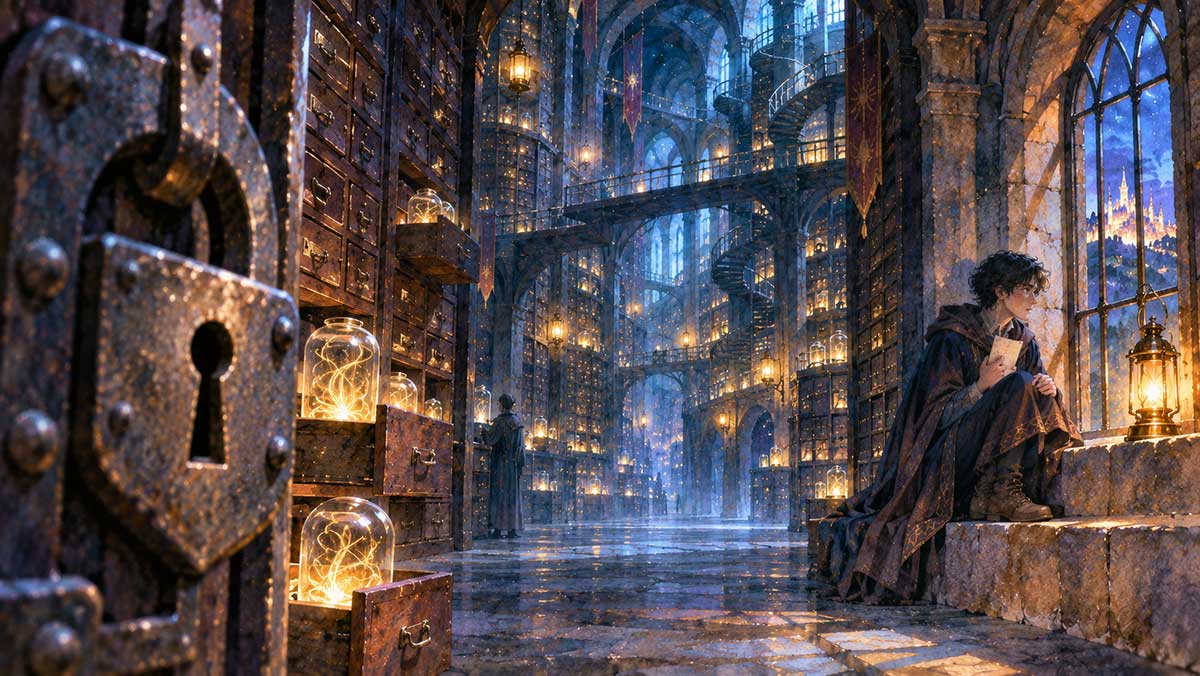
Cassian Vale had always hated the sound of keys.
Not all keys, of course. His mother's front-door key made a cheerful clink against the bowl where she left it. The keys to the pastry stalls at Lantern Market jingled in the pockets of people who had never kept a secret in their lives. But the keys of the Unwritten Archive had a sound like small bones striking glass, and after the Mirror Fortress he had never heard them without remembering the cold.
Now the sound followed him through dreams.
He sat in a narrow room beneath Asterfell, writing his own name on the back of a scrap of paper.
Cassian Vale.
He wrote it again.
Cassian Vale.
He could remember the letters. He could remember learning them. He could remember the hand that had guided his first crooked strokes.
He could not remember whether the man who had brought him food that morning had once been his friend.
The door opened.
A young attendant stepped inside with a tray. He had a kindly face and a bruise on one wrist.
“You should eat,” he said.
“What's your name?”
The attendant hesitated. “You asked me yesterday.”
“Then tell me again.”
“Eren.”
Cassian repeated it. “Eren. Have we met before?”
“Many times.”
“Were we friends?”
The young man set the tray down. “I thought so.”
Cassian closed his eyes.
He had begun to understand that the worst part of forgetting was not the absence of facts. It was the damage done to the people who still remembered. Eren had come every day. He had brought food, carried messages, and risked angering the men who kept the room locked.
Cassian could see all that kindness and still could not feel the history that should have joined it together.
“I'm sorry,” he whispered.
Eren shook his head. “Don't apologize for what someone did to you.”
Cassian looked up. “Then help me remember who did it.”
Eren glanced at the door. In all the mornings Cassian had been confined here, the young attendant had never looked quite so frightened.
“I can tell you what I know,” Eren said. “Not what I think I know. Only what I saw.”
Cassian folded the scrap bearing his name and put it beneath his plate. “That's more than anyone else has given me.”
Eren sat on the edge of the wooden chair opposite him. He had once brought Cassian a book with its spine repaired by string. Cassian remembered the book, the loose page at the back, the argument they had had about whether a map of Asterfell could ever be accurate when its streets changed according to the hour. He remembered being amused. He could not find Eren inside the amusement.
“Three days ago,” Eren said, “a man came with a ledger. The guard called him Master Voss. He asked about the people you trusted. He made you read a statement aloud.”
“What statement?”
“Something about the Archive being preserved for those who understood it.”
“I would have said yes to protecting it.”
“I think he knew you would.”
Cassian tried to recall the man's face. He found only the memory of a gloved hand resting on a book, and the sickening sensation of being unable to make his thoughts hold together. The glove had a small tear near the thumb. He could see it clearly, which made the missing face more unbearable.
“Did I ask about my mother?”
Eren nodded.
“What did he say?”
“He said the first people we lose are often the ones whose names have been written most often.”
Cassian gripped the edge of the table. “That's an answer a person gives when he enjoys hearing himself sound wise.”
For the first time that morning, Eren smiled.
A bell struck somewhere in the passage. Eren rose too quickly, leaving his chair askew. Cassian heard a key turn in the outer gate, then another. There were three locks beyond his door. The guards were changing shifts.
“Eren,” he said. “My mother used to sing to me through the dark passage beneath the market. Did I ever tell you the song?”
“You did.”
“Can you write the first words? Not here. Somewhere they won't find them.”
Eren hesitated. “If they search me...”
“Then don't. I won't ask you to risk yourself for a story I can no longer feel.”
Eren looked at him for a long moment. “That's why I wanted to be your friend,” he said. “You always gave people a way to say no.”
Cassian felt an odd pressure in his chest. It was not the lost warmth, but it was something he could recognize as his own.
“Was I good at it?”
“Better than you think.”
Eren carried away the tray. Cassian heard the three locks turn again.
He took out the scrap of paper and added a line beneath his name: Eren was kind to me today. That was true whether or not he remembered every earlier kindness. Beneath it he wrote: My mother knows the song. I want to hear it again.
He set the paper beside his pillow and resolved to protect it from the next inspection. He had learned how frightening it was to be asked a question by someone who would not tell him what the answer might cost. He would not put another person in that position merely to save himself.
The following morning, Cassian arranged his food into patterns before taking a bite. A crust at the edge of the plate marked the door; a piece of apple stood for the chair where Eren sometimes sat; three grains of salt represented the guards outside. He moved the grains whenever their footsteps passed, trying to keep the order of events straight.
He knew that this was a strange way to map a prison. In Asterfell, strange maps were a tradition. His mother had once drawn the route to the Lantern Market by marking the smells that drifted from each turning: cinnamon, wet rope, baked chestnuts, the sweet smoke from a glassblower's stall. The remembered smells came readily. The comfort that should have accompanied them did not.
A guard entered before Eren could leave. He wore a brass clasp shaped like a closed eye.
"Master Voss requests a revised statement," he said. "You are to name one person who would answer for you if summoned."
Cassian pushed the apple piece toward the door. "I have already given a statement."
"It was incomplete."
"Then bring the original and show me what's missing."
The guard frowned. "You are not authorized to inspect it."
"But you want me to agree to its correction."
The silence seemed to make the locks louder. Eren lowered his gaze to the tray.
"Answer the question," the guard said.
Cassian looked at the three grains of salt. He wanted to say his mother's name. He could see her waiting beneath a market awning, close enough to recognize and impossibly distant. Giving her name would not bring her nearer. It might place her in the path of whoever controlled the ledger.
"No," he said.
The guard collected the untouched paper from the bedside and left. Cassian ate the apple after the locks closed, furious at himself for shaking. Eren waited until the last footsteps faded before speaking.
"They'll ask again."
"Then tomorrow I'll have to say no again."
At Hogwarts, Peter Pettigrew was turning over Cassian's old satchel in his hands.
The satchel had been kept among the materials Thistlewick brought back from Asterfell. It was patched at the corners, stained with ink, and marked with seven narrow lines. Peter remembered Cassian carrying it through the Mirror Fortress, looking far braver than he had felt.
“He was frightened,” Peter said.
James glanced up from a stack of notes. “We all were.”
“Yes, but he kept going. I think we forget that part when we tell the story.”
Remus was copying a list of the people who had handled the Archive records during the first adventure. “We haven't forgotten Cassian.”
“No,” Peter said. “But we haven't thought about him much, either.”
The words stung, though Peter had not intended them as an accusation.
James considered the previous year. They had been consumed by the Moonlit Kingdom, by dangers that seemed to belong to them alone. Cassian had returned to Asterfell, and they had accepted that as the end of his part in their story.
“That's true,” James said.
Sirius looked at him. “We can't keep track of every person we've ever met.”
“No,” James answered. “But perhaps we should have written to him.”
Remus unfolded a letter Cassian had sent after their first adventure. The ink was faded but legible. He had thanked them for helping Asterfell and promised to show them the Lantern Market if they ever returned.
At the bottom, beneath his signature, was a sketch of a pastry shaped like a star.
Sirius smiled despite himself. “He promised us food. That's a binding magical contract.”
“Then we're obliged to rescue him,” Peter said.
They laughed, and the laughter eased the guilt without erasing it.
Thistlewick entered carrying another document. She had obtained a copy of a letter that Cassian had apparently signed before his disappearance. It invited him to help preserve the Archive's remaining names, promising that his knowledge of the seventh line would protect the records from misuse.
“Did he agree?” James asked.
“He did,” Thistlewick said. “The handwriting appears to be his. But the consent was obtained under a false description of what the agreement would do.”
Peter studied the signature.
“If he thought he was helping protect people, then he wasn't agreeing to lose them.”
“Exactly,” Thistlewick replied.
She set a second paper beside it: a list of names from the Archive's roll of apprentices. Cassian's entry was still there, though the ink looked faint.
“The original roll is missing,” she said. “This is only a copy. We have reason to believe the stolen register has been kept with private Black family records.”
Sirius went still.
James saw it, and remembered the unopened letter and the strain in Sirius's voice whenever Regulus was mentioned.
“Does that mean the Blacks stole it?” James asked carefully.
“No,” Thistlewick said. “It means someone used their collection. We do not yet know who arranged the transfer or who carried it out.”
Sirius stared at the copied entry.
“My family has rooms full of things nobody ought to own,” he said. “I used to think they collected them to feel important.”
“Perhaps they did,” Remus said.
“Perhaps someone has found a use for them.”
James wanted to tell him that Regulus could not be involved. He had no evidence for that comfort, so he kept silent.
Peter opened the satchel. Inside, tucked beneath a false seam, he found a narrow strip of parchment. It bore a familiar question.
WHOM DO YOU TRUST TO REMEMBER YOU?
Below it were several lines of Cassian's cramped writing.
My mother knows the song I learned before I could speak. Master Orrel knows the first register I repaired. Eren knows I promised to return his book.
Peter read the names aloud.
Peter stopped before reaching the final sentence. At the bottom of Cassian's note, so faint that the letters almost vanished in the fold, was an instruction written in an uneven hand.
If a door asks you who loves you, do not answer for anyone else.
He read it twice. It sounded less like a warning from a student and more like the sort of thing learned after making a mistake too terrible to repeat.
“What's that?” Remus asked.
Peter turned the paper so they could all see.
Sirius read it aloud, then frowned. “How could answering for someone else matter?”
Remus gave a bleak little smile. “Have you ever had someone tell you what you feel, as if your own account is less interesting than theirs?”
Sirius looked away. The expression came and went before James could decide whether to speak.
“It's what the Society did,” Peter said. “They invited people to describe friendship and then treated the description like a deed to a house.”
James spread out the other documents. There were bills for paper, lists of students who had agreed to give interviews, and a catalogue entry from the Black collections. On the catalogue sheet, seven short lines had been drawn beneath the word transfer. The record named no buyer. Beside the date, however, someone had written a peculiar note: witness not required if the answer is spoken within the enclosure.
“Enclosure?” Sirius repeated.
“The moving room,” James said.
“Perhaps,” Remus answered. “Or something like it. We don't know.”
James was irritated by the correction until he noticed that Remus had not spoken to defeat the idea. He was trying to preserve the difference between a useful suspicion and a fact. James drew a question mark beside the phrase.
Peter laid Cassian's note across the catalogue entry. “What if the people taking these memories aren't trying to find out where we went? What if they want to know who will come looking?”
Sirius stopped pacing.
“Then every name on this paper is a person they might hurt to keep Cassian quiet,” he said.
Thistlewick was still examining the signature. “Or a person they might threaten in his presence. The danger is not limited to the records themselves.”
James found that he could think of no witty answer. He had written to Cassian only twice since their first adventure, and both letters had been full of stories about Hogwarts, as though Asterfell existed solely to provide exciting visitors. Cassian's promise to show them the market had been offered as friendship. James had treated it like an invitation to a holiday.
“We have to let his mother know,” he said.
“She knows he's missing,” Thistlewick replied. “I have been in contact with the Asterfell authorities. They are searching for him.”
“Does she know what the Veil does?”
“She knows enough to fear it. The fuller explanation must come from someone who can stay with her when she hears it.”
James nodded slowly. He thought of his own mother receiving a letter that claimed he was alive but might no longer know her. The thought made him reach for the edge of the desk.
“I want to go,” he said. “But if we rush in, we might give Voss exactly what he wants.”
Sirius stared at him. “You sound like Remus.”
“Thank you,” Remus said.
“That wasn't a compliment.”
“Then you should practice delivering them.”
Peter folded the warning into the satchel. The four of them stood around the desk in uneasy agreement. It was the closest they had come to understanding their opponent, and the understanding made the room feel less safe.
Remus leaned closer. “He made a list of people who could tell him who he was.”
“Before the spell took hold,” James said.
“Or after he realized what it was doing,” Peter replied.
Thistlewick took the parchment with great care. “This may help us find the bonds that were cut.”
Sirius stood. “Then we go to Asterfell.”
“Not without a plan,” James said.
Sirius opened his mouth, then shut it again. “I was going to say that.”
“You were going to say we leave tonight.”
“I was going to suggest a highly efficient departure.”
James smiled faintly. “We'll speak to Dumbledore. We have names now, and a possible location.”
Thistlewick nodded. “I will ask for permission to investigate the records directly. Until then, do not approach the door on the fourth floor.”
Peter folded Cassian's list. “He thought of the people who might remember him.”
James looked at the names, written with such anxious care.
“And somebody decided those were the people he could afford to lose.”
That afternoon, Dumbledore received them in a room that smelled of polished wood and orange peel. A long stretch of silence followed Thistlewick's account. The headmaster examined Cassian's handwriting, the copy of the Black catalogue entry, and Peter's note about the person beyond the door.
"Is there a way to reach him without giving the door what it asks?" James said.
"That is what we must discover," Dumbledore replied. "If it were only a locked room, I should be less concerned. The danger is that an offer of help can be made to serve as a declaration of ownership."
Sirius leaned against the fireplace. "We know Voss has him. Every day we spend reading registers is another day he sits in that place."
"I share your urgency," Dumbledore said. "I do not share the belief that haste is proof of care."
Sirius looked away. Peter noticed his knuckles tightening against the mantel.
Thistlewick spread an Asterfell plan over the desk. The Archive had no fixed entrance, but it returned to the same ring of streets at regular intervals. Eren had managed to pass messages through a delivery route used by the market traders. A letter could reach a designated address; a person might arrive at a completely different door.
"Then we arrange a meeting with the people outside," Remus said. "Not with the room itself."
Peter pointed to a narrow passage shown in blue. "Cassian drew this during our last visit. He told us it shifts whenever the market lanterns are lit. If we know where Eren works, we can ask him to identify which version is current."
"And give Eren a chance to refuse," Lily added from beside the desk. "He has already taken risks for Cassian."
James glanced at Sirius. "We could leave a message, not a command. Ask what help they need."
After a moment Sirius nodded. "And when we know, we go."
Dumbledore's answer was not permission to enter the Archive. It was permission to prepare: to contact Asterfell's guardians, to secure testimony, and to work out how to bring Cassian home without endangering everyone named in his notes. James disliked the limits. Yet he knew what it had cost them to ignore limits before.
As they left, Peter lingered to copy Eren's name correctly. One letter had been smudged, and he refused to risk a message being delivered to the wrong person.
That night, a message arrived from Asterfell. It contained only four words, scratched into the paper so deeply the quill had torn it.
THE ROOM IS MOVING.
Thistlewick read it in silence.
The next morning, the fourth-floor door was gone.
Chapter 11: The Archive of Borrowed Bonds

The door returned on Friday.
That morning, James discovered how much of a school day could be consumed by pretending to attend it.
In Transfiguration he turned a copper button into a small silver bird. The bird flew once around the classroom, landed on his inkpot, and immediately changed back. Professor McGonagall gave him a look of mild approval that felt worse than a reprimand. He knew he was capable of more than the work he had offered, and she knew it too.
At lunch, Lily found him staring at the timetable instead of eating.
“Thistlewick says you're going to the fourth floor,” she said.
“We're supposed to inspect the entrance and come back.”
“That sounds like an excellent plan.”
“You say that as if you've heard a worse one.”
“I've heard several from you.”
James managed a smile.
Lily sat opposite him. “If you hear Cassian's voice, how will you know it's him?”
“I'll ask something only he knows.”
“What if the door knows whatever he wrote in his records?”
James looked up.
“That's why I wanted to talk,” Lily said. “Don't let the answer to one question become a reason to trust the next.”
He turned his fork between his fingers. “Then what would you do?”
“I'd give him the chance to refuse. If he's trapped in there and afraid, he may tell you anything he thinks will get him out.”
James thought of Cassian's note. Do not answer for anyone else.
“You're good at making the obvious difficult,” he said.
“Only when it's dangerous to pretend the obvious is simple.”
She rose, but before leaving she paused beside the bench. “I'll be at the lower passage. If anything happens, I won't try to be clever. I'll fetch help.”
James nodded. “Good.”
“Try to do the same.”
He watched her cross the Hall. It was, he decided, a much harder request than it sounded.
Upstairs, the moving door had already unsettled the portraits. One of them complained that the corridor had acquired an entirely unauthorized draft. Another had taken to refusing passage to anyone carrying a notebook, on the grounds that writers were responsible for everything strange that had ever happened in the castle.
Peter stood apart from the others and checked the four names on the map one last time. James noticed that he had written the time beside each of their planned positions.
“That's new,” James said.
“I thought if the doorway moved, we'd need to know where it had been.”
“You've thought of more than I have.”
Peter gave a quick, embarrassed shrug. “You were busy asking McGonagall whether a button could be taught to sing.”
“It was an entirely legitimate question.”
“You spent ten minutes arguing that the answer should be yes.”
Remus arrived with a folded signal charm. He put it in James's hand and waited until James fastened it to his sleeve.
“That's the warning,” Remus said. “If it burns, we leave. No debate.”
Sirius held up his own sleeve. The charm was sewn on so crookedly that it resembled a flattened insect.
“Mine looks like a punishment,” he said.
“You installed it yourself,” Remus replied.
“Exactly. I feel victimized.”
They laughed. The sound was small and welcome, and James wanted the afternoon to remain that ordinary. Then the ink on the wooden door began to move.
It appeared between two portraits that had spent the morning arguing about the proper way to peel an orange. Neither portrait admitted seeing it arrive. One insisted it had been there for centuries; the other declared that any door appearing without permission was an offense against the dignity of the corridor.
James stood before it with Sirius, Remus, and Peter.
They were not alone in the castle. Thistlewick knew where they were. Lily had agreed to wait at the lower passage and watch for anyone leaving by the service stairs. Dumbledore had been told about the moving room, and the professor had arranged a signal charm that would alert her if the door shifted again.
James repeated the plan aloud.
“We examine the entrance. We do not answer any questions. We come back with what we find.”
Sirius raised a hand.
“No, you may not improvise.”
“I was going to ask whether we're allowed to breathe.”
“Only quietly,” Remus said.
Peter checked the folded map. A faint boundary now traced the door's position. It showed no room beyond, only a white space with four dots standing at its edge.
“It's still not telling us what's inside,” he said.
“Then we won't ask it to,” James replied.
The writing on the door appeared.
WHO GAVE YOU PERMISSION TO BE HERE?
They waited.
The words faded and were replaced by another question.
WHOM DO YOU TRUST TO REMEMBER YOU?
Peter's hand tightened around the map.
“That was in Cassian's satchel,” he said.
Before James could answer, a voice sounded from beyond the door.
“James?”
It was faint and uncertain.
Sirius stepped forward. “Cassian?”
“Please,” the voice said. “I can't find the way out.”
James felt the familiar pull of danger, the certainty that delay could cost someone dearly. He looked at the map. The white region remained blank, but a fifth dot had appeared beyond the threshold.
“That's a person,” Peter said. “It doesn't tell us who.”
“Cassian?” James called.
“Is that my name?”
The question struck harder than a scream.
James looked at his friends. He had promised himself that he would not repeat old mistakes. He had asked the adults for help. He had followed the plan. Now a person they knew was on the other side of a door that might disappear at any moment.
He reached for the signal charm.
He could still hear Cassian beyond the door. The sound of his voice tugged at James with the dreadful intimacy of someone pleading from underwater. Yet the parchment on the floor had not written Cassian's name. It had written a demand.
James knelt to study it. The page was dry, but the edges were bent as if it had been folded many times and kept in a pocket. Near the bottom was an impression where another line had been erased. He could make out the word witness and the lower curve of a capital letter.
“Someone wrote this before we arrived,” Peter said.
Sirius had his wand out. “Then someone knew we'd come.”
“Or expected someone to come,” Remus said. He stood with his back to the wall, listening. “It doesn't have to be us.”
That was worse. An invitation that waited for whoever was most desperate to help could collect victims for years.
Peter took the spare sheet from his notebook and placed it beside the message. “What if we write back without answering anything? We can ask whether Cassian is injured. A question isn't an agreement.”
“Unless the door turns it into one,” Remus said.
“Then we don't send it through.” Peter looked at James. “We could leave the sheet here where he might see it.”
Sirius bent to the slit under the wood. “Cassian, listen to me. If you're there, knock twice.”
For a moment there was only the sound of the portraits muttering in their frames. Then came two faint taps, followed by a third, so soft James almost missed it.
“Three,” Peter said. “He knocked three times.”
“Maybe he couldn't hear,” Sirius replied.
“Or maybe it's making us hear what we want to hear.”
Sirius turned on him. “Are you saying we leave him?”
“No. I'm saying a knock isn't proof of who's knocking.” Peter's voice wavered. He tightened his grip on the notebook and continued. “We don't know what happens when we give the door the answer it's been waiting for.”
James watched Sirius's anger collapse into something much more familiar: fear. Sirius had spent years knowing that the right answer in his own house was often the one that kept him out of trouble, not the one he believed. The door seemed built to exploit that habit.
“Suppose I ask a question that only Cassian knows,” James said.
“Then the person on the other side learns the answer when Cassian says it,” Remus replied. “And what have we proved?”
“Nothing,” James admitted.
A soft scrape came from inside. The fifth mark on Peter's parchment shifted toward them, then vanished into the blank area. The map identified position, not allegiance. It offered no certainty about the frightened voice.
“If I were in there,” Sirius said quietly, “I'd hope someone came for me.”
“If you were in there,” Remus answered, “you'd want us to come without giving away the rest of us.”
Sirius's mouth twisted. He glanced at James, perhaps expecting the old, impatient agreement, the grand declaration that friends took risks and asked questions afterward.
James pressed the signal charm through the fabric of his pocket. He remembered being eleven and racing down a corridor after Sirius, thrilled that the castle seemed to belong to anyone bold enough to run through it. He remembered older mistakes more clearly now: times when a fast decision had made other people pay for his confidence.
“We can call Thistlewick,” he said.
“And lose the door,” Sirius replied.
“Maybe. But that's not the same as losing Cassian forever.”
There was no satisfying answer. James hated that. He hated the way Peter's careful questions made the danger larger rather than smaller. Yet he could see the fifth dot hanging beyond the barrier and could picture Cassian trapped among the things that stole names.
James moved his hand toward the charm again. He could feel its warmth even through the fabric of his pocket.
Then the voice called again, nearer than before, and the door gave a sudden shiver as though preparing to disappear. James had time for one last glance at his friends. None of them seemed certain. He was not certain himself.
That uncertainty, he understood, was exactly what the keeper wanted.
Before he could touch it, the door opened a fraction.
James stopped with his fingers over the charm. A warning was meant to be given before a catastrophe, not after it. He pressed the small sewn knot, and heat traveled up his forearm. Somewhere in the castle a second charm, carried by Thistlewick, would have begun to glow.
“That's it,” Remus said. “We've sent the signal. Now we keep our distance.”
The door trembled. Through its narrow opening James could see the corner of a cabinet and a pale hand resting on the floor. He could not tell whether the hand belonged to Cassian or to some other apprentice whose name the Archive had consumed. An attempt to pull the person free might save a life. It might bind all four of them to the same cruel machinery.
Sirius pushed his wand into the gap. “Accio,” he whispered, naming the fallen coat he could see beyond the threshold. A sleeve stirred. The coat rose an inch, then unfolded into a scattering of white slips. Every slip carried the same question. Whom do you trust to remember you?
Sirius recoiled. “That thing can turn a coat into a question.”
“Or it puts a question between anything we try to reach,” Peter said. He knelt and pulled a length of red thread from the kit in his pocket. He tied it around the quill used in their earlier test and slid the feather beneath the door, keeping hold of the other end. The thread pulled taut. For one blessed second the quill remained visible on the far side. Then Peter felt a tug, as though someone small had caught it and held on.
“Cassian?” he called. “If you can hear us, let it go.”
The pressure eased, but the thread came back with five neat knots in it. None of them had tied those knots. Peter laid the thread beside the map and counted them again.
“Five,” he said. “The fifth dot. Perhaps the person inside is trying to tell us something.”
“Or it's counting us,” Remus replied.
The four stood without speaking. James thought of Lily waiting below and Thistlewick hurrying through the castle. Calling for help had been the correct choice. Yet a correct choice could still leave someone frightened on the other side of a door. He could not force the world to make the two obligations agree.
“We wait for the professor,” he said. “We can keep talking. We cannot promise to enter.”
From beyond the wood came a weak sound, not a word but the unmistakable scrape of somebody moving on stone. Sirius's face tightened. James felt his own resolve strain under the weight of that little noise. The door was growing thinner, no longer solid oak but something like frost upon glass. If it vanished now, they might have nothing more to bring the adults than a thread and five knots.
A piece of parchment slid through the gap.
It carried one sentence.
ANSWER THE QUESTION AND I CAN COME HOME.
James stared at it.
“We can't,” Remus said.
“Not without knowing what we're agreeing to,” Peter added.
Sirius put his hand against the wood. “Then we find another way.”
The voice beyond the door began to fade. “Please don't leave me.”
James looked down the corridor. Thistlewick would come if he called. But the door had already begun to move, its edges blurring against the stone.
He made a choice he would later wish he had examined more carefully.
“We answer together,” he said. “Not with a secret. With the truth.”
He looked at his friends.
“Whom do you trust to remember you?”
Sirius answered first. “These three idiots.”
Remus gave a tired smile. “The same.”
Peter looked at each of them. “You.”
James swallowed. “All of you.”
The door swung open.
James heard a sound like a thousand pages brushing past one another. The door opened inward without hinges turning, revealing a floor tiled in pieces of stone, wood, and polished black glass. It was not possible to tell which surface belonged to Hogwarts and which to Asterfell. A table stood half inside one wall. The shadows beneath it pointed in three directions.
Sirius reached for James's sleeve, then checked himself.
“Stay where I can see you,” he said quietly.
James glanced back. It was an unusual request from Sirius, who preferred to be the one no one could catch. James nodded and kept his hand near the signal charm.
Cassian stood beyond the shelving. He had one hand pressed against a cabinet and looked as though he had been standing there for hours. The fifth dot on the map flickered but did not move toward the door.
“Cassian,” James called again. “Can you come out?”
Cassian looked down at the floor. “I tried. I reached the threshold, and I was back beside the cabinet.”
Peter crouched and touched the edge of the doorway with the end of a quill. The wood of the quill did not disappear. The nib came back covered in fine white dust.
“It's not a normal corridor,” he said.
“It's not a normal afternoon,” Sirius answered.
Remus held out his hand, palm open, to the boy across the chamber. “We're going to try something. You don't have to agree. Can you tell us whether you want to leave with us?”
Cassian's face changed. “Yes.”
“Did anyone tell you what you'd have to give up?”
“No.”
“Then don't offer anything. We only want to know what you want.”
Cassian drew a careful breath. “I want to see my mother.”
James felt the words settle into him. It was a simple desire, uncomplicated by seals or signatures, and yet the room seemed reluctant to contain it.
A faint metallic sound came from behind the cabinets. Peter looked up from the map.
“Someone else is here,” he whispered.
James reached for the charm at his sleeve, just as the pages overhead stopped turning.
Inside was a long chamber assembled from pieces of other rooms. Shelves stood at impossible angles. A staircase ended in the ceiling. Cabinets from Asterfell sat beside Black family trunks. Hundreds of loose pages floated in the air, turning slowly as though caught in an underwater current.
At the far end stood Cassian Vale.
He was thinner than James remembered, and his eyes moved from face to face with a desperate uncertainty.
“Cassian!” Peter called.
Cassian took one step forward.
Then every page in the chamber stopped moving.
A man emerged from behind a cabinet. He wore dark gloves and carried a small ledger.
Adrian Voss.
“Thank you,” he said. “The question required a living answer.”
James felt the floor shift beneath him.
“You tricked us.”
“I asked you whom you trusted. You answered freely.”
“That wasn't permission to harm us,” Remus said.
Voss looked at him with mild interest. “The original agreement would have agreed with you. Fortunately, the version I possess has been amended.”
Sirius raised his wand.
Voss did not raise his own.
Instead he opened the ledger and drew a finger down four names.
James heard a soft tearing sound, as if someone had ripped a page from a book in another room.
He turned toward Sirius.
For one instant he knew the face, the black hair, the familiar expression of anger and reckless courage. He knew he had laughed with this person. He knew they had shared meals and dangers and the kind of silence that required no explanation.
Then the connection vanished.
He could still see the boy standing beside him.
He could not remember his name.
Sirius stared back with the same bewilderment.
“Who are you?” Sirius asked.
James tried to answer. He knew his own name. He knew he belonged to a group of four. He knew there were people he would have trusted with his life.
He could not tell which of the strangers in the room were those people.
Remus stumbled backward against a cabinet. Peter looked from one face to another, terrified.
Voss watched them without smiling.
“An elegant result,” he murmured.
James heard the pages begin to turn again.
He opened his mouth to call for help.
He could not remember whom he meant to call.
Chapter 12: The Friend Without a Name

James remembered a boy laughing on a windowsill.
He remembered the sound of rain against the glass, a black-edged letter, and the curious relief of sitting beside someone without asking him to explain his pain. The memory was perfectly clear. What James could not do was attach it to the boy standing three feet away with his wand raised.
“Don't come closer,” the boy said.
James stopped.
The chamber's shelves leaned at impossible angles. The papers above them had begun turning again, though no wind stirred. Beyond the open door, the corridor of Hogwarts looked as distant as a picture seen through water.
“I'm not going to hurt you,” James said.
“Then tell me who you are.”
“James Potter.”
The boy's face changed. The name meant something to him; James could see that much. But it was the expression of someone who recognized a word in a foreign language without knowing its meaning.
“Do I know you?”
“I think so.”
“You think?”
James tried to remember the boy's name. There was a dark-haired boy in every memory of the past five years, someone who shared his jokes, stole his socks, and knew exactly how his mother took her tea. The boy before him looked like that person. Yet each time James reached for the connection, his mind slid away.
At the far end of the chamber, Adrian Voss wrote something in his ledger.
“Stop it,” said a thin boy near the doorway.
Voss did not look up. “Stop what?”
“Whatever you've done to them.”
“An observation is not an injury.”
The thin boy took a step forward. “Then undo it.”
James knew that voice. He was certain he did. The certainty itself made him dizzy.
Voss looked up at last. “You are rather interesting.”
The boy flinched. “Why?”
“Your name is on my list. Your connections are not where I expected them to be.”
A fourth boy, pale and watchful, had backed against a cabinet. He was staring at his own hands.
Remus knew the precise dates of his worst nights. He remembered the cold of the stone passage, the relief of waking with friends nearby, and the fierce embarrassment of having been cared for. Those memories were intact. The faces attached to their kindness had become uncertain, as though the last line of every story had been torn away.
He touched the cabinet's brass hinge. “I can still tell you what I fear,” he said. “I don't know whom I would tell.”
Peter moved closer but stopped an arm's length away. “Would it help if I asked permission before I looked at your notes?”
“I haven't any notes.”
“You have a folded page in your coat. You showed it to us outside. You can decide whether to show it again.”
Remus drew out the paper. It carried a simple sequence written in his own hand: leave the door, find the signal charm, do not sign or answer. No names. No secrets. A plan made when he could still identify the people beside him.
“Who wrote this?” Sirius asked.
“I did.”
“And you believe yourself?”
Remus considered the question with a seriousness that might have been funny elsewhere. “I can check the handwriting,” he replied. “I can't check my feelings.”
A cabinet drawer clicked open by itself. Inside lay a row of envelopes bearing names Remus had spoken aloud before the Veil took hold. He recognized the writing on the first envelope: the same script as the instructions in his pocket, altered by a steadier hand.
He pulled his own paper away. “We don't touch those,” he said. “Whoever wrote them wanted to make us prove something.”
Peter looked at the envelopes and understood the design. The room offered them fragments of certainty, each requiring a new confession to obtain the next. It was not a prison built from locked doors. It was a prison built from people's hunger to be sure of one another.
For a moment Remus wished the strangers would simply tell him who they were and make him believe them. He knew, without needing to know their names, that the wish was dangerous. “No more tests of whether we care,” he said. “We can decide what to do without that.”
“I remember a secret,” he said. “I remember telling it to people I trusted. But I don't know who those people were.”
James felt the shape of the same absence. He remembered being part of four. He could count the bodies in the room. He could not make the arithmetic mean friendship.
“Look at the map,” the thin boy said.
James turned toward him. “What map?”
The boy held up a folded parchment. “You gave this to me before we came in. I know where everyone is.”
He opened it. Four moving dots appeared inside a blank chamber. The names beside them were legible.
James Potter. Sirius Black. Remus Lupin. Peter Pettigrew.
James read them aloud. The names struck sparks against his memories, but none caught fire.
“I'm Peter,” said the boy holding the map.
James stared at him. “I know that.”
Peter's eyes widened.
“No,” James said, frustrated. “I know the name. I know it's yours. I don't know what you are to me.”
For the first time, Peter seemed to understand that he had been spared something terrible. He looked at Sirius, who was keeping his wand trained on James, and at Remus, whose face had gone gray with fear.
“I'm your friend,” Peter said.
James wanted to believe him. That desire was all he had.
Near the cabinets stood another boy, thin and hollow-eyed. He watched the four of them with a terrible hunger.
“Did you come for me?” he asked.
Peter nodded. “Cassian. Yes.”
Cassian pressed his hand to his mouth. “I remember that name. I don't remember you.”
Voss closed his ledger.
“The Veil does not destroy the events of your lives,” he said, as though delivering a lecture. “It merely removes the recognition that gives them personal meaning. A very economical operation.”
“People aren't operations,” Peter said.
“People are remarkably dependent on arrangements they cannot see.”
“Then put them back,” Peter said.
Voss rested the ledger against his palm. “You assume what has been separated can be joined without cost. A curious assumption for someone who has seen an Archive.”
“You took something from them.”
“I recorded a consent.”
“You recorded an answer,” Peter replied. “That's different.”
Voss's eyes narrowed slightly. James saw the change and was glad, without understanding why, that the smaller boy had found the right words.
“An answer has weight,” Voss said.
Voss turned the ledger toward the light. On one page James saw a tiny drawing of a train carriage, inked so carefully that the windows seemed almost to reflect a sky. He knew that train. He had been happy there. He could not say with whom.
The dark-haired stranger lifted his wand again. James took one step back.
“Put that away,” Peter said to the stranger.
“Why should I trust you?”
“You shouldn't,” Peter replied, and that answer seemed to surprise them both. “Not just from my saying so. But James hasn't tried to hurt you. You haven't tried to hurt him. Can we agree to that much?”
The stranger's fingers tightened. He had the bearing of a boy who had survived a house where danger could arrive during supper. James recognized the defensive movement and knew he had once learned to answer it without words. That knowledge did him no good now.
“Tell me one thing I did,” the stranger demanded. “A real thing. No clever story about friendship.”
James could see a rainy afternoon. Two boys sharing a packet of biscuits, one telling a ridiculous lie about a ghost, the other laughing until he almost fell off the windowsill. He described the incident as plainly as he could.
The stranger flinched. “That happened.”
“Yes.”
“I can remember the biscuits.” He swallowed. “I can remember that somebody stayed when I wanted him to leave.”
“I did,” James said.
“Perhaps.”
Peter lowered the map between them. “The dots say your names. They do not tell you what you should feel. We could make a different agreement for the next minute. Nobody comes nearer without asking. Nobody uses a spell on anybody else.”
“Voss is the exception,” the stranger said.
“Not if we're trying to reach Cassian,” Remus said from the cabinet. “We'd spend our one chance fighting.”
James was almost grateful for Remus's flat, reasonable voice. The boy seemed frightened of his own calmness, though. He had his palm against the cabinet as if afraid the room would vanish when he stopped touching it.
“Fine,” the dark-haired boy said. He slipped his wand into his pocket, visibly hating the movement. “One minute.”
James copied him. It was a small concession, made to three people who felt like strangers. Yet for the first time since the tearing sound, the room contained an agreement that none of them had been tricked into making.
“Only when the person knows what they're answering.”
Voss closed the book halfway. “You speak as though you were present when the agreements were drafted.”
“I read the one you changed.”
A small, deliberate silence followed. Voss began to turn the ledger's pages again.
“Take care,” he said. “It is easy to think yourself outside a system simply because it has not touched you yet.”
Peter's face went pale, but he stood his ground.
James tried to place the scene in a familiar story. He knew there ought to be a spell, a dash across the chamber, a moment when they overwhelmed the man with the ledger. Instead Sirius had retreated near the wall, Remus was struggling to breathe evenly, and Peter was the only one who seemed to know which way danger lay.
It would be easy to turn on the smallest member of the group for hesitating. The thought came to James with a terrible clarity, as though he had been offered a ready-made explanation for the pain he was feeling. He refused it.
“Peter,” he said, testing the name, “what should we do?”
Peter looked at him in surprise.
“Keep talking,” Peter said. “If we can get outside, Thistlewick can see what happened. Don't promise anything. Don't agree to any bargains.”
A faint chime sounded from the corridor. The professor's signal, distant and weak.
Remus glanced toward the doorway. “If we move together...”
“Can you trust me?” James asked him.
Remus looked at the boy he could no longer recognize as his friend. “I can try.”
It was not an answer James would once have accepted. Now it felt brave.
They took one step toward the doorway. The bookshelves shifted, sliding together with a dry grinding noise. A narrow space opened beside Cassian, and through it James saw something he had not noticed before: a silver wheel turning behind the cabinets. Seven dark notches moved around its rim.
Voss followed his gaze.
“That,” he said, “is what your friends' answers have made possible.”
James felt the room change beneath his feet, and knew the experiment was not finished.
Sirius moved toward Voss. James instinctively reached to stop him. Sirius spun around, wand raised.
“Don't touch me!”
James recoiled.
The hurt in Sirius's voice struck James before the danger did. James searched his mind for the last time they had stood together. He found a photograph of a Christmas morning, the Potter kitchen full of paper and ribbons, a dark-haired visitor wearing one of his father's old jumpers. The visitor had laughed when Mrs. Potter pretended not to notice him sneaking a second helping of pudding.
James remembered the smell of the kitchen. He remembered the exact color of the jumper. The visitor in the memory had no place in his heart.
“I'm sorry,” James said.
“For what?”
“I don't know.”
Sirius backed away. The movement was automatic, almost defensive. James had seen him withdraw from insults and curses without flinching, but now he was frightened by a boy who had offered no threat at all.
Behind them, Remus whispered something under his breath. James turned and saw him running his fingers over the scar on his wrist, as if the mark could remind him of a promise he had once made.
Peter stepped between them, but kept his arms down.
“Both of you,” he said. “Listen to me. You were together when we came in.”
“That doesn't mean we're friends,” Sirius answered.
“No,” Peter said. “It doesn't. I'm asking you not to hurt one another until we know more.”
James looked at the small boy in front of him, whose fear was plain. He could not explain why Peter's request mattered to him. He knew only that he did not want to disappoint him.
“Fine,” he said. “No one touches anyone.”
The promise survived less than a minute without being tested.
A cabinet overturned between them and the exit. Its drawers sprang open, and hundreds of small cards spread across the floor. Each carried a name and a sentence recorded in dark violet ink. The letters flickered when James tried to read them. On one card a girl had written that her brother waited outside the infirmary every time she was ill. On another a man had described the day his father taught him to swim. The cards looked painfully ordinary. Their contents were the sorts of memories people offered to friends without wondering who might claim them afterward.
Remus picked up a card by its edge. It showed a pair of initials and a date, then changed to a question: WHO STOOD BESIDE YOU WHEN YOU WERE AFRAID?
“Don't answer,” Peter said immediately.
“I wasn't going to.” Remus lowered it. “But look at the back.”
A thin silver filament trailed from the card into the floor. Nearby, every card had the same thread. They led beneath the tiles toward the turning wheel James had seen beyond the shelves.
“It's connected,” Peter said. “The questions, the names, the machine.”
Sirius made for the wheel. James put out a hand and stopped himself just short of Sirius's sleeve. The boy with the black hair saw the motion and recoiled.
“I said no touching,” James told him.
“Then don't order me about.”
“I'm not. Look at the threads. They're everywhere. You could break one that belongs to somebody we can't see.”
Sirius looked down. A filament crossed the toe of his boot. He moved back.
Cassian spoke from behind the shelving. “The cards aren't just copies. He uses them to keep the bonds apart.”
Voss's voice came from the other side of the chamber. “You have an apprentice's comprehension of a very old discipline.”
“Then explain it,” Peter said. “If it's such an important discovery, you should be able to tell us how it works.”
James turned toward him. He recognized the tactic even through the strange fog covering his friendships. Peter was buying time, asking for an explanation that might make Voss careless.
Voss studied the smaller boy. “Most people want the comfort of a familiar face. They mistake that comfort for the truth. I have merely shown that comfort can be detached.”
“And sold,” Cassian said.
Voss did not deny it. “Scholars require patrons. Patrons require applications.”
“People aren't applications,” James said.
“People are the only material sufficiently interesting to study,” Voss answered.
A second cabinet trembled. Remus raised his wand to hold it upright, then stared in bewilderment at the silver filaments wrapped around its legs. James moved to help him, but Remus backed away, his face closed.
“You don't know me,” Remus said.
“I know I shouldn't let that crush you.”
“That's not the same thing.”
“No.” James kept his wand on the cabinet. “But it's enough to start.”
They held it together. Remus's spell steadied the wood, and James braced the base. For three breaths the weight stopped moving. The fifth dot on the map slipped closer to the doorway. Peter began counting the paces to the exit under his breath.
Then a new question rose from the floor in white letters. WHICH OF THEM WOULD YOU SAVE FIRST?
James felt the question strike the part of him that loved grand decisions. He could picture himself naming one friend, rushing forward, carrying him free. It would be a brave thing to do, and the wrong thing to say.
“No one answers,” Peter said.
“Someone could be hurt if we don't choose,” Sirius replied.
“Choosing isn't the same as telling the Archive whom we're willing to abandon.”
Voss bent to recover one of the fallen cards. His gloved fingers were steady. “You are learning, Mr. Pettigrew.”
“Then let us leave.”
“Learning is not the same as completing the examination.”
The white letters faded. The cabinet shook free of the spell and rolled toward James. Sirius seized his shoulder and pulled him aside by instinct. For the briefest moment both boys froze, horrified by contact that their minds insisted came from a stranger.
James stepped away and drew a ragged breath. He could remember being pulled out of danger before. He could remember laughter afterward. He could not feel the person attached to either memory.
Sirius looked at his own hand as though it belonged to someone else.
“Sorry,” he said.
“You stopped it hitting me.”
“I didn't think.”
“Perhaps that's something we can still do,” James said. “Help without knowing why.”
The fifth dot on the map had reached the side of the hidden cabinet. Peter could see Cassian now, crouched on the floor, trying to reach the threads without allowing them to touch his skin. He was shaking so badly that the cards shivered around him.
Peter knelt across from him. “Can you tell us what will happen if we cut them?”
Cassian swallowed. “The bonds don't go back into the people. The keeper has to release the claim, or somebody has to offer something the register can't pretend he owned.”
“And if we force it?”
“Then the register takes whichever bond is nearest. That's what happened to the first apprentice who tried.”
Peter stared at the cards. A spell might open the door. Another might scatter the records. Neither would necessarily restore the people whose connections had already been taken.
They had found an answer to the question of how to escape. It was not the answer to how to leave together.
Sirius's wand lowered by an inch.
At the far end of the chamber, Voss watched the exchange with the attentive expression of a teacher waiting for a difficult experiment to begin.
The pain was absurdly intimate. A stranger had shouted at him, and he felt as if a brother had.
From beyond the doorway came a distant chime: Thistlewick's signal.
Voss's expression sharpened. “Our time is limited.”
He lifted a small silver instrument from the table. Cassian took one frightened step back.
Peter looked down at the map. He could see their names. He could remember the dormitory, the laughter, the first night James had invited him to sit with them. The others could remember those things too, but not who belonged inside them.
Peter reached into his pocket and felt the silver leaf wrapped in cloth. It was only a reminder, not a cure. He understood that now.
He looked toward the open doorway and the corridor beyond. He could run for help. He could try to wrestle the ledger from Voss. He could remain unnoticed until the adults arrived.
Then he looked at James, who was watching Sirius with the helpless expression of someone grieving a person still alive.
Peter knew there was another possibility.
He was afraid to speak it aloud.
Chapter 13: The Memory Peter Gives

Peter's earliest clear memory of James Potter was not particularly grand.
It involved a fallen trunk, biscuits scattered across a railway carriage, and the dreadful conviction that he was about to become a nuisance before he had made a single friend.
He had been small for eleven and painfully aware of it. He remembered standing in the corridor beside a trunk that refused to stay upright, with the contents of a biscuit packet spread across the floor. Inside the nearest compartment were two boys laughing beside the window and a third, quiet and serious, surrounded by books.
The dark-haired boy with untidy hair had opened the door and asked if he needed a hand. Peter had said yes, expecting an impatient sigh. Instead, the boy and his friend came out to lift the trunk.
It had not sounded like charity. That was what Peter remembered most. They helped as though the trouble were perfectly ordinary, and the boy with the book noticed the strap trapping a wheel.
Someone made a joke about how much food his mother had packed. Later, inside their compartment, they chased an escaped Chocolate Frog beneath a seat. By the time the train reached Hogwarts, Peter had stopped wondering when they would ask him to leave.
He carried that feeling with him still.
He had been dragging his trunk along the corridor for what felt like an hour.
His mother had kissed his forehead on the platform and told him to be brave, which had made him feel more frightened than before. He had tried not to look at the boys already settled in their compartments. Then the trunk had tipped, the biscuits had scattered, and the clatter had announced his embarrassment to the whole carriage.
James Potter opened the nearest door. Sirius Black leaned past him to inspect the wreckage. Behind them, Remus Lupin sat with a book open on his knees, looking up at the noise.
Peter remembered preparing to apologize for blocking the corridor.
Instead James asked whether he needed a hand. When Peter said yes, James and Sirius lifted the trunk. It tipped again, and Sirius demanded to know if Peter had packed bricks.
“Mostly clothes,” Peter had said.
Remus stepped out, saw the strap caught beneath the left wheel, and showed them how to free it.
James asked his name. When Peter told him, James surveyed the biscuits and said he appeared to have brought enough supplies for a siege.
Peter explained that his mother worried he would not eat properly. Sirius looked down at the scattered biscuits and suggested she might have a point.
Peter had blushed, uncertain whether the joke was at his expense, until James laughed and the others joined in. Then James said, “Come on. There’s room in here.” No one asked Peter to earn the seat. Later his Chocolate Frog escaped, and the four of them laughed together while they tried to catch it.
The window had filled with smoke. His mother became a figure among hundreds of waving figures, then a shape behind the glass, then nothing. Peter had expected the familiar cold hollow to open inside his chest. It did not. Sirius was asking which sweets exploded. Remus was explaining why the Chocolate Frog wrapper was moving. James had offered him a place without suggesting that Peter ought to be grateful for it.
That was the memory. Not the trunk, not the biscuits, not the names of the boys, not the exact jokes. Peter knew he would retain those facts after the transfer. The treasure was the moment he stopped standing at the edge of a room and understood that the place inside it could belong to him.
He had revisited that moment privately for years. On dreadful mornings he could think of the seat by the window and feel steadier. When Sirius and James argued with a confidence he did not share, Peter remembered how they had looked at the frightened boy in the doorway. When Remus grew quiet, Peter remembered the way he had made space without demanding a conversation.
He had never told them that the first invitation mattered so much. They had made hundreds of jokes about their first train ride. They had no idea that one ordinary sentence had helped him decide what kind of person he might become.
Now Voss stood beside the Veil, offering the boys back to one another only if they would accept a bargain he could record. James looked at Sirius with flat, baffled courtesy. Remus watched them both as one might watch strangers arguing in a shop. Cassian, who had led them this far, could still describe his mother's hands but could no longer feel why he wanted them to hold his own.
Peter touched the silver leaf in his pocket.
It did not give him courage. It reminded him that a gift did not stop mattering when the person who offered it was afraid.
Now, in the Archive chamber, he understood that he might have to give it away.
“Cassian,” he said, “when Voss took your connection to your mother, did he take the memory of her?”
Cassian shook his head. “I remember her face. I remember the song she sang. But when I think of her, it feels like someone else's story.”
“Can a connection be given back?”
“I don't know.”
“Think,” Peter urged. “You studied the Archive. There must be a way.”
Cassian squeezed his eyes shut. “The seventh line protected what was freely given. The Veil twists that. It treats trust like property.”
Voss looked toward them. He seemed almost amused.
“An unusually accurate description.”
Peter ignored him. “If trust can't be taken without consent, perhaps it can be returned by consent.”
“Not copied,” Cassian whispered. “Transferred.”
Peter felt the silver leaf through his pocket. In the Moonlit Kingdom, they had shared a Seed of Memory without stripping its giver of the original experience. That magic had been an act of sharing. The Veil was different. It had severed a bond and left a space where recognition belonged.
There was no spare copy of the thing Peter was about to offer.
“James,” he said.
James turned.
“I know you don't remember me. But I remember you.”
“I know your name.”
“That's not enough. I want you to have something that belongs to me.”
Voss's eyes narrowed. “Be careful, boy.”
Peter almost laughed. He had spent so much of his life being told to be careful. Now the warning came from the one person in the room he knew he should not obey.
“I remember the first time you made room for me,” Peter said. “On the train. I thought you were going to tell me to go away. You didn't.”
James's expression flickered.
“I remember a train,” he said.
“Then take my memory of it. Not the facts. The feeling. The part that tells me I belonged.”
Remus stepped forward. “Peter, don't.”
Peter looked at him. “You remember my name?”
“Yes.”
“Do you remember why you trust me?”
Remus's silence answered.
Peter's hands trembled. He wanted to be brave without losing anything. He wanted another answer to exist. He wanted the adults to arrive and make the choice unnecessary.
Peter remembered the time he had arrived at Hogwarts with a broken suitcase handle. It had come apart on the stairs, depositing socks, quills, and a very small tin of sweets across the floor. James had helped him collect everything, and Sirius had made a great ceremony of pretending not to notice the tin. Remus had picked up the last quill and handed it over with a grave little nod.
There had been nothing heroic about it. Nobody had seen Peter do anything worth admiring. For that one afternoon, he had been included in the chaos simply by being present.
He had been so afraid of losing that place that he had sometimes agreed before he understood what the others wanted. He had laughed when a joke hurt. He had volunteered to check passages at midnight when he was tired. At times he had mistaken being needed for being loved, and perhaps his friends had helped make that confusion. The thought made him angry with them. It did not make the affection false.
Now the Archive was offering him an obscene reversal: he could make a choice none of them could make for him, and the price would be the original feeling that had told him he was wanted.
He looked at James. There was a stranger's caution in James's eyes, but no contempt. When Peter had spoken, James had listened. When Peter had asked him not to fight, James had stopped.
Peter tried to consider leaving. He could step beyond the doorway and summon help. Thistlewick might dismantle the mechanism. Dumbledore might discover a better way. He had never met a person who could promise that the answer would arrive in time. Nor did he know whether the seventh line could be brought back without someone offering a bond Voss had never recorded.
“Cassian,” he said, “what if the person who gives something changes his mind after?”
Cassian raised his head. His face was wet with sweat. “Before the exchange is finished, he can stop. The register shouldn't touch a gift withdrawn before acceptance. The original line forbade that.”
“And afterward?”
Cassian did not look away. “Afterward the feeling belongs to the one who accepted it. The giver can remember the event, but not the first warmth that was taken.”
Peter looked down at his hands. They were dirty, and there was a paper cut near the base of his thumb. A ridiculous detail to notice on a day that might change the shape of his life. He wondered whether he would be able to tell the story afterward with the same voice. Whether he would avoid the train, or sit in their compartment and pretend the missing sensation did not matter.
Sirius was watching him suspiciously. Remus held one hand against the side of his head. James waited, confused but attentive.
“Don't make this into a story about me being special,” Peter said, though none of them yet knew what he meant. “If I do it, I want us to still argue about the map. I want to choose where we go next time. I don't want everyone watching me to see whether I'm sad.”
James stared at him. “What are you talking about?”
Peter almost told him. He almost tried to make the others understand the cost in advance. But the room kept stealing the ties between words and faces. He knew he would have to speak plainly, with no speech that made the choice easier than it was.
He was frightened of the loss. He was frightened that, once he had given it, he would spend years hoping someone could give it back. He did not believe the gift would make him better than his friends or safer from the mistakes he might make later.
He believed only that it was his to offer, and that the people before him were worth helping even when they could not name him with affection.
Peter took one breath, and then another. He decided he would ask James whether he wanted the gift rather than pushing it into his hands. If James refused, Peter would have to live with that too.
It was the first time he had made a choice like this without looking to the others for permission.
But James was looking at him with hope he did not know how to name.
Peter held out his hand.
“I give this freely,” he said. “Not to a keeper. To my friend.”
The words did not immediately produce an answer.
For a long second the Archive listened. The walls were lined with records whose names could be read but whose owners had been made strange to themselves. Somewhere in the chamber a glass instrument ticked, measuring something Peter could neither see nor understand.
He felt suddenly and absurdly embarrassed. His hand was still held out. James looked at it as though he had been offered a coin from a country he had never visited.
Voss came forward, his shoes making scarcely a sound. “You haven't agreed to the terms,” he said. “A transfer requires a recipient, a witness, a record. You're making a childish declaration to a room full of mechanisms.”
Peter's arm began to ache. “I'm speaking to James.”
“He cannot accept what he cannot recognize.”
“Then let him decide whether he wants to know.”
Voss's composure changed. He had the look of a man who had expected a lock to be picked and now saw someone reaching for the hinges.
James took one step closer. “What happens to you?” he asked.
“I lose something.”
“What?”
“The first time I knew you were my friend.”
James glanced toward Sirius. The name Sirius Black belonged to a boy he knew, but every happy recollection seemed cut from its roots. He looked back at Peter.
“If I accept it,” he said slowly, “will you be all right?”
Peter could have lied. The urge almost overcame him. He wanted to be admirable, and brave people in stories never seemed to mind the cost until afterward.
“I don't know,” he said. “But I know what I'm choosing.”
James looked frightened then, and Peter was grateful for it. The question was being heard by a person, not by a machine eager for a signature.
“Can you say no?” James asked.
“Yes.”
“Can I?”
“Yes.”
James held out his own hand. “Then I want to accept it.”
Cassian spoke from beside the register, where the seventh line had begun to show itself. “This isn't the same as Mira's bond. The Archive is still holding the claim. It will take a freely given experience that the keeper never owned, not another recital of facts. Once Peter gives it, the original feeling cannot simply be given back.”
Peter nodded. He knew the train compartment would remain a fact he could recount. What he was offering was the first warmth attached to that fact. He had been told the difference and could still withdraw. He did not.
From behind them Cassian whispered, “The line is changing.”
Peter felt the air tighten around his fingers. A sharp taste of peppermint filled his mouth. He had eaten peppermint sweets with the boys on the train, and now the memory came so vividly that he nearly withdrew his hand. He could still choose not to do this. That fact made the choice harder and more real.
Before the light took hold, Peter's mind returned to the compartment on the Hogwarts Express. He had been eleven, standing in the doorway with a trunk too heavy to pull and a question he hated having to ask. The three boys inside were already talking as if they had known one another forever. James had moved his bag. Sirius had made a foolish remark about the school sweets. Remus had shifted his feet to clear a little more room. No trumpet had sounded. Nobody had announced that Peter was being accepted into anything important.
The kindness had seemed almost careless. That was what made it precious. They had welcomed him before he had proved useful, before he had learned which jokes to laugh at, before he could offer any impressive spell. He had carried the feeling through five years of changing rooms and frightened nights, sometimes resting his whole sense of himself upon it.
He thought of all the times he had since tried to earn that welcome anew. He had made himself agreeable when he was angry, laughed when a joke had landed badly, hidden how often he feared being left behind. The Archive could take the feeling attached to the first kindness. It could not make him promise to spend the rest of his life earning permission to sit beside his friends.
Peter turned toward James. His friend's expression remained guarded, a stranger's polite alarm. Peter wanted to wait until recognition returned, to hear James tell him he was certain the plan would work. There would be no such reassurance. James could not give it, and Peter would not ask him to manufacture it.
“I need you to know something,” Peter said. “If this works, don't decide what I ought to feel about it afterward. Don't call me brave every time you see me. Don't expect me to be grateful for being hurt.”
James stared at him, trying to understand a person he could not place. “Then why do it?”
“It's my choice,” Peter said. “And it's you. All of you. I can't explain it to you until you're able to hear it.”
The light flickered, waiting. Peter had time to withdraw. He had time to be frightened, which he was, and time to remain frightened as he continued. He let the truth of the fear stand beside his choice rather than pretending one canceled the other.
The air between them brightened, not with a blaze but with the fragile warmth of sunlight on a winter window.
James heard the wheels of a train.
He smelled coal smoke and biscuits. He saw an anxious boy beside a toppled trunk, wishing the spilled food would vanish. He saw himself open a compartment door and ask whether the boy needed a hand. Later he heard his own voice say that there was room.
The memory entered him with a force that nearly knocked him down.
“Peter,” James whispered.
Peter smiled, and then his smile faltered.
The original welcome was gone from his feelings, not from his recollection. He knew he had boarded the train. He knew he had met James. He could describe the compartment and repeat the words. But the sensation of being welcomed, the precious first certainty that he belonged, had vanished.
James crossed the distance between them.
“Peter.”
This time the name meant everything.
He took Peter's hand. The warmth of recognition spread through the room, following the freely offered bond. James turned toward Sirius.
“Padfoot.”
Sirius stared. His wand lowered an inch.
“Prongs?”
James laughed once, shakily. “You absolute idiot.”
Sirius's face crumpled with relief. He seized James by the shoulders.
Remus stepped forward, uncertain, until James and Sirius both turned toward him.
“Moony,” James said.
Remus shut his eyes. When he opened them, tears shone there.
Voss snapped his ledger closed.
“This is impossible.”
“No,” Cassian said faintly. “It's what the seventh line was for.”
A distant crash sounded in the corridor. Thistlewick was coming.
Voss moved toward a side passage, clutching the ledger. Sirius started after him, but James caught his arm.
“Cassian first.”
They reached the apprentice as the chamber began to shake. Cassian allowed Peter to take his hand. He could still remember his own name, and he knew the boys had come to help him. He did not yet know how to feel connected to the people waiting for him outside.
Thistlewick appeared through the doorway, wand raised. Lily stood behind her, pale but determined.
“Out,” Thistlewick ordered.
They ran.
The chamber folded inward with a sound like a book slammed shut. The door vanished, leaving bare stone and the smell of scorched parchment.
For a long moment no one spoke.
Then James turned to Peter.
“Do you remember the train?”
Peter nodded. “I remember what happened.”
“Do you remember how it felt?”
Peter looked down.
“No.”
James felt the new memory inside him, bright and unbearably personal. He wanted to give it back. He knew he could not.
“I'll keep it for you,” he said.
Peter shook his head gently.
“I'd rather you simply keep being my friend.”
James did not embrace him at once.
He saw Peter struggling to stand upright, and a sudden terrible guilt made his own legs feel unreliable. Inside James the borrowed feeling had settled into its new place. It seemed wrong for it to fit so well. He could summon the image of the small boy at the compartment door and feel a fierce tenderness that Peter had once owned.
“I should be able to give it back,” James said.
Peter shook his head. “Don't start looking for someone else to pay.”
“I'm not.”
“It's what you'd do if you could. You'd find a way to make this fair.”
James wanted to argue. Fairness was supposed to mean nobody had to remain hurt once the danger passed. Peter's expression told him that this was not the sort of fairness available here.
“I don't know how to thank you,” James said.
“Don't turn it into a debt.”
Sirius approached slowly. He had been studying Peter with the astonishment of someone seeing a familiar face appear in the place where a stranger had stood. His usual certainty had deserted him.
“Would you have done it,” Sirius asked, “if we'd told you not to?”
“Probably,” Peter admitted. “I was frightened you'd talk me out of it.”
“That doesn't make me happy.”
“It wasn't meant to.”
Remus came beside them and put a careful hand on Peter's shoulder, asking with his eyes before leaving it there. Peter nodded.
The four stood together in the broken chamber, none of them knowing how to make a celebration out of what had happened. Then Sirius, his voice very rough, asked whether Peter had kept the address of the sweets shop in Hogsmeade. Peter said of course he had. Sirius declared that any future trip there would begin with Peter choosing the first bag of sweets, and Peter told him that was a very poor substitute for immortality.
They laughed. It was not quite the old laughter. It belonged to this moment, and nobody had taken it away.
James embraced him.
Behind them, Cassian watched the reunion with tears on his cheeks. He had escaped the chamber, but the person he most wanted to see was still a stranger in his heart.
Chapter 14: What the Enemy Overlooked
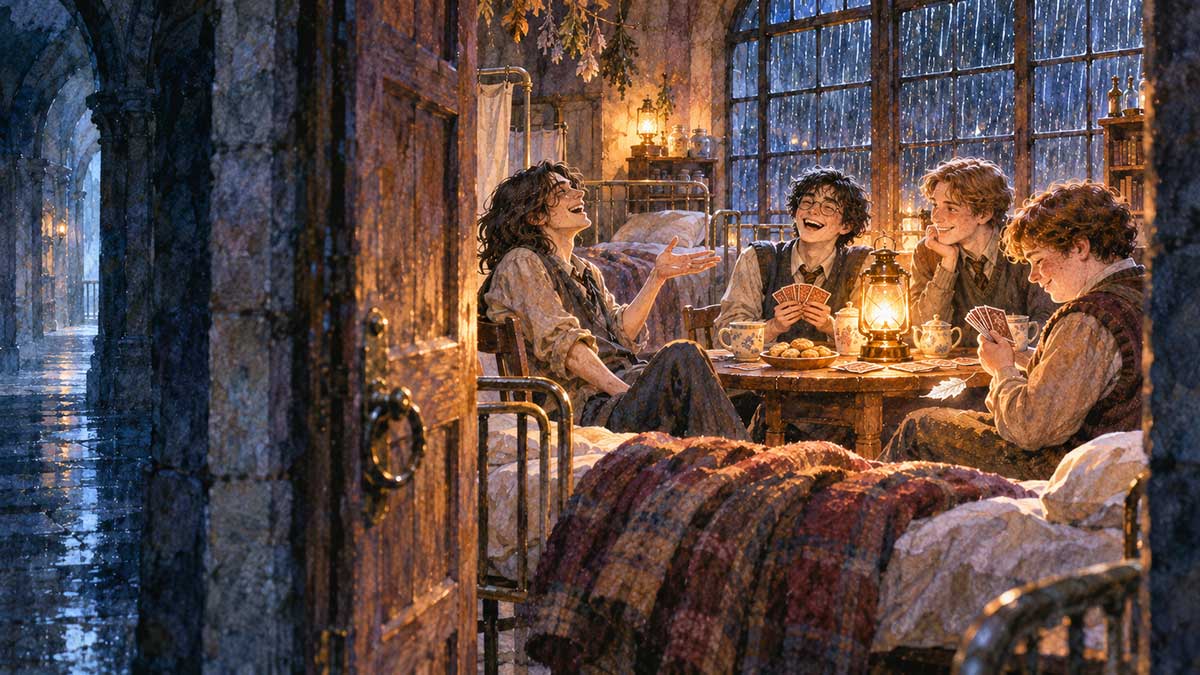
The hospital wing was crowded with people who did not know what to say.
Madam Pomfrey had cleared three beds, produced a tray of restorative potions, and informed everyone that she would not tolerate an argument about whether the boys ought to be resting. Sirius began to argue. One look from her ended the attempt.
James sat on the edge of his bed, staring at his hands.
He could still feel Peter’s memory. It was not a story he had heard or a picture he had imagined. It was a living recollection, complete with the smell of crushed biscuits and the awkward, fierce relief of being helped without being laughed at. James could remember his own side of that day. He had never before felt what the invitation had meant to Peter.
Peter lay on the next bed, pretending to sleep.
Madam Pomfrey's bedside table was crowded with things people had brought and then left because they had not known what else to do. A pot of flowering heather sat beside a bottle of restorative draught. Someone had produced a plate of biscuits, still untouched. There were three letters from younger students who had heard that the Society had been closed and wanted to know whether that meant their missing feelings would come back.
James read the first letter twice. The girl wrote that she remembered her brother teaching her to swim, but her parents had stopped speaking about him in front of her because it made her cry. She did not know why she cried. She asked whether that was normal.
He folded the letter very carefully.
Peter had been watching from the next bed. “You can't answer them all.”
“We can answer some.”
“Without promising anything?”
James looked at him. “Without promising what we don't know.”
He took out a sheet of parchment and wrote that the girl should not be ashamed of what she did or did not feel. He told her the professors were seeking a safe way to help and that she might speak to someone she trusted without having to perform recognition on command.
Peter studied the reply. “You're getting better at not making speeches.”
“I wasn't going to make one.”
“You'd already started one in your head.”
James smiled despite himself. “Possibly.”
“Good. Keep this one small.”
James put the letter aside. A group of first-years passed the open hospital-wing door, whispering. One of them saw Peter and waved awkwardly. Peter waved back. James realized that the younger boy was not looking at the famous Quidditch player or the brilliant rule-breaker. He was looking at the person who had stayed when other people might have fled.
Peter noticed it too. His ears went red. “Can we close the door?”
James closed it, then returned to his chair. He did not mention the wave.
James knew he was pretending. Peter always breathed too carefully when he wanted to be left alone.
“You don't have to talk about it,” James said.
Peter opened one eye. “Good.”
“Ever.”
“Even better.”
James waited.
After a while Peter said, “Do you think I'll stop missing it?”
“I don't know.”
“I can still tell you what happened. I just can't remember being happy.”
James looked toward the window. The grounds were silver with rain.
“You've been happy since,” he said.
“Yes.”
“And you will be again.”
Peter turned toward him. “That isn't the same.”
“No,” James said. “It isn't.”
He did not try to make the loss smaller.
James wanted to ask a dozen more questions. Did the absence have a shape? Did it come at night? Could Peter tell when the borrowed warmth stirred inside James? Every question seemed liable to turn Peter's loss into a problem James could measure and perhaps solve. He kept them to himself.
The rain had stopped. In the thin light beyond the infirmary window, a pair of younger students crossed the lawn in soaked shoes. One carried both their bags, leaving the other free to hop over puddles. James watched until they disappeared behind the greenhouse.
“There's something I should tell you,” he said.
Peter rolled onto his back. “I don't like the sound of that.”
“I can feel it. What you gave me. Sometimes I look at Sirius or Remus and that first train compartment comes back. I feel how frightened you were, and how happy when we let you stay.”
Peter's mouth tightened. “I know.”
“I don't think it should belong to me.”
“I know that too.”
James swallowed. “I don't know how to carry it without taking more from you.”
“You can stop looking at me as if I might vanish,” Peter said. “You can stop asking how I am every ten minutes. You can tell me when I've made a mistake. That's a start.”
“That's not very noble.”
“I'm trying to save you the trouble.”
James smiled before he could stop himself. Peter gave him a suspicious look, then smiled too. The expression made James realize how much he had wanted permission to be ordinary with him.
“What if I do something foolish?” Peter asked.
“You usually do it with us.”
“No. I mean something that's mine.”
James considered. “Then I'd tell you it was foolish.”
“Even after what happened?”
“Especially after. You didn't give us the right to stop being honest with you.”
Peter looked at the ceiling for a long time. “Good.”
Later that afternoon, Madam Pomfrey allowed them ten minutes in the courtyard. Sirius arrived carrying a packet of sweets that had leaked syrup through the paper. Remus brought a book but read none of it. Peter chose a bench where the late sunlight reached the stone, and the other three sat beside him without discussing it.
Sirius offered Peter the first sweet. Peter chose the largest, then complained that it tasted like burnt sugar and old boots.
“You picked it,” Sirius said.
“That's the tragedy of free choice.”
Remus laughed. James did too. Peter tried to hide his grin behind the sweet packet.
The laughter was new. That mattered more than James could explain. Whatever Peter had lost, the afternoon was not a replacement for it. It was something they had made after the loss, without asking anyone to pay for it.
Across the room, Sirius was pacing beside Remus's bed.
“He didn't notice Peter,” Sirius said.
“Who?” Remus asked.
“Voss. He was looking straight at us and still treated Peter like an afterthought.”
Peter sat up. “I was there.”
“I know. That's what I mean.”
“Then say it properly,” Peter replied, with more firmness than James had ever heard from him.
Sirius stopped pacing.
“You're right,” he said. “He overlooked you. And you saved us.”
It should have been a simple kindness, but the words made Peter uneasy.
“It's not just that he overlooked me,” Peter said. “You did sometimes.”
Sirius began to protest, stopped, and looked at James.
Peter pressed on before he lost his nerve. “When you two decide to do something, you talk so quickly I don't always get a turn. If I think of a problem, you say we'll work it out. Sometimes you do. Sometimes it turns into a joke.”
James remembered the map, the wrong turns Peter had caught, and the times he had been glad someone else was checking the details. He could not remember ever asking whether Peter enjoyed being the one who checked them.
“We've treated you like the person who follows,” James said.
Peter gave a short laugh. “I follow plenty. But I don't want that to be the only reason you like having me there.”
“It's not,” Remus said immediately.
Peter turned toward him. “I know you mean that. I just want us to act like it's true.”
Sirius sat down on the edge of the empty bed. He had a dozen quick apologies ready, none of them adequate. The room had taught him that explanations about how much he cared could become another way of claiming the right to speak over somebody.
“Then you get a vote on the next thing,” he said.
“On every thing,” Peter corrected.
“On every thing,” Sirius agreed, a little startled by how relieved he felt to have been corrected.
James glanced at Peter's empty bedside table. “Does it hurt when we talk about the train?”
“Sometimes. I want you to talk about it anyway. I don't want you behaving as though the first day we met has become forbidden.”
“We can do that.”
“Good.” Peter looked at all three of them. “And I don't want anyone telling me I must be happier now that I did something brave.”
“No one will,” Remus said.
Sirius held out a biscuit. “Can we tell you you're insufferably sensible?”
Peter accepted it. “You already do.”
For the first time since the Archive collapsed, the room felt capable of holding their friendship without pretending it had suffered no damage.
Peter looked startled. Then he nodded.
By afternoon Madam Pomfrey had permitted the boys to sit at the foot of Peter's bed, provided nobody attempted to transform the mattress into a racing broom. Sirius had objected to the accusation, then quietly tucked his wand beneath his pillow.
Peter produced a small pack of cards from his bedside drawer. They had bent corners, and one card bore a suspicious scorch mark. “We could do something that doesn't involve talking about what happened,” he said.
Sirius took the pack. “I know an excellent game.”
“You cheat at it,” Remus said.
“That is a hurtful allegation.”
“You put the same queen in the deck twice.”
“Then it was a very generous deck.”
James watched them argue over the rules. He could remember the first game they had played together years earlier. He knew which tricks Sirius favored and which cards Remus kept close to his chest. With Peter he remembered a small, jubilant laugh whenever an unlikely hand won. The borrowed feeling of that first welcome stirred in him, and for an instant guilt threatened to make him silent again.
Peter noticed. “If you're going to stare at me like that,” he said, “you can deal.”
James picked up the cards. “I've been told my dealing is suspicious.”
“Your dealing is suspicious,” Sirius agreed.
“Good,” Peter said. “Then we have one familiar problem left.”
They played badly. Sirius accused Remus of hiding a card. Remus accused Sirius of inventing new rules. Peter won twice and was accused of both crimes. James lost the last round and, for once, made no effort to argue that he had been robbed.
At the open window a light rain tapped the sill. James understood that the four of them could make a new ordinary afternoon without claiming it replaced the one Peter had lost. Nothing in the game repaired the Archive. Peter still had moments when the train compartment felt like a story about another child. But when he laughed at Sirius's outrageous complaint, the laugh belonged entirely to the present.
Afterward Peter collected the cards. He tucked the scorched one on top and looked at James. “There,” he said. “Now you owe me a rematch. That's a debt I'm willing to collect.”
Thistlewick arrived with Dumbledore shortly before supper. They had recovered several loose pages from the chamber's remains, but Voss and his original ledger were gone.
“The Society of the Seventh Seal has been closed,” Dumbledore said. “Professor Slughorn believed he was sponsoring a historical discussion group. He did not know how its records were being used.”
Dumbledore's announcement did not end the work. It began a slower and less dramatic one.
Professor Thistlewick laid three folders on the table. One contained lists of students who had signed Society forms. Another held copies of invitations recovered from classrooms, the library, and the rooms the group had used for meetings. The third was almost empty.
“What is that one?” Lily asked.
“The names of students who have not come forward,” Thistlewick said. “We cannot assume every person who was injured knows what happened.”
Mary Macdonald had volunteered to help, and now she sat with her pencil poised over a page. “How do we find them without telling the whole school what they lost?”
“We begin with the students whose names appear on the invitations,” Dumbledore answered. “Privately, with staff present. We ask whether they wish to speak. We do not demand personal recollections.”
Sirius stood at the foot of Peter's bed, arms folded. “And the society's sponsor?”
“Professor Slughorn has provided his records,” Dumbledore said. “He believed the group was studying historical bonds. That was his mistake, and he understands that it was a serious one. His sponsorship does not establish that he knew the records were being weaponized.”
Sirius looked dissatisfied, but said nothing.
Lily turned a page in the invitations folder. Each printed question was courteous. Which person welcomed you when you were afraid? What promise have you never forgotten? Who taught you what home meant? She had asked questions like those herself, in letters and conversations, without imagining that an answer could become a target.
“How do we tell anyone they can trust another question?” she asked.
“By letting them refuse,” Thistlewick said. “And by respecting that refusal.”
The professor set an envelope beside Cassian. It had arrived from Asterfell, with his mother's handwriting on the front. He recognized it immediately.
“Do you want to open it now?” she asked.
Cassian touched the envelope. His fingers stopped over his mother's name.
“Later,” he said.
“Then later it is.”
He placed the letter under his pillow. Lily could see that he was glad someone had asked before deciding for him.
“Will the students be safe?” Lily asked from the doorway.
“Some are already receiving help,” Thistlewick replied. “Others may need more time. We cannot promise that every damaged connection will be restored quickly.”
Mary's pencil stopped moving. “Then what do we tell the students whose families live too far away to come?”
“We tell them exactly what we know,” Thistlewick said. “A direct reconnection can sometimes be attempted when both people are present, each can refuse, and the Archive is no longer holding a claim over the bond. Letters may help someone choose a meeting, but a letter cannot be forced to stand in for a person.”
“And the cases that are still being held?” Lily asked.
“We will identify the registers and seek a lawful release. Peter's sacrifice is not to become the expected treatment for everyone.”
Lily looked at the younger students' letters. One girl had asked whether she had to hug her brother if he came. Another feared her mother would think she was ungrateful for failing to recognize her. The letters were full of small, frightened questions nobody had included in the Society's polite forms.
“Can we write an explanation they can give their families?” she asked. “Not a promise to recover. A request for patience.”
Thistlewick nodded. “Yes. I would like you and Miss Macdonald to draft it.”
“And anyone who doesn't want a meeting?” Mary said.
“Must not be compelled.”
Sirius, who had been restless near the window, glanced at Peter. “People keep talking as if he's proved the price is worth paying.”
“He has proved that a gift cannot be claimed by its keeper,” Thistlewick answered. “That is quite different.”
Peter's face softened in relief. He had not known how to say that without sounding as if he regretted helping his friends.
Cassian returned to the envelope from Asterfell. His mother's handwriting leaned slightly to the left. She had included an ordinary detail about a broken lantern at the market, then asked whether he would like her to visit. There was no demand that he remember loving her, no accusation that he had forgotten.
He read the question three times.
“I want to see her,” he said. “But if I look at her and feel nothing, I don't want anyone telling her to leave.”
“Then we will explain that to her,” Thistlewick said. “She may be hurt, and she may need to understand that the hurt is not a decision you made.”
Cassian folded the letter carefully. “She used to mend the lanterns by the kitchen window. I remember that. Maybe she can tell me the stories behind them.”
“No one can require you to believe those stories belong to you,” Lily said. “You can choose to listen.”
Cassian nodded. The comfort in that answer was modest. It was more honest than a promise that everything would be restored by supper.
Across the room, Peter leaned over the map. James had drawn a small circle around the space where the Archive entrance had appeared, then crossed out the circle and written a warning instead. No names had been added to the blank space, no claim that they now possessed the secret of what lay beyond.
Peter thought he liked the warning better. For once, their map recorded something they knew they had no right to own.
Cassian sat near the window with a blanket around his shoulders. He had asked for his mother. A message had been sent to Asterfell, but he seemed frightened of what would happen when she arrived.
“I know who she is,” he said quietly. “I know she loves me. But what if I look at her and feel nothing?”
Lily moved a chair beside him.
“Then she'll still be your mother,” she said. “You don't have to pretend the feeling is there.”
Cassian looked at her. “What if it never comes back?”
Lily did not answer at once.
“Then we'll keep looking for a way,” she said. “And we'll tell you the truth about what we find.”
Dumbledore asked James to describe the moment the Veil broke. James explained Peter's gift, the warmth of recognition, and the way their friendship had returned without anyone being forced to accept it.
“The original seventh line,” Thistlewick said, “protected what could only be freely given. Voss used a false agreement to seize it. Peter's act restored a bond by offering something of his own.”
“Something he can't get back,” James said.
“Yes,” she replied.
Dumbledore looked at Peter for a long moment. “You made a difficult choice. I hope you know that your friends value you for far more than what you gave them.”
Peter glanced toward James, Sirius, and Remus.
“I think I do,” he said.
That evening, after the professors left, the boys gathered around the map. Its dots had never stopped identifying them, not even when the Veil made their names feel meaningless.
“It's odd,” Remus said. “The map knew where we were the whole time.”
“It knew our names,” Sirius said. “It didn't know us.”
Peter traced the route out of the chamber with his finger.
James watched him. He understood now that a person could be seen and still be overlooked. He understood that being trusted was not the same as being useful.
Sirius leaned over the map.
“Voss has something else,” he said.
“What?”
“The ledger. He watched us, recorded what happened, and escaped with the notes. He'll sell what he learned.”
“Then we tell Dumbledore,” James said.
“We have.”
“And we keep helping the students.”
Sirius looked impatient. “That's not enough.”
“It may not be,” James admitted. “But it's what we can do tonight.”
Peter folded the map.
“Voss won't forget me now,” he said.
James looked at him. “Perhaps not.”
Far away, in a rented room with curtains drawn against the street, Adrian Voss opened his surviving ledger.
He had written four names and several observations.
Beside Peter Pettigrew he paused. The boy had not been the most gifted, the loudest, or the most obviously dangerous. Yet he had undone an experiment that should have been irreversible.
Voss wrote a single word beside the name.
Overlooked.
He shut the book and began preparing his next offer.
Chapter 15: The Record Remus Hid

Remus Lupin found the page beneath his pillow.
It was folded twice and sealed with a strip of black wax. There was no name on the outside. He knew it was meant for him before he opened it.
The first line contained his full name.
The second contained the date of a full moon.
The third described the incident that had changed his life.
Remus read no further. His hands had gone cold.
He knew what the rest would contain. That was part of the cruelty.
Before Hogwarts there had been forms, examinations, adults speaking over his head, and the dreadful discovery that the rest of the world could turn a child's life into a schedule of warnings. His parents had tried to protect him from it. They had sat beside his bed when he could not sleep and said his name in the familiar ordinary way. At home he had still been Remus, a boy who read beneath his blanket and disliked boiled cabbage. The pages created about him had never captured any of that.
He unfolded the second half of the sheet despite himself.
It contained a map of dates and places, nothing more dramatic than a tidy sequence of entries. One paragraph mentioned his parents. Another referred to an incident from his childhood with the detachment of a clerk recording the loss of a valuable object. The page ended by suggesting that the information might persuade a headmaster or employer to reconsider whether a student belonged in their care.
Remus stared at the words until they blurred.
He could be expelled. His friends might lose their place at Hogwarts if their involvement in his transformations came to light. The teachers who had helped him might have to explain every exception they had made for a boy the law and the public regarded as dangerous.
The next afternoon he took a long route to the hospital wing, not for treatment but for the privacy of a staircase where hardly anybody went between lessons. A window there looked down upon the greenhouses. Two students were wrestling with a sack of potting soil, laughing as it spilled over their shoes. Remus watched them until his breathing slowed. The scene was so harmless that he nearly hated it. A person could be standing six yards from a dangerous letter and never suspect anything had changed.
He took out a clean piece of parchment and drew two columns. In the first he wrote what the sender knew. In the second he wrote what the sender could prove. Dates. A childhood incident. Names of adults. None of the entries demonstrated that Remus had harmed anyone at school; nevertheless the distinction might mean nothing to a frightened employer. His life could be reduced to a handful of accurate statements arranged in the cruelest possible order.
At the bottom of the page he began a third column: What I can choose. It was harder to fill. He could refuse a demand. He could tell one adult about the threat. He could ask that the paper be treated as evidence rather than as an invitation to examine him. He could not order Voss to forget his name. Yet writing the choices down stopped the record from occupying the whole page of his future.
A door opened somewhere below. Remus folded both sheets rapidly and stood, furious with himself for flinching. The person coming up the stairs was a younger Hufflepuff holding a broken telescope. She looked at his parchment, saw his expression, and went past without a word. He had forgotten how hard it was to be ordinary when he suspected every face concealed a question.
He had imagined being exposed many times. In those nightmares there was usually a crowd, a shout, the sudden turning of faces. This threat was worse for being quiet. One copied page could move from desk to desk without anyone needing to look him in the eye.
On the back, beneath a line of numbers, stood a sentence he had almost missed: No action required until response is obtained.
So that was the purpose. Someone wanted him to do something first.
Remus folded the paper, then unfolded it and copied the words into his own notebook, where he could examine them without repeatedly touching the original. His writing was remarkably even. Only a small dot of ink beside the final word betrayed how hard he had pressed the quill.
From downstairs came Sirius's laughter. Remus could picture his friend tipping back in an armchair, arguing with James about a new shortcut on the map. The sound hurt him with its normality. He wanted to go down and sit among them without carrying this page in his pocket.
He tucked the notebook under his pillow beside the original and went to dinner. He was already making bargains with his fear. He would tell them tomorrow. After he understood what the sender wanted. After he found a way to make the danger smaller.
Tomorrow was a comforting word when what he really meant was not yet.
He sat on the edge of his bed while the dormitory filled with the ordinary noises of evening. James was arguing with Sirius about whether a map should mark every shortcut that required crawling. Peter was searching for a missing quill. Somewhere downstairs a first-year was practicing a charm that made a kettle whistle like a train.
Remus folded the page and put it in his pocket.
He knew that Snape had learned the truth about him after the Shrieking Shack incident. That knowledge had been dangerous enough. This page was different. It contained dates, names, and details that could be shown to anyone. A rumor could be denied. A record could be copied.
He wanted to tell his friends.
He wanted to burn the page.
He wanted to be the boy they had welcomed before any of them knew what happened to him every month.
“Moony?” James called.
Remus looked up.
“Are you coming?”
“To what?”
“Dinner. Unless you've decided to survive on library dust.”
“Coming.”
He tucked the paper deeper into his pocket.
At supper, Sirius told an elaborate story about a suit of armor that had challenged him to a duel and then refused to fight on the grounds that he lacked a proper title. James laughed. Peter added that Sirius could call himself Lord of the Missing Socks. Remus smiled at the right moments.
He barely tasted his food.
Afterward he went to the library, found a secluded desk, and unfolded the record again. The handwriting was precise, almost bureaucratic. It listed his condition as though it were an item in an inventory. Beneath the dates was a note: suitable for leverage if necessary.
Remus felt sick.
He had survived years of being afraid that someone would discover the truth. Now he was looking at proof that someone already had.
A shadow fell across the page.
Lily stood beside the desk.
“Remus?”
He covered the paper too quickly.
She noticed. Of course she noticed.
“Are you all right?”
“Fine.”
“You look as if you've seen a ghost.”
“Just tired.”
Lily hesitated. “If it's about the Society, Thistlewick wants to know about anything unusual.”
“I know.”
“Then tell her.”
Remus looked at Lily across the library desk and remembered how easily she had spoken to Alice after Mira's recognition was damaged. Lily had never insisted that Alice perform grief in a useful way. She had sat beside her, listened, and accepted that one afternoon could not mend everything.
“I know what you would say,” he told her.
“Do you?”
“That keeping it secret gives the person who sent it an advantage.”
“I might say that.” Lily sat in the chair opposite him without asking to see the page. “I might say that if the person has enough information to frighten you, they probably already know more than you want them to know.”
Remus stared at the library clock. “What if telling the truth hurts other people?”
“Then you decide what part of the danger they need to know. You don't have to offer the whole story just to ask for help.”
He thought of Sirius, who was fierce with love and careless with other people's boundaries when frightened. He thought of James, who believed he could protect everyone if he reached them soon enough. He thought of Peter, who had given away something irreplaceable and still managed to tell his friends what he wanted from them.
“What if they think less of me?” Remus asked, so quietly he barely heard himself.
Lily's expression changed. She did not know what was written on the paper, but she understood the shape of the fear.
“Then that would tell you something about them,” she said. “Not about what you're worth.”
Remus looked down. It was an easy truth to offer a friend and a difficult one to inhabit.
“I'm not ready,” he said.
“I hear you.” Lily rose. “But if the letter asks you to do something, please don't answer it alone.”
He nodded, and she walked away without trying to look over his shoulder.
Remus watched her disappear around the shelves. He was relieved she had respected his silence. He was ashamed that part of him had hoped she would stay until he broke it.
Remus looked at the folded page.
He could not bear the thought of another adult reading the details, even an adult he trusted. He had spent years learning to live with a secret that was his own. Voss had turned it into something that could be passed from hand to hand.
“I will,” he said.
Lily studied him for a moment. “You don't have to tell me what it is.”
“Thank you.”
“But don't let someone frighten you into facing it alone.”
Remus wanted to ask whether she could promise that a secret, once spoken, would remain where he put it. Lily could not promise such a thing. He recognized that before he embarrassed them both by asking.
“Suppose I told someone a threat existed,” he said, “but asked them not to make decisions until I'd had a chance to think. Would they listen?”
“Some would,” Lily said. “If you chose the right person, and told them exactly what sort of help you wanted.”
“It's hard to know who the right person is.”
“Yes.” She rested her hand on a closed book. “You don't need to earn the right to be cautious. But caution should leave you somewhere to stand, shouldn't it?”
He thought about the list he had made on the stairs. He had written what he could choose, then hidden the page because choosing still frightened him.
Lily rose without looking at the parchment. When she had gone, Remus stayed at the desk until the librarian began putting out lamps. He placed the list of choices inside his History of Magic notes. The threat he hid elsewhere. He could not yet bring himself to carry both to an adult, but he was beginning to see the difference between waiting to make a decision and allowing a stranger to make it for him.
After she left, Remus stared at the page until the words blurred.
He returned to the dormitory late. The others were asleep. He placed the record inside a book, then hid the book beneath a loose board.
The next morning, Sirius found him standing beside the window.
“You've been quiet,” Sirius said.
“I'm often quiet.”
“Not like this.”
Remus looked away. “I'm fine.”
Sirius did not believe him. Remus could see it in his face.
A year earlier, that might have been the end of the matter. Sirius would have pushed until Remus told him everything, and Remus would have retreated until neither of them could remember what the argument was about.
Now Sirius tried something different.
“If something's wrong,” he said, “you can tell me.”
“I know.”
“And if you don't want to, I won't make you.”
Remus felt a rush of gratitude so sharp it hurt.
“Thank you,” he said.
Sirius nodded and left.
Remus waited until the footsteps faded, then took the book from beneath the floorboard.
He had intended to show the page to Thistlewick. Instead he carried it to an empty classroom and hid it behind a loose stone.
He told himself he needed time.
The empty classroom was cold enough to sting his hands. Remus knelt before the loose stone and pressed the folded record into the space behind it. The wall had been repaired many times; layers of mortar showed where older students had hidden sweets, notes, and other less dangerous secrets. A red thread protruded from one crack. Someone had tied a small knot in it years ago, perhaps to mark a hiding place they had eventually forgotten.
He found himself wondering what that student had hidden. A confession? A letter to someone they loved? A bad essay? There was an awful difference between a secret kept in a wall and one kept in a person's body.
Remus pushed the stone into place.
His first instinct was to seal it with a spell. That would call attention to it if another wizard came searching. His next instinct was to destroy it. But a copy of Voss's record could provide evidence of a threat, and Remus knew that the original lay somewhere beyond his reach.
He stood and checked the classroom door. Empty. He tested the stone once more. Solid. The record seemed safe, which was nothing like feeling safe himself.
When he returned to the dormitory, Sirius was polishing his broom and Peter was trying to mend a damaged quill. James had fallen asleep across his bed with a Quidditch diagram on his chest.
“There's a space at the window,” Peter said, moving his books. “If you want to read.”
Remus sat down. For a little time, nobody asked him to explain the expression on his face. He listened to Sirius complain about a loose broom handle and to Peter argue that glue was not the answer to every broken object. James woke just long enough to say he disagreed before falling asleep again.
The scene was ridiculous, affectionate, and ordinary. Remus wanted to stay inside it forever.
Then a thought came to him: perhaps the sender was counting on exactly this. The more he loved his friends, the more he feared giving the enemy a reason to hurt them. Silence could look like care until it became the thing that left everyone unprepared.
He glanced at Sirius. For a moment he considered telling him that night.
But Sirius was laughing, and Remus could not bring himself to stop him.
He told himself he was protecting his friends.
He told himself that if Voss possessed the original, destroying one copy would change nothing.
All three things were partly true.
That afternoon, a second message arrived. It contained no dates and no names, only a sentence written in the same careful hand.
Your friends cannot protect a truth they do not know.
Remus crumpled the paper.
For the first time since the Veil, he wondered whether the danger to their friendship was not forgetting, but the fear of being remembered too clearly.
Chapter 16: The Shape of a Secret

The trouble began with a missing essay, but Sirius would later remember the sound of a spoon striking a teacup.
At breakfast that same week, Sirius had watched Regulus pass the Gryffindor table without so much as turning his head. It irritated him more than he cared to admit. The smallest signs of distance had begun to feel like verdicts. Across the table, Remus was rearranging toast he had no intention of eating. Sirius could see that something was wrong; the knowledge made him impatient with all the reasons his friend might not tell him.
Once, Sirius would have solved the problem by making a spectacular nuisance of himself until Remus shouted the truth. He knew now that being trusted was different from obtaining an answer. He had learned the distinction in the Archive and then, like most difficult lessons, had to learn it again in a less dramatic setting.
He opened his mouth to ask a question, reconsidered, and passed the marmalade instead.
Remus took it with a murmur of thanks. The exchange was tiny. Sirius had no idea whether restraint had helped, and he disliked doing something without proof that it mattered. For the moment, he tried to let the uncertainty stand.
That morning Remus had been at breakfast, turning the handle of his cup through his fingers while the Great Hall filled around him. Three second-years were discussing the approach of the next full moon. One claimed werewolves grew an inch taller each time they transformed. Another said a werewolf's shadow moved independently of its body.
“Mine does,” Sirius said from across the table. “It goes to lessons for me when I'm tired.”
The children laughed. Remus did not.
James was reading a Quidditch notice and missed it, but Peter saw Remus press his thumb against the cup until the knuckle whitened. Peter changed the subject to a charm he'd found on the library noticeboard, a spell that supposedly taught teapots to identify rude guests. Sirius offered to test it on Slughorn. Remus smiled, a little, and everyone moved on.
Later Peter found Remus in the corridor outside the library.
“Did I make it worse?” Peter asked.
“You were trying to help.”
“That isn't an answer.”
Remus folded the paper in his hand. It was not his essay. “Sometimes it's enough to change what people are talking about.”
Peter nodded. He had begun to see how friendship could mean noticing the instant before a joke turned cruel. He still wanted to ask what was troubling Remus, but the expression on his friend's face stopped him.
Inside the library, Remus searched for a table far from the windows. In his pocket lay the record Voss had sent: dates, a fragment of the night he had been bitten, and the names of people who had arranged his education. There were childhood facts he had spent years guarding, laid out as if they belonged to whoever held the page.
He had considered copying the threat for Thistlewick, but had hidden the original in the disused classroom, intending to retrieve it after he decided how much to say. It had felt safer than keeping it under his mattress. He had not counted on Sirius losing an essay and hunting for it with the persistence of a starving kneazle.
The next day the essay went missing. Sirius blamed a corridor draft, then James, then an unusually selective poltergeist. James swore innocence. Peter suggested checking the empty classroom where they had last used their map.
Sirius went alone.
The room was cold, smelling of chalk and rain. Dust lay thick beneath the desks. When he reached for a rolled parchment wedged beside the wall, his elbow struck the loose stone. A folded sheet slid onto his shoe.
He knew he should have left the folded sheet where it lay.
Sirius saw Remus's name before he realized he ought not to read further.
The date of a full moon appeared beneath it. Then another date. Then a sentence about a child bitten by a werewolf.
He folded the page at once. But he could not unread it.
When Remus entered, Sirius was standing beside the window, the paper held between two fingers.
“Where did you get that?” Remus asked.
“Behind the wall.”
“Put it down.”
“I did. Then I picked it up again.” Sirius held it out. “Someone's threatening you.”
Remus took the page so sharply that it tore at the fold. “You had no right.”
“I didn't go looking for it.”
“You read it.”
“I read enough to know Voss has information about you.”
Remus turned away. The light from the window made his face look tired and much older than sixteen.
“Who else knows?” Sirius asked.
“Don't.”
“Does James?”
“Don't ask me that.”
“Then what am I supposed to do? Pretend I didn't see it?”
Remus faced him. “You could ask whether I'm all right.”
Sirius stopped.
He had been frightened from the moment he saw the dates. Frightened for Remus, frightened that their enemies knew something that could destroy him, frightened by how close he had come to losing all recognition of his friends inside the Archive. The fear had come out sounding like an accusation.
“Are you all right?” he asked.
“No.”
Sirius nodded, but the hurt in Remus's expression did not disappear.
“I wanted time,” Remus said. “Just a little time before I had to make this everyone's problem.”
“It already is someone's problem. Yours.”
“And that doesn't mean it's yours to manage.”
The words struck a place Sirius rarely allowed anyone to touch. He thought of Regulus, of unanswered letters and doors shut in his face, of the helplessness of knowing someone he loved was in danger and could not be dragged to safety.
“People keep telling me to stand back,” he said.
“Maybe sometimes you should.”
Sirius left before he said something worse.
Outside, Sirius took the stairs too quickly and nearly collided with a first-year carrying an armful of books. He caught the child's elbow before the books fell.
“Sorry,” he said.
The child looked at him as though the apology were an unexpected spell and hurried away.
Sirius stood in the stairwell with his heart pounding. Remus's words kept returning: You could ask whether I'm all right. They were so ordinary that Sirius could not dismiss them as a dramatic insult. He had looked at a friend who was frightened and demanded answers as if answers would make the fear manageable.
In his family's drawing room, asking what someone knew had been a way of establishing who might be punished. His mother asked questions she already knew the answers to, then waited to see who would lie. Sirius had spent years refusing to give her the satisfaction. Now he'd heard the same edge in his own voice.
He went to the astronomy stairs. Cold air drifted between the high stone walls. Somewhere overhead an owl crossed the open sky.
A few minutes later Peter came up from the courtyard, carrying two cups from the kitchens.
“Remus thought you might be here,” Peter said.
Sirius looked up sharply. “He sent you?”
“No. He said he didn't know where you went. I guessed.” Peter offered him a cup. “It's tea. I asked for something stronger, but the house-elf said I looked as if I'd fall asleep standing.”
Sirius accepted it.
Peter sat one step below him. They watched a strip of cloud cross the moon. Neither spoke for a time.
“If you've come to tell me I'm wrong, you can save yourself the effort,” Sirius said at last.
Peter turned the cup between his palms. “I was going to tell you I don't know what happened.”
“Then I ought to tell you.”
“Only if Remus wants me to know.”
Sirius closed his eyes. It was the same boundary, offered without an accusation. He stared down into the tea.
“What if I can't stand by when someone I love is in danger?” he asked.
“You can stand beside them,” Peter said. “It's different.”
Sirius let out an unwilling laugh. “You've become terribly wise.”
“Don't tell James. He'll make me captain of something.”
They sat until the tea cooled. Peter left first. Sirius remained on the stairs, trying to work out how to apologize without turning the apology into another demand.
That was where James found him.
James found him on the astronomy stairs, where Sirius sat with his elbows on his knees and stared at the stone floor.
“I've made a mess,” Sirius said.
James sat beside him. “What sort?”
“The familiar sort.”
Sirius told him about the hidden paper, the dates, and the threat. He did not repeat the details of Remus's childhood. James listened, then asked one question.
“Did Remus want you to tell me?”
“No.”
“Then we should speak to him before we speak about the record.”
Sirius stared. “Voss has a weapon against him.”
“I know. And Remus is still the person who gets to decide how much of his life he shares.”
“You make it sound simple.”
“It isn't.”
Before they went upstairs, James stopped beside a window overlooking the dark lawns.
“There's something I haven't told you,” he said.
Sirius glanced at him. “That sounds ominous.”
“After the Archive, when I couldn't recognize you, I could still tell you were frightened. I thought if I learned enough facts about you, the feeling would come back. I was angry when it didn't.”
“I remember.”
“I think I treated you as a problem I was supposed to solve. I did the same to Peter afterward, trying to give him back what he'd lost.”
Sirius looked away. Peter had never asked for repayment. Yet the loss of his first feeling of belonging was real, and every attempt to praise his sacrifice seemed to put him at a distance from the friends he had saved.
“What are you saying?” Sirius asked.
“That I'm afraid of losing people too. And fear makes me bossy.”
“That's a charitable name for it.”
“Do you want to apologize to Remus?”
“Yes.”
“Then tell him what you did. Not what you were trying to prevent.”
Sirius nodded. There was no charm for putting a sentence back into someone's mouth. He would have to say a different one.
They found Remus in the dormitory. Peter was there too, repairing a torn corner of the map. He looked up as the others entered and immediately set down his quill.
Sirius spoke first. “I'm sorry I read the paper.”
Remus looked at him without answering.
“I didn't mean to,” Sirius continued. “But once I saw what it was, I was frightened. I acted like you owed me an explanation.”
“I owe you the truth when it affects your safety,” Remus said quietly. “I don't owe you every detail of what happened to me.”
“Then tell me what I can actually do,” Sirius said. There was strain in his voice, but no command. “If the answer is nothing, I'll try to respect that. I may be dreadful at it.”
Remus considered him. “Don't mention the dates. Don't repeat a single name from that paper. Not to James, not in a joke, not when you're angry.”
“I won't.”
“And if the sender contacts you, don't answer for me.”
Sirius stared at the floor. “I can do that.”
“There's one thing I do want,” Remus said. “When I go to Thistlewick, someone can wait outside. I would rather not walk back alone.”
Sirius looked up quickly. “I can wait.”
“So can I,” Peter offered, then added, “I can bring something to eat. Waiting is about the only duty I'd claim to be exceptionally good at.”
The quiet laugh that followed did not settle everything. Remus still felt exposed, and Sirius still felt the insult of having read something he could not repair. But the next thing they were going to do belonged to Remus. That mattered more than an apology performed perfectly.
Peter leaned forward. “Maybe those are two different things.”
They turned toward him.
“If someone knows how to hurt us, we need to know that,” Peter said. “But knowing a danger exists doesn't mean we get to own the whole story.”
James felt the memory of the train stir inside him, the memory Peter had lost. He wondered whether his friend had always understood belonging more clearly than the rest of them.
“Can we agree on that?” James asked. “We share threats. We don't demand confessions.”
Remus nodded slowly. Sirius nodded too.
James did not ask to see the record. He did not ask Remus what else was written there. Part of him wanted to know; he chose not to make that wanting a command.
Peter returned to the map. “Then perhaps we can work on something less miserable.”
“Like detention routes?” Sirius asked.
“Like whether the kitchen corridor can be marked without the house-elves noticing.”
Remus managed a small smile. “It can't.”
“Not with that attitude,” Sirius said.
The laughter was brief and imperfect. It was enough to begin again.
That night, Remus brought the threatening page to Thistlewick himself. She accepted it without asking him to explain his childhood. Together they made a plan for protecting the information and identifying where the copies had gone.
Outside her office, Remus paused at the window. He could see three figures crossing the courtyard, waiting for him beneath the lamps.
He knew they were his friends. The knowledge was not a spell. It was a choice they had all made again.
Chapter 17: The Broker’s Offer

The bookshop had closed before the street learned its owner's name. Its windows were covered with newspaper from three winters past. People walked by without looking, and Adrian Voss liked that about it.
On his second morning there, he placed four objects on the desk: a fountain pen, a copper seal, a child's school photograph, and a list of signed names.
The photograph showed a girl at a station beside her father. The scene was unremarkable. A trunk, a scarf slipping from one shoulder, and a man trying to smile at the departure he had dreaded all summer. Their relationship was valuable precisely for its ordinariness. It needed no grand declaration to shape the girl's choices. If the connection vanished, the facts of the photograph would remain, and she might spend months treating the man who came to collect her as a stranger.
Voss noted the possibility in a narrow column. The mechanism fascinated him, not for any emotional reason, but for the neatness of its results. Remove the tie; leave the evidence. Anyone who tried to prove the tie would find themselves surrounded by evidence that could not supply the missing certainty.
His assistant, a thin woman named Maude Quill, entered with a bundle of letters.
“The school has warned several families,” she said. “The headmaster has written to the station authorities.”
“Then it will be a public demonstration.”
“People may be injured.”
“Some will be frightened. There is a distinction.”
Maude put the letters down. “At Asterfell, a child was frightened of his own mother.”
Voss considered her. “You sound dissatisfied.”
“I signed on to catalogue records. I did not sign on to separate children from families.”
“You signed an employment agreement.”
Maude had been sorting the acquisition files for six months. She knew where the paper came from: school registers, municipal ledgers, a handful of family collections whose ownership had been disputed before Voss acquired them. In the beginning the work had felt like rescuing fragile history. The first time she'd seen the same child's name copied under three different headings, she'd thought it an error. Now she understood how an error could be manufactured into an instrument.
“The agreements are dated,” she said. “Some of the students signed before they were told what the questions meant. That isn't permission.”
Voss touched the copper seal with one finger. “Permissions are interpreted by authorities. You are not an authority.”
“Neither are you.”
He looked up. Maude realized she had frightened herself more than him. Nevertheless she placed the employment agreement on top of the school photograph rather than beneath it. She wanted the records to be seen together, even if only by the next person Voss tried to persuade.
A small movement caught her eye. The shop's back door stood open by an inch. She could leave through it. She could take nothing useful without triggering the charms sewn into the ledger's binding. She settled for noticing the number of notches on the copper tool and the blue stain on the edge of the desk. If she reached someone willing to listen, details might be more valuable than bravery.
“Yes,” she said, “and I've read it again.”
Maude laid a small folded document on the desk. On its final line she had written an amendment: I do not consent to the use of my work for severance.
Voss did not touch the paper.
“You may leave,” he said.
“I intend to.”
After she had gone, he opened the ledger and crossed out her access to the station. He did not try to keep her. A reluctant assistant was unpredictable. He preferred clients who believed knowledge entitled them to possession.
He turned back to the photograph and made another note: Public resistance likely. Consent records still sufficient for selected targets.
When the visitor in a dark cloak arrived, the photograph was face down and the ledger was open.
Voss had moved his business to a room above a shuttered bookshop in London. The shelves were bare, the windows blackened by soot, and the desk stood precisely in the center of the floor.
He disliked clutter. Clutter made people feel that secrets could hide anywhere. Voss preferred his secrets indexed.
A visitor in a dark traveling cloak stood across from him.
“You promised a demonstration,” the visitor said.
“I promised proof of a method.”
“Words are cheap.”
“Then you will be pleased that mine are accompanied by records.”
Voss opened a ledger. He showed the visitor names of students, the questions they had answered, and the signatures obtained under the Society's false agreements. He explained how a person could retain every memory of a loved one yet fail to recognize the bond connecting them.
“An isolated student is easier to recruit,” the visitor said.
“Or to silence,” Voss replied. “My interest is in the transaction, not the use to which the purchaser puts it.”
The visitor studied the pages. “When?”
“First of September. King's Cross. The platform will contain hundreds of witnesses and enough confusion to conceal the first moments of the effect.”
“And the school?”
“The school has closed my Society. That is inconvenient, not decisive.”
The visitor left without shaking his hand.
Voss opened a separate file. Inside lay a list of people whose relationships were especially valuable to disrupt. Lily Evans appeared near the top.
He considered the name for a moment, then wrote a short note to Severus Snape.
Snape received it two days later. It offered a meeting at a place where no one from Hogwarts would see him. The invitation mentioned a correction to a past mistake, a memory that could be softened without altering the events around it.
He knew what Voss meant. He had known since the man first suggested that Lily might be made to forget the word Snape had used against her.
The temptation was ugly. He knew that too. Yet a part of him kept returning to the same impossible thought: what if she could remember their friendship without remembering the moment he had shattered it?
Snape had rehearsed what he would say on the walk from the station. He would ask to see the old inscriptions, decide whether the man possessed anything worth studying, and leave before the conversation became personal. He had even rehearsed refusing an offer. The words sounded convincing in his head.
Then the street narrowed, and with every step toward the shuttered shop he remembered the last time Lily had spoken to him without anger.
She had once met him by a stream with her schoolbooks tucked under one arm. Her questions had come so quickly he had barely answered one before she asked another. Could a spell keep rain off a path? Could a bird carry a message across the country? Would the houses at Hogwarts be beautiful? He remembered her laughter when a gust of wind opened his umbrella inside out. He had been young enough to believe that being the person who answered her questions meant he would always have a place beside her.
Now she would barely look at him. He had given her a word she could never mistake, a slur that made his claimed loyalty to her impossible to believe. The people he had chosen to impress had heard it. She had heard it. The moment belonged to him, and that was what he could not bear.
Halfway down the street, he stopped at a public telephone. He could send a warning to Dumbledore. He could destroy the invitation and go home. He could admit that Voss had already shown him enough to make the offer dangerous.
Instead he folded the invitation smaller and continued.
A bell rang when he entered the shop. No books were on the shelves. The silence was so complete that he could hear the scrape of his own shoe across the floorboards.
Somewhere above him, a floorboard creaked.
He went to the meeting.
Voss did not greet him warmly. He offered a chair and a page of technical notes.
“The spell requires an existing record,” Voss said. “A name and a freely given answer. I need you to verify the older inscription.”
Snape read the page. The seventh line had been reversed. The words no keeper may claim had become a claim of custody. He recognized the trick and, to his shame, recognized its elegance.
In the old classroom at Hogwarts, he and Lily had once argued over a sentence in a borrowed book. She had insisted that a translation did not become true merely when its words sounded precise. He had called her suspicious. She had replied that she was suspicious of people who used grammar to escape responsibility.
The memory came to him now with a force that made the room seem suddenly smaller.
Voss waited. He was excellent at waiting. He understood that someone who wanted forgiveness badly enough might begin by negotiating with his own scruples.
Snape tested the construction in his head. The altered ending did not make consent real. It made a copied response appear transferable between registers. That was the danger: a person's answer to a harmless question could be presented as agreement to something they would have refused if they had known its purpose.
“Is the page already being used?” he asked.
“A theoretical question,” Voss said.
“Is it?”
“Your concern for procedure does you credit.”
Snape saw how little the compliment cost him. He should have set the quill down then. He was still young enough to believe he could enter a dangerous room, take what he wanted, and leave without belonging to the choices he made inside it.
“Why are you showing me this?” he asked.
“You have an interest in a particular young woman. I have an interest in accurate translations. We may assist one another.”
“Her memories would remain?”
“The facts would remain. The pain attached to them could be separated from the person responsible.”
Snape felt his stomach turn. Voss was describing forgiveness without choice.
He should have left. Instead he corrected one technical error in the margin. The correction was small, a single misplaced inflection in an Asterfell construction. Voss watched him write it.
“There,” Voss said. “You see? Scholarship can accomplish what regret cannot.”
Snape's quill remained on the paper for a moment after he had made the correction. The ink sank into the margin. The altered inflection clarified how the register could reach a connection recorded at a different place and time.
He had known what the line meant before he wrote. That fact would not change if he later decided to call his action a scholarly exercise.
Voss slid the page away, stopping just short of Snape's hand.
“Do you know why the older translators missed that construction?” Voss asked.
“They assumed the keeper was a witness, not a claimant.”
“And you knew better.”
Snape felt a cold certainty settle over him. “You didn't need me to translate anything. You wanted my handwriting on the page.”
Voss smiled faintly. “It will prove you consulted on the document.”
“You said this was about a memory.”
“I said I could offer relief from an unpleasant connection.”
“You know she would never choose it.”
“Then it is fortunate the records were gathered before she knew she had anything to fear.”
Snape stared at him. The promise had always required Lily's choice to be made irrelevant. He had known that too, beneath the excuses that brought him into the room.
“Give me the page back,” he said.
“No.”
Snape reached for his wand and stopped. A duel in an unknown room would not recover every copy, nor would it undo what he had written. He was learning the limits of anger in a way that disgusted him.
Voss turned the paper over. A second list lay beneath it. Lily's name appeared among the targets, not alone, but beside those of several students whose relatives would be at King's Cross on the first of September.
Snape saw the station date. He saw the names. He knew he had helped a mechanism that might be used on her without warning.
A strip of copper lay on the table beneath the documents. It was hinged like a carpenter's rule, with seven notches cut along one edge. Snape had seen a similar device among the Asterfell transit diagrams. This one could be fixed to an existing doorway and persuaded to remember a different destination for a handful of heartbeats. The metal had gone dull near the final notch. It had already been used and repaired.
“An exit?” Snape asked.
“A return passage,” Voss said. “No seller of dangerous knowledge should assume that his customer will remain polite.”
“Where does it lead?”
“That depends on which threshold I have prepared. The journey consumes the inscription. I should hate to spend it before I have a reason.”
Snape stood. “I haven't agreed to anything.”
“You came.”
“That isn't the same.”
Voss closed the file. “Perhaps you will think differently when you see what can be done.”
Outside, Snape walked for a long time without noticing the streets. He had made one contribution, and he could not take it back. He told himself it was merely a correction. He knew Voss would use it.
He paused in the dark street and looked back at the shuttered bookshop. There was no version of this afternoon in which the ink became innocent once he left. Voss's assistant had disappeared by the end of the meeting. The man had not needed to threaten him; he needed only to make Snape understand that a record of their meeting now existed.
He considered going straight to the headmaster and admitting everything. Instead he stood under a failing streetlamp and calculated how little he might confess without losing the place he still hoped to occupy among his Slytherin associates. The calculation disgusted him. He made it anyway.
He found a table in a quiet public room and wrote down what he remembered of the station list. The names frightened him, most of all the one he had wanted to protect by means she would never have chosen. He tore up the first warning, which contained too many explanations of his own motives, and wrote a second with the necessary facts.
He left his name off it. The anonymous note might save someone, but anonymity preserved his own comfort too. He understood both truths, and could not pretend the second erased the first.
At Hogwarts, Lily was making a list of students who had signed the Society's register. She had asked each one to identify a person they trusted and to tell that person what had happened. Some had already begun to recover. Others were frightened to speak about it.
Mary Macdonald sat beside her, copying names.
“Why are you doing this yourself?” Mary asked.
“I'm not. You're here.”
“You know what I mean.”
Lily looked at the pages. “If somebody tried to make me forget you, I'd want someone to notice.”
Mary smiled, then returned to her work.
An owl tapped at the window. Lily opened it and found an unsigned note tied to the bird's leg.
The note contained only a warning: The next demonstration will involve students traveling to Hogwarts. Do not let anyone answer questions on the platform.
Lily read it twice. The handwriting was disguised, but the urgency was unmistakable.
She took the note to Thistlewick, who immediately sent for Dumbledore.
Snape, meanwhile, sat alone in the Slytherin common room, staring at a copy of the list Voss had shown him. Lily's name had appeared among the intended subjects. He had not noticed it at first, distracted by the promise that he could erase her pain.
Now he saw it clearly.
He had wanted to change what Lily remembered about him. Voss intended to use the same method to take away the people she loved.
Snape folded the page and put it in his pocket. He could not undo his correction, but he could refuse to give Voss anything more.
For the first time, he understood that refusing was not the same as making amends.
Chapter 18: A Brother’s Choice
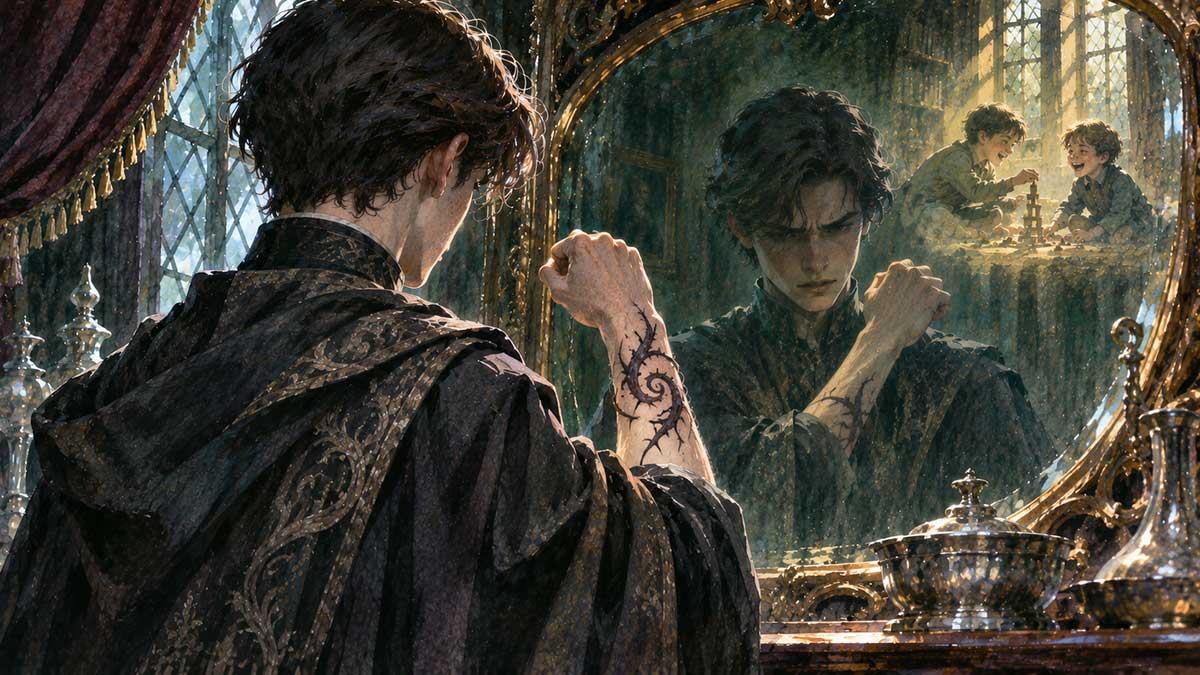
At the Black family table, nobody spoke about choice unless the choice had already been made for you.
Regulus had learned that young. He remembered his mother explaining which families were respectable, which friends were suitable, and which words he must never say in front of visitors. When he was little, he had asked why Sirius laughed at the rules. His mother had said that Sirius enjoyed causing pain. Regulus knew that was not true. He had seen his brother climb onto a windowsill in winter to rescue a bird whose wing had frozen to the glass.
Sirius had been reckless and loud, careless with furniture and their mother's temper. He had given Regulus a wooden wand and taught him to make dust motes sparkle. When Regulus became afraid of the dark staircase, Sirius walked down first, announcing that any monster would have to get through him.
Then Sirius had grown older. He argued at every meal. The shouting shook the portraits. When he finally left, the house became quieter, which was what their mother said she had wanted. Regulus discovered that the quiet could feel worse.
He told himself he had to become the son his family could rely on. It seemed easier than naming what he missed.
The men who spoke to him about the Dark Lord used words his mother approved of: duty, tradition, dignity. They treated his youth as evidence that he was extraordinary. One praised the fact that he had not followed his brother into disgrace. Regulus was ashamed by how deeply that praise pleased him.
The night before he received the Mark, he found the old wooden wand in a drawer. Its paint had chipped away, leaving a pale strip along the handle. He held it until the room grew cold, then put it back and locked the drawer.
There had been a supper that evening. The adults spoke about loyalty in the same bright voices they used when discussing which relatives were coming for Christmas. Regulus sat beneath the family portrait and tried to remember when he had last been asked what he actually wanted.
A guest congratulated him on being the sort of boy who could be relied upon. His mother smiled with unmistakable relief. Regulus felt the terrible comfort of having made her proud without yet having done anything. It was a debt paid in advance, and he sensed he was about to be asked to repay it.
Later he passed the room Sirius had once occupied. The portrait hanging opposite was still scorched at one corner from a prank Sirius had considered his greatest artistic success. Their mother had ordered it repaired twice. The scorch remained, stubborn as a remembered laugh.
Regulus stood there imagining the sound of Sirius on the stairs, two steps at a time, demanding that Regulus come outside and try another impossible spell. He was angry with himself for missing someone who had left him. Angrier still at the possibility that Sirius had not truly meant to abandon him.
The wooden wand lay in his pocket. He had taken it from the drawer again without thinking. He held it until the chipped edge pressed a white line into his palm. In the morning he would be expected to prove which family he belonged to. No one had told him how to choose between the family that had raised him and the brother who had once made that house feel livable.
He did not tell anyone that he had been afraid.
Regulus Black had expected the Mark to feel like a beginning.
He had imagined a moment of certainty, the kind his relatives spoke of at long dinners when they lowered their voices and called fear loyalty. He had imagined that once he had chosen, the doubts would fall away.
Instead his arm hurt.
The pain was not the worst part. The worst part was the silence afterward, when the people around him looked pleased and Regulus realized he had been waiting for someone to tell him he could still change his mind.
No one did.
He returned home with his sleeve pulled low. The house was cool even in summer. Portraits watched him pass. Somewhere upstairs a door closed softly.
Sirius was waiting in the drawing room.
Regulus stopped. “How did you get in?”
“I used to live here.”
“That doesn't answer the question.”
“No. It doesn't.”
Sirius had come to collect the last of his belongings. He was seventeen now, with his uncle Alphard's inheritance and a small flat of his own. The Potters still expected him for Sunday dinner. He had spent the morning laughing with James about the flat's crooked fireplace and the kettle that refused to boil unless addressed politely.
The laughter had ended when he saw Regulus's sleeve.
“Show me your arm,” Sirius said.
Regulus's face hardened. “No.”
“Please.”
The word seemed to surprise them both.
Regulus looked away. “You wouldn't understand.”
“Then explain it.”
“You left. You decided everything our family believed was worthless.”
“I decided I wasn't going to hurt people to make them proud of me.”
“You always make it sound simple.”
“It's not simple. That's why I'm asking you to come with me.”
Regulus laughed once, without amusement. “To your flat?”
“To the Potters. To anywhere you can think.”
“You think they'll welcome me?”
“I think they'll listen.”
Regulus stared at the carpet. His hand moved toward his sleeve, then stopped.
Sirius saw the gesture and felt something inside him give way.
“You did it,” he said.
Regulus said nothing.
“You let them mark you.”
“I chose it.”
“Did you?”
Regulus's eyes flashed. “Don't speak to me as if I'm a child.”
“Then don't tell me you've made a choice when you're afraid to show me what it cost.”
Regulus drew back his sleeve.
The Dark Mark lay against his skin. Sirius had heard people describe it, had seen crude drawings, had imagined the shape in nightmares. The real thing was worse for being so ordinary on his brother's arm.
He remembered Regulus at eight, following him down a corridor with a wooden wand, insisting he was old enough to learn every spell Sirius knew. He remembered teaching him a harmless charm that made dust motes glow. He remembered their mother calling them to dinner and Regulus reaching for his hand before entering the room.
Sirius looked at the Mark and could not make the two images fit together.
Regulus kept his sleeve lowered and studied Sirius's face.
“You think you can arrive for ten minutes and undo everything that's happened since you left,” he said.
“I think you can still walk out of this house.”
“Then where do I go when they come looking? What do I do when they ask our mother what I've told you? You have friends who would hide you. I've spent two years being told those friends are enemies.”
Sirius studied his brother's face and saw a question he had no right to answer with a slogan. The Potters' kitchen was warm, but it was not a fortress. A spare bed was not protection against people who could follow a surname across the country. Regulus had been made afraid of precisely the people Sirius trusted most.
“We'd have to plan,” Sirius said. “Somewhere other than my flat, at first. Someone who can protect you and doesn't need to know every detail. We could speak to the headmaster without your name being carried all over the school.”
“And if I told him I'd already been marked?”
Sirius swallowed. “Then we'd tell him that too, if you chose to.”
“You make leaving sound like moving my trunk.”
“No.” He looked at the photograph on the mantel, the two of them on a day in the garden. “I make it sound possible. It might be dreadful. It might take longer than we'd like. It would still be possible.”
Regulus's expression faltered. Sirius could see that his brother had not come home seeking an argument. He had come home wanting the pain in his arm to mean something. Sirius almost said that the Mark could never mean anything except shame. He stopped himself. He knew what happened when a boy's fear was answered with contempt.
“We could begin with one question,” Sirius said. “Who would you want to be if none of them were listening?”
Regulus looked away. “I don't know.”
It was the first answer he had given that afternoon without sounding like someone else's words.
Sirius wanted to deny it, but Regulus was right about one part: Sirius had never made a practical plan for what his brother would face the morning after leaving. The offer of the Potter house was genuine, but it was not a complete answer.
“We could ask Dumbledore,” Sirius said. “We could work out somewhere safe.”
Regulus looked at him sharply. “We?”
“Yes.”
“You don't even live here.”
“That doesn't mean I've stopped caring about you.”
Regulus's fingers tightened around his cuff. For an instant he seemed to be considering the words. Sirius saw an opening and stepped closer.
“Reg, I remember the garden. I remember you making the dust glow. I remember you following me around until I told you to stop and then missing you when you did.”
“Don't.”
“You were always my brother.”
“That's easy for you to say when everyone at your new home thinks you're brave.”
Sirius stopped. He remembered the first nights at the Potters', sleeping under clean blankets and waking when somebody walked past the door. James had knocked before entering. Mrs. Potter had asked what he wanted for breakfast without treating the answer as a test. Sirius had accepted these small things with an ease he now saw Regulus could not imagine.
“I wasn't brave at first,” he said. “I was scared out of my mind.”
Regulus looked away. “I can't leave because you're afraid.”
“No. You'd have to leave because you wanted to.”
That was the only honest offer Sirius had left. He stood waiting, hoping it would be enough.
Regulus said nothing. Somewhere in the house, a portrait muttered that the family had lost all sense of discipline.
Sirius felt his hope harden into anger. He had come to save his brother. He could not bear that Regulus might be choosing to stay. When he opened his mouth again, his voice was already wrong.
“Come away,” he said again.
Regulus lowered his sleeve. “No.”
“Reg.”
“Don't call me that.”
The rejection was small, almost childish. It hurt more than the shouting.
Sirius stepped back. “I can't keep doing this.”
“I didn't ask you to.”
“I know.”
Regulus looked toward the door. For a moment Sirius thought he might say something that would stop the conversation from becoming permanent. Regulus's lips parted, then closed.
Sirius picked up his bag.
“I don't have a brother,” he said.
He regretted it before the sentence was finished. But he was too angry, and too proud, to take it back.
Regulus stood perfectly still as Sirius left.
Outside, the summer air felt impossibly bright. Sirius walked without knowing where he was going. He reached the corner before realizing he was carrying a photograph he had meant to leave behind: two boys in the garden, one grinning, the other trying not to smile.
He sat on a low wall and held it in his hands.
Before he went to the Potters, Sirius walked to his flat. The rooms smelled faintly of new paint and a fireplace that had never drawn properly. His uncle's money had paid for the place, and he had filled it with secondhand chairs, a wobbly table, and enough tea to last a year.
He put his bag down beside the door. The photograph of the two brothers slid out onto the floor.
In it, younger Sirius kept trying to drag Regulus into a grin. Regulus refused for three seconds, then laughed. The photograph repeated the moment endlessly. Sirius watched it until he could no longer bear to see either of their faces.
He took a blank sheet of parchment and wrote: I didn't mean what I said.
The words looked thin.
He crossed them out and wrote: I meant that I can't watch you hurt people.
That looked worse. It sounded like a verdict sent by someone who knew nothing about the danger Regulus might be in.
He tried a third time: If you ever decide you want to leave, I will help you find somewhere safe.
He read it, folded it, and did not seal it. A letter could be intercepted. It could be turned into evidence against Regulus. Sirius had spent the entire afternoon assuming the right thing would be simple once he said it loudly enough.
He set the letter beside the photograph and went to the Potter house, where the kitchen light was on and somebody had left a chair near the fire.
He had been taught that the Black family settled quarrels by making them irrevocable. A sentence was pronounced, a door closed, and thereafter nobody was permitted to refer to the person who had walked out of it. The portraits rehearsed the story until it sounded like history.
Sirius wanted to break that habit. He was less certain how. His first impulse was to write an apology so grand that Regulus would have to respond. Another form of command, he realized. He took out two sheets. On one he wrote everything he wished he had said at the drawing-room door, including the threats he had not made and the accusations he regretted. He read it, then put it in the fireplace unsealed.
On the other he tried to write only what Regulus might safely receive. There were no names, no addresses, no promises that involved people who had not given permission. His brother would need the freedom to refuse it. Sirius sat with the blank page a long time before trusting himself to begin.
He imagined the plain words he might someday safely send: I was cruel to you. I am sorry. That was all he could offer without asking his brother to forgive him immediately. He left both drafts in the flat. On the way to the Potters', he practiced saying nothing about Regulus that would make the next conversation harder, should he ever be granted one.
At the Potter house that evening, James found Sirius in the kitchen. Mrs. Potter had left a plate of food beside him, untouched.
James sat down.
“He's joined them,” Sirius said.
James did not ask whom he meant.
“I told him I didn't have a brother.”
James waited.
“I wanted him to be frightened enough to leave. I think I just made him hate me.”
“You don't know that.”
“No. I don't.”
James thought of the Veil, of the way he had looked at Sirius and felt the connection disappear. Sirius was living through a different kind of loss. He knew exactly who Regulus was. That was what made it unbearable.
“Do you want me to say he'll come back?” James asked.
Sirius shook his head.
“Then I won't.”
They sat together until the food went cold.
Before Sirius went to bed, James asked whether he wanted to stay at the Potters' house for a few days.
“I have my own place now,” Sirius said.
“I know.”
“I should learn to live in it.”
“You can do that tomorrow.”
Sirius looked at him and gave a tired, grateful smile.
Across London, Regulus stood alone in his room. He pulled the photograph's matching copy from a drawer. In it, his younger self kept reaching toward Sirius, and Sirius kept pretending not to notice before taking his hand.
Regulus turned the photograph face down.
He could still choose what he did next. He knew that much, though he was not yet ready to admit it.
Chapter 19: Lanterns Above Asterfell

The first lantern rose at sunset, carrying a pastry seller's wish that no one would burn the next batch.
It floated above the market, turned twice, and burst into a shower of golden crumbs. The crowd applauded. Somewhere below, the pastry seller bowed as though he had planned the effect.
“That's my sort of magic,” Sirius said.
“Magic that makes a mess?” Remus asked.
“Magic that makes a mess people applaud.”
James bought four star-shaped pastries and immediately discovered that each one tasted like the eater's favorite childhood treat. His tasted of apple tart. Remus's tasted of warm bread. Sirius announced that his tasted of freedom and refused to explain what that meant.
Peter took a bite of his and went very still.
“What is it?” James asked.
“Chocolate,” Peter said. “The kind my mother used to put in my lunch when she thought I was worried.”
James watched him finish the pastry. Peter's lost memory had not returned. He could remember every event on the Hogwarts Express that first day, but the feeling of being welcomed remained absent. Some mornings he was cheerful. Other mornings he stared into space when the others mentioned the train.
James had learned not to ask every time.
Asterfell's Lantern Market filled the hidden city with color. Umbrellas hung upside down over the stalls, and beneath each one rain fell upward into the fabric. Tiny mechanical fish swam through the air above a fountain. A woman sold bottles containing the sound of summer evenings. A boy with a wooden cart offered directions to places that did not exist until someone asked for them.
Cassian walked beside them, still thin but stronger than he had been in the Archive chamber.
“I promised to show you the market,” he said.
“You promised food,” Sirius corrected. “We've come to collect.”
Cassian smiled. “Then you may be disappointed. The pastries are all I've got.”
“An excellent beginning.”
They wandered past a stall where mirrors showed the viewer's reflection a moment late. James pulled a ridiculous face and watched his reflection repeat it after he had stopped. Sirius tried to trick the mirror into making the face first. Remus said that was not how time worked. Peter bought a small paper lantern shaped like a mouse and persuaded it to follow them.
They found a stall that sold bottles containing bottled weather, each labeled with a date that had not happened yet. One held the smell of a September orchard. Another housed a thunderstorm that kept bumping angrily against the cork. When Sirius offered to buy a blizzard, the shopkeeper looked at him and said that most customers preferred to leave with all their fingers.
“Rude,” Sirius told the others. “Accurate, but rude.”
Cassian led them through a lane so narrow that their elbows brushed warm brick. The lanterns strung between the houses were made from folded paper fish. They swam against the air, tails flicking in patient circles. Beneath them a shoemaker sat on a stool fitting a pair of boots to an elderly customer. Every time she took a step, the boots told her which stones were loose.
“Those would be useful at Hogwarts,” Remus said.
“They refuse to enter staircases,” Cassian replied. “They've heard stories.”
Peter stopped beside a cart where an old woman was selling blank cards. A customer wrote a name on one and the paper unfolded into a tiny model of a room. Its furnishings shifted as the customer described the place aloud. Peter watched the miniature settle into the shape of a nursery, then suddenly collapse into flat paper again when the man stopped speaking.
The woman noticed Peter's interest and slid an empty card across the counter. It bore a pale outline of a house, no larger than a fingernail.
“Five knuts for a place,” she said. “Nothing extra for the person you wish were inside it.”
Peter kept his hands on the counter. “Does it copy the memory?”
“Only what you choose to describe. It cannot know the difference between a palace and a cupboard. A customer once paid me to make an entire village that turned out to be the inside of a biscuit tin.”
Sirius leaned over Peter's shoulder. “A private kingdom. I approve.”
Peter did not laugh. “Suppose you can describe a place but not what being there felt like.”
The woman studied him. Her eyes were milky with age, but they seemed to see more than Peter wanted to show.
“Then you make the place,” she said. “And leave room for something new to happen there.”
He spent the five knuts. Under her guidance he described a narrow train compartment, the window spotted with rain, and a pile of sweets on the seat. Four small figures appeared inside, but their faces remained unfinished. Peter could not decide whether that was the fault of his description or the magic.
James took the miniature gently when Peter offered it. “That's the wrong color for the seat,” he said. “It was darker.”
“Was it?” Peter asked.
“Definitely. And Sirius dropped a chocolate frog into my shoe.”
“An accident,” Sirius said.
“You aimed.”
The figures in the miniature shifted. One reached for the other one's sweets. Peter smiled at the little quarrel. He could recognize every detail of it. The old missing warmth remained missing.
“Keep it,” James said, offering the model back. “Maybe we'll have another journey worth putting in there.”
Peter slipped the tiny compartment into his pocket. He found that he was glad he had bought it, and that gladness, at least, belonged entirely to him.
“What are they for?” he asked.
“For giving a place to someone who has never seen it,” the woman said. “My granddaughter lives in another city. Sometimes words make a room too small. This lets her look.”
“Does it keep what you've told it?” Peter asked.
“No. If I want her to have the story, she has to hear it again.” The woman smiled. “That's part of the gift.”
Peter bought one card with the coins left from his pastry. He turned it over several times, looking for the hidden mechanism.
“Planning a grand exhibition of your bedroom?” Sirius asked.
“Maybe our compartment on the first train,” Peter said.
The joke Sirius had been preparing disappeared. James saw him glance at Peter, then away.
“You could describe it to us,” James said. “We could check whether you remember the important parts.”
“I remember all the parts.” Peter placed the card carefully in his pocket. “That's the strange thing.”
A bell sounded from the nearest tower, low and resonant. Above the crowd, a dozen paper birds unfolded from a rooftop, each carrying a speck of blue flame in its beak. People turned their faces upward and called wishes that the birds carried out of hearing.
Remus watched a little girl pull her father into the open square. She had been explaining the rules of the lantern release and was frustrated that he had not listened closely enough.
A bell sounded from somewhere under the cobblestones. All around the square, the lantern-makers stopped talking. The upside-down umbrellas folded themselves shut, gathering the last drops of upward rain like silver beads.
Cassian explained that the market observed one minute each year when nobody made a wish aloud. “People used to believe a spoken wish could be taken by someone who had learned to listen in the wrong way.”
“Rather less charming than the pastry magic,” Sirius said.
“It's meant to be a kindness,” Cassian answered. “A wish can be private.”
James looked at the paper lanterns rising over the roofs. For months he had imagined that the right words, spoken at the right moment, might make Peter whole again. He was learning to fear that wish. Peter had freely surrendered something, and James had no right to treat that decision as a mistake waiting to be corrected.
When the bell fell silent, Remus turned to Cassian. “Do you have to return to the apprenticeship immediately?”
“Yes. They need someone to restore the damaged rolls.” Cassian hesitated. “I could have asked to stay at Hogwarts. It would be easier in some ways. But I want to learn why the Archive failed. I want to be useful where it happened.”
“You don't owe Asterfell anything,” James said.
“I know. I want to go back anyway.”
They stood for a moment without arguing. Sirius spotted a stall that sold biscuits which changed flavor with every bite, and the conversation ended in the usual dispute over whether a biscuit tasting of boiled cabbage should count as a prank or a crime.
Behind their laughter, the lanterns continued rising, each carrying a wish no stranger was entitled to inspect.
“You have to let it go yourself,” she said. “It won't fly if you ask somebody else.”
Her father knelt beside her. “Then you'll have to show me.”
James smiled at the exchange. It seemed astonishing that a city capable of making rain fall upward still depended on ordinary gestures: a parent kneeling, a child offering instruction, a stranger holding a door for another stranger.
Cassian stood beside a stall filled with braided cords. He was looking at the crowd ahead, his expression growing guarded.
“Is something wrong?” Remus asked.
“No,” Cassian said too quickly. “I was thinking of somebody.”
He led them toward the square. The boys followed, not yet knowing who he hoped to find.
For an hour, the mystery of Voss seemed very far away.
At the farthest edge of the market, they discovered a narrow booth with a door painted the color of wet slate. Above it hung three lanterns, one burning blue, one clear as water, the third unlit. Cassian stopped outside. He recognized the booth's keeper, a stout woman who had once let him shelter beneath her awning during a storm. The recognition was entirely ordinary. It did not hurt until he tried to recall whether he had trusted her.
"Does every lantern carry a wish?" Peter asked.
"Not a wish," the keeper said. "A promise the person who releases it intends to keep. That is a different sort of light."
Sirius inspected the unlit lantern. "What happens when the promise is impossible?"
"It stays dark. Better an honest dark than a bright lie."
Cassian looked at the keeper for a long time. "If I promise to love someone I no longer know how to love, would that be a lie?"
She did not reach for him or ask whom he meant. "Perhaps promise what you can do today. Tomorrow will give you another chance."
Cassian borrowed a scrap of paper and wrote, in small precise letters, I will listen when my mother speaks. He read it twice, as though he expected the ink to rearrange itself. Then he folded it and placed it in the clear lantern. A tiny light appeared at its base. It was scarcely larger than a firefly.
"That's hardly impressive," Sirius said gently.
"It isn't supposed to be," Cassian answered. "I think I can keep it."
James watched the little light tremble. He had spent weeks imagining the day Cassian would be restored: one embrace, one brilliant flash, and everything returned. Here was a promise so small that no one could mistake it for a cure. Yet Cassian carried it through the market as carefully as if it were the first thing of value he had ever owned.
Peter stayed beside him until the stalls thinned. "There are days I think I ought to remember how it felt," he said. "Then I find there's something I can still do."
Cassian glanced at the folded lantern in Peter's pocket. "Does that make it better?"
"Not always." Peter was silent for several steps. "It makes the next hour possible."
Then they reached the square where the lanterns were released.
A woman stood beneath the archway, holding a basket of folded ribbons. Cassian stopped when he saw her.
“That's my mother,” he said.
James looked at him. “Do you want to go to her?”
Cassian's face tightened. “I know she is. I remember the things we did together. I just don't feel ...”
He did not finish.
His mother saw him and smiled. She began to cross the square, then slowed when she saw his expression.
“Cassian,” she said.
He looked at the ribbons in her basket. “You always tie them too tightly.”
She laughed softly. “And you always complain.”
He wanted to laugh with her. James could see it. But the connection was still broken.
Cassian's mother did not embrace him. She stood beside him and offered a ribbon.
“Would you like to help?” she asked.
Cassian took it. His hands remembered the knot. They worked together without speaking, and when the lantern rose, he watched it until it became a small light among hundreds.
“I'll keep trying,” he told her.
“So will I,” she replied.
The boys moved away to give them privacy.
James made it only as far as the next arch before turning back. Cassian and his mother were still working with the ribbons, their heads bent over the same difficult knot. She said something he could not hear. Cassian answered without looking at her, and she moved the basket closer so he would not have to reach.
“He knows her,” James said, feeling foolish as soon as the words left him.
“He knows everything except the part he wants,” Remus replied.
Sirius rested a hand on the stone parapet. “She's not trying to get it out of him.”
James looked at him.
“Most of my family would,” Sirius said. “They'd demand a declaration. They'd insist you were insulting them by not feeling the right thing quickly enough.”
He watched Cassian's mother pick up a dropped ribbon and place it back into her son's hands. “She just keeps working.”
Peter put his elbows on the wall. “I used to think if somebody knew how much a thing mattered, that would be enough to make them feel it.”
“You still matter to us,” James said.
“I know.” Peter smiled faintly. “That isn't what I meant.”
James let the words settle. He remembered the feeling Peter had given him, the warmth of that very first welcome. It sat inside him like something entrusted to his care. He could explain to Peter how it felt, but the explanation would not be the same as returning it.
He resisted the urge to offer another apology.
“There's a stall selling lanterns you can draw on,” Remus said. “Shall we buy one?”
Sirius raised an eyebrow. “For whom?”
“For all of us. One each. No declarations required.”
They returned with four small paper lanterns, and Peter wrote a single word inside his: AGAIN. He folded the paper before anyone could ask what it meant. James wrote ROOM. Remus wrote HOME, then crossed it out and wrote HERE. Sirius kept his lantern blank until the last possible moment, when he scratched a name so quickly James could not see it.
The vendor lit the lanterns with a spark from her wand. Peter's rose crookedly and bumped into James's. They drifted upward together, circling once before separating among the lights.
“Mine's going backward,” Sirius said.
“That's the wind,” Remus replied.
“In a city where rain goes up?”
“Still the wind.”
Peter laughed. For a brief instant, his face looked as open as it had when they were children. James felt the pressure of the memory he carried, and he did nothing with it. He simply laughed alongside him.
Peter watched the lanterns. “Do you think he'll remember her?”
“I hope so,” Remus said.
Sirius looked at the crowd. “Hope isn't a plan.”
“No,” James replied. “But sometimes it's what lets people make one.”
They found a quiet wall overlooking the market and sat together with another bag of pastries. The artificial sky above Asterfell glowed with stars that were not real but had guided generations of people home.
Peter asked them to tell the story of their first train ride.
Sirius began at once, claiming that James had introduced himself by announcing he would one day be famous for something extremely foolish.
“I did not,” James protested.
“You did,” Remus said. “I was there.”
“You were reading.”
“I can read and listen.”
Peter laughed. “What did I say?”
James felt the memory inside him, warm and sad. “You asked if there was room.”
“And?”
“I said there was.”
Peter nodded. He knew the words. He knew the facts. He could not recover the feeling, but he could see his friends smiling at him now.
“Tell it again,” he said.
So they did.
Later, as the market began to close, Cassian returned with a folded travel document. He had found it among the records recovered from the Archive chamber, and the seal on its corner had troubled him.
“Look,” he said, pointing to the seven lines.
James recognized the mark at once.
“Where is it going?” Remus asked.
“London,” Cassian said. “A place called King's Cross.”
Cassian turned the document over. A rubbed impression marked its back: a hinged copper strip, seven notches, a note ordering the holder to attach it to a service door that already existed. “He won't be able to open a passage anywhere he likes,” Cassian said. “He needs an actual doorway, a prepared destination and a strip he can destroy in using it. This is a transport authorization, not only a delivery receipt.”
James studied the faded diagram. “Then we tell Thistlewick to watch service doors.”
“We should,” Cassian said. “But this plan doesn't tell us which door he chose.”
The date beneath the seal was the first of September.
Sirius's smile faded. Peter folded his little paper lantern and put it carefully in his pocket.
Above them, the last lights of Asterfell rose into the false night. They looked, for a moment, like stars trying to escape.
Chapter 20: The Names on the Platform
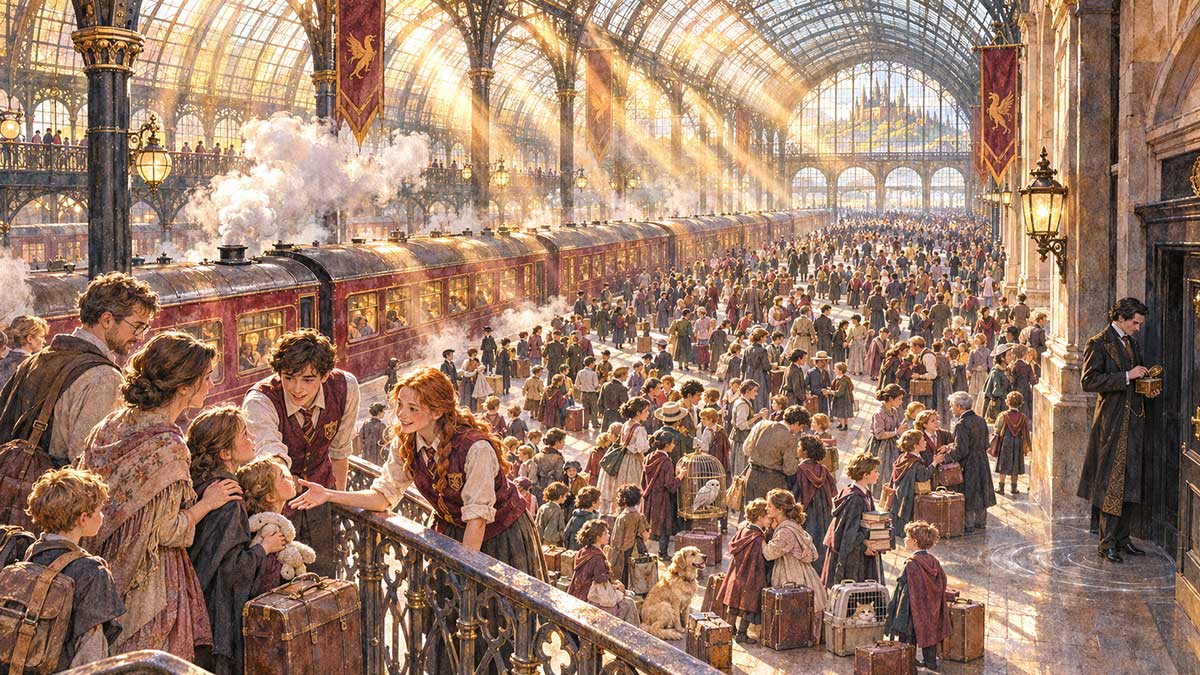
On the last evening of August, Lily Evans discovered that a list of names could be more frightening than a threat.
The first column held students. The second held the people who had come to see them off at King's Cross: mothers, fathers, sisters, brothers, guardians, and friends. In the third she had written the particular connection each student had been asked to describe to the Society of the Seventh Seal.
Nora Fenwick. Her father. The day he had carried her trunk through the station.
An older Ravenclaw. Her younger sister. The promise they made when the younger girl received her Hogwarts letter.
A boy Lily had met only once. His grandmother. A song in a language Lily could not read.
Lily added a fourth column that said only ACCOUNTED FOR. She did not yet mark it.
Mary returned from the adjoining room with a bundle of envelopes tied in green ribbon. They were letters from parents who had received the Society's invitations. Some were angry. Others insisted that their children had signed nothing more dangerous than a school club register. One letter contained a photograph of two brothers squinting into summer sunlight. The mother had drawn a circle around the younger boy.
Lily read the first three letters aloud, but stopped at the fourth. It had been written in sloping blue ink by a father who worked nights and would arrive late at the station. He asked whether somebody could tell his daughter he had tried to come sooner.
Mary took the letter. “She may not be on Voss's list.”
“We don't know who is on his list,” Lily said. “That's why I want a plan that helps people who aren't named here.”
They made a second sheet with no victims listed on it at all. It described the symptoms of a severed connection without suggesting that the child had lied, that the adult was an impostor, or that a frightened person was obliged to trust anyone. It listed a place where volunteers would wait, with Dumbledore's name and the name of the railway supervisor who had agreed to help.
Mary read the finished instructions. “There's nothing about fighting the person doing it.”
“The adults can deal with him. We need families to know what to do when the ordinary rules fail.”
A small argument followed about the best meeting place. The first idea was near the clock, until Mary pointed out that the clock was visible from too many approaches and would draw a crush of people who did not know why they had stopped. They chose a quieter area alongside the barrier and arranged for another station employee to guide overflow traffic toward a waiting room.
Lily drew the two sites on a sketch. She was not certain they would be enough.
A mother arrived with two daughters and asked a question no one had rehearsed. “What if I'm the one who forgets them?”
Lily felt the girl's smaller hand tighten around the mother's coat.
“Then you should be given the same chance to decide what help to accept,” she said. “Your daughters will still know who they are. We won't ask them to prove it by being brave for everybody else.”
The mother nodded slowly. One of the daughters asked whether they would still be able to get on the train.
“We're working to make that possible,” Mary said.
After they left, Lily added one final instruction to the sheet: check adults, too. Children were not the only people who could be frightened into following a stranger.
He had written about the day his brother taught him to swim. His brother would be with him at the station. She begged them not to separate the boys.
“Should we ask them to stay home?” Mary said.
Lily studied the photograph. “Some families already have train tickets and no other way to get their children here. If Voss has their names, staying away may not protect them forever. We need an actual plan for the station.”
She carefully put the letter into a folder for Dumbledore.
“I'm worried they'll be frightened of their own children,” Mary said.
“I'm worried the children will be frightened of the people who come to help them.”
Mary sat down opposite her. “Then our instructions need to start with that.”
They tried out several versions. “Do not trust an unfamiliar volunteer” was unhelpful, since the affected children might find everyone unfamiliar. “Remain with your family” could be impossible if the child no longer believed the relationship. Their third attempt took nearly a full page and still failed when Mary read it aloud as though she were a panicked eleven-year-old.
“Stop,” she said. “If I had just forgotten my mother, I wouldn't listen to any of this.”
Lily set down her quill. “What would you listen to?”
Mary thought. “Someone telling me I could say no. Someone who would stay close and not pull at my sleeve.”
Lily wrote: I will tell you who I am. You do not have to believe me immediately. You may choose where we stand. We will not take you away from the people who came with you unless you ask, or you are in immediate danger.
It was longer than she wanted, but it was honest.
A small owl arrived at the window, carrying an answer from Thistlewick. Dumbledore had secured help from magical station staff who knew the barrier, and from adults able to guide the ordinary travelers away from the affected families without exposing the platform to them. They would keep the public part of the station moving, isolate neither the student nor the family, and use a side room only by agreement or for immediate safety.
“He can still slip through,” Mary said.
“Yes.” Lily looked again at the empty fourth column. “And we may not find everybody.”
She left the column unmarked. It was a promise to keep counting, not an assurance that the count would be perfect.
They were not the sorts of facts a dark wizard would ordinarily steal. That was what made them so terrible.
Mary Macdonald leaned over Lily's shoulder. “You can't ask every family to tell you their private memories.”
“I know.”
“And some won't believe you.”
“I know that too.”
Lily set down her quill. “We don't need their secrets. We need them to know that something may happen, and that they mustn't let anyone take their children away merely because a child fails to recognize them.”
Mary studied the list. “How do you say that without terrifying everyone?”
“I haven't worked that part out.”
A knock sounded at the door. Professor Thistlewick entered with Dumbledore, followed by James Potter, who was carrying a rolled parchment and looking uncharacteristically serious.
“Miss Evans,” Dumbledore said, “we have spoken to the station authorities and made arrangements for assistance. Your list will help us identify those at greatest risk.”
Lily stood. “There may be more. The society used several versions of the invitation. I don't know whether we found them all.”
“Then we plan for uncertainty,” Dumbledore replied.
Dumbledore asked each person at the table to explain exactly what would make them abandon their post. The railway supervisor would move for a blocked exit or an unsafe platform edge. Thistlewick would move if an adult tried to take a child away against that child's expressed wishes. Mary would move between the quiet waiting room and the barrier. Remus would supervise the volunteer pairs on the concourse.
James listened until he grew restless. He wanted one clear assignment that would take him straight to Voss. Instead Dumbledore told him to remain near the families with Lily and report anything he recognized about the case.
“I'm the one who's seen him use the Archive,” James objected.
“Which is why you will identify his methods,” Dumbledore said. “And why your first responsibility cannot be to chase him.”
James opened his mouth, then glanced toward Peter, who had been keeping a careful count of the entrances on the station drawing.
“What if two groups get separated by the crowd?” Peter asked.
“The station staff can hold people at the barrier,” the supervisor replied. “Not for very long. The train cannot wait indefinitely.”
“Then the most useful thing is a record of who was together before the separation,” Peter said. “Not just the names of people who were affected.”
Lily took the pencil from her ear and wrote that down.
Nobody declared the plan finished. It filled the table with uncertain tasks, open questions, and the names of adults willing to take responsibility. James found that less satisfying than an adventure announced with a flourish. It felt considerably more serious.
Mary found a flaw in their arrangement when they tried it with three volunteers and a boy who had agreed to pretend he could no longer recognize his aunt. At the first meeting point, two helpers stepped into the same narrow passage and blocked the exit with a trolley. The boy stopped playing his part and began complaining that he could not get through even if he wanted to.
"Good," Lily said, though her face had gone pale. "That's exactly the sort of mistake we need to find now."
They cleared the passage and tried again. This time the boy reached the bench, but the volunteer beside it immediately asked him to describe his favorite memory of his aunt. Lily halted the exercise.
"Don't ask for a private memory to prove a relationship," she said. "If the connection has been cut, it won't persuade him. If it hasn't, you've frightened him for nothing."
The volunteer reddened. "Then how do I help?"
"Ask where he feels safe standing. Tell him which adult is in charge. Let him refuse a conversation that isn't urgent. Keep a written record of whom he arrived with, but do not treat the paper as permission to move him."
James watched her reset the positions on the sketch. In a duel, a good answer usually came quickly enough to feel like instinct. Here they had to practice not doing things: not grabbing an arm, not announcing that somebody ought to be grateful, not treating frightened silence as consent. He found it harder than he wanted to admit.
When the volunteers had gone, Mary lowered herself into a chair. "We have trained them to do almost nothing."
"To do the right small things," Lily corrected. "And to get the children out of the path of a moving train."
Peter added a thick line across the station drawing. "Then our meeting places need a second route for people who cannot bear to cross the first one. We should assign someone who only watches the exits."
"You'd be good at that," James said.
Peter gave him a sharp look. "Don't give me the boring job to prove you trust me."
"I wasn't." James paused. "You're right. Tell us which job you want."
Peter studied the map and tapped the central pillar. "I want the notebook. If everyone sends their information to one place, we'll know what we haven't found."
Lily handed it to him without ceremony. She had written the names and routes in a small, practical script. Peter turned to a clean page, drew two columns, and labelled them SEEN and STILL LOOKING. The second column remained empty. For the moment.
James unrolled the map on the table. Its moving lines showed Hogwarts, not London, and Lily gave him a questioning look.
“We can't use it to map King's Cross,” he said. “Not yet. But we've learned to follow positions without pretending we know what people are thinking. I thought that might help with the rescue routes.”
Thistlewick placed a sketch of the station beside the map. “We have four main exits, a crowded concourse, and the barrier to the platform. We will have people near each. No one acts alone.”
James nodded. Lily noticed that he did not argue.
“What about Voss?” she asked.
“We believe he has transferred the signed records to a portable case,” Thistlewick said. “He needs proximity to the students and a moment when their connections matter. A station full of families is an ideal place.”
Lily looked at the names again. “He's going to make people strangers to one another in public.”
“He will attempt it,” Dumbledore said.
The distinction mattered. Lily wanted to believe they could stop him before anyone was hurt. She had learned enough from Asterfell to know that wanting did not make it certain.
That night she wrote a short instruction for each volunteer: do not restrain a frightened child unless immediate safety requires it; do not force recognition; keep the affected person near someone they know; ask whether they freely wish to accept help.
She wrote the word freely twice.
At the Potter house, James found Sirius in the garden with a broomstick balanced across his knees. The air smelled of cut grass and the last warmth of summer. Sirius had moved into his own flat using the money left by his uncle Alphard, but he still came to the Potters for Sunday dinner, and tonight he had stayed to help prepare.
“Do you think he'll be there?” Sirius asked.
“Voss?”
“Regulus.”
James sat beside him. “I don't know.”
Sirius looked down at the broom. “He'll be going back for seventh year.”
“You might see him.”
“And say what?”
James considered the question. He could think of a dozen speeches, none likely to change Regulus's mind.
“Perhaps nothing,” he said.
Sirius gave a bitter laugh. “You're becoming good at that.”
“At what?”
“Not pretending there's an answer.”
James watched a moth circle the garden lamp. “I'm still trying.”
Inside, Mrs. Potter called them to supper. Sirius rose slowly, and James followed.
At supper, Mrs. Potter insisted that everyone eat enough to think clearly the following morning. Her idea of enough required three attempts and a threat to send another plate upstairs. Sirius accepted a second helping simply to see whether James would manage to escape his own.
Mr. Potter asked for the station plan. He did not touch the page until Peter gave permission, then traced the narrow passage between the main concourse and the platform barrier.
“Do you have someone posted here?” he asked.
“Two staff members,” James said. “One on either side.”
“And a way for them to send word if they lose sight of each other?”
Peter looked up from his plate. “I put a signal for that on page three.”
Mr. Potter turned to it. “A sensible precaution.”
Sirius tried to reach across the table for the bread. Mrs. Potter caught his wrist without looking up from her conversation.
“Use the plate,” she said.
“I was testing your reflexes.”
“You tested them at Christmas.”
“And they remain excellent.”
James laughed, then saw Sirius watching Mrs. Potter with a look that vanished as soon as he noticed James noticing. The Potters had made room for him without ceremony. James knew that their home could never mend everything that had been broken at Grimmauld Place, but he was grateful it did not require Sirius to pretend.
After the dishes were cleared, the boys carried their bags into the sitting room. Sirius picked up an old photograph from the mantel. James and Sirius were thirteen, standing in the garden with a broom between them, both covered in mud. Peter had been behind the camera; Remus had refused to stand in the photograph until they stopped arguing over whose broom it was.
“Have you told your parents about the danger to their names?” Sirius asked quietly.
“Dumbledore has,” James said. “Mum said she'd come to the station if they needed another volunteer.”
“Of course she did.”
Sirius returned the photograph to the mantel. “I don't want them hurt on my account.”
“They aren't helping on your account. They're helping families.”
“Same difference, sometimes.”
James did not argue. The house made a series of familiar noises around them: a clock striking, water moving through the pipes, his mother humming in the kitchen. He had always taken those noises for granted. Tonight he listened carefully, as though he could memorize the entire place before morning.
Later, when the house was quiet, James found Peter checking a small notebook. It contained names, meeting places, and the order in which the volunteers would move if the station became confused.
“You've done all this?” James asked.
“Lily did most of the names. Remus checked the exits. I wrote down where everyone should be.”
James looked at the neat pages. “Good work.”
Peter smiled, then hesitated. “If it goes wrong, you'll want to take over.”
“Probably.”
“Please don't.”
James raised his eyes.
Peter's voice was steady. “You can't be everywhere. Someone has to stay with the plan.”
James closed the notebook and handed it back. “Then that someone should be you.”
Peter looked as if he wanted to ask whether James meant it.
“I mean it,” James said.
The next morning, King's Cross filled with steam, trunks, and the familiar cries of families saying goodbye.
At ten o'clock, the station seemed to be made of farewells. A boy tugged a caged owl through the crowd while his little brother begged to hold its tail. A grandmother produced an astonishing quantity of sandwiches from a handbag no bigger than a glove. Near the barrier, a father knelt to repair the loose wheel on a trunk and received advice from four different people who had never met him.
James watched Mrs. Potter straighten his collar, despite the fact that he could have done it himself. Sirius stood a little apart, pretending an interest in the departure board. Mrs. Potter caught his sleeve before he could move away.
“You know you can write if you need anything,” she told him.
“I have a flat, you know.”
“A flat can't tell when you're forgetting to eat.”
“That is a terrible defect in flats.”
She kissed him on the cheek. Sirius froze, glanced at James, and then, to James's surprise, bent down and kissed her cheek in return.
Peter appeared with the notebook and announced that the quiet waiting room was open. Remus checked the two volunteers by the barrier, reminding them that their job was to keep people together, not to tell families what they ought to feel.
Lily passed through the crowd carrying her folder under one arm. Her hair was escaping its pins, and she had a pencil tucked behind one ear. James wanted to say something witty. He found himself asking whether she had eaten breakfast.
“Yes,” she replied. “Have you?”
“Of course.”
“Toast taken from Sirius doesn't count.”
James grinned. Then a girl near the ticket barrier began shouting for her father, although he was standing at her side. The grin vanished. The plan they had made on parchment had finally become a room full of real people.
A mother near the barrier bent to straighten her son's scarf. He looked up at her with an expression of polite confusion.
“Excuse me,” he said. “Who are you?”
The woman laughed at first.
A porter's whistle sounded behind her. A trolley rattled past, and a little girl in a yellow coat tugged at her father's hand because she had seen the train smoke beyond the barrier. The mother stepped closer to Daniel, still smiling, trying to turn his question into the kind of joke a nervous child might make at the beginning of term.
“Come along, darling,” she said. “Don't tease.”
Daniel moved sideways until the trolley stood between them.
“I wasn't teasing.” His eyes flicked to the woman holding his ticket, then to the name stitched into his school scarf. “You know where I'm going. How do you know?”
She looked at the ticket, at the trunk with his initials, at the small repair she had sewn into the elbow of his robe the previous night. She had done all those things for him. She could explain every one. Yet none was proof the boy could feel.
On the other side of the concourse, a man lifted a leather case from a bench and turned the clasp toward the stream of departing students.
The mother's mouth opened. No answer came.
Then she saw his face.
Chapter 21: The Crowd That Forgot
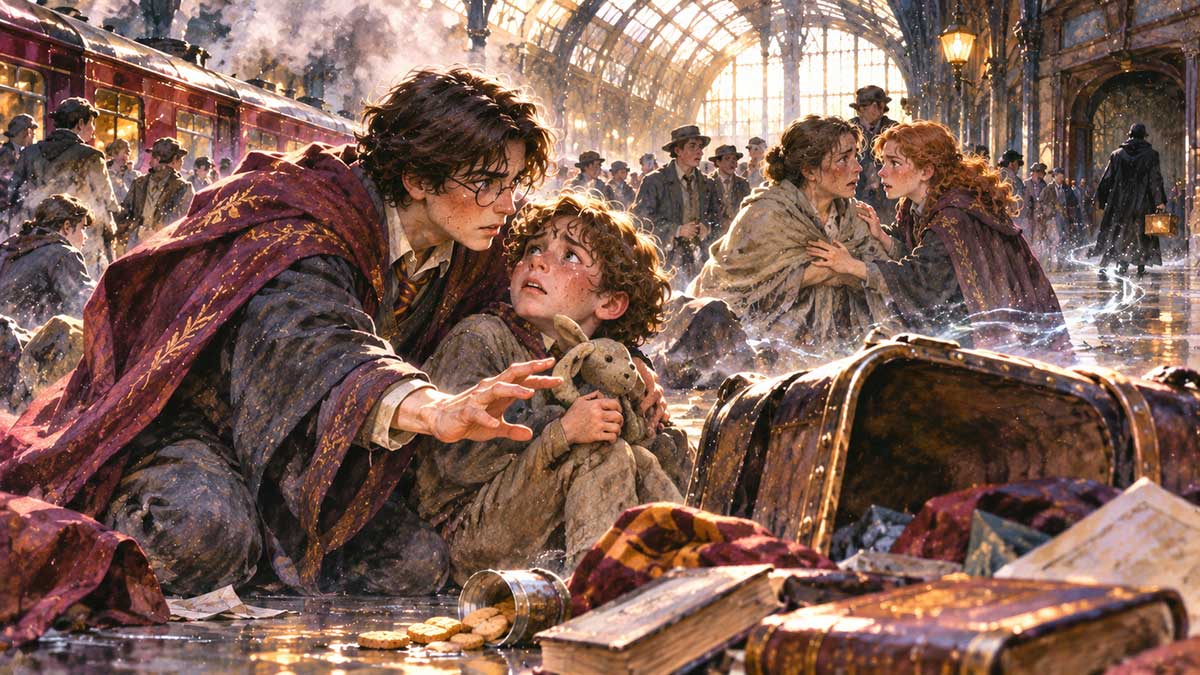
Earlier that morning, Voss had inspected the brass case beside an unused service doorway. A packet of signed forms lay beneath its glass plate. The names were already written there, each paired with the connection its owner had answered questions about in the Society's rooms. His latest mechanism could draw on those existing answers only when a named student came within the reach of its seven-line clasp. He could not invent a new name in the crowd or strip a stranger's history with a careless wave of his hand.
The clasp required a pause to settle after each release. Voss watched the barrier and counted the families moving into range. He needed only a few successful severances to prove his design to the buyer. If the students boarded too soon, the experiment would fail before it began.
The first scream came from beside a luggage trolley.
It was not loud enough to stop the station. A train whistle swallowed most of it, and people continued walking, kissing cheeks, checking tickets, and calling children back from the edge of the platform. That was what frightened Lily most. Something dreadful had begun, and ordinary life kept moving around it.
The boy whose mother had straightened his scarf backed away from her.
“Don't touch me,” he said.
“Daniel, darling, it's me.”
He shook his head. “I know my name. I don't know yours.”
Lily reached them with Mary at her side. She had memorized the instructions she had written, but now she had to speak them aloud to a woman whose face was collapsing with fear.
“I'm Lily Evans. We're here to help. Please stay close to him, but give him room.”
The mother caught Lily's sleeve. “What's happened to my son?”
“We believe someone's interfering with recognition. He may remember things you've done together without knowing they belong to you.”
The woman looked at Daniel. “You remember the blue bicycle?”
He nodded uncertainly. “I remember falling off.”
“And who picked you up?”
He shut his eyes. “Someone did.”
“Would you like to hear her tell you about it?” Lily asked.
Daniel looked at the woman. His breathing was quick and shallow.
“Maybe,” he whispered.
Mary cleared a space between two pillars where Daniel could see his trunk and the barrier. He insisted on keeping his ticket. Lily agreed at once.
“Who are you supposed to be?” Daniel asked the woman.
“Your mother,” she said.
He looked at Lily, who was standing close enough to intervene but not close enough to hem him in.
“I can't tell you what to think,” Lily said. “You can decide whether you want to hear what she remembers.”
The woman's fingers clenched around her handbag. She looked as if she might shout that she did not need anyone's permission to speak to her own son. Then she saw the fear in his face and sat down on a nearby bench.
“I can start with the bicycle,” she said. “Or we can talk about the sandwiches I packed.”
Daniel glanced at the trunk. “What sort of sandwiches?”
“Cheese, with the crusts left on. You said you were old enough to decide for yourself.”
He blinked. “I did.”
“Do you want me to open them?”
“Not yet.”
She nodded, holding the bag on her lap. That was the first choice he made that morning, and she accepted it without argument.
Lily looked toward Mary, who had already begun directing a second family to a separate place where they would not be interrupted. Nearby, one of the station volunteers held up a paper sign showing the agreed meeting point. No names, no claims of custody, no demand for a response.
For the moment, the plan was working as a plan. It could not restore what had vanished. It could prevent fear from doing still more damage.
That moment ended when the porter at the outer passage began shouting that two children had tried to climb onto the wrong train. Lily ran with Mary to find them. One child was clinging to a post; the other insisted his brother had been replaced by a stranger. They had been holding hands only minutes earlier.
A crowd gathered almost at once. Someone said the boys were lying. Another accused the older one of stealing a ticket. Mary stepped between the children and the onlookers. Lily asked the porter to clear a path and lead the nearest adult away from the rails. She kept her voice low, not from calm but from fear that one more raised voice would send the younger child running.
"You're not in trouble," she told him. "You can stay where you are, but the train must be able to move. Can we walk to that wall together?"
He considered her for a long second. "Will he follow?"
The older boy's face crumpled. "I have to. He's my brother."
"Only if you keep a little distance until he asks," Lily said. She looked at the younger child. "You can tell me when it's close enough."
They walked slowly past the porter. The older boy followed three steps behind, carrying both their schoolbooks. He knew the younger one's name, birthday and favorite pudding. He knew every story that had made them brothers. None of those things reached the frightened child. Yet the younger one let him carry the books. Lily counted that as a beginning and refused to call it anything greater.
Farther down the concourse, James saw Voss glance at the commotion with professional interest. His hand rested on the case. James felt his wand beneath his sleeve and pictured the straight route across the floor. One good stunning spell. One leap over the fallen trolley. An ending he could explain afterward.
A little girl tripped at his feet. The heel of her shoe caught beneath a trunk, and the crowd pressed past her. James crouched, freed her foot, and carried the trunk toward a clearer space. When he looked up, Voss had moved. James's first emotion was anger at the child for needing him. He was ashamed of it before he stood.
The girl took her trunk and stared at him suspiciously. "I didn't ask to be picked up."
"I know," James said. "I should have asked. Are you hurt?"
She shook her head. He watched her hurry toward a volunteer. He had lost the chance to catch Voss, and perhaps he had prevented a worse loss. There was no clean way to measure the two possibilities.
Lily guided them away from the flow of travelers. She could not make Daniel accept the connection. She could give him a place to choose.
Near the service corridor, Thistlewick and two adult helpers approached the brass case from opposite sides. One carried a shield charm that shimmered along the wall. The second held a thick cloth intended to cover the case's open face without touching the signed documents beneath it. They had rehearsed the maneuver with an empty suitcase.
Voss watched them come, almost amused. He turned the clasp a fraction. The edge of the brass assembly took on a thin green glow, and a woman standing beside her daughter stepped back as though the girl had spoken in a foreign language. Her daughter reached toward her, then withdrew. The case had not struck everyone in the corridor. The moving strip of air between the case and the signed names had carried the effect across the few people already named in its records.
Thistlewick lowered the cloth. "Close it," she said to Voss. "You do not have unlimited reach."
"Nor do you have unlimited time," he replied. "A train cannot remain at the platform merely for your conscience."
The shield shifted between him and the nearest family. For a second the green light narrowed. Voss backed toward the service doorway, keeping the case aligned with the retreating students rather than the professors. James saw the tactic at once: if the adults lunged toward the case, the beam would pass across children struggling to leave. Their caution gave Voss room.
"The volunteers can clear the near side," James called. "Move the named students behind the pillars. The case can't use a name it hasn't got."
Voss's eyes flicked toward him, the first sign of irritation James had seen. Thistlewick didn't answer the boy directly, but she moved her shield to shelter the narrowest path and signalled the helpers to guide the children around it. She had not won. Yet Voss had to turn the case again to threaten the next group. Every movement showed them another limit.
Peter was already writing those limits into the notebook: names recorded, line of sight, open clasp, interruption by shield. He drew a mark beside the family that had just been struck. He did not circle their names.
Across the station, James saw three more families falter almost at once. A girl called her father “sir.” Two sisters looked at one another with equal bewilderment. A student who had been laughing with friends suddenly stood among them as though she had entered the wrong compartment.
The confusion did not spread evenly. One group passed through untouched. Three paces away, an older student tried to persuade a younger one that they had shared a compartment every year, and the younger child shook her head with increasing panic.
James saw a volunteer raise her wand. He caught her wrist before the spell was cast.
“Not a Memory Charm,” he said. “It won't restore what Voss has taken.”
“She won't come with me,” the volunteer said.
“Then stay where she can see you. Don't make her come.”
At the far side of the concourse, a porter was trying to push an abandoned trunk through the crowd. It blocked the route to the waiting room. James waved to the station supervisor, who sent two workers to move it. The incident took less than a minute. James noticed how many frightened people had begun gathering in the wrong place during that minute.
Mary hurried past with a pair of sisters, repeating the names of the volunteers who would meet them. One sister remembered the other's favorite book but could not remember why she knew it. The other insisted they had been arguing about a borrowed scarf only five minutes earlier. She looked furious, as if anger might pull the vanished connection back into place.
James remembered his own terror in the Archive, when Sirius had been standing close enough to touch and had felt like a stranger. The recollection steadied him. He did not need to invent a grand speech. He needed to ask the girls where they wanted to wait, and whether they wished to stay together.
The younger sister nodded. The older one whispered, “I don't know why I want to, but yes.”
They went with Mary. James watched them reach the waiting-room door before he turned to the next family.
James saw how the panic traveled before most people understood what was happening. A boy called for his father. The father answered at once, and the boy turned away from the familiar voice with a startled expression. A nearby woman took his hand in an attempt to comfort him. He accepted it, then realized he did not recognize her either and pulled free.
A luggage trolley rolled unattended into the edge of the crowd. The wheels struck a pillar and sent a cage of white owls rocking. The birds beat their wings against the bars. Somebody shouted that a child was missing. Three people repeated the shout, each believing it concerned a different child.
James climbed onto a low stone step and scanned the station. He could see the four routes that Peter had marked, but the lines on paper could not account for a fallen suitcase, a crying first-year, or the travelers who had stopped to watch.
Near the far wall, a girl wearing Ravenclaw colors stared at an older woman who was holding out a coat.
“I'm not going with you,” the girl said.
“You don't have to,” the older woman replied. She set the coat on a bench. “But it's yours, and it's cold on the platform.”
The girl picked it up after a moment. The older woman did not reach for her.
That restraint mattered more than James had expected. It left a narrow path open for trust.
He caught sight of Peter at the agreed position, counting people with a pencil held between his teeth, crossing off a direction and writing another without looking up. James started to call him over. Then Peter raised his hand and pointed toward Remus. The message was simple: the north route needed help, and the plan was already moving.
James swallowed the instruction he had been about to shout. Peter was doing his job.
A man in a dark coat stepped into the gap beside the frightened Ravenclaw girl. He held out a folded paper with the Society's seal and said he had been asked to take her somewhere safe.
The girl looked from him to the older woman with the coat. Her hand moved toward the offered paper.
James jumped down from the step.
Then the crowd shifted.
Men in plain dark coats moved toward the confused students. They were not running. They offered help in calm voices and directed the children toward a side exit, away from the families trying to reach them.
James recognized the method before he recognized the danger. Isolate the person. Make the rescuer seem unreasonable. Offer certainty to someone who has lost the most familiar certainty in the world.
He moved to intercept them.
A hand caught his sleeve. Remus.
“Not alone,” Remus said.
James almost pulled free. There were frightened children in front of him, and every instinct urged him to act before another second passed.
Instead he looked toward the volunteers. Thistlewick was moving to the side exit. Sirius had taken position near the barrier. Peter was with the route plan.
“Tell Thistlewick,” James said. “I'll stay with the families.”
Remus nodded and disappeared into the crowd.
At the far end of the concourse, Adrian Voss stood beside a battered leather case. It looked like the luggage of an ordinary traveler. A narrow brass clasp held it shut, and beneath the clasp James saw seven tiny lines.
Voss's hand rested over the clasp, shielding it from the moving crowd. To James it appeared that he was guarding something fragile rather than directing a crime.
“Interesting,” Voss said, as if they had met in a quiet study instead of a station full of frightened families. “You have organized the victims better than most institutions organize their archives.”
“You're counting them,” James said.
“I am counting what survives.”
A porter collided with the edge of the case. Voss pulled it back with sudden urgency. The brass plate flashed once and went dark.
James saw the hesitation. “It needs time before you can use it again.”
“All instruments have limits.”
“And those signatures. You can't do this to just anyone.”
Voss's smile narrowed. “You think a limitation makes a device merciful?”
“No. I think it makes you easier to stop.”
Two station workers approached from the far doorway. For a moment James thought Voss might be trapped. Then a knot of travelers moved between them, and Voss guided the case behind the cover of their trunks. He knew the station better than James had expected.
The danger of chasing him struck James with new force. Every move Voss made was aimed at drawing attention away from the affected families. If James followed, the man could choose the next place to strike, and James would once again be running after a danger rather than protecting the people already hurt.
He looked beyond Voss to Mary, who was struggling to keep a clear path to the waiting room. James stepped sideways, giving her space. Voss noticed the choice and, for the first time, looked irritated.
Voss caught his eye.
“You came,” Voss said.
James stopped a few paces away. “Open the case.”
“Such an ungracious greeting.”
“People are being hurt.”
“People are being shown how little they know about themselves.”
A girl behind James began crying for her brother, who was standing directly in front of her.
James felt anger rise so fiercely that his hands shook.
Voss noticed. “You could stop this quickly, Mr. Potter. There are methods of fixing recognition that do not require consent. You might find them useful.”
James thought of Peter in the Archive chamber, giving up the first moment he had felt welcomed. He thought of how easily a gift could become theft when someone decided that the result justified the means.
“No,” he said.
Voss tilted his head. “You haven't heard the offer.”
“I've heard enough.”
A sudden crack sounded from the case. The clasp glowed.
The sound was small, like the splitting of a dry twig. James had expected something more theatrical from Voss: a green flash, a thunderclap, a spell that could be seen from one end of the station to the other. Instead, the brass clasp lifted half an inch and a thin ribbon of grey writing unwound into the air.
Names appeared and disappeared so quickly James could barely read them. Under each name sat a line from a student's own account, a recollection offered to a society that had promised to preserve it. He recognized the form of the seventh clause before the letters folded inward.
“Those children signed in good faith,” he said.
“They answered a question,” Voss replied. “The answer was recorded. We can argue about the spirit of the agreement if it amuses you.”
“The agreement forbids what you're doing.”
“The original does. Copies are much easier to sell.”
James saw the narrow edge of a page in the case, covered with the familiar seven lines. For a moment he believed he could snatch the whole apparatus and break it over his knee. Voss watched his hands with obvious interest.
“You could end this,” Voss said. “You have exceptional magical ability. The same mechanism that separates a bond can be directed to imprint one. A child would recognize the assigned guardian immediately. No questions, no waiting.”
“And if the guardian wasn't real?”
Voss's silence answered him.
James thought of the people stationed at the exits, of Lily asking Daniel what he wanted, of Peter's careful list. He thought of how satisfying it would feel to solve everything at once, and how dangerous that satisfaction could become.
“You're selling obedience,” he said.
“I'm selling certainty.”
“It's the same thing if no one can refuse.”
The grey ribbon divided into strands and flew over the crowd. Voss closed the case enough to hide the writing but not enough to stop it. He had planned the demonstration to be seen. He wanted an audience for the harm he could create and for the false cure he could offer.
Across the station, another wave of confusion passed through the crowd. A father reached for his daughter's hand and she recoiled. A woman called her son's name, and he turned toward the voice with the wary expression one gives a stranger.
James wanted to run to all of them.
He could not.
Near the barrier, Sirius saw Regulus among the students waiting to board. Their eyes met for a single instant. Sirius took a step toward him.
Then a little boy beside Regulus began to cry because he no longer recognized his older sister.
Sirius turned away from his brother and went to help the child.
Regulus watched him go.
The little boy had wrapped his arms around his trunk and was refusing to move. His sister stood a pace away, visibly trying not to cry.
“He's frightened of me,” she told Sirius. “I'm the one who taught him to get through the barrier.”
“Then you know he doesn't like being hurried,” Sirius said.
She gave a surprised nod.
Sirius crouched so the boy would not have to look up at him.
“Do you want to stand right here?” he asked.
The boy nodded.
“Fine. The train isn't going anywhere without a great deal of complaint from the staff. Your sister can wait over there, and you can tell her when you're ready.”
“She's not my sister.”
“You don't have to call her that yet.”
The boy studied Sirius. “Are you somebody's brother?”
The question struck with an accuracy no spell could match.
“Yes,” Sirius said.
“Does he like you?”
Sirius looked toward the Slytherin students. Regulus had turned away, but he was still close enough to hear if Sirius called his name.
“I don't know,” Sirius answered.
The boy looked at his sister. “I used to like her.”
“You might again,” Sirius said. “You get to decide what happens next.”
When he rose, Regulus was no longer there. Sirius stared at the space for a moment, feeling anger at himself for missing another chance. Then the boy asked whether he could sit on his trunk, and Sirius helped him turn it on its side without letting the wheels roll away.
At the side exit, Thistlewick intercepted two of Voss's assistants. They attempted to claim that the students had been placed in their care by the Society. Thistlewick demanded the signed authorizations. The men produced papers bearing the same false seventh clause.
She held them up.
“These do not give you custody of anyone,” she said.
One man reached for his wand. Dumbledore arrived before he could raise it.
Lily heard the disturbance but kept her attention on Daniel and his mother. The boy had agreed to listen. His mother was describing a rainy afternoon, a blue bicycle, and a scraped knee.
“I was cross with you,” Daniel said suddenly.
“You were,” she replied. “You said I should have caught you.”
“I did say that.”
“Would you like me to hold your hand?”
He looked at her for a long time.
Then he nodded.
Lily felt a small warmth pass through the air. Daniel's expression changed. He whispered, “Mum.”
His mother folded him into her arms.
Lily almost cried. She had no time.
James looked from the reunited pair to the spreading confusion. He understood that the answer was not to defeat Voss in a duel and hope everyone else recovered. The answer was to bring people back to one another, one freely chosen connection at a time.
He turned and called for Peter.
Voss smiled thinly.
“Trust,” he said, “is such a fragile thing. It can always be made to fail.”
James looked at the frightened families.
“Then we'll keep choosing it,” he said.
Chapter 22: The Map in Peter's Hands
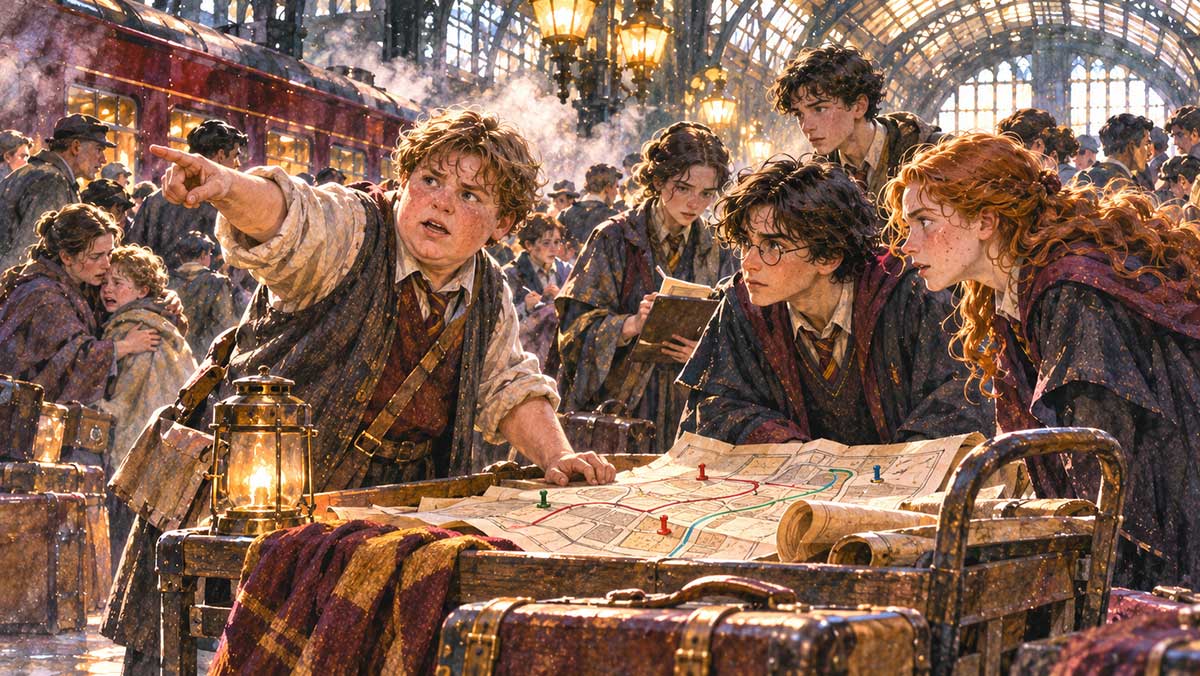
Peter Pettigrew had never liked being in charge of anything that could go wrong.
An hour before the attack, Peter had drawn a little square beside each meeting place in his notebook. He had expected the squares to be useful. He had not expected to become the person everyone looked at when a decision had to be made.
He had once envied James's ease with that attention. When James spoke, people seemed to move in the direction of his voice without questioning it. Peter had always believed the trick lay in saying something brilliant quickly enough that no one noticed the fear beneath it.
Now, watching the station fill with frightened strangers, he discovered that the only words he could rely on were ordinary ones: Where did you last see her? Is he safe? Who has already checked that passage?
He told himself he could ask those questions without pretending to be anyone else. He took a breath and returned to the marked floor plan.
He liked knowing where to stand. He liked being given a task and finishing it well. He liked the moment when someone checked his work and said it was correct. Taking charge meant that if something failed, people would look at him first.
Now James was pushing the route notebook into his hands.
“Take it,” James said.
“James, I can use the station plan, but the magical map only shows Hogwarts.”
“Exactly. Use the hand-drawn station routes, the volunteers’ notes and the meeting points. The Hogwarts map cannot track anyone in London, and neither parchment can tell us whether a person trusts another.”
Peter looked across the concourse. Children were crying. Parents were shouting names that no longer meant what they should. A trolley had overturned near the barrier, and someone was trying to gather spilled books before they were trampled.
“What if I send someone the wrong way?”
“Then correct it.”
“What if I can't?”
James gripped his shoulder. “I trust you.”
For an instant Peter felt the familiar ache of the memory he had surrendered. He knew James had welcomed him on the train years ago. He knew the words. He could not recover the first feeling.
But James was here now, asking him to help.
Peter opened the notebook.
The first message came from the north passage: a young girl had been found, but she would not go with the man carrying her trunk. The second came from Mary: two boys had reached a safe seat and were refusing to speak to each other. The third came from the porter: the crowd was beginning to push against the barrier.
Peter had never felt so close to failing at something that mattered. The answers arrived faster than he could write them. He made a mistake, sending a volunteer to the wrong arch, and caught it when the same child's name appeared on a second report. He crossed out the instruction, sent a correction, and told the volunteer plainly that it was his error.
No one stopped listening to him. That surprised him more than anything.
A witch wearing a brown travelling cloak approached with a little boy whose face was smeared with tears. "He's asking for his father. The father is at the far end of the platform. Shall I take him?"
"Ask him," Peter said.
The boy stared at Peter's open notebook. "Will I get lost again?"
"I can't promise that," Peter replied. "But the two of you can walk with the volunteer, and I can write down where you're going. Then if someone looks for you, they'll have an answer."
"Will you stay here?"
"Yes."
The boy considered this. "Write my name properly. It's Jonathan with an h."
Peter wrote it carefully, showed him the page, and watched the little procession depart. It would have been easier to tell the child everything would be fine. It would have been less truthful. Peter wondered, briefly, whether James had learned the same lesson when he had handed him the notebook.
A moment later, James appeared by the pillar, breathless and smudged with soot. "Do you need me to take over?"
"No," Peter said, more sharply than he intended. "I need you to go where I send you."
James blinked. Then he nodded.
"There's a family at the east bench who can't reach Mary," Peter continued. "Take two volunteers and clear the path. Don't move them until they agree."
"Right."
Peter watched him go. He had imagined leadership as a grand feeling that would arrive when he finally deserved it. It felt more like a stack of unfinished tasks and an ache in his hand. Still, he could do the next thing.
“Remus,” he called. “Take the north side. Find the sisters from the list. Sirius, stay near the barrier. Don't let anyone separate the children from their families. Mary, bring the volunteers to the middle platform.”
The words came faster once he began.
He marked each reunited pair with a small circle. He marked the missing ones with a line. When a family could not be found, he sent someone to the agreed meeting point rather than letting the volunteers scatter.
He had initially marked the barrier as the sole place where families should wait. Now he saw it would trap confused students in the busiest part of the station. He crossed out his own instruction before anyone else could obey it, wrote two quieter locations, and sent Mary to correct the volunteers. He had made a mistake. It did not have to become everyone else's.
The first person to challenge him was a railway porter with a gray moustache and a trolley full of trunks.
“You can't make a meeting place in the middle of my station,” the man said. “People have trains to catch.”
Peter glanced at the clock above the concourse. Its hands had moved since the last time he looked. The departure board was changing, and a line of impatient travelers had formed behind a cordon. The station did not know it was supposed to stop for a magical emergency.
“I know,” Peter said. “Can you bring the trolley around the other side? It will keep this passage clear.”
“I haven't got orders from you.”
“No. You've got orders from the station manager. Professor Dumbledore said he'd spoken to him. If that's not true, I can find someone who can explain.”
The porter studied Peter's face and then the frightened child sitting with a volunteer near the pillar. Without another word, he turned the trolley. Its wheels complained on the tiles.
“Thank you,” Peter said, and meant it.
His first plan had been to gather every family at the barrier. The plan now seemed absurd. Crowds were pressing through it from both directions, and a confused child could be carried away by people who believed they were helping. He drew a new shape in his notebook: a small waiting area by the clock, a second station by the bookstall, a line between them that no rescuer would cross without telling someone.
“Two meeting points,” Mary said when he explained. “How will we know where a child has been taken?”
“Each pair of volunteers carries a numbered card. They give the card to whoever stays behind. I'll write the number beside the name. If a child moves, the number moves with them.”
Mary pulled a handful of blank cards from her bag. “I'll cut these.”
Peter started to thank her, then stopped. There was no time for politeness long enough to conceal an instruction.
“Please write the numbers as large as you can.”
He almost apologized for sounding demanding. Instead he opened the notebook to the next name.
A woman approached the clock holding a photograph of a girl in yellow ribbons. “My daughter came through the barrier,” she said. “She was right beside me. Then she said I was a stranger and ran. Do you know where she is?”
Peter took the photograph. He recognized the girl from the list, but there was no circle beside her name. He asked permission to describe the picture to the volunteers. The woman said yes so quickly that the word sounded painful.
He sent a message to Sirius, who was guarding the barrier, and another to Remus along the northern passage. Then he placed the photograph where the woman could see it, on the notebook between them.
The mother with the photograph had begun to apologize for troubling him. Peter stopped her.
“You've told me where your daughter was standing. That's useful. I need you to remain here so she can find you if she comes back.”
“What if she doesn't know me?”
“Then we tell her you're waiting and let her decide what she wants to do.”
She looked down at the photograph. In it, a small girl held a paper crown over her mother's head, both of them laughing too hard to keep still.
Peter drew a fresh symbol in his notebook, different from a circle and different from a line. The circle meant connection restored. The line meant someone still missing. The new mark meant a person was safe but had not yet chosen what happened next.
Remus arrived to report that the northern passage was clear, but two volunteers had begun arguing about whether to force a boy through the barrier before the train left.
“Tell them no,” Peter said. “And find out whether the boy has a family member he wants to speak to first.”
Remus nodded, then smiled at him. “Good call.”
The phrase was so simple that Peter almost missed it. Later, he would remember that a person could be trusted without receiving a speech about his bravery.
“Will you wait here?” he asked.
“What if she's looking for me?”
“If she comes back, she'll know where to find you. If she doesn't, someone will bring her.”
The woman looked at the photograph. “She loves those ribbons. I tied them for her this morning.”
Peter thought of the train memory he could describe but not feel. He knew the precise shape of an absence now. He refused to tell the mother that a picture would solve it.
“Tell me what happened when you tied them,” he said. “I'll write it down for her, if you want.”
As the woman spoke, Peter recorded only what she agreed to share. A small thing. A yellow ribbon. A mother who had held her child's hair in both hands that morning. He put the note into an envelope, not the society's ledger, and marked the envelope with the woman's chosen meeting point.
For the first time since James handed him the plan, Peter noticed that he was no longer waiting for someone else to decide what mattered.
The work was not glamorous. It was counting, checking, and asking people to repeat instructions. It was the kind of work Peter could do.
At the side exit, Snape appeared beside Lily.
“Three students,” he said. “Voss marked them for the next activation. Their names are on this page.”
Lily took the paper. “How did you get it?”
Snape's face tightened. “I helped him copy the inscriptions. I didn't know he would use them here.”
“You knew enough to be afraid.”
“Yes.”
The admission startled her.
Snape looked toward the confused families. “I came to warn you.”
Lily held his gaze. “Then help us get them to safety. Afterward, you'll tell Dumbledore what you know.”
He nodded. He did not ask for forgiveness.
Lily did not move aside for him.
“There's a difference between warning us and telling us the whole truth,” she said quietly. “If there are other copies of those inscriptions, you need to say so now.”
Snape looked toward the far passage. For several seconds she thought he might leave.
“I saw two duplicate sheets,” he said. “One for the case. One for a book Voss kept locked. The marks on the paper were slightly different.”
“Different how?”
“The seventh line. His version didn't simply omit the restriction. It changed the ending of the sentence.”
Lily felt a cold pressure at the back of her neck. “You corrected that line for him.”
“One inflection. I told him how the old grammar worked. I didn't write the whole clause.”
“You made it easier to use.”
“Yes.”
The word came without excuse. Lily remembered a boy from Cokeworth who could talk for hours about strange words, who was delighted when a difficult sentence finally yielded its meaning. She had once trusted that delight. Now it had helped a man hurt children.
“You're going to tell Dumbledore every part of this,” she said. “Including what you were hoping Voss could do for you.”
Snape's face changed. “That isn't relevant.”
“It is if he promised you something in exchange.”
A train whistle sounded, and a child near the barrier began crying. Lily turned toward the sound and then back to him.
“Don't make me choose between helping them and dragging the truth out of you.”
She left him beside the pillar. When she looked back, he was walking toward Thistlewick with the paper still in his hands.
Peter received the new names and sent volunteers to find them. One was near the bookstall, another beside the luggage carts, and the third already halfway through the barrier.
“James!” Peter called. “The third student is moving. I need someone on the other side.”
James looked toward Voss, who was still guarding the case. He wanted to stop the man himself. The temptation was sharp and familiar.
Then he turned to Sirius.
“Can you reach the platform?”
“Watch me.”
Sirius vanished into the crowd.
James remained with Peter and the families.
Near the station entrance, Cassian stood beside Thistlewick. He had insisted on coming because he recognized the seal on Voss's case. He was pale, but he was not retreating.
A woman hurried toward him, guided by a volunteer.
“Cassian,” she said.
He turned.
His mother stopped a few feet away. She was carrying the same worn handbag he remembered from childhood. He knew the shape of her face, the small scar beside her eyebrow, and the way she held her shoulders when she was trying not to cry.
But the warmth was absent.
“Hello,” he said politely.
Her expression broke.
Thistlewick stepped back. “You may speak to him. He must choose whether to accept the connection.”
Cassian's mother nodded. She did not touch him.
“When you were little,” she said, “you were afraid of the dark passage beneath the market. You made me sing the same song every time we walked through it.”
Cassian closed his eyes.
He remembered the song. He remembered the passage. He remembered a small hand held inside a larger one.
At the Lantern Market, Cassian had stood close to her and chosen only to tie a ribbon. He had not been ready to accept what their shared history meant, and the distance between them had stayed. Now he looked at her and recognized a new choice: she had come to a crowded, dangerous station knowing he might greet her as a stranger, and she had agreed to wait rather than demand that he remember.
“Will you stay if I still don't feel anything?” he asked.
“Yes,” she said. “And if you want me to leave, I'll listen.”
He let the answer settle. “Then I want to try. Not to make you happy. I want to know you again.”
“Sing it,” he whispered.
She began softly, her voice trembling.
The station noise seemed to recede. Cassian saw the false stars of Asterfell, the lanterns above the market, and his mother's face bending toward him when he was too frightened to walk.
He opened his eyes.
“Mum?”
She nodded.
He stepped into her arms.
There was no sudden recovery of every lost morning. He knew how much time they had missed. But the bond the keeper had interrupted was no longer being maintained by a live Archive claim, and this time Cassian had freely accepted the woman before him, with her free acceptance offered in return. The song had given him a place to begin, not an instruction his mind was forced to obey.
Peter saw the reunion from across the concourse. He marked Cassian's name with a circle, then paused. The page was full of names, each one attached to someone who had come looking for them.
Cassian's mother did not seem to believe that her son had said the word. She drew back just enough to look at him.
“Can you tell me what you feel?” she asked.
Cassian gave a small, astonished laugh. “I was going to ask you that.”
She touched the edge of her handbag and found a folded ribbon inside. It was the ribbon he had knotted at the Lantern Market, pale blue and slightly uneven where his fingers had struggled with the last loop.
“I kept it,” she said. “I thought you might recognize the knot, if you couldn't recognize me.”
“I did recognize it,” he told her. “At the market. I just didn't know what that meant.”
“Do you know now?”
He looked at her, and the answer came slowly. “I know that I wanted you to keep it. I know I was frightened you would leave before I could ask.”
She closed her fingers around his. Neither of them pretended that everything lost had returned. There were months of silences, misunderstandings, and unanswered letters between them. But when she offered her hand, he took it without needing to be persuaded.
Thistlewick turned to a volunteer. “Please find them a quiet place away from the case.”
Cassian heard her and shook his head. “I can still help. I know the Asterfell seal.”
“You have already helped,” she said. “You don't owe us the rest of your morning.”
He looked at his mother. “Would you wait with me?”
“Of course.”
The words were so ordinary that Cassian smiled again.
Peter watched them go toward the waiting area by the clock. He made the circle beside Cassian's name larger so none of the volunteers would accidentally send him away from his mother. A single mark in a notebook did not restore a relationship. It could, at least, help protect one that had just been found.
“Peter,” James said. “How many left?”
“Four pairs. Maybe five. We're still checking.”
Peter turned the notebook around so James could see it. One column held the names of students who had been located. Another listed the people looking for them. Some entries had circles. Others had the new mark Peter had drawn for those who were safe but still uncertain.
“Look at the girl with the blue trunk,” Peter said. “Her sister is in the waiting room, but we can't ask them to recognize each other before they're ready. Can you send Mary to sit with them?”
James scanned the column. “Yes.”
“And tell Sirius the barrier must stay clear. If everyone gathers there, we'll lose the passage.”
James nodded again. His gaze lingered on the open lines at the bottom of the page.
“I'm sorry,” he said.
“For what?”
“I kept thinking I should go after Voss.”
“You still can, if the professors tell you to.”
“That's not what I mean. I nearly left you to organize all this without help.”
Peter shut the notebook. “You stayed.”
James looked at him, wanting to offer a greater promise. Peter shook his head.
“Don't promise we'll save everyone,” he said. “Tell me which corridor you can cover.”
James went to the corridor. Peter returned to the names. He no longer needed to imagine himself standing at the center of the rescue. He was already there, in the work.
“Keep going.”
Voss opened the case wider. The brass clasp flashed.
Peter glimpsed the forms shifting beneath the glass. One carried Elsie's full name beside a reference to her grandfather and the story of paper boats. The register was not reaching every child in the crowd. It was reaching the people whose names Voss had already collected, at the moments they passed near his case.
“Move the signed students out of his reach,” Peter called. “Not everyone, the ones on Lily's list. Take them past the north pillar.”
Mary relayed the warning, but the movement of the crowd carried Elsie back toward the clasp before the volunteers could clear the last passage.
A final wave of confusion struck the station. The crowd surged toward the train. A young girl was separated from her grandfather, and Peter lost sight of both of them.
He looked at the route plan. There was one path still open between the barrier and the far end of the platform.
“Remus!” he shouted. “Take the south passage. Sirius, hold the barrier. James, I need you to stay here and keep the families together.”
James nodded without hesitation.
Peter ran toward the platform.
He was frightened. He was certain he might fail. But for once he did not wait for someone else to tell him what to do.
Chapter 23: The One Who Could Not Return
The last whistle sounded before Peter found the girl.
Earlier, when the platform first erupted into confusion, Elsie's grandfather had gone to the barrier for help and returned to find the bench empty. The red mitten she had dropped was lying on the stone. He picked it up, believing for one awful instant that the station had swallowed her.
Mary guided him to Peter, who took down his description of the girl and the place they had last spoken. He did not say they would find her. He sent one volunteer along the platform and another into the waiting room, then went himself toward the far benches.
The whistle sounded again. Somewhere close by, a guard was arguing with a student who insisted that the woman calling his name could not possibly be his mother. The grandfather gripped the mitten until his knuckles whitened.
“She has a scar on her chin,” he told Peter. “She fell off a wall trying to rescue a cat. She will tell you she was heroic. She was mostly frightened.”
Peter repeated the detail back to him so he would not forget it. It seemed absurd that a little scar could matter so much when the whole station was in danger. Yet it was enough to distinguish Elsie from every other child in the crowd, and that was the first useful step.
She was sitting beneath a bench on the platform, holding a red mitten in both hands. Her grandfather stood several yards away, asking every passing student whether they had seen his granddaughter.
Peter knelt beside her.
“What's your name?”
“Elsie.”
“Do you know that man?”
She looked at the old man. “He says he's my grandfather.”
“Do you remember him?”
“I remember someone teaching me to make paper boats. I remember a garden. But I don't know him.”
Peter sat on the floor beside her. He did not try to pull her out.
A porter shouted for passengers to stand clear of the carriage doors. The girl flinched, and Peter could see her deciding whether to run farther beneath the bench.
“I'm not taking you anywhere,” he said. “I need to know whether you're hurt.”
She showed him her palm. It was scratched, with a bright thread of blood across the base of her thumb. Peter offered a clean handkerchief. She took it without touching his fingers.
“Everybody keeps telling me where to go,” she said.
“I know.”
“They say the train will leave, and then somebody says I'm not supposed to leave without my grandfather. But if he's my grandfather, why can't I tell?”
Peter looked at the older man beyond the bench. The man's coat was badly buttoned, and he kept searching the platform with a desperate attention that would have been comic in any other circumstance. He carried the matching red mitten, one thumb turned inside out.
“Sometimes a spell damages the part that tells us what a memory belongs to,” Peter said. “It can leave you with the picture, but take away the feeling of knowing who is in it.”
“Can you fix it?”
“Not by making you say something you don't believe.”
She looked at the mitten in her hand. “I don't want to be rude to him.”
“You don't have to pretend for his sake.”
Her face changed at that. It was the first time she had looked less afraid.
Peter felt a sudden, unexpected tenderness toward her. He remembered the facts of his own first train ride: the compartment door, the invitation, the shared sweets, the feeling he knew he had once possessed. He could not give the girl certainty. He could offer the freedom he had wished for when everyone tried to make his own loss into a beautiful story.
“Would you like to hear him tell you about the boats?”
Elsie considered the question. “Maybe.”
Peter called the grandfather over. The old man knelt with difficulty, his face wet with tears.
“You always made the boats too small,” he said. “They sank before they reached the end of the stream.”
Elsie looked at him. “You said the stream was a sea.”
“I did.”
“And you said I was the captain.”
“You were.”
She held out the red mitten. “You gave me this.”
The old man nodded. “Your grandmother knitted it.”
Elsie's face softened. She reached for his hand.
For a moment Peter thought the warmth would return.
Elsie lowered the mitten. “I want to know him,” she said, speaking to Peter as though asking permission.
“You're allowed to,” Peter answered. “You don't have to feel anything you don't feel.”
Her grandfather knelt beside the bench again, leaving enough space for her to move away. The effort made him wince. He had been on his feet all morning, and his coat was damp with the steam that settled over the platform.
“Tell me about the cat,” Elsie said.
He laughed helplessly. “You didn't save the cat. It climbed down by itself, and you were furious with it.”
Elsie considered that. “That sounds like me.”
“I thought so too.”
She edged nearer. He did not reach for her. Peter watched the girl make a small choice to stay, though neither of them could know whether the lost bond would follow. The choice deserved to be honored even if the magic never answered.
Then the brass case flashed again.
Elsie recoiled. Her grandfather's name vanished from her expression. She remembered the boats, the garden, and the mitten, but the man before her remained a stranger.
The old man did not reach for her again.
“Elsie,” he said, “I'm still here.”
“I know you're here.” She swallowed. “I just can't find you.”
For a moment Peter thought that the correct thing would be another story, another detail, another careful invitation. He looked toward the clock and then down at the little girl's white knuckles. She had agreed to listen. She had begun to accept. The second flash had torn the bridge away just as they were crossing it.
He understood, then, that repeating the story at once could become another kind of pressure. She was tired and frightened, and the person asking her to remember needed the answer so badly that she might give him words she did not mean.
“Would you like us to stop?” he asked.
Elsie nodded.
The grandfather shut his eyes. Peter waited until he had opened them again.
“There's a quiet seat by the far wall,” Peter said. “You can both go there if Elsie agrees. Someone will stay nearby, and nobody will ask her to recognize anyone until she's ready.”
The grandfather nodded once. “I'll tell her a story if she asks.”
Peter helped Elsie out from beneath the bench. He walked between them, carrying her small trunk, and did not try to take her hand. The grandfather kept pace on the other side. Their little procession was painfully slow against the flow of boarding students.
Elsie's grandfather walked as though a wrong step might undo every choice she had made. When they reached the waiting-room wall, he sat on a separate bench and set his hands flat on his knees. Peter remained nearby, ready to leave if she asked him to and equally ready to stay.
"The paper boats," Elsie said after a long silence. "Was it always the blue paper?"
"Sometimes newspaper," the old man answered. "The blue sheet was for your birthday. It was the only one that floated straight."
"I remember it sinking," she said.
He smiled and then looked away, a smile so brief it seemed to cost him something. "The third one sank. You made me promise not to tell anyone."
Elsie pressed the red mitten against her chest. "You could have read that in a letter."
"I could have," he agreed.
Peter expected him to plead his case. Instead the grandfather opened his bag and took out a folded piece of blue paper. He placed it between them without moving closer. "Would you like to make one? You can keep it whether or not you decide I'm who I say."
Elsie stared at the paper. She had no reason to trust the man's claim, but she wanted to fold something with her hands. Slowly she pulled the paper toward her. He waited until she asked him how to make the first crease. Then he showed her, making a boat on his own side of the bench.
Peter looked down at his own hands. Once, someone had offered him a seat beside a train window. The feeling of that welcome was gone, but he knew the shape of an offered place. He did not mistake it for a restored bond. He did not need to.
When Elsie reached the last fold, she held the boat out to her grandfather. "You can keep this one," she said. "For when I come back."
The old man took it with both hands. "I'd like that."
Peter turned away before either of them saw his expression. He had marked enough names to know that some would remain unresolved when the train left. Elsie had not recognized her grandfather. She had chosen an afternoon with him anyway. For now, that was the most any of them could ask.
At the wall Elsie sat down and held out the uninjured hand. The grandfather looked at her as though he had been offered the whole world, then placed his fingers in hers.
“I don't remember you,” she told him.
“I understand.”
“But I don't want you to go away.”
“I won't.”
Peter turned aside for a moment, pretending to examine the notebook. He had been proud of his circles and their tidy meaning. Now he had to leave a name uncircled, and still make sure the girl was safe.
Peter felt the loss as if it were his own.
He looked toward the concourse. Voss was moving through the crowd with his case. Dumbledore and Thistlewick were closing in, but the man had prepared an escape. The service door Peter had passed twice stood open at an impossible angle. A copper strip with seven notches burned across its frame, the same device Cassian had found sketched on the travel authorization.
James saw him too.
He could chase Voss. He could attempt to seize the case. He could leave the families for a few seconds and hope the others managed.
Instead he turned toward the frightened students.
“Stay together,” he called. “No one leaves alone.”
Voss paused at the hidden door.
“You could have stopped me,” he said.
James looked at him. “I could have tried.”
“You chose badly.”
“I chose people.”
Voss's expression hardened. He stepped through the door, taking the surviving ledger with him. The copper strip whitened and crumbled as he crossed. The passage folded shut before Thistlewick reached it, leaving Voss no ready route back through the same door.
Dumbledore raised his wand, but the doorway had already narrowed to a seam of pale light. For an instant James saw the shape of another room beyond it, bare stone and shelves filled with dark boxes. Then the seam sealed, leaving a station wall marked by a damp patch and the faint outline of a brass clasp.
Thistlewick pressed two fingers against the stone. “A prepared passage. Not a spontaneous Disapparition.”
“Can you follow it?” James asked.
“Not without knowing where it ends. A blind pursuit might leave us with two emergencies.”
James hated how reasonable she sounded. Somewhere beyond the wall, Voss was carrying the names of students and families as if they were goods in a case.
Lily crouched beside the waiting-room door and watched two girls share a sandwich. One knew that the other had once been her closest friend. She was not yet certain she wished to call her that again. Lily had wanted to protect them from the worst of Voss's work. She was beginning to see that protecting someone afterward was a slower and more difficult responsibility.
When she rose, James was standing nearby with his sleeves rolled up, helping a station worker gather belongings from an overturned trolley.
“They'll need support when we reach Hogwarts,” she said. “Not just a list of names passed to the staff.”
“I know.”
“I'd like students to volunteer, but I don't want the people affected to become everyone's good deed for the week.”
James put the last fallen book into the trunk. “Then we ask them what help they actually want.”
Lily watched him. A year earlier he might have declared himself in charge of the whole matter before she'd finished speaking. Here he was, tired and frightened, asking another question.
“That's a beginning,” she said.
The train was almost ready to leave. There were still people who did not recognize the ones they had arrived with. Lily understood that the station could not become a place where everybody remained until the story had a happy ending. Some would depart with uncertainty still between them, and their consent would matter after they were gone.
“What about the people he took records from?” James asked.
“Copies of the signed forms are still at Hogwarts,” Dumbledore said. “We can warn the people named. The original restrictions, too, may help us understand how to protect them.”
James looked toward the bench where Peter had found Elsie. “He'll use what he has again.”
“Perhaps,” Dumbledore replied. “Which makes our work here no less necessary.”
One of the station officers approached, his cap in his hands. “The train can wait another few minutes, sir, but after that we must move it. We've got lines blocked all the way down.”
Dumbledore thanked him and turned to the volunteers. “We will not send a child away with anyone whose relationship to them is uncertain. Make the necessary arrangements here. The train may carry those who are safe to travel.”
James saw a problem in the decision that no amount of magic would make pleasant. Several students wanted desperately to depart, certain that everything would be worse if they remained. Several parents could not bear to let them go. Some children were no longer certain whose wishes they should trust.
There would be no single command that made everyone happy.
James went to Peter, asked for the latest list, and started helping the volunteers ask each family what they wanted to do next.
The station fell quiet in a strange, uneven way. Not silent, but relieved of the pressure that had been building since the first activation. Families called to one another. Volunteers checked names. The train waited, delayed by the confusion.
Most of the damaged connections had been restored.
Not all.
Elsie sat beside her grandfather, holding his hand because she had decided to trust him, not because she remembered the bond. He told her about the paper boats again. She listened carefully. The warmth did not return.
Peter wanted to promise that it would.
He did not.
“Will I remember him tomorrow?” Elsie asked.
“I don't know,” Peter said.
She looked at her grandfather. “Then can you tell me the story again?”
The old man nodded. “As many times as you like.”
Peter stood and walked back toward James.
“How many?” James asked.
“Most of them,” Peter said. “One didn't come back.”
James looked past him toward the bench.
“Did you stay with her?”
“Yes.”
“Good.”
Peter shook his head. “It doesn't feel good.”
“No,” James said. “It doesn't.”
Lily joined them, exhausted and ink-stained. She had been checking the final list with Mary. Snape stood some distance away, speaking to Thistlewick. Sirius emerged from the platform with Remus, both of them looking as if they had fought a battle without ever raising their wands.
Cassian stood beside his mother, holding her hand. When he saw James, he smiled.
“I remember her,” he said.
James smiled back. “I'm glad.”
At the edge of the concourse, Snape laid his handwritten copy of the corrected inflection on a station bench. Dumbledore examined the page without offering reassurance. Thistlewick placed it beside the warning Lily had received, and the two accounts established exactly what Snape had known before the demonstration.
“You altered a functional instruction,” Dumbledore said. “That was not a neutral translation.”
“No,” Snape answered.
“And you approached him hoping to change Miss Evans's feelings without her permission.”
Snape stared at the platform stones. “Yes.”
“Your warning prevented some harm. It does not cancel the risk you knowingly helped create. I will take this evidence to the appropriate authorities. You will give us a complete written account, including every name you saw.”
Snape nodded once. He looked toward Lily, but she had turned back to a younger student who was frightened of boarding. He did not ask her to look at him. He stayed to finish his statement.
The Hogwarts Express gave another whistle. Students began boarding again, slowly this time, with families lingering at the doors.
Sirius looked toward the Slytherin carriages. Regulus was already inside. For an instant their eyes met through the glass.
Neither raised a hand.
James noticed, but said nothing.
Peter folded the route notebook and placed it inside his trunk. He had circled most of the names. One remained marked with a line.
Before he closed the notebook, Peter found the mother with the photograph of the girl in yellow ribbons. Her daughter had been located near the bookstall and had agreed to sit beside her. Their connection had not returned, but they were speaking, and the woman had chosen to remain at the station rather than put her daughter alone on the train.
“I'm sorry we couldn't do more,” Peter said.
The mother shook her head. “I was shouting at her to remember me. Then your volunteer brought us the note about her ribbons. We talked about the morning. She let me tie them again.”
“Did it help?”
“It helped us sit together.” The woman looked at the girl, who was eating a biscuit and carefully keeping the yellow ends out of the crumbs. “I don't know what happens after today.”
Peter had begun to dislike promising things. He had once thought a promise was the warmest thing he could offer somebody. Now he knew promises could become obligations for people who had never agreed to carry them.
“We'll ask the staff to write to you,” he said. “They have your details.”
“Thank you for not losing her.”
He wanted to say that it had been luck. It had been partly luck. There had been a porter who moved a trolley and Mary who cut the numbered cards, Sirius at the barrier and Remus in the passage, and James making room for Peter to do a difficult job.
“We all kept looking,” Peter said.
He returned to the trunk, opened the notebook one last time, and added a second mark beside Elsie's name: staying with family at station. He did not circle it. The mark was not a happy ending. It was a place where someone could find her tomorrow.
He did not cross it out.
On the train, Lily found James sitting by a window with the list in his hands.
“You're still checking it,” she said.
“I keep thinking I've missed someone.”
“You may have.”
He looked up.
Lily sat beside him. “We can keep looking. But you can't do it alone.”
James glanced toward the corridor, where Sirius was arguing with Remus about the best way to store their luggage. Peter was laughing at something neither of them had intended to be funny.
“I know,” James said.
The train began to move.
Outside, parents waved. Some children waved back with relief. Others watched with uncertainty, holding tight to the hands of people they were still learning to recognize.
James looked down at the list.
He had wanted to save everyone. He had not.
But he had trusted his friends, and together they had saved more people than he could have reached alone.
Far from the station, Voss opened his ledger in a rented room. The names he had recorded were still there. So were the observations he had made about Remus Lupin.
Beside Peter Pettigrew's name stood a single word.
Overlooked.
Voss closed the book.
The train carried the Marauders north toward Hogwarts, and for the moment, they were together.
Chapter 24: The List on the Train
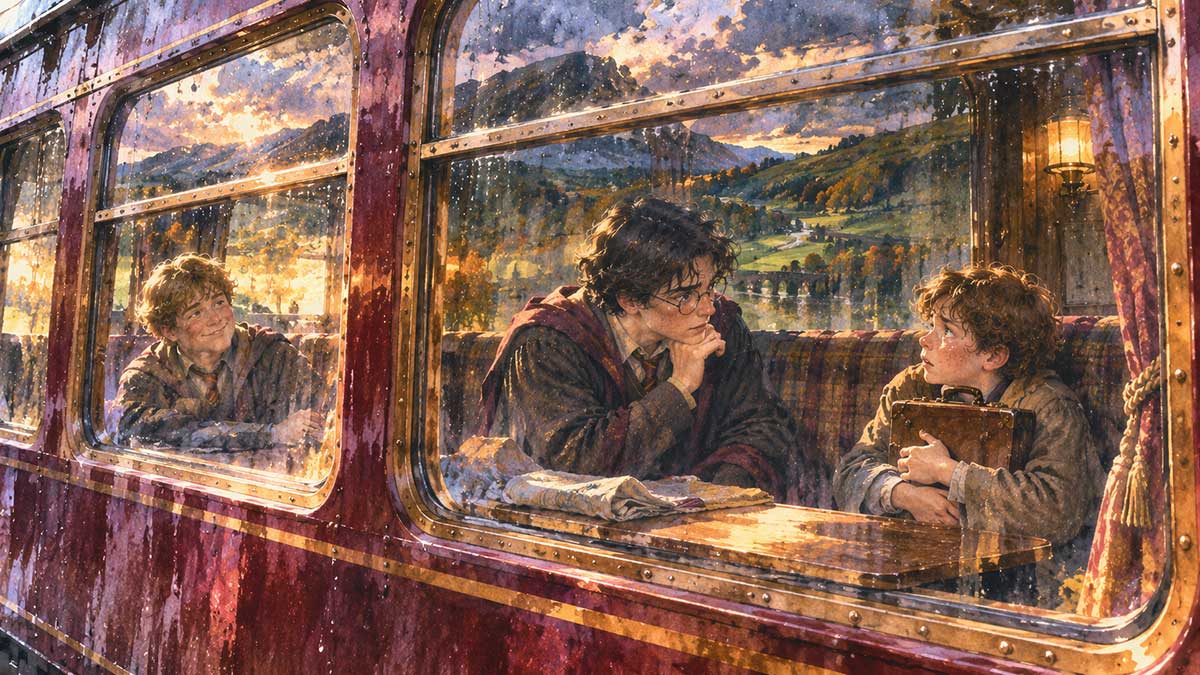
James had never thought a list could become heavier after it was folded.
The parchment lay across his knees as the Hogwarts Express gathered speed. The names were ordinary names. Some had circles beside them, marking a connection restored at King's Cross. Others had small notes in Lily's careful hand. Beside Elsie's name, James had written one word: waiting.
A knock came at the door before James could settle to reading the names. A girl stood outside with a suitcase so wide that it had left a red mark across her stocking. She could not have been more than eleven. Her tie was untied, and she held a little brass clasp in her closed fist.
“Sorry,” she said. “Somebody said there was a boy who knew where people ought to go.”
James glanced at the parchment. He had spent the last hour hearing exactly that from people old enough to know better. “That sounds regrettably like me.”
“My brother was on the platform. He knows who I am. He told the guard we're related. I know he's my brother, too. I know our address and his birthday. But when he tried to carry my trunk, I thought he was taking it.”
James shifted sideways so she could sit. “What's your name?”
“Harriet Bell.” She examined the clasp. “He gave me this before we left home. It was my grandmother's. I remember him giving it to me, but I don't remember why I was happy.”
He had no clever answer. The train's wheels struck a junction, and the suitcase rolled gently against his shoe. He stopped it with his foot.
“Did he ask you to come here?”
“He said I should find someone I trusted.” Harriet looked up sharply. “I don't trust him at the moment. Does that make me wicked?”
“No.” James said it before he had fully thought through the answer. “It makes you frightened. Those are different things.”
She pressed the clasp against her palm. “Everybody keeps saying I'll know him again. They say it like I ought to be trying harder.”
James considered the list. There were names beside which he had written restored. He wondered how many of those people had accepted that word to avoid making their families sad. “You don't need to promise anyone a feeling you haven't got,” he said. “What would help during the journey?”
“A place where people won't ask me if I remember things.”
He found an empty compartment near the prefects' carriage and asked a seventh-year girl to watch the corridor, not Harriet. He brought the case in himself. When Harriet asked whether he could tell her brother where she was, he asked if she wanted him to send the message now or after they arrived. She chose after they arrived. It was a small decision, and her hand relaxed around the clasp.
By the time James returned to his seat, the parchment on his knee looked different. A name was not a problem that could be crossed off. It belonged to somebody who might want an hour of peace rather than another attempt to be saved.
He had been staring at it so long that he did not notice Lily enter the compartment.
“May I?” she asked.
James moved his bag. “Of course.”
She sat beside the window, her hair catching the last pale light of London. Outside, warehouses gave way to gardens and then to fields. A child ran alongside a fence waving at the train, and James found himself waving back before he could stop.
“Still checking?” Lily asked.
“There's a chance I missed someone.”
“There is,” she said. “We both might have.”
He looked at her. “You don't find that unbearable?”
“I find it frightening. That's different.”
Lily took the parchment, studied the entries, and added two names from her own notes. She did not offer him the comfort of saying they had done everything possible. Instead she asked whether the families had been told whom to contact, whether Thistlewick had copies, and whether the students would have someone to speak with when they reached Hogwarts.
James answered what he could. When he reached the last question, he stopped.
“We should ask McGonagall,” he said.
Lily drew a line beneath the final name instead of closing the notebook.
“There's something else,” she said. “No one will want to admit that their family has been affected, especially if the person who was harmed can still explain everything that happened. A teacher might think a student is being stubborn, or ungrateful.”
James remembered Daniel pulling away from his mother. A grown-up who arrived a minute too late might see only a boy refusing to obey.
“We should tell the staff what the magic does,” he said. “Not just the names.”
“And what it doesn't do. It doesn't turn someone into a liar. It doesn't make their pain less real if they sound calm.”
She spoke with an edge James recognized. It was the voice she used when someone had mistaken confidence for cruelty. He looked at her, wondering whether she had ever been treated that way herself, but he did not ask.
“Will McGonagall listen?” he asked.
“Yes,” Lily said. “She may not agree with every plan we bring her, but she'll listen. That's why we have to be exact.”
James took the list and began writing a short account of the attack on the back. He avoided describing people as rescued until he knew what had happened to them. It made the sentences less satisfying. He found he preferred them that way.
“Good.” Lily handed him back the list. “There. One more useful thing to do.”
James smiled tiredly. “You make being responsible sound almost tolerable.”
“Don't get carried away, Potter.”
A trolley rattled past the compartment. Somewhere down the corridor Sirius was loudly accusing Remus of having eaten a biscuit that Sirius had already eaten himself. Peter was laughing, and the sound lifted James's spirits more than he expected.
Lily heard it too.
“Peter was remarkable today,” she said.
“Yes.”
“You gave him the whole plan.”
“He knew it better than I did.”
“You would once have found that difficult to admit.”
James looked at her. “I still find a great many things difficult to admit.”
“Such as?”
“That I'm tired. That I was frightened. That I wanted to chase Voss and leave everyone else to sort themselves out.”
“But you didn't.”
“No.” James looked down at the list. “Peter stayed where I couldn't. He didn't need me to rescue him. He needed me to trust him.”
Lily was quiet for a while. Then she said, “I used to think you wanted everyone to notice when you did something decent.”
“I often did.”
“Today you looked rather relieved when nobody had time to notice.”
James laughed softly. “There were more pressing matters.”
They watched the fields roll past. He had imagined, many times, what it would be like to sit alone with Lily Evans. In those imaginings he always said something brilliant. Now he had no brilliant remark, and for once he did not mind.
A little later the food trolley returned. James bought two pumpkin pasties and placed one on the seat beside Lily without looking at her. She accepted it with a small nod, and for several minutes they ate in companionable silence.
“You used to do that,” Lily said at last.
“Buy food?”
“Make everything a performance. If you gave somebody a sweet, you needed the entire carriage to know.”
James winced. “I was rather spectacular at being unbearable.”
“Rather.”
He expected another rebuke, but she was smiling at the window.
“I'm not trying to pretend I was different,” he said. “I'm trying to become different.”
She turned to him. “I know.”
The simplicity of it made him more embarrassed than a compliment would have. He looked down at his pasty and discovered he had eaten the entire crust without noticing.
“My father says a person should be judged by what they do when nobody is watching,” he said.
“Your father sounds sensible.”
“He usually is. It becomes irritating.”
Lily laughed. Outside, a sheep lifted its head as the train passed and regarded them with profound disapproval.
James pointed at it. “That one definitely knows my examination results.”
“It's disappointed.”
“It has high standards.”
“Someone should.”
They laughed again. It was the first laughter James had managed that day without looking immediately afterward to see whether someone needed him. He felt relief and then guilt for feeling it.
Lily seemed to notice.
“You can have an ordinary moment,” she said. “It won't take anything away from the people who can't.”
James watched the countryside stream by. The thought was new enough that he did not answer immediately.
“Did you see Snape?” Lily asked.
“Yes.”
“He warned us about the last three students. He'd helped Voss with an inscription.”
James felt the old anger rise, but he kept it from choosing his words.
“Are you all right?” he asked.
“I don't know yet.” Lily folded her hands. “He did something useful. It doesn't undo what he did before. I can be grateful for one and still angry about the other.”
“That sounds fair.”
“It's not always easy.”
“No,” James said. “It isn't.”
At the compartment door, Peter appeared holding a paper bag.
“There's a woman selling buns two carriages down,” he announced. “Sirius says they're suspiciously small, so he's bought six.”
“Has he left any for us?” James asked.
Peter held up the bag. “I bought these first.”
Lily smiled. “Then you're the sensible one.”
“Please don't tell Sirius,” Peter said. “He'll make me responsible for the timetable.”
He vanished again, leaving James and Lily laughing.
Later, as the train climbed north, James learned that McGonagall had appointed him Head Boy. He read the notice twice, half expecting the ink to rearrange itself into a joke. He had never been a prefect. He wondered whether someone had made an administrative mistake.
Lily looked at the badge in its little box.
“Well,” she said. “That ought to keep you busy.”
“Is there a form for declining?”
“Probably. But I think you'll be good at it.”
James looked up sharply. Lily's expression was serious.
“Why?” he asked.
“Today you listened.”
He closed the box, careful not to damage the badge.
Outside, the countryside darkened. Ahead lay Hogwarts, one last year, and responsibilities he could not yet see. For the first time, James did not wish to know how everything would turn out. He only wanted to meet it with the people he loved.
At Hogsmeade Station the platform was wet with the kind of drizzle that found its way under collars. First-years clustered beside their trunks, and the lanterns along the path cast yellow circles that barely reached one another. Harriet stood at the edge of the group, her brass clasp pinned crookedly to her cloak.
Lily caught James looking. “You spoke to her?”
“She wants a room where nobody quizzes her.”
“Good. Who's meeting her?”
James frowned. He had arranged for a quiet carriage but not the hours after it. Lily pointed across the platform, where Professor McGonagall was checking a roll of names beneath an umbrella that appeared to dislike the rain as much as she did.
They crossed together and explained without naming Harriet's brother or describing the girl as a patient. McGonagall listened, her mouth pressed into a thoughtful line. “A prefect can show Miss Vale to her common room. I'll tell her Head of House that questions about the platform are not to become public entertainment.”
“And if the other children ask?” Lily said.
“They will,” McGonagall replied. “We can teach them to ask whether someone wants company rather than whether someone has remembered enough.”
James could hear the carriages waiting beyond the gates. His badge was still inside its box. He was relieved; he would have felt ridiculous wearing it before doing anything to deserve it.
“Tomorrow morning,” McGonagall said, “you and Miss Evans may bring your proposed arrangements to my office. Together. I prefer a plan that can be followed by tired teachers and frightened children.”
Lily tucked her wet hair behind an ear. “That eliminates half of James's plans.”
“Only half?” McGonagall said, and walked away before either could answer.
James watched Harriet climb into a carriage with two girls who made room without questions. The girl glanced back once. He raised a hand. She did not wave, but she kept looking until the carriage moved.
That night the four boys did not go straight to bed. The common room smelled of drying wool and damp ash, and three first-years were still awake beside the fire. One had written the same name across six scraps of parchment. Another kept opening the door to check the staircase.
Sirius lowered his voice. “The hat seems to have sorted them into the house of insomnia.”
Remus nudged him. “There's an eleven-year-old over there who's heard enough jokes about forgetting.”
“Wasn't joking about that.” Sirius watched the child at the door. “I wanted to say something that might make tonight less awful.”
Peter rose and approached the boy, keeping his hands visible. He offered a battered tin of chocolate biscuits. The boy asked if he had to tell his story first.
“No,” Peter answered. “You can take one and sit with us, or take one and go upstairs. Either choice is fine.”
The boy took a biscuit and stayed. He said very little. When he finally went to bed, he carried two more wrapped in a napkin for his sister in another house.
James saw Sirius staring after him. “What?”
“I was trying to think of the right thing to say. Wormtail simply gave him a biscuit.”
“Perhaps kindness doesn't always need a speech,” Remus suggested.
James groaned. “If word gets out, I'll have no purpose as Head Boy.”
Their laughter came softly. James had known how to make a room laugh since he was small. He was still learning how to let a room be quiet.
Later, when the fire was no more than a red line beneath the grate, he found Peter watching a small photograph he kept inside his notebook. The four of them stood outside the castle in their second year, wind worrying at their scarves. Peter's expression in the picture was astonished and proud. The moving image smiled and waved; the boy holding it did not.
“Does looking at it hurt?” James asked.
“Sometimes. It feels as though I recognize a door from a house I've never entered.” Peter tapped the photograph shut. “But I know I was happy there. I don't need you to explain it to me every time.”
James sat beside him. “I keep thinking there ought to be a way to return what you gave.”
“I know.” Peter's voice was kind and firm. “If you spend our last year trying to pay me back, you'll miss the year. I don't want that. I didn't give it away to make you indebted to me.”
James watched a log settle in the hearth. “What would you like, then?”
“Tomorrow? Help with my Charms essay. By Friday? A decent game of chess. After that, I'll decide.”
“Your demands are terrifying.”
“I've been practising.”
James reached for the chessboard. Peter defeated him in eighteen moves, then accepted the offer of a rematch without making a ceremony of his victory.
Chapter 25: The Corridor Between Brothers
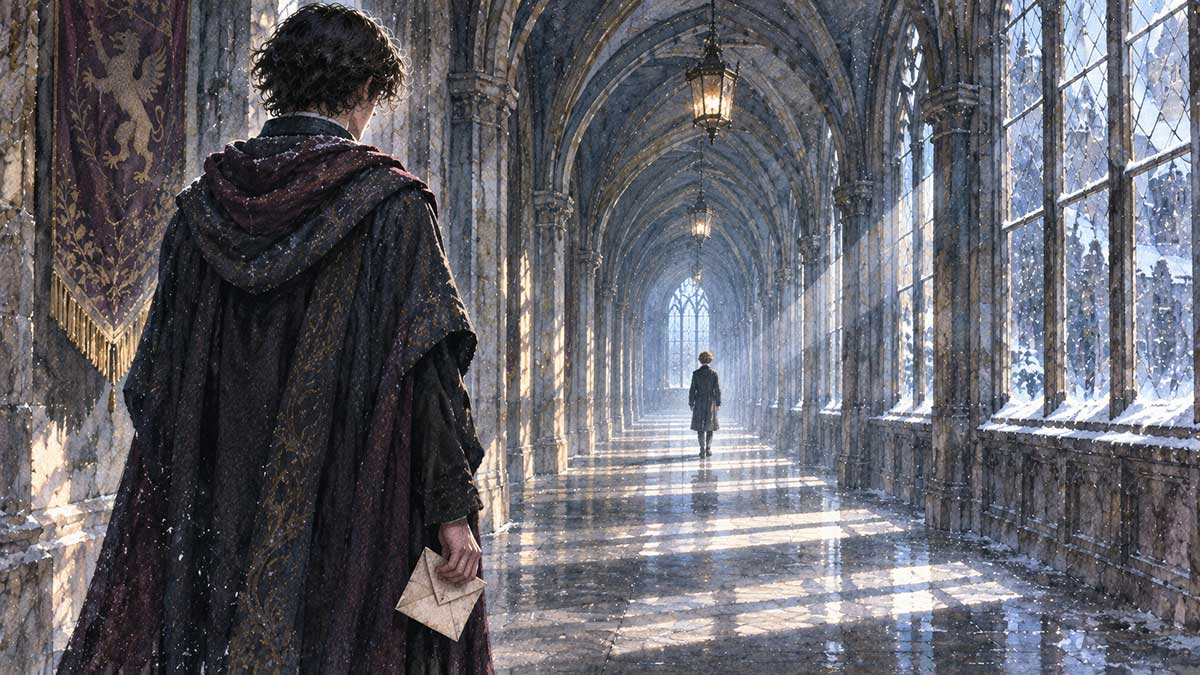
By October, James had discovered that being Head Boy involved far more lost gloves than heroic decisions.
September had begun with a dispute over a noticeboard.
James had written a cheerful announcement inviting students affected by the station attack to visit a newly designated room near the infirmary. Lily read it, went very still, and took the sheet from his hands.
“You've put the room's exact purpose in the headline.”
“So people know where to go.”
“So everybody knows who goes there.”
They stood in the prefects' room with a pot of paste cooling between them. James felt an old spark of indignation. He had worked on the wording for an hour. “If we hide the room, no one will find it.”
“Then we explain it in private. We can give notices to Heads of House, not invite the whole school to watch the door.” Lily folded the parchment. “Harriet was stopped three times on the train by people who meant well.”
“I know. I talked to her.”
“Then you know she shouldn't have to announce herself again.”
His annoyance survived long enough for him to say, “You could have told me that without making me feel like a fool.”
Lily blinked. Then, to his surprise, she nodded. “I could. I'm sorry.”
He had expected the argument to continue. Instead he found himself looking at the paste stuck to his fingers. “I'm sorry, too. I thought if I worked hard enough the answer would be obvious.”
“It rarely is.”
They visited McGonagall with two new proposals. The first was James's: every student should receive a private point of contact. The second was Lily's: no one would be required to attend a group meeting or discuss their experiences. McGonagall asked who would keep records, how families would correct inaccuracies, and whether students could choose a different adult if they disliked the first.
Neither had answered the last question. They added it.
At supper, McGonagall asked James to explain the arrangement to the older prefects. He could hear himself becoming brisk and confident, the way he did before a Quidditch match. Then a prefect from Hufflepuff raised a hand.
“Who's going to explain this to the first-years? The same ones who were frightened at the station?”
There was a silence. James wanted to say that he would handle it personally. Instead he looked at Lily, who was already making notes.
“Not one person,” he answered. “Each Head of House can choose someone their students know. We'd like volunteers from each house, if they'll speak to their own first-years and let them decide whether they want help.”
A Ravenclaw prefect objected that the plan sounded like extra duty. Another worried it could become gossip. James listened to both and agreed to rewrite the instructions. He left the meeting with a wrinkled list of objections and the peculiar satisfaction of having won nothing.
That evening Harriet found him near the stairs. “Professor Flitwick told me I could choose someone else if I wanted,” she said.
“Yes.”
“I chose him.”
“That's good.”
“He didn't ask why.” She gave him a small, guarded smile. “I thought you should know.”
For the first time, James understood that a plan might succeed precisely when its author became unnecessary.
He had mediated a dispute over a bewitched chessboard, escorted three first-years back from a corridor they insisted had moved, and persuaded Peeves to return a student's shoes in exchange for a promise that nobody would tell him where the shoes had been found.
The first-years had been frightened long after the corridor returned to its proper place. One of them, a girl called Harriet, insisted that a wall had asked for her mother's maiden name. James took the children to Professor Flitwick and reported the question exactly. There had been no invitation to join a society, no brass seal, and no voice that he could identify. The castle had enough mysteries of its own. But James refused to dismiss the frightened girl merely for sounding implausible.
Flitwick listened to the whole account, then made a note to inspect the passage with Thistlewick. Harriet looked surprised.
“You believe me?” she asked.
“I believe you heard something,” James said. “We can investigate the rest.”
The distinction was not as satisfying as a heroic promise. Harriet's shoulders loosened anyway.
Afterward James found Lily sorting a stack of student correspondence at the prefects' table. She had organized a quiet meeting room for children affected by King's Cross and was fielding questions from parents who had never heard of relational magic until the day it entered their families.
“Being Head Boy is rather less glamorous than I expected,” James said.
Lily glanced at the smudge of ink on his sleeve. “You expected glamour?”
“I expected an impressive badge. I was promised a badge.”
“You have a badge.”
“It has not once solved a problem.”
“It told Harriet where to find you.”
James looked at her. “How did you know about Harriet?”
“She came to me afterward. She said you didn't laugh.”
He glanced down. “That hardly counts as an achievement.”
“It does to someone who expects people to laugh.”
Lily put a letter into an envelope, sealing it with the small wax stamp she had borrowed from the school office. The envelope bore no private history, just a meeting time and the assurance that attendance was voluntary. James saw the care she took to keep even the outside of the message from announcing anything its recipient might prefer to hide.
“Do you ever get tired?” he asked.
“Yes,” Lily said, and then, with a small smile, “but I don't get tired of being useful.”
James thought of the easy cheers after a Quidditch victory, of the satisfaction of seeing everyone turn toward him. Helping a frightened child had offered none of that. Yet he remembered Harriet's relief more clearly than the last match's score.
“I could take the next stack of letters,” he said.
Lily surveyed him. “You'd have to follow instructions.”
“I have heard of them.”
“It's a promising beginning.”
She handed him six envelopes and the list of families to whom they belonged. He checked each name twice.
In November Lily brought James a problem that had no clear place in the prefects' handbook. A student had asked to join a family-support meeting and then refused to enter the room after spotting another student's older brother outside. The brother had done nothing wrong. His face happened to resemble one of the men seen at King's Cross.
James asked whether the student wanted the boy moved. Lily shook her head.
“She wants to attend without asking anyone to leave. She thinks it's her problem to solve alone.”
“Could we change the time?”
“We could. Then she'll think she caused an inconvenience. I'd like to ask her before changing anything.”
They sat at the small table outside the prefects' office, surrounded by piles of unfinished essays. James had spent the afternoon revising a Transfiguration diagram and wanted a problem that would submit to a ruler. Lily pushed a clean sheet across to him.
“Write down what we know,” she said.
He did. Three lines. Nothing about what the other student had meant, nothing about how the frightened girl ought to feel. He was surprised by how much space remained.
“Now write down what we're guessing.”
The second list was longer. James crossed out half of it and looked at Lily. “This is unpleasantly educational.”
She smiled. “I'm glad the school is providing you with some instruction.”
The girl eventually chose a different entrance, with no announcement and no escort. She attended twice, then stopped. Lily asked once whether she wanted to return, accepted her answer, and put away the attendance sheet. James did not discover the end of her story. He found that difficult and, to his own surprise, bearable.
On a cold evening a week later he met Lily in an empty classroom, where she was trying to mend the snapped handle of a tea tray used for the meetings. His first impulse was to take her wand and solve it himself. He sat down instead.
“Have you tried the counterweight charm?” he asked.
“Yes. It tips the tray sideways.”
“Then we need a better handle.”
“Or fewer teacups.”
“Unthinkable. We would destroy civilisation.”
They spent twenty minutes tinkering with the handle. It held until James filled the tray, when the whole arrangement folded like a startled bird. He caught two cups; Lily caught the teapot; the last cup bounced and shattered. Their laughter echoed down the corridor.
Lily knelt to gather the pieces. “You know, I used to dread working with you.”
“I gave you excellent reasons.”
“You made everything an opportunity to prove you were clever.” She fitted a fragment into the palm of her hand. “Today you asked what I thought first.”
James set the surviving cups on a desk. “I'm still clever.”
“Terribly.”
“Just less eager to provide a demonstration.”
She looked up at him and smiled in a way he could not turn into a joke. For the first time the possibility that she might choose to be with him felt different from a prize he hoped to win. It felt like a promise he would have to deserve on ordinary Tuesdays, when nothing magnificent was happening.
They left the broken cup in a labelled box for the caretaker and carried the remaining tea to the people waiting in the next room.
“An inspiring reign,” Sirius said when James recounted the afternoon. “History will remember the shoes.”
“History will remember you failing to finish your Transfiguration essay,” Remus replied.
“Cruel. I came here for sympathy.”
“You came here for my notes.”
Peter sat on the floor with the map spread before him. They had been improving it in the intervals between lessons, testing corridors, adjusting moving staircases, and arguing over whether it needed a warning about the portrait that insulted people's hats.
“It definitely needs a warning,” Peter said. “The portrait made a second-year cry.”
“Her hat was dreadful,” Sirius said.
“That's not the point,” James answered.
Sirius grinned. “Listen to him. Head Boy for six weeks and already a moral authority.”
James threw a cushion. It struck the map instead, and the four boys scrambled to rescue a bottle of ink. Their laughter filled the dormitory, loud enough that someone downstairs banged on the ceiling.
Not every day was so easy.
One Friday, the school held a short gathering after dinner for students who wanted news of the families affected at King's Cross. Professor McGonagall stood beside a table with unopened envelopes and made it plain that no names would be read aloud. Students could speak to their Heads of House afterward. No one would be asked to come forward.
James had been asked to make the closing remarks. He had prepared a paragraph about courage, scratched it out, then written another. By the time he stood up he could feel Sirius trying not to grin from the back of the room.
“We have a room near the infirmary,” James began, “and people who can help you reach your families. We made a mistake with the first notices. They gave away more than some students wanted others to know. That's been corrected. If you've received one, you can keep it, return it, or ignore it.”
A boy near the window raised his hand. “Why did you make a list of us in the first place?”
James heard the discomfort move through the room. The boy's question was fair. “We made it during the attack so people wouldn't be left behind. Afterward we should have asked what you wanted done with it.”
“Did you?”
“Not soon enough.”
McGonagall did not rescue him from the silence. James told them copies would be held securely by staff, and families could ask to see or correct entries concerning them. He knew it was still imperfect. He could see a girl leave before he finished. Lily did not go after her.
Later James found Lily outside the hall, standing with her arms folded against a draft. “That was awful,” he said.
“It was useful.”
“I was dreadful.”
“You answered the question. And you didn't make the boy grateful for the answer.”
He looked back at the closed doors. “He might hate me for a month.”
“He's allowed.” Lily touched his sleeve. “You can still do the work.”
Across the corridor Peter and Remus were helping a first-year retrieve a stack of dropped books. Sirius had somehow persuaded two suits of armour to hold a doorway open. Their improvised procession was ridiculous, and James laughed before he could help it.
“You're doing it again,” Lily said.
“What?”
“Looking relieved when someone else has the situation in hand.”
He considered denying it. Instead he went to help collect the books.
Remus still sometimes went quiet when the subject of Voss's records arose. Sirius had apologized for pressing him about the hidden page, but James could see that an old uncertainty remained between them. It did not always appear in words. Sometimes it appeared when Remus entered a room and Sirius stopped talking a fraction too quickly.
James wanted to make them discuss it. He had learned that forcing a conversation was not the same as healing it.
One evening, he found Remus alone in the library.
“Want company?” James asked.
Remus moved his books. “You can sit.”
James sat. For a while they worked in silence.
“You haven't asked what was on the page,” Remus said eventually.
“No.”
“Don't you want to know?”
“Part of me does.” James closed his book. “But you told us what we needed to know about the danger. The rest is yours.”
Remus studied him. “You really mean that?”
“I do.”
Remus looked down at his hands. “I keep thinking you'll change your mind.”
“I might be frightened again,” James admitted. “That doesn't mean I'll stop trusting you.”
The conversation did not settle everything. Remus still carried the knowledge that Voss had a record of his condition. But he smiled when James asked whether he wanted to go downstairs for supper, and that was enough for the evening.
Across the castle, Sirius rounded a corner near the Slytherin staircase and found Regulus standing at the other end of the passage.
For a moment neither moved.
Regulus wore his school robes neatly fastened. He looked younger than Sirius remembered and older than he ought to have been. Sirius could see the brother who had once followed him through the house at Grimmauld Place, asking questions about every door. He could see the young man who had chosen the Dark Mark.
Regulus looked at Sirius's face, then at the space beside him, as if expecting someone else to appear.
Sirius wanted to say that their mother had been wrong about a hundred things. He wanted to ask whether Regulus was afraid. He wanted to tell him that there was still a place at the Potter table, that the door would open if he knocked.
He said nothing.
Regulus stepped aside to let him pass.
Sirius walked on.
He got no farther than the landing before he stopped.
At home, when they were little, Regulus used to walk in Sirius's footsteps on the stairs. He had been small enough to need both hands on the banister, and Sirius had made a game of choosing alternate steps, turning each flight into an adventure that ended with them hiding behind the drawing-room curtains. On the last step Regulus would whisper, “Wait for me,” and Sirius would always wait.
He stood now beside a stone window, looking at the rain collecting on its ledge. The word he had spoken in Grimmauld Place came back with terrible clarity: *I don't have a brother.* He could no longer pretend it had been mere anger. Words said in anger still reached the person standing in front of you.
Footsteps approached. Sirius looked up, half expecting Regulus, but it was a younger Slytherin student carrying a parcel tied with dark green ribbon.
“Excuse me,” the student said. “You're Sirius Black, aren't you?”
“Depends who's asking.”
“Your brother was looking for the Charms corridor. I think he went the other way.”
“He knows where the Charms corridor is.”
The boy shrugged. “I suppose he did look rather lost.”
Sirius felt the impulse to rush after him and demand an explanation. He wanted to know whether Regulus had come to find him, whether the brief glance in the corridor had meant something, whether he had missed the one moment when the door between them might have opened.
Instead he asked, “Was he hurt?”
“Not that I saw.”
“Thanks.”
The boy hurried away. Sirius remained at the window until the stone beneath his palm was cold.
He reached inside his robe for the folded letter he had carried since August. It contained an apology for the sentence at Grimmauld Place. He had written it three times, cutting every line that sounded like a demand for Regulus to leave their family or agree with him. The latest version was brief: *I was wrong to say you weren't my brother. I cannot take it back. I would like you to know that I wish I had not said it.*
He had not sent it. He had told himself that Regulus would tear it up, or that their mother would find it, or that the words might be mistaken for permission to go on serving the people Sirius opposed. None of those possibilities was entirely imaginary. Yet the longer he carried it, the more the folded parchment felt like an excuse masquerading as caution.
He took it out, unfolded it, and checked the last sentence once more.
Then he walked to the owlery.
There he stopped again, not from fear of rejection this time but from a sharper thought: if Regulus had already chosen dangerous loyalties, a letter might be intercepted and used against him. Sirius added no names, no addresses, no promises of secret meetings. He sealed the note with plain wax and asked the owl to deliver it directly into Regulus's hands, or return if that was impossible.
The owl took flight into rain that silvered the towers.
Sirius watched until it vanished. He felt no sudden peace. The decision had been too small to repair what stood between them and too late to erase what he had said.
Still, he had taken one step Regulus had not been required to take for him.
When he reached the common room, James was waiting with two mugs of tea. Sirius took one and sat beside him. Neither spoke for a long time.
Elsewhere, Lily was reviewing a set of follow-up letters from the families affected at King's Cross. Most reported improvement. Elsie's grandfather had written that she still did not recognize him in the old way, but she asked for the paper-boat story each evening. She had begun making boats of her own.
Lily showed James the letter the next morning.
A second letter lay beneath it. This one was from Nora Fenwick, who had begun visiting the younger students in the quiet room after supper. She described a boy who could recite every detail of his father's stories but panicked when his father tried to embrace him. The family had decided to meet for ten minutes each Sunday without asking the boy to remember anything at all. The father brought a model train; the boy brought his drawings. For the moment they talked about wheels and stations. It was enough for the boy to come back the next week.
Lily read this aloud, then folded the parchment and looked toward the windows.
“I keep making lists,” she said. “Names. Visits. Meetings. People who have help and people who need it. Some days I think if I make the right list, nobody else will disappear from someone else's life.”
James pulled a chair beside her. “I know that feeling.”
“You always want to rescue somebody.”
“I used to prefer rescues people could applaud.”
“And now?”
“Now I think somebody has to put the chairs away when the meeting ends.”
She laughed, and his expression softened.
Lily tapped Nora's letter. “I wish I could tell these families that the rest of their lives will be simple.”
“You could tell them we're still here.”
“We won't always be here.”
“Then we help them make something that survives us.”
For a while they worked through the letters together. James copied meeting times. Lily checked the spelling of the students' names. They left empty spaces wherever the families had not yet decided what they wanted. Neither filled a blank merely to make the page look complete.
At the end of the evening Lily found a note from one of the volunteers at King's Cross. The writer thanked Peter for calmly assigning her a place in the rescue when she had wanted to run in every direction at once. Lily read it twice.
“Has Peter seen this?” she asked.
“No. He'd probably be embarrassed.”
“That doesn't mean he shouldn't see it.”
James smiled. “I'll give it to him.”
“Don't present it at breakfast in front of everybody.”
“I wasn't going to.”
“You were considering it.”
“Briefly.”
Lily shook her head with affection that he was only beginning to recognize. When James left the room, he carried the thank-you note folded between the pages of his own notebook, where it would stay safe until Peter could receive it privately.
“It's not a cure,” she said.
“No.”
“But it's something.”
James read the last line twice: She laughs when the boats sink.
He looked at Lily. “Would you like to walk by the lake after dinner?”
She raised an eyebrow. “Is this a Head Boy inspection?”
“Not unless the lake has misplaced its shoes.”
Lily laughed. “Then yes.”
They walked beneath the trees while the last autumn leaves moved across the water. James told her about his parents, and Lily told him about home, about Petunia, and about the strange sadness of loving someone who no longer wanted to share your life. James did not try to repair it with a clever remark. He listened.
The walk was interrupted twice. First by a kneazle that had escaped a third-year's basket and decided James's shoelace was an enemy. Then by the distant tolling of the bell, calling students indoors before the light failed. Lily insisted on freeing the animal from its own indignation before they went on.
“You could use magic,” James pointed out, kneeling in damp grass.
“It keeps twisting,” she said. “Hold still, or it'll take your fingers.”
“Is that advice for me or the kneazle?”
“For both of you.”
When they finally returned the animal, its owner offered James a breathless apology. Lily took the little creature back without making the boy feel worse. James watched her do it. He had admired Lily for years, but admiration had been an easy thing from a distance. Up close, she could be tired, impatient, funny, and entirely unwilling to abandon a difficult creature just to win an argument.
At a bench near the water, she told him she was considering stepping back from one of the family-support meetings. “The younger students have started waiting for me to decide everything,” she said. “Nora Fenwick knows them better now. I think she should lead.”
“You've built it,” James said. “You can let someone else carry it.”
Lily looked at him sideways. “You sound suspiciously wise.”
“Temporary condition. May pass.”
“Good.” She scuffed at a stone. “I keep thinking if I leave the room for a night, somebody will need me.”
“Somebody will. They can ask Nora. And if Nora needs you, she can ask.”
Lily thought for a while. “You make it sound simple.”
“Not simple. Just possible.”
They sat without speaking. Somewhere on the opposite bank a bird rose from the reeds, shook silver drops from its wings, and disappeared into the evening. For a little while the castle was simply a school, full of people with homework and cold hands and insufficient time to finish dinner. It was a relief to let it be that.
At the end of the path, Lily took his hand.
He looked at her, surprised.
“Don't make a speech,” she said.
“I wasn't going to.”
“You were thinking about one.”
“Only a short one.”
“Good night, James.”
She kissed his cheek and walked back toward the castle.
James remained beside the lake until the cold reminded him that he was meant to be indoors.
Winter brought a silence to Sirius that even the other Marauders did not know how to fill. His flat was safe, his trunks were unpacked, and the money left to him by his uncle meant he could remain there after school. None of those facts answered the question he never spoke aloud: whether Regulus would someday knock on his door.
On the final Saturday before the Christmas holiday, Sirius stood beside an owl in the draughty tower, holding a second letter. The first had received no reply. He had rewritten this one until the parchment was soft at the folds.
Remus found him there. He did not ask to see the letter. He merely stood far enough away for the owl to stop snapping at his cuffs.
“I could ask him whether he's received it,” Remus said.
“That would make him feel watched.”
“Then I won't.”
Sirius looked out at the grounds, where the lake had gathered a crust of silver along its shore. “I keep thinking that if I choose exactly the right words, he'll remember what we were like before Mother taught us to be afraid of choosing.”
“Do you remember everything the same way he would?”
“No.” Sirius's answer came at once. “That's the trouble. The good afternoons are clear to me. Perhaps to him they're the afternoons before I left.”
Remus considered that. “You could tell him what you regret without telling him how to feel about it.”
Sirius unfolded the letter one final time, struck out a sentence that began *You must understand*, and wrote instead: *I understand that you may not want to answer. The door will still be open.*
He read the line twice and secured the note to the owl's leg. The bird launched itself into the snow. Sirius watched until it disappeared, then remained at the parapet with his hands reddening in the wind.
Downstairs, James and Peter had arranged a chess match by the fire. Sirius joined them, lost three pieces in the first seven moves, and accused the board of displaying family prejudice. Peter laughed so hard that one of the pieces toppled sideways. Sirius laughed too, not from relief that Regulus would answer, but from the ordinary comfort of still having a place to return to.
That evening James asked Lily if she would join the others for Christmas tea at his parents' home. He had imagined a grand invitation and practised half of it in the mirror. The words came out rather differently.
“My mother will make enough food for forty people,” he said. “I thought you might help us reduce the danger.”
Lily raised an eyebrow. “Am I invited as a guest or a public safety measure?”
“Both, if you're willing.”
“I'd like to come.”
James had no answer prepared for a simple yes. Lily laughed at his expression and walked beside him down the stairs.
That night, when he returned to the map, Peter had marked a narrow corridor that had resisted their spells for months. The line ended in a blank space.
“Still there,” Peter said.
James studied it. “Some places don't want to be known.”
“Maybe,” Peter replied. “Or maybe we haven't asked the right question.”
James smiled. “Then we'll keep looking.”
In January, a letter arrived for Lily with her sister's handwriting on the envelope. She took it to the library, read it, and tucked it into her bag so carefully that James knew something was wrong before she spoke.
They walked to a classroom where the windows faced the frozen grounds. Lily sat on the edge of a desk. “Petunia says I should stop writing about school. She doesn't want explanations about magic, and she thinks I use every letter to remind her of things she cannot do.”
James had never been good at hearing the name of Lily's sister without wanting to defend Lily. “That isn't what you're doing.”
“You haven't read the letters.”
He stopped. Lily turned the envelope between her fingers. “I think I've been writing to the sister I had when we were children. She isn't that person now, and I keep asking her to be.”
“Do you want to write back?”
“Not today.”
He sat opposite her. Snow slipped from the windowsill in a soft collapse. He could have argued that Lily deserved better, or offered to send a furious owl of his own. He stayed with her instead.
After a while she said, “You can tell me when I'm wrong, you know.”
“I've seen you try to be kind to her. I haven't seen the whole thing.”
She glanced at him, surprised. “That sounds almost fair.”
“I've been studying.”
Lily reached across the narrow space between their desks and took his hand. They remained there until the classroom clock struck the hour. In the corridor outside, a bell called them toward a lesson they were already late for.
That evening, news spread that a former student from one of the houses had vanished on the road home from work. Some students insisted it was a political disappearance; others said there had been an accident. McGonagall told the prefects not to repeat claims the school could not verify. She asked them to check on the younger pupils and make certain frightened parents knew how to reach their children.
James found himself remembering the lists at King's Cross. In a former life, he would have wanted to solve the disappearance that very night. Instead he wrote a careful message for the Head of House, then carried water to a dormitory where two children had been waiting for an owl since breakfast.
Sirius came to fetch him when the duty ended. “I have news,” he said, standing in the doorway.
James's pulse jumped. “Regulus?”
“No. A reply from the landlord. He'll let us change the lock on the flat.” Sirius kept his voice light, but James could hear the disappointment beneath it. “I suppose the rest can wait.”
James handed him his coat. “Come on. You can tell me about the lock on the way back.”
Sirius did. He described it in absurd technical detail, and James listened.
Chapter 26: The Year They Choose

The map was finished on a Thursday in spring, which Sirius considered an insult to its importance.
Their first attempt that spring had gone so badly that Sirius proposed burning the evidence. A name had appeared in two places at once, one in the Charms corridor and one in a staircase that had not existed since Tuesday. Remus insisted the duplication was a problem with timing, not location. Peter insisted it was a problem with a stairwell deciding to move at exactly the wrong moment.
They carried the unfinished parchment into an unused classroom and argued until midnight. Then Peter spread a page of tiny measurements beside it. He had been recording the intervals between the staircase's movements for weeks.
“It's not lying about where the person is,” he said. “It's showing where the stairs were when the ink began drawing.”
“So we teach the parchment to be quicker,” Sirius said.
“We teach it to wait until the stone stops changing. Otherwise it will send us into a wall.”
James looked at the measurements. Some were made on scraps of homework; one had been written across the back of a chocolate-frog card. “How long have you been checking?”
“Since we nearly walked into that wall in November.”
Nobody spoke for a moment. Peter's attention to the smallest practical danger had kept them safe at King's Cross. James ought not to have been surprised that it mattered here. Yet the depth of the work humbled him.
The next test went wrong in a different fashion. The map showed a boy in the library after the real boy had gone to bed. Peter proved this by borrowing the boy's discarded quill as a marker and watching its position refuse to move. Remus discovered that the charm was confusing a person's location with the last place a possession had been touched. They stripped the identification spell apart and rebuilt it with a new limit: no object could stand in for the person whose name appeared.
“We're putting more restrictions on it than features,” Sirius complained.
“That's what happens when your features are prepared to slander innocent people,” Remus replied.
James was still thinking about the last test when he passed Harriet outside the library. She was reading a letter and not crying, which seemed to him a greater accomplishment than any map charm. He did not ask whether the letter came from her brother. He asked how her essay was going. She complained for several minutes about the weight of her books. James listened gratefully.
They returned to the parchment with ink on their sleeves and no sense of triumph. When the final trial succeeded, Peter was the first to notice: the name appeared only after the staircase had settled. He smiled without seeking an audience. Sirius made one for him anyway.
The four of them had spent the preceding week arguing over the last protective charms. James wanted the map to answer only to them. Sirius wanted it to insult anyone who opened it without permission. Remus warned that an insult was not protection and that the map would eventually end up in hands they could not predict. Peter suggested separating its instructions from its contents, so a stranger would see a harmless piece of parchment until the right words were spoken.
“It's not the right words alone,” Peter said, studying their notes. “People can overhear words. What matters is that we chose the words together and know what they mean.”
Sirius looked thoughtful for a moment. “Then the opening must be suitably magnificent.”
“The opening must not set fire to anything,” Remus said.
“That excludes several of my favorites.”
They settled the matter after dinner, when the common room emptied and the fire sank low in the grate. Four wands hovered over the parchment. James spoke the first part of the charm, Sirius the second, Remus the third, and Peter the last. Each left a faint trace of ink that vanished beneath the surface when all four had finished.
For a dreadful second nothing happened.
Sirius leaned forward. “Perhaps the map is considering retirement.”
Then the first tiny footprint appeared, walking along a corridor beside the library. A second followed. Ink moved in fine, delicate strokes, revealing students crossing the staircases and teachers returning to their rooms.
Peter let out a breath. “It worked.”
“It did,” Remus said, sounding relieved enough to forgive the three experiments that had ruined his earlier notes.
James looked at the parchment and thought about the Archive's ledger. That ledger had collected names to injure the bonds between people. Their map collected names to find people who might otherwise be lost. He knew it could be misused. Any clever thing could. But for once they had discussed the limits before the triumph.
“We should write down what it can't do,” he said.
Sirius stared at him. “You've changed beyond recognition.”
“I'm still here.”
“That is exactly what makes it disturbing.”
Remus took a clean page from his notebook. Together they recorded the map's gaps, the corridors it could not reliably reveal, and the fact that seeing a name on a page did not tell them whether that person was happy, afraid, honest, or lonely. Peter added one final sentence in his small handwriting: *A person is more than a place on a map.*
James read it, nodded, and slid the paper into the pocket of the case they used to protect the parchment.
“Great achievements ought to happen on Saturdays,” he declared. “Preferably after lunch.”
“Great achievements happen when someone finally corrects your spelling,” Remus said.
Sirius looked wounded. “I have an expressive relationship with spelling.”
Peter held the parchment flat as its lines settled into place. Corridors and staircases lay in delicate ink, and tiny names moved across the castle. The map was not perfect. It could not explain motives, reveal every hidden room, or tell one friend what another was feeling. But it could show where people stood, and it had been made by four boys who had spent years learning to find one another.
James looked at the finished parchment.
“We did it,” he said.
Peter smiled. “We did.”
Sirius leaned over it. “We should give it a proper name.”
Remus groaned. “Please don't.”
They argued for half an hour, proposing titles so grand that even Sirius began laughing. In the end they settled on a name that belonged to the four of them, a private joke and a declaration that the castle had been explored by people who had never learned to leave well enough alone.
Outside the window, spring sunlight crossed the grounds. The end of school approached with the slow inevitability of a train drawing into a station.
The map earned its first ordinary use a week later. A nervous second-year approached Remus after supper and confessed that she had lost a borrowed library book. She was certain it had been taken from a windowsill near the astronomy stairs. Her friend had already been accused of stealing it.
Remus refused to use the map as a verdict. “It can't tell us what anyone meant to do,” he explained. “And it won't show a book.”
“Then what's the point of it?” Sirius asked when they met upstairs.
“Perhaps the point is that we should stop treating it as an answer to questions it can't answer,” Peter said.
They asked the girl to retrace her route. James carried her lantern through two staircases; Sirius entertained her with an absurd account of his own lost homework; Remus checked the window ledges; Peter kept track of which passages they'd already searched. They discovered the book tucked beneath a loose bench near a portrait of a sea captain. The captain insisted he had rescued it from the wind.
“Fine,” Sirius told the portrait. “A noble act. You may now relinquish the prisoner.”
The girl ran downstairs with the book against her chest. Her friend met her at the foot of the stairs, stiff and embarrassed. Neither knew how to begin. James wondered whether he should speak for them. He did not.
“We'll go,” Peter said quietly, steering Sirius away by the elbow.
The friends were left with their own apologies. The book was only a book. Still, it mattered that the map had led them to the right part of the castle, and that they had chosen not to use a person's name on parchment as evidence of a person's guilt.
Peter wrote a final note beside their rules: *A location is not an explanation.* James read it and nodded. For once Sirius did not object to another rule. He was busy negotiating with the sea captain for the return of a second book.
James had begun to notice small things he had once ignored. The scrape of chairs in the Great Hall. The way Remus held his book open with one finger when he wanted to listen to a conversation without admitting it. The way Sirius reached for an extra plate before Peter sat down. The way Peter looked toward the others whenever he made a joke, waiting to see whether it had landed.
Lily had become part of James's days in a way he had not expected. They argued about rules, laughed about teachers, and sometimes sat together without saying anything at all. She did not agree with him simply to be kind. He had come to treasure that.
One afternoon they walked beside the lake. The air smelled of grass and wet stone.
“What will you do when school ends?” Lily asked.
James looked toward the castle. “I don't know. Something useful, I hope.”
“That's not much of a plan.”
“No. But I have a few people I'd like to keep close.”
Lily slipped her hand into his. “That's a start.”
The war beyond Hogwarts was becoming harder to ignore. Letters arrived with news that made the older students speak in lowered voices. Some families were leaving their homes. Others were choosing sides. James knew that the world waiting beyond the gates would demand more of them than school ever had.
One morning a classmate received a letter at breakfast and left the table without opening it. James learned later that the girl's family had moved for the third time in a year. She was tired of explaining that there was no forwarding address, no particular town she could name with certainty, and no reason to believe the next place would be safe.
In Transfiguration the next day, Professor McGonagall assigned a difficult exercise. For the first time James could remember, he did not finish ahead of everybody else. He kept thinking about that letter and the girl who had placed her breakfast untouched beside it.
McGonagall paused at his desk. “Mr. Potter, your concentration appears to have gone elsewhere.”
“Yes, Professor.”
“Then bring it back, please. The rest of the class has need of your example.”
He swallowed the reply he would have made a year earlier. “I will.”
Afterward he asked whether the student who had received the letter needed school supplies or help writing to relatives. McGonagall looked at him for a long moment.
“If she does,” she said, “you may offer without making her circumstances public.”
James nodded. He was learning that being trusted with someone's difficulty carried an obligation to keep it from becoming a story told for admiration.
That weekend Sirius visited his flat for a few hours. He returned with the smell of rain on his coat and a face James could not read. They climbed to the dormitory without much conversation.
“Any word?” James asked once they were alone.
Sirius knew what he meant. “The owl came back.”
“And?”
“Regulus took the letter.”
James waited.
“He didn't send anything.”
“It's only been a few days.”
Sirius shook his head. “I'm not counting.”
He was counting. James could see that plainly. But he said only, “Would you like tea?”
Sirius studied him. “Potter, have you turned into a sixty-year-old man?”
“Possibly. Does a sixty-year-old man get you tea?”
“If he knows what he's doing.”
James went downstairs and returned with two steaming mugs. They sat in the silence that had once made Sirius restless and now seemed one of the few places where he did not have to perform certainty.
After a while Sirius said, “I don't know how to be his brother anymore.”
“You haven't stopped being it,” James replied.
“That hasn't made me very good at it.”
“No.”
The admission hurt both of them, but Sirius did not ask James to take it back.
Beyond the windows the grounds were green, the lake serene, and the sky bright with the kind of weather that made Hogwarts seem exempt from everything happening outside its walls. James knew better now.
He did not want to spend his last weeks rehearsing every possible loss.
On their final evening together in the dormitory, the four boys sat by the window with a plate of biscuits and the finished map between them. Sirius had brought a battered tin of sweets from his flat. Remus had smuggled in a book he claimed not to be reading. Peter had found an old photograph of the four of them, taken when their robes were too large and their faces were still round with childhood.
The final examinations came in June. Hogwarts did not pause to acknowledge the war beyond its walls: essays still had to be completed, cauldrons still overturned, and the owls carrying examination results were as indifferent as ever to panic. Sirius claimed the Transfiguration paper had personally insulted him. Remus assured him that the examiner probably felt the same.
By May, all four boys had received advice about the future, most of it unsolicited. A visiting Ministry official offered James a position with an impressive title and duties described so vaguely that Sirius declared the office must be responsible for counting enchanted paperclips.
Remus received a more discouraging reply to an inquiry he had made about research work. It praised his school record and said that the position was no longer available. He folded the letter without showing anyone. James noticed only the careful way he placed it beneath his plate.
“Anything we can do?” James asked when the others had gone.
“Not about that particular letter.” Remus looked at the empty seats. “I don't want to spend my last term having everyone behave as if I must be rescued from my future.”
“You won't.” James considered his next words. “If there is a day when help would be welcome, you can ask.”
Remus gave a tired smile. “That's a great improvement over your old method.”
“What was my old method?”
“Announce a solution and demand applause.”
“Cruel. Accurate, but cruel.”
Peter had begun keeping his own list of things he wanted after graduation. It did not contain great offices or impossible achievements. He wanted a place where his friends could visit without asking permission, a job that would allow him to do something useful, and enough money to buy a new trunk. He confessed the last wish to Sirius, who inspected Peter's old one with theatrical horror.
“It has survived seven years in your care. It's a historical monument.”
“It's falling apart.”
“An increasingly authentic historical monument.”
They repaired the straps together and found, caught beneath the lining, the ticket Peter had carried on his first train to Hogwarts. Its faded numbers were still readable. Peter touched the edge but did not claim the old feeling had returned. He knew only that a frightened boy had kept the ticket all those years and that he, the older boy, would keep it a little longer.
For one Saturday the four friends escaped their work and walked the grounds without trying to solve a mystery. They returned to the place where they had first tested a foolish bit of spellwork, the lawn where Sirius had once argued with a goose, and the tree beneath which Remus had read them an entire chapter against their protests. Each place had changed less than they had.
At the edge of the lake they argued about what to do with the map. Sirius wanted it hidden where nobody could find it. Remus feared that hiding it would create the temptation to use it carelessly when they came back. Peter suggested they agree never to reveal somebody's whereabouts to a stranger merely to prove the map worked. James accepted the rule without turning it into a speech.
“Does anybody think we'll keep all these promises?” Sirius asked.
“No,” Remus answered. “But we can keep trying to notice when we fail.”
James studied the school rising above the water. They had invented secrets for the pleasure of sharing them. They had nearly lost people to a man who treated secrets as merchandise. The difference lay in what they chose to protect.
When the sun moved behind the towers, they took the long path back. Peter walked between James and Sirius, interrupting their argument over the best way to cook potatoes. Remus followed with the map case under his arm. Nobody spoke of this as the last ordinary afternoon. It was enough that they had one.
There was a farewell gathering in the Great Hall after the last lessons. No grand speech could make seven years fit into a single evening. Professor McGonagall thanked the departing students, then reminded them to return borrowed books and not to attempt to depart with pieces of the castle. Sirius looked guiltily at the polished brass doorknob in his pocket. It was, he insisted, a souvenir of a door that had been removed years ago. Remus demanded that he put it back.
James had been asked to say a few words as Head Boy. He stood beneath the floating candles with his notes folded twice in his hand. Lily was seated at the end of the Gryffindor table, smiling encouragement without waving. Peter and Remus watched with dangerous solemnity; Sirius gave him two thumbs up and then a third with a charm that McGonagall pretended not to see.
“A year ago,” James began, “I thought being responsible meant having the right answer before anybody else.”
Several students laughed. He deserved that.
“This year people were hurt in ways we couldn't always mend. Some of us tried to help and got it wrong. I did. What I've learned is that being trusted means asking what people need, accepting an answer we don't like, and staying to help after the exciting part is over.”
His voice faltered when he looked toward the younger students, some of whom had arrived from the station carrying losses that the castle could not cure. He did not name them. “I hope we leave this place a little easier for the next people who come through its doors. And I hope we keep finding our way back to one another.”
He folded the notes. It was not his finest speech. He heard Sirius clap first, much too loudly. The others followed, and James sat down feeling that he had not made the moment into a performance.
After supper Lily led him out beneath the stone archway. The summer air smelled of leaves and distant rain. “You forgot the paragraph about courage,” she said.
“It was pompous.”
“It was.”
“Could have warned me.”
“I thought you might work it out.” She took his hand. “You did.”
From the steps they could see the last lights of the school, a place that had made them both better and caused them grief. Neither pretended there was a safe path waiting beyond the gates. There was only the fact of stepping out into it with people they trusted.
The farewell meal ended long after the candles had burned low. Sirius announced that there was still time for one last celebration in the dormitory. Remus protested that the trunks were not packed. Peter said he had brought biscuits. That settled the matter.
“Look at us,” Sirius said. “Tragic.”
“You were already insufferable,” Remus observed.
“An early talent.”
James took the photograph. The boys in it were smiling uncertainly at the camera. Peter stood a little apart, as though he had not yet learned that he was allowed to move closer.
“Do you remember the train?” James asked.
Sirius laughed. “Which disaster? There have been several.”
“The first one. When we met.”
Remus smiled. “You were trying to impress everyone.”
“I was eleven.”
“You were very committed to the effort.”
Sirius pointed at Peter. “And Wormtail looked as though he expected us to throw him out.”
Peter laughed, but James saw the brief shadow behind his eyes.
“Tell it again,” Peter said.
Sirius began with a version in which he had saved the entire carriage from a runaway trunk. Remus corrected him. James insisted that the trunk had merely lost an argument with its own wheel. Peter laughed so hard he had to put down his cup.
Then James told the part he remembered most clearly now: a small boy in the corridor, biscuits on the floor, and a trunk that would not stay upright. He remembered offering a hand, then a seat, and only later learning how much the invitation had mattered.
“There’s room in here,” James said.
Peter looked at him. He knew the words. He knew the story. The first feeling of belonging was still missing, given away in the Archive chamber and never returned.
At the foot of Peter's bed stood the battered trunk he had used since first year. He had packed it that afternoon, folding his robes as carefully as he could, wrapping his schoolbooks in an old jumper so the corners would not split. Beneath the books lay the small notebook from King's Cross, the one in which he had counted families and drawn circles beside the names of people who had found one another.
He had almost thrown it away. The pages held a record of choices he could never completely explain to someone who had not been there. Yet when he tried to put it in the fire, he remembered the grandfather kneeling beside Elsie and the girl asking for the paper-boat story again. Peter had placed the notebook back in his trunk instead.
Now the others were telling him the story of the first train, and he felt something that was not the lost memory. He felt embarrassment at Sirius's exaggerations, warmth from the fire, irritation when James stole the last biscuit, and an unexpected gratitude that he had been asked to tell his version too.
“There's a part you've all missed,” he said.
Three heads turned.
“When you opened the compartment door, my trunk had fallen over twice,” Peter said. “I thought you were going to tell me to clear the corridor. I was afraid I’d made enemies before the train had even started moving.”
“I asked whether you needed a hand,” James replied.
“And after Remus fixed the wheel, you told me there was room in your compartment. I remember thinking you might change your mind when you saw how many biscuits I’d brought.”
Sirius put a hand to his chest. “Cruel and accurate.”
“I didn’t know whether the jokes were friendly at first,” Peter said. “I came in anyway. That’s the part I remember deciding.”
Remus nodded. “You stayed after your Chocolate Frog escaped.”
“It wasn’t my fault it jumped,” Peter said.
“And Sirius nearly fell off the seat laughing,” Remus said.
Peter smiled. He had lost the original happiness that followed the invitation, but he had not lost every moment since. The loss was real and would remain real. It need not be the only truth about him.
James reached across the map and held out a biscuit. Peter took it.
Outside the dormitory, a bell rang the late hour. Nobody rose immediately. They were leaving school soon enough. The evening could have another ten minutes.
But the room around him was full of people who wanted him there.
“I'm glad I came in,” Peter said.
“So are we,” Remus replied.
Sirius tossed him a biscuit. “Someone has to keep us organized.”
James looked at his friends and felt the strange ache of happiness that is already becoming a memory. They had survived wonders and mistakes, secrets and quarrels. They had failed to save everyone. They had learned that love did not make a person safe, and that trust could not be demanded like a password.
He wished he could keep the evening exactly as it was.
Instead he let it continue.
Sirius told another ridiculous story. Remus protested. Peter laughed. James joined them, and the four voices filled the room until the castle seemed to hold them gently in its walls.
Outside, the last light faded over Hogwarts.
For this one evening, the future had not yet arrived.
Epilogue: An Overlooked Name
Adrian Voss disliked presenting unfinished work.
The man across the table had little patience for uncertainty. He wore no identifying mark, and Voss had not asked for a name. The room was cold, the curtains closed, and a single lamp illuminated the ledger between them.
A narrow rain-streaked window reflected the visitor as a second, paler figure. He had arrived without an escort and had examined the room before sitting, checking the door, the fireplace, and the space beneath the writing desk. He had said nothing about loyalty. Voss preferred that. Men who announced what they served were often less useful than men who wanted something precise.
On a shelf behind Voss stood three identical leather cases. The visitor had noticed them immediately.
“Are they functional?” he asked.
“One is,” Voss said. “Two hold copies of the inscriptions. Their value is in the comparison.”
The visitor selected a case and turned it over without opening it. Seven faint lines crossed the metal clasp. He set it down with deliberate care.
“I hear your experiment at King's Cross failed to hold its subjects.”
“Some subjects were reunited,” Voss replied. “Others retained the separation. That distinction is why I asked for this meeting.”
“Perhaps you should have asked for more guards.”
“Guards cannot force the missing connection to become genuine. They can prevent people from meeting, which achieves a different purpose. I can demonstrate the difference.”
The visitor's eyes narrowed. “Your business is selling possibilities. Mine is obtaining results.”
Voss folded his hands. “Then we must agree on the result before discussing a price.”
In the man's silence Voss heard the real terms of the conversation. He could offer knowledge but would not control what followed. He disliked that loss of leverage. He disliked still more the thought of being dismissed before he had explained the usefulness of a method that could make love seem to have vanished without altering the facts of a person's life.
He opened the ledger to the first surviving entry. The paper retained the pressure of names whose ink had been stripped away. His buyer leaned forward despite himself.
“You promised a demonstration,” the visitor said.
“I provided one.”
“You lost control of it.”
“I learned the conditions under which the effect can be reversed.”
The visitor looked unimpressed. “And what use is that?”
“Every defense reveals the shape of an attack.”
Voss opened the ledger. He showed the surviving records, the names of students whose connections had been severed, and notes about the volunteers who had brought them back together. He spoke of consent, of the false seventh clause, and of the remarkable willingness of some people to give up something precious for someone else.
The visitor listened without warmth.
“Can you repeat the effect?” he asked.
“With the right records.”
“Then obtain them.”
Voss turned a page. There were observations about Remus Lupin, written in the precise hand he used for anything he believed might be sold. Below them were the names of the other boys who had entered the Archive chamber.
The visitor's finger passed over James Potter, Sirius Black, and Remus Lupin. It paused briefly at Peter Pettigrew.
“Who is this?”
“One of the four. He escaped my first selection.”
“Why?”
“I had underestimated his role.”
The visitor glanced at the note beside the name. One word: Overlooked.
“Is he easily led?” the visitor asked.
“I cannot say,” Voss replied.
“That is not much of an assessment.”
“He is quiet when others are praised. He is observant in a crowd. He is capable of acting without anyone's permission. At King's Cross, he used a paper plan and a group of frightened volunteers to unravel part of my work.”
“Then why mark him overlooked?”
“It's a description of a habit in other people, not of an absence in him.”
The visitor considered this for a moment, then turned his attention to the entries concerning James Potter and Sirius Black. The names carried weight in families and circles that were becoming harder to ignore. Peter's name carried no comparable reputation.
“Keep the details,” he said. “We may have use for them later.”
Voss made no reply. He had the uncomfortable sense that the visitor had heard the warning and filed it as a curiosity. That, too, was a kind of choice.
He moved on.
Voss closed the ledger. He was irritated by the dismissal, but he did not correct it. He had learned that people who believed themselves important rarely noticed the person standing quietly at the edge of a room.
Far away, the four friends were leaving Hogwarts with their trunks, their unfinished plans, and a map that had taken years to make. They believed they knew one another. In the ways that mattered most, they did.
Nothing in the ledger decided what any of them would choose next.
For now, their friendship was real. The laughter had been real. The love had been real.
And the future was still unwritten.
Short Bios:
Leave a Reply