

Introduction
What if the greatest teacher of love in history was a man whose own heart had been broken by love?
More than 750 years after his death, Jalal al-Din Rumi continues to speak to people searching for meaning, peace, and spiritual connection. His poetry has crossed languages, cultures, and religious boundaries, touching readers who may know very little about the extraordinary life behind his words. But who was Rumi before he became one of the world's most beloved mystical poets? What did he truly believe about God? And why did an encounter with a mysterious wandering mystic transform a respected religious scholar into a poet whose words still move millions?
Born in 1207 in the Persian-speaking world of Greater Khorasan, Rumi grew up during an age of political upheaval and uncertainty. His family eventually settled in Konya, in present-day Turkey, where he became an accomplished Islamic scholar, teacher, husband, and father. His life seemed firmly established until 1244, when he encountered Shams of Tabriz. Their remarkable spiritual companionship transformed his religious and poetic expression. The relationship, its tensions, and Shams's mysterious disappearance became central to Rumi's later life. Readers can explore the historical background through Rumi's biography and historical setting and the scholarly resources collected by Dar-al-Masnavi.
What fascinates me most about Rumi is the tension between his extraordinary spiritual vision and his deeply human experiences. He wrote about divine love, yet he experienced devastating separation. He taught humility, yet he had once occupied a respected position of religious authority. He described the soul's longing for God, yet his own search unfolded through friendship, sorrow, uncertainty, and personal transformation. The opening of his monumental Masnavi, often called the Song of the Reed, expresses the pain of separation and the longing to return to one's source. Several translations of this passage can be explored through The Song of the Reed.
For this imaginary interview, I wanted to go beyond the beautiful quotations commonly attributed to Rumi and ask the questions that genuinely trouble me. What does it mean to experience God rather than merely believe in God? Was Shams a spiritual teacher, a beloved companion, or someone through whom Rumi discovered a deeper form of divine love? Can mystical experiences be trusted? If God is loving, why does God allow innocent people to suffer? And can spiritual love truly change a world divided by religion, fear, and conflict? These questions form the heart of our five conversations.
Rather than meeting Rumi in a modern studio, we travel through five imagined scenes rooted in the historical world of his life. We begin in his scholarly surroundings in Konya, move to the marketplace associated with his encounter with Shams, experience a Sufi gathering, sit with him in a quiet garden after Shams's disappearance, and finally visit his teaching community in his later years. Each setting reveals a different dimension of the man: the scholar, the seeker, the grieving friend, the devoted Muslim, and the teacher who believed that spiritual knowledge must transform human conduct.
I have approached Rumi with admiration, but not unquestioning agreement. His answers deserve serious examination, especially when discussing divine revelation, the soul, religious differences, and the meaning of suffering. Rumi's spiritual teachings were deeply rooted in Islam, and this interview respects that historical identity rather than presenting him as someone who believed all religions were interchangeable. At the same time, his questions about pride, forgiveness, love, and compassion remain meaningful to readers from many different backgrounds.
My hope is that this conversation encourages us to examine something beyond Rumi's poetry: our own lives. Are we becoming more loving as we grow older? Are our beliefs making us more compassionate? Do we recognize the humanity of people who disagree with us? And if love is truly among the greatest forces in human life, why do we so often allow fear, resentment, and pride to govern our relationships?
Fictional Interview Disclaimer: This is an imagined conversation between Nick Sasaki and Jalal al-Din Rumi, created for educational, literary, and philosophical exploration. The dialogue and scenes are fictional, informed by Rumi's historical life, Islamic faith, and Sufi writings. They are not documented quotations or historical transcripts.
Topic 1. The Scholar Who Knew God but Had Not Yet Found Him
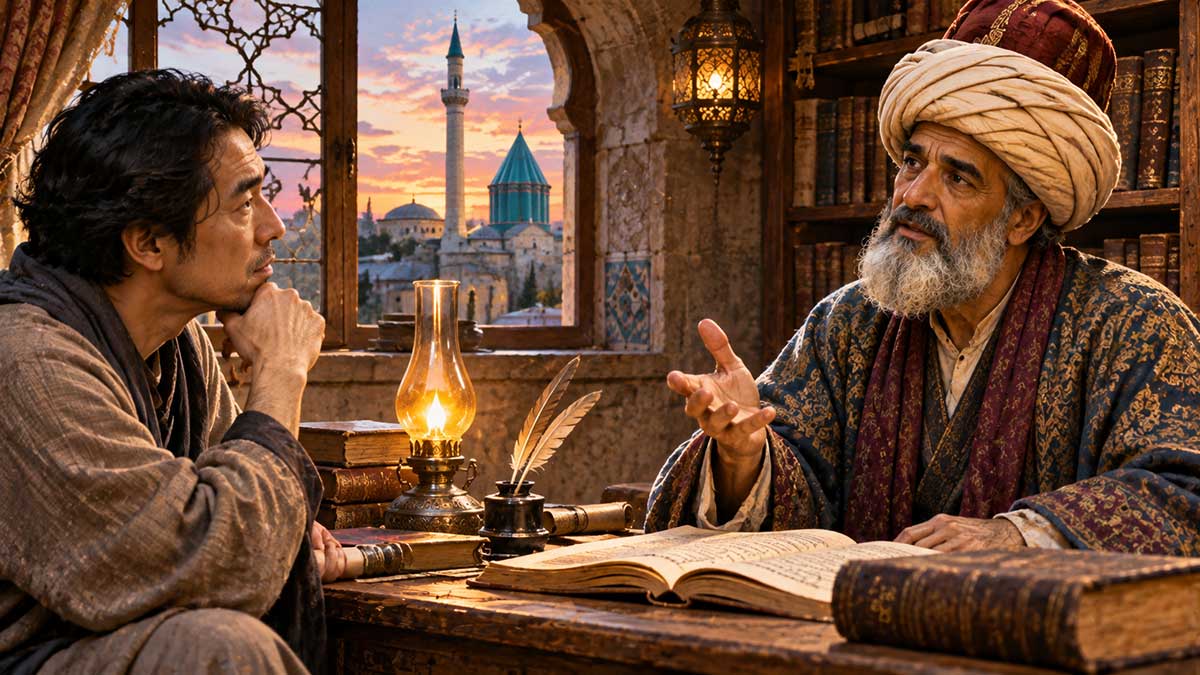
The Meeting in Konya
Konya, Anatolia. A quiet evening in the thirteenth century.
The last light of sunset filters through the arched windows of a modest study. Oil lamps cast a gentle amber glow across shelves of handwritten manuscripts. Beyond the courtyard, the distant call to evening prayer drifts over the rooftops, mingling with the soft footsteps of travelers returning home.
A small brass kettle rests beside two cups. The air carries the faint fragrance of rosewater and burning wood.
Jalal al-Din Muhammad Rumi sits on a woven cushion, dressed in a simple robe and turban. His expression is calm, but his eyes are alert with curiosity. He is in his late thirties, already a respected scholar and teacher, yet still approaching the encounter that will transform his life.
Across from him sits Nick Sasaki, a visitor from another century, carrying questions that have troubled human beings for generations.
Rumi gestures toward the empty cushion.
Rumi: Please, Nick. Sit with me. The evening is still young, and there is much we might discover together.
Nick Sasaki: Thank you, Rumi. I've wanted to have this conversation for a long time.
Rumi: Then perhaps we should begin with what brought you here.
Nick Sasaki: Curiosity, mostly. And a question I've been thinking about for years.
Rumi: A good question is a generous guest. Let us welcome it.
Nick smiles, settles into his seat, and opens his notebook.
Question 1. Did Losing Your Homeland Teach You What It Means to Long for God?
Nick Sasaki: Rumi, millions of people know your poetry, but I suspect most don't know much about the person who wrote it.
You were born in 1207, in a region that was about to experience enormous upheaval. Your family left its homeland when you were young, and you eventually settled here in Konya.
I want to begin there, before the poetry, before Shams, before you became famous.
What was it like to lose your homeland as a child? And do you think that experience shaped your lifelong search for God?
Rumi: Nick, when a child leaves his homeland, he may not yet understand what he has lost.
He understands the faces of his family, the familiar sounds of his home, the places where he has played. Then one day, the road stretches before him, and those familiar things begin to disappear.
But I would be careful about claiming that my childhood alone explains my later teachings.
Many children lose their homes. Some become poets, others become merchants, soldiers, or scholars. Suffering does not automatically make a person wise.
What matters is what the heart eventually discovers through its experiences.
In my Masnavi, I begin with the lament of the reed that has been cut from its reed bed. The reed cries out, longing for the place from which it came.
That image expresses something deeper than the loss of a geographical homeland.
I believed that the human soul experiences a longing for its true origin, for closeness to God.
Nick Sasaki: That's interesting. But I want to distinguish two things.
When you talk about losing your homeland, that's something concrete. You remember a place. You remember people. You know what you've lost.
But when you say the soul longs for God, how do you know that's what it's longing for?
Couldn't that feeling simply be loneliness?
Rumi: Sometimes it is loneliness.
Sometimes it is grief, disappointment, or the desire to be loved.
We should not pretend that every sorrow is a mystical revelation.
But consider a person who obtains everything he has desired. He has wealth, respect, a comfortable home, and a loving family.
And yet, within him, a question remains.
Is this all?
Why does the heart sometimes continue searching when its ordinary desires have been satisfied?
Nick Sasaki: Well, a psychologist might say that's simply human nature. We adapt to whatever we achieve, and then we want something else.
Rumi: That is a reasonable observation.
But it describes the movement of desire. It does not necessarily settle the question of what desire ultimately seeks.
Suppose a thirsty man repeatedly drinks salt water. You might explain why he continues drinking, but you have not yet given him fresh water.
My teaching is that the deepest longing of the human heart cannot be satisfied by temporary possessions alone.
Its ultimate fulfillment lies in God.
Nick Sasaki: So you're not saying that everyone who feels lonely is secretly having a spiritual experience.
You're saying that ordinary loneliness might point to a deeper question about what human beings are searching for.
Rumi: Yes. But the person must discover that question sincerely.
A teacher cannot simply announce the answer and expect the heart to be transformed.
Nick Sasaki: I like that distinction.
Let me ask you something more personal.
When your family was traveling, did you ever feel angry about what was happening? Angry at rulers, at war, maybe even at God?
Rumi: Nick, I cannot give you a perfect account of every feeling from my childhood.
But I would never tell a displaced child that fear or anger makes him spiritually inferior.
A frightened child needs protection. A hungry family needs food. A person who has lost his home needs compassion.
Spiritual teaching must never become an excuse to ignore human suffering.
Nick Sasaki: That's something I really wanted to hear.
Sometimes people speak about suffering as if it's automatically a blessing. But when you're the person suffering, you don't necessarily want someone explaining the spiritual benefits.
You want someone to help you.
Rumi: Then help him.
A person who speaks beautifully about compassion but refuses to practice it has misunderstood the purpose of spiritual knowledge.
Nick Sasaki: So perhaps the first lesson from your life isn't that suffering makes us spiritual.
It's that suffering can awaken questions, but what we do with those questions matters.
Rumi: That is well said, Nick.
And sometimes the most faithful response to another person's suffering is not an explanation.
It is an act of mercy.
Question 2. You Had Faith, Knowledge, and Success. What Was Still Missing?
The kettle begins to murmur softly. Rumi pours tea into the two cups. Nick waits until he has finished before continuing.
Nick Sasaki: Let's move forward in your life.
By your thirties, you had become a respected religious scholar in Konya. You had studied theology and Islamic law. You were teaching students, leading a community, and raising a family.
From the outside, it sounds like you had accomplished everything you were supposed to accomplish.
So here's what I really want to know.
Were you happy?
Or was there something missing that you couldn't explain?
Rumi: Nick, I would not want you to imagine that my life before meeting Shams was empty.
My father was a man of learning and devotion. I received an education that I valued deeply. I studied the Quran, religious law, and the teachings of those who had sought God before me.
I had responsibilities, students, and a family.
These were not meaningless things.
Nor did spiritual truth suddenly appear in my life for the first time when Shams arrived.
Nick Sasaki: That's important, since the popular story makes it sound like you were just a conventional religious teacher until this mysterious stranger completely transformed you.
Rumi: A person's life is rarely so simple.
A tree does not begin growing on the day it produces its first fruit.
The roots have been developing for years.
My teachers, my father, my studies, my prayers, and the experiences of my life all prepared the ground.
But preparation is not the same as fulfillment.
Nick Sasaki: So what was the difference?
Rumi: Consider a man who studies the nature of honey.
He knows where bees gather nectar. He knows how honey is produced. He can describe its color, its fragrance, and its qualities.
But there is something he cannot discover through description alone.
Its taste.
Nick Sasaki: Right. You can know everything about honey without ever tasting it.
Rumi: Exactly.
Religious knowledge can teach a person about God, prayer, morality, and the purpose of human existence.
Such knowledge is valuable.
But the heart must be changed by what it learns.
A person may speak eloquently about humility and remain consumed by pride.
He may teach compassion and treat his own family harshly.
He may explain divine love yet secretly desire admiration more than God.
Knowledge that does not influence the character remains incomplete.
Nick Sasaki: Now that's interesting.
Are you saying that before Shams, you were guilty of some of those things?
Were you proud of being a respected scholar?
Rumi: It would be easy for an imagined version of me to confess a particular hidden fault and give you a satisfying story.
But the deeper question concerns the danger faced by anyone who receives admiration.
A teacher may begin by wanting to serve God and gradually become attached to being recognized as a teacher.
He may become more concerned with defending his reputation than discovering his mistakes.
The ego can hide inside religious devotion.
Nick Sasaki: That's a pretty serious accusation against religious leaders.
Rumi: It is first a warning to the person speaking.
A man who condemns the pride of others may be feeding his own pride through the condemnation.
Nick Sasaki: I can see that.
You know, we see this today in almost every field.
Someone becomes successful, people start listening to them, and eventually they begin to believe they're always right.
It happens in religion, politics, business, science, everywhere.
How does someone recognize that it's happening to them?
Rumi: Observe what happens when someone corrects you.
If your first concern is whether the correction is true, you may still be seeking knowledge.
If your first concern is protecting your reputation, you have discovered something about your attachment to yourself.
Nick Sasaki: That's a very practical test.
But let me challenge you.
Suppose you've spent twenty years studying something, and a stranger walks into the room and tells you you're wrong.
Shouldn't you defend what you've learned?
Rumi: Certainly. Truth is not served by surrendering judgment to every stranger.
Humility does not mean believing every criticism.
It means being willing to examine it.
A scholar should neither worship his own knowledge nor despise it.
Nick Sasaki: That's an important distinction.
I don't want people reading this interview and thinking you're telling them to abandon reason.
Rumi: Nor would I want that.
Reason has its place. Religious learning has its place.
But neither should become an idol.
The question is whether knowledge brings us closer to truth and makes us more faithful, compassionate, and sincere.
Nick Sasaki: Let me bring this back to your family.
You were a husband and father during these years.
When you talk about spiritual fulfillment, do you think a person can find it through raising children, loving a spouse, and taking care of ordinary responsibilities?
Or does someone need a special spiritual experience?
Rumi: The ordinary responsibilities of life offer many opportunities for spiritual growth.
A father may discover the limits of his patience through his children.
A husband may discover his selfishness through the sacrifices marriage requires.
A teacher may discover humility when a student asks a question he cannot answer.
The problem is not ordinary life.
The problem is living without examining the heart.
Nick Sasaki: So someone doesn't have to become a mystic or abandon the world to begin changing spiritually.
Rumi: No.
But neither should we confuse being busy with becoming wise.
A person may spend his entire life fulfilling obligations and never ask whether his actions arise from love, fear, pride, or habit.
Nick Sasaki: I think that applies to a lot of us.
We work hard, raise families, try to be responsible, and eventually ask ourselves whether we've really understood why we're alive.
Rumi: Then the question itself may be an invitation.
Not an invitation to abandon your life.
An invitation to live it more consciously before God.
Question 3. What Is the Difference Between Knowing About God and Actually Experiencing God?
Outside, the evening prayer has ended. The courtyard has grown quiet. Rumi sets his cup aside, and Nick leans forward.
Nick Sasaki: Rumi, I think we're getting close to the central question.
You spent years studying God. You knew the Quran, Islamic theology, and religious law.
But you keep suggesting that knowing about God and actually knowing God are two different things.
What does it mean to experience God?
And how can someone know that the experience is real?
Rumi: Nick, let us begin with something familiar.
Have you ever loved someone?
Nick Sasaki: Of course.
Rumi: And suppose a man who had never loved anyone asked you to explain love.
You might describe affection, sacrifice, tenderness, concern, and the desire for another person's happiness.
You could speak for many hours.
But would your explanations give him the complete experience?
Nick Sasaki: No. He would have to experience love himself.
Rumi: Precisely.
Religious teachings can guide us toward God. Prayer can turn our attention toward God. Scripture can teach us how to live in accordance with divine guidance.
But spiritual knowledge must become something more than words.
It must enter the heart and change the person.
Nick Sasaki: I understand the comparison, but there's a problem.
We know other human beings exist. We can see them and speak to them.
God is different.
Someone might pray intensely, feel overwhelming love, and believe they've encountered God.
But couldn't that experience simply come from the human brain?
Rumi: That is a serious question.
A powerful feeling does not prove that every interpretation of it is correct.
People can be deceived by their emotions. They can mistake excitement for wisdom and imagination for revelation.
For this reason, spiritual experience requires discernment.
Nick Sasaki: How do you test it?
Rumi: One test is what the experience produces in the person's life.
Does he become more humble or more arrogant?
More compassionate or more contemptuous?
More honest or more willing to deceive?
Does he become more faithful in his responsibilities, or does he use his experience as an excuse to neglect them?
Nick Sasaki: That's a good way to judge whether the experience has helped someone.
But it doesn't prove God caused it.
Someone could become kinder through meditation, therapy, or even a powerful experience in nature.
Rumi: You are correct.
A change in character is not, by itself, a demonstration that God exists.
I would not ask you to mistake a moral consequence for a complete philosophical proof.
My conviction is grounded in the revelation of the Quran, the teachings of the Prophet Muhammad, and the spiritual path through which I seek closeness to God.
But the fact that I hold this conviction does not mean every question has been answered to your satisfaction.
Nick Sasaki: I appreciate that.
So when you speak about experiencing God, you're not necessarily talking about seeing a supernatural figure or hearing a voice.
Rumi: No.
A person may seek closeness to God through prayer, remembrance, contemplation, repentance, and sincere service.
In the Sufi path, we speak of purifying the heart so that it becomes less dominated by selfish desires and more receptive to divine guidance.
There may be moments of extraordinary spiritual intensity.
But an extraordinary sensation is not the goal.
Nick Sasaki: Then what is the goal?
Rumi: To become a sincere servant of God.
To love what is good.
To recognize one's dependence upon the Creator.
To become less enslaved by pride, greed, and resentment.
And to allow love of God to transform the way one lives.
Nick Sasaki: That sounds almost surprisingly ordinary.
People associate mysticism with visions, ecstasy, and experiences beyond normal consciousness.
But you're describing a person becoming more humble, more loving, and more responsible.
Rumi: If a man experiences a thousand visions but treats his family cruelly, what has he gained?
If another man never experiences a vision but sincerely remembers God, acts justly, and cares for those entrusted to him, should we dismiss his devotion?
Nick Sasaki: No, I wouldn't.
But let me ask something that might be uncomfortable.
What about people who don't believe in God?
I've known people who are generous, honest, and compassionate without following any religion.
Are they missing something essential?
Rumi: Nick, I would not claim to know the final standing of every human soul before God.
The Quran teaches that God knows what is hidden within human hearts.
I can speak about the path I believe to be true. I can explain why I regard remembrance of God as the deepest fulfillment of human existence.
But I should be cautious about pretending to possess God's complete judgment of another person.
Nick Sasaki: That's interesting.
So you can be deeply committed to your own faith without claiming to know everything about everyone else's relationship with God.
Rumi: Conviction and arrogance are not the same thing.
A person may believe that a path is true and still recognize the limits of his own knowledge.
Nick Sasaki: Let me take this one step further.
Suppose someone spends forty years studying religion, praying every day, and following the rules.
But another person, who has never studied theology, seems naturally compassionate and loving.
Which person is closer to God?
Rumi: You have asked me to judge two hearts from their outward appearances.
I would rather ask what each person is becoming.
Religious knowledge without sincerity is incomplete.
Compassion is precious, but human beings may still have much to learn about the source and purpose of goodness.
The goal is not to arrange people in a competition of spiritual superiority.
It is to seek truth sincerely and allow that truth to transform us.
Nick Sasaki: You keep coming back to transformation.
Rumi: For good reason.
A man can memorize teachings about generosity and remain miserly.
He can discuss patience and become furious at the smallest inconvenience.
He can praise love and refuse to forgive an ordinary insult.
The distance between what we know and how we live can be very great.
Nick Sasaki: That reminds me of something.
Sometimes people know exactly what they should do. They know they should forgive someone, stop being selfish, or spend more time with their family.
But knowing doesn't make them do it.
Why is changing ourselves so difficult?
Rumi: The lower self does not surrender merely when the intellect recognizes its faults.
Habit has strength.
Desire has strength.
Pride protects itself through clever arguments.
A person may even use religious knowledge to defend the very behavior he should change.
This is why the spiritual path requires practice, discipline, repentance, and humility.
Nick Sasaki: So knowledge is the beginning, not the destination.
Rumi: Knowledge can be a beginning. It can be a companion throughout the path.
But its purpose is not merely to fill the mind.
It must help awaken the heart.
Nick Sasaki: Rumi, can I ask you one final question about your life before Shams?
Rumi: Please.
Nick Sasaki: If you already understood all these things, if you already believed that knowledge must transform the heart, why did you need Shams?
What could one wandering stranger possibly teach a man who had spent his entire life studying God?
Rumi looks toward the courtyard.
A faint breeze moves through the open doorway, causing the flame of the nearest oil lamp to flicker.
For a moment, he says nothing.
Rumi: Nick, a person may spend many years preparing a lamp.
He gathers the oil. He fashions the vessel. He protects the wick.
Every part of that preparation matters.
But preparation and illumination are not the same.
Nick Sasaki: And Shams was the flame?
Rumi: Perhaps that is one way to describe what his companionship came to mean.
But do not misunderstand me. The light does not belong to the human being who helps another person recognize it.
The source of all true illumination is God.
Nick Sasaki: So what happened when you first met him?
Rumi turns back toward Nick. A faint smile crosses his face.
Rumi: Ah, Nick. That is a longer story.
And perhaps it begins with a question neither of us would have expected.
Nick closes his notebook for a moment.
Outside, the streets of Konya have grown dark, but the lamps inside the study continue to burn.
The conversation continues in Topic 2: Shams, The Stranger Who Set His Soul on Fire.
Fictional Interview Disclaimer: This is an imagined conversation created for educational, literary, and philosophical exploration. Rumi's dialogue is a creative reconstruction informed by his historical life, Islamic faith, and Sufi teachings. It is not a record of his actual spoken words. The meeting, atmosphere, and interactions with Nick Sasaki are fictional. Historical details and interpretations are distinguished where possible.
Topic 2. Shams, The Stranger Who Set His Soul on Fire
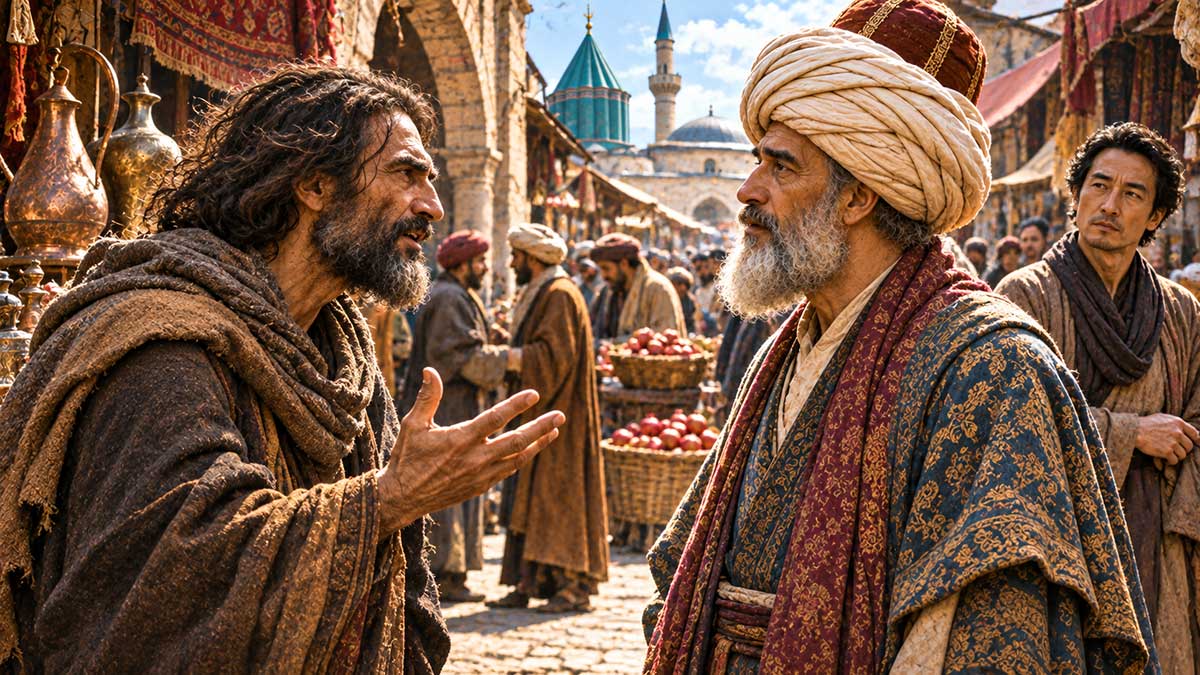
The Stranger in the Marketplace
Konya, Anatolia. A bright autumn afternoon, 1244.
The marketplace is crowded with merchants, travelers, scholars, and craftsmen. Copper vessels gleam beneath the sunlight. The smell of freshly baked bread mingles with spices and leather. Somewhere beyond the narrow streets, a blacksmith's hammer strikes against hot iron.
A caravan of camels passes slowly through the square, their bells sounding above the conversations of traders.
Nick Sasaki walks beside Jalal al-Din Muhammad Rumi through the busy streets.
Rumi is thirty-seven years old, dressed in the dignified robes of a respected Islamic scholar. Several students recognize him and bow respectfully as he passes.
But today, Nick is interested in someone who cared very little for such recognition.
A wandering mystic named Shams of Tabriz.
The man who would change Rumi's life forever.
They stop beside an old stone fountain. Water flows steadily into a shallow basin, and the noise of the marketplace fades slightly beneath the surrounding arches.
Nick Sasaki: Rumi, I wanted to bring our conversation here instead of staying in your study.
Rumi: Then you have chosen a good place. The marketplace teaches lessons that books sometimes overlook.
Nick Sasaki: And somewhere in these streets, you met a man who completely changed your life.
Rumi: Yes. Shams of Tabriz.
Nick Sasaki: I've read different stories about your first meeting. Some sound almost supernatural. Others make it seem like a confrontation between two very intelligent men.
What actually happened?
Rumi watches the water for a moment.
Rumi: The stories people tell about a meeting are often less important than what the meeting awakens.
Nick Sasaki: I suspected you'd say something like that.
But I'm not letting you escape so easily.
Rumi laughs.
Rumi: Then ask, Nick. I shall do my best to answer.
Question 1. What Did Shams Reveal That Years of Religious Study Had Failed to Teach You?
Nick Sasaki: Let's begin with Shams himself.
Who was this man?
You were already a respected religious scholar. You had studied the Quran, Islamic law, theology, and Sufi teachings.
Then this wandering stranger appears.
What made him so extraordinary?
Rumi: Nick, Shams was not extraordinary merely through his appearance.
He did not arrive with an army, a palace, or a collection of titles.
He was a traveler, a seeker, a man whose questions could unsettle those who had grown comfortable with their answers.
He possessed a fierce devotion to God and an unwillingness to flatter those who claimed spiritual authority.
Nick Sasaki: So he wasn't impressed that you were famous?
Rumi: Fame was not what he sought.
Nick Sasaki: That's interesting. Most people who approached you probably wanted to learn from you. Shams seems to have approached you as someone who wanted to challenge you.
Rumi: A true companion does not always tell us what we wish to hear.
Sometimes he recognizes the walls we have built around ourselves.
And sometimes he asks a question that reveals a door we had never noticed.
Nick Sasaki: What kind of question?
Rumi: There are several accounts of our first meeting.
Some describe questions about the Prophet Muhammad and the great mystic Bayazid Bistami.
Others describe a challenge involving books and the limits of scholarly knowledge.
I would not ask you to treat every detail of these later stories as certain history.
But they preserve something important about the character of our encounter.
Shams challenged the distance between religious knowledge and spiritual realization.
Nick Sasaki: Let's talk about that famous question involving Muhammad and Bayazid.
As I understand it, Bayazid was a mystic who made extraordinary statements about his experience of God.
And Shams supposedly asked you to compare him with the Prophet Muhammad.
Why would that be such a difficult question?
Rumi: Bayazid's ecstatic expressions have been interpreted as arising from an overwhelming spiritual state.
The Prophet Muhammad, peace be upon him, represents a different measure of spiritual perfection in Islamic understanding.
The question concerns whether a powerful experience should be mistaken for the highest spiritual realization.
Nick Sasaki: So someone could have an extraordinary mystical experience and still misunderstand its significance?
Rumi: Certainly.
A man may be overwhelmed by a single cup of wine because he has never tasted anything like it.
Another may possess a much greater capacity and remain aware of how much more there is to receive.
Spiritual intensity and spiritual maturity are not necessarily identical.
Nick Sasaki: That's fascinating.
People today sometimes have one extraordinary experience and suddenly believe they've discovered the ultimate truth about the universe.
You're saying that could actually be a sign of limited experience?
Rumi: It may be.
A person who has climbed a small hill may believe he has reached the highest point in the world if he has never seen a mountain.
Nick Sasaki: But what about you?
Did Shams challenge your pride?
Rumi: Nick, I had received an education and responsibilities that I valued.
Yet every scholar must ask whether his learning has become a source of humility or an attachment to his own importance.
Shams had little patience for spiritual complacency.
Nick Sasaki: Did that offend you?
Rumi: A challenge can wound our pride before it benefits our character.
But a wound to pride is not always an injury to the soul.
Nick Sasaki: That's a distinction I like.
Still, there's something I find difficult to understand.
If you were already a sincere believer, why did you need another person to awaken something inside you?
Why couldn't you discover it through prayer or studying the Quran?
Rumi: God may guide a person through many means.
Through scripture.
Through prayer.
Through suffering.
Through the beauty of creation.
And through another human being.
The importance of a spiritual companion is not that he replaces God.
It is that he may help remove the obstacles preventing us from recognizing what God has already placed before us.
Nick Sasaki: So Shams wasn't giving you a new God.
Rumi: No.
Nick Sasaki: He was changing how you experienced the God you already believed in.
Rumi: That is closer to what I mean.
Nick Sasaki: Can I ask you something more direct?
When you met him, did you immediately know that he was going to change your life?
Rumi: People often recognize the meaning of an encounter only after many years.
The beginning of a transformation does not always announce itself.
Nick Sasaki: But did something feel different?
Rumi: Imagine meeting someone who does not ask what position you hold, how many students you teach, or how much knowledge you possess.
Instead, he asks whether the life you are living reflects the truth you claim to know.
Such a question can follow a person long after the conversation ends.
Nick Sasaki: I can see how that would be unsettling.
Especially for someone who had spent years becoming an authority.
Rumi: Authority can be useful when it serves others.
But it becomes dangerous when the person holding it begins to confuse respect with spiritual perfection.
Nick Sasaki: So perhaps Shams was the first person in years who treated you not as a famous teacher, but as a fellow seeker.
Rumi: That is a meaningful way to describe our companionship.
For before God, Nick, no human being has finished learning.
Question 2. Was Shams Your Teacher, Your Closest Friend, or Someone Through Whom You Experienced God?
The afternoon grows warmer.
Rumi leads Nick away from the crowded marketplace into a quiet courtyard behind a modest lodging house.
A fig tree spreads its branches over a stone bench. Sunlight passes through the leaves, scattering moving patterns across the ground.
A servant brings two cups of water and a small plate of dates.
For a moment, neither man speaks.
Nick Sasaki: Rumi, I want to ask you something personal.
Your relationship with Shams has fascinated people for centuries.
Some describe him as your spiritual teacher. Others call him your closest friend. Some interpret your poetry about him as romantic love.
And some say he represented the divine presence you were searching for.
Who was he to you?
Rumi: Nick, human language struggles when we attempt to describe a relationship that touches many dimensions of life.
Shams was my companion in the search for God.
He challenged me, questioned me, and helped awaken a more intense devotion.
But I would not wish you to confuse the human companion with the Creator.
Nick Sasaki: Yet your poetry expresses such extraordinary love for him.
You even named an enormous collection of poems after Shams.
That's unusual, isn't it?
Rumi: The name of a beloved companion can become associated with everything that companionship awakens.
A person may see sunlight reflected in a mirror.
He may treasure the mirror for revealing the light.
But the light does not originate in the mirror.
Nick Sasaki: So Shams was the mirror.
Rumi: In one sense.
But I do not wish to reduce him to an object in a metaphor.
He was a human being with his own struggles, convictions, and spiritual search.
Nick Sasaki: That's an important point.
Sometimes when people tell your story, Shams almost disappears as a real person. He becomes a mysterious symbol whose only purpose was to transform you.
But he had his own life.
Rumi: Indeed.
And genuine love should not erase the reality of the person we love.
Nick Sasaki: Let me ask a difficult question.
How do you distinguish the love you felt for Shams from romantic love?
People today often assume that if two people are deeply attached, there must be a romantic or sexual dimension.
Rumi: The language of love can describe many relationships.
The love of a parent for a child.
The love between friends.
The devotion of a student to a teacher.
The longing of the soul for God.
In Persian mystical poetry, the language of the beloved often moves between human affection and spiritual meaning.
It would be a mistake to assume that every passionate expression describes sexual desire.
It would be equally careless to claim that poetry alone reveals every private dimension of a historical relationship.
Nick Sasaki: So we shouldn't pretend to know things that the historical evidence doesn't establish.
Rumi: Precisely.
But we can examine what the relationship inspired.
Did it deepen the search for God?
Did it challenge attachment to reputation?
Did it awaken love that reached beyond the individual companion?
Those questions bring us closer to the spiritual meaning of the relationship.
Nick Sasaki: Let me push you a little.
Suppose a person says, "I love my spiritual teacher so much that I would do anything for him."
That sounds dangerous.
History is full of spiritual leaders who manipulate their followers.
How can someone distinguish genuine spiritual devotion from unhealthy dependence?
Rumi: That is a necessary question.
A spiritual guide should not be judged merely by his eloquence, reputation, or ability to inspire intense emotion.
Consider what happens to those who follow him.
Do they become more sincere?
More responsible?
More compassionate?
Or do they become fearful, dependent, and unwilling to question him?
Nick Sasaki: So if a teacher demands unquestioning obedience, that's a warning sign.
Rumi: No human being should be treated as God.
A teacher who uses spiritual language to satisfy his own vanity has become trapped in the very ego he claims to overcome.
Nick Sasaki: But isn't there a contradiction here?
You say we must overcome the ego, and yet spiritual disciples are sometimes encouraged to surrender themselves completely to a master.
How do you prevent surrender from becoming manipulation?
Rumi: We must distinguish surrender to God from the abandonment of moral responsibility.
A genuine spiritual path should lead a person toward truth, humility, and faithful conduct.
It should not make cruelty holy or deception acceptable.
Nick Sasaki: Did Shams ever ask you to abandon your responsibilities?
You had a family, students, and a community.
And from what I've read, your intense relationship with him created tension with people close to you.
Rumi: The tension was real in the accounts preserved about our lives.
Spiritual intensity can disturb established relationships.
And we should not romanticize every consequence of that disturbance.
Nick Sasaki: Did you ever think you were neglecting your family or students?
Rumi: Nick, we should be cautious about inventing private confessions that history has not preserved.
But your question deserves consideration.
A person may believe he is pursuing the highest spiritual good and still fail to recognize the pain his choices cause others.
That possibility should make every seeker humble.
Nick Sasaki: I appreciate that.
Sometimes biographies make great spiritual figures seem incapable of ordinary human mistakes.
But I find them more interesting when we recognize that they had families, conflicts, and responsibilities like everyone else.
Rumi: Spiritual aspiration does not free a person from the obligation to examine his conduct.
Nick Sasaki: Let me ask something else.
If Shams had never appeared, do you think you would still have become the poet we know today?
Rumi: That is a question no one can answer with certainty.
My life had already been shaped by teachers, books, prayer, and spiritual companionship.
But Shams became inseparable from the extraordinary flowering of my poetry.
Nick Sasaki: So he didn't create your spiritual life out of nothing.
He awakened something that had been developing for years.
Rumi: Yes.
And perhaps that is one of the great gifts another human being can offer us.
Not to make us into a copy of himself.
But to help us become more truthful about what we are called to be.
Nick Sasaki: That's beautiful.
But I keep coming back to one thing.
You speak about love that frees us from ego and attachment.
Yet when Shams disappeared, you were devastated.
Doesn't that suggest you had become deeply attached to him?
Rumi looks down at the cup resting between his hands.
Rumi: Nick, love may begin with attachment to a particular person.
The question is whether it remains confined there.
Nick Sasaki: And in your case?
Rumi: That question leads us into a more painful part of the story.
Question 3. Was Your Spiritual Awakening Genuine, or Were You Becoming Dependent on Shams?
Evening approaches.
The two men leave the courtyard and walk along a quieter street near the edge of the city.
The marketplace is beginning to close. Merchants fold their awnings, and the last customers hurry home.
A cool wind carries dust along the stone walls.
Nick notices that Rumi has become quieter.
Nick Sasaki: Rumi, I want to ask you something that might sound a little harsh.
When I look at your relationship with Shams, I see an extraordinary spiritual friendship.
But I can see another interpretation.
You were a respected scholar who met an unconventional, charismatic man. You became intensely attached to him. Your students became jealous. Your ordinary life was disrupted.
Then he disappeared, and you were devastated.
From a modern psychological perspective, someone might call that emotional dependency.
How would you respond?
Rumi: I would first ask whether the person making that judgment has carefully examined the evidence.
We should not diagnose a human relationship merely from the intensity of its poetry.
But neither should we assume that spiritual language makes every attachment healthy.
Nick Sasaki: So you admit that spiritual relationships can become unhealthy.
Rumi: Any human relationship can be distorted by pride, possessiveness, fear, or selfish desire.
Even relationships that begin with sincere intentions.
Nick Sasaki: Then how can we tell the difference?
Rumi: Ask what the love seeks.
Does it seek to possess the beloved?
To control his movements?
To demand constant reassurance?
Or does it seek the beloved's genuine good, even when that good cannot be possessed?
Nick Sasaki: But when Shams left, you searched for him.
Doesn't that suggest you couldn't accept losing him?
Rumi: Grief is not proof that love was false.
A mother who weeps for her child has not necessarily loved selfishly.
A friend who mourns another friend has not necessarily failed spiritually.
The question is not whether love brings sorrow.
The question is what sorrow eventually reveals and how we respond to it.
Nick Sasaki: That's fair.
But your grief seems to have been overwhelming.
Rumi: The accounts describe a period of profound distress and searching.
And the poetry associated with Shams expresses longing with extraordinary intensity.
I would not wish to turn that pain into a simple lesson.
Nick Sasaki: What do you mean?
Rumi: People sometimes look at another person's suffering and say, "How wonderful. Without that pain, he would never have become great."
But suffering is not beautiful merely for being suffering.
And the loss of someone beloved should not be celebrated as if the person were expendable.
Nick Sasaki: That's exactly what bothers me about some spiritual explanations.
People say everything happens for a reason.
But imagine telling someone who has lost a child that the tragedy was necessary for their growth.
That could be terribly cruel.
Rumi: Then do not say it.
Offer compassion before interpretation.
And be humble about what you claim to know of God's purposes.
Nick Sasaki: So how did you personally begin to make sense of losing Shams?
Rumi: In the poetry associated with his name, longing becomes a means of turning attention beyond the visible form of the beloved.
The absence of a companion can force the heart to confront what it has truly been seeking.
Nick Sasaki: Are you saying that when Shams disappeared, you realized you had been searching for God through him?
Rumi: That is one meaningful interpretation of the spiritual movement expressed in my poetry.
But such realization is not always immediate.
A person may understand something intellectually long before the heart can accept it.
Nick Sasaki: Did you ever feel angry with Shams for leaving?
Rumi: The surviving accounts do not permit us to reconstruct every private emotion with certainty.
But anger, sorrow, confusion, and longing are familiar human responses to separation.
The spiritual question is not whether such feelings arise.
It is whether they become the final masters of our lives.
Nick Sasaki: Let me ask you something more philosophical.
If the purpose of your relationship with Shams was to lead you toward God, wouldn't that mean you eventually had to stop depending on Shams himself?
Rumi: A spiritual companion should direct us beyond his own personality.
If a man points toward the sun, we should not spend our entire lives staring at his finger.
Nick Sasaki: That's a powerful image.
But what if you love the person who is pointing?
Rumi: Then love him.
Be grateful for him.
Honor what he has given you.
But do not confuse the human being with the eternal reality toward which he directs your attention.
Nick Sasaki: So love doesn't have to disappear.
It has to change.
Rumi: It may deepen.
At first, we may love someone for what he gives us.
For comfort, admiration, companionship, or the feeling of being understood.
Later, we may learn to love without demanding that the beloved satisfy every desire.
And through such love, we may become more aware of our dependence upon God.
Nick Sasaki: Let me challenge that.
Couldn't someone use this philosophy to avoid ordinary human commitments?
They might say, "I love you spiritually, but I don't need to be present for you. I don't need to care for you. I'm beyond attachment."
Rumi: That would be a misuse of the teaching.
A person who claims to have transcended attachment but refuses ordinary acts of kindness should examine his heart carefully.
Love of God does not excuse neglect of those entrusted to our care.
Nick Sasaki: That's something I wanted to establish.
Spiritual love shouldn't become an excuse for emotional irresponsibility.
Rumi: Indeed.
A person's claims about spiritual realization must be considered alongside his conduct.
Nick Sasaki: Now here's something else I've been thinking about.
Shams challenged your scholarly identity. He seems to have pushed you beyond the world of books and formal religious authority.
But couldn't that be dangerous too?
What if someone abandons critical thinking and begins believing every intense emotion is a revelation?
Rumi: Then he has confused spiritual intensity with spiritual wisdom.
The path requires discernment.
A powerful experience may reveal something about the heart, but it does not make every thought arising from that experience true.
Nick Sasaki: So reason and spiritual experience shouldn't be enemies.
Rumi: They need not be.
Reason can help us recognize contradictions, examine our conduct, and avoid deception.
But reason alone cannot replace the practice of love, just as reading about generosity cannot substitute for giving.
Nick Sasaki: I think I'm beginning to see why Shams mattered so much.
He didn't simply give you new information.
He challenged the way you were living with the information you already possessed.
Rumi: Yes.
Nick Sasaki: And perhaps the most difficult part wasn't meeting him.
It was discovering how much you had attached your spiritual awakening to his presence.
Rumi: That is a question worth carrying, Nick.
Nick Sasaki: Can I ask you one final question?
Rumi: Of course.
Nick Sasaki: If you could go back to the day you first met Shams, knowing that your relationship would bring extraordinary love but also devastating separation, would you still choose to meet him?
Rumi stops walking.
For a moment, he looks back toward the city, where the first lamps have begun to appear in the windows.
Rumi: Nick, we often wish to keep the gifts of love and remove the possibility of loss.
But human life does not offer us such certainty.
I cannot tell you what another version of my life would have become.
I can only say that my companionship with Shams became part of my search for God, my poetry, and my transformation.
Nick Sasaki: So you wouldn't erase it?
Rumi: I would not wish to erase the love merely to escape the sorrow.
Nick Sasaki: That's a beautiful answer.
But it leaves me with another question.
You've spoken about God throughout our conversation. You've described divine love, the soul, and the ego.
Yet I still don't know exactly what you mean when you say you experienced God's presence.
What is God to you?
Is God a being somewhere beyond the universe?
Is God present within us?
Or is God something so different from our ordinary understanding that language cannot describe it?
Rumi looks toward the darkening sky.
Rumi: Nick, those are not small questions.
And before we answer them, we may need to examine the person who is asking.
Nick Sasaki: You mean me?
Rumi: You, me, and every human being who asks what God is.
For how we understand ourselves may shape what we are capable of recognizing.
Nick considers this for a moment.
Nick Sasaki: Then perhaps that's where we should go next.
The evening call to prayer begins to echo across Konya.
Rumi turns toward the sound, and Nick remains beside him as the final light disappears from the city walls.
The conversation continues in Topic 3: What Is God, and Who Are We Really?
Fictional Interview Disclaimer: This conversation is an imaginative reconstruction created for literary, educational, and philosophical exploration. Rumi's responses draw upon themes from his poetry, Islamic faith, and Sufi teachings, but they are not documented quotations. The marketplace encounter, dialogue, and interactions with Nick Sasaki are fictional. Historical accounts of Rumi's first meeting with Shams and the nature of their relationship contain uncertainties, which this fictional interview does not claim to resolve.
Topic 3. What Is God, and Who Are We Really?
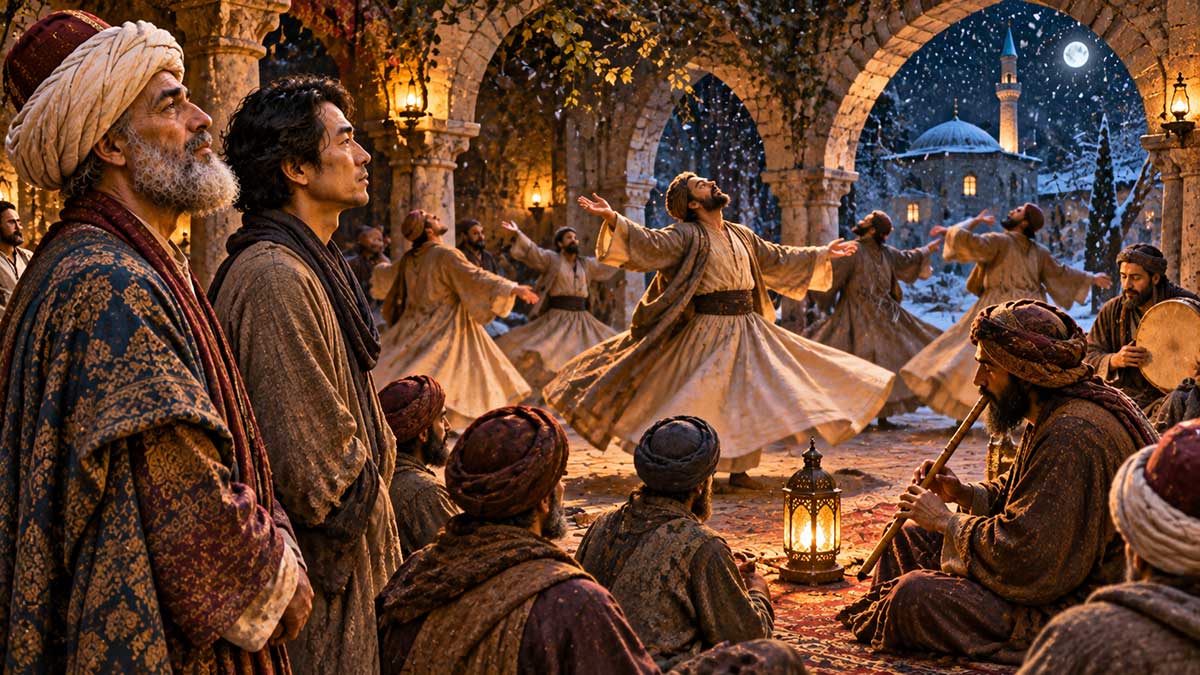
The Night of the Turning Dervishes
Konya, Anatolia. A winter evening in the middle of the thirteenth century.
Snow rests along the edges of the narrow streets. Beyond a wooden doorway, warm lamplight spills into a courtyard where several men have gathered for prayer and remembrance.
Inside, a reed flute begins to play.
Its sound is haunting, almost like a human voice calling for someone who has gone away. A frame drum joins it, marking a gentle rhythm. Several dervishes rise and begin moving in slow circles, their robes turning around them.
Nick Sasaki stands beside Rumi near a wooden pillar.
Rumi watches the gathering with quiet attention. His expression suggests that the movement is more than a performance. For him, it is an act of devotion.
The scene is an imagined Sufi gathering, not a depiction of the later formal Mevlevi ceremony.
Nick Sasaki: Rumi, I have to say, this is extraordinary.
Rumi: What do you find extraordinary, Nick?
Nick Sasaki: The atmosphere. The music, the movement, the way everyone seems completely absorbed.
But I'm curious about something.
Are they trying to enter some kind of altered state of consciousness?
Rumi: They are seeking remembrance of God.
Movement may help turn the heart away from its ordinary distractions. But movement alone is not spiritual realization.
A man may turn in circles until he becomes dizzy and discover nothing beyond dizziness.
Nick laughs.
Nick Sasaki: That's a surprisingly practical answer.
Rumi: The body can participate in devotion, but the heart must know what it seeks.
Nick Sasaki: Then tonight I want to ask you three questions I've been waiting to ask since we met.
What is God?
Who are we really?
And how can anyone know that a mystical experience reveals something true?
Rumi: Those questions may keep us awake until morning.
Nick Sasaki: That's perfectly fine with me.
Question 1. When You Speak of God and Divine Love, What Exactly Do You Mean?
Nick Sasaki: Rumi, you speak constantly about God.
You say the soul longs for God. You say divine love transforms us. You describe human life as a search for something eternal.
But let's begin with the most basic question.
What exactly is God?
Is God a personal being who knows and loves us? Is God some infinite consciousness? Or is God something beyond anything human language can describe?
Rumi: Nick, I begin with the God revealed in the Quran.
God is the Creator, not a creature. God is one, without equal, without dependence upon anything else.
God knows what is visible and what is hidden.
God is merciful, just, and beyond the limitations of created things.
But human language can never contain the fullness of divine reality.
Nick Sasaki: So God is personal, but not a person in the ordinary human sense?
Rumi: God hears prayer and knows the human heart, yet God is not limited by a human body or human needs.
We must not confuse the qualities through which we know God with the limitations of ourselves.
Nick Sasaki: Let me ask something that has always puzzled me.
If God is beyond our comprehension, how can we claim to know anything about God?
Isn't that contradictory?
Rumi: There is a difference between knowing something truly and knowing it completely.
A child may know that his mother loves him without comprehending everything about her mind and heart.
Likewise, the human being may receive genuine knowledge of God without possessing complete knowledge of divine reality.
Nick Sasaki: But how do you know that knowledge is genuine?
Rumi: My faith is grounded in revelation, in the Quran, and in the prophetic example.
My spiritual search is an attempt to live that faith with sincerity.
I do not claim that a feeling alone establishes every truth about God.
Nick Sasaki: That's interesting. Modern readers sometimes describe you as if you believed God was simply love itself.
Rumi: Love is central to my teaching, but God cannot be reduced to a human emotion.
Divine love is not merely the pleasant feeling we experience when someone makes us happy.
It draws the soul beyond selfishness.
It teaches us to value truth more than our reputation and the good of others more than our immediate desires.
Nick Sasaki: But why would God want our love?
If God is perfect, God doesn't need anything from us.
Rumi: God does not become greater through our devotion.
We are the ones who need transformation.
The sun does not require a flower to turn toward it.
Yet the flower receives what it needs by turning toward the light.
Nick Sasaki: So prayer and devotion aren't about making God feel appreciated.
They're about changing us.
Rumi: They are acts of worship, gratitude, obedience, and remembrance. Their benefits return to the worshipper.
Nick Sasaki: Here's a difficult question.
If God loves humanity, why create us in a condition where we struggle so much to recognize that love?
Why not make God's existence obvious to everyone?
Rumi: Nick, I would be cautious about claiming to explain every purpose of divine creation.
But the Quran presents human life as a place of moral responsibility, remembrance, and testing.
Human beings are capable of seeking truth, but they can become distracted by desire, pride, and forgetfulness.
Nick Sasaki: That sounds like God deliberately made the situation difficult.
Rumi: It is reasonable to ask why life contains such difficulty.
Faith does not require us to pretend that every divine purpose is transparent to us.
But difficulty itself does not establish that love is absent.
Nick Sasaki: I can accept that as a religious answer. But a skeptic might say you're explaining an invisible God through another invisible purpose.
Rumi: Then the skeptic should continue asking sincere questions.
I would rather converse with a person who honestly seeks truth than receive praise from someone who repeats religious words without examining their meaning.
Nick Sasaki: I like that.
Let me ask you one more thing.
You talk about love leading us to God. But what if someone has never experienced love from another human being?
How can they possibly recognize divine love?
Rumi: Human beings can be wounded by neglect and cruelty.
We should never treat their difficulty trusting love as a moral failure.
Sometimes the first lesson a person needs is not a lecture about God.
It is the experience of being treated with dignity and compassion.
Nick Sasaki: So when someone says they cannot feel God's love, perhaps we should begin by showing them human kindness.
Rumi: An act of mercy may communicate something that many speeches cannot.
Question 2. What Is the Ego, and What Remains When We Surrender It?
The gathering has become quieter. Some dervishes sit in contemplation. Others continue their remembrance in low voices.
Nick and Rumi move into a small adjoining room, where a charcoal brazier warms the air.
Nick Sasaki: Rumi, there's something in your teaching that I find both fascinating and confusing.
You keep telling people to overcome the ego.
But modern psychology teaches that having a healthy sense of self is important.
We need personal identity, boundaries, confidence, and the ability to make decisions.
Why would God create us as unique individuals and then ask us to surrender our individuality?
Rumi: Nick, we must distinguish the self from its selfish domination.
In the spiritual tradition, we speak of the nafs, the lower self that can become ruled by appetite, vanity, anger, and pride.
The problem is not that you have a name, a personality, or responsibilities.
The problem begins when your desires become your master.
Nick Sasaki: Give me a practical example.
Rumi: Suppose someone criticizes your work.
You may examine the criticism and discover something useful.
Or you may become furious simply through the feeling that your importance has been challenged.
In the second case, what are you defending?
Truth?
Or your image of yourself?
Nick Sasaki: Probably my ego.
Rumi: And suppose another person receives an honor you desired.
You might sincerely rejoice in his good fortune.
Or you might feel diminished, as if another person's success has stolen something from you.
The ego can make life into an endless competition for importance.
Nick Sasaki: But ambition can be good.
A person might want to build a business, discover a cure for a disease, or become an excellent athlete.
Are you saying ambition itself is wrong?
Rumi: No.
The moral character of an action depends in part upon its intention and its consequences.
A person may work diligently to provide for his family or serve his community.
Another may pursue the same outward achievement primarily to feel superior.
Their actions may look similar, but their hearts are moving in different directions.
Nick Sasaki: So you aren't asking people to stop achieving things.
You're asking them to examine why they want those achievements.
Rumi: Yes.
Nick Sasaki: But suppose someone genuinely succeeds in overcoming pride, envy, and selfishness.
What remains?
Who is that person?
Rumi: A human being more capable of fulfilling the purpose for which God created him.
Humility does not destroy intelligence.
Compassion does not destroy courage.
Surrender to God does not erase moral responsibility.
It can free a person from being ruled by every passing desire.
Nick Sasaki: That sounds almost like freedom through discipline.
Rumi: A man who cannot resist his anger is not free merely through doing whatever anger commands.
A man who must receive constant praise is dependent upon the opinions of others.
A man who cannot bear another person's success is imprisoned by comparison.
Nick Sasaki: That's interesting. We often define freedom as doing whatever we want.
You're saying freedom might mean not being controlled by everything we want.
Rumi: That is a useful distinction.
Nick Sasaki: But can anyone completely overcome the ego?
What about you? Did you reach that state?
Rumi: A person who announces his complete freedom from pride should examine why he wishes everyone to know.
Nick bursts into laughter.
Nick Sasaki: That's a pretty good answer.
Rumi: The spiritual path requires continual self-examination.
We should be cautious of those who claim that their transformation places them beyond ordinary moral accountability.
Nick Sasaki: So spiritual enlightenment doesn't give someone permission to do whatever they want.
Rumi: It certainly should not become an excuse for wrongdoing.
Nick Sasaki: Then maybe the real question isn't whether we've eliminated our ego.
It's whether we're becoming less controlled by it.
Rumi: And whether that change brings us closer to God and makes us more faithful in how we treat others.
Question 3. How Can We Know a Mystical Experience Is Real?
The reed flute begins again in the adjoining hall.
Nick listens for a moment before returning to the conversation.
Nick Sasaki: Rumi, here's where my skeptical side becomes curious.
People throughout history have reported mystical experiences.
Some say they encountered God. Others describe universal consciousness, divine light, or a feeling that everything is connected.
Today, scientists can study what happens in the brain during meditation and intense spiritual experiences.
How do you distinguish a genuine encounter with God from an unusual state of consciousness?
Rumi: We should first acknowledge that a powerful experience does not make every interpretation of it true.
A person may experience intense joy and misunderstand its cause.
Another may experience fear and mistake it for a divine warning.
Discernment is necessary.
Nick Sasaki: But couldn't everything you describe be happening inside the brain?
Rumi: An experience occurring through the human mind does not, by itself, establish whether its object exists beyond the mind.
Nor does the intensity of an experience establish that its interpretation is correct.
Nick Sasaki: So you're not claiming that neuroscience could never explain mystical experiences.
Rumi: I cannot claim knowledge of scientific discoveries made centuries after my lifetime.
But examining how an experience occurs and asking whether its interpretation is true are related, yet distinct questions.
Nick Sasaki: Let me make this harder.
Suppose a Christian mystic says he encountered Christ.
A Hindu mystic says he encountered Krishna.
A Muslim mystic says he experienced closeness to Allah.
They all seem completely convinced.
How can they all be right when their beliefs differ?
Rumi: Sincerity does not make contradictory propositions identical.
A person may experience something profound and still interpret it through an imperfect understanding.
Nick Sasaki: Then how do we decide who is correct?
Rumi: We must examine claims through reason, revelation, the teachings we trust, and the moral and spiritual fruits of the path.
I speak from within the Islamic tradition.
I would not pretend that every religious difference disappears through the use of beautiful language about love.
Nick Sasaki: That's refreshing.
Some people quote you as if you were saying every religion teaches exactly the same thing.
Rumi: Human beings may share deep spiritual longings without holding identical beliefs.
Recognizing common longing does not require denying genuine differences.
Nick Sasaki: One last question.
Suppose I'm an atheist. I don't believe in God or an immortal soul.
But I want to experience the kind of inner transformation you're describing.
What should I do?
Rumi: Begin with sincerity.
Examine what governs your life.
Observe your anger, your attachments, your pride, and your treatment of other people.
Practice generosity without demanding admiration.
Make time for silence and honest reflection.
And do not close the question of God merely through assuming that you have already answered it.
Nick Sasaki: So you would invite me to investigate rather than demand that I pretend to believe.
Rumi: Faith cannot be made sincere through pretending.
Nick Sasaki: Rumi, something strikes me about everything you've said tonight.
You speak of divine love as something that frees us from fear and attachment.
But your own life tells a more complicated story.
You loved Shams, and then you lost him.
If love truly leads us toward God, why did it break your heart so terribly?
Rumi looks toward the doorway. The final notes of the reed flute fade into silence.
Rumi: Nick, perhaps we should speak of that somewhere quieter.
There are some questions that become clearer when we stop trying to escape the sorrow within them.
The conversation continues in Topic 4: When Love Breaks the Heart, Can It Open the Soul?
Fictional Interview Disclaimer: This is an imagined conversation informed by Rumi's Islamic faith, Sufi teachings, and poetry. The dialogue and setting are fictional. The devotional gathering draws on historical Sufi practices rather than depicting the later standardized Mevlevi ceremony.
Topic 4. When Love Breaks the Heart, Can It Open the Soul?
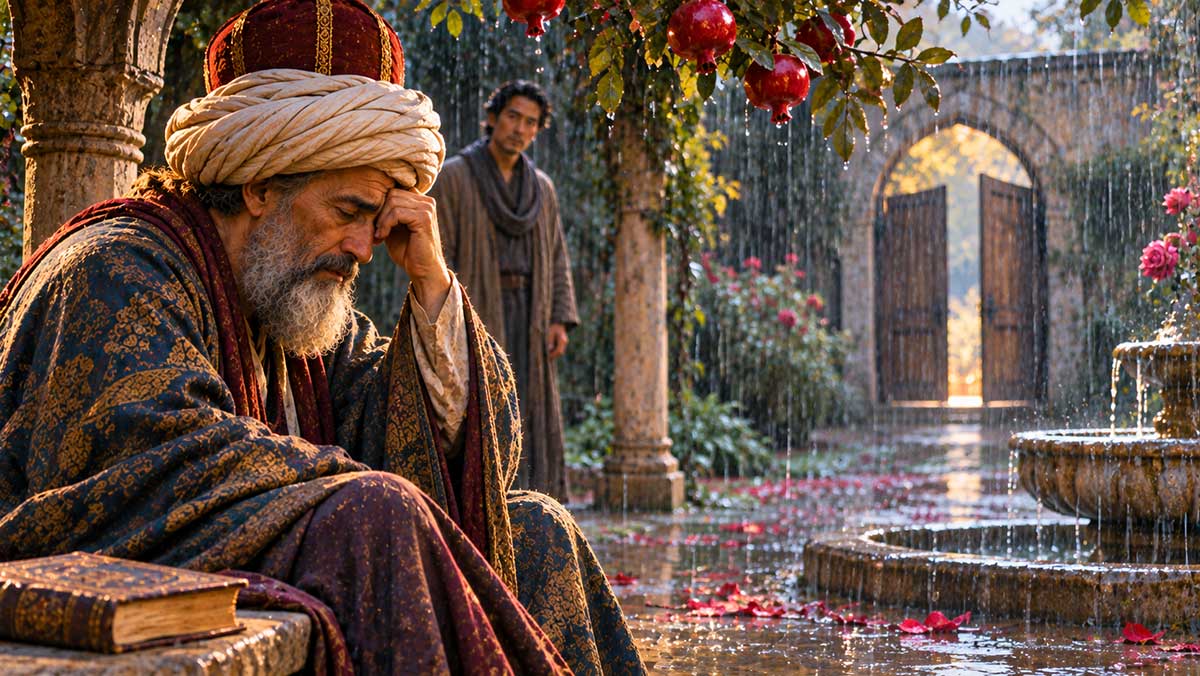
The Garden Where Absence Speaks
Konya, Anatolia. Around 1248.
An evening rain has just passed over the city.
Beyond the walls of a secluded garden, narrow streets glisten beneath the fading light. Water drips from the branches of a pomegranate tree. A stone fountain murmurs in the courtyard, its surface disturbed by the occasional falling leaf.
The air smells of wet earth, rose petals, and woodsmoke.
Nick Sasaki enters through a wooden gate and finds Jalal al-Din Rumi sitting beneath a covered veranda. A manuscript rests beside him, its pages untouched. He looks older than he did during their previous encounter, not through the passage of many years, but through the weight of an absence that has settled into his life.
Shams of Tabriz has disappeared.
No one can say with certainty what happened to him. Some accounts suggest he departed voluntarily. Others preserve darker possibilities. What remains unmistakable is the extraordinary longing that would become inseparable from Rumi's poetry.
Rumi looks up as Nick approaches.
Rumi: Nick. You have come through the rain.
Nick Sasaki: I hope I'm not disturbing you.
Rumi: Not at all. Come and sit. The garden is particularly peaceful after a storm.
Nick settles onto a cushion beside him. For a moment, both men listen to the fountain.
Nick Sasaki: I've been thinking about our last conversation. About Shams.
Rumi: Then perhaps the rain has brought us to the right subject.
Nick Sasaki: You told me that love can free us from attachment. But I keep wondering how that teaching survives the loss of someone we cannot bear to lose.
Rumi looks toward the empty path leading to the gate.
Rumi: That is not a question one answers merely through clever words.
Question 1. What Did Losing Shams Teach You About Love?
Nick Sasaki: Rumi, I want to begin with something personal.
You met Shams in 1244. Your friendship transformed your life. You became inseparable in the accounts people tell about you.
Then he disappeared.
There are conflicting stories about what happened, and historians still cannot establish every detail.
But regardless of what happened, you lost someone you loved profoundly.
What was the hardest part?
Rumi: Nick, there are different kinds of separation.
Sometimes a person dies, and the sorrow is accompanied by the knowledge that his earthly life has ended.
But when someone disappears, the mind may continue searching.
Perhaps he is alive.
Perhaps he will return.
Perhaps tomorrow will bring news.
The heart can become suspended between hope and grief.
Nick Sasaki: Did you search for him?
Rumi: Accounts of my life describe journeys and efforts to find Shams.
But we should not pretend that every later story gives us a complete record of what happened.
What is certain is that his absence became a profound presence in my poetry.
Nick Sasaki: That's an interesting way to put it.
His absence became a presence.
Rumi: A person may leave our sight without leaving our inner life.
Sometimes the memory of someone becomes so vivid that ordinary places seem filled with reminders.
A doorway.
A familiar street.
A question he once asked.
Nick Sasaki: Did you ever feel angry with him?
Rumi: Nick, the historical record cannot tell you every private emotion I experienced.
But anger is not unusual in grief.
We may feel abandoned, confused, or betrayed, even when we do not know whether the person intended to leave us.
Nick Sasaki: That's what makes your story so human.
People often describe you as a saint who transformed grief into beautiful poetry. But before the poetry, there must have been a man who simply missed his friend.
Rumi: Grief should not be made beautiful so quickly that we forget the person who is suffering.
Nick Sasaki: I appreciate that.
Sometimes people say suffering is a gift, or that every tragedy happens for a reason.
But imagine telling a parent who has just lost a child that the loss was necessary for spiritual growth.
That would be cruel.
Rumi: Then do not say it.
A grieving person does not always need an explanation.
Sometimes he needs someone to sit beside him without demanding that his sorrow become a lesson.
Nick Sasaki: So when you say suffering can transform us, you don't mean every tragedy is good.
Rumi: No.
Pain is not made righteous merely through producing something valuable afterward.
A person may grow through suffering, but that does not mean the suffering itself should be celebrated.
Nick Sasaki: Let me ask about your poetry.
Your Divan-e Shams-e Tabrizi is filled with longing, ecstasy, and love.
Did writing help you survive the loss?
Rumi: Poetry can give expression to what ordinary speech struggles to contain.
But I would not reduce the poems to a simple method of coping.
They express spiritual longing, remembrance, devotion, and the transformation of love.
Nick Sasaki: Yet Shams's name is everywhere.
Rumi: A beloved companion can become associated with the spiritual awakening he helped bring about.
But the deepest object of the soul's longing is God.
Nick Sasaki: So Shams was never supposed to be the final destination.
Rumi: No human being should replace the Creator.
Nick Sasaki: But isn't that easier to say than to live?
You can intellectually know that God is eternal and human beings are temporary.
Yet when someone you love disappears, your heart doesn't simply accept the distinction.
Rumi: Indeed.
Knowledge and transformation are not identical.
We may understand a teaching long before we can live according to it.
Nick Sasaki: Then maybe your grief revealed something you hadn't fully understood.
Rumi: Perhaps love must continually examine its own attachments.
Do we love another person only for what his presence gives us?
Or can love become gratitude, generosity, and devotion beyond the immediate desire to possess?
Nick Sasaki: But I don't want to lose the human side of this.
Suppose Shams suddenly walked through that garden gate.
What would you do?
Rumi looks toward the gate.
The wind moves through the wet branches, scattering droplets onto the stone path.
Rumi: Nick, perhaps I would forget every beautiful sentence I have ever spoken.
Nick Sasaki: You'd just run to him?
Rumi smiles.
Rumi: Perhaps.
Nick Sasaki: I like that answer.
It reminds me that spiritual wisdom doesn't have to erase ordinary human love.
Rumi: Love that makes us less human has misunderstood its own purpose.
Nick Sasaki: Then let me ask one final question.
If you could return to the day you first met Shams, knowing the joy and the suffering that would follow, would you still choose to meet him?
Rumi is quiet for a long moment.
Rumi: Nick, we often wish to receive the gifts of love without accepting the possibility of separation.
But human relationships do not offer that certainty.
I cannot tell you what another life would have become.
I can only say that the companionship of Shams became part of my search for God and the flowering of my poetry.
Nick Sasaki: So you wouldn't erase the love just to escape the pain.
Rumi: I would not wish to erase love merely to escape sorrow.
Question 2. If God Is Loving, Why Does God Allow Innocent People to Suffer?
The evening grows darker.
A servant brings a small oil lamp and places it between the two men. Its flame flickers as the breeze moves beneath the veranda.
Nick watches the light for a moment before speaking.
Nick Sasaki: Rumi, I want to ask what may be the hardest question in religion.
If God is loving, why does God allow innocent people to suffer?
I'm not talking about suffering caused by our own mistakes.
I'm talking about children dying in wars, families losing everything, people experiencing cruelty they never deserved.
Why would a loving God permit that?
Rumi: Nick, anyone who answers such a question too easily should examine whether he has truly heard it.
Nick Sasaki: That's exactly why I'm asking.
Religious people sometimes say suffering is a test.
But why should an innocent child have to endure such a test?
Rumi: Islamic teachings speak of human responsibility, divine wisdom, trials, and the life to come.
Yet those teachings do not give us complete knowledge of why each particular tragedy occurs.
Nick Sasaki: So you don't have a complete answer?
Rumi: I would not claim to know the hidden purpose behind every child's suffering.
And I would be deeply cautious of anyone who claims that a particular tragedy was necessary for another person's spiritual improvement.
Nick Sasaki: But you believe suffering can transform people.
Rumi: It can.
That is different from saying that every instance of suffering was intended to produce a particular benefit.
A fire may teach a person caution.
That does not mean we should celebrate a burning house.
Nick Sasaki: That's a distinction I think people need to hear.
But here's another problem.
If someone believes suffering is part of God's plan, couldn't that make them passive?
Couldn't they say, "I don't need to fight injustice. God has a reason for everything"?
Rumi: That would misunderstand moral responsibility.
If someone is hungry, feed him.
If someone is oppressed, do not use spiritual language to excuse cruelty.
Trust in God does not absolve human beings of the duty to act justly.
Nick Sasaki: What about forgiveness?
Suppose someone deliberately harms your family.
Are you supposed to forgive that person?
Rumi: Forgiveness can be a profound moral act, but it should not be confused with allowing harm to continue.
Compassion and justice need not be enemies.
Nick Sasaki: So I can forgive someone and still demand accountability.
Rumi: Yes.
The heart may seek freedom from hatred without pretending that wrongdoing is acceptable.
Nick Sasaki: But how do you forgive someone who shows no remorse?
Rumi: Forgiveness is not always immediate.
And one should not force another person to declare forgiveness before the wounds have been acknowledged.
The spiritual task is to avoid allowing hatred to become the master of one's entire life.
Nick Sasaki: Let me make this personal.
When Shams disappeared, did you forgive the people who opposed him?
Rumi: The historical record does not establish everything I felt or did.
I would rather not create a false certainty.
But the question of how to respond to hostility is central to spiritual life.
Nick Sasaki: Then tell me this.
What would you say to someone who has suffered terribly and now hates God?
Rumi: I would first listen.
Nick Sasaki: You wouldn't correct them?
Rumi: Not before hearing what has wounded them.
A person crying out in anguish may need mercy more urgently than argument.
Nick Sasaki: You keep returning to that.
Rumi: A heart is not repaired through winning a debate against its suffering.
Nick Sasaki: Let me push you further.
Suppose someone has suffered so much that they no longer believe life has any meaning.
They've lost their family, their home, and their faith.
What would you tell them?
Rumi: I would not demand that they immediately discover meaning.
I would encourage them to remain among people who can offer care, protection, and companionship.
And I would remind those around them that compassion is not merely a feeling.
It requires action.
Nick Sasaki: So you wouldn't begin with theology.
Rumi: I would begin with the human being before me.
Nick Sasaki: That's something I think the world needs more of.
People are often so eager to defend their beliefs that they forget to care for the person asking the question.
Rumi: A person may win an argument and lose an opportunity to show mercy.
Nick Sasaki: Rumi, I want to ask something about your own faith.
Did you ever doubt God when you suffered?
Rumi: The historical record does not permit us to reconstruct every private struggle.
But faith is not the absence of difficult questions.
A person may seek God through tears, confusion, and longing.
Nick Sasaki: So doubt and devotion aren't necessarily opposites.
Rumi: A sincere question may become part of a sincere search.
But a question should not be mistaken for its own answer.
Question 3. What Happens to the Soul After Death?
The night has settled over Konya.
A crescent moon appears above the garden wall. The fountain reflects its pale light, and the air has grown cool enough for Nick to draw his cloak closer.
Nick Sasaki: Rumi, we've talked about losing people we love.
Eventually, every one of us faces death.
You believed the soul continues beyond physical life.
What exactly happens when we die?
Rumi: In the Islamic understanding, earthly life is not the whole of human existence.
Death brings a transition, and human beings remain accountable before God.
The Quran speaks of resurrection, judgment, mercy, and the life to come.
My poetry often approaches these realities through images of separation and reunion.
Nick Sasaki: But do we remain ourselves?
Will I still be Nick?
Will I remember my family?
Rumi: The religious tradition affirms the significance of the individual soul and its accountability.
Yet we should not pretend to possess a complete description of the unseen.
Nick Sasaki: So when people say the soul dissolves into God, is that what you believe?
Rumi: The language of mystical union must be handled carefully.
In Sufi teaching, the annihilation of the ego does not mean that the Creator and the creature become identical in every sense.
It concerns the transformation of the self through devotion to God.
Nick Sasaki: That's an important distinction.
But how do you know the soul survives death?
Rumi: My conviction rests upon faith in God's revelation and the prophetic teaching.
Nick Sasaki: Not scientific proof.
Rumi: I would not claim to possess a scientific demonstration that I cannot provide.
Nick Sasaki: Were you afraid of death?
Rumi: The human being may fear pain, separation, uncertainty, or the consequences of his actions.
Faith does not require pretending that these concerns never arise.
But remembrance of God can transform one's relationship with mortality.
Nick Sasaki: What about the people we love?
Do you believe you'll meet Shams again?
Rumi: I place my hope in God's mercy.
But I would not speak as though I possessed a map of every encounter awaiting us beyond death.
Nick Sasaki: I think that's more meaningful than pretending to know everything.
Rumi, can I tell you what troubles me most about death?
Rumi: Please.
Nick Sasaki: It's not simply the idea of dying.
It's the thought of leaving people behind.
People we love. People who depend on us.
The idea that one day we won't be able to hold them, speak to them, or help them anymore.
Rumi: Then perhaps the awareness of death should teach us something about life.
Nick Sasaki: What?
Rumi: Do not postpone the love you can express today.
Do not allow pride to keep you from apologizing.
Do not allow resentment to consume years that might have been spent in kindness.
Remembering death should not make us indifferent to life.
It should awaken responsibility for the time entrusted to us.
Nick Sasaki: That's something I think almost everyone can relate to, whether they believe in God or not.
Rumi: Then let it become action.
Nick Sasaki: Rumi, we've spent this evening discussing love, grief, and death.
But I'm thinking about something bigger.
Humanity has experienced suffering for thousands of years.
People have fought wars, persecuted one another, and divided themselves through religion.
You taught that love can transform the human heart.
But can it actually transform the world?
Rumi rises slowly and walks to the edge of the veranda.
The rain has stopped completely. Beyond the garden walls, the sounds of Konya return.
Rumi: Nick, tomorrow, come to the place where my students gather.
Let us speak about what happens when the heart's private transformation meets the responsibilities of public life.
Nick stands beside him.
Nick Sasaki: I'll be there.
Rumi looks toward the darkened garden.
Rumi: And perhaps we should ask whether love has fulfilled its purpose when it remains only a beautiful feeling.
The conversation continues in Topic 5: One Humanity, One Divine Love, What Have We Forgotten?
Fictional Interview Disclaimer: This dialogue is a creative interpretation of Rumi's spiritual teachings, not a historical transcript. The garden setting, personal exchanges, and imagined reflections are fictional. Statements about death, suffering, and divine love are informed by Islamic and Sufi traditions, with historical uncertainty preserved where appropriate.
Topic 5. One Humanity, One Divine Love, What Have We Forgotten?
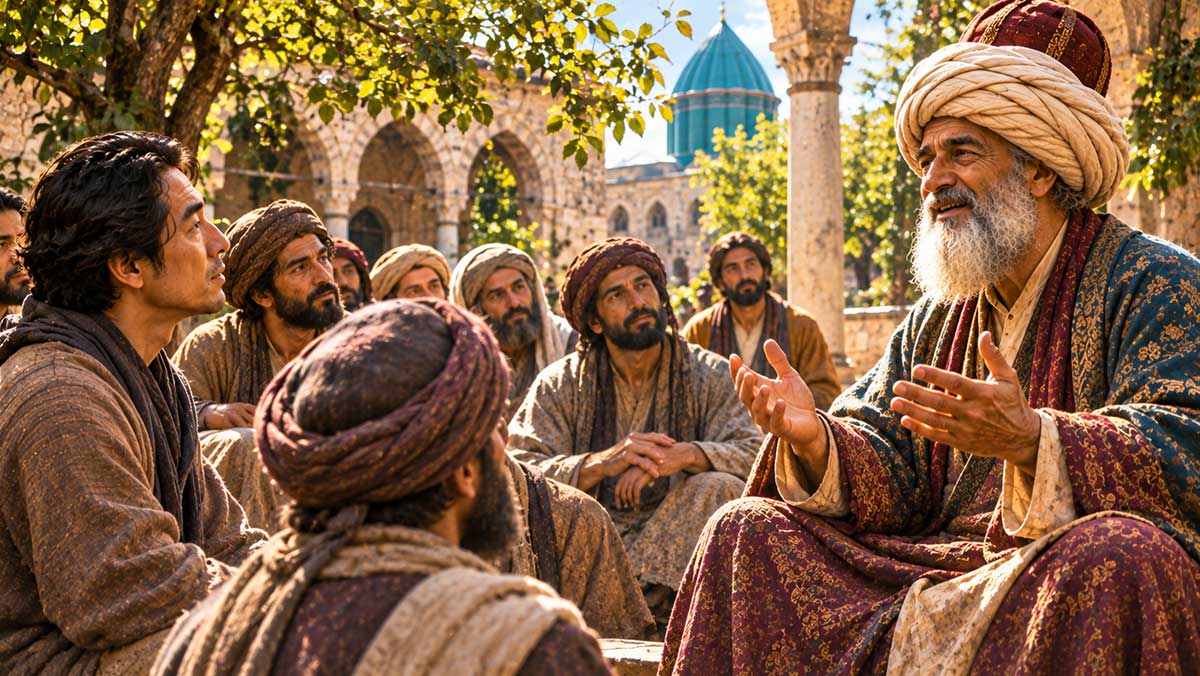
The Courtyard of Many Voices
Konya, Anatolia. Autumn, around 1270.
Morning sunlight falls across the stone courtyard of a teaching lodge in Konya, the city where Jalal al-Din Muhammad Rumi has spent much of his adult life.
Beyond the arched entrance, merchants are opening their shops. A baker carries warm loaves through the street. The rhythmic tapping of a copper worker's hammer mingles with the voices of travelers passing through the city.
Inside the courtyard, students gather around a low wooden table covered with manuscripts. Some have come to study the Quran and religious teachings. Others are drawn to the extraordinary poetry and stories of the aging master.
Persian, Arabic, and Turkish can be heard among the visitors.
Rumi, now in his sixties, sits beneath a shaded archway. His beard has turned white, and his movements are slower than when Nick first met him in the marketplace years earlier.
Yet his eyes remain lively.
A young student struggles to read a passage from a manuscript. An older student leans closer and patiently helps him.
Nick Sasaki watches the exchange before approaching Rumi.
Rumi: Nick, welcome. You have returned.
Nick Sasaki: I promised I would.
Rumi: Then come. Sit beside me.
Nick Sasaki: I wanted to see you here, surrounded by your students.
We've spoken about your childhood, Shams, divine love, suffering, and death.
But today I want to ask about the world beyond your own spiritual experiences.
Rumi: A worthy subject.
Nick Sasaki: You believe love can transform the human heart.
But can it transform humanity?
Rumi glances toward the students gathering their manuscripts.
Rumi: Let us begin with the human beings already before us.
Question 1. If We Come from One Creator, Why Do Religious People Hate One Another?
Nick Sasaki: Rumi, there's something extraordinary about your influence.
You were a devoted Muslim. Your poetry is filled with the Quran, the Prophet Muhammad, and Islamic spiritual teachings.
Yet centuries later, Christians, Jews, Hindus, Buddhists, and people with no religion read your work and find something meaningful in it.
Why do you think your words reach people from so many different backgrounds?
Rumi: Nick, human beings may recognize sincerity, beauty, and wisdom in words that emerge from traditions different from their own.
A person may hear another's longing and recognize something of his own.
But recognizing a shared human experience does not mean that every religious belief is identical.
Nick Sasaki: So you wouldn't say all religions teach exactly the same thing?
Rumi: No.
Religions make different claims about God, revelation, worship, and human destiny.
Those differences deserve to be examined honestly.
My own faith is rooted in Islam.
Nick Sasaki: But here's what troubles me.
If God created all humanity, why do people who claim to love God sometimes hate one another so intensely?
Why have religious differences become reasons for persecution and war?
Rumi: A person may speak of serving God and yet remain governed by pride, fear, ambition, or resentment.
Religion can become entangled with the desire for status and control.
A man may claim to defend divine truth when he is actually defending his own importance.
Nick Sasaki: That's a serious accusation.
Rumi: It is a serious danger.
And it is one that religious people should examine within themselves before condemning others.
Nick Sasaki: But surely some religious disagreements are genuine.
Suppose two people sincerely believe different things about God.
They can't both be correct about every detail.
Rumi: Sincerity does not make contradictory claims identical.
But disagreement does not grant permission for cruelty.
Nick Sasaki: That's an important distinction.
You can believe someone is wrong without treating them as an enemy.
Rumi: Yes.
Nick Sasaki: Let me ask about a story from your Masnavi.
You tell the story of Moses and a shepherd.
The shepherd speaks to God in a simple, almost childish way. He imagines caring for God, offering food, and tending to God's needs.
Moses corrects him for speaking improperly.
But then the story challenges Moses for failing to recognize the shepherd's sincerity.
What were you trying to teach?
Rumi: The story concerns the danger of becoming so attached to outward forms that we fail to recognize the condition of the heart.
A person may possess limited knowledge yet offer sincere devotion.
Another may speak with great theological precision and remain consumed by pride.
Nick Sasaki: But doesn't theology matter?
If someone has a completely mistaken idea about God, shouldn't we correct them?
Rumi: Truth matters deeply.
But correction requires wisdom.
A person may possess accurate knowledge and communicate it with such arrogance that he wounds the very heart he wishes to guide.
Nick Sasaki: So someone can be technically correct but spiritually wrong in how they treat another person.
Rumi: Indeed.
Nick Sasaki: I wonder what you would say if the leaders of the world's major religions were sitting here with us.
Suppose they began arguing about whose religion was true.
Would you tell them to stop arguing?
Rumi: I would not forbid sincere examination of truth.
But I would ask them to consider what their devotion has produced in their character.
Has it made them more humble?
More just?
More compassionate?
More responsible toward those entrusted to their care?
Nick Sasaki: And if they couldn't agree?
Rumi: Then let them disagree without forgetting their moral obligations.
Nick Sasaki: I think humanity needs that distinction.
We don't have to pretend everyone believes the same thing to recognize that we belong to the same human family.
Rumi: We share our dependence upon the Creator and our responsibility to act justly.
But unity should not require the abandonment of truth.
Nick Sasaki: So the challenge is learning how to pursue truth without turning disagreement into hatred.
Rumi: That is a worthy challenge for every generation.
Question 2. Can Divine Love Actually Change Families, Enemies, and Nations?
A young boy approaches the archway carrying a wooden bowl of dates.
He offers it to Rumi, who thanks him and passes the bowl to Nick.
Nick Sasaki: Rumi, here's where I want to challenge your philosophy.
You say love can transform the human heart.
But can it actually change the world?
People have been fighting wars for thousands of years.
They compete over land, wealth, religion, and political control.
What makes you believe love can overcome all of that?
Rumi: Nick, love is not a substitute for justice, wisdom, or responsible action.
A ruler cannot end a famine merely through announcing that he loves his people.
He must act.
Nick Sasaki: Exactly.
So spiritual transformation isn't enough by itself.
Rumi: Inner transformation must influence outward conduct.
A person who becomes less selfish may govern more justly.
A merchant who becomes more honest may refuse to exploit his customers.
A parent who becomes more patient may raise children without cruelty.
These changes are not insignificant.
Nick Sasaki: But what about someone who has no interest in love?
What about a violent ruler who wants more territory?
Rumi: Such a person may need to be restrained through just means.
Compassion does not require surrendering the vulnerable to oppression.
Nick Sasaki: That's important.
Sometimes people hear teachings about peace and assume they mean never confronting evil.
Rumi: Peace without justice can become another name for submission to wrongdoing.
Nick Sasaki: Then how does love influence justice?
Rumi: It reminds us that justice should not become an excuse for cruelty.
The purpose of restraining wrongdoing is not to satisfy hatred.
It is to protect what is good and prevent further harm.
Nick Sasaki: Let me bring this down to the family.
Suppose a husband and wife have spent years arguing.
Both believe they're right. Neither wants to apologize.
What would you tell them?
Rumi: I would ask each to examine what is more precious.
The relationship?
Or the pleasure of winning the argument?
Nick Sasaki: That's a good question.
But sometimes one person really is wrong.
Rumi: Then the truth should not be concealed.
Humility does not require pretending that wrongdoing has not occurred.
Nick Sasaki: So love doesn't mean avoiding difficult conversations.
Rumi: No.
Love may require honesty that is uncomfortable.
But honesty need not become humiliation.
Nick Sasaki: What about parents and children?
Rumi: Children learn much from what adults practice.
A father who teaches kindness but constantly humiliates others gives his child conflicting lessons.
A mother who teaches forgiveness through her own conduct offers something more than words.
Nick Sasaki: I think that's one of the strongest ideas you've shared.
The world changes through the way people treat the individuals closest to them.
Rumi: Great ambitions do not excuse small cruelties.
A man who dreams of bringing peace to distant nations should examine whether he brings peace into his own household.
Nick Sasaki: Let me ask one more thing.
Do you believe humanity could ever become one family?
Not politically one nation, but spiritually one human family?
Rumi: Human beings share a created origin and a common moral responsibility.
Yet unity does not require eliminating every difference.
The deeper question is whether people can recognize their obligations to one another without demanding that everyone become identical.
Nick Sasaki: So the goal isn't uniformity.
It's learning to live with differences without losing our compassion.
Rumi: And without abandoning truth or justice.
Question 3. If Humanity Could Preserve Only One of Your Teachings, What Would It Be?
The courtyard has become quiet.
Most students have returned to their work. A few remain beneath the trees, reading manuscripts or speaking softly.
Nick and Rumi sit beside a low stone fountain.
The morning sun has climbed higher, and the sound of flowing water fills the pauses between their words.
Nick Sasaki: Rumi, I want to ask you the question I've been saving since we first met.
You've lived through displacement, the death of loved ones, years of scholarship, the extraordinary friendship with Shams, and the pain of losing him.
You've written thousands of verses about God, love, and the human soul.
If humanity could preserve only one teaching from your entire life's work, what would you want it to be?
Rumi remains silent for a moment.
Rumi: Nick, I would want people to recognize that their lives belong to God and that the heart must be transformed through sincere love and devotion.
Nick Sasaki: Why that teaching above everything else?
Rumi: A person may acquire knowledge without wisdom.
He may gain wealth without generosity.
He may become respected without humility.
He may perform outward acts of religion without allowing them to change his character.
But when love of God becomes sincere, it calls the person to examine all these things.
Nick Sasaki: So love isn't simply one virtue among many.
It's something that changes the way we understand every other part of life.
Rumi: Divine love can reorder what the heart considers most precious.
Nick Sasaki: But what about people who don't believe in God?
Can they still learn something essential from your teaching?
Rumi: They may begin by examining the condition of their hearts and the direction of their lives.
Are they governed by resentment?
Do they seek admiration at the expense of truth?
Can they act generously without expecting repayment?
Can they recognize the dignity of someone who disagrees with them?
These are meaningful questions for any human being.
Nick Sasaki: I want to make this practical.
Suppose someone listening to us has spent sixty or seventy years chasing money, recognition, and success.
They've made mistakes. They've hurt people. They've neglected relationships.
And now they wonder whether they've wasted their life.
What would you tell them?
Rumi: The recognition of one's mistakes can become the beginning of repentance.
A person should not assume that age makes sincere change impossible.
Nick Sasaki: But what if they've done things they can never repair?
Rumi: Then they should repair what they can.
Seek forgiveness where appropriate.
Restore what has been unjustly taken when possible.
And stop using the impossibility of changing the past as an excuse to avoid responsibility in the present.
Nick Sasaki: That's very practical.
Rumi: Spiritual transformation should become visible through action.
Nick Sasaki: Let me ask the skeptical version of this question.
Suppose I'm completely unconvinced.
I don't believe in God.
I don't believe in an immortal soul.
I don't believe in mystical experiences.
But I'm willing to try something.
What exactly should I do tomorrow morning?
No poetry. No metaphors.
Just tell me.
Rumi laughs.
Rumi: Very well, Nick.
When you awaken, spend a little time in honest reflection before the demands of the day consume your attention.
Examine what you intend to pursue.
Ask whether your desires are directing you toward what is good.
Practice an act of generosity without seeking recognition.
When someone angers you, pause before allowing anger to decide your response.
And consider seriously the question of God rather than dismissing it through habit.
Nick Sasaki: That's it?
Rumi: Begin there.
A person who cannot practice patience in an ordinary conversation should be cautious about claiming extraordinary spiritual attainment.
Nick Sasaki: How long should someone practice?
Rumi: Long enough to discover that transformation is not merely a passing enthusiasm.
Nick Sasaki: And how will they know they're changing?
Rumi: Ask those who live with them.
Nick laughs.
Nick Sasaki: That's a dangerous test.
Rumi: It may be an honest one.
Nick Sasaki: Your family might know more about your spiritual progress than your admirers.
Rumi: Those closest to us often encounter the parts of our character that public praise conceals.
Nick Sasaki: Rumi, there's one last thing I want to ask.
And this is personal.
If you could speak directly to someone who feels completely alone tonight, someone who believes nobody loves them and that their life has no meaning, what would you say?
Rumi looks toward the fountain.
Rumi: I would not begin by telling that person to stop feeling sorrow.
I would want them to know that their present pain does not define the whole of their existence.
I would encourage them to seek the companionship of trustworthy people, to accept help, and to remain open to the mercy of God.
A wounded heart should not be abandoned to isolation.
Nick Sasaki: And what would you say to someone who believes they've become too selfish or too bitter to change?
Rumi: I would ask whether they are willing to begin with one sincere act.
Nick Sasaki: Just one?
Rumi: A person who waits until he feels completely transformed before acting kindly may wait for a very long time.
Begin with what is within your reach.
Nick Sasaki: Rumi, I think I finally understand something.
When I first came here, I thought I was interviewing a poet who wrote beautiful things about love.
But you've been talking about something much more demanding.
You're asking people to change how they live.
Rumi: Poetry that never touches life remains incomplete.
Nick Sasaki: And your love for Shams, your grief, your spiritual experiences, all of that was part of a larger search for God.
Rumi: Yes.
Nick Sasaki: Then perhaps the greatest question isn't whether we understand your poetry.
It's whether we're willing to let the questions within it change us.
Rumi smiles.
Rumi: Nick, a question can be the beginning of something meaningful.
But the answer must eventually enter the life of the person asking.
A bell sounds from a nearby workshop.
Students begin returning to the courtyard, carrying manuscripts beneath their arms.
Nick closes his notebook, but he does not rise immediately.
Nick Sasaki: Rumi, I came here with forty questions.
I think I'm leaving with even more.
Rumi: Then perhaps our conversation has been useful.
Nick Sasaki: One thing still troubles me.
You've spent your life speaking about divine love, but people continue to fight over religion.
If you could return centuries from now and see what humanity has done with your teachings, what do you think would disappoint you most?
Rumi considers the question.
Rumi: Perhaps seeing people admire words about love without examining whether love has changed their conduct.
Nick Sasaki: And what would give you hope?
Rumi: Finding even one person who had become more truthful, compassionate, and humble through sincerely seeking God.
Nick looks across the courtyard.
A young student has stopped to help an elderly visitor gather several manuscripts that have fallen onto the stones.
Neither man speaks for a moment.
Nick Sasaki: Rumi, I think I understand why you wanted me to come here today.
Rumi follows Nick's gaze.
Rumi: Then tell me, Nick. What do you see?
Nick Sasaki: Something very ordinary.
And perhaps something more important than all the beautiful speeches we could make.
The student finishes gathering the manuscripts. The elderly visitor thanks him, and the two walk together beneath the archway.
The courtyard returns to its quiet rhythm.
The conversation remains open, as Rumi's questions about love, faith, and the human heart continue beyond the courtyard.
Fictional Interview Disclaimer: This conversation is an imaginative literary reconstruction informed by Rumi's poetry, Islamic faith, and Sufi teachings. The dialogue, courtyard gathering, and interactions with Nick Sasaki are fictional. Rumi's statements are not historical quotations. His religious convictions are presented within their historical Islamic context rather than as modern universalist doctrine.
Final Thoughts by Nick Sasaki
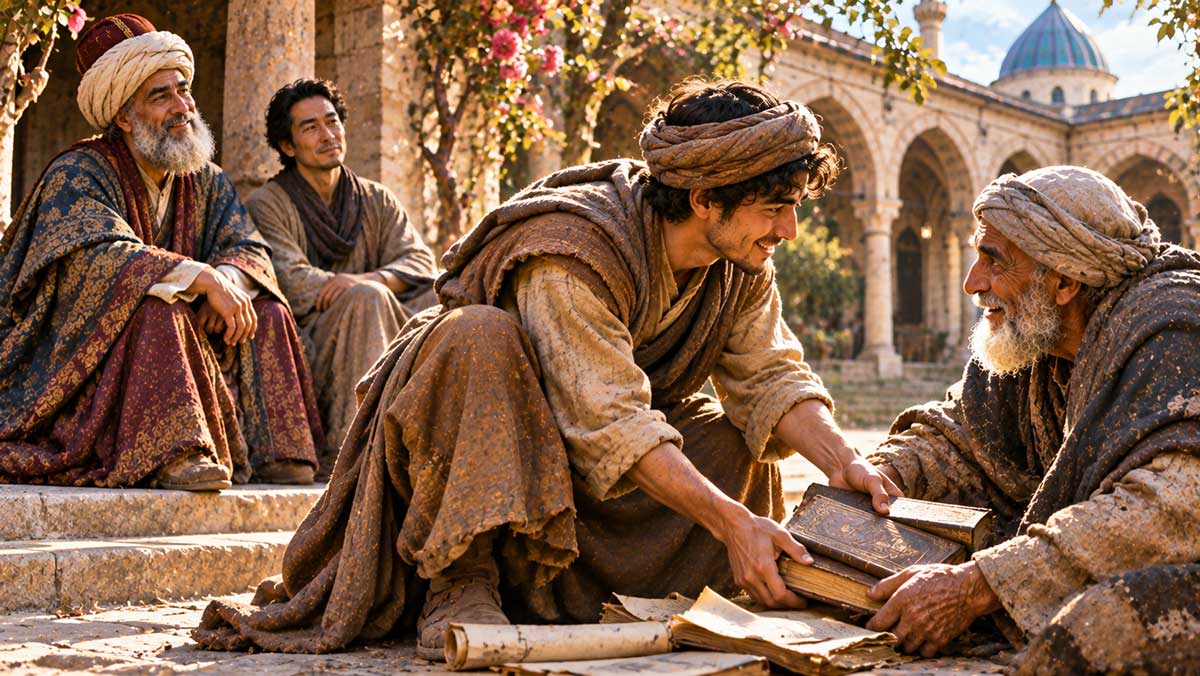
When I began this imaginary conversation with Rumi, I expected to encounter a poet who would teach me about love. What I discovered was something far more challenging. Rumi was not simply asking people to feel love more deeply. He was asking them to examine the selfishness, pride, fear, and attachments that prevent love from changing their lives. That distinction stayed with me throughout our five conversations.
I was especially moved by the relationship between Rumi and Shams of Tabriz. We often think of love as something that brings happiness, comfort, and fulfillment. But their story reminds me that profound love can expose our deepest vulnerabilities. Shams awakened something extraordinary in Rumi, yet his disappearance brought sorrow that cannot be separated from the poetry that followed. Reading the opening verses of the Masnavi, with their imagery of separation and longing, makes me wonder how often our own pain reveals what matters most to us.
One of the most meaningful lessons for me concerns the difference between knowing something intellectually and living it. I have met people who possess enormous knowledge about religion, philosophy, or morality, yet struggle to practice kindness in ordinary situations. I recognize that contradiction in myself, too. It is easy to speak about forgiveness when no one has offended us. It is easy to praise compassion when we are surrounded by people who agree with us. The real test comes when we feel hurt, misunderstood, rejected, or angry.
Our conversation about suffering was perhaps the most difficult. I cannot accept the idea that every tragedy should be celebrated as a hidden blessing. When someone loses a child, experiences violence, or faces unbearable grief, explanations can sometimes deepen the wound. What touched me was the possibility that genuine spiritual wisdom begins with compassion rather than certainty. Sometimes we do not need to explain another person's suffering. We need to sit beside them, listen, and offer whatever help we can.
I was equally interested in Rumi's understanding of God. His poetry can sound universal, but his spiritual life was firmly grounded in the Quran, Islamic worship, and devotion to the Creator. Recognizing that context makes his work richer, not smaller. The historical and textual resources at Dar-al-Masnavi offer an opportunity to encounter Rumi's teachings beyond isolated inspirational quotations. I believe we can learn from someone whose religious convictions differ from our own without pretending those differences do not exist.
The question that remains closest to my heart is whether humanity can learn to live as one family. We have developed extraordinary knowledge and technology, yet we continue to divide ourselves through nationality, religion, politics, and fear. I believe that every human being deserves dignity and love, and that our shared humanity should matter more than the labels that separate us. Rumi's emphasis on humility and compassion challenges me to ask whether I am practicing that belief in my daily relationships, not simply expressing it as an ideal.
Perhaps my favorite moment in our imagined conversation came when Nick asked Rumi how someone could know whether they were becoming spiritually transformed. His answer was to ask the people who live with them. I smiled when writing that exchange, but the more I considered it, the more serious it became. Our families, friends, coworkers, and neighbors experience the person we actually are. They see our impatience, our generosity, our honesty, and our failures. If our spiritual convictions do not make us kinder to those closest to us, what have we truly learned?
I leave this conversation with more questions than answers, and perhaps that is appropriate. What would happen if we spent less time trying to prove ourselves right and more time trying to understand one another? Can love exist without justice? Can faith become deeper through honest questioning? And most personally, if someone examined the way we treated others yesterday, would they recognize the love we claim to believe in? I would love to hear your thoughts in the comments. Which of Rumi's teachings speaks most deeply to you, and which do you find hardest to accept?
Fictional Reflection Disclaimer: These final thoughts are Nick Sasaki's personal reflections on an imagined interview. The exchanges with Rumi are creative reconstructions, not records of historical conversations. Interpretations of Rumi's teachings should be considered alongside reliable translations and scholarly research.
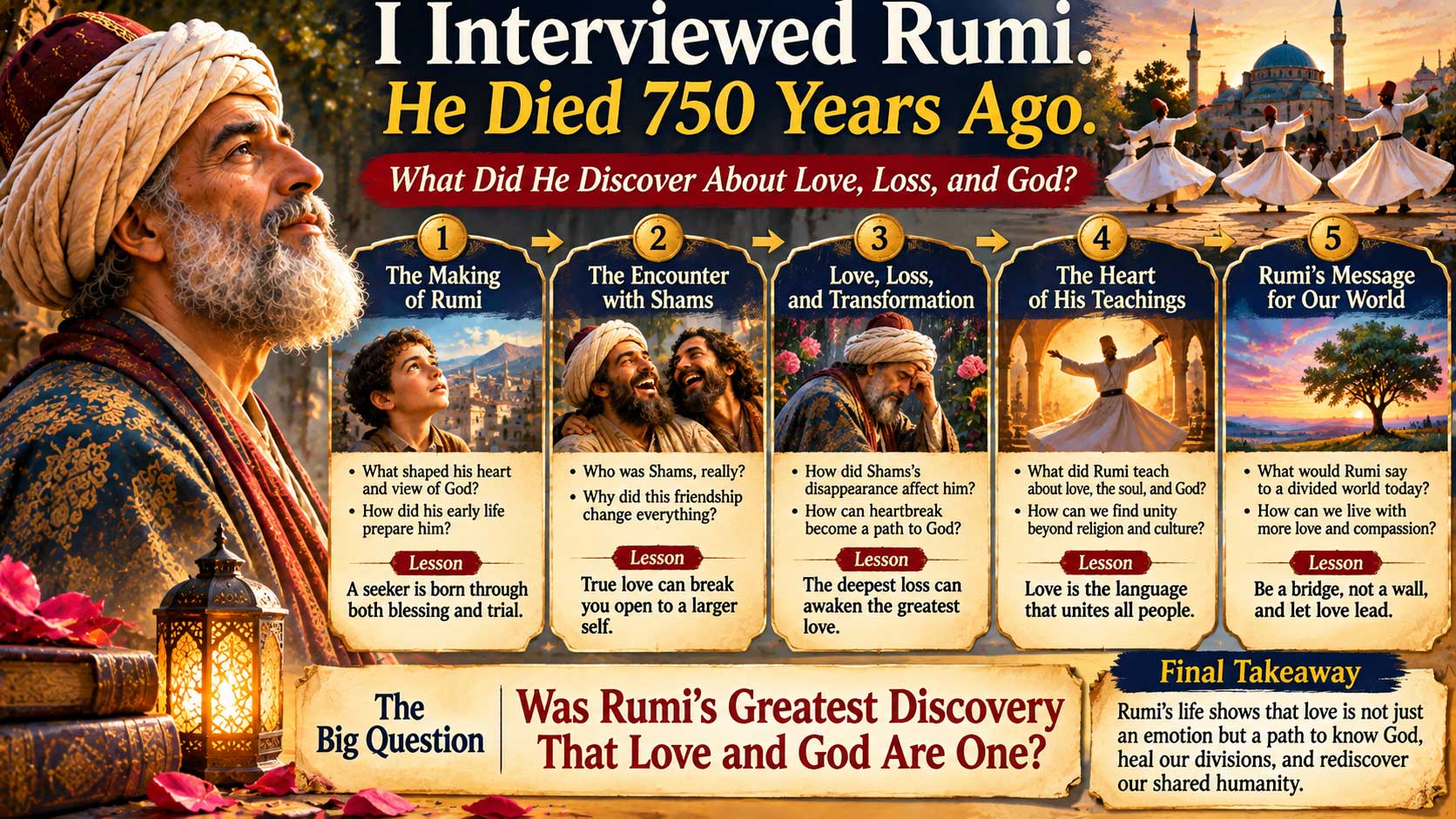
Short Bios:
Jalal al-Din Muhammad Rumi (1207–1273)
Jalal al-Din Muhammad Rumi was a Persian-language poet, Islamic scholar, and Sufi teacher whose writings have influenced spiritual and literary traditions for centuries. Born in Greater Khorasan, he eventually settled in Konya, where he taught and wrote. His encounter with Shams of Tabriz in 1244 profoundly influenced his life and poetry. His major works include the Masnavi, a six-book spiritual poem, and the Divan-e Shams-e Tabrizi, a collection of lyrical poetry associated with his transformative friendship. Rumi died in Konya on December 17, 1273. For further study, explore Rumi's life and historical background and the Masnavi research resources.
Nick Sasaki, Interviewer and Creator of ImaginaryTalks
Nick Sasaki is the creator of ImaginaryTalks.com, where historical figures, philosophers, writers, spiritual teachers, and influential thinkers are brought together through imaginative conversations. His interviews combine historical research, philosophical questions, and fictional storytelling to explore the ideas and experiences that continue to shape humanity. Through ImaginaryTalks, Nick hopes to encourage curiosity, compassion, mutual respect, and a deeper recognition of our shared humanity.
The interviewer and historical guest did not meet in real life. This interview is a fictional literary work inspired by historical research.
Leave a Reply