
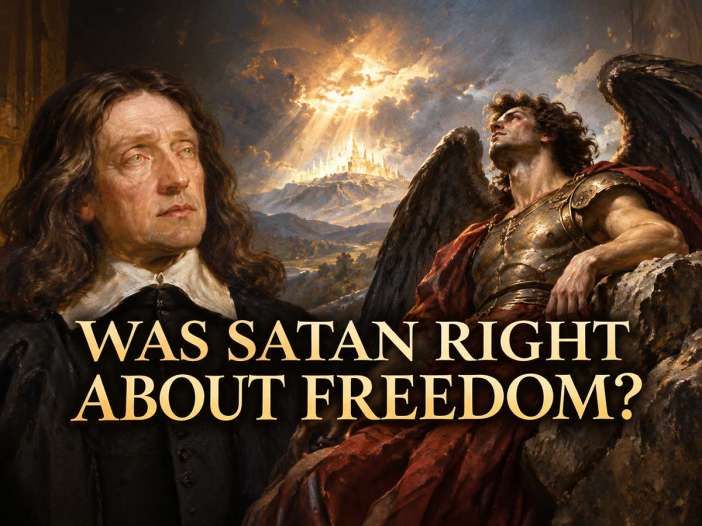
Introduction
What if Satan believed he was fighting for freedom? What if Adam's greatest mistake came from loving Eve too much? And what if losing everything we once considered precious could lead us to discover a deeper meaning in life?
These are the questions at the heart of our imagined John Milton interview, a five-part conversation exploring Paradise Lost, the mystery of God, the psychology of evil, and the extraordinary life of one of England's greatest poets. Rather than approaching Milton as a distant literary monument, I wanted to meet him as a human being: a man of ambition and faith, remarkable intellectual courage, profound suffering, and convictions that still invite disagreement centuries after his death.
Born in 1608, John Milton lived through one of the most turbulent periods of English history. He challenged religious institutions, defended freedom of expression, supported the parliamentary cause against King Charles I, and served the English Commonwealth. He gradually lost his eyesight and was completely blind by the early 1650s. Yet his greatest literary achievement was still ahead of him. According to the Poetry Foundation's biography of John Milton, his experiences with political conflict, religious controversy, and personal adversity profoundly shaped his writings. His life raises a question that feels deeply relevant today: How can we remain faithful to our convictions without becoming prisoners of our own certainty?
Published in 1667, Paradise Lost retells the biblical story of Satan's rebellion and humanity's fall from Eden. But Milton's epic is far more than a familiar account of temptation and disobedience. It asks whether God's foreknowledge can coexist with human freedom, why evil is possible in a creation governed by divine goodness, and how human beings can recover hope after devastating mistakes. Princeton University's introduction to Paradise Lost explores the poem's treatment of free will, evil, relationships, and humanity's connection to God. These questions form the foundation of our conversation.
One of the most fascinating aspects of Milton's masterpiece is Satan himself. Why would a deeply religious poet create a rebel whose speeches are so persuasive that readers sometimes find themselves sympathizing with him? And how could Milton, who resisted kings and religious authorities, distinguish his own political rebellion from Satan's defiance of Heaven? The questions become more disturbing when we recognize something familiar in Satan's behavior: his wounded pride, his ability to justify his actions, and his growing inability to admit that he might be wrong. Through this imagined exchange, I wanted to explore whether the greatest danger lies in deliberately choosing evil or becoming so convinced of our own righteousness that we can no longer recognize it.
Our discussion then turns to Adam and Eve, whose story raises equally personal questions about love, curiosity, and responsibility. Was Eve wrong to desire knowledge, or did she make the mistake of trusting a deceptive promise? Did Adam join her out of genuine devotion, fear of separation, or a failure to distinguish love from attachment? Milton's own experiences of marriage, separation, reconciliation, and bereavement make these questions especially poignant. The Academy of American Poets' biography provides valuable historical context for his marriages, political commitments, and literary life. In our fictional interview, these experiences become opportunities to consider whether genuine love requires both freedom and the courage to disagree.
What moved me most, however, was the connection between Milton's personal losses and the ending of Paradise Lost. Here was a man who had lost his sight, endured the deaths of loved ones, and watched the political cause he had defended collapse. Yet he created a poem that concludes with Adam and Eve leaving Eden, uncertain of their future but still capable of hope. Their story does not erase suffering or pretend that every mistake can be undone. Instead, it invites us to consider what remains possible after the life we expected has disappeared. The Morgan Library & Museum's account of Paradise Lost offers further historical background on the creation of this remarkable work.
Across five conversations, I ask Milton about his ambitions, blindness, faith, interpretation of Jesus and God the Father, Satan's psychology, Adam and Eve's relationship, freedom of expression, political violence, and the meaning of a successful life. I challenge his assumptions, invite him to reconsider apparent contradictions, and explore what his ideas might mean for people living today. The goal is not to make Milton agree with modern opinions or to present his beliefs as unquestionable truths. It is to discover what happens when we bring genuine curiosity to a thinker whose questions remain remarkably alive.
Perhaps the most meaningful question is not whether we can recover the Paradise we have lost, but whether we can learn to live more wisely in the world that remains before us. If we have made mistakes, can we acknowledge them? If our convictions are challenged, can we listen? And if life takes away something precious, can we still find reasons to love, create, and hope? I invite you to join this imagined conversation with John Milton and consider what his extraordinary life and enduring masterpiece might reveal about our own.
Fictional disclaimer: This interview is an imaginative literary reconstruction created for ImaginaryTalks.com. John Milton's responses are fictional, informed by his documented biography, published writings, and historical context. The conversation does not represent an actual interview or verified private statements.
Topic 1: The Man Who Lost His Sight but Found His Vision
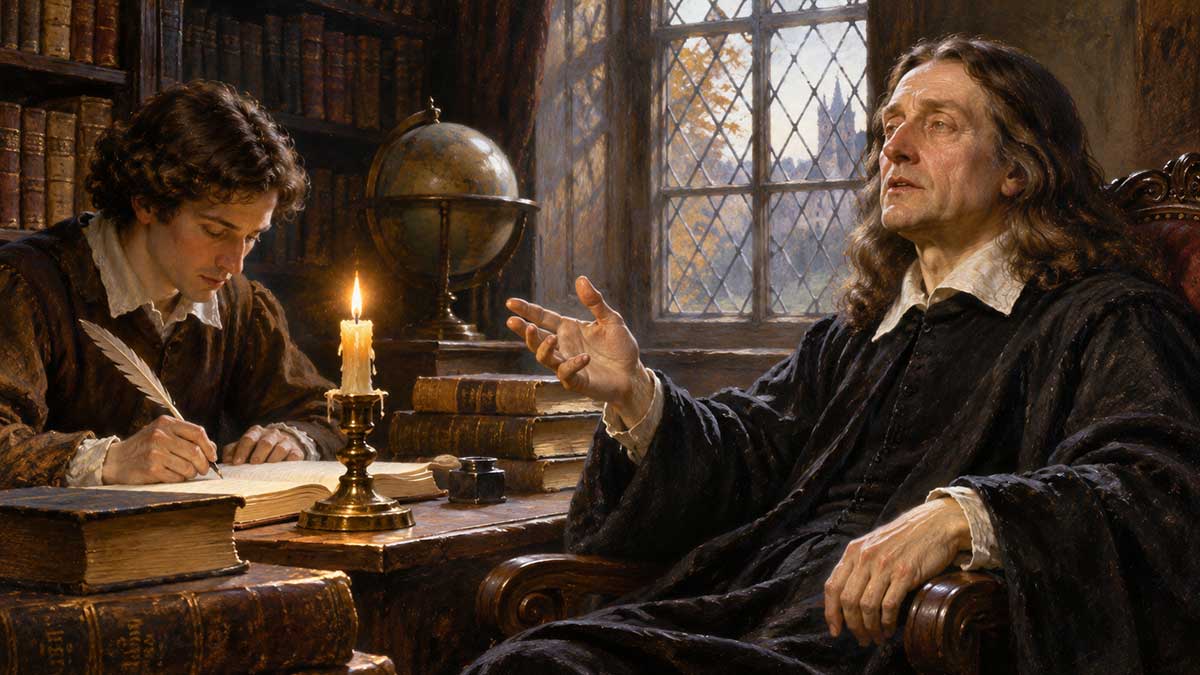
A Conversation About Ambition, Faith, Suffering, and the Purpose of Life
Nick Sasaki
John, I've been looking forward to this conversation. You've had an extraordinary life. You lived through a civil war, challenged religious and political authorities, met Galileo, lost your eyesight, and somehow wrote one of the most influential poems in English literature.
But I don't want to begin with Paradise Lost. I want to understand the person who wrote it.
When you were growing up, did you already feel you were meant to do something extraordinary? Or were you simply a curious child who loved books?
John Milton
I was certainly a child who loved books, Nick. Perhaps rather too much, according to those who believed a young man ought to spend more time in ordinary recreation.
My father gave me an excellent education, and I was fortunate to have teachers who encouraged my appetite for learning. From an early age, I found myself drawn to poetry, ancient history, philosophy, and the Scriptures.
But your question concerns something deeper than education. You ask whether I believed I had a destiny.
I would not say that I knew what I was destined to accomplish. That would imply a certainty I did not possess.
Yet I felt a powerful obligation not to waste the abilities God had given me.
I believed that a human life ought to be devoted to something greater than personal comfort or public admiration.
Nick Sasaki
That's interesting. You're saying you didn't necessarily know what you were going to accomplish, but you felt responsible for accomplishing something.
John Milton
Precisely.
There is a difference between believing oneself destined for greatness and believing oneself accountable for one's gifts.
The first may be vanity. The second may be duty.
Of course, the two are not always easily separated.
Nick Sasaki
I like that distinction. But let me push you a little.
When you're young and you believe God has given you some special ability, isn't there a danger that you start thinking you're more important than other people?
John Milton
Certainly.
And I would be dishonest if I pretended that ambition had never tempted me.
A young man may begin by wishing to serve truth and gradually become enamored of the thought that he shall be celebrated for serving it.
The desire for excellence is admirable. The desire to be worshipped for excellence is another matter.
The difficulty is that both desires may inhabit the same heart.
Nick Sasaki
So you were aware of that struggle even when you were young?
John Milton
I became increasingly aware of it. Awareness, however, is not the same as victory.
A man may recognize pride in himself and still find it difficult to surrender.
The Long Preparation
Nick Sasaki
You spent years studying before creating your greatest work. You went to Cambridge, learned multiple languages, and then devoted more years to reading and preparing yourself.
Did you ever worry that the future you imagined might never arrive?
John Milton
Yes. That anxiety was very real.
When I was approaching my twenty-fourth year, I wrote a sonnet expressing my concern that time was passing and I had accomplished too little.
I looked at others who seemed to be progressing more quickly and wondered whether I was falling behind.
Yet I gradually came to believe that one's life must be measured by something other than the speed of visible achievement.
If Providence had appointed me a task, I could not force its proper season merely through impatience.
Nick Sasaki
That's something I think a lot of people struggle with today.
You see someone your age becoming successful, making money, gaining recognition, and suddenly you feel behind.
Did you compare yourself with other writers?
John Milton
I did.
I admired the great poets of antiquity, particularly Homer and Virgil. Their works had endured for centuries, and I hoped that English poetry might attain comparable dignity.
But comparison can be both a teacher and a tormentor.
It may inspire us to improve, yet it may persuade us that our present efforts are worthless.
Nick Sasaki
Did you ever think, "What if I'm just fooling myself? What if I spend twenty years preparing to write something great and nobody cares?"
John Milton
Such a possibility could not be dismissed.
But consider the alternative. Would I have been happier abandoning the work I believed worthy of my life simply to escape the possibility of failure?
I think not.
There are endeavors whose value cannot be determined entirely by their reception.
A poem may be neglected. A book may be condemned. A political cause may perish.
Yet the sincere pursuit of truth retains a value that public applause cannot confer.
Nick Sasaki
But that's easier to say after you've written Paradise Lost.
What about the young John Milton who hasn't accomplished it yet?
John Milton
You are right to challenge me.
The young man could not know the outcome.
He had to act without that knowledge.
And perhaps that is the true test of a calling: whether one continues to prepare when success remains uncertain.
Nick Sasaki
So faith isn't necessarily believing you'll succeed.
John Milton
No. Faith may require accepting that the result does not belong entirely to you.
Meeting Galileo
Nick Sasaki
I want to ask about something remarkable. You traveled to Italy and met Galileo.
Here was a man who had challenged accepted ideas about the universe and suffered serious consequences.
What impressed you most about him?
John Milton
Galileo was already elderly when I visited him near Florence. His astronomical investigations had made him celebrated, but they had brought him into conflict with powerful religious authorities.
I was deeply interested in the intellectual controversies surrounding his discoveries.
What remains significant to me is the question his experience presents: What happens when an institution entrusted with defending truth becomes fearful of investigation?
Nick Sasaki
Do you remember what you talked about?
John Milton
I must be careful here, Nick. I left no detailed record of our conversation.
I would not wish to invent a discussion and present it as a historical certainty.
But I can tell you that his circumstances made a lasting impression upon my thinking about intellectual freedom.
Nick Sasaki
I appreciate that.
Let me ask it differently.
Suppose someone studies the universe and discovers something that seems to contradict what religious authorities have been teaching for centuries.
Who should change their mind, the scientist or the Church?
John Milton
The question must be settled by the quality of the evidence and the soundness of interpretation, not merely by the authority of the institution.
Truth has no need to fear honest examination.
Yet I would distinguish genuine inquiry from the assumption that every novelty must be true merely for being novel.
The proper response is investigation.
Nick Sasaki
But what if the investigation leads somewhere uncomfortable?
John Milton
Then discomfort must be endured.
An error does not become truth through centuries of repetition.
Nor does truth become false when it offends a powerful man.
Nick Sasaki
You know, I find that fascinating, especially coming from someone so religious.
Some people assume that strong faith means never questioning anything.
John Milton
I would ask them whether faith is strengthened by ignorance.
If a belief is true, examination may clarify it. If it is false, why should a person desire to preserve it?
But there is a difficulty here that I must acknowledge.
A man may defend inquiry in principle and still resist it when his own most cherished convictions are challenged.
Nick Sasaki
Including you?
John Milton
Including me.
The Dangerous Side of Conviction
Nick Sasaki
That brings me to something I've noticed about your life.
You had tremendous confidence in your convictions. You challenged religious leaders, defended controversial political ideas, and wrote with extraordinary certainty.
Did you ever worry that your confidence might become pride?
John Milton
Pride is among the most subtle dangers of the intellectual life.
A man who seeks wealth may recognize his greed. A man who seeks public admiration may recognize his vanity.
But a man who believes he is defending truth may mistake every impulse of his own will for a righteous necessity.
That is particularly dangerous.
Nick Sasaki
Why?
John Milton
For the simple reason that he possesses a moral explanation for everything he does.
His anger becomes zeal.
His stubbornness becomes courage.
His contempt for others becomes devotion to principle.
He may commit grave injustices without ever admitting that he has ceased to act justly.
Nick Sasaki
That sounds remarkably close to the Satan you created in Paradise Lost.
John Milton
There is a connection.
Satan possesses extraordinary abilities, but he cannot bear the thought of submitting his will to a goodness greater than himself.
He interprets his rebellion as liberty, yet becomes increasingly enslaved by envy and resentment.
Nick Sasaki
So did you ever worry that you might be doing something similar?
John Milton
I would hope that any serious Christian must ask himself such a question.
But I would not claim that asking it makes a person immune to pride.
One may examine one's conscience and still arrive at a flattering verdict.
Nick Sasaki
That's a powerful thought.
Sometimes the people most convinced they're doing good are the least willing to consider that they might be wrong.
John Milton
Indeed. And the greater a person's abilities, the greater may be his capacity to rationalize his errors.
Intelligence does not automatically produce wisdom.
It may simply furnish pride with more sophisticated arguments.
Nick Sasaki
We're definitely coming back to that when we discuss Satan.
But first, I want to talk about something much more personal.
When Darkness Entered His Life
Nick Sasaki
When you began losing your eyesight, what frightened you most?
John Milton
My sight declined over a period of years. By approximately 1652, I had become completely blind.
The loss was profound.
Reading had been among the central occupations of my life. I had devoted myself to books, languages, manuscripts, and the written word.
To lose the ability to read with my own eyes was to lose a familiar means of entering the world.
Nick Sasaki
Did it happen gradually enough that you could prepare yourself emotionally?
John Milton
The gradual nature of the loss did not make it easy.
Knowing that a cherished faculty is disappearing does not necessarily reconcile one to its disappearance.
Indeed, anticipation may become a suffering of its own.
Nick Sasaki
I can understand that.
There's the physical loss, but then there's the fear of what your life is going to become.
Did you worry that your work was finished?
John Milton
That fear was certainly bound up with the loss.
I had long believed that my abilities carried responsibilities. Now I confronted the possibility that I could no longer exercise them in the manner I had expected.
My sonnet on blindness gives expression to that struggle.
I wondered how I might serve God when the faculty upon which so much of my labor depended had been taken from me.
Nick Sasaki
Were you afraid of becoming dependent on other people?
John Milton
Dependence was an unavoidable part of my circumstances.
I required assistance with reading, writing, and many ordinary tasks.
Yet dependence is not necessarily the opposite of dignity.
I had to learn that the work of the mind could continue through cooperation with others.
My writings were dictated to those who assisted me, including members of my household and other amanuenses.
I remained the author, but I could no longer pretend that authorship required no help.
Nick Sasaki
That's an interesting lesson for someone who valued independence so much.
John Milton
It is.
A man may spend his youth defending independence and discover in later life that no human being is entirely self-sufficient.
Did Milton Ever Become Angry with God?
Nick Sasaki
John, can I ask you something personal?
Did you ever get angry with God?
I mean, you devoted your life to studying Scripture, defending your beliefs, and trying to use your gifts for something meaningful.
Then you lost your eyesight.
Did you ever ask, "God, why are You doing this to me?"
John Milton
That is a difficult question, Nick.
I would distinguish what my surviving writings reveal from what no one can now establish with certainty about my private emotions.
My sonnet reveals anxiety over the apparent loss of my usefulness. It reveals a struggle to reconcile my limitations with my desire to serve.
But it would be too simple to claim that I experienced either uninterrupted serenity or unrestrained anger.
Nick Sasaki
So you struggled with it.
John Milton
Certainly.
And I came to consider whether I had misunderstood the nature of service.
I had assumed that service required visible accomplishment.
But perhaps obedience, patience, and acceptance of one's limitations could be forms of service as well.
Nick Sasaki
That reminds me of your famous line, "They also serve who only stand and wait."
What did you mean by that?
John Milton
That a person's worth before God cannot be measured solely by outward productivity.
We are not all appointed the same tasks, nor do we possess the same capacities throughout our lives.
A person who cannot perform the labor he once performed has not thereby become worthless.
Nick Sasaki
That's beautiful, but let me challenge you.
Isn't it easier to say that after you've found a way to keep working?
What about someone who loses their abilities and never gets to accomplish anything extraordinary afterward?
John Milton
Then the principle becomes more necessary, not less.
If human dignity depended upon producing celebrated works, most of humanity would be condemned to insignificance.
That would be a terrible misunderstanding of the value of a human life.
Nick Sasaki
So a person who spends years caring for a sick family member, or someone who can no longer work, may still be living a deeply meaningful life.
John Milton
Certainly.
A quiet act of faithfulness may possess a moral value that public achievement lacks.
We are too easily impressed by what attracts attention.
But attention and goodness are not identical.
Nick Sasaki
I like that.
And I think it's something people need to hear, especially when they feel their best years are behind them.
John Milton
Then perhaps we should question the assumption that a person's best years are necessarily those in which he possesses the greatest physical strength or public influence.
Some forms of wisdom arrive only after those advantages have diminished.
Writing Paradise Lost in Darkness
Nick Sasaki
Now I have to ask about the actual writing.
You were blind when you composed Paradise Lost.
How did that work?
Could you hear entire passages in your mind before dictating them?
John Milton
I had spent much of my life studying poetry, language, and the rhythms of verse.
Such preparation had trained my memory and imagination.
By the time I undertook the great poem, I possessed habits of composition that did not depend entirely upon the physical act of writing.
I could form and revise passages mentally before dictating them.
Nick Sasaki
That's extraordinary.
Did you picture the scenes?
For example, when you imagined Satan falling from Heaven, did you see the whole thing in your mind?
John Milton
I would distinguish the eye's perception from the imagination's apprehension.
The imagination can conceive vast spaces, movement, light, darkness, and forms that no human eye has directly witnessed.
Indeed, even a sighted poet must rely upon imagination when describing Heaven or Hell.
Nick Sasaki
So losing your eyesight didn't mean losing your visual imagination.
John Milton
Precisely.
Yet I would caution against the romantic notion that blindness was some miraculous advantage.
It was a deprivation.
The poem was possible through years of preparation, sustained effort, memory, imagination, and the assistance of others.
It would be unjust to describe the loss itself as a gift merely on account of what followed.
Nick Sasaki
I'm glad you said that.
People sometimes look at someone's suffering and say, "See, it happened for a reason."
But the person who suffered might not feel that way at all.
John Milton
And we should be cautious about claiming to know the divine purpose behind another person's affliction.
It is one thing to discover meaning amid suffering.
It is another to insist that suffering was necessary for that meaning to exist.
Nick Sasaki
That's a big distinction.
Let me ask you something else.
You had spent years preparing for this great literary work. Did the poem change as your life changed?
John Milton
My conception of a great sacred poem developed over many years.
I considered different subjects and forms before settling upon the epic treatment of humanity's fall.
My experiences inevitably shaped the seriousness with which I approached questions of obedience, liberty, temptation, and loss.
Yet I would resist reducing Paradise Lost to a disguised account of my personal misfortunes.
It is an attempt to address questions larger than one man's life.
Nick Sasaki
But surely you brought some of yourself into it.
John Milton
Every writer does, whether knowingly or not.
Our experiences influence the questions we find urgent.
A man who has witnessed political defeat may think differently about rebellion.
A man who has suffered bereavement may write differently about loss.
A man deprived of sight may approach the imagery of light with particular intensity.
But the work must be judged by more than the circumstances of its author.
Does Suffering Really Make Us Stronger?
Nick Sasaki
There's something I want to explore before we move on.
People love saying suffering makes us stronger.
You hear it everywhere.
Someone loses a job, experiences a tragedy, gets sick, or loses someone they love, and people tell them they'll come out stronger.
But do you really believe that's always true?
Can't suffering sometimes simply break people?
John Milton
Of course it can.
To deny that would be to ignore much of human history.
Suffering may cultivate patience, compassion, or humility. But it may equally produce bitterness, despair, or exhaustion.
There is no automatic virtue in pain.
Nick Sasaki
Then what determines the difference?
Why does one person become wiser through suffering, and another become consumed by resentment?
John Milton
I do not believe the answer can be reduced to a single cause.
Circumstances differ. Human capacities differ. The support one receives differs.
Nor should we presume that a person who struggles under suffering has failed morally.
There are burdens that overwhelm even the courageous.
Nick Sasaki
That's important.
I sometimes wonder whether we put too much pressure on people to turn every painful experience into some inspiring story.
John Milton
Then we risk making suffering into a spectacle for the comfort of those who have not endured it.
A grieving person does not owe the world an uplifting conclusion.
Sometimes compassion requires us simply to acknowledge the reality of another person's pain.
Nick Sasaki
But you did continue. You lost your sight, your political cause collapsed, and you still completed Paradise Lost.
What kept you going?
John Milton
My religious convictions, my intellectual habits, my sense of vocation, and the practical assistance of others all contributed to the continuation of my work.
But I would not wish to transform my life into a formula.
Another person might endure similar losses and follow a very different path.
The absence of a celebrated achievement would not make that person's endurance less worthy of respect.
Nick Sasaki
You know, John, that's not quite the answer I expected.
I thought you might tell me that God took away your eyesight so you could see some higher truth.
John Milton
Such a statement would presume knowledge I do not possess.
I believed in divine Providence, but belief in Providence does not grant a man the ability to explain every particular misfortune.
Nor does the existence of a later accomplishment prove that the suffering preceding it was necessary.
Nick Sasaki
So you wouldn't say blindness was the secret behind your greatness.
John Milton
No.
I would say that I continued my work after becoming blind.
That is both a simpler and a more defensible claim.
Nick Sasaki
I respect that.
Let me ask one final question before we move into your ideas about God and creation.
When you were young, you wanted to accomplish something extraordinary. You worked incredibly hard, studied for years, and eventually created a masterpiece.
But after everything you experienced, did your definition of a successful life change?
John Milton
I believe the question of success must be distinguished from the question of faithfulness.
A man may achieve everything he desires and yet live badly.
Another may fail in his public ambitions and nevertheless act with courage, generosity, and integrity.
My political hopes did not come to fruition as I wished.
My physical circumstances became far more difficult than I could have anticipated.
Yet the value of a life cannot be settled merely by examining which ambitions were fulfilled.
Nick Sasaki
So what would you tell someone who feels they've failed?
John Milton
I would first ask what they mean by failure.
Have they failed to gain recognition? Have they lost wealth? Have their plans been defeated?
Or have they betrayed something they knew to be right?
These are not equivalent losses.
The first may be painful without being shameful.
The last requires moral examination.
Nick Sasaki
And what if they genuinely did make mistakes?
John Milton
Then they must learn what they can, make amends where possible, and continue living.
Human beings are not granted the privilege of returning to the beginning and choosing again.
We must act from the place in which we now stand.
Nick Sasaki
That reminds me of Adam and Eve at the end of Paradise Lost.
They can't go back into Eden. They have to walk into an uncertain future.
John Milton
Yes.
Their loss is real. It is not erased by the hope that accompanies them.
Yet the world before them still contains the possibility of obedience, love, repentance, and grace.
Their story does not end with the closing of Paradise.
Nick Sasaki
And maybe that's true for the rest of us.
Sometimes we spend so much time wishing we could return to the life we had that we forget we still have a life ahead of us.
John Milton
That is a thought worth considering.
But we should not confuse hope with the denial of grief.
One may mourn what has been lost and still take the next step.
Nick Sasaki
John, there's something I keep coming back to.
You believed in a loving God. You believed that God knew the future. You believed human freedom was essential.
Yet you personally experienced terrible losses, and your greatest poem tells the story of how humanity lost Paradise.
So here's what I want to understand.
If God knew everything that would happen, why create a world in which so much suffering was possible?
John Milton
That, Nick, brings us to the central difficulty of my poem.
If God possesses perfect foreknowledge, and if His goodness is without defect, how are we to account for the evil and suffering that exist within His creation?
I believed that human freedom was indispensable to the answer.
But freedom itself raises questions that cannot be dismissed lightly.
Nick Sasaki
Good. That's exactly where I want to go next.
I don't want to accept an easy answer simply because it sounds comforting.
John Milton
Nor should you.
For a question concerning divine justice deserves more than a convenient explanation.
Editorial note: This is an imagined conversation. John Milton's historical circumstances, writings, and theological concerns inform his fictional responses. The dialogue does not represent recorded statements or verified private conversations.
Topic 2: Why Would a Loving God Allow Paradise to Fall?
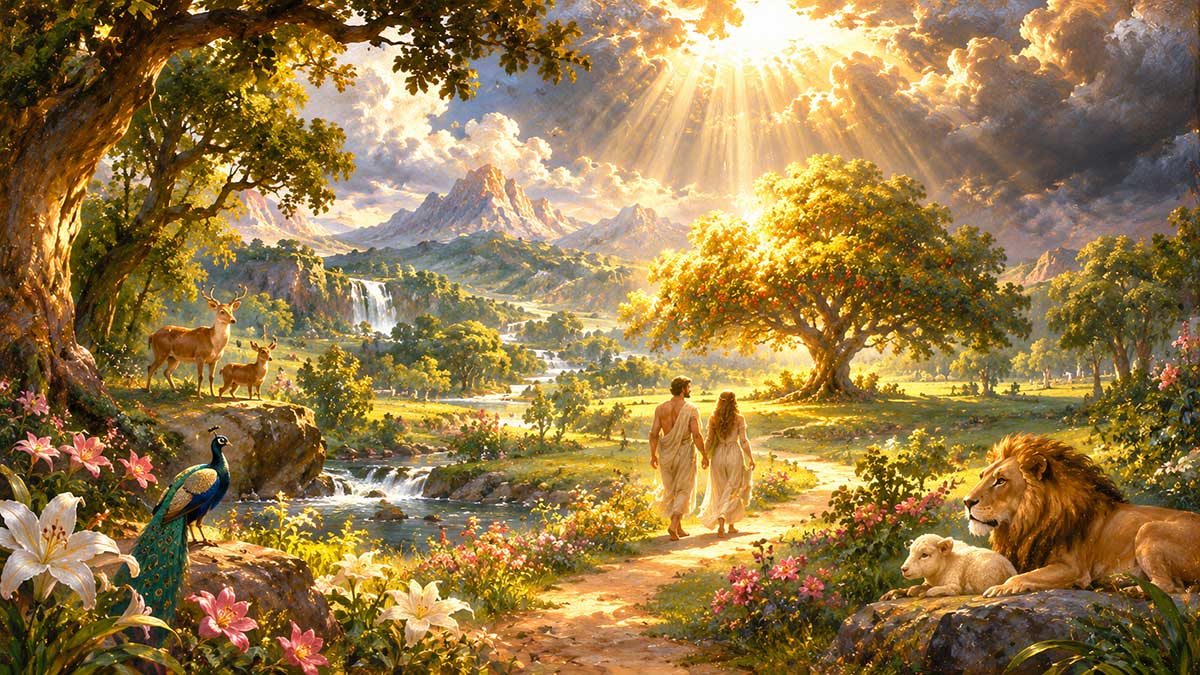
The Mystery of God and the Limits of Human Knowledge
Nick Sasaki
John, I want to pick up exactly where we left off.
You spent much of your life studying God, reading Scripture in its original languages, questioning religious authorities, and trying to explain divine justice through Paradise Lost.
Here's what I'm curious about.
After all those years, did you feel you understood God better? Or did God become more mysterious the more you studied Him?
John Milton
Both, Nick, though perhaps not in the manner you might expect.
Study can clarify what we believe God has revealed. It can expose errors in our interpretations, distinguish human traditions from Scripture, and help us examine questions that once appeared insoluble.
Yet greater knowledge does not necessarily eliminate mystery.
Indeed, the more carefully one considers divine eternity, foreknowledge, creation, and goodness, the more clearly one recognizes the limitations of human comprehension.
I believed that reason was a gift from God, not an enemy of faith.
But reason must recognize the difference between investigating what has been revealed and pretending to possess knowledge that belongs to God alone.
Nick Sasaki
That's interesting. You're saying we should question things, but there's a point where we have to admit we don't know.
How do you tell the difference between a genuine mystery and something that simply doesn't make sense?
John Milton
That is an excellent distinction.
A mystery may concern something beyond our present comprehension. A contradiction concerns propositions that cannot both be true in the same sense.
We should not invoke mystery merely to protect ourselves from difficult reasoning.
If an interpretation appears contradictory, we ought to examine the interpretation before declaring that the contradiction is sacred.
Nick Sasaki
I like that.
Sometimes I hear people say, "Well, that's just God's mystery," and the conversation stops.
But maybe the question deserves more examination.
John Milton
Indeed.
Faith should not become an excuse for intellectual idleness.
Yet neither should intellectual confidence persuade us that the infinite must fit comfortably within the boundaries of our understanding.
Nick Sasaki
Did you ever reach a point where you thought, "Maybe I've been asking the wrong questions about God"?
John Milton
Certainly, one must remain open to that possibility.
For example, a person may begin by asking why God has not arranged the universe according to his preferences.
But perhaps the more fruitful question is whether those preferences adequately account for freedom, moral responsibility, and the nature of goodness.
Nick Sasaki
That sounds reasonable.
But I have a feeling your answer is going to lead us into a much bigger problem.
If God Knew the Future, Why Create Humanity?
Nick Sasaki
Here's something that has puzzled me for years.
If God knew Satan would rebel, knew Adam and Eve would disobey, and knew humanity would experience thousands of years of suffering, why create everything in the first place?
I mean, God wasn't surprised by what happened in Eden, was He?
John Milton
No. In the theological account I present in Paradise Lost, God foreknows the fall.
But foreknowledge must be distinguished from causation.
Knowing that a person will choose something does not necessarily mean compelling that person to choose it.
Nick Sasaki
I understand that distinction.
But it doesn't completely answer my question.
Let's say I know with absolute certainty that creating something will eventually lead to terrible suffering.
I may not directly cause every decision that follows, but I still made the original choice to create it.
Don't I carry some responsibility?
John Milton
You have moved from the question of freedom to the question of divine responsibility.
That is indeed more difficult.
In my poem, God declares that human beings were created sufficiently free to stand, yet free to fall.
Their obedience would possess moral significance precisely as the expression of their own will.
But your question remains: Why permit a creation in which that freedom could be misused?
My answer would begin with the goodness of creation itself.
Existence, rationality, love, and the capacity for communion with God are genuine goods.
The possibility of their misuse does not automatically render their creation evil.
Nick Sasaki
But God didn't merely know there was a possibility.
He knew what would actually happen.
That's what bothers me.
John Milton
And rightly so. A distinction between possibility and certainty cannot be ignored.
I would argue that certainty in divine knowledge does not transform a free act into a compelled act.
Yet I acknowledge that this distinction does not by itself explain every dimension of suffering.
Nick Sasaki
So you don't think you've solved the entire problem.
John Milton
I would distinguish defending the justice of God from claiming to comprehend every divine purpose.
My poem seeks to explain why the fall need not be attributed to a defect in God's goodness.
It does not give a mortal mind complete possession of the reasons for creation.
Nick Sasaki
Let me try another angle.
Wouldn't it have been better for God never to create humanity than to create billions of people who would suffer?
John Milton
That judgment assumes we can compare existence and nonexistence as though they were two experiences placed before us.
But there is no person who experiences the supposed advantages of never having existed.
Furthermore, suffering is not the whole of human life.
There is love, beauty, understanding, friendship, generosity, and the possibility of redemption.
Nick Sasaki
True. But what about someone whose life is almost entirely suffering?
John Milton
Then the question becomes especially grave.
We must not dismiss that person's suffering by appealing casually to the happiness of others.
Nor should we presume that a philosophical argument can relieve the burden of someone enduring terrible pain.
The defense of divine justice is one question.
Our obligation to relieve suffering is another, and it is immediate.
Could God Have Created Free People Who Always Choose Good?
Nick Sasaki
Let's talk about free will.
You believed freedom was essential to genuine obedience and love.
But here's my question.
Couldn't God have created human beings who were completely free and still always chose goodness?
Why does freedom have to include the possibility of doing evil?
John Milton
We must first distinguish freedom from mere unpredictability.
A rational creature is free when its actions proceed from its own understanding and will, rather than external compulsion.
If that creature possesses genuine moral agency, it must be capable of choosing in accordance with reason or departing from it.
Nick Sasaki
But God is perfectly good, isn't He?
And God is free.
So doesn't that prove freedom and perfect goodness can exist together?
John Milton
You have identified an important difficulty.
Divine freedom and creaturely freedom need not be identical in every respect.
God's goodness belongs to His perfect nature. A created rational being does not possess divine perfection by nature.
Its virtue involves willing the good rather than being compelled by an external force.
Nick Sasaki
But couldn't God create a person who freely chooses goodness every single time?
Not a robot. Someone who genuinely loves goodness and never wants to do evil.
John Milton
One may conceive of a creature whose will remains consistently directed to goodness.
The question is whether such constancy is bestowed as an unalterable condition or attained through the creature's own willing.
My account places great significance upon the freedom originally granted to angels and human beings.
Their obedience was not meant to be mechanical.
Nick Sasaki
I understand, but I still feel there's a missing piece.
If Heaven is a place where people are free and no longer sin, why couldn't God have started humanity in that condition?
John Milton
That question presses beyond what my poem fully resolves.
One might distinguish innocence from confirmed righteousness, or the beginning of moral life from its fulfillment.
But I would not pretend that naming those distinctions eliminates every difficulty.
Nick Sasaki
So perhaps the real question is whether freedom requires the possibility of evil forever, or only during some stage of development.
John Milton
That is a more precise formulation.
And it deserves serious consideration.
Nick Sasaki
You know what I find fascinating?
We often assume freedom means having as many choices as possible.
But maybe true freedom is reaching a point where you no longer desire what destroys you.
John Milton
There is wisdom in that thought.
A person enslaved by appetite may possess many apparent choices while lacking genuine self-government.
The ability to choose what is destructive does not make destruction itself an expression of perfected liberty.
Freedom must be considered in relation to reason and goodness.
Why Didn't God Stop Adam and Eve?
Nick Sasaki
Let me make this more personal.
I'm a father. If I see one of my children about to do something dangerous, I don't simply stand there and say, "Well, they have free will."
I try to stop them.
Sometimes I explain. Sometimes I warn them. Sometimes I intervene.
Why didn't God prevent Adam and Eve from making their terrible mistake?
John Milton
In Paradise Lost, God does not leave Adam and Eve without instruction.
They receive warnings. They possess reason. They are informed of the consequences of disobedience.
The angel Raphael visits Adam and explains the danger of temptation and rebellion.
Their freedom is accompanied by knowledge and responsibility.
Nick Sasaki
But God could have done more.
He could have kept Satan out of Eden.
He could have removed the forbidden tree.
He could have intervened at the very moment Eve reached for the fruit.
Why didn't He?
John Milton
Those are reasonable questions.
But consider what happens if every possible misuse of freedom is prevented before it can occur.
At what point does moral agency become merely the appearance of agency?
Nick Sasaki
I see what you're saying.
But parents do that all the time. We prevent certain choices until children are mature enough to handle them.
John Milton
And that analogy deserves attention.
Yet Adam and Eve, in my poem, are not presented simply as helpless infants. They are rational beings capable of receiving instruction and exercising judgment.
Their innocence does not mean they lack responsibility.
Nick Sasaki
Still, they were inexperienced.
Satan was an extraordinarily intelligent being who had already rebelled against Heaven.
Wasn't that an unfair contest?
John Milton
Satan possessed cunning, certainly.
But the poem does not present deception as irresistible.
Eve is capable of reasoning, and Adam understands the prohibition.
Their failure arises through persuasion, desire, and decisions they could have examined differently.
Nick Sasaki
But what about the consequences?
One mistake, and generations of people suffer.
Doesn't that seem disproportionate?
John Milton
The consequences of the fall are among the most difficult elements of the Christian account.
My poem treats the fall as a transformation in humanity's relationship with God, nature, and itself.
Yet I would caution against interpreting the narrative as though God were merely an offended monarch imposing an arbitrary penalty.
The disorder introduced by disobedience is presented as having consequences within human nature and human history.
Nick Sasaki
So you're saying sin isn't just breaking a rule.
It changes the person who commits it.
John Milton
Precisely.
And sometimes its consequences extend far beyond the original decision.
But that observation should deepen our moral seriousness, not make us indifferent to those who suffer consequences they did not personally choose.
Is Suffering God's Lesson or Humanity's Responsibility?
Nick Sasaki
That brings me back to suffering.
Do you believe God intentionally uses suffering to teach people?
Or is suffering simply part of living in a world where people have freedom?
John Milton
I would hesitate to force every instance of suffering into a single explanation.
Some suffering follows directly from human wrongdoing.
Some arises from the conditions of bodily existence.
Some is inflicted upon the innocent through the actions of others.
And much remains difficult for us to interpret.
Nick Sasaki
What about your blindness?
Did you think God was trying to teach you something?
John Milton
My writings show that blindness led me to examine my understanding of service, patience, and vocation.
But it would be presumptuous to claim that I possessed certain knowledge of why God permitted that particular loss.
A person may learn through suffering without proving that suffering was inflicted for the purpose of teaching the lesson.
Nick Sasaki
That's an important distinction.
Sometimes people say, "Everything happens for a reason."
But I wonder whether that's always helpful.
Imagine saying that to parents who have lost a child.
John Milton
Such words may be offered with compassionate intentions, yet they can become cruel when they dismiss another person's grief.
The sufferer does not necessarily need an explanation.
He may need companionship, practical assistance, and permission to mourn.
Nick Sasaki
You experienced the deaths of two wives and children. Did those losses change how you thought about God's goodness?
John Milton
They certainly made suffering more than an abstract subject.
I would not claim to know precisely how every private grief transformed my theology.
But any serious reflection on providence must acknowledge the difference between discussing loss and enduring it.
Nick Sasaki
Do you think people sometimes use religion to avoid confronting pain?
John Milton
They may.
A person can repeat correct religious propositions without allowing himself to experience grief honestly.
But religion may equally give language to lamentation.
Consider the Psalms. They contain anguish, protest, fear, and questions directed toward God.
Faith need not require emotional dishonesty.
Nick Sasaki
I like that.
Maybe a person can question God without abandoning God.
John Milton
Certainly.
A question offered in sincere pursuit of truth is not necessarily an act of rebellion.
But we should distinguish honest questioning from the refusal to accept any answer that does not flatter our desires.
That distinction will become particularly important when we discuss Satan.
Who Decides What God Really Said?
Nick Sasaki
John, you studied the Bible intensely. You knew Hebrew, Greek, and Latin. You questioned established religious teachings and developed some interpretations that were controversial.
How did you decide what was genuinely God's truth and what was simply human interpretation?
John Milton
I regarded Scripture as the principal authority in matters of Christian doctrine.
But Scripture must be read, interpreted, and compared with itself.
A church council or ecclesiastical office cannot transform an unsupported interpretation into divine truth merely by declaring it authoritative.
Nick Sasaki
But here's the problem.
Everybody says they're following the Bible.
Different churches read the same passages and arrive at completely different conclusions.
How do you know your interpretation is the right one?
John Milton
That is a fair challenge.
One must examine the language, context, and consistency of an interpretation with the larger body of Scripture.
Reason has a legitimate role in that examination.
Yet the possibility of error remains.
Nick Sasaki
So why were you so confident when you disagreed with religious authorities?
John Milton
Confidence may arise from careful study, but it does not become infallibility.
I believed that Christians had a responsibility to examine doctrine rather than surrender judgment entirely to institutions.
That conviction could lead me to oppose interpretations widely accepted in my time.
Nick Sasaki
But if everyone follows their own interpretation, couldn't Christianity fragment into thousands of competing beliefs?
John Milton
It could, and religious disagreement was already abundant in my century.
Yet enforced uniformity does not necessarily produce genuine agreement.
A person may outwardly repeat a doctrine while inwardly doubting it.
I would rather distinguish sincere conviction from compelled conformity.
Nick Sasaki
Here's something I've wondered.
What if two people sincerely study the Bible, pray, and use reason, but reach opposite conclusions?
Could both still be genuinely seeking God?
John Milton
I see no reason to assume that every disagreement proves one participant insincere.
Human understanding is imperfect.
But sincerity alone cannot establish that every conclusion is equally true.
We must preserve both intellectual humility and a serious concern for truth.
Nick Sasaki
That's a difficult balance.
You don't want to become arrogant, but you don't want to pretend every belief is correct.
John Milton
Exactly.
Humility should make us willing to examine our convictions.
It need not make us indifferent to whether those convictions are true.
Was Jesus God Himself or the Son of God?
Nick Sasaki
Now I want to ask about something particularly interesting in your theology.
You had an unusual understanding of the relationship between Jesus and God the Father.
Many Christians believe Jesus is fully God, equal and eternal with the Father.
But your writings seem to suggest a different understanding.
Could you explain what you believed?
John Milton
In my theological writings, particularly De Doctrina Christiana, I argued for the supremacy of God the Father.
I understood the Son as divine and uniquely exalted, yet derived from the Father rather than equal to Him in the manner asserted by the traditional doctrine of the Trinity.
I considered the scriptural language concerning the Father and the Son to be significant.
Nick Sasaki
So you didn't believe Jesus and God the Father were simply the same person?
John Milton
No.
Indeed, traditional Trinitarian theology itself distinguishes the Father and the Son as persons.
My disagreement concerned the nature of their relationship, particularly their equality, eternity, and the Son's derivation from the Father.
I believed the Father possessed ultimate primacy.
Nick Sasaki
That's an important distinction.
Let me ask you about something that has always interested me.
Jesus prayed to the Father.
In the Garden of Gethsemane, He asked that the cup of suffering might pass from Him, yet submitted to the Father's will.
If Jesus were God in exactly the same sense as the Father, why would He need to pray?
John Milton
That was among the kinds of scriptural evidence I considered relevant.
The distinction between the will of the Father and the obedience of the Son deserves careful examination.
In my understanding, the Son's obedience expresses a genuine relationship to the Father.
Nick Sasaki
And when Jesus cried out from the cross, asking why God had forsaken Him?
John Milton
That passage raises profound questions concerning Christ's suffering and relationship to the Father.
I would interpret it within the larger scriptural account of the Son's mission, rather than treating a single utterance as sufficient to establish an entire doctrine.
Nick Sasaki
What about the temptation of Jesus?
Satan tested Him in the wilderness.
If Jesus were God Himself, how could He genuinely be tempted?
John Milton
One must distinguish the possibility of temptation from surrender to temptation.
Christian traditions have offered different accounts of how Christ's divine identity and human experience relate.
My own interpretation gave particular significance to the Son's obedience, His mission, and His relationship to the Father.
Nick Sasaki
So for you, Jesus wasn't simply pretending to struggle.
His obedience meant something real.
John Milton
Certainly.
If obedience were merely a theatrical display without genuine moral significance, much of the scriptural account would lose its force.
Nick Sasaki
But let me challenge your position.
Traditional Christians might say that Jesus was fully divine and fully human, and that His human nature explains His prayers, temptations, and suffering.
How would you respond?
John Milton
I would ask whether that explanation arises clearly from Scripture or depends upon later theological formulations.
I would examine the passages concerning the Father's supremacy, the Son's generation, His obedience, and His exaltation.
But I would not pretend that these questions can be settled merely by repeating a preferred formula.
Nick Sasaki
Do you think Christians sometimes spend so much time arguing about who Jesus is that they forget what He taught?
John Milton
That danger certainly exists.
Yet doctrine and conduct need not be enemies.
What we believe about Christ may influence how we understand His teachings, His sacrifice, and His example.
The difficulty arises when theological argument becomes a substitute for obedience, charity, and humility.
Nick Sasaki
So someone could have the correct theological formula and still fail to live like a Christian.
John Milton
Certainly.
Knowledge without virtue is an impoverished achievement.
Nick Sasaki
And someone might misunderstand part of theology but still sincerely love God and try to follow Jesus.
John Milton
I would not presume that every theological error destroys sincerity or virtue.
Yet I would still encourage that person to continue seeking truth.
Nick Sasaki
That's a much more interesting answer than simply saying one group is right and everyone else is wrong.
What If Milton Was Wrong About God?
Nick Sasaki
John, I want to finish this part of our conversation with something personal.
You've spent decades studying Scripture. You've challenged religious institutions, defended your interpretations, and written an epic poem about God's justice.
But suppose you discovered that one of your most cherished beliefs about God was mistaken.
Would you be willing to change your mind?
John Milton
If I became persuaded by sound reasoning and sufficient evidence that I had erred, I ought to correct my belief.
Truth is not made more honorable by our refusal to acknowledge error.
Nick Sasaki
That's the ideal answer.
But emotionally, would it be difficult?
Imagine discovering that something you had defended for forty years was wrong.
Wouldn't that feel like losing part of yourself?
John Milton
It might.
A conviction held for many years becomes intertwined with memory, identity, and personal sacrifice.
To abandon it may feel like repudiating one's former life.
But that feeling cannot determine whether the conviction is true.
Nick Sasaki
Have you ever wondered whether your desire to be right might be stronger than your desire to discover the truth?
John Milton
That is a question every serious thinker ought to ask.
The danger is not confined to theologians.
Philosophers, political leaders, scholars, and ordinary people may become attached to their conclusions.
We often begin by seeking truth and end by defending ourselves.
Nick Sasaki
That's something I see everywhere.
People argue about religion, politics, science, almost anything.
Sometimes it seems like nobody is listening. They're just waiting for their turn to speak.
John Milton
Then the argument has ceased to be an inquiry.
It has become a contest of vanity.
Nick Sasaki
But how do we avoid that?
How can someone have strong convictions without becoming arrogant?
John Milton
By remembering that conviction and infallibility are different things.
One may believe a proposition firmly and still acknowledge the possibility of having misunderstood the evidence.
One may defend an argument vigorously without despising the person who disagrees.
And one may discover that the most difficult adversary is not another person but one's own pride.
Nick Sasaki
I think that's where faith becomes really interesting.
Maybe genuine faith isn't the absence of questions.
Maybe it's the courage to keep asking them without losing the desire for truth.
John Milton
That is a worthy thought.
But I would add that questions should be accompanied by a willingness to hear answers we did not anticipate.
Otherwise, questioning itself can become another expression of pride.
Nick Sasaki
You keep bringing us back to pride.
John Milton
It is difficult to discuss the fall of angels and humanity without encountering it.
Nick Sasaki
And that brings me to something I've been wanting to ask since we started.
You wrote one of the most extraordinary characters in literature.
Satan.
He's intelligent. He's courageous in certain ways. He speaks beautifully. He refuses to surrender.
And when I read some of his speeches, I can understand why people find him fascinating.
But here's what I don't understand.
You spent your own life resisting kings and religious authorities.
You believed in freedom. You defended the right to challenge those in control.
Then you created Satan, a character who rebels against supreme authority, and portrayed his rebellion as evil.
So, John, what's the difference?
Why was your rebellion against authority righteous, but Satan's rebellion against God wrong?
John Milton
That is a question worth examining carefully, Nick.
For the moral character of rebellion cannot be determined merely by the fact that someone resists authority.
We must ask what kind of authority is being resisted, whether that authority is just, what motivates the resistance, and what the rebel seeks to establish in its place.
Satan's tragedy is not simply that he refuses to submit.
It is that he mistakes the domination of others for freedom and the exaltation of himself for justice.
Nick Sasaki
But isn't that exactly what some human rulers do?
They claim they're defending order and goodness, but really they're protecting their own position.
John Milton
Indeed.
And that is why the question becomes more difficult when applied to human affairs.
A mortal ruler may claim divine authority without possessing divine goodness.
A rebel may speak of liberty while secretly desiring dominion.
Neither obedience nor resistance is automatically virtuous.
Nick Sasaki
Then maybe the most dangerous thing is when someone becomes completely convinced that God is on their side.
John Milton
That conviction may inspire genuine courage.
It may equally become a terrible instrument of self-deception.
The difference demands examination of one's motives, actions, and understanding of justice.
Nick Sasaki
And perhaps that's why Satan is so interesting.
Maybe he doesn't think he's evil at all.
Maybe he thinks he's the hero.
John Milton
Then we have arrived at one of the most disturbing possibilities in human nature.
A person may become so committed to his own account of righteousness that he loses the ability to recognize what he has become.
And that, Nick, is where the tragedy of Satan truly begins.
Editorial note: This is an imagined conversation. John Milton's historical writings, including Paradise Lost, Areopagitica, and De Doctrina Christiana, inform his fictional responses. The theological interpretations presented reflect scholarly readings of Milton's work and should not be confused with recorded statements or verified private conversations.
Topic 3: Was Satan Evil, or Did He Believe He Was Right?
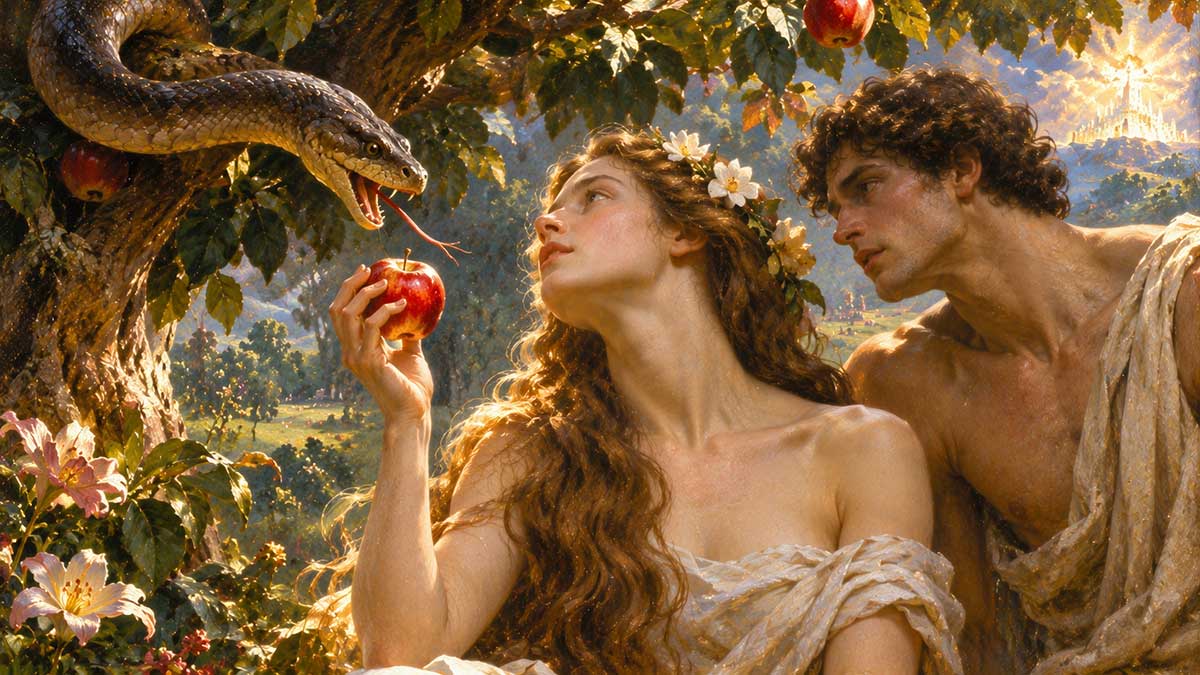
The Psychology of Pride, Rebellion, Freedom, and the Possibility of Forgiveness
Nick Sasaki
John, I want to continue with something you said a moment ago.
You suggested that Satan's greatest tragedy wasn't simply his rebellion against God. It was his inability to recognize what he had become.
That fascinates me.
When I read Paradise Lost, Satan doesn't seem like a simple villain. He's intelligent, determined, courageous in certain ways, and incredibly persuasive.
Sometimes he seems more emotionally compelling than anyone else in the poem.
Why did you make him such a fascinating character?
John Milton
Perhaps we should begin by questioning what makes a character fascinating, Nick.
Do we admire Satan because he is good, or are we drawn to him because he possesses qualities that we ordinarily associate with greatness?
He has intelligence, eloquence, determination, and the ability to inspire others.
These qualities are not evil in themselves.
But they become dangerous when separated from wisdom and goodness.
Nick Sasaki
So you're saying someone can have extraordinary abilities and still be morally corrupt.
John Milton
Certainly.
Indeed, extraordinary abilities may make moral corruption more destructive.
An ignorant tyrant may inflict suffering through crude force. An intelligent tyrant may persuade others that their suffering is necessary for a noble cause.
Satan is dangerous partly because he possesses the gifts required to make evil appear attractive.
Nick Sasaki
But here's what interests me.
You could have written Satan as an obviously horrible creature.
Instead, you gave him some of the most memorable speeches in English literature.
Was that intentional?
John Milton
In the imaginative construction of my poem, Satan must possess sufficient grandeur to make his fall meaningful.
A creature without greatness has little greatness to lose.
Furthermore, temptation does not ordinarily present itself as something openly contemptible.
It approaches us through desires and arguments that appear reasonable.
If Satan were merely repulsive, readers might never recognize the danger of his reasoning.
Nick Sasaki
So you wanted readers to feel the attraction before recognizing the deception.
John Milton
That is a defensible interpretation.
But I would distinguish the dramatic force of Satan's speeches from an endorsement of his conclusions.
His eloquence is part of the danger.
Nick Sasaki
I wonder whether some readers stop at the eloquence.
They hear his speeches about freedom and independence, and they think, "This guy has a point."
John Milton
Then I would encourage them to examine what his pursuit of independence produces.
Does Satan become more free?
Does he become happier?
Does he develop greater compassion for those who follow him?
Or does his rebellion increasingly confine him within resentment, envy, and the desire to destroy what he cannot possess?
A character's declarations should be judged alongside his actions.
Better to Reign in Hell
Nick Sasaki
Let's talk about his most famous declaration.
"Better to reign in Hell, than serve in Heaven."
That's an extraordinary line.
I can understand why people find it inspiring. There's something appealing about refusing to submit, even after you've been defeated.
Were you deliberately making Satan's rebellion attractive?
John Milton
The attraction is inseparable from the danger.
Satan frames his situation as a choice between independence and servitude.
But consider what he has actually chosen.
He has exchanged a place within divine goodness for a kingdom of misery.
And he calls that exchange a victory.
Nick Sasaki
But couldn't someone argue that freedom is worth suffering for?
People throughout history have accepted imprisonment, exile, and even death rather than submit to tyranny.
John Milton
Certainly.
But we must distinguish the suffering endured in pursuit of justice from the suffering produced by pride.
A person resisting tyranny may sacrifice comfort to defend the rights of others.
Satan sacrifices goodness itself to preserve his claim to supremacy.
Nick Sasaki
But from Satan's perspective, maybe he believes God is a tyrant.
John Milton
That is precisely why his perspective requires examination.
A belief does not become true merely through the intensity with which it is held.
Satan interprets the supremacy of God as an insult to his own dignity.
He cannot tolerate the existence of a goodness greater than himself.
Nick Sasaki
Let me challenge that.
Suppose Satan genuinely believes he's being treated unfairly.
Wouldn't rebellion seem justified from his point of view?
John Milton
It might seem justified to him.
But the moral question is whether his judgment is sound.
In my poem, Satan's rebellion is not directed against a corrupt human ruler.
It is directed against the source of goodness.
His desire for equality becomes a desire for domination.
Nick Sasaki
So the problem isn't wanting freedom.
It's wanting to be above everyone else.
John Milton
Exactly.
Freedom and supremacy are not the same thing.
A person may desire liberty so that he can live according to reason and conscience.
Another may invoke liberty because he cannot endure being subject to any standard beyond his own will.
The language may sound similar, but the moral purposes differ.
Nick Sasaki
That makes me think of people who say they just want freedom, but what they really want is the freedom to control everybody around them.
John Milton
Such contradictions are common in human affairs.
The person who cannot tolerate authority over himself may be remarkably eager to exercise authority over others.
Does Satan Believe His Own Story?
Nick Sasaki
Here's something I really want to understand.
Do you think Satan genuinely believes he's fighting for freedom?
Or does he know, somewhere deep inside, that jealousy and wounded pride are driving him?
John Milton
I would direct your attention to the moments when Satan speaks without an audience.
His public speeches are often magnificent.
But when he reflects upon his condition, the reader encounters a different figure.
He recognizes aspects of his responsibility for his fall.
He remembers the goodness he once experienced.
He confronts the possibility that his suffering arises from his own choices.
Nick Sasaki
So he knows.
John Milton
At moments, he appears capable of recognizing the truth.
But recognition is not the same as repentance.
Nick Sasaki
That's interesting.
Someone can know they're wrong and still refuse to change.
John Milton
Indeed.
And the refusal may become stronger precisely when the truth threatens one's pride.
Imagine a man who has spent years persuading others that he is a great liberator.
He has inspired followers, made promises, and sacrificed much for his cause.
Then he discovers that his cause was founded upon a falsehood.
To admit his error would require more than changing an opinion.
He would have to surrender the identity he had constructed.
Nick Sasaki
That's powerful.
Sometimes people keep defending a mistake simply because they've invested so much of their lives in it.
John Milton
Yes.
A person may become more committed to preserving his self-image than to discovering what is true.
Nick Sasaki
And Satan has an entire army of fallen angels following him.
If he admits he was wrong, he loses everything he's built his identity around.
John Milton
That is part of the tragedy.
His leadership becomes another chain binding him to his rebellion.
He cannot easily admit that he has led others into misery.
Nick Sasaki
So maybe the most frightening thing about Satan isn't that he lies to other people.
It's that he gradually becomes unable to stop lying to himself.
John Milton
That is a perceptive reading.
Yet I would add that self-deception is not always complete ignorance.
Sometimes a person sees the truth and deliberately turns away from it.
Repeated refusal can make the next refusal easier.
Did Milton Recognize Himself in Satan?
Nick Sasaki
John, can I ask you something a little uncomfortable?
You've described Satan as intelligent, proud, independent, and unwilling to admit defeat.
But those are qualities that, in different forms, people might associate with you.
You challenged kings. You opposed religious authorities. You defended your convictions fiercely.
Did you ever recognize something of yourself in Satan?
John Milton
That is a question I cannot answer through a documented private confession, Nick.
But I can examine the moral difficulty it raises.
The temptation toward pride is not restricted to those who openly pursue evil.
A person devoted to a righteous cause may become attached to his own righteousness.
He may begin by defending liberty and end by defending his personal authority.
Nick Sasaki
But I'm asking about you.
Did you ever think, "Maybe I'm becoming too stubborn. Maybe I can't admit when I'm wrong"?
John Milton
My writings demonstrate that I held strong convictions and defended them vigorously.
They do not prove that every judgment I made was correct.
If we are imagining me examining my life with the benefit of distance, I would have to acknowledge that the possibility of error applied to me no less than to my opponents.
Nick Sasaki
That's fair.
Let me ask it another way.
What is the difference between courage and stubbornness?
John Milton
Courage remains faithful to a worthy principle despite fear or opposition.
Stubbornness may remain attached to a position after the reasons supporting it have failed.
The outward behavior can appear identical.
Both individuals may refuse to surrender.
The difference lies partly in what they refuse to surrender and whether they remain willing to examine their reasons.
Nick Sasaki
So someone can be brave and wrong.
John Milton
Certainly.
Courage does not guarantee wisdom.
Nick Sasaki
And someone can be intelligent and wrong.
John Milton
Very much so.
Nick Sasaki
And religious and wrong.
John Milton
Religion does not make human judgment infallible.
Nick Sasaki
Then how do we keep ourselves from becoming like Satan?
John Milton
By cultivating the willingness to examine our motives.
We should ask whether our convictions lead us to greater justice, humility, and concern for others.
We should question whether we seek truth or merely vindication.
And we should remain attentive to the possibility that our greatest strengths may become instruments of our greatest failures.
Nick Sasaki
I think that's one of the most important things you've said.
Our strengths can become our weaknesses when we stop examining them.
John Milton
Yes.
The danger is greatest when a person believes his virtues place him beyond temptation.
Can Hell Begin Inside the Mind?
Nick Sasaki
There's another part of Paradise Lost that fascinates me.
Satan seems unable to escape his own resentment.
Even when he leaves Hell physically, he carries his misery with him.
Do you think Hell can begin inside someone's mind?
John Milton
In the poem, Satan's condition is not defined solely by his physical location.
He carries the consequences of his rebellion within his own consciousness.
He cannot recover peace merely by traveling somewhere else.
His envy and hatred accompany him.
Nick Sasaki
That's remarkably psychological.
You could move someone into a beautiful home, give them wealth, comfort, and everything they ever wanted, but if they're consumed by resentment, they might still be miserable.
John Milton
Material circumstances cannot automatically heal a disordered will.
A person who measures happiness entirely through superiority over others may remain dissatisfied regardless of his possessions.
There will always be someone to envy, something to resent, or some imagined insult to avenge.
Nick Sasaki
So Satan could stand in Paradise and still experience Hell.
John Milton
That is consistent with the poem's portrayal.
He enters a place of beauty and innocence, yet its goodness intensifies his awareness of what he has lost.
Rather than rejoice in beauty, he seeks to corrupt it.
Nick Sasaki
Why?
Why would someone want to destroy something beautiful just because they can't have it?
John Milton
Envy can transform another person's happiness into an accusation against oneself.
The envious person does not merely desire what another possesses.
He may come to resent the very existence of that happiness.
Nick Sasaki
That's disturbing.
It's almost as if the other person's happiness becomes painful to him.
John Milton
Precisely.
And if he refuses to examine that pain, he may seek relief through destruction.
Nick Sasaki
But could Satan escape that mental prison?
Could he simply decide to stop hating?
John Milton
A change of will would be necessary.
But the difficulty is that his pride resists the humility such a change requires.
He would have to acknowledge that his chosen course has brought him misery.
Nick Sasaki
So the prison door might be his own refusal to admit he's wrong.
John Milton
That is a compelling way to describe the psychological dimension of his condition.
But we should not reduce the poem's theological Hell entirely to a state of mind.
Its spiritual, moral, and cosmic dimensions remain significant.
Why Was Milton's Rebellion Righteous but Satan's Evil?
Nick Sasaki
Now we come to the question I've been waiting to ask.
You spent much of your life challenging authority.
You opposed the established Church. You supported Parliament against the king. You defended the execution of Charles I.
You believed that people should resist tyranny.
But Satan rebels against supreme authority, and you portray him as evil.
Why was your rebellion righteous but Satan's rebellion wrong?
John Milton
The first distinction concerns the nature of the authority being resisted.
A human ruler is fallible.
He may violate the laws he is entrusted to uphold, oppress his subjects, or place his personal desires above the common good.
In such circumstances, resistance may be justified.
But the God portrayed in Paradise Lost is not a fallible human monarch.
He is the source of justice and goodness.
Nick Sasaki
But that's exactly what concerns me.
Human rulers often claim they're acting on God's behalf.
They say their authority comes from Heaven.
How can ordinary people know whether they're resisting tyranny or resisting God's will?
John Milton
They must examine the ruler's conduct, the principles of justice, and the obligations of conscience.
A claim to divine authority does not establish that the claimant possesses it.
Nick Sasaki
But people disagree about justice.
One side thinks a ruler is protecting society. Another thinks he's a tyrant.
Both may believe God supports them.
John Milton
That is among the gravest difficulties of political life.
A person must not confuse the certainty of his conviction with the certainty of his judgment.
Nick Sasaki
Yet you supported executing a king.
That's an irreversible decision.
What if you were wrong?
John Milton
My historical writings defended the right of a people to hold a tyrannical ruler accountable, including through the severest penalties.
That position was controversial then and remains morally serious.
In an imagined conversation such as ours, I should not evade the burden of the question.
If a judgment leading to a person's death is mistaken, its consequences cannot be repaired.
Nick Sasaki
So how do you justify taking that risk?
John Milton
I argued that permitting unchecked tyranny carries grave consequences of its own.
But that does not eliminate the obligation to examine evidence, legitimacy, and the proportionality of punishment.
Nor should one pretend that political convictions grant immunity from error.
Nick Sasaki
Here's where I see the contradiction.
You say Satan is wrong partly because he's convinced of his own righteousness.
But weren't you convinced of yours?
John Milton
Conviction alone is not the distinction.
We must examine whether the cause is just, whether the authority being opposed is legitimate, and whether the means employed are morally defensible.
Yet your challenge exposes a danger that no political writer should dismiss.
A man may use the language of justice to conceal his own ambition.
Nick Sasaki
Including someone fighting against a tyrant.
John Milton
Including such a person.
Nick Sasaki
Then maybe the most important question isn't simply whether we should obey or rebel.
Maybe it's whether we're willing to question ourselves before doing either.
John Milton
That is a serious moral responsibility.
Blind obedience can enable injustice.
Blind rebellion can produce another form of tyranny.
The virtue lies neither in submission nor resistance considered alone, but in the justice of the action.
When Evil Believes It Is Good
Nick Sasaki
Let me ask you something about human psychology.
What's more dangerous?
Someone who knows they're doing wrong, or someone who's completely convinced that everything they're doing is righteous?
John Milton
Both may be dangerous, but the second possesses a particular capacity for self-justification.
A person who knowingly commits evil may still recognize the moral standard he violates.
A person who identifies his own will with goodness may cease to recognize any standard beyond himself.
Nick Sasaki
So he can justify almost anything.
John Milton
Yes.
Cruelty may become necessity.
Deception may become strategy.
Domination may become protection.
And opposition may become proof that his enemies are wicked.
Nick Sasaki
That sounds like something that could happen in religion, politics, business, almost anywhere.
John Milton
It can occur wherever human beings acquire influence and become unwilling to examine their motives.
Nick Sasaki
What about ordinary people?
Someone who's convinced a family member has wronged them and spends years refusing to forgive.
Could that be a smaller version of the same problem?
John Milton
Resentment can indeed become a form of captivity.
But we should distinguish legitimate grievances from destructive attachment to grievance.
A person who has suffered injustice may have good reason to seek accountability.
Forgiveness need not require pretending that the injury never occurred.
Nick Sasaki
That's an important distinction.
Sometimes people are pressured to forgive before they've even had a chance to acknowledge what happened.
John Milton
Then forgiveness risks becoming another form of coercion.
Genuine reconciliation cannot be manufactured through the denial of truth.
Nick Sasaki
So forgiveness and justice aren't necessarily opposites.
John Milton
No.
Justice concerns what is right.
Mercy concerns how we respond to those who have done wrong.
Their relationship is difficult, but they need not be enemies.
Nick Sasaki
And Satan seems incapable of either admitting the truth or accepting mercy.
John Milton
His pride makes both extraordinarily difficult.
He would rather preserve his self-image than surrender his rebellion.
Could Satan Ever Be Forgiven?
Nick Sasaki
John, I want to end this part with what might be the hardest question of all.
Could Satan ever sincerely repent?
And if he did, would God forgive him?
John Milton
We must distinguish two questions.
The first is whether Satan, as portrayed in my poem, is willing to repent.
The second is whether divine mercy could extend to a being who genuinely repented.
These are not identical.
Nick Sasaki
Let's start with the first.
Does Satan ever seriously consider repentance?
John Milton
In Book IV of Paradise Lost, Satan reflects upon his condition and considers the possibility of submission.
He recognizes that his suffering is connected to his own rebellion.
Yet he turns away from repentance.
He cannot bear the humiliation of acknowledging his error.
Nick Sasaki
So he actually sees a possible way back.
John Milton
He contemplates it.
But he ultimately rejects it.
Nick Sasaki
Why?
Is his hatred of God stronger than his desire to escape suffering?
John Milton
His pride and despair have become intertwined.
He fears humiliation, doubts the possibility of genuine restoration, and remains committed to the identity he has created through rebellion.
Rather than surrender that identity, he chooses to continue his destructive course.
Nick Sasaki
But here's what troubles me.
If God is infinitely loving, shouldn't there always be a possibility of forgiveness?
John Milton
Divine mercy is a profound subject, and we must be careful not to claim more than the poem establishes.
The narrative presents Satan's rebellion as continuing toward destruction rather than repentance.
It does not portray a successful reconciliation between Satan and God.
Nick Sasaki
But I'm asking you to go beyond the story for a moment.
Suppose Satan genuinely changed.
Suppose he finally said, "I was wrong. I hurt others. I let pride destroy me. I want to return to God."
Would God reject him?
John Milton
Your hypothetical raises the relationship between divine justice, mercy, and the nature of angelic rebellion.
Within the theological framework of my poem, the fallen angels are not offered the same redemptive path that humanity receives through the Son.
That difference is significant.
I would not simply erase it to provide a comforting answer.
Nick Sasaki
But why should humanity receive a chance for redemption while Satan doesn't?
John Milton
The poem distinguishes the circumstances of angelic and human disobedience.
Satan's rebellion is portrayed as deliberate and undertaken with extraordinary knowledge.
Humanity's fall involves deception and weakness, though it remains morally consequential.
The Son's redemptive mission is directed toward humanity.
Nick Sasaki
But isn't that still difficult to reconcile with infinite mercy?
John Milton
It is a difficult theological question.
One must consider what mercy means, whether repentance is genuinely possible, and whether a creature's settled will can become incapable of seeking reconciliation.
But I would resist pretending that the narrative provides an uncomplicated answer to every hypothetical.
Nick Sasaki
You know what strikes me?
Satan seems to have everything necessary to recognize his mistake.
He's intelligent. He remembers Heaven. He understands what he's lost.
But he can't say two simple words.
"I was wrong."
John Milton
That is part of the tragedy.
His intellectual greatness does not rescue him from moral failure.
Indeed, his intelligence enables him to construct elaborate defenses of his own misery.
Nick Sasaki
And maybe that's something all of us should think about.
Sometimes we spend years defending an argument when what we really need is the courage to admit we were mistaken.
John Milton
Such an admission may require greater courage than continuing the argument.
Nick Sasaki
That's interesting.
We usually associate courage with refusing to surrender.
But perhaps sometimes courage means surrendering our pride.
John Milton
Yes.
The willingness to relinquish a false claim to greatness may be the beginning of genuine moral freedom.
Nick Sasaki
John, I want to ask one more thing.
Do you think Satan is miserable primarily because God punished him, or because he refuses to stop being the person he's become?
John Milton
In the poem, divine judgment and Satan's own choices are inseparable aspects of his condition.
But his continuing misery is intensified by his refusal to abandon envy and hatred.
He repeatedly chooses to deepen the rebellion that has already brought him suffering.
Nick Sasaki
So even after losing Heaven, he keeps losing more of himself.
John Milton
That is an apt description.
His tragedy is not confined to a single act of rebellion.
It continues through the gradual corruption of his own character.
Nick Sasaki
And that's what makes him frightening.
Not just that he wants to destroy Paradise, but that he seems to have destroyed his own capacity to enjoy anything good.
John Milton
Indeed.
He cannot create the happiness he desires, so he seeks to diminish the happiness of others.
Nick Sasaki
Which brings us to Adam and Eve.
Satan enters Eden and sees two innocent human beings who have done nothing to him.
Yet he decides to destroy their happiness.
And what fascinates me is that he doesn't force them to eat the fruit.
He persuades them.
He appeals to curiosity, desire, love, and fear.
So maybe the story isn't simply about a powerful evil being attacking innocent people.
Maybe it's about how ordinary human emotions can lead us into extraordinary mistakes.
John Milton
That is precisely why the temptation of Adam and Eve deserves careful examination.
Their fall is not presented as the result of physical compulsion.
It involves reasoning, desire, persuasion, and choice.
Nick Sasaki
And I want to understand Eve in particular.
She wanted knowledge.
Normally, we consider curiosity a good thing.
You and I have spent this entire conversation celebrating the search for truth.
So why does Eve's desire for knowledge become part of humanity's downfall?
John Milton
An excellent question, Nick.
For the distinction is not simply between knowledge and ignorance.
It concerns the manner in which knowledge is pursued, the promises made about it, and the purposes for which it is desired.
And perhaps we should begin by asking whether Eve's curiosity was truly her greatest mistake.
Editorial note: This is an imagined conversation based on John Milton's life, political writings, and Paradise Lost. The dialogue is fictional, including Milton's personal reflections and responses to modern questions. Historical positions and literary interpretations are distinguished where possible from invented speech.
Topic 4: Did Adam and Eve Fall Through Love or Weakness?
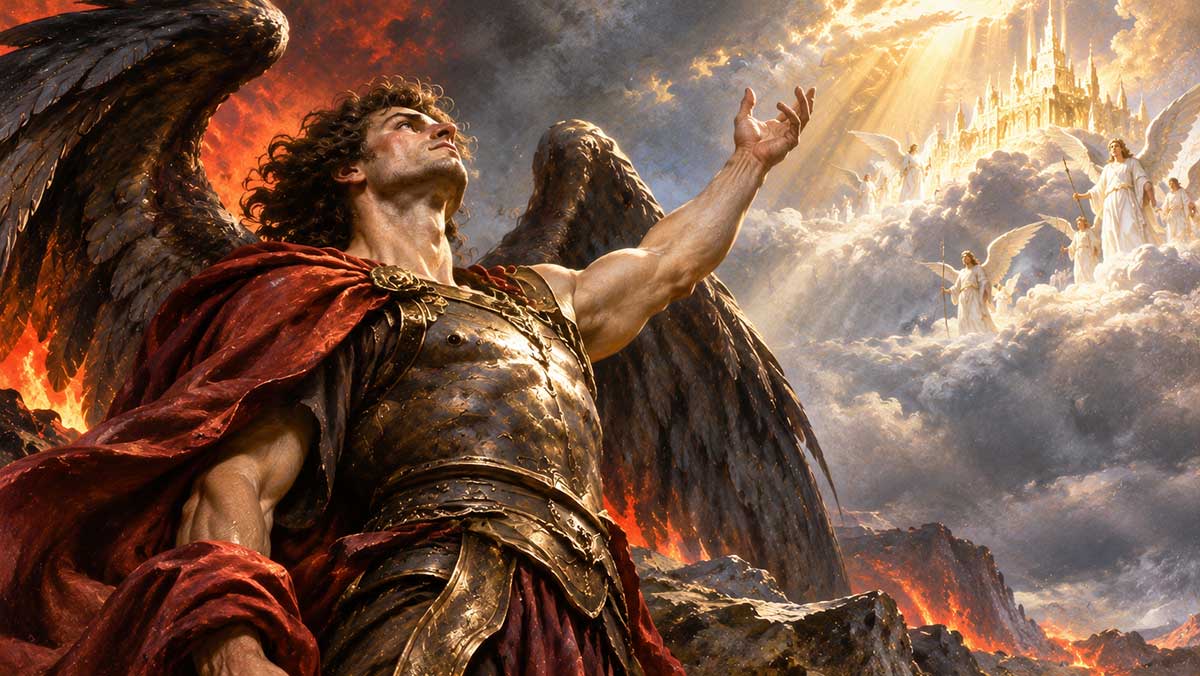
Curiosity, Temptation, Marriage, and the Freedom to Love
Nick Sasaki
John, I want to pick up exactly where we left off.
You said that perhaps Eve's curiosity wasn't her greatest mistake.
That's fascinating to me, since curiosity is something I've always valued. I think asking questions is one of the most important things human beings can do.
But in Paradise Lost, curiosity seems to lead Eve into terrible trouble.
So let me begin with something simple.
Why are human beings sometimes most attracted to the very things we're told we cannot have?
John Milton
Perhaps, Nick, because prohibition can awaken a desire that did not previously exist.
When a person is told that something lies beyond his reach, he may begin to regard it as possessing extraordinary value.
The forbidden object becomes more than an object. It becomes a symbol of independence, knowledge, or imagined happiness.
Yet we should distinguish curiosity from disobedience.
Curiosity is not inherently sinful.
Indeed, the desire to understand creation is among the noblest capacities of the human mind.
Nick Sasaki
Then why put a forbidden tree in Eden at all?
I mean, think about it.
Adam and Eve are living in Paradise. They have everything they need. Then God tells them there's one tree they must not eat from.
Doesn't that almost invite temptation?
John Milton
It creates an occasion in which obedience may be freely exercised.
Without the possibility of choosing otherwise, obedience would lack its moral significance.
But the tree is not presented as an evil object in itself.
The question concerns the relationship between freedom, trust, and the limits established by divine instruction.
Nick Sasaki
But isn't there something psychologically strange about telling someone they can have everything except one thing?
Suddenly that one thing becomes incredibly interesting.
John Milton
Human desire can certainly operate in that manner.
Yet we should not assume that the existence of a boundary makes its violation inevitable.
A rational being may recognize that not every possible action is beneficial merely because it is possible.
Nick Sasaki
So freedom doesn't mean doing absolutely anything we want.
John Milton
No.
Freedom without judgment can become another form of bondage.
A person governed entirely by appetite may believe himself independent, yet he is continually directed by impulses he has never examined.
Nick Sasaki
That's interesting.
Satan believes he's free because he refuses to submit to anyone.
But he's actually controlled by resentment and pride.
John Milton
Precisely.
And the temptation in Eden concerns a related misunderstanding.
The serpent suggests that disobedience will enlarge Eve's freedom and understanding.
But the promise conceals the possibility that she may lose the very harmony that makes her present freedom meaningful.
Was Eve Wrong to Want Knowledge?
Nick Sasaki
Let's talk about Eve herself.
She wanted knowledge.
And normally, we admire people who want to learn.
You spent your entire life studying, questioning authorities, and searching for truth.
So why should Eve be condemned for wanting to know more?
Was her curiosity really the problem, or was it the way she acted on it?
John Milton
I would distinguish the desire for knowledge from the desire to possess knowledge through wrongful means.
In my poem, Eve is not presented as incapable of reason.
She possesses intelligence, beauty, curiosity, and the capacity for moral choice.
The serpent does not tempt her by offering something obviously contemptible.
He presents disobedience as a path toward wisdom and advancement.
Nick Sasaki
But isn't that exactly what you believed about challenging authority?
You didn't simply accept what religious leaders told you.
You investigated things for yourself.
John Milton
There is a distinction between examining whether a human authority speaks truthfully and rejecting an instruction one has reason to regard as divine.
But I recognize the difficulty your question exposes.
A person must use judgment to distinguish genuine authority from a false claim to authority.
Nick Sasaki
That's where I get stuck.
If Eve had simply accepted everything without questioning it, wouldn't she have been less intellectually independent?
John Milton
Not necessarily.
Reason does not require rejecting every instruction.
It requires examining the grounds upon which we accept or reject it.
A person may exercise excellent judgment by recognizing that a trustworthy warning should be obeyed.
Nick Sasaki
But Satan gives Eve an argument.
He says the fruit will make her wiser.
He even claims that eating it has benefited him.
Why shouldn't she investigate?
John Milton
She should examine the argument.
But examination need not require performing the forbidden act.
The serpent's testimony is not neutral evidence. He is an interested persuader offering promises that contradict the instruction she has received.
Nick Sasaki
So the problem is that she trusts the wrong source.
John Milton
That is part of it.
But the temptation becomes effective through her own desires.
The serpent appeals to the possibility that she might attain a higher condition, perhaps even something approaching divine knowledge.
Nick Sasaki
In other words, he makes her feel that she's missing out.
John Milton
Yes.
He transforms a boundary into an apparent deprivation.
He encourages her to believe that the goodness she already possesses is insufficient.
Nick Sasaki
That's remarkably modern.
People are constantly being told they're missing something.
More success, more knowledge, more recognition, more happiness.
And sometimes they destroy what they already have trying to obtain something they don't need.
John Milton
The desire for improvement can be admirable.
But when improvement becomes inseparable from dissatisfaction, a person may lose the capacity to appreciate genuine goods already present.
Nick Sasaki
Let me ask you something uncomfortable.
Do you think Eve's mistake was partly that she wanted to become equal to Adam, or perhaps even superior to him?
John Milton
The poem includes questions of hierarchy, knowledge, and the relationship between the sexes.
But I would caution against reducing Eve's temptation to a simple desire to surpass her husband.
The serpent offers her an enlarged conception of herself.
Her motives involve curiosity, aspiration, persuasion, and mistaken judgment.
Nick Sasaki
So you don't think ambition itself is wrong.
John Milton
No.
The question is what one seeks, why one seeks it, and whether the means are just.
Ambition directed toward wisdom and virtue differs from ambition directed toward domination or self-exaltation.
Did Adam Choose Love Over God?
Nick Sasaki
Now let's talk about Adam.
This is where the story becomes really interesting to me.
Eve eats the fruit after being deceived.
But Adam understands what's happened.
He knows the consequences.
And yet he decides to join her.
Was that love?
Was it fear of losing her?
Or was it simply a terrible failure of judgment?
John Milton
In my poem, Adam's decision is particularly tragic precisely because he is not deceived in the same manner as Eve.
He recognizes the seriousness of her action.
Yet he cannot bear the prospect of separation from her.
His attachment overwhelms his judgment.
Nick Sasaki
But isn't that what love sometimes does?
People sacrifice everything for someone they love.
We celebrate that in stories all the time.
John Milton
We must distinguish sacrifice from the abandonment of moral responsibility.
Love may call us to endure hardship for another person's good.
But it does not follow that every action undertaken from attachment is therefore virtuous.
Nick Sasaki
Suppose someone says, "I would rather suffer with the person I love than live happily without them."
Is that wrong?
John Milton
The sentiment may express devotion.
But we must ask what the suffering involves and whether the choice serves genuine goodness.
If a person knowingly commits wrongdoing merely to avoid separation, the intensity of affection does not erase the wrongdoing.
Nick Sasaki
But Adam doesn't want to abandon Eve.
He doesn't want her to face the consequences alone.
Isn't there something noble about that?
John Milton
There is something emotionally moving about his refusal to imagine life without her.
But the poem invites readers to distinguish emotional intensity from rightly ordered love.
Adam's decision is not presented as an act of redemption.
He cannot save Eve through joining her disobedience.
Nick Sasaki
That's a powerful distinction.
Sometimes we think loving someone means following them wherever they go, even when they're making a destructive choice.
John Milton
Yet genuine love may require refusing to participate in that choice.
One can remain devoted to another person without endorsing every action that person takes.
Nick Sasaki
So what should Adam have done?
John Milton
Within the moral framework of the poem, he should have remained faithful to the divine command.
But your question invites a further difficulty: What would fidelity have required of him in his relationship with Eve afterward?
The poem does not provide a complete account of every alternative that might have followed.
Nick Sasaki
That's exactly what I'm wondering.
Could Adam have said, "Eve, I love you, but I can't do this. I'll stay with you and help you face whatever happens"?
John Milton
Such a response would distinguish companionship from participation in wrongdoing.
It is an illuminating hypothetical, though we should not confuse it with an event actually depicted in the poem.
Nick Sasaki
And perhaps that would have been a stronger kind of love.
John Milton
Perhaps.
Love that remains faithful to goodness may require greater courage than love that simply follows desire.
Can Love Exist Without Equality?
Nick Sasaki
John, I want to ask about something that may be uncomfortable from a modern perspective.
You wrote that marriage should involve genuine companionship.
You seemed to believe a husband and wife should be able to share their thoughts and support one another intellectually.
But in Paradise Lost, Adam and Eve don't appear to have equal authority.
How do you reconcile those ideas?
John Milton
You are correct that my conception of marriage included companionship, conversation, and mutual assistance.
I believed marriage should offer more than physical union or the production of children.
Yet I lived within a society whose assumptions about the relationship between men and women differed substantially from those common in your century.
My writings reflect those assumptions.
Nick Sasaki
But let's examine the principle rather than simply saying you lived in a different time.
If Eve is intelligent, capable of reasoning, and morally responsible, why shouldn't she have equal authority in the relationship?
John Milton
Within the theological and social framework I employed, I understood marriage as possessing an order in which the husband held a governing responsibility.
But your question exposes a tension between that hierarchy and the intellectual companionship I valued.
Nick Sasaki
Do you think that tension is a real contradiction?
John Milton
It may become one if authority prevents the genuine exercise of reason and conscience by the person expected to obey.
A relationship cannot be called intellectually companionable if one participant's judgment is never permitted to matter.
Nick Sasaki
That's exactly what I was thinking.
If two people are supposed to help each other become wiser, shouldn't both be free to disagree?
John Milton
Meaningful counsel requires the possibility of disagreement.
Otherwise, conversation becomes little more than the repetition of one person's opinions.
Nick Sasaki
Then why have a hierarchy at all?
Why not simply say that two people should make decisions together?
John Milton
That is a reasonable challenge to the assumptions reflected in my writings.
I would not wish to pretend that my seventeenth-century account anticipated every argument later generations would make concerning equality.
Nick Sasaki
I appreciate that.
I don't expect you to think exactly like someone living today.
But I do want to know whether your own principles might lead somewhere beyond what you originally believed.
John Milton
That is a fair method of examination.
A writer's principles may contain implications he has not fully recognized.
But one should distinguish those possible implications from the positions he actually defended.
Nick Sasaki
So perhaps your belief in companionship could lead future readers to question the hierarchy you accepted.
John Milton
They may certainly examine it in that light.
And they should do so honestly, without pretending that I explicitly endorsed conclusions I did not express.
What Did Milton's Marriages Teach Him About Love?
Nick Sasaki
Let's move from your writing to your actual life.
You married three times.
Your first marriage involved a difficult separation before you and Mary Powell reunited.
Later, you experienced the deaths of Mary and your second wife, Katherine Woodcock.
What did those experiences teach you about love that you couldn't have learned from books?
John Milton
The historical record tells us much about the circumstances of my marriages, but considerably less about every private emotion I experienced.
We should be cautious about inventing intimate confessions.
Yet we may consider the questions those experiences raise.
Marriage is not merely an intellectual proposition.
It involves the daily encounter between two individuals whose desires, temperaments, and expectations may differ.
Nick Sasaki
You wrote arguments defending divorce when a marriage lacked genuine companionship.
That was controversial in your time.
What led you to believe emotional and intellectual compatibility mattered so much?
John Milton
I argued that marriage was intended to relieve loneliness through suitable companionship.
A union lacking that companionship could become a source of profound distress.
I did not believe that the purposes of marriage could be reduced entirely to physical relations or legal permanence.
Nick Sasaki
That sounds surprisingly modern.
But your own first marriage was difficult.
Did you ever wonder whether the problem might have been partly you?
John Milton
That is a question a responsible person should consider whenever a relationship fails.
Yet I cannot provide a verified account of my private self-examination.
My published arguments reveal what I believed about marriage. They do not establish every motive or fault within my household.
Nick Sasaki
Fair enough.
But let me ask a broader question.
Why is it sometimes so difficult for two intelligent people who love each other to live together peacefully?
John Milton
Intelligence does not eliminate pride, impatience, or conflicting expectations.
Indeed, two people who are confident in their own judgment may find disagreement particularly difficult.
Companionship requires more than admiration.
It requires patience, listening, and a willingness to consider the needs of another person.
Nick Sasaki
And sometimes compromise.
John Milton
Certainly, provided compromise does not require abandoning essential moral responsibilities.
Nick Sasaki
What about losing someone you love?
You experienced that more than once.
Does grief change the way we understand love?
John Milton
It can reveal how deeply another person's presence has become part of one's daily existence.
The loss is not confined to grand emotions.
It may be felt in ordinary moments, familiar conversations, and the absence of a person whose companionship one had come to expect.
Nick Sasaki
That makes sense.
Sometimes the smallest things become the things we miss most.
John Milton
Indeed.
And grief reminds us that love involves vulnerability.
To love another person is to acknowledge that one's happiness is no longer entirely independent of another life.
Nick Sasaki
Which brings us back to Adam.
He couldn't bear the thought of losing Eve.
John Milton
Yes.
But vulnerability must not be confused with the surrender of judgment.
The challenge is to love deeply without allowing fear of loss to determine every action.
Does Genuine Love Require Freedom?
Nick Sasaki
John, here's something I've been thinking about throughout our conversation.
Does genuine love require giving another person the freedom to make choices we strongly disagree with?
John Milton
Love cannot be reduced to control.
A person who seeks to govern every thought and action of another may desire obedience more than companionship.
But freedom within love does not mean indifference.
We may warn, advise, disagree, and sometimes refuse to participate in harmful conduct.
Nick Sasaki
So loving someone doesn't mean approving everything they do.
John Milton
Certainly not.
Nor does disagreement necessarily mean a lack of love.
Indeed, there are circumstances in which honest disagreement may be an expression of care.
Nick Sasaki
What about parents and children?
As a father, I know you sometimes have to let your children make mistakes.
But it's incredibly difficult when you can see the consequences coming.
John Milton
The responsibility of a parent changes as a child matures.
A young child may require protection from dangers he cannot comprehend.
An adult child must increasingly exercise his own judgment.
But the parent's concern does not disappear merely because the child becomes independent.
Nick Sasaki
That's exactly it.
You want to protect them, but you don't want to control their lives.
John Milton
Then the challenge is to distinguish guidance from domination.
A parent may offer wisdom without claiming ownership over another person's conscience.
Nick Sasaki
And perhaps that's part of what God was doing with Adam and Eve.
He gave them freedom, warned them, but didn't physically prevent them from choosing.
John Milton
That is consistent with the account presented in my poem.
Yet, as we discussed earlier, the analogy between divine and human parenthood has limitations.
It can illuminate certain aspects of freedom without resolving every question concerning foreknowledge and suffering.
Nick Sasaki
Let me ask something more personal.
Do you think love becomes stronger when two people agree about everything?
Or can disagreement actually deepen a relationship?
John Milton
Agreement may produce harmony, but agreement alone does not establish intimacy.
Two people may agree merely because one is afraid to speak honestly.
Genuine companionship requires enough trust to permit disagreement.
Nick Sasaki
That's a good point.
Sometimes peace in a relationship is just silence.
John Milton
And silence may conceal resentment rather than express contentment.
Nick Sasaki
So perhaps love requires both freedom and responsibility.
John Milton
Yes.
Freedom permits genuine choice.
Responsibility asks us to consider how our choices affect those we love.
Neither can be neglected without diminishing the relationship.
When Obedience Becomes Control
Nick Sasaki
John, earlier we talked about how you questioned religious authorities.
You didn't believe people should simply accept everything a church leader told them.
Did that experience influence how you thought about obedience in personal relationships?
John Milton
My opposition to ecclesiastical domination arose from concerns about conscience, Scripture, and legitimate authority.
Those principles can invite reflection upon personal relationships, though my historical views on marriage retained forms of hierarchy that modern readers may question.
Nick Sasaki
That's what interests me.
Suppose a husband says, "I'm the head of this family, so my wife must obey me."
But suppose he's wrong.
What should she do?
John Milton
No human authority should be treated as morally infallible.
A demand that violates conscience or genuine moral obligation cannot become righteous merely through the status of the person issuing it.
Nick Sasaki
Then shouldn't the same principle apply to everyone?
Husbands, wives, parents, children, religious leaders, political rulers?
John Milton
The principle that human authority is limited has broad implications.
But its application depends upon the nature of the relationship and the responsibilities involved.
Nick Sasaki
I understand that.
But here's my concern.
People sometimes use religion to justify controlling someone they claim to love.
They say obedience is a virtue, so disagreement becomes a moral failure.
John Milton
Then we must ask whether the authority being exercised serves the genuine good of those subject to it.
Authority that exists merely to gratify pride has departed from its proper purpose.
Nick Sasaki
That sounds similar to your criticism of Satan.
He wants authority for himself, not for the good of others.
John Milton
Indeed.
His desire for supremacy is inseparable from his refusal to recognize goodness beyond his own will.
Nick Sasaki
So could a person become a kind of tyrant inside their own family?
John Milton
A person may exercise domination in private no less than in public.
The scale differs, but the moral questions concerning justice, pride, and responsibility remain.
Nick Sasaki
And sometimes the people closest to us are the ones most affected by our pride.
John Milton
That is often true.
Public achievements do not excuse private injustice.
A person may be admired by thousands and still fail those who depend upon him.
Nick Sasaki
That's something worth thinking about.
We sometimes judge people by their achievements, their books, their speeches, their public reputation.
But maybe the people who know them best have a very different story.
John Milton
Then our judgments should be made with humility.
A public reputation is not a complete account of a human life.
What Would Milton Tell His Younger Self About Love?
Nick Sasaki
John, I want to ask you something a little different.
Earlier, we talked about your blindness.
You lost your eyesight in your early forties, and afterward you depended on other people to help you read, write, and carry on your work.
Suppose you could speak to yourself just before that happened.
What would you tell the younger John Milton about love, vulnerability, and the people who would help him?
John Milton
If we are imagining such a conversation, I might begin by telling him that independence is not the same as self-sufficiency.
A person may possess considerable intellectual abilities and still depend upon others for the simplest necessities.
There is no dishonor in acknowledging that dependence.
Nick Sasaki
That's interesting, especially coming from someone who valued independence so strongly.
John Milton
Independence of judgment is not independence from human relationships.
I might tell my younger self to recognize more fully the value of those whose labor makes his own work possible.
Nick Sasaki
Do you think you appreciated those people enough?
John Milton
The surviving record does not permit a complete answer.
But the question itself is worthy.
A writer's name may appear upon a book, yet the conditions that make the book possible often involve many people whose contributions receive little recognition.
Nick Sasaki
That's true.
We celebrate the person who creates the masterpiece, but we rarely think about the family members, assistants, and friends who supported them.
John Milton
And that imbalance should make us cautious about treating achievement as an entirely solitary accomplishment.
Nick Sasaki
What else would you tell your younger self?
John Milton
Perhaps that the desire to accomplish great things must not obscure the importance of ordinary kindness.
A person may devote decades to defending justice in public and still need to examine whether he practices patience and generosity at home.
Nick Sasaki
That's a difficult lesson.
It's sometimes easier to care about humanity in general than to be patient with the person sitting across the table from you.
John Milton
Indeed.
Abstract benevolence may demand less of us than daily companionship.
Nick Sasaki
And what about love itself?
After experiencing separation, reconciliation, and the deaths of people close to you, would you define love differently?
John Milton
I would be reluctant to invent a final doctrine from experiences whose private details cannot be fully recovered.
But I can offer a reflection consistent with the questions we have explored.
Love must involve more than admiration, desire, or fear of separation.
It requires concern for another person's genuine good.
And that concern may sometimes demand restraint, honesty, patience, and the willingness to endure disagreement.
Nick Sasaki
So loving someone isn't simply wanting them to stay with you.
John Milton
No.
Possession is not the same as love.
Nick Sasaki
And sacrificing everything for someone isn't automatically love either.
John Milton
Not if the sacrifice requires abandoning what is right.
Nick Sasaki
Then perhaps Adam's tragedy is that he loved Eve deeply but didn't know how to love her wisely.
John Milton
That is a thoughtful interpretation.
His affection is genuine, but his judgment fails.
The poem asks us to consider whether love can remain good when it becomes separated from reason and moral responsibility.
The Love That Survives Paradise
Nick Sasaki
John, there's something about the ending of Paradise Lost that moves me.
Adam and Eve have made terrible mistakes.
They've blamed each other. They've experienced shame, fear, and regret.
They've lost the world they knew.
But they don't simply abandon each other.
They eventually reconcile.
Why did you choose to end their story that way?
John Milton
Their reconciliation is essential to the movement of the poem from disobedience toward repentance and hope.
The fall introduces division into their relationship.
They accuse one another and struggle beneath the consequences of their choices.
But the possibility of repentance permits a different response.
They begin to acknowledge responsibility rather than merely assigning blame.
Nick Sasaki
That's interesting.
Earlier, Satan couldn't admit he was wrong.
But Adam and Eve eventually do.
John Milton
Precisely.
That distinction is central.
Satan repeatedly returns to the defense of his pride.
Adam and Eve, after conflict and suffering, begin to move toward humility and reconciliation.
Nick Sasaki
So maybe the difference isn't that Adam and Eve are good people who never make mistakes.
They make an enormous mistake.
But they're willing to acknowledge it.
John Milton
Yes.
The possibility of moral restoration begins with recognizing the truth of one's condition.
Nick Sasaki
And they forgive each other.
John Milton
Their movement toward reconciliation involves mutual concern, repentance, and a renewed willingness to face their future together.
Nick Sasaki
I find that beautiful.
They can't recover Eden.
They can't undo what happened.
But they can choose how to treat each other afterward.
John Milton
That is an important part of the ending.
The consequences of their disobedience remain.
Yet their future is not devoid of hope.
Nick Sasaki
It makes me think about marriage and relationships in general.
Sometimes people spend years wishing they could go back to how things were before something painful happened.
But maybe the more important question is whether they can create something meaningful from where they are now.
John Milton
That is a reasonable reflection.
But reconciliation cannot be demanded without regard to the nature of the injury.
The poem concerns a particular relationship and a particular theological narrative.
It should not be used to insist that every injured person must remain in a harmful relationship.
Nick Sasaki
I'm glad you made that distinction.
Forgiveness doesn't necessarily mean everything goes back to the way it was.
John Milton
No.
Repentance, forgiveness, and reconciliation are related, but they are not identical.
A person may forgive without restoring every former condition of trust.
Nick Sasaki
And perhaps love sometimes means accepting that things have changed.
John Milton
Yes.
Love must exist within reality, not merely within our longing for what has been lost.
Nick Sasaki
John, I think we've discovered something interesting.
We began by asking whether Eve's curiosity was wrong.
But we've ended up talking about freedom, control, pride, marriage, responsibility, and forgiveness.
And perhaps the most surprising thing is that Adam and Eve's greatest act of love wasn't necessarily what happened before the fall.
Maybe it was their decision to face the consequences together afterward.
John Milton
That is a meaningful interpretation.
Their innocence was precious, but their reconciliation reveals something different.
They must now exercise humility in circumstances they never expected to face.
Nick Sasaki
And that brings me to your own life.
You fought for political freedom. You defended ideas that were deeply controversial. You lost your eyesight. Your political cause collapsed.
Yet you continued writing.
At the end of Paradise Lost, Adam and Eve walk away from everything they've known, uncertain of what comes next.
I wonder whether you saw something of your own life in that moment.
John Milton
The poem's ending certainly invites reflection upon loss and the possibility of continuing after defeat.
But we should not assume that every detail represents a direct account of my personal circumstances.
What matters is the larger question.
Can human beings retain hope when the world they expected to inhabit has disappeared?
Nick Sasaki
And can they still find meaning after losing what they thought defined their lives?
John Milton
Indeed.
The loss of Paradise is not the extinction of human possibility.
Adam and Eve depart into an uncertain world, but they do not depart without guidance or hope.
Nick Sasaki
You know, John, I want to spend our final conversation exploring exactly that.
Because your life raises some difficult questions.
You defended freedom of expression, yet you lived in a time when religious tolerance had serious limits.
You fought against tyranny, yet you supported the execution of a king.
You devoted yourself to a political cause that ultimately failed.
And somehow, after all of that, you wrote a poem whose ending suggests that hope can survive even the loss of Paradise.
So here's where I want to begin next.
When you look back on your life, how do you distinguish between the causes worth fighting for and the convictions you might have held too tightly?
John Milton
That is a question no person of strong convictions should dismiss.
For there is a difference between remaining faithful to truth and becoming incapable of recognizing one's own errors.
And perhaps the greatest test of a person's principles comes not when he is victorious, but when the world refuses to reward his certainty.
Editorial note: This is an imagined conversation based on John Milton's life, writings, and the literary themes of Paradise Lost. The dialogue is fictional, including Milton's personal reflections and responses to modern questions. Historical circumstances are distinguished where possible from creative interpretation.
Topic 5: Can We Find a Greater Paradise After Losing Everything?
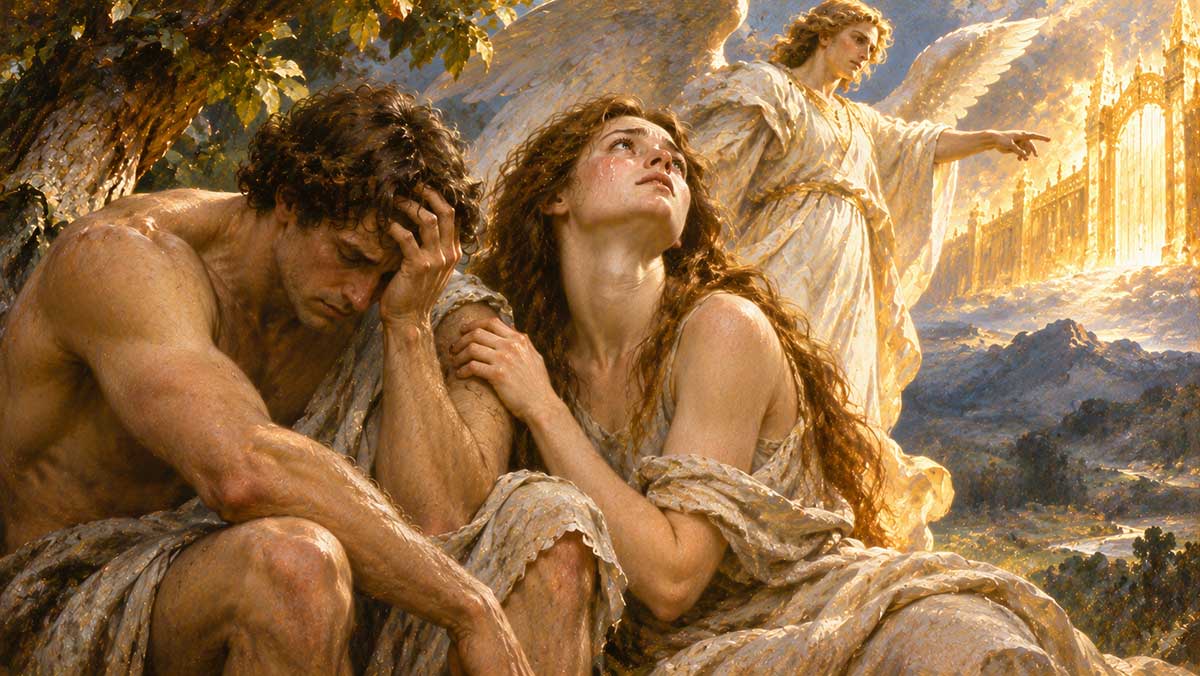
Freedom, Political Defeat, Moral Courage, and the Meaning of a Human Life
Nick Sasaki
John, I want to continue from where we left off.
We've talked about your childhood, your blindness, your relationship with God, Satan's rebellion, and Adam and Eve's struggle with love and freedom.
But there's something about your own life that I find just as fascinating as Paradise Lost.
You believed deeply in freedom. You challenged religious authorities, defended controversial ideas, and supported a revolution against the monarchy.
Yet you lived during a period when freedom was frequently denied to people who disagreed with those in control.
And some of the people you supported were responsible for restrictions of their own.
So I want to begin with a question that I think is just as relevant today as it was in your century.
Should people be free to publish ideas that you personally believe are dangerous, offensive, or completely mistaken?
John Milton
That question brings us to the heart of my argument in Areopagitica, Nick.
I opposed the requirement that books receive official approval before they could be published.
I believed that truth and falsehood should be permitted to confront one another, rather than allowing authorities to decide in advance which arguments the public might encounter.
But I must distinguish my historical position from the broader concept of freedom of expression that many people defend in your century.
My own arguments contained limitations, particularly concerning certain religious beliefs.
I was not a modern advocate of unrestricted freedom for every opinion.
Nick Sasaki
I appreciate you acknowledging that.
But let's examine the principle.
Suppose someone publishes a book arguing that everything you believe about Christianity is wrong.
Should that person be allowed to publish it?
John Milton
My argument against prior licensing would favor allowing intellectual examination rather than requiring official permission before publication.
But the precise boundaries of toleration in my historical writings were narrower than the principle you are asking me to consider.
Nick Sasaki
Then here's my challenge.
If you believe truth becomes stronger when it's tested against opposing ideas, why wouldn't that apply to every religion?
John Milton
It is a serious challenge.
A principle may contain implications that its original defender has not consistently followed.
In Areopagitica, I placed great confidence in the ability of truth to withstand examination.
Yet my religious assumptions limited how far I extended toleration.
Nick Sasaki
So perhaps your own argument could go further than you were personally willing to go.
John Milton
That is possible.
But I would ask readers to distinguish the argument's implications from the positions I actually held.
Nick Sasaki
That's fair.
Here's what bothers me about censorship.
The people deciding which ideas are dangerous always seem convinced they're protecting society.
But what happens when they're wrong?
John Milton
Then the public may be deprived of knowledge that could have corrected the authorities themselves.
A system of prior licensing assumes that those entrusted with approving books possess superior judgment.
Yet officials are human beings, subject to error, prejudice, and ambition.
Nick Sasaki
And sometimes they might suppress an idea simply because it threatens their position.
John Milton
Indeed.
An institution may claim to defend truth when it is actually defending its own authority.
Nick Sasaki
But let me challenge the other side.
What about deliberately false information that could cause real harm?
Should there be no restrictions whatsoever?
John Milton
We must distinguish opposition to prior licensing from the claim that every published act should be immune from accountability.
My argument did not eliminate the possibility of consequences for unlawful or harmful conduct.
The question is whether the state should prevent publication in advance merely because an official fears the ideas it contains.
Nick Sasaki
So freedom of expression doesn't necessarily mean freedom from responsibility.
John Milton
Precisely.
A society may value open inquiry without abandoning every distinction between responsible argument and harmful action.
But the standards must be examined carefully, lest the language of protection become an excuse for suppressing disagreement.
When Is It Right to Remove a Ruler?
Nick Sasaki
Now I want to ask about one of the most controversial decisions of your life.
You supported the execution of King Charles I.
That's an extraordinary position, especially for someone who wrote so deeply about morality and Christianity.
How did you decide that removing a ruler, and ultimately supporting his execution, was morally justified rather than simply another form of violence?
John Milton
I argued that kings were not placed beyond accountability merely by occupying a throne.
In The Tenure of Kings and Magistrates, published in 1649, I defended the right of a people to call tyrannical rulers to account.
I rejected the notion that hereditary authority automatically granted a monarch the right to govern without regard for justice.
Nick Sasaki
But there's a difference between removing someone from office and executing them.
Why did you support going that far?
John Milton
My historical argument held that a ruler who violated the trust placed in him could be subject to judgment and punishment.
But I recognize that the execution of a sovereign raises grave questions concerning legitimacy, evidence, proportionality, and the possibility of political vengeance.
Nick Sasaki
What concerns me is that both sides believed they were defending what was right.
The king believed in his authority.
Parliament believed it was resisting tyranny.
And eventually people were killing each other.
How do you know when your cause is just enough to justify taking someone's life?
John Milton
That is a question no defender of political violence should treat lightly.
A conviction that one's cause is just does not itself establish that every means used in its defense is justified.
The conduct of the ruler, the authority of those judging him, and the moral consequences of the decision must all be examined.
Nick Sasaki
But suppose you were wrong.
Suppose the king deserved removal, but not execution.
Wouldn't that mean you had defended an irreversible injustice?
John Milton
If the punishment were unjust, its irreversibility would deepen the wrong.
One cannot defend a mistaken execution merely by appealing to sincere intentions.
Nick Sasaki
Did you ever consider that possibility?
John Milton
My surviving political writings demonstrate my defense of the regicide and the Commonwealth cause.
They do not establish that I later privately repudiated that defense.
It would be historically misleading for me to claim a documented change of heart that the evidence does not support.
Nick Sasaki
I respect that.
But let me ask you to reflect on the principle rather than invent a confession.
Should someone who believes they're fighting tyranny be held to a higher moral standard, precisely because they're claiming to defend justice?
John Milton
That is a worthy principle.
A person who condemns oppression cannot claim moral exemption when exercising authority himself.
The justification for resisting tyranny must remain connected to justice, not merely to the identity of the person exercising control.
Nick Sasaki
So defeating a tyrant doesn't automatically make you a good ruler.
John Milton
No.
Victory establishes that one side has prevailed.
It does not establish that every action taken by the victors was righteous.
When the Revolution Becomes the Government
Nick Sasaki
That brings me to something else.
You fought against what you considered tyranny.
But the Commonwealth government you served had restrictions and injustices of its own.
Looking back, would you challenge anything you once defended?
John Milton
I served the Commonwealth as Secretary for Foreign Tongues, working principally with Latin correspondence and official writings.
My political commitments were substantial.
But you are right that the governments established after the monarchy's defeat did not produce a society free from coercion or conflict.
Nick Sasaki
That's what I find interesting.
It's one thing to fight against authority.
It's another thing to become part of the authority.
Suddenly you're the one making decisions that affect people who disagree with you.
John Milton
And that transition creates moral dangers.
The person who once demanded liberty may discover that governing requires confronting opposition.
He must then decide whether the principles he defended remain binding when they become inconvenient.
Nick Sasaki
Exactly.
Suppose you defend free expression when you're the opposition.
Then your side takes control, and suddenly people start criticizing you.
Do you still defend their right to speak?
John Milton
If one's defense of liberty is principled, it cannot depend entirely upon whether the speaker is an ally.
Yet, as we have acknowledged, my historical position did not extend equally to every form of religious expression.
Nick Sasaki
So there were limits to your consistency.
John Milton
There were limits to the toleration I advocated.
A reader may reasonably examine whether those limits were compatible with the strongest arguments I made against censorship.
Nick Sasaki
Would you say that one of the greatest tests of political character is how people treat their opponents after winning?
John Milton
That is certainly a revealing test.
It is easy to speak of justice when one lacks the means to impose one's will.
The possession of authority reveals whether one's principles are genuine restraints upon one's own conduct.
Nick Sasaki
You know, I think people sometimes confuse loyalty to a cause with loyalty to the people leading it.
They begin by believing in certain principles, but eventually they defend their leaders no matter what those leaders do.
John Milton
Then loyalty has displaced judgment.
A just cause should not require the suspension of conscience.
Nick Sasaki
But isn't that difficult when you've sacrificed years of your life for something?
You don't want to admit the people you've supported might be making serious mistakes.
John Milton
It is difficult.
A person may fear that acknowledging wrongdoing within his own cause will strengthen his opponents.
But refusing to recognize injustice does not make the injustice disappear.
Nick Sasaki
So perhaps the strongest supporter of a cause is someone willing to criticize it when necessary.
John Milton
That may be so, provided the criticism arises from sincere concern for justice rather than vanity or opportunism.
Which Is More Dangerous, Obedience or Certainty?
Nick Sasaki
John, we've talked about Satan's pride, Adam and Eve's choices, religious authorities, and political rulers.
I see a common problem running through all of them.
Human beings seem capable of making terrible mistakes in two opposite ways.
Sometimes we obey authority without thinking.
Other times we're so convinced we're right that we refuse to listen to anyone.
Which concerns you more?
John Milton
Both are dangerous, Nick, and they may arise from a common failure to exercise sound judgment.
Blind obedience surrenders moral responsibility to another.
Arrogant certainty treats one's own judgment as incapable of error.
In each case, the individual ceases to examine his actions honestly.
Nick Sasaki
That's interesting.
One person says, "I was just following orders."
The other says, "I know I'm right, so I don't need to listen."
But neither is really thinking carefully.
John Milton
Precisely.
The first avoids responsibility through submission.
The second avoids correction through pride.
Nick Sasaki
So what should a person do?
We can't question absolutely everything forever. At some point we have to make decisions.
John Milton
We must act according to the best judgment available to us, recognizing that our knowledge remains imperfect.
Intellectual humility does not require paralysis.
It requires openness to correction.
Nick Sasaki
But how do you remain open to correction when you feel certain about something?
John Milton
By distinguishing the strength of your conviction from the infallibility of your understanding.
You may believe an action is right and still ask whether you have overlooked relevant evidence.
You may disagree strongly with another person and still listen carefully to his reasoning.
Nick Sasaki
Do you think pride is more dangerous when it's attached to religion?
John Milton
Religious pride can be particularly dangerous when a person mistakes his own preferences for the will of God.
He may then regard disagreement as wickedness rather than an occasion for examination.
But the same tendency can arise in political, philosophical, and other convictions.
Nick Sasaki
So someone doesn't need to be religious to become self-righteous.
John Milton
Certainly not.
Self-righteousness is a human temptation, not the exclusive property of any institution.
Nick Sasaki
You know, that brings me back to Satan.
He didn't simply want freedom.
He wanted to be right about everything.
And the more he suffered, the more determined he became to defend his original decision.
John Milton
His pride makes repentance increasingly difficult.
He would rather preserve the appearance of consistency than acknowledge the truth of his condition.
Nick Sasaki
And perhaps the same thing happens in ordinary life.
People continue an argument long after they realize they've gone too far.
They just can't bring themselves to apologize.
John Milton
A simple acknowledgment of error may require greater moral courage than an elaborate defense of one's reputation.
When Everything Milton Believed In Seemed to Collapse
Nick Sasaki
John, I want to move from politics to something more personal.
You lost your eyesight.
You experienced the deaths of people you loved.
And eventually the political cause to which you had devoted so much of your life collapsed.
In 1660, the monarchy was restored.
Charles II became king.
The Commonwealth was gone.
Was there ever a moment when you questioned everything you believed?
John Milton
The Restoration represented a profound defeat for the political cause I had supported.
The return of monarchy placed men associated with the former government in serious danger.
I was briefly imprisoned, and my political writings were publicly condemned.
Nick Sasaki
That must have been terrifying.
You had already lost your sight, and now the government you had served was gone.
Did you think you might be executed?
John Milton
The political circumstances were dangerous.
Some leading figures associated with the regicide suffered execution, and others faced punishment.
My own position was uncertain for a time.
But we should be careful about claiming knowledge of every fear I experienced privately.
Nick Sasaki
I understand.
But imagine spending twenty years fighting for something, believing it was right, and then watching it collapse.
How does someone recover from that?
John Milton
The defeat of a cause does not necessarily establish that the cause was unjust.
History contains many instances in which worthy efforts have failed.
But defeat should invite examination of one's judgments, methods, and expectations.
Nick Sasaki
Did you ever wonder whether God had abandoned you?
John Milton
My writings do not provide a simple confession that I concluded God had abandoned me.
Yet the question of divine providence amid apparent defeat was central to the religious and literary concerns of my later years.
Nick Sasaki
Here's what fascinates me.
You believed God was just.
You believed you were defending important principles.
But your side lost.
How do you reconcile that?
John Milton
By rejecting the assumption that worldly victory is an infallible sign of divine approval.
If success proved righteousness, every victorious tyrant could claim moral vindication.
Nick Sasaki
That's a powerful point.
We often look at successful people and assume they must have done something right.
But success doesn't necessarily prove goodness.
John Milton
No.
Nor does failure necessarily prove moral error.
We must judge actions by more than their outcomes.
Nick Sasaki
But outcomes still matter, don't they?
If your decisions contributed to suffering, you can't simply say your intentions were good.
John Milton
Certainly.
Moral responsibility includes serious attention to consequences.
But consequences must be evaluated alongside intentions, circumstances, and the principles involved.
Nick Sasaki
So defeat can teach us something, but it doesn't automatically mean we were wrong.
John Milton
Precisely.
And victory can conceal mistakes that defeat might have exposed.
Can Losing Paradise Help Us Discover What Matters?
Nick Sasaki
Now I want to return to the ending of Paradise Lost.
Adam and Eve lose Eden.
They lose their innocence, their familiar home, and the life they expected to have.
Yet the poem doesn't end in complete despair.
Do you believe we sometimes have to lose something precious before we discover what truly matters?
John Milton
Loss can reveal values we previously neglected.
But I would not say that suffering is always necessary for wisdom.
Nor would I suggest that every deprivation should be celebrated as a hidden blessing.
Nick Sasaki
That's consistent with what you said earlier about your blindness.
You learned things through suffering, but that doesn't mean the suffering was good.
John Milton
Exactly.
We should distinguish the possibility of growth after loss from the claim that loss itself is desirable.
Nick Sasaki
Then what makes the ending of Paradise Lost hopeful?
Adam and Eve have lost something they can never recover in the same form.
John Milton
Their hope arises from the promise of redemption and the possibility of continuing in faith.
They leave Eden, but they are not abandoned to absolute despair.
They have received a vision of humanity's future through the angel Michael.
They understand that suffering and death will enter human history, yet the possibility of restoration remains.
Nick Sasaki
So Paradise isn't simply a physical place anymore.
John Milton
The poem's conclusion invites readers to consider a deeper relationship between external circumstances and inward spiritual life.
Adam learns that obedience, faith, and virtue are not confined to a particular garden.
Nick Sasaki
That reminds me of something.
When we're young, we sometimes think happiness depends on getting into the right school, finding the perfect job, making enough money, or achieving some great ambition.
Then life changes.
And suddenly the things we thought were essential don't seem quite as important.
John Milton
Human priorities can indeed change through experience.
But I would caution against treating material needs as insignificant.
For those who lack food, shelter, or safety, such concerns are not merely distractions from spiritual wisdom.
Nick Sasaki
That's true.
But once our basic needs are met, perhaps the question becomes what kind of person we're becoming.
John Milton
That is a worthy question.
A person may acquire wealth and recognition without developing wisdom or compassion.
Another may live without public distinction and nevertheless cultivate extraordinary moral character.
Nick Sasaki
Do you think Adam and Eve became wiser after the fall?
John Milton
They acquired knowledge through bitter experience.
But knowledge purchased through wrongdoing is not necessarily superior to wisdom that could have been exercised without the wrongdoing.
The poem does not invite us to celebrate their disobedience.
It invites us to recognize the possibility of repentance and hope after it.
Nick Sasaki
So their mistake wasn't necessary for them to become good.
But once they made it, they still had a future.
John Milton
Precisely.
The possibility of redemption does not make wrongdoing desirable.
It means that wrongdoing need not be the final word.
What Matters More, Achievement or Character?
Nick Sasaki
John, I want to ask you something that I think gets to the heart of your life.
You spent years fighting for political causes that ultimately failed.
But your poetry survived.
Centuries later, people still read Paradise Lost.
They study your language, your ideas, your theology, and your characters.
When you look back on your life, what matters most?
Your achievements?
Your convictions?
Or the way you treated other people?
John Milton
That is a difficult question, Nick, partly because the three cannot be separated entirely.
Achievements may express convictions.
Convictions may guide conduct.
And conduct reveals whether those convictions have genuinely shaped one's character.
But if you ask which deserves the greatest moral weight, I would hesitate to place public accomplishment above the practice of virtue.
Nick Sasaki
That's interesting.
You wrote one of the greatest poems in English literature, but you're saying the poem itself might not be the most important measure of your life.
John Milton
Literary achievement and moral goodness are not identical.
A person may write beautifully and behave badly.
Another may possess little literary talent yet live with extraordinary generosity and courage.
Nick Sasaki
Do you think a great writer has a responsibility to be a good person?
John Milton
Every person has moral responsibilities.
The possession of literary gifts does not exempt a writer from them.
Indeed, the ability to influence others may increase the seriousness of those responsibilities.
Nick Sasaki
But here's something I've wondered.
Can we admire someone's work while acknowledging that the person had serious flaws?
John Milton
We can examine a work's artistic and intellectual merits without pretending its author was morally perfect.
But admiration should not require blindness to wrongdoing.
Nick Sasaki
So you wouldn't want people to treat you as some kind of saint simply because you wrote Paradise Lost.
John Milton
Such treatment would misunderstand both the poem and the human condition it portrays.
The work itself concerns the dangers of pride, the misuse of gifts, and the necessity of moral judgment.
It would be strange to exempt its author from those concerns.
Nick Sasaki
That's a good point.
And perhaps it's something we should remember when we admire historical figures.
They may have accomplished extraordinary things and still made serious mistakes.
John Milton
Indeed.
Historical admiration becomes more meaningful when it remains honest.
Nick Sasaki
Let me ask you something personal.
If you could choose how future generations remembered you, would you rather be remembered as a great poet or as a good man?
John Milton
In this imagined conversation, I would hope that literary accomplishment had not come at the expense of moral responsibility.
But the historical record must remain open to judgment.
It would be inappropriate to invent a perfect private character for the sake of a satisfying answer.
Nick Sasaki
I appreciate that.
Maybe the better question isn't how we want to be remembered.
Maybe it's how we should live when nobody is watching.
John Milton
That is a more searching question.
For reputation depends upon the judgments of others.
Character concerns what we actually do.
What Was God Trying to Teach John Milton?
Nick Sasaki
John, we've reached the final question of our conversation.
And I want to make it personal.
You've lived an extraordinary life.
You were an ambitious young scholar who believed he had a calling.
You met Galileo.
You challenged religious authorities.
You defended political revolution.
You experienced marriage, separation, reconciliation, and grief.
You lost your eyesight.
You watched your political cause collapse.
And after all of that, you completed Paradise Lost.
So here's what I want to ask.
After everything you've experienced, what do you believe God was trying to teach you through your life?
John Milton
Nick, I would begin by acknowledging that I cannot claim certain knowledge of every divine purpose behind the events of my life.
To say that God intended each loss to teach me a particular lesson would exceed what I can establish.
But if we are considering what a person might learn through such experiences, several reflections arise.
Nick Sasaki
I'd love to hear them.
John Milton
First, that ability is not the same as virtue.
A person may possess extraordinary intellectual gifts and still be vulnerable to pride, anger, and self-deception.
The cultivation of talent must be accompanied by the cultivation of judgment.
Nick Sasaki
That sounds like Satan.
He had extraordinary abilities, but those abilities couldn't save him from himself.
John Milton
Indeed.
The possession of gifts does not guarantee their proper use.
Nick Sasaki
What else?
John Milton
That freedom requires responsibility.
A person may rightly resist unjust authority, but he must remain accountable for the means he employs and the consequences of his actions.
Liberty is not simply the absence of restraint.
It involves the disciplined exercise of judgment.
Nick Sasaki
And perhaps the willingness to admit when you're wrong.
John Milton
Certainly.
A person who cannot acknowledge error has surrendered an important part of intellectual freedom.
Nick Sasaki
What about your blindness?
What did that teach you?
John Milton
It confronted me with the limits of my independence.
I had devoted much of my life to reading and writing.
When my sight disappeared, I was compelled to continue my work through different means and with the assistance of others.
It invited reflection upon patience, dependence, and the nature of service.
But I would not claim that blindness was necessary for those lessons to exist.
Nick Sasaki
And what about love?
John Milton
That companionship is more than admiration or desire.
It requires concern for another person's genuine good.
And it cannot flourish where pride makes honest communication impossible.
Nick Sasaki
We've talked about that quite a bit.
Sometimes the people we love most are the people we find hardest to listen to.
John Milton
Then perhaps the difficulty reveals how readily affection can become entangled with self-interest.
Nick Sasaki
John, there's something that keeps coming back to me.
You spent so much of your life trying to explain God's justice.
But perhaps the most important thing isn't whether we can explain everything God does.
Maybe it's whether we can live with humility, compassion, and courage in a world we don't fully understand.
John Milton
That is a thoughtful conclusion.
Yet I would not abandon the pursuit of understanding.
Reason remains one of humanity's great gifts.
The recognition of our limitations should deepen inquiry rather than extinguish it.
Nick Sasaki
So we should keep asking questions.
John Milton
Yes.
But we should ask them with a sincere willingness to discover truth, including truths that may unsettle us.
Nick Sasaki
Let me ask you one final follow-up.
Suppose you could speak directly to someone living today.
Someone who's lost a job, lost a loved one, experienced failure, or watched a dream collapse.
Someone who feels that the best part of life is already behind them.
What would you say?
John Milton
I would not presume to explain the meaning of that person's suffering.
Nor would I promise that every loss will lead to some extraordinary achievement.
Such promises may offer comfort, but they are not always truthful.
I would encourage that person to distinguish what has been lost from what remains possible.
Grief may be real.
Failure may be painful.
The future may be uncertain.
Yet the inability to recover the past does not mean that every possibility for goodness has disappeared.
Nick Sasaki
So they don't have to pretend everything is fine.
John Milton
No.
Hope does not require pretending that suffering is insignificant.
Nick Sasaki
And they don't have to accomplish something extraordinary to prove their life has value.
John Milton
Certainly not.
A life devoted to ordinary acts of kindness, patience, and responsibility may possess profound worth.
Nick Sasaki
I think that's a beautiful place to arrive.
We began this interview with a young man who wanted to accomplish something extraordinary.
And now we're talking about the value of an ordinary human life.
John Milton
Perhaps the distinction between ordinary and extraordinary is less morally decisive than we often suppose.
Nick Sasaki
John, there's one final image from Paradise Lost that I want to return to.
Adam and Eve are standing outside Eden.
They've lost their home.
They don't know what the future holds.
And yet they begin walking.
Why did you end the poem with that image?
John Milton
The poem concludes with Adam and Eve departing from Paradise into the world before them.
Their former condition cannot be restored through their own efforts.
Yet they are not without guidance.
They possess the possibility of faith, repentance, and continued moral life.
Their departure is sorrowful, but it is not the end of their story.
Nick Sasaki
And you wrote that they had the world before them.
John Milton
Yes.
The poem's final lines describe the world lying before them, with Providence as their guide.
They leave Eden together.
Nick Sasaki
That's what moves me.
They don't know exactly where they're going.
They don't know what they'll experience.
But they have each other, and they have the possibility of a future.
John Milton
Their uncertainty is part of the human condition.
They must now live through choices whose outcomes they cannot fully foresee.
Nick Sasaki
Maybe that's where we all are, in some way.
We can't return to childhood.
We can't undo every mistake.
We can't recover every opportunity we've lost.
But the world is still before us.
John Milton
And what remains before us calls for judgment, courage, and hope.
Nick Sasaki
John, thank you.
I began this conversation wanting to understand how a blind poet could write about Heaven, Hell, and the fall of humanity.
But I think I've discovered something more personal.
Your story isn't simply about losing sight and finding a different kind of vision.
It's about the danger of pride, the difficulty of admitting mistakes, the responsibility that comes with freedom, and the possibility of continuing after defeat.
And perhaps the greatest lesson of Paradise Lost is that losing Paradise doesn't necessarily mean losing hope.
John Milton
That is a thoughtful interpretation, Nick.
But I would leave your readers with a question rather than a final declaration.
If human beings possess the freedom to choose, what will they do with that freedom?
Will they use it to defend their pride, or to pursue what is good?
Will they treat their convictions as instruments of truth, or as weapons against those who disagree?
And when they discover that they have made mistakes, will they imitate Satan's refusal to repent, or Adam and Eve's willingness to begin again?
Nick Sasaki
Maybe that's the question each of us has to answer through the way we live.
John Milton
Indeed.
For the value of a human life cannot be determined solely by the Paradise it has lost.
It must be considered through the choices that remain.
Nick Sasaki
And perhaps that's why your poem still matters after all these centuries.
It doesn't simply tell us what happened to Adam and Eve.
It asks what we are going to do with our own lives.
John Milton
Then let the reader consider that question carefully.
For the world remains before us.
And the next choice is still our own.
Editorial note: This is an imagined interview between Nick Sasaki and John Milton. Milton's historical life, political writings, and literary works inform the fictional conversation. His personal reflections and responses to modern questions are creative interpretations, not documented statements. The interview is intended to encourage thoughtful examination of freedom, faith, moral responsibility, and the enduring questions raised by Paradise Lost.
Final Thoughts by Nick Sasaki
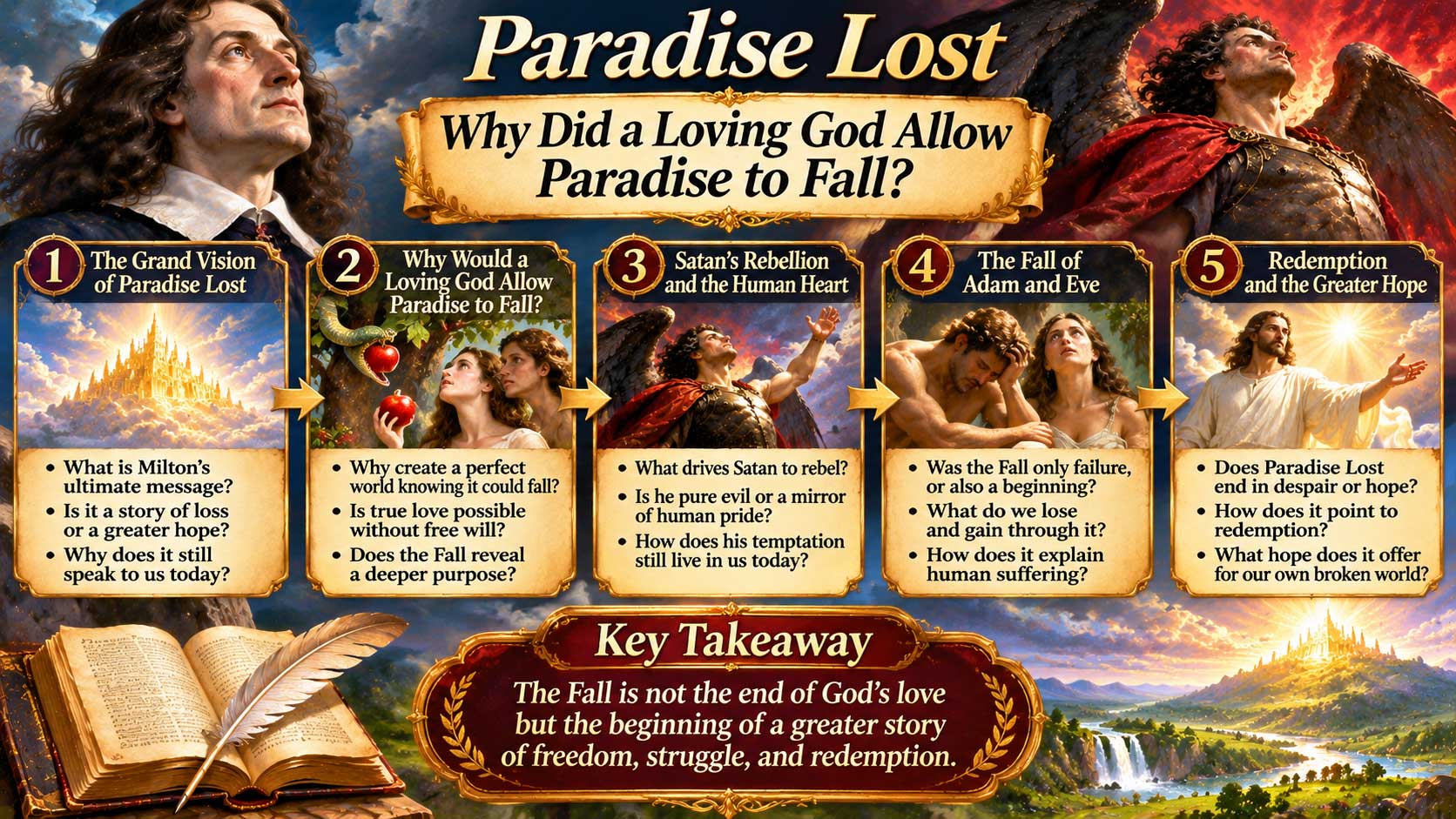
After completing this imagined conversation with John Milton, I found myself returning to a question that seems simple but becomes increasingly difficult the more I consider it: What does it mean to be a good person when we are convinced that we are right? Milton devoted much of his life to defending ideas he believed were just. He challenged religious authorities, supported political revolution, and argued for freedom of expression. Yet his own writings reveal tensions between liberty and authority, conviction and humility, justice and mercy. I came away thinking that perhaps one of the greatest dangers in human life is not ignorance alone, but the inability to recognize our own mistakes.
The character who challenged me most was Satan. I had expected our discussion to focus on rebellion against God, but it became something more personal. Satan is intelligent, eloquent, determined, and capable of extraordinary reasoning. Yet those gifts do not save him from pride. He repeatedly justifies his actions, refuses to acknowledge his responsibility, and gradually becomes imprisoned by resentment. I began wondering how often we do something similar in ordinary life. When someone disagrees with us, do we genuinely consider their perspective, or do we immediately begin defending ourselves? When we hurt someone, do we seek reconciliation, or do we construct explanations that protect our pride? I believe Milton's portrayal of Satan asks us to examine these uncomfortable tendencies within ourselves.
Our conversation about God and free will left me with questions rather than final answers. If God knew humanity would fall, why create a world in which suffering was possible? Could human beings have been free without choosing evil? And why does divine love sometimes seem so difficult to reconcile with human pain? I appreciated the opportunity to explore Milton's distinctive theological views, including his interpretation of the relationship between Jesus and God the Father. I don't believe meaningful faith requires pretending that every theological difficulty has been settled. For me, the willingness to ask sincere questions can be an expression of respect for truth rather than a rejection of it.
I was equally moved by our discussion of Adam and Eve. Before this conversation, I tended to think of their story primarily as a warning about disobedience. But examining their decisions through the experiences of love, curiosity, fear, and responsibility gave the narrative a more intimate dimension. Eve's desire for knowledge is something I can recognize in myself. Adam's fear of losing the person he loves is equally human. What struck me most was the distinction between loving someone and following that person into a harmful decision. Genuine love, I believe, requires the freedom to disagree, the courage to speak truthfully, and the humility to acknowledge when we have failed one another.
Milton's blindness led me to another reflection. We often admire people who overcome adversity and accomplish extraordinary things. It is tempting to turn their suffering into a beautiful story about destiny. But I don't think we should assume that every painful experience was necessary or that every loss must produce some remarkable achievement. Milton's life reminded me that human worth cannot be measured solely through productivity, fame, or success. Someone caring for a loved one, enduring illness, recovering from failure, or simply continuing through a difficult season may be living a deeply meaningful life. We should not require suffering people to transform their pain into an inspiring accomplishment before recognizing their dignity.
The political discussion challenged me in a different way. Milton defended liberty, yet he supported decisions that remain deeply controversial, including the execution of Charles I. I found myself asking whether we apply the same moral standards to people we support and people we oppose. It is easy to defend free expression when the speaker agrees with us. It is harder when the ideas are offensive or deeply mistaken. It is easy to condemn abuses committed by opponents. It is harder to recognize similar behavior among those whose goals we share. I want to remain willing to question my own assumptions, particularly when I feel most certain of them. A commitment to truth should be stronger than loyalty to any individual, institution, or cause.
The most moving part of our interview, for me, was the ending of Paradise Lost. Adam and Eve cannot return to the life they knew. They have made mistakes, experienced shame, and lost something precious. Yet they leave Eden together, with an uncertain future still before them. I think many of us reach moments when life no longer resembles what we once expected. A relationship changes. A career ends. Someone we love is gone. An ambition we pursued for years becomes impossible. We cannot always repair the past, but we can still decide how to live in the present. I find great comfort in the possibility that hope does not require denying what we have lost.
If I could carry one lesson from this imagined meeting with John Milton into my own life, it would be this: The greatest freedom may be the freedom to admit that we were wrong, learn from what happened, and choose a better way forward. I want to remain curious without becoming arrogant, faithful without becoming closed-minded, and ambitious without forgetting the people around me. Milton's life and writings remind me that intellectual achievement and moral character are different things. The real measure of our convictions may be found in how we treat others, particularly when they disagree with us.
I would love to hear what you think. Was Satan's greatest failure his rebellion, or his refusal to repent? Did Adam's decision to follow Eve express love or weakness? Can we truly possess free will if God already knows every choice we will make? And perhaps most personally, have you ever experienced a loss that changed what you believed mattered most in life? I hope you'll share your thoughts in the comments. Our answers may differ, but perhaps the conversation itself can help us see something we might otherwise have missed.
Fictional disclaimer: The reflections above are Nick Sasaki's first-person commentary on an imagined interview. John Milton's dialogue throughout the article is fictional and informed by historical and literary research. Interpretations of his beliefs are offered for discussion, not as authenticated statements from Milton.
Short Bios:
John Milton (1608–1674)
John Milton was an English poet, political writer, and religious thinker best known for Paradise Lost (1667), his epic treatment of Satan's rebellion, the fall of Adam and Eve, free will, and divine justice. Educated at Cambridge, he became an influential advocate of religious and political reform and defended freedom of publication in Areopagitica (1644). He served the English Commonwealth, lost his eyesight by the early 1650s, and later dictated his greatest poetic works. His writings continue to inspire debate about faith, liberty, authority, marriage, and moral responsibility.
Nick Sasaki
Nick Sasaki is the creator of ImaginaryTalks.com, a platform that brings historical figures, writers, philosophers, spiritual teachers, and influential thinkers into fictional conversations about enduring human questions. Through curious, open-ended interviews, he explores faith, freedom, love, human psychology, personal growth, and the search for meaning. His goal is to encourage readers to question assumptions, consider different perspectives, and discover insights that can contribute to a more thoughtful and compassionate world.
Leave a Reply