
Introduction
In 1997, William Strauss and Neil Howe made an extraordinary argument in The Fourth Turning. They suggested that history moves through recurring generational seasons, and that America was approaching another period of major crisis and transformation.
Nearly three decades later, their ideas raise even more intriguing questions. What did Strauss and Howe actually predict? Why does Neil Howe identify 2008 as the beginning of the current Fourth Turning? What did they expect from Boomers, Gen X, Millennials, and the generations following them? And what happens to a theory based on human generations when smartphones, social media, longer lifespans, and artificial intelligence begin changing society faster than generations themselves?
In this imaginary discussion, Walter Isaacson moderates a conversation with Neil Howe, Peter Turchin, Jean Twenge, and Yuval Noah Harari. Rather than trying to prove or disprove The Fourth Turning, they explore what makes its central questions so compelling.
Most importantly, they look beyond the Crisis itself. If Strauss and Howe were broadly right that historical winter is eventually followed by another spring, what might come next, and what role do people living through this moment have in creating it?
(Note: This is an imaginary conversation, a creative exploration of an idea, and not a real speech or event.)
Topic 1: What Did Strauss and Howe Actually Predict?
Walter Isaacson placed a copy of The Fourth Turning in the center of the table.
It was thick, worn at the edges, unmistakably a book from another era.
He rested his hand on the cover.
Walter Isaacson: Before we talk about 2008, COVID, artificial intelligence, or anything happening in 2026, I want us to do something difficult.
Forget all of it.
Let's go back to 1997.
Bill Clinton is president. The American economy is expanding. The Soviet Union is gone. The internet is still young. Google has barely begun. Facebook doesn't exist. There are no smartphones. No social media feeds. No generative AI.
Neil, you and William Strauss publish this book and tell people that the relatively comfortable world around them is approaching the end of a historical season.
What did you actually think was coming?
Neil Howe: That's the right place to begin, Walter, because a great deal has been attributed to Bill and me that we never claimed.
We weren't sitting there saying, "There will be a financial crisis in 2008."
We certainly didn't say, "There will be a coronavirus pandemic in 2020."
What we argued was that America was moving through what we called an Unraveling, a period characterized by weakening institutions, strengthening individualism, declining civic confidence, and growing fragmentation.
And we believed another social mood would follow.
A Crisis.
Walter: And you thought that transition would occur fairly soon.
Howe: Yes. We thought it would likely begin in the first decade of the twenty-first century. Our timing was somewhat earlier than what I would now identify looking backward.
Walter: Roughly 2005?
Howe: Somewhere around there, yes.
Walter: Which is interesting.
You were off by a few years if we accept your later identification of 2008.
But standing in 1997, you were essentially saying: Don't assume the world you see around you is going to continue.
Howe: Precisely.
That, in some ways, was the larger argument.
People tend to extrapolate the present.
When institutions are strong, people imagine they'll remain strong.
When institutions are weak, people imagine they'll remain weak.
When society is individualistic, people assume individualism will continue increasing.
History doesn't necessarily behave that way.
Peter Turchin: That's where I find the original book interesting, even though Neil and I approach historical dynamics differently.
It is quite difficult to stand inside a relatively stable period and recognize that underlying conditions may be moving toward instability.
People are usually much better at explaining a crisis after it happens.
Walter: Peter, you're saying the interesting part isn't necessarily predicting the spark.
It's recognizing that the forest is becoming dry.
Turchin: That's a good analogy.
Suppose you have a forest accumulating combustible material.
Can I tell you which lightning strike will start the fire?
Probably not.
But I may be able to tell you that the conditions for a large fire are becoming more favorable.
That's different from prophecy.
Walter: Neil, is that roughly how you would describe what you and Bill were doing?
Howe: In part.
Our mechanism was different from Peter's.
We focused heavily on generational replacement.
But yes, the distinction matters enormously.
A catalyst doesn't create all the conditions that precede it.
It reveals them.
Walter opened the book.
Walter: That's where some of the mythology around The Fourth Turning becomes confusing.
People now say things like:
"They predicted 9/11."
"They predicted the financial crisis."
"They predicted COVID."
Did you?
Howe: Not in that sense.
Walter: Not even COVID?
Howe: No.
We discussed various possible Crisis catalysts, including economic distress, terrorism, geopolitical confrontation, disease, and other possibilities.
But listing a category of possible events isn't the same as predicting a particular event.
Jean Twenge: That's an important distinction.
If you make several broad predictions and one later resembles something that happens, people naturally remember the resemblance and forget the alternatives.
Howe: Absolutely.
And I would rather people understand the actual argument than make it sound more supernatural than it was.
Walter: That's interesting coming from the coauthor.
You're essentially telling people:
Stop making our prediction sound better than it was.
Howe laughed.
Howe: If making it sound better means making it less accurate, yes.
Yuval Noah Harari: There is another reason to be careful.
Humans love stories in which someone saw the future.
Ancient societies had prophets. Modern societies have forecasters, futurists, economists, algorithms.
But history is extraordinarily difficult to predict at the level of events.
You might identify forces.
You might identify tensions.
Predicting the event itself is something else.
Walter: Then let's make this very precise.
Neil, if I had met you in 1997 and asked:
"What happens in America over the next thirty years?"
What could you honestly have told me?
Howe thought for a moment.
Howe: I might have said that the individualistic and institutionally distrustful mood of the late twentieth century would eventually exhaust itself.
That younger generations would come of age with different attitudes toward collective action.
That older generations would enter new stages of life carrying values formed decades earlier.
That these generations would interact differently when a major crisis arrived.
And that sometime in the early twenty-first century, America would probably enter a period in which institutional questions that had been postponed for years could no longer be postponed.
Walter: That's very different from predicting an event.
Howe: Yes.
We were predicting a change in social mood.
Walter leaned toward Peter Turchin.
Walter: Peter, here's where I want you to enter.
You believe history contains recurring periods of instability too.
If you had read The Fourth Turning in 1997, what would have interested you?
Turchin: The attempt to identify recurring dynamics.
Where I would ask questions is about mechanism.
Neil says generational succession.
My work places much more emphasis on structural-demographic pressures.
Economic conditions.
Popular immiseration.
Elite overproduction.
Competition within elites.
Fiscal stress.
Political fragmentation.
Those forces can accumulate for decades.
Walter: So you and Neil might look at the same storm clouds and disagree about meteorology.
Turchin: Exactly.
Howe: And that's a productive disagreement.
Peter's model and ours don't necessarily have to be mutually exclusive.
Generations don't exist outside economic structures.
Economic structures don't exist outside populations of people shaped by particular historical experiences.
Turchin: I agree.
Where I would remain cautious is when the pattern becomes too regular.
History contains cycles, but cycles are rarely clocks.
Walter: That's a beautiful distinction.
Cycles, but not clocks.
Neil?
Howe: I can live with that.
Walter smiled.
Walter: That's only Topic 1 and I've already prevented the fight.
Twenge laughed.
Twenge: Give us time.
Walter turned back to Howe.
Walter: Let's talk about something I find even more interesting.
You and Strauss didn't merely say a crisis was coming.
You proposed several completely different things that might trigger it.
Financial collapse.
Terrorism.
Disease.
International confrontation.
How can a theory accommodate events that different?
Howe: Because the catalyst isn't the Turning.
That's one of the most misunderstood parts of the theory.
Walter: Explain that.
Howe: Imagine two societies experiencing the same external shock.
One absorbs it and returns quickly to normal.
The other reorganizes institutions, expectations, leadership, public behavior, perhaps even its understanding of itself.
Same type of shock.
Different social response.
The Turning concerns that deeper response.
Harari: This is where the idea becomes more interesting than prediction.
Historical events acquire meaning through the systems that receive them.
A pandemic in a medieval agricultural society is not the same historical event as a pandemic in a globally connected digital civilization, even if biologically we are discussing infectious disease in both cases.
Twenge: And generations experience the same event differently.
Think about COVID.
Someone who was seventy-five experienced it differently from someone who was thirty-five.
Someone who was fifteen experienced something entirely different again.
School disappeared.
Friendships moved onto screens.
Milestones vanished.
Their formative experience was different.
Howe: Exactly.
And that is why generations matter in our framework.
Historical events shape generations.
Then those generations grow older and shape the response to later historical events.
It's reciprocal.
Walter: Which brings us back to something Bill Strauss said in our imaginary conversation in Part 1.
History is another parent.
Howe: I like that.
Twenge: So do I.
Walter paused.
Walter: But there's a danger here.
If you say, "We don't know what the catalyst will be, but something will happen," aren't you giving yourself an enormous amount of room?
Eventually something always happens.
Financial crisis.
War.
Pandemic.
Natural disaster.
Political crisis.
Technological disruption.
How do we distinguish a genuine prediction from something broad enough that history will eventually satisfy it?
The room became quieter.
Howe: That's fair.
A useful theory can't simply say, "Something bad will happen someday."
Our claim was more specific than that.
We proposed a sequence of social moods.
We associated those moods with particular generational configurations.
We suggested an approximate historical timetable.
And we expected the next Crisis to emerge as the generations entered particular phases of life.
Walter: So the prediction isn't merely the catalyst.
Howe: Correct.
The more meaningful prediction is the constellation surrounding it.
Who is young.
Who is entering adulthood.
Who is in midlife.
Who is moving into elder leadership.
What people expect from institutions.
How willing society becomes to tolerate collective action.
How people respond once the catalyst occurs.
Turchin: That is a much stronger formulation.
I might disagree about how much causal power to assign the generational archetypes, but at least now we have something that can be examined.
Walter: Jean?
Twenge: I'd want to look at the generational evidence carefully.
There are real generational differences.
But determining why they exist is difficult.
Technology changes.
Economics changes.
Parenting changes.
Education changes.
Marriage changes.
The age at which people reach traditional adult milestones changes.
Those things interact.
Walter: Which means perhaps Strauss and Howe correctly saw something moving without necessarily having identified every force moving it.
Twenge: That's possible.
Howe: I think Bill would have been perfectly comfortable with that possibility.
We never imagined The Fourth Turning was the final book anyone would ever need to understand history.
Walter picked up the book again.
Walter: I want each of you to imagine holding this in 1997.
Not 2026.
What's the most striking thing about its prediction from that perspective?
Peter?
Turchin: That it rejected the assumption of indefinite stability.
That was significant.
Twenge: For me, it's the importance given to childhood.
The idea that what children experience today can influence society twenty or thirty years later is enormously important, regardless of whether every archetype works perfectly.
Harari: I would say the rejection of linear history.
People repeatedly imagine that whatever direction history is moving now is the direction it will continue moving forever.
History frequently punishes that assumption.
Walter: Neil?
Howe looked at the old cover.
Howe: I think Bill and I wanted people to understand that the present is temporary.
Walter waited.
Howe continued.
Howe: That sounds obvious.
But people don't live as though it's obvious.
When you're twenty-five, the world that formed you feels permanent.
When you're fifty, institutions you've known for decades feel permanent.
When you're seventy-five, conflicts that defined your adulthood can feel permanent.
They're not.
Walter: Did you believe that strongly in 1997?
Howe: Yes.
Walter: Do you believe it more strongly now?
A small smile crossed Howe's face.
Howe: Much more strongly.
Walter closed the book.
Walter: Then perhaps the most interesting Fourth Turning prediction wasn't terrorism.
It wasn't financial collapse.
It wasn't disease.
It wasn't even a date.
It was something simpler:
The world of the late 1990s would not last.
And it didn't.
But that leaves us with a much harder question.
If Strauss and Howe expected a Crisis era to arrive sometime in the early twenty-first century, when did that era actually begin?
Was it September 11, 2001?
Was it the financial crisis of 2008?
Was it COVID in 2020?
Or are we imposing clean boundaries on history only after the fact?
Walter looked at Howe.
Walter: Neil, next I want you to convince this table of one very specific thing.
Why 2008?
Topic 2: Are We Living Through the Fourth Turning They Anticipated?
Walter Isaacson left four dates on the screen behind the table.
2001
2008
2020
2026
For several seconds, nobody spoke.
Each date carried its own weight.
Walter finally turned toward Neil Howe.
Walter Isaacson: At the end of our last conversation, I promised I'd ask you to defend one date.
So let's do it.
September 11 changed America.
The financial crisis shook the global economy.
COVID changed everyday life across much of the world.
Yet when you describe the current Fourth Turning, you usually begin it in 2008.
Why?
Neil Howe: Because a Turning isn't necessarily marked by the most shocking event.
It's marked by a change in the social mood.
Walter: Then let's begin with the obvious objection.
Why wasn't September 11 the beginning?
Howe: September 11 was unquestionably historic. It changed foreign policy, security, surveillance, war, travel, and America's relationship with the outside world.
But look at the domestic culture after the immediate shock.
Much of the underlying social order continued.
The economy returned to familiar patterns.
The culture remained highly individualistic.
The institutional arrangements that characterized the previous era largely remained in place.
Walter: There was enormous unity immediately afterward.
Howe: Yes.
But unity alone doesn't create a Turning.
The question is whether the event fundamentally redirects the trajectory of society.
Peter Turchin: I think this distinction is useful.
An event can be enormous without resolving the structural pressures that have accumulated underneath society.
Walter: So a historical event and a historical transition aren't necessarily the same thing.
Turchin: Correct.
You can have a spectacular event that changes certain dimensions of society while deeper pressures continue accumulating.
Walter: Neil, then we reach 2008.
What changes?
Howe: The financial crisis wasn't merely a stock-market decline.
It challenged assumptions about institutions, markets, debt, housing, economic security, and the relationship between private risk and public responsibility.
And look at the generations.
Millennials were moving into young adulthood.
Gen X was moving into midlife.
Boomers increasingly occupied positions of senior leadership.
The generational constellation we had associated with the opening of a Crisis was taking shape.
Walter: So if I understand you correctly, 2008 isn't important simply because Lehman Brothers collapsed.
Howe: Exactly.
If Lehman Brothers had collapsed and society had simply returned to the previous mood, it would be harder to call it the beginning of a Turning.
Walter: Then your argument is partly about what happens afterward.
Howe: Very much so.
Jean Twenge leaned forward.
Jean Twenge: And 2008 is interesting generationally for another reason.
Think about someone born in 1990.
They're eighteen.
Someone born in 1985 is twenty-three.
Someone born in 1980 is twenty-eight.
They're entering adulthood during a period when assumptions about employment, housing, debt, and economic security are being challenged.
That matters.
Walter: Because formative experiences matter more when you're young?
Twenge: Often, yes.
You don't experience a recession at eighteen the same way you experience one at sixty-eight.
At eighteen, you're still learning what adulthood is supposed to look like.
Howe: That's central to our framework.
Twenge: Though I would still be cautious about attributing everything that happens to those people afterward to their generation.
Howe: Fair.
Walter: Jean keeps you honest.
Howe: That's why she's here.
They laughed.
Walter: Peter, if Neil hadn't told you anything about Turnings, would your own work point toward this general period as important?
Turchin: My framework is different, but yes, there were accumulating structural pressures.
Economic inequality.
Stagnating or declining relative well-being for substantial portions of the population.
Increasing competition among elites.
Declining institutional trust.
Political fragmentation.
Those trends don't begin suddenly in 2008.
They accumulate over decades.
Walter: Which sounds like your dry-forest analogy from Topic 1.
Turchin: Exactly.
A crisis isn't simply the match.
It's the forest.
Howe: And I would add that the people standing in that forest belong to different generations with different formative experiences.
Turchin: And I would say those experiences themselves were partly produced by structural conditions.
Howe smiled.
Howe: We're going to keep doing this, aren't we?
Turchin: Probably.
Walter: Good. That's why I invited both of you.
Walter pointed at the next date.
2020.
Walter: Now it gets harder.
If someone knew nothing about your theory and I asked them which of these dates felt most like a Fourth Turning, I suspect many would choose this one.
Schools close.
Offices empty.
Borders close.
Hospitals fill.
Governments take extraordinary measures.
Families isolate.
Millions of people suddenly conduct their lives through screens.
Why isn't that the beginning?
Howe: Because I see COVID as occurring within a Crisis era already underway.
Walter: So 2008 opens the door and COVID pushes us much farther through it.
Howe: That's one way of putting it.
Yuval Noah Harari: COVID is particularly interesting because it wasn't simply a health event.
It accelerated processes already developing.
Digital communication.
Remote work.
Online education.
Dependence on large information systems.
Institutional decision-making based on data.
And it forced societies to make collective decisions very quickly.
Walter: Which sounds almost perfectly designed to test Fourth Turning ideas.
Harari: Perhaps, but we should resist making every major event confirmation of a theory.
Howe: I agree.
Harari: That's important.
A theory becomes less useful if every possible outcome proves it.
Walter: Neil, that's now the second time someone has raised that issue.
Suppose COVID had produced enormous social solidarity.
Would that have confirmed the Fourth Turning?
Howe: It could have been consistent with it.
Walter: But COVID produced enormous disagreement too.
Could that also be consistent with it?
Howe paused.
Howe: Potentially, yes.
Walter: You see my problem.
Howe: I do.
Walter: If unity confirms it and division confirms it, how do I know what wouldn't confirm it?
The table became quiet.
Howe: That's a legitimate question.
I wouldn't define a Fourth Turning by whether everyone suddenly agrees.
A Crisis can contain enormous conflict over what the new order should become.
The stronger test is whether society undergoes sustained institutional restructuring and whether the relationship between individuals and institutions changes.
Turchin: That's a much more useful criterion.
Walter: So don't watch Twitter arguments.
Watch institutions.
Howe: That's one way of saying it.
Twenge: And watch lives.
Something like COVID can have a profound generational impact even if it doesn't immediately create institutional consensus.
A child who spent crucial developmental years during school closures may carry something from that experience for decades.
Walter: Which raises a strange possibility.
An event can be part of one Turning while simultaneously creating the generation that will shape the next one.
Howe: Exactly.
That's one of the central mechanisms.
Walter: History creates generations.
Generations create history.
Howe: Yes.
Walter walked toward the screen and touched the final date.
2026.
Walter: Here we are.
If I walked outside and asked one hundred people, "Does America feel like it's in the middle of a historical Crisis?" I'd probably get wildly different answers.
Some would immediately say yes.
Others might say:
"What crisis? I went to work this morning. I picked up groceries. My kids went to school. We're having dinner tonight."
Doesn't everyday normality count against the idea that we're living through a Crisis era?
Howe: Not necessarily.
Historical crises don't mean every day feels catastrophic.
People lived ordinary lives during previous Crisis periods.
They married.
Had children.
Started businesses.
Went to school.
Went dancing.
Made jokes.
Fell in love.
Walter: That's important.
Howe: History looks dramatic when compressed into textbooks.
Living through history feels different.
Harari: Very much so.
A textbook may devote one paragraph to ten years.
The person living those ten years still wakes up approximately 3,650 mornings.
Most of those mornings contain breakfast.
Walter smiled.
Walter: That's wonderfully grounding.
Harari: We shouldn't imagine people living through historical transformations constantly saying, "How extraordinary. I'm experiencing history."
Usually they're trying to get through Tuesday.
Twenge: And that's why ordinary behavior can be more revealing than dramatic headlines.
How are people forming families?
When are they leaving home?
How are they working?
How much time are they spending alone?
How do they communicate?
Whom do they trust?
Those changes can be enormous without looking cinematic.
Walter: Then let's ask the question our readers really want answered.
Neil, when does this end?
Howe smiled.
Howe: I knew we'd get there.
Walter: Of course.
If you're going to tell people they're living through winter, eventually somebody asks when spring begins.
Howe: I've suggested that the current Fourth Turning could reach its resolution around the end of this decade or the beginning of the next.
Walter: Around 2030.
Howe: Roughly.
Walter: How confident are you?
Howe: I would never treat a date like that as an appointment on a calendar.
The theory isn't that precise.
Turchin: Good.
Walter laughed.
Walter: Peter was waiting for that.
Turchin: I was.
Walter: But this brings us to a serious problem.
Originally, you and Strauss expected the next Crisis to begin around the middle of the first decade of this century.
Looking backward, you place the beginning in 2008.
Now the ending is approximately 2030.
At what point does flexibility become a weakness?
Howe: That's fair.
Generations themselves have lengthened somewhat.
People marry later.
They have children later.
They establish careers later.
Life stages aren't identical to what they were a century ago.
So I think some stretching of the cycle is understandable.
Twenge: There is considerable evidence for delayed life milestones.
Adolescence has effectively stretched in many respects.
Young people are taking longer to reach several traditional markers of adulthood.
Walter: Which could actually affect the clock.
Twenge: Potentially.
Turchin: But this is where we need discipline.
If every discrepancy can be explained afterward by stretching the cycle, then eventually the cycle becomes impossible to test.
Howe: I agree with the concern.
Walter: You do?
Howe: Of course.
Any framework that explains everything explains nothing.
Walter stopped.
Walter: That's an important sentence.
Walter: Then give me something concrete.
How will we know that the Fourth Turning has ended?
Not the exact year.
What should we look for?
Howe considered the question.
Howe: I would look for a new institutional settlement.
Not necessarily one everyone loves.
But one that people increasingly accept as the framework within which society operates.
I would look for younger generations moving into positions of greater responsibility.
I would look for a shift away from the extreme individualism characteristic of the previous era.
I would look for renewed confidence in certain institutions, though perhaps entirely new institutions.
And I would expect the social mood itself to change.
Walter: From what to what?
Howe: From uncertainty about the basic rules toward greater confidence about what the rules are.
Harari: That doesn't necessarily mean better rules.
Howe: Correct.
That's extremely important.
Walter: A High isn't automatically good.
Howe: No.
A High describes a relationship between individuals and institutions.
It isn't a moral score.
Turchin: And stronger institutions can produce stability while still containing serious inequalities or injustices.
Walter: So "spring" sounds nicer than it necessarily is.
Howe: Exactly.
Walter looked around the table.
Walter: Let me ask each of you something slightly different.
Suppose it's 2035.
What would make you look backward and say:
"Yes. Something genuinely changed around the end of the 2020s or beginning of the 2030s."
Peter?
Turchin: Sustained reduction in the structural pressures producing instability.
Not simply quieter headlines.
Actual change in underlying conditions.
Walter: Jean?
Twenge: I'd watch young people's lives.
If their expectations about adulthood, family, work, community, and institutions begin changing in a durable way, that tells us something deeper than a temporary shift in public opinion.
Walter: Yuval?
Harari: I would look at institutions governing information and artificial intelligence.
If AI transforms economies, education, government, or human decision-making, then the institutional order of 2035 may be fundamentally different from that of 2026.
Walter: Neil?
Howe: I would look for all of those things.
But I would ask one additional question.
Walter: What's that?
Howe: What does the next generation believe is normal?
Walter didn't respond immediately.
Howe: When children grow up taking institutions for granted that their parents remember being created, you've probably entered another era.
Walter looked again at the four dates.
2001.
2008.
2020.
2026.
Then he erased them.
Walter: Perhaps that's the difficulty with living inside history.
The beginning of an era may be obvious only after it has begun.
Its ending may be obvious only after it has ended.
And the people who understand the new world most naturally may be the ones too young to remember the old one.
But that creates another question.
Strauss and Howe didn't merely predict that a Crisis would arrive.
They predicted that different generations would play different roles inside it.
They made claims about Boomers.
About Generation X.
About Millennials.
And about children who hadn't even been born when their book appeared.
Walter turned toward Howe.
Walter: Neil, let's make this personal.
What did you and William Strauss predict about us?
Topic 3: What Did Strauss and Howe Predict About Us?
Walter Isaacson returned to the table carrying four cards.
He placed them in a row.
BABY BOOMERS
GENERATION X
MILLENNIALS
HOMELAND GENERATION
Then he placed four more cards beneath them.
PROPHET
NOMAD
HERO
ARTIST
Walter stepped back.
Walter Isaacson: Neil, this may be the part of the Fourth Turning theory that people misunderstand most.
You and William Strauss didn't merely say history moves through four Turnings.
You argued that four recurring kinds of generations move through those Turnings.
And then you did something even more ambitious.
You looked at generations that were still relatively young and suggested what roles they might eventually play.
Neil Howe: Yes.
Walter: So today I don't want to ask whether Millennials like avocado toast.
Jean laughed.
Jean Twenge: Thank you.
Walter: Or whether Gen X listens to Nirvana.
Peter Turchin: You're eliminating most generational journalism.
Walter: That's the plan.
They laughed.
Walter pointed at the second row.
Walter: I want to understand these four strange words.
Prophet.
Nomad.
Hero.
Artist.
What were you and Bill actually claiming?
Howe: We were proposing that generations raised during different Turnings tend to develop different relationships with institutions, authority, family, community, and collective life.
Not every individual.
That's crucial.
These aren't personality types.
Walter: So I can't meet someone born in 1972 and say, "You're Gen X, therefore I know who you are."
Howe: Absolutely not.
Twenge: Good.
Howe: I knew Jean would appreciate that.
Twenge: Very much.
Howe: Individuals vary enormously.
The claim concerns broad generational patterns created partly by the historical environment people encounter while growing up.
Walter: Let's make it concrete.
Boomers.
Why Prophet?
Howe: Boomers were born into the postwar High.
Strong institutions.
Rising prosperity.
High social confidence.
Relatively protected childhoods.
Then they came of age during the Awakening.
The culture became more focused on personal meaning, values, authenticity, spirituality, identity.
Prophet generations tend to become values-oriented adults and later enter elder leadership during a Crisis.
Walter: And Gen X?
Howe: Nomad.
They were raised during the Awakening and came of age during the Unraveling.
Their childhood environment was generally less protective.
Institutions were increasingly questioned.
Family structures were changing.
They developed a reputation for independence, pragmatism, skepticism.
Twenge: And this is where we have to be careful.
Some of those differences are measurable.
Some are cultural narratives we've repeated so often that they begin to sound more precise than the evidence warrants.
Walter: Meaning?
Twenge: Take something like independence.
Is Gen X independent because of a recurring Nomad archetype?
Because parenting changed?
Because divorce increased?
Because children spent more time unsupervised?
Because the economy changed?
Because media changed?
These explanations can overlap.
Howe: I don't disagree.
The archetype is intended to describe the larger historical pattern, not replace all those causal explanations.
Walter pointed to the third card.
MILLENNIALS.
Then to the word beneath it.
HERO.
Walter: Here we go.
Neil, I suspect this is the one that gets you into trouble.
Howe: Frequently.
Walter: You called Millennials a Hero generation.
If someone hears that without understanding your theory, it sounds almost absurdly flattering.
Howe: That's not what Hero means.
Walter: What does it mean?
Howe: Hero refers to a recurring generational archetype typically protected more strongly during childhood, increasingly team-oriented when young, and coming of age as society enters a Crisis.
The historical role becomes more collective.
Walter: So you weren't predicting that Millennials would all become courageous people.
Howe: No.
Hero isn't a compliment.
Nomad isn't an insult.
Prophet isn't praise.
Artist doesn't mean someone paints.
Walter smiled.
Walter: We should probably put that sentence in bold.
Turchin: But here's where I want to ask Neil something.
Suppose Millennials do become more collectively oriented during a period of instability.
Why should we assume the generational archetype caused that?
Perhaps the instability itself produces collective behavior.
Howe: I wouldn't say the archetype operates independently of the instability.
The interaction matters.
Turchin: But then causation becomes difficult.
Are Millennials responding collectively because they're Heroes?
Or are they Heroes because they respond collectively?
Walter: That's a very good question.
Neil?
Howe: The theory is developmental.
Millennials were raised differently before the Crisis arrived.
That's important.
They entered the Crisis with characteristics that had already been forming.
Twenge: I think that's where the discussion gets genuinely interesting.
Childhood has changed enormously across generations.
And you can measure some of those changes.
How much freedom children have.
How much time they spend with parents.
When they begin dating.
When they start working.
When they get driver's licenses.
How much time they spend online.
Those experiences can shape adulthood.
Walter: So perhaps the question isn't:
"Are Millennials Heroes?"
It's:
What kind of adulthood emerges from the childhood Millennials experienced?
Twenge: Exactly.
Walter leaned forward.
Walter: Let's talk about what actually happened to them.
Someone born in 1990 turns eighteen in 2008.
They enter adulthood during a financial crisis.
Over the next decade, smartphones transform social life.
Housing becomes difficult for many young adults.
Marriage and parenthood happen later.
Then they're around thirty when COVID arrives.
And now, in their thirties, artificial intelligence begins transforming work.
That's quite an adulthood.
Twenge: It is.
Walter: Neil, is that the Hero journey you imagined in 1997?
Howe paused.
Howe: Not in those specifics.
Certainly not smartphones or AI.
But the idea that Millennials would enter adulthood during a period of greater collective challenge was central to what Bill and I expected.
Walter: Yet Millennials themselves might say:
"Hero? I was just trying to pay rent."
Twenge laughed.
Twenge: Many probably would.
Howe: And that's another misunderstanding about historical generations.
People rarely experience themselves as archetypes.
Walter: Explain that.
Howe: Someone living through history experiences a job.
A marriage.
A child.
A mortgage.
A parent getting sick.
A layoff.
A friendship.
A move.
History becomes visible later.
Harari: This is extremely important.
Historical narratives compress millions of private lives into a few words.
"The Industrial Revolution."
"The Great Depression."
"The postwar era."
But nobody wakes up and eats breakfast inside a chapter heading.
They live individual lives.
Walter: That's a wonderful line.
Nobody eats breakfast inside a chapter heading.
Harari: Yet afterward historians create the heading.
Walter pointed toward the final card.
HOMELAND GENERATION.
Walter: Now we get into confusing territory.
Most people today would probably say Gen Z.
Neil, you don't use exactly the same boundaries.
Howe: Correct.
Our generational boundaries are tied to historical turning points rather than simply using popular demographic labels.
We began referring to the generation after Millennials as the Homeland Generation.
Walter: Why that name?
Howe: They were born into the post-9/11 era, when homeland security, greater parental protection, institutional concern about children's safety, and eventually the Crisis environment became part of childhood.
Twenge: Whereas most contemporary researchers and popular culture use Gen Z, usually with somewhat different birth boundaries.
Walter: Which raises an obvious question.
If experts can't even agree on where a generation begins and ends, how real are these categories?
Twenge: Generational boundaries are never walls.
Someone born one year before a boundary isn't fundamentally different from someone born one year after.
That's why I prefer thinking about generational change as gradual.
Howe: I agree that boundaries are fuzzy.
Walter: That's an important agreement.
Howe: Absolutely.
A Turning doesn't happen at midnight and suddenly produce different babies.
Walter: But you call this younger generation an Artist archetype.
What does that mean?
Howe: Artist generations are typically born during a Crisis.
They grow up in a period when adults become highly concerned with protecting children.
Institutions strengthen.
Collective problems dominate public attention.
Children are often protected from dangers adults are confronting directly.
They then come of age after the Crisis has passed.
Walter: Which would mean today's children and younger adults may carry the psychological imprint of this era long after the era itself ends.
Howe: Precisely.
Twenge: And there is something important there even without accepting the full cyclical theory.
COVID alone profoundly changed childhood and adolescence.
Schooling.
Social interaction.
Screen use.
Mental health.
Family routines.
Walter: And now AI.
Twenge: Yes.
A child entering elementary school today may grow up assuming that talking to artificial intelligence is completely normal.
Older generations will remember when it wasn't.
Harari: That distinction may eventually be enormous.
Walter turned toward Harari.
Walter: Yuval, imagine someone born in 2018.
COVID arrives when they're two.
Generative AI becomes widespread before they're ten.
By adulthood, intelligent machines may be embedded throughout education and work.
Does it still make sense to group that person with someone born fifteen years earlier?
Harari: That's precisely the problem.
Technological change may increasingly fragment what we mean by a shared formative environment.
For much of history, people born fifteen years apart experienced relatively similar technologies.
Today that isn't guaranteed.
Howe: But they may still share historical experiences.
Harari: Certainly.
And that distinction matters.
Technology can change rapidly while institutions and human biology change more slowly.
Walter: So we're beginning to encounter multiple clocks again.
Harari: Yes.
Biological time.
Generational time.
Institutional time.
Technological time.
They don't necessarily move together.
Walter looked again at the four archetypes.
Walter: I want to ask something more personal now.
Suppose I'm a Millennial and I read that I'm part of the Hero generation.
Does that expectation constrain me?
Suppose I'm Gen X and I'm told I'm a Nomad.
Do these labels become self-fulfilling?
Twenge: That's one danger with generational labels.
People begin treating averages as identities.
Then stereotypes can become expectations.
Turchin: And historical theories can become narratives people use to explain themselves.
Walter: Yuval, you've written extensively about the power of shared stories.
What happens when a generation reads a story about its own future?
Harari: The story itself can become part of history.
This is different from predicting an eclipse.
The moon doesn't read astronomy books.
Human beings read books about human beings.
Walter smiled.
Walter: That's very good.
Harari: If millions of Millennials read that they're supposed to become a Hero generation, some may reject it.
Some may embrace it.
Some may reinterpret it.
The prediction enters the system it is trying to predict.
Howe: That's true.
Walter: Does that bother you?
Howe: Not necessarily.
The archetype isn't destiny.
Walter: Then say that as clearly as possible.
Howe looked at the cards.
Howe: No generation has a script.
Walter let the words sit.
Walter: That's different from how people sometimes interpret your theory.
Howe: I know.
A generation inherits a historical location.
It inherits institutions.
It inherits problems.
It inherits memories from older generations.
It inherits consequences from decisions made before its members were born.
But it doesn't inherit a predetermined response.
Turchin: That's an important distinction.
Structural conditions constrain choices.
They don't eliminate choices.
Twenge: And averages don't determine individuals.
Harari: History provides possibilities and constraints.
Humans still act.
Walter removed the archetype cards one at a time.
Prophet.
Nomad.
Hero.
Artist.
Only the generational names remained.
Then he removed those too.
The table was empty.
Walter: Maybe that's how we should end this conversation.
Take away the labels.
Take away the archetypes.
Take away Boomer, Gen X, Millennial, Gen Z.
What remains?
Jean?
Twenge: People shaped partly by the world in which they grew up.
Turchin: People responding to structural conditions they didn't create.
Harari: People inheriting stories from generations that came before them.
Walter looked at Howe.
Walter: Neil?
Howe: People who will eventually leave a world to generations they will never meet.
Nobody spoke for a moment.
Walter nodded.
Walter: That may be the part of generational theory worth thinking about most.
We spend enormous amounts of time asking:
"What generation am I?"
Maybe the better question is:
"What kind of world is my generation creating for the people who come after us?"
But there is now a complication Strauss and Howe could only partly have imagined.
For most of human history, generations changed faster than the technologies surrounding them.
Today, that relationship may be reversing.
A child can enter elementary school in one technological world and graduate into another.
Walter placed a smartphone beside the old copy of The Fourth Turning.
Then he opened a laptop running an AI system.
Walter: Neil, your theory runs on the clock of a human lifetime.
This thing runs considerably faster.
So next I want to know:
What happens when technology starts moving faster than generations?
Topic 4: What Couldn’t Strauss and Howe Have Predicted?
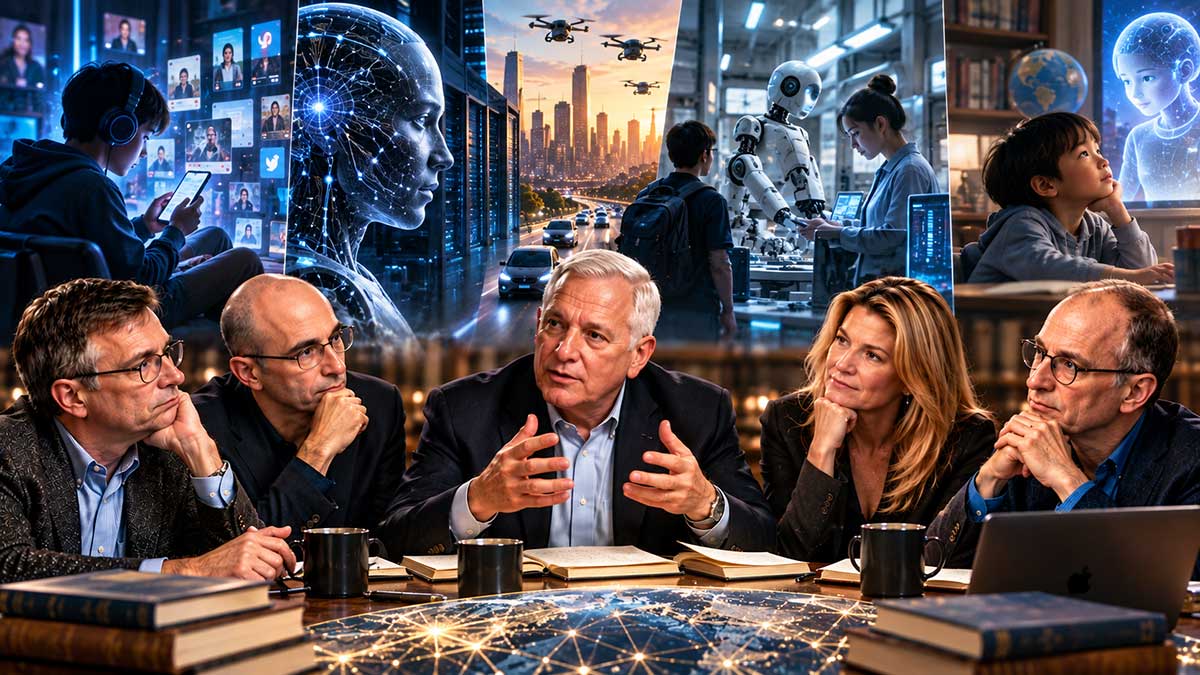
The smartphone lay beside the old copy of The Fourth Turning.
Walter Isaacson looked at the two objects for a moment.
One had been published in 1997.
The other contained technologies that would have sounded almost absurd in 1997.
Walter picked up the phone.
Walter Isaacson: Neil, when you and William Strauss wrote this book, this didn't exist.
Neil Howe: No.
Walter: Neither did Facebook.
YouTube.
Twitter.
TikTok.
Generative AI.
A teenager couldn't carry most of human knowledge in a pocket.
A ten-year-old couldn't ask an artificial intelligence to explain quantum physics.
A seventy-year-old couldn't video-call a grandchild on another continent while walking through a grocery store.
And billions of people weren't waking up every morning to personalized streams of information selected by algorithms.
Howe: That's right.
Walter: So here's the question.
Your theory says generations change history.
But what happens when technology begins changing the environment within a generation?
Jean?
Jean Twenge: That's one of the places where Neil and I approach generations somewhat differently.
Technology can profoundly change the experience of growing up.
The smartphone is an obvious example.
Someone born in 1990 didn't spend middle school carrying a smartphone.
Someone born fifteen years later very well might have.
Those are different childhood environments.
Walter: Even though we might put both people fairly close together on a generational timeline.
Twenge: Exactly.
And smartphones don't merely give young people another gadget.
They change how people communicate.
How friendships operate.
How dating works.
How teenagers spend free time.
How much they sleep.
How much face-to-face interaction occurs.
How quickly social information travels.
The environment itself changes.
Walter turned to Howe.
Walter: Neil, Jean is basically saying technology shapes generations.
But you've made almost the reverse argument.
Howe: I think both directions matter.
We frequently ask how technology changes generations.
I think we should ask how generations change technology.
Walter: Explain that.
Howe: A technology doesn't enter an empty society.
It enters a society populated by generations with different habits, expectations, fears, and needs.
Those generations decide how technologies are adopted.
They decide what becomes popular.
They decide what becomes regulated.
They decide what becomes socially acceptable.
Twenge: That's true.
Walter: Wait.
That was too easy.
He looked at Jean.
Walter: You're supposed to disagree.
Twenge: I can disagree if you'd like.
Everyone laughed.
Twenge: But he's right that the relationship goes both ways.
The disagreement is probably about how much weight we give each direction.
Walter stood and walked to a whiteboard.
He wrote:
TECHNOLOGY → GENERATIONS
Then beneath it:
GENERATIONS → TECHNOLOGY
Walter: Maybe we've been asking the wrong question.
Maybe history is a feedback loop.
Howe: Exactly.
Twenge: That's closer to how I would think about it.
Walter: A generation grows up with a particular technology.
The technology changes that generation.
Then that generation grows older and builds different technologies, businesses, institutions, regulations and cultural norms.
Those changes shape the next generation.
Howe: Yes.
Peter Turchin: And both are occurring within economic and political structures.
Technology doesn't simply appear.
It changes who has power.
It can create new elites.
Destroy industries.
Create industries.
Change labor markets.
Concentrate wealth.
Distribute information.
Change the cost of organizing political movements.
Those effects can influence instability.
Walter: So now our model is getting rather crowded.
Generations change institutions.
Institutions shape generations.
Technology changes generations.
Generations shape technology.
Economic structures influence all of them.
Yuval Noah Harari: Welcome to history.
They laughed.
Walter looked toward Harari.
Walter: Yuval, Strauss and Howe developed a theory based partly on a very old fact about human beings.
We have stages of life.
Children become young adults.
Young adults become middle-aged.
Middle-aged people become elders.
Eventually another generation replaces them.
But technology doesn't have to wait twenty years.
Harari: Correct.
And that difference may become increasingly important.
For most of history, human biological time moved much faster than technological change.
A farmer in the year 1000 might have lived in a world technologically recognizable to his grandparents.
Today someone can begin a career using one set of technologies and find the profession transformed ten years later.
Walter: And AI could compress that even further.
Harari: Potentially.
We should be cautious about predicting exactly how quickly AI capabilities or social adoption will develop.
But the important difference is already visible.
Software can change on a timescale that human beings cannot.
Humans still need years to grow up.
Institutions often need years to adapt.
Technology may change in months.
Walter returned to the whiteboard.
He wrote:
HUMAN CLOCK
TECHNOLOGY CLOCK
Walter: Neil, does your theory assume these clocks remain reasonably synchronized?
Howe: It assumes that human life stages remain fundamental.
Children still need to grow up.
People still move through different stages of life.
Generations still replace one another.
Unless those biological realities change dramatically, I think generational succession remains important.
Harari: But that "unless" could become very important.
Walter: I was waiting for you to say that.
Walter: Let's talk about lifespan.
The Strauss-Howe saeculum is roughly the length of a long human life.
Approximately eighty to one hundred years.
What happens if human lives become substantially longer?
Howe: That's an excellent question.
Walter: It's not merely theoretical anymore.
People establish careers later.
Marry later.
Have children later.
Remain professionally active longer.
Jean, you've studied some of these changes.
Twenge: Yes.
There has been a broad slowing of the life course in many developed societies.
Young people often reach traditional adult milestones later.
Dating.
Driving.
Employment.
Marriage.
Parenthood.
Some of that reflects economics.
Some reflects parenting.
Some reflects education.
Some reflects technology and cultural change.
Walter: So even without radical life-extension technology, the human clock may already be stretching.
Twenge: Certain stages certainly appear to be.
Walter: Neil, that's a serious problem for a theory with an eighty-to-one-hundred-year rhythm, isn't it?
Howe: It could modify the timing.
Generational boundaries have never been mechanically fixed at exactly twenty years.
Turchin: But this is where I would again urge caution.
If the cycle changes length whenever social conditions change, eventually it becomes difficult to distinguish a real recurring mechanism from a pattern being adjusted retrospectively.
Howe: That's fair.
Walter: There's Peter again.
Howe: I was expecting him.
Walter: Let's push the thought experiment much further.
Suppose medicine advances dramatically.
Imagine large numbers of people remaining healthy and influential into their nineties.
Perhaps beyond.
Instead of four generations substantially shaping public life simultaneously, maybe we have five.
What happens to the cycle?
Howe: I don't think we know.
Walter: That's an answer I like.
Howe: Bill and I built the framework around historical patterns we observed.
If fundamental features of the human life course change, the pattern could change.
Harari: This is extremely important.
Historical patterns exist under particular biological conditions.
Change the biology and you may change history.
If biotechnology eventually alters aging significantly, many institutions built around traditional life stages could change.
Education.
Marriage.
Careers.
Retirement.
Inheritance.
Political leadership.
Family structure.
Walter: And perhaps generations themselves.
Harari: Yes.
Imagine a society in which people commonly have productive adult lives lasting a century.
The political relationship between generations could be radically different.
Turchin: It could affect elite competition too.
If people remain in powerful positions much longer, younger cohorts may find advancement increasingly blocked.
Walter: That's fascinating.
Longer life could actually increase intergenerational tension.
Turchin: Under some conditions, yes.
Howe: Which itself could create new historical dynamics.
Walter looked again at the smartphone.
Walter: But lifespan is still relatively slow.
Let's turn to the thing moving very fast.
AI.
Suppose we accept the basic Strauss-Howe premise that childhood conditions help create generations.
What happens when childhood conditions change every five years?
Jean?
Twenge: Then broad generational categories may become less precise.
Think about social media.
Someone who experienced adolescence before smartphones had a different developmental environment from someone whose adolescence occurred after smartphones became ubiquitous.
Now imagine comparable shifts happening repeatedly.
Walter: So instead of twenty-year generations, could we eventually have five-year micro-generations?
Twenge: I wouldn't go that far automatically.
Family, education, economics, culture and major historical events still create shared experiences across longer periods.
But technology can create meaningful differences within what we conventionally call a generation.
Howe: I would distinguish technological experience from generational location.
Walter: Meaning?
Howe: Two people might grow up using different technologies while still occupying similar positions in the larger historical cycle.
Twenge: That's where Neil and I would probably keep debating.
Walter: Good.
Now we're earning our imaginary coffee.
Harari: There is another possibility.
AI may not merely change what young people use.
It could change who participates in shaping culture.
Walter: Explain.
Harari: Until recently, nearly all stories, laws, poems, advertisements, political arguments, religious commentaries, financial analyses and cultural artifacts were ultimately produced by human minds.
Now we are creating systems capable of generating language, images, software and decisions.
If these systems become deeply integrated into institutions, history may no longer be shaped solely by interactions among human generations.
Walter became quiet.
Walter: That's a much bigger claim.
Harari: It is a possibility, not a certainty.
But it matters.
Strauss and Howe's model assumes human generations inherit institutions from previous human generations.
What happens if increasingly powerful nonhuman systems participate in maintaining, modifying, or designing those institutions?
Howe: That would certainly be outside anything Bill and I contemplated in the 1990s.
Walter: Completely?
Howe: Completely.
Turchin: But we should avoid assuming unprecedented technology makes historical forces irrelevant.
Walter: Explain.
Turchin: Every major technological transformation feels unprecedented to the people living through it.
Printing.
Industrialization.
Railroads.
Telegraphy.
Electricity.
Radio.
Television.
The internet.
Technology changes the environment, but humans still compete over resources, status, power and institutions.
Harari: I agree.
The question isn't whether everything becomes new.
The question is which old mechanisms survive the new technology.
Walter: That's a very useful distinction.
Not:
Does AI destroy history?
But:
Which parts of historical behavior survive AI?
Harari: Exactly.
Walter looked at Howe.
Walter: Neil, imagine William Strauss walks into this room.
He died in 2007.
So the first iPhone had only just appeared.
He missed almost the entire smartphone revolution.
Social media as we know it.
COVID.
Generative AI.
You hand him this phone.
Then you show him an AI system capable of holding a conversation.
What do you think Bill asks first?
Howe smiled.
For a moment he said nothing.
Howe: Knowing Bill?
He'd probably play with it for about ten minutes.
Then he'd stop asking what the technology can do.
Walter: What would he ask instead?
Howe: He'd ask:
"What are children doing with it?"
Jean smiled.
Twenge: That's a good question.
Howe: Then:
"What are parents doing about it?"
And then:
"Which generation trusts it?"
"Which generation fears it?"
"Which generation is building it?"
"Which generation will regulate it?"
"And what will the children who never knew a world without it become?"
Walter slowly put the smartphone back on the table.
Walter: That's the Fourth Turning version of the AI question.
Not simply:
"What will AI do?"
But:
"What will different generations do with AI?"
Howe: Exactly.
Walter: Jean, let me ask you the inverse.
Imagine a child born today.
AI tutors.
AI companions.
AI-generated entertainment.
Perhaps AI doctors.
AI coworkers.
Maybe eventually autonomous machines throughout everyday life.
When that child turns twenty-five, will we be able to understand that person using categories created in the twentieth century?
Twenge: Some categories will survive.
Others probably won't.
But there's something we shouldn't lose sight of.
Human developmental needs don't necessarily change simply because technology does.
Children still need relationships.
Adolescents still develop identity.
People still want belonging.
They still compare themselves with others.
They still fall in love.
They still experience loneliness.
Technology changes the environment in which those things happen.
Walter: That's important.
The device changes faster than the human heart.
Twenge: Much faster.
Harari: And that mismatch could become one of the defining issues of the century.
Our technology can change extremely rapidly.
Human biology changes slowly.
Human psychology changes slowly.
Institutions usually change somewhere in between.
Walter: There are our clocks again.
He returned to the whiteboard.
This time he wrote four lines:
BIOLOGICAL TIME
GENERATIONAL TIME
INSTITUTIONAL TIME
TECHNOLOGICAL TIME
Walter: Peter, what happens when these clocks move at radically different speeds?
Turchin: Stress.
Institutions designed for one environment struggle in another.
Groups benefiting from technological change may gain wealth and power.
Others may lose status or security.
Political systems may adapt too slowly.
Those mismatches can become sources of instability.
Walter: Which means AI could affect a Fourth Turning even if AI has nothing whatsoever to do with generational archetypes.
Turchin: Precisely.
Howe: And then the generational question becomes how different cohorts respond to those disruptions.
Twenge: Which brings us back to the feedback loop.
Walter erased everything from the whiteboard except one question.
DOES TECHNOLOGY BREAK THE CYCLE?
Walter: Neil?
Howe: I don't know.
Walter laughed.
Walter: You're getting better at this.
Howe: It's the responsible answer.
The theory comes from patterns in history.
If conditions change sufficiently, the pattern could change.
But I wouldn't assume that smartphones or AI automatically erase generational dynamics.
Walter: Peter?
Turchin: I wouldn't assume any historical cycle continues indefinitely.
Mechanisms matter more than patterns.
If the mechanisms change, the dynamics can change.
Walter: Jean?
Twenge: I think technology is already complicating the idea that everyone within a twenty-year generation experienced the same childhood.
Walter: Yuval?
Harari: The most dangerous mistake would be choosing between two extremes.
One extreme says:
"Nothing has changed. History will continue repeating itself."
The other says:
"Everything has changed. History teaches us nothing."
Both are too simple.
Walter stared at the remaining words on the board.
DOES TECHNOLOGY BREAK THE CYCLE?
Then he erased the question mark.
He paused.
And put it back.
Everyone laughed.
Walter: I think we'll leave it there.
He closed the laptop.
Walter: Strauss and Howe built their theory around one of the slowest clocks imaginable.
A human lifetime.
Birth.
Childhood.
Adulthood.
Middle age.
Elderhood.
Death.
Another generation follows.
That rhythm has accompanied civilization for thousands of years.
But now another clock is ticking beside it.
Technology can transform itself before a child finishes school.
AI may transform industries before institutions learn how to govern it.
And longer lives may stretch the boundaries between generations themselves.
Maybe the Fourth Turning cycle survives all of this.
Maybe it stretches.
Maybe it changes.
Perhaps something entirely unexpected happens.
But that leaves us with one final question.
The question that probably matters most to anyone reading The Fourth Turning in 2026.
Walter picked up the old book and turned it over in his hands.
Walter: Neil, your theory says winter eventually ends.
So enough about the Crisis.
What comes after it?
Topic 5: What Does the Fourth Turning Predict Comes Next?
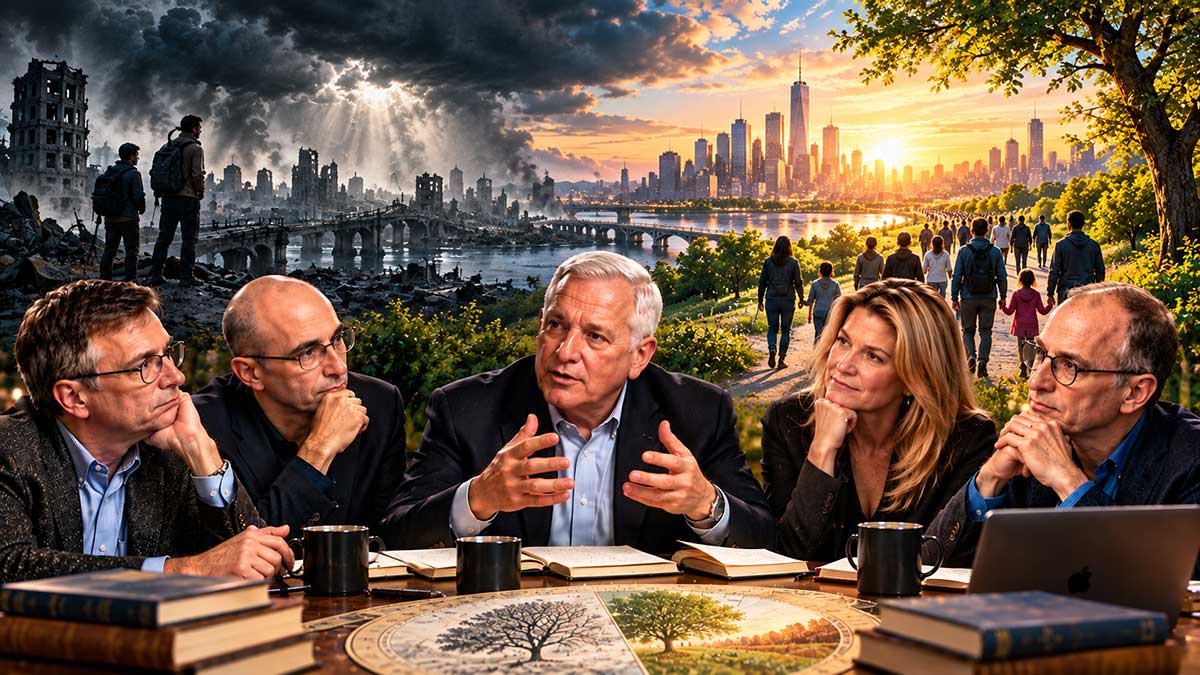
Walter Isaacson kept the old copy of The Fourth Turning in his hands.
For four conversations, they had talked about Crisis.
Financial instability.
Institutional distrust.
Generational conflict.
COVID.
Technology.
Artificial intelligence.
Historical cycles.
Walter finally put the book down.
Walter Isaacson: I think we've made a mistake.
Neil Howe: What's that?
Walter: We've spent almost this entire conversation talking about winter.
How it begins.
How we know we're in it.
How generations behave during it.
Whether technology changes it.
How it ends.
But nobody buys a calendar because they're fascinated only by January.
Jean Twenge smiled.
Walter: Your theory doesn't end with the Fourth Turning.
Howe: No.
Walter: It starts again.
Howe: Exactly.
Walter: Then I want to spend our final conversation asking about the part people seem to talk about least.
What happens after the Fourth Turning?
Walter stood and wrote four words on the board.
HIGH
AWAKENING
UNRAVELING
CRISIS
Then he drew an arrow from Crisis back to High.
Walter: Neil, let's begin here.
If we're currently living through a Fourth Turning, your theory says the next Turning should be a High.
What does that actually mean?
Howe: A High is a period following a Crisis in which institutions tend to be stronger and individualism is relatively weaker.
Society has recently passed through a period of major collective challenge.
People have created or rebuilt institutions to address that challenge.
There is usually greater confidence in the social order.
Walter: People hear the word "High" and assume you mean everything becomes wonderful.
Howe: That's not what it means.
Walter: So let's kill that misunderstanding immediately.
A High is not utopia.
Howe: Absolutely not.
A society can have strong institutions and still contain injustice.
It can have social cohesion and still exclude people.
It can have confidence and still make terrible mistakes.
Peter Turchin: That's important.
Stability and justice aren't synonyms.
Walter: Nor are cohesion and goodness.
Turchin: Correct.
Walter: The obvious American example is the period after World War II.
Howe: Yes.
Walter: And that's where I worry people misunderstand your theory.
They hear "the next High" and imagine suburban houses, factories, highways, church on Sunday, three television networks and everybody wearing hats.
Jean Twenge: Hopefully not the hats.
Walter: I like the hats.
They laughed.
Walter: But we're not going back to 1955.
Howe: Of course not.
Turnings repeat moods, not circumstances.
Walter: Say more.
Howe: The next High would emerge from the world we're living through now.
It would contain technologies that didn't exist during previous Highs.
Different demographics.
Different family structures.
Different relationships between men and women.
Different racial and cultural patterns.
Different international conditions.
Different economic institutions.
Walter: And potentially artificial intelligence everywhere.
Howe: Potentially.
Yuval Noah Harari: Which means the next period of strong institutions could look completely unlike previous periods of strong institutions.
Walter: That's the part I find fascinating.
Maybe we wouldn't even recognize a High if we were looking for the 1950s.
Howe: Exactly.
Walter turned toward Turchin.
Walter: Peter, before we start imagining spring, I want you to make things difficult.
Does a Crisis need a climax?
Strauss and Howe's model contains that idea.
Some kind of decisive resolution.
Historically that has often involved war.
Does winter need a storm before spring arrives?
Turchin: I wouldn't formulate it that way.
Periods of instability can resolve through different mechanisms.
The important question is whether the structural pressures driving instability are actually reduced.
If elite competition remains intense, living standards remain under pressure, institutions remain dysfunctional and political legitimacy continues deteriorating, simply declaring the Crisis over doesn't resolve those conditions.
Walter: So you want to see the underlying pressures change.
Turchin: Yes.
Walter: Neil, does your Fourth Turning require war?
Howe: No.
War has accompanied many historical Crises, and certainly some of the most dramatic ones.
But I wouldn't say the theory requires a particular war.
Walter: Does it require a dramatic climax?
Howe: Our model does anticipate a climax, a point when the major questions of the Crisis reach some form of resolution.
But that doesn't mean we can know beforehand what form it takes.
Walter: Could people live through it without recognizing, "This is the climax"?
Howe: Certainly.
Historical significance often becomes clearer afterward.
Harari: I would add something.
We should be careful about assuming the resolution of the next major crisis must resemble previous resolutions.
Technology can change the range of possible historical outcomes.
Walter: Meaning AI itself could become part of whatever new institutional settlement emerges?
Harari: Certainly.
Imagine institutions making decisions with AI.
Education organized around AI.
Economies reorganized by automation.
New systems governing information.
New mechanisms for verifying identity and authenticity.
We don't know which of these will happen or in what form.
But if the institutional structure changes significantly, the next stable period may be built partly around technologies that are still immature today.
Walter: Which means the institutions of the next High might not exist yet.
Harari: Some probably don't.
Walter paused.
Walter: That's a remarkable thought.
We're sitting here asking whether people will regain trust in institutions.
Perhaps some of the institutions they eventually trust haven't been invented.
Twenge: And some may be smaller than we're imagining.
Walter: What do you mean?
Twenge: When people hear "institutions," they think immediately about government or corporations.
But social institutions include families, schools, religious communities, neighborhoods, civic organizations.
If people become exhausted by fragmented digital life, one response could be renewed interest in smaller forms of community.
Walter: That's almost counterintuitive.
The more digital the world becomes, the more valuable physical community might become.
Twenge: It could.
We shouldn't assume technological development moves every part of life in the same direction.
Harari: Yes.
Scarcity creates value.
If artificial intelligence makes information abundant, human attention may become more valuable.
If synthetic content becomes abundant, authentic human interaction may become more valuable.
If virtual experiences become abundant, physical presence may become more valuable.
Walter: That's a very different picture of the future from the usual one.
Not humans disappearing into machines.
Humans rediscovering what machines can't easily replace.
Harari: That is one possibility.
Walter walked to the board.
Under HIGH, he wrote:
TRUST?
COMMUNITY?
STRONGER INSTITUTIONS?
NEW RULES?
Walter: Neil, would those be reasonable clues?
Howe: Yes, though I would add another.
Walter: What?
Howe stood and wrote beneath them:
A NEW DEFINITION OF NORMAL
Walter looked at it.
Walter: We came across that idea earlier.
Howe: Because I think it's fundamental.
The generation born after the Crisis will grow up taking the new institutional order for granted.
They won't experience it as new.
It will simply be the world.
Walter: While older people will remember the transition.
Howe: Exactly.
What feels revolutionary to one generation becomes normal to the next.
Walter sat down again.
Walter: I want to ask something that worries many readers.
If the Fourth Turning theory says Crisis is followed by renewal, couldn't that encourage passivity?
"Don't worry. History fixes itself."
Howe: That would be a serious misunderstanding.
History doesn't fix anything.
People do things.
Institutions are built by people.
Communities are maintained by people.
Compromises are made by people.
Sacrifices are made by people.
Turchin: I strongly agree with that.
Cycles aren't supernatural forces.
If structural problems exist, they require responses.
Understanding historical dynamics is useful only if it improves those responses.
Walter: So knowing that previous winters eventually ended doesn't guarantee this winter ends well.
Howe: Correct.
The outcome is never guaranteed.
Walter: Then let me ask the question readers probably care about more than anything we've discussed.
Suppose someone accepts only sixty percent of the Fourth Turning theory.
Maybe they find the cycle intriguing but not exact.
Maybe they're uncertain about the archetypes.
Maybe they think some of Strauss and Howe's predictions were impressive and others too broad.
Fine.
What should they do differently tomorrow morning?
Nobody answered immediately.
Walter turned toward Twenge.
Walter: Jean?
Twenge: Understand that people raised in different periods genuinely experience the world differently.
That doesn't mean stereotyping them.
It means becoming curious about why their assumptions differ from yours.
Walter: Give me an example.
Twenge: Instead of saying, "Young people today don't understand work," ask:
"What was entering the workforce like when I was twenty-two, and what is it like for someone who's twenty-two now?"
Those are different questions.
Walter: That's useful even if Strauss and Howe's cycle is completely wrong.
Twenge: Yes.
Walter: Peter?
Turchin: Don't mistake symptoms for causes.
If a society becomes unstable, blaming individual personalities or single events can prevent us from seeing structural pressures underneath.
Look deeper.
What is happening to living standards?
Opportunity?
Elite competition?
Institutional legitimacy?
Social cooperation?
Walter: In other words, don't spend all your time staring at the match.
Look at the forest.
Turchin: Exactly.
Walter: Yuval?
Harari: Don't assume that because something has happened repeatedly in history, it must happen again in the same way.
Historical knowledge should expand the possibilities you can imagine.
It shouldn't imprison you inside analogies.
Walter: Particularly with AI.
Harari: Particularly when genuinely new technologies appear.
Learn from history.
But remain capable of surprise.
Walter finally turned to Howe.
Walter: Neil?
Howe looked at the four Turning names still written on the board.
Howe: Don't confuse the season with destiny.
Walter waited.
Howe: If you're living through winter, understanding winter matters.
You prepare differently.
You understand why certain things are happening.
You recognize that the environment has changed.
But knowing the season doesn't tell you exactly what to do.
You still make choices.
Walter: Individually and collectively.
Howe: Yes.
And those choices help determine what comes next.
Walter closed The Fourth Turning.
Walter: I want to finish differently.
No debate.
No rebuttals.
One sentence from each of you.
Complete this:
"If there is one idea from the Fourth Turning that people living in 2026 should carry with them, it is..."
He looked at Jean.
Twenge: The world that shaped you is not the same world that shaped everyone else, so understanding another generation begins with understanding what their childhood was actually like.
Walter turned to Peter.
Turchin: Periods of instability have causes, and understanding those causes gives societies more choices about how to respond.
Then Harari.
Harari: Historical patterns can illuminate the future, but the future always retains the capacity to surprise us.
Finally, Walter looked at Howe.
Howe rested his fingers on the cover of the book he had written with William Strauss almost three decades earlier.
He took a moment.
Howe: History gives every generation problems it didn't choose.
He stopped.
Then continued.
Howe: But no theory decides what that generation does with them.
For a few seconds, the table was silent.
Walter looked at the words still written on the board:
HIGH
AWAKENING
UNRAVELING
CRISIS
Then he erased them.
Walter: Maybe that's where we should leave Strauss and Howe.
Not with a prediction.
With a responsibility.
The people living in a historical season don't choose the season.
They inherit it.
But they do participate in deciding what survives it.
Which institutions deserve rebuilding.
Which ones deserve replacing.
What technologies serve human beings.
What communities are worth preserving.
What children learn from watching the adults around them.
And what kind of world those children eventually inherit.
Walter picked up the 1997 book one last time.
Walter: Strauss and Howe tried to imagine our world before it existed.
Perhaps our responsibility isn't merely to ask whether they were right.
It's to ask something harder.
What kind of world are we creating for the people who will look back on 2026 as history?
And perhaps the answer to that question can't be found in another theory.
It has to be found in human lives.
Five lives.
Five ordinary people living through their own private versions of history.
That is where Part 3 begins.
Final Thoughts
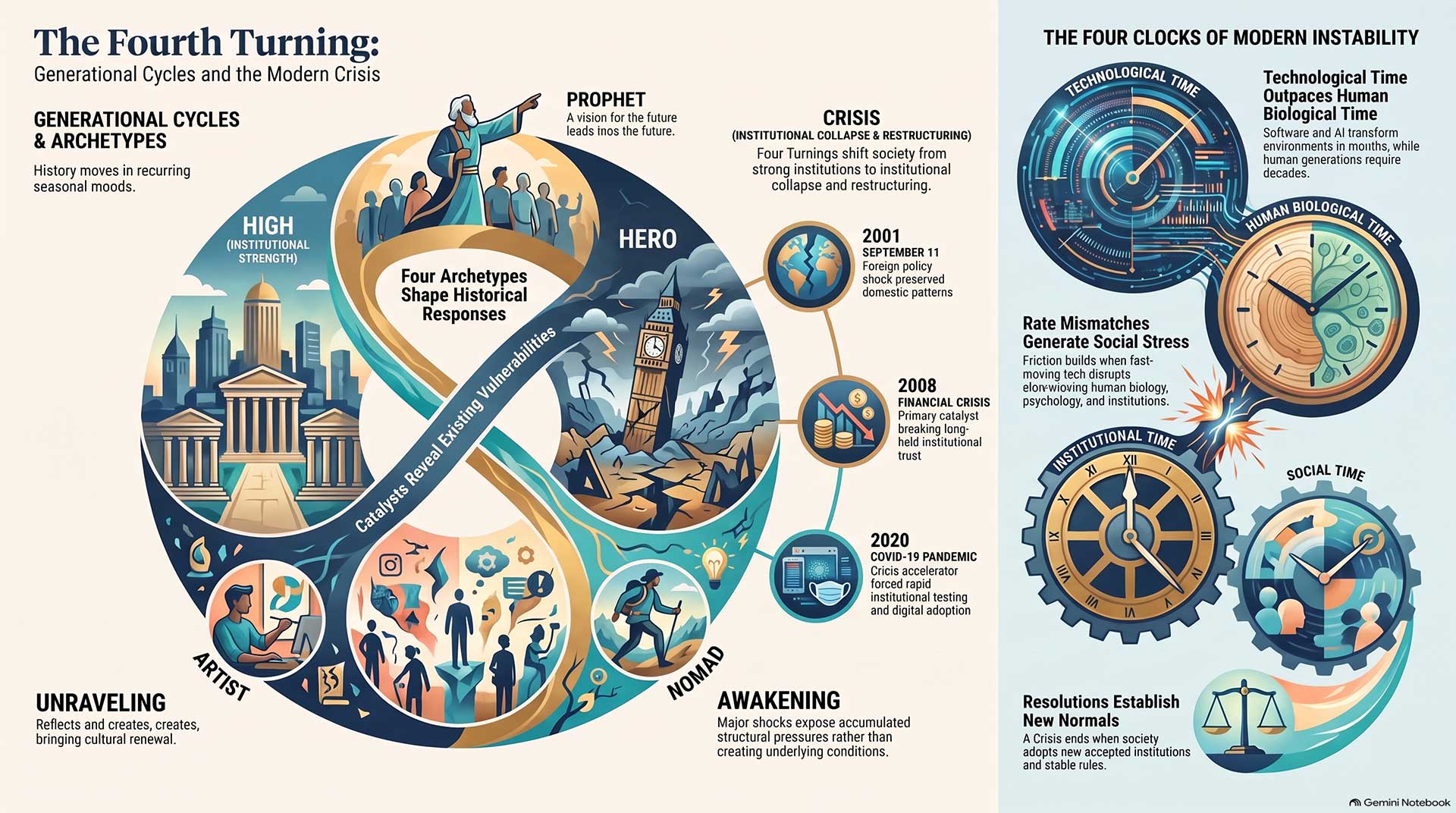
Perhaps the most fascinating thing about The Fourth Turning is not whether Strauss and Howe predicted every event correctly. They clearly did not, nor did they claim to.
The deeper idea is that people rarely recognize the historical season they are living through while they are inside it.
Strauss and Howe asked readers to look beyond individual headlines and consider the interaction between generations, institutions, childhood experiences, and historical memory. Peter Turchin reminds us that economic and structural pressures matter too. Jean Twenge shows how profoundly changing technology and childhood can reshape generations. Yuval Noah Harari raises an even newer question: what happens when technological change begins moving faster than the human generational clock?
Yet the conversation ultimately returns to human agency.
No generation chooses the circumstances it inherits. Boomers did not choose the world of their childhood. Gen X did not. Millennials did not. Today's children do not.
What each generation eventually helps create is another matter.
If Strauss and Howe's historical winter eventually gives way to spring, that spring will not simply arrive by itself. It will be built through millions of choices about families, communities, institutions, technology, responsibility, and trust.
History may give us the season.
What we do within it remains ours.
Short Bios:
Walter Isaacson is an American author, journalist, and biographer known for exploring the lives of transformative figures including Steve Jobs, Albert Einstein, Leonardo da Vinci, Jennifer Doudna, and Elon Musk. In this imagined discussion, he serves as moderator, pressing the panel to translate large historical theories into clear human questions.
Neil Howe is an American author, historian, and demographer best known for developing generational theory with William Strauss. Together they wrote Generations and The Fourth Turning, proposing a recurring cycle of generational archetypes and historical Turnings. Howe has continued developing and discussing the framework since Strauss's death in 2007.
Peter Turchin is a complexity scientist known for developing cliodynamics, an interdisciplinary approach that uses historical data and mathematical models to study long-term social change. His work examines recurring instability through forces such as inequality, elite competition, declining well-being, and institutional stress, offering an illuminating alternative to the Strauss-Howe generational explanation.
Jean Twenge is a psychologist and author whose research examines generational differences and changes in American culture. Her work has explored Millennials, Gen Z, smartphones, social media, adolescence, and changing life patterns, making her perspective particularly relevant to questions about how technology and historical environments shape generations.
Yuval Noah Harari is a historian and author known for Sapiens, Homo Deus, 21 Lessons for the 21st Century, and Nexus. His work explores large-scale human history, information networks, technology, artificial intelligence, and the stories societies create to organize collective life. In this conversation, he helps examine whether technological change could begin moving faster than traditional generational cycles.
Leave a Reply