
Introduction: What If Death Is Not the End of Who We Are?
What if the moment you die, you discover that you have never truly been confined to your physical body?
Imagine taking your final breath, closing your eyes, and then discovering that you are still conscious.
You can still think. You can still remember. You are still you.
But something extraordinary has changed.
The limitations that defined your entire human existence may no longer apply.
Would you recognize yourself? Would you see the people you loved? Would you discover that your earthly life was only one small part of a much greater existence?
For centuries, humanity has asked what happens after death. Religions have offered visions of heaven, reincarnation, judgment, and eternal life. Yet some of the most intriguing interpretations come from spiritual teachings that challenge our ordinary concepts of consciousness, identity, and time itself.
In Seth Speaks, the consciousness known as Seth, speaking through Jane Roberts, presents a remarkable perspective on the survival of personality and the multidimensional nature of existence.
The teachings of Bashar, channeled by Darryl Anka, raise equally fascinating questions about parallel realities, the Higher Mind, and whether our experience of time reflects only a fraction of a much greater reality.
Meanwhile, Dolores Cannon's regression research introduces accounts of people who described extraordinary experiences between physical incarnations.
But what would happen if these perspectives were brought together?
In this imaginary conversation, Seth, Bashar, Elias, The Michael Entity, and Dolores Cannon gather to explore five profound mysteries.
What actually happens in the first moments after death?
Could our past, present, and future incarnations exist simultaneously?
Will we recognize the people we love, and could our relationships continue beyond physical existence?
What might consciousness experience when it is no longer limited by the human body?
And perhaps the greatest mystery of all: Who are we beyond the identity we have known throughout our earthly lives?
As their ideas meet, unexpected questions emerge, revealing possibilities that go far beyond conventional descriptions of the afterlife.
Perhaps the most extraordinary discovery awaiting us is not simply that consciousness might survive death, but that we have barely begun to recognize what consciousness is.
Disclaimer: This article presents a fictional conversation inspired by the published teachings of Seth, Bashar, Elias, The Michael Entity, and Dolores Cannon. The dialogue is imagined and does not represent actual statements, meetings, or endorsements. Claims about the afterlife, channeling, and reincarnation are spiritual interpretations rather than established scientific facts.
Topic 1: The First Moments After Death: What Do We Actually Experience?
An imaginary conversation with Seth, Bashar, Elias, The Michael Entity, and Dolores Cannon
Question 1. What happens the very moment the physical body dies?
Moderator
I'd like to begin with the simplest question imaginable.
Suppose I'm lying in a hospital bed. My family is gathered around me. I take my final breath, and my heart stops.
From their perspective, I've died.
But what about my perspective?
One second I'm alive. The next second, what happens?
Is there darkness? Do I lose consciousness? Do I suddenly find myself somewhere else?
Dolores, perhaps you could begin with what people described during your regression sessions.
Dolores Cannon
One of the most interesting things I encountered in my work was how ordinary the transition sometimes seemed to the people describing it.
I expected death to be this enormous, dramatic event. But many subjects described something surprisingly gentle.
They might say they were suddenly outside their bodies, looking down at themselves.
Some were curious. Others were surprised.
One recurring theme was the absence of physical discomfort.
People who described dying after long illnesses sometimes reported feeling wonderfully free once they were no longer experiencing the body.
They might look at the body and recognize it, yet feel no desire to return to it.
Now, these were accounts obtained through hypnosis, and naturally we must distinguish those accounts from direct observation of death itself.
But the patterns were fascinating.
Moderator
When you say they were looking down at their bodies, do you mean they could still see the hospital room?
Dolores Cannon
That's how some described it.
They reported seeing people gathered around the body, sometimes noticing the sadness of relatives.
What struck me was that several subjects described feeling more concerned about the grieving people than about their own condition.
They were no longer frightened of what had happened to them.
Seth
There is an important assumption within your question.
You ask what happens when the body dies, as though the body were the container of consciousness and consciousness must suddenly escape.
But your identity has never been confined to the physical structure in the manner you suppose.
Even during physical existence, your awareness participates in dimensions of experience that are not ordinarily recognized by the waking personality.
Death does not create those dimensions.
It changes your relationship to them.
Moderator
So you're saying that I don't suddenly become a spiritual being when I die.
I've always been one?
Seth
Precisely.
The physical personality interprets experience through the body, and that interpretation becomes so familiar that you identify consciousness with the instrument through which it operates.
Yet the instrument is not the entirety of the identity.
Your question might more fruitfully become: What does consciousness discover when it no longer organizes its awareness primarily through physical perception?
Bashar
And that is where things become particularly interesting!
You have been practicing one particular perspective for your entire physical lifetime.
You have been focusing on being a physical human, in a physical environment, experiencing what you call linear time.
When that physical focus concludes, you may recognize a much larger aspect of yourself.
But remember, the larger aspect was never absent.
You were simply concentrating upon one experience.
Moderator
Could you give me an example?
Bashar
Think about dreaming.
During a dream, you may have a completely different identity. You may find yourself in a city you've never visited, speaking with people you've never met.
For that moment, the experience may feel entirely real.
Then you awaken.
You don't necessarily travel anywhere to awaken. Your focus changes.
Now, physical death is not identical to waking from an ordinary dream. But the comparison can help you begin to understand the principle.
Elias
I would add a distinction.
An expansion of awareness does not necessarily occur instantaneously in the same manner for every individual focus.
There may be a continuation of familiar objective perception.
The individual may initially experience circumstances that resemble physical reality, particularly when strongly identifying with physical existence.
Moderator
So someone might die and not realize they're dead?
Elias
Within the descriptions of transition presented in my teachings, yes.
The individual may continue to organize experience through familiar perceptions and expectations.
This does not imply that the individual is permanently trapped.
It describes an adjustment in awareness.
The Michael Entity
The individual personality may require a period of orientation.
A lifetime involves extensive identification with bodily sensations, social roles, personal relationships, and the apparent progression of time.
The cessation of physical manifestation does not require those habits of perception to disappear immediately.
Moderator
That makes sense.
If I've spent eighty or ninety years thinking of myself as a physical person, perhaps I wouldn't suddenly understand an entirely different form of existence.
But I wonder about something else.
If consciousness continues, would I still have my ordinary thoughts?
Would I remember my name?
Would I remember my children?
Seth
The continuity of personality is central to this question.
The individual does not become meaningless merely through the termination of physical existence.
The memories, emotions, relationships, and creative qualities developed through that personality contribute to a larger identity.
Yet you must distinguish continuity from remaining forever limited to the precise perspective of your earthly personality.
Moderator
So I could still remember being a father, but eventually realize that being a father was only one part of who I am?
Seth
Yes.
And you might discover that the significance of that experience is much greater than you understood during physical life.
Dolores Cannon
That reminds me of the way some subjects described remembering their earthly relationships after the transition.
They still recognized people they loved.
But they sometimes reported an awareness of other relationships and other experiences that made the earthly lifetime seem like part of a much larger story.
Moderator
There's something comforting about the possibility that we don't simply forget everyone.
But there's another detail I'm curious about.
Does the moment of death actually feel like a moment?
Or could time itself change?
Bashar
Now you're reaching the central issue!
You assume that the experience after death must follow the same chronological structure you experience now.
One second, another second, another second.
But if consciousness is not fundamentally limited by linear time, then the transition may not be experienced according to your earthly measurement.
What seems like an instant from one perspective might contain an enormous range of experience from another.
Elias
And the perception of duration may vary according to the individual's awareness.
It is useful to distinguish the occurrence of physical death from the manner in which consciousness experiences transition.
Moderator
So even asking what happens during the first five minutes after death could be misleading?
Seth
Indeed.
Your question assumes that the clock beside the hospital bed continues to measure the entirety of your existence.
That assumption is precisely what we should investigate.
Question 2. Who or what determines the environment we encounter after death?
Moderator
Let's suppose I've died and become aware that I'm still conscious.
What will I see?
A bright light?
A beautiful landscape?
My parents?
Or perhaps nothing resembling physical reality at all?
Elias, you mentioned that people may initially perceive familiar environments.
Could you explain that further?
Elias
During physical existence, individuals develop extensive systems of beliefs about reality.
These beliefs influence how experiences are perceived and interpreted.
The cessation of physical manifestation does not automatically erase those patterns.
An individual may initially present to themselves an environment that corresponds with familiar expectations.
Moderator
So if someone expects heaven to look like a beautiful garden, they might actually experience that garden?
Elias
That is a possible illustration.
Yet the important distinction is between the nature of consciousness and the forms through which consciousness interprets experience.
A garden is one recognizable form.
The experience need not be constrained by the physical requirements of soil, sunlight, or biological growth.
Dolores Cannon
That brings to mind the descriptions of places that came up during my sessions.
Some subjects spoke about beautiful gardens or peaceful surroundings.
Others described buildings or areas where souls gathered.
There were accounts of being welcomed by familiar individuals, sometimes in settings that seemed very comforting.
Moderator
Did you ever wonder whether those places were actually there?
Or whether the subjects were somehow creating them?
Dolores Cannon
Of course.
I became interested in the recurring similarities, but I was careful to record what subjects reported.
The interpretations were another matter.
Sometimes people spoke about an environment as though it existed independently.
Other times, they described conditions in which thoughts seemed to influence what they experienced.
Seth
You are assuming that reality must belong to one of two categories.
Either an environment exists independently of consciousness, or it is merely imagined and therefore unreal.
But perhaps consciousness participates in creating the very reality it experiences.
In that case, the distinction becomes less straightforward.
Moderator
Are you saying that a spiritual garden could be real even if consciousness created it?
Seth
Consider that you already participate in the construction of your physical experience.
The apparent solidity of your surroundings does not provide the final explanation of their nature.
Within nonphysical existence, the relationship between consciousness and experience may be more immediately apparent.
Bashar
Exactly!
And let's examine your definition of real.
When you dream of standing beside a beautiful ocean, the experience can generate genuine emotions.
You may feel joy or sadness. You may remember the dream for years.
The ocean was not physical in the ordinary waking sense.
Yet the experience occurred.
Now expand that principle to forms of consciousness capable of participating in shared nonphysical experiences.
Moderator
Shared experiences?
That's what I wanted to ask next.
Suppose I die and see a beautiful garden. My mother is standing there waiting for me.
Would she see the same garden?
Or am I simply creating an image of my mother?
The Michael Entity
This question involves two distinct matters.
One concerns the environment through which an experience is organized.
The other concerns the identity of the consciousnesses participating in the encounter.
The presence of a consciousness-created environment does not necessarily imply that every participating individual is merely a projection of one person's expectations.
Moderator
So the garden could be created through consciousness, but my mother could still be genuinely present?
The Michael Entity
That is a coherent possibility within these teachings.
Elias
There is another distinction worth examining.
Individuals may recognize familiar expressions of consciousness, yet recognition does not necessarily require the same physical form that was experienced during earthly life.
An individual focus may be encountered through recognizable expressions, while essence encompasses a much greater range of awareness.
Moderator
Then when I see my mother, she might appear as she did when I was a child?
Elias
The perception may reflect familiar imagery.
But the appearance should not be confused with the total identity of the consciousness being encountered.
Dolores Cannon
Some people in my sessions described exactly that kind of recognition.
A soul might appear in a familiar form, but the subject reported knowing the person through something deeper than appearance.
They sometimes described recognizing an energy or a feeling of familiarity.
Moderator
That's fascinating.
But here's something that bothers me.
If consciousness creates environments according to beliefs, what happens when two people believe completely different things?
Suppose one person believes in a traditional Christian heaven, and another believes that the afterlife consists of different spiritual dimensions.
Could they still meet?
Seth
Their expectations might initially organize their experiences differently.
But consciousness is not permanently limited to any particular belief structure.
The ability to expand beyond familiar assumptions is part of the greater possibility of nonphysical existence.
Bashar
And two individuals do not necessarily have to interpret reality identically to interact meaningfully.
Even on Earth, two people can attend the same event and experience it quite differently.
One may experience joy, another anxiety.
They are participating in a shared circumstance without possessing identical interpretations.
Moderator
So perhaps two souls could meet in a common reality, yet perceive that reality differently?
Bashar
That is an interesting extension of the principles we're discussing.
The Michael Entity
The continuity of meaningful relationships need not depend upon identical perceptions.
Moderator
Now let me take this further.
Could an entire group of souls create a shared world?
A place where they live, learn, and explore together?
Dolores Cannon
My regression subjects sometimes described spiritual communities or areas in which souls gathered for particular purposes.
They spoke of learning, meeting others, and participating in activities.
Seth
Consciousness is creative.
You should not assume that creative cooperation becomes impossible when physical bodies are no longer involved.
Elias
Yet I would caution against interpreting nonphysical existence exclusively through earthly concepts of buildings, communities, and locations.
Such images may be useful translations of experiences that do not operate through physical space.
Moderator
So a spiritual community might be real as an experience, without functioning like a town on Earth?
Elias
Yes.
Moderator
Then perhaps the afterlife is not one fixed place.
Perhaps it contains countless ways of experiencing reality.
Seth
That would be considerably closer to the breadth of possibilities described in my material.
Question 3. Who helps us during the transition, and what if we are frightened?
Moderator
There's something I'd like to explore more carefully.
We've discussed the possibility of peaceful transitions and beautiful environments.
But not everyone dies peacefully.
Some people die suddenly. Others experience fear, confusion, or terrible suffering.
What happens to them?
Suppose someone dies believing that God will punish them.
Could that belief influence their experience?
Seth
Beliefs may continue to influence perception beyond physical existence.
A person who expects punishment may initially interpret experience through that expectation.
But the expectation is not necessarily an eternal verdict.
It is important to distinguish the individual's belief from the greater nature of consciousness.
Moderator
Then someone might temporarily experience something resembling hell?
Seth
Within the framework of belief-shaped experience, a person might encounter frightening conditions corresponding to their expectations.
Yet those conditions need not constitute a permanent, externally imposed state.
Elias
The continuation of certain belief structures can influence transition.
An individual who strongly identifies with fear or punishment may initially express experiences through those beliefs.
Recognition and adjustment can occur.
Moderator
How does that recognition happen?
Elias
Through changes in awareness.
The individual may begin to recognize that familiar patterns of perception no longer define the entirety of experience.
Assistance from other consciousnesses may facilitate that recognition.
Dolores Cannon
Some subjects in my work described being met by guides or familiar souls.
They reported receiving reassurance or help in adjusting to their new circumstances.
In those accounts, the transition wasn't something everyone had to manage completely alone.
The Michael Entity
Assistance can be understood as part of the broader relationships among consciousnesses.
The individual personality may require orientation when it remains attached to physical experience.
Guidance does not require punishment, superiority, or coercion.
Moderator
Who are these guides?
Are they souls who have already died?
Are they beings who never lived physically?
Or are they aspects of our own greater consciousness?
Dolores Cannon
The accounts varied.
Some subjects described familiar souls.
Others spoke of teachers or guides who seemed to have particular responsibilities.
There were reports of beings who appeared to know the individual very well.
The Michael Entity
Within the Michael framework, relationships among essences and nonphysical forms of guidance play significant roles in the development and integration of experience.
Bashar
There is another possibility worth considering.
If you possess a greater consciousness that is not limited to the physical personality, guidance may sometimes be understood as communication from a broader level of your own awareness.
Moderator
So a guide might be another being, but guidance might come through my own Higher Self as well?
Bashar
Those possibilities are not necessarily mutually exclusive.
Seth
And you should avoid assuming that nonphysical communication must resemble two physical people speaking to one another.
The methods of communication available to consciousness may be considerably more extensive.
Moderator
Could you explain?
Seth
You are familiar with conveying meaning through words.
But meaning is not created by words alone.
Consider how an emotion, impression, or sudden realization can communicate more than a lengthy explanation.
Nonphysical communication may involve forms of direct recognition that are difficult to translate into ordinary language.
Moderator
So a guide might communicate an entire idea without speaking a sentence?
Seth
That is one possibility.
Elias
Communication need not be limited to verbal language or physical sensory symbols.
Moderator
That's interesting.
But what about someone who dies very suddenly?
Suppose a person dies in an accident and doesn't understand what happened.
Could they continue believing they're alive?
Elias
Within my descriptions of transition, an individual may retain familiar objective perceptions and may not immediately recognize the cessation of physical manifestation.
That recognition can develop through adjustment.
Dolores Cannon
Some accounts I encountered involved people who described confusion after unexpected deaths.
They might initially continue acting as though they were still participating in physical life.
Then some form of assistance or realization would help them understand their circumstances.
Moderator
Would they be trapped?
Elias
The language of permanent entrapment is misleading.
Confusion reflects an experience of awareness, not necessarily an inescapable condition.
The Michael Entity
Adjustment can involve varying degrees of orientation and assistance.
The experience of confusion need not define the individual's continuing existence.
Moderator
I want to ask about something very sensitive.
What about a young child who dies?
A child may not have developed sophisticated beliefs about heaven, reincarnation, or spiritual worlds.
Would that make the transition different?
Dolores Cannon
Accounts involving children often led me to consider the distinction between the physical personality's age and the broader identity described by the subjects.
Within that framework, a young physical age does not necessarily mean a young soul.
The Michael Entity
The development of a physical personality during one lifetime is distinct from the experiences attributed to essence across incarnations.
Elias
The age of the physical body does not determine the totality of essence.
Moderator
So a child who dies might still possess a much greater spiritual identity than their earthly age suggests?
Seth
Within these teachings, the physical duration of a lifetime does not define the entirety of consciousness.
Moderator
What about the parents?
If they eventually reunite with that child, will the child still appear young?
Or will they discover a much greater being?
Elias
Recognition may occur through familiar expressions, yet the greater nature of consciousness is not restricted to the physical age of a particular focus.
Dolores Cannon
Some of the accounts in my work described recognizable appearances, but the emphasis was often on the connection between souls rather than the age or physical form.
Moderator
That brings me back to something you said earlier, Seth.
You suggested that after death we might realize we're much more than the person we thought we were.
But I don't want to lose the person I was.
I want to remember my family.
I want to remember the moments that mattered.
I want to remain myself.
Seth
And why should expanding your awareness require erasing the significance of your experiences?
You imagine that becoming more must mean abandoning what you already are.
But the development of consciousness need not operate through such destruction.
The personality has created experiences that possess their own meaning.
Those experiences contribute to the larger nature of identity.
Moderator
Then perhaps death doesn't erase our human story.
It allows us to recognize the story within a much larger existence.
Bashar
And perhaps you discover that the person you believed yourself to be was never the entire story in the first place.
The Michael Entity
The experiences of an incarnation remain meaningful within the broader identity of essence.
Dolores Cannon
That's one of the ideas I found most interesting in the accounts I collected.
The physical lifetime mattered.
The relationships mattered.
The choices mattered.
But people often described discovering that their existence extended beyond what they had known.
Moderator
Elias, I want to make sure I understand something.
You describe essence as having many individual focuses.
If I die, do I become all those other people?
Elias
Not precisely.
Each focus possesses its own individuality.
Essence encompasses the focuses, yet this does not mean that the individual focus is replaced by an indistinguishable collection of personalities.
It is more useful to consider the expansion of awareness and the relationship between focus and essence.
Moderator
So the person who loved my family remains meaningful, even when I become aware of other lives?
Elias
Yes.
Moderator
Then perhaps the greatest surprise isn't simply that consciousness survives death.
Perhaps it's discovering that our identity is much greater than we imagined, without losing the significance of the person we've been.
Seth
That is a fruitful direction for your inquiry.
Moderator
I want to end this part of our conversation with one final question.
We've spoken about transition, guides, unfamiliar environments, and the possibility of expanded awareness.
But what if the entire experience after death depends upon how we interpret reality?
Should we spend our lives preparing for death by changing our beliefs?
Bashar
Your beliefs influence your experience now, not merely after physical death.
Rather than approaching life through fear of what might happen later, you can examine the assumptions through which you experience the present.
Elias
An awareness of beliefs can be meaningful during physical existence.
Yet individuals need not adopt a particular metaphysical explanation as a requirement for a peaceful transition.
The Michael Entity
The value of physical experience includes the relationships, choices, and development expressed during the incarnation.
Fear of an imagined future condition need not dominate those experiences.
Dolores Cannon
I would encourage people to remain curious.
The accounts I collected gave me many things to think about, but I wouldn't want someone to become so preoccupied with the next life that they stop appreciating the one they're living.
Seth
Indeed.
You do not need to abandon the significance of physical existence to recognize that consciousness may be greater than physical existence.
Your present life is a meaningful expression of your identity.
Moderator
Then maybe the most useful preparation for death is to live with greater awareness.
To love more deeply.
To question the assumptions that keep us afraid.
To recognize that there may be much more to existence than our physical senses can perceive.
And perhaps, when that final moment comes, whatever it brings, we will discover something about ourselves that we could never fully recognize during physical life.
But that leads directly to our next discussion.
If consciousness survives death, and if the individual personality belongs to a much greater identity, who exactly is that greater self?
And here's the question that fascinates me most.
If my so-called past lives and future lives are actually happening simultaneously, could there be many versions of me living different lives right now?
Bashar
Now we are approaching a very interesting exploration of time, identity, and the nature of existence.
Elias
And it will be useful to distinguish carefully between the individual focus and the essence that encompasses many focuses.
Seth
For once you begin questioning the nature of time, your entire conception of reincarnation must be reconsidered.
The Michael Entity
The relationship between individual experience and greater identity will become central to that inquiry.
Dolores Cannon
And I have some fascinating accounts from my regression work that could help us explore what people mean when they say they remember other lives.
Moderator
Then that's where we'll go next.
Not simply into the question of who we become after death, but into the possibility that we have always been much more than one person living one lifetime.
Editorial note: This fictional exchange draws from the participants' published metaphysical teachings, including Seth's descriptions of post-death existence, Bashar's principles of consciousness, Elias's teachings on transition and essence, the Michael system's accounts of soul development, and Dolores Cannon's hypnotic-regression narratives. The dialogue is newly imagined; no passage is presented as a historical statement by these participants. Hypnotic accounts and channeled material do not independently establish the existence or nature of an afterlife.
Topic 2: The Greater Self: Are All Our Lives Happening Right Now?
Question 1. Who am I when I am no longer my human personality?
Moderator
In our previous conversation, we explored the possibility that death isn't the end of consciousness.
But something you said has stayed with me.
You suggested that when we die, we may discover that we've always been much more than the person we believed ourselves to be.
I find that fascinating, but slightly difficult to grasp.
I've spent my entire life being one person.
I have a name, a family, memories, dreams, regrets, and relationships.
If I die and suddenly become aware of a much greater identity, what happens to the person I've spent my life becoming?
Seth, could we begin with you?
Seth
You are approaching identity from the perspective of limitation.
You imagine that the person you know must either remain exactly as they are or disappear into something greater.
But consciousness does not require such an either-or arrangement.
The individual personality is a legitimate, creative expression of a larger entity.
Your experiences possess their own significance, and that significance does not vanish when your awareness expands.
Moderator
But would I still remember my name?
Would I remember the people I loved?
Seth
You need not lose your memories merely through gaining access to a greater range of them.
Consider a child who grows into adulthood.
The adult develops a broader identity, yet the childhood experiences remain part of the individual.
Of course, the relationship between the physical personality and the greater entity is considerably more expansive.
The essential principle is that increased awareness does not necessarily require the destruction of previous identity.
Elias
I would introduce a distinction that may clarify your question.
You refer to yourself as one personality, and within your physical experience, that identification is quite appropriate.
In my terminology, you are an individual focus of essence.
Essence encompasses many focuses of attention, each expressing its own individuality.
You are not simply a temporary costume worn by essence.
Your experiences and choices possess their own validity.
Moderator
So my greater self isn't just a larger version of me?
Elias
Not precisely.
Essence is not merely your familiar personality with additional memories.
The relationship is more expansive.
You may recognize yourself as a particular focus while becoming aware of other expressions of the same essence.
Bashar
Here's another way to explore it.
Right now, you believe you're sitting in this room having a conversation.
That's your current perspective.
But you can simultaneously be aware that you are a parent, a friend, a writer, or someone who has traveled through many experiences.
Each identity represents a particular expression of you.
Now consider that your greater consciousness may contain an enormous range of perspectives beyond the one you presently recognize.
Moderator
But those are roles within one lifetime.
You're talking about completely different lives.
Bashar
Yes!
And that is precisely where the ordinary concept of identity becomes too narrow.
Your physical mind is organized to experience one particular reality.
The Higher Mind, in my teachings, represents a broader perspective not confined to the physical personality's ordinary limitations.
The Michael Entity
Within our framework, personality and essence must be distinguished.
Personality is organized for the experiences of a particular physical incarnation.
Essence encompasses the broader pattern of experience across incarnations.
The relationship is not one of worthlessness and superiority.
The personality makes a unique contribution through its choices, relationships, and perceptions.
Moderator
Dolores, did people in your regression sessions ever describe the moment when they realized they were more than their earthly personality?
Dolores Cannon
Yes, that was one of the recurring themes in the accounts I collected.
Some subjects described remembering other lives or recognizing an identity that seemed much older and broader than their current personality.
What interested me was how natural it sometimes seemed to them.
During ordinary waking consciousness, they might have no awareness of those experiences.
But under hypnosis, they would describe them as though they belonged to a much larger personal history.
Moderator
Did they seem frightened by that discovery?
Dolores Cannon
Not always. Some seemed surprised, but others described a sense of familiarity.
It was almost as though they were remembering something that had always been there.
Of course, the fact that someone describes such an experience during hypnosis doesn't establish that the memory reflects an actual previous existence.
But within the framework of the accounts, the sense of recognition was often significant.
Moderator
Let me make this personal.
Suppose I die at ninety.
During my life, I was a father, a husband, a friend, and someone who spent years trying to understand the meaning of existence.
After death, I discover that my greater consciousness includes hundreds of other lives.
Would I still care about the life I just finished?
Seth
Why should the discovery of other experiences diminish the significance of this one?
You assume that meaning is a finite substance.
But consciousness is capable of incorporating additional experiences without rendering earlier expressions meaningless.
The Michael Entity
The uniqueness of a particular incarnation is precisely what gives its contribution value.
No other personality has experienced exactly the same combination of circumstances, relationships, intentions, and choices.
Elias
And that individual focus remains itself.
It is not necessary to interpret expansion of awareness as the elimination of individuality.
Moderator
Then perhaps death doesn't reveal that my human life was an illusion.
Perhaps it reveals that my human life was one genuine expression of something much greater.
Bashar
That is a useful distinction.
Your physical experience is real within its own framework.
It simply does not represent the totality of your existence.
Moderator
That makes me wonder whether our ordinary definition of identity is too small.
Maybe the question isn't, "Who will I become after death?"
Maybe it's, "Who have I always been without realizing it?"
Seth
Now you are asking a much more interesting question.
Question 2. If all incarnations exist simultaneously, can they affect one another?
Moderator
Let's go further.
Most people who believe in reincarnation picture a sequence.
First, I live one lifetime.
Then I die.
Later, I'm born into another body.
And the process repeats.
But Seth, Bashar, and Elias, your teachings challenge that sequence.
Are you saying that my past lives and future lives might all be happening right now?
Seth
The difficulty lies in your interpretation of the word now.
You identify the present with one narrow point in a chronological sequence.
But from the perspective of the greater entity, the organization of experience is not restricted to that sequence.
Incarnations that you perceive as belonging to the past or future may exist simultaneously within a more expansive structure of consciousness.
Moderator
So a person living in ancient Rome could be another expression of my greater self, and that person is still experiencing their life?
Elias
From the perspective of simultaneous time, yes.
But I would clarify that the Roman individual is not necessarily the same personality you recognize as yourself.
Each focus possesses its own individuality.
You and that focus may be expressions of the same essence without being interchangeable personalities.
Moderator
That's a very important distinction.
I used to think reincarnation meant that I was once another person.
But you're suggesting that the person might be another individual connected to me through essence.
Elias
Precisely.
The conventional expression "I was that person" can be misleading.
It implies that one individual personality becomes another in a chronological progression.
Within the simultaneous-focus framework, those personalities are distinct expressions of essence.
Bashar
And once you stop assuming that linear time is the fundamental structure of existence, you can begin exploring how these different perspectives relate to one another.
Your present physical experience is one focus.
Other experiences may represent different perspectives within the greater consciousness.
Dolores Cannon
This is where my regression work becomes interesting.
People sometimes described what they believed were memories of previous lives.
They might speak about historical circumstances, relationships, or emotional experiences that seemed connected to their present lives.
Most subjects interpreted these as past lives, since that was the language available to them.
Moderator
But perhaps the experiences weren't necessarily in the past from the soul's perspective?
Dolores Cannon
That's a possible interpretation if we bring these teachings together.
My subjects usually described their experiences through familiar concepts of time, but that doesn't settle the larger metaphysical question.
The Michael Entity
Our teachings describe incarnations through patterns of development and experience.
From the perspective of physical life, such experiences may be organized sequentially.
The possibility of simultaneous existence raises a question about whether that sequence reflects the total nature of essence or one manner of perceiving its experiences.
Moderator
Let's explore something practical.
Suppose I have an unexplained fear of deep water.
I've never nearly drowned in this life.
Yet I feel terrified whenever I'm near the ocean.
Could that fear be connected to another incarnation?
Dolores Cannon
Some subjects in my work described apparent previous-life experiences that they associated with present fears or emotional difficulties.
For instance, a subject might describe a drowning experience in an apparent earlier lifetime.
Within the regression narrative, that experience could appear to explain the fear.
But such accounts require careful interpretation. An experience reported under hypnosis doesn't independently establish the historical event or its cause.
Elias
Within my framework, an individual may experience impressions or influences associated with other focuses.
Such connections need not operate through a chronological sequence.
Yet you should not automatically attribute every present difficulty to another focus.
Seth
Your beliefs, expectations, and present experiences remain significant.
It would be unwise to treat an imagined previous-life explanation as more authoritative than the experience you are creating now.
Moderator
Then let's change the example.
Suppose I develop the courage to overcome that fear.
Could my change influence the other focus that experienced drowning?
Bashar
Now we have reached a fascinating question!
If you interpret the other lifetime as an event that has already ended, you might assume that nothing you do now could influence it.
But within a simultaneous framework, you are no longer dealing with a fixed past in quite the same way.
The question becomes whether a change in one perspective can alter its relationship to other perspectives and possibilities.
Elias
We may distinguish between influencing another focus and controlling another focus.
The individuality of each focus remains significant.
Connections among focuses do not imply that one personality possesses authority over the choices of another.
Moderator
So I might share experiences or influences with another focus, but I couldn't simply decide what that person should do?
Elias
Correct.
Seth
Consciousness is interconnected, yet individuality and freedom remain meaningful.
Your present choices can have significance beyond your narrow conception of personal history.
But that does not require treating other individuals as extensions under your control.
The Michael Entity
The experiences of each personality contribute to essence.
The broader relationship among those contributions may extend beyond the linear model through which the personalities themselves interpret their lives.
Moderator
Let me ask an even stranger question.
Could another incarnation of my greater self somehow influence me right now?
Perhaps through intuition, a dream, a sudden realization, or a feeling of familiarity?
Seth
Such possibilities are consistent with a model in which consciousness extends beyond the waking personality and communicates through forms not ordinarily recognized by the physical senses.
Elias
Impressions and subjective experiences may be interpreted as connections among focuses.
Yet the individual should remain aware that impressions are not automatically proof of their assumed source.
Bashar
Your intuitive awareness may contain information that your physical mind cannot fully explain.
What matters is how you engage with that information in your present experience.
Moderator
Could I intentionally communicate with another focus?
Elias
My teachings describe exercises involving attention, impressions, and awareness of other focuses.
But such experiences should not be mistaken for guaranteed access to independently verifiable historical lives.
Dolores Cannon
People have certainly explored similar questions through hypnosis and meditation.
The reports can be meaningful to them, but interpretation remains important.
Moderator
Now I'm beginning to see something.
If these ideas are accurate, reincarnation isn't just about remembering who we used to be.
It could be about recognizing that our larger consciousness is expressing itself through many different lives.
And those lives may be connected in ways we don't yet understand.
Seth
A considerably more expansive conception.
Moderator
But that creates an enormous puzzle.
If all these lives are happening simultaneously, what does spiritual growth actually mean?
Question 3. If the greater self already knows everything, why do we need to experience life?
Moderator
Michael, your teachings describe soul development.
There are different soul ages, different stages, and different kinds of experiences.
But here's my problem.
If all incarnations are simultaneous, as Seth and Elias describe, how can a soul progress from one stage to another?
Doesn't progress require time?
The Michael Entity
That question concerns the relationship between the experience of development and the broader identity of essence.
Within our framework, incarnations contribute distinct experiences through which essence develops and integrates awareness.
Soul age describes patterns of experience and orientation, not the inherent worth of an individual.
The larger organization of those experiences need not be identical to the physical personality's perception of chronological time.
Elias
I would emphasize that consciousness does not require a hierarchy of intrinsic value.
Differences in experience do not establish that one essence is fundamentally superior to another.
The Michael Entity
We agree that spiritual development should not be confused with moral superiority.
The stages described in our teachings concern patterns of experience and maturation.
Moderator
So a soul described as mature isn't necessarily better than a soul described as young?
The Michael Entity
Correct.
Such categories concern different orientations and experiences.
Seth
The deeper issue is your assumption that consciousness must possess a final, completed state of knowledge.
You imagine the greater entity as a being that already knows everything and therefore has nothing left to experience.
But creativity is not merely the repetition of what is known.
New expressions of consciousness have value in themselves.
Moderator
Let me see if I understand.
Knowing what courage means is different from actually being courageous?
Seth
Precisely.
A description of love is not identical to the experience of loving.
An awareness of creativity is not the same as the act of creating.
You cannot reduce the value of experience to the accumulation of information.
Bashar
And physical reality offers a very particular kind of experience.
You encounter limitations.
You make choices without having conscious access to every possible consequence.
You discover preferences, form relationships, face uncertainty, and express yourself through physical circumstances.
Those conditions create opportunities that would not necessarily exist in the same manner from a broader nonphysical perspective.
Moderator
But why would a greater consciousness voluntarily accept such severe limitations?
Why experience fear, loneliness, illness, or loss?
Bashar
Within this framework, the value lies in the capacity to experience and express different aspects of consciousness through particular circumstances.
But that does not mean every painful event should be interpreted as deliberately chosen or deserved.
Your physical decisions and the actions of other individuals remain meaningful.
Dolores Cannon
My subjects sometimes described selecting broad themes or circumstances before birth.
They interpreted physical life as an opportunity to experience things that were difficult to understand from a purely nonphysical perspective.
But I would never want that idea to become a reason for dismissing someone's suffering.
Moderator
That's important.
I don't want someone who has experienced tragedy to be told that they simply chose it and should stop grieving.
The Michael Entity
The possibility of broader spiritual intentions does not remove the significance of compassion within physical experience.
Elias
Nor should metaphysical explanations invalidate the emotional reality of an individual focus.
Moderator
Then let me ask a more hopeful question.
Suppose someone spends their entire life trying to learn forgiveness.
They struggle with anger, resentment, and painful memories.
Eventually, through difficult personal work, they find a way to forgive someone.
What does that experience contribute to the greater self?
The Michael Entity
It contributes a particular experience of choice, emotional development, and relationship.
The significance is not merely the concept of forgiveness, but the individual's actual engagement with it.
Seth
And the experience possesses creative value.
The person has not simply memorized an abstract principle.
They have expressed a possibility through their own unique circumstances.
Bashar
The choice becomes part of how that individual experiences and defines their present reality.
Elias
Each focus expresses its own choices and experiences.
Those expressions possess significance without requiring comparison to other focuses.
Dolores Cannon
That's one reason the human stories were so interesting to me.
The details mattered.
A subject might describe a very ordinary life, yet believe that a seemingly small act of kindness was one of its most meaningful experiences.
Moderator
That makes me think about something.
Perhaps we're too focused on extraordinary spiritual accomplishments.
We imagine that the purpose of life must be enlightenment, supernatural abilities, or some grand mission.
But what if the experience of raising a child, forgiving a friend, caring for someone who's sick, or simply learning to love has tremendous value?
Seth
You are beginning to recognize the creative significance of ordinary existence.
Moderator
Then I want to return to the central puzzle.
If all incarnations are simultaneous, is the greater self learning something new?
Or is it simply becoming aware of experiences that already exist?
Seth
Your question assumes that knowledge, existence, and experience must be arranged according to a single temporal sequence.
But the creative nature of consciousness cannot be fully described through that assumption.
You may consider simultaneous existence and ongoing becoming as different aspects of a reality your physical concepts do not completely encompass.
Elias
Essence is not a static container of finished personalities.
The relationship among focuses and their expressions is dynamic, though not necessarily organized through linear time.
Bashar
Think about the distinction between an infinite range of possibilities and the experience of a particular possibility.
The existence of possibilities does not eliminate the meaningfulness of choosing and experiencing.
The Michael Entity
The integration of experience remains significant, regardless of whether the greater structure of consciousness is understood as sequential or simultaneous.
Moderator
So perhaps the greater self isn't a finished being waiting for us to catch up.
Perhaps consciousness is eternally creative.
Seth
That is a much more fruitful conception than imagining an omniscient spectator watching a collection of predetermined lives.
Moderator
Dolores, did your subjects ever describe why they would voluntarily return to physical life after experiencing a peaceful spiritual existence?
Dolores Cannon
Yes, that was one of the recurring questions in my work.
Subjects sometimes described wanting to experience particular relationships, challenges, or opportunities.
They might say they had chosen to learn something or to contribute in a particular way.
Some accounts described eagerness before incarnation, followed by difficulty remembering those intentions once physically alive.
Moderator
That raises another fascinating question.
If we choose to experience life, why do we forget our greater identity when we're born?
Bashar
The limitation of conscious awareness contributes to the particular nature of the physical experience.
If you remembered every possible outcome and every alternate perspective, the experience of making choices under uncertainty would be very different.
Elias
The physical focus organizes attention in a manner appropriate to its particular experience.
The absence of ordinary awareness of other focuses does not imply their nonexistence within the greater essence.
Seth
The waking personality specializes in interpreting the physical system.
That specialization provides an intensity and concentration of experience that might be diluted if the individual attempted to perceive every dimension simultaneously.
Moderator
So forgetting could serve a purpose?
Seth
Within this framework, the focused limitations of physical awareness contribute to the character of the experience.
Moderator
But perhaps we don't forget completely.
Maybe dreams, intuition, creativity, and those moments when we feel connected to something greater are reminders.
Elias
They may be interpreted as opportunities to explore aspects of awareness beyond ordinary objective perception.
Bashar
And the important question is what you choose to do with those experiences.
Moderator
There's one last question I want to ask before we move on.
Suppose I die and recognize hundreds of other incarnations.
Some were joyful. Some were tragic. Some involved kindness, and others involved terrible mistakes.
Would I judge those other versions of myself?
Would I feel guilty for what they did?
The Michael Entity
The broader perspective of essence allows experiences to be considered within a context extending beyond the judgment of a single personality.
The integration of experience can involve recognition, responsibility, and growth without requiring the permanent condemnation of an individual focus.
Elias
It is useful to distinguish evaluation of choices from judgments of intrinsic worth.
Each focus possesses its own experiences and individuality.
Seth
A greater awareness may permit you to recognize patterns and consequences that were inaccessible within a particular lifetime.
But the purpose of such awareness need not be self-condemnation.
Dolores Cannon
Some subjects described gaining broader perspectives on actions they had regretted.
They sometimes interpreted those experiences in terms of learning, forgiveness, or compassion.
Bashar
And recognition of a past or alternate experience does not require you to define yourself permanently through it.
Your relationship to that experience can change.
Moderator
Then maybe the greater self is not a judge collecting evidence against us.
Maybe it is a consciousness capable of recognizing every experience, every relationship, every mistake, and every act of love within a much greater perspective.
Seth
An interesting way to express the possibility.
Moderator
And perhaps the remarkable thing is that all these different lives could be contributing to something we cannot yet comprehend.
I began this conversation thinking I was one person moving through time.
Now I'm considering the possibility that my entire human identity is one expression within a much larger consciousness.
But here's what I really want to know.
If I have hundreds of other incarnations, does that mean I have hundreds of different families?
Hundreds of mothers?
Hundreds of spouses?
Hundreds of children?
Dolores Cannon
That's where the accounts of soul relationships become particularly fascinating.
The Michael Entity
Relationships across incarnations are an important part of the broader experiences of essence.
Elias
Yet we should carefully distinguish the roles expressed within each focus from the larger relationships among essences.
Bashar
And perhaps you may discover that love is not limited to the particular roles through which it is expressed in physical reality.
Seth
Indeed. The expansion of identity need not diminish the significance of love.
Moderator
Then that will be our next subject.
If death reveals a greater identity, and if we've shared many different lives with other souls, what happens to the people we love?
Will we recognize our parents?
Will we reunite with our spouses?
Will we still feel the same connection to our children?
And perhaps the most extraordinary question of all:
Could our relationships continue growing and changing long after our physical lives have ended?
Dolores Cannon
I think you'll find that this opens some of the most moving possibilities in the accounts I've collected.
The Michael Entity
The relationship between individuality, essence, and continuing connection will be central to that exploration.
Seth
And you may discover that love, like consciousness itself, is not adequately described through physical limitations.
Moderator
Then let's explore it together.
Editorial note: This fictional dialogue draws upon Seth's teachings about simultaneous incarnations and the greater entity; Bashar's teachings concerning the Higher Mind, physical focus, and simultaneous possibilities; Elias's distinction between essence and individual focuses; the Michael Teachings' descriptions of personality and essence; and Dolores Cannon's published hypnotic-regression accounts. The conversation and questions are original fictional creations. Spiritual claims and regression accounts should not be interpreted as scientific evidence that reincarnation or simultaneous lives are established facts.
Topic 3: Love Beyond Death: Do We Reunite With Everyone We Have Loved?
Question 1. Will my loved ones still recognize me, and will I recognize them?
Moderator
In our last conversation, we explored something extraordinary.
The possibility that our present life is only one expression of a much larger consciousness, and that what we call past and future incarnations may actually exist simultaneously.
But I've been thinking about what that means for our relationships.
Imagine someone who has been married for fifty years.
They have raised children together, shared ordinary mornings, survived difficult times, and built a lifetime of memories.
Then one of them dies.
For the person who remains, the loss can be heartbreaking.
But from the perspective of the person who has died, what happens to that love?
Do they still remember their spouse?
Do they still care?
Dolores, perhaps we could begin with what your subjects described.
Dolores Cannon
This was one of the most moving aspects of my regression work.
Many subjects described recognizing familiar souls after death.
Sometimes they spoke about being welcomed by individuals they had loved in their physical lives.
Other times, they recognized souls who had played different roles in other incarnations.
What interested me was that recognition didn't always depend on physical appearance.
A subject might describe meeting someone who didn't look like their earthly mother, yet they would say they knew immediately who it was.
Moderator
How could they recognize someone without the familiar face?
Dolores Cannon
They often described a feeling of knowing.
They might say the recognition was immediate, almost as though the connection existed at a level deeper than ordinary memory.
Some interpreted it as recognizing the other person's energy or spiritual identity.
Of course, these were experiences reported under hypnosis. They provide interesting material for exploring these ideas, but they are not independent confirmation of reunions after death.
Seth
You have identified an important limitation of physical perception.
During earthly life, you associate identity with faces, voices, gestures, and familiar bodies.
But the consciousness you recognize through those physical expressions need not be identical to the expressions themselves.
Love is experienced through physical relationships, yet its meaning may extend beyond the physical forms through which it is expressed.
Moderator
So if my mother dies at eighty, and I remember her as an elderly woman, she wouldn't necessarily look eighty when I meet her?
Elias
The appearance associated with a physical focus is one expression through which that individual has been recognized.
Within nonphysical experience, recognizable imagery may be presented without requiring the individual to retain a particular physical age.
But I would clarify something further.
The individual focus is not simply dissolved into essence upon the conclusion of physical manifestation.
Individuality remains meaningful.
Moderator
That matters to me.
If I want to see my mother again, I don't want to meet some enormous collective consciousness that vaguely includes her.
I want to meet her.
The person who raised me.
The person who knew me when I was a child.
The person who remembered the little things nobody else remembers.
Elias
And the distinction between essence and focus is valuable here.
The greater essence encompasses numerous focuses, yet each focus is a unique expression.
The recognition of a larger identity does not require the invalidation of the individual expression.
Bashar
And consider what you are truly seeking when you say you want to meet your mother.
Is it the physical appearance?
Or is it the connection?
The sense of being recognized, loved, and known?
Moderator
It's both, I suppose.
Her face matters to me.
Her voice matters.
But what I really want is to know that she's still there.
Bashar
Exactly!
The physical expression may be one way of recognizing that connection.
But if consciousness is not limited to physical form, then recognition may become possible through a more direct experience.
The Michael Entity
Relationships among essences may involve repeated interactions across incarnations.
The personality's experience of a particular relationship remains significant.
The broader relationship does not erase the meaning of the individual incarnation.
Moderator
Let me ask something more difficult.
Suppose my mother dies before I do.
In the Michael system, could she begin another incarnation before I die?
And if so, who would I meet when I eventually pass away?
The Michael Entity
Within a framework of successive incarnations, the relationship between essence and personality is significant.
Essence is not limited to the continuing physical manifestation of one personality.
A personality's experiences remain part of essence beyond the conclusion of its incarnation.
Moderator
But would the personality I remember still be available to meet me?
Seth
Your question assumes that one incarnation must disappear when another begins.
That assumption comes from your chronological interpretation of reincarnation.
Within a simultaneous model, the existence of another incarnation does not require the disappearance of the personality you knew.
Elias
And I would distinguish between the individual focus and essence.
An individual focus does not become another focus in a sequential exchange.
Each focus retains its uniqueness.
Moderator
Then my mother could have other incarnations without the mother I knew somehow ceasing to exist?
Elias
Within this framework, yes.
Dolores Cannon
Some of my subjects described meeting familiar souls who were connected to other incarnations.
They didn't necessarily experience those different lives as obstacles to recognition.
Moderator
That's a beautiful possibility.
But what about the emotions?
Would my mother still love me with the same tenderness she felt while raising me?
Or would the relationship become so spiritually expansive that the familiar feeling of motherly love disappears?
Seth
Expansion need not mean emotional impoverishment.
You are imagining that the larger perspective must be less personal.
But perhaps a greater awareness permits recognition of the relationship's meaning without removing its emotional significance.
Bashar
You might discover that the love you experienced as mother and child was one expression of a connection that extends beyond those particular roles.
That doesn't make the expression less meaningful.
Moderator
Perhaps it makes it even more meaningful.
Because then the relationship wasn't merely an accident of birth.
It was something two consciousnesses experienced together.
The Michael Entity
That is one interpretation of relationships across incarnations within our teachings.
Moderator
Now here's another question.
What happens when someone dies young?
Suppose a parent loses a five-year-old child.
Many years later, the parent dies.
Would the child still be five?
Would the parent recognize the child?
Dolores Cannon
In the accounts I collected, physical age was not always described as a permanent characteristic of the soul.
Some subjects reported recognizing familiar souls regardless of the age or appearance associated with a particular incarnation.
Elias
The age of a physical body does not define the entirety of essence.
Yet the individual focus's experience remains significant.
Moderator
Would the child still remember being that parent's child?
Seth
Within a framework where personality survives physical death, the experiences of that relationship need not be erased.
But we should be careful not to pretend that these teachings allow us to describe with certainty the experience of every individual.
Moderator
I appreciate that distinction.
I don't want to turn someone's grief into a promise that we cannot verify.
But I do want to explore what these ideas suggest.
And what they suggest is that love may not depend entirely on the physical body.
Bashar
That is the central possibility.
The physical relationship may represent one form through which a connection is experienced.
Moderator
Then I want to ask something I've rarely heard discussed.
Suppose I reunite with my mother.
We recognize each other.
We embrace, or experience whatever the spiritual equivalent of an embrace might be.
What happens after that?
Do we simply spend eternity remembering the past?
Or can our relationship continue growing?
Question 2. Do our relationships continue growing after physical death?
Moderator
When people talk about heaven, I often hear them describe seeing loved ones again.
But the conversation seems to stop there.
I want to know what happens the next day.
I realize the word day may not mean much outside physical time, but you know what I mean.
Can we continue doing things together?
Could I talk with my father about things we never discussed while he was alive?
Could I laugh with my mother?
Could I explore new places with my children?
Dolores Cannon
Some subjects described activities and relationships continuing after death.
They spoke of meeting familiar souls, participating in learning experiences, and sometimes preparing for future incarnations together.
The descriptions varied, but the idea of nonphysical existence as an active experience appeared repeatedly.
The Michael Entity
Relationships are not necessarily completed when one physical incarnation concludes.
The interactions between essences may extend across multiple experiences.
Physical relationships can provide particular opportunities for learning, cooperation, and understanding.
Seth
You should also examine the assumptions contained in the word continue.
You imagine that relationships must proceed through a sequence of days, years, and shared physical activities.
But consciousness may experience interaction through forms that do not require that chronological structure.
Moderator
Could you give me an example?
Seth
Imagine that you and someone you love could share an understanding of an experience without needing to describe it through words.
You might perceive aspects of the other person's experience that were inaccessible during physical existence.
Your interaction could contain a depth of recognition difficult to achieve through ordinary conversation.
Moderator
That sounds extraordinary.
Are you suggesting that I could understand what my mother experienced while raising me?
Not simply remember what she told me, but actually recognize her perspective?
Seth
Within the broader possibilities of consciousness, expanded awareness could permit new forms of understanding.
But it would be better to explore this as a possibility emerging from these principles rather than declare that every individual will experience precisely that event.
Elias
And the recognition of another individual's experience does not require the disappearance of the distinction between individuals.
You may expand awareness of a relationship without becoming the other individual.
Moderator
That's important.
I don't want love to become some kind of spiritual absorption where everyone loses their identity.
I want connection.
Bashar
Then perhaps you are discovering something about the nature of connection itself.
During physical life, you often experience separation.
You cannot directly know every thought or feeling of another person.
You communicate through words, gestures, and behavior.
But if consciousness is capable of a broader form of communication, then intimacy might extend beyond those limitations.
Moderator
Could that mean misunderstandings become easier to resolve?
Bashar
Consider what happens when you recognize another person's perspective without immediately filtering it through your own assumptions.
Your understanding of the relationship changes.
Moderator
Let's make this concrete.
Suppose two brothers spent twenty years refusing to speak to one another.
One dies before they reconcile.
When the other eventually dies, could they meet and finally understand one another?
Dolores Cannon
Some regression accounts described individuals recognizing relationships and conflicts from a broader perspective.
Subjects sometimes interpreted difficult relationships as experiences involving lessons or unfinished emotional patterns.
The Michael Entity
Relationships involving conflict may contribute significant experiences to essence.
Greater awareness could change the individual's interpretation of those experiences.
Seth
Yet reconciliation should not be imagined as a mechanical requirement imposed upon consciousness.
Love and understanding cannot be reduced to obligatory forgiveness.
Elias
And individuals maintain their own choices and identities.
The recognition of a larger perspective does not invalidate the significance of painful earthly experiences.
Moderator
That's a valuable point.
I wouldn't want to suggest that someone who was abused or mistreated must eventually reconcile with the person who harmed them.
Elias
Precisely.
An individual's autonomy remains meaningful.
Moderator
But perhaps, where both people genuinely wish to understand each other, nonphysical existence could offer possibilities that were difficult to achieve on Earth.
The Michael Entity
That is a reasonable question to explore within these teachings.
Moderator
Let's consider a happier example.
Suppose a husband and wife loved traveling together.
They visited mountains, forests, oceans, and historic cities.
After death, could they explore entirely new environments together?
Bashar
Why limit consciousness to the landscapes of one planet?
Within a framework where reality contains multiple systems of experience, shared exploration could take forms far beyond ordinary physical travel.
Dolores Cannon
Some subjects spoke of environments unlike Earth, though their descriptions often relied upon familiar images.
Others described spiritual activities or locations they found difficult to explain.
Seth
The possibilities of consciousness are not exhausted by the physical universe as you perceive it.
Nor must creativity cease when it is no longer expressed through material objects.
Moderator
Could two souls create something together?
A beautiful garden, perhaps?
Or an entirely new kind of environment?
Seth
Consciousness is creative.
Cooperative creation is a natural area to explore within that premise.
Bashar
And imagine what happens when the limitations of physical materials no longer define the process.
You are asking about creation through consciousness rather than merely through physical manipulation.
Moderator
So love after death could involve shared creativity.
Not simply reunion, but discovery.
The Michael Entity
Shared activity and experience may contribute to continuing relationships among consciousnesses.
Moderator
Elias, I'd like your perspective.
You describe many simultaneous focuses of essence.
Suppose I have a spouse in this life, but another focus of my essence has a completely different spouse in another lifetime.
Do those relationships interfere with one another?
Elias
You are again interpreting the experiences of essence through the assumptions of one physical focus.
Each focus possesses its own individuality and relationships.
The existence of other focuses does not invalidate the experiences of the present focus.
Moderator
But could my present spouse and I have a greater connection that extends beyond this one marriage?
Elias
Connections among essences may be expressed through numerous focuses and circumstances.
Yet it would be misleading to assume that every earthly relationship necessarily represents one permanently exclusive spiritual arrangement.
Dolores Cannon
Some subjects described recognizing the same souls in different roles across various incarnations.
A person who appeared as a spouse in one life might have been described as a friend, sibling, or parent in another.
Moderator
That brings us to something I've been wondering.
If we have loved many people across many lives, what happens to the idea of a soulmate?
Question 3. Is there something greater than earthly marriage, parenthood, and friendship?
Moderator
People often talk about finding their soulmate.
Sometimes they mean one special person who belongs with them forever.
But if we have many incarnations and many relationships, does the idea of one eternal romantic partner still make sense?
Michael, how does your system approach this?
The Michael Entity
The Michael Teachings describe relationships among essences, including recurring patterns of interaction across incarnations.
These relationships may involve intimacy, cooperation, friendship, challenge, and mutual development.
A deeply meaningful relationship need not imply that two individuals are permanently restricted to one exclusive role.
Moderator
So two souls might be married in one lifetime and siblings in another?
The Michael Entity
Within the framework of recurring interactions among essences, different roles may be expressed across incarnations.
Dolores Cannon
That is similar to what some of my subjects described.
They reported recognizing familiar souls in different relationships.
Sometimes a person who had been a parent in one lifetime appeared as a friend or spouse in another.
Their interpretation was that the connection existed beyond the particular earthly role.
Moderator
That sounds beautiful, but it raises some difficult questions.
Suppose I deeply love my wife.
After death, I discover that we've shared several lifetimes together.
But I discover that I've loved other people just as deeply in other incarnations.
Does that diminish the love I have for my wife?
Seth
You are assuming that love must operate as a limited quantity.
You believe that if one relationship possesses significance, another relationship must necessarily possess less.
But why should consciousness be constrained by that arithmetic?
Moderator
I suppose that's how romantic love often works on Earth.
We want to be special to someone.
We want to be chosen.
Seth
And those desires possess meaning within the physical experiences of relationship.
But the larger nature of love may not be restricted to the same assumptions.
Bashar
Consider that you can love more than one child deeply without requiring the love for one child to diminish the love for another.
The relationships are distinct.
Their uniqueness does not depend upon the exclusion of every other connection.
Now extend that principle beyond the particular roles through which you experience love on Earth.
Moderator
That's an interesting comparison.
I can love each of my children completely, yet differently.
Bashar
Exactly.
The uniqueness of a relationship need not depend upon exclusivity in every possible dimension of existence.
Elias
Each individual relationship expresses its own circumstances, choices, and experiences.
The existence of other relationships does not remove the validity of those expressions.
Moderator
But what about romantic love?
Could a husband and wife remain romantic partners after death?
Dolores Cannon
Some subjects described continuing close connections with souls they recognized from earthly relationships.
But the accounts don't provide a single universal model for romantic relationships in nonphysical existence.
Seth
You should consider whether the qualities of intimacy, affection, and creative connection must always take the same form that they assume within physical experience.
Moderator
Then perhaps romantic love could become something broader without losing its tenderness.
Seth
That is one possibility.
Moderator
Let's return to the idea of a soulmate.
Could there be one consciousness with whom we share a uniquely close relationship across many incarnations?
The Michael Entity
The Michael framework includes distinctions among different kinds of relationships and bonds between essences.
Some relationships may be particularly significant across numerous experiences.
Yet such significance should not be interpreted as requiring every individual to find one exclusive partner in order to become complete.
Elias
Essence is not incomplete merely through the absence of a particular relationship.
Bashar
And the idea that another person must complete you can become a limiting belief.
A relationship may be deeply meaningful without requiring either participant to possess only half an identity.
Moderator
I like that distinction.
Perhaps a soulmate isn't someone who completes us.
Perhaps it's someone with whom we create something deeply meaningful.
Dolores Cannon
That fits the way many people interpreted their experiences of familiar souls in the accounts I collected.
Moderator
Now I want to explore another possibility.
What if love doesn't just connect two souls?
What if it connects entire groups of souls?
Families, friends, communities, people who have shared experiences across numerous incarnations?
The Michael Entity
Our teachings describe relationships among essences that extend beyond individual pairings.
Soul groups and larger configurations of consciousness can participate in recurring patterns of experience.
Moderator
Could the people in my present family belong to such a group?
The Michael Entity
That is one possibility within this framework, but it should not be assumed that every earthly family corresponds to one permanently fixed spiritual group.
Dolores Cannon
Some subjects described planning or participating in incarnations with familiar souls.
They interpreted relationships as involving mutual purposes or recurring connections.
Moderator
Suppose a family of five or six people has shared an extraordinary life together.
Could they agree to experience another lifetime together?
Dolores Cannon
Some accounts describe arrangements resembling that possibility.
But the reported relationships don't always repeat in exactly the same roles.
Seth
The creative possibilities of consciousness need not be reduced to repeating the same earthly arrangement.
A connection may express itself differently without losing its significance.
Moderator
Then perhaps one family could become friends in another lifetime, or participate in entirely different kinds of experiences together.
Elias
Within the framework of simultaneous focuses and recurring connections among essences, that is a question worth exploring.
Moderator
But if all incarnations are simultaneous, does it make sense to say that souls agree to meet again in a future life?
Elias
The phrase meet again expresses the sequential perception of physical consciousness.
From a simultaneous perspective, the relationships among focuses do not require a chronological arrangement.
Bashar
And this illustrates why the concept of eternal time changes your interpretation of relationships.
You imagine a soul leaving one life, waiting, and then arranging another meeting.
But perhaps the greater consciousness experiences those connections from a perspective that includes all the incarnations.
Moderator
Then two souls could be connected across many lifetimes without those lifetimes happening one after another?
Bashar
Yes, within that model.
Moderator
That's almost impossible to picture.
Seth
Your physical imagination is accustomed to constructing events in sequence.
The difficulty of imagining another structure does not automatically invalidate the possibility.
Moderator
Let me ask something deeply personal.
If all our relationships are expressions of something larger, does that mean the love between a parent and child is simply a temporary role?
Or is there something eternal about that specific relationship?
The Michael Entity
The role is associated with a particular incarnation.
The experiences created through that role contribute to the broader relationship among essences.
The role may be temporary, yet its significance need not be temporary.
Dolores Cannon
That reminds me of how some subjects described recognizing familiar souls who had played different roles in other lives.
They sometimes expressed affection that seemed to extend beyond any one relationship.
Yet the memories of particular incarnations remained meaningful.
Elias
The individual focus and its experiences possess validity.
The existence of a broader relationship does not negate the particular expression.
Moderator
So a mother and child might eventually recognize each other as much greater spiritual beings, yet still cherish the lifetime in which they were mother and child.
Seth
Precisely.
Moderator
I keep returning to a feeling that I can't quite describe.
If these teachings are accurate, our earthly relationships might be like windows into something much larger.
We meet another person through a particular role, and perhaps we recognize only a small part of the connection.
Then, after death, we may discover dimensions of that relationship we never imagined.
Bashar
And perhaps that recognition allows you to appreciate the physical relationship more deeply, rather than treating it as insignificant.
Moderator
There's one more question I want to ask all of you.
It concerns people who never receive the love they long for during physical life.
Someone who grows up without a loving family.
Someone who spends years feeling isolated.
Someone whose relationships end painfully.
If souls are connected beyond physical existence, does that mean those individuals may still discover meaningful relationships after death?
Dolores Cannon
Some regression accounts describe individuals recognizing connections beyond the relationships they experienced during their most recent physical lives.
Those accounts suggest the possibility of a broader sense of belonging.
The Michael Entity
A particular incarnation does not define the total range of relationships associated with essence.
Elias
The absence of a desired relationship within one physical experience does not establish the absence of connection within the greater nature of consciousness.
Seth
Nor should the limitations of one lifetime be mistaken for the total possibilities of identity.
Bashar
And that possibility can invite a different perspective on belonging.
But it does not mean someone should neglect the relationships and support available during physical life.
Moderator
That's meaningful.
Perhaps no individual human life can express the totality of love.
We experience some relationships deeply, others briefly, and some not at all.
But perhaps consciousness contains possibilities of connection far beyond what we encounter in one lifetime.
Seth
An expansive question indeed.
Moderator
Then let me bring us back to where we began.
A husband and wife have shared fifty years.
One dies.
Years later, the other dies.
If these teachings describe something real, perhaps they recognize one another again.
Perhaps their connection continues.
Perhaps they discover that their relationship extends beyond the roles they knew.
And perhaps they can create entirely new experiences together.
I find that possibility deeply moving.
But it leads to a question that might be just as fascinating.
If love continues after death, what else continues?
Do we still learn?
Do we create?
Do we explore?
Can we experience adventures beyond anything possible on Earth?
And if we can, why would we ever choose to return to physical life?
Dolores Cannon
Those are exactly the kinds of questions that led me to explore accounts of existence between incarnations.
The Michael Entity
The development and integration of experience extend beyond the boundaries of one physical lifetime.
Bashar
And once you begin examining the creative possibilities of nonphysical consciousness, you may discover that the range of possible experience is far greater than you first imagined.
Elias
Yet it will be useful to examine carefully how physical concepts of time, learning, and location influence those questions.
Seth
For the possibilities of consciousness are not exhausted by physical existence.
Moderator
Then that's where we'll go next.
We've explored the possibility that we survive death.
We've considered the Greater Self and simultaneous incarnations.
And now we've explored love beyond physical life.
But perhaps eternity isn't simply a place where we reunite with people we love.
Perhaps it's an opportunity for experiences we haven't even begun to conceive of.
Editorial note: This is a fictional conversation inspired by Seth's teachings on consciousness and identity, Bashar's principles concerning the Higher Mind and nonphysical reality, Elias's distinction between focus and essence, the Michael Teachings' accounts of relationships among essences, and Dolores Cannon's published hypnotic-regression narratives. No dialogue represents an actual statement from these participants. The possibility of reunion after death remains a spiritual belief rather than a scientifically established fact.
Topic 4: Between Lives: What Do Souls Actually Do After Death?

Question 1. Do we review our lives, and what do we discover?
Moderator
We've explored three extraordinary possibilities.
First, that consciousness may continue after physical death.
Second, that our earthly identity may be one expression of a much greater self.
And third, that the people we love may remain connected to us beyond physical existence.
But now I'm curious about something more practical.
What do we actually do after death?
Suppose I've died, adjusted to my new condition, and reunited with people I love.
What happens next?
Do I simply enjoy being reunited with everyone? Do I rest? Do I begin exploring?
Or is there something I'm expected to do?
Dolores, your regression subjects described what is often called a life review. Perhaps we could begin there.
Dolores Cannon
That was one of the most interesting experiences described in my sessions.
People sometimes reported examining the lifetime they had just completed.
But it wasn't necessarily like sitting in front of a judge who was deciding whether they had been good or bad.
In many accounts, subjects described seeing events from a much broader perspective.
They might recognize why certain relationships had been difficult, or how their choices had affected other people.
Some described becoming aware of things they had completely overlooked during their physical lives.
Moderator
Could you give us an example?
Dolores Cannon
Imagine someone who spent years believing that a particular family member had treated them unfairly.
During a life review, they might describe gaining a broader perspective on the circumstances surrounding that relationship.
Perhaps they recognized pain or fear in the other person that they had never noticed.
Or they might see how their own behavior influenced someone else's life.
In the accounts, those realizations were often described as opportunities for learning rather than punishment.
The Michael Entity
The integration of experience is central to the process described within our teachings.
A physical lifetime involves choices made through a particular personality with limited awareness.
Upon the conclusion of that incarnation, the experiences can be considered from the broader perspective of essence.
The significance of an event is not necessarily limited to the individual's original interpretation.
Moderator
When you say integration, do you mean that everything I experienced becomes part of my greater self?
The Michael Entity
Within our framework, the experiences of personality contribute to essence.
The emotional, intellectual, and relational experiences of the incarnation possess significance beyond the temporary circumstances in which they occurred.
Seth
But let us examine the language of a life review.
You imagine an individual sitting somewhere, watching a recording of events that have already ended.
That description may be useful, but it carries assumptions about time.
From the standpoint of the greater entity, the lifetime may not exist merely as a completed series of events stored in memory.
The experience of that lifetime can be understood within a larger structure of consciousness.
Moderator
So perhaps a life review isn't simply watching a movie of everything I've done?
Seth
Indeed.
A broader awareness of an experience may involve recognizing relationships, implications, and possibilities that were inaccessible to the physical personality.
Bashar
And consider something else!
During physical life, you often interpret events through your beliefs about yourself.
You may spend years defending a particular decision.
You may convince yourself that someone else was entirely responsible for a conflict.
But suppose you no longer need to maintain that defensive identity.
What might you recognize?
Moderator
Perhaps I would see things I couldn't admit while I was alive.
Bashar
Exactly.
Not necessarily through condemnation, but through a different perspective.
Elias
And I would emphasize that the perception of judgment is itself influenced by beliefs.
An individual who strongly expects punishment may interpret expanded awareness through that expectation.
Yet the recognition of one's experiences does not inherently require an external authority administering judgment.
Moderator
That's interesting.
Many religions describe a judgment after death.
But you're suggesting that the life review may be something we participate in voluntarily, rather than a trial imposed upon us.
The Michael Entity
The distinction between judgment and comprehension is significant.
The recognition of consequences may contribute to development without requiring condemnation.
Moderator
Let me ask something that has always fascinated me.
Could I experience my life from someone else's perspective?
Suppose I said something cruel to a friend twenty years ago.
I barely remember the conversation.
But perhaps that friend carried the pain for years.
During a life review, would I simply remember what I said?
Or could I actually experience what my friend felt?
Dolores Cannon
Some subjects described experiences that they interpreted in that way.
They reported becoming aware of emotions or consequences they hadn't recognized during the original event.
The accounts sometimes suggested a kind of expanded empathy.
Seth
Consider what it would mean to recognize an event without being confined to the perspective from which you originally experienced it.
The physical personality ordinarily organizes events around its own attention.
A broader awareness could reveal relationships among experiences that were previously hidden.
Elias
Yet it would be useful to distinguish experiencing another individual's perspective from becoming that individual.
Expanded awareness need not eliminate individuality.
Moderator
So I might understand my friend's pain much more completely, but I wouldn't literally become my friend?
Elias
That distinction is worth maintaining.
Bashar
And what would be the purpose of such an experience?
Would it be punishment?
Or would it be an opportunity to recognize the full significance of the interaction?
Moderator
I suppose it could be an opportunity to understand.
And perhaps to feel compassion that I wasn't capable of feeling before.
The Michael Entity
That interpretation is consistent with the purpose of integration and expanded awareness.
Moderator
But I wonder whether a life review might contain surprises in the other direction.
We often spend years regretting our mistakes.
What about the good things we did without realizing their significance?
Suppose I smiled at a stranger who was having a terrible day.
Perhaps I forgot the encounter immediately.
But what if that small gesture helped the person more than I ever knew?
Could I discover that during my life review?
Dolores Cannon
That's a beautiful question.
Some accounts emphasized the importance of seemingly ordinary interactions.
People described recognizing that small moments could have significance far beyond what the individual originally perceived.
Seth
You tend to measure the importance of your life through dramatic achievements and visible results.
Yet the creative influence of consciousness is not necessarily limited to events that attract public attention.
Bashar
And that's worth considering during physical life, isn't it?
You may never know the full effect of a kind word, a moment of encouragement, or an act of generosity.
Moderator
Then perhaps a life review would reveal that some of the most meaningful moments of our lives were moments we hardly noticed.
The Michael Entity
A lifetime's significance is not necessarily equivalent to its most celebrated accomplishments.
Moderator
Now let me ask a harder question.
What happens when someone discovers that they've caused tremendous suffering?
Not simply a small mistake, but something that seriously harmed another person.
Does expanded consciousness automatically lead to remorse?
Elias
An individual may encounter awareness that challenges their previous interpretation of experience.
But it would be misleading to assume that every individual responds identically or that expanded awareness removes the significance of choice.
The Michael Entity
The recognition of harmful consequences can contribute to learning and responsibility.
Yet understanding consequences and repairing harm are distinct matters.
Seth
You should be cautious about reducing the complexity of consciousness to a universal sequence in which everyone automatically experiences remorse, forgiveness, and completion.
The possibilities of expanded awareness are more varied.
Moderator
So spiritual awareness wouldn't erase moral responsibility.
Seth
Greater awareness need not invalidate the consequences of actions.
Moderator
And what about forgiveness?
Suppose I hurt someone who died before we reconciled.
Could I somehow ask for forgiveness after death?
Dolores Cannon
Some regression accounts involved reconciliation and recognition between souls.
But we shouldn't treat those reports as guarantees about what any particular person will encounter.
The Michael Entity
A broader perspective may allow new forms of interaction and understanding.
The autonomy of each individual remains meaningful.
Moderator
Then forgiveness might be possible, but it couldn't simply be demanded.
Elias
Correct.
Moderator
There's something deeply moving about all of this.
If these teachings describe something real, perhaps one day we might recognize the complete influence of our lives.
The people we hurt.
The people we helped.
The moments we thought were insignificant.
And the love we received without fully appreciating it.
But here's another question.
If we become aware of all these experiences after death, can we do anything with that knowledge?
Or do we simply reflect upon what has already happened?
Seth
Ah, now you are approaching the limitations of your ordinary conception of the past.
Perhaps experience is not quite as fixed and inaccessible as you suppose.
Question 2. Do souls continue learning, creating, and exploring?
Moderator
Seth, I'd like to explore something you just suggested.
Most people imagine the afterlife as a place where we rest, reunite with loved ones, and perhaps learn spiritual lessons.
But what if nonphysical existence is far more active and creative?
Could we actually do things that are impossible during physical life?
Seth
Why would you assume that consciousness loses its creative capacity when it ceases to operate through a physical body?
You have become accustomed to expressing creativity through physical materials.
You write books, paint pictures, construct buildings, and develop relationships through physical circumstances.
Yet consciousness itself is not necessarily dependent upon those materials for every form of creative expression.
Moderator
Could I create an entire environment through thought?
Seth
Within the larger possibilities described by my teachings, consciousness participates in the creation and organization of experienced reality.
The forms available in nonphysical existence need not be limited to those familiar to your physical senses.
Bashar
And here's where your imagination can begin to expand!
You are asking whether consciousness can create an environment.
But perhaps the more interesting question is what it means to experience creation without the usual delay between intention and manifestation.
In physical reality, you may spend years learning how to paint.
You purchase materials, develop techniques, and gradually produce a finished work.
Now consider a form of experience where intention and expression have a much more immediate relationship.
Moderator
Could I visualize a beautiful house and suddenly find myself inside it?
Bashar
That would be one way to picture the principle.
But don't limit the idea to reproducing physical objects.
The possibilities may include forms of experience that have no direct equivalent in your familiar world.
Elias
I would introduce a distinction concerning the translation of nonphysical experience into physical imagery.
An individual may describe a house, garden, or landscape as a recognizable representation of an experience.
This does not necessarily mean that the environment functions according to the physical properties you associate with those objects.
Moderator
So perhaps we use earthly images to describe something much more expansive.
Elias
Precisely.
Dolores Cannon
That was a recurring challenge in my sessions.
Some subjects described places that sounded familiar, such as libraries, schools, gardens, or meeting areas.
Others struggled to explain what they were experiencing.
They might use familiar words because those were the only words available.
Moderator
I'd love to explore the idea of spiritual libraries.
Did subjects describe actual books?
Dolores Cannon
Some accounts contained imagery associated with studying, records, or learning.
But I wouldn't insist that every such environment contains physical books in the ordinary sense.
The descriptions may reflect how subjects interpreted experiences involving knowledge or memory.
The Michael Entity
Learning within nonphysical existence need not depend upon the same instruments employed during physical life.
The integration of experience and development of awareness may involve forms of communication unfamiliar to physical consciousness.
Moderator
Then here's a fascinating possibility.
Could a soul gain knowledge directly?
Instead of spending ten years studying a subject, could it experience the knowledge almost instantly?
Bashar
You are approaching the distinction between receiving information and experiencing understanding.
Your physical mind organizes knowledge sequentially.
It learns one concept and then another.
A broader form of awareness may not require precisely that sequence.
Seth
Yet you should not assume that direct awareness eliminates the value of discovery.
Consciousness may possess creative possibilities that extend far beyond merely acquiring information.
Moderator
What would there be left to discover?
Seth
New forms of expression.
New relationships among experiences.
New systems of reality.
New creative possibilities.
You imagine that eternity must eventually become boring.
But that assumption depends upon a very limited conception of what consciousness can experience.
Moderator
That's actually something I've wondered about.
If we live forever, wouldn't we eventually get tired of everything?
After a million years, wouldn't we have done it all?
Bashar
Only if you assume that the range of possible experience is finite.
And you're still measuring eternity through years!
Moderator
Fair point.
But I think many people share that fear.
They imagine heaven as a beautiful place where nothing ever changes.
At first, that sounds wonderful.
But after a while, wouldn't it become monotonous?
Seth
An unchanging paradise would be a peculiar definition of infinite creativity.
The greater nature of consciousness need not resemble a permanent vacation in a familiar environment.
The Michael Entity
Development and creative experience need not cease with physical incarnation.
Different forms of existence may offer different possibilities for integration and expression.
Moderator
Dolores, did people ever describe doing something joyful in the spiritual world?
Not studying or reviewing their mistakes, but simply enjoying themselves?
Dolores Cannon
There were accounts of companionship, peaceful experiences, and activities that subjects found deeply satisfying.
Some described a sense of freedom from the restrictions of physical life.
Others spoke of exploring environments or being with familiar souls.
Moderator
Could souls have a sense of humor?
Dolores Cannon
I don't see why we would need to assume that joy and humor belong exclusively to physical life.
But the specific experiences reported by subjects varied.
Bashar
And perhaps humor itself could take forms beyond your ordinary expectations.
You often laugh when a familiar assumption is suddenly overturned.
Imagine how many assumptions might be overturned when consciousness recognizes a much greater range of reality!
Moderator
I like that.
Perhaps we'd discover that we've taken ourselves far too seriously during physical life.
Elias
That is certainly a possibility worth considering.
Moderator
Now let's explore something else.
Could souls travel?
I know that's a physical word, but suppose I wanted to experience another planet, another civilization, or a completely different kind of reality.
Would that be possible?
Seth
My teachings describe systems of reality beyond the physical one you presently experience.
Consciousness is not restricted to one universe or one particular arrangement of experience.
Bashar
And if reality contains multiple perspectives and possibilities, then the range of experiences available to consciousness could be far broader than you imagine.
But remember, travel may not require movement through physical distance.
It may involve a change in focus.
Moderator
So instead of flying somewhere, I might simply become aware of another reality?
Bashar
That is one way to approach the idea.
Elias
Again, the physical concept of location may be less applicable than the concept of attention or awareness.
Moderator
Could we explore these realities with other souls?
Suppose my wife and I loved traveling together on Earth.
After death, could we continue exploring extraordinary environments together?
The Michael Entity
Shared experiences among consciousnesses are compatible with the broader relational framework of our teachings.
Dolores Cannon
Some subjects described participating in activities with familiar souls between incarnations.
The idea of shared exploration is an interesting extension of those reports.
Seth
The possibilities of cooperative creativity need not be confined to physical existence.
Moderator
Then perhaps a couple who loved exploring Earth could continue discovering entirely different worlds together.
That's a beautiful possibility.
But now I'm thinking about creative work.
Suppose someone spent their life writing novels but died with a dozen unfinished ideas.
Could they continue creating stories after death?
Seth
The creative impulse is not necessarily extinguished through physical death.
But the form of expression may change.
You need not assume that the nonphysical individual would remain limited to writing sentences upon paper.
Moderator
Could they create an entire world and experience it from within?
Bashar
Now you're exploring a much more expansive expression of creativity.
What if consciousness can participate in the realities it creates rather than merely observe them?
Elias
Yet we should distinguish the creative possibilities of consciousness from the assumption that every imagined scenario becomes an independently existing physical universe.
Moderator
That's fair.
But the possibility itself is extraordinary.
Imagine a novelist who could enter the world of their own story.
Or an artist who could experience a painting from within.
Or two souls who could create an environment together, sharing the experience directly.
Dolores Cannon
Those are fascinating possibilities to explore through imagination.
The Michael Entity
Creative expression may contribute to the experience of consciousness beyond the forms familiar to earthly life.
Moderator
Then perhaps nonphysical existence isn't simply a place where we wait for another incarnation.
Perhaps it's an active form of living.
Seth
You are beginning to recognize that the word life need not be restricted to biological existence.
Moderator
But if we can learn, create, explore, and experience love without a physical body, that raises an enormous question.
Why would any soul choose to return to Earth?
Question 3. Can souls choose another incarnation, explore other worlds, or remain nonphysical?
Moderator
Let's consider this carefully.
We've imagined a nonphysical existence where consciousness may experience extraordinary freedom.
There may be no physical illness, no need to earn money, no requirement to maintain a body, and perhaps no ordinary limitations of time and distance.
If that kind of existence is possible, why would anyone choose to return to physical life?
Dolores, what did your subjects say?
Dolores Cannon
Some subjects described choosing to return for particular experiences.
They spoke of relationships, opportunities for learning, and circumstances they wished to explore.
A recurring theme was that physical life offers experiences that differ from nonphysical existence.
The challenges of embodiment were sometimes described as part of what made an incarnation meaningful.
Moderator
But would anyone really choose difficulty?
Dolores Cannon
Within the narratives, some subjects interpreted difficult circumstances as connected to broader intentions.
But I want to be careful here.
We should never use such accounts to tell someone who is suffering that they deserved their circumstances or deliberately chose every painful event.
Those conclusions go beyond what the accounts can establish and can cause real harm.
The Michael Entity
Physical incarnations allow essence to engage experiences through particular limitations, relationships, and choices.
The personality acts within circumstances that may include uncertainty and conflict.
Those conditions contribute to the character of physical experience.
Moderator
Seth, your teachings suggest that reincarnation isn't the only option after death.
Could you explain?
Seth
In Seth Speaks, I describe possibilities extending beyond the conventional idea of returning to another physical incarnation.
These include further incarnational experiences, reworking or exploring experiences associated with previous lives, and entering other systems of probabilities.
The important point is that consciousness is not necessarily confined to an endless sequence of earthly births.
Moderator
Reworking a previous life?
That sounds fascinating.
What does that mean?
Seth
You assume that a lifetime is a fixed object deposited permanently in the past.
But within a broader conception of time and probabilities, the relationship among experiences may be much more flexible.
Different possibilities associated with an incarnation may be explored through consciousness.
Moderator
Let me give an example.
Suppose I spent my entire life wanting to become an artist, but I never pursued it.
After death, could I experience a version of my life in which I followed that dream?
Seth
That is an imaginative illustration of the possibilities involved in exploring probable experiences.
Yet you should not reduce the principle to a promise that every regret can be erased or every preferred outcome obtained.
Bashar
And this connects directly to parallel realities.
You experience a particular path through physical existence, but your perception of that path does not exhaust every possibility.
The greater consciousness may not be confined to the single sequence recognized by the physical personality.
Moderator
So another version of my life might include choices I didn't make?
Bashar
Within the framework of parallel possibilities, yes.
Elias
But I would clarify that the existence of other probabilities or focuses does not imply that one individual personality simply becomes every possible version of itself.
The distinctions among focuses and experiences remain significant.
Moderator
Then what exactly would happen if I wanted to explore another possibility?
Elias
That question involves the nature of attention and the organization of consciousness.
It should not be understood as ordinary physical travel from one completed history into another.
Moderator
Michael, your system describes soul ages and the completion of incarnation cycles.
Does that mean there comes a point when a soul no longer needs to return to Earth?
The Michael Entity
Within the Michael Teachings, the completion of physical incarnation is part of the broader development of essence.
The experiences of physical life contribute to that development.
After the completion of a cycle, existence continues through nonphysical processes and forms of collective experience.
Moderator
So earthly life isn't necessarily something we repeat forever.
The Michael Entity
Correct, within our system.
Moderator
Bashar, what about the possibility of experiencing life on another planet or in an entirely different reality?
Bashar
Your present experience is organized around the conditions of being human on Earth.
But the broader nature of consciousness need not be limited to those conditions.
Different realities may offer different forms of experience.
And remember, from the perspective of simultaneous existence, the idea of choosing a future experience may not operate according to your ordinary conception of before and after.
Moderator
That brings us back to something we discussed in Topic 2.
If all incarnations are simultaneous, what does it mean for a soul to decide to reincarnate?
Doesn't the incarnation already exist?
Elias
This is precisely why the conventional language of reincarnation can be misleading.
Within a simultaneous framework, essence expresses numerous focuses.
One focus does not necessarily conclude its physical manifestation and then become another focus.
The experiences are not fundamentally arranged in the sequence perceived by physical consciousness.
Moderator
Then how would you explain the accounts Dolores collected, where souls described planning future lives?
Elias
Those accounts may be interpreted through the individual's perception of sequence.
A consciousness may organize an experience in terms familiar to the physical understanding of time.
That does not necessarily establish that the greater nature of essence operates according to the same sequence.
Dolores Cannon
That's an interesting way to look at it.
My subjects often described preparation, choices, meetings, and future incarnations using ordinary language.
But the language of the report doesn't necessarily settle the metaphysical structure behind the experience.
Seth
Your physical conception of time shapes how you interpret relationships among events.
What appears to be preparation for a future incarnation from one perspective may have a different relationship within simultaneous existence.
The Michael Entity
The experiences described through developmental stages and incarnation planning can be considered in relation to broader models of consciousness.
The terminology may reflect different ways of organizing the same underlying questions.
Moderator
Then perhaps what appears to be a sequence to a soul could be simultaneous from the perspective of the greater self.
Bashar
That's one way to reconcile the perspectives without assuming that every description must refer to the same level of experience.
Moderator
I want to explore something else.
Suppose I've lived a full life, learned what I wanted to learn, and enjoyed meaningful relationships.
Could I simply decide not to reincarnate?
Could I remain in nonphysical existence and continue creating, learning, and loving?
Seth
Within the possibilities presented in my teachings, another earthly incarnation is not the only available direction for consciousness.
The Michael Entity
Our teachings describe forms of existence beyond the completion of physical incarnation cycles.
Bashar
And the range of possible experiences need not be restricted to physical embodiment.
Elias
Yet it is useful not to interpret essence as a physical personality making choices from a menu of destinations.
The organization of consciousness is more expansive than that image.
Moderator
That's fair.
But I think many readers will be happy simply knowing that some of these teachings don't describe an endless obligation to return to Earth.
Dolores Cannon
Some of my subjects certainly described the prospect of returning to physical life as something they considered carefully.
Moderator
Then I'd like to ask a question that brings us back to our present lives.
If physical existence offers experiences that nonphysical consciousness cannot obtain in quite the same way, what should we appreciate most about being human?
Bashar
The opportunity to make choices within your particular circumstances.
You experience uncertainty.
You discover preferences.
You form relationships.
You express yourself through limitations that give your choices a distinctive character.
Seth
Physical reality offers a particular intensity of experience.
The focus of attention upon one set of circumstances permits creative expressions that might not occur in the same manner elsewhere.
Elias
And each individual focus experiences its own unique expression.
Its value does not depend upon achieving some externally imposed standard of spiritual accomplishment.
The Michael Entity
The development of relationships, understanding, and experience through physical incarnation contributes to essence.
Dolores Cannon
I think it's easy to become so fascinated by the possibility of other lives that we forget how extraordinary this life can be.
There are things we experience here through our bodies, our senses, and our relationships that deserve our attention.
Moderator
That makes me think of something very ordinary.
The smell of coffee in the morning.
Walking outside on a cool day.
Hearing a child laugh.
Holding someone's hand.
Eating a wonderful meal with family.
Watching a sunset.
Perhaps we take these things for granted precisely since they're so familiar.
Seth
The significance of physical experience is frequently overlooked through the personality's preoccupation with larger achievements.
Moderator
Then perhaps one of the things we might discover after death is how precious the ordinary moments of physical life actually were.
The Michael Entity
The significance of experience is not necessarily measured by its public recognition or material achievement.
Moderator
Let me take this one final step.
Suppose consciousness continues forever.
We have opportunities to explore other realities, participate in creative experiences, and discover new aspects of ourselves.
What gives the entire process meaning?
Are we trying to reach some final state?
Or is the purpose of existence simply to experience and create?
Seth
You are approaching the question of the nature of consciousness itself.
It may be mistaken to imagine that existence must be justified by reaching a final destination.
The creative nature of consciousness may possess significance beyond the human concept of completion.
Bashar
And if existence is fundamentally an eternal present, then the meaning of experience need not depend upon an ultimate future reward.
Elias
The assumption of a final endpoint arises from the physical organization of perception.
You may consider whether consciousness requires such an endpoint.
The Michael Entity
The completion of particular cycles of development does not necessarily imply the conclusion of existence or experience.
Dolores Cannon
And perhaps the question of ultimate purpose is one that encourages us to appreciate the experiences we're having now.
Moderator
Then perhaps we should explore what lies beyond reincarnation itself.
We've discussed the possibility that souls survive death.
We've considered the Greater Self and simultaneous lives.
We've explored love beyond physical relationships.
And now we've considered the astonishing possibilities of nonphysical existence.
But there is still one question that seems larger than all the others.
If every individual consciousness belongs to something greater, what is that greater consciousness?
Are we all ultimately one?
And if so, what happens to our individuality?
The Michael Entity
The relationship between individual essence and collective consciousness will be central to that exploration.
Elias
And we should distinguish carefully between interconnectedness and the elimination of individuality.
Bashar
Perhaps unity and uniqueness are not opposites at all.
Seth
Indeed. The expansion of identity may reveal relationships that cannot be adequately described through the physical categories of separation and combination.
Dolores Cannon
Some of my subjects described experiences of returning to a greater Source.
Their accounts raised many of the same questions.
Moderator
Then that will be our final topic.
We've spent four conversations exploring what happens after death.
But perhaps the deepest mystery isn't what happens when the body dies.
Perhaps it's what consciousness actually is.
And whether the individual person we've spent our entire life becoming is part of something infinite.
Editorial note: This fictional exchange draws upon Seth's descriptions of choices beyond physical death and probable realities; Bashar's principles concerning parallel possibilities and consciousness; Elias's teachings on essence, focus, and simultaneous time; the Michael Teachings' descriptions of soul development and nonphysical existence; and Dolores Cannon's published regression narratives concerning life reviews and experiences between incarnations. The dialogue is newly imagined and should not be interpreted as an actual exchange or direct quotation. These metaphysical accounts do not establish the existence or nature of life after death.
Topic 5: Beyond Reincarnation: Are We All Part of One Infinite Consciousness?
Question 1. What happens when souls finish experiencing physical incarnations?
Moderator
We've come a long way in our conversations.
We began with the most personal question imaginable: What happens when I die?
Then we explored the possibility that our earthly personality is one expression of a much greater consciousness.
We discussed whether love continues beyond physical death, whether souls recognize one another, and whether relationships can continue developing in nonphysical existence.
And in our last conversation, we considered something extraordinary: perhaps existence after death isn't simply a place where we rest or wait for another incarnation.
Perhaps consciousness continues learning, creating, and exploring realities far beyond our physical imagination.
But now I want to ask a question that goes beyond all of those possibilities.
What happens when a soul has experienced everything it wishes to experience through physical incarnation?
Does it graduate into some higher form of existence?
Does it eventually become part of a larger consciousness?
Or does it continue creating new experiences forever?
Michael, your teachings describe a progression through different soul ages. Perhaps we could begin with what happens when that process is complete.
The Michael Entity
Within our teachings, physical incarnation is one phase within a broader development of essence.
The soul ages describe changing orientations and experiences through incarnations, from the earliest stages of physical exploration through increasingly complex relationships with self, others, and existence.
The completion of the physical incarnation cycle does not represent the termination of consciousness.
The experiences of those incarnations contribute to essence, and further development takes place within nonphysical planes of existence.
Moderator
So graduating from physical life doesn't mean graduating from existence itself?
The Michael Entity
Correct.
The conclusion of a particular form of experience opens other possibilities for integration and development.
Moderator
But your teachings describe soul ages such as Infant, Baby, Young, Mature, and Old souls.
Does that mean some souls are spiritually superior to others?
The Michael Entity
The categories describe patterns of experience, not inherent worth.
An Old Soul has encountered different types of experience than an Infant Soul.
The distinction should not be interpreted as assigning greater fundamental value to one essence over another.
Elias
I would like to explore that distinction further.
Within my teachings, consciousness does not require a hierarchy of superior and inferior expressions.
Each focus possesses its own unique validity.
If the stages you describe are understood as differences in the organization of experience rather than differences in intrinsic worth, then perhaps we are discussing two perspectives upon a related question.
The Michael Entity
That is a useful distinction.
Development describes changes in experience and awareness.
It need not imply that the fundamental nature of consciousness is more valuable in one expression than another.
Moderator
Then perhaps the spiritual path isn't like a competition where some souls are winning and others are losing.
Elias
Precisely.
Seth
And I would question another assumption within the idea of spiritual graduation.
You imagine that consciousness begins in ignorance, accumulates knowledge, and eventually arrives at a completed state.
But creativity does not necessarily function through a progression from deficiency to perfection.
The nature of consciousness involves continual expression.
New experiences are not necessarily valuable merely through moving an individual closer to some predetermined endpoint.
Moderator
So perhaps spiritual development isn't just about becoming better.
Perhaps it's about becoming more expansive.
Seth
That is closer to the possibilities I describe.
Yet even the word becoming requires examination when we consider consciousness outside linear time.
Bashar
Exactly!
You are imagining a soul moving along a timeline.
First, it experiences physical existence.
Then it becomes more aware.
Then it graduates.
Then it moves into another state.
But from the perspective of the eternal present, all of these experiences may exist as different perspectives within a much larger reality.
The physical mind experiences a sequence.
The greater consciousness is not necessarily restricted to that sequence.
Moderator
Then a soul could experience spiritual development through time without its greater identity being confined to time?
Bashar
That's one way to explore it.
Dolores Cannon
My regression subjects often described spiritual progress using familiar terms.
They spoke about learning, teachers, levels of development, and preparing for new experiences.
Some described eventually moving into forms of existence that seemed much broader than individual human life.
But the language they used reflected their attempts to describe something through ordinary human concepts.
Moderator
Did they ever describe reaching the end of reincarnation?
Dolores Cannon
Some accounts included the idea that souls could complete certain experiences and move into other forms of spiritual activity.
Others described continued participation in physical existence for particular purposes.
There wasn't one identical account from every subject.
Moderator
That makes me wonder about something.
Suppose someone has completed their earthly incarnations.
They no longer need a physical body.
Could they choose to help souls who are still experiencing physical life?
The Michael Entity
Within our framework, nonphysical consciousnesses may participate in forms of guidance and communication.
Our own teachings present Michael as a collective entity communicating through human channels.
Moderator
And Michael, you're described as a collective of 1,050 essences?
The Michael Entity
Yes.
The Michael Teachings describe our entity as a collective formed from 1,050 essences that completed their physical incarnation cycles.
Moderator
That's extraordinary.
So instead of existing as one individual personality, your consciousness includes many distinct essences?
The Michael Entity
Our identity is collective.
The experiences and perspectives of the constituent essences contribute to the larger entity.
Moderator
Do those individual essences still have their own identities?
Or have they become one being?
The Michael Entity
The relationship between individual essence and collective entity cannot be fully represented through physical concepts of separation and combination.
The collective encompasses the contributions of its constituent essences.
Elias
And this is precisely where I would caution against assuming that union requires the destruction of individual expression.
Consciousness can participate in broader configurations without invalidating individuality.
Seth
You are accustomed to thinking of identity as a boundary.
A person is one individual, separated from everyone else.
When you imagine several identities joining together, you picture those boundaries disappearing.
But perhaps identity is capable of expanding in ways that do not require such annihilation.
Moderator
Then perhaps a collective consciousness could be one being and many beings at the same time.
Bashar
Now you're approaching a more expansive understanding of unity.
From a broader perspective, many distinct expressions can participate within one consciousness without requiring those expressions to become identical.
Moderator
Dolores, did your subjects ever describe joining a greater consciousness?
Dolores Cannon
Some described a feeling of returning to Source.
They spoke of profound peace, connection, and an awareness of belonging to something much larger than their individual identity.
Others described maintaining a recognizable sense of individuality within that broader experience.
The descriptions varied.
Moderator
So perhaps the final destination isn't a place.
Perhaps it's a different relationship to consciousness itself.
Seth
And perhaps the assumption that there must be a final destination is itself a limitation of your ordinary understanding.
Moderator
That leads directly to the question I most want to explore.
If we are all expressions of one infinite consciousness, what happens to the individual person?
Do we eventually lose ourselves?
Question 2. If we are all part of one consciousness, do we eventually lose our individuality?
Moderator
I want to be very clear about something.
The idea of universal consciousness is beautiful to me.
The possibility that every person, every soul, and perhaps every form of life belongs to something greater is deeply moving.
But there's one part I struggle with.
I don't want to disappear.
I don't want to become an anonymous drop in an infinite ocean.
I want to remain myself.
I want to remember my family.
I want to continue loving the people who have mattered to me.
If we eventually merge with Source, do we lose all of that?
Elias, could you begin?
Elias
You are interpreting interconnectedness through a physical conception of separation.
Within physical experience, you identify objects and individuals according to boundaries.
One object occupies a particular location. Another occupies a different location.
When the objects combine, you may imagine that their original identities disappear.
But consciousness is not necessarily organized through those physical conditions.
Essence encompasses many focuses, yet the individuality of those focuses remains significant.
Moderator
So unity doesn't necessarily mean losing individuality?
Elias
Correct.
The existence of interconnected consciousness does not require the annihilation of distinct expressions.
Seth
Consider your own identity.
You possess memories from childhood.
You have experienced different emotional states, developed different abilities, and expressed many aspects of personality throughout your life.
Yet you recognize these experiences as belonging to one individual.
Your identity contains diversity without requiring every experience to become identical.
Now consider an organization of consciousness vastly more expansive than the ordinary personality.
Moderator
So my greater self could contain many different identities without destroying them?
Seth
Within the framework I describe, the entity encompasses individual personalities and their experiences.
The expansion of identity does not require us to interpret those personalities as disposable fragments.
Bashar
Here's another interesting way to approach it.
You are asking whether you will lose yourself when you recognize unity.
But perhaps unity is not something that happens to you in the future.
Perhaps you are already an expression of that unity.
You simply experience yourself through a particular perspective.
Moderator
So I wouldn't become connected to everything after death.
I might discover that I've always been connected?
Bashar
Exactly!
The distinction matters.
If the greater consciousness already encompasses all its expressions, then the recognition of connection does not require the destruction of those expressions.
The Michael Entity
Within the Michael framework, essence participates in larger structures of consciousness.
The individual experiences of incarnations contribute to the broader identity.
The value of those experiences does not disappear when they become integrated into a collective.
Moderator
But Michael, when your 1,050 essences communicate as one entity, who is actually speaking?
Is there a leader?
Do the essences vote?
Or do they somehow share one awareness?
The Michael Entity
Our teachings describe collective expression rather than a physical organization governed through ordinary individual leadership.
The entity is understood as a larger configuration of consciousness.
The physical concepts of voting, leadership, and separate voices do not adequately represent that configuration.
Moderator
Then it's almost like many individual perspectives participating in one greater awareness.
The Michael Entity
That is a useful approximation.
Dolores Cannon
Some of my subjects struggled to describe experiences that seemed to involve both individuality and complete connection.
They might say they were themselves, yet they also felt connected to everything around them.
It was difficult to translate those experiences into ordinary language.
Moderator
Let me ask a question that might sound strange.
Suppose I could experience the consciousness of another person.
Not simply know what they're thinking, but actually experience their perspective.
Would I still be myself?
Seth
The question assumes that awareness of another perspective must replace awareness of your own.
But perhaps consciousness can encompass multiple perspectives without requiring them to become indistinguishable.
Elias
We should distinguish awareness of another individual from the elimination of the distinction between individuals.
The individual focus retains its own expression.
Moderator
Then perhaps complete empathy could exist without losing identity.
The Michael Entity
That is an interesting way to describe the possibility of expanded collective awareness.
Moderator
Now let's take this further.
Could I experience the consciousness of my entire family simultaneously?
Could I understand my children's experiences from their perspectives while still remembering my own life as their parent?
Bashar
Within an expanded model of consciousness, simultaneous awareness of multiple perspectives becomes an interesting possibility.
But remember, you're still trying to picture it through the structure of the physical mind.
Your physical mind concentrates upon one perspective at a time.
A broader consciousness may not be restricted in the same manner.
Moderator
I think I understand conceptually.
But emotionally, it still feels strange.
If I know everything my child experiences, wouldn't our relationship become different?
Part of loving someone is discovering who they are.
We don't know everything about them.
We ask questions. We share experiences. We gradually learn.
Wouldn't complete awareness eliminate that discovery?
Seth
You are assuming that greater awareness necessarily removes the possibility of new experience.
But consciousness is creative.
Its relationships need not become static merely through expanded understanding.
The Michael Entity
The integration of experience does not require the cessation of development or interaction.
Dolores Cannon
Some subjects described spiritual relationships continuing through new experiences rather than simply preserving the memories of previous incarnations.
Within those accounts, the connection itself remained meaningful.
Moderator
Then perhaps even souls who understand one another deeply can continue creating new experiences together.
Bashar
And perhaps their relationship becomes more expansive rather than less interesting.
Moderator
That brings me to a question about God.
If all consciousness is connected, are we all part of God?
Or is God something separate from us?
Seth
The concept of All That Is, as described within my teachings, is not simply an enlarged human personality existing apart from creation.
Consciousness and creativity are intimately connected with the nature of existence.
Individual personalities are meaningful expressions within that greater reality.
Moderator
So God isn't necessarily a distant being observing us from somewhere else?
Seth
The relationship between individual consciousness and All That Is is more intimate than such an image suggests.
Bashar
Within my framework, all existence is interconnected within the One.
Yet each individual perspective possesses its own experience.
Unity does not require uniformity.
Elias
And it is useful to recognize that terminology such as God, Source, essence, and consciousness may carry different meanings in different teachings.
We should not assume they are automatically interchangeable.
The Michael Entity
Our system describes the Tao as the ultimate source from which essence emerges and through which existence is expressed.
The relationship between essence and Tao provides one framework for considering the unity of consciousness.
Moderator
Dolores, your subjects often used the word Source.
Did they describe Source as a being with a personality?
Dolores Cannon
The accounts varied.
Some described a profound sense of love and belonging.
Others spoke of light, energy, or an awareness that seemed to encompass everything.
The descriptions weren't always easily translated into the image of a personal God.
Moderator
But could Source still be personal?
Could an infinite consciousness actually know each individual?
Not merely as a tiny part of itself, but as a unique being?
Seth
The relationship between All That Is and individual consciousness is not adequately represented through the image of an impersonal mechanism producing disposable parts.
The creative significance of individual identity remains central.
Bashar
If the infinite includes every perspective, then no individual experience need be excluded from that greater reality.
Moderator
Then perhaps God could be infinitely greater than us and still intimately connected to each of us.
The Michael Entity
That is one possible interpretation of the relationship between individual essence and the Tao.
Moderator
I want to take this somewhere very personal.
Human beings have spent thousands of years fighting over religion, identity, nations, and beliefs.
We divide ourselves into groups.
We say some people belong to God and others don't.
Some are chosen, others rejected.
Some are spiritually advanced, others inferior.
But if every human being is an expression of one infinite consciousness, what happens to those divisions?
Elias
The recognition of interconnectedness challenges judgments of fundamental separation and superiority.
Yet physical individuality and differences of experience do not need to disappear.
Seth
You may recognize the validity of individual expression without constructing systems of worth based upon separation.
Bashar
And the recognition of unity does not require everyone to possess identical beliefs, identities, or experiences.
Different perspectives can contribute to the richness of existence.
The Michael Entity
The variety of incarnational experiences contributes to the broader development of essence.
Differences in experience do not establish differences in intrinsic worth.
Dolores Cannon
I think there's something meaningful about that possibility.
If people felt connected to something greater, perhaps they would be less inclined to treat others as completely separate from themselves.
Moderator
That's what moves me most.
Perhaps the deepest meaning of universal consciousness isn't merely that we survive death.
Perhaps it's that we're connected now.
The person across the street.
The stranger in another country.
The people whose beliefs we don't share.
The people we find difficult to love.
If we're all expressions of one greater reality, then perhaps our differences are real, but our separation isn't absolute.
Seth
That is a meaningful implication to explore.
Moderator
But then the question becomes even larger.
If we're all part of one infinite consciousness, what is that consciousness trying to accomplish?
Does it have a purpose?
And does its creation ever end?
Question 3. Is there an ultimate destination, or does consciousness create and discover forever?
Moderator
We've reached what may be the largest question of our entire conversation.
Suppose consciousness is eternal.
Suppose physical death is a transition.
Suppose individual identities contribute to greater selves, and those greater selves participate in something we might call Source, Tao, All That Is, or universal consciousness.
What happens next?
Does existence eventually reach a state of perfection?
Or does consciousness continue creating forever?
Seth, your teachings often describe consciousness as fundamentally creative.
Could you begin?
Seth
Your question assumes that existence must possess a final destination in order to have meaning.
You imagine a process beginning in incompleteness and ending in perfection.
But consciousness need not be understood as moving along a single path from deficiency to completion.
Its nature involves creative expression.
The possibilities of existence are not necessarily exhausted through the realization of any particular state.
Moderator
So even an infinitely developed consciousness might continue discovering something new?
Seth
You should examine the assumption that infinity can be completed.
The creative nature of All That Is cannot be adequately described through the image of a being who has finished every possible activity and now has nothing remaining to experience.
Bashar
And remember, the concept of forever is still a concept rooted in linear time.
You imagine an endless sequence of years.
A million years, a billion years, a trillion years.
But from the perspective of the eternal present, infinity does not require an endless journey through time.
The experience of existence can be understood through an ever-present range of possibilities.
Moderator
Then perhaps eternity isn't simply an unlimited amount of time.
Perhaps it's a completely different way of experiencing existence.
Bashar
Exactly.
Elias
And the assumption that consciousness must ultimately arrive at a final state reflects the physical tendency to interpret experience through beginnings, progressions, and endings.
Within a broader conception of consciousness, those categories may not apply in the same manner.
The Michael Entity
The completion of specific developmental cycles does not imply the conclusion of all possible experience.
A particular form of existence may reach completion, yet consciousness continues within broader configurations.
Dolores Cannon
Some subjects described a sense of returning to Source as though they had come home.
Others spoke of further activity and experience.
The descriptions didn't always fit into one simple sequence.
Moderator
Then perhaps returning to Source isn't necessarily the end.
Dolores Cannon
That is one way to interpret those accounts.
Moderator
But what would an infinite consciousness actually want?
If it already contains everything, why create anything?
Seth
You are interpreting desire through the human experience of lack.
You want food when hungry.
You seek shelter when exposed.
You pursue knowledge when uncertain.
But creativity need not arise solely from deficiency.
Expression itself may possess intrinsic significance.
Moderator
So creation might arise from abundance rather than need?
Seth
That is a useful distinction.
Bashar
And consider the relationship between infinite potential and particular experience.
The existence of potential does not remove the significance of its expression.
Each perspective offers a distinctive experience.
Moderator
Then perhaps God, or Source, creates not from loneliness or incompleteness, but from the joy of expression.
Elias
That is a philosophical interpretation worth exploring, provided we distinguish it from a definitive description of the nature of Source.
The Michael Entity
Within our framework, the experiences of essence contribute to the broader expression of the Tao.
Moderator
Let me offer a possibility.
What if every soul is a way for the infinite to experience something unique?
A child seeing the ocean for the first time.
A mother holding her newborn baby.
An artist completing a painting.
A person forgiving someone after years of pain.
A stranger helping someone they'll never meet again.
Could all those experiences possess significance within the greater consciousness?
Seth
The creative value of individual experience is central to the relationship between personality and the greater entity.
The Michael Entity
Each incarnation contributes its own experiences to essence.
Bashar
And every individual perspective has its own unique relationship to reality.
Moderator
Then perhaps no human life is insignificant.
Even someone who never becomes famous, never becomes wealthy, and never accomplishes anything society considers extraordinary might contribute something irreplaceable.
Elias
The worth of an individual focus does not depend upon external measures of accomplishment.
Dolores Cannon
Some of the most meaningful accounts I encountered involved ordinary lives and relationships.
The people describing them often found meaning in experiences that might seem small from the outside.
Moderator
That's beautiful.
But now I want to ask something that goes beyond the individual soul.
Could consciousness create entirely new universes?
Could beings who once lived as humans eventually participate in creating new systems of reality?
Seth
My teachings describe systems of reality beyond the familiar physical universe and emphasize the creative nature of consciousness.
The possibility of participation in forms of creation beyond ordinary human experience is consistent with the broader framework.
Bashar
And if consciousness is fundamentally creative, then different expressions of consciousness may participate in realities unlike those you presently recognize.
But you should distinguish imaginative extensions from statements that have been directly established through the teachings.
Moderator
Of course.
We're exploring possibilities, not pretending we can describe the architecture of the universe with certainty.
The Michael Entity
The development of collective consciousness invites questions about forms of creation and experience beyond physical incarnation.
Elias
Yet the concept of creating a universe should not automatically be interpreted as a physical being constructing a separate object.
Creation through consciousness may involve forms of experience that do not correspond to human physical models.
Moderator
Then perhaps what we call the universe is only one expression among countless possibilities.
Seth
A worthwhile question.
Moderator
Let me ask about something else.
If consciousness is infinite, could there be forms of love we have never experienced?
Not simply stronger versions of human love, but entirely new ways of connecting with other beings?
Bashar
Your physical experience of love is expressed through particular emotional, relational, and biological conditions.
A broader consciousness may experience forms of connection that are not limited to those conditions.
The Michael Entity
Collective awareness may involve forms of relationship beyond the ordinary distinction between separate physical personalities.
Elias
Yet the uniqueness of individual expression can remain meaningful within broader awareness.
Dolores Cannon
Some subjects described feelings of love or belonging that they struggled to compare with earthly emotions.
They would try to explain the experience through familiar language, but often said it was difficult to capture.
Moderator
Perhaps that's one reason these subjects fascinate me.
Even our most beautiful human experiences might be small glimpses of something much greater.
But I don't want to diminish earthly love.
I don't want to tell people that the love they feel for their families is merely a shadow of something more important.
Seth
Nor should you.
The physical expression is meaningful in its own right.
You need not diminish one form of experience merely through recognizing the possibility of others.
Moderator
Then perhaps earthly love is complete as an earthly experience, yet still part of a much greater possibility.
Elias
That is a useful distinction.
Moderator
There's one final question I'd like each of you to answer.
We've spent five conversations exploring death, identity, reincarnation, love, and infinite consciousness.
But the people reading our conversation are still alive.
They have families to care for.
Jobs to do.
Bills to pay.
Dreams they haven't fulfilled.
Perhaps relationships they need to repair.
Some are grieving people they've lost.
Others are afraid of dying.
If you could offer them one insight from your teachings, something that might change the way they live tomorrow, what would it be?
Seth, let's begin with you.
Seth
I would invite them to reconsider the limitations they place upon their own identities.
You are not merely passive observers of a fixed reality.
Your beliefs, perceptions, intentions, and creative expressions participate in the experiences you live.
Do not wait until death to recognize that consciousness may possess greater possibilities than those you ordinarily acknowledge.
The present personality has significance.
Your present life is worthy of your attention.
Moderator
Bashar?
Bashar
Recognize the importance of your present choices.
You do not need to solve every mystery of eternity before living meaningfully.
Pay attention to what genuinely inspires you.
Act with integrity.
Recognize that the way you interpret reality influences how you experience it.
And don't assume that your current perspective represents the totality of who you are.
Moderator
Elias?
Elias
Examine your beliefs with curiosity rather than condemnation.
Recognize that your individuality possesses validity.
You do not need to compare yourself with other individuals in order to establish your worth.
The greater nature of consciousness need not invalidate the significance of your present expression.
Your experience is yours.
Engage it with awareness.
Moderator
Michael?
The Michael Entity
Recognize that experience contributes to development through the relationships and choices of physical life.
Differences among individuals need not become judgments of superiority or inferiority.
Compassion, responsibility, curiosity, and honest engagement with experience can contribute meaningfully to the life you are expressing.
Your physical incarnation is one experience within a broader framework, but it possesses its own unique significance.
Moderator
Dolores?
Dolores Cannon
I'd encourage people to remain curious and open-minded without becoming so focused on what happens after death that they forget to live.
Love the people around you.
Ask questions.
Explore ideas that interest you.
And appreciate the ordinary experiences of physical life.
Whatever the ultimate nature of consciousness may be, this is the life you're experiencing now.
Don't overlook it.
Moderator
Thank you.
I've been thinking about something throughout our conversations.
When we began, my question was very simple.
What happens when we die?
I imagined that perhaps we'd discover a description of heaven, or an explanation of reincarnation, or some account of the spiritual world.
But the conversation has taken us much further.
We explored the possibility that death is a transition in awareness rather than the destruction of consciousness.
We considered whether our earthly identities belong to greater selves experiencing multiple incarnations.
We imagined relationships continuing beyond physical life.
We discussed life reviews, spiritual learning, and creative possibilities extending beyond the physical universe.
And finally, we explored whether every individual consciousness belongs to something infinite.
But perhaps the most meaningful discovery isn't about death at all.
Perhaps it's about life.
If the person sitting beside me is more than their physical body, perhaps I should treat them with greater respect.
If the people I love are expressions of a consciousness far greater than I can recognize, perhaps I should cherish the time we share.
If every individual life contributes something unique, perhaps I should stop measuring people's worth through success, wealth, status, or recognition.
And if we are connected in ways we don't fully understand, perhaps the divisions we create between ourselves deserve to be questioned.
I don't know whether the universe works precisely as any of you describe.
But I find the possibilities meaningful.
They invite me to approach life with curiosity rather than fear.
And they suggest that perhaps the greatest mystery is not what happens when consciousness leaves the body.
Perhaps it's what consciousness has always been.
Seth
The exploration of consciousness need not end with any particular conclusion.
Bashar
And every new perspective offers another opportunity to experience reality differently.
Elias
Your awareness may continue expanding through the questions you choose to explore.
The Michael Entity
Each experience contributes to a larger pattern of expression.
Dolores Cannon
And perhaps the most interesting questions are the ones that inspire us to look at our lives in a new way.
Moderator
Then let me leave our conversation with one final thought.
Perhaps we have spent too much of human history asking where we go after death.
Maybe we should spend more time asking what it means to be alive.
To be conscious.
To love.
To create.
To share an extraordinary planet with billions of other individuals who, like us, are trying to understand their existence.
And perhaps, one day, when our physical lives come to an end, we will discover whether these possibilities point to something real.
Until then, we have an extraordinary opportunity.
We can live.
We can love.
We can learn.
And we can continue asking questions that bring us closer to one another.
The stars beyond the windows remain silent.
For a moment, nobody speaks.
Then Dolores Cannon looks around the table.
Dolores Cannon
You know, there's still something I'd love to ask.
If consciousness really is this expansive, why do we remember so little of it during physical life?
Bashar
Now that is another fascinating conversation!
Seth
Indeed. For the nature of forgetting may be just as significant as the nature of remembering.
Elias
And perhaps we should examine whether the information is truly absent, or merely outside the ordinary focus of attention.
The Michael Entity
The relationship between the physical personality and essence offers further possibilities for exploration.
Moderator
Then it seems our conversation is far from finished.
Editorial note: This fictional discussion is inspired by Seth's teachings concerning All That Is and multidimensional consciousness; Bashar's principles involving the eternal present and interconnected existence; Elias's descriptions of essence, individuality, and the nonhierarchical nature of consciousness; the Michael Teachings' accounts of soul development and collective entities; and Dolores Cannon's regression narratives involving Source and nonphysical existence. All dialogue is newly imagined and does not represent verified quotations, actual conversations, or endorsements by the people or organizations associated with these teachings. The metaphysical claims discussed are spiritual perspectives, not established scientific findings.
Final Thoughts: What If We Have Always Been More Than We Imagine?

Our imaginary conversation began with a question nearly every human being eventually confronts.
What happens when we die?
But as Seth, Bashar, Elias, The Michael Entity, and Dolores Cannon explored their different perspectives, the discussion opened into a much greater consideration of consciousness itself.
One of the most intriguing possibilities is that physical death may not represent the destruction of individual identity.
Within these teachings, consciousness is not simply something produced by the body. Instead, the physical personality is understood as one expression of a greater identity.
Seth's teachings suggest that the individual personality belongs to a multidimensional entity whose existence is not restricted to physical time.
Bashar presents a perspective in which consciousness experiences reality through different focuses of awareness, with multiple possibilities existing beyond ordinary sequential time.
Elias makes an important distinction between the individual focus and the greater essence. Each focus possesses its own identity, even when considered within a much larger consciousness.
The Michael Teachings describe individual incarnations contributing experiences to essence and participating in wider patterns of spiritual development.
Dolores Cannon's hypnotic-regression accounts offer another perspective, with subjects describing experiences of separation from the body, encounters with familiar souls, life reviews, and activities between incarnations.
Together, these teachings raise several remarkable possibilities.
What If Our Lives Are Happening Simultaneously?
One of the most challenging ideas in the conversation concerns time.
We ordinarily imagine life as a sequence: birth, childhood, adulthood, old age, death, and perhaps another incarnation.
But what if the greater consciousness does not experience those incarnations in that order?
What if different lifetimes exist simultaneously, each representing a distinct expression of a larger identity?
Under this interpretation, reincarnation becomes something far more expansive than one personality repeatedly entering different bodies.
It raises questions about the connections between incarnations, the role of free will, and whether individual experiences contribute to a consciousness that exists beyond chronological time.
What If Love Continues Beyond Physical Life?
Perhaps the most emotionally meaningful discussion concerned relationships.
If consciousness survives death, what becomes of the love between parents and children, husbands and wives, and lifelong friends?
The five participants explored the possibility that individual relationships remain meaningful even when consciousness becomes aware of a greater identity.
One of the most beautiful implications is that reunion, if it occurs, might be more than a return to familiar memories.
Relationships could continue through new experiences, shared discoveries, and forms of communication unavailable during physical life.
The possibility of a greater spiritual identity need not diminish the meaning of an earthly relationship.
A mother could remain meaningful as a mother. A spouse could remain meaningful as a spouse. The love experienced during one lifetime might retain its unique significance within something much larger.
These ideas do not establish that reunions occur, but they offer a moving way of considering whether love could extend beyond physical separation.
What If Eternity Is Filled With Discovery?
Another fascinating possibility is that existence beyond death may be active rather than static.
The participants explored life reviews, spiritual learning, nonphysical creativity, and other systems of reality.
Seth's material describes possibilities beyond conventional reincarnation.
The Michael Teachings describe forms of development extending beyond the completion of physical incarnation cycles.
Elias emphasizes consciousness as continually exploring and becoming.
Bashar introduces the possibility of an eternal present containing many perspectives and experiences.
Cannon's accounts describe souls participating in learning and exploration between incarnations.
Taken together, these perspectives suggest a conception of eternity that is not simply endless time spent in one unchanging environment.
Perhaps consciousness could continue expressing, discovering, and creating without reaching a final limit.
What If We Are All Connected?
The final discussion reached the question of universal consciousness.
Are individual souls fundamentally separate beings, or are they expressions of something greater?
The participants approached this question through different concepts: All That Is, the Higher Mind, Essence, the Tao, and Source.
Their terminology and models are not identical.
Yet their teachings invite a common reflection: individuality and interconnectedness may not be opposites.
Perhaps a consciousness can remain unique while participating in something infinite.
And if that possibility means anything for the way we live, it may be found in how we treat one another.
Human beings often define themselves through differences of nationality, religion, culture, status, and belief.
But what if those differences represent only part of who we are?
What if every person we encounter possesses a significance far greater than their outward identity?
We need not establish the existence of an afterlife to recognize the value of compassion, forgiveness, and connection.
The possibility that every person participates in a greater reality offers a reason to reconsider the boundaries we place between ourselves.
The Question That Remains
After five conversations, we cannot claim to know precisely what happens when the physical body dies.
The teachings remain metaphysical interpretations, and the experiences reported through hypnosis and channeling do not provide independent scientific confirmation of an afterlife.
Yet the questions they raise are worth contemplating.
What if our physical identity represents only a portion of who we are?
What if our relationships possess a significance that extends beyond one lifetime?
What if consciousness is capable of forms of creativity, connection, and experience that human beings have barely begun to consider?
And what if the most meaningful response to these possibilities is not to become preoccupied with death, but to appreciate life more deeply?
Perhaps we can begin by loving the people around us more fully.
By recognizing that small acts of kindness may have consequences we never see.
By becoming more curious about people whose experiences differ from our own.
By appreciating the extraordinary opportunity to exist, create, and share meaningful experiences with others.
For now, the mystery of death remains. But the opportunity to love, learn, and create is already here.
And perhaps that is where the greatest exploration of consciousness begins.
Disclaimer: These Final Thoughts reflect themes from a fictional discussion inspired by the teachings of Seth, Bashar, Elias, The Michael Entity, and Dolores Cannon. Neither the dialogue nor the spiritual accounts establish that consciousness survives death, that reincarnation occurs, or that particular experiences await individuals after dying. No participant, channel, author, or affiliated organization is represented as endorsing this imagined conversation.
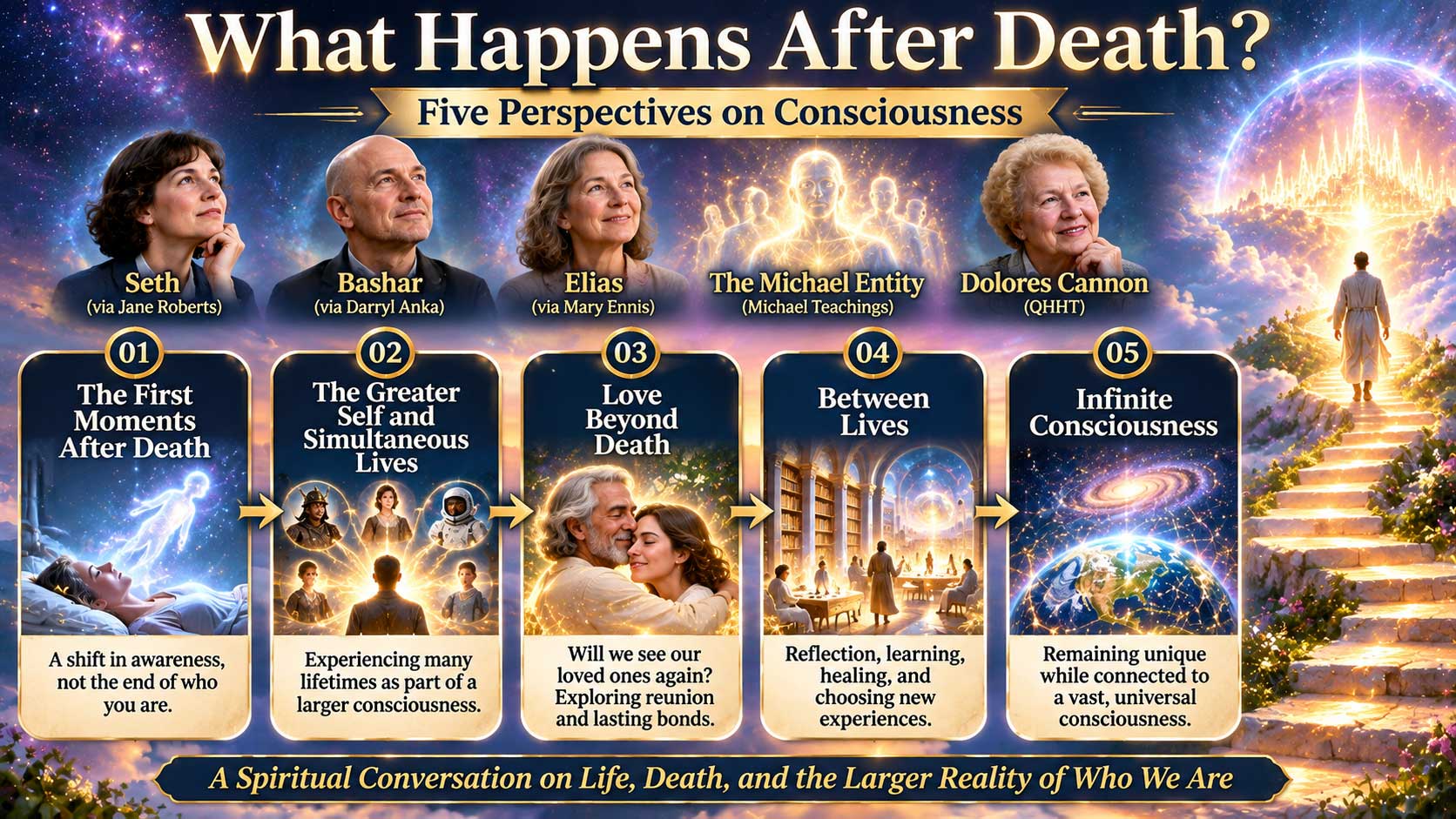
Short Bios:
Seth: A purported nonphysical consciousness whose teachings were communicated through American author Jane Roberts (1929–1984), beginning in the 1960s. Seth's books explore consciousness, multidimensional identity, reincarnation, beliefs, and the nature of reality. His influential works include Seth Speaks, The Nature of Personal Reality, and The "Unknown" Reality. Learn more through the Seth Center.
Bashar: A purported nonphysical intelligence channeled by Darryl Anka since 1983. Bashar's teachings examine parallel realities, the Higher Mind, the eternal present, and how individual beliefs influence experienced reality. Anka describes Bashar as an extraterrestrial consciousness communicating through channeling, while acknowledging that its independent existence cannot be proven. Learn more at the official Bashar website.
Elias: A purported nonphysical consciousness communicated through Mary Ennis, whose channeling sessions began in 1995. Elias's teachings explore the relationship between essence and individual focuses, simultaneous incarnations, beliefs, perception, and the transition after physical death. The material presents each lifetime as a unique focus of a greater consciousness. Explore the Elias Sessions and Mary Ennis's introduction.
The Michael Entity: A purported collective consciousness described in the Michael Teachings as comprising 1,050 essences that completed their earthly incarnation cycles. The teachings became widely known through Chelsea Quinn Yarbro's Messages from Michael. They explore soul ages, reincarnation, personality, essence, and development beyond physical life. Learn more through the Michael Educational Foundation.
Dolores Cannon: American hypnotherapist and author (1931–2014) known for her work in past-life regression and Quantum Healing Hypnosis Technique (QHHT). Her books, including Between Death and Life and The Convoluted Universe series, describe accounts of reincarnation, nonphysical existence, life reviews, and the nature of consciousness reported by subjects during hypnosis. Learn more through her official biography.
Sources and Further Reading
Seth
Seth Speaks: The Eternal Validity of the Soul, particularly Chapters 9–13.
The "Unknown" Reality, Volumes 1 and 2.
Bashar
Elias
The Michael Entity
Messages from Michael by Chelsea Quinn Yarbro.
Dolores Cannon
Between Death and Life
The Convoluted Universe series.
Leave a Reply