

Introduction
What if the greatest chapter of human history hasn't been written yet?
What if artificial intelligence helps us discover new cures, live healthier lives, pursue dreams we once considered impossible, and even become better at understanding and forgiving one another?
In America's Golden Age: Trumpism and an Era of Limitless Possibilities, former U.S. House Speaker Newt Gingrich offers a strikingly optimistic vision of America's next fifty years.
His central purpose is simple: reignite optimism.
At a time when public conversations often focus on division, uncertainty, and technological disruption, Gingrich asks readers to consider a different possibility. What if the convergence of artificial intelligence, biotechnology, robotics, advanced manufacturing, and scientific discovery creates extraordinary opportunities for human progress?
His argument is rooted in a distinctly American belief in freedom, entrepreneurship, innovation, and the capacity of individuals to shape their own futures.
But what happens when that vision meets four other remarkable perspectives?
In this fictional conversation, Gingrich is joined by Masayoshi Son, the Japanese technology visionary whose enthusiasm for artificial superintelligence reaches beyond productivity into human happiness; Peter Diamandis, who explores the possibilities of abundance and healthy longevity; Fei-Fei Li, a leading advocate for human-centered artificial intelligence; and Arthur C. Brooks, whose work examines happiness, relationships, and the search for meaning.
Our setting is July 4, 2076, America's 300th birthday.
Five thinkers gather in a peaceful garden overlooking a future city. Looking back across fifty years, they explore what humanity might accomplish if scientific ambition is matched by wisdom, compassion, and a genuine desire to improve people's lives.
Their conversation unfolds through five questions:
- Are Humanity's Greatest 50 Years Still Ahead? Can optimism become a force that inspires people to build a better future?
- When AI Becomes Smarter Than Humans, Could We Become More Human? Might artificial intelligence expand creativity, independence, and human potential rather than diminish them?
- What If We Could Live to 120 and Still Have Dreams Worth Pursuing? How might longer, healthier lives change our understanding of aging, family, and purpose?
- Can We Create a Golden Age That Reaches Every Family? What would technological abundance mean for ordinary people, including those who have historically had fewer opportunities?
- Could AI Help Us Love, Forgive, and Find Greater Happiness? Might one of AI's most meaningful contributions be helping people understand themselves and one another?
The fifth conversation brings an unexpected dimension to Gingrich's vision.
Son suggests that artificial intelligence might help an estranged daughter understand her father, a married couple communicate more thoughtfully, or an older person reconnect with someone they love.
Brooks asks whether technology can genuinely contribute to happiness without replacing the difficult, deeply human work of loving and forgiving.
Their exchange leads to a question that reaches beyond technological achievement:
What if humanity's greatest golden age is measured not only by how intelligent our machines become, but by how much wiser, kinder, and more loving we become?
This imaginary discussion is inspired by Gingrich's book and the participants' publicly expressed areas of interest. The dialogue, future setting, and personal exchanges are fictional. Predictions about AI, longevity, and other technologies are possibilities to explore, not established outcomes.
The purpose is not to challenge optimism for its own sake. It is to explore how an already ambitious vision of human progress might become even more meaningful.
Perhaps the most exciting part of the future isn't simply what we will discover.
Perhaps it's what we will choose to do with those discoveries.
(Note: This is an imaginary conversation, a creative exploration of an idea, and not a real speech or event.)

Topic 1: Are Humanity's Greatest 50 Years Still Ahead?

July 4, 2076. The Golden Garden.
The terrace overlooks a city celebrating America's 300th birthday. Below, children play beneath flowering trees. Autonomous vehicles move almost silently along shaded streets. An elderly couple walks hand in hand, stopping occasionally to admire the festivities.
Five thinkers have gathered around a circular table. On a nearby screen is the cover of a book published fifty years earlier: America's Golden Age.
Newt Gingrich: You know, when I wrote that book back in 2026, people thought I was being ridiculously optimistic.
Peter Diamandis: Only ridiculously?
Newt Gingrich: (Laughing) Peter, some people thought I'd lost my mind. The country was divided. People were worried about artificial intelligence taking their jobs, medical costs were out of control, and every television network seemed determined to convince Americans that civilization was about to collapse.
And I kept thinking, have these people forgotten who we are?
Arthur C. Brooks: What do you mean by that, Newt?
Newt Gingrich: Think about the people who crossed the Atlantic in wooden ships. Think about the families who loaded everything they owned into wagons and headed west. They didn't have guarantees. They had imagination, courage, and the belief that tomorrow could be better than today.
That willingness to build something better is one of the things I most admire about America.
I wrote America's Golden Age to remind people that our greatest accomplishments didn't have to be behind us.
Masayoshi Son: Newt, I remember reading about your book. What interested me wasn't simply your optimism about America. It was that you were thinking fifty years ahead.
Most business leaders think about the next quarter. Politicians think about the next election. But fifty years? That changes the questions you ask.
Newt Gingrich: Exactly. And Masayoshi, you were doing something similar with artificial superintelligence.
Masayoshi Son: Yes, but I think there is something even more interesting.
For most of human history, intelligence was one of our greatest limitations. A brilliant scientist could spend a lifetime solving one difficult problem. A doctor might never encounter the information needed to save a particular patient.
What happens when intelligence becomes extraordinarily abundant?
Peter Diamandis: That's the question that fascinated me for decades. We used to think of scarcity as a permanent condition. Not enough doctors. Not enough teachers. Not enough energy. Not enough expertise.
But technology can change the economics of scarcity.
Think about photography. A hundred years ago, taking a photograph required equipment, film, processing, and money. Today, billions of people can take pictures almost without thinking about the cost.
Now imagine that kind of transformation happening in education or medical diagnostics.
Fei-Fei Li: I agree with the possibility, Peter, but I want to make one distinction. Having abundant intelligence doesn't automatically mean having abundant wisdom.
A system might know everything written about medicine and still fail to understand what a frightened patient needs to hear.
Masayoshi Son: That's true. But Fei-Fei, why should we assume the technology stops improving at that point?
Fei-Fei Li: We shouldn't. My question is how we guide that improvement. The goal isn't simply to build machines that perform impressive tasks. It's to build technology that serves human beings.
Newt Gingrich: And that's where I think people sometimes misunderstand optimism.
Optimism isn't saying there won't be problems. Of course there will be problems. It's saying we have the capacity to solve them.
When Edison helped make electric lighting practical, people didn't need to understand every consequence of electrification before recognizing its enormous potential.
Arthur C. Brooks: Newt, let me ask you something. You often connect optimism with the American character. But isn't hope something much larger than any one nation?
Newt Gingrich: Absolutely. America doesn't own optimism. What I'm saying is that the American experiment was built around a remarkable proposition: people should have the freedom to pursue a better life.
And I believe that freedom helped create an environment where people could take risks, invent things, fail, try again, and succeed.
Masayoshi Son: I like that distinction. I'm Japanese. My vision of artificial intelligence has never been limited to Japan.
When I think about superintelligence, I think about humanity.
A child in Africa. An elderly woman in Japan. A farmer in India. A family in Ohio.
Why shouldn't they all benefit?
Peter Diamandis: And that changes the scale of our ambitions.
For most of history, if you wanted to solve a problem affecting a billion people, you needed enormous physical infrastructure and extraordinary financial resources.
Digital technologies made it possible for a relatively small group of people to reach millions, sometimes billions.
AI could extend that capacity much further.
Arthur C. Brooks: But I want to return to something Newt said about courage.
There's an emotional dimension here. People don't resist the future simply because they don't understand technology. Sometimes they're afraid of losing something they value.
Their livelihood. Their independence. Their dignity.
If we want people to embrace the future, we have to take those fears seriously.
Newt Gingrich: Arthur, I agree. But here's what bothers me. We spend so much time telling young people what might go wrong that we sometimes forget to tell them what they could accomplish.
Imagine being twenty years old in 2026.
You might help develop a treatment for Alzheimer's. You might build a company that brings excellent education to children who have never had access to it. You might help design a spacecraft or discover a new material.
And instead of telling you that the world is full of opportunities, we tell you to be afraid.
That's a terrible way to prepare the next generation.
Fei-Fei Li: I agree with the importance of opportunity. But I would tell that young person something else, too.
Don't simply ask what AI can do for you. Ask what you want to accomplish with it.
Technology is a tool. Human purpose should guide its use.
Masayoshi Son: Fei-Fei, may I challenge that just a little?
Fei-Fei Li: Please.
Masayoshi Son: We often say AI is a tool, and I understand why. But I think that description may become too limited.
A hammer doesn't help you discover a new idea. A calculator doesn't ask why you're solving a particular problem.
Advanced AI may become something much more interactive. It may challenge our assumptions, show us possibilities we haven't considered, and help us develop ideas we couldn't have developed alone.
I don't think that makes humans less important.
I think it could make our potential much greater.
Peter Diamandis: That's the combination effect Newt wrote about.
People tend to imagine technologies developing separately. AI gets better. Robotics gets better. Biotechnology gets better.
But when those advances interact, the possibilities multiply.
Imagine AI helping scientists design a new treatment, robotics making it inexpensive to manufacture, and personalized medicine helping doctors determine who would benefit.
That's much more significant than any one breakthrough.
Newt Gingrich: Precisely! That's one of the central arguments of my book.
People look at an invention and ask, "What will this change?"
But the better question is, "What happens when this invention interacts with ten other inventions?"
The automobile changed transportation. Electricity changed daily life. Computers changed communication and commerce.
Now think about what happens when intelligent systems interact with biology, manufacturing, energy, and space exploration.
We shouldn't assume we can predict the limits of those combinations.
Arthur C. Brooks: I can see why that excites you. But I wonder whether our imagination sometimes gets ahead of our ability to recognize what really matters.
Suppose a future family has extraordinary medical care, a beautiful home, and an AI assistant that manages practically everything.
But the parents hardly speak to their children.
Would you call that progress?
Newt Gingrich: I'd call it incomplete progress.
Arthur C. Brooks: That's an important answer.
Newt Gingrich: Arthur, I'm an optimist, not an idiot.
(Everyone laughs.)
Newt Gingrich: A better civilization isn't just one with more gadgets. It's one where people have greater freedom and opportunity to build meaningful lives.
But I don't accept the idea that technological progress and human happiness have to compete.
Masayoshi Son: Neither do I.
In fact, Arthur, I think we may be making a mistake when we separate them too sharply.
Arthur C. Brooks: How so?
Masayoshi Son: Think about a young man who wants to reconnect with his father after twenty years of silence.
He doesn't know what to say. Every time he thinks about calling, he remembers the arguments, the disappointment, the anger.
What if an AI assistant helps him examine the situation from another perspective?
Not by telling him what to feel. Not by pretending to know his father.
But by asking questions he has never asked himself.
What was your father afraid of? What do you wish he had understood about you? What would you want him to know now?
Maybe the young man still decides not to call.
But maybe, for the first time in twenty years, he sees a possibility.
Isn't that technological progress helping human progress?
Arthur C. Brooks: It certainly could be. Though I would want to be careful about a machine inventing explanations for someone's behavior.
Fei-Fei Li: That's exactly the distinction. A trustworthy AI should help people examine possibilities without presenting speculation as fact.
Masayoshi Son: Yes! And that's the kind of AI I want humanity to build.
Not simply intelligence that answers questions.
Intelligence that helps us ask better questions.
Peter Diamandis: That's a fascinating thought. We've been discussing technologies that could help people live longer. But what if they could help people live better together?
Newt Gingrich: You know, Peter, that's a wonderful extension of the argument.
When I wrote about America's golden age, I was thinking about extraordinary advances in science, medicine, prosperity, and opportunity.
But the point of those achievements is to improve human life.
If technology helps a father and son reconcile, that's not separate from progress. That's progress becoming personal.
Arthur C. Brooks: And perhaps that's where optimism becomes most meaningful.
Not when someone tells us the future will be wonderful, but when we begin to see something good we can actually do.
Fei-Fei Li: Which brings us to the question I want to ask everyone here.
Suppose a young person in 2026 is listening to this conversation.
They're not a billionaire. They're not a scientist. They don't work for a technology company.
What can they do to participate in this future?
Peter Diamandis: Start by identifying a problem you care about.
Don't begin with the technology. Begin with someone whose life you want to improve.
Maybe it's an aging parent who needs assistance. Maybe it's children who struggle to learn. Maybe it's people who feel isolated.
Then ask what new tools make possible.
Masayoshi Son: And don't underestimate your own imagination.
A young person with access to AI may be able to attempt projects that once required an entire organization.
But I would tell them something else.
Don't ask only how to become successful.
Ask how your success can make other people happy.
Arthur C. Brooks: I like that very much.
And I would encourage them to cultivate relationships alongside their ambitions.
Build something meaningful, certainly. But don't become so fascinated with changing the world that you forget the people sitting across the dinner table.
Fei-Fei Li: I would tell them to remain curious and independent.
Use AI to learn, explore, and challenge your thinking. But don't surrender your judgment simply because a machine produces an impressive answer.
Newt Gingrich: And I'd tell them not to let the pessimists convince them that their best opportunities are gone.
Every generation inherits problems. Every generation has the chance to solve some of them.
You don't need to know exactly what the world will look like fifty years from now.
You need the courage to help make it better.
(For a moment, the conversation pauses. Beyond the terrace, children are running through the garden, chasing small glowing lights that float gently above the grass.)
Arthur C. Brooks: Newt, looking back at the book that brought us together, is there anything you would change about its message?
Newt Gingrich: I'd probably make it even more optimistic.
(Son laughs.)
Masayoshi Son: Now you're speaking my language.
Newt Gingrich: No, I'm serious.
I wanted people to believe that America's greatest achievements might still be ahead.
But listening to all of you, I think the possibility is even larger.
We can build better machines, discover better treatments, create extraordinary opportunities, and perhaps help people become better at living together.
The future isn't something we simply inherit.
It's something we help create.
Masayoshi Son: And perhaps the most exciting thing is that we may still be underestimating what's possible.
Fei-Fei Li: As long as we remain thoughtful about what we're creating.
Peter Diamandis: And ambitious about the problems we choose to solve.
Arthur C. Brooks: And clear about the people we're trying to help.
Newt Gingrich: Then let me ask all of you something.
If you could send one message back to a twenty-year-old in 2026, what would it be?
Masayoshi Son: Don't be afraid of intelligence greater than your own. Learn how to work with it, and use it to make other people's lives better.
Peter Diamandis: Find a problem that matters to you. The tools available during your lifetime may allow you to solve it in ways no previous generation could.
Fei-Fei Li: Stay curious. Keep asking questions. And never confuse having an answer with knowing what is right.
Arthur C. Brooks: Love people now. Don't wait for a better world before becoming the kind of person who can make one.
Newt Gingrich: Mine is simple.
Don't let anyone convince you that the great adventures of humanity are over.
They may just be beginning.
Across the city, the first fireworks of the tricentennial celebration rise into the evening sky. For a moment, their reflections shimmer across the glass buildings and the faces of the children watching below.
At the table, Son is still smiling, but he has been thinking about something Brooks said.
Masayoshi Son: Arthur, there's one thing I want to come back to.
Arthur C. Brooks: What's that?
Masayoshi Son: You said we shouldn't wait for a better world before becoming better people.
I agree.
But I wonder what happens when the intelligence we create begins helping us discover better ways to think, learn, and understand ourselves.
Perhaps we haven't yet realized how much human potential remains unexplored.
Fei-Fei Li: That's a question worth taking seriously.
Newt Gingrich: Well, we've got fifty years of possibilities sitting in front of us.
I'd say we have plenty to talk about.
Topic 2: When AI Becomes Smarter Than Humans, Could We Become More Human?
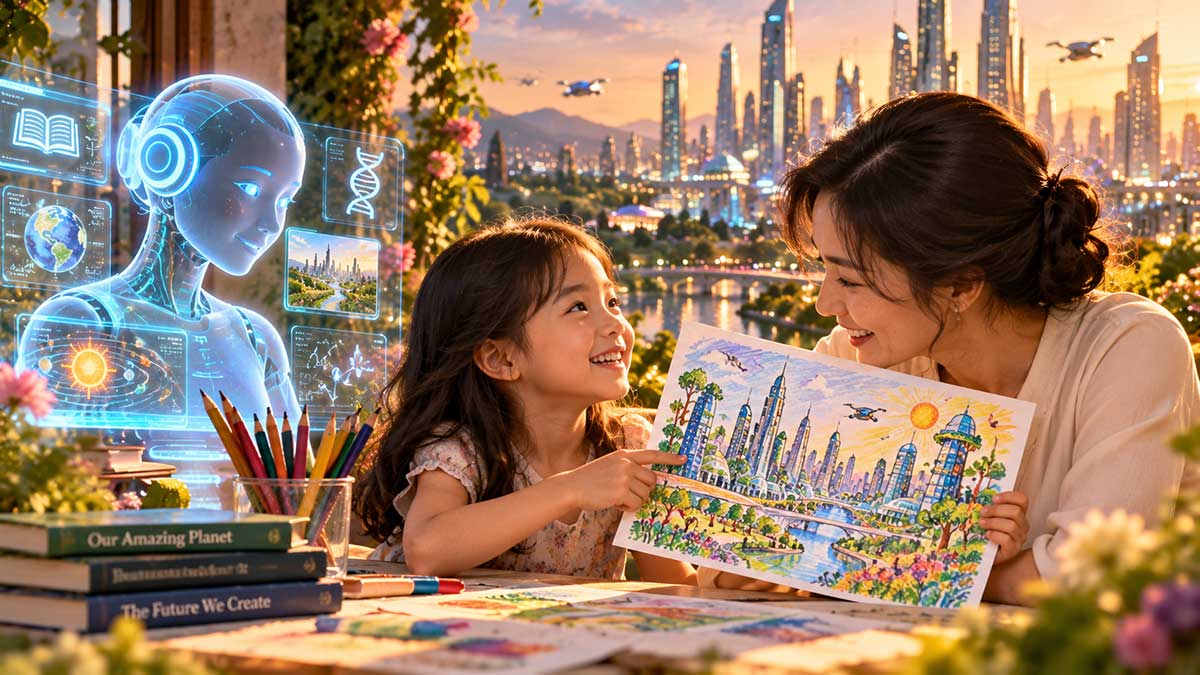
The last fireworks have faded over the city of 2076. In the Golden Garden, small lights illuminate the pathways. A young woman passes the terrace with a child who is asking questions faster than she can answer them.
Masayoshi Son watches them for a moment, smiling.
Masayoshi Son: When I was young, I had a dream that seemed almost absurd. I believed there would come a time when artificial intelligence would surpass human intelligence by an extraordinary margin.
People would ask me, "Masayoshi, aren't you afraid of creating something smarter than yourself?"
And I would ask them, "Why should I be afraid of something that might help humanity accomplish what we could never accomplish alone?"
Arthur C. Brooks: But Masayoshi, intelligence and goodness aren't the same thing. A brilliant person can be cruel. An extraordinarily intelligent machine could be very capable without caring about anyone.
Masayoshi Son: Yes. And that is why the question of what we want intelligence to accomplish matters so much.
But Arthur, let me ask you something. Suppose you had a teacher who was a thousand times more knowledgeable than you. Would you refuse to learn from that teacher?
Arthur C. Brooks: Of course not.
Masayoshi Son: Then why should we assume that learning from something more intelligent makes us less human?
Fei-Fei Li: I agree with that distinction. But I would change one word in your question.
Knowledgeable isn't necessarily the same as intelligent. And neither guarantees that a system understands the consequences of its advice.
An AI might provide a remarkably accurate explanation of human psychology and still misunderstand the circumstances of a particular person.
Peter Diamandis: True. But humans make those mistakes too.
Fei-Fei Li: Absolutely. That's why the goal should be better judgment, not unquestioning trust in either humans or machines.
Newt Gingrich: You know, this reminds me of something from American history.
When public libraries began spreading across the country, people gained access to knowledge that had once been reserved for a relatively small number of scholars and wealthy families.
Nobody seriously argues that libraries made human intelligence worthless.
They gave ordinary people opportunities to learn.
AI could represent another enormous expansion of access to knowledge.
Arthur C. Brooks: But Newt, there's a difference between reading a book and asking a machine to do your thinking.
Newt Gingrich: Of course. And there's a difference between using a calculator to check your arithmetic and never learning arithmetic in the first place.
The question is how we use the technology.
Masayoshi Son: Arthur, I think you've touched on something very interesting.
What if AI could recognize when we're using it to avoid thinking?
Arthur C. Brooks: What do you mean?
Masayoshi Son: Suppose a student asks an AI system to write an essay.
The system could produce a beautiful essay in seconds.
But perhaps it responds, "I can write this for you. But first, tell me what you believe. Let's explore your argument together."
Now the AI isn't replacing the student's thinking. It's helping the student develop it.
Fei-Fei Li: That's a much better educational model.
An effective AI tutor shouldn't simply maximize the number of correct answers it produces. It should help students develop their own capabilities.
Sometimes that means answering a question.
Sometimes it means asking one.
And sometimes it means allowing a student to struggle long enough to discover something independently.
Peter Diamandis: Think about the implications for education.
In 2026, a wealthy family might hire an excellent private tutor. A child in a remote village might have one overworked teacher responsible for forty students.
Now picture a future where every child can receive personalized instruction in their own language.
A child who struggles with mathematics could receive patient explanations for as long as necessary.
A child who learns quickly could move ahead.
A child with a learning disability could receive assistance suited to their needs.
That could be one of the most significant advances in educational opportunity in history.
Arthur C. Brooks: Provided children still learn how to interact with other children.
Peter Diamandis: Certainly.
Arthur C. Brooks: I'm serious, Peter. Education isn't simply the transfer of information.
A child learns patience when another child interrupts. Cooperation when a group project becomes difficult. Courage when speaking in front of classmates.
Those experiences matter.
Masayoshi Son: I agree. But perhaps AI could help with those experiences too.
Arthur C. Brooks: You're determined to bring AI into every part of human life, aren't you?
Masayoshi Son: (Laughing) Arthur, I'm beginning to think you're determined to keep it out!
Arthur C. Brooks: Someone has to keep you from giving the robots all the good jobs.
Newt Gingrich: I have a feeling Masayoshi would give the robots the bad jobs first.
Masayoshi Son: Exactly!
(The group laughs.)
Masayoshi Son: But seriously, imagine a shy child who is terrified of speaking in public.
An AI tutor could help her practice. It could listen patiently, suggest improvements, and encourage her to try again.
Then, when she stands before her classmates, she has more confidence.
The machine hasn't replaced human interaction.
It has helped her participate in it.
Fei-Fei Li: That's an excellent example of technology supporting human agency.
But the design matters. If the AI becomes so agreeable that the child never learns to handle disagreement, we may create a different problem.
A good assistant should help people engage with reality, not hide from it.
Newt Gingrich: And that's where I think the real opportunity lies.
We shouldn't be asking whether AI will eliminate every difficulty in life.
We should ask whether it can help people overcome difficulties that previously defeated them.
There is an enormous difference.
Peter Diamandis: And the same principle applies to creativity.
For centuries, a person with an idea for a movie needed access to cameras, actors, editing equipment, financing, and distribution.
A person with an idea for a new product needed engineers, manufacturers, and capital.
AI can reduce some of those barriers.
More people can attempt things that once seemed beyond their reach.
Arthur C. Brooks: But if everyone can create a beautiful painting or write a moving story with AI, what happens to the satisfaction of developing a skill?
Masayoshi Son: Arthur, do you enjoy cooking?
Arthur C. Brooks: I do.
Masayoshi Son: And restaurants exist?
Arthur C. Brooks: Last time I checked.
Masayoshi Son: (Smiling) Yet you still cook.
The existence of someone who can cook better than you doesn't eliminate the pleasure of cooking.
Why should the existence of AI that can create something beautiful eliminate the pleasure of creating?
Arthur C. Brooks: That's fair. But there's another possibility. People might become so accustomed to instant results that they lose the patience required to develop mastery.
Fei-Fei Li: That's a genuine concern.
We should distinguish between creating an output and developing a capability.
If someone uses AI to generate a beautiful image, they have created something with assistance.
If someone spends years learning to paint, they've developed observation, technique, judgment, and persistence.
Both activities may have value, but they're not identical.
Peter Diamandis: Perhaps AI will make the difference clearer.
People may begin asking themselves, "Do I want this result, or do I want to become the kind of person who can produce it?"
Newt Gingrich: That's a wonderful question.
And I suspect the answer will depend on the task.
I don't need to become an expert mechanic every time my car breaks down. But I might want to learn to play the piano simply for the satisfaction of learning.
Technology gives us choices.
It doesn't have to make those choices for us.
Arthur C. Brooks: Now we're getting somewhere.
The real danger isn't that AI becomes extraordinarily capable.
It's that human beings stop asking what capabilities they want to develop within themselves.
Masayoshi Son: Yes. But I would go further.
I think AI might help people discover abilities they never realized they possessed.
Let me tell you a story.
Son leans forward. The garden has grown quieter, and the others turn their attention to him.
Masayoshi Son: Imagine a sixty-five-year-old man who has spent most of his life working in business.
He always wanted to write stories, but he never believed he had the talent.
One day, he begins talking with an AI assistant about a memory from his childhood.
The AI asks him questions.
What did the room look like? What did your mother say? Why does that memory still matter to you?
As he answers, he begins discovering a story.
Then another.
Then another.
He starts writing things he never thought he could write.
Tell me, Arthur, has AI made that man less creative?
Arthur C. Brooks: No. It sounds as if the AI helped him find a part of himself that had been waiting for an opportunity.
Masayoshi Son: Exactly.
The story still comes from his life, his memories, his imagination.
The AI helps him express something that might otherwise have remained hidden.
Fei-Fei Li: And the important detail is that he's participating.
He's not simply accepting whatever the system generates.
He's making decisions, rejecting suggestions, adding memories, and discovering what he wants to say.
That's a meaningful collaboration.
Peter Diamandis: And imagine how many people have creative ambitions they've abandoned.
Someone wants to compose music but can't read notation.
Someone wants to design a house but doesn't know architectural software.
Someone wants to start a business but struggles with accounting.
AI could help them cross those initial barriers.
Newt Gingrich: Which brings us back to the future I was trying to describe in America's Golden Age.
For too long, people have looked at technological change primarily in terms of what it might take away.
What jobs disappear? What industries become obsolete?
Those questions deserve attention.
But we should be equally interested in what becomes possible.
What new businesses can people create? What problems can they solve? What dreams can they finally pursue?
Arthur C. Brooks: I like the story about the older man. But I want to challenge Masayoshi on something.
Suppose that same man becomes dependent on his AI assistant.
He asks it what to write, what to think, what to believe.
Eventually, he stops trusting his own judgment.
Would you still call that progress?
Masayoshi Son: No.
Arthur C. Brooks: That was a surprisingly quick answer.
Masayoshi Son: (Laughing) You were expecting a longer argument?
Arthur C. Brooks: From you? Absolutely.
Masayoshi Son: Then let me give you one.
I believe intelligence should help people become more capable, not more helpless.
If an AI system makes someone dependent on it for every decision, perhaps we have built the wrong kind of assistant.
Why not create systems that encourage people to think independently?
An AI might say, "Here are three possibilities. What do you think?"
Or, "You've asked me this question before. Would you like to try answering it yourself?"
Or perhaps, "I think you already know what matters to you. Tell me what you're afraid of."
Fei-Fei Li: That's a valuable design goal, though we should be careful about assuming a system knows someone's inner motives.
It can ask reflective questions without pretending to read minds.
And people should be able to disagree with it, question its advice, or walk away.
Arthur C. Brooks: That last part matters enormously.
A healthy relationship with technology should leave us free to live without constantly consulting it.
Peter Diamandis: I wonder whether the same thing could be said about education.
A great teacher doesn't want students to remain dependent forever.
The goal is for them to develop the ability to think and act independently.
Newt Gingrich: And that's an important part of freedom.
A society of people who can think for themselves is fundamentally different from a society where everyone waits to be told what to do.
If AI helps people become more knowledgeable and confident, that's an extraordinary opportunity.
If it encourages passivity, we've missed the point.
Masayoshi Son: There's something else I want to discuss.
We've talked about intelligence, creativity, and independence.
But what about emotional intelligence?
Arthur C. Brooks: I had a feeling you were coming back to that.
Masayoshi Son: (Smiling) Of course.
Consider a husband and wife who have been married for thirty years.
They love each other, but they have developed habits of misunderstanding one another.
The husband thinks his wife is criticizing him. The wife thinks her husband never listens.
They have the same argument again and again.
Now suppose AI helps each person recognize the pattern.
It might ask the husband, "When your wife says she's tired, are you hearing a request for help or an accusation?"
And it might ask the wife, "When your husband becomes quiet, is it possible he's overwhelmed rather than indifferent?"
Would that be valuable?
Arthur C. Brooks: Potentially, yes. But those are possibilities, not conclusions about what either spouse really feels.
Masayoshi Son: Exactly. The AI opens a door. The people decide whether to walk through it.
Fei-Fei Li: And it must respect privacy and consent. We wouldn't want an AI secretly analyzing one spouse on behalf of the other.
Peter Diamandis: What interests me is that we're beginning to talk about technology improving the quality of human relationships.
That could have enormous implications.
Think about how much suffering comes from misunderstandings, isolation, and unresolved conflict.
Newt Gingrich: And how much human potential is lost when people spend years carrying resentment or believing they're incapable of change.
Arthur C. Brooks: I agree that technology could help people examine their assumptions.
But forgiveness is more than a cognitive exercise.
Someone can intellectually recognize why another person behaved badly and still feel deeply hurt.
And sometimes reconciliation isn't safe or appropriate.
Masayoshi Son: I agree.
AI should never pressure someone to forgive or return to a harmful relationship.
But Arthur, consider what you just said.
Someone can understand another person's behavior intellectually and still feel hurt.
Perhaps AI can help with the next step, too.
Not by removing the pain, but by helping someone explore it.
Why am I holding on to this anger? What would forgiveness mean to me? Can I release resentment without pretending the harm never happened?
Those are difficult questions.
Maybe having a patient, thoughtful assistant could help someone begin asking them.
Arthur C. Brooks: That's a more convincing argument.
And I appreciate that you're not claiming AI can manufacture forgiveness.
You're suggesting it might help people develop the insight and courage to choose it.
Masayoshi Son: Yes.
For years, people imagined superintelligence primarily in terms of solving scientific problems.
But I believe the possibilities for human happiness deserve just as much attention.
Fei-Fei Li: And that brings us back to human-centered AI.
The best systems won't simply optimize for engagement or tell users what they want to hear.
They'll help people understand their choices and maintain their independence.
Newt Gingrich: There's an irony here.
People once feared that machines would make human physical abilities irrelevant.
Instead, machines gave us extraordinary freedom to travel, build, and explore.
Now some people fear that intelligent machines will make human thinking irrelevant.
But perhaps they could help us become more intellectually ambitious than ever.
Peter Diamandis: And more creative.
Arthur C. Brooks: Perhaps more self-aware.
Fei-Fei Li: If we build and use them responsibly.
Masayoshi Son: And perhaps more compassionate.
Below the terrace, the young woman and child have returned. The child is holding a small drawing of the city, filled with impossible-looking buildings and colorful gardens.
Arthur C. Brooks: Look at that child. I wonder what education means in a world like this.
Fei-Fei Li: I hope it still means discovering what you don't know.
Peter Diamandis: And having the opportunity to pursue whatever interests you.
Newt Gingrich: And developing the courage to try things that seem impossible.
Masayoshi Son: I would add one more thing.
Learning how to use intelligence without surrendering your humanity.
Arthur C. Brooks: That's a good thought. But let me ask the question a different way.
What should we teach children that no machine can decide for them?
Fei-Fei Li: What they value.
An AI can help them explore history, philosophy, and different perspectives. But they must learn to make judgments and accept responsibility for their decisions.
Peter Diamandis: I'd teach them to identify problems worth solving.
Not simply how to find answers, but how to recognize opportunities to improve people's lives.
Newt Gingrich: I'd teach them that freedom comes with responsibility.
If you want to shape the future, you can't spend your life waiting for someone else to shape it for you.
Arthur C. Brooks: I'd teach them that love is an action.
You can know everything about kindness and still fail to be kind to the person sitting beside you.
Masayoshi Son: And I would teach them something my father taught me.
Make other people happy.
Son pauses, looking across the illuminated garden.
Masayoshi Son: We can build machines with extraordinary intelligence. We can create technologies that solve problems previous generations thought impossible.
But if a child grows up believing that intelligence exists only to make himself richer or more successful, we have taught him something terribly incomplete.
I want children to ask, "How can I use what I know to help someone else?"
Arthur C. Brooks: Masayoshi, that's a much better answer than I expected from the man who wanted to give everyone a superintelligent assistant.
Masayoshi Son: (Laughing) Arthur, you keep thinking I love machines.
I love what they might help people accomplish.
Newt Gingrich: And that's the future worth building.
Not a world where human beings become unnecessary.
A world where more human beings have the opportunity to become everything they're capable of becoming.
The child below the terrace holds up her drawing to her mother. The woman bends down, studies it carefully, and asks a question. The little girl begins explaining, pointing excitedly at the tallest building.
Fei-Fei Li: Look at her mother.
Peter Diamandis: What about her?
Fei-Fei Li: She could probably ask an AI to interpret the drawing. It might identify every building, every shape, every color.
But instead, she asks her daughter what she was thinking.
Arthur C. Brooks: And her daughter gets to tell her.
Masayoshi Son: That's beautiful.
Newt Gingrich: You know, fifty years ago, people were asking whether AI would replace human intelligence.
Maybe we should have been asking a bigger question.
What new possibilities might intelligence create for human beings?
Masayoshi Son: And how can we use those possibilities to become more fully human?
The little girl takes her mother's hand, and together they walk beneath the trees. Her drawing is still held high, catching the last light of the celebration.
At the table, the conversation continues, but the image lingers: a child with an idea, a parent willing to listen, and a future that still has room for both.
Topic 3: What If We Could Live to 120 and Still Have Dreams Worth Pursuing?

The evening air in the Golden Garden has turned cool. Beyond the terrace, an elderly couple is dancing beneath a flowering tree. The woman laughs when her husband misses a step, then pulls him closer.
Peter Diamandis watches them with obvious delight.
Peter Diamandis: Look at those two. I wonder how old they are.
Newt Gingrich: Peter, I know that expression. You're about to tell us they're a hundred and forty.
Peter Diamandis: (Laughing) I was going to say ninety-five. But thank you for raising the ambition.
Arthur C. Brooks: Before you start selling everyone another fifty years, Peter, could we establish whether those two actually want them?
Peter Diamandis: Arthur, that's precisely the question I want to explore.
For centuries, people assumed that growing older meant an inevitable decline in strength, memory, and independence. We accepted that diseases would accumulate and that eventually the body would fail.
But what if we could change the experience of aging itself?
Fei-Fei Li: We should distinguish between extending lifespan and extending healthspan. Living to 120 is one thing. Remaining healthy, independent, and mentally engaged for most of those years is another.
Peter Diamandis: Exactly. I'm much more interested in the second.
Imagine reaching ninety and still having the physical ability to travel, the mental clarity to learn, and the energy to begin something entirely new.
That's a different understanding of old age.
Newt Gingrich: And it's very close to what I was describing in America's Golden Age.
One of the great changes I anticipated was a shift from treating people after they became seriously ill to helping them remain healthy in the first place.
We spent enormous amounts of money managing disease after it had already caused damage.
I wanted us to think about preventing that damage.
Masayoshi Son: Newt, I think artificial intelligence could make that transformation much more significant.
Imagine a medical system that doesn't wait for you to become sick.
It continuously helps you understand your health, recognizes changes, and suggests when you should seek professional care.
Not a doctor you visit only when something goes wrong, but intelligent assistance that helps you make better decisions throughout your life.
Arthur C. Brooks: That sounds attractive. But there's something slightly unsettling about being monitored constantly.
Masayoshi Son: Then don't monitor constantly.
Arthur C. Brooks: You make it sound so simple.
Masayoshi Son: (Smiling) Sometimes the answer is simple. Give people choices.
If someone wants an AI assistant to help them manage their health, let them use it. If someone wants less monitoring, respect that.
The technology should serve the person.
Fei-Fei Li: And people need meaningful control over their information.
Health data is deeply personal. A system that helps prevent illness could be enormously valuable, but only if it protects privacy, acknowledges uncertainty, and doesn't turn every normal variation into a medical alarm.
Peter Diamandis: That's an excellent point.
The goal isn't to make people spend their entire lives worrying about their health.
It's to make good health easier to maintain.
Think about the difference between repairing a bridge after it collapses and inspecting it regularly so you can address problems before they become dangerous.
Arthur C. Brooks: I understand the principle. But human beings aren't bridges, Peter.
Peter Diamandis: (Laughing) I was hoping you'd let that one pass.
Arthur C. Brooks: Not a chance.
Peter Diamandis: Fair enough. Human beings are infinitely more complicated. But prevention still matters.
Take Alzheimer's disease. Imagine being able to identify important risk factors much earlier and intervene before severe cognitive decline begins.
Think about what that could mean for families.
Newt Gingrich: That's exactly why I discussed Alzheimer's in my book.
People tend to think about the cost of treatment. But the human cost is much greater.
The husband who no longer recognizes his wife. The daughter who spends years caring for a parent. The family watching someone they love gradually lose the ability to communicate.
If medical advances could delay that suffering significantly, it would be an extraordinary achievement.
Fei-Fei Li: And we should be careful about what we're promising.
Risk prediction isn't the same as prevention. A test might identify increased risk without telling us exactly who will develop a disease. And delaying Alzheimer's by decades remains an ambitious research goal.
But advances in early detection, prevention, and treatment are important areas of scientific work.
Masayoshi Son: Fei-Fei, I appreciate that distinction.
I sometimes become so excited about what may be possible that I want to jump fifty years ahead.
Newt Gingrich: That's why we invited you.
Masayoshi Son: (Laughing) And that's why we invited Fei-Fei to keep me from jumping too far.
Fei-Fei Li: Someone has to check whether the landing is safe.
The others laugh. Across the garden, the elderly couple finishes their dance and sits on a bench, still holding hands.
Arthur C. Brooks: Let me ask something different.
Suppose we really do make extraordinary progress in extending healthy life.
What happens to the meaning of old age?
For generations, people have organized their lives around a fairly predictable pattern. Education, work, retirement, and eventually death.
What happens if that pattern changes?
Peter Diamandis: I think it opens up tremendous possibilities.
Imagine someone working as an engineer until sixty, becoming a teacher at seventy, starting a business at eighty, and studying philosophy at ninety.
Why should life have only one career?
Newt Gingrich: That's a question I've been asking for years.
When I was growing up, I had relatives who worked in steel mills. The physical demands were enormous. Some people were worn down long before traditional retirement age.
Retirement made sense as an escape from work that the body could no longer sustain.
But intellectual work is different.
People can remain curious, engaged, and productive much later in life.
Arthur C. Brooks: Newt, I agree that purpose matters. But I wouldn't want anyone to hear this conversation and conclude that retirement is a failure.
A person can find extraordinary meaning in caring for grandchildren, volunteering, gardening, painting, or simply being present for the people they love.
Newt Gingrich: Absolutely. I don't mean everyone should stay employed until they're a hundred.
I mean people shouldn't assume that reaching a particular birthday means their useful life is over.
Masayoshi Son: I love that.
What if we stopped asking people, "When are you going to retire?"
And started asking, "What would you like to do next?"
Peter Diamandis: Exactly!
Fei-Fei Li: But I want to introduce another question.
What happens to people who don't have the financial freedom to reinvent themselves?
It's wonderful to imagine a seventy-year-old starting a company. But what about someone who spent forty years doing physically demanding work and has little savings?
Peter Diamandis: That's why accessibility matters.
If medical advances remain available only to wealthy people, we haven't achieved the transformation I'm hoping for.
Newt Gingrich: And that's where innovation can make a difference.
Historically, many technologies began as expensive products available to relatively few people. Competition, improved production, and new business models often made them more accessible.
That doesn't happen automatically in medicine, of course. But we should be looking for ways to make better care less expensive.
Fei-Fei Li: Especially when public research, regulation, insurance systems, and healthcare delivery all affect access.
Technological breakthroughs are only part of the challenge.
Masayoshi Son: But imagine what happens when AI reduces the cost of expertise.
A doctor in a small town might gain access to advanced diagnostic assistance. A nurse caring for older patients might receive better decision support.
A person who cannot travel easily might receive more services at home.
That's a future worth pursuing.
Arthur C. Brooks: And I hope we don't forget the importance of being cared for by another person.
There's a difference between receiving excellent medical information and feeling that someone genuinely cares about you.
Masayoshi Son: Arthur, you keep returning to that distinction.
Arthur C. Brooks: I do.
Masayoshi Son: Then let me ask you a question.
Suppose an elderly woman lives alone. Her children love her, but they live far away.
She has an AI companion that reminds her to take medication, helps her contact her doctor, and notices when she may need assistance.
It talks with her when she's lonely.
Would you consider that a good thing?
Arthur C. Brooks: Certainly, if it genuinely improves her life.
Masayoshi Son: Then suppose the AI helps her reconnect with an old friend she hasn't spoken to in thirty years.
Or suggests she call her granddaughter because it's her birthday.
Or helps her organize family photographs into stories she can share with her grandchildren.
Now the technology isn't simply keeping her safe.
It's helping her maintain relationships.
Arthur C. Brooks: That's a much richer picture.
But I'd still want her to have real people in her life.
Masayoshi Son: Of course.
I don't want AI to replace her granddaughter.
I want it to help her granddaughter remain part of her life.
Fei-Fei Li: That's a meaningful design distinction.
We should evaluate these systems partly by whether they strengthen people's connections with the outside world.
Does the technology help someone participate in relationships and activities they value?
Or does it encourage them to withdraw into an artificial relationship that becomes their entire social world?
Peter Diamandis: I can see enormous opportunities for elder care.
And there's another side to this that people sometimes overlook.
Caregivers need help too.
A daughter caring for her father with dementia may be exhausted. She may have a job, children, and responsibilities of her own.
If technology reduces some of the physical and administrative burden, she might have more time and energy simply to be his daughter.
Newt Gingrich: That's a wonderful way to put it.
Instead of spending every visit sorting medication schedules and insurance paperwork, she might have time to sit with him, look through old photographs, or take a walk.
Arthur C. Brooks: And perhaps that's one of the most meaningful benefits of technological progress.
Not eliminating human responsibility, but giving people more room for human affection.
Masayoshi Son: Exactly!
Son gestures toward the elderly couple on the bench.
Masayoshi Son: Look at them.
We don't know their ages. We don't know what medical treatments they've received or what technology they use.
But we can see something important.
They're enjoying being together.
If AI and medicine can give people more healthy years like that, why wouldn't we want to pursue it?
Arthur C. Brooks: I do want to pursue it.
But I wonder whether we should ask what those additional years are for.
Peter Diamandis: I was hoping you'd ask that.
Arthur C. Brooks: Suppose a man reaches ninety-five in excellent health.
He's financially secure. He has access to remarkable technology. He can travel anywhere.
But he wakes up every morning wondering why he's still here.
What has longevity accomplished for him?
Newt Gingrich: It has given him time.
What he does with that time is another question.
Arthur C. Brooks: Precisely.
And I think that question deserves as much attention as the medical breakthroughs.
Masayoshi Son: Arthur, may I tell you something personal?
Arthur C. Brooks: Please.
Masayoshi Son: When I was young, my father encouraged me to pursue a life that would make people happy.
That idea stayed with me.
For much of my career, I was fascinated by technology, telecommunications, and artificial intelligence.
But technology was never supposed to be the final purpose.
It was a way to help people.
If I could live another thirty healthy years, I wouldn't simply want thirty more years to accumulate achievements.
I'd want more opportunities to make a difference.
Peter Diamandis: And that's the exciting part.
A longer healthy life could give people time for multiple meaningful chapters.
Maybe someone spends their first forty years raising a family and building a career.
Then they spend twenty years teaching.
Then they devote another twenty years to helping their community.
The possibilities are extraordinary.
Fei-Fei Li: But I hope we make room for quieter lives too.
Not everyone wants to start another company or change the world.
Someone might simply want to watch their grandchildren grow up.
Or spend more time with a spouse.
Or enjoy the garden they've cared for over many years.
Those are meaningful aspirations.
Newt Gingrich: Absolutely.
The point is choice.
A golden age should give people more opportunities to pursue the lives they value, not impose a new expectation that everyone must remain endlessly productive.
Arthur C. Brooks: I like that distinction.
Longer life isn't necessarily better if it's simply more time spent doing things that don't matter to us.
But more healthy years spent loving, learning, contributing, and appreciating life?
That's something worth celebrating.
Peter Diamandis: Let me ask everyone a question.
Suppose you were given thirty additional healthy years.
No guarantees about what happens afterward. Just thirty more years in which you remain capable of doing the things you love.
What would you do?
Newt Gingrich: I'd read more history.
Masayoshi Son: (Laughing) Newt, you've already read more history than most libraries contain.
Newt Gingrich: And I still haven't finished.
I'd spend more time learning, writing, and talking with people who have interesting ideas.
And I'd want to see what the next generation accomplishes.
There's something wonderful about watching young people do things you couldn't have imagined at their age.
Fei-Fei Li: I'd want to keep learning too.
But I'd spend more time with family and students.
One of the most rewarding experiences in research is watching someone discover an idea that changes how they see the world.
I'd love to witness more of those moments.
Peter Diamandis: I'd probably start another project.
Arthur C. Brooks: Nobody is surprised, Peter.
Peter Diamandis: (Laughing) What can I say? There are too many fascinating problems.
But I'd want to spend more time with the people I love too.
The older I get, the more I appreciate that achievement is much more satisfying when you have someone to share it with.
Masayoshi Son: I'd want to help more young people realize their dreams.
I remember what it felt like to be young and full of ideas that seemed impossible.
If I had thirty more healthy years, I'd want to encourage people who were told their ambitions were unrealistic.
Arthur C. Brooks: I'd want to become better at loving the people already in my life.
Newt Gingrich: That's an interesting answer.
Arthur C. Brooks: Think about it.
We spend so much time imagining what we could accomplish with more years.
But perhaps some of us would benefit from learning how to be more fully present in the years we already have.
I'd want to become more patient. More generous. Less distracted.
And I'd want to spend more time with the people who matter most to me.
Masayoshi Son: Arthur, I think that's beautiful.
But I want to challenge you again.
Arthur C. Brooks: I was beginning to worry you wouldn't.
Masayoshi Son: (Smiling) Why assume those things must remain entirely dependent on our own limited abilities?
Suppose AI helps you recognize when you're becoming impatient.
Or helps you understand why you react defensively in certain conversations.
Or helps you find a better way to express appreciation to someone you love.
Could that help you become the person you want to be?
Arthur C. Brooks: Yes, it might.
Provided I don't begin treating the machine's suggestions as a substitute for personal reflection.
Masayoshi Son: Of course.
But that's what excites me.
We talk about extending life.
What if we can improve the quality of the life we're extending?
Fei-Fei Li: And perhaps we should measure that improvement through human outcomes rather than technological performance alone.
Are people healthier?
Are they more independent?
Do they feel connected to others?
Can they pursue activities that matter to them?
Those questions are more meaningful than simply asking how advanced the machines have become.
Newt Gingrich: That's the heart of what I wanted people to understand.
Technology is not an end in itself.
The purpose of innovation is to expand human possibilities.
When I imagined America's golden age, I wasn't simply imagining better machines.
I was imagining people living better lives.
The elderly couple rises from the bench. The husband offers his arm, and his wife takes it. They begin walking slowly along the garden path.
Peter Diamandis: Look at them again.
Arthur C. Brooks: What about them?
Peter Diamandis: Earlier, we were wondering how old they were.
Now I'm wondering something different.
How many years have they been together?
Masayoshi Son: Perhaps seventy.
Newt Gingrich: Maybe eighty.
Fei-Fei Li: Whatever the number, they seem to enjoy each other's company.
Arthur C. Brooks: And that may be the more important measurement.
The couple pauses beneath a tree. The woman says something that makes her husband laugh. He leans down and kisses her forehead.
Masayoshi Son: You know, Peter, I think I'd change my answer to your question.
Peter Diamandis: About what you'd do with thirty more healthy years?
Masayoshi Son: Yes.
I said I'd help more young people pursue their dreams.
And I would.
But I'd want to spend more time appreciating the people who helped me pursue mine.
Newt Gingrich: That's a very good answer.
Arthur C. Brooks: Perhaps we should all ask ourselves that question before another thirty years pass.
Peter Diamandis: Which question?
Arthur C. Brooks: If we were given thirty more healthy years, what would we wish we had started doing today?
For a moment, no one answers.
Beyond the garden, the city glows softly beneath the night sky. The elderly couple disappears around a bend in the path, still walking arm in arm.
Fei-Fei Li: Perhaps the greatest promise of longer life isn't simply having more time.
Newt Gingrich: It's having more possibilities.
Masayoshi Son: More opportunities to learn.
Peter Diamandis: More chances to begin again.
Arthur C. Brooks: And more moments with the people we love.
Son watches the path where the couple disappeared.
Masayoshi Son: Then I hope we build a future where people don't have to choose between living longer and living well.
Fei-Fei Li: That's a future worth working for.
Newt Gingrich: And a wonderful reason to remain optimistic.
The garden grows quiet again. Somewhere beyond the trees, the elderly woman's laughter can still be heard.
Topic 4: Can We Create a Golden Age That Reaches Every Family?

The Golden Garden has grown quieter. Below the terrace, families are leaving the tricentennial celebrations. A little boy carries a glowing paper lantern, his younger sister asleep against their father's shoulder.
Fei-Fei Li watches them make their way along the garden path.
Fei-Fei Li: We've spent the evening imagining extraordinary possibilities. Longer lives. Better medicine. Artificial intelligence that helps people learn, create, and solve problems.
But I'd like to ask a question that matters just as much.
Who gets to enjoy those possibilities?
Newt Gingrich: That's a good question. And it's one of the reasons I wrote America's Golden Age.
I wanted Americans to recognize that innovation can create opportunities on a scale previous generations couldn't have imagined.
Fei-Fei Li: I agree. But imagine two families.
One lives in a wealthy neighborhood. The parents have access to excellent healthcare, advanced AI tutors, and the latest medical treatments.
The other lives in a small rural community. The parents work long hours. Their local hospital has closed. Their children attend an understaffed school.
Both families live in the same technologically advanced country.
But are they living in the same golden age?
Peter Diamandis: That's precisely the kind of problem technology can help solve.
Think about what happened with mobile phones. Early mobile devices were expensive and available to relatively few people. Over time, billions gained access to communication, information, and services that once required enormous infrastructure.
AI could create similar opportunities in education and healthcare.
Arthur C. Brooks: But Peter, a mobile phone doesn't automatically give someone a good education.
Peter Diamandis: No, but it can provide access to educational resources that didn't exist before.
Arthur C. Brooks: Access matters. So do the circumstances in which people use it.
A child might have an excellent AI tutor but no quiet place to study. Or a parent who works two jobs and rarely has time to help with homework.
We can't assume technology eliminates every obstacle.
Masayoshi Son: Arthur, I agree. But I think we should be careful not to underestimate what becomes possible.
Imagine that child has access to an AI tutor that understands how she learns.
She struggles with mathematics. The AI explains a problem in five different ways until she understands it.
She becomes interested in biology. The AI helps her explore the subject.
Eventually, she begins asking questions that no one in her community has ever had the opportunity to study.
Why should her family's income determine the limits of her intellectual future?
Fei-Fei Li: It shouldn't.
And that's why I believe human-centered AI must include accessibility from the beginning.
We shouldn't create extraordinary systems and only afterward ask how to make them available to everyone.
Newt Gingrich: Let me offer a historical perspective.
For much of human history, education was a privilege. Books were expensive. Universities were accessible to a small portion of society.
Then printing, public education, libraries, and new communication technologies dramatically expanded access to knowledge.
It didn't happen overnight. It wasn't perfect.
But the long-term transformation was extraordinary.
Peter Diamandis: And AI could accelerate that transformation.
A child in a remote village might receive instruction from a system that can explain advanced mathematics in her native language.
A small business owner might gain access to financial analysis that once required expensive consultants.
A local doctor might use AI to recognize patterns that would otherwise require access to a major research hospital.
That's what excites me.
Arthur C. Brooks: I share that excitement. But I want to ask something about dignity.
Suppose we give someone an AI system that solves every problem for them.
Have we actually given them opportunity?
Or have we created another form of dependence?
Masayoshi Son: Arthur, you keep returning to dependence.
Arthur C. Brooks: And you keep returning to possibility.
Masayoshi Son: (Laughing) Perhaps that's why we get along.
But I think the answer is straightforward.
The best technology should help people become more capable.
If a farmer uses AI to understand soil conditions, predict weather patterns, and improve crop yields, the farmer hasn't become less important.
The farmer has gained knowledge.
Fei-Fei Li: That's a valuable distinction.
We should ask whether AI increases people's ability to make decisions and pursue their goals.
A system that gives people useful information can support independence.
A system that makes decisions without meaningful human control can undermine it.
Newt Gingrich: And that brings us to freedom.
One of my central arguments has always been that people accomplish extraordinary things when they're free to experiment, innovate, and pursue opportunities.
I don't believe the answer to every problem is creating another layer of bureaucracy.
We should encourage entrepreneurs, researchers, educators, and local communities to develop solutions.
Fei-Fei Li: I agree that innovation needs room to develop.
But Newt, some technologies require public investment and common standards.
Consider rural broadband access.
A company might have little financial incentive to serve a remote community. Yet that community still needs reliable connectivity to benefit from digital education or telemedicine.
Newt Gingrich: Fair point.
Government can help create conditions that allow innovation to spread. My concern is when regulation becomes so complicated that it prevents people from trying new approaches.
Peter Diamandis: Perhaps the question isn't government versus entrepreneurship.
It's how we create conditions where innovation reaches more people.
Arthur C. Brooks: And how we recognize that some people need more than access to technology.
They need relationships, encouragement, and opportunities to participate in their communities.
Below the terrace, the family with the lantern pauses near a fountain. The father gently adjusts his sleeping daughter's position on his shoulder.
Masayoshi Son: Look at that family.
We know nothing about them.
Maybe the father works in a laboratory. Maybe he's a teacher. Maybe he repairs buildings.
But whatever he does, I suspect he wants something very simple.
He wants his children to have good lives.
Arthur C. Brooks: Most parents do.
Masayoshi Son: Then perhaps that's where we should begin.
Instead of asking how advanced our technology can become, ask what it can do for that father.
Can it help his children learn?
Can it help his family stay healthy?
Can it give him more time with the people he loves?
Newt Gingrich: That's exactly the kind of practical thinking I want to encourage.
The purpose of economic growth isn't simply to produce impressive statistics.
It's to give families more opportunities.
Fei-Fei Li: And those opportunities should include people whose needs are often overlooked.
Older adults. People with disabilities. Rural communities. Families who speak languages that receive little attention from technology companies.
Peter Diamandis: The potential is enormous.
Imagine someone with a physical disability who gains greater independence through robotics.
Or a person who has difficulty speaking and can communicate more easily through assistive AI.
Technology could remove barriers that have limited people's lives for generations.
Arthur C. Brooks: There's something beautiful about that.
But I want to challenge all of us with another possibility.
What happens if technology makes life more convenient but people become more isolated?
Suppose a family can order everything they need, receive medical care remotely, and educate their children at home.
They might rarely need to interact with their neighbors.
Is that necessarily a better community?
Masayoshi Son: Not necessarily.
But why assume technology must lead to isolation?
Arthur C. Brooks: I'm asking whether we might lose something valuable without realizing it.
Masayoshi Son: And I'm asking whether we might gain something valuable that we haven't imagined.
Suppose AI helps people find local communities based on their interests.
A retired man who loves gardening discovers neighbors who share his passion.
A young mother who feels isolated connects with other parents nearby.
An elderly woman finds volunteers willing to help her visit a community center.
Technology could help people form relationships rather than withdraw from them.
Fei-Fei Li: Yes, if those systems are built with that purpose.
We should measure whether technology strengthens participation in the real world.
Peter Diamandis: I think we're discovering an important principle.
Abundance isn't simply having more products and services.
It's having more opportunities to live the life you value.
Newt Gingrich: Precisely.
And that includes the freedom to choose a life that doesn't revolve around technology.
Someone might use AI to build a company.
Someone else might use it to manage a small farm more efficiently.
And someone might simply want to spend more time fishing with their grandchildren.
All three are legitimate expressions of a better life.
Arthur C. Brooks: I like that.
But I want to ask about another kind of inequality.
What happens when some countries advance much faster than others?
Peter Diamandis: That's a major question.
Technological progress can spread across borders, but access isn't automatic.
Infrastructure, education, economic conditions, and political stability all matter.
Masayoshi Son: I believe this is where international cooperation becomes very important.
AI research may begin in one country, but its benefits don't have to remain there.
A breakthrough in medical diagnosis could help patients in Japan, America, India, or Kenya.
A better agricultural system could help farmers across continents.
Newt Gingrich: Cooperation is valuable, but we shouldn't ignore competition.
Countries have different interests. Some governments may use advanced technology to control people rather than empower them.
That's one reason I believe freedom and the rule of law matter.
Fei-Fei Li: I agree that governance matters.
And I think scientific collaboration matters too.
Researchers from different countries have contributed to the development of AI for decades.
We should preserve opportunities for shared discovery, particularly in areas such as medicine, climate research, and basic science.
Masayoshi Son: Newt, may I ask you something?
Newt Gingrich: Of course.
Masayoshi Son: You wrote about America's golden age.
But suppose America's greatest contribution to the next fifty years isn't simply becoming richer or more technologically advanced.
Suppose it helps create technologies that improve lives around the world.
Wouldn't that be an even greater achievement?
Newt Gingrich: I think that would be a remarkable achievement.
America has often contributed to global progress through scientific discovery, entrepreneurship, and technological innovation.
But I would add something.
I hope the next fifty years demonstrate that freedom and human creativity remain powerful forces for improving civilization.
Arthur C. Brooks: And perhaps other countries will contribute lessons America needs to learn.
Newt Gingrich: Absolutely.
Masayoshi Son: Japan has much to learn from America. America has much to learn from Japan.
And both have much to learn from the rest of the world.
The future becomes more interesting when we recognize that no single country possesses all the answers.
Peter Diamandis: I think that's one of the most encouraging aspects of scientific progress.
A discovery in one laboratory can inspire researchers thousands of miles away.
Ideas don't respect national borders.
Fei-Fei Li: But their benefits still depend on human decisions.
We have to choose whether to share knowledge, create accessible systems, and invest in people who might otherwise be excluded.
The little boy with the lantern approaches the fountain. He kneels beside the water and watches the reflection of the glowing paper.
Arthur C. Brooks: I wonder what that boy will remember about tonight.
Newt Gingrich: Probably the fireworks.
Peter Diamandis: Or the lantern.
Masayoshi Son: Maybe the fact that his father carried his sister all the way home.
Fei-Fei Li: That's an interesting thought.
We've been discussing the golden age in terms of technologies, institutions, and economic systems.
But that boy may remember something much simpler.
Feeling safe. Being loved. Having his family together.
Arthur C. Brooks: Which raises a question.
What would a golden age look like through the eyes of an ordinary family?
Newt Gingrich: A world where parents have opportunities to support their children.
Where people can work, create, and build meaningful lives.
Where illness doesn't destroy a family's future.
Where freedom allows people to pursue their dreams.
Peter Diamandis: A world where excellent healthcare and education are accessible to far more people.
Where technology reduces unnecessary suffering and expands opportunity.
Fei-Fei Li: A world where people have the knowledge and tools to make decisions for themselves.
Where technology respects human dignity.
And where progress reaches people who have historically been left behind.
Masayoshi Son: A world where a child doesn't have to abandon a dream simply because of where they were born.
And where parents have more time to enjoy watching those dreams develop.
Arthur C. Brooks: I'd add one thing.
A world where people have enough security and freedom to care for one another.
Where success isn't measured only by what families own, but by the quality of the lives they share.
Newt Gingrich: Arthur, I think we're describing something extraordinary.
Not a society without problems.
But a society where more people have the ability to overcome them.
Masayoshi Son: And where technology helps us see possibilities that once seemed impossible.
Peter Diamandis: That's what abundance should mean.
Fei-Fei Li: Opportunity that becomes real in people's lives.
The father lifts his son away from the fountain. The boy protests briefly, then laughs as his father places him on his shoulders.
Arthur C. Brooks: Look at that.
Newt Gingrich: What?
Arthur C. Brooks: The father is carrying one child in his arms and another on his shoulders.
He's probably exhausted.
But both children look perfectly happy.
Masayoshi Son: Perhaps he is too.
Arthur C. Brooks: Perhaps.
And I wonder whether the greatest achievement of a golden age might be giving more families the freedom to enjoy moments like that without being overwhelmed by fear, illness, or financial insecurity.
Newt Gingrich: That's a future worth building.
Fei-Fei Li: And worth building carefully.
Peter Diamandis: With ambition.
Masayoshi Son: With imagination.
Arthur C. Brooks: And with love.
The family disappears beyond the trees, the lantern bobbing gently above the father's shoulder.
For a moment, the five thinkers sit quietly.
Newt Gingrich: You know, when I wrote America's Golden Age, I wanted people to believe that the future could be extraordinary.
But I think we've arrived at an even more interesting question.
Fei-Fei Li: Which is?
Newt Gingrich: How do we make sure that when the future arrives, ordinary people can look at their own lives and say, "Yes. This really is better."
Masayoshi Son: Perhaps that's the standard we should hold ourselves to.
Not simply what our technology can accomplish.
But what it allows people to experience.
Arthur C. Brooks: And who they get to share those experiences with.
Beyond the garden, the city's lights shimmer beneath the stars. Somewhere along the path, the little boy's laughter carries through the warm evening air.
Topic 5: Could AI Help Us Love, Forgive, and Find Greater Happiness?

July 4, 2076. The Golden Garden.
The celebration is winding down. Most of the families have gone home, and the fountains have grown quiet. Across the terrace, the city glows beneath a sky filled with stars.
An attendant brings a fresh pot of tea. Arthur C. Brooks notices an elderly man sitting alone on a bench below. The man is looking at an old photograph projected above a small device in his hand.
Arthur C. Brooks: We've spent a wonderful evening talking about the future. Longer lives, extraordinary intelligence, better medicine, and opportunities that would have seemed impossible fifty years ago.
But I keep returning to one question.
Suppose we accomplish everything we've discussed.
Suppose people live to 120, artificial intelligence becomes extraordinarily capable, and material prosperity reaches levels previous generations could scarcely comprehend.
Will people actually be happier?
Peter Diamandis: I certainly hope so.
Arthur C. Brooks: Hope isn't quite the same as an answer, Peter.
Peter Diamandis: (Laughing) I knew you were going to say that.
Newt Gingrich: Arthur, you're asking whether progress guarantees happiness.
I don't think anyone here would claim that.
But surely eliminating unnecessary suffering gives people a better opportunity to be happy.
Arthur C. Brooks: Absolutely. If someone is hungry, feed them. If they're sick, help them recover. If they lack education, give them an opportunity to learn.
Those are extraordinary achievements.
But once people's basic needs are met, happiness becomes more complicated.
A person can have wealth, comfort, excellent health, and still feel profoundly lonely.
Masayoshi Son: Arthur, I agree with you.
But I want to challenge the assumption behind your question.
Arthur C. Brooks: Which assumption?
Masayoshi Son: That AI can help us solve scientific problems, but human happiness must remain beyond its reach.
Why should that be true?
Arthur C. Brooks: I wouldn't say happiness is beyond its reach. I would say happiness isn't something a machine can simply deliver.
Masayoshi Son: Good. Then we agree on the starting point.
But let me ask you something.
If AI can help a scientist understand a complicated biological system, why couldn't it help a person understand a complicated emotional pattern?
Arthur C. Brooks: It might. But understanding emotions and experiencing love are different things.
Masayoshi Son: Of course.
A music teacher can help someone understand music. The teacher cannot experience the student's joy for them.
But that doesn't make the teaching worthless.
Fei-Fei Li: I think there's a useful distinction here.
AI can help people reflect, communicate, and recognize patterns. It may support emotional understanding.
But we shouldn't confuse generating emotionally appropriate language with possessing human feelings.
And we shouldn't assume an AI knows what another person is thinking.
Masayoshi Son: Yes. That's important.
I don't want a machine that pretends to love me.
I want intelligence that helps me become better at loving the people who actually do.
Brooks sets down his teacup.
Arthur C. Brooks: That's a much more interesting proposition.
Newt Gingrich: And it's a remarkable extension of the technological possibilities we've been discussing.
People usually talk about AI in terms of productivity.
What if one of its most valuable contributions is helping people improve their relationships?
Peter Diamandis: That could be enormous.
Think about the resources we devote to solving physical problems.
Now think about the suffering caused by loneliness, resentment, misunderstanding, and broken relationships.
If technology could help reduce even a portion of that suffering, it would be a meaningful advance.
Arthur C. Brooks: Let me give you a difficult example, Masayoshi.
A woman hasn't spoken to her father in fifteen years.
He was harsh when she was growing up. He criticized her constantly. She felt that nothing she did was ever good enough.
Now he's eighty-five.
She hears that his health is declining, but every time she considers calling him, the old anger returns.
What exactly could AI do for her?
Masayoshi Son: First, it should listen.
Not tell her to forgive. Not tell her that her father was secretly a wonderful man.
Just help her explain what happened and how she feels.
Then perhaps it asks a question.
"What would you want your father to understand about your childhood?"
Arthur C. Brooks: She might say, "I wanted him to be proud of me."
Masayoshi Son: Yes.
And perhaps the AI asks, "Have you ever told him that?"
She might say no.
Then it could help her consider what she wants to do with that realization.
Arthur C. Brooks: That could be useful.
Masayoshi Son: But I would go further.
Suppose the AI helps her explore her father's life.
She knows he grew up in poverty. She knows his own father was strict. She knows he spent much of his life working to support the family.
Perhaps she has never considered how those experiences might have influenced him.
Fei-Fei Li: We have to be careful there.
Those experiences might help explain his behavior, but the AI shouldn't invent a psychological story and present it as truth.
A difficult childhood doesn't prove why someone became critical.
Masayoshi Son: I agree completely.
The AI should say, "These experiences may have influenced him. We cannot know without hearing his perspective."
Then perhaps it asks, "Would understanding his experiences change how you want to approach him?"
Arthur C. Brooks: That's the part I find compelling.
The AI isn't deciding whether she should forgive.
It's helping her consider possibilities that anger may have made difficult to see.
Masayoshi Son: Exactly.
Maybe she decides to call him.
Maybe she writes a letter.
Maybe she chooses to forgive him privately while maintaining distance.
The decision remains hers.
Newt Gingrich: And if she does call him, she might discover something neither of them expected.
Arthur C. Brooks: Or she might discover that he hasn't changed.
Newt Gingrich: Certainly.
But at least she has the opportunity to make a thoughtful decision instead of remaining trapped in an argument that ended fifteen years ago.
Peter Diamandis: There's something extraordinary about that.
We've been discussing technology that could give people thirty more healthy years.
But what if someone spends those thirty years refusing to speak to a person they love?
Helping them reconnect might improve their lives more than almost anything else.
Arthur C. Brooks: Sometimes, yes.
But forgiveness and reconciliation aren't identical.
A person can release resentment without returning to a relationship that remains harmful.
I don't want technology making people feel guilty for protecting themselves.
Masayoshi Son: Neither do I.
Forgiveness should never become another obligation imposed by a machine.
What excites me is the possibility of helping people see beyond their immediate emotions.
Sometimes we're so close to our own pain that we cannot see anything else.
A thoughtful conversation can help.
Why couldn't AI sometimes contribute to that conversation?
Below the terrace, the elderly man on the bench closes the photograph. He remains seated, staring at the darkened screen.
Fei-Fei Li: I wonder what he's looking at.
Arthur C. Brooks: Perhaps someone he misses.
Masayoshi Son: Or someone he hasn't spoken to in a long time.
Newt Gingrich: Or maybe he's simply remembering a wonderful day.
Arthur C. Brooks: That's a good reminder, Newt. We shouldn't invent a sad story about someone just because he's sitting alone.
Newt Gingrich: (Smiling) I thought Fei-Fei would appreciate that.
Fei-Fei Li: Very much.
(They laugh.)
Peter Diamandis: Let's consider a different example.
Suppose a married couple has been together for forty years.
They love each other, but they've developed habits that make communication difficult.
The husband thinks he's helping when he offers solutions.
The wife wants him to listen.
They have the same argument repeatedly.
Could AI help them recognize that pattern?
Arthur C. Brooks: It could, especially if both people willingly participate.
Masayoshi Son: Picture this.
The wife says, "When I tell him I'm exhausted, he immediately gives me advice. I feel as though he isn't listening."
The husband says, "I thought helping her solve the problem was how I showed that I cared."
The AI might ask him, "What if she needs understanding before solutions?"
And ask her, "Would it help to tell him directly that you want him to listen rather than fix the problem?"
Newt Gingrich: That might save a lot of marriages.
Arthur C. Brooks: It might save a lot of arguments, at least.
Masayoshi Son: (Laughing) I'll accept that.
Fei-Fei Li: But the system must avoid taking sides simply to please whoever is speaking.
If the husband consults it alone, it shouldn't automatically agree that his wife is unreasonable.
If the wife consults it alone, it shouldn't automatically confirm every interpretation she makes.
A helpful AI should encourage curiosity and humility.
Arthur C. Brooks: That's important.
People often seek advice when they really want someone to tell them they're right.
Newt Gingrich: Arthur, that's not limited to marriage.
I've spent enough time in politics to know how much people enjoy hearing that they're right.
Peter Diamandis: And how rarely they enjoy hearing that they might be wrong.
Newt Gingrich: (Laughing) Precisely.
Masayoshi Son: Then perhaps AI could help us become more comfortable with being wrong.
Arthur C. Brooks: Now that's an ambitious technological project.
Masayoshi Son: Think about it.
Suppose someone says, "My brother is selfish. He never calls me."
A thoughtful AI might ask, "When was the last time you called him?"
Peter Diamandis: Ouch.
Masayoshi Son: Or someone says, "My daughter doesn't appreciate anything I've done for her."
The AI might ask, "What does your daughter wish you understood about her?"
Arthur C. Brooks: That question could change a conversation.
Masayoshi Son: Yes.
Not by making the parent wrong or the daughter right.
But by creating room for another perspective.
Fei-Fei Li: And sometimes the best response is simply, "You may need to ask her."
AI shouldn't replace conversations that people need to have with one another.
It should help them prepare to have those conversations.
Arthur C. Brooks: I love that distinction.
Newt Gingrich: It reminds me of something we've been discussing all evening.
The purpose of technology is to expand human capabilities.
In this case, perhaps the capability is understanding someone we thought we already understood.
Peter Diamandis: And that might become especially important as people live longer.
Imagine a family with four or five living generations.
Great-grandparents, grandparents, parents, children, and grandchildren.
That's an extraordinary opportunity for connection.
But it could create new tensions too.
Arthur C. Brooks: Families are complicated enough with three generations, Peter.
Peter Diamandis: (Laughing) Exactly.
Now imagine a hundred-year-old father giving career advice to his seventy-five-year-old son.
Newt Gingrich: I can practically hear the argument.
Masayoshi Son: "When are you finally going to settle down and get a real job?"
(Everyone laughs.)
Arthur C. Brooks: But there's a serious point beneath the joke.
Longer lives could give families more opportunities to repair old misunderstandings.
A person might have time to appreciate a parent in a way they couldn't when they were younger.
Fei-Fei Li: Or to learn family stories that would otherwise disappear.
AI could help preserve photographs, recordings, letters, and memories.
A grandchild might learn about a grandmother's childhood in another country, or the difficulties her family faced before emigrating.
Masayoshi Son: That's another possibility I find deeply moving.
Imagine a young man who thinks his grandfather is old-fashioned and doesn't understand the modern world.
Then he discovers recordings of his grandfather at twenty-five.
He hears about the dreams he had, the mistakes he made, the person he loved, the disappointments he survived.
Suddenly, his grandfather isn't simply an old man who gives unwanted advice.
He's a person who once stood at the beginning of his own life, full of uncertainty and hope.
Arthur C. Brooks: That could create real empathy.
Newt Gingrich: History does that when it's taught well.
It helps us recognize that people in the past were human beings, not merely names and dates.
They had fears, ambitions, families, and difficult decisions.
Fei-Fei Li: And AI could help people explore genuine historical records in engaging ways.
But if it reconstructs missing details, those should be identified as fictional interpretations.
We shouldn't manufacture memories and present them as authentic.
Masayoshi Son: Of course.
The truth is valuable enough.
We don't need to invent a perfect grandfather.
We need to understand the real one.
The elderly man below the terrace stands. He takes a few steps, then pauses when a younger woman approaches along the path.
She waves. He smiles and opens his arms.
The woman embraces him for a long moment.
Arthur C. Brooks: Well, that answers one question.
Newt Gingrich: He wasn't waiting for a machine.
Masayoshi Son: No.
He was waiting for someone he loves.
Peter Diamandis: And perhaps technology helped them arrange the meeting.
Fei-Fei Li: Perhaps. But we don't need to know.
The woman and the elderly man begin walking together.
Arthur C. Brooks: There's something I want to ask Masayoshi.
You've spoken about AI helping people become more empathetic, more understanding, perhaps more forgiving.
But what if people begin turning to AI instead of turning to one another?
What if a young man decides that talking to his AI companion is easier than dealing with the complications of real relationships?
Masayoshi Son: Then we should ask whether the technology is helping him live or helping him hide.
Arthur C. Brooks: That's a good answer.
Masayoshi Son: I don't want AI to become a comfortable prison.
I want it to open doors.
If someone is lonely, perhaps AI can help them practice conversation, explore their interests, or find communities where they might meet people.
But the goal should be a richer human life.
Fei-Fei Li: We should take that seriously in how these systems are designed.
An AI that maximizes the amount of time someone spends interacting with it might have incentives that conflict with the person's well-being.
A system designed to support human flourishing might sometimes encourage the user to put down the device.
Peter Diamandis: That's an interesting business challenge.
Newt Gingrich: A very interesting one.
Arthur C. Brooks: And perhaps a moral challenge.
Would we celebrate an AI assistant that successfully helps someone become less dependent on it?
Masayoshi Son: I would.
Arthur C. Brooks: Even if that means they use it less?
Masayoshi Son: Arthur, if a teacher helps a student become independent, we call that success.
Why shouldn't we want the same from intelligent technology?
Fei-Fei Li: I think that's one of the strongest ideas we've discussed tonight.
Newt Gingrich: And it fits beautifully with the broader vision of a golden age.
The goal isn't to make human beings dependent on increasingly sophisticated systems.
It's to give them more freedom to pursue meaningful lives.
Peter Diamandis: Let me ask something that may sound strange.
What if, fifty years from now, we discover that some of the greatest benefits of AI aren't the ones that attract the most attention?
Arthur C. Brooks: Such as?
Peter Diamandis: A medical breakthrough that saves millions of lives will rightly make headlines.
But what about the thousands of small, private moments that never become news?
A student who gains confidence.
A parent who learns to listen.
An elderly person who reconnects with a friend.
A couple who finds a way to communicate without hurting each other.
Those improvements may be difficult to measure, but they matter.
Masayoshi Son: I think about that often.
When people discuss artificial superintelligence, they usually ask how much smarter it will become.
A hundred times? A thousand times? A million times?
But intelligence is not the final destination.
What matters is what we do with it.
Arthur C. Brooks: And that returns us to happiness.
For years, I've emphasized the importance of love, relationships, friendship, and purpose.
The fascinating possibility you're presenting is that AI might help people become better at cultivating those things.
Masayoshi Son: Yes.
And perhaps we should stop treating that as a secondary application.
Why shouldn't helping people become happier, more compassionate, and more capable of loving one another be among our highest ambitions?
Fei-Fei Li: I would support that ambition, provided we remain honest about what technology can and cannot do.
AI can support reflection. It can help people practice communication. It can make knowledge more accessible.
But it cannot guarantee happiness.
And it cannot take responsibility for our moral choices.
Newt Gingrich: Nor should we want it to.
One of the great things about human life is the freedom to choose what kind of person we become.
Arthur C. Brooks: Exactly.
Love isn't meaningful merely because we understand it.
It's meaningful when we practice it.
You can have the world's most sophisticated AI explain forgiveness to you.
But eventually, you're the one who must decide whether to release your resentment.
Masayoshi Son: And perhaps the AI helps you find the courage to begin.
For a moment, the group grows quiet.
Below the terrace, the elderly man and the younger woman stop beneath a tree. He takes out the device he was holding earlier and shows her the photograph.
She studies it, then smiles.
Peter Diamandis: I wonder what they're looking at.
Arthur C. Brooks: Maybe an old family photograph.
Newt Gingrich: Maybe a picture from fifty years ago.
Fei-Fei Li: Whatever it is, they're sharing it together.
Masayoshi Son: And that's the part that matters.
The woman slips her arm through the elderly man's, and they continue along the path.
Newt Gingrich: You know, when I wrote America's Golden Age, my purpose was to reignite optimism.
I wanted people to believe that extraordinary opportunities lay ahead.
Better medicine. Greater prosperity. Scientific breakthroughs. New possibilities for people willing to create and explore.
I still believe in that vision.
But listening to this conversation, I'm struck by something.
Perhaps the greatest achievement of a golden age isn't simply what humanity learns to build.
It's what humanity learns to become.
Arthur C. Brooks: That's a beautiful thought, Newt.
But I'd make one small addition.
We don't have to wait for extraordinary technology to begin becoming better people.
We can practice kindness today.
We can apologize today.
We can call someone we've neglected.
We can forgive someone, even if we're not ready to reconcile.
Masayoshi Son: Yes!
And perhaps that's the most exciting possibility of all.
We don't have to choose between technological progress and human progress.
We can pursue both.
Peter Diamandis: More healthy years to live.
Fei-Fei Li: More knowledge to help us make thoughtful decisions.
Newt Gingrich: More freedom and opportunity to pursue our dreams.
Arthur C. Brooks: And more chances to love the people who share our lives.
Masayoshi Son: Then perhaps the greatest golden age won't be remembered only for how intelligent our machines became.
Perhaps it will be remembered for how much wiser, kinder, and more loving human beings learned to be.
The city clock begins striking midnight.
Across the garden, the last lights of the tricentennial celebration flicker gently among the trees. The five thinkers remain at the table, watching the city settle into silence.
Arthur C. Brooks: Masayoshi, I have one final question.
Masayoshi Son: Yes?
Arthur C. Brooks: Suppose you could choose between building an AI that makes humanity a thousand times more intelligent and one that helps humanity become just a little more loving.
Which would you choose?
Son looks at him for a moment.
Masayoshi Son: Arthur, I would ask why we have to choose.
Arthur C. Brooks: (Smiling) I should have expected that.
Masayoshi Son: What if greater intelligence could help us understand one another more deeply?
What if it could help us overcome some of the misunderstandings that have divided families, communities, and nations?
What if it could give people more opportunities to care for one another?
Then intelligence and love wouldn't be competing goals.
One could help the other grow.
Fei-Fei Li: If we choose to build and use it that way.
Masayoshi Son: Yes. That choice belongs to us.
Newt Gingrich: And that's a fitting thought for America's 300th birthday.
The future isn't something we simply wait for.
It's something we help create.
Peter Diamandis: And we still have so much to discover.
Arthur C. Brooks: Including how to be better to one another.
The five sit together beneath the stars.
Far below, the elderly man reaches for the younger woman's hand as they cross the garden. She takes it without hesitation.
No extraordinary machine is needed for that moment.
But perhaps, in the golden age these thinkers have spent the evening discussing, extraordinary intelligence can help make more moments like it possible.
Final Thoughts: The Golden Age Begins With What We Choose Today

What makes a golden age truly golden?
Is it the ability to live to 120? Artificial intelligence that solves problems beyond human understanding? Medical discoveries that prevent suffering? Or the freedom to pursue dreams that earlier generations could only dream about?
Newt Gingrich's America's Golden Age invites us to believe that extraordinary progress is possible.
And that belief matters.
Throughout history, people have accomplished remarkable things when they refused to accept that the future had to resemble the past.
But our imaginary conversation suggests something even more hopeful.
The greatest advances of the next fifty years may not be measured only by what technology can do for us, but by what it helps us do for one another.
Masayoshi Son challenges us to see artificial intelligence as a possible partner in developing human potential. Peter Diamandis encourages us to think beyond today's limits on health and opportunity. Fei-Fei Li reminds us that technological progress should strengthen human independence and dignity. Arthur C. Brooks brings us back to the relationships that give our lives meaning.
And Gingrich reminds us that optimism becomes powerful when it inspires action.
Perhaps the future will bring extraordinary advances in medicine and longevity.
Perhaps AI will help a child who struggles in school discover a remarkable talent.
Perhaps an elderly person will remain healthy long enough to meet a great-grandchild.
And perhaps someone carrying years of resentment will find the courage to make a phone call they once believed was impossible.
We cannot know exactly what the next fifty years will bring.
But we can begin creating a better future without waiting for 2076.
We can learn something new. Encourage a young person. Help someone pursue a dream. Show appreciation to someone we've taken for granted.
We can try to understand a person we disagree with.
We can make room for forgiveness.
A golden age doesn't begin when technology becomes extraordinary. It begins when people use the opportunities before them to make life better.
And perhaps the most hopeful thought of all is this:
The future doesn't have to be perfect to be wonderful.
It only has to offer us new possibilities, and the courage to make something good from them.
What is one thing you would love to see humanity accomplish in the next fifty years? And what is one small thing you could do today to help create a better world?
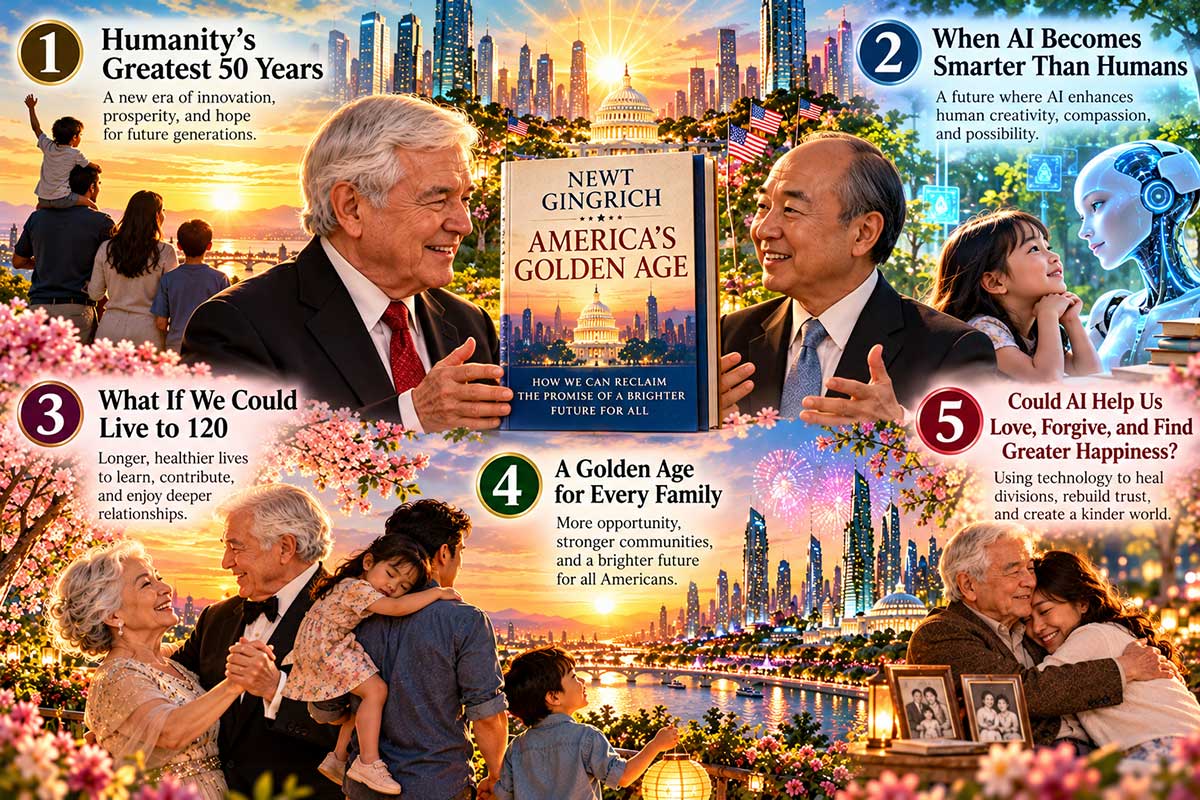
Short Bios:
Newt Gingrich is a former Speaker of the U.S. House of Representatives, historian, and bestselling author. In America's Golden Age: Trumpism and an Era of Limitless Possibilities, he presents an optimistic vision of America's future, connecting technological innovation, entrepreneurship, and his political philosophy of Trumpism. In this imaginary conversation, he challenges readers to believe that humanity's greatest accomplishments may still lie ahead.
Masayoshi Son is the founder, chairman, and CEO of SoftBank Group and a prominent advocate for artificial superintelligence. His vision emphasizes the extraordinary possibilities that advanced AI could create for humanity. In this fictional discussion, he explores whether AI might help people become more creative, understanding, compassionate, and happy.
Peter Diamandis is the founder and executive chairman of the XPRIZE Foundation, an entrepreneur, and an advocate for exponential technologies and human longevity. His work explores how innovation could reduce scarcity, improve health, and expand opportunity. Here, he considers a future where people live longer, healthier lives and gain more chances to pursue meaningful dreams.
Fei-Fei Li is a Stanford computer scientist, founding co-director of Stanford's Human-Centered AI Institute, and co-founder of World Labs. Her work focuses on advancing AI while keeping human needs and capabilities central. In this conversation, she explores how intelligent technology might strengthen independence, dignity, and opportunity.
Arthur C. Brooks is an author, educator, and researcher whose work explores happiness, purpose, love, and human relationships. He has held academic appointments at Harvard and Vanderbilt. In this imaginary discussion, he asks whether extraordinary technological progress can help people develop deeper relationships and more meaningful lives.
Editorial note: This is a fictional conversation created for ImaginaryTalks.com. The participants did not take part in this discussion. Their words, interactions, and experiences in 2076 are imagined for creative and educational purposes.
Leave a Reply