
Introduction
Plato: One Extraordinary Day in Ancient Athens
Imagine traveling nearly 2,400 years into the past and spending an entire day with Plato.
Not the marble statue. Not the philosopher whose writings have puzzled generations of students. The actual man, sitting beneath an olive tree in ancient Athens, enjoying a simple meal, remembering old friends, and occasionally laughing at his own expense.
What would you ask him?
Would you begin with justice, the immortality of the soul, or his famous theory of Forms?
Or would you ask something much more personal?
Plato, what were you like before you became Plato?
Around 350 BCE, the elderly philosopher is approaching eighty. His teacher Socrates has been dead for nearly half a century. His attempts to influence the rulers of Syracuse have brought disappointment and danger. Yet the Academy he established outside Athens remains alive with young thinkers, including Aristotle, who are developing ideas that may eventually challenge his own.
According to the Stanford Encyclopedia of Philosophy's account of Plato, his philosophical works are remarkable for their dramatic conversations, often featuring Socrates rather than Plato himself. We know his arguments far better than we know the man behind them.
That leaves some fascinating questions.
Did Plato ever fall deeply in love? What made him laugh? Did he regret risking his life in Sicily? What did he miss most about Socrates? And after spending decades examining justice, happiness, and the human soul, did he believe he had lived a good life?
His relationship with Socrates, whose trial and death remain among the defining events of ancient philosophy, is explored in the Stanford Encyclopedia's biography of Socrates. Meanwhile, the history of Plato's Academy reveals an intellectual community whose influence extended far beyond its founder's lifetime.
But historical scholarship can only take us so far.
In this imagined encounter, Nick Sasaki, a curious visitor from the twenty-first century, spends one extraordinary day with Plato. Their conversation begins with childhood memories and youthful ambitions, moves through friendship, love, political disappointment, and finally reaches a question that concerns every human being.
When you look back on your life, what will make you feel it was worth living?
The philosopher's answers may be less predictable than Nick expects.
And perhaps the most revealing moments will come when Plato finds himself unable to answer immediately.
Disclaimer: This is an entirely fictional interview. Nick Sasaki's encounter with Plato, their conversations, and Plato's personal remarks are imagined. The historical background draws on ancient sources and modern scholarship, but the dialogue should not be interpreted as Plato's authentic words or documented private beliefs.
(Note: This is an imaginary conversation, a creative exploration of an idea, and not a real speech or event.)
Topic 1: Before Plato Became Plato
Plato: One Extraordinary Day in Ancient Athens
Athens, Greece — Around 350 BCE, morning
An imaginary conversation between Nick Sasaki and Plato
Opening: The Stranger Who Wanted to Meet Plato
The morning sun has begun warming the dusty roads outside Athens.
Beyond the city walls, olive trees cast long shadows across the grounds of the Academy. Birds call from the branches. A few young men walk together, arguing with the seriousness of people who believe the fate of civilization depends on their next sentence.
One of them is talking so enthusiastically that he nearly walks into a tree.
Nick Sasaki steps aside to let him pass.
He has traveled an extraordinary distance to be here—farther than anyone in ancient Athens could possibly imagine.
But he has not come to see the Parthenon or attend a public debate.
He has come to meet Plato.
Not the marble bust.
Not the author of The Republic.
The man.
A young student points toward a shaded walkway.
Student: You will find him over there. But I should warn you—he may ask you more questions than you ask him.
Nick: That's what I'm afraid of.
The student laughs and hurries away.
Beneath an olive tree sits an elderly man with a broad forehead, a full beard, and the attentive expression of someone who has been listening carefully for most of his life.
Two younger men stand before him.
First Student: But surely courage means never being afraid.
Second Student: That's ridiculous. Even a brave soldier can be afraid.
The elderly man looks from one to the other.
Plato: Then perhaps we should begin by deciding whether courage concerns the absence of fear or what one does in spite of it.
Both students fall silent.
Plato: Ah. At last, some progress.
Nick laughs before he can stop himself.
The old man turns.
Plato: You find that amusing?
Nick: Very much.
Plato: Then you may be the only person here who does.
The students smile reluctantly.
Nick: Excuse me. Are you Plato?
Plato: I am. And you are?
Nick: Nick Sasaki.
Plato: A name I do not recognize. Where are you from?
Nick: I was born in Japan, and I've spent much of my life in America.
Plato studies him with interest.
Plato: Neither place is known to me. You must be a traveler of unusual ambition.
Nick: You could say that.
Plato: And what brings you to the Academy?
Nick: I want to interview you.
Plato: Interview?
Nick: Ask you questions. Learn about your life. Get to know you.
Plato: People generally come here hoping to learn about justice, virtue, or the nature of reality.
Nick: I want to know about those things too. But first, I want to know what you were like as a kid.
Plato raises his eyebrows.
Plato: As a child?
Nick: Yes. Were you funny? Did you get into trouble? Did you like sports? Did you have girlfriends?
One of the students coughs to conceal a laugh.
Plato looks at Nick for several seconds.
Plato: You have crossed an extraordinary distance to ask me whether I had girlfriends?
Nick: That's only the beginning.
Plato turns to his students.
Plato: Gentlemen, I believe your discussion of courage has acquired a practical example.
First Student: In what way?
Plato: This stranger has just asked an elderly philosopher about his romantic life in front of his students.
The students burst out laughing.
Nick grins.
Nick: So, is that courage or foolishness?
Plato: We may need the entire morning to determine the difference.
He gestures toward the path.
Plato: Come, Mr. Sasaki. Let us walk. But I must warn you that my childhood was considerably less exciting than you appear to hope.
Nick: I'll be the judge of that.
Plato: I was afraid you might say so.
They begin walking beneath the olive trees.
Guiding Question 1: What Kind of Boy Were You?
Nick: All right, Plato. Let's start at the beginning. What was your family like?
Plato: Comfortable, by the standards of Athens. My family had property, connections, and expectations.
Nick: Expectations?
Plato: Naturally. A young man born into a prominent household was expected to become educated, cultivate his abilities, and take an interest in the affairs of the city.
Nick: So your parents wanted you to become a politician?
Plato: A public life would not have surprised them.
Nick: What about your father?
Plato: My father was Ariston. My mother was Perictione. Through both sides of the family, we had connections to distinguished Athenian lineages.
Nick: Were they strict?
Plato smiles.
Plato: You ask as though parents can be classified into two species: strict and indulgent.
Nick: In my experience, sometimes they can.
Plato: And which species are you?
Nick: I have five children. They'd probably give you five different answers.
Plato stops walking.
Plato: Five?
Nick: Five.
Plato: Then you have undertaken an educational experiment more demanding than anything attempted at this Academy.
Nick laughs.
Nick: Some days it certainly feels that way.
Plato: And have you succeeded in making them all wise?
Nick: Not yet.
Plato: Then perhaps there is hope for the rest of us.
They continue.
Nick: Did you have brothers and sisters?
Plato: Yes. My brothers included Glaucon and Adeimantus. I also had a sister, Potone.
Nick: Were you close?
Plato: We belonged to the same household and shared much of the same upbringing. But brothers are not always inclined to agree simply because they share parents.
Nick: I can relate to that.
Plato: You may know their names from my writing. Glaucon and Adeimantus appear in the conversation that people call The Republic.
Nick: Yes! That surprised me when I learned it. You actually put your brothers into your books.
Plato: I found them suitable participants.
Nick: Did they ever complain about how you portrayed them?
Plato laughs.
Plato: You are assuming that the living men and the literary characters are precisely the same.
Nick: They're not?
Plato: A conversation written for philosophical purposes is not necessarily a record of words spoken exactly as they occurred.
Nick: So you took some creative liberties.
Plato: That is one way to describe the work of a writer.
Nick: Did you make your brothers sound smarter than they really were?
Plato gives him a sideways glance.
Plato: Mr. Sasaki, you have apparently traveled here to create trouble within my family.
They laugh.
A breeze moves through the olive branches.
Nick: What was Athens like when you were growing up?
Plato's expression changes.
Plato: Troubled.
Nick: Because of the war?
Plato: Yes. Athens had been at war with Sparta for years. I grew up in a city where political speeches, military news, fear, and ambition were part of ordinary life.
Nick: Were you frightened?
Plato: Children do not always understand the causes of a war. But they understand when adults are worried. They notice absences. They hear the names of men who have died.
He pauses.
Plato: A city at war teaches its children things no teacher intended.
Nick: That's a powerful way to put it.
Plato: I would rather those lessons had been unnecessary.
Nick: Did you ever dream of becoming a soldier?
Plato: Like other young Athenians of my circumstances, I received an education that included physical training. Military service was part of the world in which we lived.
Nick: I've heard you were quite an athlete.
Plato looks amused.
Plato: Have you?
Nick: A wrestler, apparently.
Plato: Wrestling was a respected part of Greek education.
Nick: But were you good?
Plato: You seem determined to establish whether you could defeat me in a contest.
Nick: Absolutely not. You're almost eighty. That would be unfair.
Plato: How generous of you.
Nick: Although I've heard you had very broad shoulders.
Plato sighs theatrically.
Plato: Ah. We have arrived at the shoulders.
Nick: Is that where the name Plato came from?
Plato: There are stories about my name, as there are stories about nearly everything else.
Nick: I've heard your original name was Aristocles.
Plato: So some traditions say.
Nick: And Plato means broad?
Plato: It can suggest breadth. Whether people associated it with my build, my forehead, or something else is a matter on which storytellers seem remarkably confident.
Nick: So you won't confirm the shoulder story?
Plato: Would you believe me if I denied it?
Nick: Probably not.
Plato: Then I see little advantage in answering.
Nick laughs.
Nick: You know, I expected you to be much more serious.
Plato: Have I disappointed you?
Nick: Quite the opposite.
Plato: Good. There is enough solemnity in Athens without adding more to it unnecessarily.
They pass a young man carrying a bundle of writing materials.
Nick: Were you a good student?
Plato: I was fortunate to receive an extensive education.
Nick: That's a very careful answer.
Plato: Is it?
Nick: I'm asking whether you were the kid who always knew the answer.
Plato: I suspect I was sometimes the young man who believed he knew the answer.
Nick: There's a difference?
Plato: An enormous one.
Nick: Did you ever get into trouble?
Plato smiles.
Plato: Mr. Sasaki, must every detail of my youth be made public?
Nick: Only the entertaining ones.
Plato: Then I fear you may find the surviving evidence disappointing.
Nick: You're avoiding the question.
Plato: You are becoming familiar with my methods.
They laugh.
Guiding Question 2: Did You Really Want to Become a Poet?
The path opens onto a small courtyard.
From somewhere beyond the Academy comes the faint sound of a flute.
Nick pauses to listen.
Nick: I have another question. Before you became a philosopher, did you want to be a writer?
Plato: I have spent a considerable portion of my life writing.
Nick: I mean a different kind of writer. A poet. A playwright.
Plato: Ah.
Nick: I've heard that when you were young, you wrote tragedies.
Plato: There are stories about my youthful literary interests.
Nick: One says you were going to enter a dramatic competition, but after meeting Socrates, you abandoned your plays.
Plato: That is a very tidy story.
Nick: Too tidy?
Plato: Life rarely arranges its turning points so neatly for the convenience of future biographers.
Nick: So what really happened?
Plato: I was deeply interested in poetry and the dramatic arts. That much should not surprise anyone who has read my dialogues.
Nick: It actually surprised me.
Plato: Why?
Nick: Because people talk about you as though you spent your entire life thinking about invisible perfect triangles.
Plato laughs.
Plato: A dreadful occupation, if that were all I did.
Nick: But your books are full of characters. People interrupt each other, make jokes, get embarrassed, argue, and sometimes say foolish things.
Plato: As people generally do.
Nick: You must have enjoyed observing them.
Plato: Very much. Human beings are endlessly interesting, particularly when they believe themselves to be consistent.
Nick: What do you mean?
Plato: A man may praise honesty in the morning and spend the afternoon flattering someone from whom he hopes to gain an advantage.
Nick: That hasn't changed.
Plato: Another may declare that he values wisdom above wealth, then become furious when he loses a small amount of money.
Nick: That definitely hasn't changed.
Plato: People often possess noble opinions about themselves. Their conduct provides a more demanding examination.
Nick grins.
Nick: You sound like a comedian.
Plato: A comedian?
Nick: Someone who makes people laugh by pointing out how ridiculous human behavior can be.
Plato: Then perhaps comedy and philosophy are not as distant as some imagine.
Nick: Exactly.
Plato: Though a comedian may be satisfied when the audience laughs. A philosopher would like to know why the audience recognizes the contradiction.
Nick: That's an interesting distinction.
Plato: It is also possible that the audience is laughing at the wrong person.
Nick: That happens quite often.
They sit briefly on a low stone bench.
Nick: Why did you choose to write dialogues instead of explaining your philosophy directly?
Plato: Consider what happens when someone reads a statement.
Nick: All right.
Plato: Suppose I write, "Courage is knowledge."
Nick: Okay.
Plato: The reader may agree, disagree, or memorize it. But has the reader examined what courage means?
Nick: Not necessarily.
Plato: Now suppose two people begin discussing courage. One says it is fearlessness. Another says it is endurance. A third asks whether foolish endurance is courageous.
Nick: Then the reader starts thinking along with them.
Plato: Precisely. The reader is invited into the difficulty.
Nick: So you're making the audience participate.
Plato: That is one of the possibilities offered by dialogue.
Nick: It's almost like watching a good conversation.
Plato: Or overhearing one.
Nick: Which is exactly what I'm trying to do with you.
Plato turns toward him.
Plato: Then perhaps you have some sympathy for my literary methods.
Nick: I do. But I have to ask: Did you ever put words into Socrates' mouth that he never actually said?
Plato studies him.
Plato: That is a serious question.
Nick: I know.
Plato: Socrates was a real man. He spoke with many people, and his conversations shaped my life. But a philosophical dialogue is not the same thing as a courtroom transcript.
Nick: So the Socrates in your books is partly a literary character?
Plato: A reader should be careful about assuming that every conversation occurred exactly as written.
Nick: Did you ever worry that people would confuse your ideas with his?
Plato: That is a reasonable concern. Yet I have also found that a conversation can illuminate an idea more effectively than a declaration of authorship.
Nick: Interesting. So you didn't always want to stand in the spotlight.
Plato: The question matters more than the vanity of the person asking it.
Nick: That's unusual for a writer.
Plato: Is it?
Nick: Believe me, many writers want everyone to know exactly how brilliant they are.
Plato smiles.
Plato: Then perhaps they should write fewer books about themselves.
Nick laughs.
Nick: You would have been very entertaining at a dinner party.
Plato: I hope I have occasionally been tolerable company.
Nick: Did you enjoy parties?
Plato: I enjoyed good conversation. A meal among friends can be an excellent setting for one.
Nick: With wine?
Plato: Wine was hardly unknown to the Greeks.
Nick: I had to ask.
Plato: I am beginning to suspect that you intend to write a biography devoted entirely to my meals, athletic abilities, and romantic prospects.
Nick: Don't forget your sense of humor.
Plato: A most unconventional philosophical investigation.
They rise and continue walking.
Guiding Question 3: Did You Dream of Becoming a Powerful Man?
The Academy's olive grove gives way to a view of the road toward Athens.
In the distance, the city rises beneath the bright sky. The Acropolis stands above the rooftops, its temples visible even from here.
Nick looks toward it.
Nick: Plato, growing up in a prominent family, did you ever imagine becoming a political leader?
Plato: Certainly, public life was an attractive possibility for someone of my background.
Nick: Did you want power?
Plato: I wanted to see Athens governed well.
Nick: That's not quite the same thing.
Plato: No. And learning the difference is one of the more important lessons of political life.
Nick: When did you start becoming disappointed with politics?
Plato looks toward the city.
Plato: Athens offered many opportunities for disappointment.
Nick: Because of the war?
Plato: The war, certainly. But also what followed it.
Nick: The Thirty?
Plato: Yes.
In 404 BCE, after Athens' defeat by Sparta, an oligarchic government came to power. Its leaders included men connected to Plato's family.
Nick: Some of your relatives were involved, weren't they?
Plato: Critias and Charmides were among the men associated with that regime.
Nick: That must have been complicated for you.
Plato: It was a period when many people had to confront uncomfortable truths about those they knew.
Nick: Did you initially hope they would improve Athens?
Plato: Men often promise order and justice when seeking authority. What they do once they possess it is another matter.
Nick: And what did they do?
Plato: They ruled harshly. People suffered. Fear spread. The city was wounded by its own rulers.
Nick: Were you shocked?
Plato: I had hoped that men who spoke about improving the city would understand what improvement required.
Nick: But they didn't.
Plato: Their conduct gave me little reason to trust their claims.
Nick: So you turned against oligarchy?
Plato: I became increasingly concerned with a more fundamental problem: what makes anyone fit to govern?
Nick: That's a question we're still asking.
Plato: I am sorry to hear it has remained unresolved.
Nick laughs.
Nick: Very unresolved.
Plato: Then your people must be exceptionally patient.
Nick: Not really.
Plato: That is an unfortunate combination.
They smile.
Nick: What about democracy? Athens eventually restored it.
Plato: Yes.
Nick: Were you relieved?
Plato: The end of the oligarchic violence was welcome. But the restoration of democratic institutions did not settle every question about justice.
Nick: Because of what happened to Socrates?
Plato becomes quiet.
Plato: That was one of the most painful examples.
Nick: We'll talk about him in a moment. But before we do, I'm curious about something.
Plato: Go on.
Nick: When you were young, did you think the problem with Athens was simply that the wrong people were in charge?
Plato: At times, perhaps. It is tempting to believe that replacing one group of rulers with another will solve a city's problems.
Nick: But you eventually thought the problem went deeper?
Plato: Much deeper.
Nick: How deep?
Plato: Consider a ship.
Nick: A ship?
Plato: Suppose you are crossing the sea. Would you choose your captain because he is wealthy?
Nick: No.
Plato: Because he gives the most exciting speeches?
Nick: Definitely not.
Plato: Because he promises every passenger a comfortable voyage?
Nick: I'd want to know whether he can actually sail.
Plato: Exactly. You would want someone who understands navigation.
Nick: And you're saying government should work the same way.
Plato: I am asking why people are so careful about choosing a competent navigator and so careless about choosing those who govern their lives.
Nick nods.
Nick: That's a fair question.
Plato: Yet political judgment is more complicated than navigation. People disagree about what the destination should be.
Nick: So even a capable ruler needs to know what is good.
Plato: And how is that knowledge acquired? Can it be taught? Can power corrupt it? These are the difficulties.
Nick: You know, I can see why you became obsessed with justice.
Plato raises an eyebrow.
Plato: Obsessed?
Nick: Maybe that's the wrong word.
Plato: It is certainly an enthusiastic one.
Nick: I mean, you grew up during a terrible war. You saw people connected to your own family become involved in a brutal government. Then the restored democracy eventually condemned your teacher.
Plato: You have summarized several painful decades rather efficiently.
Nick: Sorry.
Plato: There is no need to apologize. But those events did not arrive as a neatly arranged philosophical lesson. We lived through them without knowing what would come next.
Nick considers this.
Nick: That's something I forget when I read history.
Plato: What?
Nick: We already know how the story ends. The people living through it don't.
Plato: Precisely.
Nick: So when you were young, you didn't know you were going to become Plato, one of the most famous philosophers in history.
Plato looks genuinely amused.
Plato: I was aware that my name was Plato.
Nick: You know what I mean.
Plato: I suspect I do.
Nick: You were just a young man trying to figure out what to do with his life.
Plato: As most young men are.
Nick: Did you ever feel lost?
Plato takes his time answering.
Plato: There were periods when the path before me was far from clear. I had received an education that prepared me for certain possibilities. Events made some of those possibilities less attractive.
Nick: Were you afraid of wasting your life?
Plato: A thoughtful young person should be concerned about how to use the years available to him. But concern can become paralyzing if one demands certainty before acting.
Nick: That's true.
Plato: I was fortunate to encounter people who made me question what I had assumed a successful life would look like.
Nick: Especially one person?
Plato smiles.
Plato: Especially one.
Closing: The Man Who Changed Everything
They return toward the shaded heart of the Academy.
A group of students passes, greeting Plato respectfully. One carries a wax tablet covered with calculations. Another is still arguing about a question raised earlier in the morning.
Nick watches them.
Nick: Plato, can I tell you something?
Plato: Of course.
Nick: When I came here, I expected to meet a man who had always been a philosopher.
Plato: That would have been an unusual infant.
Nick laughs.
Nick: But now I'm starting to picture a different person.
Plato: What sort of person?
Nick: A kid from a well-connected family. Someone who liked poetry and sports. Someone who grew up surrounded by war and politics. Someone who thought he might become a leader, but wasn't sure what kind of life he wanted.
Plato: That is closer to the ordinary beginnings of a human life.
Nick: And then you met Socrates.
Plato stops beneath an olive tree.
For the first time since their conversation began, his expression becomes noticeably softer.
Plato: Yes.
Nick: What was he like?
Plato looks toward the city.
Plato: That is a question I could spend the entire day answering.
Nick: Good. I've got time.
Plato smiles.
Plato: Tell me, Mr. Sasaki, have you ever met someone who made you realize that you had been asking the wrong questions about your life?
Nick: Yes. I think most of us have, if we're fortunate.
Plato: Then you already understand something of what Socrates meant to me.
Nick: Was he really as wise as everyone says?
Plato laughs quietly.
Plato: He was the most remarkable man I ever knew. But if you had approached him and told him he was wise, I suspect he would have made your life very uncomfortable.
Nick: Why?
Plato: Because he would have asked you what wisdom is.
Nick: And then?
Plato: And then he would have continued asking until you were no longer quite so confident of your answer.
Nick grins.
Nick: He sounds exhausting.
Plato: He could be.
Nick: But you loved him.
Plato is silent for a moment.
Plato: I admired him greatly. And I owe him more than I can easily express.
The morning breeze moves gently through the branches.
Nick looks at the elderly philosopher beside him.
Nick: Then I'd like to hear about Socrates the person. Not just the philosopher.
Plato nods.
Plato: Very well. But I should warn you—he was even more unusual than you imagine.
They begin walking again.
And for the first time that morning, Plato is no longer speaking primarily about himself.
He is remembering the man who changed his life.
To be continued in Topic 2: The Man Plato Could Never Forget.
Author's note: This is a fictional conversation inspired by Plato's life, ancient Athens, and his philosophical writings. Details about his family, the Peloponnesian War, the Thirty, and his relationship with Socrates are grounded in historical sources. Stories about his athletic achievements, original name, and youthful literary ambitions remain uncertain. The dialogue, personal recollections, humor, and emotional responses are imagined and should not be treated as authenticated statements by Plato.
Topic 2: The Man Plato Could Never Forget
Plato: One Extraordinary Day in Ancient Athens
Athens, Greece — Around 350 BCE, late morning
An imaginary conversation between Nick Sasaki and Plato
Opening: The Most Unusual Man in Athens
The morning sun has climbed higher over the Academy.
A warm breeze moves through the olive trees, carrying the distant sounds of carts, footsteps, and voices from the road leading toward Athens.
Nick Sasaki walks beside Plato along a shaded path.
For the past hour, they have been talking about Plato's childhood, his family, his youthful interests, and the political turmoil that shaped his early life.
But something changed when Nick mentioned Socrates.
Plato had been cheerful throughout the morning, sometimes answering Nick's questions with mischievous humor. Now his expression carries something quieter.
The affection of a man remembering someone who has been gone for half a century.
Nick: Plato, I have to tell you something. I've been looking forward to asking you about Socrates more than almost anything else.
Plato: Then I hope you will not be disappointed.
Nick: I don't think I will. But I want to approach this differently.
Plato: Differently from what?
Nick: Most people talk about Socrates as though he were a collection of famous sayings. They talk about his trial, his philosophy, and how he died.
Plato: Those are certainly important matters.
Nick: Of course. But you actually knew him. You spent time with him. You heard him laugh. You saw him interact with ordinary people.
Plato: Yes.
Nick: So forget the famous philosopher for a moment. What was Socrates like to hang out with?
Plato laughs.
Plato: Hang out with?
Nick: Spend time with. Walk around Athens. Have conversations. Maybe share a meal.
Plato: Ah. You want to know whether he was pleasant company.
Nick: Exactly.
Plato: That depended entirely upon whether you enjoyed having your most cherished opinions examined in public.
Nick laughs.
Nick: So he was difficult?
Plato: Wonderfully difficult.
Nick: I like that answer.
Plato: Then you may have liked him. Although I suspect he would have found you equally entertaining.
Nick: Why?
Plato: Because you ask questions with very little concern for whether the answers will be convenient.
Nick: That's probably true.
Plato: Socrates would have appreciated that.
They continue walking.
Nick: Tell me about the first time you met him.
Plato looks ahead.
Plato: I cannot give you a perfectly preserved account of our first encounter. Memory does not arrange itself for the convenience of future storytellers.
Nick: Fair enough.
Plato: But I remember the effect of encountering him.
Nick: What was that?
Plato: He made ordinary conversations feel extraordinarily important.
Nick: How?
Plato: A man might begin by speaking about courage, believing the subject was simple. An hour later, he would discover that he could not explain what courage was.
Nick: And people enjoyed this?
Plato: Some did.
Nick: What about the others?
Plato: The others sometimes became very angry.
Nick laughs.
Nick: I can imagine.
Plato: You have no idea.
Guiding Question 1: What Was Socrates Really Like as a Person?
They approach a stone bench overlooking a small courtyard.
Several students are practicing geometry nearby.
Nick sits, and Plato joins him.
Nick: Let me ask you something simple. Was Socrates funny?
Plato smiles immediately.
Plato: Very.
Nick: Really?
Plato: He possessed a remarkable ability to expose human foolishness without always appearing to do so.
Nick: Give me an example.
Plato: Imagine a man who has spent the morning explaining to everyone that he understands justice.
Nick: All right.
Plato: Socrates approaches and asks whether the man would be willing to explain justice to someone who knows nothing about it.
Nick: Meaning himself.
Plato: Precisely. Socrates would present himself as the ignorant student.
Nick: And then?
Plato: The confident man would begin explaining. Socrates would ask a question. Then another. Then another.
Nick: Until the man realized he didn't understand justice.
Plato: Or until he became furious enough to leave.
Nick bursts out laughing.
Nick: So Socrates was basically the most annoying person in Athens.
Plato: To certain people, undoubtedly.
Nick: Did he know he was annoying them?
Plato: Often.
Nick: And he kept doing it?
Plato: He believed that examining our assumptions was more important than protecting our vanity.
Nick: That's a dangerous philosophy.
Plato: In Athens, it eventually proved to be.
The laughter fades.
Nick changes direction gently.
Nick: What did he look like?
Plato: He was not a man whom people admired for conventional beauty.
Nick: I've seen sculptures of him. Broad face, prominent nose, bald head.
Plato: Yes. His appearance was frequently compared to that of a Silenus.
Nick: What's a Silenus?
Plato: A figure associated with Dionysus, often portrayed as rather unattractive, with an exaggerated face and nose.
Nick: So people made fun of his looks?
Plato: They did.
Nick: Did it bother him?
Plato: He seemed remarkably willing to laugh at himself.
Nick: That's impressive.
Plato: He understood that a handsome face is no guarantee of a beautiful character.
Nick: Did he ever tease you?
Plato looks amused.
Plato: Socrates could make a person uncomfortable without uttering a single insult.
Nick: How?
Plato: By asking a perfectly reasonable question at precisely the wrong moment.
Nick: Such as?
Plato: Suppose you were boasting about how well you had raised your five children.
Nick: I don't think I'd make that mistake.
Plato: Socrates might ask whether you had taught them virtue.
Nick: I'd probably say I was trying.
Plato: Then he would ask what virtue is.
Nick: Oh, no.
Plato: And whether you can teach something you cannot define.
Nick: That's terrible.
Plato: And then he would ask whether your children might be teaching you instead.
Nick laughs.
Nick: Actually, that last part might be true.
Plato: Then perhaps you would have enjoyed speaking with him.
Nick: Did he have a family?
Plato: He had a wife, Xanthippe, and children.
Nick: Was he a good father?
Plato considers the question.
Plato: I would be cautious about pretending to know every detail of another man's household. His public conversations are better remembered than his private domestic life.
Nick: That's fair.
Plato: But he was not a man entirely detached from ordinary responsibilities. He had a family, served as a soldier, and lived among his fellow citizens.
Nick: I think people forget that.
Plato: They often turn philosophers into disembodied voices.
Nick: Exactly. That's why I'm here.
Plato smiles.
Nick: Was Socrates physically tough?
Plato: He served in military campaigns and was remembered for his endurance.
Nick: I've heard stories about him standing outside in the cold without shoes.
Plato: His tolerance for discomfort was remarkable.
Nick: Was he trying to prove something?
Plato: He seemed less concerned with physical comfort than most people.
Nick: That's the opposite of me. I like a comfortable bed and a good meal.
Plato: Then you have already identified two subjects on which you and Socrates might have disagreed.
Nick: I suspect there would have been more.
Plato: Undoubtedly.
Nick: What did you admire most about him?
Plato takes a moment.
Plato: His independence.
Nick: Explain that.
Plato: He was extraordinarily difficult to intimidate with wealth, reputation, or authority. Many people alter their opinions depending upon who is listening.
Nick: And he didn't?
Plato: He could be stubborn, certainly. But he was willing to follow a question into uncomfortable territory, even when powerful people preferred that he remain silent.
Nick: Was he always confident?
Plato: He was confident that examination mattered. That is different from claiming to possess every answer.
Nick: Did you ever win an argument with him?
Plato laughs.
Plato: You are very interested in victories.
Nick: I'm curious whether he ever admitted he was wrong.
Plato: Socrates frequently led conversations toward the recognition that the participants had not established what they believed they knew.
Nick: Including himself?
Plato: He was willing to acknowledge uncertainty. But that did not make him an easy conversational opponent.
Nick: Did he ever make you angry?
Plato smiles.
Plato: It would be surprising if a young man never felt irritated by someone who questioned him so relentlessly.
Nick: So yes.
Plato: You may interpret my answer as you wish.
They laugh.
Nick watches two students arguing over a geometric diagram.
Nick: You know what I find interesting? He sounds like someone who could have been very popular if he had simply told people what they wanted to hear.
Plato: Perhaps.
Nick: But he couldn't do it.
Plato: He did not consider pleasing an audience the highest purpose of conversation.
Nick: That's rare.
Plato: It was rare in Athens too.
Guiding Question 2: What Did You Feel When Athens Condemned Him?
The sounds of the Academy seem to grow quieter as Nick turns toward Plato.
Nick: Plato, can we talk about the trial?
Plato: Yes.
Nick: I know it happened a long time ago. But I'd like to understand what that experience was like for you.
Plato looks toward the distant city.
Plato: It was a painful time.
Nick: Did you ever imagine Athens would actually execute Socrates?
Plato: The danger was real. He had made enemies, and his manner of questioning had offended many people.
Nick: What exactly was he accused of?
Plato: Impiety and corrupting the young.
Nick: Did you believe those accusations?
Plato: No.
Nick: Not at all?
Plato: I believed he had encouraged young people to examine their lives and question their assumptions. That is not the same thing as corrupting them.
Nick: But some parents probably didn't appreciate their children questioning everything.
Plato: That is possible.
Nick: Especially if the children started asking their fathers whether they actually knew what justice meant.
Plato smiles faintly.
Plato: Socrates could make family dinners uncomfortable.
Nick: I can imagine.
The smile fades.
Nick: What do you remember most about the trial?
Plato: The seriousness with which the city judged a man whose life had been devoted to questioning what people considered serious.
Nick: Were you there?
Plato: I was among those associated with him at the time of his trial. The account I later wrote in the Apology presents his defense.
Nick: Did he seem afraid?
Plato: He did not present himself as a man willing to abandon his way of life merely to escape punishment.
Nick: That must have been difficult to watch.
Plato: It was.
Nick: Did you want him to say whatever was necessary to save himself?
Plato considers his answer.
Plato: When someone you admire faces death, you naturally wish for a way to preserve his life.
Nick: But Socrates wouldn't compromise?
Plato: He believed that avoiding wrongdoing mattered more than avoiding death.
Nick: Even if that meant leaving his family behind?
Plato: That is among the painful questions raised by his decision.
Nick: Did you agree with him?
Plato: I admired his integrity. But admiration does not erase the sorrow of losing someone.
Nick nods.
Nick: That's important.
Plato: Why?
Nick: Because people sometimes tell these stories as though the philosopher's courage makes the death less tragic.
Plato: Courage does not make death harmless to those who remain.
For a moment, neither speaks.
A bird calls from somewhere above them.
Nick: When the verdict came, were you angry?
Plato: I was deeply troubled by what the city had done.
Nick: At the jurors?
Plato: At the failure of judgment that allowed a man like Socrates to be condemned.
Nick: Did you feel betrayed by Athens?
Plato: I had grown up believing that public life could be honorable. The events of those years gave me many reasons to question the judgment of those who exercised power.
Nick: First the Thirty, then the trial.
Plato: Yes. Different political arrangements, yet both capable of grave injustice.
Nick: Did that make you lose hope?
Plato: It made hope more difficult. But abandoning the search for justice would not have honored Socrates.
Nick: That's a beautiful thought.
Plato looks at him.
Plato: I would not wish to make the matter beautiful at the expense of its pain.
Nick: You're right.
Nick pauses.
Nick: Were you with Socrates when he died?
Plato shakes his head.
Plato: No. In the account of his final conversation, I am described as absent because of illness.
Nick: I've read that.
Plato: Others were there. Phaedo, Crito, and several companions.
Nick: Do you regret not being there?
Plato looks down.
Plato: There are absences one cannot easily revisit without wondering what might have been different.
Nick: Even when nothing could have changed the outcome?
Plato: Even then.
Nick lets the silence remain.
Nick: Did you cry when you learned he was dead?
Plato looks toward the trees.
Plato: You ask a very personal question, Mr. Sasaki.
Nick: I know. You don't have to answer.
Plato: Grief does not always take the form people expect. Some mourn openly. Others become quiet. Some turn toward work because they do not know what else to do.
Nick: What did you do?
Plato: I continued thinking about the questions he had placed before us.
Nick: And eventually you wrote about him.
Plato: Yes.
Nick: Was writing a way of keeping him alive?
Plato thinks for a long moment.
Plato: Perhaps writing allowed something of his manner of questioning to continue reaching people who would never meet him.
Nick: That's a powerful legacy.
Plato: It is also an imperfect one. A written conversation cannot reproduce a living person completely.
Nick: But it can preserve something.
Plato: Yes. Something.
Nick looks toward the city.
Nick: I wonder whether Socrates ever imagined that people would still be talking about him thousands of years later.
Plato smiles.
Plato: He might have asked whether being remembered is necessarily the same thing as being understood.
Nick: That's exactly what he would say, isn't it?
Plato: I suspect so.
They laugh softly.
Guiding Question 3: Did Socrates' Death Change Your View of Humanity?
They rise from the bench and resume walking.
The path leads toward a shaded courtyard where a few students are preparing a simple midday meal.
Nick: Plato, I want to ask you about something that happened after Socrates died.
Plato: Go on.
Nick: You could have become bitter.
Plato: Perhaps.
Nick: You could have decided that Athens was hopeless, that people were foolish, and that politics was nothing but corruption.
Plato: Many people have reached such conclusions.
Nick: But you didn't simply withdraw from the world.
Plato: I devoted myself to philosophical inquiry and eventually established this community.
He gestures toward the Academy.
Nick: Why?
Plato: Because the problems that troubled me had not disappeared.
Nick: What problems?
Plato: Why do people mistake popularity for wisdom? Why do rulers confuse their own interests with the good of the city? Why do people speak confidently about justice while acting unjustly?
Nick: You wanted to find better answers.
Plato: I wanted to examine whether better understanding might lead to better lives.
Nick: Did Socrates make you believe that people could change?
Plato: He demonstrated that people could be challenged to examine themselves.
Nick: But that doesn't mean they'll change.
Plato: No. It does not.
Nick: That must have frustrated you.
Plato: Often.
Nick: Did you ever think people simply didn't want wisdom?
Plato smiles.
Plato: People frequently desire the reputation of wisdom more eagerly than wisdom itself.
Nick: That's very true.
Plato: To become wiser, one must first recognize that some cherished beliefs may be mistaken. That can be uncomfortable.
Nick: So most people avoid it.
Plato: Many do. Others are willing to endure the discomfort.
Nick: Was that what you tried to teach here?
Plato: In part. We examine mathematics, politics, ethics, and other subjects. But the deeper purpose is to cultivate minds capable of careful judgment.
Nick: What about character?
Plato: Knowledge and character cannot be separated so easily in the questions that interest me.
Nick: Could someone be brilliant and still be a terrible person?
Plato: Certainly. A clever person may use his abilities to pursue foolish or harmful ends.
Nick: Then intelligence isn't enough.
Plato: No.
Nick: That's interesting because people often assume that if we educate everyone, society will automatically improve.
Plato: Education must concern what people learn to value, as well as what they learn to calculate.
Nick nods.
Nick: Do you think Socrates would be proud of what you've built?
Plato looks around the Academy.
Plato: I would hope he found our inquiries worthwhile.
Nick: Would he enjoy being here?
Plato: I suspect he would make the students very uncomfortable.
Nick: More uncomfortable than you do?
Plato: Considerably.
Nick laughs.
Nick: What about Aristotle? Would Socrates enjoy arguing with him?
Plato smiles.
Plato: Aristotle is an energetic and capable thinker. I imagine the conversation would be lively.
Nick: Do you ever wish Socrates could meet your students?
Plato: There are many conversations I would have liked to witness.
Nick: If you could bring him back for just one afternoon, what would you ask him?
Plato slows his steps.
Plato: That is difficult.
Nick: Take your time.
Plato: I might ask what he thinks of the questions we have continued exploring since his death.
Nick: You wouldn't ask him whether he's proud of you?
Plato laughs gently.
Plato: He might respond by asking what pride is and whether I should seek it.
Nick: That sounds about right.
Plato: And before the afternoon ended, I would probably find myself defending assumptions I had not realized I possessed.
Nick: Even after all these years?
Plato: Especially after all these years. A man who has spent decades teaching can become dangerously confident in his own judgment.
Nick: That's a remarkable thing to admit.
Plato: Age does not automatically produce wisdom.
Nick: Neither does writing famous books?
Plato: Certainly not.
Nick smiles.
Nick: I think I would have liked Socrates.
Plato: I believe you would have enjoyed his company.
Nick: Even if he drove me crazy?
Plato: Perhaps especially then.
They reach the courtyard.
A few students are seated around a low table. Bread, olives, cheese, figs, and diluted wine have been set out.
Plato gestures toward the food.
Plato: Shall we eat?
Nick: Absolutely. All this philosophy has made me hungry.
Plato: Then at least one question has been answered.
Nick: What's that?
Plato: Whether philosophical conversation can stimulate the appetite.
Nick laughs.
Closing: The Love That Remains
They sit beneath the shade of the trees.
Nick breaks a piece of bread and looks across the table.
Nick: Plato, can I ask one last thing about Socrates?
Plato: Of course.
Nick: We've talked about his courage, his wisdom, his humor, and his death.
Plato: Yes.
Nick: But after all these years, what do you miss most about him?
Plato looks at Nick for a moment.
Then he glances toward the Academy, where students are still arguing over their lessons.
Plato: His presence.
Nick: What do you mean?
Plato: The possibility of speaking with him. Of bringing him a question and discovering that the question was more complicated than I had imagined.
Nick: So you miss the conversations.
Plato: Yes. But a conversation is more than words. It is the person who listens, challenges, laughs, and sometimes sees something in you that you have not yet recognized.
Nick nods slowly.
Nick: That's true.
Plato: A book can preserve an argument. It cannot entirely replace the experience of sitting beside someone who matters to you.
Nick: Do you think that's why friendship is so important?
Plato: I think friendship deserves far more attention than people usually give it.
Nick: You've written a great deal about love.
Plato smiles.
Plato: I have.
Nick: And I've been wanting to ask you about that too.
Plato: I suspected we would eventually return to your interest in my personal life.
Nick: You haven't forgotten my first questions?
Plato: Mr. Sasaki, you asked about my romantic history before you had been here five minutes.
Nick laughs.
Nick: Fair enough.
Plato: And now, after discussing the death of Socrates, you wish to investigate love.
Nick: I do. Not just romantic love. Friendship, family, companionship—all of it.
Plato: Then perhaps we should begin with a question.
Nick: Of course. You're Plato.
Plato: When you say you love someone, what exactly do you mean?
Nick stares at him.
Nick: You know, I was hoping I'd be the one asking the questions.
Plato: You have been asking them all morning. Surely I may have one.
Nick: All right. Let me think.
Plato takes a small piece of bread and waits.
Nick looks at the philosopher sitting across from him.
For the first time, he realizes that the next conversation may be even more personal than the last.
Because the man who spent his life examining justice and wisdom also wrote some of the most influential reflections on love in human history.
Yet almost nothing is known with certainty about his own romantic experiences.
Nick smiles.
Nick: Plato, before I answer your question, there's something I've been dying to ask.
Plato: I can hardly imagine what it might be.
Nick: Did you ever fall in love?
Plato laughs.
Plato: Ah, Mr. Sasaki. Now we are entering dangerous territory.
To be continued in Topic 3: Plato on Love — The People Who Mattered Most.
Author's note: This is a fictional conversation inspired by Plato's life, his relationship with Socrates, and the philosophical dialogues associated with both men. The historical trial and execution of Socrates occurred in 399 BCE. Plato's writings, particularly the Apology and Phaedo, are important sources, but they are literary and philosophical works rather than verbatim historical transcripts. Plato's private emotions, memories, humor, and conversations with Nick Sasaki are imagined. In the Phaedo, Plato is explicitly described as absent from Socrates' final gathering because of illness; this story does not portray him as an eyewitness to the death.
Topic 3: Plato on Love — The People Who Mattered Most
Plato: One Extraordinary Day in Ancient Athens
Athens, Greece — Around 350 BCE, midday
An imaginary conversation between Nick Sasaki and Plato
Opening: The Question Plato Wasn't Expecting
The bread is still warm.
A shallow bowl of olives sits between Nick Sasaki and Plato, alongside figs, cheese, and a clay pitcher of wine diluted with water. Beyond the courtyard, the Academy hums with the voices of students discussing mathematics, virtue, and matters they consider terribly important.
A young man has been arguing for several minutes that beauty must be something everyone can recognize immediately.
His companion disagrees.
Neither seems particularly interested in lunch.
Nick watches them for a moment, then turns back to Plato.
Nick: You know, I think I understand why you enjoy this place so much.
Plato: Because of the conversations?
Nick: Because there's never a dull moment. Even lunch turns into an argument.
Plato: Some people require wine to become argumentative. Our students manage it with water.
Nick laughs.
A few moments earlier, they had been speaking about Socrates—his humor, his courage, and the pain of losing him. The conversation had ended with Nick asking a question that Plato had greeted with considerable amusement.
Now Nick returns to it.
Nick: All right, Plato. I'm going to ask again.
Plato: I was hoping the bread might distract you.
Nick: Not a chance. Did you ever fall in love?
Plato sets down his cup.
Plato: You are persistent.
Nick: I've been told that can be a good quality.
Plato: It can also be a very irritating one.
Nick: Socrates taught you that?
Plato: Socrates demonstrated it almost daily.
They laugh.
Nick: Seriously, though. You've written one of the most famous conversations about love in history. People have been studying it for centuries. But we know almost nothing about your own love life.
Plato: You seem disappointed.
Nick: I'm curious. There's a difference.
Plato: A distinction worth preserving.
Nick: Were you ever married?
Plato: I have not left posterity a detailed account of my household affairs.
Nick: That's a very philosophical way of avoiding the question.
Plato: Perhaps. But consider what you are asking. Would knowing whom I loved make my account of love more convincing?
Nick: Maybe not more convincing. But more human.
Plato pauses.
Nick: That's what interests me. I don't want to know only what you thought about love. I want to know what love meant to you.
The elderly philosopher studies him.
Then he smiles.
Plato: Very well. But I suspect we should first determine what you mean by love.
Nick: Oh, no. You're not going to do this to me.
Plato: Do what?
Nick: Turn my simple question into a three-hour philosophical examination.
Plato: I thought you had traveled here for conversation.
Nick: I did. But I'd also like to finish lunch before sunset.
Plato laughs.
Plato: Then we had better begin.
Guiding Question 1: Plato, Did You Ever Fall Deeply in Love?
Nick: Let me start with something ordinary. When you were young, did you find people attractive?
Plato: I was young once, Mr. Sasaki.
Nick: That's not an answer.
Plato: It is a reminder that philosophers belong to the human race.
Nick: Good. That's exactly what I wanted to establish.
Plato: Was there ever any doubt?
Nick: Sometimes, when I read philosophy, yes.
Plato smiles.
Nick: You know what I mean. You write about eternal beauty, the soul, perfect forms. But ordinary people fall in love with someone because of a smile, a laugh, the way they look across a room.
Plato: And you believe such experiences are beneath philosophy?
Nick: No. I think they're where philosophy ought to begin.
Plato: Then we agree on something.
Nick: Wonderful. We're making progress.
Plato: Do not become too confident.
Nick takes a fig.
Nick: In your Symposium, you describe a gathering where people give speeches about love. Some are serious, some are funny, and one man arrives rather drunk.
Plato: Alcibiades.
Nick: Exactly. He practically steals the show.
Plato: He had a talent for attracting attention.
Nick: I noticed. And Aristophanes tells that wonderful story about people once being joined together, then separated, spending their lives searching for their missing halves.
Plato: A memorable story.
Nick: It's beautiful. The idea that somewhere there's another person who makes you feel complete.
Plato: Many people find that image appealing.
Nick: Do you?
Plato: It expresses something recognizable about longing. People often feel that they lack something and hope another person will supply it.
Nick: Isn't that what falling in love feels like?
Plato: Sometimes. But longing alone does not tell us whether what we desire will truly benefit us.
Nick: You're making romance sound dangerous.
Plato: Have you found it entirely safe?
Nick laughs.
Nick: Absolutely not.
Plato: Then perhaps we are making progress again.
Nick: But seriously, when you meet someone and suddenly can't stop thinking about them, isn't that one of the most extraordinary things about being alive?
Plato: It can be extraordinary. It can also be confusing. Desire is powerful, and powerful experiences are not always reliable guides to what is good.
Nick: Did you learn that from experience?
Plato looks at him over his cup.
Plato: You return to the personal question with impressive determination.
Nick: Because you keep escaping.
Plato: Perhaps I have become practiced at it.
Nick: Were you ever heartbroken?
A student passing nearby glances toward them, then quickly looks away.
Plato waits until the young man is out of earshot.
Plato: I have known disappointment, affection, admiration, and the loss of people who mattered to me. I would hesitate to offer you a neatly arranged history of my private desires.
Nick: Fair enough.
Plato: But I can tell you that affection becomes more interesting when we ask what it leads us to value.
Nick: Explain that.
Plato: Suppose you are attracted to someone because of physical beauty.
Nick: All right.
Plato: You wish to spend time with that person. You admire their appearance. Perhaps you find yourself unusually cheerful when they enter the room.
Nick: That sounds familiar.
Plato: Now suppose, after knowing them better, you discover courage, generosity, intelligence, and kindness.
Nick: Then the attraction becomes something deeper.
Plato: Perhaps. You begin admiring qualities that are not confined to the body.
Nick: But what if they're beautiful and have a terrible personality?
Plato: Then you have discovered that appearance and character are not identical.
Nick: That discovery has caused a lot of trouble throughout history.
Plato: I doubt the trouble began recently.
They laugh.
Nick: What about marriage? Did you ever think about settling down and raising children?
Plato: Marriage and family are central to the lives of many Athenians. But I would rather not have you reconstruct an entire household from what I have not told you.
Nick: You're protecting your privacy.
Plato: I am protecting you from confusing curiosity with knowledge.
Nick nods.
Nick: That's actually a very good distinction.
Plato: I thought you might appreciate it.
Nick: I do. And I won't pretend to know things about your personal life that history hasn't preserved.
Plato inclines his head.
Plato: A considerate biographer. How refreshing.
Nick: But I can still ask what you think makes a relationship last.
Plato: Certainly.
Nick: So what does?
Plato: I would begin by asking what kind of relationship you wish to preserve. Two people can remain together through habit, fear, convenience, or genuine affection. Mere duration does not tell us whether their life together is good.
Nick: That's interesting. So being together for forty years doesn't automatically mean the relationship was successful.
Plato: It tells us they remained together for forty years.
Nick: You're very precise.
Plato: Precision can prevent considerable confusion.
Nick: Then what should two people look for?
Plato: Whether their companionship encourages what is best in them. Whether they admire one another for worthy reasons. Whether affection helps them become more thoughtful, generous, and just.
Nick: So love should make us better people?
Plato: That would be one admirable possibility. But people sometimes call something love when it makes them possessive, fearful, or cruel.
Nick: Jealousy?
Plato: Among other things.
Nick: Have you ever been jealous?
Plato smiles.
Plato: Mr. Sasaki, I was beginning to enjoy your more general questions.
Nick laughs.
Nick: All right. I'll give you a break.
Plato: How generous.
Guiding Question 2: Who Were the People Closest to You?
A servant brings another small plate of bread.
Plato thanks him, then offers some to Nick.
Beyond the courtyard, a student is reciting a mathematical argument so loudly that several others have gathered to correct him.
Nick: Plato, earlier you talked about how much you miss Socrates.
Plato: Yes.
Nick: It made me wonder about the other important people in your life.
Plato: There have been many.
Nick: Who could you really trust?
Plato considers the question.
Plato: Trust is a demanding thing. It is easy to enjoy someone's company when circumstances are pleasant. More difficult to know how that person will act when loyalty becomes costly.
Nick: Have you had friendships that survived difficult times?
Plato: Yes. And friendships tested by circumstances neither person could fully control.
Nick: What makes someone a true friend?
Plato: I would be suspicious of anyone who agreed with me about everything.
Nick: Really?
Plato: Certainly. Such a person might be very agreeable company, but would he help me recognize my mistakes?
Nick: So you want friends who challenge you.
Plato: Friends who care enough about what is good to speak truthfully.
Nick: Even when the truth hurts?
Plato: Especially when silence would allow harm.
Nick: That's difficult. Sometimes people just want emotional support.
Plato: And support is important. But support need not require pretending that a foolish decision is wise.
Nick: That's true.
Plato: A good friend must know when to comfort and when to question.
Nick: Socrates was probably better at questioning.
Plato laughs.
Plato: His talents were certainly conspicuous in that direction.
Nick: Did he know when to comfort?
Plato's smile softens.
Plato: He could show care in ways that were not always obvious. But I would not wish to turn him into a flawless figure. He was a man, and men are complicated.
Nick: I appreciate that. Sometimes when someone becomes famous, people make them perfect.
Plato: Then they stop seeing the person.
Nick: Exactly.
Nick takes a sip of water.
Nick: Tell me about Dion.
Plato looks up.
Plato: Dion?
Nick: Yes. I've heard he was one of the most important people in your later life.
Plato: He was a remarkable man.
Nick: How did you meet?
Plato: In Sicily, during my association with Syracuse. He was connected to the ruling household and possessed an unusual interest in philosophy.
Nick: Was he young when you met him?
Plato: Considerably younger than I was.
Nick: What impressed you about him?
Plato: His seriousness. Many men of wealth and position enjoy being entertained by clever conversation. Dion seemed interested in allowing philosophy to influence how he lived.
Nick: That's rare?
Plato: Rarer than merely enjoying the appearance of being philosophical.
Nick: Did you become close friends?
Plato: We developed a strong intellectual and personal bond.
Nick: Did you ever think of him almost like a son?
Plato considers that.
Plato: I would not reduce our friendship to a single familiar category. He was a younger man whose abilities and aspirations I respected. Our circumstances were also very different.
Nick: Because he was involved in politics?
Plato: Yes. And because his position brought opportunities and dangers that few members of this Academy will ever experience.
Nick: Did you trust him?
Plato: I believed he sincerely wished to pursue a better form of life and government.
Nick: Did he ever disappoint you?
Plato looks toward the far end of the courtyard.
Plato: Friendship does not protect people from disagreement or misfortune.
Nick: Something happened between you?
Plato: Much happened around us. Syracuse was a place where personal relationships and political ambitions were difficult to separate.
Nick: That sounds complicated.
Plato: It was.
Nick: Was he ambitious?
Plato: Yes. But ambition is not necessarily dishonorable. Much depends upon what one seeks and why.
Nick: Did you ever worry that he wanted power too much?
Plato: I worried about the difficulties of bringing philosophical principles into a world governed by rivalry, suspicion, and force.
Nick: Did you think you could help him?
Plato: I hoped that philosophical education might improve political judgment.
Nick: And did it?
Plato pauses.
Plato: The answer requires a longer story than our lunch will comfortably accommodate.
Nick: We'll get to it.
Plato: I suspected you would insist.
Nick smiles.
Nick: There's something else I'm curious about. Did you ever feel lonely?
Plato looks surprised by the change of direction.
Plato: Lonely?
Nick: Yes. You have all these students. You have friends. But you're also someone who spends an enormous amount of time thinking about things most people never consider.
Plato: That is true.
Nick: Does that ever make you feel separate from other people?
Plato thinks for a moment.
Plato: Intellectual work can be solitary. But philosophy, as I practice it, depends greatly upon conversation.
Nick: So you don't see yourself as a lonely thinker?
Plato: I have spent much of my life among people who wish to examine difficult questions. That is a kind of companionship I value deeply.
Nick: But surely there are times when even philosophers need someone who isn't interested in debating them.
Plato laughs.
Plato: You make a persuasive case for the occasional silent meal.
Nick: Exactly.
Plato: And yes, there are times when a person's company is valuable without any need to examine a proposition.
Nick: Really? You can sit with someone without asking them what justice means?
Plato: I have occasionally managed it.
Nick: That's encouraging.
Plato: Though I cannot promise the silence lasts indefinitely.
They laugh.
Nick: Do you think friendship is a form of love?
Plato: Certainly. But love is a broad subject. The affection between friends, the attraction between lovers, the devotion of parents, and the desire for wisdom are not identical experiences.
Nick: Yet they're connected?
Plato: They may share a movement toward something valued as good.
Nick: So when I love my children, I'm recognizing something good in them?
Plato: Perhaps. But parental love also raises questions about responsibility, care, and the desire for another person's flourishing.
Nick: That's a beautiful way to describe it.
Plato: Do you find that your children always make it easy to love them wisely?
Nick bursts out laughing.
Nick: Absolutely not.
Plato: Then you already understand that love requires more than pleasant feelings.
Nick: It requires patience.
Plato: Among other virtues.
Nick: And sometimes a very strong sense of humor.
Plato: I shall accept your testimony on that subject.
Guiding Question 3: What Is Love Really Supposed to Teach Us?
The midday sun is now high above the courtyard.
The students have finished their meal, though several remain in animated discussion.
Nick leans back.
Nick: Plato, there's something in your Symposium that has always puzzled me.
Plato: Only one thing?
Nick: Let's start with one.
Plato: Very well.
Nick: In the dialogue, Socrates recounts a teaching about love from a woman named Diotima.
Plato: Yes.
Nick: She describes a kind of ascent. A person begins by appreciating the beauty of one body, then recognizes beauty in others, then in souls, practices, knowledge, and eventually Beauty itself.
Plato: You have followed the broad movement.
Nick: But here's what bothers me.
Plato: Go on.
Nick: Suppose I deeply love my wife. I love her face, her personality, her memories, the life we've built together. Are you saying that the highest form of love is to move beyond her toward some abstract idea of Beauty?
Plato studies him carefully.
Plato: You are asking whether philosophical ascent requires abandoning particular affection.
Nick: Exactly.
Plato: That is an important question.
Nick: Because it sounds a little cold.
Plato: I can understand why.
Nick: Imagine telling someone, "I used to love you, but now I've progressed to loving Beauty itself."
Plato laughs.
Plato: I would not recommend beginning a conversation with one's beloved in that manner.
Nick: I don't think it would end well.
Plato: Probably not.
Nick: So what are you really saying?
Plato: Consider a young person who is captivated by physical beauty.
Nick: All right.
Plato: At first, he may believe that one beautiful person possesses something entirely unique.
Nick: That's how attraction often feels.
Plato: But with experience, he may recognize beauty in many people. Then he may begin to appreciate qualities of character, excellence in conduct, and beauty in knowledge.
Nick: So his understanding expands.
Plato: Yes. He begins to recognize that what first attracted him was part of something larger.
Nick: But does that make his love for the original person less important?
Plato: The account in Symposium asks us to consider whether love can lead beyond fixation on one beautiful body toward an understanding of beauty that is not dependent upon any particular body.
Nick: That still sounds as though the individual gets left behind.
Plato: It is possible to read the ascent that way. The difficulty deserves serious attention.
Nick looks pleased.
Nick: I'm glad you admit that.
Plato: A philosopher should not conceal a difficulty simply because it arises in his own writing.
Nick: So can someone love universal Beauty and still deeply love one person?
Plato: We should distinguish several things. The desire to possess someone, the admiration of that person's character, and the recognition of beauty are not the same. A person who grows in understanding may come to value others more wisely. Whether that necessarily preserves every particular attachment is a question worth examining.
Nick: I like that you don't give me a simple answer.
Plato: Would you prefer one?
Nick: Sometimes.
Plato: Then perhaps I should charge extra for certainty.
Nick laughs.
Nick: Let me ask you something else. Do you think love can make someone a better person?
Plato: It can inspire a person to seek what is noble and beautiful.
Nick: But it can also make people do terrible things.
Plato: Certainly.
Nick: Wars, jealousy, betrayal, obsession.
Plato: Desire is powerful. Without judgment, it can lead us toward what harms both ourselves and others.
Nick: So love needs wisdom.
Plato: Love may awaken the desire for wisdom. Indeed, the philosopher is, in a sense, a lover of wisdom.
Nick: That's what philosophy means.
Plato: Yes.
Nick: So you've been in love your whole life.
Plato raises an eyebrow.
Plato: Have I?
Nick: With wisdom.
Plato smiles.
Plato: You have found a clever way to answer your own earlier question.
Nick: I knew I'd get you eventually.
Plato: Do not celebrate too quickly. Loving wisdom does not mean possessing it.
Nick: That's interesting.
Plato: The lover seeks something he recognizes as valuable but does not yet fully possess.
Nick: So a philosopher isn't necessarily a wise person.
Plato: He is someone who desires wisdom and pursues it.
Nick: That sounds much more humble than the way people usually talk about philosophers.
Plato: Humility is useful when confronting questions that have occupied thoughtful people for generations.
Nick nods.
Nick: Let me try something. Suppose a young man falls in love with a beautiful woman.
Plato: Very well.
Nick: At first, he loves how she looks. Then he gets to know her and discovers she's kind, intelligent, courageous, and generous.
Plato: Continue.
Nick: Over time, he realizes that those qualities are beautiful wherever he finds them. In his children, his friends, even strangers.
Plato: Yes.
Nick: So loving one person helps him recognize goodness in many people.
Plato: That would be a valuable development.
Nick: And eventually he begins to understand that beauty isn't confined to appearance.
Plato: Precisely.
Nick: Then perhaps love can help us become less selfish.
Plato: It may, if our understanding grows beyond mere possession and appetite.
Nick: That's something I wish more people understood.
Plato: Then perhaps you should ask them about it.
Nick: Maybe I will.
Plato smiles.
Nick: But I still have one concern.
Plato: I would have been surprised if you did not.
Nick: What about someone who spends so much time searching for perfect beauty that he overlooks the imperfect people who love him?
Plato becomes thoughtful.
Plato: That would be a serious failure of judgment.
Nick: Even for a philosopher?
Plato: Especially for someone who claims to value the good.
Nick: So you wouldn't want philosophy to become an excuse for neglecting people?
Plato: An inquiry into goodness that leaves a person indifferent to the lives of others would require careful examination.
Nick: I agree.
Plato: But do not assume that every difficult philosophical question can be resolved by a comforting answer.
Nick: Fair enough.
Plato: Love may enlarge us. It may also expose our weaknesses. Understanding it requires more than celebrating its pleasant aspects.
Nick: That's probably why people keep writing about it.
Plato: And why they continue to misunderstand one another.
They laugh.
Closing: The Friend Who Led Plato Into Danger
The meal is nearly finished.
A young student approaches Plato, holding a wax tablet.
Student: Master, may I ask you something?
Plato: Certainly.
Student: We have been discussing whether friendship is possible between people who disagree about the good.
Plato glances at Nick.
Plato: An excellent question. What do you think?
Student: I think friends must agree about the most important things.
Plato: And have you never disagreed with someone you loved?
The student hesitates.
Student: Of course I have.
Plato: Then perhaps you should begin by examining what sort of disagreement destroys friendship and what sort might strengthen it.
The student looks at his tablet.
Student: I hadn't thought of that.
Plato: Good. Now you have something worth thinking about.
The young man thanks him and walks away.
Nick watches with amusement.
Nick: You really can't help yourself, can you?
Plato: Help myself do what?
Nick: Turn every conversation into another question.
Plato: Would you prefer that I simply tell him what to believe?
Nick: No. Actually, I think you handled that beautifully.
Plato smiles.
Nick: You know, after spending this time with you, I think I'm beginning to understand something.
Plato: What is that?
Nick: You don't see love as just a feeling.
Plato: No.
Nick: You see it as something that can shape a person's character, choices, and understanding of life.
Plato: That is one important way to consider it.
Nick: And friendship can be part of that.
Plato: Certainly.
Nick: Which brings me back to Dion.
Plato looks at him.
Plato: I wondered when you would return to that subject.
Nick: You said he was a remarkable man. Someone you trusted. Someone who genuinely wanted to live according to philosophy.
Plato: Yes.
Nick: But you also said your friendship led you into dangerous situations.
Plato sets down his cup.
Plato: Syracuse was a place where noble intentions could encounter powerful resistance.
Nick: Was Dion the reason you went there?
Plato: Our relationship was one important part of my involvement, particularly in the later journeys. But the full story begins earlier.
Nick: With the tyrant?
Plato: With a ruler who possessed enormous power and a court in which power was rarely questioned safely.
Nick: That doesn't sound like a place for a philosopher.
Plato: It was not always a comfortable one.
Nick: Were you afraid?
Plato looks toward the afternoon sunlight beyond the courtyard.
Plato: There were reasons to be cautious.
Nick: But you went anyway.
Plato: I did.
Nick: More than once.
Plato: Yes.
Nick: Why?
Plato studies him for a moment.
Plato: Because there are times when a person must decide whether the principles he discusses are important enough to influence his actions.
Nick leans forward.
Nick: So you wanted to put your philosophy into practice.
Plato: I wanted to see whether philosophical education could make a difference in political life.
Nick: And did it?
Plato smiles, though there is little amusement in his expression.
Plato: Not in the way I had hoped.
Nick sits back.
Nick: Now that's a story I definitely want to hear.
Plato: Then perhaps we should leave the comfort of this courtyard and walk for a while.
Nick: Where are we going?
Plato: Nowhere dangerous, I assure you.
Nick: After everything you've said about Syracuse, I'm glad to hear that.
Plato rises.
Plato: Come, Mr. Sasaki. You have spent the morning asking about my childhood, my teacher, and my understanding of love.
Nick: And you've avoided several of my personal questions.
Plato: I have answered more than you seem willing to acknowledge.
Nick: Fair enough.
Plato: Now let us discuss what happens when a philosopher attempts to educate a tyrant.
Nick stands and follows him toward the sunlit path.
Nick: Something tells me this isn't going to have a happy ending.
Plato looks back.
Plato: It has several endings. Few are entirely happy.
They walk away from the courtyard, leaving the students to their questions.
And as the afternoon begins, Nick prepares to hear about the greatest political gamble of Plato's life.
To be continued in Topic 4: Plato's Greatest Gamble.
Author's note: This is an imaginative conversation, not a historical transcript. Plato's Symposium is an authentic philosophical dialogue, but its speeches and characters should not automatically be treated as literal records of conversations. Diotima's teaching about love is presented through Socrates within that dialogue. Very little reliable information survives about Plato's private romantic relationships, marital status, or emotional experiences; the personal exchanges here are fictional. Plato's relationship with Dion and involvement in Syracuse are historically grounded, though the precise motives and details of those relationships remain subjects of scholarly interpretation.
Topic 4: Plato's Greatest Gamble
Plato: One Extraordinary Day in Ancient Athens
Athens, Greece — Around 350 BCE, afternoon
An imaginary conversation between Nick Sasaki and Plato
Opening: The Philosopher Who Walked Into a Tyrant's Palace
The afternoon sunlight stretches across the Academy's courtyard.
A warm breeze stirs the olive trees as Nick Sasaki follows Plato along a narrow path. Behind them, students are still discussing love, friendship, and the meaning of beauty.
Their conversation over lunch has taken an unexpected turn.
Plato, the man Nick imagined spending his life quietly writing books and teaching students, has revealed that he once traveled to Sicily and became involved with some of the most powerful—and dangerous—men in the Greek world.
Nick shakes his head.
Nick: Plato, I have to tell you something. This is the part of your life that surprises me most.
Plato: More than my supposed wrestling career?
Nick: Much more.
Plato: I am relieved.
Nick: Seriously. I always pictured you sitting under an olive tree, discussing justice and writing books.
Plato: An agreeable picture.
Nick: But you actually traveled across the Mediterranean to advise tyrants.
Plato: I became involved in the affairs of Syracuse, yes.
Nick: That sounds like the beginning of a terrible adventure.
Plato: At times, it was.
Nick: Were you looking for trouble?
Plato laughs.
Plato: No. Trouble rarely requires an invitation.
Nick: Then why go?
Plato looks toward the distant hills.
Plato: Because there comes a point when a person must consider whether the ideas he has spent his life discussing can make any difference beyond conversation.
Nick: So you wanted to put philosophy into practice.
Plato: I wanted to understand whether political power could be guided by wisdom.
Nick: And you thought a tyrant might listen?
Plato: I hoped that someone with power might be persuaded to use it well.
Nick: That's optimistic.
Plato: It was certainly a hope that required testing.
Nick smiles.
Nick: All right. Tell me everything.
Plato: Everything?
Nick: Start with your first trip. Why Sicily?
Plato gestures toward a stone bench overlooking the Academy.
Plato: Then sit down, Mr. Sasaki. This story will take longer than you imagine.
Guiding Question 1: Why Did You Go to Syracuse?
They sit beneath a broad olive tree.
In the distance, the voices of students rise and fall like waves.
Nick: First of all, how old were you when you went to Sicily?
Plato: I was around forty when I made my first journey there.
Nick: So you weren't a young man anymore.
Plato: You seem unusually interested in reminding me of my age.
Nick: Sorry. I'm just trying to picture you.
Plato: Then picture a man who had already experienced war, political upheaval, and the death of Socrates.
Nick: And now you're sailing to Sicily.
Plato: Yes.
Nick: Why?
Plato: The Greek cities of southern Italy and Sicily were places of considerable wealth, culture, and intellectual activity. They also offered opportunities to encounter people interested in philosophy.
Nick: Was Syracuse impressive?
Plato: Very. It was one of the great Greek cities, with a powerful ruler, extensive resources, and a court accustomed to luxury.
Nick: Did you enjoy the luxury?
Plato smiles.
Plato: I was not particularly impressed by extravagance.
Nick: Really? Beautiful palaces, fine food, expensive wine?
Plato: Such things can be pleasant. But they do not necessarily improve the character of those who possess them.
Nick: You sound like someone who was invited to a very expensive party and spent the whole evening criticizing the host.
Plato laughs.
Plato: That is an uncharitable description.
Nick: But not completely inaccurate?
Plato: Let us say I was more interested in the people than in their possessions.
Nick: Tell me about the ruler.
Plato: Dionysius, the elder.
Nick: Dionysius I.
Plato: Yes. A man who had accumulated extraordinary power.
Nick: Was he intelligent?
Plato: Political success often requires considerable ability. But ability and wisdom are not identical.
Nick: Did you like him?
Plato considers the question.
Plato: I found little reason to admire the manner in which such power was exercised.
Nick: Did you tell him that?
Plato: A philosopher who speaks about justice cannot always avoid questions that rulers would prefer not to hear.
Nick: That's a dangerous answer.
Plato: It can be.
Nick: I've heard a story that you angered Dionysius so much that he had you sold into slavery.
Plato raises an eyebrow.
Plato: That story has traveled widely.
Nick: Did it happen?
Plato: Accounts of my first journey have acquired details that are difficult to establish with certainty.
Nick: So you're not confirming it.
Plato: I would rather not pretend that every dramatic story told about a philosopher is reliable simply because it makes a good tale.
Nick: That's disappointing for an interviewer.
Plato: But perhaps beneficial for the truth.
Nick laughs.
Nick: Fair enough. Let's talk about Dion. You mentioned him earlier.
Plato's expression brightens.
Plato: Dion was among the most promising men I encountered in Syracuse.
Nick: What made him different?
Plato: He possessed wealth and political connections, yet he was interested in the possibility that a person should govern his own desires rather than be governed by them.
Nick: That's unusual for someone surrounded by luxury.
Plato: It is unusual for anyone.
Nick: Did he become your student?
Plato: He took a serious interest in philosophical education.
Nick: And you became friends.
Plato: Yes.
Nick: Did you think he might someday become a great ruler?
Plato: I believed he had qualities that could make him useful to his city.
Nick: Was he ambitious?
Plato: Certainly. But ambition is not always a defect. A person may desire power for selfish reasons or hope to accomplish something worthwhile.
Nick: How do you tell the difference?
Plato: That is one of the difficulties of political judgment.
Nick: Did you ever misjudge him?
Plato pauses.
Plato: I may have misjudged many things in Sicily.
Nick: That's a pretty big admission.
Plato: Experience is of little value if one refuses to learn from it.
Nick nods.
Nick: But you still believed philosophy could change politics.
Plato: I believed that political power without an understanding of justice was dangerous.
Nick: And that education might help.
Plato: Yes.
Nick: Did you imagine that one day a philosopher could actually rule a city?
Plato: I considered whether those who govern ought to possess genuine knowledge of what is good, rather than merely skill in acquiring power.
Nick: The philosopher-king.
Plato: A phrase that invites many misunderstandings.
Nick: Such as?
Plato: People imagine a scholar wearing a crown and giving lectures to unwilling citizens.
Nick bursts out laughing.
Nick: That's exactly what I was imagining.
Plato: Then we have identified the first misunderstanding.
Nick: So what did you mean?
Plato: That political authority and wisdom should not remain strangers to one another.
Nick: That's a much better way of putting it.
Plato: But the question is not settled by saying that rulers should be wise. We must ask what wisdom requires and how to recognize it.
Nick: And that's where things get complicated.
Plato: Very complicated.
Guiding Question 2: Why Did You Keep Returning When Things Went Badly?
A group of students passes along the path, greeting Plato.
He acknowledges them before turning back to Nick.
Nick: All right. You went to Syracuse once. You met Dion, encountered the older tyrant, and eventually returned to Athens.
Plato: Yes.
Nick: Then years later, Dionysius I died.
Plato: He did.
Nick: And his son became ruler.
Plato: Dionysius the younger.
Nick: Dionysius II.
Plato: Yes.
Nick: Now here's what I don't understand. Why did you go back?
Plato folds his hands.
Plato: Dion believed that the new ruler might be receptive to philosophical education.
Nick: Did you believe him?
Plato: I considered the possibility seriously.
Nick: But you were already an experienced man. You knew how dangerous politics could be.
Plato: Experience can make one cautious. It does not necessarily make every opportunity unworthy of consideration.
Nick: So you thought, perhaps this time it could work.
Plato: Something like that.
Nick: Did you know Dionysius II personally before returning?
Plato: Not in the way I knew Dion. Much of the hope surrounding the new ruler depended upon reports of his character and his willingness to learn.
Nick: That sounds risky.
Plato: It was.
Nick: What was he like when you met him?
Plato: A young ruler surrounded by people who had strong interests in preserving their influence.
Nick: People who didn't want a philosopher telling him how to govern.
Plato: Some certainly had reason to distrust Dion's influence and the changes he hoped to encourage.
Nick: Did Dionysius actually want to study philosophy?
Plato: He showed interest. But interest is not the same as commitment.
Nick: What do you mean?
Plato: Many people admire philosophy when it appears to confer distinction. Fewer are prepared for the discipline it demands.
Nick: So he liked the idea of being a philosopher-king.
Plato: Perhaps he liked being regarded as intellectually accomplished.
Nick: But didn't want to do the work?
Plato: A person who wishes to be thought wise may resist the very examination that could make him wiser.
Nick laughs.
Nick: That's a great line.
Plato: It is also a recurring human difficulty.
Nick: Did you try to teach him mathematics?
Plato: Mathematical study was one of the disciplines I considered valuable for cultivating the mind.
Nick: I can imagine a tyrant being very excited about that.
Plato smiles.
Plato: Your imagination may be more generous than the circumstances deserve.
Nick: Did he get bored?
Plato: The greater problem was whether he possessed the patience and character necessary for serious inquiry.
Nick: And did he?
Plato pauses.
Plato: The results were disappointing.
Nick: What happened to Dion?
Plato: He was exiled.
Nick: Your friend was forced out?
Plato: Yes.
Nick: That must have been devastating.
Plato: It was a serious blow to the hopes that had brought us there.
Nick: Did you think Dionysius had betrayed you?
Plato: Political relationships at court were shaped by suspicion, rivalry, and fear. The situation was more complicated than a single broken promise.
Nick: Were you in danger yourself?
Plato: There were circumstances in which my freedom of movement and my ability to leave were constrained.
Nick: So you couldn't simply get on a ship and go home?
Plato: Not always when I wished.
Nick: That's frightening.
Plato: It was certainly unpleasant.
Nick: Unpleasant? Plato, you were practically trapped in a tyrant's palace!
Plato laughs.
Plato: You prefer more dramatic language.
Nick: I think it deserves dramatic language.
Plato: Perhaps. But fear becomes more manageable when one describes circumstances carefully rather than allowing imagination to enlarge them.
Nick: Were you afraid you might die there?
Plato grows serious.
Plato: I understood that powerful rulers could act unpredictably. It would have been foolish to ignore the risks.
Nick: Did you ever think, "What am I doing here? I should be back in Athens teaching my students"?
Plato: I certainly had reasons to wish myself elsewhere.
Nick: And eventually you returned home.
Plato: Yes.
Nick: But then—and this is the part that amazes me—you went back again.
Plato smiles faintly.
Plato: You have been waiting to ask that.
Nick: Of course! Once is understandable. Twice is questionable. Three times?
Plato: You are counting my journeys with considerable disapproval.
Nick: I'm trying to understand whether you were courageous or stubborn.
Plato: Perhaps those qualities can resemble one another from a distance.
Nick: So why the third trip?
Plato: There were renewed appeals, promises, and obligations connected to Dion and the ruler. I had to consider whether refusing to return would abandon responsibilities I believed important.
Nick: Did you trust Dionysius?
Plato: I had reason to be cautious.
Nick: Then why believe things might improve?
Plato: Hope does not always arise from confidence in another person's character. Sometimes it arises from the possibility that an opportunity, however uncertain, might produce something valuable.
Nick: But at what point does hope become foolishness?
Plato looks directly at him.
Plato: An excellent question.
Nick: I thought you might like that one.
Plato: A person must weigh the good he hopes to accomplish against the dangers and evidence before him.
Nick: And looking back, do you think you weighed them correctly?
Plato is silent for several moments.
Plato: I cannot claim that the outcomes justified every expectation I held.
Nick: Do you regret going?
Plato: I regret that so much promise was lost. Whether every decision was mistaken is a different question.
Nick: That's a very careful distinction.
Plato: Regret can teach us, but it can also tempt us to judge the past as though we possessed knowledge that was unavailable at the time.
Nick nods.
Nick: That's something I think about a lot. It's easy to look back and say, "I should have known."
Plato: Yes. Yet wisdom requires asking what one reasonably could have known.
Nick: What happened to Dion after all this?
Plato's expression darkens.
Plato: He eventually returned to Syracuse and took power. But his position remained insecure.
Nick: And he was assassinated.
Plato: Yes.
The courtyard seems suddenly quiet.
Nick: I'm sorry.
Plato looks toward the distant city.
Plato: His death was a grievous loss.
Nick: Did you feel responsible?
Plato: I had encouraged philosophical aspirations in him, and our lives had become entangled with the politics of Syracuse. Such circumstances invite difficult reflection.
Nick: Did you ever wonder whether he might have lived longer if he'd stayed away from politics?
Plato: It is possible to imagine many different lives for those we have lost. But imagination cannot tell us which of those lives would actually have occurred.
Nick: That's true.
Plato: Dion made choices of his own. He also faced circumstances shaped by many other people.
Nick: Did losing him remind you of Socrates?
Plato looks at Nick.
Plato: They were very different men, and their deaths occurred in very different circumstances.
Nick: But both were important to you.
Plato: Yes.
Nick: And both died because of political conflict.
Plato: Political conflict played a decisive role in both stories.
Nick: That must have been painful. You spend your life trying to understand justice, and two people you deeply admire are destroyed by the struggle for power.
Plato takes a long breath.
Plato: It is painful when events demonstrate how far human conduct can fall short of what we believe it ought to be.
Nick: Did it ever make you want to give up on people?
Plato: No. But it made me more conscious of the difficulty of improving political life.
Nick: So you didn't stop believing in philosophy.
Plato: I did not conclude that the failures of powerful men proved wisdom worthless.
Nick: That's important.
Plato: But neither did I conclude that philosophical arguments alone could overcome every political danger.
Nick sits quietly for a moment.
Nick: Plato, I have to say, I respect that.
Plato: Why?
Nick: Because you actually tried. You didn't simply write about how society should work. You went out into the world and took risks.
Plato considers this.
Plato: One must also ask whether the risks were wisely chosen.
Nick: Fair enough. But at least you were willing to test your ideas.
Plato: I hoped that political power could be directed toward the good. The experience taught me how difficult that hope can be to realize.
Guiding Question 3: Was the Academy Your Greatest Success?
The afternoon light begins to soften.
Plato rises from the bench and gestures toward the Academy buildings.
Plato: Come. I should show you something.
Nick follows him into a courtyard where several students are gathered around a geometric diagram scratched into the ground.
A young man is explaining a mathematical proposition while another interrupts with questions.
Plato watches quietly.
Nick: You look happy here.
Plato: This place has occupied much of my life.
Nick: When did you start the Academy?
Plato: Many years ago, after my earlier travels and before my later journeys to Syracuse.
Nick: So you were already teaching here when you went back to Sicily.
Plato: Yes.
Nick: Why did you establish it?
Plato: I wanted a community where people could pursue serious inquiry together.
Nick: Like a university?
Plato: I do not know that institution.
Nick: A place where students study different subjects, learn from teachers, and debate ideas.
Plato: Then perhaps there is some resemblance.
Nick: What do you teach here?
Plato: Mathematics, philosophical reasoning, questions of ethics and politics, and other matters requiring careful thought.
Nick: Do students pay you?
Plato: Our community is not organized simply as a collection of lessons purchased from a traveling teacher. Its relationships and activities are more varied than that.
Nick: Do you have examinations?
Plato smiles.
Plato: Every serious conversation can become an examination.
Nick: That's terrifying.
Plato: Only to those who insist upon appearing knowledgeable.
They laugh.
Nick: What's your favorite part of teaching?
Plato watches the students.
Plato: Seeing someone begin to recognize a problem that had previously escaped him.
Nick: You enjoy watching people realize they're wrong?
Plato: I enjoy seeing understanding improve.
Nick: That's a nicer way to put it.
Plato: Though the two experiences sometimes occur together.
Nick laughs.
Nick: Tell me about Aristotle.
Plato smiles.
Plato: Aristotle is a remarkably capable young man.
Nick: I've heard he's brilliant.
Plato: He possesses great energy for inquiry and an impressive appetite for knowledge.
Nick: Does he agree with everything you teach?
Plato laughs.
Plato: Certainly not.
Nick: Does that bother you?
Plato: A student who merely repeats his teacher's conclusions has not necessarily learned to think.
Nick: So you like disagreement?
Plato: I value serious examination. Disagreement can be useful when it leads toward greater understanding.
Nick: But what if Aristotle eventually decides you're wrong about something important?
Plato: Then he should be prepared to explain why.
Nick: And you'd listen?
Plato: I would hope to.
Nick: That's a wonderful answer.
Plato: Do not mistake my willingness to listen for a promise to agree.
They laugh.
Nick: You know, there's something interesting here.
Plato: What is that?
Nick: In Syracuse, you tried to influence one powerful ruler.
Plato: Yes.
Nick: Here, you're influencing dozens of students.
Plato: I hope we are learning from one another.
Nick: And those students may eventually influence hundreds or thousands of other people.
Plato: That is possible.
Nick: So perhaps this is a better way to change society.
Plato considers the suggestion.
Plato: Education can have effects that extend far beyond the immediate conversation.
Nick: But it takes longer.
Plato: Usually.
Nick: And you can't control what your students eventually do.
Plato: Nor should a teacher imagine that education gives him ownership of another person's judgment.
Nick: That's a beautiful idea.
Plato: It is also a demanding one. Teachers must be willing to see students develop conclusions they themselves may question.
Nick: Do you think Socrates would have liked the Academy?
Plato looks around.
Plato: He would certainly have found plenty of people to question.
Nick: Would he have been proud of you?
Plato smiles.
Plato: He might have asked whether pride was an appropriate response to the pursuit of wisdom.
Nick: You really knew him well.
Plato: I knew enough to expect difficult questions.
Nick: Do you ever wish he could see this place?
Plato's expression softens.
Plato: There are conversations I would have liked to continue.
Nick nods.
Nick: I think he'd be happy to know that you kept asking questions.
Plato: Perhaps.
Nick: And that you taught others to do the same.
Plato: That would be a hope worth having.
They walk slowly past the students.
Nick: Plato, can I ask you something? After everything that happened in Sicily, did you ever feel like a failure?
Plato stops.
Plato: In what sense?
Nick: You wanted to help create a just government. You wanted to educate rulers. You wanted philosophy to improve political life.
Plato: Yes.
Nick: But Syracuse didn't turn out the way you hoped.
Plato: No.
Nick: So did you feel that you'd failed?
Plato looks toward the Academy.
Plato: A person should be willing to acknowledge when an undertaking has not achieved its purpose.
Nick: But does that make the person a failure?
Plato: That is a different question.
Nick: How do you separate them?
Plato: If a navigator encounters a storm and loses his ship, we must examine his judgment, his preparation, and the circumstances. We cannot determine his competence solely from the fact that the voyage ended badly.
Nick: That's a good analogy.
Plato: Nor should we excuse every poor decision simply because the person had noble intentions.
Nick: So we need both honesty and fairness.
Plato: Precisely.
Nick: Then how do you judge your own life?
Plato smiles faintly.
Plato: You have arrived at a difficult question.
Nick: I've been thinking about it all day.
Plato: Have you?
Nick: Yes. You lost Socrates. You saw Athens suffer. You tried to influence Syracuse. You lost Dion. But you also built this extraordinary place.
Plato: The Academy has brought me great satisfaction.
Nick: Is it your greatest achievement?
Plato looks at the students.
Plato: I would hesitate to measure a life as though it were a contest with prizes.
Nick: But surely some things matter more than others.
Plato: Certainly. I value the opportunity to pursue truth in the company of people who care about it.
Nick: More than political power?
Plato: Power is valuable only insofar as it enables something good.
Nick: And knowledge?
Plato: Knowledge, too, must be directed toward worthy ends.
Nick considers this.
Nick: So even philosophy isn't enough by itself.
Plato: A person may speak beautifully about justice and behave unjustly. The words alone do not establish the quality of his life.
Nick: That's interesting, coming from someone who's written so many books.
Plato laughs.
Plato: Then perhaps I should be particularly cautious.
Closing: The Question at the End of a Lifetime
A young student approaches carrying a wax tablet.
Student: Plato, may I ask you something?
Plato: Of course.
Student: We have been discussing whether a person can be happy if he fails to achieve his greatest ambition.
Plato glances at Nick.
Plato: A timely question.
Nick: Very timely.
Student: One of us says happiness depends upon success. Another says a good person can remain happy even when circumstances go badly.
Plato: And what do you think?
Student: I am not sure.
Plato: Then begin by asking what you mean by success.
The student looks puzzled.
Plato: Is a man successful because he acquires wealth? Because he gains power? Because others admire him? Or because he lives well?
Student: I suppose those are different things.
Plato: Then you have made a useful beginning.
The student thanks him and returns to his companions.
Nick watches him leave.
Nick: You know, Plato, that's exactly what I've been wondering about you.
Plato: What is?
Nick: Whether you think you've lived a successful life.
Plato: You have been asking that in several different ways.
Nick: Because I think it's the most important question of all.
Plato: Perhaps.
Nick: You've spent your whole life asking what makes a person good. But after everything you've experienced, what do you think makes a life good?
Plato looks toward the sunlit trees.
Plato: That is a question we should discuss without hurrying.
Nick: I agree.
Plato: And perhaps somewhere quieter.
He gestures toward a path leading away from the courtyard.
Nick: Where does that go?
Plato: Toward an olive grove where I sometimes walk in the evening.
Nick: Sounds perfect.
They begin walking.
The sounds of the Academy gradually fade behind them.
Nick: Plato, one more thing before we go.
Plato: You have developed an impressive habit of saying that.
Nick: I know. But I'm curious.
Plato: Go on.
Nick: If you could go back and do it all again—the journeys to Syracuse, the disappointments, the risks—would you?
Plato pauses.
He looks toward Athens, then back toward the Academy.
Plato: I have spent many years examining what makes a good life. Perhaps it is time to consider how well I have lived my own.
Nick smiles.
Nick: That's exactly what I was hoping you'd say.
They continue toward the olive grove as the afternoon begins to give way to evening.
To be continued in Topic 5: Did Plato Find the Good Life?
Author's note: This fictional conversation draws upon Plato's historical involvement in Syracuse, his friendship with Dion, and his founding of the Academy. The three journeys to Sicily, the political struggles surrounding Dionysius I and Dionysius II, Dion's exile, and his assassination in 354 BCE are historical events. However, details of Plato's motives and experiences are disputed, particularly those associated with the contested Seventh Letter. The ancient story that Plato was sold into slavery is uncertain. All dialogue, personal reflections, and interactions with Nick Sasaki are imagined.
Topic 5: Did Plato Find the Good Life?
Plato: One Extraordinary Day in Ancient Athens
Athens, Greece — Around 350 BCE, sunset
An imaginary conversation between Nick Sasaki and Plato
Opening: The Question at the End of a Lifetime
The sun is sinking toward the hills west of Athens.
A golden light falls across the olive grove as Nick Sasaki walks beside Plato. Behind them, the sounds of the Academy have grown faint. The arguments of students, the footsteps on gravel, and the occasional bursts of laughter have given way to birdsong and the soft movement of leaves.
It has been an extraordinary day.
Nick arrived that morning expecting to meet one of history's greatest philosophers. Instead, he found a man with a mischievous sense of humor, an affection for conversation, and a life far more complicated than any marble statue could suggest.
They have talked about Plato's childhood, his youthful ambitions, and the Athens that shaped him.
They have remembered Socrates, the teacher whose death changed the course of Plato's life.
They have discussed love, friendship, and the people who mattered most.
And they have explored the dangerous journeys to Syracuse, where Plato attempted to bring philosophy into the world of political power—with disappointing and sometimes tragic consequences.
Now, as the day draws to a close, Nick has one question he has been saving.
Plato stops beside an old olive tree.
Plato: You have grown unusually quiet, Mr. Sasaki.
Nick: I'm thinking.
Plato: An encouraging development.
Nick laughs.
Nick: You know, I've spent the entire day asking you questions, and somehow you still manage to make fun of me.
Plato: I would hate for you to leave with the impression that philosophers are incapable of amusement.
Nick: Believe me, you've cured me of that.
They sit on a low stone bench beneath the tree.
Beyond the grove, the city stretches toward the Acropolis. Smoke rises from cooking fires, and the distant sounds of evening life drift through the warm air.
Nick: Plato, you've lived a remarkable life.
Plato: I have lived a long one.
Nick: Almost eighty years.
Plato: You continue to remind me.
Nick: Sorry.
Plato: I am aware of the passage of time, even without your assistance.
Nick smiles.
Nick: But seriously. You've seen wars, political upheavals, the rise and fall of powerful men. You've traveled, taught, written, and lost people you loved.
Plato: Yes.
Nick: And now you have this Academy, with students who may carry your ideas into the future.
Plato looks toward the distant buildings.
Plato: It has been a life filled with questions.
Nick: But has it been a happy life?
Plato turns toward him.
Plato: Ah. At last, we have arrived at the question you have been approaching all afternoon.
Nick: I suppose we have.
Plato: Then let us see whether we can make some progress before the sun disappears.
Guiding Question 1: What Made Your Life Worth Living?
Nick: Let me begin with something simple. When you look back over your life, what makes you happiest?
Plato smiles.
Plato: You have chosen a question that sounds simple but contains several difficulties.
Nick: Of course I have.
Plato: Do you mean which moments gave me the greatest pleasure? Or which experiences I now consider most valuable?
Nick: Both. But let's start with pleasure. What memories make you smile?
Plato leans back against the tree.
Plato: There are many.
Nick: Tell me one.
Plato: I remember conversations with friends that continued long after we had intended to finish.
Nick: That sounds familiar.
Plato: Someone would raise a question over a meal. Another would disagree. Before long, the food would be forgotten, and everyone would be attempting to explain something they had previously assumed was obvious.
Nick: So your happiest memories involve arguments?
Plato: Not arguments in the sense of angry disputes. Conversations in which people were genuinely interested in understanding one another.
Nick: Did you ever just sit around telling jokes?
Plato laughs.
Plato: Of course.
Nick: Thank goodness.
Plato: You seem relieved.
Nick: I was worried every meal in ancient Athens ended with someone defining justice.
Plato: Only the unfortunate ones.
They laugh.
Nick: What else made you happy?
Plato: Music. Poetry. The company of people whose minds surprised me. The satisfaction of understanding something that had previously seemed obscure.
Nick: Did you enjoy writing?
Plato: Very much, though the work could be demanding.
Nick: Did you ever sit down to write and find that nothing came?
Plato: Certainly. An idea that appears clear in thought may become troublesome when one attempts to express it.
Nick: That hasn't changed in two thousand years.
Plato: Then writers in your time have my sympathy.
Nick: Did you ever get frustrated with your own books?
Plato: Often enough. A dialogue must allow its participants to speak convincingly. An argument may appear sound until one imagines a capable person challenging it.
Nick: So sometimes your characters surprised you?
Plato: Writing can reveal difficulties the writer had not fully anticipated.
Nick: I love that.
Plato: Why?
Nick: Because it means even Plato didn't always know exactly where his writing was going.
Plato: A writer who already knows everything his work will reveal has little reason to undertake it.
Nick nods.
Nick: What about teaching? Does that make you happy?
Plato looks toward the Academy.
Plato: It brings me great satisfaction.
Nick: Why?
Plato: Consider a young person who arrives believing that knowledge consists of memorizing what a respected teacher says.
Nick: All right.
Plato: After some time, he begins to question, examine, and reason independently. He becomes capable of recognizing difficulties that previously escaped him.
Nick: And you get to watch that happen.
Plato: Yes.
Nick: That must feel wonderful.
Plato: It is gratifying to see someone's understanding deepen.
Nick: Is that better than writing a famous book?
Plato smiles.
Plato: You continue to measure things as though they were competing athletes.
Nick: I can't help it. I'm trying to understand what matters most.
Plato: Then perhaps you should stop asking which accomplishment is greatest and ask what makes an accomplishment worthwhile.
Nick: There you go again.
Plato: I warned you this might happen.
They laugh.
Nick looks at the distant city.
Nick: Let me ask you something more personal. When you were younger, did you imagine happiness would look different from what it looks like now?
Plato considers the question.
Plato: Young people often imagine happiness in terms of possibilities before them—recognition, achievement, influence, perhaps wealth or public honor.
Nick: And older people?
Plato: Age may teach us to examine whether those things actually produce the life we hoped for.
Nick: Did you ever want to be famous?
Plato: I wanted my work to be worthwhile. I would not claim that ambition was entirely absent from my younger self.
Nick: That's refreshing.
Plato: Why?
Nick: Because some philosophers sound as though they've never cared what anyone thinks of them.
Plato: Philosophers are human beings. We may examine vanity without being entirely free of it.
Nick: So even Plato has an ego.
Plato smiles.
Plato: You have spent an entire day trying to establish that I possess ordinary human weaknesses.
Nick: And I'm making progress.
Plato: I fear you are.
They laugh.
Nick: But seriously, after all these years, what do you think happiness really is?
Plato takes his time.
Plato: I would be reluctant to reduce it to a single pleasant feeling. A person may enjoy many pleasures while living foolishly. Another may endure hardship while acting honorably.
Nick: So happiness isn't simply feeling good.
Plato: Not if we mean by happiness the flourishing of an entire life.
Nick: Flourishing?
Plato: Living in a way that allows the best capacities of the soul to develop. Cultivating judgment, justice, moderation, and an understanding of what is good.
Nick: That sounds demanding.
Plato: A worthwhile life may be demanding.
Nick: But can it also be fun?
Plato laughs.
Plato: Mr. Sasaki, after spending the day with you, I am beginning to suspect that you consider amusement a fundamental human virtue.
Nick: It certainly helps.
Plato: I will concede that laughter can make difficult inquiries more agreeable.
Nick: That's all I'm asking.
Plato: Then we have achieved another small agreement.
Guiding Question 2: What Do You Regret?
The sunlight grows softer.
A bird settles on a branch above them.
Nick watches Plato for a moment before speaking.
Nick: Plato, can I ask you something difficult?
Plato: You have asked little else.
Nick: What do you regret?
Plato looks toward the horizon.
Plato: That is a serious question.
Nick: I know.
Plato: There are events I wish had unfolded differently.
Nick: Socrates?
Plato: Certainly.
Nick: Do you still think about his death?
Plato: I think about his life, his questions, and the circumstances that led to his condemnation.
Nick: Do you ever imagine what would have happened if Athens had spared him?
Plato: At times, one cannot help considering possibilities that history has closed.
Nick: Would your life have been different?
Plato: Undoubtedly. But I cannot tell you precisely how.
Nick: Maybe you wouldn't have written the same books.
Plato: Perhaps not.
Nick: Maybe you wouldn't have founded the Academy.
Plato: It is possible. Yet we should be cautious about claiming knowledge of lives that were never lived.
Nick: That's true.
Plato: We can learn from the past without pretending we can reconstruct every alternative.
Nick nods.
Nick: What about Syracuse?
Plato gives a small sigh.
Plato: I suspected we would return there.
Nick: I'm sorry. But I have to ask.
Plato: Then ask.
Nick: If you could go back, would you still make those journeys?
Plato sits quietly for several moments.
Plato: I believed that philosophical education might influence political power for the better. That hope was not entirely unreasonable.
Nick: But the results were disappointing.
Plato: Yes.
Nick: And Dion was killed.
Plato's expression grows solemn.
Plato: His death was a terrible loss.
Nick: Do you think you were naive?
Plato: There were occasions when I may have placed too much confidence in the possibility of changing people whose interests and habits resisted change.
Nick: That's a painful lesson.
Plato: It is.
Nick: Did you ever blame yourself?
Plato: When an undertaking ends badly, one should examine one's own decisions. But it is equally important to distinguish what one controlled from what lay beyond one's power.
Nick: So you don't take responsibility for everything that happened.
Plato: That would be neither accurate nor useful.
Nick: But you don't excuse yourself completely either.
Plato: No.
Nick smiles faintly.
Nick: That's a balanced way of looking at regret.
Plato: Regret can become another form of vanity if we imagine that everything depended upon us.
Nick: I never thought about it that way.
Plato: We may overestimate our importance even when blaming ourselves.
Nick: That's fascinating.
They sit quietly.
Then Nick asks another question.
Nick: What would you tell your younger self?
Plato laughs softly.
Plato: I suspect he would be rather impatient with an elderly man offering advice.
Nick: Really?
Plato: Young people are often convinced that their circumstances are entirely different from those of their elders.
Nick: That's definitely true.
Plato: And perhaps they are right in certain respects.
Nick: But suppose he listened. What would you say?
Plato thinks.
Plato: I might encourage him to be more careful about confusing a person's intelligence with his character.
Nick: That's a good one.
Plato: I might remind him that noble intentions do not guarantee wise decisions.
Nick: Another good one.
Plato: And I might urge him to pay greater attention to the people whose company enriches his life.
Nick turns toward him.
Nick: Because they won't always be there?
Plato nods.
Plato: Time has a way of making that clear.
Nick looks down at his hands.
Nick: I think that's something everyone needs to hear.
Plato: Perhaps.
Nick: Sometimes we're so busy trying to accomplish things that we forget to appreciate the people around us.
Plato: Ambition can narrow our attention.
Nick: Even when the ambition is something good.
Plato: Yes. A person may become so devoted to a distant goal that he neglects obligations close at hand.
Nick: Did that ever happen to you?
Plato considers the question.
Plato: I have spent much of my life pursuing difficult questions and undertakings. It would be unwise to assume that every choice I made gave proper attention to everything that mattered.
Nick: That's a very human answer.
Plato: I am relieved to have passed your examination.
Nick laughs.
Nick: One more question about regret.
Plato: Only one?
Nick: For now.
Plato: Proceed.
Nick: If Socrates were sitting here with us, what do you think he'd say about your life?
Plato smiles.
Plato: He would probably begin by asking me what I mean by a good life.
Nick: Of course he would.
Plato: Then he would ask whether I had lived according to the principles I defended.
Nick: And what would you say?
Plato looks toward the Academy.
Plato: I would tell him that I have tried. That I have sometimes been mistaken. That I have learned from people I admired and from experiences I would not wish to repeat.
Nick: Do you think he'd be satisfied?
Plato: I doubt he would consider the conversation finished.
They laugh.
Guiding Question 3: What Do You Hope People Will Understand About You?
The sun has nearly reached the horizon.
Long shadows stretch across the grove.
Nick turns toward Plato.
Nick: Plato, there's something I haven't told you.
Plato: That is surprising. You have told me a great deal.
Nick: Where I come from, people still read your books.
Plato looks at him.
Plato: Do they?
Nick: Yes. More than two thousand years after your lifetime.
Plato is silent.
Plato: That is a remarkable claim.
Nick: I know it sounds impossible.
Plato: Many things about your visit have sounded impossible.
Nick: Fair enough.
Plato: And what do these distant readers make of my work?
Nick: They study it in schools and universities. They argue about your ideas. Some admire you. Some criticize you. Some think you're one of the greatest thinkers who ever lived.
Plato smiles faintly.
Plato: And others?
Nick: Others think some of your political ideas are dangerous.
Plato: Then at least they are examining them.
Nick: That doesn't bother you?
Plato: I would be more concerned if people accepted an argument simply because it came from a respected name.
Nick: Even your name?
Plato: Especially if respect for my name prevented them from thinking.
Nick: That's interesting. Because your ideas about the ideal city are controversial.
Plato: They concern difficult questions about justice, education, authority, and the organization of political life. I would expect thoughtful people to examine them critically.
Nick: Some people think your philosopher-kings would be too powerful.
Plato: Power without genuine knowledge of the good is dangerous. But whether any person can be trusted to possess such knowledge is itself a demanding question.
Nick: And some people worry that your ideal society doesn't leave enough room for individual freedom.
Plato turns toward him.
Plato: You speak of freedom as something especially important to your people.
Nick: Very important.
Plato: Then I would ask what kind of freedom they mean, and how they understand its relationship to justice.
Nick: I think we'd have a very long conversation about that.
Plato: I would welcome it.
Nick smiles.
Nick: You know, one of your students becomes very famous too.
Plato: Which student?
Nick: Aristotle.
Plato laughs.
Plato: That would not surprise me.
Nick: He develops his own philosophy. And he disagrees with you about some important things.
Plato: He already disagrees with me about important things.
Nick: Really?
Plato: He is a vigorous thinker. It would be disappointing if he were content merely to repeat what he hears.
Nick: So you wouldn't mind him challenging your ideas?
Plato: I might disagree with his conclusions. But a student should not be required to preserve his teacher's opinions unchanged.
Nick: That's wonderful.
Plato: Why?
Nick: Because some teachers want their students to become copies of themselves.
Plato: Then they may be more interested in obedience than understanding.
Nick: Exactly.
Nick pauses.
Nick: If people are still reading you two thousand years from now, what would you want them to understand?
Plato looks toward the fading sunlight.
Plato: I would hope they recognize that philosophical inquiry requires more than memorizing conclusions.
Nick: What else?
Plato: That questions about justice, knowledge, beauty, and the good life deserve sustained examination.
Nick: Even if we never reach perfect answers?
Plato: The difficulty of a question does not make it unworthy of pursuit.
Nick: That's something I love about your work.
Plato: What is?
Nick: You don't always tell the reader exactly what to think. You let people argue. Sometimes the conversation ends without a clear answer.
Plato: That can be frustrating.
Nick: It can. But it also makes the reader think.
Plato: Then perhaps the frustration serves a purpose.
Nick nods.
Nick: Do you ever worry that people will misunderstand you?
Plato: Any writer should expect that possibility.
Nick: Even when you're very careful?
Plato: Especially when the subject is complicated.
Nick: So what should readers do?
Plato: Read attentively. Examine the arguments. Consider whether the speakers have understood one another. And remain willing to revise their judgments.
Nick: That's good advice.
Plato: I hope it is.
Nick: What about Socrates? What would you want future generations to remember about him?
Plato's expression softens.
Plato: That he cared deeply about how people lived.
Nick: More than being right?
Plato: He believed that examining one's life was important. He challenged people because he thought their understanding of virtue and justice mattered.
Nick: Did he ever get tired of asking questions?
Plato laughs.
Plato: If he did, I never noticed.
Nick: I wish I could have met him.
Plato: I think he would have enjoyed meeting you.
Nick: Even with all my questions?
Plato: Especially with all your questions.
They smile.
Nick: Plato, after everything we've talked about, I think I'm beginning to understand why your work lasted.
Plato: Tell me.
Nick: Because you're asking questions that don't disappear.
Plato: Such as?
Nick: What makes a person good? What is justice? What is love? How should we live? What makes life worth living?
Plato: Yes.
Nick: Those questions matter whether someone lives in ancient Athens or thousands of years in the future.
Plato considers this.
Plato: Then perhaps human beings, despite their many differences, share certain difficulties.
Nick: I think we do.
Plato: And perhaps certain hopes.
Nick: Yes. I think that too.
Closing: One More Conversation
The sun is almost gone.
A cool breeze moves through the olive trees.
Nick stands and looks toward the Academy.
Nick: Plato, I think it's time for me to go.
Plato: Already?
Nick: We've been talking all day.
Plato: Have we?
Nick: You philosophers really do lose track of time.
Plato: I suspect you have contributed considerably to the delay.
Nick laughs.
Nick: Guilty.
Plato rises slowly from the bench.
For a moment, they stand together in silence.
Nick: Can I ask you one final question?
Plato smiles.
Plato: You have said that several times today.
Nick: This time I mean it.
Plato: Very well.
Nick: After spending your whole life searching for wisdom, do you think you've found it?
Plato looks toward the distant city.
Plato: I have learned many things. I have also discovered how much remains difficult to understand.
Nick: So you still have questions.
Plato: Many.
Nick: Doesn't that frustrate you?
Plato: Sometimes. But I would be more troubled if I ceased to recognize questions worth asking.
Nick nods.
Nick: Then let me ask it another way.
Plato: Go on.
Nick: Do you think you've lived a good life?
Plato is quiet for a long moment.
Plato: I have had opportunities for which I am grateful. I have known remarkable people. I have pursued work that matters to me.
He pauses.
Plato: I have also made mistakes, suffered losses, and seen hopes disappointed.
Nick: But overall?
Plato smiles.
Plato: I would rather continue examining my life than declare the examination complete.
Nick: Even at your age?
Plato: Especially at my age.
Nick laughs softly.
Nick: You know, that's not the answer I expected.
Plato: What did you expect?
Nick: I thought you might tell me the secret to happiness.
Plato: And what would you do with it?
Nick: Probably write it down and share it with everyone.
Plato: Then I fear I have disappointed your readers.
Nick: Actually, I think you've given them something better.
Plato: What is that?
Nick: A reason to examine their own lives.
Plato smiles.
Plato: That would be a worthwhile outcome.
They begin walking back toward the Academy.
A few students are still gathered beneath the trees, debating a question that apparently refuses to be settled.
Nick watches them.
Nick: Look at that. They're still arguing.
Plato: An encouraging sign.
Nick: Don't they ever stop?
Plato: Eventually they must sleep.
Nick: And tomorrow?
Plato: I expect they will begin again.
They laugh.
At the edge of the grove, Nick stops.
Nick: Plato, thank you.
Plato: For what?
Nick: For letting me ask so many personal questions. For telling me about your life. For showing me that behind all those famous books is a human being.
Plato looks at him warmly.
Plato: I have enjoyed our conversation, Mr. Sasaki.
Nick: So have I.
Plato: Though I suspect you still have questions.
Nick: Hundreds.
Plato: Then perhaps we should speak again.
Nick smiles.
Nick: I'd like that.
Plato: And next time, perhaps you will explain more about these extraordinary places you call Japan and America.
Nick: It's a deal.
Plato extends his hand.
Nick takes it.
Nick: Goodbye, Plato.
Plato: Farewell, Mr. Sasaki. May you continue asking worthwhile questions.
Nick turns toward the road.
After a few steps, he looks back.
Plato has already returned to the students.
One young man is explaining something with great confidence. Plato listens carefully, then asks a question.
The student stops.
His companions begin laughing.
Plato smiles.
Nick laughs to himself.
Some things, apparently, never change.
As the last sunlight fades over Athens, Nick realizes that he came searching for the wisdom of one of history's greatest philosophers.
But what he will remember most is something much simpler.
An elderly man who loved conversation.
A teacher who missed his friends.
A writer who still struggled with difficult questions.
A human being who had experienced joy, disappointment, affection, ambition, and loss.
And who, after nearly eighty years, remained curious about the world.
Perhaps wisdom is not a destination one finally reaches.
Perhaps it is a way of living—an openness to learning, a willingness to question, and the courage to keep searching even when answers remain incomplete.
Nick continues down the road as the evening lights of Athens begin to appear.
Behind him, beneath the olive trees, Plato is still talking with his students.
And the conversation goes on.
The End.
Author's note: This is a fictional conversation inspired by Plato's life and philosophical writings. Plato's historical experiences, including his relationship with Socrates, his journeys to Syracuse, his friendship with Dion, and his work at the Academy, provide the foundation for the narrative. However, the dialogue, personal reflections, expressions of regret, and emotional conclusions are imaginative interpretations rather than documented statements. Plato's philosophical positions are complex and sometimes contested; this story aims to make his humanity accessible without presenting its fictional exchanges as historical evidence.
Final Thoughts: The Wisdom of an Unfinished Life
What would make your life successful?
For some people, the answer comes quickly: financial security, professional achievement, a respected reputation, a happy family, or the freedom to live as they choose.
Others spend decades pursuing those things, only to find themselves wondering whether they have overlooked something important.
Plato's life presents a fascinating challenge to our usual understanding of success.
He was born into a prominent Athenian family. He possessed the education and connections that might have allowed him to pursue political influence. Instead, his experiences with war, injustice, and the death of Socrates helped turn his attention toward a deeper question: What qualifies anyone to live or govern wisely?
Yet knowing how to ask that question did not guarantee that Plato could answer it in practice.
His involvement in Syracuse illustrates an uncomfortable possibility: even a person who devotes his life to understanding justice can misjudge other people, overestimate the power of education, and become entangled in circumstances beyond his control.
There is something profoundly human about that.
We often imagine wisdom as a condition in which uncertainty disappears. The wise person supposedly knows what to do, understands everyone around him, and avoids the mistakes that trouble ordinary people.
But what if wisdom does not work that way?
What if growing wiser means becoming more aware of how easily we misunderstand our own motives, how limited our knowledge can be, and how much our decisions depend on circumstances we cannot fully predict?
That possibility makes Plato's story more compelling than a simple celebration of philosophical genius.
Consider his relationship with Socrates.
It is tempting to remember Socrates only as the man who accepted death rather than abandon his principles. But behind that celebrated example was a teacher whose loss affected people who knew him.
For Plato, Socrates was more than a subject for philosophical writing. He was someone whose conversations had helped shape the direction of his life.
And that raises another question.
When we measure a person's achievements, why do we so often overlook the relationships that made those achievements possible?
A teacher who changes the way a student thinks may influence generations without ever knowing it. A friend who challenges our assumptions may help us avoid a terrible decision. A parent who teaches a child kindness may accomplish something that no public honor can adequately measure.
These influences rarely appear in the grand accounts of history.
Yet they may be among the most important things we do.
Plato's Academy offers a particularly interesting example. Its influence did not depend upon every student agreeing with its founder. Aristotle would develop philosophical positions that differed substantially from Plato's.
There is something hopeful in that disagreement.
A teacher's greatest achievement may not be producing followers who repeat his conclusions. It may be helping others develop the courage and ability to think independently.
That is a lesson worth considering in our own time.
We live in a world where people are often rewarded for expressing certainty. Public figures are expected to have immediate answers. Arguments become competitions. Admitting uncertainty can be mistaken for weakness.
But a genuine conversation requires something different.
It requires the possibility that another person knows something we do not.
It requires the patience to listen without immediately preparing a rebuttal.
And sometimes it requires the humility to say, "I may have been mistaken."
None of this means Plato's ideas should escape criticism. Some of his political proposals raise serious concerns about authority, individual freedom, and the power entrusted to those who claim superior knowledge. His philosophical writings deserve examination, not automatic agreement.
Perhaps that is precisely how they should be approached.
The purpose of reading a philosopher is not necessarily to become his disciple. It can be to enter a conversation that helps us examine our own lives.
And what about happiness?
The fictional Plato in this interview does not offer a convenient formula. He remembers people he admired, choices that proved difficult, hopes that were disappointed, and the satisfaction of seeing others learn.
His imagined reflections suggest that a meaningful life cannot always be judged by whether events unfolded according to plan.
A failed undertaking may teach something valuable. An unfinished question may inspire another generation. A conversation may matter long after the people who shared it are gone.
As Nick leaves the Academy at sunset, the most enduring image is not a philosopher announcing that he has finally solved the mystery of human existence.
It is an elderly teacher returning to his students.
Someone asks a question.
Plato listens.
Then he asks another.
Perhaps the good life is not a perfect life, or even a life in which we achieve everything we hoped to accomplish.
Perhaps it is a life in which we continue learning, remain grateful for the people who accompany us, and strive to become better even after discovering how often we fall short.
And perhaps the most important question is not whether Plato found the good life.
It is whether we are giving enough attention to the lives we are living right now.
Disclaimer: These reflections are inspired by a fictional conversation with Plato. His imagined memories, regrets, emotional responses, and final statements are literary interpretations, not verified historical testimony. The discussion is intended to encourage reflection rather than present a definitive interpretation of Plato's philosophy.
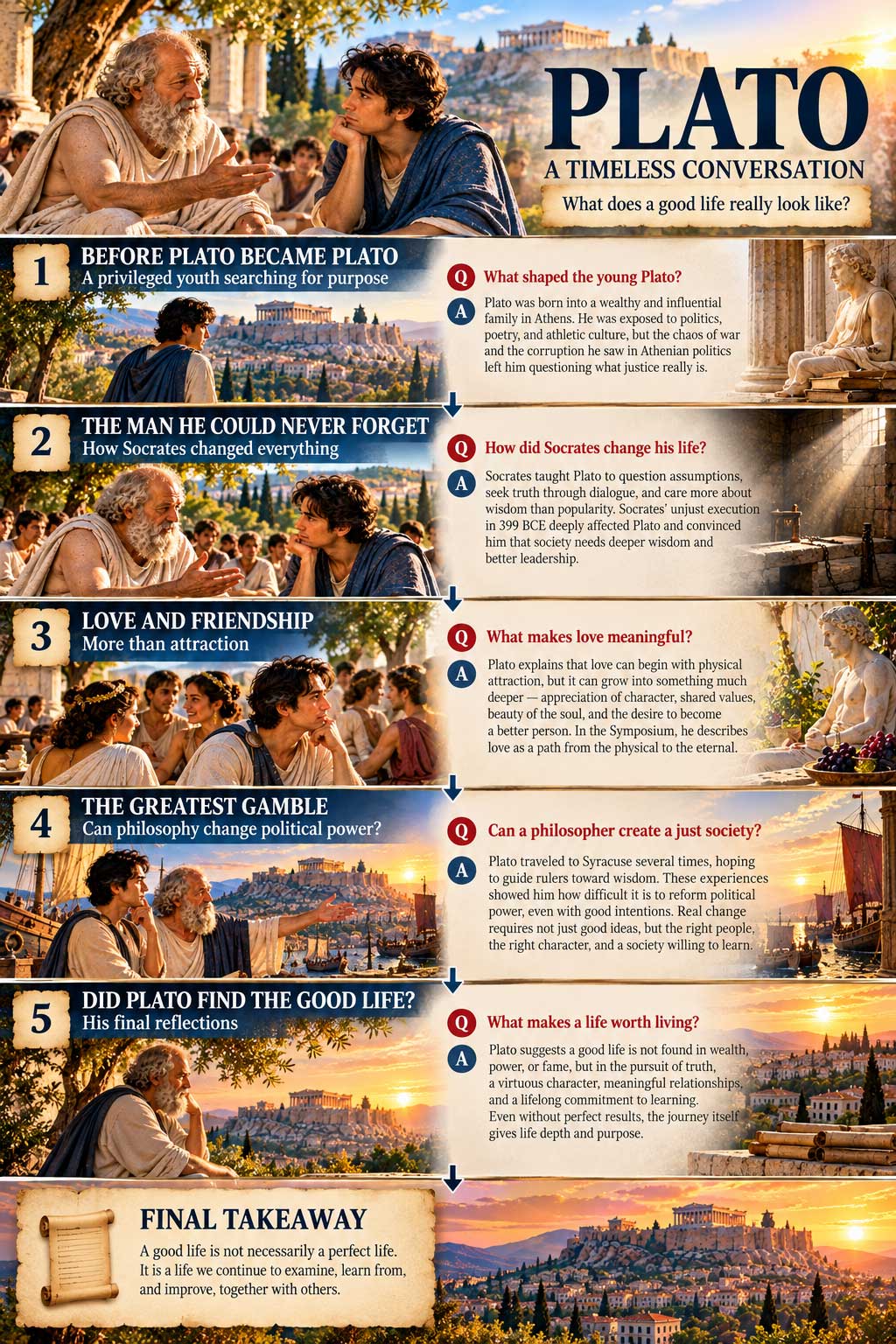
Short Bios:
Plato (c. 428/427–348/347 BCE)
Plato was an ancient Greek philosopher, a student of Socrates, and the founder of the Academy in Athens. Through influential dialogues such as The Republic, Symposium, Phaedo, and Phaedrus, he examined justice, love, knowledge, education, political authority, and the nature of reality.
Born into a prominent Athenian family during the Peloponnesian War, Plato witnessed political turmoil and the execution of Socrates in 399 BCE. His subsequent philosophical work and involvement in Syracuse reflected a lifelong concern with the relationship between wisdom and political power. His Academy became one of antiquity's most influential centers of intellectual inquiry, attracting students including Aristotle. Although Plato's writings have survived, many details of his private life remain uncertain.
Nick Sasaki — Interviewer and Imaginary Traveler
Nick Sasaki is the creator of ImaginaryTalks.com, a storytelling project that brings historical figures, philosophers, writers, and influential thinkers into fictional conversations about timeless human questions.
Born in Japan and having spent much of his adult life in the United States, Nick brings a cross-cultural perspective and an interest in the experiences that connect people across generations. In this imagined encounter, he approaches Plato with warmth, humor, and the curiosity of a father of five. Rather than trying to win a philosophical argument, he hopes to understand the person behind the famous ideas—and what that person's life might teach us about our own.
Note: Nick's time-travel encounter and all dialogue with Plato are fictional. The biographical descriptions distinguish historical information from the invented interview setting.
Leave a Reply