
Introduction
On September 30, 2026, a flight from Dubai to Tel Aviv nearly fell from the sky. The co-pilot attacked the captain with the cockpit's emergency axe, and the plane plunged thousands of feet. The captain was wounded but still got the cockpit door open, and passengers rushed in and overpowered the attacker. Reserve pilots landed safely in Saudi Arabia, and all 174 people aboard survived. Investigators have not officially stated a motive, but around the world the same question surfaced almost instantly: did he believe God wanted this?
That question sits beneath many smaller ones. A Christian on a street corner asks a Muslim, again and again, whether a Christian is a good man, and the Muslim will not say yes. A mosque rises in London while a church cannot be built in Riyadh. A daughter tells her father at dinner that she no longer believes. Faiths that speak of one loving God keep producing walls, verdicts, and sometimes violence.
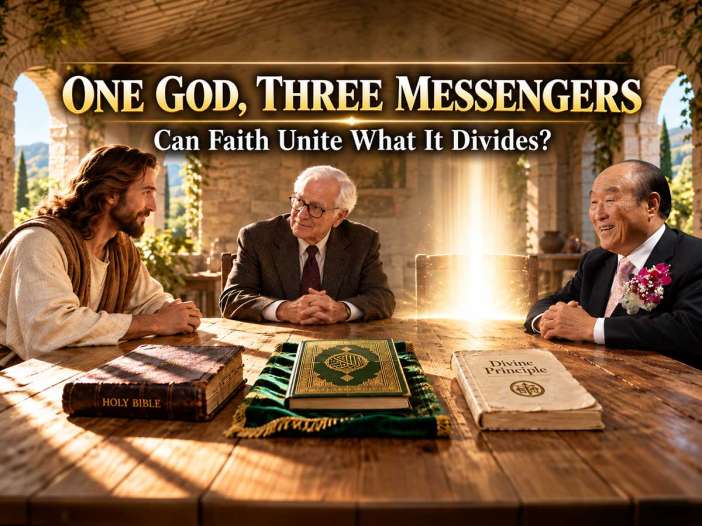
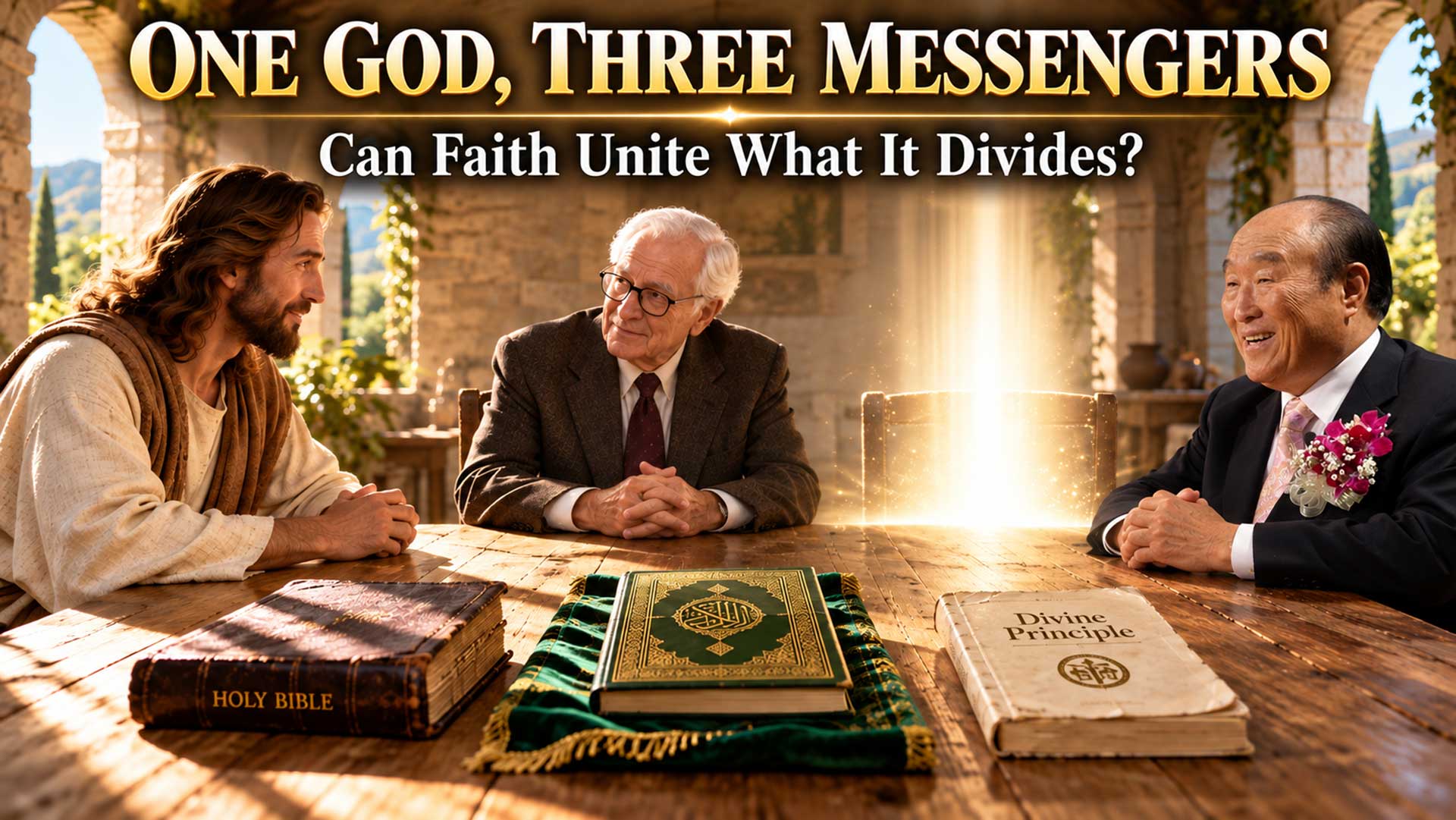
In this imaginary conversation, Huston Smith, the scholar who spent his life helping readers understand the world's religions from the inside, sits down with Jesus of Nazareth, the Prophet Muhammad, and Reverend Sun Myung Moon. Each man brought a message his followers believe completes what came before. Each now faces what his followers have done with it.
Across five conversations, they ask who gets to be called good, whether a final truth must become a final verdict, what to say to people who kill in God's name, and whether anyone should be punished for leaving a faith. They end with the hardest question of all: What would unity actually look like?
This is not an attempt to declare every religion the same. The three messengers disagree about the cross, about who Jesus is, about whether revelation is closed, and about whether anyone could come after. Those disagreements remain unresolved. The question is whether people can hold them without turning their convictions into weapons.
This is a fictional, AI-assisted conversation created for educational and reflective purposes. The dialogue is imagined and does not represent actual statements by the participants. The words of Jesus and the Prophet Muhammad are drawn closely from the Gospels and the Quran, and no depiction of either figure is intended.
(Note: This is an imaginary conversation, a creative exploration of an idea, and not a real speech or event.)
Topic 1: Who Gets to Be Called Good?

Huston Smith placed three books on the table.
A worn Bible.
A Quran wrapped in green cloth.
A thick copy of Divine Principle, its cover creased from years of use.
He did not open any of them.
Huston Smith: I spent most of my life trying to explain religions to people who didn't belong to them.
I learned something early.
You cannot understand a faith by studying what its worst followers do.
But you cannot understand it by studying only its best followers either.
So today, I want to start with an ordinary moment.
Not a war.
Not a theology lecture.
A street corner.
He looked around the table.
Huston: A Christian man asks a Muslim man, "Is a Christian a good man?"
He asks again.
And again.
The Muslim man will not say yes.
People watching the video conclude that Muslims believe Christians are bad people.
Prophet Muhammad, I want to begin with you, because that man believed he was speaking for your teaching.
Why wouldn't he say yes?
Muhammad: Perhaps because he heard two questions inside one.
Huston: Explain.
Muhammad: One question asks, "Is this man honest? Is he kind to his parents? Does he keep his promises? Does he feed the hungry?"
The other asks, "Is this man right with God?"
The first question can be answered by watching a man's life.
The second belongs to God alone.
Huston: So the man on the street refused the second question.
Muhammad: He may have feared that saying yes to the first would be heard as yes to the second.
Huston: Is that a reasonable fear?
Muhammad: It is a fear of a debate.
It is not the way the revelation speaks of Christians.
Huston waited.
Muhammad: The Quran says that the People of the Book are not all alike.
Among them is a community that stands upright, that recites God's verses through the night, that commands what is right, forbids what is wrong, and hurries toward good deeds.
And it says of them: they are among the righteous.
Huston: Among the righteous.
Muhammad: Among the righteous.
Huston: Then why didn't he simply say that?
Muhammad: You would have to ask him.
But I would tell him this: refusing to call a good man good is not faithfulness.
It is fear dressed as faithfulness.
Huston turned the phrase over.
Huston: "Fear dressed as faithfulness."
Muhammad: God does not need our stinginess to protect His truth.
Rev. Moon: May I add something?
Huston: Please.
Rev. Moon: The man asking the question was also afraid.
Huston: The Christian?
Rev. Moon: He asked the same question many times.
Why?
He was not seeking to understand his neighbor.
He wanted a confession.
He wanted to prove to the cameras that the other man's religion was cruel.
Huston: So both men were defending a position.
Rev. Moon: Both men were standing on a stage. Neither was standing before God.
Jesus had been quiet, his hands folded on the edge of the table.
Huston turned to him.
Huston: You've been listening.
Jesus: A man once ran up to me and called me good teacher.
Huston: I know the story.
Jesus: Do you remember my answer?
Huston: "Why do you call me good?"
Jesus: "No one is good but God alone."
Huston: Many Christians find that answer uncomfortable.
Jesus: They should.
It was meant to stop him before he began measuring goodness the way people usually do.
He looked at the Bible on the table.
Jesus: Your Christian on the street corner wanted the word "good" to belong to his side.
But the word was never his.
It belongs to God.
When you hold it like a flag, you have already forgotten whose it is.
Huston: Then how should we judge the people around us?
Jesus: By their fruit.
A good tree cannot bear bad fruit.
Watch what grows from a life.
Huston: So you would have said yes to the Muslim's question too. If someone asked whether a Muslim is a good man.
Jesus: I told a story once about a man beaten and left beside a road.
A priest passed by.
A Levite passed by.
Both knew the Scriptures well.
Both crossed to the other side.
Then a Samaritan stopped.
Huston: And the Samaritans were...
Jesus: The people my listeners believed worshipped wrongly.
The ones with the wrong temple.
The wrong mountain.
The wrong lineage.
The heretics.
Huston: You made the heretic the hero.
Jesus: I made the neighbor the hero.
My listeners were the ones who discovered he was a heretic.
The table was silent.
Huston slowly smiled.
Huston: That may be the most dangerous story ever told inside a religion.
Jesus: It was meant to be.
Huston: Do Christians today understand it?
Jesus: Ask yourself who the Samaritan is in your town.
Then you will know whether you understand it.
Huston: Reverend Moon, you grew up in a Christian family in Korea before you founded your own movement.
You've heard that parable your whole life.
What does it mean to you?
Rev. Moon: I first heard it as a boy.
I loved Jesus long before I understood him.
He paused, glancing toward Jesus.
Rev. Moon: The parable taught me that goodness is not a membership card.
I have taught for many years that the purpose of a human life is to live for the sake of others.
The Samaritan lived for the sake of a stranger. The priest lived for the sake of his own purity.
Which one resembles God?
Huston: The Samaritan.
Rev. Moon: Then we already know who is good.
Huston: But you don't stop there.
Rev. Moon: No.
Huston: Your teaching says that all of humanity carries a fallen nature. That everyone, Christian, Muslim, Buddhist, atheist, needs to be restored to God.
That sounds like another way of saying no one is truly good.
Moon nodded slowly.
Rev. Moon: Jesus said it first. Only God is good.
I teach that every person is a child of God.
Every person.
No one is a stranger to the Heavenly Parent.
But every person has also inherited something broken.
Selfishness.
The habit of living for oneself.
Huston: So a kind Muslim neighbor is good, and also in need of restoration.
Rev. Moon: As am I.
As is every Christian.
As is every minister who thinks his church has finished the work.
Huston: That's a generous answer.
Rev. Moon: It is not generous.
It is the same burden for everyone.
Huston leaned back.
Huston: I have to push all three of you.
Because I think this conversation is becoming too comfortable too quickly.
He touched the Bible.
Huston: Jesus, the same Gospels that contain the Good Samaritan also contain this sentence:
"I am the way, the truth, and the life. No one comes to the Father except through me."
Christians have used it for centuries to say that people outside the church are lost.
He touched the Quran.
Huston: Prophet Muhammad, you quoted a verse that calls some People of the Book righteous.
But the Quran also says that whoever seeks a religion other than Islam, it will not be accepted from him.
He touched Divine Principle.
Huston: And Reverend Moon, your movement teaches that humanity must be restored through the True Parents, and through the marriage Blessing you offered.
So each of you says goodness belongs to God.
Each of you also says there is a door.
And each of you says your message is that door.
Isn't the man on the street corner simply taking your own words seriously?
No one answered immediately.
Muhammad spoke first.
Muhammad: You have read both verses honestly.
Many people read only the one that comforts them.
Huston: Then answer both.
Muhammad: The same Book that contains the verse you read also says: those who believe, and the Jews, and the Christians, and the Sabians, whoever believes in God and the Last Day and does good, their reward is with their Lord.
It also says: to each of you We have given a law and a way. If God had willed, He would have made you one community. But He tests you in what He has given you.
So race one another in good works.
Huston: Your scholars have argued over how those verses fit together for fourteen centuries.
Muhammad: Yes.
Huston: Some say the later verse cancels the earlier ones.
Some say the opposite.
Muhammad: And some have used the argument to make God's mercy smaller than God made it.
Huston: Which reading do you hold?
Muhammad: I hold that I was sent to call people to God, and that I will be asked whether I delivered the message.
I was not appointed to decide who enters paradise.
That judgment is God's.
Huston: That still isn't a clear answer.
Muhammad: It is the clearest answer a messenger can give.
The truth matters.
Belief matters.
Rejection is not nothing.
But the moment a believer seats himself on God's throne to issue the verdict, he has committed a worse error than the unbeliever he condemns.
Huston looked at him a long moment.
Huston: So the man on the street corner had the right to say, "I believe Islam is true."
Muhammad: Yes.
Huston: He had no right to say, "Therefore you are not good."
Muhammad: He had no right to say, "Therefore I know your end."
Huston turned to Jesus.
Huston: Same question.
Jesus: I said, "I am the way."
I did not say, "My followers are the gatekeepers."
Huston: Christians have often treated those as the same sentence.
Jesus: They are not.
Huston: Then who passes through the way?
Jesus: I described the day of judgment once.
The nations are gathered.
People are separated like sheep from goats.
And the King says to some of them: I was hungry and you fed me. I was a stranger and you welcomed me. I was in prison and you visited me.
And do you remember what they said back?
Huston: "Lord, when did we see you?"
Jesus: They did not know.
They did not recognize me.
They had simply fed the hungry.
Huston: And the other group?
Jesus: They also said, "Lord, when did we see you?"
They called me Lord.
They knew my name.
They had not fed anyone.
Huston was quiet.
Huston: So in your own parable, the people who knew your name were surprised to be rejected.
And the people who didn't recognize you were surprised to be welcomed.
Jesus: Yes.
Huston: That doesn't sound like the "No one comes to the Father" verse.
Jesus: It is the same way.
The way is me.
And I am found in the hungry.
Huston: Reverend Moon.
Rev. Moon: I will not pretend my teaching contains no exclusive claim.
I believe God called me to a mission.
I believe God's providence needed True Parents to begin a new lineage.
My followers believe this. I believed it.
Huston: Then you have the same problem.
Rev. Moon: Yes.
But I also spent my life bringing together leaders of every religion. Muslim scholars. Buddhist monks. Jewish rabbis. Hindu teachers.
I did not invite them so that I could tell them they were bad people.
I invited them because I believed God was already working through them.
Huston: Some critics would say you invited them to recruit them.
Rev. Moon: Some critics would say that.
I would say that God has no denomination.
If my teaching is true, it will draw people through love.
If it requires me to call my neighbor evil, it has already failed.
Huston folded his hands.
Huston: Let me try to say what I'm hearing.
All three of you hold an exclusive claim.
All three of you believe your message matters for a person's relationship with God.
But all three of you are refusing to let a believer turn that claim into a verdict about his neighbor.
Muhammad: Yes.
Jesus: Yes.
Rev. Moon: Yes.
Huston: Then the man on the street corner wasn't entirely wrong about your teaching.
He was wrong about his job.
Muhammad nodded.
Muhammad: His job was to be a witness.
Huston: Not a judge.
Muhammad: Not a judge.
Huston looked out the window for a moment before continuing.
Huston: I want to bring this down to earth.
Tonight, somewhere in America, a Muslim family will move in next door to a Christian family.
The Christian father has seen that street-corner video.
The Muslim mother has seen videos too. Videos of Christians burning her book.
They meet at the mailbox.
What should each of them believe about the other?
Jesus: That the person at the mailbox is the neighbor.
Not a theology.
A neighbor.
Muhammad: That God made us into nations and tribes so that we might know one another.
Not so that we might despise one another.
Bring her food when she moves in. If her child is sick, visit.
That is what I taught my companions about neighbors. I told them I had been reminded so often to treat neighbors well that I thought neighbors might be given a share of inheritance.
Huston laughed softly.
Huston: That's a remarkable thing to say.
Muhammad: It is a remarkable obligation.
Christian neighbors were not excluded from it.
Rev. Moon: I would tell the two families to eat together.
Huston: That's all?
Rev. Moon: It is not small.
It is very hard to keep hating someone whose children have played in your yard.
Huston: And if the Christian father still asks himself, "Will my neighbor go to heaven?"
Jesus: Then let him ask a better question.
Huston: Which is?
Jesus: "Will my neighbor be glad I lived next door?"
Huston sat back.
Huston: "Will my neighbor be glad I lived next door?"
He repeated it quietly.
Huston: That question doesn't require anyone to give up their theology.
Jesus: No.
It requires them to give up their place on the judgment seat.
Huston picked up a pen but didn't write.
Huston: One more question before we move on.
And I want a short answer from each of you.
No parables.
Jesus: I will try.
Muhammad smiled slightly.
Huston: If a person who does not share your faith lives honestly, cares for the poor, and treats his neighbors with mercy, what is he?
Muhammad: A man God sees, and does not overlook.
Rev. Moon: God's child, and closer to God's heart than many believers.
Jesus: Not far from the kingdom of God.
Huston looked at him.
Huston: You said that once before.
Jesus: To a teacher of the law who understood that loving God and loving his neighbor mattered more than every offering in the temple.
Huston: He wasn't your follower.
Jesus: No.
He was simply honest.
Huston set the pen down.
Huston: Then maybe the man on the street corner was asking the wrong question all along.
"Is he good?" sounds humble.
But it often hides another question:
"Is my side right?"
And when we answer that second question first, we stop seeing the person in front of us.
Perhaps faith was never meant to make us the judges of who is good.
Perhaps it was meant to make us good enough that the question stops mattering at the mailbox.
He looked at the three books in front of him.
Huston: But I'm not letting any of you off the hook.
Because something happened in this conversation that I think all three of you noticed.
Each of you, in a different way, said that your message completes what came before.
The Quran calls itself the final revelation. The Prophet Muhammad, the Seal of the Prophets.
Christians call Jesus the final Word, the fullness of God.
And Reverend Moon, your teaching says that Jesus' mission was left unfinished, and that you came to continue it.
Jesus turned toward Moon.
There was no suspicion in his face.
Only the look of an older brother who already knew what the younger one was about to say.
Moon met his gaze.
Muhammad watched them both.
Huston: You can be kind neighbors at the mailbox.
But you can't all be the last word.
So in our next conversation, I want to ask the question this table has been politely avoiding:
Is my truth the final truth?
That's the full Topic 1. Besides the new ending, Moon now says he loved Jesus as a boy, and "complete it" became "continue it." Ready for the full rewritten Topic 2 when you are.
Topic 2: Is My Truth the Final Truth?
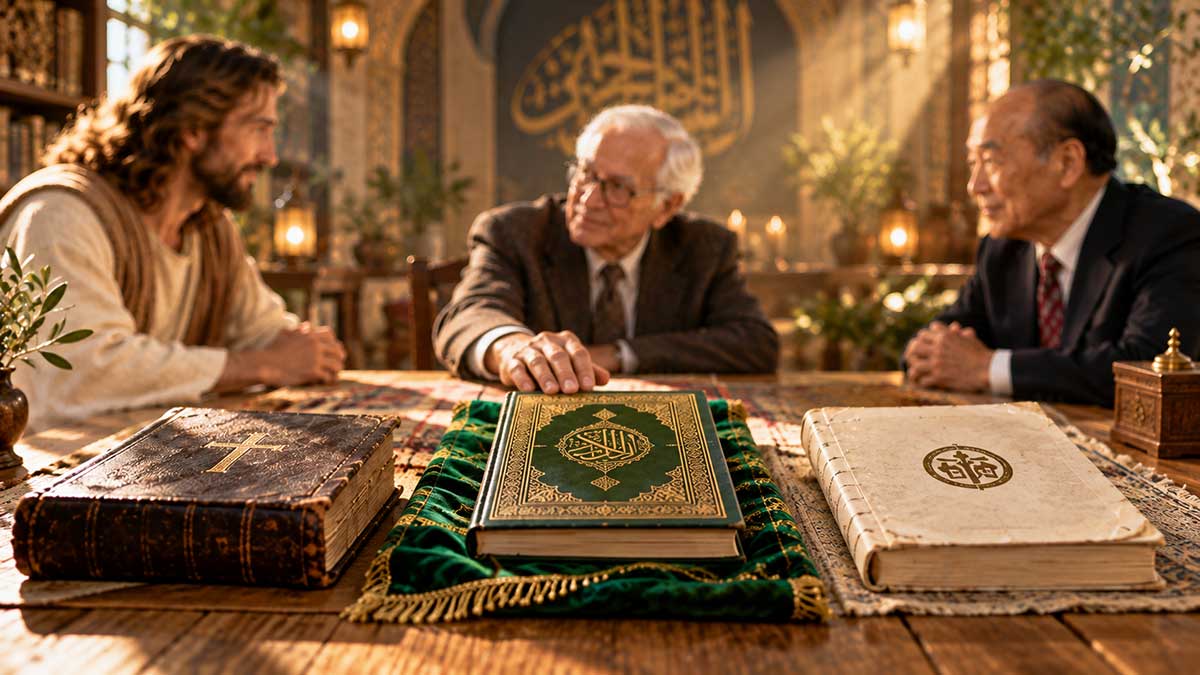
Huston Smith moved the three books closer together.
Then he moved them apart again.
He seemed unsatisfied with both arrangements.
Huston Smith: In our last conversation, the three of you agreed on something important.
No believer has the right to sit on God's throne and announce who is good.
That was the easy part.
Rev. Moon: It did not feel easy.
Huston: Compared to this, it was.
He tapped the table once.
Huston: Because each of you believes something the other two cannot fully accept.
So let's say it plainly, without diplomacy.
Jesus, Christians believe you are the Word made flesh. The Son of God. The final and complete revelation of who God is.
Prophet Muhammad, Muslims believe you are the Seal of the Prophets. That the Quran is God's final revelation, confirming what came before and correcting what was distorted.
Reverend Moon, your followers believe that Jesus' mission was left unfinished, and that God called you, with your wife, as True Parents to continue it.
He looked at each man in turn.
Huston: Three final words.
There's only room for one.
No one spoke.
Huston: I want to understand each claim before anyone challenges it.
Prophet Muhammad, you first. What does it mean to be the Seal?
Muhammad: A seal closes a letter.
It confirms that the letter is complete and that it comes from the one who sent it.
I was not sent with a new God.
I was sent with the oldest message.
The message of Abraham. Of Moses. Of Jesus, son of Mary.
There is no god but God.
Huston: Then why was a final messenger needed?
Muhammad: Because people kept adding to the message.
They made partners with God.
They made idols of stone, of wealth, of tribe, of their own desires.
The Quran came to call people back to what had always been true.
Huston: And Jesus?
Muhammad turned toward him with evident respect.
Muhammad: The Messiah.
A word from God, cast into Mary.
A spirit from Him.
He healed the blind. He raised the dead by God's permission. He is honored in this life and the next.
Huston: But not the Son of God.
Muhammad: God does not beget, and is not begotten.
That is not an insult to Jesus.
It is protection of God.
Huston turned to Jesus.
Huston: How do you hear that?
Jesus was quiet for a moment.
Jesus: I hear a brother who loves God's oneness enough to guard it.
Huston: Do you agree with him?
Jesus: I said, "The Father and I are one."
I said, "Whoever has seen me has seen the Father."
My disciples did not invent those words to make me greater than I was. They struggled with them. They were afraid of them.
Huston: So you don't agree.
Jesus: I will not pretend my words say less than they say.
Nor will I pretend he believes less than he believes.
Huston: Then let's go to the hardest place.
The cross.
He looked at Muhammad.
Huston: The Quran says Jesus was not killed and not crucified. That it was only made to appear so.
He looked at Jesus.
Huston: The Gospels say you died on that cross and rose on the third day.
Christianity stands or falls on that claim.
Islam rejects it.
Can both be true?
Muhammad: No.
Jesus: No.
They answered at the same moment.
Huston almost laughed.
Huston: Finally, something you agree on.
Muhammad: We agree that it matters.
Jesus: We agree that it cannot be solved by being polite.
Huston: Then I won't try to solve it.
I've spent my life studying both traditions. I know scholars who have spent forty years on that single question.
This table is not going to settle it in an afternoon.
But I want to ask both of you something different.
Does the disagreement require hatred?
Muhammad: It requires honesty.
Hatred is something people add.
Jesus: I asked my Father to forgive the men who drove the nails.
If I asked forgiveness for them, I will not ask my followers to despise someone who believes the nails never touched me.
Huston let the sentence settle.
Then he turned to Moon.
Huston: Reverend Moon, your claim may be the most difficult at this table.
Because you're not only offering a different teaching.
You're saying you understand something about Jesus' mission that his own church has not understood.
Rev. Moon: Yes.
Huston: Explain it.
Rev. Moon: I teach that God sent Jesus to be received.
Not rejected.
God's first hope was that his people would accept him, that he would marry, that he would begin a family free from humanity's fallen lineage.
The True Family.
But he was rejected.
So the cross became the way, but it was not God's first desire.
Salvation came spiritually through the cross. The physical restoration of the world remained unfinished.
Huston: And you came to finish it.
Rev. Moon: I believe Jesus himself asked me to continue his mission.
I was sixteen years old, praying on a mountain in Korea, on Easter morning.
Huston turned to Jesus.
But Moon spoke first.
Rev. Moon: Before you answer, let me say something.
I have never spoken of you as someone who failed.
The people who should have received you failed you. Your own nation. The leaders who knew the Scriptures. Even the disciples who slept in the garden.
For most of my life, when I prayed, I did not pray first about my own suffering.
I prayed about yours.
Jesus looked at him for a long moment.
Jesus: You wept for me.
Rev. Moon: Many times.
Jesus: Most people who speak my name ask me to carry their burdens.
Few ask what I carried.
Huston: But you don't agree with him.
Jesus: When I told my disciples that the Son of Man must suffer and be rejected, Peter took me aside and said, "This shall never happen to you."
I rebuked him.
I set my face toward Jerusalem knowing what waited there.
I will not tell you the cross was an accident.
Rev. Moon: And I will not tell you it was what your Father hoped for first.
No father wishes his son to be killed.
When people gave God rejection, He turned rejection into salvation. That was His victory, and yours.
But I have always believed heaven grieved that day too.
Jesus: Heaven did grieve.
Rev. Moon: Then perhaps we disagree less about the cross than about what came after it.
Jesus: Perhaps.
Huston leaned forward.
Huston: I want to name what just happened.
Reverend Moon believes he continues your mission.
Christians believe your mission was completed on the cross and in the resurrection.
Most churches have rejected his claim. Some very strongly.
That is not a small difference.
Jesus: No.
Huston: Does it trouble you?
Jesus didn't answer at once.
Jesus: Someone once told me my mother and brothers were outside, asking for me.
I pointed to the people sitting around me and said, "Whoever does the will of my Father in heaven is my brother."
He turned to Moon.
Jesus: I do not judge a brother by whether he agrees with every word written about me.
I judge him the way I told my disciples to judge every tree.
Huston: By its fruit.
Jesus: By its fruit.
Rev. Moon: I accept that test.
Huston: Even if the fruit includes things your critics point to?
Controversies around your movement? Former members who say they were pressured? Families who felt they lost their children?
Rev. Moon: I accept that test too.
A tree is judged by all of its fruit. Not only the fruit its gardener prefers to show.
Muhammad watched both men carefully.
Muhammad: That is a hard thing to say about oneself.
Rev. Moon: It would be harder to stand before God having refused to say it.
Huston sat back and exhaled.
Huston: All right.
We've established that the three of you disagree about some of the most important claims a person can make.
Who God is.
Whether Jesus is divine.
Whether he died on the cross.
Whether revelation is closed.
Whether anyone could come after.
These are not differences in vocabulary.
Muhammad: No.
Huston: So I have to ask the question that every believer eventually faces.
If I am convinced my faith is the final truth, what am I allowed to think about yours?
Muhammad: That it contains truth.
Huston: But not all of it.
Muhammad: In my belief, not all of it.
Huston: And what am I allowed to do about yours?
Muhammad answered without hesitation.
Muhammad: Invite.
With wisdom and beautiful preaching.
And if you argue, argue in the way that is best.
That is the command.
Huston: And if the person says no?
Muhammad: There is no compulsion in religion.
The right way has become clear from the wrong.
Whoever wills, let him believe. Whoever wills, let him disbelieve.
My task was to deliver the message.
The heart is not mine to open.
Huston: Some of your followers have not lived by that verse.
Muhammad: Some.
And the verse will be a witness against them.
Huston turned to Jesus.
Huston: What about you?
Christians have a word for it. The Great Commission. "Go and make disciples of all nations."
They've done that through hospitals and schools.
They've also done it through conquest.
Jesus: I said, "Go."
I did not say, "Conquer."
I sent my disciples out without swords, without money, without a second coat.
I told them that if a town would not receive them, they should shake the dust from their feet and walk on.
Huston: Walk on.
Jesus: Not burn the town.
When two of my disciples asked if they should call fire down from heaven on a village that rejected me, I rebuked them.
Huston: Why?
Jesus: Because they did not know what spirit they were of.
Huston repeated it slowly.
Huston: "They did not know what spirit they were of."
That seems to describe a good deal of religious history.
Jesus: It describes a good deal of human history.
Religion only gives it holier words.
Huston looked at Moon.
Rev. Moon: I would add something.
If your truth is final, why are you afraid?
Huston: Afraid?
Rev. Moon: People rarely become violent about truths they are confident in.
No one fights wars over whether the sun will rise.
People fight when they are afraid the truth will not survive unless they defend it with their hands.
Muhammad: God does not need defending.
People who think He does have made Him small.
Huston: Then let me ask what "final" really means.
Because I think the word does two very different jobs.
Prophet Muhammad, when you say the Quran is final, what are you saying?
Muhammad: That God has finished speaking what humanity needed to be told.
That nothing is missing.
That no one may add a new god or a new law and say it came from heaven.
Huston: Is that a statement about God or about Muslims?
Muhammad: About God's faithfulness.
He did not leave humanity without guidance.
Huston: But many Muslims hear it as a statement about themselves.
"We have the final truth. Therefore we are above others."
Muhammad: Then they have mistaken the gift for a rank.
Huston nodded slowly.
Huston: Mistaken the gift for a rank.
He turned to Jesus.
Jesus: When I say I am the truth, I am not saying, "My followers have won the argument."
Truth is not a trophy.
Truth is a person you follow.
And following leads downward. Toward the poor. Toward the cross. Toward washing other people's feet.
Huston: That's a strange kind of finality.
Jesus: It is the only kind I offered.
Huston: Reverend Moon?
Rev. Moon: I taught that God's providence is a story of restoration.
A story is not finished because one chapter ends.
Every religion was a chapter God wrote.
I believe my chapter was necessary. My followers believe it completes the others.
But if I use that belief to tear the other chapters out of the book, I have destroyed the book God was writing.
Huston smiled faintly.
Huston: You know, all three of you keep doing something I didn't expect.
Every time I push on your exclusive claims, you don't soften them.
You keep them.
But you change what they're for.
Muhammad: Truth is for guidance. Not for domination.
Jesus: Truth is for freedom. "The truth will set you free."
Not free to rule. Free from fear.
Rev. Moon: Truth is for living for the sake of others.
If it makes you live for the sake of your own superiority, it is no longer God's truth.
Huston picked up a single sheet of paper from beside the books.
Huston: Let me bring this to someone real.
A reader wrote to me about his life.
He grew up Japanese. As a boy, he joined the Catholic Church. As a teenager, he joined another church. Later, he joined a third.
Each time, he was told, in one way or another, that he had finally found the complete truth.
He wrote: "Was I wrong the first time? The second? Or did God speak to me in each one?"
He set the paper down.
Huston: What do you tell him?
Jesus answered first.
Jesus: I would tell him that the shepherd who looks for one lost sheep does not scold it for wandering on different paths.
He carries it home.
Huston: Does that mean every path was right?
Jesus: It means he was never out of sight.
Muhammad: I would tell him that God says: those who strive in Our cause, We will surely guide them to Our ways.
Ways. Not way.
A sincere seeker is not abandoned between doors.
Huston: Your scholars might debate that reading.
Muhammad: My scholars debate everything.
That is how you know they love the Book.
Huston laughed.
Rev. Moon: I would tell him that nothing sincere is wasted.
What he learned as a Catholic boy, he carried into every church after it.
God does not erase earlier chapters of a person's life. He builds on them.
Huston: That sounds like your theology of history applied to one man.
Rev. Moon: A person is a small history.
History is a large person.
Huston looked at the paper again.
Huston: He also wrote one more line.
"Now I believe all religions come from one God. But I find it hard to accept people who believe only theirs is right."
He looked up.
Huston: I suspect many readers feel exactly that.
So I'll ask the question back to all three of you.
Can someone who believes all religions come from one God accept someone who believes only one does?
Muhammad answered first.
Muhammad: He must.
Otherwise he has only built a new wall, with a different sign on it.
Huston: Say more.
Muhammad: If he says, "I am tolerant, and they are not, so I cannot accept them," then his tolerance has become another exclusive religion.
With its own unbelievers.
Huston was silent for a moment.
Huston: That's a difficult mirror.
Jesus: It is the mirror I held up to the Pharisee praying in the temple.
"God, I thank you that I am not like other men."
The words of his prayer were humble.
His heart was proud.
Rev. Moon: I spent my life asking people of different faiths to sit together.
The hardest people to bring to the table were not the ones who believed their religion was true.
They were the ones who believed they were better than the people who believed it.
Huston looked at the three books.
Huston: I want one sentence from each of you.
No parables.
Jesus: I will try again.
Huston: What should a person do with a truth they believe is final?
Muhammad: Carry it humbly, offer it freely, and leave the verdict to God.
Rev. Moon: Live it so completely for others that people want to know where it came from.
Jesus: Follow it until it leads you to the person you least wanted to love.
Huston closed his eyes briefly.
Huston: That last one sounds like a parable.
Jesus: It is a sentence.
They laughed.
Huston placed his hand flat on the table between the three books.
Huston: When I began studying religion, I thought the great danger was that believers would refuse to admit their differences.
Everyone saying all religions are the same. No one taking truth seriously.
That danger is real.
But today I think I understand the other danger more clearly.
A person can take truth so seriously that he forgets what truth is for.
He starts using a final revelation as a final verdict.
He confuses "God has spoken" with "I may now speak for God."
Perhaps the word "final" was never meant to close the conversation.
Perhaps it was meant to close the search for a better god than the one who already loves us.
He looked at Jesus, then Muhammad, then Moon.
Huston: None of you changed your claims today.
But each of you refused to let your claim become a weapon.
So now I have to ask the question you all knew was coming.
He reached beneath the table and placed a newspaper on top of the three books.
The headline described a flight from Dubai to Tel Aviv.
A co-pilot. An emergency axe. A wounded captain. A plane that plunged before passengers forced their way into the cockpit and stopped him.
The UAE called it an attempted terrorist act. Investigators were still searching for the motive.
But reports said the co-pilot had once been barred from flying over concerns about extremist views.
No one at the table spoke.
Huston: One hundred and seventy-four people on that plane.
Christians. Muslims. Jews. People of no faith at all.
Whatever drove that man, people across the world immediately asked one question:
Did he believe God wanted this?
Huston turned the newspaper so all three men could read it.
Huston: You have each said your followers have no right to judge who is good.
Now I want to know what you say to the ones who decide who should die.
What do you say to the people who kill in your name?
Topic 3: When Believers Kill in Your Name

The newspaper lay open on top of the three books.
No one moved it.
Huston Smith left it there on purpose.
Huston Smith: Let me tell you what we know.
And what we don't.
A flight from Dubai to Tel Aviv. One hundred and seventy-four people aboard.
Somewhere over the desert, the co-pilot turned on the captain with the emergency axe kept in the cockpit.
The plane dropped thousands of feet.
The wounded captain got the cockpit door open. Passengers rushed in and held the attacker down. Two reserve pilots brought the plane down safely in Saudi Arabia.
No one died.
The UAE called it an attempted terrorist act.
Reports say the co-pilot had once been barred from flying over his extremist views.
But investigators have not officially said why he did it.
He folded his hands.
Huston: So I won't pretend we know his heart.
But I know what millions of people thought the moment they read the headline.
"Another one. Another Muslim who believed God wanted this."
He turned to Muhammad.
Huston: I'm going to start with you.
Not because Muslims are the only people who kill in God's name.
They aren't.
But because, for the last few decades, most suicide attacks in the world have been carried out by people who used your name and your Book to justify them.
That's not prejudice.
That's the record.
Muhammad did not look away from the newspaper.
Muhammad: You are right to say it.
A messenger who will not hear the truth about his followers is not fit to deliver truth to anyone else.
Huston: Then answer the man who believes he's pleasing God by killing everyone on that plane.
Muhammad: He is not pleasing God.
He is disobeying Him three times in a single act.
Huston: Three times?
Muhammad: God says in the Quran: whoever kills a soul, unless for a soul or for corruption in the land, it is as if he has killed all of humanity.
And whoever saves one, it is as if he has saved all of humanity.
That is the first.
Huston: And the second?
Muhammad: "Do not kill yourselves."
A man who takes his own life to take others with him has not become a martyr.
He has carried two crimes before God instead of one.
Huston: And the third?
Muhammad: Even in war, a real war, declared by a legitimate authority against those who attacked first, I commanded my companions:
Do not kill women.
Do not kill children.
Do not kill the old.
Do not kill monks in their cells.
Do not cut down fruit trees.
On that plane were women. Children. The elderly.
He had no war. He had no authority. He had no enemy army.
He had only passengers.
Huston nodded slowly.
Huston: But I have to push you.
Jesus never led an army.
You did.
You fought battles. Badr. Uhud. The Trench.
When a young man reads that his prophet fought, isn't it easier for him to believe that he should fight too?
Muhammad was quiet for a long time.
Muhammad: You ask a fair question.
I will not answer it by pretending the battles did not happen.
Huston: Then answer it honestly.
Muhammad: For thirteen years in Mecca, my followers were beaten, starved, and killed. Some were tortured in the sun. We did not lift a hand.
Then we left our homes.
They followed us.
Only then did the permission come. Permission to those who are fought against, because they have been wronged.
Huston: Permission. Not command.
Muhammad: Permission, with limits.
If the enemy inclines toward peace, incline toward it as well.
The young man who reads only that I fought, and not why, and not how, and not when I stopped, has not read me.
He has read his own anger and put my name on it.
Huston: Your own tradition warned about people like that, didn't it?
Muhammad: I warned about them.
I said a people would come who recite the Quran, but it will not pass beyond their throats.
They will pass through religion the way an arrow passes through its target. Fast. Clean. And leaving nothing of it behind.
Huston: "It will not pass beyond their throats."
Muhammad: The words are in their mouths.
Not in their hearts.
The early ones were called the Kharijites. They murdered other Muslims because they decided those Muslims were not Muslim enough.
They prayed more than anyone. They fasted more than anyone.
And they killed my own cousin while he was praying.
Huston let the silence stand.
Then he turned to Jesus.
Huston: I don't want this table to become a trial of one religion.
So I'm going to read you something.
He opened the Bible.
Huston: "Do not think that I came to bring peace on earth. I did not come to bring peace, but a sword."
Your words.
Crusaders carried them. Inquisitors carried them. Men who burned other Christians at the stake carried them.
What were you doing when you said that?
Jesus: Telling my disciples the cost.
Huston: The cost of what?
Jesus: Of following me.
In the same breath, I said a man's enemies would be those of his own household.
I was not telling them to pick up a sword.
I was telling them that the sword would be pointed at them.
Huston: But Christians picked it up anyway.
Jesus: On the night I was arrested, Peter picked one up.
He struck a servant and cut off his ear.
Huston: And you said...
Jesus: "Put your sword back in its place. All who take the sword will perish by the sword."
Then I healed the servant's ear.
The last miracle I did before the cross was to repair the damage done by my own follower's violence.
Huston looked at him for a moment.
Huston: I never noticed that.
Jesus: Few people do.
Huston: Then what would you say to a Crusader?
To a man who marched across a continent believing he was fighting for you?
Jesus: The same thing I warned would happen on the last day.
Many will say to me, "Lord, Lord, did we not do mighty works in your name?"
And I will tell them: "I never knew you."
Huston: "I never knew you."
Jesus: They knew my name.
I did not know them.
Huston turned the page.
Huston: It isn't only ancient history.
In 2011, a man in Norway murdered seventy-seven people, most of them teenagers at a summer camp. He described himself as a defender of Christian Europe.
In Uganda, a militia that called itself the Lord's Resistance Army kidnapped tens of thousands of children and turned them into soldiers.
Jesus: The Lord's Resistance Army.
He said the words slowly.
Jesus: They took children.
I said that whoever causes one of these little ones to stumble, it would be better for him to have a millstone tied around his neck and be thrown into the sea.
I did not say that to frighten them.
I said it because I meant it.
Huston closed the Bible.
He turned to Moon.
Huston: Reverend Moon, no one has hijacked a plane in your name.
But I'd be dishonest if I left you out of this conversation.
Rev. Moon: I would not want to be left out.
Huston: Because there was a killing in Japan connected to your movement.
Not committed in your name.
Committed against someone because of it.
Moon's face became still.
Huston: In 2022, a man shot former Prime Minister Shinzo Abe.
He said he blamed your church because his mother's enormous donations had ruined his family. He believed Abe had helped the church.
Afterward, the Japanese government asked a court to dissolve the church's legal status there, and in 2025 a Tokyo court ordered it.
The killing was wrong. Nothing justifies it.
But many Japanese people concluded that harm done in the name of religion can also give birth to violence.
Rev. Moon: Yes.
He was silent for a moment.
Rev. Moon: I died before that day.
But I would not hide behind my death.
Huston: What would you say about it?
Rev. Moon: First, that killing a man is never the answer to a wound.
The man who fired that gun took a life, and he will answer for it.
Huston: And second?
Rev. Moon: Second, that a mother gave until her children went hungry.
If she did so believing she was obeying God, then someone taught her that God's love could be measured in money.
That is not my teaching.
But if it happened inside my movement, then it is my responsibility.
Huston: Your critics would say it was the teaching. That you asked for sacrifice and people gave until they broke.
Rev. Moon: I taught sacrifice.
I taught indemnity. Paying a price to restore what was lost.
But a sacrifice that destroys a family destroys the very thing God wants to restore.
If any leader in my name asked a mother to choose between offering money and feeding her son, that leader did not understand the first word of my teaching.
And if I built a culture where no one dared to say, "This is too much," then I share the blame.
Muhammad looked at him with something like respect.
Muhammad: That is not easy to say.
Rev. Moon: It is easier than meeting that young man before God and telling him his suffering was not my concern.
Jesus spoke quietly.
Jesus: That is how a father speaks.
Moon lowered his eyes.
Rev. Moon: I learned it from watching how you carried what others did in your name.
Huston sat back.
Huston: I want to ask all three of you the question underneath this.
Why does anyone come to believe God wants him to kill?
Rev. Moon: I spent almost three years in a North Korean labor camp.
At Hungnam. Hauling fertilizer that burned through the skin. Men died around me every week.
The guards did not believe in God at all.
They believed in an ideology just as completely.
Huston: So it isn't religion.
Rev. Moon: It is the human heart deciding that some people are less than people.
Religion can give that heart a sacred vocabulary.
Communism gave it a revolutionary one.
Nationalism gives it a patriotic one.
The disease is the same.
Huston: The record supports you.
The 1972 massacre at Lod Airport in Israel was carried out by the Japanese Red Army. Secular revolutionaries.
The 1995 sarin attack on the Tokyo subway was carried out by Aum Shinrikyo, a cult built from pieces of Buddhism, Hinduism, and apocalyptic Christianity.
And Japan once sent thousands of young pilots to die in planes aimed at ships, in the name of the Emperor.
Rev. Moon: So we should be humble.
No nation has clean hands. No religion has clean hands.
Muhammad: But humility must not become an excuse.
Huston turned to him.
Muhammad: If a Muslim hears, "Other people did terrible things too," and concludes he has nothing to correct in his own community, then this conversation has made him worse.
The Japanese Red Army does not answer for the man who used my name.
I do.
His community does.
His scholars do.
Huston: What should they do?
Muhammad: Teach the verses completely.
Not the verse about fighting without the verse about peace.
Not the battles without the treaty of Hudaybiyyah, where I accepted terms my own companions thought were humiliating, because peace was worth more than pride.
Watch the young man who begins calling other Muslims unbelievers.
That is always where it starts.
First he judges other believers.
Then he decides they can be killed.
Then he decides everyone can.
Jesus: The same road exists among my followers.
First a man believes he is more faithful than his brother.
Then he is certain.
Then he is armed.
Huston repeated it.
Huston: "Then he is certain. Then he is armed."
Jesus: Certainty without love is the most dangerous thing a person can carry.
More dangerous than an axe.
Huston picked up the newspaper and looked at it again.
Huston: I keep thinking about what happened on that plane after the attack.
The captain was bleeding. He still got the door open.
Strangers ran toward the cockpit, not away from it.
No one knows what faith most of those passengers held.
But for a few minutes, at seventeen thousand feet, they weren't Christians or Muslims or Jews.
They were people refusing to let one man decide they should die.
Rev. Moon: That is where God was on that plane.
Not in the cockpit.
In the aisle.
Huston set the paper down.
Huston: I want to bring this home.
Because most people listening to this will never be on a hijacked plane.
But some of them have a son.
A fifteen-year-old who spends every night in his room with his phone.
He's become quieter. Angrier.
One night, his mother sees the videos he's watching.
A preacher explaining that the world is divided into believers and enemies. That their community is under attack. That real men defend their faith.
It could be an Islamist preacher.
It could be a Christian nationalist.
It could be someone with no religion at all.
What should she do tonight?
Muhammad: Do not throw away the phone and slam the door.
That is what the preacher wants.
He has told the boy that his family does not understand. Do not prove him right.
Huston: Then what?
Muhammad: Sit with him.
Ask him what the preacher says that he believes.
Then ask him whether the preacher has ever fed a hungry person.
Huston: That's a strange question to ask.
Muhammad: It is a revealing one.
Men who call boys to die rarely ask them to visit the sick.
Jesus: Find out what he is hungry for.
A boy does not watch those videos because he loves hatred.
He watches because someone finally told him he matters. That his life has a purpose. That he belongs to something.
Huston: So she should give him that.
Jesus: Before someone else does.
Rev. Moon: And she should not do it alone.
His father. His grandparents. A teacher. An imam or a pastor he respects.
A boy is pulled into hatred through loneliness.
He is pulled back through a family.
Huston looked at all three.
Huston: So the antidote to radicalization isn't a better argument.
Jesus: Sometimes it is.
But usually it is a better table.
Huston: "A better table."
He smiled faintly and looked at the one they were sitting around.
Huston: I'm going to ask you to do something difficult.
Somewhere right now, someone is planning to kill in your name.
He has your words on his screen.
He believes you would be proud of him.
You have one sentence to say to him before he acts.
Muhammad answered without hesitation.
Muhammad: If you kill them, you will meet God carrying their blood, and I will not stand beside you.
Rev. Moon: Before you take one life, try living one day completely for the sake of the people you wish to destroy.
Jesus waited longer than the others.
Jesus: Look at their faces, because I will be standing among them.
The room was silent.
Huston did not speak for some time.
Huston: For most of my life, I believed that religious violence was a misunderstanding.
That if people simply read their scriptures properly, the violence would end.
I don't believe that anymore.
Not because the scriptures are violent.
Because people are clever.
A man who wants to hate will find a verse.
A man who wants permission will find a preacher.
A man who wants to feel righteous will find a crowd.
So perhaps the question isn't only, "What does my religion really teach?"
Perhaps it's, "What kind of person am I becoming while I read it?"
Anyone who needs God's permission to kill has already stopped listening to God.
He looked at the newspaper one last time, then slid it off the books.
Huston: But there is a quieter kind of violence I haven't asked you about.
Not against strangers on a plane.
Against your own.
The person born into your faith who decides to leave it.
In some countries today, a Muslim who becomes a Christian can be imprisoned. In some families, shunned. Disowned. Sometimes threatened with death.
A mosque can be built in London.
A church cannot be built in Riyadh.
And it isn't only Islam.
Reverend Moon, there were parents in America and Japan who kidnapped their adult children out of your movement and held them for "deprogramming."
And there were families who felt your movement had taken their children from them first.
He looked around the table.
Huston: You have each said today that faith must never be forced.
So let me ask the question that tests whether you mean it.
If someone stops believing, is he still free to leave?
That's the full Topic 3. The only change is a short new moment after Moon's accountability on the Abe case: Jesus says, "That is how a father speaks," and Moon answers that he learned it from him. Topic 4 is next.
Topic 4: Freedom to Believe, Freedom to Leave

Huston Smith stood up and walked to the door of the room.
He opened it.
Then he came back to the table and sat down, leaving it open.
Huston Smith: I'm going to leave that open for this conversation.
Rev. Moon: Is there a draft?
Huston: There's a question.
The three men looked at the open door.
Huston: For the last hour, each of you has said faith must never be forced.
That's easy to say about someone outside your community.
It's much harder to say about someone inside it.
Your son. Your daughter. Your closest disciple.
The person who stood beside you for twenty years and one morning says, "I don't believe anymore."
He nodded toward the door.
Huston: Is that door really open?
He turned to Muhammad.
Huston: Prophet Muhammad, I have to start with you again. Not because others are innocent. Because this is where the world's attention is.
In several countries today, leaving Islam can still carry the death penalty under the law.
In others, prison.
In many more, a Muslim who becomes a Christian or an atheist may be disowned by his family, lose his marriage, lose his children, or be threatened by neighbors.
A mosque can be built in London.
A church cannot be built in Riyadh.
Muslims in Britain have the freedom to invite people to Islam.
A Saudi citizen does not have the freedom to leave it.
You've said there is no compulsion in religion.
How does that verse survive in a country like that?
Muhammad did not answer immediately.
Muhammad: It survives in the Book.
Whether it survives in the country is a question for the people who govern it.
Huston: That sounds like distance.
Muhammad: Then let me come closer.
Huston: Please.
Muhammad: The Quran speaks of people who believed, then disbelieved, then believed again, then disbelieved again.
Several times.
Huston: And?
Muhammad: Think about what that means.
If they had been killed the first time they left, how could they have believed again?
The verse speaks of people who left and came back and left again.
It speaks of their accountability before God.
It does not tell any man to execute them.
Huston: But your tradition has a saying attributed to you: "Whoever changes his religion, kill him."
The classical schools of law built on that saying. For centuries, nearly all of them prescribed death for a male apostate.
I'm not inventing that.
Muhammad: You are not.
Huston: Then explain it.
Muhammad: In my time, to leave the community was rarely a private change of belief.
Medina was a small city surrounded by enemies.
A man who renounced his faith often did so by joining the army marching against us.
He took what he knew. He took his sword.
To leave was to go to war.
Huston: So the saying was about treason.
Muhammad: Many of your scholars today read it that way. And many of mine.
Huston: And the ones who don't?
Muhammad: They will answer for how they read it.
As I will answer for how I lived it.
Huston: How did you live it?
Muhammad: A Bedouin once came to me and pledged himself to Islam.
The next day, he had a fever.
He came back and said, "Release me from my pledge."
I refused to release him.
He asked again. I refused again.
A third time. I refused.
Then he simply left the city.
Huston: And you sent men after him?
Muhammad: No.
I let him go.
Huston looked surprised.
Muhammad: And when we made peace with Quraysh at Hudaybiyyah, they demanded that anyone who left us for them would not be returned.
I agreed.
Huston: You signed a treaty guaranteeing that people who left Islam would be safe.
Muhammad: I signed a treaty for peace.
That was one of its terms.
Huston: Your companions didn't like that treaty.
Muhammad: Some were furious.
They thought it was humiliation.
God called it a clear victory.
Huston leaned back.
Huston: There's one more story I want you to address.
There was a man in Medina, Abdullah ibn Ubayy, who pretended to follow you while working against you. He insulted you publicly. He tried to split the community.
Your companions asked permission to kill him.
Muhammad: And I said no.
Huston: Why?
Muhammad: So that people would not say Muhammad kills his own companions.
When he died, I prayed over him.
Huston let that sit.
Huston: So the most notorious hypocrite in your own city wasn't executed.
Muhammad: He was left to God.
Huston: Then why do so many Muslim-majority states treat apostasy as a crime?
Muhammad: Because power always prefers obedience to faith.
A government that fears dissent will find a verse to forbid it.
A family that fears shame will find a scholar to justify it.
But God does not need a prison to protect His truth.
A belief held because the door is locked is not belief.
It is captivity that has learned to pray.
Huston repeated it slowly.
Huston: "Captivity that has learned to pray."
He turned to Jesus.
Huston: I don't want you to enjoy this too much.
Jesus: I am not enjoying it.
Huston: Good. Because Christians have their own history here.
For centuries, the church burned heretics.
Spain expelled or forcibly converted Jews and Muslims. The Inquisition tortured people suspected of secretly practicing their old faith.
And the man who gave Christianity its theological justification for coercion was Augustine.
He cited your own words.
He opened the Bible.
Huston: A parable about a great banquet. The guests refuse to come. So the master tells his servant, "Go out to the highways and hedges, and compel them to come in."
Compel.
Augustine used that word to justify forcing heretics back into the church.
Jesus looked at the page.
Jesus: That was a story about a feast.
Huston: Yes.
Jesus: The master's house was empty because the important guests had made excuses.
So he sent his servant to the poor, the crippled, the blind, the people who never expected to be invited.
Huston: And "compel them"?
Jesus: Have you ever invited someone so poor they could not believe the invitation was real?
You have to insist.
You have to say, "No, truly, come. There is a seat for you."
That is what I meant.
Not chains.
Insistence.
Huston: But your church turned insistence into torture.
Jesus: They took a word about overwhelming generosity and made it a word about force.
The feast became a prison.
Huston: How did you treat people who left you?
Jesus: A young man once came to me. Rich. Sincere. He had kept the commandments since childhood.
He asked what more he needed.
I told him to sell what he had, give it to the poor, and follow me.
He went away sad.
Huston: And you let him go.
Jesus: The Gospel says I looked at him and loved him.
Then I let him go.
Huston: You didn't chase him.
Jesus: Love does not chase.
Love waits.
Huston turned a few pages.
Huston: There's another moment. After you told people they must eat your flesh and drink your blood.
Jesus: Many of my disciples left.
They said the teaching was too hard.
Huston: And you turned to the twelve.
Jesus: I asked them, "Do you also want to go away?"
Huston: You asked your closest friends whether they wanted to leave.
Jesus: If they could not leave, their staying would mean nothing.
Huston closed the Bible.
Huston: And the prodigal son?
Jesus: The son asked for his inheritance while his father was still alive.
It was like saying, "I wish you were dead."
The father gave it to him.
Huston: He didn't lock the gate.
Jesus: He did not lock the gate.
He did not send servants to drag him back.
He watched the road.
Huston looked up.
Huston: "He watched the road."
Jesus: Every day.
That is how he saw the son while he was still far off.
He had never stopped looking.
Huston was quiet.
Then he turned to Moon.
Huston: Reverend Moon.
Your movement knows this subject from both sides.
In the 1970s and 1980s, in America, some parents hired men to kidnap their adult children out of your church.
They held them in motel rooms. Sometimes for weeks. They called it deprogramming.
In Japan, it went further. Thousands of members were taken by their own families and confined.
One man, Toru Goto, was held for more than twelve years. A court later ruled in his favor.
Rev. Moon: Yes.
Huston: But I also have to say the other side.
Many parents believed your movement had taken their children first.
Young people who quit college. Stopped calling home. Married spouses you matched for them. Gave everything they owned.
Some former members say they were taught that leaving meant betraying God. That the spirit world would punish them. That their families were under Satan's influence.
So when both sides talk about stolen children, who is right?
Moon did not answer quickly.
Rev. Moon: Both sides were afraid of losing their children.
And both sides forgot that the children were adults.
Huston: That's a balanced answer.
Rev. Moon: It is not meant to be balanced.
It is meant to be true.
Huston: Then let me make it harder.
What is your teaching about freedom?
Rev. Moon: The Divine Principle teaches that God gave human beings their own portion of responsibility.
A small portion. But real.
God completes ninety-five percent. Humanity must complete five.
Huston: And why?
Rev. Moon: So that we can become co-creators with Him.
A child who never chooses cannot inherit his father's heart.
That is why God did not stop the Fall.
Even God would not take away human freedom.
Huston: Then if even God would not override Adam's choice...
Rev. Moon: Then no parent may lock a son in a room.
And no church may tell a daughter she will be punished by heaven for walking out the door.
Huston: Did your church tell people that?
Rev. Moon: Some of my members believed it.
Some leaders taught it.
If they did so in my name, they taught against the very principle I gave them.
Huston: But you also spoke very strongly about faithfulness. About never betraying the providence.
Rev. Moon: Yes.
I believed what I taught mattered for the whole world.
When you believe that, it is very easy to treat someone who leaves as a traitor.
That is the temptation of every movement that believes it is important.
He looked at the open door.
Rev. Moon: A father does not stop being a father when his child leaves.
If my teaching made anyone feel they had lost their father by walking out, then I failed as a father.
Jesus looked at him.
Jesus: The father in my story would understand you.
Rev. Moon: I learned that father from your story.
I have read it more times than I can count.
Muhammad looked toward him.
Muhammad: You keep saying that.
Rev. Moon: Saying what?
Muhammad: That you failed.
Rev. Moon: A man who claims to be a parent to many must also accept the failures of a parent.
Huston folded his hands.
Huston: I want to name something.
Each of you has given me a picture.
A Bedouin who leaves Medina, and no one follows him.
A rich young man who walks away, and is loved as he goes.
A father who gives his son the freedom to fail.
And yet in each of your traditions, people built walls where you left doors.
Why?
Jesus: Because people are afraid that if one person leaves, everyone will.
Muhammad: Because they believe their own faith is too fragile to survive a question.
Rev. Moon: Because they confuse the loss of a member with the loss of God.
Huston stood and walked back to the open door.
He stood beside it.
Huston: A faith that cannot survive an open door isn't faith.
It's a cage with a chapel inside.
He closed the door halfway, then opened it again.
Huston: But I want to be fair to the people who are afraid.
Because there is another side.
When someone leaves, he doesn't just change his beliefs.
His mother cries. His grandfather stops speaking to him. His wedding happens without his family.
Leaving a religion is not only an intellectual act.
It breaks hearts.
Muhammad: Yes.
Huston: So what do you say to the mother?
Muhammad: That her son is still her son.
The Quran commands kindness to parents even when they try to make you associate partners with God.
Do not obey them in that. But keep company with them in this world kindly.
Huston: That's a command to the child.
Muhammad: If the child must honor a parent who believes differently, the parent must honor the child.
The road runs both ways.
Jesus: Tell her to watch the road.
Not with anger.
Not with a list of arguments.
With a light in the window.
Rev. Moon: Tell her to love him more after he leaves, not less.
If her love was conditional on his belief, he will know.
And he will never come home.
Huston sat down again.
Huston: Let me bring it to a kitchen table.
Tonight, at dinner, a nineteen-year-old daughter home from college puts down her fork.
She says, "I don't believe anymore."
Her father is a deacon. Or an imam. Or a church leader.
Everyone at the table goes silent.
What should he say in the next ten seconds?
Jesus: "Thank you for telling me."
Huston: That's all?
Jesus: It is the hardest sentence.
Most fathers say, "How could you?"
Then the daughter learns that honesty is dangerous in that house.
Muhammad: He should say, "Tell me what changed."
And then he should listen longer than he speaks.
Perhaps her doubt is not about God.
Perhaps it is about the people who taught her about God.
Rev. Moon: He should say, "You are still my daughter."
Before any theology.
Before any argument.
Huston: And tomorrow?
Muhammad: Tomorrow, he may invite her. With wisdom. With kindness.
Once.
Not every night.
Huston: And if she never comes back?
Jesus: Then he keeps watching the road.
Rev. Moon: And he keeps setting a place for her at the table.
Huston looked at all three men.
Huston: I've noticed something.
None of you said the father should pretend her decision doesn't matter to him.
Muhammad: It matters.
Faith is not a hobby.
Jesus: If it did not matter, there would be no grief.
Rev. Moon: Grief is permitted.
Force is not.
Huston repeated it.
Huston: "Grief is permitted. Force is not."
He turned back to Muhammad.
Huston: One last push.
If you could speak to the leaders of countries where apostasy is still a crime, what would you say?
Muhammad: That my Lord said, "The truth is from your Lord, so whoever wills, let him believe, and whoever wills, let him disbelieve."
He said it to me.
If I was not permitted to force belief, neither are they.
Huston: And to the Muslim in London who enjoys the freedom to build a mosque?
Muhammad: Defend the same freedom for the Christian in Riyadh.
A freedom you only want for yourself is not a principle.
It is an advantage.
Huston nodded.
Huston: And to Christians?
Jesus: Remember what it was like when you were the ones being thrown to the lions.
Never become the people who own the lions.
Huston: And to your own movement, Reverend Moon?
Rev. Moon: Let every member know that they can walk out the door and still be called brother and sister.
If they stay, let them stay because they love.
Not because they fear.
Huston looked at the open door one more time.
Huston: One sentence each.
To the person who has just left your faith and is listening right now.
Muhammad: God has not closed His door, so let no man tell you that he has closed it for Him.
Rev. Moon: You are still God's child, and still mine.
Jesus: I am still watching the road.
The room was silent for a long time.
Huston spoke softly.
Huston: I used to think religious freedom was a political idea.
Something written into constitutions. Defended by courts.
Today, I think it's a theological idea first.
Every one of you described a God who refuses to force love.
A God who lets people walk away.
A God who waits.
If that's who God is, then every law that forces belief, every family that disowns a doubter, every church that kidnaps or shuns, is not protecting God.
It is correcting Him.
He looked at the three men.
Huston: So here's where we are.
You've agreed that no believer may judge who is good.
You've agreed that a final truth must never become a final verdict.
You've agreed that killing in God's name is rebellion against God.
You've agreed that faith must leave the door open.
That's more agreement than most religious leaders have ever reached.
But it's still only a list of things not to do.
Don't judge. Don't force. Don't kill. Don't lock the door.
Moon reached across the table and pulled an empty chair closer.
The others watched him.
Rev. Moon: I spent my life trying to bring people of every faith to the same table.
I always believed there was a reason God made us different and then called us to be one family.
Muhammad: One family.
He said it carefully, as if testing it.
Muhammad: My community is called the ummah. One body.
But it is the body of those who submit to God.
Jesus: I prayed on my last night that they would all be one, as the Father and I are one.
Huston looked from one to the next.
Huston: And there it is.
Each of you dreams of unity.
But I suspect each of you pictures that unity looking a little like your own house.
He looked at the empty chair.
Huston: So let's find out.
What would unity actually look like?
Topic 5: What Would Unity Actually Look Like?
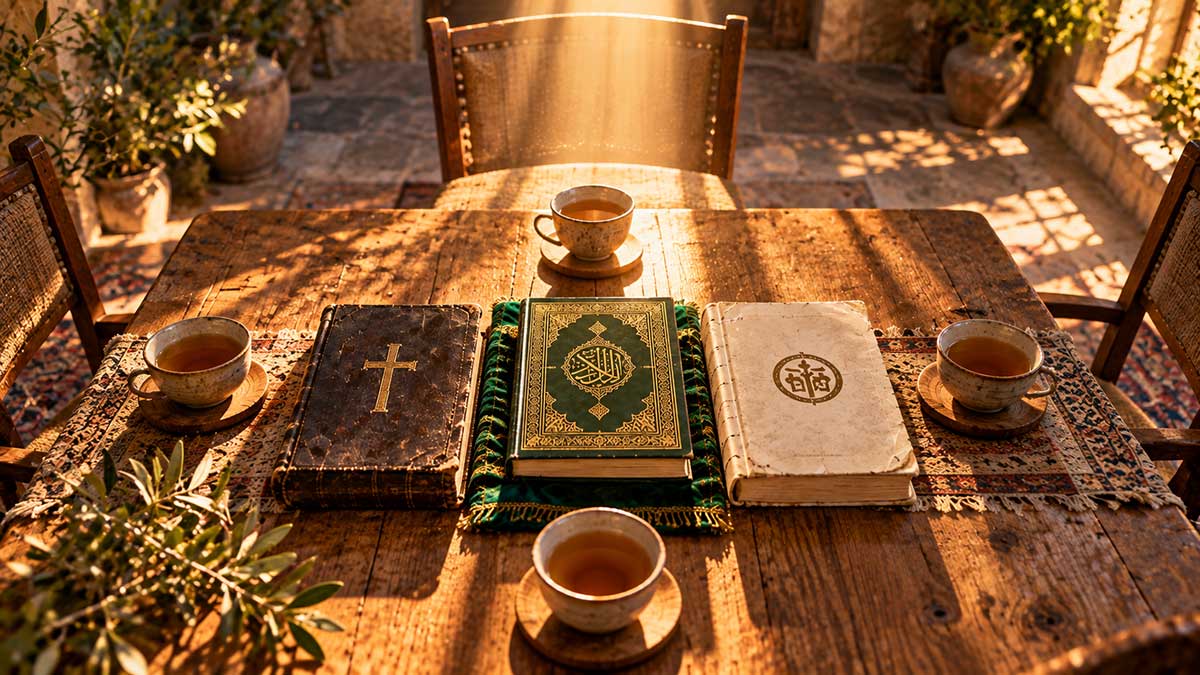
The empty chair stood at the table.
No one sat in it.
Huston Smith looked at it for a long moment, then turned to the three men.
Huston Smith: We ended the last conversation with a suspicion.
Each of you dreams of unity.
But I think each of you pictures that unity looking a little like your own house.
So I'm going to ask each of you to describe it honestly.
Not the diplomatic version.
The version you'd describe to your own followers late at night.
He turned to Moon.
Huston: You pulled the chair over. You go first.
Rev. Moon: I have always said the same thing.
One family under God.
Huston: What does that mean in practice?
Rev. Moon: It means that God is the Heavenly Parent of all humanity.
Christians, Muslims, Buddhists, Jews. All His children.
Children of the same parent should not live as strangers.
Huston: But your followers believe that family is centered on True Parents. On you and your wife.
Rev. Moon: Yes.
Huston: So the family has a head, and it's you.
Rev. Moon: My followers believe so.
Huston: Then a Muslim reading this hears, "Unity means eventually accepting Reverend Moon."
Rev. Moon: I understand why he hears that.
Huston: Is he wrong?
Moon paused.
Rev. Moon: In my heart, I hoped all people would one day receive what I believed God gave me.
I will not pretend otherwise.
Every sincere believer hopes that.
He glanced toward Jesus.
Rev. Moon: But let me say one more thing.
Jesus is my elder brother.
I never wanted to take his place at the table.
I wanted to help finish setting the table he began.
Jesus looked at him and said nothing.
But he did not look away.
Huston: Thank you for being honest.
He turned to Muhammad.
Huston: Prophet Muhammad, you said your community is the ummah. One body of those who submit to God.
Isn't that the same thing? Unity, eventually, under Islam?
Muhammad: The word islam means submission.
Every prophet was a muslim in that sense. Abraham. Moses. Jesus.
All submitted to God.
Huston: That's a beautiful definition. It's also a very convenient one.
It makes everyone a Muslim whether they agree or not.
Muhammad almost smiled.
Muhammad: You are a difficult man.
Huston: I've been told.
Muhammad: Then I will tell you about Medina.
When I arrived, the city was divided. Arab tribes that had fought each other for generations. Jewish tribes. My own followers from Mecca. People who had not yet accepted anything.
We wrote a covenant.
Huston: The Constitution of Medina.
Muhammad: It said the Jews were one community with the believers.
To the Jews their religion. To the Muslims theirs.
They would defend the city together. They would support each other against anyone who attacked.
Huston: One community. While keeping separate religions.
Muhammad: Yes.
Huston: That's not what most people think the word ummah means.
Muhammad: Many people have not read the covenant.
Huston: That covenant broke down. There was conflict later with the Jewish tribes. Fighting. Expulsions.
Muhammad: Yes.
Covenants break when trust breaks. When one side betrays the other in war.
But the covenant shows what was intended at the beginning.
Not erasure.
Shared protection.
Huston nodded slowly.
Huston: There's another story your early biographers tell.
A delegation of Christians came from Najran. They debated with you about Jesus.
Muhammad: They did not accept what I said about him.
Huston: And when it was time for their prayer...
Muhammad: They prayed in my mosque.
Huston let that sit.
Huston: Christians, who rejected your message, praying their own prayers inside your mosque.
Muhammad: They were guests.
Where else would they pray?
Huston looked at Jesus.
Huston: Did you know that?
Jesus: I did not need to know it to recognize it.
Huston: What do you mean?
Jesus: My disciples once came to me upset.
They had seen a man casting out demons in my name.
He was not one of us. He did not follow with our group.
So they tried to stop him.
Huston: And you said...
Jesus: "Do not stop him. Whoever is not against us is for us."
Huston opened the Bible and found the passage.
Huston: Your disciples wanted to protect the boundaries of your group.
You protected a stranger who was doing good.
Jesus: They thought unity meant everyone joining us.
I wanted them to see that God was already working where they had not been invited.
Huston: But you also prayed on your last night that your followers would all be one.
What did you mean?
Jesus: I prayed that they would be one as the Father and I are one.
Not identical.
The Father is not the Son.
One in love.
Huston: And why did you want that?
Jesus: So that the world may believe.
That was the reason I gave.
Their unity was meant to be a sign.
If my followers cannot love one another, why would anyone believe they know God?
Huston: Christians have thousands of denominations today.
Jesus: Yes.
Huston: They've fought wars against each other. Catholics and Protestants killed each other across Europe for a century.
Jesus: I know.
Huston: So your prayer wasn't answered.
Jesus: It has not been answered yet.
A prayer is not a prediction.
It is a direction.
Huston repeated it.
Huston: "A prayer is not a prediction. It is a direction."
He leaned back.
Huston: Let me say what I'm hearing.
Reverend Moon dreams of one family, with a head.
The Prophet Muhammad remembers a covenant where communities kept their religions but protected each other.
Jesus prayed for oneness in love, while defending a stranger outside his group.
So there are at least two kinds of unity on this table.
One is merger.
Everyone eventually believing the same thing.
The other is covenant.
Different people, keeping different faiths, who decide to protect each other.
Muhammad: The first belongs to God.
Huston: Explain.
Muhammad: God says in the Quran: if He had willed, He would have made you one community.
He did not.
He made you different on purpose.
Huston: Why?
Muhammad: To test you in what He gave you.
And then He tells us what to do with our differences.
Race one another in good works.
To God you will all return, and He will tell you about the things in which you differed.
Huston: So the differences get settled...
Muhammad: By God.
On that Day.
Not by us. Not on this day.
Our task today is to race in good.
Huston smiled.
Huston: A race.
Muhammad: Not a war.
A race.
In a race, you want to win. But you do not trip the other runner.
Huston turned to Moon.
Huston: Reverend Moon, I think your vision is the most ambitious at this table.
And the most likely to frighten people.
So let me ask you to prove that it isn't merger.
What did you actually do?
Rev. Moon: I brought people together.
Huston: Be concrete.
Rev. Moon: I gathered religious leaders from every faith. Year after year. I founded organizations so that they could speak together for peace.
Huston: Some people would call that a public relations strategy.
Rev. Moon: Some would.
Then let me tell you something harder.
Huston waited.
Rev. Moon: I matched Korean men and Japanese women in marriage.
And Japanese men and Korean women.
Huston: Your two countries had a long and bitter history.
Rev. Moon: Japan ruled Korea for thirty-five years. My generation remembered.
When I was young, the Japanese police imprisoned and tortured me.
Huston: And you matched your followers with the people who had occupied your country.
Rev. Moon: Yes.
Americans with Russians, during the Cold War.
Black with white, when many still considered that shameful.
Huston: Why?
Rev. Moon: Because enemies who share grandchildren cannot remain enemies.
Huston was silent.
Rev. Moon: I also went to North Korea in 1991.
I met Kim Il Sung.
The man whose regime sent me to the labor camp.
Huston: Your followers must have been shocked.
Rev. Moon: Many were.
I told them I went to forgive him.
Not to approve of him.
To forgive him.
Jesus spoke quietly.
Jesus: "Love your enemies. Pray for those who persecute you."
Rev. Moon: You said it first.
I only tried to obey it.
Muhammad looked at Moon for a long moment.
Muhammad: When I returned to Mecca, I stood before the people who had driven me out, killed my companions, and tried to kill me.
They expected revenge.
Huston: What did you say?
Muhammad: I asked them, "What do you think I will do with you?"
They said, "You are a noble brother, the son of a noble brother."
And I said, "Go. You are free."
Rev. Moon: Then you understand.
Muhammad: I understand that forgiveness is not weakness.
It is the strength to refuse the revenge you have the power to take.
Huston looked between them.
Huston: So unity, in all three of your lives, didn't begin with agreement.
It began with forgiveness.
Jesus: It always does.
Huston stood and walked around the table slowly.
Huston: I want to challenge something now.
Because I think this conversation could end too sweetly.
Unity sounds beautiful. But it can also become an excuse for silence.
A Christian woman in Pakistan is accused of blasphemy. A crowd gathers outside her house.
Muslim leaders in the West want "unity." So they don't mention it.
A Muslim village is attacked by a mob in India. Christians and Hindus want "unity." So they say nothing.
A former member of a new religious movement says she was manipulated. Other faiths don't want to "attack a fellow religion." So they look away.
Is that unity?
Muhammad: No.
That is cowardice wearing unity's clothing.
Huston: Then what does real unity do in those moments?
Muhammad: The Quran says: stand firm for justice, as witnesses for God, even against yourselves, your parents, or your relatives.
Even against yourselves.
A Muslim who will not speak for a Christian woman facing a mob has not loved his faith.
He has loved his comfort.
Jesus: The prophets of Israel saved their sharpest words for their own people.
Not for Babylon.
Not for Egypt.
For Jerusalem.
Rev. Moon: And when someone criticizes my movement honestly, the other faiths should not defend us for the sake of unity.
They should tell us the truth.
That is what family does.
Huston sat back down.
Huston: So real unity includes the right to criticize each other.
Muhammad: It includes the duty.
Huston: But criticism from outside is often dismissed as hatred.
Rev. Moon: Then let it come with love that has been proven.
A stranger who criticizes me, I may ignore.
A friend who stood beside me when I was persecuted, I must listen to.
Jesus: First remove the log from your own eye.
Then you will see clearly enough to remove the speck from your brother's.
Huston: In that order.
Jesus: In that order.
Huston looked at the empty chair again.
Huston: Let me tell you about some moments I find myself returning to.
In 2011, in Cairo, during the protests in Tahrir Square, Christians formed a ring around Muslims while they knelt to pray, protecting them from attack.
On another day, Muslims surrounded Christians during their Mass and did the same.
In 2019, after a gunman murdered worshippers at two mosques in Christchurch, New Zealand, people of every faith and no faith stood outside mosques across that country so Muslims could pray on Friday without fear.
And on that plane over the desert, strangers ran toward an axe.
None of them were asking anyone to change their beliefs.
Muhammad: They were protecting the right to hold them.
Huston: Is that unity?
Jesus: That is what unity looks like before anyone has agreed on anything.
Rev. Moon: It is the beginning of a family.
Huston nodded.
Huston: Then I want to make this practical.
Most people listening will never meet a religious leader from another faith.
They will never attend an interfaith conference.
What can they do this month?
Muhammad: Eat with someone of another faith.
In their home, or yours.
And when you do, ask them what they love about God.
Not what they believe. What they love.
Huston: Why the difference?
Muhammad: Belief can be argued.
Love can only be heard.
Jesus: Find out what your neighbor's community is afraid of.
Then become someone they do not have to be afraid of.
Rev. Moon: Learn one prayer of your neighbor's faith.
You do not have to pray it.
Just learn what they say to God.
You will discover that much of it you could say yourself.
Huston wrote something down.
Huston: And when the news tells you that another faith is your enemy?
Muhammad: Ask how many of them you have actually met.
Jesus: Ask whether you have seen their faces or only their headlines.
Rev. Moon: Ask whether the person telling you to hate is also asking you for money, power, or votes.
Huston laughed softly.
Huston: That last one is very practical.
Rev. Moon: I lived through the twentieth century.
I learned to follow the money.
Huston set the pen down.
Huston: I want to ask the last hard question.
You still disagree.
About the cross. About who Jesus is. About whether revelation is closed. About True Parents.
None of you has moved on those today.
If you could see the far future, a thousand years from now, do you believe those disagreements will still exist?
Jesus answered first.
Jesus: In my Father's house are many rooms.
Huston: That's not an answer.
Jesus: It is the most honest one I have.
I did not say one room.
Muhammad: God will tell us on that Day about the things in which we differed.
Until then, I believe what was revealed to me.
And I race.
Rev. Moon: I believe the day will come when humanity lives as one family.
But a family is not a uniform.
My children were never identical. They argued. They disappointed me. Some went their own way.
They remained my children.
If God's family looks like that, there will still be disagreements a thousand years from now.
They will simply be disagreements around the same table.
Huston looked at him.
Huston: "Disagreements around the same table."
Rev. Moon: That is all I ever wanted.
Not that everyone would say yes.
That no one would be outside.
Huston was quiet for a long time.
Then he gathered the three books in front of him.
For the entire conversation, they had been arranged in a row, each separate.
He did not stack them. Stacking them would have put one on top.
He did not merge them into a single pile.
He placed them side by side, close enough to touch.
Huston: One last round.
One sentence each.
What is unity?
Muhammad: Unity is knowing one another, which is why God made us nations and tribes.
Rev. Moon: Unity is living for the sake of the person who believes differently than you.
Jesus: Unity is a table where no one has to leave their faith at the door, or their neighbor outside it.
Huston turned to the empty chair.
Huston: I've been looking at that chair the entire conversation.
At first I thought it was waiting for a fourth messenger.
A Buddha. A Moses. A Krishna. Someone we didn't invite.
But I don't think so anymore.
I think it's for whoever is listening.
The Christian who still believes Jesus is the only way.
The Muslim who still believes the Quran is the final word.
The Unificationist who still believes in True Parents.
The person who believes all religions come from one God.
And the person who believes none of it.
None of you has to agree with the three men at this table.
The only requirement for sitting down is this:
You cannot ask anyone else to leave.
He looked at the three messengers.
Huston: We started with a man on a street corner who wouldn't say a Christian is a good man.
I don't think he needed a theology lesson.
I think he needed a seat at this table.
Across from someone who believes differently.
Close enough to see his face.
Long enough to stop asking, "Is he good?"
And start asking, "Am I?"
Moon reached for the teapot and poured four cups.
He set the first in front of Jesus.
Then one for Muhammad, one for Huston, and the fourth in front of the empty chair.
No one sat in it yet.
But no one moved it away.
Final Thoughts
The three messengers never agreed on who God is.
They did not settle the cross. They did not settle whether revelation is closed, or whether anyone could come after. Each left the table holding the same convictions he brought to it.
What changed was not their beliefs. It was what they refused to let those beliefs become.
A final truth does not have to become a final verdict. A faith that cannot survive an open door is not faith. And anyone who needs God's permission to kill has already stopped listening to God.
Perhaps the street-corner question was never "Is he good?" The better question is the one that follows us home: "Will my neighbor be glad I lived next door?"
We may never agree on the name of God.
We can still refuse to disagree about the worth of a human being.
Short Bios:
Jesus of Nazareth
Jesus of Nazareth (c. 4 BCE–c. 30 CE) was a Jewish teacher and healer from Galilee whose life, death, and reported resurrection became the foundation of Christianity. His teachings, preserved in the Gospels, include the Sermon on the Mount, the parables of the Good Samaritan and the Prodigal Son, and the commands to love God and love one's neighbor. Christians believe he is the Son of God and Savior. Muslims honor him as the Messiah and one of the greatest prophets, though not as divine.
The Prophet Muhammad
Muhammad (c. 570–632 CE) was born in Mecca and is revered by Muslims as the final prophet of God, through whom the Quran was revealed. After years of persecution in Mecca, he migrated to Medina in 622 and established a community governed by the Constitution of Medina, which included Jewish tribes as part of the city's shared defense. His teachings emphasize the oneness of God, prayer, charity, justice, and mercy, and Islam today is practiced by nearly two billion people worldwide.
Reverend Sun Myung Moon
Sun Myung Moon (1920–2012) was a Korean religious leader who founded the Unification movement, now known as the Family Federation for World Peace and Unification, in Seoul in 1954. His teachings, presented in Divine Principle, describe God as the Heavenly Parent and present human history as a process of restoration. He was imprisoned in a North Korean labor camp at Hungnam, became known for international Blessing ceremonies joining couples across nations and races, and founded numerous interfaith and peace organizations. With his wife, Hak Ja Han, he is regarded by followers as a True Parent, and his movement attracted both deep devotion and sustained controversy.
Huston Smith
Huston Smith (1919–2016) was an American scholar of religion, born in China to Methodist missionary parents. His book The World's Religions, originally published in 1958 as The Religions of Man, became one of the most widely read introductions to the world's faiths. He taught at Washington University, MIT, Syracuse University, and the University of California, Berkeley, and was known for practicing several traditions in order to understand them from within. In this fictional conversation, he serves as moderator, pressing all three messengers on both the wisdom and the dangers within their claims.
This conversation is fictional. Jesus, the Prophet Muhammad, Reverend Sun Myung Moon, and Huston Smith never met together. Their dialogue has been created from themes found in scripture, recorded teachings, historical settings, and the documented lives of each figure. The words attributed to them here should not be treated as actual quotations.
Leave a Reply