
Introduction
Hard Times Create Strong People: Can We Break the Cycle?
What if the greatest achievement of a strong generation isn't teaching its children how to suffer, but teaching them how to become strong without suffering?
You've probably heard the famous saying:
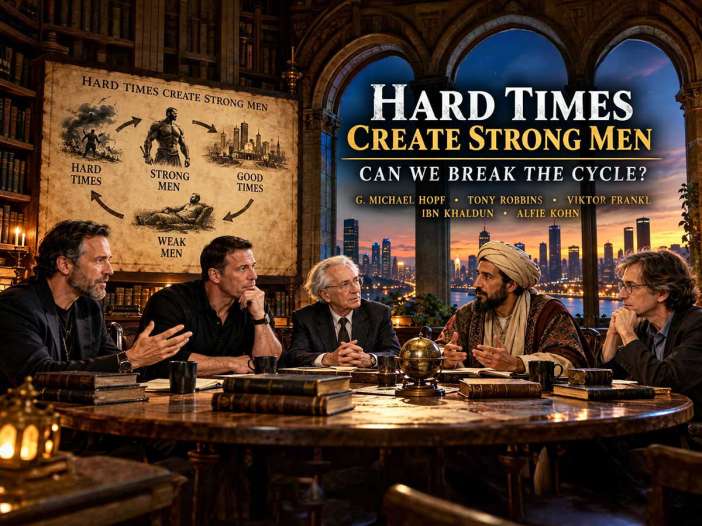
Hard times create strong men. Strong men create good times. Good times create weak men. And weak men create hard times.
These words, popularized by novelist G. Michael Hopf in Those Who Remain, have become a powerful way of explaining why civilizations rise and fall.
They seem to capture something we recognize in everyday life.
Our grandparents endured hardships we can barely imagine. Our parents worked to give us better opportunities. And we work so our children won't have to struggle as we did.
But then comes an uncomfortable question.
If we succeed in giving our children better lives, are we accidentally making them weaker?
And if that's true, what are we working so hard for?
Five Thinkers, One Difficult Question
Imagine bringing together five men who see this problem from remarkably different perspectives.
G. Michael Hopf, whose famous quotation inspired this conversation, warns that prosperity can lead people to forget the sacrifice and responsibility that made it possible.
Tony Robbins believes people can develop strength through meaningful goals, deliberate challenges, and personal responsibility. We don't have to wait for disaster to discover what we're capable of.
Viktor Frankl, the Holocaust survivor and author of Man's Search for Meaning, brings a necessary warning. Human beings can find meaning amid suffering, but that does not make suffering desirable. His life and work are documented by the Viktor Frankl Institute.
Ibn Khaldun, the fourteenth-century historian and author of The Muqaddimah, examines how social solidarity helps civilizations flourish and how those bonds may weaken as prosperity changes society.
Alfie Kohn, author of Unconditional Parenting and The Myth of the Spoiled Child, challenges the assumption that making children tougher necessarily makes them better. His research and writing on parenting offer a different approach: nurturing independence, compassion, and responsibility without making love conditional on achievement.
Together, they explore a question that reaches far beyond one famous quotation.
Can we create good times that produce an even stronger generation?
A Father, a Son, and the Price of a Better Life
At the heart of this imaginary conversation is the story of David and Daniel.
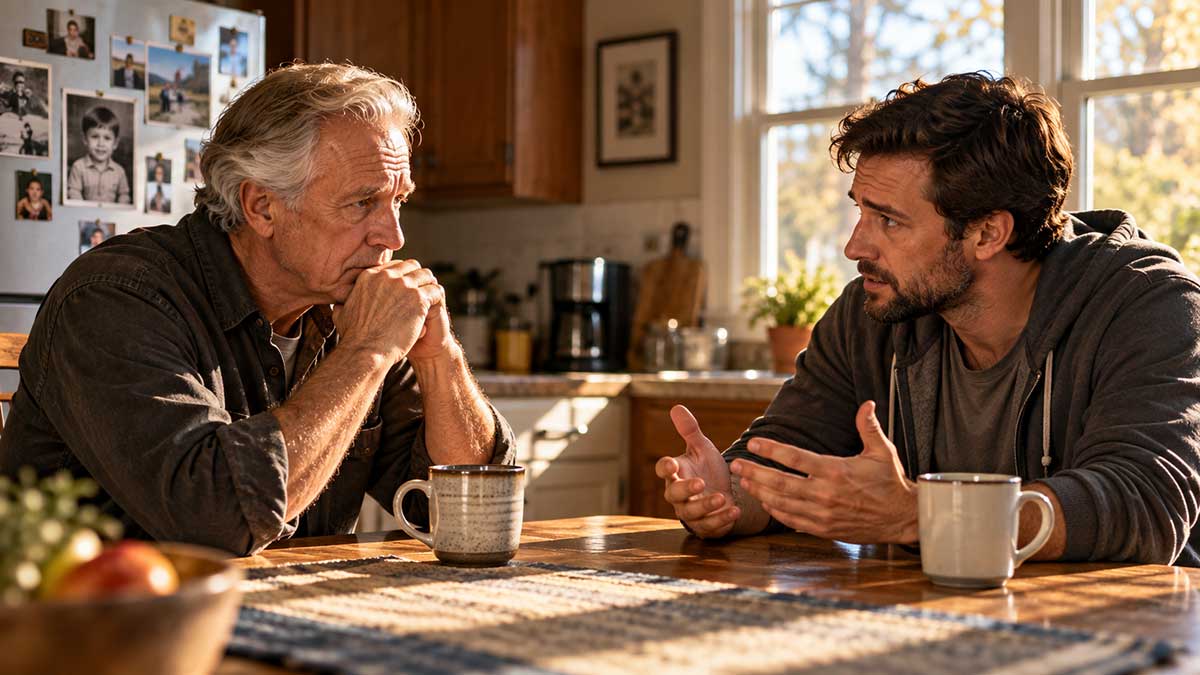
David is sixty-eight years old. He grew up poor, worked relentlessly, built a successful business, and gave his son opportunities he never had.
Daniel is thirty-five. He grew up in comfort, received a good education, and never experienced the financial insecurity that shaped his father.
Yet Daniel struggles to find his direction.
David worries that he protected his son too much.
Daniel worries that he will never be good enough for his father.
Both love each other. Neither knows how to communicate that love without hurting the other.
Their relationship raises questions many families recognize.
When does protection become overprotection? When does advice become control? Does responsibility require suffering? And can parents accept their adult children without giving up hope for their future?
Five Conversations That Challenge the Cycle
Topic 1: The Price of Comfort. Does an easy life make people weak, or can safety and opportunity become foundations for extraordinary strength?
Topic 2: The Parents' Paradox. Can loving parents unintentionally prevent their children from developing independence? David and Daniel's relationship exposes the difference between helping and rescuing.
Topic 3: The Generational Blame Game. Are younger generations truly weaker, or are we measuring them against circumstances that no longer exist?
Topic 4: Can We Break the Cycle of History? Must prosperity lead to decline? The thinkers explore how responsibility, community, education, and artificial intelligence could change the pattern.
Topic 5: Strength Without Suffering. What does real strength look like? Can parents raise capable, compassionate children without making them endure the hardships they themselves experienced?
An Imaginary Conversation About a Real Choice
This article is an original fictional thought experiment. The five participants never gathered for this discussion, and their dialogue is imagined from themes in their published work. David and Daniel are fictional characters.
The goal is not to declare Hopf's famous cycle right or wrong.
It is to examine its warning, challenge its assumptions, and discover what we might do differently.
After all, if strong people create good times, perhaps the next step in human progress is learning how to use those good times wisely.
Not to raise children who have never faced difficulty.
Not to raise children who obey without questioning.
But to raise people who can think independently, take responsibility, care for others, and find meaning in their lives.
Perhaps strong people don't have to create weak people. Perhaps they can create something better.
(Note: This is an imaginary conversation, a creative exploration of an idea, and not a real speech or event.)
Topic 1: The Price of Comfort
Does an Easy Life Make Us Weak?
The library overlooks a prosperous modern city. Through its tall windows, thousands of lights shine against the evening sky. Cars move along illuminated streets. Families sit in warm apartments. Food arrives at doorsteps with the touch of a button.
Inside, five men from different generations and centuries gather around an old wooden table.
On the wall, four sentences have been written in large letters.
Hard times create strong men. Strong men create good times. Good times create weak men. And weak men create hard times.
G. Michael Hopf stands beside the words, studying them. Tony Robbins sits forward in his chair. Alfie Kohn examines the statement with visible skepticism. Ibn Khaldun watches the city through the window.
Viktor Frankl sits quietly, his hands resting on the table.
Moderator: Mr. Hopf, those four sentences have been repeated millions of times. People quote them when economies struggle, when civilizations decline, when young people disappoint their parents.
Some even treat them as a law of history.
But I see a contradiction.
If strong people work hard to create good times, why should their success produce weak people?
G. Michael Hopf: It doesn't have to. That's the point people often miss.
I wasn't saying that having a comfortable life automatically makes someone weak. I was warning about what happens when people forget what made that comfort possible.
Think about a man who grows up with nothing. He works, sacrifices, takes responsibility, builds a business, raises a family. He creates opportunities his parents could only dream of.
His children inherit those opportunities.
But do they inherit his discipline? His gratitude? His willingness to sacrifice?
Not necessarily.
And if those qualities disappear, prosperity becomes fragile.
Alfie Kohn: You just described a successful father and then suggested that his children might be deficient.
Why?
Hopf: I said they might be.
Kohn: But notice how easily the assumption enters the conversation. The father suffered, so we admire him. The children didn't suffer, so we become suspicious of them.
What if those children become scientists? Teachers? Parents who raise their own children with greater patience than they received?
What if their comfortable childhood gives them the emotional security to do extraordinary things?
Wouldn't that make them stronger in some ways than their father?
Hopf: Of course it could.
Kohn: Then perhaps the problem isn't good times creating weak people. Perhaps it's our tendency to confuse suffering with virtue.
Tony Robbins: Hold on. There's something valuable in what Michael is saying, and I don't want us to lose it.
I've worked with people who had every advantage imaginable. Money, education, connections, opportunities.
And some of them were miserable.
Not from a lack of resources. They had resources everywhere.
They had no compelling reason to get out of bed.
Kohn: That's a problem of meaning, Tony. Not necessarily weakness.
Robbins: Fine. Call it whatever you want. But if someone never has to develop the ability to face discomfort, make difficult decisions, or follow through when things get hard, what happens when life finally demands those abilities?
Kohn: We should teach those abilities.
Robbins: Exactly.
Kohn: Without assuming children must suffer to acquire them.
Robbins: I never said they had to suffer.
Kohn: You said they needed discomfort.
Robbins: Discomfort isn't suffering. A person who has never lifted a weight doesn't become stronger by staring at the equipment.
Viktor Frankl: May I ask something?
The others turn to him.
Frankl: When you say stronger, stronger for what?
Robbins pauses.
Robbins: For life. For challenges. For whatever comes.
Frankl: And what is the purpose of that strength?
Robbins: To live fully. To contribute. To take responsibility for your life.
Frankl: Then we are discussing something greater than endurance.
A man can endure extraordinary hardship and become cruel. Another can live in comfort and devote his life to helping strangers.
Which is stronger?
Hopf: The second, if he possesses the character to act when it matters.
Frankl: Then perhaps we should be careful about the words on your wall.
They may contain a warning worth hearing. But someone who reads them carelessly might begin to believe that suffering itself makes human beings better.
I have seen enough suffering to know that this is not true.
For a moment, nobody speaks.
Moderator: Dr. Frankl, you survived Nazi concentration camps. People often refer to your experience as proof that hardship can make people stronger.
Does that trouble you?
Frankl: It troubles me when people make suffering sound like a gift.
There was nothing desirable about the suffering inflicted in those camps. People died. Families were destroyed. Human dignity was violated.
Some people discovered extraordinary courage in those circumstances. Others were overwhelmed. Many never had the opportunity to demonstrate what they might have become.
We must never confuse the human capacity to find meaning amid suffering with the idea that suffering is necessary for meaning.
Hopf: I respect that distinction.
But consider something else. A society can become so determined to avoid discomfort that it loses the willingness to make sacrifices for anything beyond immediate pleasure.
Surely that is a danger.
Frankl: Yes. But sacrifice for a meaningful purpose is different from suffering imposed without purpose.
Robbins: That's exactly where I was going.
Look, nobody needs a catastrophe to develop discipline.
You can choose a difficult goal. You can build something. You can serve someone who needs you. You can take responsibility for a problem instead of waiting for someone else to fix it.
The challenge doesn't have to destroy you. It has to demand something from you.
Kohn: And the purpose has to matter to the person undertaking it.
That's where I think many adults make a mistake.
They see a young person who lacks motivation, and they assume the solution is to make life harder.
More pressure. More rules. More punishment.
But perhaps that young person has spent years doing things to satisfy other people's expectations and has never had the opportunity to discover what matters to them.
Robbins: But Alfie, what about the young person who simply refuses responsibility?
Kohn: I'd want to know what that refusal means before deciding how to respond.
Robbins: Sometimes it means they don't want to do the work.
Kohn: Sometimes. And sometimes it means they're afraid of failing. Or they're depressed. Or they don't see the value of the work they're being asked to do.
Robbins: And sometimes they need someone to tell them to get moving.
Kohn: Perhaps. But if that's our first response to every struggling young person, we're going to misunderstand a lot of them.
Ibn Khaldun, who has been listening silently, turns away from the window.
Ibn Khaldun: You are discussing the individual as though the individual exists apart from society.
Moderator: What are we missing?
Ibn Khaldun: The bonds between people.
In my studies of dynasties, I observed how groups possessing strong solidarity could establish authority and build prosperous societies.
Their strength did not arise merely from individual toughness. They shared obligations. They depended upon one another. They understood that their survival required cooperation.
Prosperity could gradually change those relationships.
People became accustomed to luxury. They relied increasingly upon institutions and servants to perform duties they once carried themselves. The bonds that had united them could weaken.
Hopf: That's remarkably close to what I was trying to express.
Ibn Khaldun: There is a resemblance. But I would caution against reducing the process to strong and weak individuals.
A society may decline through failures of leadership, institutions, solidarity, and judgment. Calling an entire generation weak tells us little about which of those failures occurred.
Kohn: Thank you.
Ibn Khaldun: Do not thank me too quickly. I do believe excessive luxury can weaken the habits that sustain collective life.
Kohn: I can accept that as a possibility. What I question is treating it as inevitable.
Ibn Khaldun: On that point, we may agree.
Moderator: Let me challenge all of you with something.
Imagine two children.
The first grows up poor. His father works twelve hours a day. Sometimes there isn't enough food. He learns to work early, to save money, to endure disappointment.
The second grows up in a loving home. He has nutritious meals, excellent schools, supportive parents, and the freedom to explore his interests.
Which child has the better chance of becoming a strong adult?
Hopf: You haven't told us enough about either child.
Moderator: That's interesting. Why not?
Hopf: I don't know their character. I don't know what they're taught. I don't know how they respond to challenges.
Kohn: Precisely. Yet the popular interpretation of your quote encourages people to assume the first child will be stronger.
Hopf: That's not what I'm arguing.
Kohn: Then we have an opportunity to make your argument more precise.
Robbins: I'd bet on the second child having more opportunities. But opportunity isn't achievement.
What does that child do with those opportunities?
Frankl: And what does the first child lose through deprivation?
We speak so easily about the discipline he might acquire. What about the education he might miss? The trust he might struggle to develop? The fear that might remain with him long after the hunger has ended?
Moderator: So hardship might create strength in one area and damage in another?
Frankl: Certainly.
Ibn Khaldun: Nor should we assume the second child lacks challenges merely on account of material security.
Every human life contains obligations, uncertainty, loss, and decisions of consequence.
Robbins: That's the part I want to underline.
The goal shouldn't be to make your kids hungry so they'll appreciate food.
The goal should be to raise someone who knows what to do with the opportunities they've been given.
Kohn: And who cares about people who haven't been given those opportunities.
Robbins: Absolutely.
Hopf: Which brings us back to gratitude and responsibility.
Moderator: But there's still a problem with the quote, isn't there?
It suggests a cycle. Hard times, strong people, good times, weak people, hard times again.
If prosperity doesn't necessarily weaken people, why should the cycle repeat?
Hopf: It shouldn't have to.
The saying is a warning, not a commandment.
The danger arises when people assume the good times will continue regardless of what they do.
Ibn Khaldun: Yet warnings about decline can themselves become misleading.
People may imagine that history moves according to a simple rhythm, when actual events emerge from many causes.
A prosperous society may reform itself. A struggling society may deteriorate further. There is no guarantee that hardship produces renewal.
Robbins: That's what gives us a choice.
If you see a destructive pattern, you don't have to wait until everything falls apart to change it.
Kohn: Provided we understand the pattern correctly.
Robbins: You really don't let anything slide, do you?
Kohn: Not when the stakes involve how we treat children.
Robbins laughs. Kohn allows himself a small smile.
Moderator: I want to bring this down from civilizations and theories to one family.
There's a man I'd like you to consider. We'll call him David.
He's sixty-eight years old.
David grew up poor. His father worked in a factory. His mother cleaned houses. When David was young, he sometimes went to school with holes in his shoes.
He remembers the embarrassment of pretending he wasn't hungry when his friends bought lunch.
He started working at sixteen.
Eventually, he built a successful business. He married, raised a family, bought a comfortable home, and gave his children opportunities he never had.
His son Daniel is now thirty-five.
Daniel never worried about food or rent as a child. He went to good schools. David helped him financially whenever he struggled.
But Daniel hasn't found a stable direction in life.
He's intelligent. He's kind. He has dreams.
Yet he changes jobs, abandons projects, and often turns to his father when something goes wrong.
David looks at his son and thinks, I worked so hard to give him a better life. Did I make him weak?
The room grows quiet.
Robbins: My first question would be whether Daniel has ever had to take full responsibility for a meaningful decision.
Kohn: Mine would be whether David has ever trusted Daniel to make one.
Hopf: I'd want to know whether Daniel understands what his father sacrificed.
Frankl: I would want to hear Daniel speak.
Moderator: Why Daniel?
Frankl: We have heard what his father thinks of him. We have not heard what Daniel thinks of himself.
Moderator: Suppose Daniel says, "My father worked his way out of poverty. He built a business. Everyone admires him. I know how much he sacrificed. But no matter what I do, I feel like a disappointment."
Kohn: There it is.
Robbins: Maybe. But feeling disappointed in yourself doesn't mean you stop taking action.
Kohn: No. Yet if every attempt at independence is measured against an extraordinary father's achievements, failure can begin to feel inevitable.
Hopf: David might not intend that comparison.
Kohn: Intentions don't erase their effects.
Ibn Khaldun: There is another possibility. David believes he has passed prosperity to his son. But perhaps he has not passed a meaningful role within the family or community.
Moderator: What do you mean?
Ibn Khaldun: A person may possess comfort without possessing a sense of being needed.
In a family where one individual provides everything and solves every difficulty, what remains for the others to contribute?
Robbins: Now that's a serious question.
Frankl: Indeed. Human beings need more than comfort. They need reasons to direct their lives beyond themselves.
Moderator: But David loves his son.
Frankl: I do not doubt it.
Moderator: And everything David did was intended to protect him.
Frankl: That may be true as well.
Moderator: Then how could something so loving go wrong?
Frankl: Before calling it wrong, I would ask David a question.
Moderator: What question?
Frankl: When you were young and hungry, what did you wish for your future children?
Moderator: David would probably say, "I wanted them never to experience what I experienced."
Frankl: And he succeeded?
Moderator: In many ways, yes.
Frankl: Then why is he treating the fulfillment of that wish as a failure?
The question hangs in the room.
Hopf: He isn't disappointed that his son escaped poverty. He's afraid his son won't be prepared when life becomes difficult.
Frankl: Then let him speak of that fear. Let him not confuse it with disappointment that his son did not suffer.
Robbins: That's a powerful distinction.
Kohn: And it changes the question David needs to ask.
Instead of "How do I make my son tougher?" perhaps he should ask, "What have I been doing that makes it harder for my son to trust himself?"
Hopf: Or, "What responsibilities have I failed to teach him?"
Kohn: Those are not necessarily the same question.
Hopf: No. But they may both matter.
Moderator: I can almost hear David responding.
"I gave my son everything. I paid for his education. I helped him buy his first car. I was there whenever he needed me. What more was I supposed to do?"
Robbins: Maybe less.
The answer surprises the table.
Robbins: Less solving. Less rescuing. Less deciding.
Not less love.
But if you always catch someone before they fall, how will they discover they can get back up?
Kohn: I'd be careful. Some falls can do real damage, and we shouldn't turn withholding help into a virtue.
Robbins: I'm not talking about abandoning him.
Kohn: I know. I'm asking how David distinguishes support from interference.
Robbins: By asking whether his help is making Daniel more capable or more dependent.
Frankl: And by asking whether Daniel experiences that help as love or as a reminder of his inadequacy.
Moderator: So David's problem might not be that he gave Daniel too much comfort.
Kohn: It might be that he gave him too little room to become himself.
Hopf: Or too few opportunities to practice responsibility.
Ibn Khaldun: Or too little sense that his contribution matters.
Robbins: Those are all worth examining.
Moderator: Dr. Frankl, you seem reluctant to judge either man.
Frankl: What would judgment accomplish?
David acted from his own history. He remembered deprivation and wanted to spare his son.
Daniel grew up in circumstances his father created, yet he must still discover how to live his own life.
Neither man chose the other's childhood.
Moderator: That's an interesting thought.
David couldn't choose to grow up poor. Daniel couldn't choose to grow up comfortable.
Yet David sometimes speaks as though Daniel should be grateful for hardships he never experienced.
Frankl: Gratitude cannot be demanded as payment for another person's suffering.
It may be invited through example, through relationship, through recognition of what others have given.
But Daniel's responsibility is not to recreate his father's life.
It is to respond to his own.
Outside, a young man crosses the street carrying a bag of groceries. His phone glows in one hand. He pauses at the crossing, looking up at the apartments above him.
Moderator: Mr. Hopf, after everything we've discussed, would you still put those four sentences on the wall?
Hopf: Yes.
But I'd want people to understand what they're warning against.
Not happiness. Not security. Not parents loving their children.
Complacency.
Forgetting responsibility.
Assuming that the things we inherit will take care of themselves.
Kohn: Then I might write something beside them.
Hopf: What would you write?
Kohn: "Good times can create stronger people, if we know what to do with them."
Robbins: I'd add one word.
Kohn: Which word?
Robbins: Choose.
Don't wait for hard times to force you to grow. Choose something meaningful that asks more of you.
Ibn Khaldun: And do not make that choice only for yourself. A society survives through obligations shared among its members.
Frankl: Nor should we forget that the purpose of strength is not simply to endure the next disaster.
Strength may be needed to love faithfully, to act justly, to serve another person, or to accept responsibility when doing so is difficult.
Moderator: Then perhaps we've misunderstood the entire cycle.
Strong people create good times. But good times don't have to create weak people.
They might create people who are more educated, more compassionate, more capable of helping others.
Hopf: They might.
Moderator: And if they don't?
Hopf: Then the warning still stands.
The moderator looks again at the four sentences on the wall.
Moderator: There's something about David I can't stop thinking about.
When he was a boy, he dreamed of a day when his children wouldn't have to suffer.
He spent his entire adult life making that dream come true.
Now, at sixty-eight, he looks at his son and wonders whether he should have allowed him to struggle more.
It's almost heartbreaking.
He achieved what he wanted most, and now he's afraid that achieving it was a mistake.
Frankl: Perhaps his mistake was not giving his son a comfortable life.
Perhaps it was believing that he could give his son a completed one.
Moderator: A completed life?
Frankl: A life in which every important problem has already been solved by someone who loves him.
But a person must still answer the questions that life places before him.
A father may prepare the ground. He cannot live his son's life.
Robbins: And the son has to decide what he's going to build on that ground.
Kohn: Without having to become a copy of his father.
Hopf: And without forgetting what his father gave him.
Moderator: That sounds simple when we say it here.
But I suspect David has no idea how to do it.
For thirty-five years, helping Daniel has been one of the ways he expresses love.
If he stops helping, he might feel that he's abandoning his son.
And if Daniel refuses his help, David might feel rejected.
Frankl looks across the table.
Frankl: Then perhaps David's greatest difficulty is not learning how to make his son stronger.
Perhaps it is learning how to love a son whose life he can no longer control.
No one rushes to answer.
Beyond the library windows, the city continues its ordinary evening. Somewhere, a father is waiting for a phone call from his adult son. Somewhere else, a son is staring at his father's number, uncertain whether to call.
And on the wall, the four famous sentences remain, no longer quite as simple as they first appeared.
Editor's note: This is an original fictional conversation inspired by the participants' published ideas. None of the dialogue is presented as an actual historical exchange. David and Daniel are fictional characters.
Topic 2: The Parents' Paradox
Can Loving Parents Accidentally Make Their Children Weak?
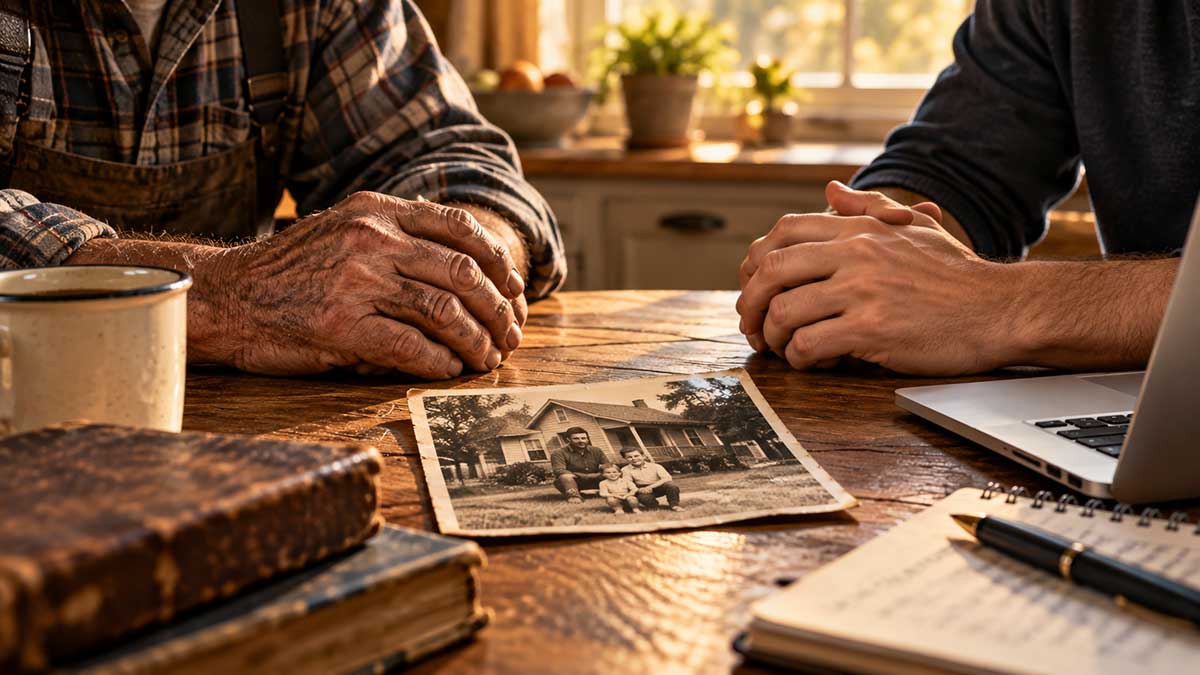
The evening has deepened outside the library. Rain begins tapping against the tall windows. On the table sits a photograph of a father and son, taken many years ago.
The father is David, now sixty-eight. In the photograph, he is thirty-five, smiling proudly beside his seven-year-old son, Daniel. They are standing in front of a small house with a newly painted white fence.
David has one hand resting on Daniel's shoulder. The boy is grinning, holding a baseball glove nearly as large as his head.
Tony Robbins picks up the photograph.
Tony Robbins: Look at that face.
Moderator: David's?
Robbins: The boy's. Daniel looks like he believes his father can do anything.
Alfie Kohn: Most seven-year-olds believe something like that.
Robbins: Exactly. And there's something beautiful about it.
But at thirty-five, if Daniel still believes his father has to do everything for him, we've got a problem.
Kohn: You make that sound like Daniel's failure.
Robbins: I said we have a problem. I didn't say whose fault it was.
Kohn: Fair enough.
Moderator: Last time, we left David facing a painful question. He worked his way out of poverty, built a business, and gave his son opportunities he never had.
Now Daniel is thirty-five. He's intelligent and kind, but he hasn't found a stable direction. David keeps helping him financially, solving problems, and offering advice.
And David is beginning to wonder whether his love has made his son weak.
Tony, you said something interesting. Maybe David needs to do less.
Less rescuing. Less deciding. Less solving.
But how does a father who has spent thirty-five years protecting his son suddenly stop?
Robbins: He doesn't suddenly stop loving him. He changes how he helps.
Let me ask you something. When Daniel was little and learning to walk, what did David do?
Moderator: Probably held his hands.
Robbins: Right. And when Daniel started walking on his own?
Moderator: He let go.
Robbins: Exactly.
If David had kept holding his son's hands every time he walked, Daniel would never have learned to trust his own balance.
The problem is that some parents keep holding on long after the child has learned to walk.
Kohn: That's a useful image, but real relationships aren't quite so simple.
Sometimes adult children genuinely need help. They lose jobs. They get sick. They experience setbacks.
If a parent responds by saying, "You're thirty-five. Figure it out yourself," that isn't necessarily wisdom.
Robbins: I agree. But if every setback becomes Dad's emergency, Daniel never has to develop the confidence to handle one.
Kohn: Then let's distinguish helping someone from taking over their life.
Moderator: How?
Kohn: Start by asking the person what kind of help they want.
It sounds obvious, but parents often skip that step.
They hear about a problem, become anxious, and immediately begin offering solutions.
Sometimes the adult child simply wants to be heard.
G. Michael Hopf: I agree that listening matters. But there's another side to this.
David spent decades creating security for his family. That required discipline, sacrifice, and difficult decisions.
He may reasonably expect Daniel to take responsibility for his own life.
Kohn: Expecting responsibility is one thing. Deciding what another adult's life should look like is another.
Hopf: Are you suggesting a parent shouldn't have expectations?
Kohn: I'm suggesting that an adult child isn't a project whose success is measured by how closely he follows his parent's plans.
Robbins: But Alfie, we can't pretend every choice is equally good.
If Daniel keeps abandoning commitments, running out of money, and asking his father to rescue him, those patterns have consequences.
Kohn: Of course they do.
My question is whether David's disappointment helps Daniel change those patterns or makes him feel incapable of changing them.
Moderator: Let me read something.
The moderator takes a folded sheet of paper from the table.
This is an imagined letter from Daniel. He has never sent it to his father.
"Dad, I know how hard you worked. You've told me about the factory, the old apartment, the nights you couldn't afford dinner. I know you gave me everything you never had."
"But sometimes I feel like I was born owing you a debt I can never repay."
"When I get a job, you ask if it's going anywhere. When I leave a job, you ask what I'm thinking. When I tell you about an idea, you explain why it probably won't work."
"You say you're trying to help me. I know you are."
"But every time we talk, I leave feeling smaller."
The moderator stops reading.
Robbins: That's painful.
Kohn: And revealing.
Hopf: I'd like to hear David's side.
Moderator: We will.
Viktor Frankl: May I ask about one sentence?
Moderator: Which one?
Frankl: "I was born owing you a debt I can never repay."
That is a heavy burden to place upon a child.
Hopf: But Daniel does owe his father gratitude, doesn't he?
Frankl: Gratitude is not the same as debt.
Hopf: Explain the distinction.
Frankl: Gratitude recognizes a gift. Debt demands repayment.
A parent who raises a child with love does not create a creditor's claim upon that child's future.
Hopf: Surely children have responsibilities to their parents.
Frankl: Certainly. Families are bound by responsibilities.
But a son's responsibility to love and respect his father is not identical to an obligation to reproduce his father's achievements.
Ibn Khaldun: There is a further difficulty.
David appears to measure his son's progress according to the circumstances of David's own youth.
But Daniel inhabits a different world.
Moderator: Isn't that what every generation does?
Ibn Khaldun: Often.
A father remembers the conditions that shaped his judgment. He believes those conditions taught him what is necessary for success.
He then tries to transmit the conclusions without recognizing that his son must apply them to different circumstances.
Robbins: But some principles don't change.
Take responsibility. Keep your commitments. Develop useful skills. Contribute something.
Those matter in any century.
Ibn Khaldun: I agree. Yet the forms of responsibility may change.
The son need not build the same business or pursue the same occupation to demonstrate maturity.
Kohn: Exactly.
Hopf: I don't think David necessarily expects an identical life. He may simply want evidence that Daniel can support himself.
Moderator: Let's hear David's side.
The moderator unfolds a second letter.
"Daniel thinks I'm always criticizing him. Maybe I am."
"But what he doesn't understand is how frightened I am."
"When I was twenty, nobody was coming to save me. If I lost my job, I couldn't pay rent. If I made a mistake, I had to live with it."
"Now I watch my son make decisions that seem careless, and I remember what it feels like to have nothing."
"I know he thinks I'm controlling. But when I see trouble coming, how am I supposed to sit there and do nothing?"
"He's my son."
The moderator lowers the letter.
Robbins: There it is.
Moderator: What?
Robbins: Fear.
David isn't simply trying to control Daniel. He's trying to protect him from the pain he remembers.
Kohn: And that makes him understandable. It doesn't automatically make his behavior helpful.
Robbins: Agreed.
Frankl: The father's suffering has not ended entirely.
Moderator: But he isn't poor anymore.
Frankl: Material circumstances can change long before a person's fears change.
David remembers what it meant to be helpless. When his son faces uncertainty, David may experience the old fear again.
He attempts to relieve that fear by taking control.
Hopf: So helping Daniel may sometimes be a way of comforting himself?
Frankl: That is one possibility.
Kohn: And it's a question parents rarely ask themselves.
"Am I doing this for my child, or am I doing it so I don't have to feel anxious?"
Moderator: That's uncomfortable.
Kohn: It should be.
Not every uncomfortable question is an attack.
Robbins: Now you're speaking my language.
Kohn smiles briefly.
Moderator: Let's make this practical.
Daniel calls David and says, "Dad, I lost my job."
What should David do?
Robbins: First, listen.
Kohn: Good.
Robbins: Then ask Daniel what he's planning to do.
Kohn: Better.
Robbins: And if Daniel says, "I don't know. Can you pay my rent again?" I'd want to understand the circumstances before making a decision.
Moderator: Suppose this is the third time in two years.
Robbins: Then there's a pattern that needs to be addressed.
Kohn: Yes, but I'd still want to know why.
Is Daniel losing jobs through carelessness? Is he choosing unsuitable work? Does he lack skills? Is something else interfering?
The solution depends on the problem.
Hopf: At some point, though, Daniel must accept that his choices affect other people.
David's resources aren't unlimited. His father has a life of his own.
Ibn Khaldun: Responsibility must be reciprocal.
A family can support a struggling member without allowing the obligations of one person to consume everyone else's resources.
Moderator: So David could say no?
Robbins: Of course.
Kohn: Yes. But how he says it matters.
Moderator: Give me an example.
Kohn: Instead of, "You're thirty-five years old. When are you going to grow up?" he might say, "I love you, and I want to help you work through this. But I can't keep paying your rent. Let's talk about what options you have."
Hopf: That seems reasonable.
Robbins: I'd add, "What are you willing to do?"
Kohn: And I'd be careful not to turn the conversation into an interrogation.
Robbins: You really are determined to keep me from pushing anyone, aren't you?
Kohn: Only when pushing becomes a substitute for listening.
Robbins: Fair enough.
Moderator: But what if Daniel becomes angry?
What if he says, "You have plenty of money. Why won't you help your own son?"
Hopf: Then David must be willing to tolerate his son's disappointment.
Kohn: Yes. A parent's boundary doesn't become wrong merely when a child dislikes it.
Frankl: Nor does a son's anger necessarily mean that he is ungrateful.
Sometimes a change in a long-established relationship produces pain on both sides.
Moderator: That brings us to something I find especially difficult.
What if David genuinely believes Daniel is making a terrible decision?
Suppose Daniel wants to leave a secure job to start a business. David thinks the idea is foolish.
Should he speak up?
Robbins: Absolutely. But there's a difference between giving advice and taking ownership of the decision.
Kohn: And between expressing concern and communicating contempt.
Hopf: If David has forty years of business experience, Daniel would be wise to listen.
Kohn: Listen, yes. Obey, no.
Hopf: I didn't say obey.
Kohn: Then we agree.
Moderator: What if Daniel fails?
Robbins: He might.
Moderator: And loses his savings?
Robbins: That's possible.
Moderator: And has to move into a smaller apartment?
Robbins: Then he has a difficult experience to learn from.
Kohn: Unless the failure has consequences beyond what he can reasonably manage.
I don't want us celebrating every failure as character-building.
Robbins: Nobody's celebrating bankruptcy.
Kohn: But people sometimes speak about failure as though its educational value automatically outweighs its cost.
Frankl: There is no virtue in unnecessary suffering.
Yet a person cannot be protected from every consequence without losing the freedom to direct his own life.
Moderator: So what is David supposed to say?
Frankl: Perhaps, "I have concerns. Would you like to hear them?"
Moderator: That's it?
Frankl: It is a beginning.
Moderator: And if Daniel says no?
Frankl: Then David must decide whether his concern is so serious that it requires speaking regardless, or whether he can respect his son's refusal.
Kohn: That distinction is valuable.
Parents often believe love gives them unlimited permission to offer opinions.
Hopf: But silence can be irresponsible too.
Kohn: Certainly. If someone is facing immediate danger, speaking up may be necessary.
But choosing a different career? Marrying someone a parent wouldn't have chosen? Moving to another city?
Those decisions belong to the adult child.
Ibn Khaldun: A father may offer the wisdom of experience. He cannot demand that experience be accepted as law.
Moderator: I wonder whether David knows who he is when Daniel no longer needs him.
The conversation becomes quieter.
Robbins: That's a deeper question.
Moderator: Think about it.
For thirty-five years, David has been the provider. The protector. The person with answers.
When Daniel has a problem, David knows what to do.
But if Daniel becomes completely independent, David loses a role that has defined much of his life.
Could a father unconsciously keep helping his son partly out of fear that he won't be needed anymore?
Kohn: Certainly possible.
And I think many parents would recognize themselves in that question.
Hopf: That's a difficult thing to admit.
Frankl: Especially for someone whose identity has been built around sacrifice.
Moderator: David might say, "If my son doesn't need me, what am I supposed to be?"
Frankl: His father.
Moderator: But not his rescuer?
Frankl: Fatherhood does not end when a child becomes capable of living independently.
It changes.
Moderator: Changes into what?
Frankl: That is something David and Daniel must discover together.
Perhaps companionship. Mutual respect. Shared memories. Advice freely requested rather than imposed.
A relationship between two adults who love one another.
Ibn Khaldun: And perhaps mutual contribution.
The son may eventually possess knowledge, abilities, or perspectives his father lacks.
Robbins: That's a great point.
What if David stopped asking only, "What can I do for Daniel?" and started asking, "What can Daniel contribute?"
Kohn: Provided he doesn't make Daniel's worth depend on productivity.
Robbins: I'm talking about contribution, not earning the right to be loved.
Kohn: Then we agree again.
Moderator: Let me ask something that might sound harsh.
Could David actually be disappointed that Daniel didn't have to struggle?
Hopf: I doubt he'd describe it that way.
Moderator: But perhaps part of him thinks, "I had to work for everything. Why should my son have it so easy?"
Kohn: That resentment can exist alongside love.
Robbins: And if it does, David needs to recognize it.
Frankl: There is a temptation to believe that our suffering becomes meaningful only when others acknowledge it.
David may long for Daniel to appreciate what he endured.
But his suffering does not become more valuable if Daniel suffers too.
Hopf looks down at the photograph.
Hopf: There's something tragic about that.
A father escapes hardship, gives his son a better life, then finds himself wishing the boy had experienced enough hardship to appreciate the gift.
Frankl: Perhaps what he truly wishes is not that Daniel had suffered.
Perhaps he wishes they could understand one another.
Moderator: That's a very different desire.
Frankl: And one that may still be fulfilled.
Moderator: I want to return to Daniel's letter.
He said, "Every time we talk, I leave feeling smaller."
What would you want David to hear in that sentence?
Kohn: That his son is telling him something important about their relationship.
Not accusing him of being a bad father.
Not denying his sacrifices.
Telling him that the way they communicate is hurting him.
Robbins: And I'd want Daniel to take responsibility for telling his father what he needs.
He can't expect David to read his mind.
Hopf: Nor can he expect his father never to disagree with him.
Kohn: No. Respectful disagreement is part of an adult relationship.
Moderator: Suppose David finally sits down with Daniel.
He wants to apologize, but he doesn't know what to say.
He's afraid that admitting a mistake will erase everything he did right.
Frankl: An apology need not erase a lifetime of love.
It may reveal the depth of that love.
Moderator: What might he say?
Frankl: I would not put words in his mouth. But perhaps he could begin with what he knows to be true.
Moderator: Such as?
Frankl: "I love you. I've been afraid for you. And I think sometimes I've allowed that fear to speak more loudly than my trust."
The rain grows heavier against the windows.
Robbins: That's good. But I'd want him to go one step further.
Ask Daniel, "What would support from me look like now?"
Kohn: And be prepared to hear an answer he doesn't like.
Hopf: What if Daniel says, "I don't want your advice anymore"?
Kohn: Then David can respect that without pretending it doesn't hurt.
Ibn Khaldun: The bond between father and son need not disappear merely on account of changing authority.
Indeed, it may become stronger when both recognize the dignity of the other.
Moderator: And what should Daniel say?
Robbins: Whatever is true.
If he's grateful, say so.
If he's frustrated, say so.
If he's afraid of failing, admit it.
But he needs to stop waiting for his father's approval before beginning his own life.
Kohn: I'd phrase that a little differently.
He may need to learn that his father's disappointment, painful as it is, does not determine his worth.
Hopf: And he may need to accept that independence comes with obligations.
Frankl: Both can be true.
Freedom without responsibility becomes empty. Responsibility without freedom becomes a burden imposed by others.
Moderator: There's a sentence I've been thinking about.
What if David said to himself:
"It's not my job to change my son. I just have to love and appreciate who he is."
Would that be enough?
Robbins: It's a beautiful starting point.
But I'd distinguish accepting someone from giving up on their potential.
You can love Daniel exactly as he is and still believe he's capable of more.
Kohn: Yes, provided David doesn't make that belief into a constant demand.
Sometimes the most meaningful expression of faith in another person is to stop reminding them of what they haven't accomplished.
Hopf: And allow them to demonstrate responsibility in their own way.
Frankl: There is something liberating in the sentence.
David need not abandon his hopes for Daniel. But he can release the belief that he has the right to determine who Daniel must become.
Moderator: So loving and appreciating Daniel doesn't mean approving of every decision?
Kohn: Of course not.
Moderator: Or continuing to rescue him?
Robbins: No.
Moderator: Or pretending his problems don't exist?
Hopf: Certainly not.
Moderator: It means recognizing that Daniel is a person, not an unfinished version of David's dreams.
Frankl nods.
Frankl: Yes.
Moderator: Then perhaps the hardest part of parenting isn't raising a child.
Perhaps it's learning to accept that the child eventually becomes someone whose life belongs to them.
Ibn Khaldun: And recognizing that a family remains a family when its members cease to occupy the same roles they once did.
Robbins: I want to add something.
David may be sixty-eight, but he isn't finished growing either.
He can learn a new way of being a father.
Kohn: That's an important point.
We often talk about children needing to mature, but parents have developmental work of their own.
Hopf: Particularly when the circumstances that once made them successful no longer provide the right answers.
Moderator: There's something I want to ask David, if he were sitting here.
The moderator looks at the old photograph.
"David, when Daniel was seven, you held his hand crossing the street. You taught him to ride a bicycle. You protected him from dangers he couldn't yet recognize."
"You did those things out of love."
"But Daniel is thirty-five now."
"Do you believe he can live a meaningful life without you directing it?"
No one speaks.
Moderator: I think David would struggle to answer.
Not necessarily from a lack of faith in his son.
But from the fear that if he says yes, he'll have to let go.
Frankl: Then perhaps that is the difficulty David must now face.
Not poverty. Not failure in business. Not the hardships of his youth.
The difficulty of trusting someone he loves.
Robbins: And that's a challenge no amount of money can solve for him.
Kohn: Nor can anyone else complete it on his behalf.
Moderator: What if he tries, and Daniel still makes mistakes?
Hopf: He will.
Moderator: What if Daniel chooses a life David doesn't understand?
Kohn: He may.
Moderator: What if David never sees his son become the successful man he imagined?
Frankl: Then David must ask whether his love was meant for the man he imagined or the son who stands before him.
The words settle over the table.
Robbins slowly places the photograph back where he found it.
Robbins: You know what strikes me?
That seven-year-old boy in the picture looks completely secure.
He knows his father loves him.
Kohn: And perhaps the thirty-five-year-old man still needs to know that.
Hopf: Without needing his father to solve everything.
Ibn Khaldun: Without losing the bond between them.
Frankl: Without having to become someone else to deserve it.
Moderator: Then maybe the question David should ask Daniel isn't, "When are you finally going to grow up?"
Maybe it's, "What kind of relationship would you like us to have now?"
Outside, the rain begins to ease.
The moderator studies the photograph one last time.
Moderator: I wonder what Daniel would say if his father asked him that.
And I wonder what David would feel if Daniel answered:
"Dad, I don't need you to be disappointed in me anymore. I don't need you to fix everything."
"I just want you to be proud that I'm trying to find my own way."
Frankl looks at the photograph.
Frankl: Perhaps the father would discover that his son has been asking for something very simple.
Moderator: What?
Frankl: The freedom to be loved without first becoming a success.
For a long moment, the five men sit quietly.
Then Ibn Khaldun looks again at the four sentences on the wall.
Ibn Khaldun: We began with the question of whether prosperous generations become weak.
But we have spent this evening discussing a father who cannot release his fear and a son who cannot escape his father's expectations.
Which of them is weak?
Moderator: I don't know.
Ibn Khaldun: Nor do I.
He turns back to the table.
Ibn Khaldun: Perhaps that is why we should be cautious when judging generations. We may be looking at two people struggling with different burdens, each unable to recognize the weight carried by the other.
Beyond the windows, the city lights reflect on the wet streets.
Somewhere in that city, an adult son is deciding whether to call his father.
And somewhere else, a father is wondering why the son he loves no longer calls as often as he used to.
Editor's note: This is an original fictional conversation inspired by the participants' published ideas. None of the dialogue represents an actual exchange. David and Daniel are fictional characters created to explore the emotional and practical questions raised by the discussion.
Topic 3: The Generational Blame Game
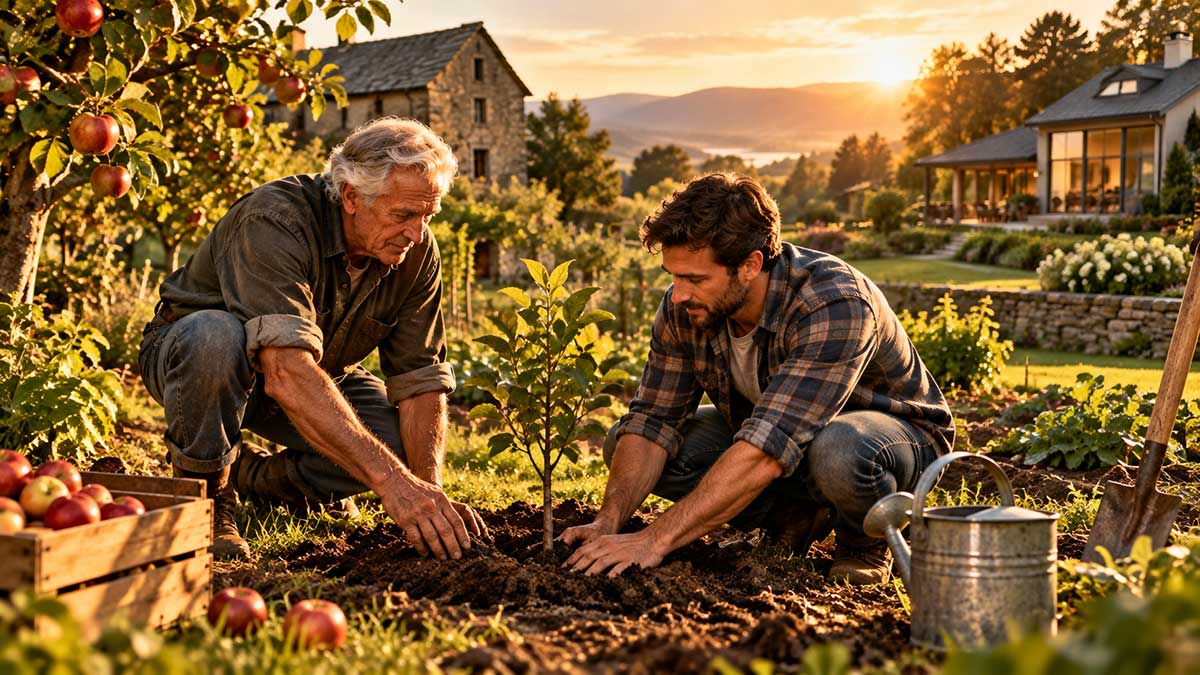
Are Young People Really Weaker, or Are We Measuring Them Wrong?
The rain has stopped.
Beyond the library windows, the city glistens under streetlights. A young delivery driver rides through the wet streets, his insulated bag bouncing against his back. Above him, apartments glow with the light of televisions and computer screens.
On the table, beside the photograph of David and his son Daniel, the moderator has placed two newspaper headlines.
The first, from an earlier generation, complains that young people lack discipline and respect.
The second, from the present, asks whether today's young adults have become too fragile to face ordinary life.
G. Michael Hopf reads them and gives a small, knowing smile.
G. Michael Hopf: Different generations. Same complaint.
Moderator: That's what caught my attention.
For centuries, older people have complained that younger people are lazy, entitled, disrespectful, or weak.
Yet civilization somehow continued.
So I want to ask something that may make you uncomfortable, Michael.
What if the cycle in your famous quote is partly an illusion created by every generation's tendency to admire itself?
Hopf: That would be a fair challenge if my argument were simply that older people are better than younger people.
It isn't.
I'm concerned about what happens when people inherit prosperity without appreciating the responsibility required to maintain it.
Alfie Kohn: But how do you know they're failing to appreciate it?
Hopf: Look at behavior.
Kohn: Whose behavior?
Hopf: People who expect rewards without effort. Who refuse responsibility. Who assume someone else will solve every problem.
Kohn: You've described behaviors that exist in every generation.
Hopf: Of course.
Kohn: Then how do you establish that an entire generation has become weaker?
Hopf considers the question.
Hopf: You would need more than anecdotes.
Kohn: Exactly.
And that's where I think we need to be careful. A story about one irresponsible young adult can become a judgment about millions of people.
Tony Robbins: I agree that labeling a whole generation is lazy thinking.
But Alfie, let's not pretend patterns don't exist.
People are shaped by their environments. Technology changes habits. Parenting changes expectations. Economic conditions change behavior.
If a generation grows up with fewer opportunities to practice certain skills, we should be willing to talk about that.
Kohn: Certainly. But we should be equally willing to ask what skills they've developed that previous generations didn't possess.
Robbins: Fair point.
Moderator: Such as?
Kohn: Consider a young person who has friends across continents, can collaborate with people from different cultures, learns unfamiliar skills online, and is willing to question traditions that earlier generations accepted without examination.
Those may be genuine strengths.
Hopf: And that same young person may struggle to handle criticism, commit to difficult work, or accept responsibility.
Kohn: Perhaps. But why are we assuming those characteristics belong together?
Viktor Frankl: May I suggest that we are beginning with the wrong comparison?
Moderator: What would be a better one?
Frankl: Instead of asking whether one generation is stronger than another, we might ask what each generation has been called upon to face.
The demands of life are not identical across time.
Courage in one period may mean surviving physical deprivation. In another, it may mean refusing to participate in injustice. In another, it may mean preserving human relationships amid isolation.
The forms change.
The responsibility to respond remains.
Ibn Khaldun: And we must examine the circumstances that produce those demands.
A generation does not arise independently of the society that raises it.
If the young are accustomed to luxury, who created the luxury?
If they lack opportunities to contribute, who organized the institutions that exclude them?
If they distrust authority, what have those in authority done to earn or lose their trust?
The moderator looks at Hopf.
Moderator: That's an uncomfortable reversal.
We often hear older people say, "Young people today have it too easy."
But who worked so hard to make their lives easier?
Hopf: Their parents and grandparents, in many cases.
Moderator: Then why blame the children for receiving what their parents wanted to give them?
Hopf: I don't blame anyone for being born into comfort.
I question what people do with the opportunities they've inherited.
Kohn: Then the criticism should be directed at choices and behaviors, not birth years.
Hopf: Agreed.
Robbins: And the same standard should apply to older people.
You can be seventy years old and still spend your life blaming everyone else.
Age doesn't automatically create wisdom.
Moderator: That's something I want to explore.
We often speak about the Greatest Generation, people who lived through the Great Depression and World War II.
We admire their sacrifice, endurance, and sense of duty.
But were they necessarily better people?
Frankl's expression changes slightly.
Frankl: We must be cautious with such judgments.
The same historical period produced extraordinary courage and extraordinary cruelty.
People who endured similar conditions made very different moral choices.
Hardship did not transform everyone into a virtuous human being.
Moderator: You experienced that directly.
Frankl: I witnessed what human beings were capable of doing to one another. I witnessed acts of generosity under terrible conditions.
But I would not say that suffering automatically improved those who experienced it.
That would diminish the moral significance of their choices.
Robbins: That's important.
Strength isn't what happens to you. It's how you respond.
Frankl: Our response matters deeply. Yet we should not forget that circumstances can limit the choices available to us.
We must not use the language of personal responsibility to judge those who were overwhelmed by conditions we have never faced.
Robbins: That's fair.
Moderator: Let me make this more personal.
Imagine an eighty-five-year-old grandfather telling his twenty-five-year-old grandson:
"When I was your age, I was married, owned a house, had two children, and worked sixty hours a week. What's wrong with your generation?"
What would you say to him?
Kohn: I'd ask whether he's considered what that house cost relative to his income.
Hopf: And I'd ask whether the grandson has a plan for his life.
Kohn: Why do you always begin with the grandson?
Hopf: I don't. You began with the house.
Kohn: Fair enough.
Ibn Khaldun: Both questions matter.
A society may provide abundant goods while making certain forms of stability difficult to attain.
A young adult may face economic obstacles unknown to an earlier generation.
Yet he must still decide how to respond to the circumstances before him.
Robbins: Exactly.
I don't want to dismiss the housing problem. It's real in many places.
But I don't want someone to conclude, "The system is difficult, so there's nothing I can do."
That belief can become a prison.
Kohn: And I don't want someone to conclude, "If I haven't succeeded, the problem must be my character."
That belief can become a prison too.
Moderator: You two keep arriving at the same problem from opposite directions.
Robbins: Maybe we need both directions.
Kohn: Maybe we do.
Outside, the delivery driver stops beneath an apartment building. He removes his helmet and checks his phone before carrying a bag toward the entrance.
Moderator: Look at that young man.
We don't know anything about him.
He might be a student working nights. He might be supporting his parents. He might be saving for a business. He might be struggling with debt.
Or perhaps he's simply earning enough money to get through the week.
Yet someone watching him could say, "Young people today have no ambition. They just want flexible jobs."
Hopf: Which would be an unfair judgment without knowing his circumstances.
Moderator: Exactly.
But someone else could look at a young man sitting at home playing video games all day and conclude the same thing.
Robbins: And sometimes that judgment might identify a genuine problem.
Kohn: It might. But it still wouldn't tell us why the problem exists.
Moderator: Why does the reason matter so much?
Kohn: Think about a doctor who sees a patient with a fever.
The fever is real. But treating every fever as though it has the same cause would be foolish.
Human behavior deserves at least that much curiosity.
Hopf: I agree with curiosity. But at some point, curiosity has to lead to action.
Kohn: Absolutely.
Robbins: Now we're getting somewhere.
The moderator turns the photograph of David and Daniel around so everyone can see it.
Moderator: Let's return to our father and son.
David is sixty-eight. Daniel is thirty-five.
David believes Daniel has had opportunities he never had.
Daniel believes his father doesn't recognize how different the world has become.
And I have another imagined letter from Daniel.
The moderator opens a folded page.
Moderator: "Dad, you keep telling me that when you were my age, you already owned a house and had started your business."
"I know. You've told me a hundred times."
"But when you bought your first house, you could afford it with the money you earned from your job. When you started your business, you didn't have to compete with companies on the other side of the world."
"I'm not saying your life was easy."
"I'm saying mine isn't easy in the same way."
The moderator pauses.
"And there's something else."
"You keep telling me how much you sacrificed so I could have opportunities."
"But sometimes I wonder whether you wanted me to have opportunities or whether you wanted me to become successful enough to prove that your sacrifices were worthwhile."
The room falls silent.
Hopf: That's a difficult accusation.
Kohn: It's a painful question, not necessarily an accusation.
Robbins: It could be both.
Moderator: What do you think David would say?
Hopf: He might say, "I never asked you to prove anything. I just wanted you to make something of your life."
Kohn: And Daniel might ask, "Who gets to decide what making something of my life means?"
Robbins: But Daniel has to answer that question himself.
It's not enough to reject his father's definition of success. He needs to develop his own.
Frankl: Yes.
Freedom from another person's expectations is only part of the task.
Freedom becomes meaningful when one accepts responsibility for what one chooses.
Moderator: So Daniel can't simply say, "Stop judging me," and then expect his father to continue solving every problem?
Frankl: He must consider the responsibilities that accompany the independence he seeks.
Ibn Khaldun: And David must consider whether his assistance comes with expectations that have never been openly discussed.
Moderator: Such as?
Ibn Khaldun: Financial help may appear to be a gift, yet the giver may expect influence in return.
The recipient may accept the assistance while resenting the influence.
Neither speaks honestly about the arrangement.
Robbins: That happens all the time.
Kohn: And it can poison a relationship.
Hopf: Then the solution is to establish clear expectations.
Kohn: Clear expectations, yes. But they must be reasonable and respectful.
Moderator: Let's say David agrees to help Daniel with rent for three months.
Could he ask Daniel to create a financial plan?
Robbins: Absolutely.
Kohn: He could. And Daniel could decide whether those conditions are acceptable.
Hopf: That's responsibility on both sides.
Moderator: But what if Daniel says, "You don't trust me"?
Frankl: Then perhaps David should listen carefully.
Sometimes a person hears a condition as a judgment because the relationship already contains years of unresolved disappointment.
Moderator: So the argument isn't really about rent.
Frankl: It may have begun long before the rent was due.
The moderator places Daniel's letter beside the photograph.
Moderator: There's something else I want to ask.
Why do parents so often compare their children with themselves?
Why does David say, "When I was your age..."?
Robbins: Sometimes it's an attempt to teach.
Parents want their children to benefit from what they've learned.
Kohn: Sometimes it's an attempt to control.
Hopf: And sometimes it's simply the only example they know.
Ibn Khaldun: Human beings interpret unfamiliar circumstances through familiar experience.
A father remembers the world of his youth. His son knows the world of the present.
Neither possesses complete knowledge of the other's circumstances.
Moderator: Then perhaps both need a little humility.
Ibn Khaldun: A great deal.
Robbins: Especially if they want to keep learning.
Moderator: I want to challenge Daniel now.
Suppose he says, "Dad, you don't understand how hard my generation has it."
But he spends hours every day scrolling through social media, comparing himself with strangers, avoiding difficult conversations, and postponing decisions.
Wouldn't David have a point?
Robbins: Of course he would.
Look, you can face real economic obstacles and still develop habits that make your situation worse.
Both things can be true.
Kohn: Yes. But I'd want to know what Daniel is getting from those habits.
Robbins: What do you mean?
Kohn: Perhaps social media provides an escape from constant anxiety. Perhaps he feels paralyzed by comparison. Perhaps he's lonely.
Understanding that doesn't excuse every choice. It helps us identify what might actually change it.
Hopf: But isn't there a danger of explaining every failure until nobody is responsible for anything?
Kohn: Only if you assume that understanding a behavior means approving of it.
Frankl: Explanation and responsibility need not be enemies.
We can recognize the circumstances that influence a person's choices without denying that choices matter.
Robbins: That's the balance I'm looking for.
Moderator: So we shouldn't say young people are weak simply for struggling.
But we shouldn't pretend every struggle is beyond their influence.
Robbins: Exactly.
Kohn: And we should apply that same standard to older generations.
Moderator: How?
Kohn: Consider David.
He's successful in business. He's disciplined. He's financially responsible.
But he struggles to listen without criticizing. He struggles to accept decisions he doesn't understand. He struggles to tolerate uncertainty.
Are those not forms of difficulty?
Hopf: Certainly.
Kohn: Then why do we call David strong and Daniel weak?
Moderator: David is strong in the areas we traditionally admire.
Kohn: And Daniel may possess strengths David has never learned to recognize.
Ibn Khaldun: This is a significant point.
A society often defines strength according to the qualities that helped it succeed in the past.
But new circumstances may demand new qualities.
Moderator: Such as?
Ibn Khaldun: The ability to cooperate across differences. To adapt to unfamiliar knowledge. To maintain trust in changing institutions. To exercise judgment when information is abundant but wisdom is scarce.
Robbins: That last one is becoming enormous.
We have more information available than any generation in history.
But information isn't judgment.
Moderator: Especially with AI.
Robbins: Exactly. You can ask a machine almost anything. But you still need to decide what matters, what to believe, and what you're willing to do.
Kohn: And education should help young people develop those capacities rather than merely produce correct answers.
Hopf: Which means technology can create new opportunities and new dependencies.
Moderator: So perhaps our generation has its own version of the old problem.
We can obtain answers without learning how to think.
Frankl: Yet the ability to obtain answers does not remove the responsibility to ask meaningful questions.
The moderator looks through the window again.
Moderator: I wonder whether we're being unfair to young people in another way.
When older generations endured poverty, war, or physical hardship, their struggles were often visible.
You could see the worn shoes. The empty cupboards. The exhausted faces.
But many modern struggles are invisible.
Loneliness. Anxiety. A feeling that your life has no direction.
Does that make them less real?
Frankl: No.
Suffering is not a competition.
Moderator: But people compare it constantly.
Frankl: Yes. And comparison can become a way of refusing to listen.
A person who has endured great suffering may be tempted to dismiss another person's pain as insignificant.
Yet the suffering of one human being does not become unreal simply on account of another's greater suffering.
Hopf: I agree. But we also need perspective.
There are people today living through war, hunger, and persecution. We shouldn't forget them when discussing the frustrations of prosperous societies.
Frankl: Certainly.
Perspective can deepen gratitude.
But gratitude should not become a weapon used to silence another person's distress.
Kohn: That's beautifully put.
Robbins: And it works both ways.
A young person can recognize the sacrifices of earlier generations without pretending their own problems don't matter.
Moderator: I want to return to David and Daniel one more time.
Imagine that Daniel finally gathers the courage to tell his father something.
"Dad, I know you worked hard."
"I know you gave me a better childhood than you had."
"But sometimes, when you tell me how difficult your life was, I feel like you're asking me to apologize for the life you gave me."
Hopf looks down.
Hopf: That's a sentence a father would remember.
Moderator: Why?
Hopf: If David truly loves his son, he doesn't want Daniel to apologize for being protected.
He wants him to appreciate the protection and use it well.
Kohn: Then perhaps David needs to stop presenting his sacrifices as evidence in an argument.
Robbins: And Daniel needs to recognize that his father may be trying, imperfectly, to communicate something valuable.
Moderator: What would that be?
Robbins: "I want you to be capable. I want you to have a meaningful life. I don't want fear or dependence to keep you from discovering what you can do."
Frankl: Perhaps Daniel wants something equally valuable.
Moderator: What?
Frankl: "I want you to know me as I am, not merely as the person you hoped I would become."
The room grows quiet.
Ibn Khaldun: Both desires are understandable.
The father wants continuity. He hopes the qualities that sustained his life will survive in his son.
The son wants freedom. He hopes to establish a life that belongs to him.
A family must find a way to preserve its bonds without demanding that every generation repeat the one before it.
Moderator: That's almost a description of civilization itself, isn't it?
Ibn Khaldun: In a sense.
Every generation inherits something.
Institutions. Knowledge. Wealth. Customs. Mistakes.
The question is not whether the young will reproduce the past exactly.
They cannot.
The question is what they will preserve, what they will change, and what they will pass forward.
Hopf: Which is why I worry about forgetting.
Kohn: And why I worry about demanding obedience in the name of tradition.
Robbins: And why I worry about people giving away their ability to act.
Frankl: These concerns need not cancel one another.
Moderator: Perhaps the older generation should ask, "What wisdom do we need to pass on?"
And the younger generation should ask, "What wisdom do we need to discover for ourselves?"
Ibn Khaldun: That would be a more fruitful exchange than deciding which generation deserves contempt.
The moderator gathers the two newspaper headlines from the table.
Moderator: There's something strange about these complaints.
For centuries, older generations have worried that younger generations are becoming weak.
Yet every generation was once young.
Every generation was once criticized.
And every generation eventually becomes the one doing the criticizing.
Robbins: Maybe that's the real cycle we need to break.
Kohn: The cycle of judging people before trying to understand them.
Hopf: I would still insist that every generation must learn responsibility.
Kohn: I would insist that responsibility cannot be reduced to obedience.
Robbins: And I'd insist that understanding your circumstances doesn't mean surrendering to them.
Frankl: Then perhaps we have arrived at something worth preserving.
We cannot choose the historical circumstances into which we are born.
But we can choose how seriously we take our responsibility to one another.
Moderator: There's one more question.
If every generation believes it suffered more, worked harder, and understood life better than the next, how will we ever learn from one another?
Ibn Khaldun: By recognizing that no generation possesses the whole of human wisdom.
Outside, the delivery driver returns to his bicycle. He pulls on his helmet, checks the next address, and disappears into the night.
The moderator watches him go.
Moderator: We know nothing about that young man.
We don't know whether he's saving for college, supporting a family, or simply trying to pay his bills.
We don't know whether he's ambitious or discouraged, confident or frightened.
And yet it would be so easy to tell a story about him based on his age.
Kohn: That's what people do.
Moderator: Maybe tomorrow he'll become a successful entrepreneur.
Maybe he'll become a teacher.
Maybe he'll struggle for years before finding his direction.
Maybe he'll never achieve anything the world considers extraordinary.
Frankl: None of those possibilities tells us the full measure of his worth.
Moderator: And perhaps that's what David needs to understand about Daniel.
His son doesn't have to become another David.
Hopf: But he does have to become responsible for his own life.
Kohn: Yes. In a way that belongs to him.
Robbins: And he has to begin somewhere.
Moderator: I wonder whether David and Daniel could ever sit down together and talk without comparing their lives.
Not "When I was your age."
Not "You don't understand my generation."
Just two men.
A father who remembers being poor.
A son who remembers being afraid of disappointing him.
Frankl: That would require courage from both.
Moderator: Courage?
Frankl: Yes.
For David, the courage to listen without defending everything he has done.
For Daniel, the courage to speak honestly without making his father responsible for every disappointment.
Moderator: Which of them would need more courage?
Frankl: Why must we decide?
The moderator smiles faintly.
Moderator: Perhaps we don't.
He places the photograph of David and Daniel between the two newspaper headlines.
Moderator: You know, I began tonight wondering whether young people had become weaker.
Now I'm wondering whether we've become too comfortable judging one another.
Ibn Khaldun: That is a form of complacency worth examining.
Hopf: Perhaps the most dangerous kind.
Robbins: It's easier to blame a generation than to take responsibility for changing anything.
Kohn: And easier to criticize a young person than to ask what kind of world we've prepared for them.
The moderator looks once more at the four sentences on the wall.
Moderator: Mr. Hopf, your quote says weak people create hard times.
But suppose the danger isn't that young people are becoming weak.
Suppose the danger is that generations are losing the ability to understand and cooperate with one another.
Wouldn't that create hard times too?
Hopf studies the words on the wall.
Hopf: Yes.
And perhaps faster than we realize.
Outside, the last traces of rain disappear from the streets. The city continues moving, carried forward by millions of people who inherited different opportunities, different fears, and different hopes.
At the table, no one seems eager to decide which generation deserves the title of strongest.
There is a more difficult question waiting: whether the qualities that once sustained a prosperous society can be passed forward without repeating the hardships that produced them.
Editor's note: This is an original fictional conversation inspired by the participants' published ideas. The exchanges are imagined, not historical quotations. David and Daniel are fictional characters whose relationship continues throughout the series.
Topic 4: Can We Break the Cycle of History?

Must Every Prosperous Society Eventually Decline?
The clock above the library fireplace reads a little past ten.
Outside, the city has grown quieter. The rain has passed, leaving the streets clean and reflective. Office towers stand illuminated against the dark sky. In apartment windows, people eat dinner, watch television, finish work, and prepare for another day.
The moderator has placed a small hourglass in the center of the table.
Beside it lies the photograph of David and Daniel, the father and son whose struggles have accompanied the discussion.
On the wall, G. Michael Hopf's four-stage cycle remains visible.
The moderator turns the hourglass over.
Moderator: Mr. Hopf, I've been looking at those four sentences all evening.
Hard times create strong people. Strong people create good times. Good times create weak people. Weak people create hard times.
If that cycle is inevitable, then somewhere in this city, people are already preparing the next crisis without knowing it.
And if it's inevitable, why bother trying to prevent it?
G. Michael Hopf: I never said it was inevitable.
Moderator: But that's how many people interpret it.
They look at a prosperous society, see signs of complacency, and conclude that decline must be coming.
Hopf: A warning isn't a prophecy.
If someone tells you that neglecting your health may lead to illness, that doesn't mean you're destined to become sick.
It means you have a reason to change your habits.
Alfie Kohn: But your statement is much stronger than a warning.
It doesn't say good times may create weak people.
It says they do.
Hopf: It's a memorable way of describing a recurring danger.
Kohn: And that's precisely why I question it.
Memorable statements can become substitutes for thinking.
People repeat them until they stop asking whether they're true.
Tony Robbins: Alfie, I agree that we shouldn't turn a saying into a law of nature.
But Michael is identifying something real.
People can become complacent when things are going well.
A successful business stops listening to its customers. A person achieves financial security and stops developing useful skills. A family becomes comfortable and forgets the habits that helped it succeed.
Those patterns happen.
Kohn: Certainly. But prosperity can produce the opposite result too.
A successful business can invest in research. A financially secure person can pursue education. A family with resources can give its children opportunities to contribute.
Why assume decline is the natural outcome?
Ibn Khaldun: Perhaps we should distinguish between prosperity and the loss of solidarity.
Moderator: Explain that distinction.
Ibn Khaldun: In my examination of dynasties, I observed how groups possessing strong bonds could establish authority and build institutions.
Their members depended upon one another. They shared obligations. They accepted hardship in pursuit of common purposes.
As prosperity increased, their circumstances changed.
They might become accustomed to luxury. Their leaders might grow distant from those they governed. Institutions could become instruments of private advantage rather than common welfare.
The decline did not arise merely from people sleeping in comfortable beds.
It arose when the relationships and responsibilities sustaining the society deteriorated.
Hopf: That's close to what concerns me.
Ibn Khaldun: There is an important difference.
Your saying may lead people to look for weak individuals.
I would ask them to examine weakened bonds, neglected obligations, and failures of governance.
Moderator: So a society could have hardworking, disciplined individuals and still decline?
Ibn Khaldun: Certainly.
A society is not simply a collection of private achievements.
Robbins: But institutions are run by people.
If leaders lose integrity, that's a failure of character.
Ibn Khaldun: Sometimes. Yet an institution can encourage destructive behavior among people who believe themselves to be acting responsibly.
Robbins: Give me an example.
Ibn Khaldun: Imagine a prosperous city in which every merchant seeks only to maximize his own advantage.
Each merchant may work diligently. Each may provide for his family.
But if no one contributes to maintaining roads, protecting the vulnerable, or preserving public trust, the city eventually suffers.
Individual effort alone does not preserve collective prosperity.
Kohn: And a society can celebrate personal responsibility so loudly that it forgets shared responsibility.
Robbins: I don't disagree.
But shared responsibility can't become an excuse for individuals to do nothing.
Kohn: Nor should individual responsibility become an excuse for institutions to neglect their duties.
Moderator: It sounds as though we keep discovering two sides of the same problem.
We need capable individuals and trustworthy institutions.
Ibn Khaldun: And bonds strong enough to connect them.
The moderator watches the sand falling through the hourglass.
Moderator: Let me challenge the entire idea of historical cycles.
We often hear that Rome became wealthy, comfortable, and decadent, and then collapsed.
But Rome's history involved wars, political conflicts, economic pressures, military problems, and changes over centuries.
Isn't it misleading to reduce all of that to strong men becoming weak?
Ibn Khaldun: It would be.
Historical events seldom obey a single explanation.
Hopf: I agree that civilizations don't fall for one reason.
But I still believe losing the willingness to sacrifice for something greater than oneself is dangerous.
Kohn: Then let's examine that danger directly rather than assuming every prosperous society must repeat Rome.
Robbins: And let's ask what we can do about it.
That's where this gets interesting to me.
If we recognize that certain habits helped create prosperity, why can't we deliberately preserve those habits?
Moderator: Such as?
Robbins: Responsibility. Discipline. Learning. Adaptability. Contribution.
You don't have to wait for disaster to develop them.
Hopf: Exactly.
Kohn: I agree with most of those qualities. But the way we teach them matters.
Robbins: Here we go.
Kohn smiles.
Kohn: You knew I wasn't going to let that pass.
Robbins: I was counting on it.
Kohn: Let's take discipline.
A child who follows orders out of fear may appear disciplined.
But what happens when nobody is watching?
Robbins: Then we find out whether the discipline was real.
Kohn: Precisely.
A child who understands the purpose of a task, has some choice in how to approach it, and feels responsible to others may develop a more lasting commitment.
Hopf: But children also need to do things they don't enjoy.
Kohn: Of course. Adults do too.
The question is whether we help them recognize meaningful obligations or simply demand obedience.
Moderator: Let's bring David and Daniel back into this.
David built a business through years of sacrifice. He wants Daniel to inherit his discipline.
But Daniel didn't experience the same poverty.
How could David teach those qualities without manufacturing hardship?
Robbins: Give Daniel meaningful responsibility.
Not artificial suffering.
Something real.
A project. A commitment. A problem he owns from beginning to end.
Hopf: And let him experience the consequences of his decisions.
Kohn: Reasonable consequences, yes. But David shouldn't turn every mistake into a lesson about how much harder his own childhood was.
Moderator: Suppose David gives Daniel responsibility for a small part of the family business.
Daniel makes a mistake that costs money.
What should David do?
Robbins: First, find out what happened.
Hopf: Hold him accountable.
Kohn: Help him examine the mistake without humiliating him.
Ibn Khaldun: And consider whether the responsibility was genuinely his.
Moderator: What do you mean?
Ibn Khaldun: Did David give Daniel authority to make decisions?
Or did he give him a title and continue controlling every choice?
Robbins: That's a great distinction.
You can't demand ownership from someone you've never allowed to own anything.
Hopf: But you can't give unlimited authority to someone who hasn't demonstrated competence.
Kohn: Then give responsibility appropriate to his experience and allow it to grow.
Moderator: So responsibility is learned through responsibility?
Robbins: That's the idea.
Frankl: Provided we recognize that responsibility is more than the successful completion of a task.
Moderator: You've been quiet, Dr. Frankl.
Viktor Frankl: I have been considering what we mean by preserving strength.
We speak of discipline, institutions, prosperity, and success.
These are important.
But a person may be disciplined in pursuit of a destructive purpose.
A society may be efficient while failing to respect human dignity.
We should ask what these qualities are intended to serve.
Moderator: And your answer?
Frankl: Meaning. Responsibility to other human beings. The recognition that our actions matter beyond our immediate desires.
Robbins: That's what I mean by contribution.
Frankl: Then perhaps we agree on the destination, though we may describe different paths.
Moderator: But can meaning be taught?
Frankl: It cannot simply be handed from one person to another like an object.
A father may demonstrate how he finds meaning in his work, his relationships, and his obligations.
His son must still discover the particular responsibilities of his own life.
Moderator: David could show Daniel how he lives, but he cannot decide what Daniel should live for.
Frankl: Yes.
Hopf: And yet David can teach him that life requires more than personal comfort.
Frankl: Certainly.
Kohn: Through example, conversation, and opportunities to contribute.
Robbins: And through action.
Moderator: I notice something.
We began with a disagreement about whether good times create weak people.
Now we're discussing how to preserve strength during good times.
Perhaps prosperity itself isn't the problem.
Perhaps the problem is what we stop practicing when life becomes easier.
Hopf: That's exactly the warning I hoped people would hear.
Kohn: Then I'd suggest we stop calling the people who haven't practiced those skills weak.
Call them inexperienced. Unprepared. Under-supported.
Those descriptions tell us more about what needs to change.
Robbins: Sometimes weak is still the right word.
Kohn: For what purpose?
Robbins: To recognize a capacity that needs development.
Kohn: But a label can become an identity.
If you tell a young person often enough that they're weak, they may begin to believe it.
Robbins: Then don't tell them they're weak. Tell them they're capable of becoming stronger.
Kohn: That's better.
Hopf: We're getting awfully careful with language.
Frankl: Language can influence how we see one another.
Care may be appropriate.
The moderator reaches for a tablet lying beside the hourglass.
Moderator: I want to introduce something that none of the earlier civilizations had.
Artificial intelligence.
We have spent this evening discussing what happens when prosperity removes hardship.
But AI may remove something even more significant.
The need to think through difficult problems ourselves.
Robbins: Or it may give people the ability to solve problems they couldn't solve before.
Moderator: Exactly.
Suppose Daniel wants to start a business.
He asks AI to write his business plan, design his website, research competitors, create advertisements, and answer customer emails.
In a matter of days, he accomplishes work that might once have taken months.
Is Daniel becoming stronger or weaker?
Hopf: That depends on what he understands.
Moderator: Explain.
Hopf: If he can evaluate the work, recognize mistakes, make decisions, and take responsibility for the outcome, the technology may be an extraordinary advantage.
But if he blindly accepts whatever it produces, he may be building something he doesn't know how to operate.
Kohn: That's an educational question.
Are we using technology to deepen learning or merely to produce finished assignments?
Robbins: I'd go further.
What matters is whether Daniel is becoming more capable of creating value.
If AI helps him test ideas, learn skills, and serve customers better, that's progress.
Moderator: But what if AI does almost everything?
Robbins: Then Daniel still has to choose what matters.
He has to understand the people he's serving.
He has to decide what kind of business he wants to build.
And he has to accept responsibility when something goes wrong.
Frankl: Technology can assist a person in carrying out a task.
It cannot relieve that person of responsibility for the purpose of the task.
Moderator: What if someone asks AI to make every decision?
What career to pursue. Who to marry. How to raise children. What to believe.
Kohn: Then I would be concerned about the loss of independent judgment.
Hopf: That's the kind of dependency my warning applies to.
A person inherits extraordinary capabilities without developing the ability to use them wisely.
Robbins: But we shouldn't assume that's where AI leads.
People once worried that calculators would destroy mathematical ability.
The question is how the tool is used.
Kohn: Calculators can help students explore mathematics. They can also allow students to bypass learning concepts they still need to understand.
The same distinction applies here.
Moderator: So AI could make people more capable or more dependent.
Ibn Khaldun: It may also transform the bonds between people.
Moderator: How?
Ibn Khaldun: Consider a society in which machines perform an increasing share of intellectual and practical work.
What becomes of the skills that once made individuals valuable to their communities?
How do people maintain a sense of contribution?
How do institutions distribute the benefits of greater productivity?
If the gains are shared, prosperity may increase.
If the gains are concentrated and large numbers of people lose their sense of purpose or security, social cohesion may weaken.
Robbins: That's a serious issue.
Hopf: And another reason responsibility matters.
Kohn: But responsibility belongs to those developing and governing these systems too, not merely to the people affected by them.
Moderator: I want to ask a question that may sound strange.
What if AI eventually becomes so capable that people don't need to struggle intellectually?
What if a child can learn almost anything instantly?
Would that be a tragedy?
Kohn: Not necessarily.
We should distinguish learning from performing repetitive work.
If technology removes tedious tasks, students may have more time for exploration, creativity, and meaningful questions.
Robbins: Exactly.
The point isn't to preserve difficulty for its own sake.
It's to develop human capability.
Hopf: But some abilities require practice.
You can't become a skilled decision-maker without making decisions.
Frankl: Nor can a person discover the meaning of responsibility if every difficult choice is delegated to another.
Moderator: So perhaps the real danger isn't that AI will make life easier.
It's that we may stop exercising the capacities that make us human.
Frankl: That is one possibility.
But another is that technology may free people to devote more attention to relationships, service, and questions of meaning.
We should not condemn an opportunity merely out of fear that it may be misused.
Robbins: I love that.
Kohn: I agree with the principle, though I'd want us to examine who actually receives those opportunities.
Ibn Khaldun: And whether the society remains capable of using them for the common good.
The moderator places the tablet beside the photograph of David and Daniel.
Moderator: Let's say David sees Daniel using AI to build his business.
David says, "When I started my company, I had to do everything myself. You have no idea how easy you have it."
Daniel replies, "Dad, isn't that what you wanted? Didn't you work so I could have opportunities you never had?"
What should David say?
Robbins: He should ask Daniel what he's building.
Moderator: Not lecture him about how easy it is?
Robbins: No.
Ask him what problem he's solving. Who his customers are. What he's learned. What decisions he's making.
Hopf: And whether he understands the risks.
Kohn: Without treating the use of technology as evidence of laziness.
Ibn Khaldun: David might discover that his son is developing skills he himself never needed.
Moderator: Such as?
Ibn Khaldun: The ability to coordinate new technologies, evaluate information, and adapt to unfamiliar conditions.
Frankl: And Daniel might discover that his father's experience contains wisdom that technology cannot replace.
Moderator: Such as?
Frankl: How to respond when a promise has been broken. How to accept responsibility for a mistake. How to treat another person when there is no immediate advantage in doing so.
Robbins: That's where the generations could become a team.
David brings experience. Daniel brings new tools.
Kohn: Provided David doesn't insist on being the boss of every conversation.
Hopf: And Daniel doesn't dismiss his father's experience as outdated.
Moderator: That would be something.
Instead of the older generation accusing the younger of weakness, and the younger accusing the older of ignorance, they could actually help each other.
Ibn Khaldun: That would strengthen the bonds between generations.
Moderator: And perhaps interrupt the cycle.
The hourglass has nearly emptied.
Moderator: I want to return to a question we haven't fully answered.
Can we preserve strength without creating hardship?
We can give children responsibilities. Encourage service. Teach independent thought.
But will those things truly prepare them for a crisis?
Can someone who has never experienced severe suffering develop the courage to face it?
Hopf: They can prepare.
They can develop discipline, useful skills, and the habit of taking responsibility.
But nobody knows exactly how they'll respond to a catastrophe until it arrives.
Robbins: That's true of everyone.
You can train. You can build habits. You can strengthen relationships.
But life will still surprise you.
Kohn: And preparation should include knowing when to ask for help.
We sometimes define strength so narrowly that people become ashamed of needing anyone.
Ibn Khaldun: Yet dependence upon others is not always weakness.
The bonds that sustain a community arise from mutual need.
Frankl: Courage does not require the absence of fear, nor does responsibility require complete independence.
Moderator: Then perhaps we've made strength too individual.
We picture one person standing alone against the world.
But many of the greatest human achievements come from people supporting one another.
Ibn Khaldun: Precisely.
Hopf: And that support requires people willing to contribute, not merely receive.
Kohn: Which brings us back to responsibility without humiliation.
Robbins: And contribution without waiting for perfect circumstances.
Moderator: Let me try to put together what we've discovered.
Hard times may call forth strength, but they can destroy lives too.
Good times may encourage complacency, but they can create opportunities for growth.
A society doesn't have to manufacture suffering to develop responsibility.
And technology doesn't have to weaken human judgment if we use it thoughtfully.
Hopf: That's fair.
Moderator: Then why do so many people seem convinced that decline is inevitable?
Ibn Khaldun: Fear can make a simple explanation attractive.
When the future is uncertain, people seek patterns that promise to make it predictable.
Kohn: And blaming a generation gives people someone to hold responsible.
Robbins: But recognizing a danger isn't the same as surrendering to it.
Frankl: Nor should hope be confused with a guarantee.
Human beings can act responsibly and still encounter tragedy.
The value of responsible action does not depend upon certainty of success.
The moderator turns the empty hourglass over once more.
Moderator: That may be the most important distinction tonight.
We cannot guarantee good times will last.
But we can choose what we teach, what we practice, and how we treat one another during the good times we have.
Hopf: And we can refuse to take prosperity for granted.
Kohn: Without treating comfort as a moral failure.
Robbins: Without waiting for disaster to motivate us.
Ibn Khaldun: Without forgetting our obligations to the wider community.
Frankl: Without losing sight of the human beings for whom prosperity should exist.
The moderator looks down at David and Daniel's photograph.
Moderator: I keep returning to these two.
David is afraid that his son won't survive the next hard time.
Daniel is afraid that he'll never become the man his father wants him to be.
Both are afraid.
But perhaps neither has asked the other a simple question.
"What can we learn from each other?"
Robbins: That's where I'd begin.
Kohn: And I'd want them to listen to the answers.
Hopf: Then put what they learn into practice.
Ibn Khaldun: And recognize that neither generation can preserve its achievements alone.
Moderator: Dr. Frankl, what would you ask them?
Frankl: I would ask David what kind of father he wishes to be now, rather than what kind of father he needed to be thirty years ago.
And I would ask Daniel what responsibilities are calling him now, rather than what achievements he believes he must produce to satisfy his father.
Moderator: You wouldn't ask whether Daniel is strong enough?
Frankl: I would ask what he is prepared to take responsibility for.
Strength may reveal itself in the answer.
The moderator leans back and studies the four sentences on the wall.
Moderator: I think I finally understand why the quote bothers me.
It seems to suggest that the children of successful people are destined to become weaker.
But if that's true, what are we working for?
Why build a better world if the better world will destroy the qualities that made it possible?
Hopf: That's precisely why the warning matters.
Prosperity should be something we preserve through responsibility, not something we consume without thought.
Kohn: And I would add that the purpose of prosperity isn't merely to produce another generation capable of maintaining prosperity.
It's to make human lives better.
Robbins: Which includes giving people the chance to grow.
Ibn Khaldun: And strengthening the relationships upon which shared life depends.
Frankl: And allowing each generation to discover its own meaningful responsibilities.
Moderator: So the cycle might be broken.
Hopf: It might.
Moderator: Not by making life harder.
Kohn: Not unnecessarily.
Moderator: Not by making children afraid of failure.
Robbins: But by helping them develop the courage to act.
Moderator: Not by demanding that they repeat their parents' lives.
Ibn Khaldun: But by helping them carry forward what remains valuable.
Moderator: And not by telling them they must suffer to become strong.
Frankl looks at the city beyond the windows.
Frankl: No.
We should never need to wish suffering upon those we love.
The room grows quiet.
Moderator: Then perhaps we can give the next generation something better than hardship.
We can give them the opportunities our ancestors struggled to create, the wisdom their experiences taught them, and the freedom to discover what they will contribute.
Robbins: That's a future worth working for.
Hopf: Provided we don't forget the responsibility that comes with it.
The moderator reaches for the photograph of David and Daniel.
Moderator: There's one thing I still wonder about.
If David truly accepts that his son doesn't need to experience the same hardships he did, how will he know whether Daniel is becoming strong?
He can't measure it by poverty survived.
He can't measure it by hours worked.
He can't measure it by whether Daniel builds a business as successful as his own.
So what should he measure?
Kohn: Perhaps he should stop trying to measure his son.
Robbins: Or ask whether Daniel is becoming more capable of directing his own life.
Hopf: Whether he keeps his commitments.
Ibn Khaldun: Whether he contributes to others.
Frankl: Whether he responds to the responsibilities that life places before him.
Moderator: Those are very different answers.
Frankl: Perhaps they should be.
A human being is not a business whose value can be reduced to a single measure.
The moderator looks again at the old photograph.
Moderator: Then perhaps the question isn't how David can make Daniel strong.
Perhaps it's what kind of strength Daniel might already possess that David has never learned to recognize.
Outside, the city's lights begin to disappear one window at a time.
The hourglass continues to empty.
And on the wall, the four sentences remain, waiting for a different kind of answer.
Editor's note: This is an original fictional conversation inspired by the participants' published ideas. The exchanges are imagined, not historical quotations. David and Daniel are fictional characters whose relationship continues throughout the series.
Topic 5: Strength Without Suffering
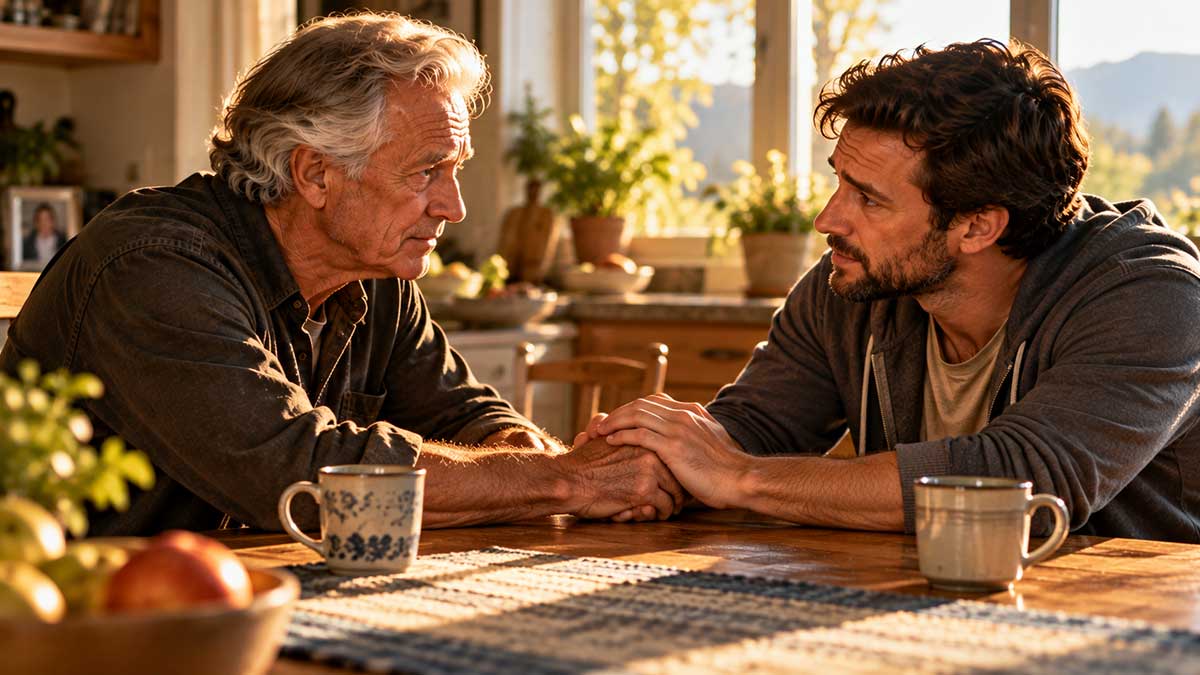
Can Strong People Create an Even Stronger Generation?
It is nearly midnight.
The city beyond the library windows has grown quiet. Most of the office lights have gone dark. A few apartments remain illuminated, their windows offering glimpses of ordinary lives: a woman washing dishes, a young man bent over his laptop, an elderly couple sitting together beneath a reading lamp.
The five men remain around the wooden table.
The hourglass has stopped. Beside it rests the photograph of David and Daniel, taken when Daniel was seven years old.
On the wall, G. Michael Hopf's four famous sentences remain unchanged.
The moderator studies them for a moment.
Moderator: We've spent the evening asking whether good times create weak people.
We've talked about prosperity, responsibility, parents, children, civilizations, and even artificial intelligence.
But I think we've avoided the most personal question.
What kind of strength do we actually want our children to have?
Tony Robbins: The strength to take responsibility for their lives.
Alfie Kohn: The courage to think independently, care about other people, and question things that deserve to be questioned.
G. Michael Hopf: The character to do what's necessary, even when it's difficult or unpopular.
Ibn Khaldun: The willingness to contribute to something greater than individual comfort.
Viktor Frankl: The capacity to recognize and respond to the meaning that life presents to them.
Moderator: Five answers.
And they're all different.
Robbins: Different angles on the same thing, perhaps.
Kohn: I'm not sure.
Robbins: I had a feeling you'd say that.
Kohn: Tony, you speak about responsibility. Michael speaks about character. But those words can mean very different things depending on who's using them.
A child who obeys every instruction might appear responsible to an authoritarian parent.
A young adult who refuses an unjust instruction might appear irresponsible to that same parent.
Which one is stronger?
Hopf: The one acting with integrity.
Kohn: Even when integrity means defying authority?
Hopf: Of course.
Kohn: Then we're getting somewhere.
Robbins: I think we need to distinguish obedience from self-discipline.
A person can obey out of fear. Self-discipline means being able to act according to a commitment, especially when you don't feel like it.
Kohn: But who chose the commitment?
Robbins: Ideally, the person did.
Kohn: That's a significant distinction.
Moderator: Let me ask a harder question.
What if a young man is financially successful, physically strong, disciplined, and confident, but treats other people terribly?
Would you call him strong?
Hopf: Not in the sense I intend.
Robbins: Successful in some areas, perhaps. But deeply lacking in others.
Ibn Khaldun: His achievements may be impressive, yet his conduct may weaken the bonds upon which his society depends.
Frankl: Strength without regard for human dignity can become an instrument of destruction.
Moderator: So strength isn't merely the ability to endure hardship or achieve success.
Frankl: No.
A person may endure much and remain indifferent to others.
Another may live in safety and demonstrate extraordinary courage by defending someone who is vulnerable.
We should not mistake the circumstances of a life for its moral worth.
Moderator: Then perhaps our original question was incomplete.
We asked whether good times create weak people.
But perhaps we should ask whether good times can create people who are not just capable, but good.
Kohn: And whether the way we raise children encourages them to care about others rather than merely compete with them.
Hopf: I agree. But goodness also requires the courage to act.
It's easy to claim compassion when compassion costs nothing.
What happens when helping another person demands sacrifice?
Robbins: That's where commitment becomes real.
Frankl: And where meaning can call a person beyond immediate comfort.
The moderator picks up the photograph of David and Daniel.
Moderator: I want to return to this family.
David is sixty-eight now. Daniel is thirty-five.
David spent his life trying to give Daniel everything he never had.
But somewhere along the way, they began to misunderstand one another.
David sees a son who hasn't fulfilled his potential.
Daniel sees a father whose approval always seems just beyond reach.
And I have one final imagined scene from their lives.
The moderator unfolds a page.
The library grows still.
A Father's Confession
Moderator: It's a Sunday afternoon.
David is sitting at his kitchen table. Daniel has come to visit.
For the first time in months, neither man is in a hurry.
David has made coffee.
Daniel sits across from him, looking at the old family photographs on the refrigerator.
David asks about work.
Daniel says he's considering leaving his current job to start a small business.
David immediately begins explaining the risks.
Daniel listens for a few minutes, then puts down his cup.
He says:
"Dad, can I ask you something?"
David nods.
"Have you ever been proud of me?"
The moderator stops reading.
Robbins: Oh.
Kohn: That's a question no parent wants to hear from a grown child.
Moderator: David is stunned.
He says, "Of course I'm proud of you."
Daniel asks, "Then why don't I ever feel it?"
David begins listing things he's done for his son.
The schools he paid for. The opportunities he provided. The times he helped Daniel out of trouble.
Daniel shakes his head.
"Dad, I'm not asking what you've done for me."
"I'm asking whether you like the person I've become."
The room falls silent.
Hopf: That's painful.
Frankl: Yes.
Moderator: What should David say?
Robbins: The truth.
Kohn: And perhaps nothing for a moment.
Robbins: Nothing?
Kohn: He has just heard something that challenges his entire picture of their relationship.
If he immediately begins defending himself, Daniel may never finish telling him what he feels.
Robbins: Fair point.
Hopf: But I hope Daniel recognizes that his father's sacrifices were expressions of love.
Kohn: He may recognize that perfectly well.
The problem is that David keeps answering a question about affection with evidence of provision.
Frankl: Providing for someone and recognizing that person are not identical acts.
Moderator: That's a difficult distinction for David.
He grew up poor.
To him, making sure his son had food, education, and security was the greatest expression of love he could imagine.
Frankl: And it was a meaningful expression of love.
But Daniel is asking whether his father sees him.
Not merely what his father has given him.
Ibn Khaldun: The father may have transmitted material security without realizing that the son still seeks a place of dignity within their relationship.
Moderator: Let's continue.
David looks at Daniel and says:
"Son, everything I've done has been for you."
Daniel replies:
"I know, Dad."
"That's why it's so hard to tell you that sometimes I wish you'd done a little less for me and just spent more time being happy with me."
The moderator sets down the page.
Hopf: I don't know how a father hears that without feeling that his whole life is being rejected.
Kohn: He might feel that way.
But Daniel isn't necessarily rejecting his father's life.
He's telling him what was missing from their relationship.
Robbins: And that gives David a chance to do something different.
Moderator: At sixty-eight?
Robbins: Why not?
He's not finished living.
He spent decades learning how to build a business. He can learn how to have a different relationship with his son.
Frankl: A person is never reduced to the decisions already made.
The past cannot be undone. But the present still asks something of us.
Moderator: What does the present ask of David?
Frankl: Perhaps to listen.
Perhaps to recognize that his son is not asking him to become a different father in the past.
He is asking him to be present now.
The Question of Responsibility
Moderator: There's something I don't want us to overlook.
Daniel is thirty-five. He's struggled with jobs, finances, and following through on his plans.
We can sympathize with him, but we shouldn't pretend he has no responsibility.
Tony, what would you say to him?
Robbins: I'd say, Daniel, your father's approval matters to you. I understand that.
But you cannot build your entire life around trying to earn it.
At some point, you have to decide what you want to create, what commitments you're willing to make, and what you're going to do when things don't work out.
You can't wait until your father understands every decision before you begin living.
Moderator: What if Daniel says, "But I'm afraid I'll fail"?
Robbins: Then I'd ask him what he's more afraid of.
Failing at something meaningful?
Or spending another twenty years wondering what might have happened if he'd tried?
Kohn: I'd want to know whether Daniel has the resources and support to take that risk responsibly.
Robbins: Of course.
Kohn: I'm serious, Tony.
When people talk about taking risks, they sometimes forget that failure doesn't cost everyone the same amount.
Someone with savings and family support can recover from a failed business more easily than someone with dependents and no financial cushion.
Robbins: I agree. Courage doesn't mean ignoring reality.
Hopf: And responsibility means considering the consequences before acting.
Moderator: So Daniel shouldn't quit his job tomorrow simply to prove he's independent?
Robbins: No. He should develop a plan.
Learn what he needs to learn. Test his idea. Understand the risks.
Then make a decision and own it.
Ibn Khaldun: He might benefit from his father's experience.
Kohn: If his father can offer it without taking over.
Hopf: And if Daniel can receive advice without interpreting every concern as criticism.
Frankl: Both must learn to distinguish guidance from control and independence from rejection.
Moderator: That seems to be the difficulty.
David wants Daniel to be independent, but he becomes anxious when Daniel makes decisions independently.
Daniel wants his father's respect, but he sometimes rejects the very experience that could help him.
Ibn Khaldun: They have become trapped in roles that no longer serve them.
Moderator: The provider and the dependent?
Ibn Khaldun: Yes.
David continues to see himself as the man who must protect his son from danger.
Daniel continues to see himself as the son who must either obey his father or resist him.
Neither has fully recognized that they are now two adults capable of contributing to one another.
Moderator: How do they change that?
Ibn Khaldun: Through new forms of mutual responsibility.
Robbins: Let Daniel bring something to the table.
Not just a request for help.
An idea. A plan. A decision he's prepared to take responsibility for.
Kohn: And let David respond with curiosity rather than an immediate evaluation.
Moderator: What would that sound like?
Kohn: Instead of "That business will never work," David might ask, "What interests you about it?"
Robbins: Then, "What have you learned about the market?"
Hopf: "What risks have you considered?"
Frankl: And perhaps, "What would success mean to you?"
Moderator: That's very different from "When I was your age, I'd already built a company."
Kohn: Exactly.
Hopf: But Daniel still has to demonstrate that he's serious.
Moderator: Michael, may I challenge you?
Hopf: Please.
Moderator: What if Daniel never becomes successful in the conventional sense?
What if he never builds a business?
What if he chooses a modest life, earns enough to support himself, treats people kindly, and finds meaning in his relationships?
Would David have failed to raise a strong son?
Hopf: No.
Not if Daniel is taking responsibility for his life and contributing to others.
Moderator: Then why do we so often measure strength by wealth and achievement?
Hopf: They're visible.
Character is harder to measure.
Frankl: And sometimes the most meaningful acts of a human life are almost invisible.
Moderator: Such as?
Frankl: A person who cares for an aging parent. Someone who remains faithful to a difficult responsibility. A neighbor who notices another person's loneliness and offers companionship.
These actions may never appear in a record of economic achievement.
Yet they can reveal profound strength.
Robbins: That's contribution.
Kohn: And it doesn't require extraordinary suffering to develop.
Ibn Khaldun: Nor does it require extraordinary wealth.
The moderator looks toward the city.
Moderator: I wonder how many people out there are considered unsuccessful simply for choosing lives that don't impress anyone.
Frankl: The meaning of a life cannot be determined entirely by the admiration it receives.
Can Strength Be Taught Through Love?
Moderator: Let me return to the question that brought us here.
If hard times can create strong people, but we don't want our children to suffer unnecessarily, how do we help them become strong?
I don't want another slogan.
I want something a parent could actually do tomorrow.
Robbins: Give your child something meaningful to be responsible for.
And I don't mean inventing pointless obstacles.
Let them make a decision. Let them follow through. Let them see the results.
If they make a mistake, help them learn from it instead of immediately fixing everything.
Kohn: I'd begin by asking the child what matters to them.
Children aren't empty containers waiting for adults to pour discipline into them.
They have interests, concerns, and a developing sense of fairness.
Invite them to participate in decisions that affect their lives.
Hopf: I'd teach gratitude through action.
Not by lecturing children about how difficult life used to be, but by involving them in service.
Let them help people who are struggling.
Let them discover that comfort brings opportunities to contribute.
Ibn Khaldun: I would strengthen the bonds between generations.
Let children know their grandparents' stories. Let them participate in family and community obligations.
A person who understands that others depend upon him may develop responsibility without experiencing deprivation.
Frankl: I would ask parents to recognize the unique person before them.
A child is not simply a future worker, a future parent, or a vessel for inherited values.
That child will encounter possibilities and responsibilities no one else can fulfill in exactly the same way.
Help the child discover them.
Moderator: Those are all valuable suggestions.
But I notice something missing.
What about failure?
Children will fail. Adult children will fail.
How do we let someone we love experience failure without feeling that we've abandoned them?
Kohn: By distinguishing support from rescue.
You can sit beside someone who has failed without pretending the failure didn't happen.
You can help them think through their options without taking over.
Robbins: And you can express confidence in their ability to recover.
Hopf: Provided that confidence is accompanied by honest expectations.
Moderator: Suppose Daniel starts his business and loses money.
David could afford to rescue him.
Should he?
Robbins: Not automatically.
Kohn: Nor should he automatically refuse.
Moderator: You two really won't give me a simple answer.
Robbins: Life doesn't always offer one.
Kohn: Especially when money and family relationships are involved.
Ibn Khaldun: The decision should consider Daniel's needs, David's resources, their obligations, and the effect of assistance upon their relationship.
Moderator: But what if David says, "If I don't help him, he'll think I don't love him"?
Frankl: Then David must ask whether he has allowed financial assistance to become the primary language of their relationship.
Moderator: And if he has?
Frankl: He can begin learning another language.
Moderator: Which is?
Frankl: Presence. Respect. Trust. Honesty.
The willingness to remain connected when one cannot solve another person's problem.
Kohn: And the willingness to say, "I love you," without attaching a performance review.
Hopf: That doesn't mean abandoning standards.
Kohn: No. It means separating a person's worth from their achievements.
Robbins: You can have high standards for how someone acts without making your love conditional on their success.
Moderator: So love and accountability don't have to oppose each other.
Frankl: No.
But love should never become a disguise for possession.
The words linger.
Moderator: Possession?
Frankl: A parent may love a child deeply and still struggle to accept that the child's life does not belong to the parent.
Love calls us to care for another person.
It does not grant us ownership of that person's future.
The Conversation David Never Expected
The moderator picks up the final page of David and Daniel's fictional story.
Moderator: Let's return to that Sunday afternoon.
David and Daniel are still sitting at the kitchen table.
Daniel has asked whether his father likes the person he's become.
For a long time, David doesn't answer.
Then he says something he's never said before.
"When you were born, I was terrified."
"I looked at you in the hospital, and all I could think about was the life I'd had. The nights I went hungry. The times I watched my parents worry about money."
"I promised myself you'd never feel that fear."
Daniel listens.
David continues.
"Every time you had a problem, I remembered being young and having nobody to help me."
"So I helped."
"And when helping wasn't enough, I tried harder."
"I thought that was what a good father did."
David looks down at his hands.
"But somewhere along the way, I started treating every problem you had like it was a problem I had failed to prevent."
"And maybe every time I tried to fix your life, I made you feel like you weren't capable of living it."
The moderator pauses.
Kohn: That's a remarkable admission.
Robbins: And it takes courage.
Hopf: Particularly for a man who has spent his life believing he needed to be strong for everyone.
Moderator: Daniel doesn't know what to say.
Finally, he asks:
"Dad, are you disappointed in me?"
David looks at his son.
"Sometimes I'm disappointed in your decisions."
"Sometimes I'm worried about the choices you make."
"But no, Daniel. I'm not disappointed that you're my son."
Daniel begins to cry.
David reaches across the table, then hesitates.
For a moment, he seems unsure whether his grown son still wants his hand.
Daniel reaches back.
The moderator lowers the page.
No one speaks.
Frankl: There is something important in David's answer.
Moderator: What?
Frankl: He does not pretend to approve of every decision.
He does not deny his concerns.
But he separates those concerns from his love for his son.
Kohn: And Daniel finally hears something he has needed for years.
That he doesn't have to become a different person to be loved.
Robbins: But I hope Daniel doesn't stop there.
Moderator: What do you mean?
Robbins: That moment can change their relationship.
But Daniel still has a life to build.
Love can give him a foundation. It can't make his decisions for him.
Hopf: Exactly.
Moderator: Let's continue.
The moderator looks back at the page.
Daniel wipes his eyes.
"Dad, I know I haven't always made good decisions."
"I've quit things too soon. I've borrowed money I should have earned. Sometimes I've been so afraid of failing that I didn't even try."
"And sometimes I blamed you for that, when I knew it wasn't fair."
David listens.
"I don't know whether this business idea will work."
"But I want to try."
"And this time, I don't want you to pay for it."
David looks surprised.
"You don't want my help?"
"I want your help, Dad."
"Just not your money."
"I want to ask you questions. I want to hear about the mistakes you made. I want you to tell me what you think."
"But I need you to let the decisions be mine."
David is quiet for a long moment.
Then he asks:
"And if I think you're making a mistake?"
Daniel smiles faintly.
"You can tell me."
"Just don't make me feel like I'm a mistake."
The moderator sets down the letter.
Kohn: There.
Moderator: What?
Kohn: That's the distinction we've been searching for.
A parent can question a decision without questioning the worth of the person making it.
Robbins: And an adult child can welcome advice without surrendering responsibility.
Hopf: Daniel is beginning to demonstrate the very qualities David wanted him to develop.
Ibn Khaldun: The relationship is becoming reciprocal.
David contributes experience. Daniel contributes his willingness to act.
Neither needs to dominate the other.
Frankl: And both are learning that love may require relinquishing something.
For David, the need to control.
For Daniel, the need to secure his father's approval before accepting responsibility for his own choices.
Moderator: It's interesting.
Neither man needed a catastrophe to arrive at this moment.
No bankruptcy. No tragedy. No terrible loss.
Just a difficult conversation.
Frankl: Sometimes honesty asks more courage of us than we expect.
Robbins: And sometimes the hardest action is the one we've been avoiding for years.
The Better Cycle
The moderator stands and walks to the wall.
He looks at the four sentences that began the evening.
Moderator: Mr. Hopf, I want to ask your permission to try something.
Hopf: Go ahead.
Moderator: Your original cycle begins with hard times and ends with hard times.
It describes a warning about what can happen when generations lose the qualities that created prosperity.
But what if we could create another cycle?
One that doesn't require suffering to produce strength?
Hopf: I'm listening.
Moderator: Suppose love creates security.
And security gives children the confidence to take meaningful risks.
Those risks, combined with responsibility and support, help them develop capability.
Capability allows them to contribute to their families and communities.
And those contributions create greater prosperity and opportunity for the next generation.
Could that work?
Kohn: It could, provided security doesn't become another word for controlling every outcome.
Robbins: And meaningful risks require action. You don't develop confidence merely by being told you're capable.
Ibn Khaldun: The cycle must include obligations to others. Otherwise prosperity may become merely private accumulation.
Hopf: And each generation must understand that the opportunities it inherits require stewardship.
Frankl: I would add that meaning cannot be reduced to prosperity.
A society may become wealthier without becoming more humane.
Moderator: Then perhaps the better cycle looks like this:
Love creates security.
Security encourages courage.
Courage develops capability.
Capability supports contribution.
Contribution strengthens communities.
And strong communities help the next generation grow.
Hopf: That's a hopeful possibility.
Moderator: But would you change your original quote?
Hopf: No.
Moderator: Why not?
Hopf: It expresses a danger I still believe people need to recognize.
Prosperity can create complacency.
People can forget the sacrifices that made their opportunities possible.
I don't want to pretend that danger has disappeared simply on account of a hopeful alternative.
Kohn: Fair enough.
But I'd want readers to recognize that your cycle is a possibility, not a destiny.
Hopf: I can accept that.
Robbins: And I'd want people to know they can begin changing their habits now.
They don't need to wait for hard times.
Ibn Khaldun: Nor can individual determination alone preserve a society.
We must cultivate institutions and relationships worthy of trust.
Frankl: And we should remember that the purpose of a better society is not simply to create more successful people.
It is to provide conditions in which human beings can respond meaningfully to life.
Moderator: Then perhaps the greatest achievement of a strong generation isn't creating a generation that can endure the same suffering.
Perhaps it's creating a generation that doesn't have to.
Hopf: Provided they retain the courage to face the hardships that will inevitably come.
Kohn: And the compassion not to wish those hardships upon others.
Robbins: And the willingness to take responsibility before circumstances force them to.
Ibn Khaldun: And the solidarity to face difficulties together.
Frankl: Yes.
But there is something I would ask us not to forget.
Moderator: What is that?
Frankl: We have spoken all evening about creating strong children.
Perhaps we should ask whether we are willing to recognize strength when it appears in forms we did not expect.
The moderator looks again at David and Daniel's photograph.
Moderator: Daniel may never become as wealthy as his father.
He may never build a company of the same size.
He may make decisions David would never make.
But perhaps he will become a more patient father.
Perhaps he will be more willing to listen.
Perhaps he will recognize another person's pain without comparing it to his own.
Kohn: Those are meaningful possibilities.
Hopf: And if he keeps his commitments and contributes to others, I would call that strength.
Robbins: He still has to act. Good intentions alone won't build his life.
Moderator: Of course.
But perhaps David can finally stop measuring his son's future against his own past.
Frankl: And perhaps Daniel can stop measuring his worth against his father's achievements.
The moderator returns to the table.
Moderator: I want to share the final lines of David and Daniel's story.
He opens the last page.
After their conversation, David walks Daniel to the front door.
The two men stand on the porch.
Daniel turns to leave, then stops.
"Dad?"
"Yes, son?"
"Thank you for everything you did for me."
David smiles.
"I just wanted you to have a better life."
Daniel looks at him.
"I know."
"And I do."
"It's just going to look different from yours."
David feels the old impulse to offer advice, to warn him about mistakes, to remind him how difficult the world can be.
But this time, he says something else.
"I think I'd like to see what you make of it."
Daniel smiles.
"Me too, Dad."
They embrace.
Then Daniel walks to his car.
David stands on the porch watching him.
For the first time in years, he doesn't feel the need to follow him with another warning.
He simply watches his son drive away.
And when the car disappears around the corner, David goes back inside.
Not entirely free of worry.
Not certain that Daniel will succeed.
But willing, at last, to let his son try.
The moderator folds the page.
The library is silent.
Moderator: I think that's what I wanted this conversation to discover.
David spent his life trying to prevent his son from experiencing the suffering he endured.
He succeeded in many ways.
But he had to learn that giving someone a better life doesn't mean deciding how that life should be lived.
Robbins: And Daniel had to learn that freedom comes with responsibility.
Kohn: Without making his father's approval the condition of his worth.
Hopf: And without forgetting the sacrifices that gave him his opportunities.
Ibn Khaldun: Each generation has something to give and something to learn.
Frankl: And love need not disappear when control ends.
The moderator turns toward the wall one last time.
Moderator: Hard times create strong people.
Strong people create good times.
Good times create weak people.
Weak people create hard times.
Four sentences.
A warning that has traveled around the world.
But perhaps there is another possibility.
Strong people can create good times.
And good times, guided by love, wisdom, responsibility, and meaningful purpose, can create people who are stronger in ways their ancestors never had the opportunity to become.
Frankl looks at the photograph of the father and his young son.
Frankl: A parent cannot guarantee that a child will never suffer.
But perhaps a parent can give that child something more valuable than protection from every hardship.
Moderator: What would that be?
Frankl: The knowledge that whatever life asks of him, he is worthy of love, capable of responsibility, and never required to become someone else to justify his existence.
The moderator looks at the empty hourglass.
Then at the photograph.
And finally at the lights of the city.
Moderator: Maybe strong people don't have to create weak people.
Maybe they can create something better.
Beyond the windows, the first faint light of morning begins to appear.
Somewhere in the city, a father is waking up, still worried about his adult son.
Somewhere else, that son is making coffee, opening his laptop, and preparing to try something new.
Neither knows exactly what tomorrow will bring.
But for the first time in a long time, neither feels he must face it alone.
Editor's note: This is an original fictional conversation inspired by the participants' documented philosophies and published work. The dialogue is imagined and does not represent historical statements or actual meetings. David and Daniel are fictional characters created to explore the relationship between generational strength, parental love, responsibility, and independence.
Final Thoughts: What If Good Times Could Create Even Stronger People?
I began this imaginary conversation with a simple question.
If strong people create good times, why should those good times produce weak people?
After listening to five very different perspectives, I find myself questioning something deeper.
Why do we so often assume that suffering is necessary for strength?
We admire people who overcome poverty, war, rejection, and failure. Their courage deserves recognition.
But that doesn't mean we should wish those experiences upon our children.
A child who grows up with love, security, education, and opportunity may have advantages that previous generations could only dream of.
Why shouldn't that child become wiser, more compassionate, more creative, and more capable?
Perhaps the real danger isn't comfort itself.
Perhaps it's forgetting responsibility, losing our sense of purpose, and failing to recognize that other people depend upon us.
Those are problems we can address without waiting for a crisis.
The Father Who Finally Let Go
Of everything in these five conversations, I keep returning to David and Daniel.
David spent his life trying to give his son a better childhood than he had experienced.
Yet somewhere along the way, he began measuring Daniel against his own achievements.
Daniel loved his father, but he felt that love was always accompanied by disappointment.
What moved me most was the moment David began to understand that his son didn't need another lecture.
He needed to know that his father loved and appreciated him for who he was.
That didn't mean David had to approve of every decision.
It didn't mean Daniel could avoid responsibility.
It meant they could finally separate love from control.
I think there's something important here for parents of adult children.
It's not our job to turn our children into the people we imagined they would become. We can love and appreciate who they are while trusting them to take responsibility for who they choose to become.
And perhaps we can allow them to teach us something too.
A Different Kind of Strength
Tony Robbins reminds us that we can choose meaningful challenges instead of waiting for hardship.
Alfie Kohn challenges us to develop responsibility without making affection conditional on achievement.
Ibn Khaldun reminds us that a strong society requires more than strong individuals. It requires people who care for one another.
G. Michael Hopf warns that prosperity must never be taken for granted.
And Viktor Frankl brings us back to a question that matters more than success or comfort.
What gives our lives meaning?
For me, the most hopeful possibility is that these ideas don't have to compete.
We can teach responsibility and practice compassion.
We can encourage independence and offer support.
We can honor the sacrifices of previous generations without demanding that our children repeat them.
We can use new technologies to expand human capability while preserving our ability to think and choose for ourselves.
The Cycle We Can Choose
The famous saying describes a cycle of hardship, strength, prosperity, weakness, and renewed hardship.
But I wonder whether we can create another.
Love creates security.
Security encourages courage.
Courage develops capability.
Capability makes contribution possible.
Contribution strengthens families and communities.
And stronger communities create better opportunities for the next generation.
This is not a guarantee. History will still bring difficulties. People will still make mistakes. No parent can protect a child from every disappointment.
But perhaps we don't need another generation to suffer before we remember what matters.
We can begin now.
By listening more carefully.
By taking responsibility for our own choices.
By helping without controlling.
By recognizing strength in people whose lives look different from ours.
And by allowing our children to build futures we might never have imagined.
Strong people created the good times we inherited.
Our greatest responsibility may be to make those good times the foundation for an even stronger, kinder, and wiser generation.
That would be a cycle worth passing on.
Short Bios:
G. Michael Hopf is an American novelist and U.S. Marine Corps veteran, known for his post-apocalyptic New World series. His famous observation about hard times, strong people, and generational decline appears in Those Who Remain. In this imaginary conversation, he defends the warning against complacency while exploring whether prosperity can preserve the responsibility that created it.
Tony Robbins is known for his work on personal development, motivation, leadership, and behavioral change. His books include Awaken the Giant Within and Unlimited Power. In this imagined discussion, he argues that meaningful goals, deliberate practice, and personal responsibility can develop strength without requiring unnecessary suffering.
Viktor Frankl was an Austrian neurologist, psychiatrist, and author of Man's Search for Meaning. His work explores humanity's search for meaning and the responsibility to respond to life's circumstances. In this fictional exchange, Frankl challenges the romanticization of suffering and emphasizes meaning, dignity, love, and moral responsibility.
Ibn Khaldun was a North African historian and thinker whose influential work The Muqaddimah examined the development of societies and dynasties. His concept of asabiyyah, often understood as group solidarity or social cohesion, helps explain how communities gain and lose collective strength. Here, he questions whether individual toughness alone can sustain a prosperous civilization.
Alfie Kohn writes about education, motivation, parenting, and human behavior. His books include Unconditional Parenting, Punished by Rewards, and The Myth of the Spoiled Child. In this imaginary conversation, he questions the assumption that hardship produces character and advocates respect, autonomy, unconditional love, and meaningful participation in family life.
Disclaimer: All five participants are portrayed in a fictional conversation inspired by their published ideas. The dialogue does not represent their actual statements, endorsements, or participation. David and Daniel are fictional characters.
Leave a Reply