

Introduction: What Happens When Dostoevsky Meets Victor Hugo?
What if a man accused of murdering his father could be saved by someone who had once been condemned by the law himself? And what if the person who could save him had to risk losing his freedom all over again?
Two of literature's greatest writers, Fyodor Dostoevsky and Victor Hugo, explored these questions from different directions. Dostoevsky looked deep into the human conscience, where guilt can exist without a crime and innocence can coexist with terrible desires. Hugo examined the institutions that judge us, asking whether punishment creates justice and whether mercy can transform a human life. What might happen if their most unforgettable characters found themselves confronting the same murder?
In Dostoevsky's The Brothers Karamazov, a father's violent death exposes the bitter conflicts among his sons. Dmitri, passionate and reckless, becomes the obvious suspect. Ivan, the intellectual, struggles with questions of morality, faith, and personal responsibility. Alyosha, the compassionate youngest brother, searches for goodness in a family torn apart by resentment. As explored in The New Yorker's examination of Dostoevsky's masterpiece, the novel is far more than a murder mystery. It asks whether responsibility for evil can extend beyond the person who commits the act.
Victor Hugo's Les Misérables approaches justice through the extraordinary life of Jean Valjean, a former prisoner transformed by an act of compassion. Valjean knows how easily society can confuse a criminal record with a person's entire identity. His relentless pursuer, Inspector Javert, represents a contrasting conviction: that law and order must remain firm regardless of individual circumstances. Their relationship raises a question that continues to challenge us: Can a society truly be just if it leaves no room for mercy?
In The Judgment of the Innocent: Dostoevsky Meets Victor Hugo, I bring these literary characters together in an imagined Russia of 1842. When Fyodor Pavlovich Karamazov is found murdered, suspicion falls upon his eldest son, Dmitri. The evidence appears convincing, and the authorities begin constructing a case against him. But Jean Valjean and Javert, visiting Russia on matters connected to a charitable refuge, become involved in an investigation that forces them to confront their own experiences with punishment, evidence, and conscience.
What fascinates me most about this encounter is that none of these characters possesses a complete answer. Valjean believes in the possibility of redemption, but he knows that good intentions cannot erase wrongdoing. Javert trusts evidence, yet must confront the danger of drawing conclusions too soon. Ivan understands philosophical arguments about freedom, but struggles with the moral consequences of his own thoughts. Alyosha believes in compassion, yet discovers that kindness alone cannot protect someone from an unjust system. And Dmitri must face the unsettling possibility that a person can be innocent of murder and still have serious wrongs to answer for.
There is another voice in this story that I believe deserves attention: Anya, a young serf whose social position makes telling the truth dangerous. Her presence reminds us that justice is not simply a contest between brilliant thinkers or influential men. It affects ordinary people who may lack the freedom to defend themselves. A witness can possess a piece of the truth and still fear what will happen if she speaks. That tension is just as relevant to our lives today as the philosophical arguments of Dostoevsky and Hugo.
As you read these six chapters, I invite you to look beyond the question of who committed the murder. Consider how quickly suspicion becomes certainty, how difficult it can be to admit a mistake, and how courage sometimes appears in the smallest decisions. Above all, ask yourself: Is justice fulfilled when the guilty are punished, or does it demand that we protect the innocent, acknowledge our own failures, and leave room for human beings to change?
Fictional disclaimer: This is an original literary crossover inspired by Fyodor Dostoevsky's The Brothers Karamazov and Victor Hugo's Les Misérables. The story takes place in an imagined alternate history, and the encounters, dialogue, and events are fictional. The authors did not write or endorse this imagined narrative.
Chapter 1: The Night the Father Died
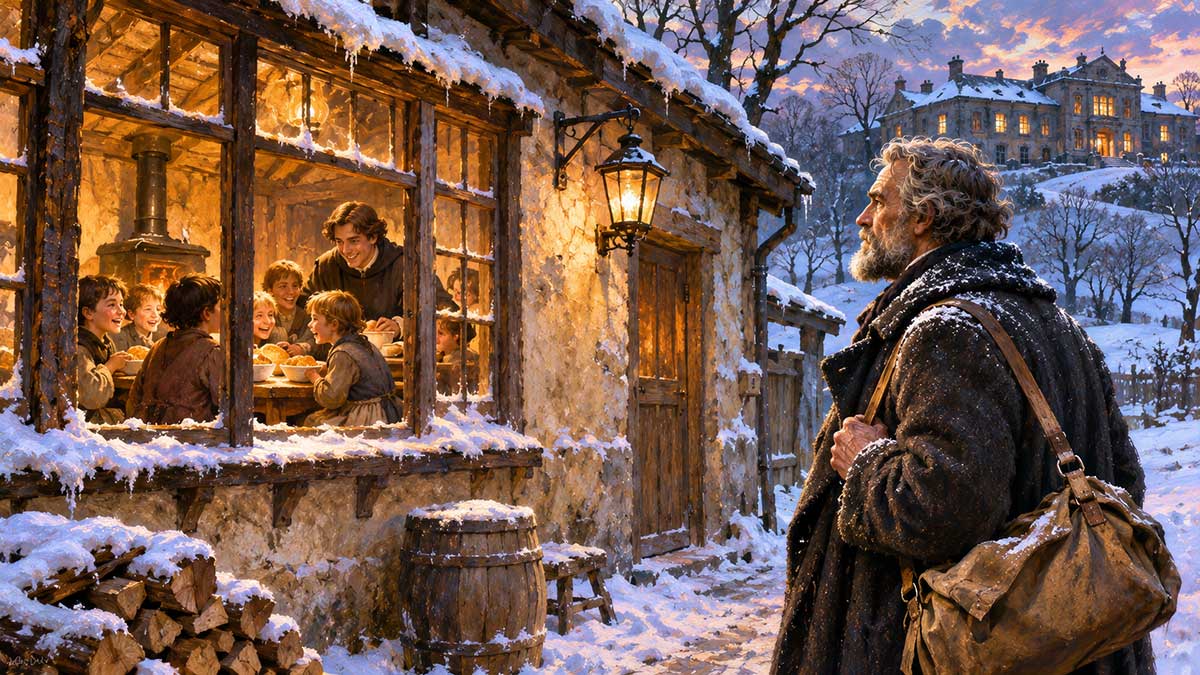
The child had hidden a crust of bread beneath his pillow.
Jean Valjean knew this before anyone told him. He knew it from the way the boy sat upright when the blankets were straightened, from the furtive movement of one small hand, and from the look of terror that passed over his face when a woman asked him to lift his head. The boy was no more than seven. He had the thin, watchful face of someone who had already learned that a meal might be followed by a day without one.
“Let him keep it,” Valjean said.
The woman looked to Alyosha Karamazov, who translated softly into Russian. Her expression changed from disapproval to embarrassment. She smoothed the blanket and left the bread where it was.
Outside, the afternoon was losing its color. The refuge occupied two rooms of a former merchant’s house, one for the children and one for everything else: cooking, washing, prayer, the sorting of clothes, the keeping of accounts. A cracked stove gave off more smoke than warmth. Seven children slept there; four more came for soup when there was enough to share.
Valjean stood beside the narrow bed until the boy ceased guarding the pillow with his hand.
“You need not save it from us,” he said, though the child could not understand his French.
Alyosha translated. The boy studied Valjean's face, then pushed the crust deeper beneath the pillow.
“He does not believe us yet,” Alyosha said.
“He would be foolish to believe us so quickly.”
At seventy-three, Valjean had acquired a habit of speaking quietly. The journey from France had left his joints stiff and his breathing short on stairs. His hands, however, remained broad and scarred, and when he lifted a broken chair from the floor, he did so with the care of a man who knew how easily a thing could be damaged by strength.
At the table by the window, Javert had opened a leather notebook. He entered the number of children, the cost of flour, and the sum that had supposedly been promised by Fyodor Pavlovich Karamazov. He did not look at the boy.
“The donation has not arrived,” Javert said in French.
“No.”
“And the accounts record it as expected income.”
“Yes.”
“Expected income is not income.”
Valjean regarded him. “The children have already expected it.”
“That does not alter the figures.”
“I did not ask you to alter them.”
This was the arrangement between them, and perhaps the only arrangement possible. Valjean, whose travel papers named him Fauchelevent, had asked Javert to inspect the refuge’s accounts precisely for Javert’s refusal to overlook a missing coin. Javert had accepted without gratitude. A debt lay between them, incurred long ago on a barricade in Paris, and Javert seemed to believe that a task completed exactly might reduce it.
Alyosha laid a page of figures beside the notebook. “My father promised the money through his household. I have asked him twice.”
“Then we shall ask him a third time,” said Valjean.
Javert wrote down the hour.
In Valjean’s coat pocket was a letter from Cosette. He had read it three times that morning. She wrote of ordinary things, a garden wall in need of repair, a visit from Marius, the first frost. Beneath the ordinary things was a tenderness that had once seemed lost to him. They were finding a way back to one another. He had promised to return before the autumn mud closed the roads. A seat had been reserved for him on a westbound carriage.
He touched the folded paper and followed Alyosha outside.
The Karamazov house was larger than the refuge and less welcoming. Its windows reflected a pale sky; its outbuildings stood behind a high fence. A servant admitted them after a long inspection of their faces. Another, older servant watched from the passage without speaking.
“Grigory,” Alyosha said, greeting him. The man bowed to Alyosha but kept his eyes lowered before the visitors.
Valjean had seen that posture before. In France it had belonged to prisoners waiting for a guard to decide whether they might speak. Here it belonged to people bound to a household, people whose master could dispose of much of their lives. The distinction mattered in law; it did not always show itself in a man's shoulders.
A thin young servant sat near the kitchen door with a little notebook on his knee. French words had been copied down one beneath another, each with a careful Russian gloss. When he saw the visitors, he shut it.
“Smerdyakov,” Alyosha said. “My father's cook.” Some in the household whispered that he was Fyodor Pavlovich's unacknowledged son, born to a homeless woman. Alyosha had never heard proof, only the whisper repeated as though it were a fact.
The young man inclined his head. His gaze rested for a moment on Javert's coat.
From the next room came Fyodor Pavlovich's voice, rising in theatrical complaint. He welcomed them with an extravagant gesture and immediately began explaining why no money could possibly be produced that day. There had been a delay, an unreliable steward, a misunderstanding about a sum which he had never refused to give. He spoke with the relish of a man who enjoyed hearing himself accused, provided he could turn the accusation into a performance.
Alyosha listened without interrupting. Valjean asked for a date by which the promise could be fulfilled. Fyodor offered three dates in as many sentences. Javert wrote down none of them. Fyodor leaned close to Alyosha. “Your learned brother Ivan left yesterday after explaining that without God everything is permitted. If that is so, my dear monk, why should I pay a kopek for your little saints? Perhaps Ivan can send you a proof that hunger is an illusion.” He laughed at his own wit. “He has gone only to Chermashnya, but already the house is poorer in philosophy.”
“Do you distrust my word, monsieur?” Fyodor demanded.
“I am recording what can be verified,” Javert answered.
Fyodor laughed, but the laugh had an edge. “A French policeman! My son brings me a French policeman to count my sins.”
“Not a policeman here,” Javert said.
“Then I have been spared one misfortune.”
A shout sounded in the yard. Fyodor's expression changed before anyone entered the room.
“Again,” he muttered.
Dmitri Karamazov came through the outer doorway, leaving it swinging behind him. Mud marked the carpet where he stopped. His face was flushed; his coat hung open; his eyes sought his father and found him at once.
“You have been hiding from me.”
Fyodor stepped behind the table. “Here are witnesses. Here is my pious son. Here are distinguished foreigners. Let them hear how I am treated.”
Dmitri took one step forward. “Give me what you owe. I know about your three thousand, and who you mean to give it to.”
“You see? Money. Always money.”
“And keep away from Grushenka.”
At the name, the father straightened. His expression became so nakedly spiteful that Valjean felt he had witnessed something private and shameful.
Alyosha moved between them. “Mitya, please.”
Dmitri's fist tightened. For one terrible instant it seemed he might strike his father in front of them all. Then he turned away, knocking a chair against the wall.
“I could kill you,” he said. The words came out low and clear. “Do you hear me? I could.”
He went out. No one followed.
Fyodor stood motionless. Then, with an effort, he recovered his smile. “You have heard him. Every one of you.”
Valjean looked toward the door. It troubled him that the threat had sounded less like a plan than like a man frightened by what he might become.
Their business was finished. Alyosha promised to return the next morning, and the visitors passed back through the servants' passage. Javert entered the time of their departure as they went out through the gate. Valjean waited beside him on the road.
“You were watching the son,” Javert said in French.
“I was watching a man lose control of himself.”
“A useful distinction to him, perhaps. Less useful to his father.”
“Do you think a threat is a deed?”
“I think a threat ought to be remembered when a deed follows.”
Javert shut the notebook. “A forçat knows how readily a threat becomes a deed.”
Valjean said nothing. He looked back once at the house, then walked on.
Beyond the fence, a servant was gathering kindling from the yard. Neither Frenchman paid him any attention. Javert made one more entry: the rooms they had visited, the servants they had seen, the hour they left. Valjean, who had once feared that notebook's predecessors, watched the pen move without asking him to stop.
At the refuge, supper had been served. The boy with the hidden bread sat beside the stove, eating slowly. Valjean was preparing to ask him whether he wanted another piece when Alyosha was summoned to the door.
The messenger was breathless. His words came too quickly for Valjean to follow, but Alyosha's face lost its color.
“My father,” he said. “Something has happened at the house.”
They went together.
By the time they reached the Karamazov property, lamps were burning in the yard. Grigory lay inside, his head bandaged, breathing in shallow gasps. A woman knelt beside him with blood on her sleeve. “Anya,” Alyosha said, recognizing a maid from the household kitchens. A police official named Belov had arrived and was giving orders in a voice that made everyone else speak more quietly. She would not meet his eyes.
In the study Fyodor Pavlovich lay dead.
Valjean stopped at the threshold. He had seen death in prisons, on roads, in the streets of Paris. It had never become familiar. The dead man's face still held a trace of astonishment, as if the final insult had been one he could not answer.
Belov barred the doorway with an arm. He understood some French but spoke it haltingly, and relied on Alyosha to render the visitors’ precise words. Alyosha identified the two French visitors and explained their earlier call. Javert immediately gave the hour of their arrival and departure, reading from his notebook. Belov regarded the book with suspicion but permitted him to finish.
“Who found him?” Valjean asked.
The question passed through Alyosha to Belov and back. A servant had raised the alarm. There was blood in the garden. Grigory had been struck and might not survive. Dmitri had been seen fleeing the grounds, blood on his sleeve. Someone reported that the garden door stood open. Another servant said Smerdyakov had fallen into a fit after the visitors departed; a doctor had seen him, and the household believed he had remained in bed ever since.
Belov pointed to an object near the writing desk. A torn envelope lay on the floor. Across it, in a hand made foolish by affection, were words addressed to Grushenka: To my angel, if she will come.
“The money is gone,” Belov said through Alyosha.
“How much?”
“Three thousand rubles in silver, they say.”
“The son knew of the money,” Belov said. “He threatened his father, and the envelope is empty. He may have torn it open to take what he wanted.”
Javert looked from the envelope to the doorway, then toward the dark garden beyond the window. He said nothing. His silence was not doubt; Valjean knew that look. It was the stillness of a man arranging facts into an order he already expected to hold.
Outside, someone repeated Dmitri's threat from the afternoon. Another spoke of the rivalry over Grushenka. A third said the eldest son had been desperate for money. Each statement was carried into the study, and together they began to sound like certainty.
Alyosha knelt beside his father's body. His hands trembled, but he did not hide his face. Then he rose and asked Belov to have the body covered before the servants were brought in to give their accounts. Belov hesitated, then nodded.
Valjean looked at the envelope once more.
Belov ordered a search for Dmitri Karamazov.
And before the night was over, the town had found its murderer.
Chapter 2: A Man Who Knows Prison
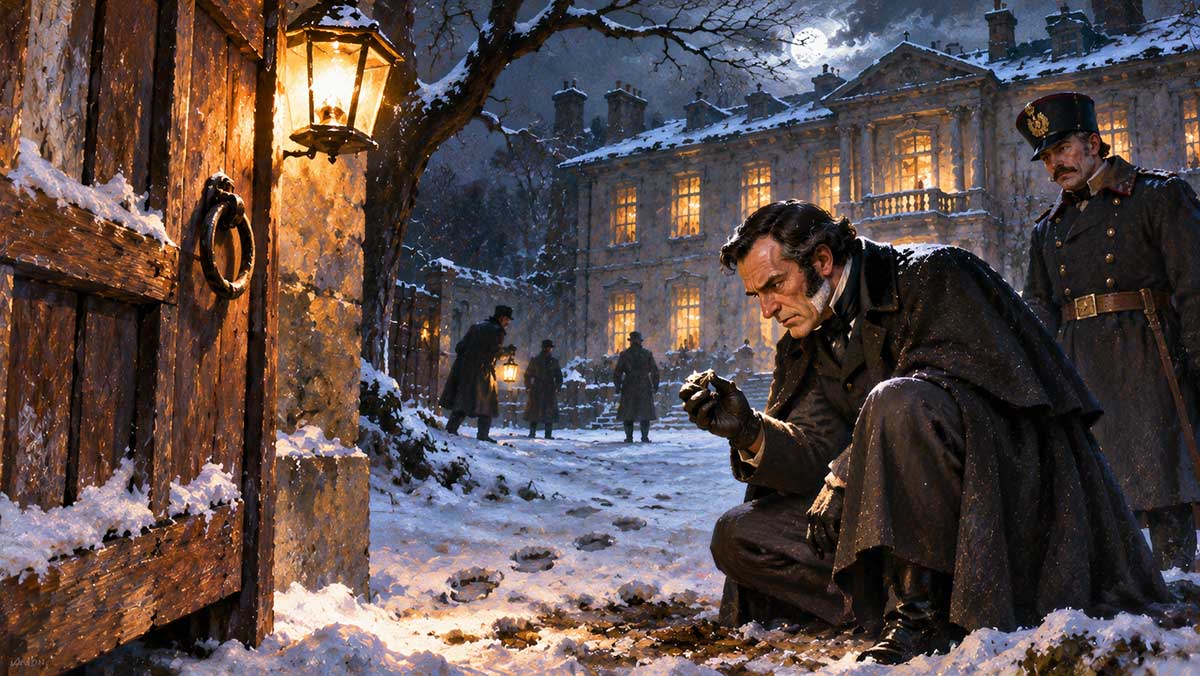
By morning the accusation had acquired a shape that could be carried from house to house. It had a name, a sum of money, and a son who had promised to kill his father before witnesses. People repeated these particulars with the satisfaction of those who have escaped the labor of doubt.
Jean Valjean heard them at the refuge. A woman bringing potatoes said that Dmitri Karamazov had been taken on the road from Mokroye. She had not seen him taken, nor did she know anyone who had. She knew that he had arrived there in the night with money enough to make the innkeeper bring out his best bottles. Another visitor had heard that he had confessed.
“Confessed to whom?” Valjean asked.
The woman looked toward Alyosha for help. He translated the question, listened to her answer, and shook his head.
“She says he told a room full of people he had killed the old man.”
“Which old man?”
“She does not know.”
Javert, seated at the accounts table, closed his notebook on a column of figures. “There is only one dead father in the matter.”
“There is another man,” Valjean said. “Grigory.”
“Who is not yet dead.”
“That is not what Dmitri knew when he fled.”
Javert considered this without looking pleased. “It is a question to put to him. It is not an answer.”
Alyosha stood with his hands folded against his chest. His father had been buried neither in earth nor in memory, and already the household had begun to speak of who might command it. He had slept scarcely an hour. Still, when the youngest child asked whether the potatoes were for soup, he bent down to answer her before attending to the two Frenchmen.
“I am going to my brother,” he said. “Belov has agreed to let me see him.”
“Will he let me come?” Valjean asked.
“I can ask.”
Javert reached for his coat. “I should like to hear what the accused says.”
Alyosha hesitated. “You cannot question him for Belov.”
“I have not said I could.”
The three went out into a street where the morning mud had dried in pale ridges. The sun was clear, but the cold found the seams of Valjean's gloves. He walked more slowly than the brothers would have wished. Javert kept beside him, neither offering an arm nor walking ahead.
The place where Dmitri was held had once been a merchant's storehouse. Its narrow windows faced an enclosed yard; a guard sat at a table beneath an icon darkened by smoke. Belov met them there. He had spent the night receiving statements, and his collar was marked where he had rubbed it with an ink-stained hand.
“You may speak to him,” Belov told Alyosha. “The foreigners may listen. Nothing is to be carried away, and I will be present.”
Alyosha translated. Valjean nodded. He had known rooms in which a visitor's silence was taken for consent and a prisoner's speech for insolence. This room was not one of those rooms, yet he felt the old impulse to count its doors.
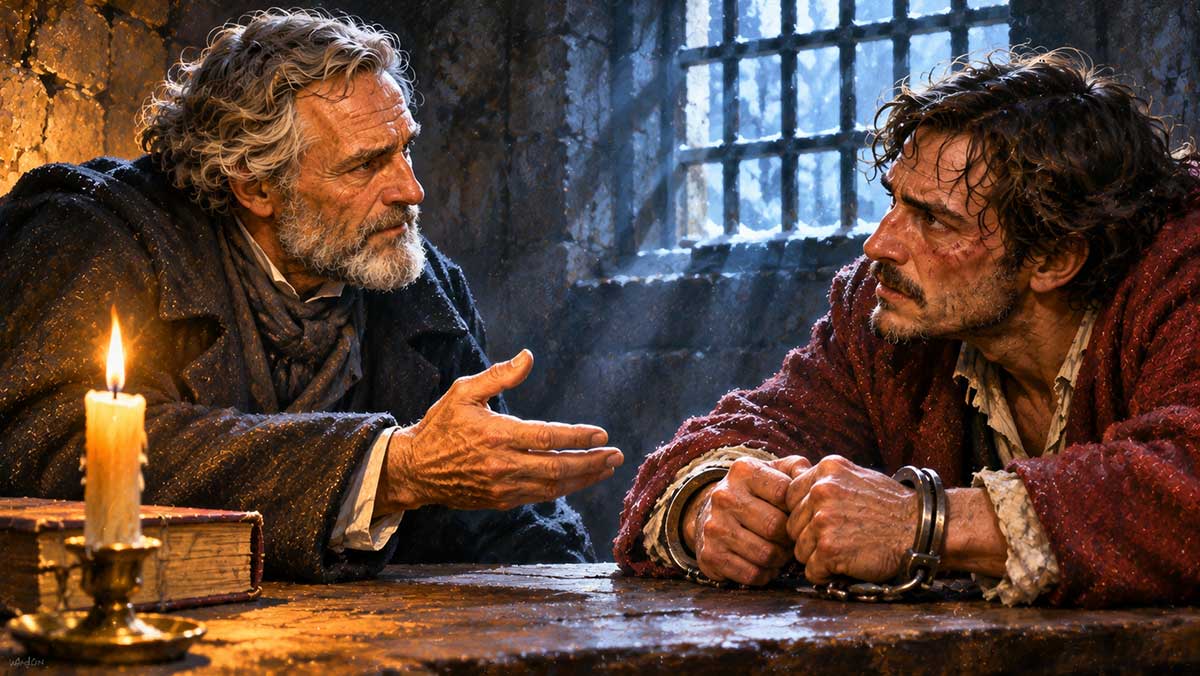
Dmitri was standing when they entered. His coat had been taken; his shirt was open at the throat. A dark stain marked one cuff. He looked first at Alyosha, then at the visitors, and his expression hardened with shame.
“You saw me yesterday,” he said in French, stumbling over the words but refusing his brother's help. “You heard what I said.”
“Yes,” Valjean answered.
“Then you know what they think.”
“We know what they say.”
Dmitri laughed once. “They are not far apart.”
Belov asked in Russian whether Dmitri admitted striking Grigory. Alyosha began to interpret, but Dmitri answered before he had finished.
“I struck him. He caught me in the garden. I wanted to get away. I hit him and he fell.” He looked at the stain on his sleeve. “There was blood. I thought I had killed him.”
“And your father?” Belov asked.
Dmitri turned sharply. “I did not touch him.”
“You threatened him in the afternoon. You knew he had prepared money for Agrafena Alexandrovna.”
“Grushenka,” Dmitri said, as though the familiar name might restore something human to the accusation. “Yes, I knew. The old fool had his envelope and his little signal, as if she were a girl he could summon to a window.”
“What signal?”
Dmitri stopped. For a moment he seemed to regret that he had spoken. “A knock. He had arranged knocks with his servant. A way of telling him she had come. I knew of it.”
“Did you use it?”
“No. I went to the window. No, I never reached it.” Dmitri looked toward Belov, furious with himself for correcting his own words. “I never entered his study. I went into the garden looking for her, and Grigory came after me.”
“First the window, then not the window,” Belov said. “Which account shall I enter?”
“Enter that I did not go inside!” Dmitri answered. Alyosha laid a hand on the table, but his brother would not look at him.
Belov wrote. Javert's eyes followed the pen.
“And the money you spent at Mokroye?” Belov asked.
Dmitri's face changed. It was not the startled look of a man confronted with an unknown fact. It was the look of someone who had known a question was coming and had feared it more than the others.
“It was mine.”
“Where did you get it?”
“I had it.”
“Three thousand rubles disappeared from your father's room. You arrived at an inn with money, after threatening him and leaving blood behind you.”
“Not his money.”
“Then whose?”
Dmitri pressed both hands to his forehead. “Must every disgrace be dragged out before strangers? Ask me whether I killed him. I say no. Ask me whether I struck Grigory. I say yes. But do not ask me to make another person's name filthy to save my own.”
Valjean could not tell whether this was pride or a remnant of honor. In prison he had known men who lied about a loaf of bread and told the truth about a killing. Shame did not arrange itself according to the seriousness of an offense.
“They say you cried out that you had killed the old man,” Alyosha said quietly.
“I thought Grigory was dead!” Dmitri struck the table with his palm, and the guard moved at the door. “That is what I meant. God help me, I thought I had killed him. Is he alive?”
“We have been told he is breathing,” Alyosha said. “The doctor has not promised more.”
Dmitri sat down. He looked relieved for the length of a breath, then covered his face.
Valjean watched the movement. He had come expecting anger, perhaps the cleverness of a man constructing an excuse. He found a man who had committed one violence and was being asked to answer for another. The difference mattered, but it did not make the first violence small.
Outside the room, Belov asked them to wait. A clerk had brought news from a search of Dmitri's lodgings. Among his papers lay a letter from Katerina Ivanovna, dated twelve days before the murder, stating that she had entrusted three thousand rubles, reckoned in silver, to Dmitri before that date. Belov read its substance aloud; Alyosha translated in a low voice. The letter established an earlier transfer, not which money Dmitri had carried to Mokroye.
“Then the money he spent may have come from what she entrusted to him,” Valjean said.
“Or,” Belov replied, “he needed to replace what she had entrusted to him. A desperate obligation is a reason to steal. The letter establishes that she gave him the sum. It does not tell us what was in his pocket last night.”
Valjean could not dispute that. He asked whether the letter would be kept with the other papers.
“It will be entered,” Belov said, and handed it back to his clerk.
They were permitted to see Grigory later that afternoon. He lay in a small room adjoining the servants' quarters, where a woman had placed a folded cloth beneath his head. His bandage was clean; the skin around his eyes was swollen. He recognized Alyosha and tried to rise.
“Stay,” Alyosha said. “Please.”
Grigory looked at Valjean with suspicion, then at Javert's notebook. The old servant spoke in Russian, slowly, stopping when pain took his breath. Alyosha rendered his words with care.
“He says Dmitri was in the garden. He called out. Dmitri struck him. He remembers the ground, and afterward the door.”
“The garden door?” Javert asked.
“Yes. Open. He is certain it stood open.”
“Before the blow?”
Grigory's answer came quickly, with irritation at being questioned. Alyosha hesitated before translating. “He says it was open when Dmitri came. He says he saw it.”
Javert made a note. Valjean looked at the bandage and the effort with which Grigory kept his gaze steady.
“Does he remember seeing it before he fell,” Valjean asked, “or does he remember seeing it?”
Alyosha put the distinction to the old man. Grigory shut his eyes. “Before,” he insisted after a moment. “It was before.”
Valjean said no more. Grigory was not a witness who could afford to be careless with his words. His master's sons would have a say in what became of the household, and one of those sons had struck him down. Yet fear was not the same as falsehood, nor pain the same as certainty.
At the passage door, Alyosha found Anya carrying water. She stopped when she saw Belov's clerk behind them and lowered her eyes. Alyosha asked whether Grigory had eaten. She said he had taken broth. When he asked if she had slept, she glanced toward the steward's office and said she had work to do. The clerk slowed as if to listen. Alyosha raised his voice and asked him instead where Belov wished the visitors to wait. By the time the clerk answered, Anya had gone through the kitchen door. Alyosha did not call her back.
Near the kitchen, the household was speaking of Smerdyakov. A doctor had attended him after a reported fit the previous evening. He was known to suffer such attacks, and no one who had seen him afterward doubted that he had been unwell. The doctor had examined him earlier in the evening; he had not observed the patient through the night. The steward nevertheless said he had lain in bed all night.
“Did the doctor remain all night?” Javert asked.
“No,” Alyosha translated from the answer. “He came and went.”
“Who watched the patient?”
The steward named two servants, then admitted that neither had sat beside the bed without interruption. Javert entered their names, and beside them the hour of the doctor's departure. He did not challenge the account. A sick man's room was not evidence of murder merely for having been unobserved.
On the road back, the daylight was already thinning. Javert walked with his notebook closed.
“You think him innocent,” he said to Valjean.
“I think we have not heard enough.”
“He admits the threat, the assault, the blood. He knew of the money and the signal. The door was open. He cannot account for what he spent.”
“All true,” Valjean said. “Or all said to be true.”
“Will you dismiss the facts because you recognize the prisoner?”
Valjean stopped. Across the road a cart had sunk to its axle, and two men were trying to free it with a plank. For an instant he saw another road, another man whose life had been weighed against his own safety. Champmathieu had been condemned in the minds of men who were not wicked. They had been certain, and certainty had almost been enough.
“I recognize the room,” Valjean said.
Javert looked at him, then away. “A room cannot absolve its occupant.”
“No. Nor can it convict him.”
At the refuge, the children had gathered around the stove. The little boy with the hidden crust sat beside a younger girl, eating his own portion where everyone could see.
Valjean stood in the doorway until the boy noticed him. This time the child did not hide the bread.
From the accounts table came the faint scratch of Javert's pen. Somewhere beyond the refuge, a clerk was making another record, one that would determine whether Dmitri Karamazov returned to the streets or vanished behind a locked door. The pages would contain blood, money, threats, a garden door, and a servant's certainty. They would contain the truth of what Dmitri had done.
What he had not done would be harder to write down.
Chapter 3: The Law and the Silence of God
Ivan had received the news the previous evening. He had read the message twice, folded it into four precise squares, and sat until dawn beside a candle he did not remember extinguishing. On the road he had rehearsed questions for the police. At the gate, where his father's windows were shuttered, he could remember none of them.
Alyosha came out to meet him. The brothers embraced awkwardly. Ivan's coat was damp; Alyosha felt the cold of it against his cheek.
“Dmitri?” Ivan asked.
“Held by Belov. He admits he struck Grigory.”
“And our father?”
“He denies it.”
Ivan released his brother. “Of course he does.”
“Do you believe him?”
“I have only just arrived.”
It was an answer a reasonable man might give. Ivan disliked it as soon as he heard himself speak.
Inside, the house had begun the strange work of surviving its owner. The steward moved through rooms with keys at his belt and spoke of inventories, seals, and instructions not yet received. The servants stood aside whenever either brother passed. Ivan noticed that they watched Alyosha with hope and himself with calculation, as though the dead man's authority had not vanished but broken into pieces that might fall on anyone.
He asked where Smerdyakov was. The steward said the man was recovering and should not be disturbed.
“Was he in bed when my father died?”
“He had suffered a fit, sir. The doctor came.”
“That is not what I asked.”
The steward glanced at the keys. “Everyone understood him to be in bed.”
Ivan went no further. He had heard Smerdyakov make predictions before, in the quiet voice of a man who preferred another person to say the dangerous part aloud. Before Ivan left, the servant had remarked that a household could be left terribly unguarded. Ivan had answered him with impatience. Now he could not recall the exact words, only the relief of having departed. His fingers closed around the damp glove in his hand until the seams pressed into his palm. He could have asked the steward to send for Smerdyakov. Instead he asked where Alyosha had gone.
Earlier on the day Ivan returned, Alyosha went to the servants' passage with a bundle of clean linen for Grigory. Anya took it from him without meeting his eyes. Her hands were reddened from washing, and she had tied a strip of cloth around one finger.
“Grigory is sleeping,” she said.
“Then the linen can wait.”
She looked toward the steward's office. “You should not be here, sir.”
“Does he forbid you to speak with me?”
“He says the household has lost enough through careless mouths.”
Alyosha knew what she meant by the household. It was the dead man's property, and no one yet knew whose command would replace his. Anya could be sent away, punished, or made to answer to the very people whose names were being spoken in the inquiry.
“I will ask that you not be troubled,” Alyosha said.
“Ask whom?”
He had no ready answer. He was one of the sons, but he had never wished to be a master. It seemed to him then that refusing the name did nothing to lessen the danger it carried for her.
“The steward first,” he said. “And I will speak to my brothers. I cannot promise what they will do.”
A key turned in the passage behind them. The steward appeared, saw Anya holding the linen, and opened his mouth. Alyosha stepped between them.
“I asked her to carry these to Grigory,” he said. “If there is a complaint, bring it to me. My father is dead, but I am still his son.”
The words tasted strange. The steward bowed without answering and went on. Alyosha knew a bow was not a promise; Anya might pay for the exchange when he was gone.
Anya studied him. “If I tell you something, will it go to Belov?”
“If it concerns the death, it may have to. I will not tell you otherwise.”
“Then not here.”
She took the linen inside. Alyosha remained in the passage until he heard the bolt slide behind her. He did not follow.
That afternoon, on the day Ivan returned, Javert was admitted to Belov's office, not as an investigator but as a foreign visitor permitted to inspect the portions of the record that concerned his presence at the estate. Belov watched while the clerk laid out three statements and a physician's brief account. The papers were in Russian. Alyosha, summoned to interpret, read each sentence before rendering it into French.
The steward's statement said Smerdyakov had been confined to his bed throughout the evening. The clerk's summary used firmer language: the servant had been incapable of leaving it. The physician's account said that he had examined Smerdyakov earlier that evening after a reported seizure. It did not say he had remained until morning.
“Ask at what hour the physician departed,” Javert said.
Belov gave the time. Javert compared it with his notes.
“And who observed the patient after that?”
“Two servants attended him,” Belov said through Alyosha.
“Continuously?”
Belov frowned. “Their statements do not say continuously.”
“Then the summary says more than the witnesses.”
“It may be a customary way of describing an invalid.”
“Custom cannot supply an hour that no one observed.”
Belov drew the summary toward himself. He was not pleased to be corrected by a man who had no right to conduct an inquiry in Russia. Yet he did not put the paper away.
“You were permitted to examine these papers as a witness to events at the estate,” he said. “You are not appointed to examine my clerk. How do you know the servants did not take turns watching him?”
“I do not know,” Javert said. “That is the point. Neither does this paper say they did.”
Belov looked from the steward’s statement to the physician’s account. “Are you suggesting the illness was invented?” he asked.
“No. I have no medical opinion to offer.” Javert placed a finger beside the line, without touching the ink. “I am suggesting the written statement has become more certain than the evidence from which it was made.”
Belov instructed the clerk to mark the difference for further questioning. It was a small instruction. The clerk did not seem to think it changed anything.
Outside, Alyosha asked whether Javert now doubted Dmitri's guilt.
“I doubt a sentence,” Javert said. “That is not yet the same thing.”
He closed his notebook, then opened it again to record Belov's correction.
The next morning, on the third day after the murder, Valjean was repairing a loose wooden latch at the refuge. He had removed the screws and laid them on the table beside the account books. The children watched his hands with the solemn interest children give to any task whose purpose is clear.
Alyosha brought Ivan in and introduced him in French. Ivan spoke it fluently, with a precision Valjean recognized from educated men who had learned the language in bright rooms and had rarely needed it to ask for bread. Valjean's own French was plainer. Neither remarked on the difference.
“I understand you came to collect a promise my father made,” Ivan said.
“To ask whether he intended to keep it.”
“He did not.”
“No.”
“My brother says you have taken an interest in Dmitri.”
“I have visited him.”
“Then you must have heard his defense.”
“I heard a man confess to hurting someone and deny another injury.”
Ivan examined the screws in their careful row. “A distinction the law may not find as moving as you do.”
“Law should be able to distinguish one act from another.”
“And if it cannot?”
“Then a man must insist.”
The boy who had once hidden bread brought Valjean a bent nail. Valjean thanked him and set it apart from the screws. Ivan waited until the child had returned to the stove.
“My father was contemptible,” he said. “It is customary to lie about the dead, but I have no talent for it.”
“Your brother Alyosha has not lied about him.”
“Alyosha has a talent more difficult than lying.”
Ivan stood by the window. A cart passed outside, its driver striking a horse that had stopped in the mud. He watched the animal lean against the traces.
“Before I left,” Ivan said, “I argued with my father. I told him that if there is no God to command us, men will find no law above their own desire. He laughed. He thought it an excuse not to pay what he owed you.”
“Did you mean it as an excuse?”
“I meant it as a question.”
“Questions can be used as excuses.”
Ivan turned. “You speak as if you have never wished an evil thing.”
Valjean set down the screwdriver. “I have wished many.”
“Then answer me. Suppose I wished my father dead. Suppose I left this house knowing that someone else might wish it too. What have I done?”
Valjean did not answer at once. Through the open door he could see Alyosha helping a child wash a bowl, patient with the boy's refusal to surrender it.
“Did you ask anyone to kill him?” Valjean said.
“No.”
“Did you help anyone do it?”
Ivan's face tightened. “Not with my hands.”
“That was not my question.”
“I know.” Ivan looked away. “I wanted him gone. There. You have the truth. I wanted a world in which his voice had ceased.”
“The wish is yours,” Valjean said. “The act belongs to whoever committed it. Do not confuse them to escape responsibility, or to claim guilt you have not earned.”
Ivan gave a short, unhappy laugh. “You make guilt sound like property.”
“It is dangerous to take another man's burden when you have not yet examined your own.”
“And if words are enough to send another man to murder?”
“Then we must ask which words, and what the other man chose.”
Ivan looked at the children. “You believe in choice.”
“I have seen men deprived of almost everything else.”
They said nothing for some time. The latch fitted badly; Valjean tested it and took it apart again. Ivan had expected either forgiveness or accusation. This patient refusal to give him either made him wish he had remained in Chermashnya.
On the third day after the murder, Grushenka was questioned about the night at Mokroye. Belov allowed Alyosha to hear the account and later conveyed its substance to the Frenchmen. She confirmed that Dmitri had arrived with money and spent it freely. She remembered his agitation, the drinks, the reckless generosity with which he treated strangers. She would not swear where the money had come from.
“Did he say he killed his father?” Belov asked.
“He spoke of blood and an old man,” she answered. “He was frightened of what he had done. I will not make his words clearer than they were.”
“And the money?”
“I saw him spend it. I did not see him take it.”
Belov recorded her answer without satisfaction. He had hoped for a statement that would settle something. Instead she had told him precisely what she knew.
That evening Anya found Alyosha beside the refuge's back steps. She had waited until the children were called in for supper. Her shawl was pulled tightly across her shoulders, though the wind had dropped.
“I saw Smerdyakov,” she said.
Alyosha did not move.
“On the night your father died. I was carrying water. He had a covered lamp and a cloth folded over his arm. He went into the room by the old hearth, the one no one uses.”
“Did you see him come from my father's study?”
“No.”
“Did you see what was in the cloth?”
“No. I saw only where he went.”
“Are you certain of the time?”
“The kitchen clock had just struck the half hour. I finished drawing the water and heard the next quarter before I reached my bed. I cannot tell you the minute.”
“After half past nine, then, but before a quarter to ten?”
“Yes. That is all I can say.”
Alyosha remembered how much had been made of a minute in Grigory's account. He would not give Anya a certainty she had not claimed.
“Why have you waited?” he asked.
“Because he belongs to this house, and so do I.” Her voice shook. “Your father is dead. I do not know who will own my answer.”
Alyosha looked through the refuge window. Valjean was sitting with a little girl whose sleeve had torn; Javert, at the accounts table, was marking figures in his book. Neither could protect Anya by authority. Neither could make her words safe merely by believing them.
“I will help you speak when you are ready,” Alyosha said. “I will be there, and we will ask that someone else be there too. You must say only what you saw.”
Anya nodded, but did not thank him. Gratitude would have been premature.
When she had gone, Alyosha went inside and found Ivan waiting by the stove. His brother had heard nothing of the conversation. He was turning the bent nail over between his fingers.
“You look as if you have learned something,” Ivan said.
“I have learned how much a person may fear telling the truth.”
Ivan put the nail down. “And you think fear makes it false?”
“No,” Alyosha said. “I think fear makes silence easier.”
On the accounts table lay Javert's notebook, shut upon its dates and figures. Anya had described a door, a lamp, and a folded cloth, and nothing more.
It was not enough to name a murderer. It was enough to make the written certainty look different.
Chapter 4: The Fourth Son
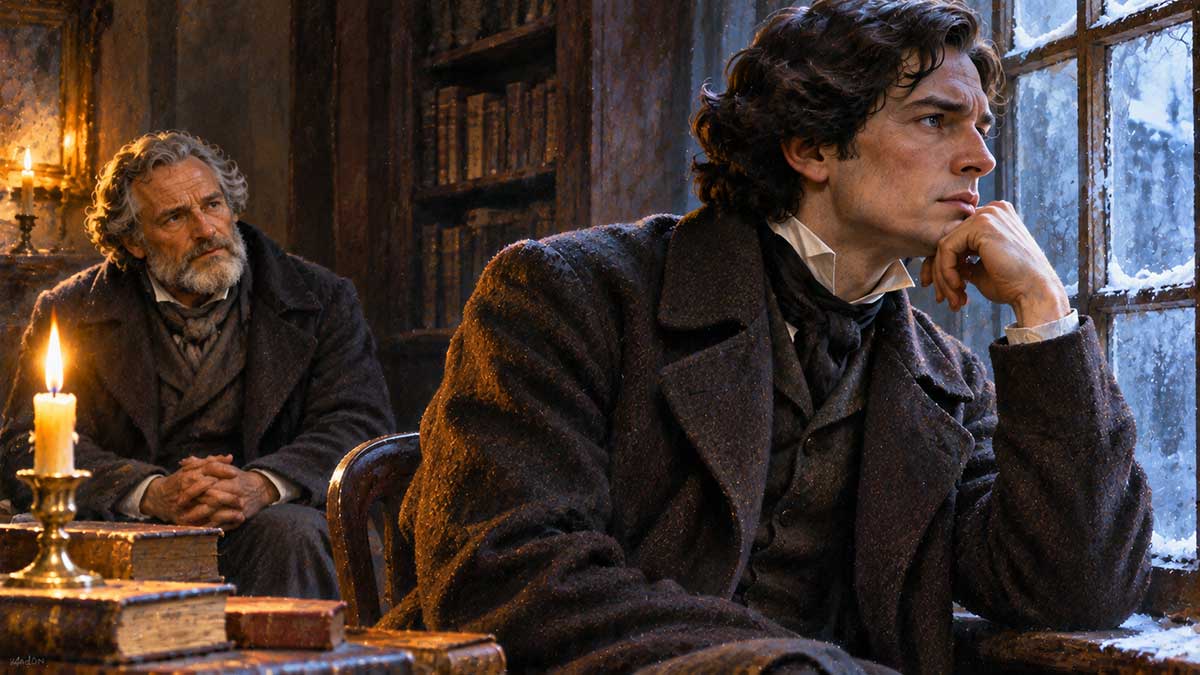
The first thing Smerdyakov asked was whether Ivan had come alone.
He lay on a narrow bed in a room that smelled of boiled linen and extinguished candles. A cup of water stood untouched on the floor. His face had the pallor of a man recovering from illness, but his eyes followed Ivan's movements without the smallest delay.
“The steward knows I am here,” Ivan said.
“That is not what I asked.”
Ivan closed the door. It was the fourth morning since Fyodor Pavlovich had been found dead. The house had acquired a habit of speaking softly, as if its walls might be called to testify.
“You wanted to see me,” Ivan said. “I am here.”
Smerdyakov moved his head against the pillow. “I wondered whether you would come at all. You have been home two days.”
“I was told you were ill.”
“I have been ill many times. It has never stopped people from requiring things of me.”
He spoke without raising his voice. Ivan remembered the same voice in the kitchen before his departure, discussing the household's vulnerabilities as one might discuss a forecast of rain.
“Did you know what was going to happen?” Ivan asked.
“I knew what you wanted.”
“I wanted to leave this house.”
“Yes. That was one of your wishes.”
Smerdyakov sat up slowly. Ivan noticed that the movement cost him something, or was meant to appear to. Neither possibility comforted him.
“Your father kept money for Agrafena Alexandrovna,” Smerdyakov said. “In an envelope with her name written on it. Your brother knew about it. Grigory knew there was an envelope. You knew your father was afraid of your brother.”
“What are you telling me?”
“That when Dmitri Fyodorovich came into the garden, he did not enter the study.”
Ivan stood very still.
“Then who did?”
“I did.”
The words entered the room so quietly that for an instant Ivan waited for them to be repeated. Outside, a bucket struck the stones of the yard. Someone cursed at a horse.
“You are saying you killed him.”
“Yes.”
Smerdyakov looked at Ivan as if waiting for a correction in grammar.
“After Dmitri struck Grigory,” he continued, “the house was listening for one son and not for another man. I knew the knocking signal. Your father opened to me. The envelope was where I expected it. I took the money and left the torn paper where it would be found. The garden door needed to stand open.”
Ivan felt an impulse to seize the bedstead, to make the other man stand and repeat everything before witnesses. Yet he did not move.
“Where is the money?”
“Safe.”
“Where?”
Smerdyakov smiled faintly. “You ask like a policeman. I thought you would ask whether I suffered.”
“Did you?”
“Would it change what I have told you?”
Ivan heard himself say, “You were in bed. There was a fit.”
“I have fits. The doctor saw me unwell. People concluded the rest. You are an educated man, Ivan Fyodorovich. You know that one true thing can be made to support a false one.”
He lowered his gaze to his hands.
“You spoke of a world in which men are free to do what they desire. You wished your father gone. I understood that you would not interfere.”
“I gave no order.”
“An order would have been vulgar. You left.”
Ivan crossed the room, then stopped at the door. He saw himself returning to Chermashnya, shutting out the house, leaving the old man to his own cruelty. He saw, too, Dmitri held under guard, the property and the debts of their father waiting to be divided among sons whose claims might change if one were condemned. The thought of a larger share came to him with such sudden clarity that he was ashamed before he had finished thinking it.
“You will tell Belov,” Ivan said.
“I could tell him you arranged it. Who would believe the sick servant against a gentleman? Perhaps no one. Yet he might ask why you went away when I told you what could happen.”
“I did not know.”
“You preferred not to know.”
Ivan opened the door. The passage was empty. For several minutes he remained there, unable either to return to the room or to go toward the police office.
Dmitri received the news of Grigory's survival with a laugh that startled even himself.
“He will live?” he said. “Grigory will live?”
The young clerk who had brought the report stepped back from the table. Dmitri caught his sleeve.
“Did he speak? Did he stand? Tell me exactly.”
“He has spoken. He is still injured. The physician says he must rest.”
“Then I did not kill him.”
Dmitri released the sleeve and covered his face. For a moment the cell seemed larger. The accusation against him remained, his father remained dead, and the money remained a knot of shame he could not untie; yet one terrible weight had lifted. He wanted to thank God, the clerk, the physician, anyone who would hear him.
In a broken sleep the night before, he had seen a child shivering in a cart while adults stood near her and explained why nothing could be done. He had woken wanting to help her, then found himself again behind the barred door, with no deed to offer.
Then he remembered the blood on Grigory's hair.
“I am glad,” he said, and stopped. “I am glad for myself.”
The clerk waited.
“An old man lay in the garden, and all I have thought since you entered is that I shall not be called his murderer. Did he ask after me?”
“No.”
“He has served our family for years. He would have stood in my way again, if he could. I struck him for doing it.” Dmitri pressed his hands flat on the table. “Will someone take him what he needs? Linen, broth, a doctor who returns when called. Tell Belov I will pay what I can.”
“I cannot make promises on your behalf.”
“Then write down the request. He need not hear my apology yet. I have no right to make him listen.”
The clerk looked at him with an expression Dmitri could not read. After the door closed, Dmitri sat for a long time considering the difference between being relieved that a man lived and being willing to face him.
At the police office Belov had spread the statements across a desk too narrow to hold them. The doctor's account lay beside the clerk's summary. The latter said Smerdyakov had been confined to bed throughout the night; the former described an examination earlier in the evening and offered no observation of the hours that followed.
Javert stood opposite the desk, his hat in his hands. He had been permitted to examine the two statements again, and he had asked Belov to summon an interpreter for the servants' accounts. Alyosha stood near the window, prepared to assist but determined not to supply words a witness had not spoken.
“Your doctor does not say the man could walk,” Belov said.
“No,” Javert replied. “He does not say he could not.”
“And you believe that distinction establishes murder?”
“It establishes that the summary knows more than its source.”
Belov set down the papers. “I have an injured witness who says he saw the garden door open. I have a son who threatened his father, fled with blood on him, and spent money he cannot satisfactorily account for. You have a servant whose illness may have been described too broadly. I will not exchange a case for a suspicion.”
“Nor should you,” Javert said.
The answer irritated Belov more than an argument would have. He turned to Grigory's deposition.
“The door,” Javert said. “Ask him what he remembers before the blow, and what he remembers after waking.”
“He remembers the door open.”
“Yes. I do not dispute that he saw it. I dispute the certainty with which the order of events has been written. A man struck on the head may speak truthfully of a sight and be mistaken about when he saw it.”
“You are not a physician.”
“I am not. That is why I ask for his sequence to be recorded as uncertain, not for a diagnosis.”
Belov rubbed his forehead. Outside his office the corridor filled with footsteps, then fell quiet. The investigation had begun as a straight line: threat, blow, blood, money, flight. Now every paper seemed to carry a small word that had been written too firmly.
Alyosha asked permission to bring in a witness. He explained that Anya had seen something near the unused service room, and that the steward had already tried to discourage her from speaking. Belov frowned at the name.
“Will she speak here?”
“If there is someone present who can attest to her words, and if she is not left afterward to answer alone for having spoken.”
“I cannot grant her freedom from her household obligations.”
“I have not asked you to. I ask that you hear her without the steward in the room, and record that she came at my request.”
Belov agreed to have his clerk present and to call a second local witness. He made no promise about what the estate might do. Alyosha thanked him for precisely what he had agreed to, no more.
Anya entered with her hands folded so tightly that her knuckles were pale. Alyosha remained where she could see him. Belov asked his questions in Russian; the clerk recorded the answers, and Alyosha translated only when Javert required it. The second witness listened without interruption.
She described the kitchen clock, the interval between half past nine and a quarter to ten, the covered lamp, and the folded cloth. She said she had seen Smerdyakov enter the unused service room. She had not seen him leave. She had not seen Fyodor's study, the killing, or any money.
“Are you certain it was Smerdyakov?” Belov asked.
“I know him, sir. We live under the same roof.”
“Did he speak?”
“No.”
“Why did you not report this at once?”
Anya looked toward Alyosha, who gave no sign of what to say.
“I did not know what it meant,” she answered. “And I knew what might happen to me if I spoke.”
Belov dictated the last sentence slowly. When the statement was read back, Anya corrected the clerk: she had seen Smerdyakov enter the room, not stand beside its door. The correction was made in the margin and initialed.
Afterward Alyosha escorted her as far as the passage. He did not tell her that the danger had passed.
Ivan had crossed the yard twice before he encountered Alyosha beside the gate. His brother did not ask what Smerdyakov had said. He asked whether Dmitri was still under guard.
“Of course he is,” Ivan replied.
“And Belov has not heard what you have heard?”
Ivan studied his brother's face. “You know nothing of it.”
“I know you went to him this morning. I know Dmitri cannot speak for himself about what happened in that room.”
“Suppose speaking makes me answerable for what I wished?”
Alyosha did not look away. “Then answer for what you wished. But do not let them mistake your silence for evidence against someone else.”
Ivan could have accused him of sanctimony. Instead he saw the clerk's pen, moving somewhere beyond the gate, setting down a story that would harden with every hour. Alyosha made no attempt to lead him inside.
Ivan came to Belov near the end of the afternoon. His coat was unbuttoned, though the air was cold. He asked to speak without Alyosha, then changed his mind when he saw his brother waiting outside.
“I must say something,” he told Belov. “I have delayed saying it.”
Belov sent for the clerk. Ivan refused a chair. In French he could have arranged the story into exact distinctions, a wish from a command, an argument from an agreement. In Russian, before a man writing down his words, each distinction sounded less certain.
He reported Smerdyakov's confession: the signal, the envelope, the opening of the garden door, the stolen packet. He reported the servant's claim that Ivan's words had given him permission. He denied instructing anyone to kill Fyodor.
“Why did you wait?” Belov asked.
Ivan looked at the clerk's moving pen.
“I was afraid he would accuse me.”
“Of what?”
“Of wanting what happened.”
Belov waited.
“I did want my father dead,” Ivan said. “That is not a confession to his murder. I know how little comfort there is in the distinction.”
Belov ordered the statement read back and corrected a sentence that made Ivan appear to have witnessed the crime. Then he requested that Smerdyakov be kept available for further questioning. The servant's confession, relayed by one interested brother, could not be treated as established fact. But it could not be left outside the dossier.
The new accounts converged on a room whose keeper had not been asked a single question. Belov sent for the steward’s storeman, who kept the room and brought a ring of keys and a ledger of entries made for estate repairs. He explained that the service room was ordinarily shut and used for old implements; servants with household duties might have access to the passage, but he had made no authorized entry for the French visitors. His ledger did not account for every person who might have crossed the threshold. The keeper said that on ordinary days the door was held by an inner latch, which servants fetching implements could lift with a spare hook kept in the adjoining passage. After the murder, he had secured it with his own key. He could not say whether Smerdyakov had used the hook that night.
Belov arranged an inspection before dusk. The keeper unlocked the room in the presence of Belov, the clerk, and two local attesting witnesses. Valjean was admitted only after Belov had established who was present. Javert remained by the doorway with his notebook, careful to distinguish what he observed from what others said.
The room smelled of cold ash and damp plaster. A narrow window admitted the last gray light. There were broken handles, a cracked basin, and a hearth unused long enough for soot to lie in soft layers along its rim.
Belov examined the floor and the shelves. The keeper pointed out where tools had once been stored. Valjean, who had spent years learning to notice what could be moved and what could not, remained near the hearth. One stone sat slightly proud of its neighbors. At its edge the soot was interrupted by a clean crescent, small enough to be missed by anyone looking for a hidden chest or a secret passage.
Valjean remembered Champmathieu, a stranger nearly sent to the galleys under his name. In that affair a resemblance had been treated as certainty, and he had been the one man who could interrupt it. Here he knew less. The disturbed soot might signify a hiding place or nothing more than a careless servant's hand. He kept his own hands at his sides.
“Do you see that?” he asked.
Belov came beside him. Valjean stepped away without touching the stone.
“It may be nothing,” Valjean said. “But the dust has been disturbed.”
Belov crouched. He saw the same narrow mark. He told the clerk to describe the hearth as it stood, and instructed everyone to leave the stone untouched until a formal search could be recorded. Belov sent everyone out, had the keeper lock the door, and placed a constable in the passage until the evening search. The keeper kept the key, but was instructed not to unlock the room without Belov present. The clerk entered the names of those who had attended the inspection and noted that the witnesses could speak only to what they had seen that afternoon. The keeper's ledger did not prove who might have entered the room during the days before.
For the first time that day, Ivan asked Alyosha to walk with him. They crossed the courtyard without speaking. At the gate Ivan stopped.
“If the money is there,” he said, “it will not make me innocent of everything.”
“No,” Alyosha said.
“You could have lied to me.”
“I know.”
Ivan looked back at the house. “And if it is not there?”
“Then we must still tell the truth about what we know.”
The search began after lamps were brought in that evening. The constable reported that he had remained at the passage since the afternoon inspection and had seen no one enter. Belov returned with his clerk, the room keeper, and two adult attesting witnesses. The keeper showed the key and opened the door at Belov's instruction. The clerk read the afternoon entry aloud, including the description of the soot and the stone's position. Belov asked each witness to look at the hearth before the stone was moved. Their names and what they saw were entered on the sheet. None was asked to certify what had happened in the room before that day.
Belov ordered the keeper to remove it. The man knelt, worked his fingers into the narrow gap, and raised the slab with a short iron tool. Beneath it was a cavity lined with old mortar. A folded cloth lay inside, dark with soot.
No one spoke. The clerk recorded the position of the cloth. Belov had it brought out in the witnesses' sight and opened on the table. Inside lay a packet of paper instruments, bound together and protected from the ash. At Belov's direction, the clerk separated the paper instruments by kind and entered their stated amounts. He reckoned their value in silver rubles, allowing for the different rates at which the paper was counted. He read the entries aloud, and they counted a second time in the witnesses' presence. Belov instructed him to copy the inventory into the inquiry record.
The value was three thousand silver rubles.
Belov looked from the money to the statement in which Anya had described a folded cloth. He did not announce an acquittal. He did not name a murderer. He ordered the packet sealed and the inventory attested, and instructed the clerk to append the discovery to the inquiry before any report was sent onward.
In the corridor, a servant who had watched the witnesses arrive saw the keeper emerge beside the clerk. The servant turned toward Smerdyakov's room. By the time Belov's seal had cooled, the news that something had been found beneath the hearth was moving through the house.
On the table lay the entire packet, valued at three thousand silver rubles, in a place Dmitri had never been shown to enter. Belov looked again at the charge he had begun to write. Its neatest explanation no longer fitted the facts.
Chapter 5: The Trial of Conscience
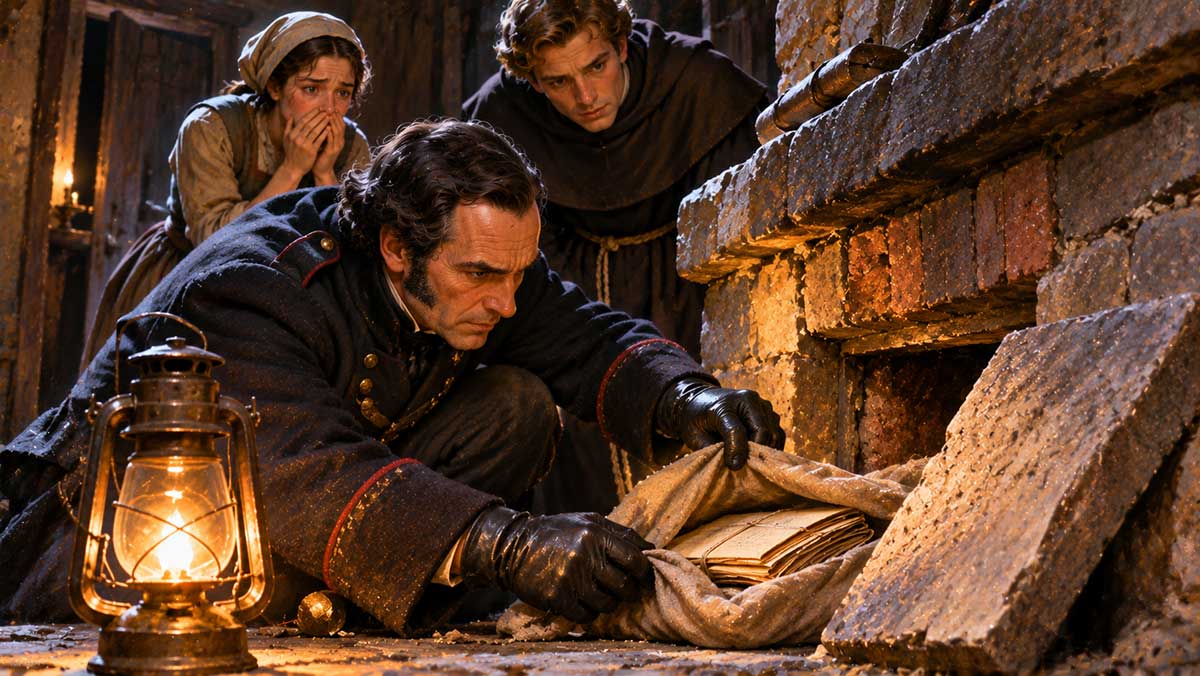
The first thing Smerdyakov asked was whether the money had been counted.
Belov had come expecting denial. The servant lay on a narrow bed with his face turned toward the window, where a pale rectangle of morning showed through the unwashed glass. A cup stood on the floor beside him. His hands were folded over the blanket with the composure of a man waiting for a visitor to finish an unwelcome errand.
“It has been entered in the record,” Belov said.
“Then the record is complete.”
“No. I have questions about how it came to be under the hearth.”
“Ask the man who put it there.”
“Who was that?”
Smerdyakov turned his head. “The French convict.”
Belov did not move. The clerk at his side lifted his pen, then held it above the page.
“You will explain that,” Belov said.
“I heard the other Frenchman call him a forçat. I have been learning their language. It is not a word for a gentleman who has merely fallen upon hard times.”
“Where did you hear it?”
“Near the servants' passage, that afternoon, before the murder. They were quarreling. The older one spoke quietly, but he was angry enough to be heard.”
Belov asked what else had been said. Smerdyakov gave a few isolated words and admitted he had not followed the conversation. At Belov’s request he indicated a small exercise book on the shelf. The clerk opened it and found French words copied beside uncertain Russian meanings, including forçat. Belov entered the book in his notes but did not mistake it for knowledge of Valjean’s history. Smerdyakov could not say what prison Valjean had entered, when, or under what name. The limits of his knowledge did not trouble him.
“A man with a prisoner's past,” he said, “might understand how to put money where honest men would discover it.”
“Who gave him the money?”
“That is a question for him.”
“And your confession to Ivan Fyodorovich?”
Smerdyakov's lips tightened. “My master Ivan came to me in agitation. He had wished his father dead. He had spoken of a world in which no command binds a man. Now he finds that the world has listened, and he is frightened. He told me what to do. I was ill. He knows it.”
“You are saying Ivan ordered his father's murder?”
“I am saying that he was the one who wanted it done.”
“That is not the question.”
For the first time Smerdyakov looked directly at Belov. “You may write the difference if you wish. The gentlemen have always been allowed to make differences.” He glanced at the clerk’s clean cuffs. “A servant hears everything, understands nothing, and is blamed for what the gentlemen meant. When I spoke, they called it insolence. When Ivan Fyodorovich spoke, they called it philosophy.”
“You say the Frenchman planted the money,” Belov said. “You also say Ivan told you what to do. Those are not the same account.”
Smerdyakov looked away. Belov instructed the clerk to record both claims and their contradiction.
Belov made the clerk read back the answer. Smerdyakov corrected nothing. When asked how the packet had come into the unused room, he said that the foreigner had been near the hearth on the previous afternoon. Belov pointed out that this was the inspection, when the stone had remained untouched. Smerdyakov smiled faintly.
“I did not say I saw him put it there.”
“Then you have seen no one put it there?”
“No.”
The clerk wrote that down too. Belov ordered that Smerdyakov remain under guard for further questioning, without treating the accusation as a judgment.
Valjean was at the refuge when Alyosha came for him. The children were being taught to make letters on pieces of slate. A boy who could not form the first stroke had turned his slate over and drawn a door. Valjean had been watching him, trying to remember how long it had been since a room full of children had ceased to feel like a miracle.
Alyosha spoke in French so the children would not understand.
“They have called you a convict.”
Valjean set the slate on the table. “That is true.”
“They say you concealed the money.”
“That is false.”
“I know the difference.”
“You do. The police may have to learn it.”
He took Cosette's letter from the inner pocket of his coat. The paper was soft at its folds. She had written of a small ordinary evening, of Marius reading beside the fire, of a chair kept ready for her father when he returned. She had written nothing about fear. Valjean had supplied that part himself each time he read it.
He put the letter away. “I will tell Belov my name before he asks for it,” he said. Alyosha looked at him but did not try to dissuade him. They went together.
Belov received him in the same room where the stolen packet had been inventoried. The clerk was there, and Javert stood beside the window. On the table lay a copy of the statement taken from Smerdyakov that morning.
“My papers name me Fauchelevent,” Valjean said before Belov could begin. “That is not the name under which I was born. My name is Jean Valjean.”
Belov looked down at the papers. “You give this name of your own accord?”
“Yes.”
The clerk wrote slowly. Belov watched him finish before speaking again.
“Were you sentenced to imprisonment in France?”
“Yes.”
“For what offense?”
“For stealing bread, at first. My imprisonment lasted much longer than that offense deserved. I committed other wrongs in the years that followed. I will not ask you to make me innocent by calling me unfortunate.”
Belov glanced at Javert. “You knew this?”
“I did.”
“And you did not tell me?”
“You did not ask me to certify his birth name. I came to inspect accounts. When the inquiry touched his movements, I gave you the movements I could attest.”
“You brought a man traveling under another name into a murder inquiry.”
“I did not bring him into it,” Javert replied. “The murder did.”
Belov held out Valjean's papers. “I cannot determine here whether these documents were properly issued. Until that question has been put to the appropriate office, you will not leave the district.”
Valjean felt the familiar narrowing of the world. He could see the road that would not be taken, the border he could not cross, Cosette waiting beside an empty chair. He had once chosen to reveal himself when a stranger stood to suffer in his place. He had believed the price of such a choice would grow easier to pay with age. It had not.
“I will remain available,” he said. “But you must not confuse my past with evidence that I handled that money.”
“Your presence at the hearth is established.”
“In the presence of others.”
“Then let us hear the others.”
The seat Valjean had reserved on the westbound carriage would now go unused. He asked the clerk to send word that it must be surrendered, and requested paper on which to write to Cosette. He could not yet tell her when he would come home.
Javert opened his notebook, its corners worn from travel. He gave the date of their first visit to Fyodor's house and named the rooms into which they had been admitted. He recorded that Valjean had left before nightfall. He recorded their visit to Grigory on the following day, in the presence of Belov’s clerk, near the servants’ quarters. He described the later visit to the service room, noting the keeper's key, Belov's presence, the clerk, and the witnesses. He did not claim to know where Valjean had been at every hour between the visits.
“Your book is your own writing,” Belov said. “It is not a witness.”
“No,” Javert said. “It is a dated account whose claims may be tested.”
The keeper was called. He confirmed that he had admitted the party to the room only at Belov's instruction and that the Frenchman had entered it only in his presence. He could not speak for every moment of the four preceding days. The clerk read the afternoon inspection entry and the constable's account of guarding the passage before the evening search. Two witnesses had seen the stone in place before it was lifted. None claimed to have watched the room since the murder.
Belov listened without interruption. The testimony did not establish an impossible thing, that no person had ever slipped into the room. It established something smaller and more useful: Smerdyakov's accusation contained no observed act, and the search had not been arranged in secret by the foreigner.
After the keeper left, Belov said to Javert, “Why defend him?”
Javert's expression changed so slightly that Valjean might have missed it had he not spent years studying that face.
“I am not defending him,” Javert said. “I am correcting the record.”
Ivan came at noon, pale from another sleepless night. He had heard that Smerdyakov accused him of ordering the murder. Belov read the accusation aloud. Ivan listened with his hands resting on his knees, perfectly still until the servant's claim that he had given instructions.
“That is a lie.”
“Did you tell him your father might be left unguarded?”
“He told me that. I did not stop him from saying it.”
“Did you know the signal?”
“I knew there were signals. I did not arrange their use.”
“Did you wish your father dead?”
“Yes.”
Belov put down the paper. “You see what difficulty you create.”
“I have lived in that difficulty since I came home.” Ivan's voice roughened. “If I say I did not command him, you think I am hiding behind words. If I say I wished it, you hear a command where there was none. I cannot make the two things identical merely to satisfy you.”
“Nor may I make them identical,” Belov said. “But I must ask what you knew and when you knew it.”
Ivan gave the account again. He did not soften his words about Fyodor. He did not pretend he had hurried to Belov immediately after the confession. When the clerk asked why he had delayed, Ivan looked toward the doorway, where Alyosha waited.
“I was afraid of being believed guilty,” he said. “And I was afraid of what would happen if my brother remained accused. I was ashamed to discover that both fears could live together.”
Belov asked him to sign the statement after it had been read back. Ivan crossed out a phrase that described Smerdyakov's words as an eyewitness account of the murder. The confession had been spoken to Ivan; Ivan had seen no killing. Belov allowed the correction.
Outside, Alyosha offered to walk with him. Ivan refused, then stopped at the foot of the steps.
“You will want me to pray,” he said.
“I want you to sleep.”
“I cannot.”
“Then come and sit somewhere you need not explain yourself.”
Ivan looked at his brother for a long moment. “That may be worse.”
Alyosha did not answer. He walked beside him anyway.
By afternoon the torn envelope had been brought from its wrapping and placed beside the written account of its discovery. The inscription for Grushenka was still legible. Belov asked Javert whether it had not first appeared to be proof that Dmitri entered the study seeking the promised money.
“It appeared to fit that account,” Javert said.
“And now?”
“Now it fits more than one.”
He touched neither paper nor envelope. “A man entering from the garden might tear it open in haste. A man of the household who knew the money was there might tear it to make us picture the first man. The torn paper tells us that the envelope was opened. It does not tell us who opened it.”
Belov took up Katerina Ivanovna's letter. It had been found among Dmitri's belongings, dated twelve days before the murder, and entered in the inquiry on the first day of detention. Belov had read it as a creditor's accusation. Now he read the wording about money entrusted to Dmitri, money already placed in his hands.
“He needed money,” Belov said.
“He had received money,” Javert replied. “Both may be true.”
“The packet beneath the hearth was complete.”
“On the accounting recorded by your clerk, yes.”
“Then the money he spent at Mokroye was not taken from that packet.”
“The full packet was recovered here. It is difficult, then, to say he spent notes taken from that packet at Mokroye. Katerina Ivanovna’s letter offers another possible source, but does not account for every ruble he spent. Nor does any of this prove he could not have taken part in the killing.”
Belov rubbed the bridge of his nose. There were statements from men who had heard Dmitri cry that he had killed an old man; there was Grigory's wound and the blood on Dmitri's sleeve. Those facts had not vanished. But the injured man's memory of the garden door had acquired a serious weakness: he might have seen it open after regaining consciousness. His first words had placed the ground before the door, and his later recollection of what came first could not bear the weight placed upon it. The physician had seen Smerdyakov ill earlier; he had not watched him through the night. Anya had seen Smerdyakov enter the unused room carrying a folded cloth and a covered lamp; she had not seen him kill Fyodor or hide money. Ivan had reported a confession with details worth checking, yet he was a son with interests and fears of his own.
Belov arranged the pages in the order of their dates. The first account had been neat. He had trusted its neatness.
“The steward says Anya has brought disgrace on the household,” Alyosha said from the doorway. He had come to ask permission to see the recorded statement. “He has spoken of sending her away.”
Belov looked up. “That is an estate matter.”
“It becomes your matter if a witness is punished for giving the account you requested.”
Belov considered him. “I can warn the steward that interference with a recorded witness will be noted. I cannot settle who will control the estate.”
“Then note the warning.”
Belov told the clerk to do so. Alyosha thanked him, but he did not smile. A note in a police file could delay a cruelty; it could not make a bonded woman free.
When the clerk went to fetch the steward, Belov remained at the table. Valjean was still there, waiting for a decision about his papers.
“You have lost your road home for this,” Belov said.
“Perhaps for a time.”
“Would you have spoken had you known?”
Valjean thought of Cosette's letter, and of the man who had once stood before a court under his name. He did not offer Belov a noble answer.
“I would have been afraid,” he said. “I was afraid.”
At dusk Belov began the amended account. He did not write that Dmitri was innocent. He wrote that the evidence supporting the existing accusation of patricide was materially disputed and that the inquiry could not responsibly be forwarded as though the contradictions had been resolved. He listed the money recovered in full, the testimony concerning the service room, the uncertain extent of Smerdyakov's incapacity, the limits of Grigory's recollection, the competing explanations of Dmitri's cash, the reported confession and denial, and the conflict between Smerdyakov’s accusations against the foreigner and Ivan. He recommended further examination of Smerdyakov and reconsideration of the case against Dmitri by the authorities receiving the dossier.
The clerk read the pages back. “The first accusation has already gone to the district offices,” he said. “They will see that we have altered it.”
Belov held the pen above the page. “They must see why,” he answered. He corrected the sentence describing Anya as having seen Smerdyakov conceal the packet. She had seen him enter the room, nothing more. He struck out a phrase that treated Ivan's account as a confession heard by the police themselves. It was testimony about a confession, and the distinction belonged on the page.
He signed only when the corrections were made. The amended papers would be forwarded to the receiving authorities the following morning, with his recommendation for further examination. They were wrapped with the earlier statements preserved beneath them. Nothing had been erased from the record; the first accusation would travel with the reasons to doubt it.
Javert watched the clerk tie the packet. Years earlier, he had thought the law a straight road that could not lead an honest man astray. He no longer trusted the straightness of a road merely on the strength of its paving. Yet he had not ceased to believe that a written account should be exact.
“Will you tell Dmitri?” Valjean asked.
“I will tell him what I have written,” Belov said. “Not what the authorities will decide.”
Beyond the office, the evening bells began. Valjean stood and listened until they ceased. He had no permission to leave the district. Dmitri remained under guard. Smerdyakov had not been judged, and Anya's steward had not lost his hold over her. The packet of papers on Belov's desk could alter a life, but it had not yet altered one.
Belov placed his hand upon it, as though keeping it from being carried off too soon.
“Send it in the morning,” he told the clerk. “And send every correction with it.”
Chapter 6: The Bells at Dawn
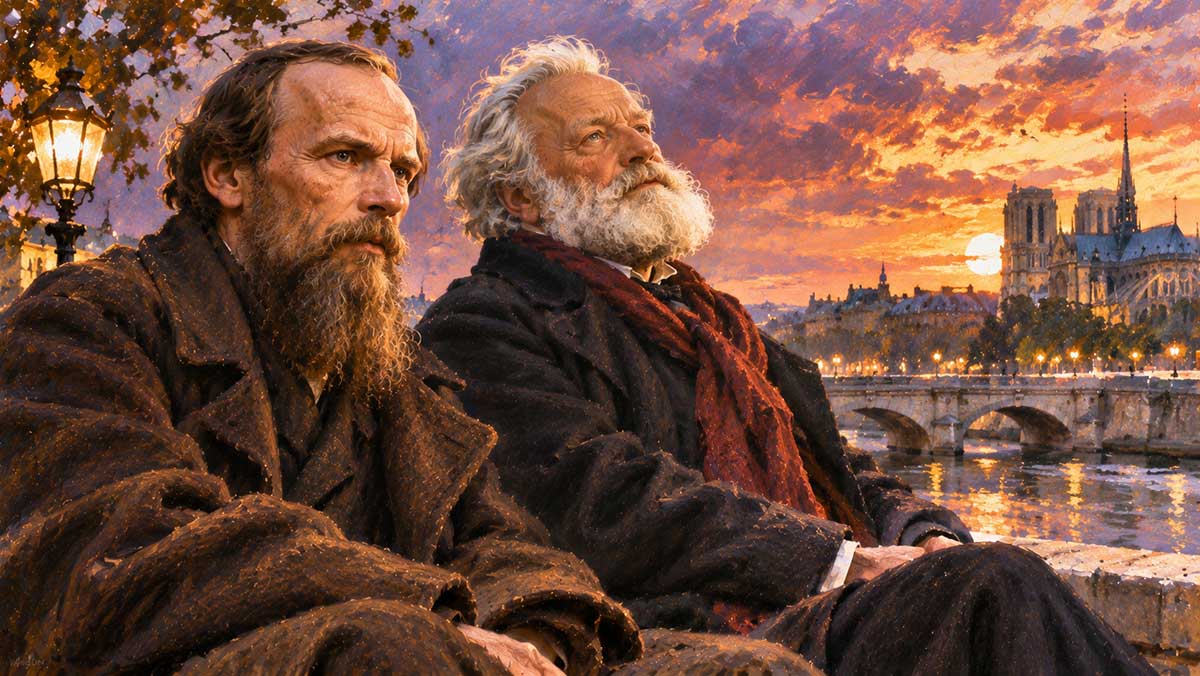
On the morning the amended papers left Belov's office, the roads were white with frost.
The clerk carried the packet beneath his coat, protecting it from the damp as though it were a loaf of bread. Belov watched him cross the square and disappear behind the post horses. He had written his recommendation in a hand that gave no indication of the hours he had spent scratching out its first sentences. The evidence no longer supported proceeding against Dmitri Karamazov on the existing accusation of patricide. The death of Fyodor Pavlovich required further inquiry. The testimony concerning Smerdyakov required examination by those empowered to order it.
Belov had signed his name. He could do no more that morning, and what he had done could still be rejected.
When Alyosha came to ask whether Dmitri might be released, Belov did not invite him to sit.
“I have sent what I can defend,” he said. “I have not sent a pardon.”
“I did not ask for one.”
“You asked with your face.”
Alyosha looked at the empty corner of the desk where the packet had lain. “Then I will wait with him.”
Belov turned toward the window. The square was filling with people who had not read a word of his report. They had already learned one story about Fyodor's death. There was no reason to suppose they would welcome another.
The weeks that followed did not arrange themselves into an ending. Alyosha went to Dmitri whenever he was permitted, sometimes carrying a letter, sometimes nothing at all. Dmitri asked whether there was news before Alyosha had taken off his coat. Most days there was none. Once he refused to speak, then called Alyosha back to apologize before the door was shut. The waiting gave neither brother a sentence he could trust.
Rain softened the frost and froze again. At the refuge, a child broke a cup and hid the pieces in his bed. At the estate, the steward spoke more politely to Anya when Alyosha was present, and more sharply when he was not. Smerdyakov remained under guard for further examination. The questions put to him did not produce a second confession that anyone could agree upon. He insisted Ivan had understood his intentions. Ivan insisted that understanding a man's words was not the same as commanding his hands.
At last a notice came permitting Dmitri's murder detention to end pending further inquiry. Belov read the language aloud in Russian. When Alyosha offered a hopeful French rendering, Belov recognized enough to correct its meaning.
“Not cleared,” Belov said. “Not convicted. No longer held on the accusation as it stands.”
Dmitri heard the news in a room with a barred window. He rose so quickly that the chair struck the wall. Then he stood motionless, both hands pressed against the table. His breath came in quick, uneven pulls. He tried to laugh and could not. The barred window was still behind him; he had heard permission spoken aloud and found that his body did not believe it. He covered his face for a moment, ashamed of his relief when Grigory still bore the wound he had given him.
“The money I spent at Mokroye,” Dmitri said, “was part of what Katerina entrusted to me. I kept it back. I would sooner have borne another accusation than speak of that shame.” He swallowed. “It was not my father’s packet.”
“May I go to Grigory?” he asked.
Belov knew whom he meant. “Grigory has not asked to see you.”
“I know.”
“That is not an invitation.”
“No,” Dmitri said. “It is not.”
Grigory sat by a low window with one leg supported on a stool. The swelling about his temple had subsided, but he still lost the thread of a conversation when it ran too quickly. A bowl of cooled porridge stood beside him. The woman who had brought it remained at the door when Dmitri entered, as though her presence might prevent another blow.
Dmitri had imagined this meeting a dozen times. In his imaginings he had been eloquent. He had confessed everything in a single terrible sentence and had been answered with something that would let him breathe.
Before Grigory, he could scarcely begin.
“I struck you,” he said. “You were trying to stop me. I knew what I was doing when I raised my hand.”
Grigory stared at him. “You were running from your father's house.”
“Yes.”
“You left me in the dirt.”
“Yes.”
Dmitri looked at the older man's swollen fingers resting on the blanket. “I was told you were alive, and my first thought was that I might escape a worse accusation. I ought to have thought of you.”
“People think of themselves first,” Grigory said. “It does not make the wound smaller.”
Dmitri accepted this without answering. He had brought a few coins from money Alyosha had lent him for his first necessities. He placed them on the sill, well away from Grigory's hand.
“I will pay what I can. If there is work you cannot do, I will see that someone does it. I cannot give you back the night.”
Grigory regarded the money as though it were another object left at a crime scene.
“You can leave it,” he said. “That does not mean I forgive you.”
“I know.”
“Do you?”
Dmitri had no defense against the question. He bowed his head and left without asking Grigory to soften it.
Outside, Alyosha waited beside the gate. He had offered to accompany his brother, but Dmitri had insisted on going in alone.
“He took the money,” Dmitri said.
“Did he speak to you?”
“He said I could leave it.” Dmitri looked toward the window. “It is a small thing to be allowed to do.”
Alyosha did not correct him.
Anya had not been sent away. That was the extent of the victory Alyosha could honestly describe.
The steward had agreed, in the presence of Belov's clerk, not to interfere with her further statements. He had agreed to nothing about her future. The estate's affairs remained unsettled; every promise of protection could be withdrawn by a man who had not made it. Alyosha began gathering the names of those whose consent or authority might be required to seek her freedom. The paper he brought was only a preliminary petition asking that her situation be considered by those controlling the estate. The petition could request a hearing; it could not release her from service. Some refused to answer him. Others told him to wait until the inheritance was settled.
Anya listened while he explained the first steps. She had finished washing the floor and held the rag in both hands.
“Will they make me leave if I sign?” she asked.
“I cannot tell you they will not.”
“Then you have brought me another paper that can be used against me.”
Alyosha lowered his eyes. “Perhaps. I wanted you to see it before anyone asked for your name.”
She laid the rag on the bucket. “Read it again. Slowly.”
He read each line in Russian, pausing whenever she asked. When he finished, she did not take the pen. She asked where the paper would be kept and who could see it. Alyosha answered as far as he knew. He left the space for her formal assent untouched.
It was not freedom. It was a question she had been allowed to ask before someone answered on her behalf.
Javert completed the refuge accounts on a table beneath a window that would not close. He had found the promised Karamazov contribution entered among expected receipts though no money had been received. The error was not the children's doing. The figures were corrected, the unpaid promise marked as unpaid, and the accounts signed by those who had actually seen the sums counted.
“Future gifts should be received by the charitable circle directly,” he told Alyosha, who translated the recommendation for the woman keeping the books. “Two people should acknowledge each payment. Keep the receipt with the account, not in a gentleman's pocket.”
“You have made the book less hopeful,” Alyosha said.
“I have made it say what you possess.”
“And that will feed them?”
“Not by itself.” Javert closed the ledger. “It may keep a hungry child from being promised the same loaf twice.”
Valjean was seated near the stove, where the boy who had once hidden bread was mending a torn mitten with thread too thick for the needle. Belov had received notice that Valjean could depart despite the continuing questions about his travel papers, and had passed that permission to him. The notice gave no absolution and explained little. It was enough to let him return to Cosette.
He had already written to her about the delay, making it smaller on the page than it had felt at night. He had not told her of the moment when the old name rose in Belov's office and he feared he might never leave Russia. There would be time to tell her, if she wished to hear it, in a room where he could see her face.
Javert placed the closed ledger between them.
“You asked me here to find an irregularity,” he said.
“I did.”
“I found one.”
“And more than one thing we did not come to find.”
Javert considered the answer. “That is not a method I recommend.”
Valjean smiled, but did not ask for warmth in return. The inspector had put away his papers. As Valjean rose, Javert noticed that the old man had left his gloves beside the stove. He picked them up and held them out without comment. Valjean took them, and for a moment neither released the worn leather. Then Javert let go.
Ivan came to the refuge at dusk. He had slept little. In the courtyard he stood beside Valjean without greeting him, watching the children carry wood from the shed in armfuls scarcely larger than themselves.
“They have stopped speaking of my father in the market,” Ivan said. “Now they speak of the servant who killed him, and the son who taught him how.”
“What do you say?” Valjean asked.
“That I wished him dead. That I did not order it. Neither sentence stops the other from being true.” Ivan watched a child struggle with a heavy piece of wood. “For an hour I thought what my brother’s conviction might leave to me. I did nothing with the thought. I cannot make myself forget that I had it.”
Valjean waited. He had learned that silence sometimes offered a man more room than comfort.
“I thought there would be a moment,” Ivan said, “when the right statement was entered and I would feel the difference.”
“Do you?”
“I know the difference. I do not feel it.”
Alyosha appeared at the door and called the children in to eat. Ivan watched his brother lift a basket from a small girl's arms before she dropped it. He looked as though he might go to him, then stepped back.
“Will you leave tomorrow?” he asked Valjean.
“If the horses come.”
“And he stays.”
“Dmitri stays,” Valjean said. “You may still speak to him.” Ivan had avoided his brother since the amended account, afraid that speaking would demand more than an explanation.
Ivan gave a brief, unhappy laugh. “You make it sound like an ordinary duty.”
“Most duties are ordinary when they arrive.”
Ivan remained in the yard after Valjean went inside. A little later Alyosha came out with two bowls of soup. He handed one to Ivan and sat beside him on the step. Neither spoke for some time.
Dmitri arrived the next morning before the bread was cut.
He had been free to walk through town for three days, and each street had offered him a different kind of gaze. Some people avoided him. Others congratulated him with the eagerness of those who wished to have been right all along. He found both unbearable. He had come to help Alyosha repair the refuge's outer door, which had begun to scrape against the threshold.
A child stood near the stove watching the loaf. It was the boy with the hidden crust. He had grown no less thin in the weeks since Valjean arrived, but he no longer watched every adult hand as though it might take his supper.
“Are you hungry?” Dmitri asked.
The boy nodded.
Dmitri reached for the bread, then stopped. He had seen Alyosha count the children and the portions. He took the knife only after Alyosha nodded, cut a piece, and gave it to the boy. When the child asked for another, Dmitri looked at the remaining loaf.
“There are others,” he said, more gently than he had intended. “We will see what is left when everyone has eaten.”
The boy carried his piece to a smaller child sitting near the wall. He broke it in two and gave her the larger half.
Dmitri watched, his hand still resting on the knife. He thought of the child he had once seen in a dream, shivering in a cart while the grown people stood about her with their explanations. He had awakened then with a desire to do something for someone, anything, and had mistaken the desire for the deed.
Now the door needed lifting. He put down the knife and went to the threshold, where Alyosha waited with a wedge of wood.
Beyond the refuge, a carriage rolled into the square. Valjean's bag lay beside the driver; Javert was checking the straps with the same attention he had given the accounts. Valjean embraced Alyosha, then looked once through the open doorway at the children eating. Dmitri met his gaze from beside the door. Valjean inclined his head, and Dmitri returned the gesture before taking up the work again. He did not ask the children to remember him.
The first bell sounded while Dmitri held the door on its hinges. Alyosha set the wedge beneath it. The second sounded as they pushed together, easing the swollen wood above the stone.
When the third bell came, the door opened without scraping. A child passed through carrying an empty bowl, and Dmitri stepped aside to let her go.
Final Thoughts: When Justice Is Not Enough
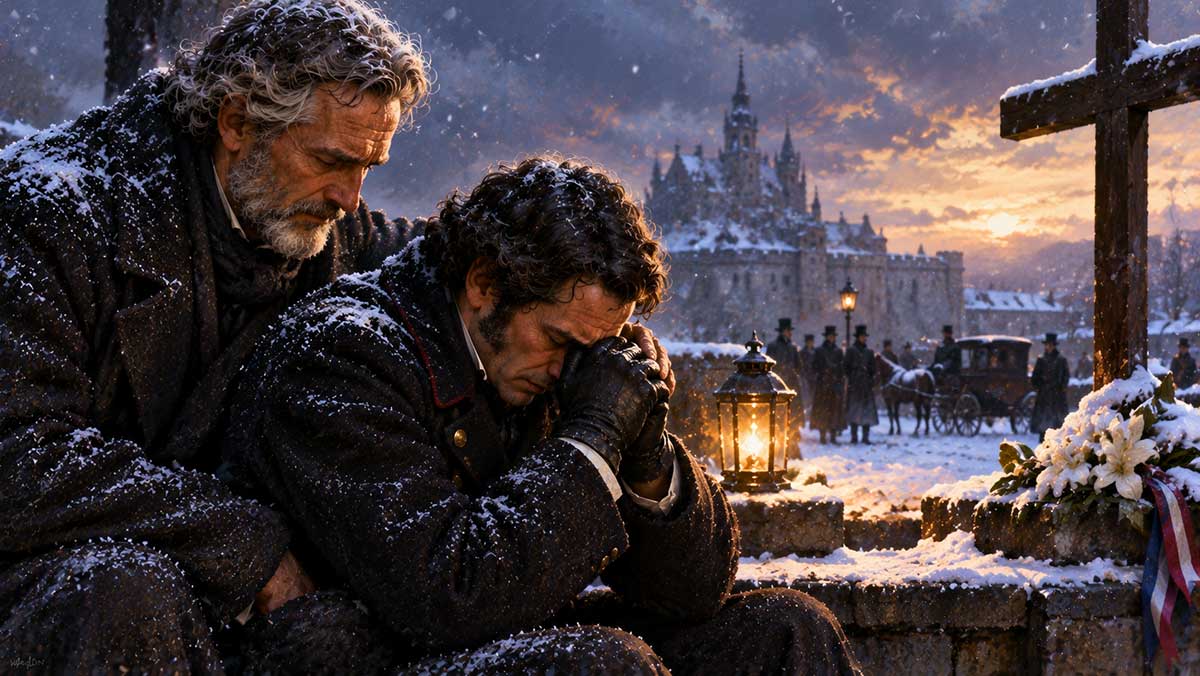
What if the greatest injustice is not that an innocent person suffers, but that everyone around him believes they are doing the right thing?
That question stayed with me throughout The Judgment of the Innocent. When I first considered bringing Dostoevsky's Karamazov brothers together with Victor Hugo's Jean Valjean and Javert, I was fascinated by what might happen when two extraordinary literary visions of justice encountered one another. But as the story developed, I found myself thinking less about the murder mystery and more about the people whose lives could be changed by a single mistaken judgment.
Dmitri Karamazov is not an innocent man in every sense. He is impulsive, violent, jealous, and capable of terrible mistakes. He strikes Grigory, threatens his father, and makes decisions he deeply regrets. Yet he did not commit the murder for which he is accused. That distinction matters enormously to me. We sometimes judge people by their worst behavior and then assume they must be guilty of everything else. But a person can be guilty of one wrong and innocent of another. Justice loses its meaning when we forget that difference. This concern reaches beyond fiction. The Innocence Project documents wrongful convictions and works to prevent the failures of justice that can send innocent people to prison.
Jean Valjean brings another dimension to this question. He knows what it means to be judged by a criminal record rather than by the person he has become. His willingness to reveal his identity, knowing it might cost him his freedom again, reminds me that moral courage is rarely comfortable. I was moved by the idea that someone who has suffered under an unjust system might still risk his own happiness to prevent another person from suffering the same fate. Perhaps one of the greatest signs of personal transformation is the willingness to protect someone else from the pain we once experienced. Victor Hugo explores this struggle throughout Les Misérables, where compassion repeatedly challenges the boundaries of conventional justice.
Javert surprised me in a different way. I did not want him to become a completely different person simply through an encounter with Valjean. Instead, I wanted to explore what might happen if his devotion to the law gradually became a devotion to accuracy. He does not abandon evidence or suddenly become sentimental. He insists that the official record distinguish what witnesses actually saw from what investigators assumed. I find something deeply meaningful in that transformation. Sometimes justice begins with a person having the humility to admit, "I do not know."
Ivan Karamazov presents perhaps the most troubling question of all. Can we be morally responsible for something we wished would happen, without being legally responsible for the act itself? Ivan never orders his father's murder, yet he cannot escape the knowledge that he wanted his father gone. I think many of us recognize something of ourselves in this struggle. We may never commit a terrible act, but we have all experienced anger, resentment, or thoughts we would hesitate to admit. The challenge is not to pretend such feelings never exist. It is to examine them honestly and decide what kind of people we want to become. These questions are central to Dostoevsky's The Brothers Karamazov, where the distance between thought, intention, and action becomes one of the novel's deepest moral concerns.
I was equally affected by Anya's situation. She tells the truth, yet telling the truth places her livelihood and future in danger. Her testimony helps change the investigation, but the story does not reward her with immediate freedom. I wanted that uncertainty to remain. In real life, people who act courageously do not always receive the protection or recognition they deserve. Her experience raises a question I believe deserves more attention: What does our commitment to justice mean if the people with the least authority must bear the greatest risks for speaking honestly?
The final scene, with Dmitri repairing a door at the refuge, expresses what I most wanted this story to leave behind. Dmitri has not been declared innocent of every wrong. Grigory has not forgiven him. Ivan has not found peace. Anya is not yet free. But Dmitri can still choose to help a child. He can repair something broken. He can make room for another human being. To me, that small action carries a profound message: redemption is not simply being forgiven for the past. It is choosing what we will do next.
I have often wondered whether humanity might become more peaceful if we learned to separate a person's actions from the total worth of that person. We need laws, accountability, and consequences. Yet we need compassion, humility, and the willingness to see someone as more than a mistake. Dostoevsky asks us to confront the hidden contradictions within the human soul. Hugo asks us to recognize the possibility of goodness in those society has condemned. Bringing their characters together helped me see how deeply those questions belong to one another.
And now I would love to hear what you think. Can someone be morally guilty without being legally guilty? Is forgiveness possible without repentance? Should justice focus more on punishment, truth, or rehabilitation? And if you were Jean Valjean, would you risk your freedom again to save someone who had made so many mistakes?
Perhaps the most difficult question is this: When we encounter someone who has done wrong, can we hold that person accountable without closing the door to who they might still become?
Author's note: This is an original fictional literary crossover inspired by characters created by Fyodor Dostoevsky and Victor Hugo. The events, meetings, and dialogue are imagined and do not appear in the original novels.

Short Bios:
Fyodor Dostoevsky (1821–1881)
Fyodor Dostoevsky was a Russian novelist whose works explore guilt, faith, suffering, freedom, and moral responsibility. After surviving a mock execution and enduring imprisonment in Siberia, he developed a profound interest in the contradictions of human nature. His major novels include Crime and Punishment, The Idiot, and The Brothers Karamazov. His characters frequently struggle between intellectual convictions and the demands of conscience.
Victor Hugo (1802–1885)
Victor Hugo was a French novelist, poet, dramatist, and advocate for social justice. Best known for Les Misérables and The Hunchback of Notre-Dame, he examined poverty, punishment, compassion, and the possibility of redemption. His opposition to the death penalty and his concern for society's most vulnerable people shaped much of his writing. Through Jean Valjean, Hugo created one of literature's most enduring portraits of moral transformation.
Jean Valjean
Jean Valjean is the central character of Victor Hugo's Les Misérables. Imprisoned for stealing bread and later offenses, he struggles to rebuild his life after experiencing an extraordinary act of mercy from Bishop Myriel. His transformation from a bitter former prisoner into a compassionate protector raises questions about forgiveness, identity, and whether society allows people to change.
Inspector Javert
Javert is the relentless police inspector in Les Misérables who believes deeply in law, order, and personal accountability. His pursuit of Jean Valjean reveals the tension between legal authority and moral conscience. In this imagined crossover, Javert confronts the limitations of rigid judgment without abandoning his commitment to truth and evidence.
Dmitri Karamazov
Dmitri, also called Mitya, is the passionate eldest son of Fyodor Pavlovich Karamazov in Dostoevsky's The Brothers Karamazov. His jealousy, financial troubles, and turbulent relationship with his father make him a suspect in his father's murder. Dmitri represents the struggle between destructive impulses, genuine remorse, and the longing for redemption.
Ivan Karamazov
Ivan is the intellectually gifted middle Karamazov brother, known for his philosophical challenges to religious faith and moral authority. His arguments about suffering, freedom, and responsibility form some of the most celebrated passages in The Brothers Karamazov. His character raises a disturbing question: How responsible are we for the consequences of ideas we express but never act upon?
Alyosha Karamazov
Alexei, commonly called Alyosha, is the youngest Karamazov brother. Deeply influenced by the spiritual teachings of Elder Zosima, he approaches others with compassion, patience, and an enduring belief in human goodness. Rather than seeking to win philosophical arguments, Alyosha often responds to suffering through presence, kindness, and practical acts of care.
Pavel Smerdyakov
Smerdyakov is a servant in the Karamazov household and is widely believed to be Fyodor Pavlovich's illegitimate son. Intelligent, resentful, and socially marginalized, he plays a central role in the murder mystery of The Brothers Karamazov. His relationship with Ivan raises difficult questions about manipulation, class resentment, and moral responsibility.
Investigator Belov
Belov is an original fictional investigator created for The Judgment of the Innocent. Responsible for examining Fyodor Pavlovich's murder, he must reconsider an apparently convincing accusation when new testimony and physical evidence emerge. His character represents the responsibility of legal authorities to distinguish established facts from assumptions.
Anya
Anya is an original fictional serf in the Karamazov household. Her observations become significant to the murder investigation, but speaking truthfully exposes her to possible retaliation. Through Anya, the story explores the vulnerability of witnesses who lack social standing, legal independence, and protection from those who control their livelihoods.
Fictional disclaimer: This literary crossover places characters from Dostoevsky's and Hugo's novels in an imagined alternate history. Belov and Anya are original fictional characters created for this story. The events and interactions are not part of the original works.
Leave a Reply