
Introduction
Isaac Newton Explained the Universe, But Could He Understand Himself?
Isaac Newton explained the laws of the universe, but why did one of history's greatest minds struggle so much with the mysteries of his own life? What if the man who transformed science was far more lonely, passionate, religious, and emotionally complicated than the familiar story of a falling apple suggests? We remember Newton for gravity, calculus, and the laws of motion. But behind those extraordinary discoveries stood a boy who grew up without his father, experienced years of separation from his mother, and nearly became a farmer instead of a scholar. What happened inside that boy's mind before he changed humanity's view of the universe?
When I began exploring Newton's life, I expected to encounter a brilliant mathematician whose greatest passion was explaining nature. Instead, I discovered a man whose interests stretched far beyond what most of us learned in school. According to the Stanford Encyclopedia of Philosophy's biography of Isaac Newton, his work extended from mathematics and optics to alchemy, theology, and biblical history. Newton did not simply want to calculate how the universe behaved. He sought explanations for its deepest mysteries, including questions about creation, matter, and divine purpose. Yet the more I learned about his private life, the more curious I became about something his equations could never fully answer: Was Isaac Newton happy?
Newton's scientific achievements were extraordinary. During the plague years of the 1660s, he developed ideas that would contribute to calculus, optics, and gravitational theory. His 1687 masterpiece, Philosophiæ Naturalis Principia Mathematica, established mathematical principles that transformed the study of motion and celestial mechanics. The Library of Congress preserves a digitized edition of this historic work, allowing modern readers to encounter the book that helped reshape science. But Newton's discoveries were not simply the result of a miraculous apple falling from a tree. They emerged through years of concentration, experimentation, calculation, and intellectual struggle. I wanted to ask him what it actually felt like to spend so much of his life pursuing questions that other people could scarcely comprehend.
Then I discovered another Newton, one whose private convictions might surprise many readers. He devoted enormous effort to studying alchemy, ancient history, biblical prophecy, and the development of Christian doctrine. His theological investigations eventually led him to reject the orthodox understanding of the Trinity, a position he largely kept private during his lifetime. The Newton Project at Oxford, particularly historian Rob Iliffe's study of Newton's religious life, reveals how central these investigations were to his intellectual identity. Here was a man who helped explain the movements of planets while searching Scripture for answers about God, Jesus, and the ultimate meaning of creation. How did he reconcile mathematical certainty with spiritual conviction? And why did he devote so much attention to religious questions that could threaten his public standing?
But perhaps the most moving discovery was Newton's humanity. He could be intensely sensitive to criticism, became involved in bitter disputes with fellow scholars, and experienced a serious period of personal distress in 1693. His achievements did not protect him from misunderstanding, strained relationships, or the limits of his own judgment. That realization changed the interview I wanted to create. I no longer wanted to sit across from Newton merely to ask how gravity works. I wanted to meet the child who felt separated from his family, the young scholar who found comfort in difficult questions, the ambitious thinker who sometimes struggled with other people, and the aging man who had achieved almost unimaginable recognition.
In this five-part imaginary interview, I invite Isaac Newton to sit with me as a friend. We begin beneath the apple tree at Woolsthorpe Manor, where childhood memories lead us toward the remarkable discoveries of his youth. We then enter his study to explore gravity, light, mathematics, and the thrill of scientific investigation. As evening falls, our conversation turns toward his rivalries, friendships, and moments of vulnerability. Later, surrounded by religious manuscripts and alchemical instruments, we discuss his search for God and his unconventional theological beliefs. Finally, in a quiet London drawing room, we consider success, relationships, mortality, and the questions that remained unanswered after a lifetime of discovery.
What interests me most is not whether Newton possessed all the answers. Clearly, he did not. It is that he continued searching, despite uncertainty, conflict, and the enormous distance between what humanity knew and what remained undiscovered. Perhaps his greatest gift was not simply showing us that the universe follows mathematical principles. Perhaps it was demonstrating how much can change when someone refuses to stop asking questions. And perhaps his personal struggles remind us that intellectual greatness and human wisdom are not always the same thing. I hope this conversation encourages you to see Newton not as an untouchable monument of genius, but as a fascinating human being whose search for truth still speaks to our own lives.
Fictional interview disclaimer: This is an imagined conversation created for educational, literary, and reflective purposes. Isaac Newton's dialogue, emotional responses, and private conversations are fictional reconstructions inspired by documented history. They are not authentic quotations. Historical interpretations are informed by scholarly research, and uncertainties about Newton's private feelings remain open.
Topic 1 | The Boy Who Was Left Behind
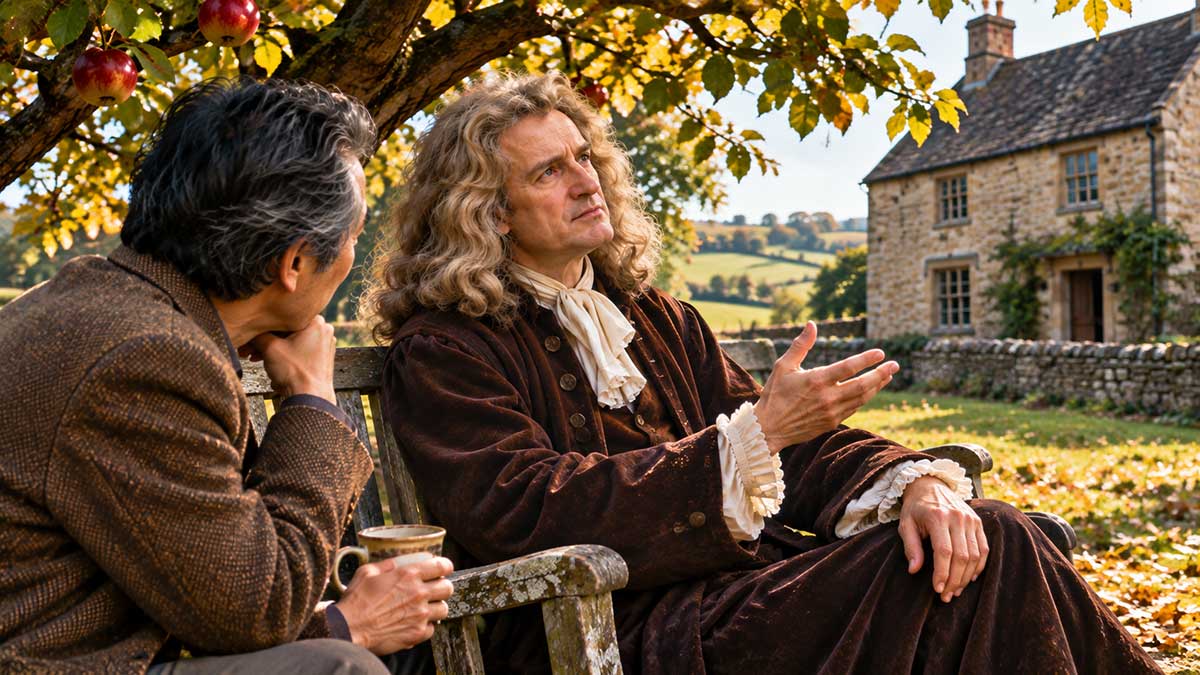
Woolsthorpe Manor, Lincolnshire, England. A quiet autumn morning.
The old stone house stands beneath a pale blue sky. Golden leaves drift across the garden, and the branches of an apple tree sway gently in the breeze. Beyond the low garden wall, the Lincolnshire countryside stretches into the distance.
Isaac Newton, now an elderly gentleman with long silver hair, sits on a wooden bench beneath the tree. His dark coat is neatly buttoned, and a walking stick rests beside him. He watches a fallen apple roll slowly across the grass.
Nick Sasaki approaches carrying two cups of warm tea.
Nick Sasaki
Sir Isaac, I brought you some tea. I hope I'm not interrupting any revolutionary discoveries.
Isaac Newton
Not at present, Mr. Sasaki. Though I cannot promise the tea will remain scientifically uninteresting.
Nick
(Laughing) Well, I have to confess something. I promised myself I wouldn't begin our conversation by asking whether an apple really fell on your head.
Newton
A most welcome promise. I fear that poor apple has enjoyed a greater reputation than many respectable scholars.
Nick
You spent years working on mathematics, motion, and gravity, and the world remembers a piece of fruit.
Newton
Perhaps I ought to have written my great work upon the properties of apples. It might have sold more copies.
Nick
(Laughing) You know, I think I would have liked you as a neighbor.
Newton
You might have reconsidered that judgment after finding me awake at three in the morning, making calculations by candlelight.
Nick
Actually, I do some of my best thinking late at night. We might have gotten along.
Newton smiles faintly.
For a moment, they sit quietly beneath the tree.
Nick
Isaac, we're sitting outside the house where you grew up. Most people know what you eventually accomplished, but I'm curious about the boy who lived here.
Before you became Isaac Newton, the great scientist, what kind of little boy were you?
Question 1 | What Kind of Little Boy Was Isaac Newton?
Newton
A rather solitary one, I believe. Though I should not wish you to think I spent every childhood hour in melancholy reflection.
I had my amusements.
I was particularly interested in constructing things. Small mechanical devices, models, anything that allowed me to observe how one movement produced another.
A machine seemed to possess a kind of honesty. If its parts were arranged properly, it behaved according to their arrangement. If it failed, one could examine the cause.
Nick
So you were the kind of child who took things apart to see how they worked?
Newton
And occasionally succeeded in putting them together again.
Nick
(Laughing) That sounds familiar. My children have done that. Sometimes the original object never recovers.
Newton
Then they have already learned something of experimental philosophy.
Nick
Did you have many friends?
Newton
I had companions at school, though I was not naturally inclined toward large gatherings. I preferred certain occupations that could be pursued alone.
You must understand, however, that recollections of childhood are imperfect. One remembers particular incidents and gradually constructs a story from them.
Nick
That's interesting. Even the man who studied the universe isn't completely certain about his own childhood.
Newton
The heavens leave evidence of their motions. Childhood leaves a rather less orderly record.
Nick
Were you a good student?
Newton
Not always the most diligent, according to some accounts. I became more determined as I grew older.
There is a story of a quarrel with another schoolboy that encouraged me to improve my standing. Whether the tale has been polished by those who repeated it, I cannot say.
But I certainly came to enjoy intellectual competition.
Nick
So somebody challenged you, and you decided to become better than him?
Newton
That would be an inelegant description.
Nick
But fairly accurate?
Newton
(Smiling) Perhaps not entirely inaccurate.
Nick
I like that. People sometimes picture great thinkers as children who were born knowing everything.
Newton
That would make education quite unnecessary.
Nick
Did you know you were different?
Newton
I knew that certain questions occupied my attention more persistently than they seemed to occupy the attention of others.
But I did not sit beneath this tree announcing that I should one day explain the motions of the planets.
Nick
I'm glad to hear that. It would have made you a rather strange child.
Newton
I suspect some already considered me strange enough.
They laugh.
A breeze carries several leaves across the bench. Newton looks toward the house, and his expression becomes quieter.
Question 2 | The Mother Who Went Away
Nick
Isaac, may I ask you something more personal?
Newton
You may ask.
Nick
Your father died before you were born. And when you were about three years old, your mother remarried and went to live with her new husband.
You stayed here with your grandparents.
What was that like for you?
Newton looks toward the windows of the manor.
Newton
My father died before I could know him. That absence was simply part of the circumstances into which I was born.
My mother's departure was another matter.
A young child cannot comprehend all the arrangements adults make, or the obligations and expectations that govern their decisions.
He knows only that someone who was present is no longer there.
Nick
Did you miss her?
Newton
I cannot offer you a precise account of what I felt at three years of age.
But I know that her absence became part of my childhood, and I know that my feelings concerning my family were not always gentle.
Nick
There's something I came across while researching your life. When you were about nineteen, you wrote a private list of sins.
One entry mentioned threatening to burn the house with your mother and stepfather inside.
That's a frightening thing to read.
Newton
It is a frightening thing to have written.
Nick
Were you that angry?
Newton
The words testify to anger, certainly. They do not tell us every circumstance in which it arose.
I wrote that list as an examination of my conscience. It was not intended as a history for future generations.
Nick
I'm sorry. I don't want to make you feel as though I'm judging a child for something he wrote privately.
Newton
Then perhaps you understand the difficulty of your undertaking, Mr. Sasaki. You have invited a man to discuss his life, yet much of what survives was never intended for an audience.
Nick
That's fair.
I think what I'm trying to understand is whether you ever felt abandoned.
Newton
That is a word you might use. I should hesitate to claim that it captures every feeling I possessed.
My grandparents cared for me. I had a home. My mother eventually returned.
Yet a child's experience cannot be measured simply by counting those who provided him shelter.
Nick
When your mother came back, was everything normal again?
Newton
What is normal after several years of separation?
She returned following my stepfather's death, bringing my younger half-siblings. The household was changed, and I was older.
One does not recover the years that have passed merely by occupying the same rooms again.
Nick takes a slow sip of tea.
Nick
That's something I hadn't thought about.
People sometimes assume that when a family comes back together, everything that happened before is finished.
Newton
Time does not operate quite so conveniently.
Nick
Do you think those experiences made you more comfortable being alone?
Newton
I cannot establish such a connection with certainty.
I was certainly capable of spending long periods in solitary study. Whether that inclination arose from childhood circumstances, natural temperament, or the pleasure I found in my work is not a question I can resolve for you.
Nick
You won't let me get away with an easy psychological explanation, will you?
Newton
I should be a poor investigator if I accepted an explanation merely for its attractiveness.
Nick
(Laughing softly) Fair enough.
But I want to ask one more thing.
When you think of that little boy living here, is there anything you wish someone had said to him?
Newton remains silent for several moments.
Newton
That is a question requiring imagination rather than recollection.
Perhaps I should have wished him to know that the circumstances of his childhood would not determine the whole of his life.
Nick
That's a beautiful thought.
Newton
It is a hopeful one. Whether the boy would have believed it is another question.
The two men sit quietly. Somewhere beyond the garden wall, a bird calls from the hedgerow.
Question 3 | The Farmer Who Almost Changed History
Nick
Now, Isaac, I understand your mother wanted you to become a farmer.
Newton
That was indeed her intention.
Nick
I have to say, I'm having trouble picturing it.
Isaac Newton, the world's most famous farmer.
Newton
You are quite right to have difficulty. I was not particularly accomplished at the occupation.
Nick
What happened?
Newton
I was expected to attend to the business of the farm, but my attention was frequently elsewhere.
The management of land requires practical judgment, regular attention, and considerable industry.
I possessed industry when sufficiently interested in a subject. Unfortunately, the farm did not always command that interest.
Nick
So instead of watching the sheep, you were thinking about mathematics?
Newton
The surviving stories suggest that my thoughts were often occupied by books and other matters when I ought to have been attending to agricultural duties.
Nick
(Laughing) Your mother must have been frustrated.
Newton
She had reasonable grounds for dissatisfaction.
Nick
Did you ever consider simply doing what she wanted?
Newton
A young man cannot always choose his circumstances. I understood that a family estate required management.
But I found greater satisfaction in study.
Fortunately, others recognized that I might be better employed in an academic life.
Nick
Your schoolmaster?
Newton
Among others. William Stokes, my schoolmaster at Grantham, supported my education. My uncle was influential in encouraging my path toward Cambridge.
Their assistance mattered greatly.
Nick
That's extraordinary.
A few people recognized something in you, and history changed.
Newton
You are speaking with the advantage of knowing what followed.
At the time, there was no guarantee that my studies would produce anything of lasting importance.
Nick
But you must have felt excited when you learned you could go to Cambridge.
Newton
I certainly regarded it as an opportunity.
Cambridge offered books, scholars, and the possibility of pursuing questions that had already begun to interest me.
It was not a promise of greatness. It was an opening.
Nick
Do you ever think about what might have happened if those people hadn't helped you?
Newton
Such speculation can be instructive, provided we recognize its limits.
I might have remained at Woolsthorpe. I might have become a tolerable farmer through necessity, though I suspect my neighbors would have suffered from my absent-mindedness.
Nick
(Laughing) You might have discovered gravity while losing all your sheep.
Newton
I should hope the sheep would have remained subject to gravity regardless of my discoveries.
Nick
That's a relief.
But seriously, Isaac, I find this moving.
We often talk about famous people as though their achievements were inevitable.
Yet your life could have taken a completely different direction.
Newton
Every life depends upon circumstances that might have been otherwise.
My education was made possible by the judgment and assistance of others. Whatever I accomplished afterward, that fact deserves acknowledgment.
Nick
So even Isaac Newton didn't accomplish everything alone.
Newton
Certainly not.
The work of learning depends upon teachers, books, predecessors, correspondents, and those who provide opportunities.
No man begins his investigations with the world entirely unknown and no knowledge inherited from others.
Nick
I wish more people heard that.
Sometimes we celebrate successful individuals so much that we forget everyone who helped them.
Newton
Then perhaps we should remember Mr. Stokes and those who encouraged my education, rather than concerning ourselves exclusively with the apple.
Nick
I think that's a wonderful idea.
Nick looks toward the manor and then at the tree above them.
Nick
Isaac, when you finally left this place for Cambridge, did you feel you were escaping your childhood or beginning something new?
Newton
I should not wish to reduce the experience to either description.
I was leaving a familiar place to pursue an uncertain future.
I could not know what awaited me.
Nick
And years later, when the plague closed Cambridge, you returned here.
Newton
Yes. My studies continued at Woolsthorpe during that period.
Nick
It's remarkable, isn't it?
The house where you spent so much of your childhood became the place where some of your most extraordinary scientific ideas began to develop.
Newton
There is a certain symmetry in that observation.
Though I would caution you against imagining that every discovery occurred in a single miraculous afternoon.
Nick
(Laughing) You really don't want me to tell the apple story that way.
Newton
I would prefer that the mathematics receive some credit.
Nick
Then next time, I promise we'll talk about the mathematics.
But before we leave, I want to thank you for telling me about the boy who lived here.
I came expecting to meet one of history's greatest minds.
I think I'm beginning to meet Isaac.
Newton looks toward the old stone house.
Newton
And I find that the boy is sometimes more difficult to explain than the motions of the planets.
Nick smiles.
A ripe apple drops from a branch and lands softly in the grass a few feet away.
Both men turn toward it.
Nick
I didn't arrange that, I promise.
Newton
I should hope not. It would be a rather elaborate method of introducing our next conversation.
Nick
Well, Isaac, perhaps the universe is giving us a hint.
Newton
Or perhaps the apple has simply reached the end of its attachment to the tree.
Nick
(Laughing) You always have a scientific explanation.
Newton
Not always, Mr. Sasaki.
Newton looks at the apple, then raises his eyes toward the pale Moon still faintly visible in the morning sky.
Newton
But I have always found it worthwhile to ask whether one might be discovered.
The autumn breeze passes through the branches. Above Woolsthorpe Manor, the Moon hangs quietly in the daylight, waiting for a young man's question that will one day help change humanity's view of the universe.
To be continued in Topic 2 | The Apple That Changed the Universe
Topic 2 | The Apple That Changed the Universe
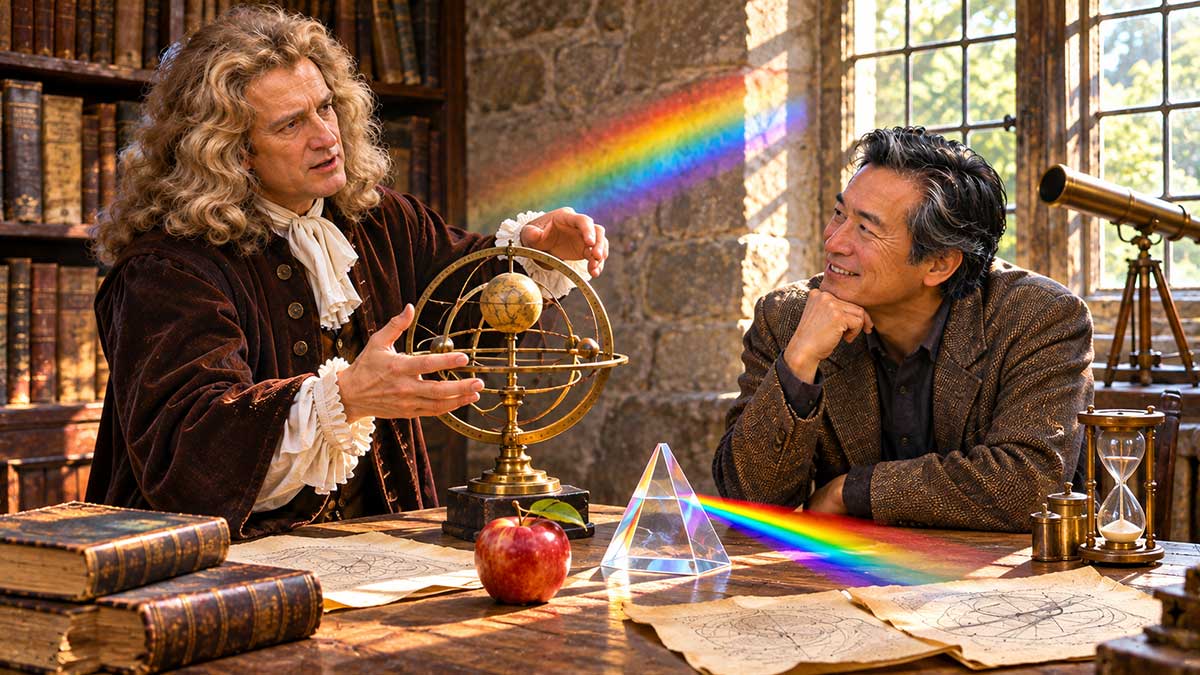
Woolsthorpe Manor, Lincolnshire, England. A quiet autumn afternoon.
Sunlight enters through a narrow window of Newton's old study, illuminating a wooden table covered with mathematical notes, books, a small globe, and a glass prism. A brilliant band of colors stretches across the opposite wall.
Outside, the apple tree sways gently in the afternoon breeze.
Isaac Newton sits beside the window, carefully adjusting the prism. Nick Sasaki watches with the fascination of a child witnessing a magic trick.
Nick Sasaki
Isaac, I have to say, this is beautiful.
Isaac Newton
The colors are indeed pleasing. But what interests me is not merely their beauty. It is what they reveal about light.
Nick
You know, most people would see a rainbow and say, "How beautiful!" You see a rainbow and start questioning the nature of the universe.
Newton
(Laughing softly) I do occasionally permit myself to admire a beautiful thing without immediately examining it.
Nick
Really? When was the last time?
Newton
I shall have to consult my records.
They laugh.
Nick picks up an apple resting beside the globe.
Nick
Before we get into the mathematics, can we finally settle something?
Did an apple actually inspire your theory of gravity, or have people been telling a wonderful story at your expense?
Question 1 | Why Did a Falling Apple Change Everything?
Newton
There is truth in the account, though the popular telling has acquired certain embellishments.
During my time at Woolsthorpe, I considered the force that causes an apple to fall toward the Earth.
But no apple struck me upon the head, so far as I recall.
Nick
That's disappointing. I was hoping for a dramatic moment.
Newton
I fear scientific discovery is often less theatrical than people desire.
Nick
So you saw an apple fall and started wondering why it fell?
Newton
The more interesting question was whether the influence drawing the apple downward might extend far beyond the Earth's surface.
Consider the Moon.
Nick
The Moon?
Newton
Yes. Why does the Moon not simply proceed in a straight line through space?
Its motion is continually diverted from such a path.
I wondered whether the same attraction that causes an apple to fall might extend to the Moon, diminishing with distance.
Nick
Wait. That's incredible.
Everybody sees an apple falling down. But you looked at the Moon and wondered whether it was falling too?
Newton
In a manner of speaking, yes.
The Moon continually changes its direction as it travels around the Earth. One may understand that motion as a continual departure from the straight path it would otherwise follow.
Nick
So the Moon is falling toward Earth, but it keeps missing?
Newton
That is a useful way to picture orbital motion, provided we do not mistake the illustration for a complete mathematical account.
Nick
(Laughing) You really don't let me get away with anything.
Newton
I should be doing you a disservice if I allowed a convenient picture to replace careful reasoning.
Nick
But how did you make that connection? Millions of people had watched apples fall.
Newton
I was not the first to consider attraction or the relationship between terrestrial and celestial motions. Others had made important observations and proposals.
My task was to investigate whether a mathematical law could account for these phenomena together.
Nick
So the real discovery wasn't simply asking why an apple falls.
It was asking whether the same law applies everywhere.
Newton
Precisely.
A principle that explains one phenomenon may be useful. A principle that connects many apparently different phenomena possesses much greater significance.
Nick
That's a beautiful thought.
Did you know immediately that you were right?
Newton
Certainly not.
An attractive idea is not sufficient evidence of its truth.
The calculations had to be examined. The motions of celestial bodies had to be compared with the proposed mathematical relations.
And those investigations required considerable time.
Nick
How much time?
Newton
Years of work, revision, and further investigation.
The period during which the university was affected by plague was fruitful, but the mature theory of universal gravitation emerged through subsequent efforts.
Nick
So the famous apple was the beginning of a question, not the end of the discovery.
Newton
That is a much better description.
Nick places the apple beside the globe.
Nick
You know what amazes me? You looked at something ordinary and saw something extraordinary.
Newton
Nature does not conceal all her questions in distant places, Mr. Sasaki.
Some lie immediately before us.
The difficulty is learning to ask the right question.
Question 2 | What Was Happening Inside Newton's Mind?
Nick turns toward the prism, where sunlight has formed a spectrum of red, orange, yellow, green, blue, and violet.
Nick
Isaac, can I ask you something I've always wondered about?
What does it actually feel like to think the way you do?
Newton
I am not certain my thoughts differ in kind from those of other men.
Nick
Come on. You helped develop calculus, investigated the nature of light, and changed our knowledge of gravity.
You can't tell me your mind was ordinary.
Newton
(Laughing) I can tell you that I spent a great deal of time being confused.
Nick
Really?
Newton
Of course.
One begins with a problem. One attempts a solution. The solution proves inadequate, or the evidence refuses to agree with one's expectations.
Then one must begin again.
Nick
Did that frustrate you?
Newton
Frequently.
But difficulty is not always a reason to abandon a question. Sometimes it is a sign that one's assumptions require examination.
Nick
Did you ever become so absorbed in a problem that you forgot everything else?
Newton
I have been known to neglect ordinary matters when occupied with an investigation.
Nick
Like eating?
Newton
On occasion.
Nick
Sleeping?
Newton
That, too, could suffer from insufficient attention.
Nick
(Laughing) Isaac, if you lived today, someone would probably tell you to improve your work-life balance.
Newton
A sensible recommendation, perhaps. Though I suspect I should have found it inconvenient.
Nick
Let's talk about this prism.
Before your experiments, people thought the prism somehow changed white light into colors, didn't they?
Newton
There were differing explanations of the phenomenon.
My experiments led me to conclude that ordinary white sunlight contains rays of different refrangibilities.
The prism separates them according to their behavior when passing between materials.
Nick
So the colors were already part of the light?
Newton
That is the essential point.
The prism does not simply manufacture those colors from uniform white light.
Nick
How did you prove it?
Newton
Among other experiments, I isolated a portion of the colored light produced by one prism and passed it through another.
Its behavior showed that the color was not being newly created by the second prism.
Such experiments helped establish that the rays possessed distinct properties.
Nick
That's fascinating.
You didn't just look at a rainbow and make a guess. You found a way to test your explanation.
Newton
An explanation ought to be answerable to experiment.
Nick
And calculus? How did you even begin creating a new kind of mathematics?
Newton
I was concerned with quantities that vary, and with methods for investigating their rates of change and their accumulation.
Existing mathematical work provided important foundations. I developed methods that I called fluxions, which proved useful in studying changing quantities.
Nick
So you needed new mathematics to answer questions the old methods couldn't easily handle?
Newton
That is a fair description, though many mathematicians contributed to the foundations upon which such methods were built.
Nick
And Leibniz developed his own calculus independently.
Newton
Yes. Our methods and notations differed, and the question of priority later became a source of considerable controversy.
Nick
We'll talk about that another time.
Newton
(Smiling) I had suspected you might.
Nick
But there's something else I want to ask.
When you finally solved a difficult problem, what did you feel?
Excitement? Relief? Happiness?
Newton
Satisfaction, certainly, when a result appeared sound.
But a solution frequently produced further questions.
One difficulty removed might reveal three others.
Nick
That sounds exhausting.
Newton
It could be.
Yet there is a particular pleasure in discovering that something which appeared confused possesses an intelligible order.
Nick
Did you ever experience a moment when everything suddenly became clear?
Newton
There were moments of insight, but they were generally preceded by sustained labor.
People are fond of sudden discoveries. They are less interested in the many unsuccessful attempts that make them possible.
Nick
That's true in almost everything, isn't it?
People see the finished achievement, but they don't see the years of uncertainty.
Newton
Indeed. And one should never confuse the appearance of simplicity in a final explanation with simplicity in arriving at it.
Nick looks again at the rainbow on the wall.
Nick
I think I'm beginning to understand something about you.
You weren't simply looking for answers.
You wanted to know how to tell whether an answer was true.
Newton
That distinction is fundamental.
Question 3 | Why Does the Universe Follow Mathematical Laws?
The afternoon light begins to soften. Newton sets the prism aside and opens a worn copy of his Philosophiæ Naturalis Principia Mathematica.
Nick studies the dense pages of Latin and mathematical diagrams.
Nick
Isaac, I have a confession.
Newton
Another one?
Nick
I tried looking through your Principia once.
Newton
And how did you find it?
Nick
I think I understood the title.
Newton laughs.
Newton
Then you made an admirable beginning.
Nick
But seriously, this book changed science.
You described laws of motion and a theory of gravity that could explain things happening here on Earth and far away in space.
Did you realize how extraordinary that was?
Newton
I understood that the mathematical principles possessed considerable explanatory reach.
But their significance depended upon their agreement with observed phenomena and their usefulness in further investigation.
Nick
Can you explain your three laws of motion without making my head hurt?
Newton
I shall attempt it.
A body continues in its state of rest or uniform straight-line motion unless acted upon by a net force.
A change of motion is related to the force impressed upon the body.
And when one body exerts a force upon another, the second exerts an equal and opposite force upon the first.
Nick
So when I push against this table, the table pushes back?
Newton
Indeed.
Nick
And when I trip over a chair, the chair is simply obeying your laws?
Newton
I fear the chair may possess an excellent defense.
Nick
(Laughing) I'll remember that next time.
But here's the question that really interests me.
Why does the universe follow these laws in the first place?
Why is there order instead of complete chaos?
Newton closes the book gently.
Newton
You have moved from a question of natural philosophy into one of greater difficulty.
Mathematics may describe regularities in nature with remarkable precision.
But to ask why the world possesses such an order is to ask about its ultimate foundation.
Nick
And what did you believe?
Newton
I believed that the extraordinary arrangement of the natural world gave reason to consider an intelligent and powerful Creator.
The motions of the planets, the structure of the heavens, and the regularities of nature were not, to my mind, indifferent to questions of divine wisdom.
Nick
So your scientific discoveries strengthened your belief in God?
Newton
My investigations of nature and my religious convictions were deeply connected, though one should not suppose that every scientific result supplies a direct theological proof.
Nick
But you still couldn't explain everything.
For example, you could calculate how gravity behaves, but you couldn't fully explain what gravity actually is.
Newton
That is correct.
I could formulate mathematical principles describing gravitational attraction and its effects.
But I did not establish the ultimate physical cause of that attraction.
Nick
Did that bother you?
Newton
It remained an important question.
Yet one must distinguish what has been established from what is merely conjectured.
I did not consider it necessary to invent an unsupported mechanism simply to make the explanation appear complete.
Nick
That's fascinating.
You were willing to say, "I don't know."
Newton
A man who cannot acknowledge the limits of his knowledge will find it difficult to extend them.
Nick
I love that.
But let me ask you something personal.
When you looked up at the stars after making these discoveries, did the universe feel smaller, now that you could explain more of it?
Or did it feel even bigger?
Newton turns toward the window.
The first faint suggestion of evening appears over the fields.
Newton
Its motions became more intelligible to me.
But intelligibility does not diminish wonder.
Indeed, the discovery of order may increase one's awareness of how much remains beyond present knowledge.
Nick
So the more you learned, the more you realized there was still to discover?
Newton
That was often my experience.
Nick
Isaac, I think that's one of the most beautiful things you've told me.
You changed humanity's conception of the universe, yet you never reached a point where every question was answered.
Newton
I should have been a very poor philosopher if I imagined that the success of one investigation entitled me to pronounce upon all things.
Nick
Do you think people today sometimes confuse knowledge with certainty?
Newton
People in every age are tempted to believe that what they presently understand represents the full extent of what may be known.
It is a temptation worth resisting.
Nick looks down at the apple still resting beside the globe.
Nick
You know, Isaac, I came here thinking the most extraordinary thing about you was your intelligence.
But I'm beginning to think it was your curiosity.
Newton
Curiosity alone would not have carried the work very far.
It required discipline, calculation, patience, and the contributions of many others.
Nick
There you go again, refusing to take all the credit.
Newton
I assure you, Mr. Sasaki, there have been occasions when others considered me rather too concerned with receiving proper credit.
Nick
(Laughing) Really?
Newton
Indeed.
Nick
Now that's a story I want to hear.
Newton
I suspected you would.
Nick
Were you difficult to work with?
Newton raises an eyebrow.
Newton
I should prefer that you put the question to someone who disagreed with me.
Nick
And would they give me an honest answer?
Newton
They would certainly give you an enthusiastic one.
Both men laugh.
Outside the window, the autumn sky deepens toward gold. The rainbow on the wall fades as the sunlight shifts.
Nick notices several old letters lying beneath the mathematical papers. One bears the name of Robert Hooke.
Nick
Isaac, you've shown me how you searched for order in nature.
But looking at these letters, I get the feeling your relationships with other scientists weren't quite so orderly.
Newton
Human beings, Mr. Sasaki, are considerably less predictable than planets.
Nick
And I suspect they sometimes caused you more trouble.
Newton
You may be approaching an uncomfortable truth.
Nick
Then perhaps that's where we should begin our next conversation.
Newton picks up one of the letters and studies it thoughtfully.
Newton
Very well. But I must warn you that the history of scientific disagreement is seldom as simple as either party wishes it to appear.
Nick
That's exactly why I want to hear it from you.
The room grows quiet. The last colors of sunlight disappear from the wall, leaving the prism beside the apple and the globe.
Newton has explained how he discovered order in the heavens. But the letters resting on his desk suggest a different mystery, one that mathematics alone could never resolve.
To be continued in Topic 3 | The Genius Who Could Not Find Peace
Topic 3 | The Genius Who Could Not Find Peace
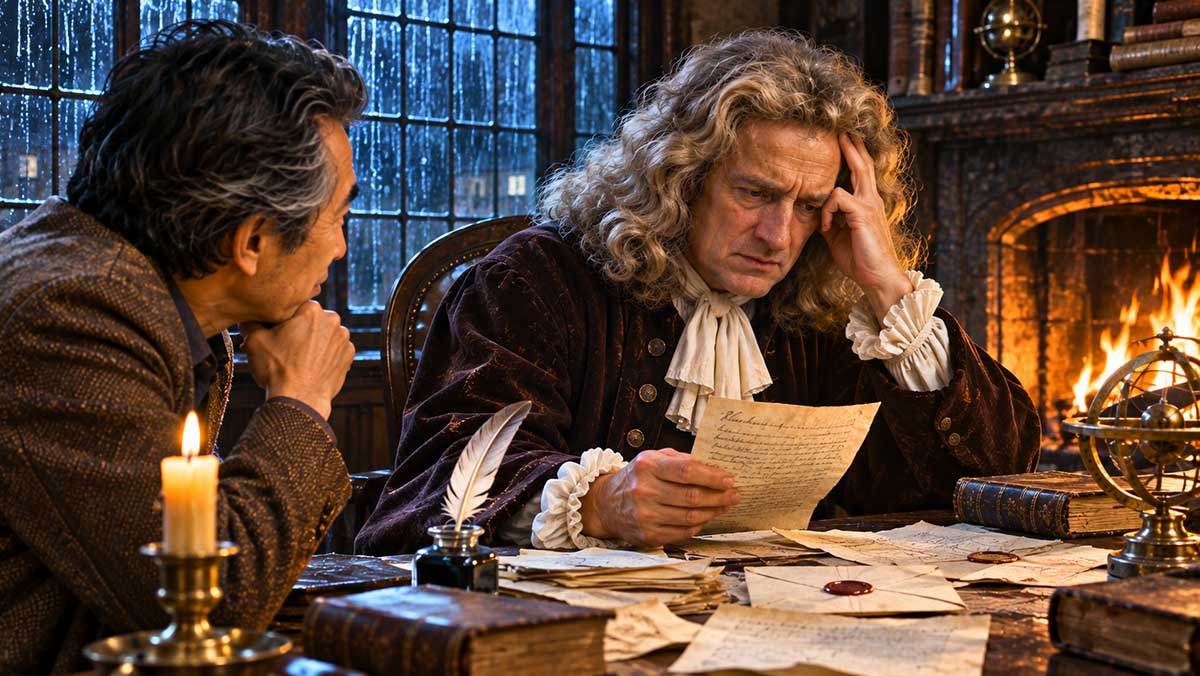
Trinity College, Cambridge, England. A rainy autumn evening.
Rain taps against the leaded windows of a quiet college chamber. A small fire burns in the hearth, illuminating shelves crowded with books, mathematical papers, and bundles of correspondence. The room smells faintly of old leather, ink, and burning wood.
Isaac Newton sits in a high-backed chair beside the fireplace. His silver hair catches the warm candlelight as he examines a letter lying on the table.
Nick Sasaki sits across from him, holding a cup of tea.
The two men have spent the afternoon discussing gravity, light, and the extraordinary mathematical order of the universe. But now Nick's attention has shifted from the stars to the letters scattered across Newton's desk.
One name catches his eye.
Robert Hooke.
Nick Sasaki
Isaac, can I ask you something?
Isaac Newton
I suspect you will, whether I grant permission or not.
Nick
(Laughing) You're getting to know me.
I was looking at these letters, and something occurred to me.
You discovered mathematical laws that helped explain the movements of planets. You could predict how objects behave under forces.
But when it came to other scientists, things didn't always go quite so smoothly, did they?
Newton
Human beings possess an unfortunate habit of refusing to behave according to convenient mathematical principles.
Nick
So people were more difficult than planets?
Newton
Planets do not ordinarily accuse one another of stealing ideas.
Nick
(Laughing) That's a good point.
But seriously, Isaac, I want to understand something about you.
You were one of the greatest minds in history. Why did disagreements with other brilliant people sometimes become so personal?
Question 1 | Why Did Criticism Hurt Newton So Deeply?
Newton
You must distinguish between disagreement and misrepresentation.
A scientist ought to welcome legitimate examination of his work. But when a man believes his conclusions have been misunderstood, or that his contributions have been unfairly represented, he may become less patient than he ought.
Nick
Are you thinking about Robert Hooke?
Newton
Among others.
Hooke was a capable investigator. He contributed to several branches of natural philosophy and possessed considerable ingenuity.
But our exchanges concerning light were not always agreeable.
Nick
You published your work on light, and he challenged it.
Newton
He criticized aspects of my conclusions. Other correspondents raised objections as well.
I believed that my experiments established certain properties of light. When those conclusions were disputed, I felt obliged to defend the reasoning and evidence.
Nick
But you became so frustrated that you withdrew from some public scientific discussions.
Newton
I did grow weary of controversy.
An investigation requires concentration. Endless argument can consume time better spent upon experiments and calculations.
Nick
Can I challenge you a little?
Newton
I have come to expect nothing less.
Nick
Maybe criticism bothered you so much partly because you cared deeply about being right.
Newton
There is nothing dishonorable in caring whether one's conclusions are correct.
Nick
Of course not.
But there's a difference between wanting your ideas to be correct and needing everyone to recognize that you're correct.
Newton studies Nick for a moment.
Newton
You make a distinction worth considering.
A man may begin by defending a proposition and discover that he has become equally concerned with defending his reputation.
Nick
Did that happen to you?
Newton
I should be dishonest if I claimed to have been entirely indifferent to reputation.
Nick
I appreciate that answer.
You know, sometimes when someone criticizes something I've worked hard on, I feel as though they're criticizing me personally.
Newton
Then you understand something of the difficulty.
A scholar may devote years to an investigation. His conclusions become closely associated with his labor, judgment, and intellectual identity.
That does not excuse excessive resentment. But it may help explain why disputes become heated.
Nick
Did you ever regret how you treated Hooke?
Newton
I would hesitate to offer you a convenient confession merely to satisfy the expectations of a modern audience.
Our disagreements were real, and I continued to believe that important questions of evidence and credit were involved.
Yet I can acknowledge that scientific disagreement does not always bring forth the best qualities of those engaged in it.
Nick
That's fair.
I wasn't looking for a perfect apology.
Newton
Then you have spared us both an artificial reconciliation.
Nick
(Laughing) Isaac, you're a difficult man to interview.
Newton
So I have been told.
Question 2 | Did Genius Make Friendship More Difficult?
Nick picks up another letter.
Nick
Let's talk about the people who supported you.
Not everybody was your rival.
Newton
Certainly not.
Nick
Edmond Halley, for example. Without his encouragement, your Principia might not have appeared when it did.
Newton
Halley rendered considerable assistance.
He encouraged me to develop and communicate my mathematical investigations, and he undertook significant efforts to bring the book into publication.
His contribution deserves recognition.
Nick
So you could work closely with people when you trusted them.
Newton
I was never opposed to cooperation as a principle.
My work depended upon the observations, correspondence, and achievements of many others.
Nick
Then why do people often describe you as isolated?
Newton
Because there is some truth in the description, though it can be exaggerated.
I spent long periods working alone. Certain investigations required sustained concentration, and I did not always welcome interruption.
But solitude should not be confused with the complete absence of relationships.
Nick
Did you enjoy being alone?
Newton
Frequently.
There is a particular satisfaction in pursuing a difficult problem without distraction.
Nick
I understand that. Sometimes I need quiet to think.
But after a while, I want to talk to somebody.
Did you ever feel that way?
Newton
At times, certainly. Correspondence could be stimulating, and conversations with capable scholars were valuable.
But I was not always skilled at maintaining agreeable relations.
Nick
Let's talk about Leibniz.
You both developed calculus independently, but the dispute over who discovered it first became bitter.
Newton
The matter of priority was important to me.
I had developed my methods of fluxions years before some of the relevant publications appeared.
Leibniz developed his own differential methods independently and published them earlier.
The controversy concerned chronology, evidence, and the recognition of intellectual achievement.
Nick
But it became more than an academic disagreement.
Newton
Indeed.
Supporters on both sides contributed to its severity. The controversy extended far beyond a simple comparison of mathematical methods.
Nick
And you were president of the Royal Society when it issued a report favoring your priority.
You had substantial involvement in that process.
Newton
That is part of the historical record.
Nick
Looking back, do you think you were too personally involved to judge the matter fairly?
Newton leans back in his chair.
Newton
You have chosen a difficult question.
A man convinced of his own position may believe that his participation serves the truth. Others may reasonably question whether he can remain impartial.
Nick
That's something we still struggle with today.
People often think they're defending truth when they're defending themselves.
Newton
The two interests are not always easily separated.
Nick
What about John Locke? You were friends, weren't you?
Newton
We maintained an important intellectual relationship, though it experienced difficulties.
Locke was a thoughtful philosopher, and our correspondence concerned matters of considerable interest.
Nick
Did you trust him?
Newton
There were periods of confidence and periods of misunderstanding.
Nick
It seems to me that you could understand incredibly complicated mathematical relationships, but human relationships were sometimes harder.
Newton
Mathematical relationships possess an advantage.
Their terms may be defined with precision.
Human beings carry memories, expectations, anxieties, and intentions that are not always visible to one another.
Nick
That's beautifully said.
But do you think you sometimes expected too much from people?
Newton
Possibly.
A man accustomed to demanding rigor in his work may become impatient when others fail to meet his expectations.
Yet friendship is not a geometrical demonstration.
Nick
No, it isn't.
Sometimes a friend just needs you to listen.
Newton
A lesson that may be more difficult to practice than to acknowledge.
The fire crackles softly.
For several moments, neither man speaks.
Question 3 | When Newton Could No Longer Trust His Own Thoughts
Nick
Isaac, there's something more personal I'd like to discuss.
And if you'd rather not, we can leave it alone.
Newton
You may proceed.
Nick
In 1693, you went through a very difficult period.
Your letters suggest that you weren't sleeping properly. You became suspicious of people you had trusted, including Locke and Samuel Pepys.
What happened?
Newton looks toward the fire.
Newton
That period was deeply distressing.
My correspondence from those months reveals confusion and accusations that I later recognized as mistaken.
I had experienced serious disturbances of sleep, and my judgment was affected.
Nick
You wrote to Locke accusing him of things that weren't true.
Newton
I did.
And I later wrote to acknowledge that I had wronged him.
Nick
That must have been painful.
Newton
It was painful to recognize that I had spoken unjustly of someone who had shown me friendship.
Nick
Do you know what caused the crisis?
Newton
I cannot offer a single explanation with confidence.
Illness, exhaustion, sleeplessness, and personal circumstances have all been discussed in connection with that period.
It would be unwise to claim certainty where the evidence does not permit it.
Nick
I respect that.
But can I ask you something as a friend?
Newton
Of course.
Nick
Were you frightened?
Newton remains silent.
Rain continues to fall against the windows.
Newton
There is something deeply unsettling about discovering that one's own judgment may be unreliable.
A man who has spent his life examining evidence and testing conclusions places considerable trust in his capacity to reason.
To find that capacity disturbed is no small matter.
Nick
That sounds terribly lonely.
Newton
I would not wish to describe every moment of that period in one word.
But it was not an experience I should have chosen.
Nick
Who helped you through it?
Newton
The surviving record does not allow every circumstance of my recovery to be reconstructed.
I remained connected to people who knew me, and I eventually resumed my work and public responsibilities.
But I should not invent a comforting account of assistance merely to fill the gaps in the record.
Nick
That's fair.
You know, Isaac, when people hear your name, they think of almost superhuman intelligence.
They imagine someone who always had control of his thoughts.
Newton
Then they imagine a creature that never existed.
Nick
Exactly.
I think there's something meaningful about recognizing that even someone like you could experience a period when life became overwhelming.
Newton
Intellectual ability does not exempt a person from the limitations of human existence.
Nick
Did that experience change you?
Newton
It reminded me that certainty concerning one's own judgment must never be assumed without examination.
Whether it produced a lasting transformation of character is a question others may find easier to answer than I.
Nick
You know what I find interesting?
You spent so much of your life searching for laws that never change.
But human beings change constantly.
Our emotions, our relationships, our beliefs about ourselves.
Newton
Perhaps that is one reason human affairs resist the methods by which we investigate the motions of bodies.
Nick
Do you think there are things about being human that science can never fully explain?
Newton
I should hesitate to declare permanent limits upon future investigation.
But I would distinguish between explaining a phenomenon and comprehending every aspect of its significance.
One may investigate the physical conditions of an experience without thereby answering every question concerning its meaning.
Nick
That's a wonderful distinction.
Newton looks at the letters on the desk.
Newton
There is another matter worth considering.
Nick
What's that?
Newton
A man may be correct about many things and mistaken about something of great importance.
His achievements do not render him incapable of error.
Nick
That's something I think all of us need to hear.
Newton
My own history supplies sufficient evidence.
Nick
(Laughing softly) At least you can joke about it now.
Newton
I find that age occasionally grants a man the ability to regard his former disputes with a little less excitement.
Nick
Only occasionally?
Newton
Let us not exaggerate my progress.
They laugh together.
Outside, the rain begins to ease.
Nick notices several manuscripts lying beneath the correspondence. Their pages contain passages from Scripture, notes about ancient history, and unfamiliar symbols.
Nick
Isaac, I've been looking at these papers.
They're not mathematics, are they?
Newton
Not all of my investigations concerned mathematics.
Nick
Some of these appear to be about the Bible.
And these others look like chemical experiments.
Newton
I devoted considerable attention to both subjects.
Nick
I have to admit, that surprises me.
The man who explained gravity was spending years studying ancient religious texts and alchemy?
Newton
You appear to find that combination peculiar.
Nick
A little.
Newton
Then perhaps our next conversation will be of interest to you.
Nick
I think it will.
But before we finish tonight, may I ask one last question?
Newton
You have developed a habit of asking that.
Nick
(Laughing) I know.
Isaac, after everything we've discussed, do you think being a great scientist made you a better human being?
Newton gazes thoughtfully into the fire.
Newton
Scientific achievement may improve a man's knowledge of nature.
It does not automatically improve his conduct toward others.
For that, he must examine himself with at least as much seriousness as he examines the world.
Nick nods slowly.
Nick
I think that's one of the most meaningful things you've said to me.
Newton
Then I hope I have occasionally succeeded in saying something useful beyond the subject of gravity.
Nick
More than occasionally, Isaac.
The fire settles into glowing embers. Outside the window, the rain has stopped, and the clouds begin to separate.
Nick gathers his notes, but his eyes return to the religious manuscripts.
Nick
Tomorrow, I want to ask you about something I've been wondering since we first met.
Newton
And what might that be?
Nick
You spent your life searching for truth through mathematics and experiments.
But you were deeply religious too.
Were you searching for God through science?
Newton places a hand upon the open manuscript.
Newton
That question, Mr. Sasaki, deserves an evening of its own.
The last drops of rain fall from the window ledge. In the quiet chamber, Newton's mathematical papers lie beside his theological manuscripts, two parts of an intellectual life that history has too often separated.
The next conversation will reveal why the man who helped explain the heavens devoted so much of his life to searching for the divine.
To be continued in Topic 4 | The Scientist Who Searched for God
Topic 4 | The Scientist Who Searched for God
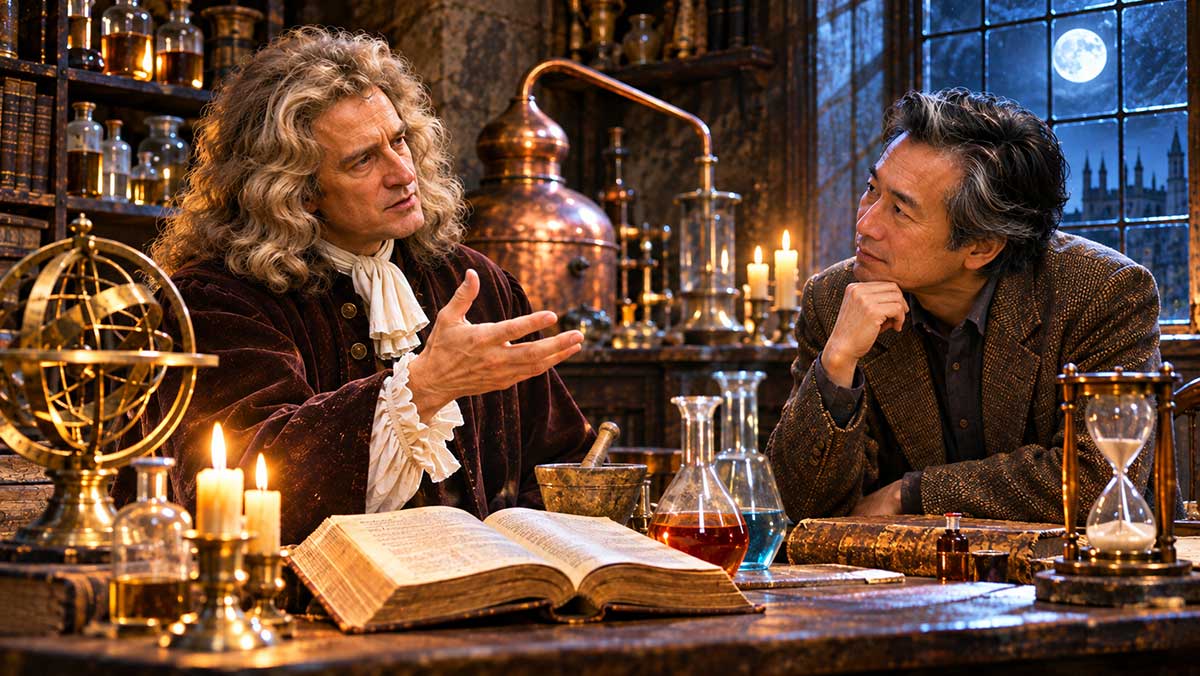
Cambridge, England. A private study and laboratory, late at night.
The rain has passed, leaving the old college buildings wrapped in silence. Beyond the narrow windows, the moon hangs above the rooftops.
Isaac Newton leads Nick Sasaki down a stone corridor and opens a heavy wooden door.
Inside, candlelight illuminates a room unlike any Nick has seen before. Glass vessels stand beside metal crucibles. Shelves hold ancient books, handwritten manuscripts, and chemical substances carefully stored in small containers. On a wooden desk rests an open Bible, its margins crowded with Newton's notes.
A faint metallic scent lingers in the air.
Nick pauses at the doorway.
Nick Sasaki
Isaac, I have to say, this isn't quite what I expected.
Isaac Newton
And what were you expecting, Mr. Sasaki?
Nick
Mathematical equations. Telescopes. Maybe a few apples.
But this looks like something from an ancient alchemist's workshop.
Newton
Then your observation is not entirely mistaken.
Nick
Wait. You really were an alchemist?
Newton
I investigated the properties and transformations of matter through methods and traditions that your age would associate with alchemy.
Nick
That's incredible. The man who helped establish modern physics was studying alchemy.
Newton
You seem to regard the two pursuits as irreconcilable.
Nick
Well, today people often associate alchemy with trying to turn lead into gold.
Newton
And in my century, the study of matter embraced questions and practices that later generations would divide into separate disciplines.
Nick
So you weren't simply trying to become rich?
Newton
(Laughing softly) I assure you, my interests were rather more extensive than acquiring gold.
Nick
Good. For a moment, I thought I'd discovered your secret retirement plan.
Newton smiles and gestures toward a chair beside the desk.
Newton
Come, then. Let us examine what you find so surprising.
Question 1 | Why Did Newton Spend So Much Time Studying Alchemy?
Nick
Isaac, this is what puzzles me.
You had already accomplished things most scientists could only dream of.
Why devote so much of your life to alchemy?
Newton
You must remember that my investigations into matter began long before the world regarded me as a celebrated natural philosopher.
I wished to understand how substances behaved, how they interacted, and what processes might account for their transformations.
Mathematics was an extraordinary instrument of investigation, but I did not suppose that every question concerning nature could be resolved by calculation alone.
Nick
What did you actually do here?
Newton
I examined substances, conducted operations involving heat and chemical reactions, studied the writings of earlier investigators, and recorded observations.
Some of those writings employed obscure language and symbols. Their interpretation demanded patience.
Nick
Did you believe there were hidden secrets in nature?
Newton
I believed there were many processes in nature that remained insufficiently understood.
That is not quite the same as claiming that every obscure tradition contains truth.
Nick
But you must have believed some of those old alchemical writers knew something valuable.
Newton
I considered their writings worthy of investigation. Yet the difficulty lay in distinguishing useful observations from uncertain claims.
One could not assume that an ancient author was correct merely on account of his antiquity.
Nick
Did you ever succeed in turning ordinary metal into gold?
Newton
I cannot present you with a verified success of that kind.
Nick
(Laughing) So no secret mountain of gold hidden beneath Cambridge?
Newton
If such a mountain existed, I suspect the university authorities would have taken a considerable interest in it.
Nick
You know what I find fascinating? People often divide science and mystery into opposite categories.
Science is supposed to explain things. Mystery is supposed to disappear.
But you seemed attracted to both.
Newton
Mystery is often the beginning of investigation.
If everything were already understood, what purpose would inquiry serve?
Nick
Did you ever worry that some of your alchemical ideas might be wrong?
Newton
Certainly. A hypothesis may be attractive and still prove false.
I was not immune to error, nor should my scientific achievements be used to establish the correctness of every speculation I entertained.
Nick
That's an interesting admission.
Newton
It ought not to be remarkable. The authority of a man is no substitute for evidence.
Nick
Then why do you think people today find your alchemical work so surprising?
Newton
Perhaps they imagine that the intellectual boundaries of their own century must have existed in mine.
But knowledge does not arrive already divided into the categories future generations will assign to it.
Nick studies the crucibles, then notices the open Bible.
Nick
Isaac, I think I'm beginning to see something.
You weren't just interested in how objects moved.
You wanted to know what matter was, how nature worked, and perhaps why it existed at all.
Newton
Those are questions worthy of serious attention.
Nick
And that brings me to something even more surprising.
You spent an enormous amount of time studying religion.
Newton
Indeed.
Nick
Possibly more than most people realize.
Newton
Then perhaps most people have been reading an incomplete account of my life.
Question 2 | Why Did Newton Reject the Trinity?
Nick moves closer to the desk and looks at the handwritten notes surrounding the open Bible.
Nick
Isaac, I grew up thinking of you primarily as a scientist.
I didn't realize how deeply you studied Christianity.
Newton
My religious investigations occupied many years.
I examined Scripture, biblical prophecy, ancient chronology, and the history of Christian doctrine.
I regarded these matters with great seriousness.
Nick
Did you believe in God?
Newton
Certainly.
I believed in one supreme God, the Creator and Governor of all things.
The order of nature gave me reason to consider divine wisdom, though my religious convictions were not derived from natural philosophy alone.
Nick
And you believed in Jesus Christ?
Newton
Yes. I regarded Christ as central to the divine purposes revealed in Scripture.
Nick
But here's what surprised me.
You came to reject the traditional doctrine of the Trinity.
Newton
I came to believe that certain doctrines accepted by established churches did not faithfully represent the earliest Christian teachings.
Nick
What led you to that conclusion?
Newton
I studied the biblical texts and their transmission through history.
I examined how theological controversies developed and how particular interpretations gained authority.
I became concerned that some formulations of doctrine had departed from what I understood to be the original faith.
Nick
So you believed the Church had changed some important teachings?
Newton
I believed that corruption had entered Christian doctrine over time.
My investigations led me to question the identification of the Son with the supreme God in the manner taught by orthodox Trinitarian theology.
Nick
Can I ask you a direct question?
Newton
Of course.
Nick
Did you believe Jesus was God?
Newton folds his hands thoughtfully.
Newton
The answer depends upon what one means by that expression.
I distinguished the supreme God, the Father, from the Son, whom I understood to possess an exalted and divinely appointed role.
I did not accept the orthodox claim that Father, Son, and Holy Spirit are three coequal persons in one divine essence.
Nick
So you believed Jesus had a unique relationship with God, but you didn't believe he was equal to God the Father in the traditional Trinitarian sense?
Newton
That is a reasonable summary of an important distinction in my theology.
Yet I should caution you that my religious manuscripts contain extensive arguments that cannot be reduced to a single sentence.
Nick
Of course.
What interests me is how you reached your conclusion.
You were willing to question something that many Christians considered fundamental.
Newton
I believed that truth should not be determined solely by the authority of established opinion.
But religious inquiry required care. The consequences of publicly rejecting accepted doctrine could be serious.
Nick
Were you afraid people would discover your beliefs?
Newton
I was certainly cautious about making some of my theological conclusions public.
My position at Cambridge and the religious expectations of my time made such questions consequential.
Nick
That must have been difficult.
You were celebrated for questioning accepted ideas about nature, but questioning accepted religious doctrine could threaten your position.
Newton
The freedom granted to inquiry has not always been distributed equally across different subjects.
Nick
Did you ever feel torn between loyalty to the Church and loyalty to what you believed Scripture taught?
Newton
I regarded fidelity to divine truth as a grave obligation.
But one must distinguish the visible institutions of religion from the truth those institutions claim to preserve.
Nick
That's a powerful distinction.
Can I ask something more personal?
Newton
You may.
Nick
Did your religious studies bring you peace?
Newton glances at the Bible.
Newton
They brought intellectual satisfaction at times, and serious difficulty at others.
The investigation of sacred history is not always a tranquil occupation.
One encounters disputed texts, conflicting interpretations, and questions whose answers are not immediately apparent.
Nick
So even in religion, you were searching, questioning, and sometimes struggling.
Newton
I should have considered it irresponsible to abandon careful examination merely on account of the subject's sacred character.
Nick
Did you ever doubt your own conclusions?
Newton
A responsible investigator must remain attentive to the possibility of error.
Conviction does not eliminate the obligation to examine evidence.
Nick
You know, Isaac, I find something deeply human about that.
People sometimes think faith means never asking questions.
But your faith led you to ask some very difficult ones.
Newton
Questions may arise from disbelief, but they may arise equally from a serious desire to understand what one believes.
The candle beside the Bible flickers.
For a moment, both men sit quietly.
Question 3 | Did Newton See God in the Universe?
Nick
Isaac, let me ask you something I've been thinking about since our conversation about gravity.
When you looked at the stars, did you see mathematical laws or the work of God?
Newton
I did not regard those as necessarily competing explanations.
Mathematical principles describe the motions and relationships of natural bodies.
Questions concerning the ultimate origin and governance of the world belong to a broader inquiry.
Nick
So science explained how things moved, but religion helped you think about why the universe existed?
Newton
That distinction may be useful, provided it is not made too rigid.
Natural philosophy can investigate causes within nature, and theology addresses matters concerning God.
The questions sometimes intersect.
Nick
Did you believe God created the laws of nature?
Newton
I believed that the universe depended upon an intelligent and powerful Creator.
The remarkable order of the planetary system was, to my mind, consistent with divine wisdom and governance.
Nick
But if God created the universe, why would he make it so complicated?
Newton smiles.
Newton
Perhaps you should direct that question to its Creator.
Nick
(Laughing) I was hoping you might have a slightly easier answer.
Newton
I fear I am not authorized to explain every divine intention.
Nick
Fair enough.
But here's something that puzzles me.
You could describe gravity mathematically. Yet you couldn't explain its ultimate physical cause.
Did that ever make you uncomfortable?
Newton
It left an important question unresolved.
But there is no dishonor in recognizing that a mathematical description does not settle every question concerning the nature of a phenomenon.
Nick
Some people might say that if you don't know the cause, your explanation is incomplete.
Newton
In one sense, it is incomplete.
Yet an incomplete explanation may still possess great value if it accurately describes phenomena and allows reliable predictions.
One should neither reject established results merely on account of remaining mysteries nor pretend that those mysteries have been resolved.
Nick
I love that.
You were willing to live with unanswered questions.
Newton
I was obliged to do so. The alternative would have been to invent answers unsupported by evidence.
Nick
Did you ever feel that science might eventually explain everything?
Newton
I would hesitate to make such a prediction.
The extent of nature is vast, and the capacities of human investigation, however considerable, are limited.
Nick
Then what was the purpose of searching?
If we can never know everything, why spend our lives trying?
Newton looks toward the moonlit window.
Newton
Must a pursuit be capable of completion before it possesses value?
Nick
I suppose not.
Newton
Consider a man who studies the heavens.
He may discover principles that explain motions previously misunderstood. Those discoveries may benefit generations he will never meet.
Yet many questions will remain.
Does the existence of those unanswered questions diminish what he has learned?
Nick
No. I think it makes the discoveries even more remarkable.
Newton
Then perhaps the worth of inquiry lies not in possessing all truth, but in advancing our knowledge of it.
Nick
That's beautiful.
Can I ask you one more question about God?
Newton
I had anticipated at least one more.
Nick
(Laughing) You know me too well.
When you prayed, did you pray as a scientist trying to understand the Creator?
Or as an ordinary human being who needed help?
Newton's expression grows thoughtful.
Newton
I should not wish to pretend that the private experiences of devotion can be fully reconstructed from the manuscripts I left behind.
But I regarded human beings as dependent upon God.
Whatever intellectual abilities a person may possess, they do not remove that dependence.
Nick
So being a great scientist didn't make you feel that you had outgrown the need for God?
Newton
Certainly not.
To investigate creation was not, in my understanding, to become its Creator.
Nick
You know, Isaac, there's something I admire about that.
You accomplished extraordinary things, but you still recognized limits to what you could know and control.
Newton
Recognition of one's limits is not necessarily the same as humility in every part of life.
You have already heard enough of my disputes to know that I was not always a model of modest conduct.
Nick
(Laughing) That's true.
You don't make it easy for me to turn you into a saint.
Newton
I should consider that a service.
Nick
Then perhaps the most interesting thing about you is that you were never just one thing.
You were a scientist, a mathematician, a religious thinker, an investigator of alchemy, and a man who sometimes struggled with other people.
Newton
Human lives seldom conform to the tidy classifications later generations construct for them.
Nick
I think that's something we forget when we study history.
We take a complicated person and reduce him to one famous achievement.
Newton
It is convenient, perhaps. But convenience is not always faithful to the truth.
The room grows quiet.
Nick looks once more at the Bible, the chemical vessels, and the mathematical papers.
Nick
Isaac, I came here thinking that your greatest achievement was discovering laws that helped explain the universe.
But now I'm wondering whether your greatest passion was something even larger.
You wanted to discover truth, wherever it might be found.
Newton
That is an ambition I should be willing to acknowledge.
Though I would add that the search for truth requires more than enthusiasm.
It requires patience, careful judgment, and a willingness to recognize error.
Nick
And perhaps courage?
Newton
At times, certainly.
Nick
Especially when the truth you believe you've found disagrees with what everyone else believes.
Newton
One must possess courage enough to question accepted opinions, but caution enough not to mistake every private conviction for established truth.
Nick
That's a wonderful balance.
Newton closes the Bible gently.
Outside, the moon shines above the dark roofs of Cambridge.
Nick
Isaac, we've talked about your childhood, your discoveries, your conflicts, and your faith.
But there's one thing we haven't really discussed.
Newton
And what is that?
Nick
Your later life.
You became one of the most respected men in England. You worked at the Royal Mint, became president of the Royal Society, and received a knighthood.
You achieved more than almost anyone could imagine.
But I keep wondering whether all that success made you happy.
Newton rests his hands upon the closed Bible.
Newton
You have saved a difficult question for our final conversation.
Nick
I thought you might appreciate that.
Newton
I appreciate your persistence, if not always the ease of your inquiries.
Nick
(Laughing) I'll take that as a compliment.
Newton
You may.
Nick rises and looks around the room one last time.
Nick
Thank you for showing me this side of your life, Isaac.
I think many people would be surprised to discover how deeply you searched for God.
Newton
Then perhaps they will recognize that a man's public reputation seldom contains the whole of his intellectual life.
Nick
And maybe that the greatest mysteries aren't always the ones we can solve with equations.
Newton
Some questions demand different kinds of investigation.
But whatever the question, Mr. Sasaki, I hope we shall never lose the desire to seek what is true.
The candles burn low as the two men leave the laboratory. Behind them remain the instruments of Newton's investigations: prisms, crucibles, manuscripts, and an open space on the desk where the Bible had rested.
Outside, the stars shine over Cambridge, just as they had throughout Newton's life.
He has spent decades searching for the principles governing nature and the truths he believed Scripture preserved. Yet one question remains, one no mathematical demonstration or theological manuscript can answer for him.
After everything he accomplished, did Isaac Newton find the life he had hoped to live?
To be continued in Topic 5 | What the Greatest Mind Could Never Know
Topic 5 | What the Greatest Mind Could Never Know
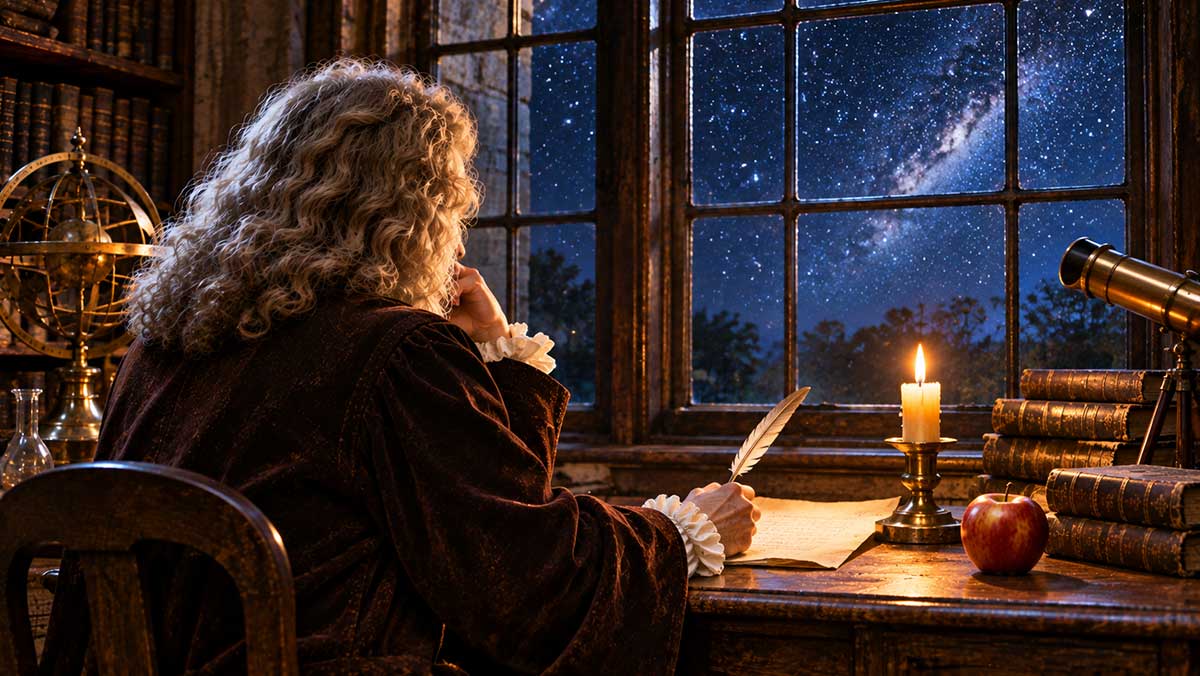
London, England. An imagined evening in Isaac Newton's later years.
The last light of sunset falls across the rooftops of London. Beyond a tall window, the Thames glimmers beneath a fading orange sky, and the first stars begin to appear.
Inside a quiet drawing room, a fire burns gently in the hearth. Shelves of books line the walls, and a small globe stands beside a telescope near the window. On a polished wooden table rests a copy of Philosophiæ Naturalis Principia Mathematica, its pages worn from years of study.
Isaac Newton, now an elderly man with long silver hair, sits comfortably in a high-backed chair. His walking stick rests beside him.
Nick Sasaki pours two cups of tea and takes a seat across from him.
For several moments, neither man speaks.
Nick Sasaki
Isaac, we've spent quite a bit of time together now.
Isaac Newton
Indeed, Mr. Sasaki. You have subjected me to a remarkable number of questions.
Nick
(Laughing) And you've managed to avoid answering a few of them.
Newton
A useful skill, particularly when the questions exceed the available evidence.
Nick
You know, when we first met beneath that apple tree at Woolsthorpe, I thought I was going to meet the greatest scientist in history.
But now I feel as though I've met several different Isaac Newtons.
The lonely little boy. The curious student. The brilliant mathematician. The man who struggled with criticism. The religious thinker searching for God.
Newton
I hope they have not proved too disagreeable a company.
Nick
Not at all. Actually, I like you more now.
Newton
Then your judgment may have deteriorated during our acquaintance.
Nick
(Laughing) That's possible.
But tonight, I'd like to ask about something we haven't discussed very much.
After all your discoveries, after the arguments, the years of work, and the search for truth, what did your success actually mean to you?
Question 1 | Did Success Give Newton What He Wanted?
Nick
Isaac, you began life in a small village in Lincolnshire.
Your father died before you were born. Your mother wanted you to become a farmer.
And yet you became one of the most respected men in England.
You served at the Royal Mint, became president of the Royal Society, and were knighted by Queen Anne.
That's an extraordinary transformation.
Newton
It was certainly a considerable change in circumstances.
Nick
Did you ever stop and think, "I've made it"?
Newton
(Laughing softly) I do not believe I would have expressed the matter quite that way.
Nick
But you must have felt proud.
Newton
I took satisfaction in work that I believed had been accomplished well.
The publication of the Principia was a significant undertaking. My responsibilities at the Mint demanded a different kind of diligence, but I regarded them seriously.
Nick
Tell me about the Mint.
I still find it amusing that the man who studied the movements of planets ended up chasing counterfeiters.
Newton
Counterfeiting was not an amusing matter to those whose livelihoods depended upon the integrity of the currency.
Nick
Of course. But it seems like such an unexpected career.
Newton
The work required investigation, attention to evidence, and the examination of complicated practices.
In those respects, it was not entirely foreign to my earlier occupations.
Nick
So you approached counterfeiters the way you approached a scientific problem?
Newton
There were similarities in the need for careful inquiry, though the consequences for the individuals involved were considerably more serious.
Nick
Did you enjoy having authority?
Newton
I valued the opportunity to carry out responsibilities effectively.
But authority carries obligations. It is not merely a reward bestowed upon the person who possesses it.
Nick
And what about being knighted?
Did that make you happy?
Newton
It was a distinction conferred upon me, and I recognized its significance.
But I would hesitate to describe the whole condition of a man's happiness through a single public honor.
Nick
That's what I wanted to ask.
You achieved fame, influence, financial security, and respect.
Did those things give you peace?
Newton looks toward the fire.
Newton
Peace is a difficult condition to measure.
Public recognition may provide satisfaction. It may remove certain practical difficulties.
But it does not necessarily resolve every private concern.
Nick
So success doesn't automatically make someone happy?
Newton
I should think that evident from the experience of many successful people.
Nick
(Laughing) You're right.
But people still keep believing it.
They think, "Once I become wealthy, once I'm respected, once I accomplish something important, then I'll finally be satisfied."
Newton
Achievement may fulfill a particular ambition.
Yet the human mind is capable of forming new ambitions almost immediately.
Nick
Did that happen to you?
Newton
My interests continued beyond any single accomplishment.
The completion of one investigation did not extinguish my desire to pursue others.
Nick
Was that exciting or exhausting?
Newton
Both descriptions might apply at different times.
Nick
You know, Isaac, I sometimes wonder whether ambitious people ever allow themselves to enjoy what they've accomplished.
Newton
That is a question worth considering.
A man who continually attends to what remains unfinished may fail to appreciate what has already been achieved.
Nick
Did you ever do that?
Newton
I cannot claim to have been free of such tendencies.
Nick smiles.
Nick
I think that's the closest you've come to admitting you might have needed a vacation.
Newton
Perhaps. Though I suspect I should have brought several books and ruined the purpose of the excursion.
They laugh.
Question 2 | Would Newton Have Lived Differently?
The room grows quieter as the evening deepens.
Nick sets down his tea.
Nick
Isaac, can I ask you something personal?
Newton
You have shown little reluctance to do so.
Nick
(Laughing softly) That's true.
You've spent much of your life working alone.
You never married, and although you had friendships, some of your relationships were difficult.
Do you ever wonder whether you missed something?
Newton considers the question.
Newton
Every life involves choices, circumstances, and opportunities that cannot all be pursued.
A man devoted to one occupation may have less time for others.
But I should caution you against assuming that a life without marriage must necessarily have been an unhappy one.
Nick
You're right.
I don't want to make that assumption.
I'm asking whether there were experiences you wished you'd had more of.
Friendship, family, ordinary pleasures.
Newton
There were people whose company and assistance I valued.
I was not entirely separated from human society.
Yet I recognize that much of my life was devoted to study and work.
Nick
Did you ever feel lonely?
Newton
There is a distinction between solitude and loneliness.
One may seek solitude willingly and find it productive.
Loneliness suggests an absence one does not desire.
I cannot honestly tell you that every solitary hour was pleasant, nor that every hour spent alone was a source of suffering.
Nick
That's fair.
I suppose we sometimes look at another person's life and judge it according to what would make us happy.
Newton
Precisely.
Nick
But what about your disagreements with other people?
Hooke. Leibniz. The difficulties with Locke.
If you could go back, would you handle those relationships differently?
Newton rests his hands upon the arms of his chair.
Newton
I would not pretend that every dispute in which I participated was conducted with perfect judgment.
I believed strongly in the importance of truth and proper recognition.
Yet conviction may sometimes become entangled with personal resentment.
Nick
Do you think you hurt people?
Newton
It would be unreasonable to suppose that my conduct never caused distress.
The question is whether I always recognized it when it occurred.
Nick
That's a difficult thing for any of us.
Sometimes we're so focused on proving we're right that we don't notice what we're doing to the relationship.
Newton
Indeed.
Nick
Isaac, you know what strikes me?
You spent years studying forces.
You could describe how one object affects another.
But people affect each other in ways that are much harder to calculate.
A kind word can change someone's life. So can a cruel one.
Newton nods thoughtfully.
Newton
Human influence is not so readily expressed through equations.
Nick
And sometimes we don't realize the effect we've had until years later.
Newton
That is certainly possible.
Nick
If you could speak to your younger self, what would you tell him?
Newton
I might advise him to preserve his curiosity and attend carefully to evidence.
Nick
That's the scientist speaking.
What would the older Isaac tell the younger Isaac about people?
Newton smiles faintly.
Newton
Perhaps that winning an argument and reaching an understanding are not always the same achievement.
Nick becomes quiet.
Nick
I like that very much.
Newton
Then I hope you will not insist upon winning every argument we have.
Nick
(Laughing) Isaac, I don't think I've won a single one.
Newton
You have occasionally persuaded me to reconsider the question.
Nick
I'll take that as progress.
A clock ticks softly on the mantelpiece.
Nick
Can I tell you something?
Newton
Of course.
Nick
When I was younger, I thought wisdom meant knowing more than other people.
But as I get older, I'm beginning to think wisdom has something to do with kindness, patience, and knowing what really matters.
Newton
Knowledge and wisdom are related, but they are not identical.
A man may possess considerable learning and still exercise poor judgment in his conduct.
Nick
Do you think you became wiser as you grew older?
Newton
I should hope that experience corrected at least some of my errors.
But age alone does not guarantee wisdom.
Nick
That's true.
I've met some very foolish older people.
Newton
(Laughing) As have I.
Question 3 | What Remains the Greatest Mystery of All?
Outside, the last traces of daylight disappear.
The stars become brighter above the London rooftops.
Nick rises and walks toward the window. Newton joins him, leaning lightly upon his walking stick.
For a moment, they look up at the night sky.
Nick
Isaac, I want to ask you the question I've been saving since we first met.
Newton
Then I trust it has benefited from the delay.
Nick
(Laughing) I hope so.
You spent your life searching for answers.
You helped explain motion and gravity. You investigated light, mathematics, matter, ancient history, and religion.
But after all those years, what remains the greatest mystery to you?
Newton looks toward the stars.
Newton
There are many questions that remain beyond my knowledge.
The ultimate cause of gravitation, the deeper constitution of matter, and the full extent of the natural world are among them.
And beyond those stand questions concerning the Creator and the purposes of existence.
Nick
Which one troubles you most?
Newton
I am not certain that every unanswered question should be described as troubling.
Some invite investigation. Others inspire wonder.
Nick
Do you believe humanity will eventually discover everything?
Newton
I see no sufficient reason to suppose that human inquiry will ever exhaust the whole of truth.
Our knowledge may increase greatly, yet the field of what remains unknown may still extend far beyond it.
Nick
Does that make you feel small?
Newton
It reminds me of the limits of human understanding.
But smallness need not imply insignificance.
Nick
What do you mean?
Newton
Consider the Earth beneath us.
It occupies but a portion of the heavens.
Yet human beings, living upon this world, have acquired the capacity to investigate celestial motions and discover mathematical relationships extending across enormous distances.
That is no trivial accomplishment.
Nick
So we're small, but we're capable of extraordinary things.
Newton
We possess remarkable faculties, though they are finite.
Nick
Isaac, there's a saying often attributed to you about being like a boy playing on the seashore, finding a smoother pebble or prettier shell, with the great ocean of truth still undiscovered.
Did you really say that?
Newton
That image was reported by others as a recollection of my words. You should treat it with the caution appropriate to a saying preserved through another person's account.
But the thought is one I can appreciate.
Nick
I love the image.
After everything you discovered, the ocean was still there.
Newton
Indeed.
Nick
You know, I think that's why your story moves me.
You achieved things almost beyond imagination.
But you remained human.
You experienced childhood difficulties, disagreements, uncertainty, and moments when your own judgment failed you.
And still you kept searching.
Newton
I pursued questions that seemed worthy of investigation.
I cannot claim that every part of my life was governed by equal wisdom.
Nick
Maybe that's what makes your story meaningful.
Not that you were perfect.
But that your discoveries were extraordinary, and your humanity remained real.
Newton turns toward Nick.
Newton
I should prefer to be remembered for work that proved useful rather than for an imagined perfection of character.
Nick
I think that's a reasonable request.
But I hope people remember more than your equations.
I hope they remember the boy who nearly became a farmer, the man who searched for God, and the scientist who knew there were questions he couldn't answer.
Newton
Then perhaps they will remember a life rather than merely a reputation.
Nick
Exactly.
Nick looks once more toward the stars.
Nick
Isaac, one final question.
Newton
I believe you have made that declaration several times this evening.
Nick
(Laughing) This time I really mean it.
If you could live your life again, knowing everything you know now, would you still choose to spend it searching for truth?
Newton considers the question for a long moment.
Newton
I cannot know what life I might have chosen under circumstances that never existed.
But the desire to understand nature has been among the most enduring interests of my existence.
I should find it difficult to imagine myself entirely without it.
Nick
So you would still ask questions.
Newton
Most certainly.
Nick
Even knowing that many of them might never be answered?
Newton
The possibility of an unanswered question is hardly sufficient reason to abandon inquiry.
Nick
I think that's a wonderful way to live.
Newton smiles.
Newton
Then I hope you will continue asking your own questions, Mr. Sasaki.
Nick
I intend to.
Though after spending time with you, I suspect my questions are going to become more difficult.
Newton
That may be a sign of improvement.
They laugh.
The clock strikes softly in the adjoining room.
Nick returns to the table and picks up his coat.
Nick
Isaac, thank you.
I came here hoping to understand the man who changed science.
But I think I've learned something about being human too.
Newton
And what might that be?
Nick
That we don't have to know everything to live a meaningful life.
That being brilliant doesn't mean we never make mistakes.
And that perhaps the most interesting people are the ones who never stop being curious.
Newton
Those are thoughtful conclusions.
I should only caution you against treating them as universal laws merely on account of our conversation.
Nick
(Laughing) You really are Isaac Newton.
Newton
I have been informed of that before.
Nick extends his hand.
Newton takes it warmly.
Nick
Good night, Isaac.
Newton
Good night, Mr. Sasaki.
And should you encounter another falling apple, I trust you will give the matter proper consideration.
Nick
I promise.
But first, I might just eat it.
Newton
A perfectly reasonable experiment.
They laugh one last time.
Nick walks toward the door, then pauses.
Nick
Isaac?
Newton
Yes?
Nick
I'm glad your mother didn't make you stay on the farm.
Newton looks toward the night sky.
Newton
I confess that I am rather pleased with the outcome myself.
Nick steps into the quiet London night.
Behind him, Newton returns to the window. The stars shine above the city, their motions continuing according to principles that his work helped humanity comprehend.
For a moment, he stands silently, watching.
Then he turns toward his desk, where an unfinished page lies beside a candle.
There is still a question waiting.
And Isaac Newton, even after a lifetime of discovery, is not quite finished asking.
End of the Imaginary Interview
This conversation is a fictional reconstruction inspired by Isaac Newton's documented life, scientific achievements, religious writings, and historical relationships. The dialogue, personal reflections, and private scenes are imagined for literary purposes and should not be interpreted as authentic quotations or verified accounts of Newton's inner thoughts.
Final Thoughts by Nick Sasaki
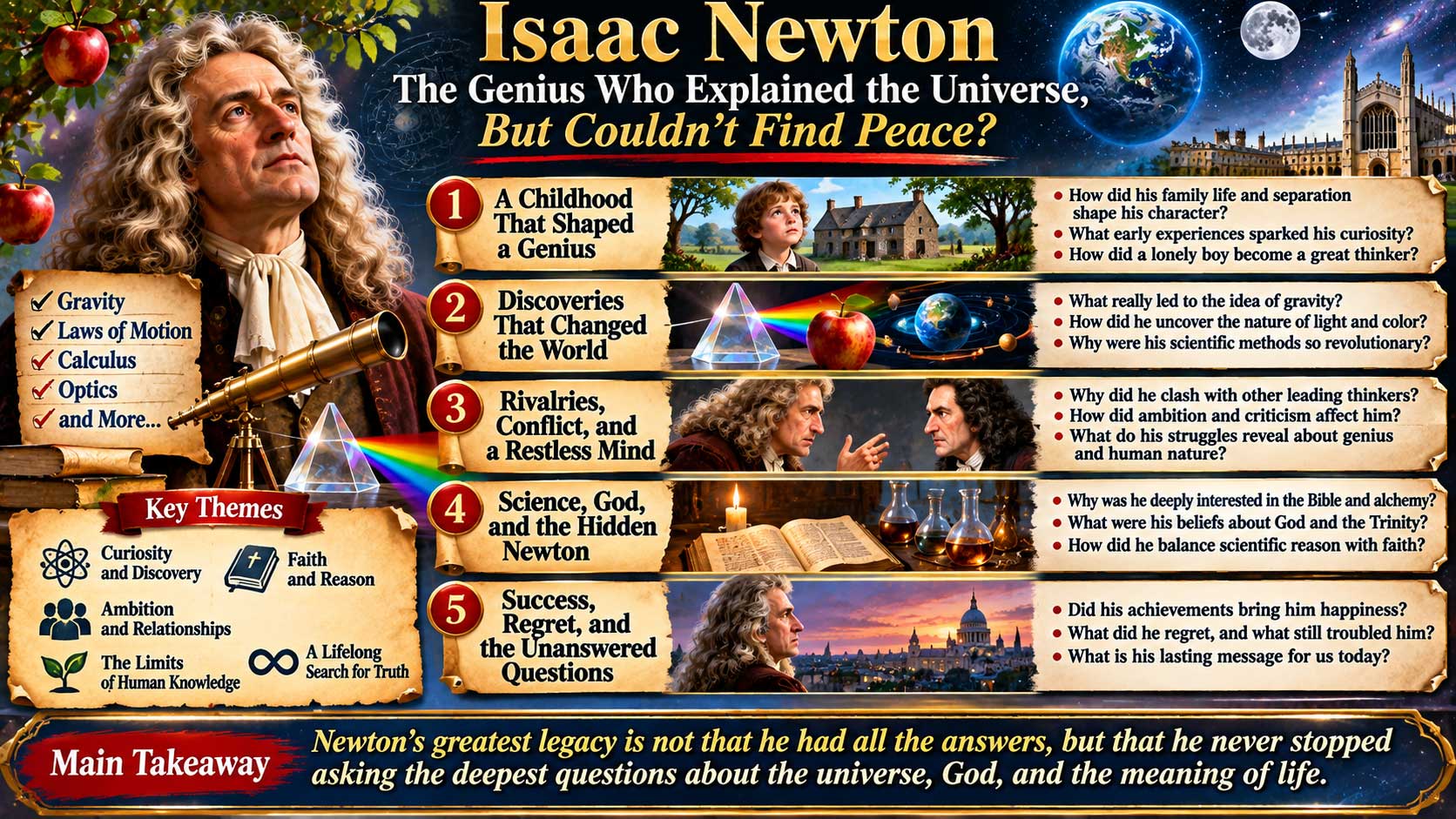
When I first imagined sitting beneath an apple tree with Isaac Newton, I thought our conversation would teach me something about genius. I wanted to know how one person could look at an ordinary falling apple and begin investigating a principle that connects Earth to the Moon and planets. I wanted to understand the extraordinary concentration that allowed him to develop mathematical methods and uncover the properties of light. But after spending time with the Newton of our imaginary conversation, I found myself thinking less about his intelligence and more about his humanity. His achievements were remarkable, yet the questions that stayed with me concerned childhood, friendship, faith, regret, and the difficulty of knowing ourselves.
One of the most moving parts of our conversation was returning to Woolsthorpe Manor, where Newton spent his early years. His father died before he was born, and his mother's remarriage led to a lengthy separation. We cannot know exactly how those experiences shaped his inner life, and I would never want to reduce his genius to a childhood wound. Still, imagining him as a little boy changed the way I thought about his accomplishments. Before he became a celebrated scientist, he was a child living through circumstances he had not chosen. That reminded me how easily we overlook the ordinary human beginnings of extraordinary people. Every famous name belongs to someone who once needed guidance, encouragement, and opportunities to discover what mattered to them.
I was equally struck by Newton's complicated relationships with other scholars. He possessed astonishing intellectual abilities, yet disagreements over scientific ideas and recognition sometimes became bitter personal conflicts. His disputes with Robert Hooke and Gottfried Wilhelm Leibniz remind me that being correct about an idea does not automatically make us wise in the way we treat people. The Stanford Encyclopedia of Philosophy's discussion of Newton's intellectual life places these controversies within the scientific and philosophical debates of his era. For me, the lesson is personal. I have sometimes cared too much about defending my own position when listening more carefully might have led to a better conversation. Knowledge can help us explain the world, but patience and kindness shape how we live together.
Newton's religious life gave me another reason to reconsider what I thought I knew about him. I had always associated his name with mathematical laws, experiments, and scientific reasoning. Yet his private writings reveal an intense commitment to theological investigation. He questioned the Trinity, studied biblical prophecy, and searched ancient texts for what he believed to be authentic Christian teachings. The Newton Project's introduction to his surviving manuscripts shows the remarkable extent of those investigations. I find this fascinating, especially as someone interested in the relationship between faith and reason. I do not think we need to agree with all of Newton's conclusions to appreciate the seriousness of his search. His life invites us to ask whether our beliefs are grounded in careful reflection or simply inherited without examination.
Perhaps the deepest lesson came from Newton's willingness to distinguish what he could demonstrate from what remained uncertain. His gravitational theory described the behavior of attraction with extraordinary mathematical success, yet it did not establish gravity's ultimate physical cause. That distinction matters far beyond science. I often notice how quickly people, including myself, want definitive answers about complicated questions. We want certainty about success, happiness, relationships, religion, and the meaning of life. Newton's scientific work reminds me that a valuable discovery need not answer every possible question. Sometimes progress begins when we admit that our knowledge is incomplete and continue investigating without pretending otherwise.
Our final conversation, set beside a London window overlooking the night sky, affected me in a different way. Newton became wealthy, influential, and widely respected. He held important public offices and received extraordinary recognition for his accomplishments. Yet I kept returning to a simple question: Did all that success give him the life he wanted? History cannot tell us exactly how he would have answered. But the question made me reflect on my own priorities. I believe achievement matters. Creating something useful, helping others, and pursuing meaningful goals can bring enormous satisfaction. Yet I would not want to reach the end of my life having accomplished everything I set out to do while neglecting the people I love or the simple experiences that make life beautiful.
I think that is why I feel unexpectedly close to Newton after this imaginary meeting. I admire his intellect, but I am more interested in the person who lived with its gifts and limitations. His story reminds me to remain curious without becoming arrogant, ambitious without forgetting kindness, and committed to truth without assuming I already possess it. The Royal Society's historical record of Newton's life and career preserves the public achievements that made him famous. Yet his surviving letters and manuscripts invite us to consider the more complicated human life behind those accomplishments. I hope readers leave our conversation with admiration for his discoveries and compassion for the man himself.
As I imagine saying goodbye to Newton, I picture him returning to his desk after our conversation, looking at an unfinished page and considering another question. That image is fictional, but it expresses something I find deeply meaningful about his legacy. We may never understand everything about the universe, God, or ourselves. Yet we can continue learning, treating others with greater care, and appreciating the mystery of being alive. What do you think mattered most in Newton's life: his extraordinary discoveries, his relentless curiosity, or his search for ultimate truth? And if you could sit with Isaac Newton for one evening, what would you ask him about science, faith, happiness, or the mysteries he never solved? I would genuinely love to hear your thoughts in the comments.
Fictional reflection disclaimer: These Final Thoughts are Nick Sasaki's imagined reflections on a fictional interview with Isaac Newton. They are not a record of an actual meeting. Historical details are based on scholarly sources, but the dialogue, personal responses, and imagined scenes are literary creations.
Short Bios:
Isaac Newton (1642–1727)
Sir Isaac Newton was an English mathematician, natural philosopher, and one of the most influential figures in the history of science. His discoveries in mathematics, optics, and mechanics transformed humanity's knowledge of the physical universe. His 1687 work, Philosophiæ Naturalis Principia Mathematica, established his three laws of motion and developed the mathematical theory of universal gravitation. Newton independently developed methods of calculus, alongside the separate contributions of Gottfried Wilhelm Leibniz. Beyond science, he devoted extensive attention to alchemy, biblical studies, theology, and ancient chronology. He served as Master of the Royal Mint and president of the Royal Society and was knighted in 1705. His private religious writings reveal beliefs that differed significantly from orthodox Trinitarian Christianity. Newton died in 1727 and was buried in Westminster Abbey.
Learn more: Stanford Encyclopedia of Philosophy, Isaac Newton | The Newton Project | Royal Society Historical Record
Nick Sasaki
Nick Sasaki is the creator of ImaginaryTalks.com, a creative platform that brings historical figures, philosophers, scientists, writers, and influential thinkers into fictional conversations. Through imaginative interviews grounded in historical research, he explores the ideas, struggles, and personal experiences that shaped remarkable lives. His conversations seek to connect intellectual discovery with human emotions, encouraging readers to reflect on compassion, curiosity, faith, and the meaning of life.
In this imaginary interview with Isaac Newton, Nick moves beyond the familiar stories of gravity and scientific genius to explore the human being behind the discoveries, from childhood experiences and difficult relationships to spiritual convictions and the enduring search for truth.
Explore more: ImaginaryTalks.com
Leave a Reply