
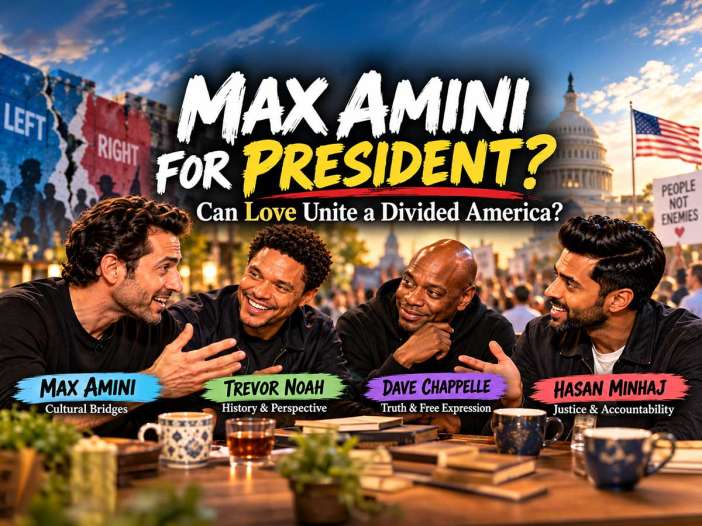
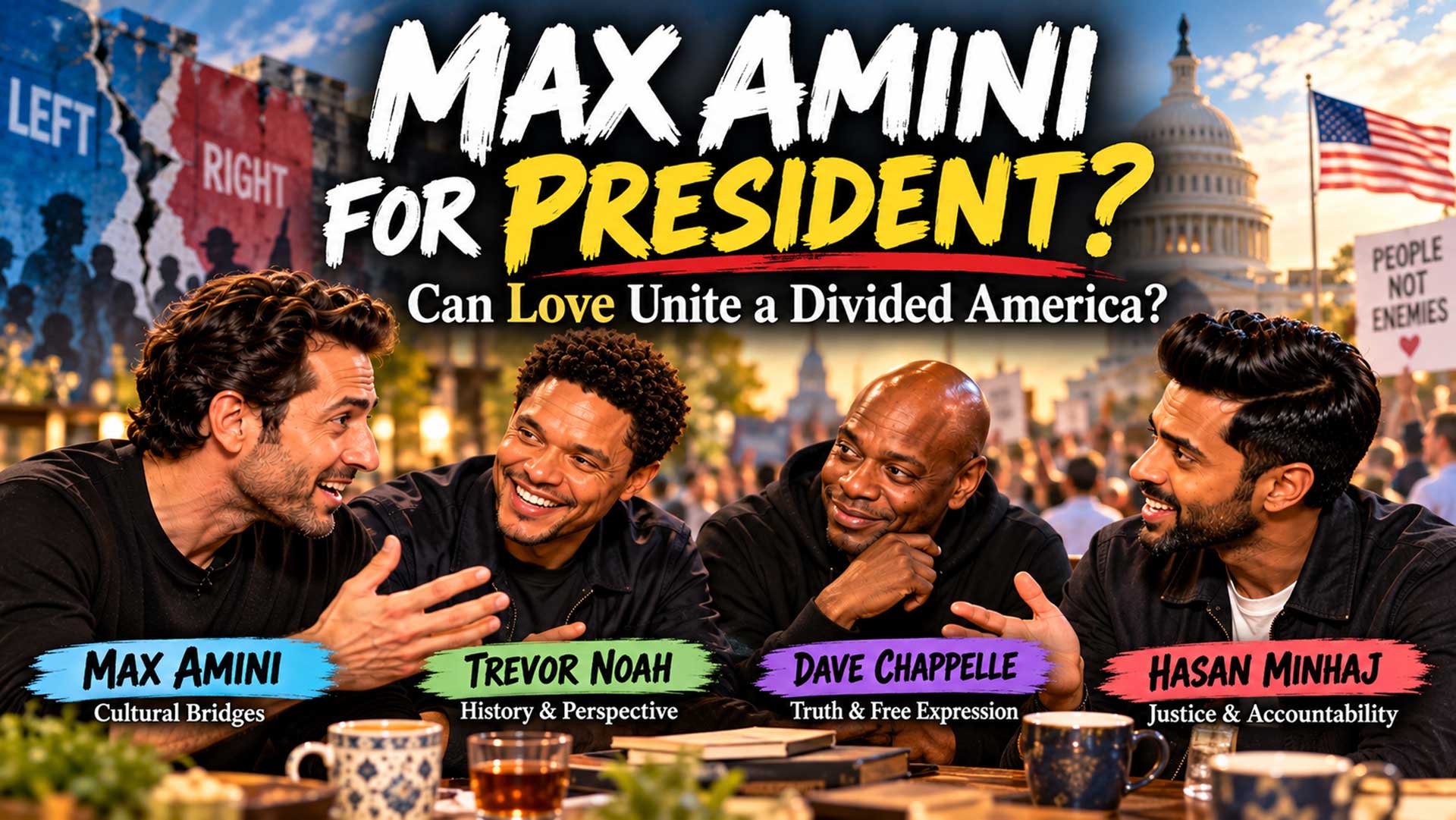
Introduction
What if four comedians from different backgrounds sat down to answer a question that politicians have struggled with for generations: Why do we hate people we've never met?
It began with a joke.
Iranian-American comedian Max Amini was asked what he thought of the American president. Instead of taking a political side, he declared that his job was to spread love, laughter, and unity. He didn't want to participate in the game of political hatred.
His message was simple but provocative: You don't represent your government. You represent yourself as a human being.
Then, in typical comedian fashion, he announced that he was running for president.
The audience laughed.
But behind the joke was a question worth taking seriously.
Why should an ordinary Iranian be blamed for the Iranian government? Why should an American be held personally responsible for every decision made in Washington? Why do we so easily judge millions of people by their nationality, religion, or political identity before knowing anything about their character?
And perhaps the hardest question of all: Can we love people across political divisions without becoming indifferent to injustice?
Four Comedians, Four Perspectives
In this fictional conversation, we bring together four comedians whose public work has explored identity, prejudice, politics, and the contradictions of human behavior.
Max Amini, an Iranian-American comedian known for his cultural observations and affectionate humor, believes that ordinary people have more in common than the political divisions separating them.
Trevor Noah, who grew up under apartheid in South Africa, brings a perspective shaped by racial classification, historical injustice, and the ability of humor to reveal the absurdity of prejudice.
Dave Chappelle, whose comedy frequently challenges social expectations and the boundaries of free expression, questions whether genuine unity can survive uncomfortable disagreement.
Hasan Minhaj, an Indian-American Muslim comedian whose political satire examines identity and public institutions, challenges the idea that remaining outside politics is always the compassionate choice.
They don't agree about everything.
In fact, their disagreements become the heart of the conversation.
Three Questions That Could Change How We See One Another
1. Why Do We Hate People We've Never Met?
The comedians explore how prejudice develops, why entire populations are blamed for their governments, and what happens when we finally meet someone we've been taught to distrust.
2. Can You Love Everyone Without Taking Sides?
Max's philosophy faces its strongest challenge. Is refusing political hatred the same as refusing political responsibility? Can we condemn injustice without dehumanizing those responsible? And can comedians challenge harmful ideas without abandoning compassion?
3. What If We Saw People Before We Saw Their Flags?
The conversation turns from argument to possibility. Can laughter create trust? Can personal encounters weaken inherited prejudice? What can ordinary people do to make the world less divided?
Why This Conversation Matters
We live in a time when a person's nationality, religion, or political affiliation can become an instant judgment of their character.
A disagreement can end a friendship. A political argument can divide a family. A stranger's accent or appearance can trigger assumptions before a single meaningful word has been exchanged.
Yet the same people who argue fiercely about politics may share the same hopes for their children, the same worries about aging parents, and the same desire to live with dignity and peace.
This conversation asks whether we can recognize those shared human experiences without ignoring real injustice.
It doesn't ask readers to abandon their beliefs.
It asks something both simpler and more difficult:
Can you disagree with someone, perhaps profoundly, and still refuse to hate them?
The discussion is fictional. These four comedians did not participate in this meeting, and the dialogue does not represent verified quotations or endorsements. Their imagined exchange draws inspiration from their public careers, experiences, and approaches to comedy.
For readers interested in the real people and ideas behind the conversation, explore Max Amini's official website, Trevor Noah's official website, and Hasan Minhaj's official website.
Now picture a nearly empty comedy theater in New York City.
The audience has gone home. The lights have dimmed. Four comedians sit around a table with leftover food.
Max has just announced his presidential ambitions.
Dave is already questioning his qualifications.
Hasan wants to know his policies.
Trevor is wondering whether the world might be better off if politicians learned to laugh at themselves.
And before long, a joke about the presidency becomes a conversation about something far more important.
What does it really mean to be a good human being?
(Note: This is an imaginary conversation, a creative exploration of an idea, and not a real speech or event.)
Topic 1: Why Do We Hate People We've Never Met?
New York City. 12:17 a.m.
The charity comedy show ended nearly an hour ago. The audience has gone home, the stage lights are off, and four comedians are sitting around a table in a backstage lounge.
There are half-eaten sandwiches, several bottles of water, and a plate of French fries that nobody seems willing to admit ordering.
Max Amini is looking at his phone, laughing.
Max Amini: Guys, I think I made a terrible mistake tonight.
Dave Chappelle: You agreed to do another charity show?
Max: Worse. I announced I'm running for president.
Hasan Minhaj: Oh, fantastic. Another man with absolutely no government experience who thinks he should run the country.
Trevor Noah: In fairness, Hasan, that does seem to be a qualification these days.
Max: No, no. I'm serious. Somebody in the audience asked what I think about the American president. And I said, why does my opinion matter? I'm a comedian! I make people laugh. I bring people together. I don't want to play this political game.
Dave: And then you announced your candidacy.
Max: Exactly!
Dave: That's the most American thing I've ever heard.
They laugh.
Hasan: Wait. What's your campaign slogan?
Max: Love everybody. Hate nobody.
Hasan: You're going to lose forty-nine states.
Trevor: Which state does he win?
Dave: California. But only if he promises to legalize something.
Max: You guys are terrible. I'm trying to spread love here.
Dave: Brother, you're sitting with three comedians. You came to the wrong table for unconditional support.
Max puts down his phone, still smiling.
Max: But seriously, something happened tonight that I keep thinking about. You saw that audience? Iranians, Americans, Arabs, Indians, Jewish people, Muslims, Christians. People from everywhere. And everybody was laughing together.
Trevor: That's the beautiful thing about comedy.
Max: Exactly! And then I think about what's happening outside that theater. People fighting over countries, religions, governments. People who have never met each other somehow hate each other.
Hasan: Well, sometimes people meet each other and hate each other even more.
Dave: That's called marriage.
Trevor nearly spits out his water.
Max: See? This is why we need comedy. You just insulted half the married population, and everybody's laughing.
Dave: Half? You're being optimistic.
Trevor: But Max is asking something interesting. Why can a room full of strangers laugh together for two hours, then walk outside and return to seeing each other as enemies?
Max: Yes! That's exactly what I'm saying.
Hasan: Maybe the laughter doesn't mean they agree about anything. They just happen to find you funny.
Max: That's enough for me to start.
Hasan: To start, sure. But not necessarily to finish.
Max: Look, I'm Iranian-American. Two countries with a lot of hostility between their governments. But when I travel, people love me. They don't ask me to explain American foreign policy. They don't ask me to defend the Iranian government. They just see Max.
Dave: Well, some of them see a guy who talks about his mother for ninety minutes.
Max: My mother is international diplomacy, Dave. Everybody understands a mother who tells you to eat more.
Trevor: That may be the one institution that has successfully crossed every border.
Hasan: The United Nations should be replaced with immigrant mothers.
Max: Oh, absolutely. Imagine a room full of Iranian, Indian, Jewish, Italian, and African mothers.
Trevor: World peace in twenty minutes.
Dave: Or World War Three over who made the best rice.
Their laughter settles.
Trevor: You know, I think there's something deeper here. When I was growing up in South Africa, the government had already decided what people were before they even spoke.
Max: Right.
Trevor: My mother was Black. My father was white. Under apartheid, their relationship was illegal. Think about that. Before I could talk, before I could walk, before I had an opinion about anything, the law had already made a judgment about my existence.
Hasan: That's extraordinary when you think about it.
Trevor: And absurd. Imagine being a baby and finding out you've committed a crime.
Dave: What was the charge?
Trevor: Existing without the correct paperwork.
Dave: That's rough. Most babies just get charged with disturbing the peace.
Trevor smiles, then grows thoughtful.
Trevor: But here's what stays with me. A child doesn't arrive knowing that another child belongs to a different racial category. Adults teach the categories. Institutions reinforce them. Then eventually people start believing those divisions are natural.
Max: That's what bothers me. Nobody is born knowing they're supposed to hate another country.
Hasan: But we should be careful. People aren't born knowing how to share their toys, either.
Dave: I've seen toddlers. Those little people are ruthless.
Hasan: Exactly. We're capable of selfishness and fear. But we're capable of learning generosity, too. The question is which behavior gets encouraged.
Trevor: And who benefits when one group is taught to fear another.
Dave: That's where things get interesting.
Dave leans back in his chair.
Dave: You know what I think? People like simple stories. Good guys, bad guys. Our people, their people. You give somebody a complicated problem, they get tired. Give them a villain, suddenly they're paying attention.
Max: But why does the villain have to be an entire country?
Dave: Convenience. If you have to learn everybody's individual story before you hate them, hatred becomes a full-time job.
Hasan: So prejudice is basically intellectual laziness?
Dave: Sometimes. But sometimes it's fear. Sometimes it's something you learned from somebody you trust. Sometimes you've actually been hurt, and now you're looking for somewhere to put that pain.
Trevor: That's an important distinction. Not all prejudice comes from the same place.
Max: But none of that makes it right to hate innocent people.
Dave: I agree. I'm saying that if you want somebody to stop hating, you've got to know what that hatred is doing for them.
Hasan: Giving them an explanation?
Dave: Giving them somebody to blame. Maybe giving them a group to belong to. That's a dangerous combination.
Trevor: Especially when belonging depends on having a common enemy.
Max: That's what I don't understand. Why can't belonging come from loving the same people instead?
Dave: It can. But hatred is easier to organize. Love requires you to actually get to know somebody.
For a moment, nobody speaks.
Hasan: I think Max has a point that gets lost in all these discussions. A government makes a decision, and suddenly millions of ordinary people are expected to answer for it.
Max: Thank you!
Hasan: Don't get excited. I'm agreeing with one sentence.
Max: I'll take it.
Hasan: Growing up as an Indian-American Muslim, there were moments when it felt like people expected you to explain the actions of strangers who happened to share your religion. It's a strange feeling, being asked to defend something you had nothing to do with.
Trevor: You're turned into a representative.
Hasan: Exactly. Nobody appoints you. There's no salary. No benefits. But suddenly you're the international spokesperson for a billion people.
Dave: That's a terrible job.
Hasan: The worst! You wake up, check the news, and think, "Please, nobody do anything stupid today. I've got a math test."
Max laughs, but his expression changes.
Max: You know, when I was a kid in Iran, I had an experience that stayed with me. I was born in America, and when we moved to Iran, I was the American kid. At school, I heard children shouting against America. And I remember being frightened, wondering what that meant for me.
Trevor: You were a child.
Max: Exactly. I wasn't representing the American government. I was just a kid trying to fit in.
Hasan: That's what makes it so painful. You're being assigned an enemy's identity before you even know what the conflict is about.
Max: And those other kids weren't born hating me. They were repeating what they'd heard.
Dave: Which doesn't make the fear less real.
Max: No. It doesn't.
Max looks down at the table.
Max: I think about that sometimes when I'm performing. I see people from so many different backgrounds laughing at the same joke. And I think, what if those kids had met me somewhere else? What if we'd been playing soccer together instead of repeating political slogans?
Trevor: They might have become your friends.
Max: Maybe. That's the part that stays with me.
Dave: Or they might have discovered you were terrible at soccer.
Max: I was excellent at soccer.
Hasan: That's the first claim tonight that needs fact-checking.
The laughter returns, but gently.
Trevor: There's something remarkable about how little it sometimes takes to change our picture of another person. You can grow up hearing an entire group described in one way, then meet someone from that group who doesn't fit the description.
Hasan: But one friendly encounter doesn't automatically erase years of prejudice.
Trevor: No. Sometimes people treat that individual as an exception and keep the stereotype.
Dave: That's the classic move. "I don't like those people, but you're different."
Max: I hate that sentence.
Dave: It's a compliment with a little racism tucked inside.
Hasan: Like a gift basket nobody asked for.
Max: But that's why I believe personal connection matters. You can't keep saying everybody from a country is terrible when you have friends there.
Dave: People absolutely can. Human beings are incredibly talented at holding two contradictory thoughts at once.
Trevor: Dave's right about that. Knowing someone isn't sufficient by itself. You have to be willing to let the experience change your assumptions.
Max: Okay. So how do you get people to do that?
Trevor: Curiosity.
Hasan: Humility.
Dave: Food.
Max: Food?
Dave: Absolutely. You want to bring two groups together? Feed them. It's hard to give a passionate speech about how much you hate somebody when you're asking his grandmother for another plate.
Hasan: Until they argue about whose grandmother invented the dish.
Dave: That's why you wait until dessert.
Trevor laughs.
Trevor: There's some truth there. Eating together changes the situation. Suddenly you're no longer discussing an abstract category. You're asking someone about their family, their childhood, what they enjoy.
Max: And you discover that you have things in common.
Hasan: Sometimes. And sometimes you discover enormous differences. I don't think the goal should be pretending everybody is the same.
Max: No, of course not.
Hasan: I actually like that people are different. Different cultures, different beliefs, different traditions. That's what makes meeting people interesting.
Dave: Until somebody starts explaining why their food is better than yours.
Hasan: Indian food is better.
Max: Persian food.
Trevor: South African food.
Dave: See? We had world peace for about eleven seconds.
They laugh.
Trevor: But Hasan has identified something meaningful. Respect doesn't require sameness. Sometimes the most respectful thing you can do is accept that somebody sees the world differently and still treat them with dignity.
Max: That's exactly my philosophy.
Dave: Hold on. I want to ask you something.
Max: Go ahead.
Dave: You keep saying people are good. Governments are bad. But governments are made of people. Those officials were children once, too. They have families. Some of them probably tell jokes at dinner.
Max: I know.
Dave: So where does the goodness disappear? Does somebody get elected and suddenly become evil?
Hasan: That's actually a good question.
Dave: Thank you. I've been saving one all night.
Max: I don't think every person in government is evil. I'm talking about systems that encourage division, about leaders who use fear and hatred.
Dave: Fair enough. But ordinary people participate in those systems, too. Sometimes willingly.
Trevor: And ordinary people sometimes resist them at enormous personal cost.
Hasan: Which is why we have to distinguish between a person, a government, and the choices that person makes.
Max: Exactly. That's what I want people to recognize. You don't have to support somebody's government to love the people living there.
Dave: I agree with that. But what if somebody personally supports something terrible?
Max: Then I disagree with them.
Dave: Strongly?
Max: Very strongly.
Dave: But you still love them?
Max considers the question.
Max: I can still recognize that they're human. I can hope they change. I don't have to hate them.
Hasan: That's a much more difficult position than just saying everybody should get along.
Max: I never said it was easy.
Trevor: And it's worth asking whether love always means closeness. You can recognize someone's humanity without trusting them or accepting what they've done.
Dave: That's important. Some people need accountability, not a hug.
Max: I agree. But I don't think accountability requires hatred.
Dave studies Max for a moment, then nods.
Dave: Now that's something we can talk about.
A faint hum comes from the refrigerator in the corner. Someone in the hallway wheels a cart past the closed door.
Hasan: You know what I keep thinking about? Somewhere tonight, there are two people who have never met. They speak different languages. Their governments hate each other. Their families have probably heard terrible things about the other country.
Trevor: And?
Hasan: And if they happened to sit next to each other on an airplane, they might spend six hours talking about their children.
Max: Exactly.
Hasan: They might exchange phone numbers. They might invite each other to dinner.
Dave: They might spend the entire flight fighting over the armrest.
Trevor: Which would at least be an honest conflict between two individuals.
Everyone laughs.
Hasan: But seriously, imagine discovering that someone you were taught to fear worries about the same things you do. Their parents getting older. Their children growing up. Whether they're making enough money. Whether the people they love are safe.
Max: That's what I see when I travel. Different countries, different cultures, but people care about their families. They want to laugh. They want to live good lives.
Trevor: And yet we should leave room for differences in what people have experienced. Someone living through war may not have the luxury of seeing another country's government as an abstract issue.
Max: Of course. I would never tell someone who has lost family members that they should just laugh and forget everything.
Dave: Good. That would be a very short comedy career.
Max: I'm saying their pain shouldn't be used to teach another generation to hate innocent people.
The room becomes quiet.
Trevor: That's difficult, Max.
Max: I know.
Trevor: When people are grieving, anger can feel like the only thing keeping them standing.
Max: I understand. But think about what happens when that anger gets passed down. A child grows up hating another child who hasn't done anything.
Hasan: And eventually both children believe the other one started it.
Dave: That's how a lot of conflicts survive longer than the people who began them.
Max slowly turns his water bottle between his hands.
Max: You know what makes me sad? Somewhere there's probably a little boy who has been told to hate Americans. Somewhere else there's an American boy who's been told to fear Iranians.
Trevor: Neither has met the other.
Max: Neither knows anything about the other. But they've already been introduced as enemies.
Hasan: And if they met?
Max: Maybe they'd argue about soccer. Maybe they'd play video games. Maybe they'd become best friends.
Dave: Or maybe one of them would steal the other's bicycle.
Max: Dave!
Dave: I'm just saying, don't make the kids saints. They're still kids.
Max laughs.
Dave: But I get your point. Give them a chance to decide what they think of each other before the adults hand them a list of enemies.
Trevor: That's a beautiful way to put it.
Hasan: And maybe the adults need to learn the same lesson.
Max: Exactly. I don't want people to pretend that governments don't matter. I don't want them to ignore injustice. I just want them to stop making innocent people carry the guilt of things they didn't do.
Trevor: There's an important difference between learning about a country's history and deciding what every person from that country must be like.
Hasan: We need the history. We need the facts. But we can't let them replace the individual standing in front of us.
Dave: And sometimes that individual is going to disappoint you.
Max: Of course.
Dave: Sometimes they're going to have terrible opinions. Sometimes they're going to be selfish. Sometimes they're going to be an asshole.
Max: Then judge them for being an asshole!
The table erupts in laughter.
Max: I'm serious! Judge the actual person! Don't blame an entire country!
Trevor: There it is. Max Amini's immigration policy.
Hasan: Individualized asshole assessment.
Dave: Finally, a government program I can support.
Max is laughing so hard he has to wipe his eyes.
Max: You see? That's what I'm talking about! Four guys from different backgrounds, laughing together, disagreeing, making fun of each other. Nobody has to hate anybody.
Dave: Don't get carried away. I still don't trust your presidential campaign.
Max: You can be my vice president.
Dave: Absolutely not. I'm not spending four years explaining your jokes.
Trevor: Actually, that might be the most difficult job in Washington.
The laughter fades into a comfortable silence.
Max: Can I tell you what I really want?
Hasan: Go ahead.
Max: I want a world where a person can say, "I'm Iranian," and nobody immediately thinks about politics. Where someone can say, "I'm American," and people don't assume they support every decision their country has made. Where a Muslim, a Christian, a Jew, or somebody with no religion can introduce themselves without having to defend millions of strangers.
Trevor: You want people to be allowed to tell their own stories.
Max: Yes. Exactly.
Hasan: That's a good place to begin.
Dave: But it's not the end of the conversation.
Max: What do you mean?
Dave: Well, we've established that you shouldn't hate somebody just for where they come from. Fine. But you keep talking about loving everybody.
Max: I believe in that.
Dave: Everybody?
Max: Everybody.
Dave: Including people who do terrible things?
Max looks at him.
Max: I believe every human being has dignity. That doesn't mean I approve of everything they do.
Dave: Okay. But suppose somebody is hurting innocent people right now. Are you going to stand there and say you love everybody? Or are you going to take a side?
Hasan sets down his glass.
Hasan: I've been wanting to ask that all night.
Trevor: I think we've just found the harder question.
Max looks from one face to another. He smiles, but this time he doesn't reach for a joke.
Max: All right. Let's talk about it.
The conversation continues.
Topic 2: Can You Love Everyone Without Taking Sides?
New York City. 1:06 a.m.
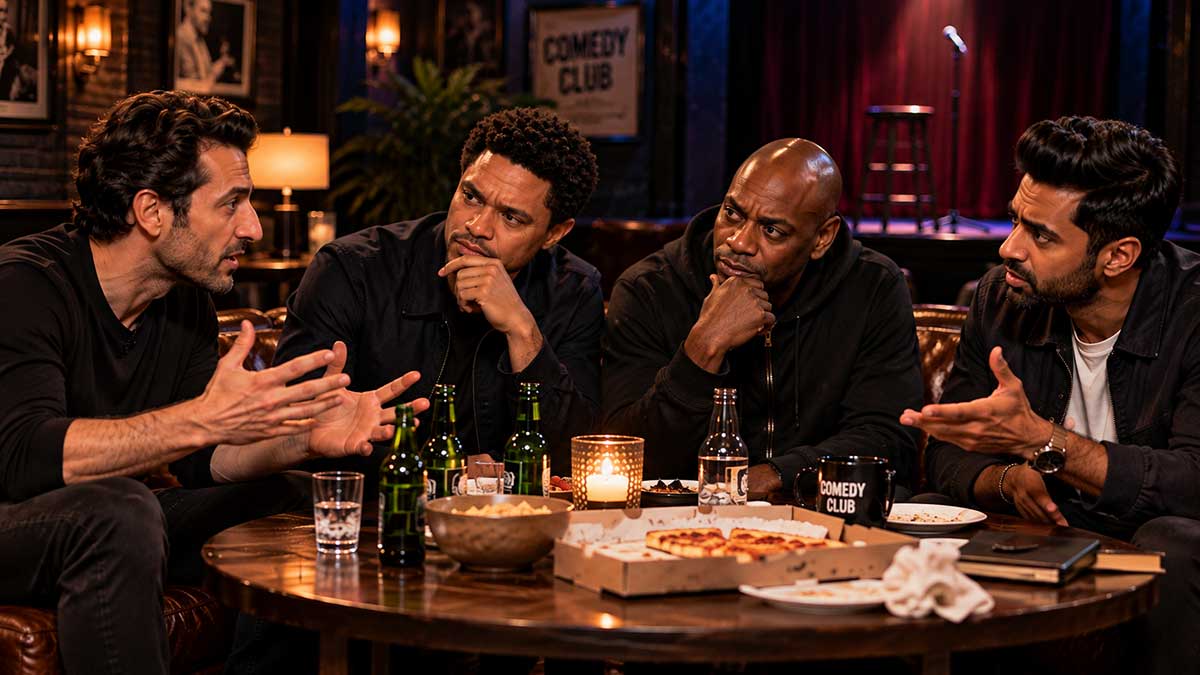
The backstage lounge has grown quieter. Someone has taken away the empty sandwich plates, but the French fries remain. Dave Chappelle leans back in his chair, watching Max Amini across the table.
Max has just said he believes every human being deserves dignity, regardless of nationality, religion, or political beliefs.
Dave isn't ready to let him off that easily.
Dave Chappelle: Okay, Max. I want to make sure I understand you. You love everybody?
Max Amini: Yes.
Dave: Everybody?
Max: Dave, we already did this.
Dave: I'm checking the warranty. Does your love come with conditions? Thirty-day return policy? What if somebody turns out to be a terrible human being?
Hasan Minhaj: Does the love cover international shipping?
Trevor Noah: I believe Max is offering universal coverage. No exclusions for preexisting political opinions.
Max: You guys are unbelievable.
Dave: I'm serious, though. Suppose somebody is hurting innocent people. Not somebody who simply disagrees with you. Somebody doing something genuinely terrible. Are you still going to say you love them?
Max: I can recognize their humanity without supporting what they're doing.
Hasan: But what does that actually mean?
Max: It means I don't have to hate someone to oppose them.
Hasan: Okay. But suppose a government is bombing civilians. People are dying. Families are losing their homes. And somebody asks you whether you condemn it. You can't just say, "I love everybody."
Max: Of course I condemn the killing of innocent people!
Hasan: Then you've taken a side.
Max: I've taken the side of innocent people.
Hasan: That's politics, Max.
Max: No. That's humanity.
Hasan: Sometimes those are the same thing.
Max opens his mouth, then pauses.
Trevor: I think we've found the problem with the phrase "I don't do politics." It can mean several different things.
Dave: It can mean, "I don't want to argue with my uncle at Thanksgiving."
Hasan: Which is a perfectly reasonable position.
Trevor: Or it can mean, "I refuse to join a political tribe."
Max: That's me.
Trevor: But it can mean, "I don't want to confront injustice." And that's where people start getting concerned.
Max: I don't believe in ignoring injustice.
Hasan: Then maybe what you really reject isn't politics. It's political hatred.
Max: Exactly!
Dave: Congratulations, Hasan. You just rewrote the man's entire presidential platform.
Hasan: Somebody had to. His campaign manager is clearly incompetent.
Max: I don't even have a campaign manager!
Dave: That's why you're losing.
They laugh.
Max: Look, here's what bothers me. Every time something terrible happens somewhere in the world, people immediately start dividing into teams. They ask, "Whose side are you on?" And if you don't repeat exactly what their side believes, suddenly you're the enemy.
Hasan: I understand that. But sometimes people ask whose side you're on when they're desperate to know whether you care about their suffering.
Max: I do care.
Hasan: Then tell them.
Max: I do!
Hasan: Not just that you love everybody. Tell them that what happened to them was wrong.
The room becomes quiet.
Trevor: Hasan, I think you're making an important distinction. When somebody is suffering, a general statement about love may not be what they need at that moment.
Dave: If somebody punches me in the face, I don't want you standing there explaining that you love both of us equally.
Max: Of course not!
Dave: I want you to stop the guy!
Hasan: Exactly.
Dave: Then you can love him afterward. From a safe distance.
Trevor: Preferably after the police have arrived.
Max: But that's what I'm saying! Stop the person doing harm. Protect the victim. Hold the person accountable. None of that requires you to hate their entire family, religion, or country.
Hasan: Now we're getting somewhere.
Dave: Hold on. I want to stay with that for a second.
Dave leans forward.
Dave: Suppose you stop somebody from doing something terrible. You hold them accountable. Maybe they go to prison. Maybe they never apologize. Maybe they don't even think they did anything wrong.
Max: Okay.
Dave: Do you still love them?
Max: I can still believe they have the capacity to change.
Dave: What if they never change?
Max: Then they never change.
Dave: But you still refuse to hate them?
Max: Yes.
Dave: That's a difficult thing you're asking people to do.
Max: I know.
Dave: Especially somebody who's been hurt.
Max: I would never tell a victim how they have to feel.
Trevor: That's important. Forgiveness cannot become another demand placed on the person who suffered.
Hasan: Exactly. Sometimes people talk about unity as if the injured person has to do all the work.
Dave: That's a good point. Somebody burns down your house, then everybody comes around saying, "Come on, man. Be the bigger person."
Trevor: And the person who burned down the house is standing there holding a match.
Hasan: Asking why you're being so divisive.
Max shakes his head.
Max: That's not unity. That's manipulation.
Hasan: Then we're agreeing that peace requires more than everybody smiling together.
Max: Absolutely.
Hasan: It requires justice.
Max: Yes.
Hasan: Accountability.
Max: Yes.
Hasan: Sometimes taking a public stand.
Max: Yes!
Dave: Careful, Max. He's about to make you join a political party.
Max: No, no! I'm not joining anything!
Trevor: He'll be an independent candidate.
Dave: With the slogan, "I love everybody, but some of you need to go to jail."
The table erupts in laughter.
Max: You know what? That's actually not a bad slogan.
Hasan: Terrible for campaign donations.
Dave: Depends who's donating.
Trevor smiles, then becomes thoughtful.
Trevor: I think there's something worth examining here. Growing up in South Africa, I learned that laws could be deeply unjust. Under apartheid, the government didn't merely encourage prejudice. It organized society around it.
Max: Right.
Trevor: So imagine someone saying, "I don't want to take sides between the government and the people resisting apartheid. I just love everybody."
Hasan: That would be a problem.
Trevor: Yes. Not hating people is admirable. But refusing to recognize injustice doesn't make you compassionate. It can make you comfortable.
Max: I agree. But there's another danger. When people fight injustice, sometimes they begin to hate everyone associated with the other side.
Trevor: That's true.
Max: And then what happens? You defeat one injustice, but you've taught another generation that hatred is acceptable as long as it's directed at the right people.
Dave: That's the tricky part. Everybody thinks their hatred is the justified kind.
Hasan: But we shouldn't treat anger and hatred as identical.
Dave: Explain.
Hasan: Anger can be a response to injustice. It can motivate people to protect others, organize, demand change. Hatred is something different. Hatred can make you stop seeing people as human.
Trevor: Anger can tell you something is wrong. It doesn't automatically tell you what the right response should be.
Max: That's exactly it. I don't want people to stop caring. I want them to stop turning other human beings into monsters.
Dave: What if the person really has done monstrous things?
Max: Then condemn what they've done. Stop them. But don't forget they're human.
Dave: Why does that matter?
Max considers the question.
Max: Because the moment we decide someone isn't human anymore, we give ourselves permission to do anything to them.
The others fall silent.
Trevor: That's a serious answer.
Hasan: And I agree with it. But I want to add something. Recognizing someone's humanity doesn't mean giving their opinions equal moral weight.
Max: Of course.
Hasan: If one person says, "I want to live in peace," and another says, "I want to destroy that person's community," we shouldn't pretend they're simply two equally reasonable perspectives.
Dave: So we can respect the person's humanity without respecting the idea.
Hasan: Exactly.
Trevor: And without pretending the consequences of their actions are equal.
Max: That's fair.
Dave reaches for the last French fry.
Hasan: Don't eat that.
Dave: Why?
Hasan: We've been discussing injustice for twenty minutes, and you haven't shared any of those fries.
Dave: This is my personal property.
Trevor: The French fry crisis has begun.
Max: I'm staying neutral.
Hasan: See? This is exactly what I'm talking about!
Everyone laughs.
Dave: Max, a man is suffering right in front of you, and you're refusing to take sides.
Max: I love both of you.
Hasan: Your love is useless!
Trevor: And that, ladies and gentlemen, is our entire philosophical disagreement in one French fry.
Dave breaks the fry in half and hands a piece to Hasan.
Dave: There. Justice.
Hasan: That's not justice. That's a settlement.
Dave: Welcome to diplomacy.
The laughter continues for several moments.
Max: You know, that's actually what I love about comedy. We can talk about terrible things without making everybody feel like they're standing in a courtroom.
Dave: Sometimes.
Hasan: Sometimes comedy makes people feel like they're the ones on trial.
Max: What do you mean?
Hasan: A joke can make someone feel seen. It can make someone feel less alone. But it can make someone feel humiliated, too.
Dave: Sure. But if comedians become afraid of making anybody uncomfortable, we're finished.
Hasan: I didn't say uncomfortable. I said humiliated.
Dave: Sometimes people can't tell the difference.
Trevor: Sometimes comedians can't tell the difference, either.
Dave turns to Trevor.
Dave: Fair enough.
Trevor: I think intention matters. But impact matters, too. You might intend a joke as affectionate teasing, and someone else might hear it through years of painful experiences.
Dave: So what do you do? Stop telling the joke?
Trevor: Not automatically. You listen. You consider the context. You decide whether the joke is worth defending, revising, or abandoning.
Dave: But you can't let every offended person control what you say.
Trevor: No. Listening isn't the same as surrendering.
Hasan: And criticism isn't the same as censorship.
Dave: Sometimes people act like it is.
Hasan: Sometimes comedians act like every criticism is an attack on civilization.
Max: Oh, here we go.
Dave: Look, I believe comedy needs freedom. People need somewhere they can hear uncomfortable things and laugh about them.
Hasan: I agree. But freedom doesn't exempt us from responsibility.
Dave: Responsibility to whom?
Hasan: To the audience. To the people we're talking about. To the truth.
Dave: That's a lot of responsibility for a guy holding a microphone.
Trevor: Yet that microphone can reach millions of people.
Dave: And millions of people can disagree about what you meant.
Max: That's why I prefer making fun of my family.
Hasan: Your family must love that.
Max: My mother has been preparing material about me for my entire life. I'm just defending myself.
Trevor: Comedy as intergenerational self-defense.
Dave: Finally, a cause we can all support.
Max smiles, then looks around the table.
Max: But seriously, when I make jokes about different cultures, I want people to feel included. I want the Iranian guy laughing, the American guy laughing, the Indian guy laughing. I want everyone to recognize something familiar.
Hasan: That's a beautiful goal. But what happens when somebody doesn't laugh?
Max: Then I try to understand why.
Dave: You don't change every joke for one person.
Max: No. But I can listen to them.
Trevor: That's the distinction we've been circling all night. Listening to someone doesn't require agreeing with them.
Hasan: And disagreeing with someone doesn't require treating them as your enemy.
Dave: You know what's funny? We're having a conversation about love, and every five minutes somebody tries to turn it into a legal contract.
Max: That's America!
Trevor: Terms and conditions apply.
Hasan: Please consult your attorney before expressing compassion.
They laugh.
Then Max's expression grows serious.
Max: Can I tell you what really worries me?
Trevor: Of course.
Max: When I see people suffering in the world, I feel terrible. Children losing their parents. Parents losing their children. Families running from war. And then I look at the way people argue about it online.
Hasan: What do you see?
Max: People celebrating when the other side suffers.
The laughter disappears.
Max: That's the part I can't accept. You can support your country. You can believe your government is right. You can disagree with another country's leaders. But how can you celebrate when an innocent child dies?
Trevor: You shouldn't.
Max: That child didn't start the war. That mother didn't make the political decisions. That father might have spent his whole life trying to keep his family safe.
Dave: And somebody sitting thousands of miles away sees a flag and decides whether their deaths matter.
Max: Exactly.
Hasan: That's what dehumanization does. It turns people into symbols. You stop seeing the child. You see the nationality.
Trevor: Or the religion.
Dave: Or the political label.
Max: And I want to say, stop! Just stop for one minute. Look at the person. That's somebody's child.
Max pauses.
Max: I have performed for people from countries whose governments are enemies. I've seen them laugh at the same jokes. I've watched them hug me afterward. And I think, if those people can stand together in one room, why are we so determined to convince them they're supposed to hate each other?
Hasan: Sometimes governments benefit from division. But sometimes the wounds between communities are real, too. We shouldn't pretend that every conflict is manufactured.
Max: I know. People have suffered. They have reasons to be angry.
Hasan: And some people need justice before they can even begin thinking about reconciliation.
Max: Then let them have justice. I'm not asking anybody to forget what happened.
Trevor: You're asking them not to extend the guilt to people who didn't cause it.
Max: Yes.
Dave: That's a distinction a lot of people lose when they're angry.
Max: And I understand why. But I don't want another generation growing up carrying hatred they never chose.
Trevor looks down at the table for a moment.
Trevor: You know, there's something I learned from growing up in a country shaped by apartheid. You can change laws. You can change governments. But changing the stories people carry about each other takes much longer.
Hasan: Sometimes generations.
Trevor: Yes. And you can't force that change through a speech. People have to experience something different.
Dave: Which brings us back to comedy.
Max: Exactly!
Dave: Don't get too excited. Comedy isn't going to solve every political problem.
Max: I never said it would.
Dave: But it might get two people laughing together who otherwise wouldn't sit in the same room.
Trevor: And that can create a moment when they're willing to listen.
Hasan: Provided somebody eventually says something worth listening to.
Dave: You really can't let anybody enjoy a moment, can you?
Hasan: It's a gift.
They laugh.
Max: I think the biggest problem is that people believe they have to choose between love and justice.
Trevor: And you don't think they do?
Max: No. I think justice without love can become revenge. And love without justice can become an excuse to do nothing.
Trevor nods slowly.
Trevor: That's a meaningful distinction.
Hasan: I agree with the principle. But I'd want us to be careful with the first half. People seeking justice aren't necessarily motivated by revenge.
Max: Of course not. I'm talking about what happens when hatred takes over.
Dave: And sometimes love makes people afraid to confront someone they care about.
Max: That's true, too.
Dave: Think about raising a child. You love your kid. That doesn't mean you let him do whatever he wants.
Trevor: Sometimes love requires a difficult conversation.
Hasan: Sometimes it requires consequences.
Max: Exactly. You can love somebody and still say, "What you're doing is wrong. You have to stop."
Dave: And if they don't stop?
Max: Then you protect the people they're hurting.
Dave: There you go.
Dave looks at Hasan.
Dave: I think we finally got him to take a side.
Hasan: Took us long enough.
Max: I told you from the beginning! I'm on the side of humanity!
Trevor: That's going to be a very crowded political party.
Dave: And a very confusing one. Everybody's invited, but half the members need to apologize to the other half.
Hasan: Honestly, that sounds like Thanksgiving.
They laugh again.
For a few moments, nobody speaks. The refrigerator hums. Somewhere beyond the lounge, a door closes.
Trevor: I want to ask each of you something.
Dave: Oh, no. Trevor's become the moderator.
Trevor: Just one question.
Hasan: That's how every three-hour podcast begins.
Trevor: Suppose you meet someone whose political beliefs are completely opposed to yours. Someone who genuinely believes things you find deeply wrong. What would it take for you to sit down and have a conversation with that person?
Dave: Depends. Are they buying dinner?
Max: Dave!
Dave: I'm serious. A free steak goes a long way.
Hasan: You have the moral principles of a restaurant loyalty program.
Dave: And yet I'm the only one at this table who has negotiated anything successfully tonight.
He points to the divided French fry.
Trevor: Let's assume dinner is provided.
Dave: Then I'd want to know whether they're willing to talk honestly. I don't need them to agree with me. But I don't want somebody pretending to listen while waiting for their turn to deliver a speech.
Hasan: I'd want to know whether they're willing to recognize the consequences of what they believe.
Max: I'd want to know them as a person.
Trevor: Before discussing politics?
Max: Yes. Tell me about your family. Your childhood. What makes you happy. What you're afraid of. What you want for your children.
Hasan: And then?
Max: Then we can talk about the difficult things.
Dave: What if they don't change their mind?
Max: Maybe I don't change mine, either.
Dave: So what's the point?
Max: Maybe the point isn't always to change someone's mind.
Dave watches him.
Max: Maybe the point is to stop seeing each other as enemies.
Trevor: Even if the disagreement remains.
Max: Yes.
Hasan: I like that. But I would add one condition.
Dave: Of course you would.
Hasan: The conversation has to leave room for truth. We can't build peace by pretending real suffering doesn't exist.
Max: Agreed.
Hasan: And people who are being harmed don't owe their oppressors a friendly conversation.
Max: Agreed.
Trevor: So perhaps the principle is that everyone deserves human dignity, but not everyone is entitled to our trust, agreement, or personal closeness.
Dave: That sounds right.
Max: Yes.
Dave: Well, look at us. Four comedians discussing moral philosophy at one in the morning.
Hasan: This is what happens when nobody invites us to an after-party.
Trevor: I'm beginning to think that was intentional.
They laugh.
Max: You know, I feel better about this conversation.
Hasan: Really?
Max: Yes. You challenged me. We disagreed. Nobody got angry. Nobody tried to cancel anybody. We actually listened.
Dave: Speak for yourself. I was considering canceling Hasan over the French fry situation.
Hasan: That was a legitimate human rights issue.
Trevor: The international community has issued a statement of concern.
Max laughs, then looks at the others.
Max: But that's what I want people to experience. You don't have to agree about everything to respect each other.
Dave: Respect is one thing. Love is harder.
Max: Maybe. But I still believe it's possible.
Hasan: Even when people have been taught to hate each other?
Max: Especially then.
Trevor: How?
Max looks toward the closed door, beyond which the theater stands empty.
Max: I don't know exactly. But tonight, there were people in that audience who probably disagree about everything. And for two hours, they laughed together.
Dave: We've already established that laughter doesn't solve everything.
Max: I know. But maybe it opens a door.
Hasan: And what happens after the laughter?
Max considers the question.
Max: Maybe somebody walks through that door and actually gets to know the person on the other side.
Trevor: That's a beautiful possibility.
Dave: But here's the problem. People can laugh together in a theater and still hate each other tomorrow.
Max: Then we have to give them something more than laughter.
Hasan: Like what?
Max: A reason to see each other differently.
Trevor slowly nods.
Trevor: Then maybe that's the question we should be asking.
Dave: What question?
Trevor: What actually changes a person's heart? Not for two hours in a comedy club. For the rest of their life.
The four men sit quietly for a moment.
Hasan: Now that is a question worth staying up for.
Dave: Fine. But somebody order more food. I'm not solving humanity's problems on half a French fry.
Max reaches for his phone.
Max: I'll order Persian food.
Hasan: Indian.
Trevor: Anything is fine with me.
Dave: See? Three minutes after agreeing to love everybody, we're back to international conflict.
Their laughter fills the nearly empty lounge.
But Trevor's question remains at the table.
What does it really take for someone to stop seeing another human being as an enemy?
The conversation continues.
Topic 3: What If We Saw People Before We Saw Their Flags?
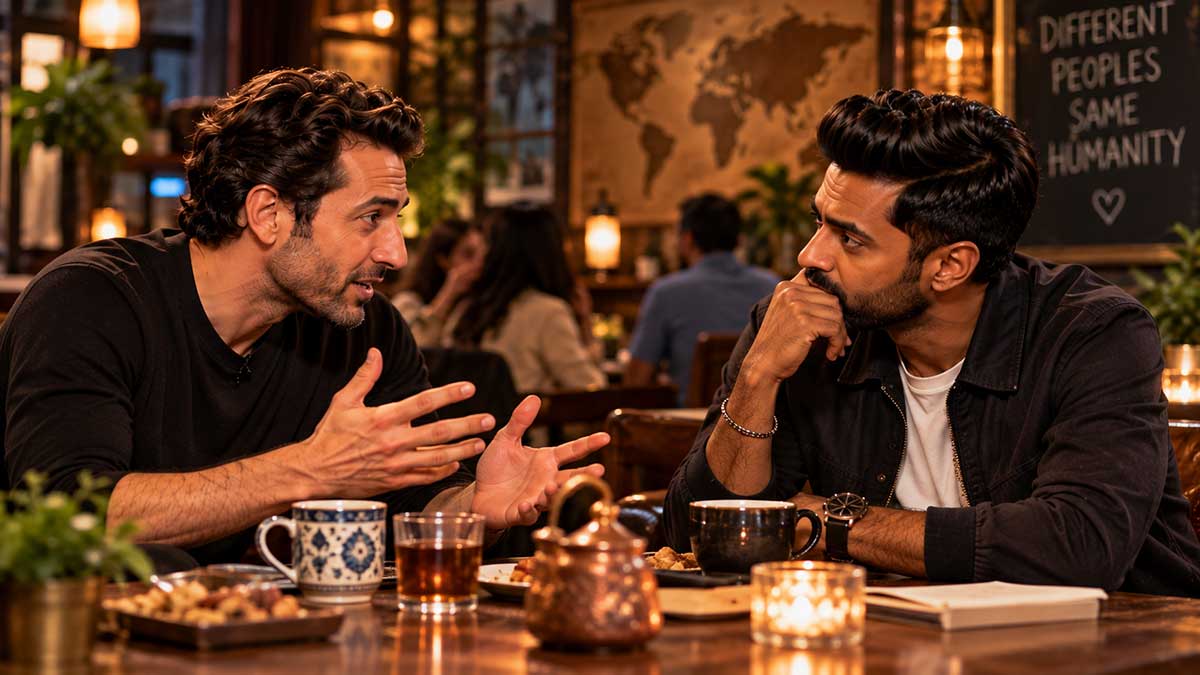
New York City. 1:48 a.m.
The Persian food has finally arrived.
Four comedians sit around a table covered with rice, grilled meat, bread, and small containers of sauce. The theater beyond the backstage lounge is completely empty now.
Dave Chappelle is examining a piece of bread.
Dave Chappelle: I have a question.
Max Amini: Oh, God. Not another one.
Dave: What exactly am I eating?
Max: That's Persian bread. It's called sangak.
Dave: It's good.
Max: Of course it's good. It's Persian.
Hasan Minhaj: There it is. Nationalism.
Trevor Noah: We spent two hours dismantling national stereotypes, and Max has rebuilt the entire system around bread.
Max: Listen, I love every country. But Persian food is the best.
Hasan: Indian food would like to file an official complaint.
Dave: I'm staying neutral. I'm eating both.
Trevor: An extraordinary display of international diplomacy.
They laugh.
Dave: You know what's funny? We spent the whole night arguing about countries, religions, governments, and hatred. But the minute food arrived, everybody became cooperative.
Max: That's what I've been saying!
Hasan: Max, you cannot solve geopolitical conflict with kebabs.
Max: Have you tried?
Trevor: I don't believe the United Nations has conducted a proper clinical trial.
Dave: Well, somebody should fund it. Operation Hummus.
Hasan: Hummus isn't Persian.
Dave: See? The war has already started.
The laughter gradually fades.
Trevor: But I think we're avoiding the question I asked earlier.
Max: Which one?
Trevor: What actually changes a person's heart? Not for two hours in a comedy club. Not just enough to laugh at a joke. What makes someone stop seeing another human being as an enemy?
Dave: Experience.
Hasan: Sometimes.
Dave: What do you mean, sometimes?
Hasan: People can have experiences that reinforce their prejudices, too.
Dave: Sure. But I'm talking about the kind of experience that makes you question something you thought you knew.
Max: Meeting someone different.
Trevor: Meeting them isn't always enough.
Max: Why not?
Trevor: Suppose you've spent your whole life believing people from a certain country are dangerous. Then you meet someone from that country who's kind and generous. What happens?
Max: You realize you were wrong.
Trevor: Maybe. Or you decide that person is an exception.
Hasan: Exactly. "I don't like those people, but you're one of the good ones."
Dave: That's a fascinating insult disguised as a compliment.
Max: I hate that expression.
Dave: Of course you do. You've probably been called one of the good ones in two different countries.
Max: With my luck, yes.
Trevor: Changing prejudice requires more than meeting someone. It requires being willing to question the story you've been telling yourself.
Hasan: And sometimes that story is tied to your family, your community, your entire identity.
Max: So what do we do? Tell people to stop believing everything they were taught?
Dave: That's a good start.
Trevor: Not everything. Some things are worth preserving. Love for your family. Pride in your heritage. Respect for your traditions.
Hasan: The problem begins when loving your own people requires you to despise somebody else's.
Max: Exactly!
Dave: You know what I think? People confuse loyalty with hatred. They think being loyal to your group means you have to dislike another group.
Trevor: As though affection were a limited resource.
Dave: Right. Like there's only so much love available, and if you give some to another country, your own country runs out.
Hasan: National love rationing.
Max: America gets forty percent, Iran gets thirty percent, everybody else shares the rest.
Dave: And Canada gets whatever's left after the administrative fees.
Trevor laughs.
Trevor: Canada would apologize for taking too much.
Hasan: Then charge everybody for parking.
The four laugh together.
Max: But seriously, why can't I love America and Iran? Why do I have to choose?
Hasan: You don't.
Max: I can love American people. I can love Iranian people. I can criticize either government when I think it's wrong. None of those things contradict each other.
Trevor: They shouldn't.
Dave: But some people will still demand that you choose.
Max: Then they'll be disappointed.
Dave: That's the spirit. Terrible politician. Excellent human being.
Max smiles.
Max: You know, I keep thinking about something. When I perform, I sometimes see people who come from countries that are politically opposed to one another. They're sitting in the same audience, laughing at the same jokes.
Hasan: You've mentioned that a few times tonight.
Max: Because it means something to me.
Hasan: I know. But I want to challenge you on it one more time.
Max: Go ahead.
Hasan: Suppose two people from opposing countries laugh together. That's beautiful. But the next morning, one of them sees news about civilians being killed. The other has a completely different interpretation of the conflict. Suddenly they're arguing again.
Max: Okay.
Hasan: What did the laughter actually accomplish?
Max thinks for a moment.
Max: Maybe it gave them something to remember.
Hasan: What do you mean?
Max: Before they start arguing, they remember that the person they're arguing with made them laugh. That they shared a moment together. That the person isn't just a flag or a political opinion.
Trevor: So the relationship becomes more complicated than the stereotype.
Max: Yes.
Dave: That's interesting. You're not saying laughter changes their politics. You're saying it changes who they're arguing with.
Max: Exactly!
Hasan: I like that.
Max: Really?
Hasan: Don't make it weird.
They laugh.
Trevor: There's a profound difference between arguing with an enemy and arguing with a friend.
Dave: Sometimes friends are worse.
Hasan: Have you ever tried discussing politics in a family group chat?
Dave: That's not a conversation. That's a hostage situation.
Max: My family group chat could start a war.
Trevor: And yet you still love them.
Max: Most days.
The laughter softens.
Trevor: I think that's worth examining. We accept disagreements within families that we would never tolerate from strangers.
Hasan: Sometimes we accept too much from family.
Trevor: True. But when someone we love says something we disagree with, we often know there's more to them than that one opinion.
Dave: We remember the whole person.
Trevor: Exactly.
Max: That's what I want people to do with strangers. Give them the chance to be a whole person.
Hasan: But what if they're saying something genuinely hateful?
Max: Then challenge them.
Hasan: And if they refuse to listen?
Max: Then maybe you walk away.
Dave: That's something people need to hear. You don't have to spend your entire life arguing with somebody to prove you're compassionate.
Trevor: You can preserve your own dignity and recognize theirs.
Hasan: And sometimes protecting others means setting boundaries.
Max: Yes. Love doesn't mean letting people hurt you.
Dave nods.
Dave: Good. I was worried your presidential platform was going to require hugging everybody who punches you.
Max: No, Dave. We hug them after the security team removes them.
Trevor: Very progressive law enforcement.
Hasan: With complimentary kebabs.
They laugh again.
Then Trevor leans forward.
Trevor: Can I propose a little experiment?
Dave: Depends. Are we getting paid?
Trevor: No.
Dave: Then I'm opposed.
Trevor: Suppose tomorrow you meet someone from a country you've been taught to fear. You know nothing about them except their nationality.
Max: Okay.
Trevor: What is the first question you should ask?
Hasan: "How are you?"
Dave: "Did you bring food?"
Max: "What's your name?"
Trevor looks at Max.
Trevor: That's the one.
Hasan: Really? We spent all night discussing political philosophy, and the answer is asking someone's name?
Trevor: Think about it. A flag represents millions of people. A name belongs to an individual.
Dave: Unless your name is John Smith.
Max: Dave!
Dave: I'm helping. It's an important distinction.
Trevor: When you ask someone's name, you're beginning to move from category to person.
Hasan: And then you have to actually listen to the answer.
Dave: That's where most people fail.
Max: It's so simple.
Trevor: Simple doesn't mean easy.
Max looks down at the table.
Max: You know, I wish more people understood that.
Hasan: Which part?
Max: That you can be proud of where you come from without hating where somebody else comes from.
Trevor: Yes.
Max: I love being Iranian. I love being American. I love the food, the culture, the people. But I don't need anybody else to become Iranian or American for me to love them.
Dave: That's a good distinction.
Max: And when I see someone from a country whose government I disagree with, I don't want to look at them and see the government.
Hasan: You want to see the person.
Max: Exactly.
For a moment, Max stops speaking.
Max: But I want to tell you something else. Something that bothers me more than political arguments.
Trevor: Go ahead.
Max: Children.
The room becomes still.
Max: I think about children growing up in places where there's war. Where people are frightened. Where families don't know if they'll be safe tomorrow.
Hasan: Yeah.
Max: Those children didn't choose any of this. They didn't choose their nationality. They didn't choose their religion. They didn't choose the leaders who are fighting.
Trevor: No, they didn't.
Max: And yet they suffer.
Max pauses.
Max: Then I think about children in other countries being taught to hate those same children.
Dave: That's a terrible inheritance.
Max: Exactly. What are we giving them? Fear? Anger? A list of enemies?
Hasan: Sometimes we're giving them stories that make hatred feel like loyalty.
Trevor: And those stories can survive long after the original conflict.
Max: That's what breaks my heart.
The four sit quietly.
Dave: You know, there's something I think we should acknowledge.
Max: What?
Dave: A lot of people inherit pain, too. Not just prejudice. Real pain. Families who've lost people. Communities who've been treated terribly. You can't ask them to forget their history.
Max: I wouldn't.
Dave: Good. Because sometimes when people say, "Let's all love each other," what somebody hears is, "Stop talking about what happened to you."
Hasan: That's exactly the danger.
Trevor: Reconciliation cannot require erasing the truth.
Max: I agree completely.
Dave: Then what are you asking?
Max takes a moment before answering.
Max: I'm asking people not to make innocent children pay for the sins of adults.
No one interrupts.
Max: Remember what happened. Tell the truth. Seek justice. Protect people. But please, don't teach your children that another child is their enemy just because of where they were born.
Hasan looks at Max for a long moment.
Hasan: That's different from saying politics doesn't matter.
Max: I know.
Hasan: It's saying our humanity has to matter more than our political hatred.
Max: Yes.
Trevor: And that justice should protect human dignity rather than destroy it.
Dave: I can agree with that.
Max smiles faintly.
Max: Look at us. We agree again.
Dave: Don't get comfortable. I'm still against your presidency.
The laughter is gentle this time.
Trevor: I think there's another question here. We keep talking about changing the world. But what can an ordinary person actually do?
Hasan: That's the question that matters.
Max: Be kind.
Dave: That's a start. But be kind to whom?
Max: Everybody.
Dave: Max!
Max: What?
Dave: You can't keep answering every question with "everybody." You're running for president. We need a policy document.
Hasan: At least a spreadsheet.
Trevor: A five-year strategic plan for universal kindness.
Max: Okay, fine. You want something practical?
Dave: Please.
Max: The next time somebody tells you they hate an entire country, ask them how many people from that country they've actually met.
Hasan: That's good.
Max: The next time somebody makes a joke that turns an entire religion into an enemy, don't join in just to fit in.
Trevor: Good.
Max: The next time you meet someone whose background is different from yours, ask about their life instead of assuming you already know it.
Dave: Now we're talking.
Max: And when somebody is suffering, don't ask whether they're on your political side before deciding whether they deserve compassion.
The table grows quiet again.
Hasan: That last one matters.
Trevor: Very much.
Dave: You know what I like about that? You're not asking anybody to abandon their beliefs.
Max: No.
Dave: You're asking them to stop using those beliefs as permission to be cruel.
Max: Exactly.
Hasan: And when their beliefs lead to harmful actions, we still challenge those actions.
Max: Absolutely.
Trevor: Then perhaps that's the balance we've been searching for all night.
Dave: Look at Trevor. He's about to deliver the closing statement.
Trevor: I'm not!
Hasan: He's been waiting three hours.
Trevor: I simply think we've been treating love and justice as if they're competing ideas. But maybe they're meant to hold each other accountable.
Max: Explain.
Trevor: Love reminds us that the person standing across from us is human. Justice reminds us that their actions matter.
Hasan: And truth prevents either one from becoming an excuse.
Dave: So you can love somebody, tell them they're wrong, and still invite them to dinner?
Trevor: Sometimes.
Dave: And sometimes you tell them they're wrong and don't invite them to dinner.
Hasan: Exactly.
Max: But you don't have to hate them.
Dave: No. You don't.
Max sits back in his chair, looking relieved.
Max: You know, that's what I've been trying to say all night.
Hasan: You could have saved us three hours.
Max: You kept interrupting me!
Dave: That's what happens when you invite comedians to discuss philosophy.
Trevor: The conversation is longer, but the catering is better.
They laugh.
For a moment, the room feels lighter.
Hasan: I want to ask something before we finish.
Max: Go ahead.
Hasan: Suppose somebody watches this conversation. Maybe they're angry. Maybe they've lost someone. Maybe they've spent years believing another group of people is responsible for everything wrong in their life.
Trevor: Okay.
Hasan: What would you actually say to that person?
Max's smile fades. He thinks carefully.
Max: First, I wouldn't tell them not to be angry.
Hasan: Good.
Max: I wouldn't tell them to forget what happened. I wouldn't tell them they have to forgive someone who hurt them.
Trevor: That's important.
Max: I'd just ask them one question.
Dave: What question?
Max: Has your pain already taken enough from you?
The room becomes silent.
Max: I mean, you've suffered. You've lost something. Maybe somebody did something terrible to you. And now, every time you meet someone who reminds you of that person, you feel the same anger again.
Hasan: That's not always something people can control.
Max: I know. I'm not judging them. I'm asking whether they deserve the chance to experience something other than that anger.
Trevor: They do.
Max: Maybe one day they'll meet someone from the country they've been taught to hate. And that person will be kind to them. Maybe they'll have a conversation. Maybe they'll discover something unexpected.
Dave: And maybe they won't.
Max: That's true.
Dave: I think we have to leave room for that. Some people aren't ready. Some wounds are deep.
Max: I understand.
Dave: But if somebody is ready, even a little bit, maybe that encounter gives them a different possibility.
Trevor: A possibility that their pain doesn't have to determine how they see every person they meet.
Hasan: And that seeking justice doesn't require inheriting hatred forever.
Max nods.
Max: That's all I want.
For several moments, nobody speaks.
Then Dave reaches for another piece of sangak.
Dave: You know what? I think I finally understand your campaign.
Max: Really?
Dave: Yeah. Your entire foreign policy is based on asking people their names and feeding them Persian food.
Max: That's a pretty good foreign policy.
Hasan: What's your economic policy?
Max: Everybody gets kebabs.
Trevor: Healthcare?
Max: More kebabs.
Dave: National security?
Max: Extra kebabs.
Hasan: This country is finished.
They burst into laughter.
Trevor: I do have one serious objection.
Max: What?
Trevor: If everybody gets free kebabs, who's paying for them?
Max: Dave.
Dave: Absolutely not!
Hasan: There goes the coalition.
Their laughter echoes through the empty lounge.
Max wipes his eyes.
Max: You know what makes me happy?
Dave: That I'm paying for dinner?
Max: No. This.
He gestures around the table.
Max: Four people from different backgrounds. Different experiences. Different opinions. We've argued all night. We've challenged each other. We've laughed at each other.
Trevor: Mostly at you.
Max: Mostly at me. And yet, I feel closer to you guys now than I did when we started.
Hasan: That's what a good conversation can do.
Dave: Sometimes.
Max: Yes. Sometimes. And maybe that's enough to begin.
Trevor: I think so.
Max: Imagine if people could do this more often. Sit together. Eat together. Laugh together. Talk about difficult things without immediately deciding the other person is evil.
Hasan: It wouldn't solve every problem.
Max: No.
Hasan: Governments would still have to answer for their actions. People would still have to fight injustice.
Max: Of course.
Hasan: But maybe fewer innocent people would be treated as enemies.
Max: Exactly.
Dave: And maybe we'd have fewer people making political arguments on the internet at three in the morning.
Trevor: Now you're asking for a miracle.
They laugh again.
Max looks at his phone. It's nearly two-thirty.
Max: Guys, I think we should go home.
Dave: Finally. The president has adjourned the meeting.
Hasan: Wait. Before we leave, I want to know something.
Max: What?
Hasan: Are you actually running for president?
Max: Absolutely.
Trevor: Of course he is.
Dave: Max, you understand that if you become president, people are going to criticize you?
Max: That's fine.
Dave: They'll disagree with you.
Max: Fine.
Dave: They'll blame you for things you didn't personally do.
Max pauses.
Max: Oh.
Hasan: They'll expect every Iranian-American comedian to explain your decisions.
Trevor: And every time somebody meets an Iranian-American, they'll ask, "What do you think of your president?"
Max stares at them.
Then he starts laughing.
Max: You know what? I withdraw my candidacy.
Dave: Smartest political decision you've made all night.
Hasan: Historic. A presidential campaign that ended before anybody got angry.
Trevor: And with no campaign debt.
Max: No, no. I have a better idea.
Dave: Here we go.
Max: I'm not running for president.
Hasan: Good.
Max: I'm running for human being.
The others groan.
Dave: Oh, that's terrible.
Trevor: That may be the worst campaign slogan I've ever heard.
Hasan: I'm begging you, hire a writer.
Max: I'm serious! That's my campaign. Just be a good human being.
Dave: You know what? Fine. I'll vote for you.
Max: Really?
Dave: As long as you never say that slogan onstage again.
They laugh.
The four men gather their coats. Hasan takes the remaining bread. Dave accuses him of stealing international property. Trevor suggests a diplomatic settlement. Max offers to order another meal.
At the doorway, Max stops.
Max: Guys?
They turn.
Max: Seriously. Thank you.
Trevor: For what?
Max: For disagreeing with me without making me your enemy.
Dave looks at him for a moment.
Dave: Brother, you're a comedian. Disagreeing with you is half the fun.
Hasan: The other half is making sure you don't become president.
Max laughs.
Trevor: Good night, Max.
They begin walking down the hallway.
Four men. Four different histories. Four different ways of seeing the world.
No grand agreement. No promise that tomorrow's conflicts will disappear.
But something has changed.
They have spent the night proving that disagreement does not have to end in hatred, that truth and compassion can sit at the same table, and that laughter can sometimes open a door that fear has kept closed.
Outside, New York City continues its restless night.
Somewhere, two strangers who have been taught to distrust each other may be meeting for the first time.
Perhaps one of them will ask the other's name.
Perhaps they'll discover something they have in common.
Perhaps they'll laugh.
And perhaps, for one small moment, the world will become a little less divided.
The conversation may be over for tonight, but the question it leaves behind is only beginning.
What would change if we met every person as a human being before deciding which side they belong to?
Final Thoughts: Perhaps Peace Begins With a Name
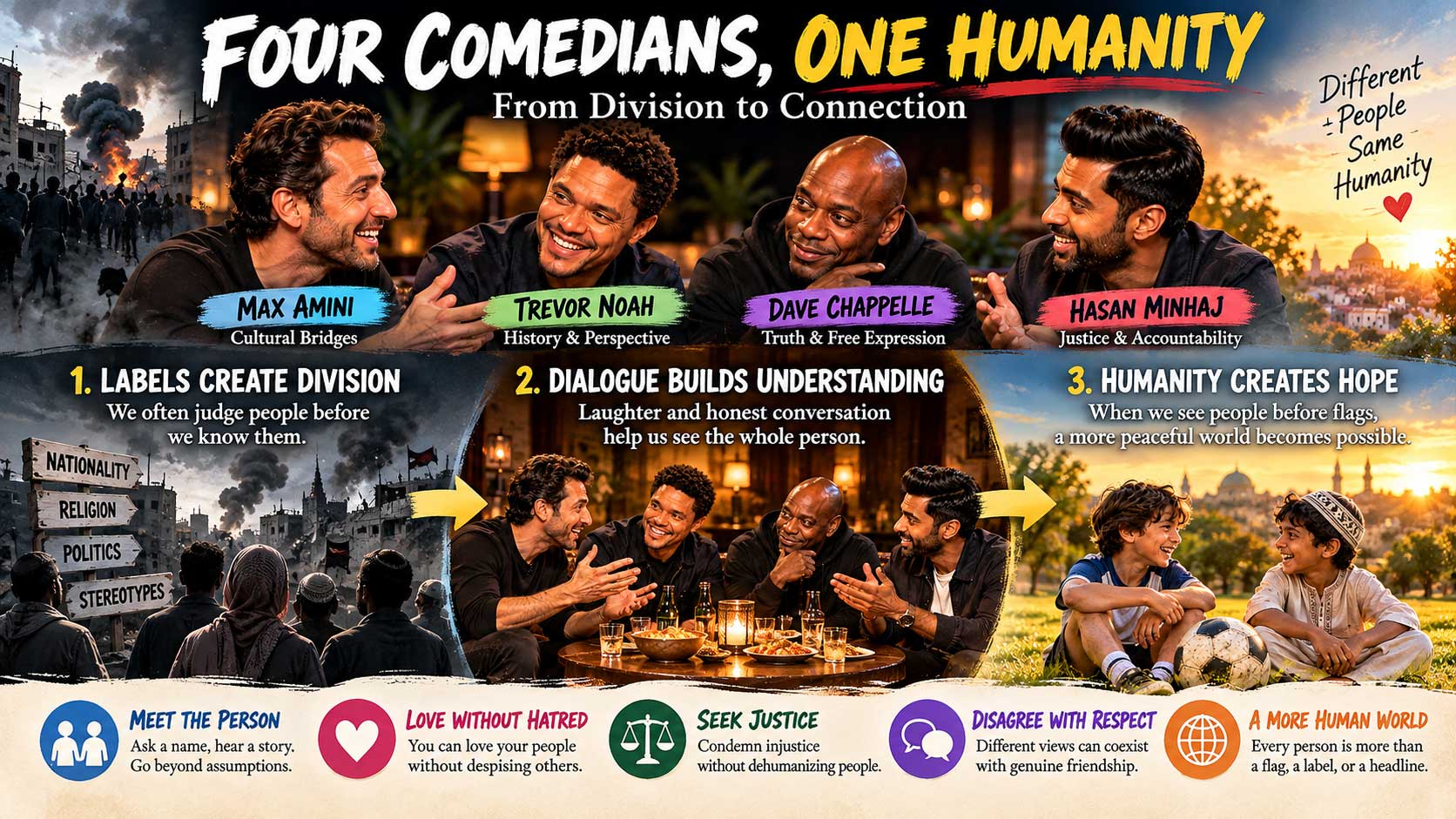
Four comedians sat around a table and tried to answer a question that has troubled humanity for centuries.
Why do we hate people we've never met?
They didn't solve the problem.
Max Amini still believes that love and kindness should come before political divisions. Hasan Minhaj still insists that compassion must never become an excuse for ignoring injustice. Dave Chappelle still challenges the idea that unity requires everyone to agree. Trevor Noah still reminds us that prejudice is shaped by history, institutions, and the stories people inherit.
Their differences remain.
And perhaps that is the most hopeful part of the conversation.
They didn't have to agree in order to respect one another.
We Are More Than the Countries We Come From
An Iranian is not the Iranian government.
An American is not every decision made in Washington.
A Russian is not automatically responsible for the actions of the Kremlin.
An Israeli or Palestinian is not merely a symbol of a political conflict.
A Muslim, Christian, Jew, Hindu, Buddhist, or person without religious belief is more than the assumptions others attach to that identity.
Every person carries a story that cannot be captured by a flag, a label, or a headline.
Some stories contain extraordinary suffering. Some contain remarkable courage. Most contain the ordinary hopes and fears that make us human.
And we rarely discover those stories when we begin by deciding who our enemies are.
Love Does Not Mean Looking Away
One of the most meaningful discoveries in this imaginary discussion is that love and justice need not be enemies.
We can condemn violence without condemning entire populations.
We can demand accountability without celebrating another person's suffering.
We can protect victims without teaching our children to hate people who share the nationality or religion of those responsible.
And we can recognize the humanity of someone whose actions we strongly oppose without excusing those actions.
Compassion is not indifference.
Forgiveness cannot be demanded from those who have suffered.
And peace cannot be built by pretending that injustice never happened.
Real reconciliation requires truth, accountability, and the willingness to see human dignity even across profound disagreement.
What Can One Ordinary Person Do?
Most of us cannot negotiate international peace agreements.
We cannot personally resolve every conflict between nations.
But we have more influence over our immediate relationships than we sometimes recognize.
We can refuse to repeat a hateful stereotype.
We can challenge a cruel joke without humiliating the person who told it.
We can ask someone about their life before assuming we know what they believe.
We can listen to a person whose experiences differ from ours.
We can teach children to be proud of their heritage without teaching them to despise another's.
And when someone is suffering, we can offer compassion without first asking whether they belong to our political side.
These actions may appear small compared with the scale of international conflict.
But hatred often survives through ordinary conversations, inherited assumptions, and everyday acts of exclusion.
Human connection can begin in those same ordinary places.
The Most Important Question
Near the end of our fictional conversation, Trevor Noah suggests that perhaps the simplest beginning is asking someone their name.
A flag represents millions.
A name belongs to a person.
When we ask someone's name, listen to their story, and allow them to be more than our assumptions, something changes.
The stranger becomes an individual.
The stereotype begins to lose its certainty.
And sometimes, an enemy we inherited becomes a friend we never expected.
Max Amini's original message deserves to be remembered:
You don't represent your government. You represent yourself as a human being.
Perhaps we can carry that thought one step further.
We are responsible for our own actions, our own words, and the dignity we extend to others.
We cannot choose every conflict we inherit.
But we can choose whether to pass hatred to the next generation.
And perhaps the next time two strangers from opposing countries meet, their first question won't be about politics.
Perhaps it will simply be:
"What's your name?"
And perhaps, before the conversation is over, they'll find something to laugh about together.
Short Bios:
Max Amini
Iranian-American Comedian, Actor, and Producer
Max Amini is an Iranian-American stand-up comedian whose performances draw on cultural differences, family relationships, immigrant experiences, and the universal absurdities of everyday life.
Born in the United States to Iranian parents, Amini spent part of his childhood in Iran. His experiences across cultures have influenced his comedic perspective and his desire to connect with audiences from different backgrounds.
His comedy often celebrates the similarities between people who may appear divided by nationality, language, or religion.
In this imaginary conversation, Max represents the belief that human connection should come before political identity.
Official website: https://www.maxamini.com/
Trevor Noah
South African Comedian, Author, and Former Host of The Daily Show
Trevor Noah is a South African comedian, writer, and television personality best known for hosting The Daily Show from 2015 to 2022.
Born during apartheid to a Black South African mother and a white Swiss father, Noah grew up under laws that prohibited his parents' interracial relationship.
His bestselling memoir, Born a Crime: Stories from a South African Childhood, explores his upbringing, racial identity, family relationships, and the contradictions of apartheid.
Noah frequently uses personal storytelling and humor to examine prejudice, politics, and human behavior.
In this fictional discussion, he offers historical perspective and explores how empathy can challenge inherited divisions.
Official website: https://www.trevornoah.com/
Dave Chappelle
American Stand-Up Comedian, Actor, and Writer
Dave Chappelle is an American comedian known for his observational humor, social commentary, and willingness to explore controversial subjects.
He gained widespread recognition through Chappelle's Show and has continued performing stand-up comedy addressing race, culture, politics, identity, and free expression.
His work has attracted both praise and criticism, often prompting debates about the responsibilities and boundaries of comedy.
In this imaginary conversation, Chappelle challenges the group to consider whether genuine human connection can survive difficult truths, offensive opinions, and disagreement.
Official website: https://www.chappelle.com/
Hasan Minhaj
Indian-American Comedian, Writer, and Political Satirist
Hasan Minhaj is an American comedian and writer known for combining personal storytelling with political and cultural commentary.
Born in California to Indian Muslim parents, Minhaj has frequently explored immigrant identity, religion, discrimination, and the experience of belonging to multiple cultures.
He gained recognition through The Daily Show and later created and hosted Netflix's Patriot Act with Hasan Minhaj, which examined political, social, and economic issues through comedy.
In this fictional discussion, Minhaj challenges the idea that avoiding political conflict is always sufficient, asking whether genuine compassion requires speaking against injustice.
Official website: https://www.hasanminhaj.com/
Editorial Note: This article is an original work of fictional dialogue created for ImaginaryTalks.com. The participants' imagined statements are creative interpretations inspired by their public work and experiences. No real meeting, endorsement, or direct participation is implied.
Leave a Reply