
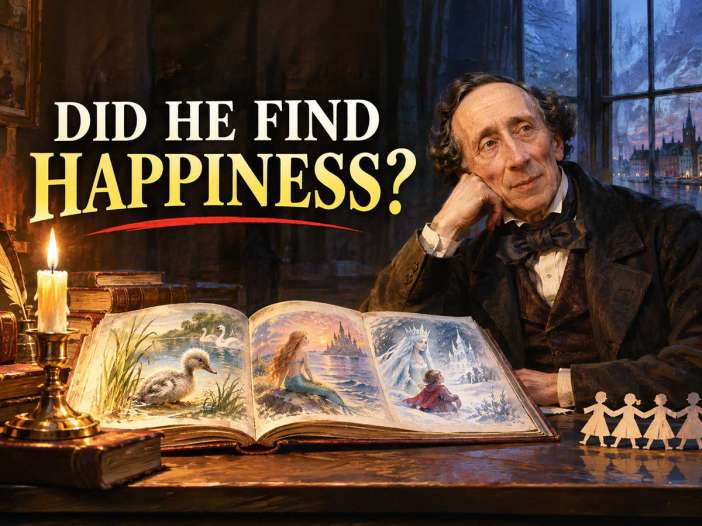
Introduction
Hans Christian Andersen gave the world some of its most beloved fairy tales, but did the man who taught generations to believe in happy endings ever find one of his own?
Behind The Ugly Duckling, The Little Mermaid, The Snow Queen, and The Little Match Girl was a remarkable human being whose life was filled with imagination, ambition, friendship, rejection, literary triumph, and a lifelong fascination with love and spiritual hope. His stories have comforted countless readers, yet the man who created them remains far more complicated than the familiar image of a gentle storyteller.
Born in Odense, Denmark, in 1805, Andersen grew up in a family of modest means. His father, a shoemaker who enjoyed literature, introduced him to the extraordinary possibilities of storytelling. After his father's death, Andersen faced an uncertain future, but at fourteen he made an astonishing decision: he left home for Copenhagen, determined to pursue a career in the theater. His early ambitions brought disappointment, yet the encouragement of influential supporters, particularly Jonas Collin, helped him obtain an education and develop his literary abilities. The Royal Danish Library's biography of Hans Christian Andersen reveals the remarkable distance between his humble beginnings and his eventual international recognition.
Andersen did not set out merely to entertain children. He wrote novels, poetry, plays, and travel accounts, developing an extraordinary literary imagination that eventually transformed the fairy tale into a sophisticated form of storytelling. In The Emperor's New Clothes, he exposed the absurdity of vanity and collective dishonesty. In The Ugly Duckling, he explored rejection, identity, and the danger of judging others by appearances. In The Nightingale, he questioned whether artificial perfection could ever replace living beauty. His surviving manuscripts, letters, and artistic creations, preserved in the Royal Danish Library's Andersen collections, reveal a writer whose creativity reached far beyond the stories for which he is best remembered.
Yet Andersen's personal relationships raise questions just as fascinating as his literary achievements. He formed meaningful friendships, developed powerful emotional attachments, and experienced romantic disappointments. He never married, but his life was far from devoid of affection, companionship, laughter, or adventure. His experiences invite us to reconsider the familiar assumption that happiness must follow one particular pattern. When we examine The Little Mermaid, for example, we discover a story concerned with much more than unreturned love. Its original ending explores sacrifice, mortality, spiritual transformation, and the longing for an immortal soul, themes that deserve attention within Andersen's broader religious imagination.
Perhaps the most moving quality of Andersen's writing is his ability to make readers care about those whom society overlooks. The little match girl suffers in a world that scarcely notices her. The ugly duckling endures rejection long before anyone recognizes his true identity. Gerda, the determined young heroine of The Snow Queen, demonstrates a devotion that survives danger, separation, and despair. These stories do not promise that kindness will always prevent suffering. Instead, they ask what happens when human beings choose compassion over indifference. The Hans Christian Andersen Centre at the University of Southern Denmark offers scholarly perspectives on the literary and intellectual dimensions of his work.
In this imaginary interview, I invite Hans Christian Andersen to join me for five conversations across the places and experiences that shaped his extraordinary life. We begin in the small childhood home in Odense, follow his artistic discoveries in Copenhagen, explore his friendships and complicated experiences of love, and confront the difficult questions of suffering, faith, and kindness within his most memorable stories. Finally, we return to the question that has followed us from the beginning: Did the storyteller who gave the world so many unforgettable endings discover what happiness meant in his own life?
What I hope emerges is something more meaningful than a simple biography or a collection of familiar fairy-tale lessons. Andersen was ambitious, humorous, sensitive, sometimes difficult, deeply imaginative, and profoundly human. His life invites us to think about the people who encouraged us, the relationships that shaped us, and the quiet ways our actions may affect others long after we have forgotten them. Perhaps the greatest surprise awaiting us is not a secret about Andersen's happiness, but a new way of recognizing the worth of the people around us.
Fictional interview disclaimer: This article presents an imagined conversation between Nick Sasaki and Hans Christian Andersen. Historical events, literary works, and documented relationships provide its foundation, but the dialogue, settings, and personal reflections are fictional reconstructions. They should not be interpreted as Andersen's recorded words or verified private thoughts.
Topic 1 - The Boy Who Refused to Stay Small
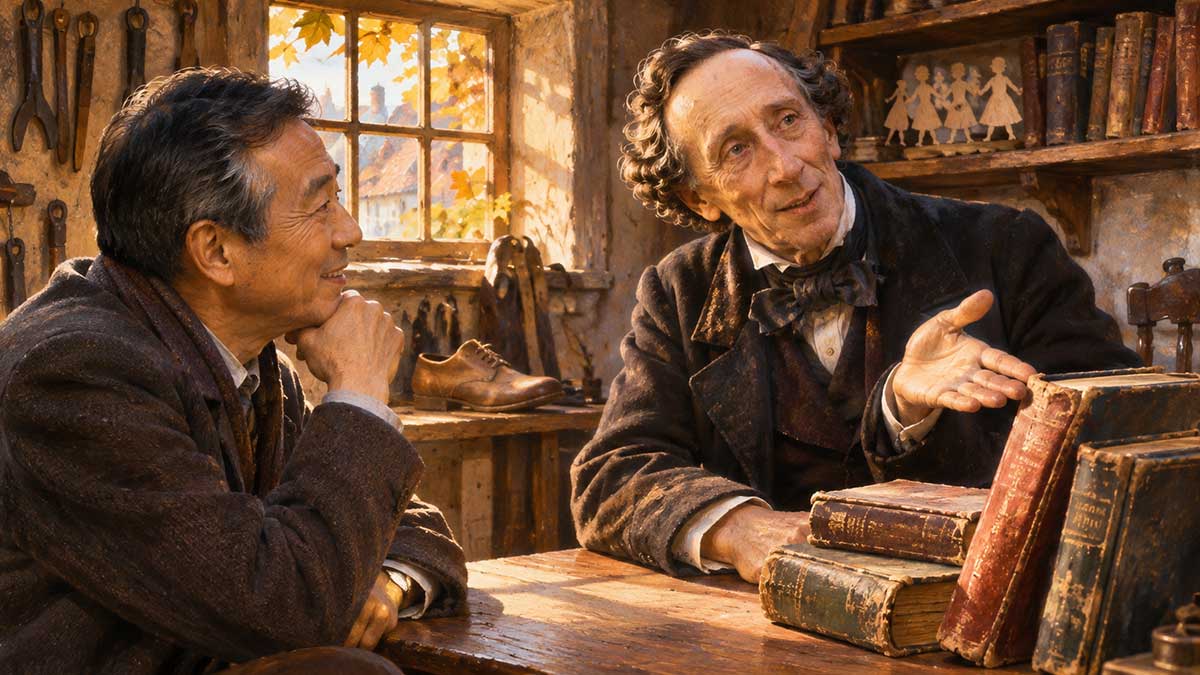
Odense, Denmark. An early autumn morning.
Sunlight slips through the small window of a modest house on Munkemøllestræde. Outside, footsteps echo along the cobblestones, and the distant sounds of a waking town drift through the cool morning air.
Inside, a shoemaker's tools rest beside a wooden workbench. A few books sit on a shelf, their worn covers suggesting they have been opened many times. The room is small enough that almost everything is within reach.
Hans Christian Andersen, now an older gentleman with a long, expressive face and gentle, observant eyes, stands quietly beside the window. He looks around with an expression somewhere between amusement and recognition.
Nick Sasaki enters, pauses, and smiles.
Nick Sasaki
Hans, I have to say, when I pictured the childhood home of one of the world's greatest storytellers, I expected something a little bigger.
Hans Christian Andersen
Laughing softly.
My dear Nick, if you expected a palace, you have mistaken the beginning of the fairy tale for its ending.
Nick Sasaki
That's a good point. Though I have a feeling you could turn this little room into a palace with a few sentences.
Hans Christian Andersen
Perhaps. But I would leave the room just as it is. A palace can be terribly dull. People spend so much time admiring the furniture that they forget to look at one another.
Nick laughs and sits near the workbench.
Question 1 - The Father Who Opened Another World
Nick Sasaki
Your father was a shoemaker, and your family didn't have much money. Yet he gave you something that seems to have shaped your entire life: stories.
What do you remember most about those early days together?
Hans Christian Andersen
My father was a thoughtful man. He worked with his hands, but his mind was seldom confined to his work.
He loved books. He read to me, and through those readings I encountered worlds far beyond Odense.
There were kings and travelers, strange adventures, and people whose lives seemed impossibly different from our own.
For a child, it was wonderful to discover that a room could remain small while the mind traveled anywhere.
Nick Sasaki
Did he read stories to entertain you, or was he trying to teach you something?
Hans Christian Andersen
I cannot say what intention was always in his mind.
But I think he enjoyed the stories himself. That made a difference.
Children can tell when adults are merely performing a duty. My father seemed genuinely interested in the things he read.
And I was delighted to share that interest.
Nick Sasaki
I love that. He wasn't necessarily giving you a lesson about becoming a writer. He was simply sharing something he loved.
Hans Christian Andersen
Yes. And perhaps that is one of the finest gifts we can give a child.
Not an instruction to become extraordinary, but permission to be curious.
Nick Sasaki
You were fascinated by the theater too, weren't you?
Hans Christian Andersen
Very much.
I loved performing. I made little theaters and played with figures. The stage seemed a magical place where ordinary people could become kings, queens, heroes, or fools.
And sometimes the fools were the most interesting characters.
Nick Sasaki
That sounds like the future author of The Emperor's New Clothes talking.
Hans Christian Andersen
Smiling.
Ah, but we have not yet reached that unfortunate emperor. Let him enjoy his dignity a little longer.
Nick Sasaki
Fair enough.
Your father died when you were eleven. That's such a young age to lose someone who encouraged your imagination.
Do you remember how your life changed afterward?
Hans Christian Andersen
His death changed our circumstances, certainly.
My mother had to continue working, and life demanded practical things of us.
But I would be careful about telling you that everything beautiful in my childhood disappeared.
There were difficulties, yes. Yet there were memories of affection and pleasure too.
I think people sometimes make a mistake when they look at a poor child's life. They assume that poverty must have filled every hour with misery.
It does not work that way.
A child may have very little and still experience moments of extraordinary happiness.
Nick Sasaki
That's something I want readers to hear.
We sometimes look backward at famous people and try to explain everything about them through their hardships.
But your father wasn't simply part of a sad childhood story. He gave you something beautiful.
Hans Christian Andersen
I am glad you see that.
And I would not wish him to be remembered merely as the father of a famous writer.
He was a person with his own thoughts, disappointments, interests, and affections.
He mattered before anyone knew what would become of his son.
For a moment, the two men look at the worn books on the shelf.
Nick Sasaki
You know, Hans, I wonder how many parents have no idea what their children will carry with them for the rest of their lives.
Maybe a book they read together. Maybe a kind word. Maybe an afternoon spent making something.
Hans Christian Andersen
And perhaps the child does not recognize the gift until many years later.
Question 2 - The Fourteen-Year-Old Who Left Home
Nick walks toward the window and looks out at the narrow street.
Nick Sasaki
Now here's the part of your story that amazes me.
At fourteen, you left Odense and went to Copenhagen, hoping to make a career in the theater.
Fourteen!
When I think about a boy that age arriving in a city with enormous dreams and very little money, I have to ask: What gave you the courage?
Hans Christian Andersen
He laughs.
You call it courage. Some people might have called it foolishness.
Nick Sasaki
Were they wrong?
Hans Christian Andersen
Not entirely!
I had a remarkable confidence in my destiny, particularly considering how little evidence I possessed to support it.
I wanted to perform. I wanted to sing. I wanted to belong to the theater.
Copenhagen seemed the place where such dreams might become possible.
Nick Sasaki
Did you have a clear plan?
Hans Christian Andersen
A clear plan? My dear Nick, I was fourteen.
I had hopes, introductions, and an extraordinary willingness to approach people who might help me.
But I had much to learn about the difference between wanting to be an artist and possessing the skills required.
Nick Sasaki
That must have been difficult. You arrive thinking you might become a great performer, and suddenly you're surrounded by people who have trained for years.
Hans Christian Andersen
Indeed.
The theater was a place of wonder, but it was also a place of judgment.
People assessed one's voice, appearance, movement, and ability.
I did not always meet their expectations.
There were opportunities, disappointments, and many awkward moments.
Nick Sasaki
Can I ask you something a little embarrassing?
Hans Christian Andersen
Only if I may ask you something embarrassing afterward.
Nick Sasaki
That's a dangerous agreement.
Both laugh.
When you approached important people and asked them to listen to you sing or perform, did you ever realize afterward that you might have been a little too enthusiastic?
Hans Christian Andersen
Laughing.
Enthusiasm is a wonderful quality in the person who possesses it.
It can be rather exhausting for everyone else.
Nick Sasaki
So you were persistent.
Hans Christian Andersen
Very persistent.
But persistence alone is not sufficient. One must learn, improve, and sometimes accept that the path one first desires may not be the path one is best suited to follow.
Nick Sasaki
Did you ever think about giving up and returning to Odense?
Hans Christian Andersen
There were difficult times. My prospects were uncertain, and I depended upon the kindness of others.
But Copenhagen offered possibilities that I was reluctant to abandon.
I still believed that I might find a place in the artistic life of the city.
Nick Sasaki
That's interesting. You weren't necessarily dreaming of becoming the author of The Little Mermaid or The Snow Queen.
You were trying to become a performer.
Hans Christian Andersen
Precisely.
Life is often described backward, as though every early event were deliberately preparing us for the achievement by which we are eventually remembered.
But the young man does not possess the knowledge of the old man.
At fourteen, I could not have described the literary career that awaited me.
I knew only that I wanted to create, perform, and be part of a larger world.
Nick Sasaki
That's a beautiful distinction.
Sometimes what looks like failure is simply a person discovering that their talent belongs somewhere unexpected.
Hans Christian Andersen
Perhaps. But I would not recommend failure as a pleasant educational method.
It can be terribly uncomfortable.
Nick Sasaki
Laughing.
Fair enough. We won't put that on a motivational poster.
Question 3 - Rejection, Education, and Unexpected Kindness
The morning light grows brighter. Andersen returns to the workbench, resting one hand lightly upon its worn surface.
Nick Sasaki
You had ambition, but ambition wasn't enough.
Several people helped you, and Jonas Collin became especially important in your life.
What did that support mean to you?
Hans Christian Andersen
It meant that I was given opportunities I could not have secured alone.
Jonas Collin recognized that I needed education and assistance.
Through his efforts and the support available to me, I was able to continue my studies.
That was enormously significant.
Nick Sasaki
But your school years weren't easy.
Hans Christian Andersen
No.
I was older than many of the pupils around me, and I was painfully aware of the deficiencies in my education.
The discipline could be severe, and my relationship with the schoolmaster Simon Meisling was particularly difficult.
There were times when I felt discouraged and humiliated.
Yet education opened doors that would otherwise have remained closed.
Nick Sasaki
Did you resent having to return to school when you wanted to be writing and performing?
Hans Christian Andersen
At times, certainly.
I had already developed the ambition of an artist, and now I was expected to attend to lessons that younger boys had begun years before.
It was not always agreeable to my pride.
Nick Sasaki
I can picture that.
You arrive thinking you're destined for greatness, and someone tells you to sit down and study grammar.
Hans Christian Andersen
Laughing.
Grammar has ruined many splendid dreams.
But it has saved a considerable number of sentences.
Nick Sasaki
That's a line every writer should hear.
Hans Christian Andersen
A writer needs imagination, but imagination alone does not make good literature.
One must learn how language works.
And one must learn to observe people.
The world offers an endless education to anyone willing to pay attention.
Nick Sasaki
What interests me is how many people were involved in your story.
Your father shared books with you. People in Copenhagen gave you opportunities. Jonas Collin helped you obtain an education.
We often describe famous writers as self-made geniuses, but nobody really creates a life entirely alone.
Hans Christian Andersen
That is true.
I possessed ambition, and I worked hard. I would not wish those efforts to be dismissed.
But I received assistance at moments when assistance mattered greatly.
A person's achievements may belong to them, yet their opportunities often depend upon other people.
Nick Sasaki
And sometimes one person sees something in a young person that the young person can't fully develop on their own.
Hans Christian Andersen
Yes.
Though the person offering help may see possibilities rather than certainties.
No one could have guaranteed what I would become.
Nick Sasaki
That's what makes kindness so interesting to me.
When someone helps a young person, they don't know what will happen twenty or fifty years later.
Maybe the child becomes famous. Maybe they don't.
But the kindness still matters.
Hans Christian Andersen
I agree.
And I hope we do not value such kindness merely by asking whether it produces a celebrated person.
A child need not become a famous writer to deserve encouragement.
Nick Sasaki
He pauses, then smiles.
Hans, that's probably my favorite thing you've said this morning.
Hans Christian Andersen
Then I am relieved. I was beginning to fear that my observations about grammar would be my lasting contribution to our conversation.
They laugh together.
Nick Sasaki
One last question before we leave this little house.
If you could speak to that fourteen-year-old boy preparing to leave Odense, would you tell him to be more realistic?
Hans Christian Andersen
He looks around the room, considering the question.
I would hesitate to give him too much advice.
He would need his dreams, even the unreasonable ones.
He would need to discover his limitations, and he would need the patience to develop abilities he did not yet possess.
I might tell him that the world is larger than he knows, but that it contains people willing to help.
And perhaps I would encourage him to remain curious when his plans go wrong.
Nick Sasaki
Not to give up on the dream, but to remain open to what the dream might become?
Hans Christian Andersen
That is a fair way of putting it.
For I went to Copenhagen hoping to find a place upon the stage.
I did not know that one day I would create characters who would continue speaking long after I had left it.
Nick looks once more at the books and shoemaker's tools.
Nick Sasaki
Your father worked with leather, shaping something ordinary into something useful.
And you eventually worked with words, shaping ordinary things into stories that people still love.
Hans Christian Andersen
Smiling warmly.
That is a charming comparison, Nick.
But I suspect my father would have reminded us that a poorly made shoe is of little use, however beautiful the story told about it.
Nick Sasaki
Laughing.
So craftsmanship matters.
Hans Christian Andersen
Very much.
And that brings us to a question I think you have been waiting to ask.
Nick Sasaki
How did you learn to make fairy tales?
Hans Christian Andersen
Exactly.
Andersen reaches for a small sheet of paper and a pair of scissors resting on the table.
He folds the paper once, then again.
Hans Christian Andersen
Perhaps we should begin with something simple.
The scissors move carefully through the folded paper.
Hans Christian Andersen
After all, a little imagination can do surprising things with very ordinary materials.
And with that, the conversation turns from the boy who dreamed of the theater to the writer who would transform the possibilities of the fairy tale.
Fictional interview disclaimer: This conversation between Nick Sasaki and Hans Christian Andersen is an imaginative literary reconstruction. It draws upon documented biographical events, but the dialogue, private reflections, and meeting are fictional. They should not be interpreted as Andersen's recorded statements.
Topic 2 - The Secret Life of Fairy Tales
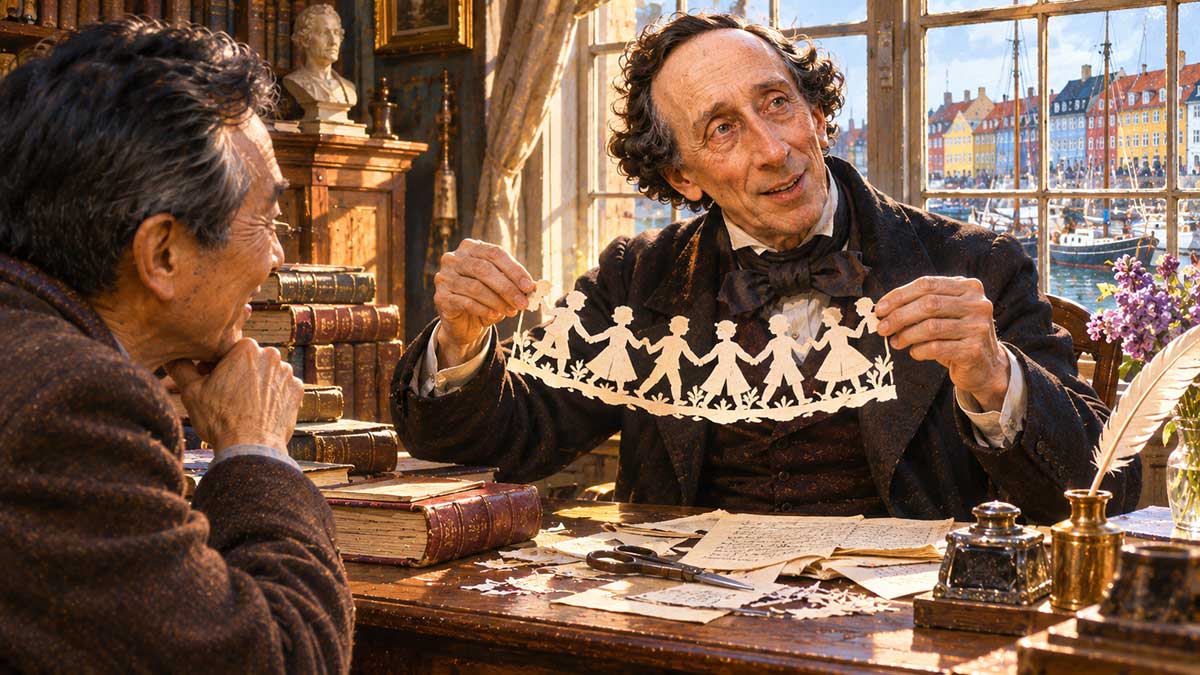
Copenhagen, Denmark. A midafternoon in the 1830s, in an imagined writing room overlooking Nyhavn.
Sunlight pours through the tall windows, illuminating a wooden desk crowded with manuscripts, books, scissors, and delicate paper cuttings. Beyond the glass, the harbor is alive with movement. Sailors call to one another, a carriage rattles along the cobblestones, and gulls circle above the colorful buildings.
Hans Christian Andersen sits beside the desk, carefully cutting a folded piece of paper. Nick Sasaki watches with growing curiosity.
With one final movement of the scissors, Andersen unfolds the paper. A procession of tiny figures appears, their arms connected as though they are dancing.
Nick Sasaki
Hans, that's incredible. Five minutes ago, it was an ordinary sheet of paper.
Hans Christian Andersen
And now it is a little society. Though I fear they are all holding hands against their will.
Nick Sasaki
Laughing.
You're already creating problems for your characters.
Hans Christian Andersen
Of course. Without problems, there would be very few stories.
Nick Sasaki
You know what's fascinating? Your father worked with his hands, and here you are doing something similar. Except instead of making shoes, you're making little worlds.
Hans Christian Andersen
A dangerous occupation. In a little world, one can make the king ridiculous, give a flower a voice, or allow a tin soldier to fall in love.
Nick Sasaki
And nobody can stop you?
Hans Christian Andersen
Oh, critics can certainly try.
They laugh as Andersen places the paper figures beside a manuscript.
Question 1 - How Did You Invent a New Kind of Fairy Tale?
Nick Sasaki
Hans, you originally wanted to become an actor or singer. Then you wrote poetry, plays, and novels.
But today, people around the world know you best for your fairy tales.
What did you discover in fairy tales that you couldn't express quite the same way in your other writing?
Hans Christian Andersen
Freedom, Nick.
In a fairy tale, a flower may speak, a shadow may become independent of its owner, and a nightingale may possess greater wisdom than an emperor.
The reader accepts these extraordinary events and follows them toward something recognizably human.
That is a marvelous freedom for a writer.
Nick Sasaki
So you could say things about people without describing ordinary people directly?
Hans Christian Andersen
Sometimes.
But a fairy tale need not hide its meaning behind a disguise. It can reveal something through the very strangeness of its invention.
A child's toy may suffer from pride. A little fir tree may spend its entire life wishing to be somewhere else.
And an emperor may discover that admiration is not always the same as honesty.
Nick Sasaki
I love that. You take an ordinary object and give it a personality.
Did you ever look at something like a teapot and think, "I wonder what this poor thing is worried about?"
Hans Christian Andersen
Laughing.
A teapot might have a great deal to worry about. It is always in danger of losing its spout.
Nick Sasaki
And it probably thinks it's the most important object in the kitchen.
Hans Christian Andersen
Naturally. Pride is not confined to human beings, at least not in literature.
Nick Sasaki
Your early fairy tales sometimes drew on stories people already knew, but many of your later tales were original inventions.
Were you consciously trying to create something different?
Hans Christian Andersen
I wanted to write in a manner that felt alive.
The old tales had their wonders, and I admired the imaginative possibilities they offered. But I wanted the language to possess the movement and immediacy of someone telling a story.
A tale could be playful, sorrowful, ironic, or mysterious.
And it need not speak exclusively to children.
Nick Sasaki
That's something people often miss. They see the words "fairy tale" and assume it's just children's entertainment.
Hans Christian Andersen
Children are excellent readers in many respects. They accept wonders that adults spend far too much time explaining away.
But adults bring their own experiences to a story.
A child may laugh at a foolish king. An adult may recognize the foolishness of an entire court.
Nick Sasaki
And perhaps recognize themselves among the courtiers?
Hans Christian Andersen
With a mischievous smile.
That is the danger of reading carefully.
Nick Sasaki
Did you ever worry that people would take your fairy tales less seriously than your novels?
Hans Christian Andersen
I cared greatly about my standing as a writer. My novels, plays, and poetry mattered to me.
I did not begin my literary life with the intention of being remembered chiefly as a writer of fairy tales.
Yet the tales found readers, and I discovered more and more possibilities within them.
A writer may begin by choosing a form, only to find that the form gradually reveals what he is capable of doing.
Nick Sasaki
That's interesting. The stories almost taught you what kind of writer you could become.
Hans Christian Andersen
Perhaps they taught me how much remained to be discovered.
Question 2 - The Ugly Duckling and the Naked Emperor
Nick picks up a manuscript and turns it over thoughtfully.
Nick Sasaki
Let's talk about two of your most famous stories.
In The Ugly Duckling, everyone rejects a young bird for being different.
In The Emperor's New Clothes, almost everyone pretends to admire something that doesn't exist.
One is heartbreaking. The other is hilarious.
Yet both seem to ask the same question: Why are people so easily fooled by appearances?
Hans Christian Andersen
That is a perceptive connection.
People are remarkably eager to decide what something is worth before they have properly examined it.
A creature looks strange, and they call it ugly.
A ruler is important, and they assume he must be wise.
A person speaks confidently, and others are reluctant to question him.
Nick Sasaki
Let's start with the ugly duckling.
Readers often say it's your own life disguised as a fairy tale. A boy from a poor family, misunderstood and rejected, eventually becomes a celebrated writer.
Is that fair?
Hans Christian Andersen
There are certainly experiences in my life that may help a reader approach the story.
I knew what it meant to feel out of place.
But I would hesitate to say that every part of the tale corresponds to some event in my biography.
A story must be allowed to become more than its author's personal history.
Nick Sasaki
The ending fascinates me.
The ugly duckling doesn't become a swan through hard work or determination. He discovers that he was a swan all along.
Hans Christian Andersen
Yes. He has been judged according to an identity that was never truly his.
The creatures around him believe they know what he ought to be.
But their judgment is mistaken.
Nick Sasaki
So the transformation isn't really about changing himself to please everybody.
Hans Christian Andersen
It is a discovery of what he is.
And the beauty of the ending is inseparable from the suffering that precedes it.
The young creature has endured ridicule and exclusion. When he finally sees his reflection among the swans, he encounters a truth that others had failed to recognize.
Nick Sasaki
That makes me think about children who feel different.
Some are teased for the way they look, speak, or behave. They start believing the judgment of everyone around them.
Do you think a story can help someone question that judgment?
Hans Christian Andersen
I hope literature can help readers see beyond the opinions of a crowd.
But I would be cautious about promising that every unhappy child will discover a splendid destiny.
Life is not so accommodating.
A person's dignity should not depend upon eventually becoming beautiful, famous, or admired.
Nick Sasaki
That's a remarkable distinction.
The duckling deserves kindness before anyone discovers he's a swan.
Hans Christian Andersen
Precisely.
Nick Sasaki
Now, let's move to the emperor.
I have to ask: Did you enjoy writing that story?
Hans Christian Andersen
Laughing.
Very much.
There is something irresistible about an entire court behaving foolishly while insisting upon its own intelligence.
Nick Sasaki
Two swindlers announce that their cloth is invisible to anyone who's stupid or unfit for office.
And suddenly nobody wants to admit they can't see it.
Hans Christian Andersen
An ingenious deception, is it not?
The swindlers do not merely exploit vanity. They exploit fear.
Each person is afraid that honesty will reveal some deficiency in himself.
Nick Sasaki
Even the emperor!
Hans Christian Andersen
Especially the emperor. He has the most to lose from admitting that he sees nothing.
Nick Sasaki
And then a child says what everybody already knows.
Hans Christian Andersen
A child who has not yet learned all the elaborate reasons adults invent for remaining silent.
Nick Sasaki
It's funny, but a little uncomfortable too.
I think most of us have been in a room where everybody agrees with something ridiculous, and nobody wants to be the first person to object.
Hans Christian Andersen
Then perhaps the emperor continues to travel more widely than I ever did.
Nick bursts into laughter.
Nick Sasaki
Hans, I think you would have a wonderful time observing the modern world.
Hans Christian Andersen
I suspect I would find the clothing very strange.
Nick Sasaki
The clothing would be the least of your surprises.
They laugh again.
Question 3 - The Nightingale and the Meaning of Genuine Beauty
Andersen lifts the paper figures from his desk. Their thin silhouettes tremble slightly in the afternoon breeze.
Nick Sasaki
There's another story I want to discuss: The Nightingale.
An emperor hears a real nightingale sing and is deeply moved. Then he receives a beautiful mechanical bird covered in jewels.
For a time, everyone seems to prefer the artificial bird.
What interested you about that contrast?
Hans Christian Andersen
The mechanical bird is splendid in appearance. It can repeat its performance reliably, and its workings may be admired.
But the living nightingale possesses something the imitation cannot fully reproduce.
Its song is alive. It changes. It comes freely.
And it can touch the heart in ways that splendid decoration cannot guarantee.
Nick Sasaki
So the mechanical bird isn't necessarily bad. It's just limited.
Hans Christian Andersen
Exactly.
It is a remarkable object. But the court mistakes the beauty of its construction for the whole meaning of the nightingale's song.
They admire what can be displayed and controlled.
Nick Sasaki
And when the emperor becomes seriously ill, the mechanical bird can't help him.
Hans Christian Andersen
Its mechanism fails him.
The living nightingale returns and sings, and the emperor is drawn back from the presence of Death.
Nick Sasaki
What I love is that the nightingale doesn't return demanding revenge.
The emperor abandoned her for a jeweled imitation, yet she still sings for him.
Hans Christian Andersen
There is generosity in that act.
And there is something important in the nightingale's freedom. She will not remain merely as an ornament of the court.
Nick Sasaki
That's interesting. She offers beauty, but she refuses to be owned.
Hans Christian Andersen
The finest things in life are not always those we can possess.
Nick Sasaki
Can I connect that to your own writing?
You became famous, and people admired your stories. Did you ever worry about writing what audiences expected rather than what you genuinely wanted to create?
Hans Christian Andersen
A writer naturally wishes to be read and appreciated.
I was certainly not indifferent to praise.
Nick Sasaki
Smiling.
I've noticed that about you.
Hans Christian Andersen
And I have noticed that you enjoy reminding me.
They laugh.
Hans Christian Andersen
But the desire for recognition can become troublesome if it governs every artistic decision.
One must remain attentive to the story itself.
Its language, movement, characters, and emotional truth must matter more than the applause one hopes to receive.
Nick Sasaki
When you say "emotional truth," what do you mean?
Hans Christian Andersen
A tale may describe something that could never occur in ordinary life.
A tin soldier cannot truly fall in love. A flower cannot speak. A shadow cannot walk away from its owner.
Yet through such inventions, a reader may recognize pride, longing, fear, affection, or foolishness.
The event is impossible. The human experience is familiar.
Nick Sasaki
That may be the best explanation of fairy tales I've ever heard.
Hans Christian Andersen
Then I hope you will allow me to continue writing them.
Nick Sasaki
I wouldn't dare stop you.
Nick places the manuscript back on the desk and looks at the delicate paper figures.
Nick Sasaki
You know, Hans, something has struck me during this conversation.
Your stories are full of characters who want to be seen for who they really are.
The ugly duckling wants to belong. The nightingale wants her freedom. The emperor is surrounded by people who refuse to tell him the truth.
It's almost as though your stories keep asking whether we can see beyond appearances.
Hans Christian Andersen
Perhaps that is one of the questions literature is especially suited to ask.
We look at people every day, yet how much do we truly see?
We judge quickly. We admire what glitters. We overlook what is quiet.
And sometimes we discover that the person we dismissed possesses something we never thought to seek.
Nick Sasaki
I wonder whether that becomes especially difficult when love is involved.
It's one thing to want the world to recognize your talent.
It's another to want one particular person to recognize your heart.
Andersen's expression softens. He looks toward the harbor, where the afternoon light has begun to turn golden.
Hans Christian Andersen
Ah, Nick.
That is a much more dangerous subject than emperors without clothing.
Nick Sasaki
Laughing gently.
I had a feeling you might say that.
Hans Christian Andersen
With an emperor, one can laugh at the foolishness of others.
With love, one is often obliged to examine one's own.
Nick Sasaki
Then perhaps that's where we should go next.
Hans Christian Andersen
Perhaps.
He folds another piece of paper, but this time leaves the scissors untouched.
Hans Christian Andersen
For there are some things the imagination can transform into a beautiful story, yet the heart may continue to find them difficult.
Outside, the harbor continues its afternoon activity. Inside, the conversation begins to move from the worlds Andersen created to the relationships that mattered most to him.
Fictional interview disclaimer: This conversation between Nick Sasaki and Hans Christian Andersen is an imaginative literary reconstruction. It draws upon Andersen's documented literary career and the original themes of his fairy tales, but the dialogue, private reflections, and meeting are fictional. They should not be interpreted as Andersen's recorded statements.
Topic 3 - The Heart That Longed to Be Loved
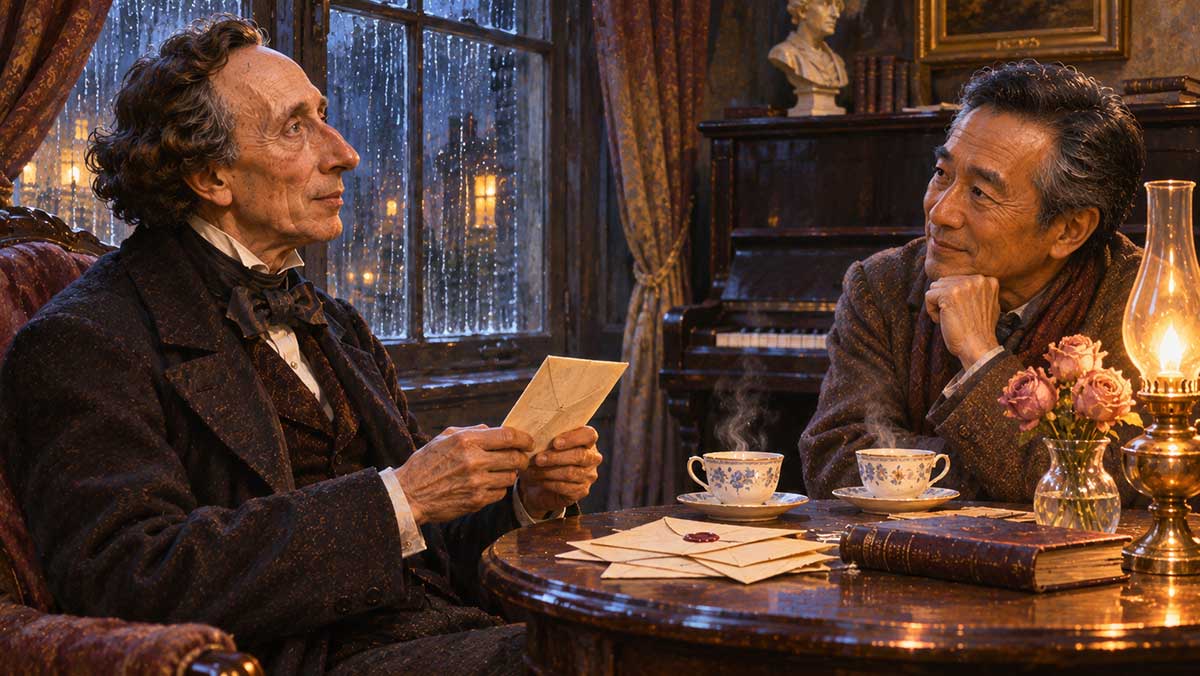
Copenhagen, Denmark. An early evening in an imagined nineteenth-century sitting room.
Rain taps gently against the tall windows. A small oil lamp casts a golden glow across a polished wooden table, where several handwritten letters rest beside a vase of fading roses. A piano stands against the far wall, its dark surface reflecting the flickering light.
Hans Christian Andersen sits in a high-backed chair, his long fingers resting upon a folded sheet of paper. Nick Sasaki pours tea into two porcelain cups.
For a moment, neither speaks. The silence feels comfortable, like the quiet shared by friends who have already spent hours talking.
Nick Sasaki
Hans, can I ask you something personal?
Hans Christian Andersen
Smiling.
After everything we have discussed, I am beginning to wonder whether you know any other kind of question.
Nick Sasaki
Laughing.
Fair point. But I promise not to ask you to reveal every secret you've ever kept.
Hans Christian Andersen
How considerate. I should hate to disappoint future biographers by leaving them nothing to argue about.
Nick Sasaki
Actually, that's part of what interests me.
You wrote so many letters throughout your life. Sometimes I wonder whether writing something down makes it easier to express feelings we struggle to say aloud.
Was that true for you?
Hans Christian Andersen
At times, yes. A letter allows one to choose words carefully, to return to a thought, to say what might become confused in conversation.
But letters are dangerous things too.
Nick Sasaki
Dangerous?
Hans Christian Andersen
Certainly. One writes a sentence in a moment of feeling, and there it remains, waiting patiently for someone to read it a hundred years later.
Nick Sasaki
Laughing.
And then people like me come along and start asking questions about it.
Hans Christian Andersen
Exactly. I should have burned a few more letters.
They laugh, and Andersen places the folded paper on the table.
Question 1 - The Friendships That Sustained You
Nick Sasaki
You formed some very deep friendships, especially with people who helped you when you were young.
The Collin family became an important part of your life.
What did friendship mean to you?
Hans Christian Andersen
A great deal.
When I first came to Copenhagen, I possessed ambition, but I had little security. I depended upon the goodwill of people who were willing to assist me.
Jonas Collin became particularly important in helping me obtain an education and establish myself.
And through his family, I encountered a world of companionship, conversation, and social life that meant much to me.
Nick Sasaki
Did they feel like a second family?
Hans Christian Andersen
There were times when I felt very close to them, yes.
But friendship and family affection are not always simple matters. People may care for one another deeply and still misunderstand one another.
I was sensitive to the smallest signs of affection or distance.
Nick Sasaki
That's interesting. Sometimes when we care deeply about someone, a tiny change in their behavior can feel enormous.
Hans Christian Andersen
Indeed.
A person may write a shorter letter than usual, and suddenly the recipient begins constructing an entire tragedy around it.
Nick Sasaki
Laughing.
I think that still happens today.
Hans Christian Andersen
Then humanity has made disappointingly little progress.
Nick Sasaki
Edvard Collin was especially important to you.
Your surviving letters show how deeply attached you were to him.
What was it about that friendship that mattered so much?
Hans Christian Andersen
Edvard was part of a family to which I felt strongly connected.
I valued his companionship and his place in my life.
But I must admit that I sometimes desired expressions of closeness that others were less comfortable offering.
We did not always approach affection in the same manner.
Nick Sasaki
Did that hurt?
Hans Christian Andersen
Differences in feeling can be painful.
One person may regard a relationship as perfectly secure without frequent expressions of tenderness. Another may long for reassurance.
Neither necessarily intends to wound the other.
Yet misunderstandings arise.
Nick Sasaki
That sounds very human.
We often assume that if someone cares about us, they'll express it exactly the way we do.
Hans Christian Andersen
And then we are surprised when they do not.
Nick Sasaki
Did becoming famous make friendships easier?
Hans Christian Andersen
Fame changes the way people approach you, but it does not remove the ordinary difficulties of affection.
Recognition can bring opportunities, introductions, invitations, and admiration.
But being admired by many people is not the same as feeling close to one person.
Nick Sasaki
That's a distinction I think many people need to hear.
You can be celebrated in public and still wonder whether someone truly knows you.
Hans Christian Andersen
Yes, though I would not wish to suggest that my life lacked friendship or happiness.
I received affection, hospitality, and generosity from many people.
I enjoyed visiting friends, traveling, attending performances, and sharing conversation.
My difficulties were real, but so were my pleasures.
Nick Sasaki
I'm glad you said that.
I don't want readers to walk away thinking you spent your entire life sitting alone beside a window.
Hans Christian Andersen
Smiling.
That would be a terrible waste of a perfectly good window.
Question 2 - Loving Someone Who Cannot Love You Back
The rain grows slightly heavier. Nick sets his teacup down and glances at the roses.
Nick Sasaki
Hans, you've written about love in ways that are beautiful, painful, and sometimes difficult to explain.
And in your own life, you experienced affection that wasn't always returned in the way you hoped.
Can we talk about that?
Hans Christian Andersen
We may.
But I hope you will allow me to remain a person rather than become an illustration of disappointed love.
Nick Sasaki
Absolutely.
I want to understand your experiences, not reduce you to them.
You had feelings for Riborg Voigt when you were young.
What do you remember about that time?
Hans Christian Andersen
Riborg was someone for whom I developed strong affection.
But her circumstances and commitments meant that the relationship I might have wished for was not possible.
It was an unhappy experience in certain respects.
And like many young people, I was inclined to feel things intensely.
Nick Sasaki
Did you ever wonder whether you were in love with the person herself or with the future you hoped might exist?
Hans Christian Andersen
He considers the question.
That is a difficult distinction.
When we love someone, we know certain things about them. But we also create hopes, expectations, and dreams.
Sometimes the imagined future becomes so beautiful that we suffer not merely from losing the person, but from losing the life we had pictured.
Nick Sasaki
That's beautifully put.
And later there was Jenny Lind, the celebrated singer.
You admired her enormously.
Hans Christian Andersen
Jenny possessed an extraordinary talent, and I valued her friendship.
She was a remarkable artist.
My affection for her included feelings that were not returned romantically.
But I would not wish the entire significance of our relationship to be measured by that disappointment.
Nick Sasaki
That's fair.
You admired her work and cared about her as a person.
Hans Christian Andersen
Yes.
Affection does not cease to have meaning merely when it fails to become a romance.
Nick Sasaki
Can I ask something that might sound strange?
Did you ever wish you could simply turn your feelings off?
Hans Christian Andersen
Laughing quietly.
That would be a most useful invention.
Perhaps a small mechanical device one could keep beside the bed.
Turn the handle three times, and all troublesome affection disappears.
Nick Sasaki
I suspect that would sell very well.
Hans Christian Andersen
And ruin half the literature of Europe.
Both laugh.
Nick Sasaki
But seriously, how did you live with feelings that didn't have an easy resolution?
Hans Christian Andersen
One continues living.
There are friends to visit, places to see, books to write, performances to attend.
The heart may be disappointed, but the world does not become empty.
And sometimes an experience that causes sorrow also teaches us to look more carefully at other people's feelings.
Nick Sasaki
I like that answer.
It doesn't pretend that disappointment is pleasant, but it doesn't make disappointment the whole story.
Hans Christian Andersen
It would be a very poor story if nothing else were allowed to happen.
Question 3 - The Little Mermaid and the Meaning of Sacrifice
Nick reaches for a book resting beside the lamp. Its pages contain an illustrated edition of The Little Mermaid.
Nick Sasaki
Hans, I want to talk about this story.
Many people today know The Little Mermaid as a romance about a mermaid who falls in love with a prince.
But your original story is much more complicated.
She longs for the prince, yes, but she longs for an immortal soul too.
Why were those two desires connected?
Hans Christian Andersen
The mermaid belongs to a world different from that of human beings.
She possesses beauty, feeling, and the capacity for love, yet she learns that human beings have something she believes her own kind lacks: an immortal soul.
Her longing therefore extends beyond the prince.
She desires a transformation of her existence.
Nick Sasaki
And that changes the meaning of everything.
She's not simply trying to marry someone.
She's searching for something eternal.
Hans Christian Andersen
Yes.
The prince becomes part of her hope, but he is not the whole of it.
Nick Sasaki
There's a moment in the story that I find almost unbearable.
The prince marries another woman.
The mermaid knows that when the sun rises, she will die.
Then her sisters bring her a knife and tell her she can save herself by killing the prince.
But she refuses.
Why?
Hans Christian Andersen
Because she will not preserve her own life through the murder of someone she loves.
That decision matters.
She has already sacrificed much, and now she faces a choice that reveals the nature of her affection.
Nick Sasaki
She could survive by destroying the person who broke her heart.
Instead, she throws the knife away.
Hans Christian Andersen
Yes.
And in doing so, she refuses to make love into an excuse for cruelty.
Nick Sasaki
That's powerful.
She doesn't get what she wants, but she refuses to become someone she doesn't want to be.
Hans Christian Andersen
That is one way to read her choice.
Nick Sasaki
But then something surprising happens.
She doesn't simply disappear into sea foam.
She joins the daughters of the air.
Hans Christian Andersen
The ending opens another possibility.
Through good deeds and a period of spiritual striving, the daughters of the air may attain immortal souls.
The mermaid's hope is no longer dependent upon the prince returning her love.
Nick Sasaki
So the story doesn't end with romantic success.
It ends with a different kind of hope.
Hans Christian Andersen
A hope that belongs to the spiritual meaning of the tale.
Nick Sasaki
Some readers interpret the mermaid as a reflection of your own unreturned feelings, especially your attachment to Edvard Collin.
Do you think that's a fair interpretation?
Hans Christian Andersen
Readers may discover connections between a writer's life and his work.
But I would be reluctant to imprison a story within a single explanation.
The Little Mermaid contains questions about love, sacrifice, mortality, and the soul.
Those questions are larger than any one relationship.
Nick Sasaki
I agree.
And I think the story becomes more interesting when we allow it to be about more than heartbreak.
Hans Christian Andersen
Precisely.
Literature should open doors, not close them.
Nick Sasaki
Hans, there's something I've been thinking about.
In your stories, love doesn't always lead to happiness in the ordinary sense.
The mermaid loses the prince. The steadfast tin soldier meets a tragic end. And yet these characters can still reveal something beautiful.
Did you believe love could remain meaningful without being rewarded?
Hans Christian Andersen
I believed that human feeling could reveal both our nobility and our foolishness.
Love can inspire generosity, but it can also become possessive.
It may lead us to sacrifice, yet we must still ask what is being sacrificed and why.
A story allows us to examine such questions without pretending that they are simple.
Nick Sasaki
That's one thing I appreciate about talking with you.
You don't give me an easy answer just to make me feel better.
Hans Christian Andersen
Smiling.
I am a writer, Nick. If I gave away all the answers, what would become of the readers?
Nick Sasaki
Laughing.
You'd put me out of business too.
The rain begins to soften. Beyond the window, the evening sky holds a faint trace of blue.
Nick Sasaki
One final question.
When you think about the people you've loved, the friendships you've cherished, and the disappointments you've experienced, do you believe love has to be returned in the same way to have been worthwhile?
Hans Christian Andersen
He looks toward the window before answering.
I would not wish to pretend that unreturned affection is easy.
There is sorrow in discovering that another person's heart does not answer our own as we hoped.
But affection can still contain gratitude, admiration, and genuine concern for another person's happiness.
Perhaps the difficulty is learning to distinguish loving someone from demanding that they fulfill our dreams.
Nick Sasaki
That's a difficult lesson.
Hans Christian Andersen
Indeed.
And I suspect it is one that people must learn more than once.
Nick closes the book gently.
Nick Sasaki
You know, Hans, we've talked about love that isn't returned.
But some of your stories show something different.
In The Snow Queen, a little girl named Gerda travels through danger and hardship because she refuses to abandon her friend Kai.
Her love doesn't ask what she will receive.
It simply keeps going.
Hans Christian Andersen
Ah, Gerda.
She is a remarkable little traveler.
Nick Sasaki
What interests me is that she doesn't defeat the Snow Queen with wealth, clever tricks, or violence.
She brings something much simpler.
Hans Christian Andersen
And perhaps much more difficult.
Nick Sasaki
Kindness?
Hans Christian Andersen
Kindness, faithfulness, and a heart that has not forgotten how to love.
He rises and walks toward the window.
Hans Christian Andersen
But we should be careful, Nick.
Kindness does not always rescue everyone from suffering.
And a fairy tale that suggests otherwise may offer comfort at the expense of truth.
Nick Sasaki
Then that's what I'd like to talk about next.
Why do some of your saddest stories leave readers with hope?
Hans Christian Andersen
Turning back with a thoughtful smile.
That, my dear Nick, is a question worth asking on a winter evening.
The last light fades from the windows. Outside, the rain has stopped, leaving the cobblestones shining beneath the streetlamps.
Their conversation is ready to move from the longing to be loved to the courage of loving others, even when kindness cannot guarantee a happy ending.
Fictional interview disclaimer: This conversation between Nick Sasaki and Hans Christian Andersen is an imaginative literary reconstruction. It draws upon documented relationships, correspondence, and themes from Andersen's original fairy tales. The dialogue, private reflections, and meeting are fictional and should not be interpreted as Andersen's recorded statements. Interpretations of his personal relationships and their influence on particular stories remain subjects of scholarly discussion.
Topic 4 - Why Kindness Is Stronger Than Cruelty
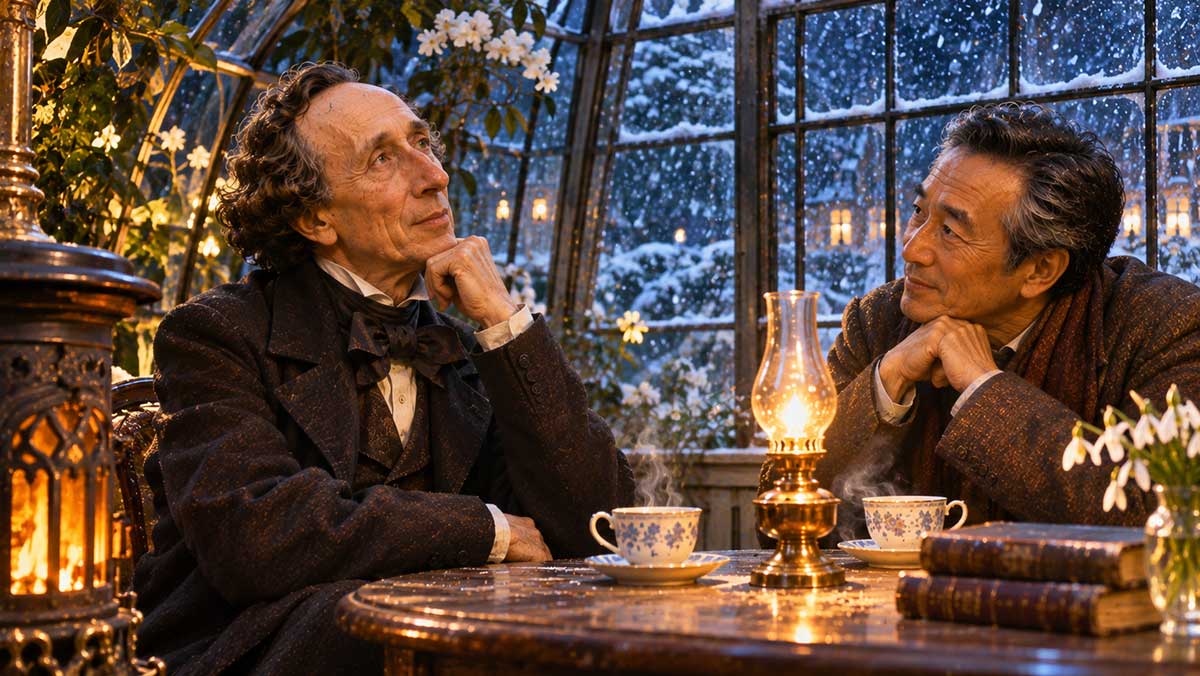
Copenhagen, Denmark. A winter evening in an imagined nineteenth-century conservatory.
Snow drifts beyond the tall glass windows, settling upon bare branches and the stone paths of a quiet garden. Inside, a small iron stove warms the room. Lanterns cast a gentle golden light across potted evergreens, winter flowers, and a wooden bench beside the windows.
Hans Christian Andersen stands near the glass, watching the snowflakes disappear into the darkness. Nick Sasaki enters carrying two cups of hot tea.
Nick Sasaki
Hans, I have a question.
Hans Christian Andersen
Turning with a smile.
Only one? You are becoming remarkably economical.
Nick Sasaki
Laughing.
I was going to ask whether you ever wrote a fairy tale where everybody was happy, nobody suffered, and nothing terrible happened.
Hans Christian Andersen
Ah. You are asking whether I ever wrote a story in which absolutely nothing happened.
Nick Sasaki
That's not quite what I meant.
Hans Christian Andersen
But it is a tempting interpretation.
Nick hands him a cup, and they sit beside the window.
Nick Sasaki
We've talked about your childhood, your imagination, and the people you've loved.
Now I want to talk about something that appears again and again in your stories.
Kindness.
Not the easy kind, where someone does something nice and everybody immediately lives happily ever after.
I mean kindness that continues when things are difficult.
Hans Christian Andersen
Then we must begin with a little girl who was far more determined than many grown men.
Nick Sasaki
Gerda?
Hans Christian Andersen
Gerda.
Question 1 - Why Does Gerda Refuse to Give Up?
Nick Sasaki
In The Snow Queen, Kai and Gerda are close friends. Then a fragment of the wicked mirror enters Kai's eye and another enters his heart.
Suddenly, he begins seeing ugliness where he once saw beauty.
What fascinated you about that change?
Hans Christian Andersen
The mirror distorts everything it reflects.
What is good appears foolish or ugly. What is beautiful becomes ridiculous.
When its fragments enter Kai, they alter the way he sees the world.
I wanted to explore how a person's perception may become corrupted, until he can no longer recognize the goodness that once delighted him.
Nick Sasaki
That's frightening when you think about it.
Kai hasn't simply forgotten Gerda. He begins treating her differently.
Hans Christian Andersen
Yes. His affection becomes obscured.
And the Snow Queen draws him into a world of coldness, precision, and isolation.
Nick Sasaki
The palace is beautiful, but there's something terribly empty about it.
Hans Christian Andersen
Beauty without warmth can become a kind of imprisonment.
Kai is surrounded by ice and occupied with his strange puzzle, yet he has lost the living connections that once gave him joy.
Nick Sasaki
And Gerda refuses to accept that he's gone forever.
She sets out to find him.
What I love is that she's not some mighty warrior. She's a little girl.
Hans Christian Andersen
A little girl who possesses determination, innocence, and affection.
And she receives help along the way.
Nick Sasaki
That's something people sometimes overlook.
Gerda doesn't accomplish everything alone.
She meets strangers, some helpful, some dangerous, and others who are simply caught up in their own concerns.
Hans Christian Andersen
Exactly.
Her adventure is filled with encounters that reveal different aspects of human nature.
The world is not divided neatly into good people and wicked people.
There are those who help generously, those who become distracted, and those who must be persuaded to act with kindness.
Nick Sasaki
I have to mention the little robber girl.
She's wonderful.
At first, she seems terrifying. She threatens Gerda, keeps a knife, and behaves like someone you definitely wouldn't want to meet in a dark forest.
Hans Christian Andersen
Laughing.
No, I would not recommend seeking her company without an introduction.
Nick Sasaki
Yet she helps Gerda.
Hans Christian Andersen
She does.
Her roughness does not prevent her from recognizing something in Gerda's devotion.
And she eventually allows Gerda to continue her search.
Nick Sasaki
I like that. A person can behave terribly and still have the capacity to do something kind.
Hans Christian Andersen
Human beings are rarely so simple that one action explains everything about them.
Nick Sasaki
There's another moment I find fascinating.
The Finnish woman tells the reindeer that Gerda doesn't need some new magical ability. Her strength is already within her.
What does that mean to you?
Hans Christian Andersen
The Finnish woman recognizes the extraordinary strength of Gerda's innocence and devotion.
But the tale is not merely about personal determination.
Gerda's prayers and faith are part of her strength too.
Her journey has a spiritual dimension.
Nick Sasaki
So when she finally reaches Kai, she doesn't defeat the Snow Queen in a battle.
She embraces him and cries.
Hans Christian Andersen
Her tears reach his heart, and his own tears help release the fragment from his eye.
He remembers her.
The frozen world loses its hold upon him.
Nick Sasaki
That's such a beautiful scene.
A little girl's tears accomplish what strength and cleverness couldn't.
Hans Christian Andersen
The story places love, faith, and innocence against a coldness that has separated Kai from ordinary human affection.
Nick Sasaki
But I want to ask something difficult.
Is kindness always stronger than cruelty?
In real life, kind people sometimes lose. They suffer. Sometimes they die.
Hans Christian Andersen
His expression becomes thoughtful.
That is true.
And it would be dishonest to promise that every act of kindness produces an earthly victory.
Gerda's story offers one kind of ending.
Other stories offer different ones.
Kindness may not prevent suffering, but that does not make kindness meaningless.
Nick Sasaki
So perhaps kindness isn't always stronger in the sense that it wins every battle.
Hans Christian Andersen
No.
Its worth cannot be measured solely by whether it defeats every misfortune.
For a moment, they watch the snow gathering upon the branches outside.
Question 2 - Why Did You Write Such a Heartbreaking Story?
Nick Sasaki
Hans, there's another story I want to talk about.
And I have to admit, this one is difficult for me.
The Little Match Girl.
A poor child walks through the streets on New Year's Eve. She's cold, hungry, and afraid to return home because she hasn't sold her matches.
People are celebrating indoors, but she's outside, almost invisible.
Why did you choose to tell such a heartbreaking story?
Hans Christian Andersen
I wanted to place the reader beside a child whom the comfortable world might pass without noticing.
The contrast is important.
There are warm rooms, festive meals, and lights shining through windows.
And outside, a child is suffering.
Nick Sasaki
That contrast is what gets me.
The people inside aren't necessarily doing anything dramatic or cruel.
They're simply enjoying their evening.
Meanwhile, a little girl is dying just beyond their windows.
Hans Christian Andersen
Indifference can be terrible precisely when it appears ordinary.
One need not be a villain to overlook another person's suffering.
Nick Sasaki
Then she lights her matches, one after another.
Each flame gives her a vision of something beautiful.
A warm stove. A feast. A Christmas tree.
Hans Christian Andersen
For a brief moment, the flames seem to offer what the cold street has denied her.
Warmth, abundance, beauty.
And then each vision disappears.
Nick Sasaki
Until she sees her grandmother.
Hans Christian Andersen
Yes.
Her grandmother represents the love and tenderness she longs for.
And when the final matches burn, the grandmother takes the child into a spiritual vision of joy beyond earthly suffering.
Nick Sasaki
The ending is difficult.
The little girl dies.
And the next morning, people find her body.
Hans Christian Andersen
They see the spent matches and imagine that she was merely trying to warm herself.
They do not know what she experienced in those final moments.
Nick Sasaki
That's devastating.
But I want to ask you something, Hans.
If the story ends with the child finding happiness in Heaven, could readers use that as an excuse to ignore the suffering of children who are still alive?
Hans Christian Andersen
That would be a troubling conclusion.
The spiritual ending offers consolation, but the suffering on earth remains real.
The reader has witnessed a child neglected by the world around her.
To close the book without considering that neglect would be to overlook something essential in the story.
Nick Sasaki
That's exactly what I was thinking.
We can believe that she's at peace, but that doesn't erase the fact that nobody helped her while she was alive.
Hans Christian Andersen
No.
And perhaps the reader must hold both thoughts together.
The hope of spiritual consolation and the recognition of human suffering.
Nick Sasaki
Do you think a story can change the way someone treats another person?
Hans Christian Andersen
I would hope that literature can awaken attention.
A reader who has felt compassion for a fictional child may look more carefully at a real one.
But I cannot guarantee what anyone will do after closing a book.
Nick Sasaki
Of course.
Still, I think that's one of the remarkable things about stories.
You can tell someone that poverty exists, and they might forget the fact five minutes later.
But give them one little girl standing barefoot in the snow, and suddenly they feel something.
Hans Christian Andersen
A story gives suffering a face and a life.
It asks the reader to remain with someone who might otherwise be passed by.
Nick Sasaki
Quietly.
And sometimes that may be where kindness begins.
Hans Christian Andersen
Perhaps it is one beginning.
Nick looks through the window. The falling snow seems different now.
Question 3 - Can Hope Survive When Suffering Does Not End?
Nick Sasaki
Hans, something has been bothering me.
In The Snow Queen, Gerda saves Kai.
In The Little Match Girl, the child dies.
And in The Steadfast Tin Soldier, the soldier and the paper dancer meet a tragic end.
Why do some of your stories offer rescue while others don't?
Hans Christian Andersen
Life contains both.
A writer who offers nothing but happiness may fail to recognize the sorrow that readers already know.
Yet a writer who sees nothing but sorrow may overlook the beauty and goodness that exist alongside it.
Nick Sasaki
So you didn't feel every story needed a happy ending?
Hans Christian Andersen
Certainly not in the ordinary sense.
A tale must follow its own nature.
Some stories invite laughter. Others invite reflection or grief.
And sometimes the ending asks the reader to consider a hope that lies beyond the events of earthly life.
Nick Sasaki
Your Christian faith seems important here.
In many of your stories, death isn't necessarily the final word.
Hans Christian Andersen
My religious convictions shaped the way I considered life, suffering, and eternity.
I was deeply interested in the relationship between the visible world and the spiritual one.
The hope of an immortal soul appears in several of my tales.
Nick Sasaki
But your stories don't always make faith feel simple.
Sometimes they raise more questions than they answer.
Hans Christian Andersen
Faith does not remove every difficulty from human experience.
A person may believe in divine goodness and still grieve, doubt, or struggle to comprehend suffering.
Literature can give form to those questions.
Nick Sasaki
Can I ask you something that might sound a little challenging?
Hans Christian Andersen
I have grown accustomed to your challenging questions, Nick.
Nick Sasaki
Suppose someone reads The Little Match Girl and says, "I don't want to be comforted by the idea that she went to Heaven. I want someone to have opened the door and brought her inside."
What would you say?
Hans Christian Andersen
He considers the question carefully.
I would not dismiss that response.
It reveals compassion for the child and anger at her suffering.
Those are feelings the story can reasonably awaken.
The spiritual ending does not require the reader to approve of the neglect that preceded it.
Nick Sasaki
That's an important distinction.
Hope shouldn't make us comfortable with cruelty.
Hans Christian Andersen
Nor should sorrow persuade us that goodness is useless.
Nick Sasaki
You know, Hans, I keep coming back to something.
Gerda is helped by strangers. The little match girl is ignored by strangers.
One child receives kindness. The other doesn't.
Hans Christian Andersen
And that difference changes their earthly stories.
Nick Sasaki
Exactly.
Maybe one of the questions your stories leave us with is whether we will be the kind of stranger who helps.
Hans Christian Andersen
That is a question worth carrying beyond the pages of a book.
Nick Sasaki
I think about children who feel unwanted or different.
Not necessarily children suffering in the snow, but children who feel that nobody really sees them.
Sometimes a small act of kindness can change an entire day.
Hans Christian Andersen
And sometimes the person offering it may never know what it meant.
Nick Sasaki
That's what fascinates me.
We don't always know which words or gestures stay with someone.
A teacher's encouragement. A friend's invitation. Someone simply noticing that a child is sitting alone.
Hans Christian Andersen
Small actions can carry great significance.
Though I would caution against making every kindness into a grand moral achievement.
Sometimes it is enough to offer a seat, share a meal, or listen with genuine attention.
Nick Sasaki
Smiling.
You make kindness sound wonderfully ordinary.
Hans Christian Andersen
Should it not be?
If kindness were reserved only for extraordinary occasions, the world would have very little of it.
Nick laughs softly.
Nick Sasaki
I like that.
And perhaps that brings us back to your own life.
You were helped by people who couldn't possibly have known how famous you would become.
Your father shared stories with you. Others gave you opportunities.
And now your stories have reached people those individuals could never have met.
Hans Christian Andersen
It is a remarkable thought.
A person's actions may travel farther than they realize.
Nick Sasaki
Which makes me wonder about the stories we leave behind.
Not just the ones we write, but the ones created by the way we treat other people.
Hans Christian Andersen
Smiling.
Now you are becoming a storyteller yourself, Nick.
Nick Sasaki
I've had a good teacher.
Andersen laughs, then looks once more at the snow-covered garden.
Hans Christian Andersen
Tell me, Nick, have you ever noticed how people speak of a happy ending as though it were a reward owed to a good person?
Nick Sasaki
Yes. And real life doesn't always work that way.
Hans Christian Andersen
No.
A person may be kind and suffer. Another may be celebrated without deserving every compliment.
Yet we continue to ask what makes a life good.
Nick Sasaki
That leads to something I've wanted to ask you since we first met.
You began as a poor boy in Odense, dreaming of the theater.
You became internationally famous. You traveled, met remarkable people, and wrote stories that have lasted for generations.
But you experienced disappointments too.
When you look back, Hans, do you think you found your own happy ending?
Andersen turns away from the window. The lantern light catches his thoughtful expression.
Hans Christian Andersen
With a gentle smile.
Ah, Nick.
You have saved the most difficult question for the end.
Nick Sasaki
I had a feeling you might say that.
Hans Christian Andersen
Then perhaps we should discuss it somewhere warmer, with a comfortable chair and enough time to consider the answer.
Nick Sasaki
And maybe something to eat?
Hans Christian Andersen
Most certainly.
A philosopher may survive on questions, but a storyteller requires supper.
They laugh together.
Outside, the snow continues to fall. Inside, the warmth of the conservatory lingers as their conversation prepares to turn from Andersen's fictional characters to the extraordinary, complicated life of the man who created them.
Fictional interview disclaimer: This conversation between Nick Sasaki and Hans Christian Andersen is an imaginative literary reconstruction. It draws upon themes, events, and spiritual elements in Andersen's original stories, but the dialogue, personal reflections, and meeting are fictional. Interpretations of his religious beliefs and literary intentions should not be mistaken for recorded statements by Andersen.
Topic 5 - Did the Storyteller Find His Own Happy Ending?
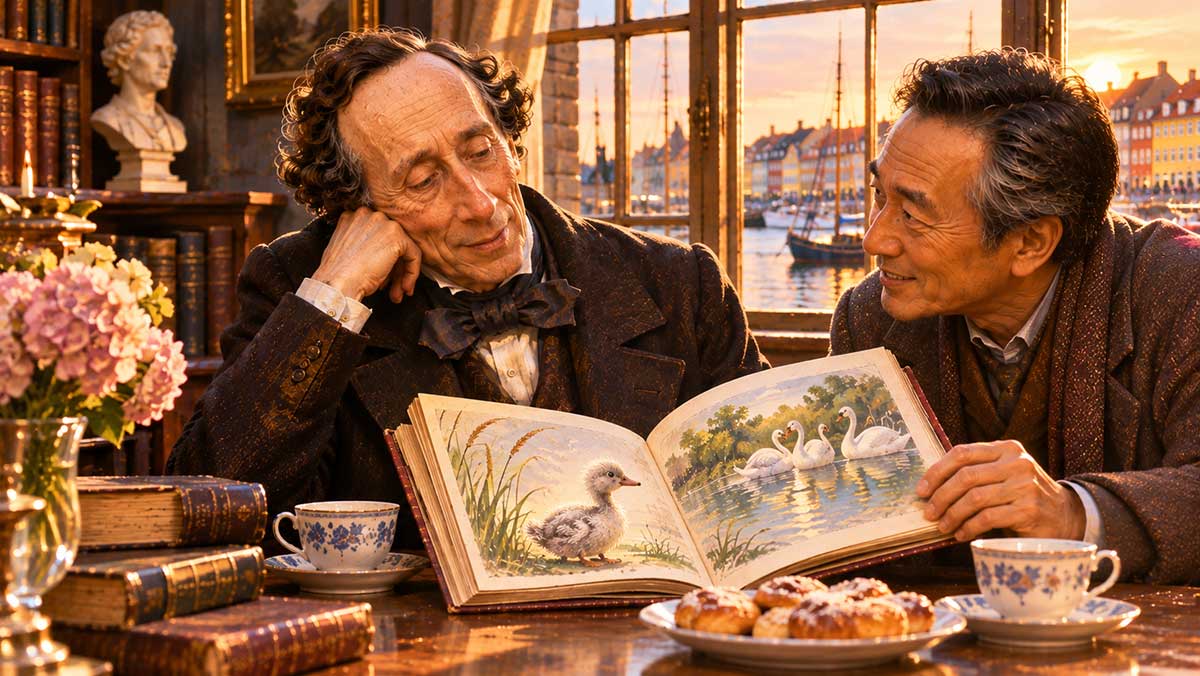
Copenhagen, Denmark. A late summer evening in the early 1870s.
The setting sun casts a golden light across Nyhavn, where ships rest beside the colorful waterfront buildings. From the open windows of an imagined sitting room at Nyhavn 18, the sounds of distant conversation and footsteps rise from the street below.
Books fill the shelves. A small collection of travel keepsakes rests beside a vase of fresh flowers. On a wooden table lie several letters, a pair of scissors, and an unfinished paper cutting.
Hans Christian Andersen stands near the window, watching the harbor. Nick Sasaki enters carrying a plate of pastries and two cups of tea.
Nick Sasaki
Hans, I brought something for you.
Hans Christian Andersen
Turning with a smile.
At last! After all your questions about suffering, disappointment, and the meaning of life, you have remembered that a guest might appreciate something to eat.
Nick Sasaki
Laughing.
I was beginning to worry that you'd write a fairy tale about a cruel interviewer who starved his guest.
Hans Christian Andersen
An excellent idea. The interviewer asks three hundred questions, and the poor writer slowly turns into a biscuit.
Nick Sasaki
And then somebody eats him?
Hans Christian Andersen
Naturally. A tragic ending, but a very economical one.
They laugh. Nick places the pastries on the table and sits across from Andersen.
Nick Sasaki
Hans, we've spent a wonderful time together.
We've talked about your childhood, your father, the dreams that brought you to Copenhagen, your fairy tales, the people you've loved, and the extraordinary kindness in your stories.
But there's one question I still want to explore.
You gave the world so many unforgettable stories.
Did you find happiness in your own?
Hans Christian Andersen
He settles into his chair.
That is a large question, Nick.
And I suspect you will not be satisfied with a small answer.
Question 1 - The Extraordinary Life You Never Expected
Nick Sasaki
Let's begin with something remarkable.
At fourteen, you arrived in Copenhagen with little money and dreams of becoming a performer.
Now your stories are read in countries you've never visited, and people recognize your name across Europe.
When you look back, what surprises you most?
Hans Christian Andersen
Perhaps that life took me along a path I could never have planned.
I wished to belong to the theater. I wanted to perform, to sing, to be recognized as an artist.
Yet the work for which I became most widely known emerged through writing.
And even there, the fairy tales were only part of what I hoped to accomplish.
Nick Sasaki
You cared deeply about your novels and plays too.
Hans Christian Andersen
Very much.
A writer does not necessarily see his own work in the same proportions as the public.
Readers may embrace one part of his writing so warmly that they scarcely notice the rest.
Nick Sasaki
Does that ever frustrate you?
Hans Christian Andersen
At times.
But one should be careful about complaining that people love one's work.
It is a fortunate difficulty to possess.
Nick Sasaki
Laughing.
That's true.
You traveled extensively, too. Germany, Italy, France, England, and many other places.
What did travel give you?
Hans Christian Andersen
A wider view of human life.
I encountered different customs, cities, artistic traditions, and people.
Travel offered inspiration for my writing and introduced me to friendships and experiences I treasured.
I was often eager to see what lay beyond the next city.
Nick Sasaki
Did you enjoy meeting famous writers?
Hans Christian Andersen
Certainly. I admired many of them.
And it was gratifying when writers whose work I respected showed interest in mine.
Nick Sasaki
Which brings us to Charles Dickens.
Hans Christian Andersen
Closing his eyes with a theatrical sigh.
Ah. I wondered how long you would resist mentioning him.
Nick Sasaki
Laughing.
Hans, I can't let you escape this one.
You visited Dickens in England in 1857.
And you stayed for five weeks.
Hans Christian Andersen
I was delighted to enjoy his hospitality.
Nick Sasaki
Five weeks, Hans!
Hans Christian Andersen
You say it as though I had occupied his house with an invading army.
Nick Sasaki
Well, I suspect his family may have felt something like that.
Hans Christian Andersen
Laughing.
I shall leave the judgment of my visit to the historians.
Nick Sasaki
Fair enough.
But there's something wonderful about the story.
Here are two of the most famous storytellers of the nineteenth century, and apparently even great writers can have trouble being houseguests.
Hans Christian Andersen
Literary genius does not necessarily include a perfect knowledge of when to depart.
Nick Sasaki
That's going to be my favorite quote from our entire conversation.
Hans Christian Andersen
Then I hope you will identify it as something I said in this imaginary meeting.
Otherwise, future scholars may become very confused.
They laugh together.
Nick Sasaki
Seriously, though, when you think about all the people you've met and places you've visited, did success feel the way you expected it would?
Hans Christian Andersen
Success brought extraordinary opportunities.
I enjoyed recognition, travel, friendship, and the knowledge that my writing reached readers.
But success does not make a person cease to be human.
One may receive praise and still worry about a new book.
One may enjoy a splendid evening among friends and feel disappointed by a careless remark.
The heart does not become perfectly content merely through public recognition.
Nick Sasaki
So fame changed your circumstances, but it didn't settle every question inside you.
Hans Christian Andersen
No. I doubt any earthly achievement can do that completely.
Question 2 - What Makes a Life a Happy One?
The light outside softens. A passing carriage rattles along the waterfront, and the sound gradually fades.
Nick Sasaki
Hans, I want to ask something that may be more difficult than talking about Dickens.
Hans Christian Andersen
That would be a remarkable achievement.
Nick Sasaki
You experienced friendship, admiration, adventure, and artistic success.
But you never married, and some of your deepest affections didn't develop into the relationships you hoped for.
When you look back, what makes a life a happy one?
Hans Christian Andersen
I would begin by questioning whether happiness can be measured by a single accomplishment.
Marriage may bring great happiness to one person. Artistic work may bring fulfillment to another.
Friendship, faith, family, travel, and service to others may each become important.
And a person may experience happiness in one part of life while suffering disappointment in another.
Nick Sasaki
That's interesting.
We often think of a happy ending as the moment when everything finally works out.
The person finds love, becomes successful, resolves every problem, and lives happily ever after.
Hans Christian Andersen
A convenient ending for a tale.
Rather difficult to arrange in ordinary life.
Nick Sasaki
Laughing.
Exactly.
But your own stories rarely offer such simple endings.
Hans Christian Andersen
Life contains contradictions.
A person may achieve a cherished ambition and discover that new desires have appeared.
Another may lose something precious and still find reasons for gratitude.
Happiness is not always a permanent condition.
Sometimes it is an afternoon with friends, a beautiful performance, a letter received, or the completion of a piece of writing.
Nick Sasaki
That sounds almost too ordinary for a famous storyteller.
Hans Christian Andersen
Smiling.
My dear Nick, I have spent much of my career trying to show that ordinary things are not necessarily uninteresting.
Nick Sasaki
Good point.
Can I ask you about regret?
When people look back on their lives, they sometimes focus on the things they didn't receive.
The love that wasn't returned. The opportunities that disappeared. The decisions they wish they could change.
Did you ever worry that those disappointments might overshadow everything else?
Hans Christian Andersen
I experienced disappointments, certainly.
But I would hesitate to give you a final inventory of my regrets.
A human life is too complicated to be reduced to a balance sheet of triumphs and losses.
Nick Sasaki
That's fair.
And I don't want to put words into your mouth.
Hans Christian Andersen
Then you are already showing greater restraint than some biographers.
Nick Sasaki
Laughing.
I'll take that as a compliment.
Hans Christian Andersen
You may.
Nick Sasaki
We've discussed your Christian faith and the spiritual hope in your stories.
Did that faith influence the way you thought about your own life?
Hans Christian Andersen
Yes.
My interest in the soul, divine goodness, and the meaning of earthly existence was not confined to fiction.
I believed that human life must be considered in relation to something greater than worldly success.
The applause of an audience is pleasant, but it cannot answer every question about existence.
Nick Sasaki
And perhaps it can't tell us what kind of person we've become.
Hans Christian Andersen
No.
That question requires a different kind of reflection.
Nick Sasaki
You know, Hans, when I think about your life, something strikes me.
You began as a child who needed other people to believe in him.
Your father encouraged your imagination. Jonas Collin helped you obtain an education. Friends supported you.
And through your writing, you eventually offered something to readers who would never meet you.
Hans Christian Andersen
That is a generous way of considering it.
Nick Sasaki
But I wonder whether you ever thought about the people on the other side of your books.
Not critics or famous writers.
Just ordinary readers.
People sitting alone with one of your stories.
Hans Christian Andersen
A writer naturally hopes to reach readers.
But the lives of those readers remain largely unknown to him.
A book travels into rooms its author will never enter.
Nick Sasaki
That's a beautiful thought.
And it brings me to one final question.
Question 3 - The Child Who Finally Feels They Belong
Nick reaches for a small volume of Andersen's fairy tales resting beside the lamp.
He opens it to The Ugly Duckling and studies the illustration for a moment.
Nick Sasaki
Hans, may I tell you something I've been thinking about since we visited your childhood home?
Hans Christian Andersen
Of course.
Nick Sasaki
You were once a boy who felt different from many of the people around him.
You dreamed of a life that seemed almost impossible.
You encountered rejection, but you were fortunate to meet people who encouraged you.
And then, years later, you wrote The Ugly Duckling.
Hans Christian Andersen
Yes.
Nick Sasaki
I want you to picture something.
Somewhere in the world, perhaps many years from now, there's a child who feels completely out of place.
Maybe other children laugh at the way he looks.
Maybe she struggles to make friends.
Maybe that child has begun to believe that being different means being worth less than everyone else.
One evening, the child opens your story.
And for the first time, something changes.
The child begins to wonder whether the judgment of other people might be wrong.
Whether being different might not be something shameful.
Whether there might be a place in the world where that child can belong.
Nick pauses.
Nick Sasaki
Hans, what would it mean to you if one of your stories could give a child that kind of hope?
Andersen looks down at the open book.
For a few moments, the only sound is the distant activity of the harbor.
Hans Christian Andersen
That would be a beautiful thing, Nick.
Not that I should wish a child to suffer merely so that my story might comfort them.
But if someone who feels rejected discovers a little courage through reading, I would be grateful that the tale had reached them.
Nick Sasaki
I think that matters more than most writers realize.
Hans Christian Andersen
Perhaps.
Yet I would hope the child finds kindness in the world beyond the book too.
The ugly duckling's suffering is not made acceptable merely by the beauty of his ending.
He should have been treated with greater kindness long before anyone recognized him as a swan.
Nick Sasaki
That's what stayed with me from our earlier conversation.
The duckling deserved compassion before he became beautiful.
Hans Christian Andersen
Yes.
A person's worth should not depend upon the admiration of others.
Nick Sasaki
And maybe a story can help someone see that.
Hans Christian Andersen
Perhaps it can.
But let us not ask a book to do everything.
A child needs people who will listen, encourage, and offer friendship.
Literature may open a door in the imagination, but human kindness must still find its way into daily life.
Nick Sasaki
Quietly.
That's beautiful, Hans.
And it makes me think of your father.
He couldn't have known that the stories he shared with you would one day become part of something so much larger.
He was simply spending time with his son.
Hans Christian Andersen
He looks toward the window.
He gave me memories that remained with me.
Nick Sasaki
And now perhaps a parent somewhere is reading one of your stories to a child.
Maybe they're sitting in a little room, just as you once did.
The parent doesn't know what that child will become.
They don't know which words will remain in the child's memory.
But they're sharing something beautiful.
Hans Christian Andersen
Smiling gently.
Then the story has found a good home.
Nick Sasaki
You know, when we began this conversation, I wanted to ask whether you found your own happy ending.
But now I'm wondering whether that was the wrong question.
Hans Christian Andersen
Oh? And after all this time, you have discovered a better one?
Nick Sasaki
Laughing softly.
Maybe.
Perhaps a life isn't simply one story with one ending.
Perhaps it's connected to countless other stories.
The people who helped us. The people we loved. The strangers we encouraged without realizing it.
And the people who might find something meaningful in what we leave behind.
Hans Christian Andersen
That is a thoughtful way of looking at life.
Though I would still caution you against making every human experience fit neatly into a moral.
Some things remain unfinished.
Some disappointments do not become blessings.
And some questions are never answered to our complete satisfaction.
Nick Sasaki
I agree.
But perhaps a life can still be beautiful without being perfect.
Hans Christian Andersen
I should think so.
After all, the most interesting stories are seldom those in which everything happens exactly as expected.
The last sunlight touches the rooftops across the harbor.
Nick Sasaki
Hans, there's one thing I want to thank you for.
Not just the fairy tales.
But the way you've helped me look at people differently.
The ugly duckling who deserves kindness before anyone recognizes his beauty.
The little match girl whom the world fails to notice.
Gerda, who refuses to abandon someone she loves.
And even that ridiculous emperor who reminds us how foolish we can become when we're afraid to tell the truth.
Hans Christian Andersen
Laughing.
Ah, yes. We must not forget the emperor.
He has contributed a great deal to human wisdom by contributing so little of his own.
Nick Sasaki
I think he may be your most successful philosopher.
Hans Christian Andersen
Then philosophy is in a very dangerous condition.
They laugh together.
Nick Sasaki
One last question, Hans.
If you could leave readers with a single thought, not a grand lesson, just something you hope they might carry with them, what would it be?
Hans Christian Andersen
He considers the question, then looks at the unfinished paper cutting on the table.
Perhaps I would ask them to remain curious.
To look carefully at the people and things they are tempted to dismiss.
To remember that the world contains more wonder than our first judgments allow us to see.
And when they encounter someone who seems strange or different, perhaps they might offer a little kindness before deciding what that person is worth.
Nick Sasaki
I think that's a wonderful place to leave our conversation.
Hans Christian Andersen
Then we have achieved something remarkable.
You have finally decided to stop asking questions.
Nick Sasaki
Laughing.
For tonight, Hans.
Hans Christian Andersen
For tonight, then.
Andersen picks up the folded paper beside him and carefully opens it.
Inside is a small paper bird, its wings spread wide.
Nick Sasaki
Another swan?
Hans Christian Andersen
Perhaps.
Or perhaps merely a bird.
Must everything become extraordinary before we allow ourselves to admire it?
Nick smiles.
Nick Sasaki
No, Hans.
I don't think it must.
Outside, the evening settles over Copenhagen. The harbor grows quiet, and the first lamps begin to shine along the waterfront.
Inside the small room, two friends continue talking about books, travel, laughter, and the peculiar habits of human beings.
The question of whether Hans Christian Andersen found his own happy ending remains open.
But somewhere beyond the room, his stories are waiting to be opened again.
And perhaps that is another kind of beginning.
Fictional interview disclaimer: This conversation between Nick Sasaki and Hans Christian Andersen is an imaginative literary reconstruction. It draws upon documented elements of Andersen's life, travels, literary career, friendships, and religious interests. The dialogue, personal reflections, paper-cutting scene, and meeting are fictional. They should not be interpreted as Andersen's recorded statements or verified private beliefs.
Final Thoughts by Nick Sasaki

What Hans Christian Andersen Taught Me About Happiness, Kindness, and the Stories We Leave Behind
When I began my imaginary conversation with Hans Christian Andersen, I thought the most fascinating question would be whether he had found his own happy ending. Here was a man who rose from poverty to international literary fame, created characters beloved across generations, and traveled through much of Europe. Yet he experienced rejection, emotional disappointment, and the ordinary uncertainties of human relationships. I wondered whether such an extraordinary life could still feel incomplete. By the time our conversation ended, however, I found myself questioning the very idea that a human life should be judged by a single ending.
The first thing that stayed with me was Andersen's childhood. I pictured the small room in Odense where his father shared stories with him, never knowing what those moments might mean for his son's future. His father did not need to predict literary greatness to give his child something precious. He simply shared books, curiosity, and affection. Later, Jonas Collin and others helped Andersen pursue an education and a literary career. Reading about these relationships through the Royal Danish Library's account of Andersen's life reminded me how much a person's future can depend upon encouragement offered without any guarantee of success. I found myself thinking about parents, teachers, friends, and strangers whose small acts of generosity may remain with someone for decades.
I was equally struck by the intelligence and humor of Andersen's fairy tales. The Emperor's New Clothes made me laugh, but it also made me uncomfortable. How often do we remain silent when we know something is wrong, simply to avoid embarrassment or disagreement? The Nightingale made me question our tendency to admire appearances, prestige, and technical perfection while overlooking something genuine and alive. Andersen understood that a story could entertain us and still expose our foolishness. His surviving manuscripts and correspondence, represented in the Royal Danish Library's collection of his original work, offer a reminder of the imagination and sustained artistic effort behind these seemingly simple tales.
Our conversation about love left me with more difficult questions. Andersen's relationships were meaningful, sometimes complicated, and not always fulfilled in the ways he hoped. But I came to appreciate the danger of judging someone's happiness by whether they married or received the affection they desired. His life contained friendships, achievements, humor, and experiences that cannot be erased by romantic disappointment. His original Little Mermaid deepened that reflection. The mermaid refuses to kill the prince to save herself, and her story moves beyond romance into questions of sacrifice and spiritual hope. I found myself asking whether love is measured entirely by what we receive, or whether its meaning can sometimes be found in how we choose to treat another person.
Perhaps the most difficult part of our conversation concerned The Little Match Girl. I could not stop thinking about the contrast between warm homes filled with celebration and a suffering child left outside in the cold. Andersen's spiritual ending offers consolation, but it does not make the child's earthly suffering disappear. That distinction matters deeply to me. I believe stories should do more than make us feel sad for a few moments. They can encourage us to notice the people we might otherwise pass without seeing. The Snow Queen offers a different picture of love through Gerda, whose devotion is sustained by courage, faith, and the kindness of others. Together, these stories made me think about the difference between feeling compassion and acting upon it.
The moment that moved me most came when I asked Andersen to consider a child reading The Ugly Duckling. Perhaps that child feels awkward, unwanted, or different. Perhaps other people have made the child believe that something is wrong with them. Then the child encounters a story that raises a possibility they had never considered: other people's judgments may not define their worth. Of course, our conversation and Andersen's response were fictional. But the possibility itself is real and meaningful. Literature can help readers recognize their experiences, question cruel judgments, and find courage. I was reminded that the ugly duckling deserved kindness long before anyone discovered he was a swan. We should never require someone to become beautiful, successful, or famous before treating them with dignity.
I began by asking whether Andersen found his happy ending. I finished by thinking about the many lives a single person may touch. Andersen's own life was neither a perfect fairy tale nor an uninterrupted tragedy. It contained accomplishments, affection, ambition, uncertainty, and loss. Yet the stories he created continue to invite readers into questions about goodness, identity, faith, and human relationships. The Hans Christian Andersen Centre continues to study the depth and originality of his writing, reminding us that these familiar tales still reward serious reflection. I do not believe we need to settle the question of Andersen's private happiness to appreciate the extraordinary gift of his imagination.
What I will carry from this conversation is a simple but demanding thought: perhaps we should spend less time asking whether our own lives are unfolding according to the endings we expected, and more time noticing the stories we are helping create in other people's lives. A child who receives encouragement, a friend who feels heard, or a stranger who is treated with unexpected kindness may remember that moment long after we have forgotten it. And now I would love to hear your thoughts. Which Hans Christian Andersen story has stayed with you the longest? Do you believe a person can live a happy and meaningful life without receiving everything they once hoped for? And if you could speak to Andersen himself, what would you ask him about love, kindness, or the meaning of a happy ending?
Fictional reflection disclaimer: These Final Thoughts express Nick Sasaki's reflections on an imagined literary conversation. Andersen's responses within the interview are fictional interpretations informed by historical and literary research, not authenticated quotations or evidence of his private beliefs.
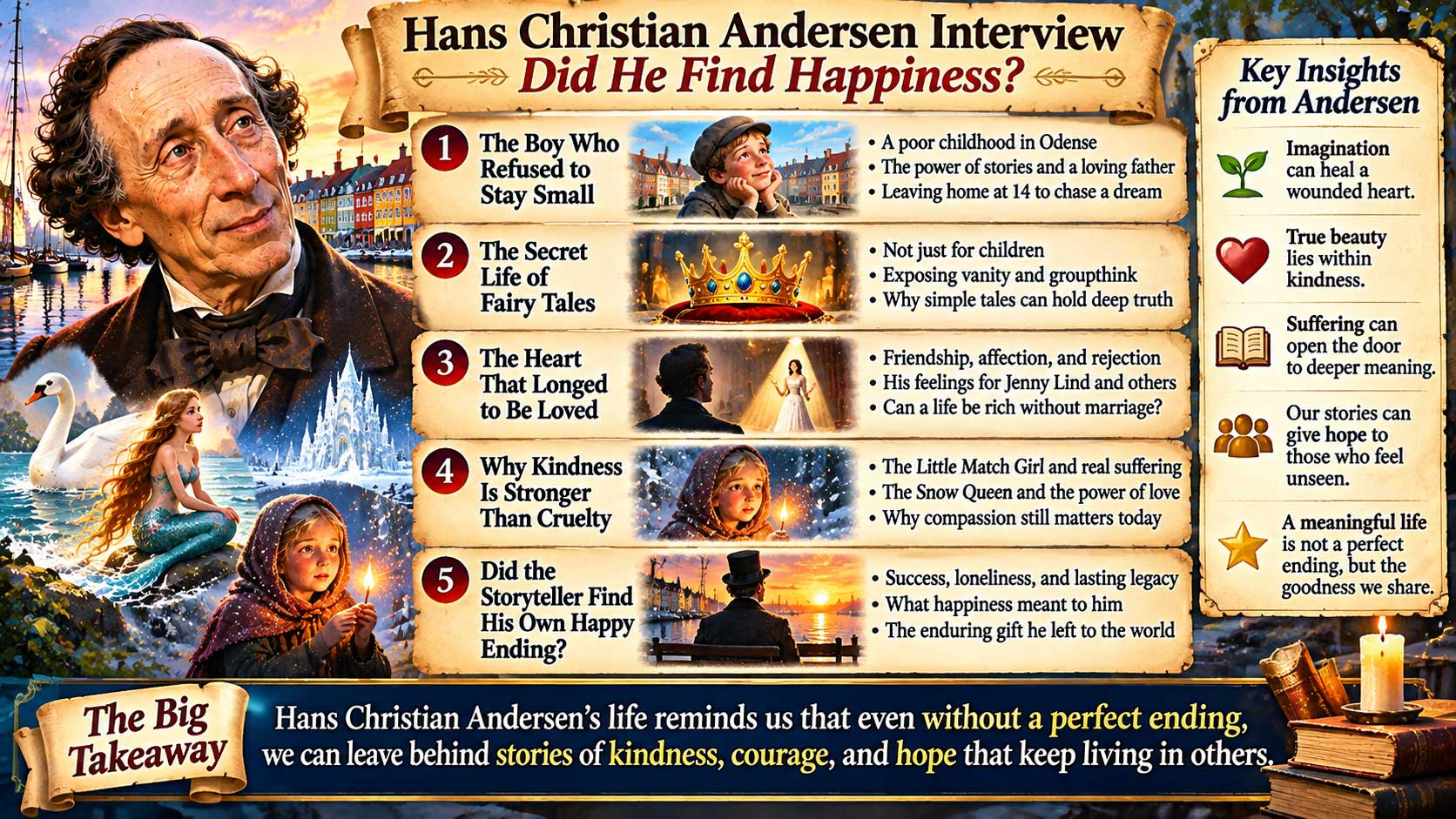
Short Bios:
Hans Christian Andersen (1805–1875)
Hans Christian Andersen was a Danish author, poet, novelist, playwright, and traveler best known for his literary fairy tales, including The Ugly Duckling, The Little Mermaid, The Snow Queen, The Emperor's New Clothes, and The Little Match Girl. Born in Odense, Denmark, he moved to Copenhagen at fourteen to pursue an artistic career. With educational support and years of literary work, he became one of Denmark's most internationally recognized writers. His stories explore identity, love, vanity, suffering, spiritual hope, and the extraordinary possibilities of imagination. His legacy extends far beyond children's literature, encompassing novels, travel writing, drama, poetry, and visual art. Learn more through the Royal Danish Library's Andersen biography and the Hans Christian Andersen Centre.
Nick Sasaki
Nick Sasaki is the creator of ImaginaryTalks.com, a creative storytelling platform that brings historical figures, authors, thinkers, and influential personalities into fictional conversations about life's enduring questions. Through imaginative interviews, Nick explores philosophy, literature, spirituality, history, relationships, and human nature, seeking to make important ideas approachable through curiosity, warmth, humor, and meaningful dialogue. His work invites readers to encounter familiar figures from new perspectives and consider how their experiences and ideas might illuminate contemporary life. Explore more fictional interviews and conversations at ImaginaryTalks.com.
Fictional content disclaimer: The biographies describe real individuals and their documented activities. The interview presented in this article is a creative work of historical fiction. Hans Christian Andersen did not participate in the conversation, and the fictional dialogue should not be cited as a historical source.
Leave a Reply