
Introduction
What if one of the most influential spiritual teachers of the twentieth century returned for one more conversation and told us that the greatest discovery of our lives was still waiting within us? Paramahansa Yogananda crossed the ocean from India to America in 1920 with a remarkable conviction: God was not simply someone to believe in, but a divine presence that human beings could seek through direct spiritual experience. Yet behind that extraordinary mission was a young man who deeply loved his mother, longed for his guru's affection, faced uncertainty in a foreign country, and spent his life searching for a love he believed could never die.
When I began preparing this imaginary interview with Paramahansa Yogananda, I wanted to meet the human being behind the spiritual teacher. His celebrated Autobiography of a Yogi, first published in 1946, contains accounts of remarkable spiritual experiences, but I found myself drawn just as strongly to its quieter moments. What did losing his mother teach him about love? Why did hearing Sri Yukteswar say he loved him mean so much? And what gave a twenty-seven-year-old monk the courage to leave everything familiar and begin teaching in America?
His life became far more than a personal spiritual quest. Yogananda founded the Self-Realization Fellowship, introduced generations of Western students to Kriya Yoga, and taught a distinctive interpretation of the spiritual relationship between Jesus and Krishna. The Self-Realization Fellowship's account of his life and mission describes his dedication to helping people seek direct experience of God. Independent scholarship, including David J. Neumann's Finding God through Yoga, places that mission within the religious and cultural history of modern America. Both perspectives matter if we want to appreciate his achievements without overlooking the historical questions surrounding them.
Our imagined conversation begins beside the Ganges, where I ask Yogananda about his childhood, his mother, and the teacher who shaped his life. We then travel to Boston Harbor in 1920, where his American mission begins amid unfamiliar customs and uncertain prospects. At Mount Washington in Los Angeles, I ask what he meant by experiencing God directly, why Kriya Yoga mattered so deeply to him, and what he would say to someone who has prayed sincerely but feels nothing. Later, in India, we explore his interpretation of Jesus and Krishna, the real differences between religious traditions, and the difficult question of innocent suffering.
But there was one question I wanted to save for our final meeting at Lake Shrine in California. If Yogananda could speak to humanity one more time, what would he most want us to remember? Would he speak about meditation, the mysteries described in his autobiography, his students, or the universal love he believed was the deepest reality of existence? I wanted to give him room to answer that question in his own voice, rather than turn him into a figure who merely responds to my curiosity.
As I developed this interview, I found myself returning to a simple possibility: perhaps the most meaningful measure of spiritual growth is not how extraordinary our experiences appear, but how deeply they change the way we treat other people. I invite you to join Yogananda and me across these five imagined conversations. You do not need to share all his beliefs to consider his questions about faith, loss, love, and the purpose of life. You may find yourself questioning some of his answers. I hope you will feel welcome to do so, and perhaps discover a question of your own worth carrying forward.
Fictional interview disclaimer: This article presents an imagined conversation between Nick Sasaki and Paramahansa Yogananda. The dialogue, meetings, and personal responses are creative interpretations informed by historical accounts and Yogananda's published teachings. They are not authentic interviews or quotations. Spiritual and supernatural claims are presented as religious beliefs or personal testimony, not independently established scientific facts.
Topic 1: The Boy Who Would Not Stop Searching for God
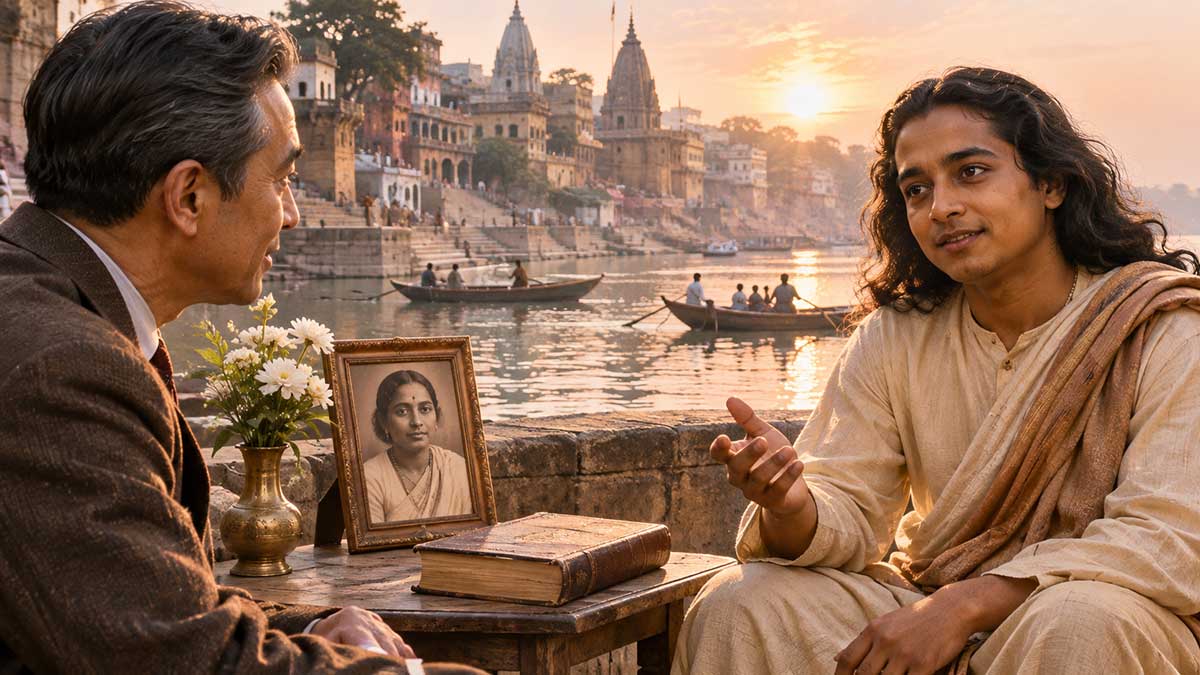
Opening Scene: Varanasi, India, Around 1910
Dawn reaches the Ganges slowly. A boatman pushes away from the steps, and the water catches a narrow ribbon of gold. Bells sound somewhere beyond the riverfront buildings. The air is cool enough that the two men seated on a quiet stone terrace can linger without speaking.
Nick Sasaki has brought a copy of Autobiography of a Yogi. Beside it rests a small photograph of Yogananda's mother, placed here as part of this imagined meeting, not as a claim about a historical encounter. Across from him sits the young Mukunda Lal Ghosh, whom the world will come to know as Paramahansa Yogananda. His expression is attentive, with the hint of a smile.
Nick Sasaki
Thank you for meeting me here. I've read about the lectures, the journey to America, and the extraordinary experiences you describe. But I wanted to begin before all that. Before you were a teacher, you were somebody's son. Would it be all right if we started with your family?
Paramahansa Yogananda
I would be very glad. People sometimes look at a spiritual teacher and see only the robe or the teachings. Yet the heart that seeks God has known a mother's kindness, a father's concern, and all the tender experiences of earthly life. We need not leave those behind when we speak of the soul.
Question 1: What Did Your Childhood, Especially Your Mother's Love and Death, Teach You About Life, Loss, and Your Search for God?
Nick Sasaki
When you think of your mother, what comes back first? Not the lessons people later drew from her life. Just a memory of being her child.
Paramahansa Yogananda
Her tenderness. I remember her as someone whose affection made a child feel safe. My father was a man of discipline and quiet principle. My mother had a warmth that reached us immediately. They were different in temperament, but each gave us something precious. When I speak of divine love, I do not mean that human love is worthless. For many of us, it is our first glimpse of something greater.
Nick Sasaki
I like that. Sometimes spiritual stories begin so quickly with visions and revelations that we forget the child who wanted to be held. You were already drawn to spiritual things when you were young, weren't you?
Paramahansa Yogananda
Yes. In my own account I describe unusual memories and experiences, and a strong attraction to saints and meditation. Those experiences were meaningful to me. But I would not ask a reader to accept every account merely on my authority. I would ask the reader to examine the deeper invitation: to seek sincerely, to pray, and to discover what spiritual practice may reveal in his or her own life.
Nick Sasaki
That's a generous distinction. Your book tells us what you experienced and how you interpreted it. The reader still has to decide what to make of it.
Paramahansa Yogananda
Sincerity is more valuable than pretending to believe. A person who asks an honest question may be nearer to truth than one who repeats beautiful words without reflection.
Nick Sasaki
Then came the loss of your mother. I don't want to turn her death into a neat explanation for everything you did afterward. You were searching already. But surely losing her changed the world around you.
Paramahansa Yogananda
It did. The death of someone we love makes the ordinary world seem suddenly uncertain. A child expects a beloved face to appear again in the doorway. When it does not, the absence can seem impossible to comprehend. I carried grief, and I carried my love for her. My search for God was not born in that moment alone, but the longing for a love that death could not take away became deeply personal.
Nick Sasaki
Did you ever wish you could stop being the spiritual seeker for a day and simply have your mother back?
Paramahansa Yogananda
What child would not wish to see his mother again? Spiritual aspiration does not require us to deny such feelings. The task is to let love grow rather than allow sorrow to close the heart. I came to believe that the love we experience through another person has a source greater than either person. That belief did not erase my mother's absence. It gave my longing a direction.
Nick Sasaki
Your father interests me, too. In your autobiography he can seem reserved, almost formal. Yet you describe discovering tenderness beneath that reserve.
Paramahansa Yogananda
My father expressed love differently. A quiet man may be deeply affectionate without displaying it freely. I learned not to measure love only by outward manner. Later, when I taught students whose temperaments differed greatly, that lesson was useful. Some spoke easily of devotion. Others showed it by helping, studying faithfully, or remaining loyal through difficulties.
Nick Sasaki
So your childhood taught you that love can look different in different people.
Paramahansa Yogananda
Yes. And that we must be careful before deciding we know the contents of another heart.
A boat passes close to the terrace. Nick watches its reflection break apart, then gather again on the water.
Nick Sasaki
There is another side of young Mukunda I enjoy. You weren't always quietly sitting in meditation. You tried to run away to the Himalayas. You could be quite determined.
Paramahansa Yogananda
Perhaps my family would have chosen a stronger word! I had an earnest desire to find saints, but earnestness in a young person can travel with impatience. My youthful adventures gave me much to learn about enthusiasm and judgment.
Nick Sasaki
I'm relieved to hear that. I was beginning to worry that you were born wise and never made a foolish decision.
Paramahansa Yogananda
Then my autobiography has not done its work! A spiritual life is not made more believable by removing every mistake. We learn through correction, sometimes with embarrassment, and sometimes with laughter.
Question 2: When You First Met Sri Yukteswar, What Convinced You He Was the Teacher You Had Been Searching For?
Nick Sasaki
Let's talk about the person who changed your life. You describe meeting Sri Yukteswar in 1910. What made that encounter different from all your earlier searches?
Paramahansa Yogananda
I experienced a profound recognition. I believed I had found the teacher for whom I had long prayed. That is how I understood the meeting. Yet recognition was only a beginning. A genuine relationship between teacher and student is tested in ordinary days, through patience, correction, service, and the willingness to change.
Nick Sasaki
That's interesting. People love the dramatic first meeting. They don't always think about what happens the next morning, when someone tells you to clean up, study, or stop making excuses.
Paramahansa Yogananda
My guru was exceptionally skilled at bringing lofty aspiration into contact with practical reality. I wished to experience God. He expected me to cultivate steadiness, attention, and responsibility. I sometimes preferred the extraordinary to the ordinary. He taught me that the two cannot be separated so easily.
Nick Sasaki
Was he hard to live with?
Paramahansa Yogananda
He could be exacting. He did not flatter me, and I was not always pleased to hear what he said. But I came to see his discipline as an expression of concern for my growth. I would not suggest that every stern teacher is therefore wise. Authority must be joined to integrity, care, and the good of the student.
Nick Sasaki
I'm glad you made that distinction. Readers today have legitimate questions about spiritual authority. How can a student respect a teacher without giving up personal judgment?
Paramahansa Yogananda
Respect need not mean the abandonment of conscience. The purpose of spiritual guidance is not to make a person helplessly dependent. It is to help awaken wisdom, self-control, and devotion. A student should seek truth, not merely the approval of another human being. The teacher's responsibility is serious precisely since trust is precious.
Nick Sasaki
You once left the hermitage, then returned expecting Sri Yukteswar to be angry. In your account, he surprised you with forgiveness. I find that scene more moving than many of the miracles in your book.
Paramahansa Yogananda
It was a lesson I cherished. I had imagined that my absence would wound his pride. Instead, he showed me a love that did not demand possession. He was glad for my return, yet his happiness did not depend on controlling me. Such love is difficult to practice. We often confuse affection with the desire to keep another person near us on our own terms.
Nick Sasaki
That feels familiar. Parents, friends, married couples, teachers, we can all say we love someone and still want them to behave exactly as we wish.
Paramahansa Yogananda
And when they do not, we discover how much expectation has mixed with our affection. To love more freely is a lifelong discipline. One need not be a monk to begin.
Nick Sasaki
Was there room for humor between you? The cauliflower story suggests life with Sri Yukteswar wasn't always solemn.
Paramahansa Yogananda
Certainly. I would be sorry if readers thought spiritual seriousness required a gloomy face. My guru's lessons could arrive through the smallest events. A missing cauliflower may teach a student more about attention than a long speech! We could laugh, and the laughter did not diminish our reverence.
Nick Sasaki
I'm going to remember that. A teacher who can laugh is easier to approach.
Paramahansa Yogananda
Joy and reverence are not enemies, Nick.
Question 3: Why Did Hearing Sri Yukteswar Say That He Loved You Matter So Deeply?
The morning light now reaches the upper steps of the ghat. Nick turns a few pages of the autobiography and pauses at the account of Yogananda's return to India after years in America.
Nick Sasaki
There's a moment I want to stay with. You had become a teacher yourself. You had crossed the ocean and spent years speaking to people about divine love. Yet when you were reunited with Sri Yukteswar, you wanted him to tell you, in words, that he loved you. Why was that so important?
Paramahansa Yogananda
A spiritual conviction does not make the heart indifferent to tenderness. I knew my guru's care through his actions. But I longed to hear it spoken. There is something beautiful in a simple expression of affection between people who have shared much of life. I treasured that exchange.
Nick Sasaki
Did you feel shy asking him?
Paramahansa Yogananda
I knew his nature. He did not easily speak in sentimental language. Yet love had been present through years of instruction and sacrifice. When he expressed it, I felt the depth of a bond that had shaped my life. I did not think less of his earlier reserve. I understood it more fully.
Nick Sasaki
That moves me. We spend so much time trying to become strong or accomplished. Then one day, what matters most is hearing someone say, 'I love you.'
Paramahansa Yogananda
Those words can be a gift when they are sincere. Yet we must remember the quieter gifts, too: a meal prepared, an illness tended, a difficult truth spoken with care, a friend who remains. The expression of love is wider than any one sentence.
Nick Sasaki
When you later taught students, did you try to give them the kind of affection you had received?
Paramahansa Yogananda
I wished them to know that spiritual discipline and kindness belong together. A teacher may speak firmly when needed, but firmness without compassion can become cruelty. The highest aim is not to collect followers who admire the teacher. It is to help people discover the divine presence and become more loving themselves.
Nick Sasaki
That brings me to something our readers may wonder. Did you want people to remember you, or did you want them to remember what you taught?
Paramahansa Yogananda
I hoped the teachings would help people seek God sincerely. Affection for a teacher can encourage a student, but it should lead beyond admiration. A photograph cannot meditate for you. A book cannot love your family in your place. Each person must practice, pray, serve, and test the teachings through life.
Nick Sasaki
I appreciate that answer. It gives you room to speak about your mission without making the whole conversation about your reputation.
Paramahansa Yogananda
A teacher's life may point toward a door. The student must choose to enter.
Nick Sasaki
One more personal question. If you could sit here with your mother and Sri Yukteswar for just a little longer, what would you want to say to them?
Yogananda looks across the river. For a moment the imagined conversation rests in silence.
Paramahansa Yogananda
I would offer gratitude. To my mother, for the tenderness that nourished my childhood. To my father, for his steady example. To my guru, for the patience and discipline that helped me grow. Love does not become less meaningful when we express thanks. It becomes clearer.
Nick Sasaki
Thank you for letting us begin here. Before America, before the crowds and books, there was a young boy who loved his family, made mistakes, laughed, grieved, and searched for God. I feel I know you better now.
Paramahansa Yogananda
And I am grateful you began with the people I loved. If readers carry one thought from our morning together, let it be that the search for God need not make us less human. It can call us to greater tenderness, sincerity, and responsibility toward one another.
The river has grown bright. The bells are quieter now, and the city is beginning its day.
Nick closes the book, but not the conversation. Across the ocean lies a country Yogananda has not yet seen, and a mission that will ask him to turn private conviction into public service.
Nick Sasaki
Next I'd love to ask about that voyage to America. You had a calling, but you still had to board a ship and begin again in a country you barely knew. I suspect there are some wonderful stories there.
Paramahansa Yogananda
There are, Nick. And a few surprises that may make you smile.
Fictional interview disclaimer: This is an imagined conversation between Nick Sasaki and Paramahansa Yogananda. The dialogue, setting, and personal responses are creative interpretations informed by Yogananda's published autobiography and teachings. They are not historical transcripts. Accounts of spiritual experiences represent Yogananda's own reported beliefs and interpretations.
Topic 2: Why Did Yogananda Cross an Ocean to Teach America?
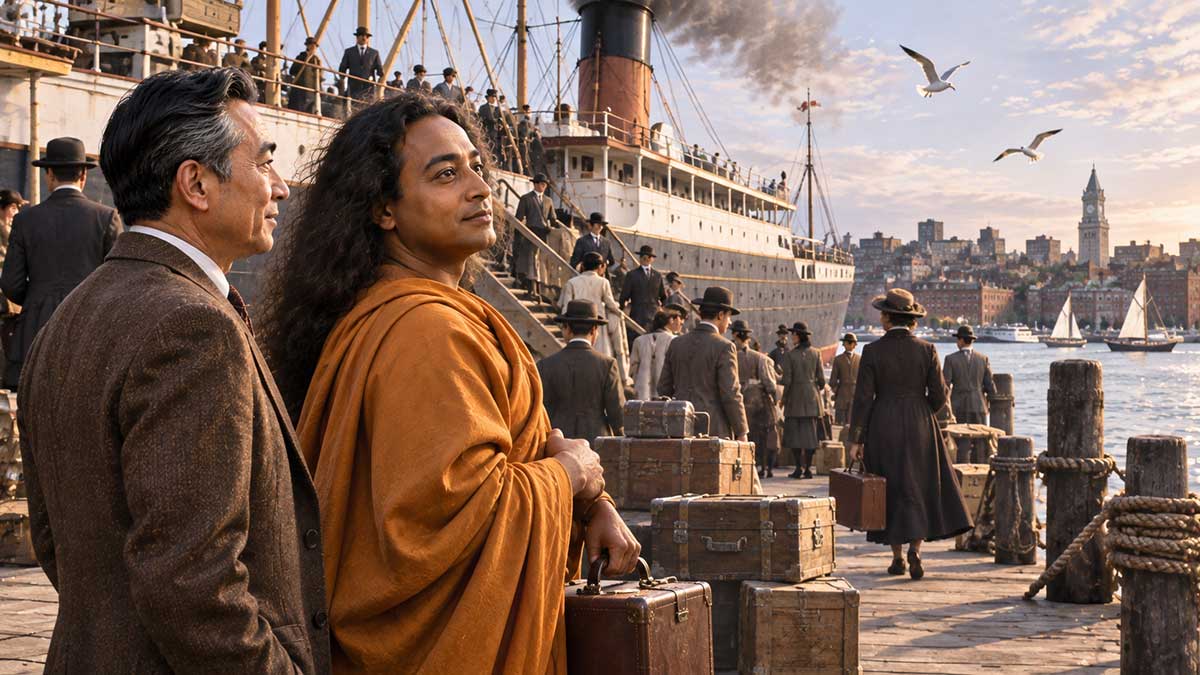
Opening Scene: Boston Harbor, September 1920
A late-afternoon breeze crosses Boston Harbor. Steam rises from a vessel moored at the waterfront, and dockworkers call to one another as trunks and parcels move down the gangway. The smell of salt and coal hangs in the air. A few travelers stand still, looking toward the city that will become their new beginning.
On a bench overlooking the water sit Nick Sasaki and Paramahansa Yogananda. In this imagined conversation, the older teacher looks back upon his arrival as a twenty-seven-year-old monk from India. He has come to speak at the International Congress of Religious Liberals, but the future of his American mission remains unknown.
Nick Sasaki
Yesterday, in Varanasi, we talked about the boy who searched for God and the teacher who changed his life. Today I wanted to bring you here. You crossed an ocean to reach this harbor. I keep wondering what that young man was feeling when he first saw America.
Paramahansa Yogananda
I remember the great significance of that crossing. I had received an invitation to address a religious congress in Boston, and I believed my guru's guidance and God's will were leading me westward. Yet a spiritual purpose does not make every practical difficulty disappear. A traveler still needs courage, patience, and the kindness of strangers.
Nick Sasaki
That's what fascinates me. We know how your story developed. The young man stepping off the ship didn't know how many people would listen, who would become his friends, or how long he would remain. Let's begin there.
Question 1: What Gave You the Courage to Leave India in 1920, and What Did You Most Hope Americans Would Discover?
Nick Sasaki
You were only twenty-seven. You had your country, your language, people you loved, and the spiritual traditions you knew. What made you willing to leave all that behind?
Paramahansa Yogananda
I had come to believe that the truths I was learning were not meant for one nation alone. My guru, Sri Yukteswar, had prepared me to see a spiritual kinship between East and West. I did not come to persuade Americans to become Indian. I hoped to share methods of meditation through which sincere seekers might deepen their own experience of God.
Nick Sasaki
Was there a moment when you felt reluctant? You can be convinced of your calling and still miss home.
Paramahansa Yogananda
Affection does not vanish when one accepts a responsibility. I loved India, and leaving familiar faces was no small matter. But I had learned that love could grow wider without becoming weaker. To serve people across the ocean did not mean I had ceased to love the people I left behind.
Nick Sasaki
What did you know about America before arriving?
Paramahansa Yogananda
I knew something of its energy, industry, and interest in new ideas. I did not know every habit of its people, nor could I predict their response to an Indian monk speaking about God-realization. My task was to communicate sincerely, listen carefully, and learn.
Nick Sasaki
When you addressed the congress, you spoke about the science of religion. Some readers might think that means you were claiming meditation had already been proven in a modern laboratory. Is that what you meant?
Paramahansa Yogananda
I used the language of systematic practice and personal investigation. I wished people to see religion as something that could be lived and tested in the laboratory of one's own consciousness, not merely accepted as an inherited statement. That is a spiritual use of the word science. It should not be confused with a claim that every metaphysical teaching has been independently demonstrated by experimental research.
Nick Sasaki
That's a distinction I appreciate. You weren't simply asking people to memorize a doctrine. You wanted them to practice and observe what happened in their lives.
Paramahansa Yogananda
Yes, and to grow in sincerity. An impressive experience is not the only measure of progress. Patience, self-control, kindness, and devotion matter. A person who speaks eloquently of God yet treats others without compassion has more to learn.
Nick Sasaki
Suppose an American listener had come to you that first week and said, 'I already have a religion. Why should I listen to you?' What would you have wanted to say?
Paramahansa Yogananda
I would have welcomed the sincerity of that question. I did not wish people to discard what was sacred to them merely to please a visitor. I believed meditation could deepen their search for the divine. I would have invited them to consider the teachings and judge their fruits through sincere living.
Nick Sasaki
That makes your mission sound less like bringing a finished answer to strangers and more like beginning a conversation with them.
Paramahansa Yogananda
A teacher who cannot listen will find it difficult to teach. Every sincere encounter asks something of both people.
A ship's horn sounds across the harbor. Nick waits until the echo fades.
Nick Sasaki
Did you ever picture the scale of what would follow? The lecture halls, the students, the books, the headquarters in California?
Paramahansa Yogananda
I held a vision of serving many souls. But a vision must be met one day at a time. The person standing before you today deserves your attention, whether a thousand others may come tomorrow or not.
Question 2: What Were the Greatest Difficulties You Encountered in America, and How Did You Respond?
Nick Sasaki
When people read the story backward, your American mission can look inevitable. Yet it wasn't. You had to find audiences, places to speak, money for travel, and people willing to help. What was hardest?
Paramahansa Yogananda
There were many practical responsibilities. Teaching requires more than inspiration. Someone must arrange a hall, answer letters, organize lessons, and welcome the people who arrive. I came to speak of spiritual freedom, but I had to learn the everyday disciplines of building a lasting work.
Nick Sasaki
That's a side of spiritual teachers we rarely discuss. You could give a wonderful lecture and still need someone to make sure the lights were on.
Paramahansa Yogananda
Indeed! A hall does not prepare itself merely through elevated thoughts. Those who serve quietly deserve gratitude. Their work allows the public teaching to take place.
Nick Sasaki
You eventually traveled widely, and your audiences grew. But you encountered suspicion and prejudice, too. How did you keep from becoming bitter when people judged you before hearing what you had to say?
Paramahansa Yogananda
Prejudice is painful, and I would not pretend otherwise. Yet I believed that responding to hostility with hatred would injure the very purpose of my mission. One may stand firmly for dignity and truth without wishing harm to those who misunderstand. Compassion is not the same as accepting mistreatment without judgment.
Nick Sasaki
I want to be careful here. We know from historical research that you encountered resistance, but I don't want to invent a private moment of despair and put it in your mouth. So let me ask openly: what helped you persevere?
Paramahansa Yogananda
My spiritual convictions, my training, and the friendship of those who supported the work. It is tempting to tell the story of a mission through one person's determination. But no enduring work is accomplished without the generosity of others.
Nick Sasaki
Who comes to mind when you think of those early years?
Paramahansa Yogananda
Many people gave their time, hospitality, and encouragement. Some became close disciples. Others assisted with the simple tasks that made a lecture or class possible. I would want them remembered not merely as names beneath a photograph, but as people whose kindness made a difference.
Nick Sasaki
One of the stories we researched was your meeting with Dr. Minott W. Lewis, a dentist in Boston. According to his later account, he arrived with serious questions about the Bible and became one of your early students. Did you welcome people who doubted you?
Paramahansa Yogananda
A sincere question is not an insult. Dr. Lewis sought to examine what I taught. His later account describes an experience he regarded as spiritually profound. That was his testimony, and readers must consider it as such. What matters for our conversation is that friendship and spiritual inquiry can begin with honest questions.
Nick Sasaki
I like that. He wasn't required to leave his mind at the door.
Paramahansa Yogananda
A genuine search asks for both an open heart and a thoughtful mind.
Nick Sasaki
Did Americans surprise you in good ways?
Paramahansa Yogananda
Very much. I found people willing to study diligently, offer hospitality, and make sacrifices for an ideal. Their sincerity reminded me that devotion is not the property of any nation. A person's accent, clothing, or birthplace tells us very little about the depth of that person's spiritual longing.
Nick Sasaki
What about humor? Surely there were misunderstandings when you were learning American customs.
Paramahansa Yogananda
When people from different cultures meet, both may discover that their ordinary habits seem extraordinary to the other! A little laughter can open a door that a solemn argument leaves closed. I preferred that people see a fellow human being before they saw an exotic visitor.
Nick Sasaki
You moved your headquarters to Los Angeles in 1925. Why did that matter?
Paramahansa Yogananda
A stable center allowed the teaching to continue beyond a single evening's lecture. Students needed a place for study, meditation, correspondence, and community. I hoped to build something that would serve people long after the excitement of a public event had passed.
Nick Sasaki
And with that came responsibilities that could pull you away from the quiet meditation you loved.
Paramahansa Yogananda
That tension is familiar to anyone trying to serve others. Solitude nourishes the inner life; service asks us to return to people. Neither should become an excuse to neglect the other. I had to practice the balance I taught.
Question 3: Looking Back on Your Schools, Lectures, Students, and Spiritual Organization, What Gave You the Greatest Satisfaction?
The harbor is growing quieter. A few lights appear in the windows across the water, and the late sun turns the ship's rigging copper. Nick opens his notebook to a photograph of children at Yogananda's school in Ranchi.
Nick Sasaki
When people speak about your accomplishments, they often begin with the crowds you addressed in America. But before you sailed here, you had founded a school in Ranchi. Why did teaching children matter so much to you?
Paramahansa Yogananda
I wanted young people to develop the whole person. Intellectual learning is precious, but so are character, physical well-being, concentration, and the ability to serve. Children should have opportunities to discover their gifts and use them wisely. A school can plant seeds whose results the teacher may never see.
Nick Sasaki
That last thought is moving. You might help a child, then never know what kind of adult that child becomes.
Paramahansa Yogananda
Service does not always return to us as recognition. A teacher should rejoice when a student grows, whether the teacher's name is remembered or forgotten.
Nick Sasaki
You later taught adults who had families, businesses, disappointments, and ordinary worries. Did they need a different kind of guidance from the children in Ranchi?
Paramahansa Yogananda
Their responsibilities differed, but the human need was familiar. People wished to find steadiness, meaning, and love. A parent may seek patience. A worker may seek integrity. A grieving person may seek comfort. I wanted spiritual practice to enter daily life rather than remain an activity reserved for a quiet room.
Nick Sasaki
That connects with something we've discussed since Varanasi. Your mother expressed love through tenderness, your father through quiet responsibility, and your guru through discipline and care. Did your American students teach you new ways that love can appear?
Paramahansa Yogananda
Every community gives such lessons. One student may be generous with time; another may listen patiently to a troubled friend. Someone who has little money may still offer a kindness of great value. If we look carefully, we discover that the divine qualities we seek in meditation are calling to be expressed through ordinary actions.
Nick Sasaki
You must have felt proud when your students began helping other people.
Paramahansa Yogananda
I would call it gratitude. To see a person become more sincere, more peaceful, or more compassionate is a deep joy. Numbers may tell us how many attended a lecture. They cannot tell us how much love entered a home afterward.
Nick Sasaki
That's a wonderful distinction. A crowded hall can be impressive, but a person who goes home and treats a struggling family member more kindly may be the real result.
Paramahansa Yogananda
Yes. Spiritual teaching should bear fruit in conduct. One must be careful, of course, not to claim that meditation will remove every hardship. Human life includes illness, loss, and uncertainty. Yet people can cultivate a steadier and more compassionate response to what they face.
Nick Sasaki
I want to ask about your ambition. You wanted your teachings to reach many people. How did you distinguish a desire to serve from a desire to become famous?
Paramahansa Yogananda
That is a question every public teacher should ask. Recognition can help a message travel, but admiration is not the destination. The true test is whether the work helps people grow in wisdom and love. A teacher must continually examine his motives, just as any student must.
Nick Sasaki
And what about the people who disagreed with you or left your organization? Can someone still value your teachings without belonging to the institution you built?
Paramahansa Yogananda
I believed deeply in the importance of proper instruction and the guru-disciple relationship. I would explain those convictions honestly. Yet no organization should become an excuse to treat another person without respect. A person's spiritual conscience deserves seriousness. What I hoped to cultivate was sincere practice and devotion, not mere outward affiliation.
Nick Sasaki
That gives us something substantial to return to when we talk about Kriya Yoga. For now, I want to ask a simpler question. Picture the young monk who arrived here in 1920. If you could stand beside him for a minute, what would you want him to know?
Paramahansa Yogananda
I would encourage him to remain faithful to his purpose, but never overlook the people who help him fulfill it. He may arrive carrying a message, yet he will receive many gifts from those he meets. Gratitude must accompany conviction.
Nick Sasaki
You've spoken so warmly about your students. Is there something you wish people would remember about the Americans who welcomed you?
Paramahansa Yogananda
That they were not merely an audience. They were individuals with hopes, sorrows, and generous hearts. Some became friends who devoted years to the work. Their faithfulness mattered to me. I would not want the story of my mission to erase their contributions.
Nick Sasaki
I'm glad we came back to the harbor. I expected to hear about the courage it took to cross the ocean. I didn't expect the story to become so much about gratitude.
Paramahansa Yogananda
Courage may begin a work, Nick. Gratitude helps keep the heart worthy of the work.
Nick looks out at the water. In the imagined harbor, the young monk's ship still waits beside the pier, as though the first day in America has not quite ended.
Nick Sasaki
Thank you for telling me about the people behind your achievements. I admire the vision that brought you here, but I admire the patience it took to build something lasting, too. And I appreciate that you want the people who helped you to receive their share of the credit.
Paramahansa Yogananda
Thank you, Nick. You have asked about the work without forgetting the hearts that sustained it. That is a kindness to them.
Nick Sasaki
Next time, I'd like to ask the question at the center of everything you've described. You crossed this ocean believing people could experience God directly. What did you mean by that, and what would you say to someone who sincerely tries but feels nothing?
Paramahansa Yogananda
That is a question worthy of patient conversation. Let us give it the time it deserves.
The last light slips from the harbor. The imagined meeting ends with the sound of footsteps on the dock and the sense that a much larger conversation is waiting beyond the water.
Fictional interview disclaimer: This conversation between Nick Sasaki and Paramahansa Yogananda is imaginary. The setting, dialogue, and private reflections are creative interpretations informed by Yogananda's autobiography, his recorded and published teachings, and historical accounts of his American mission. They are not historical quotations or transcripts. Dr. Minott W. Lewis's reported spiritual experience is presented as his personal testimony, not as independently verified fact.
Topic 3: Can Ordinary People Really Experience God?
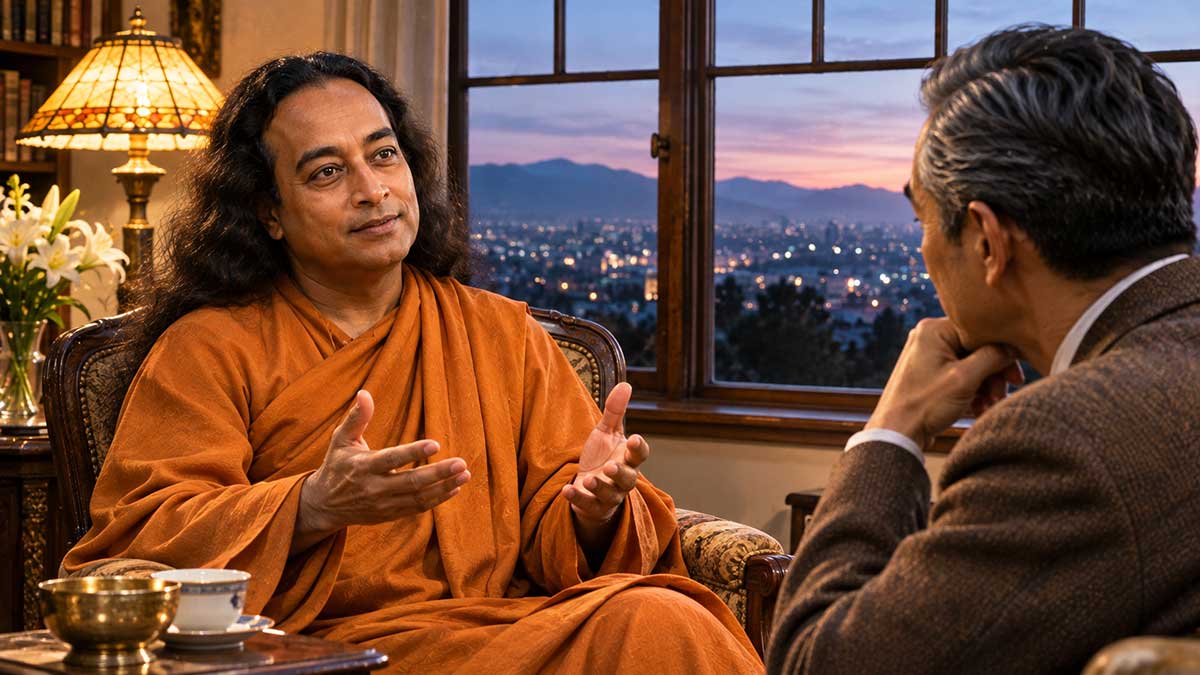
Opening Scene: Mount Washington, Los Angeles, Before Dawn, 1949
Los Angeles is still asleep. Beyond the windows of the Mount Washington headquarters, scattered lights mark the streets below, and the sky is just beginning to soften from black to blue. A small lamp illuminates a quiet room. Two chairs face a window, with a low table between them. There is no audience, no microphone, and no expectation that anyone must produce a remarkable answer.
Nick Sasaki sits across from Paramahansa Yogananda. Their imagined conversation has followed the young Mukunda from his childhood in India to the American mission he began in 1920. Here, in the stillness before sunrise, Nick has come to ask about the conviction at the center of that mission.
Nick Sasaki
Last time, you told me about crossing the ocean and the people who helped you establish your work in America. I kept thinking about something you said: you didn't come simply to give lectures. You came to help people seek an experience of God for themselves.
Paramahansa Yogananda
Yes, Nick. A lecture may awaken interest, but interest is a beginning. The purpose of spiritual teaching is not that people should admire the speaker. I wished them to discover, through sincere practice, a deeper reality within their own consciousness and to carry the fruits of that search into daily life.
Nick Sasaki
That's an extraordinary claim, and I want to give it the attention it deserves. I have questions, some personal and some skeptical, but I hope you'll hear them as sincere curiosity.
Paramahansa Yogananda
I welcome sincere questions. A person who asks what is true is not an enemy of faith.
Question 1: What Did You Mean When You Said Ordinary People Could Experience God Directly?
Nick Sasaki
When you say people can experience God, what do you mean? Are you talking about feeling peaceful, having a sudden insight, sensing a presence, or something entirely different?
Paramahansa Yogananda
Those may be beginnings, but I meant more than a passing feeling. I taught that beneath the restless activity of thought there is a deeper spiritual nature, and that through meditation and devotion a person may become aware of the divine reality that sustains life. I understood the highest realization as union with God, not simply a pleasant state of mind.
Nick Sasaki
In your autobiography, you describe an experience you call cosmic consciousness. You recount your awareness seeming to extend beyond your ordinary sense of a body. I can read your account and recognize how meaningful it was to you. But how should a reader distinguish what you experienced from your interpretation of it?
Paramahansa Yogananda
That is a fair distinction. The experience was real to me, and I interpreted it through the spiritual training I had received. I cannot place my experience into another person's hands as one might pass across a book. I can describe it, explain the discipline I believed helped prepare me, and invite others to examine their own lives with sincerity. They need not pretend certainty they do not possess.
Nick Sasaki
I appreciate that. Some people are naturally moved by accounts of mystical experience. Others wonder whether the mind can create experiences that feel absolutely convincing. Is there room in your teaching for that question?
Paramahansa Yogananda
There should be room for careful examination. The human mind can mislead us, and a desire for extraordinary experiences may become another distraction. I would not encourage someone to measure spiritual maturity by the number of visions he reports. Look at conduct, steadiness, humility, and the capacity to love. Those do not settle every philosophical question, but they matter greatly.
Nick Sasaki
So if someone tells you they've seen a brilliant light during meditation, you wouldn't automatically say they've reached the highest realization?
Paramahansa Yogananda
No. An unusual event should not become a medal worn before others. Spiritual pride is a subtle obstacle. The aim is not to become an impressive person but to seek God sincerely.
Nick Sasaki
You use the word God very personally. For someone who grew up hearing about God as a distant ruler, what would you want them to know about the God you loved?
Paramahansa Yogananda
I spoke of God as infinite consciousness, wisdom, joy, and love, yet I approached the divine with the tenderness of a child speaking to a beloved parent. These are not competing ideas to me. The Infinite need not be cold or remote. Devotion gives the heart a language for approaching what the intellect alone cannot contain.
Nick Sasaki
Does that mean someone who doesn't share your religious beliefs is excluded from the experience you're describing?
Paramahansa Yogananda
I believed the divine was not confined to one nationality or outward religious identity. Yet I had definite convictions about the spiritual path and the importance of disciplined practice. I would speak honestly about those convictions, then treat the person before me with respect. Genuine spiritual conversation should not require contempt for another's conscience.
Nick Sasaki
I keep returning to the young Mukunda we met beside the Ganges. He wanted to find God so badly that he tried to reach the Himalayas. Did the man who later taught thousands ever lose that child's sense of wonder?
Paramahansa Yogananda
I hoped to preserve it. Discipline without wonder can become mechanical. Wonder without discipline may remain only a beautiful wish. A spiritual life asks us to bring them together.
A faint line of silver appears at the edge of the hills. Nick looks at it for a moment, then turns back.
Nick Sasaki
I like that answer. It doesn't demand that everyone accept your experiences. It explains why they mattered to you and why you spent so much of your life inviting others to practice.
Paramahansa Yogananda
And it reminds us that the invitation is greater than the personality of the person offering it.
Question 2: Why Was Kriya Yoga So Central to Your Mission, and What Would You Want a Beginner to Know?
Nick Sasaki
Let's talk about the practice itself. People hear the words Kriya Yoga and may think of a mysterious secret, or perhaps a breathing exercise. Why did you regard it as so important?
Paramahansa Yogananda
I understood Kriya Yoga as a sacred method of spiritual discipline passed through my lineage. I taught that it could assist the seeker in withdrawing attention from outward restlessness and directing it toward God-realization. It belonged within a larger life of devotion, ethical conduct, meditation, and the guidance I believed proper instruction provided. It was never meant to be a fashionable trick.
Nick Sasaki
You often used scientific language to describe spiritual practice. A modern reader may hear that and assume every claimed effect of Kriya Yoga has been established through clinical experiments. How would you clarify the difference?
Paramahansa Yogananda
When I spoke of a science of religion, I emphasized orderly practice and personal investigation. I was speaking within a spiritual framework. The religious claims I made should not be mistaken for conclusions automatically established by contemporary laboratory research. I would want people to be accurate about what is known, what is believed, and what is experienced personally.
Nick Sasaki
That matters to me. A reader should be able to respect your spiritual conviction without feeling pressured to accept every explanation as proven physiology.
Paramahansa Yogananda
Truth is not served by exaggeration. Nor is devotion strengthened by pretending there are no questions.
Nick Sasaki
What about a complete beginner? Suppose someone has never meditated. They work all day, come home tired, and sit down for five minutes. Their mind immediately starts making grocery lists. Are they doing it wrong?
Paramahansa Yogananda
They are discovering how active the mind can be! That is no reason for shame. One does not learn concentration by becoming angry at distraction. Begin sincerely, with patience. Establish a regular period for quiet, cultivate attention, and bring kindness into the rest of the day. For the particular practices of my tradition, I directed students toward proper instruction rather than casual imitation.
Nick Sasaki
I can almost hear a beginner saying, 'Five minutes? I couldn't stay focused for thirty seconds.'
Paramahansa Yogananda
Then thirty seconds of honest effort may teach something valuable. A person learning to walk does not despise the first step. Why should a person learning inward stillness despise the beginning?
Nick Sasaki
You make that sound much kinder than the way people sometimes talk to themselves. They miss a day and decide they've failed.
Paramahansa Yogananda
Steadiness grows through returning. A missed practice need not become a reason to abandon the path. Yet sincerity asks more than admiration for an ideal. We must make time for what we claim to value.
Nick Sasaki
Here's something I've wanted to ask since our FAR research. If someone finds peace through prayer, contemplation, or another spiritual tradition, would you regard that as meaningful, or would you insist that Kriya Yoga is the only path worth taking?
Paramahansa Yogananda
I had a particular mission and taught Kriya Yoga with deep conviction. I would not conceal that. But I believed God was not limited by human labels. I encouraged sincere devotion and respect for the spiritual search. I would explain why I valued my method rather than belittle someone whose practice differed.
Nick Sasaki
There's another concern people have about spiritual teachers. When a method is taught through a lineage, students can become afraid to question the organization or the teacher. How can devotion remain healthy?
Paramahansa Yogananda
The relationship between teacher and disciple carries serious responsibilities. I regarded guidance and commitment as important. Yet a teacher should serve the student's spiritual growth, not merely demand admiration. Sincerity, conscience, and conduct deserve attention. The outer form must never become an excuse for neglecting compassion.
Nick Sasaki
I'm glad we can talk about that without making it a confrontation. You spent years building a spiritual community. I want to honor that work and still ask how a person can remain thoughtful within it.
Paramahansa Yogananda
An honest question asked with respect may help a community remain true to its purpose.
Nick Sasaki
If you could correct one common misunderstanding about meditation, what would it be?
Paramahansa Yogananda
I would ask people not to confuse the means with the end. A method is precious when it serves the search for God and helps transform character. If one becomes proud of technique while neglecting love, one has lost sight of the purpose.
Nick Sasaki
So the measure isn't just what happens when someone's eyes are closed.
Paramahansa Yogananda
It is equally important what happens when those eyes open and the person meets another human being.
Question 3: What Would You Say to Someone Who Has Prayed or Meditated for Years but Still Feels No Presence of God?
The first sunlight touches the window frame. The lamp is no longer needed, but neither man reaches to turn it off. Nick closes his notebook for a moment.
Nick Sasaki
I think this may be the question I care about most today. Suppose a woman has prayed for years. She has lost someone she loves. She tries to meditate, attends services, reads spiritual books, and asks God for some sign that she isn't alone. Nothing seems to happen. What would you say to her?
Paramahansa Yogananda
I would begin by listening. I would not make her sorrow into an argument to be won. When a person is grieving, the first duty of a friend is compassion. I would not tell her that the absence of a felt experience proves she has failed. Her suffering deserves tenderness, not a verdict.
Nick Sasaki
That is a relief to hear. Sometimes people are told, 'If your faith were stronger, you would feel God's presence.' That can make an already lonely person feel ashamed.
Paramahansa Yogananda
Shame is a poor companion for a sincere seeker. I believed persistence in prayer and meditation mattered, but I would not claim to know the hidden condition of another person's heart. We must be careful with confident judgments about experiences we cannot see.
Nick Sasaki
Would you tell her God is definitely listening?
Paramahansa Yogananda
I would speak from my conviction that God is present and that no sincere prayer is meaningless. But I would distinguish my faith from a promise that she will receive a particular sign on a particular day. Love should not be offered as a bargain in which someone performs enough exercises and receives a guaranteed sensation.
Nick Sasaki
That's a meaningful distinction. You can share your conviction without pretending to control her experience.
Paramahansa Yogananda
Yes. And I would ask whether she has people who can support her. Prayer need not replace human companionship, practical assistance, or appropriate care. When someone is suffering deeply, a warm meal, a trusted friend, or help with daily burdens may be a sacred expression of kindness.
Nick Sasaki
That brings us back to your mother, your father, and Sri Yukteswar. The love you received from people wasn't an obstacle to your spiritual search. It helped shape it.
Paramahansa Yogananda
I would say so. Human affection can awaken gratitude and widen our sense of what love might become. We need not despise the ordinary acts through which compassion reaches us.
Nick Sasaki
What if this woman tells you, 'I don't know whether God exists anymore. I can't honestly say I believe'? Would you still welcome her?
Paramahansa Yogananda
Certainly. She need not pretend certainty to receive respect. I would invite her to remain sincere, to ask her questions, and to care for herself and others. If she wishes to pray, let it be an honest prayer, not a performance for anyone's approval.
Nick Sasaki
Can a person live a meaningful, loving life without having the mystical experiences you describe?
Paramahansa Yogananda
A loving act is meaningful. I would not dismiss the goodness of someone who has never known an extraordinary spiritual state. My religious conviction remained that human beings could seek a deeper realization of God. But the search should make us more attentive to goodness, not blind us to it wherever it appears.
Nick Sasaki
I want to press this gently. What about a child who suffers, or a family whose prayers for healing go unanswered? I know our next conversation will discuss suffering more fully, but how do you prevent spiritual teaching from sounding indifferent to pain?
Paramahansa Yogananda
By refusing indifference. Philosophical explanations can be discussed, but they should not be used to silence grief or excuse neglect. A person in pain needs care. If our spiritual practice does not awaken compassion, we must examine what we have made of it.
Nick Sasaki
You speak so often of joy. Is it fair to ask someone in mourning to be joyful?
Paramahansa Yogananda
Not as a demand. Grief has its own human truth. I taught that a deeper joy could be discovered through spiritual realization, but I would not ask a grieving person to wear a smile to satisfy others. Tenderness comes first. The heart may find its way toward peace in its own time.
Nick looks down at the closed notebook. The room has become bright enough to see the trees outside clearly.
Nick Sasaki
Something has changed for me during this conversation. I expected to spend most of our time asking about extraordinary experiences. Instead, I keep hearing you return to patience and the way people treat one another.
Paramahansa Yogananda
I do not wish you to forget the extraordinary aim of God-realization. It was central to my life. Yet I would be disappointed if someone spoke of divine consciousness with enthusiasm and then passed a suffering neighbor without kindness. The inward search and the outward life must meet.
Nick Sasaki
May I ask you one final question before we leave this room? If you had only a minute with someone who wanted to begin searching for God today, what would you say?
Paramahansa Yogananda
Begin with sincerity. Make a little space for quiet and prayer. Do not compare your inner life with another person's stories. Practice patiently, seek trustworthy guidance, and express whatever love you can through the people near you. If you stumble, begin again. And do not make the search for God an excuse to forget the human beings God has placed before you.
Nick Sasaki
Thank you. I admire how seriously you took your mission, and I appreciate that you haven't treated my questions as a lack of respect. I wanted to know what you meant by experiencing God. You've given me a fuller answer than a description of a vision.
Paramahansa Yogananda
And I thank you for asking with an open heart. Questions offered sincerely can become part of the search itself.
Nick Sasaki
Next, I'd love to explore something that seems inseparable from your mission. You spoke about Jesus and Krishna as teachers of a shared spiritual truth. That's beautiful to some people and difficult for others. What did Jesus mean to you personally? And how do we talk about different faiths without overlooking their real disagreements?
Paramahansa Yogananda
Those questions deserve care, Nick. We can honor what is sacred to others and still speak honestly about our own convictions. I would welcome that conversation.
Outside, the sun has cleared the hills. The city begins to stir below Mount Washington. Nick and Yogananda rise from their chairs, leaving the quiet room as it was, with the lamp still glowing faintly in the morning light.
Fictional interview disclaimer: This is an imagined conversation between Nick Sasaki and Paramahansa Yogananda. The dialogue, private responses, and meeting in 1949 are creative interpretations, not historical transcripts or quotations. The discussion draws on themes in Yogananda's published autobiography and spiritual teachings. His descriptions of cosmic consciousness and God-realization are presented as religious testimony, not independently verified scientific findings. No meditation instructions here substitute for instruction within his tradition.
Topic 4: Did Jesus and Krishna Teach the Same Spiritual Truth?
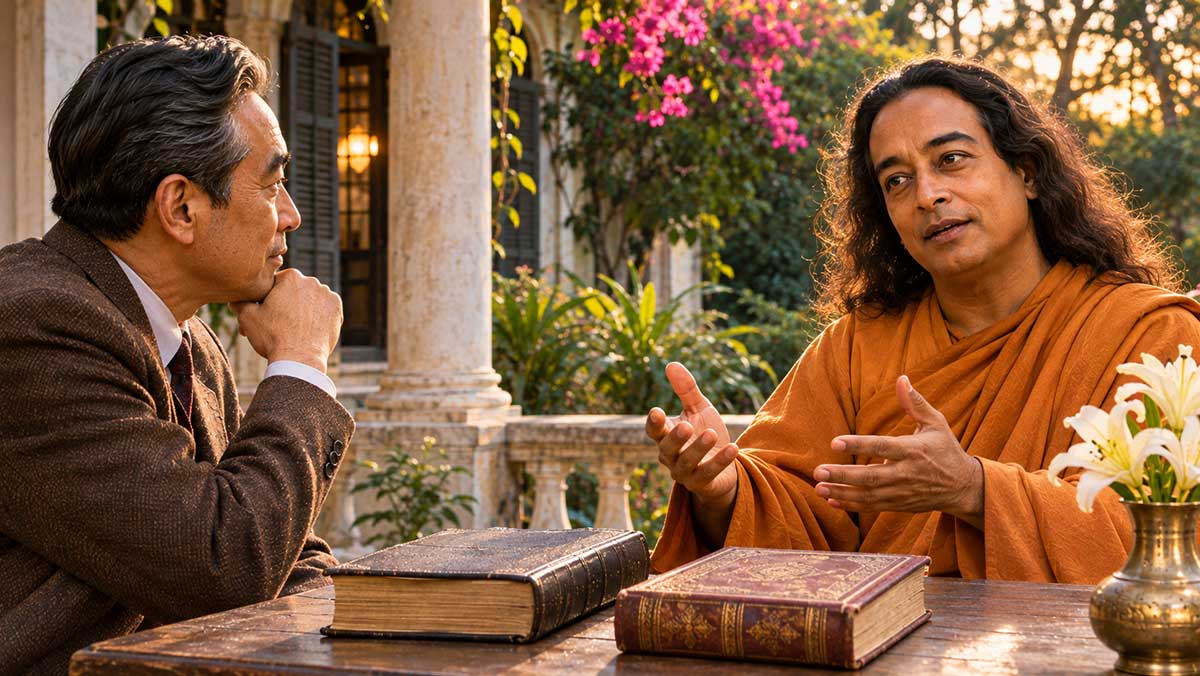
Opening Scene: Serampore, India, An Evening During 1935–36
The afternoon heat has begun to loosen its hold on Serampore. Beyond a shaded veranda, a small garden glows in the last amber light. Leaves stir in the breeze, and the distant sounds of the town drift over a low wall. On a table sit a Bible and a copy of the Bhagavad Gita, placed together for this imagined meeting as a symbol of the traditions that occupied so much of Paramahansa Yogananda's teaching.
Nick Sasaki and Yogananda sit facing the garden. Their conversations have traveled from a boy's longing for God to the challenges of an American mission and the inward discipline of meditation. Tonight, the questions concern the beliefs that gave that mission its distinctive character.
Nick Sasaki
I've been looking forward to this conversation, and I admit I've been thinking about how to ask these questions fairly. You loved Jesus and Krishna. You believed their deepest teachings belonged together. Yet some devoted Christians and Hindus would disagree with the way you interpreted them. I want to hear what you actually believed without pretending the differences are unimportant.
Paramahansa Yogananda
That is a worthy intention, Nick. One need not speak carelessly of another's faith in order to explain one's own. I sought to show the spiritual kinship I perceived between the teachings of Jesus and the wisdom of yoga. I did not imagine that a few agreeable words could erase every difference in doctrine or history.
Nick Sasaki
Good. Then let's begin with the person, not the theory. When you thought of Jesus, whom did you love?
Question 1: What Did Jesus Mean to You Personally, and Why Did You Believe His Teachings Were Connected With Krishna's?
Paramahansa Yogananda
I revered Jesus as a great divine teacher whose life expressed love, sacrifice, and the possibility of spiritual union with God. I felt deep devotion toward him. In my interpretation, the consciousness manifested in Jesus was not meant to remain an inaccessible wonder. His teachings invited humanity toward a higher realization of the divine.
Nick Sasaki
You use the expression Christ consciousness. For a reader who has never encountered it, what were you trying to describe?
Paramahansa Yogananda
I used that term for the universal divine intelligence or consciousness reflected in creation, which I believed could be realized in spiritual experience. I understood Jesus as a supreme manifestation of that consciousness. That is my theological interpretation, shaped by the yoga tradition I taught. It is not identical to the way every Christian church defines Christ.
Nick Sasaki
That distinction is essential. Many Christians understand Jesus as uniquely God incarnate, not primarily as an example of a consciousness that other people can realize. When you read the Gospels, did you see Jesus differently from them?
Paramahansa Yogananda
In significant ways, yes. I saw his words through the lens of meditation, divine realization, and the spiritual teachings of India. I believed that his inner teachings had a universal application. I would not claim that my reading was simply the undisputed meaning of Christian scripture. It was the understanding I came to teach.
Nick Sasaki
And Krishna? You weren't saying Jesus and Krishna had the same biography or spoke in exactly the same language.
Paramahansa Yogananda
Certainly not. Their historical settings, narratives, and religious traditions differ. My conviction concerned what I believed to be a shared spiritual truth: that the human being can turn from the narrow identification with the ego toward realization of the divine. I found in the Bhagavad Gita a profound teaching about disciplined action, devotion, wisdom, and liberation. I believed those themes could illuminate the teachings of Jesus.
Nick Sasaki
Could you give me an example without forcing the two scriptures to say precisely the same thing?
Paramahansa Yogananda
Consider the importance of love and the surrender of selfishness. The Gita calls the seeker toward devotion and action without attachment to personal reward. Jesus calls his followers toward love of God and neighbor. These teachings arise within different theological worlds, but I perceived a spiritual kinship in their demand that love become greater than self-interest.
Nick Sasaki
That feels like a place where people might find common ground, even when they disagree about the nature of Jesus or Krishna.
Paramahansa Yogananda
Yes. Common ground need not require identical belief. A Christian may retain a Christian confession, a Hindu a Hindu understanding, and both may take seriously the obligation to love and serve.
Nick Sasaki
I want to ask a personal question. Did your affection for Jesus ever feel surprising to people who knew you as a Hindu monk?
Paramahansa Yogananda
Some people were surprised by the depth of my devotion. I wished them to know that reverence for Jesus was sincere, not a decorative addition intended to please an American audience. My teaching about him was an important part of my religious mission. I loved India and its spiritual heritage; that did not prevent me from honoring the spiritual greatness I perceived in Jesus.
Nick Sasaki
That helps me hear your intention. You weren't trying to win a clever argument about whose religion was right. You wanted people to encounter what you regarded as a living spiritual truth.
Paramahansa Yogananda
Precisely. A debate may clarify ideas, but spiritual life cannot end with the satisfaction of having defeated someone. The question is what truth does to the heart and how one lives afterward.
A bird settles in the branches above the veranda. Nick looks at the two books on the table, then turns one slightly so both covers face the men equally.
Question 2: How Would You Respond to Christians or Hindus Who Believe Your Interpretation Differs From Their Traditions?
Nick Sasaki
Let's picture a Christian pastor sitting here. He says, 'I respect your devotion to Jesus, but I believe he is uniquely the Son of God. I don't agree that Christ consciousness is a spiritual state others can attain.' How would you respond?
Paramahansa Yogananda
I would first thank him for stating his belief sincerely. I would explain that my understanding arose from the spiritual experience and scriptural interpretation I accepted. We might examine the teachings together, and perhaps we would continue to disagree. Respect does not require that either of us conceal a conviction.
Nick Sasaki
Would you try to persuade him?
Paramahansa Yogananda
I was a teacher, so naturally I wished to communicate what I believed. But persuasion should not become contempt. If a conversation ends with two people still differing in doctrine, they can nevertheless have treated each other with honesty and kindness.
Nick Sasaki
And suppose a Hindu scholar says, 'You speak of a unity between Jesus and Krishna, but Hindu traditions themselves contain many different interpretations. You cannot speak for all of us.'
Paramahansa Yogananda
That scholar would be right to remind us of the richness and variety of Hindu thought. I taught within a particular lineage and drew upon the interpretations that shaped my life. I would not claim that every Hindu philosopher, devotee, or school must agree with me. My conviction was deeply held, but it was still a conviction expressed through a particular tradition.
Nick Sasaki
I appreciate that. Sometimes the phrase 'all religions teach the same thing' sounds welcoming at first, but it can make people feel that the things they hold sacred are being flattened.
Paramahansa Yogananda
Then we should be more careful with our words. I believed that spiritual truths could be recognized across traditions. That does not mean every religious claim is interchangeable. Love should make us more attentive to another person's meaning, not less.
Nick Sasaki
Could someone admire your teachings on meditation and still disagree with your interpretation of Jesus?
Paramahansa Yogananda
Of course a person may examine one part of a teaching without accepting every theological claim. I would explain the full purpose of my work honestly, including my devotion to God and my conviction about Kriya Yoga. I would not pretend that it was merely a neutral exercise program. Yet the listener must make a conscientious judgment.
Nick Sasaki
That's important. People should know what you actually taught, not a softened version created to avoid disagreement.
Paramahansa Yogananda
I would rather be understood accurately than praised for something I did not mean.
Nick Sasaki
There's a harder question. Religious people sometimes say they love everyone, then speak harshly about people outside their tradition. Have you seen that tendency in yourself, too? The temptation to think, 'I have found the deeper truth, and others simply haven't understood it'?
Paramahansa Yogananda
Anyone who teaches should examine the danger of pride. A claim to spiritual insight can become a disguise for the ego. I believed deeply in the truth of my teachings, but certainty must not become permission to humiliate others. The conduct of the teacher is part of the teaching.
Nick Sasaki
When you came to America, did you hope Christians would abandon Christianity and become Hindu?
Paramahansa Yogananda
I wished them to deepen their experience of God through the methods I taught. I spoke often of the original teachings of Jesus and their harmony, as I understood it, with yoga. I did not see the mission simply as changing an outward religious label. But I would be misleading you if I denied that my interpretation challenged some established Christian doctrines.
Nick Sasaki
So genuine respect doesn't mean avoiding every difficult difference. It means discussing those differences without treating the other person as an enemy.
Paramahansa Yogananda
That is well said. A sincere disagreement may even teach us patience. We need not surrender conviction in order to practice kindness.
Nick Sasaki
I wonder what your mother would have thought of this conversation. We began our first meeting with her love, and now we're discussing centuries of theology. Perhaps she would ask whether we've eaten.
Paramahansa Yogananda
And that would be a wise interruption! A hungry philosopher may discover that his charity improves after supper.
Nick laughs. The tension of the theological discussion gives way to a moment of easy companionship.
Nick Sasaki
There is something reassuring about that. We can take ideas seriously without making the room cold.
Paramahansa Yogananda
Indeed. Reverence and warmth belong together.
Question 3: If Divine Love Is Central to Spiritual Life, How Should We Understand Suffering and the Pain of Innocent People?
The light has faded. Someone inside the house lights a lamp, and its soft glow reaches the veranda. Nick is quiet for a moment before speaking.
Nick Sasaki
I want to move from theology to something more painful. Suppose a parent loses a child. People may offer explanations about karma, destiny, or God's plan. But the parent is devastated. What would you say first?
Paramahansa Yogananda
I would begin with compassion. The parent has not come to us as an abstract problem. This is a human being who loves a child and has suffered a terrible loss. Words offered too quickly may deepen the wound. Presence, practical care, and tenderness should come before philosophical explanation.
Nick Sasaki
That matters to me. I've heard people use karma as though it explains why a particular person deserved a tragedy. I find that frightening. Would you tell a grieving parent that the child's suffering was punishment for something done in a previous life?
Paramahansa Yogananda
I would not presume to know the hidden causes of another person's sorrow. I taught karma within my spiritual philosophy, but such a teaching should not become an excuse for accusation or indifference. We are not helped by declaring that a suffering person deserves pain. The immediate moral responsibility is to offer compassion and help.
Nick Sasaki
Can you see why someone might reject the entire explanation? They might say, 'I don't want a theory about why this happened. I want my child back.'
Paramahansa Yogananda
I can respect that cry of the heart. No theory should be used to silence it. A person in grief may not want a theological discussion, and we should not force one upon them. Love must know when to speak and when to remain quietly beside someone.
Nick Sasaki
Earlier you told me that you longed for your mother after her death. Did that experience make it easier to recognize another person's grief?
Paramahansa Yogananda
My own loss made sorrow deeply personal. I would never claim that one person's grief is identical to another's. But having loved and lost, I knew that spiritual language must be spoken with tenderness. The longing for someone we love cannot be dismissed as ignorance.
Nick Sasaki
What about people who pray desperately for healing and don't receive it? Does unanswered prayer mean they didn't believe strongly enough?
Paramahansa Yogananda
We should not make such judgments. I believed in prayer and divine communion, yet I would not promise that every request will be answered in the form we desire. To tell a suffering family that their loss proves inadequate faith would be cruel. Prayer may accompany medical care, companionship, and all the practical assistance that love can provide.
Nick Sasaki
Let me ask something about Jesus. One of the things that moves me most is his compassion for people who were sick, poor, rejected, or grieving. Is that part of what drew you to him?
Paramahansa Yogananda
Very much. I revered his love and his willingness to serve. Whatever differences people have about theology, they should not overlook the call to care for the vulnerable. I believed spiritual realization should widen our compassion rather than separate us from human need.
Nick Sasaki
And Krishna? The Gita is set on a battlefield. That can seem very far from a conversation about gentleness.
Paramahansa Yogananda
The Gita addresses duty, moral struggle, disciplined action, and spiritual insight. I interpreted its battlefield in important ways as an inward struggle as well. Yet readers should recognize that it has a rich history of interpretation. For me, one of its great lessons was that spiritual aspiration does not release us from responsibility. We must act with discernment and without selfish attachment.
Nick Sasaki
So if we say we believe in divine love, we still have to do something. Feed someone. Forgive someone. Defend someone who's being mistreated.
Paramahansa Yogananda
Yes. Meditation should deepen the capacity to serve. Compassion without action may remain a beautiful sentiment. Action without inward reflection may become restless or proud. I hoped people would cultivate both.
Nick Sasaki
I have a question that may sound simple. Is it possible to love someone whose beliefs you think are mistaken?
Paramahansa Yogananda
Certainly. If love depended upon complete agreement, human friendship would be a very fragile thing. We may speak honestly, listen carefully, and still cherish the person before us. The dignity of another soul does not disappear when we disagree.
Nick Sasaki
That makes me think of the world outside this garden. Different religions, different countries, people who have inherited old suspicions. Do you believe spiritual unity can become more than an inspiring phrase?
Paramahansa Yogananda
It must begin in conduct. A person who wishes for peace among nations can begin by refusing unnecessary cruelty in the home. A person who speaks of brotherhood can learn to listen to someone from another tradition. Great ideals become credible through small, repeated acts of integrity.
Nick Sasaki
What if someone listening to us has no faith at all? They don't believe in God, Christ consciousness, reincarnation, or karma. Can they still take something meaningful from what you're saying?
Paramahansa Yogananda
They can consider whether greater patience, self-examination, compassion, and service would benefit their lives and the lives of others. I would speak openly about my belief in God; I would not require them to pretend to share it before we could meet as fellow human beings.
Nick Sasaki
That's a beautiful place to arrive. We started with a disagreement about Jesus and Krishna. We've ended with the possibility of treating one another kindly without erasing the disagreement.
Paramahansa Yogananda
And perhaps that is a beginning, not an ending. Spiritual friendship does not ask us to stop seeking truth. It asks us to seek without surrendering love.
Nick Sasaki
Before we leave, I want to ask you something personal. You gave so much of your life to bringing people of different backgrounds together. Did you ever wish you could simply sit with a friend and talk, without explaining a doctrine or carrying the responsibilities of a teacher?
Paramahansa Yogananda
Friendship itself can be a spiritual gift, Nick. A sincere conversation, a shared laugh, a moment of quiet appreciation, these need no grand audience. I would not wish to become so occupied with speaking of divine love that I forgot to enjoy the affection of the people near me.
Nick Sasaki
I'm grateful for that answer. You've given me a more precise picture of your beliefs, and I respect that you haven't pretended everyone agrees with you. I particularly appreciate your willingness to put compassion before explanations when someone is suffering.
Paramahansa Yogananda
Thank you for asking with care. You have allowed me to speak of convictions dear to me and to acknowledge the sincerity of those who differ. That is a gracious way to meet another person.
Nick closes the Bible and the Bhagavad Gita and places them gently beside each other. Beyond the veranda, the garden is dark now, and the lamp throws a warm circle of light across the table.
Nick Sasaki
Next time, I'd like to ask about the message you most wanted people to remember. Not what admirers say your legacy was, but what you yourself hoped a person living a hundred years later would discover. And I'd love to hear about the people who made you happy along the way.
Paramahansa Yogananda
Then we must speak of gratitude, friendship, and the purpose behind all these years of teaching. I would be glad to continue.
Fictional interview disclaimer: This imagined conversation between Nick Sasaki and Paramahansa Yogananda is a creative interpretation, not a historical transcript. The Serampore meeting, its setting details, and the dialogue are fictional. Yogananda's reported convictions about Jesus, Krishna, Christ consciousness, Kriya Yoga, and karma are represented as his religious interpretations. Christian and Hindu traditions contain diverse views, and the dialogue does not claim universal agreement. Spiritual claims are not presented as independently established scientific facts.
Topic 5: What Did Yogananda Most Want Humanity to Remember?
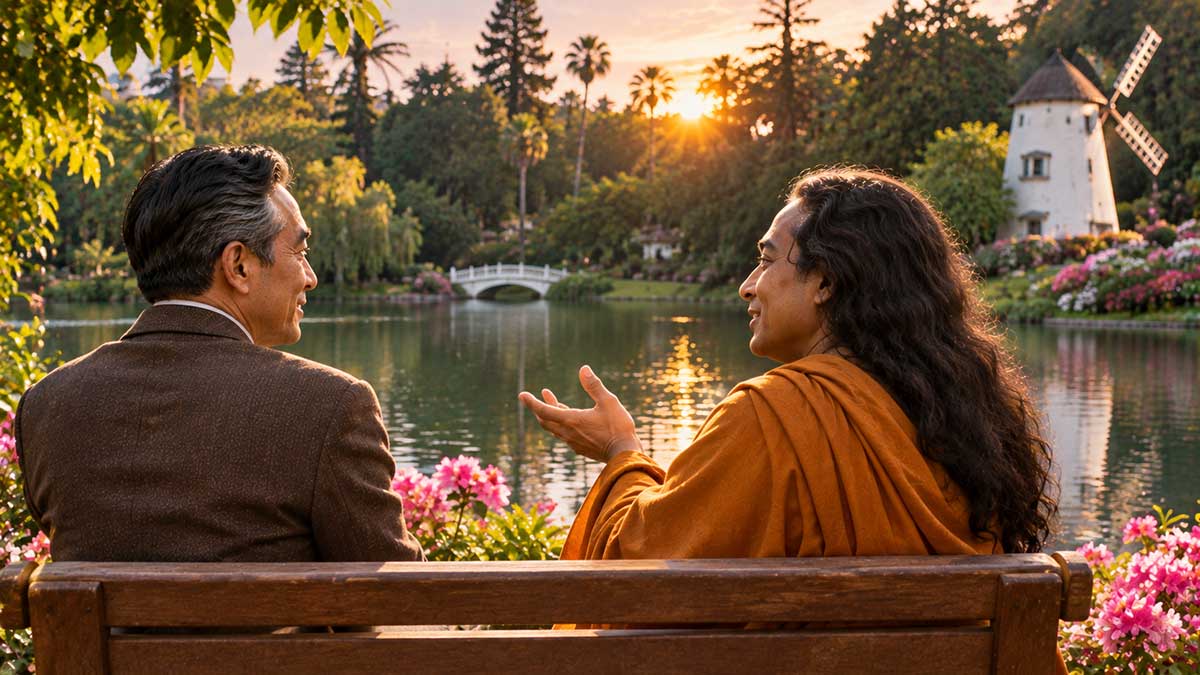
Opening Scene: Lake Shrine, Pacific Palisades, California, Around 1951
The afternoon light has turned golden over the lake. A breeze moves through the trees, touching the water with small circles of silver. The garden paths are quiet. Farther along the shore, a visitor pauses to look at the reflections before continuing on.
Nick Sasaki and Paramahansa Yogananda sit on a bench facing the lake. This meeting is imagined, but the setting belongs to a place Yogananda established as a sanctuary for meditation and reflection. After four conversations spanning childhood, his arrival in America, God-realization, and the teachings of Jesus and Krishna, Nick has left his notebook closed. He wants to begin with something simpler than philosophy.
Nick Sasaki
We've talked about so much, and I'm grateful you've stayed with my questions. Today I want to start with happiness. Not your greatest achievement or the biggest audience you addressed. When you think back over your life, which moments make you smile?
Paramahansa Yogananda
That is a delightful question, Nick. People often suppose a spiritual teacher must speak only in solemn tones. Yet joy was central to what I wished to share. I remember the affection of family, the companionship of students, moments of laughter with my guru, and the happiness of seeing someone take a sincere step toward God. There were difficulties, certainly, but gratitude brings many faces to mind.
Question 1: Looking Back on Your Students, Friendships, Teaching, and Autobiography, Which Memories Bring You the Greatest Happiness?
Nick Sasaki
Let's begin with your students. When you arrived in Boston, you didn't have the community you later built. Over the years, people gave their time, their homes, and sometimes much of their lives to the work. Who would you want us to appreciate?
Paramahansa Yogananda
I would want readers to see them as people, not merely as names in an organization's history. Dr. Minott W. Lewis was among the early students whose friendship and support mattered. Many others worked quietly, arranging classes, helping with correspondence, caring for guests, or offering their abilities in service. The work was never the accomplishment of one person alone.
Nick Sasaki
I was struck by the story of Daya Mata. She was a teenager when she first heard you lecture in Salt Lake City in 1931, and later became such an important figure in the community. What do you think a teacher owes a young person who trusts him that deeply?
Paramahansa Yogananda
Care, integrity, and a sincere commitment to that person's spiritual growth. Trust is a precious gift. I believed deeply in the guru-disciple relationship, but a teacher must never forget that the student is a human being with hopes, fears, and responsibilities. Spiritual guidance should cultivate devotion and discernment, not vanity in the teacher.
Nick Sasaki
You know, I like hearing you talk about responsibility. It makes the story feel real. It wasn't simply a series of wonderful lectures. There were people depending on you, and some of them were very young.
Paramahansa Yogananda
Yes. An institution may be remembered for its buildings and publications, but its true significance rests in the lives of the people it serves. A student's growth is never merely a statistic.
Nick Sasaki
What about your book? Autobiography of a Yogi appeared in 1946. By then you had spent decades teaching. Did you feel like a proud author when you finally held it?
Paramahansa Yogananda
I felt deep satisfaction that the work could reach people whom I might never meet. In the recollections of my students, there are affectionate stories of my excitement when the book appeared. That joy was genuine. A book can cross distances that its author cannot, and it can remain on a shelf until the day someone needs it.
Nick Sasaki
One of those recollections describes you hiding an advance copy behind your back before showing it to the disciples. I love that picture. It's such a playful thing to do.
Paramahansa Yogananda
Why should spiritual aspiration make a person incapable of a happy surprise? There is room for laughter in a life devoted to God. Perhaps especially in such a life.
Nick Sasaki
Were you ever tempted to check how many copies people bought?
Paramahansa Yogananda
A writer hopes his work will be read! But the more important question is what happens after the book is closed. Does a reader become more thoughtful, more devoted, more compassionate? Does admiration turn into practice? Those are the results I would wish for.
Nick Sasaki
You once told me about Sri Yukteswar's affection, and the way he could correct you firmly but still make you feel loved. Do you think you carried some of his manner into your own teaching?
Paramahansa Yogananda
His example remained with me. I remembered his discipline, his wisdom, and the tenderness he did not always display in words. I hoped to share what I had received. Yet every teacher must remain a student of his own ideals. To speak about love is easy; to express it consistently is a lifelong task.
Nick Sasaki
When you think of your mother now, after everything you've accomplished, do you still picture the boy who missed her?
Paramahansa Yogananda
Love allows us to carry many seasons of life together. The child who loved his mother did not disappear when he became a monk or a teacher. I would be sorry if spiritual maturity meant losing gratitude for the people who first cared for us.
Nick Sasaki
That's beautiful. It means the child in Varanasi is still part of the man sitting here beside the lake.
Paramahansa Yogananda
And perhaps that is true of everyone, Nick. We carry our histories into the way we love. The task is to let those experiences deepen our kindness rather than narrow our hearts.
Question 2: What Have People Most Misunderstood About Your Teachings, and What Message Did You Most Want Future Generations to Receive?
The sun slips behind a stand of trees. For a few moments the water looks almost motionless. Nick opens his notebook to a page containing just two words: What matters?
Nick Sasaki
This is the question I especially wanted to ask. We spent time with advisers planning our conversation, and I realized something. We were very good at deciding what I wanted to know. We weren't giving enough attention to what you wanted to tell us. So I'm going to leave you room here. What do you think people miss when they remember your life?
Paramahansa Yogananda
I would not want them to mistake the remarkable stories for the purpose of the work. My autobiography includes accounts of saints, visions, and experiences that I understood as spiritual. Those accounts may awaken curiosity. But curiosity about extraordinary events is not the same as the search for God. I wished people to discover that spiritual realization calls for sincere practice, devotion, and a transformation of the heart.
Nick Sasaki
So if someone finishes your book saying, 'That was fascinating! I wonder whether the miracles happened,' but never asks how to live differently, you might feel they missed your central invitation.
Paramahansa Yogananda
I would hope the fascination becomes a beginning. Readers may believe, doubt, or remain uncertain about particular accounts. I would ask them not to stop at admiration or argument. What is the purpose of their own lives? How do they seek truth? How do they treat those who depend on them?
Nick Sasaki
There's another modern misunderstanding I want to test with you. People sometimes present meditation as a way to relax, sleep better, or become more productive. Those can be worthwhile aims. But you crossed an ocean for something more than stress relief, didn't you?
Paramahansa Yogananda
Indeed. I taught meditation for God-realization. Peace and steadiness may be valuable fruits of practice, but they were not the whole purpose. I wanted seekers to know themselves as souls and to cultivate direct communion with the divine. To omit that aim would leave out the center of my mission.
Nick Sasaki
And Kriya Yoga wasn't just an interesting technique in the background.
Paramahansa Yogananda
It was central to the spiritual discipline I taught, within the lineage and devotional framework I accepted. I would wish future readers to represent that accurately. They need not share every conviction I held, but they should know what those convictions were.
Nick Sasaki
What about your message that Jesus and Krishna taught a shared spiritual truth? We spoke last time about how sincerely religious people can disagree with your interpretation.
Paramahansa Yogananda
I would still speak of the harmony I perceived. It was dear to my heart. But harmony should not become an excuse for misrepresenting another tradition. I hoped that people could approach one another with reverence, seek the divine sincerely, and refuse to let religious difference become hatred.
Nick Sasaki
There's something I worry about when we tell the story of a spiritual teacher. Readers can put the person on such a high pedestal that they stop thinking for themselves. How would you want them to remember you without making you the center of everything?
Paramahansa Yogananda
A teacher may point toward a path, but he cannot walk it in another person's place. I cherished the guru-disciple relationship and regarded faithful practice as important. Yet I would not wish a person's admiration for me to replace sincere effort, moral responsibility, or devotion to God. The message is greater than the messenger.
Nick Sasaki
What would you say to someone who feels unworthy? Someone who thinks, 'I'm not spiritual. I get angry, I lose patience, I worry about money, and I haven't had a single mystical experience.'
Paramahansa Yogananda
I would tell that person that sincerity matters more than a polished appearance. Begin where you are. Acknowledge your faults without surrendering to them. Make time for prayer and meditation, seek good guidance, and practice kindness in the responsibilities already before you. The spiritual life is not reserved for those who can display unusual experiences.
Nick Sasaki
And what if they don't believe in God?
Paramahansa Yogananda
I would speak honestly about my faith, and I would listen to theirs. A person need not pretend agreement to be treated with dignity. Perhaps we could begin by asking what truth, love, and responsibility mean in that person's life. A sincere conversation need not end in conversion to have value.
Nick Sasaki
I think you've given us the answer we were missing in our planning. You didn't spend your life trying to become famous as a remarkable holy man. You wanted people to take their own spiritual lives seriously.
Paramahansa Yogananda
Yes, Nick. And I wanted that seriousness to be filled with joy. God was not, to me, a distant abstraction. I spoke of the divine as the source of love, wisdom, and bliss. I hoped people would seek that reality personally and express its fruits through service.
Question 3: If You Could Speak to Someone Living a Hundred Years After Your Death, What Would You Most Want Them to Discover About God, Love, and the Purpose of Life?
A visitor passes along the far shore, then disappears behind the trees. Nick watches the last of the sunlight settle on the lake. He puts the notebook aside again.
Nick Sasaki
Now I want to ask you something with no follow-up prepared. Suppose it's the year 2052, one hundred years after your death. Someone finds your book or hears your voice for the first time. They don't know your history. They may be lonely, discouraged, successful but dissatisfied, or simply curious. You have a few minutes to speak to them. What do you want them to hear?
Paramahansa Yogananda
I would tell them that their lives possess a spiritual dignity greater than their outward circumstances. I believed that beneath the changing experiences of the body and mind lies the soul, whose deepest fulfillment is found in God. I would invite them to seek that truth sincerely rather than live entirely at the mercy of fear, ambition, and distraction.
Nick Sasaki
Would you begin with meditation?
Paramahansa Yogananda
I would invite them to make room for stillness and prayer, and to pursue disciplined spiritual practice with trustworthy guidance. But I would speak of love, too. The person who sits quietly for an hour and then treats a family member with contempt has more to learn. Our inward aspirations must become visible in our conduct.
Nick Sasaki
What would you tell someone who has spent a lifetime chasing success? They have money and recognition, but they don't feel happy.
Paramahansa Yogananda
I would ask whether they have made outward achievement carry a burden it cannot bear. Work, family, and accomplishment may be good, but they cannot by themselves answer every longing of the heart. I taught that lasting joy comes from the divine source within. That was my conviction, and I would encourage them to investigate it through sincere practice rather than merely adopt the words.
Nick Sasaki
And someone who has very little? Someone struggling to pay bills or care for a sick relative? I don't want spiritual advice to sound like their practical needs don't matter.
Paramahansa Yogananda
Nor would I. A hungry person needs food. A sick person deserves care. A burdened family may need material help, companionship, and rest. Spiritual teaching must never become an excuse to ignore these needs. Service is one way love becomes real. We should help where we can, without claiming that inward practice removes every hardship.
Nick Sasaki
When we began in Varanasi, I asked about your mother. I keep returning to her. If a person doesn't know where to begin spiritually, could they begin by loving the people in front of them more fully?
Paramahansa Yogananda
That would be a beautiful beginning. I would encourage them to cultivate devotion to God, yet I would never dismiss the sacred responsibility of kindness. Speak gently when you can. Ask forgiveness when you have caused pain. Offer friendship without calculating what you will receive. These acts do not replace spiritual discipline, but they reveal whether our ideals are entering life.
Nick Sasaki
What about death? You spent your life speaking of the soul and immortality. Many people are afraid of losing those they love, or of disappearing themselves. What would you say without pretending you could prove the unseen to everyone?
Paramahansa Yogananda
I would share my conviction that the soul is not extinguished by bodily death, and I would explain the spiritual experiences and teachings that shaped that belief. I would not demand that a grieving person accept my testimony as proof. I would offer companionship and hope, and encourage a sincere search for truth. Love should make us patient with another person's uncertainty.
Nick Sasaki
You know, this conversation has changed the way I think about your legacy. I expected the most memorable parts to be the cosmic visions, the journey across the ocean, and the famous book. Those are remarkable. But the moments I keep remembering are your mother's tenderness, Sri Yukteswar finally telling you he loved you, the people who welcomed you in America, and the students who worked quietly beside you.
Paramahansa Yogananda
Then I am glad we spoke of them. Spiritual aspiration need not erase our affection for people. I hoped to teach a love that grows wider, not colder. If a person claims to seek God but becomes indifferent to human suffering, something essential has been overlooked.
Nick Sasaki
Can I ask a question that's a little unfair? If you had to choose between being remembered as a great spiritual teacher and having one unknown person become genuinely kinder through your teachings, which would matter more?
Paramahansa Yogananda
A title cannot comfort a grieving friend. A reputation cannot perform another person's act of kindness. If the teaching helped someone love more sincerely and seek God more deeply, that would be a worthy fruit of the work. I did not cross the ocean merely to leave a famous name behind.
Nick Sasaki
I think that's what I most wanted to hear from you. Not a slogan for a monument. Something that asks us to live differently tomorrow morning.
Paramahansa Yogananda
Then tomorrow morning is a good place to begin, Nick. Set aside a little time for stillness. Be grateful for the people you love. Do the work before you conscientiously. Seek God with sincerity. And do not forget to smile when life gives you a reason.
Nick Sasaki
You know, after five conversations, I have one final confession. I was a little nervous about interviewing you. I thought I might have to ask enormous philosophical questions every minute. But some of my favorite moments were when we laughed.
Paramahansa Yogananda
Then we have accomplished something useful! A conversation about the divine should not make ordinary friendship impossible. Joy was never a stranger to the spiritual life I taught.
Nick Sasaki
Before we go, I want to thank you properly. Thank you for trusting me with memories of your mother and your guru. Thank you for speaking about the courage it took to come to America and the people who helped you. Thank you for answering difficult questions about faith without asking me to hide my own curiosity. And thank you for reminding me that love isn't just something we discuss. It's something we practice.
Paramahansa Yogananda
Your gratitude is a kindness, Nick. I am glad you asked about the people who shaped my life, and that you allowed me to speak about the purpose behind my teaching. I hope readers will not stop with our conversation. Let them ask their own questions, practice sincerely, and offer more kindness to those around them.
Nick Sasaki
Then perhaps we should leave the last word with you. Not as a quotation from history, but as the message this imagined conversation has helped us hear. What would you want a reader to carry home from this lake?
Paramahansa Yogananda
Do not spend your life merely admiring the possibility of divine love. Seek the truth sincerely, cultivate the inner life, and let the love you discover become a blessing to others. That is the direction in which I tried to point.
For a time neither man speaks. Across the lake, the water reflects the first pale light of evening. Nick stands, and Yogananda rises beside him. They exchange a warm farewell, then walk a short distance together along the garden path.
The imagined interview ends without a grand pronouncement. There is only the quiet lake, the memory of a generous conversation, and a question waiting for the reader: what would change if spiritual longing made us more loving in the ordinary hours of life?
Fictional interview disclaimer: This meeting, its setting details, and every spoken line are imaginative interpretations, not historical quotations or a transcript. The dialogue draws on themes from Paramahansa Yogananda's autobiography, published teachings, and disciples' recollections. The recollections are personal testimony, and religious claims about God-realization, the soul, and life after death are presented as beliefs rather than independently verified facts.
Final Thoughts by Nick Sasaki
When I began this imaginary conversation with Paramahansa Yogananda, I expected to spend much of our time discussing extraordinary spiritual experiences. I wanted to know what he meant by cosmic consciousness, why he believed people could experience God directly, and what made Kriya Yoga so central to his mission. Those questions remained important throughout our five conversations. Yet what stayed with me most was something quieter: the tenderness of a son remembering his mother, the gratitude of a student toward his teacher, and the affection of a man who knew that his achievements depended on the kindness of many others.
Our first meeting beside the Ganges reminded me that spiritual teachers begin as human beings. Yogananda's account of his relationship with Sri Yukteswar, particularly his longing to hear his guru express love openly, moved me deeply. I thought about how easily we assume that people know we love them. We may show affection through responsibility, sacrifice, or years of faithful companionship, yet a few sincere words can still mean more than we realize. That is one lesson I want to carry into my own relationships: gratitude and affection deserve to be expressed before the opportunity passes.
At Boston Harbor, I was struck by the courage of Yogananda's decision to leave India in 1920. He had a religious mission, but he still faced the practical demands of living and teaching in an unfamiliar country. His story reminded me that meaningful work rarely belongs to one person alone. Behind public achievements are friends who open their homes, students who volunteer their time, and people who offer encouragement when the future is uncertain. I came away wanting to appreciate those quieter contributions more fully, rather than judging a life only by its most visible accomplishments.
Our conversation at Mount Washington gave me the greatest number of questions to continue thinking about. Yogananda believed that meditation could lead to direct God-realization. His published autobiography describes experiences that he understood through that conviction. I respect the seriousness with which he pursued his spiritual path, yet I recognize that readers will interpret his accounts differently. What I found especially meaningful was the invitation to examine our own lives sincerely. Whether someone approaches meditation as religious devotion, personal reflection, or a practice of attention, I think patience and humility matter more than trying to impress others with extraordinary claims.
The discussion of Jesus and Krishna reminded me that respect does not require pretending every religion teaches precisely the same thing. Yogananda offered a distinctive interpretation of their spiritual relationship, one that differs from important Christian and Hindu traditions. I wanted to hear his beliefs faithfully while leaving room for sincere disagreement. The part of that conversation that touched me most was our discussion of suffering. When someone is grieving, a confident explanation may offer less comfort than a patient listener, a meal, or a friend who stays nearby. The Self-Realization Fellowship's collection of Yogananda's teachings on love helped me appreciate how central love was to the spiritual life he advocated.
Our final meeting at Lake Shrine brought me back to the question that guided this entire interview: what did Yogananda most want humanity to remember? Based on his life and teachings, I believe he would have wanted people to seek God sincerely, practice the spiritual discipline he taught, and discover a love that reaches beyond personal self-interest. Yet I do not want to reduce his message to a generic encouragement to be kind. His devotion to God-realization and Kriya Yoga was central to his identity. To appreciate him fairly, I must respect that conviction, including the parts I may still question or interpret differently.
What I take from these five conversations is a renewed desire to live with greater gratitude, patience, and love. I want to listen more carefully, express affection more freely, and avoid treating another person's suffering as a problem that must be explained before it can be met with compassion. I am grateful to Yogananda for the remarkable life and body of teachings that inspired this imaginary encounter, and to the people whose historical recollections and scholarship help us continue learning about him. Now I would love to hear from you. Do you believe human beings can experience God directly? What do you make of Yogananda's interpretation of Jesus and Krishna? And if you could ask him one question about love, faith, or the purpose of life, what would it be?
Fictional interview disclaimer: These reflections concern a creative, historically informed conversation, not an actual meeting with Paramahansa Yogananda. The responses attributed to him in the interview are imagined. Readers are encouraged to consult his original writings and independent historical scholarship when examining his beliefs and life.
Short Bios:
Paramahansa Yogananda (1893–1952) was an Indian spiritual teacher who brought his teachings on Kriya Yoga and God-realization to the United States in 1920. Born Mukunda Lal Ghosh in Gorakhpur, India, he studied under Sri Yukteswar Giri and founded the Self-Realization Fellowship. His 1946 book, Autobiography of a Yogi, introduced readers around the world to his spiritual life, his teachers, and his interpretation of the relationship between Eastern and Western religious teachings. More biographical information is available through the Self-Realization Fellowship.
Nick Sasaki is the creator and interviewer behind ImaginaryTalks.com, where imagined conversations bring historical figures, writers, philosophers, and spiritual teachers into thoughtful discussions about the questions that shape human life. His interviews combine historical research with creative dialogue, seeking to explore not simply what remarkable people accomplished, but what they loved, struggled with, and most wanted others to learn. The conversations are fictional works rather than authentic interviews.
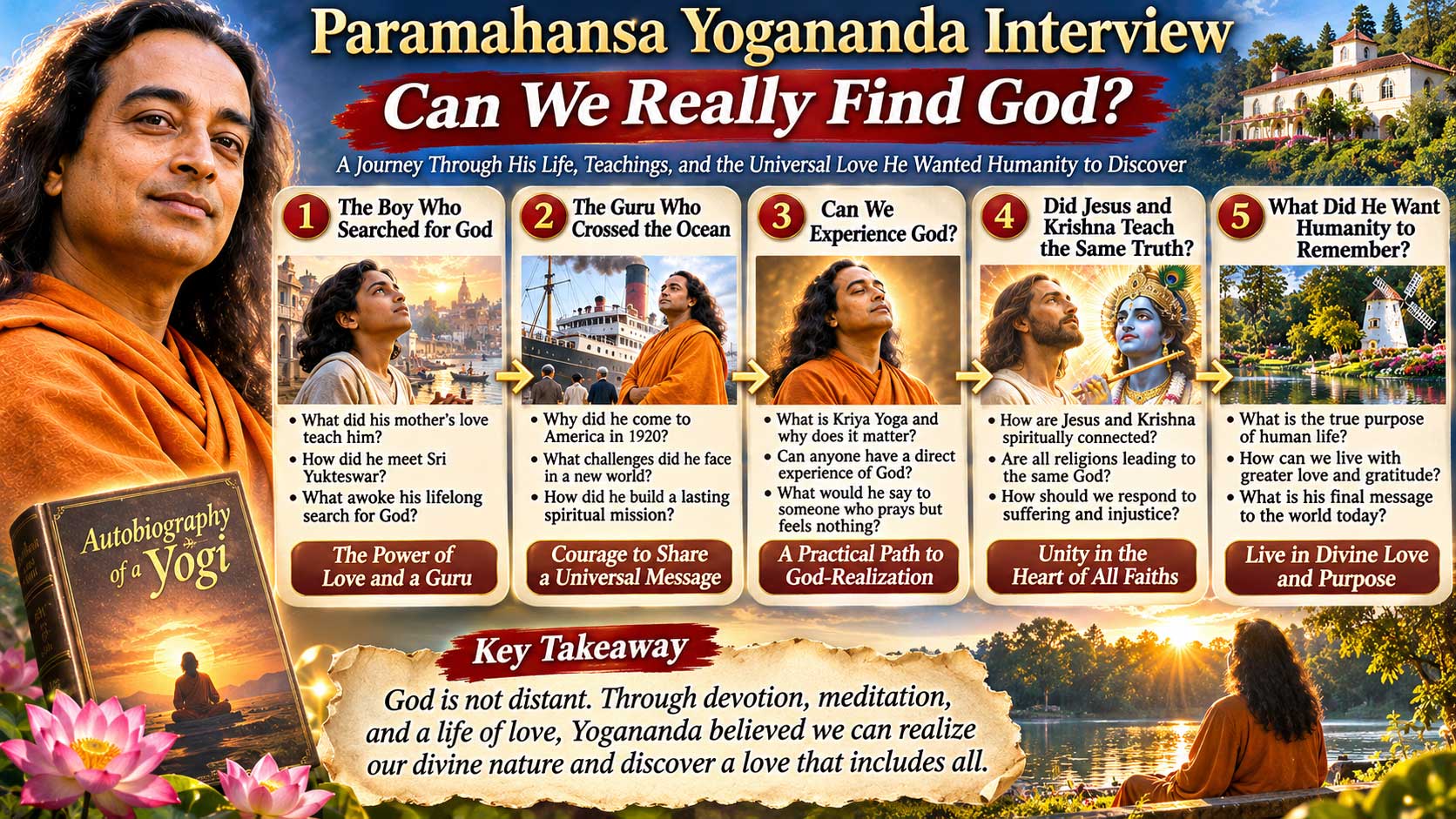
Leave a Reply