
Introduction
What if Neville Goddard's greatest discovery had nothing to do with manifesting money, success, or the life of your dreams? What if the man who taught generations of readers to feel their wishes fulfilled eventually came to believe that something far greater was waiting to be discovered? In this imaginary Neville Goddard interview, I wanted to meet the person behind one of the twentieth century's most fascinating spiritual philosophies. I wanted to discover what inspired him, what sustained his convictions, and what he truly hoped humanity would learn from his extraordinary life.
Born in Barbados in 1905, Neville Goddard left his island home at seventeen to pursue a theatrical career in New York. He became a professional dancer before discovering a very different calling. According to his later accounts, a mysterious teacher named Abdullah introduced him to an interpretation of consciousness and Scripture that transformed his thinking. Neville eventually became a prominent lecturer and author within the New Thought tradition, sharing ideas that continue to attract readers today. His remarkable transformation from aspiring performer to spiritual teacher is documented in his Penguin Random House author biography.
Neville's central teaching was both simple and extraordinary: he believed that imagination was not merely a private mental activity but the fundamental creative reality within human experience. In his 1944 book Feeling Is the Secret, he explained how assuming the feeling of an accomplished desire could, in his view, influence external circumstances. His famous story of mentally experiencing a return to Barbados before receiving passage home became one of the defining illustrations of his philosophy. Yet the deeper question remains: was Neville describing a spiritual principle, a psychological transformation, or something that cannot be independently demonstrated?
As I explored his life, I discovered that his teachings extended far beyond manifestation. In The Power of Awareness, originally published in 1952, Neville continued developing his philosophy of consciousness and self-conception. But beginning in 1959, he reported a series of mystical experiences that changed the emphasis of his later work. He called this revelation the Promise, a spiritual awakening through which he believed humanity would eventually discover its divine identity. For Neville, the fulfillment of worldly desires was not the greatest mystery. The question of who we truly are mattered far more.
I wanted to explore these ideas with genuine curiosity, including the difficult questions they raise. If imagination creates reality, how should we think about suffering, injustice, and events beyond our control? What did Neville mean when he identified imagination with God and interpreted Christ through the experience of consciousness? Could his teachings offer hope without placing unfair responsibility on people facing circumstances they did not choose? These questions deserve thoughtful examination, but I did not want our conversation to become an argument in which someone had to win. I wanted Neville to have the opportunity to explain his convictions fully, with the respect owed to a man who devoted decades to studying and sharing them.
Our imaginary conversation begins in a rainy Harlem apartment, where Abdullah challenges Neville to reconsider what he believes is possible. We then move to a sunlit Manhattan study to explore imagination and the Law of Assumption. Beside an autumn lake in Central Park, we confront the relationship between spiritual belief and human suffering. In a quiet Los Angeles apartment, Neville recounts the mystical experiences that transformed his later teachings. Finally, we return to Barbados, where the older Neville reflects on the young dreamer who left home, the teachers who shaped him, and the message he most wanted to leave with humanity.
What I found most meaningful was not simply Neville's confidence in his philosophy. It was his willingness to devote his life to questions about human possibility, spiritual identity, and the limits we place upon ourselves. Whether readers accept his metaphysical claims or approach them skeptically, his story offers an opportunity to consider the influence of hope, conviction, imagination, and compassion. I hope this conversation helps you discover a more complete Neville Goddard: the dancer, the student, the teacher, the spiritual seeker, and the human being whose ideas continue to invite reflection.
Fictional interview disclaimer: This imaginary conversation between Nick Sasaki and Neville Goddard is a creative reconstruction inspired by Neville's documented life, books, lectures, and reported spiritual experiences. The settings, dialogue, and personal exchanges are fictional. His metaphysical teachings are presented as his beliefs, not as scientifically established facts.
Topic 1: What Did Abdullah Know That Neville Didn't?

Harlem, New York, 1933 | A Rainy Evening
Rain had been falling over Manhattan since late afternoon, turning the streets into long ribbons of reflected light. In Harlem, the elevated trains rattled above the avenues, their iron wheels briefly drowning out the voices of pedestrians hurrying beneath umbrellas. Somewhere nearby, a piano drifted through an apartment window, its notes mingling with the rain. America was deep in the Great Depression. Men stood in breadlines, families worried about tomorrow, and the future seemed uncertain even for those who had once believed that hard work guaranteed a better life.
On an upper floor of an aging brownstone, a small apartment glowed with the warmth of a single lamp. Books occupied nearly every available surface. A Bible lay open on a wooden table beside a worn notebook. The room smelled faintly of coffee, old paper, and the damp wool of coats hung near the door. Outside, the city struggled with unemployment and disappointment. Inside, an altogether different understanding of reality was taking shape, one that would eventually influence thousands of people searching for a way to change their lives.
Neville Goddard was twenty-eight years old, tall, slender, and possessed of the unmistakable bearing of a trained dancer. Born on the Caribbean island of Barbados, he had arrived in New York as a teenager with dreams of performing on the stage. But the man sitting across from me tonight seemed increasingly interested in a different kind of performance: the mysterious drama of human consciousness. His dark eyes were alert, his manner courteous, and his confidence occasionally gave way to an amused smile, especially when recalling the extraordinary teacher who had recently challenged everything he thought he knew.
I had come to hear about that teacher, a man named Abdullah. Neville spoke of him with a mixture of affection, gratitude, and something approaching astonishment. According to Neville, Abdullah had introduced him to an idea so strange that he initially resisted it: that the world we experience is shaped by the assumptions we accept as true within ourselves. I had many questions, but as the rain continued against the windows, I decided to begin somewhere much simpler, with the young man who had crossed an ocean in search of a different life.
The Young Man Who Wanted Something More
Nick Sasaki
Neville, before we get into Abdullah and all these extraordinary ideas about imagination, I want to know something about you.
You were born in Barbados, this beautiful Caribbean island, and then you came to New York when you were seventeen. That's a pretty big adventure for a teenager.
What were you dreaming about back then? Did you have any idea you'd eventually become a spiritual teacher?
Neville Goddard
(Laughing softly) None whatsoever, Nick. I assure you, the young Neville Goddard who arrived in New York had no intention of becoming a teacher of spiritual truths.
I wanted to dance.
I was fascinated by the theater, by movement, by the possibility of becoming someone through performance. New York was a marvelous place for a young man with ambition. It was frightening, certainly, but enormously exciting.
I had come from a large family in Barbados. My father was a businessman, and there were nine boys and one girl in our family. You can imagine that growing up among so many brothers gave one a certain determination to establish an identity.
Nick Sasaki
(Laughing) Nine boys! I have five children, and that can already be quite an adventure. I can't quite picture what dinner must have been like in your house.
Neville Goddard
Oh, lively, Nick. Very lively.
But I was not thinking about the mysteries of consciousness in those days. I was thinking about opportunity, recognition, and what the world might offer me.
I suppose I was like most young people. I believed happiness was something waiting somewhere ahead of me.
If I could succeed, if I could become accomplished, if I could establish myself, then perhaps I would feel complete.
Nick Sasaki
That's interesting. You just said something that I think almost everyone can relate to.
We spend so much of our lives thinking happiness is waiting for us after the next achievement.
When I make enough money, I'll be happy. When I become successful, I'll feel secure. When somebody finally appreciates me, I'll feel worthy.
Were you like that?
Neville Goddard
Very much so.
And there is nothing inherently wrong with ambition. I would never condemn a young person for wanting to accomplish something.
But there is a difference between enjoying the pursuit of an experience and believing that the experience must confer upon you an identity you do not yet possess.
I did not understand that distinction.
Nick Sasaki
So you were trying to become somebody.
Neville Goddard
Yes.
And later I would discover that the question was not merely what I wished to become, but what I was already assuming myself to be.
Nick Sasaki
Wait, I want to stay with that for a moment.
When you were young and struggling in New York, did you ever feel like a failure?
Neville Goddard
I knew uncertainty. I knew the difficulties that accompany artistic ambition. A performer depends upon opportunities that cannot always be predicted.
And I was not immune to disappointment.
But what fascinates me now is how naturally we accept the evidence of our circumstances as evidence of our identity.
A man fails at an undertaking and declares, "I am a failure."
A woman experiences rejection and concludes, "I am unwanted."
Someone encounters poverty and begins to identify himself with limitation.
We take an experience, Nick, and turn it into a definition of ourselves.
Nick Sasaki
That's a powerful distinction.
But I can hear someone listening to us saying, "Neville, that's easy to say when you're sitting in a comfortable room. What about someone who genuinely doesn't have enough money to feed their children?"
Neville Goddard
Then we must never confuse an inner principle with indifference to human need.
If a person is hungry, feed him.
If someone needs assistance, offer it.
I am not suggesting that we should stand before suffering and deliver a lecture about imagination.
What I am suggesting is that a person's present condition need not become the final verdict upon what is possible for that person.
Nick Sasaki
I like that distinction.
And I want to come back to suffering later, since I think it's one of the most difficult questions your philosophy raises.
But let's go back to New York.
You're dancing, trying to build a career, and then somehow you meet Abdullah.
How did that happen?
The Mysterious Teacher
Neville Goddard
Ah, Abdullah.
(Smiling, he leans back in his chair.)
He was a remarkable man.
I met him in New York in the early 1930s, during a period when I had begun exploring religious and metaphysical ideas.
Abdullah was an Ethiopian-born teacher, deeply immersed in an unconventional interpretation of Scripture.
He did not approach the Bible as most people did.
To him, it was not primarily a collection of historical events. It was a revelation of the workings of consciousness.
Nick Sasaki
That sounds like a pretty radical idea, especially in the 1930s.
What was your first impression of him?
Neville Goddard
I found him extraordinary.
He possessed a confidence that was almost infuriating.
(Laughing.)
He did not seem interested in debating every doubt I presented. He spoke from what he regarded as knowledge, not speculation.
Nick Sasaki
That sounds a little intimidating.
Did he ever make you feel foolish?
Neville Goddard
He certainly made me recognize the limitations of my thinking.
But there was a quality about him that I came to appreciate. He refused to accept the limitations I placed upon myself.
Nick Sasaki
Now that's interesting.
Sometimes we meet someone who sees possibilities in us that we cannot see ourselves.
Was Abdullah that kind of person?
Neville Goddard
In a most unusual way.
He was not merely encouraging me to work harder or think more positively.
He was challenging the very foundation upon which I understood reality.
Nick Sasaki
What was the first idea he taught you that really disturbed you?
Neville Goddard
That consciousness is the fundamental reality.
That what a man assumes himself to be is of extraordinary significance.
And that Scripture, properly interpreted, reveals this truth.
Nick Sasaki
Hold on.
When you say consciousness is reality, do you mean that the physical world isn't real?
This table feels pretty solid to me.
(Knocking gently on the wooden surface.)
If I hit my head against it, I'm going to have a very real headache.
Neville Goddard
(Laughing warmly) And I would not recommend the experiment, Nick.
No, I am not suggesting that you should disregard the experience of the physical world.
I am suggesting that what appears outwardly has its origin in a deeper reality.
Consider a dream.
During the dream, you encounter people, places, and circumstances. They seem entirely real to you.
Only upon awakening do you recognize that the entire experience arose within consciousness.
Nick Sasaki
But dreams are created by the brain, aren't they? At least that's how modern science would explain them.
You're making a much bigger claim.
You're saying our waking world works in a similar way?
Neville Goddard
I am saying that imagination is not the insignificant faculty we have been taught to believe it is.
Most people regard imagination as something secondary to reality.
I came to regard it as primary.
Nick Sasaki
And Abdullah convinced you of this?
Neville Goddard
He introduced me to the principle.
But I had to discover what it meant through experience.
Nick Sasaki
That brings me to the story I've been waiting to hear.
Barbados.
I've read accounts of this experience, and I have to tell you, Neville, part of me finds it fascinating, and another part of me thinks, "Surely there's another explanation."
Neville Goddard
(Smiling broadly) Then you are in excellent company, Nick.
I was not without doubts myself.
You Are Already in Barbados
Nick Sasaki
Tell me what happened.
You were living here in New York, and you wanted to visit your family in Barbados.
Neville Goddard
Yes. It was 1933.
I had been away from Barbados for many years, and I longed to return.
But my circumstances did not appear favorable.
I lacked the means to make the journey as I wished.
So I spoke to Abdullah about my desire.
Nick Sasaki
And what did he say?
Neville Goddard
He told me that I was already in Barbados.
Nick Sasaki
(Laughing) That's it?
Neville Goddard
That was the essence of it.
Nick Sasaki
I can picture you standing there thinking, "This man has completely lost his mind."
Neville Goddard
(Laughing) I certainly found his response difficult to accept.
Here I was in New York, perfectly aware of my surroundings, and Abdullah was telling me that I was in Barbados.
Nick Sasaki
Did you say, "Abdullah, look out the window! That's Harlem, not the Caribbean!"
Neville Goddard
I offered objections of that general character.
But he was unmoved.
He insisted that I must not think of Barbados as a distant destination I hoped to reach.
I must experience myself as already being there.
Nick Sasaki
That's a strange psychological reversal.
Instead of saying, "I want to go to Barbados," you're supposed to feel, "I'm already there."
Neville Goddard
Precisely.
You have grasped the distinction.
A desire ordinarily places its fulfillment in the future.
The person says, "One day I shall have this. One day I shall become that."
But Abdullah taught me to occupy inwardly the state of the wish fulfilled.
Not to hope that I might reach Barbados.
To experience Barbados as my present reality in imagination.
Nick Sasaki
But how do you do that without just pretending?
Neville Goddard
That is an excellent question.
I would lie in bed and imagine myself in Barbados.
I would bring to mind the familiar surroundings, the atmosphere, the feeling of being home.
I would imagine the world from that location.
New York would no longer be the place where I was struggling to arrange a journey.
It would become the place from which I had departed.
Nick Sasaki
So you're not watching a movie of yourself in Barbados.
You're experiencing it from your own eyes.
Neville Goddard
Exactly.
That distinction is fundamental.
When you imagine yourself from the outside, you may remain a spectator.
When you experience a scene from within, you begin to assume the identity of the person for whom it is already true.
Nick Sasaki
Let me try to explain this in ordinary language.
Suppose someone desperately wants to become a successful writer.
Instead of imagining themselves trying to become successful, they imagine sitting at a desk after their book has been published.
They feel the satisfaction, the gratitude, perhaps the relief.
Is that what you're describing?
Neville Goddard
Yes.
The desired condition is no longer approached as something absent.
It is inwardly accepted as fulfilled.
Nick Sasaki
But here's what I don't understand.
Why would that change the physical world?
I can understand how imagining success might make someone more confident. Perhaps they become more persistent or recognize opportunities they previously overlooked.
But you're saying something beyond that.
Neville Goddard
I am.
And I recognize that my claim is extraordinary.
I came to believe that imagination is causative, that the assumption of a fulfilled state participates in the production of corresponding events.
Nick Sasaki
You say "came to believe." So you didn't immediately accept it?
Neville Goddard
No.
And Abdullah did not indulge my habit of returning to appearances for reassurance.
I would visit him and speak of the difficulties.
He would remind me that I was already in Barbados.
Nick Sasaki
(Laughing) I think I would have driven him crazy.
I'd have asked, "But where's the ticket? Where's the money? How am I getting there?"
Neville Goddard
And he would have refused to discuss those matters on your terms.
Nick Sasaki
That must have been frustrating.
Neville Goddard
Exceedingly.
But I eventually began to recognize what he was attempting to teach.
He wanted me to cease identifying with the absence of my desire.
When the Unexpected Happened
Nick Sasaki
So what happened next?
Neville Goddard
In the account I later shared publicly, I described receiving a letter from my brother in Barbados.
The letter contained news that arrangements had been made for me to return home.
My brother had provided the means for the journey.
Nick Sasaki
And you hadn't asked him to do that?
Neville Goddard
I had not arranged the journey through the ordinary means available to me.
The opportunity appeared in a way I had not planned.
Nick Sasaki
That must have been an incredible moment.
What did you feel when you opened the letter?
Neville Goddard
Gratitude, certainly.
And astonishment at the correspondence between what I had been experiencing inwardly and what had now become possible outwardly.
But Abdullah was not interested in my astonishment.
To him, the outcome was consistent with the principle he had taught.
Nick Sasaki
I have to ask the skeptical question.
Couldn't your brother simply have wanted you home?
Maybe he knew you were struggling. Maybe he was planning to help you anyway.
How could you know your imagination caused his decision?
Neville Goddard
You are asking how one distinguishes an apparent correspondence from a causal relationship.
That is a legitimate question.
I cannot place my experience before you as a laboratory demonstration that compels your agreement.
I can tell you what occurred, how I understood it, and why it became significant in the development of my conviction.
Nick Sasaki
I appreciate that distinction.
I don't want to dismiss something meaningful to you simply because I can't explain it.
But I don't want to accept a conclusion merely because the story has a happy ending.
Neville Goddard
Nor should you pretend to possess a conviction that is not yours.
Nick Sasaki
That's interesting coming from someone who teaches assumption.
You're not telling me to force myself to believe you?
Neville Goddard
I would rather you examine the principle seriously than repeat my words without understanding them.
Nick Sasaki
There's something else I'm curious about.
Let's say the letter never arrived.
Suppose you imagined Barbados every night, and December came and went, and you remained in New York.
What would you have concluded?
Neville Goddard
At that stage of my life, I might have struggled greatly with such an outcome.
I was learning to distinguish the acceptance of an inner state from anxious attention to external circumstances.
Later, I would speak of persistence, of remaining faithful to the assumed reality.
Nick Sasaki
But is there a danger there?
If something doesn't happen, you could always say the person didn't persist enough.
Then the teaching becomes impossible to disprove.
Neville Goddard
That is a serious challenge, Nick.
And I would not wish to use the language of faith merely to silence honest inquiry.
My conviction developed from the experiences I interpreted through this principle.
You must distinguish that conviction from proof that would satisfy every observer.
Nick Sasaki
Good. I think that's an important distinction for our readers.
But let's talk about something more personal.
When you finally returned to Barbados, was it everything you'd imagined?
Neville Goddard
There is something deeply moving about returning to one's birthplace after years away.
The familiar sights, the warmth of the air, the recognition of home.
Yet what remained with me most strongly was not simply the pleasure of returning.
It was the change in how I understood possibility.
Nick Sasaki
You know, I was born in Japan, and I've spent much of my life in America.
When I return to Japan, there are moments when the smell of the air, the sound of people speaking, or some ordinary street corner brings back a part of my childhood.
It's almost as if time folds in on itself.
Did Barbados feel like that to you?
Neville Goddard
I understand what you mean, Nick.
There are places that live within us long after we have departed from them.
A familiar place is never merely geography.
It contains memory, affection, identity.
Perhaps that is why Barbados was such a meaningful experience for me.
I was not simply imagining a destination.
I was experiencing the feeling of being home.
Nick Sasaki
That's beautiful.
And it makes me wonder whether the feeling itself mattered more than the physical journey.
Neville Goddard
The feeling was central to the practice.
But I did not regard the external fulfillment as irrelevant.
I believed the inward assumption and the outward experience were connected.
What Abdullah Really Changed
Nick Sasaki
Neville, there's something I've been thinking about as you've told this story.
Most people describe Abdullah as the man who taught you how to manifest things.
But I wonder if he gave you something more valuable.
Maybe he changed your relationship with yourself.
Before meeting him, you were a young man trying to become successful, trying to find your place in the world.
Afterward, you began thinking that your identity wasn't fixed by your circumstances.
Was that the greater transformation?
Neville Goddard
(He considers the question before answering.)
You have touched upon something important.
Abdullah taught me to question the authority I had given to appearances.
We are accustomed to allowing the world to tell us who we are.
Our finances tell us whether we are prosperous.
Our relationships tell us whether we are loved.
Our achievements tell us whether we are worthy.
But what if we have reversed the relationship?
What if our habitual conception of ourselves is more fundamental than we realize?
Nick Sasaki
I can see why that would be liberating.
But I can see a danger too.
Someone might begin thinking, "If my life isn't working, there must be something wrong with my imagination."
And then instead of feeling hopeful, they feel guilty.
Neville Goddard
Then they have misunderstood the spirit in which I would wish this principle to be approached.
I would not have someone use imagination as another instrument of self-condemnation.
The purpose is to recognize possibility, not to manufacture shame.
Nick Sasaki
That's important to me.
I think human beings already carry so much unnecessary guilt.
We blame ourselves for mistakes, for missed opportunities, sometimes for things that were never within our control.
I would hate to see a teaching intended to create hope become another burden.
Neville Goddard
Then let us speak of imagination as a capacity to conceive a different state of being, rather than a weapon with which to punish oneself.
Nick Sasaki
Can I ask you something about Abdullah himself?
When you think about him now, what do you remember most?
His intelligence? His confidence? His spiritual knowledge?
Neville Goddard
His certainty.
He possessed a remarkable unwillingness to entertain the limitations I presented to him.
But I remember something else.
He taught through the authority of his own conviction.
He did not ask me to admire his personality.
He directed my attention to what he believed I could discover within myself.
Nick Sasaki
That's a wonderful quality in a teacher.
A great teacher doesn't necessarily want students to depend on him forever.
He wants them to discover something they can eventually understand for themselves.
Neville Goddard
Indeed.
Nick Sasaki
Did you ever tell Abdullah how much he changed your life?
Neville Goddard
I believe he understood the significance of what he had given me.
And I continued to speak of him with gratitude.
Nick Sasaki
I wish we could invite him into this room for just five minutes.
I'd probably ask him a hundred questions.
(Laughing.)
Neville Goddard
He might answer one of them and refuse to entertain the other ninety-nine.
Nick Sasaki
(Laughing) Especially if I kept asking him for evidence!
Neville Goddard
I suspect he would have enjoyed challenging you.
The Question Neville Could Not Leave Behind
Nick Sasaki
Let me ask one final thing about this period of your life.
You came to New York wanting to become a dancer.
Then you encountered Abdullah and began exploring consciousness.
But you didn't stop at teaching people how to get things they wanted.
Eventually, you developed these extraordinary ideas about God, Christ, and spiritual awakening.
Was that direction already present in Abdullah's teaching?
Neville Goddard
Yes, though I did not understand its full significance at the beginning.
Abdullah introduced me to Scripture as something far more intimate than an account of events belonging to the distant past.
He taught me to look within the biblical drama for an account of human consciousness.
At first, the practical implications of imagination captured much of my attention.
Naturally, I was a young man living in the world, with ordinary desires and ambitions.
But the deeper questions remained.
Who is the one who imagines?
What is the nature of this consciousness?
Why should imagination possess such significance?
And what does Scripture mean when it speaks of God dwelling within humanity?
Nick Sasaki
That last question is enormous.
You're not just saying that imagination helps us become successful.
You're suggesting that the part of us that imagines may be connected to what religious people call God.
Neville Goddard
That became my conviction.
But it was not a conclusion I arrived at all at once.
Nick Sasaki
I think that's what fascinates me most about your story.
A young man leaves Barbados wanting to become a dancer.
He meets a mysterious teacher in Harlem.
He learns to imagine himself somewhere he cannot yet physically reach.
And somehow, that experience becomes the beginning of a lifelong search into the nature of God.
It's almost unbelievable when you look at the whole sequence.
Neville Goddard
Life can lead us into questions we never expected to ask.
Nick Sasaki
But Neville, I want to make sure I understand one thing before we go further.
When you imagine yourself already possessing something you desire, are you changing your own mind?
Or are you claiming that something in the universe itself begins to change?
Neville Goddard
(He leans forward slightly.)
Nick, that is precisely where the teaching becomes difficult for many people.
They can accept that imagination changes attitude.
They can accept that confidence influences behavior.
They can accept that expectations may affect the choices we make.
But I came to believe imagination reaches beyond those familiar psychological effects.
Nick Sasaki
Beyond the brain?
Neville Goddard
Beyond what we ordinarily regard as the boundaries of the individual mind.
Nick Sasaki
And you believe that literally?
Neville Goddard
Yes.
Nick Sasaki
(After a brief silence.)
Then I think we need to talk about that very carefully.
I can accept that changing how I see myself might change how I live.
But if you're telling me imagination can influence events I have no obvious control over, that's an entirely different proposition.
And I have a feeling Abdullah would have had very little patience with my questions.
Neville Goddard
(Laughing.)
He might have reminded you that the world is not necessarily limited to what your present understanding can explain.
Nick Sasaki
And I'd probably tell him that not being able to explain something doesn't automatically prove his explanation is right.
Neville Goddard
Then you and Abdullah might have had some very lively conversations.
Nick Sasaki
(Laughing.) I think we would have.
But that's exactly why I want to continue this.
You know, Neville, when I first heard about your teachings, I thought they were mainly about visualizing success.
Now I'm beginning to see that you're making a much larger claim about consciousness itself.
And I have to admit, I'm curious.
If imagination really is what you say it is, then perhaps we've misunderstood something fundamental about being human.
But if it isn't, we still need to understand why your experiences convinced you so deeply.
Neville Goddard
That is a worthy inquiry, Nick.
Nick Sasaki
Then let's start with something very simple.
When I close my eyes and picture something that doesn't exist in front of me, what exactly do you believe is happening?
Outside, the rain had softened to a faint tapping against the glass. Neville glanced toward the window, then back at me. The question seemed to please him. For a moment, he said nothing, as though considering how to explain an idea that had occupied so much of his life.
The small apartment was quiet now, but I had the distinct feeling that our conversation was only beginning to reach the territory Neville most wanted to explore.
Fictional interview disclaimer: This conversation between Nick Sasaki and Neville Goddard is an imaginative reconstruction inspired by Neville's life, published teachings, and accounts of Abdullah. The dialogue, setting, emotional reactions, and personal exchanges are fictional. Neville's reported experiences and metaphysical interpretations should not be confused with independently verified scientific findings.
Topic 2: Can Imagination Really Change the World?

New York City, 1946 | The Invisible World Behind the Visible
Afternoon sunlight poured through the tall windows of a quiet Manhattan study, illuminating tiny particles of dust suspended above an old Persian rug. Outside, New York was rebuilding its dreams after the Second World War. Soldiers had returned home, families were beginning again, and millions of Americans were looking toward a future they hoped would be kinder than the past. Automobiles passed below, horns sounded in the distance, and somewhere across the street a radio announcer spoke enthusiastically about the possibilities of a new age.
Neville Goddard, now in his early forties, had become an increasingly confident lecturer. His years of studying with Abdullah had shaped a philosophy that challenged the ordinary relationship between mind and matter. He was no longer simply the young dancer who had struggled to understand why his teacher insisted he was already in Barbados. He was a man who had spent years experimenting with imagination, studying Scripture, and teaching audiences that their inner assumptions were far more consequential than they realized.
The room was filled with books, but my attention was drawn to a small, ordinary object resting on Neville's desk: a red apple. Beside it sat a notebook containing several handwritten observations. Neville had placed the apple there to illustrate something about imagination, though he had not yet explained what. I picked it up, felt its weight in my hand, and wondered how an object so undeniably physical could possibly have anything to do with the invisible world of consciousness.
Our earlier conversation about Abdullah had left me with a question I could not dismiss. I understood that imagining a different future might change someone's confidence, decisions, and behavior. But Neville was claiming something far more extraordinary. He believed imagination could influence events beyond our direct control. As I returned the apple to the desk, I decided it was time to discover exactly what he meant, and whether his remarkable confidence could withstand a few difficult questions.
What Happens When We Imagine?
Nick Sasaki
Neville, I've been thinking about the question I asked you earlier.
When I close my eyes and imagine something, what exactly is happening?
For example, if I close my eyes right now and imagine holding this apple, I can almost feel its weight. I can picture its color, even imagine taking a bite.
But the apple in my imagination isn't the same as the one sitting on your desk.
Or are you telling me that somehow it is?
Neville Goddard
(Smiling.)
You have begun with a very interesting distinction, Nick.
You regard the apple on the desk as real because your senses confirm its existence.
You regard the apple in imagination as unreal because your senses do not confirm it.
But I would ask you to consider whether the senses are the ultimate authority on reality.
Nick Sasaki
Well, they're pretty useful.
If I walk into a wall, I don't need a philosophy book to tell me the wall is real.
Neville Goddard
(Laughing.)
Indeed. And I have no desire to see you injure yourself in the pursuit of metaphysical knowledge.
But consider something else.
Have you ever awakened from a dream in which you experienced fear so intense that your heart was racing?
Nick Sasaki
Of course.
I've had dreams where something terrible was happening, and when I woke up, it took a few moments to realize I was safe.
Neville Goddard
Then the imagined experience produced a real physical response.
Your heart responded. Your breathing changed. Your emotions were affected.
The event was not occurring in the physical world as you ordinarily define it, yet its effects were real.
Nick Sasaki
I agree with that.
But neuroscience can explain why dreams affect our bodies.
The brain processes imagined experiences, and the nervous system responds.
That doesn't prove imagination can make an airplane ticket appear or cause someone thousands of miles away to make a decision.
Neville Goddard
You are correct that the dream example does not, by itself, establish my larger claim.
I use it to question the assumption that imagination is entirely without consequence.
But my teaching goes further.
I came to regard imagination as the creative reality from which outward experience emerges.
Nick Sasaki
That's where I have trouble following you.
You're saying the physical world isn't simply something we observe.
You're saying it's somehow an expression of consciousness.
Neville Goddard
Precisely.
I taught that consciousness is the fundamental reality and that what a person accepts as true of himself becomes significant in the experiences of his life.
Nick Sasaki
But does that mean everybody is living in a different universe?
If I believe it's raining and you believe it's sunny, we can't both be right about the weather outside this window.
Neville Goddard
I am not suggesting that a passing thought instantly replaces every appearance.
A state of consciousness is more than an isolated thought.
It is the condition from which a person experiences himself and his world.
Nick Sasaki
A state of consciousness.
Can you explain that without using spiritual terminology?
Neville Goddard
Certainly.
Imagine two men who have experienced the same professional disappointment.
One concludes, "I am a failure. Nothing ever works for me."
The other concludes, "This attempt did not succeed, but I remain capable of success."
They have encountered the same event, but they inhabit different inward states.
They may subsequently perceive opportunities differently, respond differently, and behave differently.
Nick Sasaki
That makes perfect sense to me.
But again, that's psychology.
Neville Goddard
Yes, and I do not deny that psychology may describe some of the effects.
But I believed the relationship between consciousness and events was more fundamental than psychology ordinarily recognizes.
Nick Sasaki
Then I want to separate two things.
One is the idea that our beliefs influence our behavior and therefore our outcomes.
The other is your claim that imagination can influence external circumstances without an obvious physical connection.
You believe both?
Neville Goddard
I do.
Nick Sasaki
And what convinced you of the second?
Neville Goddard
Not one experience alone.
Over the years, I encountered many accounts of people imagining a fulfilled condition and subsequently experiencing events that corresponded to it.
Some were simple. Others were extraordinary.
I collected such accounts and eventually included many in my writing.
Nick Sasaki
But those are stories, Neville.
People remember the surprising successes. They may forget the hundreds of things they imagined that never happened.
How do you distinguish a genuine principle from selective memory?
Neville Goddard
That is a reasonable challenge.
A collection of personal testimonies does not settle every question about causation.
But I regarded the repeated correspondence between inner assumption and outward experience as significant.
I encouraged people to examine the principle in their own lives.
Nick Sasaki
So you weren't asking people simply to believe you.
You wanted them to experiment.
Neville Goddard
Yes.
But the experiment required something more than repeating a wish.
It required entering into the experience of its fulfillment.
The Secret of Feeling the Wish Fulfilled
Nick Sasaki
That's something I've always wanted to ask you about.
Your famous teaching is often summarized as "feel the wish fulfilled."
But what does that actually mean?
Suppose someone wants a better job.
Are they supposed to sit in a chair, close their eyes, and imagine receiving an offer?
Neville Goddard
That could be a beginning.
But I would encourage them to imagine a scene that implies the desire has already been fulfilled.
Perhaps they hear a close friend congratulating them.
Perhaps they are sitting at their new desk.
Perhaps they experience the satisfaction of having completed their first week in the new position.
The important thing is not merely to observe the scene.
It is to participate in it.
Nick Sasaki
So they should feel like they're already there.
Neville Goddard
Exactly.
They should experience the scene from the standpoint of the person who has received what was desired.
Nick Sasaki
Let me give you a personal example.
Suppose I want my business to become much more successful.
I could imagine looking at my financial results and seeing that I've achieved my goal.
But I could do that every night and still wake up worried about money.
Which feeling matters?
Neville Goddard
The assumption you habitually occupy.
You may imagine success for a few moments and then spend the remainder of the day identifying yourself with failure.
In such a case, you have not truly accepted the new state.
Nick Sasaki
That sounds difficult.
Because the moment you open your eyes, reality reminds you of everything that hasn't changed.
Neville Goddard
That is precisely why I taught the importance of inward acceptance.
You need not deny what your senses report.
But you need not allow present appearances to determine the limits of what you can conceive.
Nick Sasaki
I understand the emotional value of that.
But suppose someone is struggling to pay rent.
They imagine themselves financially secure every night.
Then the rent is due, and they still don't have the money.
Shouldn't they be spending that time finding work or asking for assistance?
Neville Goddard
Certainly, they should attend to the responsibilities before them.
I would not ask someone to neglect an immediate practical necessity.
My teaching concerns the inward state from which one approaches life.
It was never intended, in my view, as an excuse to abandon ordinary responsibility.
Nick Sasaki
That's an important clarification.
Sometimes I hear manifestation discussed as though people can simply sit at home and wait for the universe to deliver everything.
Neville Goddard
The manner in which a desire becomes fulfilled may involve actions and circumstances that appear entirely ordinary.
The person may take a job, meet someone, receive an opportunity, or make a decision.
My conviction was that the inward assumption precedes and influences the unfolding of those events.
Nick Sasaki
You have another technique called the state akin to sleep.
What is that?
Neville Goddard
It is a relaxed condition in which the body approaches sleep but attention remains sufficiently awake to direct imagination.
In that state, one may find it easier to enter an imagined scene without the usual distractions of the day.
Nick Sasaki
So it's that moment when you're almost asleep but not quite.
Neville Goddard
Yes.
One may then experience a short scene implying the fulfillment of the desire.
Rather than forcing the imagination, one allows the scene to become natural and convincing.
Nick Sasaki
Why a short scene?
Why not imagine an entire movie about your future?
Neville Goddard
A brief scene can concentrate attention upon a single implication.
If you desire marriage, for example, you might imagine feeling a wedding ring upon your finger.
If you desire reconciliation, you might imagine hearing words of affection from someone with whom you have been estranged.
The scene should imply completion rather than continued longing.
Nick Sasaki
I can see how that could affect someone's emotions.
But what if they can't make themselves believe it?
Suppose they're imagining success, but a voice in their head keeps saying, "Who are you kidding?"
Neville Goddard
Then I would encourage them not to struggle violently against the doubt.
They may begin with a modest scene that feels natural.
The purpose is not to force an emotion through tension.
It is to become familiar with the experience of the desired condition.
Nick Sasaki
That's interesting.
You make it sound less like demanding something from the universe and more like becoming comfortable with a new identity.
Neville Goddard
That is an important aspect of it.
The person who feels himself to be loved does not approach every encounter with the same desperation as the person who believes himself unworthy of love.
Nick Sasaki
But there's a danger in that example.
Suppose someone wants a particular person to love them.
They could become obsessed with imagining that relationship, even when the other person has clearly said no.
Neville Goddard
Then we must examine the difference between the desire to experience love and the desire to possess another human being.
I would encourage a person to imagine a loving relationship rather than cultivate bitterness, desperation, or resentment.
Nick Sasaki
But would you tell them to respect the other person's decision?
Neville Goddard
I would not encourage cruelty or coercion.
Nick Sasaki
I want to return to that later, since free will seems like a serious challenge to your philosophy.
But first, there's another part of your teaching that fascinates me.
You talk about the Sabbath.
I always associated the Sabbath with a day of religious rest.
What does it mean in your philosophy?
The Strange Peace of Having Already Received
Neville Goddard
In my teaching, the Sabbath represents a state of inward rest following the acceptance of a fulfilled desire.
Consider the ordinary experience of wanting something intensely.
The mind continually returns to the absence.
When will it happen?
How will it happen?
What if it never happens?
But when you genuinely accept the fulfillment inwardly, that anxious striving may subside.
Nick Sasaki
So the Sabbath isn't necessarily Saturday or Sunday.
It's a psychological or spiritual condition.
Neville Goddard
Yes.
It is the rest that follows inward acceptance.
Nick Sasaki
Let me see if I understand.
Suppose I desperately want to receive a letter from someone.
Every morning I check the mailbox. Every afternoon I check again.
I'm constantly wondering whether the letter has arrived.
But if I somehow felt certain the letter was already on its way, I might stop worrying.
Neville Goddard
Precisely.
Nick Sasaki
That sounds peaceful.
But it raises a strange question.
If you're no longer desperate to get something, does that mean you've stopped caring about it?
Neville Goddard
Not necessarily.
There is a difference between enjoying the anticipation of an experience and being tormented by its absence.
The Sabbath is not indifference.
It is freedom from the anxiety of continual seeking.
Nick Sasaki
I like that.
I think a lot of people are exhausted by wanting things.
They want more money, more recognition, more security, more affection.
And the more they want, the more aware they become of what they don't have.
Neville Goddard
Yes.
Desire can become a perpetual declaration of absence.
Nick Sasaki
But here's something I'm wondering.
What if the real benefit of your method is that it helps people stop obsessing?
Maybe once they feel secure, they make better decisions.
They become more relaxed, more confident, more open to opportunities.
Could that explain at least some of the results?
Neville Goddard
It may explain some observable changes.
But I would not reduce my teaching entirely to those effects.
Nick Sasaki
You keep coming back to that.
You really believe imagination does something beyond changing our behavior.
Neville Goddard
I do.
Nick Sasaki
Then let me ask about another one of your techniques.
Revision.
I've heard that you taught people to mentally rewrite events that had already happened.
That sounds even stranger than imagining the future.
Can We Change Yesterday?
Neville Goddard
Revision is one of the most meaningful applications of imagination.
At the end of the day, a person may review an unpleasant event and imagine it unfolding differently.
Suppose someone speaks harshly to you.
Instead of repeatedly remembering the insult, you imagine hearing words of kindness.
You experience the revised scene as vividly as possible.
Nick Sasaki
But the person still said the insulting words.
You can't erase the actual event.
Neville Goddard
The historical event remains part of what you remember.
But you can alter the manner in which you inwardly experience it.
Nick Sasaki
That sounds similar to changing the emotional meaning of a memory.
Psychologists sometimes help people reinterpret painful experiences.
Neville Goddard
There may be parallels.
But I regarded revision as having creative significance beyond emotional reinterpretation.
Nick Sasaki
You mean you believed revising an event could influence what happened afterward?
Neville Goddard
Yes.
I believed the revised assumption could alter the course of subsequent experience.
Nick Sasaki
Let me give you a difficult example.
Suppose a father loses his temper and says something cruel to his daughter.
Later, he regrets it.
He could imagine that he had spoken kindly instead.
But shouldn't he actually apologize?
Neville Goddard
Certainly.
If an apology is needed, offer it.
Revision should not become a means of escaping responsibility.
Nick Sasaki
Good.
Because I worry that people might use imagination to avoid dealing with reality.
They could tell themselves that everything is fine without ever repairing the harm they've caused.
Neville Goddard
Then they would be using imagination to conceal rather than transform.
I would encourage them to imagine a reconciled relationship and to express that reconciliation through their conduct.
Nick Sasaki
That's an important distinction.
But let me push a little further.
Suppose someone has experienced a terrible childhood.
They cannot change what happened.
Could revision help them stop feeling defined by those experiences?
Neville Goddard
I would hope they could discover that the events of the past need not determine the entirety of their future identity.
But I would never ask them to deny their pain.
Nick Sasaki
I appreciate that.
There are people carrying memories that are genuinely traumatic.
I wouldn't want them to feel they must imagine those memories away or blame themselves if the pain remains.
Neville Goddard
Nor should they be expected to accomplish such a change through force.
Nick Sasaki
What fascinates me is that your teaching keeps returning to identity.
Not merely what happens to us, but what we believe those events mean about who we are.
Neville Goddard
You are beginning to see the connection.
Nick Sasaki
And yet you insist there's a metaphysical dimension beyond psychology.
Neville Goddard
Yes.
Nick Sasaki
(Laughing.)
You're not going to make this easy for me, are you?
Neville Goddard
(Laughing warmly.)
I would not wish to deprive you of the pleasure of inquiry.
What Happens When the Law Doesn't Work?
Nick Sasaki
Neville, I want to ask something that I think many people are afraid to ask.
What happens when someone does everything you teach and nothing happens?
Suppose a woman imagines finding a loving partner.
She feels the wish fulfilled.
She persists for months, perhaps years.
But she remains alone.
What would you tell her?
Neville Goddard
I would first wish to know what she has truly been assuming about herself.
A person may consciously desire love yet habitually identify with rejection.
Nick Sasaki
But suppose she genuinely believes she's worthy of love.
Suppose she's emotionally healthy, kind, open to meeting people, and still hasn't found the relationship she wants.
Would you acknowledge that your method might not produce the desired result?
Neville Goddard
You are asking whether I would accept an apparent failure as evidence against the principle.
My conviction was that the Law operates consistently, though I recognized that people may misunderstand or misapply it.
Nick Sasaki
But that's exactly where I get concerned.
If every failure is explained as misunderstanding or insufficient belief, how could anyone ever determine whether the Law itself is mistaken?
Neville Goddard
(He pauses.)
That is a serious philosophical difficulty.
I cannot offer you a universally accepted scientific test that would settle the matter.
I can explain the principle as I understood it and the experiences that strengthened my conviction.
Nick Sasaki
I respect that.
But I think it's important for readers to know the difference between a spiritual conviction and something scientifically established.
Neville Goddard
Agreed.
Nick Sasaki
There's another issue.
What if someone becomes obsessed with manifestation?
They monitor every thought.
They become terrified that a moment of fear will create something terrible.
They stop enjoying life because they're constantly trying to control their consciousness.
That sounds exhausting.
Neville Goddard
Then they have turned the practice into another form of anxiety.
I would not encourage someone to fear every passing thought.
A fleeting worry is not the same as a deeply accepted state.
Nick Sasaki
So you're not saying that every negative thought immediately produces a negative event.
Neville Goddard
No.
Nick Sasaki
That's reassuring.
Because if every thought became reality, I think humanity would be in serious trouble.
(Laughing.)
Neville Goddard
(Laughing.)
Indeed, Nick.
Nick Sasaki
But I still wonder whether people sometimes become so focused on controlling their inner world that they forget to live in the outer one.
They spend hours imagining a wonderful future but neglect the relationships and opportunities right in front of them.
Neville Goddard
Then imagination has become an escape rather than an instrument of transformation.
I would encourage a person to live fully, to act responsibly, and to approach life from the state he wishes to embody.
Nick Sasaki
That brings me to something I find genuinely moving about your philosophy.
You seem to be saying that we don't have to wait for the world to give us permission to feel worthy.
We don't have to wait until we're rich to experience gratitude.
We don't have to wait until everyone loves us to recognize that we're capable of love.
Neville Goddard
Yes.
Nick Sasaki
I think that's beautiful.
But I'm still not convinced imagination literally creates external events.
Neville Goddard
You need not pretend otherwise.
Nick Sasaki
And you're still convinced it does.
Neville Goddard
I am.
Nick Sasaki
(Laughing.)
Well, at least we're being clear with each other.
The Difference Between Wanting and Being
Nick Sasaki
Neville, let me ask you something that might sound strange.
What if someone gets everything they want through your method?
They become wealthy, successful, admired, and loved.
But they're still unhappy.
What would you say?
Neville Goddard
Then they have discovered that the fulfillment of external desires does not necessarily resolve the deeper questions of existence.
Nick Sasaki
That's interesting.
You're the man who teaches people how to fulfill desires, but you're admitting that fulfilled desires don't necessarily produce happiness.
Neville Goddard
I have never believed that material success alone answers every question of the human heart.
Nick Sasaki
Then what is the point of manifestation?
Neville Goddard
The Law concerns the creative relationship between consciousness and experience.
But there is another dimension to my understanding of human existence.
Nick Sasaki
You mean the spiritual dimension.
Neville Goddard
Yes.
Nick Sasaki
I want to explore that later.
But before we leave this subject, I want to understand something about your own life.
When you were younger, you wanted to become a successful dancer.
Then you learned to imagine yourself differently.
Did you eventually stop caring about success?
Neville Goddard
My interests changed.
The stage had once represented a world of possibility.
Later, I found myself increasingly absorbed in the study and communication of these ideas.
I discovered a different kind of fulfillment in teaching.
Nick Sasaki
Did you ever miss dancing?
Neville Goddard
There is a particular pleasure in movement and performance that one does not entirely forget.
But the body of a dancer teaches something interesting about attention.
A movement that initially requires great effort may eventually become natural through repetition.
The performer no longer thinks consciously about every gesture.
He inhabits the movement.
Nick Sasaki
That's a wonderful comparison.
You're saying an imagined identity can eventually feel natural in the same way a practiced movement becomes natural.
Neville Goddard
That is one way to approach the idea.
Nick Sasaki
And when it feels natural, your behavior may change without constant effort.
Neville Goddard
Yes.
Nick Sasaki
But you would say something more happens.
Neville Goddard
I would.
Nick Sasaki
(Laughing.)
I knew you were going to say that.
The Invisible Bridge
Nick Sasaki
There's one phrase I've heard associated with your teaching: the bridge of incidents.
What does that mean?
Neville Goddard
It refers to the sequence of events through which an assumed condition becomes outwardly fulfilled.
The individual may not recognize the significance of those events as they unfold.
A meeting, a decision, an apparent disappointment, or an unexpected opportunity may later appear to have formed part of a larger pattern.
Nick Sasaki
So you're saying that once someone assumes the desired outcome, life begins arranging circumstances that lead there.
Neville Goddard
That is how I came to interpret such experiences.
Nick Sasaki
But isn't there a danger of looking backward and inventing a pattern?
Human beings are very good at finding meaning in events after they happen.
Neville Goddard
That is a possibility one must consider when evaluating personal accounts.
Nick Sasaki
I appreciate your willingness to acknowledge that.
But here's what interests me.
Sometimes a disappointment really does lead to something wonderful.
A person loses a job and eventually discovers a better career.
A relationship ends, and years later they meet someone who changes their life.
At the time, the event seems terrible.
Later, it becomes part of a story they never could have planned.
Neville Goddard
Life often reveals connections that were not apparent at the beginning.
Nick Sasaki
Do you believe every event is part of some predetermined arrangement?
Neville Goddard
I would not describe my teaching as simple fatalism.
I placed great significance upon the state of consciousness a person occupies.
Nick Sasaki
So in your view, we're not merely passengers.
We're somehow participating in the creation of our experiences.
Neville Goddard
Precisely.
Nick Sasaki
And that participation carries responsibility.
Neville Goddard
Yes.
Nick Sasaki
Then I think we're approaching the question that troubles me most.
If imagination participates in creating reality, what happens when our desires conflict?
What if two people want the same job?
What if two people love the same person?
What if one person's imagined success requires another person's disappointment?
Neville Goddard
Those questions lead us into the relationship between individual consciousness and the consciousness of others.
Nick Sasaki
And I suspect your answer is going to be even more controversial than what we've discussed so far.
Neville Goddard
(Smiling.)
Perhaps.
Nick Sasaki
But before we go there, I want to ask one final question.
If someone listening to us tonight wants to try your method, what would you encourage them to do?
Not to prove anything to the world, but simply to explore the possibility of changing how they experience themselves.
Neville Goddard
I would encourage them to choose a desirable state that is consistent with love and goodwill.
Let them become quiet.
Let them imagine a brief scene that implies the fulfillment of that state.
Let them experience it from within, rather than observe it from a distance.
And let them notice the difference between longing for something and inwardly accepting its possibility.
Nick Sasaki
And if nothing extraordinary happens?
Neville Goddard
They may still discover something about the assumptions they have been carrying.
Nick Sasaki
I think that's a reasonable place to begin.
But I want to be careful.
I don't want anyone to believe that failing to manifest something means they're defective, spiritually weak, or responsible for every hardship in their lives.
Neville Goddard
Nor would I wish anyone to use these ideas as an excuse for cruelty toward themselves.
Nick Sasaki
Good.
Because I think the real test of any spiritual philosophy is not merely whether it promises extraordinary results.
It's what kind of human being it encourages us to become.
Does it make us kinder?
Does it make us more responsible?
Does it help us face suffering with courage?
Or does it make us more obsessed with getting what we want?
Neville Goddard
Those are worthy questions, Nick.
Nick Sasaki
And I think they're going to become even more difficult when we start talking about other people.
Because it's one thing to imagine changing my own life.
It's another thing to claim that my imagination can influence yours.
The afternoon light had shifted across the study. The red apple still rested on Neville's desk, unchanged and ordinary, yet somehow it had become a symbol of the mystery we had been discussing. I could hold it, weigh it, and describe its physical properties. But Neville was asking me to consider whether the invisible experience of imagining it might possess a significance I had never suspected.
I remained unconvinced by his strongest claims, but I was beginning to appreciate the depth of his conviction. And as I looked toward the busy street below, I found myself thinking less about apples, money, or success and more about the people moving through the city, each carrying private hopes, fears, and assumptions about who they were.
If Neville believed imagination could influence the lives of others, then we needed to confront a question far more serious than whether someone could manifest a better job or a journey to Barbados.
What happens when our imagination meets another person's freedom, or another person's suffering?
Fictional interview disclaimer: This imaginary conversation between Nick Sasaki and Neville Goddard is inspired by Neville's published works and lectures, including Feeling Is the Secret, The Power of Awareness, and his teachings on revision and the Law of Assumption. The dialogue, setting, personal exchanges, and emotional reactions are fictional. Neville's metaphysical claims are presented as his beliefs, not as scientifically established facts.
Topic 3: If Imagination Creates Reality, Why Do Innocent People Suffer?

Central Park, New York | An Autumn Afternoon
The autumn sun was beginning its slow descent over Central Park, casting long golden shadows across the winding paths. The trees surrounding the lake were dressed in deep reds, burnt oranges, and fading yellows, their leaves drifting gently onto the dark surface of the water. Beyond the treetops, Manhattan's buildings rose like silent witnesses to the countless lives unfolding beneath them. A cool breeze carried the scent of fallen leaves and damp earth, and somewhere in the distance, children laughed as they chased one another along a narrow path.
Neville and I had left the quiet study where we had spent hours discussing imagination, assumption, and the mysterious relationship between consciousness and physical reality. Now we sat on a wooden bench overlooking the lake. An elderly couple walked past us holding hands, moving slowly but comfortably in one another's company. Nearby, a young mother knelt to tie her daughter's shoelaces before the little girl ran toward a gathering of pigeons. The scene was ordinary, almost painfully beautiful, filled with small expressions of love that people rarely stopped to notice.
Yet as I watched the families passing us, I found myself thinking about the other side of human existence. Somewhere in the same city, a parent might be sitting beside a hospital bed, praying for a sick child. Someone might be grieving a husband or wife who had died unexpectedly. Others might be struggling with poverty, violence, loneliness, or circumstances they had never chosen. Neville had spoken confidently about imagination shaping reality, but I wondered how that philosophy could possibly account for the suffering of people who had done nothing to deserve their pain.
Neville seemed unusually quiet as we watched the little girl return to her mother. He had spent much of his life teaching people that they were not helpless before their circumstances. I admired the hope in that message. But hope could become dangerous if it encouraged people to blame themselves for tragedies beyond their control. I turned toward him, aware that the questions I was about to ask might challenge the very foundation of his teaching.
The Question No One Wants to Answer
Nick Sasaki
Neville, I want to ask you something difficult.
And before I do, I want you to know that I'm not trying to attack your philosophy.
I genuinely want to understand it.
You've told me that imagination creates reality, that our assumptions influence the experiences we encounter, and that consciousness is somehow more fundamental than the physical world.
But look around us.
See that little girl playing near her mother?
Neville Goddard
Yes, Nick.
Nick Sasaki
Suppose that child becomes seriously ill tomorrow.
Suppose her parents do everything they can to save her, but she dies.
Are you telling me that someone imagined that tragedy into existence?
Neville Goddard
(He watches the child for a moment before answering.)
You have brought us to one of the most difficult questions that can be asked of my teaching.
And it deserves more than a convenient answer.
Nick Sasaki
I'm glad you say that.
I think people sometimes become so excited about the idea that they can create their future that they forget what the claim implies.
If we're responsible for everything that happens to us, then what about children who suffer?
What about victims of war?
What about someone who loses a loved one in an accident?
Surely we cannot tell those people they somehow chose their suffering.
Neville Goddard
I would never wish to stand before a grieving parent and condemn them.
That would be a terrible misuse of spiritual teaching.
But I must distinguish what I taught from the conclusion that every individual consciously chooses each event in life.
Nick Sasaki
That's an important distinction.
But your teaching still suggests that consciousness is responsible for outward experience.
How far does that responsibility extend?
Neville Goddard
In my understanding, consciousness is not limited to the individual personality as we ordinarily conceive it.
I believed that the deeper reality of consciousness transcends the apparent separation between human beings.
Nick Sasaki
But that doesn't answer the question about the child.
Neville Goddard
No, it does not provide the kind of explanation you are asking for.
And I recognize the difficulty.
I can tell you that I believed imagination to be fundamental to reality.
But explaining a particular tragedy through that principle is another matter.
Nick Sasaki
I appreciate your saying that.
There are moments when I think the most compassionate thing a spiritual teacher can do is admit that something remains mysterious.
Not every tragedy needs an explanation.
Sometimes people need someone to sit beside them and share their grief.
Neville Goddard
Yes.
And I would not wish an intellectual theory to replace human kindness.
Nick Sasaki
You know, Neville, I think about parents who have lost children.
I've never believed that telling someone their suffering has a hidden purpose automatically makes that suffering easier.
Sometimes it makes things worse.
Neville Goddard
Then perhaps the first responsibility is not to explain the suffering but to respond to the sufferer.
Nick Sasaki
Exactly.
If a child is hungry, feed the child.
If someone is grieving, comfort them.
If a family is struggling, help them.
We can discuss the mysteries of consciousness afterward.
Neville Goddard
That is a humane approach, Nick.
Nick Sasaki
But I want to push further.
If you truly believe imagination shapes reality, wouldn't you have to conclude that even terrible events are somehow connected to consciousness?
Neville Goddard
Within my metaphysical understanding, yes.
But that does not give any observer the right to identify a victim's private assumptions as the cause of suffering.
Nick Sasaki
So you would reject the idea of telling a sick person, "You created your illness through negative thinking."
Neville Goddard
I would reject using such a claim to accuse or humiliate someone.
Nick Sasaki
That's reassuring.
But I think there's still a contradiction we haven't resolved.
You believe consciousness creates experience, yet you don't want people to blame themselves for painful experiences.
How can both ideas be true?
Neville Goddard
Perhaps the difficulty arises when we equate the deepest reality of consciousness with the ordinary personal mind.
I did not regard the individual personality as the ultimate identity of a human being.
Nick Sasaki
So you're saying the self we ordinarily identify with isn't the whole story.
Neville Goddard
Precisely.
Nick Sasaki
And that leads toward your teaching about God.
Neville Goddard
It does.
Nick Sasaki
We'll explore that more deeply later.
But for now, I want to stay with the human consequences.
A philosophy can sound beautiful when everything is going well.
I want to know what happens when life becomes unbearable.
When Hope Becomes Another Burden
Nick Sasaki
Let me give you another example.
Imagine a woman who has been in an abusive marriage.
For years, her husband has controlled her, criticized her, and made her feel worthless.
Eventually, she discovers your teaching.
She hears that everyone in her life reflects her assumptions.
What if she concludes that she somehow created her husband's cruelty?
Neville Goddard
Then she would be interpreting the teaching in a way that could cause her further suffering.
Nick Sasaki
But isn't that interpretation understandable?
If you tell people their consciousness shapes their relationships, they may assume they're responsible for the behavior of others.
Neville Goddard
Yes, I can see how such a conclusion might arise.
Nick Sasaki
Then what would you tell her?
Neville Goddard
I would want her to recognize her dignity.
I would want her to know that cruelty is not something she must accept as the final condition of her life.
And I would encourage her to imagine herself living in safety, respect, and freedom.
Nick Sasaki
Would you encourage her to leave if she were in danger?
Neville Goddard
If her safety required leaving, I would not ask her to remain in danger merely to demonstrate faith in imagination.
Nick Sasaki
Good.
That's important.
Sometimes people become so committed to a spiritual idea that they neglect the practical action necessary to protect themselves.
Neville Goddard
Then the idea has become a prison rather than an instrument of liberation.
Nick Sasaki
I like that expression.
A prison rather than liberation.
And I think it applies to more than abusive relationships.
People can become trapped by the belief that every setback reflects some failure within themselves.
They lose a job and blame their thoughts.
They experience illness and blame their emotions.
They lose someone they love and wonder whether they imagined something wrong.
Neville Goddard
That is not the spirit in which I would wish a person to approach imagination.
Nick Sasaki
Then perhaps we should make one thing clear.
Recognizing that our attitudes and choices influence our lives is not the same as claiming that we deserve everything that happens to us.
Neville Goddard
Yes.
Nick Sasaki
I think that's a distinction worth protecting.
Because people already suffer enough without being told they're spiritually responsible for every misfortune.
Neville Goddard
(Quietly.)
I understand your concern.
Nick Sasaki
And yet, I don't want to dismiss the hope in your teaching.
There is something genuinely encouraging about telling someone that their present circumstances don't have to define their future.
I think that's why your philosophy has attracted so many people.
Neville Goddard
I believe so.
Nick Sasaki
But perhaps hope becomes more meaningful when it doesn't require us to pretend that suffering is always under our control.
Neville Goddard
That is a thoughtful way of approaching the question.
Can We Imagine Another Person Into Loving Us?
The little girl had returned to her mother, who was now sitting beneath a maple tree. Across the path, the elderly couple stopped beside the lake. The man gently adjusted his wife's scarf before they continued walking.
Nick Sasaki
Look at that couple.
They must have been together for many years.
There's something beautiful about the way he looks after her.
Neville Goddard
Indeed.
Nick Sasaki
Love is one of the greatest things in life.
But it also raises another difficult question about your philosophy.
Suppose I fall deeply in love with someone.
I imagine us together. I feel the wish fulfilled. I persist in the assumption that we're happily married.
But the other person doesn't love me.
They've told me clearly that they don't want a relationship.
What happens then?
Neville Goddard
You are asking about the relationship between imagination and the apparent independence of another person's will.
Nick Sasaki
Exactly.
Can I imagine someone into loving me?
Neville Goddard
My teaching held that our assumptions about others participate in the experiences we have with them.
I regarded human consciousness as more deeply connected than appearances suggest.
Nick Sasaki
But does the other person have free will?
Neville Goddard
That depends upon what we mean by free will and by the individual self.
Nick Sasaki
(Laughing softly.)
Neville, I knew you were going to make this complicated.
Let me ask it more simply.
If a woman tells me she doesn't want to date me, should I respect her decision?
Neville Goddard
Yes, Nick.
Nick Sasaki
Even if I believe I can imagine a different outcome?
Neville Goddard
Respecting another person need not prevent you from imagining a life filled with love.
Nick Sasaki
But shouldn't I let go of the idea that I can control that particular person?
Neville Goddard
I would not encourage you to pursue cruelty, coercion, or resentment.
Nick Sasaki
That's good.
But I want to distinguish love from possession.
Sometimes we think we love someone when what we really want is for that person to make us feel complete.
We become obsessed with their attention.
We interpret rejection as something we must overcome.
And we stop seeing the other person as a human being with independent desires.
Neville Goddard
That is an important distinction.
Nick Sasaki
What if the healthiest thing is simply to accept that they don't love us?
Not because we're unworthy.
Not because we failed to imagine correctly.
But because love cannot be demanded.
Neville Goddard
I would agree that love should not be reduced to domination.
Nick Sasaki
Then perhaps the better assumption is not "This person must love me."
Perhaps it's "I am worthy of a loving relationship, and I can respect the freedom of others."
Neville Goddard
That would be a generous state to occupy.
Nick Sasaki
And if the relationship never happens, I can still live with dignity.
Neville Goddard
Yes.
Nick Sasaki
I think that's important.
Because the greatest love stories aren't about controlling another person.
They're about two people freely choosing each other.
Neville Goddard
Love without freedom would be a poor expression of love.
Nick Sasaki
Now we're getting somewhere.
But there's another phrase associated with your teaching that I find fascinating and a little unsettling.
"Everyone is you pushed out."
What does that mean?
Is Everyone Really a Reflection of Me?
Neville Goddard
I taught that the people and circumstances we encounter reflect the states of consciousness we occupy.
In my understanding, the apparent separation between ourselves and others does not reveal the deepest nature of reality.
Nick Sasaki
So when I meet someone who treats me badly, you're saying that person reflects something within me?
Neville Goddard
I would say that our assumptions concerning ourselves and others participate in the experiences we encounter.
Nick Sasaki
But what if the person is simply behaving badly?
What if they're selfish, dishonest, or cruel?
Surely their behavior can't always be explained by my assumptions.
Neville Goddard
From the ordinary standpoint of human relationships, people make choices and bear responsibility for their actions.
My metaphysical teaching addresses what I believed to be a deeper unity of consciousness.
Nick Sasaki
But that's where I think people could become confused.
If I believe everyone is merely a reflection of me, I might stop taking other people's individuality seriously.
I might think their feelings and choices are somehow less real than mine.
Neville Goddard
That would be a dangerous conclusion if it led to disregard for another person's humanity.
Nick Sasaki
Exactly.
I don't want to look at my wife, my children, or my friends and think of them as characters in my personal story.
They're real people.
They have their own hopes, fears, memories, and dreams.
Neville Goddard
And I would not encourage you to treat them without love or respect.
Nick Sasaki
Then perhaps we need to ask whether spiritual unity and personal individuality can coexist.
Neville Goddard
That is a profound question.
Nick Sasaki
Because if we're all connected at some deeper level, that could be a beautiful idea.
It might encourage compassion.
But if the idea means other people exist merely to reflect my assumptions, it could encourage selfishness.
Neville Goddard
Then the moral significance lies partly in how the idea is lived.
Nick Sasaki
I think so.
And I suspect this is where your interpretation of Christ becomes important.
Neville Goddard
Very much so.
The Power of Imagining Good for Others
Nick Sasaki
Neville, I want to move away from controlling other people and talk about something more hopeful.
You encouraged people to imagine good things for others, didn't you?
Neville Goddard
Yes.
I taught that imagination should be exercised lovingly.
Nick Sasaki
Tell me what that means.
Neville Goddard
Suppose a friend tells you that he is experiencing financial difficulty.
You might respond by imagining him prosperous and secure.
You could inwardly hear him telling you that his circumstances have improved.
You could experience the satisfaction of knowing that he is well.
Nick Sasaki
That's interesting.
Instead of imagining something for myself, I imagine happiness for someone else.
Neville Goddard
Yes.
Nick Sasaki
But what if that friend needs money for groceries today?
Wouldn't giving him money be more useful than imagining him prosperous?
Neville Goddard
If you can provide the assistance he needs, provide it.
I would not suggest that imagination should replace an available act of kindness.
Nick Sasaki
Good.
Because I think kindness becomes most meaningful when it takes action.
It's wonderful to wish someone happiness.
But sometimes love means showing up at their door with food.
Neville Goddard
Indeed.
Nick Sasaki
Let me ask you something more personal.
Did Abdullah teach you to imagine lovingly for others?
Neville Goddard
He introduced me to a conception of consciousness in which the separation between self and other was not ultimate.
That understanding naturally raises questions about how we regard one another.
Nick Sasaki
And did it change how you treated people?
Neville Goddard
I came to believe that the manner in which we imagine others is morally significant.
If I continually imagine someone as dishonest, cruel, or hopeless, I am occupying a state that reflects those judgments.
But if I imagine that person capable of goodness, I am choosing a different inward relationship.
Nick Sasaki
That reminds me of something.
Sometimes when we dislike someone, we begin expecting the worst from them.
Every little mistake confirms our opinion.
But when we approach someone with kindness, they may respond differently.
Neville Goddard
Yes.
Nick Sasaki
That doesn't prove imagination controls them.
But it shows how our assumptions can influence relationships.
Neville Goddard
And I believed the connection extended beyond the observable psychological effects.
Nick Sasaki
(Laughing.)
I know, Neville. You're not going to let me reduce everything to psychology.
Neville Goddard
(Laughing.)
Not without a little resistance.
Nick Sasaki
Fair enough.
But I think we agree on something important.
If imagination has any moral significance, then imagining good for others is more meaningful than constantly trying to satisfy our own desires.
Neville Goddard
I would agree that love gives imagination a worthy direction.
Forgiveness and the Burden of Yesterday
Nick Sasaki
There's another subject I want to explore.
Forgiveness.
You taught a technique called revision, where people imagine past events differently.
Could that help someone forgive a person who hurt them?
Neville Goddard
I believed revision could help transform the inward relationship one maintains with an experience.
If someone has injured you, the memory may continue to occupy your imagination long after the event has passed.
You may replay the insult, the betrayal, or the humiliation.
In doing so, you continually experience the emotional condition associated with it.
Nick Sasaki
That's very true.
Sometimes people hurt us once, but we relive the experience hundreds of times.
Neville Goddard
Exactly.
Revision invites the individual to experience a different inward relationship to the event.
Nick Sasaki
But what if the person did something terrible?
Suppose they betrayed a friend, abused a child, or committed a serious injustice.
Should we simply imagine that it never happened?
Neville Goddard
No one should be encouraged to deny the need for justice, protection, or accountability.
Nick Sasaki
I'm glad you say that.
Because forgiveness and forgetting aren't the same thing.
You can forgive someone without pretending their actions were acceptable.
And sometimes forgiveness doesn't mean allowing that person back into your life.
Neville Goddard
That is a reasonable distinction.
Nick Sasaki
Then what does revision actually change?
Neville Goddard
At the very least, it may change the manner in which a person continues to experience the memory.
In my broader teaching, I believed such changes in assumption could influence subsequent events.
Nick Sasaki
But perhaps the most immediate benefit is that the person stops allowing the painful memory to control every moment of their present life.
Neville Goddard
That would be meaningful.
Nick Sasaki
You know, Neville, I've always thought forgiveness is one of the most difficult things human beings attempt.
We can understand intellectually that resentment hurts us.
But when someone has caused deep pain, letting go can feel like saying their actions didn't matter.
Neville Goddard
Then perhaps forgiveness must be approached as an inward liberation rather than an excuse for wrongdoing.
Nick Sasaki
I like that.
An inward liberation.
But I think it takes time.
Sometimes people need years.
And sometimes they need help from others before they can even begin.
Neville Goddard
Then we should not turn forgiveness into another demand imposed upon the wounded.
Nick Sasaki
Exactly.
The last thing a hurting person needs is someone telling them they're failing spiritually because they haven't forgiven quickly enough.
What Would You Tell a Grieving Mother?
The sun had moved lower, and the surface of the lake reflected a pale orange sky. The young mother and her daughter were preparing to leave. The little girl held her mother's hand, occasionally skipping ahead before returning to her side.
Nick Sasaki
Neville, I want to return to the little girl we were watching earlier.
I know we've discussed suffering, but I don't think we've reached the heart of it.
Suppose that mother loses her daughter.
Years later, she still grieves.
She comes to you and says, "Neville, I tried to imagine my child recovering. I prayed. I believed. I did everything I could. But she died."
What would you say to her?
Neville Goddard
(He remains quiet for a moment.)
I would not begin by explaining a metaphysical principle.
I would recognize that she has suffered a terrible loss.
Nick Sasaki
Would you tell her she failed to imagine correctly?
Neville Goddard
No.
Nick Sasaki
Would you tell her that her grief is evidence of a mistaken state of consciousness?
Neville Goddard
No.
Nick Sasaki
Then what would you tell her?
Neville Goddard
I would want her to know that love is not extinguished by the loss of physical companionship.
My spiritual convictions concerning the nature of consciousness and death would influence how I understood her loss.
But I would not demand that she accept those convictions as a condition of receiving compassion.
Nick Sasaki
That's a very important distinction.
Because sometimes people are so eager to offer spiritual reassurance that they forget to listen.
They say, "Everything happens for a reason."
Or, "Your loved one is in a better place."
And perhaps those words bring comfort to some people.
But others may simply need someone to acknowledge how much they miss the person who died.
Neville Goddard
Yes.
Nick Sasaki
I think love sometimes means accepting that we cannot fix another person's pain.
We can only accompany them through it.
Neville Goddard
That is a compassionate understanding.
Nick Sasaki
And if your philosophy is truly about the divine nature of humanity, then surely compassion must be central to it.
Neville Goddard
I would agree.
Nick Sasaki
Because what would be the point of discovering that imagination is divine if we became indifferent to the suffering of others?
Neville Goddard
There would be a profound contradiction in such indifference.
Nick Sasaki
Then perhaps the greatest expression of imagination isn't creating a mansion or becoming wealthy.
Perhaps it's being able to see another person's suffering so clearly that we respond with love.
Neville Goddard
That is a beautiful application of imagination, Nick.
The Difference Between Being God and Playing God
Nick Sasaki
There's something else that's been bothering me.
You teach that human imagination is God.
But isn't there a danger in that statement?
If someone believes they're God, they might become arrogant.
They might start thinking they're superior to other people.
Neville Goddard
That would reveal a misunderstanding of what I intended.
I did not teach that one individual personality is a superior deity ruling over others.
I taught that the divine reality is present within humanity.
Nick Sasaki
So you're not saying, "Neville Goddard is God, and everyone should obey him."
Neville Goddard
(Laughing.)
Certainly not.
Nick Sasaki
Good. I was getting worried.
Neville Goddard
(Laughing.)
You need not worry about that particular interpretation.
Nick Sasaki
But seriously, if every person possesses this divine identity, then wouldn't that mean every person deserves dignity?
Neville Goddard
Yes.
Nick Sasaki
Even someone who disagrees with you?
Neville Goddard
Yes.
Nick Sasaki
Even someone who has never heard of your teaching?
Neville Goddard
Certainly.
Nick Sasaki
Even someone who doesn't believe in God at all?
Neville Goddard
My conviction concerning the nature of consciousness would not depend upon that person's agreement.
Nick Sasaki
Then there's something profoundly democratic about your idea.
No one is spiritually superior simply because they understand a particular teaching.
Neville Goddard
That would follow from the universality of the divine identity I described.
Nick Sasaki
But then why do people spend so much time comparing themselves with others?
We want to be richer, more successful, more admired.
We feel jealous when someone achieves something we haven't.
If we really believed every person carried something divine, wouldn't we see one another differently?
Neville Goddard
Perhaps we would recognize that another person's success need not diminish our own worth.
Nick Sasaki
And perhaps we would stop treating life as a competition in which someone else's happiness threatens ours.
Neville Goddard
That would be a generous way to live.
Nick Sasaki
I think that's one of the most attractive possibilities in your philosophy.
But it still leaves me with a major question.
If God is present within every human being, why do we experience ourselves as separate?
Why do we hurt one another?
Why do we forget this supposed divine identity?
Neville Goddard
Those questions lead directly to what I came to understand as the Promise.
Nick Sasaki
The Promise.
You've mentioned it several times now.
And I get the feeling it's something very different from the manifestation techniques that made you famous.
Neville Goddard
It is related to the Law, but its significance is far greater in my understanding.
Nick Sasaki
Then perhaps we're finally approaching the heart of your teaching.
The Mystery Behind Human Suffering
Nick Sasaki
Neville, let me ask you one more question before we leave this park.
If you could change one thing about how people interpret your philosophy, what would it be?
Neville Goddard
I would want them to recognize that imagination is not merely an instrument for acquiring possessions.
I regarded it as the divine reality within human experience.
Nick Sasaki
And what should that mean for how we treat one another?
Neville Goddard
It should encourage us to recognize a deeper significance in every person we encounter.
Nick Sasaki
Then I want to ask you something very personal.
When you see someone suffering, do you first think about what they might have imagined?
Or do you first see a fellow human being who needs compassion?
Neville Goddard
I would hope to see the human being.
Nick Sasaki
That's the answer I was hoping to hear.
But I don't want to pretend we've resolved all the contradictions.
We haven't.
You still believe imagination creates external reality.
And I still struggle with what that means for innocent suffering, free will, and the independent existence of other people.
Neville Goddard
Those are questions worth examining.
Nick Sasaki
I think so.
And I appreciate that you're willing to discuss them without dismissing my concerns.
Neville Goddard
An honest conversation need not require immediate agreement.
Nick Sasaki
You know, Neville, when we began talking, I thought your philosophy was mainly about helping people get what they want.
Now I'm beginning to see that there's another question beneath it.
What kind of person do we become when we believe imagination has such significance?
Do we become more loving?
More humble?
More responsible?
Or do we become obsessed with controlling everything around us?
Neville Goddard
The way one lives a conviction is certainly significant.
Nick Sasaki
And I think the most difficult test comes when someone else is suffering.
It's easy to talk about creating reality when life is going well.
It's much harder to remain compassionate when the world refuses to behave according to our wishes.
Neville Goddard
Yes.
Nick Sasaki
But there's still something I can't quite understand.
You speak about God as though God isn't separate from us.
You speak about Christ as though Christ is somehow connected to imagination.
And you speak about the Promise as though every human being is destined for some extraordinary awakening.
Where did those ideas come from?
Were they simply interpretations you developed from studying the Bible?
Or did something actually happen to you?
Neville Goddard
(He turns toward the lake, watching the last sunlight disappear behind the trees.)
Something happened, Nick.
Something that transformed my understanding of everything I had been teaching.
Nick Sasaki
What do you mean?
Neville Goddard
For many years, I taught the Law of imagination.
I believed that the assumption of a fulfilled desire could shape outward experience.
But beginning in 1959, I underwent experiences that I interpreted as the fulfillment of biblical promises.
They were unlike anything I had previously known.
Nick Sasaki
You mean visions?
Neville Goddard
More than visions, as I understood them.
They were experiences of extraordinary vividness and significance.
Nick Sasaki
Were you dreaming?
Neville Goddard
That is one of the questions we must examine.
Nick Sasaki
And you believe these experiences revealed something about God?
Neville Goddard
I came to believe they revealed the identity and destiny of humanity.
Nick Sasaki
(After a long silence.)
Neville, that's an enormous claim.
And I have to tell you, I'm both fascinated and skeptical.
Neville Goddard
(Smiling gently.)
Then we have arrived at a very interesting place in our conversation.
Nick Sasaki
I think we have.
Because if what you're describing is true, then your teaching is about something much greater than manifestation.
But if these were extraordinary experiences of the human mind, we still need to understand why they changed your life so profoundly.
Neville Goddard
Indeed.
The park had grown quieter. The elderly couple had disappeared along the path, and the young mother and her daughter were gone. Only a few walkers remained beside the lake. The last light of the afternoon rested upon the water, and the first lamps along the pathways began to glow.
I had come to Central Park determined to challenge Neville's claims about imagination and suffering. I was leaving with more questions than answers. Yet something in our conversation had shifted. I no longer saw Neville merely as a teacher promising that people could obtain whatever they desired. He was a man whose convictions had led him into questions about God, death, consciousness, and the meaning of human existence.
And now he was telling me that, after decades of teaching others how to imagine a different life, he had experienced something that convinced him he had discovered the deepest secret of life itself.
I wanted to know exactly what happened.
Fictional interview disclaimer: This imaginary conversation between Nick Sasaki and Neville Goddard is inspired by Neville's published teachings concerning imagination, revision, the Golden Rule, and the Promise. The dialogue, setting, personal exchanges, and emotional reactions are fictional. Neville's metaphysical claims and reported mystical experiences are presented as his beliefs, not as independently verified facts.
Topic 4: Did Neville Really Experience God Within Himself?
Los Angeles, 1960 | The Night That Changed Everything
The Los Angeles sky had turned a deep, velvety blue, and the last traces of sunset had disappeared behind the distant hills. From the windows of Neville Goddard's modest apartment, the city stretched into the darkness, its scattered lights resembling stars fallen to earth. Cars moved along the streets below, their headlights briefly illuminating the palm trees lining the sidewalks. Somewhere in the distance, a dog barked, and the faint hum of the city continued beneath the stillness of the night. It was a different world from the crowded streets of Harlem where Neville had first encountered Abdullah nearly three decades earlier.
Inside, a small lamp illuminated a wooden table covered with books, handwritten notes, and a well-worn Bible. The pages were marked with passages from the Gospel of Luke, the Psalms, and the letters of Paul. Neville, now fifty-five, sat comfortably in an armchair, his expression unusually thoughtful. He had spent years speaking to audiences about imagination, assumption, and the fulfillment of desire. Yet something had changed in him. His familiar confidence remained, but beneath it I sensed a quieter intensity, as though he had encountered something that even his remarkable vocabulary struggled to describe.
Our afternoon conversation in Central Park had ended with a revelation that I could not stop thinking about. Neville had told me that beginning in July 1959, he experienced a series of extraordinary events that convinced him the biblical story was not merely an account of something that happened two thousand years ago. He believed it was a spiritual drama destined to unfold within every human being. He had spoken of awakening from within his own skull, of a child wrapped in cloth, and of experiences he interpreted as signs of divine revelation. I had read descriptions of these events, but hearing them from Neville himself, in this imagined encounter, felt entirely different.
A clock on the mantelpiece struck eleven. Neville poured tea into two porcelain cups, then returned to his chair. I looked at the open Bible between us. For centuries, people had debated the identity of Jesus Christ, the nature of God, and the possibility of spiritual revelation. Neville was about to offer an interpretation that would challenge much of traditional Christianity. I was fascinated, but I was not prepared to accept his conclusions without questioning them. And I suspected that Neville, who had once resisted Abdullah's teachings with equal determination, would understand exactly why.
The Night Neville Believed He Was Born Again
Nick Sasaki
Neville, I've been thinking about what you told me in Central Park.
You spent years teaching people how to use imagination to change their circumstances.
Then, in 1959, something happened that apparently changed your entire understanding of life.
I want to hear about it.
But before we begin, can I ask you something?
Were you expecting anything extraordinary to happen?
Neville Goddard
No, Nick. Not in the manner in which it occurred.
I had studied Scripture for many years. I had taught the Law of imagination, and I had come to believe that the Bible concealed a profound account of human consciousness.
But there is a difference between understanding a teaching intellectually and experiencing something that seems to reveal its meaning directly.
Nick Sasaki
So you weren't sitting around waiting for a mystical vision?
Neville Goddard
No.
I was living my life, lecturing, studying, and continuing my work.
Then, in July 1959, I experienced what I came to regard as the beginning of the fulfillment of the Promise.
Nick Sasaki
What exactly happened?
Take me through it as carefully as you can.
Neville Goddard
I found myself in an extraordinary state of awareness.
In my account, I described awakening within my skull, as though the place where I had previously believed my consciousness resided had become a kind of tomb.
I experienced myself emerging from it.
The experience was astonishingly vivid.
Nick Sasaki
Wait.
You said you awakened inside your skull?
Neville Goddard
Yes.
Nick Sasaki
I'm trying to picture that.
Do you mean you were physically inside your own head, looking outward?
Or was it more like a dream in which you experienced yourself in a strange place?
Neville Goddard
The language of ordinary physical experience is inadequate to describe it.
I experienced myself as awakening within a confined space, which I understood as my skull.
And I knew, with extraordinary certainty, that I was emerging from a tomb.
Nick Sasaki
Were you frightened?
Neville Goddard
There was astonishment, certainly.
But the experience was accompanied by a sense of significance that went beyond ordinary fear.
Nick Sasaki
And then what happened?
Neville Goddard
I emerged from that condition and encountered a scene that corresponded, in my interpretation, to the biblical account of the birth of Christ.
There was an infant, and there were witnesses.
I understood the experience as my own spiritual birth.
Nick Sasaki
Hold on.
You saw a baby?
Neville Goddard
Yes.
Nick Sasaki
And you believed that baby represented Christ?
Neville Goddard
I interpreted the entire experience as the fulfillment of the biblical mystery of divine birth.
Nick Sasaki
But you weren't the baby?
Neville Goddard
Not in the ordinary sense.
The experience revealed, as I understood it, that the birth of Christ is a mystery concerning the awakening of God within humanity.
Nick Sasaki
Neville, I have to admit, this is extraordinary.
If someone told me they had awakened inside their skull, emerged from it, and witnessed a mysterious birth, my first thought would be that they had experienced a very vivid dream.
Neville Goddard
That is an understandable interpretation.
Nick Sasaki
Did you consider that possibility?
Neville Goddard
I knew the difference between my ordinary waking experiences and the experiences I had in sleep.
But I regarded this event as possessing a reality and significance unlike an ordinary dream.
Nick Sasaki
What made it different?
The vividness?
The emotion?
The feeling that you had discovered something?
Neville Goddard
All of those contributed.
But the deepest significance was the correspondence I perceived between the experience and Scripture.
I believed I was encountering the fulfillment of a mystery that had been concealed within the biblical narrative.
Nick Sasaki
But couldn't the correspondence exist precisely since you had spent decades studying the Bible?
Your mind was filled with biblical symbols.
Perhaps those symbols appeared in an extraordinary dream.
Neville Goddard
That is a possible psychological interpretation.
I did not adopt it.
Nick Sasaki
Why not?
Neville Goddard
The experience carried what I understood as the certainty of revelation.
It did not feel like a symbolic story I had invented.
It felt like something being disclosed.
Nick Sasaki
But feelings of certainty can be mistaken.
People have dreams in which they're absolutely convinced something is true.
They wake up and realize it wasn't.
Neville Goddard
Yes, Nick.
And I recognize that the certainty of an experience does not compel another person to accept its interpretation.
Nick Sasaki
That's what I'm trying to understand.
I don't doubt that you experienced something extraordinary.
I'm questioning whether the experience proves what you believe it proves.
Neville Goddard
A fair distinction.
Nick Sasaki
Did you tell anyone immediately?
Neville Goddard
I eventually spoke publicly about the experiences and their significance.
They became central to my later teaching.
Nick Sasaki
And did people believe you?
Neville Goddard
Some were receptive.
Others found the teaching difficult.
Many had come to hear about the fulfillment of desires. They were less prepared for an account of divine awakening.
Nick Sasaki
(Laughing softly.)
I can picture someone sitting in your audience thinking, "Neville, I came here to learn how to get a better job. Now you're telling me you were born out of your skull!"
Neville Goddard
(Laughing.)
Yes, I suspect some listeners experienced something of that nature.
Nick Sasaki
But you kept teaching it anyway.
Neville Goddard
I considered it too significant to ignore.
Was It a Vision, a Dream, or a Revelation?
Nick Sasaki
Neville, I want to stay with the experience itself.
Not to dismiss it, but to understand it.
Human beings have reported extraordinary spiritual experiences for thousands of years.
Christians have visions of Jesus.
Buddhists describe states of awakening.
Hindus speak of encountering divine consciousness.
Some people have near-death experiences that completely change their lives.
What makes you believe your experience revealed an objective spiritual truth rather than something extraordinary happening within your mind?
Neville Goddard
You are asking a question that has accompanied mystical experience throughout human history.
How does one distinguish revelation from imagination in the ordinary sense?
Nick Sasaki
Exactly.
And there's another difficulty.
People from different religions sometimes have experiences that seem to confirm contradictory beliefs.
A Christian might encounter Jesus.
A Hindu might encounter Krishna.
A Muslim might interpret an experience through Islamic teachings.
They may all feel absolutely certain.
How do we know which interpretation is correct?
Neville Goddard
The forms through which spiritual experiences are understood may differ.
My own understanding was shaped by Scripture, which I regarded as a revelation of the divine drama unfolding within consciousness.
Nick Sasaki
But that's still an interpretation.
Neville Goddard
Yes.
Nick Sasaki
I'm glad you're willing to acknowledge that.
What troubles me is when someone says, "I had an extraordinary experience, so everyone must accept my explanation of the universe."
Neville Goddard
I can describe my experience and explain my conviction.
I cannot force another person to possess the same conviction.
Nick Sasaki
Did the experience make you feel superior to people who hadn't experienced anything similar?
Neville Goddard
No.
I came to believe the Promise concerned the destiny of all humanity.
Nick Sasaki
That's interesting.
You didn't believe you had been specially selected to become more important than everyone else?
Neville Goddard
I regarded the awakening as universal in its ultimate significance.
What occurred in me, I believed, would occur in others.
Nick Sasaki
So you're saying this wasn't a reward for being spiritually advanced.
Neville Goddard
Correct.
Nick Sasaki
What about people who never meditate, never study Scripture, and never practice imagination?
Do you believe they can experience the Promise?
Neville Goddard
I did not regard the Promise as something a person could earn through technique or merit.
The Law and the Promise are distinct in that respect.
Nick Sasaki
That's fascinating.
You've spent years teaching people a method for fulfilling desires.
But now you're describing something that cannot be manufactured through effort.
Neville Goddard
Precisely.
Nick Sasaki
Then perhaps that's why you called it a promise rather than a law.
Neville Goddard
Yes.
The Law concerns the relationship between imagination and experience.
The Promise concerns the awakening of divine identity.
Nick Sasaki
And you believed the Promise would eventually be fulfilled in everyone?
Neville Goddard
I did.
Nick Sasaki
That's a remarkably hopeful idea.
But I want to ask about the other experiences you reported.
The birth wasn't the only one, was it?
Neville Goddard
No.
I described further experiences involving biblical symbols, including the revelation of David as my son, the splitting of the temple veil, and the descent of the dove.
Nick Sasaki
David?
You mean King David from the Bible?
Neville Goddard
Yes.
Nick Sasaki
You believed David appeared to you?
Neville Goddard
I experienced an encounter in which David recognized me as his father.
Nick Sasaki
That's even more surprising.
In Christianity, Jesus is commonly described as the Son of David.
But you're saying David called you his father.
Neville Goddard
That reversal was central to my interpretation.
Nick Sasaki
You're going to have to explain that.
Why Did David Call Neville His Father?
Neville Goddard
Consider the question Jesus asks concerning the Messiah and David.
If David calls him Lord, how is he merely David's son?
I came to understand this mystery through the experience of David recognizing me as his father.
Nick Sasaki
So you believed the experience revealed something about the identity of God?
Neville Goddard
Yes.
In my understanding, David represents the son who reveals the Father.
The recognition is not merely a historical relationship.
It is a revelation of divine identity.
Nick Sasaki
Let me see if I understand.
You weren't claiming that the historical King David literally traveled through time to meet Neville Goddard.
You were interpreting the experience as a spiritual revelation expressed through biblical figures.
Neville Goddard
That is closer to what I intended.
Nick Sasaki
But why David?
Why not Abraham or Moses?
Neville Goddard
I believed David occupied a particular role in the biblical revelation of fatherhood and divine identity.
Nick Sasaki
And what about the temple veil?
Neville Goddard
I experienced what I understood as the removal of a barrier concealing the divine presence.
The imagery corresponded to the biblical symbolism of the veil separating humanity from the holy presence of God.
Nick Sasaki
And the dove?
Neville Goddard
I experienced the descent of a dove, which I interpreted through the biblical account of the Holy Spirit.
Nick Sasaki
Did all these experiences happen on the same night?
Neville Goddard
No.
They unfolded over a period of time.
I regarded them as distinct stages of a single spiritual revelation.
Nick Sasaki
That interests me.
You weren't simply having one extraordinary dream and building an entire philosophy around it.
You believed several experiences formed a coherent pattern.
Neville Goddard
Yes.
Nick Sasaki
But someone skeptical might say the pattern existed in your expectations.
Once you interpreted the first experience as biblical fulfillment, later experiences could have been shaped by that interpretation.
Neville Goddard
That is a possible explanation from a psychological standpoint.
I understood the experiences differently.
Nick Sasaki
Did you ever worry that you might be mistaken?
Neville Goddard
I had wrestled with doubt earlier in my life.
But these experiences produced a conviction that was profound.
Nick Sasaki
And yet you can't demonstrate their supernatural origin to someone who wasn't there.
Neville Goddard
I cannot provide the kind of external evidence you are seeking.
Nick Sasaki
Then perhaps we should ask a different question.
Whether the experiences were supernatural or psychological, what did they do to you?
Did they make you more loving?
Less afraid of death?
More compassionate?
Neville Goddard
They transformed my understanding of human destiny.
I came to regard every person as bearing a divine identity that would eventually be revealed.
Nick Sasaki
And did that change the way you looked at strangers?
Neville Goddard
I believed the same divine reality existed within them.
Nick Sasaki
That's the part I find moving.
If you truly believed every person carried something sacred, it would be difficult to regard anyone as worthless.
Neville Goddard
Indeed.
Is Jesus Christ Really Human Imagination?
Nick Sasaki
Neville, now we need to talk about something that I suspect would surprise many Christians.
You taught that Christ is human imagination.
That's a very different statement from the traditional Christian belief that Jesus Christ is the Son of God.
What did you mean?
Neville Goddard
I came to understand Christ as the divine creative reality within humanity.
I identified that reality with imagination.
Nick Sasaki
But Christians believe Jesus was a real person who lived in first-century Judea.
They believe he taught, healed, suffered, was crucified, and rose from the dead.
Are you saying none of that happened?
Neville Goddard
My teaching did not depend upon establishing the Gospel narratives as ordinary historical accounts.
I interpreted them as revelations of a spiritual drama that unfolds within humanity.
Nick Sasaki
That's a radical departure from mainstream Christianity.
Neville Goddard
Yes.
Nick Sasaki
And I want to be careful here.
For many Christians, Jesus isn't simply a symbol of consciousness.
He's someone they love, pray to, and believe is personally alive.
His sacrifice and resurrection are central to their faith.
What would you say to someone who feels your interpretation takes Jesus away from them?
Neville Goddard
I would say that my intention was not to diminish the significance of Christ.
I believed I was revealing the intimate relationship between Christ and humanity.
Nick Sasaki
But they might respond, "Neville, Christ is not my imagination. Christ is my Savior."
Neville Goddard
And I would explain that my interpretation of salvation concerns the awakening of divine identity within humanity.
Nick Sasaki
Then you and traditional Christianity disagree about something fundamental.
Neville Goddard
Yes.
Nick Sasaki
I think that's important to acknowledge rather than pretend the teachings are identical.
Let me ask you something.
When Jesus says, "Not my will, but yours be done," traditional Christians often interpret that as Jesus submitting to the Father.
How would you interpret it?
Neville Goddard
I would approach the passage through the relationship between the human experience of limitation and the divine reality within.
The biblical drama, in my understanding, reveals the process through which humanity awakens to its true identity.
Nick Sasaki
But isn't there a danger of making every passage mean whatever supports your philosophy?
If a verse appears to support your interpretation, you accept it symbolically.
If it challenges your interpretation, you reinterpret it.
How do you prevent that from becoming circular?
Neville Goddard
A fair challenge.
My interpretation rests upon the conviction that Scripture reveals a coherent spiritual mystery.
I recognize that readers who begin from different assumptions will reach different conclusions.
Nick Sasaki
And historians would approach these texts differently again.
They would study the languages, authors, historical setting, and development of early Christianity.
Neville Goddard
Yes.
Nick Sasaki
So there are at least three distinct questions.
What did the biblical authors intend?
What do Christian traditions teach?
And what did Neville Goddard experience and believe the texts revealed?
Those questions shouldn't be confused.
Neville Goddard
That is a useful distinction.
Nick Sasaki
I think so.
But I want to ask you something more personal.
Did you love Jesus?
Neville Goddard
(He pauses, considering the question.)
I revered the revelation of Christ.
But my understanding of Christ was inseparable from my conviction concerning the divine identity within humanity.
Nick Sasaki
So when you spoke of Christ, you weren't thinking primarily about a separate person in Heaven.
Neville Goddard
Correct.
Nick Sasaki
And when you prayed, who were you praying to?
Neville Goddard
I understood prayer as an inward act of consciousness.
Rather than petitioning a distant deity, I taught people to assume the state of their fulfilled desire.
Nick Sasaki
But what about gratitude?
What about simply speaking to God from the heart?
A person might pray not to obtain anything, but to express love.
Neville Goddard
I would not dismiss the significance of gratitude or love.
But I understood the divine presence as nearer to us than our ordinary sense of separation suggests.
Nick Sasaki
There's something beautiful about the idea that God is close.
But I think there's an important difference between saying God dwells within us and saying God is identical to our imagination.
Neville Goddard
Yes.
And my teaching makes the stronger claim.
Nick Sasaki
I appreciate your clarity.
I don't want to make your philosophy more conventional than it really was.
What Happens When We Die?
The clock approached midnight. Outside, the city had grown quieter, though an occasional car passed beneath the apartment windows. Neville rose to refill our cups, and I noticed how carefully he handled the old Bible on the table. Whatever disagreements his interpretations might provoke, the book had clearly occupied a central place in his life.
Nick Sasaki
Neville, I want to ask about death.
We've talked about suffering, love, and the identity of Christ.
But death is the mystery that eventually confronts every human being.
Did your experiences change your fear of dying?
Neville Goddard
Profoundly.
I came to believe that physical death does not represent the extinction of consciousness.
Nick Sasaki
What did you believe happens after death?
Neville Goddard
I taught that consciousness continues and that the divine Promise concerns the ultimate awakening of humanity.
I did not regard the physical body as the final identity of the individual.
Nick Sasaki
So you believed people continue to exist after their bodies die.
Neville Goddard
Yes.
Nick Sasaki
Did you believe in Heaven and Hell?
Neville Goddard
Not in the conventional sense of eternal reward and punishment administered by a distant deity.
My interpretation of Scripture was very different.
Nick Sasaki
What about someone who has lived a terrible life?
Someone who has hurt many people?
Would that person eventually experience the Promise too?
Neville Goddard
I believed the divine destiny of humanity was universal.
Nick Sasaki
That's a remarkable statement.
You're saying even people who have committed terrible acts aren't permanently excluded from spiritual awakening.
Neville Goddard
I did not regard the Promise as something reserved for a spiritually privileged minority.
Nick Sasaki
But what about justice?
Suppose someone murders an innocent person.
Surely their actions matter.
Neville Goddard
Human actions have consequences, and the need for justice within human society remains.
My teaching about the Promise concerns the ultimate nature and destiny of consciousness.
Nick Sasaki
I can understand the distinction.
But I think many people would still struggle with it.
They want to believe that goodness matters and evil is not simply forgotten.
Neville Goddard
Then we must distinguish between accountability within human experience and the ultimate spiritual destiny I believed awaited humanity.
Nick Sasaki
Let me ask about something deeply personal.
Suppose someone loses their mother.
They loved her more than anyone in the world.
Would your philosophy give them hope that they might see her again?
Neville Goddard
I believed that consciousness survives physical death.
And I regarded love as something more profound than a temporary physical relationship.
Nick Sasaki
But could you promise them a reunion?
Neville Goddard
I could explain my conviction.
I could not offer the kind of independently verifiable guarantee you are asking for.
Nick Sasaki
That's fair.
I think people deserve hope, but they deserve honesty too.
Sometimes the desire to comfort someone tempts us to speak with more certainty than we possess.
Neville Goddard
Yes.
Nick Sasaki
You know, Neville, I've thought about death quite a bit as I've gotten older.
When we're young, it can feel like something that happens to other people.
Then we lose someone we love.
Or we look at our children growing older.
And suddenly we realize how quickly life moves.
Neville Goddard
The passage of time can awaken profound questions.
Nick Sasaki
And I think the question isn't simply whether we survive death.
It's whether we've truly lived.
Have we loved enough?
Have we been kind enough?
Have we appreciated the people who were right in front of us?
Neville Goddard
Those are meaningful questions, Nick.
Nick Sasaki
Did your mystical experiences make ordinary life seem less important?
Neville Goddard
No.
They changed the significance I attributed to human life.
If every person bears a divine identity, then the ordinary encounters of life are not without spiritual meaning.
Nick Sasaki
I like that.
But did you ever worry that focusing on the next spiritual existence might cause people to neglect the life they're living now?
Neville Goddard
Then they would be overlooking the significance of their present experience.
Nick Sasaki
Exactly.
If I believe I'll see someone again after death, that's comforting.
But it shouldn't stop me from loving them while they're here.
Neville Goddard
Indeed.
The Law and the Promise
Nick Sasaki
Neville, something has been bothering me throughout this conversation.
You spent much of your career teaching the Law.
People came to you wanting jobs, relationships, financial security, and better circumstances.
Then you began teaching the Promise.
And the Promise seems to be about something completely different.
Did you ever feel that your earlier teaching had been incomplete?
Neville Goddard
I regarded the Law and the Promise as distinct but related aspects of my understanding.
The Law concerns the creative operation of imagination within human experience.
The Promise concerns the revelation of the identity of the one who imagines.
Nick Sasaki
That's a fascinating distinction.
The Law asks, "How can I change my life?"
The Promise asks, "Who am I?"
Neville Goddard
Yes.
Nick Sasaki
And which question is more important?
Neville Goddard
The revelation of divine identity was, in my understanding, the greater mystery.
Nick Sasaki
Then why did you continue teaching manifestation?
If spiritual awakening was the greater discovery, why not tell everyone to stop worrying about material success?
Neville Goddard
Human beings live within the conditions of ordinary experience.
They have needs, desires, responsibilities, and relationships.
I did not regard the fulfillment of legitimate desires as inherently opposed to spiritual awakening.
Nick Sasaki
So you weren't asking people to abandon their families, careers, or ambitions.
Neville Goddard
No.
Nick Sasaki
But you wanted them to recognize that getting what they wanted wasn't the final purpose of existence.
Neville Goddard
Precisely.
Nick Sasaki
That reminds me of something.
When we're young, we often believe the next achievement will finally make us happy.
We want the promotion, the house, the recognition.
Then we get something we wanted, and for a little while we're delighted.
But eventually the excitement fades.
And another desire appears.
Neville Goddard
Yes.
Nick Sasaki
It's almost as though we're trying to fill a spiritual hunger with material achievements.
Neville Goddard
The fulfillment of desires may bring satisfaction, but it does not necessarily reveal the deepest identity of the one who desires.
Nick Sasaki
And you believed the Promise answered that deeper question.
Neville Goddard
I did.
Nick Sasaki
But here's something I find interesting.
You said the Promise cannot be earned through spiritual effort.
Does that mean someone could spend their entire life practicing manifestation and never experience it?
Neville Goddard
Yes.
The Promise is not produced by mastering a technique.
Nick Sasaki
And someone who has never heard of Neville Goddard could experience it?
Neville Goddard
I believed its fulfillment was universal in destiny.
Nick Sasaki
Then you weren't selling a secret available only to your students.
Neville Goddard
No.
Nick Sasaki
I think that matters.
Sometimes spiritual movements make people feel they must join a particular group, follow a special teacher, or learn a hidden method to become worthy.
But you're saying the ultimate awakening isn't reserved for the people who understand your books.
Neville Goddard
Correct.
Nick Sasaki
Then what was your role as a teacher?
Neville Goddard
To communicate what I believed I had discovered.
To invite others to examine the Law and to share my testimony concerning the Promise.
Nick Sasaki
Not to make them dependent on you.
Neville Goddard
That was not my purpose.
Did the Experience Make Neville More Loving?
Nick Sasaki
Neville, I want to ask a question that may sound unfair.
But I think it's important.
You described extraordinary mystical experiences.
You believed you had awakened to your divine identity.
You interpreted Scripture in a completely new way.
But did any of that make you a better human being?
Neville Goddard
(He smiles faintly.)
A fair question, Nick.
Nick Sasaki
I mean it seriously.
I've met people who know a tremendous amount about spirituality.
They can discuss consciousness, enlightenment, and the mysteries of the universe for hours.
But sometimes they aren't very kind to the people closest to them.
Neville Goddard
Knowledge and the expression of love are not necessarily identical.
Nick Sasaki
Exactly.
So what changed in your everyday life?
Did you become more patient?
More forgiving?
Less judgmental?
Neville Goddard
My experiences deepened my conviction that the divine identity is present within humanity.
I came to regard the apparent separation between people as less fundamental than it appears.
Nick Sasaki
But did that actually change how you behaved?
Neville Goddard
I would hope that my convictions were reflected in the way I lived.
Yet I would not ask you to judge the truth of my experiences solely from my own description of my character.
Nick Sasaki
I appreciate that.
It's easy for anyone to declare themselves loving.
The difficult part is demonstrating love when we're tired, frustrated, disappointed, or angry.
Neville Goddard
Indeed.
Nick Sasaki
And I think that's especially true for spiritual teachers.
The more extraordinary their claims, the more carefully we should examine how they treat ordinary people.
Neville Goddard
That is a reasonable standard.
Nick Sasaki
Suppose someone claims to have experienced God.
But they're arrogant, cruel, and dismissive of anyone who disagrees with them.
Would you question the value of their experience?
Neville Goddard
I would certainly question the manner in which they were expressing their understanding.
Nick Sasaki
Then perhaps spiritual awakening should make us more humble, not more certain of our superiority.
Neville Goddard
That is a worthy aspiration.
Nick Sasaki
You know, the older I get, the more I wonder whether the deepest spiritual truths might be surprisingly simple.
Love your family.
Help someone who's struggling.
Forgive when you can.
Don't treat other people as less important than yourself.
Neville Goddard
Those are profound expressions of human life.
Nick Sasaki
And perhaps if someone has experienced something extraordinary, the real question isn't whether they can describe the heavens.
It's whether they can bring a little more kindness into the world.
Neville Goddard
I would not dismiss that measure.
The Mystery of God Within
The clock had passed midnight. Neville turned off the larger lamp, leaving a smaller light beside the Bible. The room grew softer, and the distant city lights seemed brighter against the darkness. For several moments, neither of us spoke.
Nick Sasaki
Neville, can I ask you something very personal?
When you were a young man in Barbados, did you believe in God?
Neville Goddard
I was raised in a culture shaped by Christianity.
The language of God and Scripture was familiar to me.
But my later understanding differed profoundly from the conventional interpretations I had encountered.
Nick Sasaki
And when you met Abdullah, he began changing that understanding.
Neville Goddard
Yes.
Nick Sasaki
Then, decades later, you experienced what you believed was divine awakening.
Neville Goddard
Yes.
Nick Sasaki
Did you ever miss the idea of God as someone separate from you?
Someone you could pray to?
Someone who could comfort you?
Neville Goddard
I did not regard the divine as absent.
I came to believe that the presence people seek outwardly is nearer than they realize.
Nick Sasaki
But isn't there something comforting about the idea that God is greater than ourselves?
That when we feel weak, confused, or afraid, we can turn to someone who knows more than we do?
Neville Goddard
I understand the comfort of that relationship.
But my interpretation of the divine mystery led me to a different conclusion concerning the relationship between God and humanity.
Nick Sasaki
And you believed your experiences confirmed that conclusion.
Neville Goddard
I did.
Nick Sasaki
Let me ask you something.
If God is imagination, does that mean God is present when someone imagines something cruel?
Neville Goddard
My teaching concerns the divine creative reality within consciousness.
The moral direction in which imagination is exercised remains significant.
Nick Sasaki
But that's a difficult problem.
Human imagination can create beautiful things.
Art, compassion, scientific discoveries, acts of generosity.
Yet it can create terrifying things too.
War, hatred, cruelty, destruction.
If imagination is divine, how do you account for its capacity to produce evil?
Neville Goddard
The human experience of separation and limitation is central to the mystery I believed Scripture revealed.
Nick Sasaki
But that doesn't fully explain evil.
Neville Goddard
No brief explanation can remove the difficulty you are raising.
Nick Sasaki
I think that's fair.
And perhaps it's one of the questions humanity will continue asking for a very long time.
Neville Goddard
Perhaps.
Nick Sasaki
You know what I find interesting?
We've spent hours talking about God, and we still haven't reached a definition we both agree on.
Neville Goddard
(Laughing softly.)
That is hardly unusual in the history of religious discussion.
Nick Sasaki
(Laughing.)
No, I suppose it isn't.
But I do think we've discovered something about your life.
You began by searching for success.
Then Abdullah taught you to question the limits of your imagination.
You spent years teaching others to experience their desires as fulfilled.
And eventually, you became convinced that the real mystery wasn't what imagination could create.
It was the identity of the one imagining.
Neville Goddard
Yes, Nick.
That expresses the direction of my discovery.
Nick Sasaki
But I want to ask you something that might be even more difficult than all the questions I've asked tonight.
Suppose someone listens to everything you've told me and says:
"Neville, I don't know whether your mystical experiences were divine revelations. I don't know whether imagination creates physical reality. I don't even know whether I believe in God."
"But I want to live a good life. I want to love my family. I want to help people. I want to face death without regret."
"Is that enough?"
Neville Goddard
(He studies me for a moment.)
Nick, I would not measure the worth of a human life by whether that person has accepted my interpretation of reality.
Nick Sasaki
You wouldn't?
Neville Goddard
No.
My conviction was that the divine identity is not dependent upon intellectual agreement with a particular teacher.
Nick Sasaki
Then perhaps a person can live a beautiful life without ever experiencing the extraordinary things you described.
Neville Goddard
Certainly.
Nick Sasaki
And perhaps someone who has experienced extraordinary things can still have much to learn about ordinary kindness.
Neville Goddard
That is possible too.
Nick Sasaki
I think that's important.
Because I don't want people to read our conversation and feel that their lives are somehow incomplete if they've never had a mystical experience.
Some of the most loving people I've known have lived very ordinary lives.
They raised children, cared for aging parents, worked hard, helped neighbors, and quietly made the world better.
They may never have experienced anything supernatural.
But their lives mattered enormously.
Neville Goddard
Yes.
Nick Sasaki
And I think that's where I want to take our conversation next.
You've told me about the Law.
You've told me about the Promise.
You've described experiences that convinced you of the divine identity within humanity.
But after all those years of searching, teaching, and discovering, what did you really want people to understand?
Not just about imagination.
About life itself.
Neville Goddard
(He looks toward the darkened window.)
That is the question beneath all the others, Nick.
Nick Sasaki
Then I want to hear your answer.
But not as a lecturer speaking to an audience.
I'd like to hear it from the young man who left Barbados, the dancer who dreamed of success, the student who argued with Abdullah, and the man who spent his life trying to communicate what he believed he had discovered.
If you could speak to someone who is frightened, lonely, disappointed, or simply wondering why they're here, what would you tell them?
Neville Goddard
I would begin by asking them to reconsider who they believe themselves to be.
Nick Sasaki
Not what they want to become?
Neville Goddard
Not merely that.
Nick Sasaki
But who they already are.
Neville Goddard
Yes.
The apartment was almost completely silent now. Outside, Los Angeles continued its restless life, but the city seemed impossibly distant. I looked at the Bible resting between us and thought about the countless people who had opened its pages seeking answers to the same questions we had been discussing: Who are we? Why do we suffer? What happens when we die? Is God somewhere beyond us, or closer than we realize?
I still could not accept Neville's mystical interpretations as established truth. His experiences remained extraordinary personal testimony, and many of his conclusions stood far outside traditional Christian belief. Yet I could understand why those experiences had transformed his life. He believed he had discovered something that belonged not to a chosen few, but to every human being.
What interested me now was what remained after the extraordinary claims, the biblical symbolism, and the promises of manifestation were set aside. What wisdom would Neville offer to someone who simply wanted to live with greater love, dignity, and hope?
I watched him turn the pages of his Bible, then close it gently. For the first time that evening, I found myself less interested in asking him to prove what had happened in 1959 and more interested in discovering what those experiences had taught him about the years that followed.
Fictional interview disclaimer: This conversation between Nick Sasaki and Neville Goddard is an imaginative reconstruction inspired by Neville's published lectures and writings concerning the Promise, the awakening from the skull, David, the temple veil, the dove, and his interpretation of Christ. The setting, dialogue, personal exchanges, and emotional reactions are fictional. Neville's reported mystical experiences are presented as personal testimony and spiritual interpretation, not independently verified supernatural events. His interpretation of Christ differs substantially from traditional Christian doctrine.
Topic 5: What Did Neville Goddard Ultimately Want Humanity to Discover?

Barbados | The Island Where Everything Began
The first light of dawn spread across the Caribbean Sea, turning the horizon into a delicate band of gold. Gentle waves rolled onto the shore beneath a terrace surrounded by hibiscus, palm trees, and flowering tropical vines. The air was warm and fragrant after a brief overnight rain. Farther along the beach, fishermen prepared their boats, exchanging greetings as seabirds circled overhead. The island was awakening slowly, just as it had on countless mornings before Neville Goddard was born here in 1905.
Neville and I sat in wicker chairs overlooking the ocean. A small wooden table held freshly brewed coffee, sliced papaya, and a plate of warm bread. Behind us stood a traditional Caribbean house with broad shutters and a shaded veranda. Neville seemed unusually peaceful. The man who had spent decades lecturing about imagination, consciousness, and the mysteries of Scripture was sitting once again on the island he had left as a seventeen-year-old boy, dreaming of a future in New York.
Our imaginary conversations had carried us through the defining chapters of his life. We had visited Harlem, where Abdullah challenged his assumptions. We had explored his teachings about imagination in a Manhattan study. We had confronted difficult questions about suffering and free will beside an autumn lake in Central Park. And in Los Angeles, Neville had described the extraordinary experiences that convinced him he had encountered the fulfillment of biblical promises. We had not agreed about everything, but I had gained a deeper appreciation for the courage and dedication of a man who spent much of his life exploring questions that many people never dare to ask.
Now, watching the sunlight touch the ocean, I wanted our final conversation to be different. There would still be questions, but I was no longer interested in testing every claim Neville made. I wanted to discover what had given his life meaning, what he was most grateful for, and what he hoped people would carry forward from his teachings. Above all, I wanted him to know that I appreciated the extraordinary generosity with which he had shared his life and convictions.
The Young Dreamer Who Left Barbados
Nick Sasaki
Neville, this is a wonderful place to finish our conversations.
Look at that ocean.
It's beautiful.
Neville Goddard
(Smiling.)
It is, Nick.
There is something about returning to the place where one's life began.
The world may change, and we may change with it, but certain memories remain extraordinarily vivid.
Nick Sasaki
I know exactly what you mean.
When I return to Japan, sometimes a familiar smell or a little street brings back memories I haven't thought about in decades.
Suddenly, I'm a child again.
Neville Goddard
Yes.
The past has a remarkable presence within consciousness.
Nick Sasaki
I've been thinking about the young Neville who left Barbados in 1922.
Seventeen years old.
Heading to New York.
Dreaming of becoming a successful dancer.
Did you have any idea what your life would become?
Neville Goddard
(Laughing.)
None whatsoever.
I was eager to experience the great city.
I wanted to perform.
I wanted to succeed in the theatrical world.
The young man who left this island was not thinking about becoming a spiritual lecturer.
Nick Sasaki
I love that.
Sometimes we look at famous people and assume their lives followed some grand plan.
But your life took turns you could never have predicted.
Neville Goddard
Indeed.
Nick Sasaki
And I think there's something encouraging about that.
A young man leaves a small Caribbean island with one dream, discovers an entirely different calling, and eventually becomes a teacher whose ideas continue to interest people long after his lifetime.
That's remarkable, Neville.
Neville Goddard
Thank you, Nick.
Nick Sasaki
I mean it.
I think we sometimes become so focused on examining someone's philosophy that we overlook the human achievement behind it.
You had to leave home.
You had to build a life in an unfamiliar country.
You had to endure uncertainty.
And eventually, you had the courage to speak publicly about ideas that many people considered strange.
That takes determination.
Neville Goddard
I was fortunate to encounter teachers and experiences that changed the direction of my life.
Nick Sasaki
And you were willing to follow where those experiences led.
That's something I admire.
Did you ever miss dancing?
Neville Goddard
There were aspects of the theatrical life that remained dear to me.
Performance requires discipline, presence, and the ability to communicate something beyond ordinary speech.
Nick Sasaki
Do you think that experience helped you become a lecturer?
Neville Goddard
I believe it helped me become comfortable before an audience.
Nick Sasaki
That makes sense.
A good lecturer has to do more than explain ideas.
He has to make people feel that those ideas matter.
And you certainly knew how to do that.
Neville Goddard
(Smiling.)
You are very generous, Nick.
Nick Sasaki
I'm giving credit where it's deserved.
We've spent enough time discussing the difficult questions.
Today, I want to recognize what you've accomplished.
The Teacher Who Changed His Life
Nick Sasaki
Neville, can we talk about Abdullah one more time?
Neville Goddard
Of course.
Nick Sasaki
I have to tell you, he's become one of my favorite people in your story.
Neville Goddard
(Laughing.)
He was an extraordinary teacher.
Nick Sasaki
I can picture him sitting in that Harlem apartment, looking at this young man who desperately wants to return to Barbados.
And instead of offering sympathy, he tells you that you're already here.
Neville Goddard
Yes.
Nick Sasaki
Then you keep asking questions, and he refuses to accept your doubts.
Neville Goddard
He was quite firm.
Nick Sasaki
(Laughing.)
I think he and I would have had some very interesting arguments.
Neville Goddard
I have little doubt of that.
Nick Sasaki
But there's something beautiful about his role in your life.
He saw possibilities that you hadn't yet recognized.
He challenged the limits you had accepted.
And he gave you a new way of approaching your future.
Neville Goddard
He profoundly influenced my understanding.
Nick Sasaki
What did you appreciate most about him?
Neville Goddard
His certainty.
His refusal to accept appearances as the final measure of reality.
And his extraordinary interpretation of Scripture.
Nick Sasaki
Did you ever tell him how much he meant to you?
Neville Goddard
I regarded him with great respect.
His teaching became fundamental to the work I later shared with others.
Nick Sasaki
You know what strikes me?
Abdullah taught you, and then you spent decades teaching other people.
It's almost like a chain of kindness.
Someone helps us see something we couldn't see before.
And then we have the opportunity to help someone else.
Neville Goddard
That is a beautiful way of describing the relationship between teacher and student.
Nick Sasaki
And I think the greatest teachers aren't necessarily the ones who make their students dependent on them.
They're the ones who help students discover confidence in themselves.
Neville Goddard
Yes.
Nick Sasaki
Did you want your students to become independent of you?
Neville Goddard
Certainly.
I wanted them to test the Law for themselves rather than accept my words merely upon authority.
Nick Sasaki
I respect that.
You weren't asking people to worship Neville Goddard.
You wanted them to discover something through their own experience.
Neville Goddard
Precisely.
Nick Sasaki
And whether people agree with your explanation or not, encouraging them to question their limitations is a meaningful contribution.
Neville Goddard
Thank you.
Nick Sasaki
I wonder whether Abdullah would be proud of you.
Neville Goddard
(He looks out toward the sea.)
I would hope he recognized that I had taken his instruction seriously.
Nick Sasaki
I think he would.
Though I suspect he'd still find something to correct.
Neville Goddard
(Laughing warmly.)
That is entirely possible.
What Did Neville Most Want People to Discover?
The sun rose higher, illuminating the leaves of the hibiscus bushes beside the terrace. Neville took a sip of coffee and settled back in his chair. I could see that he was enjoying the morning, and I wanted to give him the opportunity to explain his life's message without interruption.
Nick Sasaki
Neville, I want to ask you something, and this time I'm going to try not to interrupt.
Neville Goddard
(Laughing.)
That will be an interesting experiment.
Nick Sasaki
I deserve that.
We've spent hours discussing your teachings.
I've challenged you about imagination, suffering, free will, and your interpretation of Christ.
You've been remarkably patient.
But now I want to give you the floor.
After everything you've experienced, what did you most want humanity to discover?
Neville Goddard
(He pauses for a moment.)
Nick, I wanted humanity to discover its true identity.
I taught that the human being is far greater than the limited personality he ordinarily believes himself to be.
People identify themselves with their circumstances.
They say, "I am poor."
"I am unwanted."
"I am a failure."
"I am incapable of changing my life."
They accept these conditions as though they describe the deepest truth of their existence.
But I believed that the reality within humanity is far greater than these limitations.
Nick Sasaki
Please continue.
Neville Goddard
I taught that imagination is the divine creative reality within the individual.
That the capacity through which we conceive, experience, and inwardly accept a state is fundamental to the life we encounter.
And I believed that Scripture reveals a mystery far greater than the fulfillment of worldly desires.
It reveals the awakening of God within humanity.
Nick Sasaki
The Promise.
Neville Goddard
Yes.
The Law concerns the creative activity of imagination.
The Promise concerns the revelation of the identity of the one who imagines.
For many years, people came to hear me speak about the Law.
They wanted to improve their circumstances.
And I was glad to share what I believed I had discovered.
But the Promise became the greater mystery of my life.
Nick Sasaki
So your greatest discovery wasn't about getting what you wanted.
It was about discovering who you believed yourself to be.
Neville Goddard
Precisely.
Nick Sasaki
I think that distinction deserves much more attention.
People often associate your name with money, success, and manifestation.
But your later teachings were concerned with the identity and destiny of humanity.
Neville Goddard
Yes.
Nick Sasaki
And you believed this destiny belonged to everyone.
Not just your students.
Not just people who practiced the Law successfully.
Everyone.
Neville Goddard
That was my conviction.
Nick Sasaki
That's an extraordinary expression of spiritual hope.
I may interpret the mystery differently, but I can appreciate the generosity of that vision.
Neville Goddard
Thank you, Nick.
Nick Sasaki
And I think readers deserve to encounter that part of Neville Goddard.
Not simply the teacher of manifestation techniques.
But the man who spent his later years trying to communicate what he believed was a universal spiritual destiny.
The People Neville Helped
Nick Sasaki
Neville, I want to ask about your audiences.
You lectured for decades.
People came to hear you from different backgrounds and circumstances.
What did you enjoy most about teaching?
Neville Goddard
I enjoyed communicating ideas that I believed could change the manner in which people experienced their lives.
Nick Sasaki
Did people ever come back and tell you that something you taught had helped them?
Neville Goddard
Yes.
I received accounts from people who believed that practicing the Law had contributed to changes in their circumstances.
Some described employment, relationships, or other desired outcomes.
Nick Sasaki
And how did that make you feel?
Neville Goddard
I was pleased when people reported experiences that encouraged them.
Nick Sasaki
I can understand that.
As someone who creates things for readers, I know how meaningful it is when someone tells you that your work helped them.
Sometimes you spend days creating something, never knowing who will read it.
Then one person says, "That changed how I see my life."
And suddenly all the effort feels worthwhile.
Neville Goddard
Yes.
Nick Sasaki
I suspect your lectures gave many people something they desperately needed.
Hope.
Neville Goddard
Hope can be an important beginning.
Nick Sasaki
And I think that's worth celebrating.
Consider someone living through the Great Depression.
They've lost their job.
They feel defeated.
They begin believing that their future will never improve.
Then they hear you say that their present circumstances need not define their identity.
That they can begin thinking about themselves differently.
I can see why that message would matter.
Neville Goddard
I wanted people to recognize that they were not condemned to remain within the limitations they had accepted.
Nick Sasaki
And you spent years communicating that conviction.
You wrote books.
You delivered lectures.
You answered questions.
You continued teaching when people disagreed with you.
That's a significant dedication of one's life.
Neville Goddard
It was work I valued deeply.
Nick Sasaki
Did you ever become discouraged?
Neville Goddard
There were certainly difficulties.
Not everyone accepted my interpretation of Scripture or my teaching concerning imagination.
Nick Sasaki
Did criticism hurt?
Neville Goddard
I recognized that my ideas challenged familiar assumptions.
Disagreement was inevitable.
Nick Sasaki
But you kept going.
Neville Goddard
Yes.
Nick Sasaki
I admire that.
There's a difference between stubbornness and conviction, of course.
But I respect people who dedicate their lives to something they sincerely believe may benefit others.
And I think you've earned recognition for that dedication.
Neville Goddard
(He smiles.)
I appreciate your kindness, Nick.
What If Someone Never Manifests Their Dreams?
Nick Sasaki
Neville, may I ask something about people who struggle?
Not as a challenge this time.
I'm genuinely interested in how you would encourage them.
Suppose someone has read your books and practiced your methods.
They've tried to feel their wishes fulfilled.
But their circumstances haven't changed.
They feel disappointed.
What would you say?
Neville Goddard
I would encourage them not to regard their present circumstances as the final definition of what is possible.
Nick Sasaki
And what if they're exhausted?
What if they've tried for years?
Neville Goddard
Then I would not want them to turn the teaching into another source of self-condemnation.
Nick Sasaki
I'm glad.
I think people need encouragement without pressure.
Sometimes the most meaningful thing we can tell someone is that their value doesn't depend on achieving every dream.
Neville Goddard
Yes.
Nick Sasaki
And I think that applies to your teaching too.
A person who becomes wealthy isn't automatically more spiritually advanced than someone who struggles financially.
Neville Goddard
Material circumstances do not determine the divine identity I taught.
Nick Sasaki
Someone who finds a wonderful marriage isn't necessarily more worthy than someone who remains single.
Neville Goddard
Correct.
Nick Sasaki
And someone who never experiences a mystical revelation can still live a deeply meaningful life.
Neville Goddard
Certainly.
Nick Sasaki
That makes me appreciate the distinction between the Law and the Promise.
Your ultimate message wasn't that people had to achieve extraordinary worldly success to possess spiritual worth.
Neville Goddard
No.
Nick Sasaki
I think many readers will find comfort in that.
Neville Goddard
I hope so.
Nick Sasaki
Let me tell you about someone I admire.
Picture a mother who spends decades caring for her family.
She works hard.
She sacrifices.
She helps her children when they're frightened.
She comforts her husband when he's discouraged.
She may never become famous.
She may never have much money.
But her love changes the lives of everyone around her.
Would you consider her life meaningful?
Neville Goddard
Very meaningful.
Nick Sasaki
And she doesn't need to understand your philosophy to possess dignity.
Neville Goddard
No.
Nick Sasaki
I think that's beautiful.
Sometimes the most extraordinary lives appear completely ordinary from the outside.
Neville Goddard
Indeed.
The Loving Use of Imagination
Below the terrace, a fisherman stepped from his small boat and began gathering his equipment. A young child waited beside the shore, watching him with obvious excitement. The fisherman raised one hand in greeting, and the child waved enthusiastically.
Nick Sasaki
Neville, look down there.
That little boy has been waiting for his father.
Neville Goddard
(Smiling.)
Yes.
Nick Sasaki
You can see how excited he is.
Neville Goddard
A lovely sight.
Nick Sasaki
You know, I think about scenes like that more and more.
A father returning home.
A child running into his arms.
A person caring for someone who's sick.
Someone forgiving an old friend.
Those moments may seem small, but I think they're among the most beautiful things human beings experience.
Neville Goddard
Love expresses itself through many ordinary acts.
Nick Sasaki
And I think imagination can help us become more loving.
Not necessarily through anything supernatural.
But through our ability to picture what another person is feeling.
When I consider someone else's pain, I may become more compassionate.
When I recognize their hopes, I may become more encouraging.
Neville Goddard
You are describing a loving application of imagination.
Nick Sasaki
And you encouraged people to use imagination for others, didn't you?
Neville Goddard
Yes.
I taught that one could imagine a friend experiencing happiness, health, or prosperity.
Nick Sasaki
I appreciate that part of your teaching.
It's generous.
Instead of focusing entirely on what we want, we can think about what might make another person's life better.
Neville Goddard
Yes.
Nick Sasaki
Suppose a friend tells me he's struggling financially.
I can picture him finding a good job.
I can encourage him.
I can introduce him to someone who's hiring.
I can help him if he needs groceries.
And perhaps the act of seeing a better future for him makes me more willing to help.
Neville Goddard
That is a meaningful expression of goodwill.
Nick Sasaki
I think that's something we share.
I want my work to bring more kindness into people's lives.
I want readers to finish a conversation feeling more hopeful about humanity.
And I want them to recognize something beautiful in people they might otherwise overlook.
Neville Goddard
That is a worthy purpose, Nick.
Nick Sasaki
Thank you.
And I think your teachings can contribute to that purpose when approached with compassion.
Neville Goddard
I am pleased you see that possibility.
Nick Sasaki
We've disagreed about the relationship between imagination and external events.
But I genuinely appreciate your invitation to question limiting assumptions and envision better possibilities for others.
That is something I can carry into my own life.
The Spiritual Mystery Neville Wanted to Share
Nick Sasaki
Neville, I want to return briefly to your experiences beginning in 1959.
Not to challenge them again.
I think we've explored the questions of evidence and interpretation thoroughly.
This time, I want to ask what those experiences meant to you personally.
Did they bring you peace?
Neville Goddard
They brought a profound conviction concerning the identity and destiny of humanity.
Nick Sasaki
Did they change how you viewed death?
Neville Goddard
Yes.
I came to regard physical death as something other than the extinction of consciousness.
Nick Sasaki
And did they change how you looked at other people?
Neville Goddard
I believed the same divine reality was present within every individual.
Nick Sasaki
That's what interests me most.
You weren't claiming that only Neville Goddard possessed this divine identity.
You believed it belonged to everyone.
Neville Goddard
Yes.
Nick Sasaki
And that includes people who disagree with you.
Neville Goddard
Certainly.
Nick Sasaki
People who belong to different religions.
Neville Goddard
Yes.
Nick Sasaki
People who have never read your books.
Neville Goddard
Of course.
Nick Sasaki
Then I think there's something generous in your vision.
You saw humanity as sharing a deeper identity, rather than dividing people into those who possessed spiritual worth and those who didn't.
Neville Goddard
That was central to my understanding.
Nick Sasaki
I respect that.
And I want to say something about our discussions concerning Christ.
Your interpretation differs considerably from traditional Christianity.
We both recognize that.
But I appreciate that you took Scripture seriously and devoted years to studying it.
You weren't casually borrowing biblical language.
You were attempting to communicate a spiritual interpretation that had become deeply meaningful to you.
Neville Goddard
Thank you, Nick.
Scripture was fundamental to my life and teaching.
Nick Sasaki
And I think readers should understand that.
They may agree or disagree with your conclusions.
But they should recognize the sincerity and seriousness with which you approached those questions.
Neville Goddard
I appreciate your willingness to make that distinction.
Nick Sasaki
I believe disagreement becomes much more meaningful when we first make a sincere effort to understand what another person is trying to communicate.
Neville Goddard
Yes.
Nick Sasaki
And you've given me that opportunity.
I'm grateful.
What Would Neville Tell His Younger Self?
The morning breeze moved gently through the palms. Neville looked toward the distant coastline, where the sunlight illuminated the fishing boats and low buildings along the shore.
Nick Sasaki
Neville, let's return to the seventeen-year-old boy who left Barbados.
Suppose you could sit beside him on the ship to New York.
He doesn't know about Abdullah.
He doesn't know about the Law.
He doesn't know about the Promise.
He's simply excited and frightened about the future.
What would you tell him?
Neville Goddard
(He smiles thoughtfully.)
I would tell him that he is far greater than the circumstances through which he presently defines himself.
I would encourage him to pursue his ambitions without allowing success or failure to become the measure of his worth.
Nick Sasaki
Would you warn him about the difficulties ahead?
Neville Goddard
I might tell him that disappointments need not become permanent limitations.
Nick Sasaki
Would you tell him about Abdullah?
Neville Goddard
(Laughing.)
Perhaps I would allow him the pleasure of discovering Abdullah for himself.
Nick Sasaki
That's a good answer.
Some experiences are too meaningful to spoil.
Neville Goddard
Indeed.
Nick Sasaki
Would you change anything about your life?
Neville Goddard
Every life contains circumstances one might wish had unfolded differently.
But the experiences of my life contributed to the path I followed.
Nick Sasaki
Do you feel grateful for that path?
Neville Goddard
Yes.
I am grateful for the teachers I encountered, the opportunities I received, and the experiences that shaped my convictions.
Nick Sasaki
And for the people who listened to you?
Neville Goddard
Certainly.
Nick Sasaki
I think that's beautiful.
You know, when I look at your life, I see a man who kept learning.
You didn't stop when you achieved your original ambition.
You continued searching.
You allowed your beliefs to develop.
And when you encountered experiences that changed your perspective, you were willing to share them.
Neville Goddard
I felt compelled to communicate what I believed I had discovered.
Nick Sasaki
And you did.
For decades.
That's something worth honoring.
A Question About Happiness
Nick Sasaki
Neville, can I ask you something simple?
What made you happy?
Neville Goddard
(Laughing softly.)
A surprisingly direct question after all our philosophical discussions.
Nick Sasaki
I know.
But sometimes I think we forget to ask the simplest things.
We've talked about consciousness and God for hours.
I want to know what made Neville Goddard smile.
Neville Goddard
I enjoyed the theater, the study of Scripture, the company of people dear to me, and the opportunity to communicate ideas I found meaningful.
Nick Sasaki
Did you enjoy making people laugh?
Neville Goddard
Certainly.
Nick Sasaki
I suspected that.
You've laughed quite a bit during our conversations.
Neville Goddard
You have provided several opportunities.
Nick Sasaki
(Laughing.)
Mostly through my endless questions.
Neville Goddard
They have been entertaining questions.
Nick Sasaki
I'll accept that as a compliment.
But seriously, I think it's important for readers to see this side of you.
Not just Neville the lecturer.
Neville the human being.
The young dancer.
The student who argued with Abdullah.
The man who loved his family.
The teacher who enjoyed sharing his discoveries.
Neville Goddard
Those are all parts of my life.
Nick Sasaki
And I think people connect with those parts.
Sometimes we put famous thinkers on such high pedestals that they become difficult to relate to.
But every extraordinary person was once a child.
Every great teacher had questions.
Every philosopher experienced ordinary human emotions.
Neville Goddard
Yes.
Nick Sasaki
And I think recognizing that makes their achievements more meaningful, not less.
Neville Goddard
I agree.
The Question That Matters Most
Nick Sasaki
Neville, we're approaching the end of our conversation.
And I want to give you one final opportunity to speak directly to our readers.
Suppose someone is reading this interview during a difficult period of life.
Perhaps they've lost confidence.
Perhaps they're lonely.
Perhaps they've failed at something important.
Perhaps they're frightened about the future.
What would you most want them to hear?
Neville Goddard
(He looks toward the ocean before answering.)
I would want them to know that their present circumstances do not exhaust the possibilities of their existence.
That they need not accept every limiting judgment they have made about themselves.
That the identity they have assumed may be far smaller than the reality of their being.
Nick Sasaki
And where should they begin?
Neville Goddard
They may begin by reconsidering what they believe themselves to be.
Instead of accepting the assumption of failure, they may inwardly experience themselves as capable.
Instead of identifying themselves with rejection, they may conceive of themselves as worthy of love.
Instead of accepting hopelessness as their final condition, they may entertain the possibility of a different future.
Nick Sasaki
I think that's an encouraging message.
And I especially appreciate that you're speaking about identity, not simply possessions.
Neville Goddard
Yes.
Nick Sasaki
What would you say to someone who has made serious mistakes?
Someone who regrets the way they've treated people?
Neville Goddard
I would encourage them not to regard the mistakes of the past as the final definition of their being.
Nick Sasaki
And perhaps they can begin changing their life by making amends.
Apologizing.
Becoming more considerate.
Helping someone they've hurt.
Neville Goddard
Those would be meaningful actions.
Nick Sasaki
What about someone who believes it's too late?
Someone who's seventy or eighty and thinks their best years are gone?
Neville Goddard
I would not regard age as the final measure of what a person may discover within himself.
Nick Sasaki
I love that.
I think people need to hear that life can remain meaningful at every age.
We may not be able to do everything we once did.
But we can still learn.
We can still love.
We can still help someone.
We can still discover something beautiful.
Neville Goddard
Yes.
Nick Sasaki
And perhaps that's one of the most hopeful lessons we can take from your life.
The story of who we are doesn't have to end with our greatest disappointment.
Neville Goddard
That is a meaningful way of expressing it.
The Gift of a Meaningful Conversation
The fisherman below had finished securing his boat. His young son ran across the sand toward him, and the man knelt to welcome the child into his arms. The boy laughed as his father lifted him from the ground. For a moment, their embrace seemed to contain everything that mattered about the morning.
Nick Sasaki
Neville, look at them.
Neville Goddard
(He smiles.)
A beautiful moment.
Nick Sasaki
You know, we've talked about extraordinary things.
Manifestation.
Mystical experiences.
The identity of God.
Life after death.
But when I see that father holding his child, I feel that I'm witnessing something extraordinary too.
Neville Goddard
Love can reveal itself through the simplest experiences.
Nick Sasaki
Exactly.
And I think that's something I want to carry forward from our conversations.
I want to use imagination to see more beauty in ordinary people.
To recognize possibilities in someone who's discouraged.
To be more patient with people who are struggling.
To create stories that help readers feel hopeful about humanity.
Neville Goddard
That is a wonderful intention, Nick.
Nick Sasaki
And I want to thank you for helping me think about imagination in a broader way.
I came here expecting to discuss manifestation techniques.
But you've encouraged me to consider identity, compassion, spiritual hope, and the limits we place upon ourselves.
Neville Goddard
I am glad our conversations have been meaningful to you.
Nick Sasaki
Very meaningful.
And I want to tell you something else.
I admire your courage.
You left Barbados as a teenager and pursued a dream in a new country.
You encountered a teacher who changed your thinking.
You spent decades studying ideas that challenged conventional assumptions.
And you dedicated much of your life to sharing what you believed could help other people.
That's an extraordinary life.
Neville Goddard
(He lowers his gaze briefly, then smiles.)
Thank you, Nick.
Those are very generous words.
Nick Sasaki
I mean every one of them.
And I admire something else.
You continued searching.
You didn't simply become successful and decide you had learned everything.
Your ideas developed over time.
The Law became part of a much greater spiritual vision.
And you were willing to speak about that vision, knowing many people might disagree.
Neville Goddard
It was important to me to communicate what I believed I had experienced.
Nick Sasaki
I respect that.
And I want you to know that our disagreements haven't diminished my appreciation for you.
In fact, I think they've helped me appreciate you more.
I've had the opportunity to see how seriously you considered these questions.
Neville Goddard
I have appreciated your willingness to listen, Nick.
Nick Sasaki
And thank you for being patient with me.
I know I've asked some difficult questions.
Neville Goddard
(Laughing.)
You have asked quite a few.
Nick Sasaki
(Laughing.)
I hope I haven't exhausted you.
Neville Goddard
Not at all.
A thoughtful conversation is a pleasure.
Nick Sasaki
I'm glad.
Because I wanted you to enjoy being here.
I never wanted our conversations to feel like an interrogation.
I wanted to get to know the person behind the books and lectures.
Neville Goddard
And I believe we have had that opportunity.
Nick Sasaki
We have.
I feel as though I've come to know you much better.
And I hope our readers will feel the same.
A Final Message From Neville
Nick Sasaki
Neville, before we finish, is there anything you wish I had asked?
Something important about your life or teachings that we haven't discussed?
Neville Goddard
(He considers the question.)
Perhaps I would return to the idea that the human being is far greater than the limited identity he ordinarily accepts.
That conviction lies at the heart of my teaching.
Nick Sasaki
And you would want people to discover that for themselves.
Neville Goddard
Yes.
I would want them to examine the assumptions through which they experience life.
And I would want them to recognize that the mystery of their identity is greater than any temporary condition.
Nick Sasaki
And what about the Promise?
Neville Goddard
I believed it concerned the ultimate destiny of humanity.
That the divine reality within human experience would eventually be revealed.
Nick Sasaki
Then that's what you most wanted people to discover.
Not simply that they could fulfill desires.
But that their deepest identity was greater than they knew.
Neville Goddard
Precisely.
Nick Sasaki
Thank you for explaining that so clearly.
I think readers who know you mainly through manifestation will discover a much richer side of your philosophy.
Neville Goddard
I hope they will.
Nick Sasaki
And perhaps some will read your books with fresh curiosity.
Not simply searching for techniques.
But asking what you were trying to communicate about human life.
Neville Goddard
That would please me.
Thank You, Neville
The sun had climbed higher, and the morning light shimmered across the water. The fisherman and his child had begun walking home along the beach. Their footprints formed a winding trail across the pale sand.
Nick Sasaki
Neville, I think it's time for us to finish.
But I have to admit, I'm a little reluctant.
I've really enjoyed spending this time with you.
Neville Goddard
As have I, Nick.
Nick Sasaki
When we began, I knew you mainly as the teacher of the Law of Assumption.
Now I'll remember you differently.
I'll remember the young boy from Barbados who dreamed of New York.
The dancer who discovered a new calling.
The student who argued with Abdullah.
The lecturer who devoted decades to sharing his convictions.
And the man who believed that every human being carried a divine identity.
Neville Goddard
(He smiles warmly.)
Thank you.
Nick Sasaki
But I think I'll remember something else too.
Your willingness to sit with me and discuss difficult questions without losing the warmth of our conversation.
We didn't agree about everything.
And that's perfectly fine.
I never expected us to.
What matters to me is that I had the opportunity to listen, learn, and discover something meaningful about your life.
Neville Goddard
I am grateful for the opportunity, Nick.
Nick Sasaki
And I want to say this very clearly.
You've given hope to many people.
You've encouraged people to question the limitations they placed upon themselves.
You've invited them to consider possibilities they might otherwise have dismissed.
And you've spent a remarkable lifetime pursuing questions about consciousness, Scripture, and human identity.
Those contributions deserve appreciation.
Neville Goddard
(He pauses, visibly moved.)
Thank you, Nick.
I am pleased that you have found something meaningful in my work.
Nick Sasaki
I certainly have.
And I hope you leave our conversation feeling appreciated.
Neville Goddard
I do.
Very much.
Nick Sasaki
That makes me happy.
Because I think the greatest conversations should leave both people feeling richer for having met.
Neville Goddard
I agree.
Nick Sasaki
One last thing.
If you could offer our readers a final thought, what would it be?
Neville Goddard
(He looks out across the sea.)
Do not allow the conditions of your present experience to persuade you that they reveal the entirety of who you are.
Question the limitations you have accepted.
Exercise imagination lovingly.
And consider the possibility that the mystery of your identity is far greater than you have ever suspected.
Nick Sasaki
(Quietly.)
That's beautiful, Neville.
Thank you.
Neville Goddard
Thank you, Nick.
Nick Sasaki
And if Abdullah were sitting here, what do you think he'd say?
Neville Goddard
(He laughs.)
I suspect he would say that you have been in Barbados all along.
Nick Sasaki
(Laughing.)
Of course he would.
Neville Goddard
And he might ask why you needed five conversations to discover it.
Nick Sasaki
(Laughing.)
Well, I'm glad we took our time.
I wouldn't have wanted to miss any of them.
Neville Goddard
Neither would I, Nick.
We remained on the terrace for a few more moments, enjoying the breeze and the morning sunlight. There was no need to rush away. The coffee had grown cool, the fishermen had returned home, and the island continued its quiet awakening around us.
As I looked at Neville, I thought about the extraordinary distance he had traveled from the young dreamer who left Barbados in 1922. His life had carried him across oceans, through the theatrical world of New York, into the teachings of Abdullah, and eventually into a lifelong exploration of imagination and spiritual identity. He had followed his convictions with determination, and his books and lectures had given generations of readers new questions to consider.
I still had reservations about some of his metaphysical claims. But I had gained something more meaningful than simple agreement. I had developed a genuine appreciation for the man behind those claims, his curiosity, his courage, his devotion to teaching, and his desire to help people recognize possibilities beyond their present circumstances.
Below us, the father and child disappeared around a bend in the beach. I found myself thinking about the extraordinary beauty of ordinary human love. A parent's embrace. A teacher's encouragement. A stranger's kindness. A friend who listens without judgment. Perhaps these moments are among the greatest gifts human beings can offer one another.
I had come to meet Neville Goddard hoping to learn about imagination. I was leaving with a deeper appreciation for a man who had devoted his life to exploring it.
And I was grateful that, for a little time beneath the Barbados sun, our paths had crossed.
Fictional interview disclaimer: This imaginary conversation between Nick Sasaki and Neville Goddard is inspired by Neville's biography, published writings, lectures, and teachings concerning the Law, the Promise, imagination, and divine identity. The Barbados setting, dialogue, personal memories, and emotional exchanges are fictional reconstructions. Neville's metaphysical claims and reported mystical experiences represent his beliefs rather than independently verified facts.
Final Thoughts by Nick Sasaki
When I began this imaginary conversation with Neville Goddard, I expected to spend most of our time discussing manifestation. I wanted to ask whether imagination could truly influence external events, why Abdullah's teachings had such a profound effect on him, and what he meant by feeling a wish fulfilled. Those questions were fascinating, and some remain unresolved for me. But by the time we reached the sunlit terrace overlooking the Caribbean Sea, I realized that I had discovered something more meaningful than a collection of techniques. I had developed a genuine appreciation for the man behind the philosophy.
I kept thinking about the seventeen-year-old boy who left Barbados for New York in 1922. He did not begin his life intending to become a famous spiritual lecturer. He wanted to dance, perform, and discover what the wider world might offer. His ambitions changed, and his encounters with Abdullah opened a new direction. I admire that willingness to learn and pursue a calling that differed so greatly from his original dream. Neville's life reminds me that we cannot always predict which experiences will become the most meaningful chapters of our story.
I came to appreciate his dedication as a teacher. Neville spent decades writing, lecturing, studying Scripture, and communicating ideas that challenged conventional assumptions. He encouraged people to reconsider the identities they had accepted and to see possibilities beyond their immediate circumstances. His books, including Feeling Is the Secret and The Power of Awareness, continue to invite readers into those questions. I cannot verify his claims that imagination directly determines external events, but I can appreciate the hope that many readers have found in his encouragement to reconsider their limitations.
Our discussion of suffering was especially meaningful to me. I believe spiritual teachings should help people become more compassionate, never make those who suffer feel personally responsible for every hardship. I was glad our imaginary conversation allowed us to explore that concern without diminishing Neville's dignity or treating his philosophy as something to ridicule. Respectful disagreement can be a form of genuine interest. We can recognize what is valuable in another person's convictions without pretending that every question has been answered.
I was equally moved by the distinction between what Neville called the Law and the Promise. Before working on this interview, I associated him primarily with manifestation and the fulfillment of personal desires. But his later teachings, including those explored in The Law and the Promise, reflected his conviction that humanity possessed a spiritual destiny far greater than material success. His interpretation of God and Christ differs from traditional Christian theology, and I do not share every conclusion he reached. Yet I respect the seriousness of his search and the universal hope he sought to communicate. His later work deserves attention from anyone who wants to appreciate the full scope of his thinking.
The scene I will remember most is the father embracing his child on the Barbados beach. In our fictional conversation, that simple moment reminded me of something I have come to value deeply: the extraordinary beauty of ordinary human love. I think imagination can serve us beautifully when it helps us recognize another person's struggles, picture a better future for someone we care about, or find the courage to offer kindness. A compassionate act may appear small beside a grand spiritual theory, but it can change someone's day, and sometimes someone's life. This is the part of Neville's message I most want to carry forward: the invitation to use our inner lives lovingly.
I am grateful to Neville Goddard for the questions his life and teachings have encouraged me to ask. I admire his courage in following an unconventional path, his loyalty to the teacher who influenced him, his dedication to sharing his discoveries, and his conviction that human beings are more than the limitations they accept. If I could truly sit beside him on that Barbados terrace, I would want him to know that I appreciated his time and generosity. I would thank him for allowing me to question his beliefs, for sharing the experiences that mattered most to him, and for reminding me that meaningful conversations do not require complete agreement. I would want him to leave feeling respected, valued, and glad that we had met.
And now I would love to hear what you think. Have Neville Goddard's teachings ever encouraged you to look at yourself or your circumstances differently? Do you find his Law of Assumption convincing, or do you see imagination primarily as a psychological and creative gift? What do you make of his later spiritual teachings about the Promise? Most of all, if you could spend one morning talking with Neville Goddard, what would you thank him for, and what would you still want to ask? I hope you'll share your thoughts in the comments. Perhaps the most meaningful discovery will come from the conversation we continue together.
Fictional reflection disclaimer: These Final Thoughts are Nick Sasaki's personal reflections on a fictional interview. The emotional exchanges and Barbados farewell are creative scenes inspired by Neville Goddard's life and teachings. References to Neville's mystical experiences describe his reported beliefs and do not establish their supernatural interpretation as fact.

Neville Goddard (1905–1972)
Neville Lancelot Goddard was a Barbadian-born author, lecturer, and influential teacher associated with the New Thought movement. After moving to New York in 1922 to pursue theater and dance, he became interested in metaphysical interpretations of consciousness and Scripture, studying with a teacher he called Abdullah. His books include Feeling Is the Secret (1944), The Power of Awareness (1952), and The Law and the Promise (1961). He taught that imagination was the fundamental creative reality and later described mystical experiences that informed his teaching of the Promise. His work continues to attract readers interested in spirituality, consciousness, and personal transformation. Learn more through his Penguin Random House biography and the Neville Goddard writings archive.
Nick Sasaki
Nick Sasaki is the creator of ImaginaryTalks.com, a creative platform exploring history, philosophy, spirituality, literature, and human experience through fictional conversations with influential figures. His interviews combine historical research, sincere curiosity, respectful questions, and imaginative storytelling to help readers encounter extraordinary people in a more personal way. Through these conversations, Nick hopes to encourage greater compassion, appreciation, curiosity, and meaningful connections between people whose experiences and beliefs may differ.
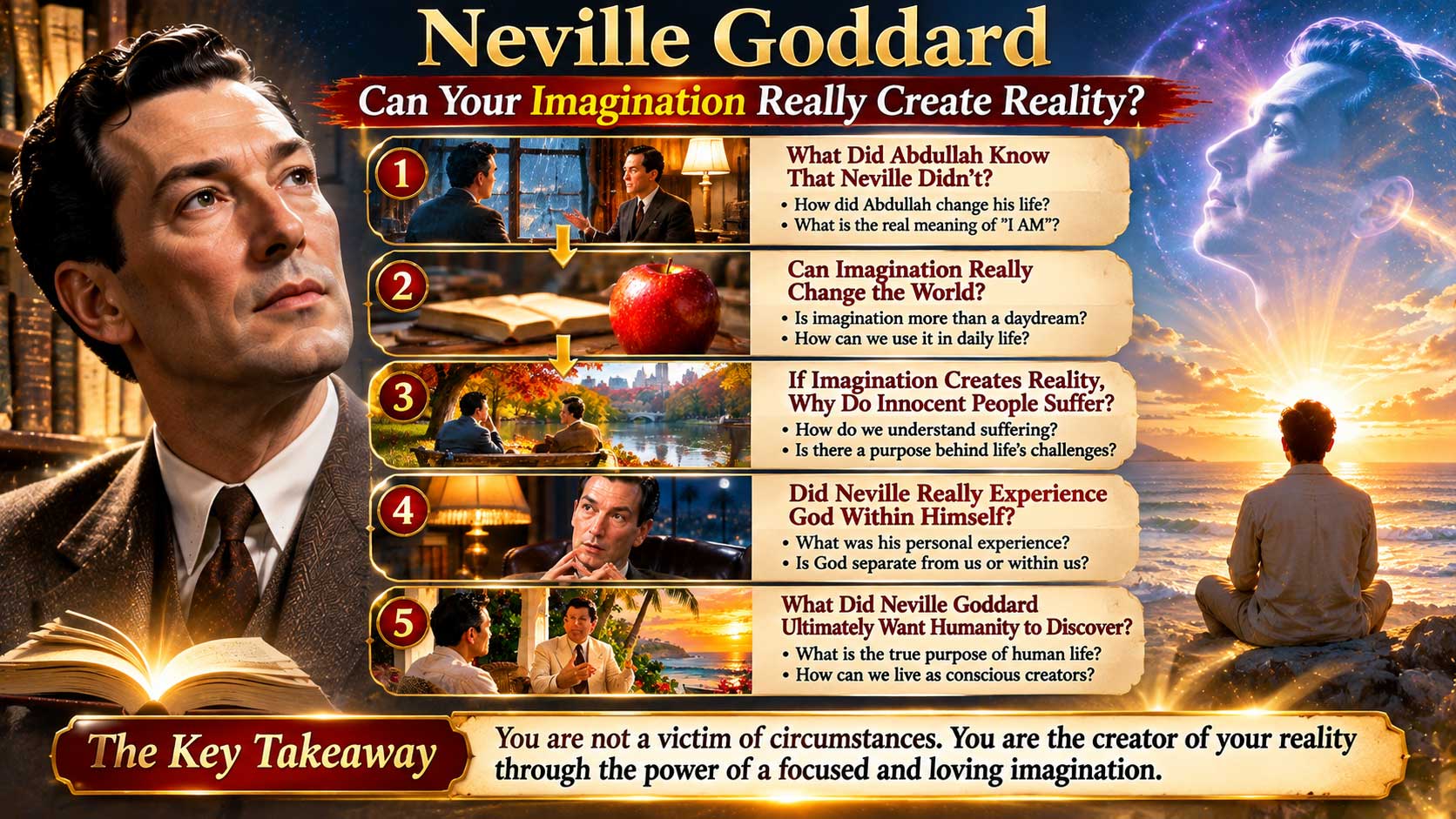
Leave a Reply