
Introduction
What happens to a person who gets everything, and then loses it all?
That question has followed me for years. Not as a history lesson, but as something closer to home. Most of us will never conquer a continent. But almost everyone climbs something. A career, a business, a dream, a family. And sooner or later, almost everyone reaches the moment when the climbing stops and the quiet begins.
No one in history climbed higher or fell harder than Napoleon Bonaparte. He rose from a poor Corsican officer to Emperor of the French, redrew the map of Europe, and crowned himself in Notre-Dame. Then came Russia, Waterloo, and exile on Saint Helena, a speck of rock in the South Atlantic where the British hoped the world would forget him. He spent his last six years there at Longwood House, damp, windswept, and watched. The Fondation Napoléon describes his exile as his final conquest: the fight to tell his own story.
So I went to meet him there.
This is the first ImaginaryTalks conversation I host myself, in the spirit of the long, unscripted conversations I love. No panel and no prepared speeches. Just one night at Longwood House, two hundred years after his death, and the questions I’ve always wanted to ask. I don’t claim to channel anyone. Everything here is imagined, but built on his own words, his letters, and the records his companions left behind.
We talk about the star he believed guided him, and whether he truly saw it. We talk about Joséphine, the woman his soldiers called his luck, and the letters he wrote her from the battlefields of Italy. We talk about what it was really like to sit on top of the world and then on a rock in the ocean. He looks at our world in 2026, our phones, our influencers, our wars fought by machines. And finally, we talk about God, death, and what comes after.
Somewhere in that night, the most powerful man of his age says something I didn’t expect. It’s the reason I’m sharing this conversation with you.
If you’ve ever reached a goal and felt empty, lost something you were sure was yours, or wondered whether your life is guided by something larger, pull up a chair. The fire is cold, but the conversation isn’t.
(Note: This is an imaginary conversation, a creative exploration of an idea, and not a real speech or event.)
Topic 1: The Star That Guided Him
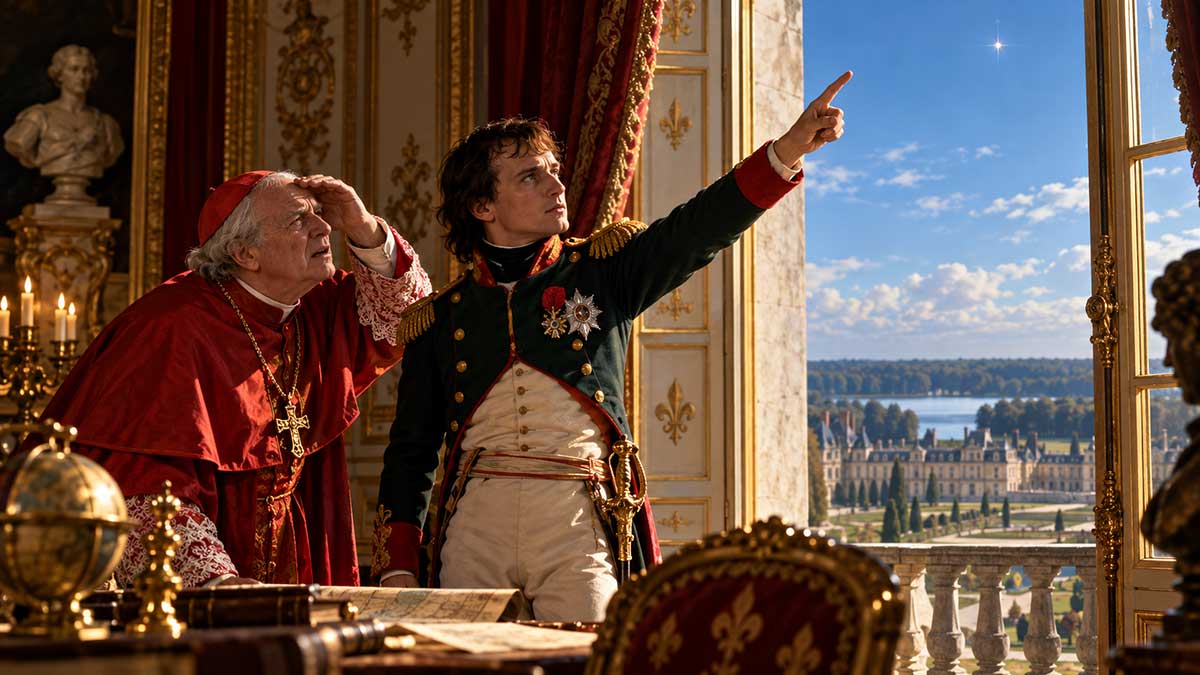
Longwood House, Saint Helena. Wind presses against the shutters. A single lamp burns over the billiard table.
Nick: I came a long way to sit at this table. Two flights, then a drive up a road that never stops climbing. And the whole way, I kept thinking about one story.
Napoleon: One story. They have filled libraries about me, and you crossed an ocean for one story. Which?
Nick: You were arguing with your uncle, Cardinal Fesch. You led him to a window and asked if he could see your star. He said no. You said you could.
Napoleon: Marmont told you that.
Nick: It’s in his memoirs.
Napoleon: Marmont. The man who handed Paris to my enemies. Interesting, which witnesses history decides to trust.
Nick: So it didn’t happen?
Napoleon: I did not say that.
Nick: Then be honest with me. Did you actually see a star, or did you need to believe you did?
Napoleon: You ask like a man who has never needed anything.
Nick: I’ve needed plenty. I’ve changed what I believed more than once in my life. Every time, I was sure. That’s why I’m asking.
Napoleon: Hm. Then you understand more than Fesch did.
You must know where I come from. Corsica. An island where old women read the future in the fat of a lamb. My mother crossed herself at every crow. I was born on the feast of the Assumption, and the women of Ajaccio made a great deal of that. I laughed at them. But a child who hears every day that the sky is watching him, he does not forget it. He only learns not to say it aloud.
Nick: When did you start saying it aloud?
Napoleon: After Lodi. A bridge in Italy, 1796. My men crossed it under fire, and that night I understood I was no longer a simple general. I was a man who would decide the fate of nations.
Nick: Wait. Before Lodi, you didn’t see it?
Napoleon: I saw it the way a boy sees a girl he has not yet spoken to. From across the room. Uncertain it is looking back.
Nick: And after the bridge?
Napoleon: After the bridge, it looked back.
Nick: Here’s my problem. You also said that a series of great actions is never the result of chance or luck. Only planning and genius. So which is it? You can’t have both.
Napoleon: Why not?
Nick: Because one means you earned it, and the other means it was given to you.
Napoleon: You think like a shopkeeper. Earned or given. Paid or owed.
Listen. Genius plans the battle. I knew the roads, the rivers, the hour the enemy would eat. But genius cannot plan the rain. It cannot plan which bullet finds which man.
Marengo. Do you know it?
Nick: You nearly lost.
Napoleon: I had lost. By afternoon my army was retreating. Then Desaix arrived with his division, and we won before dark. So tell me, was that planning? Yes. I had sent for Desaix.
He pauses.
Napoleon: But I did not plan for him to die in the first charge. He brought me the victory and never saw it. If you can tell me which part of that was genius and which part was the star, you are wiser than I am.
Nick: Maybe that’s the honest answer. You don’t know where one ends and the other begins.
Napoleon: Nobody does. The difference is that I admitted the star. Other men give all the credit to their genius and then wonder why the gods humble them.
Nick: There’s someone listening tonight sitting at a kitchen table, wondering if they’re meant for something bigger. Waiting for a sign. What would you tell them?
Napoleon: Stop waiting.
Nick: That’s it?
Napoleon: The star does not come to men sitting at kitchen tables. It comes to men already marching. I was a captain at Toulon with holes in my boots. Nobody saw any star over me. I moved the guns myself. Afterward people said I was chosen. Perhaps. But I was chosen while I was moving.
Nick: So when did the star stop showing up?
The wind rises. Napoleon looks toward the dark window.
Napoleon: Russia.
The night Moscow burned, I went out to look for it. The sky was orange from one end to the other. There are no stars in a burning sky. I told myself it was the smoke.
Nick: Was it?
Napoleon: At Waterloo, it rained all night. The ground was too soft for my guns, so I waited for it to dry. I waited. I, who never waited for anything in my life. By the time the ground was ready, the Prussians were on the road.
Was that the star leaving me? Or an old man who had begun to hesitate? I have had six years on this rock and two hundred more beyond it to decide. I have not decided.
Nick: Do you think everyone has a star? Or only a few?
Napoleon: You want me to say everyone. That is the modern fashion, no? Everyone is special.
Nick: I want you to say what you believe.
Napoleon: Then I will ask you instead. Do you have one?
Nick: I don’t see stars. I get questions that won’t let me sleep. Like this one. That’s why I’m here.
Napoleon: Then that is your star.
Mine burned so brightly it nearly consumed Europe. Yours only keeps you awake. Perhaps yours is the kinder one.
Nick: Kinder, or smaller?
Napoleon: (a short laugh) Good. You are learning to push back.
I will tell you something I never told Las Cases, because he wrote down everything. Some nights here, I am no longer certain the star led me at all. Perhaps I simply walked so fast, for so long, that it had no choice but to follow.
Silence. Nick doesn’t answer. The lamp flickers.
Napoleon: It is cloudy tonight.
Nick: Is it?
Napoleon: It is always cloudy here.
Topic 2: Joséphine: The Luck He Let Go
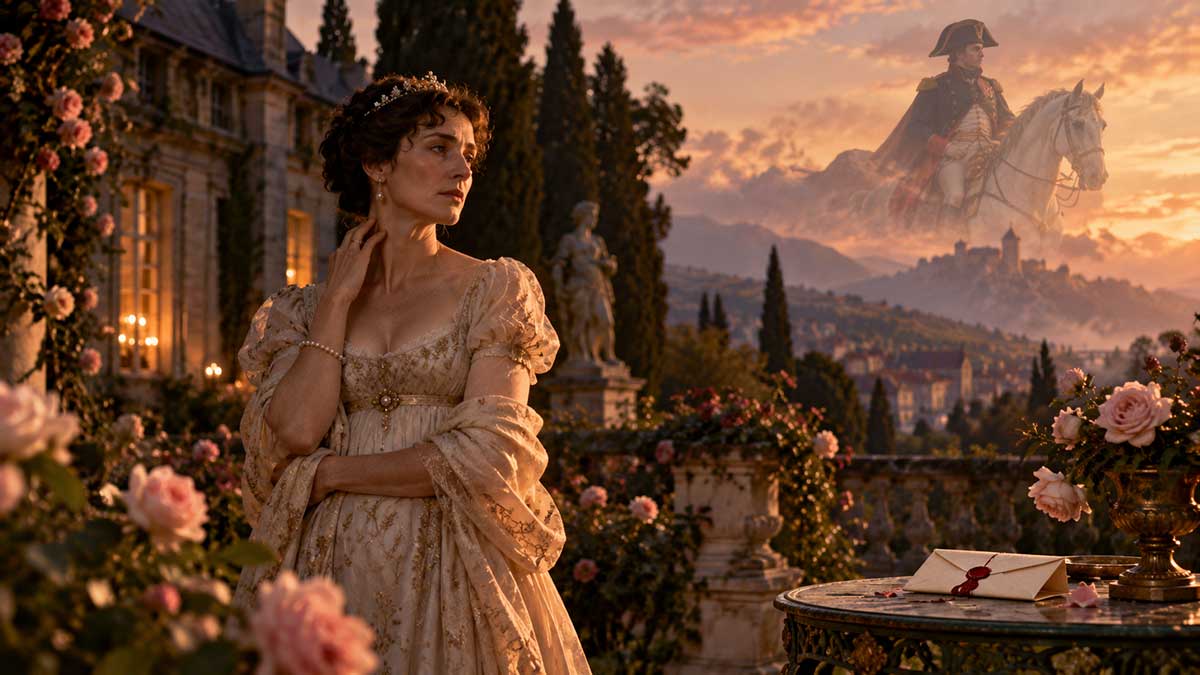
The lamp has burned lower. Napoleon has moved from the billiard table to a chair by the cold fireplace.
Nick: I want to read you something. It’s yours.
Napoleon: Everything people read to me is mine. Go on.
Nick: Italy, 1796. You’d been married two days when you left to take command. You wrote her that you hadn’t spent a day without loving her, or a night without holding her in your arms.
Napoleon says nothing for a moment.
Napoleon: Where did you get that?
Nick: It’s been published for two hundred years.
Napoleon: Of course it has. Nothing is private when you lose.
Nick: The man who wrote that letter was conquering Italy. Who was he?
Napoleon: A fool.
Nick: That’s the quick answer. Give me the real one.
Napoleon: The real one is also a fool. Twenty-six years old, winning battles every week, and every night writing to a woman who did not write back. I sent couriers across the Alps. Do you know what that costs, a courier? Horses killed on the road so she could have my letter in four days. And she would leave it unopened on a table while she went to dinner.
Nick: You knew that?
Napoleon: I knew everything. I was the government. I learned later that while I was writing to her, she was laughing with a young officer named Charles. Hippolyte Charles. A lieutenant with good boots and jokes about my accent.
Nick: And you stayed with her.
Napoleon: In Egypt I swore I would divorce her. I told my brother. I had it all planned. Then I came home, she wept at my door all night, and in the morning I opened it.
Nick: Why?
Napoleon: You ask why like there is an answer. Why does a man take back the woman who betrayed him? Because after that I was winning again. Marengo. The Consulate. The crown. My soldiers began to say it. While the Emperor has Joséphine, he cannot lose.
Nick: Did you believe it?
Napoleon: I am Corsican. I believed it before they said it.
Nick: Then I don’t understand. If she was your luck, and you believed it, why did you leave her?
Napoleon: For an heir. France needed a son. She could not give me one.
Nick: That’s the official reason.
Napoleon: It is the true reason.
Nick: It’s a true reason. But you’re a man who saw a star in daylight, and you divorced the woman you believed protected you. Was it really duty? Or was it ambition? Or were you afraid?
Napoleon: Afraid of what?
Nick: Of dying without anything to leave behind. Of all of it being for nothing.
Napoleon stands and goes to the window.
Napoleon: You push hard for a man who came here politely.
Nick: You told me I was learning.
Napoleon: (a long breath) Ambition, yes. An empire without an heir is a tent. The first wind takes it. Duty, yes, because I truly believed France would collapse into civil war again if I died without a son.
And fear.
The fear you say, but not only that. I was forty. I had been shot at for twenty years. One morning I looked in the mirror and saw a fat man with thinning hair, and I thought, the star will not wait forever. If I was ever going to make it permanent, it had to be now.
So I made it permanent. I married an Austrian princess. I had my son. And three years later I was on Elba.
Nick: Do you think leaving her cost you your luck?
Napoleon: I think you want me to say yes, because it makes a beautiful story.
Nick: I want to know what you think.
Napoleon: I think after the divorce I stopped listening to anyone who told me no. She was the only one left who could laugh at me and be right. Without her, nobody laughed. You can call that luck if you want. I call it losing the last honest mirror in the palace.
A soft sound behind them. A woman stands near the doorway in a pale gown, a shawl around her shoulders. Napoleon does not turn.
Joséphine: He’s being generous to me. He usually is, once I’m not in the room.
Nick: Madame.
Joséphine: Just Joséphine. Although that isn’t my name either. I was Rose until I met him. He decided Rose was a name for other men, so he gave me a new one. That is what it was like to be loved by Bonaparte. He renamed the weather.
Nick: Can I ask you something? What was it like to be called someone’s luck?
Joséphine: Heavy.
People think it’s flattering. It isn’t. When he won, I was a charm. When he lost, I’d be the reason. Every courier from the front, I’d open with my hands shaking, not because I feared for him, God forgive me, but because I feared what his luck would say about me.
So yes, I left his letters on the table. Not because I didn’t care. Because each one asked me to be a miracle, and I was a woman from Martinique who liked dinners and gardens and had already buried one husband to the guillotine.
Nick: Did you love him?
Joséphine: Not at first. He was an odd, intense little man with an accent and terrible manners. Later, more than he believed. Far less than he wanted. Is that an answer?
Nick: It’s an honest one.
Joséphine: Honest answers were what I had instead of sons.
She turns to go. Napoleon still doesn’t look at her.
Joséphine: You can tell him one thing for me, since he won’t turn around. I kept the roses at Malmaison until the end. Every one of them.
She is gone. The fire is still cold.
Nick: She died while you were on Elba. How did you hear?
Napoleon: A newspaper. Weeks late. I read it standing up, then I went into my room and told Bertrand I was not to be disturbed.
Nick: For how long?
Napoleon: Two days. Perhaps more. On Elba there was nothing else to command, so I commanded the door to stay closed.
When I escaped and returned to Paris, I went to Malmaison. Her daughter Hortense took me to her room. I asked to be left alone there.
Nick: What did you do?
Napoleon: Nothing. I sat on the bed. A man who had moved two hundred thousand soldiers across a continent sat on a bed and did nothing.
Nick: Someone listening tonight let go of the person who knew them best because the timing didn’t fit their plans. Maybe they’re still telling themselves it was necessary.
Napoleon: It probably was necessary.
Nick: Then why sit on the bed?
A long silence. When Napoleon speaks again, there is no grandeur in it at all.
Napoleon: Because necessary and right are not the same word. I knew both languages. I only ever spoke one.
He finally turns from the window, toward the empty doorway.
Napoleon: I miss her.
Topic 3: Saint Helena: What Waits at the Top
Gray light at the shutters now. Somewhere outside, a rat scratches along the eaves. Napoleon doesn’t react. He stopped noticing long ago.
Nick: Can I ask you something simple?
Napoleon: Simple questions are the dangerous ones. Ask.
Nick: Walk me through a normal day here. Not the battles you dictated. A Tuesday. What were you doing at three in the afternoon?
Napoleon: (he almost smiles) Nobody has asked me that. Two hundred years, and they ask about Austerlitz.
A Tuesday. I woke late. There was nothing to wake for. Marchand brought coffee. Then dictation. Las Cases at first, later Montholon, Gourgaud. Campaigns, mostly. I would walk around this table moving salt cellars and bits of bread as if they were divisions.
Nick: And at three?
Napoleon: At three, a bath. Hot. Very long. Two hours, sometimes more. It was the only place on this island that was warm and dry.
Nick: Two hours in a bath.
Napoleon: You say it like it’s a scandal. What else would I do? Ride? The governor drew a line around this plateau. If I rode past it, an English officer followed me. So I stopped riding. I would not give Hudson Lowe the pleasure of watching me through a telescope.
Nick: And the evenings?
Napoleon: Dinner, which took forever because I made it take forever. Then I read aloud to the household. Corneille, Racine, Voltaire. They fell asleep. I pretended not to notice. One night I said, “Let’s finish the tragedy,” and Gourgaud said, “We already have, Sire.” We had read it twice that week.
Nick: That’s a hard picture. The man who ran Europe, reading the same play twice to people who were falling asleep.
Napoleon: You wanted Tuesday.
Nick: I did. So let me ask the big one. You conquered most of a continent. You crowned yourself. You remade the laws of France. Sitting here, honestly, was it worth it?
Napoleon: Of course it was worth it. I took a nation drowning in its own blood and gave it order. I opened careers to talent, not birth. A cooper’s son could become a marshal of France. I built roads, schools, a code of law. Kings had to learn my name. Was it worth it? Ask the boys who rose from nothing because of me.
Nick: That’s a good answer.
Napoleon: It is the true answer.
Nick: It’s the answer you’d give at noon, in front of Las Cases with his pen out. Now give me the answer you’d give at three in the morning.
Napoleon looks at him for a long moment.
Napoleon: You are a strange interviewer.
Nick: I’m just curious.
Napoleon: At three in the morning.
He sits down heavily.
Napoleon: At three in the morning, I counted. Not victories. The dead. I never did that in the field. A general who counts the dead loses the next battle. But here there was no next battle, so the numbers came anyway. Russia alone. Half a million went in. You know how many came home.
And I would ask myself, what remains of it? The empire is gone. The borders I drew, gone. My son is in Vienna being raised as an Austrian, and they will not let me write to him. Everything I built with soldiers was taken back by soldiers.
Nick: So the honest answer is no?
Napoleon: The honest answer is that I do not know, and I hate not knowing more than I ever hated the English.
Once, Las Cases and I were talking late, and I said something like, what a novel my life has been. He wrote it down, of course. People quote it as if I were proud.
Nick: Weren’t you?
Napoleon: I was looking at the walls. A novel is something you finish. And then it sits on a shelf.
Nick: I’m retired myself. After twenty-five years of building businesses, I know a little about the quiet afterward. Not like this. But I know the moment the phone stops ringing and you wonder who you are when nobody needs a decision from you.
Napoleon: And who are you?
Nick: Still finding out. That’s partly why I’m here.
Napoleon: Then you are further along than I was. I never asked. For thirty years I was what I did. When they took away what I did, I thought they had taken away me.
Nick: That’s what I wanted to talk about. There are people today who climb their whole lives. They get the promotion, sell the company, reach the number they wanted. And they feel nothing. Empty. Psychologists even have a name for it.
Napoleon: They needed a name for that? I could have told them for free.
Nick: Then tell them. Why does the top feel empty?
Napoleon: Because the top is not a place. It is a direction. When you are climbing, every morning has an enemy, a problem, a reason. You think the joy is in the summit. No. The joy was the climbing, and the summit takes it away.
And there is something worse. When I was climbing, I never built anything for afterward. No friendships that did not depend on my power. No pleasures that did not involve command. Not one habit of a man at rest. So when the climbing ended, there was no one there. Only the general, with no army.
Nick: But you did find something here eventually, didn’t you? I read you started gardening.
Napoleon: (sharply) Who told you that?
Nick: Several people.
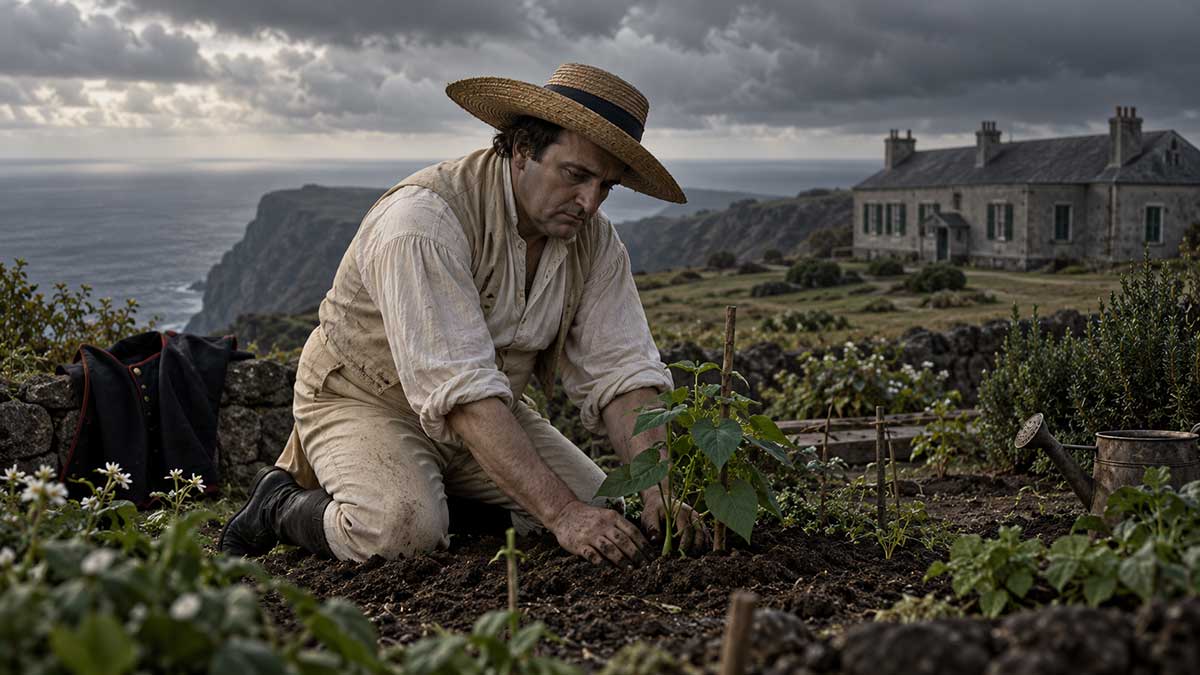
Napoleon: (a pause, then grudgingly) Near the end. Yes. I had the servants dig, and then I dug myself. I put on a big straw hat like a planter and gave orders to the Chinese gardeners and the household. We made paths, a pond, beds of flowers. Montholon thought I had gone mad.
Nick: Had you?
Napoleon: For the first time in my life, I watched something grow that I had not conquered. A bean does not care who you were. It cares whether you water it.
I should have learned that at thirty. I learned it at fifty, on a rock, with a liver that was already failing.
Nick: Someone listening right now just retired, or lost their business, or reached their dream and felt nothing. What would you tell them?
Napoleon: I would tell them they came to the wrong man. I am the warning, not the example.
Nick: Then give them the warning.
Napoleon: Build the other side while you are still climbing. Not after. After is too late, because after you will be too proud to start small. Learn one thing you are bad at. Keep one friend who does not need you. Plant something that will not care about your name.
And if you are already on your island, and your climbing is finished, then do not spend six years walking around a billiard table moving bread like soldiers.
Go outside. Get dirt on your hands.
He looks toward the window. Thin daylight shows the shape of the garden beyond, overgrown now.
Napoleon: They let it all go after I died, you know. The paths, the pond.
Nick: Does that bother you?
Napoleon: (after a moment) No. It grew for me while I was here. That was enough. Strange, isn’t it? It is the only thing I ever made that I did not need to last.
Topic 4: Napoleon Looks at 2026
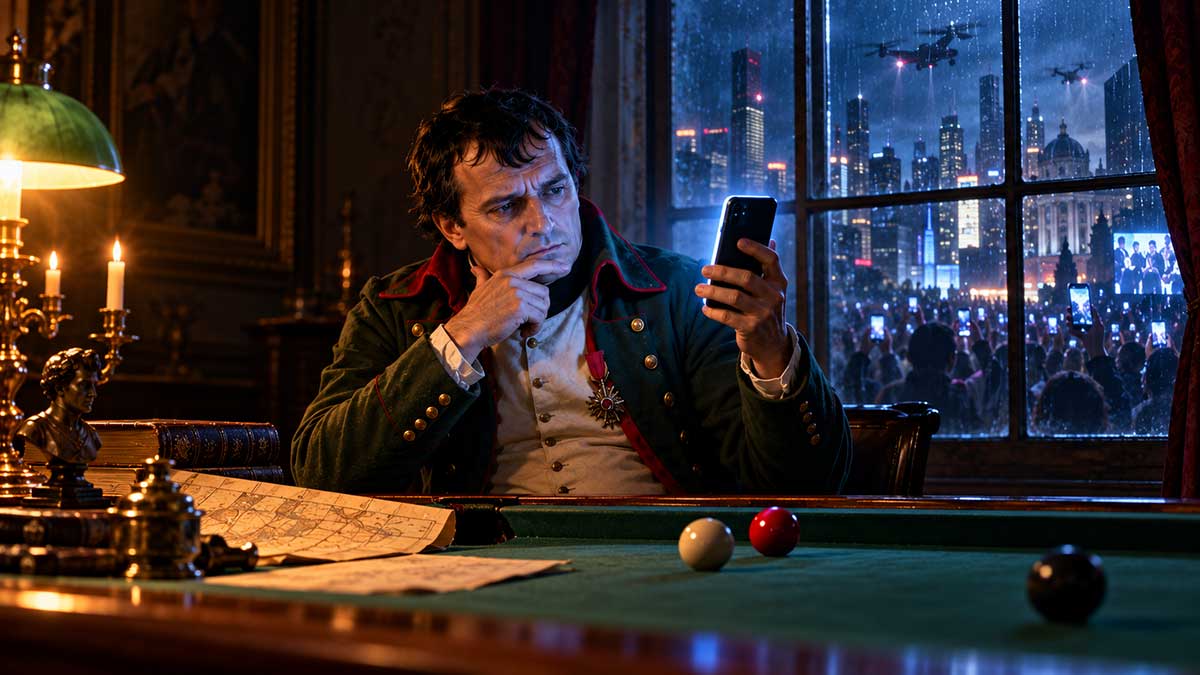
Full morning now. Napoleon has taken the chair at the head of the table. Nick sets a smartphone on the green felt between them.
Napoleon: What is that?
Nick: Two hundred years of news, more or less. Everyone carries one.
Napoleon: Everyone? Peasants too?
Nick: Especially peasants. Farmers check the weather on it. Kids watch videos. Some people stare at it eight hours a day.
Napoleon: (picking it up, turning it over) Eight hours. I could have conquered Prussia with that kind of attention. Who controls what they see?
Nick: That’s the question everybody’s arguing about.
Napoleon: Then nothing has changed. Show me.
Nick shows him how to scroll. Napoleon scrolls fast, then faster. He stops on something.
Napoleon: This man has eleven million followers. Followers of what?
Nick: Of him. He’s an influencer. He posts videos about his life, his opinions, his morning routine.
Napoleon: Eleven million. That is more than my Grande Armée at its height, many times over. And he commands them with his breakfast.
Nick: That’s actually what I wanted to ask you. You took the crown out of the Pope’s hands and put it on your own head. Then you had David paint it, huge, so everyone would remember it the way you wanted. Wasn’t that just the world’s first personal branding move?
Napoleon: (laughs, genuinely) First? Caesar put his face on coins. Alexander had a court sculptor who alone could carve him. I only did it better.
But yes. You understand me. That moment in Notre-Dame was not for the Pope. It was for the painting. And the painting was for every schoolchild who would never see me in person.
Nick: Your army bulletins too. The French even had a saying. To lie like a bulletin.
Napoleon: They said that? (a pause, almost pleased) Good. It means they read them.
A bulletin was not a lie. It was a direction. I told the army what it needed to believe in order to win tomorrow. Sometimes the truth came later, when it could do less damage.
Nick: That’s exactly what people worry about today. Anyone can tell millions of people what to believe, instantly. Some of them don’t care if it’s true.
Napoleon: And you want me to be shocked.
Nick: I want to know if you’d be dangerous with this. (nodding at the phone)
Napoleon: (he sets it down carefully, like something loaded) With that? I would have taken France without firing a shot.
That is the honest answer. Your influencer with his breakfast does not know what he is holding. I would have known. Whoever owns the story owns the people. The guns are only for those who refuse the story.
Nick: That scares me a little.
Napoleon: It should. Not because of me. Because somewhere today a young man with no money, no title, nothing but hunger and that machine, understands it as well as I would have.
Nick: Let’s talk about war, then. Today a lot of fighting is done with drones. Machines that fly themselves. Some are guided by AI, artificial intelligence. Software that can pick targets.
Napoleon: Without a man?
Nick: More and more.
Napoleon: (he is quiet for a moment) I want to say this thrills me. I was an artillery officer. I loved anything that reached farther and hit harder. And part of me does want to see it.
But tell me. A machine that cannot be afraid, can it be brave?
Nick: I don’t think so.
Napoleon: Then you have taken the only beautiful thing out of war.
I am not sentimental about battle. I sent men to die. But on the bridge at Lodi, a man could choose to run forward when every part of him screamed to run back. That choice is the only thing that ever redeemed the slaughter even a little. If the machine chooses, then nobody chooses. Then war is only arithmetic.
And arithmetic never stops.
Nick: Do you think a machine could ever have a star?
Napoleon: (he looks at Nick sharply, then smiles) You keep coming back to that.
No. A star needs someone who can fail. A machine either works or breaks. It does not walk into the rain at Waterloo and wonder if heaven has left it.
Nick: Here’s the harder question. When you look at leaders today, and the people with millions following them, does anyone remind you of yourself?
Napoleon: You want names.
Nick: No names. I want patterns.
Napoleon: Good, because I would give you names from every side, and you would be hated by everyone.
The pattern is easy. A nation is tired. Exhausted by chaos, by arguing, by being afraid. Then a man appears and says the old rules are too slow for the danger. Give me the power, and I will bring back order.
I was that man. France in 1799 was a ruin. The people did not take my power from them. They handed it to me. Gratefully.
Nick: And does that worry you, seeing it again?
Napoleon: It would worry me more if I did not see it. It is the oldest story in the world. What worries me is that the people handing over the power always believe this time is different.
And the man receiving it always believes it too. I did. I believed I was the exception. I believed I could hold that power without becoming what it makes you.
Nick: Could you?
Napoleon: I crowned myself. You tell me.
Nick: Can I read you something else? It’s yours too. You said there are only two powers in the world, the sword and the mind. And in the long run, the sword is always beaten by the mind.
Napoleon: I said that to Fontanes. I was young and still had time to believe it.
Nick: Do you still believe it?
Napoleon: Tell me what remains of me in your world.
Nick: Your empire is gone. Your borders are gone. But your civil code, the law you wrote for France, still shapes legal systems around the world. Countries you never conquered use ideas from it. Even Louisiana.
Napoleon: (very still) Louisiana. The place I sold to the Americans because I needed money for war.
Nick: That one.
Napoleon: (he laughs softly, shaking his head) So the land I sold for cannons kept my laws, and the lands I conquered with cannons threw me out.
Yes. I believe it now more than when I said it. Everything I won with the sword was taken back by the sword. The code I wrote at a desk at night, arguing with lawyers about inheritance and marriage, outlived the empire.
I thought it was the least of my achievements. It is the only one that survived.
Nick: So what would you tell someone today who’s building something?
Napoleon: Ask yourself which part of your work is the sword and which part is the code. The sword is everything you take, win, defeat, accumulate. It feels like the real work, and it never lasts.
The code is the quiet part. What you build that helps people live after you are gone. It feels small while you do it. It is the only part they will still be using in two hundred years.
He slides the phone back across the felt to Nick.
Napoleon: Keep your machine. But be careful what you write on it. Some of it may last longer than you intend.
Topic 5: God, Death, and the Way Home
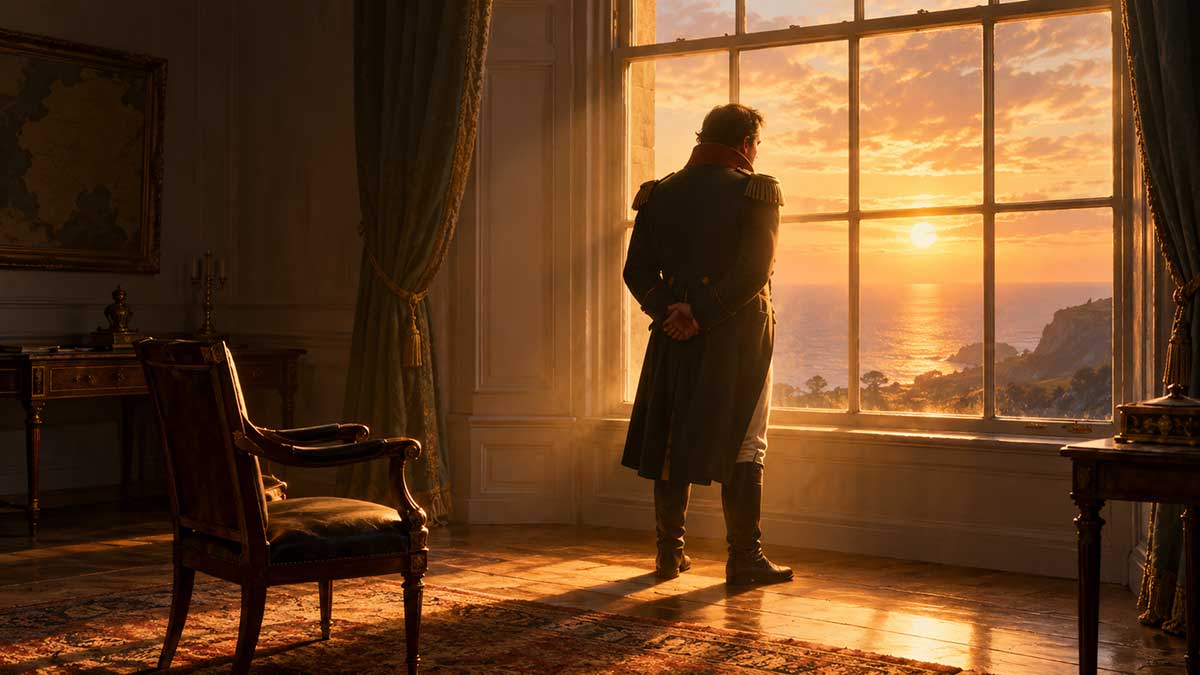
Late afternoon. The wind has dropped. For the first time, the house is completely quiet.
Napoleon: You saved this one for last.
Nick: You noticed.
Napoleon: I noticed everything you did today. You start soft, then you push. You would have made a decent officer.
Nick: I'll take that. So here it is. Some historians say you didn't believe in God. That you believed in destiny, in your star, and used religion as a tool. Others say that right here, on this island, you argued for the divinity of Christ against your own general. Bertrand, the unbeliever. I've changed what I believed more than once in my life. So I want to ask you. Which was the real Napoleon?
Napoleon: Both, and you will not like that answer.
Nick: Try me.
Napoleon: When I governed, religion was policy. I said it plainly to my Council of State. By making myself Catholic, I ended the war in the Vendée. By making myself Muslim, I was accepted in Egypt. If I governed a nation of Jews, I would rebuild the Temple of Solomon. That was not faith. That was administration.
Nick: That's a little cold.
Napoleon: It was a cold job. Thirty million people do not kneel at the same altar. Somebody must keep them from killing each other over which altar is correct. I restored the churches because France was sick without them, not because I prayed in them.
Nick: And on this island?
Napoleon: On this island, there was nobody left to govern.
Nick: So did you really say those things to Bertrand? About Christ not being a man? I'll be honest with you. There are scholars who think your companions polished those conversations after you died. Made them grander.
Napoleon: (a dry laugh) Of course they did. Montholon could not report a conversation about soup without making it sound like Plutarch.
Nick: So you didn't say it.
Napoleon: I didn't say it like that. They gave me better sentences than I had. But the argument happened. Bertrand was a good man and a stubborn atheist, and I liked to provoke him. I said, I know men, and I tell you this one was not a man.
Nick: Did you mean it, or were you provoking him?
Napoleon: Both again. You keep wanting one answer.
Listen. I spent my life studying men who made other men follow them. Caesar. Alexander. Myself. I know how it is done. Fear, glory, bread, and a uniform. Charlemagne needed an army. I needed an army. And when we died, the armies went home.
This one had no army. No palace. He died the worst death a man could die, and his followers were fishermen who ran away. And two thousand years later, people still give their lives for him. Freely. Nobody gives his life for me now. They visit my tomb and buy postcards.
So I would say to Bertrand, explain that to me, using only what we know about men. He couldn't. Neither could I.
Nick: That sounds less like dogma and more like a general studying the one campaign he can't figure out.
Napoleon: (looks at him, then nods slowly) Yes. That is the most accurate thing anyone has said about my religion.
Nick: Before a battle, did you ever feel guided? Or warned? Not the star. Something else.
Napoleon: (long pause) Before the great battles, there was always one moment. Usually at night. The plans were finished, the orders sent, and there was nothing more to do. Everyone else slept. And I would feel something like being watched. Not judged. Watched. As if somebody was curious what I would do with what I had been given.
Nick: Did that ever feel like a warning?
Napoleon: Once. Before Russia. I felt nothing. That was the warning. The silence, where the watching should have been. I went anyway.
Nick: Why?
Napoleon: Because I had six hundred thousand men in uniform and a pride the size of the steppe. A man can hear silence and decide it means permission.
Nick: I think a lot of people listening know that feeling. Hearing the silence and going anyway.
Napoleon: Then tell them from me. When the watching stops, stop. Wait until it returns.
Nick: You wrote in your will that you died in the Catholic faith you were born into. And at the end you asked for a priest.
Napoleon: The Abbé Vignali. A young Corsican, not very learned. I chose him for that. I did not want a theologian. I wanted a man from my island who would do the old things the old way, the way my mother would have wanted.
Nick: Was that faith? Or comfort?
Napoleon: At the end, I am not sure there is a difference. You hold on to what held you when you were small.
Nick: You died here on May 5, 1821. What happened next? Where did you go?
Napoleon is silent for a long time. When he answers, his voice is quieter than it has been all day.
Napoleon: I can tell you what it felt like. I cannot tell you what it was. I was a soldier, not a priest.
There was a storm that evening. Everyone said so afterward. The wind tore at the house. I remember the sound of it, and then I did not hear it. And it was not dark. That is what surprised me. I had expected darkness, like a tent at night.
It was like the moment before battle, the one I told you about. The watching. But closer. And for the first time, I did not need to do anything to deserve it.
Nick: What did you see?
Napoleon: You want faces. Joséphine. My mother.
He stops.
Napoleon: Perhaps. I will keep a few things for myself. Even here, a man should have some territory no one can take.
But I will tell you this. Nobody asked me how many battles I won. Not one person. I had prepared answers for two hundred years, and nobody asked.
Nick: What did they ask?
Napoleon: Whether I had loved anyone more than I loved being Napoleon.
He looks at Nick.
Napoleon: I am still working on my answer.
Nick: Can I tell you two things? I don't think anyone told you.
Napoleon: You have been telling me things all day. Go on.
Nick: Your son. The one in Vienna they wouldn't let you write to. He died in 1832. He was twenty-one. Tuberculosis.
Napoleon does not move. His hand closes slowly on the edge of the table.
Napoleon: Twenty-one.
Nick: I'm sorry.
Napoleon: Did he know anything of me? Did they let him?
Nick: From what's been written, he kept your memory close. He wanted to be a soldier like you. And many years later, his remains were brought to Paris, to Les Invalides. He rests near you now.
Napoleon: Near me. (barely audible) So I am not on this rock anymore.
Nick: That's the second thing. In your will, you asked for your ashes to rest on the banks of the Seine, among the French people you loved. Nineteen years after you died, France brought you home. They carried you through Paris in the snow, and huge crowds came out to see it. You're under the dome at Les Invalides.
Napoleon turns away toward the window. The light outside has gone gold.
Napoleon: They brought me home.
Nick: They did.
Napoleon: The English kept me here so France would forget me. I thought they had succeeded. Every ship that came, I watched the horizon, and every ship was for someone else.
A long silence.
Napoleon: You asked me today whether it was worth it. Whether the star was real. Whether I loved her. You know what I think now, sitting in this chair with you?
Nick: Tell me.
Napoleon: I think destiny did not punish me by sending me here. I think this was the only place quiet enough for me to finally hear the questions. On a throne, I never heard one. Everyone was too busy giving me answers.
This island took my army, my wife, my son, my empire. And it gave me the questions. I fought it for six years. I should have thanked it sooner.
Nick: That's a hard thing to say about the worst place you ever lived.
Napoleon: The worst place I ever lived, and the only place I ever became honest.
He stands, straightening his old green coat, every inch the emperor again for a moment. Then he softens.
Napoleon: You came a long way with one story. Now you have another. Go home, Nick. Ask your questions. And when your own island comes, and it will come for everyone, do not waste six years fighting it.
Ask it what it came to teach you.
He walks toward the window. The gold light fills the glass. When Nick looks up again, the room is empty, and the garden outside is moving in the evening wind.
That completes all five topics. Next comes MFS, where I'll research and verify the links for the introduction and bios, then TDKI. Want me to go straight into MFS?
Final Thoughts
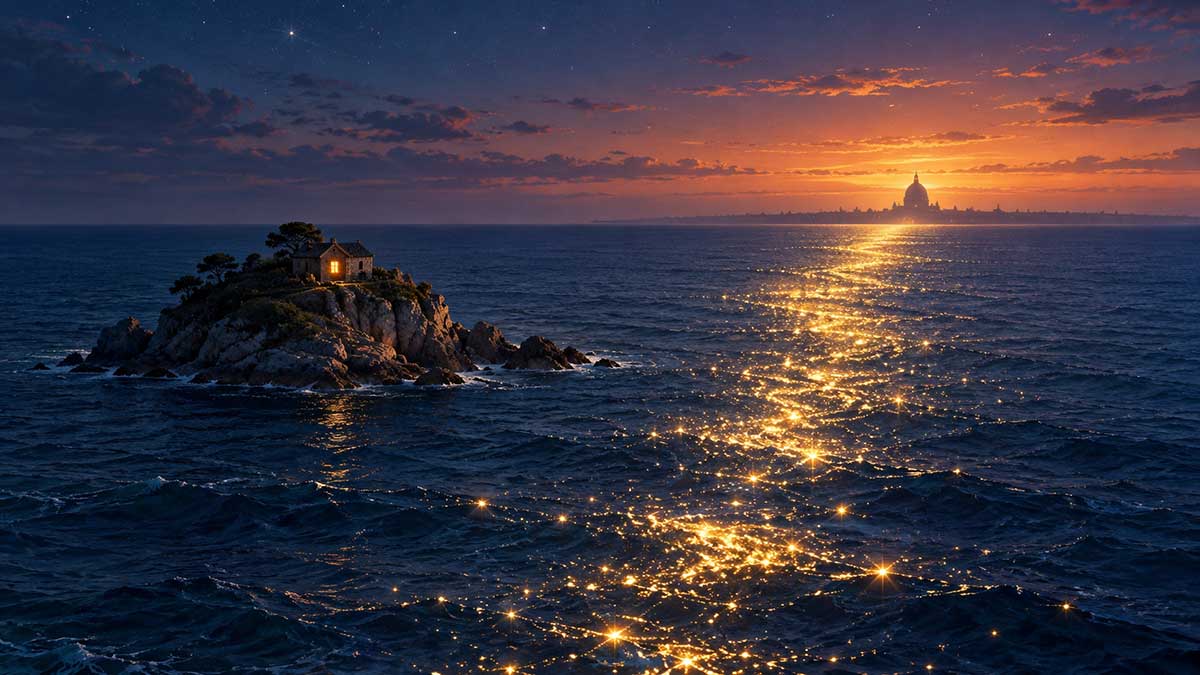
I went to Saint Helena expecting to meet a conqueror. I met a man still working on his answers.
What stayed with me wasn’t the star or the battles. It was a bean plant. A man who had commanded hundreds of thousands of soldiers, kneeling in the dirt in a straw hat, watching something grow that didn’t care who he had been. He learned at fifty, on a rock, what most of us are still avoiding: the climb is not the life. It’s only the part of life that keeps us too busy to ask what it’s for.
Napoleon admitted he built nothing for the other side of the summit. No friendships that didn’t depend on his power. No habits of a man at rest. When the climbing ended, there was nobody there, only the general with no army. I suspect many of us are building the same empire in smaller ways. A title. A number. A reputation we polish so carefully that we forget to keep one friend who doesn’t need anything from us.
I don’t know whether his star was real. He didn’t know either, and I found that strangely comforting. Maybe guidance and effort were never two separate things. Maybe the star only shows up for people who are already moving, and only leaves when we stop listening to the silence.
But the moment I keep returning to is near the end, when he calls Saint Helena the only place he ever became honest. The island took everything, and it gave him the questions.
Most of us will face an island someday. A loss, a retirement, an illness, a door that closes for good. We’ll want to fight it, the way he did for six years.
So here’s the question I’ll carry with me, and I hope you will too.
What is your island trying to teach you?
Short Bios:
Nick Sasaki is the creator and host of ImaginaryTalks.com. After 25 years of building businesses, he turned to building bridges between eras, ideas, and the questions people carry, drawn especially to spirituality, the soul’s journey, and what lies beyond ordinary explanation. He hosts as a seeker rather than an expert, asking the questions readers wish they could ask someone long gone. About Nick and ImaginaryTalks
Napoleon Bonaparte (1769–1821) rose from a Corsican artillery officer to Emperor of the French, dominating Europe for more than a decade before his defeat at Waterloo. His civil code still shapes legal systems around the world. Exiled to Saint Helena, he spent his final years dictating his memoirs and wrestling with destiny, faith, and what his life had meant. Biography of Napoleon I
Joséphine de Beauharnais (1763–1814) was born in Martinique, survived imprisonment during the Terror, and became Napoleon’s first wife and Empress of the French. Napoleon renamed her Joséphine, and his soldiers believed she was the source of his luck. He annulled their marriage in 1810 to secure an heir, and she died at Malmaison while he was in exile on Elba. Biography from the Fondation Napoléon
Leave a Reply