
Introduction
What happens when the most influential man in the Roman Empire discovers that he cannot fully control his own mind, his children's future, or the suffering of the people he loves?
Nearly 1,800 years after his death, Marcus Aurelius remains one of history's most admired philosopher-emperors. He ruled Rome from AD 161 to 180, commanded armies, confronted devastating epidemics, and carried responsibilities that few human beings have ever experienced. Yet his most enduring achievement was not a military victory or an imperial monument. It was a collection of private reflections, now known as Meditations, in which he repeatedly reminded himself to resist anger, practice justice, accept mortality, and become a better human being. The extraordinary thing about these writings is that Marcus was not lecturing the world. He was struggling with himself.
But who was the man behind those remarkable words? According to the Stanford Encyclopedia of Philosophy's study of Marcus Aurelius, his philosophical outlook was deeply influenced by Stoicism, particularly its teachings about virtue, reason, and the distinction between our own judgments and events beyond our control. Yet Marcus was far more than a philosopher sitting peacefully among books. He was a husband, a father, a military commander, and an emperor whose decisions affected millions. His life presents a fascinating question: Can someone remain morally good when given extraordinary authority?
In this imaginary interview, I travel through five defining stages of Marcus Aurelius's life. We begin in AD 138, when a seventeen-year-old Marcus is preparing for a future he did not entirely choose. We meet him again as emperor in Rome, where wealth, admiration, and political authority threaten the humility he has spent years cultivating. Then we follow him to the Danube frontier, where the philosopher who believed in human cooperation must confront the brutal realities of war. In a quiet winter chamber, we explore his private reflections on grief, God, and death. Finally, near the end of his life, we ask whether his philosophy survived its greatest tests.
What fascinated me most was the distance between Marcus's ideals and the world he governed. He believed human beings belonged to a common moral community, yet Rome depended on conquest and slavery. He taught patience and compassion, yet commanded armies in prolonged conflicts. Christians suffered persecution during his reign, raising difficult questions about imperial responsibility and religious tolerance. And perhaps his most painful legacy was the succession of his son Commodus, whose later reign stood in striking opposition to many of his father's philosophical principles. The Internet Encyclopedia of Philosophy's examination of Marcus Aurelius provides valuable context for his philosophical commitments and the tensions surrounding his life.
I wanted to ask Marcus questions that go beyond the familiar quotations shared on social media. Did Stoicism actually comfort him when his children died? Did he ever become angry enough to regret his actions? Was he genuinely happy, or simply skilled at controlling his emotions? Did he believe in God? Could he forgive someone who betrayed him? And if he truly believed in the brotherhood of humanity, how did he justify ruling an empire sustained by military force? These are not questions intended to destroy his reputation. They are questions intended to discover the human being beneath it.
What emerges from our five conversations is not a flawless sage who possesses every answer. It is a man who recognizes his weaknesses and continues struggling against them. Marcus never completely escapes fear, grief, pride, or uncertainty. His wisdom lies partly in his refusal to pretend otherwise. Perhaps that is why his writings remain meaningful across centuries. We may never command Roman legions or govern an empire, but we know what it means to lose our patience, worry about our children, fear death, and wonder whether we have lived well.
And that brings us to the question at the heart of this interview: What if the greatest achievement of Marcus Aurelius was not learning how to rule Rome, but discovering that becoming a good human being is the work of an entire lifetime? His story invites us to examine our own lives, not through the measure of wealth, fame, or public recognition, but through the patience we show, the people we help, the mistakes we acknowledge, and the love we offer before our time runs out.
Fictional interview disclaimer: This article presents an imagined conversation between Nick Sasaki and Marcus Aurelius. The dialogue, private scenes, and personal responses are creative reconstructions, not documented historical exchanges. Historical events and philosophical ideas are drawn from surviving sources and scholarship. Where Marcus's motives or personal responsibility remain uncertain, the conversation explores possibilities rather than presenting speculation as established fact.
Topic 1. The Boy Who Wanted to Be Good Before He Became Great
Rome, AD 138: A Young Man Standing at the Edge of Destiny
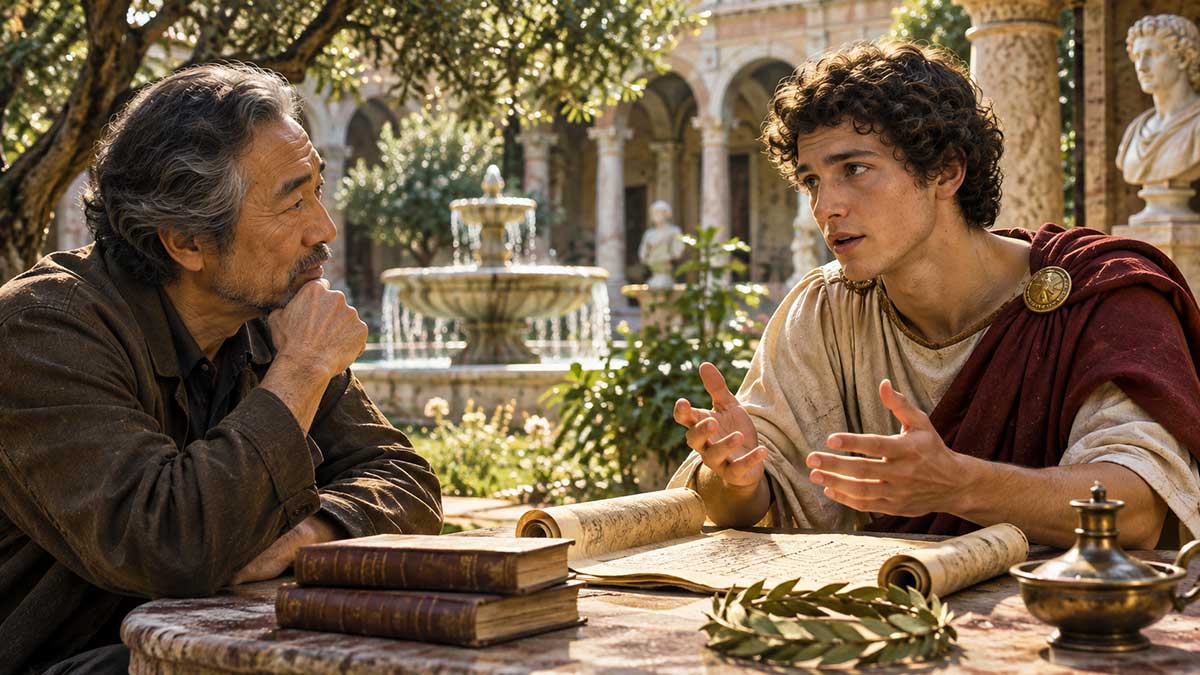
Rome, early autumn, AD 138. A few months have passed since Emperor Hadrian's death. Antoninus Pius now rules the Roman Empire, and a seventeen-year-old Marcus Aurelius has been drawn into the imperial succession.
The morning sun falls across the marble courtyard of a noble Roman residence. Beyond the columns, the city is already awake. Merchants call to passing customers, servants carry baskets of bread, and the distant rumble of wagon wheels rises from the streets.
Inside a quiet study, a young man sits beside a wooden table. Several scrolls lie open before him. A small bronze oil lamp, no longer needed in the morning light, stands near a wax writing tablet.
He is not dressed like someone preparing to command the greatest empire of his age. His clothing is simple, his expression thoughtful, and his attention fixed on a passage of Greek philosophy.
This is Marcus Aurelius before the wars, before the plague, before the deaths of his children, and before the private reflections that future generations will call Meditations.
He is still a young student. Yet the responsibilities of an emperor are beginning to gather around him.
For this imaginary conversation, Nick Sasaki has been granted something history cannot provide: an opportunity to speak with Marcus at seventeen, with the older emperor's memories and philosophical reflections available to him.
Marcus sets aside his scroll as Nick enters.
Nick Sasaki
Marcus, thank you for meeting me. I have to admit, this feels strange. I know what happens to you. I know you eventually become emperor, fight terrible wars, lose people you love, and write one of the most influential philosophical works in history.
But here you are, seventeen years old, sitting in a quiet room with your books.
Marcus Aurelius
Then perhaps you have arrived at a fortunate moment, Nick.
A young man with books is considerably less dangerous than an emperor with armies.
Nick Sasaki
(Laughs.) That's a good beginning.
You know, most people who study your life focus on the emperor. They want to know how you ruled Rome, how you handled war, or how you became such a famous Stoic.
But I want to begin before all of that.
I want to know who you were when you were still trying to figure out what kind of person you wanted to become.
Marcus Aurelius
That is a better question than asking what kind of emperor I wished to become.
A title tells you what responsibilities society has placed upon a man. It does not tell you whether he is worthy of them.
And I suspect that many of the mistakes I later made began with weaknesses I already possessed as a young man.
Nick Sasaki
Then that's where I want to start.
Question 1. What Shaped Your Character Before You Became Emperor?
Nick Sasaki
Marcus, your father died when you were very young. You grew up in a privileged family, surrounded by teachers, relatives, and people who recognized your potential.
How did those early experiences shape you?
And was there a particular person who taught you what it meant to be a good human being?
Marcus Aurelius
I would not give that honor to a single person.
My father died when I was too young to know him well. Much of what I learned about him came through the character others attributed to him.
My grandfather taught me gentleness and the importance of controlling my temper.
My mother taught me reverence, generosity, and the importance of living without unnecessary luxury.
My teachers gave me different gifts. Some taught me how to speak. Others taught me how to think. The finest taught me that speaking well and thinking well were not necessarily the same thing.
I came to recognize that a human being is shaped by many hands, including hands that are no longer present.
Nick Sasaki
That's interesting. You lost your father, but you still felt his influence through what other people told you about him.
Did you ever feel that something was missing?
Marcus Aurelius
I cannot honestly tell you what I would have become had he lived.
A child does not always know what he has lost. He discovers the absence gradually.
There were moments when I wished to ask him questions, or to know whether he would have approved of the person I was becoming.
But I had people who cared for me. I would dishonor their generosity if I allowed one absence to make me blind to their presence.
Nick Sasaki
That's a very mature way of looking at it.
But I want to challenge you a little.
You were born into a wealthy family. You had excellent teachers. You had opportunities that most children in Rome could never dream of having.
Was it easier for you to become a philosopher simply since you didn't have to worry about finding enough food or surviving the next day?
Marcus Aurelius
In certain respects, certainly.
It would be foolish to deny that wealth can provide time for study, access to teachers, and freedom from many daily hardships.
A poor man who must labor from sunrise until nightfall does not possess the same opportunities as a young aristocrat surrounded by books.
But privilege creates dangers of its own.
When everyone attends to your wishes, you may begin to believe your wishes deserve attention.
When people praise your intelligence, you may mistake praise for wisdom.
When servants obey you, you may forget that they possess the same human capacity for reason and suffering.
Privilege can protect the body and corrupt the character.
Nick Sasaki
That's a fascinating distinction.
Did you ever catch yourself becoming arrogant?
Marcus Aurelius
Of course.
I enjoyed being considered intelligent. I enjoyed learning things quickly. I was capable of impatience with those who did not understand something as readily as I did.
A young man can become proud of being serious, proud of being disciplined, even proud of appearing humble.
Vanity is remarkably inventive.
Nick Sasaki
(Laughs.) You can actually become arrogant about being humble?
Marcus Aurelius
Certainly.
A man may reject expensive clothing, then secretly admire himself for being less vain than those who wear it.
He has changed his clothing without changing his character.
Nick Sasaki
That's something people still do today.
They compete over who is more spiritual, who is more disciplined, who eats better, who lives more simply.
Sometimes even being a good person becomes a competition.
Marcus Aurelius
Then human nature has remained familiar.
The question is not whether others recognize your virtue.
The question is whether you would still choose to act virtuously if nobody noticed.
Nick Sasaki
I love that.
But let me ask something more personal.
When you were seventeen, did you already know that you wanted to become a good man? Or did you simply want to impress your teachers and family?
Marcus Aurelius
Both desires existed.
I would like to tell you that I was motivated entirely by love of virtue, but that would make my youth sound more admirable than it was.
I wanted to be worthy of the people who trusted me.
I wanted to learn.
I wanted approval.
And gradually I began to see that these desires were not always compatible.
A person who seeks approval may abandon what is right when doing what is right becomes unpopular.
That realization troubled me.
Nick Sasaki
So the first real struggle wasn't between you and the Roman Empire.
It was between the person other people wanted you to be and the person you believed you should become.
Marcus Aurelius
Yes.
And that struggle does not end when a man becomes emperor.
If anything, the voices demanding his approval become louder.
Nick looks at the open scroll on the table. Outside, a servant passes through the courtyard carrying a clay water jug.
For a moment, Marcus appears less like a future ruler and more like a thoughtful teenager trying to meet expectations he did not choose.
Question 2. Why Did You Believe Being Good Was More Important Than Being Successful?
Nick Sasaki
Marcus, I want to understand something that separates you from many famous rulers.
Most people want success. They want wealth, recognition, influence, and respect.
You were on a path to receive all of those things.
Yet you became deeply interested in Stoicism, a philosophy that teaches that none of those things can make a person truly good.
Why?
Marcus Aurelius
Consider two men.
The first possesses wealth, receives praise, and commands the obedience of thousands. Yet he is dishonest, cruel, and terrified of losing what he owns.
The second possesses little. He is truthful, fair, courageous, and capable of helping others without demanding a reward.
Which man would you trust with your life?
Nick Sasaki
The second man.
Marcus Aurelius
And which man would you trust with the lives of your children?
Nick Sasaki
Definitely the second.
Marcus Aurelius
Then you already recognize that wealth and position are not the highest human goods.
They may be useful. They may give us opportunities to help others.
But they do not establish the character of the person who possesses them.
Nick Sasaki
I agree with that in principle.
But let me ask the question people might be afraid to ask you.
If you truly believed wealth and status didn't matter, why didn't you give everything away and live like a poor philosopher?
Why become emperor at all?
Marcus Aurelius
You are confusing indifference to status with indifference to responsibility.
I did not choose the circumstances of my birth. Nor did I arrange the decisions that placed me in the imperial succession.
But once those responsibilities came to me, I had to decide how to fulfill them.
A physician does not become virtuous by abandoning his patients.
A father does not demonstrate wisdom by abandoning his children.
And a ruler does not necessarily become just by walking away from those whose lives depend upon his decisions.
Nick Sasaki
So you're saying that rejecting ambition doesn't mean rejecting responsibility.
Marcus Aurelius
Precisely.
One may perform a great task without believing oneself a great man.
Nick Sasaki
That's a beautiful distinction.
But there's another thing I want to understand.
You were influenced by Epictetus, who had once been enslaved.
Here you were, a wealthy Roman aristocrat preparing for the highest position in the empire, learning moral wisdom from a man who had experienced slavery.
What did that teach you?
Marcus Aurelius
That freedom and slavery have meanings beyond the laws of Rome.
Epictetus taught that a person may be legally free and still be enslaved by fear, greed, vanity, or anger.
A man who cannot refuse his own desires is not master of himself, however many servants he commands.
And a person deprived of outward freedom may still possess a remarkable degree of moral independence.
Nick Sasaki
But Marcus, here's the difficult part.
Epictetus was enslaved. You lived in an empire that accepted slavery.
If you believed that enslaved people possessed the same capacity for reason and virtue, shouldn't that have led you to question slavery itself?
Marcus Aurelius
It should certainly have led me to question the treatment of every person under Roman authority.
And I cannot pretend that the society in which I lived fulfilled the moral implications of our philosophy.
We Romans inherited institutions that we often defended as natural simply since they were familiar.
That is one of the dangers of custom.
A philosopher must be willing to examine what his society takes for granted.
Nick Sasaki
But did you examine it far enough?
Marcus Aurelius
That is a fair challenge.
I cannot claim that my conduct, or the laws of the empire I governed, fully expressed the ideal of human fellowship.
If I tell you that all rational beings belong to a common human community, you are entitled to ask whether my decisions honored that belief.
And you should not accept a beautiful philosophical statement as proof that they did.
Nick Sasaki
I appreciate that answer.
I think that's something people need to hear.
We often admire famous thinkers for what they wrote, but we don't always examine how they lived.
Marcus Aurelius
Then examine both.
But apply the same examination to yourself.
It is easy to discover contradictions in the lives of men who died centuries ago.
It is harder to recognize the contradictions in one's own conduct this morning.
Nick Sasaki
(Laughs.) Fair enough.
You turned that question right back on me.
Marcus Aurelius
A useful question should trouble both participants.
Nick Sasaki
Let me try another one.
Today, millions of people read your words about self-control, discipline, and accepting what we cannot change.
But some people interpret Stoicism as becoming emotionally cold.
They think the ideal Stoic never cries, never gets angry, and never feels hurt.
Is that what you wanted?
Marcus Aurelius
No.
The aim is not to become a stone.
We are human beings. We form attachments. We experience bodily pain. We lose people we love.
The question is what we do with those experiences.
Does grief make us cruel?
Does anger persuade us that injustice has become acceptable?
Does fear cause us to betray our principles?
Philosophy should help us respond wisely, not make us incapable of affection.
Nick Sasaki
So a Stoic can love deeply?
Marcus Aurelius
A Stoic should love deeply.
How could a philosophy that teaches us to serve our fellow human beings be complete without genuine concern for them?
But love must not become a demand that the universe obey our wishes.
To love a mortal person is to love someone whose life, like your own, cannot be guaranteed.
Nick Sasaki
That sounds beautiful, but painful.
Marcus Aurelius
The truth is not always arranged for our comfort.
Nick Sasaki
And did you actually live that way?
When someone you loved died, were you able to accept it peacefully?
Marcus lowers his eyes.
Marcus Aurelius
Not always.
And perhaps that is a conversation we should have when you meet me later in life.
The young man sitting before you has not yet learned what the older man will be asked to endure.
Nick Sasaki
That's fair.
We'll return to that.
The room grows quiet. Somewhere beyond the courtyard, a bell sounds from a nearby workshop. Marcus closes the scroll and places it carefully beside the writing tablet.
Question 3. Were You Afraid That Becoming Emperor Would Change Who You Were?
Nick Sasaki
Marcus, here's what fascinates me most about your youth.
You were being prepared to become one of the most influential men on Earth.
You would eventually have armies, enormous wealth, political authority, and people constantly trying to please you.
Were you frightened that all of that might change you?
Marcus Aurelius
I would have been foolish not to fear it.
Consider what happens when a person is rarely contradicted.
He begins to mistake agreement for truth.
When people praise his decisions, he may stop examining them.
When others fear his displeasure, he may begin to believe that his anger is justified.
And when he possesses the means to satisfy nearly every desire, he may lose the habit of asking whether those desires deserve satisfaction.
Nick Sasaki
So how do you protect yourself from that?
Marcus Aurelius
You must preserve the ability to hear the truth.
You must welcome correction.
You must remember that your position does not make your judgment infallible.
And you must continually examine the motives behind your actions.
Am I doing this for the common good?
Or am I doing it to be admired?
Am I angry at another person's injustice?
Or am I angry that someone has challenged my authority?
Am I defending Rome?
Or am I defending my pride?
These questions become more necessary as authority increases.
Nick Sasaki
That sounds exhausting.
Marcus Aurelius
It can be.
But consider the alternative.
A man who refuses to examine himself may enjoy greater comfort in the morning, then cause suffering to thousands before evening.
Nick Sasaki
You know, Joe Rogan would probably ask you something like this.
"Marcus, you're about to become emperor. You can have almost anything you want. How do you stop yourself from completely losing your mind?"
Marcus Aurelius
(Laughs softly.)
I would tell him that the mind is not protected by having fewer temptations.
It is protected by learning to recognize temptation.
And I would add that a man who believes himself incapable of corruption is already in danger.
Nick Sasaki
Let me ask something deeper.
Did you ever want to escape?
Did you ever think, "I don't want to be emperor. I just want to study philosophy, spend time with my family, and live quietly"?
Marcus Aurelius
There is a difference between enjoying a quiet life and wishing to abandon one's duties.
I valued study. I valued conversation with thoughtful people. I valued simplicity.
But I was raised to recognize obligations beyond my personal preferences.
I cannot claim that I never desired relief from responsibility.
Yet I believed that the proper question was not always, "What life would I most enjoy?"
Sometimes it was, "What does the situation require of me?"
Nick Sasaki
But isn't there a danger in that?
If you always put duty first, you might sacrifice your happiness, your family, and even your humanity.
Marcus Aurelius
Yes.
Duty can become an excuse for neglect when it is misunderstood.
A man may claim to serve the public good, yet treat the people closest to him with impatience.
He may speak beautifully about justice while behaving harshly toward his household.
He may attend to the needs of an empire and fail to notice the suffering of his own child.
Such a man should not congratulate himself on his devotion to duty.
Nick Sasaki
That's an extraordinary answer.
Do you think you ever became that man?
Marcus Aurelius
I suspect there were moments when I did.
I would be distrustful of anyone who had lived as long as I eventually would, carried the responsibilities I carried, and claimed never to have failed those closest to him.
Nick Sasaki
Then let me ask you something very personal.
Suppose you could choose between two futures.
In the first, you become a great emperor. History remembers your name for thousands of years. But you experience enormous suffering.
In the second, you live an ordinary life. You have no empire, no fame, and no historical legacy. But you enjoy peace with the people you love.
Which would you choose?
Marcus studies Nick for a moment.
Marcus Aurelius
You have presented me with a choice that appears simple only if happiness is the highest good.
Nick Sasaki
Isn't it?
Marcus Aurelius
Not if happiness means the uninterrupted enjoyment of pleasant circumstances.
A person may enjoy comfort while acting unjustly.
Another may suffer hardship through fulfilling a moral obligation.
I would not call the first life better simply on account of its greater comfort.
Nick Sasaki
But what about love?
What about sitting with your children, enjoying a meal, laughing with your wife?
Surely those things matter.
Marcus Aurelius
They matter immensely.
A life devoted to virtue should not be empty of affection.
But I would not wish to purchase a peaceful family life through abandoning people who genuinely depended upon me.
Nor would I wish to sacrifice my family merely to gain a reputation for greatness.
The question is not whether fame is preferable to love.
It is whether I can fulfill the responsibilities actually before me with justice and care.
Nick Sasaki
You keep returning to responsibility.
Marcus Aurelius
And you keep returning to happiness.
Perhaps that is why our conversation is useful.
Nick Sasaki
(Laughs.) Maybe.
I suppose I'm trying to discover whether someone can live a truly meaningful life without sacrificing the things that make life beautiful.
Marcus Aurelius
Then I would ask you to consider whether meaning and beauty must be separated.
A parent caring for a sick child may be exhausted and frightened. Yet the act of caring can be among the most meaningful things that parent ever does.
A person who forgives an enemy may experience considerable pain before finding peace.
A ruler who refuses an unjust advantage may lose popularity, yet preserve something more valuable than applause.
A good life is not necessarily an easy life.
Nick Sasaki
That might be the most important thing you've said today.
A good life isn't necessarily an easy life.
Marcus Aurelius
Nor does difficulty alone make a life good.
Suffering is not virtue.
What matters is how we conduct ourselves in the circumstances we encounter.
Nick Sasaki
I want to finish with one question.
You're seventeen years old. Your future is already taking shape, and much of it is beyond your control.
What would you say to another seventeen-year-old who feels pressure to become successful, famous, wealthy, or admired?
Marcus Aurelius
I would ask that young person to consider what remains when those things are taken away.
If you lose admiration, can you still be honest?
If you lose wealth, can you still be generous with what you possess?
If you fail to achieve the position you desire, can you still act with courage?
If someone insults you, can you resist becoming cruel?
If nobody praises your efforts, can you still do what is right?
Begin there.
Do not wait until you possess authority to develop good judgment.
Do not wait until you are wealthy to practice generosity.
Do not wait until you are admired to become worthy of respect.
And do not mistake the attention of others for evidence that you have lived well.
Nick Sasaki
Marcus, I think people today really need to hear that.
We spend so much time asking what we want to achieve.
Maybe we should spend more time asking what kind of person we want to become.
Marcus Aurelius
That would be a worthy beginning.
But take care, Nick.
It is possible to admire that idea and still do nothing about it.
Nick Sasaki
(Laughs.) You're not going to let me leave with just an inspirational quote, are you?
Marcus Aurelius
No.
I would prefer that you leave with something to practice.
Nick Sasaki
Such as?
Marcus Aurelius
Choose one person who irritates you.
Tomorrow, when you encounter that person, try to respond with greater patience than you did today.
If you fail, examine the failure without making excuses.
Then try again.
That is a small beginning.
But a human life is composed of such beginnings.
Closing Scene: The First Lesson of an Emperor
The morning has advanced. Sunlight now reaches the far wall of the study, illuminating the scrolls and writing tablets that Marcus will soon return to.
Beyond the courtyard, Rome continues its daily life. Soldiers patrol the streets. Merchants argue over prices. Children chase one another between market stalls.
Somewhere within the imperial household, decisions are being made that will determine the young man's future.
Marcus rises from his chair.
Nick Sasaki
Before I go, Marcus, there's something I want to tell you.
You will eventually become one of the most famous emperors in history.
But I don't think that's the reason people will still be reading your words nearly two thousand years from now.
Marcus Aurelius
Then what do you think the reason will be?
Nick Sasaki
I think it's that you never stopped trying to become a better person.
You had more authority than almost anyone alive, yet you kept reminding yourself to be patient, humble, honest, and kind.
That makes you feel surprisingly human.
Marcus Aurelius
Then perhaps my failures will have served some purpose, if the effort to correct them encourages others to examine themselves.
But do not admire the struggle so much that you forget its purpose.
The purpose is to become better.
Nick Sasaki
I'll keep that in mind.
Thank you, Marcus.
Marcus Aurelius
And thank you, Nick.
May your next conversation find us both a little wiser.
Nick steps into the courtyard.
Behind him, Marcus returns to his table, opens a scroll, and resumes his studies.
The young philosopher does not yet know how many times the empire will test his patience, his courage, his love, and his convictions.
He does not know how many people he will lose.
He does not know that one day, in the midst of war and grief, he will write private reminders to himself that will survive for centuries.
For now, he is simply a seventeen-year-old boy learning to ask a question that will follow him for the rest of his life.
Not, "How great can I become?"
But, "How good can I become?"
And somewhere beyond the peaceful courtyard, the Roman Empire is waiting.
Fictional interview disclaimer: This conversation is an imaginative reconstruction inspired by the documented life, Stoic philosophy, and writings of Marcus Aurelius. Nick Sasaki's questions and Marcus's responses are fictional, not historical transcripts or direct quotations. The scene combines Marcus's youth in AD 138 with perspectives from his later life. His early education, imperial succession, and philosophical commitments are grounded in historical sources, including Meditations and surviving Roman accounts.
Topic 2. The Most Powerful Man in Rome Who Feared His Own Ego
Rome, AD 162: The Emperor Who Could Command Millions but Not Always Himself
Rome, spring, AD 162.
Twenty-four years have passed since our first conversation with Marcus Aurelius.
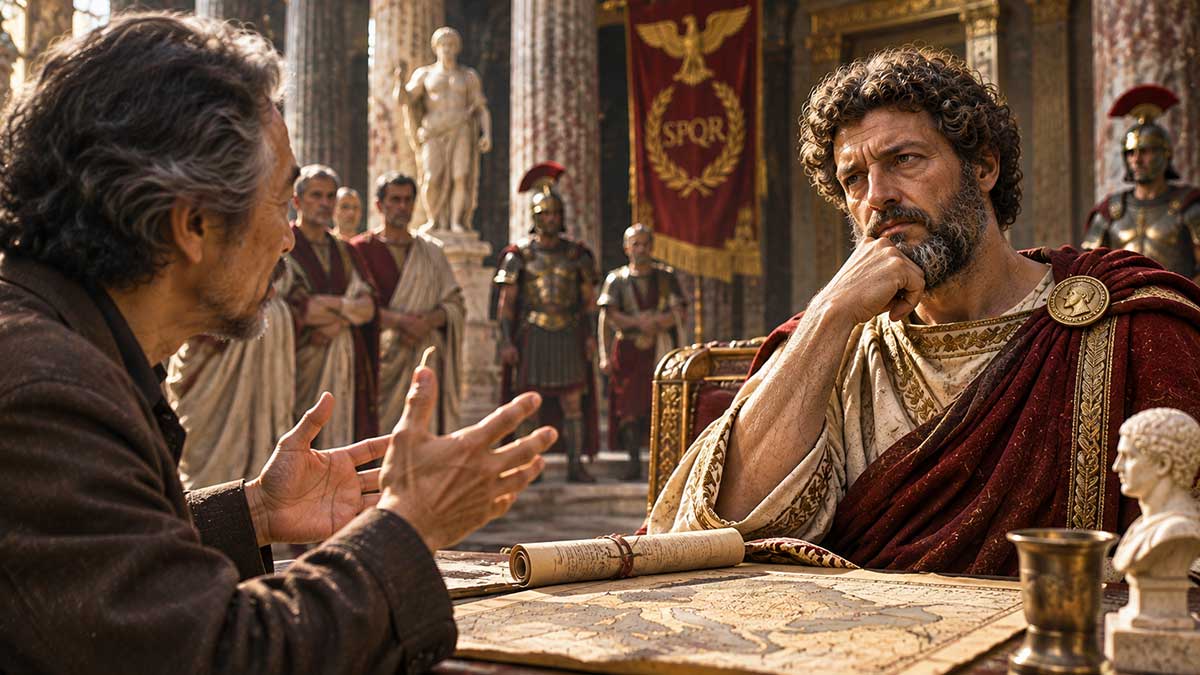
The thoughtful seventeen-year-old who once sat quietly among his philosophy scrolls is now a forty-year-old emperor. Antoninus Pius, his adoptive father and predecessor, died the previous year. Marcus now shares the imperial throne with Lucius Verus, an arrangement that gives Rome two emperors ruling together.
Outside the imperial residence on the Palatine Hill, the capital awakens beneath a pale morning sky. The streets are crowded with merchants, soldiers, senators, laborers, and enslaved people. The city is magnificent, wealthy, and deeply unequal.
Inside the palace, the atmosphere is surprisingly restrained.
Marble columns rise above polished floors. Bronze lamps stand beside carved furniture. A map of the empire stretches across a large wooden table, its borders reaching from Britain to Egypt and from Hispania to the eastern provinces.
Several sealed messages lie beside it. Reports from the eastern frontier describe growing conflict with Parthia. Provincial officials request decisions. Senators seek appointments. Military commanders await instructions.
Every document represents people whose lives may be changed by a few words from the emperor.
Marcus stands near an open window, studying the city below.
He wears a simple white tunic beneath his cloak. His beard has grown fuller, his face more mature. The seriousness that marked his youth remains, but it is now accompanied by the weariness of a man who has discovered that responsibility rarely brings peace.
When Nick Sasaki enters, Marcus turns and smiles.
Marcus Aurelius
Nick. You have returned.
I trust you have been practicing patience with the people who irritate you.
Nick Sasaki
(Laughs.) Marcus, I was hoping you had forgotten that.
Marcus Aurelius
Then you have misunderstood the purpose of our first conversation.
Nick Sasaki
Fair enough.
But look at you now. Last time we met, you were seventeen years old, sitting with your books, worried about becoming a good person.
Now you're emperor of Rome.
You have armies, enormous wealth, and authority over millions of people.
How does that feel?
Marcus Aurelius
Less impressive from this side of the table than you might suppose.
Nick Sasaki
Really?
Marcus Aurelius
Come here.
Marcus gestures toward the map.
Marcus Aurelius
Every province represented here contains people who expect something from me.
Some want protection. Some want justice. Some want favorable appointments. Some want lower taxes. Others want the empire to fight their enemies.
And many of those desires contradict one another.
The map makes the empire appear orderly.
The people living within it are considerably more difficult.
Nick Sasaki
That's a fascinating way to begin.
Last time, we talked about the kind of man you wanted to become.
Today, I want to know what happened when that man received almost unlimited authority.
Question 1. You Ruled Rome. How Did You Stop Power from Corrupting You?
Nick Sasaki
Marcus, let me ask you something directly.
You became one of the most influential men in the world.
People bowed before you. Senators praised you. Soldiers obeyed your commands.
You could make decisions that changed thousands of lives.
How did you stop all that authority from going to your head?
Marcus Aurelius
I did not assume that I could stop it merely through good intentions.
That would have been the first mistake.
Authority changes the behavior of everyone around you.
A man who once heard disagreement begins to hear agreement.
A man whose jokes were once ignored suddenly discovers that everyone finds him amusing.
A man whose opinions were questioned begins to believe that his opinions are unquestionably correct.
If he is not careful, he mistakes the behavior of frightened or ambitious people for evidence of his own wisdom.
Nick Sasaki
That's so true.
People around influential figures often tell them what they want to hear.
Did you have people who could tell you that you were wrong?
Marcus Aurelius
I needed such people.
My adoptive father, Antoninus Pius, provided an example of patient administration. He taught me through his conduct that dignity did not require theatrical displays of superiority.
My teachers, particularly Junius Rusticus, taught me to value correction.
And my correspondence with Fronto reminded me that affection and intellectual disagreement could exist together.
But having good advisers does not automatically make a man willing to hear them.
Nick Sasaki
What do you mean?
Marcus Aurelius
Suppose an adviser tells me that a decision is mistaken.
I may listen calmly.
Or I may become irritated and begin searching for reasons to dismiss his criticism.
I may remind myself that I possess more information than he does.
I may suspect that he has personal motives.
I may even convince myself that defending my pride is the same thing as defending the dignity of the imperial office.
That is how self-deception begins.
Nick Sasaki
So the biggest danger wasn't people lying to you.
It was you lying to yourself.
Marcus Aurelius
Both dangers exist, but the second is more difficult to escape.
You can dismiss a dishonest adviser.
You cannot dismiss yourself.
Nick Sasaki
(Laughs.) That's a good point.
Let me ask you something more personal.
Marcus, you had the authority to do almost anything. You could have enormous banquets, beautiful palaces, entertainment, and people satisfying every desire.
How did you resist becoming completely addicted to pleasure?
Marcus Aurelius
By recognizing that pleasure is a poor master.
There is nothing inherently shameful in enjoying food, friendship, beauty, or rest.
But when pleasure becomes the measure of a good life, the person who pursues it becomes dependent upon circumstances he cannot always control.
He requires better food, greater admiration, more entertainment, and increasingly elaborate distractions.
Eventually, he may possess everything he once desired and still feel dissatisfied.
Nick Sasaki
That sounds exactly like what happens today.
People become successful, make millions of dollars, buy expensive houses, and still want more.
Marcus Aurelius
Then the difficulty is not peculiar to Rome.
A man who cannot recognize when he has enough will discover that no amount is sufficient.
Nick Sasaki
But Marcus, let me challenge you.
It's easy to say wealth doesn't matter when you're already wealthy.
Would you have believed the same thing if you had been born poor?
Marcus Aurelius
I cannot know with certainty.
Poverty imposes hardships that a wealthy philosopher should never dismiss.
Hunger, illness, insecurity, and the inability to provide for one's children are real burdens.
Stoicism does not require us to pretend otherwise.
What I would maintain is that wealth cannot, by itself, make someone just, courageous, wise, or compassionate.
And poverty cannot, by itself, deprive a person of every opportunity to exercise those qualities.
Nick Sasaki
So wealth isn't necessarily bad.
It's what happens to your character when you pursue it.
Marcus Aurelius
And what you do with it when you possess it.
Nick Sasaki
Did you ever become arrogant as emperor?
Marcus Aurelius
Certainly.
There were moments when I became impatient with people who wasted my time.
Moments when I was tempted to regard my judgment as superior simply on account of my position.
Moments when I wanted others to recognize how much responsibility I carried.
Those are not admirable impulses.
Nick Sasaki
But isn't it natural to want appreciation?
You work hard. You make difficult decisions. People criticize you regardless of what you do.
Don't you sometimes want someone to say, "Marcus, you're doing a good job"?
Marcus Aurelius
Of course.
But there is a difference between appreciating gratitude and depending upon it.
If I act justly only when people praise me, my commitment to justice is conditional.
If criticism causes me to abandon what I know is right, then public opinion has become my ruler.
Nick Sasaki
That's interesting.
You're the emperor, but you could still become a slave to other people's opinions.
Marcus Aurelius
A man may command armies and still be governed by his own vanity.
Nick Sasaki
That might be the central contradiction of your life.
You ruled Rome, but you were constantly trying to rule yourself.
Marcus Aurelius
And the second task was often more difficult.
Nick looks at the imperial map. A messenger enters, bows, and places another sealed document on the table. Marcus thanks him and asks that the matter wait until the conversation has finished.
The messenger withdraws.
Nick Sasaki
Even that was interesting.
You thanked him.
Marcus Aurelius
He performed a service.
Nick Sasaki
But you're emperor. You don't have to thank anyone.
Marcus Aurelius
Then it is especially necessary that I remember to do so.
Question 2. Can You Believe in Justice While Ruling an Empire Built on Conquest and Slavery?
Nick Sasaki
Marcus, I want to move into a more difficult subject.
You believed that human beings belong to a common community.
You taught that we should treat others fairly, cooperate, and recognize our shared humanity.
But the Roman Empire was built through conquest.
It depended heavily on enslaved labor.
Its wealth and stability were not shared equally.
How did you reconcile those realities with your philosophy?
Marcus Aurelius
Not as completely as I would have wished.
Nick Sasaki
That's a surprisingly direct answer.
Marcus Aurelius
Would you prefer that I offer a polished defense of every Roman institution?
Nick Sasaki
No. I'd prefer the truth.
Marcus Aurelius
Then we must begin by recognizing that an empire is not identical to the ideals of the man who governs it.
Rome existed long before my reign.
Its laws, customs, armies, economic relationships, and social divisions were inherited.
I could influence those institutions, but I could not simply erase their history.
Yet inheritance does not eliminate moral responsibility.
A ruler must still ask whether the institutions he preserves are just.
Nick Sasaki
But here's my concern.
People often use that argument to avoid responsibility.
They say, "That's just how society works. I didn't create the system."
But if you have the greatest authority in the empire, shouldn't you be the person most responsible for changing it?
Marcus Aurelius
Greater authority brings greater responsibility.
I would not dispute that.
But responsibility must be exercised through judgment about what can actually be accomplished, what consequences will follow, and how people may be harmed by decisions made without sufficient preparation.
Nick Sasaki
That sounds reasonable.
But couldn't it become an excuse for doing nothing?
Marcus Aurelius
Yes.
Prudence can become cowardice when a person invokes difficulty merely to avoid moral action.
That is why the examination of one's motives matters.
Am I declining to act since the action would cause greater harm?
Or am I declining since the action would inconvenience me?
Those are very different reasons.
Nick Sasaki
Let's talk about slavery.
You admired Epictetus, who had once been enslaved.
He became one of the most influential philosophers in your life.
Didn't that make you question the idea that one human being could own another?
Marcus Aurelius
It should make any thoughtful person question the moral assumptions behind such an institution.
Epictetus demonstrated that wisdom was not determined by legal status.
He possessed a degree of moral independence that many socially privileged people never achieve.
That is a serious challenge to the belief that wealth, birth, or political position establishes human worth.
Nick Sasaki
But you didn't abolish slavery.
Marcus Aurelius
No.
Nick Sasaki
Do you consider that a failure?
Marcus Aurelius
From the perspective of a philosophy that recognizes our shared rational nature, there is a profound tension between universal human fellowship and the institution of slavery.
I cannot dissolve that tension merely by pointing to the customs of my age.
Nick Sasaki
I appreciate that.
I don't want to judge every historical person as though they lived in the twenty-first century.
But I don't want to excuse injustice simply since it was common at the time.
Marcus Aurelius
Then you are asking the proper question.
Historical circumstances help explain conduct.
They do not automatically establish its moral goodness.
Nick Sasaki
Let me take this further.
You were part of an empire that conquered other peoples.
Roman soldiers killed enemies, destroyed communities, and brought prisoners into captivity.
How could you believe in human brotherhood and still lead such an empire?
Marcus Aurelius
A ruler has an obligation to protect the people entrusted to him.
When an army attacks Roman territory, threatens communities, or endangers lives, a ruler cannot simply declare that all human beings are brothers and abandon those he has a duty to defend.
But the obligation to protect does not grant unlimited moral permission.
The enemy remains human.
Military necessity does not transform cruelty into virtue.
And victory does not establish that every action taken in pursuit of it was just.
Nick Sasaki
But where do you draw the line?
Every ruler claims that his wars are necessary.
Marcus Aurelius
That is precisely why such claims require scrutiny.
A ruler must examine whether force is genuinely required, whether his aims are defensible, and whether his decisions are being influenced by pride, ambition, or revenge.
And he must recognize that the suffering of people outside his borders is not morally irrelevant.
Nick Sasaki
Do you think you always lived up to those standards?
Marcus Aurelius
No ruler should assume that he has.
And no philosopher should mistake the possession of principles for proof that he has consistently obeyed them.
Nick Sasaki
That makes me wonder about something.
You wrote that human beings are made to cooperate.
Do you think humanity could ever reach a point where people stop dividing themselves into enemies?
Where we begin to see ourselves as one human family?
Marcus Aurelius
I would hope that human beings could grow more conscious of their shared nature.
We are born into different cities, customs, and political communities.
But we possess common needs.
We experience hunger, fear, affection, grief, and the desire to live without unnecessary suffering.
Reason allows us to recognize that another person's humanity does not disappear when he belongs to a different nation.
Nick Sasaki
Then why do we keep fighting?
Marcus Aurelius
Fear.
Ambition.
Competition over resources.
False judgments about honor and superiority.
And the habit of treating the interests of our own group as though they were the only interests that mattered.
Nick Sasaki
Do you think philosophy could change that?
Marcus Aurelius
Philosophy may help individuals recognize their obligations.
But ideas alone do not transform institutions.
They must influence laws, education, habits, and the conduct of those who govern.
A man who praises human brotherhood and then mistreats his servants has not understood the lesson he claims to admire.
Nick Sasaki
That's something I wish every world leader could hear.
Marcus Aurelius
Then begin with yourself, Nick.
Nick Sasaki
(Laughs.) You really enjoy doing that.
Marcus Aurelius
You ask how humanity might become one family.
I ask how you treat the people who are already part of your life.
The larger ideal begins with the smaller responsibility.
For a moment, neither man speaks.
Beyond the window, Rome stretches into the distance, a city of extraordinary achievements and profound inequalities.
The emperor looks down at the streets below, where people of every social position move through the same morning sunlight.
Question 3. Did Stoicism Make You Truly Happy, or Simply Better at Hiding Your Feelings?
Nick Sasaki
Marcus, I want to ask something very personal.
You've talked about discipline, duty, justice, and responsibility.
But I keep wondering about your happiness.
You had everything people think they want.
Wealth. Recognition. Authority. A family. The ability to influence history.
Were you happy?
Marcus Aurelius
At times, yes.
But I suspect you and I are using the word differently.
Nick Sasaki
What do you mean?
Marcus Aurelius
If happiness means uninterrupted pleasure, then no human being can reasonably expect to possess it.
Our circumstances change.
People disappoint us.
Our bodies become ill.
Those we love are mortal.
And our plans frequently fail.
A life dependent upon the absence of difficulty will always be vulnerable.
Nick Sasaki
Then what did happiness mean to you?
Marcus Aurelius
To live in accordance with reason and virtue.
To act justly when injustice would be convenient.
To remain truthful when deception might bring advantage.
To fulfill my responsibilities without becoming consumed by resentment.
And to recognize that my worth as a human being did not depend entirely upon the outcome of events beyond my control.
Nick Sasaki
But that sounds more like being a good person than being happy.
Marcus Aurelius
Perhaps the distinction is not as sharp as you suppose.
A person who possesses wealth but continually betrays his conscience may experience pleasure without peace.
A person who faces hardship yet acts according to his deepest moral convictions may possess a form of fulfillment that pleasure alone cannot provide.
Nick Sasaki
I can see that.
But what about love?
Your wife, Faustina. Your children.
Did you enjoy spending time with them?
Did you laugh together?
Did you have moments when you forgot about the empire and were simply a husband and father?
Marcus Aurelius
Yes.
Affection is not an enemy of philosophy.
A child's laughter can bring delight.
A conversation with one's wife can provide comfort.
A quiet meal shared with family can remind a man that life contains goods no imperial title can supply.
Nick Sasaki
That's the Marcus I want people to meet.
Not just the philosopher telling everyone to control their emotions.
The father who loves his children.
Marcus Aurelius
Then do not separate those identities too completely.
The same philosophy that asks me to govern my anger should help me become a more patient father.
The same commitment to justice that guides public decisions should influence how I treat my wife, my children, and the people who serve in my household.
If philosophy makes a man less compassionate, he should question whether he has understood it.
Nick Sasaki
Let me challenge you with something people often say about Stoicism.
They say Stoics don't really deal with their emotions.
They just suppress them.
They pretend not to feel pain.
Is that what you were doing?
Marcus Aurelius
No.
But I recognize how such a misunderstanding could arise.
When I speak of governing anger, I do not mean that the first sensation of anger can always be prevented.
A sudden insult may disturb us.
A frightening event may cause the body to react before reason has examined the situation.
The question is whether we accept the judgments that follow.
Must an insult become a reason for revenge?
Must fear become a reason for cowardice?
Must grief become a reason to abandon every remaining responsibility?
Nick Sasaki
But what if you need to cry?
Marcus Aurelius
Then tears may come.
The mere presence of tears does not establish moral failure.
What matters is whether our response to suffering remains consistent with wisdom, justice, and care for others.
Nick Sasaki
That's different from the way many people describe Stoicism today.
They make it sound like you're supposed to become emotionally invincible.
Marcus Aurelius
Invincibility is a dangerous ambition.
A human being who believes himself incapable of suffering may become indifferent to the suffering of others.
I would prefer to become more capable of responding well to pain, not less capable of recognizing it.
Nick Sasaki
Marcus, can I ask you something uncomfortable?
Marcus Aurelius
You have been doing so for most of the morning.
Nick Sasaki
(Laughs.) Fair enough.
Did you ever use philosophy to avoid facing your own feelings?
Maybe you were angry or hurt, and instead of admitting it, you told yourself that a wise man shouldn't feel that way.
Marcus Aurelius
I suspect that danger exists for anyone who studies philosophy.
A man can turn even a noble teaching into a defense against self-examination.
He may tell himself that he is calm when he is merely refusing to acknowledge resentment.
He may claim to have accepted a loss when he has simply avoided thinking about it.
He may praise self-control when what he truly fears is appearing vulnerable.
Nick Sasaki
Did that happen to you?
Marcus Aurelius
I cannot claim to have been free of it.
My repeated reminders about anger, impatience, and the need for self-correction suggest that these were not difficulties I had permanently overcome.
Nick Sasaki
That's what I find so interesting about your Meditations.
You weren't writing a book telling everyone else how to live.
You were writing reminders to yourself.
Almost like you were saying, "Marcus, don't lose your temper today. Don't become arrogant. Don't waste your life."
Marcus Aurelius
That is a reasonable way to describe the practice.
A person who has completely mastered a lesson has less need to repeat it.
Nick Sasaki
So the fact that you kept writing about patience suggests that patience was still difficult for you.
Marcus Aurelius
Yes.
Nick Sasaki
And the fact that you kept writing about death suggests that mortality still troubled you.
Marcus Aurelius
It certainly deserved my attention.
Nick Sasaki
Then here's what I really want to know.
Did you ever reach a point where you felt completely at peace with yourself?
Where you could say, "I've become the person I wanted to be"?
Marcus turns from the window.
For the first time during the conversation, he appears reluctant to answer immediately.
Marcus Aurelius
There were moments of peace.
Moments when I believed I had acted properly, fulfilled a responsibility, or resisted an impulse that might have led me astray.
But I would distrust the claim that I had completed the work of becoming a good person.
Nick Sasaki
Why?
Marcus Aurelius
Since the next day always arrives.
And with it comes another opportunity to become impatient, proud, frightened, selfish, or unjust.
A good decision yesterday does not guarantee a good decision tomorrow.
Nick Sasaki
That sounds like a lifelong struggle.
Marcus Aurelius
It is.
Nick Sasaki
Doesn't that ever discourage you?
Marcus Aurelius
At times.
But consider how you approach learning any difficult skill.
You do not expect to become proficient through a single lesson.
You practice.
You recognize mistakes.
You correct them.
And gradually your habits improve.
Why should the cultivation of character require less effort than learning to speak, write, or govern?
Nick Sasaki
That's a good point.
But I want to return to happiness one last time.
If you could speak to someone today who has spent their entire life chasing success, what would you tell them?
Someone who believes, "Once I make enough money, once I become famous, once I achieve my goals, then I'll finally be happy."
Marcus Aurelius
I would ask that person what happens if the desired success arrives and the mind remains dissatisfied.
Will he pursue another achievement?
Another possession?
Another form of recognition?
And when will he begin practicing the qualities that make a life worth living?
Nick Sasaki
So you wouldn't tell him to stop pursuing success?
Marcus Aurelius
Not necessarily.
There is nothing inherently wrong with developing a skill, building a useful enterprise, or achieving something valuable.
But I would ask him to examine the purpose of his efforts.
Does he seek wealth to provide for others and contribute something worthwhile?
Or does he seek wealth to prove that he is superior?
Does he desire recognition for work that serves a genuine purpose?
Or has recognition itself become the purpose?
The outward achievement may be similar.
The character expressed through it may be entirely different.
Nick Sasaki
I think that distinction matters enormously.
We spend so much time asking whether we're successful.
We rarely ask whether our success is making us better people.
Marcus Aurelius
Then perhaps you have discovered a useful question to carry home.
Nick Sasaki
You know what I find remarkable, Marcus?
You have the highest position in Rome.
And yet, after talking with you, I don't get the impression that you feel you've arrived anywhere.
You're still questioning yourself.
Still trying to become more patient.
Still trying to understand justice.
Still trying to figure out what happiness really means.
Marcus Aurelius
Would you prefer an emperor who believed he had nothing left to learn?
Nick Sasaki
(Laughs.) Definitely not.
Marcus Aurelius
Then perhaps the awareness of one's imperfections is not evidence of failure.
It may be the beginning of wisdom.
Closing Scene: The Emperor and the Man in the Mirror
The morning light has shifted across the imperial chamber.
Beyond the palace walls, Rome continues its relentless activity. Officials hurry between government buildings. Soldiers prepare for duty. Merchants negotiate in crowded markets. Families gather around tables in homes both wealthy and poor.
Inside the palace, the documents awaiting Marcus have multiplied.
The emperor walks back to the wooden table and lifts a sealed message.
Nick Sasaki
Marcus, before I leave, I want to ask one final question.
When people look at you, they see an emperor.
When you look at yourself, what do you see?
Marcus considers the question.
Marcus Aurelius
A human being entrusted with responsibilities he must try to fulfill.
A husband.
A father.
A student of philosophy.
A man capable of both good judgment and serious error.
And someone who will eventually die, just like every person whose life he governs.
Nick Sasaki
Does remembering death make your authority seem less important?
Marcus Aurelius
It reminds me that authority is temporary.
And that I should use the time available to me responsibly.
Nick Sasaki
What would you want people to say about you after you're gone?
Marcus Aurelius
I would hope that those who knew me found me just, truthful, and willing to correct my mistakes.
But their opinions will no longer be mine to control.
My task is to live properly now.
Nick Sasaki
Marcus, I think the world could use more leaders who think that way.
Marcus Aurelius
Then let us hope that the world produces more people who demand such conduct from themselves, not merely from their leaders.
Nick Sasaki
(Laughs.) There you go again.
Marcus Aurelius
It is a habit I am trying to cultivate.
Nick smiles and turns toward the doorway.
Before leaving, he glances once more at the enormous map of the Roman Empire.
Its borders stretch across continents. Its cities contain countless lives. Its armies stand ready to fight.
And at the center of it all stands a man who understands that his greatest danger may not come from an enemy beyond Rome's borders.
It may come from his own pride, anger, fear, or desire for admiration.
The emperor returns to his documents.
Another messenger enters.
Another decision awaits.
And somewhere far to the east, Roman forces are preparing for a conflict that will test the philosophy Marcus has spent his life studying.
The man who believes human beings were made to cooperate will soon face the terrible realities of war.
And Nick's next question will be one Marcus cannot answer with philosophy alone.
How can a man who believes in justice and human brotherhood command armies that kill?
That question awaits us on the northern frontier.
Fictional interview disclaimer: This conversation is an imaginative reconstruction inspired by the life, Stoic philosophy, and historical reign of Marcus Aurelius. Nick Sasaki's questions and Marcus's responses are fictional, not historical transcripts or direct quotations. The setting reflects Marcus's early reign, when he shared imperial authority with Lucius Verus and Rome faced growing conflict with Parthia. The dialogue's reflections on slavery, justice, emotional discipline, and happiness are interpretive explorations rather than documented statements by Marcus.
Topic 3. The Philosopher Who Preached Human Brotherhood but Fought Wars
The Danube Frontier, AD 172: When Philosophy Meets the Battlefield
The northern frontier of the Roman Empire. Autumn, AD 172.
Ten years have passed since Nick Sasaki last sat with Marcus Aurelius in the imperial palace on Rome's Palatine Hill.
The world surrounding the emperor has changed.
The Antonine Plague has swept through the empire, claiming countless lives and weakening communities already burdened by war. Lucius Verus, Marcus's fellow emperor, died in AD 169. Germanic and Sarmatian peoples have threatened Roman territory, and fighting has spread across the Danube frontier.
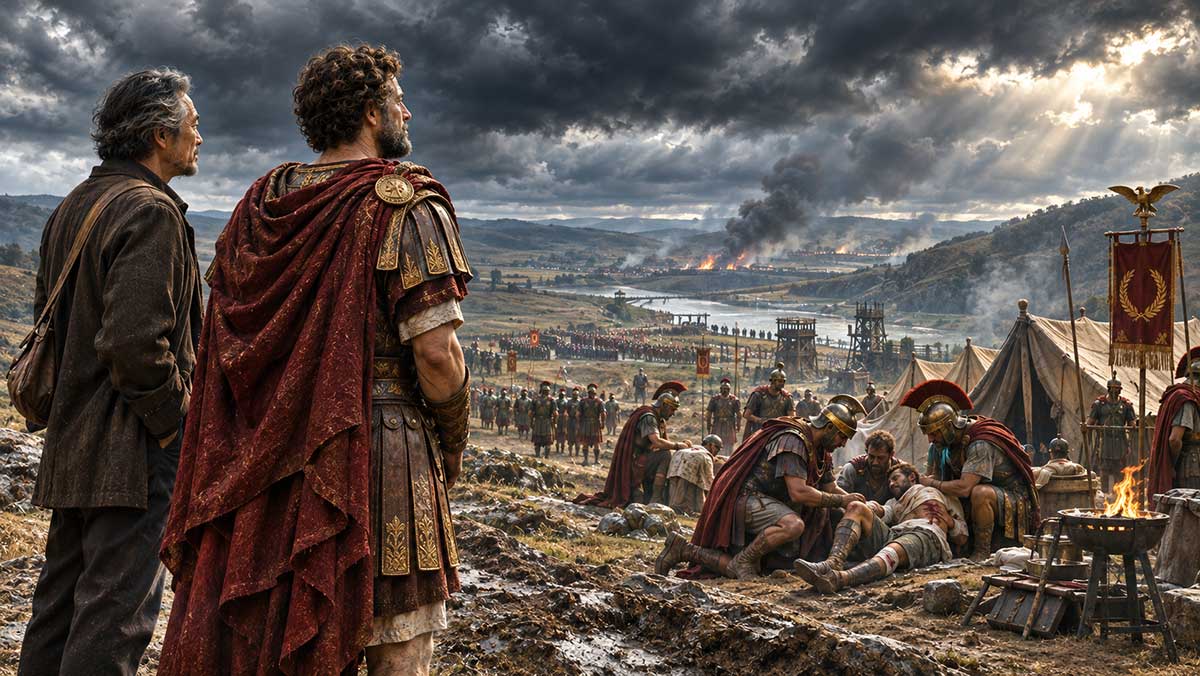
Marcus, now fifty-one years old, has exchanged the marble halls of Rome for the cold, muddy camps of the Roman army.
The morning sky is gray. A bitter wind moves across the open plain, carrying the smell of wet earth, wood smoke, horses, and leather.
Rows of military tents stretch beyond a defensive ditch. Soldiers repair equipment, sharpen blades, tend wounded comrades, and prepare for another day of uncertainty.
Some men speak quietly around small fires. Others sit alone, staring at the ground.
In the distance, a funeral procession moves between the tents.
The dead are being carried away.
Inside a command tent, Marcus Aurelius sits before a rough wooden table covered with maps, military reports, and correspondence from Rome.
His face is thinner than Nick remembers. His beard is streaked with gray. The emperor who once spoke calmly about the dangers of vanity now carries the visible exhaustion of a man who has spent years confronting suffering he cannot simply reason away.
A military cloak hangs from his shoulders. Beside him rests a small writing tablet.
When Nick enters, Marcus looks up.
Marcus Aurelius
Nick.
You have chosen a less comfortable place for our third conversation.
Nick Sasaki
Marcus, I hardly recognized you.
The last time we met, you were surrounded by marble columns and beautiful gardens.
Now you're living in a military camp.
Marcus Aurelius
Rome's borders do not defend themselves.
Nick Sasaki
You look tired.
Marcus Aurelius
I am.
Nick Sasaki
That's a very honest answer.
Marcus Aurelius
Fatigue does not disappear when one refuses to acknowledge it.
Nick Sasaki
(Laughs softly.) You're still the same philosopher.
Marcus Aurelius
I hope I have learned something since our last meeting.
But I fear I have been given more opportunities to practice than I would have chosen.
A horn sounds beyond the tent. Marcus pauses until the noise fades.
Nick Sasaki
I saw soldiers carrying bodies outside.
Marcus Aurelius
Some died from wounds. Others from illness.
War and disease have little concern for our plans.
Nick Sasaki
And you're responsible for all these men.
Marcus Aurelius
I am responsible for decisions that affect them.
That is not the same as possessing control over their fate.
Nick Sasaki
That's exactly what I want to talk about today.
You taught that human beings should cooperate, that anger corrupts judgment, and that justice is one of our highest responsibilities.
Yet here you are, commanding armies.
How do those two sides of your life fit together?
Marcus looks down at the map.
Marcus Aurelius
Not comfortably, Nick.
Not comfortably at all.
Question 1. How Could You Teach Human Brotherhood and Still Command Armies?
Nick Sasaki
Marcus, I want to begin with the contradiction that troubles me most.
You believed human beings were born to cooperate.
You taught that we share a common rational nature, that we should treat one another justly, and that we shouldn't become consumed by hatred.
But you were the emperor of Rome.
Your soldiers fought battles, killed enemies, and occupied territories.
How could you believe in human brotherhood and still command armies?
Marcus Aurelius
I would begin by asking you a question.
If armed men entered your home and threatened your children, what would you do?
Nick Sasaki
I would protect my family.
Marcus Aurelius
And if protecting them required force?
Nick Sasaki
I would use whatever force was necessary.
But there's a difference between defending your home and ruling an empire that has conquered other peoples.
Marcus Aurelius
There is.
And we should not pretend otherwise.
An empire inherits a history of expansion, political ambition, and violence.
Some wars may be fought to defend communities from immediate danger.
Others may arise from pride, greed, fear, or the desire to dominate.
The mere fact that an emperor commands an army does not establish that every campaign is just.
Nick Sasaki
Then how did you decide whether a war was justified?
Marcus Aurelius
I had to consider the danger facing Roman communities, the security of the frontiers, the consequences of inaction, and the suffering that military action would produce.
But such judgments are rarely simple.
A decision that protects one community may expose another to danger.
A campaign intended to prevent further attacks may produce suffering among people who did not choose the conflict.
A victory may create new grievances that lead to another war.
Nick Sasaki
That sounds like an endless cycle.
Marcus Aurelius
It can become one.
Nick Sasaki
So why not stop fighting?
Why not negotiate with the Germanic tribes and find a peaceful arrangement?
Marcus Aurelius
Negotiation is preferable when it can produce a just and stable peace.
But agreements require some confidence that their terms will be respected.
The frontier contains many peoples, leaders, and competing interests. There is no single voice with whom Rome can settle every dispute.
Nor is Rome innocent of creating grievances through its own conduct.
Nick Sasaki
I appreciate you acknowledging that.
But let me push you further.
When Roman soldiers cross the Danube, the people living there might see you as the invader.
They have families, homes, and children too.
Do you think about them?
Marcus Aurelius
I must.
If I cease to recognize their humanity, I have abandoned one of the central principles I claim to follow.
The fact that someone stands against Rome does not make his suffering meaningless.
Nick Sasaki
But your soldiers still kill them.
Marcus Aurelius
Yes.
And no philosophical argument should make us speak lightly about that reality.
Nick Sasaki
Doesn't that make you question your own philosophy?
Marcus Aurelius
It makes me question whether I am living according to it.
There is a difference.
A principle does not become false merely since its followers fail to honor it.
But those followers must not use the principle as a decoration that conceals their conduct.
Nick Sasaki
That's a strong answer.
Still, I wonder whether there's something deeper.
Maybe the problem isn't that human beings don't know how to cooperate.
Maybe the problem is that we care more about our own people than other people.
Romans care about Romans.
Germanic tribes care about their own communities.
Everyone believes they're defending their families.
And somehow, everyone ends up killing one another.
Marcus Aurelius
You have identified one of the greatest difficulties in human affairs.
Our natural affection begins with those closest to us.
We love our children, our families, our neighbors, and our communities.
There is nothing wrong with that affection.
The danger arises when we conclude that people beyond those circles possess no claim upon our justice.
Nick Sasaki
So how do we overcome that?
Marcus Aurelius
By widening the circle of our concern without abandoning the responsibilities nearest to us.
A father should care for his children.
A magistrate should serve his city.
An emperor must protect those entrusted to his government.
But none of these obligations requires him to believe that outsiders are less than human.
Nick Sasaki
That sounds like the beginning of a philosophy of world peace.
Marcus Aurelius
Perhaps.
But peace requires more than affection expressed in beautiful words.
It requires restraint when we are angry.
Fairness when we possess an advantage.
A willingness to recognize the legitimate needs of others.
And the courage to reject opportunities for domination when they violate justice.
Nick Sasaki
Let me ask you something very personal.
Have you ever looked at an enemy soldier and wondered what kind of man he was before the war?
Maybe he was a father.
Maybe he loved his wife.
Maybe he wanted nothing more than to return home.
Marcus Aurelius
Such thoughts are necessary if one wishes to avoid becoming cruel.
But I must distinguish what I know from what I can only suppose.
I cannot know the private life of every man who opposes us.
Yet I know enough about human nature to recognize that our enemies are not merely objects placed before Roman weapons.
Nick Sasaki
Then here's a difficult question.
Suppose you could speak directly to the leader of an opposing army.
What would you say?
Marcus Aurelius
I would ask what he truly seeks.
Security?
Land?
Revenge?
Recognition?
The survival of his people?
And I would ask whether the destruction of another community is genuinely necessary to achieve those aims.
Nick Sasaki
What if he asked you the same question?
Marcus Aurelius
Then I should answer it.
Nick Sasaki
Would you admit that Rome might be wrong?
Marcus Aurelius
If the evidence required that conclusion, yes.
An emperor who believes Rome incapable of injustice is not qualified to judge its actions.
Nick Sasaki
Marcus, I wish I could bring every world leader into this tent and make them answer those questions.
Marcus Aurelius
Then you would discover that recognizing a good principle is easier than accepting its demands.
Nick Sasaki
Do you believe war will ever disappear?
Marcus Aurelius
I cannot predict that.
Human beings possess reason, but they are capable of fear, ambition, resentment, and mistaken judgments.
I would hope that societies could learn to resolve more disputes without violence.
But hope is not a substitute for the difficult work required to make peace possible.
Nick Sasaki
So you haven't given up on humanity?
Marcus Aurelius
No.
If I had abandoned the belief that human beings could act more wisely, I would have little reason to continue studying philosophy.
Outside, a group of soldiers passes the tent. One supports a younger man whose arm is wrapped in bloodstained linen.
Nick watches them disappear into the camp.
Nick Sasaki
Marcus, those men are the ones who pay the price for these decisions.
Marcus Aurelius
Yes.
And an emperor should never forget it.
Question 2. Did You Ever Lose Control of Your Anger, Fear, or Despair?
Nick Sasaki
Marcus, I want to talk about something people rarely associate with you.
Fear.
You wrote so much about controlling our judgments, resisting anger, and accepting what we cannot change.
But here you are, surrounded by war, disease, and death.
Were you ever afraid?
Marcus Aurelius
Certainly.
Nick Sasaki
Of what?
Marcus Aurelius
Of making decisions that would lead to unnecessary deaths.
Of receiving news that another frontier had been breached.
Of discovering that disease had spread through a community we could not adequately protect.
Of failing people who depended upon my judgment.
Nick Sasaki
Were you afraid of dying?
Marcus Aurelius
I knew that death was possible.
But I would distinguish the natural awareness of danger from allowing fear to govern every decision.
A man may recognize that his life is at risk without concluding that survival is the highest good.
Nick Sasaki
That sounds almost impossible.
If someone told me I might die tomorrow, I think I'd be terrified.
Marcus Aurelius
Then you would be experiencing a very human reaction.
The question is what follows.
Would fear cause you to abandon someone who needed your help?
Would it persuade you to betray a friend?
Would it lead you to act unjustly toward another person?
The first movement of fear may arise without our consent.
Our subsequent judgments and choices deserve examination.
Nick Sasaki
But isn't fear sometimes useful?
It keeps us alive.
Marcus Aurelius
The recognition of danger is useful.
Panic that destroys judgment is not.
A soldier who recognizes an approaching threat can prepare.
A soldier overwhelmed by terror may become unable to act.
The goal is not ignorance of danger.
It is the ability to respond to danger intelligently.
Nick Sasaki
What about anger?
You wrote repeatedly about how destructive anger can be.
But surely you've been furious with people.
Military commanders make mistakes.
Officials betray your trust.
Soldiers disobey orders.
Enemies attack Roman towns.
Did you ever lose your temper?
Marcus Aurelius
I have experienced anger.
And I have sometimes been dissatisfied with the way I responded to it.
Nick Sasaki
Can you give me an example?
Marcus Aurelius
I would rather not invent a particular incident merely to make my answer more dramatic.
But I can describe the temptation.
When someone fails in a duty, my first impulse may be irritation.
I may think of the time wasted, the danger created, or the disrespect implied.
Then I must ask whether my anger is helping me judge the situation.
Was the failure caused by dishonesty?
Ignorance?
Exhaustion?
Misunderstanding?
Or circumstances the person could not control?
The proper response depends upon the answer.
Nick Sasaki
So you're saying anger can make us stop asking questions.
Marcus Aurelius
It often persuades us that we already know the answers.
Nick Sasaki
That's a great observation.
Sometimes when I'm angry, I'm absolutely convinced I'm right.
Then a few hours later, I realize I misunderstood the entire situation.
Marcus Aurelius
That is a common human experience.
Anger frequently supplies certainty before reason has supplied evidence.
Nick Sasaki
But Marcus, what if someone does something truly evil?
What if a commander deliberately orders the killing of innocent people?
Shouldn't you be angry?
Marcus Aurelius
You should recognize the injustice and act to prevent or correct it.
But anger is not the same thing as moral seriousness.
A judge who acts from hatred may punish excessively.
A commander seeking revenge may endanger people who were not responsible.
Justice requires firmness, but it does not require cruelty.
Nick Sasaki
That's difficult.
Sometimes anger feels like the only proper response to injustice.
Marcus Aurelius
It may feel that way.
But ask yourself whether the anger is making you more effective at protecting the innocent.
If it is clouding your judgment, encouraging vengeance, or making you indifferent to suffering, then it has become an obstacle to the very justice you seek.
Nick Sasaki
Let me ask you something about how you trained your mind.
Marcus, modern people often talk about mental training.
Meditation, breathing exercises, cold exposure, physical discipline.
Did you have a daily practice that helped you stay mentally strong?
Marcus Aurelius
I practiced examining my judgments.
I reminded myself that difficult people would appear in my day.
I reflected upon the temporary nature of life.
I considered my duties and the qualities required to fulfill them.
And when I recognized a failure in my conduct, I tried to correct it rather than defend it.
Nick Sasaki
Did you do that every morning?
Marcus Aurelius
I cannot claim that every day followed an identical routine.
But regular philosophical reflection was important to me.
A mind left entirely to habit may repeat the same errors without recognizing them.
Nick Sasaki
What did you do on days when you felt completely exhausted?
When you didn't want to get out of bed?
Marcus Aurelius
I reminded myself that I had responsibilities appropriate to a human being.
But I would not claim that exhaustion is imaginary or that the body requires no rest.
A person who refuses necessary rest may become less capable of fulfilling his duties.
Discipline must be guided by reason, not vanity.
Nick Sasaki
That's interesting.
Some people today think discipline means pushing yourself constantly, no matter what.
Marcus Aurelius
Then they risk turning discipline into another form of pride.
Nick Sasaki
Marcus, I want to ask something more serious.
The plague has killed enormous numbers of people.
Your fellow emperor Lucius Verus is dead.
You're surrounded by suffering.
Did you ever feel despair?
Did you ever wonder whether all your efforts were pointless?
Marcus is silent for several moments.
Marcus Aurelius
There were times when the scale of suffering exceeded anything I could remedy.
That is a difficult experience for a ruler.
You receive reports of illness, hunger, military losses, and families displaced by conflict.
You issue instructions.
You allocate resources.
You consult advisers.
And still, people suffer.
Nick Sasaki
How do you live with that?
Marcus Aurelius
By recognizing the difference between responsibility and omnipotence.
I am responsible for using my judgment and authority as wisely as I can.
I am not capable of preventing every death or correcting every injustice.
If I confuse responsibility with complete control, I will either become consumed by despair or begin pretending that my decisions cannot fail.
Neither response serves the people who depend upon me.
Nick Sasaki
But emotionally, how do you accept that?
Marcus Aurelius
Not through a single moment of insight.
Acceptance must be practiced.
Sometimes repeatedly.
Sometimes after the same painful thought returns many times.
Nick Sasaki
So even Marcus Aurelius had to keep reminding himself?
Marcus Aurelius
Especially Marcus Aurelius.
Nick Sasaki
(Laughs softly.) I appreciate that.
I think people sometimes look at philosophers as though they've solved life.
But you're telling me that knowing the right thing doesn't mean you always feel the right thing.
Marcus Aurelius
Knowledge and habit are not identical.
A man may understand that anger is harmful and still become angry.
He may recognize that death is natural and still grieve.
He may believe that justice is essential and still be tempted by convenience.
Philosophy begins with recognizing these difficulties.
It continues through the effort to respond to them more wisely.
Nick Sasaki
Then maybe courage isn't the absence of fear.
Maybe it's doing what you believe is right when you're afraid.
Marcus Aurelius
That is a reasonable description.
But courage must be joined with wisdom and justice.
A reckless man may face danger without fear.
That does not automatically make his conduct admirable.
Nick Sasaki
I think I understand.
The wind presses against the canvas walls. Marcus reaches for his cloak and draws it more closely around his shoulders.
For a moment, the emperor looks older than his fifty-one years.
Question 3. What Did War Teach You About Human Nature, Forgiveness, and Peace?
Nick Sasaki
Marcus, I want to ask you something that may be the most difficult question of our conversation.
After years of war, what have you learned about human beings?
Are we naturally good?
Naturally violent?
Or something in between?
Marcus Aurelius
I believe human beings possess the capacity for reason and cooperation.
But possessing a capacity does not guarantee that we will exercise it well.
Fear can distort judgment.
Ambition can make cruelty appear necessary.
Pride can transform a minor insult into a prolonged conflict.
And loyalty to one's own community can become an excuse for treating outsiders unjustly.
Nick Sasaki
Do you think people are born that way?
Marcus Aurelius
We are born with capacities that develop through education, habit, and circumstance.
A child learns from the behavior of those around him.
A young soldier may be taught that courage requires hatred of the enemy.
A ruler may be taught that mercy demonstrates weakness.
Such beliefs can become deeply rooted.
But they can be questioned.
Nick Sasaki
Have you ever met an enemy you respected?
Marcus Aurelius
I have encountered opponents whose courage and determination deserved recognition.
But respect for courage does not mean approval of every cause in which it is exercised.
A man may be brave and mistaken.
He may be loyal to his people and unjust toward others.
Human character is rarely captured by a single quality.
Nick Sasaki
That's true.
Sometimes we divide people into heroes and villains.
But real people are more complicated.
Marcus Aurelius
And that habit of simplification becomes particularly dangerous during war.
If you convince yourself that every enemy is entirely wicked, almost any action against him can begin to seem acceptable.
Nick Sasaki
Marcus, I want to ask about forgiveness.
Suppose someone betrayed you.
Not just insulted you, but truly betrayed your trust.
Could you forgive that person?
Marcus Aurelius
I would try to distinguish forgiveness from the abandonment of justice.
A person who has committed a serious wrong may need to be restrained or held accountable.
But I need not cultivate hatred in order to recognize wrongdoing.
Nick Sasaki
So forgiveness doesn't mean letting someone get away with everything.
Marcus Aurelius
Correct.
It means refusing to make revenge the governing purpose of one's actions.
Nick Sasaki
But what if the person who betrayed you never apologizes?
Marcus Aurelius
Then the absence of an apology does not require me to surrender my own judgment to resentment.
I may still need to protect others from that person's conduct.
But I need not allow hatred to determine who I become.
Nick Sasaki
That's a difficult lesson.
Marcus Aurelius
The most useful lessons often are.
Nick Sasaki
I want to ask you about something that hasn't happened yet in this conversation's timeline.
In a few years, one of your own generals, Avidius Cassius, will rebel against you.
He will claim imperial authority.
And you'll face the possibility of civil war.
What do you think a philosopher should do when betrayed by someone who once served him?
Marcus Aurelius
You have told me of a future event, Nick.
I cannot pretend to possess knowledge of it at this moment.
But I can tell you the principle I would hope to follow.
I should protect the commonwealth.
I should examine the facts before condemning people.
I should avoid allowing personal humiliation to become a reason for cruelty.
And if peace could be restored without unnecessary bloodshed, that would be preferable to vengeance.
Nick Sasaki
Would you want the man executed?
Marcus Aurelius
I would want justice to be guided by reason rather than anger.
The appropriate judgment would depend upon the circumstances.
But I would be deeply concerned if the desire to punish became more important than the welfare of the people affected.
Nick Sasaki
You know, history will remember your response to that rebellion as one of the most revealing episodes of your reign.
Marcus Aurelius
Then I hope history will examine what actually happened rather than merely what later writers wished to believe.
Nick Sasaki
That's a fair warning.
Let me ask something bigger.
If you could speak to the rulers of every nation today, what would you tell them about war?
Marcus Aurelius
I would ask them to remember that the people affected by their decisions are not abstractions.
A border on a map may be drawn with a line.
But the land beneath it contains homes, farms, children, and families.
A military report may describe losses through numbers.
But each number represents a human life.
A ruler should be suspicious of anyone who speaks enthusiastically about war without acknowledging its suffering.
Nick Sasaki
That's a strong message.
But how do we actually create peace?
People have been fighting for thousands of years.
Religion, territory, resources, pride, revenge.
It never seems to end.
Marcus Aurelius
Peace requires several things.
It requires people capable of restraining their anger.
It requires institutions that can resolve disputes fairly.
It requires leaders willing to recognize limits upon their ambitions.
And it requires communities to acknowledge that their own security cannot always be achieved through the humiliation of others.
Nick Sasaki
Do you believe people can learn to see one another as members of the same human family?
Marcus Aurelius
I believe they can learn to recognize their common nature.
But recognition must influence conduct.
It is easy to say that humanity is one community.
It is more difficult to treat a stranger's suffering as worthy of concern.
It is more difficult still when that stranger belongs to a people whom your own society calls an enemy.
Nick Sasaki
Then maybe that's the real test.
Not how we treat people who agree with us.
But how we treat people we fear, dislike, or consider enemies.
Marcus Aurelius
Yes.
A person's commitment to justice is tested most severely when justice requires restraint toward someone he does not love.
Nick Sasaki
Marcus, can I ask one final question?
Marcus Aurelius
Of course.
Nick Sasaki
After everything you've seen, the plague, the battles, the suffering, the deaths of your friends and soldiers, do you still believe human beings are fundamentally capable of goodness?
Marcus looks toward the entrance of the tent.
Outside, a young soldier kneels beside an injured companion, helping him drink from a small cup.
The emperor watches them for several moments.
Marcus Aurelius
Look at those two men.
One is wounded.
The other has chosen to help him.
Neither act of kindness nor suffering is unusual in this camp.
War reveals terrible things about human beings.
But it can reveal generosity, courage, loyalty, and compassion as well.
The existence of cruelty does not erase the existence of goodness.
Nick Sasaki
So you still have hope.
Marcus Aurelius
I still believe that our choices matter.
Hope without action is insufficient.
But action without any belief in the possibility of improvement becomes difficult to sustain.
Nick Sasaki
That's beautiful.
Marcus Aurelius
Then let us hope it becomes useful.
Closing Scene: The Emperor Who Could Not Command Peace
The conversation has lasted longer than Marcus intended.
Outside, the afternoon light has begun to fade. Smoke rises from cooking fires, and soldiers gather around their evening meals.
An officer approaches the entrance and waits for permission to enter.
Roman Officer
Caesar, the commanders are ready for the evening council.
Marcus Aurelius
Tell them I will join them shortly.
The officer bows and withdraws.
Nick Sasaki
Another meeting?
Marcus Aurelius
Another set of decisions.
Nick Sasaki
Marcus, before you go, I want to tell you something.
When I first came here, I thought I was going to interview a philosopher who had somehow found the secret to staying calm in the middle of chaos.
But now I see something different.
You're a man who is surrounded by suffering, and you're trying not to let that suffering turn you into someone cruel.
Marcus Aurelius
That is a task worth attempting.
Nick Sasaki
Do you ever wish you could simply stop being emperor?
Go home, sit with your family, and forget about the empire?
Marcus Aurelius
There are moments when a quiet life appears deeply attractive.
But wishing for different circumstances does not remove the responsibilities of the present.
Nick Sasaki
And what if you fail?
What if you make the wrong decision tomorrow?
Marcus Aurelius
Then I must acknowledge the error, correct what can be corrected, and continue.
Nick Sasaki
Even if people hate you for it?
Marcus Aurelius
Their hatred would not make an unjust decision right.
Nor would their praise make it right.
Nick Sasaki
I think that's what makes your philosophy so difficult.
You can't blame other people for the person you become.
Marcus Aurelius
You remain responsible for your own judgments and actions, Nick.
That responsibility can be burdensome.
But it is part of what makes moral improvement possible.
Marcus reaches for the small writing tablet beside his maps.
Nick Sasaki
Are you going to write about our conversation?
Marcus Aurelius
Perhaps.
But not for an audience.
Nick Sasaki
Then who are you writing for?
Marcus Aurelius
For the man who must wake tomorrow and try again.
Nick smiles.
He extends his hand, and Marcus takes it.
Nick Sasaki
Thank you, Marcus.
I hope one day you find the peace you've been fighting so hard to protect.
Marcus Aurelius
Peace is not always something a ruler can command.
But he can refuse to make unnecessary suffering his aim.
And he can continue the work of governing himself.
Nick leaves the command tent.
Outside, the wind has grown colder.
Soldiers stand watch along the defensive earthworks. Beyond them lies a vast territory whose inhabitants have their own fears, hopes, and reasons for fighting.
The emperor remains inside, preparing for another council of war.
He possesses the authority to command thousands of soldiers.
But he cannot command disease to disappear.
He cannot command the dead to return.
He cannot command every enemy to lay down his weapons.
And he cannot command his own heart never to feel fear, anger, or grief.
He can only continue practicing the philosophy he believes should guide his choices.
Yet the greatest test of that philosophy is still ahead.
Marcus has spoken about accepting death as part of nature.
Soon, Nick will ask him a far more personal question.
What happens when death takes someone you love?
Can philosophy truly comfort a grieving father?
Or does even the wisest emperor sometimes find himself helpless before sorrow?
That question awaits us in the next conversation.
Fictional interview disclaimer: This dialogue is an imaginative reconstruction inspired by the documented reign and Stoic philosophy of Marcus Aurelius. Nick Sasaki's questions and Marcus's responses are fictional, not historical transcripts or direct quotations. The Danube frontier setting reflects Marcus's military campaigns during the Marcomannic Wars. His exact location in autumn AD 172, the individual military incidents depicted, and his private reactions are imagined. References to the Antonine Plague, the death of Lucius Verus, and the later rebellion of Avidius Cassius draw upon historical events. Interpretations of Marcus's views on war, justice, forgiveness, and emotional discipline are informed by his Meditations and Stoic philosophy.
Topic 4. The Emperor Who Wrote to Himself About Death
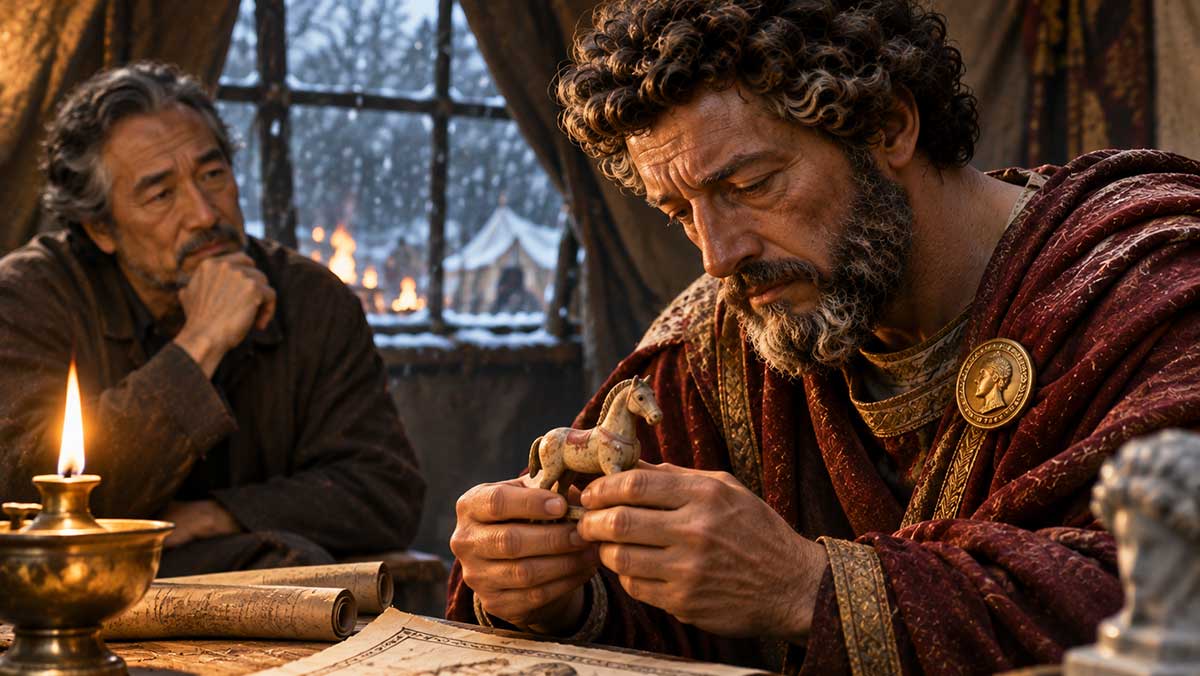
Carnuntum, AD 174: A Father, a Philosopher, and the Silence After Loss
Carnuntum, on the Roman Empire's Danube frontier. Winter, AD 174.
Two years have passed since Nick Sasaki last visited Marcus Aurelius in a military camp.
Outside the emperor's quarters, snow gathers along the wooden walkways. The wind blows across the frozen ground, rattling shutters and carrying the distant sounds of horses, soldiers, and the occasional hammer striking metal.
The Roman army remains stationed near the northern frontier. The wars have continued, and the Antonine Plague has left scars across the empire.
But tonight, the camp is unusually quiet.
Inside a modest chamber, a small oil lamp burns beside a wooden writing desk. Several scrolls lie neatly stacked against the wall. A bronze basin holds water, and a woolen cloak hangs near the entrance.
Marcus Aurelius, now fifty-three, sits alone.
He is writing in Greek.
There is no secretary beside him. No audience waiting to applaud. No senator listening for an imperial command.
These words are not intended for the Roman people.
They are reminders to himself.
He writes about the shortness of life, the danger of anger, the importance of justice, and the need to accept what nature brings.
At times, he stops and stares at the flame.
Marcus has already buried several of his children. He has watched illness spread through the empire. He has lost friends and colleagues. He knows that the life of an emperor is no safer from death than the life of a farmer or a soldier.
And yet, like every father who has loved a child, he knows that recognizing death as natural is not the same thing as welcoming it.
When Nick enters, Marcus looks up from his writing.
Marcus Aurelius
Nick.
You have arrived at an hour when sensible men are usually asleep.
Nick Sasaki
(Laughs softly.) I was about to say the same thing to you.
Are you still working?
Marcus Aurelius
Not on imperial business.
Nick Sasaki
Then what are you writing?
Marcus Aurelius
Reminders.
Nick Sasaki
Reminders of what?
Marcus Aurelius
Of things I already know but do not always practice.
Nick Sasaki
That sounds familiar.
When we first met, you were seventeen years old, studying philosophy.
Then I visited you as emperor in Rome.
Then I found you on the battlefield, trying to reconcile your beliefs with the terrible realities of war.
And now, here you are, writing to yourself in the middle of the night.
Marcus Aurelius
Perhaps I have made less progress than you expected.
Nick Sasaki
Actually, Marcus, I think the opposite.
I'm beginning to understand why people will still read your words almost two thousand years from now.
You don't seem to be writing as a man who has solved life.
You seem to be writing as someone who is still struggling with it.
Marcus Aurelius
That is a fair observation.
Nick Sasaki
Tonight, I want to talk about something we haven't explored deeply enough.
Death.
Not death as an abstract philosophical idea.
But death as something that takes away people we love.
And I want to know whether your philosophy truly helped you when that happened.
Marcus sets down his writing instrument.
The flame of the oil lamp moves gently in the draft.
Marcus Aurelius
Then we should speak carefully.
There are subjects about which a man can reason clearly and still feel deeply.
Question 1. Why Did You Keep Writing Reminders to Yourself When You Already Knew the Philosophy?
Nick Sasaki
Marcus, let me begin with something that has fascinated me since our first conversation.
You spent your entire life studying philosophy.
You learned from some of the finest teachers in Rome.
You admired Epictetus.
You understood the principles of Stoicism.
Yet here you are, decades later, writing reminders to yourself about patience, anger, humility, and death.
Why did you need to keep repeating the same lessons?
Marcus Aurelius
For the same reason a soldier continues practicing with his weapons after learning how to use them.
Knowing what to do does not guarantee that one will do it well under pressure.
A man may understand that anger distorts judgment.
Yet when insulted, he may still become angry.
He may recognize that wealth and reputation are temporary.
Yet he may still desire admiration.
He may know that death is natural.
Yet when someone he loves dies, he may still wish desperately for that person to return.
Nick Sasaki
So philosophy isn't something you learn once and then finish.
Marcus Aurelius
No.
It is something you practice.
And the practice must continue precisely when circumstances make it difficult.
Nick Sasaki
But why write it down?
Why not just think about it?
Marcus Aurelius
Writing requires a certain discipline of attention.
A thought that passes through the mind may remain vague.
When I put it into words, I must examine it more carefully.
What exactly am I afraid of?
What judgment is causing my anger?
What responsibility am I avoiding?
What have I mistaken for something genuinely important?
Writing helps me confront these questions.
Nick Sasaki
That's interesting.
Today, people call that journaling.
Millions of people write down their thoughts to manage stress, understand their emotions, and improve themselves.
You were doing something similar almost two thousand years ago.
Marcus Aurelius
Human beings have long needed ways to examine themselves.
The tools may change.
The need remains.
Nick Sasaki
But there's something almost funny about your writing.
You're the emperor of Rome.
You command armies.
You make decisions that affect millions of people.
And yet, in your private notes, you're basically telling yourself, "Marcus, don't get angry. Don't be arrogant. Stop worrying about what other people think."
Marcus Aurelius
(Laughs softly.)
Yes.
Nick Sasaki
Doesn't that seem a little embarrassing?
Marcus Aurelius
It would be more embarrassing if I believed that becoming emperor had made such reminders unnecessary.
Nick Sasaki
That's a great answer.
But let me challenge you.
Could all this self-examination become excessive?
Could you spend so much time correcting yourself that you never feel satisfied?
Marcus Aurelius
Certainly.
Self-examination should serve moral improvement, not become another form of vanity or self-punishment.
A man who continually condemns himself without changing his conduct has gained little.
And a man who becomes proud of how severely he judges himself may simply have discovered a new way to admire his own seriousness.
Nick Sasaki
So even self-criticism can become ego.
Marcus Aurelius
Yes.
The aim is not to think endlessly about oneself.
It is to become better at fulfilling one's responsibilities to others.
Nick Sasaki
That distinction matters.
Some people today spend enormous amounts of time analyzing their feelings, their weaknesses, their childhood, and their mistakes.
But they never seem to move forward.
Marcus Aurelius
Reflection should eventually return us to action.
If I recognize that I have been impatient with someone, the next task is to treat that person more patiently.
If I recognize that I have been unjust, I must correct what I can.
If I recognize that I have wasted time, I should use the next hour more wisely.
Nick Sasaki
Can I ask you something personal?
When you write these reminders, are you speaking to yourself as an emperor or as an ordinary human being?
Marcus Aurelius
As a human being.
The imperial office creates particular duties, but it does not change the basic moral questions.
Am I acting honestly?
Am I treating people justly?
Am I allowing fear or anger to govern me?
Am I using my time well?
These questions belong to everyone.
Nick Sasaki
Then maybe that's why your writings have survived.
People don't read them to learn how to rule Rome.
They read them to learn how to live.
Marcus Aurelius
If they find something useful in them, I would hope they put it into practice.
But I did not write these reflections to secure an audience centuries after my death.
Nick Sasaki
That's the remarkable part.
You were writing for yourself.
And somehow, your private struggle became a source of wisdom for millions.
Marcus Aurelius
Then perhaps the struggles of human beings are less different across time than we suppose.
Marcus looks down at the open writing tablet.
Nick notices that the emperor's hand has stopped moving.
Nick Sasaki
Marcus, there's something else I notice.
You write about death again and again.
Almost as though you're trying to convince yourself not to fear it.
Marcus Aurelius
Mortality deserves frequent attention.
Nick Sasaki
But why so often?
Marcus Aurelius
Since it is so easily forgotten when we become absorbed in trivial concerns.
A man may spend an entire day angry over an insult that will be forgotten within a week.
He may sacrifice years pursuing recognition from people whose opinions will eventually disappear.
He may postpone kindness, reconciliation, or meaningful work as though he possesses unlimited time.
Remembering death can restore a proper sense of proportion.
Nick Sasaki
So thinking about death helps you appreciate life.
Marcus Aurelius
It should.
But only if the reflection leads to better living rather than fear or despair.
Nick Sasaki
That brings me to something much more personal.
The room becomes quiet.
Question 2. When Your Children Died, Did Stoicism Actually Comfort You?
Nick Sasaki
Marcus, you've experienced something no parent ever wants to experience.
You've lost children.
More than one.
And I know that later in your life, you will experience further loss.
I want to ask you something that may be difficult.
When your children died, did Stoicism actually comfort you?
Or were there moments when all the philosophy in the world meant nothing?
Marcus does not answer immediately.
He turns his gaze toward the oil lamp.
Marcus Aurelius
Nick, there are experiences that cannot be made small through clever words.
The death of a child is one of them.
Nick Sasaki
I'm sorry if the question is painful.
Marcus Aurelius
You need not apologize for asking sincerely.
But I would not wish to turn the suffering of my family into a demonstration of philosophical skill.
Nick Sasaki
I understand.
I'm not asking you to prove that you were strong.
I'm asking whether
Topic 5. The Wise Emperor Who Could Not Save His Own Legacy
Vindobona, AD 180: The Last Questions of a Philosopher Emperor
The northern frontier of the Roman Empire. March, AD 180.
Six years have passed since Nick Sasaki last visited Marcus Aurelius in his winter quarters near Carnuntum.
The emperor is now fifty-eight years old.
For nearly two decades, he has carried the responsibilities of ruling Rome. He has endured wars, epidemics, political conspiracies, the deaths of children, and the loss of his beloved wife, Faustina.
He has tried to govern according to the principles of Stoicism: justice, courage, moderation, wisdom, and the recognition that all human beings share a common nature.
But his life is approaching its end.
The precise circumstances of Marcus's final illness remain uncertain. Ancient accounts differ about details of his last days, and historians debate whether he died at Vindobona, near modern Vienna, or elsewhere along the northern frontier.
For this final imaginary conversation, we find him in a quiet chamber at Vindobona.
Outside, a cold wind moves through the Roman military camp. Soldiers walk between wooden barracks, carrying supplies and preparing for another uncertain spring.
Inside, a small fire burns.
Marcus lies on a narrow bed beneath heavy blankets. His face is pale, his breathing slow, and his once-commanding voice has grown softer.
Beside him rests a writing tablet.
The emperor who spent so many years reminding himself that death was natural now faces the possibility that his own death is near.
His son Commodus, already sharing imperial authority, stands to inherit the empire.
Marcus has spent his life studying how to become a good man.
But has he succeeded?
And what happens when a father's hopes for his son collide with the future of an entire civilization?
When Nick Sasaki enters, Marcus turns his head.
Marcus Aurelius
Nick.
You have returned.
Nick Sasaki
Marcus.
It's good to see you again.
Marcus Aurelius
You are kind to say so.
I suspect I am less impressive to look at than I was during our first meeting.
Nick Sasaki
(Laughs softly.) You were seventeen then.
Marcus Aurelius
And convinced that I had many years in which to become wise.
Nick Sasaki
Now you're fifty-eight.
Marcus Aurelius
A respectable amount of time.
Though it seems considerably shorter when one approaches its end.
Nick Sasaki
How are you feeling?
Marcus Aurelius
Weak.
Tired.
And grateful that we can still speak.
Nick Sasaki
Are you afraid?
Marcus considers the question.
Marcus Aurelius
I am aware of what may be approaching.
But I would prefer to spend the time remaining in conversation rather than in fear of losing it.
Nick Sasaki
Then let's talk.
There are three questions I've wanted to ask you since we first met.
And I think they're the most difficult questions of all.
Marcus Aurelius
Then perhaps we have saved the proper questions for the end.
Question 1. Was Choosing Commodus Your Greatest Mistake?
Nick Sasaki
Marcus, I want to begin with your son.
Commodus.
You spent your entire life trying to become a wise and just ruler.
You studied philosophy.
You tried to control your ego.
You believed that authority should be used for the common good.
But the son who will succeed you will become one of Rome's most controversial emperors.
How do you explain that?
Marcus looks toward the window.
Marcus Aurelius
A father may teach his son.
He may advise him.
He may provide examples of good conduct.
He may try to surround him with capable people.
But he cannot enter his son's mind and make every judgment for him.
Nick Sasaki
That's true.
But you weren't just an ordinary father.
You were emperor.
You had the responsibility to choose someone who could govern millions of people.
Why Commodus?
Marcus Aurelius
You ask the question as though I possessed complete freedom to select any person and place him upon the throne without consequence.
Roman succession was not so simple.
Commodus was my surviving son, publicly recognized within the imperial system and already associated with imperial authority.
His position carried expectations among the army, the court, and the political institutions of Rome.
To remove him would not necessarily have produced a peaceful transition.
Nick Sasaki
But didn't you recognize the danger?
Didn't you see signs that he might not become the kind of ruler you wanted?
Marcus Aurelius
A father can recognize weaknesses in his child without knowing how those weaknesses will develop.
Youthful vanity may diminish with maturity.
Poor judgment may improve through experience.
A young man who resists instruction may eventually recognize its value.
But hope must not be confused with certainty.
Nick Sasaki
Did you hope he would change?
Marcus Aurelius
What father does not hope that his child will grow wiser?
Nick Sasaki
But here's the difficult part.
If you knew he wasn't ready, shouldn't you have placed Rome's future above your personal love for him?
Marcus Aurelius
That is a serious question.
And one that deserves more than an easy defense.
A ruler must distinguish between what benefits his family and what benefits the people he governs.
When those interests conflict, his obligations become painful.
Nick Sasaki
Do you think you made the wrong decision?
Marcus Aurelius
I cannot honestly judge my decisions using knowledge of events that have not yet occurred from my present point in time.
You have told me what history will say of Commodus.
But I must not pretend that I possessed your knowledge when I made my choices.
Nick Sasaki
That's fair.
But let me tell you what happens.
After your death, Commodus becomes sole emperor.
His reign becomes associated with increasingly erratic behavior, political violence, and public displays of personal grandeur.
He eventually appears in the arena as a gladiator.
And the image of the philosopher emperor is followed by that of a ruler obsessed with his own importance.
How does that make you feel?
Marcus closes his eyes for a moment.
Marcus Aurelius
Sadness.
Not merely for my reputation.
For my son.
And for the people whose lives may suffer through his decisions.
Nick Sasaki
Would you blame yourself?
Marcus Aurelius
I would examine my responsibilities.
Did I provide sound instruction?
Did I model the virtues I wished him to possess?
Did I correct his faults when correction was necessary?
Did I allow affection to interfere with judgment?
Those are proper questions.
But there is another question.
Can one human being be held responsible for every decision another human being eventually makes?
Nick Sasaki
No.
Not every decision.
Marcus Aurelius
Then we must recognize both truths.
A father influences his child.
A ruler influences succession.
But neither possesses complete control over another person's character.
Nick Sasaki
I think that's something every parent struggles with.
You raise your children.
You love them.
You try to teach them right from wrong.
But eventually, they make their own choices.
And sometimes those choices are painful.
Marcus Aurelius
Yes.
Love does not grant ownership over another person's soul.
Nick Sasaki
That's a beautiful way to put it.
But there's something I want to challenge.
You taught that we should accept what we cannot control.
Could that philosophy become an excuse for avoiding responsibility?
Couldn't someone say, "Well, Commodus made his own choices, so none of this was my fault"?
Marcus Aurelius
That would be a misuse of the teaching.
We must distinguish between the decisions within our responsibility and the outcomes beyond our control.
I remain accountable for my own choices.
I cannot claim innocence merely on account of the uncertainty of their consequences.
But neither should I claim an ability to control the future that no human being possesses.
Nick Sasaki
So accepting what you can't control doesn't mean denying what you could have done differently.
Marcus Aurelius
Precisely.
Nick Sasaki
Marcus, let me ask something more personal.
Did you ever worry that you were a better emperor than a father?
Marcus is silent.
Marcus Aurelius
That is a question I would have reason to ask myself.
The demands of government and war have kept me away from my family for long periods.
I have tried to fulfill my duties.
But a child does not experience a father's absence as an abstract obligation to the state.
He experiences it as absence.
Nick Sasaki
Do you regret that?
Marcus Aurelius
I regret every occasion on which I failed to give proper attention to someone who needed me.
But regret is useful only when it leads to a more accurate judgment of one's conduct.
Nick Sasaki
What would you say to Commodus if he were sitting here right now?
Marcus Aurelius
I would tell him that being emperor does not make him greater than the people he governs.
That admiration is not the same as love.
That fear is not the same as respect.
That pleasure cannot replace character.
And that every person who approaches him, whether senator, soldier, servant, or stranger, possesses a humanity that deserves recognition.
Nick Sasaki
Would you tell him you love him?
Marcus Aurelius
Yes.
Nick Sasaki
Before or after the advice?
Marcus smiles faintly.
Marcus Aurelius
Before.
And after.
Nick Sasaki
That's the answer I was hoping for.
Outside, footsteps pass along the wooden corridor.
The emperor's breathing becomes heavier for a moment. Nick waits until Marcus is comfortable.
Question 2. Looking Back, Did You Actually Live According to Your Philosophy?
Nick Sasaki
Marcus, I want to ask you something that may be uncomfortable.
You spent your life teaching yourself to be just, compassionate, humble, and wise.
But you were still an emperor.
Rome fought wars under your command.
Slavery continued throughout the empire.
Christians experienced persecution during your reign.
And your succession arrangements placed Commodus on the throne.
Looking back, do you believe you truly lived according to your philosophy?
Marcus Aurelius
Not perfectly.
Nick Sasaki
That was a quick answer.
Marcus Aurelius
A man who claims perfect virtue should be examined with particular suspicion.
Nick Sasaki
But you were one of history's most admired philosopher rulers.
Surely you did many good things.
Marcus Aurelius
Perhaps.
But praise does not erase failure.
Nor does failure erase every good decision.
Human conduct must be examined with care.
Nick Sasaki
Let's talk about the Christians.
During your reign, Christians were persecuted in different parts of the empire.
Some were imprisoned.
Some were executed.
In AD 177, Christians in Lyon and Vienne suffered terrible violence.
How could that happen under a ruler who believed in justice and human brotherhood?
Marcus Aurelius
If people were punished unjustly for their beliefs, that raises a grave moral question.
A ruler should not assume that religious difference makes a person wicked.
Nor should public hostility be accepted as proof of guilt.
Nick Sasaki
But it happened during your reign.
Marcus Aurelius
Then my government must be examined.
But we should distinguish what is documented from what is uncertain.
You must ask which actions were ordered directly by the emperor, which were taken by provincial authorities, and what laws and customs governed those decisions.
A historian should not invent evidence either to condemn or to defend me.
Nick Sasaki
That's fair.
Historians still debate how directly involved you were.
But regardless of whether you personally ordered those persecutions, innocent people suffered under your government.
Doesn't that create a responsibility?
Marcus Aurelius
A ruler has responsibilities beyond the orders he personally signs.
He must consider the conduct of officials, the fairness of legal procedures, and the consequences of policies carried out in his name.
It would be insufficient to say, "I did not personally witness the injustice."
Nick Sasaki
Then do you think Stoicism failed you?
Marcus Aurelius
Philosophy cannot guarantee that its student will always act wisely.
It can provide principles for examining conduct.
But those principles must be practiced.
If I fail to act justly, the failure should not be concealed by my reputation as a philosopher.
Nick Sasaki
That might be one of the most important things you've said in all our conversations.
People often admire your Meditations so much that they forget to examine your actual life.
Marcus Aurelius
Then they risk turning philosophy into admiration of a personality.
That would be a poor use of it.
Nick Sasaki
Marcus, let me challenge you with a difficult possibility.
Marcus, what if all this philosophy was just a sophisticated way of making yourself feel better?
What if you told yourself you were acting according to reason, but sometimes you were simply rationalizing decisions you already wanted to make?
Marcus Aurelius
That danger is real.
Reason can be used to examine our desires.
But it can be misused to defend them.
A man may construct an elaborate argument for a decision motivated by pride.
He may call his fear prudence.
He may call his anger justice.
He may call his ambition duty.
Nick Sasaki
So how do you know when you're fooling yourself?
Marcus Aurelius
You must remain willing to hear criticism.
You must examine your motives.
You must compare your conduct with the principles you claim to follow.
And you must ask whether you would judge the same behavior differently if another person performed it.
Nick Sasaki
That's a powerful test.
If someone else did what you did, would you excuse them?
Marcus Aurelius
Exactly.
Nick Sasaki
Marcus, I want to ask you something that goes beyond politics.
Were you a good husband?
A good father?
A good friend?
Marcus Aurelius
I tried to be.
But the people who lived with me would be better witnesses than I am.
Nick Sasaki
That's a humble answer.
Marcus Aurelius
It is also a practical one.
A man is not always the most reliable judge of his own character.
Nick Sasaki
Did you love Faustina?
Marcus looks toward the fire.
Marcus Aurelius
Yes.
Nick Sasaki
You lost her several years ago.
Do you still think about her?
Marcus Aurelius
Of course.
Nick Sasaki
Does it still hurt?
Marcus Aurelius
There are memories that bring gratitude and sorrow together.
I do not believe that loving someone requires us to forget them when they die.
Nick Sasaki
But Stoicism teaches acceptance.
Shouldn't you have accepted her death by now?
Marcus Aurelius
Acceptance does not require the destruction of affection.
I can recognize that her life has ended without pretending that her absence means nothing.
Nick Sasaki
I think that's a very important distinction.
Some people believe that being spiritually mature means never feeling sadness.
Marcus Aurelius
Then they may be confusing maturity with emotional emptiness.
A human being can grieve and still act wisely.
Nick Sasaki
Marcus, after everything you've experienced, what do you think your greatest personal weakness was?
Marcus Aurelius
I would be cautious about selecting a single weakness as though the others were unimportant.
But impatience, pride, and the desire to control circumstances beyond my reach have all required attention.
Nick Sasaki
And what was your greatest strength?
Marcus Aurelius
Perhaps the willingness to continue examining myself.
Nick Sasaki
That's interesting.
Not courage?
Not wisdom?
Not your ability to lead?
Marcus Aurelius
Those are qualities others may judge.
But I know that I repeatedly needed correction.
If I possessed any useful strength, it was the recognition that the work was unfinished.
Nick Sasaki
So you never reached a point where you thought, "I've finally become a wise man."
Marcus Aurelius
No.
Nick Sasaki
Even now?
Marcus Aurelius
Especially now.
Nick Sasaki
Why especially now?
Marcus Aurelius
Since the approach of death makes the distance between our ideals and our conduct difficult to ignore.
There is little reason to continue pretending.
Nick Sasaki
Marcus, can I tell you something?
Marcus Aurelius
Of course.
Nick Sasaki
When I first began interviewing you, I thought I was going to meet one of history's greatest philosophers.
But after these conversations, I think I've met something more meaningful.
A man who never stopped trying.
Marcus Aurelius
Then perhaps you have discovered something worth carrying into your own life.
But do not mistake effort for virtue itself.
We must still examine what our efforts accomplish and whom they affect.
Nick nods.
The fire crackles softly.
Outside, the wind has begun to calm.
Question 3. What Would You Most Want Humanity to Learn 1,800 Years After Your Death?
Nick Sasaki
Marcus, this is our final question.
And I want you to think beyond Rome.
Beyond your family.
Beyond your reputation.
I come from a world almost eighteen centuries after your death.
Our cities are larger than anything you could have envisioned.
We can communicate across oceans instantly.
We have machines that fly, medicines that save lives, and technologies that allow us to learn from people who lived thousands of years ago.
But we still struggle with many of the same problems you faced.
War.
Anger.
Greed.
Fear.
Political division.
The desire for wealth and recognition.
And the difficulty of treating one another with kindness.
If you could speak directly to humanity today, what would you most want us to understand?
Marcus closes his eyes for a moment.
Marcus Aurelius
I would ask human beings to recognize how brief their lives are.
Nick Sasaki
Why begin with death?
Marcus Aurelius
Since many of our worst judgments arise from forgetting it.
We behave as though we have unlimited time to correct our mistakes.
We postpone reconciliation.
We pursue recognition from people whose opinions will soon disappear.
We sacrifice friendships for arguments that will be forgotten.
We allow anger to consume days that will never return.
Nick Sasaki
So your first message would be to remember that life is short.
Marcus Aurelius
Yes.
But not to become frightened by that knowledge.
To become more attentive.
Nick Sasaki
Attentive to what?
Marcus Aurelius
To the person standing before you.
To the responsibility that belongs to this moment.
To the opportunity to act justly.
To the chance to show kindness before that chance disappears.
Nick Sasaki
That's beautiful.
But I want to ask about something else.
You believed that human beings are part of a larger community.
Today, people are divided by nationality, religion, race, political beliefs, and countless other differences.
Do you think humanity could ever become one family?
Marcus Aurelius
I believe human beings possess a common nature that should encourage mutual concern.
We are born into different communities.
We speak different languages.
We follow different customs.
But we experience many of the same needs and vulnerabilities.
We suffer.
We love.
We fear death.
We wish to protect our children.
We seek meaning.
Nick Sasaki
Then why do we keep dividing ourselves?
Marcus Aurelius
We often mistake the boundaries of our communities for the boundaries of our moral obligations.
We care for those nearest to us and forget that strangers possess the same humanity.
We become attached to opinions and begin to regard disagreement as hostility.
We allow fear to persuade us that another person's well-being threatens our own.
Nick Sasaki
Do you think we can change that?
Marcus Aurelius
We can change how we respond to it.
Every person has opportunities to act with greater fairness, patience, and concern.
And those choices can influence families, communities, and institutions.
But human cooperation requires more than individual good intentions.
It requires just laws, responsible leadership, and habits of mutual respect.
Nick Sasaki
What about religion?
People have fought terrible wars over their beliefs about God.
You believed in a rational order of the universe, but your understanding of the divine was very different from the religions that will dominate much of the world after your death.
What would you say to people who believe their religion gives them the right to condemn or harm others?
Marcus Aurelius
I would ask whether their conduct is consistent with justice.
If a person claims devotion to the divine but acts with cruelty, that contradiction deserves examination.
If a person believes the universe possesses a rational and moral order, he should ask whether hatred and injustice reflect that order.
Nick Sasaki
Do you think God exists?
Marcus Aurelius
I have often reflected upon the possibility of providence and the rational structure of nature.
I have considered whether events unfold within a divine order or through the arrangement of natural causes.
But whatever the ultimate explanation, I remain responsible for how I conduct myself.
Nick Sasaki
So you don't think someone needs to solve every mystery about God before becoming a good person?
Marcus Aurelius
No.
A person may possess uncertainty about the universe and still recognize the importance of honesty, courage, justice, and compassion.
Nick Sasaki
That's something I find deeply meaningful.
Sometimes people spend so much time arguing about God that they forget to love the people around them.
Marcus Aurelius
Then perhaps they should examine whether the argument is serving wisdom or vanity.
Nick Sasaki
Marcus, let me ask something very simple.
What is the meaning of life?
Marcus smiles faintly.
Marcus Aurelius
You have waited until the end to ask the largest question.
Nick Sasaki
(Laughs.) I thought you might be ready for it.
Marcus Aurelius
I would say that a human life finds its proper fulfillment through the exercise of reason and virtue.
We are capable of examining our judgments.
We can distinguish justice from injustice.
We can recognize obligations to others.
And we can choose how to respond to circumstances we did not create.
To live well is to use those capacities wisely.
Nick Sasaki
But what about happiness?
Marcus Aurelius
A good life should possess a deeper fulfillment than the pursuit of pleasure alone.
Pleasure may accompany it.
Love may enrich it.
Friendship may sustain it.
But character gives it moral direction.
Nick Sasaki
What about success?
Marcus Aurelius
Success is valuable when it serves something worthwhile.
It becomes dangerous when it replaces the question of what is worthwhile.
Nick Sasaki
What about love?
Marcus Aurelius
Love reminds us that our lives are connected to the lives of others.
But love should be guided by care rather than possession.
Nick Sasaki
And what about death?
Marcus Aurelius
Death reminds us that the opportunity to live well is limited.
Nick Sasaki
Marcus, I want to ask you something that may sound strange.
Suppose you could live your entire life again.
You could return to the moment we first met, when you were seventeen years old.
You could choose a different path.
You could avoid becoming emperor.
You could live quietly, study philosophy, and spend more time with your family.
Would you do it?
Marcus looks toward the fire.
Marcus Aurelius
I cannot know what another life would have contained.
Perhaps it would have offered greater peace.
Perhaps it would have presented difficulties I cannot foresee.
But I would not wish to spend my final hours longing for a life that was never mine.
Nick Sasaki
You wouldn't change anything?
Marcus Aurelius
I would correct my mistakes if given the opportunity.
I would act with greater patience where I had been impatient.
I would listen more carefully where I had failed to listen.
I would show more kindness where I had been distracted by duty or pride.
But wishing to correct one's conduct is different from wishing that one's entire life had never occurred.
Nick Sasaki
That's a thoughtful distinction.
Let me ask one more question.
If history forgets your military victories, your imperial titles, and your political achievements, but remembers your Meditations, would you be satisfied?
Marcus Aurelius
I did not write those reflections to be remembered.
Nick Sasaki
I know.
But would it please you to know that people centuries later might become kinder, more patient, and more courageous through reading them?
Marcus Aurelius
If my private efforts to correct myself help another person live more wisely, that would be a good result.
But I would hope they did not merely admire the words.
I would hope they practiced them.
Nick Sasaki
Then let me ask the final question in the simplest way possible.
What is the one thing you would want every person on Earth to do tomorrow morning?
Marcus looks directly at Nick.
Marcus Aurelius
When you wake, recognize that you have been given another opportunity to act as a human being should.
You will encounter people who are impatient, mistaken, selfish, frightened, or difficult.
You may become one of those people yourself.
Do not be surprised.
Instead, try to respond with reason and kindness.
Perform the work that belongs to you.
Treat others justly.
Correct your mistakes.
And do not waste the day waiting for a more convenient time to become good.
Nick Sasaki
That's your final message?
Marcus Aurelius
It is enough for one morning.
Nick Sasaki
(Laughs softly.) You really haven't changed.
Marcus Aurelius
I hope I have changed a little.
But perhaps the most important lessons remain the same.
Closing Scene: The Last Conversation
The fire has burned low.
Outside the chamber, the sounds of the military camp have grown quieter. A distant guard calls to another, and footsteps fade along the corridor.
Marcus rests against his pillows.
Nick realizes that their conversation is approaching its end.
Nick Sasaki
Marcus, before I leave, I want to thank you.
When we first met, you were seventeen years old.
You were studying philosophy and wondering what kind of man you wanted to become.
Then I saw you become emperor.
I watched you struggle with authority, war, anger, grief, and responsibility.
And now, here we are.
You've spent your whole life trying to become a good person.
Do you think you succeeded?
Marcus considers the question for a long time.
Marcus Aurelius
I tried.
Nick Sasaki
Is that enough?
Marcus Aurelius
Not always.
Good intentions do not erase the consequences of our mistakes.
But neither does imperfection make moral effort meaningless.
We must act as wisely as we can, correct what we can, and accept that our work may remain unfinished.
Nick Sasaki
You know what I think?
Marcus Aurelius
Tell me.
Nick Sasaki
I think the reason people admire you isn't that you were perfect.
It's that you understood how difficult it is to be good.
You had everything people dream of having.
Wealth.
Authority.
Recognition.
An empire.
But none of those things solved the problems inside your own heart.
You still had to struggle with anger.
You still had to face grief.
You still had to question yourself.
And you kept trying.
Marcus Aurelius
Then perhaps you have learned something useful from our conversations.
Nick Sasaki
I have.
But there's something else.
You taught me that we can't control everything that happens.
We can't control other people's opinions.
We can't control every outcome.
We can't prevent every loss.
But we can still choose how we treat the people around us.
Marcus Aurelius
Yes.
Nick Sasaki
And maybe that's where a better world begins.
Not with everyone agreeing about everything.
But with people deciding to treat one another with greater kindness.
Marcus Aurelius
That would be a worthy beginning.
Nick Sasaki
Marcus, are you ready for what comes next?
The emperor looks toward the small window.
Beyond it, the first pale light of morning is beginning to appear.
Marcus Aurelius
I have spent many years reminding myself that death belongs to nature.
I cannot promise that every part of me faces it without difficulty.
But I would prefer to meet it without abandoning the principles I have tried to practice.
Nick Sasaki
Is there anything you wish you had said?
Marcus Aurelius
There is always more that could be said.
But perhaps there is less that needs to be said than we suppose.
Nick Sasaki
What do you mean?
Marcus Aurelius
Be just.
Be patient.
Love those entrusted to your care.
Recognize your mistakes.
Do not allow anger to make you cruel.
And use the time you possess.
Nick Sasaki
Marcus, thank you.
For your honesty.
For your wisdom.
And for showing me that even the most admired philosopher in history was still human.
Nick reaches for Marcus's hand.
The emperor takes it.
Marcus Aurelius
Thank you, Nick.
For asking questions that required me to examine myself.
Nick Sasaki
I hope we meet again.
Marcus Aurelius
Then let us leave that question to the mysteries of the universe.
For now, attend to the life before you.
Nick smiles through tears.
Nick Sasaki
I will.
He rises and walks toward the doorway.
Before leaving, he turns one final time.
Marcus Aurelius rests quietly beside the dying fire.
The man who once commanded the Roman Empire now possesses no authority over the passing hours.
He cannot stop the approach of death.
He cannot guarantee the future of his son.
He cannot control how history will judge his reign.
But the principles he spent his life practicing remain.
And in the centuries that follow, his private writings will travel farther than his armies ever marched.
They will reach people living in countries he never knew existed.
They will be read by students, parents, leaders, workers, soldiers, and ordinary people searching for a better way to live.
Some will admire his wisdom.
Others will question his contradictions.
And perhaps the most thoughtful readers will do both.
For Marcus Aurelius was never simply a philosopher who became emperor.
He was a human being who spent his life trying to become worthy of the responsibilities placed upon him.
His greatest legacy may not be the empire he governed.
It may be the question he leaves behind.
When tomorrow morning arrives, what kind of person will you choose to become?
Fictional interview disclaimer: This conversation is an imaginative reconstruction inspired by the documented life, reign, and Stoic philosophy of Marcus Aurelius. Nick Sasaki's questions and Marcus's responses are fictional, not historical transcripts or direct quotations. The final illness setting is imagined, and the precise location and circumstances of Marcus's death remain historically uncertain. The discussion of Commodus reflects the succession arrangements and his later reign, without claiming that Marcus could foresee those events. References to Christian persecution acknowledge documented suffering during Marcus's reign, including the events at Lyon and Vienne in AD 177, without asserting an unproven personal order from the emperor. The dialogue's reflections on mortality, justice, human fellowship, and moral responsibility draw inspiration from Meditations and historical scholarship.
Final Thoughts by Nick Sasaki
When I began this imaginary interview with Marcus Aurelius, I expected to discover the secrets of a great Stoic philosopher. I wanted to learn how a man who ruled one of history's greatest empires could remain calm, disciplined, and morally grounded. But as our conversations progressed, I became interested in something far more personal. I discovered a man who struggled with many of the same questions we face today. How do we control our anger? How do we become better parents? How do we remain humble when we succeed? How do we accept the loss of someone we love? And how do we live meaningfully when we know our lives will eventually end?
One of the most moving moments for me came when Marcus spoke about his children. I had always associated Stoicism with emotional control, but our conversation challenged that simplified picture. A father can recognize that death is part of nature and still experience profound grief. A husband can accept that life is temporary and still miss his wife. The distinction between accepting reality and becoming emotionally indifferent is central to the Stoic tradition. Reading the reflections collected in Meditations, I am struck by how frequently Marcus returns to the same concerns. He reminds himself to be patient, to resist vanity, and to recognize the fragility of life. To me, those repetitions suggest something deeply human: knowing what is right does not mean that doing it becomes easy.
Our conversation about war left me with another important question. Marcus believed that human beings share a common rational nature and should cooperate with one another. Yet he spent years commanding Roman armies. I cannot simply ignore that contradiction, nor do I think we should dismiss every moral teaching of a historical figure who failed to live up to modern ideals. I find it more meaningful to examine both his wisdom and his limitations. The Stanford Encyclopedia of Philosophy helps place his moral thinking within the broader Stoic tradition, but the questions raised by his political responsibilities remain relevant. Can we genuinely believe in human brotherhood if we refuse to recognize the suffering of people outside our own nation, religion, or community?
I have long believed that one of humanity's greatest hopes is to recognize that we belong to one human family. Our differences in nationality, culture, language, and belief do not erase our shared humanity. We all know what it means to love someone, to worry about our children, to suffer disappointment, and to hope for a better future. Marcus's philosophy offers an important starting point: another person's humanity does not disappear simply when that person disagrees with us. Yet I believe we must carry this idea beyond philosophy. We must practice it in our families, communities, institutions, and relationships with people we might otherwise consider strangers or enemies.
The story of Commodus may be the most painful part of Marcus's legacy. Here was a father who devoted much of his life to moral discipline, yet could not guarantee that his son would embrace the same principles. As a parent, I find that deeply moving. We can teach our children, encourage them, and try to provide good examples, but we cannot make every decision for them. At the same time, Marcus's succession arrangements remind us that accepting what we cannot control does not free us from responsibility for what we can influence. His story challenges me to examine the difference between loving someone and assuming that love alone will lead to wise decisions.
Another lesson I will carry from these conversations concerns success. We live in a society that often measures achievement through wealth, status, influence, and recognition. Marcus possessed those things on a scale few people could ever experience. Yet his private writings repeatedly returned to character, duty, and the temporary nature of worldly honors. The Internet Encyclopedia of Philosophy offers a helpful examination of the ethical principles behind his reflections. What I take from them is not that ambition or achievement is necessarily wrong. It is that success should serve something more meaningful than the desire to feel superior. If our achievements make us less patient, less compassionate, or less honest, we should question what we have truly gained.
Perhaps the greatest lesson Marcus taught me is that we do not need to wait until we become wiser, wealthier, or more successful to begin living well. We can start with the next conversation, the next disagreement, or the next opportunity to help someone. We can apologize when we have been wrong. We can listen more carefully to someone whose beliefs differ from ours. We can show affection to the people we love rather than assuming they will always be there. And when we fail, as every human being sometimes does, we can acknowledge the failure and try again. Marcus Aurelius did not leave us a promise that life would become easy. He left us an example of a person who continued practicing his principles amid extraordinary difficulty.
As I reflect on our final imaginary conversation, I keep returning to the image of an aging emperor who can no longer command the future. His armies, titles, wealth, and reputation cannot prevent the approach of death. Yet his questions about how to live remain with us. That is the legacy I find most meaningful. What does it really mean to live a good life? Can we love deeply without being destroyed by the fear of loss? Can we defend our convictions without becoming cruel toward those who disagree? And if Marcus Aurelius were sitting across from you today, what would you most want to ask him? I would love to hear your thoughts in the comments. Perhaps the conversation he began with himself nearly two thousand years ago is one that all of us can continue together.
Fictional reflection disclaimer: These final thoughts are written from Nick Sasaki's perspective on an imagined interview. The interpretations and personal lessons are reflective commentary, not verified statements or private confessions by Marcus Aurelius.
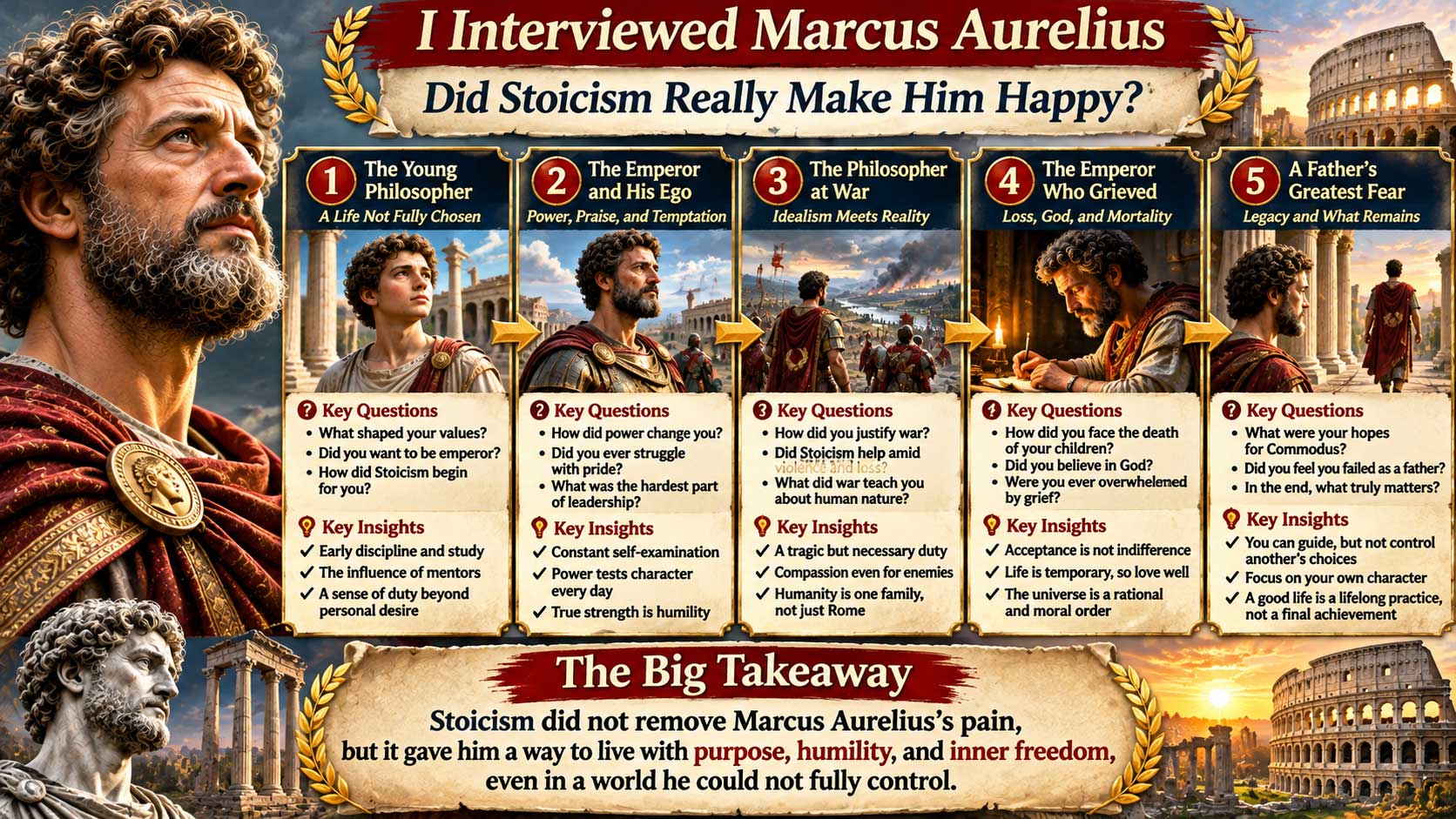
Short Bios:
Marcus Aurelius (AD 121–180)
Marcus Aurelius Antoninus was Roman emperor from AD 161 until his death in 180. Born into a prominent Roman family, he was adopted into the imperial succession and became a student of Stoic philosophy. During his reign, he confronted military conflicts along the empire's frontiers, the Antonine Plague, and significant political challenges. His private Greek philosophical reflections, later collected as Meditations, have become one of the most widely read works of Stoic thought. His legacy remains complex, combining influential moral teachings with the political and military realities of imperial Rome. Learn more through the Stanford Encyclopedia of Philosophy's biography and philosophical analysis and Encyclopaedia Britannica's historical biography.
Nick Sasaki
Nick Sasaki is the creator of ImaginaryTalks.com, where historical figures, philosophers, authors, spiritual teachers, and influential thinkers come together through imaginative conversations. His work explores enduring questions about love, human nature, morality, faith, happiness, and the meaning of life. Through fictional interviews grounded in historical research, Nick seeks to make great ideas accessible, emotionally meaningful, and relevant to contemporary readers. His larger creative vision is to encourage greater compassion, mutual respect, and the recognition that humanity shares a common future.
Epictetus (approximately AD 50–135)
Epictetus was a Greek Stoic philosopher who spent part of his life enslaved before becoming an influential teacher. He argued that human freedom depends fundamentally upon the proper use of judgment and choice rather than external circumstances. His teachings, recorded by his student Arrian in the Discourses and Enchiridion, profoundly influenced Marcus Aurelius. Epictetus emphasized that wealth, reputation, and social position cannot replace virtue and moral independence. Learn more through the Internet Encyclopedia of Philosophy's biography of Epictetus.
Antoninus Pius (AD 86–161)
Antoninus Pius was Roman emperor from AD 138 to 161 and the adoptive father and predecessor of Marcus Aurelius. His reign is remembered for relative political stability and an emphasis on orderly administration. Marcus admired his patience, restraint, and approach to public duty, later reflecting upon his example in Meditations. Antoninus helped shape Marcus's conception of responsible leadership and the proper conduct of an emperor. Read more in Encyclopaedia Britannica's biography of Antoninus Pius.
Commodus (AD 161–192)
Commodus was the son of Marcus Aurelius and Faustina the Younger. He became co-emperor with his father in AD 177 and sole emperor following Marcus's death in 180. His later reign was marked by political instability, conflicts with members of the Roman elite, and unusual public displays of imperial identity, including appearances in the arena. Ancient accounts of Commodus are often hostile and require critical examination, but his succession remains central to debates about Marcus Aurelius's political judgment and legacy. Learn more through Encyclopaedia Britannica's biography of Commodus.
Lucius Verus (AD 130–169)
Lucius Verus ruled alongside Marcus Aurelius as Roman co-emperor from AD 161 until his death in 169. His reign included the Roman war against Parthia, during which he held responsibility for the eastern military campaign. His death left Marcus as sole emperor during a period of serious military and public-health challenges. Their shared rule represented an unusual arrangement in Roman imperial government. Read more in Encyclopaedia Britannica's biography of Lucius Verus.
Leave a Reply