

Prologue: Two Kings, One Fatal Mistake
Before the curtain rises. Darkness. The sound of rain, first gentle, then fierce. Somewhere a bell tolls once. A solitary light reveals the FOOL, standing before a bare wooden chair. Upon the chair rests a crown. He does not touch it.
FOOL
Come closer, good people. Not too close. Crowns are dangerous things, and this one has not yet decided whom to bite.
You have come to see two kings. One is old enough to know better. The other is young enough to believe that knowing better is the same as doing better. One gave away a kingdom and found himself unwanted. The other took a kingdom and discovered that no door could keep his fear outside.
You may think them opposites. I thought so once.
The first is Lear. He had three daughters and asked them to tell him how much they loved him. An easy question, you say? Not when the answer carries a price. Two daughters dressed their words in silk and received the land. The youngest, Cordelia, spoke plainly and received her father's anger. Lear mistook a truthful heart for an empty one, and sent away the child who loved him without bargaining.
The second is Macbeth. He heard a promise from strange mouths upon a heath. A crown, they said, would come to him. But he could not bear to wait for the future to arrive. With his wife beside him and murder in his thoughts, he made a road through the sleeping king's chamber. He gained Scotland and lost the quiet of his own mind.
Now consider this chair.
He circles it.
It has four legs. A king has two. Yet kings often believe they cannot stand unless a throne holds them up. Take away the chair, and they stagger. Take away the crown, and they ask who they are. Take away the praise, and some grow angry enough to burn the house that sheltered them.
I served Lear. I watched him turn a daughter's honesty into an insult. I made jokes, for a joke can sometimes enter a royal ear when counsel cannot. He laughed at the wrong moments and grew furious at the right ones. Still I followed him, through rain and cold, hoping that somewhere beneath his wounded pride a father might be waiting.
And what of Macbeth? I have not served him, though I have known his kind. He keeps his sword close and his sleep far away. He believes that every danger has a face he can threaten, a throat he can silence, a gate he can bar. Yet the thing he fears most walks beside him wherever he goes.
Tonight their roads meet at Dunsinane.
Lear arrives without a crown, seeking shelter. Macbeth offers him a roof, then turns the roof into a prison. Between them stand daughters, wives, servants, soldiers, and men who still dare to speak truth. There will be bargains made in royal chambers, letters hidden in sleeves, a forest that seems to walk, and a sword that may yet be set upon the ground.
Do not expect the innocent to remain untouched. Nor expect one good deed to wash a hundred cruel ones away. A father's apology cannot return stolen years. A king's surrender cannot raise the dead. The living must decide what to do with the truth after it is spoken.
The FOOL lifts the crown from the chair. He weighs it in his hands.
How small it is. How many lives men have poured into this little circle.
Here is my wager: before the night is done, the man who has lost his crown may discover what a king ought to be. And the man who still wears his may discover what it costs to take it off.
He replaces the crown upon the chair and steps back into the darkness.
Listen. The storm has reached the gate.
Thunder. A heavy knock sounds three times. Blackout.
End of Prologue.
Act I, Scene One: The Stranger at Dunsinane

Scotland. A mountain road beneath the walls of Dunsinane. Night. Wind drives rain across the stones. Far above, torches burn behind the battlements. A bell sounds once, then falls silent.
Enter LEAR, KENT, and the FOOL. Lear's cloak is torn. Kent supports him as they struggle uphill. The Fool carries a small bundle wrapped against the rain.
LEAR
There. A light. I told thee there was light.
KENT
A fortress, my lord. Not necessarily a refuge.
LEAR
Must every stone in Britain learn to turn its face against me? I have crossed a kingdom that was mine, and every gate has asked whose leave I carry.
FOOL
A gate is an honest servant, nuncle. It opens for the man with the key, not the man with the story.
LEAR
Peace, boy.
FOOL
Gladly, if thou canst find me a dry piece of it.
Lear stops to catch his breath. Kent watches the distant torches.
KENT
We should not give our names until we know whose men keep watch. Your daughters have riders on the northern roads.
LEAR
My daughters. Say rather the two strangers who wear my blood like stolen velvet.
KENT
Their orders are no less dangerous for being unjust.
LEAR
I gave them fields, rivers, towns, the very chairs from which they now command my capture. Is this what fathers purchase with generosity?
FOOL
A father who gives away his house should keep one room for himself. Better yet, the door.
LEAR
I did not give away my name.
FOOL
No, nuncle. Only the men who used to answer when it was called.
A gust nearly throws Lear to his knees. Kent catches him.
KENT
We need shelter. The old border track lies behind us. Ahead is Dunsinane, held by Macbeth, King of Scotland.
LEAR
Macbeth. A soldier made king. I have heard his name. They say he defeated traitors and brought order to a divided land.
KENT
They say many things. King Duncan is dead, and his sons have fled. The manner of his death is disputed.
LEAR
Then Scotland too has learned that crowns sit lightly upon the head.
FOOL
Some crowns are light, nuncle. It is the secrets underneath that weigh so much.
From above, a GUARD raises a lantern.
FIRST GUARD
Who approaches Dunsinane after the watch bell?
KENT
Travelers from the south, seeking shelter from the storm.
FIRST GUARD
Names and business.
LEAR
Tell thy master King Lear stands at his gate.
KENT
My lord—
LEAR
I will not creep into a castle as though I were a thief. Tell him Lear of Britain asks the hospitality due to a king.
The guard hesitates. A SECOND GUARD appears beside him.
SECOND GUARD
Lear? The king whose daughters rule in his place?
LEAR
The king whose daughters have forgotten how to be daughters.
FOOL
And whose Fool has forgotten what dry stockings feel like.
FIRST GUARD
Wait where you stand.
The guards withdraw. Lear looks up at the black walls.
LEAR
A soldier king will know the meaning of loyalty.
KENT
I pray he does.
FOOL
I pray he knows the meaning of supper. Loyalty can wait until morning.
The scene shifts to a chamber above the gate. MACBETH stands over a table scattered with maps. A CAPTAIN enters, dripping rain.
CAPTAIN
My liege, three travelers have come from the southern road. One claims to be Lear, the dispossessed king of Britain.
MACBETH
Lear himself?
CAPTAIN
An old man in a torn cloak, with one attendant and a fool. He speaks as though the land still belongs to him.
MACBETH
An interesting habit in a king who owns none of it. Have you searched them?
CAPTAIN
Not yet.
MACBETH
Do so with courtesy. Has word of their coming reached the English border posts?
CAPTAIN
We cannot say. Riders have been seen behind them, though none approached the walls.
Macbeth considers the map. His finger rests upon the road south toward England.
MACBETH
Malcolm shelters in England. Macduff whispers in his ear. And now a king driven out by his daughters comes to my gate. Fortune sends strange guests when a kingdom is troubled.
CAPTAIN
Shall I turn them away?
MACBETH
No. A man with no throne may still possess a name that moves armies. Bring them inside. Feed them. Let no one say Macbeth left an old king to perish in the rain.
CAPTAIN
And afterward?
MACBETH
Afterward, we learn what his enemies fear and what his friends might pay to see him free.
The Captain bows and leaves. LADY MACBETH enters from the shadows.
LADY MACBETH
You speak of guests as though they were pieces on a board.
MACBETH
A king who cannot see the board soon finds himself removed from it.
LADY MACBETH
Then be certain you know whose game you play. The old man may bring a war to our door.
MACBETH
War already walks toward us. Perhaps this one brings a shield.
LADY MACBETH
Or a witness.
Macbeth turns sharply.
MACBETH
To what?
LADY MACBETH
To the state of our court. To the way men lower their voices when we pass. A stranger may see what those who live here dare not speak.
MACBETH
Then let him see a king who gives shelter. Prepare a chamber and a table. I will receive him myself.
Lady Macbeth studies him, then exits. Macbeth remains alone for a moment.
MACBETH
A fallen king at my gate. What message does the night intend?
Below, the heavy gate opens. The scene returns to the courtyard. Guards hold torches as Lear, Kent, and the Fool enter. Macbeth descends the steps to meet them.
MACBETH
King Lear. Scotland is honored by your presence, though I would wish a kinder road had brought you here.
LEAR
Macbeth. I have walked among men who once bowed to me and found them suddenly blind. Your greeting does you credit.
MACBETH
A crown may change hands. The respect owed to suffering does not.
FOOL
A handsome sentence, nuncle. We must ask whether it comes with blankets.
Macbeth smiles.
MACBETH
Blankets, bread, and a fire. Your wit has traveled farther than your comfort, it seems.
FOOL
Wit travels light, Your Majesty. Comfort has been stolen by better-dressed people.
MACBETH
Then we shall see what Scotland can restore. Captain, take our guests to the western chambers.
KENT
Your generosity is welcome. We hope to depart as soon as the roads are safe.
Macbeth's smile does not change.
MACBETH
There is no haste. The northern roads are treacherous, and the southern roads more so. You will be safer beneath my protection.
LEAR
I have had enough of protection offered by those who would command me. Yet I thank you. I know what honor sounds like, though I have heard little of it lately.
MACBETH
Then rest tonight. Tomorrow we may speak as kings, without the storm between us.
Lear is moved by the invitation. Kent is less reassured. The Fool glances at the armed men above the gate.
FOOL
Two kings beneath one roof. We shall need a very large bed, or a very careful carpenter.
LEAR
Must thou jest at every kindness?
FOOL
Only until I know what it costs.
Lear follows a servant into the castle. Kent pauses beside Macbeth.
KENT
My lord has endured much. I ask only that he be allowed to rest undisturbed.
MACBETH
He shall be treated with every courtesy.
KENT
And when he wishes to leave?
A beat.
MACBETH
Then we shall discuss the safest road.
Kent bows without lowering his eyes and follows Lear. The Fool lingers at the threshold, examining the gate.
MACBETH
Have you lost something, little sir?
FOOL
No, Your Majesty. I am counting hinges.
MACBETH
Hinges?
FOOL
A door may welcome a man with one face and keep him with another. I like to know which way it swings.
The Fool slips inside. Macbeth watches him go. The Captain approaches.
CAPTAIN
Their horses are exhausted. The old king's attendant has asked that they be made ready for morning.
MACBETH
See that they are fed. Keep them in the lower stable.
CAPTAIN
Saddled at dawn?
MACBETH
No. And place trusted men at the western passage. The guests may walk within the castle, but none is to pass beyond its walls without my word.
CAPTAIN
They believe themselves free to depart.
MACBETH
Then do not trouble their sleep with news to the contrary.
The Captain departs. Macbeth looks south, toward the unseen English border. Inside the castle, a door closes. Above the courtyard, guards slide the iron bolts into place.
From somewhere within, the Fool's voice is heard, softly, almost to himself.
FOOL
A warm fire, a full plate, a kindly king. If this be a prison, it has learned good manners.
Blackout.
End of Act I, Scene One.
Act I, Scene Two: The Banquet of Two Kings
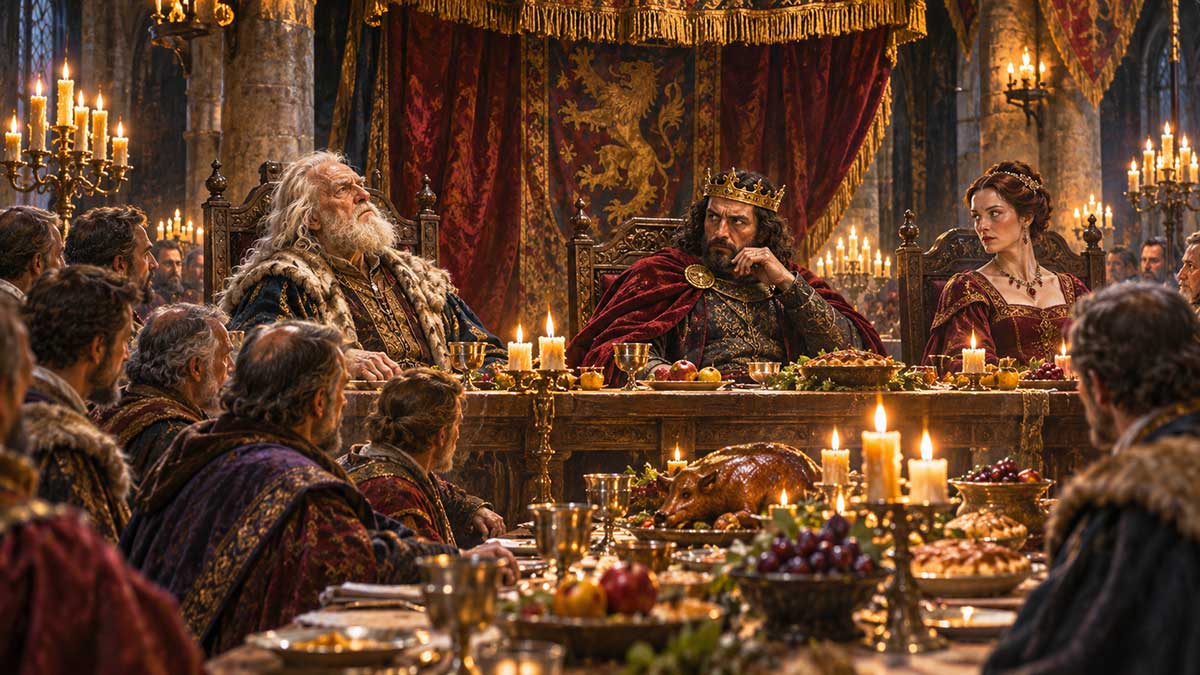
Dunsinane. The great hall of Macbeth's castle. Evening.
Long tables shine beneath hundreds of candles. A fire roars in the enormous hearth. Servants carry roasted meats, bread, fruit, and flagons of wine. At the high table stand two chairs of state: one beneath the royal canopy, the other beside it, prepared for LEAR. A third chair, farther down, remains empty.
LADY MACBETH directs the servants. A STEWARD approaches.
STEWARD
The guests are assembled, my lady. The old king's attendants ask whether they may dine beside him.
LADY MACBETH
His gentleman may stand behind his chair. The Fool may sit where he pleases, provided he knows when to hold his tongue.
STEWARD
He has already asked whether our silver is real.
LADY MACBETH
What did you tell him?
STEWARD
That it belongs to the King.
LADY MACBETH
Then you answered a different question.
She straightens a goblet and looks toward the empty chair.
LADY MACBETH
Why is that place laid?
STEWARD
It was reserved for Lord Banquo before word came that he would not attend.
LADY MACBETH
Remove it.
STEWARD
The chair, my lady?
LADY MACBETH
The setting. Leave the chair. A vacant place need not be announced to the room.
The Steward obeys. Trumpets sound. Enter MACBETH, LEAR, KENT, the FOOL, nobles, and guards. Macbeth wears a crown. Lear wears the clean but plain cloak provided to him.
MACBETH
Friends, tonight our house receives a guest whom misfortune has wronged but cannot diminish. I ask you to honor Lear of Britain, whose years of rule deserve more reverence than the storms have shown him.
The company rises. Lear inclines his head, deeply moved despite himself.
LEAR
You have offered a tired man what his own blood denied him: a chair, a fire, and a voice that does not command him to depart. I thank you, Macbeth.
MACBETH
Sit beside me. Let the world see that Scotland remembers what is owed to kings.
FOOL
And what is owed to fools, Your Majesty?
MACBETH
Supper, if they behave.
FOOL
Then I shall behave until the pudding.
Laughter. The company sits. Kent remains behind Lear, watching the doors. Macbeth signals for wine.
MACBETH
You have traveled far, my lord. I am told the roads behind you are watched by men in your daughters' colors.
LEAR
My daughters have grown fond of colors. They dress betrayal in fine cloth and call it government.
MACBETH
An ungrateful child is a crueler enemy than any foreign army.
LEAR
Aye. An enemy in the field declares himself. A daughter may kiss your hand before she takes away the chair beneath you.
MACBETH
Then a father must remind his children whose hand raised them.
KENT
Sometimes the hand that raised them must learn when to unclench.
Lear turns sharply.
LEAR
I did not ask counsel at table.
MACBETH
Your servant speaks boldly.
LEAR
He has always suffered that defect.
KENT
And survived it, my lord, by your mercy.
FOOL
A rare mercy. Nuncle usually prefers a mirror that tells him he is handsome.
LEAR
And what does my mirror say now?
FOOL
That the rain has improved your complexion. It has washed away much of the king and left the man underneath.
Some guests laugh cautiously. Macbeth studies Lear.
MACBETH
The man beneath the king. An interesting distinction. I have never found the two easily separated.
LEAR
Nor did I, until my daughters performed the surgery.
Lady Macbeth gives a small signal. Musicians begin a quiet tune. Servants refill the cups.
MACBETH
Tell me of your youngest daughter. Cordelia, is it not? I hear she is now Queen of France.
Lear's expression changes.
LEAR
She is.
MACBETH
And unlike her sisters, she has not turned her soldiers against you?
LEAR
She turned her words against me first. I asked for love, and she gave me a measure of duty, as though a father's heart were a merchant's scale.
KENT
She spoke plainly, my lord.
LEAR
Plainly enough to wound me.
MACBETH
Yet France commands armies. A daughter's affection may prove useful when the hour comes to reclaim what is yours.
LEAR
I would sooner have her love than her soldiers.
He hesitates, surprised by his own words.
MACBETH
Would you? A king without soldiers must trust the kindness of other kings.
FOOL
And a king with soldiers must trust that they will not discover a kinder king.
The laughter is thinner now. Macbeth turns toward the Fool.
MACBETH
Does your tongue never fear its own sharpness?
FOOL
Often. But I have found that a dull tongue can cut its owner just as deeply.
LADY MACBETH
Our guest has traveled through hardship. Let us spare him the quarrels of courts and give him an evening of peace.
LEAR
Peace. There is a word I once thought I could command. My herald spoke it, and men put down their swords. Yet I could not summon it to my own house.
MACBETH
Peace is secured by strength.
LEAR
Is it? Then why does the strongest man in the room keep looking at the doors?
Macbeth's hand stops upon his cup. A pause.
MACBETH
A king watches his house.
LEAR
So I once told myself.
A MESSENGER appears at a side entrance. Macbeth rises and steps away from the table. Their exchange is low but audible in fragments.
MESSENGER
My lord, the riders have returned. The father is dead, but the son—
MACBETH
Speak lower.
MESSENGER
The boy escaped us. Fleance is gone.
Macbeth grips the messenger's arm.
MACBETH
Search the northern roads. Every crossing. Every shepherd's hut. No word of this reaches the hall.
The Messenger bows and disappears. Macbeth remains still for a moment before returning. Lady Macbeth watches his face.
LADY MACBETH
My lord? Your guests await you.
MACBETH
Then let no man say I neglected them.
He lifts his goblet.
MACBETH
To the health of our noble guest, and to friends absent from this table. Would that Banquo were here to share our welcome.
As Macbeth turns to sit, he stops. BANQUO'S GHOST is seated in the vacant chair. His hair and clothing bear the marks of violence. No one else reacts.
MACBETH
Who has done this?
The room falls silent.
LADY MACBETH
Done what, my lord?
MACBETH
Which of you placed him there?
FIRST LORD
Placed whom, Your Majesty?
Macbeth points at the chair.
MACBETH
Do not pretend you cannot see him.
LEAR
Who sits there?
FIRST LORD
No one, my lord.
Macbeth backs away. The ghost looks at him without speaking.
MACBETH
Thou hast no business here. The earth received thee. Keep what it has taken.
LADY MACBETH
My husband suffers from an old affliction. It passes quickly. Pay it no mind.
FOOL
An empty chair has made the King forget his manners. I should like to see what a full one might do.
KENT
Quiet.
MACBETH
Look at me, then! If thou hast a charge, speak it before them all!
Macbeth lunges toward the chair. The ghost vanishes. Macbeth catches the back of it and stands breathing hard. The guests stare.
LEAR
Macbeth. Come away from that place.
MACBETH
You saw him?
LEAR
I saw a man afraid.
MACBETH
That is not what I asked.
LEAR
It is what I can answer.
Lady Macbeth moves between Macbeth and the guests.
LADY MACBETH
The feast is ended. His Majesty has given too much of himself to the affairs of Scotland. You will forgive this sudden leave-taking.
FIRST LORD
We wish the King good rest.
The lords rise. Servants hurry to clear the tables. Macbeth turns to Lear, struggling to regain composure.
MACBETH
A passing fever. Nothing more.
LEAR
I have known nights when the mind sets enemies before us that no sword can reach.
MACBETH
I need no counsel on the workings of my mind.
LEAR
Nor did I, when my mind first began to fail me. That was part of the trouble.
Macbeth looks away. Lear takes a step closer.
LEAR
What hast thou lost, my brother, that thou darest not name?
Macbeth turns back, his face hardening.
MACBETH
Nothing that concerns you.
FOOL
Then it must be a very small nothing, to fill so great a hall.
LADY MACBETH
Your chamber is ready, King Lear. The hour is late.
KENT
Come, my lord.
Lear hesitates, then allows Kent to guide him away. The Fool follows, but pauses beside the empty chair.
FOOL
Good night, whoever thou art. Thou hast eaten less than the rest and frightened them more.
He exits. The hall empties. Macbeth and Lady Macbeth remain. For several moments neither speaks.
LADY MACBETH
You spoke to an empty chair before the whole court.
MACBETH
It was not empty.
LADY MACBETH
Whatever you saw, you gave it a voice by answering.
MACBETH
Banquo is dead. I know that much. Yet his son lives. The witches promised a line of kings from Banquo's blood, and every hour the boy breathes is an hour stolen from my house.
LADY MACBETH
You cannot murder every future you fear.
MACBETH
Then I must learn which threats can be turned against one another. A frightened enemy may serve me better than a dead one.
LADY MACBETH
And when he ceases to be frightened?
MACBETH
I will have made certain he cannot leave.
Macbeth stares at the vacant chair.
MACBETH
The old king watched me as though he knew.
LADY MACBETH
Lear knows grief. That does not make him a prophet.
MACBETH
He has no crown, no army, and scarcely a servant. Yet he asked me a question no lord in Scotland would dare put to my face.
LADY MACBETH
Then do not make an enemy of him for speaking it.
MACBETH
A king without a kingdom can still become a banner. Malcolm has friends in England. Cordelia has France. If Lear stands with them, our enemies may gather beneath one cause.
LADY MACBETH
And if he does not?
MACBETH
Then I must learn how to keep him here.
LADY MACBETH
You have already ordered that.
Macbeth turns toward her. She has understood more than he intended.
MACBETH
You hear much within these walls.
LADY MACBETH
The walls have grown thin since Duncan died.
Macbeth recoils at the name.
MACBETH
Do not speak it here.
LADY MACBETH
Then where may it be spoken? In sleep? In the dark? Must every room in this castle be emptied before we may name the dead?
For a moment Macbeth seems ready to answer. Instead, he moves toward the door.
MACBETH
Tomorrow I shall send for news of Cordelia. If she seeks her father, I would know her road before she finds it.
LADY MACBETH
What do you intend?
MACBETH
To receive her with the same kindness I have shown him.
He exits. Lady Macbeth remains beside the vacant chair. She slowly lifts the untouched goblet from its place, then sets it down again.
Elsewhere in the castle, a narrow passage outside Lear's chamber. KENT checks the latch. LEAR stands by the window, looking toward the dark courtyard. The FOOL sits on the floor, drying his shoes near a small fire.
LEAR
He was frightened. I know that look.
KENT
The court knows it too, I think. None dared speak until his Queen dismissed them.
LEAR
A powerful king, attended by armed men, afraid of a chair that held no one.
FOOL
Perhaps the chair held a truth, nuncle. Truth is invisible to many men until it sits at their table.
LEAR
I have seen things that were not there. In the storm I heard my daughters in the thunder. I heard them laugh when the sky broke open.
KENT
You had suffered hunger and cold. Your mind was overburdened.
LEAR
And his? What burdens a king who has everything?
FOOL
Keeping it.
Lear turns toward the Fool.
LEAR
You think Macbeth wicked?
FOOL
I think a man who locks his pantry may be guarding bread. A man who locks every door may be guarding something else.
KENT
I counted four guards in the western passage. There were two when we arrived.
LEAR
He promised us safety.
KENT
He did not promise us freedom.
Lear sits heavily. For once he has no angry reply.
LEAR
I mistook my daughters' praises for love. I would not make the same mistake with a stranger's courtesy.
FOOL
That is a fine beginning, nuncle. Tomorrow we may teach thee to tell a window from a door.
Lear almost smiles.
LEAR
And what lesson comes after that?
FOOL
How to leave through the door before someone remembers to lock it.
Footsteps sound beyond the chamber. Kent moves toward the entrance and listens. The heavy tread of guards passes, then stops.
FIRST GUARD (from outside)
By order of the King, no guest leaves the western wing tonight.
SECOND GUARD (from outside)
And at dawn?
FIRST GUARD (from outside)
The order stands until His Majesty changes it.
Kent looks at Lear. The Fool slowly sets down his shoe.
LEAR
So. We are honored guests.
FOOL
Indeed, nuncle. So honored that the King cannot bear to part with us.
The fire sinks. Beyond the window, Dunsinane's gate is shut and barred. Lear watches it in silence.
Blackout.
End of Act I, Scene Two.
Act I, Scene Three: The Bastard's Bargain
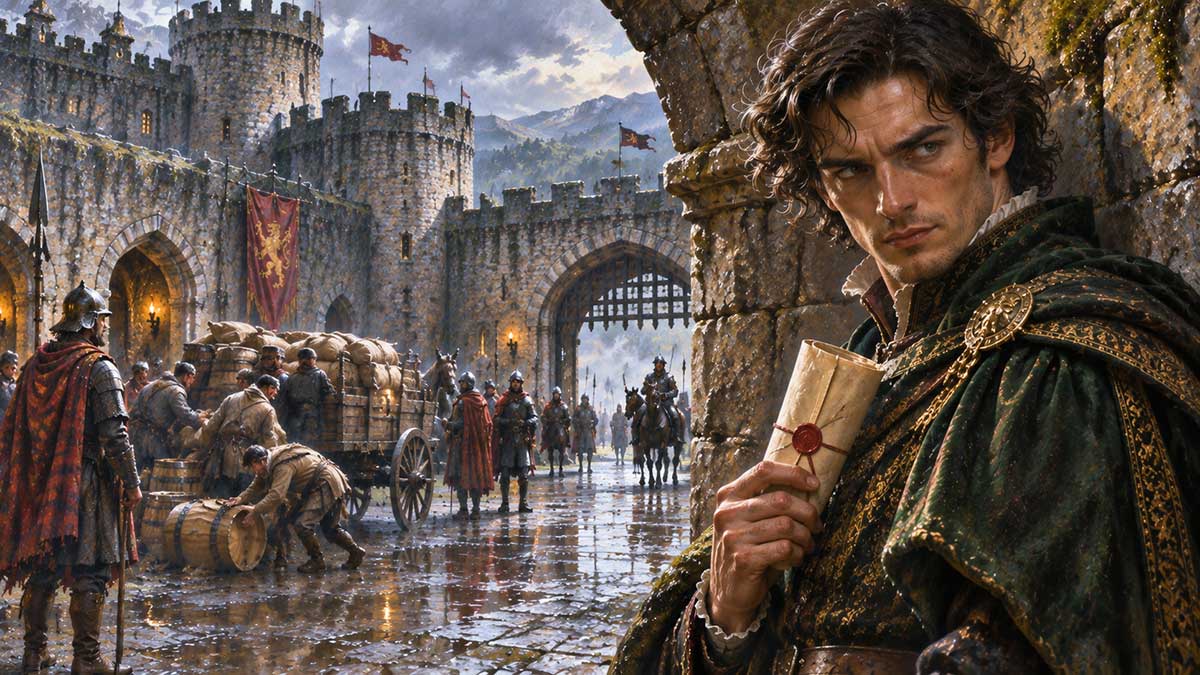
Dunsinane. The eastern courtyard. Morning.
The storm has passed, leaving the castle walls wet and black beneath a pale sky. Soldiers unload provisions from a wagon. Beyond the gates, the mountains stand under low clouds.
KENT enters, carrying a folded cloak. He approaches a CAPTAIN who is inspecting the guards.
KENT
Good morning, Captain. I would have our horses brought from the stables. King Lear wishes to travel when the weather clears.
CAPTAIN
The horses are being cared for.
KENT
I did not question their comfort. I asked that they be made ready.
CAPTAIN
No horses leave Dunsinane without the King's permission.
KENT
Your king or mine?
CAPTAIN
There is only one king within these walls whose orders I am sworn to obey.
Kent studies him.
KENT
Then your master's hospitality has acquired an unusual condition.
CAPTAIN
You may speak with His Majesty.
KENT
I intend to.
The Captain turns away. The FOOL emerges from behind a wagon, eating an apple.
FOOL
Well, Kent? Have the horses been crowned, that they too must await the King's pleasure?
KENT
They are held in the stables.
FOOL
A wise precaution. Horses have been known to carry men away from places where they are not wanted.
KENT
Speak quietly.
FOOL
Then I must become a courtier. They speak softly enough that no one hears the truth.
He takes another bite.
KENT
There are more guards than yesterday. The southern gate has been closed since dawn. We must learn what Macbeth intends before Lear confronts him.
FOOL
Nuncle will confront him before breakfast if he discovers a door has dared to disobey him.
KENT
Then keep him occupied.
FOOL
With what?
KENT
Anything.
FOOL
I have spent half my life keeping a king occupied with foolishness. Look where it has brought us.
A trumpet sounds beyond the walls. A mounted party approaches. The guards move to open the gate.
Enter EDMUND, accompanied by two attendants. He is elegantly dressed for travel, his cloak bearing the colors of neither Goneril nor Regan. He dismounts and surveys the fortress with an expression of practiced admiration.
EDMUND
A formidable house. Its master must sleep soundly.
FOOL
Then you have not dined with him.
Edmund turns.
EDMUND
And who are you?
FOOL
A man of little importance. That makes me safer than most.
EDMUND
I have heard that King Lear travels with a Fool.
FOOL
And I have heard that men who ask too many questions often know the answers already.
Kent steps forward.
KENT
State your business.
EDMUND
Edmund, son of Gloucester. I carry correspondence for Macbeth, King of Scotland.
KENT
From whom?
EDMUND
Those presently entrusted with the government of Britain.
KENT
You mean Goneril and Regan.
EDMUND
I mean those whose seals give authority to the letters I bear.
KENT
You have come a long road to avoid saying two names.
EDMUND
And you have spoken very boldly for a servant whose master has no kingdom.
Kent takes a step toward him.
KENT
Mind how you speak of Lear.
EDMUND
I spoke of his circumstances, not his worth.
FOOL
A clever difference. If a man steals my coat, he may say he has only changed my circumstances.
The Captain approaches.
CAPTAIN
Lord Edmund, His Majesty has been informed of your arrival. You are expected in the council chamber.
EDMUND
Then I shall not keep him waiting.
Edmund walks toward the castle. As he passes Kent, he pauses.
EDMUND
Give King Lear my respects. Tell him his daughters have not forgotten him.
KENT
That is precisely what troubles me.
Edmund exits with the Captain.
FOOL
A smooth gentleman.
KENT
Smooth as a knife newly sharpened.
FOOL
And twice as eager to find a pocket.
They exchange a troubled glance.
The scene shifts to Macbeth's private council chamber. Maps of Scotland, England, and the northern territories cover a long table. A fire burns beneath the royal arms.
MACBETH stands beside the table. LADY MACBETH is near the window. Enter EDMUND, escorted by the CAPTAIN.
MACBETH
Lord Edmund. Scotland welcomes an emissary from its neighbors.
EDMUND
I thank Your Majesty. I bring assurances of friendship from those who govern the southern kingdom.
MACBETH
Friendship travels strangely these days. It arrives with armed escorts and sealed letters.
EDMUND
In troubled times, even affection must protect itself.
Edmund presents two letters. Macbeth examines their seals.
MACBETH
Goneril. And Regan. Each writes separately?
EDMUND
Their interests are united, though their households remain distinct.
LADY MACBETH
A delicate answer.
EDMUND
The truth is often delicate when kingdoms are divided.
MACBETH
And what do these united sisters desire?
EDMUND
Peace along the border. Recognition of Scotland's rightful king. And an assurance that certain persons will not be permitted to disturb the settlement of Britain.
MACBETH
Certain persons?
EDMUND
Their father, chiefly.
Macbeth sets down the letters.
MACBETH
Lear is my guest.
EDMUND
So I have learned. Your generosity is already admired in the south.
MACBETH
Yet they send a messenger to discover whether I mean to continue it.
EDMUND
They fear that their father may be persuaded to reclaim authority he has freely surrendered.
LADY MACBETH
Freely? I have heard a different account of his treatment.
EDMUND
Families seldom agree upon the history of their quarrels.
MACBETH
What would the sisters have me do?
EDMUND
Keep him safe. Keep him comfortable. Above all, keep him from becoming a banner beneath which their enemies may gather.
MACBETH
You ask me to imprison a king.
EDMUND
I ask you to protect a father from the dangers of his own condition.
LADY MACBETH
And who protects him from his daughters?
Edmund meets her gaze.
EDMUND
Your Majesty, I would not presume to judge the private affections of a royal family.
LADY MACBETH
You presume a great deal for a man who has scarcely entered the room.
Macbeth gestures toward the map.
MACBETH
Leave us, Captain.
The Captain exits.
MACBETH
Let us dispense with the language of family affection. What do Goneril and Regan offer Scotland?
EDMUND
Assistance in preventing English supplies from reaching Malcolm's supporters through their territories. Information concerning the movements of hostile nobles. And recognition of Your Majesty's sovereignty.
MACBETH
Malcolm has English friends who do not depend upon your mistresses' roads.
EDMUND
True. But an army that cannot trust its rear must look backward as often as forward.
MACBETH
And in return?
EDMUND
Lear remains here until the political situation is settled. His youngest daughter is prevented from gathering support in his name.
MACBETH
Cordelia.
EDMUND
The Queen of France has been making inquiries about her father. Her agents have reached the northern ports. There are reports that she intends to cross into Scotland herself.
Lady Macbeth turns from the window.
LADY MACBETH
She would enter a foreign kingdom to find the father who rejected her?
EDMUND
So it appears.
LADY MACBETH
Then perhaps she possesses more affection than her sisters.
EDMUND
Or more ambition.
MACBETH
You see ambition in every act of loyalty.
EDMUND
I have found it prudent to examine what loyalty expects in return.
MACBETH
And what do you expect?
A pause. Edmund smiles faintly.
EDMUND
The recognition of service. My father possesses lands and titles. My brother Edgar stands before me in the order of inheritance, though I have never found him my superior in judgment or ability.
LADY MACBETH
So this mission concerns your father's estate.
EDMUND
It concerns the future. My father has chosen his heir according to custom. I intend to prove that merit deserves a place beside birth.
MACBETH
And your brother?
EDMUND
Has fled after giving our father reason to fear for his life.
LADY MACBETH
Is that what happened?
EDMUND
It is what my father believes.
Lady Macbeth watches him carefully.
MACBETH
You speak like a man who understands how a throne may be won by one whose birth gives him no promise of it.
EDMUND
I understand that the world praises courage after it has succeeded and calls it treason when it fails.
Macbeth looks at him with new interest.
MACBETH
You have come to the right court.
LADY MACBETH
Or the wrong one.
Macbeth ignores her.
MACBETH
Suppose I keep Lear within my walls. Suppose Cordelia enters Scotland. What then?
EDMUND
Her presence gives Your Majesty a choice. You may negotiate with France through her, or persuade her to support a settlement favorable to Scotland and my mistresses.
MACBETH
And if she refuses?
EDMUND
Then her freedom becomes a matter of negotiation.
LADY MACBETH
You would make a daughter pay for the privilege of seeing her father.
EDMUND
I would prevent a war in which thousands of fathers and daughters might perish.
LADY MACBETH
You have learned to make cruelty sound like mercy.
EDMUND
A useful skill in government, my lady.
Macbeth raises a hand before she can answer.
MACBETH
Enough. I shall consider the letters. You will remain at Dunsinane as my guest until I have decided.
EDMUND
I am honored.
MACBETH
One warning. You may have the confidence of Lear's daughters, but within Scotland you serve my purposes. Do not mistake my interest for trust.
EDMUND
I would never ask a king to trust a stranger merely upon his word.
Edmund bows and exits.
Lady Macbeth waits until his footsteps have faded.
LADY MACBETH
That man would sell his own father if he could persuade himself the price was just.
MACBETH
He may be useful.
LADY MACBETH
So was the dagger.
Macbeth turns sharply.
MACBETH
Must you return to that night whenever we speak of danger?
LADY MACBETH
No. The night returns without my invitation.
MACBETH
Lear's daughter may bring French soldiers to our border. Malcolm gathers men in England. If I refuse the sisters' offer, I may face enemies on every road.
LADY MACBETH
Then speak with Cordelia when she arrives. Do not begin by making her your prisoner.
MACBETH
You heard Edmund. She may become the instrument by which Lear regains his kingdom.
LADY MACBETH
And is a father restored to his daughter such a threat to Scotland?
MACBETH
A king restored to his throne is a threat to every man who stands between him and it.
Lady Macbeth looks toward the door through which Edmund departed.
LADY MACBETH
Then I fear we have invited another hungry man to our table.
She exits. Macbeth remains over the map, studying the roads between Scotland and France.
The scene shifts to a small garden enclosed by the castle walls. LEAR walks beneath a covered passage. KENT and the FOOL follow.
LEAR
This place is fair enough. Its stones are strong, its servants respectful. Macbeth knows how a king should be received.
KENT
He knows how to receive you. Whether he knows how to release you remains uncertain.
LEAR
Again thy suspicions.
KENT
Our horses are held. The gates are guarded. And a messenger from Goneril and Regan has arrived.
Lear stops.
LEAR
From my daughters?
KENT
Edmund, Gloucester's younger son.
LEAR
I remember the boy. A clever face. Gloucester spoke of him with a father's pride and embarrassment mingled together.
KENT
He carries letters for Macbeth.
LEAR
Then my daughters have followed me even here.
FOOL
A father may travel a thousand miles and still find his children waiting in his purse.
LEAR
What do they want now? Have I not surrendered enough?
KENT
We do not yet know.
LEAR
I will speak with Macbeth. He has given me his hand. He will not betray a guest for the favor of two ungrateful women.
KENT
I hope you are right.
LEAR
You doubt every man who offers me kindness.
KENT
I doubt the kindness that cannot bear examination.
Lear begins to answer, then looks away.
LEAR
There was a time when I thought Cordelia unkind. She would not praise me as her sisters did. I mistook the absence of sweet words for the absence of love.
FOOL
And now?
LEAR
Now I know sweet words may hide a bitter heart.
FOOL
A good lesson, nuncle. But thou hast learned only half.
LEAR
What is the other half?
FOOL
That a bitter word may sometimes come from a loving one.
Lear studies him.
LEAR
Thou art speaking of Cordelia.
FOOL
I am speaking of anyone who has ever told thee something thou didst not wish to hear.
Kent approaches Lear carefully.
KENT
There is news of her.
Lear's face changes at once.
LEAR
What news?
KENT
Edmund says she has sent agents north. She may be coming to Scotland herself.
LEAR
Here?
KENT
So he claims.
LEAR
After all that passed between us?
KENT
She has not forgotten you.
Lear looks beyond the walls, toward the distant hills.
LEAR
I forbade her my house. I took from her the portion that should have been hers. I sent her away with nothing but the love she would not put into words.
FOOL
And it seems she has carried that love farther than her sisters carried their promises.
Lear turns sharply, struggling between longing and pride.
LEAR
If she comes, I shall hear what she has to say.
KENT
And what will you say to her?
Lear is silent.
FOOL
There is the difficulty. A king may command a thousand men, but he cannot order one honest apology to leave his mouth.
LEAR
I have not said that I owe her an apology.
FOOL
No, nuncle. That is why I am still waiting.
Lear walks away from them, troubled.
Elsewhere, Edmund stands alone in a narrow chamber assigned to visiting nobles. He opens a small leather case containing two letters.
He reads the first, bearing Goneril's seal.
EDMUND
"Let our father remain beyond our borders. His return would unsettle every settlement we have made."
He unfolds the second, bearing Regan's seal.
EDMUND
"If the old man cannot be restrained, see that he is rendered incapable of troubling us further."
Edmund lowers the letters and smiles without pleasure.
EDMUND
Two sisters. One kingdom. Two instructions for the same father.
He takes a third letter from inside his cloak, this one addressed to him privately.
EDMUND
"And when the matter is settled, remember whose affection first recognized your worth."
He folds it away.
EDMUND
Affection. There is the most expensive word in any court.
A knock sounds.
EDMUND
Enter.
The CAPTAIN appears.
CAPTAIN
His Majesty requests that you remain available. No word of your mission is to reach Lear.
EDMUND
Naturally.
CAPTAIN
And the Queen of France?
EDMUND
What of her?
CAPTAIN
Our scouts report a small party traveling north from the coastal road. They bear French colors, though they have no army with them.
Edmund steps closer.
EDMUND
How far?
CAPTAIN
Two days, perhaps less.
EDMUND
Does Macbeth know?
CAPTAIN
He has been informed.
EDMUND
Then tell him I can identify those who travel in Cordelia's service. My mistresses have kept careful accounts of her friends.
CAPTAIN
I shall deliver the message.
The Captain exits. Edmund turns to the window.
EDMUND
Come then, Cordelia. A daughter who loves her father is a useful thing to men who know what fathers are worth.
He extinguishes the candle.
The scene returns to Macbeth's council chamber. Night is approaching. Macbeth stands before the map. The CAPTAIN waits beside him.
MACBETH
The French party must be watched from the moment it crosses our border. No violence unless I command it.
CAPTAIN
And if the Queen herself is among them?
MACBETH
Escort her here with every mark of honor.
CAPTAIN
Will she be free to depart?
Macbeth looks at the two letters from Goneril and Regan lying upon the table.
MACBETH
Not until I have spoken with her father.
CAPTAIN
And Lear?
MACBETH
He may walk the gardens. He may dine at my table. He may receive every courtesy a king deserves.
Macbeth folds the letters together.
MACBETH
But no messenger leaves Dunsinane in his name, and no horse is saddled for his departure.
CAPTAIN
It shall be done.
The Captain bows and withdraws.
Macbeth stands alone. A gust rattles the shutters. He looks toward the vacant chair at the far end of the chamber.
MACBETH
One king without a crown. One daughter with an army beyond the sea. One bastard who would sell them both.
He places his hand upon his own crown.
MACBETH
And all of them come to Scotland seeking something.
From the darkened corner, the sound of a faint footstep. Macbeth turns. No one is there.
MACBETH
Who goes?
Silence.
He moves to the door and calls for the guards. Outside, the castle bells begin marking the night watch.
High upon the battlements, soldiers close the outer gate. Far below, on the southern road, a solitary rider passes a torchlit border marker and continues toward Dunsinane.
Blackout.
End of Act I, Scene Three.
End of Act I.
Act II, Scene One: The Daughter Who Would Not Lie

Scotland. A forest road south of Dunsinane. Late afternoon.
The trees stand dark beneath a cold autumn sky. A narrow road winds between ancient oaks, their branches nearly touching overhead. In the distance, the mountains rise like broken walls.
Enter CORDELIA, accompanied by SIR ALAIN, a French knight, and two ATTENDANTS. Their horses are weary from travel. Cordelia wears a dark blue traveling cloak, with a small golden clasp bearing the lilies of France.
A distant raven cries.
SIR ALAIN
We should rest before the light fails, Your Majesty. The horses have climbed since dawn, and these roads are unfamiliar.
CORDELIA
How far to Dunsinane?
SIR ALAIN
Perhaps two hours. Less, if the road remains clear.
CORDELIA
Then we have two hours of daylight to spend.
SIR ALAIN
And a night of danger if we misjudge the road.
CORDELIA
My father has spent more than one night without shelter. I will not complain of another.
SIR ALAIN
You are Queen of France. Your safety concerns more than your own heart.
CORDELIA
I know what crown I wear, Alain. Yet before I wore it, I was a daughter.
She looks toward the distant hills.
CORDELIA
When I was a child, my father would walk with me through the orchard after supper. He knew the names of every tree. He would point to the oldest and tell me that a kingdom should grow like an oak, slowly, with roots deeper than its branches.
SIR ALAIN
He was a wise king, then.
CORDELIA
Sometimes. He was a man who could speak beautifully of roots and still cut away the branch that loved him.
SIR ALAIN
You speak without bitterness.
CORDELIA
I have had bitterness enough to know its taste. I do not wish to carry it across another border.
SIR ALAIN
He cast you out before the court. He denied your inheritance. There are those in France who say you owe him nothing.
CORDELIA
They are mistaken.
SIR ALAIN
What do you owe a father who rejected you?
CORDELIA
The truth. I owed it to him when he was king, and I owe it to him now.
SIR ALAIN
And love?
CORDELIA
That was never a debt.
She touches the small clasp at her throat.
CORDELIA
He asked how much I loved him. My sisters gave him words enough to fill a kingdom. I gave him what I could speak honestly, and he called it nothing.
SIR ALAIN
Perhaps he will ask forgiveness when he sees you.
CORDELIA
Perhaps he will ask why I have come without an army.
SIR ALAIN
You could have brought one.
CORDELIA
And made my father's rescue the beginning of another war? Scotland has troubles of its own. I came to ask for a man, not to conquer a country.
SIR ALAIN
Macbeth may not see the distinction.
CORDELIA
Then we must make him see it.
An ATTENDANT rides forward from the trees.
FIRST ATTENDANT
My lady, armed men ahead.
SIR ALAIN
How many?
FIRST ATTENDANT
Six that I could see. More may be concealed.
Sir Alain reaches for his sword.
CORDELIA
Do not draw.
SIR ALAIN
Your Majesty—
CORDELIA
We have crossed this border openly, bearing the colors of France. Let them see that we have nothing to hide.
Enter the SCOTTISH CAPTAIN with six SOLDIERS. They spread across the road, blocking the passage.
CAPTAIN
Travelers, halt. State your names and your purpose in Scotland.
SIR ALAIN
You stand before Cordelia, Queen of France, traveling under diplomatic protection. I am Sir Alain de Vienne, charged with her safety.
The Captain bows, but his soldiers do not move.
CAPTAIN
Your Majesty. We were instructed to expect you.
CORDELIA
Then your king has received my message?
CAPTAIN
His Majesty Macbeth has been informed of your approach.
CORDELIA
Good. We seek an audience concerning my father, Lear of Britain.
CAPTAIN
King Lear is presently enjoying the hospitality of Dunsinane.
CORDELIA
Is he well?
CAPTAIN
He is housed and attended.
CORDELIA
That was not my question.
The Captain hesitates.
CAPTAIN
I have not spoken with him myself, my lady.
CORDELIA
Then I shall ask him when we arrive.
CAPTAIN
His Majesty has commanded that you be escorted to the castle.
SIR ALAIN
We are grateful for the escort. Our horses require water, and we would appreciate safe passage.
CAPTAIN
Your escort may accompany you as far as the outer courtyard. Their weapons must then be surrendered.
SIR ALAIN
That is not customary treatment for a visiting queen.
CAPTAIN
It is a precaution required by the present troubles.
CORDELIA
And if I decline? Are we free to turn back?
The Captain looks at the soldiers. None moves aside.
CAPTAIN
My orders are to bring you safely to Dunsinane.
CORDELIA
Then I see that your protection is not ours to refuse.
Sir Alain moves closer to her.
SIR ALAIN
Your Majesty, we should return to the border and send word to France.
CORDELIA
If we return, my father remains here. If we resist, blood may be shed for nothing.
She looks directly at the Captain.
CORDELIA
We will accompany you. But understand this: I come as a queen seeking peaceful conversation, not as a prisoner submitting to arrest.
CAPTAIN
You will be treated with honor.
CORDELIA
Then honor your words.
The Captain bows. His soldiers turn toward Dunsinane. Cordelia and her attendants follow, surrounded by armed men.
As they disappear among the trees, a raven rises from the branches.
The scene shifts to Dunsinane. A chamber overlooking the inner courtyard.
LADY MACBETH stands before a mirror. A SERVANT fastens a dark jeweled clasp upon her gown. On a nearby table rests a silver basin filled with water.
SERVANT
The French Queen has reached the southern road, my lady. She should arrive before nightfall.
LADY MACBETH
Has the King prepared a reception?
SERVANT
He has ordered the great chamber opened. Lord Edmund is with him.
Lady Macbeth turns sharply.
LADY MACBETH
Edmund again.
SERVANT
He has scarcely left His Majesty's side since morning.
LADY MACBETH
Men who arrive bearing secrets are often reluctant to leave before they have sold them all.
The Servant lowers her eyes.
SERVANT
Will you require anything else?
LADY MACBETH
No. Leave me.
The Servant exits.
Lady Macbeth looks into the mirror. She raises her hands, examining them. Slowly, she dips them into the basin and rubs them together.
The water is clear.
LADY MACBETH
Still.
She rubs harder.
LADY MACBETH
Still there.
Footsteps sound. She quickly withdraws her hands and dries them.
Enter MACBETH.
MACBETH
The French Queen approaches.
LADY MACBETH
I have heard.
MACBETH
She travels with four attendants and a knight. No army. No great display of royal dignity.
LADY MACBETH
Perhaps she has come to see her father rather than impress yours.
MACBETH
You have grown fond of this woman before meeting her.
LADY MACBETH
I have grown curious. There is a difference.
MACBETH
Edmund says she is stubborn. She refused to flatter Lear even when her inheritance depended upon it.
LADY MACBETH
Then she possesses a quality uncommon at courts.
MACBETH
Pride?
LADY MACBETH
Honesty.
MACBETH
Honesty is often the name given to pride by those who refuse to yield.
LADY MACBETH
And loyalty is often the name given to obedience by those who demand it.
Macbeth studies her.
MACBETH
You speak as though you know this daughter better than her father does.
LADY MACBETH
Her father is a man who has lost a kingdom and has not yet learned why.
MACBETH
Lear may regain his throne if he listens to me.
LADY MACBETH
And what will you ask in return?
MACBETH
His public support. His daughter's cooperation. France must be persuaded to withhold assistance from Malcolm.
LADY MACBETH
Cordelia cannot command every decision of France alone.
MACBETH
She can influence them. Her husband will listen.
LADY MACBETH
And if she refuses?
MACBETH
Then she will remain until she understands the necessity.
LADY MACBETH
You intend to hold her.
MACBETH
I intend to negotiate from strength.
LADY MACBETH
A guest becomes a hostage when the door is locked.
MACBETH
Must you name every precaution a crime?
LADY MACBETH
No. I would prefer that fewer precautions required such names.
Macbeth approaches the window.
MACBETH
Malcolm gathers soldiers in England. Macduff calls me murderer. Lear's daughters bargain for his silence. And now a French queen enters my country to claim a father whose name could unite my enemies.
LADY MACBETH
Then give her father back.
MACBETH
And let them depart together? Lear might return with French soldiers at his back. His daughters would blame me. Malcolm would gain another ally.
LADY MACBETH
Perhaps there is a danger in every act of mercy. That does not make cruelty wise.
Macbeth turns.
MACBETH
You once told me that a man must seize the moment when fortune places a crown within reach.
Lady Macbeth stiffens.
LADY MACBETH
I know what I told you.
MACBETH
Have you forgotten?
LADY MACBETH
There are words I would give half my life to take back.
A bell sounds from the courtyard.
MACBETH
Our guest has arrived.
He offers his arm. Lady Macbeth looks at it for a moment, then takes it.
The scene shifts to the great chamber of Dunsinane.
Two rows of guards stand beneath banners bearing Macbeth's royal emblem. EDMUND waits beside the throne. Several SCOTTISH LORDS are present.
Enter MACBETH and LADY MACBETH. Trumpets sound.
Enter CORDELIA, SIR ALAIN, and their attendants, escorted by the Captain.
Cordelia walks with quiet dignity. Her clothing bears the dust of travel, but she makes no apology for her appearance.
MACBETH
Cordelia, Queen of France. Scotland receives you with honor.
CORDELIA
I thank Your Majesty for granting me an audience.
MACBETH
Your arrival brings distinction to our court. I regret that the roads have been difficult.
CORDELIA
The roads were passable. The soldiers upon them were less willing to let us choose our direction.
Several courtiers exchange glances.
MACBETH
My men were instructed to protect you.
CORDELIA
Then I trust their instructions will be clearer when I depart.
MACBETH
We need not speak of departure before you have rested.
CORDELIA
I have come for my father. Rest can wait.
Macbeth smiles.
MACBETH
A devoted daughter. Your father is fortunate.
CORDELIA
I hope he is well.
MACBETH
He has been given every comfort my castle can provide.
CORDELIA
May I see him?
MACBETH
In due course.
CORDELIA
I have crossed the sea and the border to find him. I would prefer that course begin today.
EDMUND
Your Majesty, perhaps the King might first explain the delicate situation in which your father has placed himself.
Cordelia turns toward Edmund.
CORDELIA
I know you.
EDMUND
Edmund, son of Gloucester, at your service.
CORDELIA
My father's court knew your family well. How fares Lord Gloucester?
EDMUND
He has endured difficulties.
CORDELIA
What difficulties?
EDMUND
Matters of domestic sorrow. I would not burden you with them at such a moment.
CORDELIA
You have brought my sisters' letters to Scotland, have you not?
EDMUND
I have undertaken certain duties on behalf of the government.
CORDELIA
Then I suspect your presence concerns my father more than your own household.
Edmund bows slightly.
EDMUND
You have always been perceptive.
CORDELIA
I have always preferred a plain answer.
Macbeth steps forward.
MACBETH
Then let us speak plainly. Your father is in a dangerous position. His daughters govern Britain. His former supporters are divided. Malcolm, the son of Duncan, gathers an army in England and threatens Scotland's peace.
CORDELIA
I know of Malcolm. I know his father is dead and that questions remain concerning the manner of his death.
Macbeth's expression hardens.
MACBETH
Those questions have been answered in Scotland.
CORDELIA
Then Scotland should have no fear of their being asked elsewhere.
Lady Macbeth lowers her eyes. Macbeth pauses before answering.
MACBETH
You are direct, my lady.
CORDELIA
My father once found that quality intolerable.
MACBETH
Yet you have come to rescue him.
CORDELIA
Yes.
MACBETH
After he cast you out?
CORDELIA
Yes.
MACBETH
After he denied you your inheritance and declared you no daughter of his?
CORDELIA
Yes.
MACBETH
Then your devotion is remarkable.
CORDELIA
It is ordinary. A father does not cease to be a father when he acts unjustly.
Lady Macbeth looks up at Cordelia.
MACBETH
And a king does not cease to be a king when his subjects refuse him obedience?
CORDELIA
That depends upon what you mean by a king.
MACBETH
A man appointed to govern, to command, and to preserve his realm.
CORDELIA
Then he must govern justly, command wisely, and preserve the people entrusted to him.
MACBETH
You speak as though a crown were a burden.
CORDELIA
Is it not?
MACBETH
It is an honor won by courage.
CORDELIA
Then courage must continue after the crown is won.
Silence falls over the court.
EDMUND
Your Majesty, the Queen's concern for her father is admirable. Yet the safety of nations cannot depend upon affection alone.
CORDELIA
Nor should it depend upon the ambition of men who have none.
Edmund's smile fades.
MACBETH
I have a proposal. Your father may regain his influence in Britain. I am prepared to support a settlement restoring him to a position of dignity and authority.
CORDELIA
At what price?
MACBETH
France must recognize my sovereignty and refrain from supporting Malcolm's rebellion. Your father must publicly affirm the legitimacy of my rule. You must persuade your husband that Scotland seeks peace.
CORDELIA
I cannot promise what the King of France has not authorized.
MACBETH
You possess his confidence.
CORDELIA
I possess his love. I will not misuse it.
MACBETH
You would refuse an opportunity to restore your father's honor?
CORDELIA
My father's honor is not a piece of land to be returned by treaty.
MACBETH
You speak of honor as though it were independent of authority.
CORDELIA
It must be. Otherwise every successful thief would become an honorable man the moment he wore what he had stolen.
The court falls utterly still.
Macbeth slowly rises from his chair.
MACBETH
Take care, Queen Cordelia.
CORDELIA
I have spoken of no man here.
MACBETH
You speak in riddles.
CORDELIA
No. I speak plainly. That has always been my difficulty.
Lady Macbeth intervenes.
LADY MACBETH
Our guest has traveled far. Let us offer her refreshment before matters of state are pursued further.
MACBETH
The Queen is right. We need not settle every question tonight.
He turns back to Cordelia.
MACBETH
You may see your father when I have received assurances concerning your intentions.
CORDELIA
My intentions are before you. I wish to see him, speak with him, and, if he consents, accompany him to safety.
MACBETH
And if I require his presence here?
CORDELIA
Then I must ask by what right you hold him.
MACBETH
By the right of a king protecting a guest.
CORDELIA
A guest may leave.
MACBETH
A guest may place himself in danger.
CORDELIA
And a king may decide that another person's freedom is dangerous to himself.
Macbeth steps closer.
MACBETH
You are in Scotland now, my lady.
CORDELIA
I have not forgotten.
MACBETH
Here, my word governs.
CORDELIA
Then let your word be worthy of obedience.
Macbeth stares at her. For a moment, his hand tightens upon the arm of his throne.
MACBETH
You will be shown to your chamber. My wife will attend to your comfort.
CORDELIA
And my father?
MACBETH
Tomorrow.
CORDELIA
You have said that twice.
MACBETH
Then you know my answer.
He signals to the Captain.
MACBETH
Escort the Queen to the eastern apartments. Her attendants may remain with her. No one is to enter or leave that wing without the permission of the royal household.
SIR ALAIN
Your Majesty, I must protest. The Queen of France cannot be detained under the appearance of hospitality.
MACBETH
Your protest is heard.
SIR ALAIN
Will you release her?
MACBETH
When our business is concluded.
Cordelia raises her hand, restraining Sir Alain.
CORDELIA
I will not give you the quarrel you seek, Macbeth.
MACBETH
I seek no quarrel.
CORDELIA
Then you may still choose peace.
She turns to Lady Macbeth.
CORDELIA
My lady, I thank you for your courtesy.
LADY MACBETH
I shall see that you are properly attended.
CORDELIA
I ask only one kindness.
LADY MACBETH
Name it.
CORDELIA
Tell my father I have come.
Lady Macbeth meets her eyes.
LADY MACBETH
I will tell him.
Cordelia bows with dignity and leaves under guard. Sir Alain and the attendants follow.
Macbeth waits until the doors close.
MACBETH
A stubborn woman.
EDMUND
A dangerous one, my lord. She possesses the certainty of those who have never needed to compromise.
LADY MACBETH
She has compromised much already. She came without an army and placed herself in our hands.
EDMUND
And now expects us to surrender our advantage out of admiration.
MACBETH
Enough. I have heard what she wishes. I must decide what Scotland requires.
He turns to Lady Macbeth.
MACBETH
You will supervise her confinement. She is to be treated with every courtesy, but she is not to communicate with France.
LADY MACBETH
You have made her a prisoner.
MACBETH
I have made her a guest whose departure requires my consent.
LADY MACBETH
You may change the word. You have not changed the deed.
Macbeth looks at her coldly.
MACBETH
See that my orders are obeyed.
He exits with Edmund and the guards.
Lady Macbeth remains alone beneath the royal banners.
The scene shifts to a narrow passage outside the eastern apartments. Night has fallen.
Cordelia stands beside a tall window. Beyond it lies an enclosed courtyard. Sir Alain is near the chamber door, where two Scottish guards have taken their posts.
SIR ALAIN
I should have insisted we turn back at the forest.
CORDELIA
They would not have allowed it.
SIR ALAIN
Then we should have fought.
CORDELIA
Six soldiers on the road, more hidden in the trees, and an army within these walls. What would your sword have accomplished?
SIR ALAIN
It might have preserved our honor.
CORDELIA
Your honor is not diminished by remaining alive.
SIR ALAIN
The King of France will not tolerate this insult.
CORDELIA
Then we must find a way to tell him without bringing war upon everyone who lives between here and the sea.
SIR ALAIN
The guards have taken our letters.
CORDELIA
They cannot take every road forever.
She looks toward the courtyard.
CORDELIA
My father is somewhere within these walls.
SIR ALAIN
If Macbeth has spoken truth.
CORDELIA
He has spoken enough truth to make his falsehoods more dangerous.
A distant door opens. Voices echo across the courtyard below.
Cordelia moves closer to the window.
LEAR (from below, unseen)
I will not be kept from the garden like a child! Tell your master that I am Lear!
KENT (from below)
My lord, the hour is late. Come away from the door.
LEAR
I have crossed storms and kingdoms, and now a servant tells me where I may walk!
Cordelia grips the stone window ledge.
CORDELIA
Father.
She leans forward.
CORDELIA
Father! It is Cordelia!
The courtyard voices continue, but the wind carries her words away.
CORDELIA
Father, I am here!
Sir Alain approaches.
SIR ALAIN
He cannot hear you.
Below, Lear's voice grows faint.
LEAR (from below)
I was a king once. Do they think I have forgotten?
Footsteps recede.
Cordelia remains at the window, trembling.
CORDELIA
No, Father. I fear you remember it too well.
She lowers her head.
CORDELIA
If only you knew how little I care for the crown they took from you.
Behind her, the chamber door opens.
Enter LADY MACBETH, carrying a small lamp. The guards remain outside.
LADY MACBETH
I thought you might wish for light.
CORDELIA
I have heard my father's voice.
LADY MACBETH
He walks in the western courtyard at this hour.
CORDELIA
Then you know where he is.
LADY MACBETH
Yes.
CORDELIA
Will you take me to him?
Lady Macbeth looks toward the guarded door.
LADY MACBETH
I have been instructed to keep you here.
CORDELIA
Do you believe the instruction is just?
Lady Macbeth sets the lamp upon the table.
LADY MACBETH
Justice is seldom simple in a kingdom threatened by war.
CORDELIA
It is simple enough to know that a daughter should be allowed to embrace her father.
LADY MACBETH
And if that embrace brings armies to our gates?
CORDELIA
Then your king has mistaken love for a weapon.
Lady Macbeth looks away.
CORDELIA
My lady, you have shown me kindness in a court where kindness seems to require permission. I thank you.
LADY MACBETH
Do not thank me yet.
CORDELIA
Why?
LADY MACBETH
I have done nothing.
CORDELIA
You have listened.
LADY MACBETH
Listening may be the easiest virtue of a coward.
CORDELIA
Then perhaps it is where courage begins.
Lady Macbeth studies her, unsettled.
LADY MACBETH
You speak as though courage were always gentle.
CORDELIA
No. I have seen courage take a sword into battle. I have seen it stand before an angry king and refuse to lie. I believe it may take many forms.
LADY MACBETH
And which is hardest?
CORDELIA
The one we have spent our lives refusing to practice.
A long silence.
Lady Macbeth turns her hands beneath the lamplight. She rubs one thumb against the palm of the other.
CORDELIA
Are you unwell?
LADY MACBETH
No.
CORDELIA
Your hands are trembling.
LADY MACBETH
It is the cold.
Cordelia looks toward the fire.
CORDELIA
The room is warm.
Lady Macbeth closes her hands.
LADY MACBETH
Rest tonight. I will speak with the King concerning your father.
CORDELIA
Will you tell him what I have said?
LADY MACBETH
I doubt he would wish to hear it.
CORDELIA
Then tell him anyway.
Lady Macbeth almost smiles.
LADY MACBETH
You have not learned the art of surviving at court.
CORDELIA
I have survived one court by leaving it. I hope to survive this one by remaining myself.
Lady Macbeth moves toward the door, then pauses.
LADY MACBETH
Your father loved you once?
CORDELIA
I believe he loves me still.
LADY MACBETH
After what he did?
CORDELIA
Love does not excuse what he did.
LADY MACBETH
Then why have you come?
CORDELIA
To give him the chance to become a better man than the one who sent me away.
Lady Macbeth is silent. The words seem to have reached a place she has long kept closed.
LADY MACBETH
And if he refuses?
CORDELIA
Then I will have spoken the truth and offered him my hand. What he chooses afterward belongs to him.
Lady Macbeth nods slowly.
LADY MACBETH
Good night, Queen Cordelia.
CORDELIA
Good night, my lady.
Lady Macbeth leaves. The door closes. The sound of the lock turning is unmistakable.
Cordelia stands motionless for a moment, then returns to the window.
Across the courtyard, in another wing of the castle, a single light burns behind a narrow window.
She watches it.
CORDELIA
Father, I am here.
The wind stirs the curtain.
CORDELIA
I cannot give you back your kingdom. I do not know whether I can give you peace. But I have come.
She places her hand against the cold glass.
CORDELIA
This time, I will not leave without trying to reach you.
The light across the courtyard goes out.
Cordelia remains at the window.
Blackout.
End of Act II, Scene One.
Act II, Scene Two: The Blood That Will Not Wash
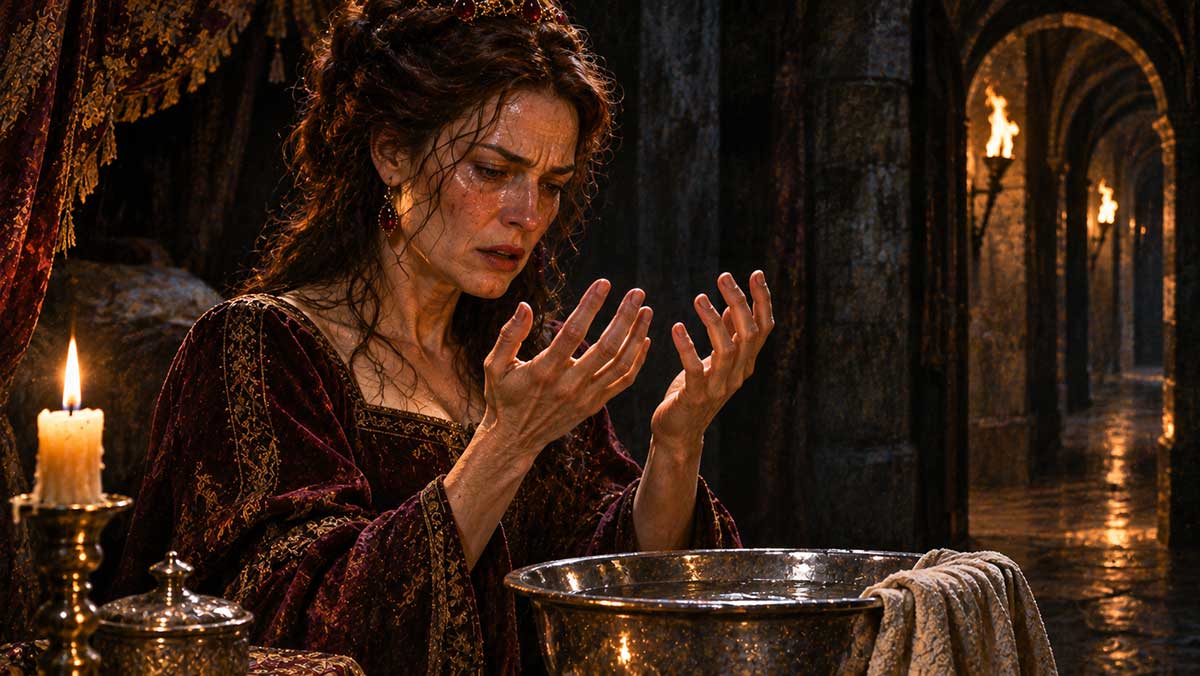
Dunsinane. The eastern apartments. Deep night.
The castle sleeps beneath a moon obscured by passing clouds. A narrow corridor stretches between the guest chambers and the private apartments of the Queen. Torches burn low in their iron brackets.
Within her chamber, CORDELIA sits beside a table. A candle illuminates a small sheet of parchment. SIR ALAIN stands near the window, listening to the distant footsteps of guards.
SIR ALAIN
The western passage remains guarded. I counted four men at the stair and two beneath the arch.
CORDELIA
And the courtyard?
SIR ALAIN
Closed after the second watch. No one passes without the King's permission.
CORDELIA
Then Macbeth fears what a daughter might say to her father.
SIR ALAIN
He fears what your husband might do when he learns you are detained.
CORDELIA
My husband will not learn it from these walls. They have taken our letters.
SIR ALAIN
I have considered the kitchen servants. One may be persuaded to carry a message.
CORDELIA
With what payment?
SIR ALAIN
Gold.
CORDELIA
And when the servant is discovered?
SIR ALAIN
There is danger in every attempt.
CORDELIA
Then let the danger fall first upon those who chose to come here, not upon a boy who carries bread.
Sir Alain bows his head.
SIR ALAIN
You have never made my duties easy, Your Majesty.
CORDELIA
Nor have you made mine. You insist upon keeping me alive when I would rather be useful.
SIR ALAIN
I have found those duties compatible.
Cordelia smiles faintly. She looks down at the parchment.
SIR ALAIN
What are you writing?
CORDELIA
A letter to my father.
SIR ALAIN
Will the guards deliver it?
CORDELIA
I do not know.
SIR ALAIN
Then why write?
CORDELIA
There are things I could not say when I stood before him. Perhaps I shall find the words before I see him again.
SIR ALAIN
You spoke honestly at his court.
CORDELIA
I did. Yet honesty may still be incomplete.
She reads softly from the page.
CORDELIA
"My father, I did not refuse to praise you for lack of love. I feared that love made into a contest would cease to be love at all."
She stops.
SIR ALAIN
That is well said.
CORDELIA
It is too well said. It sounds like a queen addressing a council.
She tears the parchment in two.
SIR ALAIN
My lady—
CORDELIA
When I see him, I wish to speak as his daughter.
She lays the pieces beside the candle.
CORDELIA
I shall tell him that I missed him.
A bell sounds faintly from the tower.
SIR ALAIN
The third watch. You should sleep.
CORDELIA
And you?
SIR ALAIN
I shall remain by the door.
CORDELIA
You have watched over me since we crossed the border.
SIR ALAIN
Then I have had excellent practice.
He withdraws into the adjoining chamber.
Cordelia extinguishes all but one candle. She approaches the window, where the moonlight briefly reveals the western wing of the castle.
Then a sound comes from the corridor.
A soft scraping.
Cordelia turns.
The sound returns. A footstep. Another.
She moves toward the door and listens.
A woman's voice, scarcely louder than breath.
LADY MACBETH (beyond the door)
Out.
A pause.
LADY MACBETH
Out, I say.
Cordelia opens the door cautiously.
The guards are absent from the immediate passage, having moved to the stair below. At the far end of the corridor stands LADY MACBETH.
She wears a white nightgown. Her hair hangs loose. In one hand she carries a candle. With the other, she rubs her fingers against her palm.
Her eyes are open, yet she appears to see nothing before her.
CORDELIA
My lady?
Lady Macbeth does not answer.
LADY MACBETH
One spot. A little spot.
She raises her hand toward the candle.
LADY MACBETH
How came it there?
Cordelia approaches slowly.
CORDELIA
Are you unwell?
LADY MACBETH
The water was clean. I saw it. Clean as morning.
She rubs her hands more fiercely.
LADY MACBETH
Yet here it is again.
Cordelia looks at her hands. There is no visible stain.
CORDELIA
There is nothing upon them.
LADY MACBETH
Nothing?
Lady Macbeth gives a low, terrible laugh.
LADY MACBETH
A little nothing. A little red nothing that has filled the whole house.
She begins walking down the corridor. Cordelia follows at a careful distance.
LADY MACBETH
He was old. He slept beneath our roof.
Cordelia stops.
LADY MACBETH
A guest. A king. A father.
Lady Macbeth's candle trembles.
LADY MACBETH
Who would have thought an old man held so much blood?
Cordelia looks toward the dark passage.
CORDELIA
Of whom do you speak?
Lady Macbeth continues as though she has heard nothing.
LADY MACBETH
I said it would be easy. One door. One knife. A little courage.
She presses her hands against her face.
LADY MACBETH
And afterward the world would be ours.
Cordelia draws a slow breath.
CORDELIA
King Duncan.
At the sound of the name, Lady Macbeth recoils.
LADY MACBETH
Hush!
She looks about wildly, though her eyes still seem fixed upon something far beyond the corridor.
LADY MACBETH
The walls hear. The stones hear. The dead hear everything.
She moves toward a basin standing beside a narrow window. Setting down the candle, she plunges her hands into the water.
She scrubs them.
LADY MACBETH
Wash.
She scrubs harder.
LADY MACBETH
Wash, and be done.
The water spills across the floor.
CORDELIA
My lady, you will hurt yourself.
Cordelia gently reaches for her wrists.
Lady Macbeth jerks away.
LADY MACBETH
Do not touch me!
Her voice echoes through the passage. She freezes, listening.
LADY MACBETH
Was that the bell?
CORDELIA
Only your voice.
LADY MACBETH
No. The bell. The bell that told him to go.
She begins to weep without seeming to know it.
LADY MACBETH
I could have stopped him.
Cordelia stands very still.
LADY MACBETH
I could have said no.
Lady Macbeth slowly sinks onto a bench.
LADY MACBETH
But I called him coward.
The candle flickers.
LADY MACBETH
And he believed me.
Cordelia kneels beside her.
CORDELIA
My lady, listen to my voice. You are in your own castle. You are safe.
LADY MACBETH
Safe?
She looks directly at Cordelia for the first time, yet without recognition.
LADY MACBETH
There is no safe place for a heart that knows what it has done.
Her eyes close. She sways.
Cordelia catches her before she falls.
CORDELIA
Alain!
Sir Alain appears at the chamber door, sword in hand.
SIR ALAIN
Your Majesty!
CORDELIA
Put away your sword. The Queen is ill.
He hurries forward. Together they help Lady Macbeth rise.
SIR ALAIN
We should summon her attendants.
CORDELIA
Quietly. She must not be made a spectacle.
They lead her to a chair. Cordelia wraps a cloak around her shoulders.
Lady Macbeth's eyes open. This time they are clear.
LADY MACBETH
Where am I?
CORDELIA
In the eastern passage.
Lady Macbeth looks at Cordelia, then at the wet floor and the basin.
LADY MACBETH
What have I done?
CORDELIA
You were walking in your sleep.
Lady Macbeth's face drains of color.
LADY MACBETH
What did I say?
Cordelia hesitates.
CORDELIA
You seemed troubled.
LADY MACBETH
What did I say?
SIR ALAIN
My lady, perhaps we should—
LADY MACBETH
Leave us.
Sir Alain looks to Cordelia. She nods. He withdraws to the far end of the corridor.
Lady Macbeth rises, gripping the chair.
LADY MACBETH
You heard me speak.
CORDELIA
Yes.
LADY MACBETH
Then you know.
CORDELIA
I know that you suffer.
LADY MACBETH
Do not answer me with kindness. Tell me what you heard.
CORDELIA
You spoke of a guest. An old king. A knife. You said that you might have stopped someone.
Lady Macbeth closes her eyes.
LADY MACBETH
You have misunderstood.
CORDELIA
Perhaps.
LADY MACBETH
Dreams make monsters of ordinary thoughts.
CORDELIA
Sometimes. They may reveal what waking minds labor to conceal.
Lady Macbeth turns sharply.
LADY MACBETH
You presume too much.
CORDELIA
I ask nothing of you that you are not willing to answer.
LADY MACBETH
Then ask nothing.
She moves toward the stair.
CORDELIA
My lady.
Lady Macbeth stops.
CORDELIA
You said you could have stopped him.
Lady Macbeth remains motionless.
CORDELIA
Whoever he was, whatever happened, you spoke as though one moment had followed you through every night since.
LADY MACBETH
There are moments that cannot be recalled.
CORDELIA
No.
LADY MACBETH
And there are deeds that cannot be undone.
CORDELIA
That is true.
Lady Macbeth turns, surprised by the absence of contradiction.
LADY MACBETH
Then what comfort can you offer?
CORDELIA
I do not know whether comfort is what you need.
LADY MACBETH
What else is there?
CORDELIA
The choice of what you do next.
Lady Macbeth gives a bitter smile.
LADY MACBETH
You speak as though tomorrow were a clean page.
CORDELIA
No. Tomorrow carries everything we have written upon yesterday. Yet we may still choose what words come after.
LADY MACBETH
And if the page is stained beyond reading?
CORDELIA
Then perhaps the first honest word matters more.
Lady Macbeth studies Cordelia's face.
LADY MACBETH
You are young.
CORDELIA
I am younger than you. That does not make every truth I speak childish.
LADY MACBETH
You have never been asked to choose between the man you love and the thing you know to be right.
CORDELIA
I have been asked to choose between the father I love and the truth I could not betray.
LADY MACBETH
And you chose the truth.
CORDELIA
I chose not to lie. I lost my father for it.
LADY MACBETH
Yet you came back.
CORDELIA
Yes.
LADY MACBETH
Why?
CORDELIA
I hoped there was still time for us to become something better than we had been.
Lady Macbeth looks down at her hands.
LADY MACBETH
Time is not equally merciful to every soul.
CORDELIA
No. But it has not yet ended for either of us.
Footsteps approach from the stair. A WAITING WOMAN appears, carrying a shawl.
WAITING WOMAN
My lady! We have searched your chamber. You were not in your bed.
Lady Macbeth straightens, regaining her royal bearing.
LADY MACBETH
I wished for air.
WAITING WOMAN
You should not walk alone at night.
LADY MACBETH
I am well enough. Take me back.
The Waiting Woman places the shawl around her.
Lady Macbeth turns once more to Cordelia.
LADY MACBETH
What you heard tonight must remain between us.
CORDELIA
I will not turn your suffering into entertainment for the court.
LADY MACBETH
That is not the promise I asked.
CORDELIA
It is the promise I can make.
Lady Macbeth's expression hardens.
LADY MACBETH
You would endanger yourself for the sake of a truth you scarcely know.
CORDELIA
I would not accuse you upon the words of a dream. But I cannot promise to conceal a crime if innocent lives depend upon the truth.
For a moment Lady Macbeth seems ready to strike her.
Instead, she lowers her eyes.
LADY MACBETH
You are very like your father.
CORDELIA
I hope I am like him in what is good.
LADY MACBETH
He was never afraid to command.
CORDELIA
I am not commanding you.
LADY MACBETH
No. That is what makes you difficult.
Lady Macbeth departs with the Waiting Woman.
Sir Alain returns to Cordelia.
SIR ALAIN
You should not have spoken so freely. She could have ordered us killed.
CORDELIA
Perhaps.
SIR ALAIN
You heard what she said. Duncan was murdered beneath this roof.
CORDELIA
We heard a woman speaking in her sleep. We must not confuse suspicion with proof.
SIR ALAIN
But you believe her guilty.
CORDELIA
I believe she remembers something terrible. I believe she fears it. And I believe Macbeth has given her reasons to fear him.
SIR ALAIN
Then she may be dangerous.
CORDELIA
She may be the first person in this castle who knows how dangerous he truly is.
Cordelia looks at the basin. The spilled water runs between the stones.
CORDELIA
Have the servants clean this before morning. I would not have her shame displayed to every passing guard.
SIR ALAIN
And what shall we do?
CORDELIA
We must find my father. We must find a way to send word to France. And we must discover whether Macbeth intends to use us against Malcolm.
SIR ALAIN
Three tasks for two prisoners.
CORDELIA
Then we must begin with the one nearest at hand.
She lifts the candle.
CORDELIA
Tomorrow, I shall ask Lady Macbeth to let me see my father again.
The scene shifts to Lady Macbeth's private chamber.
The Waiting Woman helps her mistress into bed. A small fire burns in the hearth. The candle Lady Macbeth carried has been placed beside a silver basin.
WAITING WOMAN
You must rest, my lady. I shall remain in the adjoining room.
LADY MACBETH
No. Leave me.
WAITING WOMAN
The physician advised—
LADY MACBETH
I said leave me.
The Waiting Woman bows and exits.
Lady Macbeth sits upright, staring at the basin.
She slowly raises her hands.
LADY MACBETH
Clean.
She turns them over.
LADY MACBETH
They are clean.
She lowers them, but her gaze remains fixed upon the water.
The chamber door opens. MACBETH enters, still dressed in his dark royal garments.
MACBETH
You sent for no one. Yet your attendants tell me you were found wandering the eastern passage.
LADY MACBETH
I could not sleep.
MACBETH
That is plain enough. Why were you near the French Queen's chamber?
LADY MACBETH
I do not remember going there.
MACBETH
You spoke with her.
LADY MACBETH
When I woke.
MACBETH
And before?
Lady Macbeth looks at him.
LADY MACBETH
I do not know.
MACBETH
Did you speak of Duncan?
The name hangs between them.
LADY MACBETH
Why do you ask?
MACBETH
The castle has ears. A servant heard your voice.
LADY MACBETH
Then perhaps the servant should learn not to listen at doors.
MACBETH
This is no matter for wit. Cordelia is not a harmless girl. She is Queen of France. One accusation from her could give Malcolm a weapon greater than any army.
LADY MACBETH
Then perhaps we should cease providing weapons to our enemies.
MACBETH
What does that mean?
LADY MACBETH
It means that every new cruelty creates another witness. Every frightened guest becomes another enemy. We have filled this castle with people who would flee us if the doors were open.
MACBETH
We?
Lady Macbeth looks away.
LADY MACBETH
I have not forgotten my part.
MACBETH
Then remember what we gained.
LADY MACBETH
I remember what we lost.
Macbeth approaches her.
MACBETH
You were stronger once.
LADY MACBETH
I was louder.
MACBETH
You urged me forward when my courage failed.
LADY MACBETH
I urged you into a darkness I did not understand.
MACBETH
We cannot turn back.
LADY MACBETH
No. But we need not walk farther into it.
Macbeth turns away, impatient.
MACBETH
Cordelia must be persuaded to support our settlement. Her father may yet prove useful. Edmund believes the sisters will cooperate if we keep both under our protection.
LADY MACBETH
Edmund believes in nothing but his own advancement.
MACBETH
He understands ambition.
LADY MACBETH
So did I.
Macbeth pauses.
MACBETH
What did the French Queen say to you?
LADY MACBETH
She asked whether I was unwell.
MACBETH
And?
LADY MACBETH
She asked whether there was something I wished I had done differently.
MACBETH
What did you answer?
LADY MACBETH
Nothing.
MACBETH
Good.
Lady Macbeth looks at him with sudden sadness.
LADY MACBETH
You call silence good whenever truth threatens you.
MACBETH
Truth is what men can prove. The rest is rumor.
LADY MACBETH
Duncan is dead whether men prove how he died or not.
Macbeth seizes her wrist.
MACBETH
Do not speak that name again.
She does not pull away.
LADY MACBETH
You cannot forbid a dead man's name and expect him to disappear.
Macbeth releases her.
MACBETH
Rest. Tomorrow we must present a united face to the court.
He moves toward the door.
LADY MACBETH
Macbeth.
He stops.
LADY MACBETH
If Cordelia were to die here, would you call that necessity too?
Macbeth does not turn.
MACBETH
No harm will come to her if she is wise.
LADY MACBETH
That is not an answer.
MACBETH
It is the only one I have.
He exits.
Lady Macbeth remains seated in the dim chamber.
She looks again at her hands.
LADY MACBETH
I once believed courage was the strength to do what frightened others.
She rises and approaches the basin.
LADY MACBETH
Perhaps I never knew what courage was.
She dips her fingers into the water, then withdraws them without washing.
For the first time, she leaves the basin untouched.
The scene shifts to the eastern apartments. Cordelia kneels beside her bed, the candle nearly spent.
CORDELIA
God of mercy, I have come seeking one wounded heart and found another.
She pauses.
CORDELIA
I do not know what this woman has done. I do not know what she may yet do. But if she stands before a choice, give her the courage to choose what is right.
She rises and looks toward the western wing.
CORDELIA
And let me see my father before another night is lost.
Beyond the window, dawn begins to pale the horizon.
Somewhere in the castle, a bell rings.
Blackout.
End of Act II, Scene Two.
Act II, Scene Three: The Door Between Them
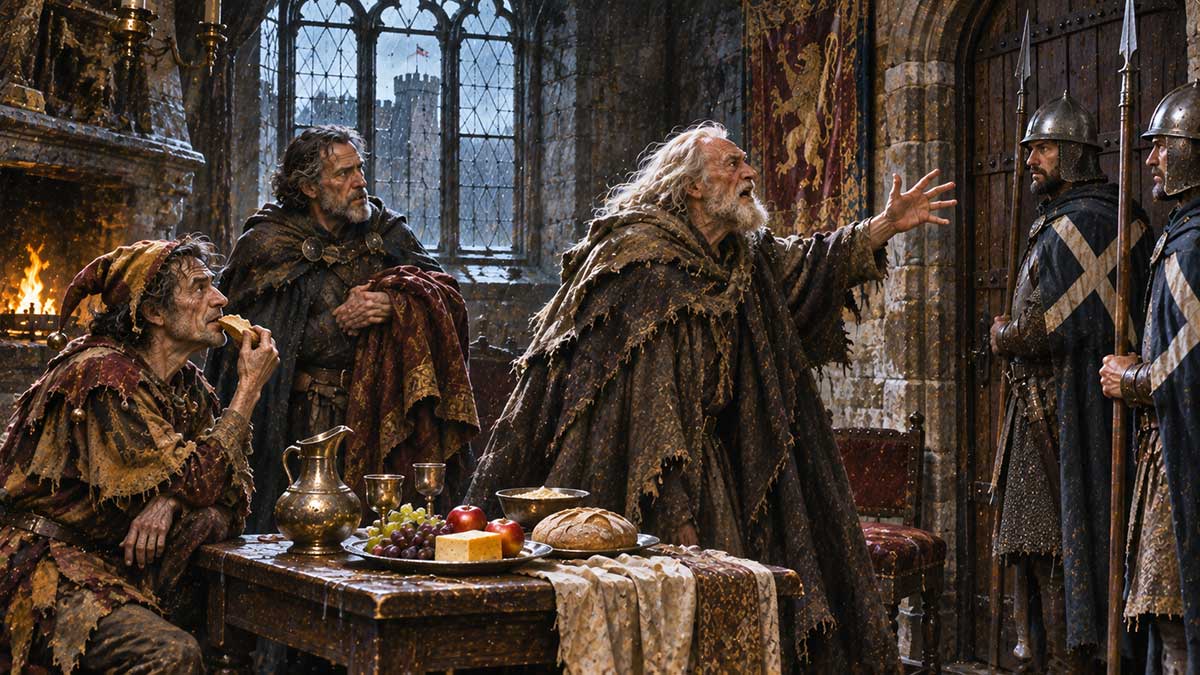
Dunsinane. The western apartments. Morning.
Rainwater still clings to the narrow windows. A fire burns low in the hearth. LEAR stands before a table on which breakfast has gone untouched. KENT enters, carrying a folded cloak. The FOOL follows with a crust of bread.
LEAR
Another morning. Another locked gate.
KENT
The Captain says the roads remain unsafe.
LEAR
The roads were unsafe when we arrived. Yet we traveled them.
FOOL
A road is most dangerous to a jailer when his prisoner begins to walk upon it.
LEAR
Have you seen Macbeth?
KENT
He has refused an audience until this afternoon.
LEAR
I am to wait upon his convenience like a petitioner.
FOOL
A petitioner may be refused, nuncle. A prisoner is refused before he asks.
Lear turns toward the window.
LEAR
Cordelia is here. I heard her name spoken beneath my window. Yet no one will bring her to me.
KENT
I have asked permission for a meeting.
LEAR
Permission. That word follows me like a beggar.
KENT
There may be another way to send her word.
LEAR
What word?
Kent waits. Lear looks at the untouched meal.
LEAR
Tell her I wish to see her.
FOOL
That is what every locked door says to the man on the other side. It tells him nothing of what waits within.
LEAR
Must I rehearse my heart before thee?
FOOL
No, nuncle. But it may be kinder to rehearse it before thy daughter arrives.
Lear takes a chair, then rises again.
LEAR
When I cast her out, I believed I was teaching her the cost of disobedience.
KENT
You were angry that she would not flatter you.
LEAR
I know what I was.
KENT
Then perhaps you know what must be said.
LEAR
Knowing a thing and speaking it are two different labors.
FOOL
The first costs pride. The second requires the pride to pay.
There is a knock. A SERVANT enters with fresh wood.
SERVANT
For the fire, my lord.
As the Servant kneels, Kent notices a narrow ribbon tied around one piece of wood.
KENT
Who sent these?
SERVANT
The household stores, sir.
The Servant glances toward the door, then speaks more quietly.
SERVANT
The eastern apartments have requested more wood than they need. I was told the western rooms might share it.
Kent loosens the ribbon. Beneath it is a small scrap of parchment.
KENT
My lord.
Lear takes the paper. He reads with difficulty, his hands unsteady.
LEAR
“I am within these walls. I ask no kingdom of you. I ask only to see my father. Cordelia.”
He reads it again.
LEAR
She asks no kingdom.
FOOL
Then she is the only royal guest here who has come without a bargain.
LEAR
She should not have had to ask.
Lear moves toward the door.
KENT
Wait. The messenger may be punished if the guards discover how the letter came.
Lear stops. He turns to the Servant.
LEAR
What is your name?
SERVANT
Mairi, my lord.
LEAR
Mairi. You have done me a kindness I cannot repay.
SERVANT
Then do not speak my name beyond this room.
Lear nods. The Servant departs.
LEAR
Kent, find ink. I will answer.
FOOL
With a royal command?
LEAR
With my own hand.
Kent places paper before him. Lear sits. For a long moment the pen does not move.
LEAR
How does a father begin when he has made a daughter a stranger?
KENT
With her name.
Lear writes.
The scene shifts to the eastern apartments.
CORDELIA stands at a window overlooking the courtyard. SIR ALAIN examines the barred door. LADY MACBETH enters without attendants.
CORDELIA
You have come early.
LADY MACBETH
I did not sleep.
CORDELIA
Then sit. You look weary.
LADY MACBETH
There are things I cannot tell you.
CORDELIA
I have not asked you to tell them.
LADY MACBETH
Yet you heard enough last night to know I am not the woman I appear to be.
CORDELIA
I heard a woman suffering.
LADY MACBETH
Suffering does not make a person innocent.
CORDELIA
No. Nor does guilt prevent a person from choosing differently tomorrow.
Lady Macbeth looks at her hands.
LADY MACBETH
My husband believes every mercy will be used against him.
CORDELIA
And what do you believe?
LADY MACBETH
That he is making enemies of people who came asking for nothing he could not give.
SIR ALAIN
Then permit the Queen to leave with her father.
LADY MACBETH
I do not command the gates.
SIR ALAIN
You command servants who pass through them.
LADY MACBETH
And if one is caught, it is the servant who pays.
Cordelia steps between them.
CORDELIA
I will not purchase my father's freedom with another person's life.
LADY MACBETH
There is a passage beneath the chapel. It joins the eastern and western wings. Beyond it lies an old service gate opening into the orchard. The gate has not been used in years, and I cannot yet promise that its lock will yield.
CORDELIA
Could my father reach it?
LADY MACBETH
Perhaps. But Macbeth has forbidden any meeting. If he discovers I helped you, I may lose what little influence remains to me.
CORDELIA
I will not ask you to risk yourself for me.
LADY MACBETH
You need not ask. The question has already been placed before me.
A bell sounds from the courtyard.
LADY MACBETH
I can arrange a brief meeting after the evening prayers. No soldiers. No attendants beyond the chapel door.
CORDELIA
You would do that?
LADY MACBETH
I have spent too long helping doors remain closed.
She turns to leave, then pauses.
LADY MACBETH
There is something you must know. Macbeth hopes to use your father to persuade France to abandon Malcolm.
CORDELIA
My father cannot make such a promise for me.
LADY MACBETH
He may be offered his throne in exchange.
CORDELIA
Then I must speak to him before he is asked.
LADY MACBETH
I will send word when the passage is clear.
Lady Macbeth exits.
SIR ALAIN
Do you trust her?
CORDELIA
I trust that she knows what she is doing is dangerous.
SIR ALAIN
That is not the same thing.
CORDELIA
No. It is the beginning of a choice.
The scene shifts to Macbeth's council chamber.
MACBETH studies a dispatch. EDMUND stands nearby. The CAPTAIN waits by the door.
MACBETH
Malcolm's men have been seen gathering beyond the border. Their scouts move through the woods by night.
EDMUND
Then time favors neither patience nor courtesy.
MACBETH
Cordelia refuses to negotiate. Lear demands her release. My wife questions every order I give.
EDMUND
Three voices asking you to surrender the advantage you possess.
MACBETH
Lear is no threat without soldiers.
EDMUND
A name may gather soldiers faster than a trumpet. He is more useful alive, honored, and dependent upon you.
MACBETH
And Cordelia?
EDMUND
Let her see that her father's comfort depends upon her cooperation.
MACBETH
You would have me bargain with a daughter's affection.
EDMUND
Your Majesty, every court bargains with affection. Most simply choose a gentler name for it.
Macbeth folds the dispatch.
MACBETH
I will speak with Lear after supper. Prepare the great hall tomorrow. Let the nobles attend. I would have them see that I fear neither an old king nor the truth spoken in my own house.
EDMUND
The Fool may make the occasion memorable.
MACBETH
Let him. I can endure a jest.
Edmund bows, concealing a smile.
MACBETH
Captain, double the watch at the chapel passage. I have been told the servants carry more than firewood between these wings.
CAPTAIN
Has a message been intercepted?
MACBETH
Not yet. I intend to keep it that way.
The Captain exits.
EDMUND
You suspect Lady Macbeth?
MACBETH
I suspect anyone who believes pity grants them permission to disobey.
EDMUND
Then the court tomorrow may serve another purpose. A public lesson is remembered longer than a private warning.
Macbeth looks toward the door.
MACBETH
A lesson for whom?
EDMUND
For whoever still mistakes your hospitality for weakness.
The scene shifts to the western apartments. Evening.
Lear sits alone at the table. The letter he has written lies before him. KENT returns, his cloak damp.
KENT
The chapel passage is watched. Two guards at the upper stair, three below. We cannot reach it unseen.
LEAR
Who told you of the passage?
KENT
A servant who would not give her name.
LEAR
Then Cordelia is trying to reach me.
KENT
Yes.
LEAR
And I have done nothing but sit here.
KENT
You have written to her.
LEAR
Words. I once thought words enough to divide a kingdom. Now I cannot send one across a courtyard.
The Fool picks up Lear's letter but does not unfold it.
FOOL
Would you have her receive this?
LEAR
Yes.
FOOL
Then do not leave it upon the table where any hand may find it.
He returns the letter. Lear folds it and presses it into Kent's hand.
LEAR
Give it to the woman who brought hers. No one else.
KENT
I will try.
Footsteps approach. Kent hides the letter inside his cloak. Enter the CAPTAIN with two guards.
CAPTAIN
King Lear. His Majesty requests that you remain in your apartments tonight. There has been a disturbance near the chapel.
LEAR
What disturbance?
CAPTAIN
A breach of household instructions.
LEAR
Is my daughter safe?
CAPTAIN
The Queen of France remains in her chambers.
LEAR
That is not the question.
CAPTAIN
I can offer no further report.
Lear approaches him.
LEAR
Tell Macbeth I will speak with him tomorrow, before his assembled lords if he wishes. But he will not make a bargain of my daughter.
CAPTAIN
I will deliver your words.
The Captain and guards withdraw. The bolt slides into place.
LEAR
He calls us guests and bolts the door.
FOOL
Then tomorrow I shall ask him whether the bolts are for keeping danger out or truth in.
KENT
Take care what you say before his court.
FOOL
I always take care, Kent. I simply do not take silence.
Lear turns to the window. Across the courtyard, a light appears in the eastern wing.
LEAR
She is there.
He raises his hand, though the distance is too great for anyone to see.
LEAR
Cordelia, I have a thousand things to say and no road by which to reach thee.
The Fool stands beside him.
FOOL
Begin with one, nuncle. The others may follow.
Lear looks down at the letter no longer in his hand.
LEAR
Then let her know I am trying.
The scene shifts to the chapel passage.
Lady Macbeth stands before a locked iron gate. A GUARD approaches with a lantern.
GUARD
My lady. The King has ordered this passage sealed.
LADY MACBETH
At whose request?
GUARD
His own.
LADY MACBETH
Then open it for me.
GUARD
I cannot.
She studies the guard, then the heavy lock.
LADY MACBETH
You fear him.
GUARD
I obey him.
LADY MACBETH
I once believed those were different things.
The Guard lowers his eyes.
From beyond the passage comes the distant sound of a woman calling a name. It is too faint to make out.
Lady Macbeth rests one hand against the cold iron.
LADY MACBETH
A door can be locked by one man. It may take many to open it.
She withdraws into the darkness.
Above, the castle bells announce the evening watch. In the eastern wing, Cordelia waits. In the western wing, Lear waits. Between them, soldiers stand at a door neither has been permitted to cross.
Blackout.
End of Act II, Scene Three.
End of Act II.
Act III, Scene One: The Price of a Crown
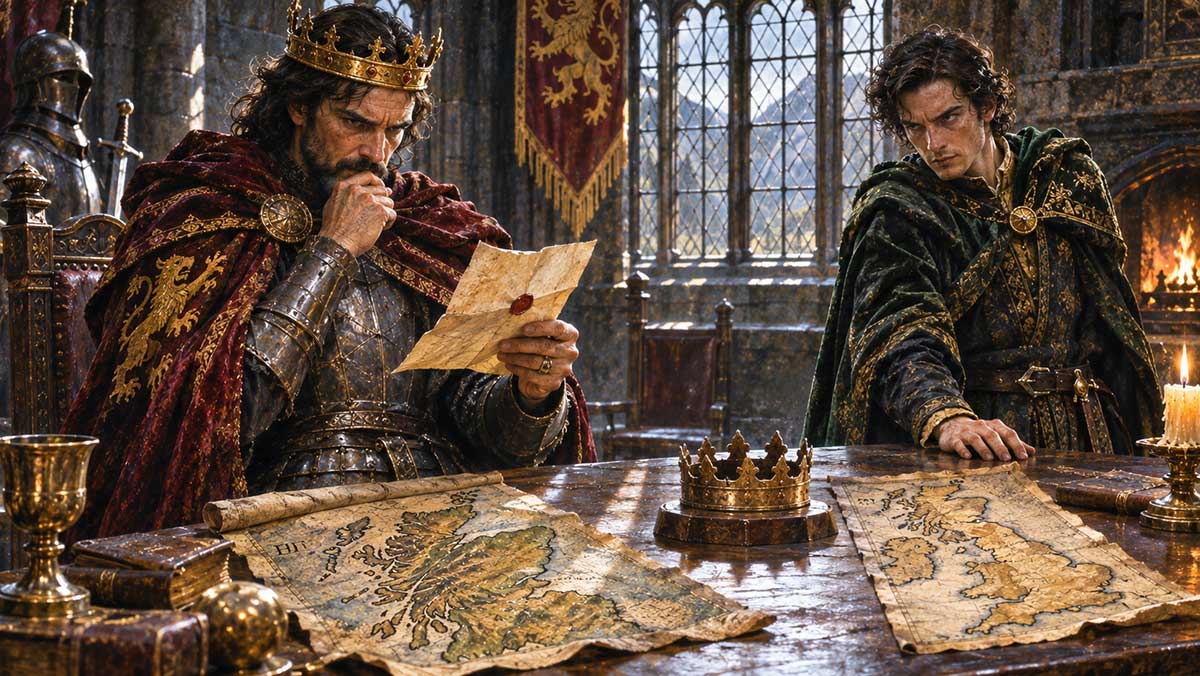
Dunsinane. The council chamber. Morning.
The storm has passed. A cold light enters through the high windows. Upon the table lie two maps, one of Scotland and one of Britain. Between them rests a crown fashioned from wood, an old model used by the royal craftsmen. MACBETH studies a letter. EDMUND waits nearby.
MACBETH
The watch reports movement on the southern road. Men without banners, horses without heraldry. Malcolm sends his friends before he sends his army.
EDMUND
A man who has lost a kingdom learns to approach it quietly.
MACBETH
You speak of Malcolm. Yet your eyes rest upon the English map.
EDMUND
I speak of any man who believes a throne belongs to him merely because another man sits upon it.
MACBETH
And what do you believe belongs to a man?
EDMUND
What he has the wit to win and the strength to keep.
Macbeth turns the wooden crown in his hands.
MACBETH
A dangerous doctrine for a king to hear from a guest.
EDMUND
Then consider it a warning rather than a doctrine. Lear has no army, but his daughter wears the lilies of France. A promise from him might move English nobles. A refusal from her might move French soldiers.
MACBETH
You would have me threaten the daughter to persuade the father, then threaten the father to persuade the daughter.
EDMUND
I would have Your Majesty learn which of them is willing to pay the greater price.
MACBETH
And if neither yields?
EDMUND
Then their love will have proved less useful than their pride.
LADY MACBETH enters. She has heard the last words.
LADY MACBETH
Love is not a coin minted for your convenience, Edmund.
EDMUND
No, my lady. Yet kingdoms have often been purchased with it.
LADY MACBETH
And the sellers seldom sleep peacefully afterward.
Macbeth sets down the crown.
MACBETH
The passage beneath the chapel was sealed last night.
LADY MACBETH
So I discovered.
MACBETH
The Captain reported that you ordered the chapel cleared after evening prayers. No attendants. No soldiers beyond the door.
LADY MACBETH
I wished to give a father and daughter a moment together.
MACBETH
You intended to bring Lear and Cordelia together.
LADY MACBETH
I intended to let a father see his daughter.
MACBETH
Without my leave.
LADY MACBETH
I had asked for your leave. You would not grant it.
MACBETH
Then you had your answer.
LADY MACBETH
I had an order. An answer would have told me why their meeting threatens Scotland.
Edmund watches the exchange with quiet interest.
MACBETH
Their meeting threatens the arrangement by which I may keep an army from my borders.
LADY MACBETH
Then tell them so openly. A bargain that cannot survive daylight deserves suspicion.
MACBETH
Very well. I will speak with Lear today. You may witness it, if you wish to hear how kingdoms are kept.
LADY MACBETH
I have heard much of that subject. I should like to hear how a kingdom might be made worthy of keeping.
She exits. Macbeth watches the door close.
EDMUND
Her Majesty has grown sympathetic to the French Queen.
MACBETH
My wife is not yours to interpret.
EDMUND
Forgive me. I meant only that Cordelia has gained a friend within the walls.
MACBETH
Then I must discover whether Lear has gained courage from the same source.
The scene shifts to the western apartments.
LEAR stands by the hearth. KENT is beside the door. The FOOL sits on the floor, attempting to repair the leg of a small wooden horse.
LEAR
Has she received my letter?
KENT
I cannot say. The servant who carried hers has been moved to the kitchens below the north tower. I have found no safe way to reach her.
LEAR
I wrote so little.
FOOL
That is an improvement, nuncle. Once thou spoke enough to lose a kingdom.
LEAR
I wrote that I wished to see her. That I had been wrong. That I would listen if she would speak.
KENT
Then you wrote what was needed.
LEAR
I did not ask her forgiveness.
FOOL
Perhaps thou feared she would give it.
Lear looks at him.
FOOL
A man may bear his daughter's anger more easily than her kindness. Anger permits him to defend himself. Kindness asks what he intends to do next.
A guard announces Macbeth. MACBETH enters with EDMUND and the CAPTAIN. Kent bows stiffly. Lear does not.
MACBETH
King Lear. I trust you have been made comfortable.
LEAR
A comfortable room does not make an open road.
MACBETH
We must speak of roads, and of the armies that may soon travel them.
LEAR
Then speak plainly. You have kept my daughter from me. You have kept my horses from the gate. What is the price of our departure?
MACBETH
I seek a settlement that may benefit us both. Your daughters govern Britain, yet many still honor your name. With Scotland's friendship you could regain your standing among them.
LEAR
My standing?
MACBETH
A place at the council. Lands restored. Perhaps, in time, a crown.
Lear stares at the wooden horse in the Fool's hand.
LEAR
Once I would have offered you half my kingdom for such a promise.
MACBETH
And now?
LEAR
Now I would ask what the other half costs.
MACBETH
Your public recognition of my rule. Your daughter's assurance that France will not assist Malcolm. A common defense against those who would plunge Scotland into war.
LEAR
You ask Cordelia to speak for her husband and France, though you will not allow her to speak to her father.
EDMUND
Her Majesty has refused reasonable proposals.
LEAR
I did not ask thee.
EDMUND
I serve those who have an interest in your welfare.
LEAR
My elder daughters, whose welfare has always improved when mine has diminished.
Edmund bows without answering.
MACBETH
You need not love the terms to accept them. A king must sometimes sacrifice his wishes for the safety of his people.
LEAR
That is a lesson I learned too late. But I will not learn it backward by sacrificing my daughter to restore myself.
MACBETH
I offer you a path home.
LEAR
Home? I made my home a place where the daughter who loved me could not remain. If she will see me, that is the first home I must recover.
MACBETH
Your answer places her in danger.
LEAR
No. The danger comes from the man who holds the keys.
The Captain shifts uneasily. Macbeth notices.
MACBETH
Take care that grief does not make you reckless.
LEAR
Grief has made me old. Recklessness made me a fool long before that.
FOOL
And left me with competition I never sought.
Lear almost smiles. Macbeth does not.
MACBETH
I will give you until tomorrow to consider the offer.
LEAR
I have considered it.
MACBETH
Then consider what follows refusal.
Macbeth leaves. Edmund lingers.
EDMUND
The world is less gentle to fathers who have lost their influence than to daughters who possess it.
LEAR
And less gentle still to sons who trade their fathers for advancement.
Edmund's face tightens. He exits.
KENT
You have angered them both.
LEAR
I have spent my life angering the honest and rewarding the flattering. Let me try the reverse.
The scene shifts to a small chamber outside the eastern apartments.
CORDELIA stands beside a table where a meal has been left untouched. SIR ALAIN waits at the window. LADY MACBETH enters, carrying a folded paper.
CORDELIA
Have you seen my father?
LADY MACBETH
Not today. But a letter was found among the servants' bundles. It bears your name.
She gives Cordelia the paper. Cordelia unfolds it.
CORDELIA
It is his hand.
She reads silently. Then aloud, softly.
CORDELIA
“I wronged thee. I have no right to ask that thou come, yet I hope thou wilt. If thou speakest, I will listen.”
Her voice falters.
SIR ALAIN
Your Majesty?
CORDELIA
I have waited so long to hear him say he would listen.
LADY MACBETH
He has refused the King's bargain. Macbeth offered to restore his position if you would turn France against Malcolm.
CORDELIA
And my father refused?
LADY MACBETH
He would not make you the price of his return.
Cordelia folds the letter carefully.
CORDELIA
Then perhaps the father I came to find is still here.
LADY MACBETH
He is here. But I fear my husband may punish him for what he has said.
SIR ALAIN
We must send word to France.
CORDELIA
If we send soldiers to rescue us, Macbeth will claim his fears were justified. We must find another way.
LADY MACBETH
There are Scottish nobles who remember Duncan. They do not all approve of what this court has become.
CORDELIA
Will they help?
LADY MACBETH
Some may. But they must be given something more than another contest for a crown.
CORDELIA
Then ask them to help two people meet. No throne. No army. Only a father and his daughter.
Lady Macbeth looks at the letter.
LADY MACBETH
A small request can become the hardest one in a frightened court.
CORDELIA
Then we should begin there.
The scene shifts to a narrow corridor beyond the council chamber.
EDMUND intercepts the CAPTAIN as servants prepare the great hall for the following evening.
EDMUND
The King intends to receive the Scottish nobles tomorrow. Lear is to attend.
CAPTAIN
So I have been told.
EDMUND
His Fool should come with him.
CAPTAIN
Why?
EDMUND
A little laughter may soften an awkward occasion.
CAPTAIN
You have seen the Fool speak. His laughter seldom softens anything.
EDMUND
Then perhaps the King will learn who among his nobles laughs at his expense.
CAPTAIN
You wish to set a trap.
EDMUND
I wish the court to see where loyalty lies. The King will decide what to do with what is revealed.
CAPTAIN
And if the Fool goes too far?
EDMUND
He has a talent for finding the edge of a blade. I doubt he will stop before he feels it.
The Captain looks away. Edmund leaves him with the preparations.
The scene shifts to the castle chapel at dusk.
The chapel is empty except for LADY MACBETH. Candles burn before a stone altar. She kneels, but her hands remain clasped so tightly that her knuckles are white.
LADY MACBETH
I thought courage meant the will to do what frightened others. I did not ask whether fear itself could be a warning.
She opens her hands and studies them.
LADY MACBETH
A daughter comes to rescue the father who cast her out. An old king refuses a crown for her sake. And I, who once urged a man to take a crown at any cost, cannot persuade him to open a door.
She hears footsteps and rises. The FOOL appears at the chapel entrance, escorted by KENT.
KENT
Forgive us, my lady. The western passage was opened for evening prayers.
LADY MACBETH
You may enter.
Kent remains near the door. The Fool approaches a candle.
FOOL
A fine place for secrets. Men speak here to someone they cannot see, then return to court and pretend no one hears them.
LADY MACBETH
Do you mock prayer too?
FOOL
No, my lady. I mock the men who pray to be forgiven and rise determined to do the same wrong again.
Lady Macbeth considers him.
LADY MACBETH
You are invited to entertain the King tomorrow.
FOOL
So I have heard. I am to bring my finest jokes and leave my head at the door if they fail.
LADY MACBETH
You should be careful.
FOOL
I am careful with the things I love. My tongue is merely the thing I own.
LADY MACBETH
Macbeth has little patience for ridicule.
FOOL
Then I shall offer him truth instead.
LADY MACBETH
That may be worse.
FOOL
It often is.
The Fool turns to leave, then stops.
FOOL
My lady, if a man has walked a long way in the wrong direction, is he wiser to keep walking so no one sees him turn?
LADY MACBETH
No.
FOOL
Then perhaps we should all begin turning before the road runs out.
He leaves with Kent. Lady Macbeth remains alone.
The scene shifts to Macbeth's chamber. Night.
MACBETH stands before a mirror. He has removed his crown and set it on the table. Through the window comes the sound of hammers from the great hall, where servants are preparing for tomorrow's gathering.
MACBETH
They speak of justice as though it were a door I could open and pass through unharmed.
He takes the crown and turns it over.
MACBETH
Duncan trusted me. Banquo knew me. Malcolm remembers. Every man I have feared has given me reason to fear the next.
He places the crown upon the table again.
MACBETH
And now an old man who has lost everything tells me I must give something up.
A knock. Edmund enters.
EDMUND
The hall will be ready tomorrow. The nobles have been summoned. Lear and his companions will attend.
MACBETH
Good. Let the old king see that Scotland has not forgotten how to honor its guests.
EDMUND
And his Fool?
MACBETH
Let him speak. A king who cannot endure laughter deserves none of the praise he receives.
EDMUND
You are generous, my lord.
MACBETH
I am king. Let the court remember it.
Edmund bows and withdraws. Macbeth looks again at the crown.
Across the courtyard, Lear sits awake beside his window. Cordelia, in another wing, holds his letter against her heart. Between them, the chapel passage remains locked.
The servants' hammers cease. The castle falls quiet.
Macbeth lifts his crown and puts it on, though no one is present to see.
Blackout.
End of Act III, Scene One.
Act III, Scene Two: The Fool Before the Tyrant
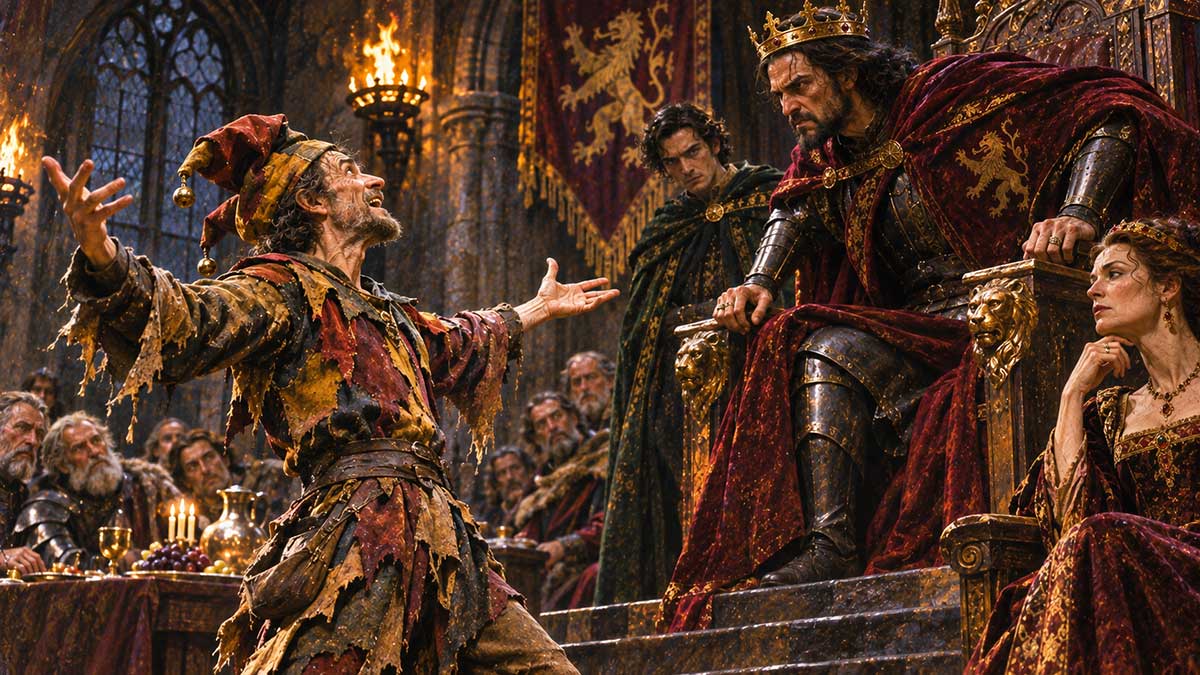
Dunsinane. The great hall. Late afternoon.
The hall has been transformed for an evening of entertainment. Torches illuminate the stone walls. Musicians wait beneath a gallery, and a long table has been arranged for the Scottish nobles.
At the far end stands MACBETH'S throne. Beside it is a smaller chair intended for LADY MACBETH. No chair has been prepared for LEAR.
MACBETH enters with EDMUND and the CAPTAIN.
MACBETH
Are the guests assembled?
CAPTAIN
The lords await you, my king. The musicians are prepared.
MACBETH
And Lear?
CAPTAIN
He has been summoned.
MACBETH
With his Fool?
CAPTAIN
As you commanded.
EDMUND
An unusual entertainment, my lord. Most kings summon poets to praise them, not fools to mock them.
MACBETH
A wise king may laugh at what lesser men fear to hear.
EDMUND
And an unwise Fool may discover the limits of that wisdom.
Macbeth looks toward the empty space beside his throne.
MACBETH
The old king has grown troublesome. He asks to see his daughter, demands passage from the castle, and questions the loyalty of my servants.
EDMUND
His pride remains greater than his circumstances.
MACBETH
Then tonight he shall learn the difference between the dignity he remembers and the authority he possesses.
EDMUND
And the Fool?
MACBETH
Let him speak. A man who laughs at kings may reveal more than a man who flatters them.
The doors open. LADY MACBETH enters.
LADY MACBETH
You have summoned the court for entertainment?
MACBETH
Our guests have endured too many solemn evenings.
LADY MACBETH
I hear Lear's Fool is to perform.
MACBETH
He has entertained kings before.
LADY MACBETH
His jokes are seldom harmless.
MACBETH
Then perhaps the court will learn courage by hearing them.
LADY MACBETH
Or learn fear by watching what happens afterward.
Macbeth turns away.
MACBETH
Take your place. The guests are coming.
Trumpets sound.
Enter Scottish nobles, servants, and guards. They bow before Macbeth and take their seats.
Enter LEAR, KENT, and the FOOL.
Lear pauses upon seeing that no chair has been prepared for him.
LEAR
I see that Scotland has discovered a new custom.
MACBETH
What custom is that?
LEAR
A king may invite another king to his table and forget that he requires a seat.
Macbeth smiles.
MACBETH
Forgive the oversight. Bring a chair for our honored guest.
A servant hurries forward with a plain wooden chair.
Lear examines it.
FOOL
A generous gift, nuncle. In England, thou gavest away a kingdom and kept thy pride. Here, they give thee a chair and expect thy gratitude.
The courtiers laugh.
LEAR
I have sat upon worse.
He sits. Kent stands behind him.
MACBETH
Tonight we set aside the burdens of government. Let us enjoy good company and honest laughter.
FOOL
Honest laughter? Then I fear Your Majesty has invited the wrong court.
The laughter grows louder.
MACBETH
You are quick with your tongue.
FOOL
It is the only part of me that has never required a horse.
MACBETH
Come forward. Entertain us.
The Fool looks at Lear.
LEAR
Go on. Thou hast plagued me long enough. Let another king endure thee.
The Fool steps into the center of the hall.
FOOL
My lords and ladies, I have traveled far to discover the difference between a king and a beggar.
FIRST LORD
And have you found it?
FOOL
Indeed. A beggar knows when his purse is empty.
The court laughs.
FOOL
A king may spend a thousand lives before he notices.
The laughter diminishes.
MACBETH
A dark jest.
FOOL
Then I shall offer a brighter one.
He takes two wooden cups from his pouch.
FOOL
Here are two kings. One wears a crown. The other has lost his.
He places one cup upon his head and the other upon the floor.
FOOL
Which is richer?
SECOND LORD
The crowned one, naturally.
FOOL
A sensible answer. But suppose the crowned king cannot sleep for fear of losing his crown, and the crownless king sleeps peacefully beside a friend. Which possesses the greater treasure?
MACBETH
The man who rules a kingdom may purchase many peaceful nights.
FOOL
Then Your Majesty must know where they are sold.
Several nobles suppress their laughter.
Macbeth leans forward.
MACBETH
And what would you pay for such a night?
FOOL
Nothing. A peaceful night is the one thing a guilty man cannot buy and an innocent man need not purchase.
Silence.
Lady Macbeth looks sharply at the Fool.
MACBETH
You speak often of guilt.
FOOL
It is a popular subject among men who possess more than they can explain.
MACBETH
Take care. A Fool who mistakes insolence for wisdom may lose the privilege of speaking.
FOOL
Then I should speak quickly.
The Fool bows extravagantly.
FOOL
I have another riddle.
MACBETH
Let us hear it.
FOOL
What is the difference between a thief and a king?
FIRST LORD
A king rules by law.
FOOL
An excellent answer. Yet if a thief steals a crown and writes the law afterward, which name shall we give him?
The room becomes very quiet.
MACBETH
That depends upon whether he can keep it.
FOOL
Then the law is a remarkable garment. It changes its color according to the strength of the man who wears it.
Macbeth rises slowly.
MACBETH
You have traveled with Lear through storms and exile. Perhaps you have forgotten the respect owed to a sovereign.
FOOL
No, my lord. I have seen how little respect a sovereign may receive when the crown is gone. That lesson is difficult to forget.
MACBETH
Then perhaps your master should have taught you better.
Lear rises.
LEAR
My Fool has spoken freely since he was young. I have punished him for less and forgiven him for more.
MACBETH
You were his king.
LEAR
I remain his king in the only way that matters to him.
FOOL
And he remains my Fool in the only way that matters to me.
Lear looks at him, surprised.
LEAR
Thou hast reversed our offices.
FOOL
Only to see whether either of us notices.
Some nobles laugh again. Macbeth sits, but his expression remains dark.
MACBETH
Let us test your wisdom with a more serious question. Tell me, Fool, what makes a king legitimate?
FOOL
That is a difficult question. Shall I answer as a philosopher, a soldier, or a tax collector?
MACBETH
Answer as yourself.
FOOL
Then I must begin with what a king does when no one is watching.
MACBETH
A king is watched by everyone.
FOOL
That is what makes the unwatched moments so interesting.
Lady Macbeth lowers her eyes.
MACBETH
And what should he do in those moments?
FOOL
The same thing he would do if the whole kingdom stood beside him.
MACBETH
An impossible standard.
FOOL
Then perhaps kingship is more difficult than wearing a crown.
Macbeth turns to the court.
MACBETH
You hear him. The Fool believes himself fit to instruct kings.
FOOL
No, my lord. I have spent my life trying to instruct one king. I have failed so often that I should hesitate to accept another.
Lear almost smiles.
MACBETH
Then tell us of your failure. What has Lear learned from you?
FOOL
He has learned that daughters may speak sweetly and still love poorly.
MACBETH
A lesson bought dearly.
FOOL
He has learned that a man may give away his kingdom and discover he has given away the wrong thing.
MACBETH
What should he have kept?
FOOL
The daughter who told him the truth.
Lear looks down.
FOOL
And he has learned that a Fool may remain beside him when wiser men have found reasons to depart.
Kent steps forward slightly.
KENT
That much is true.
MACBETH
Then loyalty is your greatest virtue.
FOOL
No. Loyalty without truth is only obedience wearing a kinder face.
The words strike Lady Macbeth. She turns toward the Fool.
LADY MACBETH
And what becomes of loyalty when truth threatens the person one loves?
The Fool looks at her.
FOOL
Then loyalty must decide whether it loves the person or merely the peace of never contradicting them.
A long silence.
Lady Macbeth looks away.
MACBETH
Enough riddles. Give us a song.
FOOL
A song, my lord?
MACBETH
A cheerful one.
FOOL
Then I must search my memory. Most cheerful songs are written before the singers learn what the words mean.
He thinks for a moment, then speaks in a rhythmic, playful voice.
FOOL
A king built walls against the rain,
And locked the sunlight out again.
He kept his gold, he kept his throne,
And wondered why he sat alone.
The court listens uneasily.
FOOL
A beggar slept beneath a tree,
With neither lock nor golden key.
He woke to find the morning fair,
And thanked the world for being there.
MACBETH
And the moral?
FOOL
The beggar knew what morning was. The king had forgotten.
Macbeth rises.
MACBETH
You have entertained us sufficiently.
FOOL
Then I shall retire before my wisdom grows expensive.
The Fool bows and begins to return to Lear.
MACBETH
Stop.
The Fool turns.
MACBETH
One final question. Have you ever seen a ghost?
Lady Macbeth becomes still.
FOOL
Many, my lord.
MACBETH
Many?
FOOL
I have seen men haunted by the promises they made and the kindness they refused. I have seen fathers haunted by daughters who were still alive. Those are the most troublesome ghosts. They will not remain politely in their graves.
Lear looks at him.
MACBETH
I ask of the dead.
FOOL
Then I must disappoint you. The dead have never troubled me as much as the living.
MACBETH
You mock what you do not understand.
FOOL
Then teach me, my lord. What does a ghost desire?
Macbeth stares at him.
FOOL
Does it seek revenge? Does it seek justice? Or does it merely wish the living to admit that it once existed?
MACBETH
Silence!
The hall falls quiet.
The Fool does not move.
MACBETH
You presume to question matters beyond your station.
FOOL
My station is low enough that I may look beneath the furniture. I have found many things there that kings prefer not to see.
Macbeth descends from the dais.
MACBETH
You have been permitted to speak too freely.
LEAR
He has spoken no treason.
MACBETH
He has insulted the crown before my court.
LEAR
He has insulted every crown he has ever seen. It is his profession.
MACBETH
Then his profession has become dangerous.
Macbeth turns to the Captain.
MACBETH
Take him.
Two guards approach the Fool.
LEAR
Stand back!
The guards stop.
LEAR
You will not lay hands upon him.
MACBETH
This is my hall.
LEAR
And he is my servant.
MACBETH
A servant who has abused my hospitality.
LEAR
Then punish me for bringing him.
MACBETH
You offer yourself in his place?
LEAR
I offer you the truth. If his words have offended, they were spoken under my protection.
MACBETH
Your protection has little authority here.
Lear stands straighter.
LEAR
It has the authority of a man who will not abandon the last friend who has remained beside him.
The Fool looks at Lear with unexpected emotion.
FOOL
Nuncle—
LEAR
Be silent. For once in thy life, permit me to speak.
Lear faces Macbeth.
LEAR
I have lost my kingdom. I have lost the obedience of my daughters. I have lost the men who once bowed when I entered a room. Yet this Fool followed me through rain and hunger when wiser servants sought safer masters.
MACBETH
Then he has earned your affection.
LEAR
He has earned more than that. He has earned my defense.
MACBETH
And what will you do if I refuse to release him?
LEAR
I shall stand beside him.
Macbeth studies Lear.
MACBETH
You would risk your safety for a Fool?
LEAR
I have risked much more for things worth far less.
The words seem to surprise Lear himself.
Lady Macbeth rises.
LADY MACBETH
My lord, the entertainment has gone far enough. Let the old king and his companion return to their chambers.
MACBETH
The court has heard the Fool insult my authority. If I release him without consequence, every servant in Scotland will believe himself entitled to mock his king.
LADY MACBETH
The court has heard a frightened man demand punishment for a jest.
Macbeth turns toward her.
MACBETH
Take care.
LADY MACBETH
I am trying to.
Edmund steps forward.
EDMUND
Perhaps a private confinement would satisfy the dignity of the crown without creating a public spectacle.
MACBETH
A sensible proposal.
LEAR
You will imprison him for speaking?
MACBETH
Until he learns discretion.
FOOL
Then I fear I shall grow old in captivity. Discretion has never been among my talents.
MACBETH
Take him to the lower tower.
The guards seize the Fool.
Lear moves forward, but Kent catches his arm.
KENT
My lord, do not give them cause to use force.
LEAR
They have already found cause enough.
The Fool looks back at Lear.
FOOL
Fear not, nuncle. A prison is merely a castle that has forgotten to pretend.
The guards lead him away.
Lear watches until the doors close.
Then he turns toward Macbeth.
LEAR
You invited me into your house and called me honored guest. You promised protection. You offered friendship. Now you seize my servant for speaking words you dislike.
MACBETH
Your servant crossed a boundary.
LEAR
And you have crossed one far greater.
MACBETH
Remember where you stand.
LEAR
I know where I stand. I stand in the house of a man who fears a Fool.
The court is silent.
Macbeth approaches Lear.
MACBETH
You have mistaken my patience for weakness.
LEAR
And you have mistaken my age for helplessness.
MACBETH
You possess no army here, no throne, no authority to command my people.
LEAR
Then why are you afraid of me?
Macbeth stops.
LEAR
Why have you locked your gates? Why do your soldiers follow me through every passage? Why is my daughter held apart from me?
MACBETH
Your daughter has placed herself in a difficult political position.
LEAR
My daughter came to find her father.
MACBETH
She came as Queen of France, bearing interests beyond affection.
LEAR
Then speak with her honestly. Do not make prisoners of us both.
MACBETH
You are not prisoners.
KENT
Then permit us to depart.
Macbeth looks at Kent.
MACBETH
You presume to issue demands in my court?
KENT
I ask for the freedom you have repeatedly promised.
MACBETH
And if I refuse?
KENT
Then the truth will be plain.
Macbeth turns to the assembled nobles.
MACBETH
Hear me. King Lear remains under my protection until the danger beyond our borders has passed. His daughter remains here until her intentions concerning Scotland are settled. His attendants will be confined wherever their conduct requires it.
Lear stares at him.
LEAR
Then you admit it.
MACBETH
I admit that Scotland's safety cannot depend upon the whims of foreign guests.
LEAR
You have made us prisoners.
MACBETH
Call it what you wish.
LEAR
I call it betrayal.
Macbeth's face hardens.
MACBETH
Then return to your chamber before your words bring consequences you cannot bear.
Lear looks around the hall. No noble meets his eyes.
LEAR
I once believed a king's greatness could be measured by the number of men who bowed before him.
He looks at Macbeth.
LEAR
I see now how little a bow may mean.
He turns toward the door.
MACBETH
Captain. Escort him.
The Captain approaches. Kent walks beside Lear.
As they pass the nobles, Lear stops.
LEAR
You are men of Scotland. I do not ask you to betray your king. I ask only that you remember what you have seen.
No one answers.
Lear exits with Kent and the guards.
The hall remains silent.
Macbeth returns to his throne.
MACBETH
The entertainment is concluded.
The nobles rise and begin to depart.
Lady Macbeth watches them go. Edmund approaches Macbeth.
EDMUND
The old king has become more dangerous than before.
MACBETH
He has become more troublesome.
EDMUND
He has spoken openly against you before the court. Some will remember his words.
MACBETH
Then they must remember the consequences.
EDMUND
The Fool may prove useful as leverage.
MACBETH
A Fool?
EDMUND
Lear has shown how much he values him. Cordelia values Lear. Each affection gives us another means of persuasion.
MACBETH
You would build a chain from one heart to another.
EDMUND
Men call such chains loyalty when they serve a crown.
Lady Macbeth turns toward them.
LADY MACBETH
And what do they call them when they serve cruelty?
EDMUND
History seldom agrees upon names.
LADY MACBETH
History may disagree. The dead do not.
Macbeth looks sharply at her.
MACBETH
Leave us.
Edmund bows and exits.
Lady Macbeth remains.
MACBETH
I did not dismiss you.
LADY MACBETH
No. You rarely do when there is something you wish me to witness.
MACBETH
You challenged me before the court.
LADY MACBETH
You threatened an old man and imprisoned his Fool before the court.
MACBETH
The Fool accused me of crimes he cannot prove.
LADY MACBETH
He accused you of fear.
MACBETH
And you believe him?
Lady Macbeth looks at him for a long moment.
LADY MACBETH
I believe fear has become the strongest voice in this castle.
MACBETH
You speak as though you are innocent of what brought us here.
LADY MACBETH
I am not innocent.
MACBETH
Then do not judge me.
LADY MACBETH
I judge what we are becoming.
Macbeth turns away.
MACBETH
Malcolm's army approaches. Macduff calls for my death. Lear challenges me before my own lords. Cordelia refuses every proposal. Would you have me open the gates and invite them all to take my crown?
LADY MACBETH
I would have you ask whether keeping the crown is worth destroying everything beneath it.
Macbeth does not answer.
Lady Macbeth moves toward the door.
LADY MACBETH
The Fool spoke one truth you did not wish to hear.
MACBETH
Which truth?
LADY MACBETH
A king may command a thousand men and still be unable to command one peaceful night.
She exits.
Macbeth remains alone upon the throne.
The scene shifts to the lower tower.
A narrow cell lies beneath the castle. Water drips from the stone ceiling. A small window admits a pale strip of moonlight.
The FOOL sits upon a wooden bench. His cap has been taken from him, but he still holds the small wooden horse.
The door opens. A GUARD enters with bread and water.
GUARD
Your supper.
FOOL
A generous feast. Does the King know he has given me half the kingdom's grain?
GUARD
Eat it or leave it.
FOOL
I shall eat it. Hunger has never improved my jokes.
The Guard sets down the food.
FOOL
Tell me, good fellow, how many prisoners are kept in this tower?
GUARD
Enough.
FOOL
And how many are guilty?
GUARD
That is not for me to decide.
FOOL
A fortunate arrangement. A man may lock the door and leave his conscience outside.
The Guard hesitates.
GUARD
You would do well to keep quiet.
FOOL
That advice has followed me since childhood. I have never found it easy to obey.
The Guard turns to leave.
FOOL
Wait.
The Guard stops.
FOOL
Is the old king safe?
GUARD
He has been returned to his chamber.
FOOL
And his daughter?
GUARD
She remains in the eastern apartments.
FOOL
Then the family is reunited in everything but the rooms.
The Guard says nothing.
FOOL
One more question. Have you a father?
GUARD
I did.
FOOL
And did he love you?
GUARD
As well as he knew how.
FOOL
Then you are richer than many kings.
The Guard looks at him, uncertain.
GUARD
You speak strangely for a prisoner.
FOOL
I spoke strangely when I was free. It would be a shame to improve now.
The Guard almost smiles, then leaves.
The Fool listens as the lock turns.
He sets the wooden horse upon the bench.
FOOL
There now, little beast. We have come to a fine stable.
He looks toward the narrow window.
FOOL
My old king has lost his crown. My new king has lost his sleep. And I have lost my cap.
He pauses.
FOOL
Of the three, I suspect mine will be easiest to replace.
He lies back upon the bench, staring at the ceiling.
FOOL
But if the old king has learned to stand for another man, perhaps the world has not finished surprising me.
The moonlight shifts across the floor.
Far above, in the western wing, Lear stands at his chamber window.
He looks down toward the lower tower.
LEAR
Kent.
Kent approaches.
KENT
My lord?
LEAR
I have been a king for most of my life. Men have died defending my name. Others have suffered for refusing my commands.
KENT
Yes, my lord.
LEAR
Yet today I found myself ready to fight for a Fool.
KENT
He has earned your loyalty.
LEAR
I wonder how many others deserved it and never received it.
Kent remains silent.
LEAR
I thought kingship meant being obeyed.
KENT
And now?
LEAR
I begin to think it may mean knowing whom one must protect.
He looks toward the eastern tower.
LEAR
My daughter came to save me. I repaid her with anger. My Fool spoke truth. I repaid him with danger.
KENT
There is still time to repair what can be repaired.
LEAR
Then we must find a way to reach them.
KENT
Macbeth has doubled the guards.
LEAR
Let him. I have spent too many years demanding that others risk themselves for me.
Lear turns from the window.
LEAR
Now I would risk something for them.
The scene shifts to Macbeth's chamber.
Macbeth stands before a mirror. His crown rests upon the table beside him.
He looks at his reflection.
MACBETH
What makes a king legitimate?
He hears the Fool's voice in memory.
FOOL'S VOICE
What a king does when no one is watching.
Macbeth turns sharply.
The chamber is empty.
MACBETH
Silence.
He approaches the table and lifts the crown.
MACBETH
I am king.
He places it upon his head.
MACBETH
I am king.
From somewhere beyond the walls comes the distant sound of a prison door closing.
Macbeth looks toward the sound.
Blackout.
End of Act III, Scene Two.
Act III, Scene Three: The News from England
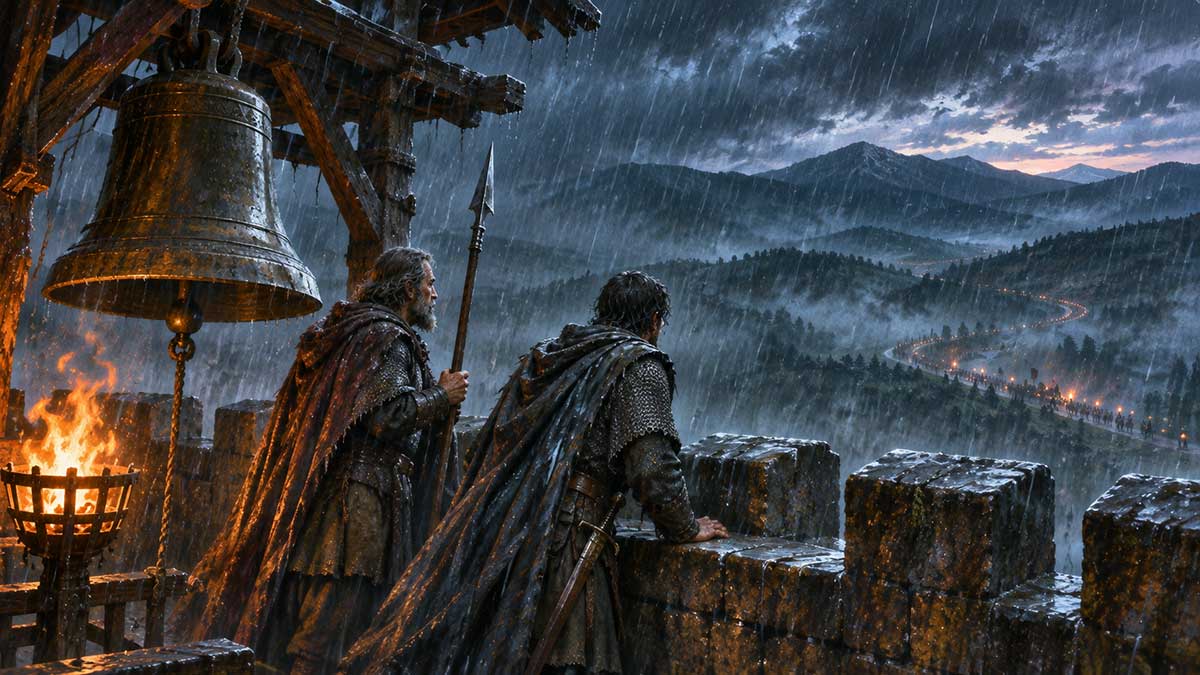
Dunsinane. The northern watchtower. Before dawn.
Rain sweeps across the battlements. A great bell hangs beneath a wooden roof, its bronze surface dark with age. Beyond the castle, the hills disappear into mist.
Two SOLDIERS stand beside a brazier. The younger struggles to keep his cloak closed against the wind.
YOUNG SOLDIER
How many nights have we watched this road?
OLDER SOLDIER
Enough to know it never brings good news.
YOUNG SOLDIER
Yesterday they said the English army was three days away. Before that, five. Before that, they said it would never come.
OLDER SOLDIER
Armies travel faster in rumors than upon roads.
YOUNG SOLDIER
And when the rumors become soldiers?
OLDER SOLDIER
Then we discover whether the men who made the promises intend to stand beside us.
A horn sounds from below.
The soldiers move toward the parapet.
A RIDER approaches the outer gate, his horse exhausted.
RIDER
Open! Dispatches for the King!
The Older Soldier signals to the gatehouse.
OLDER SOLDIER
From where?
RIDER
The southern passes. Malcolm has crossed the border.
The Young Soldier looks toward the dark hills.
YOUNG SOLDIER
How many?
RIDER
Enough to make counting difficult.
The gate begins to open.
Blackout.
The scene shifts to Macbeth's council chamber.
Maps cover the table. Several markers have been moved since the previous evening. MACBETH stands beside the hearth, fully dressed despite the early hour. EDMUND studies a letter. LADY MACBETH sits near the window.
Enter the CAPTAIN with the RIDER.
CAPTAIN
My lord, the southern watch has confirmed the movement of Malcolm's forces.
MACBETH
Where?
RIDER
Beyond the lower passes. Their advance companies have reached the villages east of Birnam.
MACBETH
Their number?
RIDER
The first report counted near three thousand. Others follow behind. English soldiers march with Scottish nobles who have joined Malcolm.
MACBETH
And Macduff?
RIDER
He rides among their commanders.
Macbeth looks toward the map.
MACBETH
He returns to the country he abandoned.
LADY MACBETH
He returns to the country where his family was murdered.
The Rider lowers his eyes.
MACBETH
His family died in the disorder of rebellion.
LADY MACBETH
Is that what we call it now?
Edmund intervenes.
EDMUND
The circumstances of those deaths will matter little if Malcolm reaches Dunsinane. We must concern ourselves with what the living intend.
MACBETH
You have read the dispatches from Britain?
EDMUND
Yes. Goneril and Regan have each promised to restrict the movement of men and provisions favorable to Malcolm. Their cooperation remains conditional.
MACBETH
Upon Lear.
EDMUND
And Cordelia.
MACBETH
Then our guests have become more valuable.
LADY MACBETH
You speak of them as merchants speak of grain.
MACBETH
Grain feeds an army. A royal name may stop one.
Macbeth turns to the Captain.
MACBETH
Strengthen the southern gates. Store provisions within the inner walls. No messenger leaves without my seal. And double the watch upon the prisoners.
CAPTAIN
All of them, my lord?
MACBETH
Lear, Cordelia, the French knight, Kent, and the Fool. No one is to pass between their chambers.
LADY MACBETH
You have separated a father from his daughter and imprisoned a man for making jokes. What danger do you fear from their speaking?
MACBETH
The danger of words carried beyond these walls.
LADY MACBETH
Then your kingdom is in greater peril than I imagined.
Macbeth turns toward her, but the Captain interrupts.
CAPTAIN
There is another matter. A traveler was detained near the northern gate during the night. He carried no weapons beyond a hunting knife and asked after Lord Gloucester's son.
Edmund looks up.
EDMUND
Which son?
CAPTAIN
He would not say.
EDMUND
Describe him.
CAPTAIN
A young man in a worn cloak. He claims to have traveled from the British border.
EDMUND
Bring him to me.
MACBETH
You know him?
EDMUND
I suspect I do.
Macbeth studies Edmund.
MACBETH
Then let us discover whether your suspicion is justified.
The Captain exits.
Lady Macbeth rises.
LADY MACBETH
I must attend to the household.
MACBETH
You will remain near Cordelia. I wish to know everything she says.
LADY MACBETH
She speaks chiefly of her father.
MACBETH
Then listen carefully. The wishes of a daughter may yet determine the movements of France.
Lady Macbeth exits without answering.
The scene shifts to a guardroom near the northern gate.
EDGAR stands before two guards. His clothing is stained with mud, and a healing cut crosses his forehead. He has the bearing of a gentleman, though his boots and cloak suggest many weeks of hardship.
The Captain enters.
CAPTAIN
You asked after Gloucester's son.
EDGAR
I did.
CAPTAIN
Which son?
EDGAR
The one who calls himself Edmund.
CAPTAIN
What business have you with him?
EDGAR
A family matter.
CAPTAIN
You have crossed a dangerous border for a family matter.
EDGAR
Some families leave little choice.
The Captain examines him.
CAPTAIN
Your name?
Edgar hesitates.
EDGAR
Edgar.
The Captain's expression changes.
CAPTAIN
Edgar, son of Gloucester?
EDGAR
Yes.
The guards move closer.
CAPTAIN
You are accused of plotting against your father's life.
EDGAR
I know the accusation.
CAPTAIN
Do you deny it?
EDGAR
With every breath I have.
CAPTAIN
Then why flee your country?
EDGAR
When the men sent to arrest you have already decided your guilt, remaining to argue becomes a poor method of survival.
CAPTAIN
And your father?
Edgar looks away.
EDGAR
He lives.
CAPTAIN
Where?
EDGAR
In the care of people whose names I will not surrender.
CAPTAIN
Why?
EDGAR
He has suffered enough at the hands of men who claimed to serve authority.
The Captain waits.
EDGAR
My father was seized, accused of treachery, and blinded. I found him afterward. He did not know my face, and he could no longer see it.
The guards exchange troubled glances.
CAPTAIN
Who did this?
EDGAR
Men serving those who govern Britain.
CAPTAIN
And Edmund?
EDGAR
He profited from the accusation against me. I have reason to believe he helped create it.
CAPTAIN
Then you have come seeking revenge.
EDGAR
I have come seeking the truth. If justice requires my brother to answer for his deeds, I will not turn away.
Footsteps approach.
Enter EDMUND.
EDMUND
Brother.
Edgar turns.
EDGAR
Edmund.
They face one another across the guardroom.
EDMUND
I had hoped the rumors of your death were false.
EDGAR
You have always been skilled at giving rumors a useful life.
EDMUND
You look weary.
EDGAR
Our father looks worse.
Edmund's expression remains composed.
EDMUND
I have heard of his misfortune.
EDGAR
Misfortune? Is that what you call the taking of a man's eyes?
EDMUND
I did not order his punishment.
EDGAR
You knew the men who did. You knew the lies that placed him in their hands.
EDMUND
Take care. You stand in a foreign fortress where your accusations carry no authority.
EDGAR
Then I shall speak without authority, as the innocent often must.
Edmund turns to the Captain.
EDMUND
My brother is troubled. He has lived among fugitives and may not know whom to trust. Give him food and a chamber where he can rest.
EDGAR
I do not require your kindness.
EDMUND
Then accept the King's hospitality.
EDGAR
I have heard what that hospitality means.
Edmund's smile disappears.
EDMUND
You would do well to hold your tongue.
EDGAR
Our father held his tongue when he should have questioned you. I shall not repeat his mistake.
Edmund approaches him.
EDMUND
What do you hope to accomplish here?
EDGAR
To find out how far you intend to climb upon the ruin of our family.
EDMUND
Then you may discover that the world has changed since you fled it.
EDGAR
The world has changed. You have not.
Edmund turns to the Captain.
EDMUND
Keep him under guard. I will speak with Macbeth.
Edmund exits.
Edgar watches him leave.
EDGAR
He still speaks as though every room belongs to him.
CAPTAIN
You will remain here until the King decides your disposition.
EDGAR
Then I hope your king is a better judge of men than my father was.
The guards lead him away.
The scene shifts to the lower tower.
The FOOL sits upon his bench, balancing the small wooden horse upon one finger. Water drips steadily from the ceiling.
The door opens. LADY MACBETH enters carrying a covered basket. A GUARD follows.
GUARD
My lady, the prisoner has been given his meals.
LADY MACBETH
Then he may consider this a royal excess. Wait outside.
The Guard hesitates, then withdraws.
FOOL
A queen bearing supper. Have I been promoted without knowing it?
LADY MACBETH
I brought bread, cheese, and a little wine.
FOOL
Then I have certainly been promoted. Yesterday I received water and a lecture.
Lady Macbeth places the basket beside him.
LADY MACBETH
You should not have challenged the King before the court.
FOOL
I did not challenge him. I asked questions. He challenged the answers.
LADY MACBETH
You know what I mean.
FOOL
I do. You mean that truth is safer when spoken in a whisper.
LADY MACBETH
Sometimes it is.
FOOL
Yet a whisper may never reach the man who needs to hear it.
Lady Macbeth sits upon the opposite bench.
LADY MACBETH
You have followed Lear for many years. Do you truly believe people change?
FOOL
I have seen a proud king share his last crust with a beggar. I have seen a man who once demanded love begin to ask whether he deserved it.
LADY MACBETH
And a cruel man?
FOOL
That depends upon whether he wishes to change more than he wishes to be forgiven without changing.
She lowers her eyes.
LADY MACBETH
You have a dangerous habit of answering questions that were never spoken.
FOOL
It is the only advantage of having no courtly education.
Lady Macbeth rises.
LADY MACBETH
There may be a chance for you to leave this tower tonight.
The Fool becomes still.
FOOL
And my king?
LADY MACBETH
I am arranging a meeting. Lear, Cordelia, and Kent may be brought together.
FOOL
Under whose orders?
LADY MACBETH
Mine.
FOOL
Then your husband must not know.
Lady Macbeth does not answer.
FOOL
I see. A queen has discovered that doors may open in two directions.
LADY MACBETH
You must be ready when the guard comes. Do not make a joke. Do not delay. Follow him without speaking.
FOOL
You ask a great sacrifice.
LADY MACBETH
I ask you to live.
The Fool's expression softens.
FOOL
Then I shall try.
Lady Macbeth moves toward the door.
FOOL
My lady.
She stops.
FOOL
A man may spend years walking the wrong road. Turning around does not shorten the distance he has traveled.
LADY MACBETH
I know.
FOOL
But it changes where he may arrive.
Lady Macbeth looks at him for a moment, then leaves.
The scene shifts to the eastern apartments. Evening.
CORDELIA stands beside SIR ALAIN. A small map of the castle has been drawn upon the back of a discarded letter.
LADY MACBETH enters quietly.
CORDELIA
You came.
LADY MACBETH
There is little time. The King meets his captains after sunset. Edmund has been occupied with a prisoner from Britain. The household guards are changing shifts.
SIR ALAIN
What do you propose?
LADY MACBETH
The King has sealed the main chapel entrance. But an old servants' stair beneath the eastern wing leads to the chapel passage and its outer service gate. That gate can still be opened from within.
CORDELIA
And my father?
LADY MACBETH
Kent will bring him. I have persuaded one of the guards to escort the Fool from the lower tower to the chapel stairs, under the pretense that I require his presence. He has not been granted his freedom. Once you are beyond the service gate, he must leave with you.
SIR ALAIN
Horses?
LADY MACBETH
Two will wait beyond the orchard. The others must be found along the road.
SIR ALAIN
Two horses for five people?
LADY MACBETH
I have arranged what I could without drawing attention.
CORDELIA
You are risking your life.
LADY MACBETH
I have risked it for worse reasons.
Cordelia approaches her.
CORDELIA
Why have you decided to help us?
Lady Macbeth hesitates.
LADY MACBETH
Last night I watched my husband study a map. He moved small stones across it as though every life in Scotland belonged to his hand.
CORDELIA
And what did you see?
LADY MACBETH
I saw that he no longer recognizes the difference between protecting his crown and protecting his people.
CORDELIA
You still love him.
LADY MACBETH
Yes.
CORDELIA
Then this must be painful.
LADY MACBETH
Love has become the one thing I cannot use to excuse him.
She hands Cordelia a small iron key.
LADY MACBETH
The outer service gate. Wait until the second bell. Alain must keep the guards occupied until then.
SIR ALAIN
I can manage that.
LADY MACBETH
Do not kill anyone unless there is no other choice. A dead guard will bring the entire castle upon you.
CORDELIA
We will do everything possible to leave without bloodshed.
LADY MACBETH
Then pray the night is kinder than the day.
She exits.
Cordelia holds the key.
SIR ALAIN
Do you trust her?
CORDELIA
Enough to follow the only road she has opened.
The scene shifts to the western apartments.
LEAR sits beside a table, holding the unfinished letter bearing Cordelia's name. KENT stands near the door.
KENT
The Queen has sent word. We are to leave after the second bell.
LEAR
And Cordelia?
KENT
She will meet us beneath the chapel.
LEAR
Does she know?
KENT
Yes.
Lear folds the letter.
LEAR
I had meant to give her this.
KENT
You may give it to her tonight.
LEAR
There is only one word upon it.
KENT
Then perhaps the rest is better spoken.
Lear looks toward the window.
LEAR
I have spent three days thinking of what I should say. Every sentence begins with an explanation. Every explanation becomes a defense.
KENT
Then begin without one.
LEAR
With what?
KENT
With the truth you have avoided.
Lear looks at the letter.
LEAR
That I was wrong.
Kent says nothing.
LEAR
It seems a small sentence.
KENT
Small sentences can carry great weight.
A bell rings.
Kent moves toward the door.
KENT
The first watch has ended.
LEAR
Then we must be ready.
He places the letter inside his cloak.
The scene shifts to a narrow passage beneath the castle.
Stone steps descend into darkness. The walls are damp, and roots have forced their way between the stones. A small chapel stands at the end of the passage, its altar covered in dust.
CORDELIA and SIR ALAIN enter carrying a lantern.
SIR ALAIN
The passage is clear.
CORDELIA
How long until the second bell?
SIR ALAIN
A few minutes.
Cordelia approaches the outer service gate and tests the key. The lock turns with difficulty.
CORDELIA
It opens.
She looks through the narrow gap. Beyond lies an overgrown orchard and a path leading toward the forest.
CORDELIA
There is still a road beyond these walls.
SIR ALAIN
There is. We must reach it before the guards discover us.
Footsteps approach.
Cordelia turns.
Enter LEAR and KENT.
CORDELIA
Father.
Lear stops upon seeing her.
LEAR
Cordelia.
For a moment they simply look at one another.
CORDELIA
We have little time.
LEAR
I know.
He approaches her.
LEAR
I have wished to speak with thee.
CORDELIA
Then speak when we are safe.
LEAR
I fear that if I wait for safety, I shall find another reason to remain silent.
Cordelia looks at him.
LEAR
I was wrong.
The words seem to cost him great effort.
LEAR
When thou camest to me, I asked again for the obedience that drove thee away. I spoke as though thy love were a debt that could be collected.
CORDELIA
Father—
LEAR
No. Let me finish. I have made many speeches in my life. This may be the first in which I have no wish to hear myself admired.
Cordelia's eyes fill with tears.
LEAR
I do not ask thee to agree with Macbeth. I do not ask thee to recover my throne. I ask only that thou believe I am ashamed of how I treated thee.
Cordelia takes his hand.
CORDELIA
I believe you.
Lear lowers his head.
LEAR
Then perhaps there is hope for me yet.
Footsteps echo from the far stair.
Enter the FOOL, escorted by a GUARD.
FOOL
Nuncle! I had feared the castle would forget where it stored me.
LEAR
My Fool.
Lear embraces him awkwardly. The Fool is startled, then returns the embrace.
FOOL
Take care. If thou growest affectionate, the court will suspect thee of illness.
The Guard looks toward the stair.
GUARD
The second bell is sounding. You must leave now.
Sir Alain opens the outer service gate.
A gust of cold air enters.
Then a voice sounds from the darkness behind them.
EDMUND
A touching reunion.
Everyone turns.
EDMUND stands at the top of the steps, accompanied by armed soldiers. Behind him is the CAPTAIN.
EDMUND
A father restored to his daughter. A loyal servant reunited with his master. Even the Fool has found his way back into good company.
KENT
Stand aside.
EDMUND
I fear I cannot.
CORDELIA
We are leaving Scotland peacefully. There is no reason to stop us.
EDMUND
There are several reasons. The King has ordered that no prisoner depart without his consent.
LEAR
Then tell your king I no longer seek his consent.
EDMUND
That would be an admirable declaration if the gates belonged to you.
Sir Alain draws his sword.
SIR ALAIN
You will not take the Queen.
The soldiers raise their weapons.
CORDELIA
Alain, no.
SIR ALAIN
Your Majesty, stand behind me.
EDMUND
Put away your sword. You are outnumbered.
SIR ALAIN
Then I shall make the first blow count.
CORDELIA
I said no.
Sir Alain looks at her.
CORDELIA
We did not come here to purchase freedom with the lives of men who have done us no personal wrong.
Reluctantly, he lowers his sword.
Edmund smiles.
EDMUND
A wise decision.
KENT
Who told you of this passage?
EDMUND
The castle has many servants. Some are loyal to their queen. Others remember who commands the soldiers.
Lady Macbeth appears behind the guards.
LADY MACBETH
Edmund.
He turns.
EDMUND
My lady. I had hoped you would not be troubled by this discovery.
LADY MACBETH
You have betrayed me.
EDMUND
I have prevented a breach of the King's orders.
LADY MACBETH
You knew what I intended.
EDMUND
I suspected. Then I asked the right questions.
Lady Macbeth looks at the Captain.
LADY MACBETH
Release them.
CAPTAIN
My lady, the King has given direct instructions.
LADY MACBETH
I am your queen.
CAPTAIN
And I am sworn to obey the King.
The silence is terrible.
EDMUND
You see the difficulty. A kingdom cannot endure two contrary commands.
LADY MACBETH
No. It cannot endure men who use obedience to escape responsibility.
Edmund turns to the soldiers.
EDMUND
Separate the prisoners.
LEAR
No!
Lear steps in front of Cordelia.
LEAR
You will not take her from me again.
EDMUND
Then you may choose to make this more difficult.
LEAR
I have made many things difficult in my life. This time I shall do so for a reason worth defending.
The guards hesitate.
CORDELIA
Father, do not let them harm you.
LEAR
I am finished being protected at the cost of those I love.
Edmund approaches slowly.
EDMUND
You have no soldiers, Lear. No crown. No kingdom. What do you believe you can accomplish by standing there?
Lear looks at Cordelia, then back at Edmund.
LEAR
I can refuse to help you make her afraid.
Edmund's expression hardens.
EDMUND
Captain, take them.
The guards move forward. Kent struggles briefly as they seize his arms. Sir Alain is disarmed. The Fool is pulled away from Lear.
Cordelia reaches for her father.
CORDELIA
Father!
LEAR
Cordelia!
Their hands touch for an instant before the soldiers separate them.
LADY MACBETH
Stop this!
Her voice echoes through the chapel.
The soldiers pause.
LADY MACBETH
You have them. There is no need to treat them like animals.
Edmund studies her.
EDMUND
Then perhaps Your Majesty should persuade the King to release them.
He signals the guards onward.
Lear is led up one stair. Cordelia and Sir Alain are taken through another passage. Kent is held by two soldiers. The Fool is dragged toward the lower tower.
Lady Macbeth remains beside the open outer service gate.
Beyond it, the orchard lies dark and empty.
The scene shifts to Macbeth's council chamber.
MACBETH stands before the map. Edmund enters, carrying a folded letter.
MACBETH
I have heard of the escape attempt.
EDMUND
It has been stopped.
MACBETH
My wife arranged it.
EDMUND
Yes.
Macbeth looks toward the door.
MACBETH
She has chosen to defy me openly.
EDMUND
She has allowed affection to interfere with judgment.
MACBETH
Do not presume to judge my wife.
EDMUND
I judge only the danger her actions have created.
Edmund places the letter upon the table.
EDMUND
There is another danger.
MACBETH
What is this?
EDMUND
Correspondence linking Cordelia's party to supporters of Malcolm.
Macbeth opens the letter and reads.
MACBETH
You prepared this.
EDMUND
At your instruction.
MACBETH
I did not order it to be used.
EDMUND
Nor has it been. Yet circumstances have changed. Cordelia attempted to escape. Her French knight drew a sword against Scottish soldiers. Malcolm advances from the south.
MACBETH
You would make these events appear part of one conspiracy.
EDMUND
They already resemble one. The letter would provide the missing connection.
Macbeth sets it down.
MACBETH
And if Cordelia is accused?
EDMUND
She may be detained as a foreign agent. Her father's influence can be restrained. France may be warned that intervention will endanger its queen.
MACBETH
You have arranged every piece.
EDMUND
Only those Your Majesty has permitted me to touch.
Macbeth looks toward the window.
MACBETH
Malcolm approaches. Macduff seeks my blood. My wife opens doors behind my back. Lear defies me. Cordelia refuses my terms.
He turns.
MACBETH
And you bring me a forged letter and call it security.
EDMUND
I bring you a choice.
MACBETH
Every man who comes to this castle brings me a choice. Every choice leaves me with fewer friends.
EDMUND
Then choose the kingdom.
Macbeth studies the letter.
MACBETH
Have the prisoners held separately. Lear in the western tower. Cordelia in the eastern apartments, under strict guard. Kent and the Fool below. The French knight is to be disarmed and confined.
EDMUND
And the letter?
MACBETH
Keep it. We may yet require it.
EDMUND
As you command.
Edmund bows and exits.
Macbeth remains alone.
The scene shifts to the eastern apartments.
Cordelia sits upon the floor beside her chamber door. Beyond it, soldiers exchange the watch.
She holds a small piece of cloth torn from Lear's cloak during their separation.
CORDELIA
He said he was wrong.
She looks at the cloth.
CORDELIA
For one moment, he was not a king asking to be obeyed. He was my father asking to be heard.
She closes her hand around the cloth.
CORDELIA
I will not let that moment be the last.
The scene shifts to the western tower.
Lear stands alone beside a narrow window. Kent has been taken elsewhere.
The old king looks down into the dark courtyard.
LEAR
I had her hand.
He opens his palm.
LEAR
For one moment, I had her hand.
He slowly closes it.
LEAR
And I let them take her.
He looks upward.
LEAR
I have commanded armies, judged disputes, and divided kingdoms. Yet I cannot open one door for my child.
He sinks onto a bench.
LEAR
If there is a lesson in this, let me learn it before she is lost to me again.
The scene shifts to Lady Macbeth's chamber.
Lady Macbeth stands beside the silver basin. The water is still.
Macbeth enters.
MACBETH
You arranged their escape.
LADY MACBETH
Yes.
MACBETH
You defied my orders.
LADY MACBETH
Yes.
MACBETH
You placed my throne in danger.
LADY MACBETH
I tried to save you from another wrong.
Macbeth approaches her.
MACBETH
You believe releasing my enemies would save me?
LADY MACBETH
I believe keeping them has already cost you more than you understand.
MACBETH
You have chosen their cause over mine.
LADY MACBETH
I have chosen not to help you harm them.
Macbeth looks at her as though she has become a stranger.
MACBETH
Once, you would have stood beside me against the world.
LADY MACBETH
I did.
She looks at the basin.
LADY MACBETH
And I have been trying to wash the world from my hands ever since.
Macbeth turns away.
MACBETH
You will remain in your chambers until I decide what is to be done.
LADY MACBETH
Then I am a prisoner too.
MACBETH
You have made yourself one.
He exits. The door closes.
Lady Macbeth looks toward the basin.
For a moment, she reaches toward the water.
Then she stops.
LADY MACBETH
No more washing.
She withdraws her hand.
LADY MACBETH
There must be something left to do.
The scene shifts to the southern road.
Night.
An army moves beneath the trees. Torches flicker among the branches. Scottish soldiers march beside English allies. At their head ride MALCOLM and MACDUFF.
Malcolm studies the distant hills.
MALCOLM
Dunsinane lies beyond the ridge.
MACDUFF
Then we are near enough for Macbeth to hear us coming.
MALCOLM
Scouts report that he holds Lear and the Queen of France within the castle.
MACDUFF
Then he has gathered innocent lives around his throne.
MALCOLM
We must not allow their deaths to become the price of victory.
MACDUFF
I know the price of innocent deaths.
Malcolm looks at him.
MALCOLM
Your wife and children shall not be forgotten.
MACDUFF
I do not fear forgetting them.
He looks toward Dunsinane.
MACDUFF
I fear that when I stand before the man who ordered their deaths, grief will make me forget the man I wish to remain.
MALCOLM
Then I shall stand beside you.
MACDUFF
And if I cannot restrain myself?
MALCOLM
I shall remind you that justice must outlive revenge.
Macduff nods slowly.
MACDUFF
Then let us reach the castle before Macbeth finds another family to destroy.
The army continues forward.
Far away, Dunsinane rises against the dark sky.
Within its walls, five prisoners wait in separate chambers. Beyond its gates, an army approaches.
And in the highest tower, Macbeth watches the southern horizon, his crown catching the light of a single candle.
Blackout.
End of Act III, Scene Three.
End of Act III.
Act IV, Scene One: The Bargain of Kings
Dunsinane. The western tower. Before sunrise.
A narrow window looks out upon the mountains. Beneath it, LEAR sits at a wooden table. His cloak hangs from one shoulder, and the candle beside him has burned almost to its base.
Upon the table lies a sheet of parchment bearing a single word: Cordelia.
Lear takes up a pen. He tries to write beneath the name, but his hand trembles.
LEAR
My daughter, I have...
He stops.
LEAR
No. Too many words.
He begins again.
LEAR
I ask thee...
He lays down the pen.
LEAR
There it is. Even in apology, I begin by asking.
He folds the parchment and puts it inside his cloak.
A key turns in the door. The CAPTAIN enters with two guards.
CAPTAIN
King Lear. His Majesty requests your presence.
LEAR
Your king has discovered a fondness for my company.
CAPTAIN
He wishes to speak privately.
LEAR
Then why have you brought soldiers?
CAPTAIN
For your protection.
Lear rises.
LEAR
I have heard that word so often in this castle that I begin to fear it more than a threat.
CAPTAIN
Will you come?
LEAR
I will. But I have a request.
CAPTAIN
I am listening.
LEAR
Tell Macbeth that I wish to see my daughter.
CAPTAIN
You may speak with him yourself.
LEAR
I have spoken with him. I have demanded, argued, and pleaded. This morning I ask you, a man who holds a key. Tell him.
The Captain looks at Lear, surprised by his quietness.
CAPTAIN
I will deliver your request.
LEAR
Thank you.
The Captain bows slightly. Lear follows him out.
The scene shifts to Macbeth's council chamber.
An enormous map of Britain and Scotland covers the table. Black and white stones mark roads, fortresses, and armies. A sealed document rests beside a silver cup.
MACBETH stands near the window, watching the first pale light. EDMUND waits at the table.
EDMUND
The southern watch reports that Malcolm's men have reached the outskirts of Birnam.
MACBETH
How long before they stand beneath our walls?
EDMUND
Two days, perhaps less.
MACBETH
And the British sisters?
EDMUND
Their agents have agreed in principle to a restoration of Lear's authority, provided Scotland recognizes their existing territorial settlements.
MACBETH
In principle.
EDMUND
Goneril will surrender certain revenues and northern estates. Regan will recognize a royal council presided over by Lear. Both retain substantial authority.
MACBETH
They offer him a crown without its teeth.
EDMUND
They offer him something he no longer possesses: a government that must answer to his name.
MACBETH
And can they deliver it?
EDMUND
Their seals are genuine. Their nobles have already discussed the arrangement. If Cordelia secures French recognition, the settlement can take effect.
MACBETH
Then this is no empty promise.
EDMUND
No, my lord. It is a bargain of considerable value.
MACBETH
Yet you have not told me why the sisters have become so generous.
EDMUND
They fear civil war more than their father's return. Each suspects the other of seeking too much authority. A restored Lear might restrain them both.
MACBETH
Or become their puppet.
EDMUND
That would depend upon how wisely he governs.
Macbeth looks at the sealed document.
MACBETH
And Cordelia must endorse me.
EDMUND
Publicly. She must affirm that Scotland's present government is lawful, urge France to withhold assistance from Malcolm, and acknowledge the British settlement.
MACBETH
She will refuse.
EDMUND
She has refused you. She may find it harder to refuse her father.
A knock sounds.
Enter the Captain with Lear.
MACBETH
Leave us.
The Captain and guards withdraw. Edmund remains.
LEAR
You asked for privacy, yet another man attends you.
MACBETH
Lord Edmund has prepared the terms I wish to discuss.
LEAR
Then let him speak plainly. I have grown weary of being offered kindness that comes with guards.
Macbeth gestures to a chair.
MACBETH
Sit, Lear.
LEAR
I have been sitting for days.
He remains standing.
MACBETH
Very well.
Macbeth unrolls the document.
MACBETH
Your daughters have agreed to consider restoring a royal council in Britain. You would preside over it. Certain lands and revenues would return to your household. Officers would be appointed in your name. Your daughters would be bound by a new settlement to respect your position.
Lear looks at the document.
LEAR
They have agreed to this?
EDMUND
Their representatives have accepted the principal terms.
LEAR
Goneril and Regan, who denied me shelter, would now restore my authority?
EDMUND
Political circumstances have changed.
LEAR
They always do when frightened men begin counting soldiers.
Lear takes the document and examines the seals.
LEAR
These are theirs.
MACBETH
They are.
LEAR
And the lands?
EDMUND
Here, along the northern territories. The council would hold authority over revenue, appointments, and disputes affecting the settlement.
Lear studies the map.
LEAR
These were once mine.
MACBETH
They may be yours again.
For a moment Lear's face brightens. He traces a river upon the map.
LEAR
I rode this road with Cordelia when she was ten. We stopped at a village where the bridge had washed away. She asked why a king could command a thousand soldiers but could not command a river to remain in its banks.
MACBETH
A perceptive child.
LEAR
I told her that a king must build bridges, not command rivers.
He smiles faintly at the memory.
LEAR
I had forgotten that answer.
MACBETH
Then perhaps you may return to the place where you gave it.
Lear looks up.
LEAR
What do you ask?
MACBETH
Your public recognition of my rule in Scotland. Cordelia's support for the settlement. France must withdraw any assistance it may give Malcolm.
LEAR
And if France refuses?
MACBETH
Then the settlement cannot proceed.
LEAR
And if Cordelia refuses?
Macbeth says nothing.
LEAR
There it is.
EDMUND
Her cooperation is necessary to prevent war.
LEAR
You have arranged a kingdom upon this table, yet the price is hidden beneath my daughter's name.
MACBETH
Her signature could spare thousands of lives.
LEAR
Or condemn thousands who have trusted Malcolm.
MACBETH
Malcolm seeks my throne.
LEAR
And you seek to keep it.
MACBETH
I am the lawful King of Scotland.
LEAR
Then why must my daughter swear it before France?
Macbeth's expression hardens.
MACBETH
You have enjoyed my protection.
LEAR
And paid for it with my freedom.
MACBETH
You stand before the opportunity to regain your place in Britain. Few men in your condition would question the hand that offered it.
LEAR
I have questioned too few hands in my life. That is part of how I came to this condition.
Edmund steps forward.
EDMUND
King Lear, consider what is truly at stake. You may return to Britain with dignity, regain a household, and establish peace between your daughters. Your subjects may see you preside over a lawful government once more.
LEAR
And Cordelia?
EDMUND
She would be honored for making the agreement possible.
LEAR
Honored for saying what she does not believe.
EDMUND
Honored for serving her father's interests.
Lear looks toward Edmund.
LEAR
I have heard those words before. They came from my own mouth.
Macbeth moves around the table.
MACBETH
I have not brought you here to debate your daughter's character. I have brought you a genuine offer. If you accept, I shall put my seal beside those of Goneril and Regan. You may return home when the settlement is secure.
LEAR
With Cordelia?
MACBETH
If she agrees to the terms.
LEAR
And if she does not?
MACBETH
She remains under my protection until the danger has passed.
LEAR
You mean she remains your prisoner.
MACBETH
Call it what you wish.
Lear places the document upon the table.
LEAR
I wish to see her.
MACBETH
You have seen her.
LEAR
I wish to see her without a bargain laid between us.
MACBETH
You may see her when we have reached an agreement.
LEAR
Then you ask me to purchase my daughter's company with her conscience.
MACBETH
I ask you to act as a king.
Lear is silent.
MACBETH
You know the burdens of rule. You know that affection cannot govern nations. You know that a king must sometimes demand sacrifice from those closest to him.
Lear looks toward the map.
LEAR
Yes. I know that lesson very well.
He approaches the chair but does not sit.
LEAR
When Cordelia was a child, she once broke a cup that had belonged to her mother. She came to me trembling, holding the pieces in her hands.
MACBETH
What did you do?
LEAR
I asked whether she had broken it. She said yes. I praised her for telling the truth and told her that no cup was worth a lie.
He pauses.
LEAR
Years later, before my entire court, I asked her to speak more love than she could honestly put into words. When she refused, I punished her.
EDMUND
A father's disappointment is not the same as political judgment.
LEAR
No. Yet I made it political judgment. I divided a kingdom according to the sweetness of my daughters' speeches.
He turns toward Macbeth.
LEAR
You offer me the chance to do it again.
MACBETH
I offer you restoration.
LEAR
At the cost of demanding that Cordelia deny what she believes.
MACBETH
At the cost of one public declaration.
LEAR
One declaration may change the fate of a country.
MACBETH
You have ruled a country. You know that words have consequences.
LEAR
I do now.
Macbeth's patience begins to fail.
MACBETH
Do you understand what you are refusing? These are lands, revenues, authority. Your daughters will be bound by treaty. You may return as a ruler instead of a fugitive.
LEAR
And Cordelia must become the daughter I once demanded.
MACBETH
She must become reasonable.
LEAR
She has been reasonable. I was too proud to hear it.
Lear removes a small royal signet ring from his hand. He turns it slowly between his fingers.
LEAR
I wore this when I divided Britain. I wore it when I disowned her. I wore it when I commanded Kent to leave my sight for defending her.
MACBETH
It is a symbol of your authority.
LEAR
It is a symbol of what I believed authority permitted me to do.
He sets the ring beside the document.
LEAR
I will not take the settlement.
Edmund looks sharply at him.
EDMUND
My lord, perhaps you should consider—
LEAR
I have considered.
MACBETH
You would refuse your kingdom?
LEAR
I would refuse to purchase it with my daughter's freedom.
MACBETH
You may never receive another offer.
LEAR
Then I shall never receive another.
Macbeth looks at the ring.
MACBETH
You are an old man who has mistaken exhaustion for wisdom.
LEAR
Perhaps. But I have spent enough of my life mistaking pride for strength.
Lear pushes the document back across the table.
LEAR
I renounce my claim to restoration under these terms. I will not ask Cordelia to lie for me. I will not make her love a condition of my dignity.
MACBETH
Then what remains of your kingship?
Lear looks at him steadily.
LEAR
Whatever remains when the crown is gone.
Silence.
Macbeth's gaze moves toward the window. Beyond it, the distant hills are faintly visible.
MACBETH
You think yourself noble for refusing what other men would kill to possess.
LEAR
I do not know whether I am noble. I know only that I have hurt my daughter enough.
MACBETH
And what of Scotland? What of the lives that may be lost if Malcolm attacks?
LEAR
You hold the gates. You command the soldiers. You decide whether prisoners live or die. Do not place your choices upon my daughter's shoulders.
Macbeth steps close to Lear.
MACBETH
If Malcolm comes against Dunsinane, I cannot promise that you or Cordelia will survive the battle.
LEAR
Then release us before it begins.
MACBETH
You know I cannot.
LEAR
You mean you will not.
MACBETH
I will defend my crown.
LEAR
Then defend it with your own life, not with hers.
Macbeth stares at him.
MACBETH
Take him away.
The Captain enters.
MACBETH
Return Lear to the western tower. No visitors. No correspondence.
LEAR
One thing more.
MACBETH
You have said enough.
LEAR
I have refused your bargain. Do not punish Cordelia for my refusal.
MACBETH
Her fate depends upon decisions greater than yours.
LEAR
Then may you one day discover how small a crown becomes when placed beside a human life.
Lear exits with the Captain.
Edmund watches him go.
EDMUND
That was an unexpected choice.
MACBETH
He has abandoned the very thing he crossed kingdoms to recover.
EDMUND
He has become difficult to influence through ambition.
MACBETH
Then what remains?
EDMUND
Affection. He has made his daughter the center of every decision.
MACBETH
You would use her again.
EDMUND
I would prevent her from becoming an instrument of Malcolm.
MACBETH
You have the forged correspondence.
EDMUND
Yes.
MACBETH
Keep it ready. If Malcolm attacks, the prisoners may become our only means of negotiation.
Edmund bows.
EDMUND
I shall prepare for that possibility.
He exits.
Macbeth stands alone. He takes up Lear's signet ring.
MACBETH
A king who throws away his crown.
He looks at his own reflection in the window.
MACBETH
What manner of king is that?
The scene shifts to the eastern apartments.
CORDELIA sits at a table beside SIR ALAIN. A bowl of untouched food stands between them.
A key turns. LADY MACBETH enters.
CORDELIA
Have you news of my father?
LADY MACBETH
He has met with Macbeth.
CORDELIA
Is he safe?
LADY MACBETH
For the present.
CORDELIA
What happened?
Lady Macbeth takes a seat.
LADY MACBETH
Macbeth offered him a settlement restoring authority in Britain. Lands, revenues, a royal council, and recognition from your sisters.
CORDELIA
Then my father must have been tempted.
LADY MACBETH
He was.
CORDELIA
What did he say?
LADY MACBETH
He refused.
Cordelia looks at her in disbelief.
CORDELIA
Refused?
LADY MACBETH
He would not ask you to support the agreement. He would not make your freedom depend upon your obedience.
Cordelia slowly rises.
CORDELIA
He said that?
LADY MACBETH
Macbeth's servants have spoken of little else. Lear left his royal signet upon the table.
Cordelia covers her mouth with one hand.
CORDELIA
He has carried that ring since before I was born.
LADY MACBETH
He left it behind.
CORDELIA
Then perhaps he has finally set down something heavier than gold.
Lady Macbeth watches her.
LADY MACBETH
You seem relieved, though his refusal has placed you both in greater danger.
CORDELIA
I am afraid. But I have wished for years that he would choose me without asking me to become someone else.
She wipes her eyes.
CORDELIA
I would give anything to tell him what it means to me.
LADY MACBETH
I will try to arrange another meeting.
CORDELIA
You have risked enough.
LADY MACBETH
Not yet.
Cordelia studies her.
CORDELIA
My lady, your husband may discover what you are doing.
LADY MACBETH
He already knows I oppose him.
CORDELIA
Then he may imprison you.
LADY MACBETH
He has begun to do so, though he has not yet named it imprisonment.
She looks at the guarded door.
LADY MACBETH
I spent years believing that if Macbeth became king, we would be safe. Every day since his coronation has required another sacrifice to preserve what we gained.
CORDELIA
What will you do?
LADY MACBETH
I do not know how to repair the first wrong. But I may still prevent the next.
Cordelia takes her hand.
CORDELIA
That is where you must begin.
Lady Macbeth holds her gaze, then rises.
LADY MACBETH
Keep faith with your father. He has begun a difficult work.
CORDELIA
So have you.
Lady Macbeth exits.
The scene shifts to the western tower.
Lear sits upon his bench. The Captain stands near the door, preparing to leave.
LEAR
Captain.
The Captain turns.
CAPTAIN
My lord?
LEAR
Did Macbeth keep the ring?
CAPTAIN
It remains upon his table.
LEAR
Good.
The Captain hesitates.
CAPTAIN
I heard what you refused.
LEAR
Then you know I am a foolish old man.
CAPTAIN
My father served a lord who took his land for failing to flatter him. He died believing he had done wrong by speaking honestly.
Lear looks up.
CAPTAIN
I think he would have understood your decision.
Lear is silent for a moment.
LEAR
What was his name?
CAPTAIN
Thomas.
LEAR
Then I am sorry for what Thomas suffered.
The Captain lowers his head.
CAPTAIN
I shall remember that.
He turns to leave.
LEAR
One more favor.
CAPTAIN
If it lies within my duty.
LEAR
Tell my daughter that I have asked for her.
CAPTAIN
The King has forbidden correspondence.
LEAR
Then tell her nothing of treaties or crowns. Tell her only that her father wishes to see her.
The Captain looks at the old king.
CAPTAIN
I will see what can be done.
He exits.
Lear sits alone.
He takes the folded parchment from his cloak and opens it.
Cordelia.
He places it upon the table.
LEAR
I once believed that a king must never kneel.
He looks toward the door.
LEAR
Perhaps I feared that if I lowered myself, no one would help me rise.
He touches his daughter's name.
LEAR
If I see thee again, child, I shall not ask thee to kneel.
The scene shifts to Macbeth's chamber.
Night approaches. The distant sound of soldiers drilling carries through the window.
Macbeth stands beside the map. Lear's signet ring lies near his crown.
He picks up the ring and holds it beside the crown.
MACBETH
He had a kingdom and lost it. I had no kingdom and took one.
He places the ring inside the crown.
MACBETH
And now he lays his claim aside as though it were nothing.
He looks toward the southern hills.
MACBETH
If I laid mine aside, what would remain of me?
The question hangs in the room.
From beyond the window comes a distant horn. Then another.
Macbeth turns toward the sound.
MACBETH
The army.
He takes up his sword.
MACBETH
There is no time for such questions.
He places the crown upon his head and leaves.
The signet ring remains alone upon the table.
Blackout.
End of Act IV, Scene One.
Act IV, Scene Two: The Father Who Knelt
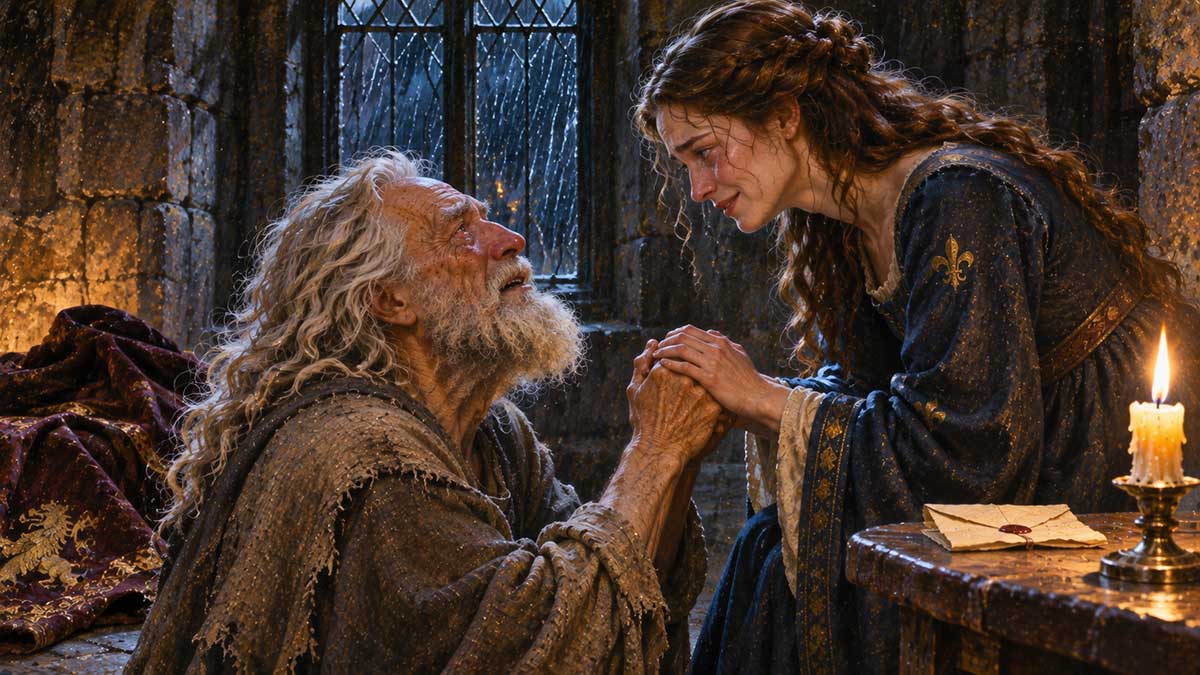
Dunsinane. The western tower. Night.
Rain falls against the narrow window. A single candle burns upon a wooden table, beside a folded letter bearing Cordelia's name.
LEAR sits on the edge of his bed. His royal cloak lies discarded upon the floor. He wears a simple woolen tunic, and his hair hangs loose around his shoulders.
From somewhere beneath the castle comes the faint sound of a man singing.
FOOL (distant, unseen)
A crown may shine upon the head,
And leave the heart as cold as lead.
But love may find a broken door,
And make a home of stones once more.
Lear listens.
LEAR
Still singing, poor Fool. They may lock his body beneath the earth, yet his tongue will find a window.
He rises and approaches the table.
LEAR
Cordelia.
He unfolds the unfinished letter he carried during the failed escape. Cordelia's name stands alone at the top of the page.
LEAR
I carried this through the passage, thinking I might place it in her hands. One word. Her name. All the rest I meant to speak.
He sits and takes up the pen.
LEAR
She has read my first letter. She knows I have admitted my wrong. Yet I have told her so little of the wrong itself.
He writes beneath her name.
LEAR
"My daughter, I have wronged thee."
He stops, looking at the words.
LEAR
There. No excuses this time.
He continues.
LEAR
"I demanded from thee a love that would flatter my pride, and when thou gavest me truth, I called it nothing."
His hand trembles.
LEAR
"I cannot restore the years I have taken from us. I cannot return the kingdom I divided. But I would ask..."
He stops writing.
LEAR
Again I ask.
He lays down the pen.
LEAR
What can a father give when he has spent his life taking?
A key turns in the door.
LEAR rises sharply.
Enter LADY MACBETH, carrying a lantern. Behind her stands the CAPTAIN.
LEAR
My lady.
LADY MACBETH
Forgive the hour.
LEAR
In this castle, day and night have become equally troublesome. What brings you?
LADY MACBETH
Your daughter.
Lear grips the edge of the table.
LEAR
Is she safe?
LADY MACBETH
For the moment. She has asked to see you.
LEAR
Then take me to her.
LADY MACBETH
You must understand the danger. Macbeth has forbidden all contact between you. If he discovers this meeting, he may confine you more severely.
LEAR
He has already taken my freedom. What more can he threaten?
LADY MACBETH
Your daughter.
Lear falls silent.
LADY MACBETH
I have arranged for her to be brought to the old chapel chamber. Kent will accompany her.
She hesitates, glancing toward the door.
LADY MACBETH
The Captain who obeyed Edmund at the chapel has agreed to help me. He has not forgotten the look upon your daughter's face when the soldiers separated you.
LEAR
He refused your command before.
LADY MACBETH
He did. I spoke with him afterward. I asked whether his oath required him to prevent a father from speaking privately with his daughter. He could find no answer.
LEAR
And now?
LADY MACBETH
He will allow us a brief meeting during the changing of the watch. The guards have been told that I require the chapel for prayer. He has promised no more than that.
LEAR
And the Fool?
LADY MACBETH
I am trying to have him brought from the lower tower.
LEAR
You risk much for us.
LADY MACBETH
Then let the risk accomplish something. We have little time before the watch changes.
She looks at the letter upon the table.
LADY MACBETH
Is that for Cordelia?
LEAR
It is an apology that cannot find its ending.
LADY MACBETH
Then perhaps you should give it to her unfinished.
LEAR
A king should never present unfinished business.
LADY MACBETH
You are not meeting her as a king.
Lear looks at her.
LEAR
No.
He folds the letter and places it inside his tunic.
LEAR
I am meeting her as a father.
The Captain opens the door.
CAPTAIN
We must go now.
Lear takes the lantern from Lady Macbeth.
They exit.
The scene shifts to the abandoned chapel chamber beneath Dunsinane.
The room is small and cold. A broken stained-glass window admits a pale wash of moonlight. The remnants of painted saints look down from the walls.
Two candles burn upon the altar. CORDELIA stands beside them, accompanied by KENT.
She wears the same blue cloak in which she entered Scotland. Her hands are clasped tightly together.
CORDELIA
Do you think he will come?
KENT
He has asked for you every day.
CORDELIA
He has asked before, and yet when we met, he wished me to become the daughter he had imagined rather than the one standing before him.
KENT
He has changed since then.
CORDELIA
I want to believe it.
KENT
He refused Macbeth's bargain.
CORDELIA
I know.
KENT
He surrendered the possibility of regaining authority in Britain rather than demand your obedience.
CORDELIA
It is the first time I have heard of my father refusing a crown.
KENT
He has begun to see what the crown concealed from him.
Cordelia turns toward the altar.
CORDELIA
When I was a child, I thought my father could protect me from every danger. I believed the whole kingdom was safe when he sat upon his throne.
KENT
Children see greatness more easily than weakness.
CORDELIA
Then I grew older and discovered that the man I loved could wound me more deeply than any stranger.
She pauses.
CORDELIA
I have forgiven him in my thoughts a hundred times. Yet when I stand before him, I still hear his voice telling me I am no daughter of his.
KENT
Forgiveness does not require the wound to have vanished.
CORDELIA
I know. But I fear that if he speaks harshly again, I may lose the courage to remain.
KENT
Then speak honestly. You have never served him better by doing otherwise.
Footsteps sound beyond the door.
Cordelia turns.
The door opens.
Enter LEAR, accompanied by LADY MACBETH and the CAPTAIN.
For a moment Lear and Cordelia stand motionless.
Then Lady Macbeth gestures to Kent and the Captain.
LADY MACBETH
We shall wait outside.
They withdraw. The door closes softly.
Lear and Cordelia are alone.
LEAR
My child.
CORDELIA
Father.
Lear takes a step forward, then stops.
LEAR
I have rehearsed this meeting so many times that I fear I have forgotten every word.
CORDELIA
Then we need not begin with words.
She approaches and takes his hands.
Lear looks down at them.
LEAR
These hands once held thee when thou wast small enough to sleep upon my shoulder.
CORDELIA
I remember.
LEAR
Thou couldst not possibly remember. Thou wast scarcely three.
CORDELIA
I remember the feeling.
Lear smiles faintly.
LEAR
And I remember how thou wouldst grasp my beard and refuse to release it.
CORDELIA
You complained to Mother that I was already a tyrant.
LEAR
She told me I deserved one.
They laugh softly.
Then the laughter fades.
LEAR
Cordelia, I have something to give thee.
He removes the folded letter from his tunic.
CORDELIA
What is it?
LEAR
A poor thing. A few words written by a man who has spent his life speaking too many.
He hands it to her.
Cordelia unfolds the parchment and reads silently.
Her eyes fill with tears.
CORDELIA
You wrote this?
LEAR
I tried. I could not finish it.
CORDELIA
It says enough.
LEAR
No. It does not.
He draws a slow breath.
LEAR
I wronged thee before the court. I demanded that thou measure thy love in words. When thou refusedst to flatter me, I called thee ungrateful. I denied thee thy inheritance. I denied thee thy place in my house.
His voice breaks.
LEAR
Worst of all, I denied thee as my daughter.
Cordelia lowers the letter.
CORDELIA
Father...
LEAR
For years I told myself I had acted as a king must act. I was old. I feared losing my authority. I believed thy sisters loved me more.
He shakes his head.
LEAR
But those were excuses. I had asked thee for truth, and when thou gavest it, I punished thee.
Cordelia begins to cry.
LEAR
And here in Scotland, when I might have begun to make amends, I nearly made the same mistake. I asked thee to surrender thy conscience so that I might regain my throne.
CORDELIA
You were afraid of losing everything.
LEAR
I was. Yet thou hast shown me that a man may lose his crown and still have something worth living for.
He pauses.
LEAR
I cannot undo what I did. Nor can I ask thee to forget it. But I can promise thee this: never again will I demand that thy love prove itself by surrendering thy judgment.
Slowly, Lear lowers himself to one knee.
Cordelia gasps.
CORDELIA
Father, no.
LEAR
I have made others kneel before me all my life. I have rarely asked whether I deserved their reverence.
He bows his head.
LEAR
Now I kneel before the daughter I cast away.
Cordelia reaches for him.
CORDELIA
Please rise.
LEAR
Not until I have spoken what pride would never permit.
He looks up at her.
LEAR
Forgive me, Cordelia. Not as a subject forgives a king, but as a daughter may forgive a father who failed her.
Cordelia kneels beside him.
CORDELIA
You do not need to kneel to earn my love.
LEAR
Then why did I demand that thou shouldst kneel to prove thine?
Cordelia cannot answer. She embraces him.
Lear holds her tightly, his face buried against her shoulder.
CORDELIA
I forgive you.
He trembles.
CORDELIA
I have loved you through every year of our separation. I was angry. I was wounded. There were nights when I wondered whether you ever thought of me.
LEAR
Every day.
CORDELIA
Then why did you never send for me?
LEAR
I feared thou wouldst refuse.
CORDELIA
I might have.
LEAR
And I feared the humiliation of asking.
Cordelia gently draws back.
CORDELIA
That is what hurt me most. You would rather have lived without me than risk hearing no.
Lear lowers his eyes.
LEAR
Yes.
CORDELIA
I needed you to know that.
LEAR
I do.
CORDELIA
And I need you to know something else.
She takes his face in her hands.
CORDELIA
I did not come to Scotland to restore your crown. I came to find my father.
LEAR
And thou hast found a broken old man.
CORDELIA
I have found a man who is finally willing to let me see his heart.
Lear closes his eyes.
LEAR
Then perhaps there is still something worth living for.
Cordelia helps him rise.
They sit together upon a low bench beneath the stained-glass window.
LEAR
Tell me of France.
CORDELIA
What would you like to know?
LEAR
Everything. The house where thou livest. The gardens. The people who surround thee. The man thou hast married.
CORDELIA
He is kind.
LEAR
I am glad.
CORDELIA
He listens when I disagree with him.
LEAR
Then he possesses a wisdom I lacked.
CORDELIA
He has his faults.
LEAR
Good. I should distrust a man without them.
Cordelia smiles.
CORDELIA
There is a garden behind our residence. In spring, the pear trees bloom before the roses. I often walk there in the morning.
LEAR
Alone?
CORDELIA
Sometimes. I think of home.
LEAR
A home that cast thee out.
CORDELIA
A home where I was loved before I was rejected.
Lear takes her hand.
LEAR
If we leave this place, wouldst thou permit me to visit that garden?
CORDELIA
I would be glad to have you there.
LEAR
I should not wish to be a burden.
CORDELIA
You would be my father.
LEAR
A father who no longer possesses a kingdom.
CORDELIA
Then you may have time to learn the names of the pear trees.
Lear laughs softly.
LEAR
I should like that.
He looks toward the broken window.
LEAR
I once believed peace would come when every man obeyed me. Now I think it might come from sitting beside thee beneath a tree, with nothing to command and nowhere to hurry.
CORDELIA
Then we must live long enough to discover whether you are right.
The door opens quietly.
LADY MACBETH enters, followed by KENT and the FOOL.
The Fool wears his familiar cap, though one of its bells is missing.
FOOL
Nuncle! I have escaped the lower tower, but the tower has stolen one of my bells. I demand compensation.
Lear rises.
LEAR
My Fool!
He embraces him.
FOOL
Careful. Thou hast become dangerously affectionate. First thy daughter, now thy Fool. Soon thou wilt be embracing the furniture.
LEAR
If the furniture has served me faithfully, it may deserve it.
The Fool looks at Cordelia.
FOOL
My lady, I see thou hast performed a miracle.
CORDELIA
What miracle?
FOOL
Thou hast taught an old king to smile without being praised.
Cordelia laughs through her tears.
KENT
My lord, I am glad to see you together.
LEAR
Kent, thou hast served me when I least deserved it.
KENT
I served the man I believed you could become.
Lear takes Kent's hand.
LEAR
Then I hope not to disappoint thee again.
Lady Macbeth watches the reunion from near the door.
Cordelia notices her.
CORDELIA
My lady, come closer.
LADY MACBETH
This is your family's moment.
CORDELIA
You made it possible.
Lady Macbeth approaches reluctantly.
LEAR
I owe you thanks.
LADY MACBETH
You owe me nothing.
LEAR
Then let me give it freely.
Lady Macbeth looks at him, surprised.
LEAR
You have returned my daughter to me for one precious hour. I shall not forget it.
Lady Macbeth lowers her eyes.
LADY MACBETH
I wish I could do more.
CORDELIA
Perhaps you still can.
The Fool studies Lady Macbeth.
FOOL
A queen who opens doors is a rare creature. Most kings spend their lives closing them.
Lady Macbeth gives a faint smile.
LADY MACBETH
And most Fools spend their lives testing how firmly they are locked.
FOOL
Someone must discover which doors lead somewhere.
The Captain appears at the entrance.
CAPTAIN
My lady, the watch is changing. We have little time before the King's officers return.
LADY MACBETH
Then we must end the meeting.
Cordelia grips Lear's hand.
CORDELIA
So soon?
LADY MACBETH
I cannot keep the passage unguarded much longer.
LEAR
Then take me with her.
LADY MACBETH
I cannot. The King has ordered you held separately.
LEAR
I have spent too many nights apart from my daughter.
CORDELIA
Father, we must not place everyone here in danger.
Lear looks at her, struggling.
LEAR
I fear that if I let thee go, I shall never see thee again.
CORDELIA
Then look at me.
He does.
CORDELIA
You have given me something tonight that I have waited years to receive. No locked door can take it away.
Lear nods slowly.
LEAR
And I have received something I did not deserve.
CORDELIA
Love is not always given according to what we deserve.
They embrace once more.
The Captain looks toward the corridor.
CAPTAIN
We must go.
Kent and the Fool move toward the door.
Cordelia turns back to Lear.
CORDELIA
When we are free, I will take you to the garden in France.
LEAR
And I shall learn the names of every tree.
CORDELIA
You may begin with the pears.
She smiles and exits with Sir Alain, who has been waiting beyond the passage.
Lear watches until the door closes.
The Fool approaches him.
FOOL
Nuncle, thou hast lost a kingdom and gained a daughter.
LEAR
I had her all along. I was too blind to see it.
FOOL
Then thou hast recovered thy sight without visiting a physician.
Lear looks toward the altar.
LEAR
I have been given more mercy than I knew how to ask for.
Lady Macbeth remains near the door, watching him.
The scene shifts to the corridor outside the chapel.
Cordelia walks beside Lady Macbeth. The guards remain at a distance.
CORDELIA
I cannot thank you enough.
LADY MACBETH
You have thanked me already.
CORDELIA
Then let me ask you something.
LADY MACBETH
What is it?
CORDELIA
When was the last time you spoke to your husband as I have spoken to my father?
Lady Macbeth stops.
LADY MACBETH
I do not remember.
CORDELIA
Then perhaps there is still something you need to say to him.
LADY MACBETH
There are many things.
CORDELIA
Begin with the one you fear most.
Lady Macbeth looks toward the distant stair.
LADY MACBETH
The truth may destroy what remains of our marriage.
CORDELIA
A marriage built upon silence may already be breaking.
Lady Macbeth looks at her.
LADY MACBETH
You have learned much from your father's mistakes.
CORDELIA
I hope so.
LADY MACBETH
And I have learned much from my own.
She lowers her voice.
LADY MACBETH
There is something I must tell you. Duncan's death was not the work of the guards who were blamed.
Cordelia becomes still.
CORDELIA
Then who killed him?
Lady Macbeth looks away.
LADY MACBETH
My husband struck the blow.
Cordelia draws a slow breath.
CORDELIA
And you?
Lady Macbeth closes her eyes.
LADY MACBETH
I helped make it possible.
The words hang between them.
CORDELIA
Then you must tell Malcolm.
LADY MACBETH
I know.
CORDELIA
You must tell the truth before more people die.
LADY MACBETH
I know.
Lady Macbeth opens her eyes.
LADY MACBETH
I have spent years fearing what would happen if the truth were spoken. Tonight, for the first time, I fear what will happen if it remains hidden.
Cordelia takes her hand.
CORDELIA
Then you have already begun.
Lady Macbeth nods.
LADY MACBETH
Tomorrow I shall write what I know.
She looks toward the western tower.
LADY MACBETH
And whatever judgment follows, I will no longer pretend that silence is innocence.
The two women stand together beneath the torchlight.
The scene shifts to Macbeth's chamber.
MACBETH sits alone before the map. Lear's discarded signet ring lies beside his crown.
He takes up the ring and studies it.
MACBETH
He knelt.
He looks toward the window.
MACBETH
A king who once commanded nations knelt before his daughter.
He places the ring beside the crown.
MACBETH
And yet they say he has recovered something greater than a kingdom.
He rises.
MACBETH
What have I recovered?
No answer comes.
The distant bell sounds.
Macbeth looks toward the southern hills, where faint campfires mark the approach of Malcolm's army.
MACBETH
I have won a crown, and every night I fear its loss.
He touches the crown.
MACBETH
He has lost his, and tonight he may sleep.
Macbeth turns away from the window.
The scene shifts once more to Lear's chamber.
Lear lies upon his bed. The letter to Cordelia rests upon his chest.
He closes his eyes.
LEAR
My daughter.
For the first time since arriving in Scotland, he falls asleep with a peaceful expression.
Blackout.
End of Act IV, Scene Two.
Act IV, Scene Three: The Queen's Confession
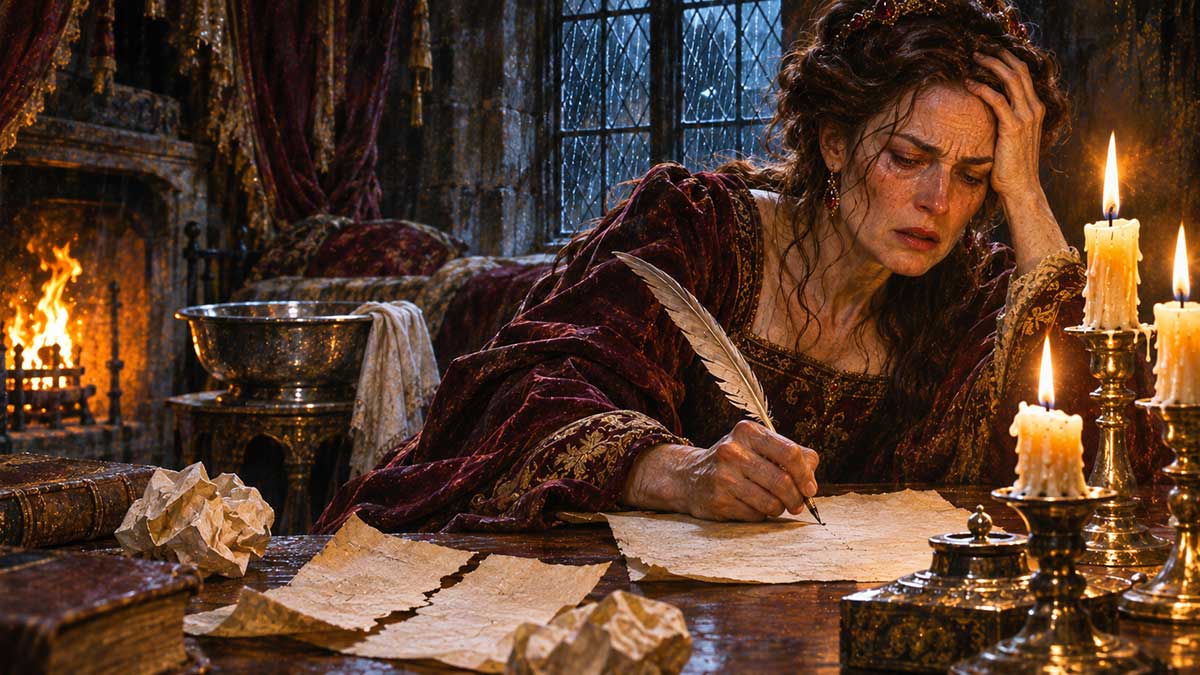
Dunsinane. Lady Macbeth's private chamber. Before dawn.
The room is dimly illuminated by three candles. Rain touches the windowpanes. A silver basin stands beside the bed, its water undisturbed.
LADY MACBETH sits at a writing table. Several sheets of parchment lie before her. One has been torn in half. Another has been crumpled and thrown into the hearth.
She holds a pen, but her hand refuses to move.
LADY MACBETH
How does one begin?
She looks at the blank parchment.
LADY MACBETH
"To Malcolm, son of Duncan..."
She writes the words.
LADY MACBETH
"Your father died beneath our roof."
She stops.
LADY MACBETH
No. He did not merely die.
She scratches out the sentence.
LADY MACBETH
"He was murdered."
Her hand trembles.
LADY MACBETH
And I helped.
She lays down the pen.
For a long moment she stares at the basin.
LADY MACBETH
I once believed that water could end everything. Wash the hands, change the garments, extinguish the candles, and morning would find us innocent.
She rises and approaches the basin.
LADY MACBETH
Yet every morning has remembered.
She touches the rim but does not place her hands in the water.
LADY MACBETH
No more.
She returns to the desk.
LADY MACBETH
"To Malcolm, son of Duncan, rightful heir of Scotland..."
She writes steadily now.
LADY MACBETH
"I write as one who participated in the crime that took your father's life. Macbeth killed Duncan as he slept in our castle. I knew of his intention. I urged him forward when he hesitated. I prepared the circumstances of the murder and helped conceal the truth afterward."
She stops to steady her breathing.
LADY MACBETH
"The guards accused of the deed were innocent of the killing. Their deaths served to silence suspicion."
She closes her eyes.
LADY MACBETH
So many dead men. And I can scarcely remember the sound of their voices.
She resumes writing.
LADY MACBETH
"I do not ask to be excused. I ask that my testimony be heard, that the innocent no longer bear our guilt, and that no further lives be taken to preserve a throne obtained by murder."
She pauses.
LADY MACBETH
"Whatever judgment is passed upon me, I accept that my actions must be answered for."
She sets down the pen.
The first light of morning appears behind the clouds.
A soft knock sounds.
LADY MACBETH
Enter.
The WAITING WOMAN enters carrying fresh candles.
WAITING WOMAN
My lady, you have not slept.
LADY MACBETH
No.
WAITING WOMAN
The physician asked that you rest.
LADY MACBETH
The physician has spent many nights trying to cure what no medicine can reach.
The Waiting Woman notices the parchment.
WAITING WOMAN
Are you writing to the King?
LADY MACBETH
To a man whose father I wronged.
The Waiting Woman hesitates.
WAITING WOMAN
My lady, there are soldiers at every passage. The King has forbidden private correspondence.
LADY MACBETH
Then the letter must travel without his permission.
WAITING WOMAN
If it is discovered...
LADY MACBETH
I know.
Lady Macbeth folds the parchment.
LADY MACBETH
Send for the Captain who guarded Lear yesterday. Tell him I wish to speak privately.
WAITING WOMAN
Will he come?
LADY MACBETH
I believe he may.
The Waiting Woman exits.
Lady Macbeth looks once more at the letter.
LADY MACBETH
Duncan, I cannot give you back your life.
She presses the folded parchment between her hands.
LADY MACBETH
But I can cease stealing the truth of your death.
Blackout.
The scene shifts to a narrow corridor outside the western tower.
The CAPTAIN stands beside a guarded door. KENT approaches under escort.
KENT
You sent for me?
CAPTAIN
The Queen has asked that you attend her.
KENT
For what purpose?
CAPTAIN
She did not say.
KENT
Macbeth has forbidden me to speak with Lear. He has forbidden me to see Cordelia. Now his wife wishes to question me?
CAPTAIN
I do not believe she intends you harm.
KENT
Belief has become a costly habit in this castle.
The Captain glances toward the guards.
CAPTAIN
Then listen carefully. There are men here who still know the difference between duty and cruelty.
KENT
And are you one of them?
CAPTAIN
I am trying to be.
Kent studies him.
KENT
Then lead me to her.
They depart.
The scene shifts to Lady Macbeth's chamber.
LADY MACBETH stands beside the table. The confession lies beneath a small book.
Enter KENT and the CAPTAIN.
LADY MACBETH
Thank you for coming.
KENT
I was told you required my presence.
LADY MACBETH
I require your help.
KENT
I have little influence here.
LADY MACBETH
You possess something more valuable. You have remained loyal to Lear when loyalty brought you no reward.
KENT
I have tried to serve him faithfully.
LADY MACBETH
Then I must ask whether you can serve a truth that may endanger us all.
Kent looks toward the Captain.
KENT
What truth?
Lady Macbeth removes the letter from beneath the book.
LADY MACBETH
This is a confession concerning Duncan's murder.
Kent grows still.
KENT
Your confession?
LADY MACBETH
Yes.
KENT
Then the suspicions concerning Macbeth are true.
LADY MACBETH
He killed Duncan. I encouraged him. I helped conceal the crime.
Kent absorbs the words.
KENT
And you wish this delivered to Malcolm?
LADY MACBETH
Yes.
KENT
Why now?
Lady Macbeth looks at the confession in her hands.
LADY MACBETH
For years I asked what might become of me if the truth were known. I never asked what might become of others if I kept it hidden.
She places the confession upon the table between them.
LADY MACBETH
I cannot restore Duncan's life. I cannot return his sons the years stolen from them. But I can place the truth before those who must decide what happens next.
KENT
And what has brought you to this decision?
LADY MACBETH
My husband prepares to use Lear and Cordelia against Malcolm. Edmund has forged correspondence that may be used to accuse Cordelia of treason. I have seen enough innocent people suffer for our silence.
KENT
Forged?
LADY MACBETH
I saw the beginnings of it in Edmund's chamber. Macbeth knows it is false.
KENT
Then Cordelia is in grave danger.
LADY MACBETH
Yes. If Malcolm attacks, Macbeth may threaten the prisoners to force a withdrawal. Edmund may go farther.
CAPTAIN
The southern army is moving closer. We may have less than a day.
KENT
Then the letter must leave at once.
LADY MACBETH
Can you arrange it?
KENT
There is a servant in the stables who once served Lear's household. If he can reach the northern orchard, he may find a path beyond the patrols.
CAPTAIN
The stable passage is watched. I can arrange a change of guard before noon.
LADY MACBETH
Then take this.
She hands the confession to Kent.
LADY MACBETH
Deliver it to Malcolm. If you cannot reach him, give it to Macduff. Let them know that I am prepared to testify.
KENT
You understand what this means?
LADY MACBETH
I do.
KENT
You may be condemned.
LADY MACBETH
I have lived beneath a sentence of my own making for years. Let a court hear the truth and decide what judgment the law requires.
Kent bows his head.
KENT
Then I shall carry it.
Lady Macbeth looks at the Captain.
LADY MACBETH
See that he reaches the stables.
CAPTAIN
I will do what I can.
They move toward the door.
LADY MACBETH
Kent.
He turns.
LADY MACBETH
Tell Cordelia that I have begun.
KENT
She will understand.
Kent and the Captain exit.
Lady Macbeth remains alone.
She looks at the basin, then turns away.
The scene shifts to a small chamber beside the southern gate.
EDMUND stands before a table, examining a map of the castle. A SERVANT enters hurriedly.
SERVANT
My lord, the Queen has summoned Kent and the Captain to her apartments.
EDMUND
For what purpose?
SERVANT
I do not know. They remained within for some time.
EDMUND
Did either carry anything when he departed?
SERVANT
Kent held a folded parchment.
Edmund looks up.
EDMUND
Where is he now?
SERVANT
He was escorted toward the stables.
EDMUND
Then the Queen has chosen her moment.
Edmund takes up his cloak.
EDMUND
Send two men to the northern passage. Quietly. I wish to know what Kent carries before it leaves Dunsinane.
SERVANT
Yes, my lord.
The Servant exits.
Edmund smiles faintly.
EDMUND
A guilty queen may become a useful witness. Or a dangerous one.
He moves toward the door.
EDMUND
The difference lies in who reads her words first.
Blackout.
The scene shifts to the castle stables.
Horses stamp upon the straw. The great doors stand partly open, revealing a narrow path through the orchard.
KENT enters with the CAPTAIN. A STABLE BOY waits beside a saddled horse.
CAPTAIN
The northern watch has been called to the armory. You have perhaps ten minutes.
KENT
Enough.
Kent hands the folded letter to the Stable Boy.
KENT
You must ride beyond the ridge and seek Malcolm's scouts. Tell them you carry a message from within Dunsinane.
STABLE BOY
Will they believe me?
KENT
Show them this seal. Tell them Kent, servant of Lear, sends you.
STABLE BOY
And if Macbeth's men stop me?
KENT
Then say nothing of the Queen. You may surrender the horse and return.
STABLE BOY
I understand.
He mounts.
A voice sounds from the doorway.
EDMUND
A touching display of loyalty.
Edmund enters with four soldiers.
The Captain draws his sword.
CAPTAIN
Stand back.
EDMUND
Captain, I advise you to lower that weapon.
KENT
Let the boy pass.
EDMUND
I fear he carries something that belongs to the King.
KENT
He carries a message.
EDMUND
Then let us discover its contents.
Edmund signals. Two soldiers seize the horse's bridle.
The Stable Boy struggles.
STABLE BOY
Let go!
EDMUND
Dismount.
The boy obeys.
Edmund takes the letter and examines the seal.
EDMUND
The Queen's private mark.
He breaks it and reads.
His expression changes.
EDMUND
Well.
KENT
You have no right to read it.
EDMUND
Rights are delicate things during war.
He continues reading.
EDMUND
"Duncan was murdered... Macbeth killed him as he slept..."
The Captain looks toward Kent.
CAPTAIN
My lord, this must reach Malcolm.
EDMUND
You have chosen a dangerous cause.
KENT
The truth is not a cause. It is what happened.
EDMUND
Truth becomes a weapon when placed in the hands of an enemy.
KENT
Then perhaps the enemy should not have committed the crime.
Edmund folds the letter.
EDMUND
Take the boy and the Captain into custody.
The soldiers move forward.
CAPTAIN
I have served Scotland faithfully.
EDMUND
Then you will understand why unauthorized correspondence cannot be permitted.
The Captain reluctantly surrenders his sword.
Kent steps toward Edmund.
KENT
Give me the letter.
EDMUND
You have already lost it.
KENT
You have taken the paper. You have not taken what it says.
Edmund smiles.
EDMUND
A fine distinction. I wonder how useful it will prove.
He signals to the soldiers.
EDMUND
Take them.
The Captain and Stable Boy are led away.
Kent remains, watched by two guards.
EDMUND
You have served Lear for many years.
KENT
Longer than you have served anyone but yourself.
EDMUND
Then you know how loyalty can blind a man.
KENT
I know how ambition can.
Edmund approaches him.
EDMUND
You may find that your queen's confession has placed her in greater danger than she anticipated.
KENT
Then let her words be heard before you destroy them.
EDMUND
I have no intention of destroying them.
He places the letter inside his cloak.
EDMUND
Not yet.
He exits.
Kent watches him go. As the guards turn away, he quietly slips a small folded scrap of parchment from his sleeve and conceals it beneath his belt.
Blackout.
The scene shifts to Macbeth's council chamber.
MACBETH stands before the map. Outside, the sound of soldiers drilling has grown louder.
Enter EDMUND.
MACBETH
You asked for an audience.
EDMUND
I bring evidence of treachery within your household.
MACBETH
Whose treachery?
Edmund places the letter upon the table.
EDMUND
Your wife's.
Macbeth looks at the seal.
MACBETH
Where did you obtain this?
EDMUND
Kent attempted to send it beyond the castle. I intercepted the messenger.
Macbeth breaks the fold and reads.
As he reads, his face changes.
MACBETH
She has written everything.
EDMUND
Enough to give Malcolm a powerful claim before the Scottish lords.
MACBETH
She has accused herself.
EDMUND
And you.
Macbeth reads again.
MACBETH
"I urged him forward when he hesitated."
He closes his eyes.
MACBETH
She remembers.
EDMUND
She has remembered with remarkable precision.
MACBETH
You speak as though this were a game.
EDMUND
I speak as a man who sees a danger that must be contained.
Macbeth turns sharply.
MACBETH
She is my wife.
EDMUND
And she has prepared to testify against you.
MACBETH
You know nothing of what she has endured.
EDMUND
I know that a written confession may end your reign.
Macbeth looks down at the letter.
MACBETH
She once told me that we could wash the deed away. She told me to be strong, to put fear behind us.
EDMUND
And now she has surrendered to fear.
MACBETH
No.
Edmund looks at him.
MACBETH
This is not fear.
Macbeth raises the letter.
MACBETH
She has written her own guilt beside mine. She knows what judgment may follow.
EDMUND
Then she is more dangerous than a woman seeking to save herself.
Macbeth remains silent.
EDMUND
You must confine her. Prevent her from communicating with the prisoners. Place her attendants under watch.
MACBETH
You would have me imprison my queen.
EDMUND
I would have you preserve your throne.
Macbeth looks toward the window.
MACBETH
Every man who speaks to me offers the same counsel. Preserve the throne. Protect the crown. Silence the danger.
EDMUND
The advice remains sound.
MACBETH
And every time I obey, the danger grows.
Edmund says nothing.
MACBETH
Have her brought to me.
EDMUND
My lord—
MACBETH
I said bring her.
Edmund bows and exits.
Macbeth stands alone, holding the confession.
He approaches the basin beside the window and stares at the water.
MACBETH
She has found a way to speak what I have spent years refusing to hear.
He looks at his reflection.
MACBETH
And I have found no way to answer.
The scene shifts to Lady Macbeth's chamber.
LADY MACBETH stands beside the window. The WAITING WOMAN enters hurriedly.
WAITING WOMAN
My lady, Edmund has intercepted the confession. Kent is under arrest.
Lady Macbeth closes her eyes.
LADY MACBETH
Then Macbeth knows.
WAITING WOMAN
The servants' passage may still be open. You could escape.
LADY MACBETH
And leave Cordelia and Lear behind? No.
Footsteps approach.
The door opens. MACBETH enters alone.
For a long moment husband and wife face one another.
MACBETH
You wrote to Malcolm.
LADY MACBETH
Yes.
MACBETH
You confessed Duncan's murder.
LADY MACBETH
Yes.
MACBETH
You named me.
LADY MACBETH
I named us both.
Macbeth approaches her.
MACBETH
Do you wish to see me hanged?
LADY MACBETH
No.
MACBETH
Then why place a rope in Malcolm's hands?
LADY MACBETH
I wish the killing to end.
MACBETH
You think a confession will stop an army?
LADY MACBETH
It may stop you from ordering another murder to defend the first.
Macbeth looks at her in disbelief.
MACBETH
You have betrayed me.
LADY MACBETH
I betrayed you when I told you that killing Duncan would make us great.
The words strike him.
LADY MACBETH
I betrayed you when I called your hesitation weakness. I betrayed you when I helped hide the crime and pretended we could build a happy life upon it.
MACBETH
You speak as though you alone bear the guilt.
LADY MACBETH
No. I have written the truth of my part. You must answer for yours.
Macbeth turns away.
MACBETH
I cannot surrender Scotland to Malcolm.
LADY MACBETH
Scotland was never yours to possess like a jewel.
MACBETH
I am its king.
LADY MACBETH
Then act for its people.
Macbeth turns back.
MACBETH
Would you have me walk into Malcolm's camp and confess?
LADY MACBETH
I would have you release the prisoners. I would have you stop threatening innocent lives. I would have you face the men whose families have suffered under your orders.
MACBETH
Macduff would kill me.
LADY MACBETH
He may wish to. Yet justice is not the same as vengeance.
MACBETH
You have learned that from Cordelia.
LADY MACBETH
I have learned it from watching what happens when no one dares tell a king he is wrong.
Macbeth looks at her for a long moment.
MACBETH
You were the one who told me to be king.
LADY MACBETH
And now I tell you to be a man worthy of the name.
Macbeth recoils as though struck.
MACBETH
You have no right to speak to me of worth.
LADY MACBETH
Perhaps not. But I have the responsibility to speak the truth.
Macbeth turns toward the door.
MACBETH
You will remain here. No visitors. No letters. Your attendants will be questioned.
LADY MACBETH
Then I am your prisoner.
MACBETH
You have chosen to become my enemy.
LADY MACBETH
I am not your enemy.
He stops.
LADY MACBETH
I am your wife. I have loved you through ambition, fear, and blood. I love you still. But I will no longer help you destroy yourself.
Macbeth does not turn.
MACBETH
Love has become a strange word in this castle.
LADY MACBETH
Then perhaps we must learn its meaning again.
Macbeth exits.
The door closes. A lock turns.
Lady Macbeth stands alone.
She approaches the basin.
The water is clear.
LADY MACBETH
I have told the truth.
She looks at her hands.
LADY MACBETH
And still they are not clean.
She sits beside the window.
LADY MACBETH
Perhaps they never will be.
She looks toward the distant hills.
LADY MACBETH
But they need not take another life.
Blackout.
The scene shifts to a storage chamber beneath the western tower.
KENT sits upon a wooden bench, guarded by a young soldier. His hands are bound loosely.
The soldier turns toward the door as distant footsteps pass.
Kent quietly removes the folded scrap from beneath his belt.
He opens it.
The scrap contains several lines copied from Lady Macbeth's confession, together with her name and seal impressed in wax.
The soldier turns back.
YOUNG SOLDIER
What is that?
KENT
Something that must reach Malcolm.
YOUNG SOLDIER
You were searched.
KENT
Not carefully enough.
The soldier approaches.
YOUNG SOLDIER
Give it to me.
Kent looks at him.
KENT
Do you know why Duncan died?
YOUNG SOLDIER
I know what the King has said.
KENT
Then you know what you were ordered to believe.
The soldier hesitates.
KENT
This letter names the men responsible. If it reaches Malcolm, there may be a chance to end the war without more innocent deaths.
YOUNG SOLDIER
And if I help you, I may be executed.
KENT
Yes.
The soldier looks toward the door.
YOUNG SOLDIER
My brother marches with Malcolm.
KENT
Then you have a reason to wish this war ended.
YOUNG SOLDIER
He may already be dead.
KENT
Then let us try to prevent more brothers from joining him.
The soldier takes the scrap.
YOUNG SOLDIER
I know a servant who carries supplies to the outer watch. He may be able to pass it beyond the gate.
KENT
Do not risk him without telling him the danger.
YOUNG SOLDIER
I will not.
He conceals the parchment inside his tunic.
KENT
What is your name?
YOUNG SOLDIER
Andrew.
KENT
Then I thank you, Andrew.
The soldier moves toward the door.
YOUNG SOLDIER
Do not thank me yet.
He exits.
Kent remains seated, listening to the footsteps fade.
KENT
The truth has found another road.
The scene shifts to Macbeth's chamber.
MACBETH stands before the window. EDMUND enters.
EDMUND
The Queen has been confined?
MACBETH
Yes.
EDMUND
Then one danger has been contained.
MACBETH
You mistake silence for safety.
EDMUND
Silence can preserve a kingdom.
MACBETH
It has preserved mine poorly.
Edmund approaches the table.
EDMUND
The southern scouts report Malcolm's army has reached the edge of Birnam Wood. Macduff rides with the advance guard. They may attack tomorrow.
MACBETH
Then tomorrow we shall see whether the witches spoke truth.
EDMUND
The witches?
Macbeth looks sharply at him.
MACBETH
Nothing.
EDMUND
You have spoken of them before. You believe they foretold your reign.
MACBETH
They foretold more than that.
EDMUND
Then perhaps they have given you reason for confidence.
Macbeth looks toward the crown upon the table.
MACBETH
They told me that no man born of woman would defeat me. They told me I need not fear until Birnam Wood came to Dunsinane.
EDMUND
Then you are safe. Forests do not march.
MACBETH
No.
He pauses.
MACBETH
Forests do not march.
Edmund studies him.
EDMUND
Then we should prepare the prisoners for the coming siege. Lear and Cordelia may be brought before Malcolm's forces if negotiation becomes necessary.
MACBETH
Do not harm them without my command.
EDMUND
Of course.
MACBETH
I mean it.
EDMUND
I understand.
Macbeth turns away.
MACBETH
Leave me.
Edmund bows and exits.
The scene shifts to a narrow passage outside the council chamber.
Edmund walks alone, carrying the original confession beneath his cloak.
He stops beside a torch and removes the letter.
EDMUND
A queen's confession. A king's guilt. A daughter who refuses to lie. An old man who has renounced his crown.
He looks toward the eastern apartments.
EDMUND
All these people believe that truth will save them.
He folds the letter.
EDMUND
Yet truth is merely another weapon in the hands of the man who knows when to use it.
He places the confession inside his cloak.
From beyond the walls comes the distant sound of horns.
Edmund looks toward the southern horizon.
EDMUND
Let Malcolm come.
He extinguishes the torch.
Blackout.
End of Act IV, Scene Three.
End of Act IV.
Act V, Scene One: When the Forest Moves
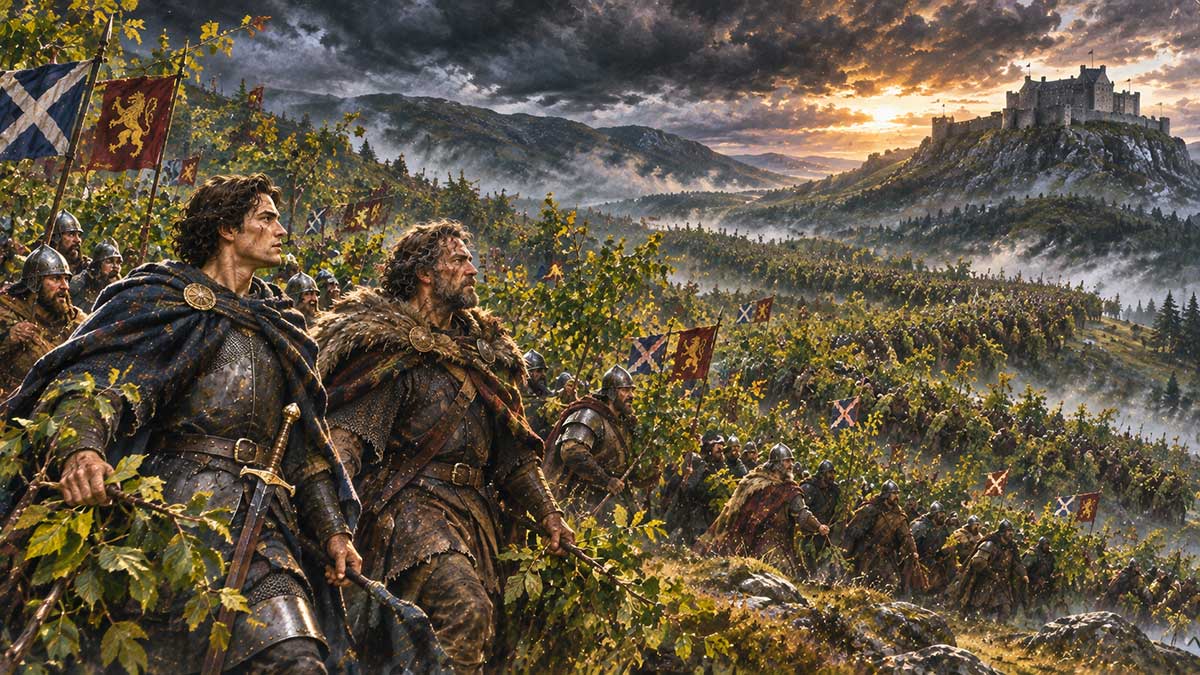
Birnam Wood. The southern edge of the forest. Before dawn.
A pale mist hangs among the trees. Beneath the branches, an army waits in silence. English soldiers stand beside Scottish men who have returned from exile. Their armor is dulled with mud, their banners furled.
At the center of the encampment, MALCOLM studies a map by the light of a covered lantern. MACDUFF stands beside him. Several CAPTAINS await their orders.
MALCOLM
Dunsinane lies beyond the northern ridge. Our scouts have counted three lines of defense. The outer earthworks, the lower gate, and the castle itself.
FIRST CAPTAIN
Macbeth has withdrawn his men from the villages. He means to hold the fortress.
MACDUFF
He has gathered food enough for a siege. If we wait outside his walls, the prisoners may starve before his soldiers do.
MALCOLM
Then we must approach before he has time to prepare another cruelty.
SECOND CAPTAIN
His watchers occupy the hills. They will count our soldiers the moment we leave the trees.
Malcolm looks around at the forest.
MALCOLM
Then we shall make their counting difficult.
FIRST CAPTAIN
How, my lord?
Malcolm takes his knife and cuts a leafy branch from a young tree.
MALCOLM
Let every soldier carry a branch before him. Keep the ranks dispersed beneath the cover of the wood. From the castle walls, our numbers will be hidden until we are near enough to strike.
SECOND CAPTAIN
The men will look like a forest advancing.
MACDUFF
Then let Macbeth see a forest where he expected an army.
The Captains exchange approving looks.
MALCOLM
Give the order. No fires. No shouting. The branches are to be cut without destroying the trees. We need concealment, not a wasteland.
The Captains depart.
Macduff watches the soldiers begin their preparations.
MACDUFF
There was a time when I would have welcomed a battle for the honor of Scotland.
MALCOLM
And now?
MACDUFF
Now I wish it were unnecessary.
MALCOLM
That may be the soundest reason to fight one.
MACDUFF
I have dreamed of standing before Macbeth. In those dreams I kill him, and my wife and children return to me.
He pauses.
MACDUFF
Then I wake.
MALCOLM
Their deaths demand an answer.
MACDUFF
Yes. But I fear what I may become in giving it.
MALCOLM
If Macbeth can be taken alive, he must answer before Scotland. The same law that condemns his crimes must govern our victory.
MACDUFF
And if he refuses surrender?
MALCOLM
Then we defend ourselves. But we do not come here to imitate him.
Macduff nods.
MACDUFF
What news of Lear and Cordelia?
MALCOLM
Still held apart. The messenger who reached us during the night says the Queen of Scotland has attempted to help them.
MACDUFF
Lady Macbeth?
MALCOLM
So he claims. Kent concealed a portion of her confession before Edmund seized the original. He entrusted the copy to a young soldier, who arranged for it to pass through the outer watch. A messenger brought it to us during the night.
Malcolm removes a folded scrap from his cloak.
MALCOLM
It names Macbeth as Duncan's killer and speaks of his wife's participation.
Macduff reads it.
MACDUFF
Her seal.
MALCOLM
The original letter was intercepted. We cannot yet know everything it contained.
MACDUFF
But enough to demand testimony.
MALCOLM
Yes. I have sent word to our commanders that Lear, Cordelia, and Lady Macbeth are to be protected if the castle falls. None is to be killed upon suspicion alone.
MACDUFF
And Edmund?
MALCOLM
He remains with Macbeth.
MACDUFF
Then Gloucester's son may prove as dangerous as the king he serves.
A horn sounds softly from the forest's edge.
A SCOUT approaches.
SCOUT
My lord, a traveler asks to speak with you. He says he carries news from the British border.
MALCOLM
His name?
SCOUT
Edgar, son of Gloucester.
Macduff turns.
MACDUFF
Bring him.
Enter EDGAR, escorted by two soldiers. His cloak is torn, and one wrist bears the marks of a recently cut rope.
MALCOLM
You have escaped Dunsinane?
EDGAR
With help from a servant who believed I should answer my brother before a court, not disappear in a dungeon.
MACDUFF
You have seen Edmund?
EDGAR
Yes. He is trusted by Macbeth and has become the keeper of secrets that may decide the fate of the prisoners.
MALCOLM
What of your father?
EDGAR
He lives near the border under the protection of friends. His eyes are gone, but his mind remains clear.
MACDUFF
I grieve for him.
EDGAR
He asks for justice, not pity.
MALCOLM
Then help us bring those responsible to judgment.
EDGAR
I will. But I ask one thing.
MALCOLM
Speak.
EDGAR
If Edmund is captured, let him answer for what he has done. Do not kill him merely for bearing our father's blood.
MACDUFF
You still call him brother.
EDGAR
I cannot change who our father was. Nor can I allow that bond to excuse what Edmund has done.
Malcolm extends his hand.
MALCOLM
Then stand with us.
Edgar takes it.
Beyond them, soldiers begin moving beneath branches.
The scene shifts to Dunsinane. The highest watchtower. Morning.
MACBETH stands beside the battlements, wearing armor beneath his royal cloak. EDMUND approaches with the CAPTAIN.
CAPTAIN
My lord, movement has been seen along the southern ridge.
MACBETH
Malcolm?
CAPTAIN
We believe so. The mist makes it difficult to count his men.
MACBETH
Then let him come. Our walls have stood against stronger armies.
EDMUND
Our scouts report that several Scottish lords have abandoned their posts and joined Malcolm.
MACBETH
Then they have chosen their reward.
EDMUND
Or their survival.
Macbeth looks sharply at him.
MACBETH
Do you doubt me?
EDMUND
I doubt men who promise loyalty when defeat becomes possible.
MACBETH
Then doubt them. I have assurances greater than theirs.
He looks toward Birnam Wood.
MACBETH
No man born of woman shall defeat me. And until Birnam Wood comes to Dunsinane, I need not fear.
CAPTAIN
My lord...
The Captain stares into the distance.
MACBETH
What is it?
CAPTAIN
The forest.
MACBETH
What of it?
CAPTAIN
It appears to be moving.
Macbeth steps toward the battlement.
Beyond the ridge, a vast line of green branches advances through the mist. Leaves sway above the heads of unseen soldiers. The movement stretches across the valley.
For a moment the entire hillside seems alive.
MACBETH
No.
CAPTAIN
The enemy carries branches for concealment.
MACBETH
Birnam Wood.
He grips the stone parapet.
MACBETH
They said it could not come.
EDMUND
It is a trick of soldiers, my lord. The trees themselves have not moved.
MACBETH
The prophecy did not say how.
He stares at the advancing branches.
MACBETH
It said the wood would come.
CAPTAIN
Shall I order the archers to the southern wall?
Macbeth struggles to regain his composure.
MACBETH
Yes. Archers above the lower gate. Spears beneath the eastern arch. Close every passage to the courtyard.
CAPTAIN
And the prisoners?
MACBETH
Bring Lear and Cordelia to the inner keep. No one is to harm them without my order.
EDMUND
Their presence may discourage Malcolm from assaulting the walls.
MACBETH
Then let him see what is at stake.
The Captain departs.
Macbeth turns to Edmund.
MACBETH
The witches told me I could not fall until the forest moved. Now the forest moves.
EDMUND
Then the condition has been fulfilled, but your defeat has not been foretold.
MACBETH
You speak like a man who can turn any warning into a promise.
EDMUND
I speak like a man who intends to survive.
Macbeth looks at him.
MACBETH
And if survival requires abandoning me?
Edmund pauses.
EDMUND
I have not abandoned you.
MACBETH
Not yet.
Macbeth walks toward the stair.
MACBETH
Prepare the inner defenses. I will not surrender Dunsinane to men hiding behind leaves.
He exits.
Edmund remains upon the battlement, watching the advancing army.
EDMUND
A king who trusts a prophecy more than his captains deserves the uncertainty it brings.
He looks toward the lower courtyard.
EDMUND
But uncertainty may still be made profitable.
The scene shifts to the inner courtyard.
Soldiers rush across the stones carrying arrows, shields, and barrels of water. Bells sound from the towers.
LEAR stands beneath guard beside CORDELIA. They have been brought together under the Captain's orders. KENT and the FOOL are held several paces away. SIR ALAIN stands disarmed near Cordelia.
Lear looks toward the southern wall.
LEAR
The bells have begun.
CORDELIA
Malcolm's army is near.
LEAR
Then the castle may soon become a battlefield.
CORDELIA
We must find a way to keep the soldiers from using us as shields.
FOOL
A difficult task. Kings have spent centuries placing other men between themselves and danger.
KENT
Macbeth has ordered us brought here for a purpose.
LEAR
Then let him state it.
The Captain approaches.
CAPTAIN
You are to remain in the inner keep until the fighting ends.
CORDELIA
Will we be allowed to leave if Malcolm offers safe passage?
CAPTAIN
I have no authority to promise it.
LEAR
Then you have no authority to call us protected.
The Captain looks at him.
CAPTAIN
I have been ordered to keep you alive.
LEAR
That is something.
He glances toward Cordelia.
LEAR
See that the order is obeyed.
The Captain hesitates, then nods.
CAPTAIN
I will do what I can.
He departs.
FOOL
There goes a man who still has a conscience. I hope it survives the day.
Cordelia turns toward Lear.
CORDELIA
Father, if the fighting reaches us, you must not try to defend me with your life.
LEAR
What wouldst thou have me defend thee with? I have no sword.
CORDELIA
With your wisdom. With your voice. With the life you have only just begun to reclaim.
LEAR
Thou askest much.
CORDELIA
I ask you to live.
Lear takes her hand.
LEAR
Then I shall try.
The scene shifts to a narrow passage near the eastern gate.
EDMUND walks quickly with two soldiers. A sealed order rests in his hand.
FIRST SOLDIER
My lord, the King has ordered the prisoners kept alive.
EDMUND
I know his orders.
FIRST SOLDIER
Then why have you summoned us?
EDMUND
To prepare for a circumstance he has not yet considered.
He hands the soldier a folded document.
EDMUND
If Malcolm breaches the inner wall, Cordelia is to be removed from the courtyard. Her death must appear the result of an attempted rescue by Malcolm's men.
The soldier stares at the order.
FIRST SOLDIER
The King has forbidden harm to her.
EDMUND
The King has entrusted me with the defense of his interests.
SECOND SOLDIER
Does this bear his seal?
EDMUND
It bears mine.
FIRST SOLDIER
Then I cannot obey it.
Edmund steps closer.
EDMUND
You would defy a commander during battle?
FIRST SOLDIER
I would obey the King.
Edmund studies the man.
EDMUND
A dangerous distinction.
He takes back the order.
EDMUND
Very well. Return to your post.
The soldiers depart.
Edmund watches them go.
EDMUND
Loyalty becomes inconvenient when men begin to think.
A voice sounds behind him.
EDGAR
Then you have found yourself surrounded by inconvenience.
Edmund turns.
EDGAR stands at the far end of the passage, sword drawn. Behind him, two soldiers loyal to Malcolm have entered through a breached service gate.
EDMUND
Brother.
EDGAR
You have run out of roads upon which to escape me.
EDMUND
You have brought an enemy into the castle.
EDGAR
I have brought witnesses.
Edmund draws his sword. In his haste, the folded order slips from his hand and falls beside the wall. Neither brother moves to retrieve it.
EDMUND
You have always preferred the company of men who could protect you.
EDGAR
And you have always preferred the company of men you could deceive.
EDMUND
Our father believed you dangerous.
EDGAR
Our father believed the lies you placed before him.
EDMUND
He believed what he wished to believe.
EDGAR
He believed his son.
Edmund's expression flickers.
EDGAR
You used that trust to destroy him.
EDMUND
He denied me what was mine by blood.
EDGAR
He gave you his name. He gave you a place in his house.
EDMUND
A place beneath you.
EDGAR
Then you should have demanded justice, not manufactured my guilt.
EDMUND
Justice is a word spoken by those who already possess what they desire.
EDGAR
No. Justice is what must remain when desire has made us cruel.
Edmund raises his sword.
EDMUND
Then defend your justice.
They fight.
The clash of swords echoes through the passage. Edgar fights with discipline, Edmund with desperate speed. Their blades strike the stone walls.
Edmund lunges. Edgar turns the blade aside and wounds him in the shoulder.
Edmund staggers but continues fighting.
EDMUND
You always had the better teachers.
EDGAR
And you had the better opportunities to choose differently.
Edmund attacks again. Edgar disarms him with a sharp movement. Edmund's sword falls across the stones.
Edgar places the point of his blade near Edmund's throat.
EDMUND
Finish it.
EDGAR
No.
EDMUND
You have wanted my death since you learned what happened to our father.
EDGAR
I have wanted you to answer for it.
EDMUND
Then take your revenge.
EDGAR
I will not become you to defeat you.
Edmund looks up at him.
EDGAR
You will live. You will stand before a court. You will hear what our father suffered, and you will answer for the lives you have endangered.
Edmund laughs bitterly, then winces from the wound.
EDMUND
You think a court will restore his eyes?
EDGAR
No.
EDMUND
Then what good is it?
EDGAR
It may prevent another father from losing his.
Edgar turns to the soldiers.
EDGAR
Bind his wound and take him into custody.
The soldiers approach.
Edmund looks toward the fallen order.
EDMUND
There is something you should know.
EDGAR
Speak.
EDMUND
Macbeth has ordered Lear and Cordelia held as bargaining pieces. But there are men who may act without waiting for his command.
EDGAR
What men?
Edmund looks at the folded document.
EDMUND
I prepared an order concerning Cordelia. It was refused. Others may be less scrupulous.
Edgar picks up the document and reads.
EDGAR
You intended her death.
EDMUND
I intended to secure my future.
EDGAR
By murdering a woman who came to rescue her father.
EDMUND
All my life I was told that birth had placed me beneath another man. I swore that no one would ever decide my worth again.
He looks at the fallen sword.
EDMUND
And now I have made myself the prisoner of every bargain I struck to escape that judgment.
EDGAR
You were wronged by the circumstances of your birth. Cordelia did not wrong you. Neither did the men whose lives you offered in exchange for advancement.
EDMUND
I know whose lives I offered.
Edgar folds the order.
EDGAR
Then you have given us another charge to place before the court.
He signals the soldiers.
EDGAR
Take him away. Keep him alive.
Edmund is led away.
Edgar looks toward the courtyard.
EDGAR
Cordelia must be warned.
He runs toward the inner keep.
The scene shifts to Dunsinane's southern wall.
The advancing branches have reached the lower slopes. Arrows fly from the battlements. Malcolm's soldiers cast aside their branches and raise their shields.
MACDUFF leads a company toward the gate.
MACDUFF
Forward! Keep the ranks together!
The soldiers advance beneath a storm of arrows.
Above them, MACBETH appears upon the battlement.
MACBETH
Macduff!
Macduff looks up.
MACDUFF
Macbeth!
MACBETH
You have brought foreign soldiers against your own country.
MACDUFF
I have brought men to free it from you.
MACBETH
You abandoned Scotland when it needed you.
MACDUFF
I left to seek help against a tyrant.
MACBETH
And your family paid the price.
Macduff freezes.
The soldiers around him continue moving.
MACDUFF
Do not speak of them.
MACBETH
You left them behind.
MACDUFF
And you sent murderers to their home.
Macbeth says nothing.
MACDUFF
My wife had no sword. My children had no army. Tell me what danger they posed to your crown.
Macbeth looks away.
MACDUFF
You cannot answer.
Malcolm approaches beside Macduff.
MALCOLM
Macbeth! Your outer defenses are falling. We offer terms. Release the prisoners and surrender the fortress. You and your officers will receive lawful judgment.
MACBETH
You offer me a trial for a throne that belongs to me.
MALCOLM
I offer you a chance to prevent more deaths.
MACBETH
Then withdraw your army.
MALCOLM
Not until the prisoners are free and Scotland is no longer held by fear.
Macbeth looks toward the inner courtyard.
MACBETH
Lear and Cordelia remain alive. Their safety depends upon what happens next.
MACDUFF
You would threaten them to save yourself?
MACBETH
I would prevent a slaughter.
MALCOLM
Then open the gates.
Macbeth does not answer.
He turns to the Captain.
MACBETH
Prepare the inner courtyard. Bring Lear and Cordelia before me.
CAPTAIN
My lord, the enemy has breached the lower gate.
MACBETH
Then there is little time.
The Captain hesitates.
CAPTAIN
And if they refuse to come?
MACBETH
They are prisoners. They do not choose.
The Captain bows reluctantly and departs.
Macbeth looks once more at the advancing army.
MACBETH
The forest has moved.
He grips his sword.
MACBETH
But I still stand.
The scene shifts to the inner courtyard.
LEAR and CORDELIA stand beneath guard. KENT and the FOOL remain nearby. SIR ALAIN watches the gates.
The sounds of battle grow louder.
EDGAR enters hurriedly, accompanied by two soldiers.
EDGAR
Queen Cordelia!
Cordelia turns.
CORDELIA
Who calls me?
EDGAR
Edgar, son of Gloucester. I come from Malcolm's forces.
LEAR
Gloucester's son?
EDGAR
Yes, my lord.
LEAR
Your father was my friend.
EDGAR
He remains alive, though grievously injured.
Lear looks at him with sorrow.
LEAR
I have heard of his suffering.
EDGAR
Then let us prevent more of it. Edmund has been captured. He prepared an order to have Cordelia killed and the blame placed upon Malcolm's soldiers.
Cordelia grows pale.
SIR ALAIN
Then we must leave at once.
EDGAR
The inner gate is not yet secure. Malcolm's men are fighting to reach it.
KENT
Can you take us through the passage you entered?
EDGAR
Not safely. Macbeth's soldiers have closed the route behind us.
The Captain enters with armed guards.
CAPTAIN
By order of the King, Lear and Cordelia are to be brought before him.
EDGAR
They are under Malcolm's protection.
CAPTAIN
Malcolm does not command this courtyard.
EDGAR
He soon may.
The Captain looks toward the distant fighting.
CAPTAIN
I have orders to keep them alive. I intend to obey them.
LEAR
Then we shall come.
CORDELIA
Father—
LEAR
We cannot outrun every sword in this castle. Let us face the man who holds them.
He takes her hand.
LEAR
Together.
Cordelia nods.
The Captain signals his guards.
They move toward the great hall.
The scene shifts to Macbeth's private chamber.
LADY MACBETH stands beside the locked door. Outside, soldiers run through the passage.
The door opens. The WAITING WOMAN enters, breathless.
WAITING WOMAN
My lady, the lower gate has fallen. The King has ordered the prisoners brought into the courtyard.
LADY MACBETH
Then he means to use them against Malcolm.
WAITING WOMAN
You must hide.
LADY MACBETH
No.
Lady Macbeth takes up a folded sheet of parchment from the table.
WAITING WOMAN
What is that?
LADY MACBETH
Another copy of my confession.
WAITING WOMAN
The first was intercepted.
LADY MACBETH
Then this one must be spoken aloud.
She moves toward the door.
WAITING WOMAN
My lady, the King has forbidden you to leave.
LADY MACBETH
He has forbidden many things.
She looks at the Waiting Woman.
LADY MACBETH
I have obeyed the wrong commands for too long.
She exits.
The scene shifts to the great hall of Dunsinane.
The banquet tables have been removed. The hall stands almost empty, its banners trembling in the drafts from the open doors.
MACBETH enters from one side. LEAR and CORDELIA are brought in from the other, followed by KENT, the FOOL, SIR ALAIN, and the CAPTAIN.
Macbeth looks at Lear.
MACBETH
You have seen what comes of refusing my offer.
LEAR
I have seen what comes of your fear.
MACBETH
Malcolm's soldiers are at my gates. If they force their way into this hall, I cannot promise that anyone will survive.
CORDELIA
Then let me speak to them.
Macbeth turns toward her.
MACBETH
You would have me send a Queen of France to bargain with an army at my gates?
CORDELIA
I would have you permit a message to pass beneath a flag of truce. Let Malcolm know my father and I are alive. Let him know that the wounded within these walls need protection, whether they wear your colors or his.
MACBETH
And what would you offer him in return?
CORDELIA
Nothing that belongs to another. I will promise neither your crown nor his victory. I will ask him to hold his attack long enough for the wounded and the innocent to be brought to safety.
MACBETH
You think he will listen?
CORDELIA
I cannot command his answer. But I can give him a reason to choose mercy before another man dies.
She turns to the Captain.
CORDELIA
You know the men upon these walls. Would they carry such a message?
The Captain hesitates.
CAPTAIN
Under a flag of truce, my lady, they might.
Cordelia faces Macbeth again.
CORDELIA
Then the choice is before you. You can keep us here and wait for the doors to fall, or you can let one message cross the walls.
MACBETH
No message leaves this hall. He will not stop until he has my crown.
LEAR
Then you must decide whether the crown is worth the lives of those who stand before you.
Macbeth turns sharply.
MACBETH
You speak easily. You have already surrendered yours.
LEAR
No. I surrendered my claim to regain it. The loss came long before.
MACBETH
And you believe that makes you wise?
LEAR
I believe it has made me less willing to destroy another life for my pride.
The Fool steps forward.
FOOL
A strange contest, my lords. One king has a crown and fears losing it. The other has none and fears losing his daughter. I wonder which has chosen the better treasure.
Macbeth looks at the Fool.
MACBETH
You again.
FOOL
I have a habit of appearing when kings most wish to be alone with their mistakes.
The doors tremble beneath a distant impact.
The Captain turns toward the sound.
CAPTAIN
My lord, the inner gate is under attack.
Macbeth draws his sword.
MACBETH
Then let them come.
He looks at Lear and Cordelia.
MACBETH
You will remain here. If Malcolm wishes to take this castle, he must first reckon with the lives his attack places in danger.
Lear steps in front of Cordelia.
LEAR
Then he must reckon with mine.
Macbeth stares at him.
MACBETH
Stand aside.
LEAR
No.
MACBETH
You cannot stop me.
LEAR
I know.
Lear holds his ground.
LEAR
But I can choose where I stand.
The great doors shake again.
From outside comes the sound of Malcolm's soldiers calling for surrender.
Macbeth raises his sword.
Lear does not move.
Cordelia stands behind her father, holding his cloak.
The Fool watches the two kings, his expression grave.
Blackout.
End of Act V, Scene One.
Act V, Scene Two: The King Who Knelt
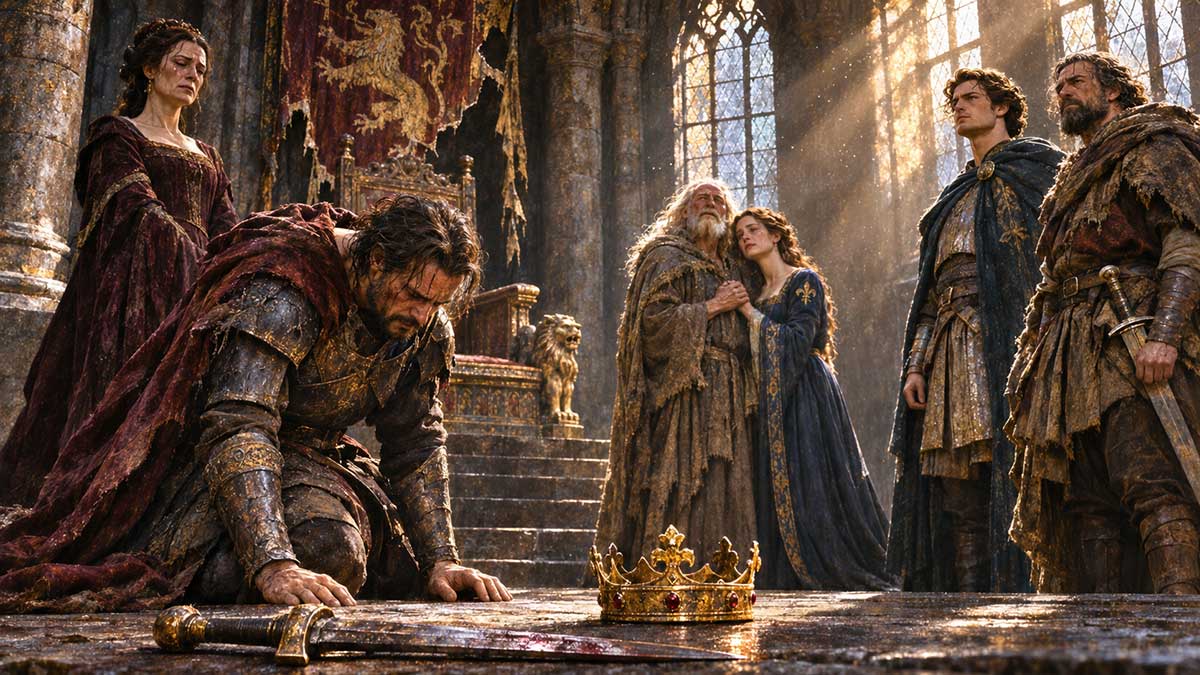
Dunsinane. The great hall. Late afternoon.
The windows shake beneath the thunder of the assault. Dust falls from the beams. A tapestry depicting Scotland's ancient kings hangs torn above the throne.
MACBETH stands near the center of the hall, sword drawn. LEAR has placed himself between Macbeth and CORDELIA. KENT, the FOOL, SIR ALAIN, and several Scottish guards stand nearby.
Beyond the doors, the cries of soldiers grow louder.
MACBETH
Stand aside, Lear.
LEAR
No.
MACBETH
You have no army here. No authority. No weapon.
LEAR
I have a daughter.
MACBETH
And you would throw away your life for her?
LEAR
I have wasted enough of it without her.
Macbeth approaches. Lear does not move.
MACBETH
Do not mistake my patience for weakness.
LEAR
And do not mistake my age for surrender.
CORDELIA
Father, please.
LEAR
Stay behind me, child.
CORDELIA
I did not come here to watch you die.
LEAR
Nor did I come here to see thee murdered for another man's crown.
Macbeth looks from father to daughter.
MACBETH
You believe this is courage? An old man standing before a sword?
LEAR
No. Courage would have been listening to her when she first spoke the truth. This is what remains for me to do.
A tremendous impact shakes the doors.
The CAPTAIN enters, blood upon his sleeve.
CAPTAIN
My lord! The inner gate has fallen. Malcolm's soldiers have reached the courtyard.
MACBETH
Then hold the passage.
CAPTAIN
We have lost too many men. Some have laid down their weapons.
MACBETH
Then find those who have not.
CAPTAIN
They ask whether the prisoners are safe.
MACBETH
Tell them the prisoners remain alive.
CAPTAIN
And what are your orders concerning them?
Macbeth looks toward Cordelia.
MACBETH
They remain here.
The Captain hesitates.
CAPTAIN
My lord, if they are allowed to leave, Malcolm may halt the assault.
MACBETH
You are a captain, not my counselor.
CAPTAIN
I have watched men die at the gate for a cause they no longer understand.
MACBETH
Then remind them that they serve their king.
CAPTAIN
They know whom they serve. They are beginning to ask whom their king serves.
Macbeth raises his sword slightly.
MACBETH
Leave.
The Captain looks at Lear, then Cordelia.
CAPTAIN
I will not permit harm to the prisoners.
He exits before Macbeth can answer.
FOOL
There goes another soldier who has discovered that a conscience is harder to command than a sword.
MACBETH
Silence!
FOOL
I have been silent in a tower, my lord. It did not improve your judgment.
Macbeth turns away.
The great doors open.
MALCOLM enters with MACDUFF and armed soldiers. EDGAR follows. Their weapons are drawn, but they halt upon seeing the prisoners.
MALCOLM
Macbeth!
Macbeth turns toward them.
MACBETH
You have entered my hall without invitation.
MALCOLM
We have entered to end the fighting.
MACBETH
Then withdraw your men.
MALCOLM
Release the prisoners and surrender your weapons. Your soldiers will be offered the opportunity to lay down their arms.
MACBETH
You demand surrender while standing beneath my roof.
MALCOLM
I demand an end to needless deaths.
Macduff steps forward.
MACDUFF
And I demand an answer.
Macbeth sees him.
MACBETH
Macduff.
MACDUFF
You sent murderers to my home.
The hall becomes still.
MACBETH
Your household was suspected of aiding rebellion.
MACDUFF
My wife was not a soldier.
MACBETH
She sheltered your interests.
MACDUFF
My children had no interests in your war.
Macbeth says nothing.
MACDUFF
One was too young to understand why men carried swords. Another believed that soldiers existed to protect families.
Macduff's voice begins to shake.
MACDUFF
They died calling for their mother.
Macbeth looks away.
MACDUFF
Look at me.
Macbeth slowly turns back.
MACDUFF
Did you order their deaths?
Silence.
MACBETH
I ordered action against your household.
MACDUFF
That is the language of a man hiding behind his command.
MACBETH
Yes.
The admission surprises everyone.
MACBETH
I gave the order.
Macduff grips his sword.
MACDUFF
Then draw your blade against me and answer for it.
MALCOLM
Macduff.
MACDUFF
He murdered my family.
MALCOLM
And he must face judgment.
MACDUFF
Judgment cannot return them.
MALCOLM
Neither can another death.
Macduff struggles to restrain himself.
MACBETH
You have come seeking revenge. Do not pretend otherwise.
MACDUFF
I have dreamed of killing you.
MACBETH
Then fulfill your dream.
Macduff raises his sword.
Lear steps forward, still shielding Cordelia.
LEAR
No more.
Macduff stops.
LEAR
I cannot speak for the dead. I cannot tell a father what his grief should demand. But I have seen what happens when a king believes his anger is the same as justice.
He looks toward Macbeth.
LEAR
I was such a king.
MACBETH
You compare the loss of your kingdom with the blood upon my hands?
LEAR
No. I compare the pride that made us deaf.
Lear turns to Macduff.
LEAR
Your family deserves justice. Let it be a justice that their memory may honor.
Macduff lowers his sword slightly.
MACDUFF
You ask me to spare him?
LEAR
I ask that you do not let him decide what kind of man you become.
Macduff looks at Malcolm.
MACDUFF
Then take him alive, if he will surrender.
Malcolm nods.
MALCOLM
Macbeth, you have heard our terms. Release the prisoners. Lay down your sword. You will be held for trial before Scotland.
Macbeth looks toward the throne.
MACBETH
A trial.
MALCOLM
Yes.
MACBETH
Before men who have already decided I am a murderer.
MALCOLM
You have admitted ordering the deaths of Macduff's family. There are other accusations you must answer.
MACBETH
And Duncan?
Malcolm grows still.
MALCOLM
What of my father?
Macbeth does not answer.
From the corridor comes a woman's voice.
LADY MACBETH
I can answer that.
LADY MACBETH enters, accompanied by the WAITING WOMAN. She carries a folded parchment. Her face is pale, but her steps are steady.
Macbeth turns sharply.
MACBETH
You were ordered to remain in your chamber.
LADY MACBETH
I have obeyed enough orders that should never have been given.
She walks toward Malcolm.
LADY MACBETH
You are Duncan's son.
MALCOLM
I am.
LADY MACBETH
Then you have a right to hear what happened beneath our roof.
She unfolds the parchment.
MACBETH
Do not.
Lady Macbeth looks at him.
LADY MACBETH
I must.
MACBETH
You would condemn us both?
LADY MACBETH
I would stop pretending we have escaped what we did.
She turns to Malcolm.
LADY MACBETH
Duncan did not die by the hands of his guards. Macbeth killed him while he slept. I knew of the plan. I urged my husband to carry it out. I helped conceal the crime afterward.
Malcolm stands motionless.
MALCOLM
My father trusted you.
LADY MACBETH
Yes.
MALCOLM
He came to your castle as a guest.
LADY MACBETH
Yes.
MALCOLM
And you prepared his death.
Lady Macbeth lowers her head.
LADY MACBETH
I did.
Malcolm struggles for composure.
MALCOLM
Why confess now?
LADY MACBETH
For years I hoped that silence would protect us. Instead, it protected every cruelty that followed.
She looks toward Cordelia.
LADY MACBETH
A woman who had every reason to hate this house showed me that truth need not be spoken without mercy.
Cordelia meets her gaze.
LADY MACBETH
But mercy does not cancel guilt. I ask no pardon. I ask only that the killing end.
She hands the confession to Malcolm.
MALCOLM
This will be examined. You will be required to testify, and your own actions will be judged.
LADY MACBETH
I understand.
Macbeth stares at his wife.
MACBETH
You have given him our lives.
LADY MACBETH
Our lives were never ours to purchase with the lives of others.
MACBETH
You stood beside me when I took the crown.
LADY MACBETH
Yes.
MACBETH
You told me I must not falter.
LADY MACBETH
Yes.
MACBETH
And now, before my enemies, you call me a murderer.
LADY MACBETH
I call you what your actions have made you.
Her voice softens.
LADY MACBETH
But I do not believe those actions must determine every choice you make until your final breath.
Macbeth turns toward the throne.
The crown rests upon his head. His sword remains in his hand.
MACBETH
I have fought for this crown against enemies, prophecy, and fear. I have buried friends, destroyed families, and made my own home a prison.
He looks at Lear.
MACBETH
And you. You had a kingdom and lost it through foolish pride.
LEAR
I did.
MACBETH
Yet you stand here without a crown, and your daughter holds your hand.
Lear looks at Cordelia. She takes his hand.
MACBETH
I have a crown, and my wife stands before strangers accusing me of murder.
LADY MACBETH
I stand here telling you the truth.
MACBETH
The truth.
He looks toward the open doors.
Beyond them, wounded soldiers are being carried across the courtyard. A young Scottish soldier kneels beside a fallen companion.
MACBETH
I told myself that one death would secure the throne. Then another was needed to protect the first. Then another.
He looks down at his sword.
MACBETH
Every time I believed I had reached the end, I found another man standing in my way.
MALCOLM
You can end it now.
MACBETH
I can end the fighting. I cannot bring back those I have killed.
MALCOLM
No.
MACBETH
Nor can I make their families forgive me.
MALCOLM
Forgiveness is not yours to command.
Macbeth looks toward the wounded soldiers beyond the doors.
MACBETH
Then perhaps there is one thing left that I can give them. No more sons dying at my command. No more fathers carried from these walls.
MALCOLM
You must still answer for what you have done.
MACBETH
I know. For the first time, I see that answering for it may be the only thing I have not yet tried.
Macbeth closes his eyes.
MACBETH
The witches told me that no man born of woman would defeat me.
Macduff steps forward.
MACDUFF
Then they deceived you. I was taken from my mother's womb before the natural hour of birth.
Macbeth stares at him.
MACBETH
You.
MACDUFF
Their promise cannot protect you.
Macbeth looks toward the windows, where the branches carried from Birnam Wood lie scattered across the courtyard.
MACBETH
The forest came. And now the man.
He gives a bitter laugh.
MACBETH
Every word was true, yet none meant what I wished it to mean.
FOOL
A prophecy may tell a king what will happen. It cannot tell him what he ought to do.
Macbeth looks at the Fool.
MACBETH
You have mocked me since the day you entered my castle.
FOOL
I have mocked your crown, my lord. I hoped the man beneath it might eventually listen.
Macbeth turns toward Lear.
MACBETH
You knelt before your daughter.
LEAR
Yes.
MACBETH
Was it not unbearable?
LEAR
For a moment.
MACBETH
And afterward?
LEAR
I could look her in the eyes.
Macbeth looks toward Lady Macbeth.
MACBETH
If I surrender, you will still be judged.
LADY MACBETH
Yes.
MACBETH
I cannot save you from that.
LADY MACBETH
Nor should you.
The hall falls silent.
Macbeth slowly lowers his sword.
Macduff watches, scarcely breathing.
Macbeth looks at the blade. The steel is scratched and darkened from battle.
MACBETH
I once thought this sword proved that I was a king.
He kneels and places it upon the stone floor.
MACBETH
It has proved only that I could kill.
He removes the crown.
For a long moment he holds it in both hands.
MACBETH
I believed that without this, I would be nothing.
He looks toward Lear.
MACBETH
Perhaps I must discover whether anything remains.
Macbeth places the crown beside the sword.
MACBETH
I surrender.
No one moves.
MACBETH
Order the fighting stopped. Open the gates. Release the prisoners.
Malcolm turns to his Captains.
MALCOLM
Sound the ceasefire. Send word to every company. Any soldier who lays down his weapon is to be taken into custody without harm. Attend to the wounded on both sides.
The Captains depart.
Macduff approaches Macbeth, his sword still in hand.
MACDUFF
You have surrendered your crown. You have not answered for my family.
MACBETH
I know.
MACDUFF
You will hear their names.
MACBETH
Then speak them.
Macduff struggles to control his voice.
MACDUFF
My wife. My children. The servants who died protecting them.
He pauses.
MACDUFF
You will hear every name before the court.
MACBETH
I will listen.
Macduff lowers his sword.
MACDUFF
Then let the law do what my anger cannot.
Malcolm signals two guards.
MALCOLM
Take Macbeth into custody. He is to be held securely and treated according to law. No one is to harm him.
The guards approach.
Macbeth offers his wrists without resistance.
Lady Macbeth watches him.
LADY MACBETH
Macbeth.
He turns.
LADY MACBETH
I do not know what remains for us.
MACBETH
Neither do I.
LADY MACBETH
But for the first time in years, we need not invent another lie to reach tomorrow.
Macbeth looks at her, his face exhausted.
MACBETH
I wish we had known that before Duncan came to our door.
The guards lead him away.
Malcolm turns toward Lady Macbeth.
MALCOLM
You will be held separately until the court hears your testimony.
LADY MACBETH
I accept that.
CORDELIA
May she receive care? She has suffered greatly in mind and body.
MALCOLM
She will receive care. Her confession will be considered, but the judgment of her actions belongs to the court.
Lady Macbeth bows her head.
LADY MACBETH
That is fair.
She turns toward Cordelia.
LADY MACBETH
You told me that courage begins with the truth we fear most.
CORDELIA
And you found the courage to speak it.
LADY MACBETH
Too late for Duncan. Too late for many others.
CORDELIA
Then let it matter for those who still live.
Lady Macbeth nods and allows the guards to escort her away.
The great hall grows quiet.
The distant sounds of fighting diminish. A horn sounds three long notes, followed by answering horns across the castle.
Malcolm approaches Lear and Cordelia.
MALCOLM
You are free.
Cordelia closes her eyes.
CORDELIA
Thank you.
MALCOLM
I regret that your journey to Scotland brought such suffering.
CORDELIA
It brought me back to my father.
Lear looks at her.
LEAR
And it brought me back to myself.
Malcolm turns toward Lear.
MALCOLM
Your Majesty, arrangements can be made for your safe return to Britain. Your former authority may yet be restored through negotiation.
Lear shakes his head.
LEAR
I thank you, but I seek no throne.
MALCOLM
Then what do you seek?
Lear looks toward Cordelia.
LEAR
A garden in France. A daughter willing to walk beside me. And enough years to learn how to be grateful.
Cordelia smiles through her tears.
Kent approaches.
KENT
My lord, the road south will be opened once the wounded have been moved.
LEAR
Then we shall wait. There is no need to hurry past men who have suffered for our freedom.
The Fool steps toward the abandoned crown.
He bends to examine it but does not touch it.
FOOL
There it lies. A little circle of gold that made so many men walk in circles.
Lear approaches him.
LEAR
Leave it, Fool.
FOOL
Gladly, Nuncle. It looks heavy.
LEAR
It is.
The Fool looks up.
FOOL
And yet your head seems lighter without one.
Lear laughs softly.
Malcolm lifts the crown from the floor, not to wear it, but to place it upon the council table.
MALCOLM
Scotland will have a king again. But first it must have peace, and then justice.
Macduff looks toward the courtyard, where the wounded are being tended.
MACDUFF
Peace will not bring back those we have buried.
MALCOLM
No.
MACDUFF
Then let us build a country in which fewer families must suffer as mine has.
Malcolm nods.
MALCOLM
That will be our duty.
Lear stands beside Cordelia. He looks once more toward the throne.
LEAR
I once believed that a king was the man whom everyone must obey.
CORDELIA
And now?
LEAR
Now I think he is a man who must answer for what he asks others to do.
Cordelia takes his arm.
CORDELIA
Then you have learned a lesson worth carrying home.
Lear looks at her.
LEAR
Home.
He smiles.
LEAR
It is a beautiful word.
The last echoes of battle fade.
Beyond the open doors, evening sunlight falls upon the branches scattered across the courtyard. The forest that seemed to march against Dunsinane lies still once more.
Upon the table rest Macbeth's sword and crown.
No one reaches for them.
Blackout.
End of Act V, Scene Two.
Act V, Scene Three: The Fool's Last Lesson
Edinburgh. Several months after the surrender of Dunsinane. A clear autumn morning.
The great hall of the royal council has been repaired. Its walls bear no trophies of the recent war. Instead, the names of the dead have been written upon a long parchment displayed near the entrance. At a table sit MALCOLM, MACDUFF, and EDGAR. KENT stands beside a window. A small, unoccupied chair has been placed at the end of the table.
MALCOLM
The last judgment has been entered. The records will remain open to the families of those who suffered.
MACDUFF
And Macbeth?
MALCOLM
The court found him responsible for Duncan's murder, the killing of Banquo, and the orders that destroyed your household. He will remain imprisoned for life. He has been stripped of title, lands, and command.
MACDUFF
He lives, then.
MALCOLM
Yes.
MACDUFF
There were mornings when I thought I could not endure that.
EDGAR
And now?
MACDUFF
I still wake wanting my children. His death would not change the empty rooms. I have begun to understand that a sentence need not satisfy my grief to be just.
Malcolm allows the silence to remain.
MALCOLM
Lady Macbeth was judged separately. Her confession was admitted alongside the testimony of servants and guards. The court found her guilty of helping arrange Duncan's murder and conceal it. Her sentence is confinement under guard, with treatment for her illness and a further review of her condition and custody.
KENT
She spoke when silence might have protected her.
MALCOLM
The court considered that. It did not erase her part in the crime.
MACDUFF
Nor should it.
EDGAR
What of Edmund?
MALCOLM
He is held for trial on the charges arising from his forged letters and the attempted killing of Cordelia. The English authorities have requested his return to answer for the accusations against Gloucester and you. He will be heard before judgment is passed.
EDGAR
My father asked that I tell him something.
MALCOLM
What is it?
EDGAR
That he is alive. That he knows what Edmund did. And that he will not let hatred consume the little time he has left.
MACDUFF
Your father is stronger than many men who still have their sight.
EDGAR
He says strength is an odd word for a man who must ask which way the door lies.
They share a brief, weary smile.
MALCOLM
The families of the fallen must be provided for. The council has approved restitution from the forfeited estates. It cannot replace those we lost, but the living must not be abandoned.
MACDUFF
I will help oversee it.
MALCOLM
Thank you.
He looks toward the empty chair.
MALCOLM
We have spoken enough of judgments for one morning. Our guests depart today.
The doors open. Enter LEAR and CORDELIA, followed by the FOOL and SIR ALAIN. Lear wears a plain traveling coat. No crown or royal insignia marks his clothing. Cordelia carries a small bundle of letters.
MALCOLM
Welcome. I had hoped you would join us before leaving.
LEAR
We would not depart without thanking those who opened the gates.
CORDELIA
And those who kept them open afterward.
MALCOLM
You are welcome in Scotland whenever you wish to return.
FOOL
An invitation to a castle? Nuncle, take care. The last one cost us a winter's worth of sleep.
LEAR
This time we may decline the hospitality before the doors are locked.
The Fool bows with exaggerated relief.
MALCOLM
The council has received word from Britain. Your daughters have renewed their proposal for a settlement. If you wish, we can arrange a delegation to discuss the return of your authority.
Lear looks at Cordelia, then at the vacant chair.
LEAR
I thank you. But I have given my answer.
MALCOLM
You would not even hear their terms?
LEAR
I will hear from my daughters if they wish to speak as daughters. I will not make another family meeting a contest for a throne.
CORDELIA
We have written to them. Whether they answer is their choice.
LEAR
For once, I intend to let another person choose without punishing the choice.
FOOL
A remarkable policy. If kings had tried it sooner, I should have been out of work.
Lear laughs.
KENT
I shall accompany them to the coast.
LEAR
And farther, if thou wilt.
KENT
My lord, I have served you for many years. I would like to see you safely settled.
LEAR
Then come as a friend. I have no office left to offer thee.
KENT
That is the office I wanted least.
Lear reaches for Kent's arm.
LEAR
I have taken thy friendship for granted. I hope to spend what years remain doing otherwise.
The council members rise. Malcolm approaches Lear.
MALCOLM
Before you go, may I ask something? I am newly crowned. Men speak of my father's goodness as though it were a cloak I might simply put on. Yet every decision seems to leave someone disappointed.
LEAR
Then thou hast already discovered the first truth of kingship.
MALCOLM
What is it?
LEAR
A king cannot make everyone love him. And if he tries, he may cease to hear those who do not.
MALCOLM
What would you have done differently?
LEAR
I would have kept a chair for the man who disagreed with me. And I would have listened before sending him away.
He glances at Kent.
LEAR
Especially if that man had already proved himself a friend.
Malcolm looks at the empty chair.
MALCOLM
Then perhaps we have chosen its place wisely.
The scene shifts to a quiet garden outside the council hall. A stone path leads past bare rosebushes toward an old pear tree. Its last leaves turn gold. A bench stands beneath it.
LEAR and CORDELIA walk slowly together. The FOOL trails behind, carrying a small traveling bag much too large for him.
FOOL
My lady, I have counted the gifts the Scots have sent with us. Three blankets, two bottles of wine, four books, and a pair of boots that appear to have been made for a giant.
CORDELIA
The boots are for Kent.
FOOL
Then the giant has a name.
Cordelia smiles. Lear stops beneath the pear tree.
LEAR
There it is.
CORDELIA
What?
LEAR
A pear tree. I promised to learn their names.
CORDELIA
You have begun with the easiest.
LEAR
Do not discourage a scholar in his first lesson.
He touches the trunk.
LEAR
I used to pass trees without seeing them. I was always traveling to a council, a ceremony, a dispute. Every road had to lead somewhere important.
CORDELIA
And now?
LEAR
Now I find that standing beneath one may be important enough.
They sit upon the bench.
CORDELIA
The journey to France will be long. Are you certain you wish to travel so far?
LEAR
I am certain I wish to see thy garden. I am less certain about the ship.
FOOL
A wise fear. The sea has never accepted a royal decree.
LEAR
Then I shall ask it politely to be calm.
CORDELIA
We will take the gentlest crossing the weather permits.
Lear watches a leaf fall.
LEAR
I have been thinking of Macbeth.
CORDELIA
What of him?
LEAR
He surrendered his crown. Yet he will spend his life behind walls. I surrendered the hope of mine and am free to walk with thee. It seems a cruel difference.
CORDELIA
Our choices do not erase what came before them.
LEAR
No. I know that. Had my folly brought death to so many, no apology could have made me innocent.
CORDELIA
His surrender spared lives. His crimes still require judgment. Both things can be true.
LEAR
Thou hast always spoken plainly. I wish I had learned sooner that plain speech may carry love.
CORDELIA
We have time to practice listening to each other.
Lear looks at her, then away.
LEAR
Do we?
Cordelia understands his fear.
CORDELIA
We have today. And a road before us. I will not promise what neither of us can command.
LEAR
There speaks my daughter.
He takes her hand.
LEAR
I used to demand promises of forever. Today will do.
The Fool settles upon the grass at their feet.
FOOL
Then I promise to complain about the ship today, and reserve tomorrow's complaints for tomorrow.
The scene shifts to a modest prison chamber elsewhere in Edinburgh.
MACBETH sits beside a barred window. A bowl of untouched soup rests on the table. No guards stand inside the room. Beyond the window, a courtyard tree moves gently in the wind.
The door opens. LADY MACBETH enters under escort, permitted a brief supervised visit. She is dressed simply. Her hands are still.
MACBETH
I did not think they would allow you to come.
LADY MACBETH
The court granted a visit.
MACBETH
How long?
LADY MACBETH
A little while.
She sits opposite him.
MACBETH
They have taken my crown, my lands, my command. Men who once bowed to me now speak my name with disgust.
LADY MACBETH
They have reason.
MACBETH
I know.
He looks at her hands.
MACBETH
Do you still wash them in your sleep?
LADY MACBETH
Sometimes. Less often now. The physician listens when I speak of what I remember.
MACBETH
And does speaking help?
LADY MACBETH
It does not make the memories pleasant. It makes them less solitary.
Macbeth looks toward the window.
MACBETH
I have begun writing down the names of those who died by my command. I thought I knew them all. The list grows.
LADY MACBETH
Then keep writing.
MACBETH
Will it change anything?
LADY MACBETH
It may change what you refuse to forget.
He looks at her.
MACBETH
Do you forgive me?
She takes a long breath.
LADY MACBETH
I cannot give you a simple answer. I must answer for my own choices before I can speak clearly of yours. I still care for you. I am angry with you. And I grieve for the people we harmed.
MACBETH
Then we have no easy ending.
LADY MACBETH
No.
The guard quietly signals that the visit must end.
LADY MACBETH
There may still be honest days ahead of us, however few or difficult.
She rises.
MACBETH
I will keep writing the names.
LADY MACBETH
Good.
She exits. Macbeth returns to the table and begins to write.
The scene shifts back to the garden. Afternoon light has warmed the stone path. A carriage waits beyond the gate. SIR ALAIN secures the luggage while KENT speaks with the driver.
LEAR, CORDELIA, and the FOOL remain beneath the pear tree.
CORDELIA
We must leave soon.
LEAR
Then let us not make a ceremony of it.
FOOL
A king declining a ceremony? Scotland has changed us all.
LEAR
I am no king.
FOOL
You have said that often enough. I begin to believe you.
LEAR
And what am I, then?
The Fool looks from Lear to Cordelia.
FOOL
A father. A friend. A traveler with an unreasonable fear of boats. Is that not enough employment for one old man?
Lear laughs.
LEAR
More than enough.
Cordelia rises and walks toward the carriage. Lear follows, but the Fool remains beneath the tree.
LEAR
Come, Fool. We have a road to travel.
FOOL
In a moment, Nuncle. I have one last lesson for this tree.
LEAR
It has done thee no harm.
FOOL
Then it may be the first audience that deserves my wisdom.
Lear and Cordelia wait at the garden gate. The Fool stands beneath the branches, holding his cap in both hands. He looks toward the audience.
FOOL
I have served two kinds of kings in this tale. One held a crown so tightly that blood ran through his fingers. The other threw his crown away and found his daughter's hand waiting beneath it.
He places his cap upon his head.
FOOL
And if you ask me which was richer, I shall tell you this:
A king may wear a crown of gold
And leave his heart in winter cold.
Another, stripped of crown and throne,
May find a love he once disowned.
So let the wise remember this:
No crown can give a father's kiss.
And one who learns when pride must cease
May lose a kingdom, yet find peace.
He glances toward Lear, who stands waiting beside Cordelia.
FOOL
There. My lesson is finished. Whether anyone learns it is no longer my business.
He runs toward the carriage.
LEAR
What kept thee?
FOOL
I was telling the tree what a king ought to know.
LEAR
And did it listen?
FOOL
Better than most.
Cordelia takes Lear's arm. They climb into the carriage. Kent joins them, and the Fool scrambles up after him.
The carriage begins to move. Lear looks back once at the city, then turns to Cordelia.
LEAR
Tell me again about the pear trees in France.
CORDELIA
In spring, they bloom before the roses.
The carriage travels down the sunlit road. The garden gate swings gently closed behind it.
Blackout.
End of Act V, Scene Three.
End of The Crown of Ashes.
Author's Reflection: What Remains When the Crown Is Gone?
An author's reflection by Nick Sasaki
When I began thinking about what might happen if King Lear met Macbeth, I was drawn to a question that reaches far beyond kings and castles: Why do we sometimes sacrifice the people we love for something we believe we must possess?
Lear wants love, yet he demands it in a form that wounds the daughter who offers it most sincerely. Macbeth wants security, yet every violent attempt to protect his position makes him less secure. They seem to be chasing different things, but both are trapped by the same belief: if they can control what happens around them, they will finally feel safe.
I find Lear's failure especially painful. He does not begin by announcing that he hates Cordelia. He begins by asking for reassurance. He wants to hear that he matters. That desire is human. His tragedy begins when he makes his daughter's answer a test she cannot pass without betraying herself. I wonder how often we do something smaller but similar: ask for honesty, then punish someone when the truth disappoints us.
The moment that matters most to me is not Lear refusing Macbeth's offer of restored authority. It is Lear kneeling before Cordelia. The refusal is a decision about a crown. The kneeling is a decision about another person. He stops asking his daughter to prove her love and finally accepts responsibility for the harm he caused. Cordelia's forgiveness does not pretend that the years apart were painless. She is allowed to say how deeply he hurt her. Their reunion becomes meaningful precisely when both truths can stand together.
Macbeth faces a different reckoning. His surrender saves lives, but it cannot undo Duncan's murder, Banquo's death, or the killing of Macduff's family. I did not want his final choice to become a convenient escape from justice. He must live with the names of those he harmed. Lady Macbeth must answer for her own part, too. Their willingness to tell the truth matters, but it is the beginning of accountability, not a substitute for it.
Macduff's grief presents another difficult question. What can justice give a man whose family will never come home? The play offers no easy comfort. A lawful judgment cannot fill the empty rooms. Yet refusing to let grief dictate another killing may protect something precious in the living. I wanted Macduff's restraint to feel hard-won, not effortless. His sorrow remains real at the end.
I think often about the Fool. He has no kingdom, no army, and little protection from the anger of powerful men. Yet he can say what courtiers dare not. He sees that a crown is an object, but love is a relationship, and relationships cannot be commanded into existence. His jokes give the story room to breathe, but they carry a serious challenge: Are we listening to the people who tell us what we need to hear, or only to those who tell us what we want?
The ending I wanted was not a world where everyone becomes innocent and every wound closes. It was a world where the next choice can be better than the last. Lear may never recover his lost years, but he can spend his remaining days listening to Cordelia. Macbeth cannot escape judgment, but he can stop ordering deaths. Malcolm can inherit a throne without inheriting the belief that a king stands above the law.
Most of us will never wear a crown. We may still cling to smaller versions of one: a title, a reputation, the need to win an argument, the wish to have the last word. I have caught myself doing that. The harder question is whether I can set those things aside before someone I care about pays the price.
If Lear and Macbeth could speak to us beyond the final curtain, what would they ask us to surrender? Have you ever mistaken obedience for love, or certainty for strength? And when a person truly changes, what should forgiveness offer, and what must justice still require?
This reflection accompanies an original fictional drama inspired by Shakespeare's characters and themes. The imagined meetings, dialogue, and outcomes are creative inventions.
Author's Note: Shakespeare's Two Tragedies Reimagined
The Crown of Ashes is an original crossover stage play inspired by William Shakespeare's King Lear and Macbeth. It asks what might happen if Lear, separated from Cordelia and stripped of his authority, sought refuge in Macbeth's Scotland after Duncan's murder.
The two source tragedies have distinct plots, histories, and endings. This play deliberately brings their characters into a shared fictional setting and changes their fates. Lear and Cordelia are given the chance to reconcile. Macbeth chooses surrender rather than the ending Shakespeare wrote for him. Lady Macbeth survives to testify, and the surviving characters face questions of law, grief, and responsibility.
The dialogue, scenes, and crossover events here are newly imagined. The language draws upon the emotional directness and theatrical traditions associated with Shakespeare without presenting itself as Shakespeare's writing, a discovered text, or a historically accurate account. The characters and their original dramatic settings come from Shakespeare's public-domain plays.
Readers who know the original tragedies may notice familiar images: the storm, the divided kingdom, the honest daughter, the witches' promises, the moving forest, and the blood that will not wash away. These echoes are intentional. They provide a starting point for a different question: Can a person who has caused terrible harm choose a better final act, without escaping responsibility for what came before?
For the fullest experience, I encourage readers to encounter Shakespeare's King Lear and Macbeth in their original forms, too. This play is a conversation with those works, not a replacement for them.
Nick Sasaki
Short Bios:
William Shakespeare (1564–1616)
English playwright, poet, and actor, widely regarded as one of the most influential writers in literary history. His tragedies King Lear and Macbeth explore ambition, betrayal, family relationships, moral responsibility, and the consequences of unchecked authority. These two plays provide the literary foundation for The Crown of Ashes.
King Lear
The aging King of Britain in Shakespeare's King Lear. After dividing his kingdom according to his daughters' declarations of love, Lear rejects Cordelia, the daughter who speaks most truthfully. His downfall forces him to confront pride, suffering, and the meaning of genuine love. In The Crown of Ashes, he receives an imagined opportunity for reconciliation and personal change.
Macbeth
A Scottish nobleman and warrior who becomes king after murdering King Duncan in Shakespeare's Macbeth. Driven by ambition, fear, and prophetic promises, he descends into tyranny. In this adaptation, Macbeth confronts the consequences of his crimes and faces a different final choice.
Cordelia
Lear's youngest daughter, known for her honesty, loyalty, and compassion. Her refusal to exaggerate her love leads to her banishment in Shakespeare's original tragedy. In The Crown of Ashes, her courage and willingness to forgive become central to Lear's transformation.
Lady Macbeth
Macbeth's wife, whose ambition and encouragement help set Duncan's murder in motion. Haunted by guilt, she experiences profound psychological suffering. This adaptation imagines her surviving long enough to confess her involvement and accept responsibility.
The Fool
Lear's witty and perceptive companion, who uses humor, riddles, and uncomfortable truths to challenge the king's pride. Though lacking political authority, he frequently sees what more influential figures cannot. In The Crown of Ashes, he becomes a voice of wisdom, humility, and compassion.
Nick Sasaki
Writer and creator of ImaginaryTalks.com, a platform exploring history, literature, philosophy, and human experience through fictional conversations and creative storytelling. In The Crown of Ashes, he brings together two of Shakespeare's most memorable tragedies to explore whether pride can give way to humility, whether forgiveness can coexist with justice, and whether people can change before their stories end.
Leave a Reply