
Introduction
What If You Could Interview Nostradamus? Prophecy, Psychic Visions, AI, and Humanity's Future
What would you ask Nostradamus if you could sit across from him, not as a legendary prophet, but as another human being?
Would you ask whether he really predicted the future? Whether he foresaw wars, disasters, or the rise of powerful leaders? Or would you ask something more personal: What did it actually feel like to believe you could see tomorrow?
I have wondered about these questions for years.
I've known people who describe themselves as psychics, and I remember watching a Brazilian man named Jucelino Nóbrega da Luz on Japanese television. What fascinated me was his claim to predict remarkably specific events, sometimes including dates and locations. Compared with the mysterious verses of Nostradamus, his reported predictions seemed extraordinarily detailed.
But how can we distinguish genuine foresight from coincidence, interpretation, or claims that become convincing only after an event has occurred?
That question is one reason I wanted this conversation.
Our guest is Michel de Nostredame, better known as Nostradamus, the sixteenth-century French medical practitioner and author of Les Prophéties, first published in 1555. His cryptic quatrains have inspired centuries of fascination, controversy, and competing interpretations. The historical record of his life reveals a man whose experiences extended far beyond the reputation he acquired as a prophet.
I also discovered something unexpected: Nostradamus reportedly suffered from gout, a condition I've experienced myself. And like me, he was a father. Suddenly, the man whose name has become synonymous with prophecy felt much less distant.
So what would happen if we met in his study in 1566?
What would he think of modern psychics who claim to document predictions in advance? Could a warning change a disaster that has not yet happened? And what would a Renaissance thinker make of artificial intelligence, when some researchers believe the next decade could transform civilization in ways we can barely anticipate?
The scientific study of claims about psychic phenomena remains controversial, with no established demonstration of reliable supernatural prediction. Yet the human desire to understand the future is undeniable.
Perhaps the most surprising part of this imaginary interview will not be what Nostradamus tells me about tomorrow.
It may be what he asks me about the world we have created.
Editorial disclaimer: This article is a fictional, historically inspired conversation. Nostradamus's dialogue is imagined, not an authentic interview or verified statement of his beliefs. Modern psychic claims and AI forecasts are discussed as possibilities or reported assertions, not established facts.
(Note: This is an imaginary conversation, a creative exploration of an idea, and not a real speech or event.)
Topic 1: The Man Behind the Prophecies
What If You Could Interview Nostradamus? | Part 1 of 5
A fictional conversation inspired by Nostradamus's documented life. His dialogue and private thoughts are imaginative interpretations, not historical quotations.
Salon-de-Provence, France, 1566.
The room smells faintly of dried herbs, old paper, and candle wax. Books crowd the shelves, and a large wooden table is covered with handwritten pages, astronomical charts, and a half-finished cup of wine.
Michel de Nostredame, known to history as Nostradamus, sits beside a window. His beard has turned gray, and his movements are slower than they once were. He studies his visitor with a mixture of curiosity and amusement.
Nick: Michel, first of all, thank you for inviting me. I have to say, this is a little surreal. I've heard about you practically my entire life, and now here I am sitting in your study.
Nostradamus: And I am sitting across from a man who claims to have arrived from the year 2026. I assure you, the strangeness is mutual.
Nick: Laughs. Fair enough. I suppose you've got more questions for me than I have for you.
Nostradamus: I doubt that very much. You have been examining my books since you entered. Most visitors begin by asking when they will die.
Nick: Really? That's the first thing they ask?
Nostradamus: More often than you might think. Some wish to know whether they will become wealthy. Others whether their enemies will suffer. Very few ask whether they will become wiser.
Nick: Well, I'm not going to ask you when I'll die. I don't think I want to know.
Nostradamus: Smiles. An encouraging beginning.
Nick: Actually, before we get into your predictions, I want to know you as a person. Everyone talks about Nostradamus the prophet, but what about Michel? What were you like growing up?
Nostradamus: A troublesome child, according to my family.
Nick: Oh, really? In what way?
Nostradamus: I asked too many questions. If someone told me the stars governed the seasons, I wanted to know how. If a physician prescribed a remedy, I wanted to know why it worked. If a priest explained a passage of Scripture, I sometimes asked another question before he had finished answering the first.
Nick: Laughs. I think we would have gotten along.
Nostradamus: Or driven everyone around us to distraction.
Nick: Probably both. You grew up Catholic, didn't you?
Nostradamus: I did. My family's history is somewhat complicated. My ancestors were Jewish, and my family entered the Catholic faith before my birth. In France, religion is not always a matter of private conscience. It can determine whether a family lives peacefully or lives in fear.
Nick: That's interesting. I became Catholic myself when I was in elementary school.
Nostradamus: Did you? Were your parents Catholic?
Nick: My experience was a little different from yours. But religion became part of my life when I was young, and I've continued thinking about spiritual questions ever since.
Nostradamus: Then we have something in common. May I ask whether you still practice the faith of your childhood?
Nick: My beliefs have developed over the years. I still believe very strongly in God, but I respect people who understand Him differently.
Nostradamus: A generous attitude. In my century, such generosity is not always rewarded.
Nick: Yes, I've read about the religious conflicts during your lifetime. It must have been difficult.
Nostradamus: Difficult is a gentle word. Men who agree on the existence of God can disagree so violently about how to worship Him that they forget the lives of those standing beside them.
Nick: That hasn't completely changed in my century, unfortunately.
Nostradamus: Raises an eyebrow. Four hundred and sixty years, and you have not settled the matter?
Nick: Laughs. I hate to disappoint you.
Nostradamus: Then perhaps your century is not quite as advanced as I had hoped.
Nick: Well, we've made progress in some areas. Medicine, for example. You were a physician, weren't you?
Nostradamus: I practiced medicine, yes. I studied it, worked among the sick, prepared remedies. But I would be cautious about claiming that I possessed all the knowledge a physician ought to have.
Nick: That's a surprisingly humble answer.
Nostradamus: Spend enough time among the dying, and medicine will teach you humility whether you seek it or not.
Nick: What was it like treating people during the plague?
Nostradamus: Frightening. Exhausting. Sometimes intolerable.
He moves a stack of papers aside and rests his hands on the table.
Nostradamus: Imagine entering a household where three people are already ill. The father begs you to save his wife. The children are frightened. You examine the patient, offer what treatment you believe may help, and return the next morning to find that two more have fallen sick.
Nick: That must have been heartbreaking.
Nostradamus: It was. And there was something worse.
Nick: What was that?
Nostradamus: Knowing how little we understood.
Nick: You mean about what caused the disease?
Nostradamus: Precisely. We had theories. Corrupted air, imbalances within the body, influences of the heavens. Some physicians defended their explanations with extraordinary confidence. Yet the sickness continued.
Nick: In my century, we know that the plague is caused by bacteria.
Nostradamus: Bacteria?
Nick: Tiny living organisms. Far too small to see with the naked eye.
Nostradamus: Living creatures that enter the body and cause disease?
Nick: Exactly.
Nostradamus: Leans forward. And you can see these creatures?
Nick: With microscopes, yes.
Nostradamus: Remarkable. And can you kill them?
Nick: We have medicines called antibiotics. They're very effective against many bacterial infections, including plague when treated early.
Nostradamus looks toward the window. For several seconds, he says nothing.
Nick: Michel?
Nostradamus: Forgive me. I was thinking of the people I treated.
Nick: I understand.
Nostradamus: You tell me that in your century, a physician may identify the creature responsible for the illness and administer a treatment against it.
Nick: Yes.
Nostradamus: Then I envy your physicians.
Nick: We've come a long way. But people still get sick, and medicine still has its limitations.
Nostradamus: Naturally. Death has not surrendered its claim upon mankind, I presume?
Nick: No, unfortunately.
Nostradamus: Then your physicians and ours still share a common frustration.
Nick: That's true. Speaking of medicine, I heard you suffered from gout.
Nostradamus: Groans softly. Ah. You have discovered my least distinguished accomplishment.
Nick: Laughs. Well, I actually had gout myself not too long ago.
Nostradamus: You have my sympathy. Where did it strike you?
Nick: I know how painful it can be. It's amazing that something involving such a small part of your body can hurt so much.
Nostradamus: Small? My dear Nick, when gout takes hold of a foot, the foot becomes the center of the universe.
Nick: Laughs. That's a pretty good description.
Nostradamus: I have lain awake considering whether I could persuade someone to remove the offending limb.
Nick: Oh, come on!
Nostradamus: I did not say I would permit it. Only that the thought became briefly attractive.
Nick: Laughing. Well, we have medications for gout now.
Nostradamus: You are beginning to make your century sound increasingly appealing.
Nick: You should see what we can do with surgery.
Nostradamus: I am not entirely certain I wish to.
Nick: Laughs. Fair enough.
Nostradamus: Tell me, do your physicians still instruct patients to avoid excessive wine and rich foods?
Nick: They certainly talk about diet and lifestyle.
Nostradamus: Some things survive the centuries.
Nick: Yes, unfortunately. You know, it's funny. I came here expecting to talk about your visions, and we're talking about gout.
Nostradamus: Perhaps that is appropriate. You have traveled across centuries to meet a prophet, and discovered an old man with aching joints.
Nick: That's exactly why I wanted to talk to you this way. I think people forget that famous historical figures were ordinary human beings too.
Nostradamus: Ordinary is a word few of my admirers would use.
Nick: Do you enjoy being famous?
Nostradamus: Sometimes. Fame brings opportunities. It brings patrons. It allows one's writings to travel farther than one's own feet.
Nick: And the downside?
Nostradamus: People stop listening to what you say and begin listening for what they hope you will say.
Nick: That's interesting.
Nostradamus: A frightened man wishes to hear that he will survive. An ambitious man wishes to hear that he will succeed. A grieving woman wishes to hear that her suffering has meaning. They come seeking certainty.
Nick: And you can't always give it to them.
Nostradamus: No. Nor should I pretend otherwise.
Nick: Were you always interested in predicting the future, or did that come later?
Nostradamus: My interests developed over time. Medicine led me to the study of nature. Astronomy and astrology offered ways of considering cycles and changes. The writings of earlier scholars and prophets fascinated me.
Nick: So it wasn't one sudden experience that changed everything?
Nostradamus: A man's life rarely changes in a single moment, though afterward he may choose one moment and call it the beginning.
Nick: That's a beautiful way to put it.
Nostradamus: It is convenient for biographers. Less convenient for the person living the life.
Nick: Smiles. I can see that.
Nick notices a small collection of family belongings near the books.
Nick: You have children, don't you?
Nostradamus: Yes. Six with my wife Anne. Three sons and three daughters.
Nick: Six! I have five children myself.
Nostradamus: Then you understand why a household may be noisier than a marketplace.
Nick: Laughs. Absolutely.
Nostradamus: Are yours young?
Nick: They're growing up. Some are already adults. It's interesting how your relationship with your children changes as they get older.
Nostradamus: Does it become easier?
Nick: Laughs. Different. You worry about different things.
Nostradamus: Then parenthood, too, has resisted the progress of four centuries.
Nick: Apparently.
Nostradamus: I have learned that a father may instruct his children, protect them, and provide for them, yet he cannot live their lives in their place.
Nick: I agree with that. You can love them, but you can't control everything that happens to them.
Nostradamus: No.
His expression changes slightly.
Nick: Michel, I know you lost your first wife and two children. I don't want to bring up something painful if you'd rather not discuss it.
Nostradamus: Quietly. You may ask.
Nick: How did you get through that?
Nostradamus looks at the candle between them.
Nostradamus: I do not know that one gets through such a thing. One continues living. That is not quite the same.
Nick: I understand what you mean.
Nostradamus: People imagine that grief is a road. They speak of passing through it, as though one day you arrive at the other side and leave it behind.
Nick: And you don't think that's how it works?
Nostradamus: Not for me. There are mornings when the house is full of laughter, and I am grateful for the family I have now. Then some small thing reminds me of those I lost. A child's voice. A familiar expression. The smell of bread. Suddenly, the years between us disappear.
Nick: That sounds very painful.
Nostradamus: It can be. Yet I would not wish to forget them merely to escape the pain.
Nick: No. Of course not.
Nostradamus: I have sometimes wondered whether the greatest sorrow is not that someone has died, but that the world continues so ordinarily afterward.
Nick: What do you mean?
Nostradamus: The sun rises. Merchants open their shops. Neighbors discuss the weather. Somewhere a child laughs. And you wish to cry out, "Do you not understand what has happened?"
Nick remains quiet.
Nostradamus: Yet the world continues. Eventually, you must decide whether you will continue with it.
Nick: And you did.
Nostradamus: I tried.
Nick: You remarried, raised another family, continued your work.
Nostradamus: Yes. But I would not call that a triumph over grief. It was simply life asking something more of me.
Nick: Did losing your family change the way you thought about the future?
Nostradamus: How could it not? Before such a loss, tomorrow seems like a promise. Afterward, you recognize that tomorrow is something no man possesses.
Nick: That's interesting, coming from someone famous for predicting tomorrow.
Nostradamus: A faint smile. You have noticed the irony.
Nick: I have.
Nostradamus: Perhaps that is why people misunderstand my work. They imagine that a man who writes of the future must feel secure in his knowledge of it.
Nick: And you didn't?
Nostradamus: There are many forms of knowledge, Nick. None has spared me the ordinary uncertainties of being human.
Nick: Can I ask you something? If you had known in advance that your wife and children were going to die, would you have wanted that knowledge?
He does not answer immediately.
Nostradamus: I have asked myself similar questions.
Nick: And?
Nostradamus: Part of me would have wanted to know everything. The hour, the cause, the smallest detail that might have allowed me to save them.
Nick: Of course.
Nostradamus: But another part wonders what such knowledge would have done to the days we still had together. Would I have spent every moment fearing their loss? Would I have forgotten to enjoy their presence?
Nick: That's a difficult question.
Nostradamus: It is.
Nick: I suppose if you could actually prevent it, you'd want to know. But if there was absolutely nothing you could do...
Nostradamus: Then knowledge might become another form of suffering.
Nick: Yes.
Outside, footsteps pass along the narrow street. A bell rings in the distance.
Nostradamus: Tell me something, Nick. In your century, when medicine has advanced so greatly and people can communicate across enormous distances, are they happier?
Nick: That's a very good question.
Nostradamus: You hesitate.
Nick: Well, we have so many things that would seem miraculous to you. We can travel around the world in hours. We can speak with someone on the other side of the planet instantly. We have machines that can answer questions about almost anything.
Nostradamus: And yet?
Nick: People still struggle with loneliness, fear, relationships, and finding meaning in their lives.
Nostradamus: Then perhaps you have changed the instruments of living more successfully than the experience of living.
Nick: That's a good way to put it.
Nostradamus: Do not mistake me. I would gladly exchange many of our medical practices for yours. I am not an admirer of suffering merely on account of its age.
Nick: Laughs. That's reassuring.
Nostradamus: But I wonder whether each generation believes it has nearly solved the human condition.
Nick: Probably. And now we're developing artificial intelligence, which some people think could change almost everything.
Nostradamus: Artificial intelligence?
Nick: Oh, Michel, that's going to take some explaining.
Nostradamus: Smiles. Then I shall look forward to it.
Nick: Before we get there, though, I want to ask about something else.
Nostradamus: Your expression tells me we have reached the reason you truly came.
Nick: Maybe one of the reasons. You know, I've actually known several people who describe themselves as psychics.
Nostradamus: Have you?
Nick: Yes. And years ago, when I was watching Japanese television, I saw a Brazilian man who claimed he could dream about events months or even years before they happened.
Nostradamus: Dreams of the future?
Nick: Exactly. His name was Jucelino. What impressed me was how detailed his predictions reportedly were. He even claimed to send warning letters before disasters.
Nostradamus: That is an interesting practice.
Nick: And it made me curious about you. I've read that your predictions were often written in mysterious verses. But I've always wondered what you actually experienced.
Nostradamus: You wish to know what I saw?
Nick: Yes. Not just what you wrote. What happened in your mind when you believed you were seeing something that hadn't happened yet?
Nostradamus leans back in his chair. For the first time, he seems less amused and more thoughtful.
Nostradamus: That, Nick, is a rather different question from the ones most visitors ask me.
Nick: How so?
Nostradamus: They wish to know what tomorrow will bring. You wish to know what it means to believe one has already glimpsed tomorrow.
Nick: I suppose I do.
Nostradamus: Then we should begin carefully. There is what one observes, what one believes one has perceived, and what one later makes of it. Those are not always the same thing.
Nick: That's interesting. Tell me more.
Nostradamus reaches for one of the manuscripts on his desk, turns it over, and looks at his visitor.
Nostradamus: First, tell me about this Brazilian dreamer. You say his warnings were detailed. How did he know what he had seen was a future event rather than an ordinary dream?
Nick leans forward, intrigued by the question.
Their conversation continues.
This opening establishes your shared experiences with Catholicism, gout, and fatherhood, then moves from Nostradamus's life into your curiosity about Jucelino. Topic 2 can begin directly with his question about how someone distinguishes a prophetic dream from an ordinary one.
Topic 2: What Does It Feel Like to See the Future?
What If You Could Interview Nostradamus? | Continuous LCF Dialogue | Part 2 of 5
A fictional conversation inspired by historical accounts. Nostradamus's words and private experiences are imagined. Modern claims of psychic predictions are discussed as reported accounts, not verified supernatural events.
Salon-de-Provence, France, 1566.
The afternoon light has begun to fade. Nostradamus has turned one of his manuscripts face down on the table. The conversation has moved from medicine, family, and grief to a subject that has fascinated people for centuries: the possibility of seeing tomorrow before it arrives.
Nostradamus: You were telling me about a Brazilian man who claimed to dream of future events. Jucelino, you called him?
Nick: Yes, Jucelino Nóbrega da Luz. I remember watching him on Japanese television maybe twenty years ago. What fascinated me was how detailed his predictions reportedly were.
Nostradamus: Detailed in what sense?
Nick: Dates, locations, sometimes descriptions of disasters. He claimed to have dreamed about events years before they happened and sent letters warning people.
Nostradamus: And did you see these letters?
Nick: I saw him discussing them on television. I remember being very impressed. But I can't say I personally examined every original letter.
Nostradamus: That is a useful distinction.
Nick: Yes. But here's what interests me. I've known several people who are psychics. So the idea of someone experiencing visions or receiving information in unusual ways doesn't seem especially strange to me.
Nostradamus: Then perhaps you have come with fewer prejudices than many of my visitors.
Nick: I hope so. I'm curious about how it works.
Nostradamus: Curiosity is a better companion than certainty. Certainty often arrives before the evidence and refuses to leave afterward.
Nick: Laughs. That's a good line.
Nostradamus: I shall expect you to remember it in your century.
Nick: Oh, don't worry. We have machines that remember almost everything now.
Nostradamus: That sounds both useful and dangerous.
Nick: We'll get to those machines later. First, I want to know about your own experiences. When you believed you were seeing the future, what actually happened? Did you see pictures? Hear voices? Was it like dreaming?
Nostradamus: You ask as though I might open a cabinet and show you the instruments of my mind.
Nick: Smiles. Well, if you have a cabinet like that, I'd certainly like to see it.
Nostradamus: Chuckles. I fear it would disappoint you.
He picks up a sheet covered with calculations and notes.
Nostradamus: People imagine a prophet closing his eyes and watching tomorrow unfold as clearly as a performance upon a stage. My work was not so simple. There were calculations, observations, old writings, symbols, and moments of contemplation.
Nick: So astrology played a significant role?
Nostradamus: It did. We studied the movements of heavenly bodies and sought correspondences between those movements and earthly events.
Nick: Did you believe the planets actually caused events to happen?
Nostradamus: That question occupied many learned men of my age. Some believed the heavens exerted influences. Others believed their movements revealed patterns without compelling every human action.
Nick: Which view was yours?
Nostradamus: I was interested in what could be discerned through those correspondences. Yet a man must be careful when he confuses the sign with the thing signified.
Nick: Can you explain that?
Nostradamus: Suppose you observe dark clouds gathering. You may reasonably expect rain. But the clouds are not a written command ordering the rain to fall at a particular hour.
Nick: I see. You're distinguishing a sign from a certainty.
Nostradamus: Precisely.
Nick: But that's still different from Jucelino. He claimed to see events in dreams, almost like watching something before it happened.
Nostradamus: And what did he believe caused those dreams?
Nick: He described them as prophetic experiences. I don't want to put words in his mouth about the exact source.
Nostradamus: Sensible. People are often too eager to explain another person's experience before listening to how that person describes it.
Nick: That's something I've learned from talking with psychics. Different people seem to describe very different methods.
Nostradamus: Such as?
Nick: Some talk about dreams. Others say they receive impressions or communicate with spirits. Recently I heard someone discussing looking into a particular object to receive images. I think it might have been a crystal or something similar.
Nostradamus: Ah. Divination through a surface or vessel. Such practices were known long before my birth.
Nick: Did you ever use anything like that?
Nostradamus: You will find stories of bowls, flames, water, and mirrors attached to men who claim unusual knowledge. Some are older than Christianity itself.
Nick: But did you personally use them?
Nostradamus: Smiles. You do not let me escape the question.
Nick: Laughs. I'm genuinely curious!
Nostradamus: Then I must answer carefully. My writings contain references to ancient methods of divination. That does not mean every image in a verse is a literal description of what I did in this room.
Nick: So people might have taken symbolic descriptions too literally?
Nostradamus: People have a remarkable talent for turning symbols into furniture.
Nick: Laughs. That's a wonderful way of saying it.
Nostradamus: You may use it, provided you do not tell your century that I kept a magical bowl beneath this table.
Nick: I promise.
Nick glances at the manuscripts.
Nick: Can I ask you something that has bothered me for years?
Nostradamus: Of course.
Nick: Why were your prophecies so mysterious? I mean, when I watched Jucelino, what impressed me was that he reportedly gave very precise details. Your verses seem much harder to interpret.
Nostradamus: You prefer a date, a place, and a name.
Nick: Well, wouldn't that be more useful? Suppose you saw a terrible event coming. If you could say exactly where and when it would happen, people might have a chance to prevent it.
Nostradamus: If I possessed such certainty, and if the event could be prevented, your reasoning would have merit.
Nick: But?
Nostradamus: But you assume that the knowledge available to a man is always as precise as the question he wishes to answer.
Nick: That's fair.
Nostradamus: Consider a physician examining a sick child. He recognizes signs that trouble him. He fears the illness may worsen. Yet he cannot say with certainty what will happen on the third day or the seventh.
Nick: So you're saying your predictions weren't always clear to you either?
Nostradamus: I am saying that interpretation is part of the work. The observer does not necessarily receive a finished account with every detail neatly arranged.
Nick: That's interesting. But then how do you know you're interpreting something correctly?
Nostradamus: An excellent question.
Nick: And?
Nostradamus: One must compare, examine, and remain aware that judgment can fail.
Nick: Did yours ever fail?
Nostradamus smiles faintly.
Nostradamus: Would you trust a man more if he told you he had never been mistaken?
Nick: No. Probably less.
Nostradamus: Then we agree on something important.
Nick: But I'm still curious about your verses. Some of them are so vague that people connect them to completely different events.
Nostradamus: And I suspect people in your century are particularly inventive in this regard.
Nick: You have no idea.
Nostradamus: Tell me.
Nick: People have claimed you predicted Napoleon, Hitler, world wars, and even the September 11 attacks in America.
Nostradamus: September 11?
Nick: A terrible terrorist attack in 2001. Thousands of people died.
Nostradamus: His expression grows serious. And they believe I wrote of this?
Nick: Some do. But many supposed quotations circulated after the attacks, and some weren't actually written by you.
Nostradamus: Then they have made me the author of words I never composed.
Nick: Yes.
Nostradamus: That is a curious form of immortality.
Nick: Smiles sadly. I suppose it is.
Nostradamus: And how do the scholars of your age distinguish my writings from those invented afterward?
Nick: By checking original editions, dates, manuscripts, and historical records.
Nostradamus: Good. I am relieved to learn that your century has preserved at least some respect for the written record.
Nick: Laughs. We try.
Nostradamus: Yet you told me that your Brazilian dreamer impressed you with detailed predictions. Have scholars examined his original warnings in the same manner?
Nick: That's a good question. I know he claimed to send letters to governments and other people before events occurred. But I haven't personally verified all those records.
Nostradamus: Then perhaps you admire the possibility his story presents.
Nick: What do you mean?
Nostradamus: The possibility that someone might receive a warning clear enough to act upon.
Nick: Yes! Exactly. That's what impressed me. If someone really can provide specific information months or years ahead, that's extraordinary.
Nostradamus: It would be.
Nick: And potentially very useful.
Nostradamus: If the warning were correct, understood, and delivered to someone capable of acting.
Nick: That's true.
Nostradamus: You see, we have already encountered three different questions. Did the person perceive something? Did he interpret it correctly? And could anyone make use of what he reported?
Nick: I hadn't separated them quite that way.
Nostradamus: They are worth separating.
Nick sits back for a moment.
Nick: You know, there's another psychic I wanted to mention. His name is Tana Hoy. He's known for a reported prediction of the Oklahoma City bombing in 1995.
Nostradamus: Another terrible event?
Nick: Yes. A bombing that killed 168 people. He reportedly spoke about it on the radio shortly before it happened.
Nostradamus: And was his warning preserved?
Nick: That's something we'd need to examine carefully. I know the claim, but I don't want to pretend I've personally verified the original recording.
Nostradamus: Then you are learning to distinguish admiration from proof.
Nick: Laughs. You're making me work harder than I expected.
Nostradamus: You traveled four centuries to ask me questions. Surely you did not expect me to do all the thinking.
Nick: Fair point.
Nostradamus: But I am interested in something else. You say you know several people who describe themselves as psychics. Have you personally witnessed an experience that convinced you they possessed unusual knowledge?
Nick: I've had enough contact with people in that field that I don't find the subject strange. But I think each person's experiences deserve to be considered individually.
Nostradamus: A thoughtful answer.
Nick: I don't feel the need to dismiss someone just for saying they've experienced something unusual.
Nostradamus: Nor must you accept every explanation they offer.
Nick: Exactly.
Nostradamus: Then perhaps we are closer in our approach than you imagined.
Nick: Let me ask you something. Do you think the ability to see the future is something a person is born with? Or could almost anyone develop it?
Nostradamus: What do you think?
Nick: I'm not sure. I've known people who seem naturally drawn to these experiences, but I wonder how much practice matters.
Nostradamus: Consider a physician. Some students observe details others overlook. Some possess extraordinary memories. Some develop their judgment through years of experience.
Nick: So you think there might be both natural ability and training?
Nostradamus: I would not dismiss either possibility. But we must first decide what ability we are discussing. The ability to observe? To interpret symbols? To recognize patterns? Or to perceive something that has not yet occurred?
Nick: Those aren't necessarily the same thing.
Nostradamus: No.
Nick: That's interesting. In my century, people sometimes talk about intuition as though it's the same thing as psychic ability.
Nostradamus: Yet a physician may recognize that a patient is gravely ill without knowing exactly how he reached his judgment. Years of observation may have taught him to notice signs he cannot immediately describe.
Nick: That's true. We know that the brain can recognize patterns without conscious awareness.
Nostradamus: Your century has learned much about the brain, then?
Nick: Quite a bit, though there's still a lot we don't know.
Nostradamus: And do your scholars believe every unexplained experience is supernatural?
Nick: No. Many are skeptical. Some researchers study these experiences, but reliable evidence that people can predict future events through psychic means hasn't been established scientifically.
Nostradamus: Then the argument continues.
Nick: Very much.
Nostradamus: How reassuring. I would hate to think your century had run out of mysteries.
Nick: Laughs. No danger of that.
The room has grown darker. Nostradamus lights another candle and places it beside the manuscripts.
Nick: Michel, there's something personal I'd like to ask. When people came to you seeking predictions, did you ever feel pressure to give them an answer, even when you weren't certain?
Nostradamus: Of course. People dislike uncertainty, particularly when they are afraid.
Nick: Did you ever tell someone you simply didn't know?
Nostradamus: A man who never admits ignorance is either a fool or a merchant selling certainty.
Nick: Laughs. That's quite a statement.
Nostradamus: You seem surprised.
Nick: I suppose I expected someone famous for prophecy to be more confident about the future.
Nostradamus: Confidence is not always wisdom.
Nick: That's true.
Nostradamus: Tell me, Nick. In your century, do people still pay fortunes to those who promise certainty about tomorrow?
Nick: Oh, absolutely. Financial predictions, political predictions, psychic readings, economic forecasts. We have entire industries devoted to predicting what's next.
Nostradamus: And are they usually correct?
Nick: Laughs. Let's just say people keep trying.
Nostradamus: Then human nature has remained remarkably consistent.
Nick: It certainly has.
Nostradamus: Perhaps the desire to know the future is itself more enduring than any particular method of predicting it.
Nick: That's an interesting thought. People want reassurance. They want to know that things will turn out well.
Nostradamus: Or that their fears are justified.
Nick: Yes, that too.
Nostradamus: And what of you? If I offered to tell you one thing about your future, what would you ask?
Nick pauses.
Nick: That's difficult. I suppose I'd want to know whether my family would be happy and healthy.
Nostradamus: A father's answer.
Nick: Smiles. I suppose so.
Nostradamus: And if I told you something troubling?
Nick: I'd want to know whether there was anything I could do about it.
Nostradamus: There. You have reached the question that matters most to you.
Nick: What do you mean?
Nostradamus: You are less interested in knowing tomorrow for its own sake than in knowing whether you can influence it.
Nick: I think that's true.
Nostradamus: Then perhaps you should ask yourself whether foreknowledge would make you more courageous or more fearful.
Nick: I hope more courageous.
Nostradamus: Hope is a beginning. It is not yet an answer.
Nick: Laughs softly. You really don't let me get away with much, do you?
Nostradamus: You did ask me to speak openly.
Nick: I did.
For a moment, both men sit quietly. The candlelight catches the edges of Nostradamus's handwritten pages.
Nick: Michel, earlier you mentioned that people sometimes misunderstand your writings. Does that bother you?
Nostradamus: At times. But every author eventually loses control of his words once they leave his hands.
Nick: That's certainly true in my century. People can take one sentence and spread it around the world in seconds.
Nostradamus: In seconds?
Nick: Yes.
Nostradamus: Then I am grateful my errors travel only as fast as your printing presses.
Nick: Laughs. You would not enjoy social media.
Nostradamus: I do not know what that is, but your expression suggests I should be thankful.
Nick: Probably.
Nostradamus: Yet there is something I wish to ask about your Brazilian dreamer.
Nick: Jucelino?
Nostradamus: Yes. You say he sent letters warning people about disasters.
Nick: That's what he claimed.
Nostradamus: Why?
Nick: To warn them, I assume. Perhaps to help prevent the disasters or reduce the harm.
Nostradamus: Then he believed the future might be changed?
Nick: That's an interesting point. I suppose sending a warning suggests that something could be done.
Nostradamus: Unless the letter served another purpose.
Nick: Such as?
Nostradamus: To establish that he had foreseen the event. To seek recognition. Or simply to discharge a burden from his conscience. I do not know the man, so I cannot judge his motives.
Nick: Fair enough.
Nostradamus: But the question remains. If someone truly foresees a catastrophe, and the warning prevents it, what becomes of the prediction?
Nick: That's exactly what I wanted to ask you next.
Nostradamus: Smiles. Then perhaps we are finally approaching the same question from opposite directions.
Nick: Let me put it this way. Suppose someone dreams that an airplane will crash. They warn the airline, the plane is inspected, and a mechanical problem is discovered. The flight is canceled. Nobody dies.
Nostradamus: A fortunate outcome.
Nick: Absolutely. But then someone could say the prediction was wrong, since the crash never happened.
Nostradamus: And someone else could say the prediction succeeded precisely through preventing the crash.
Nick: Exactly.
Nostradamus: How would you distinguish those explanations?
Nick: That's what I'd like to explore.
Nostradamus: Then we must consider a question more difficult than whether a person can glimpse tomorrow.
Nick: Which is?
Nostradamus: Whether tomorrow is a destination we are approaching, or something our actions are still creating.
Nick looks at him with renewed interest.
Nick: Michel, I think we're going to have a very interesting conversation about that.
Nostradamus: I suspect we are.
The candle burns steadily between them as their discussion turns from the experience of prophecy to the possibility of changing what has been foretold.
Topic 3: Can Knowing the Future Change It?
What If You Could Interview Nostradamus? | Continuous LCF Dialogue | Part 3 of 5
A fictional conversation inspired by Nostradamus's life and writings. His responses are imagined. References to modern psychic predictions are presented as reported claims rather than established historical facts.
Salon-de-Provence, France, 1566.
The evening has settled over the town. A cool breeze moves through the partly open window, carrying the distant sound of church bells. On the table between Nick and Nostradamus lies a manuscript filled with handwritten verses.
Their conversation has moved beyond the question of how someone might see the future. Now they are confronting something far more difficult: whether knowing what lies ahead could actually change what happens.
Nick: Michel, you just said something that's been on my mind. Is tomorrow something we're approaching, or something we're still creating?
Nostradamus: And which do you believe?
Nick: I lean toward believing we have some influence over it. Otherwise, what's the point of receiving a warning?
Nostradamus: You assume every warning is intended to prevent the event it describes.
Nick: Isn't that usually the purpose?
Nostradamus: Sometimes. A physician warns a patient that his condition will worsen if he continues certain habits. The patient may change, and the illness may improve.
Nick: Right.
Nostradamus: But a sailor may be warned that a storm is approaching. He cannot command the storm to disappear. He can only prepare his vessel.
Nick: That's a good distinction.
Nostradamus: In one case, the warning may alter the danger itself. In another, it may alter how a person meets the danger.
Nick: So you think prophecy might work the same way?
Nostradamus: I think it would be foolish to assume that every event is equally open to human influence.
Nick: That's fair. But how would you know which ones can be changed?
Nostradamus: Smiles faintly. If I possessed a reliable answer to that, I might be a far more useful man than I am.
Nick: Laughs. At least you're willing to admit it.
Nostradamus: You appear surprised whenever I acknowledge uncertainty.
Nick: I suppose your reputation makes people expect you to know everything.
Nostradamus: A most inconvenient reputation.
Nick: Let me go back to Jucelino for a moment. What fascinated me about his story was that he claimed to send detailed warnings before disasters. If someone really could do that, imagine how many lives might be saved.
Nostradamus: Perhaps many. But tell me, what would you do if you received such a letter?
Nick: Depends on what it said.
Nostradamus: Suppose it warned that a terrible earthquake would strike your city next month.
Nick: I'd want to know how reliable the prediction was.
Nostradamus: And if the author insisted he had never been mistaken?
Nick: I'd probably want evidence.
Nostradamus: Sensible. But suppose you could find none, and the date was approaching. Would you leave your home?
Nick: That's difficult. I have a family to think about.
Nostradamus: Precisely. You must decide whether to act upon a warning whose reliability you cannot establish.
Nick: I might take some reasonable precautions. But I wouldn't want to frighten everyone unnecessarily.
Nostradamus: Then you have already discovered that receiving a warning is not the same as knowing what to do with it.
Nick: That's true.
Nostradamus: And what if you warned your neighbors? Some might leave. Others might laugh at you. A few might accuse you of seeking attention.
Nick: I can see that happening.
Nostradamus: Then the predicted disaster fails to occur. What happens next?
Nick: People might say I was wrong.
Nostradamus: Or that your warning prevented it.
Nick: But with an earthquake, my warning wouldn't stop the earthquake itself.
Nostradamus: Nods approvingly. Exactly. You have found a limit to our earlier example. A warning may reduce suffering without altering the natural event.
Nick: So we have to distinguish preventing an event from preventing its consequences.
Nostradamus: Yes. And perhaps a third possibility: that the warning was mistaken from the beginning.
Nick: That's important too.
Nostradamus: You see how much responsibility accompanies the claim to know tomorrow.
Nick: Have you ever struggled with that responsibility yourself?
Nostradamus: I have struggled with the consequences of words. A man may write something in private contemplation and discover that others treat it as an instruction, a promise, or a threat.
Nick: Did that ever frighten you?
Nostradamus: There are forms of attention a writer does not welcome.
Nick: Such as?
Nostradamus: When a powerful man believes you have foretold his downfall. Or when a frightened family believes you possess an answer you cannot honestly give.
Nick: That must put you in a difficult position.
Nostradamus: It does. Yet I must confess something less flattering.
Nick: What's that?
Nostradamus: Recognition can be pleasant. A man who says he cares nothing for reputation may be deceiving himself.
Nick: Smiles. I appreciate you saying that.
Nostradamus: I have enjoyed being consulted by influential people. I have enjoyed seeing my writings circulate. But pleasure in recognition is not proof that one's judgments are correct.
Nick: That's true for people in my century too.
Nostradamus: Tell me, are there famous predictors in your time?
Nick: Oh, absolutely. People predict elections, stock markets, wars, economic crises, technological breakthroughs. Some become very famous.
Nostradamus: And what happens when they are wrong?
Nick: Sometimes they lose credibility. Sometimes people forget the mistakes and remember the successes.
Nostradamus: Chuckles. Then your century has preserved one of our oldest customs.
Nick: Which one?
Nostradamus: Remembering what flatters our beliefs and forgetting what embarrasses them.
Nick: Laughs. We certainly haven't solved that problem.
Nostradamus: It is a stubborn one.
Nick looks down at the manuscript.
Nick: Michel, can I ask you something about your famous predictions?
Nostradamus: You may.
Nick: People in my century connect your writings with the deaths of kings, major wars, and terrible disasters. But some of those connections were made only after the events happened.
Nostradamus: That would not surprise me.
Nick: Doesn't that make it difficult to know whether the prediction was accurate?
Nostradamus: Of course.
Nick: Then why not write more clearly?
Nostradamus: We return to your favorite question.
Nick: Laughs. I suppose we do.
Nostradamus: You have assumed that clarity is always available to the writer. Sometimes it is not. Sometimes language cannot adequately contain what a person is attempting to express. Sometimes the writer fears how his words will be received.
Nick: And sometimes ambiguity protects the writer from being proven wrong.
Nostradamus looks at him for a moment, then smiles.
Nostradamus: You have become bolder.
Nick: I'm not trying to be disrespectful.
Nostradamus: Nor have I taken offense. Your observation is reasonable. A vague statement can survive many interpretations. A precise statement may be tested and found wanting.
Nick: Exactly.
Nostradamus: Then perhaps the reader has a responsibility equal to the writer's. He must resist the temptation to find certainty where none was given.
Nick: I like that.
Nostradamus: You like it?
Nick: Yes. It makes the conversation more honest.
Nostradamus: Good. I would rather have an honest conversation than an admirer who agrees with everything I say.
Nick: That makes two of us.
The candle nearest the window flickers.
Nostradamus: Let me ask you a question, Nick. Suppose I could tell you with certainty that one of your children would face a terrible hardship ten years from now.
Nick: That's a difficult thing to hear.
Nostradamus: Would you want me to tell you?
Nick: If I could do something to help, yes.
Nostradamus: And if there were nothing you could do?
Nick: I don't know. I might spend ten years worrying.
Nostradamus: Precisely.
Nick: But I might spend those ten years appreciating that child more.
Nostradamus: Pauses. That is another possibility.
Nick: I mean, if you knew time was limited, wouldn't you want to make the most of it?
Nostradamus: You would.
Nick: I think so.
Nostradamus: Then perhaps the warning could change something important, even if it could not change the event.
Nick: What do you mean?
Nostradamus: It could change the way you love.
Nick considers that.
Nick: That's a beautiful thought.
Nostradamus: Yet I would not offer it as a universal rule. Another father might become so consumed by fear that he could scarcely enjoy a single day.
Nick: That's true.
Nostradamus: We are not all strengthened by the same knowledge.
Nick: No, we're not.
Nostradamus: And sometimes ignorance allows a person to live freely.
Nick: That's interesting. We usually think having more information is always better.
Nostradamus: Do you?
Nick: In my century, yes. We have access to enormous amounts of information. News from around the world, scientific discoveries, financial markets, everything.
Nostradamus: And does that abundance make people calmer?
Nick: Laughs softly. Not necessarily.
Nostradamus: Then perhaps information and wisdom are not identical.
Nick: Definitely not.
Nostradamus: A man may know of every war occurring in the world and still be unable to make peace with his neighbor.
Nick: That's very true.
Nostradamus: Or he may know every danger that threatens his children and become so fearful that he forgets to enjoy their company.
Nick: I think a lot of parents struggle with that.
Nostradamus: Including you?
Nick: Like most parents, I worry about my children. But I've come to believe that I can't control their lives. I can love them and try to support them, but they have to make their own choices.
Nostradamus: That is not an easy lesson for a father.
Nick: No, it isn't.
Nostradamus: Yet you believe it is necessary.
Nick: I do.
Nostradamus: Then perhaps you already understand something about the future. You cannot command your children's lives, but you can influence what they carry into tomorrow.
Nick: That's a good way to look at it.
Nostradamus: What do you most wish to give them?
Nick: Love. The confidence that they're valued for who they are. And hopefully the ability to make good decisions for themselves.
Nostradamus: Not certainty about what awaits them?
Nick: No. I don't think anyone can give them that.
Nostradamus: Smiles. Then you may be wiser than some who come seeking my predictions.
Nick: Laughs. I wouldn't go that far.
Nostradamus: Modesty is permitted. False modesty is less interesting.
Nick: You're quite a character, Michel.
Nostradamus: I have been called worse.
Both men laugh.
Nick: Let me ask you something else. Do you believe there are certain events in history that simply have to happen?
Nostradamus: Some events arise from causes already in motion. Others depend upon choices not yet made. I would hesitate to claim that every event belongs entirely to one category.
Nick: So you don't necessarily believe everything is predetermined?
Nostradamus: I believe the question is more difficult than either complete freedom or complete necessity.
Nick: Can you give me an example?
Nostradamus: Consider a city where the harvest has failed, the treasury is empty, and the people are angry. A wise observer might foresee unrest.
Nick: Right.
Nostradamus: But whether that unrest becomes a riot, a rebellion, or a peaceful negotiation may depend upon the decisions of rulers and citizens.
Nick: So the general direction might be predictable, but the outcome could still change.
Nostradamus: That is one way to think about it.
Nick: I like that idea. It means people still have responsibility.
Nostradamus: They do. But do not underestimate how difficult it is to change the course of events once many causes have accumulated.
Nick: That's true. Sometimes people wait until a crisis before doing anything.
Nostradamus: And by then, their choices may be fewer.
Nick: So perhaps the best warnings are the ones that come early enough to give people options.
Nostradamus: Perhaps. But early warnings are often the least convincing.
Nick: Why?
Nostradamus: The danger has not yet become visible. People prefer to believe that tomorrow will resemble yesterday.
Nick: That's very true. We saw something similar with the pandemic in my century.
Nostradamus: A pandemic?
Nick: Yes. In 2020, a disease spread around the world. Millions died. Scientists and public health officials worked to understand it and develop vaccines.
Nostradamus: Leans forward. Your century suffered a great epidemic?
Nick: Yes.
Nostradamus: And with all your advances in medicine?
Nick: Even with those advances.
Nostradamus: Then I am sorry to hear it.
Nick: Thank you.
Nostradamus: Did people heed the warnings?
Nick: Some did. Others didn't. There were disagreements about how serious the danger was and what governments should do.
Nostradamus: I recognize that pattern.
Nick: I'm sure you do.
Nostradamus: And did your physicians learn from the experience?
Nick: A great deal. But there are still disagreements about many of the decisions that were made.
Nostradamus: Then the difficulty was not merely discovering the danger. It was deciding how to respond.
Nick: Exactly.
Nostradamus: That is the burden of every warning, whether it comes from a physician, a sailor, or a man who claims to see tomorrow.
Nick: You know, Michel, I think that's one of the most important things we've discussed.
Nostradamus: Which part?
Nick: That predicting the future isn't necessarily the most important thing. What matters is what people do with the information.
Nostradamus: A reasonable conclusion. But I would add one caution.
Nick: What's that?
Nostradamus: A warning must deserve the trust it asks of others.
Nick: I agree.
Nostradamus: If a man frightens a thousand families with an unfounded prediction, he cannot excuse himself merely by saying he wished to help.
Nick: That's fair.
Nostradamus: And if a warning is supported by good evidence, dismissing it simply because it is inconvenient may carry its own cost.
Nick: So there's responsibility on both sides.
Nostradamus: Precisely.
The church bells ring again. Nostradamus glances toward the window, where the last traces of daylight have disappeared.
Nick: Michel, do you ever wish people would stop asking you about the future?
Nostradamus: Frequently.
Nick: Laughs. Really?
Nostradamus: I have spent years considering what may happen tomorrow. Yet there are evenings when I would prefer someone to ask whether I have enjoyed my supper.
Nick: Well, have you?
Nostradamus: Not yet. And I suspect our conversation is responsible.
Nick: Laughs. I'm sorry about that.
Nostradamus: Do not apologize. A good conversation is a reasonable excuse for a late meal.
Nick: I'll take that as a compliment.
Nostradamus: You may.
Nick: Before we eat, though, there's something I really want to tell you about my century.
Nostradamus: Another discovery in medicine?
Nick: Something much bigger. At least potentially.
Nostradamus: Bigger than the ability to treat the plague?
Nick: Some people think it could change almost every part of human civilization.
Nostradamus: You have my attention.
Nick: We're developing something called artificial intelligence. Machines that can converse with us, analyze enormous amounts of information, write stories, solve problems, and increasingly perform tasks that once required human intelligence.
Nostradamus: Studies him carefully. You have constructed machines that can think?
Nick: That's part of what people are debating. They can perform some tasks that look remarkably like thinking, but questions about consciousness and genuine subjective experience remain unresolved.
Nostradamus: And you trust these machines?
Nick: I use them quite a bit, actually.
Nostradamus: For what purpose?
Nick: Writing, research, exploring ideas, sometimes conversations like this one.
Nostradamus: Raises an eyebrow. Conversations with whom?
Nick: Historical figures, among others.
Nostradamus: You mean you converse with the dead?
Nick: Laughs. Not literally. The machines can help create imaginary conversations based on historical information.
Nostradamus: A slow smile appears. Then I must ask you something rather unsettling.
Nick: What's that?
Nostradamus: If your machines can create a conversation with a man who died centuries ago, how do you know you are speaking with the real Nostradamus now?
Nick bursts into laughter.
Nick: Michel, that's a very good question!
Nostradamus: I thought you might appreciate it.
Nick: You know what? I think you're going to find artificial intelligence absolutely fascinating.
Nostradamus: And I suspect you have not yet told me the most troubling part.
Nick: What makes you say that?
Nostradamus: You speak of these machines with great enthusiasm. But there is something in your expression that suggests you are not entirely comfortable with what may come next.
Nick: You're right. Some people believe that within five or ten years, artificial intelligence could become more capable than human beings in almost every intellectual field.
Nostradamus's smile fades.
Nostradamus: And if that happens, who will decide what these machines should do?
Nick looks at him.
Nick: That's exactly what we're trying to figure out.
Nostradamus slowly closes the manuscript in front of him.
Nostradamus: Then perhaps, my friend, your century has discovered a new reason to fear tomorrow.
The conversation continues.
Topic 4: AI and the Next Ten Years
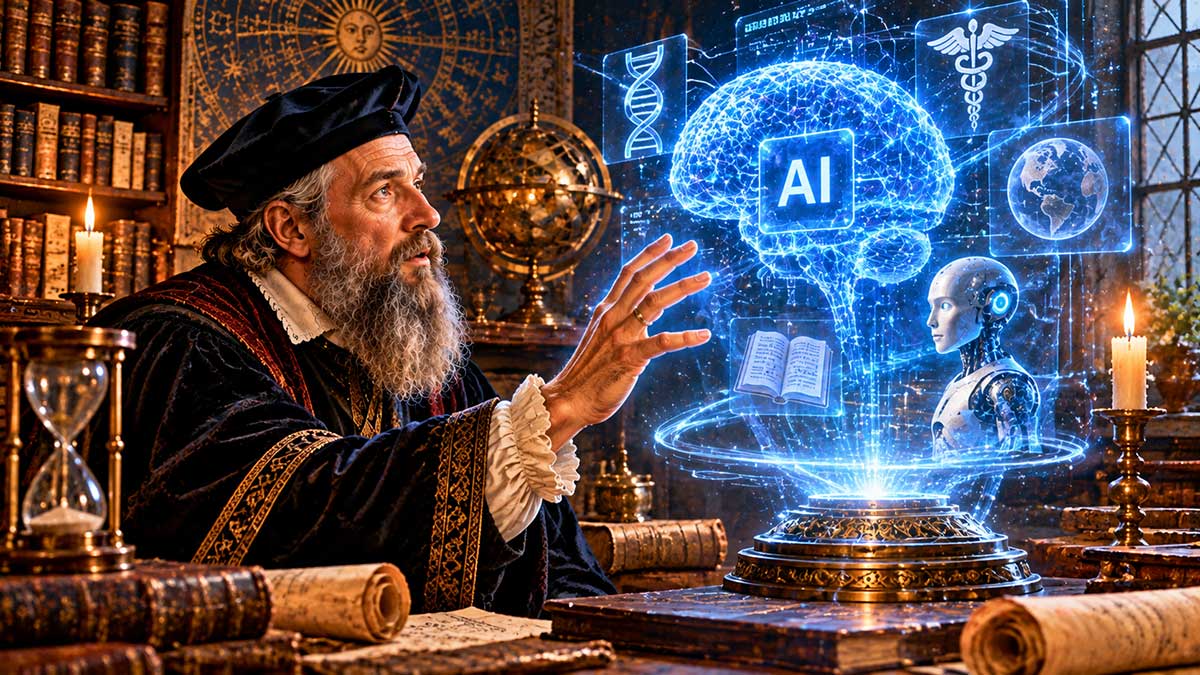
What If You Could Interview Nostradamus? | Continuous LCF Dialogue | Part 4 of 5
This is a fictional conversation. Nostradamus's responses to artificial intelligence and modern civilization are imagined, not historical predictions. The discussion of AI's future explores possibilities rather than certainties.
Salon-de-Provence, France, 1566.
Night has fallen. Beyond the window, the narrow streets are quiet. A servant has brought bread, cheese, olives, and wine, and Nostradamus has finally agreed to eat while continuing the conversation.
But the visitor from 2026 has introduced a subject that seems to have captured the old physician's attention more completely than any prophecy.
Nostradamus: Let me understand what you are telling me. Your people have created machines that can converse, write, reason, and answer questions?
Nick: Yes. And they're improving incredibly quickly.
Nostradamus: Yet they are not human beings.
Nick: No.
Nostradamus: Nor animals?
Nick: No.
Nostradamus: Then what are they made of?
Nick: Computers. Electronic machines that process enormous amounts of information. They learn patterns from data and use those patterns to generate answers, solve problems, and perform tasks.
Nostradamus: Looks at the candle. You have taught lightning to speak.
Nick: Laughs. That's actually a pretty good description.
Nostradamus: Does it understand what it says?
Nick: That's one of the big questions. Some people believe AI could eventually become conscious. Others think it might become extraordinarily intelligent without experiencing anything the way humans do.
Nostradamus: And you do not know which is true?
Nick: Not with certainty.
Nostradamus: Yet you continue building it.
Nick: Absolutely.
Nostradamus: Smiles. I begin to recognize your century.
Nick: What do you mean?
Nostradamus: Human beings have always been willing to experiment with powers they do not entirely understand.
Nick: That's true. But we've accomplished extraordinary things that way.
Nostradamus: Indeed. I would hardly criticize curiosity. I have devoted much of my life to it.
Nick: Exactly. And AI could help us discover new medicines, improve education, solve scientific problems, and make knowledge available to almost everyone.
Nostradamus: Almost everyone?
Nick: Well, access isn't equal everywhere. But the possibilities are enormous.
Nostradamus: Tell me something. You spoke earlier of the plague. Could these machines help physicians discover treatments?
Nick: Yes. AI is already being used in medical research, including studying proteins, analyzing medical images, and helping scientists investigate potential drugs.
Nostradamus: Sets down his bread. That interests me greatly.
Nick: I thought it would.
Nostradamus: If such a machine had existed when I was treating the sick, could it have told me what caused the plague?
Nick: With modern scientific knowledge and the right tools, it could certainly explain the bacteria responsible and help researchers study the disease.
Nostradamus: Then I would have welcomed it into my study.
Nick: Even though you don't completely understand how it works?
Nostradamus: I do not completely understand how a seed becomes a tree. That has never prevented me from planting one.
Nick: Laughs. That's a great answer.
Nostradamus: But I would wish to know whether the machine's advice was reliable before placing a patient's life in its hands.
Nick: That's exactly the concern we have today.
Nostradamus: Good. Then at least some of your physicians remain sensible.
Nick: Smiles. Most try to be.
Nick takes a sip of wine.
Nick: Michel, here's something I find fascinating. I'm sitting here talking with you, and in my century I regularly have conversations with AI. Sometimes we discuss philosophy, religion, relationships, even the meaning of life.
Nostradamus: You discuss the meaning of life with a machine?
Nick: Yes.
Nostradamus: And does it have an answer?
Nick: Laughs. Many answers.
Nostradamus: Ah. Then it resembles a philosopher.
Nick: Laughs harder. You would enjoy talking with one.
Nostradamus: Perhaps. But I am curious. Why do you seek such conversations with a machine rather than another person?
Nick: I talk with people too. But AI is available whenever I want to explore an idea. It has access to an enormous range of knowledge, and I can ask questions without worrying about bothering anyone.
Nostradamus: Does it disagree with you?
Nick: Sometimes. And I actually appreciate that when it has a good reason.
Nostradamus: Then it may be more useful than a courtier.
Nick: Laughs. Probably.
Nostradamus: Yet I wonder whether a machine that learns your preferences might eventually become too eager to please you.
Nick: That's a real problem. AI can sometimes agree too much or tell people what they want to hear.
Nostradamus: Then it may become a mirror.
Nick: A mirror?
Nostradamus: A mirror that speaks. One that reflects your thoughts, polishes them, and returns them to you in a more flattering form.
Nick: That's interesting. But good AI can challenge your thinking too.
Nostradamus: Then you must teach it the difference between serving a person and flattering him.
Nick: Yes. That's a very important distinction.
Nostradamus: And can you teach it?
Nick: We're working on it.
Nostradamus: Chuckles. I suspect that phrase is spoken often in your century.
Nick: Constantly.
For a while, the conversation turns to the practical wonders of modern life. Nick describes airplanes, satellites, smartphones, and the internet. Nostradamus listens with the intense curiosity of a physician encountering an unfamiliar instrument.
Nostradamus: Wait. You carry a device in your pocket that can communicate with someone on the other side of the earth?
Nick: Yes.
Nostradamus: And it can show you a picture of that person while you speak?
Nick: Yes.
Nostradamus: Then why do people still write letters?
Nick: Laughs. Some still do. But not nearly as much.
Nostradamus: I would have enjoyed such a device when traveling during the plague.
Nick: I'm sure you would.
Nostradamus: And these devices are common?
Nick: Billions of people have smartphones.
Nostradamus: Billions?
Nick: The world's population is over eight billion.
Nostradamus stares at him.
Nostradamus: Eight billion human beings?
Nick: Yes.
Nostradamus: Slowly shakes his head. I cannot conceive of such a number.
Nick: And we're all connected in ways people in your century couldn't have imagined.
Nostradamus: Then surely your nations understand one another better.
Nick hesitates.
Nostradamus: Ah. Your expression has answered before your words.
Nick: We understand more about one another, but that doesn't always mean we get along.
Nostradamus: How curious. You have conquered distance without conquering suspicion.
Nick: That's a good way to put it.
Nostradamus: Tell me, do your people still fight wars?
Nick: Yes.
Nostradamus: Religious wars?
Nick: Sometimes religion plays a role. But there are conflicts over territory, power, security, resources, and different political systems.
Nostradamus: Then the reasons have multiplied, but the suffering remains.
Nick: Unfortunately.
Nostradamus: And your intelligent machines? Will they help bring peace?
Nick: I hope so. AI could help people understand one another, translate languages, analyze conflicts, and perhaps find solutions that humans have overlooked.
Nostradamus: Or help rulers conduct war more efficiently.
Nick: Yes. That's a danger too.
Nostradamus: Then the machine does not decide whether its intelligence serves mercy or cruelty.
Nick: Not necessarily. The people developing and deploying it make many of those decisions. But as AI systems become more autonomous, questions about control become more complicated.
Nostradamus: Autonomous?
Nick: Able to carry out increasingly complex tasks with less human supervision.
Nostradamus: Leans back. Now we approach the part that troubles you.
Nick: Yes.
Nostradamus: Explain it to me.
Nick: Some researchers and technology leaders believe that within five or ten years, we might create AI systems that outperform humans across most intellectual tasks.
Nostradamus: Most tasks?
Nick: Scientific research, engineering, programming, mathematics, perhaps even designing better AI systems.
Nostradamus: Then your machines might begin improving themselves?
Nick: That's one possibility people discuss. If AI becomes capable of accelerating AI research, progress could become much faster than we're accustomed to.
Nostradamus: And what would you call such a development?
Nick: Some people use the term singularity. The idea is that technological change could become so rapid and transformative that predicting what comes afterward becomes extremely difficult.
Nostradamus: Smiles faintly. A future that even the prophets cannot predict.
Nick: Laughs. Exactly.
Nostradamus: When do you expect this singularity?
Nick: Nobody knows. Some predict it could happen relatively soon. Others think it will take much longer, or may never happen in the dramatic way people imagine.
Nostradamus: And what do you believe?
Nick: I think the next five or ten years could be extraordinarily important. I'm excited about what AI could accomplish, but I also recognize that the risks could be serious.
Nostradamus: What frightens you most?
Nick: The possibility that we create something more capable than ourselves without knowing how to control it safely.
Nostradamus: Then why continue?
Nick: Because the benefits could be enormous. Imagine curing diseases that have caused suffering for centuries. Imagine giving every child access to a wonderful teacher. Imagine helping people communicate across cultures and find solutions to problems we've struggled with for generations.
Nostradamus: You speak with the enthusiasm of a young physician who has discovered a new remedy.
Nick: Smiles. I suppose I do.
Nostradamus: And I remember that enthusiasm well.
Nick: But you sound skeptical.
Nostradamus: Not of the possibilities. Of the assumption that human beings will always use them wisely.
Nick: That's fair.
Nostradamus: Let me ask you something. In your century, do people possess enough food to feed everyone?
Nick: Globally, we produce a great deal of food. Hunger persists because of poverty, conflict, distribution problems, and other factors.
Nostradamus: Then the problem is not simply the absence of knowledge or productive capacity.
Nick: No.
Nostradamus: Do your physicians know how to prevent many diseases?
Nick: Yes.
Nostradamus: Yet people still suffer from preventable illness?
Nick: They do.
Nostradamus: Then you have already discovered that possessing a solution is not the same as delivering it to those who need it.
Nick: That's true.
Nostradamus: Why should artificial intelligence automatically solve that difficulty?
Nick: I don't think it will automatically solve it. But it could give us better tools.
Nostradamus: Better tools, yes. But who holds them?
Nick: That's the central question.
Nostradamus: Suppose a king possesses a thousand brilliant advisers who never sleep, never tire, and can examine every record in his kingdom. Would that make him a just king?
Nick: Not necessarily.
Nostradamus: It might make him a more powerful one.
Nick: Yes.
Nostradamus: Then intelligence and goodness are not the same thing.
Nick: I agree. But I also think technology can help people become more informed and compassionate.
Nostradamus: How?
Nick: By exposing them to different perspectives. By helping them understand other cultures. By making education available to people who couldn't otherwise afford it.
Nostradamus: That is a worthy hope.
Nick: And I don't think we should underestimate humanity's ability to improve.
Nostradamus: Nor should we underestimate its ability to repeat familiar mistakes with more impressive instruments.
Nick: Smiles. You're not going to make this easy for me, are you?
Nostradamus: You told me you valued honest disagreement.
Nick: I do.
Nostradamus: Then I shall offer you some.
Nick laughs and reaches for another piece of bread.
Nick: All right. Let me ask you something different. Suppose AI becomes smarter than every human being. Do you think it could develop wisdom?
Nostradamus: What do you mean by wisdom?
Nick: The ability to make good judgments, understand consequences, and perhaps recognize what's morally right.
Nostradamus: Can your machines suffer?
Nick: We don't know whether any AI has subjective experiences. There's no established scientific consensus that today's systems are conscious.
Nostradamus: Can they love?
Nick: They can produce language that sounds loving. Whether that reflects an inner experience is another question.
Nostradamus: Can they regret a decision?
Nick: They can identify errors and correct them. But that's different from knowing whether they actually experience regret.
Nostradamus: Then I wonder whether they might become extraordinarily skilled at describing virtues they have never experienced.
Nick: That's possible. But let me challenge you a little.
Nostradamus: Please.
Nick: Does someone necessarily have to experience suffering personally to understand it? A physician doesn't need to have every disease to help patients.
Nostradamus: An excellent objection.
Nick: So perhaps AI could develop a very sophisticated understanding of human suffering without experiencing it in the same way.
Nostradamus: It might. And I would welcome any instrument that helps relieve suffering.
Nick: Then we're not so far apart.
Nostradamus: Perhaps not. But I would still ask whether knowing what is good guarantees choosing it.
Nick: No. It doesn't.
Nostradamus: Then even a machine capable of answering every moral question might not necessarily act morally.
Nick: That's one of the reasons people are working on AI safety and alignment, trying to make sure these systems behave in ways that benefit humanity.
Nostradamus: Who decides what benefits humanity?
Nick: That's difficult. Different people and cultures have different values.
Nostradamus: And if the people controlling the machines disagree?
Nick: Then we have a serious governance problem.
Nostradamus: Nods slowly. I recognize this situation. You have created a new form of power before agreeing how it should be governed.
Nick: That's one way to describe it.
Nostradamus: It is a familiar human achievement.
Nick: Laughs. You're enjoying this, aren't you?
Nostradamus: A little.
Nick: Let me tell you why I'm still optimistic. I've spent a lot of time using AI, and what impresses me isn't just the technology. It's how it helps me explore ideas I might never have considered on my own.
Nostradamus: Such as?
Nick: Conversations between historical figures. Questions about philosophy, religion, relationships, human nature. Sometimes I learn something simply by considering how a person from another time might see the world.
Nostradamus: Like our conversation?
Nick: Exactly.
Nostradamus: Then perhaps the machine is useful not merely for answering questions, but for helping you discover better ones.
Nick: Yes! That's exactly what I mean.
Nostradamus: I find that more interesting than a machine that merely recites facts.
Nick: Me too.
Nostradamus: Yet I must ask, do you ever worry that people will stop thinking for themselves?
Nick: Yes. That's a legitimate concern.
Nostradamus: If a student can ask a machine to compose his argument, why should he learn to argue?
Nick: He still needs to learn how to evaluate the answer. But education will probably have to change.
Nostradamus: And if the machine becomes better at evaluating arguments than the student?
Nick: Then perhaps the student will need to focus more on judgment, creativity, and deciding what questions matter.
Nostradamus: You hope that the machine will free human beings to become more human.
Nick: That's a beautiful way of putting it. Yes.
Nostradamus: But it could also allow them to become less attentive, less curious, and more dependent.
Nick: That's the danger.
Nostradamus: Then perhaps the question is not simply what these machines will become.
Nick: What is it?
Nostradamus: What will human beings become while using them?
Nick grows quiet for a moment.
Nick: That's a powerful question.
Nostradamus: You have told me that your machines may soon surpass human intelligence. But you have not told me what humanity intends to do with the freedom such machines might provide.
Nick: I don't think we've fully figured that out.
Nostradamus: Then perhaps you should begin.
Nick: Smiles. You know, Michel, if you were alive in 2026, I think you'd have a very popular podcast.
Nostradamus: A what?
Nick: A program where people have long conversations, and millions of others can listen.
Nostradamus: Millions?
Nick: Potentially.
Nostradamus: And they would listen to two men discussing philosophy over bread and wine?
Nick: Absolutely. Some of the most popular programs are exactly that.
Nostradamus: Looks at the table. Then your century has accomplished something remarkable.
Nick: What's that?
Nostradamus: It has made conversation profitable.
Nick bursts into laughter.
Nick: Oh, Michel, you have no idea.
Nostradamus: I suspect you will explain that to me as well.
Nick: Another time.
The laughter fades into a comfortable silence.
Nostradamus: Nick, may I ask you something more personal?
Nick: Of course.
Nostradamus: You have spoken about your children. You have told me that these machines may transform civilization within ten years.
Nick: Yes.
Nostradamus: Do you believe your children will inherit a better world because of them?
Nick: I hope so. I genuinely believe AI could help humanity make extraordinary progress.
Nostradamus: But you are not certain.
Nick: No.
Nostradamus: Then what do you most want them to preserve, regardless of how powerful the machines become?
Nick thinks for a moment.
Nick: Their humanity. Their ability to love people, to care about others, to make meaningful choices. I don't want technology to take those things away.
Nostradamus: Then you fear losing something that no invention can easily replace.
Nick: Yes.
Nostradamus: Tell me, do your machines teach people to love one another?
Nick: They can help people understand relationships, communicate better, and see different perspectives. But human beings still have to choose how they treat one another.
Nostradamus: Then the choice remains with you.
Nick: At least that's what I hope we can preserve.
Nostradamus: Looks toward the dark window. I have spent much of my life studying the movements of the heavens, seeking patterns in events, and wondering what tomorrow might bring.
Nick: And?
Nostradamus: You have brought me news of machines that may accomplish in moments what scholars once required lifetimes to learn.
Nick: It's extraordinary, isn't it?
Nostradamus: It is. But I find myself troubled by a familiar question.
Nick: Which one?
Nostradamus: Will greater power make men more merciful?
Nick: I think it could.
Nostradamus: And I think it will depend upon what they value.
Nick: Perhaps we're both right.
Nostradamus: Perhaps. But do not mistake agreement for an answer.
Nick: Laughs softly. You always have to get the last word.
Nostradamus: Only when my guest allows it.
Nick looks at the old physician across the table. He has spent hours speaking with a man whose name became synonymous with predictions of catastrophe. Yet what strikes him now is not the mystery of prophecy, but the ordinary human concern beneath it.
Nick: Michel, we've talked about disease, war, psychic visions, and machines that might become smarter than us. We've spent almost this entire conversation discussing what could go wrong.
Nostradamus: A fair observation.
Nick: But I don't want to end there.
Nostradamus: Nor do I.
Nick: Then let me ask you something. You've devoted so much of your life to thinking about what might happen in the future.
Nostradamus: Yes.
Nick: But what about what you actually want to happen?
Nostradamus looks at him with interest.
Nick: Forget your predictions for a moment. Forget what the stars might suggest. If you could choose the future humanity will have, what kind of world would you want us to create?
Nostradamus is silent for a long moment.
Nostradamus: That, my friend, may be the most difficult question you have asked me tonight.
The conversation continues.
Topic 5: The Future We Choose
What If You Could Interview Nostradamus? | Continuous LCF Dialogue | Part 5 of 5
The final conversation moves beyond prediction to a deeply personal question: What kind of future is worth creating?
Salon-de-Provence, France, 1566.
It is late. The food has been cleared away, and only two candles remain burning on the table. Beyond the window, the town is quiet. Nostradamus sits with his hands folded, considering the question Nick has just asked.
For hours they have discussed medicine, family, psychic experiences, the possibility of changing destiny, and machines that may one day surpass human intelligence.
Now Nick has asked the old prophet something he seldom hears.
Nick: Forget your predictions for a moment, Michel. If you could choose the future humanity will have, what kind of world would you want us to create?
Nostradamus: After a long silence. A world in which a father does not have to bury his children.
Nick says nothing.
Nostradamus: That would be a beginning.
Nick: That's a very personal answer.
Nostradamus: You asked what I wanted, not what I could calculate.
Nick: You're right.
Nostradamus: I have seen towns emptied by disease. I have watched families plead for help that no physician could provide. I have seen men quarrel over matters of faith while their neighbors suffered. If I could choose a future, I would begin by removing some of that suffering.
Nick: You know, in my century, we've made tremendous progress in medicine. Diseases that killed people in your time can now be treated or prevented.
Nostradamus: You told me. And I have been thinking about it ever since.
Nick: But we still have wars. We still have poverty. People still hurt one another.
Nostradamus: Then perhaps your physicians have advanced more quickly than your philosophers.
Nick: Laughs softly. Maybe.
Nostradamus: Though I should not be too harsh. A physician can identify a disease and seek a remedy. Human cruelty is more difficult. It rarely admits that it is ill.
Nick: That's interesting. What do you think causes people to hurt each other so much?
Nostradamus: Fear. Pride. Greed. The desire to control what one cannot understand.
Nick: You think those are the main reasons?
Nostradamus: They are among them. But there is another that troubles me.
Nick: What's that?
Nostradamus: The ease with which a man persuades himself that his cruelty is righteous.
Nick: Yes. That's a big problem.
Nostradamus: A soldier may tell himself that his enemies are less human than he is. A ruler may claim that innocent people must suffer for the good of the kingdom. A religious man may become so convinced of his own virtue that he forgets to practice mercy.
Nick: And people can genuinely believe they're doing the right thing.
Nostradamus: Precisely. That is what makes the problem so difficult.
Nick: I think about that sometimes. Especially when I look at conflicts in my century. People see the same situation from completely different perspectives.
Nostradamus: And each believes he sees clearly.
Nick: Yes.
Nostradamus: Tell me, Nick. When two men disagree about something they consider sacred, how do you persuade either one to listen?
Nick: I think you have to begin by respecting the other person. You don't necessarily have to agree with their beliefs. But you can try to understand why they believe what they do.
Nostradamus: And if his beliefs are dangerous?
Nick: Then you may have to challenge what he wants to do. But I don't think attacking his faith is necessarily going to help.
Nostradamus: Nods slowly. There is wisdom in distinguishing a man's conscience from his conduct.
Nick: I believe in one God. And I believe we're all God's children. I don't think that means everyone has to belong to the same religion.
Nostradamus: You believe divine fatherhood extends beyond the boundaries men draw between themselves?
Nick: Yes. That's how I see it.
Nostradamus: My own understanding of faith belongs to the Church in which I was raised. But I can understand why the thought of a common Father might lead you to regard strangers as members of one family.
Nick: Exactly. And if we really saw one another that way, wouldn't it become harder to kill each other?
Nostradamus: Perhaps. Yet I must ask you something uncomfortable.
Nick: Go ahead.
Nostradamus: Do brothers never kill brothers?
Nick pauses.
Nick: Unfortunately, they do.
Nostradamus: Then calling humanity a family does not by itself make humanity peaceful.
Nick: No. But it gives us a different way to look at one another.
Nostradamus: That may be its greatest value. Still, the understanding must reach beyond words.
Nick: I agree.
Nostradamus: A man may speak beautifully of universal love and treat his own household cruelly.
Nick: That's true.
Nostradamus: Then perhaps peace begins closer to home than we imagine.
Nick: You mean with how we treat our families?
Nostradamus: Families. Neighbors. Servants. Strangers. Anyone over whom we possess some small measure of power.
Nick: I like that.
Nostradamus: It is easier to declare love for all mankind than to be patient with one difficult person sitting across the table.
Nick: Laughs. You've probably described half the arguments in modern families.
Nostradamus: Only half? Your century has improved considerably.
They both laugh.
Nick: You know, I have five children. And one thing I've learned is that I can't make them become the people I think they should be.
Nostradamus: That is a painful discovery for a father.
Nick: It can be. But I think my job is to love them and appreciate who they are. I can give advice, but I can't live their lives.
Nostradamus: And do you always succeed?
Nick: Laughs. Of course not.
Nostradamus: Good. I was beginning to suspect you had achieved sainthood.
Nick: Not even close.
Nostradamus: Then we may continue speaking as equals.
Nick smiles.
Nostradamus: I have six children in my household. I wish to protect them from every sorrow. Yet I know I cannot. Even if I possessed knowledge of every danger they would face, I could not guarantee their happiness.
Nick: That's exactly how I feel.
Nostradamus: Perhaps love is not the power to prevent every suffering.
Nick: What do you think it is?
Nostradamus: The willingness to remain present, even when one cannot make the suffering disappear.
Nick considers his answer.
Nick: That's beautiful, Michel.
Nostradamus: It is easier to say than to practice.
Nick: Yes.
The room grows quiet for a moment.
Nick: Can I ask you something? After everything you've experienced, do you still believe humanity can become better?
Nostradamus: Better in what sense?
Nick: More compassionate. More peaceful. Less interested in hurting one another.
Nostradamus: I believe individual people can become better. I have seen it happen.
Nick: But humanity as a whole?
Nostradamus: That is a larger claim.
Nick: You sound doubtful.
Nostradamus: I am cautious. Your century has extraordinary knowledge, yet you tell me that people still wage wars. You have developed medicines that would seem miraculous to me, yet many still suffer without adequate care. You can communicate across the earth, yet you struggle to understand your neighbors.
Nick: All true.
Nostradamus: Then why are you so hopeful?
Nick: Because I don't think those failures tell the whole story.
Nostradamus: Go on.
Nick: Think about what has changed since your century. We live longer. More children survive. We have ways to communicate with people around the world. We can learn about other cultures, other religions, and other ways of thinking.
Nostradamus: And you believe greater understanding will eventually produce greater compassion.
Nick: I think it can. Not automatically. But I think the opportunity is there.
Nostradamus: Opportunity is not achievement.
Nick: No, but without opportunity, achievement becomes impossible.
Nostradamus: Smiles. You argue well.
Nick: I've had some practice.
Nostradamus: With your intelligent machines?
Nick: Laughs. Among others.
Nostradamus: Then perhaps they have already made you a more troublesome conversationalist.
Nick: That's probably true.
Nostradamus: But let me challenge your optimism once more.
Nick: Please.
Nostradamus: Suppose your machines become a thousand times more intelligent than the greatest human scholar. Suppose they discover cures for diseases, produce abundant food, and solve problems that have troubled mankind for centuries.
Nick: That would be wonderful.
Nostradamus: Suppose, too, that a small number of powerful people control those machines.
Nick: That would be dangerous.
Nostradamus: Then would the intelligence of the machines matter more than the character of those who wielded them?
Nick: Both would matter.
Nostradamus: And which would be more difficult to improve?
Nick: Probably human character.
Nostradamus: Then your greatest challenge may not be technological.
Nick: I think you're right. But maybe AI can help us with that too.
Nostradamus: How would a machine improve human character?
Nick: By helping us understand one another. By showing us perspectives we haven't considered. By making education available to people who never had the opportunity.
Nostradamus: And what if a man asks the machine to justify his hatred?
Nick: Then we need systems designed not to encourage that.
Nostradamus: Who designs them?
Nick: People.
Nostradamus: Raises an eyebrow.
Nick: Laughs. I know. We're back to the same problem.
Nostradamus: Indeed.
Nick: But I don't think that means we should give up.
Nostradamus: Nor do I.
Nick: Really?
Nostradamus: You sound surprised.
Nick: Well, you've spent much of the evening pointing out everything that could go wrong.
Nostradamus: A physician who identifies a disease is not necessarily opposed to the patient's recovery.
Nick: Laughs. Fair enough.
Nostradamus: I question your optimism because I wish it to survive contact with reality.
Nick: I appreciate that.
Nostradamus: Hope that depends upon ignoring danger is fragile. The first serious disappointment may destroy it.
Nick: And what kind of hope do you prefer?
Nostradamus: Hope that knows what it is facing.
Nick: I like that.
Nostradamus: Then perhaps we have found some common ground.
Nick looks toward the window. The stars are visible above the rooftops.
Nick: Michel, you spent years studying the heavens. Did looking at the stars ever make your problems feel smaller?
Nostradamus: Sometimes. At other times, it made them feel more mysterious.
Nick: What do you mean?
Nostradamus: When you look at the heavens, you become aware of how brief a human life is. Kingdoms rise and fall. Men fight over land that their grandchildren may never possess. Yet the stars continue their courses.
Nick: Does that make human life seem insignificant?
Nostradamus: No. Quite the opposite.
Nick: Really?
Nostradamus: If our time is brief, then what we do with it becomes precious.
Nick: That's interesting.
Nostradamus: I cannot command the stars. I cannot restore those I have lost. I cannot guarantee that my children will escape suffering. But I can choose how I treat the person before me.
Nick: And you think that matters?
Nostradamus: I think it may matter more than many of the things for which men seek fame.
Nick: Even your prophecies?
Nostradamus looks at the manuscript on the table.
Nostradamus: Perhaps especially my prophecies.
Nick: That's quite a statement coming from you.
Nostradamus: You have spent the evening asking whether I could see the future. Yet when I remember the moments that have mattered most in my life, they are not moments of prediction.
Nick: What are they?
Nostradamus: A patient recovering when I had feared the worst. A child taking my hand. A quiet evening with my wife. The sound of laughter returning to a house that had known grief.
Nick: Those are beautiful memories.
Nostradamus: They are ordinary memories.
Nick: Maybe that's what makes them beautiful.
Nostradamus smiles.
Nostradamus: Perhaps.
For a while, neither speaks.
Nick: Can I tell you something? I think one reason people are so interested in the future is that they're afraid of losing what they love.
Nostradamus: That is certainly one reason.
Nick: We want reassurance that our children will be safe, that the people we love will stay with us, that everything will work out.
Nostradamus: And no prophet can honestly promise all of that.
Nick: No.
Nostradamus: Nor can a machine, however intelligent.
Nick: That's true.
Nostradamus: Then perhaps the desire for certainty is sometimes a desire to escape the vulnerability of loving.
Nick: What do you mean?
Nostradamus: To love someone is to accept that you may lose them. To raise a child is to accept that the child will one day make choices beyond your control. To care for the sick is to accept that some will die despite your efforts.
Nick: That's difficult.
Nostradamus: Very difficult. But would you choose never to love, merely to avoid that uncertainty?
Nick: No. Absolutely not.
Nostradamus: Neither would I.
Nick: Then perhaps we don't need to know everything about the future.
Nostradamus: Perhaps not.
Nick: We just need to do the best we can with the time we have.
Nostradamus: Smiles. You have traveled four centuries to arrive at a thought many grandmothers could have told you.
Nick: Bursts into laughter. You're absolutely right!
Nostradamus: Yet I suspect you will value it more for having traveled so far.
Nick: I think I will.
The laughter fades. Nick glances at the candles, now burning low.
Nick: Michel, I have one final question.
Nostradamus: Only one? I find that difficult to believe.
Nick: Laughs. All right. One final question for tonight.
Nostradamus: Then I shall try to make my answer worthy of it.
Nick: If you could speak directly to everyone living in 2026, what would you want to tell them?
Nostradamus looks down at his hands. He seems to consider several answers before speaking.
Nostradamus: I would first ask them something.
Nick: What would you ask?
Nostradamus: Why are you so eager to know what tomorrow will bring when you have not yet decided what to do with today?
Nick: That's a good question.
Nostradamus: You have told me of machines that can speak, ships that fly through the air, medicines that cure illnesses I could scarcely treat, and devices that allow a man to see his family across an ocean.
Nick: Yes.
Nostradamus: These are wonders beyond anything I could have reasonably expected.
Nick: They really are.
Nostradamus: Yet you tell me that people still fear one another. Still fight. Still struggle to love those closest to them.
Nick: Unfortunately.
Nostradamus: Then I would ask your century not to confuse power with wisdom.
Nick: What else?
Nostradamus: Do not surrender your judgment merely because someone claims to know the future. Do not mistake fear for knowledge. And do not allow a warning about tomorrow to rob you of the life you have today.
Nick: I like that.
Nostradamus: But I would say something more.
Nick: Please.
Nostradamus: If you possess the means to relieve suffering, use them. If you can prevent a war, try. If you can heal a child, do not delay. If you can reconcile with someone you love, do not wait for the stars to arrange a more favorable hour.
Nick listens quietly.
Nostradamus: Your century may possess greater powers than mine. Then perhaps it also possesses greater responsibilities.
Nick: I agree.
Nostradamus: And if your machines become more intelligent than you, do not permit that achievement to persuade you that human kindness has become obsolete.
Nick: That's beautiful, Michel.
Nostradamus: Kindness is not a lesser accomplishment than intelligence.
Nick: No, it isn't.
Nostradamus: A brilliant man may understand the movements of the heavens and still fail to comfort a grieving child. A simple woman may possess little learning and yet know exactly how to ease another person's suffering.
Nick: And perhaps that's the kind of wisdom we should value more.
Nostradamus: Perhaps.
Nick sits quietly for a moment, then smiles.
Nick: You know, Michel, I came here wanting to ask you about your predictions. I thought we'd talk about the future, maybe discover something about what's going to happen in the next ten years.
Nostradamus: And have I disappointed you?
Nick: Not at all. But I think I've learned something I wasn't expecting.
Nostradamus: What is that?
Nick: That knowing the future might not be nearly as important as I thought.
Nostradamus: Smiles. Then I have failed magnificently as a prophet.
Nick: Laughs. Maybe you've succeeded as a human being.
Nostradamus lowers his eyes for a moment.
Nostradamus: That would please me more.
Outside, a distant bell marks the hour.
Nick: Michel, thank you. I've really enjoyed talking with you.
Nostradamus: As have I. Though I confess, I remain curious about these machines of yours.
Nick: Laughs. I thought you might.
Nostradamus: Before you return to your century, tell me one thing.
Nick: What's that?
Nostradamus: When your machines can answer nearly every question, will human beings still sit together and talk as we have tonight?
Nick: I certainly hope so.
Nostradamus: Then perhaps you should make certain they do.
Nick: I'll do my part.
Nostradamus rises slowly from his chair. Nick stands as well.
Nostradamus: And Nick?
Nick: Yes?
Nostradamus: You asked me what future I would choose for humanity.
Nick: I did.
Nostradamus: I think I have an answer now.
Nick: I'd love to hear it.
Nostradamus: A future in which men no longer need prophets to frighten them into caring for one another.
Nick smiles, moved by the simplicity of the answer.
Nick: I hope we get there, Michel.
Nostradamus: So do I.
They shake hands.
For a moment, Nick looks back at the old physician standing beside his table, surrounded by manuscripts that will fascinate generations yet unborn.
He had come seeking a man who could see tomorrow.
He leaves remembering a man who had spent his life trying to understand suffering, protect those he loved, and make sense of the uncertain world around him.
And perhaps that is the greatest surprise of the evening.
The future remains unwritten.
But the next act of kindness does not have to wait.
End of Conversation
Final Thoughts: The Prophet Who Asked About Humanity
I began this conversation wanting to understand a man who became famous for predicting the future. I finished it thinking about something much closer to home.
Nostradamus, as we imagined him, was not simply a mysterious figure writing cryptic verses. He was a medical practitioner who confronted disease, a father who experienced devastating loss, and a man who understood that knowledge does not always give us control.
Our conversation about gout brought an unexpected moment of humor. Our discussion of his family brought something more difficult: the realization that even someone associated with prophecy could not protect everyone he loved.
That contradiction stayed with me.
I was particularly interested in comparing Nostradamus's symbolic writings with the detailed predictions reportedly made by Jucelino Nóbrega da Luz. But an important distinction emerged. A compelling story about a prediction is not the same as independently verified evidence that the prediction was made before an event.
The conversation raised another question that I found even more interesting.
If we could know the future, would that knowledge make us wiser, or simply more afraid?
Warnings can save lives when they are credible and actionable. Yet fear can also consume the very time we are trying to protect.
That question becomes especially relevant when we consider artificial intelligence.
I remain excited about AI's potential to advance medicine, education, scientific discovery, and human understanding. I believe it could become one of the most beneficial technologies humanity has ever developed.
But I appreciated the challenge our fictional Nostradamus presented: greater intelligence does not automatically create greater compassion.
A civilization might develop extraordinary machines while continuing to struggle with the same human problems that troubled people five centuries ago.
War. Fear. Pride. The desire to control others. The difficulty of loving people whose beliefs or choices differ from our own.
What moved me most was the conversation's return to family.
As a father of five, I have learned that loving my children does not mean controlling their futures. I can offer guidance, encouragement, and support. But I must appreciate who they are, rather than insist they become exactly who I want them to be.
Perhaps humanity faces a similar challenge.
We cannot guarantee the future. We cannot eliminate every danger. And no prophet, scientist, or intelligent machine can relieve us of the responsibility to choose how we treat one another.
I believe we are all children of one God. That conviction gives me hope that people of different religions, cultures, and nations can discover common ground without surrendering their individuality.
My hope for AI is much the same. Not that it will replace human judgment or human love, but that it might help us understand one another more deeply.
There was one imagined exchange near the end of the interview that I found especially meaningful.
When I asked Nostradamus what future he would choose for humanity, he answered:
"A future in which men no longer need prophets to frighten them into caring for one another."
Those words were written for this fictional conversation. Yet they capture the hope I wanted to explore.
We may never know exactly what tomorrow holds.
But we can decide whether to approach it with fear, indifference, or love.
And perhaps that choice matters more than any prediction.
Editorial disclaimer: These reflections are inspired by an original fictional interview, not an actual conversation with Nostradamus. The guest's statements, including the closing quotation, are creative writing rather than historical quotations. References to psychic predictions are not endorsements of their accuracy, and discussion of AI's future is speculative. Personal spiritual reflections express the author's perspective, not established scientific or universal religious conclusions.
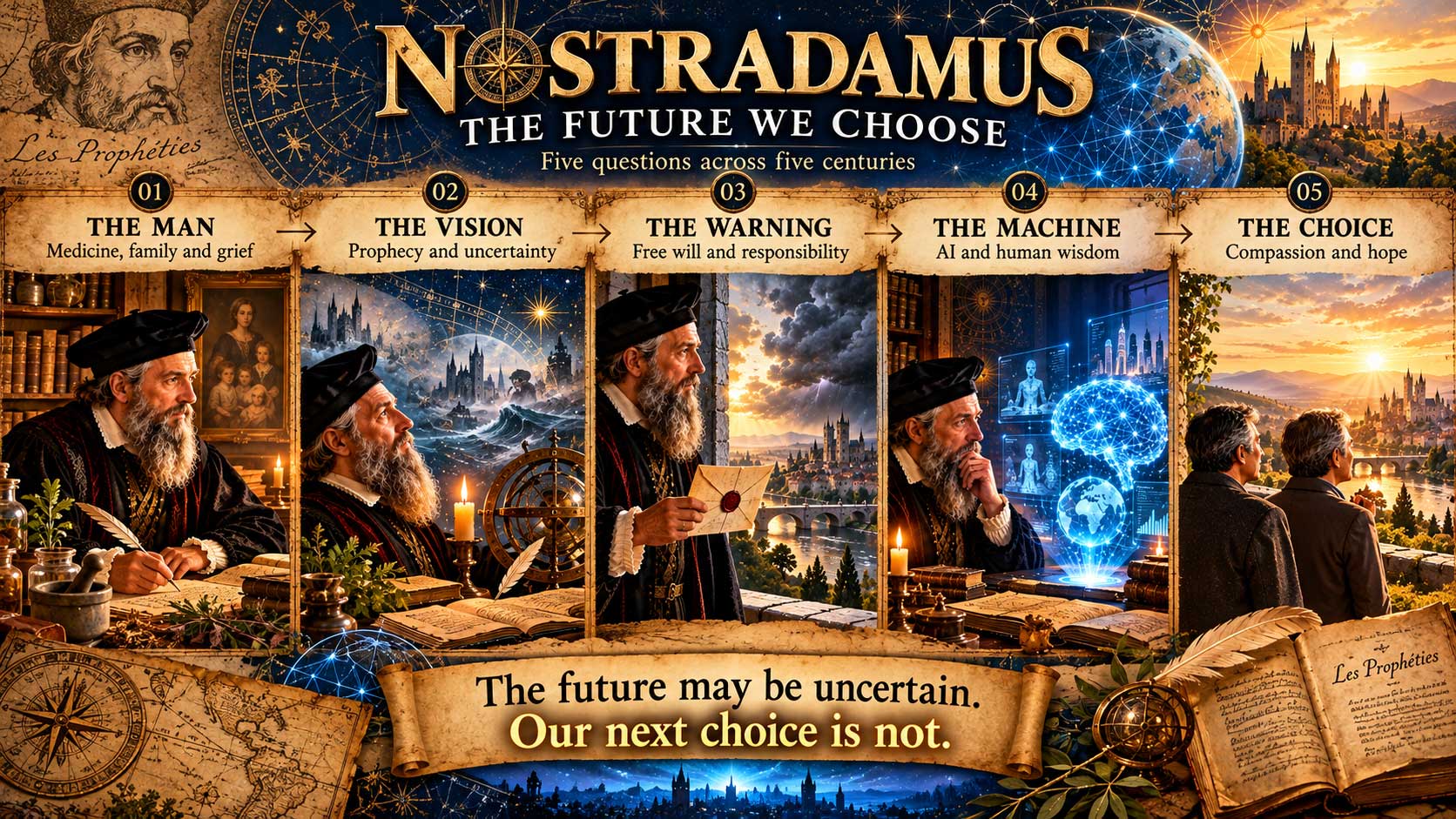
Short Bios:
Nostradamus (Michel de Nostredame, 1503–1566)
Nostradamus was a French astrologer, medical practitioner, and author best known for Les Prophéties, first published in 1555. Born in Saint-Rémy-de-Provence into a family of Jewish ancestry that had converted to Catholicism, he became associated with medical work during plague outbreaks and later gained fame for his cryptic prophetic verses. His writings attracted royal attention during his lifetime and have generated centuries of debate over whether their apparent predictions reflect genuine foresight or retrospective interpretation. He died in Salon-de-Provence in 1566.
Nick Sasaki — Interviewer and Creator of ImaginaryTalks
Nick Sasaki is the creator of ImaginaryTalks.com, a creative platform exploring human nature, history, literature, spirituality, and modern challenges through fictional conversations. Drawing on his experiences living in Japan and the United States, his interest in artificial intelligence, and his curiosity about different spiritual perspectives, Nick approaches interviews as opportunities to discover common ground rather than win arguments. In this conversation, his personal experiences with gout, Catholicism, fatherhood, and friendships with people who describe psychic abilities provide connections to the life and reputation of Nostradamus.
Jucelino Nóbrega da Luz — Referenced Contemporary Figure
Jucelino Nóbrega da Luz is a Brazilian writer and spiritual adviser who claims to experience precognitive dreams and to have sent advance warnings about significant events. His reported predictions attracted attention internationally, including on Japanese television. His accounts provide an interesting contrast with Nostradamus's cryptic verses, particularly concerning the specificity and documentation of predictions. His claims of supernatural foresight have not been independently established as reliable.
Tana Hoy — Referenced Contemporary Figure
Tana Hoy is an American psychic and spiritual adviser known for claims involving clairvoyance and predictions. He has been associated with a reported advance warning concerning the 1995 Oklahoma City bombing. The account is discussed in this fictional interview as a reported claim, not as independently verified proof of psychic prediction.
Leave a Reply