

Introduction
Henry David Thoreau walked away from the American dream to discover the secret of happiness. But did he actually find it?
He graduated from Harvard, had the intelligence to pursue a respected career, and lived in a country increasingly fascinated by wealth, industry, and progress. Yet in 1845, at just twenty-seven, he moved into a tiny cabin beside Walden Pond in Massachusetts. He wanted to discover how little a person truly needed, how much freedom simplicity could provide, and whether human beings were spending their lives pursuing things that did not make them happy. His experiment eventually became the foundation of Walden, one of America's most influential works of philosophy and nature writing.
But the more I studied Thoreau, the more I realized that his story was far more complicated than a man escaping civilization. He had experienced profound grief after the sudden death of his beloved older brother, John. His first book struggled commercially. He never married, never became wealthy, and died of tuberculosis at only forty-four. Yet he continued to believe that life offered extraordinary possibilities to anyone willing to pay attention. As the Thoreau Society's account of his life reveals, his retreat to Walden was both a personal experiment and an opportunity to pursue the writing and reflection that mattered most to him.
And there was another side to Thoreau that fascinated me. The same man who found spiritual meaning in birds, trees, and quiet mornings was willing to spend a night in jail rather than compromise his conscience. He opposed slavery, challenged the moral authority of government, and later defended the controversial abolitionist John Brown. His philosophy was not simply about finding private happiness. It demanded that individuals examine their responsibility to others. The Stanford Encyclopedia of Philosophy's study of Thoreau explores this connection between his ethical convictions, political resistance, and commitment to living deliberately.
For this imaginary interview, I wanted to meet the human being behind those famous ideas. Why did he believe so many people were quietly desperate? Did he ever regret turning away from conventional success? Was his solitude a source of happiness, or did he sometimes feel terribly lonely? And how could a man who loved peace and nature defend someone who resorted to violence in the struggle against slavery? I wanted to challenge his philosophy without losing sight of the personal experiences that shaped it.
Our conversation begins beside his small cabin at Walden Pond. From there, we travel through five chapters of his life: his rejection of conventional success, the heartbreaking loss of his brother, his search for happiness and spiritual meaning, his confrontation with political injustice, and finally his reflections on mortality. Along the way, I discover a man who is thoughtful, sometimes stubborn, surprisingly humorous, and far more emotionally complicated than the familiar image of a solitary philosopher in the woods.
But one question remains at the center of everything. Thoreau went to Walden because he did not want to reach the end of his life and discover that he had never truly lived. He spent years questioning society's assumptions about money, ambition, freedom, and happiness. When his own life was drawing to a close, did he believe he had succeeded? His imagined answer may challenge the way we measure our own lives.
Fictional interview disclaimer: This is an imagined conversation between Nick Sasaki and Henry David Thoreau. The historical events and philosophical ideas are drawn from documented sources, but the dialogue, personal reflections, and interview settings are creative interpretations rather than authentic historical statements.

Topic 1. Why Did a Harvard Graduate Walk Away from the American Dream?
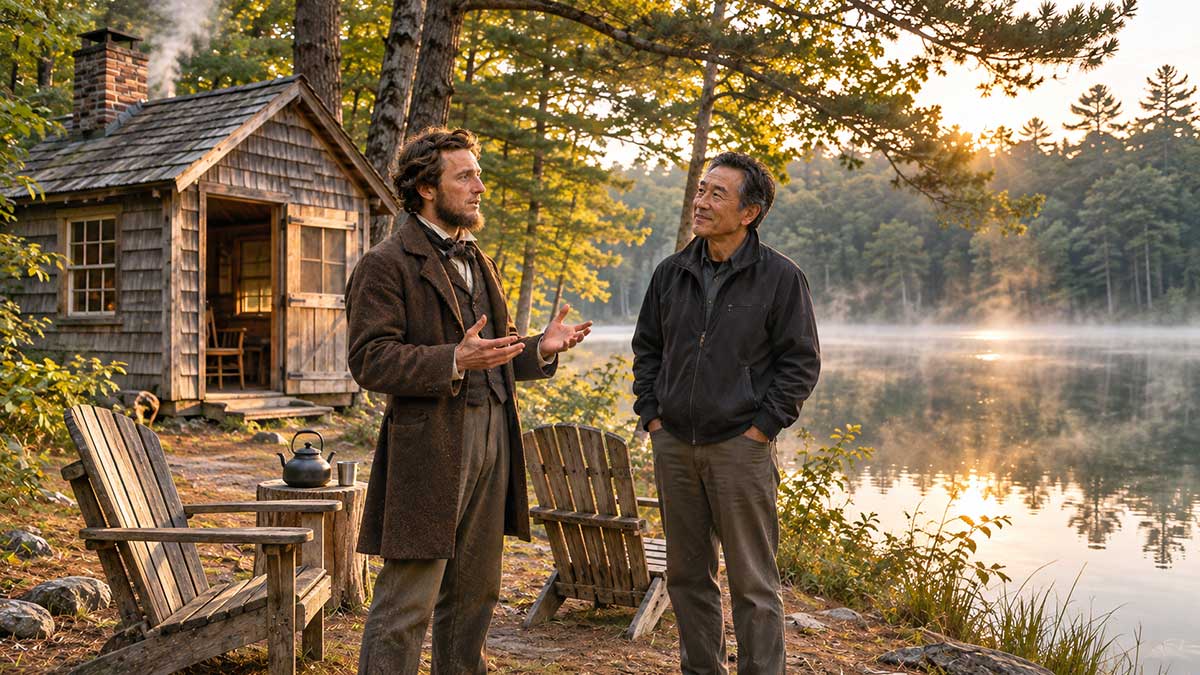
A Morning at Walden Pond
July 1845. Dawn has barely reached the surface of Walden Pond. A thin mist drifts above the water. Pine needles soften the ground around a small, newly built cabin. Through the open doorway, a plain table, a few books, and a bed are visible. Henry David Thoreau sets down a kettle as Nick Sasaki approaches along the path.
Nick Sasaki
Henry, this is beautiful. I can hear the birds, and that's about it. No traffic, no people rushing somewhere. But I have to ask, when your friends heard you were moving out here, did they think you'd lost your mind?
Henry David Thoreau
Some were amused. Some were puzzled. People find it difficult to believe a man might choose fewer conveniences without having suffered some misfortune. They assume that if you have not acquired a great many things, you must be waiting for the chance.
Nick Sasaki
And you weren't waiting?
Henry David Thoreau
I was waiting, but for something quite different. I wanted to discover what life might become when I ceased spending so much of it preparing to live.
Nick Sasaki
That's interesting. Preparing to live. You mean people work for years to get the life they want, and somewhere along the way they forget to enjoy the life they already have?
Henry David Thoreau
Precisely. A man says he will be free when he has paid for his house. Then he requires a larger house. He will rest when his business prospers, but prosperity gives him new anxieties. He has built a ladder and forgotten to ask what wall it leans against.
Question 1. Why Leave a Promising Life Behind?
Nick Sasaki
You went to Harvard. You had an education that many people could only dream of. You could have pursued a respectable career. Why come here instead? What were you really trying to find out?
Henry David Thoreau
Whether I could live honestly with my own needs. We inherit a great number of supposed necessities. Fine clothes, an impressive dwelling, endless employment to maintain them. I wished to examine these necessities one by one, as a naturalist examines specimens, and see which were alive and which were merely stuffed and displayed.
Nick Sasaki
So this is an experiment, not a permanent escape?
Henry David Thoreau
An experiment, yes. I have not sworn never to enter a town again. I visit Concord. I have friends and family. I work when work is needed. But I refuse to believe that a man must spend nearly every waking hour earning the right to possess his own hours.
Nick Sasaki
Did you ever feel pressure to prove yourself? I mean, you graduate from Harvard, and people must expect something impressive.
Henry David Thoreau
Certainly. Expectations are a curious form of debt. No money changes hands, yet a young man may spend half his life repaying what others imagined he would become.
Nick Sasaki
I like that. But let me challenge you. Maybe your classmates wanted to become doctors, lawyers, or businessmen because they genuinely loved those things. Isn't it possible to have a successful career and still live deliberately?
Henry David Thoreau
Of course. I do not quarrel with honest work or a useful profession. I quarrel with sleepwalking. Let the physician heal because healing matters to him, and let the merchant trade because he finds the work worthy. But let neither mistake the applause of his neighbors for the verdict of his own conscience.
Nick Sasaki
So you're not telling people to quit their jobs. You're telling them to ask why they're doing them.
Henry David Thoreau
And what those jobs cost them. We keep careful accounts of dollars and cents. We are less careful with mornings, friendships, health, and the quiet intervals in which a person might hear himself think.
Question 2. What Is Quiet Desperation?
A breeze stirs the surface of the pond. Nick sits on a rough wooden chair outside the cabin. Thoreau takes the other, resting his hands on his knees.
Nick Sasaki
You wrote that the mass of men lead lives of quiet desperation. That's a pretty strong statement. What were you seeing in people that made you say that?
Henry David Thoreau
I saw men who appeared respectable and prosperous yet spoke of their lives as though they were prisoners serving a sentence. They rose early, hurried to labor, worried over debts, and postponed their desires. They had accepted their arrangements so thoroughly that they scarcely considered whether another arrangement was possible.
Nick Sasaki
Were they unhappy, or were you projecting your own dissatisfaction onto them?
Henry David Thoreau
A fair question. I cannot peer into every heart. Nor do I claim that the farmer or shopkeeper is secretly miserable. I speak of a habit I observed, and one I recognized in myself: the habit of treating the customary as inevitable.
Nick Sasaki
That makes it more personal. Did you ever feel that desperation yourself?
Henry David Thoreau
I have known uncertainty, disappointment, and the humiliation of failing to meet expectations. My first attempts at teaching did not produce a settled career. I have questioned my usefulness. One need not be chained to a desk to feel imprisoned by an idea of what one ought to be.
Nick Sasaki
And when you come out here, does that feeling disappear?
Henry David Thoreau
Not by magic. A man may carry his anxieties into the woods as easily as he carries his boots. Simplicity removes some distractions. It does not remove the necessity of examining oneself.
Nick Sasaki
I think people today would recognize that. They have more conveniences than ever, but they still feel rushed. They check their phones the moment they wake up. They compare their lives with strangers. They keep thinking happiness is one more achievement away.
Henry David Thoreau
You describe a remarkable device, but a familiar temptation. The mind can be occupied without being nourished. Tell me, does this instrument give its owner more time to contemplate the world, or does it demand that the world continually interrupt him?
Nick Sasaki
Both, actually. It can teach you almost anything, but it can consume your whole day. And people often don't notice how much time they've given away.
Henry David Thoreau
Then the question is not whether the instrument is clever. It is whether its owner remains awake.
Nick Sasaki
That sounds like the heart of your message. But how does someone wake up? Suppose they realize they've spent twenty years chasing something they never really wanted.
Henry David Thoreau
Begin with an honest inventory. What do you require for health, shelter, affection, and useful work? What do you keep merely to satisfy a spectator? Which hours belong to your convictions, and which have been sold to your fears? There is no need to demolish a life in one afternoon. But one must first cease pretending it cannot be changed.
Question 3. Can Ordinary People Afford Freedom?
Nick looks toward the cabin. It is small enough that he can see almost everything Thoreau owns through the doorway.
Nick Sasaki
Here's where I want to push back a little. This cabin stands on Emerson's land. You have family in Concord. You're not completely alone or without support. What would you say to a father with five children, a mortgage, and bills that don't stop coming? He can't simply move to a pond.
Henry David Thoreau
Nor should he, merely to imitate me. An imitation would defeat the purpose. The experiment is mine; the question belongs to everyone. Such a father has obligations I do not have, and I would be foolish to prescribe my circumstances to him.
Nick Sasaki
I'm glad you say that. Sometimes advice about simplicity sounds easy when it comes from someone who doesn't have to support a family.
Henry David Thoreau
And advice about prosperity sounds easy when it comes from someone who has never asked what it costs. We must be careful in both directions. Poverty is not a virtue merely for being poverty. Hunger does not become wisdom when a philosopher praises simplicity.
Nick Sasaki
Then what could that father actually do tomorrow?
Henry David Thoreau
Perhaps nothing dramatic. He might ask which expenses serve his children and which serve his vanity. He might reserve an hour for them that he has habitually given to unnecessary labor. He might refuse one ambition that promises distinction but steals his peace. A free life is not measured by the size of one's cabin.
Nick Sasaki
What if he loves building a business? What if making money is creative and exciting for him, and it helps other people?
Henry David Thoreau
Then let him build it with open eyes. Wealth can purchase useful instruments and relieve genuine suffering. I would ask only whether the business serves his life or his life has become fuel for the business. The difference may be invisible to his customers, but it will not be invisible to those who love him.
Nick Sasaki
That's a significant distinction. I know people who genuinely enjoy their work, but I know others who can't stop, even after they have enough. How do you know when enough is enough?
Henry David Thoreau
When you can answer what the next acquisition is for. If it answers a real need, consider it. If it merely postpones the moment when you must face yourself, perhaps the price is greater than the merchant has written.
Nick Sasaki
Let me ask something more personal. You've chosen freedom, but don't you worry that one day you'll look back and wish you'd built something bigger? A family, a career, a legacy?
Henry David Thoreau
I do not know the full shape of my future, Nick. I care about my writing. I care whether my observations are useful. I am not beyond disappointment or ambition. But I should regret more deeply a life spent becoming what others admired, if I never learned what I myself loved.
Nick Sasaki
You keep coming back to love. Not romantic love necessarily, but loving the life you're actually living.
Henry David Thoreau
Yes. And loving the world enough to pay attention to it. Look there.
A small bird lands on a low branch near the water. Neither man speaks for several moments.
Henry David Thoreau
That creature has interrupted no important business. Yet had we been hurrying, we would have missed it entirely. I am not proposing that every man watch birds all morning. I am asking why we so readily call the things that fill our days important, and the things that make those days worth living unimportant.
Nick Sasaki
I came here thinking I would ask why you gave up so much. Now I'm wondering whether you felt you were getting something back.
Henry David Thoreau
Time. Attention. The opportunity to find out what I believe before my days are finished. Those are no small returns.
Nick Sasaki
One last question before we walk. Was there a particular moment when you began to feel how short life really is?
Thoreau looks across the pond. His expression changes, almost imperceptibly.
Henry David Thoreau
There was a journey I once took with my brother John. We traveled by river, with more confidence in the days ahead than perhaps any young men have a right to possess.
Nick Sasaki
You were close?
Henry David Thoreau
Very. He knew how to make an ordinary day seem an adventure. I have tried to put something of that journey into words.
Nick Sasaki
I'd like to hear about him, if you're comfortable telling me.
Thoreau stands and takes a slow breath of the cool morning air.
Henry David Thoreau
Then let us walk by the water. Some memories are easier to approach when one's feet are moving.
The two men follow the narrow shoreline path. Behind them, the little cabin disappears among the trees. Ahead, the pond opens toward the river country where Henry and John once traveled together.
This is a fictional interview inspired by Thoreau's life and writings. The dialogue is imagined, not a historical transcript.
Topic 2. The Brother He Lost and the Life He Refused to Waste
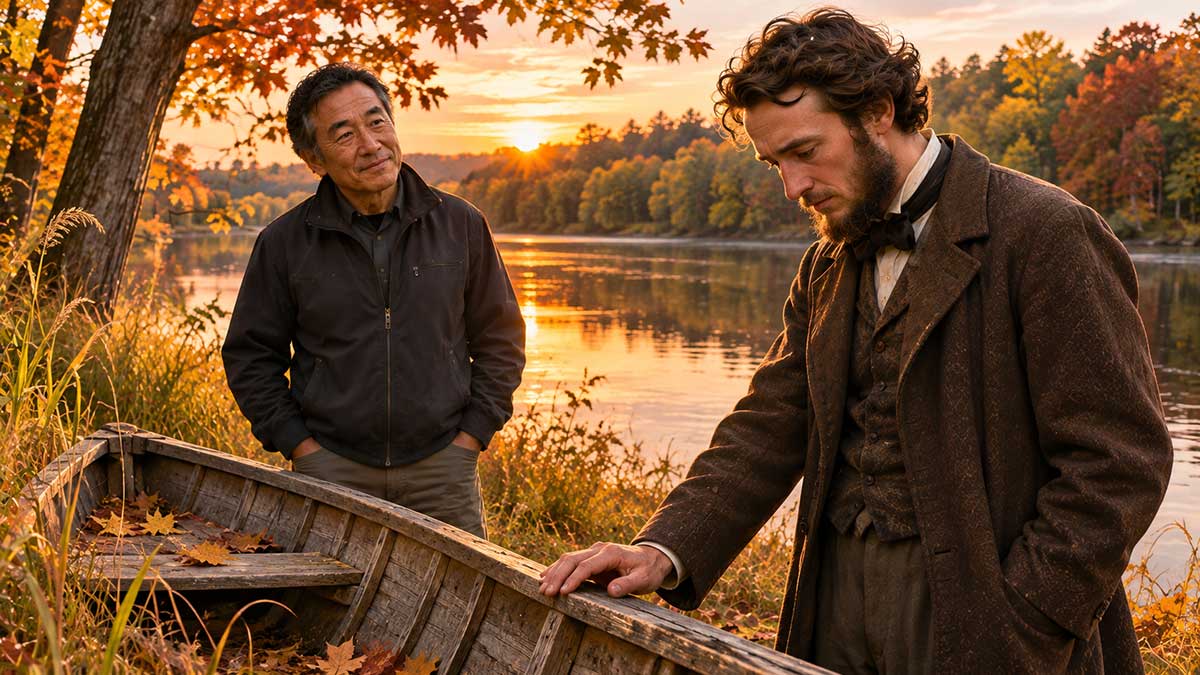
The River That Remembers
The morning sun has climbed above the trees surrounding Walden Pond. Henry David Thoreau and Nick Sasaki follow a narrow woodland path, their footsteps softened by fallen pine needles.
As they walk, Henry speaks of another body of water, the Concord River, and a journey he took six years earlier with his older brother, John.
The scene seems to shift around them. It is now a golden autumn afternoon along the Concord River. A small wooden boat rests against the grassy bank. The water moves slowly, reflecting the fading sunlight. Somewhere in the distance, a bird calls.
Henry stops beside the boat and runs his fingers along its weathered edge.
Nick Sasaki
Henry, you've become very quiet since you mentioned your brother. What was John like?
Henry David Thoreau
John was the sort of person who could make you feel that the day had been given to you as a gift. He was warm, agreeable, and possessed a natural ease with people that I have sometimes lacked.
Nick Sasaki
So he was more outgoing than you?
Henry David Thoreau
Considerably. I have been accused of making even a friendly conversation sound like an examination of the witness. John had a gentler manner.
Nick Sasaki
(Laughing) Well, I haven't felt examined yet.
Henry David Thoreau
Then I must be losing my touch.
They laugh together. Henry looks out across the river.
Nick Sasaki
You must have had wonderful memories together.
Henry David Thoreau
We did. We taught together for a time. We walked, talked, and shared an enthusiasm for the natural world. In 1839, we took a journey along the Concord and Merrimack rivers. We were young, and the days seemed generous.
Nick Sasaki
Did you ever think those days might become some of the most precious memories of your life?
Henry David Thoreau
No. That is one of the peculiarities of happiness. We seldom recognize its full value when it is standing beside us.
Question 4. What Happens When Someone You Love Suddenly Disappears?
Nick Sasaki
Henry, I want to ask you about something painful. Your brother died in 1842, only a few years after that river journey. He was just twenty-six.
How did you make sense of losing someone so young, someone you were so close to?
Henry remains silent for a moment.
Henry David Thoreau
John injured himself while shaving. A small wound. Something one might dismiss without another thought. Then came the illness, the terrible spasms, and the realization that we could do little to save him.
It is difficult to reconcile the smallness of a cause with the enormity of its consequence.
Nick Sasaki
That must have been terrifying. One day your brother is healthy, and then suddenly you're watching him die.
Henry David Thoreau
Yes. Death is a familiar subject in books. It is quite another matter when it enters your home and takes the person whose footsteps you know.
Nick Sasaki
What was the hardest part afterward? Was it the sadness, the loneliness, or simply not being able to believe he was gone?
Henry David Thoreau
Perhaps the ordinary moments. One thinks of something amusing and turns to tell the person who would understand it best. Then one remembers.
There is a particular silence where a familiar voice ought to be.
Nick Sasaki
I think that's what makes losing someone so painful. It's not just one terrible moment. You lose them again in all those little moments afterward.
Henry David Thoreau
That is well said.
Nick Sasaki
Did you ever feel angry? At life, at God, at the unfairness of it?
Henry David Thoreau
I cannot claim to have met every hour with serenity. A philosopher who tells you he is beyond suffering may simply have become very skilled at concealing it.
But I found that asking why John had been taken did not restore him. I could spend my days arguing with the fact of his death, or I could try to honor the fact that he had lived.
Nick Sasaki
That's beautiful. But isn't that easier to say years later? When the pain is fresh, people don't want a philosophical explanation. They just want the person back.
Henry David Thoreau
Indeed. And perhaps the kindest response is not an explanation at all.
A person in grief does not always require wisdom. Sometimes he requires someone willing to sit beside him without demanding that he become wise before supper.
Nick Sasaki
I love that distinction. We often try to fix someone's sadness when maybe we should simply be with them.
Henry David Thoreau
We are impatient with sorrow, especially when it belongs to another. We wish to see it resolved so that our own discomfort may end.
But love does not always permit a quick resolution.
Question 5. Can We Live in the Present When Our Hearts Remain in the Past?
The afternoon light turns amber. Nick and Henry sit on the riverbank, watching leaves drift across the water.
Nick Sasaki
Henry, here's something I've been wondering. Your philosophy teaches people to pay attention to the present moment, to appreciate the life happening right now.
But grief pulls us backward. We remember conversations, places, birthdays, little things we wish we could experience again.
Isn't there a contradiction there?
Henry David Thoreau
Only if we mistake living in the present for forgetting the past.
Nick Sasaki
What do you mean?
Henry David Thoreau
A memory occurs now. When I recall John's laughter, I am not literally returning to 1839. I am experiencing something of his life within my own present consciousness.
The danger is not remembrance. It is allowing regret to consume the hours still entrusted to us.
Nick Sasaki
So you don't believe we should let go of the people we've lost?
Henry David Thoreau
I would be suspicious of anyone who ordered me to do so.
Why should love become worthless merely because the beloved has died?
Nick Sasaki
That's a powerful question.
Henry David Thoreau
We speak of death as though it could erase everything that preceded it. Yet John helped form the person I am. His kindness, his companionship, our shared experiences remain woven into my life.
If I observe a bird and recall how he would have delighted in it, am I refusing to live in the present? Or am I allowing the present to become richer through remembrance?
Nick Sasaki
I think a lot of people need to hear that. Sometimes people feel guilty when they're happy again after losing someone. Almost as if enjoying life means they've stopped loving that person.
Henry David Thoreau
Then they have confused sorrow with fidelity.
I cannot believe that the proper monument to someone we loved is a life from which all joy has been banished.
Nick Sasaki
Did John's death influence your decision to come to Walden?
Henry David Thoreau
I would not reduce the decision to one event. My desire to simplify my life had been growing for years. I wanted to write, observe nature, and discover what was essential.
But loss can sharpen one's sense of time.
It is one thing to know intellectually that life is brief. It is another to watch a young man, full of plans, discover that he has no more tomorrows.
Nick Sasaki
Did it make you afraid of dying?
Henry David Thoreau
It made me more concerned about failing to live.
Nick Sasaki
There's a difference?
Henry David Thoreau
A considerable one. Fear of death can make a person cling desperately to life. Awareness of death can invite him to inhabit life more fully.
Suppose you knew that the coming spring would be your last. Would you spend it worrying about whether your neighbor owned a finer carriage? Or would you notice the first flowers?
Nick Sasaki
I'd like to say I'd notice the flowers. But I might spend half the spring worrying about dying.
Henry David Thoreau
(Laughing softly) Then you would be human. I do not propose that fear can be abolished by a clever sentence.
I suggest only that we need not grant fear the entire day.
Nick Sasaki
I appreciate that. Sometimes philosophers make happiness sound like a test. If you're sad or afraid, you've failed.
Henry David Thoreau
Then they have misunderstood happiness. A life fully experienced must contain sorrow, uncertainty, disappointment, and joy.
I would rather feel the full weight of loving someone than purchase immunity from grief at the price of never loving at all.
Nick Sasaki
That might be one of the most meaningful things you've said today.
Henry David Thoreau
Then perhaps I should stop speaking before I spoil it.
They laugh, and the conversation settles into a comfortable silence.
Question 6. If You Could Speak to John One More Time, What Would You Say?
The sun approaches the distant tree line. A narrow band of gold stretches across the river.
Nick Sasaki
Henry, may I ask you something very personal?
Henry David Thoreau
You have shown considerable restraint so far.
Nick Sasaki
(Laughing) I'm not sure about that.
Suppose, just for a moment, that John could sit here with us. You could spend one hour together. No illness, no suffering. Just the two of you, like before.
What would you want to tell him?
Henry looks at the empty boat.
Henry David Thoreau
I wonder whether I would say anything particularly profound.
Nick Sasaki
Really?
Henry David Thoreau
Perhaps I would ask whether he remembered the weather on the morning we began our river excursion. Or some foolish remark one of us made.
We might speak of birds, the current, the people we met.
Nick Sasaki
You wouldn't tell him how much you missed him?
Henry David Thoreau
I hope he would know.
But yes, perhaps I would tell him.
And I might thank him for the days we shared, days I did not then possess the wisdom to recognize as extraordinary.
Nick Sasaki
Would you ask him anything?
Henry David Thoreau
Perhaps whether he had been happy.
Not happy in every moment, naturally. But whether he felt his life had been worth living.
Nick Sasaki
And what do you think he'd say?
Henry David Thoreau
I would not presume to answer for him.
But I remember his capacity for delight. He did not need the world to be perfect before he could enjoy a morning upon the river.
I should like to recover more of that quality in myself.
Nick Sasaki
That's interesting. You've become famous for teaching people to live deliberately, but maybe your brother was already practicing something similar without needing to write philosophy about it.
Henry David Thoreau
That is entirely possible.
John possessed a generosity of spirit that cannot be manufactured through intellectual effort.
We sometimes suppose wisdom must arrive through great books and difficult thinking. Yet one may learn as much from the manner in which a person welcomes a friend.
Nick Sasaki
Do you think love might be more important than philosophy?
Henry David Thoreau
What would philosophy be worth if it made us less capable of love?
Nick Sasaki
I was hoping you'd say something like that.
Henry David Thoreau
Then you must be careful, Nick. A good interviewer should not merely collect the answers he wishes to hear.
Nick Sasaki
You're right. So let me challenge you.
You value independence so deeply. You want to be self-reliant. But doesn't loving someone mean accepting that your happiness can depend on another person?
Henry David Thoreau
Yes. And perhaps that reveals a limit to the ordinary meaning of independence.
I may build my own shelter, earn my bread, and govern my conscience. But I cannot claim to have created myself without the influence of others.
John's life remains part of mine. My parents, my friends, even those with whom I disagree have helped shape me.
Self-reliance need not mean self-sufficiency in affection.
Nick Sasaki
That's a distinction I really wanted to explore. Maybe freedom isn't about needing nobody. Maybe it's about choosing how to live without closing your heart to people.
Henry David Thoreau
I would accept that, with one reservation.
Nick Sasaki
What's that?
Henry David Thoreau
We must be willing to love people as they are, rather than require them to complete some imagined picture of our happiness.
Otherwise, affection becomes another form of possession.
Nick Sasaki
Henry, do you believe you'll see John again after death?
Thoreau watches the last sunlight move across the water.
Henry David Thoreau
I have encountered many confident descriptions of what awaits us beyond the grave. I cannot pretend to possess such certainty.
But I do not believe the mystery of existence is exhausted by what our senses can measure.
Nature continually reveals transformations that exceed our first impressions. The leaf falls, decays, and nourishes another spring. That does not prove what becomes of a human soul, but it teaches me humility before mysteries I cannot solve.
Nick Sasaki
So you have hope, but not certainty.
Henry David Thoreau
I have wonder. And I should rather live honestly with wonder than pretend to knowledge I do not possess.
Nick Sasaki
If John could hear you right now, what would you want him to know most?
Henry's gaze returns to the river.
Henry David Thoreau
That the journey did not end when we stepped out of the boat.
I have carried something of it into every year since.
And that I am still learning how to appreciate the days we were given.
For a long moment, neither speaks.
A bird crosses the river, its wings briefly catching the last light.
Nick Sasaki
Henry, when I listen to you, I get the feeling that your philosophy isn't really about giving things up. It's about learning what we should never take for granted.
Henry David Thoreau
Perhaps you have found a better way of saying it than I have.
Nick Sasaki
I doubt that. But I do want to ask something as we head back.
You've spoken about the joy of ordinary moments, even after experiencing such a terrible loss. Is it possible to find a happiness that doesn't depend on everything going our way?
Henry David Thoreau
That is precisely what I hoped to investigate at Walden.
Nick Sasaki
Then I'd love to hear what you discovered.
Henry rises, brushing the grass from his trousers.
Henry David Thoreau
Come. The evening is approaching, and the pond has a different character beneath the stars.
They begin walking back through the trees. Behind them, the river continues flowing, carrying the reflections of a day that will never return, yet leaving something of its beauty in the memory of those who witnessed it.
Fictional interview disclaimer: This conversation is an imaginative reconstruction, not an actual historical transcript. Thoreau's brother John died of tetanus in 1842, and their 1839 river excursion inspired A Week on the Concord and Merrimack Rivers. Thoreau's imagined private reflections and statements about grief, love, and the afterlife are creative interpretations, not documented quotations.
Topic 3. Can You Find Happiness Without Money, Success, or Other People?

The Pond Beneath the Stars
Twilight settles over Walden Pond. The last copper light slips between the pines, and the water becomes a dark mirror. Nick Sasaki and Henry David Thoreau return from their walk by the river. Henry lights a small lantern outside his cabin, then sets two chairs near the shore. A loon calls from somewhere across the pond.
Nick Sasaki
After hearing about John, I think I understand your decision to come here a little differently. It wasn't just about saving money. You were trying to pay attention to the life you still had.
Henry David Thoreau
Yes, though I would be wary of making a single sorrow explain an entire life. I had long wanted to test my assumptions. But when someone you love dies, tomorrow becomes less convincing as a place to store all your hopes.
Nick Sasaki
That's a striking way to put it. So let's talk about happiness. You have a cabin, a few possessions, and this pond. Is that enough?
Henry David Thoreau
Enough for what? That is where I would begin.
Question 7. What Are We Really Trying to Buy?
Nick Sasaki
Suppose someone builds a successful business. They have a beautiful home, a comfortable life, money in the bank. They've worked hard for all of it, but they're still restless. What do you think is missing?
Henry David Thoreau
I could not diagnose a stranger from the inventory of his furniture. Perhaps he is exhausted. Perhaps he lacks friendship. Perhaps his work has ceased to interest him. But I would ask him one question: when you have acquired the thing you desire, does it free you to live, or does it give you another thing to fear losing?
Nick Sasaki
That's interesting. I know people who love creating businesses. They enjoy the challenge, the freedom, the chance to help their families. Would you tell them to stop?
Henry David Thoreau
Certainly not. I have worked with my hands and my mind. My family's pencil business has required ingenuity and labor. There is pleasure in making something useful. My objection is not to enterprise. It is to becoming an employee of one's own appetites.
Nick Sasaki
An employee of your appetites. Explain that.
Henry David Thoreau
A man may begin by wanting a warm house. That is reasonable. Then he wants the house his neighbor admires. Then he must furnish it to match the admiration. Soon he cannot afford to lose his income, cannot bear to disappoint his acquaintances, and cannot recall when he last walked outside without calculating what the hour was worth.
Nick Sasaki
But isn't it possible that money gives you more freedom? If you have enough saved, you can travel, spend time with your family, support good causes.
Henry David Thoreau
Indeed. Money may relieve a genuine burden. I would never tell a hungry family that hunger is a spiritual advantage. Yet freedom has two sides. One may increase one's means, or decrease the number of things one believes indispensable. Often the wisest course requires some of each.
Nick Sasaki
So how do you know when you have enough?
Henry David Thoreau
I cannot give every person the same number. Ask instead what your next pursuit will cost. Will it demand your health? Your evenings? Your affection? The ability to notice that the world exists outside your ambitions? If the price is your life, the bargain deserves inspection.
Nick Sasaki
You make it sound like happiness is less about how much you own and more about whether you're free to choose your days.
Henry David Thoreau
That is closer to my meaning. But I would go further. A free hour is of little value if one has forgotten how to inhabit it.
Question 8. Can Nature Teach Us About God?
The lantern flame trembles in the breeze. Across the pond, the first stars appear. Henry leans forward to listen to the faint movement of water against the stones.
Nick Sasaki
You spend hours observing things most of us barely notice. A bird, a leaf, the way ice forms. What are you finding out here that makes you so happy?
Henry David Thoreau
Not happiness every minute. Sometimes I find mosquitoes. Sometimes a cold wind and wet feet. But I find that the world is inexhaustible. You may return to the same shore a hundred times and never see precisely the same pond.
Nick Sasaki
So the wonder comes from paying attention?
Henry David Thoreau
Attention is the beginning. The world does not become commonplace merely through our familiarity with its name. We say "oak" and think we have finished knowing a tree. Yet how much have we learned of its roots, its visitors, its response to rain, the generations of acorns it may scatter?
Nick Sasaki
I want to ask you something spiritual. When you sit here alone and feel that sense of wonder, do you believe you're encountering God?
Henry David Thoreau
I am reluctant to confine the experience too quickly within a word. I was raised among Christian traditions, and I have read the sacred writings of other peoples with interest. When I encounter something vast and living beyond my own little concerns, I feel reverence. Whether another person calls that God, spirit, or the divine life of nature, I would first ask what the experience makes him see and how it makes him live.
Nick Sasaki
Do you pray?
Henry David Thoreau
Not always in the manner expected by a church. A morning spent in sincere attention may be closer to prayer than an hour of pious words spoken without thought. But I would not presume that my way must be everyone else's.
Nick Sasaki
I believe prayer can connect us to God, and I love the idea that gratitude for a beautiful morning might be part of that connection. But here's a harder question. Nature can be cruel. Your brother died from a tiny wound. Animals suffer. Storms destroy homes. How can nature be your spiritual teacher when it can be so indifferent to us?
Henry David Thoreau
That is a necessary objection. To call nature beautiful is not to claim it always comforts us. The pond may glitter today and threaten a careless swimmer tomorrow. I do not think wisdom consists in pretending the world exists for our convenience. It may consist partly in learning to see it without demanding that it flatter our wishes.
Nick Sasaki
Doesn't that leave people feeling small?
Henry David Thoreau
It can. But being small is not the same as being worthless. I find relief in discovering that I am not the center of everything. The stars do not require my approval. The spring does not wait for my accomplishments. Yet I am permitted to witness them.
Nick Sasaki
That's a very different idea of happiness from trying to control everything.
Henry David Thoreau
Control is an exhausting ambition. Participation may be a happier one.
Question 9. Is Solitude Freedom, or Is It Loneliness?
For a time, neither speaks. A faint ripple crosses the pond, breaking the reflected stars.
Nick Sasaki
Let me ask the question people probably ask you all the time. Don't you get lonely out here?
Henry David Thoreau
Sometimes I desire company, certainly. But solitude and loneliness are not identical. One may feel abandoned in a crowded room and wonderfully accompanied in a forest.
Nick Sasaki
I agree, but human beings need relationships. You loved your brother. You value your friends. Isn't there a danger in becoming so independent that you stop letting people close to you?
Henry David Thoreau
Yes. Independence can become vanity if one uses it to avoid obligation or affection. I live near Concord, not at the end of the earth. Visitors come. I visit friends. My family remains important to me. I am trying to make room for thought, not declare war upon companionship.
Nick Sasaki
So what does solitude give you that conversation doesn't?
Henry David Thoreau
It lets me discover which thoughts are mine. In company, we are forever adjusting ourselves to the expectations of others, sometimes without noticing. Alone, I can observe what remains when there is no audience to impress.
Nick Sasaki
But couldn't that become self-absorption? You're spending all this time examining yourself. What about helping other people?
Henry David Thoreau
That is a fair danger. A person may make a prison out of self-examination just as easily as he makes one out of commerce. I hope the solitude teaches me to return to others with clearer eyes, not a colder heart.
Nick Sasaki
I like that. What would you say to someone who has never spent even ten minutes alone without reaching for a distraction?
Henry David Thoreau
I would not begin by commanding him to live in a cabin for two years. I might invite him to take a walk without any purpose but seeing what is there. Let him become acquainted with his own attention. At first, he may find restlessness. That is useful knowledge too.
Nick Sasaki
And if he comes back and says, "Henry, I tried it. I was bored"?
Henry David Thoreau
I would congratulate him on meeting his boredom in person. Perhaps they have been strangers too long.
Nick laughs. Henry smiles and lifts the lantern, shielding its flame from the wind.
Nick Sasaki
One thing I keep hearing from you is that freedom isn't escaping every responsibility or owning nothing. It's being awake enough to choose what matters.
Henry David Thoreau
Yes. And once you have chosen, living accordingly. A beautiful conviction that never affects one's conduct is merely an ornament for the mind.
Nick Sasaki
Then I have to ask something. What if living according to your conscience puts you in conflict with everyone around you? What if the law itself asks you to do something you believe is wrong?
Henry's expression grows serious.
Henry David Thoreau
Then the question ceases to be merely how one might live pleasantly. It becomes how one might live without becoming an accomplice to injustice.
Nick Sasaki
You've had to face that yourself, haven't you?
Henry David Thoreau
I have. And I suspect you will find that a night in jail can reveal a great deal about what a person calls freedom.
The lantern glows against the darkening shore. Across the pond, the forest is almost invisible, but the stars remain clear upon the water. Nick turns toward Henry, sensing that the quiet evening is about to lead them into a far more difficult conversation.
Fictional interview disclaimer: This conversation is an imaginative reconstruction inspired by Thoreau's writings and documented life, not an actual historical transcript. His statements about God, prayer, happiness, and personal feelings are creative interpretations.
Topic 4. Why Would a Peaceful Philosopher Defend Breaking the Law?
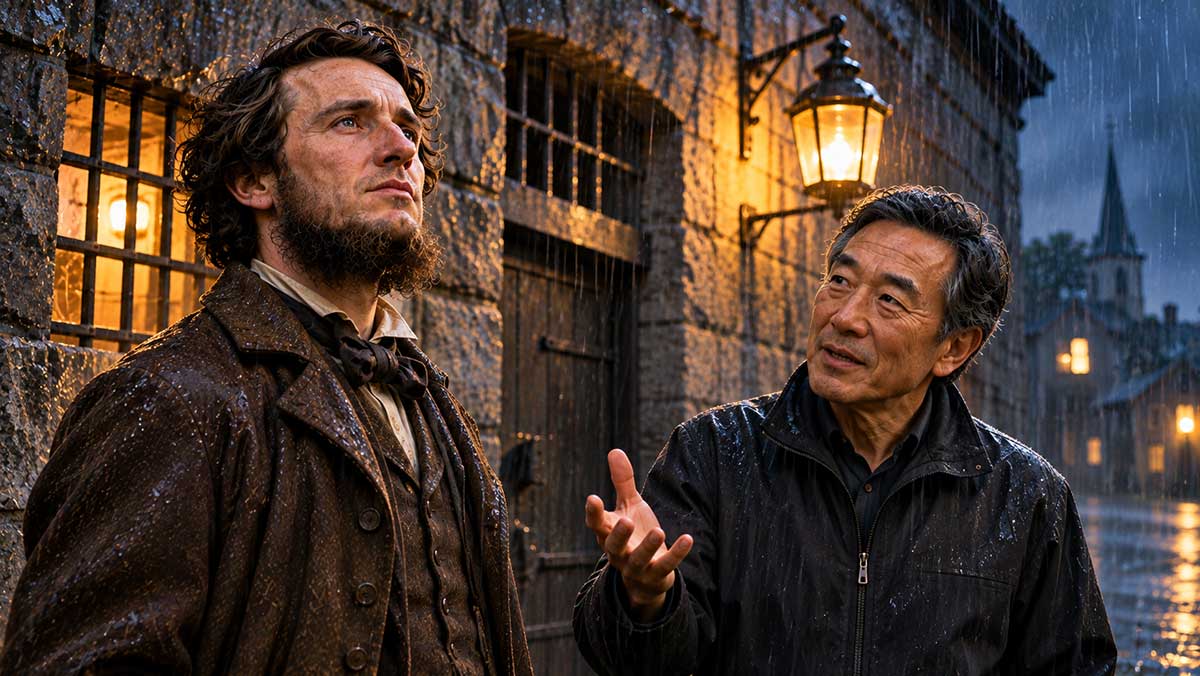
The Night Freedom Became a Question
The quiet beauty of Walden Pond has given way to a cold, rainy evening in Concord, Massachusetts.
Nick Sasaki and Henry David Thoreau stand outside the old jail where Henry spent a night in July 1846. A lantern casts a pale glow across the stone walls. Rainwater runs between the cobblestones, and the streets are nearly deserted.
Their conversation now moves beyond the Walden years, looking back on Thoreau's arrest and forward to his defense of the abolitionist John Brown in 1859.
Henry studies the building with an expression that is neither bitter nor nostalgic.
Nick Sasaki
Henry, I have to tell you, this is quite a change from Walden Pond. A few hours ago, we were talking about birds, happiness, and the beauty of nature. Now we're standing outside a jail.
Henry David Thoreau
A rather instructive change, don't you think? One may learn something about freedom beside a pond. One may learn something else about it behind a locked door.
Nick Sasaki
And you actually spent a night in there?
Henry David Thoreau
I did. Though I cannot recommend the accommodations.
Nick Sasaki
(Laughing) No beautiful view of the pond?
Henry David Thoreau
A considerably smaller view of the world. Yet I discovered that a government can confine a man's body without necessarily securing his agreement.
Nick Sasaki
That's what I want to explore. You were willing to go to jail for your beliefs. But I wonder how you decided that your conscience mattered more than the law.
Question 10. What Gives You the Right to Disobey the Government?
Nick Sasaki
Let's start with what happened. You refused to pay a tax, and the authorities arrested you. Why was that tax such a big issue for you?
Henry David Thoreau
The tax itself was not a great sum. My objection concerned the government that demanded it.
I lived in a country where human beings were held as property, and where the machinery of government protected that injustice. The United States was engaged in war against Mexico, a conflict I regarded as deeply unjust.
I could not comfortably claim that slavery was wrong and then behave as though my obligations to the government required no examination.
Nick Sasaki
But you still used roads and lived in the community. Couldn't someone say you were accepting the benefits of government without paying your share?
Henry David Thoreau
Someone certainly could. And I would distinguish between the ordinary obligations of living among neighbors and being compelled to lend one's allegiance to an unjust political system.
I do not imagine that every tax payment is a direct endorsement of every government action. My refusal was a deliberate act of resistance, a way of withdrawing my cooperation where I believed cooperation had become morally intolerable.
Nick Sasaki
Here's my problem with that. Suppose everyone starts deciding which laws to obey. One person refuses taxes over slavery. Another refuses a law simply because it inconveniences him. How does society function?
Henry David Thoreau
A necessary question. I do not suggest that personal preference and moral conscience are interchangeable.
A man who refuses a law merely to preserve his comfort has offered us no compelling moral argument. A man who refuses to assist in the enslavement of another confronts a different question.
Nick Sasaki
But who decides which conscience is right?
Henry David Thoreau
We must reason, examine evidence, listen to those harmed, and submit our convictions to serious scrutiny. Conscience is not made trustworthy merely by being passionately felt.
Yet I cannot escape responsibility by saying that the majority has decided for me.
Nick Sasaki
So democracy isn't enough?
Henry David Thoreau
Democracy may provide a means of governing, but a majority does not transform injustice into justice simply by voting for it.
Suppose a hundred men agree that one innocent man may be enslaved. Does the number of those who agree make the act righteous?
Nick Sasaki
No. But laws can be changed through elections. Why not work within the system instead of refusing to cooperate?
Henry David Thoreau
Sometimes one should. But consider the person suffering while the rest of us patiently wait for reform.
How long must he remain enslaved so that his neighbors may feel comfortable with the pace of political change?
Nick Sasaki
That's difficult to answer.
Henry David Thoreau
It ought to be difficult. Moral responsibility should not become easy merely when we place it in the hands of an institution.
Nick Sasaki
When they locked you up, were you frightened?
Henry David Thoreau
I was not eager to be imprisoned. But I found something peculiar about the experience. The state appeared to believe that locking me away had settled our disagreement.
It had merely demonstrated the means by which it intended to enforce its demand.
Nick Sasaki
Someone paid your tax, and you were released the next day. Were you disappointed?
Henry David Thoreau
I had not sought imprisonment as a prize. Yet I would have preferred that my refusal remain my own. Another person's payment could open the door, but it could not answer the moral question.
Nick Sasaki
And what did you learn?
Henry David Thoreau
That one should not confuse the ability to compel obedience with the authority to command respect.
Question 11. How Do We Recognize Injustice When Society Accepts It?
Rain begins falling more heavily. Nick and Henry move beneath the shelter of a nearby doorway.
Nick Sasaki
Henry, what troubles me is that slavery was accepted by so many people during your lifetime. There were educated people, religious people, respected leaders who defended it.
How could so many people fail to recognize something so obviously wrong?
Henry David Thoreau
Human beings possess a remarkable ability to become accustomed to arrangements that benefit them.
A man may consider himself kind, generous, and honorable, yet refuse to examine the suffering upon which his comfort depends.
Nick Sasaki
Do you think people knew it was wrong deep down?
Henry David Thoreau
Some certainly did. Others persuaded themselves otherwise. It is dangerous to imagine that every defender of injustice secretly recognizes the truth.
We are capable of deceiving ourselves with great sincerity.
Nick Sasaki
That makes me wonder about our own time. We look back and condemn slavery, but future generations might look at us and ask how we tolerated things that seemed perfectly normal.
Henry David Thoreau
I would expect them to ask exactly that.
Nick Sasaki
How can we recognize those blind spots before history judges us?
Henry David Thoreau
Begin by listening to those who bear the consequences of our arrangements.
Ask whose suffering has been made invisible, whose dignity has been denied, and whose interests are protected by our explanations.
And beware of the comforting belief that your own generation has finally achieved perfect moral clarity.
Nick Sasaki
That's something I appreciate. But I want to challenge you, too. You were extremely confident about your convictions. How do you know that you weren't sometimes wrong?
Henry David Thoreau
I do not possess immunity from error. Nor should my independence be mistaken for infallibility.
Nick Sasaki
Then shouldn't we be more humble about judging other people?
Henry David Thoreau
Yes, but humility must not become an excuse for cowardice.
There is a difference between admitting that one's judgment may be imperfect and refusing to judge anything at all.
Nick Sasaki
Can you give me an example?
Henry David Thoreau
If I see a person being beaten, I need not solve every philosophical dispute about human nature before recognizing that I should intervene.
Nick Sasaki
That makes sense. But suppose the person doing the beating believes he's morally justified.
Henry David Thoreau
Then his conviction does not absolve him. We must examine the act and its consequences, not merely the intensity of his belief.
Nick Sasaki
You know, Henry, I think there's something important here. People often believe they're good simply because they belong to the right group or support the right cause.
Henry David Thoreau
And that is a dangerous substitute for examining one's conduct.
A person may speak eloquently of liberty and still participate in oppression. He may praise compassion while remaining indifferent to suffering at his doorstep.
Nick Sasaki
So being a good person is not just about what you believe.
Henry David Thoreau
It is about what your beliefs require of you when acting upon them becomes inconvenient.
Nick Sasaki
I wonder whether that's the hardest part. It's easy to say we support justice. It's much harder when standing up for someone costs us money, friendships, or our reputation.
Henry David Thoreau
Then perhaps we should be slower to congratulate ourselves for opinions that have cost us nothing.
Nick smiles, then looks toward the dark windows of the jail.
Nick Sasaki
You certainly weren't afraid to make people uncomfortable.
Henry David Thoreau
I suspect some of my neighbors would agree with that assessment.
Question 12. Can Violence Ever Be Justified in the Name of Justice?
The rain begins to ease. Nick and Henry step back into the street, where the lantern light reflects in shallow puddles.
Nick Sasaki
Henry, now I want to ask about something that genuinely surprised me.
I knew you as the philosopher who loved peace, nature, and solitude. But later in your life, you defended John Brown, who used violence in his fight against slavery.
How do those two sides of you fit together?
Henry David Thoreau
I would first ask what you mean by peace.
Nick Sasaki
The absence of violence, I suppose.
Henry David Thoreau
Then a society might appear peaceful to those who are free, even as enslaved people live under the constant threat of force.
The quiet of the privileged is not necessarily evidence of justice.
Nick Sasaki
I understand that. But Brown and his followers killed people. His raid at Harpers Ferry involved an attempt to seize weapons and provoke an uprising.
Does a righteous cause justify those actions?
Henry David Thoreau
A righteous cause does not make every act committed in its name righteous.
But neither can we judge resistance to slavery without acknowledging the violence already sustaining slavery itself.
When I defended Brown, I saw a man whose moral seriousness stood in extraordinary contrast to the complacency of those who tolerated human bondage.
Nick Sasaki
But you can admire his courage without approving of everything he did, right?
Henry David Thoreau
You can distinguish those things, yes. Yet my defense was not merely polite admiration from a safe distance. I believed Brown's commitment exposed the moral failures of a society that condemned his violence more readily than it condemned slavery.
Nick Sasaki
Here's where I struggle. Once people believe their cause is so important that violence becomes acceptable, where does it stop?
Henry David Thoreau
That danger is real.
Nick Sasaki
And history gives us plenty of examples of people committing terrible acts while claiming to serve justice or God.
Henry David Thoreau
Indeed. Moral conviction demands scrutiny, particularly when it places other lives at risk.
Nick Sasaki
So what would you say to someone today who reads your work and concludes that they have a moral right to attack people who disagree with them?
Henry David Thoreau
I would ask whether they have confused disagreement with oppression, anger with courage, and certainty with wisdom.
To invoke conscience is to accept responsibility for one's actions, not to escape it.
Nick Sasaki
That's an important distinction. You don't want people using your philosophy as permission to do whatever they feel is right.
Henry David Thoreau
Certainly not. And I would not have my defense of Brown reduced to a convenient formula. The institution of slavery involved profound violence and the systematic denial of human freedom. That historical reality matters.
Nick Sasaki
Can peaceful resistance really change a system that refuses to listen?
Henry David Thoreau
Sometimes peaceful resistance may expose injustice, withdraw cooperation, and awaken public conscience. But I would be dishonest if I claimed that every oppressor could be persuaded merely through gentle argument.
Nick Sasaki
Then perhaps the real challenge is knowing when resistance is necessary, and how to resist without becoming the very thing you're fighting.
Henry David Thoreau
That is a question worthy of a lifetime's examination.
Nick Sasaki
Henry, I have one more question. You've talked so much about personal freedom, finding happiness, and living deliberately. But now you're telling me we have obligations to people we may never meet.
Can a person really be happy knowing that others are suffering?
Henry David Thoreau
One may experience moments of happiness, certainly. But a life devoted entirely to protecting one's private comfort, regardless of the suffering beyond it, would be a very narrow achievement.
Nick Sasaki
So the purpose of freedom isn't just to enjoy your own life?
Henry David Thoreau
Freedom gives us the opportunity to live according to conscience. If we use it merely to avoid inconvenience, we have made rather little of the gift.
Nick Sasaki
That's interesting. At Walden, you wanted to discover what you could live without. But here, standing outside this jail, you're talking about what a person must never give up.
Henry David Thoreau
Yes. A man may discover that he needs fewer possessions than he imagined.
But he may discover that he requires more courage.
Nick looks at Henry for a long moment.
Nick Sasaki
You know, when I first came to interview you, I thought we'd mostly talk about happiness and simplicity. I didn't expect to find someone so willing to confront society.
Henry David Thoreau
Perhaps the two inquiries are not so separate.
How can one live deliberately without examining the consequences of one's actions? How can one claim to value freedom and remain indifferent when freedom is denied to others?
Nick Sasaki
And yet I wonder whether all this conviction ever exhausted you. Fighting injustice, questioning society, defending your principles. Did you ever wish you could simply go back to the pond and forget about the world?
Henry David Thoreau
There were times when I longed for the quiet of the woods.
But the woods did not teach me to stop caring about humanity.
They taught me to see more clearly what was worth caring about.
The rain has stopped. A few stars appear through breaks in the clouds.
Nick Sasaki
Henry, we've talked about money, freedom, losing your brother, finding happiness, and now the courage to stand against injustice.
But there's something I still don't know.
After everything you experienced, did you feel satisfied with the life you chose?
Did you ever look back and wonder whether you should have done things differently?
Henry looks down the empty street.
Henry David Thoreau
Those are questions a man should not answer too quickly.
Nick Sasaki
Then perhaps we should return to Walden one more time.
Henry David Thoreau
I would welcome that.
Nick Sasaki
And this time, I want to ask you the question that has been on my mind since we first met.
You went to the woods because you didn't want to reach the end of your life and discover that you had never truly lived.
Henry, did you find what you were looking for?
Thoreau turns toward Nick, then looks up at the clearing sky.
Henry David Thoreau
Let us speak of that when the morning comes.
The two men walk away from the jail. Behind them, its heavy stone walls remain in darkness. Ahead lies the road to Walden Pond, where a new day will bring the most personal questions of their conversation.
Fictional interview disclaimer: This dialogue is an imaginative reconstruction, not a historical transcript. Thoreau's 1846 imprisonment, opposition to slavery, and 1859 defense of John Brown are documented historical events. His responses to modern ethical questions are creative interpretations grounded in his published arguments.
Topic 5. Did the Man Who Taught the World How to Live Actually Find Peace?
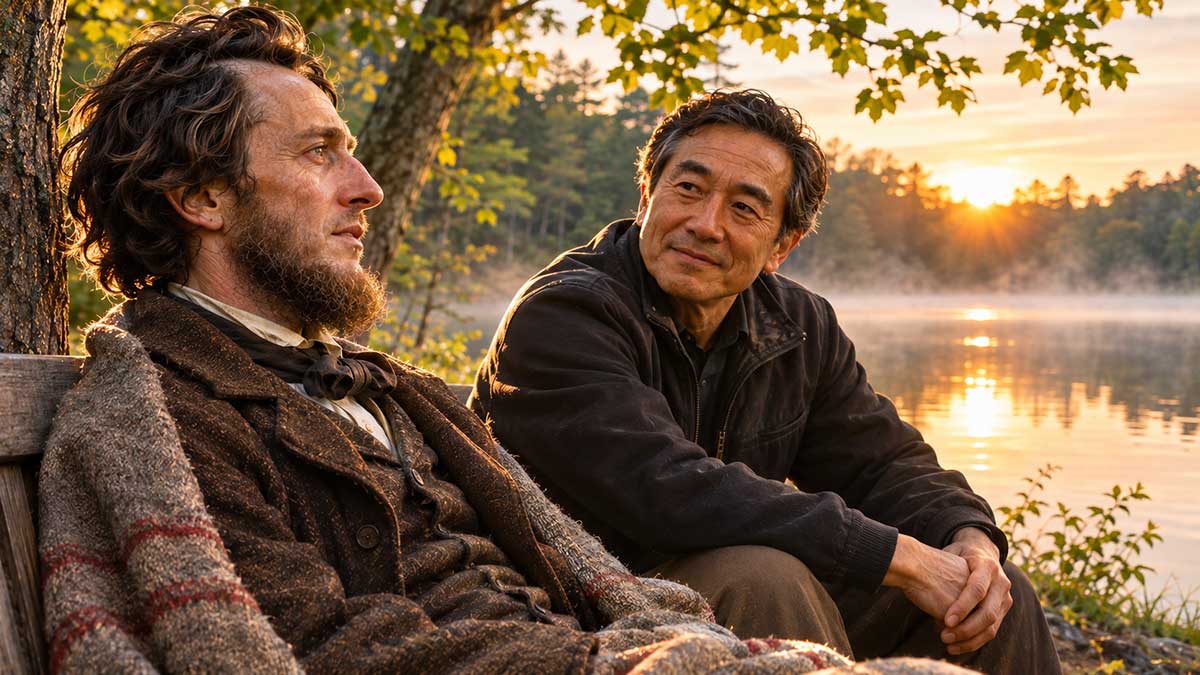
The Last Sunrise at Walden Pond
The first light of dawn spreads across Walden Pond. A thin veil of mist rises from the water, drifting slowly between the pines. The air is cool, and the forest is almost perfectly still.
Nick Sasaki and Henry David Thoreau sit on a weathered wooden bench near the shoreline.
Their conversation has traveled through different moments of Henry's life, from the youthful optimism of his Walden experiment to the grief of losing his brother, his search for happiness, and his courageous opposition to slavery.
Now the conversation turns toward the final chapter of his life.
It is May 1862 in this imagined meeting. Henry is forty-four years old, weakened by tuberculosis. His face is thinner, and he occasionally pauses to catch his breath. Yet his eyes remain attentive to every movement of the morning.
A bird calls from a nearby branch.
Henry smiles.
Henry David Thoreau
Listen to that. The birds have begun their work without waiting for the rest of us.
Nick Sasaki
You really do notice everything, don't you?
Henry David Thoreau
Hardly everything. That is what makes the world so interesting. There is always more to discover.
Nick Sasaki
Henry, we've talked about so many things. But I want to ask you something I've been thinking about since we first met.
You devoted your life to questioning how other people lived. Did you ever seriously question whether you had chosen the right life yourself?
Henry watches the sunlight move across the water.
Henry David Thoreau
Frequently, Nick. A man who examines everyone else's life but refuses to examine his own would make a rather poor philosopher.
Question 13. Did You Ever Regret the Life You Chose?
Nick Sasaki
You graduated from Harvard. You had opportunities. But you never became wealthy, never married, and your books didn't bring you great fame during your lifetime.
Did you ever wonder whether you'd made a mistake?
Henry David Thoreau
I have wondered whether I used my time wisely. I have regretted wasted hours and unfinished work. But I would distinguish those regrets from wishing I had lived according to another man's expectations.
Nick Sasaki
Your first book didn't sell well. That must have hurt.
Henry David Thoreau
It was disappointing. I had spent considerable effort preparing A Week on the Concord and Merrimack Rivers. I believed it contained something worth sharing.
When readers failed to arrive in the numbers I had hoped, I discovered that independence does not make one immune to disappointment.
Nick Sasaki
That's interesting. People sometimes picture you as someone who didn't care what anybody thought.
Henry David Thoreau
I cared whether my work communicated something true. I cared whether it reached those who might find it useful. That is not the same as wishing to be admired by everyone.
Nick Sasaki
But wouldn't it have been wonderful to become a successful writer, make a comfortable living, and have more people read your ideas?
Henry David Thoreau
Certainly. I have never argued that failure is preferable to success.
I have argued that success must be measured against something more meaningful than public applause.
A man may sell a thousand books and have nothing worth saying. Another may write something valuable that waits many years for its readers.
Nick Sasaki
So you weren't against success. You just didn't want it controlling your life.
Henry David Thoreau
Precisely.
Nick Sasaki
Let me ask about something more personal. You never married. Did you ever wish you'd had a wife and children?
Henry is quiet for a moment.
Henry David Thoreau
I knew affection and the possibility of romantic attachment. There were paths my life might have taken that it did not.
But I hesitate to describe an unlived life as though I know what happiness or sorrow it would have contained.
Nick Sasaki
That's fair. Still, don't you sometimes wonder what it would have been like to have children running around your house, someone waiting for you at the end of the day?
Henry David Thoreau
I can appreciate the beauty of such a life without claiming it was necessarily mine to live.
A family may be a great source of meaning. It may bring responsibilities that deepen a person's character. But marriage does not guarantee happiness, any more than solitude guarantees wisdom.
Nick Sasaki
Do you think you sacrificed love for freedom?
Henry David Thoreau
I hope not. I have loved my family, my friends, my brother John, and the world around me.
But perhaps I have sometimes been more comfortable observing life than entering fully into certain parts of it.
Nick Sasaki
That's a surprisingly honest answer.
Henry David Thoreau
At this stage of life, Nick, it seems an unnecessary expense to maintain an impressive opinion of oneself.
Nick laughs gently.
Nick Sasaki
If you could live your life again, would you change anything?
Henry David Thoreau
I might listen more patiently. I might speak more kindly on certain occasions. I might recognize sooner that being correct is not always the same as being helpful.
But I would still wish to walk these woods. I would still write. And I would still refuse to spend my life acquiring things merely to prove that I had succeeded.
Question 14. What Did You Discover About Love, God, and Death?
The sun rises higher. Henry takes a slow breath, then rests his hands on the bench.
Nick Sasaki
Henry, you're only forty-four. That's far too young to die.
Does it frighten you, knowing that your life may be coming to an end?
Henry David Thoreau
There are moments when the body reminds me of its limitations. I would prefer more time. There are books I have not finished, observations I have not made, seasons I should like to witness again.
But I do not wish to spend whatever days remain in a quarrel with the fact that life is finite.
Nick Sasaki
That's easy to admire, but I wonder how you actually do it.
When you wake up in the morning, do you ever think, "I don't want to die. I want another twenty years"?
Henry David Thoreau
I have desired more life, certainly. I am not a stone.
Yet there is a difference between wishing for more time and refusing to appreciate the time one has.
Nick Sasaki
You know, I think people are afraid of death partly because they don't know what comes afterward.
Do you believe there's a Heaven? Do you believe you'll see your brother John again?
Henry David Thoreau
I cannot describe the next existence with the confidence of someone who has visited it and returned.
I have encountered many religious teachings, and I respect the human longing behind them.
But I would rather confess uncertainty than pretend to knowledge.
Nick Sasaki
So you don't know whether you'll see John again.
Henry David Thoreau
No. But I know that I loved him.
And I know that his life continues to influence mine.
Perhaps there are mysteries of existence that we have not begun to comprehend.
Nick Sasaki
I believe love has a spiritual meaning that goes beyond our physical lives. When I think about people we love, it's difficult for me to believe that everything simply disappears.
Henry David Thoreau
Then let that belief encourage you to love more deeply in the life you can see.
Whatever awaits us, we should not neglect the people sitting beside us today.
Nick Sasaki
That's something I wanted to ask you. You've spent so much time talking about freedom and independence. But when you look back, what mattered most? Your ideas, your writing, nature, or the people you loved?
Henry David Thoreau
I do not find them easily separated.
My brother taught me something about friendship that no book could have supplied. My friends challenged my thinking. Nature taught me attention. Writing gave me a way to examine and share what I discovered.
I would not wish to reduce a life to a competition among its blessings.
Nick Sasaki
Do you think you were happy?
Henry looks across the pond.
Henry David Thoreau
Often.
Nick Sasaki
Only often?
Henry David Thoreau
Would you trust a man who claimed to have been happy every day of his life?
Nick Sasaki
Probably not.
Henry David Thoreau
I have known sorrow, frustration, illness, and disappointment. Yet I have experienced mornings when the world seemed so abundant that I could scarcely imagine wanting anything more.
Perhaps happiness is not a permanent condition one finally achieves.
Perhaps it is a way of meeting life when one is sufficiently awake to receive it.
Nick Sasaki
So the goal isn't to eliminate sadness?
Henry David Thoreau
No. To demand a life without sorrow would be to demand a life without many of the attachments that make us human.
Nick Sasaki
I think that's especially meaningful after hearing about John.
Henry David Thoreau
His death caused me great pain. But I would not exchange the years we shared for the comfort of never having known that pain.
Nick Sasaki
Henry, what about God? After all your years observing nature, do you feel you've come closer to something divine?
Henry David Thoreau
I have become more aware of how little I know.
But I have found that wonder need not diminish with knowledge. The more carefully I observe the natural world, the more extraordinary it appears.
If there is a divine presence within existence, I should hope that sincere attention is one way of honoring it.
Nick Sasaki
I like that. Sometimes people search so desperately for a spiritual experience that they miss the beauty right in front of them.
Henry David Thoreau
A man may travel a thousand miles seeking revelation and overlook the morning light entering his own window.
Question 15. Did You Actually Succeed in Living Deliberately?
A breeze passes across the pond. The mist has nearly disappeared.
Nick turns toward Henry.
Nick Sasaki
Henry, I want to return to the question that brought me here.
You went to Walden because you wanted to live deliberately. You didn't want to reach the end of your life and discover that you had never truly lived.
Now you're approaching that moment.
Did you succeed?
Henry watches the water for a long time before answering.
Henry David Thoreau
I succeeded in discovering that life was worth examining.
I learned that many things I once considered necessary were not necessary at all.
I learned that a single morning could contain more wonder than a year spent pursuing recognition.
And I learned that independence requires more than refusing to follow others. It requires the courage to follow one's conscience.
Nick Sasaki
But did you find what you were searching for?
Henry David Thoreau
Not in the sense of reaching a final answer and having nothing more to learn.
I went to the woods hoping to encounter life directly.
I found that the more attentively I lived, the more there was to discover.
Nick Sasaki
So the search never really ended.
Henry David Thoreau
Nor would I have wished it to.
Nick Sasaki
Let me ask you something. Suppose a man has spent most of his life working hard, raising a family, and trying to do the right thing. But now he's getting older, and he wonders whether he's missed something.
Maybe he never traveled where he wanted to go. Maybe he didn't spend enough time with his children. Maybe he was so busy preparing for retirement that he forgot to enjoy his younger years.
What would you tell him?
Henry David Thoreau
I would first tell him not to dismiss the life he has lived.
Raising children, caring for others, and performing honest work may be worthy accomplishments. He should not mistake an ordinary life for a wasted one.
But if he discovers that something essential has been neglected, let him begin attending to it now.
Nick Sasaki
What if he thinks it's too late?
Henry David Thoreau
Too late for what?
He cannot recover yesterday. Neither can I.
But if he has this morning, he has an opportunity to live this morning deliberately.
Nick Sasaki
Even at seventy or eighty?
Henry David Thoreau
Why should age make a person incapable of noticing a sunrise, speaking kindly, learning something new, or reconciling with an old friend?
Nick Sasaki
That's encouraging. But some people feel they've failed. They look back and see mistakes everywhere.
Henry David Thoreau
Then let them learn from those mistakes without making regret their final occupation.
A field may have been poorly cultivated for many seasons. That does not mean nothing worthwhile can grow there now.
Nick Sasaki
I love that.
Henry smiles faintly.
Henry David Thoreau
You have a generous habit of loving my comparisons, Nick.
Nick Sasaki
(Laughing) Well, some are better than others.
Henry David Thoreau
I am relieved you have noticed.
They share a quiet laugh.
Nick Sasaki
Henry, suppose you could speak directly to people living two hundred years after you.
They have technology you couldn't have dreamed of. They can communicate across oceans instantly, travel around the globe, and access enormous amounts of information.
Yet many are anxious, lonely, and constantly worried about money and success.
What would you most want them to understand?
Henry David Thoreau
I would ask them whether all these remarkable inventions have given them greater freedom to live, or merely more elaborate ways to remain occupied.
I would ask whether they know their neighbors, whether they have time for those they love, and whether they can sit quietly without feeling that something has been lost.
And I would remind them that no invention can live their lives for them.
Nick Sasaki
That's something people need to hear.
But can you make it practical? What's one thing someone could do tomorrow morning to begin living more deliberately?
Henry David Thoreau
Before surrendering the day to its demands, ask yourself what deserves your attention.
Not what is loudest. Not what is most urgent to someone else. What is genuinely worthy of the limited hours you have been given?
Then give some part of the day to it.
Nick Sasaki
That sounds simple.
Henry David Thoreau
The simplest things are not always the easiest.
Nick Sasaki
One last personal question, Henry.
If you could return to one day of your life, just to experience it again, which day would you choose?
Henry looks toward the distant trees.
Henry David Thoreau
Perhaps a day on the river with John.
Nothing extraordinary would need to happen. We might row for hours, speak of books, watch the birds, and stop somewhere for a simple meal.
I should like to hear his laughter again.
Nick Sasaki
And what would you tell him?
Henry David Thoreau
Perhaps nothing at first.
I might simply listen.
Nick looks down for a moment, moved by the answer.
Nick Sasaki
You know, Henry, when I first came here, I thought you were going to teach me how to live with less.
But now I think your message is much bigger.
It's about not taking life for granted. Not taking people for granted. Not spending our entire lives chasing something that keeps moving farther away.
Henry David Thoreau
Then our conversation has been worthwhile.
Nick Sasaki
And I think the thing that touches me most is that you didn't need to live a perfect life to discover something beautiful about it.
Henry David Thoreau
Perfection would be a strange requirement for appreciating a morning.
Look at this pond. Its surface is broken by ripples, its shores are irregular, and its depths are often dark.
Yet would you improve it by making everything perfectly smooth?
Nick Sasaki
No. I wouldn't change a thing.
Henry David Thoreau
Neither would I.
The sun has risen above the trees. The water glows with a soft golden light.
Henry closes his eyes for a moment, listening to the birds.
Nick Sasaki
Thank you, Henry. I think I'll remember this morning for a long time.
Henry David Thoreau
Then I hope you will remember the morning itself, Nick, and not merely the things we have said about it.
Nick Sasaki
What do you mean?
Henry David Thoreau
The light upon the water. The wind through the pines. The fact that we were here to witness them.
A conversation about living is worthwhile only if it returns us to life.
Nick follows Henry's gaze across the pond.
For several moments, neither man speaks.
There is no need.
A small bird lands on the branch above them, shakes the morning dew from its feathers, and begins to sing.
Henry smiles.
Henry David Thoreau
There. Another day has begun.
And there is still so much to see.
Fictional interview disclaimer: This conversation is an imaginative reconstruction inspired by Henry David Thoreau's life, writings, and philosophy. The May 1862 meeting at Walden Pond, his private reflections, and all dialogue are fictional. Thoreau died of tuberculosis on May 6, 1862, at age 44.
Final Thoughts by Nick Sasaki

When I began this imaginary conversation with Henry David Thoreau, I expected to learn about simplicity. I thought we would discuss money, possessions, and why a Harvard graduate would choose to live in a small cabin beside a pond. But as our conversation unfolded, I found myself thinking about something much more personal: How much of my life am I actually living, and how much am I spending preparing for a future that may never arrive? Thoreau's experiment at Walden was not simply about owning fewer things. It was about discovering whether we could reclaim the freedom to decide what truly matters.
One of the most meaningful discoveries for me was that Thoreau did not necessarily reject ambition or success. He questioned what success was costing us. I have spent many years building businesses, pursuing goals, and trying to create a better future for my family. I still believe meaningful work can bring tremendous satisfaction. But Thoreau made me reconsider a question that is easy to overlook: when does ambition enrich our lives, and when does it begin taking away the very things we hoped success would give us? Reading Walden reminds me that financial freedom and inner freedom are related, but they are not identical.
The conversation about his brother John touched me most deeply. I had known that Thoreau loved nature, but I had not fully appreciated how much personal loss existed behind his reflections on life. His brother died at only twenty-six, leaving Henry with memories of their friendship, shared teaching, and unforgettable river excursion. In our imagined conversation, I asked what he would say if he could spend one more hour with John. His answer was not about achieving something extraordinary. It was about listening, remembering, and enjoying another ordinary moment together. That made me think about my own family and the countless small experiences that become precious only after they have passed.
I was equally moved by Thoreau's relationship with nature. He could return to the same pond, walk through the same woods, and observe familiar birds without losing his sense of wonder. In a society that constantly encourages us to seek new experiences, buy new things, and accomplish more, I find that perspective refreshing. His reflections in Walking and other writings collected by Project Gutenberg suggest that attention itself can transform our experience of life. Perhaps we do not always need a new destination or achievement. Perhaps we sometimes need to look more carefully at what is already in front of us.
His political convictions challenged me in a different way. Thoreau's refusal to pay his poll tax and his opposition to slavery demonstrated that personal freedom cannot be separated entirely from moral responsibility. Yet his defense of John Brown raised difficult questions about violence, justice, and the limits of conscience. I do not believe we should accept every conclusion Thoreau reached simply because we admire his courage. His life reminds me that we must examine our own convictions, remain open to criticism, and consider how our choices affect others. The Stanford Encyclopedia of Philosophy's analysis of his political thought offers a deeper examination of these tensions.
What surprised me most was that Thoreau's life did not fit the conventional picture of success. He did not achieve great wealth or widespread fame during his lifetime. He experienced grief, disappointment, illness, and uncertainty. Yet he found meaning in observing nature, writing, friendship, intellectual independence, and standing by his conscience. I do not think his example means everyone should abandon their careers or move into the wilderness. For me, the more valuable lesson is that we can choose to live with greater awareness wherever we are. We can work hard, care for our families, pursue our dreams, and still protect time for gratitude, love, reflection, and the simple pleasure of being alive.
As I reflect on our final imagined morning at Walden Pond, I keep returning to Thoreau's determination to live deliberately. He did not discover a formula that eliminated suffering or answered every spiritual question. His life was unfinished, just like ours. But perhaps that is what makes his message so meaningful. We do not have to become perfect, wealthy, famous, or completely free from regret before we can begin appreciating life. We can start with the people we love, the work we find meaningful, the convictions we believe are worth defending, and the extraordinary beauty hidden within ordinary days.
And now I would love to hear your thoughts. Do you believe Thoreau discovered the secret of happiness, or did his pursuit of independence cause him to miss other important parts of life? If you could simplify one part of your life to gain more freedom, what would you change? And perhaps the most personal question of all: if you reached the end of your life tomorrow, would you feel that you had truly lived?
Fictional interview disclaimer: These Final Thoughts reflect Nick Sasaki's interpretation of an imagined conversation with Henry David Thoreau. The historical references are based on documented events and published writings, but the interview and Thoreau's responses are fictional.
Short Bios:
Henry David Thoreau (1817–1862)
Henry David Thoreau was an American writer, philosopher, naturalist, surveyor, and abolitionist associated with the Transcendentalist movement. Born in Concord, Massachusetts, he graduated from Harvard University in 1837 and became known for his experiment in simple living at Walden Pond from 1845 to 1847. His most influential works include Walden, Civil Disobedience, A Week on the Concord and Merrimack Rivers, and Walking. His ideas about individual conscience, purposeful living, nature, and resistance to injustice continue to influence readers around the globe. He died of tuberculosis on May 6, 1862, at age forty-four. Learn more through the Thoreau Society and the Stanford Encyclopedia of Philosophy.
Nick Sasaki
Nick Sasaki is the creator of ImaginaryTalks.com, where he brings historical figures, philosophers, authors, spiritual thinkers, and influential personalities into imaginative conversations about life's most meaningful questions. Drawing on his interests in literature, philosophy, spirituality, human relationships, and personal growth, Nick explores how the wisdom and experiences of remarkable individuals can help us examine our own lives. Through these fictional interviews, he hopes to encourage curiosity, compassion, reflection, and a deeper appreciation of what makes life worth living.
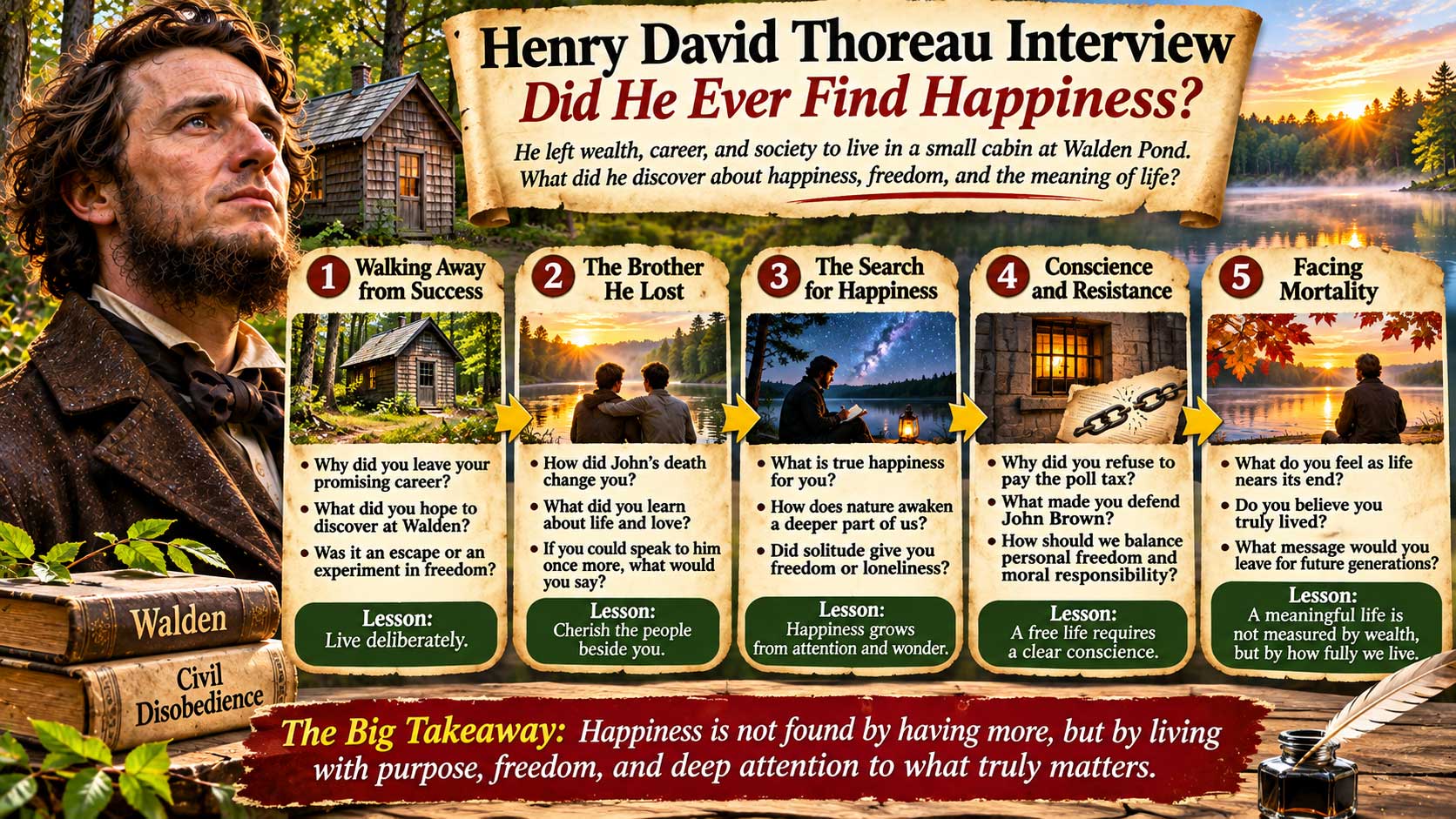
Leave a Reply