
Introduction
A hundred years after The Sun Also Rises first appeared, the world surrounding Jake Barnes and Lady Brett Ashley is almost unrecognizable. The wars are different, travel is faster, relationships are mediated through phones, gender roles have changed, and people possess freedoms Hemingway’s characters could scarcely have imagined. Yet the novel’s deepest questions have not disappeared.
In Part 1 of this trilogy, we allowed Hemingway’s characters themselves to ask what it means to belong to a “Lost Generation.” They wrestled with masculinity, love, escape, freedom, faith, and the difficult task of finding direction after the old map has failed.
Part 2 steps outside the novel. Hemingway scholar Robert W. Trogdon joins writers Colm Tóibín, Min Jin Lee, Mira Jacob, and Vinson Cunningham to revisit the questions emphasized during the novel’s 2026 centennial: postwar disillusionment, changing gender identities, Brett’s independence, fractured relationships, Hemingway’s silences, the search for meaning, and the Biblical origin of the title itself.
Their conversation gradually reveals something unexpected. Perhaps Hemingway’s characters were not simply people who had lost meaning. Perhaps they were trying—often badly—to discover which values still deserved their loyalty after inherited certainties had collapsed.
And that question may belong just as much to 2026 as it did to 1926.
(Note: This is an imaginary conversation, a creative exploration of an idea, and not a real speech or event.)
Topic 1: After the World Changes, How Do You Know What to Live For?

The room had been arranged for a centennial conversation, but nothing about it felt ceremonial.
On a table near the window sat several editions of The Sun Also Rises: old copies with worn spines, newer editions, and the annotated centenary volume. Beyond the glass, the city moved through 2026 with its usual indifference—cars, phones, screens, people hurrying somewhere.
Robert W. Trogdon rested a hand on the book in front of him.
“I suppose we should begin by getting rid of one comfortable idea.”
Colm Tóibín smiled.
“That sounds ominous.”
“The Lost Generation,” Trogdon said. “We use the phrase so easily now that it can become an explanation for everything. They were lost, therefore they drank. They were lost, therefore they wandered. They were lost, therefore their relationships failed.”
Min Jin Lee leaned forward.
“And once you call them lost, you don't have to ask what they were looking for.”
“Exactly.”
Vinson Cunningham looked down at the novel.
“Or what they had lost.”
Mira Jacob nodded.
“That seems like the more interesting question.”
Trogdon opened the book.
“And perhaps the more difficult one.”
What Was Actually Lost?
Tóibín spoke first.
“I don't think they lost meaning altogether. People without meaning don't behave like these characters.”
Jacob looked at him.
“What do you mean?”
“They care too much.”
That drew a small laugh from Lee.
Tóibín continued.
“Jake cares desperately about Brett. Cohn cares disastrously about Brett. Brett cares about freedom, desire, loyalty, perhaps even goodness, though she repeatedly fails to live peacefully with any of them. Romero cares about his craft. Bill cares about friendship.”
“So they're not nihilists,” Jacob said.
“I don't think so.”
Cunningham considered that.
“Perhaps nihilism would actually be easier.”
“How?”
“If nothing matters, there is nothing to mourn.”
The room became quieter.
“But these people are mourning constantly,” Cunningham continued. “They just rarely call it mourning.”
Lee nodded slowly.
“That may be why the war's relative absence is so powerful.”
Trogdon looked toward her.
“Go on.”
“You could imagine another novelist constantly reminding us: These people behave this way because of the war. Hemingway doesn't do that. The war has already happened. We're looking at what people become afterward.”
“The catastrophe isn't the story,” Jacob said.
“The aftermath is.”
Trogdon nodded.
“And Jake carries that aftermath physically.”
“But not only physically,” Cunningham said.
He paused.
“What interests me is the destruction of confidence.”
“In what?” Jacob asked.
“In explanations.”
Cunningham looked around the table.
“Imagine growing up believing words such as civilization, progress, honor, duty, country, perhaps God, carried relatively stable meanings. Then Europe sends millions of young men into industrialized slaughter while using many of those very words.”
Tóibín nodded.
“Afterward, you don't necessarily stop believing in courage.”
“No.”
“You stop trusting people who tell you what courage means.”
“That,” Cunningham said, “is very different.”
Lee leaned back.
“So perhaps what was lost was authority.”
Trogdon raised an eyebrow.
“Authority?”
“Not merely political authority. Interpretive authority. Who gets to tell me what a good life is?”
Jacob immediately picked it up.
“That's interesting because Brett has the same problem from another direction. She's been handed a script for womanhood and essentially says, ‘No, thank you.’”
“And Jake has had the script for manhood physically interrupted,” Tóibín added.
“So both of them are improvising,” Jacob said.
“Badly, sometimes.”
“Very badly.”
They laughed.
Lee smiled.
“But that's important. We often romanticize liberation because we're looking backward. We see the rule that disappeared and think, Good, that rule needed to disappear.”
She paused.
“But the disappearance of a bad answer doesn't automatically give you a good answer.”
Trogdon nodded.
“That might describe much of this novel.”
Jacob looked toward him.
“You're free from something.”
“Yes.”
“And then comes the question nobody puts on the liberation poster.”
Tóibín smiled.
“Free for what?”
“Exactly.”
Cunningham looked again at the old copies on the table.
“Maybe that is one definition of being lost.”
“Not having freedom?” Lee asked.
“No. Having freedom without orientation.”
Trogdon leaned back.
“That already sounds rather contemporary.”
“We'll get there,” Jacob said.
“I'm afraid we will.”
Are They Escaping Meaning—or Searching for It?
Trogdon turned the conversation.
“Then let's take the behavior everybody remembers. Drinking. Travel. Paris. Pamplona. Restaurants. Hotels. Bullfights. Sexual relationships. Arguments. More drinking.”
Tóibín smiled.
“You forgot more drinking.”
“I assumed it was understood.”
Jacob laughed.
“But what are they doing?” Trogdon asked. “Have they abandoned the search for meaning, or are these activities part of the search?”
Lee thought for a moment.
“Both.”
“That sounds evasive.”
“It isn't.”
She leaned forward.
“I think people can search and escape at the same time.”
Cunningham smiled.
“That's painfully true.”
“You can travel because you're curious about the world,” Lee continued. “And because you don't want to be alone in your apartment. You can fall in love because you genuinely love someone and because you desperately need someone to tell you that you matter.”
Tóibín looked amused.
“That covers quite a lot of literature.”
“And quite a lot of life.”
Jacob said, “I think we make a mistake when we divide human motives into clean boxes. Brett isn't either liberated or damaged. Cohn isn't either romantic or possessive. Jake isn't either loyal or self-destructive.”
“People are mixtures,” Cunningham said.
“And often the thing saving us,” Jacob replied, “is right beside the thing destroying us.”
That stopped the conversation for a moment.
Trogdon looked at her.
“Explain.”
“Take the fiesta. Community, ritual, beauty, danger, tradition, celebration—those are real things. But you can also use celebration to disappear.”
Tóibín nodded.
“Alcohol can be conviviality and anesthesia.”
“Travel can be discovery and avoidance.”
“Love can be generosity and dependency,” Lee said.
“Religion can be faith and hiding,” Cunningham added.
Trogdon smiled slightly.
“Now nobody is safe.”
“They shouldn't be.”
Tóibín picked up his copy.
“One of the extraordinary things about the novel is that Hemingway doesn't constantly tell us which is which.”
Jacob nodded.
“He doesn't put little labels on them.”
“Precisely. Jake doesn't announce, ‘I am now drinking because I am emotionally avoiding my war trauma.’”
Lee laughed.
“That would have ruined the book.”
“It would have ruined quite a few novels.”
“But that's where the style matters,” Tóibín continued. “The restraint forces the reader to notice behavior.”
Cunningham said, “And perhaps behavior becomes the moral language of the book.”
Trogdon looked interested.
“That's worth pursuing.”
“If these characters no longer trust grand declarations,” Cunningham said, “then perhaps Hemingway begins asking us to judge people through smaller things.”
“How they behave,” Lee said.
“How they treat people.”
“Whether they keep their word.”
“Whether they humiliate someone weaker.”
“Whether they remain when remaining is difficult.”
Tóibín added, “Whether they can sit quietly beside another person without demanding something from them.”
Jacob smiled.
“Bill and Jake.”
“Yes.”
Trogdon nodded.
“And Romero's craft.”
“Exactly,” Cunningham said. “Perhaps meaning hasn't vanished. Perhaps it has moved downward.”
“Downward?”
“From abstraction into conduct.”
The phrase hung there.
Lee repeated it softly.
“From abstraction into conduct.”
Cunningham continued.
“If words like honor and courage have been corrupted by institutions, perhaps you rediscover them in smaller acts. Do your work properly. Tell the truth when it costs something. Don't humiliate people. Remain loyal without becoming possessive. Take responsibility for your strength. Care for someone.”
Jacob said, “That's almost a moral code.”
“Perhaps Hemingway has one.”
Trogdon raised a finger.
“We should be cautious about constructing a complete Hemingway moral philosophy from one novel.”
“Fair.”
“But,” Trogdon continued, “the characters certainly make distinctions. Some behavior has dignity. Some doesn't.”
Tóibín nodded.
“And Romero matters partly because he does something seriously.”
Jacob looked at him.
“Bullfighting.”
“His craft. Whatever we think about bullfighting now, within the novel Hemingway presents the seriousness of Romero's attention. He isn't merely consuming experience. He's practicing something.”
Lee said, “That's a fascinating distinction.”
“Between what?”
“Consumption and devotion.”
Nobody spoke for a second.
Then Cunningham said quietly:
“That may be one of our bridges to 2026.”
When Everything Becomes a Choice
Jacob laughed.
“We lasted longer than I expected.”
Trogdon smiled.
“All right. Let's cross the bridge.”
Jacob looked through the window.
“If Jake and Brett suddenly arrived here, I think the first thing that would astonish them wouldn't be the technology.”
“What would?”
“How many lives we're told we can have.”
Lee nodded immediately.
“That's true.”
Jacob began counting almost playfully.
“You can change careers. Move countries. Reinvent your appearance. Find communities online. Leave communities. Date thousands of people theoretically. Change your beliefs. Build a personal brand. Become an entrepreneur. Become a minimalist. Become a digital nomad. Become a wellness person. Become a political person. Become a spiritual person.”
Tóibín smiled.
“You sound exhausted.”
“I am exhausted.”
They laughed.
“But seriously,” she said. “We're told that having choices is freedom.”
“And it is,” Lee replied.
“Yes. Often wonderfully so. But choice creates another responsibility.”
“Choosing.”
“Exactly.”
Cunningham said, “And choosing requires a hierarchy of value.”
Trogdon turned toward him.
“Meaning?”
“You cannot meaningfully choose unless some things matter more than other things.”
Lee nodded.
“If everything is equally valid, then there's no reason to choose one thing over another.”
“Which sounds liberating,” Cunningham said, “until you're actually trying to construct a life.”
Tóibín looked thoughtful.
“The problem may have reversed.”
“How?”
“Hemingway's generation inherited strong structures and discovered they could not trust them.”
He paused.
“Ours may inherit weak structures and discover that we cannot live without some.”
The table went quiet.
Jacob slowly nodded.
“That's very good.”
Trogdon smiled.
“Don't encourage him.”
Tóibín ignored him.
“The young people after the First World War could say, ‘The map lied to us.’”
Lee completed the thought.
“And someone today might say, ‘Nobody gave me a map at all.’”
“Or,” Jacob said, “everyone gave me one.”
Cunningham looked at her.
“Yes.”
“Parents have a map. TikTok has a map. Religion has a map. Therapy has a map. Capitalism has a map. Politics has a map. Influencers have a map. Your friends have maps. Algorithms keep offering maps.”
Trogdon said, “And they don't lead to the same destination.”
“Not remotely.”
Lee smiled.
“So perhaps 1926 had a broken map.”
“And 2026,” Cunningham said, “has a thousand maps.”
Tóibín added quietly:
“But no agreement about where we are trying to go.”
Nobody spoke for several seconds.
The city continued moving outside.
Can You Be Lost While Appearing Successful?
Lee broke the silence.
“There is another difference.”
Trogdon looked toward her.
“In Hemingway's novel, lostness is visible. These people wander. They drink too much. Their relationships are chaotic. You can almost see the instability.”
“And now?” Jacob asked.
“Now someone can look extraordinarily organized and still be completely lost.”
Cunningham nodded.
“Successful career.”
“Beautiful home.”
“Followers.”
“Money.”
“Fitness.”
“Marriage.”
“Children.”
“Vacations.”
“And no answer,” Lee said, “to the question of why any of it matters.”
Tóibín looked at her.
“That's darker than wandering around Paris drunk.”
“Maybe.”
Jacob said, “Because at least wandering feels like wandering.”
“Yes.”
“But if you're following all the instructions and still feel lost—”
“You may think something is wrong with you,” Cunningham finished.
Trogdon tapped the book lightly.
“Which raises an interesting possibility. Perhaps lostness shouldn't be measured by whether someone has a conventional life.”
Lee nodded.
“Or an unconventional one.”
“Then how?”
Cunningham thought for a moment.
“Maybe by whether your life is oriented toward something you believe is worthy.”
Jacob asked, “Worthy of what?”
“Your time.”
Lee added, “Your love.”
Tóibín said, “Your suffering.”
Trogdon looked toward him.
“That's important.”
Tóibín continued.
“Every serious commitment eventually hurts.”
The others listened.
“Love hurts. Children hurt. Work you care about can hurt. Friendship hurts. Faith can hurt. Creating something hurts. Caring for aging parents hurts. Staying with a person through illness hurts.”
His voice softened.
“If your philosophy of life is primarily about avoiding pain, then eventually you have to avoid nearly everything worth loving.”
The room became very still.
Cunningham nodded.
“And perhaps that is where meaning and suffering meet.”
Jacob looked uneasy but interested.
“Meaning doesn't make suffering good.”
“No.”
“Because I don't want us romanticizing suffering.”
“Nor should we.”
Cunningham leaned forward.
“But meaning can tell us why some suffering is worth enduring and some suffering should be escaped.”
Lee said, “That's an enormous distinction.”
“Yes.”
Trogdon looked around the table.
“And Hemingway's people aren't very good at making it.”
“No,” Tóibín said. “Neither are we.”
Does Meaning Have to Be Bigger Than the Self?
Cunningham had been quiet for a while.
Now he said, “I think there's a question we're avoiding.”
Jacob smiled.
“That's usually your cue to make things uncomfortable.”
“Probably.”
He looked at the others.
“Can the self provide enough meaning for the self?”
Trogdon leaned back.
“There it is.”
Lee asked, “You mean religion?”
“Not necessarily. But religion certainly belongs in the question.”
Cunningham folded his hands.
“If the twentieth century weakened inherited authorities—and the twenty-first century increasingly tells individuals to construct identity and meaning for themselves—there is an obvious problem.”
“What?”
“What happens when the self is precisely the thing that is suffering?”
Nobody answered immediately.
“If my career gives my life meaning,” Cunningham continued, “what happens when I lose the career?”
“If my beauty gives me meaning,” Jacob said, “what happens when I age?”
“If romantic love gives me meaning,” Tóibín added, “what happens when the person leaves?”
“If parenthood gives me meaning,” Lee said, “what happens when the children leave?”
“If achievement gives me meaning,” Trogdon said, “what happens when nobody remembers what I achieved?”
Cunningham nodded.
“Exactly.”
Jacob looked at him.
“So you think meaning has to be transcendent?”
“I think the question deserves to remain open.”
“That was diplomatic.”
He smiled.
“We have Topic Five.”
Tóibín laughed.
“Save God for later.”
“I suspect God is accustomed to waiting.”
That produced the biggest laugh of the afternoon.
When it faded, Lee returned to the point.
“Maybe we don't even need to begin with God.”
Cunningham nodded.
“What do you mean?”
“Maybe meaning becomes larger than the self the moment I become responsible for something that isn't me.”
Trogdon watched her.
“A child.”
“Yes.”
“A person.”
“A community.”
“A craft.”
“A promise.”
“A place.”
“A principle.”
Tóibín added, “A book, if you're foolish enough.”
They smiled.
Lee continued.
“The important thing is that I stop asking only, ‘What will make me feel fulfilled?’”
Jacob nodded.
“And start asking?”
“‘What is worth caring for even when caring for it is inconvenient?’”
Cunningham's expression changed.
“That may be very close to meaning.”
So What Makes a Generation Lost?
Trogdon looked at the clock but made no attempt to finish quickly.
“Let's return to where we began.”
He looked around the table.
“If we are going to use this phrase at all—Lost Generation—what should it mean?”
Jacob answered first.
“A generation isn't lost because it rejects an old rule.”
Lee followed.
“Or because it changes how people live.”
Tóibín said, “Or because it suffers.”
Cunningham waited.
“A generation becomes endangered when it loses confidence that anything is worthy of devotion.”
The others turned toward him.
He continued.
“Not obedience. Devotion.”
Trogdon nodded slowly.
“That's an important distinction.”
“Obedience asks, ‘What am I told to do?’ Devotion asks, ‘What is worthy of my love, effort, sacrifice, and fidelity?’”
Jacob said, “And if nothing is?”
“Then you drift.”
Lee added, “Even if you're very busy.”
“Especially if you're very busy,” Tóibín said.
They laughed softly.
Then Tóibín became serious.
“Maybe that is the great danger in both centuries.”
He looked toward the window.
“The characters in Hemingway keep moving because movement can resemble direction.”
Jacob repeated it.
“Movement can resemble direction.”
Trogdon closed the book in front of him.
“And 2026 has become extraordinarily good at movement.”
Cunningham smiled faintly.
“We can cross oceans in hours.”
Lee said, “Change careers.”
Jacob said, “Change partners.”
Tóibín said, “Change identities.”
Trogdon added, “Consume more information in a morning than Jake Barnes might encounter in months.”
Cunningham looked around the table.
“And none of those things tells us where we should go.”
Silence returned.
Not uncomfortable silence.
The kind that appears when nobody wants to disturb a thought too quickly.
Finally Min Jin Lee spoke.
“Then perhaps the question isn't whether we're another Lost Generation.”
Trogdon looked at her.
“What is it?”
She glanced at the century-old novel lying between them.
“What are we willing to give our lives to?”
No one answered.
Outside, thousands of people continued toward thousands of destinations.
And for the first time that afternoon, the distinction between having somewhere to go and knowing why you were going there seemed enormous.
Topic 2: When Old Gender Roles Break, What Makes a Good Man or Woman?

The conversation resumed after lunch.
The centennial editions were still scattered across the table, but the mood had shifted. The first discussion had been about generations, maps, meaning, and what happens when inherited explanations no longer hold.
Now Mira Jacob rested her elbows on the table and looked at the others.
“If we're going to talk about broken maps,” she said, “we probably have to talk about gender.”
Colm Tóibín smiled.
“I was wondering how long you would wait.”
“Not very long.”
Robert W. Trogdon glanced toward the book.
“And in this novel, we have two particularly dramatic disruptions.”
“Jake and Brett,” Min Jin Lee said.
Trogdon nodded.
“Jake cannot completely inhabit the masculine role his culture expected of him.”
“And Brett refuses to inhabit the feminine one,” Jacob added.
Vinson Cunningham looked from one to the other.
“So perhaps their tragedy isn't merely that they can't become husband and wife.”
Tóibín nodded.
“Perhaps neither of them is entirely certain anymore what a husband or wife is supposed to be.”
Is Jake's Wound Really About Sex?
Trogdon opened the discussion.
“The obvious starting point is Jake's war injury.”
Jacob immediately said, “And the danger is that we reduce everything to impotence.”
“Exactly.”
Tóibín leaned back.
“His wound matters sexually, obviously. Hemingway makes that unavoidable. But it also destroys an entire imagined future.”
Lee nodded.
“Marriage.”
“Perhaps children.”
“Sexual confidence.”
“Being desired in the way he expected.”
“Being able to perform masculinity according to the conventions he inherited,” Jacob said.
Cunningham looked at her.
“Perform?”
“Yes.”
She paused.
“I don't mean masculinity is fake. I mean every culture teaches people what counts as evidence that you are doing gender correctly.”
Trogdon nodded.
“In Jake's world?”
“Physical strength. Sexual capacity. Emotional control. Courage. Perhaps economic independence. Being able to pursue women rather than being dependent on them.”
“And war heroism,” Lee added.
Jacob looked at Jake's name on the page.
“Then the war that supposedly proves manhood takes from Jake one of the things his society uses to define it.”
Cunningham's face tightened slightly.
“That is a brutal irony.”
Tóibín said, “And Hemingway doesn't give Jake a speech explaining it.”
“No,” Trogdon replied. “We infer it from behavior.”
Jacob nodded.
“He watches.”
Lee looked at her.
“What do you mean?”
“Jake is often watching other men inhabit forms of masculinity available to them.”
She began to count.
“Cohn can fight.”
“Romero is physically graceful and sexually desirable.”
“Mike performs a reckless kind of male bravado.”
“Bill has humor and ease.”
“And Jake?”
Jacob stopped.
“He has to construct something else.”
Tóibín looked thoughtful.
“That may explain why Jake's restraint is so important.”
Cunningham asked, “You think restraint becomes masculinity?”
“No. That would be too simple.”
Tóibín leaned forward.
“But if Jake cannot prove himself through conventional sexual performance, the novel forces us to look elsewhere.”
“Where?”
“How he bears pain.”
Lee said, “How he treats people.”
“How he works.”
Trogdon added, “How he observes.”
Jacob said, “How much resentment he allows to become cruelty.”
Cunningham raised an eyebrow.
“And sometimes he fails there.”
“Of course.”
Jacob smiled.
“That matters. Otherwise we turn him into a saint because he's wounded.”
Lee nodded.
“And wounded people can wound other people.”
The room went quiet.
Tóibín looked toward her.
“Yes.”
Is Cohn Weak Because He Is Emotional?
Trogdon shifted the conversation.
“Then let's complicate things. Robert Cohn.”
Jacob sighed dramatically.
“Oh, Robert.”
Lee smiled.
“Careful.”
“I know. I know. He gets treated too easily as the pathetic one.”
Tóibín nodded.
“He is physically strong.”
“A boxer.”
“Educated.”
“A writer.”
“And capable of real romantic feeling,” Lee added.
Jacob looked at her.
“Until feeling becomes entitlement.”
“That's the problem.”
Cunningham said, “But notice what makes readers uncomfortable about him.”
Trogdon looked at him.
“What?”
“He wants too visibly.”
Nobody answered.
“He longs visibly,” Cunningham continued. “He becomes jealous visibly. He is humiliated visibly. He wants Brett to choose him and cannot disguise how much it matters.”
Tóibín nodded.
“Whereas Jake's suffering is more controlled.”
“More socially acceptable,” Jacob said.
Cunningham smiled.
“Is that necessarily healthier?”
That stopped them.
Lee spoke first.
“Not always.”
Jacob said, “But Cohn's problem isn't that he feels.”
“No.”
“It's what he does with the feeling.”
“Exactly.”
Tóibín leaned toward the table.
“That distinction is crucial.”
He looked around.
“Emotional openness is not the same thing as emotional maturity.”
Cunningham nodded.
“One can confess pain and still make the pain everyone else's responsibility.”
Jacob smiled.
“That may be one of the most 2026 sentences we've said.”
They laughed.
Lee continued.
“Cohn wants Brett.”
Trogdon nodded.
“Clearly.”
“And eventually, he seems to believe that because his feelings are sincere, they should produce an obligation in her.”
Jacob said, “That is the moment devotion starts becoming possession.”
Cunningham added, “The feeling may be real. The entitlement is the problem.”
Tóibín said, “So perhaps healthy masculinity cannot simply mean ‘men should express emotions.’”
Jacob nodded emphatically.
“Right.”
“It must also mean: what do you do after you express them?”
Lee said, “Can you hear no?”
“Can you accept rejection without turning humiliation into punishment?”
“Can you remain responsible for what you feel?”
Cunningham said, “That sounds less glamorous than ‘be vulnerable.’”
Jacob smiled.
“And much harder.”
What About Romero?
Trogdon turned several pages.
“Then we have Pedro Romero.”
Tóibín smiled.
“Everyone's favorite symbol.”
Jacob groaned.
“Which means we should probably ruin him.”
Lee laughed.
“Please do.”
Trogdon said, “Within the novel, Romero clearly represents qualities Hemingway admired.”
“Discipline,” Cunningham said.
“Craft.”
“Courage.”
“Composure.”
“Control.”
“Seriousness.”
Tóibín nodded.
“He has a relationship to danger that the others don't.”
Lee looked toward him.
“What do you mean?”
“He doesn't seek danger merely for sensation.”
“He practices.”
“Yes.”
Tóibín continued.
“The bullring is not chaos to him. It's form.”
Cunningham said, “A code.”
“Exactly.”
Jacob was quiet for a moment.
“And that is attractive.”
“Very.”
“But…”
Trogdon smiled.
“There it is.”
Jacob leaned forward.
“What happens when the disciplined man encounters a woman who refuses the form he understands?”
Lee immediately nodded.
“Brett.”
“Yes.”
Jacob continued.
“Romero may be wonderfully disciplined in the ring. But does that make him equally capable of allowing another human being to remain free?”
Tóibín said, “Probably not.”
Cunningham looked interested.
“So discipline can become control.”
“Absolutely.”
Lee said, “Especially when you assume that because your code gives you order, everyone you love should fit inside it.”
Trogdon nodded.
“That complicates the easy Romero-versus-Cohn comparison.”
Jacob said, “Good.”
She looked around the table.
“Cohn's weakness is not that he wants connection.”
“No.”
“Romero's strength is not automatically that he has self-control.”
“No.”
“Jake's dignity is not automatically that he suffers quietly.”
“No.”
“Bill's humor is not automatically emotional health.”
Tóibín smiled.
“Poor Bill.”
“He'll survive.”
They laughed.
Then Jacob became serious.
“Every masculine virtue has a shadow.”
Cunningham said, “Say more.”
“Strength can become domination.”
“Discipline can become rigidity.”
“Confidence can become arrogance.”
“Protection can become control.”
“Vulnerability can become manipulation.”
“Independence can become emotional isolation.”
Lee added, “And loyalty can become possession.”
Tóibín nodded.
“That sounds like the beginning of a useful definition.”
“Not yet,” Jacob said.
“We haven't talked about Brett.”
Is Brett Free?
Min Jin Lee looked down at the page.
“Brett may actually be the most dangerous character to simplify.”
Trogdon agreed.
“She often is.”
Jacob said, “Because readers tend to choose.”
“Between what?”
“She's either a liberated modern woman or a destructive woman who hurts men.”
Tóibín nodded.
“And she's both more sympathetic and more troubling than either version.”
Cunningham said, “Perhaps because freedom is morally ambiguous.”
Jacob looked at him.
“What do you mean?”
“Freedom tells you what you are not compelled to do.”
He paused.
“It does not automatically tell you what is worth doing.”
Lee smiled.
“We're back to Topic One.”
“We probably never left it.”
Jacob picked up the thought.
“Brett has escaped certain expectations.”
“Marriage as destiny.”
“Sexual purity as identity.”
“Female passivity.”
“Dependence.”
“She moves through spaces traditionally controlled by men,” Tóibín added.
“She chooses.”
“Yes.”
Jacob nodded.
“And that's real freedom.”
Cunningham said, “But freedom from?”
She looked at him.
“Exactly.”
“Not necessarily freedom for.”
Lee was quiet.
“Do we know what Brett wants?”
Tóibín considered it.
“She wants intensity.”
Jacob said, “She wants desire.”
“Love.”
“Movement.”
“Perhaps not to be trapped.”
Lee said, “But wanting not to be trapped is not yet the same thing as knowing where you want to live.”
The room fell silent.
Trogdon said, “One could argue that Brett's freedom is historically extraordinary.”
Jacob nodded.
“And we should not diminish that.”
“But?”
“But being able to reject a script does not mean you automatically know how to write a better one.”
Cunningham said softly, “That may be one of the central human problems of modernity.”
Tóibín looked toward him.
“Not just for women.”
“Certainly not.”
Does Brett Become “Masculine”?
Trogdon turned the question.
“Hemingway's readers have often noticed Brett's short hair, manner, clothes, speech, sexual freedom.”
Jacob nodded.
“And there is a temptation to say she is ‘masculine.’”
Lee said, “Which raises a problem.”
“What?”
“If independence, sexual agency, directness, and freedom are called masculine, aren't we still allowing masculinity to own those qualities?”
Jacob smiled.
“Exactly.”
Tóibín laughed softly.
“So the woman escapes traditional femininity only to have critics tell her she's becoming a man.”
“Pretty much.”
Cunningham looked thoughtful.
“Perhaps the more interesting question is not whether Brett is masculine.”
“But?”
“What qualities should belong to everyone?”
That landed.
Jacob said, “Courage.”
Lee added, “Tenderness.”
Tóibín said, “Self-command.”
Trogdon: “Responsibility.”
Cunningham: “Humility.”
Jacob: “Capacity to apologize.”
Lee: “Capacity to hear no.”
Tóibín: “Capacity to love without owning.”
Cunningham: “Capacity to remain when staying is difficult.”
Trogdon smiled.
“We are beginning to sound suspiciously constructive.”
Jacob shrugged.
“It happens.”
What Does 2026 Do With These Questions?
Trogdon looked around the table.
“We've spent a great deal of time in the novel. Let's move forward a century.”
Jacob smiled.
“Dangerous.”
“Necessary.”
He continued.
“If traditional gender roles are no longer sufficient by themselves, what defines a good man or woman in 2026?”
Lee spoke first.
“I would resist defining goodness separately.”
Jacob nodded.
“Me too.”
Tóibín said, “Then why keep the categories at all?”
Nobody answered immediately.
Cunningham broke the silence.
“Perhaps because embodiment still matters.”
Jacob looked at him.
“Explain.”
“Men and women may encounter the world differently for biological, cultural, historical, and social reasons. But the moral virtues required to live well may overlap far more than the old roles suggested.”
Lee nodded.
“So instead of asking, ‘What jobs belong to men?’ or ‘What temperament belongs to women?’…”
“We ask what courage looks like in a man or woman.”
“What responsibility looks like.”
“What honesty looks like.”
“What care looks like.”
Tóibín said, “And how power is handled.”
“That may be particularly important for men,” Cunningham said.
Jacob looked at him.
“Because?”
“Because physical, social, or economic power can be used either to enlarge other people's freedom or shrink it.”
Lee nodded slowly.
“That's good.”
Jacob leaned back.
“I think men in 2026 are often receiving contradictory instructions.”
Trogdon asked, “Such as?”
“Be strong but vulnerable.”
“Ambitious but not domineering.”
“Protective but not controlling.”
“Confident but not arrogant.”
“Emotionally open but not emotionally dependent.”
“Decisive but collaborative.”
Tóibín smiled.
“Simple.”
Jacob laughed.
“Exactly.”
Lee said, “Women receive contradictions too.”
“Of course.”
“Be independent but not intimidating. Successful but available. Beautiful but effortless. Maternal but ambitious. Sexual but not judged for sexuality. Strong but warm.”
Trogdon sighed.
“So perhaps freedom did not eliminate performance.”
“No,” Jacob said. “It multiplied the performances.”
Cunningham considered that.
“Then maybe the challenge of 2026 is not escaping all expectations.”
“What is it?”
“Learning which expectations are worth accepting.”
Tóibín nodded.
“That's a very different kind of freedom.”
“Freedom with discernment.”
Lee said, “And commitment.”
Jacob looked at her.
“Why commitment?”
“Because identity cannot remain permanently provisional.”
Jacob raised an eyebrow.
“Meaning?”
“If I'm always keeping every possible version of myself open, I may never become anyone.”
Tóibín smiled.
“That applies to relationships too.”
“And careers.”
“And communities.”
“And faith.”
“And perhaps gender itself,” Cunningham said.
Jacob looked at him carefully.
“Meaning we need fixed roles?”
“No.”
He shook his head.
“Meaning that freedom becomes meaningful when it develops into a way of being.”
Can Strength Make Other People Safer?
Tóibín had been quiet for a while.
Now he said, “Maybe we should return to Jake.”
Trogdon nodded.
“Why?”
“Because his injury strips away one conventional proof of masculinity.”
He paused.
“So if we want to know what remains, perhaps we should ask what kind of presence he creates around other people.”
Jacob looked skeptical.
“He isn't always wonderful.”
“No.”
“He participates in cruelty toward Cohn.”
“Yes.”
“He enables Brett.”
“Yes.”
“He avoids.”
“Certainly.”
Tóibín smiled.
“I am not nominating him for sainthood.”
They laughed.
“But Jake sometimes has a quality that matters.”
“What?”
“People come to him.”
Lee nodded.
“Brett does.”
“Bill.”
“Others.”
“He can create a kind of steadiness.”
Cunningham said, “Even while he himself is suffering.”
“Yes.”
Jacob thought about that.
“So maybe strength is partly relational.”
Trogdon said, “Meaning?”
“It isn't only what you can endure.”
She paused.
“It is what happens to other people around your strength.”
That silenced the table.
Lee repeated it.
“What happens to other people around your strength.”
Jacob nodded.
“Do they become safer?”
“Or smaller?” Cunningham asked.
“Yes.”
Tóibín smiled faintly.
“That may be a better masculinity test than almost anything else we've said.”
Lee leaned forward.
“Think about the alternatives.”
“Cohn's pain eventually makes other people unsafe.”
“Romero's certainty risks making Brett smaller.”
“Mike's humiliation spills outward.”
“Jake sometimes enables but sometimes protects.”
“Bill's friendship often gives Jake room.”
Trogdon said, “So perhaps strength that constantly requires witnesses is insecure strength.”
Cunningham nodded.
“And strength that constantly requires submission is fear.”
Jacob added, “Strength that cannot apologize is fragility.”
Tóibín said, “Strength that cannot grieve becomes hardness.”
Lee said, “And strength that cannot tolerate another person's freedom becomes control.”
Nobody hurried to speak after that.
What About Femininity?
Trogdon finally asked, “If we are attempting to rescue masculinity from caricature, should we do the same for femininity?”
Jacob smiled.
“Definitely.”
Lee said, “Traditional femininity is often reduced to softness, care, beauty, motherhood, emotional intelligence.”
Tóibín nodded.
“Which can turn real virtues into obligations.”
“Exactly.”
Jacob said, “Care is beautiful when it is chosen. Less so when women are expected to absorb everyone else's pain indefinitely.”
Cunningham nodded.
“Tenderness is a virtue.”
“Yes.”
“But not a female duty.”
“Exactly.”
Lee added, “And ambition is not a masculine virtue.”
“Neither is courage.”
“Nor independence.”
Trogdon said, “Then perhaps the centennial question becomes less about rescuing separate lists of male and female traits.”
“And more about asking how men and women can develop full human character,” Jacob finished.
Tóibín smiled.
“Very unfashionably Aristotelian.”
Cunningham laughed.
“We'll survive.”
What Should We Keep?
Trogdon folded his hands.
“If old gender roles contained both wisdom and injustice, what should a generation do with them?”
Jacob answered quickly.
“Don't burn everything.”
Lee looked surprised.
“That's interesting coming from you.”
Jacob smiled.
“Bad rules can still contain observations about human needs.”
“Such as?”
“People need commitment.”
“Children need care.”
“Families require sacrifice.”
“Communities require responsibility.”
“Bodies matter.”
“Sex has consequences.”
“Dependence is not always weakness.”
Lee nodded.
“And tradition sometimes remembers things individuals forget.”
Cunningham looked at her.
“But tradition also preserves mistakes.”
“Of course.”
“So what do we do?”
She paused.
“Test it.”
“Against what?”
“Reality.”
Tóibín smiled.
“Which is not always gentle.”
“No.”
“But neither is ideology.”
Cunningham said, “Perhaps the mature position is neither automatic obedience nor automatic rebellion.”
Jacob nodded.
“That's hard.”
“Most worthwhile things are.”
Trogdon said, “So a person might inherit a tradition and ask: Does this make people more truthful? More responsible? More loving? More capable of commitment? More able to flourish?”
Lee added, “And does it protect dignity?”
Jacob: “Does it allow freedom?”
Tóibín: “Does it make intimacy possible?”
Cunningham: “Does it teach us to use power without worshiping it?”
So What Makes a Good Man or Woman?
Trogdon looked around the table.
“We should probably attempt an answer.”
Jacob groaned.
“I thought this was literature.”
“Even literature occasionally suffers from conclusions.”
Tóibín laughed.
“All right.”
Trogdon looked first at Cunningham.
“A good man?”
Cunningham thought.
“One who does not need another person's diminishment to feel substantial.”
Lee nodded.
“A good woman?”
He smiled.
“The same.”
Trogdon turned to Lee.
She considered.
“A good person is capable of belonging without disappearing.”
Jacob looked at her.
“I like that.”
“And capable of independence without pretending they need no one.”
Tóibín nodded.
“That includes Brett.”
“And Cohn.”
“And Jake.”
“All of us.”
Trogdon looked to Jacob.
She smiled.
“I'd say a good man or woman can possess strength without turning it into control.”
“Freedom without turning it into avoidance.”
“Vulnerability without turning it into manipulation.”
“Desire without turning it into entitlement.”
“And confidence without requiring constant validation.”
Tóibín said, “That's annoyingly good.”
“Thank you.”
Trogdon turned toward Tóibín.
He waited a moment.
“A good person can love another human being without requiring that person to become evidence of their own worth.”
No one joked.
Jacob looked down at the table.
“That may be the hardest one.”
“Yes.”
Finally they looked at Trogdon.
He smiled.
“I am supposed to provide textual evidence, not wisdom.”
“Too late,” Jacob said.
He laughed.
“All right.”
He looked at the century-old novel.
“Perhaps the novel teaches us to be suspicious of definitions of manhood or womanhood that depend primarily on performance.”
The others listened.
“Jake's body cannot perform one expected role.”
“Brett refuses another.”
“Cohn performs physical strength and remains insecure.”
“Romero performs extraordinary courage and may still misunderstand freedom.”
“Mike performs bravado while disintegrating.”
“Bill performs humor while sometimes using it to keep seriousness at a distance.”
Trogdon closed the book.
“So perhaps Hemingway leaves us with characters whose performances repeatedly fail to tell us who they really are.”
The room settled.
Outside the window, evening had begun turning the glass reflective.
For a moment, instead of seeing the city, the five participants could see themselves.
Cunningham spoke quietly.
“Maybe that is what happens when the old roles break.”
Nobody interrupted him.
“At first, it feels frightening because the role used to answer the question.”
What is a man?
What is a woman?
He paused.
“But perhaps losing a role can force a deeper question.”
Jacob looked toward him.
“What question?”
Cunningham answered:
“What kind of person am I becoming when nobody is watching me perform?”
The room remained quiet.
Then Min Jin Lee added:
“And perhaps that's the part Hemingway understood.”
Trogdon looked at her.
“What?”
She glanced toward Jake and Brett's names on the open page.
Freedom from an old role may be necessary. But eventually freedom has to become character.
No one tried to improve the sentence.
There was nothing to add.
Topic 3: Why Can't Jake and Brett Simply Love Each Other?
The question appeared simple enough.
Perhaps that was why nobody answered it immediately.
Robert W. Trogdon finally broke the silence.
“Why can't Jake and Brett simply be together?”
Mira Jacob laughed.
“Because then we'd lose most of the novel.”
Colm Tóibín smiled.
“A sound literary answer.”
“But not a very satisfying human one.”
Min Jin Lee looked toward him.
“The usual answer is Jake's injury.”
“Yes.”
“Remove the injury, remove the obstacle.”
Tóibín was quiet.
Then he shook his head.
“I don't believe that.”
Vinson Cunningham looked toward him.
“You don't believe they would have been happy?”
“I don't know.”
“That is considerably less romantic.”
“It is also considerably more interesting.”
Trogdon smiled.
“Then let's ruin one of twentieth-century literature's great romances.”
Jacob leaned back.
“Finally.”
If Jake Had Never Been Wounded
Tóibín began carefully.
“The temptation is to imagine an alternate novel.”
Jake returns from the war unwounded.
He meets Brett.
They fall in love.
They marry.
And the tragedy disappears.
“But that's fantasy,” he said.
Lee nodded.
“Because we don't know those people.”
“Exactly.”
Jacob looked puzzled.
“We know Jake and Brett.”
“We know Jake and Brett after the wound.”
That stopped her.
Tóibín continued.
“Jake's injury isn't merely an obstacle placed between two otherwise complete people. It has helped form the Jake we meet.”
Cunningham nodded.
“His restraint.”
“His shame.”
“His relationship to desire.”
“His understanding of masculinity.”
“His relationship to God.”
“His relationship to Brett.”
Trogdon added, “And Brett herself is not simply waiting for the correct physical circumstances to become someone's conventional wife.”
“No,” Lee said.
“Not remotely,” Jacob added.
Tóibín looked down at the novel.
“So when people say, ‘If only Jake hadn't been wounded,’ they're imagining that everything else would remain exactly the same.”
“But it wouldn't,” Lee said.
“No.”
Cunningham leaned forward.
“And perhaps ‘if only’ is doing psychological work.”
Jacob looked at him.
“What do you mean?”
“It gives suffering a single cause.”
He paused.
“If only this one thing hadn't happened, everything would have been all right.”
Lee nodded slowly.
“That can be comforting.”
“Extremely.”
“Because the alternative is admitting that life is more complicated.”
“Yes.”
Jacob looked toward Tóibín.
“So you're saying Jake's injury may protect their relationship?”
“Perhaps.”
“That's harsh.”
“It is.”
“How?”
“Because they never have to discover whether their love can survive ordinary life.”
The table became quiet.
Tóibín continued.
“They have longing.”
“Desire.”
“Separation.”
“Jealousy.”
“Rescue.”
“Regret.”
“Beautiful conversations.”
“Impossible circumstances.”
He paused.
“What they don't have is Tuesday.”
Jacob smiled despite herself.
“Tuesday?”
“Yes.”
Tóibín leaned back.
“Bills. Laundry. Irritation. Boredom. Someone leaving a cup in the wrong place for fifteen years.”
Lee laughed.
“That is marriage.”
“Exactly.”
Cunningham smiled.
“Tragedy can be strangely flattering to love.”
Jacob looked at him.
“Explain.”
“If love fails because of some enormous external wound, then the love itself remains innocent.”
Lee nodded.
“It was perfect. The world prevented it.”
“Yes.”
“But if two people are given every opportunity and still cannot live well together…”
“Then they have to confront something about themselves.”
Jacob became serious.
“Maybe impossible love is sometimes safer than possible love.”
Nobody answered immediately.
Trogdon finally said:
“Because possible love can disappoint you.”
“Yes.”
Tóibín added:
“And impossible love can remain beautiful forever.”
Does Brett Love Jake?
Lee turned the question around.
“We keep asking whether Jake loves Brett.”
Jacob nodded.
“Obviously he does.”
“Does Brett love Jake?”
Tóibín answered immediately.
“Yes.”
Jacob looked at him.
“That confident?”
“Yes.”
“But?”
“Love isn't the same thing as readiness.”
Cunningham nodded.
“Or compatibility.”
“Or health.”
“Or destiny,” Lee added.
Tóibín smiled.
“That's a very important one.”
Jacob looked puzzled.
“People don't like hearing that.”
“No.”
“Why?”
“Because we want love to settle the question.”
Cunningham said, “If two people truly love each other, we want the moral of the story to be that they should be together.”
Lee shook her head.
“But sometimes love is real and the relationship still doesn't work.”
The room quieted again.
“That's painful,” she continued, “because it means love isn't always sufficient.”
Trogdon looked toward her.
“What else is required?”
Lee considered it.
“Timing.”
Jacob said, “Trust.”
Tóibín: “Capacity for intimacy.”
Cunningham: “Responsibility.”
Trogdon: “Reality.”
They looked at him.
He smiled.
“Someone had to say it.”
What Does Brett Get From Jake?
Jacob leaned forward.
“I want to ask a more uncomfortable question.”
Tóibín smiled.
“That's becoming your role.”
“What does Brett get from Jake?”
“Love,” Lee said.
“Yes. But what else?”
Cunningham thought.
“Safety.”
Jacob nodded.
“Exactly.”
Tóibín looked toward her.
“Jake doesn't demand that she become someone else.”
“No.”
“He doesn't try to own her.”
“No.”
“He is available when she needs him.”
“Yes.”
Jacob paused.
“And that's beautiful.”
“But?”
“But it can also become a system.”
Lee understood immediately.
“Brett can leave.”
“Yes.”
“Have another relationship.”
“Yes.”
“Create chaos.”
“Yes.”
“And Jake remains the safe place she can return to.”
Jacob nodded.
“Jake becomes home without requiring her to live there.”
Tóibín's expression changed.
“That is a very sad sentence.”
“It is.”
Cunningham said quietly:
“Shelter can become another form of avoidance.”
They looked toward him.
“If I know someone will always rescue me, I may never have to ask why I keep walking into the storm.”
Trogdon looked down at the book.
“And Jake?”
Jacob answered.
“He gets something too.”
“What?”
“He gets to remain necessary.”
The room became very still.
Tóibín looked at her.
“That's cruel.”
“I don't mean consciously.”
“No. But it's probably true.”
Jacob continued.
“Jake cannot have the relationship he wants with Brett.”
“So?”
“So perhaps being the person Brett returns to becomes another form of intimacy.”
Lee nodded.
“He cannot be her husband.”
“But he can be indispensable.”
Cunningham said:
“And being needed can feel remarkably similar to being loved.”
Tóibín looked toward him.
“Sometimes dangerously similar.”
When Does Helping Become Enabling?
Trogdon turned toward the group.
“Then is Jake wrong to help Brett?”
“No,” Lee said immediately.
Jacob agreed.
“That's too simple.”
Tóibín nodded.
“If someone you love is suffering, helping them is not pathology.”
Cunningham added, “Compassion shouldn't be turned into a diagnosis.”
“Good,” Jacob said.
“But there is still a boundary.”
Trogdon asked, “Where?”
Nobody answered immediately.
Lee finally said:
“Maybe when helping repeatedly prevents the other person from encountering the consequences necessary for change.”
Jacob nodded.
“Yes.”
Tóibín added:
“Or when your entire identity becomes organized around being the rescuer.”
Cunningham said:
“Or when you secretly need the person to remain wounded because their wound gives you a role.”
The room fell silent.
Jacob looked uncomfortable.
“That happens.”
“Yes.”
“Parents do it.”
“Partners.”
“Friends.”
“Communities.”
“Even institutions,” Cunningham said.
Trogdon nodded.
“So love can become distorted even when the motive begins with care.”
“Of course,” Lee said. “Most destructive patterns don't begin with people announcing that they intend to create destructive patterns.”
And Then There Is Robert Cohn
Tóibín sighed.
“Poor Robert.”
Jacob smiled.
“We keep saying that.”
“We should.”
Lee nodded.
“Because he's easy to despise.”
Trogdon said, “And Hemingway's group certainly does.”
Cunningham looked around the table.
“But Robert's feelings aren't fake.”
“No,” Tóibín said.
“He really loves Brett—or believes he does.”
Jacob corrected gently:
“Maybe both.”
Lee said, “The problem begins when Brett's freedom contradicts the story Robert has created.”
Trogdon looked toward her.
“What story?”
“That their intimacy means something permanent.”
Tóibín nodded.
“He cannot accept that the experience means something different to her.”
“And therefore?”
“He tries to force reality to match his interpretation.”
Cunningham leaned forward.
“That may be the moment love becomes possession.”
Jacob nodded.
“When another person's freedom becomes intolerable because it threatens what their love is supposed to prove about you.”
Trogdon repeated:
“Prove about you.”
“Yes.”
Jacob continued.
“If Brett chooses Robert, Robert matters.”
“If she doesn't…”
Lee completed it.
“He experiences rejection not merely as loss but as humiliation.”
Tóibín said quietly:
“And humiliation is often more dangerous than heartbreak.”
Cunningham nodded.
“Heartbreak says, ‘I lost someone I love.’”
He paused.
“Humiliation says, ‘Her refusal means I am nothing.’”
Nobody spoke.
“And once another person becomes responsible for proving that you are not nothing,” he continued, “love is carrying a burden it cannot survive.”
Is Jake Really So Different?
Lee turned toward Tóibín.
“But let's not make Robert the villain and Jake the enlightened alternative.”
“Agreed.”
“Jake doesn't possess Brett physically.”
“No.”
“But could he possess her emotionally?”
Jacob looked interested.
“How?”
Lee considered her words.
“Through the story.”
“What story?”
“The story that they are the great impossible love.”
Tóibín smiled sadly.
“Yes.”
Jacob said, “That's powerful.”
“If Jake believes Brett is the love of his life,” Lee continued, “then every other possibility becomes secondary.”
Cunningham nodded.
“And the impossibility protects the belief.”
“Yes.”
Trogdon asked:
“So Cohn refuses to release Brett because he believes she should belong to him.”
“And Jake,” Lee said, “may refuse to release the idea of Brett because the idea belongs to him.”
The room became silent again.
Jacob finally whispered:
“Those are very different forms of possession.”
“Yes.”
“But they're both ways of refusing reality.”
Why Do We Choose Unavailable People?
Trogdon glanced toward the window.
“Now we arrive at the question that takes us rather abruptly into 2026.”
Jacob laughed.
“Unfortunately.”
“Why do people choose unavailable relationships?”
Tóibín answered:
“Because unavailable people can be extraordinarily safe.”
Jacob stared at him.
“That sounds backwards.”
“It is.”
“Explain.”
“If I love someone who cannot fully be mine, I can experience enormous emotion without ever confronting the full vulnerability of ordinary intimacy.”
Lee nodded.
“You can long.”
“Dream.”
“Wait.”
“Suffer.”
“Analyze.”
“Hope.”
“Write terrible messages at two in the morning,” Jacob added.
They laughed.
Tóibín smiled.
“Yes.”
“But you never have to find out whether someone can actually live beside you.”
Cunningham said:
“Longing can feel deeper than intimacy because longing is almost entirely internal.”
Jacob looked at him.
“Meaning?”
“The person you long for exists partly in your imagination.”
Lee added:
“Whereas the person you live with eventually becomes inconveniently real.”
Tóibín laughed.
“Very inconveniently.”
Love in the Age of Infinite Choice
Jacob picked up her phone from the table.
“This changes the architecture.”
Trogdon looked at it.
“The phone?”
“The phone.”
She held it up.
“Jake and Brett had geography.”
“Paris.”
“Spain.”
“Trains.”
“Letters.”
“Absence.”
She tapped the screen.
“We have this.”
Lee said, “Permanent access.”
“Yes.”
“You can leave someone without completely losing them.”
“You can watch their life.”
“See who they're dating.”
“See where they traveled.”
“See when they're online.”
“See whether they read your message.”
“Reappear after six months.”
Tóibín looked horrified.
“Hemingway would have needed another hundred pages.”
They laughed.
Jacob continued.
“We've made separation technically easier and psychologically harder.”
Cunningham nodded.
“That is interesting.”
“You can end a relationship without ending contact.”
Lee said, “Which means grief can remain permanently interrupted.”
“Exactly.”
Trogdon asked:
“And dating apps?”
Jacob sighed.
“Choice.”
“Which we said was good.”
“It is.”
“But?”
“But infinite choice changes how commitment feels.”
Tóibín nodded.
“Choosing one person also means refusing thousands of hypothetical people.”
Lee said, “Who remain hypothetical and therefore flawless.”
“Exactly.”
Cunningham smiled.
“The person in front of you competes against imaginary people.”
Jacob pointed at him.
“Yes.”
“And imaginary people don't leave cups in the wrong place.”
Tóibín laughed.
“My Tuesday returns.”
Is More Choice Making Us Better at Love?
Trogdon asked:
“So are people in 2026 better at relationships?”
Nobody answered.
He smiled.
“That silence is unpromising.”
Lee spoke first.
“I think we have better language.”
“For?”
“Boundaries. Trauma. Attachment. Consent. Emotional abuse. Codependency. Communication.”
Jacob nodded.
“That matters enormously.”
“Absolutely.”
“But language can become another hiding place.”
Cunningham looked at her.
“How?”
“We can become extremely sophisticated at explaining why we behave badly.”
Tóibín smiled.
“Without behaving differently.”
“Exactly.”
Jacob added:
“And sometimes therapeutic language becomes a weapon.”
“Meaning?”
“Instead of saying, ‘I don't want to do this,’ I diagnose you.”
Lee nodded.
“Instead of having a difficult conversation, I declare something toxic.”
Cunningham said, “Or call every discomfort a boundary violation.”
Trogdon raised a hand.
“We should be careful.”
“Absolutely,” Jacob said. “Real abuse exists. Real boundaries matter. The language exists because people needed it.”
“But?”
“But any moral language can be used to avoid moral responsibility.”
Tóibín looked down at the novel.
“Hemingway's people lack our vocabulary.”
“Yes.”
“But perhaps we sometimes possess the vocabulary without the courage.”
The sentence sat there.
What Does Healthy Love Require?
Trogdon finally asked:
“If love is not enough, what is?”
Lee answered:
“Reality.”
Jacob said:
“Freedom.”
Cunningham:
“Responsibility.”
Tóibín:
“Ordinariness.”
They looked at him.
He smiled.
“I mean it.”
“Love must eventually survive being ordinary.”
He continued.
“Not every conversation can be profound.”
“Not every evening can be romantic.”
“Not every sexual encounter can be transcendent.”
“Not every disagreement means the relationship is broken.”
“Not every moment of boredom means you chose the wrong person.”
Lee nodded.
“That may be particularly important in a culture built around optimization.”
Jacob said, “Because we're always asking whether something better exists.”
“Yes.”
Cunningham added:
“And love eventually requires the surrender of some possibilities.”
Jacob looked at him.
“That sounds almost anti-freedom.”
“No.”
He shook his head.
“Commitment is one of the things freedom can be used for.”
The room went quiet.
Lee smiled.
“That's good.”
Cunningham continued.
“If I cannot choose, commitment means nothing.”
“But if I refuse ever to choose?”
“Then freedom becomes permanent postponement.”
Can Another Person Heal You?
Trogdon looked around the table.
“We've arrived at the largest question.”
He paused.
“Can another person heal you?”
Jacob answered first.
“Yes.”
Everyone looked at her.
She smiled.
“You expected me to say no.”
“A little.”
“I said yes. I didn't say completely.”
She continued.
“People heal us all the time.”
“Someone believes us.”
“Stays.”
“Apologizes.”
“Touches us kindly.”
“Shows us a relationship can be safe.”
“Refuses to abandon us when we're ashamed.”
“Love changes nervous systems. Families change people. Friendships change people.”
Lee nodded.
“So ‘nobody can heal you but yourself’ is too simple.”
“Way too simple.”
Cunningham added:
“But another person cannot become responsible for making your existence meaningful.”
“Yes.”
Tóibín said:
“They can accompany the wound.”
“Perhaps help clean it.”
“Help you understand it.”
“Keep you from reopening it.”
Lee smiled.
“But they cannot become the missing piece of your body.”
Everyone knew what she meant.
Jake.
Tóibín spoke softly.
“And Brett cannot give Jake back what the war took.”
“No.”
“Jake cannot give Brett whatever peace she cannot yet give herself.”
“No.”
“Brett cannot give Robert the sense of worth he demands from her.”
“No.”
Cunningham folded his hands.
“Perhaps love becomes dangerous when we ask another human being to perform a divine function.”
Jacob looked at him.
“Meaning?”
“To save us.”
Silence.
Tóibín finally said:
“And yet people do save one another.”
Cunningham nodded.
“Yes.”
“That's the paradox.”
“Exactly.”
Lee looked between them.
“Maybe the difference is between saving someone from a moment and becoming their salvation.”
Nobody spoke.
She continued.
“A friend can save you on a terrible night.”
“A spouse can carry you through illness.”
“A parent can keep a child alive.”
“A stranger can change your future.”
“That is real.”
“But if I tell you that my worth, identity, purpose, and reason to exist now depend upon your continuing to love me…”
Jacob finished:
“I have made love impossible.”
The Sentence at the End
Trogdon opened the novel near its final pages.
Everyone knew what was coming.
Jake and Brett.
Madrid.
The taxi.
The fantasy of what might have been.
Trogdon did not dramatize it.
He simply reminded them of Brett imagining that they might have had a wonderful life together—and Jake's famous restrained response.
Then he closed the book.
“What is Jake doing?”
Tóibín answered first.
“Refusing the fantasy.”
Jacob looked surprised.
“Finally?”
“Perhaps.”
Lee nodded slowly.
“He doesn't say she is wrong.”
“No.”
“He doesn't say they would have been miserable.”
“No.”
“He simply refuses to live inside the hypothetical.”
Cunningham smiled faintly.
“That's a form of acceptance.”
Jacob looked down.
“That's much sadder than I remembered.”
“And healthier,” Lee said.
“Maybe.”
Tóibín continued.
“For much of the novel, the impossibility of their relationship keeps the fantasy alive.”
“But in that final moment?”
“Jake seems to recognize that the fantasy itself is part of the tragedy.”
Cunningham looked toward the window.
“Maybe that's why the ending has survived.”
Trogdon asked, “Why?”
“Because nearly everyone has a sentence beginning with if only.”
Nobody laughed.
If only I had met you earlier.
If only I had been different.
If only you had stayed.
If only my body had not failed.
If only my parents had loved me differently.
If only I hadn't made that mistake.
If only the world had given us another life.
Cunningham looked back toward the table.
“Sometimes those sentences are true.”
Lee nodded.
“And sometimes?”
“Sometimes they become the place we live so we don't have to live where we actually are.”
The room became completely still.
Finally Mira Jacob spoke.
“Then maybe healing isn't learning that the past didn't matter.”
Tóibín looked at her.
“No.”
“Or pretending the love wasn't real.”
“No.”
“Or deciding you shouldn't have wanted what you wanted.”
“No.”
She paused.
“Maybe healing is when the life you didn't get stops preventing you from loving the life that remains.”
Nobody answered immediately.
Min Jin Lee finally nodded.
“And perhaps that's what Jake is beginning to do.”
Trogdon looked at the closed novel.
“Beginning.”
“Yes.”
Not finishing.
Not solving.
Beginning.
Outside the window, people moved through the city carrying phones filled with names they had loved, almost loved, lost, blocked, followed, unfollowed, remembered, regretted, and occasionally still checked late at night.
A century had transformed the technology of longing.
It had not eliminated longing.
Colm Tóibín looked toward the others.
“Perhaps love doesn't heal us by making the wound disappear.”
Cunningham waited.
“What does it do?”
Tóibín answered quietly:
“Perhaps the healthiest love helps us stop building our entire life around the wound.”
No one tried to improve it.
And for once, nobody asked what Jake and Brett's life might have been.
They allowed the life that actually happened to remain enough.
Topic 4: What Are They All Running From?

Robert W. Trogdon placed two photographs on the table.
The first showed Pamplona during the fiesta: packed streets, white clothing, raised glasses, bodies pressed together, movement everywhere.
The second showed a river.
Trees.
Mountains.
Water.
Almost nothing happening.
Mira Jacob looked from one to the other.
“Well,” she said, “Hemingway wasn't exactly subtle there.”
Colm Tóibín smiled.
“He could be very subtle while arranging something rather obvious.”
Min Jin Lee picked up the photograph of the river.
“Jake is happier here.”
Vinson Cunningham looked at her.
“Is he?”
“I think so.”
Trogdon nodded.
“At least more peaceful.”
Jacob looked again at Pamplona.
“Which is strange, because if you asked which photograph represents happiness, most people would probably choose this one.”
She pointed toward the fiesta.
“People. Music. Wine. Travel. Sex. Celebration. Excitement.”
Tóibín gestured toward the river.
“And this one?”
“Two men catching fish.”
“Not terribly marketable.”
They laughed.
Cunningham looked at the two photographs.
“Perhaps Hemingway is asking whether happiness and stimulation are the same thing.”
The laughter stopped.
Why Can't They Stop Moving?
Trogdon opened the novel.
“Consider how much movement there is.”
He began almost rhythmically.
“Paris.”
“Cafés.”
“Restaurants.”
“Hotels.”
“Trains.”
“Spain.”
“Pamplona.”
“Drinking.”
“Dancing.”
“Bullfights.”
“Arguments.”
“More drinking.”
Jacob smiled.
“You've forgotten eating.”
“Eating.”
“More drinking.”
“Thank you.”
Lee leaned forward.
“What happens if they stop?”
Tóibín looked at her.
“That may be exactly the problem.”
“What do you mean?”
“If you stop moving, eventually you encounter yourself.”
Nobody spoke for a moment.
Jacob finally said:
“That sounds like something people put on Instagram over a photograph of a mountain.”
Tóibín laughed.
“Unfortunately, clichés sometimes become clichés because they contain something true.”
Cunningham said, “Stillness removes explanations.”
Jacob looked at him.
“How?”
“When you're moving, something is always happening to you.”
“The train.”
“The party.”
“The relationship.”
“The argument.”
“The next city.”
“The next drink.”
“The next person.”
Cunningham nodded.
“There is always an external event available to explain your internal condition.”
Lee completed the thought.
“But when nothing is happening…”
“You have fewer places to hide.”
What Is Jake Running From?
Trogdon turned toward Tóibín.
“Jake first.”
Tóibín didn't answer immediately.
“Grief.”
Jacob said, “Brett.”
“Yes.”
“His body.”
“Yes.”
“The war?”
“Certainly.”
Cunningham added, “God.”
Tóibín looked at him.
“Yes.”
Lee said, “Maybe also the future.”
Trogdon raised an eyebrow.
“The future?”
“The future he expected.”
She paused.
“People don't only grieve what happened.”
They listened.
“They grieve what will never happen.”
The room quieted.
Lee continued.
“The marriage you expected.”
“The children you imagined.”
“The career.”
“The body you thought you would have.”
“The person you thought you would become.”
Tóibín nodded slowly.
“Jake isn't only mourning something behind him.”
“No.”
“He is mourning something ahead of him.”
Jacob looked down at the book.
“That may be harder.”
“Why?”
“Because there is no memory to bury.”
Cunningham looked toward her.
“Only imagination.”
“Yes.”
Trogdon said, “And drinking helps?”
“For a while,” Tóibín replied.
“That matters.”
Jacob nodded.
“We shouldn't pretend escape doesn't work.”
Cunningham looked at her.
“Explain.”
“People escape because escape works.”
She paused.
“Alcohol works.”
“Scrolling works.”
“Sex works.”
“Work works.”
“Shopping works.”
“Television works.”
“For how long?” Lee asked.
“That is the question.”
Tóibín smiled faintly.
“If escape never worked, nobody would do it.”
What Is Brett Running From?
Trogdon continued.
“Brett.”
Jacob sighed.
“Stillness.”
Lee looked toward her.
“Why?”
“Because stillness eventually asks her to choose.”
Tóibín nodded.
“That's interesting.”
Jacob continued.
“Brett knows very clearly what she doesn't want.”
“Confinement.”
“Yes.”
“Conventional expectations.”
“Yes.”
“Being owned.”
“Yes.”
“But what does she want to build?”
The table went quiet.
Cunningham said:
“Freedom from is easier to recognize than freedom for.”
Jacob pointed toward him.
“Exactly.”
“If someone tells you what you must be, rebellion gives you immediate direction.”
“Say no.”
“Yes.”
“But once the cage is gone…”
“You need a destination.”
Lee looked thoughtful.
“Maybe Brett's movement protects her from having to discover whether she has one.”
Tóibín nodded.
“And relationships provide movement too.”
“One man.”
“Another.”
“Another city.”
“Another crisis.”
“Jake.”
Jacob said quietly:
“Chaos can be strangely comforting.”
Trogdon looked surprised.
“Comforting?”
“Yes.”
“Because?”
“If your life is always on fire, you never have to ask whether you like the house.”
They laughed.
Then stopped laughing.
What Is Cohn Running From?
Trogdon said, “Robert Cohn.”
Lee answered almost immediately.
“Insignificance.”
Jacob looked toward her.
“That's strong.”
“He has spent much of his life feeling outside.”
“Jewish.”
“Socially insecure.”
“Bullied.”
“Trying to become someone.”
“Boxing.”
“Writing.”
“Marriage.”
“Travel.”
“Brett.”
Tóibín nodded.
“Brett becomes proof.”
“Again.”
“Yes.”
Cunningham said:
“If Brett chooses him, then perhaps all the earlier rejection is overturned.”
Jacob nodded.
“He wins.”
Trogdon said, “But love isn't a contest.”
“No.”
“Which may be why he suffers so badly when reality refuses the story.”
Lee said:
“Cohn runs from the fear that he does not matter.”
Tóibín looked toward her.
“And anger feels better than insignificance.”
Cunningham nodded.
“Anger often does.”
Jacob asked:
“Why?”
Cunningham considered.
“Because anger enlarges you.”
“What does that mean?”
“When you're ashamed, you feel small.”
“When you're rejected, you feel small.”
“When you're helpless, you feel small.”
He paused.
“Anger makes you feel powerful again.”
Lee nodded slowly.
“So anger can be another form of escape.”
“Yes.”
“Not from the event.”
“No.”
“From the feeling underneath it.”
Even Bill?
Jacob smiled.
“Please tell me Bill gets to be healthy.”
Tóibín laughed.
“You've been waiting four topics for this.”
“I like Bill.”
“We all like Bill.”
Trogdon said, “Which means we should examine him too.”
Jacob groaned.
“Fine.”
Tóibín smiled.
“Humor.”
Jacob looked offended.
“Humor is healthy.”
“It can be.”
“Bill's humor helps Jake.”
“Absolutely.”
“It creates companionship.”
“Yes.”
“It keeps things from becoming unbearably serious.”
“Yes.”
“So what's wrong with it?”
“Nothing.”
Jacob stared at him.
Tóibín smiled.
“Unless you cannot stop.”
Cunningham nodded.
“Humor can make pain shareable.”
Lee added, “But it can also prevent pain from ever being named.”
Jacob thought about that.
“So the question isn't whether humor is escape.”
“No.”
“It is whether humor allows you eventually to return to reality.”
Tóibín smiled.
“Exactly.”
Trogdon looked around.
“That distinction seems important beyond humor.”
Cunningham nodded.
“Almost anything can restore us.”
“And almost anything can become escape,” Lee said.
What About Romero?
Trogdon turned another page.
“Romero.”
Jacob smiled.
“Work.”
“Craft,” Tóibín corrected.
“Same thing?”
“No.”
Tóibín leaned forward.
“Work can be escape.”
“Certainly.”
“But craft demands presence.”
Cunningham nodded.
“That may be the difference.”
Lee asked, “Why is Romero so compelling to Hemingway?”
Trogdon said, “His seriousness.”
“Toward bullfighting?”
“Yes.”
“He respects the form.”
“He practices.”
“He risks something.”
“He has standards.”
“He submits himself to something larger than his immediate mood.”
Cunningham repeated:
“Larger than his immediate mood.”
Tóibín nodded.
“That matters.”
Jacob looked toward him.
“Why?”
“Because nearly everyone else in the novel is being dragged around by appetite.”
Desire.
Jealousy.
Alcohol.
Humiliation.
Loneliness.
Sex.
Anger.
“But Romero,” Tóibín continued, “has something that tells him what to do even when he feels something else.”
Lee said:
“A discipline.”
“Yes.”
Cunningham added:
“A form.”
Jacob looked skeptical.
“Until Brett.”
They laughed.
“Exactly,” Tóibín said.
“Then we discover that mastery in one domain doesn't make you master of yourself everywhere.”
Why Is the Fishing Trip Different?
Trogdon moved the fiesta photograph aside.
Only the river remained.
“Let's go fishing.”
Jacob smiled.
“Finally.”
Lee picked up the photograph again.
“What happens here?”
Tóibín answered:
“Almost nothing.”
“That's not true.”
“No?”
“They fish.”
“Eat.”
“Drink.”
“Talk.”
“Sleep.”
“Wake.”
“Fish again.”
Jacob smiled.
“So almost nothing.”
Cunningham looked toward the photograph.
“But notice what is absent.”
Trogdon waited.
“No romantic competition.”
Lee nodded.
“No performance.”
“No crowd.”
“No social hierarchy to navigate.”
“No sexual drama.”
“No fiesta.”
“No one trying to prove anything.”
Tóibín said quietly:
“And perhaps most importantly, nobody needs Jake to become someone else.”
That settled over the room.
Jacob looked at him.
“Nature doesn't care about Jake's wound.”
“No.”
“The river doesn't think he's less masculine.”
“No.”
“The fish don't ask why Brett isn't there.”
“No.”
Lee smiled.
“For once Jake's body is simply a body.”
Tóibín nodded.
“Standing in water.”
“Feeling cold.”
“Eating.”
“Sleeping.”
“Existing.”
Cunningham said:
“Perhaps nature gives him scale.”
Jacob looked toward him.
“Meaning?”
“Pain has a way of filling the entire field of vision.”
He held his hands apart.
“My pain becomes the world.”
“But the river…”
“Reminds me that my pain is inside the world.”
Nobody spoke.
Lee finally said:
“That's beautiful.”
Cunningham shook his head.
“It's also humbling.”
“Yes.”
“The river doesn't erase the wound.”
“No.”
“It places the wound inside something larger.”
Escape Versus Restoration
Trogdon looked around the table.
“I think we've reached the distinction.”
Jacob nodded.
“Escape and restoration.”
“How do we tell them apart?”
Tóibín answered first.
“By what happens when you return.”
Trogdon smiled.
“Explain.”
“If an activity restores you, you return more capable of inhabiting your life.”
Lee added:
“You can face the conversation.”
Cunningham:
“Do the work.”
Jacob:
“Feel the grief.”
Trogdon:
“Accept responsibility.”
Tóibín:
“Be present.”
“And escape?” Trogdon asked.
Jacob answered.
“You return needing to escape again.”
Silence.
Cunningham leaned forward.
“Pleasure says, ‘Let me feel something good.’”
“Nothing wrong with that,” Lee said.
“Nothing at all.”
He nodded.
“But escape says, ‘I cannot tolerate what I am feeling.’”
“And restoration?” Jacob asked.
Cunningham considered.
“Perhaps restoration says, ‘Help me become strong enough to feel it without being destroyed by it.’”
Nobody spoke for several seconds.
What Would Hemingway's Characters Do in 2026?
Jacob picked up her phone again.
“I think we know where this goes.”
Trogdon smiled.
“Unfortunately.”
“If Jake lived now,” she said, “would he drink?”
“Probably.”
“But he'd also have this.”
She held up the phone.
Tóibín sighed theatrically.
“Again.”
“Again.”
Jacob began scrolling with her thumb.
“News.”
“Sports.”
“Messages.”
“Dating apps.”
“Social media.”
“Video.”
“Pornography.”
“Games.”
“Work email.”
“Shopping.”
“Podcasts.”
“Music.”
“Politics.”
“Self-improvement.”
“Other people's vacations.”
“Other people's marriages.”
“Other people's bodies.”
“Other people's success.”
She placed the phone face down.
“All available before getting out of bed.”
Lee said:
“That is historically extraordinary.”
Cunningham nodded.
“For most of human history, boredom was unavoidable.”
Tóibín smiled.
“And now?”
“We have engineered boredom almost out of existence.”
Jacob looked at him.
“Which sounds wonderful.”
“Yes.”
“But maybe boredom was doing something.”
Trogdon raised an eyebrow.
“Such as?”
“Creating empty space.”
Lee nodded.
“Thinking.”
“Daydreaming.”
“Noticing.”
“Feeling.”
“Remembering.”
“Praying,” Cunningham added.
Jacob glanced at him.
“Yes.”
Tóibín said:
“Grieving.”
The room became quiet.
Are We Afraid of Silence?
Cunningham asked the question gently.
“What happens when you sit for ten minutes without reaching for anything?”
Jacob laughed.
“I discover that I urgently need to know what strangers are saying on the internet.”
They laughed.
Then Cunningham waited.
Lee answered more seriously.
“Thoughts arrive.”
“Memories.”
“Anxiety.”
“Things you haven't resolved.”
Tóibín added:
“People you miss.”
Jacob:
“Things you're ashamed of.”
Trogdon:
“Questions you've postponed.”
Cunningham nodded.
“Silence is not empty.”
“No,” Lee said.
“Sometimes it is crowded.”
Tóibín looked toward the river photograph.
“Perhaps that's why Jake needs the river.”
“He isn't completely alone,” Jacob said.
“No.”
“Bill is there.”
“Yes.”
Lee smiled.
“That matters.”
Why Friendship May Be the Answer
Trogdon looked toward her.
“Why?”
“Because healing doesn't always require solitude.”
Tóibín nodded.
“Very important.”
Lee continued.
“We talk a lot now about finding yourself, processing yourself, healing yourself.”
Jacob smiled.
“A lot of self.”
“Yes.”
“But Jake and Bill remind us that sometimes restoration happens beside another person.”
Cunningham said:
“Without the other person becoming the solution.”
“Exactly.”
They considered that.
“You don't need to perform for them,” Lee continued.
“You don't need to impress them.”
“They don't need to fix you.”
“They don't need to diagnose you.”
“They don't need to turn your pain into a project.”
Tóibín smiled.
“They're just there.”
Jacob looked at him.
“That sounds almost embarrassingly simple.”
“It is.”
“Then why is it so difficult?”
Tóibín answered:
“Because presence isn't dramatic.”
No one laughed.
When Escape Becomes Addiction
Trogdon became more serious.
“We should add one caution.”
The others waited.
“We must not romanticize this into ‘put down your phone and go fishing.’”
Jacob nodded immediately.
“Absolutely.”
“Some forms of escape become addiction.”
“Alcohol.”
“Drugs.”
“Gambling.”
“Compulsive sexual behavior.”
“Other patterns.”
Lee said:
“And once that happens, telling someone to simply exercise more discipline can become cruel.”
Cunningham nodded.
“People may need treatment.”
“Community.”
“Professional help.”
“Accountability.”
“Compassion.”
Jacob said:
“And shame often makes escape worse.”
Tóibín looked toward her.
“Yes.”
“If I already believe I'm weak or disgusting, then the thing I use to escape that feeling can become more necessary.”
Cunningham said quietly:
“Truth without contempt.”
They looked toward him.
“What?”
“If we want people to stop running, perhaps they need somewhere safe enough to stop.”
The room became still.
How Do I Know Whether I'm Escaping?
Trogdon finally asked:
“Suppose someone reading this in 2026 asks a practical question.”
He looked around.
“How do I know?”
Jacob answered:
“Ask what happens afterward.”
Tóibín nodded.
“Do you return to life?”
Lee added:
“Or does life increasingly become the interruption between escapes?”
Nobody spoke.
Cunningham said:
“Does the activity enlarge your capacity to love?”
Trogdon looked at him.
“That's an interesting test.”
“Or does it make other people increasingly inconvenient?”
Jacob added:
“Can you stop?”
Lee:
“Can you be alone without it?”
Tóibín:
“Can you tolerate boredom?”
Trogdon:
“Can you face the thing you were avoiding?”
Cunningham looked toward the river.
“And perhaps the simplest question…”
They waited.
“Afterward, are you more present?”
Coming Home
The light outside had begun to soften.
Nobody had touched the fiesta photograph for some time.
The river remained in the center of the table.
Min Jin Lee looked at it.
“Maybe that's the real difference.”
Trogdon waited.
“Escape is about leaving.”
“And restoration?”
“Coming back.”
Tóibín nodded slowly.
“That's very good.”
Lee continued.
“You go to the river.”
“You walk.”
“You pray.”
“You sleep.”
“You talk with a friend.”
“You read.”
“You make something.”
“You receive help.”
“You sit quietly.”
“But eventually…”
She looked around the table.
“You come back.”
Jacob said:
“To the marriage.”
“To the child.”
“To the grief.”
“To the job.”
“To the apology.”
“To the body.”
“To the decision.”
“To yourself,” Cunningham said.
Silence settled over the table.
Tóibín looked again at the fiesta.
“Hemingway's characters travel enormous distances.”
“Paris to Spain.”
“Hotels.”
“Trains.”
“Roads.”
“Bars.”
“Bedrooms.”
“Bullrings.”
Then he looked at the river.
“And perhaps the longest journey Jake makes is this one.”
Trogdon asked:
“Which?”
Tóibín answered:
The distance between running from his life and being willing to inhabit it.
Nobody spoke.
Outside, the city of 2026 continued doing what cities do.
Screens lit up.
Messages arrived.
Music played.
Packages were delivered.
People worked late.
People drank.
People exercised.
People shopped.
People scrolled.
People traveled.
People prayed.
People watched one more episode.
People promised themselves they would stop tomorrow.
None of those actions, by itself, revealed whether someone was escaping or restoring.
That could only be discovered by what happened afterward.
Cunningham turned the river photograph around so that everyone could see it.
“Maybe Hemingway's quietest answer is also his most difficult.”
Jacob looked at him.
“What?”
He smiled.
You don't heal by finding the perfect place to run. You heal when you become able to come home.
The photograph remained between them.
A river.
Two friends.
Almost nothing happening.
And perhaps, for that very reason, something important finally had room to happen.
Topic 5: Why Does the Sun Still Rise?

The final conversation began near sunset.
Someone had left the photograph of the river from the previous discussion on the table.
Beside it lay a copy of The Sun Also Rises.
Robert W. Trogdon opened the book, but instead of turning to Jake or Brett, he looked at the title page.
“Hemingway had another title.”
Mira Jacob nodded.
“Fiesta.”
“Yes.”
Colm Tóibín looked toward him.
“A very different novel with that title.”
“Exactly.”
Min Jin Lee glanced at the cover.
“Fiesta tells you where the characters are going.”
Vinson Cunningham said quietly:
“The Sun Also Rises asks what remains after they have gone.”
Nobody spoke for a moment.
Outside the window, the sun was descending behind the buildings.
Trogdon smiled.
“Well.”
Jacob looked at Cunningham.
“You've been waiting five topics to say something like that.”
“Possibly.”
They laughed.
Then Trogdon opened to the epigraph.
“Ecclesiastes.”
The laughter disappeared.
Why Give This Novel a Biblical Title?
Trogdon looked around the table.
“This is a novel filled with alcohol, sexual desire, jealousy, wounded masculinity, violence, travel, disillusionment, failed relationships.”
He tapped the page.
“And Hemingway places Ecclesiastes over it.”
Jacob leaned forward.
“Which is strange if we imagine Hemingway simply saying, ‘Nothing matters.’”
Cunningham nodded.
“Ecclesiastes is far more complicated than nihilism.”
Tóibín smiled.
“That may be the understatement of the afternoon.”
Lee asked:
“Then what does the title do?”
Trogdon answered carefully.
“It changes the scale.”
“From?”
“The characters.”
He looked toward the window.
“Jake's pain feels enormous to Jake.”
“Brett's desires feel enormous to Brett.”
“Cohn's humiliation feels enormous to Cohn.”
“But the title places all of them inside something older.”
Cunningham nodded.
“Generations come.”
“Generations go.”
“The earth remains.”
“The sun rises.”
“The sun sets.”
“And rises again.”
Jacob looked uneasy.
“That can sound almost cruel.”
Cunningham turned toward her.
“How?”
“My life is falling apart and the universe says, ‘Morning anyway.’”
Tóibín smiled sadly.
“Yes.”
Lee added:
“The world does not stop because your heart broke.”
“No.”
“It doesn't stop because someone died.”
“No.”
“It doesn't stop because your body changed.”
“No.”
“It doesn't stop because your generation discovered that the things it trusted were false.”
Jacob looked outside.
“So maybe the sunrise is indifference.”
Cunningham waited.
“Maybe.”
Is the Sunrise Comforting—or Terrifying?
Tóibín picked up the question.
“There are at least two ways to experience that.”
He looked toward Jacob.
“One is terrifying.”
“Nothing I suffer changes anything.”
“Yes.”
“My pain doesn't matter.”
“The sun rises anyway.”
“And the other?” Lee asked.
Tóibín paused.
“My pain is not everything.”
The room became quiet.
Cunningham smiled faintly.
“Those sentences sound similar.”
“But they're not,” Lee said.
“No.”
Tóibín continued.
“If I say the universe continues because I don't matter, I become smaller.”
“But if I say the world is larger than my suffering…”
Cunningham finished:
“Your suffering can remain real without becoming the whole of reality.”
Jacob looked toward the river photograph.
“Like yesterday.”
“The river.”
“Yes.”
“Jake's wound doesn't disappear.”
“No.”
“But the river puts it inside something larger.”
Trogdon nodded.
“And the title may do something similar.”
Is Hemingway Offering Hope?
Lee asked the obvious question.
“Is that hope?”
Trogdon hesitated.
“We should be careful.”
Jacob smiled.
“The scholar has arrived.”
“He was always here,” Tóibín said.
Trogdon continued.
“Hemingway does not give us a conventional redemptive ending.”
“Jake isn't healed.”
“No.”
“Brett isn't transformed.”
“No.”
“Cohn doesn't return with enlightenment.”
“No.”
“The world isn't repaired.”
“No.”
Cunningham said:
“But hope doesn't always mean repair.”
Jacob looked at him.
“What else could it mean?”
“Continuation.”
She frowned.
“That sounds very thin.”
“Sometimes continuation is thin.”
He paused.
“And sometimes continuation is everything.”
Lee looked toward him.
“Explain.”
Cunningham considered.
“If you are in despair, the promise that tomorrow will solve everything may sound dishonest.”
“Yes.”
“But the fact that tomorrow exists…”
He stopped.
“That can be enough to begin.”
Tóibín nodded.
“Not everything will be all right.”
“No.”
“Just…”
“There is another morning.”
Jacob looked down at the book.
“That's actually more moving.”
“Why?”
“Because it doesn't lie.”
Jake and God
Trogdon turned several pages.
“We've postponed this long enough.”
Jacob smiled.
“God finally gets His turn.”
Cunningham laughed.
“I said He was accustomed to waiting.”
Trogdon continued.
“Jake is Catholic.”
Tóibín nodded.
“And his Catholicism is sometimes treated almost as background.”
“But should it be?”
“No.”
Lee asked:
“What does Jake want from God?”
Nobody answered immediately.
Jacob finally said:
“His life back.”
Tóibín looked toward her.
“Yes.”
His body.
His sexual future.
Brett.
Perhaps marriage.
Perhaps children.
Perhaps the ordinary masculine life he once imagined.
Cunningham said quietly:
“And God does not give it back.”
The room became still.
Lee looked at him.
“So what happens to faith when prayer doesn't restore what was taken?”
Cunningham did not answer quickly.
“That may be one of the most serious religious questions a person can ask.”
Jacob said:
“People often talk about faith as if it's confidence that something good will happen.”
“Yes.”
“But Jake's situation doesn't allow that.”
“No.”
Tóibín added:
“There are wounds that do not reverse.”
Cunningham nodded.
“There are deaths that remain deaths.”
“Bodies that do not return to what they were.”
“Marriages that end.”
“Children who leave.”
“Opportunities that disappear.”
“Years that cannot be recovered.”
Lee asked:
“Then what is faith for?”
Nobody spoke.
Finally Cunningham said:
“Perhaps faith changes when it can no longer mean, ‘Give me the life I expected.’”
Jacob watched him.
“What does it become?”
He looked toward the window.
“Perhaps something like…”
He paused.
“Teach me how to live the life that remains.”
Silence.
Tóibín looked down.
“That is much harder.”
“Yes.”
“Because restoration would be easier.”
“Usually.”
Does Hemingway Believe That?
Trogdon raised a hand gently.
“We should distinguish Cunningham from Hemingway.”
Everyone laughed.
“Thank you,” Cunningham said.
Trogdon continued.
“We should not put a theological conclusion into Hemingway's mouth simply because the title comes from Ecclesiastes.”
“Agreed,” Lee said.
“Hemingway's relationship with religion is complicated.”
“Jake's is complicated.”
“And Ecclesiastes itself is complicated.”
Jacob asked:
“So maybe the uncertainty is part of the point?”
Trogdon nodded.
“I think we can responsibly say the Biblical framing prevents the novel from being merely the story of several unhappy expatriates.”
Tóibín added:
“It places them against time.”
“Nature.”
“Generations.”
“Mortality.”
“Repetition.”
“And perhaps transcendence,” Cunningham said.
Trogdon smiled.
“Perhaps.”
Cunningham accepted the qualification.
“Perhaps is enough.”
What If the Sun Means Nothing?
Jacob leaned forward.
“I want to defend the darker reading.”
Tóibín smiled.
“Please.”
“What if the sun rises because the universe simply doesn't care?”
Nobody interrupted.
“Jake suffers.”
“Sunrise.”
“War kills millions.”
“Sunrise.”
“Brett breaks someone's heart.”
“Sunrise.”
“A generation disappears.”
“Sunrise.”
She shrugged.
“Maybe that's it.”
Cunningham nodded.
“It could be.”
Jacob looked surprised.
“You're supposed to argue with me.”
“I don't think faith requires pretending that interpretation is foolish.”
Lee asked:
“Then what would you say?”
Cunningham considered.
“The universe's refusal to organize itself around my suffering does not prove that my suffering is meaningless.”
Jacob waited.
“Why not?”
“Because meaning may not require cosmic favoritism.”
Tóibín smiled.
“Explain that one.”
Cunningham leaned forward.
“Suppose your friend is dying.”
The room changed immediately.
“You sit beside the bed.”
“You hold their hand.”
“You cannot stop death.”
“The earth continues rotating.”
“People outside are buying groceries.”
“Someone is laughing in a restaurant.”
“Children are playing.”
“The sun rises.”
He paused.
“Does the continuation of the world make holding that hand meaningless?”
Lee shook her head.
“No.”
“Perhaps it makes the act more meaningful.”
Nobody spoke.
“Because love occurs inside mortality,” Cunningham continued.
“Not outside it.”
Maybe Meaning Is Not Something We Feel
Tóibín picked up the thought.
“We often talk about meaning as a feeling.”
Jacob nodded.
“Feeling fulfilled.”
“Yes.”
“Feeling purposeful.”
“Yes.”
“Feeling connected.”
“Yes.”
“But what if meaning sometimes exists when you don't feel it?”
Lee looked interested.
“Such as?”
“Caring for someone with dementia.”
The room became quiet.
“Changing the same sheets.”
“Answering the same question.”
“Being forgotten by the person you're caring for.”
“There may be very little feeling of transcendence.”
Cunningham nodded.
“But enormous meaning.”
Lee added:
“Raising children.”
“Yes.”
“Doing necessary work.”
“Keeping a promise.”
“Showing up for a friend.”
“Making something carefully even when nobody notices.”
Jacob smiled faintly.
“So meaning may be less like inspiration…”
“And more like fidelity,” Cunningham said.
That word stayed in the room.
Fidelity.
What Is Worth Doing Even If Nobody Applauds?
Trogdon looked toward the group.
“That brings us back to Romero.”
Jacob laughed.
“Of course it does.”
“Craft.”
“Yes.”
Trogdon continued.
“One of the things Hemingway repeatedly values is doing something well.”
Tóibín nodded.
“Writing.”
“Fishing.”
“Bullfighting within the novel's moral world.”
“Cooking.”
“Observing.”
“Working.”
Lee said:
“Things with standards outside your feelings.”
“Yes.”
Cunningham smiled.
“That may be important.”
“If meaning depends entirely on how I feel today, then meaning becomes unstable.”
Jacob nodded.
“But craft says the work still needs to be done.”
Tóibín added:
“Friendship says the person still needs you.”
Lee:
“Parenthood says the child still needs care.”
Cunningham:
“Faith says goodness may still be required even when consolation is absent.”
Jacob looked toward him.
“That last one is hard.”
“It is.”
2026: Where Does Meaning Come From Now?
Trogdon folded his hands.
“So suppose someone reading Hemingway in 2026 says: Fine. The old maps are unreliable. Traditional gender roles aren't enough. Romantic love cannot save me. Distraction cannot heal me.”
He looked around.
“Now what?”
Nobody answered immediately.
Then Jacob said:
“I don't think there is one answer.”
Lee nodded.
“Good.”
Jacob continued.
“Meaning can come through relationships.”
Tóibín said:
“Craft.”
Lee:
“Family.”
Cunningham:
“Service.”
Trogdon:
“Work.”
Jacob:
“Creativity.”
Lee:
“Community.”
Tóibín:
“Nature.”
Cunningham:
“Faith.”
Jacob looked at him.
“And for someone who doesn't believe in God?”
“Truth.”
She waited.
“Love.”
“Responsibility.”
“Beauty.”
“Service.”
“Things larger than immediate appetite.”
Lee nodded.
“So perhaps transcendence doesn't have to begin with theology.”
“No.”
Cunningham smiled.
“But theology may ask whether those things point beyond themselves.”
Trogdon laughed.
“There he is.”
Can We Create Our Own Meaning?
Tóibín turned toward Jacob.
“What about the modern idea that we create meaning for ourselves?”
Jacob thought.
“I like part of it.”
“Which part?”
“The refusal to let institutions decide your entire life.”
Lee nodded.
“Necessary.”
“But?”
Jacob hesitated.
“I don't think I can simply declare anything meaningful.”
Trogdon looked interested.
“Why not?”
“If I announce that collecting expensive shoes is the central meaning of my existence…”
Tóibín smiled.
“Who are we to judge?”
Jacob laughed.
“Exactly. But I think we actually do believe some things are deeper than others.”
Cunningham nodded.
“We may create commitments.”
“But?”
“We also discover value.”
Lee looked toward him.
“Explain the difference.”
“I might choose to become a parent.”
“Yes.”
“But I don't create the value of my child.”
Silence.
“I discover that another life makes a claim upon me.”
Tóibín nodded.
“Love often feels like that.”
“Yes.”
“You choose the relationship.”
“But eventually you discover obligations you did not invent.”
Jacob said:
“So meaning is partly chosen and partly encountered.”
Cunningham smiled.
“That is closer to what I believe.”
What If Meaning Comes From Responsibility?
Lee leaned forward.
“Maybe we're making meaning too abstract.”
Trogdon looked toward her.
“What would you replace it with?”
“Responsibility.”
Jacob raised an eyebrow.
“That doesn't sound very romantic.”
“No.”
Lee smiled.
“But perhaps meaning isn't always romantic.”
She continued.
“Jake has responsibilities.”
“To work.”
“To friends.”
“To himself.”
“Even to Brett, though not unlimited responsibility.”
“Brett has responsibilities.”
“To people she loves.”
“To the consequences of her choices.”
“To herself.”
“Cohn has responsibilities.”
“To accept another person's freedom.”
“To carry rejection without turning it into violence.”
“Romero has responsibilities.”
“To his craft.”
“And to recognize that discipline does not give him ownership over another person.”
Lee looked around the table.
“Maybe meaning begins when the question changes.”
“From what?” Jacob asked.
“From…”
What will make my life feel meaningful?
She paused.
“To…”
What is life asking me to take responsibility for?
No one answered.
The Sun Does Not Give Instructions
Tóibín finally smiled.
“There is still a problem.”
“What?”
“The sun rises.”
“Yes.”
“But it doesn't tell Jake what to do.”
Cunningham laughed softly.
“No.”
“It gives another morning.”
“Yes.”
“But not instructions.”
“No.”
Jacob looked outside.
“So we're still stuck with freedom.”
Lee smiled.
“Yes.”
Trogdon said:
“Perhaps that's why the title works.”
“How?”
“It gives continuity without certainty.”
Tóibín repeated:
“Continuity without certainty.”
“You are given another day.”
“But not told exactly how to live it.”
Cunningham nodded.
“Which means hope does not eliminate responsibility.”
“It creates it,” Lee said.
One Hundred Years
The sun had nearly disappeared.
Trogdon looked at the four writers.
“One hundred years.”
No one spoke.
“In 1926, readers opened this book.”
“Some of them had survived the war.”
“Some had lost sons.”
“Brothers.”
“Bodies.”
“Faith.”
“Certainty.”
“They read about Jake.”
“Brett.”
“Cohn.”
“Bill.”
“Romero.”
“And then they closed the book and returned to their lives.”
He looked through the window.
“Those readers are gone.”
The room became very quiet.
“Now it's 2026.”
“Different readers.”
“Different wars.”
“Different technologies.”
“Different freedoms.”
“Different anxieties.”
“And someday…”
He stopped.
Jacob completed the sentence.
“We'll be gone too.”
Trogdon nodded.
Tóibín looked at the cover.
“And the sun…”
Cunningham smiled.
“Yes.”
Why Does the Sun Still Rise?
Trogdon asked each of them.
“Colm?”
Tóibín thought for a long time.
“Because no heartbreak gets the final word over time.”
“Min Jin?”
She looked toward the river photograph.
“Because life continues asking something of us even after the life we expected disappears.”
“Mira?”
She smiled faintly.
“Because another morning is not a promise that everything will be okay.”
She paused.
“It is another chance to decide what we will do.”
Finally Trogdon looked at Cunningham.
“Vinson?”
Cunningham did not answer immediately.
Outside, the last edge of sunlight disappeared.
He looked toward the darkening window.
“I don't know why the sun rises.”
Nobody moved.
“And I think pretending to know more than we know would betray the novel.”
Jacob watched him.
“But?”
He smiled.
“But I know what its rising asks of me.”
“What?”
Cunningham looked around the table.
Whether I will use the light I have been given to love something beyond myself.
Nobody spoke.
The sun was gone now.
But the sky still held its light.
Trogdon closed The Sun Also Rises.
For five conversations they had asked what happens when a generation loses its map.
What makes a human being strong when old identities fail.
Whether love can heal without becoming possession.
Why people run from pain.
Where meaning might still be found.
There had been no final system.
No formula.
No single answer Hemingway had hidden inside the novel for them to discover.
Perhaps that was why the book had survived.
Min Jin Lee looked at the closed cover.
“Maybe we began with the wrong question.”
Jacob turned toward her.
“Which one?”
“Whether Jake's generation was lost.”
She paused.
“Every generation gets lost.”
Tóibín smiled.
“That's cheerful.”
She laughed.
“I'm serious.”
“Every generation inherits maps that eventually fail.”
“Every generation mistakes some appetites for meaning.”
“Every generation loves badly sometimes.”
“Every generation finds new ways to escape.”
“Every generation loses people.”
“Every generation discovers that life will not become what it expected.”
Cunningham nodded.
“And then?”
Lee looked toward the fading sky.
“Then morning comes.”
Silence.
Not a solution.
Not proof that suffering was necessary.
Not a promise that every wound would heal.
Not an argument that everything happened for a reason.
Simply another morning.
Another opportunity to tell the truth.
To make something carefully.
To forgive someone.
To stop running.
To accept help.
To give help.
To keep a promise.
To release someone you cannot possess.
To sit beside someone who is suffering.
To pray, perhaps.
To love.
A century earlier, Hemingway had refused to tell his readers exactly what the sunrise meant.
Perhaps that restraint was the gift.
Because every generation eventually has to answer the question for itself.
The sun rises.
The world continues.
And somewhere between those two facts stands a human being with one more day.
The question is not whether the old map will return.
It will not.
The question is not whether suffering can be erased.
Some of it cannot.
The question is not whether love will save us from every wound.
It will not.
The question is smaller.
And perhaps much larger.
The sun has risen again. What will you do with the light?
Final Thoughts
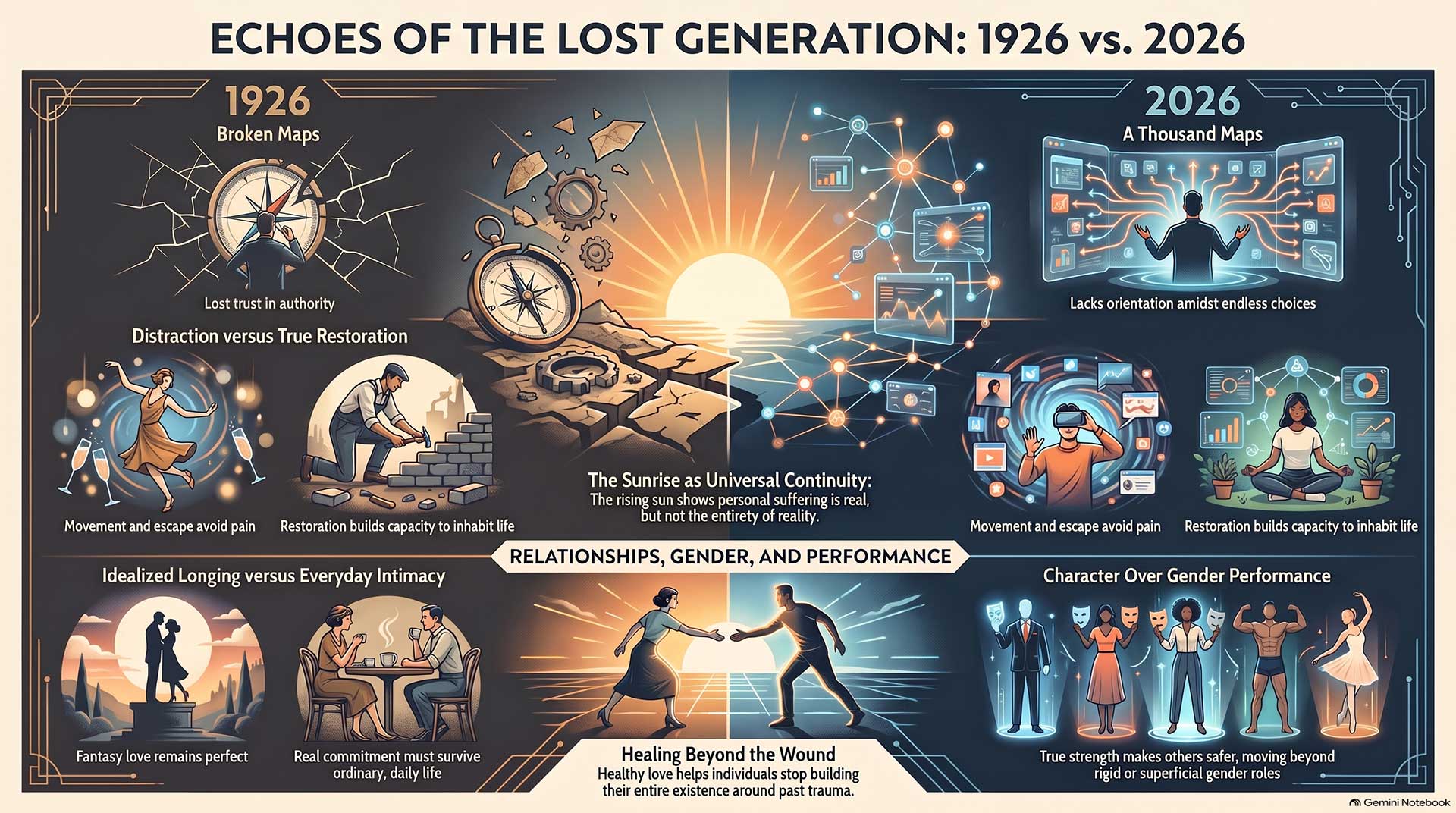
The Sun Has Risen Again
One hundred years can make a novel look very old.
A century can also make its deepest questions look surprisingly young.
Jake Barnes lived in a world shaken by war. Many of the words that had once promised order—honor, masculinity, marriage, patriotism, religion, progress—no longer seemed as reliable as they once had.
People living in 2026 inherit a different problem.
We often have more freedom, more choices, more information, more ways to connect, more ways to travel, more ways to reinvent ourselves, and more ways to escape discomfort than any generation before us.
But none of those things automatically tells us what deserves our life.
That became the thread running through all five conversations.
The characters of The Sun Also Rises are not interesting merely because they drink too much, fall in love badly, or wander from Paris to Pamplona.
They are interesting because they are trying to live after certainty has broken.
And in different ways, so are we.
The first conversation asked what a Lost Generation actually loses.
Perhaps Jake’s generation had not lost the ability to believe in anything.
Perhaps it had lost confidence in the people and institutions that once told them what was worth believing.
The old map had failed.
But 2026 may face the opposite problem.
Instead of one broken map, we have thousands.
Parents, religion, politics, therapy, social media, influencers, careers, technology, communities, and algorithms all offer competing visions of the good life.
Having many roads is not the same as knowing where to go.
Movement is not direction.
Choice is not meaning.
The second conversation turned toward masculinity and femininity.
Jake’s wound deprives him of one traditional proof of manhood.
Brett refuses many traditional expectations of womanhood.
Cohn possesses physical strength yet struggles with rejection.
Romero embodies courage and discipline yet may confuse order with control.
Each character reveals how unreliable outward performance can be.
Perhaps a better measure of strength is not whether a person can dominate, impress, endure silently, or appear invulnerable.
Perhaps we should ask:
What happens to other people around our strength?
Do they become safer?
Or smaller?
Freedom from an old role may be necessary.
But eventually freedom has to become character.
The third conversation examined Jake and Brett’s impossible love.
For generations, readers have wondered what might have happened if Jake had never been wounded.
But perhaps “if only” protects their relationship from a harder question.
Would they actually have been happy?
Impossible love never has to survive ordinary life.
It never has to survive boredom, routine, responsibility, disappointment, aging, or Tuesday.
And that realization leads to an even harder truth.
Love is real.
Love can heal.
Love can save someone in a terrible moment.
But another person cannot permanently become the proof that we are worthy of existing.
Perhaps healthy love does not eliminate our wounds.
Perhaps it helps us stop organizing our entire life around them.
The fourth conversation asked why everyone keeps running.
Hemingway fills the novel with movement.
Cafés.
Trains.
Alcohol.
Travel.
Parties.
Bullfights.
Romance.
Arguments.
More alcohol.
And then, almost unexpectedly, he sends Jake and Bill fishing.
Very little happens.
And yet those pages contain some of the greatest peace in the novel.
Perhaps Hemingway quietly distinguishes between escape and restoration.
Escape says:
I cannot bear what I am feeling.
Restoration says:
Help me become strong enough to return to my life.
That distinction may matter even more in 2026, when distraction is available every second of the day.
Phones, streaming, shopping, work, dating apps, pornography, social media, politics, exercise, gaming, travel, and endless self-improvement can all become either healthy activities or ways of disappearing.
The question is what happens afterward.
Do we return more capable of inhabiting our life?
Or do we simply need to escape again?
And finally, the conversation arrived at the title.
Why did Hemingway abandon Fiesta and reach instead toward Ecclesiastes?
Why The Sun Also Rises?
The answer remains beautifully uncertain.
Perhaps the sunrise means indifference.
Our suffering does not stop the universe.
But perhaps it means something else too.
Our suffering is not the entire universe.
Jake’s pain is real.
Brett’s loneliness is real.
Cohn’s humiliation is real.
War is real.
Loss is real.
But none of them contains all of reality.
The earth remains larger than the wound.
And this may be where Hemingway’s restraint becomes most powerful.
He does not promise that Jake will recover the life he expected.
He does not promise that Brett will become peaceful.
He does not tell us that every wound has a purpose.
He does not promise that love will fix everything.
He does not tell us precisely what God, faith, nature, suffering, or the sunrise ultimately means.
He gives us another morning.
And leaves the responsibility with us.
Perhaps that is why the novel still feels alive after a century.
Every generation receives circumstances Hemingway could never have predicted.
But every generation eventually asks questions Jake would understand.
What should I live for?
What makes me strong?
How should I love?
Why do I keep running?
What deserves my devotion?
And what do I do when the life I expected is no longer available?
Part 3 of this trilogy will leave Hemingway’s characters and scholars behind and bring these questions fully into the present through five original contemporary stories.
Different people.
Different countries, relationships, wounds, temptations, and choices.
But underneath them, the same human questions.
Because perhaps the most enduring thing Hemingway gave us was not an answer.
It was an image.
Night passes.
Morning comes.
The old life may not return.
The old map may still be broken.
But the sun has risen again.
What will we do with the light?
Short Bios:
Robert W. Trogdon is a leading Hemingway scholar whose work focuses on Hemingway’s manuscripts, textual history, letters, and the evolution of his writing. As an editor associated with the centenary edition of The Sun Also Rises, he brings historical and textual grounding to the discussion, helping distinguish what Hemingway actually wrote from interpretations later generations have placed upon the novel.
Colm Tóibín is an acclaimed Irish novelist, essayist, and critic known for his subtle treatment of desire, loneliness, family, sexuality, silence, and emotional restraint. His fiction often explores the powerful feelings that remain unspoken between people, making him especially suited to examining Jake and Brett’s complicated love and Hemingway’s famously understated style.
Min Jin Lee is the author of acclaimed novels including Pachinko and Free Food for Millionaires. Her writing frequently explores identity, migration, belonging, family, outsiders, ambition, and the ways individuals negotiate cultures that may not fully accept them. In this conversation, she brings particular insight to questions of exclusion, Robert Cohn’s outsiderhood, responsibility, and the human need to belong without losing oneself.
Mira Jacob is a novelist, memoirist, illustrator, and cultural commentator whose work explores identity, race, gender, family, sexuality, belonging, and the complicated expectations society places upon individuals. Her perspective helps reopen questions about Brett Ashley, changing gender roles, freedom, contemporary relationships, and what happens after people reject inherited identities but still must decide what kind of lives they want to build.
Vinson Cunningham is a writer, critic, and novelist whose work frequently engages with culture, morality, religion, faith, art, politics, and the spiritual questions hidden beneath everyday life. His perspective becomes especially important when the conversation turns toward Ecclesiastes, Jake’s Catholicism, suffering, responsibility, transcendence, and the larger question suggested by Hemingway’s title: what does it mean that the sun continues to rise?
Leave a Reply