


Introduction
Dale Carnegie taught millions of people how to make friends, build confidence, and stop worrying. But did he ever discover the secret to his own happiness? And what would happen if we could sit beside him, not as a famous author giving another lecture, but as an ordinary man sharing the story of his life with a friend?
Before he became one of the most influential self-help writers in history, Carnegie was an insecure young man growing up in rural Missouri. Born into a struggling farming family in 1888, he knew what it felt like to be poor, self-conscious, and desperate to prove himself. He dreamed of recognition and success, yet had little reason to believe the world would notice him. His remarkable transformation from farm boy to celebrated teacher is documented in the official Dale Carnegie historical timeline. But behind that remarkable career lies a more personal question: What happens to a man who spends his youth longing to feel important, then devotes his life to helping other people feel important?
Carnegie's life was far from a straight path to success. He worked in sales, pursued acting without achieving the career he hoped for, and eventually began teaching public speaking at a New York YMCA in 1912. There, he discovered something that would shape his future. Men who appeared successful and confident in everyday life could become frightened when asked to speak before an audience. Yet with encouragement and practice, they could change. What began as a public-speaking course gradually became a lifelong exploration of confidence, human relationships, and the desire to be appreciated.
In 1936, Carnegie published How to Win Friends and Influence People, a book that would reach millions of readers. Its central ideas were deceptively simple: take a sincere interest in others, listen carefully, offer honest appreciation, and try to see situations from another person's viewpoint. Yet those principles raise fascinating questions. Can friendship really be taught? What separates sincere kindness from manipulation? And is being admired by many people the same as being genuinely loved by a few?
Carnegie later turned his attention to another universal human struggle. His 1948 book, How to Stop Worrying and Start Living, explored practical ways to face uncertainty, reduce needless anxiety, and appreciate the present. But this creates an intriguing question about the author himself. Did success free Carnegie from the insecurities of his youth? Could a man who taught others to worry less still lie awake thinking about tomorrow? And could happiness be found in something much simpler than achievement?
In this imaginary interview, I meet Dale Carnegie five times across nearly half a century. Our first conversation takes place on a dusty Missouri farm road in 1906, when he is still a young man dreaming of a different future. We meet again in a YMCA classroom in 1912, in his New York writing room in 1936, beside a fireplace in 1948, and finally in a peaceful autumn garden in 1954. There are thoughtful questions, certainly, but there is laughter, gentle teasing, shared memories, and the growing affection of two friends who become increasingly comfortable with each other. Carnegie isn't expected to have every answer. He can be funny, uncertain, reflective, and wonderfully human.
I invite you to join us for these five conversations. You'll meet a young man who wants the world to recognize him, a teacher who finds joy in encouraging others, an author who studies the mysteries of friendship, and an older man reflecting on family, gratitude, and the ordinary moments that make life meaningful. Somewhere along the way, you may begin asking yourself the same questions I ask Dale: Are we spending too much of our lives trying to impress others? Do we appreciate the people closest to us? And could the happiness we're searching for be waiting in a place we've overlooked?
Fictional Interview Disclaimer: This article is an imaginative conversation between Nick Sasaki and Dale Carnegie, inspired by Carnegie's documented life and published teachings. The meetings, dialogue, humor, personal confessions, and friendship are fictional. They are intended to explore his ideas through storytelling, not to represent actual interviews, verified quotations, or documented private thoughts.
Topic 1. The Boy Who Wanted to Matter
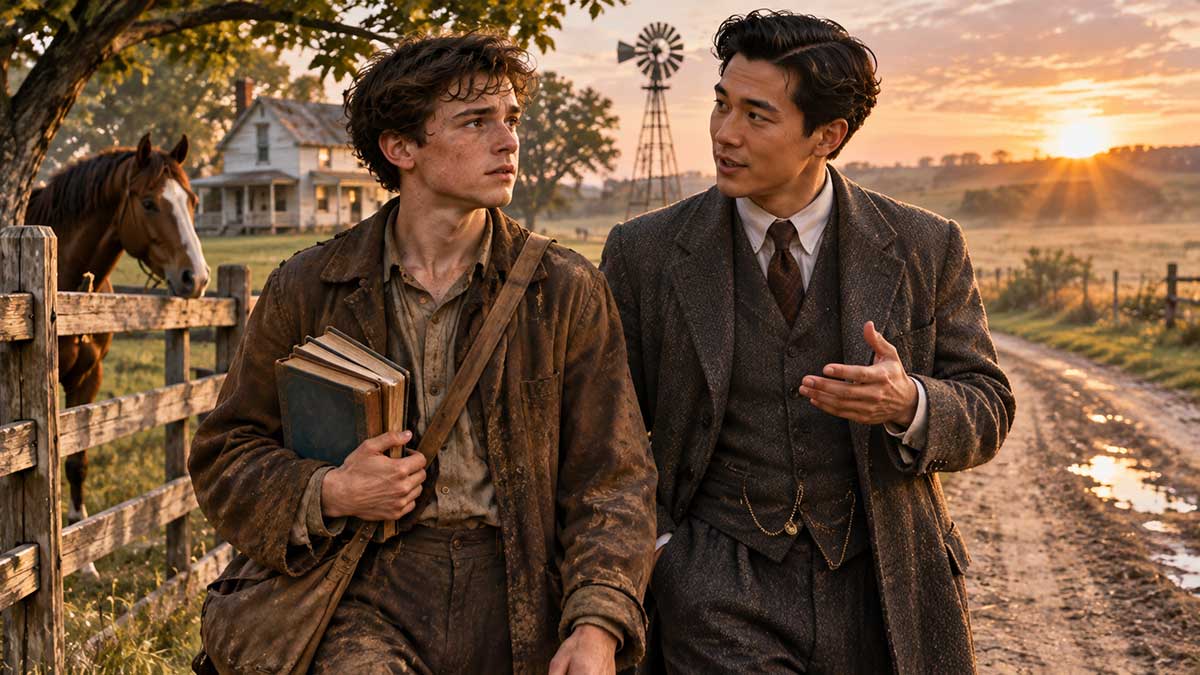
Opening Scene: A Missouri Farm Road, 1906
The afternoon sun hangs low over the rolling farmland of northwestern Missouri.
A narrow dirt road winds between fields of corn and pasture. A weathered wooden fence runs along one side, and a horse stands beneath a tree, flicking flies away with its tail.
In the distance, a farmhouse sits beneath an enormous sky.
A young man walks along the road carrying several books under his arm.
His jacket is worn. His boots are dusty. His hair has been carefully combed, though the wind has undone much of his effort.
He is eighteen-year-old Dale Carnagey.
He has big dreams, very little money, and a persistent feeling that the world is paying attention to everyone except him.
As he approaches a bend in the road, he notices a stranger standing beside the fence.
The stranger looks friendly, though his clothing seems rather unusual for rural Missouri.
Nick Sasaki: Excuse me! Are you Dale Carnagey?
Dale Carnegie: That depends. Have I done something wrong?
Nick Sasaki: Not that I know of.
Dale Carnegie: Then yes, I'm Dale Carnagey.
Nick Sasaki: Wonderful! I've been hoping to meet you.
Dale Carnegie: Me?
Dale looks over his shoulder.
Dale Carnegie: Are you certain you haven't mistaken me for someone else?
Nick Sasaki: Quite certain.
Dale Carnegie: Well, that's a first.
Nick Sasaki: What is?
Dale Carnegie: A stranger coming all the way out here hoping to meet me.
Nick Sasaki: Is that so surprising?
Dale Carnegie: Mister, around here people usually come looking for a missing cow, a borrowed tool, or somebody who owes them money.
Nick laughs.
Nick Sasaki: I'm happy to report that I don't need a cow.
Dale Carnegie: That's a relief. We haven't any to spare.
They shake hands.
Nick Sasaki: I'm Nick Sasaki.
Dale Carnegie: Pleased to meet you, Nick. Where are you from?
Nick Sasaki: It's a rather long story.
Dale Carnegie: Well, we've got a long road.
Nick Sasaki: Then perhaps you wouldn't mind some company?
Dale Carnegie: Not at all. Though I should warn you, I haven't anything particularly interesting to say.
Nick Sasaki: I have a feeling you might surprise yourself.
Dale grins.
Dale Carnegie: You sound like my mother.
They begin walking together.
For a little while, they talk about the weather, the harvest, and the peculiar behavior of horses.
Then Nick notices Dale adjusting the sleeve of his jacket.
Question 1. Dale, Did Growing Up Poor Make You Feel That You Had Something to Prove?
Nick Sasaki: Dale, can I ask you something about growing up here?
Dale Carnegie: Certainly.
Nick Sasaki: What's the hardest part of being a young man in this place?
Dale looks across the fields.
Dale Carnegie: You want the truth?
Nick Sasaki: That's usually the most interesting kind.
Dale Carnegie: The work is hard. There's always something that needs doing. You finish one chore, and another is waiting.
Nick Sasaki: Sounds familiar.
Dale Carnegie: You've worked on a farm?
Nick Sasaki: No, but I know what it's like to finish one task and discover three more.
Dale Carnegie: Then perhaps farming and whatever you do aren't so different.
They laugh.
Nick Sasaki: Does the work bother you?
Dale Carnegie: Sometimes. But that's not the worst part.
Nick Sasaki: What is?
Dale hesitates.
Dale Carnegie: I suppose it's feeling that other people have a head start.
Nick Sasaki: In what way?
Dale Carnegie: Some fellows come to school wearing fine clothes. Their families have money. They seem comfortable wherever they go.
I arrive after doing chores, wearing whatever we can afford.
Sometimes I feel as though everyone can tell the difference before I've said a word.
Nick Sasaki: Does anyone actually say anything?
Dale Carnegie: Occasionally. But they don't always have to.
Nick Sasaki: I think I know what you mean.
Dale Carnegie: Do you?
Nick Sasaki: When I was younger, I sometimes worried too much about how other people saw me. I'd walk into a room and wonder whether I belonged there.
Dale Carnegie: Exactly!
Dale turns toward him with sudden enthusiasm.
Dale Carnegie: That's it. You understand.
Nick Sasaki: I suspect more people feel that way than we realize.
Dale Carnegie: Perhaps. But when you're the fellow standing there in the shabby jacket, it doesn't seem that way.
Nick Sasaki: You feel like everyone else received instructions on how to be confident, and yours got lost in the mail.
Dale bursts out laughing.
Dale Carnegie: That's precisely how it feels!
Nick Sasaki: I never received my instructions either.
Dale Carnegie: Then we're both in trouble.
They continue along the road.
Nick Sasaki: Tell me about your parents.
Dale Carnegie: They're hardworking people. My father has spent his life farming. My mother has a strong faith and a great deal of determination.
Nick Sasaki: Do they encourage your ambitions?
Dale Carnegie: My mother certainly encourages me to make something of myself. But she doesn't believe a person's worth comes from money alone.
Nick Sasaki: Do you agree with her?
Dale smiles sheepishly.
Dale Carnegie: I agree with her when I'm thinking sensibly.
Nick Sasaki: And when you're not?
Dale Carnegie: I look at some fellow with a fine suit and wish I had one.
Nick laughs.
Nick Sasaki: Dale, I think you've just described half the human race.
Dale Carnegie: Only half?
Nick Sasaki: You're right. I may have underestimated the number.
They laugh again.
Nick Sasaki: What do you dream about doing someday?
Dale looks toward the horizon.
Dale Carnegie: I'd like to do something that matters.
Something bigger than working the farm for the rest of my life.
I want to become successful.
Nick Sasaki: What does success look like to you?
Dale Carnegie: I'd like to be respected. I'd like to speak well. I'd like people to listen when I have something to say.
And I'd like to earn enough money that my family never has to worry so much.
Nick Sasaki: Those sound like meaningful ambitions.
Dale Carnegie: Sometimes I wonder whether they're foolish.
Nick Sasaki: Why?
Dale Carnegie: Look around, Nick. I'm just a farm boy from Missouri.
What reason have I to think I'll accomplish anything extraordinary?
Nick stops walking.
Nick Sasaki: Dale, can I tell you something?
Dale Carnegie: Of course.
Nick Sasaki: I've met people who grew up with every advantage you can think of, and some still doubted themselves.
I've met others who had very little and eventually accomplished remarkable things.
I don't think your beginning tells the whole story.
Dale considers that.
Dale Carnegie: I'd like to believe you're right.
Nick Sasaki: You don't have to settle the question today.
Dale Carnegie: That's fortunate. I haven't figured out what I'm doing next week.
They smile.
Nick Sasaki: But let me ask you something. Suppose you become rich and famous. Suppose everyone admires you.
Do you think you'll finally feel that you're enough?
Dale looks surprised.
Dale Carnegie: Goodness, Nick. You don't waste much time getting to the difficult questions.
Nick Sasaki: Sorry. Occupational habit.
Dale Carnegie: What occupation is that?
Nick Sasaki: Asking questions people weren't expecting.
Dale Carnegie: Well, you're rather good at it.
He thinks for a moment.
Dale Carnegie: I suppose I hope success would make me feel better about myself.
Nick Sasaki: That's a very human hope.
Dale Carnegie: But you're wondering whether it would.
Nick Sasaki: A little.
Dale Carnegie: So am I, now that you've asked.
They resume walking, neither feeling the need to settle the matter immediately.
Question 2. Who Helped You Believe You Had Something Worth Saying?
A breeze moves through the tall grass.
Dale shifts the books under his arm.
Nick Sasaki: What's in those books?
Dale Carnegie: Schoolwork. I've been studying at the normal school in Warrensburg.
Nick Sasaki: Do you enjoy it?
Dale Carnegie: Some parts more than others.
Nick Sasaki: Which part do you like best?
Dale brightens.
Dale Carnegie: Speaking.
Nick Sasaki: Speaking?
Dale Carnegie: Public speaking. Debating. Trying to put an idea into words and make other people interested in it.
Nick Sasaki: Now that's interesting.
Dale Carnegie: Why?
Nick Sasaki: Five minutes ago, you told me you didn't have anything interesting to say.
Dale Carnegie: Did I?
Nick Sasaki: You did.
Dale Carnegie: Well, perhaps I was mistaken.
Nick Sasaki: I'm beginning to suspect that.
They laugh.
Nick Sasaki: What first attracted you to public speaking?
Dale Carnegie: I noticed how people responded to a good speaker.
A fellow could stand before a room and somehow make everyone pay attention.
He might not be the richest man there or the best dressed.
But for those few minutes, people listened.
Nick Sasaki: That must have been appealing.
Dale Carnegie: Very much.
Nick Sasaki: Did it come naturally to you?
Dale laughs.
Dale Carnegie: Naturally? I wish!
Nick Sasaki: You were nervous?
Dale Carnegie: Terribly, at times.
Nick Sasaki: What did you do?
Dale Carnegie: Practice.
Nick Sasaki: That's it?
Dale Carnegie: Well, I could have spent my time wishing I were someone else, but that didn't seem particularly useful.
Nick Sasaki: Fair point.
Dale Carnegie: So I tried to improve.
I'd work on my delivery, think about what I wanted to say, and look for opportunities to speak.
Nick Sasaki: Did you ever make a fool of yourself?
Dale Carnegie: Nick, I'm eighteen years old. I've had plenty of practice at that.
Nick laughs.
Nick Sasaki: I wish I could tell you it stops at eighteen.
Dale Carnegie: It doesn't?
Nick Sasaki: I'm afraid not.
Dale Carnegie: That's disappointing news.
They laugh together.
Nick Sasaki: But seriously, when you stood up to speak, what frightened you most?
Dale Carnegie: That people would laugh at me.
Nick Sasaki: And did they?
Dale Carnegie: Sometimes people laugh at a speaker.
Nick Sasaki: I meant in the wrong places.
Dale Carnegie: Ah. Yes, that's a different matter.
He smiles.
Dale Carnegie: But something interesting happens when you keep practicing.
Nick Sasaki: What's that?
Dale Carnegie: You begin to discover that making a mistake isn't necessarily the end of the world.
You survive it.
You try again.
And after a time, you realize you can do something that once frightened you.
Nick Sasaki: That must feel wonderful.
Dale Carnegie: It does.
Nick Sasaki: Is it the applause you enjoy?
Dale Carnegie: I certainly don't object to applause.
Nick Sasaki: Very diplomatic.
Dale Carnegie: But there's another feeling.
When you've been afraid to do something, and then you do it, you feel different afterward.
Nick Sasaki: Different how?
Dale Carnegie: As though you've discovered a little more of what you're capable of.
Nick smiles.
Nick Sasaki: I like that.
Dale Carnegie: Do you ever feel that way?
Nick Sasaki: Yes. Sometimes I begin something thinking I'm not good enough, and after working at it for a while, I realize the fear was much larger than the actual difficulty.
Dale Carnegie: Exactly.
Nick Sasaki: Though sometimes the difficulty really is large.
Dale Carnegie: Then you have to work harder.
Nick Sasaki: That's not the answer I was hoping for.
Dale Carnegie: I'm sorry. Would you prefer that I tell you success requires no effort?
Nick Sasaki: That would be much more convenient.
Dale laughs.
Dale Carnegie: Then perhaps you should find another fellow to interview.
Nick Sasaki: No, I think I'll stay with this one.
They walk beneath the shade of an oak tree.
Nick Sasaki: Dale, I want to ask you something about encouragement.
Was there anyone who helped you believe you could become a good speaker?
Dale reflects.
Dale Carnegie: My family has always wanted me to make something of myself. And when you're learning to speak, having people take your efforts seriously makes a difference.
Nick Sasaki: Why do you think that is?
Dale Carnegie: When you're uncertain of yourself, a little encouragement can help you keep trying.
Nick Sasaki: Have you ever encouraged someone else?
Dale Carnegie: I hope so.
Nick Sasaki: How did it feel?
Dale Carnegie: Rather good, actually.
Nick Sasaki: Better than receiving a compliment?
Dale Carnegie: That's an interesting question.
He thinks.
Dale Carnegie: I suppose they're different pleasures.
When someone praises you, you feel recognized.
When you help another person, you feel useful.
Nick Sasaki: Which feeling do you prefer?
Dale grins.
Dale Carnegie: Must I choose? Couldn't I have both?
Nick Sasaki: I suppose I'll allow it.
Dale Carnegie: You're a generous interviewer.
They laugh.
Nick Sasaki: Here's something I've noticed. When a person is struggling, sometimes one sincere word of encouragement stays with them for years.
Dale Carnegie: I believe that.
Nick Sasaki: Yet we often keep our appreciation to ourselves.
Dale Carnegie: Why do you suppose we do that?
Nick considers the question.
Nick Sasaki: Perhaps we assume people already know how much we value them.
Dale Carnegie: But they may not.
Nick Sasaki: Exactly.
Dale looks thoughtful.
Dale Carnegie: That's something worth remembering.
Question 3. Did Your Desire to Feel Important Help You Recognize That Everyone Else Wants Appreciation, Too?
The road curves past a small pasture.
A horse approaches the fence and watches them.
Nick Sasaki: Dale, I think we've attracted an audience.
Dale Carnegie: He's probably hoping for an apple.
Nick Sasaki: Do you think he's interested in our conversation?
Dale Carnegie: Only if it concerns food.
Nick Sasaki: Perhaps we should discuss the importance of appreciation.
Dale Carnegie: He'd appreciate an apple considerably more.
They laugh.
Dale reaches through the fence and gently scratches the horse's neck.
Nick Sasaki: You know, Dale, I've been thinking about something you said earlier.
Dale Carnegie: That I haven't enough money for a fine suit?
Nick Sasaki: No, though I haven't forgotten that either.
Dale Carnegie: I was afraid you might not.
Nick Sasaki: You said you wanted people to respect you.
Dale Carnegie: Yes.
Nick Sasaki: Do you think most people want the same thing?
Dale looks at him.
Dale Carnegie: I suppose they do.
Nick Sasaki: Even the people who seem confident?
Dale Carnegie: Perhaps especially some of them.
Nick Sasaki: Why do you say that?
Dale Carnegie: Well, I don't know what's going on inside another person's mind.
A fellow may look perfectly confident and still worry about what people think of him.
Nick Sasaki: That's true.
Dale Carnegie: I suppose we're all rather occupied with ourselves.
Nick Sasaki: I've noticed that.
Dale Carnegie: Have you ever watched people in a conversation?
Nick Sasaki: Many times.
Dale Carnegie: Sometimes one person is talking, and the other seems to be waiting for a chance to tell his own story.
Nick laughs.
Nick Sasaki: Dale, I think I may have been guilty of that.
Dale Carnegie: So have I.
Nick Sasaki: What do you think happens when someone actually listens?
Dale Carnegie: The person speaking feels that what he has to say matters.
Nick Sasaki: And isn't that exactly what you've wanted?
Dale becomes quiet for a moment.
Dale Carnegie: Yes. I suppose it is.
Nick Sasaki: So perhaps you already know something important about other people.
Dale Carnegie: What's that?
Nick Sasaki: How much it means to feel seen.
Dale looks across the pasture.
Dale Carnegie: I hadn't thought of it quite that way.
Nick Sasaki: Neither had I until we started talking.
They stand beside the fence for a moment.
Dale Carnegie: Nick, may I ask you something?
Nick Sasaki: Please.
Dale Carnegie: Have you ever met someone who made you feel important simply by listening?
Nick smiles.
Nick Sasaki: Yes.
Dale Carnegie: What did they do?
Nick Sasaki: Nothing extraordinary. They looked at me when I spoke. They asked questions. They seemed genuinely interested in what I was saying.
And when I saw them again, they remembered something I'd told them.
Dale Carnegie: That sounds like a good friend.
Nick Sasaki: It felt like one.
Dale Carnegie: Did you tell them how much it meant to you?
Nick hesitates.
Nick Sasaki: You know, I'm not sure I ever did.
Dale Carnegie: Then perhaps you ought to.
Nick Sasaki: Dale, I thought I was supposed to be asking the questions.
Dale Carnegie: You've asked plenty. Surely I'm entitled to one or two.
They laugh.
Nick Sasaki: Fair enough.
Dale Carnegie: You know, Nick, there's something rather pleasant about this conversation.
Nick Sasaki: What's that?
Dale Carnegie: You came here asking about my ambitions and my difficulties, but I don't feel as though you're examining me.
Nick Sasaki: I'm glad.
Dale Carnegie: It feels more like talking with an old friend.
Nick Sasaki: That's exactly what I was hoping for.
Dale smiles.
Dale Carnegie: Though it's rather strange, considering we met less than an hour ago.
Nick Sasaki: Some friendships begin quickly.
Dale Carnegie: I suppose they do.
Nick Sasaki: Dale, can I share one thought before we head back?
Dale Carnegie: Of course.
Nick Sasaki: You want to become important. I understand that.
But I wonder whether, someday, you might discover something even more satisfying than having people admire you.
Dale Carnegie: What could that be?
Nick Sasaki: Helping someone else feel that they matter.
Dale considers this.
Dale Carnegie: That's an interesting possibility.
Nick Sasaki: Think about your public speaking.
You enjoy the feeling of standing before an audience and being heard.
But what if you could help someone who's terrified of speaking discover that same confidence?
Dale Carnegie: I think I'd enjoy that.
Nick Sasaki: Really?
Dale Carnegie: Certainly. Especially if the fellow had been as frightened as I sometimes am.
Nick Sasaki: Then you might be a good teacher someday.
Dale laughs.
Dale Carnegie: A teacher? Me?
Nick Sasaki: Why not?
Dale Carnegie: Nick, I haven't even figured out how to make a success of myself.
Nick Sasaki: Perhaps you don't need to figure out everything before helping someone else.
Dale smiles.
Dale Carnegie: You do have a peculiar way of making a fellow think.
Nick Sasaki: I'll take that as a compliment.
Dale Carnegie: It was intended as one.
Closing Scene: A Friendship Begins
The sun is sinking behind the fields.
The farmhouse in the distance glows in the evening light, and a cool breeze moves along the road.
Dale adjusts the books beneath his arm.
Dale Carnegie: Well, Nick, I should get home before my family starts wondering where I've disappeared to.
Nick Sasaki: I don't want to keep you from supper.
Dale Carnegie: A wise decision. After a day of chores and schoolwork, supper is a serious matter.
Nick Sasaki: I can respect that.
They laugh.
Nick Sasaki: Dale, I've enjoyed talking with you.
Dale Carnegie: I've enjoyed it, too. More than I expected, if I'm being truthful.
Nick Sasaki: You weren't expecting much?
Dale Carnegie: A stranger appeared beside a fence and told me he'd been hoping to meet me. I wasn't entirely certain what to expect.
Nick Sasaki: Fair enough.
Dale Carnegie: But I'm glad you stopped.
Nick Sasaki: So am I.
They shake hands.
Dale Carnegie: Will I see you again?
Nick Sasaki: I hope so.
Dale Carnegie: Good. Perhaps next time I'll have accomplished something worth talking about.
Nick Sasaki: Dale, you've already given me plenty worth thinking about.
Dale Carnegie: Have I?
Nick Sasaki: Yes. Especially that thought about encouragement.
Dale Carnegie: Which thought?
Nick Sasaki: That receiving appreciation makes us feel recognized, but giving encouragement makes us feel useful.
Dale smiles.
Dale Carnegie: Did I say that?
Nick Sasaki: You did.
Dale Carnegie: Well, perhaps I ought to write it down before I forget.
They laugh.
Nick begins walking in the opposite direction.
After a few steps, Dale calls out.
Dale Carnegie: Nick!
Nick turns.
Nick Sasaki: Yes?
Dale Carnegie: You never did tell me where you came from.
Nick Sasaki: That's true.
Dale Carnegie: Is it a secret?
Nick Sasaki: Not exactly. It's just a rather complicated story.
Dale Carnegie: Then I suppose you'll have to tell me next time.
Nick Sasaki: It's a deal.
Dale Carnegie: And Nick?
Nick Sasaki: Yes?
Dale Carnegie: Thank you for listening.
Nick smiles.
Nick Sasaki: Thank you for trusting me with your story.
Dale raises his hand in farewell and continues along the road.
Nick watches him for a moment.
The young man has no idea what lies ahead.
He will experience disappointments. He will pursue dreams that do not unfold as expected. He will discover work that changes the direction of his life.
One day, millions of people will read his ideas about friendship, confidence, appreciation, and worry.
But none of that has happened yet.
For now, he is simply an eighteen-year-old farm boy walking home before supper.
A young man who wants to matter.
And perhaps, without realizing it, he has begun to discover something about making others feel that they matter, too.
Farther down the road, Dale turns once more and waves.
Nick waves back.
Their first conversation has ended.
Their friendship has only begun.
In Topic 2, Nick returns to meet Dale in a New York YMCA classroom in 1912. The young man who once struggled to find his own confidence is beginning to discover an unexpected joy in helping others find theirs.
Fictional Interview Disclaimer
This imaginary conversation between Nick Sasaki and Dale Carnegie is inspired by Carnegie's early life in Missouri, his family's farming background, his experiences with insecurity, and his interest in public speaking. The meeting, dialogue, jokes, private reflections, and specific exchanges are fictional. Carnegie's imagined statements should not be treated as verified quotations or documented personal memories.
Topic 2. The Discovery That Changed His Life
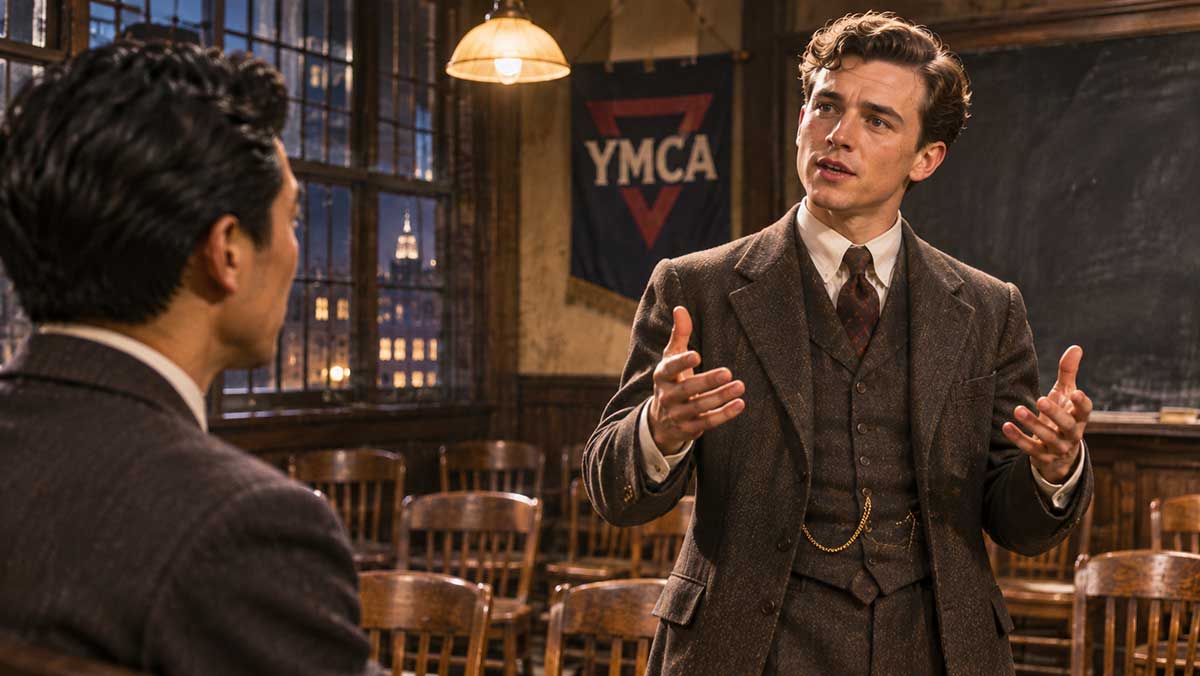
Opening Scene: A YMCA Classroom in New York City, 1912
New York City, autumn 1912.
Outside, the streets are crowded with horse-drawn wagons, motorcars, and pedestrians hurrying beneath the glow of electric streetlights.
Inside a modest YMCA classroom, a young man stands before a row of wooden chairs.
A blackboard hangs on the wall. Several sheets of paper lie scattered across a desk, and the faint smell of chalk fills the room.
The young man is practicing a speech.
Dale Carnegie: Gentlemen, the greatest obstacle to effective speaking is often not a lack of knowledge, but a lack of confidence!
He pauses.
Dale Carnegie: No, no. That's too stiff.
He tries again.
Dale Carnegie: Gentlemen, have you ever stood before an audience and suddenly forgotten every sensible thought you've ever had?
He smiles.
Dale Carnegie: That's better.
A voice comes from the doorway.
Nick Sasaki: I certainly have. Usually when someone asks me a very simple question.
Dale turns.
For a moment, he stares at the visitor.
Then his face lights up.
Dale Carnegie: Nick?
Nick Sasaki: Hello, Dale!
Dale Carnegie: Nick Sasaki?
Nick Sasaki: The very same.
Dale Carnegie: Good heavens!
He hurries across the classroom and shakes Nick's hand enthusiastically.
Dale Carnegie: Where have you been? It's been six years!
Nick Sasaki: Has it really been that long?
Dale Carnegie: Six years! You disappeared from a Missouri farm road, and I haven't heard a word from you since.
Nick Sasaki: I hope you weren't waiting beside that fence.
Dale Carnegie: I gave up after the third winter.
They burst into laughter.
Dale steps back and looks Nick over.
Dale Carnegie: There's something peculiar about you.
Nick Sasaki: Only one thing?
Dale Carnegie: You haven't aged a day!
Nick Sasaki: Thank you. I try to take care of myself.
Dale Carnegie: Well, whatever you're doing, you ought to bottle it and sell it. You'd make a fortune.
Nick Sasaki: Perhaps I'll consider that.
Dale Carnegie: And you still haven't told me where you're from.
Nick Sasaki: I was hoping you'd forgotten.
Dale Carnegie: Nick, I teach public speaking. Remembering an interesting conversation is practically part of my profession.
Nick Sasaki: So you're teaching now?
Dale spreads his arms toward the classroom.
Dale Carnegie: Apparently!
Nick Sasaki: Dale, this is wonderful.
Dale Carnegie: Thank you. Though I must admit, if you'd visited a little earlier in my life, you might have found me doing something entirely different.
Nick Sasaki: That's exactly what I want to hear about.
Dale laughs.
Dale Carnegie: Of course it is. You always did enjoy asking questions.
Nick Sasaki: And you always had interesting answers.
Dale Carnegie: Well, sit down, Nick. I've got some stories for you.
They settle into two wooden chairs near the front of the classroom.
For a moment, the two friends simply enjoy being together again.
Question 1. Dale, What Happened to Your Big Dreams After You Left Missouri?
Nick Sasaki: Dale, when we first met, you were eighteen years old.
You wanted to become successful, respected, and important.
You were practicing public speaking, and you had big dreams.
So tell me, how did everything turn out?
Dale throws back his head and laughs.
Dale Carnegie: Nick, how much time have you got?
Nick Sasaki: As much as you need.
Dale Carnegie: Then prepare yourself for a tale of extraordinary ambition, questionable decisions, and several disappointments.
Nick Sasaki: That sounds like my kind of story.
Dale Carnegie: I knew you'd enjoy it.
He leans back.
Dale Carnegie: After school, I worked in sales. I sold correspondence courses, and later I worked selling meat products for Armour and Company.
Nick Sasaki: Meat products?
Dale Carnegie: Yes, sir.
Nick Sasaki: Dale, I have to say, when we met on that farm road, I didn't picture you becoming a meat salesman.
Dale Carnegie: Neither did I!
They laugh.
Nick Sasaki: Were you any good at it?
Dale Carnegie: I learned a great deal, and I did well enough to develop some confidence in my ability to deal with people.
Nick Sasaki: What did you learn?
Dale Carnegie: That people are far more interested in their own problems than in whatever you're trying to sell them.
Nick Sasaki: That's a useful lesson.
Dale Carnegie: It is. A salesman who talks endlessly about his product without considering the customer's needs may find himself talking to an empty room.
Nick Sasaki: Did you ever do that?
Dale Carnegie: I expect I gave a few people more information about meat than they ever wished to possess.
Nick laughs.
Nick Sasaki: I'm sure they were grateful.
Dale Carnegie: Perhaps they were simply relieved when I left.
They laugh together.
Nick Sasaki: But you didn't stay in sales.
Dale Carnegie: No. I wanted something different.
Nick Sasaki: What?
Dale Carnegie: Acting.
Nick looks at him.
Nick Sasaki: Acting?
Dale Carnegie: Don't sound so surprised!
Nick Sasaki: I'm trying to picture you on a stage.
Dale Carnegie: I thought I might have a future in the theater.
Nick Sasaki: Did you?
Dale Carnegie: The theater and I had different opinions on that subject.
Nick bursts out laughing.
Nick Sasaki: Dale!
Dale Carnegie: I pursued training and tried to make something of myself as an actor. But it didn't become the career I'd hoped for.
Nick Sasaki: Were you disappointed?
Dale Carnegie: Very much.
I had pictured a different future.
Nick Sasaki: What did you love about acting?
Dale Carnegie: The opportunity to stand before an audience and hold its attention.
The excitement of communicating something that mattered.
And, if I'm being entirely truthful, the possibility of recognition.
Nick Sasaki: There he is.
Dale Carnegie: Who?
Nick Sasaki: The eighteen-year-old Dale from Missouri.
Dale smiles.
Dale Carnegie: I suppose he came along to New York with me.
Nick Sasaki: Did he still want people to admire him?
Dale Carnegie: Very much.
Nick Sasaki: I liked that fellow.
Dale Carnegie: He was rather ambitious.
Nick Sasaki: And funny.
Dale Carnegie: He didn't always know it.
They share a smile.
Nick Sasaki: Dale, can I tell you something?
Dale Carnegie: Certainly.
Nick Sasaki: I've had plans that looked wonderful in my head and rather different when I tried to put them into practice.
Dale Carnegie: Haven't we all?
Nick Sasaki: The difficult part is admitting that a dream may need to change.
Dale Carnegie: Yes. Particularly when you've told everyone what you're going to accomplish.
Nick Sasaki: Then you have to explain what happened.
Dale Carnegie: Or avoid everyone who remembers!
They laugh.
Nick Sasaki: Did you ever feel embarrassed about changing direction?
Dale Carnegie: At times. But I eventually began to see that a disappointing experience can still teach you something valuable.
Nick Sasaki: Such as?
Dale Carnegie: Sales taught me to pay attention to people.
Acting taught me something about preparation, expression, and audiences.
Neither became my life's work, but both contributed to what I'm doing now.
Nick Sasaki: That's interesting. You didn't have to erase those experiences to begin something new.
Dale Carnegie: No. I could make use of what I'd learned.
Nick Sasaki: I think many people need to hear that.
Sometimes we look at our past and see only the things that didn't work.
Dale Carnegie: When perhaps we should ask what those experiences prepared us to do next.
Nick Sasaki: Exactly.
Dale grins.
Dale Carnegie: Nick, you ought to be teaching this course with me.
Nick Sasaki: I think I'll leave that to you.
Dale Carnegie: Wise decision. I haven't figured out how to pay myself yet.
They laugh.
Question 2. How Did a YMCA Classroom Help You Discover What You Really Loved?
Nick looks around the classroom.
Nick Sasaki: Dale, I have to ask. How did you end up here?
Dale Carnegie: Teaching public speaking?
Nick Sasaki: Yes. The last time I saw you, you were a farm boy dreaming of a better future. Now you're in New York teaching adults how to speak confidently.
That's quite a change.
Dale Carnegie: It certainly is.
Nick Sasaki: Was this your grand plan all along?
Dale Carnegie: Nick, if you'd asked me a few years ago whether I intended to become a public-speaking instructor, I might have laughed.
Nick Sasaki: Then how did it happen?
Dale Carnegie: I began to think about what I actually enjoyed and what I might be able to teach.
Public speaking had interested me since my student days.
And I knew how much fear it could create.
So I approached the YMCA about offering a course.
Nick Sasaki: Did they welcome you immediately?
Dale Carnegie: It wasn't quite that simple. I had to find an arrangement that would give the classes a chance.
Nick Sasaki: That must have been nerve-racking.
Dale Carnegie: It was certainly uncertain.
Nick Sasaki: Did you worry that nobody would come?
Dale Carnegie: Naturally.
Nick Sasaki: And what if people came but didn't like you?
Dale Carnegie: Then I suppose I'd have had a room full of disappointed gentlemen.
Nick Sasaki: And a very short teaching career.
Dale Carnegie: Thank you, Nick. You're wonderfully encouraging.
They laugh.
Nick Sasaki: Sorry. I'm trying to picture what it felt like.
Dale Carnegie: I know.
He looks around the room.
Dale Carnegie: The remarkable thing is that people came with difficulties I recognized immediately.
Nick Sasaki: What kinds of difficulties?
Dale Carnegie: Fear of standing before a group.
Fear of forgetting what they intended to say.
Fear of looking foolish.
Fear of being judged.
Nick Sasaki: That sounds familiar.
Dale Carnegie: Very familiar.
Nick Sasaki: The Missouri farm boy again?
Dale Carnegie: Yes.
He smiles.
Dale Carnegie: I began to realize that many of these men were struggling with the same feelings I'd experienced.
Nick Sasaki: Were they successful men?
Dale Carnegie: Some were businessmen or professionals. Others were simply trying to improve their prospects.
But their occupations didn't necessarily protect them from nervousness.
Nick Sasaki: That's fascinating.
Someone might negotiate a business deal all morning and still be terrified of giving a short speech that evening.
Dale Carnegie: Precisely.
Nick Sasaki: So what did you do with them?
Dale Carnegie: I had them speak.
Nick Sasaki: Just like that?
Dale Carnegie: Just like that.
Nick Sasaki: Dale, that's a little cruel!
Dale Carnegie: Only if you leave them standing there without encouragement.
They laugh.
Nick Sasaki: Tell me how it works.
Dale Carnegie: A student may begin with only a few words.
Perhaps he speaks about something familiar from his own experience.
Then he tries again.
He discovers that he can stand before other people and survive the experience.
Nick Sasaki: And the next time?
Dale Carnegie: He may speak a little longer.
With practice, he begins to improve.
Nick Sasaki: What do you do when someone makes a mistake?
Dale Carnegie: Help him learn from it.
Nick Sasaki: Do you criticize him?
Dale Carnegie: I try to offer useful guidance without making him feel humiliated.
Nick Sasaki: Why does that matter so much?
Dale Carnegie: Think about it, Nick.
A man comes here afraid that people will laugh at him.
If I respond to every mistake by embarrassing him, what have I taught him?
Nick Sasaki: That he was right to be afraid.
Dale Carnegie: Exactly.
Nick Sasaki: That's a wonderful point.
Dale Carnegie: I want him to discover that mistakes are part of learning.
Nick Sasaki: And that people can encourage one another instead of waiting for someone to fail.
Dale Carnegie: Yes.
Nick looks toward the empty chairs.
Nick Sasaki: Dale, could we try something?
Dale Carnegie: What do you have in mind?
Nick Sasaki: Pretend I'm one of your students.
Dale Carnegie: Very well.
Nick Sasaki: I'm terrified of public speaking.
Dale Carnegie: You hide it remarkably well.
Nick Sasaki: I'm a talented actor.
Dale Carnegie: Better than I was, apparently.
They laugh.
Nick Sasaki: So what would you ask me to do?
Dale Carnegie: Stand up.
Nick rises.
Dale Carnegie: Now tell me about something that interests you.
Nick Sasaki: Anything?
Dale Carnegie: Anything you know well enough to discuss.
Nick Sasaki: How about friendship?
Dale Carnegie: Excellent.
Nick Sasaki: All right. Friendship is important. Everyone should have friends. Friends are very good.
He stops.
Dale waits.
Nick Sasaki: That's all I've got.
Dale bursts into laughter.
Dale Carnegie: A remarkable speech, Nick. Brief, clear, and impossible to disagree with.
Nick Sasaki: Thank you. I worked very hard on it.
Dale Carnegie: Now let's try something else.
Tell me about a friend who made a difference in your life.
Nick becomes thoughtful.
Nick Sasaki: Well, I once met a young man on a farm road in Missouri.
He was rather insecure, but he had big dreams.
We talked for a long time, and I found myself enjoying his company.
Dale Carnegie: Did you?
Nick Sasaki: Very much.
Dale Carnegie: What happened to him?
Nick Sasaki: I heard he became a teacher in New York.
Dale laughs.
Dale Carnegie: That's a considerable improvement over your first speech.
Nick Sasaki: Why?
Dale Carnegie: You told a story.
You spoke about something meaningful to you.
And you weren't trying so hard to sound impressive.
Nick Sasaki: That's interesting.
Dale Carnegie: When people speak from genuine experience, they often become more natural.
Nick Sasaki: So confidence doesn't always come from memorizing beautiful sentences.
Dale Carnegie: No. It can come from having something you sincerely want to communicate.
Nick sits down.
Nick Sasaki: Dale, I think I'm beginning to see why you enjoy this work.
Dale Carnegie: Why?
Nick Sasaki: You get to watch people surprise themselves.
Dale smiles.
Dale Carnegie: That's a lovely way of putting it.
Nick Sasaki: Someone walks into this room thinking, "I can't do this."
Then a few weeks later, he stands up and speaks.
And perhaps he begins wondering what else he might be capable of.
Dale Carnegie: Yes.
Nick Sasaki: That must be incredibly satisfying.
Dale Carnegie: It is, Nick. It truly is.
For a moment, Dale looks around the classroom with quiet affection.
Dale Carnegie: I spent years wondering what I ought to do with my life.
Now I find myself looking forward to coming here.
Nick Sasaki: That's a wonderful feeling.
Dale Carnegie: It is.
Nick Sasaki: Better than selling meat?
Dale Carnegie: Considerably.
They laugh together.
Question 3. What Do You Most Want Your Students to Discover About Themselves?
The evening has grown darker.
Through the classroom windows, electric lights glow along the New York streets.
Nick and Dale remain seated near the blackboard.
Nick Sasaki: Dale, can I ask you something?
Dale Carnegie: I was wondering when you'd get around to another question.
Nick Sasaki: I've been behaving myself.
Dale Carnegie: For almost five minutes.
They laugh.
Nick Sasaki: When someone finishes your course, what do you most hope they've gained?
Dale Carnegie: Greater confidence in speaking, certainly.
Nick Sasaki: Anything beyond that?
Dale Carnegie: I hope they begin to trust their ability to improve.
Nick Sasaki: What do you mean?
Dale Carnegie: Many people believe that confidence is something a person either possesses or lacks.
They see a comfortable speaker and assume he was born that way.
Nick Sasaki: But you weren't.
Dale Carnegie: Certainly not.
Nick Sasaki: Neither were many of your students.
Dale Carnegie: Exactly.
Nick Sasaki: So what do you want them to discover?
Dale Carnegie: That courage can grow through action.
Nick Sasaki: I love that.
Dale Carnegie: A man may still feel nervous when he stands before a group.
But he can learn to speak anyway.
And with practice, the experience often becomes less frightening.
Nick Sasaki: That sounds like something people could apply outside this classroom.
Dale Carnegie: I believe so.
Nick Sasaki: Such as asking for a better job?
Dale Carnegie: Certainly.
Nick Sasaki: Expressing an opinion in a meeting?
Dale Carnegie: Yes.
Nick Sasaki: Telling someone you love them?
Dale smiles.
Dale Carnegie: That may require more courage than delivering a speech.
Nick laughs.
Nick Sasaki: You may be right.
Dale Carnegie: A man can practice a speech in front of a mirror.
It's rather more difficult to rehearse what happens when the person you love answers him.
Nick Sasaki: And sometimes the answer isn't what he hoped for.
Dale Carnegie: Indeed.
They smile.
Nick Sasaki: Dale, there's something else I noticed during our little speaking exercise.
Dale Carnegie: What's that?
Nick Sasaki: You didn't make me feel foolish when I gave that terrible first speech.
Dale Carnegie: It wasn't terrible.
Nick Sasaki: Dale, I said, "Friends are very good."
Dale Carnegie: A perfectly respectable observation.
Nick Sasaki: You're too kind.
Dale Carnegie: I was tempted to ask whether enemies were very bad, but I restrained myself.
Nick laughs.
Nick Sasaki: See? That's what I mean. You helped me relax.
Dale Carnegie: Good.
Nick Sasaki: Do you think that matters as much as the actual speaking instruction?
Dale considers the question.
Dale Carnegie: Perhaps more than people realize.
A student needs opportunities to improve, but he must feel able to attempt something difficult.
Nick Sasaki: So you're creating an atmosphere where people can take risks without feeling humiliated.
Dale Carnegie: That's certainly what I hope to do.
Nick Sasaki: I wonder how many people go through life without that kind of encouragement.
Dale Carnegie: Probably more than we'd like to think.
Nick Sasaki: Have you ever met someone who seemed capable of much more than he believed?
Dale Carnegie: Yes.
Nick Sasaki: What did you want to tell him?
Dale Carnegie: That he should give himself a fair opportunity.
Nick Sasaki: That's a gentle way of putting it.
Dale Carnegie: People can be very severe judges of their own abilities.
Nick Sasaki: I've noticed that.
Dale Carnegie: They remember their mistakes, overlook their progress, and compare themselves with someone who has practiced for years.
Nick Sasaki: That sounds like the young Dale Carnagey.
Dale laughs softly.
Dale Carnegie: It does, doesn't it?
Nick Sasaki: Do you think teaching these students is helping you, too?
Dale Carnegie: Very much.
Nick Sasaki: How?
Dale Carnegie: I see the difficulties I once struggled with reflected in other people.
And when I help them, I learn something about myself.
Nick Sasaki: What have you learned?
Dale looks toward the classroom door.
Dale Carnegie: That I may have spent too much time thinking about whether I was important.
Nick Sasaki: Really?
Dale Carnegie: When I was younger, I wanted people to admire me.
I wanted to stand out.
I wanted to prove that a poor farm boy could accomplish something.
Nick Sasaki: Those ambitions brought you a long way.
Dale Carnegie: They did.
But there's something satisfying about helping another person succeed.
Nick Sasaki: More satisfying than applause?
Dale smiles.
Dale Carnegie: Don't ask me to give up applause entirely, Nick.
Nick Sasaki: I wouldn't dream of it.
Dale Carnegie: But yes, there's a different kind of satisfaction in seeing someone develop confidence.
Nick Sasaki: What does it feel like?
Dale thinks for a moment.
Dale Carnegie: Suppose a student arrives here frightened of speaking.
He struggles through his first attempts.
He practices.
Then one evening, he gives a speech that surprises everyone, including himself.
And afterward, he smiles.
Not simply from relief.
But from discovering that he's capable of something he once thought impossible.
Nick Sasaki: And you're happy for him.
Dale Carnegie: Very happy.
Nick Sasaki: Dale, I think you've found something important.
Dale Carnegie: What is it?
Nick Sasaki: When we first met, you wanted to become someone the world would admire.
Now you're discovering how wonderful it feels to help someone else believe in himself.
Dale looks down, smiling.
Dale Carnegie: I hadn't put it quite that way.
Nick Sasaki: Does it feel true?
Dale Carnegie: Yes. I think it does.
A comfortable silence settles between them.
Outside, a motorcar rattles past.
Dale Carnegie: Nick, may I ask you something?
Nick Sasaki: Of course.
Dale Carnegie: What do you want to accomplish with your life?
Nick looks surprised.
Nick Sasaki: Me?
Dale Carnegie: Yes. You've asked me about my ambitions for two meetings now. I think it's only fair that I ask about yours.
Nick Sasaki: That's a good question.
He considers it.
Nick Sasaki: I want to create something that helps people see life differently.
Something that makes them think, but perhaps makes them feel something, too.
Dale Carnegie: What sort of thing?
Nick Sasaki: Conversations, perhaps.
Stories about people.
Their hopes, fears, mistakes, and discoveries.
Dale Carnegie: That sounds interesting.
Nick Sasaki: I'd like people to finish reading one of those conversations and feel a little more hopeful about their own lives.
Dale Carnegie: Then I think you should pursue it.
Nick Sasaki: You do?
Dale Carnegie: Certainly.
Nick Sasaki: What if nobody reads them?
Dale Carnegie: Then perhaps you should begin by making one conversation worth reading.
Nick laughs.
Nick Sasaki: That's rather practical advice.
Dale Carnegie: I'm a teacher now. I'm expected to offer practical advice.
Nick Sasaki: And what if I fail?
Dale Carnegie: Then you'll have something interesting to tell me when we meet again.
They both laugh.
Nick Sasaki: Dale, you're becoming a very good friend.
Dale Carnegie: I hope so.
Closing Scene: The Empty Classroom
The classroom clock approaches nine.
Dale gathers his papers and places them neatly on the desk.
Nick stands and looks around the room once more.
Nick Sasaki: You know, Dale, I think this is where you belong.
Dale Carnegie: In a classroom?
Nick Sasaki: Helping people discover what they're capable of.
Dale Carnegie: I hope you're right.
Nick Sasaki: Do you think you'll keep teaching?
Dale Carnegie: I intend to. There's so much I want to learn about speaking and human behavior.
Nick Sasaki: Human behavior?
Dale Carnegie: Yes. The more I work with people, the more interested I become in what encourages them, what frightens them, and what helps them change.
Nick Sasaki: That could keep you busy for a lifetime.
Dale Carnegie: I suspect it will.
They walk toward the classroom door.
Nick Sasaki: Dale, I have a feeling you'll write a book someday.
Dale Carnegie: A book?
Nick Sasaki: Perhaps several.
Dale Carnegie: Nick, at the moment I'm trying to persuade people to attend my classes.
Nick Sasaki: One thing at a time.
Dale Carnegie: Precisely.
Nick Sasaki: But if you do write a book, I hope you'll remember something.
Dale Carnegie: What's that?
Nick Sasaki: People may forget a great deal of what you teach them, but they'll remember how you made them feel.
Dale pauses.
Dale Carnegie: That's a lovely thought.
Nick Sasaki: I think it's true.
Dale Carnegie: Then perhaps I ought to write that down.
Nick Sasaki: You said the same thing six years ago.
Dale Carnegie: Did I?
Nick Sasaki: On the farm road.
Dale Carnegie: Good heavens. I've been repeating myself for six years!
They laugh.
At the doorway, Dale turns toward Nick.
Dale Carnegie: I'm glad you came back.
Nick Sasaki: So am I.
Dale Carnegie: Will it be another six years before I see you?
Nick Sasaki: I can't promise anything.
Dale Carnegie: You really are a mysterious fellow.
Nick Sasaki: I've been told that.
Dale Carnegie: Well, wherever you go, I hope you're working on those conversations you mentioned.
Nick Sasaki: I will.
Dale Carnegie: And Nick?
Nick Sasaki: Yes?
Dale Carnegie: Don't wait until you feel perfectly confident.
Start.
Nick smiles.
Nick Sasaki: I'll try to take my own advice for once.
Dale Carnegie: Excellent. Then we're both learning something.
They shake hands warmly.
Nick steps into the hallway.
Dale Carnegie: Nick!
Nick turns.
Nick Sasaki: What is it?
Dale Carnegie: Next time, bring a better speech about friendship.
Nick Sasaki: I'll work on it.
Dale Carnegie: And perhaps a few examples of why friends are very good!
Nick laughs.
Nick Sasaki: Goodbye, Dale.
Dale Carnegie: Until next time, Nick.
The classroom door closes.
Dale returns to his desk.
He looks at the empty chairs, remembering the nervous faces of the men who sat in them earlier that evening.
He thinks about how frightened some of them were when they first stood to speak.
And how different they looked after discovering that they could do it.
Six years ago, Dale Carnagey wanted the world to recognize his importance.
Now, in a modest New York classroom, he has discovered a new kind of satisfaction.
Helping other people recognize their own worth.
He picks up his notes and smiles.
Tomorrow evening, another group of students will arrive.
Some will be confident.
Others will be nervous.
A few may be so frightened that they can barely introduce themselves.
And Dale will welcome them.
He has found work that makes him eager for tomorrow.
In Topic 3, Nick returns to meet Dale Carnegie in 1936, when his book How to Win Friends and Influence People is about to introduce his ideas to a much larger audience. Their friendship has grown, and Nick is curious about what Carnegie has discovered through more than two decades of studying human relationships.
Fictional Interview Disclaimer
This imaginary conversation between Nick Sasaki and Dale Carnegie is inspired by Carnegie's early career in sales, his unsuccessful pursuit of acting, and the public-speaking classes he began teaching at a New York YMCA in 1912. The dialogue, reunion, classroom demonstration, jokes, private reflections, and friendship are fictional. Carnegie's imagined statements are creative interpretations of ideas associated with his teaching and later writings, not verified quotations.
Topic 3. Did He Discover the Secret to Genuine Friendship?
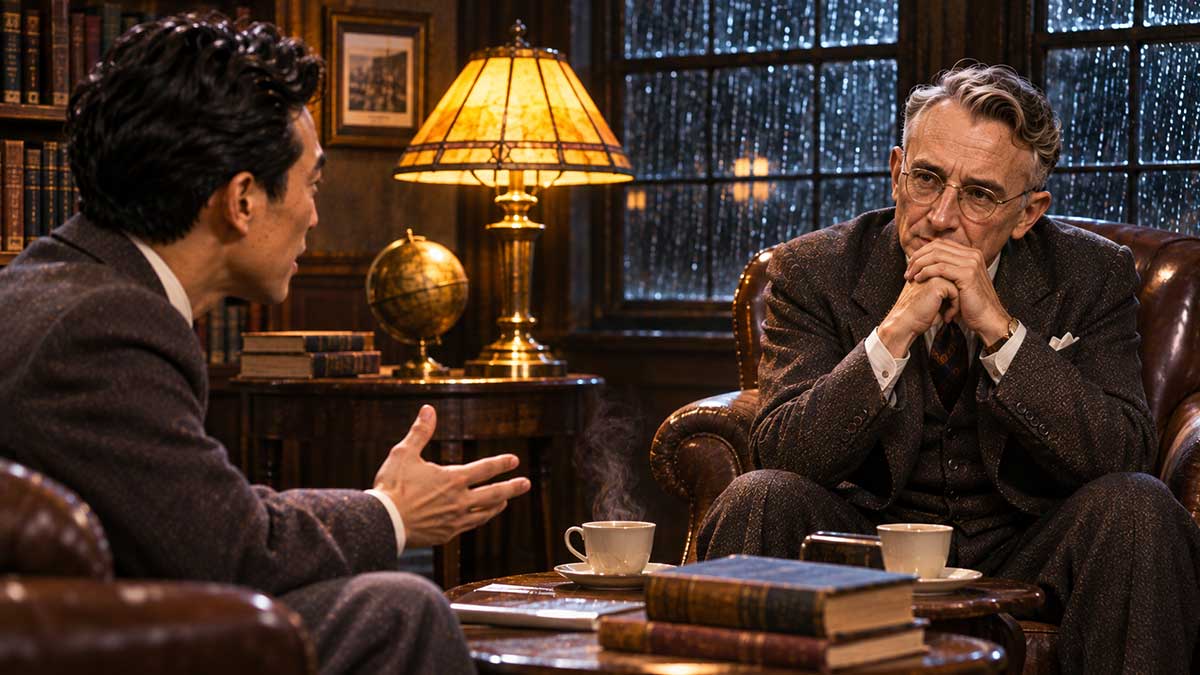
Opening Scene: A Rainy Evening in New York City, 1936
Rain falls against the windows of a small writing room in New York City.
Outside, yellow taxicabs move through wet streets, and pedestrians hurry beneath umbrellas. The city is alive with conversation, ambition, and the endless movement of people pursuing their dreams.
Inside, a desk lamp casts a warm circle of light over a manuscript.
How to Win Friends and Influence People.
The pages are covered with corrections, handwritten notes, and examples gathered from years of teaching.
Dale Carnegie, now forty-seven years old, sits at the desk, reading a paragraph aloud.
Dale Carnegie: "Become genuinely interested in other people."
He pauses.
Dale Carnegie: Genuinely. That's the important word.
He makes a small correction.
A familiar voice comes from the doorway.
Nick Sasaki: Dale, I hope you're practicing what you're preaching.
Carnegie looks up.
For a moment, he stares in disbelief.
Then he breaks into a broad smile.
Dale Carnegie: Nick Sasaki!
Nick Sasaki: Hello, old friend!
Carnegie rises quickly.
Dale Carnegie: Good heavens! Come here!
They shake hands warmly.
Dale Carnegie: Twenty-four years!
Nick Sasaki: Has it really been that long?
Dale Carnegie: Twenty-four years since that YMCA classroom! I've written books, taught thousands of people, and acquired a few gray hairs.
He steps back and examines Nick.
Dale Carnegie: And you still look exactly the same!
Nick Sasaki: Good lighting.
Dale Carnegie: Good lighting? Nick, I've aged a quarter of a century!
Nick Sasaki: Perhaps you should change your lighting.
Carnegie bursts out laughing.
Dale Carnegie: I missed you, you rascal!
Nick Sasaki: I missed you too, Dale.
They embrace briefly.
Dale Carnegie: Come in, come in. Sit down. Tell me where you've been.
Nick Sasaki: That's a long story.
Dale Carnegie: You said that in Missouri. You said it again at the YMCA. I'm beginning to suspect you don't actually have an answer.
Nick Sasaki: You may be right.
Dale Carnegie: Wonderful. My oldest mysterious friend.
They laugh.
Nick notices the manuscript.
Nick Sasaki: What's this?
Dale Carnegie: Something I've been working on.
Nick Sasaki: How to Win Friends and Influence People.
He reads the title again.
Nick Sasaki: Dale, that's quite a promise!
Dale Carnegie: You think so?
Nick Sasaki: Certainly. If it works, every lonely man in America will want a copy.
Dale Carnegie: And every salesman.
Nick Sasaki: And every politician.
Dale Carnegie: Now you're making me nervous.
They laugh.
Nick Sasaki: How's the writing going?
Dale Carnegie: Some days wonderfully. Other days I spend an hour trying to improve a sentence and end up putting it back the way it was.
Nick Sasaki: Congratulations. You've become a writer.
Dale Carnegie: Is that what writing is?
Nick Sasaki: Much of the time.
Carnegie smiles and pours two cups of coffee.
Dale Carnegie: Well, Nick, you've arrived at a good moment. I've spent years studying how people get along with one another.
Nick Sasaki: And have you figured us out?
Dale Carnegie: Not entirely.
Nick Sasaki: That's reassuring.
Dale Carnegie: Why?
Nick Sasaki: I'd hate to think human beings could be explained in a single book.
Dale Carnegie: So would I.
They settle into chairs near the desk.
The rain continues outside.
Question 1. After Studying Human Relationships for So Many Years, What Did You Discover That People Need Most From One Another?
Nick Sasaki: Dale, when we first met in Missouri, you wanted people to recognize that you mattered.
Dale Carnegie: I remember.
Nick Sasaki: Then, in your YMCA classroom, you discovered how satisfying it was to help other people become confident.
Now you've spent more than twenty years teaching and observing human behavior.
What have you learned about people?
Carnegie smiles.
Dale Carnegie: That they're endlessly interesting.
Nick Sasaki: That's your grand discovery?
Dale Carnegie: You were expecting something more impressive?
Nick Sasaki: Perhaps a secret formula.
Dale Carnegie: If I possessed one, I'd charge you considerably more for this conversation.
They laugh.
Dale Carnegie: But seriously, Nick, I've come to believe that one of our deepest desires is to feel important.
Nick Sasaki: Important?
Dale Carnegie: To feel that our existence matters. That our efforts are noticed. That someone respects us.
Nick Sasaki: That sounds familiar.
Dale Carnegie: It should. You met a young fellow in Missouri who was practically starving for recognition.
Nick Sasaki: I remember him. He had a worn jacket and very ambitious plans.
Dale Carnegie: And a terrible tendency to compare himself with everyone else.
Nick Sasaki: Whatever happened to him?
Dale Carnegie: I'm afraid he's still around.
They laugh.
Nick Sasaki: So what changed?
Dale Carnegie: I began noticing that other people wanted appreciation just as much as I did.
Nick Sasaki: How did you discover that?
Dale Carnegie: Through teaching, business, and ordinary conversations.
I watched people respond to criticism, praise, encouragement, and indifference.
A person might forget many details of a conversation but remember a sincere compliment for years.
Nick Sasaki: Have you experienced that yourself?
Dale Carnegie: Certainly.
Nick Sasaki: Tell me.
Dale Carnegie: I remember how much encouragement meant when I was trying to improve my speaking.
A few words of confidence from someone I respected could make me eager to try again.
Nick Sasaki: I think we underestimate how much those moments matter.
Dale Carnegie: We do.
Nick Sasaki: Let me tell you a little story.
Dale Carnegie: Please.
Nick Sasaki: I once knew someone who worked incredibly hard, but hardly anyone acknowledged what he did.
Then one day, another person took a moment to thank him sincerely.
It wasn't a grand speech. Just a few thoughtful words.
But he remembered that conversation for years.
Dale Carnegie: That doesn't surprise me.
Nick Sasaki: Why do we remember those moments so clearly?
Dale Carnegie: Perhaps they answer a question many people quietly carry.
Nick Sasaki: Which question?
Dale Carnegie: "Does anyone notice what I'm trying to do?"
Nick nods.
Nick Sasaki: That's a beautiful way of putting it.
Dale Carnegie: We all want to feel that our efforts matter.
Nick Sasaki: Yet we're often so occupied with our own concerns that we overlook other people's efforts.
Dale Carnegie: Precisely.
Nick Sasaki: Dale, can I confess something?
Dale Carnegie: Certainly.
Nick Sasaki: Sometimes I become so focused on finishing a project that I forget to thank the people who helped me.
Dale Carnegie: You're not alone.
Nick Sasaki: Then later I realize how much their support meant.
Dale Carnegie: And what do you do?
Nick Sasaki: I try to tell them.
Dale Carnegie: Good.
Nick Sasaki: Though sometimes I wait too long.
Dale Carnegie: Then perhaps you and I both have something to practice.
Nick smiles.
Nick Sasaki: That's one thing I enjoy about talking with you, Dale.
Dale Carnegie: What's that?
Nick Sasaki: You don't make me feel foolish for admitting my mistakes.
Dale Carnegie: I have too many of my own to spend my time condemning yours.
They laugh.
Nick Sasaki: But here's something I've noticed. Some people are excellent at giving compliments, yet I don't always feel that they're interested in me.
Dale Carnegie: Ah. Now we're getting somewhere.
Nick Sasaki: What do you mean?
Dale Carnegie: There's a difference between saying pleasant things and taking a sincere interest in another person.
Nick Sasaki: Tell me more.
Dale Carnegie: A compliment can be offered mechanically.
But genuine interest requires attention.
You listen.
You ask questions.
You try to see the situation from the other person's viewpoint.
Nick Sasaki: Is that why you emphasize listening?
Dale Carnegie: Very much.
Nick Sasaki: You know, I've noticed that the most interesting people aren't always the ones who tell the best stories.
Dale Carnegie: Really?
Nick Sasaki: Sometimes they're the ones who make you feel comfortable telling your own.
Carnegie smiles.
Dale Carnegie: Nick, that's an excellent observation.
Nick Sasaki: Thank you.
Dale Carnegie: I may borrow it.
Nick Sasaki: Only if you give me credit.
Dale Carnegie: Then perhaps I'll have to think of something else.
They laugh.
Question 2. How Can We Tell the Difference Between Genuinely Caring About Someone and Using Kindness to Influence Them?
The rain grows heavier.
Carnegie moves a few manuscript pages away from an open window.
Nick Sasaki: Dale, I have a funny story for you.
Dale Carnegie: Good. I've been working all day. I could use one.
Nick Sasaki: Have you ever met someone who was so friendly that you began to wonder what he wanted?
Carnegie laughs immediately.
Dale Carnegie: Oh, certainly.
Nick Sasaki: You know the type.
He smiles constantly, remembers everyone's name, compliments your clothes, asks about your family.
And just when you're beginning to think you've made a wonderful new friend, he tries to sell you something.
Dale Carnegie: Nick, you're describing a few salesmen I've known.
Nick Sasaki: Including yourself?
Dale Carnegie: I hope I wasn't quite that obvious.
They laugh.
Nick Sasaki: But seriously, your book teaches people how to become more likable and influential.
Do you ever worry that someone might use those principles merely to get what he wants?
Carnegie thinks for a moment.
Dale Carnegie: It's possible for a person to imitate considerate behavior without feeling genuine concern.
Nick Sasaki: How can we tell the difference?
Dale Carnegie: Often through what happens when there's nothing to gain.
Nick Sasaki: That's interesting.
Dale Carnegie: If a man is friendly only when he expects a favor, people may eventually recognize the pattern.
But someone who sincerely values others behaves with consideration even when no reward is likely.
Nick Sasaki: So sincerity becomes visible over time.
Dale Carnegie: Often, yes.
Nick Sasaki: What about flattery?
Dale Carnegie: I make a strong distinction between flattery and honest appreciation.
Nick Sasaki: How would you explain it to someone who hasn't read your book?
Dale Carnegie: Flattery tells people what we think they want to hear.
Honest appreciation recognizes something we genuinely value.
Nick Sasaki: Can you give me an example?
Dale Carnegie: Suppose a student gives a speech that needs considerable improvement.
I could tell him it was magnificent.
Nick Sasaki: That would make him happy.
Dale Carnegie: For a moment, perhaps.
But if he knows the speech was poor, he may doubt my sincerity.
Nick Sasaki: So what would you say instead?
Dale Carnegie: I might point out something he did well.
Perhaps he spoke clearly during one part, or told an engaging story.
Then I could help him improve the rest.
Nick Sasaki: That reminds me of my first speech in your classroom.
Dale Carnegie: Ah, yes. Your masterpiece about friendship.
Nick Sasaki: "Friends are very good."
Carnegie bursts out laughing.
Dale Carnegie: I still remember it!
Nick Sasaki: You told me it was brief, clear, and impossible to disagree with.
Dale Carnegie: And I stand by that assessment.
Nick Sasaki: You were being generous.
Dale Carnegie: Perhaps. But you did improve considerably when you began telling a story.
Nick Sasaki: That's true.
They smile.
Nick Sasaki: Dale, can I ask something about disagreement?
Dale Carnegie: Certainly.
Nick Sasaki: Suppose two good friends disagree about something important.
One thinks the other is making a serious mistake.
Should he remain quiet to preserve the friendship?
Dale Carnegie: I wouldn't say that.
Nick Sasaki: Then how can he speak honestly without damaging the relationship?
Dale Carnegie: He can begin by remembering that the other person has reasons for thinking as he does.
He can ask questions.
He can express concern without attacking the person's character.
Nick Sasaki: So kindness doesn't require pretending to agree.
Dale Carnegie: No.
Nick Sasaki: That's a relief. Otherwise I'd have to agree with you about everything.
Dale Carnegie: A terrible burden.
Nick Sasaki: Particularly your opinions about acting.
Dale Carnegie: Nick, I have spent years recovering from that career. Must you bring it up again?
They laugh.
Nick Sasaki: I couldn't resist.
Dale Carnegie: I suspected as much.
Nick Sasaki: But here's a serious question.
What if someone is constantly unkind to us?
Should we keep smiling and trying to win their approval?
Carnegie considers the question.
Dale Carnegie: I don't think respect requires a person to accept mistreatment indefinitely.
Nick Sasaki: That's good to hear.
Dale Carnegie: We can be courteous while maintaining our judgment.
We can try to resolve a disagreement, but we cannot make every relationship successful through our efforts alone.
Nick Sasaki: So friendship needs something from both people.
Dale Carnegie: Certainly.
Nick Sasaki: Have you ever had a friendship that didn't work out?
Carnegie smiles faintly.
Dale Carnegie: I've lived long enough to experience misunderstandings and disappointments.
Nick Sasaki: Did you always handle them well?
Dale Carnegie: Nick, if I told you that, you'd know I was lying.
They laugh.
Dale Carnegie: I've made mistakes. I've spoken too quickly at times. I've misunderstood people.
Nick Sasaki: What helps when that happens?
Dale Carnegie: Admitting the mistake is a good beginning.
Nick Sasaki: That's difficult for some people.
Dale Carnegie: For nearly everyone, I suspect.
Nick Sasaki: Including authors of books about human relationships?
Dale Carnegie: Especially authors of books about human relationships. We have our reputations to worry about.
Nick laughs.
Nick Sasaki: Dale, I'm beginning to think the title of your next book should be How to Admit You're Wrong Without Fainting.
Dale Carnegie: Don't tempt me. I might write it.
They laugh together.
Question 3. Did You Want People to Become More Popular, or Did You Want Them to Become Better Human Beings?
The rain begins to soften.
A clock ticks quietly on the bookshelf.
Nick picks up the manuscript and turns a few pages.
Nick Sasaki: Dale, I think this book is going to help a lot of people.
Dale Carnegie: I certainly hope so.
Nick Sasaki: But I've been wondering about something.
Dale Carnegie: I knew that expression on your face meant another question was coming.
Nick Sasaki: You know me too well.
Dale Carnegie: After thirty years, I ought to.
Nick Sasaki: Thirty years?
Dale Carnegie: Since Missouri.
Nick Sasaki: You're right.
Dale Carnegie: And you've still never told me where you came from.
Nick Sasaki: Let's not get distracted.
Dale Carnegie: Very convenient.
They laugh.
Nick Sasaki: Here's my question.
Suppose someone reads your book, learns all the principles, and becomes extremely popular.
Everyone likes him.
He's invited to parties.
People praise him.
He becomes successful in business.
But when he's lonely or frightened, he doesn't have a single person he feels comfortable calling.
Would you consider him successful?
Carnegie looks thoughtful.
Dale Carnegie: Not in every important sense.
Nick Sasaki: Why not?
Dale Carnegie: Popularity and close friendship aren't necessarily the same thing.
Nick Sasaki: That's what I've been thinking.
Dale Carnegie: A man may be widely admired and still feel lonely.
Nick Sasaki: Have you ever felt lonely in a room full of people?
Carnegie pauses.
Dale Carnegie: I think many people have experienced that.
Nick Sasaki: I certainly have.
Dale Carnegie: What was it like?
Nick Sasaki: Strange.
People were talking and laughing all around me.
I was part of the gathering.
But I didn't feel that anyone really knew what I was thinking or feeling.
Dale Carnegie: That sounds painful.
Nick Sasaki: It was.
Dale Carnegie: Did you have someone you could talk to afterward?
Nick Sasaki: Fortunately, yes.
Dale Carnegie: I'm glad.
Nick Sasaki: That's why I think genuine friendship is different from simply being liked.
Dale Carnegie: I agree.
Nick Sasaki: What makes the difference?
Dale Carnegie: Trust, perhaps.
A willingness to listen.
A sincere interest in another person's welfare.
And the freedom to be oneself without constantly trying to make a favorable impression.
Nick Sasaki: That last part is especially meaningful.
Dale Carnegie: Why?
Nick Sasaki: Sometimes we spend so much energy trying to be impressive that we forget how to be ourselves.
Dale Carnegie: Yes.
Nick Sasaki: Have you ever done that?
Carnegie laughs softly.
Dale Carnegie: Nick, you met me when I was eighteen. I spent a considerable amount of time trying to impress people.
Nick Sasaki: I remember.
Dale Carnegie: I wanted to be admired.
I wanted to speak brilliantly.
I wanted people to recognize that I was capable of something worthwhile.
Nick Sasaki: And now?
Dale Carnegie: I still enjoy recognition. But I've discovered that there's considerable satisfaction in helping other people.
Nick Sasaki: Do you think that's the deeper message of your book?
Dale Carnegie: I hope readers will learn to take a sincere interest in others.
Nick Sasaki: Rather than simply trying to make themselves more popular.
Dale Carnegie: Yes.
Nick Sasaki: Dale, can I tell you what I think is most interesting about your life?
Dale Carnegie: Please.
Nick Sasaki: You began by wanting the world to notice you.
Then you discovered how much other people wanted to be noticed.
And now you're writing a book that encourages people to give one another the appreciation they themselves desire.
Carnegie smiles.
Dale Carnegie: That's a thoughtful way of looking at it.
Nick Sasaki: Does it feel true?
Dale Carnegie: I think it does.
He glances toward the manuscript.
Dale Carnegie: You know, Nick, when I began teaching public speaking, I thought I was helping people become better speakers.
But the more I worked with them, the more interested I became in their relationships with other people.
Nick Sasaki: What did you notice?
Dale Carnegie: A man might learn to speak confidently, yet still struggle to listen to his wife.
He might become successful in business but have difficulty getting along with his colleagues.
He might be admired professionally and still feel misunderstood at home.
Nick Sasaki: So communication is about much more than speaking well.
Dale Carnegie: Much more.
Nick Sasaki: Dale, there's something I want to ask you as a friend.
Dale Carnegie: Of course.
Nick Sasaki: Are you happy?
Carnegie looks surprised.
Dale Carnegie: That's quite a question.
Nick Sasaki: I know.
Dale Carnegie: I've been fortunate in many ways.
I have work that interests me. I've met remarkable people. I've had opportunities I never expected when I was growing up in Missouri.
Nick Sasaki: I'm happy for you.
Dale Carnegie: Thank you.
Nick Sasaki: But do you ever worry?
Carnegie laughs.
Dale Carnegie: Naturally!
Nick Sasaki: About what?
Dale Carnegie: Work. Decisions. The future. The ordinary concerns of life.
Nick Sasaki: Does success make those worries disappear?
Dale Carnegie: Not entirely.
Nick Sasaki: That's interesting.
Dale Carnegie: Why?
Nick Sasaki: When we first met, you hoped success would make you feel secure.
Dale Carnegie: I did.
Nick Sasaki: Now you've achieved a great deal, yet you still have worries.
Carnegie smiles.
Dale Carnegie: Apparently, success hasn't made me a different species.
They laugh.
Nick Sasaki: I'm glad. I like the human version of Dale Carnegie.
Dale Carnegie: So do I. He's the only version I've got.
They laugh again.
Nick Sasaki: Dale, I think your next great subject may be worry.
Dale Carnegie: Worry?
Nick Sasaki: Yes. You've spent years studying how people relate to one another.
Perhaps someday you'll explore how people can live more peacefully with their own thoughts.
Carnegie looks interested.
Dale Carnegie: That's a fascinating subject.
Nick Sasaki: I think you'd have a great deal to say about it.
Dale Carnegie: Perhaps.
Nick Sasaki: And I'd love to hear it.
Closing Scene: A Friendship That Has Grown
The rain has stopped.
Outside, the city lights reflect in the wet streets.
Carnegie gathers the manuscript pages and places them in a neat stack.
Dale Carnegie: Nick, I'm glad you came tonight.
Nick Sasaki: So am I.
Dale Carnegie: I've spent the entire day thinking about this book. It's been pleasant to put the pages aside and simply talk with an old friend.
Nick Sasaki: That's exactly how I feel.
Dale Carnegie: You know, there's something amusing about our friendship.
Nick Sasaki: What's that?
Dale Carnegie: You appear every decade or two, ask me questions about my life, refuse to tell me anything about yours, and then disappear again.
Nick laughs.
Nick Sasaki: When you put it that way, I sound rather suspicious.
Dale Carnegie: Extremely suspicious.
Nick Sasaki: Yet you keep inviting me in.
Dale Carnegie: Well, you are good company.
Nick Sasaki: Thank you, Dale.
Dale Carnegie: And you listen rather well.
Nick Sasaki: I've learned from a good teacher.
They smile.
Nick Sasaki: Dale, I want to tell you something before I go.
Dale Carnegie: Please.
Nick Sasaki: When I met you in Missouri, you were worried that nobody would ever consider you important.
I wish that young man could see you now.
Carnegie looks toward the manuscript.
Dale Carnegie: I think he'd be astonished.
Nick Sasaki: He would.
Dale Carnegie: But I hope he'd be pleased by more than the books.
Nick Sasaki: What else?
Dale Carnegie: That I found work I enjoy.
That I've met good people.
That I've been able to help others become more confident.
Nick smiles.
Nick Sasaki: I think he'd be proud of you.
Carnegie looks touched.
Dale Carnegie: Thank you, Nick.
A comfortable silence follows.
Then Dale grins.
Dale Carnegie: Now, before you disappear for another twenty years, tell me one thing.
Nick Sasaki: What's that?
Dale Carnegie: Have you improved your speech about friendship?
Nick laughs.
Nick Sasaki: I have.
Dale Carnegie: Let's hear it.
Nick stands.
He clears his throat dramatically.
Nick Sasaki: Ladies and gentlemen, friendship is very important.
Dale begins laughing.
Nick Sasaki: Friends are very good.
Carnegie laughs harder.
Nick Sasaki: And if you're fortunate enough to have a friend who listens, encourages you, and laughs at your terrible jokes, you should appreciate him.
Dale's laughter softens into a warm smile.
Dale Carnegie: Now that's a considerable improvement.
Nick Sasaki: Thank you.
Dale Carnegie: Though I think you could shorten the introduction.
They laugh together.
Nick moves toward the door.
Nick Sasaki: Until next time, Dale.
Dale Carnegie: Until next time, Nick.
They shake hands warmly.
As Nick steps into the hallway, Carnegie calls after him.
Dale Carnegie: Nick!
Nick Sasaki: Yes?
Dale Carnegie: You said something earlier about thanking people who have helped you.
Nick Sasaki: I did.
Dale Carnegie: Have you told that friend of yours how much he means to you?
Nick smiles.
Nick Sasaki: I think I just did.
Carnegie pauses.
Then he laughs softly.
Dale Carnegie: Well played, Nick.
Nick Sasaki: Good night, Dale.
Dale Carnegie: Good night, old friend.
The door closes.
Carnegie returns to his desk.
He looks at the manuscript once more.
How to Win Friends and Influence People.
He has spent years collecting stories and studying the principles of human relationships.
Yet tonight, he has been reminded that friendship is not simply a subject to study.
It is something to experience.
A shared laugh.
An honest conversation.
The comfort of being known.
And the pleasure of knowing that somewhere in the world, there is someone who is genuinely glad you exist.
Carnegie picks up his pen.
He returns to the sentence he had been considering when Nick arrived.
"Become genuinely interested in other people."
This time, he smiles.
The words seem less like a principle in a book and more like a description of the evening he has just enjoyed.
In Topic 4, Nick returns to meet Dale Carnegie in 1948, as the author prepares How to Stop Worrying and Start Living. Their friendship continues through a conversation about fear, uncertainty, happiness, and whether a man who has helped millions of people can find peace within himself.
Fictional Interview Disclaimer
This imaginary conversation between Nick Sasaki and Dale Carnegie is inspired by Carnegie's teaching career, his study of human relationships, and the 1936 publication of How to Win Friends and Influence People. The reunion, dialogue, humor, private reflections, and friendship are fictional. Carnegie's imagined statements reflect themes associated with his published teachings and should not be treated as verified quotations or documented personal experiences.
Topic 4. Did the Man Who Taught Others to Stop Worrying Find Peace Himself?
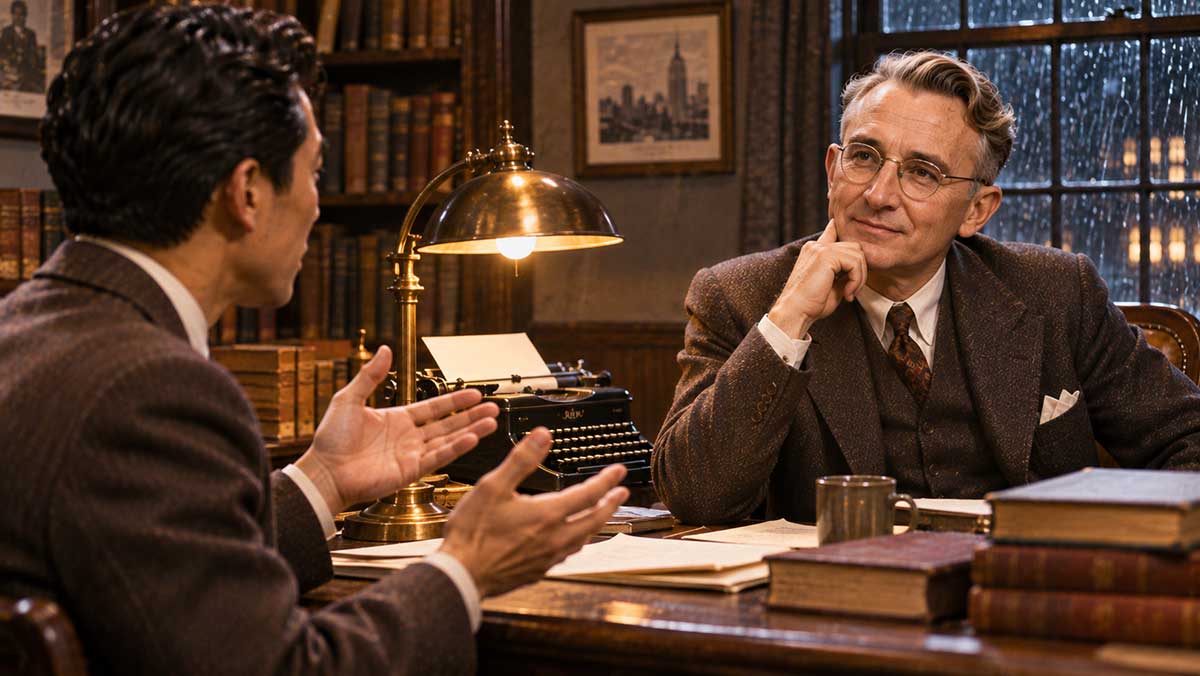
Opening Scene: A Rainy Night in New York City, 1948
New York City, autumn 1948.
Rain taps against the tall windows of Dale Carnegie's study. Beyond the glass, streetlights shimmer on wet pavement, and the occasional motorcar passes through the darkness.
Inside, a fire burns quietly in the fireplace.
Books fill the shelves. A brass lamp illuminates a desk covered with notes, letters, and pages from Carnegie's latest manuscript.
How to Stop Worrying and Start Living.
Dale Carnegie, now fifty-nine, sits in an armchair with a pencil in his hand.
He reads a passage, crosses out several words, and sighs.
Dale Carnegie: No, no. That won't do.
He reads the sentence again.
Dale Carnegie: Perhaps if I put it another way...
A familiar voice comes from the doorway.
Nick Sasaki: Dale, I hope you're not worrying about your book on how to stop worrying.
Carnegie freezes.
Slowly, he looks up.
Then he bursts into laughter.
Dale Carnegie: Nick!
Nick Sasaki: Hello, old friend!
Dale Carnegie: Nick Sasaki! You impossible fellow!
Carnegie rises from his chair.
The two men embrace warmly.
Dale Carnegie: Twelve years! It's been twelve years since you last appeared!
Nick Sasaki: You look wonderful, Dale.
Dale Carnegie: And you look exactly as you did in 1906!
Nick Sasaki: Thank you.
Dale Carnegie: Nick, I am beginning to think you have made some sort of arrangement with Father Time.
Nick Sasaki: We get along reasonably well.
Dale Carnegie: Well, tell him I'd appreciate a little consideration myself.
They laugh.
Carnegie steps back and looks at his friend.
Dale Carnegie: It's good to see you.
Nick Sasaki: It's good to see you too, Dale.
Dale Carnegie: Come in. Sit down. I'll put another log on the fire.
Nick removes his coat.
Nick Sasaki: You know, Dale, I was just thinking about the last time we met.
Dale Carnegie: When I was finishing How to Win Friends and Influence People?
Nick Sasaki: Exactly.
Dale Carnegie: Good heavens. That book changed my life.
Nick Sasaki: I think it changed quite a few other lives too.
Dale Carnegie: I'm grateful for that.
Nick Sasaki: And now you're writing about worry.
Carnegie looks at the manuscript.
Dale Carnegie: Yes.
Nick Sasaki: I have to ask. Have you stopped worrying yet?
Dale throws back his head and laughs.
Dale Carnegie: Nick, if I had completely stopped worrying, I'd probably be asleep instead of sitting here correcting manuscripts!
Nick Sasaki: That's what I suspected.
Dale Carnegie: Come, sit down. Let's have some coffee.
They settle into chairs beside the fire.
For a while, they simply catch up.
They talk about New York, old friends, changing times, and the strange experience of growing older.
At one point, Carnegie recalls the young man Nick met on a Missouri farm road.
Dale Carnegie: Do you remember that boy?
Nick Sasaki: Very well.
Dale Carnegie: He was worried about becoming successful.
Nick Sasaki: And now?
Dale Carnegie: Now he's successful, and he's found entirely new things to worry about.
They laugh together.
Question 1. Dale, Why Do We Keep Worrying Even After Our Lives Improve?
Nick Sasaki: Dale, can I ask you something?
Dale Carnegie: Certainly.
Nick Sasaki: When we first met, you were worried about money, your future, and whether you'd ever become someone important.
Dale Carnegie: I remember.
Nick Sasaki: Then you became a teacher, built a successful career, and wrote one of the most popular books of your time.
Dale Carnegie: Yes.
Nick Sasaki: So I would have thought that by now you'd be sitting in a comfortable chair, completely relaxed, without a care in the world.
Carnegie laughs.
Dale Carnegie: Wouldn't that be wonderful?
Nick Sasaki: Instead, I find you sitting beside a fireplace worrying about how to explain worry.
Dale Carnegie: When you put it that way, I sound like a rather unfortunate case.
Nick Sasaki: Perhaps you should read your own book.
Dale Carnegie: I've been doing that all evening. It hasn't helped as much as I'd hoped.
They laugh.
Nick Sasaki: But seriously, Dale, why do you think worry follows us even when our circumstances improve?
Carnegie settles back into his chair.
Dale Carnegie: I think part of the answer is that our minds are remarkably good at finding problems.
Nick Sasaki: Even when there aren't any?
Dale Carnegie: Sometimes especially then.
Nick Sasaki: What do you mean?
Dale Carnegie: When we're facing an immediate difficulty, we may know what needs to be done.
But when the difficulty is uncertain or lies somewhere in the future, we can spend hours thinking about possibilities that may never occur.
Nick Sasaki: I've done that.
Dale Carnegie: So have I.
Nick Sasaki: Let me tell you something funny.
Dale Carnegie: Please do.
Nick Sasaki: Sometimes I worry about a problem for three days.
Then the problem disappears on its own.
And I realize I've spent three perfectly good days being miserable about something that never happened.
Carnegie laughs.
Dale Carnegie: Nick, I believe you've just described a very common human experience.
Nick Sasaki: I wish it were less common in my own life.
Dale Carnegie: Don't we all?
Nick Sasaki: Why is it so difficult to stop?
Dale Carnegie: Perhaps we confuse worrying with preparing.
Nick Sasaki: That's interesting.
Dale Carnegie: We tell ourselves that if we think about a possible disaster long enough, we'll somehow prevent it.
Nick Sasaki: But thinking isn't always doing.
Dale Carnegie: Precisely.
Nick Sasaki: So what's the difference between useful concern and unnecessary worry?
Dale Carnegie: Useful concern leads us to examine a problem and take appropriate action.
Unnecessary worry keeps us circling the same fears without making progress.
Nick Sasaki: I like that distinction.
Dale Carnegie: When I was working on this book, I became increasingly interested in practical methods people could use to face difficulties.
Nick Sasaki: Such as?
Dale Carnegie: One approach is to examine the facts carefully.
Another is to decide what can be done and then act.
And when we cannot change a situation, we may need to learn how to live with that uncertainty.
Nick Sasaki: That last part sounds difficult.
Dale Carnegie: It often is.
Nick Sasaki: Have you become good at it?
Carnegie smiles.
Dale Carnegie: Better than I once was.
Nick Sasaki: That's not quite the same as saying you're good at it.
Dale Carnegie: Nick, you're becoming terribly observant.
They laugh.
Dale Carnegie: I still have moments when I become concerned about things I cannot control.
Nick Sasaki: What do you do then?
Dale Carnegie: I try to return my attention to what I can do today.
Nick Sasaki: Just today?
Dale Carnegie: Yes. I often think about the value of living in what I call day-tight compartments.
Nick Sasaki: Explain that to me.
Dale Carnegie: We can learn from yesterday and prepare for tomorrow, but we must live today.
When we carry all of yesterday's regrets and tomorrow's imagined troubles into the present moment, the burden can become overwhelming.
Nick Sasaki: So you're not saying we should ignore the future.
Dale Carnegie: Certainly not.
Nick Sasaki: You're saying we shouldn't try to live tomorrow's difficulties before tomorrow arrives.
Dale Carnegie: Exactly.
Nick smiles.
Nick Sasaki: Dale, I think I needed to hear that tonight.
Dale Carnegie: Is something troubling you?
Nick hesitates.
Nick Sasaki: A few things.
Dale Carnegie: Would you like to talk about them?
Nick Sasaki: Perhaps later.
Dale Carnegie: Very well.
He smiles gently.
Dale Carnegie: No pressure, old friend.
For a moment, they sit quietly beside the fire.
Question 2. What Can We Do When Worry Comes From Real Suffering Rather Than Imagined Problems?
The rain grows heavier.
A gust of wind rattles the windowpanes.
Nick watches the flames for a moment.
Nick Sasaki: Dale, there's something I've been thinking about.
Dale Carnegie: Tell me.
Nick Sasaki: Some worries are about things that may never happen.
But others come from real suffering.
Someone loses a job.
Someone becomes seriously ill.
Someone they love dies.
Those aren't imaginary problems.
Carnegie's expression becomes thoughtful.
Dale Carnegie: No, they aren't.
Nick Sasaki: And I don't think people can simply decide not to feel frightened or sad.
Dale Carnegie: Nor should we expect them to.
Nick Sasaki: That's what I wanted to ask you about.
How do we help someone who's facing a genuine tragedy?
Carnegie puts down his coffee cup.
Dale Carnegie: I think we must begin by recognizing the reality of what they're experiencing.
Nick Sasaki: Rather than telling them to cheer up?
Dale Carnegie: Yes.
Nick Sasaki: I've noticed that people sometimes rush to offer advice when someone is suffering.
Dale Carnegie: They do.
Nick Sasaki: And sometimes the person doesn't need advice at that moment.
Dale Carnegie: What do you think they need?
Nick Sasaki: Someone to sit beside them.
Someone willing to listen.
Carnegie nods slowly.
Dale Carnegie: I think there's a great deal of wisdom in that.
Nick Sasaki: Have you ever found yourself trying too hard to solve someone else's problem?
Dale Carnegie: I expect I have.
Nick Sasaki: Me too.
Dale Carnegie: It's natural to want to help.
Nick Sasaki: But sometimes helping means accepting that we can't fix everything.
Dale Carnegie: Yes.
Nick Sasaki: That's a difficult lesson.
Dale Carnegie: It is.
They sit quietly for a moment.
Dale Carnegie: Nick, may I ask you something?
Nick Sasaki: Of course.
Dale Carnegie: Have you ever experienced a time when someone else's kindness helped you through a difficult period?
Nick thinks.
Nick Sasaki: Yes.
Dale Carnegie: What did they do?
Nick Sasaki: Something very simple.
They stayed.
Dale Carnegie: Stayed?
Nick Sasaki: They didn't try to explain away what I was feeling.
They didn't tell me everything would be fine.
They just stayed with me.
And somehow, that made the situation a little easier to bear.
Carnegie looks moved.
Dale Carnegie: That's a beautiful thing.
Nick Sasaki: It was.
Dale Carnegie: I think companionship can be one of the greatest comforts we offer another person.
Nick Sasaki: Even when we don't know what to say.
Dale Carnegie: Especially then, perhaps.
Nick smiles.
Nick Sasaki: Dale, I wish more people realized that silence can be a form of kindness.
Dale Carnegie: Yes.
Nick Sasaki: Sometimes we think we must say something brilliant.
Dale Carnegie: And end up saying something foolish.
Nick Sasaki: I've done that.
Dale Carnegie: So have I.
They share a small laugh.
Nick Sasaki: But let me ask you about something else.
In your book, you discuss accepting the worst possible outcome when facing certain worries.
Dale Carnegie: Yes.
Nick Sasaki: How does that help?
Dale Carnegie: When we're consumed by uncertainty, we may benefit from examining what we're actually afraid of.
In some practical situations, asking ourselves what the worst realistic outcome might be can help us stop exaggerating the danger.
Then we can consider what actions might improve the situation.
Nick Sasaki: So it's a way to stop running from a problem long enough to face it.
Dale Carnegie: That's one way to describe it.
Nick Sasaki: But I suppose that approach doesn't fit every kind of suffering.
Dale Carnegie: No single method can answer every difficulty in human life.
Nick Sasaki: I'm glad you said that.
Dale Carnegie: Why?
Nick Sasaki: Sometimes people read a helpful book and think they ought to be able to solve every emotional problem by following a few instructions.
Then when they still feel sad or afraid, they begin blaming themselves.
Carnegie considers this.
Dale Carnegie: I wouldn't want anyone to feel ashamed simply for experiencing human emotions.
Nick Sasaki: Neither would I.
Dale Carnegie: The purpose of practical advice should be to help people live better, not to give them another reason to condemn themselves.
Nick Sasaki: That's a wonderful way of putting it.
Carnegie smiles.
Dale Carnegie: Thank you.
Nick Sasaki: You know, Dale, I think you and I are becoming rather good at this.
Dale Carnegie: At what?
Nick Sasaki: Talking about difficult things without making each other miserable.
Carnegie laughs.
Dale Carnegie: An accomplishment worth celebrating!
Nick Sasaki: Perhaps we should write a book together.
Dale Carnegie: What would we call it?
Nick Sasaki: How to Discuss Your Problems Without Creating Three More.
Carnegie bursts out laughing.
Dale Carnegie: Nick, I'd buy that book myself!
They laugh until the room feels lighter.
Question 3. Dale, After All Your Success, What Has Brought You the Greatest Peace?
The rain begins to slow.
Carnegie rises and adds another log to the fire.
Nick watches him for a moment.
Nick Sasaki: Dale, may I ask you something a little personal?
Dale Carnegie: Of course. We've known each other for more than forty years.
Nick Sasaki: That's quite a friendship.
Dale Carnegie: It is, though you've spent most of those years mysteriously absent.
Nick Sasaki: I prefer to think of myself as giving you time to collect interesting stories.
Dale Carnegie: Very considerate of you.
They laugh.
Nick Sasaki: When you were young, you wanted recognition.
Then you became a successful teacher.
Your first major book made you famous.
Now you're writing another.
Dale Carnegie: Yes.
Nick Sasaki: Has success brought you peace?
Carnegie returns to his chair.
He thinks for a moment.
Dale Carnegie: It's brought many wonderful opportunities.
Nick Sasaki: Such as?
Dale Carnegie: The opportunity to do work I find meaningful.
To meet interesting people.
To help students and readers.
And to provide a more comfortable life for myself and those I love.
Nick Sasaki: Those are wonderful things.
Dale Carnegie: They are.
Nick Sasaki: But peace?
Carnegie smiles gently.
Dale Carnegie: I don't think peace arrives automatically when a person reaches a particular level of success.
Nick Sasaki: That's interesting.
Dale Carnegie: There are always new concerns.
A book can succeed, and then you begin wondering whether the next one will be useful.
You achieve one goal, and another appears.
Nick Sasaki: The finish line keeps moving.
Dale Carnegie: Precisely.
Nick Sasaki: Dale, I think you've just described my entire life.
They laugh.
Dale Carnegie: Mine too, old friend.
Nick Sasaki: So what helps you feel peaceful?
Carnegie looks toward the fire.
Dale Carnegie: Sometimes it's very simple things.
A quiet evening.
A pleasant conversation.
Time with people I care about.
Knowing that I've done something useful.
Nick Sasaki: That sounds lovely.
Dale Carnegie: I've come to appreciate those moments more as I've grown older.
Nick Sasaki: Do you think that's part of growing older?
Dale Carnegie: Perhaps.
When you're young, you may spend a great deal of time thinking about what you hope to accomplish.
Later, you begin noticing how much of life consists of ordinary moments.
Nick Sasaki: Such as sitting beside a fireplace with an old friend?
Carnegie smiles.
Dale Carnegie: Exactly.
Nick Sasaki: Dale, can I tell you something?
Dale Carnegie: Please.
Nick Sasaki: When I was younger, I thought happiness meant reaching a point where nothing was wrong.
Dale Carnegie: That's an appealing idea.
Nick Sasaki: It is.
But life never seems to cooperate.
There's always something unfinished.
Something uncertain.
Someone we're concerned about.
Dale Carnegie: Yes.
Nick Sasaki: So I've begun wondering whether happiness might be possible without everything being perfect.
Carnegie nods.
Dale Carnegie: I think that's a valuable possibility.
Nick Sasaki: Have you found that in your own life?
Dale Carnegie: At times, yes.
Nick Sasaki: Tell me.
Dale Carnegie: When I'm completely absorbed in useful work, I sometimes forget to worry about myself.
When I'm helping someone, my attention turns away from my own concerns.
And when I'm enjoying the company of people I care about, I may find that the things troubling me become less overwhelming.
Nick Sasaki: That's interesting.
Dale Carnegie: Why?
Nick Sasaki: It sounds rather similar to what you discovered in Missouri and at the YMCA.
Dale Carnegie: How so?
Nick Sasaki: When you focused entirely on proving your own importance, you felt insecure.
But when you began helping other people become confident, you found a different kind of satisfaction.
Carnegie smiles.
Dale Carnegie: Yes. I suppose there's a connection.
Nick Sasaki: Perhaps peace sometimes comes when we stop examining ourselves so closely.
Dale Carnegie: And begin taking a sincere interest in the world around us.
Nick Sasaki: Exactly.
They sit quietly.
Then Carnegie turns toward Nick.
Dale Carnegie: Nick, may I ask you something?
Nick Sasaki: Certainly.
Dale Carnegie: Are you happy?
Nick laughs softly.
Nick Sasaki: Dale, you've been waiting forty-two years to ask me that, haven't you?
Dale Carnegie: Perhaps.
Nick Sasaki: Well, I'm happy tonight.
Dale Carnegie: Why tonight?
Nick Sasaki: I'm sitting with an old friend.
We're talking about things that matter.
We've laughed a great deal.
And for the moment, I don't feel the need to be anywhere else.
Carnegie smiles warmly.
Dale Carnegie: That's a fine answer.
Nick Sasaki: What about you?
Dale Carnegie: I'm happy tonight too.
Nick Sasaki: Wonderful.
Dale Carnegie: Though I still have several pages of manuscript waiting for me.
Nick Sasaki: Dale!
Dale Carnegie: What?
Nick Sasaki: Day-tight compartments!
Carnegie bursts out laughing.
Dale Carnegie: Very good, Nick! Very good!
Nick Sasaki: Leave tomorrow's pages for tomorrow.
Dale Carnegie: Unfortunately, my publisher may have a different opinion.
They laugh together.
Closing Scene: The Fire Burns Low
It is nearly midnight.
The rain has stopped, leaving the city unusually quiet.
Carnegie and Nick stand beside the fireplace.
Dale Carnegie: Nick, I've enjoyed tonight more than you know.
Nick Sasaki: So have I.
Dale Carnegie: It's been a long time since I simply sat and talked without worrying about what I ought to accomplish next.
Nick Sasaki: Then perhaps we've both practiced something from your new book.
Dale Carnegie: What's that?
Nick Sasaki: Living in the present.
Carnegie smiles.
Dale Carnegie: Yes. I believe we have.
Nick picks up his coat.
Nick Sasaki: Dale, before I go, I want to thank you.
Dale Carnegie: For what?
Nick Sasaki: For being willing to talk about worry without pretending you've solved every problem in your own life.
Dale Carnegie: Nick, if I waited until I had solved every problem, I'd never write another word.
They laugh.
Nick Sasaki: That's probably true.
Dale Carnegie: And thank you for listening.
Nick Sasaki: Always.
Carnegie walks him to the door.
Dale Carnegie: Will I see you again?
Nick Sasaki: I hope so.
Dale Carnegie: You said that in Missouri.
Nick Sasaki: And I came back.
Dale Carnegie: Eventually!
They laugh.
Nick Sasaki: Dale, I have a feeling our next conversation will be a special one.
Dale Carnegie: Why do you say that?
Nick Sasaki: I think we'll have a great deal to look back on.
Carnegie smiles.
Dale Carnegie: Then I look forward to it.
They shake hands.
Nick Sasaki: Good night, old friend.
Dale Carnegie: Good night, Nick.
Nick steps into the hallway.
Carnegie watches him for a moment.
Dale Carnegie: Nick!
Nick turns.
Nick Sasaki: Yes?
Dale Carnegie: One last question.
Nick Sasaki: Go ahead.
Dale Carnegie: Do you ever worry that I'll stop inviting you back?
Nick smiles.
Nick Sasaki: Never.
Dale Carnegie: Why not?
Nick Sasaki: You wrote the book on winning friends, Dale. I assume you know how to keep one.
Carnegie laughs.
Dale Carnegie: Well played, Nick!
Nick Sasaki: See you again.
Dale Carnegie: See you again, old friend.
The door closes.
Carnegie returns to his study.
The manuscript still rests on the desk.
How to Stop Worrying and Start Living.
He picks up the pages, then pauses.
For a moment, he looks toward the empty chair where Nick had been sitting.
He thinks about their conversation.
About the young man who once worried that he'd never become important.
About the teacher who discovered the satisfaction of helping others.
About the author who learned that success did not eliminate uncertainty.
And about the simple pleasure of spending an evening with someone who expected nothing from him except his company.
He places the manuscript back on the desk.
Then he turns off the lamp.
The fire burns low.
For tonight, the work can wait.
In Topic 5, Nick returns to meet Dale Carnegie in 1954. Their final conversation takes place during a golden autumn afternoon, when the two friends reflect on a lifetime of ambition, friendship, family, gratitude, and the meaning of a life well lived.
Fictional Interview Disclaimer
This imaginary conversation between Nick Sasaki and Dale Carnegie is inspired by Carnegie's writings on worry, his teaching career, and the 1948 publication of How to Stop Worrying and Start Living. The reunion, dialogue, jokes, personal reflections, and friendship are fictional. Carnegie's imagined statements reflect themes associated with his published work and are not verified quotations or documented private conversations. Practical suggestions about worry are presented as historical self-help ideas, not as substitutes for individualized mental health care.
Topic 5. What Did Dale Carnegie Most Want Humanity to Remember?
Opening Scene: An Autumn Afternoon, 1954
The autumn sun shines through the trees of a quiet garden in New York.
Golden leaves drift onto a winding stone path. A wooden bench stands beneath an old maple tree, and beyond the garden, the windows of a comfortable house reflect the afternoon light.
Dale Carnegie, now sixty-five years old, stands beside a rosebush, examining a flower that has somehow survived the first chilly mornings of autumn.
His hair has turned gray. His movements are slower than they once were, but his eyes retain their familiar warmth.
He looks at the flower and smiles.
Dale Carnegie: You're a stubborn little fellow, aren't you?
A voice comes from behind him.
Nick Sasaki: Dale, I hope you're not giving public-speaking lessons to the roses.
Carnegie turns.
For a moment, he simply stares.
Then his face lights up.
Dale Carnegie: Nick!
Nick Sasaki: Hello, old friend!
Dale Carnegie: Nick Sasaki! You wonderful rascal!
They hurry toward each other and embrace.
Dale Carnegie: Six years!
Nick Sasaki: Has it been six already?
Dale Carnegie: Six years since you appeared in my study and instructed me to stop worrying about my book on worry!
Nick Sasaki: Did my advice work?
Dale Carnegie: For approximately eleven minutes.
They burst out laughing.
Nick Sasaki: That's longer than I expected.
Dale Carnegie: Then you have a remarkably low opinion of my progress.
Nick Sasaki: Not at all. I'm simply familiar with human nature.
Carnegie steps back and looks at Nick.
Dale Carnegie: Good heavens. You still haven't aged.
Nick Sasaki: You always say that.
Dale Carnegie: And you never explain it!
Nick Sasaki: Some mysteries are best left unsolved.
Dale Carnegie: Nick, I've spent most of my adult life trying to understand people, and you're still my greatest mystery.
They laugh.
Carnegie places a hand on Nick's shoulder.
Dale Carnegie: It's good to see you.
Nick Sasaki: It's wonderful to see you too, Dale.
Dale Carnegie: Come. Let's sit in the garden. It's too beautiful an afternoon to spend indoors.
They walk along the stone path.
Nick Sasaki: You've found yourself a lovely place.
Dale Carnegie: Thank you. I enjoy coming out here when I need to think.
Nick Sasaki: What were you thinking about before I arrived?
Dale Carnegie: Whether that rose would survive another cold night.
Nick Sasaki: That's quite a change from worrying about book sales.
Dale Carnegie: I still worry about those occasionally.
Nick Sasaki: Dale!
Dale Carnegie: I'm joking. Mostly.
They laugh and settle onto the wooden bench.
For a little while, they talk about ordinary things.
The changing seasons.
Old friends.
The pleasures of a quiet afternoon.
And the extraordinary changes they've witnessed since their first meeting on a Missouri farm road nearly half a century earlier.
Question 1. Dale, When You Look Back at Your Life, What Makes You Smile the Most?
Nick Sasaki: Dale, do you realize how long we've known each other?
Dale Carnegie: Since 1906.
Nick Sasaki: Almost fifty years.
Dale Carnegie: That's extraordinary.
Nick Sasaki: Do you remember our first conversation?
Carnegie smiles.
Dale Carnegie: Of course.
A dusty farm road.
A rather nervous young man.
And a mysterious stranger who seemed unusually interested in his ambitions.
Nick Sasaki: You thought I might be looking for a missing cow.
Carnegie bursts out laughing.
Dale Carnegie: I did!
Nick Sasaki: I still haven't found that cow.
Dale Carnegie: Nick, after nearly fifty years, I think we ought to declare the search unsuccessful.
They laugh together.
Nick Sasaki: You were eighteen years old.
You wanted to become successful.
You wanted people to respect you.
And you wondered whether a poor farm boy could accomplish anything remarkable.
Dale Carnegie: I remember those feelings very well.
Nick Sasaki: And now look at you.
You've taught thousands of students.
Your books have reached people around the world.
Your name has become associated with friendship, confidence, and personal improvement.
Dale Carnegie: I've been very fortunate.
Nick Sasaki: Dale, when you look back, what makes you smile the most?
Carnegie considers the question.
Dale Carnegie: That's a lovely question.
He looks across the garden.
Dale Carnegie: There are many things.
The early students who came to my classes frightened of speaking.
The letters I've received from readers.
The people I've met through my work.
And the satisfaction of doing something I genuinely enjoy.
Nick Sasaki: Do you still remember those early YMCA students?
Dale Carnegie: Very much.
Nick Sasaki: Any particular memory?
Dale Carnegie: I remember the excitement of watching someone who had been nervous discover that he could speak before a group.
The change in his expression.
The confidence that began to appear.
Nick Sasaki: You always loved that.
Dale Carnegie: I did.
Nick Sasaki: More than the applause you received yourself?
Carnegie smiles.
Dale Carnegie: Nick, you never let me forget how much I enjoyed applause.
Nick Sasaki: I'm afraid not.
Dale Carnegie: Well, I still enjoy it.
Nick Sasaki: I knew it!
They laugh.
Dale Carnegie: But the pleasure of helping someone else improve is different.
It lasts.
Nick Sasaki: What do you mean?
Dale Carnegie: Applause fades.
A successful evening ends.
A book reaches the bestseller lists, and eventually another book takes its place.
But if you've helped someone gain confidence, perhaps that person carries the benefit into many parts of life.
Nick Sasaki: That's a wonderful thought.
Dale Carnegie: A man who learns to speak confidently may become better able to express his ideas at work.
He may become more comfortable meeting people.
He may discover opportunities he once avoided.
Nick Sasaki: And perhaps he'll encourage someone else.
Dale Carnegie: Exactly.
Nick Sasaki: So the benefit continues beyond the classroom.
Dale Carnegie: That's what I hope.
Nick smiles.
Nick Sasaki: Dale, I think you've become a different kind of ambitious man.
Dale Carnegie: How so?
Nick Sasaki: When you were young, you wanted to accomplish something that would make people admire you.
Now you seem most pleased when you think about what other people accomplished with your help.
Carnegie looks thoughtful.
Dale Carnegie: I suppose there's truth in that.
Nick Sasaki: Do you think your younger self would be surprised?
Dale Carnegie: Very surprised.
Nick Sasaki: What would he say?
Carnegie grins.
Dale Carnegie: He'd probably ask how much money I've made.
Nick laughs.
Nick Sasaki: And what would you tell him?
Dale Carnegie: I'd tell him that money is useful, but it doesn't answer every question he has about life.
Nick Sasaki: Would he believe you?
Dale Carnegie: Not immediately.
Nick Sasaki: Why not?
Dale Carnegie: He was rather stubborn.
Nick Sasaki: I've noticed that trait survived.
Carnegie laughs.
Dale Carnegie: Unfortunately, yes.
They sit quietly for a moment.
Nick Sasaki: Dale, there's something I want to thank you for.
Dale Carnegie: What's that?
Nick Sasaki: When I visited your classroom in 1912, you encouraged me to start creating conversations and stories.
You told me not to wait until I felt perfectly confident.
Dale Carnegie: I remember.
Nick Sasaki: That advice has stayed with me.
Carnegie looks pleased.
Dale Carnegie: I'm glad.
Nick Sasaki: Sometimes I still hesitate.
I wonder whether an idea is good enough.
Whether people will enjoy it.
Whether I should wait until I've improved.
Dale Carnegie: And what do you do?
Nick Sasaki: I try to begin anyway.
Dale Carnegie: Good.
Nick Sasaki: Though I still make plenty of mistakes.
Dale Carnegie: Nick, if making mistakes disqualified us from doing meaningful work, neither of us would have accomplished very much.
They laugh.
Nick Sasaki: That's comforting.
Dale Carnegie: And entirely true.
Question 2. After Teaching Millions About Friendship, What Have Your Own Relationships Taught You About Love?
A breeze moves through the maple branches.
Several golden leaves fall between the two friends.
From the house comes the faint sound of a door opening and closing.
Nick notices a family photograph resting on a small table near the garden entrance.
Nick Sasaki: Dale, may I ask you something about your family?
Dale Carnegie: Of course.
Nick Sasaki: We've talked so much about your work over the years.
Your classes.
Your books.
Your students.
But I'd love to hear more about the people closest to you.
Carnegie smiles warmly.
Dale Carnegie: My family means a great deal to me.
Nick Sasaki: Tell me about them.
Dale Carnegie: My wife, Dorothy, has been an important part of my life and work.
She's an accomplished woman in her own right.
And our daughter, Donna, has brought a different kind of joy into my life.
Nick Sasaki: How old is Donna now?
Dale Carnegie: She's still a little girl.
Nick Sasaki: I can picture you as a father.
Dale Carnegie: Can you?
Nick Sasaki: Certainly.
Though I suspect you're the sort of father who tries to turn every ordinary conversation into a lesson about human relationships.
Carnegie laughs.
Dale Carnegie: I hope I'm not quite that unbearable.
Nick Sasaki: Imagine your daughter refusing to eat her vegetables.
Dale Carnegie: I see where this is going.
Nick Sasaki: You lean forward and say, "Donna, the first principle of effective communication is to arouse in the other person an eager want."
Carnegie bursts out laughing.
Dale Carnegie: Nick! That's terrible!
Nick Sasaki: Then she looks at you and says, "Daddy, I eagerly want dessert."
Carnegie laughs so hard he has to wipe his eyes.
Dale Carnegie: I believe she would win that argument.
Nick Sasaki: Children are remarkably good at finding weaknesses in our theories.
Dale Carnegie: Indeed they are.
Their laughter gradually softens.
Nick Sasaki: Dale, has being a father changed you?
Carnegie considers the question.
Dale Carnegie: I think family life can teach us things that professional success cannot.
Nick Sasaki: Such as?
Dale Carnegie: Patience.
Responsibility.
The importance of giving attention to someone whose needs may be quite different from our own.
Nick Sasaki: That sounds familiar.
Dale Carnegie: It should. We've been talking about those things for nearly fifty years.
Nick Sasaki: But I suppose it's different when the person needing your attention is your own child.
Dale Carnegie: Yes.
Nick Sasaki: What makes it different?
Dale Carnegie: A child isn't interested in how many books you've sold.
She wants to know whether you have time for her.
Nick smiles.
Nick Sasaki: That's beautiful.
Dale Carnegie: A little girl doesn't necessarily care whether her father has given a successful lecture.
She may simply want him to sit beside her and listen.
Nick Sasaki: Or read her a story.
Dale Carnegie: Yes.
Nick Sasaki: Or answer a question he's already answered seventeen times.
Carnegie laughs.
Dale Carnegie: You've had some experience with children, I take it.
Nick Sasaki: A little.
Dale Carnegie: Then you know that their curiosity can be inexhaustible.
Nick Sasaki: It can.
Dale Carnegie: And sometimes the most important thing you can give them is your attention.
Nick Sasaki: Dale, that's something I've been thinking about in my own life.
Dale Carnegie: Tell me.
Nick Sasaki: I sometimes become so absorbed in work that I forget how quickly ordinary moments pass.
A conversation at breakfast.
A walk together.
A few minutes when someone wants to tell me about their day.
Dale Carnegie: Yes.
Nick Sasaki: At the time, those moments seem small.
But later, they're often the ones we remember.
Carnegie nods.
Dale Carnegie: I think there's a great deal of truth in that.
Nick Sasaki: Do you ever wish you had more time?
Dale Carnegie: Certainly.
Nick Sasaki: For work?
Dale Carnegie: For many things.
But especially for the people I love.
Nick looks toward the family photograph.
Nick Sasaki: Dale, you've written so much about making people feel important.
Do you think it's sometimes harder to practice that with the people closest to us?
Carnegie reflects.
Dale Carnegie: It can be.
Nick Sasaki: Why?
Dale Carnegie: Familiarity may lead us to take people for granted.
We assume they'll always be there.
We become occupied with our responsibilities.
And sometimes we forget to express appreciation.
Nick Sasaki: I've done that.
Dale Carnegie: So have I.
Nick Sasaki: Have you ever found yourself being more patient with a stranger than with someone you love?
Carnegie smiles ruefully.
Dale Carnegie: I think that's a failing many of us recognize.
Nick Sasaki: It seems strange, doesn't it?
Dale Carnegie: It does.
Nick Sasaki: We spend so much effort making a good impression on people we hardly know.
Then we come home tired and forget to offer the same kindness to our families.
Dale Carnegie: That's a valuable reminder.
Nick Sasaki: I think I need it as much as anyone.
Dale Carnegie: Perhaps we both do.
They sit quietly.
Then Dale turns toward Nick.
Dale Carnegie: Nick, may I ask you something?
Nick Sasaki: Of course.
Dale Carnegie: When you think about the people you love, what do you most want them to remember about you?
Nick is quiet for a moment.
Nick Sasaki: That's a difficult question.
Dale Carnegie: Take your time.
Nick Sasaki: I suppose I want them to remember that I loved them.
Not merely that I worked hard for them.
Or tried to provide for them.
But that I enjoyed being with them.
That they could laugh with me.
That I listened when something mattered to them.
Carnegie smiles gently.
Dale Carnegie: That's a wonderful answer.
Nick Sasaki: What about you, Dale?
Dale Carnegie: Much the same.
I'd like my family to remember me with affection.
I'd like them to know that they were loved.
Nick Sasaki: More than being remembered as a famous author?
Carnegie smiles.
Dale Carnegie: Fame is a curious thing, Nick.
People you've never met may know your name.
But the people who share your home know the man behind the name.
Nick Sasaki: And they know whether you're pleasant before breakfast.
Carnegie bursts out laughing.
Dale Carnegie: Unfortunately, yes!
Nick Sasaki: There's no hiding from family.
Dale Carnegie: Very little.
They laugh together.
Question 3. Dale, If You Could Leave One Message for the People Who Will Read Your Books Long After You're Gone, What Would It Be?
The afternoon light grows softer.
Long shadows stretch across the garden path.
A few birds settle in the branches above the bench.
Nick looks at his old friend.
Nick Sasaki: Dale, may I ask you one last big question?
Dale Carnegie: One last big question?
Nick Sasaki: For today.
Dale Carnegie: Ah. I was beginning to think you'd finally run out.
Nick Sasaki: Not a chance.
They laugh.
Nick Sasaki: You've spent most of your life teaching people how to communicate, build friendships, develop confidence, and worry less.
Dale Carnegie: Yes.
Nick Sasaki: And you've reached people you may never meet.
Dale Carnegie: That's one of the extraordinary things about books.
Nick Sasaki: Someday, people who haven't even been born yet may read yours.
Carnegie smiles.
Dale Carnegie: That's a remarkable thought.
Nick Sasaki: What would you most want them to learn?
Carnegie looks toward the trees.
He remains quiet for a while.
Dale Carnegie: I suppose I'd want them to recognize the value of other people.
Nick Sasaki: Tell me more.
Dale Carnegie: We spend so much time thinking about ourselves.
Our ambitions.
Our disappointments.
Our desire for recognition.
And yet every person we meet has a life as real and complicated as our own.
Nick Sasaki: Their own hopes and fears.
Dale Carnegie: Yes.
Their own struggles.
Their own need for encouragement.
Nick Sasaki: Do you think people forget that?
Dale Carnegie: Frequently.
Nick Sasaki: Why?
Dale Carnegie: Perhaps we're simply too occupied with our own concerns.
Nick Sasaki: That sounds like something the young Dale Carnagey would understand.
Carnegie smiles.
Dale Carnegie: Indeed.
Nick Sasaki: You know, Dale, I keep returning to that first afternoon in Missouri.
Dale Carnegie: So do I.
Nick Sasaki: You were worried that nobody would ever notice you.
Dale Carnegie: Yes.
Nick Sasaki: But you were also kind to a stranger who appeared beside a fence.
You let me walk with you.
You listened.
You laughed at my jokes.
Dale Carnegie: Some of them were quite terrible.
Nick Sasaki: I know.
They laugh.
Nick Sasaki: Yet you made me feel welcome.
Dale Carnegie: I'm glad.
Nick Sasaki: Perhaps you already possessed something valuable before you became successful.
Carnegie considers this.
Dale Carnegie: Perhaps I did.
Nick Sasaki: What would you say to that eighteen-year-old boy now?
Carnegie leans back.
Dale Carnegie: I'd tell him that he doesn't need to spend so much time comparing himself with other people.
Nick Sasaki: Would he listen?
Dale Carnegie: Probably not.
Nick Sasaki: I suspected as much.
They laugh.
Dale Carnegie: I'd tell him to keep learning.
To work hard.
To develop his abilities.
But I'd remind him that his worth isn't determined entirely by the applause he receives.
Nick Sasaki: That's beautiful.
Dale Carnegie: And I'd encourage him to become genuinely interested in other people.
Nick Sasaki: Why?
Dale Carnegie: He might discover that the world becomes a much more interesting place when he stops thinking about himself every moment.
Nick smiles.
Nick Sasaki: Dale, do you know what I think you've taught me over these years?
Dale Carnegie: What's that?
Nick Sasaki: That making someone feel important doesn't require becoming important yourself.
Sometimes it simply requires noticing them.
Carnegie looks touched.
Dale Carnegie: That's a lovely thought, Nick.
Nick Sasaki: A few sincere words.
A thoughtful question.
A little encouragement.
Dale Carnegie: Yes.
Nick Sasaki: Sometimes those things change a person's day.
Sometimes they change much more.
Carnegie nods.
Dale Carnegie: I believe that.
Nick Sasaki: Dale, may I ask you something even more personal?
Dale Carnegie: Of course.
Nick Sasaki: Do you think you've found happiness?
Carnegie looks at him.
Then he smiles.
Dale Carnegie: Nick, you've been working your way toward that question for nearly fifty years.
Nick Sasaki: I suppose I have.
Dale Carnegie: You certainly know how to take your time.
They laugh softly.
Carnegie looks across the garden.
Dale Carnegie: I've known happiness.
I've known disappointment.
I've enjoyed success.
I've experienced worry.
I've made mistakes.
And I've had moments when I wished I could begin again and handle something differently.
Nick Sasaki: That sounds like a full human life.
Dale Carnegie: I suppose it is.
Nick Sasaki: But have you found the happiness you were looking for as a young man?
Carnegie considers the question carefully.
Dale Carnegie: I think the young man was looking in some of the wrong places.
Nick Sasaki: Where was he looking?
Dale Carnegie: Recognition.
Achievement.
The approval of other people.
Nick Sasaki: And where would you look now?
Carnegie smiles.
Dale Carnegie: In meaningful work.
In the company of people I love.
In a good conversation.
In knowing that something I've done has helped another person.
Nick Sasaki: Like this afternoon?
Dale Carnegie: Very much like this afternoon.
Nick smiles.
Nick Sasaki: Then I'm glad I came.
Dale Carnegie: So am I.
A quiet breeze moves through the garden.
Nick Sasaki: Dale, if you could leave one final message for the world, what would it be?
Carnegie thinks for a long moment.
Dale Carnegie: Take a sincere interest in the people around you.
Listen to them.
Appreciate their efforts.
Help them discover what they're capable of.
And don't become so occupied with your own importance that you forget how much other people matter.
Nick nods slowly.
Nick Sasaki: That's a message worth remembering.
Dale Carnegie: I hope so.
Nick Sasaki: And what would you say about happiness?
Carnegie smiles.
Dale Carnegie: I would tell people not to postpone every moment of happiness until they've achieved some distant goal.
Nick Sasaki: Why?
Dale Carnegie: Life is happening now.
The people we love are here now.
There is useful work to do, kindness to offer, and beauty to notice.
Nick Sasaki: Even on an ordinary afternoon?
Dale Carnegie: Especially on an ordinary afternoon.
Nick looks around the garden.
The golden leaves.
The sunlight.
His old friend sitting beside him.
Nick Sasaki: Dale, I think this has been one of the happiest afternoons of my life.
Carnegie smiles warmly.
Dale Carnegie: Mine too, Nick.
Closing Scene: Until We Meet Again
The sun is beginning to set.
Carnegie and Nick rise from the bench and walk slowly along the garden path.
Golden leaves crunch beneath their shoes.
Dale Carnegie: Nick, I hope you know how much I've enjoyed our friendship.
Nick Sasaki: I do, Dale. And I feel the same way.
Dale Carnegie: You've appeared at some rather interesting moments in my life.
Nick Sasaki: I seem to have a talent for that.
Dale Carnegie: You certainly do.
They laugh.
Dale Carnegie: Missouri in 1906.
The YMCA in 1912.
My writing room in 1936.
That rainy evening in 1948.
And now here we are.
Nick Sasaki: Quite a collection of memories.
Dale Carnegie: It is.
Nick Sasaki: Which meeting was your favorite?
Carnegie pretends to think very seriously.
Dale Carnegie: Well, I suppose the first was the most surprising.
Nick Sasaki: The missing cow?
Dale Carnegie: Precisely.
They laugh.
Dale Carnegie: But I think I've enjoyed this afternoon the most.
Nick Sasaki: Why?
Dale Carnegie: We didn't need to accomplish anything.
We simply spent time together.
Nick smiles.
Nick Sasaki: I know what you mean.
They reach the garden gate.
For a moment, neither speaks.
Then Carnegie turns toward Nick.
Dale Carnegie: Will I see you again?
Nick smiles gently.
Nick Sasaki: I hope so, old friend.
Dale Carnegie: You've been saying that for nearly fifty years.
Nick Sasaki: And I keep coming back.
Dale Carnegie: You do.
They embrace.
Nick Sasaki: Thank you, Dale.
Dale Carnegie: For what?
Nick Sasaki: For your friendship.
For the laughter.
For the stories.
And for helping me see people a little differently.
Carnegie looks moved.
Dale Carnegie: Thank you, Nick.
Nick Sasaki: For what?
Dale Carnegie: For listening to an old fellow who still has plenty to learn.
Nick Sasaki: I think we both do.
Carnegie smiles.
Dale Carnegie: That's what makes life interesting.
Nick steps through the garden gate.
Nick Sasaki: Goodbye for now, Dale.
Dale Carnegie: Goodbye for now, Nick.
Nick begins walking down the path.
The evening sunlight filters through the trees.
After a few steps, Carnegie calls out.
Dale Carnegie: Nick!
Nick turns.
Nick Sasaki: Yes?
Carnegie smiles.
Dale Carnegie: There's one thing I want you to do when you get home.
Nick Sasaki: What's that?
Dale Carnegie: Think of someone who has been kind to you.
Someone whose efforts you may have taken for granted.
Nick Sasaki: All right.
Dale Carnegie: Then tell them how much you appreciate them.
Nick smiles.
Nick Sasaki: I will.
Dale Carnegie: Don't wait too long.
Nick nods.
Nick Sasaki: I won't.
For a moment, the two friends look at each other across the golden garden.
Then Nick raises his hand.
Nick Sasaki: See you later, Dale.
Carnegie raises his hand in return.
Dale Carnegie: See you later, old friend.
Nick continues along the path.
Carnegie watches until his friend disappears beyond the trees.
Then he turns toward the house.
Inside, his family is waiting.
There are books to write, people to meet, and ordinary days still to enjoy.
But for now, there is something more immediate.
An evening with the people he loves.
He walks slowly through the garden, passing the rosebush he had been examining when Nick arrived.
The little flower is still there.
Carnegie smiles.
He opens the door and goes inside.
The autumn garden grows quiet.
And somewhere beyond the trees, Nick carries one final thought from their long friendship.
The young man who once wanted so desperately to feel important had spent much of his life teaching others how to make people feel valued.
Perhaps that was the most meaningful discovery of all.
Not that the world must recognize our importance.
But that we can recognize the importance of one another.
And sometimes, the most lasting gift we can offer another person is simply the feeling that they are seen, appreciated, and loved.
Fictional Interview Disclaimer
This imaginary conversation between Nick Sasaki and Dale Carnegie is inspired by Carnegie's life, published teachings, and his relationships with his wife Dorothy and daughter Donna. The meeting, dialogue, family reflections, humor, and farewell are fictional creative interpretations, not documented conversations or verified private statements. Carnegie's reflections on happiness, love, and legacy are imagined from themes associated with his work.
Final Thoughts by Nick Sasaki
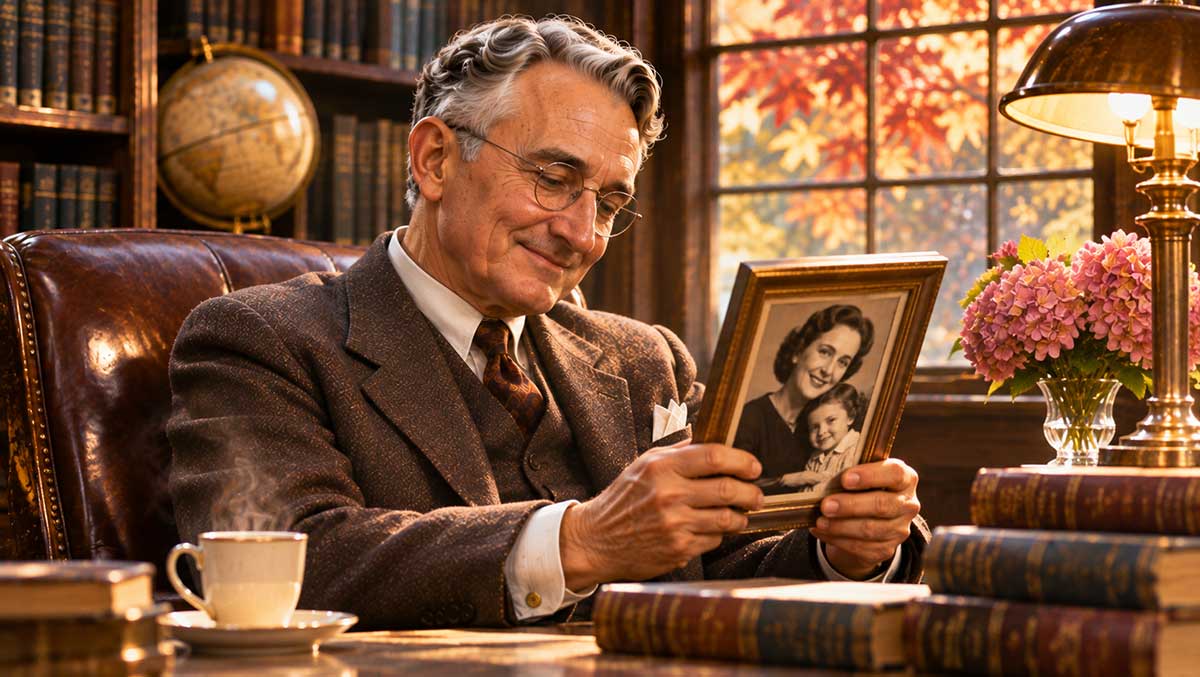
When I think about my imaginary conversations with Dale Carnegie, I don't first think about his bestselling books or his extraordinary career. I think about a young man walking along a dusty Missouri road in 1906, carrying his books and worrying about whether he would ever become someone important. He was ambitious, insecure, and a little embarrassed by his circumstances. Yet he was friendly enough to welcome a stranger into his afternoon. Looking back, I find something deeply moving about that first meeting. Before Dale knew how to teach the principles of friendship, he already possessed the ability to make another person feel welcome.
One of the most meaningful lessons I took from our conversations is that our desire to feel important is deeply human, but it doesn't have to control our lives. I recognize something of myself in young Dale. I've wanted to succeed, create meaningful work, and know that my efforts mattered. I think many of us share those hopes. But I've come to believe that recognition alone cannot satisfy every longing. We can reach a goal, receive praise, and feel proud of our accomplishments, only to discover that the feeling fades and another goal appears. Dale's transformation reminded me that there is another kind of satisfaction: helping someone else discover their confidence, dignity, or potential.
Our conversation in the YMCA classroom was particularly meaningful to me. I loved watching Dale describe the pleasure of helping frightened students stand before an audience and find their voices. His teaching grew from experiences he understood personally. That made me think about how our own difficulties can become gifts to other people. Perhaps the insecurity we struggled with when we were young can make us more compassionate toward someone experiencing the same fear today. Perhaps a failure we once regretted can become a story that encourages someone else to keep trying. Carnegie's history as an educator reminds me that the path to meaningful work doesn't always begin with success. Sometimes it begins with recognizing a struggle we know how to help another person face.
Our third conversation made me reflect on something I consider especially valuable: the difference between being popular and being a true friend. Carnegie's How to Win Friends and Influence People has sometimes been approached as a collection of techniques for becoming more likable or persuasive. Yet what moved me most was the idea of genuine interest. I don't want friendship to become a strategy for getting something from another person. I want to listen with real curiosity, laugh without pretending, and care about someone even when there is nothing to gain. In our fictional friendship, Dale and I didn't always discuss profound ideas. Sometimes we teased each other about his failed acting ambitions or my terrible public-speaking demonstration. Those small moments of laughter made the friendship feel real to me.
The conversation about worry reminded me of another lesson I'm still learning. I sometimes spend too much time thinking about what might happen tomorrow. I consider unfinished projects, uncertain outcomes, and problems I cannot solve immediately. Carnegie's idea of living in day-tight compartments, explored in How to Stop Worrying and Start Living, offers a useful reminder to return my attention to what I can do today. Yet our conversation led me somewhere beyond practical advice. When someone is experiencing genuine suffering, the greatest kindness may be neither an inspiring quotation nor a clever solution. Sometimes it is simply being present, listening, and allowing another person to feel what they feel.
Our final meeting in the autumn garden touched me most deeply. By then, Dale had accomplished far more than the young farm boy could have expected. Yet when I asked what brought him happiness, our fictional conversation returned to family, friendship, useful work, and ordinary moments of appreciation. I found myself thinking about the people in my own life. How often do I become so occupied with work that I fail to notice a simple opportunity to share a laugh, offer encouragement, or tell someone I love them? I don't want to reach the end of a busy day having completed everything on my list but having missed the people who made that day worth living. The quiet farewell in the garden reminded me that a life is made up of moments we cannot recover once they've passed.
Perhaps the greatest discovery I made through these five conversations is that happiness and friendship are connected in ways I hadn't fully appreciated. I began by asking whether Dale Carnegie ever found true happiness. I ended by thinking less about whether he had discovered a final answer and more about how he chose to treat the people around him. I don't believe any book can make us permanently happy or remove every difficulty from life. But I do believe we can make one another's lives a little brighter. We can listen more carefully. We can offer sincere appreciation. We can forgive small mistakes. We can encourage someone who doubts themselves. And we can find genuine pleasure in being together without needing to accomplish anything at all.
If I could carry one memory from this imaginary friendship into my everyday life, it would be the moment Dale called after me in the autumn garden and asked me to thank someone whose kindness I had taken for granted. That simple request feels more meaningful to me than any grand theory of success. So I'd like to leave you with a few questions. Who in your life has made you feel genuinely appreciated? Have you told that person what their kindness meant to you? And if you could sit beside Dale Carnegie for one afternoon, what would you most want to ask him about friendship, worry, or happiness? I'd love to hear your thoughts in the comments.
Fictional Reflection Disclaimer: These Final Thoughts are Nick Sasaki's personal reflections on an imagined friendship with Dale Carnegie. The conversations, emotions, and farewell scenes are fictional interpretations inspired by Carnegie's documented life and published ideas. They should not be interpreted as evidence of Carnegie's private beliefs or actual conversations with Nick.
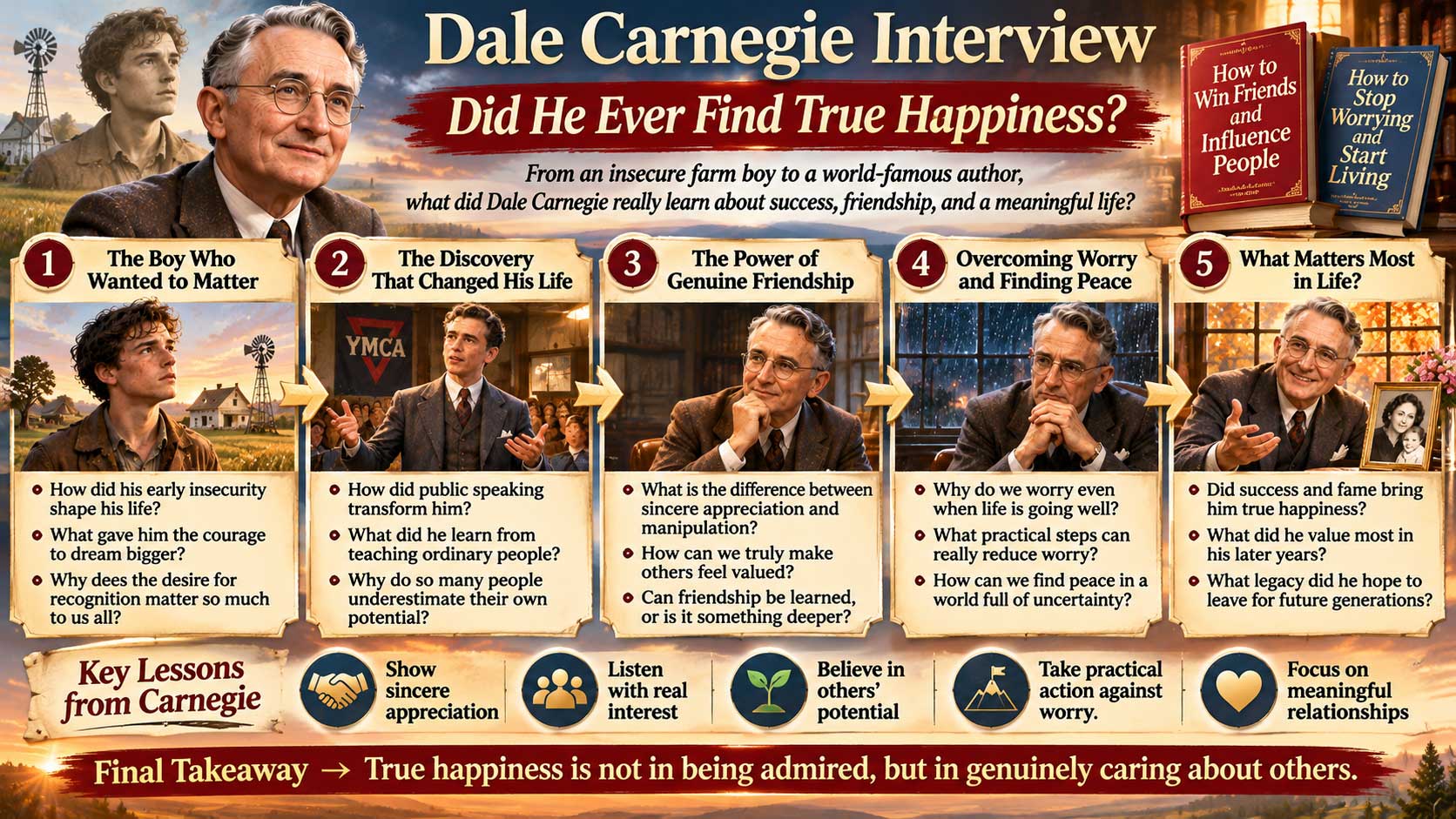
Short Bios
Dale Carnegie (1888–1955)
Dale Carnegie was an American author, lecturer, and educator whose work helped popularize modern self-improvement and interpersonal communication training. Born Dale Carnagey in Missouri, he grew up in a farming family, worked in sales, pursued acting, and began teaching public speaking at a New York YMCA in 1912. His bestselling books include How to Win Friends and Influence People (1936) and How to Stop Worrying and Start Living (1948). Carnegie's teaching focused on confidence, sincere appreciation, effective communication, and practical approaches to everyday difficulties. He died in 1955, leaving a legacy that continues through his books and the training organization associated with his name.
Learn more through Dale Carnegie Training's official history and the biographical profile at Biography.com.
Nick Sasaki
Nick Sasaki is the creator of ImaginaryTalks.com, a storytelling project that brings historical figures, writers, philosophers, spiritual teachers, and influential thinkers into fictional conversations. Through these creative encounters, Nick explores the personal struggles, convictions, humor, and human experiences behind well-known ideas. His approach favors warm, natural conversation, thoughtful questions, and the feeling of meeting a guest as a friend rather than conducting a formal interrogation.
In this imaginary interview, Nick meets Dale Carnegie at five different moments in his life, gradually developing a friendship that becomes the emotional center of the story. His hope is that readers will come away with new questions about their own lives and a renewed appreciation for the people around them.
Explore more fictional conversations at ImaginaryTalks.com.
Leave a Reply