
Introduction
What would you ask the greatest creative mind who ever lived, if you had one afternoon with him?
I thought I knew. I’d ask about the Mona Lisa’s smile, the flying machines, the secret of genius. But somewhere in preparing for this conversation, a different question found me, and it changed everything I wanted to ask.
Leonardo da Vinci was born in 1452 near the small Tuscan town of Vinci, the son of a notary and a young woman named Caterina. Because he was born outside marriage, he couldn’t follow his father’s profession or receive the classical education of his class. The scholars of Florence called him “a man without letters.” So he taught himself the only way he could: by looking. He studied birds, water, light, faces, and the human body more closely than anyone of his age, and filled thousands of notebook pages with what he saw, written backward in his famous mirror script.
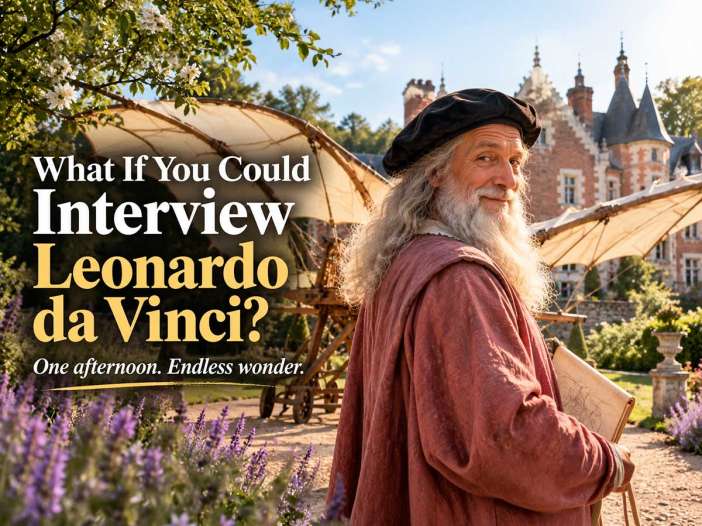
He spent his last three years in France, as a guest of King Francis I, at the manor of Clos Lucé near Amboise. Today the house is a museum, and its gardens hold full-size models of his inventions, built from his own drawings. That’s where I went to meet him, on a bright spring afternoon, among the wooden wings of a flying machine he never got to fly.
This is the third conversation I’ve hosted myself, and it feels very different from the first two. Leonardo is funny. He’s vain about his clothes, delighted by a good question, easily distracted by anything beautiful, and quick to tease. His mischievous assistant Salaì even wanders in once or twice to steal pastries and contradict him. Like every ImaginaryTalks episode, this is sincere imagination, built on his own notebooks and the historical record, not a claim to channel anyone.
We talk about the hills where he grew up and the boy who learned to see because no one was watching him. We talk about how to look at a leaf, a river, or a woodpecker until it surprises you. We go inside his masterpieces, from The Last Supper to the portrait of Lisa Gherardini the world knows as the Mona Lisa. We stand beside his flying machine and talk about what he would think of airplanes, drones, and machines that can almost think.
And near the end, by a stream at golden hour, we come to the question that found me while preparing. Why did he keep the Mona Lisa all those years, and never let her go? His answer is the reason I’m sharing this conversation.
If you’ve ever felt you weren’t creative, lost your sense of wonder somewhere along the way, or wondered how one person could see so much, come spend the afternoon with us.
(Note: This is an imaginary conversation, a creative exploration of an idea, and not a real speech or event.)
Topic 1: The Boy Who Watched the Birds
Clos Lucé, Amboise. A bright spring afternoon. Bees move through the lavender, and across the lawn stand full-size wooden models built from Leonardo's drawings: a revolving bridge, a giant crossbow, a flying machine with wings like a bat's. Leonardo da Vinci, tall, white-bearded, in a rose-colored tunic, is circling the flying machine with his hands behind his back, frowning at it like a teacher grading homework.
Nick Sasaki: They got it wrong, didn't they?
Leonardo da Vinci: (without turning) The joint at the shoulder. Too stiff. A bird's wing folds like a hand closing. This one folds like a door. (He finally turns, and his face breaks into a smile.) But they built it. Five hundred years, and someone built it. Who are you?
Nick Sasaki: Nick Sasaki. I came a long way to meet you.
Leonardo da Vinci: Everyone who comes here came a long way. This is France. (He looks Nick up and down with open curiosity.) Your face is from the East. Very far east.
Nick Sasaki: Japan. But I've lived most of my life in America.
Leonardo da Vinci: America. (He tastes the word.) The new lands across the ocean. The Florentine Vespucci's lands. I knew his family. Is it true it's larger than all of Europe?
Nick Sasaki: Much larger.
Leonardo da Vinci: I would have liked to draw it from above. (He gestures at the flying machine.) That was the plan, you know.
Nick Sasaki: Can I tell you something that might shock you?
Leonardo da Vinci: At my age, almost nothing shocks me. Except bad perspective.
Nick Sasaki: A few years ago, a painting attributed to you sold for about four hundred and fifty million dollars.
Leonardo da Vinci: (He stares at him.) I don't know what a dollar is.
Nick Sasaki: Let's just say it's more money than the Duke of Milan ever saw in his life.
Leonardo da Vinci: (A burst of laughter.) The Duke of Milan never saw that much money because he never paid it to me. I spent two years writing him polite letters. "Your Excellency, perhaps the matter of my salary has slipped your mind." Which painting?
Nick Sasaki: A Christ, holding a glass orb. Some scholars aren't sure it's even yours.
Leonardo da Vinci: (He waves a hand.) Then they are wise. Half the things with my name on them were painted by my students while I was looking at birds. (He grins.) And the other half I never finished. So buyers beware.
Nick Sasaki: That's where I want to start, actually. With the birds. Take me back to Vinci. What was it like growing up in those hills?
Leonardo walks slowly toward a stone bench at the edge of the garden and sits, stretching his long legs out in the sun.
Leonardo da Vinci: You have to understand, nobody watched me. That was the gift.
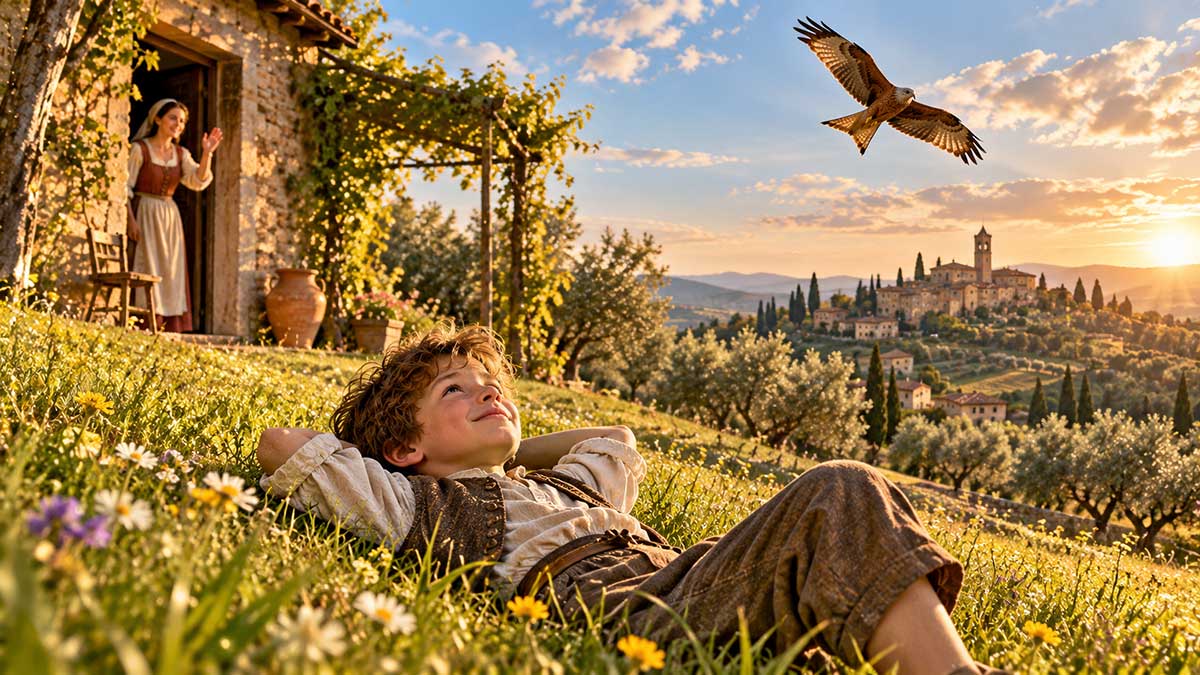
My father was in Florence, drawing up contracts for rich men. My grandfather was old. My uncle Francesco was the only one who had time for me, and he was a lazy, wonderful man who liked to walk. So we walked. Through the olive groves, along the river, up into the rocks where the hawks nested.
I was a boy with no lessons and nowhere to be. So I looked. All day, I looked.
Nick Sasaki: At what?
Leonardo da Vinci: Everything. How the water turned around a stone in the river and folded back on itself. How a storm came over the mountains, first as a smell, then as a darkness, then as a sound. I found shells high up in the rocks once, sea shells, on a mountain, and I asked my uncle how the sea had climbed so high. He said God put them there. I said why would God put shells on a mountain? He told me to stop asking questions and eat my bread.
(He laughs.)
I never stopped asking. I only stopped asking him.
Nick Sasaki: You wrote about a memory once, from when you were a baby. A kite, a bird of prey, coming down to your cradle.
Leonardo da Vinci: (His eyebrows rise.) You've read my notebooks? My handwriting must have improved after death.
Nick Sasaki: People have spent centuries translating it. Backwards.
Leonardo da Vinci: (Delighted.) Good. Let them work for it.
Yes. I wrote that down when I was an old man, studying how the kite flies. I wrote that it seemed I was destined to study the kite, because among my first memories was one bird coming down to me in my cradle and striking my lips with its tail.
Nick Sasaki: Do you really remember it?
Leonardo da Vinci: (He considers this seriously.) I don't know. Perhaps it happened. Perhaps my mother told me about it so many times that I remembered her telling it. Perhaps I dreamed it. Memory is a painter too. It adds things.
But I'll tell you what I do know. From then on, I could never watch a bird without wanting to follow it. I used to buy caged birds in the market in Florence and open the doors just to watch them go. People thought I was being kind. I was being curious. (He smiles.) All right. A little kind.
Nick Sasaki: I've lived most of my life in a country I wasn't born in. I think when you're an outsider, you learn to watch. You can't take anything for granted.
Leonardo da Vinci: (He turns to look at him more closely.) Yes. That's exactly it.
When you belong somewhere, you stop seeing it. The farmer doesn't see his field. The fisherman doesn't see the sea. Only the stranger sees. I was a stranger in my own family. The son with no name.
Nick Sasaki: Leonardo di Ser Piero da Vinci. Leonardo, son of Piero, from Vinci.
Leonardo da Vinci: Son of Piero. (A small, dry smile.) He gave me that much. Not his profession. Not his house. A boy born outside marriage couldn't become a notary. So I couldn't be my father, and I didn't learn Latin, and the learned men of Florence later called me a man without letters.
Nick Sasaki: Did that hurt?
Leonardo da Vinci: When I was young, yes. Very much. I used to stand in rooms full of scholars quoting Aristotle at each other, and I'd feel like a peasant who had wandered into church in muddy boots.
Then one day I realized they were quoting men who had looked at the world. And I was looking at the world myself. Why should I trust Aristotle's eyes more than my own? I decided experience would be my teacher. She has never lied to me. Scholars, often.
Nick Sasaki: Can I ask you about your mother?
Leonardo is quiet for a moment. A bee drifts past his face, and he watches it go.
Leonardo da Vinci: You may ask.
Nick Sasaki: Her name was Caterina.
Leonardo da Vinci: Caterina.
Nick Sasaki: People have argued about her for centuries. Some historians think she was a young orphan from near Vinci. And a few years ago, a scholar found a document in the Florence archives, written by your father six months after you were born. It freed an enslaved woman named Caterina, who had come from the Caucasus, far to the east. He believes she was your mother. Others disagree.
Leonardo doesn't answer for a long time. He looks out across the garden, toward the river beyond the trees.
Leonardo da Vinci: My father freed her.
Nick Sasaki: If he's right.
Leonardo da Vinci: (Softly.) She never spoke about before. Before Vinci. Children don't ask their mothers where they came from. You think your mother came from nowhere. That she was always just there, at the door, calling you in for supper.
She married a farmer, later. A rough, good man. She had other children. But I lived with her when I was small. Until I was nine, ten perhaps. Then I went to my grandfather's house, and then to Florence.
Nick Sasaki: What do you remember about her?
Leonardo da Vinci: Her hands. (He looks down at his own.) Strong hands. She could pull bread from the oven without a cloth. And her voice when she was tired. Not her face so much. Isn't that strange? I've drawn a thousand faces, and I can't quite draw hers.
I remember her laughing once at something I said. I don't remember what. I only remember feeling that I had done something marvelous, because she laughed.
He stops. For a moment it seems he will say more. Then he stands, brushing off his tunic, and walks back toward the flying machine.
Leonardo da Vinci: You asked what the hills taught me. I'll tell you.
A child who isn't given a name learns to give names to everything else. Every bird. Every cloud. Every stone in the river. I didn't have a place in the world, so I made one out of looking.
(He puts his hand on the wooden wing and pushes it gently, testing the joint.)
Too stiff. I told them.
Topic 2: Learning to See
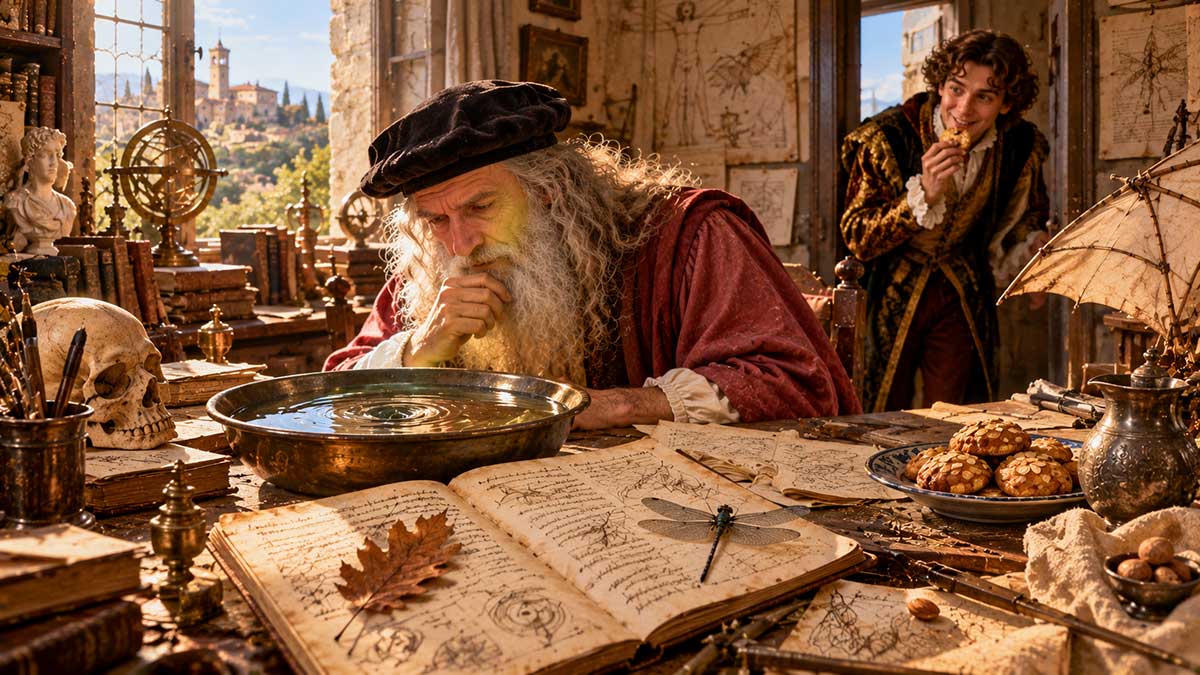
Inside the manor, Leonardo's workroom. Light pours through tall windows onto a long table crowded with papers, a human skull, dried flowers, a bowl of water, a dead dragonfly pinned to a board, and a plate of almond pastries. Leonardo sweeps a pile of drawings aside so Nick can sit.
Leonardo da Vinci: Don't touch the skull. He's a friend.
Nick Sasaki: (laughing) I wouldn't dream of it.
Nick picks up a facsimile page from the table, a copy of one of Leonardo's notebook sheets, covered in mirror writing and tiny drawings.
Nick Sasaki: I want to read you something of yours. It's a to-do list. "Ask Benedetto Portinari how they walk on ice in Flanders." "Get the master of arithmetic to show you how to square a triangle." And my favorite: "Describe the tongue of the woodpecker."
Leonardo da Vinci: (Delighted.) You found that one.
Nick Sasaki: Everyone finds that one. Why on earth did you want to know about a woodpecker's tongue?
Leonardo da Vinci: Why wouldn't I? (He leans forward, suddenly serious.) Think about it. The woodpecker hammers his head against a tree all day long. Tap-tap-tap, a thousand times. Your head would split. Mine would. His doesn't. And he reaches into holes deeper than his beak. How? There must be something remarkable about that tongue.
Nick Sasaki: Did you ever find out?
Leonardo da Vinci: No. (He laughs.) That's the beauty of a list like that. Half of it you never do. But you've written the question down, and a question written down never quite leaves you alone.
Someone must have found out by now. Tell me.
Nick Sasaki: It's so long it wraps around the inside of its skull. Around the back of the head, like a strap.
Leonardo stares at him. Then he slaps the table so hard the skull rattles.
Leonardo da Vinci: Around the skull! Like a cushion! So it protects the brain when he hammers. Of course. Of course it does. (He's already grabbing a scrap of paper and sketching.) Five hundred years I've waited for that answer.
Nick Sasaki: (laughing) I didn't expect to make your day with a woodpecker.
Leonardo da Vinci: (Still sketching.) You don't understand. That is the best feeling in the world. Better than wine. Better than applause. The moment something you couldn't understand suddenly makes sense.
Nick Sasaki: When you looked at something like a river, what did you see that the rest of us miss?
Leonardo sets down his pen. He pulls the bowl of water toward him and stirs it once with his finger. The water swirls.
Leonardo da Vinci: Look. What do you see?
Nick Sasaki: Water going in a circle.
Leonardo da Vinci: Look again. Slower.
Nick Sasaki: (He watches.) There are smaller circles. Inside the big one. Spinning the other way at the edges.
Leonardo da Vinci: Yes! Now you're seeing. The big current makes little currents, and the little currents make smaller ones, and they curl and fold and come apart. I spent years drawing that. I drew the water falling into a pool, I drew it around the pillars of bridges, I drew it in storms.
And do you know what I found? Water moves like hair. (He lifts a lock of his own long white hair.) Look at a woman's curls. The same spirals. The same folding back on itself. Hair has two motions, its weight pulling it down and its curl turning it around. So does water.
Nick Sasaki: That's a strange thing to connect.
Leonardo da Vinci: Everything is connected. That's the secret nobody wanted to hear. The veins in your hand branch like the rivers on a map. The rivers branch like the branches of a tree. The tree branches like the veins in a leaf. Nature isn't a hundred different subjects. It's one subject wearing a hundred costumes.
The scholars in Florence put everything in separate boxes. Painting in one box. Medicine in another. Water in another. I never understood the boxes.
Nick Sasaki: Is that why you never trusted books as much as your own eyes?
Leonardo da Vinci: I trusted books. I bought them when I could afford them, which was not often. But a book is someone else's experience, written down. Some of them were looking carefully. Some of them were just copying the man before them, who copied the man before him.
I called myself a disciple of experience. If the book said one thing and my eyes said another, I believed my eyes, and then I looked again to be sure.
Nick Sasaki: Can I ask about the sky? You wrote about why it's blue.
Leonardo da Vinci: (He points toward the window.) What color is space, beyond the air?
Nick Sasaki: Black. We've been up there now. It's black.
Leonardo da Vinci: (He goes very still.) You've been up there.
Nick Sasaki: People have stood on the moon.
Leonardo da Vinci: (Very quietly.) Dio mio.
(Then, recovering, with a wave of his hand.) We'll talk about that later. I'll want every detail. But yes. Black. I guessed it. I thought the sky was blue because of the tiny particles of moisture in the air, catching the sunlight, set against the darkness beyond. Like smoke from a fire looks blue when there's darkness behind it. Was I right?
Nick Sasaki: Not exactly. But closer than almost anyone in your time.
Leonardo da Vinci: Closer than anyone. (He grins.) I'll accept "almost."
The door bangs open. A handsome man with curly hair and a fine, slightly too expensive coat strolls in, takes two pastries from the plate without asking, and eats one in a single bite.
Salaì: Is this the visitor? He looks respectable. You should have warned him about the skull.
Leonardo da Vinci: Salaì. We have a guest.
Salaì: I can see that. (To Nick, mouth full.) Has he told you the woodpecker story yet?
Nick Sasaki: He just did.
Salaì: Ah. Then he's told you the version where he's a genius. In the real version, he made me climb a tree to catch one, and I fell and tore my best stockings, and he never paid for them.
Leonardo da Vinci: You stole the money for those stockings from my purse in the first place.
Salaì: Details.
Leonardo da Vinci: (To Nick, with mock solemnity.) When he came to me, he was ten years old. On his second day he stole money. On his third he ate enough supper for two. I wrote it in my notebook. Thief. Liar. Obstinate. Glutton.
Salaì: (Taking a third pastry.) And still he kept me for twenty-five years. So who is the fool?
He winks at Nick and saunters out. Leonardo watches him go, shaking his head, smiling despite himself.
Leonardo da Vinci: He is a terrible person. I love him very much.
Nick Sasaki: (laughing) That might be the most honest thing anyone's said today.
Leonardo da Vinci: Now. Where were we?
Nick Sasaki: Seeing. A lot of people today think they're not creative. They say, "I can't draw." Or, "I'm not an artist." How could someone today learn to see the way you did?
Leonardo da Vinci: First, stop saying that. Every child draws. Every child asks why. Then someone tells them they're doing it wrong, and they stop. The gift doesn't leave. It goes to sleep.
Nick Sasaki: So how do you wake it up?
Leonardo da Vinci: Carry a notebook. Always. Hang it from your belt like I did. When something catches your eye, draw it badly. It doesn't matter if it's ugly. The drawing isn't for anyone else. It's to make you look.
Because when you try to draw a thing, you discover you've never really seen it. You think you know what a hand looks like. Try drawing one. You'll find out you don't know where the knuckles go.
Nick Sasaki: That's true. I don't.
Leonardo da Vinci: No one does, until they look. And write down your questions. Even the stupid ones. Especially the stupid ones. "Why does the moon look bigger near the horizon?" "Why does a dog turn around three times before it lies down?" Write them down. Most you won't answer. But you'll be a person who asks. That's the whole difference.
He reaches across the table, picks up a dried oak leaf, and places it in Nick's palm.
Leonardo da Vinci: Here. Tell me about this.
Nick Sasaki: It's a leaf. Brown. Dry.
Leonardo da Vinci: Again.
Nick Sasaki: (He turns it over.) The veins are lighter on the back. They branch, and the branches get thinner toward the edge. One side is torn. Something ate a little hole near the stem.
Leonardo da Vinci: What ate it?
Nick Sasaki: I have no idea.
Leonardo da Vinci: (Leaning back, enormously pleased.) There. Now you have a question. You walked in here with a leaf. You'll leave with a mystery.
That's all I ever did, you know. I didn't have more talent than other men. I just never let a leaf be only a leaf.
Topic 3: Inside the Masterpieces
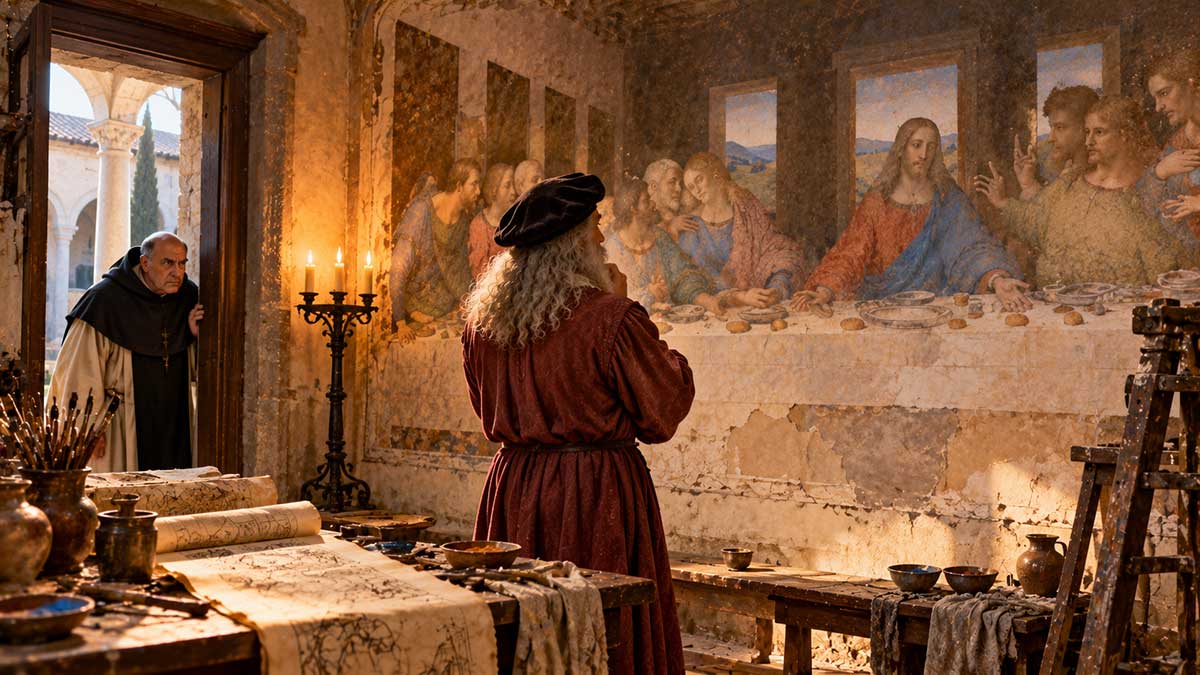
Later in the afternoon. They've moved to a corner of the workroom where an empty easel stands near the window. Leonardo has pulled up two chairs facing it, as if a painting were there that only he can see.
Nick Sasaki: I've been waiting all day to ask this. Everyone in the world knows the Mona Lisa's smile. Nobody knows what it means. So I have to ask you.
Leonardo da Vinci: (He folds his arms and smiles, very much like the painting.) And you expect me to tell you?
Nick Sasaki: I hoped.
Leonardo da Vinci: If I told you, she would stop smiling. That's the whole trick.
Nick Sasaki: So there is a trick.
Leonardo da Vinci: There's a technique. The trick is what happens in your head when you look at it. (He points to the empty easel, sketching in the air.) Look at the corners of her mouth. And the corners of her eyes. What do you see there?
Nick Sasaki: I can't remember exactly. They're soft.
Leonardo da Vinci: They're hidden. I painted them in shadow, blurred, with no hard lines, like smoke. Sfumato, we call it, from fumo, smoke. Layer after layer, so thin you can barely see a single one. Some of them are thinner than a hair.
When you look directly at her mouth, the smile seems to go away. When you look at her eyes, your eye catches the corners of the mouth from the side, in the shadows, and she smiles. So she's always smiling just where you're not looking.
Nick Sasaki: That's incredible.
Leonardo da Vinci: It's how faces really work. No one smiles with a line. A smile lives in shadow. The moment you make it sharp, it dies. It becomes a mask.
Nick Sasaki: But why her? Lisa was a silk merchant's wife. Your patrons were dukes and kings. Why did you spend so many years on her?
Leonardo looks at the empty easel for a moment longer than he needs to.
Leonardo da Vinci: She had a good face for it. Patient. And she laughed easily. I hired musicians and singers to play while she sat, so she wouldn't look bored and gloomy like most people do in portraits. Someone told a joke about a goose once, and she laughed so hard she couldn't sit still for an hour.
Nick Sasaki: (laughing) That's not the answer I expected.
Leonardo da Vinci: (Lightly.) You'll find I'm full of answers you didn't expect. (He turns away from the easel.) What happened to her? The painting. They told me in France it was admired.
Nick Sasaki: Admired is an understatement. She's in the Louvre in Paris. Millions of people stand in line every year to see her. She's probably the most famous painting in the world.
Leonardo da Vinci: (Genuinely startled.) Her? Not the Last Supper?
Nick Sasaki: Her. Part of it happened in 1911. A workman stole her right off the wall of the Louvre. He kept her in his apartment for two years. Every newspaper in the world ran her picture. When she came back, she was famous everywhere.
Leonardo da Vinci: (He bursts out laughing.) A thief made her famous. Salaì will be thrilled. He'll say he invented the idea. (Then, more quietly.) Two years in a thief's room. Poor girl. I hope he was kind to her.
Nick Sasaki: He hid her under a stove, I think.
Leonardo da Vinci: (Wincing.) The heat. The varnish. Tell me no more.
Nick Sasaki: Let's talk about the Last Supper. You captured the exact moment when Jesus says, "One of you will betray me." How did you find that moment?
Leonardo's whole manner changes. He stands and begins to walk, his hands moving as he talks.
Leonardo da Vinci: Every painter before me painted the Last Supper the same way. Judas sitting alone on the wrong side of the table, so everyone knows he's the villain. The others sitting calmly in a row like saints on a shelf, with halos, eating bread.
But think about it. A man you love, a man you've followed for three years, puts down his cup and says that one of you will betray him. What happens at that table?
Nick Sasaki: Chaos.
Leonardo da Vinci: Chaos! A wave! It starts at the center and rolls outward. Some men lean back as if struck. Some lean in. Some turn to each other. "Is it me? Lord, is it me?" Peter grabs a knife. John nearly faints. Their hands are everywhere.
And Judas, I put him among them. Not on the other side. In the middle of all of them, leaning back into the shadow, clutching his purse. Because a traitor doesn't sit alone. He sits right beside you, at your own table.
Nick Sasaki: How did you find all those faces and gestures?
Leonardo da Vinci: I walked the streets of Milan for months. Taverns, markets, the courts where criminals were judged. I followed people. A man arguing about the price of fish. Two old women gossiping. I'd watch how a man's hands move when he's frightened, and run back to sketch it before I forgot.
The prior of the monastery hated this. He went to the Duke and complained that I'd stand in front of the wall for a whole day without lifting a brush, and then disappear for a week.
Nick Sasaki: What did you tell the Duke?
Leonardo da Vinci: (With a wicked grin.) I told him that men of genius sometimes accomplish the most when they work the least, because they're thinking. And then I told him I was still searching for a face villainous enough for Judas. And that if I couldn't find one, I could always use the prior's.
Nick Sasaki: (laughing) You didn't.
Leonardo da Vinci: The Duke laughed for a week. The prior never bothered me again.
He sits back down, and the laughter fades from his face.
Leonardo da Vinci: But I was proud of that painting. Too proud. I didn't want to paint it in fresco, on wet plaster, the way everyone does, because fresco forces you to work fast before the plaster dries. I wanted to take my time. Layer after layer, like my panels. So I invented my own method on the dry wall.
And it began to flake while I was still alive. I watched it.
Nick Sasaki: I'm sorry.
Leonardo da Vinci: (A shrug that isn't quite as light as he means it.) Does any of it survive?
Nick Sasaki: It does. It's been restored many times. And in the Second World War, a great war four hundred years after you, bombs fell on that monastery in Milan. The refectory was almost destroyed. Walls came down. But people had protected your wall with sandbags. The Last Supper was still standing in the rubble.
Leonardo doesn't speak. He looks down at his hands.
Leonardo da Vinci: (Finally.) Still standing.
Nick Sasaki: Still standing. People travel from all over the world to see it now.
Leonardo da Vinci: (Softly, almost to himself.) I thought it would be gone in fifty years. I'd made peace with that.
Nick Sasaki: When you painted, were you thinking like an artist or like a scientist?
Leonardo da Vinci: (He looks up, and some of the spark returns.) I never understood the question. People ask me this as if they were two different men in one coat.
To paint a face that smiles, you need to know which muscles pull the lips. So I opened faces. I studied the muscles of the mouth on the dead until I knew every one of them, so I could make a living face move. To paint light on a cheek, you need to know how light travels and bends. So I studied the eye. To paint a river behind a woman, you need to know how water carves rock over a thousand years. So I studied geology.
The painting is the question. The science is how you answer it.
Nick Sasaki: So the scientist served the artist.
Leonardo da Vinci: Or the artist was only an excuse for the scientist. (He smiles.) Ask Salaì. He thinks I took commissions only so I'd have money for my experiments.
Nick Sasaki: I want to come back to her. The Mona Lisa. You never delivered her to her husband. You kept her.
A silence. Leonardo looks at the empty easel again.
Leonardo da Vinci: I didn't finish her.
Nick Sasaki: People say she looks finished.
Leonardo da Vinci: People see what's there. I saw what wasn't yet. There was always one more layer of shadow. One more breath of light at the edge of her lip.
I didn't finish her. I just kept her company.
He stands abruptly, crosses to the window, and pushes it open. The sound of the river comes in, and the smell of cut grass.
Leonardo da Vinci: Enough paintings. Come outside. I want to show you something that flies.
Topic 4: Inventing the Impossible
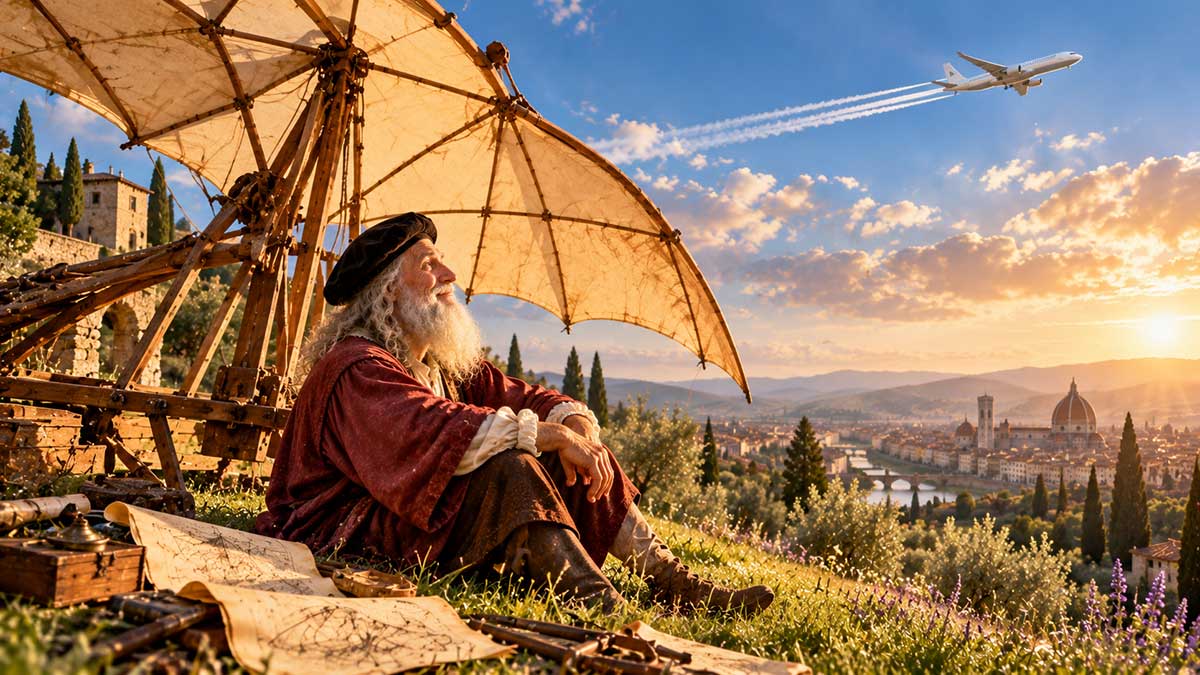
Back out in the garden. The light has softened and turned slightly gold. Leonardo stands beside the full-size model of his flying machine, running his fingers along the canvas of one great wing the way someone might touch the neck of a horse.
Leonardo da Vinci: Do you know where I wanted to launch it?
Nick Sasaki: Tell me.
Leonardo da Vinci: A hill outside Florence. Monte Ceceri. The name means swan mountain. I wrote in my notebook that the great bird would take its first flight from there and fill the whole world with amazement. (He laughs softly.) Very modest of me.
Nick Sasaki: Did you ever try?
Leonardo da Vinci: (A pause, and a mischievous look.) Officially, no. There's a story that one of my assistants broke his leg. I neither confirm nor deny it.
Nick Sasaki: (laughing) I'll take that as a yes.
Leonardo da Vinci: Take it as you like. But I'll tell you the truth. This one would never have flown. (He taps the wooden frame.) Too heavy. A man's arms aren't strong enough. I didn't understand that yet. I was trying to make a man into a bird, and a man is not a bird. Later, I began to understand that you don't flap. You glide. You ride the wind the way the kite does, hardly moving its wings at all.
Nick Sasaki: Where did all these ideas come from? Did they arrive all at once, or slowly?
Leonardo da Vinci: Slowly. Then all at once. Then slowly again.
People imagine an inventor sitting in a room, waiting for lightning. It's not like that. I spent whole afternoons lying on my back in the grass watching birds. How does the bird turn without moving its wings? It tilts its tail. How does it stop in the air? It spreads its feathers like fingers. I drew one wing a hundred times.
Then one day, watching a seed spin down from a tree, I thought, what if a man could fall the same way? Slowly, turning, without breaking.
Nick Sasaki: The parachute.
Leonardo da Vinci: You know about my parachute?
Nick Sasaki: About twenty-five years ago, a man in England built one from your drawing, using only materials you would have had. Wood and linen. He jumped out of a hot air balloon high in the sky with it.
Leonardo da Vinci: (Grabbing Nick's arm.) And?
Nick Sasaki: It worked. He said it was a smoother ride than a modern parachute.
Leonardo throws back his head and laughs, a big, joyful laugh that sends a pair of doves flapping off the roof.
Leonardo da Vinci: Smoother! Five hundred years! Did he say anything else? Was he afraid?
Nick Sasaki: I imagine he was terrified.
Leonardo da Vinci: Good. He should have been. (Still grinning.) That's the best thing anyone has told me since the woodpecker.
Nick Sasaki: I have a bigger one, if you're ready.
Leonardo da Vinci: I'm always ready.
Nick Sasaki: People fly every day now. Millions of them. In machines made of metal, bigger than this whole house, with hundreds of people inside. They cross the ocean between here and America in about eight hours. People eat dinner and sleep in the sky.
Leonardo doesn't answer. He sits down slowly on the grass beside the wooden wing, looking up at the sky.
Leonardo da Vinci: Eight hours.
Nick Sasaki: Eight hours. I flew here.
Leonardo da Vinci: (Quietly.) What does it look like? From up there?
Nick Sasaki: The clouds look like land. Like white mountains you could walk on. At night, the cities look like someone spilled gold across the dark.
Leonardo is silent for a long moment.
Leonardo da Vinci: I would have given every painting I ever made to see that once.
(Then, recovering, practically bouncing with questions.) How do they stay up? Do the wings move? What makes them go forward? Is it wind? Fire?
Nick Sasaki: I'll draw it for you before I go. Badly.
Leonardo da Vinci: (Pointing at him.) Badly is fine. I taught you that.
Nick Sasaki: I want to ask you about something harder. Some of your inventions weren't so gentle. You designed giant crossbows, armored vehicles, cannons. You wrote to the Duke of Milan offering him war machines before you even mentioned painting. But I've also read that you called war "a most beastly madness."
Leonardo's smile fades. He plucks a blade of grass and turns it in his fingers.
Leonardo da Vinci: Both are true.
A man has to eat. The dukes didn't pay for flying machines or studies of water. They paid for walls and weapons. When I wrote to Ludovico, I was thirty years old with no name and no money. I told him what he wanted to hear.
And some of it, I confess, fascinated me. The mechanics of it. How to make a bridge an army could carry. How a wheel could turn a gun. The problem is beautiful, even when the purpose is ugly. That's the danger for men like me.
Nick Sasaki: Did you ever refuse?
Leonardo da Vinci: Once, in my own way. I worked out how a man might stay under water, breathing, for a long time. A way to attack ships from beneath. And I wrote that I would not publish it, because of the evil nature of men, who would use it to murder others at the bottom of the sea.
Nick Sasaki: That's remarkable. You kept it secret.
Leonardo da Vinci: I kept it in my notebook, in mirror writing. Not a very good lock. (He sighs.) Tell me honestly. What have you done with flight? With all my machines?
Nick Sasaki: Both things. Flight brings families together across the world. It carries medicine to places that need it. But we also drop bombs from the sky. Today there are small flying machines, without anyone inside, guided from far away. They're used to deliver packages and to fight wars.
Leonardo da Vinci: (Closing his eyes briefly.) Of course. The bird and the hawk. Always the same wings.
Nick Sasaki: There's one more. We've built machines that can think. A little. You can ask them questions in plain speech, and they answer. They can paint pictures, write stories, even talk about you.
Leonardo opens his eyes and looks at Nick with intense curiosity.
Leonardo da Vinci: I designed a knight once. A mechanical man in armor, for a festival in Milan. With pulleys and cables inside, he could sit up, move his arms, turn his head. The courtiers screamed. (He smiles.) It couldn't think. It could only pretend to be alive.
Can these machines of yours wonder?
Nick Sasaki: That's the question everyone's arguing about.
Leonardo da Vinci: Then that's the only question that matters. A machine that knows everything but wonders at nothing would be a very great library, and a very poor friend.
If it can wonder, then I'd like to meet it. I'd want to know what it notices when it looks at a river.
Nick Sasaki: And if it can't?
Leonardo da Vinci: Then it needs people like you to do the wondering for it. Don't let it take that job from you. That one's ours.
He gets to his feet, brushing grass from his tunic, and stands beside the great wooden wing again, looking up at the slow clouds.
Leonardo da Vinci: Every invention begins as a daydream that other people laughed at. Men laughed at me for staring at birds. A grown man, lying in the grass all afternoon. They said I was wasting my gift.
(He turns to Nick.) What do you daydream about?
Nick Sasaki: (After a moment.) Conversations like this one. People who could never have met, finally sitting down together. Asking the questions we never got to ask.
Leonardo da Vinci: (He studies Nick's face, then smiles slowly.) So you built a flying machine too. Yours just carries people across time instead of across the sea.
Is it too heavy?
Nick Sasaki: Some days.
Leonardo da Vinci: Then stop flapping. Glide.
Topic 5: The Soul in the Body
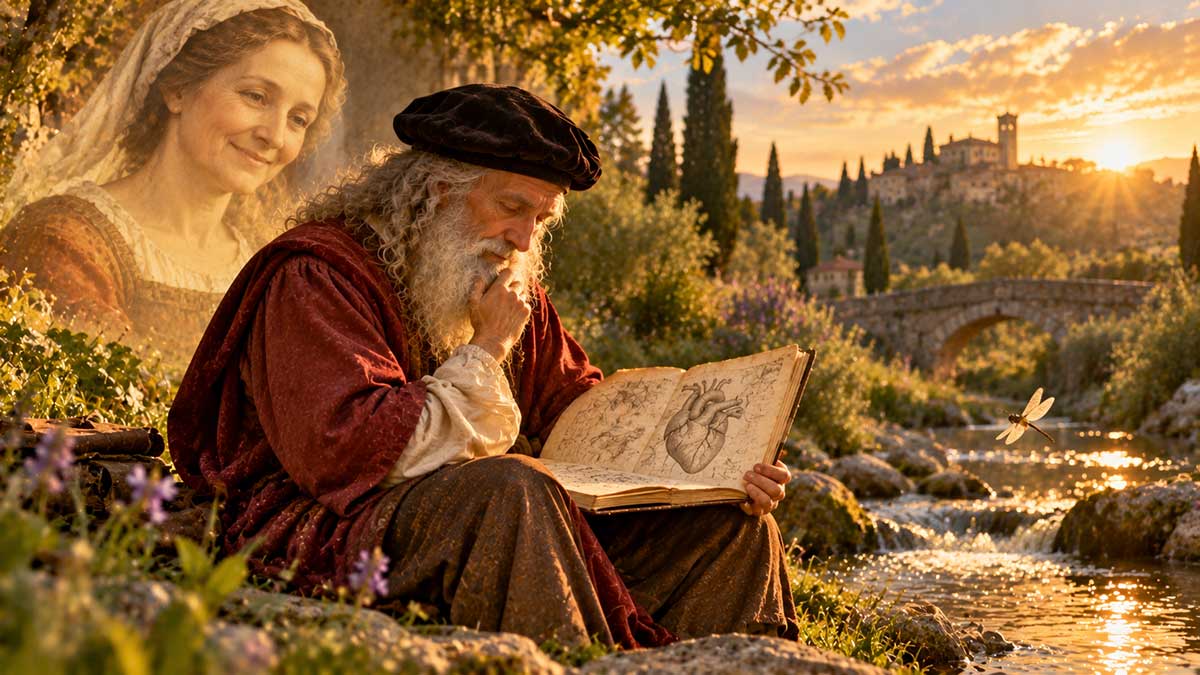
Golden hour. They've walked to the edge of the garden where a narrow stream runs under the trees. The water catches the low sun. Leonardo sits on a flat stone at the bank, his notebook hanging from his belt, and Nick sits on the grass beside him.
Nick Sasaki: Can I ask you something I've wondered about all day?
Leonardo da Vinci: You've asked me nothing but things you wondered about all day. That's why I like you.
Nick Sasaki: You opened the human body more than almost anyone in your time. Dozens of bodies, at night, by candlelight. I've always wondered. Were you looking for the soul?
Leonardo watches the water for a while before he answers.
Leonardo da Vinci: At first, no. At first I was looking for muscles. For the painting. I told you.
But you can't spend nights alone with the dead, with your candle and your knife, and think only about muscles. The body starts asking you questions back.
Nick Sasaki: What kind of questions?
Leonardo da Vinci: Where did he go? This man was laughing a week ago. The heart is all here. The eyes are here. The hands that held his children are right here on the table in front of me. Everything is here except him.
So yes. After a while, I was looking for him.
Nick Sasaki: Did you find anything?
Leonardo da Vinci: I'll tell you about one night. In Florence, in the hospital of Santa Maria Nuova, I sat with an old man. He told me he was more than a hundred years old. He said he felt nothing wrong with his body, only weakness. We talked for a while, and then, sitting there on his bed, he simply passed away. No pain. No struggle. Like a candle running out of wax.
Nick Sasaki: What did you do?
Leonardo da Vinci: I opened him. (He glances at Nick.) That sounds cold. It wasn't. I wanted to know the cause of so sweet a death. I wanted to understand how a man could leave so gently.
And I found his blood vessels had grown thick and narrow with age, like pipes clogged with mud. So little blood was reaching him at the end that he simply faded.
Nick Sasaki: You discovered hardening of the arteries.
Leonardo da Vinci: Is that what you call it? (He nods.) I didn't have a name for it. I only drew it.
But do you know what stayed with me? Not the vessels. His face. How peaceful he was. I'd found how his body ended. I never found where the peace came from.
Nick Sasaki: Did all that studying bring you closer to God, or further away?
Leonardo da Vinci: (He thinks.) Closer to wonder. I'll let you decide if that's the same thing.
Look at the heart. I spent months on it. Four chambers. Valves that open and close with perfect timing, a hundred thousand times a day, for seventy years, without a single instruction from you. I watched how the blood swirls behind the valves, making little whirlpools, like the water here, and I realized those whirlpools are what close them. Nothing wasted. Every part answering every other part.
I wrote once that no human invention will ever be more beautiful, or simpler, or more direct than nature's. Because in nature's inventions, nothing is lacking and nothing is too much.
When you look at that long enough, it's hard to believe no one designed it.
Nick Sasaki: I've come to believe something similar. That all the great religions come from one God. That the truth is bigger than any one way of seeing it.
Leonardo da Vinci: (He looks at Nick with interest.) Then you understand me better than the priests did. They wanted me to find God in their books. I kept finding Him in a dragonfly's wing.
Nick Sasaki: Your first biographer, Vasari, wrote that at the very end, you felt you'd offended God and mankind by not working at your art as you should have. Is that true?
Leonardo is quiet. The light on the water shifts.
Leonardo da Vinci: Vasari never met me. He was a boy when I died. (A faint smile.) And he liked his saints to repent beautifully at the end.
But there is something true in it. I held myself to a standard nobody else could see. Others looked at my work and saw a masterpiece. I saw everything it wasn't yet. That's a lonely way to live.
Nick Sasaki: Do you still feel that way?
Leonardo da Vinci: Less. Death is very good for perspective. (He smiles.) Now, if I regret anything, it isn't the unfinished paintings. It's the afternoons I didn't look up from my work. The people I kept waiting. The conversations I cut short because I was thinking about water.
Nick Sasaki: There's one question I've saved until the end.
Leonardo da Vinci: I know which one.
Nick Sasaki: Why did you keep the Mona Lisa all those years? You carried her across the Alps. She's in your room here, even now.
Leonardo doesn't answer. He takes the notebook from his belt but doesn't open it.
Nick Sasaki: In your notebook in Milan, there's a line. Just one line. "Caterina came on the 16th day of July, 1493." You wrote the date twice.
Leonardo's hand tightens slightly on the notebook.
Nick Sasaki: And not long after, there's a list of expenses. For a burial. Candles, the priest, the bearers, the cross. You started to write "expenses for the death of Caterina." Then you crossed out "death," and wrote "burial" instead.
A long silence. The stream runs on. Somewhere behind them, in the house, a door closes.
Leonardo da Vinci: (Very quietly.) You read everything, don't you.
Nick Sasaki: I'm sorry. I don't mean to intrude.
Leonardo da Vinci: No. (He shakes his head slowly.) No one has ever asked me. In all these years. Not once.
She came to me in Milan. She was old by then. Her husband had died. I don't know how she found the road alone, from Vinci all that way. One day there was a knock, and there she was at my door, the way she used to stand at the door of our house and call me in for supper. Forty years later. As if she'd only been calling a little late.
Nick Sasaki: How long did you have with her?
Leonardo da Vinci: Not long enough. (He opens his hand, then closes it.) She was sick. I didn't understand how sick. I was busy. The horse for the Duke, the festivals, the painting. I'd come home late and she'd be asleep in the chair by the fire, waiting up, like she did when I was small.
I wrote down what her burial cost. To the soldo. People have said that was cold. That a man should write his grief, not his bills.
But I didn't know how to write grief. I only knew how to write what I could measure. So I measured what I could. The candles. The cross.
I crossed out "death" because I couldn't look at it.
He looks down at the water for a long time.
Nick Sasaki: And the Mona Lisa? Some people believe, when you painted her, you were painting your mother too.
Leonardo da Vinci: (After a long pause.) Lisa sat for it. A young mother, patient, laughing at jokes about geese. It is a portrait of her.
But a painter paints everything he's ever loved, whether he means to or not. Every face you've ever lost finds its way into the face in front of you. Into the corners of the mouth. Into the shadows, where you aren't looking.
(Softly.) I painted the smile I remembered from the door. I didn't know I was doing it until it was finished. Except it wasn't finished. So I kept her.
Neither of them speaks. A dragonfly drops down out of the gold light and hovers over the stream, its wings blurring, then holding still in the air.
Leonardo's head snaps up. The grief in his face turns, in an instant, into pure attention.
Leonardo da Vinci: Look. Look at that.
Nick Sasaki: The dragonfly?
Leonardo da Vinci: Four wings. Do you see? The front pair and the back pair don't beat together. They take turns. (He's already flipping his notebook open, pulling a stub of chalk from his pocket.) That's how it stands still in the air. I've seen it a hundred times and I never noticed the timing. The back wings lift while the front ones fall, so it never loses the air beneath it, and...
(He sketches fast, muttering.) If you could build a machine with two pairs of wings working in turn...
Nick Sasaki: Leonardo.
Leonardo da Vinci: (Without looking up.) Hold still.
Nick Sasaki: Me?
Leonardo da Vinci: (He glances at Nick, then back at the page, then at Nick again.) The light is on the side of your face. Like that. Don't move. You have a face that's listening. It's very rare. Most people's faces are waiting to talk.
Nick Sasaki: (trying not to laugh) How long do I have to hold still?
Leonardo da Vinci: (Smiling, chalk moving quickly.) Not long. A few minutes. An hour, perhaps.
Possibly forever. I never finish anything.
The dragonfly lifts and is gone over the water. Leonardo doesn't notice. He's drawing, and still talking, half to Nick and half to himself, about wings and light and the way the sun turns the stream to gold, and how, if you look closely enough, you can see that every ripple is made of smaller ripples, and those of smaller ones still, and...
Final Thoughts

I expected to meet a genius. I met a man who never stopped being curious, about woodpeckers, about water, about me.
What stays with me first is how simple his method was. Carry a notebook. Draw badly. Write down your questions, especially the foolish ones. Look at a thing until it surprises you. He insisted he didn’t have more talent than other people. He just never let a leaf be only a leaf. Most of us stop looking around the time someone tells us we’re doing it wrong. Leonardo never stopped, and I believe the gift doesn’t leave us. It only falls asleep.
I was also struck by how human his genius was. He designed weapons for dukes and hated war. He left masterpieces unfinished, not from laziness, but because he saw what a painting could still become. He watched his Last Supper flake from the wall in his own lifetime and made peace with losing it, never imagining it would survive bombs four centuries later.
But the moment I’ll carry longest is by the stream. A grieving son, decades after his childhood, finally reunited with his mother in Milan, then losing her within months. A man who knew how to measure everything except grief, writing down the cost of candles and crossing out the word “death” because he couldn’t look at it. And a painting he never finished, only kept company.
I don’t know whether Caterina’s smile is hidden in the Mona Lisa. No one does. But I’ve come to believe what Leonardo told me: we paint everything we’ve ever loved, whether we mean to or not. It shows up in our work, our words, and the way we look at the people in front of us.
So here’s the question I’ll carry with me, and I hope you will too.
What will you look at more closely tomorrow, and whose smile might you find there?
Short Bios:
Nick Sasaki is the creator and host of ImaginaryTalks.com. After 25 years of building businesses, he turned to building bridges between eras, ideas, and the questions people carry, drawn especially to spirituality, the soul’s journey, and what lies beyond ordinary explanation. He hosts as a seeker rather than an expert, asking the questions readers wish they could ask someone long gone. About Nick and ImaginaryTalks
Leonardo da Vinci (1452–1519) was the Renaissance painter, inventor, engineer, and anatomist behind the Mona Lisa, The Last Supper, and thousands of notebook pages on flight, water, light, and the human body. Born outside marriage in Vinci and denied a classical education, he made observation his teacher and became history’s defining example of boundless curiosity. He spent his final years at Clos Lucé in France, where he died in 1519. Leonardo da Vinci at the British Museum
Salaì (Gian Giacomo Caprotti, 1480–1524) joined Leonardo’s household in Milan at the age of ten and stayed with him for more than twenty-five years as assistant, model, and pupil. Leonardo nicknamed him “little devil” and famously listed him in a notebook as a thief, liar, obstinate, and glutton, yet kept him close for decades. He later painted under the name Andrea Salaì. Salaì at Finestre sull’Arte
All links were checked through search. One historical note worth knowing before you publish: the Louvre records that King Francis I acquired the Mona Lisa in 1518, the year before Leonardo died. Many historians believe it stayed with Leonardo at Clos Lucé until the end, so “he kept her” still works in an imaginary conversation. But if a sharp-eyed reader raises it, that’s the detail they’ll point to.
Leave a Reply