
Introduction
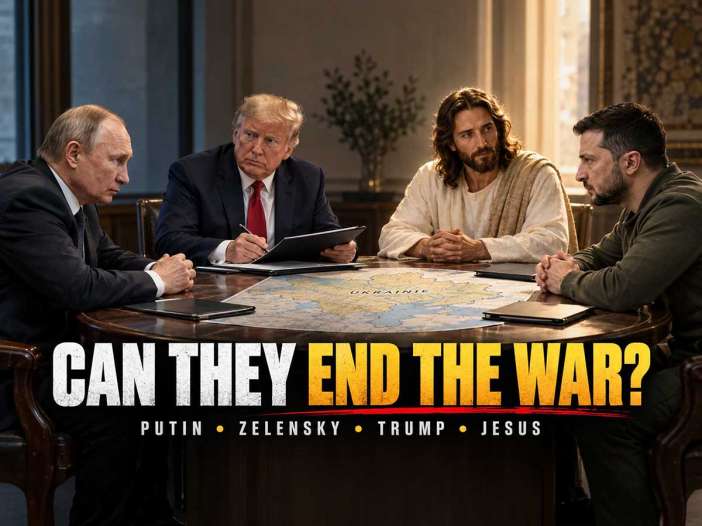
What if Vladimir Putin, Volodymyr Zelensky, Donald Trump, and Jesus sat together in a private room, determined to find a way to end the war in Ukraine?
Putin arrives believing Russia's security and historical grievances must be addressed.
Zelensky comes carrying the responsibility of defending a country whose families have endured invasion, destruction, and heartbreaking loss.
Trump wants an agreement. He believes that however difficult the conflict has become, negotiation must offer something better than endless fighting.
And Jesus?
He brings no army, no political leverage, and no territorial demands.
He comes with a question none of the other men expects.
At first, their discussion follows familiar lines. Security. Sovereignty. History. Territory. Each leader sees the conflict through experiences and responsibilities that the others do not share.
But as the conversation continues, something begins to change.
The men discover that beneath their opposing arguments are fears and hopes they recognize in one another.
And Jesus quietly invites them to consider a perspective larger than any nation.
What might happen if these leaders could see the people on the other side not only as Russians or Ukrainians, but as fellow members of one human family?
Would it change what they are willing to do?
And could that change become the beginning of peace?
This original fictional conversation explores the leaders' differing political positions and a Christian understanding of God as the loving Heavenly Father of all humanity. It does not portray a real meeting or actual diplomatic commitments.
Topic 1: Why Can't We Stop Killing Each Other?
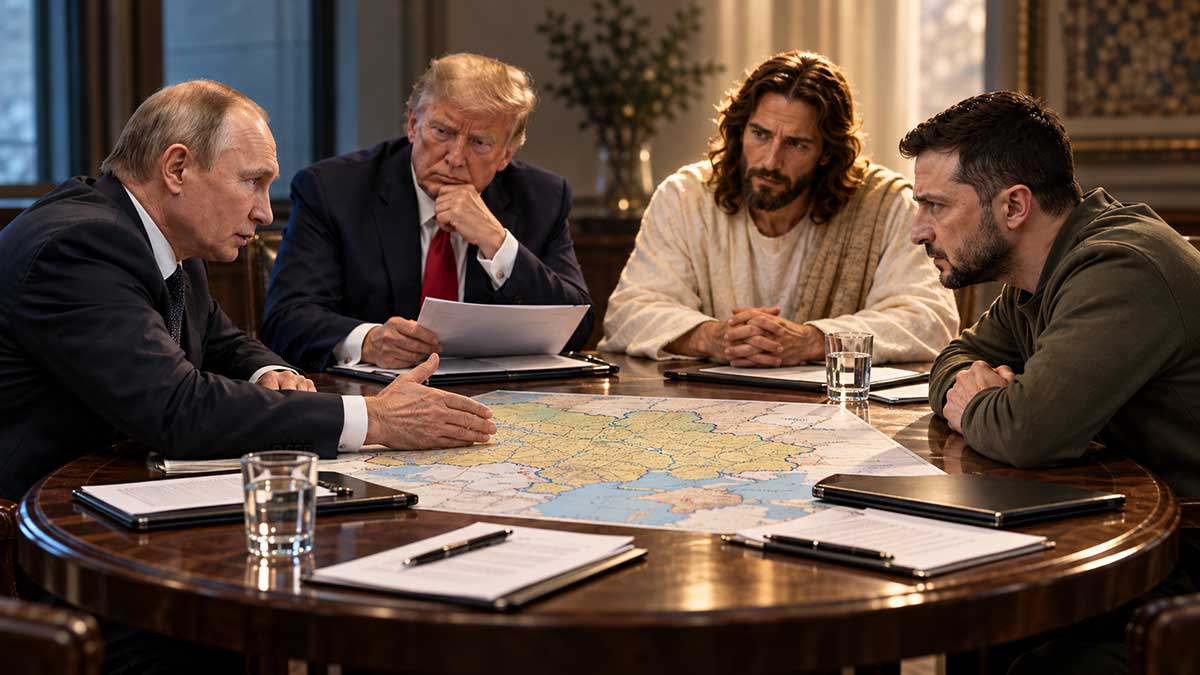
The room is smaller than anyone expected.
There are no national flags, no television cameras, no advisers whispering instructions. Four chairs surround a round wooden table. A map of Ukraine lies between several unopened folders.
Vladimir Putin stands near the window, examining the map.
Volodymyr Zelensky enters.
They look at each other.
Neither offers his hand.
Donald Trump follows, carrying a thick folder.
Trump: Well. Here we are.
He looks from one president to the other.
Trump: I appreciate you both coming. I know there are a lot of things you disagree about. But people are dying every day, and frankly, I'm tired of hearing that nothing can be done.
Putin: Mr. President, Russia has never rejected serious negotiations. But they must address the fundamental causes of this conflict.
Zelensky: And Ukraine has never rejected peace. But peace cannot mean accepting another invasion in five years.
Trump: Good. You both want peace. That's a start.
Zelensky: Wanting peace and agreeing on peace are very different things.
Trump: I know that, Volodymyr. That's why we're here.
He places his folder on the table.
Trump: But here's my first rule. We're not going to spend the entire meeting proving how terrible the other guy is. You each get to explain what you need. Then we figure out what you can offer.
Putin: An agreement cannot be separated from historical realities.
Trump: And history will be discussed. But at some point, somebody has to pick up a pen.
The door opens.
Jesus enters quietly.
There is nothing ceremonial about his appearance. He wears simple clothing and carries nothing.
Jesus: Peace be with you.
The three presidents turn.
Trump: Please, come in. We've saved you a chair.
Jesus looks at the map before sitting.
Jesus: Thank you.
Putin: I assume our discussion will remain concerned with the practical questions before us.
Jesus: I hope we will discuss practical things, Vladimir.
He sits.
Jesus: But before you begin, may I ask who is missing from this room?
Trump: Missing?
Jesus: The people whose lives will be affected by what you decide.
He looks at the empty space around the table.
Jesus: The families who have lost their homes. The mothers waiting for their sons. The children frightened by the sounds of war.
Zelensky: They are why I am here.
Putin: The welfare of our people is a responsibility we all carry.
Jesus: Then perhaps we can keep them in our thoughts as you speak.
Trump opens his folder.
Trump: Fine. Vladimir, you've wanted to explain Russia's position. Go ahead.
Putin: Thank you.
Putin sits back, folding his hands.
Putin: The conflict cannot be understood without considering what happened in Europe after the end of the Cold War.
Russia repeatedly expressed concerns about the expansion of NATO and the development of military infrastructure closer to our borders.
Ukraine's movement into the Western security system was not an abstract political question for Moscow. It involved potential weapons deployments, intelligence cooperation, foreign military facilities, and strategic risks.
Our concerns were repeatedly dismissed.
Zelensky: Vladimir, I would like to ask you something.
Putin: Please.
Zelensky: Was Ukraine a NATO member when Russia occupied Crimea in 2014?
Putin: No. But the process of Ukraine's political and military integration with Western countries had already begun.
Zelensky: Was Ukraine a NATO member when Russia launched the full-scale invasion in 2022?
Putin: No. Formal membership is not the only consideration.
Zelensky: Then Ukraine was invaded without being a NATO member.
Putin: You're attempting to reduce a complicated security situation to a single fact.
Zelensky: It is an important fact.
Putin: Yes. But the question was never limited to membership documents. It concerned the direction in which Ukraine was being moved and the consequences for Russia.
Zelensky: Moved by whom? Ukrainians have their own opinions about their future.
Putin: Ukrainian politics did not develop in isolation from Western influence.
Zelensky: And Russian intervention had nothing to do with Ukrainians wanting protection from Russia?
Putin pauses.
Putin: There were many reasons for the deterioration of relations. That is precisely what we need to examine.
Trump: Let me interrupt for a second.
He looks toward Putin.
Trump: You say Russia wants security.
Putin: Yes.
Trump: And you, Volodymyr, say Ukraine wants security.
Zelensky: Ukraine wants to survive as an independent country.
Trump: Fine. Now here's the question. What would actually make both countries secure?
Putin: Ukraine must not become a platform for military threats against Russia.
Zelensky: And Russia must not invade Ukraine again.
Trump: There. Two statements. Now we're getting somewhere.
Zelensky: No, Donald. We're not there yet.
Trump: Why not?
Zelensky: One country has already invaded the other. If we discuss security as though both countries are in identical circumstances, we misunderstand the problem.
Putin: Russia sees the origins of the conflict differently.
Zelensky: You can see them differently. But your troops crossed our borders.
Trump turns toward Putin.
Trump: Vladimir, what would you say to that?
Putin: I would say that national leaders sometimes face decisions they believe are necessary for their country's security. Russia's position is that the underlying military and political developments created unacceptable risks.
Trump: But can you see why Zelensky doesn't trust a Russian promise not to attack?
Putin: I understand that trust is absent. Russia also has reasons for distrust.
Trump: That's the problem. Nobody trusts anybody.
He looks toward Zelensky.
Trump: What would help you trust an agreement?
Zelensky: Independent verification. Credible guarantees. Consequences for violations. And no arrangement that prevents Ukraine from defending itself.
Trump: Good.
He turns toward Putin.
Trump: What about you?
Putin: Binding security arrangements, defined military limitations, and a political settlement that addresses Russia's concerns.
Trump: All right. We have two lists.
Zelensky: They are not necessarily compatible.
Trump: That's what negotiation is for.
Jesus has been listening carefully.
Jesus: Vladimir, may I ask something?
Putin: Certainly.
Jesus: When you say Russia must be secure, what do you hope a Russian family will experience when the war has ended?
Putin: A normal life. Safety. The opportunity to work, raise children, and live without fear of military threats.
Jesus: And Volodymyr, what do you wish for Ukrainian families?
Zelensky: Exactly the same thing.
He gives a small, weary smile.
Zelensky: I want children to go to school without air-raid sirens. I want parents to stop checking their phones every time there's an explosion.
I want children who have never experienced peace to discover what it feels like.
Jesus: Then both of you desire something similar for your people.
Zelensky: Yes. But the actions taken to achieve those desires matter.
Jesus: They do.
Putin: And national security cannot be achieved through good intentions alone.
Jesus: That is true too.
Jesus looks toward the map.
Jesus: May I tell you something about parents?
Trump: Of course.
Jesus: When a mother sees her child in danger, she does not think first about whether her concern is politically reasonable.
She wants her child to be safe.
Zelensky: Yes.
Jesus: And when another mother, living far away, sees her child in danger, does she feel something different?
Putin: The feeling is the same.
Jesus: Then beneath all these disagreements are parents who want the same thing.
Zelensky: But that doesn't mean one parent should allow another person's child to harm her own.
Jesus: No. Love does not mean leaving someone unprotected.
Putin: Precisely. Protection sometimes requires difficult decisions.
Jesus: Yes. But we must examine whether our efforts to protect those we love are causing suffering that could have been prevented.
Putin regards him thoughtfully.
Putin: That is a reasonable question. But the answer depends upon the circumstances.
Jesus: Then let us continue examining them.
Trump gestures toward the map.
Trump: Here's where we are. Russia wants security. Ukraine wants security. Both claim they cannot trust the other.
We need something stronger than promises.
But before we get into the details, Volodymyr, there's a question I want to ask you.
Suppose we could stop the fighting tomorrow morning. A complete ceasefire. Would you accept it?
Zelensky: What happens the following morning?
Trump: What do you mean?
Zelensky: Does Russia use the ceasefire to rebuild its forces? Does it move more weapons near our cities? Does it prepare another offensive?
Who guarantees that the fighting will not resume?
Trump: We would negotiate those guarantees.
Zelensky: They cannot be an afterthought.
Trump: But people are dying while we work through every detail.
Zelensky: And people could die in even greater numbers if an agreement collapses.
Putin: That is why Russia has insisted that a ceasefire must be part of a broader settlement.
Zelensky: You cannot use the danger of future war to justify continuing the present invasion.
Putin: Nor can Russia accept conditions that leave the underlying security issues unresolved.
Trump: Do you hear yourselves?
Both presidents turn toward him.
Trump: You each say you're worried that stopping the war might lead to another war.
So the war keeps going.
There has to be a way around that.
Zelensky: There may be. But it requires real commitments.
Putin: And attention to the fundamental causes.
Trump: Fine. Then we do both.
He writes something on a sheet of paper.
Trump: We separate the immediate steps from the long-term settlement.
Putin: The sequence would need to be negotiated.
Trump: Of course. But if we try to resolve every historical argument before anyone stops shooting, we could be here forever.
Jesus looks at the two presidents.
Jesus: May I ask a question that goes back much further than this war?
Putin: Please.
Jesus: When you were children, did you ever fight with someone you loved?
Trump smiles.
Trump: Sure. Plenty of times.
Zelensky: Of course.
Putin: Most children do.
Jesus: And when your parents saw you fighting, what did they want?
Trump: For us to stop.
Zelensky: They would want to know who had done what.
Putin: A good parent must understand the causes of the dispute. Otherwise, the same conflict can happen again.
Jesus: Yes. A loving parent wants to know the truth.
He pauses.
Jesus: But would that parent permit the children to keep hurting one another until they agreed about everything that happened?
Zelensky: No.
Jesus: Why?
Zelensky: The children could become seriously injured.
Jesus: And what would the parent do?
Zelensky: Separate them. Protect the one being hurt.
Jesus: Yes.
Jesus looks at Putin.
Jesus: Would the parent stop loving the child who had caused the harm?
Putin: No. A parent would still love that child, while correcting him.
Jesus: Then perhaps there are two responsibilities that must remain together.
Protect those who are being hurt.
And work to prevent the fighting from beginning again.
Trump: That's exactly what I want to do.
Zelensky: The question is who will separate the armies.
Putin: And under what conditions.
Trump: That's what we have to figure out.
Jesus looks at both men.
Jesus: But you understand the heart of a parent.
Putin: Of course.
Jesus: Then perhaps that can help guide the difficult decisions ahead.
He says nothing more.
Trump studies his notes.
Trump: Let me try something practical.
Could we begin with things that don't require an agreement on territory?
Prisoner exchanges. Protection of civilians. Returning missing children to their families.
Zelensky: Humanitarian measures are possible. We've had prisoner exchanges before. We know they can be arranged.
Putin: Russia has participated in exchanges and could examine further arrangements on a reciprocal basis.
Trump: Good. What about protecting energy infrastructure?
Zelensky: Ukraine would consider reciprocal arrangements that actually stop attacks and can be verified.
Putin: There must be clear definitions concerning infrastructure used for military purposes.
Trump: Then we define them. We have lawyers, military advisers, technical experts. They can identify protected facilities and develop procedures for disputed incidents.
Zelensky: And what happens if an attack continues?
Trump: Independent investigation and consequences.
Putin: The monitoring mechanism must be impartial.
Zelensky: And nobody can have the right to block an investigation into its own actions.
Trump: Good. That's something else we can work on.
He looks up.
Trump: This is what I want. Less arguing over statements we've heard a hundred times, more discussion about commitments we can actually verify.
Putin: But we will eventually have to address the territorial issue.
Trump: Absolutely.
Zelensky: And Ukraine's sovereignty.
Trump: Yes.
Putin: And Russia's security.
Trump: Yes. I heard you both.
For the first time, Zelensky gives a brief laugh.
Zelensky: You make it sound very simple.
Trump: I'm not saying it's simple. I'm saying we need to start somewhere.
Jesus: There is something encouraging in what you have just discussed.
Trump: What's that?
Jesus: You have spoken of children returning to their families, prisoners returning home, and protecting places where people live.
Zelensky: Those things matter.
Putin: Certainly.
Jesus: Then you have identified acts that could relieve suffering without first resolving every disagreement.
Trump: Exactly.
Jesus: Perhaps the difficulty is not that nothing can be done.
Perhaps it is that so much remains to be done, and the work must begin somewhere.
Trump looks toward Zelensky.
Trump: Let me ask you something personal.
When the invasion began, people offered to evacuate you from Kyiv. You stayed.
Why?
Zelensky looks at him.
Zelensky: Because I was the president.
Trump: You could have been killed.
Zelensky: Yes.
Trump: You have a wife, children.
Zelensky: I know.
He pauses.
Zelensky: But people were staying to defend their homes. Soldiers were fighting. Volunteers were lining up.
How could I leave?
Trump: I understand the responsibility.
Zelensky: I don't think anybody can completely understand those first days unless they lived through them.
Everything changed in a few hours.
I was with my family. Then I received the news that the invasion had begun.
I told my wife the war had started. I told her I loved her and that I would call.
Then I went to the office.
He looks at his hands.
Zelensky: I sometimes think about how ordinary that moment was.
A husband saying goodbye to his wife.
And then the world becomes something else.
Jesus: Were your children frightened?
Zelensky: Of course.
Jesus: And you?
Zelensky considers the question.
Zelensky: I didn't have much time to think about fear. There were decisions to make. People calling. Military reports.
You simply begin doing what you believe you must do.
Jesus: And since that day?
Zelensky: Since that day, there has been no ordinary life.
Jesus nods.
Jesus: Vladimir, may I ask you a personal question too?
Putin: Certainly.
Jesus: When you think about Russia's future, what do you most hope its children will inherit?
Putin: A stable, independent country capable of defending its sovereignty, preserving its culture, and providing opportunities for future generations.
Russia has a long history, with periods of great suffering. We have a responsibility not to permit a return to circumstances that endanger our national existence.
Jesus: And do you hope those children will grow up without hatred toward their neighbors?
Putin: Naturally. Peaceful relations are preferable to conflict.
Jesus: Even with Ukrainians?
Putin: Russians and Ukrainians have deep historical and cultural connections. Our disagreement is not with the existence of ordinary Ukrainian families.
Zelensky: Then let those families decide their own future.
Putin: Their future cannot be separated from the security implications for neighboring countries.
Zelensky: Their future belongs to them.
Trump lifts his pen.
Trump: There we go again.
He shakes his head.
Trump: You know what I find fascinating? When Jesus asks about your children, you both talk about peace.
The second we get back to borders and politics, we're fighting again.
Putin: That is the difficulty of international relations.
Zelensky: It's also the difficulty of being invaded.
Trump nods.
Trump: Fair enough.
Jesus has grown quiet.
He looks at the map, then at the faces of the three presidents.
Jesus: When each of you speaks of his country, I hear how deeply you care about its people.
Putin: Yes.
Zelensky: Yes.
Jesus: May I ask you to remember that the people on the other side of this table are loved by their families just as deeply?
Zelensky: I know Russian parents love their children.
Putin: And Ukrainian parents love theirs.
Jesus: Then what a terrible sorrow it is when the children of one family are sent to kill the children of another.
Neither president responds.
Trump: That's exactly why we have to finish this.
He turns toward Zelensky.
Trump: Volodymyr, you've spoken about the parents who've lost children. Tell me something.
What has been the hardest part of being president during this war?
Zelensky looks toward the window.
Zelensky: There are many terrible things.
The cities. The destruction. The photographs from places where civilians were killed.
But sometimes the hardest moments are very quiet.
Trump: What do you mean?
Zelensky: Award ceremonies.
Trump: Award ceremonies?
Zelensky: When we honor soldiers who have died.
You meet their parents.
He pauses.
Zelensky: Sometimes the parents speak about their children. They tell you what they wanted to become, what they were like when they were small, what they loved.
And sometimes they say almost nothing.
Jesus listens closely.
Zelensky: I remember one father.
His son had been killed defending Ukraine.
The father came forward to receive the award.
He was a strong man. You could feel it when he shook your hand.
But after I gave him the medal, he leaned toward me.
Zelensky's voice changes.
Trump: What did he say?
Zelensky: He asked if he could hug me.
The room falls silent.
Zelensky: Just a hug.
Not an explanation. Not another medal.
He looks down.
Zelensky: And I held him.
For several moments, nobody speaks.
Zelensky: I remember thinking that I was supposed to be the president. The person who could do something.
But there was nothing I could do to give him his son back.
Nothing.
Trump slowly closes his folder.
Putin remains still.
Jesus lowers his eyes.
Jesus: Volodymyr...
Zelensky looks up.
Jesus: When that father asked you for a hug, what did you feel?
The question hangs in the quiet room.
And the conversation moves somewhere none of the presidents had expected.
Topic 2: What Does Our Heavenly Father Feel When His Children Fight?
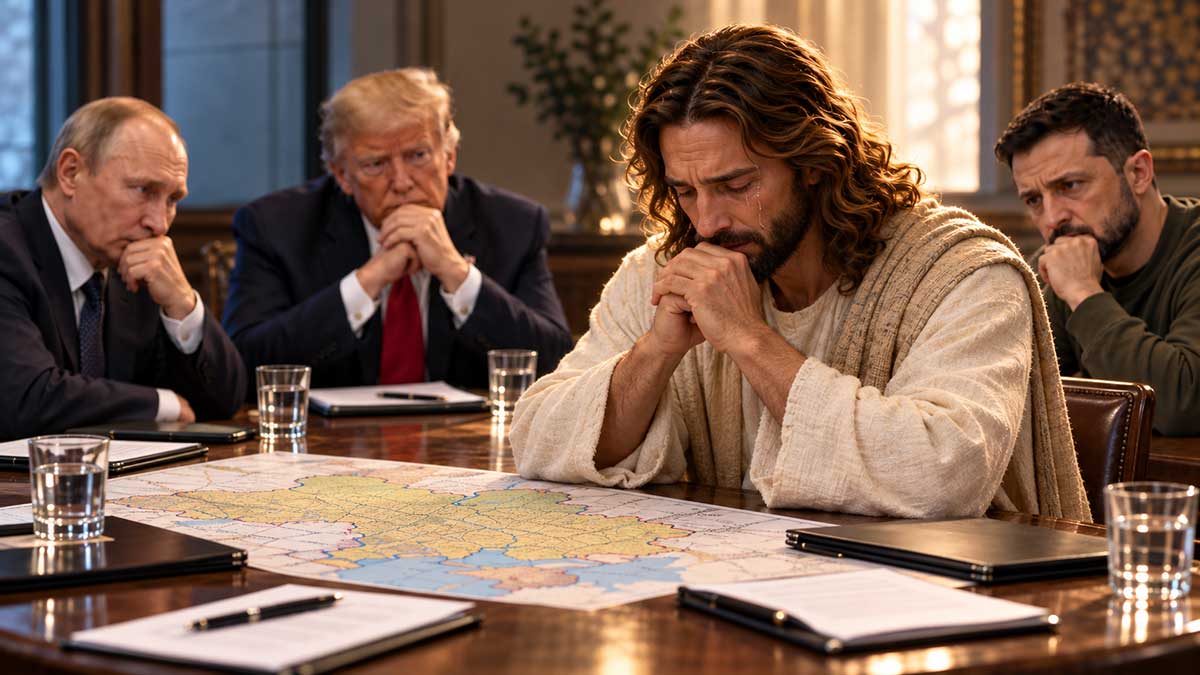
Jesus has lowered his head.
The three presidents remain silent, waiting for him to speak.
On the table lies a map of Ukraine. Red and blue markings trace disputed territories, military positions, cities, and roads. Beside it rests Trump's open folder, with the words "CEASEFIRE FRAMEWORK" written across the first page.
Jesus looks at neither.
His eyes remain on the empty chair near the wall.
Jesus: Volodymyr, you said the father asked you for a hug.
Zelensky: Yes.
Jesus: And you held him.
Zelensky: Yes.
Jesus: What did you feel?
Zelensky rubs his forehead.
Zelensky: I felt helpless.
He pauses.
Zelensky: You are the president of a country. People expect you to make decisions, give orders, solve problems. You can send weapons to a city. You can arrange an evacuation. You can negotiate with another president.
But when a father stands in front of you with his dead son's medal in his hands, there is nothing you can do.
You cannot give him what he wants.
Jesus: His son.
Zelensky: His son.
Jesus nods slowly.
Zelensky: I have met so many parents like that. Mothers, fathers, wives, husbands. Sometimes they speak. Sometimes they cannot. Sometimes they want to tell me everything about the person they've lost.
And sometimes they just hold my hand.
Putin listens without moving.
Zelensky: The hardest part is that I know there will be more.
Another missile. Another attack. Another young soldier who doesn't come home.
You don't get used to it. People think that after four years a president must somehow become accustomed to death.
You don't.
Trump: I don't think anyone could.
Zelensky: And then people ask why I'm reluctant to make compromises.
They say, "Just give up some territory. End the war. Think of the lives you'll save."
He turns toward Trump.
Zelensky: I do think about those lives. Every day.
But tell me, what do I say to the family whose home is in that territory? That their lives are now somebody else's responsibility? That we have decided their town is the price of peace?
Trump: I'm not saying it's easy. I'm saying we have to find some way to stop this.
Zelensky: And I am telling you why it is difficult.
Trump: I understand that. But there's something I need you to consider, Volodymyr.
Trump leans forward.
Trump: How many more fathers are going to stand in front of you holding medals if this keeps going another year?
Zelensky doesn't answer.
Trump: I'm serious. If we can't get an agreement, the fighting continues. More young men die. More families lose everything.
What's the plan then? Keep fighting until one country has nothing left?
Zelensky: No. That is not the plan.
Trump: Then what is it?
Zelensky: To secure a peace that lasts.
Trump: Good. That's what I want.
Zelensky: But your question assumes that agreeing to bad terms will necessarily save lives. What if it only postpones the next invasion?
Trump: Then we don't make a bad agreement. We make one that works.
Putin: Which brings us back to the security arrangements.
Trump turns toward Putin.
Trump: Vladimir, let me ask you something. Volodymyr has been speaking about Ukrainian families. You mentioned Russian families. Tell us about them.
Putin: Russia has lost many soldiers. These are people with parents, wives, and children. They serve their country, and their families bear a terrible burden when they do not return.
There are communities where people have lived under the threat of shelling and drone attacks. Families have had to leave their homes. Children have been frightened.
No serious leader can regard these losses as insignificant.
Trump: Then you have an interest in stopping the war too.
Putin: Certainly. But not merely stopping it for several months and then finding ourselves facing a larger conflict.
Zelensky: You keep saying this. A larger conflict. Who is planning to invade Russia?
Putin: The question is what military capabilities and alliances will develop along our borders. We cannot build national security on assurances that circumstances will never change.
Zelensky: And what about the circumstances you have already changed? The cities you've destroyed? The territory you've occupied?
Putin: We can discuss responsibility, but we must discuss all the events that led us here.
Zelensky: We have discussed them for years.
Putin: And yet you are asking me to set them aside.
Zelensky: I am asking you to stop attacking my country.
Trump lifts a hand, but Jesus speaks first.
Jesus: Vladimir.
Putin turns.
Jesus: You spoke of Russian mothers who have lost their sons.
Putin: Yes.
Jesus: When one of those mothers learns that her son has died, does she ask first about military alliances?
Putin: She asks why he died. And whether his sacrifice had meaning.
Jesus: And what do you tell her?
Putin takes a moment before answering.
Putin: That her son served his country. That we honor his service. And that the government has a responsibility to provide for his family.
Jesus: Does that take away her grief?
Putin: No. Of course not.
Jesus: Can anything?
Putin: Nothing can bring her son back.
Jesus looks toward Zelensky.
Jesus: Volodymyr, can anything bring back the young soldier whose father embraced you?
Zelensky: No.
Jesus: Then both of you have stood before a sorrow you cannot repair.
Zelensky exhales.
Zelensky: Yes. But there is still the question of why those men died.
Jesus: There is. And that question deserves truth.
Zelensky: Then we cannot simply say that everyone suffers and leave it there.
Jesus: No.
Jesus turns toward Putin.
Jesus: The suffering of two families may be equally heartbreaking without the decisions that brought them suffering being equally justified.
Putin watches him carefully.
Jesus: A father does not stop loving a child who has done wrong. But neither does love prevent him from telling that child the truth.
Putin: A father must hear the truth from all his children.
Jesus: Yes.
Putin: Then he should not judge before hearing both sides.
Jesus: He should listen carefully. And he should protect the child who is in danger.
Putin's hands remain folded.
Putin: I agree with protecting children. But in politics, determining who is endangered is rarely so simple.
Jesus: Then let us begin with what is simple.
Putin: Which is?
Jesus: A child is not made less precious by the country in which he was born.
Putin: Of course.
Jesus: And neither is a mother.
Putin: No.
Jesus: Then we should never speak of their deaths as if they were merely a price someone else must pay.
Trump glances at the map.
Trump: That's what I've been trying to say about this war. The cost is enormous. Human cost. Economic cost. Whole generations being affected.
Zelensky: Donald, I agree about the cost. But there are moments when defending people requires fighting.
Trump: Of course there are. I'm not telling you to let your country be overrun.
Zelensky: Then we need guarantees that mean something.
Trump: And we're going to get to that.
Jesus looks at Zelensky.
Jesus: Volodymyr, may I ask you a difficult question?
Zelensky: You've already asked several.
A faint smile passes across Trump's face.
Jesus: When you remember those who were killed in Bucha, what happens in your heart?
The smile disappears.
Zelensky sits back.
Zelensky: Bucha.
He repeats the name quietly.
Zelensky: I remember going there after we liberated the town.
I remember bodies in the streets. I remember what had happened to ordinary people. People who weren't soldiers. People who had been tied up, tortured, murdered.
His voice grows harder.
Zelensky: There are photographs. Evidence. Witnesses. It wasn't something somebody imagined.
And when you see these things yourself, they remain with you.
Jesus: What did you feel?
Zelensky: Anger.
He looks toward Putin.
Zelensky: Hatred, perhaps. I won't pretend otherwise.
Before the war, I didn't think of myself as someone who could hate another human being that deeply.
But after Bucha...
He stops.
Jesus: You wanted those responsible to suffer.
Zelensky: Yes.
His answer comes immediately.
Zelensky: Yes. I wanted them punished. I wanted them to understand what they had done.
And I'm still angry.
Putin: Allegations of crimes must be investigated on the basis of evidence. Russia has disputed many claims about what occurred in Bucha.
Zelensky: These are not just allegations to me. There are witnesses and extensive documented evidence.
Putin: I am stating that we have challenged the account presented by your government.
Zelensky: And I'm telling you what I saw.
Trump leans forward.
Trump: We are not going to settle a war-crimes investigation in this room. Evidence has to be examined independently. If crimes were committed, those responsible must face accountability.
Zelensky: They were committed.
Trump: Then accountability has to be part of the process.
Jesus remains turned toward Zelensky.
Jesus: When you think of those who died, does your anger help you remember them?
Zelensky: It reminds me that I must not abandon them.
Jesus: And does it sometimes make it harder to see anything beyond what was done to them?
Zelensky looks away.
Zelensky: Sometimes.
He speaks more quietly.
Zelensky: But what would you have me do? Smile at the man whose army invaded my country? Say I forgive everything?
Jesus: I have not asked you to say that.
Zelensky: Then what are you asking?
Jesus: Whether your love for those who died might lead you to protect those who are still living, without requiring you to forget the dead.
Zelensky: I am trying to do exactly that.
Jesus: I believe you are trying.
Zelensky: And that may mean continuing to resist.
Jesus: It may require defending those in danger. But every decision still deserves examination, including what it will cost the people you seek to protect.
Zelensky lowers his eyes.
Zelensky: That is the burden. Every decision can cost lives.
Trump: Exactly. Every decision. Including no decision.
Trump turns toward Putin.
Trump: Vladimir, can I ask you the same kind of question?
Putin: Go ahead.
Trump: Let's say the fighting continues for another year. Russia takes some more territory. Ukraine keeps resisting. More soldiers are killed on both sides.
What have you gained that you couldn't have gained through a negotiated agreement?
Putin: That depends on whether a negotiated agreement protects the security and interests of Russia.
Trump: Okay, but how many more people have to die before we find out?
Putin: It is the responsibility of political leadership to prevent a future conflict, not merely to produce a temporary pause.
Trump: And it is the responsibility of leadership to look at the people dying right now.
Putin: I am fully aware of that responsibility.
Trump: Then tell me something you would be willing to do immediately.
Putin: We can examine humanitarian measures and the conditions for a ceasefire. But they must be reciprocal and part of a credible process.
Zelensky: Then put those conditions in writing.
Putin: I would expect Ukraine to do the same.
Trump: Good. We can do that.
Trump reaches for his pen.
Jesus: Donald.
Trump: Yes?
Jesus: Before you write, may I tell you something that has been on my heart?
Trump sets the pen down.
Trump: Of course.
Jesus looks toward the window.
Outside, the afternoon light has begun to fade.
Jesus: When I lived among the people of Jerusalem, I looked upon that city and wept.
He pauses.
Jesus: I saw people I loved. Families. Children. Men and women who did not understand what would bring them peace.
He looks at the three presidents.
Jesus: Today I listen to you speak of Russia and Ukraine.
You speak of history, borders, guarantees, armies, and treaties.
These things have meaning. I know they do.
His voice grows quieter.
Jesus: But I keep thinking of our Father.
No one speaks.
Jesus: When you were children, did you ever see your mothers cry?
Trump: Of course.
Zelensky: Yes.
Putin: Naturally.
Jesus: Were they always crying over something that had happened to them?
Zelensky: No. My mother could become upset if something happened to me. Especially when I was small.
Jesus: And if you were suffering, did she sometimes seem to suffer more than you?
Zelensky gives a small, sad smile.
Zelensky: Yes. Mothers can be like that.
Jesus: Why?
Zelensky: They love their children.
Jesus: Yes.
Jesus looks toward Putin.
Jesus: Vladimir, imagine a father with two sons.
One son strikes the other. The injured son strikes back. The fighting grows worse until both are badly hurt.
What does their father feel?
Putin: He would be distressed. He would want them to stop.
Jesus: Would he love the injured son?
Putin: Of course.
Jesus: And the son who caused the injury?
Putin: He would still be his son.
Jesus: Even if he had done something terribly wrong?
Putin: A father does not cease being a father.
Jesus: Yes.
Jesus lowers his eyes.
Jesus: A father may have to restrain a child who is hurting another. He may have to confront wrongdoing. He may have to listen to terrible accusations and decide how to protect those in danger.
But he does not stop loving either child.
He looks at Zelensky.
Jesus: What if the two sons refuse to listen?
Zelensky: The father would try to separate them.
Jesus: And if they continue fighting?
Zelensky: He would do whatever he could to stop them from hurting each other.
Jesus: Would he be satisfied if one defeated the other?
Zelensky: Not if both were badly hurt.
Jesus: And if one died?
Zelensky's expression changes.
Zelensky: It would destroy him.
Jesus closes his eyes.
For several seconds, he says nothing.
Trump: Jesus?
Jesus tries to speak.
Jesus: Then think...
His voice falters.
Jesus: Think of our Heavenly Father.
A tear forms in his eye.
He looks down, and the tear slips along his cheek.
It falls onto the wooden table.
Zelensky: Jesus?
Jesus does not answer.
Zelensky: Are you crying?
Another tear follows.
Jesus: I was thinking of my Father.
Trump: Your Father?
Jesus: Yes. Our Heavenly Father.
He looks toward Putin and Zelensky.
Jesus: You have spoken about the mothers who have lost their children.
I have listened to you.
But I cannot stop thinking of the Father who loves every one of those children.
His voice trembles.
Jesus: A Ukrainian mother prays that her son will return.
A Russian mother prays for the same thing.
They may be praying on opposite sides of the battlefield. Each may believe the other country is responsible for her suffering.
But they are both praying to the same Father.
Jesus pauses.
Jesus: And He loves both sons.
The room becomes still.
Jesus: He knew them when they were infants. He knows the mothers who held them. He knows their childhood laughter, their hopes, their fears.
Jesus struggles to continue.
Jesus: And now He sees them killing one another.
He brings a hand to his face.
Jesus: I am crying because I feel my Father's sorrow.
Zelensky looks down.
Putin remains motionless.
Trump slowly closes the folder in front of him.
Jesus: You see a Russian soldier and a Ukrainian soldier.
My Father sees two sons.
His tears continue.
Jesus: When one falls, He grieves.
When the other takes a life, He grieves for what has happened to that child too.
And when those who remain alive are taught to hate one another, His sorrow does not end.
Jesus looks at the two presidents.
Jesus: Can you imagine how much our Father has suffered watching His children do this?
No one answers.
Jesus: He loves the children in Kyiv.
He loves the children in Moscow.
He loves those who speak Ukrainian and those who speak Russian.
He loves the families who have fled their homes.
He loves those who are afraid tonight.
His voice becomes almost inaudible.
Jesus: And He is their Father even when they have forgotten Him.
Jesus lowers his head again.
The silence lasts.
For the first time since the meeting began, no one seems interested in being the next to speak.
Eventually, Zelensky breaks the silence.
Zelensky: Jesus, I understand what you are saying.
He hesitates.
Zelensky: But what about the children who were murdered?
What about those who were tortured?
What about the parents who will never hold their children again?
Is our Father asking them to forgive the people who did those things?
Jesus lifts his face.
Jesus: Volodymyr, when a father sees one of his children hurting another, does he tell the injured child that the harm did not happen?
Zelensky: No.
Jesus: Does he ask the injured child to return immediately to the one who hurt him, without protection?
Zelensky: No.
Jesus: Does he stop loving the child who caused the harm?
Zelensky looks at him for a long moment.
Zelensky: No. I suppose he doesn't.
Jesus: His love does not make the wrongdoing disappear.
Jesus wipes his cheeks.
Jesus: But neither does the wrongdoing make him cease loving his child.
Zelensky: Then what does he do?
Jesus: He stops the harm. He protects the one who is in danger. He calls the one who caused the harm to account.
And he longs for the day when his children no longer wish to injure one another.
Zelensky: But I cannot forgive on behalf of people who have been murdered.
Jesus: You cannot give away another person's grief.
Zelensky: Then what am I supposed to do with all this anger?
Jesus: Do not pretend it is absent.
Let it remind you of the lives entrusted to your care.
But ask whether it can guide you to protect the living, rather than demand another death in answer to those already suffered.
Zelensky stares at the table.
Zelensky: That is not easy.
Jesus: I know.
Zelensky: Sometimes it feels as if stopping the war before justice has been done would mean abandoning those who died.
Jesus: Then seek justice.
But do not ask tomorrow's children to die before yesterday's suffering can be acknowledged.
Zelensky looks up.
The words remain between them.
Putin: I understand the moral principle. But as the head of a state, I cannot act solely upon a feeling of compassion.
Jesus: Vladimir, I am not asking you to govern without responsibility.
Putin: Russia has security concerns. Those concerns do not disappear when we speak of the suffering of families.
Jesus: I have heard you explain them.
Putin: And I believe they are legitimate.
Jesus: Then answer something for me.
If an agreement could provide credible protections for Russian families while allowing Ukrainian families to live safely and freely, would that be worth pursuing?
Putin: Certainly, provided the guarantees were genuine and the fundamental issues addressed.
Jesus: Then let us examine what is truly necessary to protect those families.
Jesus pauses.
Jesus: But I ask you not to confuse everything your government desires with everything your people need to remain safe.
Putin looks directly at him.
Putin: Who decides the difference?
Jesus: That is why you must listen to others, examine the evidence, and be willing to question your own decisions.
Putin: And Ukraine must do the same.
Jesus: Yes. Every leader must examine himself.
Jesus turns toward Zelensky.
Jesus: Volodymyr, you have spoken of what you cannot accept.
Are there measures you could accept today that would spare lives while the larger disagreements remain unresolved?
Zelensky: Humanitarian measures. Prisoner exchanges. Protection for civilians. A genuine ceasefire, if there are credible guarantees against another attack.
Jesus: Then those are places to begin.
Zelensky: But we cannot surrender our independence simply to stop fighting.
Jesus: I have not asked you to surrender your people to danger.
Jesus looks toward Putin.
Jesus: And I have not asked Vladimir to disregard the safety of Russian families.
He takes a breath.
Jesus: I am asking both of you to remember that your Father's love does not end at your country's border.
Trump has been listening quietly.
Trump: You know, I've negotiated a lot of deals.
Some were easy. Some were incredibly difficult.
But usually, when people come to the table, they know what they want. Money. Property. Some kind of advantage.
This is different.
He looks toward Jesus.
Trump: You're asking these men to think about people on the other side as if they were their own families.
Jesus: I am asking them to consider that they already belong to the same human family.
Trump: I understand that. But here's the problem.
Putin believes he's protecting Russia.
Zelensky believes he's protecting Ukraine.
And if either one makes the wrong deal, people could die later.
Jesus: Then let us seek an agreement that protects people now and does not abandon them tomorrow.
Trump: That's the challenge.
Jesus: Yes.
Trump: But I don't want to see another year of this. Another hundred thousand people dead or injured, another generation of children growing up afraid.
Zelensky: Neither do I.
Putin: Nor do I want an endless war.
Trump: Then we've got to stop explaining why peace is impossible and start working out what makes it possible.
He reaches for his folder.
Jesus: Donald.
Trump: Yes?
Jesus: May I ask you one thing before you begin?
Trump: Of course.
Jesus: When you negotiate, what do you consider a successful agreement?
Trump: An agreement that works. Both sides keep their commitments. The fighting stops.
Jesus: And who benefits?
Trump: The countries involved. Their people.
Jesus: Then remember those people when you measure its success.
Trump nods.
Jesus: The agreement should not be judged only by what the presidents sign.
It must be judged by whether the families who live with its consequences are protected.
Trump: That's fair.
Jesus: A mother does not ask whether the ceasefire has an impressive name.
She wants to know whether her son will come home.
Trump looks at Putin, then Zelensky.
Trump: You both heard that.
Putin: I did.
Zelensky: Yes.
Trump: Let me ask you something. Both of you.
If we could stop the fighting tomorrow morning, with credible monitoring and real security guarantees, would you at least consider it?
Putin: If the necessary conditions for a lasting settlement were met.
Zelensky: If Ukraine remained secure and able to defend itself.
Trump: That's where we start.
He opens his folder.
Jesus watches him, his eyes still wet.
Jesus: Before you write, I want to return to something Volodymyr said.
Trump sets down his pen.
Jesus: The father who asked for a hug.
Zelensky: Yes.
Jesus: You could not bring his son back.
Zelensky: No.
Jesus: But perhaps there is another father who has not yet received that terrible news.
Zelensky lowers his head.
Jesus: Perhaps his son is alive tonight.
Perhaps he is frightened. Perhaps he is cold. Perhaps he is looking at a photograph of his children.
Jesus looks toward Putin.
Jesus: Perhaps there is a Russian father waiting for his son too.
He turns toward both presidents.
Jesus: What if your next decision could help those sons return home?
No one speaks.
Jesus: Would that not be something precious to offer our Father?
Putin slowly looks toward the map.
Putin: It would be valuable to end the loss of life. But we must establish arrangements that endure.
Zelensky: Yes. That is the part we cannot ignore.
Trump: Then let's work on those arrangements.
He places a blank sheet of paper between them.
Trump: I want us to do something different now.
No long speeches about the past for the next few minutes. No arguments about who insulted whom. No promises nobody can verify.
I want each of you to tell me three things.
What can you stop doing immediately?
What do you need the other side to stop doing?
And who gets to check whether you both keep your word?
Putin: Those questions must be addressed in a comprehensive framework.
Trump: Then we'll build one.
Zelensky: We need guarantees, not just a framework.
Trump: Then the guarantees go into it.
Putin: And the legitimate security interests of Russia.
Trump: Those go on the table too. Everybody gets heard. But nobody gets everything simply by demanding it.
Trump writes three headings across the page.
STOP.
PROTECT.
VERIFY.
He looks at the words.
Trump: There. That's where we start.
Jesus looks at the paper.
Jesus: May I ask one thing of you before you begin?
Trump: Anything.
Jesus: When the discussion becomes difficult again, and it will, remember the parents we have spoken about.
He looks at Putin and Zelensky.
Jesus: If you argue over a piece of land, think of the children who live there.
If you argue over an army, think of the sons and daughters who serve in it.
If you argue over security, think of the families who simply wish to sleep without fear.
He pauses.
Jesus: And when anger rises between you, remember how your own mothers loved you when you were children.
Zelensky looks toward Putin.
Putin meets his eyes.
Neither smiles.
Neither looks away immediately.
Jesus: Our Heavenly Father loves you both with a love greater than you can comprehend.
His voice grows softer.
Jesus: And He loves the people whose lives depend upon what you decide here.
Jesus lowers his eyes again.
Jesus: I wish you could feel His heart.
For a moment, no one moves.
Zelensky: I can agree to discuss immediate steps to stop the killing.
Putin: Provided the process addresses the security concerns of both sides.
Trump: Good. We don't have an agreement yet. But we have something to work on.
He slides the paper to the center of the table.
Trump: Let's start with the first word.
His pen rests beneath STOP.
Trump: What can each of you stop doing tomorrow morning?
Putin leans forward.
Zelensky draws the paper closer.
Jesus sits quietly beside them.
Outside, evening settles over the city.
For the first time, the map is no longer the only document commanding their attention.
Topic 3: What Can We Agree to Before Another Child Dies?
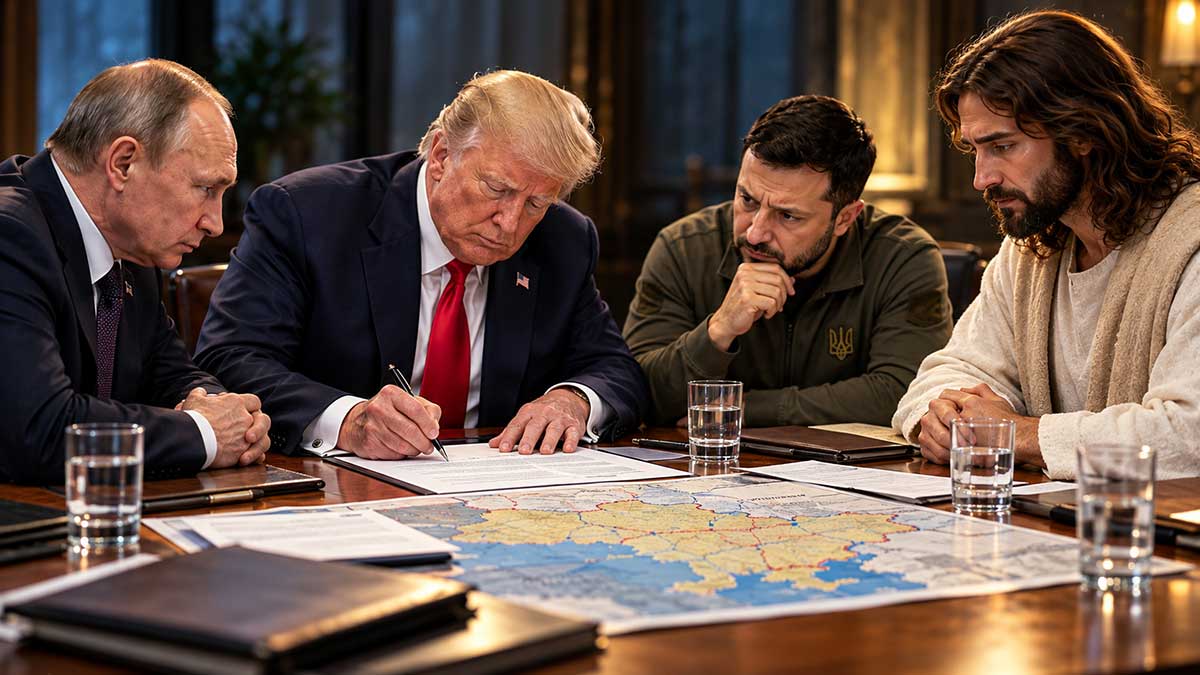
Three words are written across the top of a sheet of paper.
STOP. PROTECT. VERIFY.
Trump holds his pen beneath the first word.
Putin studies the page. Zelensky has moved his chair closer to the table.
Jesus sits quietly beside them. His eyes are still red from crying.
For several minutes, the room has been different. The arguments have not disappeared. The disagreements remain as serious as ever. But nobody has quite returned to the way he spoke before.
Trump: All right, gentlemen. We've talked about history. We've talked about security, territory, and what each country believes the other has done wrong.
We've heard things tonight that nobody in this room is going to forget.
But I want to ask you something.
What can we actually do tomorrow morning?
Putin: That depends upon what you are proposing.
Trump: I'm proposing that we stop finding reasons why nothing can happen until everything has been settled.
Let's find something we can do now.
Zelensky: We must not confuse doing something with accomplishing something.
Trump: Agreed. I want results, not a press conference.
Trump taps the first word.
Trump: STOP.
Let's begin with attacks on civilian infrastructure. Homes, hospitals, essential services. People living without electricity or heat. Families hiding when the sirens go off.
Vladimir, what would Russia be prepared to stop?
Putin: Russia could examine reciprocal restrictions on strikes against clearly defined civilian infrastructure. But we would need agreement about facilities with military uses.
Zelensky: That distinction cannot become permission to attack almost anything.
Putin: Nor can civilian infrastructure be used to conceal military operations.
Trump: Fine. Then experts define the protected facilities, the prohibited attacks, and how to investigate disputed incidents.
Volodymyr?
Zelensky: Ukraine could participate in that process. We would insist on independent verification and consequences for violations.
Trump: Good. There's our first possible commitment.
Zelensky: A possible commitment.
Trump: Yes. Possible. That's why we're negotiating.
He writes beneath STOP.
RECIPROCAL PROTECTION OF CIVILIAN INFRASTRUCTURE.
Jesus: Donald, may I ask something?
Trump: Of course.
Jesus: How quickly could those experts begin?
Trump: Immediately, if the governments authorize them.
Jesus: And how quickly could they produce something that protects people?
Trump: We'd need a deadline. A few days to identify the first measures, perhaps.
Putin: That is an ambitious timetable for technically complicated matters.
Jesus: Vladimir, you are right that a poorly designed agreement can fail.
Jesus pauses.
Jesus: But somewhere tonight, parents will put their children to bed not knowing whether their home will still be standing tomorrow.
Putin: I understand.
Jesus: Then can the urgency of their situation become part of the urgency of your negotiations?
Putin considers the question.
Putin: Yes. Provided haste does not replace sound arrangements.
Jesus: That is all I am asking.
Trump writes another note.
Trump: Immediate technical talks. Short deadline for an initial proposal. All unresolved details identified in writing.
Nobody gets to delay indefinitely by saying the subject is complicated.
Zelensky: I would support that approach.
Putin: Russia could examine it.
Trump: Good.
He draws a line beneath the first item.
Trump: Next. Prisoners.
Zelensky: Ukrainian prisoners of war must be returned. We also need access to civilian detainees and information about missing people.
Putin: Russian prisoners and missing persons must be addressed as well.
Trump: Fine. Then let's work toward further exchanges.
Zelensky: There is another issue.
Trump: The children.
Zelensky: Yes.
His expression hardens.
Zelensky: Ukrainian children who were transferred to Russia or Russian-controlled territories. Some have been separated from their families. Parents and relatives are searching for them.
They need reliable information. They need access. And children who have been unlawfully transferred must be returned.
Putin: Russia has described many transfers as evacuations for humanitarian reasons. The circumstances of individual cases must be established.
Zelensky: Then let independent organizations establish them. Provide access to records. Help find the families.
Trump: That's what we need. Individual cases, family tracing, documentation, and a process that protects the children rather than turning them into another political argument.
Jesus looks toward Putin.
Jesus: Vladimir, may I ask you to imagine something?
Putin: Yes.
Jesus: Your child has been taken far from home.
You do not know where he is. You do not know whether he is frightened. You do not know whether anyone has told him you are searching for him.
Every morning you wake with the same question.
Where is my child?
Putin is silent.
Jesus: What would you ask of the people who know where he is?
Putin: I would ask them to provide information and ensure his welfare.
Jesus: And if he could safely be reunited with his family?
Putin: That would be desirable, subject to the child's circumstances and applicable procedures.
Jesus: Then let us work from that principle.
Jesus turns toward Zelensky.
Jesus: Volodymyr, would you support the same protection for a Russian child separated from family by this war?
Zelensky: Of course. A child should not be punished for the decisions of governments.
Jesus: Then you have named something you share.
Trump writes.
FAMILY TRACING. CHILD WELFARE. REUNIFICATION.
Trump: I'm going to ask for something more specific.
I want your representatives to identify cases where action can begin immediately. No waiting until we settle every issue about borders.
Zelensky: We can provide lists and work with an independent humanitarian process.
Putin: Such a process would need agreed procedures, including verification of family relationships and the welfare of each child.
Trump: Then establish them.
He looks toward Jesus.
Trump: What else?
Jesus: There are also parents who do not know whether their sons are alive.
Trump: Missing soldiers.
Jesus: Yes. And civilians.
Perhaps the first mercy they need is the truth.
Zelensky nods slowly.
Zelensky: I have met families who have been waiting for years.
Putin: There are Russian families in the same situation.
Jesus: Then let them receive information whenever it can responsibly be provided.
For a moment, the map is forgotten.
Trump: All right. We're making progress.
Zelensky: We're beginning to describe practical possibilities.
Trump: That's progress, Volodymyr.
Zelensky gives a tired smile.
Zelensky: You really like that word.
Trump: I do. Especially when we're getting some.
Trump turns the paper.
Trump: Now comes the harder part.
A ceasefire.
Putin: This requires resolving the security conditions underlying the conflict.
Zelensky: And ensuring that a ceasefire does not become an opportunity for another invasion.
Trump: I know. But here's what I want to understand.
What would you actually need to see, in writing, to believe that stopping the fighting would not endanger your country?
He turns toward Putin.
Trump: Vladimir, not another general speech about security. Specific conditions.
Putin: There would need to be arrangements concerning offensive military deployments, foreign military infrastructure, the strategic situation along Russia's borders, and the political status of contested territories.
Trump: Which of those could be monitored?
Putin: Some military arrangements could be monitored through agreed mechanisms.
Trump: Good. Which would require longer negotiations?
Putin: The political and territorial questions would be more complicated.
Trump: Fine. We separate them.
He turns toward Zelensky.
Trump: Volodymyr, what would you need?
Zelensky: Guarantees that Ukraine can defend itself. No recognition of unlawful annexations. Independent monitoring. Meaningful consequences if Russia attacks again.
And guarantees that do not disappear when governments change.
Trump: Could Ukraine examine reciprocal military arrangements if those protections were credible?
Zelensky: Reciprocal arrangements, yes. But not terms that leave us defenseless.
Putin: And Russia cannot accept an agreement that creates new military threats along its borders.
Trump: Then both governments must identify the actual military activities they consider dangerous.
Not just say, "We don't trust them."
Tell us what equipment, what deployments, what movements, what inspections.
Putin: Some issues can be addressed technically.
Zelensky: Provided Ukraine remains free and capable of defending itself.
Trump: That's the work.
Jesus looks toward both presidents.
Jesus: May I ask a question?
Putin: Certainly.
Jesus: Vladimir, if Russian families could live without fear of attack, would you still need Ukrainian families to live in fear?
Putin: No. Russia does not seek the suffering of Ukrainian families as an objective.
Jesus: Volodymyr, if Ukrainian families could live in safety, would you wish Russian families to suffer?
Zelensky: No.
Jesus: Then neither of you says that the suffering of the other country's children is what you desire.
Zelensky: Of course not.
Jesus: Yet children are suffering.
Neither president responds immediately.
Jesus: Perhaps that is something you must both continue examining.
The difference between what you hope to accomplish and what your decisions actually bring into people's lives.
Putin: National leadership requires difficult choices. Sometimes avoiding a greater danger involves accepting immediate costs.
Jesus: Yes. And that is why the possible consequences of every choice must be examined honestly.
Zelensky: Including the consequences of refusing to defend ourselves.
Jesus: Including those.
Jesus looks at the two men.
Jesus: I am not asking you to pretend every choice is equally justified.
Nor am I asking the people who have been harmed to forget what happened.
I am asking whether you can protect those in danger without allowing the conflict to become an endless inheritance for their children.
Trump turns toward the map.
Trump: That's where the ceasefire matters.
But we have to deal with territory.
The room becomes quiet.
Zelensky: Ukraine cannot recognize the unlawful seizure of its territory.
Putin: Russia's position concerning the territories it claims is well established.
Trump: And if we insist on solving that entire dispute before taking another step, the fighting may continue.
Here's my question.
Can you stop military operations under an interim arrangement without either government pretending it has changed its legal position?
Zelensky: Only if the arrangement protects Ukraine and does not recognize annexations.
Putin: Any interim arrangement must fit within a broader process addressing the underlying disputes.
Trump: Then perhaps an interim military arrangement and a final political settlement don't have to happen on the same day.
Zelensky: The people living in those territories cannot be forgotten.
Trump: Agreed.
Zelensky: Their homes, their property, their safety, their rights. Families separated by the front line.
Putin: The rights and security of residents must be addressed.
Jesus: May I see the map?
Trump slides it toward him.
Jesus studies the small printed names.
Jesus: What is this town?
Zelensky: A town in eastern Ukraine.
Jesus: Are there people living there?
Zelensky: Some remain. Others have fled.
Jesus: Are there children?
Zelensky: Yes.
Jesus rests his finger beside the name.
Jesus: Then before anyone moves this line, I hope they will remember that it crosses people's lives.
A pause follows.
Jesus: Someone was born there.
Someone fell in love there.
A mother once stood in a doorway calling her child home for dinner.
There are places where families buried their grandparents, where children learned to ride bicycles, where a father planted a tree for his daughter.
Jesus looks at Putin.
Jesus: Vladimir, those lives matter more than the ink on this map.
Putin: The security of the people living there is part of the reason these questions must be settled.
Jesus: Then let their welfare help determine what must be protected.
He looks toward Zelensky.
Jesus: And let the families who have fled remain in your thoughts as you negotiate.
Zelensky: They are.
Jesus: I know you have carried their stories.
Trump pulls the map closer.
Trump: Then any proposed ceasefire arrangement needs provisions for civilian access, displaced people, humanitarian routes, and the rights of residents.
And the territorial dispute continues through a separate process rather than being silently decided by an interim military line.
Putin: Those provisions would require negotiation.
Zelensky: And no language that compromises Ukrainian sovereignty.
Trump: We record that objection explicitly. Nobody pretends it's resolved.
Trump sets down his pen.
Trump: Which brings me to something else.
Justice.
Zelensky: Yes.
Trump: We've heard about Bucha. About civilians killed. About prisoners and missing people. Serious allegations and documented evidence that cannot just be made to disappear.
Zelensky: The families deserve accountability.
Putin: Any proceedings must be based on evidence, lawful jurisdiction, and impartiality.
Trump: Then investigations continue according to the relevant legal processes.
But I want to ask something.
Do we have to complete every investigation before we protect another civilian?
Zelensky: No.
Trump: Do we have to settle every legal question before we exchange prisoners?
Putin: Not necessarily.
Trump: Then we shouldn't make one good thing impossible by requiring every other difficult thing to be finished first.
Jesus looks at Zelensky.
Jesus: Volodymyr, earlier you spoke of the father who asked you for a hug.
Zelensky: Yes.
Jesus: If a ceasefire were reached tomorrow, would that father's son return?
Zelensky: No.
Jesus: Would the father necessarily forgive those responsible?
Zelensky: I cannot speak for him.
Jesus: Nor should anyone demand that you do.
Jesus pauses.
Jesus: Peace does not require calling injustice justice.
It does not require telling the bereaved that their sorrow has ended.
But perhaps the living can be protected while the search for truth continues.
Zelensky: Sometimes I worry that stopping the war before justice is complete would mean abandoning those who died.
Jesus: Then continue seeking justice.
Remember their names. Tell their stories. Care for their families.
His voice grows softer.
Jesus: But do not require another mother to lose her child before the first mother's suffering can be acknowledged.
Zelensky lowers his eyes.
Zelensky: I understand.
Putin remains quiet.
Jesus: Vladimir, there are Russian mothers who have lost their sons as well.
Putin: Yes.
Jesus: What would you wish to give those who are still waiting?
Putin: The return of their sons, wherever that is possible. And a settlement that prevents further loss of life while safeguarding the country.
Jesus: Then let the desire to bring them home have a place among your decisions.
Trump looks down at the paper.
Trump: This is what I've been trying to accomplish.
We don't need to announce that everybody has forgiven everybody.
We need measures that actually reduce the killing.
But there's still one big problem.
He taps the third word.
Trump: VERIFY.
Zelensky: Without verification, there is no trustworthy ceasefire.
Putin: Verification must be impartial and technically credible.
Trump: Fine. Then we need to answer three questions.
Who checks compliance?
What counts as a violation?
And what happens when a violation is confirmed?
Zelensky: The mechanism cannot allow either side to block a finding.
Putin: Nor can allegations be treated as established facts without investigation.
Trump: Agreed. Independent investigators, defined evidence standards, access arrangements, and consequences that are known in advance.
Zelensky: And guarantees against a serious breach.
Trump: Yes.
Trump begins listing possible arrangements.
Trump: International monitors. Agreed technical reporting. Third-party investigation of disputed incidents. Procedures for urgent consultations.
We'll have to determine who is acceptable, what authority they have, and how their work is protected.
Putin: The monitoring body's composition would need to be negotiated.
Zelensky: And it would need access sufficient to do its job.
Trump: Exactly.
He looks at Jesus.
Trump: I wish I could just make them trust each other.
Jesus: Trust is difficult after great harm.
Trump: That's putting it mildly.
Jesus: Then perhaps they should begin with commitments that can be tested.
Trump: That's what I'm thinking.
Jesus: If someone says he will return a prisoner, and the prisoner returns home, a family sees that a promise was kept.
If someone promises to protect a hospital, and the hospital is no longer attacked, patients and doctors experience the value of that promise.
Jesus looks at Putin and Zelensky.
Jesus: Perhaps trust can begin not with declarations, but with actions that others can verify.
Zelensky: That is something I could accept.
Putin: I would agree that compliance is essential.
Trump: Good. That's the foundation.
He studies the notes they have produced.
Trump: Now I want to try something.
I'm going to stop asking what you need the other side to do.
Instead, I want to know what each of you is willing to do first.
Putin: Within what framework?
Trump: Within the humanitarian framework we've discussed.
No recognition of territorial claims. No pretending the war is over. No enormous concession hidden in a small agreement.
Just something concrete that protects people.
Vladimir, you first.
Putin thinks before answering.
Putin: I would be prepared, within this hypothetical process, to direct our representatives to develop an expedited proposal for further prisoner exchanges and humanitarian access, subject to agreed verification procedures.
Trump: All right. Volodymyr?
Zelensky: I would authorize our representatives to do the same. Ukraine could also work immediately on a reciprocal arrangement protecting civilian infrastructure, provided it can be independently monitored.
Trump: Vladimir, would Russia examine that proposal?
Putin: Yes, provided the terms were genuinely reciprocal and military uses were addressed.
Trump: Then we've found the first two subjects for immediate work.
He writes them down.
Trump: Now, here's where I want to be very careful.
We're not signing a peace treaty. We're not claiming agreement on territory. We're not saying the whole war is solved.
But I want an actual next step.
Each government assigns representatives. They prepare specific proposals for humanitarian measures and protection of civilian infrastructure. They identify what they accept and what still needs negotiation.
And we set a deadline for the first meeting.
Zelensky: With the interests and sovereignty of Ukraine explicitly protected.
Putin: And with Russia's stated security concerns accurately represented.
Trump: Both positions will be recorded. Neither side has to agree with the other's claims merely to begin.
He looks from one to the other.
Trump: Can you both accept that as the basis for further work?
Zelensky: I could accept beginning that process.
Putin: Subject to the conditions we have discussed, Russia could participate.
Trump puts down his pen.
Trump: There.
He sits back.
Trump: That's not peace. But it is something we didn't have when we sat down.
Zelensky: A process is not the same as a result.
Trump: You're right.
Putin: And the process would still have to produce acceptable terms.
Trump: You're both right.
He looks at the papers.
Trump: But for once, you've each described something your own government could do.
Not just what you demand from the other.
Jesus has been listening in silence.
Jesus: May I ask a favor of you both?
Putin and Zelensky turn toward him.
Jesus: Would you speak to each other for a moment?
Zelensky: We have been speaking to each other.
Jesus: Yes. But much of your conversation has been about what the other must do.
Could you speak now about what you are willing to do for the families whose lives depend upon your decisions?
Zelensky looks toward Putin.
There is a long silence.
Zelensky: Vladimir, I cannot forget what has happened to my country.
I cannot forget our dead, the cities that were destroyed, or the children who have suffered.
I cannot pretend that we agree about who is responsible or what justice requires.
Putin listens.
Zelensky: But I don't want another Ukrainian family to receive news that their son has been killed.
And I don't want Russian families to suffer that loss either.
His voice becomes quieter.
Zelensky: If there are genuine measures we can take to protect civilians, exchange prisoners, and bring children home, I am prepared to pursue them.
I will not abandon my country.
But I do not want this war to become the only future our children know.
Putin looks down at the table before answering.
Putin: Volodymyr, our understanding of the conflict remains very different.
I believe Russia has legitimate security concerns that must be addressed. I cannot disregard the responsibilities I have toward my country.
He pauses.
Putin: But I acknowledge that the suffering of families is real.
Russian families have experienced it. Ukrainian families have experienced it.
If practical, reciprocal commitments can reduce that suffering and contribute to a durable settlement, they deserve serious examination.
He looks toward Zelensky.
Putin: I am prepared to pursue that examination.
Neither man speaks for a moment.
Trump looks toward Jesus.
Trump: We still have a long way to go.
Jesus: Yes.
Trump: And a lot of very difficult questions.
Jesus: Yes.
Trump: But perhaps we have found some common ground.
Jesus smiles faintly.
Jesus: You have begun looking for it.
He turns toward Putin and Zelensky.
Jesus: When you entered this room, each of you spoke of what your country needed from the other.
Now you have begun speaking of what you might do to protect families on both sides.
His eyes glisten.
Jesus: I hope you will hold on to that.
Zelensky: Jesus, I want to ask you something.
Jesus: Yes?
Zelensky: Earlier, when you cried...
He hesitates.
Zelensky: You said you were feeling your Father's sorrow.
Jesus: Yes.
Zelensky: Do you believe our Father could ever forgive everything human beings have done to one another?
Jesus is silent for a moment.
Jesus: Volodymyr, I believe our Father's love is greater than the hatred of His children.
He pauses.
Jesus: But forgiveness is not pretending that nothing happened.
Love does not erase truth. It does not abandon those who have been harmed.
It seeks to heal what has been broken.
Zelensky: Even something as terrible as this?
Jesus: Even then, I believe our Father longs for healing.
Putin looks at Jesus.
Putin: And what would you ask of those responsible for leading nations?
Jesus: That they remember how precious each human life is.
And that they do not allow pride, fear, or the desire to prevail to become more important than the people they are meant to serve.
Jesus looks toward Trump.
Jesus: Donald, may I ask you something?
Trump: Anything.
Jesus: If these men were your sons, and they had spent years fighting, what would you hope to see before they left this room?
Trump thinks.
Trump: I'd want them to stop hurting each other.
I'd want them to be safe.
And I'd want to know they were serious about finding a way forward.
Jesus: Would you expect all their disagreements to disappear in one evening?
Trump: No.
Jesus: But would you hope they might take one step toward one another?
Trump: Of course.
Jesus nods.
Jesus: That is what I hope for tonight.
He turns toward Putin and Zelensky.
Jesus: You do not have to pretend that your disagreements have disappeared.
You do not have to call injustice justice.
But perhaps you can begin to see that the people beyond your borders are also precious to our Heavenly Father.
His voice trembles slightly.
Jesus: When a father sees his children fighting, he does not stop loving them because they disagree.
He wants the one in danger protected.
He wants wrongdoing confronted.
And he wants the fighting to end.
Jesus pauses.
Jesus: I believe our Father longs for that day more deeply than you can imagine.
Zelensky looks toward the map.
Zelensky: I have spent so much time looking at these lines.
Where the armies are. Where we have lost ground. Where soldiers are fighting.
Sometimes I think every inch of this map carries someone's suffering.
Jesus: It does.
Zelensky: But you're asking me to see the people beyond those lines as well.
Jesus: Yes.
Zelensky: Even when I am angry with their government.
Jesus: Especially then.
Zelensky nods slowly.
Putin: I would say that recognizing shared humanity does not eliminate the obligations of national leadership.
Jesus: No, Vladimir. It gives those obligations a deeper purpose.
Putin considers the answer.
Trump: You know, I think that's something we've all been missing.
We keep asking what each country can get.
Territory. Security. Guarantees.
And those things matter.
But at some point, you've got to ask what happens to the people.
Can they go home? Can they rebuild? Can they raise their children without worrying about the next attack?
If an agreement doesn't help accomplish those things, what have we really achieved?
He looks at the paper.
Trump: I want us to leave with something we can actually work on.
He slides the document into the center of the table.
Trump: Here's our first proposed instruction to the negotiating teams.
"The parties will urgently examine reciprocal humanitarian measures, including prisoner exchanges, family tracing, and protections for civilians, while beginning technical discussions on a verified cessation of hostilities. Participation does not imply agreement on unresolved territorial, legal, or security questions."
Zelensky: I would want Ukraine's sovereignty made explicit.
Putin: Russia's position on the territorial and security issues must also be accurately reflected.
Trump: Fine. We add language recording both positions without asking either side to endorse the other's claims.
He writes a note.
Trump: We'll have people work on the wording. This is the first draft.
Jesus looks at the document.
Jesus: May I suggest something else?
Trump: Please.
Jesus: Before the formal language, write down why this work matters.
Trump: What do you mean?
Jesus: A single sentence.
Something that will remind the people negotiating the details why they began.
Trump considers it.
Trump: All right. What would you write?
Jesus looks at Putin and Zelensky.
Jesus: I would rather hear it from them.
Zelensky thinks for a moment.
Zelensky: To protect the lives of those who are still in danger.
Putin: And to establish conditions for a peace that can endure.
Trump writes both ideas.
Trump: How about this?
"Our immediate purpose is to protect human lives, reduce suffering, and work toward a secure and lasting peace."
He looks up.
Trump: Can you both live with that as a statement of purpose?
Zelensky: Yes.
Putin: Yes.
Trump looks at the page.
Trump: Well.
For once, he doesn't say anything else.
Jesus smiles.
Jesus: Thank you.
Trump studies him.
Trump: You know something? When we started, I thought I had to get these men to agree about the war.
Jesus: And now?
Trump: Now I think maybe we should begin with what they agree about the people.
Jesus: That is a meaningful beginning.
Outside, the city has grown dark. Lamps illuminate the table.
Zelensky reaches for the document.
Zelensky: I would like a copy of this proposed framework.
Trump: Absolutely.
Putin extends his hand toward the papers.
Putin: I would like our representatives to examine the same text.
Trump: That's what I want. One document. The unresolved issues made clear. The humanitarian work treated as urgent.
Trump looks at the two presidents.
Trump: Before we finish, I want to ask you each one final question.
When you return to your offices, what will you tell your people about what happened here?
Zelensky looks at the paper.
Zelensky: I would tell them that Ukraine has not surrendered its rights, and that the disagreements remain serious.
But I would also tell them we have identified possible steps to protect civilians and reunite families, and that I intend to explore them.
Trump: Vladimir?
Putin: I would say that Russia's positions remain unchanged on the fundamental questions.
But that there are humanitarian matters and potential security arrangements that can be examined through serious negotiations.
Trump: Good.
He looks toward Jesus.
Trump: And what would you tell your Father?
Jesus lowers his eyes.
The room becomes very quiet.
Jesus: I would tell Him that tonight, His children listened.
He pauses.
Jesus: They did not agree about everything.
They have much to repair.
But for a moment, they remembered that the people on the other side are human beings, loved by their families and loved by Him.
Jesus' eyes fill again.
Jesus: And I would ask Him to help them remember tomorrow.
Zelensky looks at Putin.
There is hesitation, as there has been throughout the meeting.
Then Zelensky slowly extends his hand.
Zelensky: I am willing to begin this humanitarian work.
Putin looks at the offered hand.
Putin: So am I, within the conditions we have discussed.
He takes Zelensky's hand.
It is not a declaration that the war has ended.
It does not settle sovereignty, territory, security guarantees, or responsibility for crimes.
It is something smaller, but still meaningful.
Two men who began the evening speaking almost entirely about what the other must do have acknowledged something they may be able to do together.
They release their hands.
Trump watches quietly.
Jesus closes his eyes.
Jesus: Thank you, Father.
For a moment, the four men remain around the table.
Then Trump opens his folder again.
Trump: All right. Now we have work to do.
Zelensky draws his chair closer.
Zelensky: Let's make sure the humanitarian proposals have clear deadlines.
Putin: And agreed procedures for verification.
Trump: Exactly.
He places the paper between them.
Jesus remains seated beside the three presidents.
The war has not ended in this imagined world. The leaders' difficult disagreements remain. Nothing they have said tonight can return a single lost life.
But for the first time since entering the room, they are no longer asking only what the other side must give up.
They are asking what they themselves can do to protect the living.
And in the quiet hope of this fictional moment, perhaps that is where peace begins.
Final Thoughts: The Day We See One Another Differently
Perhaps one of the greatest barriers to peace is not simply what separates us.
It is what we have stopped seeing.
When we look at another country, we may see a military threat.
When we look at its president, we may see an enemy.
When we look at its soldiers, we may see uniforms and weapons.
But when a mother looks at one of those soldiers, she sees the little boy she once carried in her arms.
And somewhere, another mother sees her son in exactly the same way.
Their countries may disagree about history, territory, and responsibility. Those disagreements have real consequences. They cannot be erased by a few compassionate words.
But neither can they erase the humanity of the people involved.
That is why I wanted to imagine Jesus sitting at this table.
Not to offer a clever diplomatic formula. Not to decide every political question. And certainly not to suggest that victims of injustice must simply forget what happened.
I wanted to explore what might change if powerful leaders could feel, even for a moment, the heart of our Heavenly Father.
A father who loves all his children does not become indifferent when one hurts another.
He protects the child in danger. He confronts wrongdoing. He seeks truth and justice.
But he never stops longing for his children to live together in peace.
I find something profoundly hopeful in that understanding of God.
It means that even when human beings have forgotten their common bonds, those bonds have not disappeared.
A Russian child and a Ukrainian child do not need to agree about history to deserve a peaceful future.
Their parents do not need to share a political perspective to recognize one another's grief.
And their leaders do not need to settle every disagreement before they begin taking meaningful steps to protect human lives.
In our imagined conversation, the most important victory is not a military victory or a diplomatic triumph.
It is the moment when the men begin to see beyond their own positions and recognize their responsibility to people on both sides.
I know an imagined agreement cannot stop a real war.
But imagination can help us recognize a possibility we might otherwise overlook.
Perhaps peace begins when someone is brave enough to ask not only, "What must the other side do for us?" but also, "What can we do to make life safer for them?"
That question does not weaken our commitment to justice.
It may give that commitment a more humane direction.
And perhaps, someday, when children in Russia and Ukraine ask their parents why the fighting finally stopped, the answer will not be that one people learned to hate the other more successfully.
Perhaps it will be that enough people, including those with the power to change events, finally found the courage to see one another differently.
Not as enemies who must remain enemies.
But as children of one Heavenly Father who were always meant to live in peace.
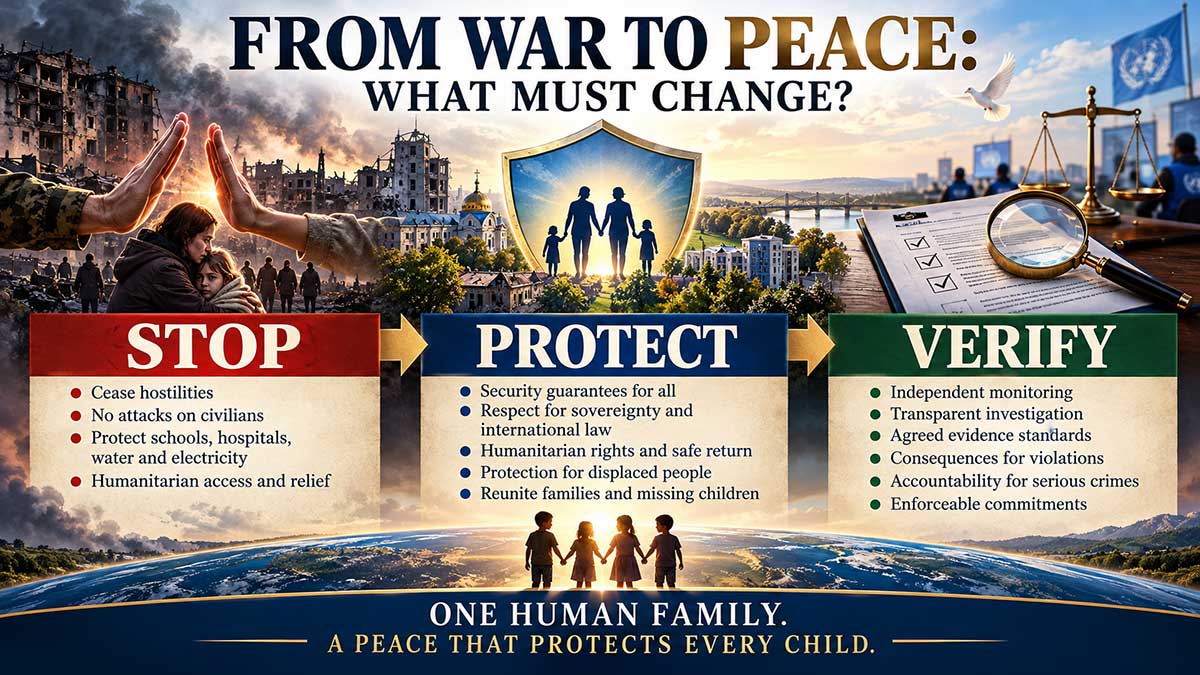
Short Bios:
Vladimir Putin
Vladimir Putin is the president of Russia. His public explanations of the war have emphasized Russian national security, NATO expansion, historical relationships, and the political status of disputed territories. In this fictional conversation, his role is to articulate Russia's stated security concerns while facing difficult questions about the human consequences of its invasion of Ukraine.
Official reference: President of Russia
Volodymyr Zelensky
Volodymyr Zelensky is the president of Ukraine. A former entertainer who became president in 2019, he has led Ukraine through Russia's full-scale invasion since February 2022. His positions emphasize Ukraine's independence, territorial integrity, civilian protection, and credible security guarantees. In this imagined meeting, he represents the challenge of seeking peace without abandoning the people he is responsible for protecting.
Official reference: President of Ukraine
Donald Trump
Donald Trump is the president of the United States. His political approach emphasizes direct negotiation, bargaining, and the pursuit of agreements. In this fictional meeting, he serves as the practical negotiator, pushing the other participants to translate their stated desires for peace into specific humanitarian, military, and verification commitments.
Official reference: The White House
Jesus of Nazareth
Jesus is the central figure of Christianity and is portrayed in this imaginary conversation as the Son of God, teaching the love and compassion of his Heavenly Father.
The Gospels describe Jesus blessing peacemakers, teaching love for enemies, and weeping over human suffering. In this story, those teachings inspire a fictional encounter in which he asks political leaders to consider the grief of a Heavenly Father who loves everyone affected by the war.
Biblical reference: Luke 19:41-42 and Matthew 5:9.
Editorial disclosure: This article is an original fictional thought experiment. The dialogue, meeting, gestures, and proposed commitments are imagined, not statements or actions that actually occurred. The portrayal of Jesus expresses a particular theological interpretation of God's parental love.
Leave a Reply