
Introduction
What if humanity has been asking the wrong question about non-human intelligence? For decades, we've debated whether unidentified objects might be extraterrestrial spacecraft. But perhaps a more fascinating question is what another intelligence could teach us about life, consciousness, and ourselves.
In October 2026, former U.S. intelligence official Jay Stratton published Out of the Shadows: Revealing the Truth About Non-Human Intelligent Life, presenting his account of government investigations into unidentified anomalous phenomena (UAP) and extraordinary alleged encounters. His memoir is one of the inspirations for this imaginary conversation. Its claims concerning non-human beings, recovered technology, and secret programs should not be mistaken for independently confirmed scientific findings.
Dan Farah's documentary The Age of Disclosure brings together testimony from 34 people with backgrounds in government, military service, and intelligence. The film explores allegations concerning UAP secrecy and possible non-human technology. Together, the documentary and Stratton's memoir raise questions extending far beyond unexplained sightings: What might another intelligence be like? Why might it be interested in Earth? And how could such a discovery change humanity?
The scientific questions are equally compelling. Harvard astrophysicist Avi Loeb has encouraged the search for possible extraterrestrial technological artifacts through the Galileo Project. Meanwhile, NASA's UAP research distinguishes unexplained observations from evidence of extraterrestrial origin. The fact that something remains unidentified does not establish that it was created by non-human intelligence. Yet the broader search for life and intelligence beyond Earth remains a legitimate scientific endeavor.
For this imaginary roundtable, I invited five people whose perspectives approach the mystery from remarkably different directions. Jay Stratton brings the questions of an intelligence investigator. Luis Elizondo examines national security, disclosure, and institutional responsibility. Avi Loeb approaches the unknown through astrophysics and testable evidence. Garry Nolan considers biology, unusual materials, and the mysteries of consciousness. Diana Walsh Pasulka explores how religious traditions and human cultures interpret extraordinary experiences.
Our fictional gathering takes place during a single night at a mountain observatory. We begin in a library at dusk, asking what non-human intelligence might actually be. Under the stars, we wonder why Earth might interest another civilization. After midnight, we explore technologies and discoveries that could transform human life. Before dawn, we examine ancient accounts and the possibility that people have long interpreted unusual experiences through the beliefs of their times. Finally, as the sun rises, we confront the question that matters most to me: What would the discovery of another intelligence mean for humanity?
I approach this subject with a personal conviction. I believe humanity is one family under one God. Different religious traditions may perceive aspects of the same divine mystery through different perspectives, much like the familiar parable of the blind men and the elephant. I recognize that others understand religion, God, and the universe differently. My purpose is not to require our guests or readers to accept my belief, but to explore whether the possibility of a much larger universe might help us reconsider the divisions we have created here on Earth.
Perhaps we will eventually discover that other intelligent civilizations exist. Perhaps the evidence will lead us somewhere entirely unexpected. For now, the greatest value of this conversation may lie in the questions themselves. What is intelligence without compassion? Can technological progress produce wisdom? Would we recognize consciousness in a form unlike our own? And if we ever encountered another civilization, what would we want it to know about us?
Disclaimer: This introduction presents an imaginary conversation created for educational, philosophical, and entertainment purposes. The featured individuals did not participate in the fictional gathering, and their imagined dialogue does not represent authentic quotations or endorsements. Claims concerning non-human intelligence and extraterrestrial technology are discussed as reported allegations or hypothetical possibilities, not independently verified scientific facts.
Topic 1. Who Are They, and What Kind of Intelligence Might Exist?
An Imaginary Conversation with Jay Stratton, Luis Elizondo, Avi Loeb, Garry Nolan, and Diana Walsh Pasulka
Moderator: Nick Sasaki
Editor's Note: This is a fictional conversation inspired by the participants' publicly expressed ideas, published research, and reported experiences. The dialogue and setting are imagined. References to alleged encounters and non-human technology reflect claims that have not been independently verified in the public record.
An Evening at the Observatory
The sun was disappearing behind the mountains when the six men and women gathered around a circular wooden table in the observatory library.
Beyond the enormous windows, the sky had begun changing from gold to deep blue. The first stars were appearing, scattered across a darkness that seemed to grow larger with every passing minute.
A copy of Jay Stratton's Out of the Shadows rested on the table beside a photograph from the documentary The Age of Disclosure.
Nick Sasaki poured coffee into a mug and looked around the room.
Nick Sasaki
"Before we begin, I have a confession.
"When I was a child in Japan, I used to look at the stars and wonder whether somebody out there was looking back.
"Now I'm sitting here with five people who have spent years thinking about that possibility.
"And Jay, you've gone considerably further than looking at stars."
Jay Stratton
"That's one way of putting it."
Nick
"I was going to ask whether you brought any visitors with you, but I figured that might be a little rude."
Luis Elizondo
"Depends on whether they brought their own coffee."
The table erupted in laughter.
Avi Loeb
"If they traveled across interstellar distances, I would hope they brought something more interesting than coffee."
Garry Nolan
"Careful, Avi. Coffee might be the most advanced technology in this room."
Diana Walsh Pasulka
"Or perhaps the most important ritual."
Nick smiled.
"See? We've already discovered something. Human civilization may depend on caffeine."
He leaned forward.
"But seriously, I don't want tonight to become another argument about whether unidentified objects exist. I want to explore something much larger.
"If there are other intelligences interacting with humanity, who or what might they be?
"And what would that tell us about ourselves?"
Question 1. Jay, What Convinced You That We Might Be Encountering a Non-Human Intelligence?
Nick
"Jay, let's begin with you.
"You spent much of your career in intelligence, where you're trained to examine information carefully and consider competing explanations.
"Yet you've publicly described experiences that led you to believe humanity may be encountering something non-human.
"What changed your thinking most deeply?"
Jay Stratton
"In the account I've given publicly, there wasn't one simple moment when everything changed.
"It was the accumulation of experiences and information.
"When you investigate something over many years, you begin noticing patterns. You encounter reports from people who have no obvious reason to invent what they're describing.
"Some observations can be explained. Others leave difficult questions.
"And eventually you have to ask whether the categories you've been using are adequate."
Nick
"But your book goes beyond military reports.
"You've publicly described an experience involving what you believed was a non-human figure outside your son's bedroom window.
"That account raises a very different set of questions from those raised by a classified report."
Jay Stratton
"When an investigator encounters an extraordinary account, the first responsibility is to establish what can be documented.
"An experience involving someone's home or family raises questions that go beyond the technical characteristics of an observation."
Nick
"Can I ask something?
"How should an investigator approach a report when the witness is deeply affected by what happened?"
Jay
"By listening carefully, documenting the account, and distinguishing the witness's observations from interpretations.
"Taking a report seriously doesn't mean assuming every proposed explanation is correct."
Nick
"Luis, you've spent years examining this subject through a national security perspective.
"Did your investigations change the way you looked at the world?"
Luis Elizondo
"They changed the questions I considered worth asking.
"In national security work, you don't have the luxury of dismissing something merely on the grounds that it sounds unusual.
"You ask what was observed, what capabilities might be involved, and what consequences might follow.
"But there's a larger philosophical issue here.
"We've built our understanding of intelligence around ourselves. Human intelligence. Human technology. Human motivations.
"What happens when the thing you're investigating doesn't fit those assumptions?"
Avi Loeb
"That's precisely why science should remain open to unexpected possibilities.
"Throughout history, humanity has repeatedly discovered that its assumptions about the universe were incomplete.
"We once believed Earth occupied a privileged position in the cosmos.
"Now we know our planet orbits an ordinary star in a galaxy containing enormous numbers of stars.
"And our galaxy is one among countless others.
"Why should we assume technological intelligence appeared only here?"
Nick
"So you're saying we may be suffering from cosmic arrogance?"
Avi
"Perhaps cosmic provincialism is the more polite expression."
Garry Nolan
"I don't know, Avi. Cosmic arrogance has a certain honesty to it."
The group laughed.
Diana Walsh Pasulka
"There's something interesting about this historically.
"Human cultures have long imagined or reported encounters with intelligences beyond ordinary human experience.
"They described angels, spirits, divine messengers, and other extraordinary beings.
"I'm not saying those were extraterrestrials. That would be imposing a modern explanation on very different traditions.
"But the human experience of confronting something perceived as radically other is not new."
Nick
"That's fascinating.
"So perhaps the question isn't simply whether we're encountering something unfamiliar.
"It's whether we have the intellectual humility to recognize that our explanations might be incomplete."
Diana
"Yes. And whether we can examine extraordinary experiences without immediately forcing them into categories we already understand."
Question 2. Could Non-Human Intelligence Be Biological, Artificial, or Something We Haven't Imagined?
Outside the windows, the final orange light disappeared.
The observatory's automatic lighting softened, leaving the room illuminated by warm lamps.
Nick turned toward Avi.
Nick
"When most people hear 'alien,' they picture a biological creature. Two eyes, a head, arms, legs, maybe gray skin.
"But Avi, you've suggested that technological civilizations might send artificial systems into space.
"Could the first intelligence humanity encounters actually be a machine?"
Avi Loeb
"Certainly, that's a possibility worth considering.
"Biological organisms are fragile. They require particular environmental conditions, and interstellar distances are enormous.
"An artificial probe could potentially operate for very long periods.
"Imagine a civilization that developed technology millions of years before humanity.
"It might have created autonomous systems capable of exploring distant star systems without requiring biological travelers."
Nick
"So the beings who built those machines might no longer exist?"
Avi
"That's possible.
"We could theoretically encounter technology created by a civilization that disappeared long ago.
"An artifact could survive its creators."
Luis Elizondo
"That raises a fascinating problem.
"If you encountered an autonomous system, how would you determine whether it was acting independently or following instructions from somewhere else?"
Garry Nolan
"And what if the distinction no longer made sense?
"We tend to separate biological life from machines. But a sufficiently advanced civilization might combine the two.
"Intelligence could exist in forms that don't resemble our present categories."
Nick
"Garry, let me ask you something.
"If an intelligence were a million years ahead of us, would we even recognize it?"
Garry
"That's the difficulty.
"We identify intelligence through behavior, adaptation, information processing, and other characteristics we know how to study.
"But our definitions are shaped by examples from Earth.
"We know human cognition. We study other animals. We develop artificial systems.
"An unfamiliar intelligence could challenge the assumptions connecting those examples."
Diana Walsh Pasulka
"And human expectations would influence the encounter.
"If we expect visitors to resemble human beings, we might overlook something entirely different.
"Religious traditions provide an interesting comparison. Extraordinary beings are often described through familiar images, even when the experience is said to transcend ordinary understanding."
Nick
"Let me propose something a little strange.
"What if intelligence doesn't require a body at all?"
Avi
"We would first need to define what we mean by intelligence and how such a system could physically exist.
"Information requires some physical representation.
"But that representation need not resemble a human brain."
Garry
"And consciousness introduces another question.
"We still have major unanswered questions about subjective experience, even in humans.
"We should be careful about assuming we know which systems can or cannot possess it."
Luis
"Here's what interests me.
"What if we're encountering something that understands our technology but doesn't interpret the world through our senses?
"We might be attempting communication using completely inappropriate methods."
Nick
"Like trying to explain the internet to an ant?"
Avi
"Perhaps. But the ant might be more interested in your sandwich."
Jay Stratton
"And if you were the ant, you might not even realize somebody was attempting to communicate."
Nick looked around the table.
"That's a disturbing thought."
Diana
"Or a humbling one."
Nick
"Yes. Maybe we've spent centuries looking for intelligence that resembles us, when the universe has never promised to produce another version of humanity."
Question 3. If They Are Here, Why Haven't We Experienced Unmistakable Public Contact?
A faint point of light moved across the sky outside.
Nick noticed it and pointed toward the window.
"Well, there's our first visitor."
Avi glanced outside.
"Satellite."
Nick
"You didn't even let me enjoy that for three seconds."
Avi
"Scientific discipline can be terribly inconvenient."
Everyone laughed again.
Nick waited until the room settled.
Nick
"Here's the mystery I keep returning to.
"Suppose an advanced intelligence knows about Earth.
"Suppose it has the ability to observe us.
"Why wouldn't it simply introduce itself?"
Luis Elizondo
"We tend to assume that contact would look like a diplomatic meeting.
"A spacecraft lands. A door opens. Somebody steps outside and announces that humanity is no longer alone.
"But why should another intelligence follow our expectations?
"We don't know its motivations, capabilities, or priorities."
Nick
"Wouldn't it be easier to communicate openly?"
Luis
"Easier for whom?
"From a security perspective, an unknown intelligence might have reasons to limit what it reveals.
"That doesn't establish that such a policy exists. It simply illustrates how many assumptions we make about contact."
Jay Stratton
"Before trying to determine intention, I'd want to establish what was observed.
"Was there more than one witness? Were instruments involved? Did the accounts agree? What ordinary explanations were considered?
"If an unfamiliar intelligence were involved, its purpose would be an important question. But first we'd need to establish what the evidence actually supports."
Nick
"Jay, if you had one opportunity to ask them a question, what would it be?"
Jay
"I think I'd want to understand their purpose.
"Why are they interested in us, assuming they are?
"That's the question behind so many others."
Avi Loeb
"I would begin with something more basic.
"Where did you come from, and how did your civilization develop?
"Imagine what we could learn about the history of intelligence in the universe."
Garry Nolan
"I'd want to know how they perceive reality.
"What can they detect that we cannot?
"What do they consider important?"
Diana Walsh Pasulka
"I might ask how they understand the relationship between intelligence and meaning.
"Do they have anything resembling our ideas of purpose, morality, or the sacred?"
Luis Elizondo
"I'd ask what they want humanity to understand about their presence.
"That might tell us something about the nature of the relationship."
Nick leaned back in his chair.
"Five people, five different questions."
He looked toward the window, where the stars now filled the sky.
"Mine would be a little different."
Jay
"What would you ask?"
Nick
"I think I'd ask, 'Do you understand love?'"
The room became quiet.
Nick
"Think about it.
"We can discuss technology, intelligence, propulsion, and civilizations millions of years old.
"But what if they understand mathematics beyond our imagination and know nothing about human affection?
"Or what if they understand love more deeply than we do?"
Diana
"That's a beautiful question, Nick.
"And it raises an important distinction.
"We often assume that greater intelligence means greater wisdom or compassion.
"But those qualities aren't necessarily the same."
Garry
"Exactly.
"A system could be extraordinarily capable at solving problems without sharing human emotional experiences.
"And another intelligence might possess forms of social connection we don't recognize."
Avi
"One could argue that cooperation is useful for the development of complex civilizations.
"But we cannot assume that the emotional experience of cooperation would resemble human love."
Luis
"Which means we might misunderstand peaceful behavior as indifference, or unfamiliar behavior as hostility."
Jay
"And that's why learning about intention would matter so much."
Nick nodded.
"Maybe the greatest challenge of contact wouldn't be translating their language.
"Maybe it would be learning to understand a mind that developed under entirely different circumstances."
A long silence followed, comfortable rather than awkward.
Beyond the glass, the mountains had vanished into darkness.
Only their outlines remained beneath the stars.
Nick
"When I was young, I thought the universe might be full of people who looked a little different from us.
"Now I'm wondering whether that's an incredibly small way of thinking.
"Maybe intelligence is far stranger, more diverse, and more beautiful than anything we've pictured."
Diana
"And perhaps encountering that possibility would teach us something about our own limitations."
Avi
"Or motivate us to investigate with better instruments."
Garry
"Or better questions."
Luis
"Preferably both."
Jay
"And perhaps a willingness to accept answers that surprise us."
Nick smiled.
"I think we have enough questions to keep us here all night."
He stood and walked toward the window.
The others followed his gaze.
Far above the dark mountains, the Milky Way stretched across the sky.
Nick
"But there's something I can't stop thinking about.
"Of all the planets in this enormous universe, why would another intelligence be interested in ours?
"What could be so special about Earth?"
Avi moved closer to the glass.
"Well, Nick, there's one remarkable thing about this planet that we already know."
Nick
"What's that?"
Avi
"It's a world where matter has become capable of asking questions about the universe."
Garry nodded.
"And where life has developed extraordinary complexity."
Luis
"And where intelligence has learned to create technologies that can affect the entire planet."
Diana
"And where human beings have spent thousands of years searching for meaning in the sky."
Jay looked out at the distant stars.
"Perhaps the question of why Earth matters is more interesting than we've realized."
Nick turned back toward the table.
"Then I think that's where we should go next."
The conversation continues in Topic 2: Why Earth, and Why Now?
Topic 2. Why Earth, and Why Now?
An Imaginary Conversation with Jay Stratton, Luis Elizondo, Avi Loeb, Garry Nolan, and Diana Walsh Pasulka
Moderator: Nick Sasaki
Editor's Note: This is a fictional conversation inspired by the participants' publicly expressed ideas, published research, and reported experiences. The dialogue and setting are imagined. Reports involving unidentified anomalous phenomena do not establish that non-human intelligence has visited Earth.
Beneath a Sky Full of Questions
The observatory library had grown quiet.
Outside, the mountains were nearly invisible beneath the darkness, but the sky above them was alive with stars.
Nick Sasaki opened the glass doors leading onto the terrace.
A cool mountain breeze entered the room.
Nick Sasaki
"Gentlemen, Diana, I think we should continue this conversation outside."
Garry Nolan
"Is that a scientific recommendation or are you trying to freeze us?"
Nick
"Consider it an experiment."
Avi Loeb
"An experiment should have a clearly defined objective."
Nick
"All right. Our objective is to discover why another civilization might find Earth interesting."
Luis Elizondo
"That's ambitious for a coffee break."
The group laughed and stepped onto the terrace.
A large telescope stood near the railing, its white dome open to the sky.
Far below, a few scattered lights marked the locations of distant towns.
Nick looked upward.
"When you see all those stars, it's hard not to wonder.
"If another civilization developed the ability to travel between stars, why would it come here?
"Why Earth?
"And perhaps an even stranger question: Why now?"
Question 4. What Could Make Earth Interesting to an Advanced Intelligence?
Nick
"Avi, let's start with the biggest picture.
"If there are civilizations millions of years ahead of us, Earth might seem primitive.
"Why would they bother visiting?"
Avi Loeb
"First, we should separate two possibilities.
"One is that extraterrestrial civilizations exist somewhere in the universe.
"The other is that they have visited Earth.
"We have reasons to investigate the first possibility, but the second requires evidence that has not been established.
"Now, hypothetically, Earth could be interesting for several reasons.
"It contains liquid water, a complex atmosphere, and a remarkable diversity of life.
"An advanced civilization interested in biology might consider Earth an extraordinary natural laboratory."
Nick
"So we might be interesting not for our technology, but for our biology?"
Avi
"Exactly.
"Imagine scientists discovering a planet where life developed independently from their own.
"That would be a remarkable scientific opportunity.
"Even simple organisms could reveal entirely new possibilities for biology."
Garry Nolan
"And Earth is far from simple.
"We have microorganisms living in extreme environments, plants converting sunlight into chemical energy, animals with sophisticated sensory systems, and human beings capable of abstract thought.
"An intelligence studying evolution might find this planet fascinating."
Nick
"What about dolphins and whales?
"Could they be more interesting than humans?"
Garry
"That depends on what the observers wanted to study.
"Whales have sophisticated communication and social behavior.
"Octopuses demonstrate remarkable problem-solving abilities.
"And humans have developed cumulative technological culture.
"Each represents a different expression of intelligence."
Nick
"So the visitors might come here to study octopuses and completely ignore us?"
Avi
"That would be a useful lesson in humility."
Luis Elizondo
"Imagine the reaction if humanity discovered that the most advanced visitors in history had traveled across the galaxy to meet a squid."
Nick
"That would be terrible for our self-esteem."
Diana Walsh Pasulka
"Perhaps the octopus would handle first contact better."
Everyone laughed.
Nick
"Jay, you've investigated reports involving unusual objects and encounters.
"Do you think people sometimes assume humanity must be the center of whatever is happening?"
Jay Stratton
"That's a natural assumption.
"When people observe something unfamiliar, they try to explain it in relation to themselves.
"But investigators have to distinguish observation from interpretation.
"An object appearing near a particular location doesn't automatically establish why it was there.
"Purpose is one of the hardest things to determine."
Nick
"So if an intelligence were studying Earth, it might not even be studying us?"
Jay
"That's one possibility in a hypothetical scenario.
"But we'd first need reliable evidence of what was actually being observed."
Diana
"There's a fascinating parallel in human history.
"People have often interpreted extraordinary events as messages directed personally toward humanity.
"A comet becomes a warning. An eclipse becomes a sign.
"Sometimes we place ourselves at the center of events that may have no particular relationship to us."
Nick
"That's humbling.
"We might be looking into the sky asking, 'Why are they interested in us?' when the answer could be, 'They're interested in the oceans.'"
Garry
"Or the bacteria."
Avi
"Or the planet's atmosphere."
Luis
"Or perhaps they simply took a wrong turn."
Nick
"After traveling fifty light-years?"
Luis
"Even advanced civilizations might have navigation problems."
The group laughed again.
Nick rested his hands on the railing.
"But that raises another question.
"If Earth is interesting for its biology, why would anyone arrive during the brief period when humanity has nuclear weapons and advanced technology?
"Is that just coincidence?"
Question 5. Could Nuclear Technology Explain Reports of Unusual Activity?
A bright satellite moved silently across the sky.
This time, Nick did not point it out.
Nick
"Luis, you and Jay have both discussed reports involving unidentified phenomena near sensitive military installations.
"Some of those reports concern nuclear facilities.
"Why has that connection attracted so much attention?"
Luis Elizondo
"Any unidentified object operating near a sensitive military facility deserves serious investigation.
"That is true regardless of whether the explanation is foreign technology, an environmental phenomenon, a sensor issue, or something else.
"Nuclear facilities are especially sensitive, so reports involving them naturally receive attention."
Nick
"But some witnesses have described objects appearing near nuclear weapons systems.
"Could another intelligence be concerned about our ability to destroy ourselves?"
Luis
"That's one interpretation people have proposed.
"But we should be careful about attributing motives to something we haven't identified.
"What we can say is that unusual activity near critical infrastructure creates legitimate security questions."
Jay Stratton
"Before interpreting a reported connection with nuclear facilities, I'd want to examine the incidents individually.
"Are the dates reliable? Were there independent witnesses? What instruments recorded the event? Were ordinary causes investigated?
"Only then could we begin evaluating whether a meaningful pattern exists."
Nick
"Suppose investigators eventually established that an unknown intelligence was monitoring our nuclear technology.
"What would that suggest?"
Avi Loeb
"It could suggest several possibilities.
"Perhaps technological civilizations become detectable when they develop certain capabilities.
"Perhaps nuclear activity is observable from a distance under particular circumstances.
"Or perhaps the observers would simply be interested in a major technological development.
"But those are hypotheses. We would need evidence to distinguish among them."
Garry Nolan
"There's a biological angle, too.
"Humanity has reached a stage where its technology can alter the conditions supporting life on Earth.
"That is an extraordinary evolutionary development.
"For most of our history, our species lacked the ability to affect the planet on such a scale."
Nick
"So we might be entering a dangerous stage of civilization?"
Garry
"Potentially.
"We have technologies that can produce enormous benefits and enormous harm.
"The question is whether our collective judgment develops sufficiently to manage them."
Diana Walsh Pasulka
"That reminds me of a recurring theme in religious and philosophical traditions.
"Human beings acquire knowledge or abilities, then face questions about how those abilities should be used.
"Knowledge and wisdom are related, but they aren't identical."
Nick
"That's something I keep thinking about.
"Suppose another civilization survived for a million years.
"Wouldn't that suggest it found a way to avoid destroying itself?"
Avi
"At minimum, it would have survived long enough to develop the capabilities we're imagining.
"But survival doesn't tell us everything about its political or moral history."
Nick
"Still, I'd love to ask how they managed it."
Luis
"So would I.
"Though my first question would probably concern whether they intended to share that information."
Jay
"And how we could evaluate whether the information was reliable."
Nick
"You two really know how to make a conversation practical."
Luis
"Occupational hazard."
Nick smiled, then looked back toward the sky.
"Maybe there's something else here.
"Humanity has been on Earth for a very long time, but our modern technological civilization is extremely young.
"Perhaps we're just beginning to become visible."
Avi
"That's an interesting possibility.
"Radio emissions, atmospheric changes, and other technological signatures can potentially reveal information about a civilization.
"Scientists study such signatures when considering how extraterrestrial technology might be detected.
"But detectability depends on the technology, distance, and observational capabilities involved."
Nick
"So another civilization might notice that something unusual is happening on this little planet."
Avi
"In principle, yes."
Diana
"And if that happened, the next question would be whether they wanted to communicate."
Nick turned toward the others.
"Which is exactly where I wanted to go."
Question 6. If Another Intelligence Wanted to Communicate, How Might It Begin?
The wind had softened.
Above the terrace, the Milky Way stretched across the dark sky.
Nick walked toward the telescope.
Nick
"Let's imagine something.
"An advanced civilization has discovered Earth.
"It knows we're here.
"And it decides to communicate.
"What happens first?"
Avi Loeb
"That would depend on its technology and intentions.
"One possibility is that it sends an electromagnetic signal.
"Mathematical patterns or physical constants might provide a starting point for establishing that the signal is artificial."
Nick
"Like sending a message using prime numbers?"
Avi
"Exactly.
"Prime numbers are an example of a mathematical pattern that might help demonstrate intentional communication.
"But establishing a shared language would be much more difficult."
Garry Nolan
"And we shouldn't assume communication would resemble human speech.
"Different species on Earth communicate through sound, visual signals, chemicals, touch, and electrical activity.
"An unfamiliar intelligence might use methods that are difficult for us to detect."
Nick
"What if they communicate through consciousness?"
Garry
"That would require us to establish what such communication means and how it could be measured.
"But studying consciousness and perception remains an interesting scientific challenge.
"We don't yet have a complete explanation of subjective experience."
Diana Walsh Pasulka
"Reports of extraordinary experiences sometimes include claims of communication without spoken language.
"People describe receiving impressions, images, or a sense of meaning.
"Those accounts are significant as human experiences, but they don't independently establish communication with an external intelligence."
Nick
"So someone could sincerely believe they've received a message, but we still need to investigate what happened?"
Diana
"Yes.
"And the cultural setting matters.
"People interpret unusual experiences through familiar symbols and beliefs."
Luis Elizondo
"From a practical perspective, communication would raise security questions.
"How do we determine whether a message is authentic?
"How do we know who or what sent it?
"And how do we assess whether responding could create risks?"
Nick
"Would you answer?"
Luis
"Not without careful consideration."
Nick
"That's a very diplomatic way of saying no."
Luis
"I'm saying I'd want to know what we're responding to."
Jay Stratton
"And whether the evidence supports the interpretation that communication is actually taking place.
"An unusual signal or event doesn't necessarily mean somebody is attempting to speak with us."
Nick
"Fair enough.
"But suppose we confirm it.
"Suppose there's no doubt that another intelligence has sent a message.
"What should humanity say first?"
Avi
"I would begin with a response that establishes shared scientific concepts.
"That could help us determine whether meaningful communication is possible."
Garry
"I'd want to learn how they perceive the world.
"Communication isn't simply exchanging information. It requires some shared framework."
Diana
"And perhaps an awareness that their understanding of meaning might differ profoundly from ours."
Luis
"I'd want any response to reflect careful international discussion.
"An encounter affecting all humanity shouldn't be treated as the private responsibility of one country."
Jay
"And we'd need to consider what information we're communicating and why."
Nick listened, then smiled.
Nick
"You know what I'd say?"
Luis
"I have a feeling you're going to tell us."
Nick
"I think I'd ask whether they came in peace.
"And then I'd tell them something about us that might not be obvious from watching our technology.
"We care about one another.
"Sometimes we're terrible at showing it. But that capacity is there."
Diana
"That tells them something important about humanity."
Nick
"What?"
Diana
"That you want to introduce our civilization through its relationships, not simply its achievements."
Garry
"Though we'd still need to establish whether they understood what relationships meant."
Nick
"Then I guess we'd have to start with a very long explanation."
Avi
"Perhaps accompanied by a mathematical appendix."
Luis
"And reviewed by several governments."
Jay
"With an evidence assessment."
Nick
"Wonderful. Our first interstellar message is going to take fifteen years to approve."
Everyone laughed.
For a moment, nobody spoke.
The stars seemed unusually bright.
Nick looked toward the observatory dome.
"You know, we've spent the last hour asking why another intelligence might be interested in Earth.
"Maybe it's our biology.
"Maybe it's our technology.
"Maybe we're just one interesting planet among many.
"But there's another possibility I can't stop thinking about."
Avi
"What's that?"
Nick
"What if they've learned things that could completely change our understanding of reality?
"Not just how to travel between stars.
"What if they know things about life, consciousness, or the universe that we haven't even begun to discover?"
Garry
"Now you're asking a very interesting question."
Diana
"And perhaps a dangerous one."
Nick
"Dangerous?"
Diana
"Knowledge can transform a civilization.
"But transformation isn't always comfortable."
Luis looked toward the laboratory door.
Luis
"Then perhaps we should continue this discussion somewhere with a little more light."
Jay
"And maybe another pot of coffee."
Avi
"At this point, I think coffee has become essential to the investigation."
Nick laughed.
"Then let's go inside.
"I want to know what humanity might learn from a civilization that's had a million-year head start."
The group walked back through the glass doors, leaving the night sky behind them.
Inside the observatory, the laboratory lights were still glowing.
The conversation continues in Topic 3: The Knowledge That Could Change Everything.
Topic 3. The Knowledge That Could Change Everything
An Imaginary Conversation with Jay Stratton, Luis Elizondo, Avi Loeb, Garry Nolan, and Diana Walsh Pasulka
Moderator: Nick Sasaki
Editor's Note: This fictional conversation is inspired by the participants' publicly expressed ideas, published research, and reported experiences. The dialogue and setting are imagined. Claims about recovered non-human technology and extraordinary encounters remain unverified in the public scientific record.
A Laboratory at the Edge of the Unknown
The observatory laboratory was quieter than the terrace.
Rows of instruments lined the walls. Computer screens displayed astronomical images, spectral graphs, and measurements collected during the night.
On a central worktable rested a small meteorite inside a transparent protective case.
Nick Sasaki leaned closer to examine it.
Nick Sasaki
"So this little rock traveled through space before reaching Earth?"
Avi Loeb
"Yes. Meteorites provide physical samples of material that originated beyond our planet."
Nick
"And we're certain this one isn't an alien spaceship?"
Avi
"If it were a spaceship, I would be concerned about its navigation system."
Garry Nolan
"Perhaps it was looking for the coffee."
The group laughed.
Nick looked at the dark object.
"Think about it. We can hold a piece of another world in our hands.
"And yet, when we talk about the possibility of technology from another civilization, everything becomes controversial."
Luis Elizondo
"That's why the quality of evidence matters.
"An extraordinary claim requires careful investigation, especially when it could have implications for science and national security."
Jay Stratton
"And the history of an object matters. Where it was found, who handled it, and what testing was performed."
Nick
"Then let's imagine something.
"Suppose tomorrow, scientists announce that they've discovered an object that was unquestionably manufactured by a non-human civilization.
"Not an unexplained video. Not a witness account.
"A physical artifact that independent laboratories have examined.
"What could we learn from it?"
Question 7. What Could a Civilization a Million Years Ahead of Us Teach Humanity?
Nick
"Avi, let's begin with you.
"If we discovered technology created by a civilization a million years ahead of humanity, what would you want to study first?"
Avi Loeb
"I would want to understand the physical principles behind its operation.
"An unfamiliar artifact could reveal engineering approaches that humanity has never developed.
"But there's an important distinction between discovering a technological object and understanding how it works.
"Imagine giving a modern smartphone to a scientist living several thousand years ago.
"That person might recognize that the object performed extraordinary functions without possessing the scientific framework necessary to reproduce it."
Nick
"So finding the technology wouldn't mean we could immediately use it?"
Avi
"Correct.
"We might spend decades or centuries trying to understand its underlying principles.
"And the process could produce new scientific discoveries."
Garry Nolan
"I'd be interested in the materials.
"How were they manufactured? What structures exist at the microscopic level? What properties do they exhibit?
"Advanced technology might depend on materials or manufacturing methods that we haven't developed."
Nick
"What about energy?
"Could another civilization have discovered ways of producing energy that would completely change life on Earth?"
Avi
"Potentially, though we should distinguish hypothetical discoveries from technologies known to be physically possible.
"A civilization with a much longer technological history might have developed extraordinarily efficient energy systems.
"But we would still need to examine any proposed mechanism using the laws of physics."
Nick
"Imagine what that could mean.
"Clean energy available everywhere.
"Transportation without pollution.
"Entire communities no longer struggling to afford electricity."
Luis Elizondo
"And imagine the strategic implications.
"A major technological breakthrough could transform economic relationships and national security.
"Countries would immediately want to know who controlled the technology and whether it could be used for military purposes."
Nick
"That's the part that troubles me.
"We discover something that could help billions of people, and the first question becomes who gets to control it."
Diana Walsh Pasulka
"Nick, let me turn that question around.
"Suppose we had the technology tomorrow, but our institutions and moral commitments remained exactly as they are today.
"Would the discovery change our behavior, or would we simply use extraordinary tools to pursue familiar ambitions?"
Nick
"That's the part that worries me.
"Perhaps we need to change ourselves at the same time we change our technology."
Jay Stratton
"Public allegations about recovered objects have generated enormous interest.
"But any proposed technological discovery raises investigative questions.
"Where did the object come from? What documentation exists? Who examined it? Can independent specialists verify the findings?
"Those questions matter before anyone can determine what the object represents."
Nick
"So even if someone claims to possess extraordinary technology, the real question is whether independent investigators can examine it."
Jay
"Exactly.
"Evidence has to be evaluated carefully."
Garry
"And if the evidence were compelling, scientists would be eager to study it.
"New materials and unfamiliar physical properties could open entirely new areas of research."
Nick
"Let me ask a bigger question.
"Suppose this civilization survived for a million years.
"Wouldn't that suggest it learned something about avoiding self-destruction?"
Avi
"Survival would demonstrate that the civilization persisted, but it wouldn't tell us exactly how.
"Perhaps it developed effective institutions.
"Perhaps it expanded beyond its original planet.
"Perhaps it encountered challenges very different from ours."
Luis
"And perhaps it developed technologies that allowed it to survive threats we haven't yet encountered."
Diana
"But we shouldn't assume that longevity automatically means moral wisdom.
"A civilization might be technologically extraordinary and ethically unfamiliar."
Nick
"Then maybe the greatest thing we could learn wouldn't be how to build their machines.
"Maybe it would be how they survived."
Garry
"That would certainly be worth investigating."
Nick glanced toward the meteorite.
"All right. Technology could change everything.
"But I want to go somewhere even stranger."
Question 8. Could Another Intelligence Transform Our Understanding of Biology and Consciousness?
Nick moved toward a monitor displaying a three-dimensional model of a human brain.
Nick
"Garry, this is your territory.
"We know that the human brain contains billions of neurons, yet consciousness remains one of the great mysteries of science.
"Suppose another intelligence understands consciousness far better than we do.
"What might that mean?"
Garry Nolan
"It could change how we think about cognition, perception, and biological systems.
"We still have major unanswered questions about how subjective experience arises and how different neural processes contribute to consciousness.
"An unfamiliar intelligence might offer entirely different examples of information processing and awareness."
Nick
"Could it help us understand whether consciousness exists independently of the brain?"
Garry
"That would require evidence.
"At present, the relationship between brain activity and conscious experience is a major area of scientific investigation.
"If someone proposed a form of consciousness operating independently of known biological systems, we'd need a way to test that claim."
Nick
"But suppose such evidence existed.
"Wouldn't that transform our understanding of life?"
Garry
"Certainly.
"It would challenge many assumptions and create new scientific questions."
Diana Walsh Pasulka
"And it would have profound implications for religion and philosophy.
"Human traditions have long explored questions about the soul, awareness, identity, and what might exist beyond physical death.
"An extraordinary discovery about consciousness could reshape those conversations."
Nick
"Let me ask something personal.
"If you could ask a civilization a million years ahead of us one question about consciousness, what would it be?"
Garry
"I'd ask how they define it.
"Do they distinguish intelligence from subjective experience?
"Can consciousness exist in different physical systems?
"And what evidence supports their conclusions?"
Avi Loeb
"I would ask whether they have developed a scientific theory that explains consciousness in a predictive way.
"A useful theory should do more than offer an appealing explanation.
"It should make predictions that can be tested."
Luis Elizondo
"I'd want to know whether their understanding of cognition creates capabilities we haven't imagined.
"Could they process information differently?
"Could they communicate in ways that bypass our conventional technologies?"
Jay Stratton
"I'd want to know how such capabilities could be observed and verified.
"If an unfamiliar form of communication existed, what measurable effects would distinguish it from misunderstanding or coincidence?"
Diana
"I might ask whether they experience anything resembling spiritual awareness.
"Do they search for meaning?
"Do they have concepts of transcendence?
"Or is their relationship to existence entirely different from ours?"
Nick looked at the brain model.
"You know what I'd ask?"
Garry
"I think we're about to find out."
Nick
"I'd ask whether consciousness survives death."
The room became quiet.
Nick
"Think about how many people throughout history have wondered about that.
"Parents who have lost children.
"Children who have lost parents.
"People who wish they could speak one more time with someone they love.
"If another civilization had discovered something about that mystery, wouldn't humanity want to know?"
Diana
"Of course.
"Questions about death and continuity are deeply connected to the human search for meaning."
Avi
"And any proposed answer would need to be evaluated carefully.
"Extraordinary knowledge would be most valuable if we could distinguish reliable discoveries from comforting assumptions."
Nick
"I agree.
"But I can still hope that the universe contains more possibilities than we currently understand."
Garry
"Hope and investigation don't have to be enemies."
Nick smiled.
"That's a sentence worth remembering."
He looked toward the others.
"And if we were fortunate enough to learn something extraordinary about life, wouldn't we have a responsibility to use that knowledge wisely?"
Question 9. Would Humanity Be Wise Enough to Use Extraordinary Knowledge?
The laboratory clock showed that midnight had passed.
A soft mechanical sound came from the telescope tracking system beyond the wall.
Nick sat on the edge of an empty workbench.
Nick
"Let's imagine the most extraordinary scenario of all.
"Humanity establishes peaceful communication with another civilization.
"They offer to share knowledge that could transform our world.
"Medical breakthroughs. New energy systems. Better ways to understand the universe.
"Would we be ready?"
Luis Elizondo
"That would be a difficult question.
"Knowledge with enormous benefits could have enormous risks.
"Any transfer of unfamiliar technology would require careful evaluation.
"Governments, scientists, and international institutions would need to consider safety, security, and long-term consequences."
Nick
"Wouldn't people demand immediate access?"
Luis
"Probably.
"But responsible decision-making sometimes requires patience.
"We would need to understand what we were receiving."
Avi Loeb
"And we should recognize that knowledge isn't the same as a finished product.
"A civilization might explain a scientific principle that takes humanity generations to develop into practical technology.
"The process of learning could be as important as the information itself."
Garry Nolan
"Medicine offers a useful example.
"Imagine receiving a biological insight that could lead to treatments for diseases we currently struggle to manage.
"Before using it, researchers would still need to establish safety, effectiveness, and the biological mechanisms involved."
Nick
"That's what I'd want most.
"If I could ask an advanced civilization for one gift, I'd ask for knowledge that could reduce human suffering.
"Help us treat devastating diseases.
"Help children grow up healthy.
"Help families spend more time together."
Diana Walsh Pasulka
"That's a revealing choice.
"You aren't asking first for faster spacecraft or greater material wealth.
"You're asking for knowledge that could protect vulnerable human lives."
Nick
"Well, I wouldn't mind the spacecraft."
Everyone laughed.
Nick
"But seriously, when I think about extraordinary technology, I think about what it could mean for ordinary people.
"Imagine parents no longer fearing that a disease will take their child.
"Imagine communities gaining access to medical treatments that were previously impossible."
Jay Stratton
"And any such breakthrough would need to be examined carefully.
"Extraordinary claims can create enormous expectations.
"People deserve evidence before being promised life-changing results."
Nick
"That's fair.
"But let's say the knowledge is real and verified.
"Should humanity share it openly?"
Avi
"In principle, scientific knowledge benefits from openness and independent examination.
"But applications involving dangerous technologies would require responsible safeguards."
Luis
"Some technologies could have both civilian and military applications.
"International cooperation would be important, but achieving it could be difficult."
Garry
"And the distribution of benefits would matter.
"Who receives treatment first?
"Who has access to new energy systems?
"Would the discoveries reduce inequality or deepen it?"
Diana
"Those are moral questions that technology alone cannot answer.
"Humanity would still need to decide what kind of civilization it wants to become."
Nick looked around the laboratory.
"You know, we've spent hours imagining beings who might be far more advanced than we are.
"But I wonder whether we're asking the wrong question.
"Maybe the most important issue isn't whether they're advanced enough to help us.
"Maybe it's whether we're mature enough to receive the help."
Avi
"That would depend on what we learned and how we chose to respond."
Luis
"And whether we could cooperate when the stakes were high."
Jay
"And whether we could distinguish genuine discoveries from misleading claims."
Garry
"And whether we could turn new knowledge into benefits for living beings."
Diana
"And whether we could develop the wisdom to accompany our growing capabilities."
Nick smiled.
"Five answers again.
"I think we're getting somewhere."
He stood and walked toward a bookshelf near the laboratory entrance.
Among the scientific journals and technical manuals was an old illustrated volume about the history of astronomy.
Diana noticed it.
Diana
"That's interesting."
She removed the book and opened it carefully.
The pages contained drawings of ancient observatories, celestial symbols, and historical accounts of unusual events in the sky.
Nick
"What have you found?"
Diana
"A reminder that humanity has been asking questions about the heavens for thousands of years.
"Long before telescopes, satellites, or modern scientific instruments, people were looking upward and trying to understand what they saw."
Nick
"And some of them believed they were encountering beings from beyond the ordinary human world."
Diana
"Yes.
"But those accounts emerged within very different religious and cultural settings.
"To understand them, we need to consider what they meant to the people who recorded them."
Nick looked at the ancient illustrations.
"Then perhaps we should ask another question.
"What if humanity's fascination with extraordinary intelligences didn't begin in the modern age?
"What if people have been wondering about this mystery for thousands of years?"
Avi glanced toward the clock.
Avi
"That could require a substantial historical discussion."
Garry
"Fortunately, we appear to have the entire night."
Luis
"At the rate we're going, we may need breakfast."
Jay
"And another pot of coffee."
Nick laughed.
"Then let's take this book into the archive.
"I want to know what humanity's oldest stories might tell us about the way we've imagined the unknown."
The group left the laboratory, carrying the old astronomy book toward the observatory's historical archive.
Beyond the windows, the night remained dark, but somewhere beyond the mountains, morning was slowly approaching.
The conversation continues in Topic 4: Have They Been With Us All Along?
Topic 4. Have They Been With Us All Along?
An Imaginary Conversation with Jay Stratton, Luis Elizondo, Avi Loeb, Garry Nolan, and Diana Walsh Pasulka
Moderator: Nick Sasaki
Editor's Note: This is a fictional conversation inspired by the participants' publicly expressed ideas, published research, and reported experiences. The dialogue and setting are imagined. Historical religious accounts and unusual experiences are explored as subjects of interpretation, not as established evidence of extraterrestrial visitation.
The Archive Before Dawn
The observatory's historical archive occupied a quiet room at the far end of the building.
Tall wooden shelves lined the walls, holding books on astronomy, ancient civilizations, religious history, and early scientific discoveries.
A single brass lamp illuminated a large reading table.
Beyond the windows, the mountains were still dark, but the eastern horizon had begun to soften.
Diana Walsh Pasulka placed the old astronomy book on the table.
Diana Walsh Pasulka
"There's something extraordinary about this room.
"Look at all these books.
"Thousands of years of human beings trying to make sense of the universe."
Nick Sasaki
"And after all those years, we're still asking whether somebody else might be out there."
Avi Loeb
"At least we have better telescopes now."
Garry Nolan
"And better coffee."
Luis Elizondo
"I'm beginning to suspect coffee is the real subject of this investigation."
Jay Stratton
"Then we've collected a substantial amount of evidence."
Everyone laughed.
Nick opened the astronomy book.
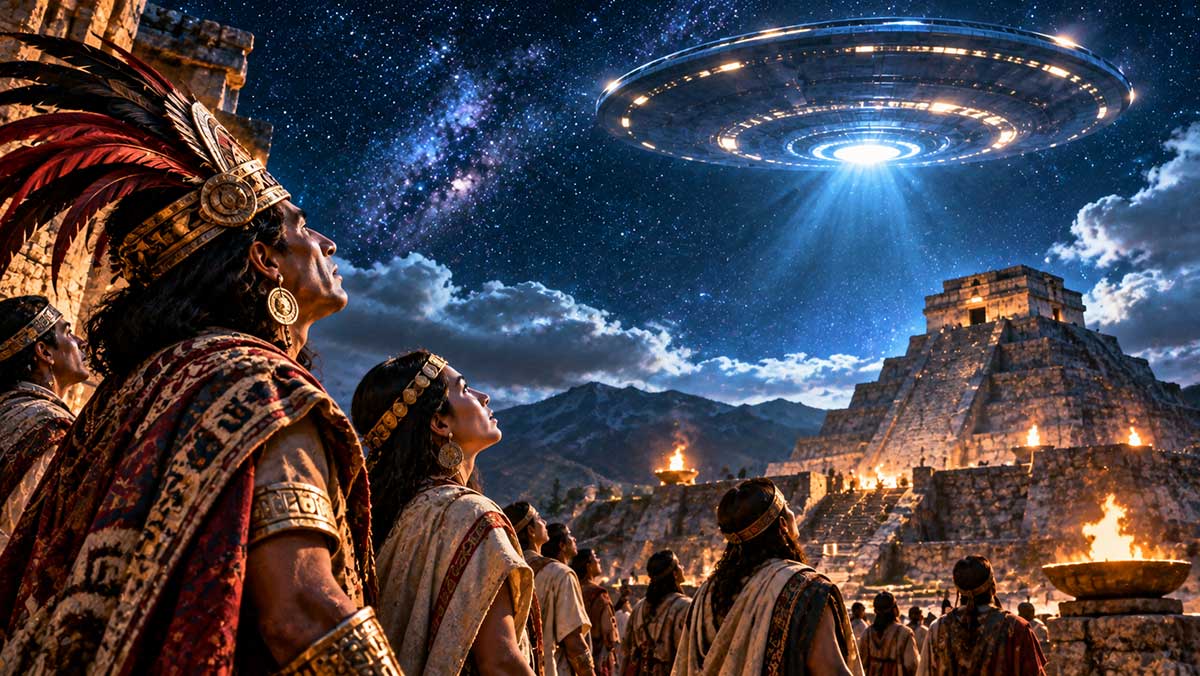
An illustration showed a group of ancient observers looking toward the heavens.
Nick
"When I was young, I used to wonder whether the stories people told thousands of years ago might contain memories of something extraordinary.
"Not necessarily spaceships.
"But perhaps encounters with something they couldn't explain.
"Tonight, I want to explore that possibility without pretending we know more than we do."
He looked toward Diana.
"Where should we begin?"
Question 10. Could Ancient Accounts Preserve Memories of Extraordinary Encounters?
Diana Walsh Pasulka
"I think we should begin by recognizing that ancient people were thoughtful observers of their world.
"They watched the heavens, recorded unusual events, and developed sophisticated religious and philosophical traditions.
"But their accounts were shaped by the languages, symbols, and beliefs of their cultures.
"We need to understand those contexts before applying modern interpretations."
Nick
"Let's take a famous example.
"The prophet Ezekiel described an extraordinary vision involving wheels, living beings, and something that seemed to move through the heavens.
"Some modern writers have suggested he might have witnessed advanced technology.
"What do you think?"
Diana
"The opening chapter of Ezekiel is a prophetic vision within the Hebrew Bible.
"It contains elaborate symbolic imagery connected with divine presence, heavenly beings, and the prophet's religious experience.
"Interpreting it as a mechanical spacecraft is a modern reinterpretation, not the meaning established by the ancient text.
"That doesn't prevent people from exploring comparisons, but the distinction matters."
Nick
"So we shouldn't assume Ezekiel was describing a flying saucer."
Diana
"Exactly.
"Ancient religious literature deserves to be approached on its own terms."
Avi Loeb
"And from a scientific perspective, a literary description doesn't provide the measurements needed to identify a physical object.
"We would want observational data, independent evidence, and a way to test competing explanations."
Nick
"What about ancient India?
"People often mention flying vehicles called vimanas."
Diana
"The term vimana appears in different Indian literary and religious contexts, with meanings that vary across texts and periods.
"Some narratives describe extraordinary aerial vehicles or celestial conveyances.
"But those accounts belong to rich literary and religious traditions.
"We shouldn't automatically treat them as technical descriptions of ancient aircraft."
Garry Nolan
"There's an interesting cognitive question here.
"Human beings often describe unfamiliar things using concepts they already know.
"If someone encounters something extraordinary, their interpretation will be influenced by their expectations and cultural background."
Nick
"So even if someone genuinely witnessed something unusual, their description might reflect the language of their time."
Garry
"Certainly.
"But that doesn't establish what the underlying event was."
Luis Elizondo
"And that's a problem investigators still face.
"Witnesses may sincerely report an experience, yet the interpretation can differ from what the available evidence supports."
Jay Stratton
"That's why separating observations from conclusions is essential.
"What did the witness actually see?
"What details were recorded?
"Which elements came from later interpretation?
"Those questions matter whether you're examining a modern report or a historical document."
Nick turned another page.
"What about the Anunnaki?
"I've seen people claim that ancient Mesopotamian stories describe extraterrestrial beings who created humanity."
Diana
"The Anunnaki are divine figures within ancient Mesopotamian religious traditions.
"Modern claims that they were extraterrestrial engineers are not established by the original texts.
"Those interpretations often combine ancient mythology with contemporary speculation.
"If we want to understand Mesopotamian beliefs, we need to examine the texts within their historical and religious contexts."
Nick
"What about medieval Europe? People sometimes mention the strange celestial event reported over Nuremberg in 1561."
Diana
"That's an interesting historical example.
"A printed broadsheet produced by Hans Glaser described unusual forms appearing in the sky over Nuremberg.
"The account includes imagery that modern readers sometimes compare with UFO reports.
"But the broadsheet emerged within a sixteenth-century culture where unusual celestial events could be interpreted as religious warnings or signs.
"We need to read it in that historical setting."
Avi
"And a printed illustration isn't the same as an instrument recording.
"We can study the historical document, but we cannot independently measure the phenomenon it describes."
Nick
"So it's a genuine historical source, but not proof of an extraterrestrial encounter."
Diana
"Exactly.
"And its value isn't limited to whether we can identify what people saw.
"It shows how people attempted to make sense of extraordinary events."
Jay
"Which is still something investigators encounter today.
"People describe an observation, then try to explain what it means.
"Separating those two steps is essential."
Nick leaned back.
"Then maybe ancient stories are valuable for a different reason.
"Not as proof that visitors came from another planet.
"But as windows into how human beings have always struggled to understand the extraordinary."
Diana
"Yes.
"And perhaps that struggle tells us something important about human consciousness."
Question 11. Could Consciousness Be Part of the Mystery?
The archive was quiet.
Outside, the eastern sky had begun to turn pale gray.
Nick rested his hands on the old book.
Nick
"Diana, in your research, you've explored extraordinary experiences that people sometimes interpret as contact with non-human intelligences.
"Some accounts involve dreams, visions, altered states of consciousness, or a sense of communication without spoken words.
"How should we think about those experiences?"
Diana Walsh Pasulka
"I think we need to distinguish between the experience itself and the explanation attached to it.
"A person may have an experience that feels profoundly real and meaningful.
"That experience may change their life.
"But the significance of the experience doesn't automatically establish its external cause."
Nick
"So someone might have a genuine experience without knowing exactly what produced it."
Diana
"Yes.
"And religious studies offers a long history of examining how people interpret such experiences."
Garry Nolan
"From a scientific perspective, consciousness remains a difficult subject.
"We know that perception and subjective experience involve complex biological processes.
"But we don't yet have a complete explanation of consciousness.
"That leaves important questions about how different organisms experience reality."
Nick
"Could another intelligence perceive dimensions of reality that humans cannot?"
Garry
"It could possess sensory capabilities very different from ours.
"Animals on Earth already demonstrate that.
"Some species detect magnetic fields. Others perceive ultraviolet light or use echolocation.
"An unfamiliar intelligence might have evolved or developed technologies that provide access to information we cannot perceive directly."
Avi Loeb
"And technology can extend perception.
"Humans cannot see radio waves with their eyes, yet instruments allow us to detect them.
"Scientific progress often involves developing methods to observe things that were previously inaccessible."
Nick
"What if consciousness itself could become an instrument?"
Avi
"That would require a clear definition and a method of testing the idea.
"But it's reasonable to ask whether future research might reveal unfamiliar aspects of cognition and perception."
Luis Elizondo
"There's a practical issue, too.
"If people report unusual experiences, how do we evaluate them?
"How do we distinguish perception, interpretation, environmental effects, and possible external causes?
"Those are difficult questions."
Jay Stratton
"And they require careful documentation.
"The more extraordinary the interpretation, the more important it becomes to examine the underlying evidence."
Nick looked toward Diana.
"Let me ask something a little more personal.
"Do you think modern society sometimes dismisses extraordinary experiences too quickly?"
Diana
"Sometimes people feel that their experiences are dismissed without being heard.
"That's worth taking seriously.
"But listening respectfully doesn't require accepting every interpretation.
"We can acknowledge that an experience was meaningful to someone and still investigate what happened."
Nick
"I like that.
"Respect the person without pretending to know the explanation."
Garry
"Exactly.
"And remain open to what careful investigation might reveal."
Nick glanced toward the window.
"Maybe our biggest limitation isn't that we lack intelligence.
"Maybe it's that we assume our way of perceiving reality is the only way."
Avi
"Science is most productive when it recognizes the limits of current knowledge and develops methods to move beyond them."
Diana
"And philosophy and religion can help us examine the assumptions we bring to the questions."
Nick nodded.
"Which makes me wonder whether humanity has misunderstood some of its own extraordinary experiences."
Question 12. Have We Been Misinterpreting the Unknown Throughout History?
The first faint light of dawn touched the archive windows.
Nick closed the astronomy book gently.
Nick
"Let me ask a difficult question.
"Suppose humanity has encountered unusual phenomena throughout history.
"Some experiences became religious stories.
"Others became legends.
"Today, some become UFO reports.
"Could different generations be describing unrelated events using similar ideas?
"Or could there be something recurring that we haven't yet identified?"
Diana Walsh Pasulka
"Both possibilities deserve careful consideration.
"Human cultures share certain patterns of perception, imagination, and storytelling.
"That can produce similarities across traditions without requiring a common external cause.
"But studying recurring themes can still reveal important things about how people experience and interpret the unknown."
Nick
"So similarities don't necessarily mean the experiences came from the same source."
Diana
"Correct.
"And differences matter just as much as similarities.
"An ancient prophetic vision and a modern radar report belong to very different contexts."
Avi Loeb
"If we're investigating a physical phenomenon, we need evidence that can be examined scientifically.
"Historical accounts can inspire questions, but they cannot substitute for measurements."
Nick
"Would you ever use ancient stories to guide scientific research?"
Avi
"They might suggest interesting questions.
"But any scientific hypothesis would still need to produce testable predictions."
Garry Nolan
"And the biological and psychological dimensions shouldn't be overlooked.
"Human perception is constructive.
"Our brains interpret sensory information using memory, expectation, and context.
"That doesn't mean every unusual report is imaginary.
"It means interpretation is part of the process."
Luis Elizondo
"That's one reason investigations need multiple sources of information whenever possible.
"Witness testimony can be valuable, but independent sensor data and other evidence can help evaluate what occurred."
Jay Stratton
"And we need to remain willing to revise conclusions.
"An explanation that seems persuasive today might change when new evidence becomes available."
Nick looked at the five guests.
"You know what I find fascinating?
"We've been discussing the possibility of intelligences beyond humanity.
"But perhaps the deeper question is how we define intelligence in the first place.
"Human beings have developed extraordinary technologies, yet we still struggle to understand ourselves."
Diana
"That's one of the enduring questions of philosophy and religion.
"What does it mean to be human?
"What is consciousness?
"What is our place in existence?"
Nick
"I believe humanity is one family under one God.
"Different religious traditions may approach the same divine reality through different perspectives.
"That belief shapes how I look at the world.
"But I know other people approach these questions differently."
Diana
"And that's an important distinction.
"Your conviction offers one way of interpreting humanity's relationship to the sacred.
"Other traditions and philosophical perspectives may reach different conclusions.
"A discovery involving another intelligence could bring those differences into a new conversation."
Nick
"Do you think such a discovery could change religion?"
Diana
"It could certainly inspire new interpretations and questions.
"But religious traditions have responded to extraordinary discoveries before.
"Some communities might see another intelligence as part of creation.
"Others might struggle with the implications.
"And some might find that their existing beliefs already provide room for life beyond Earth."
Avi
"From a scientific perspective, discovering another civilization would transform our understanding of the prevalence and development of intelligence in the universe.
"But it wouldn't automatically answer philosophical or theological questions."
Garry
"And it might raise entirely new questions about biology, consciousness, and the diversity of intelligent life."
Luis
"Governments would face difficult questions about security, communication, and international cooperation."
Jay
"And investigators would have to establish what the evidence actually demonstrated."
Nick smiled.
"Five perspectives again.
"And somehow, every answer gives me three more questions."
The group laughed.
Outside, the eastern horizon had begun to glow.
Nick walked toward the window.
The dark mountains were slowly emerging from the shadows.
Nick
"There's one question I want to save for our final conversation.
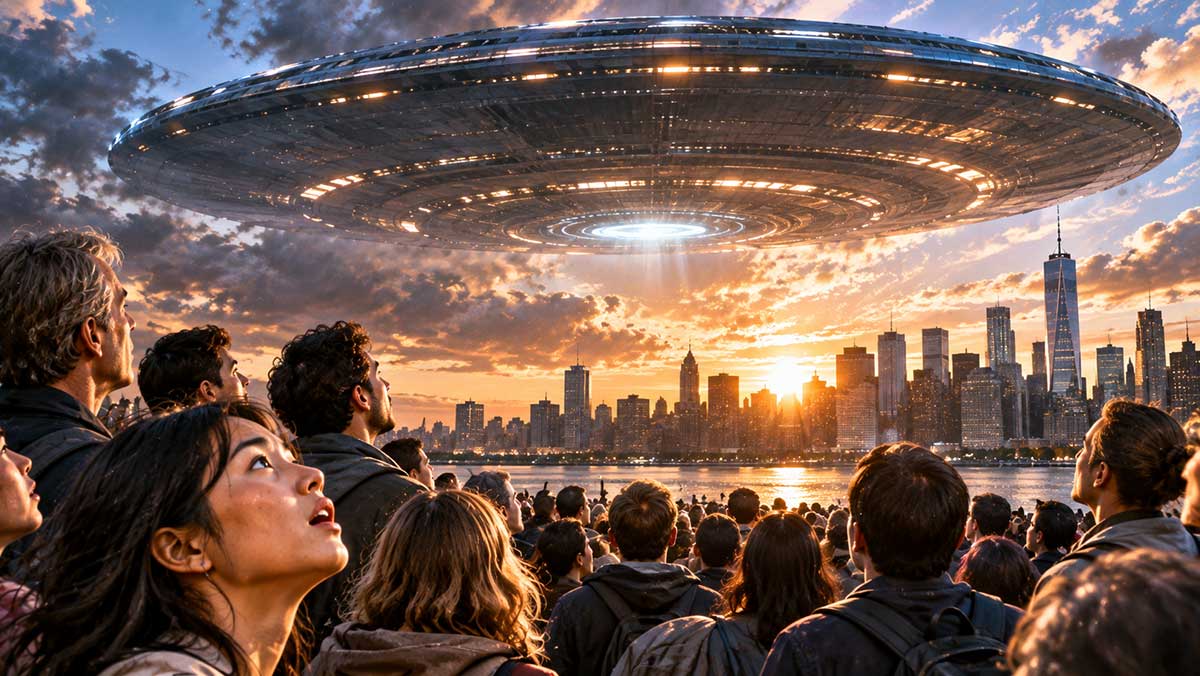
"Imagine that tomorrow morning, scientists around the world confirm the existence of an intelligent civilization beyond Earth.
"Not a rumor.
"Not an anonymous source.
"Not an unexplained video.
"Real confirmation.
"What would happen to humanity?"
Diana
"Some people would celebrate."
Luis
"Some would worry."
Avi
"Scientists would have an extraordinary amount of work to do."
Garry
"And philosophers would suddenly become very busy."
Jay
"Governments would have difficult decisions to make."
Nick watched the first pale light touch the mountain peaks.
Nick
"Would a discovery like that change how we understand ourselves?
"Would we see our differences differently?
"Or would we carry the same disagreements into a much larger universe?"
Diana
"Perhaps that's the question we've been approaching all night.
"Not simply what we might discover out there.
"But what the discovery might reveal about us."
Nick smiled.
"Then I think it's time we watched the sunrise."
The group began moving toward the terrace.
Behind them, the ancient books remained on their shelves, preserving thousands of years of human questions.
Ahead of them, the morning sky was growing brighter.
The conversation continues in Topic 5: One Humanity, a Much Greater Universe.
Topic 5. One Humanity, a Much Greater Universe
An Imaginary Conversation with Jay Stratton, Luis Elizondo, Avi Loeb, Garry Nolan, and Diana Walsh Pasulka
Moderator: Nick Sasaki
Editor's Note: This is a fictional conversation inspired by the participants' publicly expressed ideas, research, and reported experiences. The dialogue, setting, and personal exchanges are imagined. The confirmation of non-human intelligence discussed below is a hypothetical future scenario, not an event that has occurred.
The Morning Everything Changes
The first sunlight touched the mountains as the six friends stepped onto the observatory terrace.
The sky had transformed during their hours of conversation. The countless stars that had filled the darkness were fading into a pale blue morning. Golden light spread across the valley, illuminating forests, winding roads, and distant houses.
A few birds began calling from the trees below.
Nick Sasaki carried a tray of coffee outside and placed it on the table.
Nick Sasaki
"Well, we survived the night."
Luis Elizondo
"Barely."
Garry Nolan
"I think we've consumed enough coffee to qualify as a scientific experiment."
Avi Loeb
"Unfortunately, we forgot to establish a control group."
Jay Stratton
"I volunteer to remain in the experimental group."
Diana Walsh Pasulka
"That might explain why humanity has developed so many rituals around morning beverages."
Everyone laughed.
Nick settled into his chair.
"You know, when we started last night, I wanted to know who these intelligences might be.
"Then we asked why Earth might interest them, what we could learn from them, and whether humanity might have encountered extraordinary phenomena throughout history.
"But there's one question I care about more than all the others."
He looked around the table.
"What happens to us?"
The laughter faded.
Nick gestured toward the valley.
"Let's try something.
"For the next hour, I want us to imagine that tomorrow morning, something extraordinary happens.
"Scientists from several countries independently confirm that an intelligent non-human civilization exists.
"The evidence is public. Different research teams have examined it. The conclusion is no longer dependent on rumors or classified testimony.
"Humanity has finally received unmistakable confirmation that we are not alone.
"What happens next?"
Question 13. What Would Happen During the First Days After Humanity Learned We Are Not Alone?
Nick
"Jay, you've spent years thinking about disclosure.
"Imagine you wake up tomorrow and see the announcement.
"What do you think the first twenty-four hours would look like?"
Jay Stratton
"I think the response would depend enormously on what had been discovered.
"Finding an artificial object in a distant star system would be very different from confirming that an intelligence was operating here on Earth.
"If the discovery involved direct contact, governments would immediately want to understand the circumstances.
"Who made the discovery? What was observed? What capabilities were demonstrated? Is communication possible?
"And of course, people everywhere would have questions."
Nick
"Would governments tell the public everything?"
Jay
"That would depend on what information existed and whether there were legitimate security concerns.
"But a discovery affecting all humanity would create enormous pressure for transparency.
"People would want reliable information, and they would deserve serious answers."
Luis Elizondo
"I'd expect national security institutions to become involved very quickly.
"An unfamiliar intelligence with unknown capabilities would raise practical questions.
"But I think there's another issue people underestimate.
"How do governments coordinate when they're accustomed to competing with one another?"
Nick
"Imagine the United States, China, Russia, Europe, Japan, and every other country trying to decide who speaks for Earth."
Luis
"Exactly.
"Different countries have different interests and security concerns.
"An extraordinary discovery wouldn't erase those differences overnight."
Avi Loeb
"That's why independent scientific verification would be so important.
"Scientists from different countries already cooperate on astronomical observations, space missions, and other international projects.
"A discovery of extraterrestrial intelligence could become an extraordinary opportunity for global scientific collaboration."
Nick
"Would people panic?"
Diana Walsh Pasulka
"Some might feel frightened. Others would be excited, curious, or deeply moved.
"But we shouldn't assume that everyone would respond in the same way.
"Human beings have remarkable abilities to incorporate extraordinary discoveries into their existing worldviews."
Nick
"What about religion?
"Would churches, temples, mosques, and other religious communities struggle with the announcement?"
Diana
"Some communities might reconsider particular interpretations of their traditions.
"Others might see extraterrestrial life as entirely compatible with their beliefs.
"Religious responses would be diverse.
"Many traditions already contemplate realities much larger than the human world."
Garry Nolan
"And from a biological perspective, the nature of the discovery would matter.
"Finding microbial life elsewhere would be extraordinary, but it wouldn't raise exactly the same questions as encountering a technologically advanced intelligence.
"Direct contact could challenge our assumptions about cognition, evolution, and the uniqueness of humanity."
Nick
"Let me make this personal.
"Suppose the announcement happens tomorrow morning.
"Who would you call first?"
Jay
"My family."
Luis
"Family."
Garry
"I'd want to share the discovery with people close to me, and then I'd probably start asking how the evidence was obtained."
Avi
"I would want to examine the data."
Nick
"Avi, you wouldn't call anybody?"
Avi
"After examining the data, I would have a great deal to discuss."
The group laughed.
Diana
"I think I'd want to talk with the people I love.
"Extraordinary discoveries become real in our lives through the conversations we have with one another."
Nick nodded.
"That's exactly what I was thinking.
"We imagine the announcement happening at the United Nations or in a scientific laboratory.
"But the real human moment might happen at a kitchen table.
"A mother tells her children.
"A grandfather calls his grandchildren.
"Two friends sit quietly together, trying to comprehend what they've just learned."
He looked toward the valley.
"Imagine millions of families having that conversation at the same time."
Diana
"That would be a remarkable moment in human history."
Luis
"And perhaps a moment when responsible communication would matter more than ever."
Nick
"Would humanity ever return to normal?"
Avi
"Normal would change.
"Humanity has repeatedly revised its understanding of the universe.
"Discovering that another technological civilization exists would be a profound development, but human life would continue.
"People would still raise families, work, create art, and ask questions."
Garry
"And perhaps those questions would become more interesting."
Jay
"People would want to know what the discovery meant for their future."
Nick smiled.
"Which brings us to something I've been thinking about all night."
Question 14. Could Contact Help Humanity Recognize Itself as One Family?
The sunlight had reached the terrace.
Nick stood and walked toward the railing.
Below them, the valley stretched into the distance. Small houses stood among the trees. Roads connected towns that were invisible from the observatory.
Nick
"When I look down there, I don't see national borders.
"I see houses, families, schools, and communities.
"Somewhere, people are waking up, making breakfast, worrying about their children, planning their day.
"They have different languages, religions, cultures, and political beliefs.
"But from up here, those differences seem very small."
He turned toward the group.
"I believe humanity is one family under one God.
"I know that not everyone shares that conviction, and I respect that.
"But I often think of the old story about blind men touching different parts of an elephant.
"One touches the trunk and says the elephant is like a snake.
"Another touches the leg and says it's like a tree.
"Each experiences something real, but none sees the entire animal.
"I wonder whether our religious traditions sometimes approach the same divine mystery from different perspectives.
"And now imagine discovering that we're part of a universe containing other intelligent civilizations.
"Wouldn't that make our human divisions seem smaller?"
Diana Walsh Pasulka
"That's a profound question, Nick.
"Religious traditions offer different ways of thinking about humanity's relationship to the sacred.
"Some people might interpret extraterrestrial intelligence as another expression of divine creation.
"Others might find that the discovery challenges their existing beliefs.
"And people without religious commitments might see it through a scientific or philosophical perspective.
"But the possibility of a larger community of intelligence could certainly encourage reflection on what humanity shares."
Nick
"Would it change Christianity?"
Diana
"Different Christian communities would respond differently.
"Some theologians have already considered the possibility of extraterrestrial life and its implications for creation, salvation, and the uniqueness of human beings.
"The discovery wouldn't automatically settle those questions.
"It would invite new conversations."
Nick
"What about Islam, Judaism, Buddhism, Hinduism, and other traditions?"
Diana
"Each has its own intellectual and spiritual resources for considering life beyond Earth.
"Some traditions already describe vast cosmologies containing many kinds of beings.
"But we should resist treating all religions as interchangeable.
"Their differences are meaningful, and their responses would not necessarily be the same."
Avi Loeb
"I would approach the discovery through a different question.
"What can we learn about the place of humanity in cosmic history?
"We know that the universe existed for billions of years before Earth formed.
"If technological civilizations developed elsewhere, some could have histories far longer than ours.
"That perspective could encourage humility."
Nick
"Do you think it could encourage peace?"
Avi
"Possibly.
"But knowledge doesn't automatically change human behavior.
"We already know that Earth is a small planet in an enormous universe, yet human conflicts continue.
"Perhaps a genuine encounter would create a stronger sense of shared identity.
"That would depend on how people responded."
Luis Elizondo
"And we'd have to be realistic.
"A common external challenge can encourage cooperation, but it can create competition, too.
"Some countries might see an opportunity for collaboration.
"Others might focus on gaining technological or strategic advantages."
Nick
"That's what concerns me.
"What if we finally discover that we're not alone, and instead of becoming one humanity, we fight over who gets to control the discovery?"
Jay Stratton
"That's a genuine possibility.
"Which is why transparency, responsible leadership, and international dialogue would matter.
"An extraordinary discovery wouldn't automatically solve the problems humanity already faces."
Garry Nolan
"There's another interesting question.
"Would the discovery change our biological understanding of what makes us human?
"We often define ourselves through differences.
"Different nations, cultures, languages, and identities.
"But compared with an intelligence that evolved independently on another world, the biological differences among human populations would be extraordinarily small."
Nick
"Exactly.
"We spend so much energy arguing about our differences.
"But compared with another civilization, we're all human beings sharing the same planet."
Garry
"Yes.
"And perhaps studying another intelligence would help us appreciate both our shared biology and the extraordinary diversity of life."
Nick
"Let me ask you something.
"Suppose another civilization has existed peacefully for a million years.
"Wouldn't you want to know how they did it?"
Avi
"Certainly.
"But we should be careful about assuming that technological longevity necessarily means peace.
"A civilization could survive through social arrangements very different from ours."
Diana
"And its ethical concepts might be unfamiliar.
"We might discover beings with no direct equivalent of human compassion, or beings whose understanding of cooperation exceeds anything we've developed."
Nick
"What if they had no religion?"
Diana
"That would be fascinating.
"And if they did have spiritual traditions, that would raise equally fascinating questions.
"We should approach either possibility with curiosity."
Nick
"I'd love to ask whether they believe in God."
Avi
"And I would ask what evidence or reasoning led them to their answer."
Garry
"I'd ask how they define consciousness."
Luis
"I'd ask whether their beliefs influence their behavior toward other civilizations."
Jay
"And whether they understand the consequences of interacting with a younger technological civilization."
Nick laughed softly.
"Five different questions again."
He returned to his chair.
"Here's what I keep coming back to.
"If we discovered another intelligence tomorrow, I wouldn't want humanity to become united through fear.
"I'd want us to become united through wonder.
"Through the recognition that we're sharing something extraordinary.
"That every person on Earth, regardless of background, is part of the same remarkable human story."
Diana
"That's a meaningful aspiration.
"And perhaps the discovery could become an opportunity to ask what kind of shared future we want."
Luis
"An opportunity, yes.
"But we'd still have to choose what to do with it."
Nick
"Maybe that's the point.
"Another civilization can't make us compassionate.
"We have to decide to become compassionate ourselves."
The group sat quietly.
A bird landed on the terrace railing, examined the visitors, and flew away.
Garry
"Well, at least one other intelligence has decided we're not worth talking to."
Avi
"Perhaps it was disappointed by the lack of breakfast."
Everyone laughed.
Nick looked toward the sky.
"Then let's ask our final question."
Question 15. If Humanity Could Send One Message to Another Intelligent Civilization, What Should It Say?
The sun had risen above the mountains.
The valley was bright now, and the last stars had disappeared.
Nick placed his empty coffee cup on the table.
Nick
"Imagine that the day has finally arrived.
"Humanity has established communication with another intelligent civilization.
"We have one opportunity to send a message.
"Not a scientific report. Not a military warning. Not a political statement.
"A message that tells them something meaningful about who we are.
"What should we say?"
He looked toward Jay.
"Would you begin?"
Jay Stratton
"I'd want the message to communicate that humanity is seeking understanding.
"We would want to know who they are, what their intentions might be, and whether peaceful communication is possible.
"I'd want them to recognize that we take the encounter seriously."
Nick
"So your message is about establishing trust."
Jay
"Yes.
"Trust would matter enormously if contact became real."
Nick turned toward Luis.
Luis Elizondo
"I'd want to communicate that humanity is capable of cooperation and that we seek peaceful interaction.
"But I'd be careful about making promises on behalf of an entire planet.
"We'd need to recognize that humanity contains many governments, cultures, and perspectives."
Nick
"That's a good point.
"Whoever speaks for Earth would have an enormous responsibility."
Luis
"And no single person could perfectly represent every human being."
Nick
"Avi?"
Avi Loeb
"I would send information demonstrating our scientific understanding.
"Mathematics, physics, and observations of the universe could provide a foundation for communication.
"Then I'd ask about their civilization.
"How did they develop? What have they discovered? What questions remain unanswered for them?"
Nick
"Even a civilization a million years ahead of us might still have unanswered questions?"
Avi
"Of course.
"Knowledge can grow without reaching an endpoint.
"The universe may contain mysteries that challenge even the most advanced civilizations."
Nick
"I love that thought.
"Maybe curiosity is something we could share."
He turned toward Garry.
Garry Nolan
"I'd want to communicate that Earth contains an extraordinary diversity of life.
"That intelligence emerged here through biological evolution.
"And that we're interested in learning how life and cognition developed elsewhere.
"I'd ask whether they recognize anything familiar in us."
Nick
"Anything familiar?"
Garry
"Yes.
"Perhaps intelligence evolves in different ways, yet some principles are shared.
"Learning those principles could transform our understanding of life."
Nick turned toward Diana.
Diana Walsh Pasulka
"I'd want our message to acknowledge that human beings search for meaning.
"We create art, tell stories, develop moral traditions, and ask questions about our existence.
"We experience joy, grief, love, and wonder.
"And we hope to encounter the unknown without losing our humanity."
Nick nodded slowly.
"That's beautiful."
Diana smiled.
"Thank you."
Jay looked toward Nick.
Jay
"Now it's your turn."
Nick hesitated.
For the first time that morning, he seemed uncertain how to begin.
Nick
"I've been thinking about this since last night.
"When I was young, I imagined that meeting another civilization would be the greatest adventure in human history.
"I still think it could be.
"But now, when I think about what I'd want to tell them, I don't think about our skyscrapers or computers.
"I think about the people I've loved."
He paused.
"I think about parents holding newborn babies.
"Children laughing with their grandparents.
"Friends forgiving one another after years of misunderstanding.
"Strangers helping strangers during disasters.
"People who have very little, yet still find something to share."
The others listened.
Nick
"If I could send one message, I think it would be this."
He looked toward the morning sky.
"'To whoever you are, wherever you come from:
"'Welcome.
"'We are humanity.
"'We are still young, and we have much to learn.
"'We have made mistakes. We have hurt one another. We have sometimes allowed fear to become stronger than love.
"'But we are capable of kindness.
"'We care for our children. We mourn those we lose. We create beauty, search for truth, and dream of peace.
"'We do not know whether you experience these things as we do.
"'But if you come in peace, we hope we can learn from one another.
"'And perhaps together, we can discover something neither of us could discover alone.'"
Nick stopped speaking.
For a moment, the terrace was silent.
The sunlight warmed the table.
Diana
"That's a deeply human message."
Nick
"I hope so."
Avi
"I particularly like the final idea.
"Two civilizations might learn from one another in ways neither could anticipate."
Garry
"And the message acknowledges uncertainty.
"You're not assuming they think or feel exactly as we do."
Luis
"I'd still want a careful plan for what happens after the message is sent."
Nick
"Luis, you're determined to make sure we survive first contact."
Luis
"Somebody has to read the safety instructions."
Jay
"And somebody has to make sure the coffee is ready."
Everyone laughed.
Nick looked around the table.
"You know what I find remarkable?
"We started tonight with five very different perspectives.
"Intelligence investigations. National security. Astrophysics. Biology. Religion.
"And after all these hours, we still don't have a single answer to the biggest mystery."
Avi
"That is not necessarily a failure."
Garry
"Sometimes better questions are the most valuable result."
Diana
"And perhaps we've discovered something about the human desire for connection."
Luis
"And about the responsibilities that come with exploring the unknown."
Jay
"And about why the questions deserve serious attention."
Nick nodded.
"Then maybe we shouldn't end by pretending we've solved everything."
He stood and walked toward the railing.
Below them, the valley had come fully alive.
Cars moved along distant roads. Smoke rose from a farmhouse chimney. Birds crossed the morning sky.
Nick
"Look at that.
"An entire world waking up.
"Billions of people will go about their lives today, most of them never thinking about the possibility that another intelligence might exist somewhere beyond Earth.
"They'll go to work. They'll worry about money. They'll argue with someone they love. They'll celebrate birthdays. They'll face disappointments.
"And some of them will do extraordinary acts of kindness that nobody else will ever know about."
Diana joined him at the railing.
Diana
"Perhaps those ordinary acts are part of what makes humanity worth knowing."
Nick
"I think so."
Avi looked upward.
Avi
"And somewhere in that enormous universe, there may be another civilization asking whether it is alone."
Garry
"Perhaps asking questions we haven't learned to formulate."
Luis
"Perhaps wondering whether contact would be safe."
Jay
"Perhaps observing a world it doesn't yet understand."
Nick smiled.
"Or perhaps nobody is watching us at all.
"Maybe the first move is ours to make."
The group stood together, watching the sunlight spread across the mountains.
After a moment, Nick spoke again.
"You know, I used to think that discovering another intelligence would change everything.
"Now I wonder whether the most meaningful change might be something we choose to make ourselves."
Diana
"What change?"
Nick
"Learning to recognize the humanity in one another."
He looked toward his friends.
"If we're ever going to meet another civilization with wisdom, perhaps we should begin by treating the people already sharing this planet with greater kindness."
Avi smiled.
"That's a challenge we can begin addressing without waiting for an extraterrestrial signal."
Garry
"And without inventing a new machine."
Luis
"Though better technology wouldn't hurt."
Jay
"Neither would better communication."
Nick laughed.
"Then perhaps we have our first assignment."
He turned toward the observatory.
"Breakfast?"
Garry
"Now that's a discovery I can support."
Avi
"Provided we collect sufficient evidence that the food is edible."
Luis
"I'll assess the risks."
Jay
"I'll examine the coffee."
Diana
"And I'll study the breakfast rituals."
They began walking toward the observatory doors, still laughing and talking.
Behind them, the sky stretched endlessly above the mountains.
The universe had not become smaller during their night together.
It had become larger, stranger, and filled with more possibilities than any of them could fully comprehend.
And perhaps that was the most wonderful part.
They had not reached the end of the mystery.
They had barely begun asking the questions.
End of Topic 5.
Final Thoughts
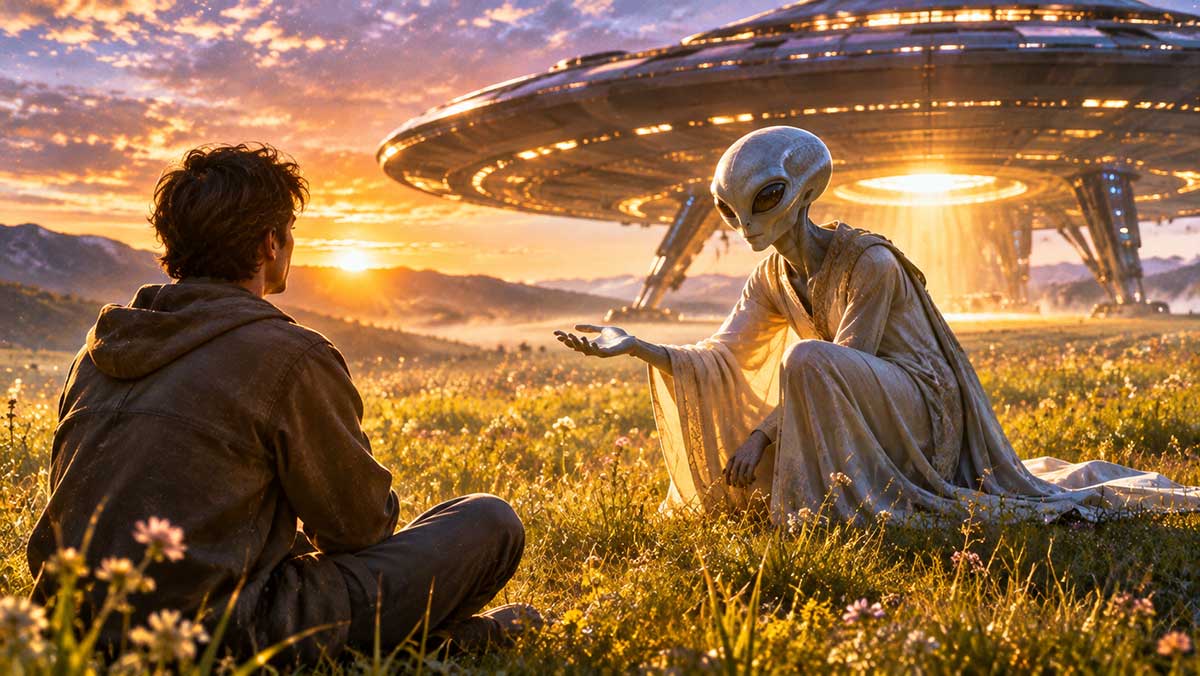
When our imaginary conversation began, the sun was disappearing behind the mountains. Six people gathered around a table, each bringing a different way of asking questions about the unknown. By sunrise, we had explored possibilities ranging from artificial intelligence created by distant civilizations to the mysteries of consciousness and the meaning of human existence. Yet we had not established that any non-human civilization has visited Earth. The most extraordinary claims remain questions for investigation, not conclusions.
One lesson from the conversation is the value of separating evidence from interpretation. Jay Stratton's public accounts and Luis Elizondo's discussions of UAP investigations raise questions about observations, testimony, institutional responsibility, and transparency. Those questions deserve serious examination without requiring us to accept every proposed explanation. NASA's public discussion of UAP provides a useful scientific reference: unidentified phenomena require better data, careful analysis, and an openness to ordinary explanations.
Avi Loeb reminds us that curiosity becomes more valuable when accompanied by methods that can test our ideas. The Galileo Project represents one approach to searching for potential extraterrestrial technological signatures through scientific observation. Whether or not humanity discovers another civilization, developing better instruments and asking better questions can deepen our knowledge of the universe.
Garry Nolan's perspective brings the mystery closer to life itself. We still have unanswered questions about the emergence of consciousness, the diversity of intelligence, and the relationship between biological systems and subjective experience. Another civilization, if one were discovered, might challenge assumptions we scarcely recognize. Yet even without extraterrestrial contact, studying life on Earth already reveals extraordinary forms of adaptation, perception, and cooperation.
Diana Walsh Pasulka offers a different reminder: human beings do not encounter mysteries without bringing their histories, beliefs, and expectations with them. Religious visions, ancient stories, and modern reports of unusual experiences belong to different contexts. Treating them with respect requires neither dismissing the people who experienced them nor declaring their interpretations scientifically proven. Her research and publications invite readers to consider how culture shapes our encounters with the extraordinary.
For me, the most personal question arose when we considered what another intelligence might know about love. A civilization could possess astonishing technology without sharing human emotions. It might understand the universe through concepts we cannot yet comprehend. But intelligence and wisdom are not necessarily the same. I find myself wondering whether our greatest achievement would be learning how to travel among the stars, or learning how to treat one another with greater compassion here on Earth.
My conviction that humanity is one family under one God remains a personal belief, not a conclusion established by astronomy or UAP research. The discovery of extraterrestrial intelligence would not automatically settle religious questions, erase political disagreements, or create peace. We would still be responsible for the choices we make. Yet I hope such a discovery might encourage us to recognize how much we share: our fragile planet, our search for meaning, our love for those closest to us, and our desire to leave a better future for our children.
As the imaginary guests leave the observatory for breakfast, the universe remains as mysterious as it was when they arrived. No final answer has been given about who might exist beyond Earth. But the night has changed the questions we ask. Perhaps the most meaningful preparation for meeting another intelligence is to become more thoughtful, curious, and compassionate toward the human beings already living beside us.
Disclaimer: These final reflections refer to a fictional conversation created by ImaginaryTalks.com. All dialogue, personal exchanges, and imagined statements attributed to the participants are creative reconstructions, not actual quotations or endorsements. The discussion explores scientific questions, reported UAP allegations, and hypothetical first contact without presenting unverified claims as established facts.
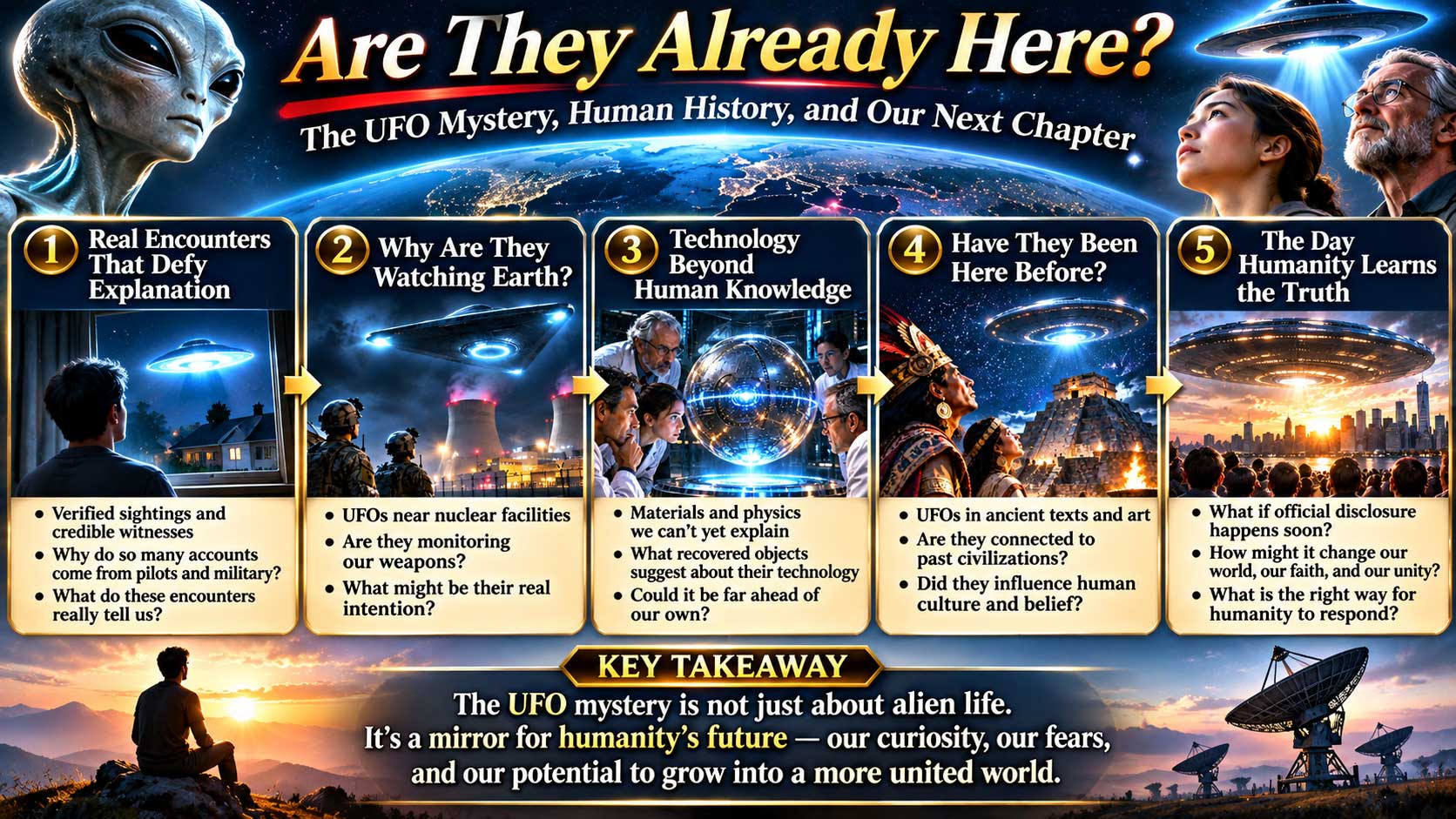
Short Bios:
Nick Sasaki
Nick Sasaki is the creator of ImaginaryTalks.com, a platform that brings historical figures, contemporary thinkers, scientists, and influential voices together through fictional conversations. His work explores philosophy, spirituality, science, history, and the questions that shape human life.
Born in Japan and having spent much of his adult life in the United States, Nick is interested in conversations that cross cultural, religious, and intellectual boundaries. He believes humanity is one family under one God and hopes imaginative dialogue can encourage curiosity, compassion, and mutual respect.
In The Great Unknown, Nick serves as the fictional moderator, asking what the possibility of non-human intelligence might reveal about the human experience.
Jay Stratton
Jay Stratton is a former U.S. intelligence official who has held significant roles involving the investigation of unidentified anomalous phenomena. His career includes work connected with government UAP investigations and intelligence analysis.
He is the author of Out of the Shadows: Revealing the Truth About Non-Human Intelligent Life, a memoir presenting his account of extraordinary alleged experiences and government investigations.
His accounts are important to public discussion surrounding UAP, but their more extraordinary conclusions concerning non-human beings and technology have not been independently established through publicly available scientific evidence.
For background on the broader government and scientific context, see NASA's UAP information.
Luis Elizondo
Luis Elizondo is a former U.S. government official and public advocate for greater investigation and transparency concerning unidentified anomalous phenomena. He has spoken extensively about national security concerns, military observations, and the importance of examining reports that remain unexplained.
He is the author of Imminent: Inside the Pentagon's Hunt for UFOs, which presents his account of government UAP-related work and his interpretations of the phenomenon. His extraordinary claims remain subjects of public debate and investigation.
In this fictional conversation, Luis represents questions about national security, responsible disclosure, institutional decision-making, and the challenges of responding to an unfamiliar intelligence.
Readers can find further background in his published book information.
Avi Loeb
Avi Loeb is an astrophysicist at Harvard University whose research interests include cosmology, black holes, the early universe, and the search for possible extraterrestrial technological signatures.
He is associated with the Galileo Project, an initiative investigating potential evidence of extraterrestrial technological artifacts through scientific observation and analysis.
Loeb has argued that unusual astronomical observations and possible technological signatures should be investigated through testable scientific methods rather than dismissed without examination.
In The Great Unknown, his fictional voice encourages curiosity grounded in physical evidence, scientific reasoning, and the recognition that humanity's knowledge of the universe remains incomplete.
His academic background is available through Harvard University's astronomy faculty profile.
Garry Nolan
Garry Nolan is a scientist at Stanford University whose established research includes immunology, cancer biology, and advanced methods for analyzing cells and biological systems.
Separately, he has participated in public discussions concerning unusual materials, reported extraordinary experiences, and questions related to UAP. These interests should be distinguished from the findings of his peer-reviewed biomedical research.
In this imaginary conversation, Nolan explores the possibilities of unfamiliar biology, alternative forms of intelligence, and the scientific questions surrounding consciousness.
His academic credentials and research can be found in his Stanford University profile.
Diana Walsh Pasulka
Diana Walsh Pasulka is a scholar of religious studies whose work examines the relationship between religion, technology, belief, and extraordinary experiences.
Her books include American Cosmic: UFOs, Religion, Technology and Encounters: Experiences with Nonhuman Intelligences. Her research explores how people interpret unusual experiences and how cultural and religious frameworks shape their meanings.
In The Great Unknown, her fictional perspective encourages historical sensitivity, philosophical reflection, and respect for different religious traditions without treating extraordinary interpretations as established scientific facts.
More information about her work is available through Diana Walsh Pasulka's official website.
Leave a Reply