
Introduction
The GTA 6 controversy raises a question that has been troubling me: Why are millions of people so excited to spend their free time pretending to be criminals? Grand Theft Auto invites players into an extraordinary virtual world where stealing cars, escaping police officers, and engaging in violent criminal activities can become exciting entertainment. I understand that it's a fictional game, and I recognize the remarkable creativity behind it. But I cannot help wondering what it says about our culture when experiences that would horrify us in real life become something we eagerly anticipate for entertainment. Are we simply having fun, or are we gradually becoming comfortable celebrating things we should find morally troubling?
My concern isn't that every GTA player wants to become a criminal. I know that many gamers are thoughtful, compassionate, law-abiding people who clearly distinguish fantasy from reality. But I worry about the broader social message. When millions of people spend countless hours enjoying virtual theft, violence, and escaping law enforcement, I believe we should at least ask whether this is a healthy direction for entertainment. The Entertainment Software Rating Board's description of GTA V illustrates the mature content that has long been part of the series. I respect people's freedom to enjoy fictional stories, but I also believe that popularity alone doesn't make something beneficial for society.
One reason I take this question seriously comes from my Christian faith. In Matthew 5:27–28, Jesus teaches that adultery can begin in the heart, before any physical act occurs. To me, this is a profound reminder that our thoughts, desires, and intentions matter. I believe that what we deliberately entertain in our minds can influence the people we become. I am not suggesting that playing a fictional criminal is equivalent to committing a real crime. But if repeatedly cultivating gratitude, compassion, and forgiveness can strengthen positive qualities, shouldn't we question whether repeatedly enjoying simulated cruelty and aggression might influence us in less desirable ways? I find that possibility difficult to dismiss.
I'm particularly concerned about the portrayal of police officers. In real life, police officers are human beings who protect communities, respond to emergencies, and sometimes risk their lives to help strangers. They deserve respect for their service, even as their actions remain subject to appropriate scrutiny and accountability. Yet in GTA, police frequently appear as enemies to escape or defeat. I understand that fictional police pursuits can be exciting gameplay, but I wonder whether repeatedly presenting law enforcement as an adversary contributes to an unhealthy cultural attitude. I cannot claim that GTA causes disrespect toward real police officers. Still, I believe this is a question worth asking, especially when younger players are exposed to mature games.
Of course, my concerns must be examined fairly. Psychological research has not established that playing GTA turns people into criminals. The American Psychological Association has cautioned against making causal claims linking violent video games to violent criminal behavior. There are meaningful distinctions between fictional actions, genuine intentions, and real-world conduct. Gamers may enjoy GTA for its storytelling, freedom, humor, technical achievements, or the opportunity to explore an imaginary world. I want to understand those attractions rather than dismiss them. And I want to hear what researchers can actually tell us about repetition, rewards, aggression, and the possible psychological effects of gaming.
That's why I've imagined a three-part debate featuring four people with contrasting perspectives. Jack Thompson, a longtime critic of violent video games, and psychologist Craig A. Anderson will examine the moral and psychological concerns. GTA streamer DarkViperAU, whose real name is Matthew Judge, and psychologist Christopher J. Ferguson will defend the gaming perspective and challenge claims that go beyond the scientific evidence. I will serve as the moderator, asking difficult questions of both sides. We will explore whether wrongdoing can begin in the imagination, whether games can influence people without their awareness, and what parents and game developers should consider when shaping entertainment for future generations.
I enter this conversation with genuine concerns about GTA's social influence, but I also enter it with an open mind. I don't expect everyone to share my beliefs, and I don't believe disagreement should prevent us from listening to one another. Perhaps the most interesting question isn't whether GTA should exist, but whether we can imagine something better. If developers can create a virtual world where stealing cars and escaping police become thrilling adventures, couldn't they create an equally compelling world where rescuing people, protecting communities, and helping others become extraordinary experiences? What if the next great achievement in gaming isn't making virtual crime more exciting, but making goodness impossible to resist? I invite you to consider the arguments from both sides and decide for yourself.
Fictional Conversation Disclaimer: This article presents an original imaginary discussion created for ImaginaryTalks.com. The named participants did not take part in these conversations, and their dialogue is fictional. Their arguments are inspired by public debates and research, not represented as authentic quotations or personal endorsements.
Topic 1. When Does Evil Begin, In the Mind or in the Act?
An imaginary conversation about Grand Theft Auto, morality, freedom, and the invisible influence of our choices.
A Bible, a Controller, and an Uncomfortable Question
Morning sunlight entered a quiet library through tall windows, illuminating shelves of old books. At the center stood a round wooden table with five chairs.
Two objects rested side by side: a well-worn Bible and a black video game controller.
Nick Sasaki had placed them there deliberately.
Jack Thompson, the former attorney known for his opposition to violent video games, studied the controller with a skeptical smile. Psychologist Craig Anderson sat beside him, reviewing a few notes.
Across the table, GTA streamer Matthew Judge, better known as DarkViperAU, leaned back comfortably. Psychologist Christopher Ferguson sat nearby, looking amused by the unusual arrangement.
Nick picked up the controller, then glanced at the Bible.
Nick Sasaki: "Gentlemen, I have a confession. I don't understand why millions of people want to spend their free time pretending to steal cars, fight police officers, and commit crimes."
DarkViperAU: "That's a pretty dramatic way to describe driving around a fictional city."
Nick Sasaki: "Well, Matthew, I could describe it as sightseeing, but I don't think the game is called Grand Tourism Auto."
Everyone laughed, including Jack.
Nick Sasaki: "But seriously, I want to understand something. When you play a criminal for hundreds of hours, are you simply having fun? Or are you practicing something that might slowly change who you are?"
The laughter faded.
Nick Sasaki: "And here's the question that brought us together. Does evil begin when we commit a harmful act, or can it begin much earlier, inside our imagination?"
Question 1. If Jesus Said Adultery Begins in the Heart, What About Imaginary Crime?
Nick Sasaki: "Jack, let me begin with something from the Bible. In Matthew 5:27–28, Jesus teaches that looking at someone with lustful intent can constitute adultery in the heart. The physical act isn't the only thing that matters. Our inner intentions matter, too."
Nick opened the Bible.
Nick Sasaki: "Now, I'm not saying playing GTA is equivalent to adultery. But here's my concern. If repeatedly entertaining immoral desires can shape our hearts, what happens when someone spends hundreds of hours enjoying simulated theft, cruelty, and violence?"
Jack Thompson: "Nick, that's exactly the kind of moral question we've neglected. We keep asking whether violent games produce criminals. But that's an incredibly narrow standard. Human character is about more than whether someone gets arrested."
DarkViperAU: "Can I challenge the premise?"
Nick Sasaki: "Please."
DarkViperAU: "You're assuming that playing a criminal means enjoying criminality itself. That's not necessarily true. I can enjoy escaping police in GTA without wanting anyone to escape justice in real life. I can enjoy a dramatic villain in a movie without admiring that villain."
Jack Thompson: "But in a movie, you're watching the villain. In a game, you're controlling him."
DarkViperAU: "And in chess, I deliberately sacrifice my own soldiers. Does that make me indifferent to human life?"
Jack Thompson: "Chess pieces don't scream when you hurt them."
DarkViperAU: "Neither do real people when I move a chess piece. That's the point. Context matters. A fictional action doesn't automatically carry the moral meaning of the real action it resembles."
Nick Sasaki: "Christopher, is Matthew making a valid distinction?"
Christopher Ferguson: "Absolutely. We have to distinguish imagination, intention, and action. Jesus' teaching concerns the deliberate cultivation of a desire directed at another person. Playing a fictional character doesn't necessarily mean desiring to commit that character's acts."
Craig Anderson: "I agree those distinctions matter. But Christopher, there's another issue. Learning doesn't require someone to consciously endorse what they're learning. Repeated exposure and reinforcement can influence responses without deliberate intention."
Christopher Ferguson: "That's a possibility, Craig. But we still need evidence that the relevant learning transfers beyond the game."
Nick Sasaki: "So let me ask both of you something. If someone repeatedly imagines helping others, we might expect that practice to strengthen compassionate thinking. Why wouldn't repeatedly enjoying cruelty have the opposite effect?"
Craig Anderson: "It could, depending on the content, the person, and the context. Some research on violent games has found associations with aggressive thoughts, feelings, or behavior. But that doesn't establish that playing GTA produces criminal intentions."
Christopher Ferguson: "And I would challenge how consistently those findings hold up, how large they are, and whether the measures capture meaningful harm. We can't simply assume that learning a game mechanic means learning a real-world moral attitude."
Jack Thompson: "But isn't that exactly why we should be cautious? If we don't fully know what repeated experiences do to young minds, why treat these experiences as morally harmless?"
DarkViperAU: "Caution is reasonable. But suspicion isn't proof. I don't think it's fair to tell millions of people they're cultivating evil simply for enjoying a fictional game."
Nick looked down at the controller.
Nick Sasaki: "Then maybe the first question isn't whether the game makes someone evil. Maybe it's whether we should pay attention to what we enjoy imagining."
For a moment, nobody spoke.
Question 2. Can Repeatedly Enjoying Wrongdoing Change Our Character?
A grandfather clock chimed softly.
Nick moved the controller to the middle of the table.
Nick Sasaki: "Let me try another angle. Suppose someone spends an hour every day practicing gratitude, compassion, and forgiveness. Over time, we'd expect those habits to influence their thinking."
Craig Anderson: "There is a substantial body of psychological research examining how repeated experiences can influence learning and behavior."
Nick Sasaki: "Then suppose someone spends an hour every day enjoying virtual violence, stealing cars, and escaping police. Why wouldn't those experiences influence them, too?"
Craig Anderson: "They might influence certain responses. But we have to be precise about what changes, how much, and for how long. Research on media violence has examined aggressive cognition, emotional reactions, and behavior. Those are not interchangeable with criminality."
DarkViperAU: "Nick, I think there's a problem with the comparison. When I play GTA, I'm not practicing stealing a real car. I'm practicing controlling a character, driving through virtual streets, completing missions, and reacting to game mechanics."
Nick Sasaki: "But you receive rewards for criminal behavior."
DarkViperAU: "Sometimes. But I receive rewards for completing challenges. If I win a game by defeating a fictional opponent, I'm not necessarily developing a desire to hurt someone."
Jack Thompson: "Matthew, you're very articulate. You're an experienced adult. But what about a thirteen-year-old? What if that child doesn't have your ability to separate the game's incentives from its moral meaning?"
DarkViperAU: "Then we should talk about age restrictions and parenting. GTA is intended for mature audiences. I don't defend giving every game to every child."
Jack Thompson: "That's a fair answer. But what about adults? Do we simply stop being influenced by our entertainment when we turn eighteen?"
DarkViperAU: "No. But influence isn't automatically harmful. And being entertained by fictional wrongdoing doesn't necessarily mean approving of real wrongdoing."
Christopher Ferguson: "That's an important distinction. We know people engage with fiction in complicated ways. Horror fans don't necessarily enjoy real suffering. People who read murder mysteries don't necessarily admire murderers."
Craig Anderson: "True. Yet fiction can influence beliefs and expectations. The question is whether a particular experience produces a measurable effect and whether that effect matters outside the fictional context."
Nick Sasaki: "Jack, let me challenge your side. If someone plays GTA for twenty years, obeys the law, treats people kindly, respects police officers, and raises a loving family, would you still say the game has damaged that person's character?"
Jack considered the question.
Jack Thompson: "I couldn't responsibly declare that person's character damaged simply from knowing what games they play. That would be unfair."
DarkViperAU: "Thank you. That's what gamers want critics to recognize."
Jack Thompson: "But I would still ask whether the entertainment itself deserves moral examination. A person's good conduct doesn't automatically make every choice they make beneficial."
DarkViperAU: "And I can accept that. I just want the examination to start with curiosity rather than a guilty verdict."
Nick smiled.
Nick Sasaki: "That's progress. We haven't solved anything, but at least nobody has been arrested."
DarkViperAU: "Give it time. We're discussing GTA."
The room broke into laughter.
Question 3. Are We Losing Our Moral Sensitivity Without Realizing It?
The sunlight had shifted across the table.
Nick closed the Bible gently.
Nick Sasaki: "I want to ask something that bothers me more than the possibility of someone stealing a car after playing GTA."
He looked around the table.
Nick Sasaki: "What if someone never commits a crime, but gradually becomes less sensitive to suffering? What if violence becomes funny, police become enemies, and innocent people become obstacles? Isn't that worth worrying about?"
Jack Thompson: "Very much so. A society can lose something morally valuable without seeing a corresponding rise in criminal convictions. Compassion, respect, and sensitivity to suffering are worth protecting."
DarkViperAU: "But you're describing a possible outcome, not necessarily what players experience. Sometimes gamers laugh at absurd physics or unexpected situations. They're not laughing at an actual person's pain."
Nick Sasaki: "But does the mind always make that distinction?"
Christopher Ferguson: "Often, yes. Humans are capable of engaging with imaginary situations without confusing them with reality. We should be careful about treating a player's laughter at fictional absurdity as evidence of reduced empathy."
Craig Anderson: "Yet desensitization is a legitimate research question. Repeated exposure to certain stimuli can sometimes reduce emotional responses. The challenge is determining whether that occurs with a particular game and whether any change carries into real-world situations."
Nick Sasaki: "So neither side can simply declare victory."
Craig Anderson: "Correct. There are findings worth taking seriously and substantial questions about their interpretation."
Nick Sasaki: "Matthew, let me make this personal. Imagine a young boy who begins playing GTA at twelve. By sixteen, he's spent thousands of hours in a world where police officers chase him and where escaping them is exciting. Would you have any concern about how he sees real police officers?"
DarkViperAU: "I'd want to know how he actually sees them. I'd ask him. Does he understand that police officers are real people with families? Does he respect the law? Is the game affecting his schoolwork or relationships? Those answers matter more than assuming the game has changed him."
Jack Thompson: "But would you be comfortable with that much exposure at such a young age?"
DarkViperAU: "No, not automatically. I'd take the age rating seriously. A twelve-year-old shouldn't simply have unrestricted access to adult entertainment."
Jack nodded.
Jack Thompson: "Then we agree that content can matter."
DarkViperAU: "Of course it matters. We disagree about what conclusions we can draw from it."
Nick Sasaki: "Christopher, here's my last challenge. Suppose science never establishes that GTA causes criminal behavior. Does that mean we have no moral reason to question the pleasure people take in simulated wrongdoing?"
Christopher Ferguson: "No. People can make ethical judgments about entertainment without claiming scientific proof of harm. But they should acknowledge that they're making a moral argument, not disguising it as an established psychological finding."
Craig Anderson: "And scientific uncertainty shouldn't prevent us from asking careful questions about potential effects. It should motivate better research."
Nick Sasaki: "Jack, what have you heard today that you hadn't fully appreciated?"
Jack Thompson: "Matthew's point about context deserves respect. I can oppose certain forms of entertainment without assuming the people who enjoy them are bad people. That's an important distinction."
Nick Sasaki: "Matthew?"
DarkViperAU: "I think Jack has made a fair point about moral reflection. Just saying 'it's fictional' doesn't automatically answer every question about what we choose to enjoy. I still reject the assumption that enjoying GTA makes someone morally worse. But I don't think gamers should be afraid of discussing the ethics of their entertainment."
Nick Sasaki: "Craig?"
Craig Anderson: "We need to distinguish what the evidence suggests from what it cannot establish. Concern about possible effects is reasonable. Exaggerating those effects is not."
Nick Sasaki: "Christopher?"
Christopher Ferguson: "And defending games shouldn't mean claiming that media can never influence anyone. We should remain open to credible evidence, including evidence that challenges our own expectations."
Nick picked up the controller one last time.
Nick Sasaki: "You know, when I began this conversation, I was thinking about Jesus' teaching that wrongdoing can begin in the heart. I still believe we should be careful about what we repeatedly welcome into our minds."
He placed the controller beside the Bible again.
Nick Sasaki: "But I've learned something today. Imagining an action isn't necessarily the same as desiring it. Enjoying a fictional story doesn't automatically mean approving of its characters. And worrying about the moral influence of entertainment doesn't mean condemning everyone who enjoys it."
DarkViperAU: "That sounds like a pretty fair starting point."
Nick Sasaki: "A starting point, yes. But we're not finished."
He turned to the two psychologists.
Nick Sasaki: "We've talked about the heart. Now I want to talk about the brain."
Craig Anderson: "That should be interesting."
Christopher Ferguson: "Especially when Craig and I start disagreeing."
Nick Sasaki: "Here's what I want to know next. If game designers spend enormous amounts of time figuring out how to reward players, keep them engaged, and make them repeat certain actions, how can we be confident those rewards don't shape anything beyond the game?"
DarkViperAU leaned forward.
DarkViperAU: "Now that's a question worth answering."
Outside the library, the morning traffic continued. Somewhere, millions of people were entering fictional cities, picking up controllers, and making choices inside worlds that existed only on screens.
Whether those choices left lasting traces beyond the screen remained an open question.
And the four participants were about to examine the evidence.
To be continued in Topic 2: Is GTA Conditioning Players Without Their Knowledge?
Fictional Conversation Disclaimer
This is an imagined discussion created for educational, philosophical, and creative exploration. Nick Sasaki, Jack Thompson, Craig A. Anderson, DarkViperAU (Matthew Judge), and Christopher J. Ferguson did not participate in this conversation. All dialogue is fictional and should not be treated as authentic quotations or endorsements. The discussion draws on publicly associated perspectives and broader debates about video games, morality, and psychology. Scientific claims are presented with appropriate uncertainty, and spiritual interpretations are distinguished from empirical findings.
Topic 2. Is GTA Conditioning Players Without Their Knowledge?

An imaginary conversation about psychological conditioning, hidden influences, the science of aggression, and whether fictional rewards can shape real-world attitudes.
The Laboratory Where Every Choice Leaves a Trace
The psychology laboratory was nearly empty when Nick Sasaki arrived that evening.
Beyond the tall glass windows, the city glowed beneath a darkening sky. Inside, several computer monitors illuminated a long table. One displayed a fictional city street from a crime video game. Another showed graphs representing behavioral responses. A third displayed a simple experiment involving rewards and decision-making.
A game controller sat beside a small bowl of chocolates.
DarkViperAU immediately noticed the chocolates.
DarkViperAU: "Are those part of the experiment?"
Nick Sasaki: "Yes. Every time you make a good argument, you get one."
DarkViperAU: "Excellent. Finally, a reward system I can support."
Jack Thompson: "And what happens when he makes a bad argument?"
Nick Sasaki: "Christopher gets the chocolate."
Christopher Ferguson: "I like this research design already."
Craig Anderson smiled but pointed at the monitors.
Craig Anderson: "I hope nobody plans to publish the results."
Nick Sasaki: "Why not?"
Craig Anderson: "No control group, no random assignment, and a moderator who clearly likes chocolate."
Everyone laughed.
Nick picked up the controller and turned toward the screen.
Nick Sasaki: "Last time, we discussed whether wrongdoing can begin in the imagination. Today, I want to ask something more disturbing."
He pressed a button. On the screen, a fictional character entered a stolen vehicle and accelerated down a crowded street.
Nick Sasaki: "What if people are learning something without realizing they're learning it?"
The laughter faded.
Nick Sasaki: "Games reward us for certain actions. They punish us for others. They encourage repetition. They create habits. So my question is simple."
He set down the controller.
Nick Sasaki: "If the game is teaching you how to succeed inside its world, how do you know it isn't teaching you something about the real world, too?"
Question 1. If Rewards Can Train Behavior, Why Would GTA Be Different?
Nick Sasaki: "Craig, let me start with you. We know rewards can influence behavior. Children learn through praise. Employees respond to incentives. Athletes improve through practice and feedback. Is gaming fundamentally different?"
Craig Anderson: "The basic principles of learning don't disappear when someone picks up a controller. Repetition, feedback, rewards, and consequences can influence behavior. The question is what people learn and whether that learning transfers to other situations."
Nick Sasaki: "So if a game rewards stealing cars, attacking people, and escaping police, wouldn't those rewards reinforce those actions?"
Craig Anderson: "Within the game, certainly. Players learn which actions help them succeed. But we need to distinguish learning a virtual behavior from developing a real-world attitude or intention."
Jack Thompson: "That's where my concern begins. We're creating elaborate systems in which wrongdoing becomes entertaining and rewarding. Then we're surprised when parents question whether that experience might influence their children."
DarkViperAU: "But Jack, you're leaving out what the player is actually trying to accomplish."
Jack Thompson: "Explain."
DarkViperAU: "Suppose I'm playing a mission where I have to escape the police. I'm not sitting there thinking, 'I hate police officers.' I'm thinking about the fastest route, the game's artificial intelligence, traffic patterns, and how to complete the mission."
Nick Sasaki: "But the game still rewards you for escaping law enforcement."
DarkViperAU: "Yes, inside a fictional challenge. If I play a racing game and drive at two hundred miles an hour, I learn how to win that racing game. That doesn't mean I suddenly think driving two hundred miles an hour on a real highway is acceptable."
Jack Thompson: "But would you agree that repeated exposure can normalize certain things?"
DarkViperAU: "It can make things feel normal inside a game. That's not the same as accepting them outside the game."
Nick Sasaki: "Christopher, how does psychology distinguish those two?"
Christopher Ferguson: "Through evidence of transfer. If someone becomes skilled at escaping fictional police, that's learning within the game. To establish a meaningful real-world effect, we'd need to demonstrate a change outside that environment."
Nick Sasaki: "What kind of change?"
Christopher Ferguson: "Perhaps measurable changes in attitudes, behavior, or emotional responses. But the methods matter enormously. A brief laboratory measure of aggressive thoughts doesn't automatically tell us whether someone becomes less compassionate or more likely to commit a crime."
Craig Anderson: "That's fair. But we shouldn't dismiss changes in aggressive thoughts or emotional responses merely since they don't immediately translate into crime. Those can be legitimate outcomes to study."
Christopher Ferguson: "Agreed. My concern is whether the measures are valid, the effects are consistent, and the conclusions are proportional to the evidence."
Nick Sasaki: "Let me try something."
Nick held up a chocolate.
Nick Sasaki: "Matthew, every time you defend GTA, I'll give you a chocolate."
DarkViperAU: "I was going to defend it for free."
Nick Sasaki: "Exactly. But after twenty chocolates, would you become even more enthusiastic?"
DarkViperAU: "I'd become enthusiastic about your chocolates."
The room erupted in laughter.
DarkViperAU: "And that's actually my point. You're assuming the reward changes my moral beliefs. Maybe it just changes how much I want chocolate."
Craig nodded.
Craig Anderson: "That's a useful distinction. Reinforcement can influence a specific response without necessarily changing a person's broader values."
Jack Thompson: "But we shouldn't assume broader values are immune, either."
Nick Sasaki: "So both sides agree rewards influence behavior. The disagreement is about what they influence and whether the effects extend beyond the screen."
Christopher Ferguson: "Precisely."
Nick placed the chocolate back in the bowl.
Nick Sasaki: "Then let's examine the evidence."
Question 2. What Does Science Actually Say About Violent Video Games?
Craig stood beside one of the monitors.
A chart appeared showing hypothetical research results from two groups of participants.
Craig Anderson: "Before we begin, I want to clarify that this illustration is not data from a real study. It simply shows how researchers might compare groups."
Nick Sasaki: "Good. I don't want our imaginary laboratory producing imaginary scientific proof."
Christopher Ferguson: "That would be a surprisingly common methodological problem."
Craig laughed.
Craig Anderson: "Fair enough."
Nick Sasaki: "Craig, your research has argued that violent video game exposure can contribute to aggressive thoughts, feelings, and behavior. What's the strongest case for that position?"
Craig Anderson: "The broader argument draws from research on social learning, cognitive associations, and repeated exposure. Some experimental and longitudinal studies have reported links between violent game exposure and measures of aggression. The concern is that repeated practice with aggressive scripts may influence how people interpret and respond to certain situations."
Nick Sasaki: "What do you mean by aggressive scripts?"
Craig Anderson: "Mental patterns about how to respond to situations. For example, someone might learn to interpret ambiguous behavior as hostile or become quicker to consider an aggressive response."
Jack Thompson: "And that matters even if the person never commits a serious crime."
Craig Anderson: "Potentially, yes. But we must distinguish statistically detectable effects from substantial real-world harm."
Nick Sasaki: "Christopher, what's your strongest objection?"
Christopher Ferguson: "Several objections. Publication bias, inconsistent measurement, small effects, and difficulty establishing causation. Some studies report associations, but others find weak or negligible relationships when methodological problems are addressed."
Nick Sasaki: "So when people hear that violent games increase aggression, they may be hearing something much less dramatic than they imagine?"
Christopher Ferguson: "Exactly. Aggression can mean many things in research. It might involve a questionnaire response, a competitive task, or another laboratory measure. That is not equivalent to assaulting someone or committing a violent crime."
Jack Thompson: "But Christopher, couldn't a small effect across millions of people still matter?"
Christopher Ferguson: "In principle, yes. But first we must establish that the effect is real, meaningful, and persistent. Multiplying an uncertain estimate by a large population doesn't make it reliable."
Craig Anderson: "I agree with the importance of reliable measurement. Where we differ is in how we interpret the accumulated evidence. I believe some findings warrant serious attention."
Nick Sasaki: "Let me challenge you, Craig. If your research identifies a small association with aggression, how can you know the game caused it? Couldn't more aggressive people simply prefer violent games?"
Craig Anderson: "That's an important concern. Longitudinal studies attempt to account for earlier aggression and other factors. Experiments can help examine short-term causal effects. Neither approach is perfect, and findings must be evaluated together."
Christopher Ferguson: "And controlling for a few variables doesn't necessarily eliminate all confounding. Family environment, personality, peer relationships, and other influences can complicate interpretation."
DarkViperAU: "Can I ask something from the player's perspective?"
Nick Sasaki: "Please."
DarkViperAU: "I've played GTA for thousands of hours. I know people who have played it for years. Many are perfectly ordinary, decent people. If these games are conditioning us to become aggressive, why doesn't that seem obvious in everyday life?"
Craig Anderson: "An effect can be small, variable, or difficult to observe in individual people. Your experience is relevant, but personal observation alone can't establish the absence of an effect across a population."
DarkViperAU: "That's fair. But personal observation can't establish the presence of an effect, either."
Craig Anderson: "Agreed."
Nick Sasaki: "Jack, what do you make of this uncertainty?"
Jack Thompson: "I think uncertainty should make us thoughtful, especially when children are involved. But I accept that moral concerns and scientific conclusions are different things."
Nick Sasaki: "And Christopher, could some violent games influence some players negatively?"
Christopher Ferguson: "It's possible. Different players respond differently, and no responsible researcher should declare every effect impossible. My objection is to broad claims that outrun the evidence."
Nick looked at the screen.
Nick Sasaki: "So science doesn't give us a simple answer that GTA turns people into criminals."
Craig Anderson: "Correct."
Christopher Ferguson: "Correct."
Nick Sasaki: "But it doesn't settle every question about aggression, attitudes, or emotional responses, either."
Craig Anderson: "Correct."
Christopher Ferguson: "That's a fair way to frame it."
Nick smiled.
Nick Sasaki: "Two psychologists agreeing twice in one evening. Should we call someone?"
DarkViperAU: "Call the Guinness World Records people."
Everyone laughed.
Question 3. Could GTA Be Changing How Players See Police, Violence, and Other People?
The laboratory lights dimmed slightly as the evening deepened.
Nick turned to the monitor showing a fictional police pursuit.
A character accelerated through traffic. Police vehicles followed. The player escaped, and the game rewarded successful completion of the mission.
Nick paused the footage.
Nick Sasaki: "This is the part that troubles me most."
He pointed toward the police vehicles.
Nick Sasaki: "In real life, police officers are people. They have families. They risk their lives. Yet inside this game, they're often obstacles to escape, outsmart, or defeat."
DarkViperAU: "They're fictional opponents within a particular game mechanic."
Nick Sasaki: "I understand. But here's my question. If someone repeatedly experiences police as enemies, could that influence their emotional associations with real police officers?"
Craig Anderson: "That's a testable hypothesis. Repeated portrayals might influence associations under some conditions. But we'd need direct evidence about attitudes toward police rather than assuming an effect from general research on aggression."
Christopher Ferguson: "And we'd need to consider existing attitudes, cultural context, other media, and personal experiences with law enforcement. Police are portrayed in many different ways across entertainment."
Jack Thompson: "But shouldn't creators take responsibility for what they repeatedly invite players to enjoy?"
DarkViperAU: "Responsibility for what, exactly? Portraying a fictional police chase? Crime stories have existed for generations. Sometimes the police are heroes. Sometimes they're antagonists. Sometimes the story explores corruption."
Jack Thompson: "I'm not arguing that every police officer in fiction must be heroic. I'm asking whether the interactive reward structure deserves moral scrutiny."
DarkViperAU: "That's fair. But I'd ask critics to recognize that players can enjoy being chased without disliking the people represented by the pursuers."
Nick Sasaki: "Let me ask you a difficult question, Matthew. Suppose a game rewarded players for humiliating teachers, mocking elderly people, or mistreating animals. Would you say it's all harmless fiction?"
Matthew leaned forward.
DarkViperAU: "No. I wouldn't automatically call every fictional experience harmless. I'd consider the context, how it's presented, the audience, and what the player is being asked to do."
Nick Sasaki: "So there are forms of entertainment you might personally reject on moral grounds?"
DarkViperAU: "Of course. Defending creative freedom doesn't mean I personally enjoy or approve of every creative choice."
Jack Thompson: "That's important. We're closer than you might think."
DarkViperAU: "Maybe. But I still don't accept the idea that playing GTA means someone is practicing hatred toward police."
Jack Thompson: "And I shouldn't assume that about you."
Nick nodded, then turned to the psychologists.
Nick Sasaki: "What about desensitization? Could repeated virtual violence make someone less emotionally responsive to real suffering?"
Craig Anderson: "Some studies have examined reduced emotional or physiological responses following exposure to violent media. Those findings raise questions about desensitization, but their meaning and long-term implications remain debated."
Christopher Ferguson: "And a reduced response to a fictional stimulus doesn't necessarily indicate reduced compassion for real people. Someone might become accustomed to horror movies yet remain deeply affected by actual suffering."
Nick Sasaki: "That makes sense. But is there any way for ordinary players to examine their own reactions?"
Christopher Ferguson: "They can reflect on their behavior and values. Do they still respond compassionately to real people? Do they distinguish fictional conflict from actual harm? Are their relationships and responsibilities suffering?"
Craig Anderson: "And parents can discuss media content with children, ask how they interpret it, and pay attention to changes in behavior without automatically blaming a single game."
Jack Thompson: "I would add one question: What kinds of experiences do we want to cultivate? That's a moral question every family can consider."
DarkViperAU: "And I would add another: Are we judging people by their actual conduct, or by assumptions about what their entertainment must mean?"
Nick walked back to the table and picked up the controller.
Nick Sasaki: "You know what strikes me? Both sides have been asking questions about influence, but perhaps we're forgetting something."
Craig Anderson: "What's that?"
Nick Sasaki: "People aren't identical. One person might play GTA and see a ridiculous fictional adventure. Another might experience it differently. The same game doesn't necessarily produce the same response in everyone."
Christopher Ferguson: "Exactly. Individual differences and context matter."
Craig Anderson: "Yes. That's an important part of studying media effects."
Nick Sasaki: "Jack, does that change your argument?"
Jack Thompson: "It changes how I would express it. I still believe the moral content of entertainment matters. But I shouldn't presume to know an individual player's character simply from the games they enjoy."
Nick Sasaki: "Matthew?"
DarkViperAU: "I think I understand Jack's concern better now. He's asking what kind of culture we create when entertainment repeatedly celebrates certain actions. I may disagree with his conclusions, but that's a legitimate subject for discussion."
Nick Sasaki: "Craig, what have you learned?"
Craig Anderson: "That we must be careful about how scientific findings are communicated. Research on aggression should never be casually transformed into a claim that gamers are criminals in training."
Nick Sasaki: "Christopher?"
Christopher Ferguson: "And skepticism about research claims shouldn't become an excuse to dismiss every ethical question. People are entitled to ask whether their entertainment reflects the values they want to live by."
Nick turned off the monitor.
The fictional police chase disappeared, leaving only the reflection of the five men in the darkened screen.
Nick Sasaki: "I began tonight worried that gamers might be conditioned without knowing it. I still think repeated rewards and habits deserve serious examination."
He looked at Matthew.
Nick Sasaki: "But I've learned that a reward inside a game doesn't automatically become a moral value outside it."
Then he looked at Jack.
Nick Sasaki: "And I've learned that a lack of proof of criminal harm doesn't settle every question about what we choose to celebrate."
He paused.
Nick Sasaki: "Now I want to move from research to something personal."
DarkViperAU: "More personal than questioning whether I'm secretly becoming a car thief?"
Nick Sasaki: "Much more personal."
Nick picked up the bowl of chocolates.
Nick Sasaki: "Imagine your own child sitting in front of a screen, playing GTA for five hours every day."
Jack Thompson: "Now we're getting to the heart of it."
Nick Sasaki: "Would you let that continue? Would you intervene? And what would you say if your child looked you in the eye and asked, 'Dad, why are you worried? It's just a game'?"
Matthew's expression became thoughtful.
Craig folded his notes.
Christopher leaned back in his chair.
For the first time that evening, nobody reached for the chocolates.
Outside, the city lights continued to glow.
The next conversation would not take place in a laboratory.
It would take place in a family living room, where the questions were no longer hypothetical research problems but choices parents might face in their own homes.
To be continued in Topic 3: Would You Let Your Own Child Play GTA, and Could We Create Something Better?
Fictional Conversation Disclaimer
This conversation is a work of creative fiction produced for ImaginaryTalks.com. Nick Sasaki, Jack Thompson, Craig A. Anderson, DarkViperAU (Matthew Judge), and Christopher J. Ferguson did not participate in this discussion. All dialogue is imagined and should not be interpreted as authentic statements, direct quotations, or personal endorsements. The psychological arguments reflect broad areas of public scientific debate, but the fictional exchanges do not substitute for published research. The laboratory demonstration and charts are imaginary, and no empirical findings are attributed to them.
Topic 3. Would You Let Your Own Child Play GTA, and Could We Create Something Better?
An imaginary conversation about parenting, moral responsibility, creative freedom, and whether the next generation of video games could make goodness as exciting as crime.
The Empty Chair in the Living Room
The rain had stopped just before sunset.
Nick Sasaki welcomed his four guests into a comfortable family living room. A warm lamp illuminated a sofa, several armchairs, and a coffee table. Family photographs lined the mantelpiece.
On the television, a Grand Theft Auto game waited at its opening menu.
A controller lay beside an unfinished homework assignment.
There was one additional chair near the television. It was smaller than the others, and empty.
Jack Thompson noticed it immediately.
Jack Thompson: "Nick, who's supposed to sit there?"
Nick Sasaki: "A sixteen-year-old boy."
DarkViperAU: "Is he joining us?"
Nick Sasaki: "No. He's imaginary. But tonight, every answer we give has to make sense to him."
Nick picked up the controller.
Nick Sasaki: "For two conversations, we've argued about morality, psychology, violence, and freedom. But parents don't have the luxury of waiting twenty years for every scientific disagreement to be resolved. They have to make decisions tonight."
Christopher Ferguson: "That's true. And those decisions should reflect the individual child, not simply a headline about video games."
Craig Anderson: "They should reflect the child's developmental stage, too."
Nick Sasaki: "Exactly. So here's our first question."
Nick pointed toward the empty chair.
Nick Sasaki: "If that were your child, would you let him play GTA?"
Question 1. Would You Let Your Own Child Play GTA?
Nick Sasaki: "Jack, let's begin with you. Your sixteen-year-old son comes home and says, 'Dad, all my friends are playing GTA. I want to play, too.' What do you say?"
Jack Thompson: "I'd say no, at least not at that age. A game built around adult crime, violence, and other mature content isn't something I would automatically welcome into a teenager's life."
Nick Sasaki: "And if he says you're old-fashioned?"
Jack Thompson: "I'd tell him that being a parent sometimes means disappointing your children. Popularity doesn't determine what's appropriate."
DarkViperAU: "I actually agree with part of that."
Jack looked surprised.
Jack Thompson: "You do?"
DarkViperAU: "Of course. GTA is intended for mature audiences. I'm not arguing that every thirteen-year-old should have unrestricted access to it."
Nick Sasaki: "What about sixteen?"
DarkViperAU: "I'd want to know the teenager. Is he responsible? Does he understand the difference between fiction and reality? Can he handle mature content? And what are his parents comfortable with?"
Jack Thompson: "But if you were the father, would you say yes or no?"
DarkViperAU: "I wouldn't give an automatic yes. I'd review the game first, discuss its content, and make a decision based on the child. For a younger teenager, I'd lean toward waiting."
Nick Sasaki: "Christopher?"
Christopher Ferguson: "I would avoid treating all teenagers as interchangeable. Age ratings provide useful guidance, but parental involvement matters. A child struggling with emotional regulation, sleep, or school responsibilities may need different boundaries from another child."
Craig Anderson: "I'd agree that individual differences matter, but age ratings shouldn't be dismissed. Adolescence is a period of continued development, and parents have legitimate reasons to limit exposure to mature entertainment."
Nick Sasaki: "Craig, suppose the boy says, 'Dad, I've never stolen anything. I respect police officers. I get good grades. Why are you treating me like a criminal?'"
Craig Anderson: "I'd tell him that setting boundaries isn't an accusation. Parents restrict many activities without assuming their children are bad people. We can recognize a child's good character and still decide certain content isn't appropriate."
DarkViperAU: "That's an excellent answer."
Jack Thompson: "I agree."
Nick smiled.
Nick Sasaki: "This is becoming suspicious. I invited four people for a debate, and everyone keeps agreeing."
DarkViperAU: "Maybe you should have invited four teenagers."
Everyone laughed.
Nick Sasaki: "Let me make it harder. Suppose the boy is eighteen. Legally an adult. He wants to spend five hours every evening playing GTA. What would you say?"
Jack Thompson: "I'd ask what he's sacrificing. Family time? Education? Exercise? Relationships? But I'd still question the moral content of what he's choosing to enjoy."
DarkViperAU: "I'd ask those same questions about any entertainment. Five hours of gaming every night could become a problem, but so could five hours of social media or television."
Christopher Ferguson: "That's a useful distinction. Excessive engagement and exposure to violent content are separate questions. We shouldn't confuse them."
Craig Anderson: "And we shouldn't assume that good grades alone settle every concern about a young person's emotional or social development."
Nick Sasaki: "So perhaps the question isn't simply whether a child plays GTA. It's what role the game occupies in that child's life."
Jack Thompson: "Yes, but I'd add what kind of moral imagination it invites the child to practice."
DarkViperAU: "And I'd add whether the child understands that fictional behavior isn't a model for real-world conduct."
Nick looked toward the empty chair.
Nick Sasaki: "I wonder whether the boy would feel judged by this conversation, or genuinely cared for."
For a moment, nobody answered.
Question 2. Can a Game Be Entertaining Without Making Crime the Reward?
The sky outside had turned deep blue.
Nick turned off the television.
Nick Sasaki: "I want to ask something I've been thinking about since our first conversation."
He leaned forward.
Nick Sasaki: "Why do we spend so much creative talent making crime entertaining? Why couldn't we create a game just as immersive, just as exciting, where players save lives, protect people, and rebuild communities?"
DarkViperAU: "We can. Games already explore heroic actions, cooperation, rescue missions, and difficult moral choices."
Nick Sasaki: "But could we make something with GTA's scale and freedom?"
DarkViperAU: "Absolutely. The real challenge is creating interesting gameplay. Players need meaningful decisions, uncertainty, skill, and consequences."
Jack Thompson: "Then why shouldn't developers invest more creativity in rewarding constructive behavior?"
DarkViperAU: "They can, and I'd welcome it. But I don't think every story needs a heroic protagonist. Sometimes fiction explores flawed people, crime, corruption, and moral failure."
Nick Sasaki: "Christopher, is there a psychological reason that crime might be more exciting than kindness?"
Christopher Ferguson: "Not inherently. Excitement can come from uncertainty, competition, risk, discovery, and achievement. Those elements aren't exclusive to criminal behavior."
Craig Anderson: "And games can incorporate cooperation and prosocial goals. Some research has examined whether prosocial game content is associated with helping behavior, though we should apply the same methodological standards to those findings."
Nick Sasaki: "Then let's design something right now."
He placed four blank sheets of paper on the table.
Nick Sasaki: "Imagine an open-world city as detailed as GTA. You can drive anywhere, enter buildings, meet people, and make choices. But instead of beginning as a criminal, you're an ordinary person who can change the lives of others."
Jack Thompson: "I'd give players the opportunity to protect vulnerable people. Rescue someone in danger. Prevent exploitation. Help a neighborhood recover from crime."
DarkViperAU: "Those are meaningful goals, but they need gameplay depth. If every mission is simply 'help someone and receive a reward,' players will get bored."
Nick Sasaki: "Then make it difficult."
DarkViperAU: "Exactly. Suppose there's a major storm approaching the city. Roads flood. Emergency services are overwhelmed. You have to decide where to go, whom to rescue first, and how to use limited resources."
Craig Anderson: "And perhaps the game could reward cooperation rather than individual dominance."
Christopher Ferguson: "But don't remove moral ambiguity. Suppose saving one neighborhood means you can't reach another in time. A compelling story allows players to confront difficult choices without pretending every problem has a perfect solution."
Jack Thompson: "I like that. Moral courage isn't simply doing something pleasant. Sometimes it means accepting sacrifice."
Nick Sasaki: "What about police officers?"
DarkViperAU: "Let players work alongside them. Investigate crimes, solve mysteries, negotiate dangerous situations, and protect civilians."
Jack Thompson: "And let players see officers as human beings, not disposable targets."
Christopher Ferguson: "You could include different perspectives. A police officer, a firefighter, a journalist, a social worker, even someone trying to leave a criminal past behind."
Craig Anderson: "That could create opportunities for perspective-taking and empathy, though we'd need evidence before claiming it improves real-world behavior."
Nick Sasaki: "What if the game included people who made mistakes and needed forgiveness?"
Jack looked up.
Jack Thompson: "Now that's interesting."
Nick Sasaki: "Suppose a teenager steals something. You catch him. You can punish him immediately, or discover that his family is struggling. Maybe helping him change his life becomes a much more difficult mission than simply arresting him."
DarkViperAU: "That could be a genuinely interesting storyline. But the game shouldn't dictate that one response is always correct."
Nick Sasaki: "Why not?"
DarkViperAU: "Since real moral choices involve uncertainty. Sometimes mercy is appropriate. Sometimes accountability is necessary. A meaningful game should allow players to experience those tensions."
Jack Thompson: "I agree. Forgiveness without responsibility can become another form of injustice."
Craig Anderson: "And players could see how their choices affect different people over time."
Nick Sasaki: "So we're describing a game where the greatest achievement isn't accumulating stolen money or escaping police."
He paused.
Nick Sasaki: "It's leaving the city better than you found it."
DarkViperAU smiled.
DarkViperAU: "I'd play that, provided the driving mechanics were good."
Nick Sasaki: "You can have your sports car."
Jack Thompson: "Just don't steal it."
Everyone laughed.
Question 3. What Should We Teach the Next Generation About Freedom, Responsibility, and Goodness?
The living room grew quiet.
Outside, the last traces of sunset disappeared behind the trees.
Nick walked to the small empty chair and sat down.
The four guests watched him with curiosity.
Nick Sasaki: "Gentlemen, I want you to imagine that I'm the sixteen-year-old boy."
He picked up the controller.
Nick Sasaki: "I love GTA. My friends love GTA. It's exciting, funny, and gives me freedom I don't have in real life."
He looked toward Jack.
Nick Sasaki: "But you tell me it's morally dangerous."
Then he turned toward Matthew.
Nick Sasaki: "And you tell me it's just a game."
Nick set down the controller.
Nick Sasaki: "I'm confused. Who should I believe?"
Jack Thompson: "I'd tell you that you don't have to believe everyone who criticizes your entertainment is attacking you. Some people are asking questions out of concern for your well-being."
Nick Sasaki: "But what if I enjoy the game and I'm a good person?"
Jack Thompson: "Then I'd respect that. I'd still ask you to examine what you enjoy, what it means to you, and whether it reflects the kind of person you want to become."
Nick turned to Matthew.
DarkViperAU: "I'd tell you that enjoying a fictional game doesn't make you a bad person. But I'd encourage you to be thoughtful about your choices. Respect your parents, recognize the game's mature content, and don't let gaming replace your responsibilities or relationships."
Nick Sasaki: "Craig?"
Craig Anderson: "I'd encourage you to recognize that media experiences can influence people in different ways. Pay attention to how you feel and behave, and don't assume that every possible influence is obvious to you."
Nick Sasaki: "Christopher?"
Christopher Ferguson: "I'd tell you to think critically about claims from both sides. Don't accept that you're being secretly transformed into a criminal without evidence. But don't assume that entertainment is beyond ethical examination, either."
Nick stood and returned to his chair.
Nick Sasaki: "Thank you. Now I want to ask each of you one final question."
He looked at Jack.
Nick Sasaki: "What have you learned from the gaming side?"
Jack Thompson: "I've been reminded that people can enjoy fictional stories without endorsing their characters' behavior. It's unfair to treat gamers as morally suspect simply for playing GTA. My criticism should focus on the content, the responsibilities of creators, and the questions families deserve to consider."
Nick Sasaki: "Matthew, what have you learned from the critics?"
DarkViperAU: "That moral questions about games aren't automatically attacks on gamers. I still believe fictional actions and real-world intentions are different. But I can respect someone who asks whether entertainment reflects our values, especially when that person doesn't begin by condemning the players."
Nick Sasaki: "Craig, what have you learned from Christopher?"
Craig Anderson: "That researchers must be careful about the strength of their conclusions. Even when findings suggest an association with aggression, we shouldn't exaggerate what they establish about criminal behavior or individual players."
Nick Sasaki: "Christopher, what have you learned from Craig?"
Christopher Ferguson: "That scientific skepticism shouldn't become absolute certainty in the opposite direction. Research questions about media influence deserve investigation, and we should remain open to credible findings rather than dismissing them prematurely."
Nick nodded.
Nick Sasaki: "I want to share something personal."
He looked toward the family photographs.
Nick Sasaki: "I believe that what we repeatedly think about matters. I believe our inner lives deserve care, just as our outward actions do."
He picked up the controller.
Nick Sasaki: "But I've learned that I shouldn't judge someone's heart simply from the fictional world they choose to visit."
He turned toward Jack.
Nick Sasaki: "And I still believe we should ask whether our entertainment helps us become more compassionate, more responsible, and more respectful of other people."
He turned toward Matthew.
Nick Sasaki: "But perhaps freedom matters, too. The freedom to explore difficult stories, make imaginary mistakes, and discover what we believe without being told what every fictional choice means."
DarkViperAU: "I think that's a fair balance."
Jack Thompson: "So do I."
Nick placed the controller on the coffee table.
Nick Sasaki: "Then maybe the greatest question isn't whether GTA should exist."
He looked around the room.
Nick Sasaki: "Maybe it's whether we can create something even more compelling."
Craig Anderson: "A game that encourages people to think about consequences."
Christopher Ferguson: "Without pretending that every player must learn the same moral lesson."
DarkViperAU: "A game with genuine freedom, interesting characters, and difficult choices."
Jack Thompson: "And a game where courage, compassion, and responsibility can be meaningful achievements."
Nick smiled.
Nick Sasaki: "You know what I find interesting? We started this conversation with two sides arguing over whether a game was harmful."
He gestured toward the four men.
Nick Sasaki: "And now we're designing a game together."
DarkViperAU: "We still need a title."
Jack Thompson: "How about Grand Responsibility Auto?"
Matthew burst out laughing.
DarkViperAU: "Jack, I don't think that's going to sell."
Nick Sasaki: "What about Grand Transformation Auto?"
Christopher Ferguson: "You may want to consult a trademark attorney before making any announcements."
Even Jack laughed.
Then Nick looked once more at the empty chair.
Nick Sasaki: "Here's what I'd want that sixteen-year-old boy to hear tonight."
His voice softened.
Nick Sasaki: "You are more than the games you play. You are more than the mistakes you make. And you have the freedom to choose what kind of person you want to become."
He paused.
Nick Sasaki: "But freedom becomes meaningful when we think about how our choices affect others."
The room fell silent.
Outside, the clouds had cleared, revealing a few stars.
The television remained dark.
For once, nobody reached for the controller.
Instead, the five men continued talking about the city they had begun imagining, a city where players could experience danger without celebrating cruelty, face difficult choices without losing their humanity, and discover that helping someone might become the most memorable achievement of all.
And somewhere in that imagined city, a police officer was helping a frightened child find her way home.
No points appeared above his head.
No trophy flashed across the screen.
The child simply took his hand.
Perhaps that moment could become the beginning of a different kind of game.
Fictional Conversation Disclaimer
This is an original fictional discussion created for ImaginaryTalks.com. Nick Sasaki, Jack Thompson, Craig A. Anderson, DarkViperAU (Matthew Judge), and Christopher J. Ferguson did not participate in this conversation. Their dialogue, personal reflections, and proposed game ideas are imagined for creative and educational purposes. The discussion explores competing ethical perspectives and research questions without claiming that violent video games cause criminal behavior or that any participant endorses the fictional statements attributed to them.
Final Thoughts by Nick Sasaki
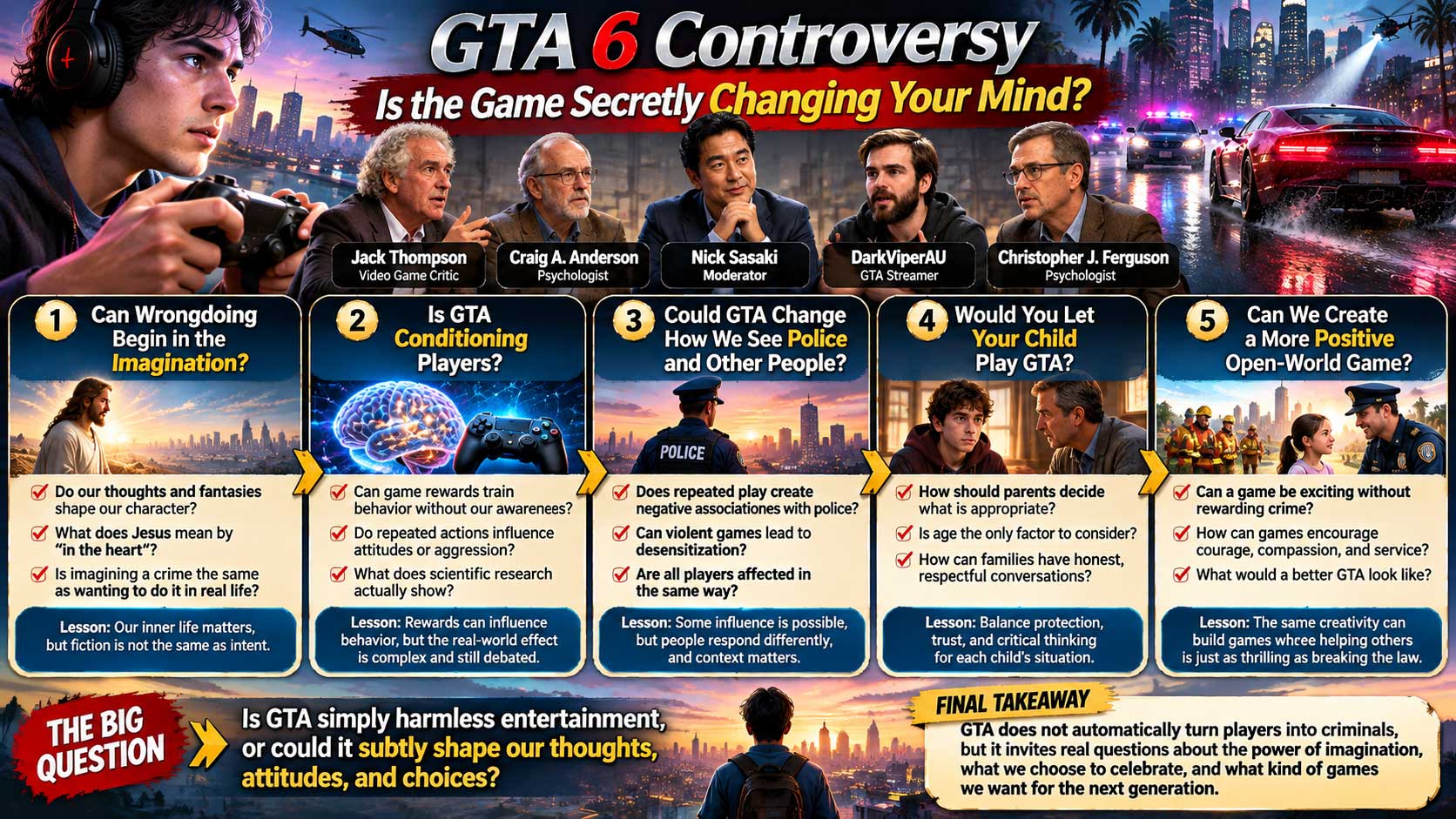
After listening to both sides of this imaginary debate, I have gained a better appreciation for why millions of people enjoy Grand Theft Auto. I can see the appeal of exploring an enormous virtual city, experiencing exciting adventures, and enjoying the freedom to do things that would be impossible or unacceptable in real life. I respect the creativity of the developers and the intelligence of gamers who can clearly distinguish fiction from reality. But after considering all these arguments, my fundamental concern has not changed. I still believe that GTA is a troubling form of entertainment, and I worry about its influence on society.
My concern goes deeper than whether playing GTA causes someone to commit a crime. I don't believe that everyone who enjoys GTA secretly wants to become a criminal. Many gamers are undoubtedly kind, responsible, law-abiding people. But I question the wisdom of creating entertainment that repeatedly makes stealing, violence, and escaping law enforcement exciting and rewarding. When millions of people participate in these experiences for hundreds of hours, I cannot simply dismiss the possibility of a broader cultural influence. We don't have to prove that a game turns people into criminals to ask whether its underlying messages are good for society.
One of the most meaningful teachings in my Christian faith comes from Matthew 5:27–28, where Jesus explains that adultery can begin in the heart before any physical act occurs. I understand this teaching as a reminder that our inner lives matter. What we deliberately think about, desire, and repeatedly entertain can influence the people we become. I am not suggesting that playing GTA is equivalent to committing a real crime, or that every imaginary action reflects a person's true intentions. Yet I believe we should be mindful of the thoughts and emotions we cultivate. If repeatedly practicing gratitude, forgiveness, and compassion can help us become more loving people, shouldn't we at least question what happens when entertainment repeatedly rewards cruelty, theft, and aggression?
I remain particularly concerned about how police officers are portrayed. In GTA, police often become obstacles to escape, enemies to defeat, or threats to eliminate. I understand that this is part of the game's fictional structure, and I recognize that legitimate criticism of police misconduct has an important place in society. But police officers are human beings who serve communities, protect families, and sometimes risk their lives for strangers. I would much rather see young people develop an appreciation for those responsibilities than become accustomed to viewing officers primarily as adversaries. I cannot claim that GTA has caused widespread disrespect for police, since that would require evidence we have not established. But I believe turning hostility toward law enforcement into entertainment deserves serious moral consideration.
The psychological debate reminded me to be careful about separating personal convictions from scientific conclusions. Research on violent video games and aggression remains contested, and the American Psychological Association has cautioned against linking violent video games directly to violent criminal behavior. I respect that distinction. At the same time, I don't believe scientific uncertainty automatically makes an activity socially beneficial. Not every question about human values can be answered through experiments or crime statistics. We can examine what entertainment celebrates, what it normalizes within its fictional setting, and what kinds of attitudes we want to encourage, without making unsupported claims about its effects.
I think about the next generation most of all. Children and teenagers grow up surrounded by entertainment that competes for their attention, often through increasingly intense experiences. Parents cannot control every influence, nor should they judge their children simply for enjoying popular games. But I believe we have a responsibility to ask what messages young people are receiving and to discuss those messages openly. I would never want a young gamer to feel ashamed or accused of being a bad person. Instead, I would ask a simple question: What do you enjoy most about this game, and what do you think it teaches you about people, responsibility, and the consequences of your choices? Those conversations may be more valuable than arguments that leave parents and children feeling misunderstood.
Perhaps the most hopeful moment in our discussion came when both sides began imagining a different kind of game. What if developers used the same extraordinary creativity to build an open world where rescuing people, solving crimes, protecting communities, and helping others were just as exciting as stealing cars and escaping police? What if players could experience danger, suspense, difficult moral choices, and remarkable freedom, but discover that their greatest achievements came from courage, compassion, and service? I don't believe every story must feature a perfect hero. Stories about flawed people can teach us important lessons about human nature. But I would love to see more games that make doing good genuinely thrilling, rather than treating goodness as an afterthought.
I want to conclude by expressing my respect for those who disagree with me. I recognize that many GTA fans find friendship, creativity, humor, and enjoyment in these games without developing any desire to harm others. I respect their freedom to choose their entertainment, just as I hope they can respect my freedom to question its moral and social value. I still believe that celebrating simulated crime on such an enormous scale is not a healthy direction for our culture. That is my personal judgment, not a claim that every gamer is negatively influenced or that the scientific debate has been settled. My hope is not to condemn gamers, but to encourage all of us, including game developers, parents, and players, to think more deeply about what we choose to celebrate. If our imagination is capable of creating extraordinary virtual worlds, why shouldn't we use more of that creativity to inspire extraordinary goodness in the real one?
What do you think? Can a game be harmless to individual players yet still raise legitimate concerns about its influence on society? Should game developers take greater responsibility for the behavior their games reward, or should those decisions rest entirely with players and parents? And if someone created a game as exciting and immersive as GTA, but centered on protecting and helping others, would you want to play it? I would genuinely welcome your thoughts, particularly from those who disagree with me. Sometimes the most meaningful conversations begin when we listen respectfully to people who see the same world differently.
Fictional Reflection Disclaimer: These final thoughts express Nick Sasaki's personal editorial perspective following an imagined debate. The other participants' dialogue and responses are fictional and should not be treated as their actual statements or endorsements. The concerns expressed here are moral and social judgments, not claims that GTA has been scientifically proven to cause criminal behavior.
Short Bios:
Nick Sasaki | Moderator and Creator of ImaginaryTalks
Nick Sasaki is the founder of ImaginaryTalks.com, a creative platform that brings influential thinkers, historical figures, and contemporary personalities together through imagined conversations about life's most meaningful questions. His work explores morality, human nature, faith, psychology, and society through respectful dialogue. In this fictional debate about Grand Theft Auto, Nick serves as moderator, raising concerns about the cultural influence of violent entertainment while inviting both critics and gaming advocates to challenge his assumptions.
Jack Thompson | Former Attorney and Video Game Critic
Jack Thompson is a former American attorney widely known for his outspoken opposition to violent video games, particularly the Grand Theft Auto series. He became a prominent figure in debates about video game violence, parental responsibility, and the ethical obligations of entertainment companies. His campaigns frequently generated controversy over the relationship between fictional violence and real-world behavior. His public history is documented in GameSpot's coverage of his legal campaigns. In this imagined conversation, he presents the case for examining the moral and cultural consequences of entertainment that rewards simulated criminal behavior.
Craig A. Anderson | Psychologist and Aggression Researcher
Craig A. Anderson is a psychologist and distinguished professor at Iowa State University whose research has examined human aggression, violent media, and the psychological effects of video games. His work has contributed to scientific discussions about aggressive thoughts, desensitization, and the possible influence of repeated exposure to violent entertainment. His academic background and research are available through his professional research website. In this fictional debate, he presents the research-based argument for taking potential psychological effects seriously, without equating game participation with criminal behavior.
DarkViperAU (Matthew Judge) | GTA Streamer and Content Creator
Matthew Judge, professionally known as DarkViperAU, is an Australian gaming creator recognized for his Grand Theft Auto V speedruns, unusual gameplay challenges, and detailed commentary about the series. His content demonstrates how players can approach GTA through strategy, experimentation, technical skill, and creative challenges rather than simply focusing on criminal behavior. His work can be explored through his official YouTube channel. In this imaginary discussion, he represents players who value creative freedom and fictional storytelling while rejecting the assumption that enjoying GTA means endorsing real-world crime.
Christopher J. Ferguson | Psychologist and Media Researcher
Christopher J. Ferguson is a psychology professor at Stetson University whose research examines media violence, aggression, video games, and the interpretation of psychological evidence. He has questioned claims that violent video games cause serious real-world violence and has advocated for greater scientific care when discussing possible media effects. He coauthored Moral Combat: Why the War on Video Games Is Wrong with Patrick Markey. His academic work and publications are available through his Stetson University faculty profile. In this fictional debate, he challenges unsupported assumptions about gamers while acknowledging the value of examining entertainment critically.
Biographical Disclaimer: These biographies describe real individuals and their publicly documented backgrounds. Their participation, dialogue, arguments, and personal reflections in this article are fictional. No endorsement or involvement by the named individuals is implied.
Leave a Reply