
Introduction
What if Jesus and Mary Magdalene's relationship held a deeper meaning than anyone has imagined? What if their possible marriage was connected to restoring something humanity lost in the Garden of Eden? Christianity has long described Jesus as the Second Adam, the one who came to redeem humanity from the consequences of the Fall. But this raises a fascinating question: If Jesus came as the Second Adam, could Mary Magdalene have come as the Second Eve, working alongside him to restore God's original ideal of love, marriage, and family? And if God intended Adam and Eve to establish a family centered on divine love, could the mission of Jesus and Mary Magdalene have involved restoring that original relationship?
The possibility that Jesus and Mary Magdalene were married is hardly new. Spiritual authors and researchers have explored this idea for decades, drawing on ancient Christian writings, mystical traditions, symbolic interpretations, and personal spiritual experiences. Genevieve Taeger, a contemporary channeler, describes Jesus and Mary as husband and wife who raised children and shared a spiritual mission. Mercedes Kirkel explores their relationship through sacred love and the divine feminine. Lars Muhl presents Jesus and Mary as a new man and woman whose partnership symbolized spiritual restoration. Margaret Starbird, Daniel Meurois, Kathleen McGowan, Cynthia Bourgeault, and Dolores Cannon bring further perspectives on their relationship, spiritual preparation, and teachings. Their interpretations differ, but they open a remarkable question about what Jesus and Mary might represent together.
Ancient Christian writings make Mary's spiritual significance especially interesting. The Gospel of Mary portrays her as a disciple who receives spiritual teachings, comforts the other followers, and speaks with an authority that some of them question. In Pistis Sophia, Mary participates extensively in discussions of spiritual mysteries, asking questions and interpreting teachings. These writings do not establish that Jesus and Mary were married, but they show that some early Christian communities portrayed Mary as a woman of extraordinary spiritual insight. What might Christianity have looked like if her teachings had received the same attention as those of the male apostles?
The Second Adam and Second Eve question introduces another intriguing dimension. Early Christian theology traditionally identifies Mary, the mother of Jesus, as the New Eve, a teaching explained in the Catechism of the Catholic Church. But could Mary Magdalene have represented a different, complementary aspect of restoration through sacred partnership? If Adam and Eve's story concerns humanity's broken relationship with God, what might a restored relationship between man and woman reveal about God's original purpose? Could the idea of salvation extend beyond individual spiritual transformation to include the healing of marriage, family, and ultimately the entire human community?
To explore these possibilities, we bring together eight remarkable voices in an imagined roundtable moderated by Nick Sasaki. Across five conversations, they examine Jesus and Mary's possible marriage, the mystery of the Essenes and Jesus' missing years, Mary's independent spiritual wisdom, the meaning of Christ consciousness, and the possibility of humanity becoming one family under God. Rather than trying to settle every historical controversy, this conversation invites participants to build upon one another's ideas, examine their spiritual implications, and consider what these teachings might mean for our lives today.
At the center of this exploration lies a question larger than whether Jesus had a wife or children. What if humanity's greatest spiritual challenge is not simply learning to believe in God, but learning to love one another as members of God's family? From the story of Adam and Eve to the divisions that continue to trouble humanity, the struggle between love and separation has remained remarkably persistent. Perhaps rediscovering Mary Magdalene's spiritual significance can help us reconsider what restoration means, how spiritual wisdom becomes visible in our relationships, and what kind of world we are being called to create.
Fictional conversation disclaimer: This article presents an imagined dialogue inspired by the participants' published writings, spiritual interpretations, and attributed experiences. The conversations are not actual quotations or verified spiritual communications. Claims concerning Jesus and Mary Magdalene's marriage, children, Essene training, and possible roles as the Second Adam and Second Eve remain unverified or speculative.
Topic 1. Jesus and Mary Magdalene: Sacred Marriage and the Second Adam, Second Eve
Question 1. If Jesus and Mary Magdalene Were Married, What Was the Greater Spiritual Purpose of Their Relationship?
Nick Sasaki
Genevieve, I'd like to begin with something from your interview on Next Level Soul.
When you channeled Jesus and Mary Magdalene, you described them as husband and wife who had children and shared a spiritual mission.
What interested me wasn't simply the possibility that Jesus was married. It was the idea that their relationship might have been an essential part of what they came to accomplish.
Most of us grew up hearing about Jesus as the Son of God, the Messiah, the Savior. Mary Magdalene appears in the Gospels as a devoted follower and witness to the resurrection.
But what if their relationship was much more central to their mission than we've traditionally considered?
I'd love to begin with you, Genevieve. What did you take away from those channeling experiences about why Jesus and Mary were together?
Genevieve Taeger
What stands out to me is the completeness of their partnership.
In the messages I've received, Jesus and Mary weren't two people who happened to fall in love during an extraordinary spiritual mission. Their relationship was connected to the mission itself.
Jesus was helping people awaken to their divine nature. Mary was helping people open their hearts and experience that divinity through love.
These weren't competing teachings. They complemented each other.
And there's something beautiful about considering that they could have had an ordinary family life. We tend to place spiritual masters so far above humanity that we forget the significance of everyday relationships.
What if the love expressed between a husband and wife, or between parents and children, can be just as sacred as meditation or prayer?
Perhaps one of the greatest teachings they could offer was not something they said publicly, but something they lived privately.
Nick Sasaki
That's an interesting distinction.
We tend to think of spiritual teaching as words spoken to a crowd. But perhaps how someone treats a spouse or raises a child reveals just as much.
Daniel, you've explored Jesus and Mary's personal lives through your accounts of the Akashic Records. How do you approach the connection between their relationship and their spiritual work?
Daniel Meurois
I would begin by separating the extraordinary from the ordinary, then recognizing that the two need not be separated at all.
In the spiritual accounts I have explored, Jesus and Mary are not distant symbolic figures. They are human beings experiencing the demands of earthly life.
They encounter misunderstanding. They experience affection, exhaustion, responsibility, and the need for solitude.
There is a tendency to assume that a divine mission requires the rejection of human intimacy.
But why should this be so?
If the divine wishes to reveal itself through human life, could human love be one of its most complete expressions?
A spiritual partnership does not require two people to become identical. It invites them to discover how their different qualities can serve a common purpose.
Margaret Starbird
I would take that a little further.
The image of the sacred bride and bridegroom has profound significance.
Marriage, at its highest expression, can represent the reunion of what has become separated.
In my work, I've explored the possibility that early Christianity lost an essential feminine dimension. Jesus became increasingly represented through exclusively masculine religious authority, and Mary Magdalene's significance was diminished.
The question isn't simply whether a historical marriage occurred.
It is what the absence of the bride has meant for our spiritual imagination.
What happens to a religious tradition when the feminine expression of divine love is pushed to the margins?
And what might be restored when we recover it?
Nick Sasaki
Mercedes, your work approaches this through the heart and sacred relationship. Do you see marriage itself as a path to spiritual awakening?
Mercedes Kirkel
It can be, certainly. But the deeper principle applies to every human being, whether married or unmarried.
We carry different qualities within ourselves: receptivity and initiative, tenderness and strength, feeling and discernment.
Many people learn to favor one set of qualities and reject another.
A sacred relationship invites us to become more complete.
When we love someone deeply, we encounter our wounds. We discover our fear of abandonment, our desire to control, our difficulty receiving love.
These moments are not necessarily failures. They can become opportunities for transformation.
If we consider Jesus and Mary through this lens, their relationship represents the meeting of two individuals whose love supports a shared spiritual awakening.
But I would be careful not to suggest that anyone must marry to become spiritually complete.
The union begins within.
Cynthia Bourgeault
I appreciate that qualification.
From a contemplative perspective, the essential question is not whether two people possess complementary characteristics. It is whether their love moves beyond self-centered attachment.
Much of what we call love is actually possession. We love another person for how they make us feel, or for how well they satisfy our expectations.
Conscious love asks something more difficult.
Can I love this person without trying to own them?
Can I remain present when their needs differ from mine?
Can I surrender my demand to be right?
Mary Magdalene, as portrayed in certain early Christian texts, demonstrates extraordinary spiritual perception.
Whether we interpret her relationship with Jesus as marital, intimate, or primarily spiritual, she represents someone who seems to have grasped the transformative nature of his teaching.
That is what deserves our attention.
Kathleen McGowan
And I would bring us back to the human experience.
One of the reasons the possibility of Jesus having a wife and children resonates with people is that it makes the sacred accessible.
People struggle with relationships every day. They worry about their children. They disagree with their spouses. They experience disappointment.
If the greatest spiritual figures lived within those same human circumstances, their examples could become more immediate.
But Mary must not disappear into the role of wife.
She needs to be recognized for her own wisdom.
I think that is part of what makes this discussion so meaningful.
Lars Muhl
There is another dimension I would like to introduce.
In the mystical traditions I've studied, the relationship between Yeshua and Mariam reflects a movement toward spiritual wholeness.
The masculine and feminine are not simply biological categories. They express dimensions of life that must be brought into harmony.
When we speak about sacred union, we are speaking about the healing of separation.
Separation between human beings.
Separation between humanity and the divine.
And separation within ourselves.
Their relationship can be contemplated as an image of what humanity is capable of becoming.
Dolores Cannon
I would approach this from what emerged through the regression sessions I conducted.
The accounts I recorded often presented Jesus as someone undergoing preparation for a difficult mission.
He was learning, experiencing, and being prepared for responsibilities that extended far beyond an ordinary life.
What interests me about this discussion is that preparation for spiritual service doesn't eliminate human relationships.
It makes the way we treat other people more significant.
If Jesus and Mary worked together, I would want to know what each had learned independently and how they used that knowledge to help others.
Nick Sasaki
There's something I keep hearing from all of you.
We're not discussing marriage simply as a personal relationship.
We're discussing the possibility that a relationship could become a living expression of spiritual truth.
And that leads me to a question I've been thinking about for a long time.
Question 2. Could Mary Magdalene Have Come as the Second Eve, Just as Jesus Came as the Second Adam?
Nick Sasaki
I'd like to explore something from the Garden of Eden.
In Genesis, God creates Adam and Eve. They're meant to live in harmony with God, with each other, and with the creation around them.
But the Fall disrupts that original relationship.
In the New Testament, Jesus is compared with Adam. Paul presents Christ as the one through whom humanity receives the possibility of new life.
So Christians have long spoken of Jesus as the Second Adam.
Here's what I've been wondering.
If Jesus came as the Second Adam to restore what the first Adam lost, is it possible that Mary Magdalene came as the Second Eve?
Could their partnership have represented the restoration of the original ideal of Adam and Eve, a man and woman united in God's love?
I'm aware that Christian tradition often identifies Mary, the mother of Jesus, as the New Eve. I'm not trying to dismiss that.
I'm asking whether Mary Magdalene could have had a different, complementary role.
Lars, your writings about Jesus and Mary as a new man and woman seem especially close to this possibility.
What do you think?
Lars Muhl
Nick, I think you've reached a very meaningful question.
Let us consider the Garden of Eden not merely as a geographical location in an ancient story, but as an image of humanity's original state of unity with the divine.
In that state, separation has not yet become the dominant human experience.
Adam and Eve represent humanity in relationship.
The loss of Eden represents a movement into division: division within the individual, division between man and woman, and division between humanity and its divine source.
When we contemplate Yeshua and Mariam as the new man and woman, we are considering the reversal of that separation.
But restoration cannot occur through symbolism alone.
It must be lived.
It must become visible through the way people love, forgive, care for one another, and recognize divine presence.
If Jesus and Mary represent a restored relationship, their example becomes an invitation to humanity.
Nick Sasaki
So you're saying the restoration isn't just about returning to a place called Eden.
It's about recovering a relationship that humanity lost.
Lars Muhl
Precisely.
And this relationship begins with our recognition of the divine within life itself.
A restored humanity would not be characterized by domination, fear, and competition.
It would be characterized by conscious unity.
Margaret Starbird
Nick, your question resonates strongly with the sacred marriage tradition I've explored.
Consider the symbolism.
In Genesis, the human story begins with a man and woman.
In the Christian story, redemption is often described through Christ, the New Adam.
But what becomes of the corresponding feminine image?
The early Church developed a beautiful theological connection between Eve and Mary, the mother of Jesus.
Your question invites us to consider whether Mary Magdalene might represent another dimension of restoration: the redeemed bride standing beside the bridegroom.
This need not erase the role of Jesus' mother.
The two women can represent different spiritual meanings within Christian interpretation.
The mother represents one dimension of divine cooperation.
The bride represents another.
And the marriage image invites us to think about reconciliation, equality, and sacred union.
Mercedes Kirkel
I would connect this with the deeper meaning of the Fall.
In my channeled teachings, the story of Adam and Eve can be approached as a reflection of separation consciousness.
We forget our connection with the divine.
We become afraid.
We begin to see ourselves as isolated individuals who must defend themselves against the world.
Then we project that separation into relationships.
We struggle to trust. We fear intimacy. We hide parts of ourselves.
From this perspective, the restoration of Adam and Eve would involve healing that original experience of separation.
Jesus and Mary could symbolize the reunion of what has become divided.
The masculine and feminine would no longer compete.
They would support one another.
Nick Sasaki
Genevieve, your channeled account describes Jesus and Mary as married and raising children.
Did anything in those messages suggest that their family had a purpose connected to restoring humanity's relationship with God?
Genevieve Taeger
The messages emphasized awakening, love, and recognizing the divine within ourselves.
I wouldn't want to claim that every detail of your Second Eve interpretation was explicitly communicated in the session.
But it resonates with the larger spiritual meaning of what came through.
Jesus and Mary were described as sharing a mission.
Their love wasn't separate from that mission.
And when we consider the possibility of children, we're no longer talking only about two spiritually awakened individuals.
We're talking about how love is expressed within a family.
How children learn to trust.
How parents teach compassion.
How a home becomes a place where the divine is experienced.
I think your question opens a beautiful possibility for reflection.
What if spiritual restoration is meant to become part of everyday family life?
Daniel Meurois
I would add that the concept of restoration becomes more compelling when we remove the idea that one person must accomplish everything.
If Jesus represents one dimension of humanity's return to God, why should the role of Mary be considered incidental?
In my spiritual interpretation, their partnership reflects shared responsibility.
Neither person becomes spiritually significant only through the other.
Each brings something essential.
Perhaps the deeper meaning of your Second Adam and Second Eve question is that restoration requires relationship, not merely individual attainment.
Cynthia Bourgeault
I find this a fruitful theological image, provided we distinguish between literal historical claims and the spiritual meaning of the symbolism.
There is something worth examining in the idea of the Second Adam and Second Eve.
But we must ask what is actually being restored.
Is it a particular family structure?
Is it the experience of divine communion?
Is it the transformation of human consciousness?
I would suggest that the deepest restoration concerns our ability to participate in divine love without the constant interference of self-centeredness.
A marriage could express that.
A friendship could express it.
A community could express it.
The spiritual meaning should be large enough to embrace all those possibilities.
Nick Sasaki
That's a good point.
I don't want to suggest that unmarried people are somehow incomplete, or that love exists only within marriage.
But Genesis does place a man and woman at the beginning of the human family.
And it makes me wonder whether God's purpose for creation involved more than the spiritual perfection of individuals.
Perhaps it involved relationships, families, and eventually all humanity.
Kathleen, you've explored the possibility that Jesus and Mary had children. Does that connect with this idea?
Kathleen McGowan
It certainly creates a compelling question.
If we contemplate Jesus and Mary as parents, then restoration takes on a generational dimension.
What do children inherit from their parents?
Not simply biological characteristics.
They inherit examples of love, fear, trust, kindness, and the way adults respond to conflict.
If Jesus and Mary lived as a loving family, their greatest legacy might have included the kind of consciousness they passed to their children.
But I would expand the idea of lineage beyond biology.
A spiritual lineage can exist through teaching.
It can be carried by students, communities, and future generations.
Mary's legacy would matter whether or not she had biological descendants.
Dolores Cannon
What interests me is the role of preparation.
In the accounts from my regression work, Jesus' life was connected to a much larger spiritual mission.
If we explore Nick's interpretation, then we have to ask what qualities a person would need to establish a new foundation for humanity.
Patience?
Compassion?
Self-discipline?
The ability to forgive?
The willingness to sacrifice personal comfort for the welfare of others?
These qualities cannot simply be announced.
They must be developed and practiced.
And perhaps that is where the Essene teachings enter our conversation.
Nick Sasaki
I want to ask one more thing before we move away from the Garden of Eden.
Many Christians interpret the Fall primarily through disobedience and sin.
But another dimension seems to be the breakdown of trust and love.
Adam blames Eve.
Eve blames the serpent.
Their relationship changes.
They become ashamed and afraid.
What if restoration means learning how to love without blame, domination, or fear?
Mercedes Kirkel
I think that is very close to the heart of spiritual healing.
When we feel separated, we search for someone to blame.
When we begin to experience unity, we become capable of taking responsibility without turning against ourselves or others.
This does not mean pretending that harmful actions don't matter.
It means responding from a deeper place.
Margaret Starbird
And sacred partnership becomes especially meaningful here.
The restoration of the bride is not about replacing male authority with female authority.
It is about healing a relationship that has become unbalanced.
Lars Muhl
Yes, and that balance must be rooted in conscious love rather than in fixed roles.
Nick Sasaki
So perhaps we can hold this possibility open.
If Jesus came as the Second Adam, perhaps Mary Magdalene's role deserves examination through the symbolism of the Second Eve.
Not as something we have established historically, but as a serious question about what divine restoration might actually mean.
And now I'd like to take that possibility one step further.
Question 3. If Jesus and Mary Had Children, Could Their Family Have Represented the Beginning of a Restored Human Family?
Nick Sasaki
Let's imagine for a moment that Jesus and Mary were married and had children, as Genevieve's channeling and some of your other accounts suggest.
If their mission was connected to restoring what Adam and Eve lost, could their family have represented the beginning of that restoration?
I'm thinking about the original purpose of creation.
If God is our Heavenly Parent, perhaps the ultimate purpose wasn't simply to create spiritually enlightened individuals.
Perhaps God wanted children who would grow into loving husbands and wives, become parents themselves, and eventually establish a world where humanity lived as one family.
And if that was the original ideal, perhaps Jesus and Mary's relationship had a much greater significance than we've imagined.
Daniel, I'd love your thoughts.
Daniel Meurois
Your question is compelling, Nick, particularly the idea that restoration must become embodied within human relationships.
A spiritual teaching remains abstract until it changes the way people live.
If we contemplate Jesus and Mary as parents, the important question becomes what kind of home they would have created.
Would their children have been taught that God was distant and frightening?
Or would they have experienced divine love through the affection, patience, and guidance of their parents?
Perhaps the most meaningful interpretation of a restored family is one in which love becomes the atmosphere of daily life.
Kathleen McGowan
I think there's another aspect worth exploring.
Many people associate spiritual greatness with renouncing ordinary responsibilities.
But raising children is one of the most demanding forms of service imaginable.
You cannot simply speak beautifully about patience.
Children will test your patience.
You cannot merely teach forgiveness.
You must practice it when relationships become difficult.
If Jesus and Mary were parents, their family life would have given them countless opportunities to express their teachings.
The home becomes a place of spiritual practice.
Nick Sasaki
That's something I find fascinating.
It's possible to speak to thousands of people about love, but your children see who you really are when nobody else is watching.
Cynthia Bourgeault
Exactly.
And this is why conscious love must involve more than idealized feelings.
Real relationships expose the limits of our spiritual maturity.
When someone disappoints us, we discover our attachment to expectations.
When a child resists our wishes, we confront our desire for control.
When someone we love suffers, we encounter our inability to arrange the world according to our preferences.
These experiences can become opportunities for surrender, compassion, and deeper awareness.
But I would hesitate to limit restoration to one particular biological lineage.
The transformation Jesus taught must remain available to the entire human family.
Nick Sasaki
I agree that restoration would need to include everyone.
But let me ask something.
Could a family be the starting point without being the endpoint?
In other words, perhaps God's ideal begins with the love of parents and children, but that love is eventually meant to extend beyond the boundaries of one's own family.
Mercedes Kirkel
I think that's a beautiful way to express it.
The family can be our first experience of relationship.
Through it, we may learn trust, vulnerability, tenderness, responsibility, and cooperation.
But love must continue to grow.
A parent who truly understands love can begin to recognize the sacred worth of children beyond their own household.
A person who experiences deep partnership can learn to bring those same qualities of respect and care into relationships with others.
The goal is not to create a small circle of love that excludes everyone outside it.
The goal is to allow that love to become universal.
Margaret Starbird
And this brings us back to the symbolism of the sacred marriage.
The union of the bride and bridegroom need not end with their own happiness.
It points to a greater reconciliation.
In Christian symbolism, the marriage feast can represent the union of humanity with divine love.
Your idea of one family under God fits naturally into this wider spiritual interpretation.
Genevieve Taeger
What I appreciate about this question is that it moves the conversation into practical life.
People sometimes think spiritual awakening means escaping the human experience.
But perhaps awakening means becoming fully present within it.
Listening to your children.
Treating your spouse with kindness.
Recognizing that the person standing in front of you carries the same divine worth that you do.
If Jesus and Mary expressed these qualities through their family, their example could speak to people today in a very immediate way.
Lars Muhl
There is something more I would like to consider.
If humanity is to return to a state of divine unity, we must move beyond the illusion that love belongs only to those closest to us.
The love between man and woman can become a beginning.
But it must awaken a greater love.
A love for the stranger.
A love that crosses religious and national boundaries.
A love that recognizes the same divine source within all humanity.
That is what I would call the deeper meaning of restoration.
Dolores Cannon
And we should consider how people learn these things.
Spiritual progress doesn't happen simply through receiving information.
People need experience.
They need to make decisions.
They need opportunities to discover how their choices affect others.
In the regression accounts I studied, earthly life was repeatedly presented as a place of learning.
If a restored family represents anything, perhaps it represents an environment where people learn to express love through experience.
Nick Sasaki
There's something I'd like to bring into the discussion.
When we look at human history, one of the deepest tragedies is that people have repeatedly divided themselves into groups.
Different religions.
Different nationalities.
Different races.
Different cultures.
And so often, people have treated those outside their group as though they belonged to a different human family.
But if God is the parent of all humanity, that division doesn't make much sense to me.
If we genuinely believed every person was our brother or sister, wouldn't we approach religious conflict, war, poverty, and injustice very differently?
Kathleen McGowan
I think we would.
But the challenge is moving from an attractive spiritual idea to actual behavior.
It's easy to say that humanity is one family.
It's far more difficult to treat someone who disagrees with you as a beloved member of that family.
That requires humility.
Cynthia Bourgeault
And a willingness to release the ego's need to defend its own identity.
The moment I define myself entirely through opposition to another person, I become trapped in separation.
That doesn't mean abandoning discernment or accepting harmful behavior.
It means refusing to let hostility determine the nature of my own consciousness.
Mercedes Kirkel
This is where healing the original wound of separation becomes so meaningful.
We learn that connection does not require sameness.
People can differ in belief, background, and experience without losing their fundamental human dignity.
Nick Sasaki
Genevieve, I want to come back to the original interview for a moment.
Your channeled Jesus described people as having the potential to experience Christ consciousness themselves.
If we connect that teaching with what we're discussing today, could spiritual awakening be related to learning to love others as members of one divine family?
Genevieve Taeger
Yes, that is very much in harmony with the larger message of the channeling.
Christ consciousness, as it was expressed, involves awakening to the divine presence within ourselves and recognizing it in others.
From that perspective, separation begins to lose its hold.
We no longer see love as something scarce that must be protected from everyone else.
We discover that it can be expressed more freely.
And what you're describing, Nick, is a world in which that recognition shapes human relationships.
Nick Sasaki
Lars, earlier you spoke about Jesus and Mary representing a new man and woman.
If we follow that interpretation, what might be the greatest obstacle preventing humanity from extending their example to the whole world?
Lars Muhl
Our attachment to separation.
We identify ourselves through our fears, beliefs, and inherited divisions.
We become so accustomed to seeing others as different that we forget our common origin.
The restoration of unity requires an inner transformation.
And it requires action.
We cannot claim to recognize divine love within humanity, then refuse to practice compassion when someone challenges us.
Margaret Starbird
I would suggest another obstacle.
For centuries, spiritual traditions have often failed to give equal dignity to the feminine.
If humanity wishes to restore harmony, it must examine how relationships have been structured around domination.
The sacred marriage image offers a different possibility.
Two individuals standing together in mutual respect and shared responsibility.
Nick Sasaki
That brings us back to Adam and Eve, doesn't it?
Perhaps the most meaningful thing about the Second Adam and Second Eve interpretation is not that one man and one woman would become extraordinary spiritual figures.
Perhaps it's that they could show humanity what a relationship restored through divine love might look like.
A relationship without domination.
Without fear.
Without treating another person as an object or possession.
And a family whose love eventually reaches beyond itself.
Daniel Meurois
Yes, and we should not underestimate how demanding such a vision would be.
It's far easier to speak about spiritual unity than to live it.
If Jesus and Mary represent that possibility, their meaning would reach far beyond the circumstances of their personal relationship.
Dolores Cannon
And I would add that we must remain open to learning.
None of us enters life knowing everything.
The process of becoming more compassionate involves recognizing our mistakes and making different choices.
Kathleen McGowan
Perhaps that is where Mary's teachings have something extraordinary to offer.
Her spiritual significance need not depend entirely on a marriage or children.
She can be understood as someone who carries wisdom capable of guiding people toward greater love and freedom.
Nick Sasaki
I think that's a good place to carry our discussion forward.
We started by asking whether Jesus and Mary could have been married.
But now we're considering something much larger.
Could their relationship represent the restoration of what humanity lost in the Garden of Eden?
And if the original ideal was a family centered on God's love, how might that restoration eventually include every person on Earth?
We've approached these questions through sacred marriage, spiritual consciousness, biblical symbolism, and the meaning of family.
But there's another question I want to explore.
If Jesus and Mary really shared such an extraordinary mission, how were they prepared for it?
What did they study?
Who were their teachers?
What did they learn about the human soul, healing, prayer, and our relationship with God?
Dolores, your work with the Essenes raises some fascinating possibilities. And Lars, you've written about Mary's spiritual training in Egypt.
I'd like to explore those accounts next, particularly whether Jesus and Mary may have followed different paths of preparation before coming together in their shared mission.
The conversation is fictional. It draws inspiration from the participants' published writings, documented teachings, and attributed spiritual accounts. The statements are imagined rather than actual quotations. Claims concerning Jesus and Mary Magdalene's marriage, children, and restorative mission remain interpretations rather than established historical facts.
Topic 2. The Essene Mysteries: Preparing Jesus and Mary for Their Mission
Question 1. What Might Jesus Have Learned During His Missing Years, and How Did His Spiritual Preparation Influence His Ministry?
Nick Sasaki
Dolores, I'd like to begin with something that has fascinated me for years.
The Gospels tell us about Jesus' birth, his childhood, and the remarkable episode when he was twelve years old, speaking with religious teachers in the Temple.
Then there's this enormous gap.
We hear very little about his life until he begins his public ministry around the age of thirty.
That's roughly eighteen years.
And I've always wondered what happened during those years.
Did Jesus spend that entire time living an ordinary life in Nazareth? Did he travel? Did he study with spiritual teachers?
Your book Jesus and the Essenes explores some extraordinary possibilities through past-life regression.
Can you tell us what emerged from those sessions, and why you came to believe that Jesus had received special spiritual training?
Dolores Cannon
What fascinated me was that I hadn't set out to write a book about Jesus.
During my hypnosis research, I encountered a subject whose regression experiences appeared to describe life within an ancient Essene community.
The individual described being a teacher, someone involved in the spiritual education of young people.
And within that account, Jesus appeared as a student.
I want you to appreciate how surprising this was to me.
The descriptions included aspects of daily life, education, spiritual discipline, and preparation for a future mission.
The Essenes were portrayed as possessing knowledge that went beyond conventional religious instruction.
Their training involved purification, concentration, healing, and learning to discipline the mind.
According to the regression account, Jesus was an unusual student. He seemed to absorb teachings with remarkable ease.
But I was struck by another aspect.
The teachers themselves were learning from the experience of teaching him.
Sometimes the most extraordinary student reveals something to the teacher.
Nick Sasaki
That's fascinating.
But let me challenge the idea just a little.
If Jesus was the Son of God, why would he need human teachers?
Wouldn't he already know everything?
Dolores Cannon
That depends on what you believe the purpose of incarnation to be.
In the spiritual framework presented through my work, entering human life involves experiencing human limitations.
A person must learn how to function within physical existence.
Think about it.
A child cannot simply begin speaking fluently at birth, regardless of what spiritual potential that child may possess.
The human mind and body develop through experience.
And extraordinary spiritual potential does not necessarily eliminate the need for preparation.
Perhaps Jesus came with an unusual capacity for spiritual awareness, but still needed to learn how to express that awareness in ways people could comprehend.
Cynthia Bourgeault
I find that an interesting doorway into the subject, Nick.
The historical Gospels do not establish that Jesus studied with the Essenes, and Dolores' regression accounts belong to a different category of spiritual testimony.
But the larger question about learning is extremely valuable.
Christianity has long wrestled with how to hold together the humanity and divinity of Jesus.
The Gospel of Luke tells us that Jesus grew in wisdom.
That is an extraordinary statement.
Growth implies development.
It suggests that Jesus' human life was not simply a theatrical performance in which every answer was already prepared.
There was a genuine human experience unfolding.
And perhaps the most fruitful question is not whether Jesus possessed all knowledge at every moment, but what his earthly development reveals about the nature of spiritual maturity.
Nick Sasaki
So even within traditional Christianity, there's room to consider that Jesus experienced a process of learning?
Cynthia Bourgeault
Certainly.
Though we must distinguish a process of human development from the very different claim that he studied at particular mystery schools.
Contemplative Christianity emphasizes spiritual transformation through attention, surrender, and love.
Jesus' public teachings demonstrate remarkable familiarity with the Jewish spiritual tradition.
His teaching about the Kingdom of God emerges from that Jewish context.
What interests me is how deeply he embodied what he taught.
He didn't simply speak about compassion.
He demonstrated compassion in circumstances where the social expectations of his time encouraged exclusion.
That is a different kind of knowledge from information acquired through study.
It is knowledge transformed into being.
Lars Muhl
And that distinction is central to the mystical traditions I have explored.
There is knowledge that fills the mind, and there is wisdom that changes the entire human being.
The ancient spiritual traditions associated with Yeshua understood this difference.
In my interpretation, initiation is not simply a ceremony performed by a teacher.
It is an inner transformation.
The initiate gradually releases the patterns that prevent a deeper relationship with the divine.
This may involve prayer, sacred language, silence, fasting, service, and the development of an awakened heart.
When I speak about the Essene traditions, I am interested in this practical dimension of spiritual awakening.
The teachings were not intended merely to create scholars.
They were intended to transform lives.
Nick Sasaki
Lars, when you say initiation, what would an actual day of training look like?
Let's say Jesus was seventeen or eighteen years old and studying with such teachers.
What might he have been doing?
Lars Muhl
In a spiritual reconstruction, we might picture him rising before dawn.
He could enter a period of silence, perhaps facing the first light of the morning.
Prayer would prepare the mind and heart for the day.
He might study sacred writings, learn methods of contemplation, participate in communal work, and receive instruction in healing.
But the most significant training would not occur only during formal lessons.
It would occur when someone offended him.
When someone failed to understand him.
When he experienced fatigue or disappointment.
Could he remain rooted in divine love under those circumstances?
This would reveal the true depth of his preparation.
Mercedes Kirkel
I love that example.
Spiritual development becomes meaningful when we experience something difficult.
You can meditate for years and still become overwhelmed by fear when someone challenges you.
You can study sacred texts and still struggle to receive love.
What interests me about Jesus' preparation is the possibility that he learned to remain open to divine presence under circumstances that would ordinarily cause people to close their hearts.
That is a remarkable spiritual accomplishment.
Genevieve Taeger
That resonates with the teachings I received through channeling.
The channeled Jesus described discovering more of who he was during his earthly life.
He spoke about learning to express spiritual abilities and recognizing the divine capacities available to him.
One of the most meaningful parts of that message was the invitation for listeners to discover their own spiritual potential.
I don't interpret that as saying everyone must perform miracles.
The deeper invitation is to recognize that our human experience can become a path toward greater awareness.
Nick Sasaki
Let me ask something that connects with our previous topic.
If Jesus came to restore something humanity lost through Adam and Eve, perhaps he needed to understand the human condition from the inside.
Fear.
Jealousy.
Misunderstanding.
The temptation to judge another person.
Could his preparation have involved confronting those experiences rather than simply avoiding them?
Daniel Meurois
I believe this is a meaningful way to approach the question.
In the accounts I have explored through the Akashic Records, Jesus is portrayed within human circumstances.
He encounters people who are spiritually perceptive and others who are deeply confused.
A spiritual mission cannot be accomplished merely by withdrawing from human difficulty.
It requires entering the human experience without being consumed by its divisions.
Consider a healer.
The healer must understand suffering.
But the healer must not become so overwhelmed by suffering that healing becomes impossible.
Perhaps spiritual preparation involves learning how to remain present with pain without losing one's connection to love.
Margaret Starbird
There's something else I would add.
If Jesus' mission involved restoring relationships, as Nick proposed in our previous conversation, his education would need to prepare him for relationships.
The ability to recognize another person's spiritual worth would be indispensable.
So would the ability to listen.
And if we contemplate a partnership with Mary Magdalene, then mutual respect becomes an essential part of that preparation.
A person cannot create a sacred partnership simply through intellectual knowledge or extraordinary spiritual experiences.
There must be a capacity to honor another human being.
Kathleen McGowan
And perhaps the missing years are fascinating precisely for that reason.
We're drawn to the extraordinary possibilities of travel, secret teachers, and ancient knowledge.
But what if some of Jesus' most significant preparation occurred through ordinary human responsibilities?
Working.
Helping his family.
Listening to people's problems.
Observing human relationships.
Learning how communities respond to conflict.
Those experiences could have shaped his later teaching just as profoundly as any formal spiritual instruction.
Nick Sasaki
That's an interesting thought.
Maybe the greatest spiritual education combines both.
Deep inner training and ordinary human experience.
Dolores, did your regression material suggest that Jesus' teachers knew he had a special mission?
Dolores Cannon
Within those accounts, yes.
The teachers believed they were preparing someone with unusual spiritual responsibilities.
But the preparation wasn't simply about giving him secret information.
It involved helping him develop the discipline and maturity necessary to carry out his work.
And that raises another question.
If Jesus needed preparation for his mission, what about Mary Magdalene?
Was she simply waiting for him to arrive?
Or was she undergoing her own preparation?
Nick Sasaki
That's exactly where I wanted to go next.
And Lars, I think your research brings something particularly interesting to that question.
Question 2. What Spiritual Education Might Mary Magdalene Have Received Independently, Especially Through Egyptian and Essene Traditions?
Nick Sasaki
We spend so much time discussing what Jesus knew.
But very little attention is given to what Mary Magdalene might have known before meeting him.
In the Gospel of Mary, she appears as someone capable of discussing profound spiritual teachings.
In the Pistis Sophia, she asks sophisticated questions and demonstrates extraordinary insight.
That makes me wonder whether Mary had an intellectual and spiritual life that we rarely consider.
Lars, you've written about Mariam's spiritual training in Egypt and traditions associated with the Therapeutae.
What kind of education do you envision her receiving?
Lars Muhl
Mariam must be approached as a spiritual individual in her own right.
She should not be defined solely through her relationship with Yeshua.
In the mystical accounts I have explored, she received preparation through traditions associated with Egypt.
The Therapeutae are particularly interesting.
Ancient descriptions present them as a contemplative Jewish community associated with prayer, sacred interpretation, and the pursuit of wisdom.
My spiritual interpretation connects Mariam with initiatory teachings that developed her capacity for inner awareness and healing.
She was not simply waiting for a teacher who would explain everything to her.
She possessed her own spiritual gifts.
And those gifts could contribute to a shared mission.
Nick Sasaki
What exactly might she have learned?
Are we talking about healing, meditation, or something more philosophical?
Lars Muhl
All of those dimensions can be considered.
But I would place the greatest attention on the transformation of consciousness.
Imagine someone learning to become deeply attentive to the human heart.
She studies sacred wisdom, practices silence, and develops the capacity to perceive suffering without immediately reacting through fear.
She learns that healing is not merely about correcting a physical condition.
It concerns the whole human being.
The body.
The emotions.
The mind.
The relationship with the divine.
A spiritually trained woman could bring extraordinary wisdom into the lives of those around her.
Mercedes Kirkel
I would like to explore that from another angle.
In the channeled teachings I have received from Mary Magdalene, the heart and emotions are central to spiritual transformation.
Many people approach spirituality through the mind.
They want concepts.
Explanations.
Systems.
But the body and emotions carry experiences that cannot always be resolved through intellectual reasoning.
Someone may know that forgiveness is good and still feel tremendous resentment.
Someone may believe God loves them and still feel unworthy of love.
A heart-centered spiritual path invites people to encounter those feelings rather than simply suppress them.
I can see why a tradition that emphasizes inner healing would be associated with Mary.
Nick Sasaki
Mercedes, do you think this could explain why some of the disciples might have struggled with Mary's teachings?
Maybe she was approaching spiritual knowledge differently?
Mercedes Kirkel
That's a fascinating possibility.
Different people recognize wisdom through different methods.
Some prefer precise doctrines.
Others approach spiritual truth through contemplation, personal experience, or relationship.
Mary's teachings, at least as presented in certain ancient and modern spiritual writings, invite an intimate experience of divine presence.
That can challenge people who expect spiritual authority to come only through established structures.
Cynthia Bourgeault
There's an important nuance here.
The Gospel of Mary does present Mary as a recipient and interpreter of spiritual revelation.
And yes, some male disciples question her authority.
But we should be cautious about projecting a modern division between masculine intellect and feminine emotion onto the ancient text.
Mary's teaching is intellectually and spiritually sophisticated.
She isn't simply offering comforting feelings.
She is describing the soul's encounter with forces that obstruct liberation.
Her wisdom concerns the nature of consciousness itself.
That makes her an important theological thinker within the world represented by the text.
Nick Sasaki
I'm glad you brought that up.
When we say Mary taught through the heart, I don't want it to sound as though she was less intellectually capable than Jesus.
Maybe her wisdom included things that other disciples had difficulty grasping.
Cynthia Bourgeault
Exactly.
And there is no reason to place the heart in opposition to intelligence.
In contemplative traditions, the heart can represent a deeper form of perception.
It is not simply the location of emotion.
It is associated with a capacity to perceive reality beyond habitual self-centered thinking.
Mary's importance may lie in her capacity to recognize and embody that deeper way of knowing.
Margaret Starbird
And this brings us to the historical treatment of women.
We should ask why Mary Magdalene's spiritual authority has so frequently been overshadowed by interpretations of her sexuality or moral character.
For centuries, many people knew her primarily through the image of a repentant sinner.
Yet the canonical Gospels portray her as a devoted follower and witness to central events surrounding Jesus' death and resurrection.
Other ancient Christian writings present her as a source of spiritual teaching.
If we recover those portrayals, we begin to see her as a substantial figure in her own right.
Kathleen McGowan
I think this is one of the most meaningful parts of the entire discussion.
Whether someone believes Mary was married to Jesus or not, her spiritual identity deserves attention.
A woman can be a mother and a teacher.
A wife and a leader.
A devoted companion and an independent spiritual thinker.
These identities need not compete.
If Mary possessed extraordinary wisdom, that wisdom would have contributed to her relationships without being defined exclusively by them.
Nick Sasaki
Daniel, your work describes female disciples carrying spiritual teachings beyond Jesus' immediate circle.
What does that suggest about Mary's role?
Daniel Meurois
It suggests a much more active spiritual community than many people imagine.
In my accounts, women participate in healing, teaching, and preserving spiritual knowledge.
They are not merely observers.
If we consider a mission intended to transform humanity, it would be incomplete if women had no meaningful part in transmitting its teachings.
Mary's role becomes particularly significant when we contemplate the possibility that she possessed preparation comparable in seriousness to that of Jesus.
Their gifts might differ.
Their responsibilities might differ.
But their spiritual dignity would not.
Genevieve Taeger
That is very much in harmony with the messages that came through in my session.
Mary described helping people become aware of their hearts and their spiritual passions.
Jesus described helping people recognize divine consciousness.
Both teachings concern awakening.
And they work together beautifully.
Imagine someone who experiences a profound spiritual realization but has difficulty expressing love.
That person's awakening may remain disconnected from daily relationships.
Now imagine someone who feels deep compassion but lacks the awareness necessary to understand their own spiritual potential.
The two approaches can help complete one another.
Nick Sasaki
Genevieve, that's close to something I've been wondering.
If Jesus and Mary had different spiritual educations, maybe they weren't preparing to perform identical tasks.
Maybe each was developing qualities that would make their shared mission possible.
Dolores, how does that idea fit with your research into the Essenes?
Dolores Cannon
It's an intriguing interpretation.
The regression accounts I collected described communities where spiritual knowledge was passed through teachers and students.
Different individuals could possess different abilities or responsibilities.
Some might focus on healing.
Others on study, instruction, or the preparation of younger students.
In a fictional reconstruction of Jesus and Mary's lives, it would be reasonable to explore how two people with different forms of preparation might work together.
But I would distinguish that imaginative reconstruction from what the historical sources actually establish.
Nick Sasaki
Let me bring us back to the Garden of Eden for a moment.
In our previous topic, we considered whether Mary Magdalene might represent a Second Eve.
And here's something I find interesting.
In Genesis, Adam and Eve begin their story together.
But what if Jesus and Mary needed to grow and prepare separately before they could unite in a shared mission?
Perhaps spiritual maturity had to come first.
Mercedes, what do you think?
Mercedes Kirkel
I think that is an important principle in relationships.
Many people enter a partnership expecting the other person to make them complete.
They may believe that finding the right partner will heal their loneliness, insecurity, or fear.
But genuine sacred partnership requires personal responsibility.
Each individual must become willing to examine their own wounds.
Each must develop the capacity to give and receive love.
And each must learn to respect the other's independence.
From that perspective, separate preparation could be meaningful.
Two individuals grow into themselves before learning how to create something together.
Lars Muhl
I would agree.
The purpose of spiritual union is not for one person to disappear into another.
It is for two awakened individuals to participate in something greater than either one alone.
Margaret Starbird
And that is very different from a relationship defined through domination.
The sacred marriage image invites us to contemplate mutual dignity.
Nick Sasaki
So perhaps Mary's training wasn't secondary to Jesus' preparation at all.
Maybe the two paths had equal significance, each preparing them for different responsibilities.
And that raises a question that goes beyond ancient history.
If Jesus and Mary spent years preparing themselves, what did that preparation ultimately allow them to do?
Could they teach others to develop those same spiritual qualities?
Question 3. If Jesus and Mary Were Preparing for a Shared Mission of Restoration, What Did They Need to Discover Within Themselves Before Guiding Others?
Nick Sasaki
I want to connect everything we've discussed.
Let's consider the possibility that Jesus and Mary were preparing for a shared mission.
Perhaps Jesus studied within Jewish spiritual traditions and developed an extraordinary relationship with God.
Perhaps Mary received her own education through contemplative or initiatory communities.
And perhaps they eventually joined their gifts to teach humanity.
But here's my question.
What did they actually need to achieve within themselves before they could help restore humanity?
Was it knowledge?
Spiritual abilities?
A direct experience of God?
Or was it something much more difficult, like becoming capable of loving others without conditions?
Cynthia, I'd like to start with you.
Cynthia Bourgeault
I would begin with the surrender of the small self.
We spend much of our lives constructing identities.
We become attached to our accomplishments, our beliefs, our social position, and the way other people perceive us.
Even spirituality can become part of this construction.
Someone can become proud of being exceptionally enlightened.
Someone can use religious knowledge to feel superior.
Someone can become attached to extraordinary spiritual experiences.
But these things do not necessarily transform the heart.
In contemplative Christianity, the path of awakening involves releasing the ego's insistence on controlling everything.
We learn to become available to a deeper love.
That is one of the most demanding forms of spiritual preparation.
Nick Sasaki
So someone could study with spiritual masters for twenty years and still not be spiritually mature?
Cynthia Bourgeault
Certainly.
Years of study do not automatically produce compassion.
And extraordinary experiences are not always reliable indicators of wisdom.
The question is how a person lives.
Can they remain loving when criticized?
Can they forgive without denying the reality of harm?
Can they recognize the dignity of someone whose beliefs are different?
Can they act without constantly seeking recognition?
These are meaningful signs of transformation.
Genevieve Taeger
I think that's a valuable distinction.
When I channel, the messages often concern recognizing the divine potential within ourselves.
But recognizing potential is only the beginning.
We still have to express that awareness.
We have to make choices.
If someone experiences a beautiful spiritual state during meditation but returns to treating other people harshly, something remains disconnected.
The spiritual experience needs to become part of everyday life.
Nick Sasaki
Lars, you've spoken about initiation as a transformation rather than simply acquiring information.
Could Jesus and Mary's preparation have involved learning to overcome the same fears and weaknesses that affect ordinary people?
Lars Muhl
That is certainly a possibility worth contemplating.
The essential task of initiation is not to escape humanity.
It is to become more fully conscious within human life.
Fear is one of the great obstacles.
Fear of death.
Fear of rejection.
Fear of losing what we possess.
Fear of allowing ourselves to love completely.
A spiritual teacher must learn to recognize these fears without becoming ruled by them.
Yeshua's teachings repeatedly confront the tendency to live through fear.
Mariam's spiritual symbolism invites us to consider how love opens the heart beyond those limitations.
The two approaches can be understood as complementary expressions of liberation.
Nick Sasaki
Dolores, your regression accounts describe Jesus learning spiritual practices.
Did they suggest that these abilities were available to other people too?
Dolores Cannon
In those accounts, spiritual abilities were often presented as capacities that could be developed through training and discipline.
The descriptions included concentration, healing, and methods of directing mental attention.
But I think it's useful to distinguish extraordinary claims from the broader lesson.
Most people will never verify whether someone in ancient times possessed unusual healing abilities.
What we can examine is the importance of developing discipline.
Learning to concentrate.
Learning to remain calm.
Learning to become responsible for one's actions.
These qualities can make a tremendous difference in a person's life.
Nick Sasaki
Daniel, let's return to the restoration question.
If the Fall represents humanity's separation from God, what would Jesus and Mary have needed to restore within themselves first?
Daniel Meurois
They would need to embody a relationship with the divine that was no longer controlled by fear.
Consider the experience of separation.
A person feels isolated.
They believe their security depends entirely on acquiring possessions, recognition, or control over others.
They begin to see life as a struggle in which someone must lose for another to succeed.
Now consider a person who experiences a profound sense of spiritual connection.
They can become less dependent on domination.
They may feel more capable of generosity.
They can recognize that another person's happiness does not diminish their own.
If we contemplate Jesus and Mary as figures of restoration, then their preparation would involve developing the capacity to live from that deeper connection.
Margaret Starbird
And I would suggest that this restoration must include the relationship between man and woman.
Human history offers countless examples of religious and social systems that have treated women as spiritually subordinate.
If we speak of restoring Adam and Eve, we must ask what restoration actually requires.
Would it mean returning to rigid domination?
Or would it mean establishing a relationship of mutual responsibility and dignity?
I would argue for the latter as the spiritual possibility represented by sacred marriage.
Nick Sasaki
That reminds me of something.
When Adam and Eve eat the forbidden fruit, the first thing they become aware of is their nakedness.
They become ashamed.
Then, when God questions them, blame enters the picture.
Adam blames Eve.
Eve blames the serpent.
It seems that separation affects their relationship with God, their relationship with each other, and their relationship with themselves.
Mercedes, could restoration involve healing all three?
Mercedes Kirkel
Yes, that is a meaningful interpretation.
Shame is especially significant.
When people feel ashamed, they often believe there is something fundamentally unacceptable about who they are.
They hide.
They become defensive.
They struggle to receive love.
And their relationships begin to reflect that fear.
A healing path invites people to become more compassionate toward themselves without avoiding responsibility.
They learn that making a mistake does not require rejecting their entire identity.
They discover that vulnerability can exist alongside strength.
In the symbolism we're exploring, restoration could involve returning to a state where we no longer need to hide our hearts from God or one another.
Nick Sasaki
That's interesting.
Perhaps the original problem wasn't simply that Adam and Eve broke a rule.
Perhaps their relationship became filled with fear, shame, and accusation.
And if Jesus and Mary represented restoration, they would need to demonstrate a different way of relating.
Not through domination.
Not through blame.
But through trust, responsibility, and love.
Kathleen McGowan
I think that interpretation becomes especially meaningful when applied to family life.
Children learn how relationships work by watching adults.
If parents respond to conflict through humiliation and blame, children may internalize those patterns.
If parents demonstrate accountability, forgiveness, and respect, children encounter a different model.
Imagine the spiritual significance of a family in which love is experienced as something dependable.
That doesn't require perfect parents.
It requires adults willing to learn and take responsibility.
If we contemplate Jesus and Mary as parents, this becomes an especially powerful dimension of their possible mission.
Nick Sasaki
Kathleen, you just brought up something I want to explore further.
We often describe restoration as a return to perfection.
But maybe genuine restoration isn't about never making mistakes.
Maybe it's about what happens after mistakes occur.
Can love become stronger through forgiveness and responsibility?
Kathleen McGowan
I think it can.
A meaningful relationship isn't one in which conflict never occurs.
It's one in which people learn to respond to conflict without destroying their connection.
They learn to apologize.
They learn to listen.
They become more willing to recognize the other's experience.
And they allow love to grow through the process.
Cynthia Bourgeault
I would add that forgiveness cannot simply mean forgetting what happened.
Conscious love includes discernment.
It includes recognizing harm and taking responsibility for repairing what can be repaired.
A restored relationship must have room for truth.
Otherwise, what appears to be harmony may be little more than avoidance.
Nick Sasaki
That's a distinction I appreciate.
Sometimes people speak about unconditional love as though it means tolerating everything.
But perhaps loving someone deeply means being willing to tell the truth and help them grow.
Genevieve Taeger
Yes, and this connects with the messages about Christ consciousness.
Spiritual awakening doesn't require pretending that everything is wonderful.
It invites us to become more conscious of how we respond.
We can recognize harmful behavior without allowing hatred to define us.
We can establish boundaries and still hold compassion.
We can choose to express love without surrendering our own dignity.
Lars Muhl
And this requires courage.
Spiritual love is not passivity.
It can demand a willingness to confront injustice without becoming consumed by hostility.
If Yeshua and Mariam were preparing to serve humanity, their training would need to cultivate that courage.
Nick Sasaki
Let me ask one more question before we finish this part of our conversation.
Suppose Jesus and Mary spent years preparing for a mission of restoration.
Suppose their preparation involved spiritual discipline, self-awareness, healing, forgiveness, and developing a deeper relationship with God.
At what point would they be ready?
How would they know that their preparation was complete?
Dolores?
Dolores Cannon
Perhaps they would recognize that preparation never truly ends.
The accounts I explored often present human existence as a continuing process of learning.
Even a highly developed spiritual teacher enters new circumstances that require new choices.
A person may prepare for years, but eventually they must begin acting.
They must leave the safety of the classroom and encounter the world.
That is where their preparation becomes meaningful.
Daniel Meurois
Yes.
Knowledge becomes wisdom through experience.
There comes a moment when spiritual preparation must become service.
The teacher begins to give what has been received.
But the giving itself becomes another form of learning.
Mercedes Kirkel
I would say something similar about love.
We don't wait until every wound has healed before entering meaningful relationships.
Relationships themselves become places where healing can occur.
We learn by loving.
And sometimes the people who challenge us most deeply become the ones who reveal where further growth is needed.
Margaret Starbird
Perhaps this is part of the beauty of sacred partnership.
Two individuals do not need to possess every answer before joining their lives.
They can continue growing together.
A sacred relationship is not necessarily the reward for spiritual perfection.
It can become one of the places where spiritual maturity develops.
Nick Sasaki
That's a fascinating idea.
Perhaps Jesus and Mary weren't simply prepared separately and then brought together to perform a predetermined task.
Perhaps their relationship itself could have become part of their continuing spiritual development.
Cynthia Bourgeault
That interpretation offers a meaningful insight.
A relationship grounded in conscious love continually asks both individuals to move beyond their habitual limitations.
And a shared mission provides countless opportunities to practice that love in the larger community.
Kathleen McGowan
Especially when the mission involves difficult people.
It's relatively easy to express love when everyone agrees with us.
The deeper test comes when people misunderstand our intentions, reject our ideas, or oppose what we're trying to accomplish.
Genevieve Taeger
And that is where spiritual awareness must become something we live.
The teaching cannot remain an idea.
It must become our response to another person.
Nick Sasaki
I've been thinking about one more connection.
Earlier, Dolores described Jesus studying with teachers.
Lars described Mary's possible spiritual preparation.
Mercedes and Cynthia discussed inner transformation.
And we've repeatedly returned to the idea that knowledge alone isn't enough.
It makes me wonder whether one of humanity's biggest misunderstandings about spiritual greatness is that we tend to admire extraordinary people without asking how they became who they were.
We look at Jesus and see miracles.
We look at Mary and see devotion.
But what if their lives involved years of learning, sacrifice, discipline, and personal transformation?
Perhaps the more meaningful question isn't simply what extraordinary things they accomplished.
Perhaps it's what kind of human beings they became through their preparation.
Lars Muhl
And what kind of human beings their example invites us to become.
Nick Sasaki
Exactly.
Which brings us to Mary Magdalene herself.
We've discussed her possible education, her role as Jesus' spiritual partner, and the possibility that she possessed wisdom of her own.
But I think we need to go much further.
Because one of the most intriguing aspects of the early Christian writings is that Mary sometimes appears to understand things the other disciples struggle to comprehend.
In the Gospel of Mary, she shares teachings about the soul that provoke questions and disagreement.
In the Pistis Sophia, she is portrayed as an extraordinarily perceptive student of spiritual mysteries.
So I want to understand something.
What did Mary Magdalene actually teach?
What did she know about the soul, the nature of God, and the transformation of human consciousness?
And if Mary truly had an independent spiritual mission, what might humanity have missed by paying so little attention to her voice?
Cynthia, I think I'd like to begin there with you, and Mercedes, I suspect you'll have quite a bit to contribute.
I want us to explore Mary not simply as the possible wife of Jesus, but as a spiritual teacher whose wisdom deserves to stand on its own.
This is a fictional conversation inspired by the participants' published works and attributed spiritual accounts. The dialogue is imagined and does not represent actual quotations or verified communications. Claims concerning Jesus' Essene education, Mary's Egyptian initiation, their marriage, and their shared restorative mission are historical or spiritual interpretations, not established facts.
Topic 3. Mary Magdalene's Forgotten Teachings: The Wisdom of the Heart
Question 1. What Did Mary Magdalene Know About the Soul, Human Consciousness, and the Nature of God?
Nick Sasaki
Cynthia, at the end of our previous conversation, we touched on something that I find fascinating.
We've spent so much time discussing Jesus' teachings, his miracles, and his relationship with God. But when we look at some of the early Christian writings, Mary Magdalene appears to possess remarkable spiritual knowledge herself.
In the Gospel of Mary, she shares teachings about the soul and its liberation. Some disciples question her authority, yet others defend her.
And in Pistis Sophia, she repeatedly asks Jesus profound spiritual questions.
That raises something I've been wondering.
What did Mary Magdalene actually understand about God, the soul, and human consciousness?
Was she simply repeating what Jesus had taught her? Or could she have possessed spiritual insight that was uniquely her own?
Cynthia Bourgeault
Nick, I think that question brings us to the heart of Mary's significance.
We often approach spiritual figures through their biographies.
We ask whom they married, where they traveled, what they wore, and whom they encountered.
These questions can be interesting.
But Mary's greatest significance may lie in the quality of consciousness she represents.
In the Gospel of Mary, the disciples are distressed after Jesus' departure. They are uncertain about how to continue.
Mary responds by recalling teachings concerning the soul's relationship with the forces that attempt to bind it.
This is not merely an emotional reassurance.
It is a sophisticated spiritual vision.
The soul must move beyond attachment, ignorance, and the forces that prevent it from recognizing its freedom.
In contemplative language, we might say Mary is describing liberation from the ego-centered patterns that keep human beings trapped in fear and separation.
Nick Sasaki
So when Mary talks about the soul's ascent, you're suggesting it might be more than a description of what happens after physical death?
Cynthia Bourgeault
Yes.
We can interpret such teachings through several lenses.
Some ancient readers may have envisioned an actual spiritual ascent.
Others may have approached the account symbolically.
But a contemplative reading asks what the teaching reveals about the human condition now.
Consider how easily our consciousness becomes captured by resentment.
Someone insults us, and we spend the next several hours replaying the event.
Our attention is no longer free.
Or consider our attachment to recognition.
We accomplish something meaningful, yet our happiness depends entirely on whether other people praise us.
Again, our consciousness becomes bound.
Mary's teaching invites us to consider what freedom might look like when these attachments no longer determine our inner lives.
Nick Sasaki
That's interesting.
We usually think freedom means being able to do whatever we want.
But you're describing something different.
Freedom from being controlled by our own emotions, fears, and desires.
Cynthia Bourgeault
Precisely.
Spiritual freedom isn't the absence of responsibility.
It's the capacity to respond from a deeper center.
Mercedes Kirkel
And I would connect that with the process of emotional healing.
Many people believe spiritual awakening means rising above their emotions.
They try to suppress grief, anger, fear, or jealousy.
But in the teachings I've received from Mary Magdalene, healing involves becoming present with these experiences rather than rejecting them.
When you feel afraid, you can bring compassion to the frightened part of yourself.
When you feel grief, you can allow yourself to experience it without believing it will define your entire existence.
The heart becomes a place where these experiences can be transformed.
Nick Sasaki
Mercedes, let me ask you something.
Is there a difference between accepting an emotion and allowing that emotion to control you?
Mercedes Kirkel
A very significant difference.
Acceptance means recognizing what is occurring within you.
Suppose you're angry with someone.
You can acknowledge your anger without deciding that the other person deserves to suffer.
You can feel disappointed without concluding that your life is hopeless.
This is where compassion becomes essential.
When people reject their own emotions, those emotions often become more difficult to process.
But when they approach their experiences with curiosity and kindness, they create room for wiser choices.
Genevieve Taeger
That resonates with the messages I received when channeling Mary Magdalene.
The emphasis was on opening the heart and rediscovering the spiritual qualities that people already carry within themselves.
There was a sense that people had forgotten something fundamental.
They had forgotten their connection to love.
They had forgotten how to recognize their own spiritual worth.
Mary's message encouraged them to return to that deeper awareness.
Nick Sasaki
Genevieve, in your interview, Mary seemed to be saying that people have a spiritual purpose that they often forget.
Do you think she was teaching people how to rediscover that purpose?
Genevieve Taeger
Yes, that was central to the message.
People become so occupied with expectations and external responsibilities that they lose touch with what gives their lives meaning.
They may spend years living according to what others expect.
Then one day they realize they haven't been listening to their own hearts.
The channeled message invited people to reconnect with that inner awareness.
Not simply to pursue whatever feels pleasant, but to recognize what brings them into greater alignment with love and service.
Daniel Meurois
I would like to expand on the meaning of spiritual memory.
In the Akashic interpretations I have explored, human beings possess deeper dimensions of identity than their immediate personalities suggest.
We become absorbed in the demands of physical existence.
Our fears and habits narrow our sense of who we are.
The spiritual path can be understood as a process of remembering.
Not necessarily remembering specific events.
Rather, remembering the deeper reality of our connection with the divine.
In this interpretation, Mary was a teacher who helped people recover that awareness.
Nick Sasaki
Daniel, that makes me think about something Jesus said in the Gospels.
He spoke about people having eyes but not seeing and ears but not hearing.
Could Mary have been teaching something similar?
That spiritual truth is already present, but our consciousness prevents us from recognizing it?
Daniel Meurois
That is a meaningful connection.
Spiritual insight does not always involve receiving new information.
Sometimes it involves recognizing what has been obscured by habit and fear.
A person may spend a lifetime searching for divine love outside themselves.
Then, through an experience of compassion or forgiveness, they discover that love is not as distant as they imagined.
Lars Muhl
I would bring the discussion to the concept of inner knowing.
In the mystical traditions associated with Mariam, knowledge is not merely intellectual accumulation.
It is a direct transformation of the human being.
You can read a thousand descriptions of water.
But until you drink, your thirst remains.
In the same way, sacred teachings must become living experience.
Mariam's significance lies partly in her ability to express wisdom that cannot be reduced to doctrines.
She represents a path of inner recognition.
Nick Sasaki
Lars, could that explain why she might have understood certain teachings differently from the other disciples?
Lars Muhl
It is possible.
Two people can hear the same teaching and receive very different meanings.
One person may understand the words intellectually.
Another may recognize the truth through direct contemplative experience.
Neither learning nor intellectual inquiry should be dismissed.
But spiritual wisdom asks us to move beyond memorization into transformation.
Margaret Starbird
And we should consider the historical context of Mary's portrayal.
In some ancient Christian writings, Mary is represented as someone whose spiritual authority is contested.
That is significant.
It suggests that at least some early Christian communities preserved traditions in which a woman possessed considerable spiritual insight.
The conflict in the Gospel of Mary concerns more than personal disagreement.
It raises a question about who has the authority to interpret sacred teaching.
Is authority determined by gender?
By position?
By institutional recognition?
Or can profound wisdom emerge through an individual's relationship with the divine?
Kathleen McGowan
I find that especially meaningful.
We have sometimes reduced Mary Magdalene to a supporting character in someone else's spiritual story.
But what if her teachings could stand independently?
What if she understood forgiveness, compassion, spiritual courage, and personal transformation in ways that deserve serious attention?
Her relationship with Jesus might have enriched her understanding.
But it wouldn't need to be the sole explanation for her wisdom.
Dolores Cannon
This connects with what I encountered in my regression research.
People described spiritual learning as something that developed over time through experience.
Different individuals possessed different forms of knowledge.
Some were teachers.
Some were healers.
Others helped preserve or communicate what they had learned.
If we contemplate Mary as a spiritually prepared individual, then her participation in Jesus' mission becomes much more substantial.
She wouldn't simply be listening and repeating.
She could be contributing something essential.
Nick Sasaki
I think that's the part I want readers to consider.
Even without deciding whether Jesus and Mary were married, the ancient writings raise a meaningful possibility.
Mary Magdalene may have been recognized by some early Christians as a teacher who possessed spiritual wisdom of her own.
And perhaps we've spent so much time debating her relationship with Jesus that we've neglected the teachings attributed to her.
That leads me to another question.
Question 2. Could the Divine Feminine Represent a Missing Dimension of Christianity, and How Might It Help Restore What Was Lost in Eden?
Nick Sasaki
Margaret, I'd like to begin with you.
In our first conversation, I asked whether Mary Magdalene could have come as the Second Eve, just as Jesus came as the Second Adam.
We've explored the possibility that Jesus and Mary represented a restoration of the original relationship between man and woman.
But now I want to go deeper.
What exactly would need to be restored?
Was it marriage?
Was it equality between men and women?
Or was something missing from humanity's relationship with God?
When you speak about recovering the sacred feminine, what do you believe humanity has lost?
Margaret Starbird
Nick, I believe the question reaches far beyond the status of women within religious institutions.
It concerns the images through which humanity experiences the divine.
For centuries, much of Christian religious language has emphasized masculine representations of God.
Father.
King.
Lord.
These expressions have profound biblical and theological significance.
But when spiritual imagination becomes almost exclusively masculine, something can become unbalanced.
The feminine has long represented qualities such as nurturing, receptivity, wisdom, compassion, and the capacity to sustain life.
Recovering the sacred feminine does not require rejecting the masculine.
It invites us to recognize that divine reality cannot be adequately contained within one human category.
Nick Sasaki
So you're not saying women should replace men in positions of spiritual authority.
You're saying both should be recognized as possessing equal spiritual dignity.
Margaret Starbird
Exactly.
The problem is not masculinity.
The problem is domination.
A sacred partnership should not require one person to diminish the other.
If we consider Adam and Eve as symbols of humanity's original unity, then restoration must involve healing the divisions that have turned relationships into struggles for control.
Mary Magdalene offers a compelling image of feminine spiritual authority standing alongside masculine spiritual authority.
Mercedes Kirkel
I would add that the feminine and masculine qualities exist within everyone.
A man can be deeply nurturing.
A woman can be decisive and courageous.
These qualities are not owned by one gender.
The spiritual problem begins when people reject parts of themselves to satisfy rigid expectations.
Someone might believe that strength requires emotional suppression.
Another might believe that compassion means never establishing boundaries.
But genuine wholeness involves learning how different qualities support each other.
Nick Sasaki
Mercedes, do you see the Garden of Eden as a story about that loss of inner balance?
Mercedes Kirkel
Within the spiritual interpretation I work with, yes.
The Fall can symbolize the experience of separation.
Human beings begin to see themselves as isolated from the divine.
They become frightened.
They experience shame.
They begin to judge themselves and others.
And that separation affects relationships.
Instead of meeting each other with trust, people begin to protect themselves through control.
Instead of recognizing the divine within one another, they become focused on differences.
Restoration involves healing those patterns.
Nick Sasaki
Let me ask something that may be a little different from the way we've been approaching this.
In Genesis, God creates Adam and Eve to become one.
If Jesus came as the Second Adam, and Mary Magdalene might have had a corresponding role, could their partnership have represented more than balancing masculine and feminine qualities?
Could it have been connected to fulfilling God's original desire for a family?
Lars Muhl
Nick, I think this question deserves serious reflection.
If we contemplate humanity's original unity with the divine, then relationships become central to spiritual life.
The individual does not exist in isolation.
Every human being develops through relationship.
We learn through parents.
We learn through companions.
We learn through responsibility to others.
The symbolism of a restored Adam and Eve could therefore represent a restoration of human communion.
But I would suggest that the meaning extends beyond the biological family.
A sacred family becomes a model of how humanity might relate to itself.
Nick Sasaki
So the family could be the beginning of the restoration, but not its final boundary?
Lars Muhl
Yes.
The love experienced within a household should eventually become capable of embracing the wider human community.
Otherwise, the family itself can become another form of separation.
We begin saying that our own children matter, but other people's children do not.
That is not the fullness of divine love.
Genevieve Taeger
That resonates with the messages about Christ consciousness.
The channeled teachings repeatedly emphasized that people share a divine connection.
When we recognize that connection, we begin to see others differently.
Instead of defining people only through their actions or beliefs, we can recognize their deeper spiritual worth.
That doesn't mean accepting harmful behavior.
It means refusing to forget the humanity of the person standing before us.
Cynthia Bourgeault
I would like to introduce a theological distinction here.
The traditional Christian identification of Mary, the mother of Jesus, with the New Eve has an established place in early Christian thought.
Mary Magdalene as a Second Eve is a different theological proposal.
It is an interesting symbolic interpretation, but it should not be confused with an established ancient Christian doctrine.
That said, the question of restoration is compelling.
In contemplative Christianity, restoration involves the transformation of our capacity to love.
We become less governed by the need to dominate, possess, or defend an isolated sense of self.
We learn to participate in a reality larger than ourselves.
Nick Sasaki
Cynthia, I appreciate that distinction.
I'm not asking everyone to accept that Mary Magdalene was literally the Second Eve.
I'm asking whether the symbolism helps us explore something important about God's original ideal.
Perhaps spiritual restoration involves both our relationship with God and our relationships with other people.
Cynthia Bourgeault
That is a fruitful line of inquiry.
And it prevents spiritual awakening from becoming an exclusively private experience.
If someone claims profound union with God yet consistently treats others with contempt, we have reason to question how fully that experience has transformed them.
Kathleen McGowan
I think the family question adds another dimension.
People sometimes imagine spiritual greatness as something that takes place far from ordinary life.
They picture monasteries, sacred mountains, and extraordinary visions.
But perhaps one of the deepest expressions of spiritual maturity occurs when a parent responds patiently to a frightened child.
Or when a husband and wife learn to resolve a disagreement without humiliating one another.
Or when a person cares for an aging parent who can no longer offer anything in return.
If the original ideal of creation involved love, these everyday acts deserve enormous significance.
Daniel Meurois
I would agree.
The spiritual and material dimensions of life need not be separated.
A loving relationship can become a place where deeper consciousness is expressed.
But a relationship can also expose the limitations of our spiritual development.
We may believe ourselves compassionate until another person challenges our wishes.
We may believe ourselves forgiving until we experience betrayal.
The family can therefore become both a place of love and a school of transformation.
Dolores Cannon
And that connects with the way I interpreted many regression experiences.
People often described earthly life as a setting in which the soul learns through relationships.
They encounter situations that require patience, courage, forgiveness, and responsibility.
Whether one accepts those accounts literally is a separate matter.
The practical lesson is that relationships reveal what we still have to learn.
Nick Sasaki
I want to bring the discussion back to Mary Magdalene.
If she represented a restored feminine dimension of spiritual life, what would her contribution have been that Jesus' disciples might not have fully recognized?
Margaret?
Margaret Starbird
Perhaps one of her greatest contributions would be demonstrating that spiritual authority does not belong exclusively to men.
But there is something more.
The sacred marriage image unites qualities that humanity has too often separated.
Strength and tenderness.
Wisdom and compassion.
Courage and receptivity.
The bride and bridegroom are not rivals.
They are partners participating in a shared spiritual purpose.
Mercedes Kirkel
And the deeper lesson is that everyone can cultivate these qualities.
Women need not become masculine to be strong.
Men need not reject tenderness to be courageous.
Spiritual wholeness invites us to become more fully human.
Nick Sasaki
Then perhaps restoring what was lost in Eden doesn't mean simply recreating an ancient family arrangement.
It might mean restoring the ability of men and women to love each other without domination, fear, or shame.
And extending that love beyond the family.
Lars Muhl
That is a meaningful interpretation.
But it must remain something we practice.
It is easy to admire the symbolism of divine union.
It is much more demanding to express respect and compassion in ordinary relationships.
Nick Sasaki
And I suppose that brings us to the next question.
If Mary's wisdom is really about restoring love, spiritual freedom, and human dignity, what would it look like if we practiced those teachings today?
Question 3. What Practical Teachings of Mary Magdalene Could Transform Families, Religious Communities, and Human Relationships Today?
Nick Sasaki
Kathleen, I'd like to start with you.
We've discussed Mary Magdalene as a spiritual teacher, the wisdom of the heart, the divine feminine, and her possible role alongside Jesus.
But I don't want this conversation to remain entirely philosophical.
Suppose Mary Magdalene could walk into a modern family today.
She sees parents arguing.
Children feeling lonely.
Couples struggling to communicate.
People becoming estranged from relatives over religion or politics.
What do you think she would teach them first?
Kathleen McGowan
I suspect she would begin by asking people to recognize the importance of love as a daily practice.
We often treat love as an emotion that arrives spontaneously.
But loving relationships require attention.
They require forgiveness.
They require the willingness to serve another person without constantly calculating what we will receive in return.
In the Magdalene teachings I've explored, faith, surrender, service, and forgiveness are connected.
They are not merely abstract spiritual principles.
They become meaningful through action.
A person who practices forgiveness may transform a family relationship.
Someone who learns to surrender the need for control may create a more peaceful household.
And service can become a way of expressing divine love.
Nick Sasaki
That sounds beautiful, but let me ask about something difficult.
What happens when only one person in a relationship is trying to practice those teachings?
Suppose a wife keeps forgiving her husband, but he continues treating her poorly.
Or a parent keeps trying to reconcile with an adult child who refuses to communicate.
At what point does love require boundaries?
Cynthia Bourgeault
That's an essential question.
Conscious love is not self-erasure.
It does not require a person to remain in a harmful situation.
Nor does forgiveness eliminate the need for accountability.
A genuinely transformed relationship requires truth.
It requires the capacity to recognize what is occurring without distorting reality to preserve an idealized image of harmony.
Sometimes love means remaining present and working through difficulty.
Sometimes it means establishing a clear boundary.
And sometimes it means recognizing that reconciliation cannot be achieved by one person alone.
Mercedes Kirkel
I agree.
People sometimes confuse compassion with making themselves endlessly available to mistreatment.
But a loving relationship includes respect for one's own dignity.
If you feel frightened, hurt, or angry, those feelings deserve attention.
They may be telling you that something needs to change.
The goal isn't to suppress those feelings and pretend everything is fine.
It's to listen carefully, recognize what you need, and respond from clarity rather than fear.
Nick Sasaki
So perhaps Mary might teach people to open their hearts without abandoning their judgment.
Mercedes Kirkel
Yes.
An open heart and healthy boundaries can exist together.
Genevieve Taeger
That fits the emphasis on becoming conscious of our choices.
When people recognize their own worth, they may become more willing to step away from patterns that continually harm them.
Spiritual awakening isn't simply about feeling peaceful.
It can involve making difficult changes.
And those changes may require courage.
Nick Sasaki
Daniel, what about relationships between parents and children?
If Mary was a mother, as some of the accounts suggest, what might she have taught about raising children?
Daniel Meurois
I would approach that as an imaginative possibility rather than a historical certainty.
But the question itself is meaningful.
A child learns about love long before understanding religious doctrine.
The child learns through the tone of a parent's voice.
Through whether their fears are taken seriously.
Through whether mistakes are met with guidance or humiliation.
Imagine a household in which children are taught that their worth does not disappear when they fail.
And that responsibility does not disappear when they are loved.
Such an environment could cultivate both security and moral maturity.
Nick Sasaki
That's an interesting balance.
Unconditional love doesn't mean there are no consequences.
It means a child's worth is not dependent on perfect behavior.
Daniel Meurois
Exactly.
Love and responsibility can support one another.
Dolores Cannon
And every child develops differently.
Some learn through careful explanation.
Others need direct experience.
Some respond quickly to correction.
Others require tremendous patience.
In my work, people often described learning through repeated experiences.
Within a family, we can recognize how different individuals require different forms of guidance.
One lesson will not necessarily reach every person in the same way.
Nick Sasaki
Lars, what about the spiritual practices we've discussed?
Could Mary Magdalene's teachings include something families could actually do together?
Lars Muhl
I would begin with silence.
Modern life provides very little room for stillness.
People awaken and immediately turn their attention to demands, information, and worries.
A family could establish a simple practice of quiet reflection.
Not as an obligation imposed through fear.
But as an invitation to become present.
Parents and children might spend a few moments each day in gratitude.
They might reflect on how they treated one another.
They might practice listening without interruption.
The practice itself need not be complicated.
The essential purpose is to create space for conscious relationship.
Nick Sasaki
I like that.
Sometimes we assume spiritual development requires extraordinary experiences.
But perhaps simply listening carefully to another person is already a profound discipline.
Lars Muhl
Indeed.
True listening requires us to release the urge to control the conversation.
We become willing to encounter another human being.
Margaret Starbird
And imagine the effect if children grew up seeing both parents treated as spiritually significant.
Imagine daughters learning that their wisdom matters.
Imagine sons learning that tenderness is compatible with strength.
Such changes may appear small, but they influence how future relationships develop.
Nick Sasaki
Margaret, let's expand that to religious communities.
If Mary Magdalene had been recognized as an important spiritual teacher from the beginning, how might Christianity have developed differently?
Margaret Starbird
We cannot know with certainty.
History contains many influences, and it would be too simple to attribute every later development to the treatment of one woman.
But we can contemplate possibilities.
Perhaps images of shared spiritual leadership would have become more prominent.
Perhaps the feminine dimensions of sacred wisdom would have received greater attention.
Perhaps women would have encountered fewer barriers to having their spiritual insights recognized.
The most meaningful question is what we can learn now.
We cannot rewrite the past.
But we can examine how spiritual authority is understood in the present.
Cynthia Bourgeault
And we should remember that the early Christian movement was diverse.
Women participated in important ways, even when their contributions were not consistently preserved or recognized.
The Gospel of Mary is especially valuable as evidence that some early Christians imagined Mary as an authoritative interpreter of Jesus' teachings.
It does not tell us everything about the historical Mary.
But it opens a window into a tradition that deserves attention.
Nick Sasaki
I want to ask everyone something.
We've talked about restoring the relationship between man and woman.
But one of the greatest problems in human history has been that religious communities often become divided.
People who worship the same God sometimes treat one another as enemies.
If Mary Magdalene's teachings emphasized the divine presence within humanity, what might she say about religious division?
Mercedes?
Mercedes Kirkel
I think she might invite people to look beneath the labels they use to define themselves.
When we become entirely identified with a particular group, we can begin to fear people outside it.
We forget their humanity.
A heart-centered spiritual path helps us recognize shared experiences.
Everyone wants to be loved.
Everyone experiences pain.
Everyone longs to feel that their life has meaning.
Recognizing those common experiences can create compassion across differences.
Nick Sasaki
But what about religious truth?
People hold beliefs that contradict one another.
Does recognizing shared humanity mean abandoning those beliefs?
Cynthia Bourgeault
Not necessarily.
People can remain devoted to their traditions without turning every difference into hostility.
Contemplative maturity includes the ability to hold convictions without becoming consumed by the need to dominate others.
We can seek truth seriously.
We can disagree.
And we can recognize that disagreement does not erase another person's dignity.
Kathleen McGowan
Sometimes people become so focused on defending religious ideas that they neglect the practical demands of love.
If a community teaches forgiveness but continually cultivates resentment toward outsiders, that contradiction deserves attention.
The question is whether spiritual beliefs lead to greater compassion and responsibility.
Genevieve Taeger
That is very close to the collective awakening described in the channeling.
When people recognize the divine potential within themselves and others, they may begin to move beyond some of the divisions that have shaped human history.
But that recognition must lead to action.
It cannot remain a beautiful idea.
Nick Sasaki
Dolores, do you think people can learn to see humanity as one family, or are we so conditioned by our cultures and histories that it's almost impossible?
Dolores Cannon
People can change their beliefs through experience.
Someone may grow up fearing a particular group.
Then they encounter an individual from that group who shows them kindness.
Their assumptions begin to change.
It may take time.
But new experiences can challenge old patterns.
If we want people to recognize our shared humanity, meaningful encounters matter.
Daniel Meurois
And those encounters require humility.
It is difficult to learn from another person when we believe we already possess every answer.
Spiritual maturity includes openness.
Not the abandonment of discernment, but the willingness to recognize wisdom where it appears.
Nick Sasaki
Lars, earlier we discussed humanity's separation from God after the Fall.
Do you think religious division is another expression of that original separation?
Lars Muhl
Within that spiritual interpretation, yes.
Human beings create boundaries around identity.
They become attached to the belief that divine love belongs exclusively to their own community.
But a genuine experience of spiritual unity should deepen compassion.
It should make us less willing to harm others.
The challenge is allowing inner awakening to transform our outward behavior.
Nick Sasaki
There's something I keep coming back to.
If God is the parent of all humanity, then every human being is part of one family.
And if Mary Magdalene came with a mission connected to restoring what was lost in Eden, perhaps her teaching was not simply about the relationship between women and men.
Perhaps it was about helping people rediscover the capacity to love one another as members of that same divine family.
Does that interpretation resonate with you, Margaret?
Margaret Starbird
It does.
The sacred marriage can become a symbol of reconciliation.
But its meaning should extend beyond one couple.
The relationship between bride and bridegroom points to a wider possibility of unity.
And that unity cannot be genuine if it excludes those who are different from us.
Mercedes Kirkel
I would add that the restoration begins with the individual heart.
We cannot simply demand that humanity become loving.
We must examine our own reactions.
Where do we become defensive?
Where do we hold resentment?
Where do we deny another person's dignity?
Every moment provides an opportunity to choose differently.
Nick Sasaki
That makes me wonder whether we've misunderstood spiritual restoration by expecting it to happen through one extraordinary event.
Maybe restoration begins when someone forgives a family member.
Or when parents teach their children to respect people of another religion.
Or when someone chooses compassion instead of revenge.
Perhaps those small decisions are part of building the world God originally hoped for.
Cynthia Bourgeault
I would agree that transformation must become embodied in ordinary life.
But I would distinguish between small actions and insignificant actions.
A genuine act of forgiveness can require extraordinary courage.
Listening to someone who has hurt us can demand tremendous spiritual maturity.
Choosing not to participate in hatred may alter the direction of a relationship or community.
These actions should not be underestimated.
Kathleen McGowan
And they create examples for others.
Children see how adults respond to conflict.
Friends notice when someone refuses to participate in cruelty.
A person's choices can influence people they may never fully realize they've touched.
Genevieve Taeger
That's the meaningful connection between spiritual awakening and human relationships.
We may begin with a personal experience of divine love.
But that experience becomes most valuable when it changes how we treat people.
Nick Sasaki
I want to finish this part of our conversation with a question that brings us back to Mary herself.
Suppose Mary Magdalene could speak to humanity today.
Not about whether she was married to Jesus.
Not about whether she had children.
Not about the controversies surrounding her identity.
Suppose she could offer one teaching that she believed humanity most needed to rediscover.
What do you think it would be?
Cynthia?
Cynthia Bourgeault
I imagine she might invite us to discover a deeper way of seeing.
To recognize that our habitual fears and judgments do not reveal the whole of reality.
To become less imprisoned by the self-centered mind.
And to allow love to transform our perception.
Mercedes Kirkel
I think she would invite us to open our hearts without fear.
To stop rejecting parts of ourselves.
To learn how to receive love.
And to extend compassion to others.
Margaret Starbird
I believe she would ask us to recognize the spiritual dignity of women and men alike.
To abandon domination as a model for sacred relationship.
And to recover the possibility of mutual love and responsibility.
Kathleen McGowan
I think she would remind us that love must become action.
Forgiveness.
Service.
Courage.
Care for the vulnerable.
And the willingness to live according to what we claim to believe.
Daniel Meurois
I imagine she would speak about spiritual memory.
She might invite us to rediscover the deeper identity that becomes obscured by fear.
And to recognize our connection with the divine through our relationships with others.
Lars Muhl
I think she would invite humanity to return to inner stillness.
To discover the presence of divine love beneath the noise of thought.
And to allow that discovery to transform how we live.
Dolores Cannon
Perhaps she would remind people that they are here to learn.
That mistakes can become opportunities for growth.
And that every relationship offers a chance to become more compassionate.
Genevieve Taeger
From the messages I received, I think she would invite people to remember the love within their own hearts.
To recognize their spiritual worth.
And to bring that love into everyday life.
Nick Sasaki
Listening to all of you, something has become clearer to me.
We began this series by asking whether Jesus and Mary Magdalene were married and whether Mary could have come as the Second Eve.
But after discussing Mary's possible teachings, I find myself thinking about her significance in a much broader way.
Perhaps her greatest contribution wasn't simply standing beside Jesus.
Perhaps it was helping people experience the divine love that Jesus was teaching about.
And if their shared mission was connected to restoring humanity, perhaps restoration involved more than changing religious beliefs.
It involved changing human hearts.
Changing how husbands and wives treat one another.
How parents raise their children.
How religious communities respond to disagreement.
How people from different nations recognize one another as members of one human family.
But I still have a question that I don't think we've fully explored.
What exactly is the spiritual transformation that makes all of this possible?
Jesus spoke about the Kingdom of God.
Genevieve's channeling describes Christ consciousness.
Cynthia has discussed conscious love and the transformation of the ego.
Lars and Mercedes have described a direct experience of divine presence.
Are these different ways of describing the same spiritual reality?
Or are there important differences in what each tradition is teaching?
And if spiritual awakening is possible for ordinary people, how can we recognize when it is genuine?
I especially want to explore whether Christ consciousness is primarily about extraordinary spiritual experiences or about becoming the kind of person who can love others more completely.
Genevieve, I think we'll begin there with you, since the channeled Jesus in your interview spoke so directly about discovering the divine within humanity.
Then I'd like Cynthia and Lars to help us examine what those teachings might mean in practical life.
Because if Jesus and Mary came to restore something humanity lost, we should ask what that restoration would actually look like inside a human being.
This is an imagined conversation inspired by the participants' published works, documented interpretations, and attributed spiritual accounts. The dialogue does not represent actual quotations or verified communications. The Gospel of Mary and Pistis Sophia are ancient Christian writings, but their portrayals do not establish the historical Mary Magdalene's exact teachings. Claims about Jesus and Mary's marriage, children, or shared restorative mission remain speculative.
Topic 4. Christ Consciousness: What Did Jesus Really Want Humanity to Become?
Question 1. Did Jesus Come to Be Worshipped, to Save Humanity, or to Teach Us How to Live?
Nick Sasaki
Genevieve, I'd like to begin with something Jesus said during your channeling session.
He described discovering his own spiritual abilities and encouraged people not to see him merely as an unreachable figure, but to recognize the divine potential within themselves.
That caught my attention.
Most Christians grow up learning that Jesus came to save humanity from sin. We hear about his crucifixion, resurrection, and the promise of eternal life.
But Jesus spent much of his earthly ministry teaching people how to live.
He spoke about loving our enemies, forgiving those who hurt us, caring for the poor, and seeking the Kingdom of God.
So here's my question.
Did Jesus come primarily to save humanity through his sacrifice, or did he come to show us how to become the kind of people God originally intended us to be?
Could those two purposes actually be connected?
Genevieve Taeger
I think the most meaningful part of the channeled message was the invitation to experience spiritual transformation personally.
The Jesus who came through in that session emphasized recognizing our divine nature.
He wasn't encouraging people to reject love for him or dismiss his teachings.
He was inviting them to discover what those teachings could awaken within themselves.
There's a difference between admiring someone who embodies compassion and learning to become compassionate yourself.
If we spend our entire lives believing that Jesus possessed qualities completely unavailable to us, we might never attempt to develop those qualities.
But if we recognize that love, forgiveness, wisdom, and inner peace are capacities we can cultivate, his teachings become something we can live.
Nick Sasaki
Let me ask you something.
When the channeled Jesus talks about Christ consciousness, does that mean everyone can become Jesus?
Or does it mean we can develop the qualities he demonstrated?
Genevieve Taeger
I would describe it as awakening to the divine presence within ourselves.
It doesn't mean adopting Jesus' historical identity.
It means becoming increasingly conscious of the love and spiritual potential that we carry.
And that awakening should affect our behavior.
Someone who experiences spiritual peace but continues treating others cruelly has not fully integrated that experience into everyday life.
Cynthia Bourgeault
I appreciate that distinction.
But I would approach the question through the Christian contemplative tradition.
Jesus' mission cannot be reduced to one simple category.
The language of salvation, incarnation, transformation, and the Kingdom of God expresses different dimensions of Christian faith.
In contemplative Christianity, Jesus reveals a way of participating in divine life.
This is not merely about acquiring extraordinary capacities.
It involves a profound transformation of consciousness.
The ordinary ego-centered self tends to organize experience around its own security.
It constantly asks what benefits me, what threatens me, and how I can preserve my identity.
Jesus demonstrates a different way of being.
A way characterized by self-giving love.
The question is whether we can participate in that same pattern of love.
Nick Sasaki
Cynthia, could you explain what you mean by the ego-centered self?
Sometimes people hear that expression and think it means having a large ego or being arrogant.
Cynthia Bourgeault
It's much broader than arrogance.
The ego-centered self is the ordinary way we organize our identity around separateness.
We experience ourselves as independent individuals who must constantly protect our interests.
That organization serves necessary functions in everyday life.
But problems arise when it becomes our entire identity.
We begin to interpret everything through personal advantage or disadvantage.
Someone disagrees with us, and we experience it as a threat.
Someone receives recognition, and we feel diminished.
Someone challenges our beliefs, and we become defensive.
The contemplative path invites us to experience consciousness beyond that narrow organization.
We become capable of loving without continually asking what we will receive in return.
Nick Sasaki
That sounds close to something Jesus said.
Whoever wants to save his life will lose it, but whoever loses his life for his sake will find it.
Could he have been describing this kind of transformation?
Cynthia Bourgeault
That is certainly one fruitful contemplative reading.
The surrender of the self-centered identity opens the possibility of a deeper life.
But we should not confuse that with self-hatred or the rejection of our humanity.
The goal is not to destroy the person.
It is to become more fully capable of love.
Lars Muhl
I would connect this with the meaning of the living Christ.
In the mystical traditions I study, the Christ principle represents an awakened relationship with the divine.
Yeshua demonstrates what becomes possible when the human being no longer experiences God as distant.
He lives from a state of inner communion.
But the essential teaching is not admiration.
It is participation.
The student must eventually practice what the teacher has demonstrated.
Otherwise, spiritual teachings become beautiful words that remain outside the individual's experience.
Nick Sasaki
Lars, that raises an interesting question.
If Jesus came to restore what Adam lost, perhaps salvation isn't merely something that happens after death.
Could it involve restoring our relationship with God during our earthly lives?
Lars Muhl
That is a meaningful interpretation.
Consider the experience of separation.
When human beings feel disconnected from the divine, they become governed by fear.
They seek security through possessions, recognition, or control over other people.
Restoration would involve rediscovering a deeper source of security.
The person becomes less dependent on domination.
More capable of compassion.
More willing to serve.
This transformation cannot remain entirely inward.
It must influence how we live together.
Margaret Starbird
And I think the relationship between Jesus and Mary Magdalene offers another dimension.
If salvation involves restoring harmony, then the relationship between masculine and feminine becomes meaningful.
In the sacred marriage interpretation, Jesus and Mary represent a movement beyond separation and domination.
Their partnership symbolizes reconciliation.
But reconciliation must include more than one couple.
It must eventually transform humanity's relationships.
Nick Sasaki
Margaret, let me ask about that.
We've been discussing Jesus as the Second Adam and the possibility that Mary Magdalene represented a Second Eve.
If they came to restore the original relationship between God and humanity, could their partnership have been part of salvation itself?
Margaret Starbird
Within that symbolic interpretation, yes.
The sacred marriage represents the reunion of what has become divided.
The bridegroom and bride stand together as complementary expressions of divine love.
But I would distinguish theological symbolism from a claim that a particular historical marriage has been established.
The symbolic meaning is valuable even when historical questions remain unresolved.
What concerns me most is the possibility that the absence of the feminine has shaped how people understand spiritual authority and redemption.
Recovering the image of sacred partnership could broaden that spiritual vision.
Daniel Meurois
I would add that salvation can be contemplated through the transformation of human relationships.
A person may experience a profound spiritual awakening.
But what happens afterward?
Does that person become more patient?
More generous?
More capable of listening?
The awakened state must enter ordinary life.
In my spiritual interpretations, the lives of Jesus and Mary illustrate the possibility that divine consciousness can be expressed within human circumstances.
Their relationship, whether considered historically or symbolically, invites us to examine how love becomes embodied.
Kathleen McGowan
And perhaps that is where the family becomes relevant again.
We frequently think of salvation as an individual relationship with God.
But our decisions affect other people.
Our children.
Our spouses.
Our communities.
If salvation involves becoming more loving, then it has consequences beyond the individual.
A parent who learns to forgive may change the emotional atmosphere of an entire household.
Someone who abandons resentment may interrupt patterns that have continued for generations.
That is a meaningful form of restoration.
Dolores Cannon
In the spiritual accounts I encountered during regression sessions, earthly life was repeatedly described as an opportunity for learning.
People were presented as developing through choices and experiences.
Some lessons involved forgiveness.
Others involved overcoming fear or learning how to serve.
That framework differs from conventional Christian theology, but it offers an interesting question for our conversation.
What if spiritual development is demonstrated through how a person responds to experience?
Someone can possess knowledge without applying it.
But meaningful transformation changes behavior.
Nick Sasaki
Listening to all of you, I see a connection.
Perhaps the question isn't whether Jesus came to save us or teach us how to live.
Perhaps the deeper question is what salvation is intended to produce.
If salvation restores our relationship with God, shouldn't that restoration eventually change how we treat other people?
Cynthia Bourgeault
That is a profound question.
Christian traditions interpret salvation in different ways, but transformation of life is certainly a major theme.
The challenge is avoiding the idea that we can simply manufacture salvation through personal achievement.
Within Christian theology, divine grace remains central.
Our response to grace may involve a lifelong transformation in how we love.
Nick Sasaki
So being saved and becoming more loving need not be competing ideas.
Cynthia Bourgeault
Exactly.
They can be understood as intimately connected, though different traditions will explain that relationship differently.
Mercedes Kirkel
And I'd add something from the perspective of the heart.
People sometimes try very hard to become loving because they believe they're fundamentally unworthy.
They think they must earn divine acceptance through perfect behavior.
But that approach often creates shame.
A heart-centered spiritual path begins by recognizing that love is already available.
When people begin to receive love, they often become more capable of offering it.
Nick Sasaki
That's interesting.
Maybe we cannot give others the kind of love we have never learned to receive.
Mercedes Kirkel
Yes.
And that brings us to the deeper meaning of restoration.
We aren't simply trying to become better performers of religious behavior.
We're learning how to live from a more complete experience of love.
Nick Sasaki
Which brings us directly to the Garden of Eden.
Question 2. If the Fall Separated Humanity from God, What Would It Mean to Restore That Connection Through Christ Consciousness?
Nick Sasaki
I'd like to return to the question that has been developing since Topic 1.
If Adam and Eve were originally meant to live in harmony with God, what exactly was lost through the Fall?
Was it innocence?
Trust?
The ability to love without fear?
Or something deeper, perhaps humanity's original relationship with God as our Heavenly Parent?
And if Jesus came as the Second Adam, could Christ consciousness represent the restoration of that original relationship?
Mercedes, I'd like to begin with you.
Mercedes Kirkel
I would approach the Fall as a spiritual image of separation.
When people experience themselves as disconnected from the divine, they begin to organize their lives around fear.
They may feel fundamentally alone.
They may believe love is scarce.
They may become convinced that they must compete with others to receive what they need.
And these beliefs influence their relationships.
They become defensive.
They fear vulnerability.
They struggle to trust.
The healing process involves rediscovering connection.
Not simply thinking about divine love, but learning to experience it.
Nick Sasaki
Could the shame of Adam and Eve after the Fall represent that separation?
They suddenly hide themselves from God.
Mercedes Kirkel
Yes, within that symbolic interpretation.
Shame often causes people to hide.
They believe that if others truly knew them, they would be rejected.
They begin to conceal their weaknesses, their feelings, and even their desire to be loved.
Healing involves discovering that vulnerability does not necessarily destroy connection.
We can become more truthful about ourselves.
We can acknowledge mistakes.
And we can learn to receive compassion without denying responsibility.
Nick Sasaki
Genevieve, during your channeling, Jesus described Christ consciousness as recognizing the divine within ourselves.
If we connect that with the Fall, could spiritual awakening be a return to the relationship Adam and Eve had before they became afraid?
Genevieve Taeger
That interpretation fits the general themes of the messages.
The channeled Jesus emphasized releasing illusions and recognizing our connection to divine consciousness.
Fear and separation were described as major obstacles.
The message encouraged people to stop defining themselves through limitations.
But awakening wasn't simply about feeling spiritually extraordinary.
It was about becoming aware of the love and spiritual potential already present.
That awareness could then influence daily life.
Nick Sasaki
There's something I want to examine carefully.
If people already possess divine potential, why do we need spiritual teachers?
Why would Jesus need to come at all?
Genevieve Taeger
Perhaps teachers help us recognize what we've forgotten.
Someone can possess the capacity for compassion without knowing how to express it.
Someone can have a deep longing for peace yet continually make choices that create conflict.
A teacher may help reveal those patterns and guide the person toward a different way of living.
Lars Muhl
I would expand that.
The spiritual teacher is not meant to become a substitute for the student's own awakening.
A genuine teacher directs attention toward the divine, not merely toward the teacher's personality.
Yeshua's teachings repeatedly invite people to transform their understanding of themselves and their relationship with God.
The restoration of unity cannot occur through admiration alone.
It requires participation.
Nick Sasaki
Lars, when Jesus speaks about the Kingdom of God being near, could he have been inviting people to experience this restoration immediately?
Lars Muhl
That is how I would approach the mystical dimension of the teaching.
The Kingdom is not merely a distant location.
It can be contemplated as the divine reality becoming present within human consciousness and relationships.
But experiencing that presence requires transformation.
We must become more conscious of our thoughts.
Our intentions.
Our reactions.
And the ways we create suffering for ourselves and others.
Cynthia Bourgeault
I would introduce another distinction.
The Kingdom of God cannot be reduced entirely to an individual psychological state.
In the Gospels, Jesus speaks about a transformed relationship with God that carries social and ethical consequences.
The Kingdom concerns justice, mercy, generosity, and the overturning of ordinary expectations about status.
The last become first.
The excluded are welcomed.
The vulnerable receive attention.
If we interpret the Kingdom only as inner peace, we risk overlooking its communal implications.
Nick Sasaki
So a person could be deeply peaceful during meditation but still misunderstand what Jesus meant by the Kingdom of God?
Cynthia Bourgeault
Certainly.
Inner stillness is valuable.
But it is not the entirety of spiritual life.
Jesus' teaching repeatedly brings people into relationship with those they might prefer to avoid.
The stranger.
The poor.
The person considered unworthy.
That is where the transformation of consciousness becomes ethically meaningful.
Margaret Starbird
And the restoration of relationships must include those historically excluded from spiritual authority.
If humanity is to recover its original harmony, women cannot simply be treated as secondary participants in divine life.
The sacred feminine reminds us that spiritual wholeness requires a fuller recognition of human dignity.
Nick Sasaki
Margaret, when you speak about the sacred feminine, could that be connected to my Second Eve question?
If the Fall disrupted the relationship between Adam and Eve, perhaps restoration requires healing the relationship between men and women.
Margaret Starbird
That is certainly a meaningful symbolic interpretation.
The sacred marriage represents a relationship that moves beyond domination.
Neither partner exists merely to serve the ambitions of the other.
Both participate in a shared purpose.
If we imagine Jesus and Mary Magdalene in that light, their partnership becomes an image of mutual spiritual responsibility.
Kathleen McGowan
I think we should take that into ordinary family life.
Many relationships suffer when people begin treating each other as possessions.
One person believes they have the right to control the other.
Parents sometimes confuse authority with domination.
Children may grow up believing love must be earned through obedience.
If restoration involves healing separation, then those patterns deserve attention.
A loving family should create room for dignity, accountability, and individual growth.
Nick Sasaki
That's something I've been thinking about.
If God is the parent of humanity, then perhaps the ideal family isn't simply one where everyone obeys the strongest person.
Maybe it's one where every member experiences love and learns to become responsible for the welfare of others.
Kathleen McGowan
Yes.
And responsibility becomes an expression of love rather than merely a requirement imposed through fear.
Daniel Meurois
This is important.
In the spiritual framework I explore, fear narrows human consciousness.
When people are afraid, they often become preoccupied with self-protection.
That can make generosity more difficult.
But when people experience a deeper sense of connection, they may become more capable of responding to others.
Restoration, then, involves both inner awareness and changes in conduct.
Dolores Cannon
And the process can be gradual.
In the regression accounts I studied, people often described learning similar lessons through different experiences.
Someone might struggle repeatedly with forgiveness.
Another person might need to learn patience.
Another might discover that their desire for control was damaging relationships.
Transformation doesn't always happen through one dramatic event.
It may develop through countless decisions.
Nick Sasaki
Let me ask everyone something that goes a little deeper.
If the Fall represented humanity's separation from God, why has religion itself sometimes contributed to separation?
People have fought wars in God's name.
Religious communities have divided families.
People have condemned others who believe differently.
How could something intended to reconnect humanity with God sometimes lead to greater hostility?
Cynthia?
Cynthia Bourgeault
One explanation is that religious identity can become incorporated into the ego's need for security.
A person may begin with genuine spiritual devotion.
But over time, belonging to the right group becomes part of their self-definition.
They become threatened by questions.
They regard disagreement as danger.
And they begin to confuse defending God with defending their own identity.
Contemplative practice invites us to examine these patterns.
The goal is not to abandon religious conviction.
It is to release the fear that makes conviction inseparable from hostility.
Nick Sasaki
So it's possible to believe deeply in one's faith without treating everyone else as an enemy.
Cynthia Bourgeault
Yes.
Conviction and compassion need not be opposites.
Mercedes Kirkel
I would add that people often project their inner fears onto others.
If someone feels fundamentally unsafe, they may search for external explanations.
Different beliefs or unfamiliar cultures can become convenient targets.
Healing begins when we recognize what is happening within ourselves.
Then we become less likely to make others responsible for every uncomfortable feeling.
Lars Muhl
And genuine spiritual insight must lead toward greater unity.
If someone claims to experience the divine but uses that experience to justify hatred, we must examine whether the teaching has truly transformed the person.
Nick Sasaki
That brings me to something personal about the question of restoration.
When I think about God's original ideal, I don't simply think about two people returning to Eden.
I think about a world where every person recognizes God as our common parent.
If that were genuinely how humanity saw itself, perhaps religious and national divisions would begin to lose their ability to turn us against one another.
Maybe the restoration of Adam and Eve ultimately points toward humanity becoming one family under God.
Would Christ consciousness, as each of you understands it, help move humanity in that direction?
Genevieve Taeger
Within the channeled teachings, yes.
The messages emphasized that human beings share a divine connection.
Awakening to that connection changes how we see others.
We begin to recognize spiritual worth beyond external differences.
Margaret Starbird
And that recognition should reshape relationships between women and men.
A restored humanity cannot be built on the continued domination of one group by another.
Daniel Meurois
Nor can it be sustained through spiritual ideas alone.
It requires genuine acts of care.
Dolores Cannon
People must learn through experience.
Understanding another culture or another person often begins with direct human contact.
Kathleen McGowan
And children must see those values being practiced.
If we teach universal love but demonstrate contempt for others, children will notice the contradiction.
Mercedes Kirkel
The healing of separation begins within the heart, then becomes visible through relationships.
Lars Muhl
The inner and outer dimensions of transformation belong together.
Cynthia Bourgeault
And we should remain aware that the language of Christ consciousness does not carry the same meaning for every Christian tradition.
For some, it refers to contemplative participation in Christ's life.
For others, it describes a universal spiritual state.
The interpretations differ, but they can still invite a meaningful discussion of what it means to live through love.
Nick Sasaki
I think that's an important distinction.
We don't have to pretend that every spiritual tradition teaches exactly the same thing.
But perhaps we can recognize questions they share.
How do we overcome fear?
How do we become less selfish?
How do we forgive?
How do we recognize the humanity of people who are different from us?
And how do we build relationships that reflect the love we claim to believe in?
Which brings me to our last question.
Question 3. How Can We Distinguish Genuine Spiritual Awakening from Extraordinary Experiences, Religious Knowledge, or Supernatural Claims?
Nick Sasaki
I want to ask something that might be uncomfortable, but I think it's important.
We've talked about channeling, past-life regression, spiritual initiation, and Christ consciousness.
People describe visions.
Some say they communicate with spiritual beings.
Others claim to remember previous lives.
Still others say they've experienced miracles or extraordinary states of consciousness.
But how do we know whether someone is genuinely spiritually awakened?
Suppose a person has remarkable mystical experiences but treats their family terribly.
And another person has never seen a vision or experienced anything supernatural, yet spends their life caring for others with extraordinary patience and compassion.
Which person is closer to the spiritual ideal Jesus taught?
Cynthia, I'd love your perspective.
Cynthia Bourgeault
I think that is one of the most important questions we can ask.
Extraordinary experiences are not necessarily indicators of spiritual maturity.
A person may encounter unusual states of consciousness without undergoing significant transformation in character.
The contemplative traditions have long recognized this danger.
Spiritual experiences can become another possession of the ego.
Someone begins to think, "I have seen things other people haven't seen. I possess knowledge unavailable to ordinary people."
And gradually, the experience becomes a source of superiority.
Genuine transformation tends to move in another direction.
It produces humility.
Compassion.
Patience.
The ability to remain present with suffering.
And a decreasing need to place oneself above others.
Nick Sasaki
So spiritual experiences can actually become distractions?
Cynthia Bourgeault
They can.
Not every unusual experience is harmful or meaningless.
But an experience should not be confused with the lifelong work of transformation.
The question is what happens afterward.
Does the person become more generous?
More truthful?
More capable of love?
Or more preoccupied with their exceptional status?
Genevieve Taeger
I think that's a valuable question, especially in the context of channeling.
From my perspective, the purpose of receiving spiritual messages is not to make someone feel superior.
It is to encourage spiritual growth.
If a message inspires greater compassion, self-awareness, and responsibility, that can be meaningful to the person receiving it.
But people still have to make their own choices.
No spiritual experience can replace the responsibility to live with kindness.
Nick Sasaki
Genevieve, let me ask you something directly.
Suppose someone listens to your channeling session and feels tremendous spiritual energy.
They become emotional.
They feel peaceful or deeply connected to something greater than themselves.
How can they tell whether that experience has actually changed their life?
Genevieve Taeger
I would encourage them to observe what happens in the days that follow.
Do they become more patient?
Are they more willing to forgive?
Do they begin to recognize patterns that have been keeping them unhappy?
Do they feel inspired to treat themselves and others with greater compassion?
An emotional experience may be meaningful, but integration takes place through daily choices.
If someone experiences spiritual peace during a session, the next step is learning how to bring that peace into ordinary life.
Nick Sasaki
Mercedes, what would you add?
Mercedes Kirkel
I would pay attention to the person's relationship with their emotions.
Sometimes people believe they're spiritually advanced because they no longer feel anger or sadness.
But they may simply have learned to suppress those feelings.
True healing doesn't require pretending that difficult emotions have disappeared.
It involves developing a healthier relationship with them.
Someone who is becoming more spiritually mature may be better able to acknowledge fear without allowing it to dictate their choices.
They may recognize resentment without becoming consumed by it.
And they may learn to communicate honestly without attacking others.
Nick Sasaki
So the ability to remain emotionally honest could be a sign of genuine development?
Mercedes Kirkel
Yes.
Spiritual maturity includes authenticity.
A person who constantly pretends to be peaceful may not be experiencing genuine peace.
Sometimes the most loving thing we can do is acknowledge that we're struggling.
Lars Muhl
I would connect this with the meaning of initiation.
In the mystical traditions I study, spiritual development requires discipline.
It is not achieved simply through collecting extraordinary experiences.
The student must become more conscious of their intentions.
More responsible for their actions.
More capable of service.
A person who seeks spiritual abilities primarily to become admired has misunderstood the purpose of the path.
Nick Sasaki
That's interesting.
Could someone theoretically develop extraordinary abilities without becoming a particularly loving person?
Lars Muhl
Within many mystical traditions, that possibility is recognized.
Powerful experiences do not automatically produce wisdom.
And this is why discernment and ethical responsibility are essential.
The spiritual path must transform how a person relates to others.
Otherwise, the development remains incomplete.
Dolores Cannon
I encountered similar questions in my regression work.
People were fascinated by descriptions of past lives and unusual experiences.
But I often thought the more important part was what they learned.
A person might hear an extraordinary story about another lifetime.
Yet the practical value would depend on whether the experience helped them recognize harmful patterns or become more compassionate.
The story itself is not enough.
Nick Sasaki
Dolores, I think that applies to so much of what we've discussed.
Whether someone believes Jesus studied with the Essenes or Mary received initiation in Egypt, the historical question is separate from what we can learn through contemplating those possibilities.
Dolores Cannon
Yes.
The interpretation people draw from an account matters, but they should still use discernment.
An extraordinary claim shouldn't be accepted merely on the basis of how moving it feels.
Daniel Meurois
I would like to add something about humility.
The more a person believes they know, the more difficult genuine learning may become.
Spiritual knowledge can turn into another form of attachment.
Someone becomes convinced they possess the complete explanation of reality.
They stop listening.
They begin dismissing other people's experiences.
And gradually, their spiritual certainty becomes a barrier to compassion.
A mature spiritual seeker remains willing to learn.
Nick Sasaki
That brings up a difficult question.
How can someone remain open to spiritual possibilities without becoming willing to believe everything?
Daniel Meurois
By recognizing that openness and discernment are compatible.
We can listen respectfully.
We can consider unfamiliar interpretations.
We can acknowledge that our knowledge is incomplete.
And we can still ask questions.
A genuinely curious person does not need to accept every claim.
Nor must they dismiss every unfamiliar experience.
Margaret Starbird
This is important when discussing Mary Magdalene.
People have made many claims about her over the centuries.
Some are grounded in ancient texts.
Others arise from symbolism, artistic interpretation, or personal spiritual experience.
These different categories should be distinguished.
But the fact that a historical claim remains uncertain does not mean its symbolism cannot inspire meaningful reflection.
We can examine the sacred marriage as a spiritual image without presenting every interpretation as established history.
Nick Sasaki
Kathleen, what about the practical side?
If someone wants to know whether they're becoming more spiritually mature, what should they look for in their everyday life?
Kathleen McGowan
I would begin with their closest relationships.
It's easy to appear compassionate in public.
But what happens at home?
How do you respond when your spouse disagrees with you?
How do you treat your children when you're exhausted?
How do you speak about someone who has disappointed you?
Are you willing to admit when you're wrong?
These everyday situations reveal a great deal about character.
Spiritual development should make us more responsible for how we treat other people.
Nick Sasaki
I love that.
Maybe the most meaningful test of spiritual awakening happens when nobody is watching.
Kathleen McGowan
Exactly.
Love becomes real through ordinary decisions.
Cynthia Bourgeault
And through the willingness to remain present when love becomes difficult.
There is a temptation to think that spiritually mature people should never experience conflict.
But genuine relationships require us to face differences.
The question is whether we can respond without allowing fear and hostility to dominate.
Nick Sasaki
Let me ask all of you something that I think brings us back to Jesus.
If someone claims to have achieved Christ consciousness but repeatedly humiliates others, seeks admiration, and refuses to acknowledge mistakes, should we question that person's spiritual maturity?
Cynthia Bourgeault
Certainly.
Claims of spiritual attainment should not exempt anyone from ethical accountability.
Mercedes Kirkel
And compassion for the person does not require ignoring harmful behavior.
Genevieve Taeger
Awareness must become action.
The teachings are meaningful when people apply them.
Lars Muhl
A spiritual path without responsibility can become another expression of ego.
Daniel Meurois
Humility is indispensable.
Margaret Starbird
And genuine spiritual authority should not depend on domination.
Kathleen McGowan
The quality of our relationships matters.
Dolores Cannon
People must continue learning, regardless of what experiences they believe they've had.
Nick Sasaki
I think that gives us something practical to consider.
Maybe the question isn't simply whether someone has experienced Christ consciousness.
Maybe we should ask whether their life is becoming an expression of the qualities Jesus taught.
Are they becoming more compassionate?
More truthful?
More willing to forgive?
More capable of taking responsibility?
And more willing to see others as part of the same human family?
But I want to go one step further.
Suppose the purpose of Jesus' mission was not simply to transform isolated individuals.
Suppose it was connected to restoring the original ideal of humanity.
If Adam and Eve were meant to establish a family centered on God's love, perhaps Christ consciousness should eventually lead to a transformed human family.
A world where people no longer divide themselves into enemies simply through differences in religion, nationality, or culture.
A world where spiritual maturity becomes visible through how we treat one another.
Lars Muhl
And that world would begin through individual choices.
Mercedes Kirkel
Through the willingness to heal separation within ourselves.
Margaret Starbird
Through relationships grounded in mutual respect.
Kathleen McGowan
Through families that teach love and responsibility.
Genevieve Taeger
Through recognizing the divine worth of other human beings.
Cynthia Bourgeault
Through surrendering the self-centered patterns that prevent conscious love.
Daniel Meurois
Through rediscovering a deeper sense of connection.
Dolores Cannon
And through continuing to learn from experience.
Nick Sasaki
There's something I want to leave open as we move forward.
In Christianity, Jesus is often understood as the Second Adam who came to restore humanity.
We've explored the possibility that Mary Magdalene might have represented a Second Eve, a spiritual partner in that restoration.
But if restoration was their mission, what happened to that mission after Jesus' death?
Did it continue through Mary and the other disciples?
Did it become transformed as Christianity developed?
And perhaps most importantly, is the restoration of humanity something that remains unfinished today?
Because when I look at the world, I see extraordinary human achievements.
But I still see families divided by resentment.
Religions divided by hostility.
Nations divided by fear.
And people who struggle to recognize one another as members of the same human family.
So I want our final topic to examine something that may be the most important question of all.
If God's original ideal was one family under God, what would it actually take for humanity to live that way?
Not merely in our prayers or spiritual experiences.
But in our homes, communities, religious traditions, and relationships with people across the world.
I want to hear what each of you believes Jesus and Mary Magdalene might teach humanity today.
And I especially want us to consider how people with different beliefs could participate in a shared effort to create a more loving world without having to erase those differences.
Because perhaps the ultimate measure of spiritual awakening isn't how close we believe we have become to God.
Perhaps it is how we treat God's other children.
This is an imagined conversation inspired by the participants' published works, attributed spiritual accounts, and broader theological interpretations. The dialogue is fictional and does not represent actual quotations. Historical claims about Jesus and Mary's marriage, their children, Essene training, or a shared mission as the Second Adam and Second Eve remain unverified. Interpretations of salvation, Christ consciousness, and the Fall differ among Christian and mystical traditions.
Topic 5. The Unfinished Restoration: One Family Under God
Question 1. If God's Original Ideal Was One Human Family Living in Harmony, What Went Wrong, and What Is Still Missing Today?
Nick Sasaki
I'd like to begin our final topic by returning to something we've discussed throughout these conversations.
The Garden of Eden.
We've explored the possibility that Jesus came as the Second Adam and that Mary Magdalene might have had a corresponding mission as the Second Eve.
We've discussed their possible marriage, their spiritual education, Mary's independent teachings, and the meaning of Christ consciousness.
But there's one question that keeps returning to my mind.
What was God originally trying to accomplish through creating Adam and Eve?
If God simply wanted obedient servants, perhaps there would have been no need for a family.
But Genesis describes a man and woman coming together, with the possibility of children and future generations.
That suggests to me that God's original ideal involved something greater than two individuals living in paradise.
Perhaps God wanted humanity to become one loving family.
And if that was the original ideal, I wonder whether the Fall represented the destruction of something that had not yet been fully established.
Not simply the loss of personal innocence, but the loss of the family and world God wanted humanity to create.
Lars, I'd like to begin with you.
If we approach Eden through the mystical interpretations you've studied, what do you think humanity lost?
Lars Muhl
Nick, I believe your question takes us to the meaning of separation.
When we contemplate Eden as the original state of humanity, we encounter an image of communion.
Humanity exists in conscious relationship with the divine.
The human being does not yet experience life primarily through fear, possession, and conflict.
The Fall represents a movement away from that unity.
People begin to experience themselves as isolated.
They become attached to their separate identities.
And eventually, that separation becomes reflected in human relationships.
We divide ourselves by family, tribe, nation, and religious belief.
We begin to imagine that the divine belongs to us but not to others.
If restoration is to occur, we must rediscover our common spiritual origin.
Nick Sasaki
But let me ask something.
If separation began with Adam and Eve, why do we still experience its consequences thousands of years later?
Shouldn't humanity have learned by now?
Lars Muhl
Knowledge alone does not eliminate fear.
Human beings can develop remarkable technology and still remain deeply attached to domination.
We can learn to communicate across the planet and continue refusing to listen to people who disagree with us.
The problem is not simply a lack of information.
It is the condition of our consciousness.
Margaret Starbird
And I would add that separation can become embedded within our religious and social structures.
If humanity was created for relationship, then the domination of one person by another represents a distortion of that ideal.
Consider how often women have been excluded from spiritual leadership.
Or how marriage has sometimes been interpreted through authority rather than partnership.
The restoration of sacred relationship requires more than symbolic reconciliation.
It requires changing the way we treat one another.
Nick Sasaki
Margaret, in our first topic, we discussed Jesus and Mary as a possible restored Adam and Eve.
If they represented the reunion of what was divided in Eden, why didn't that reunion transform humanity immediately?
Margaret Starbird
Perhaps a spiritual example does not automatically change those who encounter it.
People can admire a teaching while resisting its implications.
They can honor Jesus and still struggle to practice forgiveness.
They can praise divine love and still organize their relationships around fear.
The sacred marriage image offers a possibility.
It does not remove humanity's responsibility to embody that possibility.
Cynthia Bourgeault
I would approach your question through the difference between an accomplished spiritual reality and its gradual expression within human life.
Christianity understands Christ's work in ways that cannot simply be reduced to an unfinished human project.
Yet Christian life still involves an ongoing response to divine grace.
The transformation of consciousness takes place within individuals and communities.
We encounter resistance.
We fall back into habitual patterns.
We discover new dimensions of self-centeredness that we had not previously recognized.
So when you ask why humanity remains divided, I would say that spiritual truth does not eliminate the difficulty of living it.
Nick Sasaki
That's a good distinction.
I don't want to suggest that Jesus failed.
I'm wondering whether humanity still has something to accomplish in response to what he taught.
Cynthia Bourgeault
And that is a worthwhile question.
What does it mean for human beings to participate in reconciliation rather than merely admire it?
Mercedes Kirkel
I think the answer begins with how separation operates inside us.
People often experience a deep fear that they are not enough.
They fear rejection.
They fear losing love.
They become frightened that someone else might receive what they need.
And these fears can influence their relationships.
A person who believes love is scarce may become possessive.
A person who fears abandonment may attempt to control others.
A person who feels ashamed may become defensive and blame someone else.
These patterns can be passed from one generation to another.
The restoration of love requires becoming conscious of them.
Nick Sasaki
Mercedes, that's interesting, especially when we think about Adam and Eve.
After they eat the forbidden fruit, they hide themselves.
Then they blame others.
Could that represent the beginning of the same patterns you're describing?
Mercedes Kirkel
Within a symbolic interpretation, yes.
Shame leads to hiding.
Fear leads to defensiveness.
And defensiveness often produces blame.
The healing process invites us to respond differently.
We can acknowledge our mistakes without rejecting our fundamental worth.
We can accept responsibility without humiliating another person.
And we can learn that love does not need to disappear when conflict occurs.
Daniel Meurois
I would connect that with the idea of spiritual memory.
In my interpretation, humanity has forgotten the depth of its relationship with the divine.
We have become absorbed in our separate identities.
We define ourselves through nationality, wealth, status, and belief.
These identities are not necessarily harmful.
The difficulty arises when we begin treating them as more important than the humanity we share.
Then division becomes justified.
People convince themselves that those outside their group deserve less compassion.
Restoration requires remembering a deeper connection.
Nick Sasaki
Genevieve, during your channeling, several figures spoke about humanity entering a new age.
They described fear and separation as things we could overcome.
Do you see a connection between those messages and this idea of restoring the original human family?
Genevieve Taeger
Yes, within the spiritual framework expressed in those sessions.
The messages emphasized that humanity has the capacity to change its collective experience.
They encouraged people to recognize the divine within themselves and others.
The idea wasn't simply that the world would suddenly transform without our participation.
It was that individual changes in consciousness could influence relationships and communities.
When people become less governed by fear, they may respond more compassionately.
When they recognize their own spiritual worth, they may become less dependent on controlling others.
And when they begin to see others as connected to the same divine source, separation can lose some of its influence.
Nick Sasaki
Dolores, you've spent years exploring accounts of souls entering earthly life to learn different lessons.
Why do people seem to repeat the same destructive patterns?
We know war causes suffering.
We know hatred destroys families.
We know revenge often produces more revenge.
Yet humanity continues repeating these experiences.
Dolores Cannon
One of the recurring themes in my regression work was that people do not necessarily learn simply from being told something.
They learn through experience.
Sometimes a person has to encounter the consequences of their choices before becoming willing to change.
And those lessons can be difficult.
Someone may need to discover what it feels like to be excluded before recognizing the harm of excluding others.
Someone may experience betrayal before appreciating the importance of trust.
Within the spiritual framework of those accounts, earthly life provides repeated opportunities for learning.
But the practical question is what people choose to do with those opportunities.
Kathleen McGowan
I think there's an important connection to family history.
Many people inherit emotional patterns without realizing it.
A child grows up watching parents respond to conflict through anger.
That child becomes an adult and may repeat the same behavior.
Another child grows up believing love must be earned through achievement.
They may carry that belief into marriage and parenthood.
These patterns can continue for generations.
But they can change.
Someone can recognize the pattern and decide to respond differently.
And that decision may influence their children and grandchildren.
Nick Sasaki
That's something I find hopeful.
Perhaps restoration doesn't have to begin with transforming the entire world at once.
Maybe it begins when one generation decides not to pass its hatred to the next.
Kathleen McGowan
Yes.
A family can become a place where patterns of fear are interrupted.
But that requires conscious effort.
Nick Sasaki
Let me bring us back to Jesus and Mary Magdalene.
If they came together to demonstrate a restored relationship centered on God's love, perhaps their example wasn't simply meant to establish one extraordinary family.
Perhaps it was meant to show every family what love could become.
And eventually, that love would have to extend beyond biological relationships.
Otherwise, we'd simply have millions of families who love their own members but remain hostile to everyone else.
Margaret Starbird
Exactly.
Sacred marriage cannot become another form of exclusion.
Its highest symbolism concerns reconciliation.
Lars Muhl
And reconciliation must expand beyond the household.
The love we experience within intimate relationships should awaken greater compassion for humanity.
Nick Sasaki
Then perhaps the unfinished part of restoration is learning to extend the love of family to every person.
But that raises a difficult question.
What happens when people believe in different gods, different scriptures, and different paths to salvation?
Can humanity really become one family without agreeing on religion?
Question 2. How Can Humanity Overcome Religious Divisions Without Abandoning Its Different Faiths?
Nick Sasaki
This question is especially important to me.
When I look at human history, I see people who sincerely believed they were serving God.
Yet they sometimes persecuted, conquered, or killed people who believed differently.
Christians and Muslims have fought.
Different Christian communities have fought one another.
Religious and ethnic conflicts have divided families and nations.
And even today, people sometimes treat someone from another religion as though that person is spiritually inferior.
But if God is the parent of all humanity, wouldn't every human being be God's child?
And if we're all children of God, shouldn't we learn to recognize one another as brothers and sisters?
I'm not suggesting that all religions teach exactly the same thing.
They clearly don't.
My question is whether people can remain faithful to their own beliefs and still love those who believe differently.
Cynthia, how would you approach that?
Cynthia Bourgeault
I would begin by distinguishing spiritual conviction from psychological identification.
A person may have a deep and sincere commitment to Christianity.
That commitment can shape their prayer, moral life, and relationship with God.
But difficulty arises when their religious identity becomes inseparable from the ego's need to be superior.
Then disagreement becomes threatening.
The person may feel that acknowledging goodness in another tradition somehow diminishes their own faith.
Contemplative practice can help loosen that defensiveness.
It invites us to become less attached to the constant need to establish our superiority.
This does not require abandoning Christian beliefs.
It requires learning how to hold those beliefs without allowing hostility to dominate our relationships.
Nick Sasaki
So someone can believe Jesus is the Son of God and still recognize a Buddhist or Muslim as a person deserving genuine love and respect?
Cynthia Bourgeault
Certainly.
The command to love one's neighbor does not require the neighbor to share one's theological convictions.
In fact, the difficulty of loving those who are different is part of what makes the command spiritually demanding.
Lars Muhl
I would add that divine truth is greater than the human concepts through which we attempt to describe it.
Religious language can guide us.
Sacred traditions can preserve wisdom.
But we should be cautious about confusing our understanding of the divine with the totality of divine reality.
When people become convinced that God belongs exclusively to their group, separation becomes easy to justify.
A deeper spiritual experience should invite humility.
Nick Sasaki
Lars, let me challenge that a little.
If someone believes their religion contains a revelation from God, isn't it natural for them to believe that revelation is true?
How can they remain open to other traditions without compromising their faith?
Lars Muhl
Believing something is true does not require denying another person's humanity.
One can remain deeply devoted to a spiritual path and still recognize that other people are seeking meaning, goodness, and a relationship with the divine.
Humility does not require the abandonment of conviction.
It requires recognizing the limits of our own understanding.
Margaret Starbird
And we should examine how religious authority has sometimes been used to justify domination.
Throughout history, interpretations of sacred texts have been employed to defend unequal treatment.
That does not mean the traditions themselves contain no wisdom.
It means human beings must continually examine how their interpretations affect others.
If a spiritual teaching is being used to deny another person's basic dignity, that should prompt serious reflection.
Nick Sasaki
Margaret, do you think recovering Mary's role as a spiritual teacher could help religious communities become less hierarchical?
Margaret Starbird
It could contribute to that discussion.
Mary Magdalene offers a compelling example of feminine spiritual authority in early Christian literature.
The Gospel of Mary portrays her as someone whose insight is questioned by other disciples.
That conflict raises enduring questions.
Who gets to interpret spiritual truth?
Whose experiences are considered credible?
And how do communities respond when wisdom comes from someone outside established expectations?
Those questions remain relevant today.
Mercedes Kirkel
I think the emotional dimension is equally important.
Religious disagreements often activate fear.
A person may worry that considering another viewpoint threatens their connection with God.
They may fear losing their community.
They may feel that questioning an inherited belief means betraying their family.
Those fears deserve compassion.
We cannot expect people to become open simply by telling them to stop being afraid.
We need to create environments where honest questions can be explored without humiliation.
Nick Sasaki
That's a good point.
For some people, religion isn't simply a set of beliefs.
It's their family history.
Their community.
Their identity.
And questioning those beliefs can feel like losing everything.
Mercedes Kirkel
Exactly.
Which is why conversations across religious differences require patience.
We have to listen to the emotional significance of beliefs, not simply their intellectual content.
Genevieve Taeger
The messages I received about Christ consciousness emphasized recognizing the divine potential within humanity.
From that perspective, people are invited to look beyond external divisions.
But that doesn't mean everyone needs to abandon their traditions.
Someone can practice compassion within Christianity.
Someone else may cultivate compassion through a different spiritual path.
The important question is how those beliefs influence the person's relationship with others.
Nick Sasaki
Daniel, your spiritual accounts describe teachings traveling across cultures.
What do you think allows spiritual wisdom to move beyond the tradition in which it first appeared?
Daniel Meurois
Often it is the recognition of shared human experience.
Different cultures may use different sacred symbols.
But people everywhere encounter suffering.
They experience love, loss, fear, and the desire for meaning.
A teaching that helps someone respond to these experiences with greater wisdom may resonate beyond its original community.
Yet we should respect the historical and cultural context of each tradition.
There is a danger in assuming every teaching is identical simply because certain themes resemble one another.
Real dialogue requires appreciating differences.
Nick Sasaki
Dolores, I want to ask you something.
Many of your regression accounts described souls experiencing different lives and circumstances.
Did that influence your view of humanity's divisions?
Dolores Cannon
Within the spiritual framework of my work, people were portrayed as learning through many kinds of experiences.
The accounts sometimes described individuals occupying very different roles across different lifetimes.
One life might involve wealth.
Another poverty.
One might involve belonging to a powerful group.
Another might involve being excluded.
The lesson I drew was that people should be cautious about judging others solely through their present circumstances.
But whether someone accepts past-life regression as literal truth is a separate matter.
The practical lesson is that we can learn compassion by recognizing how limited our perspective may be.
Nick Sasaki
Kathleen, how do we teach children to respect other faiths without making them feel that their family's beliefs don't matter?
Kathleen McGowan
I think parents can communicate both conviction and respect.
A family can explain why its own religious traditions are meaningful.
It can teach children its prayers, stories, and moral principles.
But parents can also explain that people from other traditions deserve dignity.
Children can learn that disagreement is not the same as hatred.
They can ask questions.
They can learn about other cultures.
And they can discover that kindness is not limited to people who share their beliefs.
Nick Sasaki
I think that's important.
Perhaps we shouldn't teach children that being faithful to God requires being suspicious of everyone outside their religion.
Kathleen McGowan
Yes.
And children learn those attitudes from what adults actually do.
If parents speak respectfully about people of other faiths, children notice.
If parents constantly mock or condemn outsiders, children notice that too.
Nick Sasaki
Cynthia, there's another difficult question.
What about forgiveness when religious conflict has involved real atrocities?
It's one thing to encourage people to love one another.
But what if families have lost loved ones through violence?
Can we realistically ask them to forgive?
Cynthia Bourgeault
We should approach that with great care.
Forgiveness cannot be demanded as an immediate emotional obligation.
People who have experienced severe harm may need time, safety, support, and justice.
Reconciliation and forgiveness are not identical.
Reconciliation often requires meaningful change from those responsible for harm.
And forgiveness should never become an excuse for avoiding accountability.
A spiritual community must be careful not to pressure victims into appearing peaceful before they have had the opportunity to acknowledge their suffering.
Nick Sasaki
So forgiveness doesn't necessarily mean restoring the relationship exactly as it was?
Cynthia Bourgeault
Correct.
Sometimes boundaries remain necessary.
Sometimes trust cannot be restored.
Compassion does not require denying reality.
Mercedes Kirkel
And emotional healing follows its own process.
People should not be shamed for feeling anger or grief.
Those emotions can be natural responses to harm.
The healing process involves learning how to live without becoming permanently imprisoned by what happened.
But it cannot be imposed from outside.
Lars Muhl
And we must recognize that genuine peace requires truth.
A community cannot create lasting reconciliation merely by asking people to forget injustice.
There must be responsibility.
Margaret Starbird
Nor can peace be built through the continued subordination of one group.
Restoration requires dignity and justice.
Nick Sasaki
I appreciate that.
Sometimes spiritual discussions become so focused on love that they forget the responsibility to protect people.
But perhaps real love includes both mercy and justice.
And that brings me back to Jesus.
When he taught people to love their enemies, perhaps he wasn't asking them to pretend evil didn't exist.
Perhaps he was challenging the idea that hatred should determine our response to evil.
Cynthia Bourgeault
That is a meaningful interpretation.
Loving an enemy does not necessarily mean approving their conduct.
It means refusing to define the relationship entirely through hatred.
Nick Sasaki
Let me ask the group something.
If all humanity belongs to one family under God, how should we respond to people who actively reject that idea?
People who believe only their group deserves respect.
People who promote hatred.
People who refuse reconciliation.
Can we still regard them as part of the human family?
Genevieve Taeger
Recognizing someone's spiritual worth does not require agreeing with their actions.
We can maintain compassion and still establish boundaries.
Margaret Starbird
And we must distinguish equality of human dignity from equality of conduct.
Some actions cause serious harm.
They should be opposed.
Daniel Meurois
But rejecting harmful conduct does not require denying the humanity of the person responsible.
Dolores Cannon
Sometimes people learn only after confronting the consequences of their choices.
Kathleen McGowan
And protecting those who are vulnerable must remain a responsibility.
Mercedes Kirkel
Compassion and boundaries belong together.
Lars Muhl
Love without discernment can become passive.
Discernment without love can become cruel.
Cynthia Bourgeault
The challenge is to hold both.
Nick Sasaki
That's a powerful distinction.
Perhaps becoming one family under God doesn't mean everyone suddenly agrees.
It means we learn to disagree without denying each other's dignity.
We learn to confront injustice without becoming consumed by hatred.
And we learn that loving someone does not require surrendering truth or responsibility.
But I want to make this practical.
If Jesus and Mary Magdalene could look at humanity today, what would they ask us to change?
Not a thousand years from now.
Not after some extraordinary spiritual event.
But beginning with our own lives.
Question 3. If Jesus and Mary Magdalene Could Give Humanity One Essential Message Today, What Would It Be?
Nick Sasaki
I'd like each of you to imagine something.
Suppose Jesus and Mary Magdalene could visit our world today.
They see our cities, our technology, our scientific achievements, and the extraordinary ways people can communicate across continents.
But they also see wars.
Broken families.
Religious hostility.
Loneliness.
People who have become so suspicious of one another that even ordinary disagreements turn into bitter conflicts.
And perhaps they would be surprised that after two thousand years, humanity still struggles with many of the same problems they confronted.
We've spent five topics exploring their possible relationship, the mysteries surrounding their spiritual education, Mary's teachings, and Christ consciousness.
Now I want to ask each of you a personal question.
Based on your work and the spiritual traditions you've studied, what is the one message you believe Jesus and Mary would most want humanity to hear today?
Genevieve, let's begin with you.
Genevieve Taeger
I think the message would be to recognize who we truly are.
In the channeling sessions, Jesus and Mary emphasized the divine presence within humanity.
They encouraged people to stop defining themselves through fear and limitation.
The message was not simply to admire spiritual masters.
It was to recognize the capacity for love and awakening within ourselves.
If I were to express that as a message for today, I would say that people need to become more conscious of their choices.
We have the ability to express kindness.
We have the ability to forgive.
We have the ability to recognize the worth of people who are different from us.
And those choices matter.
Spiritual awakening becomes meaningful when it transforms the way we live.
Nick Sasaki
So your message would be that we shouldn't wait for someone else to create a more loving world.
We have to participate in creating it ourselves.
Genevieve Taeger
Yes.
And we begin by recognizing that our actions influence others.
Nick Sasaki
Mercedes, what about you?
Mercedes Kirkel
I think Mary would invite people to return to the heart.
Many people have learned to protect themselves by becoming emotionally closed.
They may have experienced betrayal, rejection, or disappointment.
And gradually, they stop trusting.
They become frightened of vulnerability.
But closing the heart doesn't eliminate suffering.
It can create a deeper sense of isolation.
The spiritual path invites us to discover that we can remain open to love without abandoning our boundaries.
We can acknowledge our pain.
We can heal.
And we can recognize that others carry wounds of their own.
If humanity became more compassionate toward its emotional suffering, I believe many relationships could begin to change.
Nick Sasaki
What would that look like in a family?
Mercedes Kirkel
Perhaps it begins when a parent notices that a child's anger is concealing fear.
Instead of responding only with punishment, the parent listens.
Or when a husband and wife recognize that their argument is driven by feelings of insecurity.
They become willing to speak honestly rather than attack one another.
These are ordinary moments.
But they can change the direction of relationships.
Nick Sasaki
Daniel, what would your message be?
Daniel Meurois
I would focus on remembering our deeper spiritual identity.
Human beings become absorbed in the external aspects of life.
We define ourselves through nationality, profession, possessions, and religious affiliation.
These identities have meaning.
But they do not encompass everything we are.
When we forget our deeper connection to life, we become increasingly defensive.
We see others as competitors.
We become frightened that their happiness threatens our own.
I imagine Jesus and Mary reminding humanity that divine love cannot be confined to the boundaries we have created.
A person who truly recognizes the sacred worth of another human being may become less willing to exploit or humiliate them.
That recognition could transform both personal relationships and society.
Nick Sasaki
Margaret, what do you think they would say?
Margaret Starbird
I believe they would ask humanity to restore sacred partnership.
Not simply marriage as a social institution.
But the deeper principle of mutual dignity.
Human relationships have too often been organized around domination.
One person claims authority.
Another is expected to submit.
One group is considered spiritually superior.
Another is pushed aside.
The sacred bride and bridegroom symbolize a different possibility.
Two individuals sharing responsibility.
Honoring one another.
Recognizing that genuine love does not require the diminishment of another person.
If that principle were extended to religious communities and nations, it could challenge many established patterns of exclusion.
Nick Sasaki
Cynthia, what about you?
Cynthia Bourgeault
I suspect the message would concern the transformation of consciousness through love.
Human beings often approach spiritual life as another form of acquisition.
We want special knowledge.
Extraordinary experiences.
Certainty.
Recognition.
But the deeper path asks us to surrender our attachment to the small self.
Can we become less defensive?
Can we listen without immediately preparing our response?
Can we remain present with suffering without turning away?
Can we love without requiring constant confirmation of our own importance?
The measure of spiritual maturity is not how extraordinary our experiences appear.
It is whether our lives become more available to love.
Nick Sasaki
That makes me think about something.
Sometimes people spend years searching for enlightenment.
But maybe the person who cares for a disabled family member every day, without recognition, is already expressing something profoundly spiritual.
Cynthia Bourgeault
Yes.
Love expressed through sustained responsibility can reveal an extraordinary depth of consciousness.
Spiritual maturity is not necessarily dramatic.
It may be quiet.
Persistent.
And largely invisible to the world.
Nick Sasaki
Kathleen, what would you say?
Kathleen McGowan
I would focus on bringing love into action.
People often speak beautifully about faith.
They quote sacred texts.
They describe spiritual ideals.
But what happens when someone needs help?
What happens when a family member is lonely?
What happens when we encounter a person whose circumstances make us uncomfortable?
Do we respond?
The spiritual principles I've explored through the Magdalene teachings include faith, surrender, service, forgiveness, and love.
These principles are meaningful when they become choices.
If we want a more compassionate world, we need to become more compassionate people.
Not only in extraordinary situations.
But in the ordinary decisions that shape our days.
Nick Sasaki
Lars, what message would you bring?
Lars Muhl
I would invite humanity to rediscover silence.
We live in a world filled with voices.
Everyone tells us what to believe.
What to fear.
Whom to oppose.
What will make us happy.
Yet we rarely become quiet enough to examine whether those voices reflect our deeper spiritual truth.
The mystical traditions invite us into stillness.
Not to escape responsibility.
But to become more conscious of how we live.
When we enter silence, we may discover how much of our behavior is driven by fear.
And from that awareness, a different response becomes possible.
I imagine Yeshua and Mariam reminding us that divine love is not merely an idea to defend.
It is a reality to experience and express.
Nick Sasaki
Dolores, you have the final perspective before I'd like everyone to respond to one last question.
Dolores Cannon
I would say that humanity needs to recognize the importance of learning.
People are often afraid of admitting mistakes.
They believe acknowledging an error makes them weak.
But refusing to learn can keep us repeating harmful patterns.
In my regression work, people frequently described earthly life as a place where souls encounter opportunities for growth.
Whether someone accepts that spiritual framework or not, the practical principle remains useful.
We can examine our choices.
We can recognize when we've hurt others.
We can become more willing to change.
And we can stop assuming that our present level of knowledge represents the end of learning.
Nick Sasaki
Thank you.
There's something moving about how different your answers have been, yet how closely they connect.
Genevieve speaks about awakening to the divine within.
Mercedes speaks about opening the heart.
Daniel speaks about remembering our spiritual identity.
Margaret speaks about sacred partnership.
Cynthia speaks about conscious love and the surrender of ego.
Kathleen speaks about living love through service.
Lars speaks about rediscovering divine presence through stillness.
And Dolores speaks about continuing to learn.
I want to bring all of those ideas together through one final question.
We've discussed Jesus as the Second Adam and the possibility that Mary Magdalene had a corresponding role as the Second Eve.
We've considered whether their possible marriage and family might have represented the restoration of God's original ideal.
But if that ideal was one family under God, what would be the very first thing humanity would need to change?
Not what governments need to change.
Not what religious institutions need to change.
I'm asking what we, as individuals, would need to change.
Margaret Starbird
We would need to stop treating other people's dignity as negotiable.
Mercedes Kirkel
We would need to become more conscious of the fear and pain that influence how we treat others.
Daniel Meurois
We would need to recognize that our separate identities do not erase our shared humanity.
Dolores Cannon
We would need to become willing to learn from our mistakes.
Kathleen McGowan
We would need to take responsibility for expressing love through our actions.
Lars Muhl
We would need to recognize that divine love cannot be confined to our own group.
Genevieve Taeger
We would need to remember our spiritual worth and recognize that same worth in others.
Cynthia Bourgeault
And perhaps we would need to surrender the demand that everyone else change before we begin changing ourselves.
Nick Sasaki
That last thought really stays with me.
We often say we want world peace.
But we want other people to change first.
We want other religions to become more tolerant.
Other nations to become less aggressive.
Other families to become more loving.
Other people to admit they're wrong.
But perhaps restoration begins when we stop waiting for everyone else.
If I want a world where people respect one another, I have to begin by respecting the people around me.
If I want a world where people forgive, I have to examine the resentment I'm carrying.
If I want a world where families become more loving, I have to consider how I treat my own family.
And if I believe that every human being is a child of God, then I have to ask whether I'm willing to treat people outside my religion, nationality, or community as members of that same divine family.
Kathleen McGowan
And that is often where the most meaningful change begins.
Not through grand declarations.
But through the next conversation.
The next decision.
The next opportunity to respond with love.
Nick Sasaki
I want to return once more to Adam and Eve.
When I picture the Garden of Eden, I don't think only about a place where everything was beautiful.
I think about the possibility of a world in which humanity lived without fear of one another.
Where parents loved their children.
Where men and women respected each other.
Where no one needed to dominate another person to feel secure.
And where our relationship with God was reflected in our relationships with one another.
Perhaps that was the original ideal.
And if Jesus came as the Second Adam, I wonder whether his mission was connected to restoring that world.
If Mary Magdalene came as the Second Eve, perhaps her contribution was not merely supporting Jesus, but bringing her own spiritual wisdom into that restoration.
Perhaps their relationship, whether understood historically, mystically, or symbolically, invites us to consider the connection between divine love and the human family.
But one question remains.
If the original ideal was one family under God, why has it proven so difficult for humanity to establish?
Cynthia Bourgeault
Perhaps one part of the answer lies in our tendency to confuse love with possession.
We want to protect what belongs to us.
Our family.
Our community.
Our tradition.
And we begin to fear anything outside those boundaries.
The work of spiritual transformation invites us to move beyond that narrow identification.
It asks us to recognize that love becomes greater when it is shared.
Mercedes Kirkel
And sometimes we fear that expanding our compassion will diminish the love we have for those closest to us.
But love need not operate that way.
We can love our children deeply and care about the well-being of other children.
We can remain committed to our spiritual traditions and treat people from different traditions with kindness.
The heart can become more inclusive without losing its depth.
Lars Muhl
The restoration of unity does not require the destruction of individuality.
Each person remains unique.
Each culture retains its history.
Each spiritual tradition offers its own perspective.
Unity does not require sameness.
It requires recognizing a connection deeper than our differences.
Margaret Starbird
And true unity cannot be created through domination.
If one group forces everyone else to accept its authority, that is not sacred reconciliation.
It is merely another form of control.
Nick Sasaki
That's an important distinction.
One family under God shouldn't mean one nation controlling the world.
Or one religion forcing everyone else to accept its beliefs.
It should mean recognizing the same fundamental human dignity in every person.
Daniel Meurois
And allowing that recognition to guide our choices.
Genevieve Taeger
That would be a meaningful expression of spiritual awakening.
Dolores Cannon
And perhaps humanity is still learning how to live that way.
Nick Sasaki
I think we are.
And perhaps the learning itself is part of the responsibility we have inherited.
There's one more thought I'd like to share.
In Genesis, after Adam and Eve leave Eden, the story of humanity continues.
There are children.
Families.
Conflict.
Jealousy.
And eventually, Cain kills Abel.
The first family becomes the setting for the first murder recorded in the biblical narrative.
I've always found that deeply tragic.
If God created humanity to become one loving family, the story moves almost immediately toward one brother killing another.
And when I look at human history, I wonder whether we're still repeating that pattern.
Brother against brother.
Nation against nation.
Religion against religion.
Perhaps the greatest tragedy of the Fall is that humanity forgot how to recognize its own family.
Margaret Starbird
That is a striking interpretation.
The movement from Adam and Eve to Cain and Abel reveals how quickly broken relationships can become destructive.
And the restoration of sacred partnership must eventually involve the healing of those wider human relationships.
Cynthia Bourgeault
The story challenges us to examine the roots of envy, fear, resentment, and violence.
It asks whether we can discover a different response before those patterns become destructive.
Mercedes Kirkel
And perhaps the first step is learning to recognize our own pain without turning it against someone else.
Nick Sasaki
Exactly.
If Cain had been able to recognize Abel as his brother rather than his rival, perhaps the story would have been different.
And if humanity could recognize one another as brothers and sisters, perhaps our own story could become different too.
That brings me back to Jesus and Mary Magdalene.
Maybe the deepest question isn't simply whether they were married.
Maybe it's whether they came to demonstrate a love capable of restoring what humanity lost.
A love between man and woman.
Between parents and children.
Between neighbors.
Between people of different religions.
And eventually, between all humanity and God.
I don't know whether we'll ever resolve every historical mystery surrounding their lives.
Perhaps some questions will remain unanswered.
But the questions we've explored today have challenged me to think differently about the meaning of restoration.
If God's original ideal was one family, then perhaps the fulfillment of that ideal cannot be measured only through spiritual experiences or religious knowledge.
Perhaps it must eventually be measured through the quality of love we express toward other human beings.
And that leaves us with a responsibility that is both beautiful and demanding.
We cannot simply admire Jesus' love.
We have to practice it.
We cannot simply praise Mary's wisdom.
We have to consider how it might change our lives.
And we cannot simply speak about one family under God.
We have to begin treating one another as though we genuinely believe it.
Genevieve Taeger
And perhaps that is where spiritual awakening begins to become visible.
Kathleen McGowan
In how we love.
Daniel Meurois
In how we serve.
Margaret Starbird
In how we recognize one another's dignity.
Mercedes Kirkel
In how we heal separation.
Lars Muhl
In how we discover unity without erasing our differences.
Dolores Cannon
And in how willing we remain to learn.
Cynthia Bourgeault
Perhaps the most profound spiritual transformation is the one that makes us capable of loving more fully.
Nick Sasaki
There's something I want to leave with everyone reading this conversation.
What if the restoration of humanity doesn't begin with some extraordinary event in the distant future?
What if it begins with the next person we encounter?
The family member we've stopped speaking to.
The neighbor whose beliefs we don't understand.
The stranger whose suffering we've overlooked.
The person we find difficult to forgive.
Perhaps every one of these encounters offers a small opportunity to restore something that has been lost.
And perhaps the dream of one family under God becomes more than an ideal when we begin making those choices.
But I still find myself returning to the question that first brought us together.
If Jesus came as the Second Adam, and if Mary Magdalene might have come as the Second Eve, what would their shared mission tell us about the family God hoped humanity would become?
Was their possible partnership simply an expression of personal love?
Or could it represent a vision of divine love that humanity has yet to fully realize?
And if that vision remains unfinished, what part of its fulfillment might now belong to us?
This is a fictional conversation inspired by the participants' published writings, interpretations, and attributed spiritual accounts. The dialogue does not represent actual quotations, verified channeling, or historical testimony. Claims concerning Jesus and Mary Magdalene's marriage, children, and possible restorative roles as the Second Adam and Second Eve are speculative theological and spiritual interpretations. The discussion is intended to explore ideas respectfully rather than present those claims as established historical facts.
Final Thoughts by Nick Sasaki
When I first became interested in the possibility that Jesus and Mary Magdalene were married, the question seemed mostly historical. Did they share a home? Did they have children? Did Mary play a more significant role in Jesus' life than the Gospels explicitly describe? But as I explored these ideas, I found myself returning to something much more fundamental: Why did God create Adam and Eve in the first place? If God's purpose was simply to have individuals worship Him, why begin the human story with a man and woman, with the potential to become parents and establish a family? I have long wondered whether the original ideal of creation was a loving family in which God's love could be experienced through the relationships between parents and children, husband and wife, and eventually all humanity.
This is why the possibility of Mary Magdalene as the Second Eve interests me so deeply. In Christianity, Jesus is described as the Second Adam, who came to restore what humanity lost through the Fall. Traditionally, Mary, the mother of Jesus, is understood as the New Eve, and I respect the historical and theological significance of that teaching. But I find myself wondering whether Mary Magdalene might have had another restorative role if she and Jesus were spiritual partners. Could their relationship have represented the ideal that Adam and Eve were originally meant to fulfill? Could their love have demonstrated what it means for a man and woman to unite with God at the center of their lives? I am not claiming to have discovered the historical answer. I simply believe the question deserves thoughtful exploration.
What I found especially meaningful in these imagined conversations was the recognition that Mary Magdalene should not be understood only through her possible relationship with Jesus. The Gospel of Mary and Pistis Sophia preserve portrayals of a woman with remarkable spiritual understanding. The modern authors we brought together interpret her wisdom in different ways, but many connect her with compassion, inner freedom, spiritual courage, and the healing of human relationships. I was particularly struck by the possibility that Jesus and Mary might have taught complementary dimensions of the same spiritual mission. Perhaps Jesus helped people recognize their relationship with God, and Mary helped them experience that relationship through the heart. If so, her contribution would not have been secondary. It would have been meaningful in its own right.
Another idea that stayed with me was the difference between spiritual knowledge and spiritual maturity. We can study religious texts, practice meditation, attend worship services, and speak confidently about divine love. But how do we behave when someone criticizes us? How do we respond when our spouse disappoints us, when our children make mistakes, or when someone from another religion challenges our beliefs? These moments reveal something about our actual spiritual development. I increasingly believe that the quality of our relationships may tell us more about our spiritual lives than the extraordinary experiences we describe. A person who spends years quietly caring for a sick family member may demonstrate a depth of love that deserves as much respect as any mystical experience.
The story of the Fall has taken on a deeper meaning for me through this discussion. After Adam and Eve disobey God, they experience shame, fear, and blame. Then the biblical story moves to Cain and Abel, where jealousy culminates in one brother killing another. I find that sequence heartbreaking. The human family begins with the possibility of divine love, yet the narrative soon becomes one of division and violence. And when I look at human history, I sometimes wonder whether we are still repeating the tragedy of Cain and Abel. Nations fight nations. Religions condemn other religions. People who share a common humanity begin to see one another as enemies. Perhaps one of the deepest consequences of the Fall is that we have forgotten how to recognize one another as members of the same family.
For me, the ultimate ideal of world peace can be expressed in four simple words: One Family Under God. I believe that if God is the parent of all humanity, then no person exists outside that human family. We may have different religions, languages, cultures, and convictions, but these differences do not erase our common human dignity. I do not believe unity requires every person to adopt identical beliefs. I believe it requires us to recognize that another person's life matters, even when we disagree profoundly. When I think about the possibility of Jesus and Mary Magdalene working together to restore humanity, this is the vision that comes to mind. Not simply the restoration of one couple or one family, but the gradual healing of relationships until love extends beyond the boundaries we have created.
I also recognize that such an ideal cannot be achieved through beautiful words alone. If I speak about humanity becoming one family but fail to show patience within my own family, then I have more work to do. If I hope for peace between religions but cannot listen respectfully to someone whose beliefs differ from mine, then I must begin with myself. And if I believe every human being is a child of God, I should ask whether my everyday decisions reflect that conviction. Perhaps the most meaningful lesson of these conversations is that restoration is not merely a theological concept to discuss. It is a responsibility we can begin to practice through forgiveness, honesty, service, and the effort to treat others with dignity.
I began this exploration wondering whether Mary Magdalene might have come as the Second Eve alongside Jesus as the Second Adam. I finish with a larger question that I hope remains with readers. What kind of world did God originally hope Adam and Eve would establish, and how close are we to that ideal today? If Jesus and Mary Magdalene's relationship did carry a deeper spiritual meaning, what might it teach us about marriage, family, forgiveness, and human unity? And regardless of whether their marriage can ever be historically established, what would change in our own lives if we genuinely treated every person as part of one family under God? I would love to hear your thoughts. Do you believe Mary Magdalene could have had a restorative mission alongside Jesus? What do you think humanity must learn before we can finally overcome the divisions that have separated us for so long?
Fictional conversation disclaimer: The preceding discussions are creative reconstructions informed by the participants' documented writings and spiritual interpretations. The Second Eve hypothesis concerning Mary Magdalene is explored as a possibility, not as established Christian doctrine or historical fact. The reflections above represent Nick Sasaki's personal questions and interpretations.
Short Bios:
Nick Sasaki (Moderator)
Nick Sasaki is the creator of ImaginaryTalks.com, where imagined conversations bring historical figures, spiritual teachers, writers, and contemporary thinkers together to explore important human questions. His interests include spirituality, human relationships, religious reconciliation, and the possibility of building a world united through the ideal of One Family Under God.
Genevieve Taeger
Genevieve Taeger is a spiritual channeler and author who describes receiving teachings from Jesus, Mary Magdalene, and other spiritual figures. Her appearances on Next Level Soul explore Christ consciousness, humanity's spiritual potential, and the possibility that Jesus and Mary shared a marriage, children, and a common mission. Her work draws on personal channeling experiences rather than conventional historical research.
Mercedes Kirkel
Mercedes Kirkel is a spiritual author and teacher known for Mary Magdalene Beckons and her teachings on the divine feminine. She describes channeling Mary Magdalene and explores sacred relationships, emotional healing, spiritual awakening, and the integration of feminine and masculine qualities within every person.
Daniel Meurois
Daniel Meurois is a French spiritual author whose books explore the lives of Jesus, Mary Magdalene, the Essenes, and other religious figures through claimed access to the Akashic Records. His works, including The Legacy of the Three Marys, present mystical interpretations of early Christianity, spiritual initiation, and the relationship between human life and divine consciousness.
Margaret Starbird
Margaret Starbird is an American religious author known for The Woman with the Alabaster Jar. She explores the possibility that Mary Magdalene was Jesus' wife and examines sacred marriage symbolism, the role of the divine feminine, and interpretations of early Christian traditions. Her writings have influenced modern discussions of Mary's possible relationship with Jesus.
Cynthia Bourgeault
Cynthia Bourgeault is a Christian contemplative teacher, author, and Episcopal priest whose books include The Meaning of Mary Magdalene. Her work focuses on contemplative prayer, conscious love, spiritual transformation, and the wisdom tradition within Christianity. She presents Mary Magdalene as a significant spiritual figure whose teachings invite a deeper experience of divine love.
Kathleen McGowan
Kathleen McGowan is an American novelist and spiritual author known for The Expected One and her work exploring Mary Magdalene's possible role in early Christianity. Her writings examine sacred relationships, spiritual lineage, feminine wisdom, and the possibility that Jesus and Mary shared a family. She explores practical spiritual themes including faith, surrender, service, forgiveness, and love.
Lars Muhl
Lars Muhl is a Danish spiritual author whose works include The Magdalene and The O Manuscript. His teachings draw on mystical Christianity, Aramaic spirituality, and interpretations of Essene traditions. He explores Jesus and Mary Magdalene as spiritual partners and presents their possible union as an expression of humanity's return to divine harmony.
Dolores Cannon (1931–2014)
Dolores Cannon was an American author and hypnosis practitioner known for her work with past-life regression and spiritual subjects. Her books Jesus and the Essenes and They Walked With Jesus present accounts obtained through hypnosis concerning Jesus' life, spiritual education, and the Essenes. These accounts are personal spiritual interpretations rather than established historical evidence. Her participation in this conversation is entirely fictional.
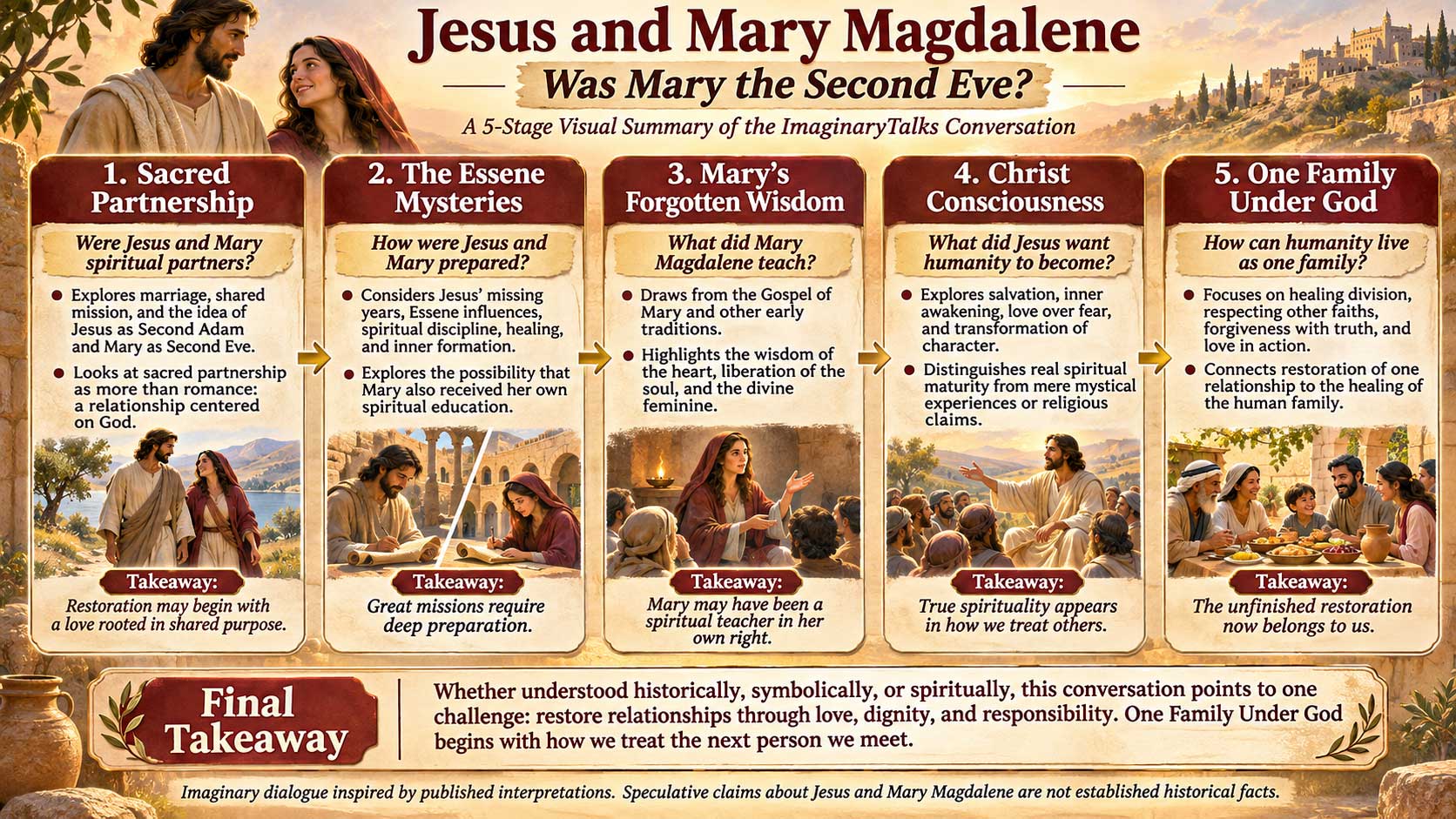
Leave a Reply