
Introduction
What if a ten-year-old could walk into Galileo’s workshop, challenge Einstein, or ask Socrates a question that no textbook could answer?
Would that child learn more than someone memorizing dates, definitions, and formulas?
The answer may be more interesting than choosing between imagination and memorization.
In her TED talk on how imaginary worlds help children learn, education researcher Anna Rainio explores what happens when children and adults enter fictional worlds together. Children become active participants, making choices, solving problems, and discovering ideas through shared experiences.
Related work on Conceptual PlayWorlds at Monash University explores how imaginative play can support early learning in science, mathematics, and other subjects.
Yet there is an important caution. Cognitive psychologist Daniel Willingham has argued that factual knowledge is essential to critical thinking. Children cannot reason deeply about subjects they know nothing about.
So perhaps the question isn't whether imagination should replace memorization. Perhaps it's how the two can work together.
In this imaginary conversation, five education thinkers meet in an unusual classroom: Anna Rainio, Marilyn Fleer, Daniel Willingham, Alison Gopnik, and Sal Khan.
Joining them is Maya, a fictional ten-year-old student who knows Galileo discovered Jupiter's four largest moons but cannot explain how he knew they were there.
Together, they explore three questions:
Are schools teaching children to memorize instead of think?
Can imaginary conversations make learning more meaningful?
Can AI become a learning partner without thinking for our children?
Their discussion takes an unexpected turn when Maya realizes that knowing an answer and knowing why it is true are two different things.
And perhaps the most important lesson begins when she stops asking adults for answers and starts asking questions of her own.
Editor's note: This is a fictional educational conversation inspired by the participants' published research and ideas. The dialogue, classroom setting, and Maya are invented. The article does not claim that imaginative learning eliminates the need for factual knowledge, direct instruction, or practice.
(Note: This is an imaginary conversation, a creative exploration of an idea, and not a real speech or event.)
Topic 1: Are We Teaching Children to Memorize Instead of Think?
The Classroom of Impossible Questions
This is an imaginary conversation inspired by the participants' published ideas and educational research. The dialogue is fictional.
The classroom was unusually quiet.
On the blackboard, someone had written two questions.
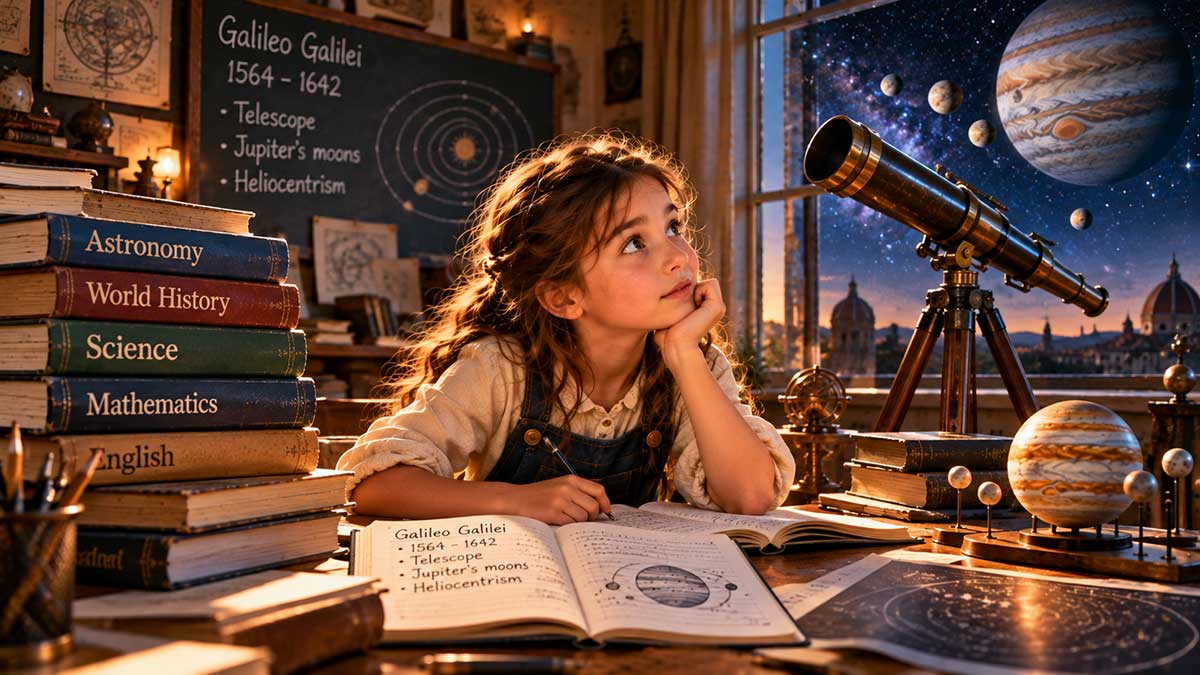
Who discovered Jupiter's four largest moons?
How could you prove that Jupiter has moons?
Maya, ten years old, raised her hand before anyone asked.
"Galileo Galilei. January 1610."
Daniel Willingham: Excellent. Now answer the second question.
Maya: Galileo discovered them.
Daniel Willingham: That's what you already told us.
Maya: Well, he looked through a telescope.
Daniel Willingham: And what did he see?
Maya hesitated.
Maya: Four moons?
Daniel Willingham: How did he know they were moons rather than stars?
Maya: Because he was Galileo?
Alison Gopnik laughed softly.
Alison Gopnik: That's a perfectly reasonable answer if you've spent ten years being told that the important thing is knowing what famous people discovered.
Daniel Willingham: Careful, Alison. We don't know that Maya's teachers have neglected reasoning. We know she's been asked a question she hasn't learned how to answer.
Maya: Actually, we had a test about Galileo last Friday.
Anna Rainio: How did you do?
Maya: One hundred percent.
Marilyn Fleer: Congratulations.
Maya: Thank you. But I don't really remember anything except his name, the moons, and the year.
Sal Khan: And you remembered those three things very well.
Maya: So did I learn it or not?
Nobody answered immediately.
Daniel Willingham: You learned something. That's not nothing. But learning a few facts about a discovery isn't the same as understanding the reasoning behind it.
Maya: Then why did I get one hundred percent?
Daniel Willingham: Because you answered every question on that particular test correctly.
Maya: That seems like a problem.
Daniel Willingham: It can be, if the test was intended to measure deeper understanding.
Alison Gopnik: Maya has just identified something adults spend enormous amounts of time arguing about. What exactly do we mean when we say a child has learned?
Maya: I thought it meant getting good grades.
Anna Rainio: What happens after you get the grade?
Maya: My mom puts the test on the refrigerator.
Anna Rainio: And then?
Maya: We have another test.
Marilyn Fleer: Do you ever get to use what you learned?
Maya: Sometimes. In science, we made volcanoes.
Alison Gopnik: What happened?
Maya: Mine exploded all over Ethan's shoes.
Sal Khan: Did you learn anything?
Maya: Yes. Never put too much baking soda in a volcano.
The adults laughed.
Daniel Willingham: Actually, that's an interesting beginning. You observed a result and drew a conclusion. The next step would be asking what caused it, testing different amounts, and learning the chemistry involved.
Maya: We didn't do that.
Daniel Willingham: Then there's an opportunity for a better lesson.
Anna Rainio: I wonder whether we should begin by asking Maya what she would like to know about Galileo.
Maya: Can I ask anything?
Anna Rainio: Anything.
Maya looked at the telescope standing beside the window.
Maya: If the Earth is moving, why don't we fall off?
Alison Gopnik: There it is.
Daniel Willingham: There what is?
Alison Gopnik: A question that belongs to her. Nobody assigned it. Nobody told her it would be on a test. She's trying to make sense of the world.
Daniel Willingham: And now she needs knowledge to answer it.
Alison Gopnik: Of course. But she wants that knowledge.
Daniel Willingham: Wanting to learn is valuable. Knowing how to help someone learn is another matter.
Anna Rainio: Perhaps we can stop treating those as competing goals.
She walked to the blackboard and erased the first question.
In its place, she wrote:
If Earth is moving, why don't we feel it?
Anna Rainio: Maya, would you like to investigate?
Maya: Right now?
Anna Rainio: Right now.
Maya: Do I need to study first?
Daniel Willingham: You may need to learn some things along the way.
Maya: That's fine. I just don't want another worksheet.
Marilyn Fleer: Let's begin with something familiar. Maya, have you ever been on an airplane?
Maya: Yes. We flew to Florida last summer.
Marilyn Fleer: When the airplane was flying smoothly, did you feel yourself moving hundreds of miles an hour?
Maya: No. But I could see the clouds moving.
Marilyn Fleer: Suppose the windows were covered.
Maya: Then I wouldn't know how fast we were going.
Daniel Willingham: Not from that sensation alone. You might still notice acceleration, turbulence, or other clues.
Maya: So the Earth is like an airplane?
Daniel Willingham: In one important respect. Smooth, constant motion can be difficult to detect from inside a moving system.
Alison Gopnik: What would happen if you tossed a ball straight up inside that airplane?
Maya: It would come down.
Alison Gopnik: Where?
Maya: In my hand, hopefully.
Sal Khan: Why wouldn't it fly to the back of the plane?
Maya stared at him.
Maya: Wait. Why doesn't it?
Daniel Willingham: Because the ball already shares the airplane's forward motion when you release it.
Maya: Oh!
Alison Gopnik: That "oh" is interesting.
Daniel Willingham: Yes, but we shouldn't confuse the feeling of understanding with understanding itself.
Maya: You really don't trust me, do you?
Daniel Willingham: Quite the opposite. I think you're capable of more than saying "oh."
Maya: Like what?
Daniel Willingham: Suppose you're standing inside a smoothly moving train. You drop a coin. Where does it land?
Maya: At my feet.
Daniel Willingham: Why?
Maya: Because the coin was moving with the train before I dropped it.
Daniel Willingham: Good. Now suppose the train suddenly brakes.
Maya: The coin might move forward.
Daniel Willingham: Excellent. You've applied the idea to a different situation.
Sal Khan: That's the difference between recognizing an explanation and being able to use it.
Maya: So now do I get one hundred percent?
Daniel Willingham: You get a harder question.
Maya: I knew there was a catch.
Anna Rainio: Daniel, I agree that children need accurate knowledge. But there's another question. Why did Maya become interested in this explanation only after she was invited to investigate something?
Daniel Willingham: We can't know that she wasn't interested before. Still, a good question can create curiosity.
Anna Rainio: In our work with imaginary worlds, children are not simply receiving a lesson. They enter a shared situation. They make choices, take roles, and encounter problems that matter inside the story.
Maya: Like being a detective?
Anna Rainio: Exactly. Or a scientist, an explorer, or someone trying to help a fictional character.
Maya: Could I be Galileo's assistant?
Anna Rainio: You could.
Maya: Even though I'm ten?
Anna Rainio: Especially since you're ten.
Daniel Willingham: I have a question for Anna. If Maya becomes Galileo's assistant and spends forty minutes pretending to explore the heavens, what guarantees she learns the intended science?
Anna Rainio: Nothing guarantees it.
Daniel Willingham: Good. That's important.
Anna Rainio: But meaningful participation creates opportunities for learning that a worksheet may not provide. The teacher must still guide the experience.
Marilyn Fleer: That's where I would make a distinction. Imaginative play does not mean abandoning teaching. In a Conceptual PlayWorld, the adult intentionally introduces concepts within the fictional situation.
Maya: What's a Conceptual PlayWorld?
Marilyn Fleer: A shared imaginary setting where children and adults explore problems together. Suppose we enter a story about a village whose bridge keeps collapsing.
Maya: Why does it keep collapsing?
Marilyn Fleer: That's what the villagers need you to discover.
Maya: They should hire a better builder.
Marilyn Fleer: Perhaps. But the village has no money, and you're the engineer.
Maya: I'm ten!
Marilyn Fleer: You're also their best hope.
Maya: That's terrible planning.
Everyone laughed.
Marilyn Fleer: Now you need to investigate which shapes make structures stronger. You build models, test them, compare results, and explain what you discover.
Daniel Willingham: And at some point, the teacher may need to explain the relevant principles directly.
Marilyn Fleer: Certainly.
Daniel Willingham: Then we're agreeing that imagination is a context for teaching, not a substitute for teaching.
Marilyn Fleer: Yes. But the context changes what the child is doing. Instead of completing an exercise to satisfy the teacher, the child is solving a problem that matters within the story.
Alison Gopnik: And children often approach such problems with remarkable creativity. They're willing to try possibilities adults might dismiss too quickly.
Sal Khan: There's a practical question, though. Can a teacher with thirty students create these experiences every day?
Anna Rainio: Not every lesson needs to become a theatrical production. Teachers can introduce smaller imaginative situations, invite questions, and allow students to make meaningful decisions.
Maya: Could we just have Galileo visit on Tuesdays?
Sal Khan: I think we may have a technological solution to that.
Daniel Willingham: Sal, we're not at the AI discussion yet.
Sal Khan: I know. I'm practicing patience.
Maya had been listening carefully.
Then she raised her hand.
Maya: Can I say something that might make everybody mad?
Alison Gopnik: Please.
Maya: I actually like memorizing things.
Daniel Willingham: Thank you, Maya.
Maya: I know all the multiplication tables. My dad used flashcards with me. And now when I do math, it's much easier.
Daniel Willingham: That's an excellent example of why memorization matters.
Maya: But I hate memorizing dates when I don't know why they're important.
Anna Rainio: What makes the multiplication tables different?
Maya: I use them.
Sal Khan: That's an important distinction. Knowing basic multiplication facts frees up attention for harder problems. If every calculation requires counting from the beginning, complex mathematics becomes exhausting.
Alison Gopnik: But children can learn those facts in different ways. Some may benefit from games, patterns, or visual representations.
Daniel Willingham: Certainly. We should distinguish the value of knowledge from the method used to acquire it.
Maya: So memorization isn't bad?
Daniel Willingham: No. Memorization is part of learning. The problem comes when remembering an answer is mistaken for complete understanding.
Marilyn Fleer: Or when children are given facts without opportunities to use them.
Anna Rainio: Or when their questions have no place in the classroom.
Maya: Then why do grown-ups argue about memorization versus imagination?
Alison Gopnik: Adults sometimes prefer simple choices. One method is good, the other is bad. Children rarely learn in such tidy categories.
Daniel Willingham: I would add that some educational debates exaggerate the shortcomings of traditional teaching. A well-explained lesson can be fascinating. Direct instruction is not inherently passive.
Anna Rainio: And imaginative learning is not inherently effective. Poorly structured play can be just as unproductive as a poorly structured lecture.
Maya: So a boring teacher could make Galileo boring, and a good teacher could make multiplication interesting?
Sal Khan: That's a fair summary.
Maya: My math teacher made fractions interesting using pizza.
Daniel Willingham: Did it work?
Maya: Yes, except everybody got hungry.
The moderator, who had remained quiet, approached the blackboard.
Moderator: We've talked about remembering facts, investigating problems, and participating in imaginary worlds. But how would you redesign Maya's original Galileo lesson?
Sal Khan: I'd begin by finding out what Maya already knows.
Daniel Willingham: Good. Then provide enough background for her to understand the problem. She should know that Galileo observed small points of light near Jupiter and tracked their changing positions over successive nights.
Anna Rainio: And give her a reason to care. Perhaps she's a young assistant helping Galileo prepare evidence for a skeptical visitor.
Maya: Can the visitor be really stubborn?
Alison Gopnik: Extremely stubborn.
Maya: Good. My brother can play him.
Marilyn Fleer: Maya could examine a sequence of observations, compare the positions of the points of light, and suggest explanations.
Daniel Willingham: We should be careful with the historical details. Galileo observed four large moons orbiting Jupiter. That was evidence that not everything in the heavens revolved around Earth. It did not, by itself, prove that Earth orbits the Sun.
Maya: So Galileo couldn't prove everything immediately?
Daniel Willingham: Correct. Scientific knowledge develops through multiple observations, arguments, and discoveries.
Alison Gopnik: And sometimes scientists have to revise ideas they once believed.
Maya: That makes me feel better.
Anna Rainio: Why?
Maya: Because sometimes I change my answer, and my teacher thinks I wasn't paying attention.
Daniel Willingham: Changing an answer after discovering better evidence can be a sign of good reasoning.
Maya: Really?
Daniel Willingham: Yes. But changing it randomly because you're unsure is something different.
Maya: You always have another rule.
Daniel Willingham: Science has quite a few.
Sal Khan: Here's how I would finish the lesson. After Maya explores the observations and hears the explanations, I'd give her a new problem. Perhaps another planet with objects appearing near it on successive nights. Can she explain what additional observations would help determine whether those objects orbit the planet?
Marilyn Fleer: And ask her to draw what she thinks is happening.
Anna Rainio: Then let her explain it to another child.
Alison Gopnik: Or defend her explanation against a friendly challenge.
Maya: Can I challenge Galileo?
Daniel Willingham: Absolutely.
Maya: What if he's wrong?
Daniel Willingham: Then you should explain why you think so, using evidence.
Maya: Even though he's famous?
Daniel Willingham: Especially when the question concerns evidence. A famous person's reputation is not a substitute for an explanation.
Maya considered this for a moment.
Maya: I think that's my favorite thing I've learned today.
Moderator: What is?
Maya: That I can disagree with someone smarter than me.
Alison Gopnik: You certainly can.
Daniel Willingham: And that being willing to learn from someone is compatible with questioning them.
Maya: But I have to know what I'm talking about.
Daniel Willingham: That helps enormously.
The afternoon sunlight had shifted across the classroom.
Maya opened her notebook and wrote:
Galileo discovered four moons of Jupiter in 1610.
Then she stopped.
Underneath, she added:
How did he know they were orbiting Jupiter?
She looked up.
Maya: I think I understand something.
Anna Rainio: Tell us.
Maya: Before today, I thought learning meant remembering what somebody told me.
Marilyn Fleer: And now?
Maya: I still have to remember things. But I can use them to figure out things nobody has told me yet.
Sal Khan: That's a wonderful goal for education.
Daniel Willingham: And a demanding one. It takes knowledge, practice, good explanations, and opportunities to reason.
Alison Gopnik: Plus the willingness to be surprised.
Maya closed her notebook, then immediately opened it again.
Maya: One more question.
Moderator: Go ahead.
Maya: If Galileo had been born today, would he have become a scientist, or would he have spent all day playing video games?
For the first time that afternoon, Daniel Willingham had no immediate answer.
Alison Gopnik grinned.
Alison Gopnik: Now that is an interesting question.
Maya smiled.
She had arrived knowing three facts about Galileo.
She was leaving with several questions about him, a better grasp of how evidence works, and a new willingness to investigate for herself.
The facts had not become less important.
They had become the beginning of something.
Topic 2: Can Imaginary Conversations Make Learning More Meaningful?
The Classroom of Impossible Questions
This is a fictional conversation inspired by the participants' educational research and published ideas.
Maya returned from lunch carrying a paper bag, a half-eaten apple, and a serious expression.
Maya: I've been thinking about Galileo.
Daniel Willingham: That's encouraging.
Maya: I told Ethan about Jupiter's moons. He said I was wrong.
Alison Gopnik: Why?
Maya: He said moons belong to Earth. Jupiter has satellites.
Daniel Willingham: Moons are natural satellites. You were correct.
Maya: That's what I told him. Then he said Galileo was probably using Google.
Sal Khan: I suspect Galileo would have appreciated Google.
Maya: He would've used it to prove Ethan wrong.
Anna Rainio: Or perhaps he would have invited Ethan to look through his telescope.
Maya: Ethan would still argue.
Marilyn Fleer: Then Ethan might be exactly the person we need for our next experiment.
Maya looked suspicious.
Maya: Are we doing another test?
Daniel Willingham: In a sense.
Maya: You really love tests.
Daniel Willingham: I love knowing whether something worked.
Alison Gopnik: Which is why we're going to try something that might not work.
Maya: That sounds much more interesting.
Anna Rainio stood and walked toward the classroom door.
Hanging beside it was a cardboard sign:
GALILEO'S WORKSHOP. FLORENCE, 1610.
Below it, someone had written:
Apprentice wanted. Must be curious. Must tolerate stubborn adults.
Maya: Who made that?
Anna Rainio: We did. Would you like to apply?
Maya: Does it pay?
Sal Khan: Historically, scientific research has not always been the most reliable path to wealth.
Maya: Then I want lunch included.
Marilyn Fleer: Negotiations accepted.
Anna opened the door.
The ordinary classroom had been rearranged.
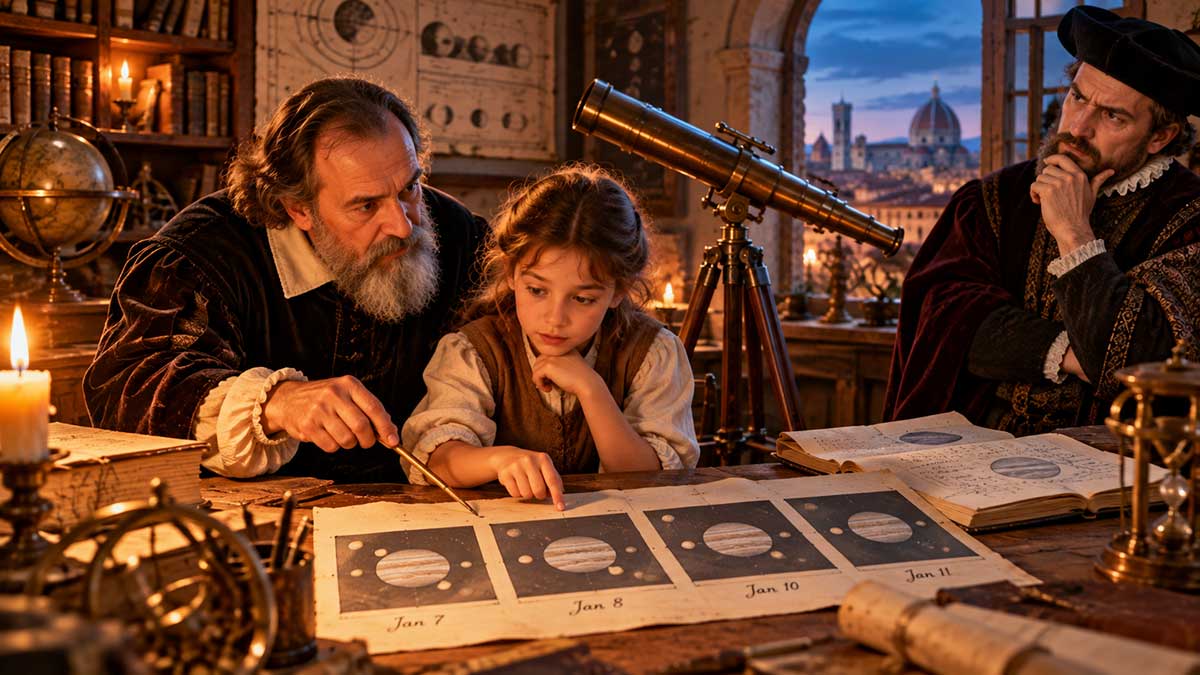
A wooden table stood near the window. On it were a brass telescope, a candle, several handwritten observation sheets, and a small model of Jupiter.
A dark blue cloth covered one wall, dotted with paper stars.
Maya stared.
Maya: You did all this during lunch?
Sal Khan: We had assistance from the school art department.
Daniel Willingham: And we should tell Maya that this is a fictional reconstruction, not a historically exact representation of Galileo's workshop.
Maya: You could've just said it's pretend.
Daniel Willingham: That works too.
Anna Rainio: Maya, you've arrived in Florence. Galileo has made a strange discovery, but some people refuse to believe him. Your job is to help him prepare an explanation.
Maya: Can I meet him?
Marilyn Fleer: Not quite yet. First, you have to examine his observations.
She handed Maya four sheets.
Each showed Jupiter as a large circle, with tiny dots appearing in different positions on successive nights.
Maya: These are the moons?
Marilyn Fleer: They might be. What else could they be?
Maya: Stars.
Alison Gopnik: Good. How could we tell?
Maya: Stars don't move.
Daniel Willingham: Careful. Stars appear to move across the sky as Earth rotates. What matters here is how the objects change position relative to Jupiter and one another over time.
Maya examined the sheets again.
Maya: These little dots keep changing sides.
Marilyn Fleer: Yes.
Maya: But Jupiter stays in the middle.
Alison Gopnik: What explanation would fit those observations?
Maya: Maybe they're going around Jupiter.
Anna Rainio: That's an interesting possibility.
Maya: Or Jupiter is moving around them.
Daniel Willingham: What observations might help you distinguish those possibilities?
Maya spread the papers across the table.
Maya: I need more nights.
Alison Gopnik: Exactly. You're asking for more evidence.
Maya: Could we just watch Jupiter tonight?
Sal Khan: We could, under suitable conditions, but its moons wouldn't appear exactly as they did in January 1610.
Maya: Then I need a time machine.
Anna Rainio: For the moment, imagination will have to do.
Anna Rainio: Before we continue, I want to ask everyone something. What changed when Maya entered this room?
Daniel Willingham: The furniture.
Anna Rainio: Daniel.
Daniel Willingham: I'm serious. We should identify what actually changed rather than assume the atmosphere improved learning.
Alison Gopnik: She acquired a purpose. She's not answering isolated questions. She's trying to solve a problem.
Marilyn Fleer: And the problem creates a reason to investigate scientific concepts. The observations aren't decorations. They're the evidence she needs.
Sal Khan: There's a difference between being told what Galileo discovered and being given the observations that made the discovery possible.
Daniel Willingham: Certainly. But the imaginary setting isn't necessarily the cause of any learning benefit. Maya might learn the same concepts from a well-designed investigation without costumes or a fictional story.
Maya: I like the costumes.
Daniel Willingham: That's a legitimate preference. But enjoying something and learning from it are different questions.
Maya: Can't I do both?
Daniel Willingham: Of course. I hope you do.
Anna Rainio: That's an important point. A Playworld is not simply a lesson with costumes. The children and adults participate in a shared imaginary situation. Children have meaningful choices. Their actions can change what happens.
Maya: Can I change the story?
Anna Rainio: Yes.
Maya: Then Galileo should have a rival.
Alison Gopnik: Why?
Maya: Because someone needs to argue with him.
Daniel Willingham: I believe you've found your rival already.
Maya: You?
Daniel Willingham: I seem qualified.
Maya laughed.
Maya: You're going to be a very stubborn astronomer.
Daniel Willingham: I've been preparing my whole life.
Daniel picked up a folded paper and adopted an exaggeratedly formal voice.
Daniel Willingham, as the skeptical visitor: Young apprentice, I have traveled a considerable distance to examine your master's extraordinary claims.
Maya: Welcome to Galileo's workshop.
Daniel, as the visitor: I understand that you believe four objects revolve around Jupiter.
Maya: Yes.
Daniel, as the visitor: Impossible. Everyone knows the heavens revolve around Earth.
Maya: That's not a very good argument.
Daniel, as the visitor: Excuse me?
Maya: You just said everyone knows it. That doesn't mean it's true.
Daniel, as the visitor: Then present your evidence.
Maya handed him the observation sheets.
Maya: Look. The dots change position around Jupiter over several nights.
Daniel, as the visitor: Perhaps your telescope is defective.
Maya stopped.
Maya: Can telescopes be defective?
Marilyn Fleer: Certainly. Early telescopes had optical limitations.
Maya: Then how do I know these observations are real?
Alison Gopnik: What could you do?
Maya: Ask somebody else to look?
Sal Khan: Independent observations. Good.
Maya: And maybe use a different telescope?
Daniel, as the visitor: Suppose another observer sees the same objects. What would that tell you?
Maya: That it's less likely to be just a problem with Galileo's telescope.
Daniel, as the visitor: And what would it not tell you?
Maya frowned.
Maya: That every single thing Galileo believes is true?
Daniel lowered his paper.
Daniel Willingham: Excellent.
Maya: Did I win?
Daniel Willingham: You made a sound argument.
Maya: That's a yes.
Anna invited Maya to sit beside the model of Jupiter.
Anna Rainio: How did you feel when Daniel challenged you?
Maya: Annoyed.
Daniel Willingham: A common reaction to my questions.
Maya: But then I wanted to prove him wrong.
Alison Gopnik: And what did you do?
Maya: I looked at the papers again. Then I had to think about what would count as proof.
Anna Rainio: That's the kind of participation I'm interested in. The child has a role, a reason to act, and an opportunity to reconsider an idea.
Marilyn Fleer: The fictional problem creates a meaningful reason to use scientific reasoning.
Daniel Willingham: I agree that this was productive. But I want to challenge something. Maya, do you now know more about the actual history of Galileo?
Maya: I know he had a really annoying visitor.
Daniel Willingham: Which is exactly the problem.
Maya burst out laughing.
Daniel Willingham: We invented that visitor. We invented this conversation. If you later tell someone Galileo had a particular argument with a particular visitor in this workshop, you would be confusing fiction with historical evidence.
Maya: But I know you're pretending.
Daniel Willingham: Today you do. Tomorrow, after reading many fictional historical conversations, will every child remember which details were invented?
Sal Khan: That's a serious design challenge, especially with AI-generated historical characters.
Anna Rainio: Then the fictional framing needs to be explicit.
Marilyn Fleer: We can separate the scientific concept from the dramatization. The observations can be grounded in historical records, and the invented dialogue can help children investigate them.
Alison Gopnik: Children are often capable of distinguishing pretend situations from reality. But adults shouldn't assume every detail will remain clearly separated in memory.
Maya: Can I write two lists?
Daniel Willingham: What kind?
Maya took a piece of paper and drew a line down the middle.
On one side she wrote:
WHAT REALLY HAPPENED
On the other:
WHAT WE PRETENDED
Under the first heading, she wrote:
Galileo observed four moons near Jupiter in 1610.
Under the second:
I was Galileo's apprentice.
She paused.
Daniel was a very rude astronomer.
Daniel Willingham: I object to the word "very."
Maya: I'll underline it.
Sal Khan: I'd like to try something. Maya, suppose this classroom could introduce you to almost anyone in history. Who would you choose?
Maya: Cleopatra.
Alison Gopnik: Interesting choice.
Maya: I want to know whether she really was as beautiful as everybody says.
Daniel Willingham: Historical accounts and artistic representations aren't enough to establish that with certainty.
Maya: Then I would ask her.
Sal Khan: And that's where we encounter a problem. An AI-generated Cleopatra could respond convincingly, but it wouldn't possess Cleopatra's actual memories.
Maya: So it might make something up.
Sal Khan: Yes.
Anna Rainio: But that doesn't make the entire experience worthless. We can still create a fictional conversation that introduces historical questions.
Marilyn Fleer: Provided the child understands what is known, what is uncertain, and what is invented.
Alison Gopnik: There's another opportunity here. Rather than making Cleopatra an all-knowing source, we could let Maya examine competing historical accounts and ask why people described Cleopatra differently.
Maya: Could I ask Cleopatra whether she thought she was beautiful?
Daniel Willingham: You could ask a fictional Cleopatra. But the answer would be the writer's invention.
Maya: That's less exciting.
Alison Gopnik: Perhaps. But here's a more interesting question: Why do you think so many stories about a politically influential woman focus on her appearance?
Maya considered that.
Maya: Because people thought being pretty was more important than being smart?
Alison Gopnik: That's one hypothesis worth investigating.
Maya: Huh.
She looked at the two lists on her paper.
Maya: Maybe talking to famous people isn't really about finding out what they'd say.
Anna Rainio: What might it be about?
Maya: Finding better questions about them.
Nobody spoke for a moment.
Marilyn Fleer: That's beautifully put.
The moderator approached the table.
Moderator: Maya has enjoyed herself. She's asked questions, examined observations, and defended an argument. But Daniel raised a challenge earlier. How do we know she actually learned?
Daniel Willingham: We need to examine what she can do beyond the activity itself.
Maya: You're giving me another test.
Daniel Willingham: A small one.
Maya: Does it have a grade?
Daniel Willingham: No.
Maya: Then I like it already.
Daniel took away the observation sheets and placed a new drawing on the table.
It showed a distant planet with three small objects appearing in different positions across four nights.
Daniel Willingham: You've never seen these observations. What would you want to know before deciding whether the objects orbit the planet?
Maya studied the drawing.
Maya: First, I'd want more observations.
Daniel Willingham: Why?
Maya: Four nights might not be enough to understand the pattern.
Daniel Willingham: Good.
Maya: Then I'd want to know whether other people saw the same thing.
Daniel Willingham: Why?
Maya: To make sure it wasn't a problem with the telescope.
Daniel Willingham: What else?
Maya: I'd compare where the objects are relative to the planet, not just where they are in the sky.
Daniel nodded.
Daniel Willingham: Now we're seeing evidence that you can apply some of the reasoning to a new situation.
Maya: So the story worked?
Daniel Willingham: It appears to have helped you learn. But we can't conclude that the story was better than another teaching method from one demonstration.
Maya: You never let anybody win completely.
Daniel Willingham: That's another useful scientific habit.
Marilyn Fleer: We could ask Maya to explain the reasoning in her own words, draw a model, and return to the problem next week.
Sal Khan: Or compare how well she solves related problems with and without guidance.
Anna Rainio: And observe whether she participates differently in future lessons.
Alison Gopnik: We should be interested in more than one outcome. Did she understand the concept? Can she remember it? Can she apply it? Does she want to investigate further?
Daniel Willingham: Yes. And we should measure those outcomes separately rather than assume one proves the others.
Maya: Can I ask something?
Moderator: Of course.
Maya: What if I forget Galileo's name next week but remember how to test whether something is true?
Daniel Willingham: Then you've retained an important reasoning skill but forgotten a historical fact.
Maya: Is that bad?
Daniel Willingham: It means there's something worth reviewing. Both matter.
Maya: You really want me to remember everything.
Daniel Willingham: No. I want you to build knowledge that lasts and learn how to use it.
Anna Rainio: And I want children to feel that learning is something they participate in, not something that simply happens to them.
Marilyn Fleer: I want the participation to lead to meaningful concepts.
Alison Gopnik: I want children to remain curious enough to test what adults tell them.
Sal Khan: And I want every child to have opportunities for that kind of guidance, not just children fortunate enough to attend an extraordinary classroom.
Maya returned to the blackboard.
She erased the words GALILEO'S WORKSHOP and wrote:
THREE THINGS I LEARNED TODAY
Underneath:
1. A famous person can be wrong.
2. Evidence matters more than who says something.
3. Pretending can help me learn, but pretending isn't the same as history.
She looked at the adults.
Maya: Did I miss anything?
Daniel Willingham: You learned how repeated observations can support an explanation.
Maya added it.
Maya: Four things.
Anna Rainio: How did it feel to be Galileo's assistant?
Maya: Like I was doing science instead of just reading about it.
Marilyn Fleer: That's an important experience.
Maya: But I think the best part was when Daniel said I was wrong.
Daniel looked surprised.
Daniel Willingham: Really?
Maya: Yes. Because I had to figure out why I wasn't.
Alison Gopnik: Or whether you were.
Maya: Right. That too.
She gathered her papers and placed them in her backpack.
Then she stopped.
Maya: I have one problem with this kind of learning.
Sal Khan: What's that?
Maya: If every lesson is an adventure, what happens when the adventure ends?
Anna Rainio: What do you think?
Maya looked at the telescope.
Maya: I guess you have to be able to figure things out without Galileo standing next to you.
Daniel Willingham: Exactly.
Maya: But what if I get stuck?
Sal glanced toward the tablet resting on the desk.
Sal Khan: That's a question people are trying to answer with artificial intelligence.
Maya: You mean I could have Galileo on my tablet?
Sal Khan: Something that speaks like a fictional version of him, yes.
Maya's eyes widened.
Maya: And I could ask him questions whenever I want?
Sal Khan: Potentially.
Maya: Even at midnight?
Daniel Willingham: I would recommend sleeping at midnight.
Maya: But what if he knows all the answers?
The room became quiet.
Alison Gopnik leaned forward.
Alison Gopnik: Maya, I think the more important question is what happens if you start believing you don't need to find answers yourself.
Maya looked down at the tablet.
For the first time that afternoon, she didn't reach for it.
Topic 3: Can AI Become a Learning Partner Without Thinking for Our Children?
The Classroom of Impossible Questions
This is an imaginary conversation inspired by the participants' published research and educational ideas. All dialogue is fictional.
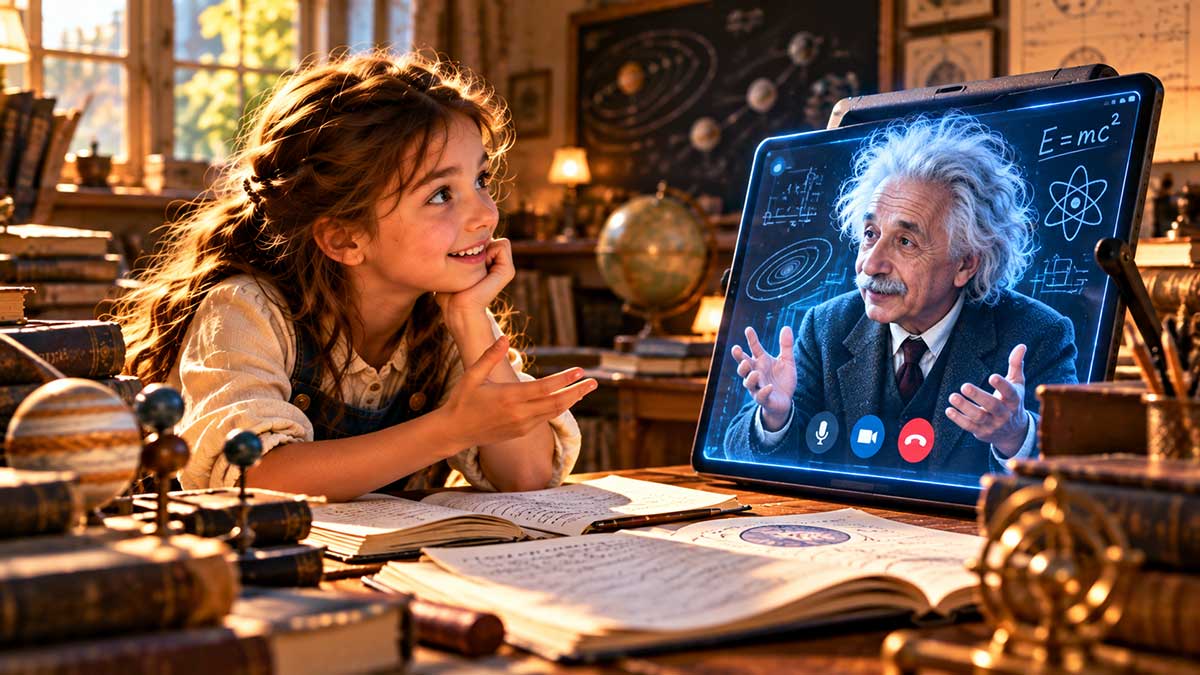
The tablet sat in the middle of the classroom.
Nobody had touched it.
Maya stared at the screen as if something inside might suddenly wake up.
Maya: So you're telling me I can talk to Einstein?
Sal Khan: You can talk to an AI character designed to respond as a fictional version of Einstein.
Maya: That's a very long way of saying yes.
Daniel Willingham: It's a very important way of saying not exactly.
Maya: What's the difference?
Sal Khan: The real Einstein died in 1955. An AI version can draw on information about his life, discoveries, and writings. But it isn't Einstein. It doesn't have his memories or his personal experiences.
Maya: So it's pretending.
Anna Rainio: In a sense, yes. Much like our Galileo workshop.
Maya: Except this one talks back.
Alison Gopnik: And that makes it both interesting and potentially misleading.
Marilyn Fleer: Particularly if children start treating the fictional character as an unquestionable authority.
Maya considered this.
Maya: Can I ask Einstein whether he liked broccoli?
Daniel Willingham: You can ask. But unless there's reliable historical evidence, the AI shouldn't invent an answer and present it as fact.
Maya: What if he says he hated broccoli?
Sal Khan: Then we should ask where that information came from.
Maya: You're going to make me check everything, aren't you?
Daniel Willingham: Not everything. Just the things you have reason to question.
Maya: That's still a lot.
Sal activated the tablet.
A simple illustration of Albert Einstein appeared on the screen, with his familiar untidy hair and gentle expression.
Below it was a message:
This is a fictional educational simulation based on historical information. Responses may contain errors. Personal dialogue is invented.
Maya: It looks like my grandpa when he wakes up.
Sal Khan: Would you like to ask your first question?
Maya leaned toward the microphone.
Maya: Professor Einstein, were you ever wrong?
The simulated Einstein replied.
AI Einstein: Of course. Scientists make mistakes. What matters is whether we're willing to reconsider our ideas when the evidence changes.
Maya: That's a good answer.
Daniel Willingham: It is. But there's something missing.
Maya: What?
Daniel Willingham: The AI has given you a general lesson. It hasn't identified a particular mistake Einstein made.
Maya: Professor Einstein, tell me something you got wrong.
AI Einstein: Einstein introduced the cosmological constant into his equations of general relativity to allow for a static universe. After evidence for cosmic expansion emerged, he came to regret that choice.
Maya: So he made a mistake?
Daniel Willingham: He reconsidered an earlier scientific choice. But we should be precise. The cosmological constant itself isn't simply a mistake. Modern cosmology uses a related term to describe accelerated cosmic expansion.
Maya: That's confusing.
Alison Gopnik: Science often is. A good explanation should help you understand why an idea changed, not turn a complicated history into a neat little moral lesson.
Maya: So even Einstein's mistakes are complicated?
Sal Khan: Apparently.
Maya: Being a genius sounds exhausting.
Anna Rainio: Sal, may I ask something? In our Galileo workshop, Maya had a role. She examined evidence, made decisions, and argued with a skeptical visitor. What would stop this AI Einstein from simply giving her a series of polished explanations?
Sal Khan: Nothing automatically. That's a design decision. We can build educational AI experiences that ask students questions, offer hints, and invite them to reason.
Marilyn Fleer: But asking questions isn't enough. The questions need to support genuine conceptual learning.
Daniel Willingham: And we must be careful with the idea that students should discover everything themselves. Sometimes the most helpful thing a tutor can do is explain a concept clearly.
Alison Gopnik: I agree. But children need opportunities to explore possibilities that aren't predetermined by the adult or the machine.
Maya: Could the AI let me choose what we study?
Sal Khan: Certainly.
Maya: Then I choose black holes.
Daniel Willingham: An ambitious beginning.
Maya: And dinosaurs.
Alison Gopnik: Naturally.
Maya: And why my little brother thinks he's always right.
Daniel Willingham: That may require a separate field of research.
Maya: Psychology?
Daniel Willingham: Possibly family diplomacy.
The room filled with laughter.
Sal Khan: Here's an experiment. Let's see what happens when the AI doesn't immediately provide an answer.
He entered a mathematics problem:
A class has 24 students. Three-eighths of them bring lunch from home. How many students bring lunch?
Sal Khan: Maya, try it.
Maya stared at the problem.
Maya: I know this. I just don't feel like doing it.
Alison Gopnik: That's an interesting distinction.
Maya: Professor Einstein, what's three-eighths of twenty-four?
AI Einstein: Let's work through it. What would one-eighth of twenty-four be?
Maya: Three.
AI Einstein: Good. Then what would three-eighths be?
Maya: Nine.
AI Einstein: Correct. How could you check your answer another way?
Maya: Multiply twenty-four by three and divide by eight.
AI Einstein: Exactly.
Maya leaned back.
Maya: That was easy.
Daniel Willingham: It was. But let's try something different.
He covered the tablet.
Daniel Willingham: What's five-sixths of thirty?
Maya: Twenty-five.
Daniel Willingham: How did you know?
Maya: One-sixth is five. Five times five is twenty-five.
Daniel Willingham: Good. You can do it without assistance.
Maya: Can I have the tablet back now?
Daniel Willingham: In a moment.
Maya: You sound exactly like my mother.
Alison Gopnik: Sal, there's something that concerns me about these systems. Children naturally experiment. They try things, make mistakes, and sometimes discover unexpected possibilities. But an AI tutor can create a very smooth experience. Every question receives a helpful response. Every difficulty is softened.
Sal Khan: Isn't that often beneficial? A child who's stuck and frustrated may stop learning altogether.
Alison Gopnik: Of course. But not every frustration is harmful. Some uncertainty is part of discovery.
Marilyn Fleer: There's a difference between productive struggle and being abandoned with a problem you cannot solve.
Daniel Willingham: Precisely. The amount of guidance should depend on what the learner already knows and what the task requires.
Anna Rainio: In a shared imaginary world, adults can observe how children respond. They may see hesitation, excitement, confusion, or an unexpected idea. Can an AI tutor recognize all of that?
Sal Khan: It can respond to some signals, especially what the student types or says. But it cannot reliably understand everything happening in a child's mind or environment.
Maya: Sometimes my teacher thinks I'm confused when I'm actually bored.
Alison Gopnik: That's a very good example.
Maya: And sometimes she thinks I understand when I'm just nodding.
Daniel Willingham: Another good example.
Maya: I'm very good at nodding.
Sal Khan: Which is why we need more than a system that asks, "Do you understand?" and accepts "yes."
Marilyn Fleer: We need evidence of understanding. Can the child explain the concept, use it, and apply it to a different problem?
Anna Rainio: And we need to preserve human relationships. Learning is not just an exchange of questions and answers.
Maya: I like learning with my friends.
Alison Gopnik: Why?
Maya: Because sometimes they think of things I don't. And sometimes they get things wrong, which is funny.
Daniel Willingham: A generous educational philosophy.
Maya: I'm still working on the generous part.
The moderator approached the table.
Moderator: Let's try a more difficult question. Suppose Maya can talk to an AI version of almost anyone in history. How should we protect her from confusing fictional dialogue with historical truth?
Daniel Willingham: Start with clear labeling. An invented conversation is not a historical source.
Sal Khan: The system should distinguish documented facts, reasonable interpretations, and invented dramatization.
Marilyn Fleer: It should encourage students to examine original evidence when possible.
Anna Rainio: And children should understand that the purpose of the imaginary conversation is to explore ideas, not to replace historical research.
Alison Gopnik: I'd go further. Let the AI character admit uncertainty. Let it say, "We don't know what this person thought about that."
Maya: But wouldn't that make the conversation boring?
Alison Gopnik: Sometimes uncertainty is the most interesting part.
Maya: Give me an example.
Alison Gopnik: Suppose you ask a fictional Cleopatra whether she loved Julius Caesar.
Maya: Did she?
Alison Gopnik: Historical evidence tells us about their relationship and political alliance, but it cannot reveal every private feeling.
Maya: So the AI shouldn't say, "Yes, I loved him more than anything"?
Daniel Willingham: Not as a verified historical fact.
Maya: Could it say, "In this fictional story, I loved him"?
Sal Khan: Yes, provided the distinction remains clear.
Maya: Then I think I understand. Pretending is fine. Pretending something is true when you don't know is the problem.
Anna Rainio: That's a useful distinction.
Maya: I should tell my little brother that.
Daniel Willingham: You may discover he already knows it.
Maya: He definitely doesn't.
Sal turned the tablet off.
Maya: Wait! We weren't finished with Einstein.
Sal Khan: I want to ask you something first. Suppose you had access to this tutor every day, for every subject, whenever you needed help. What would be the best part?
Maya: I wouldn't have to wait until my teacher was free.
Sal Khan: Good.
Maya: And I could ask embarrassing questions without everybody laughing.
Anna Rainio: That's important.
Maya: And if I didn't understand something, I could ask it to explain again.
Daniel Willingham: Those are meaningful advantages.
Sal Khan: Now what's the worst part?
Maya thought for a long time.
Maya: I might stop trying before asking for help.
Alison Gopnik: Why?
Maya: Because asking would be easier.
Marilyn Fleer: What might help?
Maya: Maybe the tablet could ask me what I've tried first.
Daniel Willingham: Excellent.
Maya: But sometimes I really don't know where to start.
Sal Khan: Then it could offer a small hint.
Maya: And if I still don't know?
Daniel Willingham: Another hint, an explanation, or a worked example, depending on what you need.
Maya: And then I try one by myself?
Marilyn Fleer: Exactly.
Alison Gopnik: I'd want time for you to explore without the tutor constantly directing you.
Anna Rainio: And opportunities to solve problems with other children.
Sal Khan: We could design a learning sequence around those principles.
Maya picked up a marker.
Maya: I want to make the rules.
She wrote on the blackboard:
MAYA'S RULES FOR AI TEACHERS
1. Ask me what I think before telling me the answer.
2. Let me make mistakes.
3. Give me hints when I need them.
4. Tell me when something is pretend.
5. Sometimes make me do it myself.
She stepped back.
Maya: Did I forget anything?
Daniel Willingham: Check whether you remember what you learned later.
Maya added a sixth rule.
6. Ask me again tomorrow.
Marilyn Fleer: And let children learn with one another.
Maya added:
7. Don't replace my friends.
Anna Rainio: Or your teachers.
Maya added:
8. Don't replace my teacher.
She hesitated.
Maya: Unless it's Friday afternoon.
Daniel Willingham: Maya.
Maya: Just kidding.
The moderator looked at the eight rules.
Moderator: These are sensible principles. But there's a larger question. What would a school look like if AI helped children become more independent rather than more dependent?
Sal Khan: I would hope teachers could spend more time mentoring students, supporting those who struggle, and creating richer learning experiences. AI could help with individualized practice and feedback.
Daniel Willingham: Provided schools verify that students are learning. We should not assume technology improves education merely by making instruction more personalized.
Marilyn Fleer: And the classroom must remain a place where children interact with the physical world. They need to build things, conduct experiments, collaborate, and discover how ideas work beyond a screen.
Anna Rainio: Shared imaginary worlds could become even richer when technology supports them. But the children should remain participants and creators, not simply consumers of machine-generated stories.
Alison Gopnik: I worry about a future in which children are constantly guided toward correct answers. Childhood has value beyond efficient learning. Children need freedom to explore, play, and discover things adults didn't anticipate.
Sal Khan: I agree. A good tutor shouldn't eliminate every difficulty or surprise.
Daniel Willingham: But it should help students acquire the knowledge and skills that make independent thinking possible.
Maya: Can I tell you what kind of school I want?
Moderator: Please.
Maya: I want to learn history by visiting pretend historical places. I want to do science experiments that sometimes fail. I want teachers who answer my questions, but sometimes ask me harder ones. I want to work with my friends. And I want an AI tutor when I'm stuck.
Anna Rainio: That sounds like a thoughtful school.
Maya: But I don't want it to do everything for me.
Alison Gopnik: Why not?
Maya: Because then I wouldn't know what I can do.
The adults fell silent.
Sal Khan: That's probably the most important thing you've said today.
Maya: Really?
Daniel Willingham: I think so.
Maya: More important than my question about Einstein and broccoli?
Daniel Willingham: Considerably.
The school day was nearly over.
Outside, parents were arriving to collect their children. Backpacks scraped across the hallway floor. Somewhere, a bell rang.
Maya stood beside the telescope.
Maya: Can I ask one last question?
Moderator: Of course.
Maya: If Einstein were alive today, would he use AI?
Sal Khan: I suspect he'd be curious about it, but we can't know exactly what he'd think.
Alison Gopnik: He might ask difficult questions about how it works.
Daniel Willingham: And whether its answers were reliable.
Marilyn Fleer: He might use it to investigate scientific problems.
Anna Rainio: Perhaps he'd ask what it means for children to learn.
Maya smiled.
Maya: I think he'd ask the AI a question it couldn't answer.
Sal Khan: Such as?
Maya thought for a moment.
Maya: "Can you tell me something nobody knows yet?"
Alison Gopnik: And what would you hope the AI would say?
Maya looked at the telescope, the observation sheets, and the blackboard covered with her rules.
Then she answered.
Maya: "Not yet. But maybe we can figure it out."
She reached for her notebook instead of the tablet.
On a fresh page, she wrote:
What is something nobody knows yet that I could try to discover?
She stared at the question.
For once, she didn't ask anyone to answer it.
Final Thoughts
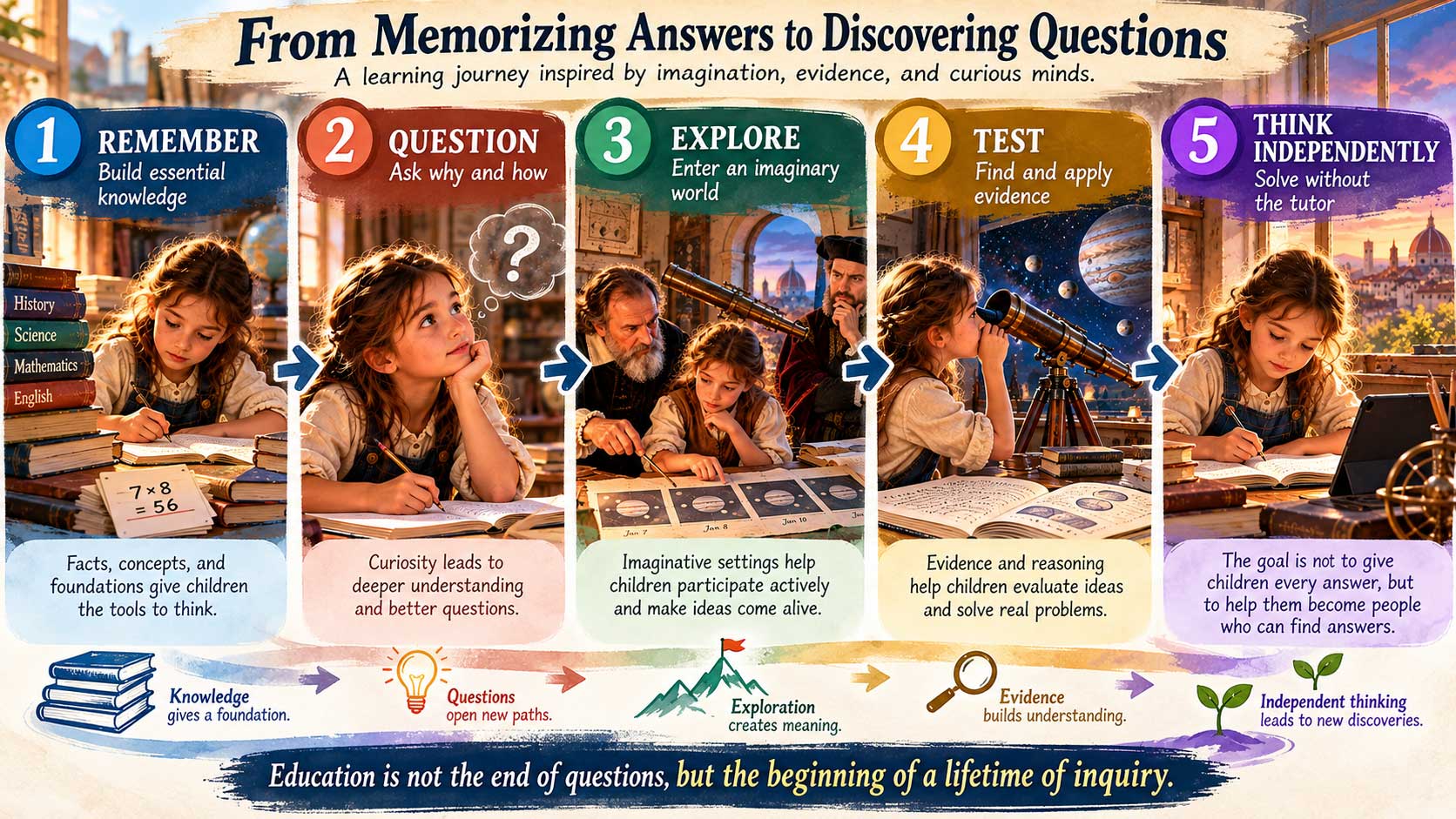
By the end of the afternoon, Maya has learned something that no multiple-choice test could fully capture.
She knows more about Galileo. She understands why evidence matters. She has discovered that questioning an expert isn't disrespectful when the question is sincere and supported by reasoning.
But something else has changed.
At the beginning, Maya wanted adults to tell her the correct answers. By the end, she wants to investigate questions herself.
That's the promise of imaginative learning.
Anna Rainio and Marilyn Fleer show us how fictional worlds can invite children to participate in learning. Alison Gopnik reminds us that children are natural explorers. Daniel Willingham makes the essential case for knowledge and memory. And Sal Khan asks whether AI could make thoughtful guidance available to more children.
Their differences matter. A wonderful story is not automatically a good lesson. Children still need facts, practice, explanations, and opportunities to demonstrate what they've learned.
And AI presents a new challenge. A child who can ask a virtual Einstein anything might become more curious. Or that child might grow accustomed to receiving answers without making the effort to find them.
The difference may depend on what happens after the question.
Does the AI immediately answer? Does it invite the child to predict, investigate, and reconsider? Can the child solve a similar problem tomorrow without assistance?
Perhaps the most valuable imaginary conversation is one in which the child eventually no longer needs the imaginary teacher.
I keep returning to Maya's eight rules for AI teachers, especially the simplest one:
"Sometimes make me do it myself."
That sentence captures something worth protecting as education changes.
We should want children who know their multiplication tables, remember history, and understand scientific principles. But we should want something more, too.
Children who can disagree respectfully. Children who recognize when they don't know something. Children who can distinguish a convincing story from reliable evidence.
And children who discover the satisfaction of finding an answer through their own effort.
The goal of education is not to give children every answer. It's to help them become people who can find answers, question them, and sometimes discover something nobody knew before.
Short Bios:
Anna Rainio is a senior university lecturer at the University of Helsinki whose research examines children's learning, participation, and shared imaginative play. Her TED talk, How Imaginary Worlds Help Kids Learn, provides the inspiration for this conversation.
Marilyn Fleer is an emeritus professor at Monash University and a leading researcher in early childhood education. She developed the Conceptual PlayWorld approach, which uses shared imaginary stories to help children explore science, engineering, and mathematics.
Daniel Willingham is a professor of psychology at the University of Virginia and author of Why Don't Students Like School? and Outsmart Your Brain. His research examines how memory, knowledge, and cognitive science can improve education.
Alison Gopnik is a developmental psychologist at the University of California, Berkeley, and author of The Philosophical Baby and The Gardener and the Carpenter. Her research investigates how young children learn through exploration, experimentation, and causal reasoning.
Sal Khan is the founder and CEO of Khan Academy, a nonprofit educational organization. His work focuses on accessible, personalized education, including the possibilities and challenges of AI-assisted tutoring.
Maya (fictional character) is the ten-year-old student at the heart of this story. Curious, outspoken, and occasionally impatient with adults, she helps the experts discover what education looks like from a child's perspective.
Leave a Reply