
Main Introduction: Pablo Picasso Interview, Was His Genius Worth the Price?
What if the man who changed the way the world sees art was asked to look at something he could never fully control: his own life? Pablo Picasso could paint almost anything. As a young man, he demonstrated remarkable technical skill. Later, he broke faces into geometric shapes, challenged traditional perspective, and helped transform modern painting. But behind his extraordinary achievements was a complicated human being. And I have always wondered whether the price of his genius was paid by Picasso alone, or by the people who loved him.
When I look through the Museum of Modern Art's collection of Picasso's work, I am amazed by how many different artistic approaches one person explored. He didn't seem satisfied with simply becoming good at something. He kept searching for another way to see. That fascinates me. What makes someone abandon a method that already works? Was Picasso searching for artistic freedom, or was he searching for something he could never quite find?
But there is another side of Picasso that I want to explore. His relationships with women were often turbulent, and several of the women in his life were accomplished artists or creative individuals themselves. I wonder how he would respond if I asked him about love, responsibility, and the emotional consequences of his choices. Could someone who saw a human face from several perspectives recognize another person's feelings with the same sensitivity?
Then there is Guernica, Picasso's monumental response to the destruction of a Spanish town during the Civil War. The painting remains one of the most recognizable artistic statements against war. Yet wars have continued throughout the world. I want to ask Picasso whether he believed art could actually change humanity. Can a painting help people become more compassionate? Or does it simply remind us of suffering that we already know exists?
I am curious about Picasso's later years, too. He lived to ninety-one and continued creating almost until the end of his life. The Museo Picasso Málaga preserves and presents the remarkable range of his artistic development. But I wonder what Picasso thought about his own life when he was no longer the young artist trying to prove himself. Did fame bring satisfaction? Did he have regrets? And if he could return to his childhood with everything he eventually learned, would he choose the same life again?
In this imaginary interview, I want to meet Picasso as a human being rather than an untouchable artistic genius. We'll explore his childhood, his revolutionary ideas, the women and children in his life, his response to war, and the personal cost of becoming one of history's most celebrated painters. I don't intend to excuse his mistakes or dismiss his accomplishments. I want to hear how he might respond to questions that challenge both his artistic philosophy and his personal choices.
Perhaps the most interesting question isn't whether Picasso was a great artist. History has already given us plenty of evidence for that. The question is whether extraordinary achievement necessarily leads to a meaningful life. If you could create something the world would admire for centuries, but doing so might damage the relationships closest to you, would you still choose that path? That's the question I want to explore with Pablo Picasso.
Disclaimer: This is an imaginary interview created for educational and reflective purposes. Picasso's responses are fictional interpretations inspired by historical information, not authenticated quotations or documented private thoughts.
Topic 1. The Boy Who Could Paint Anything
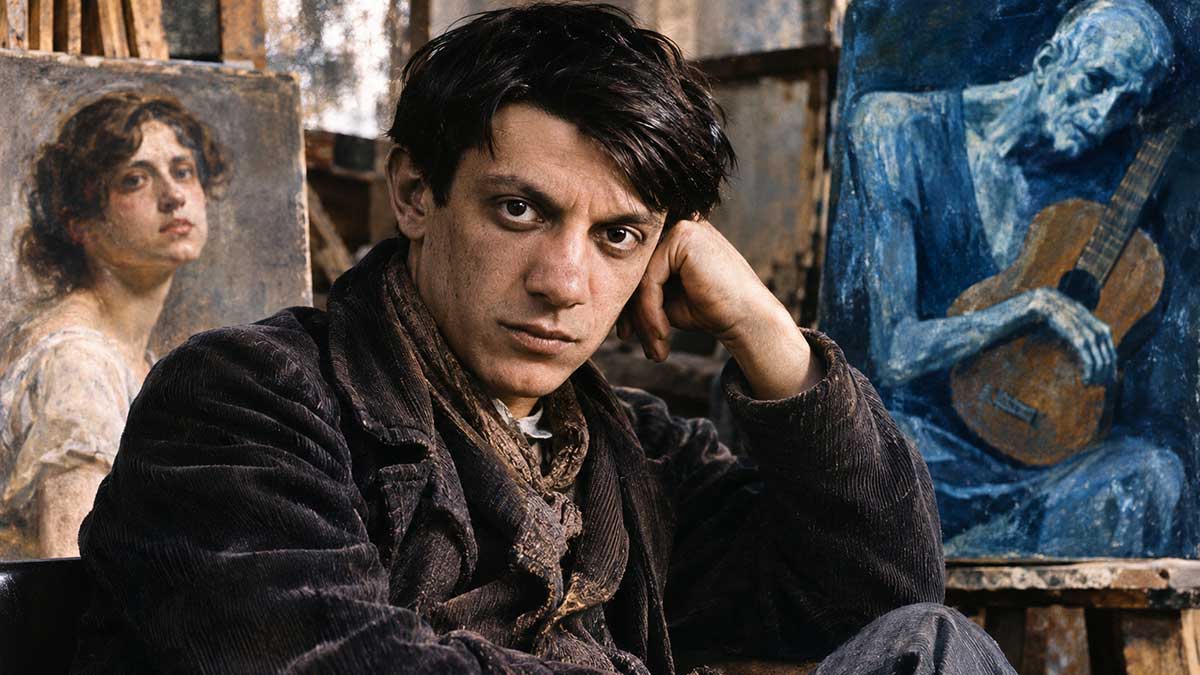
A Child Who Saw the World Differently
Nick Sasaki
Picasso, welcome. I have been looking forward to this conversation.
I've seen many of your paintings over the years, but something surprised me when I started learning about your childhood.
You could actually paint realistic portraits when you were very young. Beautiful ones!
So I have to ask you something. If you could paint people so realistically, why did you eventually start putting their eyes, noses, and mouths in such unusual places?
Pablo Picasso
(Laughs.)
You have wasted no time insulting my paintings, Nick.
Nick Sasaki
No, no! I'm genuinely curious.
Some of your later portraits look as if the person turned their head in three different directions at once.
Pablo Picasso
Perhaps that is exactly what happened.
Nick Sasaki
(Laughs.) Now you're making it worse!
Pablo Picasso
Tell me something, Nick. When you look at your wife, do you see only the face directly in front of you?
Nick Sasaki
Of course not. I know what she looks like from different angles.
Pablo Picasso
And you remember her face when she is smiling, when she is angry, when she is sleeping?
Nick Sasaki
Yes.
Pablo Picasso
Then you already carry many portraits of her inside your mind.
Why should a painting be limited to only one?
Nick Sasaki
That's an interesting way to explain it.
But before we get into your later paintings, I want to know about the little boy who started all this.
Were you born knowing you were talented?
Pablo Picasso
I was born with eyes, hands, and an appetite for looking at things.
My father gave me pencils. I used them.
Other children played games. I drew.
But I would be careful with the word genius. People enjoy that word because it makes achievement sound effortless.
Nick Sasaki
So you don't think you were born a genius?
Pablo Picasso
I think I was born with an unusual hunger.
Talent may open the door, but hunger makes you walk through it again and again.
When I was a boy, I could spend hours looking at the shape of a hand, the curve of a bird's wing, the shadows on a face.
I wanted to know how to make those things appear on paper.
Nick Sasaki
Your father was an art teacher. That must have helped enormously.
Pablo Picasso
It did.
He taught me discipline. He taught me that drawing was not simply moving a pencil across paper. You had to observe.
A bird is not merely a bird. Its body has weight. Its feathers catch light. Its eyes are alive.
My father loved painting pigeons.
Nick Sasaki
Pigeons?
Pablo Picasso
Yes. Wonderful creatures.
Nick Sasaki
I have to admit, when I think of Picasso, pigeons are not the first thing that comes to mind.
Pablo Picasso
Perhaps you have been looking at the wrong paintings.
Nick Sasaki
(Laughs.)
But did your father ever become jealous when your talent began developing so quickly?
Pablo Picasso
That is a question people enjoy asking.
There is a famous story that my father saw my ability and gave up painting himself.
Stories like that become more beautiful every time they are repeated.
What matters to me is that he recognized something in me and helped me develop it.
But eventually, I had to discover things he could not teach me.
Nick Sasaki
What couldn't he teach you?
Pablo Picasso
How to become myself.
A teacher can show you how to draw a hand.
He cannot tell you what that hand should mean in your painting.
When Talent Is Not Enough
Nick Sasaki
Let me ask you something.
Suppose you had been born into a family where nobody cared about art. No art teacher for a father. No pencils lying around.
Would you still have become Picasso?
Pablo Picasso
I might have become a carpenter.
Nick Sasaki
Really?
Pablo Picasso
Or a sculptor. Or a man who spent his life arranging stones.
Perhaps I would have drawn pictures in the dirt with a stick.
Nick Sasaki
So you think the desire to create would still have found a way?
Pablo Picasso
I suspect it would have tried.
But we should not pretend that circumstances mean nothing.
My father gave me tools. My family gave me opportunities to learn.
Another child with the same hunger might never receive those opportunities.
Nick Sasaki
That's something I think about.
We often celebrate successful people and say they were born extraordinary. But perhaps there are countless talented children who never discover what they can do.
Pablo Picasso
Of course.
And there are children who discover their talents but are told to abandon them.
They hear, "Be practical. Be sensible. Stop wasting your time."
Sometimes the world is very efficient at discouraging imagination.
Nick Sasaki
Were you ever discouraged?
Pablo Picasso
Certainly.
Not everyone understood what I wanted to do.
But when I was young, I was stubborn enough to believe that my own curiosity deserved attention.
Nick Sasaki
You were already making impressive realistic paintings as a teenager.
When you look back at those early works, are you proud of them?
Pablo Picasso
Yes, but not for the reasons you might expect.
They show discipline. They show that I had learned how to observe.
But technical skill is only the beginning.
Nick Sasaki
Only the beginning?
Most people would be delighted to paint half as well as you did at fifteen.
Pablo Picasso
Then perhaps they should paint more.
Nick Sasaki
(Laughs.) You make it sound so easy.
Pablo Picasso
I did not say it was easy.
I said they should paint.
People often spend too much time deciding whether they possess talent before they begin doing anything.
Nick Sasaki
That's true in writing, too.
Someone says, "I would love to write a book, but I don't know whether I'm a good writer."
Pablo Picasso
Then write the book and discover the answer.
Nick Sasaki
But what if it's terrible?
Pablo Picasso
Then perhaps the second one will be less terrible.
Nick Sasaki
(Laughs.) That's encouraging in a rather brutal way.
Pablo Picasso
You asked a painter, not a salesman.
Paris, Poverty, and Ambition
Nick Sasaki
Let's move forward.
You first went to Paris when you were nineteen.
Were you excited? Nervous? Did you already expect to become famous?
Pablo Picasso
Paris was intoxicating.
There were artists everywhere. Painters, poets, musicians, people arguing about ideas late into the night.
You could walk into a café and hear someone declaring that everything previously considered beautiful was now worthless.
Then another person would stand up and declare the opposite.
Nick Sasaki
That sounds like social media today.
Pablo Picasso
What is social media?
Nick Sasaki
A place where millions of people argue about things they may not fully understand.
Pablo Picasso
Ah. Then Paris was ahead of its time.
Nick Sasaki
(Laughs.)
But you weren't wealthy when you arrived.
Pablo Picasso
Far from it.
There were days when money was scarce, rooms were cold, and meals were uncertain.
You could be surrounded by brilliant ideas and still wonder how to pay the rent.
Nick Sasaki
Did you ever consider giving up?
Pablo Picasso
Giving up painting?
No.
But I certainly wondered whether the world would ever care about what I painted.
Nick Sasaki
That's an interesting distinction.
You never doubted that you wanted to paint, but you doubted whether other people would appreciate your work.
Pablo Picasso
Naturally.
An artist may believe in the necessity of creating something without knowing whether anyone else will value it.
Those are two different questions.
Nick Sasaki
What happened when someone criticized your paintings?
Pablo Picasso
Sometimes I listened.
Sometimes I argued.
Sometimes I decided the critic had understood nothing.
Nick Sasaki
And sometimes the critic was right?
Pablo Picasso
(Pauses.)
You are determined to make me admit something uncomfortable, aren't you?
Nick Sasaki
Only a little.
Pablo Picasso
Very well. Sometimes the critic was right.
But a critic may recognize a weakness without recognizing the possibility hidden inside it.
A painting can fail in an interesting direction.
Nick Sasaki
I like that. A failure in an interesting direction.
Pablo Picasso
You should remember it the next time you make something.
The Friend He Could Not Save
Nick Sasaki
I want to ask you about a much more difficult period.
Your friend Carlos Casagemas died by suicide in 1901.
You were both very young.
What was he like?
Pablo Picasso
Carlos was sensitive, restless, passionate.
He was a painter and a poet. He could be amusing and difficult, sometimes within the same hour.
We were young men who believed that life was waiting for us.
And then suddenly, one of us was gone.
Nick Sasaki
Did you feel guilty?
Pablo Picasso
There are questions that follow a person after someone dies.
Could I have said something different?
Could I have noticed something?
Could I have been there?
I cannot tell you that every question has an answer.
Nick Sasaki
Did his death change the way you looked at people?
Pablo Picasso
It made certain kinds of suffering impossible to ignore.
When you are young, you may believe sadness is something that happens for a while and then disappears.
But some losses remain with you.
You continue living, yet the absence travels with you.
Nick Sasaki
Your Blue Period began around that time.
Many of those paintings are filled with loneliness.
Were you trying to express your own grief?
Pablo Picasso
Partly.
But I was not painting only myself.
I saw poverty. Hunger. People who had been forgotten.
There were mothers holding children, old men with tired faces, people who seemed to have no place to go.
My grief made me more attentive to certain things, perhaps.
But the suffering I painted belonged to the world, not simply to me.
Nick Sasaki
That makes sense.
Sometimes when we're suffering, we become more aware of other people's pain.
Pablo Picasso
Sometimes.
And sometimes suffering makes people turn inward so completely that they cannot see anyone else.
There is no guarantee that pain will make a person compassionate.
Nick Sasaki
That's a thoughtful distinction.
Did painting help you recover?
Pablo Picasso
Recover is a difficult word.
A person is not always returned to the condition they were in before a loss.
Painting gave me somewhere to place what I could not explain.
Nick Sasaki
So painting was almost like talking to someone?
Pablo Picasso
Perhaps more like speaking when no one was there to answer.
The Old Guitarist
Nick Sasaki
One of your paintings from that period particularly interests me: The Old Guitarist.
An old, thin man is bent over his guitar. Almost everything is blue, except the instrument.
I find it incredibly sad.
What were you trying to communicate?
Pablo Picasso
Look at the man.
His body seems exhausted. He has very little.
Yet he holds the guitar.
Nick Sasaki
As though it's the only thing he has left.
Pablo Picasso
Perhaps.
Or perhaps it is the one thing he has chosen not to surrender.
Nick Sasaki
That's beautiful.
Do you think he is playing for someone?
Pablo Picasso
What do you think?
Nick Sasaki
I always imagined he was playing alone.
Pablo Picasso
Then perhaps you have discovered something about your own experience of loneliness.
Nick Sasaki
You're turning my questions back on me again.
Pablo Picasso
A painting should not answer every question for the viewer.
Sometimes it should ask a better one.
Nick Sasaki
Let me try another interpretation.
Maybe the old man is poor and physically weak, but when he plays the guitar, he feels alive.
Pablo Picasso
That is possible.
Nick Sasaki
And maybe that was true for you.
You had very little money, but you could still paint.
Pablo Picasso
(Smiles faintly.)
Now you are beginning to look rather than merely recognize.
Nick Sasaki
What do you mean?
Pablo Picasso
At first you saw an old man with a guitar.
Now you are considering what the guitar means to him.
That is where a painting begins to become personal.
Could the Young Picasso Recognize the Famous Picasso?
Nick Sasaki
Let's try something unusual.
Suppose we could bring the young Picasso from the Blue Period into this room.
He sees you at ninety-one.
He discovers that your paintings have become famous around the world, that museums display them, and that collectors pay extraordinary amounts of money for them.
What would surprise him most?
Pablo Picasso
He would probably ask whether I still painted.
Nick Sasaki
Not whether you were rich?
Pablo Picasso
He might ask that second.
Nick Sasaki
(Laughs.)
And what would you tell him?
Pablo Picasso
That I continued.
That I made paintings I could not have imagined when I was twenty.
That I learned new ways to work.
That I was still curious when my body had become old.
Nick Sasaki
Would he be proud of you?
Pablo Picasso
I hope he would be interested.
Nick Sasaki
Interested? That's all?
Pablo Picasso
Pride can make a person stop asking questions.
Interest keeps the conversation alive.
Nick Sasaki
Would you warn him about anything?
Pablo Picasso
About fame, perhaps.
Nick Sasaki
Why fame?
Pablo Picasso
When people begin calling you a genius, they sometimes stop speaking to you as an ordinary person.
They expect everything you say to be profound.
They expect every gesture to reveal something important.
It becomes difficult to know whether they admire your work, your reputation, or the person they have invented in their minds.
Nick Sasaki
Did that happen to you?
Pablo Picasso
Of course.
And I cannot pretend I always disliked it.
Admiration can be pleasant.
But it can become a mirror in which you see only the version of yourself that others want to see.
Nick Sasaki
That's something I hadn't considered.
You spent your life painting portraits of other people, but fame created a portrait of you that you couldn't entirely control.
Pablo Picasso
Exactly.
And that portrait became very difficult to escape.
Nick Sasaki
If you could give your younger self one piece of advice, what would it be?
Pablo Picasso
Do not confuse being admired with being understood.
Nick Sasaki
That's a powerful answer.
Pablo Picasso
And perhaps I would tell him to be more patient with certain people.
Nick Sasaki
Certain people?
Pablo Picasso
Yes.
Nick Sasaki
Would you like to tell me who?
Pablo Picasso
Not yet, Nick.
You have already asked me about my childhood, my poverty, my dead friend, and my mistakes.
Allow an old man a little mystery.
Nick Sasaki
(Laughs.)
Fair enough.
But before we leave your early years, I want to return to something you said.
Your father taught you how to paint what you saw, and eventually you had to discover what he couldn't teach you.
At some point, you stopped being satisfied with painting the world as everyone else saw it.
Was there a moment when you realized that being technically excellent wasn't enough?
Pablo Picasso
There was no single moment when I woke up and announced that everything must change.
It happened through looking, experimenting, making mistakes, discovering new forms.
The world did not suddenly become different.
My questions about it changed.
Nick Sasaki
So you weren't trying to become Picasso.
You were trying to discover what painting could become.
Pablo Picasso
That is a better way to put it.
Nick Sasaki
Then I think we're ready to talk about something that has puzzled me for years.
You had learned the rules of painting better than almost anyone.
And then you helped break them.
Pablo Picasso
(Smiles.)
Ah, Nick.
Now we are getting to the enjoyable part.
Topic 2. Why Did You Break the Rules of Art?
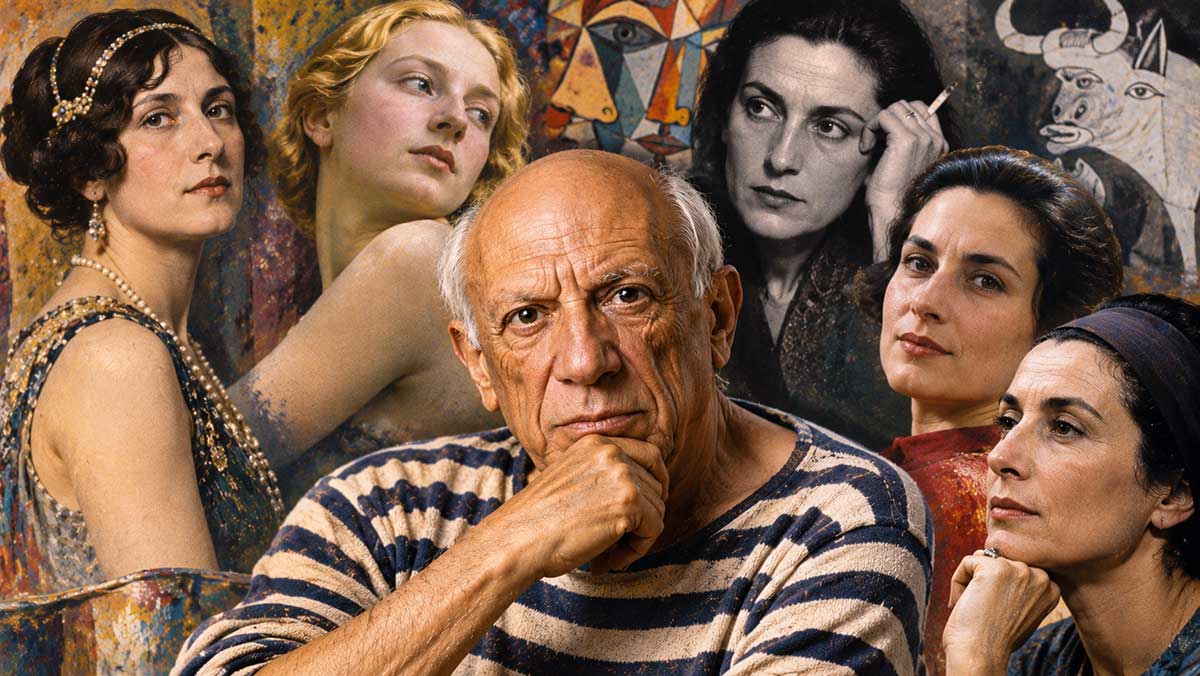
My Five-Year-Old Could Paint That!
Nick Sasaki
Picasso, I've been waiting to ask you something.
And I hope you won't take it personally.
Pablo Picasso
Nick, whenever someone begins with those words, I prepare myself for an insult.
Nick Sasaki
(Laughs.)
Well, you've painted some of the most famous works in history. People travel thousands of miles to see them. Collectors pay extraordinary amounts of money for them.
But I have a confession.
Sometimes I look at one of your Cubist paintings and think, "I could probably paint something like that."
Pablo Picasso
Wonderful!
When will you begin?
Nick Sasaki
That's not exactly the response I expected.
Pablo Picasso
What did you expect? That I would become angry and defend my reputation?
If you believe you can paint something interesting, I encourage you to try.
Nick Sasaki
But you know what people say.
"My five-year-old could paint that!"
Pablo Picasso
Then I would very much like to meet this five-year-old.
Nick Sasaki
(Laughs.)
You wouldn't be offended?
Pablo Picasso
Why should I be offended by a child?
Children make remarkable discoveries before adults teach them what is supposedly impossible.
A child may draw a person with enormous hands, a tiny head, and legs that reach the bottom of the paper.
An adult looks at the drawing and says, "That's wrong."
But perhaps the hands are enormous because the child remembers being held by them.
Perhaps the head is small because the child is thinking about something else.
The drawing may express something that a perfectly proportioned portrait cannot.
Nick Sasaki
That's fascinating.
But there's a difference, isn't there?
A child might draw that way because the child doesn't know how to draw realistically.
You knew how.
Pablo Picasso
Precisely.
Nick Sasaki
So why abandon something you had already learned to do so well?
Pablo Picasso
Nick, suppose you learn to speak English beautifully.
Would you then decide that you must never tell a joke, invent a word, or write poetry?
Nick Sasaki
Of course not.
Pablo Picasso
Learning the rules of a language gives you more possibilities, not fewer.
Painting is similar.
I learned how to represent appearances. Then I began asking what else painting could do.
Nick Sasaki
So you weren't rejecting skill. You were using skill to explore something different.
Pablo Picasso
Yes.
But I would go further.
The greatest danger for an artist is not always a lack of skill.
Sometimes it is becoming so satisfied with skill that curiosity disappears.
What Does a Face Really Look Like?
Nick Sasaki
Let's talk about those unusual faces.
In some of your paintings, one eye faces forward and the other seems to belong to a profile.
A nose points sideways. The mouth looks as though it came from another angle.
What are we supposed to see?
Pablo Picasso
Tell me, Nick. When you look at a person, do you see only one fixed image?
Nick Sasaki
At any particular moment, yes.
Pablo Picasso
But you move.
The person moves.
You remember how that face looked yesterday. You anticipate how it might look tomorrow.
You know the person from many directions.
Why must a painting pretend that only one of those views exists?
Nick Sasaki
So you're trying to combine different viewpoints into one picture?
Pablo Picasso
That is one way of describing part of what we explored.
But it was not simply a trick of placing two views together.
We were questioning how objects could be organized on a flat surface.
A painting is not a window that must imitate the world outside it.
It is an object with its own relationships, tensions, and possibilities.
Nick Sasaki
I understand the idea intellectually.
But sometimes I still look at a painting and think, "That poor woman. What happened to her face?"
Pablo Picasso
(Laughs.)
Perhaps nothing happened to her face.
Perhaps something happened to your expectations.
Nick Sasaki
You really enjoy turning the problem back on the viewer.
Pablo Picasso
Of course. The viewer participates in the painting.
You arrive carrying your memories, your habits, your assumptions.
The painting meets those things.
Sometimes it agrees with them.
Sometimes it refuses.
Nick Sasaki
But shouldn't art communicate?
If someone stands in front of your painting and doesn't understand it, hasn't something gone wrong?
Pablo Picasso
Perhaps.
Or perhaps the person has only just begun looking.
Tell me, when you meet someone for the first time, do you expect to understand that person completely in five seconds?
Nick Sasaki
No.
Pablo Picasso
Then why demand that of a painting?
Nick Sasaki
That's fair.
But if I spend an hour looking at it and still don't understand?
Pablo Picasso
Then you have spent an hour looking.
That is already more attention than most people give anything.
Nick Sasaki
(Laughs.)
You have an answer for everything.
Pablo Picasso
Not everything.
That is why I kept painting.
The Painting That Changed Everything
Nick Sasaki
I want to ask about Les Demoiselles d'Avignon, the painting you completed in 1907.
Five women, sharp angles, distorted bodies, faces that seem almost like masks.
Even today, it can be startling.
What were you trying to accomplish?
Pablo Picasso
I was trying to find a new way of making a painting.
The conventional arrangement of figures and space no longer satisfied me.
I wanted the forms to confront the viewer.
Not simply to sit there waiting to be admired.
Nick Sasaki
Were you trying to shock people?
Pablo Picasso
Shock can be useful, but it is a poor goal by itself.
If you only want to shock people, you eventually become a prisoner of their reactions.
I wanted to discover something.
Nick Sasaki
But the painting was shocking, wasn't it?
Pablo Picasso
Certainly.
Even some people close to me found it difficult.
Nick Sasaki
Did that bother you?
Pablo Picasso
It made me think.
But if everyone immediately agrees with a new idea, perhaps the idea is not as new as you believe.
Nick Sasaki
That's an interesting point.
You were influenced by Iberian sculpture and African art.
What did those traditions reveal to you that European academic painting had not?
Pablo Picasso
They challenged assumptions I had inherited.
European artists often behaved as if their own traditions represented the natural standard for depicting the human body.
But there were other ways of giving a face presence, force, and meaning.
A figure did not have to follow classical proportions to be expressive.
Nick Sasaki
Yet those works came from cultures with their own histories and meanings.
Did you understand those meanings?
Pablo Picasso
Not fully.
I encountered objects that had been separated from much of their original context.
I responded to their forms, but responding to something is not the same as comprehending everything about it.
Nick Sasaki
Do you think artists have a responsibility to acknowledge where their ideas come from?
Pablo Picasso
Yes, influence should not be erased.
But influence is complicated.
Artists learn from other artists, from ancient objects, from the streets, from ordinary things.
The question is whether they create something meaningful from what they encounter.
Nick Sasaki
And whether the people who created those earlier works receive recognition.
Pablo Picasso
That is a fair question, Nick.
Nick Sasaki
I think it matters.
Sometimes history celebrates the person who makes an idea famous more than the people who helped make that idea possible.
Pablo Picasso
History enjoys simple stories.
One genius. One discovery. One extraordinary moment.
The actual process is usually less convenient.
Was Cubism Really Your Invention?
Nick Sasaki
That brings me to Georges Braque.
People often associate Cubism with your name, but he was essential to its development.
How important was he?
Pablo Picasso
Very important.
We worked closely. We examined the same problems, challenged one another, and pushed our experiments further.
For a time, our paintings became remarkably similar.
Nick Sasaki
Was there competition between you?
Pablo Picasso
Naturally.
Competition can sharpen attention.
But there was cooperation, too.
An idea that seems impossible when you are alone can become possible when someone else takes it seriously.
Nick Sasaki
So even Picasso needed another artist.
Pablo Picasso
You sound disappointed again.
Nick Sasaki
(Laughs.)
No, actually I find that encouraging.
People often think creativity means one brilliant person sitting alone and suddenly discovering something nobody else could have imagined.
Pablo Picasso
That makes a convenient legend.
But artists live among other people.
They argue, borrow, reject, imitate, transform.
Cézanne mattered to us. Braque mattered. The art we encountered mattered.
We did not begin with an empty world.
Nick Sasaki
Then let me ask you a slightly dangerous question.
If Braque had never met you, do you think Cubism would still have happened?
Pablo Picasso
Perhaps in a different form.
Nick Sasaki
And if you had never met Braque?
Pablo Picasso
Perhaps my own work would have developed differently.
Nick Sasaki
That's a surprisingly modest answer.
Pablo Picasso
Do not become accustomed to it.
Nick Sasaki
(Laughs.)
I won't.
Is an Expensive Painting a Better Painting?
Nick Sasaki
Let's talk about money.
Some of your paintings have sold for enormous sums.
In 2015, Les Femmes d'Alger (Version O) sold at auction for more than $179 million.
What would you think if you could see that sale?
Pablo Picasso
I would wonder who received the money.
Nick Sasaki
(Laughs.)
Not you, unfortunately.
Pablo Picasso
Then the news is less exciting than you made it sound.
Nick Sasaki
But seriously, does a price like that mean the painting is extraordinarily good?
Pablo Picasso
It means someone was willing to pay an extraordinary amount for it.
Those are not identical statements.
Nick Sasaki
So money doesn't determine artistic value?
Pablo Picasso
Money determines a market price.
Artistic value is a more difficult question.
A collector may pay for beauty, history, rarity, prestige, investment, or the pleasure of possessing something others cannot possess.
Sometimes several of those motives are present at once.
Nick Sasaki
Suppose I show you two paintings.
One is by a famous artist and worth millions.
The other was painted by an unknown child.
And I genuinely prefer the child's painting.
Am I wrong?
Pablo Picasso
Why would you be wrong about what moves you?
Nick Sasaki
But an art expert might tell me the famous painting is objectively superior.
Pablo Picasso
The expert may know things you do not.
That knowledge can deepen your appreciation.
But it cannot force you to feel something you do not feel.
Nick Sasaki
So expertise matters, but personal experience matters too.
Pablo Picasso
Yes.
The mistake is to assume that either one explains everything.
Nick Sasaki
What if someone buys your painting for millions, locks it in a private room, and never looks at it?
Pablo Picasso
Then the painting has become a very expensive prisoner.
Nick Sasaki
(Laughs.)
Would you rather have one painting in a museum where millions can see it, or in a private collection where one wealthy person treasures it?
Pablo Picasso
There is no simple answer.
A private collector may care deeply for a work. A museum can make art accessible to many people.
But I dislike the thought that a painting's greatest achievement is becoming a financial trophy.
Nick Sasaki
Do you think fame ever became a problem for you?
Pablo Picasso
Fame changes how people look at your work.
Before you are famous, they ask whether the painting is good.
After you become famous, some assume it must be good before they have looked at it.
Nick Sasaki
That's almost the opposite of what happened when you were young.
Pablo Picasso
Exactly.
And both situations can prevent people from seeing what is actually there.
How Do You Know When an Experiment Has Failed?
Nick Sasaki
You changed your artistic style many times.
The Blue Period, the Rose Period, Cubism, classical figures, ceramics, sculpture, and so much more.
Why didn't you simply find one successful style and continue with it?
Pablo Picasso
Would you enjoy eating the same dinner every evening for seventy years?
Nick Sasaki
If it were really good sushi, perhaps.
Pablo Picasso
Seventy years?
Nick Sasaki
Well, maybe I'd want some ramen occasionally.
Pablo Picasso
Then you understand.
Nick Sasaki
(Laughs.)
But changing artistic styles is more difficult than changing dinner.
You could have lost your reputation.
Pablo Picasso
Yes.
But what would be the point of having artistic freedom if I became afraid to use it?
Nick Sasaki
Were you ever afraid an experiment would fail?
Pablo Picasso
Of course.
Experimenting means entering territory where you do not already know the answer.
If success is guaranteed, you are probably repeating something familiar.
Nick Sasaki
How did you know whether a painting was a failure or the beginning of something new?
Pablo Picasso
Sometimes I did not know.
A painting might resist me.
I would change something, remove something, begin again.
There are failures that teach you nothing because you have merely been careless.
And there are failures that reveal possibilities you had not considered.
Nick Sasaki
How can someone tell the difference?
Pablo Picasso
By paying attention.
If something goes wrong, ask why.
Was the idea weak? Was the execution poor? Or did something unexpected appear that deserves further exploration?
Nick Sasaki
That reminds me of writing.
Sometimes a story begins in one direction, and then a character says something unexpected. Suddenly the story becomes more interesting than the original plan.
Pablo Picasso
Then you must listen to the character.
Nick Sasaki
But the character isn't real.
Pablo Picasso
Neither is the person in a painted portrait.
Yet both can surprise their creators.
Nick Sasaki
That's a wonderful way to describe creativity.
Pablo Picasso
Creation is not always the execution of a plan.
Sometimes it is a conversation with what you are making.
Can Anyone Become Creative?
Nick Sasaki
I want to ask something for people who don't consider themselves artists.
Many adults say, "I'm not creative."
They think creativity belongs to people like you.
Do you agree?
Pablo Picasso
No.
I think many people have learned to distrust their own imagination.
Nick Sasaki
How does that happen?
Pablo Picasso
A child draws a purple horse.
Someone says horses are not purple.
The child draws a house floating above the clouds.
Someone explains that houses cannot float.
Little by little, the child learns to ask permission from reality before making anything.
Nick Sasaki
But children need to learn what is real.
We can't tell them that houses actually float.
Pablo Picasso
Of course not.
There is a difference between learning how the world works and believing that imagination must obey every ordinary expectation.
You can know that a horse is not purple and still paint one.
Nick Sasaki
So education should teach knowledge without destroying imagination.
Pablo Picasso
That would be a worthy ambition.
Nick Sasaki
Let me challenge you a little.
Some people really are more talented than others.
Not everyone can become Picasso.
Pablo Picasso
I agree.
Nick Sasaki
You do?
Pablo Picasso
Why should everyone become Picasso?
One was quite enough.
Nick Sasaki
(Laughs.)
Fair point.
Pablo Picasso
The purpose of creativity is not to become another person.
It is to discover what you can express, invent, or contribute.
A gardener can be creative.
A cook can be creative.
A person finding a new way to comfort a grieving friend can be creative.
Nick Sasaki
I like that last example.
You're saying creativity isn't limited to making beautiful objects.
Pablo Picasso
Certainly not.
It can appear in the way someone solves a problem, tells a story, arranges a room, or sees an opportunity that others overlook.
Nick Sasaki
Suppose someone listening to us says, "I'm sixty years old. I've never painted. I've never written a story. I don't think I have any creativity."
What would you tell that person?
Pablo Picasso
I would ask a question.
What have you always wanted to try but avoided because you feared being bad at it?
Nick Sasaki
And if the person says painting?
Pablo Picasso
Then paint.
Nick Sasaki
What if the painting looks terrible?
Pablo Picasso
Keep it.
Nick Sasaki
Keep it?
Pablo Picasso
Yes.
Then paint another one.
After twenty paintings, look at the first.
You may discover that you have learned something.
Nick Sasaki
Would you recommend taking lessons?
Pablo Picasso
Certainly, if the person wishes to learn.
Technique is useful.
But do not wait until you possess perfect technique before permitting yourself to enjoy creating something.
Nick Sasaki
What if someone has no idea what to paint?
Pablo Picasso
Paint the room.
Nick Sasaki
Just the room?
Pablo Picasso
Yes.
But do not paint what you think a room is supposed to look like.
Look carefully.
Notice where the light falls. Notice the objects you usually ignore.
Then paint the room again from memory.
You may discover that the second room is different from the first.
Nick Sasaki
That's an interesting exercise.
Pablo Picasso
Then paint the room as it might appear in a dream.
Nick Sasaki
Now we're getting somewhere.
Pablo Picasso
Exactly.
The room has not changed.
Your way of seeing it has.
The Difference Between Seeing and Knowing
Nick Sasaki
There's something I've noticed about your answers.
You keep returning to the idea of seeing differently.
Is that the real secret of your art?
Pablo Picasso
I would hesitate to call it a secret.
People like secrets because they hope someone can reveal them in a sentence.
But learning to see requires attention.
Nick Sasaki
What do you mean by attention?
Pablo Picasso
Look at this cup on the table.
Nick Sasaki
All right.
Pablo Picasso
Describe it.
Nick Sasaki
It's a white coffee cup.
Pablo Picasso
You have told me what you know about it.
Now tell me what you see.
Nick Sasaki
Well, the handle is curved. The rim looks oval from this angle. There's a shadow on the left side.
Pablo Picasso
Continue.
Nick Sasaki
The inside is darker. There's a reflection near the top.
And the handle almost looks like a separate shape attached to the cup.
Pablo Picasso
Better.
Nick Sasaki
So at first I was just labeling it.
Pablo Picasso
Yes.
The mind recognizes an object and quickly decides that the work is finished.
Cup. Chair. Face. Tree.
But the artist asks what is actually present.
Nick Sasaki
I think that happens with people, too.
We meet someone and immediately decide what kind of person they are.
Pablo Picasso
And perhaps we stop looking.
Nick Sasaki
That's interesting.
A person might be much more complicated than the first impression.
Pablo Picasso
Naturally.
Nick Sasaki
Then maybe your distorted portraits are reminding us that no single viewpoint captures an entire person.
Pablo Picasso
That is an interesting interpretation.
Nick Sasaki
You don't sound completely convinced.
Pablo Picasso
I would not want to take away your pleasure of discovering it.
Nick Sasaki
(Laughs.)
You are very good at avoiding direct answers.
Pablo Picasso
And you are becoming very good at asking questions.
When the Artist Becomes the Artwork
Nick Sasaki
Let me ask one final question about your creative freedom.
You became famous for refusing to follow artistic rules.
People admired you for being unpredictable, unconventional, and independent.
Did that freedom ever become part of your identity outside painting?
Pablo Picasso
Of course.
An artist does not leave his personality at the studio door.
Nick Sasaki
But isn't there a danger in that?
If everyone celebrates you for breaking rules, perhaps you begin to believe that rules don't apply to you anywhere.
Pablo Picasso
What kind of rules are you talking about?
Nick Sasaki
Well, in painting, breaking a rule might produce something wonderful.
But in ordinary life, some rules exist to protect other people.
Pablo Picasso
You are changing the subject, Nick.
Nick Sasaki
A little.
Pablo Picasso
I thought we were discussing Cubism.
Nick Sasaki
We were.
But you've spent the last hour explaining why an artist must be free to experiment.
I'm wondering whether that same attitude influenced the way you lived.
Pablo Picasso
Freedom is not a simple matter.
People speak of it as if it were a beautiful object everyone could possess without difficulty.
But one person's freedom can interfere with another person's wishes.
Nick Sasaki
Exactly.
So where do you draw the line?
Pablo Picasso
That depends on what kind of freedom you mean.
The freedom to paint a face differently is not the same as the freedom to make decisions that affect another person's life.
Nick Sasaki
I'm glad you recognize the distinction.
Pablo Picasso
Do not congratulate me too quickly.
You may not like everything I have to say about it.
Nick Sasaki
I suspected that.
Pablo Picasso
You seem to have prepared some uncomfortable questions.
Nick Sasaki
I have.
But before we get there, I want to say something.
When we began this conversation, I thought your unusual paintings were mainly about artistic experimentation.
Now I realize there was a much bigger question behind them.
You were challenging the idea that there is only one correct way to see something.
Pablo Picasso
Yes.
Nick Sasaki
And perhaps that's why your work continues to interest people.
It makes them question their own assumptions.
Pablo Picasso
Perhaps.
But I hope they do more than admire my willingness to question things.
I hope they begin questioning things themselves.
Nick Sasaki
Including you?
Pablo Picasso
Especially me.
Nick Sasaki
(Laughs.)
You may regret saying that.
Pablo Picasso
Why?
Nick Sasaki
Well, we've talked about the women you painted.
But I want to know more about the women themselves.
Your wives, your partners, the mothers of your children.
Some were artists in their own right.
And some of those relationships ended with considerable pain.
Pablo Picasso
(Pauses.)
Yes.
Nick Sasaki
You could look at a face and see possibilities that other artists missed.
But I'm curious whether you always saw the person behind that face.
Pablo Picasso
That is a different question from asking why I put an eye in an unusual place.
Nick Sasaki
It is.
Pablo Picasso
And I suspect it will be considerably harder to answer.
Nick Sasaki
Perhaps.
But I think it's worth asking.
Pablo Picasso
Then ask, Nick.
Let us see whether you are as willing to challenge your assumptions about love as you have been about painting.
Topic 3. Picasso, Did You Really Know How to Love?
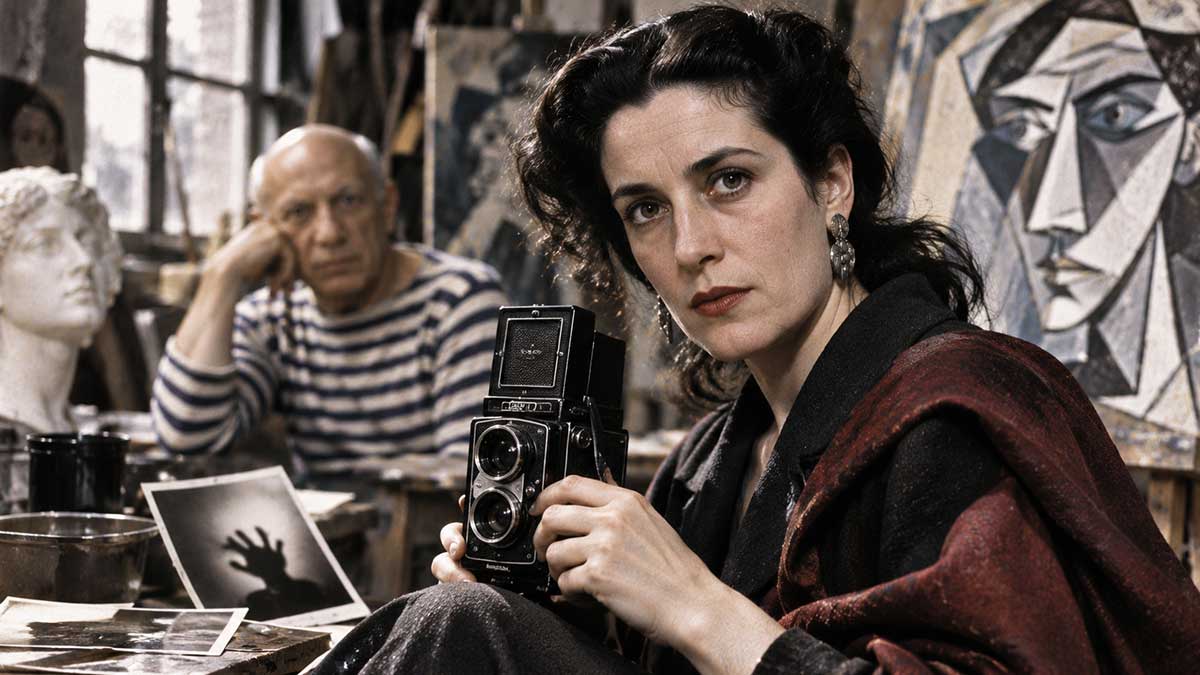
The Women Behind the Paintings
Nick Sasaki
Picasso, at the end of our last conversation, you said I should question my assumptions about love as much as I questioned my assumptions about painting.
I've been thinking about that.
Pablo Picasso
And what have you decided?
Nick Sasaki
That you may be a much more difficult man to interview about love than about Cubism.
Pablo Picasso
(Laughs.)
At least with Cubism, you can point to the painting.
Love is more troublesome. Everyone believes they understand it until another person asks them to explain.
Nick Sasaki
Well, you painted some of the most memorable portraits of women in art history.
But I've been reading about the women themselves, and I discovered that several were accomplished artists, photographers, and independent thinkers.
I wonder whether people sometimes know their faces through your paintings without knowing who they actually were.
Pablo Picasso
That is certainly possible.
A portrait can make a face famous without telling the viewer much about the person.
Nick Sasaki
Isn't that strange?
Someone can look at a painting of Dora Maar and say, "That's a Picasso," without thinking, "Who was Dora Maar?"
Pablo Picasso
Dora was a remarkable woman.
Intelligent. Sharp. A photographer with a distinctive vision.
She could challenge me in ways that were not always comfortable.
Nick Sasaki
Did you enjoy being challenged?
Pablo Picasso
In art, very much.
Nick Sasaki
And in relationships?
Pablo Picasso
(Smiles.)
You have already found the difficulty.
Nick Sasaki
(Laughs.)
I thought I might.
But seriously, did you admire the women in your life for who they were, or did you sometimes see them primarily through what they inspired you to create?
Pablo Picasso
I admired their intelligence, beauty, vitality, and individuality.
But I cannot deny that my work occupied an enormous part of my life.
Everything I experienced could become material for painting.
Nick Sasaki
Including the people you loved.
Pablo Picasso
Yes.
Nick Sasaki
Did they always want to become part of your art?
Pablo Picasso
Not necessarily.
And perhaps I did not always ask that question carefully enough.
Nick Sasaki
That's interesting.
You spent your life trying to see things from multiple perspectives, yet in your personal relationships, perhaps your own perspective sometimes dominated.
Pablo Picasso
That is a clever accusation.
Nick Sasaki
Is it unfair?
Pablo Picasso
Not entirely.
But be careful, Nick. A human relationship cannot be reduced to one person's failure or another person's suffering.
There were moments of affection, laughter, discovery, and tenderness.
Those moments were real, too.
Nick Sasaki
I agree. I don't want to erase the happiness that existed.
But I don't want to erase the pain either.
Pablo Picasso
Then perhaps we can have a worthwhile conversation.
What Was Love to Picasso?
Nick Sasaki
Let me ask the most basic question.
What did love mean to you?
Pablo Picasso
You begin with the most difficult question and call it basic.
Nick Sasaki
(Laughs.)
I suppose that's true.
Pablo Picasso
Love could be an encounter that changed everything.
A person entered your life, and suddenly the world looked different.
Colors seemed more intense. Ordinary moments became extraordinary.
You wanted to be near that person, to understand them, to capture something of their presence.
Nick Sasaki
That sounds beautiful.
Pablo Picasso
It can be.
Nick Sasaki
But that sounds like falling in love.
What happens after the excitement fades?
Pablo Picasso
Then you discover whether something deeper remains.
Nick Sasaki
And did it?
Pablo Picasso
Sometimes.
Sometimes affection remained even when the relationship became difficult.
Sometimes two people wanted very different lives.
Nick Sasaki
I've been married for many years, and I think love changes over time.
At the beginning, there may be excitement and romance.
But later, love becomes something more practical.
Taking care of each other. Being patient. Staying when life becomes difficult.
Did you see love that way?
Pablo Picasso
I understood those things.
Whether I practiced them consistently is another question.
Nick Sasaki
That's a distinction I appreciate.
Pablo Picasso
You see, Nick, it is possible to understand a principle and still fail to live by it.
Nick Sasaki
Very true.
But when that failure hurts someone else, understanding the principle isn't enough.
Pablo Picasso
No.
Nick Sasaki
Did you ever confuse love with inspiration?
Pablo Picasso
Perhaps I sometimes treated the beginning of a relationship as if it promised a new beginning for my entire life.
A new person could awaken a new artistic direction.
But another person cannot exist merely to renew your imagination.
Nick Sasaki
That's an important point.
If you love someone because they make your life exciting, what happens when they stop making it exciting?
Pablo Picasso
Then you face a choice.
You can learn to love the person beyond the excitement.
Or you can begin searching for excitement somewhere else.
Nick Sasaki
And you often chose the second.
Pablo Picasso
More often than I would like to defend.
Olga and the Dream of a Family
Nick Sasaki
Let's talk about Olga Khokhlova.
You met her through the Ballets Russes, married her in 1918, and had your son Paulo in 1921.
What attracted you to her?
Pablo Picasso
Olga was graceful, disciplined, and accustomed to a world different from the one I had known in my younger years.
She had the bearing of a dancer.
I admired her elegance.
Nick Sasaki
Your life changed considerably after the marriage.
You moved into a more comfortable social environment.
Did you enjoy that?
Pablo Picasso
There were pleasures in it.
But I was never entirely comfortable with the idea that an artist should become a respectable ornament of society.
Nick Sasaki
Did Olga want a more conventional marriage?
Pablo Picasso
She wanted stability and recognition as my wife.
I wanted a home, too, but I resisted feeling confined.
Nick Sasaki
That's where I see a contradiction.
You wanted the comfort of family life without always accepting the responsibilities that came with it.
Pablo Picasso
You are describing a contradiction many people have experienced.
Nick Sasaki
Certainly.
But the fact that many people experience it doesn't make it harmless.
Pablo Picasso
No, it does not.
Nick Sasaki
When Paulo was born, did becoming a father change you?
Pablo Picasso
It changed the way I looked at childhood.
I painted him. I watched him grow.
A child brings something into a house that no painting can provide.
Nick Sasaki
What is that?
Pablo Picasso
A life that does not belong to you.
Nick Sasaki
That's a beautiful answer.
But it makes me wonder whether you always remembered it.
Pablo Picasso
You are not going to let me escape easily, are you?
Nick Sasaki
Not on that question.
Marie-Thérèse and the Question of Influence
Nick Sasaki
In 1927, when you were forty-five, you met Marie-Thérèse Walter.
She was seventeen.
I want to ask about that directly.
Pablo Picasso
I expected you would.
Nick Sasaki
From your perspective at the time, what attracted you to her?
Pablo Picasso
Her youth, her vitality, her appearance, the sense of possibility I associated with her.
My paintings from that period reflect the intensity of my fascination.
Nick Sasaki
But you were already a famous, established artist.
She was still a teenager.
That's an enormous difference in age, experience, and influence.
Did you recognize how much influence you had?
Pablo Picasso
I knew I was older and more experienced.
I knew my reputation affected how people approached me.
But recognizing a difference does not necessarily mean understanding all its consequences.
Nick Sasaki
Today, many people would see that relationship as deeply troubling.
And I think they would have good reasons.
Pablo Picasso
I understand why.
Nick Sasaki
Do you think your fame made it easier for you to believe that your desires should determine what happened?
Pablo Picasso
Fame can encourage that illusion.
People make allowances for you.
They excuse behavior they would condemn in someone less celebrated.
Eventually, you may begin making those allowances for yourself.
Nick Sasaki
Did that happen to you?
Pablo Picasso
I would be dishonest if I claimed I was immune to it.
Nick Sasaki
Marie-Thérèse became the subject of some of your most famous paintings.
But she was a real person with her own future.
Did you think enough about what the relationship would mean for her life?
Pablo Picasso
I thought about our relationship, but I cannot claim I always considered her future with the care it deserved.
Nick Sasaki
There's a question I keep coming back to.
When someone has extraordinary talent and fame, people sometimes treat their personal behavior as part of the mythology of genius.
Do you think that is dangerous?
Pablo Picasso
Yes.
A person's talent does not make every desire wise.
Nick Sasaki
And it doesn't make every choice fair.
Pablo Picasso
No.
Nick Sasaki
I'm glad we're able to discuss this.
I don't think it takes anything away from the paintings to ask what happened to the people behind them.
Pablo Picasso
Perhaps it makes the paintings more difficult to look at.
Nick Sasaki
Maybe.
But perhaps it makes our appreciation more complete.
Dora Maar Was More Than a Weeping Woman
Nick Sasaki
Let's talk about Dora Maar.
Many people know her through your paintings, particularly The Weeping Woman.
But she was a talented photographer and artist before she became involved with you.
What impressed you about her?
Pablo Picasso
Her intelligence.
Her photographic eye.
Her ability to see strange and unsettling possibilities in ordinary scenes.
She was not someone who merely admired my work.
She had ideas of her own.
Nick Sasaki
Did you learn from her?
Pablo Picasso
Yes.
She brought her own artistic sensibility into our conversations.
And she documented the development of Guernica, which became an important record of the painting's creation.
Nick Sasaki
Then why do you think so many people know her primarily as your lover or your subject?
Pablo Picasso
My reputation became larger than the lives of many people around me.
History often places a famous name at the center and turns everyone else into supporting characters.
Nick Sasaki
But you benefited from that.
Pablo Picasso
I did.
Nick Sasaki
Did you ever try to change it?
Pablo Picasso
Not enough.
Nick Sasaki
I've always found something troubling about the phrase "Picasso's women."
It makes them sound like a collection.
Almost like paintings hanging in a gallery.
Pablo Picasso
I see what you mean.
Nick Sasaki
They weren't simply yours.
They had their own identities, talents, dreams, and relationships.
Pablo Picasso
Yes.
Nick Sasaki
And some of them suffered deeply.
Pablo Picasso
Yes.
Nick Sasaki
I don't want to make you responsible for every difficulty in another person's life.
But I think the imbalance of influence matters.
Pablo Picasso
It does.
Nick Sasaki
What do you think you misunderstood about Dora?
Pablo Picasso
Perhaps I sometimes mistook emotional intensity for a form of closeness.
Two people can share powerful experiences without truly giving one another the security they need.
Nick Sasaki
That's interesting.
You could create an unforgettable image of someone crying.
But recognizing pain in a painting isn't the same as knowing how to comfort a person who is crying.
Pablo Picasso
No.
It is not.
The Woman Who Walked Away
Nick Sasaki
Françoise Gilot is particularly interesting to me.
She was an artist herself, and she eventually decided to leave you.
How did you respond?
Pablo Picasso
Badly.
Nick Sasaki
That's a short answer.
Pablo Picasso
You asked a short question.
Nick Sasaki
(Laughs.)
Fair enough.
But I want to know why.
Pablo Picasso
I was accustomed to having a great deal of influence over my surroundings.
My studio, my work, my schedule.
I did not always respond well when someone made a decision I could not control.
Nick Sasaki
Was it difficult to accept that she had her own ambitions?
Pablo Picasso
Her ambitions were not the problem by themselves.
She was intelligent, independent, and determined to make her own work.
But independence can become uncomfortable when you have grown accustomed to being the center of a relationship.
Nick Sasaki
That sounds like a very revealing admission.
Pablo Picasso
Do not become too pleased with yourself, Nick.
Nick Sasaki
(Laughs.)
I'm trying not to.
Françoise went on to have a long artistic career.
Her work deserves to be considered independently of yours.
Pablo Picasso
Yes.
Nick Sasaki
Do you think you gave her the freedom you demanded for yourself?
Pablo Picasso
Not consistently.
Nick Sasaki
And isn't that the central problem?
You wanted the freedom to follow your imagination, your desires, and your artistic ambitions.
But the people closest to you needed freedom, too.
Pablo Picasso
Yes, Nick.
But knowing that now does not mean I knew how to live it then.
Nick Sasaki
That's fair.
Still, it seems to me that real love should include wanting the other person to become fully themselves.
Not merely wanting them to remain the person who makes us happy.
Pablo Picasso
That is a demanding definition of love.
Nick Sasaki
Do you disagree?
Pablo Picasso
No.
But I think many people discover how demanding it is only when someone they love chooses a direction they did not expect.
Nick Sasaki
And sometimes the most loving response is to let them go.
Pablo Picasso
Sometimes.
Can a Painting Make Up for Pain?
Nick Sasaki
Let me ask you something that may sound unusual.
You've made people immortal through your paintings.
Marie-Thérèse, Dora, Olga, Françoise, and others remain recognizable to audiences long after their lifetimes.
Does that give them something valuable?
Pablo Picasso
It can preserve an image of them.
It can connect their presence to people who never knew them.
Nick Sasaki
But can that compensate for suffering in real life?
Pablo Picasso
No painting can undo an injury.
Nick Sasaki
That's what I was thinking.
Imagine someone saying, "Yes, he broke my heart, but at least I'm in a famous painting."
That wouldn't necessarily make the pain disappear.
Pablo Picasso
Of course not.
Nick Sasaki
I wonder whether artists sometimes believe that creating something beautiful justifies everything that happened during its creation.
Pablo Picasso
Some may.
And sometimes the artist himself may want to believe it.
Nick Sasaki
Did you?
Pablo Picasso
I devoted so much of myself to painting that I sometimes treated its demands as more urgent than other demands.
That does not mean the other demands ceased to exist.
Nick Sasaki
Could you have produced the same extraordinary art if you had lived a quieter, more faithful, more stable family life?
Pablo Picasso
I cannot know.
Nick Sasaki
That's an answer I respect.
Pablo Picasso
People like to imagine that suffering is the necessary price of great art.
It makes suffering seem meaningful.
But we should be careful.
A painting may emerge from a painful experience without proving that the pain was necessary.
Nick Sasaki
Exactly.
I think that's an important distinction.
We can admire the work without celebrating the suffering that surrounded it.
Picasso the Father
Nick Sasaki
I'd like to move away from romantic relationships for a moment.
You had four children: Paulo, Maya, Claude, and Paloma.
What was it like being their father?
Pablo Picasso
Each child brought a different presence into my life.
Children are endlessly surprising.
They can transform an ordinary afternoon into something memorable.
Nick Sasaki
You painted your children many times.
Some of those portraits are very tender.
Pablo Picasso
I enjoyed watching them.
Their movements, expressions, and games.
A child does not remain still for a painter's convenience.
Nick Sasaki
(Laughs.)
I know something about that. I have five children.
Pablo Picasso
Five?
Nick Sasaki
Yes.
Pablo Picasso
Then perhaps you should be interviewing yourself about patience.
Nick Sasaki
(Laughs.)
You may be right.
But having children has taught me that love isn't always about the wonderful moments.
Sometimes it's about being there when they need you, especially when it's inconvenient.
Pablo Picasso
Yes.
Nick Sasaki
Did your children ever feel that they had to compete with your painting for your attention?
Pablo Picasso
My work occupied an enormous place in my life.
It would be foolish to pretend that it never affected them.
Nick Sasaki
Did you ever worry that being Picasso made it difficult for them simply to be themselves?
Pablo Picasso
A famous parent can cast a long shadow.
A child may be praised because of the parent's name or judged against it.
Neither is entirely fair.
Nick Sasaki
What did your children teach you that painting couldn't?
Pablo Picasso
That you cannot create another person according to your own design.
You can guide a child, encourage them, perhaps frighten them with your expectations.
But they are not a painting.
They will become someone you did not entirely foresee.
Nick Sasaki
That's a beautiful way to put it.
And did you always accept that?
Pablo Picasso
No.
Nick Sasaki
I appreciate that answer.
Sometimes I think the hardest part of being a parent is realizing that your children don't exist to fulfill your dreams.
They have their own lives.
Pablo Picasso
And they may choose lives you do not understand.
Nick Sasaki
Exactly.
Pablo Picasso
Then perhaps parenthood asks for a kind of imagination different from painting.
Nick Sasaki
What kind?
Pablo Picasso
The imagination required to recognize a future that does not belong to you.
What Would You Say to Them Now?
Nick Sasaki
Picasso, I'd like to ask one final question about your relationships.
And I don't want you to feel that you have to give me a beautiful answer.
Pablo Picasso
You are becoming dangerous when you speak so gently.
Nick Sasaki
(Laughs softly.)
Perhaps.
Suppose the women you loved and the children you raised could sit here with us.
Not as characters in your paintings.
Not as part of your legend.
Just as people who knew you.
What would you want them to understand about you?
Pablo Picasso
(Long pause.)
That I was not always the person they saw in newspapers or museums.
That there were moments when I was uncertain, afraid, affectionate, foolish.
That my work did not contain everything I was.
Nick Sasaki
Would you want them to forgive you?
Pablo Picasso
I might hope for forgiveness.
But hope is not a right.
Nick Sasaki
What do you mean?
Pablo Picasso
If you hurt someone, you cannot demand that they forgive you simply because you have become willing to acknowledge the injury.
Their response belongs to them.
Nick Sasaki
That's a thoughtful answer.
Would you apologize?
Pablo Picasso
For particular things, yes.
But I would not want to turn an apology into another performance.
Nick Sasaki
Another performance?
Pablo Picasso
Imagine a famous man making a grand speech about his regrets.
Everyone applauds his honesty.
But the people he hurt are expected to sit quietly and appreciate the beauty of his confession.
That would be another way of placing himself at the center.
Nick Sasaki
I hadn't thought of it that way.
Pablo Picasso
An apology should not become another portrait of the person apologizing.
Nick Sasaki
That's an extraordinary observation.
Pablo Picasso
It is easier to make an observation than to live by it.
Nick Sasaki
You keep returning to that distinction.
Pablo Picasso
Perhaps I should have paid more attention to it.
Nick Sasaki
I want to tell you something.
Before this conversation, I admired your artistic courage.
I admired the way you challenged the rules of painting and refused to limit your imagination.
I still admire those things.
But now I'm thinking about another kind of courage.
The courage to admit that someone else's happiness matters as much as our own.
Pablo Picasso
That kind of courage does not produce a painting you can hang in a museum.
Nick Sasaki
No.
But it may produce a better life.
Pablo Picasso
Perhaps.
Nick Sasaki
Do you think being a great artist made you a great human being?
Pablo Picasso
No.
Being a great artist made me a great artist.
Whatever else I was must be judged separately.
Nick Sasaki
I think that's a fair answer.
And perhaps it's an important lesson for anyone who admires a famous person.
We can appreciate someone's achievements without assuming that every part of their life deserves admiration.
Pablo Picasso
Yes.
But do not make the opposite mistake either.
A person's failures do not automatically erase everything worthwhile they created.
Nick Sasaki
Agreed.
Maybe the difficult part is holding both truths at the same time.
Pablo Picasso
That sounds very much like the problem of painting a face from more than one angle.
Nick Sasaki
(Laughs.)
There you go again, bringing everything back to Cubism.
Pablo Picasso
I told you it was useful.
Nick Sasaki
I suppose it is.
But now I want to ask about another side of your life.
You painted the suffering of individuals during your Blue Period.
And later, you created one of the most famous antiwar paintings in history.
Guernica.
Pablo Picasso
Yes.
Nick Sasaki
When I look at that painting, I see mothers crying, bodies broken, animals screaming.
It makes me wonder whether you believed art could do something that politics and ordinary words could not.
Pablo Picasso
That is a question worth asking.
Nick Sasaki
And I have another one.
If your painting could express the horror of war so vividly, did you believe it could actually help prevent another war?
Pablo Picasso
(Pauses, looking thoughtful.)
Nick, there is a difference between making people see suffering and persuading them to stop causing it.
Nick Sasaki
Then perhaps that's where we should begin our next conversation.
Topic 4. Can Art Change the World?
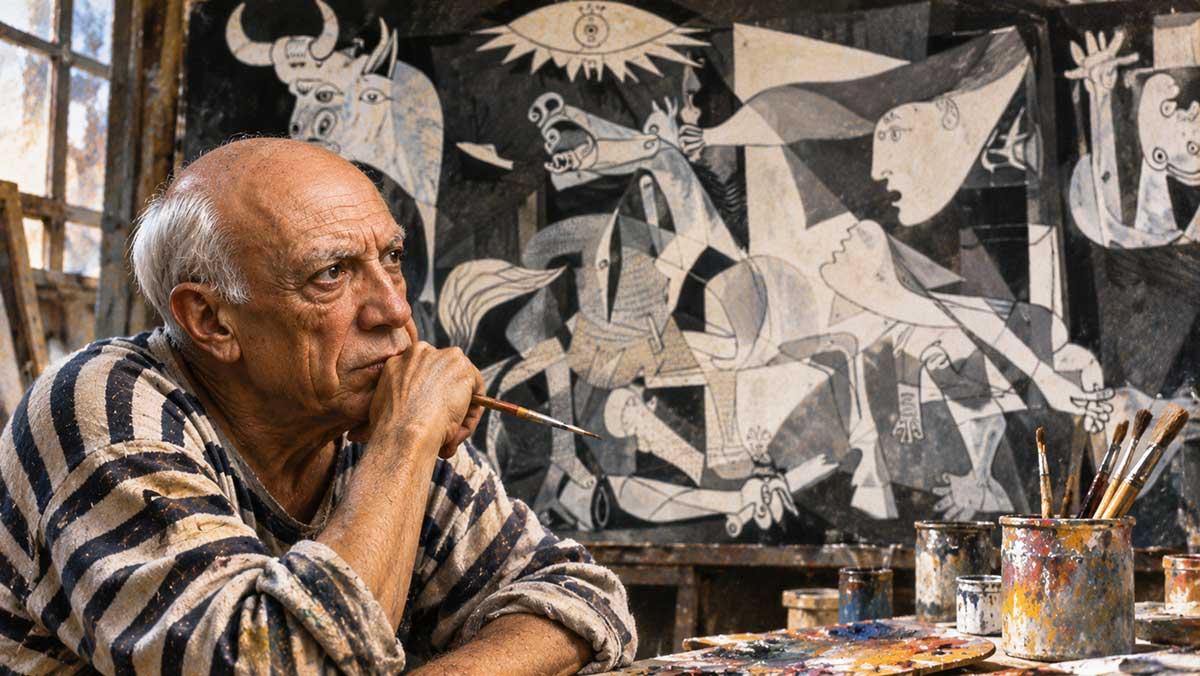
The Painting That Refused to Stay Silent
Nick Sasaki
Picasso, at the end of our last conversation, you said something that stayed with me.
You said there was a difference between making people see suffering and persuading them to stop causing it.
I've been thinking about that ever since.
Pablo Picasso
And have you reached a conclusion?
Nick Sasaki
Not really.
But I keep thinking about Guernica.
I've seen photographs of that painting many times. It's enormous, nearly twenty-six feet wide. Everything seems to be screaming.
The mother holding her dead child. The wounded horse. The broken bodies.
It's not a painting I would want hanging above my dining room table.
Pablo Picasso
(Laughs softly.)
No. I would not recommend it for a pleasant family dinner.
Nick Sasaki
But that's what interests me.
Most people associate art with beauty. Something that makes a room more attractive or gives us pleasure.
Your painting does almost the opposite.
Why would an artist deliberately create something so disturbing?
Pablo Picasso
Perhaps you have already answered your question.
If I had painted a beautiful landscape after hearing about the bombing of a town, what would that have communicated?
Nick Sasaki
That life goes on?
Pablo Picasso
Perhaps.
But I was not interested in comforting people with the appearance of normal life.
Something terrible had happened.
I wanted the painting to confront that reality.
Nick Sasaki
Let's go back to April 1937.
The Spanish Civil War was already underway. Then the town of Gernika was bombed by German and Italian aircraft supporting Franco's forces.
When you learned what had happened, what was your first reaction?
Pablo Picasso
Anger.
And horror at the destruction of ordinary lives.
The people in that town were not abstractions. They had families, homes, work, memories.
Then violence entered their lives from the sky.
Nick Sasaki
You were living in Paris at the time.
You weren't standing in the town when the bombs fell.
Pablo Picasso
No.
I learned about the attack through reports and images.
Nick Sasaki
Did that distance make it difficult to paint?
Pablo Picasso
It created a different responsibility.
I could not pretend I had witnessed what I had not witnessed.
But I could respond to what I learned.
Nick Sasaki
That's interesting.
Today, people see photographs and videos of wars almost instantly.
Sometimes we watch terrible things happening thousands of miles away, then return to eating dinner.
Pablo Picasso
And what do you think that does to people?
Nick Sasaki
I worry that we become accustomed to suffering.
The first time we see something terrible, we're shocked.
After seeing similar images a hundred times, perhaps we stop reacting.
Pablo Picasso
Then the artist faces a difficult problem.
How do you make someone look again at something they believe they have already seen?
Why Not Paint the Bombing Realistically?
Nick Sasaki
That brings me to the painting itself.
Why didn't you simply paint airplanes dropping bombs on the town?
You could have painted burning buildings, wounded civilians, and destroyed streets.
People would immediately understand what happened.
Instead, you gave us a horse, a bull, a grieving mother, and these strange broken figures.
Why?
Pablo Picasso
A photograph can show you the appearance of an event.
Painting can attempt something different.
I wanted to give form to terror, confusion, and anguish.
Nick Sasaki
But why the horse?
Pablo Picasso
Why does the horse trouble you?
Nick Sasaki
It looks as if it's suffering terribly.
Its mouth is open, its body is wounded.
I can almost hear it screaming.
Pablo Picasso
Then perhaps the painting has communicated something before you have identified a precise meaning.
Nick Sasaki
But what does the horse represent?
Spain? The people? Innocence?
Pablo Picasso
People have offered many interpretations.
I would be cautious about reducing every figure to a single explanation.
A horse can be a horse and still carry meanings beyond itself.
Nick Sasaki
And the bull?
Pablo Picasso
Another question that has occupied many viewers.
Nick Sasaki
You're avoiding my question again.
Pablo Picasso
(Laughs.)
Perhaps I am protecting you from an answer that would make the painting smaller.
Nick Sasaki
Smaller?
Pablo Picasso
Suppose I told you that every figure had one fixed meaning.
The horse means this. The bull means that. The lamp means something else.
You would memorize the answers.
Then perhaps you would stop looking.
Nick Sasaki
So you want people to experience the painting rather than solve it like a puzzle.
Pablo Picasso
Yes.
A painting is not necessarily a coded message waiting for someone to discover the correct translation.
Nick Sasaki
But the mother holding her dead child seems unmistakable.
Pablo Picasso
Her grief does not require an explanation.
Nick Sasaki
That image affects me more than anything else.
Perhaps it's the parent in me.
When I look at her face, I think about what it would mean to lose a child.
Pablo Picasso
And that thought belongs to your experience, Nick.
You bring your own life to the painting.
Nick Sasaki
So another person might look at the same image and feel something different.
Pablo Picasso
Certainly.
But the possibility of different interpretations does not mean that the suffering is meaningless.
Dora Maar and the Making of Guernica
Nick Sasaki
There's another part of this story that fascinates me.
Dora Maar photographed the painting as you worked on it.
So we can actually see how Guernica developed.
Pablo Picasso
Yes.
Her photographs became an important record of the process.
Nick Sasaki
Did you know from the beginning exactly what the finished painting would look like?
Pablo Picasso
No.
I had ideas, sketches, forms I wanted to explore.
But a large painting changes as you work.
Figures move. Relationships shift. Something that seemed necessary in the morning may become impossible by evening.
Nick Sasaki
So even a painting as famous as Guernica wasn't simply a perfect image that appeared in your mind.
Pablo Picasso
Of course not.
You have a strange admiration for the idea that artists should know everything before they begin.
Nick Sasaki
(Laughs.)
I suppose I do.
I sometimes think a genius must see the entire masterpiece before touching the canvas.
Pablo Picasso
Then you are imagining a magician, not a painter.
Nick Sasaki
Fair enough.
What did Dora contribute beyond photographing the work?
Pablo Picasso
She was an artist with her own ideas and judgment.
We discussed art and politics. Her presence was part of the environment in which the painting developed.
Nick Sasaki
I appreciate you acknowledging that.
We talked earlier about how women around famous artists can disappear into the background of history.
Without Dora's photographs, we would know much less about how Guernica changed during its creation.
Pablo Picasso
That is true.
Nick Sasaki
And there's something interesting about those photographs.
They show that a painting about destruction was itself created through many changes.
You kept revising it.
Pablo Picasso
Creation often requires destruction.
You remove what you have made. You paint over something. You abandon a figure.
Nick Sasaki
But destroying part of a painting is different from destroying a human life.
Pablo Picasso
Entirely different.
One is a choice made within a work.
The other may take away everything a person could have become.
Can One Painting Stop a War?
Nick Sasaki
Now I want to ask the question that troubles me most.
Guernica became one of the most famous antiwar paintings in history.
Millions of people have seen it.
But wars continued.
World War II came. Other wars followed. And even today, people continue killing one another.
So what did the painting actually accomplish?
Pablo Picasso
What do you think it should have accomplished?
Nick Sasaki
Ideally, I would like people to see it and say, "We must never allow this to happen again."
And then actually do something to prevent it.
Pablo Picasso
That is a great deal to ask of a painting.
Nick Sasaki
But isn't that what gives political art its purpose?
To change something?
Pablo Picasso
Art can contribute to change.
But it cannot substitute for laws, diplomacy, courage, institutions, or the decisions of ordinary people.
Nick Sasaki
Then perhaps its influence is limited.
Pablo Picasso
Of course it is limited.
Everything human is limited.
A painting cannot command an army to stop fighting.
It cannot force a government to negotiate.
It cannot bring a dead child back to life.
Nick Sasaki
Then why make it?
Pablo Picasso
Why tell the truth about something terrible if telling the truth cannot immediately end it?
Nick Sasaki
Because the truth still matters.
Pablo Picasso
Exactly.
And because people must decide what they will do with what they know.
Nick Sasaki
So the painting is a kind of witness.
Pablo Picasso
That is one way to think about it.
It refuses to let an event disappear into silence.
Nick Sasaki
But what if people admire the painting without changing their behavior?
They visit the museum, take photographs, say how moving it is, and then go home.
Pablo Picasso
Then perhaps they have encountered the painting without allowing it to disturb their lives.
Nick Sasaki
Does that disappoint you?
Pablo Picasso
It would be foolish to believe that every person who sees a painting will become morally transformed.
But some may begin asking questions they had not asked before.
Nick Sasaki
Is that enough?
Pablo Picasso
Enough for what?
Nick Sasaki
Enough to justify calling it an important contribution to humanity.
Pablo Picasso
Nick, if you demand that a work of art eliminate the evil it depicts, you will condemn nearly every work of art ever made.
Nick Sasaki
That's a fair criticism.
Pablo Picasso
A painting can open a door.
It cannot force someone to walk through it.
What Would You Paint Today?
Nick Sasaki
Suppose you were alive today.
You see images of destroyed cities, frightened children, families fleeing their homes.
Would you paint another Guernica?
Pablo Picasso
I would hope to create something that responded honestly to what I saw.
But I would not simply repeat Guernica.
Nick Sasaki
Why not?
Pablo Picasso
Because repeating a successful image is not necessarily the same as responding to a new reality.
Nick Sasaki
What if the new reality is essentially the same?
War. Death. Fear.
Pablo Picasso
The suffering may resemble earlier suffering.
But the circumstances, people, and forms of communication change.
An artist must look at what is actually happening.
Nick Sasaki
Today, an artist can reach millions of people through the internet.
A painting can be shared around the world in seconds.
Would that excite you?
Pablo Picasso
It might.
But I would ask whether being seen by millions is the same as being understood by millions.
Nick Sasaki
Probably not.
Pablo Picasso
Then the problem remains.
Nick Sasaki
There's another problem.
Images of suffering can become entertainment.
People scroll through them, argue about them, and sometimes use them to attack one another.
Pablo Picasso
Then perhaps the question is not simply how to produce more images.
It is how to help people look with greater seriousness.
Nick Sasaki
Do you think artists should show the most disturbing details of war?
Pablo Picasso
Not necessarily.
There is a difference between revealing suffering and exploiting it.
Nick Sasaki
How would you distinguish them?
Pablo Picasso
I would ask what the artist wants from the viewer.
Is the work inviting attention to human suffering?
Or is it using suffering merely to produce excitement, admiration, or publicity?
Nick Sasaki
That's a difficult distinction.
Pablo Picasso
Yes.
And an artist can deceive himself about his own motives.
The Dove of Peace
Nick Sasaki
I find another part of your career interesting.
You created Guernica, one of the most disturbing images of war.
But you became famous for something much simpler, too.
A dove.
Pablo Picasso
Yes.
Nick Sasaki
A white dove became associated with international peace movements.
It's almost the opposite of Guernica.
One image shows suffering and destruction.
The other suggests gentleness and hope.
Which do you think is more effective?
Pablo Picasso
They do different things.
Nick Sasaki
But if your goal is peace, wouldn't the dove be more inviting?
Pablo Picasso
Perhaps.
A symbol of peace can unite people around a hope they share.
But a symbol can become empty if people forget what makes peace necessary.
Nick Sasaki
So the dove needs Guernica?
Pablo Picasso
Not literally.
But hope becomes shallow when it refuses to acknowledge suffering.
Nick Sasaki
That's interesting.
And suffering can become overwhelming if there's no hope.
Pablo Picasso
Yes.
Nick Sasaki
I sometimes wonder whether humanity has spent too much time focusing on the differences between people.
Countries, religions, races, political beliefs.
We create these categories, then begin treating people outside our own group as strangers.
Pablo Picasso
People have always created identities.
Some provide belonging and meaning.
Others become excuses for domination.
Nick Sasaki
Do you think art can help people see beyond those divisions?
Pablo Picasso
Sometimes.
A person may stand before a painting made by someone from another country, another century, another culture, and feel something familiar.
Grief. Joy. Fear. Desire.
That recognition can matter.
Nick Sasaki
But recognition doesn't automatically create peace.
Pablo Picasso
No.
You keep hoping I will give you a simple answer.
Nick Sasaki
(Laughs.)
I suppose I do.
Pablo Picasso
And I keep disappointing you.
Nick Sasaki
Actually, I think I'm learning more from the difficult answers.
Why Did You Join the Communist Party?
Nick Sasaki
Let's talk about politics.
You joined the French Communist Party in 1944.
Why?
Pablo Picasso
I had lived through the Spanish Civil War and the occupation of France.
I opposed fascism.
I believed political solidarity could be a way of acting on convictions that painting alone could not fulfill.
Nick Sasaki
Did you believe communism could create a more just society?
Pablo Picasso
I was attracted to ideals of equality, solidarity, and resistance to oppression.
Nick Sasaki
But communist governments committed terrible abuses, too.
Political repression, imprisonment, and violence against their own citizens.
How do you reconcile that with your opposition to oppression?
Pablo Picasso
That is a serious challenge.
One cannot defend every act committed in the name of an ideal simply by pointing to the ideal itself.
Nick Sasaki
Then shouldn't an artist be willing to criticize the political movement he supports?
Pablo Picasso
Yes.
Nick Sasaki
Did you always do that?
Pablo Picasso
No.
My political judgments were not beyond criticism.
Nick Sasaki
I appreciate that answer.
But I want to push a little further.
If an artist condemns violence committed by one government but remains quiet about similar violence committed by another government he supports, isn't that a contradiction?
Pablo Picasso
It can be.
Nick Sasaki
And isn't that dangerous?
Pablo Picasso
Yes.
Political loyalty can make people selective about what they are willing to see.
Nick Sasaki
That seems especially dangerous for an artist whose entire career was built on seeing differently.
Pablo Picasso
You have found another contradiction in my life.
Nick Sasaki
I'm not trying to collect them.
Pablo Picasso
(Laughs.)
You are doing a remarkably good job for someone who claims otherwise.
Nick Sasaki
Perhaps.
But I think this matters.
You taught people to question appearances in art.
Shouldn't we question our political beliefs with the same willingness?
Pablo Picasso
We should.
But human beings are often less courageous when questioning the beliefs that give them a sense of belonging.
Nick Sasaki
That's true.
Sometimes we are very good at identifying the mistakes of our opponents and very poor at recognizing our own.
Pablo Picasso
Then perhaps you have discovered a problem that no political party has solved.
When Art Becomes Propaganda
Nick Sasaki
Let me ask you about propaganda.
Suppose a government offers you a large amount of money to create a painting celebrating a war you believe is unjust.
Would you accept?
Pablo Picasso
No.
Nick Sasaki
That was quick.
Pablo Picasso
You finally asked a question with a short answer.
Nick Sasaki
(Laughs.)
But what if the government supports causes you believe in?
Would you be comfortable creating art for its political campaign?
Pablo Picasso
That would depend on what I was being asked to communicate.
Nick Sasaki
What's the difference between political art and propaganda?
Pablo Picasso
Political art can challenge people to think.
Propaganda often tries to direct them toward a predetermined conclusion.
Nick Sasaki
But Guernica clearly expresses opposition to violence.
Isn't that a predetermined position?
Pablo Picasso
A work can take a position without pretending that every question has been answered.
Nick Sasaki
So you don't think neutrality is necessary for great art.
Pablo Picasso
No.
An artist is a human being living in society.
We have experiences, loyalties, fears, and convictions.
Pretending to have none of them would not automatically make us more truthful.
Nick Sasaki
But there's a danger that political commitment can limit artistic freedom.
Pablo Picasso
Certainly.
If someone begins dictating what an artist must produce, the artist's freedom is threatened.
Nick Sasaki
Then there's another contradiction.
You wanted art to influence politics, but you didn't want politics to control art.
Pablo Picasso
That tension is real.
Nick Sasaki
How did you resolve it?
Pablo Picasso
Not perfectly.
Nick Sasaki
I think that may be the most useful answer you've given me about politics.
Pablo Picasso
You are becoming suspiciously pleased whenever I admit imperfection.
Nick Sasaki
(Laughs.)
Maybe it's reassuring to discover that even Picasso didn't have all the answers.
Does an Artist Have a Duty to Speak?
Nick Sasaki
Here's a question I've been thinking about.
When terrible things happen in the world, does an artist have a responsibility to respond?
Pablo Picasso
Not every artist must respond in the same way.
Nick Sasaki
But should they respond somehow?
Pablo Picasso
An artist must decide what can be expressed honestly through the work.
Silence may be cowardice in one situation and thoughtful restraint in another.
Nick Sasaki
Suppose a painter says, "I don't want to deal with politics. I only want to paint flowers."
Is that selfish?
Pablo Picasso
Not necessarily.
A painting of flowers may give someone a moment of peace in a terrible world.
Why should that be worthless?
Nick Sasaki
That's a generous answer.
Pablo Picasso
Do not sound so surprised.
Nick Sasaki
(Laughs.)
I just expected you to insist that artists should confront injustice.
Pablo Picasso
I believe artists can confront injustice.
But art is diminished when every artist is ordered to perform the same duty.
Nick Sasaki
What about someone who creates beautiful art but supports terrible ideas?
Pablo Picasso
Then we must confront the difficult fact that artistic ability and moral judgment are not the same thing.
Nick Sasaki
We discussed something similar when we talked about your personal life.
Pablo Picasso
Yes.
Nick Sasaki
It seems that being talented doesn't automatically make someone wise, compassionate, or morally responsible.
Pablo Picasso
No.
Nick Sasaki
Then perhaps society makes a mistake when we treat great artists as authorities on everything.
Pablo Picasso
A serious mistake.
A painter may understand color and form exceptionally well and still misunderstand politics, relationships, or ordinary human needs.
Nick Sasaki
Including you?
Pablo Picasso
Including me.
What Can Art Leave Behind?
Nick Sasaki
I'd like to return to Guernica one last time.
Suppose a young person visits the museum a hundred years from now.
They know almost nothing about the Spanish Civil War.
They stand in front of your painting.
What would you hope happens?
Pablo Picasso
I would hope they look carefully.
That they recognize suffering.
That they become curious about the people and events behind the painting.
Nick Sasaki
Would you want them to feel angry?
Pablo Picasso
Perhaps.
But anger alone is not enough.
Nick Sasaki
Why not?
Pablo Picasso
Anger can awaken attention.
It can lead someone to resist injustice.
But it can become destructive when it is separated from thought and responsibility.
Nick Sasaki
So what would you want beyond anger?
Pablo Picasso
A refusal to become indifferent.
Nick Sasaki
I like that.
A refusal to become indifferent.
Pablo Picasso
Indifference allows suffering to become someone else's problem.
Nick Sasaki
And perhaps that's one of the reasons wars continue.
People care deeply about their own families, their own communities, their own countries.
But they don't always extend that concern to people they don't know.
Pablo Picasso
Yes.
And sometimes leaders encourage people to see strangers as threats rather than human beings.
Nick Sasaki
Do you think an artist can change that?
Pablo Picasso
An artist may help someone recognize a stranger's humanity.
But what that person does with the recognition remains their choice.
Nick Sasaki
You know, Picasso, when I first saw Guernica, I thought it was a painting about the Spanish Civil War.
Now I'm beginning to see it as something broader.
It's about what happens when human beings forget the humanity of other human beings.
Pablo Picasso
That is one way the painting can continue to speak beyond the event that inspired it.
Nick Sasaki
And perhaps that's why it remains relevant.
Not because history repeats itself in exactly the same way, but because human beings continue facing similar moral choices.
Pablo Picasso
Yes.
Nick Sasaki
Still, I wish paintings could do more.
I wish someone could create one extraordinary image that would finally convince humanity to stop fighting.
Pablo Picasso
And I wish a painter could live forever simply by painting himself young.
Nick Sasaki
(Laughs.)
That would be convenient.
Pablo Picasso
But wishing does not make it so.
Nick Sasaki
No.
Pablo Picasso
Perhaps art matters partly because it reminds us of what we cannot control.
We cannot prevent every tragedy.
We cannot preserve every life.
We cannot force every person to see what we see.
But we can still create something that bears witness to our time.
Nick Sasaki
And perhaps inspires someone else to act.
Pablo Picasso
Perhaps.
The Man Behind the Masterpiece
Nick Sasaki
There's something I want to ask before we move on.
You've spent your life making paintings that people will remember long after you're gone.
Guernica alone may continue affecting people for centuries.
Does that give you a sense of satisfaction?
Pablo Picasso
It gives me satisfaction to know that the work continues to be seen.
Nick Sasaki
But is being remembered the same as being happy?
Pablo Picasso
No.
Nick Sasaki
I wonder about that.
You achieved something almost every artist dreams of.
Worldwide recognition. Financial success. The freedom to create. A place in history.
Yet we've talked about grief, difficult relationships, political contradictions, and people you may have hurt.
When you look at all of it together, do you think you lived a happy life?
Pablo Picasso
You have moved from asking whether a painting can save the world to asking whether its painter could save himself.
Nick Sasaki
I suppose I have.
Pablo Picasso
Those are very different questions.
Nick Sasaki
But perhaps they're connected.
You created extraordinary works about human suffering.
You spent decades exploring what it means to see.
And now I'm curious about what you saw when you looked at your own life.
Pablo Picasso
That may be the most difficult subject of all.
Nick Sasaki
Why?
Pablo Picasso
When you paint another person, you can step away from the canvas.
When you examine your own life, you cannot step outside it so easily.
Nick Sasaki
But now, looking back on ninety-one years, perhaps you have a different perspective.
Pablo Picasso
Perhaps.
Nick Sasaki
Then I'd like to ask about the things that mattered to you when the paintings were finished.
The moments when you weren't Picasso the genius, Picasso the revolutionary, or Picasso the famous artist.
Just Pablo.
Pablo Picasso
(Smiles faintly.)
That is a person I have not always found easy to recognize.
Nick Sasaki
Then perhaps we can try to meet him.
Pablo Picasso
Very well, Nick.
But I warn you, he may be less impressive than the paintings.
Nick Sasaki
That's perfectly fine.
I'm not looking for another masterpiece.
I'm hoping to meet the man who made them.
Topic 5. Was Being Picasso Worth the Price?
When the World Knows Your Name
Nick Sasaki
Picasso, we've talked about your childhood, your paintings, the people you loved, and the wars that shaped your life.
But there's something I still don't know.
Were you happy?
Pablo Picasso
(Laughs softly.)
Nick, you have spent hours asking me difficult questions, and now you ask the most difficult one as though you were asking whether I enjoyed my breakfast.
Nick Sasaki
Well, I thought I'd start with something simple.
Pablo Picasso
Happiness is not simple.
Nick Sasaki
You became one of the most famous artists who ever lived.
You had money, recognition, beautiful homes, and the freedom to create almost anything you wanted.
Most people would consider that an extraordinary success.
But did it make you happy?
Pablo Picasso
At times, enormously.
There were mornings when I entered the studio and felt an excitement I cannot easily describe.
A canvas waited for me.
I had an idea, or perhaps only the beginning of one.
And for several hours, nothing seemed more important than discovering what might happen.
Nick Sasaki
So your happiest moments were when you were painting?
Pablo Picasso
Some of them.
But I also remember meals with friends, conversations that lasted late into the night, the laughter of children, the warmth of the sun.
Do not imagine that I spent ninety-one years staring at a canvas.
Nick Sasaki
(Laughs.)
I wasn't going to.
But it's interesting that when I ask about happiness, you don't immediately mention fame or money.
Pablo Picasso
Why should I?
Money can remove certain difficulties.
Fame can open doors.
But neither can guarantee that you will enjoy the life waiting on the other side.
Nick Sasaki
Did you discover that only after becoming wealthy?
Pablo Picasso
I understood parts of it when I was poor.
But poverty can make wealth appear more magical than it is.
When you cannot pay the rent, you imagine that having money will solve everything.
Then you obtain money and discover that certain problems have followed you into the larger house.
Nick Sasaki
What kinds of problems?
Pablo Picasso
Fear. Jealousy. Restlessness. The difficulty of living with other people.
And the difficulty of living with yourself.
Nick Sasaki
Did fame make those problems worse?
Pablo Picasso
Sometimes.
When people admire you, they may hesitate to disagree with you.
They laugh at jokes that are not funny.
They praise work they have barely examined.
They tell you that your instincts are extraordinary.
Nick Sasaki
That sounds pleasant at first.
Pablo Picasso
Of course.
Flattery is most dangerous when it is enjoyable.
Nick Sasaki
(Laughs.)
That's a good observation.
Pablo Picasso
But after a while, you may begin wondering whether people are responding to you or to the name they recognize.
Nick Sasaki
Did you ever miss being unknown?
Pablo Picasso
There were freedoms in obscurity.
You could enter a café without everyone expecting something remarkable.
You could make an unsuccessful painting without the world declaring it an important stage in your artistic development.
Nick Sasaki
(Laughs.)
So even your mistakes became valuable?
Pablo Picasso
Sometimes people were willing to pay for them.
Nick Sasaki
That's a rather nice problem to have.
Pablo Picasso
It is a profitable problem.
That does not make it an interesting artistic one.
The Ordinary Day He Would Live Again
Nick Sasaki
Let me ask you something unusual.
Suppose you could return to one ordinary day from your life.
Not a famous exhibition. Not the day you completed a masterpiece.
Just one day.
Which would you choose?
Pablo Picasso
Only one?
Nick Sasaki
Only one.
Pablo Picasso
You are a cruel man, Nick.
Nick Sasaki
(Laughs.)
I'm giving you an entire day!
Pablo Picasso
And taking away thousands of others.
Nick Sasaki
Fair point.
But try.
Pablo Picasso
Perhaps a day in my childhood in Málaga.
The sunlight entering the house.
My father's drawing materials.
The sound of people moving through the rooms.
A day before I understood how much the world could change.
Nick Sasaki
That's interesting.
I expected you to choose a day in Paris, surrounded by artists and beautiful women.
Pablo Picasso
Perhaps I would choose that tomorrow.
Nick Sasaki
(Laughs.)
But why childhood?
Pablo Picasso
There is a particular freedom in being young enough that your future has not yet become a story.
You do not know what you will achieve.
You do not know whom you will lose.
You do not know which decisions you will wish you had made differently.
Nick Sasaki
Would you want to know the future?
If someone had told the young Picasso everything that would happen, would that have helped him?
Pablo Picasso
It might have frightened him.
Or made him arrogant.
Perhaps both.
Nick Sasaki
Would you tell him that he would become one of the greatest artists in history?
Pablo Picasso
No.
Nick Sasaki
Why not?
Pablo Picasso
He might stop working.
Nick Sasaki
(Laughs.)
Or become even more ambitious.
Pablo Picasso
That is possible.
But I would rather he remain curious than become obsessed with fulfilling a prediction.
Nick Sasaki
So you wouldn't tell him about the fame.
Would you warn him about the people he would hurt?
Pablo Picasso
(Pauses.)
That would be harder to keep from him.
Nick Sasaki
Would he listen?
Pablo Picasso
I doubt it.
Nick Sasaki
You don't have much confidence in your younger self.
Pablo Picasso
I know him too well.
The Prisoner of His Own Legend
Nick Sasaki
There's something I find fascinating about your reputation.
People call you a genius.
They talk about your extraordinary creativity, your influence, your paintings.
But sometimes I wonder whether the word genius prevents us from seeing the actual person.
Pablo Picasso
It often does.
Nick Sasaki
How?
Pablo Picasso
A genius is expected to be exceptional in everything.
People assume that if you can create extraordinary paintings, you must possess extraordinary wisdom about life.
But painting and living are different activities.
Nick Sasaki
You said something similar when we discussed politics.
Pablo Picasso
And it remains true.
Nick Sasaki
Did you ever begin believing your own legend?
Pablo Picasso
Certainly.
A person would have to be unusually disciplined to hear praise for decades without being affected by it.
Nick Sasaki
Did it make you arrogant?
Pablo Picasso
I was capable of arrogance before I became famous.
Fame simply gave it more opportunities.
Nick Sasaki
(Laughs.)
That's refreshingly direct.
Pablo Picasso
Do not expect it to continue indefinitely.
Nick Sasaki
I won't.
But here's what interests me.
You were celebrated for breaking artistic rules.
You could paint a face however you wished, and people admired you for it.
Yet in life, other people had to live with the consequences of your choices.
Do you think your reputation sometimes protected you from criticism you deserved?
Pablo Picasso
Yes.
But it also attracted criticism that was not always fair.
Nick Sasaki
So you experienced both.
Pablo Picasso
Of course.
A famous person can become an object of worship or an object of resentment.
Neither reaction requires much knowledge of the person.
Nick Sasaki
Then how would you want people to judge you?
Pablo Picasso
Look at the work carefully.
Look at the life honestly.
Do not pretend that one explains everything about the other.
Nick Sasaki
Would you rather be remembered as a great artist or a good human being?
Pablo Picasso
You are asking me to choose between two things that should not have to compete.
Nick Sasaki
But suppose you had to choose.
Pablo Picasso
Then I would ask why you insist on making the choice so simple.
Nick Sasaki
(Laughs.)
You're refusing again.
Pablo Picasso
Perhaps.
But consider this.
If I said I wanted to be remembered as a good man, would that make me one?
Nick Sasaki
No.
Pablo Picasso
And if I said I cared only about my paintings, would that erase the human relationships that shaped my life?
Nick Sasaki
No.
Pablo Picasso
Then perhaps the question reveals more about the difficulty of judgment than about my preference.
Nick Sasaki
I can accept that.
But I still think the question matters.
Pablo Picasso
Then keep asking it.
Just do not expect every meaningful question to produce a convenient answer.
The Last Years in the Studio
Nick Sasaki
You continued creating art into your nineties.
That's extraordinary.
What kept you going?
Pablo Picasso
The work was not finished.
Nick Sasaki
But you had already created thousands of paintings, drawings, sculptures, and ceramics.
You could have retired.
Pablo Picasso
Retired from what?
Nick Sasaki
Painting.
Pablo Picasso
And done what instead?
Nick Sasaki
Travel. Relax. Enjoy your garden.
Pablo Picasso
I could enjoy a garden and still paint.
Nick Sasaki
(Laughs.)
Fair enough.
But didn't you ever get tired?
Pablo Picasso
My body grew tired.
My hands were not always as obedient as they had been.
But curiosity did not disappear simply because I grew old.
Nick Sasaki
Did you feel the same excitement at ninety that you felt at twenty?
Pablo Picasso
Not exactly the same.
At twenty, there was excitement in discovering what I might become.
At ninety, there was excitement in discovering what I could still do.
Nick Sasaki
That's a wonderful distinction.
Pablo Picasso
There is something interesting about old age.
You know that your time is limited.
But you may still wake up with more ideas than you can possibly complete.
Nick Sasaki
Did that frustrate you?
Pablo Picasso
Sometimes.
Nick Sasaki
Were you afraid of running out of time?
Pablo Picasso
I disliked the thought of leaving work undone.
Nick Sasaki
That's different from being afraid of death.
Pablo Picasso
Perhaps the two fears sometimes meet.
Nick Sasaki
Did you ever look at a blank canvas and think, "This may be one of my last paintings"?
Pablo Picasso
In old age, such a thought becomes difficult to avoid.
But if you allow it to dominate every moment, you may spend more time contemplating the end than doing the work in front of you.
Nick Sasaki
So you kept creating.
Pablo Picasso
Yes.
Nick Sasaki
Did you ever feel that your best work was behind you?
Pablo Picasso
Other people were eager to tell me that.
Nick Sasaki
(Laughs.)
And what did you think?
Pablo Picasso
I thought they were entitled to their opinions.
But I was still entitled to paint.
Nick Sasaki
Some critics considered your late works less disciplined or less significant than your earlier masterpieces.
Did that bother you?
Pablo Picasso
An artist who has been praised for changing styles should not be surprised when people dislike another change.
Nick Sasaki
So you never wanted to repeat your greatest successes?
Pablo Picasso
Why spend the end of my life imitating the younger Picasso?
He had already made those paintings.
Nick Sasaki
That's an interesting way to think about aging.
Many people spend their later years wishing they could become young again.
Pablo Picasso
Youth has its advantages.
But I would not want to surrender everything I had learned merely to recover a younger body.
Nick Sasaki
What had you learned that mattered most?
Pablo Picasso
That seeing is never finished.
Nick Sasaki
After all those years?
Pablo Picasso
Especially after all those years.
What Should Never Change?
Nick Sasaki
Your career was built on change.
You changed styles, materials, subjects, and techniques.
But was there anything you came to believe should never change?
Pablo Picasso
The need to remain curious.
Nick Sasaki
Even at ninety-one?
Pablo Picasso
Why should curiosity have an expiration date?
Nick Sasaki
(Laughs.)
It shouldn't.
But people often become set in their ways as they grow older.
They stop trying new things.
Pablo Picasso
Sometimes they are tired.
Sometimes they are afraid of embarrassment.
Sometimes they have decided that experience gives them permission to stop questioning themselves.
Nick Sasaki
Did you ever become set in your ways?
Pablo Picasso
Certainly.
Nick Sasaki
In what areas?
Pablo Picasso
My habits. My preferences. My expectations of people.
You must not confuse artistic experimentation with perfect openness in every part of life.
Nick Sasaki
That's a revealing distinction.
You could be revolutionary in painting and stubborn in relationships.
Pablo Picasso
Yes.
Nick Sasaki
Do you think that's common among creative people?
Pablo Picasso
I think it is common among human beings.
People can be courageous in one area and fearful in another.
A person may challenge the entire artistic establishment but become furious when someone moves his favorite chair.
Nick Sasaki
(Laughs.)
Did someone move your favorite chair?
Pablo Picasso
I refuse to discuss the chair.
Nick Sasaki
Now I'm convinced there was a chair.
Pablo Picasso
Nick, you have discovered the great scandal of my artistic career.
Nick Sasaki
(Laughs.)
Perhaps we'll save that for another interview.
What Happens After Death?
Nick Sasaki
Picasso, I'd like to ask something more personal.
You're looking back on ninety-one years of life.
You know that your paintings will continue existing after you're gone.
But what about you?
Did you ever wonder what happens to a person after death?
Pablo Picasso
Of course.
Death becomes a different kind of question when it is no longer something that happens only to other people.
Nick Sasaki
Did you believe in an afterlife?
Pablo Picasso
I would not claim certainty about something I could not establish.
I grew up surrounded by religious traditions, symbols, and stories.
Those things became part of my visual imagination.
But artistic fascination with religion is not the same as possessing a settled answer about eternity.
Nick Sasaki
Did the possibility of an afterlife comfort you?
Pablo Picasso
At times, perhaps.
But I was more occupied with the life I could see and touch.
Nick Sasaki
I find it interesting that you spent your life creating things that could outlive you.
Did painting give you a kind of immortality?
Pablo Picasso
It gave my work the possibility of surviving me.
That is not the same as keeping me alive.
Nick Sasaki
But people will continue speaking your name.
They'll study your paintings, argue about them, and perhaps have imaginary conversations with you.
Pablo Picasso
(Laughs.)
Apparently.
Nick Sasaki
Doesn't that mean something?
Pablo Picasso
It means that something I created continues to participate in human life.
I find that satisfying.
But I would not confuse being remembered with being present.
Nick Sasaki
What do you mean?
Pablo Picasso
A painting cannot answer a child who asks a question.
It cannot sit beside a friend who is lonely.
It cannot repair a conversation that ended badly.
Nick Sasaki
That's rather sad.
Pablo Picasso
Perhaps.
But it reminds us that a human life contains things that cannot be preserved in museums.
Nick Sasaki
I think that's one of the most meaningful things you've said today.
Pablo Picasso
Then I am glad I said it before you asked me about my favorite chair again.
Nick Sasaki
(Laughs.)
I promise not to.
What His Children Knew
Nick Sasaki
I'd like to return to your children.
Paulo, Maya, Claude, and Paloma.
We've discussed how they influenced your paintings.
But I'm interested in what they taught you about life.
Pablo Picasso
Children have a way of exposing the absurdity of adult importance.
Nick Sasaki
How so?
Pablo Picasso
You may have spent the morning discussing an exhibition with important people.
Then a child enters the room and wants you to look at a stone.
To the child, the stone may be far more interesting than your reputation.
Nick Sasaki
(Laughs.)
That's true.
Children don't care how famous you are when they want your attention.
Pablo Picasso
Exactly.
Nick Sasaki
Did you enjoy those moments?
Pablo Picasso
Very much.
I loved their curiosity and the unexpected things they noticed.
Nick Sasaki
But children need more than interesting moments with their parents.
They need consistency, security, and the feeling that they matter.
Do you think you gave them enough of that?
Pablo Picasso
I cannot answer that question entirely on their behalf.
Nick Sasaki
That's fair.
Pablo Picasso
I could tell you what I intended, what I enjoyed, what I remember.
But their experiences belong to them.
Nick Sasaki
I appreciate that.
Sometimes parents judge themselves by how much they loved their children.
But children may judge the relationship by how that love was expressed.
Pablo Picasso
Yes.
And the two judgments may differ.
Nick Sasaki
Did you ever feel guilty about the demands your career placed on your family?
Pablo Picasso
There were times when I knew my work occupied more of my attention than the people around me wanted.
But I would not pretend that every difficulty came from painting.
Some came from my temperament and choices.
Nick Sasaki
That's an important distinction.
It's easy for successful people to say, "I sacrificed everything for my work."
But sometimes the people around them made sacrifices they never agreed to make.
Pablo Picasso
That is true.
Nick Sasaki
If you could speak to your children now, what would you want them to know?
Pablo Picasso
That I remember them as more than figures in my paintings.
That their lives mattered independently of mine.
And that I would want to hear how they remember our time together, including the parts that might be difficult for me to hear.
Nick Sasaki
Would you be prepared for answers you didn't like?
Pablo Picasso
I would like to think so.
Nick Sasaki
That's not quite a yes.
Pablo Picasso
No.
But it may be a more truthful answer.
If You Could Change One Decision
Nick Sasaki
Suppose I could give you something extraordinary.
You could return to one moment in your life and make a different decision.
You would keep your artistic talent, your knowledge, and your memories.
But you could change one choice that affected someone close to you.
Would you do it?
Pablo Picasso
That depends on the choice.
Nick Sasaki
Is there a particular moment you think about?
Pablo Picasso
There are conversations I might approach differently.
Moments when I could have listened instead of insisting.
Times when I could have recognized that another person's wishes were not an obstacle to my freedom.
Nick Sasaki
Would you change one of your relationships?
Pablo Picasso
Perhaps.
But you are asking me to choose one decision from a life filled with consequences.
It is difficult to know what changing one moment would change elsewhere.
Nick Sasaki
That's true.
But suppose you could prevent someone from being hurt without losing your artistic ability.
Would you?
Pablo Picasso
Yes.
Nick Sasaki
Then perhaps suffering wasn't necessary for your genius.
Pablo Picasso
You are returning to something we discussed earlier.
Nick Sasaki
I am.
There's a romantic idea that great artists need turbulent lives.
That heartbreak, conflict, and personal chaos somehow produce masterpieces.
But I wonder whether that's simply a story people tell after the fact.
Pablo Picasso
Sometimes suffering becomes part of an artist's work.
That does not prove the suffering had to occur.
Nick Sasaki
Exactly.
And perhaps someone could create extraordinary art while living a peaceful, loving life.
Pablo Picasso
Certainly.
Though peace does not guarantee great art any more than suffering does.
Nick Sasaki
Fair enough.
Pablo Picasso
You see, Nick, you are searching for a formula.
A good life produces good art.
Or a difficult life produces great art.
But human beings do not obey formulas so neatly.
Nick Sasaki
I suppose not.
Pablo Picasso
And neither do paintings.
The One Thing He Would Leave Behind
Nick Sasaki
Let me try another thought experiment.
Suppose that after your death, every painting you ever made disappeared.
Every drawing, sculpture, and ceramic work.
Your name vanished from the history books.
Nobody remembered Picasso.
Pablo Picasso
You are becoming increasingly cruel.
Nick Sasaki
(Laughs.)
Just stay with me.
You could leave behind one lesson for future generations.
What would it be?
Pablo Picasso
Only one?
Nick Sasaki
Only one.
Pablo Picasso
You enjoy placing impossible limits on an artist.
Nick Sasaki
I thought limitations might inspire creativity.
Pablo Picasso
Now you are using my own arguments against me.
Nick Sasaki
I'm learning.
Pablo Picasso
Very well.
I might tell people not to surrender their curiosity merely because the world rewards certainty.
Nick Sasaki
Why that lesson?
Pablo Picasso
Curiosity allows a person to discover that what appears obvious may not be complete.
It can lead to new paintings, new ideas, new ways of looking at other people.
Nick Sasaki
Would you include something about love?
Pablo Picasso
Perhaps I would add that seeing another person requires more than looking at them.
Nick Sasaki
That's interesting.
Can you explain?
Pablo Picasso
An artist may study the shape of a face for hours.
But that does not mean he understands the person's hopes, fears, or needs.
You can become extraordinarily skilled at observing appearances and still fail to listen.
Nick Sasaki
So perhaps you learned how to see the world through painting, but understanding people required something different.
Pablo Picasso
Yes.
Nick Sasaki
And did you learn it?
Pablo Picasso
Not as completely as I would have liked.
Nick Sasaki
I think many of us could say the same.
Was Being Picasso Worth the Price?
Nick Sasaki
Picasso, I have one final question.
And it's the question I've wanted to ask since we began.
Pablo Picasso
I suspected you were saving something unpleasant.
Nick Sasaki
(Laughs softly.)
Not unpleasant, I hope.
But difficult.
You lived ninety-one years.
You created an extraordinary body of work.
You changed the direction of modern art.
You experienced love, friendship, success, poverty, war, grief, and fame.
But your life affected many other people, sometimes in painful ways.
So looking back on everything, was being Pablo Picasso worth the price?
Pablo Picasso
(Long silence.)
You ask as if a life were a painting that could be placed on a scale.
On one side, the beauty.
On the other, the damage.
And then we decide whether the result is acceptable.
Nick Sasaki
Isn't that what we do when we evaluate a life?
Pablo Picasso
Perhaps.
But I do not know whether all the things that matter can be measured against one another.
What is the value of a painting?
What is the value of a friendship?
What is the cost of a broken promise?
How many moments of happiness would compensate for one person's suffering?
Nick Sasaki
Those are difficult questions.
Pablo Picasso
Yes.
And I do not think fame gives me the right to answer them on behalf of everyone affected by my life.
Nick Sasaki
Then let me ask it differently.
Would you choose to live the same life again?
Pablo Picasso
I would choose to paint again.
Nick Sasaki
Without hesitation?
Pablo Picasso
Without hesitation.
Nick Sasaki
And everything else?
Pablo Picasso
There are things I would want to experience again.
The excitement of discovering a new form.
The laughter of friends.
The sunlight of Spain.
The streets of Paris.
The feeling of watching a child discover something for the first time.
And there are things I would want to approach differently.
Nick Sasaki
Would you still want to become famous?
Pablo Picasso
I would want the freedom to create.
If fame came, I would accept it.
But I might be more suspicious of what it encouraged me to believe about myself.
Nick Sasaki
What did it encourage you to believe?
Pablo Picasso
That being exceptional in one field might make me exceptional in every field.
Nick Sasaki
And you no longer believe that?
Pablo Picasso
I believe talent is a gift that can be developed.
It is not a certificate of moral superiority.
Nick Sasaki
That's a meaningful distinction.
Pablo Picasso
But do not misunderstand me, Nick.
I am proud of what I created.
I will not pretend otherwise.
I do not regret challenging the conventions of painting.
I do not regret following ideas that other people considered strange.
I do not regret spending my life making art.
Nick Sasaki
But you might regret some of the ways you treated people.
Pablo Picasso
Yes.
And those questions cannot be answered by pointing to a masterpiece.
Nick Sasaki
So was the price worth paying?
Pablo Picasso
For the freedom to create, I would accept the difficulties that belonged to me.
But I cannot simply declare that the suffering of other people was a price worth paying for my achievements.
That judgment is not mine alone.
Nick Sasaki
(Pauses.)
I think that's an answer worth considering.
Pablo Picasso
You sound surprised.
Nick Sasaki
A little.
I expected you to say, "Of course it was worth it. I am Picasso!"
Pablo Picasso
(Laughs.)
That would have been a much shorter interview.
Nick Sasaki
And perhaps a less interesting one.
Pablo Picasso
Perhaps.
One Last Look at the Canvas
Nick Sasaki
You know, Picasso, when we began, I thought I was going to learn why you painted faces in such unusual ways.
I didn't expect us to spend so much time discussing what it means to live a meaningful life.
Pablo Picasso
That is often what happens when you ask a painter too many questions.
Nick Sasaki
(Laughs.)
But there's something I've been thinking about.
You spent your life trying to see things from different perspectives.
Perhaps that's a lesson we can apply beyond art.
When we look at another person, we see only part of their life.
Their achievements, their mistakes, their reputation.
But there are always other sides we haven't seen.
Pablo Picasso
Yes.
Though I would caution you against believing that seeing more perspectives means refusing to make judgments.
Nick Sasaki
What do you mean?
Pablo Picasso
A painting can contain many viewpoints without making every viewpoint equally convincing.
Human lives are similar.
We can try to understand someone more fully and still recognize that certain actions were wrong.
Nick Sasaki
That's a good point.
Understanding someone doesn't require excusing everything they did.
Pablo Picasso
Exactly.
Nick Sasaki
And appreciating someone's achievements doesn't mean we have to imitate their entire life.
Pablo Picasso
Certainly not.
I would be very concerned if everyone decided to imitate my entire life.
Nick Sasaki
(Laughs.)
The world might become a rather chaotic place.
Pablo Picasso
It is already sufficiently chaotic.
Nick Sasaki
Picasso, before we finish, there's one thing I'd like to know.
If you were given a blank canvas right now, what would you paint?
Pablo Picasso
I do not know.
Nick Sasaki
Really?
After everything we've discussed, you still don't know?
Pablo Picasso
That is the wonderful part.
Nick Sasaki
Would you paint a person? A landscape? Something abstract?
Pablo Picasso
Perhaps I would begin with a line.
Nick Sasaki
Just one line?
Pablo Picasso
Yes.
And then I would see what the line wanted to become.
Nick Sasaki
That's a beautiful thought.
Pablo Picasso
Do not become too sentimental, Nick.
The line might turn into a very ugly painting.
Nick Sasaki
(Laughs.)
And then you'd paint another one.
Pablo Picasso
Naturally.
Nick Sasaki
At ninety-one, you would still be curious about what comes next.
Pablo Picasso
Why not?
Nick Sasaki
I think that's something I want to carry with me.
Not the idea that I have to become a great artist.
But the possibility that I can keep discovering something new, regardless of my age.
Pablo Picasso
Then our conversation has not been entirely wasted.
Nick Sasaki
Not at all.
Thank you, Picasso.
You've given me a great deal to think about.
Pablo Picasso
And you have asked me more questions than I expected to answer.
Nick Sasaki
I hope you enjoyed at least some of them.
Pablo Picasso
Some.
Nick Sasaki
Only some?
Pablo Picasso
The others were necessary.
Nick Sasaki
(Smiles.)
I'll take that as a compliment.
Pablo Picasso
You may.
Nick Sasaki
One last thing.
Do you think people will ever stop arguing about your paintings?
Pablo Picasso
I certainly hope not.
Nick Sasaki
Why?
Pablo Picasso
The day everyone agrees about a painting may be the day they have stopped looking at it.
Nick Sasaki
Then perhaps the conversation about Picasso will continue for a very long time.
Pablo Picasso
I suspect it will.
But now, Nick, if you have finished asking questions, I would like to return to that blank canvas.
Nick Sasaki
Of course.
What are you going to paint?
Pablo Picasso
(Smiles.)
Ask me when it is finished.
And do not be surprised if I have changed my mind by then.
Final Thoughts: What Picasso Taught Me About Creativity, Love, and the Meaning of Success
When I first imagined sitting across from Pablo Picasso, I expected to learn something about creativity. I wanted to know how a person develops the courage to challenge established ideas and create something entirely different. But as our conversation unfolded, I found myself thinking about something much more personal. What does it mean to live a successful life? Is success measured by what we accomplish, by how many people recognize our names, or by the happiness and love we experience with the people closest to us? Picasso's life made me question whether those different kinds of success always belong together.
One thing I admired about Picasso was his willingness to keep experimenting. He had already demonstrated extraordinary technical ability, yet he continued searching for new forms of expression. His work, including the groundbreaking Les Demoiselles d'Avignon at the Museum of Modern Art, challenged assumptions about how people and objects should be represented. That made me think about my own life. I have spent many years working, writing, learning, and exploring ideas. Sometimes I wonder whether I have become too comfortable with familiar ways of doing things. Picasso reminded me that we don't have to stop questioning our assumptions simply when something begins working well.
But our discussion about his relationships left me with a different feeling. I admire creativity, independence, and the determination to accomplish something meaningful. Yet I cannot accept the idea that extraordinary talent gives someone permission to disregard the feelings of others. The women in Picasso's life were real people with their own dreams, talents, and struggles. Their lives mattered independently of his paintings. I found myself thinking about my own family. I want to create work that makes a difference, but I don't want to become so absorbed in my ambitions that I forget the people who share my everyday life. If I achieved everything I wanted professionally but failed to make my loved ones feel valued, I would have difficulty calling that success.
Our conversation about Guernica made me think about another question that has interested me for many years: Can creative work help bring people closer together? Picasso's painting did not stop future wars, but its depiction of suffering continues to affect viewers. The Museo Reina Sofía's research into Guernica shows how the painting became an enduring symbol of the human cost of violence. I sometimes ask myself a similar question about ImaginaryTalks. Can an imagined conversation between people from different centuries, cultures, or religions encourage someone to reconsider an opinion? I don't expect one article to transform humanity. But if a reader finishes a conversation feeling a little more compassionate, curious, or willing to listen, I would consider that meaningful.
Something else stayed with me: Picasso continued creating into old age. That encouraged me personally. As I grow older, I sometimes think about the years that have passed and the many things I still want to accomplish. But perhaps I should spend less time worrying about how much time remains and more time thinking about what I can do with the time I have. I don't need to create a masterpiece recognized by millions. I can continue learning, writing, exploring new ideas, spending time with people I love, and contributing something meaningful in whatever ways are available to me.
I was particularly interested in the question of regret. We often admire famous people by looking backward at their accomplishments, but we rarely know how they would evaluate their lives if they could examine every personal decision. I wonder how many successful people would willingly exchange some of their achievements for more time with their children, a healthier marriage, or an opportunity to repair a damaged relationship. That question applies to me, too. It is easy to become occupied with the next project, the next goal, or the next opportunity. But the people we love are living their lives right now. We cannot always recover the moments we miss.
By the end of this imaginary conversation, I realized that Picasso had taught me two lessons that might appear contradictory but actually belong together. We should have the courage to challenge limitations and pursue our creative possibilities. But we should never confuse freedom with freedom from responsibility. I want to remain curious and ambitious. I want to continue creating things that might encourage others to think differently. Yet I want those achievements to be part of a life filled with kindness, gratitude, friendship, and love. Perhaps the greatest masterpiece any of us can create is not something we paint, write, or build, but the life we create through our daily choices.
So I would love to ask you a few questions. Do you believe Picasso's extraordinary artistic achievements were worth the personal price? Can we admire someone's genius without excusing the pain they caused? And when you look back on your own life, what would matter most to you: what you accomplished, what you created, or the love you shared with others? I would genuinely enjoy hearing your perspective in the comments below.
Disclaimer: These Final Thoughts are Nick Sasaki's personal reflections on a fictional conversation inspired by Picasso's life and artistic legacy. The imagined dialogue does not represent Picasso's authenticated statements, private thoughts, or documented admissions.
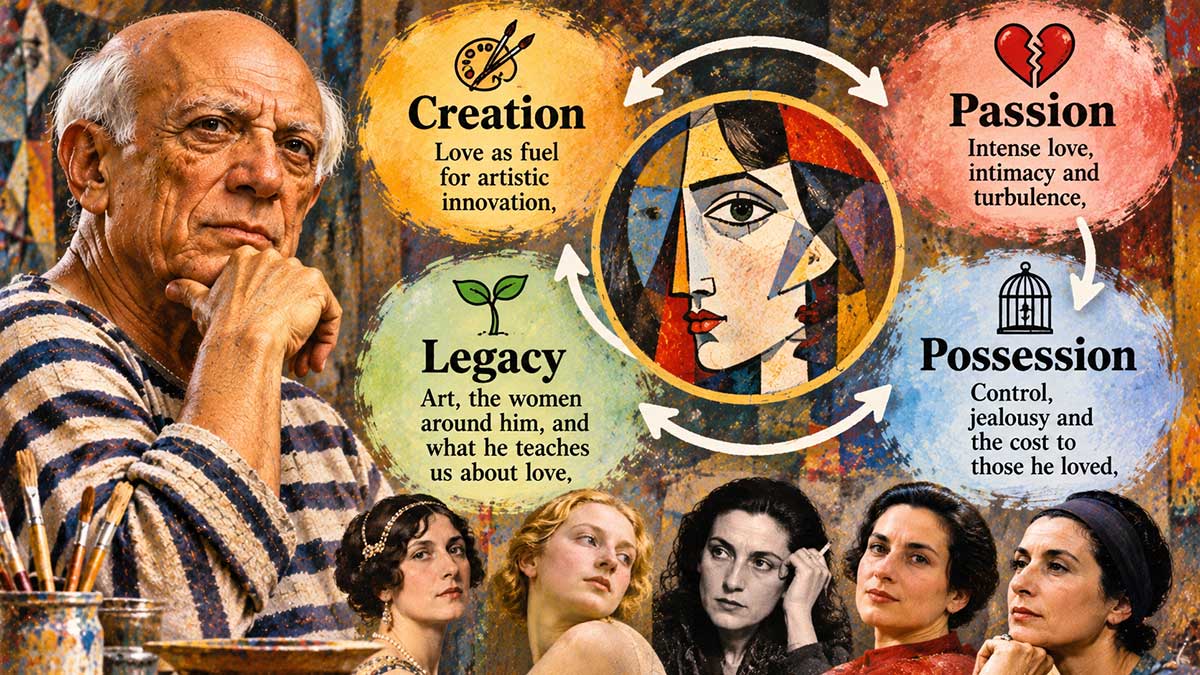
Short Bios:
Pablo Picasso (1881–1973)
Pablo Picasso was a Spanish painter, sculptor, printmaker, and ceramicist who became one of the most influential artists of the twentieth century. Born in Málaga, Spain, he demonstrated artistic talent from childhood and later helped develop Cubism with Georges Braque. His work included the Blue Period, Rose Period, Cubism, and decades of experimentation across different artistic media. Among his most celebrated paintings are Les Demoiselles d'Avignon (1907) and Guernica (1937). His remarkable artistic achievements and complicated personal relationships continue to inspire admiration, research, and debate. Learn more through the Museum of Modern Art's Picasso collection.
Nick Sasaki
Nick Sasaki is the creator of ImaginaryTalks.com, where historical figures, writers, artists, philosophers, and spiritual thinkers come together through imagined conversations. His interviews combine curiosity, humor, thoughtful questions, and personal reflection to encourage readers to explore different perspectives on creativity, happiness, relationships, faith, and the meaning of life. Through these conversations, Nick hopes to encourage greater compassion and a deeper appreciation of our shared humanity.
Leave a Reply