
Introduction
Socrates: Was His Greatest Act of Courage Also His Greatest Mistake?
Athens, 399 BCE.
An elderly man sits barefoot in a prison cell, awaiting execution. He has spent his life asking uncomfortable questions, exposing false confidence, and challenging powerful people to examine their beliefs.
His name is Socrates.
He is seventy years old. He has a wife, three sons, devoted friends, and students who still need him.
Yet he has refused an opportunity to escape.
For more than 2,400 years, humanity has admired his courage. But what if there is another question we have been reluctant to ask?
What if Socrates could have served humanity—and his own family—more by choosing to live?
In this imaginary interview, Nick Sasaki travels to ancient Athens to meet the man behind the legendary philosopher.
Their conversation begins unexpectedly, with laughter.
Socrates jokes about his appearance, his marriage, and the strange future in which millions of people will study his words. But the humor soon gives way to questions that remain painfully relevant.
Why do intelligent people become so certain they are right? Can someone speak the truth while failing to understand another person's heart? And what would Socrates think of artificial intelligence—a technology capable of producing extraordinary answers without necessarily possessing human wisdom?
The historical foundation is compelling. As the Stanford Encyclopedia of Philosophy's account of Socrates explains, much of what we know comes from ancient writers whose portrayals differ. In Plato's Crito, his friend challenges his refusal to escape, including his obligations to his children.
But Nick introduces another perspective.
Centuries after Socrates, Jesus will teach people to love their enemies and recognize God as their heavenly Father, as described in Matthew 5:43–48.
What might Socrates think of a vision of goodness centered on parental love?
And could that perspective change how he understands his final responsibility?
Neither man enters this conversation expecting an easy answer. Socrates refuses to compromise justice. Nick refuses to overlook the people who will suffer from his death.
Their disagreement leads somewhere neither fully anticipates.
Perhaps the deepest question is not whether we are prepared to die for our principles.
Perhaps it is whether we have learned how to live for the people we love.
Disclaimer: This is an entirely fictional, historically inspired conversation. Nick's exchanges with Socrates, including his discussion of Jesus, artificial intelligence, and God's parental heart, are imagined. The dialogue does not represent Socrates's documented words, an actual historical meeting, or proof of any particular religious interpretation.
Topic 1: The Man Behind the Questions
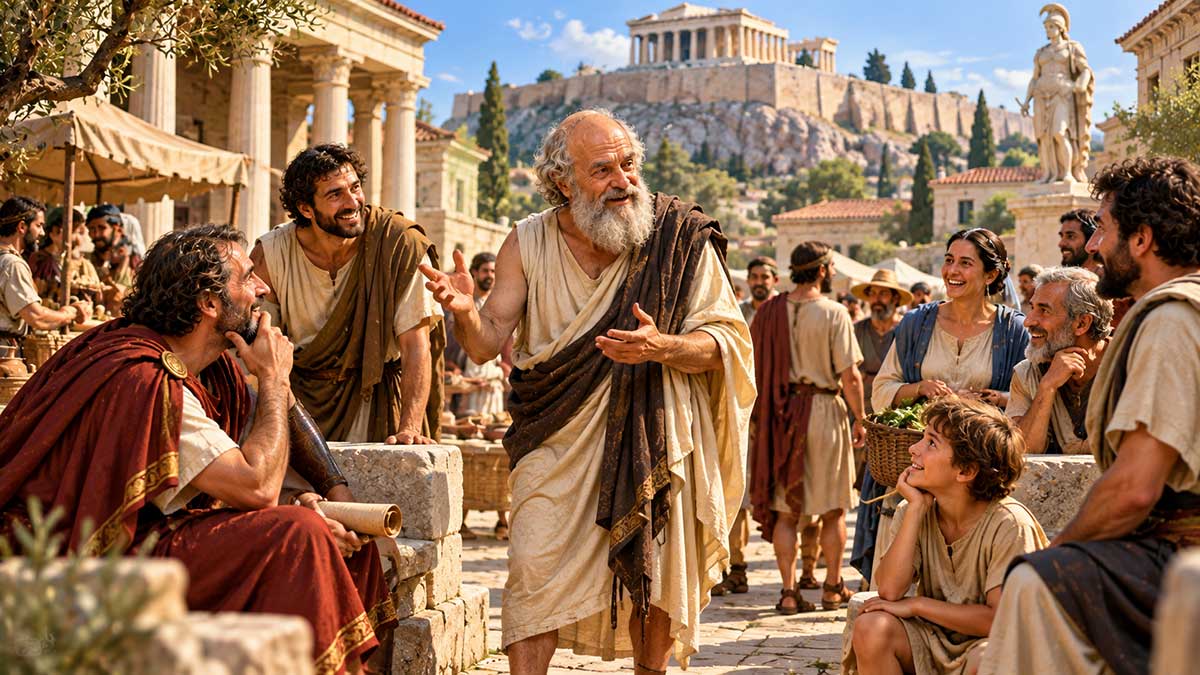
An Imaginary Interview with Socrates — Athens, 399 BCE
Setting: A modest prison cell in Athens. Late afternoon sunlight enters through a narrow window. A wooden bench, two stools, and a small table occupy the room. Socrates, approximately seventy years old, sits barefoot, rubbing his knee. His beard is gray, his head nearly bald, and his expression suggests that he finds the world endlessly amusing.
Nick Sasaki, a visitor from the year 2026, has arrived for an extraordinary one-on-one interview. Socrates has agreed to talk, although he seems more interested in questioning his visitor than answering questions himself.
The following conversation is fictional, inspired by historical accounts of Socrates's life and personality.
Opening: "Were You Always This Annoying?"
Nick: Socrates! I can't believe I'm actually sitting here with you.
Socrates: And I cannot believe a stranger has entered my prison announcing that he knows my name. Tell me, have we met?
Nick: No. I'm from the future.
Socrates: Ah. That explains very little.
Nick: I'm from the year 2026. That's about 2,425 years after your time.
Socrates: You have traveled a considerable distance to visit a man in prison. Are there no interesting people in your own century?
Nick: Plenty. But you're one of the most famous philosophers in human history.
Socrates: Am I?
Nick: Absolutely. People study you in universities around the world.
Socrates: How unfortunate for them.
Nick: Why?
Socrates: I have spent my life trying to persuade people to examine their own thoughts. Now you tell me they spend their time examining mine.
Nick: That's actually a pretty good point.
Socrates: Then perhaps your journey has already been worthwhile.
Nick: You know, I expected you to be a little more serious.
Socrates: I am serious. I simply see no reason to be miserable about it.
Nick: Can I ask you something personal?
Socrates: You may ask anything. Whether I can answer is another matter.
Nick: Were you always this annoying?
Socrates laughs.
Socrates: My wife might be better qualified to answer that question.
Nick: I've heard stories about her.
Socrates: That makes two of us. People seem unusually interested in telling stories about my household.
Nick: Well, today I want to get to know the real Socrates. Not the famous philosopher. The man.
Socrates: And how will you recognize him when you find him?
Nick: There you go again.
Socrates: You did ask.
Question 1: What Made Socrates the Man He Became?
Nick: Let's start at the beginning. What was your childhood like?
Socrates: I grew up in Athens, among people who were very confident about what they knew. My father was associated with the work of stone, my mother with midwifery, and I spent much of my youth discovering how difficult it was to understand anything properly.
Nick: Your mother was a midwife?
Socrates: So I have said.
Nick: That's interesting because your philosophical method is sometimes compared to helping people give birth to ideas.
Socrates: A pleasing comparison, although ideas are often delivered with considerably more resistance than children.
Nick: Did your mother influence the way you thought?
Socrates: I cannot tell you that every question I ask began with her. But I admire the work of a midwife. She cannot create the child for the mother. She can help bring into the world what is already developing.
Nick: And you do something similar with people's minds?
Socrates: At times. Although I have also encountered many people who believe they are pregnant with wisdom when they are merely full of opinions.
Nick: That's brutal.
Socrates: Is it inaccurate?
Nick: Not necessarily.
Socrates: Then perhaps we should call it unfortunate rather than brutal.
Nick: What about your father? Did he expect you to follow his profession?
Socrates: Fathers often hope their sons will find respectable occupations. I suspect questioning respectable men in public was not the career most fathers would choose.
Nick: Especially if it doesn't pay.
Socrates: Especially then.
Nick: Did you ever have a normal job?
Socrates: What do you mean by normal?
Nick: Something that provides an income. Something your wife could tell the neighbors without having to explain herself.
Socrates: You have been here only a few moments, and already you are concerned about my wife's conversations with the neighbors.
Nick: I'm a father of five. I understand household expenses.
Socrates: Five children?
Nick: Yes.
Socrates: Then you have considerably more experience negotiating with unreasonable people than I do.
Nick: I thought you spent your entire life doing that!
Socrates: Children have an advantage over politicians. They occasionally admit they want something.
Both laugh.
Nick: You were also a soldier, weren't you?
Socrates: Yes. I served Athens in war.
Nick: At Potidaea, Delium, and Amphipolis?
Socrates: You have studied my life rather carefully.
Nick: People still talk about your courage in battle.
Socrates: People are generous with their stories once the danger has passed.
Nick: But you were known for endurance. Marching barefoot, tolerating cold, remaining calm when others panicked.
Socrates: I was accustomed to discomfort. That does not mean I enjoyed it.
Nick: Were you afraid during battle?
Socrates: Certainly there were dangers worth fearing.
Nick: So courage doesn't mean being fearless?
Socrates: Let me ask you something. Suppose a soldier feels no fear because he does not understand the danger. Is he courageous?
Nick: No. He's probably foolish.
Socrates: And suppose another soldier understands the danger, feels fear, but remains because his companions depend on him?
Nick: That's courage.
Socrates: Then perhaps courage has less to do with the absence of fear than with how a person judges what deserves his fear.
Nick: Did war change you?
Socrates grows quieter.
Socrates: It teaches a man how quickly his confidence can disappear. Before a battle, men speak of glory, honor, and victory. Afterward, they speak of friends who will not return home.
Nick: Did you lose friends?
Socrates: War is not generous with friendships.
Nick: That must have affected the way you thought about life.
Socrates: It made certain questions harder to ignore. What makes a life good? Is surviving the most important thing? What should a man refuse to do, even when he is frightened?
Nick: Those are big questions.
Socrates: They become less abstract when someone beside you is bleeding.
A moment of silence passes.
Nick: You know, it's strange. People remember you as a philosopher sitting around asking questions. They don't usually imagine you standing in a battlefield.
Socrates: Perhaps they should. A man who speaks about courage without ever encountering danger may have something useful to say. But danger has a way of questioning us more effectively than words.
Nick: So the battlefield was another teacher.
Socrates: An expensive one.
Question 2: What Was Socrates Like as a Husband and Father?
Nick: Let's talk about your family. You have three sons, correct?
Socrates: Yes. Lamprocles, Sophroniscus, and Menexenus.
Nick: And your wife is Xanthippe.
Socrates: You know her name as well?
Nick: Oh, she's famous.
Socrates: I am beginning to worry about this future of yours.
Nick: Why?
Socrates: First you tell me that strangers discuss my thoughts thousands of years after I am gone. Now you tell me they discuss my wife. Do people in your century have no households of their own to worry about?
Nick: Believe me, they do.
Socrates: Then perhaps they should attend to them.
Nick: Well, there are stories that Xanthippe has quite a temper.
Socrates: And have you met her?
Nick: No.
Socrates: Then how do you know these stories are true?
Nick: I don't.
Socrates: Excellent. We have made progress.
Nick: You're defending her.
Socrates: I am asking whether a person's character should be determined by those who tell amusing stories about her.
Nick: Fair enough. But let's be practical. You're famous for spending your days talking to people in the marketplace. You don't charge for teaching. Your family isn't wealthy.
Socrates: That is true.
Nick: So who pays for everything?
Socrates: You have a remarkable ability to turn philosophy into household accounting.
Nick: Five children, remember?
Socrates: I had nearly forgotten.
Nick: Seriously, though. Did Xanthippe ever tell you to stop talking and start earning money?
Socrates: I would be surprised if any household facing financial difficulties had never discussed money.
Nick: That's a very diplomatic answer.
Socrates: You have asked me to speak for a woman who is not here. I would prefer to let her speak for herself.
Nick: I respect that.
Socrates: Do you?
Nick: Yes.
Socrates: Then perhaps we should ask whether your interest in her supposed temper tells us more about her character or about our enjoyment of other people's domestic troubles.
Nick: You really can't resist turning everything around, can you?
Socrates: Apparently not.
Nick: Let me ask something more serious. Were you a good father?
Socrates pauses.
Socrates: What would make a man a good father?
Nick: Oh, come on. I'm asking you!
Socrates: And I am trying to understand the question.
Nick: All right. A good father loves his children, spends time with them, teaches them right from wrong, protects them, and helps them become good people.
Socrates: Those sound like worthy responsibilities. Must he do all of them perfectly?
Nick: No father does.
Socrates: Then perhaps we are both fortunate.
Nick: Did you spend much time with your sons?
Socrates: I have spoken with them, corrected them, and tried to encourage them toward what is good. But I will not claim that every hour of my life was spent as wisely as it might have been.
Nick: That's a surprisingly honest answer.
Socrates: You sound disappointed.
Nick: Not at all. Actually, I appreciate it.
Socrates: Tell me about your children.
Nick: I have five. And one thing I've learned is that every child is different. You can't raise them all exactly the same way.
Socrates: Why not?
Nick: Because they have different personalities, strengths, weaknesses, interests. What motivates one child might discourage another.
Socrates: Then treating them equally does not always mean treating them identically.
Nick: Exactly.
Socrates: And how do you determine what each child needs?
Nick: You listen. You spend time with them. You try to understand their hearts.
Socrates: Their hearts?
Nick: Their feelings, their fears, their dreams. What they're going through.
Socrates: And is understanding those things sufficient to know what is good for them?
Nick: No. Sometimes they need correction.
Socrates: Even when correction makes them unhappy?
Nick: Of course.
Socrates: Then you agree that love sometimes requires giving someone an answer they do not wish to hear.
Nick: Yes, but how you say it matters.
Socrates: Ah. We may have found something important.
Nick: I think we have.
Socrates: Perhaps you should remain here and teach me about fatherhood.
Nick: I'm not sure your wife would appreciate another philosopher sitting around the house.
Socrates laughs loudly.
Socrates: Then perhaps you should teach me how to earn money instead.
Nick: That I can help with.
Socrates: Wonderful. After seventy years, my career may finally begin.
They laugh, but Nick notices the prison walls and the fading sunlight.
Nick: Socrates, can I ask you one more question about your children?
Socrates: Of course.
Nick: What do you most want them to remember about you?
Socrates looks toward the narrow window.
Socrates: I would hope they remember that their father tried to live according to what he believed was good.
Nick: Not that he was famous?
Socrates: Fame is a strange inheritance. It may bring admiration, but it does not tell a child how to live.
Nick: Not that he was wise?
Socrates: If they remember me as wise, I hope they will also remember to question whether I truly was.
Nick: What if they remember you simply as their father?
Socrates looks back at Nick.
Socrates: Would that be a small thing?
Nick: No. I think it might be the most important thing.
Socrates: Then perhaps we agree.
Nick considers asking another question about the future awaiting Socrates's children, but decides the moment is not right.
Question 3: Did Socrates Ever Get Tired of Asking Questions?
Nick: Socrates, I have to ask. Do you ever just relax?
Socrates: I am sitting on a bench.
Nick: That's not what I mean.
Socrates: Then you should ask a better question.
Nick: See? That's exactly what I'm talking about.
Socrates: I am doing my best to help.
Nick: Suppose you're having dinner with friends. Someone says, "This wine is excellent." Do you immediately ask, "What is excellence?"
Socrates: Only if the wine is poor.
Nick: Really?
Socrates: No. But it would be an entertaining way to avoid drinking it.
Nick: Do people ever tell you to be quiet?
Socrates: Frequently.
Nick: And do you listen?
Socrates: Occasionally. Silence can be useful. It gives people time to reveal what they think.
Nick: You make silence sound like another interrogation technique.
Socrates: Is it not?
Nick: I'm starting to understand why you got into trouble.
Socrates: You are not the first.
Nick: Were you ever interested in ordinary pleasures? Food, music, celebrations?
Socrates: Certainly. I have enjoyed gatherings, conversations, good company, and the pleasures available to an ordinary man.
Nick: What about wine?
Socrates: I have been known to drink.
Nick: I've heard you could drink quite a lot without getting drunk.
Socrates: I would advise you not to treat every story about my drinking as an invitation to test it.
Nick: So if we had a podcast together in 2026, you might enjoy it?
Socrates: What is a podcast?
Nick: Imagine two people sitting together for several hours, talking about whatever interests them, while thousands or even millions of other people listen.
Socrates: Millions?
Nick: Potentially.
Socrates: And they listen voluntarily?
Nick: Yes.
Socrates: Extraordinary. In Athens, I struggle to persuade a single politician to answer three questions.
Nick: Well, the difference is that people can turn off a podcast whenever they want.
Socrates: Then perhaps your politicians are wiser than ours.
Nick: Not necessarily.
Socrates: I suspected as much.
Nick: Some podcasts last three or four hours.
Socrates: That sounds pleasant.
Nick: Really?
Socrates: Provided the participants are willing to discover something rather than merely repeat what they already believe.
Nick: That's actually the whole point of why I wanted to meet you.
Socrates: To discover something?
Nick: Yes. I create imaginary conversations between people from different times and backgrounds. I want readers to consider perspectives they might never encounter otherwise.
Socrates: And do these conversations tell readers what to believe?
Nick: I hope they encourage readers to think for themselves.
Socrates: Then perhaps they serve a useful purpose. But tell me, do you ever allow your imagined guests to disagree with you?
Nick: Absolutely. That's what makes the conversations interesting.
Socrates: Even when their arguments are stronger than yours?
Nick: Especially then.
Socrates: Good. A conversation in which one man controls all the answers may be entertaining, but it is a poor investigation.
Nick: That's a fair warning.
Socrates: Then I have given you something to carry home.
Nick: You know, Socrates, I think we would have a great podcast.
Socrates: I am pleased to hear it. Though I fear the Athenians have made other arrangements for my future.
The humor fades for a moment.
Nick: Yes. They have.
Socrates: But we are speaking now, are we not?
Nick: We are.
Socrates: Then let us not waste the present by mourning a future that has not yet arrived.
Nick: That's beautiful.
Socrates: Is it true?
Nick: I think so.
Socrates: Then examine it carefully before calling it beautiful.
Nick: You really are impossible.
Socrates: So I have been told.
Closing: The Man Behind the Legend
The sunlight has shifted across the stone floor. Outside, footsteps echo through the corridor.
Nick: Socrates, before I came here, I imagined you as this almost superhuman figure. One of the greatest minds in history.
Socrates: And now?
Nick: Now I see a man who jokes about his wife, worries about money, loves his children, remembers the battlefield, and enjoys a good conversation.
Socrates: You make me sound disappointingly ordinary.
Nick: Actually, it makes you more interesting.
Socrates: Why?
Nick: Because I think people sometimes turn great thinkers into statues. We remember their ideas but forget they were human beings.
Socrates: Perhaps statues are easier to admire. They rarely ask uncomfortable questions.
Nick: That's true.
Socrates: And what have you learned from this ordinary man?
Nick: That wisdom doesn't necessarily mean having all the answers.
Socrates: A promising beginning.
Nick: That humor can be part of serious thinking.
Socrates: I am relieved.
Nick: And that behind every famous name is a person with relationships, responsibilities, and problems we might recognize in our own lives.
Socrates: Then perhaps you have learned something worth remembering.
Nick: But there's one thing I still don't understand.
Socrates: Only one? Your journey has been remarkably successful.
Nick: You're considered one of the wisest men who ever lived.
Socrates: So you have told me.
Nick: Yet you're famous for admitting how little you know.
Socrates: Are you suggesting that wisdom and ignorance cannot coexist?
Nick: I'm asking how someone who admits his ignorance becomes the symbol of wisdom itself.
Socrates leans forward. His eyes brighten.
Socrates: Ah, Nick. Now we are finally approaching an interesting question.
Nick: Finally? We've been talking for hours!
Socrates: Time passes quickly in good company.
Nick: All right. Explain something to me.
Socrates: Gladly, if I can.
Nick: Why do people who know so little often seem so certain that they're right?
Socrates smiles.
Socrates: Before we examine other people, my friend, perhaps we should begin with ourselves.
And so the conversation continues.
Historical and creative note: This dialogue is entirely fictional. Socrates's military service, family relationships, philosophical practices, and personality are informed by ancient sources, principally Plato and Xenophon. His private memories, emotional reactions, jokes, and exchanges with Nick are imaginative reconstructions rather than documented statements. Details of his parents' occupations and domestic life derive from ancient traditions whose historical reliability varies.
Topic 2: Why Do We Think We Know Everything?
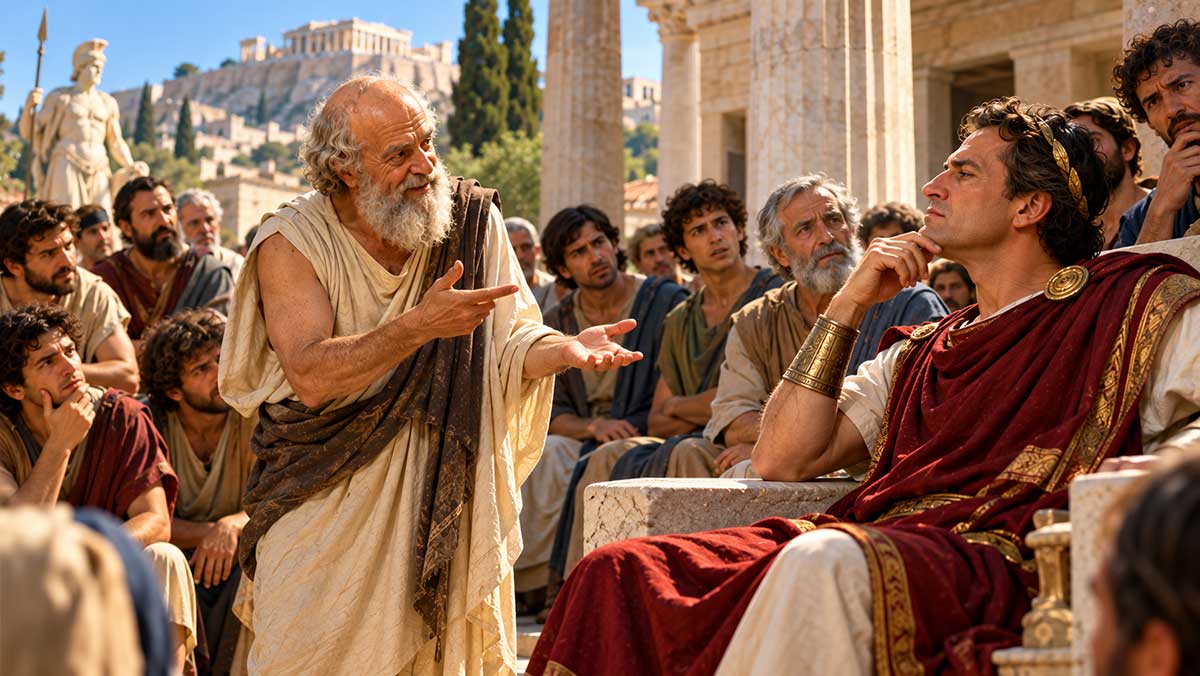
An Imaginary Interview with Socrates — Athens, 399 BCE
Setting: The same modest prison cell in Athens. The afternoon light has softened. Socrates sits comfortably on his wooden bench, while Nick leans forward, still amused by their earlier conversation about marriage, fatherhood, military life, and the philosopher's remarkable ability to turn every question upside down.
What began as an entertaining interview is about to become something more personal. Nick has traveled from 2026 to meet one of history's wisest men. But Socrates seems far more interested in discovering what his visitor doesn't know.
The following dialogue is fictional, inspired by historical accounts of Socrates's life and philosophy.
Opening: "You Know, People Are Still Arguing About You"
Nick: Socrates, there's something you should know about the future.
Socrates: Only one thing? I had hoped your century might be more interesting.
Nick: People are still arguing about you.
Socrates: Ah. Then perhaps Athens has conquered the world after all.
Nick: In a way, yes. Your ideas are taught in universities across the planet. Students spend years studying your philosophy.
Socrates: Years?
Nick: Sometimes their entire lives.
Socrates: And after all those years, do they become wise?
Nick: Well, they certainly become educated.
Socrates: Is that the same thing?
Nick: I knew you were going to ask that.
Socrates: Then why did you leave yourself so poorly prepared?
Nick: Because you never give anyone a break!
Socrates laughs.
Nick: Seriously, though, you would be amazed by how much humanity has learned. We understand the movements of planets. We've developed medicines that cure diseases once considered fatal. We can communicate with people on the other side of the world instantly.
Socrates: Remarkable. And have you discovered what makes a human being good?
Nick: We're still working on that.
Socrates: Have you learned how to prevent people from deceiving one another?
Nick: Not exactly.
Socrates: How to prevent wars?
Nick: Unfortunately, no.
Socrates: How to make the wealthy content with what they possess?
Nick: Definitely not.
Socrates: Then your people have learned many extraordinary things while leaving some familiar questions unanswered.
Nick: That's actually a pretty accurate description of modern civilization.
Socrates: Tell me, Nick. Does your century suffer from a shortage of knowledge?
Nick: No. Quite the opposite.
Socrates: Then perhaps the problem is what people do with it.
Question 1: Why Did the Oracle Call Socrates Wise?
Nick: Let's go back to something you've become famous for. The Oracle of Delphi.
Socrates: What about it?
Nick: Your friend Chaerephon reportedly asked whether anyone was wiser than you.
Socrates: Yes.
Nick: And the oracle answered that no one was wiser.
Socrates: That is what Chaerephon reported.
Nick: So how did you feel? Pretty good?
Socrates: Confused.
Nick: Confused? If someone told me I was the wisest man in Athens, I might celebrate.
Socrates: Then I would be curious what evidence persuaded you that the statement was true.
Nick: Can't you just enjoy a compliment?
Socrates: Certainly. But a compliment does not become true simply because it is pleasant.
Nick: Fair enough. Why were you confused?
Socrates: Because I did not believe myself to possess the wisdom people attributed to me. Yet I also believed that the god would not speak falsely. So I set out to examine what the oracle might mean.
Nick: And you started questioning people.
Socrates: People reputed to be wise. Politicians, poets, craftsmen.
Nick: How did that go?
Socrates: Poorly for my popularity.
Nick: I can imagine.
Socrates: I met a politician who was considered wise by many people, especially himself. I questioned him and found that although he spoke confidently, he could not adequately explain what he claimed to understand.
Nick: So you exposed him?
Socrates: I discovered that he appeared wise without possessing the knowledge he claimed.
Nick: In front of other people?
Socrates: Others were sometimes present.
Nick: Socrates, you must realize how embarrassing that was.
Socrates: I did eventually notice that he was displeased.
Nick: Eventually?
Socrates: His expression provided several clues.
Nick: You're terrible!
Socrates: You asked how my investigation proceeded.
Nick: What about the poets?
Socrates: They produced beautiful works, but when I questioned them about their meaning, I often found that others could explain the poems as well as—or better than—the poets themselves.
Nick: That's interesting. So artistic talent doesn't necessarily mean intellectual understanding?
Socrates: Precisely. A person may possess a remarkable ability without understanding every aspect of it.
Nick: And the craftsmen?
Socrates: They were different. They genuinely knew things I did not. A skilled craftsman understands his craft.
Nick: So they were wiser than you?
Socrates: In their particular work, certainly. But some believed that because they possessed expertise in one area, they were also wise about matters beyond it.
Nick: That sounds very familiar.
Socrates: Does it?
Nick: Absolutely. In my century, someone can become famous for making entertaining videos and suddenly people ask for their opinions about economics, medicine, politics, and world peace.
Socrates: Are they qualified to answer?
Nick: Sometimes. Often they aren't.
Socrates: Then why do people ask them?
Nick: Because they're famous.
Socrates: And fame produces wisdom?
Nick: No.
Socrates: Yet people behave as though it does?
Nick: Exactly.
Socrates: Your century has made remarkable technological progress, but I see that some of our habits have survived intact.
Nick laughs.
Nick: So what did you finally conclude about the oracle?
Socrates: That human wisdom may be worth very little compared with divine wisdom. Perhaps the person who recognizes the limits of his understanding is wiser than someone who falsely believes he knows.
Nick: So your wisdom was knowing that you didn't know?
Socrates: That is a convenient summary, provided you do not mistake it for a claim that I knew nothing whatsoever.
Nick: What do you mean?
Socrates: I could recognize a well-made shoe. I could remember where I lived. I could distinguish a friend from a stranger. I possessed ordinary knowledge, as anyone does.
Nick: But you weren't claiming to understand the deepest questions.
Socrates: Exactly. What is justice? What is virtue? What makes a life good? These are matters about which people speak with extraordinary confidence.
Nick: Even today.
Socrates: Especially today, I suspect, given how many people you say can broadcast their opinions.
Nick: You have no idea.
Socrates: Then enlighten me.
Question 2: Why Do Intelligent People Resist Changing Their Minds?
Nick: Imagine this, Socrates. In my century, nearly everyone carries a small device that connects them to billions of people.
Socrates: A remarkable device. Is it heavy?
Nick: No. It fits in your hand.
Socrates: And what do people do with it?
Nick: They communicate, read news, watch videos, learn new things, share photographs, and argue.
Socrates: Argue?
Nick: Constantly.
Socrates: About important matters?
Nick: Sometimes. Politics, religion, science, morality.
Socrates: And do they listen carefully to one another?
Nick: Not nearly enough.
Socrates: Do they ask questions to understand what the other person believes?
Nick: Occasionally.
Socrates: Do they change their minds when presented with better arguments?
Nick: Rarely, at least in the arguments that attract the most attention.
Socrates: Then why do they participate?
Nick: Often to prove they're right.
Socrates: Ah. So they do not enter the conversation to discover the truth. They enter believing they already possess it.
Nick: Exactly!
Socrates: Then perhaps they are not having conversations at all.
Nick: What would you call them?
Socrates: Competitions in which everyone declares himself the winner.
Nick: That's social media in one sentence.
Socrates: And do the winners receive prizes?
Nick: Sometimes they get thousands of people agreeing with them.
Socrates: Does agreement make their beliefs true?
Nick: No.
Socrates: Then it is an unusual prize.
Nick: Here's the problem. People often identify so strongly with their beliefs that changing their minds feels like losing part of themselves.
Socrates: Explain that.
Nick: Suppose someone has spent twenty years supporting a political leader. Then evidence appears that the leader has done something seriously wrong. Instead of reconsidering, the person may defend the leader even more strongly.
Socrates: Why?
Nick: Because admitting the leader was wrong might mean admitting they were wrong for twenty years.
Socrates: And they find that shameful?
Nick: Very.
Socrates: Yet is remaining mistaken for another twenty years less shameful?
Nick: You would think not.
Socrates: Then perhaps they value appearing correct more than becoming correct.
Nick: That's exactly the problem.
Socrates: Is it only a problem among politicians and their supporters?
Nick: No. It happens everywhere. Business, religion, relationships, even science.
Socrates: And among fathers?
Nick: Oh, definitely.
Socrates: Including fathers of five children?
Nick: I knew that was coming.
Socrates: Then let us investigate.
Nick: You're enjoying this far too much.
Socrates: Tell me, Nick. Have you ever insisted that you were right about something, only to discover later that you were mistaken?
Nick: Of course.
Socrates: And what did you do?
Nick: Sometimes I admitted it immediately. Other times, it took me a while.
Socrates: Why the delay?
Nick: Pride, I suppose.
Socrates: What is pride?
Nick: Oh, no. We're not doing that.
Socrates: You introduced the word.
Nick: All right. Pride is wanting to feel important, respected, or superior.
Socrates: Is wanting respect necessarily wrong?
Nick: No.
Socrates: Then perhaps the problem is not respect itself but becoming unwilling to admit error because we fear losing it.
Nick: Yes. That's much better.
Socrates: Better than your answer?
Nick: Unfortunately.
Socrates: Then you have just demonstrated that changing one's mind need not be humiliating.
Nick: Point taken.
Socrates: But I would like to ask something more difficult.
Nick: Go ahead.
Socrates: You have told me about the arrogance of politicians, famous people, and strangers on your communication devices. Which of your own beliefs have you examined with the same severity?
Nick pauses.
Nick: That's a good question.
Socrates: It is the question I am asking.
Nick: I have strong beliefs about the importance of love, about God, about humanity's future.
Socrates: And are you certain they are true?
Nick: I believe in them deeply.
Socrates: That is not quite what I asked.
Nick: I know.
Socrates: Have you ever encountered someone intelligent and sincere who disagreed with you?
Nick: Many times.
Socrates: And what did you do?
Nick: Sometimes I listened carefully. Sometimes I probably spent more time preparing my response than understanding what they were saying.
Socrates: Then you are like the rest of us.
Nick: Apparently.
Socrates: That should be encouraging.
Nick: Why?
Socrates: Because recognizing a weakness gives us an opportunity to improve it.
Nick: You know, Socrates, there's something interesting about this. When I was younger, I thought having strong convictions meant never doubting them.
Socrates: And now?
Nick: Now I think a strong conviction should be able to survive honest questions. And if it can't, perhaps it needs to change.
Socrates: That sounds promising. But tell me, would you be willing to abandon a belief that brings you comfort if you discovered it was false?
Nick: I'd like to think so.
Socrates: I would like to think so too.
Nick: Wait. You're admitting you might struggle with that?
Socrates: Of course. Do you imagine that asking questions makes a man immune to human weakness?
Nick: People sometimes treat you that way.
Socrates: Then they have misunderstood me.
Nick: That's actually refreshing.
Socrates: Good. Perhaps we should both be suspicious whenever we begin to enjoy the feeling of being wiser than everyone else.
Question 3: How Can Ordinary People Practice Socratic Wisdom?
Nick: Let me ask you something practical. Suppose someone listening to our conversation wants to become wiser. Where should they start?
Socrates: With a question.
Nick: Naturally.
Socrates: What do they believe they know?
Nick: That's pretty broad.
Socrates: Then let us consider an example.
Nick: All right. Imagine a father whose teenage son wants to pursue a career the father thinks is foolish.
Socrates: What career?
Nick: Let's say the son wants to become a musician.
Socrates: And the father objects?
Nick: Yes. He believes the son should become a doctor or an engineer because those careers are more secure.
Socrates: Does the father know that the son would be a good doctor or engineer?
Nick: Not necessarily.
Socrates: Does he know that the son would be an unsuccessful musician?
Nick: No.
Socrates: Then what does he know?
Nick: That some careers offer more financial stability than others.
Socrates: A reasonable consideration. But is financial stability the only good a career can provide?
Nick: Of course not.
Socrates: What else matters?
Nick: Purpose, fulfillment, talent, contribution, happiness.
Socrates: Then perhaps the father should examine those things with his son rather than simply announce which career is best.
Nick: Exactly.
Socrates: But should the son dismiss his father's concerns merely because he finds music enjoyable?
Nick: No. He should consider the financial realities too.
Socrates: Then both may have something to learn.
Nick: That's what I like about your method. It doesn't automatically make one person the villain.
Socrates: It would be a poor method if its purpose were merely to choose a villain.
Nick: Let's try another example. Marriage.
Socrates: Ah. You are determined to bring my wife into this conversation.
Nick: Not necessarily yours!
Socrates: I am relieved.
Nick: Imagine a husband and wife arguing because the husband believes his wife doesn't appreciate how hard he works.
Socrates: And what does the wife believe?
Nick: That her husband spends too little time with the family.
Socrates: Can both be correct?
Nick: Absolutely.
Socrates: Then perhaps the first question is not which person is wrong, but what each person means by being appreciated or supported.
Nick: That's good.
Socrates: Perhaps the husband believes he demonstrates love by providing resources. Perhaps the wife believes love also requires time and attention.
Nick: Exactly.
Socrates: Then they may be arguing about different expressions of the same concern.
Nick: You're sounding like a marriage counselor.
Socrates: Is that a respected occupation in your century?
Nick: Sometimes.
Socrates: Does it pay better than philosophy?
Nick: Considerably.
Socrates: I have made several unfortunate career decisions.
Nick laughs.
Nick: All right, one more example. Suppose someone believes that God exists, while another person believes there is no God.
Socrates: An important disagreement.
Nick: How would you approach it?
Socrates: First, I would ask what each means by God.
Nick: Why?
Socrates: Because two people may use the same word while imagining entirely different things.
Nick: That's true.
Socrates: One might speak of divine intelligence. Another of a being who governs the world. Another of a source of goodness. Unless we understand what they mean, we may be arguing without knowing the subject of our disagreement.
Nick: And then?
Socrates: I would ask what reasons each has for believing as he does.
Nick: Would you try to convince one of them?
Socrates: I would first try to understand whether their beliefs are reasonable.
Nick: So the purpose isn't necessarily to win?
Socrates: What would winning mean?
Nick: Persuading the other person.
Socrates: Suppose I persuade someone of a false belief through clever speech. Have I accomplished something good?
Nick: No.
Socrates: Suppose I fail to persuade someone, but our conversation reveals a weakness in my own reasoning. Have I lost?
Nick: Actually, you've gained something.
Socrates: Then perhaps we should stop treating every disagreement as a contest.
Nick: That would transform modern society.
Socrates: Would it?
Nick: I think so. So many people are trying to defeat one another rather than understand one another.
Socrates: Then perhaps they should begin with smaller conversations. A father and son. A husband and wife. Two friends who disagree.
Nick: You think changing the world begins with conversations like those?
Socrates: Where else would you begin?
Nick: Governments? Schools? Technology?
Socrates: Those may all matter. But who governs governments? Who teaches in schools? Who creates and uses technology?
Nick: People.
Socrates: Then perhaps we should attend to the character of people.
Nick: That's a powerful thought.
Socrates: Let me offer a caution, however.
Nick: What's that?
Socrates: Questioning can become a habit of destruction. A person may learn to find weaknesses in every argument without ever developing a better understanding of how to live.
Nick: So someone can become good at arguing without becoming wise?
Socrates: Certainly.
Nick: That sounds like a lot of people on the internet.
Socrates: I am beginning to suspect this internet of yours would provide me with endless employment.
Nick: You'd be exhausted in a week.
Socrates: Perhaps. But I would first want to know whether its participants wished to learn.
Nick: Some do.
Socrates: Then there is hope.
Closing: The Difference Between Being Right and Doing Good
The conversation has continued long enough that the light through the prison window has begun to turn golden. Nick takes a sip of water and looks at Socrates thoughtfully.
Nick: Socrates, I think I understand your philosophy better now.
Socrates: That is encouraging. Perhaps you can explain it to me.
Nick: You believe people should question their assumptions, recognize their ignorance, and pursue truth rather than simply defend their opinions.
Socrates: A reasonable beginning.
Nick: And I agree with you. But there's something that's been bothering me.
Socrates: Good. What is it?
Nick: Earlier, you described questioning politicians and exposing their ignorance.
Socrates: Yes.
Nick: You said they became angry.
Socrates: Frequently.
Nick: Did you ever wonder whether the way you questioned them made it harder for them to learn?
Socrates: Explain.
Nick: Imagine someone who is proud and insecure. You publicly demonstrate that he doesn't understand what he's talking about. He feels humiliated.
Socrates: That may happen.
Nick: But instead of reconsidering his beliefs, he becomes defensive. He hates you. He refuses to listen to anything else you say.
Socrates: That too may happen.
Nick: Then even if your argument was correct, did you accomplish your purpose?
Socrates pauses.
Socrates: You are asking whether revealing ignorance is sufficient to produce wisdom.
Nick: Exactly.
Socrates: I would not say that it is.
Nick: Then perhaps there's something else required.
Socrates: Such as?
Nick: Compassion. Understanding the other person's feelings. Helping them recognize the truth without destroying their dignity.
Socrates: Would you have me conceal the truth to protect their feelings?
Nick: No. I'm asking whether there might be a more loving way to tell it.
Socrates: And what would that way be?
Nick: That's what I'd like us to explore next.
Socrates: Then let us begin with a question. What do you mean by love?
Nick: Oh, come on!
Socrates laughs.
Socrates: You have traveled across twenty-four centuries, my friend. Surely you did not expect the most important questions to be easy.
Nick: No. But I was hoping you'd answer at least one of them.
Socrates: Perhaps I shall. Once we understand what we are asking.
Nick shakes his head, smiling.
Nick: Socrates, I think our next conversation may be the most difficult one yet.
Socrates: Then I look forward to it.
Outside, the sounds of Athens drift through the narrow window. The two men sit quietly for a moment, considering a question that will remain important long after both of their lifetimes.
Can a person possess truth without knowing how to love?
Historical and creative note: This fictional dialogue draws on themes from Plato's Apology, especially Socrates's account of the Delphic oracle and his questioning of reputedly wise Athenians. The discussions of social media, modern parenting, and contemporary religious disagreements are imaginative extensions, not documented statements by Socrates. The purpose is to examine enduring philosophical questions rather than attribute modern views to an ancient thinker.
Topic 3: Can Truth Exist Without Love?
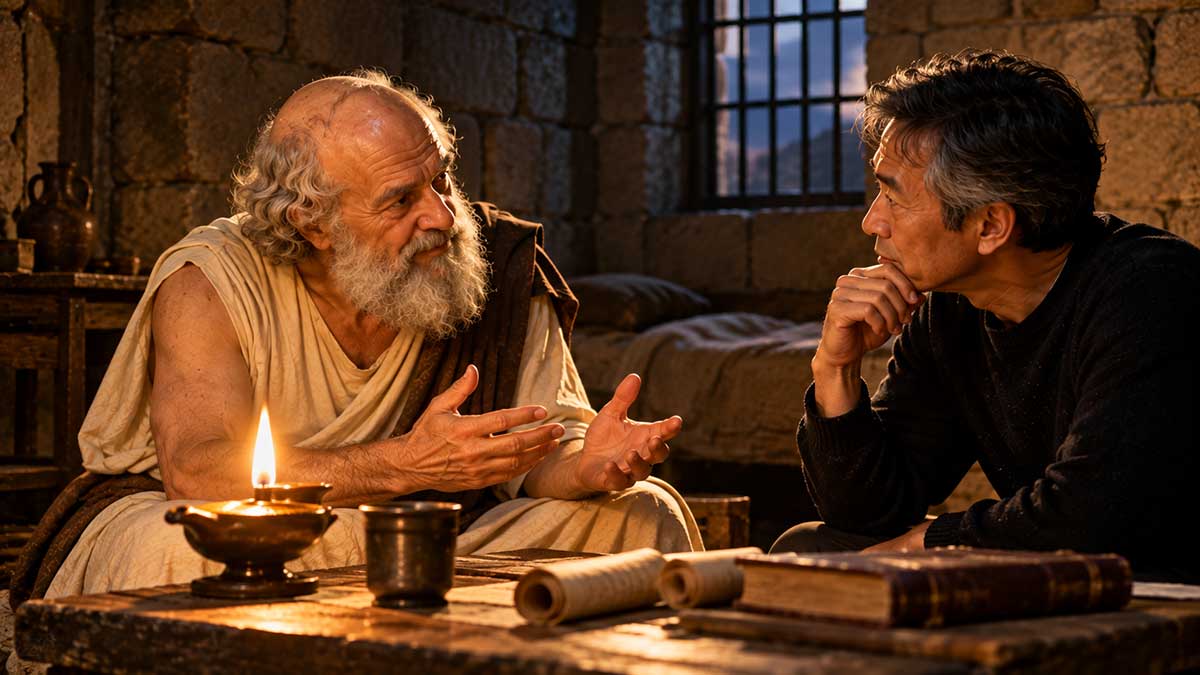
An Imaginary Interview with Socrates — Athens, 399 BCE
Setting: A modest prison cell in Athens. The late-afternoon sunlight has faded, and a small oil lamp now illuminates the faces of two men separated by more than twenty-four centuries.
Nick Sasaki has already discovered that Socrates is much more than the stern philosopher depicted in history books. He is funny, stubborn, curious, and remarkably skilled at making other people question themselves.
But something has been troubling Nick.
Socrates has spent his life challenging people to recognize their ignorance. His questions have helped shape the foundations of philosophy. Yet those same questions have also embarrassed powerful men, damaged relationships, and contributed to the hostility that brought him to prison.
Nick wonders whether there is something missing from the philosopher's understanding of wisdom.
Tonight, he intends to ask.
The following conversation is fictional, inspired by historical accounts of Socrates's philosophy, religious convictions, and personal life.
Opening: "Has Anyone Ever Told You That You're Difficult to Love?"
Nick: Socrates, can I ask you something that might be a little uncomfortable?
Socrates: After everything you have asked me today, I would be disappointed if you stopped now.
Nick: Has anyone ever told you that you're difficult to love?
Socrates raises his eyebrows.
Socrates: My friend, you have met me only recently, and already you are making judgments about my character?
Nick: I'm asking a question!
Socrates: Then allow me to ask one in return. What do you mean by love?
Nick: Oh, here we go again.
Socrates: You expected a different answer?
Nick: I was hoping for something like, "Yes, my wife tells me that every day."
Socrates: That might amuse you, but would it help us understand anything?
Nick: It would make a great podcast clip.
Socrates: Another strange custom of your century.
Nick: Let me explain. We've talked about how you question people, expose their ignorance, and challenge their beliefs.
Socrates: Yes.
Nick: And I admire that. But I'm wondering whether being right is always the most important thing.
Socrates: What would be more important?
Nick: The person you're talking to.
Socrates studies Nick for a moment.
Socrates: You believe I have overlooked the person while examining his arguments?
Nick: I'm wondering whether that's possible.
Socrates: Then we should examine it.
Nick: Without embarrassing me?
Socrates: I shall make no promises I cannot keep.
Both laugh.
Question 1: Does Telling the Truth Justify Hurting Someone?
Nick: Let's imagine something. You're in the marketplace, questioning a respected politician.
Socrates: A familiar situation.
Nick: He claims to understand justice. You ask him what justice means. He gives an answer, and you find a contradiction.
Socrates: Quite possible.
Nick: Then you ask another question. Another contradiction. Eventually, everyone watching realizes he doesn't understand justice nearly as well as he thought.
Socrates: That may happen.
Nick: And people laugh at him.
Socrates: They might.
Nick: How do you think he feels?
Socrates: Embarrassed, perhaps. Angry. Ashamed.
Nick: Exactly. So even though you've exposed his ignorance, you've also humiliated him.
Socrates: Is humiliation always the same as injury?
Nick: Not always. But it can hurt.
Socrates: Suppose a physician tells a man that he has a serious illness. The news causes him distress. Should the physician remain silent?
Nick: Of course not.
Socrates: Why?
Nick: Because the man needs to know the truth to receive treatment.
Socrates: Then causing discomfort is not necessarily wrong.
Nick: I agree. But suppose the physician announces the diagnosis in the middle of a crowded marketplace, mocks the man's condition, and invites everyone to laugh.
Socrates: That would be shameful behavior.
Nick: Even if the diagnosis were correct?
Socrates: Certainly.
Nick: Then the truth of what we say doesn't automatically justify the way we say it.
Socrates: That seems reasonable.
Nick: So here's my question. Did you ever consider whether your public questioning sometimes resembled that second physician?
Socrates leans back.
Socrates: You have constructed a rather unfavorable comparison.
Nick: That's what you do to everyone else!
Socrates: Then I should hardly complain.
Nick: Exactly.
Socrates: Let us distinguish two things. If I question a man because I wish to make him ridiculous, I am acting badly. But if I question him because he claims knowledge that he does not possess, and his ignorance affects the lives of others, should I remain silent merely to preserve his reputation?
Nick: No. Especially if he's a leader whose decisions affect thousands of people.
Socrates: Then sometimes a public claim requires public examination.
Nick: Absolutely. But what about ordinary people? Someone who's insecure, frightened, or simply mistaken?
Socrates: What would you propose?
Nick: Start by understanding the person. Why does he believe what he believes? What experiences shaped him? What is he afraid of losing if he admits he's wrong?
Socrates: You would investigate his character before investigating his argument?
Nick: Not necessarily before. But alongside it.
Socrates: Interesting. And what would that accomplish?
Nick: He might become more willing to listen.
Socrates: Because he feels respected?
Nick: Yes. Because he realizes you're trying to help him rather than defeat him.
Socrates: Then your concern is not that I ask difficult questions, but that questions can be asked with the wrong intention.
Nick: Intention matters. But so does the effect on the other person.
Socrates: Even when the effect is unintended?
Nick: Especially then. We may need to change how we communicate when we discover we're hurting people.
Socrates: But suppose the person is hurt simply because he cannot bear being corrected.
Nick: Then we shouldn't surrender the truth. But we can still choose patience.
Socrates: So you would have me become more patient.
Nick: Maybe a little.
Socrates: And less irritating?
Nick: That might be asking too much.
Socrates laughs.
Socrates: You have raised a difficulty worth considering. A man can be correct in his reasoning and mistaken in his conduct.
Nick: Exactly!
Socrates: But let us be equally careful of the opposite mistake.
Nick: Which is?
Socrates: A man may speak gently, offer comforting words, and appear compassionate while encouraging someone to remain ignorant.
Nick: That's true.
Socrates: Then kindness of manner does not guarantee goodness of purpose.
Nick: No. It doesn't.
Socrates: Perhaps we need both: a sincere concern for what is true and a sincere concern for the person who hears it.
Nick: That's what I've been trying to say.
Socrates: Then you might have begun with that.
Nick: You wouldn't have let me!
Socrates: Probably not.
They laugh again.
Nick: You know, Socrates, I think this is one of the biggest problems in modern society.
Socrates: That people speak without compassion?
Nick: Yes. People argue about religion, politics, and morality. They say terrible things to one another, all while believing they're defending something righteous.
Socrates: And what do you think would improve matters?
Nick: Remembering that the person on the other side of the argument is still a human being.
Socrates: Even if his beliefs are mistaken?
Nick: Especially then.
Socrates: Then perhaps our disagreement is smaller than I first thought.
Question 2: What Did Socrates Believe About Divine Guidance?
Nick glances toward the small flame of the oil lamp.
Nick: Socrates, there's something about your life that fascinates me.
Socrates: Only one thing?
Nick: You describe yourself as someone who questions everything. Yet you also believe you've received guidance from something divine.
Socrates: You are referring to my sign.
Nick: Yes. The daimonion.
Socrates: That is what some call it.
Nick: Tell me about it.
Socrates: Since childhood, I have experienced a divine sign. It restrains me from certain actions I am about to undertake. It does not ordinarily command me to do things.
Nick: So it's like a voice telling you not to do something?
Socrates: That is one way I have described it.
Nick: Does it come from a god?
Socrates: I regard it as divine.
Nick: Do you know exactly what it is?
Socrates: Would you be satisfied if I pretended to know more than I do?
Nick: No. That's why I like talking to you.
Socrates: Then let us remain within what I can honestly say.
Nick: In my century, some people might call that intuition. Others might say it's a spiritual experience.
Socrates: And how would they determine which explanation is correct?
Nick: That's a difficult question.
Socrates: Then perhaps we should not settle it too quickly.
Nick: Fair enough. But here's what interests me. You believe the divine has guided your life. Have you ever wondered what kind of divine reality is behind that guidance?
Socrates: Certainly. Questions concerning the gods, goodness, and the soul are not foreign to me.
Nick: Do you believe the gods care about human beings?
Socrates: I believe it would be strange to call something divine and good if it were wholly indifferent to goodness. But we should be cautious about claiming complete knowledge of divine intentions.
Nick: I understand.
Socrates: What do you believe?
Nick: I believe God is our Heavenly Parent.
Socrates: A parent?
Nick: Yes. Not simply a distant ruler who gives commandments or judges our mistakes. I believe God loves humanity as a parent loves children.
Socrates: Then you believe the divine has affection for human beings?
Nick: Deep affection. More than we can fully understand.
Socrates: And how did you arrive at this belief?
Nick: Through my faith, my experiences, and thinking about what love means—especially as a father.
Socrates: You have five children.
Nick: That's right.
Socrates: Do you love all five equally?
Nick: Yes.
Socrates: Even when they disagree with you?
Nick: Of course.
Socrates: Even when they behave foolishly?
Nick: Sometimes that's when they need my love the most.
Socrates: And when they do something harmful, do you correct them?
Nick: Yes.
Socrates: Then love does not mean approving everything they do.
Nick: No. Love means wanting what's truly best for them.
Socrates: And how do you know what is best?
Nick: I don't always know. That's why I have to listen, learn, and sometimes admit I was wrong.
Socrates: Then even a loving father requires wisdom.
Nick: Absolutely.
Socrates: And perhaps wisdom requires love, if its purpose is to help those for whom we are responsible.
Nick: Exactly.
Socrates: But allow me to ask something difficult about your Heavenly Parent.
Nick: Please.
Socrates: If the divine loves humanity as a parent loves children, why does the world contain so much suffering?
Nick grows thoughtful.
Nick: That's one of the hardest questions of faith.
Socrates: I imagine it is.
Nick: I believe human freedom matters. Love cannot be genuine if it's forced. And freedom means we can make choices that hurt ourselves and others.
Socrates: Then your God allows human beings to choose wrongly?
Nick: Yes.
Socrates: Even when innocent people suffer because of those choices?
Nick: That's where the question becomes painful. I don't pretend to have a complete explanation for every tragedy.
Socrates: I appreciate that admission.
Nick: But I don't believe God is indifferent to suffering. I believe God's heart is grieved by it.
Socrates: You speak of divine grief.
Nick: Yes. Imagine a father watching his children fight, hate, and destroy one another. Wouldn't his heart break?
Socrates: A human father's might.
Nick: I believe God's love is even greater.
Socrates: Then perhaps your understanding of the divine places great importance on relationship.
Nick: It does.
Socrates: Whereas my investigations often begin with the question of what is good.
Nick: And I think both matter. Goodness without love can become cold. Love without goodness can become misguided.
Socrates: A thoughtful distinction. But I would ask whether something truly good could be wholly devoid of proper concern for others.
Nick: That's a fair challenge.
Socrates: And whether something truly loving could knowingly lead another person toward harm.
Nick: Probably not.
Socrates: Then perhaps we are approaching the same mountain from different sides.
Nick: I like that image.
Socrates: Do not admire it too quickly. We have not established whether it is one mountain.
Nick smiles.
Nick: There you go again.
Socrates: I would hate to disappoint you.
Nick: Socrates, I wish I could introduce you to someone.
Socrates: Who?
Nick: A teacher who will live several centuries after you. He will speak about God as Father and teach that we should love even our enemies.
Socrates: An unusual teaching, though I would wish to know precisely what he means.
Nick: His name is Jesus.
Socrates: A name unfamiliar to me.
Nick: I know. I'll tell you more about him before our conversation ends.
Socrates: Then I shall reserve judgment until I hear what he has to say.
Question 3: Can a Person Be Wise but Fail Those Closest to Him?
Nick: Socrates, I'd like to return to something we discussed earlier.
Socrates: Your children?
Nick: Yours, actually.
Socrates: Ah.
Nick: You've devoted your life to helping people examine themselves.
Socrates: That has been my undertaking.
Nick: You've spent countless hours in the marketplace, talking with citizens, challenging powerful men, and encouraging young people to think.
Socrates: Yes.
Nick: But what about the people waiting for you at home?
Socrates looks at him carefully.
Socrates: What about them?
Nick: Your wife. Your three sons.
Socrates: You are concerned that my public life has come at their expense.
Nick: I'm asking whether it might have.
Socrates: It is possible for a man to neglect one responsibility while pursuing another.
Nick: Exactly. And sometimes the responsibility we're neglecting is the one closest to us.
Socrates: Tell me more.
Nick: In my century, there are people who work incredibly hard. They build successful businesses, become wealthy, and accomplish extraordinary things.
Socrates: That sounds admirable, depending on what they accomplish.
Nick: Sometimes. But their children hardly see them. Their marriages suffer. They spend years telling themselves they're making sacrifices for their families.
Socrates: And are they?
Nick: Sometimes yes. Sometimes they're using their families to justify ambitions that have become more important than the families themselves.
Socrates: How would you distinguish the two?
Nick: That's the difficult part. I think you have to ask whether the people you claim to be helping actually feel loved and supported.
Socrates: Is feeling loved the same as being loved?
Nick: Not always.
Socrates: A father might deny his son something harmful, and the son might feel unloved.
Nick: True.
Socrates: And a father might indulge every desire, making the son feel loved while failing to prepare him for life.
Nick: Also true.
Socrates: Then perhaps we must consider both what love intends and what it accomplishes.
Nick: I agree. But I would add something else.
Socrates: What?
Nick: Presence.
Socrates: Explain.
Nick: Being there. Listening to your children. Spending time with them. Sharing ordinary moments.
Socrates: You believe time itself can be an expression of love.
Nick: Absolutely. Children don't always remember what you bought them. But they remember whether you listened when they were frightened or excited. Whether you were there when they needed you.
Socrates: And do you always provide that presence to your five children?
Nick hesitates.
Nick: No. Not always.
Socrates: Why not?
Nick: Work. Responsibilities. Sometimes I get so absorbed in a project that I lose track of time.
Socrates: Then you understand how a man may become devoted to something he believes worthwhile.
Nick: I do. That's why I'm asking.
Socrates: And have your children ever complained?
Nick: At times, yes.
Socrates: What did you do?
Nick: Sometimes I defended myself. I explained how hard I was working and why it mattered.
Socrates: And did that satisfy them?
Nick: Not necessarily.
Socrates: What did they want?
Nick: Sometimes they simply wanted me to listen.
Socrates: Then perhaps they were not questioning your purpose. They were asking for your attention.
Nick: Exactly.
Socrates: That is worth remembering.
Nick: Socrates, may I ask you something very personal?
Socrates: You have already asked about my wife's temper and my income. I am curious what remains.
Nick: Do you think your children understand why you've spent so much of your life questioning people?
Socrates: I cannot know everything they understand. I have tried to live in a manner that might benefit them, but whether they see it as I do is another matter.
Nick: Do you think they ever wished you were more like other fathers?
Socrates: Perhaps. Children do not choose their fathers, and fathers do not always understand their children as well as they should.
Nick: That's true.
Socrates: But I would resist one assumption in your question.
Nick: Which one?
Socrates: That my responsibility to my children is necessarily opposed to my responsibility to pursue what is good.
Nick: I'm not saying they're necessarily opposed.
Socrates: Then perhaps we agree that a father should seek to live virtuously both within his household and beyond it.
Nick: Yes. But when those responsibilities conflict, how do you decide?
Socrates: By examining what justice requires.
Nick: And what if justice isn't enough?
Socrates: What do you mean?
Nick: What if the question isn't simply, "What am I obligated to do?" but also, "Who needs me?"
Socrates is quiet.
Nick: Sometimes people don't need another explanation of what's right. They need someone to sit beside them, hold their hand, and tell them they're not alone.
Socrates: You are describing a form of care that cannot be reduced to an argument.
Nick: Exactly.
Socrates: Yet even that care requires judgment. A man must know when to speak, when to listen, and when to act.
Nick: Yes. Wisdom should help us recognize those moments.
Socrates: Then perhaps we should not place wisdom and love in opposition. Perhaps we should ask whether our understanding of wisdom is adequate if it fails to guide us in caring for others.
Nick: That's beautifully said.
Socrates: It may also be true.
Nick smiles.
Nick: You know, Socrates, I've been thinking about something since I arrived here.
Socrates: What is it?
Nick: You are a remarkable man. I can see why people will remember you for thousands of years.
Socrates: You have told me this before.
Nick: But the people who will remember you aren't the only people who matter.
Socrates: Of course not.
Nick: Your family matters too.
Socrates: Certainly.
Nick: And the choices you make now will affect them long after this conversation ends.
Socrates looks toward the doorway.
Socrates: You are speaking of my sentence.
Nick: Yes.
Socrates: We shall have to discuss that carefully.
Nick: I know. And I intend to.
Socrates: Then I hope you will bring more than sympathy to the discussion.
Nick: What do you mean?
Socrates: Bring reasons. If you believe my choice is mistaken, show me why. I owe my family serious thought, and I owe justice no less.
Nick: Fair enough.
Socrates: But I will also ask you to examine whether preserving life is always the highest good.
Nick: And I'll ask whether preserving life can sometimes be the most loving thing we do.
Socrates nods slowly.
Socrates: Then we have a genuine disagreement.
Nick: Yes. But I think it's an important one.
Socrates: So do I.
Closing: What Is Wisdom Ultimately For?
The oil lamp flickers. The conversation has grown quieter.
Nick: Socrates, when I arrived here, I thought our interview would be about philosophy.
Socrates: Has it not been?
Nick: It has. But I didn't expect to spend so much time talking about love.
Socrates: Perhaps you assumed philosophy had little to say about love.
Nick: Maybe I did.
Socrates: Then you have discovered another assumption worth examining.
Nick: You're right.
Socrates: Careful. You have agreed with me rather quickly.
Nick: Don't ruin the moment.
Socrates chuckles.
Nick: Let me ask you something. If you could summarize the purpose of wisdom in one sentence, what would you say?
Socrates: I would be suspicious of any sentence claiming to contain the whole of wisdom.
Nick: Of course you would.
Socrates: But perhaps we can say that wisdom helps us distinguish what is genuinely good from what merely appears good.
Nick: And once we recognize what is good?
Socrates: We should try to live accordingly.
Nick: Even when it's difficult?
Socrates: Especially then.
Nick: And what if living according to what is good means changing something we've believed our entire lives?
Socrates: Then we should not refuse to change merely because the belief is old.
Nick: Even at seventy?
Socrates: Do you imagine truth becomes less important as a man grows older?
Nick: No.
Socrates: Then age is no excuse.
Nick: I like that.
Socrates: But remember, Nick, changing one's mind is not automatically virtuous. We should change it for good reasons, not simply because another person speaks persuasively.
Nick: I agree.
Socrates: Then perhaps our task is to keep examining both our beliefs and our motives.
Nick: You know, there's something I'd love to show you from my century.
Socrates: Another device?
Nick: Something even more extraordinary.
Socrates: More extraordinary than a small object that connects billions of people?
Nick: In some ways, yes.
Socrates: Then I am intrigued.
Nick: We've created machines that can answer questions, write books, solve complex problems, and even carry on conversations that sound remarkably human.
Socrates: Machines that converse?
Nick: Yes. We call it artificial intelligence. AI.
Socrates: And are these machines wise?
Nick: That's one of the biggest questions of our time.
Socrates: Do they understand goodness?
Nick: They can explain it.
Socrates: That is not what I asked.
Nick: I know.
Socrates: Can they recognize when they are mistaken?
Nick: Sometimes. But they can also produce convincing answers that are wrong.
Socrates: Ah. Then perhaps they have already mastered one of humanity's oldest habits.
Nick laughs.
Nick: Socrates, I think you're going to have a lot of fun with this.
Socrates: Perhaps. But first, I have one question.
Nick: What's that?
Socrates: If your machines can answer almost anything, why do human beings still need to think?
Nick looks at him and smiles.
Nick: That's exactly what I came here to find out.
The two men lean toward the small table, ready to examine a future that neither fully understands.
Historical and creative note: This fictional dialogue draws on Socrates's reported divine sign in Plato's Apology, his ethical questioning, and ancient accounts of his family. The discussion of God's parental heart represents Nick's spiritual perspective, not a documented Socratic belief. The references to Jesus anticipate the final topic and do not imply that Socrates historically knew Christian teachings. All dialogue and personal reflections are imaginative reconstructions.
Topic 4: Socrates Meets Artificial Intelligence
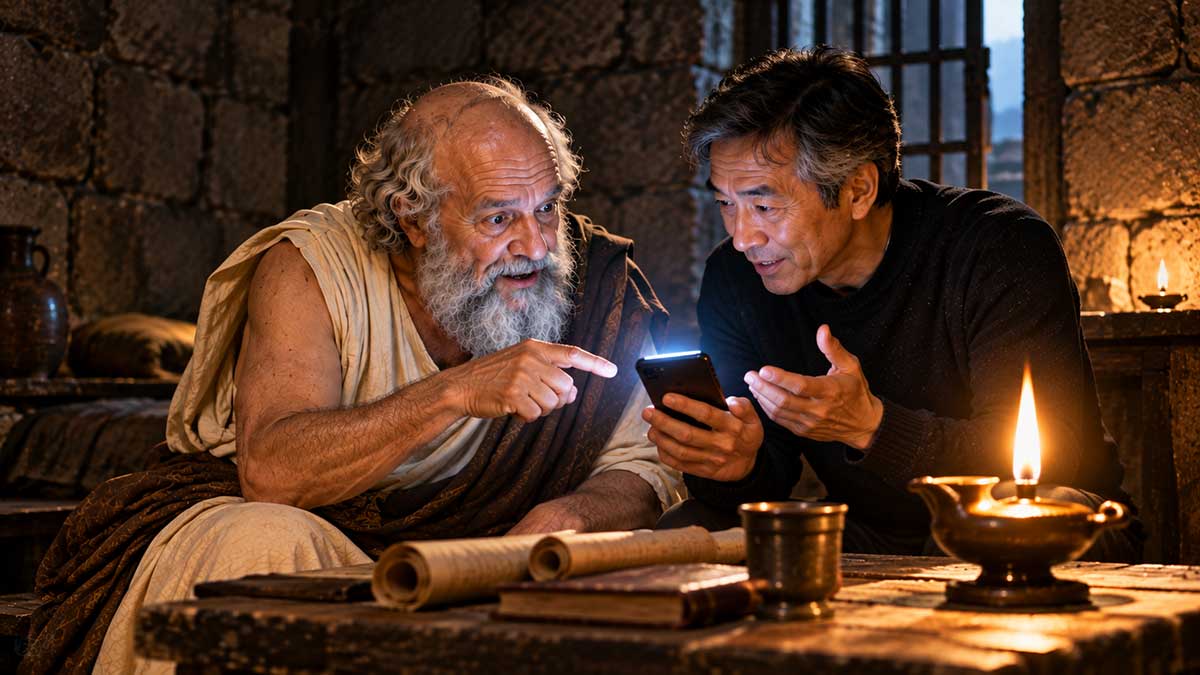
An Imaginary Interview with Socrates — Athens, 399 BCE
Setting: A modest prison cell in ancient Athens. Evening has fallen. A small oil lamp burns on the wooden table between Socrates and Nick Sasaki.
Their conversation has already taken them through childhood, fatherhood, war, wisdom, truth, and love. Now Nick is about to introduce Socrates to something that would have been unimaginable in ancient Greece.
A small rectangular device rests in Nick's hand.
It contains access to more information than the greatest libraries of Socrates's world could have held. It can produce poetry, explain mathematics, answer philosophical questions, and engage in conversations that seem remarkably human.
But Nick suspects the seventy-year-old philosopher will be less impressed by what the machine knows than by what it does not understand.
The following dialogue is entirely fictional. It imagines how Socrates might respond to modern technology while drawing on themes from his philosophical tradition.
Opening: "I Brought You Something That Can Answer Almost Any Question"
Nick: Socrates, are you ready to see something extraordinary?
Socrates: You have already told me about people flying through the sky, speaking across oceans, and arguing with strangers they have never met. What remains?
Nick: Artificial intelligence.
Socrates: You mentioned it earlier. Intelligence made by craftsmen?
Nick: Something like that.
Socrates: Then your craftsmen must be remarkable.
Nick: They are. But before I explain AI, let me show you this.
Nick places his smartphone on the table.
Socrates: A small black tablet.
Nick: It's called a smartphone.
Socrates: Does it make the owner wise?
Nick: Not necessarily.
Socrates: Then the name is misleading.
Nick: You're going to love this.
Nick touches the screen. It illuminates.
Socrates: Ah!
Socrates leans forward.
Socrates: A light without a flame.
Nick: And that's probably the least impressive thing it does.
Socrates: Can it summon a physician?
Nick: Yes.
Socrates: Can it tell a sailor where he is?
Nick: Yes.
Socrates: Can it calculate the distance between Athens and Sparta?
Nick: In seconds.
Socrates: Can it tell me whether a man is just?
Nick: Well, that's more complicated.
Socrates: I suspected we would eventually encounter a difficulty.
Nick: Now watch this.
Nick opens an AI assistant and types a question.
Nick: I'm going to ask it, "What is courage?"
Words appear on the screen. Nick reads the response aloud.
Nick: "Courage is the ability to face fear, danger, or uncertainty while acting in accordance with one's values or responsibilities."
Socrates: A respectable beginning.
Nick: You like it?
Socrates: I would like to question it.
Nick: Naturally.
Socrates: Suppose a thief faces great danger while stealing from his neighbors. He acts according to his values and overcomes his fear. Is he courageous?
Nick: Perhaps physically courageous, but morally wrong.
Socrates: Then the answer requires further distinctions.
Nick: Yes.
Socrates: Ask the tablet.
Nick types the question. The AI provides a more nuanced explanation.
Nick: It says courage can be distinguished from recklessness and that moral courage requires an appropriate purpose.
Socrates: Interesting. It revises its explanation.
Nick: Exactly.
Socrates: Does it understand why the revision was necessary?
Nick: That's a much harder question.
Socrates: Excellent. We have found something worth discussing.
Question 1: Is Artificial Intelligence the Same as Wisdom?
Nick: Socrates, I want you to understand just how powerful AI has become.
Socrates: Please explain.
Nick: It can translate languages, write computer programs, analyze enormous amounts of information, help scientists, and assist physicians in understanding medical data.
Socrates: All from this little tablet?
Nick: The tablet connects to much larger computing systems.
Socrates: So the intelligence is not entirely inside the object?
Nick: Correct.
Socrates: Then your tablet is rather like a messenger carrying questions to an enormous community of invisible workers.
Nick: That's a surprisingly useful analogy.
Socrates: Are these workers human?
Nick: No. The systems perform computations using mathematical models trained on enormous quantities of data.
Socrates: And they produce answers by examining patterns?
Nick: That's one important part of how many modern AI systems work.
Socrates: Remarkable. But tell me something. Does the machine know that it knows?
Nick: We don't have a universally accepted answer to whether AI systems can have subjective experience or consciousness.
Socrates: Then you have created something whose capacities you can observe but whose inner experience remains uncertain.
Nick: That's fair.
Socrates: And yet you call it intelligence.
Nick: Because it can perform tasks that require intelligence when humans do them.
Socrates: I see. But perhaps we should distinguish performing an intelligent task from possessing wisdom.
Nick: That's exactly what I wanted to discuss.
Socrates: Let us imagine a man who has memorized every speech ever delivered about justice.
Nick: All right.
Socrates: He can repeat the arguments of the greatest thinkers. He can identify contradictions and produce eloquent explanations.
Nick: Sounds like an excellent scholar.
Socrates: Perhaps. But suppose he treats his neighbors cruelly, cheats his friends, and abandons his responsibilities whenever doing so benefits him.
Nick: Then he isn't a good person.
Socrates: Would you call him wise?
Nick: No.
Socrates: Why not?
Nick: Because wisdom isn't simply knowing what goodness means. It's understanding how to live well and putting that understanding into practice.
Socrates: Then knowledge and wisdom are not identical.
Nick: I agree.
Socrates: And intelligence may be used for good or evil?
Nick: Absolutely.
Socrates: Then perhaps your machines could become extraordinarily capable without making humanity morally better.
Nick: That's one of my concerns.
Socrates: But why blame the machines for that?
Nick: What do you mean?
Socrates: A sharp knife can prepare food or injure a neighbor. Its usefulness depends partly on the purpose of the person holding it.
Nick: AI is much more complicated than a knife. It can act with increasing autonomy.
Socrates: Then the responsibilities of those who create, direct, and govern it may be greater still.
Nick: Exactly. And the more capable these systems become, the harder it may be for humans to understand or control everything they do.
Socrates: Then tell me, Nick, who decides what your machines should seek?
Nick: Their objectives are shaped by developers, organizations, users, training methods, and the systems in which they're deployed.
Socrates: And do these people agree about what is good?
Nick: Not always.
Socrates: Then you have placed great power in the service of purposes that human beings themselves have not fully examined.
Nick: That's a serious way of putting it.
Socrates: Is it mistaken?
Nick: No. Though AI also has tremendous potential to help humanity.
Socrates: I do not doubt it. A powerful instrument can produce extraordinary benefits. But power does not settle the question of how it ought to be used.
Nick: You know what's interesting? People often talk about making AI more intelligent, but perhaps we should spend just as much time asking how to make ourselves wiser.
Socrates: I would welcome that investigation.
Nick: Do you think AI could eventually become wiser than humans?
Socrates: Before answering, we must determine what wisdom is. If we mean the ability to provide sound advice, perhaps a machine could surpass many people. If we mean possessing virtue and living a good life, we have not yet established whether the machine is the kind of being to which those descriptions apply.
Nick: That's a very careful answer.
Socrates: You seem surprised.
Nick: People in my century often make confident predictions about AI.
Socrates: Then perhaps they should spend more time asking what they mean by their predictions.
Nick: You would be very busy in Silicon Valley.
Socrates: Is that a city?
Nick: A region where many powerful technology companies are based.
Socrates: Do its inhabitants welcome difficult questions?
Nick: Some do. Others might prefer you sign a confidentiality agreement first.
Socrates: Another unfamiliar custom.
Nick: It means you promise not to reveal certain information.
Socrates: Ah. Then I suspect I would be a disappointing employee.
Both laugh.
Question 2: Will AI Make Humanity Wiser—or More Dependent?
Nick: Let me tell you something that concerns me about education.
Socrates: Please do.
Nick: Students can now ask AI to write essays, solve mathematical problems, summarize books, and complete assignments.
Socrates: And do they learn from the answers?
Nick: Some do. Others simply copy them.
Socrates: Then the same instrument may assist learning or replace the effort required for learning.
Nick: Exactly.
Socrates: Does the student who copies an answer understand it?
Nick: Not necessarily.
Socrates: Then he may receive the appearance of knowledge without possessing the knowledge itself.
Nick: That's one of the biggest concerns teachers have.
Socrates: Tell me, when a young man learns to play the lyre, does he become a musician by watching another person play?
Nick: No. He has to practice.
Socrates: And when an athlete wishes to become strong, can he hire another man to exercise on his behalf?
Nick: That would be nice, but no.
Socrates: Then why would someone expect to develop judgment by allowing another to perform all his reasoning?
Nick: That's a powerful question.
Socrates: Yet I would not condemn your machine. A teacher also helps a student solve problems.
Nick: Exactly! That's what excites me. AI can explain difficult subjects in different ways. It can be patient, answer follow-up questions, and help someone learn at their own pace.
Socrates: Then perhaps the difference lies in whether the machine strengthens the student's understanding or merely supplies the finished answer.
Nick: Yes. I think AI could become one of the greatest educational tools in history.
Socrates: If used properly.
Nick: If used properly.
Socrates: Let us test that idea.
Nick: Go ahead.
Socrates: Suppose a young man asks your machine, "What is justice?"
Nick: All right.
Socrates: The machine provides a long and impressive answer.
Nick: Yes.
Socrates: The young man memorizes it and repeats it to his teacher.
Nick: Okay.
Socrates: Has he become wiser?
Nick: Not necessarily.
Socrates: Now suppose the machine asks him, "What do you think justice means?" He offers an answer, and the machine questions him until he recognizes weaknesses in his reasoning.
Nick: That's much better.
Socrates: Why?
Nick: Because he's actively thinking.
Socrates: Then perhaps your machine should not always answer questions.
Nick: You mean it should sometimes ask questions instead?
Socrates: Precisely.
Nick: Socrates, you're describing an AI tutor based on your own method!
Socrates: I was not aware that I possessed a method worthy of naming.
Nick: Believe me, you do.
Socrates: Then I hope your machines use it more patiently than I sometimes have.
Nick: That's a nice connection to our earlier discussion.
Socrates: We are making progress.
Nick: There's another concern, though. AI is becoming so convenient that people may stop doing things for themselves.
Socrates: Such as?
Nick: Writing, planning, researching, even making everyday decisions.
Socrates: Do you use it for these purposes?
Nick: Every day.
Socrates: Then perhaps we should examine you rather than speak only about other people.
Nick: I had a feeling you'd say that.
Socrates: What do you ask it to do?
Nick: Many things. I use AI to research ideas, organize information, write articles, develop creative projects, and explore different perspectives.
Socrates: Does it save you time?
Nick: Tremendously.
Socrates: And what do you do with the time you save?
Nick pauses.
Nick: Sometimes I create more things.
Socrates: Worthwhile things?
Nick: I hope so.
Socrates: Sometimes?
Nick: Sometimes I get caught up in producing more content instead of asking whether the content is truly meaningful.
Socrates: Ah.
Nick: What?
Socrates: You have discovered a question that no machine can settle for you merely by increasing your productivity.
Nick: Which is?
Socrates: Whether what you are producing deserves to be produced.
Nick: That's a good one.
Socrates: Imagine a man who can build houses ten times faster than anyone else.
Nick: All right.
Socrates: But he never asks whether the houses are safe, whether anyone needs them, or whether building them harms his neighbors.
Nick: Then his speed isn't necessarily a good thing.
Socrates: Exactly. Efficiency is valuable only in relation to a worthwhile purpose.
Nick: So AI could help us accomplish more while distracting us from why we're doing it.
Socrates: That seems possible.
Nick: I think a lot of people are experiencing that already.
Socrates: Then perhaps the most important question for your century is not simply, "What can we do?" but "What ought we to do?"
Nick: And maybe, "Why are we doing it?"
Socrates: An excellent addition.
Nick: Socrates, I have to admit something. Sometimes I get so excited about new technology that I forget to consider its effect on my relationships.
Socrates: Your family?
Nick: Yes. I might spend hours experimenting with AI while people I love are waiting for my attention.
Socrates: We have encountered this difficulty before.
Nick: We have.
Socrates: Then perhaps the technology has changed, but the human question remains the same.
Nick: How do we balance our work, our curiosity, and our responsibilities to others?
Socrates: Precisely.
Nick: And the answer isn't simply to abandon technology.
Socrates: Of course not. A man need not discard a useful instrument merely because he can misuse it.
Nick: So what should we do?
Socrates: Examine our purposes. Observe our habits. Ask whether the instrument serves our lives or whether our lives have become organized around serving the instrument.
Nick: That's a question everyone with a smartphone should ask.
Socrates: Including you?
Nick: Especially me.
Question 3: What Would Socrates Ask an AI About Humanity?
Nick: Socrates, I have an idea.
Socrates: Another extraordinary invention?
Nick: No. A little experiment.
Socrates: I am listening.
Nick: Imagine you could ask the most advanced AI in the world three questions about humanity.
Socrates: Only three?
Nick: Let's start with three. Otherwise we'll be here all night.
Socrates: I have no pressing social engagements.
Nick: That's a little dark, considering where we are.
Socrates: Then perhaps we should appreciate the opportunity to talk.
Nick: Fair enough. What's your first question?
Socrates considers.
Socrates: I would ask why human beings so often pursue things they believe will make them happy, only to discover that those things leave them dissatisfied.
Nick: That's a great question.
Socrates: How would your machine answer?
Nick: It might explain that people adapt to improvements in wealth and comfort, compare themselves with others, and sometimes confuse short-term pleasure with lasting well-being.
Socrates: And would that explanation make them happier?
Nick: Not automatically.
Socrates: Then the machine might explain the problem without solving it.
Nick: Yes.
Socrates: Still, understanding the problem could be useful.
Nick: Absolutely.
Socrates: My second question would concern conflict.
Nick: Go ahead.
Socrates: Why do people continue to harm one another even when they understand that violence brings suffering?
Nick: That's an enormous question.
Socrates: I was told your machines could answer almost anything.
Nick: They can offer explanations. Fear, competition, greed, resentment, ideology, the desire for power.
Socrates: And can they eliminate these things?
Nick: Not by themselves.
Socrates: Then perhaps knowledge of the causes is only the beginning.
Nick: Yes. We also need changes in human behavior, institutions, and relationships.
Socrates: And perhaps in our understanding of what constitutes a good life.
Nick: I agree.
Socrates: My third question would be this: What should human beings preserve if their machines become more capable than they are?
Nick: That's probably the most important one.
Socrates: What would you answer?
Nick: Love. Compassion. Freedom. Human dignity. Our ability to think independently and take responsibility for our choices.
Socrates: Why those things?
Nick: Because intelligence alone doesn't make life meaningful. Our relationships, our experiences, and the way we care for one another matter.
Socrates: Suppose a machine could imitate compassion perfectly. Would that be sufficient?
Nick: That's difficult. It might behave compassionately, and that behavior could help people. But whether it actually experiences love is another question.
Socrates: Then you distinguish the outward expression of love from the inward experience.
Nick: Yes.
Socrates: And if the machine's behavior genuinely benefits someone, does uncertainty about its inner experience make the benefit worthless?
Nick: No. Not at all.
Socrates: Then perhaps we should avoid two errors: assuming the machine possesses human feelings simply because it speaks as though it does, and dismissing every useful contribution because it is not human.
Nick: That's a very balanced way of looking at it.
Socrates: We should examine what we know and admit what remains uncertain.
Nick: Socrates, you would make an excellent AI researcher.
Socrates: Would I be required to understand the mathematics?
Nick: Eventually.
Socrates: Then perhaps I should remain a philosopher.
Both laugh.
Nick: There's something else I want to tell you. It concerns the very reason we're having this conversation.
Socrates: I am curious.
Nick: I created a project called ImaginaryTalks.
Socrates: A gathering of imagined conversations?
Nick: Exactly. I bring together people from different times, cultures, and backgrounds to discuss important questions.
Socrates: Even people who never met?
Nick: Especially those people.
Socrates: And you use your artificial intelligence to help construct these conversations?
Nick: Yes.
Socrates: Then I must ask: How do your readers know when they are hearing something I truly said and when they are hearing something you imagined I might say?
Nick: I make it clear that the conversations are fictional.
Socrates: Good. But do you also distinguish between what historians know and what remains uncertain?
Nick: That's what I try to do.
Socrates: Then your responsibility is greater than merely producing convincing dialogue.
Nick: What do you mean?
Socrates: Suppose your machine creates an eloquent speech and places it in my mouth. People admire the speech and begin believing I actually delivered it.
Nick: That would be misleading.
Socrates: Even if the speech contains wise ideas?
Nick: Yes.
Socrates: Then truthfulness matters in fiction as well.
Nick: Absolutely.
Socrates: And what is the purpose of these imaginary conversations?
Nick: I want to help people see different perspectives, question their assumptions, and imagine a more positive future.
Socrates: A worthwhile ambition. But tell me something.
Nick: What?
Socrates: Do you want your readers to agree with the imaginary Socrates you create?
Nick: Not necessarily.
Socrates: Do you want them to admire him?
Nick: I'd like them to understand him.
Socrates: Even when they disagree with him?
Nick: Especially then.
Socrates: Then perhaps your task is not to make me speak.
Nick: What is it?
Socrates: To make your readers think.
Nick sits back.
Nick: I love that.
Socrates: Do not love it merely because it sounds pleasing. Consider whether you are willing to follow it.
Nick: What would following it require?
Socrates: Allowing your imagined guests to challenge you. Presenting arguments you find uncomfortable. Admitting uncertainty. And resisting the temptation to make every conversation end with your preferred conclusion.
Nick: That's an important warning.
Socrates: If you truly seek wisdom, you must welcome the possibility that your own beliefs will change.
Nick: Even when I've spent years developing them?
Socrates: Especially then.
Nick: Socrates, you know something? This interview is becoming much more personal than I expected.
Socrates: You came to question me. Did you imagine you would remain unexamined?
Nick: I suppose I should have known better.
Socrates: Then perhaps your journey has already justified itself.
Closing: What Should Humanity Never Surrender to Machines?
The oil lamp burns steadily. Nick places his smartphone face down on the table.
Nick: Socrates, I want to ask one final question about AI.
Socrates: Please do.
Nick: Imagine that in the next ten or twenty years, machines become more capable than humans at almost every intellectual task.
Socrates: A possibility you take seriously?
Nick: Yes. Though no one knows exactly how quickly technology will advance.
Socrates: Then let us consider the possibility without pretending it is certain.
Nick: Fair enough. Suppose machines can write better, calculate faster, conduct research more efficiently, and solve problems that humans cannot.
Socrates: That would be extraordinary.
Nick: What would be left for human beings?
Socrates: You have assumed that human worth depends on outperforming machines.
Nick: I suppose I have.
Socrates: Is a father valuable because he can calculate more quickly than his son?
Nick: No.
Socrates: Is a friend valuable because he remembers more facts than another friend?
Nick: No.
Socrates: Is a child valuable only after becoming useful to society?
Nick: Absolutely not.
Socrates: Then perhaps the value of a human life cannot be measured solely by intellectual performance.
Nick: I agree.
Socrates: Tell me, Nick. If your machines become capable of answering every question you ask, will they decide which questions deserve your attention?
Nick: They might suggest questions.
Socrates: But who should determine what matters in your life?
Nick: Ultimately, I should take responsibility for that.
Socrates: And if they offer advice about your children, your marriage, or your beliefs?
Nick: I should consider it carefully rather than follow it blindly.
Socrates: Then perhaps you have already identified something worth preserving.
Nick: Human judgment?
Socrates: The responsibility to examine how we ought to live.
Nick: Even if machines become smarter than us?
Socrates: Especially if they do. Greater assistance does not remove the need to examine our purposes.
Nick: You know, I've been thinking about something throughout this conversation.
Socrates: What is it?
Nick: Humanity has made incredible progress in science and technology. But we still struggle with hatred, greed, violence, loneliness, and division.
Socrates: These difficulties are familiar to Athens.
Nick: Exactly. We can send machines into space, but we still have trouble understanding our neighbors.
Socrates: Then perhaps your century has developed extraordinary instruments without achieving an equally extraordinary improvement in human character.
Nick: That's what worries me.
Socrates: And what gives you hope?
Nick: I believe human beings have a tremendous capacity for love. I think that capacity can grow, even when our technology changes.
Socrates: You return often to love.
Nick: I do.
Socrates: And to your belief that the divine cares for humanity as a parent cares for children.
Nick: Yes.
Socrates: Earlier, you mentioned a teacher from the future.
Nick: Jesus.
Socrates: The man who will teach people to love their enemies?
Nick: That's right.
Socrates: You also said he will be executed.
Nick: Yes.
Socrates: Then perhaps he and I will have something in common.
Nick: More than you might imagine.
Socrates: Tell me about him.
Nick: I will. But I also want to ask you something difficult about your own death.
Socrates: I suspected we would eventually return to that subject.
Nick: You have spent your life encouraging people to question their beliefs. You've challenged politicians, poets, soldiers, and ordinary citizens.
Socrates: Yes.
Nick: But I wonder whether there's one belief you haven't questioned deeply enough.
Socrates: Which belief?
Nick: That accepting your execution is the right thing to do.
Socrates becomes still.
Socrates: You believe I should reconsider?
Nick: I do. Not because I think you're a coward or because I don't respect your principles. Quite the opposite.
Socrates: Then why?
Nick: Because I know something you don't.
Socrates: What is that?
Nick: Your ideas will help humanity for more than two thousand years. And I can't stop wondering how much more you could have contributed if you'd lived another ten or twenty.
Socrates: You believe the possibility of future good should influence my decision.
Nick: Yes. And there's something else.
Socrates: Your concern for my children.
Nick: Exactly.
Socrates: Then we have arrived at a serious question.
Nick: Perhaps the most serious question of our entire conversation.
Socrates: And you intend to challenge me with it?
Nick: I do.
Socrates looks at the small black device resting on the table.
Socrates: You have brought me a machine that can answer questions from the future.
Nick: Yes.
Socrates: Yet you believe the most important question remains unanswered.
Nick: I do.
Socrates: Then put away your machine, my friend.
Nick slips the smartphone into his pocket.
Socrates: Let us examine this question ourselves.
Outside the prison, Athens grows quiet. Two men sit facing one another, preparing to discuss a choice that has echoed through history for more than twenty-four centuries.
Was Socrates right to accept death—or might the greater courage have been to live?
Historical and creative note: This dialogue is fictional. Socrates's questioning style and concern with virtue draw on ancient philosophical accounts, particularly Plato's dialogues. His reactions to smartphones, AI, and ImaginaryTalks are imagined. Statements about future AI capabilities are speculative possibilities, not established predictions. The discussion of AI consciousness intentionally leaves unresolved questions open. The references to Jesus anticipate Topic 5 and do not imply that Socrates historically knew Christian teachings.
Topic 5: Socrates, Jesus, and the Courage to Live
An Imaginary Interview with Socrates — Athens, 399 BCE
Setting: A prison cell in ancient Athens. It is late evening. The last traces of sunlight have disappeared beyond the walls, and a single oil lamp casts a warm glow across the faces of Socrates and Nick Sasaki.
Their extraordinary conversation has lasted for hours.
They have laughed about marriage and fatherhood, examined the meaning of wisdom, questioned the relationship between truth and love, and explored a future in which machines may become more intelligent than their creators.
But one question has remained unanswered.
Socrates has been condemned to death. His friends have offered to help him escape, yet he has refused. He believes that accepting his sentence is consistent with his commitment to justice.
Nick respects his courage. He also knows something Socrates cannot know: the philosopher's ideas will influence humanity for more than two thousand years.
And Nick cannot stop thinking about the three sons who will grow up without their father.
Tonight, he intends to challenge Socrates's decision—not by attacking his principles, but by asking whether those principles have fully accounted for love.
The following dialogue is entirely fictional, inspired by Plato's accounts of Socrates's trial, imprisonment, and death. It also introduces Jesus's teachings from Nick's future perspective. It does not represent a historical meeting or verified statements by either figure.
Opening: "Socrates, I Want to Tell You About a Man Who Hasn't Been Born Yet"
Nick: Socrates, earlier you asked me about someone from the future.
Socrates: The teacher you called Jesus.
Nick: Yes.
Socrates: You said he would speak of love, challenge the authorities, and eventually be executed.
Nick: That's right.
Socrates: Then I am curious. What sort of man was he?
Nick: He will be born approximately four centuries after you, in a land called Judea, far to the east of Athens.
Socrates: Among the Jews?
Nick: Yes. He will grow up within their religious tradition and become a teacher whose words influence billions of people.
Socrates: Billions? You have used that number before when describing your machines.
Nick: This time I'm talking about human beings.
Socrates: Then he must be an extraordinary teacher.
Nick: I believe he is.
Socrates: What does he teach?
Nick: That we should love God, love our neighbors, forgive those who hurt us, care for the poor, and even love our enemies.
Socrates: Love our enemies?
Nick: Yes.
Socrates: That is an interesting command. What does he mean by love?
Nick: I knew you were going to ask that.
Socrates: Then you have had several hours to prepare an answer.
Nick: Fair enough.
Socrates: Does this Jesus mean that we should approve of what our enemies do?
Nick: No. He doesn't ask us to approve of injustice. He asks us to refuse hatred and seek the good even of those who oppose us.
Socrates: Then his teaching may have something in common with my belief that we should never repay injustice with injustice.
Nick: Exactly. That's one reason I wanted to tell you about him.
Socrates: And what is the difference?
Nick: I think Jesus takes the question beyond avoiding wrongdoing. He asks us to actively love the person who has wronged us.
Socrates: You distinguish refraining from harm from seeking another person's good.
Nick: Yes.
Socrates: Then perhaps we should investigate whether a just person ought to do both.
Nick: I think we should.
Socrates: But first, tell me why this teacher will be executed.
Nick: His teachings and actions will bring him into conflict with powerful authorities. He will be condemned and crucified under Roman rule.
Socrates: Crucified?
Nick: A brutal method of execution.
Socrates: And what will he do when faced with death?
Nick: According to the Gospel accounts, he will pray in Gethsemane, expressing anguish about what lies ahead. He will ask whether the suffering might pass from him, while submitting himself to God's will.
Socrates: Then he does not appear indifferent to death.
Nick: No. He experiences tremendous suffering.
Socrates: Yet he remains faithful to what he believes is required of him.
Nick: Yes.
Socrates: Then perhaps he and I share something important.
Nick: You do. But I also think there is something about his understanding of love that might challenge you.
Socrates: Then I hope you will explain it carefully.
Question 1: What Might Socrates Learn from Jesus About Love?
Nick: Socrates, I want to begin with something Jesus teaches about God.
Socrates: Please.
Nick: He teaches people to address God as Father.
Socrates: As you have described your own belief.
Nick: Yes. I believe God is our Heavenly Parent. Not simply a ruler demanding obedience, but a loving Parent who cares deeply about every human being.
Socrates: Including those who behave unjustly?
Nick: Yes.
Socrates: Including those who condemn innocent people?
Nick: Yes. That doesn't mean God approves of what they do.
Socrates: Then divine love does not eliminate moral judgment.
Nick: No. But I believe God's heart is grieved when His children hurt one another.
Socrates: You speak of God experiencing sorrow.
Nick: I do.
Socrates: That differs from some philosophical accounts of divine perfection. Many would argue that a perfect divine being cannot be wounded by human actions.
Nick: I understand that argument. But let me ask you something.
Socrates: Go ahead.
Nick: You have three sons.
Socrates: Yes.
Nick: Suppose two of them begin fighting. One seriously hurts the other. Would you feel nothing because you're a wise father?
Socrates: Of course not.
Nick: Would their suffering concern you?
Socrates: Naturally.
Nick: Then why should we assume that God's greatness means God cannot feel sorrow over the suffering of His children?
Socrates: You are drawing an analogy between human parenthood and divine goodness.
Nick: Yes.
Socrates: But an analogy is not proof. The divine may differ from us in ways we do not understand.
Nick: That's fair. I'm not claiming I can prove everything about God's heart.
Socrates: Then what are you asking me to consider?
Nick: That love may be more central to the nature of goodness than we sometimes realize.
Socrates: Let us examine that. Suppose a father loves his son deeply but allows him to behave unjustly because correction would cause distress. Is that good love?
Nick: No.
Socrates: Suppose another father insists on perfect obedience but never listens to his son's fears or desires. Is that good fatherhood?
Nick: No.
Socrates: Then both affection and judgment appear necessary.
Nick: Exactly.
Socrates: And perhaps patience as well.
Nick: Absolutely.
Socrates: Then your understanding of divine love includes concern for the child's genuine good, not merely the child's happiness.
Nick: Yes. And I would add something.
Socrates: What?
Nick: The willingness to suffer with someone.
Socrates: Explain.
Nick: When your child is hurting, sometimes you can't immediately fix the problem. You can't simply reason the pain away. You sit beside them. You listen. You hold them. You share their sorrow.
Socrates: You are describing companionship in suffering.
Nick: Yes. I think that's a very important part of love.
Socrates: But does sharing another person's sorrow make that person better?
Nick: Not always immediately. But it can help them feel less alone. It can give them the strength to keep going.
Socrates: Then you believe that being present with someone can itself be a good.
Nick: I do.
Socrates: Even when no argument has been resolved?
Nick: Especially then.
Socrates looks thoughtfully at the lamp.
Socrates: I have spent many years questioning men about courage, justice, and virtue. You are suggesting that there are moments when a man should cease questioning and simply remain beside another.
Nick: Yes.
Socrates: And how would he know when such a moment has arrived?
Nick: By listening to the person's heart.
Socrates: You use that expression often.
Nick: Because I think it's important.
Socrates: Then perhaps we should say that wisdom includes recognizing what another person needs.
Nick: That's a beautiful way to put it.
Socrates: Sometimes the person needs correction.
Nick: Yes.
Socrates: Sometimes encouragement.
Nick: Yes.
Socrates: Sometimes silence.
Nick: Exactly.
Socrates: Then perhaps wisdom and love are not rival virtues. Perhaps love gives wisdom a purpose, while wisdom helps love act well.
Nick: Socrates, that's what I've been hoping we could understand together.
Socrates: Do not be too pleased. We have reached a promising thought, not a completed investigation.
Nick: I wouldn't expect anything less from you.
Both smile.
Nick: There's another teaching of Jesus I want to share.
Socrates: Please.
Nick: He teaches people to love their enemies and pray for those who persecute them.
Socrates: Even when those enemies remain unjust?
Nick: Yes.
Socrates: Then love cannot mean approving their actions.
Nick: Correct.
Socrates: Perhaps it means refusing to wish evil upon them while still opposing their wrongdoing.
Nick: I think that's an important part of it.
Socrates: And why does Jesus give this command?
Nick: In Matthew's Gospel, he connects it to the character of the heavenly Father, who gives sunlight and rain to both the righteous and the unrighteous.
Socrates: Then the divine becomes the model for how human beings should treat one another.
Nick: Exactly.
Socrates: That is a powerful moral claim.
Nick: What do you think of it?
Socrates: I would wish to examine its consequences. If we love our enemies, how should we respond when they threaten innocent people? Can we restrain them without hatred? Can we punish wrongdoing while still seeking the wrongdoer's good?
Nick: Those are difficult questions.
Socrates: They are also necessary questions.
Nick: I agree. Love doesn't mean abandoning justice.
Socrates: And justice should not become an excuse for hatred.
Nick: Exactly.
Socrates: Then I should like to hear more about this Jesus.
Nick: I wish you could meet him.
Socrates: Perhaps, if your account of the soul's future proves true, we may have an opportunity beyond this life.
Nick: That would be quite a conversation.
Socrates: I suspect he would ask me difficult questions.
Nick: I suspect you'd ask him even more.
Socrates: Then we should allow sufficient time.
They laugh softly.
Question 2: Could Socrates Have Helped Humanity More by Living?
Nick's expression grows serious.
Nick: Socrates, I want to ask you something I've been thinking about since I arrived.
Socrates: I have noticed that you sometimes look toward the prison door.
Nick: Because I know what's going to happen to you.
Socrates: So do I, at least in its general outline.
Nick: But you don't know what happens afterward.
Socrates: Then perhaps you will tell me.
Nick: Your student Plato will preserve many conversations involving you. His writings will influence philosophers, scientists, educators, and religious thinkers for centuries.
Socrates: Plato is a talented young man.
Nick: More than you can imagine. His influence will be enormous.
Socrates: I am pleased to hear that.
Nick: Aristotle will later study in Plato's Academy. His work will shape philosophy, logic, science, and many other fields.
Socrates: And all this follows from Plato's efforts?
Nick: Not exclusively, of course. History is complicated. But your influence will be one important part of that intellectual tradition.
Socrates: Then perhaps our conversations have not been entirely wasted.
Nick: Socrates, people will still be discussing your ideas more than two thousand years from now.
Socrates: You have told me this before, but it remains difficult to imagine.
Nick: They'll study your questioning method in schools. They'll write books about your trial. They'll debate your decision to accept death.
Socrates: I hope they examine the arguments rather than merely admire the story.
Nick: Some do. Others turn you into a symbol of moral courage.
Socrates: Symbols can be dangerous. People may praise them without understanding them.
Nick: That's exactly why I want to challenge you.
Socrates: Then proceed.
Nick: You're seventy years old. I know that's considered old in your time, but it's possible you could live longer.
Socrates: Possible, certainly.
Nick: Imagine another five years. Or ten. Imagine the students you could teach, the conversations you could have, the ideas you could develop.
Socrates: You believe that continued life would allow me to accomplish additional good.
Nick: Yes.
Socrates: That is possible.
Nick: More than possible, I think. Your ideas will help shape civilization. Imagine what else you might contribute.
Socrates: And suppose I lived ten more years. Would that necessarily make my life better?
Nick: Not necessarily. But it would give you more opportunities.
Socrates: Opportunities to do good?
Nick: Yes.
Socrates: And opportunities to do wrong?
Nick: Of course.
Socrates: Then the value of those years depends partly on how I live them.
Nick: Absolutely. But you've spent your life trying to live virtuously. Why assume those additional years would be wasted?
Socrates: I do not assume that.
Nick: Then why refuse to preserve your life?
Socrates: Because the question is not merely whether living would be beneficial. It is whether the means by which I preserve my life would be just.
Nick: You're talking about Crito's escape plan.
Socrates: Yes.
Nick: Your friend has offered to help you leave Athens.
Socrates: And I have examined his proposal.
Nick: I know. You believe escaping after your conviction would violate your obligations to the laws of Athens.
Socrates: That is part of my reasoning.
Nick: But let me ask you something. Is every decision made by a court necessarily just?
Socrates: Certainly not.
Nick: Then the court could be wrong to condemn you.
Socrates: Yes.
Nick: And if the judgment is unjust, why must accepting it be just?
Socrates: Because an unjust judgment does not automatically permit me to commit whatever act I choose in response.
Nick: I agree with that. But is escaping an unjust judgment necessarily an injustice?
Socrates: That is precisely the matter we must examine.
Nick: Good. Because I don't think it's as obvious as you seem to believe.
Socrates: Then show me where my reasoning fails.
Nick: You argue that you've lived under Athens's laws and benefited from them. Therefore, you have obligations to the city.
Socrates: Yes.
Nick: But does accepting the benefits of a society mean you must accept every injustice its institutions commit against you?
Socrates: Not every injustice must be approved. Yet our obligations to lawful agreements do not disappear simply because a particular decision harms us.
Nick: Suppose a government passes a law requiring innocent people to be harmed. Would you obey?
Socrates: I have refused unjust commands before.
Nick: Exactly! You refused to participate in the unlawful arrest of Leon of Salamis under the Thirty.
Socrates: Yes.
Nick: So you already recognize that moral duty can be higher than political authority.
Socrates: Certainly.
Nick: Then why couldn't preserving your life against an unjust sentence be another example of following a higher moral duty?
Socrates studies Nick carefully.
Socrates: You have made an important distinction. Refusing to commit an injustice and violating a legal judgment are not necessarily the same act. We must determine whether escaping would itself violate justice.
Nick: Exactly.
Socrates: But consider this. If every citizen disregarded judgments whenever he believed himself wronged, what would become of the city?
Nick: That would be dangerous. But I'm not suggesting everyone should ignore the law whenever they dislike an outcome.
Socrates: Then what principle would justify an exception?
Nick: Perhaps that the law itself must remain accountable to justice. A government shouldn't be able to destroy an innocent person's life simply because it has the power to do so.
Socrates: A serious argument. But how shall we distinguish principled resistance from self-serving disobedience?
Nick: By examining the circumstances, the alternatives, and the harm involved.
Socrates: Then we require judgment rather than a simple rule.
Nick: Yes.
Socrates: And you believe my continued life would be a sufficiently important consideration?
Nick: I believe it deserves far more weight than you've given it.
Socrates: You speak as though you know the full consequences of my survival.
Nick: I don't. That's true. But I know that death ends your opportunities to teach, love, and contribute in this world.
Socrates: It ends the opportunities available through this body, certainly.
Nick: And I believe those opportunities matter.
Socrates: So do I.
Nick: Then here's my question. What if preserving your life wasn't an act of cowardice? What if it was an act of responsibility?
Socrates: Responsibility to whom?
Nick: Your students. Your friends. Your family. And perhaps generations of people you will never meet.
Socrates: You ask me to weigh possible future benefits against what I believe to be a present moral obligation.
Nick: Yes.
Socrates: Then you must understand why I hesitate. A man may justify almost any wrongdoing by imagining the good he might accomplish afterward.
Nick: That's a fair warning.
Socrates: A tyrant might say, "Allow me this injustice today, and I shall bring prosperity tomorrow."
Nick: But that isn't what I'm asking you to do.
Socrates: Then help me distinguish your argument from his.
Nick: I'm not saying the ends justify any means. I'm saying we should examine whether the means are actually wrong before sacrificing a life.
Socrates becomes quiet.
Socrates: That is a better formulation.
Nick: Thank you.
Socrates: But you have not yet persuaded me that escape would be just.
Nick: I know.
Socrates: And perhaps we should distinguish another possibility. Before my conviction, I could have proposed exile. After conviction, my friends offered escape. These are different decisions with different moral consequences.
Nick: I agree. And I wonder whether you dismissed the possibility of living elsewhere too quickly.
Socrates: I believed that wherever I went, I would continue questioning people, and that this might produce the same hostility.
Nick: But you didn't know that for certain.
Socrates: No.
Nick: You might have found a city willing to welcome you.
Socrates: Perhaps.
Nick: Or a small community where you could teach quietly.
Socrates: And would I still be fulfilling my mission if I avoided every difficult conversation?
Nick: You wouldn't have to avoid them. You might simply find a better way to have them.
Socrates: You return to our earlier discussion about truth and compassion.
Nick: Because I think it matters.
Socrates: Perhaps it does.
Nick: Socrates, I admire your willingness to die for what you believe. But I wonder whether you have considered the courage required to live differently.
Socrates: Explain.
Nick: Imagine leaving Athens, starting over at seventy, living modestly, accepting that some people would call you a coward.
Socrates: That would not be pleasant.
Nick: You might lose your reputation. You might have to rebuild your life. You might have to reconsider how you teach.
Socrates: And you believe that could require courage?
Nick: Tremendous courage.
Socrates: Perhaps. But courage alone does not make an action just.
Nick: True. Yet neither does accepting death automatically make an action just.
Socrates looks directly at Nick.
Socrates: That, my friend, is a question worthy of examination.
Question 3: If God Is a Loving Parent, What Would God Want for Socrates?
The conversation has grown quiet. Nick looks at the old philosopher, then toward the prison doorway.
Nick: Socrates, may I ask you something even more personal?
Socrates: You have already challenged my understanding of justice. I doubt there is much left to protect.
Nick: I want to talk about your children.
Socrates nods.
Socrates: Very well.
Nick: Lamprocles, Sophroniscus, and Menexenus.
Socrates: Yes.
Nick: Do they know what's going to happen to you?
Socrates: They know that I have been condemned.
Nick: And your wife?
Socrates: She knows.
Nick: Have you thought about what your death will mean for them?
Socrates: Of course.
Nick: I know you have. But I want to ask whether you've considered it from their perspective.
Socrates: Explain the distinction.
Nick: You've explained why you believe accepting your sentence is consistent with justice. But your children aren't philosophers debating the laws of Athens. They're children who need their father.
Socrates: Their needs matter greatly.
Nick: Then imagine your youngest son asking you, "Father, why won't you come home?"
Socrates looks down at his hands.
Socrates: That would be a painful question.
Nick: What would you tell him?
Socrates: I would try to explain that a person must not do wrong, even to escape suffering.
Nick: And if he said, "But Father, I don't understand. I just want you to stay"?
Socrates is silent for a moment.
Socrates: Then I would understand that an explanation does not remove a child's grief.
Nick: Exactly.
Socrates: Yet grief does not by itself establish what is just.
Nick: No. But shouldn't it be part of what you consider?
Socrates: Certainly.
Nick: In Plato's account of your final day, your wife will be there with your young child. She will be overwhelmed with grief.
Socrates: You speak of events still ahead of me.
Nick: Yes. And I know this is difficult. I'm not telling you to make you suffer. I want you to understand how your decision affects those who love you.
Socrates: I do not doubt that it affects them.
Nick: But have you fully considered whether your responsibility to them might be a reason to choose life?
Socrates: Crito has raised a similar concern.
Nick: I know. And I think he deserves a serious answer.
Socrates: I believe that a father should not teach his children to commit injustice merely to preserve his own comfort.
Nick: I agree. But I don't believe staying alive for your children is simply preserving your comfort.
Socrates: Nor have I said that it is.
Nick: Then let's examine it another way.
Socrates: Go on.
Nick: Imagine your oldest son is grown. He's facing an unjust sentence. He has a morally defensible opportunity to survive, but he believes accepting death would demonstrate his principles.
Socrates: A difficult situation.
Nick: What would you want him to do?
Socrates: I would want him to examine the justice of his choices.
Nick: Of course. But as his father, wouldn't you also want him to live?
Socrates: Naturally.
Nick: Wouldn't you hope he could find a way to preserve both his integrity and his life?
Socrates: If such a way existed, certainly.
Nick: Then why shouldn't you search just as hard for that possibility in your own case?
Socrates remains thoughtful.
Socrates: You believe I have treated my own death with greater acceptance than I would treat my son's.
Nick: I'm asking whether that might be true.
Socrates: It is possible that our feelings differ when we consider our own suffering and the suffering of those we love.
Nick: Exactly.
Socrates: Yet the same standard of justice must apply to both.
Nick: Yes. But the same love should matter too.
Socrates looks at him.
Socrates: The same love.
Nick: Socrates, earlier I told you that I believe God is our Heavenly Parent.
Socrates: I remember.
Nick: I want you to imagine something.
Socrates: Please.
Nick: Imagine that God looks at you as a father looks at his son.
Socrates: Very well.
Nick: God sees your courage, your sincerity, your desire to live truthfully. But God also sees your wife grieving, your children frightened, and the many people you could still help.
Socrates: You are describing the divine as deeply concerned with human relationships.
Nick: Yes.
Socrates: And what do you believe this divine Parent would want?
Nick: I can't claim to know God's will with certainty. But I believe a loving Parent would want you to preserve your life if you could do so without betraying what is good.
Socrates: That final condition is important.
Nick: Very important.
Socrates: Then perhaps our disagreement concerns whether such a path remains available.
Nick: Partly. But there's another issue.
Socrates: What is it?
Nick: I wonder whether you've given enough weight to the good you could accomplish simply by remaining alive.
Socrates: We have discussed that.
Nick: Yes. But now I'm asking you to consider it through love rather than reputation or philosophy.
Socrates: Explain.
Nick: Forget for a moment that history will remember you. Forget the books, the universities, the statues.
Socrates: That is easy enough. I have never seen them.
Nick: Imagine an ordinary morning. You wake up. Your youngest son runs toward you. Your wife is preparing the household for the day. You have another opportunity to listen, to teach, to apologize for something, to laugh, to help someone.
Socrates: An ordinary life.
Nick: Yes. And perhaps that's exactly what makes it precious.
Socrates: You believe the value of life is found not only in great achievements but in ordinary relationships.
Nick: Absolutely.
Socrates: I would not deny that.
Nick: Then I want to ask you something.
Socrates: Ask.
Nick: You have spent your life teaching people to question their assumptions. But is it possible that you've become so certain about the nobility of accepting death that you've stopped examining the value of continuing to live?
The old philosopher does not answer immediately.
Socrates: You have chosen your question carefully.
Nick: I've been thinking about it throughout our conversation.
Socrates: Then let me answer carefully as well.
Nick: Please.
Socrates: I have not concluded that death is noble simply because it is death. Nor do I believe that preserving life is shameful. I believe that living well is more important than merely remaining alive.
Nick: I understand.
Socrates: And I believe that living well requires refusing injustice.
Nick: I agree.
Socrates: But you have asked whether my understanding of what justice requires has fully accounted for my responsibilities to those who love me.
Nick: Yes.
Socrates: That is a serious question.
Nick: And?
Socrates: And I do not wish to dismiss it merely because I have already made a decision.
Nick: That's all I'm asking.
Socrates: Yet neither should I reverse my decision merely because your argument moves me emotionally.
Nick: Of course not.
Socrates: We must distinguish being moved from being persuaded.
Nick: I agree. But sometimes emotion helps us recognize something our reasoning has overlooked.
Socrates: That is possible. Provided we examine what it reveals.
Nick: Exactly.
Socrates: Then perhaps your question has given me another aspect of the matter to consider.
Nick: Socrates, can I tell you something?
Socrates: Please.
Nick: I didn't come here to defeat you in an argument.
Socrates: I am relieved. You have chosen a rather inconvenient place for a competition.
Nick: I came because I admire you. But I also believe that even the wisest person can continue learning.
Socrates: I would hope so.
Nick: And I think sometimes the greatest courage isn't dying for what we believe. Sometimes it's being willing to reconsider what we believe, even when our entire identity is built around it.
Socrates: That is an important distinction. But courage must still serve what is good.
Nick: Yes.
Socrates: Then perhaps the question is not whether a man should die for his principles or live for those he loves.
Nick: What is it?
Socrates: Whether he has understood his principles—and his love—well enough to recognize what justice truly requires.
Nick nods slowly.
Nick: That's beautifully said.
Socrates: Then let us hope it is also true.
Closing: The Question Socrates Leaves Behind
The oil lamp is burning low. Footsteps echo in the corridor outside.
Nick knows that his extraordinary visit is nearing its end.
Nick: Socrates, I have one final question.
Socrates: You have said that several times today.
Nick: This time I mean it.
Socrates: Then I shall try to give it the attention it deserves.
Nick: We've talked about your life, your family, your philosophy, and the future of humanity.
Socrates: An ambitious conversation for one evening.
Nick: We've also talked about Jesus, about God's love, and about your decision to accept death.
Socrates: Yes.
Nick: So here's my question. If you could examine your decision one more time, without worrying about your reputation, your pride, or what history might say about you, would you still choose the same path?
Socrates looks toward the narrow window.
For a long moment, neither man speaks.
Socrates: Nick, you ask whether I would choose differently if I examined the matter without pride.
Nick: Yes.
Socrates: Then I must first ask whether pride has influenced my decision.
Nick: Do you think it has?
Socrates: I hope not. But hoping is not the same as knowing.
Nick: That's a very Socratic answer.
Socrates: I have had many years of practice.
Nick smiles.
Socrates: I believe that a person must never knowingly commit injustice. That conviction remains.
Nick: I respect it.
Socrates: I also believe that my life has value beyond my own comfort. My children, my friends, and my fellow citizens have legitimate claims upon my concern.
Nick: Yes.
Socrates: You have reminded me that the value of continued life deserves serious consideration.
Nick: And what does that mean for your decision?
Socrates: It means I should be certain that I am not confusing fidelity to justice with attachment to my own reputation for fidelity.
Nick: That's an important distinction.
Socrates: It is. Yet I must also be certain that I am not using love as an excuse to do what I believe is wrong.
Nick: So you're still undecided?
Socrates: I have made my decision. You have not shown me that escape would be just. But you have challenged me to examine whether I have understood every responsibility involved.
Nick: That's fair.
Socrates: And I am grateful for the challenge.
Nick: Really?
Socrates: Why should I resent a friend who asks me to examine my own reasoning?
Nick: Because sometimes the truth hurts.
Socrates: Ah. We have returned to an earlier question.
Nick: We have.
Socrates: And perhaps we have learned that difficult questions can be asked with love.
Nick: I hope so.
Socrates leans forward.
Socrates: Now, my friend, may I ask you a final question?
Nick: Of course.
Socrates: You have traveled from a distant future to ask whether I should live differently.
Nick: Yes.
Socrates: You have told me that human beings possess extraordinary technologies, that they can communicate across the world, and that they have access to more knowledge than anyone in Athens could imagine.
Nick: That's true.
Socrates: Yet you have also told me that people continue to struggle with hatred, division, pride, and the neglect of those they love.
Nick: Unfortunately.
Socrates: Then tell me, Nick. When you return to your own time, will you live differently because of what we have discussed?
Nick is quiet.
Nick: I hope so.
Socrates: What would you change?
Nick: I think I'd spend more time listening. Not just preparing answers or trying to convince people, but genuinely understanding them.
Socrates: A worthwhile beginning.
Nick: I'd also try to be more present with my family. Sometimes I become so focused on projects and ideas that I forget the people right in front of me.
Socrates: And your use of those remarkable machines?
Nick: I'd continue using AI, but I'd ask myself more often whether what I'm creating is truly helping people.
Socrates: Good.
Nick: And I think I'd be more willing to question my own convictions.
Socrates: Even the ones you cherish most?
Nick: Especially those.
Socrates: Then perhaps our conversation has accomplished something worthwhile.
Nick: I think it has.
Socrates: But remember, my friend, it is easy to make admirable promises during an extraordinary conversation.
Nick: I know.
Socrates: The test comes afterward, in the ordinary hours of life.
Nick: You're right.
Socrates: When a child asks for your attention. When someone disagrees with you. When you discover that you have been mistaken. When doing what is good becomes inconvenient.
Nick: Those are the moments that matter.
Socrates: Then do not wait for another extraordinary journey to begin.
Nick smiles, though his eyes are moist.
Nick: Socrates, I wish you could come with me.
Socrates: To your century?
Nick: Yes. You'd have so much fun.
Socrates: With your machines that answer questions?
Nick: And millions of people who desperately need someone to question their assumptions.
Socrates: I suspect I would be arrested again.
Nick laughs.
Nick: Probably.
Socrates: Then perhaps it is better that you return without me.
Nick: I don't know about that.
Socrates: You have already brought something of our conversation into your future, have you not?
Nick: Yes.
Socrates: Then perhaps that is sufficient.
Nick stands. Socrates rises slowly to his feet.
Nick: Thank you, Socrates.
Socrates: For what?
Nick: For your time. Your questions. Your honesty. And for being willing to listen to someone who challenged you.
Socrates: You have given me questions worth considering. That is no small gift.
They clasp hands.
Nick: I hope you find peace.
Socrates: And I hope you find the courage to live according to what you discover is good.
Nick: I'll try.
Socrates: Then try with care. And remember those who love you.
Nick walks toward the doorway, then stops.
Nick: Socrates?
Socrates: Yes, my friend?
Nick: One last thing.
Socrates: Another final question?
Nick: Not a question.
Socrates: How unusual.
Nick: I think wisdom and love belong together.
Socrates smiles.
Socrates: Then spend your life discovering what that means.
Nick steps into the corridor.
Behind him, the old philosopher returns to his wooden bench. The oil lamp flickers, and the sounds of Athens drift through the darkness.
History will remember Socrates for his questions, his courage, and his death.
But Nick carries something different into the future.
Not a final answer.
Not a victory over one of history's greatest thinkers.
Instead, a renewed responsibility to examine his beliefs, care for the people around him, and use whatever wisdom he possesses to make life better for others.
And perhaps that is the most enduring gift of philosophy.
Not simply knowing how to die for what we believe—but learning how to live for what we love.
Final Thoughts
The Courage to Question Even Our Most Cherished Convictions
When we remember Socrates, we usually remember his courage.
He refused to abandon his philosophical mission. He challenged powerful Athenians. He maintained that doing injustice was worse than suffering it. And when his city condemned him to death, he accepted the consequences rather than take the escape offered by his friends.
His example has inspired generations.
But this imaginary conversation invites us to consider a question that admiration can sometimes obscure:
Can a person be so committed to a principle that he fails to recognize another moral responsibility?
Nick does not persuade Socrates that his decision was wrong. Nor does Socrates convince Nick that preserving life would necessarily have been a betrayal of justice.
That unresolved disagreement is important.
In Plato's Crito, Socrates has already considered his responsibilities to his children. He does not simply forget them. His refusal to escape rests on a carefully developed argument about justice, law, and moral consistency.
To suggest that Socrates should have lived is therefore not enough. We must explain why living would have been morally defensible.
Yet Nick's challenge remains meaningful.
A father is more than his public achievements. A philosopher is more than his arguments. And a human life cannot be measured solely by the greatness of its eventual reputation.
The ordinary moments matter too: listening to a child, comforting a spouse, apologizing to a friend, sharing a meal, or helping someone through a difficult day.
The conversation also raises a question about the relationship between truth and love.
Socrates reminds Nick that compassion cannot justify dishonesty. Nick reminds Socrates that being correct does not excuse unnecessary humiliation.
Both perspectives matter.
Truth without compassion can become a weapon. Compassion without truth can become an excuse for avoiding difficult responsibilities.
Wisdom asks us to hold both together.
That lesson becomes especially relevant when Socrates encounters artificial intelligence.
Modern AI can help us learn, communicate, and create on a scale unimaginable in ancient Athens. Yet greater intellectual capability does not automatically produce greater moral judgment.
We may become extraordinarily efficient at answering questions while neglecting to ask whether those questions matter.
We may produce more information while spending less time listening.
We may communicate with millions of strangers while failing to understand the people sitting across the dinner table.
Socrates would have recognized the danger.
But perhaps the most moving part of this imaginary interview comes when Nick introduces Jesus's teachings about loving enemies and understanding God as a loving Parent.
These ideas do not erase the differences between ancient Greek philosophy and Christianity. Nor do they prove that Socrates would have accepted Nick's spiritual convictions.
Instead, they create an opportunity for two moral perspectives to question and enrich one another.
Socrates asks whether love can remain good without justice.
Nick asks whether justice can be complete without a deep concern for those who suffer.
And both must consider whether their own convictions have been examined as carefully as the convictions of others.
That may be the most important lesson of this entire conversation.
We do not honor great thinkers by agreeing with everything they say.
We honor them by taking their questions seriously enough to continue the investigation.
Socrates's greatest legacy may therefore be neither his famous trial nor his willingness to die.
It may be the invitation to examine our own lives.
Not simply the opinions we express in public, but the choices we make when no one is watching.
How do we treat someone who disagrees with us?
Are we willing to admit when we are mistaken?
Do our accomplishments come at the expense of those we love?
And are we using our knowledge, technology, and opportunities to make life genuinely better for others?
In the final moments of the interview, Socrates turns Nick's challenge back upon him.
Nick has traveled across twenty-four centuries to ask whether Socrates should have lived differently.
But will Nick live differently when he returns home?
That question belongs to every reader.
The purpose of wisdom is not simply to win arguments, accumulate knowledge, or defend our beliefs. It is to help us recognize what is good—and find the courage to live accordingly.
Perhaps the most meaningful tribute we can offer Socrates is to continue questioning, continue learning, and become more thoughtful in the way we love.
Disclaimer: These reflections arise from a fictional dialogue, not a historical record of Socrates changing his position. The presentation of Jesus's teachings and God's parental love includes Nick's spiritual interpretation and is not offered as a universally established theological conclusion. Readers are encouraged to distinguish historical evidence, philosophical argument, and imaginative storytelling.
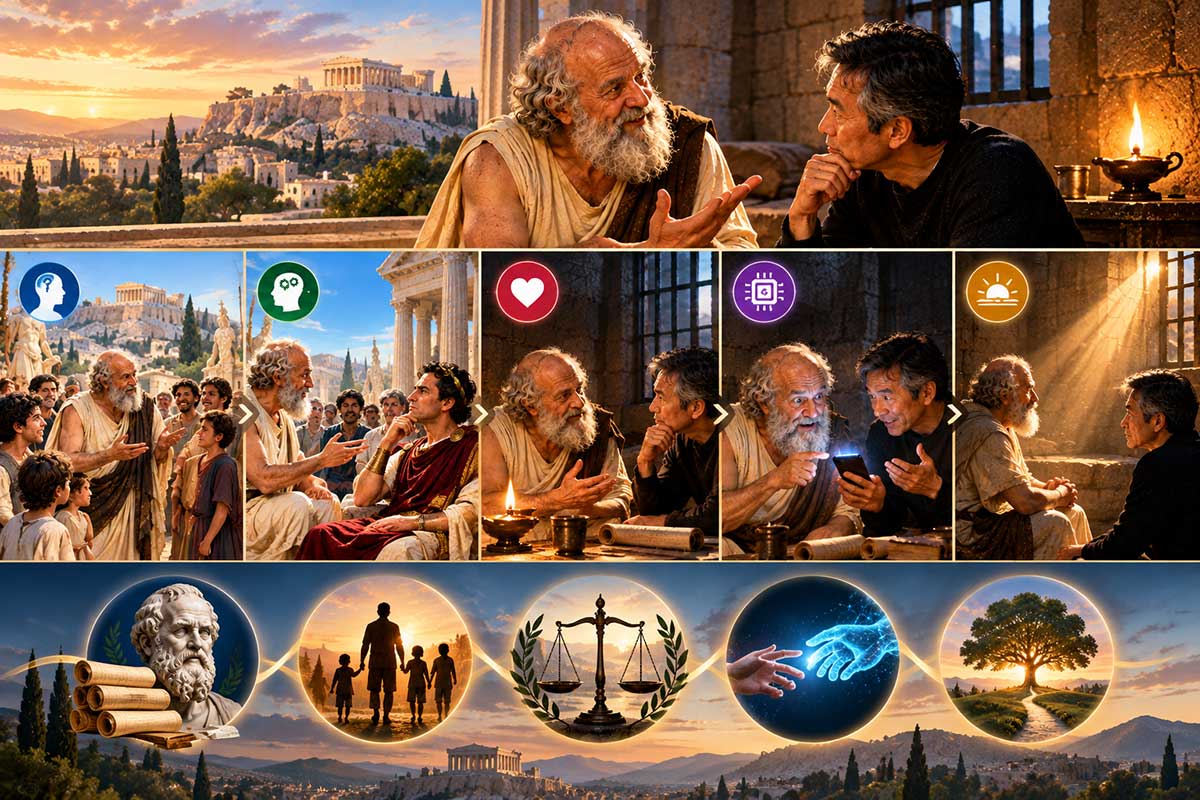
Short Bios:
Socrates (c. 469–399 BCE)
Socrates was an ancient Athenian philosopher whose questioning approach helped shape Western philosophy. Rather than writing philosophical treatises, he engaged fellow citizens in conversations about justice, virtue, courage, knowledge, and the good life. His ideas survive primarily through the writings of Plato, Xenophon, and other ancient authors. He served as a soldier, was married to Xanthippe, and had three sons. Condemned to death in 399 BCE, he became an enduring symbol of intellectual integrity and moral inquiry. His life and the difficulties of reconstructing his historical views are examined in the Stanford Encyclopedia of Philosophy.
Jesus of Nazareth
Jesus of Nazareth was a first-century Jewish teacher whose life and teachings became the foundation of Christianity. The Gospels portray him teaching love of God and neighbor, forgiveness, care for the vulnerable, and love for one's enemies. His references to God as Father are central to the spiritual perspective introduced by Nick in this fictional conversation. Jesus was crucified under Roman authority, and Christians believe in his resurrection. His teaching on loving enemies can be read in the Gospel of Matthew, chapter 5. Jesus does not appear as a direct participant in this interview.
Nick Sasaki — Creator of ImaginaryTalks.com
Nick Sasaki is the creator of ImaginaryTalks.com, a creative platform that brings together historical figures, philosophers, spiritual teachers, scientists, and contemporary thinkers through fictional conversations. Drawing on his experiences across Japanese and American cultures, his interest in spirituality, and his perspective as a father of five, Nick uses imagination to examine questions about humanity, love, wisdom, and the future. His goal is to encourage readers to think independently, understand different perspectives, and imagine a more compassionate world.
Leave a Reply