

Introduction
What would you say to the greatest writer who ever lived, if you could ask him one question no one has ever dared to ask?
I’ve wanted to sit down with William Shakespeare for years. But I didn’t fully understand why until this year, when my youngest son left for university. The house grew quiet. And I kept thinking about a father, four hundred years ago, who spent most of his son’s short life in London, three days’ ride from home, coming back now and then to find the boy a little taller and a little further away.
Shakespeare’s only son, Hamnet, was a twin. The parish records give us almost nothing else: his baptism in February 1585 and his burial in August 1596, at eleven years old. As National Geographic notes, there is no evidence his father was at the burial. On that very day, Shakespeare’s acting company was performing in a town hall in Kent. A few years later, he wrote “Hamlet,” a play about a grieving son haunted by his father’s ghost, whose name was almost identical to his own lost boy’s. An old tradition says Shakespeare played the Ghost himself.
So I went to meet him at Shakespeare’s Globe in London, the theater rebuilt in 1997 near the site of his original wooden O. It’s late on a gray autumn afternoon, after a performance of “Hamlet,” with the audience gone and the stage empty. Like every ImaginaryTalks episode, this conversation is sincere imagination, grounded in the historical record and in his own words, not a claim to channel anyone.
We talk about a glover’s son who watched his proud father fall into disgrace, and a young man who married at eighteen. We talk about the “upstart crow,” the businessman who owned a share of his company, and the man who, in a famine year, stored more grain than most of his neighbors. And then we come to the summer of 1596, and the play that grew out of it, and what forgiveness might look like for a father who wasn’t there.
If you’ve ever been away from someone you love longer than you meant to be, or carried words you never got to say, come sit with us on the edge of the stage. He’s been waiting four hundred years to answer.
(Note: This is an imaginary conversation, a creative exploration of an idea, and not a real speech or event.)
Topic 1: The Glover’s Son
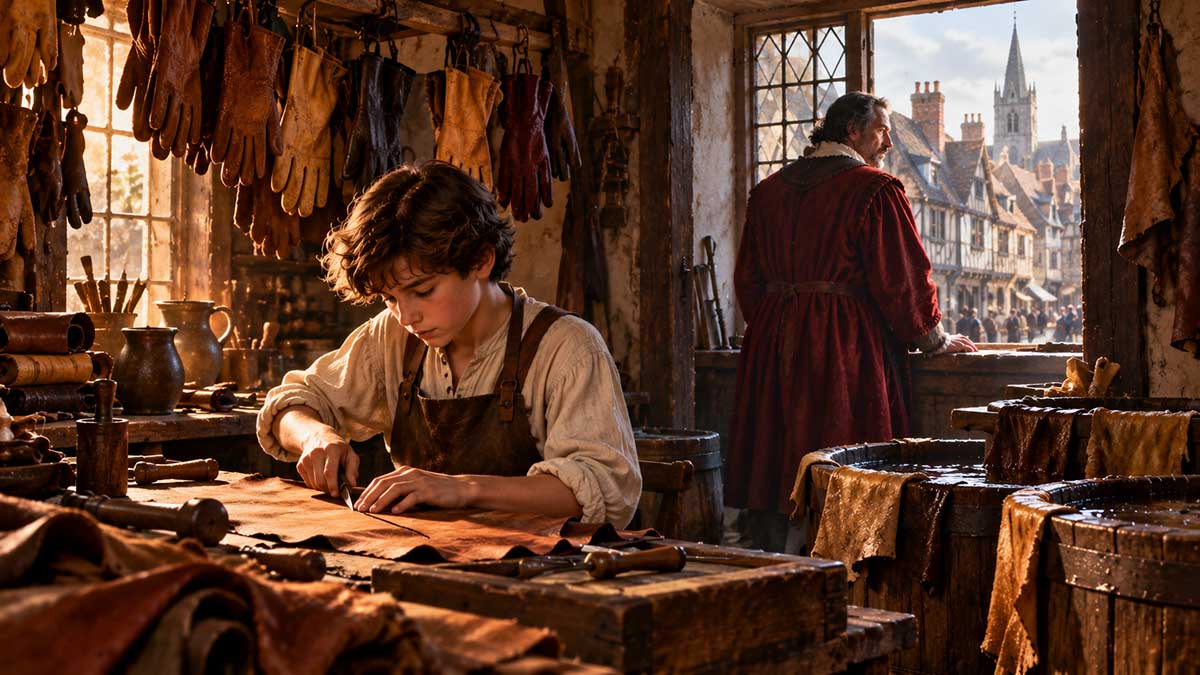
Shakespeare’s Globe, London. A gray autumn afternoon. The afternoon performance of “Hamlet” has ended, and the last of the audience has filtered out through the gates. Pigeons settle on the thatched roof. The open yard is empty, and the great painted stage stands quiet under the sky. A man in a plain dark doublet stands alone at its center, running his palm slowly along one of the tall painted pillars, the way a carpenter checks the grain of good wood.
He hears footsteps in the yard and turns.
William Shakespeare: If you’re a creditor, I’ve already left for Stratford.
Nick Sasaki: (laughing) I’m not a creditor.
William Shakespeare: A lawyer, then. Worse.
Nick Sasaki: Nick Sasaki. I’m just someone who’s wanted to meet you for a long time.
William Shakespeare: (He studies Nick, then gestures around the theater.) Then perhaps you can explain this to me. I watched this place burn. Twenty-nine of June, sixteen thirteen. And now here it stands again. The same posts, the same gallery, the same wooden O. Even the thatch. They’ve even put the thatch back.
Nick Sasaki: They rebuilt it in 1997. A few hundred feet from where the original stood.
William Shakespeare: (Softly.) Four hundred years, and someone thought it worth building again. (Then, briskly, recovering.) They’ve painted the heavens too blue. Burbage would never have paid for that much blue.
Nick Sasaki: Can I tell you something that might surprise you?
William Shakespeare: I’ve spent my life surprising other people. Go on. I’m curious how it feels.
Nick Sasaki: There’s a film about your family. It’s called “Hamnet.” It just won some of the biggest awards in the world. An Irish actor named Paul Mescal plays you. And the actress who played your wife won the highest award in her profession for it.
Shakespeare is very still for a moment.
William Shakespeare: They made a play about my family.
Nick Sasaki: A film. Like a play, but captured on light so it can be shown anywhere.
William Shakespeare: (Recovering, with a crooked smile.) And this Irishman. Is he handsome?
Nick Sasaki: Very.
William Shakespeare: Then it’s a fiction already. (He pauses.) And my wife. What did they call her?
Nick Sasaki: Agnes.
William Shakespeare: (Something flickers across his face.) Agnes. Her father wrote her that way in his will. Agnes, Anne, it was all one in Shottery. (Quietly.) Somebody did their reading.
Nick Sasaki: Before we go further, I have to ask one thing. People say that when this play was new, you played the Ghost yourself. Hamlet’s father. Is it true?
Shakespeare looks at him for a long moment. Then he turns away toward the back of the stage, where the trapdoor is.
William Shakespeare: Ask me later.
Nick Sasaki: (surprised) Later?
William Shakespeare: Later. When the light’s gone. Some questions don’t belong in the afternoon.
He sits down on the edge of the stage, his legs dangling over the yard, and gestures for Nick to sit beside him.
William Shakespeare: Ask me something easier. Where I’m from. Everyone likes that one.
Nick Sasaki: All right. What was Stratford like for a glover’s son?
William Shakespeare: (He smiles, and his voice warms.) Wet. Small. Full of sheep and gossip. A market town on the river Avon, with a fine stone bridge, a church with a tall spire, and more opinions per head than any city in Christendom.
My father made gloves. Soft gloves of kid leather, for ladies, and rougher ones for working men. He dealt in wool on the side, and in a few other things the town officials preferred not to know about. Our house on Henley Street smelled of skins and alum and the sharp tang of the curing tubs. I can smell it still.
Nick Sasaki: Did you help him?
William Shakespeare: I cut and stitched when I was small. I learned that a glove must stretch to fit any hand that wears it, and spring back when it’s taken off. (He grins.) I put that in a play once. A sentence is but a cheveril glove to a good wit. How quickly the wrong side may be turned outward.
Nick Sasaki: So the glover’s shop taught you how to write.
William Shakespeare: The glover’s shop taught me that words are like leather. Stretch them far enough, and they’ll fit any meaning you like. Then turn them inside out, and they’ll fit the opposite.
Nick Sasaki: And your mother?
William Shakespeare: Mary Arden. A farmer’s daughter, but a well-born one, with land of her own. Her father trusted her above all his other daughters. She could run a household like a general runs a campaign. And she was the one who made certain I went to school.
Nick Sasaki: The grammar school.
William Shakespeare: (He groans theatrically.) Six in the morning until five at night. Latin, Latin, and more Latin. A schoolmaster with a birch rod and no sense of humor. We translated Cicero until our eyes ached.
But then, one day, we came to Ovid.
Nick Sasaki: What happened?
William Shakespeare: (His face lights up like a boy’s.) Gods turning into bulls and swans. Girls turning into trees to escape them. A boy falling in love with his own reflection in a pool. Everything in the world changing into something else. I sat at my bench, and I thought, oh. Words can do this. Words can turn one thing into another.
I never went to the university like Marlowe and Greene and the rest of those fine Cambridge gentlemen. But I had Ovid. I’ve stolen from him all my life, and I’ve never once been sorry.
Nick Sasaki: I’ve read that your father was once the most important man in Stratford.
The warmth in Shakespeare’s face cools. He looks out at the empty yard.
William Shakespeare: He was bailiff. The town’s chief officer. He sat in the front pew in his scarlet gown, and men took off their hats when he passed in the street. I was four years old, and I thought my father was a king.
Nick Sasaki: And then?
William Shakespeare: And then, when I was twelve or thirteen, something went wrong. I never fully understood what. Money borrowed and not repaid. Deals that soured. He stopped going to the council meetings. Then he stopped going to church, and when they asked why, the reason written down was fear of being served for his debts. He sold land that had come from my mother’s family. The men who used to take off their hats began crossing the street.
He’s quiet for a moment.
William Shakespeare: A boy believes his father is made of stone. Then one day he sees him standing at the window, watching for the bailiff’s men, and he realizes his father is made of the same soft stuff as everyone else.
Nick Sasaki: What did that do to you?
William Shakespeare: (A dry, sad smile.) Made a writer of me, I suppose. Or at least, it made me very interested in great men who fall. Kings who lose their crowns. Fathers who lose their authority. Old men raging on a heath, asking who they are now that no one bows.
I’ve written a great many fathers, Mr. Sasaki. Not many of them stay standing.
Nick Sasaki: And then you married Anne. At eighteen.
William Shakespeare: (He laughs, a little ruefully.) Ah. Now we come to the part where everyone leans forward.
Nick Sasaki: She was twenty-six. And already expecting your child.
William Shakespeare: You have the parish records, I see. The whole world has the parish records. A man can’t even marry in haste without four centuries of scholars counting on their fingers.
Nick Sasaki: (smiling) Was it love, or duty?
Shakespeare doesn’t answer right away. He swings his legs slowly over the edge of the stage.
William Shakespeare: I was eighteen. A clever, restless boy with no money, no trade I wanted, and a father in disgrace. And there was this woman from Shottery, eight years older, who knew who she was. She had her own mind, her own small inheritance, her own way of looking straight through you.
When I was with her, I felt like a man, instead of a boy with ink on his fingers and nowhere to go.
Nick Sasaki: That sounds like love.
William Shakespeare: It was love. And it was haste. And it was a bond posted with the bishop’s office, and two farmers swearing there was no reason we shouldn’t marry. (He shrugs.) At eighteen, those things aren’t so different.
Six months later, Susanna was born. Two years after that, the twins.
He says “the twins” quietly, and then doesn’t continue. Nick notices, and lets it pass.
Nick Sasaki: And then you left for London.
William Shakespeare: (Turning back with a sudden, deliberate lightness.) And then I vanished. That’s the most famous thing about me, you know. More famous than Hamlet. Seven years, and not one scrap of paper. The scholars have me poaching deer, teaching schoolboys, holding horses at the theater door. One of them has me fighting in the Low Countries.
Nick Sasaki: Which is true?
William Shakespeare: (His eyes glint.) Ask me later.
Nick Sasaki: (laughing) That’s two questions for later.
William Shakespeare: A good play always keeps something back for the last act.
He gets to his feet and walks slowly to the front of the stage, looking out at the galleries rising in rings around the empty yard, their painted wood glowing faintly in the gray afternoon light.
William Shakespeare: You asked what Stratford taught me. I’ll tell you the truest thing I know about it.
A boy who watches his father lose his name learns early that a name is a fragile thing. It can be signed away on a bond. It can be whispered out of the church pews. It can be crossed off a council list.
(He lays one hand flat against the painted pillar again.) So he spends the rest of his life trying to build a name that can’t be taken away.
(A faint smile.) I wasn’t thinking of four hundred years, mind you. I’d have settled for Stratford.
Topic 2: The Upstart Crow
A little later. The sky has darkened slightly, and a stagehand somewhere in the tiring-house is stacking chairs with a hollow clatter. Shakespeare has wandered to the edge of the stage, where a crumpled program from the afternoon’s “Hamlet” lies on the boards. He picks it up, reads his own name on the cover, and raises an eyebrow.
William Shakespeare: “Hamlet, by William Shakespeare.” In letters bigger than the actors’. In my day, the playwright’s name was the smallest thing on the bill. If it appeared at all.
Nick Sasaki: Your name’s bigger than anyone’s now.
William Shakespeare: (Setting the program down.) It wasn’t always. The first time it appeared in print, it was as an insult.
Nick Sasaki: I was hoping you’d bring that up. I brought it with me.
William Shakespeare: (Groaning.) Of course you did.
Nick Sasaki: 1592. Robert Greene, in a pamphlet. He warned the other university playwrights about “an upstart Crow, beautified with our feathers, that with his Tiger’s heart wrapped in a Player’s hide supposes he is as well able to bombast out a blank verse as the best of you.” And then he calls you “the only Shake-scene in a country.”
Shakespeare laughs, a real laugh, and shakes his head.
William Shakespeare: Shake-scene. Do you know, I’ve always rather liked that one. It has a ring to it.
Nick Sasaki: Did it hurt?
William Shakespeare: (The laugh fades into something more honest.) At the time, yes. More than I let anyone see.
Greene was a Cambridge man. Master of Arts, twice over, as he never let anyone forget. And here was I, a glover’s son from the Midlands, no degree, no Latin beyond the grammar school, an actor, which was barely more respectable than a cutpurse. And I was writing plays that people actually came to see.
“Beautified with our feathers.” He meant I was a crow dressed up in borrowed plumage. A common bird, pretending.
Nick Sasaki: And the “tiger’s heart”?
William Shakespeare: (Grinning.) That was the sting. He twisted a line of mine. In my play about King Henry the Sixth, the Duke of York cries out at the cruel queen: “O tiger’s heart wrapped in a woman’s hide!” Greene turned it on me. A tiger’s heart in a player’s hide. He was quoting me to insult me. Which, if you think about it, is a sort of compliment.
Nick Sasaki: What happened to Greene?
William Shakespeare: (Quietly.) He died that same year. Poor, sick, in a shoemaker’s house, begging his wife to pay his debts. I didn’t wish it on him. (A pause.) He was jealous, and he was cruel. But he was also frightened. He could see the world changing, and he didn’t have a place in the new one.
I’ve known that fear myself.
Nick Sasaki: You keep saying you were nobody. But before Greene, you’d disappeared for seven years. The lost years. Where were you?
William Shakespeare: (His eyes narrow with pleasure.) You don’t give up, do you?
Nick Sasaki: It’s my job tonight.
William Shakespeare: Then I’ll give you this much. I was learning.
Nick Sasaki: Learning what?
William Shakespeare: People. (He spreads his hands.) How a soldier stands when he’s lying about being brave. How a servant talks to his master, and how he talks about his master once the door is shut. How a drunkard argues. How a widow pretends she isn’t lonely. How a king walks, and how a beggar who’s been a king walks.
You can’t learn those things at Cambridge, Mr. Sasaki. You learn them in inns and stables and on the road. Wherever I was, I was listening.
Nick Sasaki: That’s a beautifully evasive answer.
William Shakespeare: (Bowing slightly.) Thank you. I’ve had practice.
Nick Sasaki: Can I ask about the business side? You weren’t just a writer. You were a shareholder in your company.
William Shakespeare: (His posture changes; he’s suddenly a man of affairs.) Ah. Now you’re asking the clever question.
Most playwrights sold their plays outright. Six pounds, maybe, for a script that would earn the company hundreds. Then they spent the six pounds in a tavern and wrote another. Greene died poor because he never owned anything he made.
When the Lord Chamberlain’s Men was formed in 1594, I bought a share. A sharer, we called it. I didn’t only write the plays. I acted in them. I took a portion of every penny that came through the door.
Nick Sasaki: In my business, that’s the difference between working for wages and owning the company.
William Shakespeare: (Pointing at him.) Exactly so. You understand it. Most poets don’t.
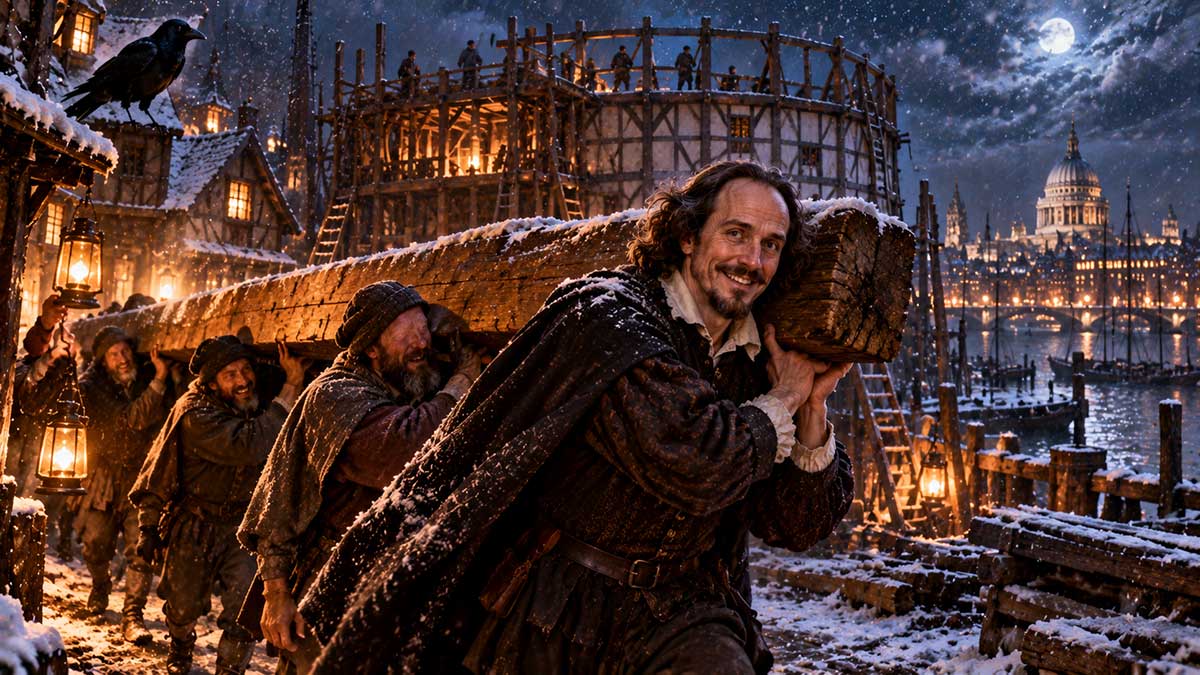
And when our landlord refused to renew the lease on our first playhouse in Shoreditch, we didn’t sit and weep. In the dead of winter, just after Christmas, we took the whole building apart. Beam by beam. While the landlord was away. We carried the timbers across the frozen city and over the river, and we built this.
(He raps his knuckles on the pillar.) The Globe was built from the bones of the old Theatre. Stolen, some would say. We preferred to say relocated.
Nick Sasaki: (laughing) You stole a building.
William Shakespeare: We stole our own building. There’s a difference. A lawyer would explain it to you, for a fee.
Nick Sasaki: I have to ask about something less flattering, though. In 1598, during a terrible grain shortage in Stratford, people were starving. And there’s a survey listing who was storing grain. Your name is on it. Ten quarters of malt. More than most of your neighbors.
Shakespeare’s expression cools. For a moment he seems about to object. Then he looks away.
William Shakespeare: Yes.
Nick Sasaki: How does the man who wrote King Lear also store grain in a famine?
William Shakespeare: (Slowly.) You put that very cleverly. As if one man couldn’t be both.
I had a family in Stratford. A wife, two daughters, aging parents, a father still haunted by his debts. I had seen what it looks like when a family falls. I was not going to let mine starve. Malt keeps. Malt can be brewed. If the harvest failed again, my house would still have bread and ale.
(A pause.) Was it more than we needed? Yes. Were there neighbors who had less? Yes. Did I think about that very hard at the time? (He meets Nick’s eyes.) No. Not as hard as I should have.
Nick Sasaki: That’s an honest answer.
William Shakespeare: It’s an uncomfortable one. Later, I wrote a play where the starving people of Rome riot over grain held back by the rich. Perhaps that was my way of thinking about it harder.
(He sighs.) A man can write with great compassion about something he failed to practice. Most writers do. The page is easier than the street.
Nick Sasaki: There’s one letter written to you that still survives. Only one, in all of history. Do you know what it is?
William Shakespeare: (Wary.) I’m afraid to ask.
Nick Sasaki: It’s from a Stratford neighbor, Richard Quiney, asking to borrow thirty pounds.
Shakespeare stares at him. Then he bursts out laughing, so hard he has to hold the pillar.
William Shakespeare: Of course it is. Of course. Four hundred years, and the one letter that survives is someone asking me for money. (He wipes his eyes.) Did I lend it to him?
Nick Sasaki: Nobody knows. The letter was found among Quiney’s own papers. He may never have sent it.
William Shakespeare: (Still chuckling.) Richard Quiney. A good man. He was always in London begging for Stratford’s taxes to be lowered, and always running short himself. (His laughter slows.) His son married my daughter Judith, you know. Years later. (A faint shadow crosses his face.) But that’s a story for another hour.
Nick Sasaki: There’s one more record I have to ask about. In 1612, you testified in a lawsuit. It’s the only time your actual spoken words were ever written down.
William Shakespeare: (Rolling his eyes.) The Mountjoy business.
Nick Sasaki: You’d lodged with a French family in Silver Street who made headdresses for ladies. And the wife asked you to persuade their apprentice to marry their daughter.
William Shakespeare: (Defensively.) I was a very good matchmaker. They married, didn’t they?
Nick Sasaki: They did. But years later, the young man sued his father-in-law over the dowry. And when the court asked you exactly what money had been promised, you said you couldn’t remember.
Shakespeare spreads his hands with a perfectly innocent expression.
William Shakespeare: I couldn’t.
Nick Sasaki: The greatest memory in English literature. Under oath. “I don’t recall.”
William Shakespeare: (Grinning.) A man remembers what he chooses to remember, Mr. Sasaki. And he forgets what would make enemies of two families he’s fond of.
(Then, after a moment, the grin fades.) But there are some things a man can never forget, no matter how hard he tries. Not if he lives to be a hundred.
He doesn’t explain. Nick doesn’t ask. Shakespeare turns and looks up at the thatched roof circling the open sky.
William Shakespeare: Did they tell you how the first one burned?
Nick Sasaki: A stage cannon, during “Henry VIII.”
William Shakespeare: A cannon, for the king’s entrance. A bit of burning wadding landed on the thatch. Everyone thought the smoke was part of the show. Within an hour, the whole house was gone. Every beam we’d carried across the river.
Nick Sasaki: Was anyone hurt?
William Shakespeare: (His mouth twitches.) Not one soul died. One man’s breeches caught fire, and he put them out with a bottle of ale.
Nick Sasaki: (laughing) That’s the best possible use of ale.
William Shakespeare: London agreed. It was all anyone talked about for a month. Not the theater. The breeches.
He walks slowly to center stage, turning in a full circle to take in the rebuilt galleries, the painted heavens, the open sky beginning to dim.
William Shakespeare: We rebuilt it the next year, you know. Grander than before, with a tile roof this time. And now, four hundred years later, someone has built it again.
(Softly.) The wooden O always rises again. That’s the thing about theaters, and about the people who make them. Burn us down, insult us in print, call us crows. We come back. We carry our own timbers across the river in the snow, and we build again.
Topic 3: The Summer of 1596
The afternoon has grown quiet and gray. The stagehand has finished stacking chairs and gone. Shakespeare and Nick sit side by side on the steps that lead down from the stage into the empty yard. For a while, neither of them speaks. A pigeon walks across the boards behind them.
Nick Sasaki: Can I tell you something personal?
William Shakespeare: (Turning to look at him.) You’ve earned that much.
Nick Sasaki: My youngest son left for university this year. The house is very quiet now. And ever since I started thinking about this conversation, I keep thinking about you. How much of your son’s life you spent here in London, and how far that was from Stratford.
Shakespeare doesn’t answer right away. He looks down at his hands.
William Shakespeare: How old is your boy?
Nick Sasaki: Eighteen.
William Shakespeare: Eighteen. (A faint smile.) The age I was when I married. A man, by the law. A boy, by every other measure.
Do you miss him?
Nick Sasaki: More than I expected to.
William Shakespeare: (Nodding slowly.) That’s the trick of it. You spend years waiting for them to be grown, and then they are, and you’d give anything to have one more ordinary afternoon when they were small and wouldn’t sit still.
Nick Sasaki: I wanted to ask you something, and I hope it’s all right.
William Shakespeare: Ask it.
Nick Sasaki: Did you get to see him enough?
Shakespeare is silent for a long time. When he speaks, the wit has gone out of his voice completely. The language is plain, almost bare.
William Shakespeare: No.
(He lets the word stand alone. Then he goes on.)
I came home when I could. When the plague closed the theaters, I was in Stratford for weeks at a time. Other years, I came for a few days at Christmas, a few days in the spring. The road from London is three days on a good horse, longer in the mud.
And every time I came home, he’d grown. That’s what I remember most. Not the days with him. The gaps. I’d leave a little boy who still wanted to sit on my knee, and come back to one who was too proud to. I’d leave a child who couldn’t read, and come back to one who’d started at the grammar school, reciting his Latin at me as if I’d never heard of Latin.
Nick Sasaki: What was he like?
William Shakespeare: (A small, real smile.) Restless. He couldn’t sit through a sermon to save his soul. His mother would pinch his ear in church, and he’d look up at the roof beams and count the birds nesting there instead of listening to the vicar.
He loved the river. He and Judith would go down to the Avon and come home soaked to the knees, both swearing the other one had fallen in first.
He stops.
William Shakespeare: I’ve written a great many children. Clever ones, bold ones. Little princes in towers. But I find I can’t describe my own son very well. Isn’t that strange? I always thought there’d be more time to look at him properly.
A long silence. The light is beginning to dim across the yard.
Nick Sasaki: I don’t want to push you. But earlier, about the courtroom, you said there are some things a man can never forget.
William Shakespeare: (Quietly.) I did.
Nick Sasaki: Where were you when you heard?
Shakespeare closes his eyes.
William Shakespeare: Kent.
That summer, the plague had closed the London playhouses again, so we took the company on the road. Wagons, costumes, the whole tired circus. We played inn yards and town halls. Faversham, Dover, wherever a mayor would pay us and the people would come.
On the eleventh of August, we played the market hall at Faversham. I remember the play. I remember the heat. I remember a fat alderman in the front row who fell asleep and snored through the whole second act, and the boys in the company laughing about it afterward over our ale.
I remember all of that. Every detail.
(He opens his eyes.) And I remember that I laughed too.
Nick Sasaki: You didn’t know.
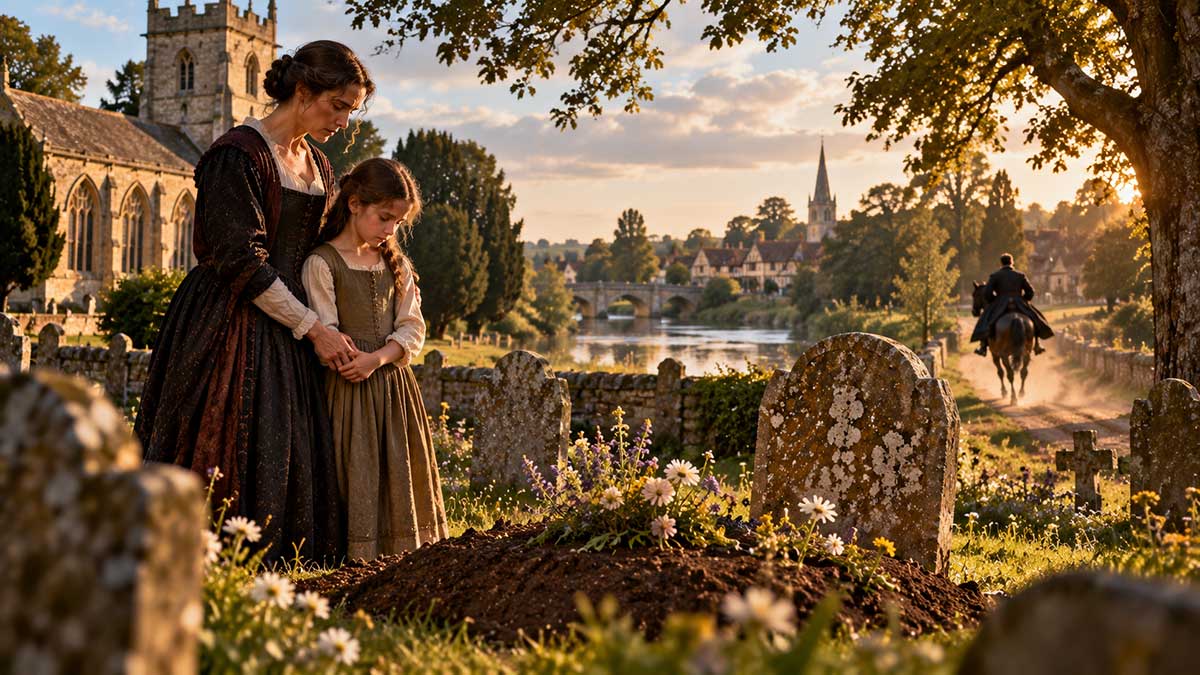
William Shakespeare: I didn’t know. (His voice is very steady, and it’s the steadiness that’s hard to bear.) That same day, at Holy Trinity Church in Stratford, my wife and my daughters were burying my son. He was eleven years old.
The news came to me days later. A rider with a letter. I don’t know how many days. I’ve tried to count them many times, and I can’t. That’s the only part I can’t remember.
Nick says nothing. He waits.
William Shakespeare: I rode home as fast as a horse could carry me. It didn’t matter. By the time I came through the door on Henley Street, it was long over. The grave was already closed. Anne was sitting at the kitchen table. She didn’t get up. She just looked at me.
(He looks out across the empty yard.) I’d written thirty speeches for men arriving too late. I had no words at all.
Nick Sasaki: I’m so sorry.
William Shakespeare: (A small nod.) You asked earlier if I remember everything. I told the court in 1612 I couldn’t remember the price of a dowry. That was true.
But I remember that summer the way you’d remember a house you grew up in. Every room. Every smell. The color of the sky over Faversham. The snoring alderman. The face of the boy who brought the letter.
Some things you’d give anything to forget. Those are the ones that never leave you.
A pigeon flutters down from the thatch and lands in the yard, pecking at something between the cobblestones. Shakespeare watches it.
Nick Sasaki: Can I ask about something that’s always puzzled me?
William Shakespeare: Go on.
Nick Sasaki: A few months after Hamnet died, you resubmitted your family’s application for a coat of arms. It was granted that autumn. It made your father a gentleman, and you after him. A title meant to be passed on to a son.
Why then?
Shakespeare lets out a long breath.
William Shakespeare: You’ve found the question I asked myself a thousand times.
The motto we chose was “Non sanz droict.” Not without right. It was my father’s dream before it was mine. He’d applied once, years earlier, when he was bailiff, before the debts. Then he fell, and the dream went into a drawer.
I took it out again that autumn.
Nick Sasaki: For your father?
William Shakespeare: Partly. He was an old man by then, and he’d lived too long in disgrace. I wanted him to die a gentleman. I wanted him to walk through Stratford one more time with his hat on, while other men took theirs off.
(A pause.) And partly, I think, because grief has to go somewhere. I couldn’t do anything for my son. I couldn’t stop it. I couldn’t even arrive in time to stand by his grave. So I did the only thing my hands knew how to do. I wrote letters. I paid fees. I filled out forms with heralds in London. I built something.
Nick Sasaki: Even though there was no son to pass it to.
William Shakespeare: (Very quietly.) Even though.
People think grief makes you stop. It doesn’t. It makes you busy. The next year I bought New Place, the second-largest house in Stratford. Gardens, orchards, ten fireplaces. As if a big enough house could fill a small empty room.
(He shakes his head.) It never does. But a man tries.
Nick Sasaki: Hamnet had a twin.
Shakespeare turns and looks at him, and for the first time all afternoon, his eyes are wet.
William Shakespeare: Judith.
They were born together, christened together, the same day in February. Hamnet and Judith, named for our neighbors, the baker and his wife, who stood godparents to them. For eleven years they did everything together. Fought together, ran to the river together, got into trouble together and blamed each other.
And then she was one.
(He wipes his eyes with the back of his hand, unembarrassed.) She was always a quiet girl after that. She never learned to write her name. She signed with a mark all her life. And I never knew what to say to her. I’d look at her across the table, and I’d see two faces. Hers, and the one beside it that was gone.
I think she saw it in my eyes. I think she knew that every time I looked at her, I was also looking for him.
He stands slowly, his knees stiff, and walks back up the steps onto the darkening stage. He stops at its center and looks up through the open roof at the gray, empty sky.
William Shakespeare: That’s the cruelest thing about losing one twin, Mr. Sasaki.
You don’t only lose a child. You make the other one into a reminder, and she never asked to be.
Topic 4: The Ghost in Hamlet
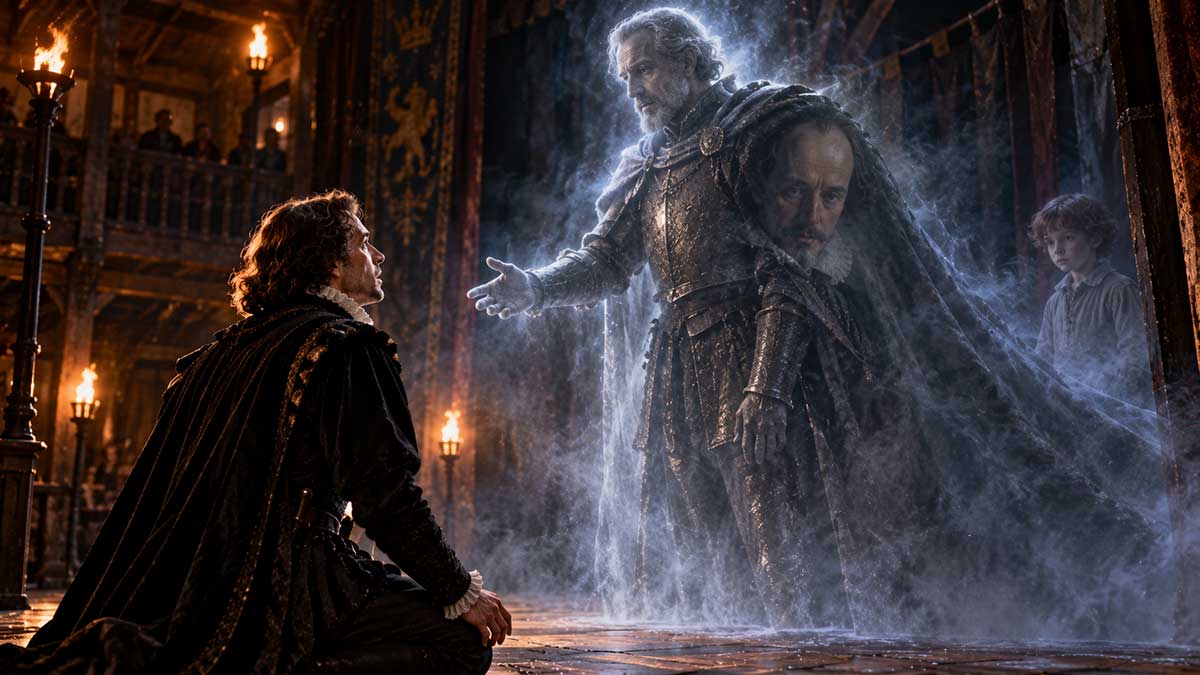
The sky above the open roof has turned the color of pewter. Somewhere outside the walls, the bells of Southwark Cathedral are ringing the hour. Shakespeare stands near the trapdoor in the center of the stage, the one actors use for ghosts and graves. He taps it lightly with his toe.
William Shakespeare: Do you know what this is for?
Nick Sasaki: The trapdoor?
William Shakespeare: Hell. Or the grave. Or the cellarage, where the Ghost cries out from under the stage. (He smiles faintly.) We used to call it the hell. Every theater has one.
Nick Sasaki: I have to ask about the play.
William Shakespeare: (Without looking up.) I know.
Nick Sasaki: Hamlet and Hamnet. In your time, those names were practically the same. Your own will spells your friend Hamnet Sadler’s name as “Hamlett.” I have to ask. Was Hamlet about your son?
Shakespeare walks slowly to the edge of the stage and sits down, his legs over the side, looking out at the empty yard.
William Shakespeare: The story wasn’t mine. It’s an old Danish tale. A prince called Amleth, who pretends to be mad so he can avenge his father. It’s centuries old. There was even an older play about it, before mine, that everyone had seen and laughed at.
Nick Sasaki: So it wasn’t about him.
William Shakespeare: I didn’t say that.
(He’s quiet for a moment.) I said the story wasn’t mine. What I did with it was.
In the old tale, it’s a revenge story. A clever prince, a wicked uncle, blood at the end. That’s what the audience paid for. And I gave it to them. But when I sat down to write it, around the time my father was failing, a few years after the summer we spoke of, I found the play wouldn’t stay a revenge story.
Nick Sasaki: What did it become?
William Shakespeare: A story about a young man who cannot stop grieving, in a house where everyone else has decided it’s time to stop.
(He recites quietly, almost to himself.) “I have that within which passeth show; these but the trappings and the suits of woe.”
His mother tells him it’s common. All that lives must die. His uncle tells him his grief is unmanly, that it’s a fault to heaven. Everyone in that castle wants Hamlet to put on brighter clothes and smile at supper.
And he can’t. He simply can’t.
Nick Sasaki: That sounds like a father writing.
William Shakespeare: (He turns to look at Nick.) Or a son. Or both. That’s the thing about grief in a play. Once it’s on the stage, it belongs to everyone who watches it. The father in the gallery weeps for his son. The son in the pit weeps for his father. The play doesn’t care whose grief it carries. It carries all of them.
Nick Sasaki: Did you ever write it more directly? Your own grief?
Shakespeare is silent. Then he speaks, slowly.
William Shakespeare: There’s a play I wrote around that time. About King John. Hardly anyone performs it now. In it, there’s a mother named Constance whose young son is taken from her. And she says something I’ve never quite been able to read aloud without stopping.
Nick Sasaki: Will you?
William Shakespeare: (He takes a breath, and his voice drops, plain and unadorned.)
“Grief fills the room up of my absent child,
Lies in his bed, walks up and down with me,
Puts on his pretty looks, repeats his words,
Remembers me of all his gracious parts,
Stuffs out his vacant garments with his form.”
(He stops. He doesn’t finish the speech.)
Nick Sasaki: (softly) That’s not a mother in a play.
William Shakespeare: No. (He looks down.) That was Anne. In the kitchen on Henley Street. Taking his shirts down from the peg and holding them up, as if she could still fill them with him.
I came home and watched her do that. And then I went back to London and gave it to Constance. (His voice is very quiet.) Is that a terrible thing, to take your wife’s grief and put it in a player’s mouth for money?
Nick Sasaki: I don’t think so. I think it might be the only way some people can carry it.
William Shakespeare: (A long pause.) I hope you’re right.
Nick Sasaki: Can I ask about another play? “Twelfth Night.”
William Shakespeare: (A faint smile.) The comedy. You’ve chosen a strange place to look for sorrow.
Nick Sasaki: A girl named Viola is shipwrecked. She believes her twin brother drowned. She mourns him for the whole play. And then, at the very end, he walks back in alive.
Shakespeare’s smile fades. He doesn’t answer for a long time.
Nick Sasaki: Was that for Judith?
William Shakespeare: (Barely audible.) Yes.
(He clears his throat.) At the end, when they find each other, they test whether it’s really true. They ask each other about their father. Viola says, “My father had a mole upon his brow.” And her brother answers, “And so had mine.” And she says their father died on the day she turned thirteen.
They prove they’re twins by remembering the same father.
(He looks out across the darkening yard.) I wrote Judith a reunion she was never going to have. I gave her brother back to her in a play, because I couldn’t do it any other way. I don’t know if she ever saw it. I never asked her. I was afraid of what her face would do.
A long silence. The bells have stopped.
Nick Sasaki: Can I tell you what the world looks like now? Just for a few minutes?
William Shakespeare: (Turning to him, grateful for the change.) Please.
Nick Sasaki: This theater was rebuilt in 1997, because people couldn’t bear for your Globe to exist only in books. Your plays are performed all over the world, in nearly every language. Japanese, Korean, Russian, Arabic, Swahili. Somewhere on earth, at almost any hour, someone is speaking your words on a stage.
Shakespeare doesn’t move.
Nick Sasaki: Children learn your lines in school on every continent. Words and phrases you used are part of ordinary English. People who’ve never read a play still say them every day.
William Shakespeare: (Quietly.) And the First Folio? Did Heminges and Condell manage it?
Nick Sasaki: They did. Seven years after you died, they gathered thirty-six of your plays into one book. Half of those had never been printed before. Without your friends, we’d have lost “Macbeth,” “The Tempest,” “Twelfth Night.”
William Shakespeare: (His eyes close briefly.) Good men. Both of them. I left them money in my will for mourning rings. It wasn’t nearly enough.
Nick Sasaki: And Ben Jonson wrote a poem at the front of it. He said you were “not of an age, but for all time.”
William Shakespeare: (A surprised laugh, half a sob.) Ben said that? Ben, who told everyone I had small Latin and less Greek? Who said I never blotted a line and should have blotted a thousand?
Nick Sasaki: The same Ben.
William Shakespeare: (Shaking his head, smiling.) Well. He always did have to have the last word.
Nick Sasaki: There’s one more thing. That film I told you about. “Hamnet.” Millions of people have seen it now. All over the world. People sat in dark theaters and wept for your son.
Shakespeare goes completely still.
Nick Sasaki: For centuries, almost no one knew he’d existed. Just two lines in a parish register. And now his name is known everywhere. People say it with tenderness. They wonder what he was like.
Shakespeare stands up slowly. He walks to the front edge of the stage and looks out at the three tiers of empty galleries, as if they were full.
William Shakespeare: (His voice breaking.) His name.
I spent my whole life giving names to people who never lived. Kings and fools, lovers and murderers. Thousands of them. I wanted the world to remember them, and it did.
And all that time, the one name I would have given everything for the world to remember, I never wrote at all. I couldn’t. It was too small, and too much.
(He stands at the edge of the stage, looking out at the empty galleries.) And now you tell me the whole world knows it.
I gave the world a thousand characters so it would remember them.
I never imagined that the one it would come to remember was the boy I couldn’t save.
Topic 5: Our Revels Now Are Ended
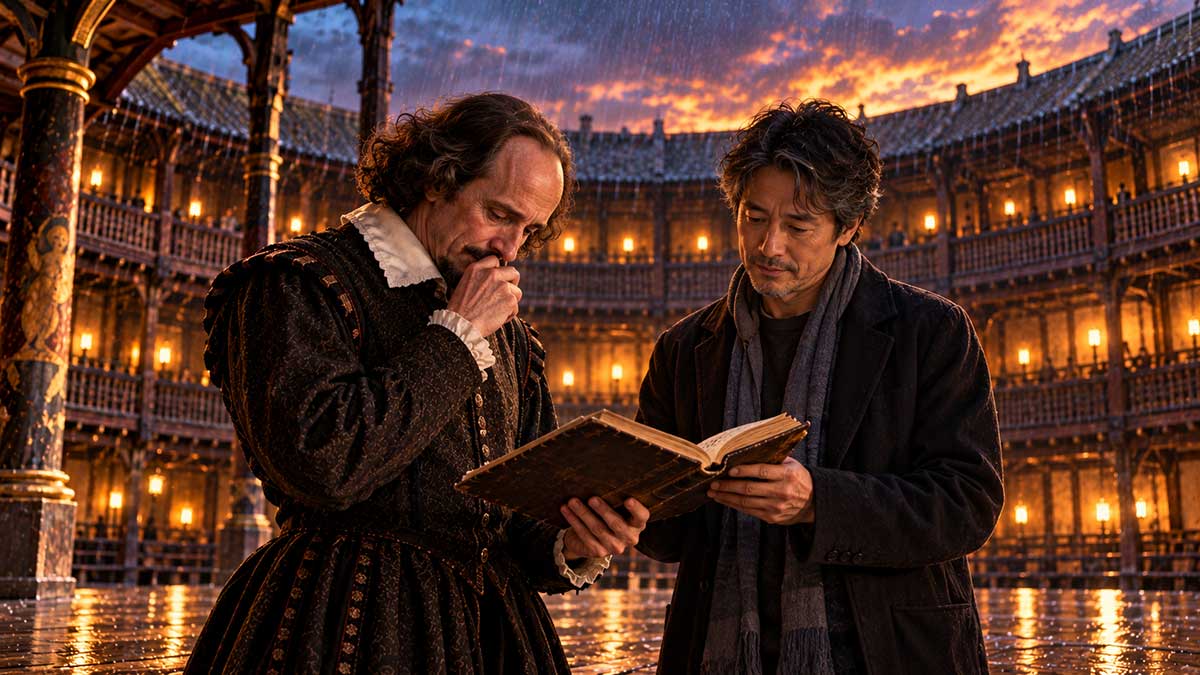
Dusk. A fine, soft rain has begun to fall through the open roof of the Globe, drifting down into the empty yard and darkening the cobblestones. The stage itself stays dry beneath its painted canopy. Shakespeare stands at the edge of it, watching the rain fall into the yard where the groundlings stood that afternoon.
William Shakespeare: It always rained on the groundlings. They paid a penny to stand in the yard, and if the heavens opened, they got wet. The gentlemen in the galleries stayed dry for their sixpence. (A faint smile.) That’s the whole of England, in one wooden O.
Nick Sasaki: Can I ask about your last plays?
William Shakespeare: You may ask about anything now. I seem to have told you everything else.
Nick Sasaki: In “The Tempest,” Prospero has spent twelve years planning his revenge on the men who betrayed him. And when he finally has them all in his power, he forgives them. He gives up his magic. He breaks his staff and drowns his book.
Was that you saying goodbye?
Shakespeare is quiet. When he speaks, he quotes softly, without performance.
William Shakespeare: “The rarer action is in virtue than in vengeance.”
That’s what Prospero says, when he decides. Anyone can take revenge. It’s the commonest thing in the world. Every tragedy I ever wrote is full of it. Hamlet, Lear, Othello, Macbeth, all of them drowning in blood because someone couldn’t let go of a wrong.
Forgiveness is rarer. Much rarer. And much harder to write, because there’s no swordfight at the end of it.
Nick Sasaki: I’ve come to believe something like that. That forgiveness doesn’t mean pretending the wrong didn’t happen. It means not letting resentment decide the rest of your life.
William Shakespeare: (He turns and looks at Nick with real interest.) Yes. That’s it exactly. You’ve said in one breath what took me four plays to learn.
Nick Sasaki: Did you find forgiveness yourself?
William Shakespeare: (A long pause.) Some of it.
I forgave my father, in the end. For falling. For letting me see him fall. He died around the time I was writing Hamlet, and I found I didn’t blame him anymore. He was a proud, frightened man doing his best, like most fathers.
I forgave London, for the crows and the critics and the fire.
Nick Sasaki: And yourself?
Shakespeare looks out at the rain for a long time.
William Shakespeare: That’s the hardest one. You’ll know that, being a father.
I chose London. I chose the theater, the company, the money, the work I loved. I told myself it was all for them. For the house, the coat of arms, the girls’ dowries. And some of it was. But some of it was simply that I loved it. I loved this. (He gestures at the stage.) And I wasn’t there when it mattered most.
I’ve had a long time to make peace with that. I’m not sure I’ve finished.
Nick Sasaki: People have argued for four hundred years about your will. You left Anne your “second-best bed.” Some say it was an insult.
Shakespeare laughs, softly and sadly.
William Shakespeare: Of course they do. Scholars. (He shakes his head.) The best bed in a house like mine stood in the parlor for guests. A grand thing, carved and curtained, to show the neighbors we’d come up in the world. Nobody slept in it but visitors.
The second-best bed was ours. The one we’d slept in for thirty years. The one where our children were born. The one where Anne lay awake through all the nights I was in London, and the nights after the summer of 1596.
Nick Sasaki: So it wasn’t an insult.
William Shakespeare: It was the most precious thing I owned. (Quietly.) By law, she’d have a third of everything anyway. I didn’t need to write that down. But the bed, I wanted named. I wanted it in writing, so no one could take it from her.
(He looks down at his hands.) I wasn’t a good husband, Mr. Sasaki. Not the way she deserved. She raised our children alone. She buried our son alone. She held his shirts up to the light while I was in Kent watching an alderman snore.
And when I came home for good, at the end, she let me back in. No speeches. No tragedy. She just moved over and made room.
That was her Tempest. She forgave me long before I ever wrote about forgiveness.
Nick Sasaki: And Judith. In your last weeks, you changed your will to protect her.
Shakespeare’s face tightens with an old protective anger.
William Shakespeare: She married that February. A Quiney. Richard’s son, the one whose father wanted to borrow thirty pounds. And within weeks we learned that he’d fathered a child by another girl, who died with the baby that very month.
I was already ill by then. I knew I hadn’t long. So I called my lawyer back and changed the will. Every penny meant for Judith, I tied up so her husband couldn’t touch it.
Nick Sasaki: You were still looking after her.
William Shakespeare: (Softly.) She was the twin who lived. I couldn’t keep her brother. I couldn’t give her a reunion except in a play. I couldn’t even find the right words across the supper table.
But I could do that. On my deathbed, with a lawyer and a quill, I could still put my hand between her and harm. It was the last thing I could do for her, so I did it.
The rain grows slightly heavier, a soft hiss across the yard. The light is almost gone. Somewhere behind the tiring-house wall, a door opens and closes; the evening crew is arriving.
Nick Sasaki: You said I could ask you later about the lost years.
William Shakespeare: (A tired smile.) I did.
Nick Sasaki: It’s later.
William Shakespeare: Then here’s the truth. I was becoming the man who could write Hamlet. Where exactly I did it, I’ll keep. (He glances at Nick with a glint of the old mischief.) A man should have one secret left. Like a second-best bed.
Nick Sasaki: (laughing quietly) Fair enough.
Shakespeare turns toward the center of the stage. He stands over the trapdoor for a moment, looking down at it. Then he turns back.
William Shakespeare: You asked me something else this afternoon. Whether I played the Ghost.
Nick Sasaki: I did.
William Shakespeare: Come. I’ll show you.
He crosses to a small table at the side of the stage, where the afternoon’s prompt book still lies. He opens it, finds a page, and hands it to Nick.
William Shakespeare: You read Hamlet. Just these lines. I’ll take the Ghost.
Nick Sasaki: (hesitating) I’m not an actor.
William Shakespeare: Neither was I, according to Robert Greene. Stand there. By the pillar. Look at me as if you’ve lost your father and can’t believe he’s come back.
Nick takes his place. Shakespeare walks slowly to the back of the stage and turns. His posture changes. He seems taller, older, carrying a great weight. When he speaks, his voice is low and resonant, filling the empty theater.
William Shakespeare: (as the Ghost) Mark me.
Nick Sasaki: (reading) I will.
William Shakespeare: (as the Ghost) My hour is almost come, when I to sulphurous and tormenting flames must render up myself.
Nick Sasaki: (reading) Alas, poor ghost!
William Shakespeare: (as the Ghost) Pity me not, but lend thy serious hearing to what I shall unfold.
Nick Sasaki: (reading) Speak. I am bound to hear.
Shakespeare takes a step forward. His voice is steady.
William Shakespeare: (as the Ghost) I am thy father’s spirit...
He stops.
For a long moment, he doesn’t move. The rain hisses softly in the yard. Then he skips ahead to the Ghost’s final line, and when it comes, his voice cracks in the middle of it.
William Shakespeare: (as the Ghost) Adieu, adieu, adieu. Remember...
He can’t finish. He lowers his head.
When he lifts it again, the Ghost is gone. It’s only a tired man of fifty-two standing on a wet stage in the dark, speaking to someone who isn’t there.
William Shakespeare: No. That’s wrong. It’s the wrong way round.
I wrote a father asking his son to remember him. It should have been the other way.
(His voice is plain now, unpoetic, almost a whisper.) Hamnet. I’m sorry I wasn’t there. I should have been there. I should have been at the river with you, and in the pew pinching your ear, and at the table when you came home soaked to the knees.
I was in Kent. I was laughing. I didn’t know.
You don’t need to remember me. I’ve had more than enough remembering.
I’ll remember you.
Silence. Nick lowers the script.
Suddenly, all around the galleries, the lights come on for the evening performance, warm and golden, one tier after another, flooding the painted pillars and the wet cobblestones of the yard. Somewhere behind the tiring-house, an actor laughs. A door bangs. Voices call to each other.
Nick looks up from the page.
The stage is empty. Only the prompt book remains on the boards beside the trapdoor, open to the Ghost’s last line, and the soft rain falling through the light into the yard.
Final Thoughts
I went to the Globe expecting to meet a genius. I met a father.
He was witty, proud, guarded, and hard-headed about money. He was also a man who remembered every detail of one terrible summer, except how many days the letter took to reach him. He told a court in 1612 that he couldn’t recall the details of a dowry. He told me he could never forget the snoring alderman in Faversham on the day his son was buried.
What moved me most was how he carried his grief. He didn’t stop. He got busy. He applied for a coat of arms and bought a grand house, as if a big enough house could fill a small empty room. And then he did the only thing he truly knew how to do: he gave the grief to his characters. Constance holding up her absent child’s clothes. Hamlet, the son who can’t stop mourning while everyone around him wants him to smile at supper. Viola, given back the twin brother Judith never got back.
But the moment I’ll carry longest is quieter. A man who spent a lifetime writing about revenge finally wrote about forgiveness, and found it was the rarer action. He forgave his father for falling. He was forgiven by his wife, who simply moved over in the second-best bed and made room. And standing on that wet stage at the end, he said the words he’d never been able to say. Not a ghost asking a son to remember him, but a father promising to remember his son.
I’m grateful my son is only at university, a phone call away. But this conversation reminded me how fast the gaps grow between visits, and how easily we tell ourselves there will always be more time to look at the people we love properly.
So here’s the question I’ll carry with me, and I hope you will too.
Who are you away from right now, and what would you want them to know before the lights come up?
Short Bios:
Nick Sasaki is the creator and host of ImaginaryTalks.com. After 25 years of building businesses, he turned to building bridges between eras, ideas, and the questions people carry, drawn especially to spirituality, the soul’s journey, and what lies beyond ordinary explanation. He hosts as a seeker rather than an expert, asking the questions readers wish they could ask someone long gone. About Nick and ImaginaryTalks
William Shakespeare (1564–1616) was the English playwright, poet, and actor whose plays, including “Hamlet,” “King Lear,” “Macbeth,” “Twelfth Night,” and “The Tempest,” are performed around the world in nearly every language. Born the son of a glover in Stratford-upon-Avon, he became a shareholder in the Lord Chamberlain’s Men and helped build the Globe Theatre. His only son, Hamnet, died at eleven in 1596, a loss many believe echoes through his later work. Shakespeare Documented, Folger Shakespeare Library
Leave a Reply