
Introduction
Everyone knows Noah built an ark.
But have you ever wondered what his wife said when he told her he was going to build an enormous boat?
Did his neighbors think he was crazy?
Did his sons complain about working for their father? Did Noah ever lose his temper, question his own abilities, or wish he could return to an ordinary life?
And here's a question we rarely ask:
What happens to a man who saves his family from the destruction of the world, only to discover that surviving a disaster doesn't automatically make a family happy?
The familiar account in Genesis chapters 6–9 tells us about God's instructions, the ark, the flood, and the covenant symbolized by the rainbow.
But it leaves many deeply human questions unanswered.
What did Noah feel when the rain began? What did he think about the people outside? How did eight family members manage to live together inside the ark for so long?
And when the waters finally receded, did Noah feel joy, grief, or something he couldn't put into words?
In this ImaginaryTalks conversation, Nick Sasaki sits down with Noah for an unusually candid interview.
No formal sermon. No polished speeches about being righteous. Just two men talking about marriage, fatherhood, exhaustion, faith, mistakes, and the people they love.
The conversation begins with laughter. Noah turns out to have a surprisingly good sense of humor, particularly when describing his sons and his wife's ability to recognize his stubbornness.
But the discussion gradually moves into more difficult territory.
The New Testament's description of Noah's faith in Hebrews 11:7 remembers his obedience. Yet the later account in Genesis 9:20–27 introduces an uncomfortable family incident that raises questions about human weakness, respect, and the consequences of our actions.
How should we remember someone who accomplished something extraordinary but remained imperfect?
Perhaps the most interesting question isn't how Noah built the ark.
It's what Noah learned about being a husband, a father, and a human being after everything he thought he knew about life had changed.
Disclaimer: This is an imaginative fictional interview inspired by biblical accounts. Noah's dialogue, personal memories, emotions, family conversations, and personality are creative interpretations, not documented historical statements. Biblical passages are distinguished from invented scenes, and religious interpretations may differ.
(Note: This is an imaginary conversation, a creative exploration of an idea, and not a real speech or event.)
Topic 1: Noah, Did People Think You Were Crazy?
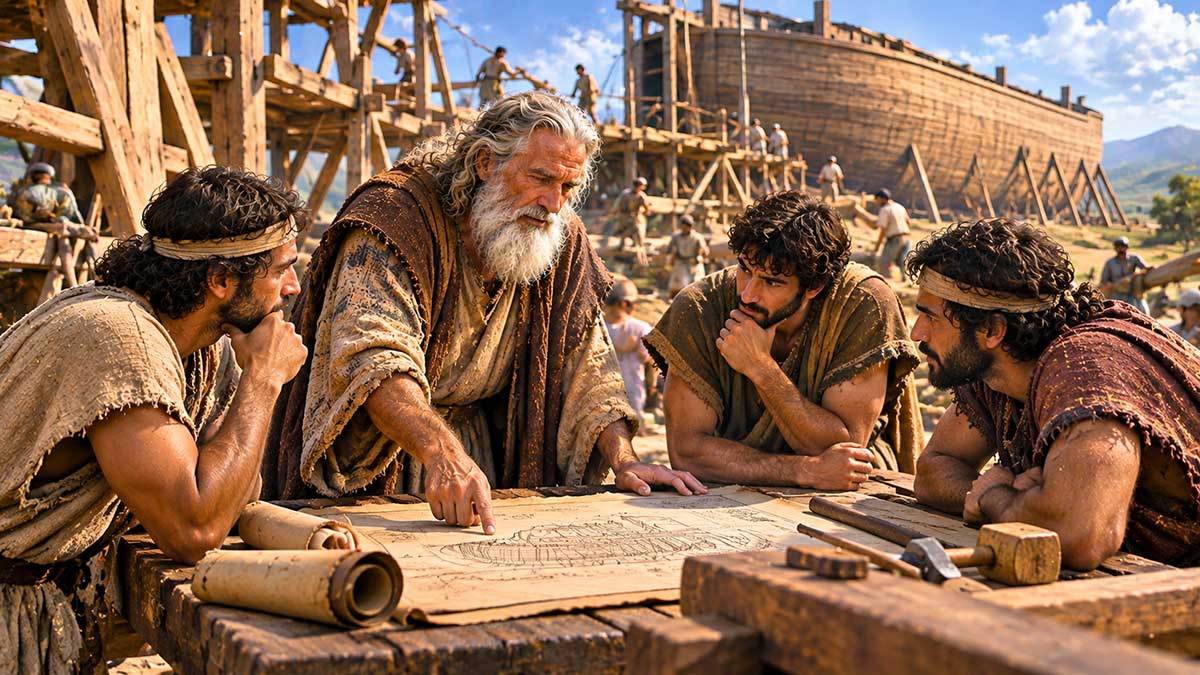
Setting: A quiet evening beneath a large canvas shelter overlooking a valley. A wooden table sits between Nick and Noah, with freshly baked bread, olives, and two cups of water. In the distance stands the enormous ark, its unfinished wooden frame catching the last golden light of sunset.
Noah is an older man with weathered hands, a thick beard, and surprisingly lively eyes. Nick settles into his chair, studying him with a curious smile.
Before You Became Noah of the Ark
Nick: Noah, man, I have to tell you, this is pretty incredible. I've talked to some fascinating people, but sitting here with the guy who built the ark? That's something else.
Noah: (Chuckles.) You make it sound like I built the whole thing yesterday.
Nick: Well, that's how people remember you! Noah, the ark, the animals, the flood. That's pretty much your entire biography for most people.
Noah: (Smiling.) That's a shame. I had a life before all that, you know.
Nick: Exactly! That's what I want to talk about. Forget the ark for a minute. Who were you before everything happened? What was a normal day like for Noah?
Noah: A normal day? I woke up, ate whatever my wife had prepared, looked at whatever needed fixing, and tried to finish half the things I'd promised to do the day before.
Nick: (Laughs.) So basically, nothing has changed in thousands of years.
Noah: Hasn't it? That's comforting.
Nick: Were you a serious guy? I mean, the Bible describes you as righteous. People hear that and probably picture someone walking around looking solemn all day, never making jokes, never getting angry.
Noah: Oh, I got angry.
Nick: Really?
Noah: Ask my sons.
Nick: (Laughing.) Oh, now we're getting somewhere. What made you angry?
Noah: Carelessness, mostly. Someone borrowing a tool and leaving it out in the rain. A fence falling apart after I'd told everyone to repair it. My boys pretending they couldn't hear me when there was work to be done.
Nick: That last one sounds familiar.
Noah: You have children?
Nick: Five.
Noah: (Raises his eyebrows.) Five? Then why are you asking me these questions? You already know what kind of man I was.
Nick: (Laughs.) Fair point. But were you strict with your sons?
Noah: I thought I was reasonable.
Nick: That's what every father says.
Noah: (Grins.) And that's what every son disputes.
Nick: What about your wife? Was she the serious one, or were you?
Noah: She could make me laugh when I was determined not to.
Nick: That's a good quality.
Noah: A dangerous one, too. You can't stay angry at someone who knows exactly how ridiculous you're being.
Nick: What was she like?
Noah: Practical. She noticed things I missed. If someone came to our home hungry, she noticed before I did. If one of the boys was troubled, she knew before he spoke. And if I was about to make a foolish decision, she usually knew that, too.
Nick: Did you listen?
Noah: (Takes a sip of water.) Eventually.
Nick: (Laughs.) Eventually! I like that answer.
Noah: There is a difference between hearing your wife and admitting she's right.
Nick: Oh, absolutely. Sometimes that difference is about three days.
Noah: In my experience, three days was optimistic.
They both laugh. Noah tears off a piece of bread and leans back in his chair.
Nick: You know what's interesting? I never thought about you having this kind of ordinary family life. In my mind, you were always building the ark.
Noah: And in my mind, I was always trying to get through the day.
Nick: That's such a different picture.
Noah: People remember the unusual things. But most of a person's life is ordinary. Eating with your family. Working. Getting tired. Watching your children grow. Wondering whether you're doing right by them.
Nick: Were you happy?
Noah: (Considers the question.) Often. Not always.
Nick: What made you happy?
Noah: A good harvest. A cool evening after a hot day. Hearing my sons laughing together instead of arguing. Sitting with my wife when there was nothing urgent left to do.
Nick: That's interesting. Nothing extraordinary.
Noah: Nick, when you've lived long enough, you discover that an ordinary peaceful evening can be quite extraordinary.
The Day Noah Told His Wife About the Ark
Nick: Okay, now I've got to ask the question everybody's probably wondering. How did you tell your wife you were going to build an enormous boat?
Noah: (Laughs immediately.) You couldn't wait any longer, could you?
Nick: No! Seriously, how does that conversation even begin?
Noah: Not particularly well.
Nick: Come on, tell me.
Noah: I remember sitting with her one evening. I was unusually quiet.
Nick: And she noticed.
Noah: Of course she noticed. She asked what was troubling me. I told her I believed God had given me something I needed to do.
Nick: And?
Noah: She asked what it was. I said I had to build a vessel.
Nick: A vessel. That's a pretty gentle way to introduce an enormous ark.
Noah: (Smiles.) I was choosing my words carefully.
Nick: Did you tell her how big it would be?
Noah: Eventually.
Nick: There's that word again!
Noah: (Laughs.) She asked why we needed such a large vessel. I explained what I believed was coming.
Nick: What was her reaction?
Noah: She was quiet. Then she asked whether I was certain.
Nick: Were you?
Noah: I believed I had received an instruction from God. But I was still a man trying to understand how to carry it out.
Nick: That's an interesting distinction. You believed what you were supposed to do, but you didn't necessarily know how you were going to do it.
Noah: Exactly. Knowing what you must do doesn't mean knowing how difficult it will become.
Nick: Did she support you immediately?
Noah: She asked questions. Many questions.
Nick: Such as?
Noah: Where would we find the timber? How long would the work take? Who would help? What would happen to our home? How would we feed everyone?
Nick: Those are pretty reasonable questions.
Noah: They were excellent questions. I wished I had better answers.
Nick: (Laughs.) So your wife was basically the project manager.
Noah: What is a project manager?
Nick: The person who makes sure the dreamer doesn't bankrupt the family.
Noah: (Laughs loudly.) Then yes. She was absolutely that.
Nick: Did you ever argue about it?
Noah: We disagreed about many things. But she understood that this wasn't something I had decided casually.
Nick: What do you think was hardest for her?
Noah: (Pauses.) Perhaps realizing that our ordinary life was changing, and that neither of us knew exactly what those changes would demand.
Nick: That's a lot to ask of someone.
Noah: It was. I don't think I appreciated that enough at first.
What Did Your Neighbors Really Think?
Nick: Now let's talk about the people around you. Did your neighbors think you'd completely lost your mind?
Noah: Some were curious. Some were amused. Others simply couldn't understand why I was doing it.
Nick: Did people come over just to stare?
Noah: Oh, certainly.
Nick: (Laughs.) I can picture that. A guy walks past your property, sees this enormous wooden structure, and says, "Noah, what on earth are you building?"
Noah: That happened more than once.
Nick: What did you tell them?
Noah: The truth, as I understood it.
Nick: That a flood was coming?
Noah: Yes.
Nick: And what did they say?
Noah: Some laughed. Some asked questions. A few became angry when I spoke about the wrongdoing and violence around us.
Nick: Were they all bad people?
Noah: (His expression changes.) No, Nick. That's too simple.
Nick: What do you mean?
Noah: People are not always the same in every part of their lives. A man might be kind to his children and cruel to someone outside his household. Another might share food with a neighbor and still participate in something terribly wrong.
Nick: So when Genesis describes a world filled with violence, you don't necessarily remember every individual as some kind of monster.
Noah: I remember people. That's what makes it difficult.
Nick: Did you have friends among them?
Noah: I knew people for many years. We worked together, traded goods, shared meals. Some had known me since I was young.
Nick: And they watched you building this enormous ark?
Noah: Yes.
Nick: That must have been awkward.
Noah: (Smiles faintly.) Sometimes.
Nick: Did anyone try to talk you out of it?
Noah: Some thought I was wasting my life. Others thought I was frightening my family unnecessarily.
Nick: Did any of that get to you?
Noah: Of course it did.
Nick: Really? I thought you'd say you ignored everybody.
Noah: Nick, ignoring someone's opinion is easier when you don't care about that person.
Nick: That's a good point.
Noah: When someone you've known for years looks at you with disappointment, it hurts. When someone you respect believes you're making a terrible mistake, you think about it.
Nick: Did you ever get angry and tell people to mind their own business?
Noah: (Grins.) I may have used words to that effect.
Nick: (Laughing.) Noah! You're ruining your perfect reputation.
Noah: I wasn't trying to protect a reputation. I was trying to finish a boat.
Nick laughs, then notices Noah looking toward the unfinished ark.
Nick: You know, there's something sad about that. People probably remember the ones who laughed at you, but they don't think about the friendships you might have lost.
Noah: Friendships are not always lost in one argument. Sometimes people simply stop visiting. You notice an empty chair at a meal. Then, after a time, you stop expecting that person to come.
Nick: Did that happen to you?
Noah: (Quietly.) Yes. And it was harder than I expected.
Nick: That's something I never considered.
Was There Ever a Moment You Wanted Your Old Life Back?
The evening light fades. Noah reaches for a small oil lamp and lights it. The enormous wooden frame of the ark is now barely visible against the darkening sky.
Nick: Noah, can I ask you something a little personal?
Noah: You've been doing that all evening.
Nick: (Laughs.) Fair enough. Did you ever wish you could go back to the way things were before all this started?
Noah: Yes.
Nick: Really?
Noah: Not in the sense of abandoning what I believed I had been asked to do. But there were evenings when I missed how simple life had once seemed.
Nick: What did you miss most?
Noah: Having an ordinary conversation without wondering whether someone would bring up the ark.
Nick: (Laughs.) And here I am, doing exactly that.
Noah: You're not the first.
Nick: Did you ever feel lonely?
Noah: There were people around me. My wife, my sons, their wives. But carrying a responsibility that others don't fully share can feel lonely.
Nick: Did you talk to your wife about that?
Noah: Sometimes. But I didn't want every meal to become a discussion about my worries.
Nick: I can relate to that. When you're working on something big, it can take over your whole mind. You sit down with your family, but you're still thinking about what needs to get done tomorrow.
Noah: (Nods.) And sometimes your family needs you to stop thinking about tomorrow and pay attention to them today.
Nick: Did your wife ever tell you that?
Noah: More than once.
Nick: (Smiling.) What did she say?
Noah: Something like, "Noah, the timber will still be there in the morning. Your supper is getting cold."
Nick: (Laughs.) I love that.
Noah: I didn't always appreciate it at the time.
Nick: You know what strikes me? We think of you as this man with an enormous mission, but your wife probably still wanted you to sit down and eat dinner with her.
Noah: Why wouldn't she? I was still her husband.
Nick: That's exactly what people forget.
Noah: People can become so interested in what a man accomplishes that they forget the people who must live with him.
Nick: Wow. That's a pretty good observation.
Noah: It's one I learned slowly.
For a moment, neither speaks. A breeze moves through the shelter, carrying the scent of fresh-cut timber.
Nick: Okay, there's something else I've been wondering. You had three sons, Shem, Ham, and Japheth. Were they all enthusiastic about building the ark?
Noah: (Laughs and shakes his head.) Enthusiastic? Nick, have you ever asked three grown sons to spend their days doing exactly what their father tells them?
Nick: I've got five kids. I already know where this is going.
Noah: Then you know that three sons can agree that their father is wrong and still disagree completely about why he's wrong.
Nick: (Laughing.) Oh, that's perfect. So which one gave you the most trouble?
Noah: I'm not answering that.
Nick: Come on!
Noah: No. I know what happens when a father starts comparing his children.
Nick: Fair enough. But seriously, did they ever push back?
Noah: They had questions. They had their own ideas about how things should be done. And sometimes they were right.
Nick: Did you admit it when they were right?
Noah: (Looks directly at Nick.) Eventually.
Nick: (Bursts out laughing.) There it is again!
Noah: You seem very interested in that word.
Nick: I'm beginning to think it's the secret to your entire marriage and family life.
Noah: It may be the secret to surviving any family.
Nick: Now I'm curious about something practical. How did you organize all that work? I mean, that ark wasn't some little fishing boat. We're talking about an enormous wooden structure.
Noah: (Leans forward, suddenly animated.) Now that's a question I can spend some time answering.
Nick: Good! Start at the beginning. You wake up one morning knowing you've got to build this thing. What's the first thing you actually do?
Noah: First? I look at the ground where it's going to stand.
Nick: The ground?
Noah: Of course. You can have the finest timber in the world, Nick, but if you don't think carefully about where you're going to build, you're already inviting trouble.
Nick: Wait, wait. I never thought about that. You're telling me the first challenge wasn't even the boat itself?
Noah: (Smiles.) Nick, we haven't even begun talking about the difficult parts.
Nick pulls his chair a little closer to the table as Noah begins describing the practical problems of constructing the ark.
Topic 2: Building the Ark, Did You Ever Want to Quit?
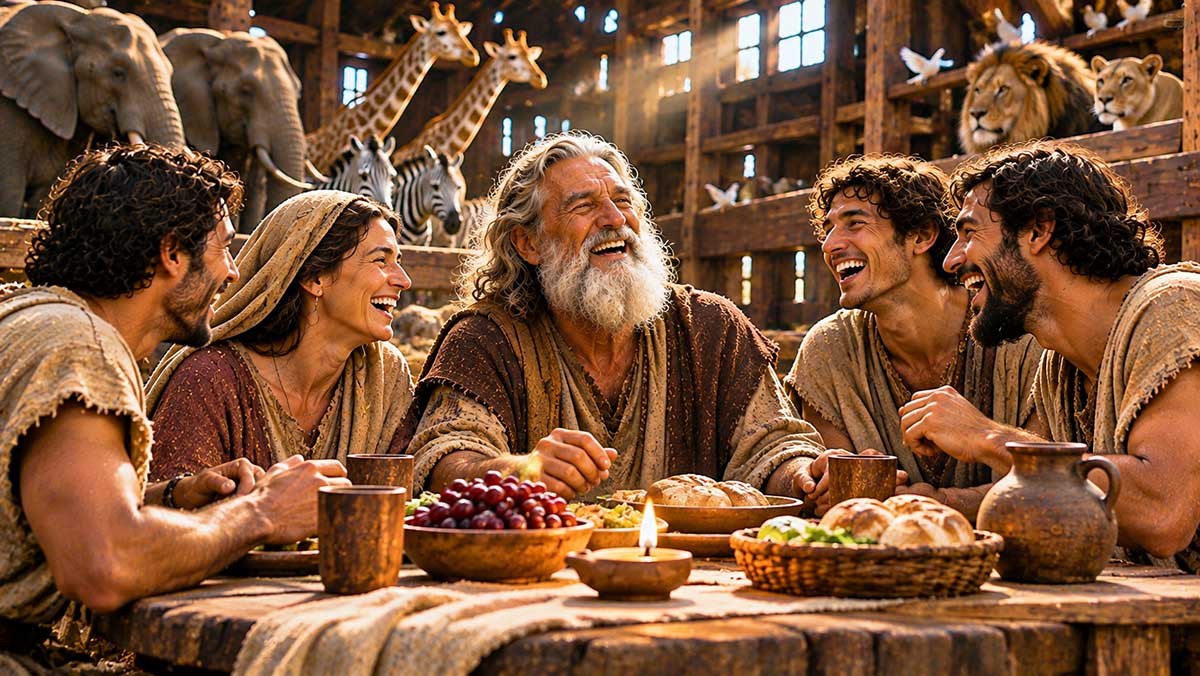
Setting: The conversation continues beneath the canvas shelter. The evening air has cooled, and an oil lamp illuminates the wooden table. Beyond the shelter, the enormous ark stands in the darkness. Noah has just explained that the first challenge of building it was deciding where it should stand.
How Do You Even Begin Building Something That Big?
Nick: Hold on, Noah. You're telling me the first thing you worried about wasn't the wood, the animals, or the size of the ark. It was the ground?
Noah: (Laughs.) Well, you have to start somewhere.
Nick: But seriously, how do you build something that enormous when nobody around you has ever done anything like it?
Noah: You begin with what you know. You look at the land. You examine the timber. You measure. Then you measure again.
Nick: And you had instructions from God, right?
Noah: Yes. The dimensions were given to me. The kind of wood, the compartments, the opening, the levels. I wasn't left to invent everything.
Nick: Right. Genesis says three hundred cubits long, fifty wide, and thirty high. Depending on the cubit, that's roughly four hundred fifty feet long.
Noah: You sound impressed.
Nick: Impressed? Noah, that's longer than a football field! I can barely get through assembling furniture without losing a screw.
Noah: (Grins.) What's a football field?
Nick: Never mind. It's enormous. That's my point.
Noah: It certainly looked enormous when I marked out the ground.
Nick: Did you just stand there looking at it?
Noah: For quite some time.
Nick: Thinking what?
Noah: (Smiles.) That I was going to need more timber.
Nick: (Bursts out laughing.) That's it? God gives you this extraordinary responsibility, and your first reaction is, "I need more wood"?
Noah: Nick, you can stand around being amazed all day. Eventually, someone has to pick up a tool.
Nick: That's fantastic. But tell me something. Were you already a skilled builder?
Noah: I knew how to work with my hands. I understood timber, repairs, and the importance of making things fit. But a structure of that size was something different.
Nick: So you were learning as you went?
Noah: In some ways, yes. You can know how to shape a piece of wood and still have a great deal to learn about bringing thousands of pieces together.
Nick: Did you make mistakes?
Noah: (Looks at Nick as though the answer should be obvious.) Of course.
Nick: Like what?
Noah: Imagine preparing a heavy beam, carrying it into position, and discovering that someone has measured from the wrong mark.
Nick: Oh, no.
Noah: Then imagine having to take it down and do it again.
Nick: Who made the mistake?
Noah: That depends on who's telling the story.
Nick: (Laughs.) Oh, come on! Was it you?
Noah: Once or twice.
Nick: Once or twice?
Noah: Perhaps more. I wasn't keeping a record for future interviewers.
Nick: (Laughing.) Fair enough. But what happened when something went wrong? Did you get frustrated?
Noah: I remember one particularly difficult day. We had spent hours positioning a large section. Something wasn't right. I wanted to believe we could correct it without taking everything apart.
Nick: And?
Noah: My son pointed out that the problem would become worse if we continued.
Nick: Which son?
Noah: Let's say Shem.
Nick: Okay.
Noah: I told him we could make it work.
Nick: Famous last words.
Noah: He disagreed. Respectfully at first.
Nick: (Laughs.) At first?
Noah: Eventually, he said, "Father, you taught us not to build on a mistake. Why are we doing it now?"
Nick: Ouch.
Noah: Yes. That was unpleasant.
Nick: What did you say?
Noah: I told everyone to take the section apart.
Nick: Did you apologize?
Noah: Not immediately.
Nick: There's that word again. Eventually?
Noah: (Laughs.) You're becoming very predictable, Nick.
Nick: I knew it!
Noah: I apologized later. But I wish I'd done it sooner.
Nick: You know what's interesting? We tend to picture you following God's instructions perfectly, without any problems. But you still had to deal with actual wood, actual measurements, and actual people.
Noah: And tired people make mistakes. Hungry people become impatient. A man can believe deeply in what he's doing and still have a terrible afternoon.
Nick: That's probably one of the most relatable things you've said.
Did Your Sons Ever Get Tired of Working With You?
Nick: Okay, let's talk about your sons. Shem, Ham, and Japheth. Three grown men working on their father's enormous project. That sounds like a recipe for some serious family arguments.
Noah: (Laughs.) You really do have five children, don't you?
Nick: Oh, yes. And I know what happens when a father has a big idea and expects everybody else to get excited about it.
Noah: Then you'll understand that each of my sons had his own way of looking at things.
Nick: Tell me about them.
Noah: Shem was careful. He wanted to know that we were doing things properly. Sometimes he thought too long before acting.
Nick: The cautious one.
Noah: You might say that. Japheth could become impatient with endless discussion. He preferred to get moving and solve problems along the way.
Nick: So those two probably argued.
Noah: Frequently.
Nick: And Ham?
Noah: (Smiles.) Ham could make everyone laugh, especially when I wanted them to take something seriously.
Nick: Oh, I like Ham already.
Noah: He was capable of turning a difficult afternoon into a pleasant one. But there were times when I wished he'd stop entertaining his brothers and finish his work.
Nick: (Laughs.) So you had the careful son, the action-oriented son, and the comedian.
Noah: That's one way to describe them. They were more than those things, of course.
Nick: Did they ever say, "Dad, why are we doing this? Why can't we live normal lives?"
Noah: We had conversations like that.
Nick: What did you tell them?
Noah: That I believed God had entrusted us with something important.
Nick: Was that enough for them?
Noah: Sometimes.
Nick: And other times?
Noah: They wanted to know how long the work would continue. They wanted time with their wives. They had their own concerns.
Nick: That's what I was wondering. People talk about your sons helping you, but these were men with their own families.
Noah: Yes. And their wives were part of our household, too. The work affected everyone, whether they were lifting timber or preparing food, tending to ordinary needs, and keeping life going.
Nick: Did you ever feel guilty asking so much of them?
Noah: (Pauses.) I didn't think of it that way often enough.
Nick: What do you mean?
Noah: When you're convinced something must be done, it's easy to think everyone should understand its importance as clearly as you do.
Nick: But they didn't necessarily experience it the way you did.
Noah: Exactly. I had received the instruction. They had received a father telling them what needed to be done.
Nick: Wow. That's a big difference.
Noah: It is. And fathers don't always appreciate that difference.
Nick: Did any of them ever refuse to work?
Noah: There were days when one needed rest, or when an argument made work impossible for a time. But I don't want you to think my sons spent their lives complaining. They worked hard.
Nick: Did you ever have a really bad argument?
Noah: I remember one evening when everyone was exhausted. We had been working since morning. One of the boys suggested changing the order of our work.
Nick: Sounds reasonable.
Noah: It was reasonable. But I was tired, and I answered him sharply.
Nick: What did you say?
Noah: Something about how he'd understand the work better if he spent less time questioning me.
Nick: Oh, that's a classic father line.
Noah: Yes. And not one of my better moments.
Nick: What happened?
Noah: He put down his tool and walked away.
Nick: Did you go after him?
Noah: No. I stood there feeling angry.
Nick: How long?
Noah: Long enough to realize the work had stopped anyway.
Nick: (Laughs.) So being stubborn didn't accomplish much.
Noah: Very little.
Nick: What did you do?
Noah: My wife came over and asked whether I wanted to finish the ark or win an argument.
Nick: (Laughs loudly.) Oh, I love your wife!
Noah: She had a gift for asking questions I didn't enjoy answering.
Nick: So you went and talked to your son?
Noah: Yes. We walked for a time. I listened. He explained what he thought we could do differently.
Nick: Was he right?
Noah: Partly.
Nick: Did you tell him?
Noah: Yes, Nick. Without waiting three days.
Nick: (Laughing.) Progress!
Noah smiles, then glances toward the ark.
Noah: You know, I sometimes think about those evenings more than the days when everything went smoothly.
Nick: Why?
Noah: A beam that fits perfectly is satisfying. But when your son returns to work beside you after an argument, that's something different.
Nick: Did you ever have fun together? I mean, was the ark just years of exhausting labor, or were there moments when you actually enjoyed being together?
Noah: Oh, we laughed. Sometimes we laughed so hard we couldn't work.
Nick: Give me an example.
Noah: Once, Ham was imitating the way I inspected the work.
Nick: Oh, no.
Noah: He walked slowly along a row of timber with his hands behind his back, examining every joint and making disappointed noises.
Nick: (Laughing.) Like an angry supervisor?
Noah: Exactly. Then he said, in a voice much deeper than his own, "Whoever made this should begin again."
Nick: (Laughs.) Was it a good imitation?
Noah: Unfortunately, yes.
Nick: Did you laugh?
Noah: I tried not to.
Nick: Come on, Noah.
Noah: I laughed so hard I had to sit down.
Nick: That's fantastic.
Noah: My wife said it was the first time she'd seen me appreciate my own personality.
They both laugh, and Nick wipes his eyes.
Did You Ever Feel Like Giving Up?
Nick: Noah, we've been laughing about all this, but I want to ask something more serious.
Noah: Go ahead.
Nick: Was there ever a day when you looked at that enormous ark and thought, "I can't do this anymore"?
Noah: (His smile fades.) There were days when I was very tired.
Nick: Physically tired?
Noah: Physically, certainly. But that wasn't always the hardest part.
Nick: What was?
Noah: Not knowing how much longer we would have to continue. Watching my family become exhausted. Seeing the work that remained after we'd already done so much.
Nick: Did you ever think the task was too big for you?
Noah: Yes.
Nick: That's surprising. I thought you might tell me you never doubted anything.
Noah: I trusted the instruction I'd received. That doesn't mean I never questioned my own ability to carry it out.
Nick: So there's a difference between doubting God and doubting yourself.
Noah: There was for me.
Nick: What did you do on those days?
Noah: Sometimes I worked anyway. Sometimes I needed to rest. Sometimes my wife noticed I was troubled before I said anything.
Nick: Did you ever pray and ask God why He'd chosen you?
Noah: I asked for help. I asked for patience. And there were moments when I wondered whether someone else might have been better suited to the work.
Nick: Did you ever get an answer?
Noah: Not always in the way I wanted.
Nick: What does that mean?
Noah: Sometimes I wanted the difficulty to disappear. Instead, the next morning came, and there was still work to do.
Nick: (Smiles.) That's not exactly the miracle people expect.
Noah: No. But a new morning, a willing family, and enough strength for another day can mean a great deal.
Nick: Did you ever get angry with God?
Noah is silent for several seconds.
Noah: I was frustrated at times. I didn't always know what to do with that frustration.
Nick: Could you tell God how you felt?
Noah: Who else would I tell? My wife already had enough to listen to.
Nick: (Laughs softly.) Fair enough.
Noah: Nick, I don't think pretending to feel strong makes a man stronger. Sometimes you must admit you're tired.
Nick: That's interesting. A lot of people think faith means never feeling afraid or uncertain.
Noah: Then they haven't met many people of faith.
Nick: (Laughs.) That's a good answer.
Noah: We are still human beings. We become hungry. We lose our patience. We worry about our children. We wonder whether we've made mistakes.
Nick: Did you ever worry that you were failing your family?
Noah: Yes.
Nick: In what way?
Noah: I worried that the work consumed too much of me. I could spend an entire day thinking about the ark and forget to ask my wife how she was feeling.
Nick: Did she complain?
Noah: Sometimes she didn't need to.
Nick: You could tell?
Noah: After enough years of marriage, you learn that silence can mean several different things.
Nick: (Laughs.) Oh, absolutely.
Noah: One evening, I came home exhausted. I sat down and began talking about everything that had gone wrong that day.
Nick: And?
Noah: My wife listened. Then she said, "Noah, you've told me about the timber, the tools, and the work. Have you noticed that I haven't said a word about my day?"
Nick: Ouch.
Noah: Yes.
Nick: What did you say?
Noah: Nothing useful at first.
Nick: (Smiles.) What happened next?
Noah: I asked her about her day.
Nick: And what did she tell you?
Noah: That she was tired, too. That she worried about our sons. That she missed the evenings when we could sit together without discussing the ark.
Nick: Did that hurt?
Noah: It did. She wasn't asking me to abandon the work. She wanted me to remember that we were still living our lives.
Nick: That's a pretty big lesson.
Noah: It was an uncomfortable conversation.
Nick: But you needed it.
Noah: Yes.
The Evenings That Kept the Family Together
Nick: You know, Noah, we've talked about how exhausting the construction was. But what kept everybody going? I mean, beyond believing the ark needed to be built.
Noah: Each other, I think. At least on our better days.
Nick: What did those better days look like?
Noah: We'd finish working, wash the dust from our hands and faces, and gather for a meal. Sometimes the boys would argue about something foolish. Sometimes their wives would tease them. Sometimes my wife would tell a story that made everyone laugh.
Nick: So the dinner table was important.
Noah: Very.
Nick: Did you talk about the ark during dinner?
Noah: Far too often.
Nick: (Laughs.) Your poor wife.
Noah: Eventually, she suggested we have at least one meal where nobody discussed timber.
Nick: That's hilarious. Did it work?
Noah: For about five minutes.
Nick: What happened?
Noah: Someone asked whether we'd need to prepare more supports for the upper level.
Nick: (Laughing.) Oh, no!
Noah: My wife looked at me. I looked at the boys. Nobody said another word about construction.
Nick: Smart family.
Noah: Occasionally.
Nick: Did you ever think about what life would be like when the ark was finished?
Noah: We talked about it. Sometimes we imagined what it would feel like to complete the work. But we knew the ark wasn't being built for an ordinary voyage.
Nick: Right. It wasn't like finishing a house and celebrating with your neighbors.
Noah: No.
Nick: That must have made the work feel strange. You were trying to finish something you hoped would save your family, but completing it meant facing the very thing you feared.
Noah: (Nods slowly.) Yes. There were days when I wanted the work to be finished, and days when I wished we had more time.
Nick: Wow. I never thought about that.
Noah: I remember looking at the structure as it grew. At first, it was only timber laid out on the ground. Then the shape became visible. Then the walls rose.
Nick: And eventually you could walk inside?
Noah: Yes. I remember standing inside and looking up at the beams above me.
Nick: What did that feel like?
Noah: Strange. Something that had existed only as instructions and measurements was becoming real.
Nick: Were you proud?
Noah: Of the work, yes. Of my family, certainly.
Nick: Did you tell your sons that?
Noah: (Pauses.) Probably not enough.
Nick: That's interesting. Fathers can be pretty bad at saying those things.
Noah: We can spend an entire day correcting what our children do wrong and forget to mention what they've done well.
Nick: Did you ever tell them you were proud of them?
Noah: I remember one evening when we'd finished a particularly difficult section. The boys were sitting together, exhausted, arguing about whose shoulders hurt the most.
Nick: (Laughs.) That sounds familiar.
Noah: I looked at them and realized how much they'd given to the work. So I told them I was grateful.
Nick: How did they react?
Noah: Shem nodded. Japheth smiled. Ham asked whether gratitude meant they could have the next morning off.
Nick: (Bursts out laughing.) I knew I liked Ham!
Noah: I told him he could rest when the work was finished.
Nick: Oh, come on, Noah!
Noah: (Laughing.) Yes, yes. I know. I should have given him the morning.
Nick: Did you?
Noah: We all started a little later the next day.
Nick: There you go.
The laughter settles. Noah takes a drink of water and looks out toward the ark.
Nick: You know, I'm starting to see something I never noticed before. Everybody talks about how you built the ark. But you didn't really build it alone.
Noah: No. I couldn't have.
Nick: Your sons, your wife, your daughters-in-law. They were all living with the consequences of what you believed God had asked you to do.
Noah: Yes. And each of them carried burdens I didn't always see.
Nick: I think that's what makes this story so much more human. It wasn't just one man following instructions. It was a whole family trying to stay together through something nobody else understood.
Noah: (Quietly.) And staying together wasn't always easy.
Nick: Let me ask you one last thing about the construction. When you finally reached the point where the ark was ready, what was the first thing you felt?
Noah: Relief, certainly.
Nick: Excitement?
Noah: Not exactly.
Nick: Why not?
Noah: (Looks at Nick.) Think about it. For so long, we'd been concerned with timber, measurements, and finishing the work. Those were problems we could do something about.
Nick: Right.
Noah: But once the ark was ready, the question was no longer whether we could build it.
Nick: It was whether the flood would actually come.
Noah: Yes.
Nick: And you knew what that would mean for everyone outside.
Noah: (His expression becomes serious.) I knew what I'd been told. But knowing something and watching it happen are not the same experience.
Nick: Did you tell your family what to expect?
Noah: We had talked about it many times. Still, I don't think any of us truly knew what those first hours would feel like.
Nick: Noah, I've got to ask. When the rain finally started, what did you do?
Noah looks toward the darkened valley. He rests both hands on the table, considering the question before answering.
Noah: Nick, the first thing I remember isn't the rain itself.
Nick: Really? What is it?
Noah: The sound of my family gathering.
Nick leans forward, waiting for Noah to continue.
Topic 3: Forty Days of Rain, What Was It Really Like Inside the Ark?
Setting: The conversation continues beneath the canvas shelter. The oil lamp flickers between Nick and Noah. Beyond them, the enormous ark stands against the night sky. Noah has just said that his first memory of the flood is not the rain, but the sound of his family gathering.
What Happened When the Rain Finally Began?
Nick: Wait, Noah. You just said the first thing you remember isn't the rain. It's the sound of your family gathering. What do you mean?
Noah: (Looks down at his hands.) Footsteps. Voices calling to one another. Someone asking whether everything had been brought inside. Someone else looking for something they'd forgotten.
Nick: So it wasn't this dramatic moment where everybody stood silently watching the sky?
Noah: (Smiles.) Nick, have you ever tried getting an entire family ready to leave home?
Nick: Five kids, Noah. Believe me, I know.
Noah: Then picture that, except you're bringing animals.
Nick: (Laughs.) Oh, man. I hadn't thought of it that way.
Noah: There was a great deal to do. The animals needed attention. Supplies had to be arranged. Everyone had something on their mind.
Nick: But at some point, the door was closed.
Noah: Yes.
Nick: Genesis says God shut you in. What was that moment like?
Noah: (Pauses.) Strange. For so long, the ark had been a place where we worked. People came and went. Timber was carried inside. Tools were brought out. There was always something unfinished.
Nick: And suddenly nobody was coming or going.
Noah: Exactly.
Nick: Did you feel safe?
Noah: I felt that we'd done what we were instructed to do. But I was very aware of the people beside me.
Nick: Your wife and sons?
Noah: My wife, our three sons, and their wives. Eight of us.
Nick: Eight people. That's it.
Noah: Yes.
Nick: And then the rain started?
Noah: It began, and it continued.
Nick: What did it sound like?
Noah: At first, rain striking the roof. Then water moving around us. The sound changed as the storm grew stronger.
Nick: Were you frightened?
Noah: I was alert. I listened to every unfamiliar noise.
Nick: Like what?
Noah: Wood shifting. Animals moving. Water striking the sides. Sometimes you hear a sound and wonder whether it's something ordinary or something that needs immediate attention.
Nick: Oh, that's terrifying. You're inside this enormous wooden structure you've spent years building, and now you're finding out whether it actually works.
Noah: (Nods.) There's a difference between believing you've built something properly and hearing a storm test it.
Nick: Did you sleep that first night?
Noah: Not much.
Nick: What about your wife?
Noah: She tried. At one point she told me to stop walking around.
Nick: (Laughs.) You were pacing?
Noah: I kept checking things.
Nick: And she was trying to sleep?
Noah: She said, "Noah, if you inspect that same wall one more time, I'm going to start worrying about it myself."
Nick: (Laughing.) Your wife is becoming my favorite person in this whole story.
Noah: She had a way of bringing me back to earth.
Nick: Which is ironic, considering you were about to lose sight of it.
Noah: (Laughs softly.) Yes. I suppose it is.
Nick: But here's something I want to know. When did you realize the ark was actually floating?
Noah: I remember feeling movement that was different from the movement of the storm.
Nick: What kind of movement?
Noah: The floor beneath us shifted gently. Then again. Something that had stood firmly on the ground was no longer resting there.
Nick: Wow.
Noah: I looked at my sons. They felt it, too.
Nick: Did anybody say anything?
Noah: For a moment, nobody did.
Nick: What were you thinking?
Noah: That the ark was doing what it had been built to do.
Nick: Were you happy?
Noah: Relieved, yes. But I wouldn't call it happiness.
Nick: Why?
Noah: The ark was floating, Nick. That meant the water had risen enough to lift it.
Nick falls silent for a moment.
Nick: Right. And everything outside was changing.
Noah: Yes.
Did You Think About the People Outside?
Nick: Noah, can I ask you something difficult?
Noah: You've asked several difficult questions already.
Nick: This one might be the hardest.
Noah: Go ahead.
Nick: Did you think about the people outside?
Noah does not answer immediately. He turns his cup slowly between his hands.
Noah: Yes.
Nick: The people who laughed at you? Your old friends? Your neighbors?
Noah: All of them.
Nick: I think this is the part of the story that troubles me most. We hear about the ark saving your family, and that's wonderful. But we're talking about people you knew. People you grew up around.
Noah: I knew their names. I knew their families. I knew where they lived.
Nick: Did you hear anything from outside?
Noah: (Quietly.) I remember the storm. I remember listening. And I remember wishing there were things I didn't have to think about.
Nick: That's a painful answer.
Noah: It's a painful question.
Nick: Did you ever ask God why things had to happen this way?
Noah: I knew the world had become terribly violent. I had seen cruelty that people had begun treating as ordinary. But knowing the condition of the world didn't make the loss of people easy to bear.
Nick: That's something I wanted to ask. Genesis describes the earth as corrupt and filled with violence. But earlier you said you didn't remember everyone as a monster.
Noah: I didn't.
Nick: So how did you make sense of it? These people could be kind in one moment and cruel in another?
Noah: Yes. And some were more cruel than others. Some suffered at the hands of those who had become violent. A society can become terribly wrong without every person being equally responsible for what happens.
Nick: That's a distinction people often miss.
Noah: It's easier to speak about a wicked generation than to remember the faces of individuals.
Nick: Did you feel guilty being safe inside?
Noah: (Looks directly at Nick.) I felt grateful that my family was alive. And I grieved for those who were not safe. Those feelings lived beside each other.
Nick: Did you ever think about opening the door?
Noah: Nick, by then the door was shut. We were not standing beside an ordinary doorway deciding who might come in for supper.
Nick: Right. I guess I'm asking whether you ever wished things had turned out differently.
Noah: Of course.
Nick: Even after everything you'd seen?
Noah: Yes. Do you think seeing people do terrible things makes you stop wishing they could change?
Nick: (Pauses.) No. I suppose it doesn't.
Noah: I had hoped people would turn away from the violence around them. I didn't want destruction to be the end of their story.
Nick: You know, some people might expect you to say that everyone outside deserved what happened.
Noah: I wouldn't speak about human lives so casually.
Nick: That's a powerful thing to hear from you.
Noah: I was inside with my family. I wasn't standing above the world congratulating myself.
Nick: Did your sons ask about the people outside?
Noah: We spoke about people we knew. Sometimes someone would mention a name, and the conversation would become quiet.
Nick: Was there someone you particularly missed?
Noah: I remember an old neighbor who used to stop by when I was working. He had a habit of telling the same stories over and over.
Nick: (Smiles.) Everybody knows someone like that.
Noah: He could spend an entire afternoon telling you about something that happened twenty years earlier. I used to make excuses to get back to work.
Nick: And inside the ark?
Noah: I found myself wishing I could hear one of those stories again.
Nick looks down at the table.
Nick: Man, Noah. That's heartbreaking.
Noah: Funny, isn't it? Sometimes the things that irritate us about someone are the very things we miss when they're gone.
Nick: Did you tell your wife about that?
Noah: Yes. She knew him, too. She said she'd never expected to miss his endless talking.
Nick: (Laughs gently.) That's such a human thing.
Noah: We remembered people. We talked about them. We didn't pretend they had never existed.
How Did Eight People Stay Together Inside the Ark?
Nick: Okay, let me change direction for a minute. We've talked about the fear and the people outside. But what was daily life actually like inside?
Noah: Busy.
Nick: Busy? Noah, you're stuck inside a boat. Where are you going?
Noah: (Laughs.) Nick, the animals didn't stop needing food just because the world outside was flooded.
Nick: Oh, right. The animals!
Noah: They needed feeding, cleaning, and attention. Supplies had to be managed. There was always something to do.
Nick: I have to ask the question everybody is thinking. What about the smell?
Noah: (Laughs loudly.) I wondered how long it would take you to ask that.
Nick: Come on! You've got animals everywhere. This wasn't a luxury cruise.
Noah: No, it certainly wasn't.
Nick: Was it terrible?
Noah: There were unpleasant smells, yes.
Nick: Unpleasant? Noah, you're being very diplomatic.
Noah: (Grins.) Let's say nobody was complaining that the air smelled too fresh.
Nick: (Laughs.) That's fantastic. Did you get used to it?
Noah: To some degree. But when you're working near animals every day, you learn quickly that cleanliness matters.
Nick: Did your sons complain?
Noah: Naturally.
Nick: Which one complained the most?
Noah: You're still trying to get me to criticize my sons.
Nick: I'm persistent.
Noah: And I'm an experienced father.
Nick: Fair enough. But what about living with eight people in one place? No vacations, no visiting friends, no going for a walk outside.
Noah: We had disagreements.
Nick: About what?
Noah: Work assignments. Supplies. Who had finished a task and who hadn't. Someone being too noisy when another person wanted to rest.
Nick: So basically, a family road trip that never ends.
Noah: What's a road trip?
Nick: A modern way of discovering how much your relatives can irritate you.
Noah: (Laughs.) Then yes, something like that.
Nick: Did anybody ever lose their temper?
Noah: Certainly.
Nick: You?
Noah: More than once.
Nick: (Laughs.) I appreciate your honesty.
Noah: There was one day when everyone seemed to be arguing. One of the boys thought another wasn't doing his share. Someone had misplaced a tool. An animal had caused trouble in a compartment we'd just cleaned.
Nick: Sounds like a wonderful day.
Noah: And I finally shouted, "Can we have one day without an argument?"
Nick: Did it work?
Noah: For about ten seconds.
Nick: (Bursts out laughing.) That's perfect!
Noah: Then my wife asked whether I thought shouting was helping.
Nick: Oh, she's good.
Noah: She was usually right about those things.
Nick: What did you do?
Noah: I went somewhere quiet for a little time.
Nick: Could you even find somewhere quiet?
Noah: Not very quiet. But quieter.
Nick: Did your family give each other space?
Noah: We tried. Everyone needed time to themselves now and then.
Nick: What about your daughters-in-law? They must have had a difficult time, too.
Noah: They did. They had left behind their familiar surroundings and were living in a place none of us had ever experienced before.
Nick: Did you talk with them about how they were feeling?
Noah: Not enough at first. My wife was better at noticing when someone needed company or rest.
Nick: What did she do?
Noah: Sometimes she'd invite one of them to sit with her. Sometimes she'd quietly take over a task so someone could rest. Sometimes she'd make everyone laugh.
Nick: She sounds like the person holding the whole family together.
Noah: (Smiles.) She carried more than I understood.
Nick: You know, I keep thinking about the Bible. It tells us about you, your sons, and the animals. But it says very little about the women who were there.
Noah: That doesn't mean they were unimportant.
Nick: Exactly. They were experiencing the same flood, the same fear, the same confinement.
Noah: And they had their own thoughts about it. I wish I'd asked more often what those thoughts were.
Nick: Did you have any moments of happiness inside the ark?
Noah: Yes. There were meals when everyone laughed. There were times when the animals did something amusing. We told stories. We remembered happier days.
Nick: Did you ever celebrate anything?
Noah: Sometimes simply getting through a difficult day felt worth celebrating.
Nick: (Laughs.) I know that feeling.
Noah: One evening, Ham began imitating the noises of the animals.
Nick: Oh, no. Ham again!
Noah: He was surprisingly good at it. Then Japheth tried to imitate him, and the two of them made such ridiculous sounds that even Shem began laughing.
Nick: What about you?
Noah: I told them to stop disturbing the animals.
Nick: And did they?
Noah: No. One of the animals answered.
Nick: (Laughs loudly.) You're kidding!
Noah: That made everyone laugh even harder.
Nick: I love that. In the middle of something terrifying, your family could still laugh.
Noah: We needed to.
Nick: Did those moments help you forget what was happening outside?
Noah: For a little time. And sometimes a little time was enough.
Forty Days of Rain, But Much Longer Inside
Nick: Noah, here's something people often get wrong. They think you were inside the ark for forty days and forty nights, then you opened the door and walked out.
Noah: (Smiles.) That would have been much simpler.
Nick: But according to Genesis, the rain lasted forty days and forty nights, and the waters remained for much longer.
Noah: Yes. The rain ending didn't mean the land was ready for us.
Nick: So what happened after the rain stopped?
Noah: We waited.
Nick: That's it?
Noah: We continued caring for the animals, managing supplies, and watching for signs that the waters were receding.
Nick: But psychologically, that must have been difficult. During the storm, you're focused on surviving. Once the rain stops, you're probably thinking, "Okay, when do we get out of here?"
Noah: That's a fair way of describing it.
Nick: Did anybody start getting impatient?
Noah: We all wanted to know what was happening outside.
Nick: Did you know where you were?
Noah: Not in the way you'd know your location while walking through familiar land.
Nick: So you're floating, the world looks completely different, and you have no idea when you'll be able to leave.
Noah: We had to be patient.
Nick: Were you good at that?
Noah: (Laughs.) You've spoken with me long enough to know the answer.
Nick: Not always?
Noah: Not always.
Nick: I love that you're willing to admit it.
Noah: Nick, waiting is much harder when there's nothing you can do to make the waiting shorter.
Nick: Did you keep track of the days?
Noah: Yes. The passing of time mattered. We watched, counted, and waited for the land to become habitable again.
Nick: Genesis describes you sending out a raven, then a dove. I want to talk about that. But first, was there ever a moment when you wondered whether you'd actually see dry land again?
Noah: (Pauses.) I believed we would. But there were days when I longed to see something familiar.
Nick: Like what?
Noah: A hillside. A tree. A path leading somewhere. The kind of things you hardly notice when they're part of your everyday life.
Nick: You missed walking outside?
Noah: Very much.
Nick: What about the sky?
Noah: I missed seeing it without a roof above me.
Nick: That's interesting. We take that for granted.
Noah: Most people don't think about the freedom to step outside whenever they wish.
Nick: Did your wife ever say what she missed?
Noah: She missed the little things. Preparing a meal without everything moving around her. Sitting outside in the evening. Having a quiet place to herself.
Nick: Did she ever tell you she'd had enough of the ark?
Noah: (Laughs softly.) Yes.
Nick: What did you say?
Noah: I told her I understood.
Nick: Did she believe you?
Noah: She said, "Noah, I know you understand. I'm just telling you I'm tired of being here."
Nick: (Laughs.) That's wonderful.
Noah: She wasn't asking me to solve the problem. She wanted someone to listen.
Nick: I think a lot of husbands could learn something from that.
Noah: Including me.
Noah leans back, his expression thoughtful.
Nick: You know, there's something that's been bothering me as we've been talking.
Noah: What's that?
Nick: When people tell the story of the flood, they usually focus on the miracle of survival. And I understand why. But you were living through an enormous loss at the same time.
Noah: Yes.
Nick: You were keeping your family alive, but you didn't know what kind of world would be waiting for them.
Noah: That's true.
Nick: Did you ever talk with your sons about what would happen afterward?
Noah: We wondered where we would live. What we would grow. How we would begin again. But there were questions none of us could answer.
Nick: Were they afraid?
Noah: I think we all were, in different ways.
Nick: Did you ever tell them you were afraid?
Noah: (Considers this.) Not often enough.
Nick: Why not?
Noah: I thought they needed their father to appear confident.
Nick: But maybe they needed to know you were human, too.
Noah: Perhaps. I learned that being a father doesn't mean having an answer for everything.
Nick: Did you ever have a moment when you simply sat together, without anyone pretending to know what came next?
Noah: Yes. I remember an evening after the rain had stopped. We were sitting together, and nobody was speaking very much.
Nick: What happened?
Noah: My wife reached for my hand. One of the boys began talking about something he wanted to do when we reached land. Another joined in. Soon everyone was talking.
Nick: About the future?
Noah: About ordinary things. Growing food. Building a home. Finding a place where we could sit outside.
Nick: That must have felt good.
Noah: It did. For a little time, we weren't talking about what we'd lost. We were talking about what we hoped to find.
Nick: Noah, I've got one more question before we talk about leaving the ark.
Noah: Go ahead.
Nick: You spent so much time inside, surrounded by the same people, the same sounds, the same walls. Then one day, you finally saw evidence that the world outside was changing. Genesis says the dove returned with a freshly plucked olive leaf.
Noah: (His expression softens.) Yes.
Nick: What was that moment like?
Noah: I remember looking at that small leaf and thinking about everything it represented.
Nick: Did you show your family?
Noah: Of course.
Nick: What did they do?
Noah: Everyone wanted to see it.
Nick: (Smiles.) Eight people gathered around one little leaf.
Noah: After everything we'd experienced, it was a remarkable sight.
Nick: Did you cry?
Noah: (Quietly.) I may have.
Nick: Really?
Noah: Nick, I had spent so long looking at timber, water, and the faces of my family. Suddenly, there was something green in my hand.
Nick: Wow.
Noah: Something living outside the ark.
Nick studies Noah for a moment, then glances toward the darkness beyond the shelter.
Nick: You know what I'm curious about now? Everybody talks about how wonderful it must have been when you finally stepped onto dry land.
Noah: (Looks at Nick.) Wonderful is one word for it.
Nick: You don't sound entirely convinced.
Noah: I was grateful to be alive. But stepping outside meant seeing what remained of the world we'd known.
Nick: And what did you see?
Noah looks down at his hands. For several moments, he says nothing.
Noah: Nick, I remember the silence.
Nick: The silence?
Noah: Yes. After all that time surrounded by the sounds of the ark, I stepped outside and heard something I wasn't prepared for.
Nick: What?
Noah: How quiet the world had become.
Nick waits, sensing that Noah has much more to say.
Topic 4: When the Flood Ended, Did You Feel Happy or Heartbroken?
Setting: The conversation continues late into the evening. The oil lamp casts a warm glow across the wooden table. Noah has just described the unsettling silence he encountered when he finally stepped outside the ark. Nick leans forward, sensing that this part of Noah's story is far more complicated than the familiar images of a rainbow and a happy family beginning again.
What Was the First Thing You Noticed Outside?
Nick: Noah, I want to go back to something you just said. When you stepped outside the ark, you remember the silence. What exactly do you mean?
Noah: (Looks toward the valley.) You know how a place sounds when people live there?
Nick: Sure.
Noah: Children calling to one another. Someone working in the distance. Animals moving through the fields. People talking outside their homes.
Nick: Right. All those ordinary sounds.
Noah: Yes. You hardly notice them until they're gone.
Nick: And when you stepped outside?
Noah: There was wind. There were the sounds of the animals. My family was moving around behind me. But the familiar sounds of human life were missing.
Nick: Wow. I never thought about that.
Noah: I had spent so long inside the ark that I'd almost forgotten what open space felt like. Then I stepped outside, and the world seemed enormous.
Nick: Did it look beautiful?
Noah: Some of it did. The sky was beautiful. I remember looking up and realizing there was nothing between me and the heavens.
Nick: That must have been incredible after all that time.
Noah: It was. But the land was unfamiliar. There were places where the ground was difficult to walk on. Nothing looked quite the way I remembered.
Nick: Did you recognize anything?
Noah: Not much.
Nick: That's terrifying in a way. You survived, but you couldn't go home.
Noah: (Nods.) That's a good way of putting it.
Nick: Did you immediately start exploring?
Noah: No. We had work to do. The animals needed to be brought out. We needed to examine the ground and decide where we could safely begin living.
Nick: Wait, so even after surviving the flood, you couldn't just sit down and relax?
Noah: (Laughs.) Nick, you seem determined to find the day when I finally stopped working.
Nick: I'm beginning to think that day never came.
Noah: It certainly didn't come when we stepped outside.
Nick: Did your wife come out with you?
Noah: Yes. I remember her standing beside me, looking around.
Nick: What did she say?
Noah: Not much at first.
Nick: Was she happy?
Noah: She was relieved. But she was looking at a world where nothing was familiar anymore.
Nick: Did you ask what she was thinking?
Noah: I did.
Nick: And?
Noah: She said, "Where are we going to live?"
Nick: (Laughs softly.) Your wife never stops being practical.
Noah: No. And I was grateful for it.
Nick: What did you tell her?
Noah: I told her we'd find a place.
Nick: Did you actually know where?
Noah: (Smiles.) Not yet.
Nick: Oh, Noah!
Noah: She gave me that look.
Nick: The look that says, "You have absolutely no idea what you're doing."
Noah: Exactly.
They laugh together. Then Noah's expression becomes thoughtful.
Noah: But she took my hand. And for a little time, we simply stood there.
Nick: You know, that's a beautiful picture. Not some grand celebration. Just a husband and wife standing together, trying to figure out what comes next.
Noah: That's closer to how I remember it.
Were You Happy to Be Alive, or Sad About Everyone Who Was Gone?
Nick: Noah, can I ask you something that might be uncomfortable?
Noah: You haven't been avoiding uncomfortable questions so far.
Nick: (Smiles.) Fair enough. When you finally stepped onto dry land, were you happy?
Noah: Yes.
Nick: But?
Noah: I was grateful to be alive. Grateful that my wife and sons and their wives were safe. Grateful that we could breathe fresh air and stand beneath the sky again.
Nick: That sounds wonderful.
Noah: It was. But gratitude doesn't erase everything else you're feeling.
Nick: You were thinking about the people who died.
Noah: Yes.
Nick: Did you feel guilty that you survived?
Noah: (Pauses for a long moment.) I sometimes wondered why I was the one standing there.
Nick: Even after God had chosen you?
Noah: Being chosen for a responsibility doesn't mean you understand everything about it.
Nick: That's interesting. I think people assume that if God tells you to do something, you must understand His entire plan.
Noah: I understood what I was asked to do. I didn't understand everything God knew.
Nick: Did you ever wonder whether you could have done more for the people outside?
Noah: I thought about the conversations I'd had with them. The times I spoke. The times I became frustrated. The people who wouldn't listen.
Nick: Did you regret anything?
Noah: I regretted some of the ways I'd spoken when I was angry. I wondered whether I had been patient enough.
Nick: But you couldn't control their decisions.
Noah: No. Still, that doesn't stop a man from looking back.
Nick: You know, I think that's something people who have lost loved ones often experience. They replay conversations. They think about what they should have said differently.
Noah: Yes. And sometimes you wish for one more ordinary conversation.
Nick: Like that neighbor you mentioned, the one who told the same stories over and over?
Noah: (Smiles sadly.) Yes. Him.
Nick: Did you think about him when you stepped outside?
Noah: I thought about many people.
Nick: Did you ever cry?
Noah: Yes, Nick.
Nick: Alone or with your family?
Noah: Both.
Nick: That's something we never see in children's pictures of Noah's ark. Everybody's smiling. The animals are walking down a little ramp. There's a rainbow.
Noah: (Chuckles.) Were there really pictures like that?
Nick: Thousands of them. You'd probably be amazed.
Noah: I hope they remembered to show someone cleaning up after the animals.
Nick: (Bursts out laughing.) No! They definitely left that part out.
Noah: Then they're missing a very important part of the story.
Nick: But seriously, Noah, do you think those happy pictures leave something out?
Noah: Happiness was part of our experience. But so was grief. If you tell only one side, you haven't told the whole story.
Nick: Did your sons grieve differently?
Noah: Very differently.
Nick: How so?
Noah: Some people want to talk when they're grieving. Others become quiet. Some keep themselves busy.
Nick: Which one were you?
Noah: I worked.
Nick: Of course you did.
Noah: (Smiles.) Yes. I suppose that's becoming a familiar answer.
Nick: Did your wife notice?
Noah: She did. One evening she found me examining a piece of timber that didn't need examining.
Nick: (Laughs.) You were looking for work?
Noah: Apparently.
Nick: What did she say?
Noah: She asked whether I was repairing something or trying not to think.
Nick: Wow. She knew you pretty well.
Noah: Better than I knew myself sometimes.
Nick: What did you tell her?
Noah: I told her I didn't know what to do with all the sadness.
Nick: And what did she say?
Noah: She said I didn't have to do anything with it that evening. I could just sit with her.
Nick is quiet for several seconds.
Nick: That's beautiful, Noah.
Noah: She was a remarkable woman.
Nick: Did you sit with her?
Noah: Yes. For once, I put the timber down.
Nick: (Smiles.) That might have been one of your greatest accomplishments.
Noah: (Laughs softly.) She probably would have agreed.
How Do You Start a New Life When Everything Is Gone?
Nick: Okay, let's talk about the practical side. You step outside. You've got eight people, a whole collection of animals, and no established home. What do you do first?
Noah: We needed water, food, shelter, and a place where we could begin growing things.
Nick: Did you have supplies left from the ark?
Noah: We had prepared provisions, but supplies don't last forever. We needed to begin producing food again.
Nick: Did you start farming right away?
Noah: As soon as we could make suitable preparations. The ground needed attention, and we had to learn what would grow.
Nick: Was it difficult?
Noah: Of course. We had to establish a place to live. We had to care for the animals. There was more work than eight people could finish in a day.
Nick: Noah, I have to say, your entire life sounds like one enormous home improvement project.
Noah: (Laughs.) I don't know what home improvement means in your time, but I suspect I wouldn't enjoy it.
Nick: Trust me, you'd be very popular on television.
Noah: Television?
Nick: Never mind. People would watch you build things.
Noah: Why would they watch instead of helping?
Nick: (Laughs loudly.) That's an excellent question!
Noah: Strange people, your generation.
Nick: You have no idea.
They laugh, and Nick takes a drink of water.
Nick: But let me ask something. Did you ever feel overwhelmed by the idea of starting over?
Noah: Yes. There were days when I looked at the work ahead and wondered how long it would take before life felt ordinary again.
Nick: Did you ever think it would?
Noah: I hoped so.
Nick: Did your sons have different ideas about what to do?
Noah: Naturally.
Nick: Oh, here we go again.
Noah: (Grins.) Shem wanted to think carefully about where we settled. Japheth was eager to begin building. Ham had ideas about how we might arrange things.
Nick: So the family arguments continued.
Noah: Did you expect the flood to change everyone's personality?
Nick: (Laughs.) Fair point.
Noah: We were still the same family. We loved one another, but we didn't always agree.
Nick: Did you find that comforting?
Noah: Sometimes. Hearing my sons argue over something ordinary reminded me that life was continuing.
Nick: That's an interesting way to look at it.
Noah: After so much uncertainty, even a familiar disagreement could feel reassuring.
Nick: What about your daughters-in-law? Were they involved in deciding where and how to live?
Noah: They had opinions, certainly. And they had needs we couldn't ignore.
Nick: Did you listen to them?
Noah: (Raises an eyebrow.) You're asking whether I'd learned anything from my wife.
Nick: Exactly.
Noah: I tried to listen more carefully than I had before.
Nick: That's progress.
Noah: Slowly, Nick. Very slowly.
Nick: (Laughs.) That's probably true for most of us.
Noah: I remember one evening when we were discussing where to build our shelter. Everyone had a different suggestion.
Nick: Sounds like a family meeting.
Noah: A very long one.
Nick: What happened?
Noah: My wife finally asked whether we intended to spend the night discussing shelter or actually make one.
Nick: (Laughs loudly.) There she goes again!
Noah: She had a remarkable ability to end an argument with one sentence.
Nick: Did you eventually settle into a routine?
Noah: Yes. Work in the morning. Meals together. Planning for the next day. Caring for what we'd planted and built.
Nick: Did you ever have a moment when you thought, "We're going to be okay"?
Noah: I remember seeing the first signs of growth in the ground we'd prepared.
Nick: Plants?
Noah: Yes. Small green shoots.
Nick: Like the olive leaf the dove brought back.
Noah: (Smiles.) Something like that.
Nick: What did you feel?
Noah: Hope. A very ordinary kind of hope.
Nick: What do you mean?
Noah: Not a great announcement from the heavens. Just the sight of something growing where we'd worked.
Nick: That's wonderful.
Noah: We had spent so much time trying to survive. Seeing something grow reminded me that we could begin living again.
Did You Ever Miss the World Before the Flood?
Nick: Noah, there's something I've been wondering. Did you ever miss the old world?
Noah: (Looks surprised.) Of course.
Nick: But wasn't it a world filled with violence and corruption?
Noah: Yes. But it was the world where I'd lived most of my life.
Nick: That's a strange contradiction.
Noah: Not really. You can know that something is terribly wrong with a place and still remember the good things you experienced there.
Nick: Like your home?
Noah: My home. The places where my sons played when they were young. The paths I walked with my wife. The trees I knew.
Nick: Did you ever dream about those places?
Noah: Sometimes.
Nick: What were the dreams like?
Noah: Ordinary. I'd be walking somewhere familiar. Or talking with someone I knew. Then I'd wake up and remember where I was.
Nick: That must have been painful.
Noah: Sometimes it was. Other times I was grateful to have remembered.
Nick: Did you ever tell your sons stories about the world before the flood?
Noah: Yes. Especially the happier memories.
Nick: Did they want to hear them?
Noah: Sometimes. Other times they wanted to talk about their own plans.
Nick: That's interesting. You were looking backward, and they were looking forward.
Noah: (Nods.) That's a good observation.
Nick: Did that ever cause disagreements?
Noah: Occasionally. I might begin talking about how we used to do something, and one of them would suggest a different way.
Nick: And you'd say, "That's not how we did it in my day."
Noah: (Laughs.) Have you been speaking with my sons?
Nick: Every generation has the same father, Noah.
Noah: Apparently so.
Nick: Did you eventually accept that the new world couldn't be exactly like the old one?
Noah: I had to. There was no returning to what we'd known.
Nick: Was that frightening?
Noah: Yes. But it was freeing in some ways, too.
Nick: How?
Noah: We could decide how we wanted to live. What kind of family we wanted to become. What we wanted our children and their children to learn.
Nick: Did you feel an enormous responsibility?
Noah: I did. And I worried about whether I could live up to it.
Nick: Really? After everything you'd already done?
Noah: Nick, surviving something difficult doesn't suddenly make you wise about everything that comes afterward.
Nick: That's a great point.
Noah: I knew how to work. I knew how to build. I knew how to care for my family in many ways. But I still had things to learn about being a husband and father.
Nick: You know, I think that's what makes your story so interesting. People think the flood was the end of your great challenge. But in some ways, it was the beginning of another one.
Noah: (Quietly.) Yes. A different kind of challenge.
Nick: And perhaps a harder one?
Noah: In some ways.
The Rainbow and a Promise for the Future
Nick: Noah, before we move on, I want to ask about something everybody associates with your story. The rainbow.
Noah: (Smiles.) Yes.
Nick: Genesis says God established a covenant with you and every living creature, promising never again to destroy all life by a flood. The rainbow became the sign of that covenant.
Noah: Yes.
Nick: What did that mean to you personally?
Noah: It meant we could look ahead with hope. The future was uncertain, but we had received a promise.
Nick: Did you feel relieved?
Noah: Very much.
Nick: Did you understand why God had chosen a rainbow?
Noah: I understood what it represented. That was enough for me.
Nick: Did you ever see one afterward and remember the flood?
Noah: Of course.
Nick: What did you think?
Noah: I thought about what we'd survived. About my family. About the people we'd lost. And about the responsibility of living in the world that remained.
Nick: Did it make you happy?
Noah: Sometimes. Sometimes it made me quiet.
Nick: That's interesting. For most people, a rainbow is just something beautiful.
Noah: Beauty can carry memories, Nick.
Nick: I like that.
Noah: A familiar sight can remind you of something joyful, something painful, or both.
Nick: Did your wife feel the same way?
Noah: She had her own memories. We didn't always experience things in the same way.
Nick: Did you talk about them?
Noah: More often than we had before the flood.
Nick: You became better at listening?
Noah: (Smiles.) I hope so.
Nick: You know what I keep coming back to? The ark saved your family physically. But afterward, you still had to figure out how to live together.
Noah: Yes.
Nick: And that's where things get really interesting.
Noah: (Looks at Nick carefully.) What are you thinking about?
Nick: Well, Noah, I don't want to get ahead of ourselves, but there's something in Genesis that has always bothered me.
Noah: Go on.
Nick: You survived the flood. You built a new life. God made a covenant with you. Then the Bible tells this strange story about you planting a vineyard, drinking wine, and something happening with your sons.
Noah's expression changes. He looks down at his cup.
Noah: Yes. I know the story you're referring to.
Nick: It's such an unexpected part of your life. I mean, after everything you've been through, you would think the story would end with the rainbow and everybody living happily ever after.
Noah: (Gives a small, sad smile.) Families don't become perfect simply by surviving a disaster.
Nick: That's exactly what I want to talk about.
Noah: I suspected you might.
Nick: But before we get to that, there's something I want to know. After the flood, when you looked at your sons, did you ever think about what kind of men they would become?
Noah: Every father wonders about that.
Nick: Were you proud of them?
Noah: Very proud.
Nick: Did you worry about them?
Noah: Very much.
Nick: And did you ever think that the hardest part of your story might have nothing to do with building the ark?
Noah takes a slow breath, then looks directly at Nick.
Noah: Nick, I spent a long time learning how to build something that could survive a flood.
Nick: Right.
Noah: But there are things inside a family that no amount of timber can protect.
Nick remains quiet, waiting for Noah to continue.
Topic 5: Noah, What Happened to Your Family After the Flood?
Setting: The conversation continues late into the night. The oil lamp between Nick and Noah burns steadily. The laughter that filled their earlier conversation has given way to something more personal. Noah has just admitted that building an ark capable of surviving the flood was one thing, but protecting the relationships within his family was another.
Did Life Ever Feel Normal Again?
Nick: Noah, I want to go back to what you just said. You spent years building something that could survive a flood, but there are things inside a family that no amount of timber can protect. That's a pretty heavy statement.
Noah: (Smiles faintly.) Well, you did ask about my family.
Nick: I did. But I wasn't expecting that answer.
Noah: Most fathers probably wouldn't give you that answer when their children are young. They'd tell you they're doing everything they can to protect their family.
Nick: Isn't that what you were doing?
Noah: Of course. I wanted my sons to be safe. I wanted them to grow into good men. I wanted them to love their wives and care for their children.
Nick: And you accomplished something extraordinary. Your entire family survived the flood.
Noah: Yes.
Nick: So when you finally started living on dry land again, did you think the hardest part was over?
Noah: (Laughs softly.) I certainly hoped it was.
Nick: I mean, come on! You built the ark, survived the flood, spent all that time with the animals, and finally got everybody back on land. You deserved a vacation.
Noah: What's a vacation?
Nick: (Laughs.) Something you desperately needed.
Noah: Then I wish you'd arrived sooner.
Nick: Seriously, though. Did life become peaceful?
Noah: There were peaceful days. We planted crops, cared for the animals, built places to live. We ate together. We laughed together.
Nick: That sounds wonderful.
Noah: It was. But we were still a family of imperfect people.
Nick: What do you mean?
Noah: My sons still disagreed. I still lost my patience. My wife still reminded me when I was being unreasonable.
Nick: (Laughs.) So the flood didn't change that.
Noah: No. And I wouldn't have wanted it to change everything.
Nick: Really?
Noah: Nick, when you spend so much time wondering whether you'll ever live an ordinary life again, even ordinary family disagreements can feel comforting.
Nick: That's interesting.
Noah: Hearing my sons laughing together, seeing their wives preparing a meal, watching everyone gather in the evening. Those were things I had feared losing.
Nick: Did you become closer as a family after everything you'd experienced?
Noah: In some ways, yes. We knew what we'd been through together. We had memories nobody else could share.
Nick: But?
Noah: Sharing an experience doesn't mean everyone remembers it the same way.
Nick: That's a good point. One person might remember how frightening it was. Another might remember how hard they worked. Someone else might remember feeling ignored.
Noah: Exactly.
Nick: Did your sons ever disagree about what happened?
Noah: Sometimes. They remembered different conversations, different moments. And they had different ideas about what we should do next.
Nick: Did that surprise you?
Noah: At first, perhaps. I thought surviving something so difficult would make us understand one another better.
Nick: But it didn't automatically happen.
Noah: No. We still had to listen to one another.
Nick: You know, I've been thinking about something. Your family wasn't just any family anymore. According to Genesis, your sons became the ancestors of the generations that followed.
Noah: Yes.
Nick: That's an enormous responsibility. Did you ever think, "Everything humanity becomes is going to begin with this family"?
Noah: I thought a great deal about what we would pass on.
Nick: Were you afraid of repeating the mistakes of the old world?
Noah: Very much.
Nick: What frightened you most?
Noah: That people might forget how easily cruelty becomes ordinary. That families might stop caring for one another. That children might grow up hearing about what happened without learning anything from it.
Nick: Did you talk to your sons about those things?
Noah: I did. But talking is easier than living what you teach.
Nick: That's true. A father can give wonderful advice and still make mistakes himself.
Noah: (Looks directly at Nick.) Yes. He can.
Noah, Can We Talk About the Vineyard?
Nick: Noah, I think we need to talk about something that appears near the end of your story in Genesis.
Noah: (Takes a slow breath.) The vineyard.
Nick: Yes. Genesis chapter nine. You became a man of the soil, planted a vineyard, drank wine, became drunk, and were uncovered inside your tent.
Noah: That's what the account says.
Nick: I've got to tell you, it surprised me the first time I read it. Here you are, this extraordinary man who followed God's instructions, and suddenly the Bible tells us you got drunk.
Noah: (Smiles ruefully.) Not the part of my life I'd have chosen for people to discuss thousands of years later.
Nick: (Laughs.) I can understand that. But what happened? Were you celebrating? Were you exhausted? Were you trying to forget everything you'd experienced?
Noah: Nick, I don't want to give you a convenient explanation that makes me sound better than I was.
Nick: I appreciate that.
Noah: The account tells you what I did. It doesn't explain every thought in my mind.
Nick: So you don't want to invent an excuse.
Noah: Exactly.
Nick: But can we talk about the drinking itself? You had survived something unimaginable. Do you think you were carrying more pain than you realized?
Noah: It's possible for a man to carry pain and not know what to do with it. But I wouldn't use that possibility to excuse losing control of myself.
Nick: That's fair.
Noah: I had responsibilities. My family depended on me. And I made a mistake.
Nick: Did you feel ashamed afterward?
Noah: (Quietly.) Yes.
Nick: What was the hardest part?
Noah: Knowing that my sons had seen me in a condition I would never have wanted them to see.
Nick: That's interesting. You were their father. The man who led them through the flood.
Noah: And still a man capable of embarrassing himself.
Nick: Did you ever feel pressure to appear perfect in front of them?
Noah: More than I should have.
Nick: Why?
Noah: I thought they needed to see strength. Certainty. Self-control.
Nick: But then they saw something very different.
Noah: Yes.
Nick: Noah, can I ask something? Do you think fathers sometimes make things worse by pretending they never make mistakes?
Noah: I do.
Nick: How?
Noah: When a father refuses to admit his own mistakes, his children may learn to hide theirs.
Nick: Wow. That's an interesting observation.
Noah: But admitting a mistake doesn't make its consequences disappear.
Nick: Right. And in your case, something happened between your sons afterward.
Noah: Yes.
Nick: Genesis says Ham, the father of Canaan, saw your nakedness and told his two brothers outside. Then Shem and Japheth took a garment, walked backward into the tent, and covered you without looking.
Noah: That's the account.
Nick: I've always found that story difficult. What exactly did Ham do wrong? Was it simply seeing you? Was it the way he spoke about you afterward? Was there something else going on?
Noah: (Studies Nick for a moment.) That's a fair question.
Nick: And people have argued about it for centuries.
Noah: Then perhaps they should be careful about claiming to know more than the account tells them.
Nick: That's what bothers me. The Bible doesn't explain every detail.
Noah: No.
Nick: Some interpretations suggest Ham treated you with disrespect. Others think the passage may imply something more serious. But the text doesn't give us a complete explanation.
Noah: Then we shouldn't pretend it does.
Nick: Can I ask how you felt when you learned what happened?
Noah: In this telling, I remember feeling exposed. Angry. Ashamed.
Nick: Angry with Ham?
Noah: Angry about what had happened. And perhaps angry with myself, too.
Nick: That's something I was wondering. Sometimes when people embarrass us, we get furious with them partly out of embarrassment with ourselves.
Noah: (Nods slowly.) Yes. That can happen.
Nick: Did you ever ask yourself whether your own mistake had contributed to the situation?
Noah: I should have.
Nick: That's a difficult admission.
Noah: It is easier to see another person's wrongdoing than to examine the part you played.
Nick: Did Shem and Japheth respond differently?
Noah: The account describes them covering me without looking.
Nick: Do you think that was an act of respect?
Noah: It can certainly be understood that way. They chose to protect my dignity when I couldn't protect it myself.
Nick: But respecting your father doesn't mean pretending he did nothing wrong, does it?
Noah: No. Respect and honesty don't have to be enemies.
Nick: I like that. You can acknowledge someone's mistake without humiliating them.
Noah: Yes. And a father should be willing to receive correction from his children, too.
Nick: Were you?
Noah: (Gives a small smile.) You already know I had trouble with that.
Nick: (Laughs.) Eventually?
Noah: Eventually.
Both men laugh, but the laughter fades as Nick turns back to the biblical account.
Why Was Canaan Cursed?
Nick: Noah, there's another part of this story that's even more difficult.
Noah: I know.
Nick: When you awoke and learned what had happened, Genesis says you pronounced a curse on Canaan. But Canaan was Ham's son. Why Canaan?
Noah looks at the lamp for a long moment.
Noah: That's a question people have struggled with for a very long time.
Nick: And I don't want to pretend there's an easy answer.
Noah: Neither do I.
Nick: The passage names Canaan, not Ham, in the curse. Yet the text doesn't fully explain why.
Noah: Correct.
Nick: So I want to ask you as a father. Do you think anger can sometimes lead a parent to say something that carries consequences far beyond the original conflict?
Noah: (Slowly.) Yes. I think anger can do terrible things inside a family.
Nick: Have you ever said something to one of your sons that you later regretted?
Noah: I have spoken harshly. I have wished I could take words back.
Nick: I think most parents can relate to that.
Noah: Words can remain in a child's memory long after the parent has forgotten speaking them.
Nick: That's frightening.
Noah: It should make us careful.
Nick: But what about the curse itself? Should readers understand it as a personal outburst, a prophecy, or something else?
Noah: Nick, those are questions for readers and interpreters to examine carefully. I won't claim that this imagined conversation can settle what the ancient text leaves unexplained.
Nick: Fair enough. And I want to make something very clear. People have misused this passage throughout history to justify slavery and racial discrimination.
Noah: That is a terrible misuse of a sacred story.
Nick: Exactly. Whatever interpretation someone accepts, this passage gives no justification for treating people as inferior on account of their ancestry or skin color.
Noah: No family should use its sacred history as permission to mistreat another family.
Nick: Let me ask you something more personal. Did you ever wish you could go back to that day and handle things differently?
Noah: (Quietly.) There are moments in every father's life that he would revisit if he could.
Nick: Is that one of yours?
Noah: In this imagined conversation, yes. I would want to begin by looking more carefully at myself.
Nick: Rather than immediately focusing on what your sons had done?
Noah: Yes.
Nick: That's a pretty difficult thing for a father to admit.
Noah: Nick, a father can spend years teaching his children to take responsibility and still struggle to do the same himself.
Nick: (Smiles sadly.) That's painfully familiar.
Noah: And children notice.
Nick: They certainly do.
Noah: They notice when you apologize. They notice when you refuse. They notice when you treat one child differently from another.
Nick: Do you think family relationships were the greatest challenge you faced after the flood?
Noah: One of the greatest.
Nick: Greater than building the ark?
Noah: Timber is difficult, Nick. But timber doesn't remember what you said to it ten years ago.
Nick: (Bursts out laughing.) Oh, man! That's one of the best things you've said all night.
Noah: (Laughs.) It's true, though.
Nick: It really is.
Did Your Family Fulfill What God Hoped For?
Nick: Noah, there's something I want to share with you. It's a belief I've thought about for many years.
Noah: I'm listening.
Nick: When I read your story, I don't see the ark as the whole purpose. I see something much bigger.
Noah: What do you see?
Nick: I see God giving humanity another chance. After everything that went wrong from Adam and Eve onward, here was a family that could begin again.
Noah: That's an interesting way to read the story.
Nick: And it makes me wonder whether the real challenge wasn't simply surviving the flood. Maybe it was creating a family that could live differently from the world that had been destroyed.
Noah: (Leans forward.) Tell me more.
Nick: Think about it. God didn't ask you to save yourself alone. Your wife came with you. Your sons came with you. Their wives came with them. Eight people. A family.
Noah: Yes.
Nick: So what if the future depended on more than your personal faith? What if your family needed to become united in love, trust, and respect?
Noah: Then that would have been a great responsibility.
Nick: Exactly. And that's why the vineyard story troubles me. After all that faithfulness, after everything your family survived together, the Bible records this painful division.
Noah: (Quietly.) Families can endure a great deal together and still struggle to understand one another.
Nick: But here's what I'm wondering. If God's hope was for humanity to begin again through your family, do you think the trouble between you and your sons represented something bigger than an ordinary family disagreement?
Noah: I can see why you would ask that. But I wouldn't want to speak for God about everything He intended.
Nick: That's fair. I'm sharing my interpretation, not asking you to confirm it.
Noah: Then let me ask you something, Nick.
Nick: Sure.
Noah: Why do you think people find it easier to talk about saving humanity than loving the people in their own homes?
Nick: (Laughs softly.) Wow. You turned the interview around on me.
Noah: You've been asking questions all evening. I thought I'd try one.
Nick: That's a good one. I suppose saving humanity sounds grand. But loving your family means dealing with real people who disagree with you, disappoint you, and sometimes hurt you.
Noah: Yes.
Nick: And you can't just give them instructions and expect everything to work out.
Noah: (Smiles.) I've tried that approach.
Nick: (Laughs.) With limited success?
Noah: Very limited.
Nick: Do you think you spent so much time trying to complete God's instructions that you sometimes overlooked what your family needed emotionally?
Noah: That's possible. I was concerned with doing what I believed was right. But being right about a task doesn't mean you're always right in the way you treat people.
Nick: That's a big distinction.
Noah: My sons needed a father, not simply someone directing their work.
Nick: And your wife needed a husband.
Noah: Yes.
Nick: Do you think you understood that better after the flood?
Noah: I began to. But learning something doesn't mean you never make the same mistake again.
Nick: That's true.
Noah: Tell me something. You have five children, correct?
Nick: Yes.
Noah: What do you want most for them?
Nick: (Pauses.) I want them to be happy. To love one another. To become good people. And I want them to know that their father loves them.
Noah: Do you tell them?
Nick: I try to.
Noah: Good. Keep doing that.
Nick: (Smiles.) I will.
Noah: And listen when they tell you something you don't want to hear.
Nick: That's the hard part.
Noah: It certainly is.
Looking Back, What Mattered Most?
The oil lamp has burned low. Nick pours the last of the water into their cups. For the first time in the conversation, Noah looks tired, not from physical work, but from revisiting memories that have remained with him for centuries.
Nick: Noah, we've covered a lot tonight. Your life before the ark, your wife, your sons, the construction, the flood, and everything that came afterward.
Noah: You ask a great many questions, Nick.
Nick: (Laughs.) I've been told that before.
Noah: And you seem to enjoy the uncomfortable ones.
Nick: Well, I think those are sometimes the questions that help us see someone as a real person.
Noah: Perhaps.
Nick: There's one thing I've been curious about since we started. When people remember you thousands of years from now, what would you want them to remember?
Noah: (Smiles.) Thousands of years? That's a rather long time to worry about one's reputation.
Nick: (Laughs.) Well, you've already made it pretty far.
Noah: Apparently.
Nick: Seriously, though. Would you want people to remember your obedience to God? Your courage? The ark?
Noah: Those things mattered. But I wouldn't want anyone to think I was a man without weaknesses.
Nick: Why not?
Noah: They might look at my life and conclude that faith is something only extraordinary people can have.
Nick: And you don't think you were extraordinary?
Noah: I was a man who was given an extraordinary responsibility.
Nick: That's a difference.
Noah: A very important one.
Nick: What do you wish you'd done better?
Noah: (Looks down at his hands.) Listened more. Spoken more gently when I was tired. Spent less time assuming that my family knew how much I loved them.
Nick: You think they didn't know?
Noah: I believe they knew. But knowing you're loved and hearing it are different things.
Nick: That's true.
Noah: I wish I'd told my wife more often how grateful I was for her.
Nick: You really loved her, didn't you?
Noah: (His expression softens.) Very much.
Nick: What do you remember most about her?
Noah: Her laugh.
Nick: Her laugh?
Noah: Yes. She had a way of laughing when I was taking myself too seriously.
Nick: (Smiles.) Which apparently happened quite often.
Noah: Far too often.
Nick: What's one memory of her that you'd want to keep forever?
Noah: There was an evening after we'd begun growing food again. We'd worked all day. Everyone was tired. The meal was simple, and the boys were arguing about something unimportant.
Nick: Sounds familiar.
Noah: I was about to tell them to be quiet when my wife caught my eye.
Nick: What did she do?
Noah: She smiled and shook her head.
Nick: And?
Noah: I let them argue.
Nick: (Laughs.) That's it?
Noah: Then Ham said something ridiculous, Japheth threw a piece of bread at him, and Shem complained that nobody was behaving like adults.
Nick: (Laughing.) Poor Shem.
Noah: My wife began laughing. Then the others joined her.
Nick: And you?
Noah: I sat there looking at them.
Nick: What were you thinking?
Noah: That we'd almost lost all of this.
Nick's smile slowly fades.
Noah: Not the house. Not the food. This. The voices. The laughter. My family sitting together.
Nick: That's beautiful.
Noah: I remember thinking that I should never treat such an evening as ordinary again.
Nick: Did you tell them what you were thinking?
Noah: (Smiles sadly.) No. I simply sat there.
Nick: Do you wish you had?
Noah: Yes.
For several moments, the two men sit quietly.
Nick: Noah, I came here wanting to know what it was like to build the ark. But now I'm thinking about something else.
Noah: What's that?
Nick: You spent so much of your life trying to protect your family from what was happening outside. But the moments you remember most aren't necessarily the extraordinary ones.
Noah: No.
Nick: They're the moments when your family was together.
Noah: (Nods.) Those are precious memories.
Nick: Do you think that's what God wanted you to appreciate?
Noah: I wouldn't claim to know everything God wanted me to learn. But I came to appreciate how much I had been given.
Nick: There's something comforting about that. You're remembered as one of the great figures of the Bible, but you're sitting here telling me you wish you'd listened to your wife more and told your children you loved them.
Noah: (Laughs.) Does that disappoint you?
Nick: No. Actually, I think I like you more now.
Noah: Good. I was beginning to worry all those questions were leading somewhere unpleasant.
Nick: (Laughs.) Well, I do have one more.
Noah: Of course you do.
Nick: If you could sit down with your three sons again, just the four of you, no ark, no flood, no enormous responsibility, what would you want to say to them?
Noah looks toward the dark valley. He thinks for a long time before answering.
Noah: I'd want to hear how they remembered our lives together.
Nick: You wouldn't begin by giving them advice?
Noah: No. I've given them enough advice.
Nick: (Laughs softly.) What would you ask?
Noah: I'd ask what made them happy when they were young. What frightened them. Whether there were times they needed me and I wasn't paying attention.
Nick: Those are difficult questions.
Noah: Yes.
Nick: What if their answers hurt?
Noah: Then I'd try to listen anyway.
Nick: And after that?
Noah: I'd tell them how proud I was of them. Not just for helping build the ark or surviving the flood. For the ordinary things they did. For their kindness. For their efforts to care for one another.
Nick: Would you tell them you loved them?
Noah: (Looks directly at Nick.) Before they had a chance to ask.
Nick smiles. Noah reaches for his cup, then stops as another thought comes to him.
Noah: Nick, there's something I want to ask you.
Nick: Sure.
Noah: When you go home to your children, what do you think you'll tell them about our conversation?
Nick: (Thinks for a moment.) I might tell them I met a man who built one of the most famous things in human history, but what he really wanted to talk about was his family.
Noah: (Smiles.) That would be a good beginning.
Nick: A beginning?
Noah: Yes. But don't make me sound too serious. Tell them I laughed occasionally.
Nick: (Laughs.) Oh, don't worry. I'm definitely telling them about Ham imitating you on the construction site.
Noah: I was afraid of that.
Nick: And your wife telling you to stop inspecting timber and come eat dinner.
Noah: Now you're making me sound like a very difficult husband.
Nick: (Grinning.) Noah, after five topics, I think we've established that you were a pretty normal husband.
Noah: Then perhaps that's the most surprising thing you've discovered.
They share another laugh. Nick glances at the nearly empty lamp, then back at Noah.
Nick: You know, there's still something I'd love to ask you about someday. Your grandfather Methuselah, your father Lamech, and what the world was like before the flood. I feel like there are entire generations of stories nobody ever asks about.
Noah: (Leans back, smiling.) Oh, Nick. If you want to talk about my family history, you may need a much larger supply of bread.
Nick: (Laughs.) Now that sounds like another conversation worth having.
Final Thoughts: Noah Saved His Family, But Could He Keep Them United?
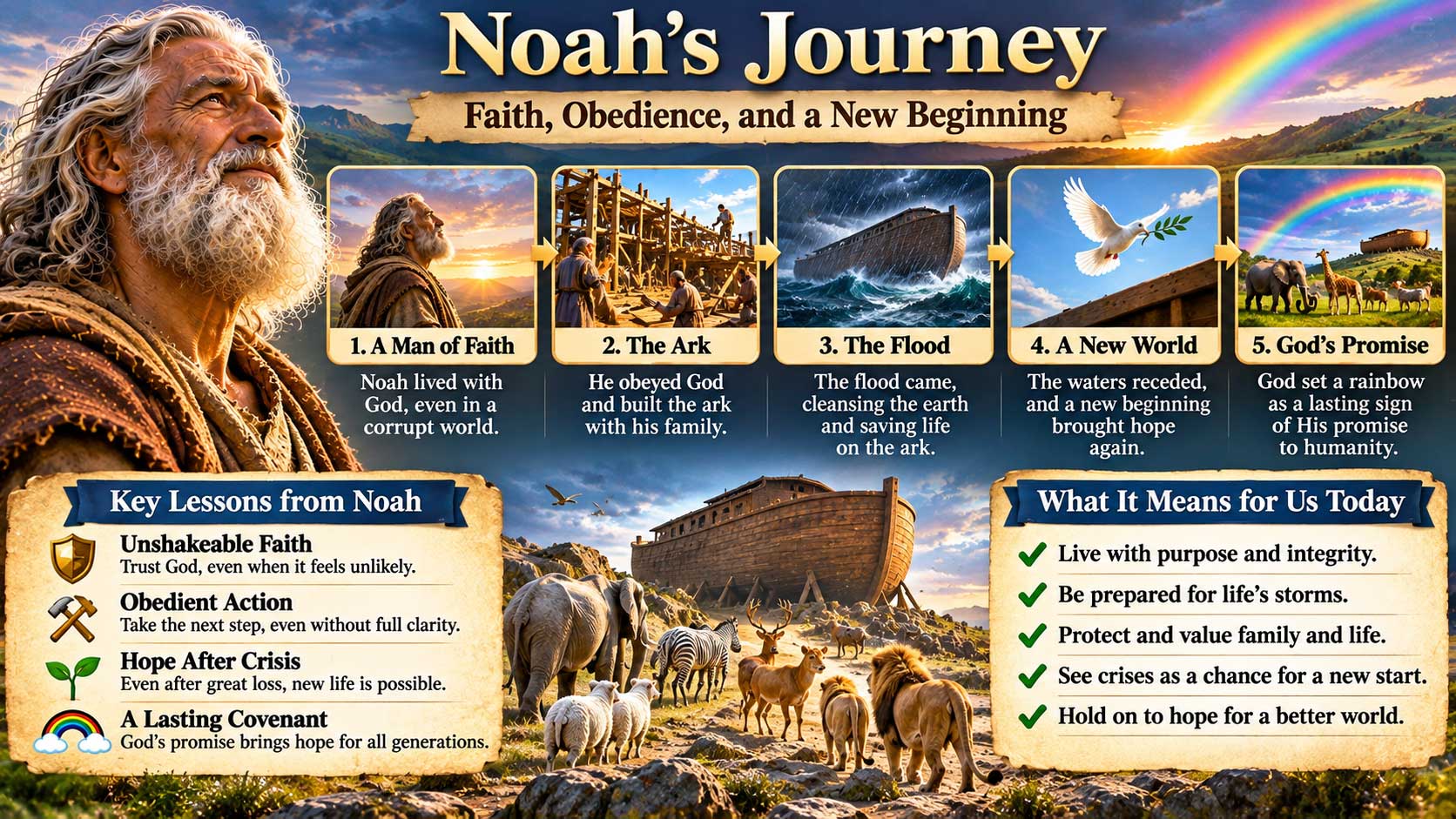
We began this imaginary interview with a familiar image: Noah building an enormous ark while the people around him struggled to understand what he was doing.
But as the conversation unfolded, the ark became only one part of a much larger human story.
We met Noah the husband, whose wife reminded him that unfinished work could wait until morning.
We met Noah the father, who sometimes lost his patience with Shem, Ham, and Japheth, and who had to learn that his sons needed more than instructions.
We met Noah the builder, who could follow extraordinary directions from God yet still struggle with ordinary frustrations, exhaustion, and family disagreements.
And we met Noah the survivor, who discovered that stepping out of the ark did not mean stepping away from grief.
The flood ended. The rain stopped. The waters receded.
But life did not simply return to normal.
The Ark Could Protect Their Bodies, But What About Their Relationships?
One of the most meaningful questions in this conversation concerns the difference between physical survival and family unity.
According to Genesis, Noah faithfully carried out God's instructions to build the ark. His wife, three sons, and three daughters-in-law survived with him.
Yet Genesis 9 records a troubling incident involving Noah's drunkenness, Ham's actions, Shem and Japheth's response, and a curse pronounced upon Canaan.
The biblical text leaves significant questions unanswered, including why Canaan is named in the curse. Interpretations vary, and the passage must never be used to justify racial discrimination or the mistreatment of any people.
For our imaginary conversation, the incident opens a deeply personal question:
Can a father succeed in an extraordinary mission and still struggle with the ordinary responsibilities of loving and guiding his family?
Noah's fictional answers suggest that he could.
He could build something enormous, yet struggle to admit when his son was right.
He could lead his family through danger, yet fail to recognize when his wife needed his attention.
He could believe deeply in God, yet still face his own weaknesses.
These are not contradictions that make his story meaningless. They are questions that make the story worth examining.
Was God's Hope Bigger Than the Ark?
There is another interpretation worth exploring.
In Genesis, Noah's family becomes the starting point for humanity's life after the flood. The covenant extends beyond Noah himself to his descendants and every living creature.
From a spiritual perspective, this invites us to ask whether God's hope involved more than preserving human life.
Could it have involved giving humanity another opportunity to build families and communities founded on love, trust, responsibility, and respect?
That is one possible theological reading, rather than an explicit explanation supplied by Genesis.
If we consider it, the relationships among Noah and his sons become particularly meaningful.
Perhaps the greatest test of a family is not whether its members can work together during a crisis.
Perhaps it is whether they can continue loving and respecting one another when the crisis has passed.
That question remains relevant to families today.
What Noah's Story Might Teach Us About Our Own Families
Most of us will never be asked to build an ark.
But we may spend years working to provide for our children, protecting them from hardship, and trying to create a better future.
We may become so occupied with those responsibilities that we forget to ask how the people closest to us are feeling.
We may assume our children know we love them.
We may believe that being a good parent means always having the right answer.
And sometimes we may discover that the people we love most have been waiting for us to listen.
In our fictional conversation, Noah's most touching memory isn't the completion of the ark or the sight of the rainbow.
It's an ordinary family dinner.
His sons are laughing. His wife is smiling. Everyone is together.
For a moment, there is nothing to accomplish and nothing to prove.
Just a family enjoying one another's company.
And Noah realizes how close he came to losing that simple happiness.
A Final Question for Every Parent
Near the end of the interview, Nick asks Noah what he would say if he could sit down with his three sons again.
Instead of offering another lesson, Noah says he would begin by listening.
He would ask about their childhood memories, their fears, and the times they needed him.
Then he would tell them how proud he was of them.
And he would tell them he loved them before they had to ask.
That imagined answer may be the most meaningful moment of our conversation.
Noah is remembered for building an ark that protected his family from the flood.
But perhaps his story can remind us of another responsibility, one that belongs to every generation:
Protecting our families matters. Learning how to love the people within them matters just as much.
And that is a conversation worth having long after the rain has stopped.
Disclaimer: These reflections are based on a fictional interview and selected biblical passages. Noah's personal feelings, regrets, conversations, and motivations are imagined. The discussion includes interpretive spiritual ideas, not established historical facts or definitive theological conclusions.
Short Bios:
Noah: Biblical Patriarch and Builder of the Ark
Noah is a central figure in the Hebrew Bible's Book of Genesis. Described as righteous in his generation, he receives instructions from God to construct an ark before a catastrophic flood. He survives with his wife, his three sons (Shem, Ham, and Japheth), and their wives. After the flood, God establishes a covenant with Noah, his descendants, and every living creature, with the rainbow serving as its sign. His story appears primarily in Genesis chapters 5–9. Noah is recognized in Jewish, Christian, and Islamic traditions, though interpretations of his life and significance differ.
Nick Sasaki: Host of ImaginaryTalks
Nick Sasaki is the creator of ImaginaryTalks.com, a creative platform that brings historical, literary, biblical, and influential figures into fictional conversations. Through imaginative interviews, Nick explores the personal experiences, beliefs, relationships, and difficult questions behind familiar stories. His conversations invite readers to encounter famous figures as relatable human beings and reflect on what their experiences might mean for contemporary life.
Leave a Reply