


Introduction: Have We Made Ourselves Our Own Gods?
What if our greatest addiction isn't alcohol, drugs, money, or technology, but the belief that we should be able to control everything? We work harder, plan further ahead, protect our children, pursue success, and try to eliminate uncertainty. Yet the more control we seek, the more anxious we sometimes become. Have we confused being responsible for our lives with believing that we should be in charge of everything? And if we cannot control life, does surrender mean accepting defeat, or could it be the beginning of a different kind of freedom?
These questions lie at the heart of Radical Surrender: Letting Go in a World Addicted to Control, the new book by Stanford psychiatrist Anna Lembke, author of Dopamine Nation. Scheduled for publication on November 10, 2026, the book challenges our modern obsession with certainty, achievement, and personal control. Lembke brings together psychology, addiction medicine, spiritual reflection, and deeply personal experiences to examine why our attempts to control life can become sources of suffering. Her central message is not that we should stop trying, but that responsible action and the acceptance of uncertainty must somehow coexist.
What makes Lembke's perspective especially moving is the personal suffering behind it. After losing her infant son Lucas to leukemia and experiencing further devastating loss, she confronted the limits of scientific knowledge, determination, and her ability to manage grief. In her November 5 conversation with Dr. Alison Cook, The Paradox of Surrender, Lembke discusses how these experiences contributed to an unexpected spiritual awakening. She began questioning whether the self could truly serve as the final authority over life, goodness, and meaning. Her reflections raise a question that reaches beyond psychology: Can surrender bring us closer to God, or to a deeper awareness of something greater than ourselves?
Lembke's November 9 appearance on Huberman Lab, discussing addiction, obsessive thinking, and the need for control, brings another dimension to the discussion. Our desire for control may appear in our careers, marriages, parenting, and moral disagreements. We may believe we're protecting our loved ones when we're actually trying to eliminate our own anxiety. We may believe we're defending truth when we're defending our pride. Yet surrender raises difficult questions of its own. When should we accept what cannot be changed? When should we fight injustice? How can we surrender to God without surrendering conscience, responsibility, or the courage to act?
To explore these questions, ImaginaryTalks brings Anna Lembke into an imagined conversation with four extraordinary thinkers: C. S. Lewis, whose Christian writings examine faith, suffering, and grace; Viktor Frankl, whose experiences and psychiatric work illuminate meaning and responsibility; Marcus Aurelius, whose Stoic philosophy examines virtue and the limits of human control; and Thich Nhat Hanh, whose Buddhist teachings connect compassion, mindfulness, and nonattachment. Across five conversations, moderated by Nick Sasaki, they examine achievement, grief, moral truth, family relationships, and the difficult balance between surrender and courage. Their beliefs are not identical, and their disagreements are part of what makes the discussion meaningful. The question isn't whether everyone must arrive at the same answer, but whether listening to different perspectives can help us live with greater wisdom, humility, and love.
Fictional conversation disclaimer: The following discussions are imagined for educational, literary, and philosophical reflection. The dialogue is fictional, not an actual interview or a collection of authenticated quotations. Anna Lembke's portrayal draws on publicly available interviews and descriptions of her work. The historical participants' perspectives are interpretations of their published teachings.
Topic 1. Have We Made Ourselves Our Own Gods?

Why do intelligent, hardworking people sometimes become prisoners of their own ambition? Can our desire for control become an addiction? And how can we pursue meaningful goals without allowing success to determine our worth?
Round 1. When Success Becomes a Prison
Nick Sasaki
Anna, I want to begin with something that caught my attention in your recent interviews about Radical Surrender.
You described a period of your life when achievement, discipline, and self-reliance occupied an enormous amount of space in your thinking. You were highly educated, professionally successful, and accustomed to solving difficult problems.
Most people would look at that life and say you were doing everything right.
Yet you've suggested that something was missing.
I'd like to begin with a personal question. When did you first recognize that your determination to succeed might have become something that was controlling you?
Anna Lembke
That's an interesting way to frame the question, Nick, because the desire to control our circumstances often presents itself as a virtue.
We admire disciplined people. We admire people who work hard, make sacrifices, and achieve difficult goals. I certainly grew up believing those qualities were important.
And I still believe they are.
But there is a distinction between using discipline to pursue something meaningful and believing that discipline gives us ultimate control over what happens.
For much of my life, I operated with an implicit assumption that if I worked hard enough, learned enough, and made the right decisions, I could create the life I wanted.
That belief was enormously motivating.
It was comforting, too.
But it contained a hidden bargain: if everything depended on my effort, then anything that went wrong could feel like evidence that I hadn't done enough.
Eventually, I began to recognize how exhausting that bargain could become.
Nick Sasaki
So the problem wasn't ambition itself. It was the belief that ambition could protect you from life's uncertainties.
Anna Lembke
Yes. And I think that distinction matters.
People sometimes hear the word surrender and assume it means abandoning goals or becoming indifferent to outcomes.
That's not what I'm describing.
I'm talking about recognizing the limits of our ability to determine what happens.
We can act responsibly. We can prepare. We can work diligently.
But we cannot guarantee success, prevent every tragedy, or make other people behave as we wish.
When we refuse to accept those limitations, our efforts to control life can become a source of suffering.
Marcus Aurelius
There is a difficulty here that I recognize.
A person may perform every duty conscientiously and still encounter failure.
An emperor may prepare carefully for a campaign, yet disease may strike his soldiers. A father may instruct his children in virtue, yet they may choose another path.
If a man makes his peace dependent upon the obedience of events, he has surrendered his peace to forces that were never his to command.
But I would ask you something, Anna.
Do you believe the desire for control is itself harmful, or does the harm begin when we seek control over things that do not belong to us?
Anna Lembke
I think the second formulation is closer to what I mean.
We need some sense of agency to function.
The difficulty comes when our desire for control becomes excessive, when it interferes with relationships, or when we become unable to tolerate uncertainty.
From the perspective of addiction medicine, I'm interested in how behaviors that initially help us cope can become repetitive and self-defeating.
A person might begin by organizing life to reduce anxiety.
But over time, they may need increasingly elaborate routines, reassurances, or achievements to experience the same relief.
What began as a strategy for living becomes something they feel compelled to do.
Viktor Frankl
I would distinguish two questions.
What do I want from life?
And what is life asking of me?
The first question can become an endless pursuit of satisfaction.
The second directs us beyond ourselves.
A person may discover meaning through work, through love, or through the attitude they take when confronted with unavoidable suffering.
Achievement can serve meaning.
But achievement cannot replace meaning.
Nick Sasaki
Viktor, that's an important distinction.
Suppose someone builds a successful business, earns considerable money, and provides a comfortable life for their family.
Those are real accomplishments.
How would that person know whether achievement is serving a meaningful purpose or has become an obsession?
Viktor Frankl
I would ask what happens when success is interrupted.
Can the person still recognize the value of life?
Can they still love?
Can they still act responsibly?
Can they still find meaning in circumstances where recognition, status, and financial rewards are absent?
If a person's entire sense of worth collapses when achievement disappears, then achievement may have become the foundation of identity rather than an expression of purpose.
C. S. Lewis
And I would suggest that this is where the spiritual danger enters.
Human beings possess an extraordinary ability to turn good things into ultimate things.
Work is good. Learning is good. Providing for one's family is good.
But when any of these becomes the final source of our identity, it begins to demand more than it can give.
We may say that we worship nothing.
Yet we can organize our entire existence around success, admiration, or the preservation of our preferred image of ourselves.
The question is not merely whether we believe in God.
It is what we have placed at the center of our lives.
Nick Sasaki
Anna, Lewis is suggesting that achievement can become a substitute for God.
Is that close to what you were describing in your interviews?
Anna Lembke
It is close to the way I've come to reflect on my own experience.
I was raised in a largely secular environment, and achievement offered a structure for understanding my place in the world.
It gave me goals and a sense of identity.
But it couldn't answer every question.
And it certainly couldn't protect me from every form of suffering.
I think one of the difficult lessons of surrender is discovering that our worth cannot depend entirely on our ability to make life turn out the way we want.
Round 2. Can Control Become an Addiction?
Nick Sasaki
Let's explore the addiction question more deeply.
Anna, you're known for your work on addiction, particularly through Dopamine Nation.
Most people understand addiction in connection with alcohol, drugs, gambling, or compulsive digital behavior.
But when you talk about being addicted to control, are you using addiction as a metaphor, or do you see a psychological process that resembles other addictive behaviors?
Anna Lembke
I think we need to be careful with the terminology.
Not every strong desire for control constitutes a clinical addiction.
But there can be meaningful similarities.
Consider someone who experiences anxiety whenever circumstances become unpredictable.
They respond by checking, planning, organizing, or trying to influence other people.
For a moment, the anxiety decreases.
That relief reinforces the behavior.
The next time uncertainty appears, the person repeats the strategy.
Eventually, the behavior can become increasingly rigid, and the person's tolerance for uncertainty may diminish.
The attempt to escape discomfort can create a cycle in which the person feels less free.
Nick Sasaki
That sounds almost contradictory.
Someone tries to control life to feel safer, but eventually becomes less capable of living with ordinary uncertainty.
Anna Lembke
Exactly.
The strategy can begin to undermine the very freedom it was supposed to provide.
Thich Nhat Hanh
There is something familiar in this description.
When fear appears, we often wish to remove it immediately.
We try to arrange the world so that the fear will not return.
But fear is part of the human experience.
If we spend our lives running away from every uncomfortable feeling, we may never learn how to care for those feelings.
Mindfulness invites us to recognize fear without allowing it to become our master.
We can say, in effect, that fear is present, and we can attend to it with compassion.
We do not need to obey every demand that fear makes.
Marcus Aurelius
Yet compassion must not become an excuse for neglecting reason.
Suppose a man fears that his household will lack food.
He should not merely contemplate his fear.
He should work, save, and prepare.
There are dangers against which practical action is entirely appropriate.
Thich Nhat Hanh
Of course.
Awareness does not prevent action.
It helps us act without being driven blindly by fear.
A parent can prepare food for a child with love.
The same parent may become so afraid of the child's future that every decision becomes an attempt to eliminate uncertainty.
The outward actions may appear similar, but the inner relationship to those actions is different.
Nick Sasaki
That's interesting.
Anna, how can someone recognize that difference in everyday life?
Is there a practical warning sign?
Anna Lembke
One warning sign is rigidity.
Can you change your plans without becoming overwhelmed?
Can you allow someone you love to make a decision you disagree with?
Can you tolerate an uncertain outcome after you've taken reasonable precautions?
Another warning sign is the cost of the behavior.
Is your need for control damaging your relationships?
Are you spending enormous amounts of time trying to prevent unlikely outcomes?
Do you feel compelled to keep checking or intervening, despite recognizing that the behavior isn't helping?
Those questions can reveal whether a useful habit has become maladaptive.
C. S. Lewis
I wonder whether there is another warning sign.
Can a person receive something good without feeling that they must have earned it?
A mind governed entirely by achievement may find grace rather difficult to accept.
Grace is not a wage.
It cannot be demanded as payment for excellent performance.
And if we believe that everything valuable must be secured through our own efforts, we may become unable to receive what is freely given.
Nick Sasaki
That's a different way of looking at control.
Perhaps people aren't simply afraid of losing what they have.
Perhaps they're uncomfortable with the idea that their lives depend partly on gifts they never earned.
Viktor Frankl
Gratitude may be important here.
No human being creates the conditions of existence alone.
Our lives depend on relationships, circumstances, and opportunities that we did not entirely choose.
Recognizing this need not diminish responsibility.
It may deepen responsibility.
If life is something we have received, we can ask how we ought to respond to it.
Anna Lembke
I appreciate that formulation.
One of the changes associated with surrender is moving away from the assumption that we are the sole authors of everything that happens.
That can make room for gratitude, humility, and connection.
Round 3. Have We Made Ourselves Our Own Gods?
Nick Sasaki
I'd like to return to our title.
Have we made ourselves our own gods?
It's a provocative question, but I don't want to use it merely for dramatic effect.
Lewis, what would that phrase mean from your perspective?
C. S. Lewis
It would describe the attempt to occupy a position that human beings cannot occupy.
We are creatures with genuine freedom and responsibility, but we are not the source of our own existence.
We do not determine the ultimate nature of reality.
We cannot command life and death.
When we insist that everything must conform to our will, we begin to behave as though our desires were the final authority.
Christianity offers a different picture.
Human freedom finds its proper purpose not in becoming independent of God, but in entering into a right relationship with Him.
Yet I must make a distinction.
Surrender to God is not the same as surrender to any powerful authority that claims to speak for God.
Human beings can misuse religious language to demand obedience.
Conscience and discernment remain necessary.
Nick Sasaki
I'm glad you raised that distinction.
The word surrender can make people uncomfortable.
Some hear it as giving up their freedom.
Others hear it as submitting to someone who might exploit them.
Anna, how do you distinguish spiritual surrender from allowing another person to control you?
Anna Lembke
That distinction is fundamental.
Healthy surrender should not mean accepting abuse, abandoning boundaries, or giving up the ability to make decisions.
In fact, relinquishing the effort to control other people may help us recognize that we need appropriate boundaries.
We cannot make another person change.
But we can decide what behavior we will participate in, what responsibilities we will accept, and what actions are consistent with our values.
Surrender is not the absence of agency.
It's a different relationship to agency.
Marcus Aurelius
Then I would say that the language of surrender must always be accompanied by the language of duty.
One should not surrender one's commitment to justice.
One should not surrender honesty.
One should not surrender the responsibility to act with courage.
We must accept that outcomes are uncertain, but the uncertainty of outcomes does not excuse the corruption of our character.
Thich Nhat Hanh
And we should consider the suffering created when we believe that our perspective must prevail.
Many conflicts begin with the conviction that only one person can be right.
We become attached to our views.
We stop listening.
We may even harm someone while believing that we are defending what is good.
Nonattachment does not require us to abandon ethical commitments.
It asks us to remain open, compassionate, and aware that our perceptions may be incomplete.
C. S. Lewis
I agree that humility is necessary.
But I would resist the suggestion that every disagreement is merely an attachment to personal opinion.
There are moral truths that we ought to defend.
The difficulty is learning to defend them without allowing pride to corrupt our motives.
Thich Nhat Hanh
Yes. We can disagree deeply and still listen.
Compassion does not require agreement.
Nick Sasaki
This is precisely the distinction I wanted to explore.
What if someone says, "I believe in truth. I believe in responsibility. I believe certain things are right and others are wrong. I don't want surrender to mean that I stop defending those convictions."
Anna, what would you tell that person?
Anna Lembke
I would say that surrender need not require abandoning those convictions.
The challenge is recognizing the difference between acting according to our values and insisting that everyone else must respond as we wish.
We can speak truthfully without controlling how our words are received.
We can act courageously without guaranteeing victory.
We can love people without guaranteeing that they will love us in return.
For me, surrender involves relinquishing the demand that reality validate every choice we make.
Viktor Frankl
Then perhaps we should say that responsibility becomes more important, not less important, when control is limited.
If we cannot determine every outcome, we must attend carefully to the choices that remain ours.
A human being is not free from circumstances.
But within the limits of circumstance, there may still be an opportunity to choose a meaningful response.
Nick Sasaki
So perhaps the opposite of control isn't helplessness.
Perhaps it's responsibility without the illusion of omnipotence.
Viktor Frankl
That is a distinction worth preserving.
Round 4. What Happens When Achievement Disappears?
Nick Sasaki
I want to make this personal again.
Suppose someone has spent forty years building a career or a business.
They've worked long hours, made sacrifices, and measured progress through accomplishments.
Then one day they retire, become ill, lose their position, or discover that their children no longer need them in the same way.
Suddenly, the identity they've spent decades building feels uncertain.
Anna, how would your ideas help someone in that situation?
Anna Lembke
I think it begins by recognizing how much identity we've invested in a particular role.
Work can provide structure, relationships, meaning, and a sense of competence.
Losing that role can be genuinely painful.
We shouldn't minimize that loss.
But it may create an opportunity to ask questions we previously avoided.
Who am I apart from what I accomplish?
What relationships have I neglected?
What matters when productivity is no longer the central measure of my days?
And can I accept being valuable without constantly demonstrating my value through achievement?
Nick Sasaki
That last question seems especially difficult for people who have always been independent.
They may find it easier to help someone else than to accept help themselves.
C. S. Lewis
Indeed.
We may prefer to be benefactors rather than recipients.
Giving allows us to retain a certain sense of superiority.
Receiving requires us to acknowledge need.
And need is something pride often finds humiliating.
Yet human beings are made for relationships.
To love another person is not simply to provide for them.
It is to allow ourselves to be known, including in weakness.
Thich Nhat Hanh
A person who has spent many years working may discover that simply being present is difficult.
They sit with a family member, but the mind continues planning.
They walk through a garden, but they think about unfinished tasks.
They may believe that rest is wasted time.
I would invite such a person to practice being fully present with one ordinary moment.
Drink tea and know that you are drinking tea.
Listen to a child and know that you are listening.
Your life is taking place now.
It is not waiting for the next achievement.
Marcus Aurelius
I would add that retirement from an occupation is not retirement from virtue.
A man may cease to govern an empire, but he can still practice justice.
He may no longer command an army, but he can still exercise courage.
He may possess fewer responsibilities, but he can still be useful to others.
The worth of a person should not depend entirely upon a title.
Viktor Frankl
And meaning can change its form across a lifetime.
At one stage, a person may find meaning primarily through creating something.
At another, through loving someone.
At another, through the attitude they take when circumstances restrict what they can accomplish.
The mistake is assuming that the disappearance of one source of meaning means the disappearance of all meaning.
Nick Sasaki
Anna, there's something interesting here.
All four of them are saying that a meaningful life does not require constant achievement.
But none of them is suggesting that people should stop trying to accomplish worthwhile things.
Is that where your idea of surrender leads?
Anna Lembke
Yes, I think so.
Surrender can free us to act for reasons other than fear.
We may continue working, creating, raising children, and pursuing goals.
But perhaps we can do those things without constantly trying to prove that we deserve to exist.
We can begin to appreciate the process rather than demanding a particular result.
And we may become more available to the people around us.
Round 5. Can Ambition and Surrender Live Together?
Nick Sasaki
I'd like to end this topic with a practical question for everyone.
Suppose someone listening to us says:
"I have dreams. I want to build something meaningful. I want to provide for my family. I want to make a difference in the world. I don't want to lose my ambition."
What would you tell that person?
Marcus, may I start with you?
Marcus Aurelius
Pursue the work before you with diligence.
Do not confuse indifference to outcomes with indifference to duty.
Prepare carefully. Act justly. Exercise courage.
But do not permit the result to determine whether you have lived honorably.
A worthy action remains worthy even when fortune denies it success.
Viktor Frankl
I would ask the person to look beyond success and toward meaning.
What human need does your work serve?
Whom do you love?
What responsibility calls for your attention?
Success may follow meaningful work, but it should not become the sole reason for undertaking it.
A meaningful life is not necessarily an easy life or a celebrated life.
Thich Nhat Hanh
I would invite the person to examine the energy behind the ambition.
Is the work nourished by love?
Or is it driven by fear that you are not enough?
Two people may pursue the same goal.
One may experience joy in the work and care for those around them.
The other may sacrifice every relationship to an endless hunger for recognition.
The goal is not necessarily the problem.
We must look at the way we hold it.
C. S. Lewis
I would tell the person not to abandon ambition merely for the sake of appearing humble.
The world needs excellent work.
It needs people who build, teach, discover, protect, and create.
But ambition must be ordered toward something greater than the self.
If success becomes an idol, it will eventually demand sacrifices that no good thing should demand.
Seek to do the work faithfully.
Do not ask the work to provide what only God can provide.
Nick Sasaki
Anna, you've heard four different approaches.
A Stoic speaks about duty.
A psychiatrist speaks about meaning.
A Buddhist teacher speaks about the inner quality of our actions.
A Christian writer speaks about placing God above success.
Where do you find yourself among those perspectives?
Anna Lembke
I find something valuable in each of them.
My own experience has led me to question the assumption that greater control will always produce a better life.
I still believe in hard work.
I still believe in science.
I still believe that we should take responsibility for our choices.
But I no longer believe that those things can eliminate uncertainty or protect us from every form of suffering.
Surrender has become, for me, a way of acknowledging reality more fully.
It means recognizing that I am not the center of everything.
It means becoming more willing to accept help, to acknowledge limitations, and to participate in something larger than my individual ambitions.
And perhaps most importantly, it means trying to act from love and responsibility rather than from fear.
Nick Sasaki
Let me challenge you with one final question.
What if someone practices surrender, becomes more peaceful, and then discovers that the world hasn't changed?
Their problems are still there.
Their family is still complicated.
Their business is still uncertain.
Their grief hasn't disappeared.
What has surrender actually accomplished?
Anna Lembke
Perhaps the first thing it changes is our relationship with what remains.
Surrender doesn't promise that every problem will disappear.
It doesn't guarantee that we will stop grieving.
It doesn't remove the need to make difficult decisions.
But it may allow us to stop adding another layer of suffering through the insistence that reality must be different before we can live meaningfully.
We can acknowledge what is happening.
We can decide what action is possible.
And we can release, at least for a moment, the demand to control what comes next.
Nick Sasaki
Viktor, would you agree?
Viktor Frankl
I would agree that the human response matters profoundly.
But I would preserve one distinction.
We should never romanticize suffering or assume that it automatically makes us better.
Where suffering can be prevented, we should act to prevent it.
Where injustice can be opposed, we should consider our responsibility to oppose it.
The question of meaning becomes especially urgent when suffering cannot be avoided.
Then the human person confronts a different kind of freedom.
C. S. Lewis
And I would add that faith does not spare us from sorrow.
Sometimes it makes our questions more painful.
But faith can prevent us from treating our present suffering as the whole of reality.
We may not understand the story in which we find ourselves.
That does not mean we must pretend that every chapter is pleasant.
Thich Nhat Hanh
And when suffering is present, we need not face it alone.
We can breathe.
We can ask for help.
We can care for one another.
Sometimes surrender begins when we stop pretending that we must carry everything by ourselves.
Marcus Aurelius
Then let us be careful not to confuse strength with domination.
The strongest person is not necessarily the one who controls the greatest number of events.
Strength may be found in the person who acts rightly amid events that refuse to obey.
Nick Sasaki
Anna, listening to everyone, I'm beginning to see surrender differently.
I initially thought the question was whether we should give up control.
But perhaps that's too simple.
The deeper question may be whether our desire for control has begun to control us.
We can work hard without worshipping success.
We can love our families without trying to determine every choice they make.
We can defend our convictions without demanding that the entire world agree with us.
And perhaps we can accept our limitations without losing the courage to act.
But there's something we haven't explored yet.
It's relatively easy to discuss surrender when life is going reasonably well.
What happens when everything we believed about life is shattered?
What happens when a person prays, works, hopes, and does everything they know how to do, yet still loses someone they love?
Anna, that question leads directly to the most painful part of your story.
I'd like us to explore it carefully in our next discussion.
Anna Lembke
I think that's where the question of surrender becomes much more than an intellectual exercise.
It's one thing to acknowledge uncertainty in principle.
It's another to encounter a loss that no amount of effort can reverse.
And sometimes, what we discover about ourselves in those moments is very different from what we believed before.
The conversation continues in Topic 2: When Suffering Breaks Everything We Believe.
Fictional conversation disclaimer: This is an imagined discussion created for literary, educational, and philosophical exploration. The participants' dialogue is fictional and is not a transcript or a collection of authenticated quotations. Anna Lembke's contributions are interpretive reconstructions informed by publicly available descriptions and interviews concerning Radical Surrender. The historical participants' perspectives draw on their published ideas and teachings.
Topic 2. When Suffering Breaks Everything We Believe

Why does suffering lead some people closer to God and drive others away? What happens when intelligence, determination, and prayer cannot prevent tragedy? And can surrender bring peace without requiring us to believe that suffering was somehow necessary?
Round 1. When Life Refuses to Follow Our Plans
Nick Sasaki
Anna, at the end of our previous conversation, we talked about how ambition and self-reliance can gradually become a way of trying to control our lives.
But I want to begin this discussion somewhere much more personal.
In your recent interviews about Radical Surrender, you've spoken about the devastating experience of losing your son, Lucas.
I want to approach that part of your life with care.
You were trained in medicine. You understood the value of scientific knowledge, preparation, and disciplined action. Yet you encountered something that no amount of intelligence or determination could make right.
When you look back on that period, what happened to your belief that life could be managed through effort and good decisions?
Anna Lembke
I think one of the most difficult things about profound loss is that it exposes assumptions we may never have consciously examined.
For much of my life, I believed that careful decisions, hard work, and knowledge could protect me from many of life's difficulties.
Of course, intellectually, I knew that terrible things happened to people who had done nothing to deserve them.
As a physician, I understood that illness and death were part of the human condition.
But intellectual knowledge and personal experience are very different.
When suffering enters your own family, it can dismantle the framework through which you've interpreted your life.
You discover that knowing something about suffering does not necessarily prepare you to endure it.
And you may discover that the strategies you've relied upon for years cannot give you what you desperately want.
Nick Sasaki
Did that create anger?
Not simply sadness, but anger at the unfairness of what happened?
Anna Lembke
I think anger is a very human response to loss.
There can be anger at circumstances, at other people, at ourselves, and at the fact that reality refuses to conform to what we believe should happen.
Sometimes anger is easier to experience than helplessness.
If I can identify someone responsible, perhaps I can preserve the belief that the world is orderly and controllable.
But some suffering resists that explanation.
And then we're left confronting something much more frightening.
We cannot make what happened unhappen.
C. S. Lewis
There is a terrible difference between discussing suffering and being wounded by it.
One can construct an elegant explanation of pain when the pain belongs to someone else.
But grief has a way of stripping such explanations of their elegance.
When my wife died, I discovered that the questions I had previously considered in theological terms became painfully immediate.
I did not cease to believe that God existed.
But I struggled with what His existence meant in the face of my suffering.
I found myself asking questions that were not comfortable or easily answered.
Nick Sasaki
Lewis, you've written extensively about Christianity and suffering.
Did your own experience make you question what you had previously taught?
C. S. Lewis
It made me question whether I had truly grasped what I was saying.
There is a temptation to treat faith as a system that should make every experience intelligible.
But faith is not a guarantee that every event will make sense to us.
I had to confront the difference between believing that God is good and feeling that goodness in the midst of grief.
Those are not always the same experience.
Viktor Frankl
I would add that suffering can destroy the assumptions upon which a person has built an entire life.
In the concentration camps, people were deprived of possessions, freedom, relationships, and the ordinary structures through which they recognized themselves.
It would be false to say that everyone responded nobly.
Some became despairing. Some became cruel. Some lost the will to continue.
We should never turn suffering into a romantic story.
But I observed that the question of meaning remained possible, even under circumstances of extraordinary deprivation.
Nick Sasaki
Anna, both Lewis and Frankl are describing a moment when life becomes almost unrecognizable.
Is that where surrender begins?
When we finally realize we cannot make the world return to what it was?
Anna Lembke
It can begin there.
But I would be cautious about making surrender sound immediate or easy.
People sometimes hear stories of spiritual transformation and assume there was one dramatic moment when everything changed.
In reality, grief can be complicated.
We may accept something intellectually and still resist it emotionally.
We may experience moments of peace followed by renewed anger or despair.
Surrender is not necessarily a permanent emotional state.
It may be something we return to repeatedly.
Round 2. Why Would a Loving God Allow Such Suffering?
Nick Sasaki
I want to ask the question that many people are afraid to ask openly.
If God is loving, why would He allow an innocent child to suffer?
Lewis, I know you've wrestled with this question.
But I don't want a comfortable theological answer.
What would you say to a parent who has just lost a child and cannot understand why God permitted it?
C. S. Lewis
I would begin by acknowledging that no philosophical explanation can restore that child.
A grieving parent does not need someone to arrive with a clever argument and announce that the tragedy has been explained.
There are questions that deserve intellectual attention, certainly.
Christianity teaches that creation is good, yet the world we inhabit is marked by suffering, disorder, and death.
But even a coherent theology of suffering does not tell us why this particular child suffered at this particular moment.
We should be humble about what we claim to know.
And I would be deeply suspicious of anyone who told a grieving parent that their child's death was necessary to teach them a lesson.
Nick Sasaki
That's something I wanted to address.
People sometimes say, "Everything happens for a reason."
They may intend to comfort someone.
But for a grieving parent, those words could sound terribly cruel.
Anna, how do you respond to that idea?
Anna Lembke
I think we need to distinguish between finding meaning after suffering and claiming that suffering was intentionally arranged to produce that meaning.
Those are very different propositions.
A person may experience profound personal change following a tragedy.
They may develop greater compassion, humility, or spiritual awareness.
But that doesn't mean we should conclude that the tragedy was necessary or desirable.
And it certainly doesn't mean that another person's suffering exists for our benefit.
Sometimes the most compassionate response is not an explanation.
It's presence.
It's allowing someone to grieve without trying to manage their emotions or rush them into a lesson.
Thich Nhat Hanh
When someone is suffering deeply, we should be very careful with our words.
The person may not need our philosophy.
They may need us to sit beside them.
They may need to cry.
They may need to know that they are not alone.
Compassion begins when we recognize suffering without turning away from it.
If we immediately offer an explanation, we may be trying to escape our own discomfort.
We want the suffering to become understandable so that we no longer feel helpless.
But love sometimes asks us to remain present without an answer.
Marcus Aurelius
I agree that we should not pretend to know the hidden causes of another person's tragedy.
Yet I would ask whether our peace should depend upon receiving an explanation.
There are many events whose causes remain beyond our knowledge.
We may spend our lives demanding answers that cannot be obtained.
The task before us is to determine how to live honorably within the circumstances we face.
Nick Sasaki
Marcus, let me challenge that.
Suppose someone says, "My child died, and you're telling me to accept it and behave honorably. That sounds cold."
How would you respond?
Marcus Aurelius
I would say that grief is not dishonorable.
Love naturally feels the absence of the beloved.
The question is not whether one should feel sorrow.
The question is whether sorrow must destroy every remaining possibility of goodness.
A person may mourn deeply and still act with tenderness.
They may feel anger and still refuse cruelty.
They may experience despair and still accept help from those who love them.
Stoic discipline should never be confused with the absence of humanity.
Viktor Frankl
There is another danger.
When we speak about meaning in suffering, people sometimes assume that we are praising suffering itself.
That is not my position.
If suffering can be removed, there is meaning in removing it.
A physician should treat illness.
A society should resist injustice.
A parent should protect a child.
Only when suffering cannot be changed do we confront the question of what attitude remains possible.
Nick Sasaki
Anna, does that distinction help explain what you mean by surrender?
Anna Lembke
Very much.
Surrender should never become a reason to stop seeking treatment, stop protecting people, or stop trying to improve difficult circumstances.
It concerns recognizing the limits of our control.
We can do everything reasonably available to us and still encounter an outcome we did not choose.
At that point, continuing to insist that reality must be different can create another form of suffering.
Acceptance does not mean approval.
And it doesn't mean that the loss becomes less significant.
Round 3. When Science Cannot Answer the Questions of the Heart
Nick Sasaki
Anna, your background makes this part of the conversation especially interesting.
You're a psychiatrist who has spent years studying the human brain, behavior, and addiction.
Science can explain many things about grief.
It can study stress responses, memory, attachment, and the psychological consequences of loss.
But you began exploring spiritual surrender.
What did spirituality offer that science could not?
Anna Lembke
I think science and spirituality address overlapping but different questions.
Science is extraordinarily valuable for investigating mechanisms.
It can help us understand how the brain processes experience and why certain patterns of behavior become difficult to change.
But a scientific explanation of grief is not the same as an answer to what grief means in a person's life.
Knowing which brain systems are involved in sorrow doesn't necessarily tell someone how to live after losing a loved one.
For me, spiritual surrender opened a different way of relating to uncertainty.
It invited me to consider that I did not need to be the ultimate authority over every aspect of my existence.
Nick Sasaki
Was that difficult for someone trained to question claims and demand evidence?
Anna Lembke
Yes, I think there can be a tension.
Scientific training encourages us to investigate, test, and seek explanations.
Those are valuable habits.
But there are experiences that do not yield easily to our demand for certainty.
Spiritual surrender does not require us to abandon critical thinking.
It may require us to recognize that critical thinking has limits.
We can remain intellectually curious without assuming that everything meaningful must be completely understood before we can engage with it.
C. S. Lewis
I would agree that science and faith need not be enemies.
Science can investigate the processes through which the physical world operates.
But it cannot, through those methods alone, settle every question about goodness, purpose, or God.
There is a mistake in assuming that one kind of knowledge must replace all others.
Yet I would press Anna on one point.
When you speak of surrendering to something greater than yourself, what exactly is that something?
Is it a personal God?
Is it the order of nature?
Or is it simply an acknowledgment that the universe does not obey your wishes?
Those are not identical claims.
Anna Lembke
That's a fair challenge.
I think my experience has made me more open to spiritual possibilities that I once approached with skepticism.
But I would hesitate to claim certainty about questions that remain mysterious to me.
The experience of surrender can begin before someone has a fully developed theology.
For some people, it occurs within an established religious tradition.
For others, it begins with the recognition that the self is not sufficient as the center of existence.
C. S. Lewis
Then perhaps our disagreement concerns what follows that recognition.
I would say that discovering our limitations is an important beginning.
But Christianity goes further.
It proposes that we are not merely surrendering to the impersonal limits of existence.
We are invited into a relationship with God.
And that relationship involves love, trust, obedience, and grace.
Nick Sasaki
Thich Nhat Hanh, your tradition approaches suffering differently.
How would you respond to the idea that surrender requires trusting a personal God?
Thich Nhat Hanh
In Buddhism, we can practice accepting impermanence without beginning with the question of a creator God.
We observe that everything changes.
Our bodies change.
Our relationships change.
Those we love will not remain physically with us forever.
Much suffering arises when we demand permanence from a world that cannot provide it.
But recognizing impermanence does not make love meaningless.
It can make love more precious.
When we understand that a flower will not bloom forever, we may appreciate it more deeply.
When we understand that the people we love are mortal, we may become more attentive to them today.
Nick Sasaki
But wouldn't someone who has lost a child say, "I already know life is impermanent. That doesn't make the pain any easier"?
Thich Nhat Hanh
Yes.
And I would not tell that person that an intellectual recognition of impermanence should remove their sorrow.
Practice is not merely agreeing with an idea.
It is learning to care for suffering with patience.
A parent may continue to feel deep love and grief.
We do not need to eliminate that love.
We can learn to hold the pain without allowing it to consume every moment of life.
Viktor Frankl
I find something valuable in both perspectives.
The human being is capable of reaching beyond immediate circumstances.
Whether through faith, love, responsibility, or a commitment to meaning, we can orient ourselves toward something greater than momentary pleasure or pain.
But I would caution against reducing spiritual experience to a psychological technique.
If a person believes in God, that belief should not be treated merely as a tool for reducing anxiety.
For that person, it concerns what is true.
Nick Sasaki
That's an excellent distinction.
Anna, could surrender become just another self-improvement technique?
Another way of saying, "If I surrender correctly, I'll finally feel peaceful"?
Anna Lembke
Absolutely, and that would risk reproducing the very problem we're trying to address.
We could turn surrender into another performance.
We might start evaluating whether we're surrendering successfully, whether we're peaceful enough, or whether we're receiving the outcomes we hoped surrender would produce.
That would be another attempt to control the experience.
Perhaps genuine surrender requires accepting that peace itself cannot always be commanded.
Round 4. What Happens When Our Prayers Are Not Answered?
Nick Sasaki
Let's talk about prayer.
Many people pray most intensely when someone they love is suffering.
They ask God for healing.
They promise to change their lives.
They ask for a miracle.
Sometimes the person recovers.
Sometimes they don't.
Lewis, what happens to faith when someone prays desperately and the outcome is heartbreaking?
C. S. Lewis
One of the hardest spiritual temptations is to imagine prayer as a transaction.
We offer devotion, sincerity, or sacrifice, and expect a particular result in return.
But prayer is not a mechanism for controlling God.
Christian prayer includes petition, certainly.
We are invited to bring our needs before God.
Yet the Christian tradition includes surrender to the divine will.
That surrender can be profoundly difficult when our own desires are entirely understandable and deeply loving.
A parent praying for a child's recovery is not asking for something selfish or trivial.
We should never suggest otherwise.
Nick Sasaki
But if God is loving, why wouldn't He answer such a prayer?
C. S. Lewis
I cannot tell you why every prayer is answered as it is.
And I would not pretend that the difficulty disappears simply through theological reasoning.
Faith does not provide a complete map of God's purposes.
There are moments when the most honest prayer may be an expression of bewilderment.
The Psalms themselves contain lament, protest, and anguish.
Christian faith has room for those cries.
Anna Lembke
I think that's important.
People sometimes believe that spiritual surrender requires them to suppress anger, doubt, or grief.
But denying those experiences may create additional suffering.
One can be open to a spiritual life and still struggle.
One can pray and still feel uncertain.
One can experience moments of trust and moments of resistance.
I don't think surrender should become another standard against which grieving people judge themselves.
Nick Sasaki
Viktor, what would you say to someone who has lost faith after suffering?
Would you encourage them to recover their belief in God?
Viktor Frankl
I would not presume to dictate another person's religious conclusions.
My concern would be to help them recognize that their life may still contain meaning.
A person who has suffered terrible loss may no longer be able to live according to their previous expectations.
But love can remain meaningful.
Responsibility can remain meaningful.
The memory of someone who has died can remain a source of profound commitment.
Meaning is not limited to the presence of happiness.
Nick Sasaki
Can you explain that through an example?
Viktor Frankl
Consider someone who has lost a beloved spouse.
They may believe that the most meaningful part of their life has ended.
But the love they experienced does not become unreal simply through death.
The relationship has changed, certainly.
Yet the person's capacity to honor that love through memory, gratitude, and future action remains.
I would never insist that they find consolation immediately.
Grief has its own reality.
But I would resist the conclusion that death has made the love meaningless.
Thich Nhat Hanh
I would say that love continues through the ways we live.
A mother may recognize her own mother's tenderness in the way she cares for her child.
A person may discover that someone who has died continues to influence their actions, their kindness, and their way of seeing the world.
We should not use this idea to deny the pain of physical absence.
But we can recognize that relationships leave traces throughout our lives.
Marcus Aurelius
And we can honor those we have lost through the character we cultivate.
Grief reminds us that life is fragile.
It may call us to become more patient, more generous, and less distracted by trivial quarrels.
But I would never claim that the death of a loved one is justified by the virtues we later develop.
Nick Sasaki
Anna, I hear an interesting difference among everyone.
Lewis sees prayer as a relationship with God.
Viktor sees meaning remaining possible after loss.
Thich Nhat Hanh sees love continuing through our lives and actions.
Marcus sees a responsibility to live honorably despite tragedy.
What did prayer mean to you as you began exploring surrender?
Anna Lembke
I think prayer can involve acknowledging that we do not possess complete control or complete knowledge.
It can create a space in which we stop demanding that everything be resolved immediately.
For someone who has relied heavily on analysis and problem-solving, that can be a profound change.
Prayer can become a way of expressing gratitude, asking for guidance, and recognizing our dependence on something beyond the individual self.
But I wouldn't want to promise that prayer will always produce a particular emotional experience.
Sometimes people pray and feel peaceful.
Sometimes they pray and feel nothing.
That uncertainty is part of the experience.
Round 5. Can We Find Peace Without Explaining Our Suffering?
Nick Sasaki
I'd like to bring our discussion back to everyday life.
Not everyone experiences a tragedy as devastating as losing a child.
But nearly everyone eventually encounters something they cannot change.
A parent watches an adult child make painful decisions.
A husband or wife faces a loved one's illness.
Someone loses a business after decades of work.
Another person reaches old age and realizes that time cannot be recovered.
Anna, what would surrender look like for someone facing one of those situations?
Anna Lembke
I would begin with a distinction.
What can I do?
And what am I demanding that I cannot do?
If a loved one is ill, we can seek appropriate care, offer support, and make responsible decisions.
But we cannot guarantee recovery.
If an adult child is struggling, we can communicate honestly, establish boundaries, and remain available.
But we cannot live that person's life.
If a business fails, we can learn, rebuild where possible, and seek help.
But we cannot change the past.
Surrender begins when we recognize the difference between responsible action and the demand for certainty.
Nick Sasaki
That sounds practical.
But what about the emotional side?
Someone might understand the distinction and still lie awake at night worrying.
Anna Lembke
That's very common.
Intellectual recognition doesn't immediately change emotional habits.
We may need to practice tolerating uncertainty in small ways.
We may need to notice when our minds begin rehearsing outcomes that we cannot control.
We may need to ask whether another hour of worrying is helping us act responsibly or simply reinforcing our distress.
And we may need the support of other people.
Surrender doesn't have to be something we accomplish alone.
Thich Nhat Hanh
I would invite the person to return to the present moment.
When we are overwhelmed, our minds may travel repeatedly into a future that has not arrived.
We experience imagined suffering again and again.
Breathing mindfully can help us recognize that, at this moment, we are here.
We can care for the fear without allowing it to become the whole of our experience.
And when we are ready, we can take one compassionate action.
Marcus Aurelius
I would ask the person to identify the next duty.
Not the entire future.
Not every possible catastrophe.
The next duty.
If someone needs care, provide it.
If a difficult conversation must occur, approach it honestly.
If rest is necessary, rest.
We need not command tomorrow in order to act honorably today.
Viktor Frankl
And I would ask what meaning remains available in the present situation.
Perhaps it is the responsibility to care for someone.
Perhaps it is the opportunity to reconcile with a family member.
Perhaps it is the courage to continue living after a profound loss.
We should not assume that meaning must arrive as a grand revelation.
It may appear in an ordinary act of love.
C. S. Lewis
I would encourage the person to bring their whole experience before God.
Not merely their gratitude or confidence.
Their fear, anger, sorrow, and uncertainty.
Prayer need not be an exercise in pretending that everything is well.
Sometimes the most faithful act is to speak truthfully from a wounded heart.
Nick Sasaki
Anna, I want to ask something that may sound uncomfortable.
You experienced profound suffering, and afterward your ideas about control, spirituality, and morality changed.
But suppose someone says, "I don't want spiritual growth at that price. I would rather have my loved one back."
What would you say?
Anna Lembke
I would understand that response.
I would never suggest that personal growth compensates for the loss of someone we love.
There is no equation in which greater wisdom makes such a tragedy worthwhile.
We can acknowledge that our lives have changed without claiming that the suffering was good.
We can discover meaning afterward without insisting that the tragedy was necessary.
And we can experience gratitude for what remains without denying the depth of what has been lost.
Nick Sasaki
I think that's one of the most important distinctions we've discussed.
We don't need to call suffering good in order to find something good after suffering.
Viktor Frankl
Precisely.
Meaning does not require us to approve of tragedy.
It asks whether life can still call us to responsibility in its aftermath.
C. S. Lewis
And faith need not demand that we pretend our wounds have disappeared.
Love makes us vulnerable to loss.
That vulnerability is not a defect in love.
It is part of what makes love so profound.
Thich Nhat Hanh
We can carry sorrow and love together.
We do not need to choose one and reject the other.
Marcus Aurelius
And we may continue to act with courage, not through the absence of sorrow, but in its presence.
Nick Sasaki
Anna, before we finish, I want to return to something you said earlier.
You described surrender as recognizing that we are not the center of everything.
For someone who has spent a lifetime relying on personal determination, that can sound frightening.
It means accepting that we are vulnerable.
That our knowledge has limits.
That our love cannot protect everyone.
And that some questions may remain unanswered.
But perhaps there's another side to that realization.
If we are not the center of everything, maybe we don't have to carry everything.
Maybe we can accept help.
Maybe we can trust others.
Maybe we can continue loving people without believing that their entire future rests on our decisions.
And perhaps, for those who believe in God, surrender becomes a way of recognizing that life has meaning beyond what we can personally arrange.
Still, I find myself with a difficult question.
If surrender brings us closer to God, does it change what we believe about right and wrong?
Does humility make us less certain of our moral judgments, or does it help us recognize a moral truth greater than our own preferences?
Anna, you've described a significant change in your thinking about morality.
I'd like to explore that next.
Anna Lembke
I think that's a natural continuation.
When we stop assuming that our individual desires should determine everything, we may become more open to the possibility that goodness exists beyond personal preference.
But that raises difficult questions.
How do we recognize what is good?
How do we distinguish genuine moral insight from our own biases?
And how do we act responsibly when we cannot be certain that our judgment is complete?
Those are questions worth exploring together.
The conversation continues in Topic 3: Is Good and Evil More Than Personal Opinion?
Fictional conversation disclaimer: This is an imagined literary and philosophical discussion, not a transcript of an actual meeting. All dialogue is fictional. Anna Lembke's portrayal draws on publicly discussed themes from her book and interviews; it does not represent new statements by her. The historical participants' contributions are interpretations of their published ideas. The discussion of grief is intended to encourage thoughtful reflection, not to suggest that suffering is necessary for spiritual growth.
Topic 3. Is Good and Evil More Than Personal Opinion?

Is morality something human beings invent, or something we discover? Can prayer and contemplation reveal moral truth? And if we believe that certain things are genuinely right or wrong, how do we defend those convictions without becoming prisoners of pride?
Round 1. Who Decides What Is Right?
Nick Sasaki
Anna, at the end of our last conversation, you raised a question that I find fascinating.
You described how surrender changed your relationship with uncertainty, but you suggested that it changed something deeper, too: how you think about morality.
In your recent interview with Alison Cook, you discussed growing up in a secular environment where moral values were often understood in relation to culture and human experience.
Yet your later spiritual exploration led you to consider whether goodness might exist beyond individual preference.
I'd like to understand that change.
What made you begin questioning the idea that morality is something people simply create for themselves?
Anna Lembke
I think the change began with recognizing how limited my own perspective could be.
When we're accustomed to relying on intelligence, analysis, and personal judgment, it's easy to assume that we can evaluate everything from a position of independence.
We develop explanations for what is right and wrong. We examine consequences. We consider cultural influences and individual experiences.
Those are valuable ways of thinking.
But I began to wonder whether the self could really serve as the final authority on goodness.
If I was capable of rationalizing my own behavior, if I could convince myself that something was acceptable simply since it served my interests, then perhaps my personal preferences weren't a sufficient moral foundation.
Spiritual surrender invited me to consider the possibility that goodness was something I needed to seek rather than something I could define entirely for myself.
Nick Sasaki
Let me make that concrete.
Suppose two people disagree about whether a particular action is morally acceptable.
One says, "That's my truth."
The other says, "No, some things are wrong regardless of what anyone believes."
How would you approach that disagreement today?
Anna Lembke
I would begin by acknowledging that our experiences shape our judgments.
We should be careful about assuming that our first interpretation is necessarily correct.
But recognizing the influence of culture and personal experience doesn't require us to conclude that all moral judgments are equally valid.
We can examine whether an action causes harm, whether it respects the dignity of others, whether it is honest, and whether it reflects responsibility rather than self-interest.
For me, the spiritual dimension adds another question.
Am I genuinely seeking what is good, or am I simply trying to justify what I already want?
C. S. Lewis
That last question is particularly interesting.
Human beings possess an extraordinary capacity to defend their own behavior.
We can condemn dishonesty in others and excuse it in ourselves.
We can demand fairness when we have been wronged, yet invent elaborate explanations when we have wronged someone else.
In Mere Christianity, I explored the remarkable fact that people frequently appeal to standards of fairness that they expect others to recognize.
They quarrel about whether someone has behaved properly.
They offer excuses when they fail to meet their own standards.
Such behavior suggests that morality is not merely a collection of private preferences.
It suggests that we recognize some standard against which our conduct can be judged.
Nick Sasaki
But couldn't someone say that those standards are simply products of evolution and social cooperation?
Human beings learned that honesty and fairness help communities survive.
Why would that require anything beyond human nature?
C. S. Lewis
An evolutionary explanation might help us understand how certain moral capacities developed.
But the origin of a belief and its truth are not necessarily the same question.
We can explain how human beings developed the ability to reason without concluding that reasoning has no relationship to truth.
Similarly, explaining how moral awareness emerged does not, by itself, settle whether moral judgments can be objectively valid.
I would ask whether we are describing why people believe something or whether we are evaluating whether that belief is true.
Those are distinct inquiries.
Marcus Aurelius
I would approach the matter through reason and human nature.
We are social beings.
We depend upon one another.
Our capacity for reason allows us to examine our actions and recognize obligations that extend beyond immediate appetite.
Justice is not simply whatever benefits me.
If I claim that deception is acceptable whenever it serves my interests, I undermine the trust upon which human cooperation depends.
The task of philosophy is to discipline our judgments so that our actions accord with reason and virtue.
Nick Sasaki
Marcus, you seem to believe that goodness is something we discover through reason.
Lewis believes moral truth ultimately points beyond humanity to God.
Anna is exploring the possibility that contemplation and surrender can open us to goodness beyond our preferences.
Viktor, where do you stand?
Viktor Frankl
I would begin with conscience.
Conscience calls us to recognize the meaning and responsibility present in a particular situation.
Sometimes we must decide between competing obligations.
There may be no simple formula that removes the difficulty.
But the absence of an easy formula does not mean that every decision is equally meaningful or equally good.
A person must remain answerable to something beyond immediate desire.
Otherwise, freedom becomes an empty permission to do whatever one wishes.
Nick Sasaki
So you're saying freedom requires responsibility.
Viktor Frankl
Yes.
Freedom without responsibility can become arbitrary.
The question is not merely what I am free to do.
It is what I ought to do with the freedom I possess.
Round 2. Can Prayer Reveal Moral Truth?
Nick Sasaki
Anna, I want to return to something distinctive in your recent interviews.
You discussed prayer and contemplation as ways of becoming more receptive to moral goodness.
That interests me, but it raises a difficult question.
How do you distinguish genuine spiritual insight from your own imagination?
Someone might pray and feel convinced that a particular decision is right.
Another person might pray and reach the opposite conclusion.
Both might believe they received guidance from something greater than themselves.
How can we know whether either person is correct?
Anna Lembke
I think that's an important challenge.
Spiritual experience shouldn't become a justification for intellectual arrogance.
The fact that someone feels deeply certain doesn't establish that their conclusion is correct.
For me, surrender involves becoming less attached to the idea that my own interpretation must prevail.
Prayer can create space to examine my motives.
Am I acting out of fear?
Am I trying to control someone?
Am I protecting my pride?
Am I avoiding a responsibility that I find uncomfortable?
Those questions can be revealing.
But I would not suggest that every thought arising during prayer should be treated as an unquestionable command.
Nick Sasaki
Then prayer might help someone become more honest with themselves, without guaranteeing that every conclusion is correct.
Anna Lembke
That's a reasonable way to describe part of its value.
And I think humility is indispensable.
If spiritual practice makes us less willing to listen, less compassionate, or more certain of our own superiority, we should question what is happening.
C. S. Lewis
I agree that spiritual impressions require discernment.
Christianity does not teach that every powerful feeling is a message from God.
Human beings can deceive themselves.
We may confuse our wishes with divine instructions.
That is one reason Christian tradition places importance upon Scripture, reason, conscience, prayer, and the wisdom of a community.
A private experience should not automatically override every other source of moral reflection.
Nick Sasaki
Lewis, let me ask a harder question.
What happens when someone uses Scripture to justify cruelty?
History contains examples of people who believed they were defending religion yet treated others terribly.
How should someone distinguish loyalty to God from loyalty to their own interpretation?
C. S. Lewis
With considerable humility.
One must distinguish between the authority of God and the fallibility of one's own judgment.
The fact that a person invokes divine authority does not prove that the person has understood divine will.
A Christian should examine whether an interpretation is consistent with the character of Christ and the moral demands of love, truth, and justice.
And we should recognize that religious people are capable of pride, self-deception, and cruelty.
Religious language does not make those failings holy.
Thich Nhat Hanh
I would ask us to look carefully at the relationship between conviction and attachment.
A person may hold a sincere belief.
But if they become attached to the belief as a possession, they may stop listening.
They may begin to see other human beings as obstacles rather than people.
Mindfulness invites us to recognize the limits of our perceptions.
We can practice deeply without assuming that we have exhausted all truth.
Nick Sasaki
But doesn't that create another problem?
If we continually question our perceptions, could we become unable to make firm moral decisions?
Suppose someone witnesses cruelty.
Should they remain open to the possibility that they have misunderstood it?
Thich Nhat Hanh
Openness does not mean indifference.
We should act to protect those who suffer.
But our actions can be guided by compassion rather than hatred.
When we confront wrongdoing, we need not surrender our humanity.
We can oppose harmful behavior without reducing the person responsible to nothing more than that behavior.
Marcus Aurelius
I would agree that hatred is not necessary for justice.
The person who acts unjustly may be confused about what is good.
Yet that confusion does not remove our obligation to respond.
We can protect the vulnerable, correct wrongdoing, and preserve order without allowing anger to govern our judgment.
Nick Sasaki
Anna, I notice something interesting.
Your idea of surrender seems to create more moral responsibility rather than less.
You aren't saying, "I don't know what's right, so I'll stop trying."
You're saying, "I may not know everything, so I need to examine my motives more carefully."
Anna Lembke
Yes.
Surrender can be understood as relinquishing the illusion of complete moral self-sufficiency.
It asks us to become more willing to recognize our mistakes, receive correction, and acknowledge the needs of others.
That can be uncomfortable.
But it can make ethical reflection more serious.
Round 3. What Happens When Society Disagrees About Good and Evil?
Nick Sasaki
Let's broaden the discussion.
We live in a society where people disagree passionately about morality.
They disagree about religion, family, justice, freedom, and individual responsibility.
Sometimes they seem to inhabit entirely different moral universes.
Anna, if morality is more than personal preference, how can people discover common ground without pretending that their disagreements are unimportant?
Anna Lembke
I think one starting point is to examine the ways we protect our identities.
When a belief becomes central to our sense of self, disagreement can feel threatening.
We may respond defensively rather than curiously.
That doesn't mean every disagreement is simply psychological.
People can have genuine differences about important moral questions.
But recognizing our defensive reactions may help us approach those differences more thoughtfully.
We can ask whether we're trying to discover what is true or simply trying to win.
Nick Sasaki
That's a powerful distinction.
Are we searching for truth, or are we defending our identity?
Lewis, can people who disagree about God still share a moral foundation?
C. S. Lewis
Certainly, people can recognize moral obligations without agreeing about their ultimate source.
A person need not accept Christian theology to recognize that cruelty is wrong or that honesty matters.
The disagreement concerns how those obligations are grounded and understood.
I would argue that moral truth ultimately has a foundation beyond human preference.
But that does not mean Christians possess a monopoly on moral insight.
Indeed, Christians must be prepared to recognize goodness wherever it appears.
Viktor Frankl
There is a danger when people reduce others to categories.
In the camps, I witnessed the consequences of systems that denied the individuality and dignity of human beings.
But I would caution against drawing a simplistic division between entire groups of good and evil people.
Human behavior cannot always be understood through collective labels.
Each person remains responsible for the choices they make.
And each situation calls for moral attention.
Nick Sasaki
Viktor, you've experienced what happens when an ideology claims absolute authority over human life.
Does that make you suspicious of anyone who says they possess moral certainty?
Viktor Frankl
I would be suspicious of certainty that eliminates personal responsibility.
A person who says, "I was merely following what my group demanded," has attempted to transfer responsibility away from the self.
But we should distinguish moral conviction from ideological obedience.
A person may have deep convictions and still exercise conscience.
Indeed, conscience may require them to resist the demands of their own group.
Marcus Aurelius
That is an important distinction.
The crowd is not a reliable measure of virtue.
A popular opinion may be unjust.
An unpopular action may be honorable.
We must examine conduct according to reason and duty rather than applause.
Yet we must be equally careful of the pride that says, "I alone possess wisdom."
A person who cannot receive correction has already abandoned the discipline of philosophy.
Thich Nhat Hanh
I would add that understanding another person's suffering can change the way we approach disagreement.
When people feel threatened, they may cling more tightly to their beliefs.
If we begin by attacking their identity, they may become less willing to listen.
But if we ask about their fears, their hopes, and the experiences that shaped them, a different conversation becomes possible.
We may still disagree.
Yet we can recognize a shared humanity.
Nick Sasaki
Let me challenge everyone.
Isn't there a risk that compassion becomes an excuse for avoiding difficult truths?
Suppose someone is clearly behaving dishonestly.
Should we soften our judgment simply to preserve harmony?
Thich Nhat Hanh
Compassion does not require dishonesty.
We can speak clearly.
But the purpose of our speech matters.
Are we trying to humiliate the person?
Or are we trying to prevent harm and create the possibility of change?
Truth spoken without compassion may become another form of violence.
Compassion without truth may fail to protect those who need help.
We need both.
C. S. Lewis
I would agree, with one qualification.
Sometimes the truth will cause discomfort regardless of how kindly it is expressed.
We should not assume that causing discomfort is always a moral failure.
A physician may need to tell a patient something frightening.
A parent may need to correct a child.
A friend may need to confront destructive behavior.
Love cannot always be reduced to making others feel comfortable.
Anna Lembke
And that connects directly to surrender.
We may need to speak honestly and then release our demand to control the response.
We cannot guarantee that someone will appreciate the truth.
We cannot guarantee that they will change.
But we can act with integrity, respect their agency, and accept responsibility for how we communicate.
Round 4. Can We Be Good Without Believing in God?
Nick Sasaki
I'd like to ask a question that comes up frequently in discussions about religion.
Can someone be genuinely good without believing in God?
Lewis, I'd like you to begin.
C. S. Lewis
Of course a person who does not believe in God can behave with extraordinary goodness.
Christianity does not require us to deny the virtues of those outside the faith.
Indeed, it would be absurd to ignore the kindness, courage, and honesty we encounter in people of different beliefs.
My argument concerns the ultimate grounding of moral truth, not the claim that religious people always behave better.
There are Christians whose behavior contradicts their professed beliefs.
And there are nonbelievers whose conduct puts many Christians to shame.
Nick Sasaki
Anna, you spent much of your life in a secular intellectual environment.
Did your spiritual change lead you to question the morality of your earlier life?
Anna Lembke
I wouldn't describe it as discovering that I had previously been incapable of goodness.
People can act compassionately and responsibly within many different worldviews.
The change was more about how I understood the source and limits of my moral judgments.
I became increasingly interested in whether goodness could be something greater than personal preference or social agreement.
That question doesn't require dismissing the moral seriousness of people who reach different conclusions.
Marcus Aurelius
I would say that the practice of virtue is demonstrated through action.
A person may speak eloquently about goodness yet behave unjustly.
Another may use no grand philosophical language yet act with remarkable integrity.
We should examine the character revealed by conduct.
Does the person tell the truth?
Do they treat others fairly?
Do they fulfill their responsibilities?
Do they govern their appetites?
Such questions matter more than the desire to appear righteous.
Viktor Frankl
I agree that moral responsibility cannot be reduced to a religious label.
Human beings encounter the call of conscience in different ways.
A person may interpret that call through faith.
Another may interpret it through a philosophical commitment to human dignity.
What matters in the immediate situation is whether the person responds responsibly.
But I would resist treating conscience as nothing more than a convenient psychological preference.
Conscience can confront us with demands we would rather avoid.
Nick Sasaki
Thich Nhat Hanh, how does Buddhism approach goodness without beginning with the Christian understanding of God?
Thich Nhat Hanh
We begin by looking deeply at suffering and its causes.
When we understand that our actions affect other beings, compassion becomes a natural direction for practice.
If I speak carelessly, I may cause pain.
If I act from anger, I may create more anger.
If I cultivate understanding, patience, and generosity, I may help relieve suffering.
Ethical practice is not merely obedience to a rule.
It is the cultivation of awareness and compassion in daily life.
Nick Sasaki
But could someone challenge that by asking, "Why should reducing suffering be good?"
What if a person benefits from someone else's suffering?
Thich Nhat Hanh
Then we must examine the illusion that our well-being can be separated entirely from the well-being of others.
Human life is deeply interconnected.
The person who harms others may gain something temporarily, but their actions can create fear, mistrust, and suffering within the wider community.
When we recognize our interdependence, compassion becomes more than a pleasant feeling.
It becomes a way of living responsibly.
C. S. Lewis
I find much to admire in that ethical concern.
Yet I would still ask whether compassion is good simply on account of its consequences, or whether it reflects something objectively true about how persons ought to treat one another.
That is where our philosophical differences become significant.
Thich Nhat Hanh
And those differences can be explored without hostility.
We need not pretend that our traditions teach exactly the same thing.
Nick Sasaki
Anna, hearing these perspectives, do you think your interest in moral goodness has brought you closer to one religious tradition, or has it made you more curious about several?
Anna Lembke
I think it has made me more attentive to questions I once approached primarily through secular reasoning.
I remain interested in what different traditions can teach us about humility, responsibility, and the limits of the self.
But I would hesitate to claim that I've resolved every theological difference.
The process of surrender has made me more comfortable acknowledging what I do not know.
And perhaps that openness is part of what allows the search to continue.
Round 5. How Do We Defend Truth Without Becoming Proud?
Nick Sasaki
I want to finish with a question that connects everything we've discussed.
Suppose someone believes deeply in God, family, honesty, responsibility, and moral truth.
They see those values being challenged.
They want to defend them.
But they don't want to become bitter, arrogant, or consumed by conflict.
How can someone stand firmly for what they believe without turning moral conviction into another form of control?
Marcus, may I begin with you?
Marcus Aurelius
Begin by governing your own character.
Do not demand that others become virtuous before you practice virtue yourself.
Speak truthfully.
Act justly.
Fulfill your duties.
But examine whether anger, vanity, or the desire for recognition has entered your conduct.
A person may claim to defend justice when they are actually defending wounded pride.
That possibility requires constant vigilance.
Nick Sasaki
So the first responsibility is not to win the argument, but to examine ourselves.
Marcus Aurelius
Self-examination is necessary, but it does not eliminate the duty to act.
If someone is being harmed, justice may require intervention.
The important question is whether our action is governed by reason and virtue rather than resentment.
Viktor Frankl
I would tell the person that moral responsibility is personal.
We cannot transfer it entirely to institutions, political movements, religious communities, or admired leaders.
We must remain willing to ask whether our own actions are consistent with conscience.
And we should recognize that another person's humanity does not disappear when we disagree with them.
Nick Sasaki
Lewis, Christianity teaches humility, but it teaches moral conviction too.
How do those two qualities coexist?
C. S. Lewis
Humility does not mean pretending that truth is unknowable.
Nor does it mean regarding every opinion as equally sound.
It means recognizing that truth is not our personal possession.
We are accountable to it.
A Christian should be prepared to defend what is believed to be right.
But the defense should not become an excuse for contempt.
If we begin to enjoy humiliating our opponents, we should ask whether we are still serving truth or merely feeding our pride.
Nick Sasaki
That's a difficult test.
Sometimes people become so emotionally invested in an argument that defeating the other person feels more satisfying than resolving the issue.
C. S. Lewis
Indeed.
And that is precisely when we should examine our motives.
It is possible to be correct about a particular matter and still behave badly in defending it.
Being right does not make cruelty virtuous.
Thich Nhat Hanh
I would encourage the person to listen before speaking.
Listening does not mean surrendering conviction.
It means recognizing that the other person has experiences, fears, and hopes that may not be visible to us.
When we understand those experiences, our words may become more helpful.
And if we must disagree, we can do so without denying the other person's dignity.
Nick Sasaki
Anna, what would you add from the perspective of psychology?
Anna Lembke
I would encourage people to notice the emotional reward they receive from feeling morally superior.
There can be a powerful satisfaction in believing that we are right and others are wrong.
That feeling may reinforce behaviors that damage relationships.
We might repeatedly seek arguments, rehearse grievances, or surround ourselves exclusively with people who confirm our views.
The challenge is to distinguish a genuine commitment to goodness from the emotional gratification of being certain.
Surrender may help us recognize that distinction.
We can act according to our values without demanding that everyone affirm our moral identity.
Nick Sasaki
Let me give you a practical example.
A father believes his adult son is making a serious mistake.
He wants to intervene.
He feels morally responsible for helping his son.
But every conversation becomes an argument.
The son feels judged.
The father feels ignored.
Where does surrender enter that relationship?
Anna Lembke
The father might begin by recognizing what belongs to him and what belongs to his son.
He can express concern.
He can explain his reasoning.
He can establish appropriate boundaries if his own responsibilities are affected.
But he cannot make every decision for an adult child.
If he continues trying to control the outcome, the relationship may become organized around conflict rather than love.
Surrender might involve accepting that his son has agency, including the capacity to make mistakes.
That doesn't require the father to approve of every choice.
It means acknowledging the limits of his authority.
Viktor Frankl
And the son remains responsible for his own decisions.
Respecting another person's freedom does not mean pretending that choices have no consequences.
C. S. Lewis
Nor does love require silence in the face of genuine danger.
A father may have a duty to speak.
But once he has spoken honestly and lovingly, he may need to relinquish the desire to command the result.
Thich Nhat Hanh
Perhaps the father can begin by asking his son what he is experiencing.
Sometimes people resist advice since they do not feel heard.
A conversation may change when both people become willing to listen.
Marcus Aurelius
And the father should remember that his son is not an extension of his own will.
He is another human being.
Love does not grant unlimited authority over another person's choices.
Nick Sasaki
Anna, this example seems to bring us back to the beginning of our conversation.
We started by asking whether morality is something we invent or discover.
But now we're asking how we live according to moral convictions when other people refuse to follow them.
Is that where surrender becomes practical?
Anna Lembke
I think so.
It's one thing to say that we believe in goodness.
It's another to practice goodness when circumstances frustrate us.
Can we remain honest when dishonesty would benefit us?
Can we remain compassionate when someone disappoints us?
Can we acknowledge our mistakes when our pride wants to defend them?
Can we respect another person's freedom without abandoning our own responsibilities?
Those questions bring morality into everyday life.
And they reveal how closely moral growth is connected to relinquishing the need to control everything.
Nick Sasaki
Before we finish, I'd like each of you to answer one final question.
What is the greatest danger facing someone who believes strongly that they know what is right?
Lewis?
C. S. Lewis
Pride.
The belief that one's moral knowledge establishes personal superiority.
Viktor Frankl
The surrender of conscience to a group or ideology.
Marcus Aurelius
The failure to examine one's own conduct with the same seriousness applied to others.
Thich Nhat Hanh
Losing compassion for those who see the world differently.
Anna Lembke
Confusing the desire to be right with the desire to do good.
Nick Sasaki
Those answers fit together in an interesting way.
Perhaps moral conviction becomes dangerous when it stops making us responsible and starts making us feel superior.
We can believe that truth exists without pretending we possess complete knowledge of it.
We can defend our principles without trying to control every person who disagrees.
We can recognize wrongdoing without denying the humanity of the person responsible.
And perhaps surrender, in this context, means acknowledging that we are accountable to goodness rather than imagining that goodness belongs to us.
But I want to bring this discussion out of philosophy and into family life.
Anna, you've talked about parents who try to protect their children from every disappointment.
You've discussed relationships in which one person attempts to manage another person's emotions or decisions.
Sometimes those behaviors come from genuine love.
Yet they can gradually become forms of control.
So here's the question I'd like us to explore next.
What happens when our desire to protect the people we love begins to prevent them from living their own lives?
Anna Lembke
That's a difficult question, and one that reaches into almost every family.
We want the people we love to be safe.
We want them to avoid suffering.
We want them to make choices that lead to meaningful, healthy lives.
But our love doesn't give us complete control over their futures.
And sometimes our efforts to prevent every painful experience can interfere with the very independence and resilience we hope they will develop.
I think the next conversation should begin with that tension.
How do we care deeply without trying to control?
The conversation continues in Topic 4: Are We Loving Our Families or Controlling Them?
Fictional conversation disclaimer: This is an imagined discussion created for literary, educational, and philosophical exploration. All dialogue is fictional, not an authenticated transcript or quotation. Anna Lembke's portrayal is an interpretive reconstruction informed by publicly discussed themes from her book and interviews. The historical participants' perspectives draw on their published philosophical and religious ideas. The conversation does not imply that any participant actually met or endorsed another participant's views.
Topic 4. Are We Loving Our Families or Controlling Them?

Can parents protect their children so much that they prevent them from becoming independent? Why do we sometimes confuse love with control? And how can we surrender our expectations without abandoning the people who depend on us?
Round 1. When Protection Becomes a Prison
Nick Sasaki
Anna, at the end of our last conversation, we were discussing a father who loves his adult son but struggles to accept his decisions.
The father believes he's acting responsibly. He has more life experience. He's made mistakes and wants to spare his son from making the same ones.
Yet every attempt to help seems to create more distance between them.
In your recent interviews about Radical Surrender, particularly your conversation with Scott Galloway, you raised concerns about parents who try to protect their children from every disappointment.
I want to begin there.
When does protecting a child stop being an expression of love and start becoming an obstacle to that child's development?
Anna Lembke
I think the difficulty is that protective behavior often begins with genuinely loving intentions.
Parents want their children to be safe, healthy, and successful. They naturally feel distressed when their children struggle.
And when parents have the resources to intervene, they may feel that they should prevent every avoidable difficulty.
But children need opportunities to encounter manageable frustration, uncertainty, and failure.
Those experiences can help them develop confidence in their ability to solve problems.
If adults continually intervene before a child has the opportunity to struggle, the child may receive an unintended message.
They may begin to believe that they cannot manage difficult situations without someone else taking control.
Nick Sasaki
That's interesting.
The parent thinks, "I'm helping my child."
But the child may hear, "You don't believe I can handle this."
Anna Lembke
Exactly.
And I would distinguish between developmentally appropriate support and excessive intervention.
A young child needs more direct protection than an adolescent.
An adolescent needs different guidance from an adult child.
The goal is not to withdraw love or assistance.
It's to help children gradually develop the ability to make decisions, experience consequences, and take responsibility for their lives.
Marcus Aurelius
A parent should consider what kind of person the child must eventually become.
If the purpose of education is merely to produce obedience, then the parent may succeed in controlling behavior without cultivating judgment.
But if the purpose is to develop reason and character, the child must gradually learn to exercise those capacities.
A father cannot practice virtue on behalf of his son.
He can demonstrate virtue, teach its importance, and correct wrongdoing.
But eventually the son must choose his own conduct.
Nick Sasaki
Marcus, that's easy to say philosophically.
But suppose the father sees his son heading toward a serious mistake.
Perhaps the son wants to leave college, start a risky business, or pursue a career the father considers impractical.
The father has spent decades learning how difficult life can be.
Shouldn't he use that knowledge to prevent his son from suffering unnecessarily?
Marcus Aurelius
He should offer his knowledge.
But knowledge offered is not the same as obedience commanded.
The father should examine whether the proposed decision is genuinely dangerous or merely different from the life he would have chosen.
There is a distinction between protecting someone from serious harm and protecting oneself from the discomfort of disagreement.
Viktor Frankl
And we must recognize that a meaningful life cannot be prescribed entirely by another person.
A parent may have a particular vision of success.
But the child must eventually confront the question of what life asks of them.
A career that satisfies the parent's ambitions may leave the child feeling empty.
A less prestigious path may provide the child with profound meaning.
Responsibility cannot develop fully if every significant choice is made by someone else.
Nick Sasaki
Viktor, would you say that making mistakes is necessary for developing responsibility?
Viktor Frankl
Mistakes are not inherently desirable.
We should learn from the wisdom and experience of others whenever possible.
But the possibility of making mistakes is inseparable from meaningful freedom.
If a person is never permitted to choose wrongly, they have not truly been entrusted with responsibility.
Thich Nhat Hanh
Sometimes parents suffer more from their expectations than from the child's actual circumstances.
A parent may have a beautiful dream for a son or daughter.
But the dream belongs to the parent.
The child has a life that is connected to the family, yet is not identical to the parent's life.
When we love someone, we should look deeply enough to recognize their own hopes and fears.
If we listen only to our expectations, we may fail to see the person standing before us.
Nick Sasaki
Anna, let me ask you something practical.
How can a parent tell whether they're protecting their child or protecting themselves from anxiety?
Anna Lembke
One useful question is: What would happen if I didn't intervene?
If the likely consequence is a manageable disappointment, perhaps the child can learn from it.
If the consequence involves serious danger, exploitation, or harm, intervention may be appropriate.
Another question is whether the parent is responding to the child's actual needs or to the parent's own discomfort.
Sometimes we intervene simply to stop feeling anxious.
That can provide immediate relief to the parent without helping the child develop independence.
And I think parents can ask whether their assistance increases the child's capacity to act or creates greater dependence.
Nick Sasaki
So perhaps a useful test is whether our help makes the child stronger or makes the child need us more.
Anna Lembke
That's a helpful question, provided we apply it with compassion.
Dependence is not always unhealthy.
People need one another throughout life.
But the goal of parenting includes helping children develop appropriate independence, not maintaining permanent control.
Round 2. Are We Raising Children Who Cannot Handle Failure?
Nick Sasaki
Anna, in your recent interviews, you've connected excessive protection with young adults struggling to tolerate uncertainty and disappointment.
That's a sensitive subject.
Some people believe younger generations have become less resilient.
Others argue that young people face economic pressures, social expectations, and mental health challenges that previous generations didn't experience in the same way.
How do we discuss this without unfairly blaming parents or young adults?
Anna Lembke
I think we should avoid sweeping judgments about an entire generation.
Young people face real challenges, and families differ enormously in their circumstances.
But there is a psychological question worth examining.
What happens when a person has relatively few opportunities to practice tolerating discomfort?
Resilience isn't simply a personality trait that appears automatically.
It can develop through experiences in which we encounter difficulty, receive appropriate support, and discover that we can continue functioning.
If every uncomfortable experience is treated as something that must be eliminated immediately, we may unintentionally reduce opportunities to develop those capacities.
Nick Sasaki
Could you give an example?
Anna Lembke
Consider a student who receives disappointing feedback.
The student feels embarrassed, angry, or discouraged.
Those feelings are understandable.
A parent can respond by listening, helping the student evaluate the feedback, and discussing what might be learned.
But suppose the parent immediately contacts the teacher, challenges the evaluation, and demands that the outcome be changed.
That response may relieve the student's discomfort temporarily.
Yet it can prevent the student from practicing how to handle criticism and disappointment.
Of course, if the evaluation was genuinely unfair or discriminatory, advocacy may be appropriate.
The important question is whether we're responding to a real injustice or simply trying to eliminate discomfort.
Nick Sasaki
I like that distinction.
Not every disappointment is injustice.
And not every uncomfortable experience is harmful.
C. S. Lewis
Indeed.
There is a difference between loving a child and arranging the universe so that the child never encounters opposition.
A parent who removes every obstacle may unintentionally teach that happiness requires the absence of difficulty.
Yet character often develops through obligations that are not immediately pleasant.
Patience, courage, honesty, and perseverance are not merely ideas to be admired.
They must be practiced.
Thich Nhat Hanh
But we should be careful not to make suffering into a test of worth.
Some children experience difficulties that are far beyond what they can manage alone.
They need protection, understanding, and support.
We should not tell a frightened child to become stronger when what the child needs is safety.
Compassion asks us to understand the actual situation rather than applying one rule to everyone.
Marcus Aurelius
Agreed.
Training should be proportionate to the person and the circumstance.
A soldier does not become capable through being thrown into danger without preparation.
Training develops ability through graduated challenges.
Likewise, children should receive responsibilities suited to their growing judgment.
Viktor Frankl
And responsibility must be connected to meaning.
A young person who is given difficult tasks merely to prove toughness may become resentful.
But someone who understands that their actions matter to others may discover a deeper motivation.
Helping a younger sibling, contributing to the household, completing a meaningful project, or fulfilling a promise can provide opportunities to experience responsibility.
Nick Sasaki
Anna, here's something I've wondered about.
Parents sometimes want their children to have an easier life than they had.
They work hard, save money, provide opportunities, and try to remove obstacles.
That seems like a natural expression of love.
But could giving children a more comfortable life unintentionally make adulthood harder?
Anna Lembke
It can, depending on how that comfort is provided.
Material security and educational opportunities can be enormously beneficial.
The problem isn't comfort itself.
The concern arises when comfort becomes an expectation that ordinary frustration should never occur.
A child can grow up in a secure, loving household and still learn responsibility, patience, and resilience.
Parents can provide support without removing every challenge.
They can allow children to participate in household responsibilities, make age-appropriate decisions, and experience the consequences of those decisions.
Nick Sasaki
Then perhaps the goal isn't to make childhood difficult.
It's to make childhood a preparation for reality.
Anna Lembke
Yes, with the recognition that children need both security and opportunities for growth.
C. S. Lewis
And perhaps parents must resist the temptation to make their children's achievements a reflection of their own worth.
A child's success can become another form of parental ambition.
Then the child is no longer simply a person to be loved.
The child becomes evidence that the parent has succeeded.
That is a heavy burden to place upon another human being.
Nick Sasaki
That's a powerful point.
Sometimes parents may be trying to protect their own reputation rather than their child's future.
Viktor Frankl
Which brings us back to the difference between meaning and achievement.
A parent may measure success through grades, income, or social standing.
But the deeper question is whether the child is developing the capacity to live responsibly and meaningfully.
Round 3. Can Marriage Survive Without Trying to Change Each Other?
Nick Sasaki
Let's move from parenting to marriage.
Anna, many couples begin their relationships believing they can accept each other as they are.
But over time, small frustrations accumulate.
One person wants the house organized differently.
Another wants to spend money differently.
One partner worries about health, work, or family responsibilities.
Eventually, love can become a series of attempts to change the other person.
How does surrender apply to marriage?
Anna Lembke
I think intimate relationships can reveal our desire for control very clearly.
When we love someone, their choices affect us emotionally and practically.
We naturally develop expectations.
Some expectations are reasonable.
Partners need to communicate, honor commitments, and share responsibilities.
But difficulty arises when we assume that our emotional well-being depends upon making the other person behave exactly as we wish.
We may begin monitoring, criticizing, correcting, or repeatedly seeking reassurance.
Those behaviors can become patterns that damage trust.
Nick Sasaki
What if the person trying to control the relationship believes they're simply being responsible?
For example, one spouse is concerned about the other's health.
They encourage exercise, better eating, or regular medical appointments.
At what point does concern become control?
Anna Lembke
I would look at how the concern is expressed and whether the other person's autonomy is respected.
There's a difference between saying, "I'm worried about your health, and I'd like us to talk about what might help," and treating the other person as someone whose behavior must be managed.
We can communicate concerns clearly.
We can offer support.
We can explain how certain choices affect us.
But we cannot force another adult to adopt every preference we have.
And repeated pressure can sometimes make change less likely.
Thich Nhat Hanh
In close relationships, we often believe we know the other person very well.
But sometimes familiarity prevents us from listening.
We assume we already know what our spouse thinks or feels.
Then we respond to our assumptions rather than to the person.
I would invite couples to practice listening with fresh attention.
Ask, "What are you experiencing?"
And listen without immediately preparing a correction.
Nick Sasaki
That sounds simple, but it's surprisingly difficult.
When someone is speaking, we're often already thinking about our reply.
Thich Nhat Hanh
Yes.
And sometimes we listen only to find the weakness in another person's argument.
Deep listening has a different purpose.
We listen to recognize suffering, hopes, and needs that may have remained hidden.
When someone feels heard, the relationship can change.
Marcus Aurelius
Yet marriage requires more than sympathetic listening.
It requires duties.
If one spouse consistently neglects responsibilities, the other should not be expected to accept that conduct without question.
Surrender must not become a convenient excuse for irresponsibility.
Anna Lembke
I agree.
Healthy surrender and healthy boundaries can coexist.
A person may accept that they cannot control a spouse's choices and still establish limits concerning finances, safety, honesty, or shared responsibilities.
In fact, recognizing the limits of control can make boundaries clearer.
Instead of trying endlessly to change someone else's behavior, we can decide what we ourselves are willing to do.
Nick Sasaki
Could you explain that difference?
Anna Lembke
Suppose one partner repeatedly makes financial decisions without consulting the other.
A controlling response might involve constant surveillance, repeated accusations, or attempts to dictate every purchase.
A boundary-based response might involve an honest discussion, agreed financial arrangements, and clear consequences if those agreements are violated.
The goal is not to dominate the other person.
It's to protect the integrity of the relationship and take responsibility for one's own decisions.
C. S. Lewis
There is another danger in marriage.
We may begin by loving the person and gradually become attached to our preferred version of that person.
We imagine how much better the relationship would be if only the other person changed.
But love requires encountering another human being, not merely admiring our own expectations.
That does not mean approving of wrongdoing.
It means recognizing that the beloved is not an object created to satisfy our wishes.
Viktor Frankl
Love allows us to recognize another person's uniqueness.
When we reduce someone to a collection of habits we wish to correct, we risk losing sight of the person.
A meaningful relationship involves responsibility, but responsibility cannot be reduced to control.
Nick Sasaki
Anna, what about situations where a couple has been together for decades?
They know each other's weaknesses.
They've developed habits that are difficult to change.
Is surrender sometimes accepting that the other person may never become exactly who we hoped?
Anna Lembke
Yes.
And that acceptance can be painful.
We may need to grieve certain expectations.
But it can create room for a more realistic relationship.
We can recognize the other person's strengths and limitations without constantly trying to reshape them.
We can decide which differences are manageable, which issues require negotiation, and which behaviors are unacceptable.
Surrender doesn't eliminate discernment.
It can help us see the relationship more clearly.
Round 4. What If Someone We Love Is Making a Serious Mistake?
Nick Sasaki
Now I want to challenge the entire idea of letting go.
Suppose a parent has an adult child who is developing a serious addiction.
Or a spouse sees their partner making decisions that could destroy the family's finances.
Or someone watches a loved one enter a harmful relationship.
In those situations, simply stepping aside could have terrible consequences.
Anna, how do we distinguish surrender from abandonment?
Anna Lembke
That's an essential question.
Surrender should never be interpreted as indifference to serious harm.
If someone is facing addiction, exploitation, violence, or another dangerous situation, appropriate intervention may be necessary.
We can seek professional assistance, communicate concerns, establish boundaries, and take protective action when warranted.
But even in those circumstances, we need to recognize that we cannot guarantee another person's recovery or choices.
People affected by a loved one's addiction can become consumed by attempts to monitor and manage that person's behavior.
Their own lives may gradually revolve around the addiction.
Learning to establish boundaries can be an important part of protecting everyone involved.
Nick Sasaki
But what if the person says, "If I stop watching them, something terrible might happen"?
That fear could be very real.
Anna Lembke
It can be.
And the appropriate response depends on the level of danger.
Immediate safety concerns require appropriate action.
But constant monitoring isn't necessarily the same as effective help.
Sometimes families benefit from outside guidance to determine what support is constructive and what behaviors may unintentionally reinforce harmful patterns.
The goal isn't to abandon someone.
It's to help in ways that are sustainable, appropriate, and respectful of the realities involved.
Viktor Frankl
I would distinguish between responsibility for another person and responsibility in relation to another person.
We may have obligations to protect, assist, or speak honestly.
But we cannot assume complete responsibility for another adult's inner decisions.
To do so would deny that person's moral agency.
Nick Sasaki
That's a subtle distinction.
We're responsible for how we respond to someone, but we cannot necessarily be responsible for every choice they make.
Viktor Frankl
Precisely.
And the distinction becomes especially important when love is accompanied by fear.
Marcus Aurelius
I would ask what action reason and justice require.
If someone is in immediate danger, act.
If a child requires protection, protect the child.
If a person needs truthful counsel, offer it.
But do not confuse responsible action with the fantasy that every consequence can be commanded.
Thich Nhat Hanh
When someone we love is suffering, we may become frightened and angry.
We may speak harshly in an attempt to force change.
But the person may already feel ashamed or isolated.
Compassionate communication can sometimes create an opening that accusation cannot.
We can be firm without humiliation.
We can express concern without treating the person as an enemy.
C. S. Lewis
And love may require difficult action.
It is not always gentle in the sense of avoiding discomfort.
A parent may need to refuse a request.
A spouse may need to confront dishonesty.
A friend may need to speak an unwelcome truth.
But the action should be directed toward the good of the person, not toward satisfying our desire to dominate.
Nick Sasaki
Anna, I'd like to ask about a word that appears frequently in discussions of addiction: enabling.
Sometimes people accuse family members of enabling destructive behavior when they're simply trying to help.
How can we discuss that without unfairly blaming families?
Anna Lembke
We should approach the issue carefully.
Families often act under enormous emotional pressure.
They may be frightened, exhausted, and uncertain about what will help.
The term enabling can become judgmental if used carelessly.
A more useful question is whether a particular form of assistance supports recovery and responsibility or unintentionally reduces the person's need to confront harmful consequences.
And the answer may differ across situations.
It's important to avoid simplistic rules.
People struggling with addiction may need treatment, housing, medical care, emotional support, and practical assistance.
The challenge is finding ways to provide help without becoming trapped in destructive patterns of control.
Nick Sasaki
So surrender doesn't mean saying, "You're on your own."
It means asking, "How can I help without trying to live your life for you?"
Anna Lembke
Yes.
And sometimes the answer requires difficult boundaries.
Other times it requires greater compassion and support.
We need to remain attentive to the actual person and circumstances.
Round 5. Can We Love Someone Without Controlling Their Future?
Nick Sasaki
I'd like to finish with a question that reaches beyond parenting and marriage.
What does love look like when we accept that the people we care about will make choices we cannot control?
Suppose someone has spent a lifetime caring for their family.
They've worked hard, sacrificed, and tried to provide opportunities.
But their children grow up and choose different paths.
Their spouse has different priorities.
Their family doesn't always appreciate the sacrifices they've made.
How can that person continue loving without becoming resentful?
Thich Nhat Hanh, may I begin with you?
Thich Nhat Hanh
Love becomes more peaceful when we recognize that another person is not our possession.
We can offer care, guidance, and presence.
But we cannot require the other person to become the fulfillment of our expectations.
Sometimes we believe that love gives us the right to demand gratitude.
We say, "I have done so much for you. Why do you not live as I wish?"
But genuine love does not need to imprison the beloved.
We can find joy in another person's growth, including when that growth leads them along a path different from our own.
Nick Sasaki
But what about the pain of feeling unappreciated?
A parent may have sacrificed years of personal freedom for their children.
Is it wrong to want gratitude?
Thich Nhat Hanh
It is natural to wish to be appreciated.
We need not condemn that feeling.
But if our happiness depends entirely upon receiving gratitude in a particular form, we may suffer repeatedly.
We can communicate our feelings honestly.
And we can recognize that the love we offered had value, regardless of whether it is acknowledged exactly as we hoped.
C. S. Lewis
I would add that love and gratitude are both moral matters.
Children should learn gratitude.
Parents should not be expected to pretend that neglect or cruelty is harmless.
But gratitude cannot be manufactured through coercion.
A parent who demands affection as repayment may transform love into a debt.
And a relationship governed entirely by debt can become spiritually impoverished.
Nick Sasaki
Lewis, that's a strong observation.
Sometimes the more we demand appreciation, the less freely it is offered.
C. S. Lewis
Indeed.
Love desires the good of the beloved.
It cannot be reduced to the satisfaction of the lover's need for recognition.
Marcus Aurelius
I would counsel the parent to examine their expectations.
If they have acted honorably, they have fulfilled something valuable.
The response of others remains uncertain.
But this does not mean abandoning the relationship.
Continue to act with fairness.
Speak honestly when necessary.
Do not allow resentment to govern your conduct.
Viktor Frankl
I would ask the person to consider the meaning of the sacrifices they made.
Were those sacrifices valuable only if the children followed a particular path?
Or were they valuable through the love and responsibility expressed in making them?
A person may discover that the meaning of an action does not depend entirely upon the recognition it receives.
Nick Sasaki
Anna, I'd like to return to the parent who worries about an adult child.
Suppose the parent knows intellectually that they cannot control the child's future.
But emotionally, they still feel responsible for every disappointment.
What practical change would you suggest?
Anna Lembke
I would begin by helping the parent recognize the pattern without judging themselves harshly.
They might notice when concern turns into repeated checking, unsolicited advice, or attempts to manage the child's decisions.
They can ask what they're afraid will happen if they step back.
Sometimes the fear concerns the child's safety.
Sometimes it concerns the parent's own identity or sense of responsibility.
Then they can consider a different response.
Instead of immediately offering a solution, they might ask, "Would you like my advice, or would it help more if I listened?"
Instead of repeatedly reminding the child about a decision, they might express their concern once and allow space.
Instead of measuring their worth through the child's achievements, they might cultivate other meaningful relationships and responsibilities.
These changes may feel uncomfortable at first.
But they can help the relationship become less dominated by anxiety.
Nick Sasaki
That question about advice is especially useful.
"Would you like my advice, or would it help more if I listened?"
It's a small change, but it gives the other person some freedom.
Anna Lembke
Yes.
And it reminds us that being helpful isn't always the same as providing an answer.
Sometimes people need room to think aloud.
Sometimes they need encouragement.
Sometimes they genuinely want practical guidance.
We can ask rather than assume.
Nick Sasaki
Viktor, how does this relate to your idea of responsibility?
Viktor Frankl
A person cannot discover their own responsibility if someone else continually assumes it for them.
But freedom is not abandonment.
We can accompany another person without determining every step.
We can encourage them to recognize that their choices matter.
And we can remain available when they encounter difficulties.
Nick Sasaki
Marcus, what would you tell a parent who says, "I understand all this, but I still worry every day"?
Marcus Aurelius
I would remind the parent that worry is not the same as preparation.
Ask whether the thought leads to a useful action.
If it does, act.
If it merely repeats what cannot be changed, return your attention to the duties of the present.
Your love for your child need not be measured by the number of hours you spend fearing the future.
Nick Sasaki
Lewis, what would you add from the Christian perspective?
C. S. Lewis
I would suggest that parents remember their children are not ultimately their possessions.
They are persons entrusted to their care for a time.
Christian love involves responsibility, sacrifice, and guidance.
But it does not grant parents unlimited ownership over another person's life.
There comes a point when faith requires us to acknowledge that we cannot be God to our children.
We can love them.
We can pray for them.
We can offer wisdom.
But we cannot guarantee their happiness or determine every choice they make.
Nick Sasaki
Anna, that brings us back to the title of our first conversation.
Have we made ourselves our own gods?
Perhaps the question becomes even more difficult within families.
We may accept that we cannot control the economy, the weather, or world events.
But when it comes to our children, spouses, or parents, we still want to believe that enough love and effort can prevent every tragedy.
What happens when we finally accept that love doesn't give us that kind of control?
Anna Lembke
I think it can be both frightening and liberating.
Frightening, since we must acknowledge that the people we love are vulnerable and independent.
Liberating, since we no longer have to pretend that their entire future rests upon our ability to manage every circumstance.
We can focus on the quality of our relationships.
We can listen more carefully.
We can communicate honestly.
We can offer support without making ourselves responsible for every outcome.
And we can begin to recognize that love is not the same as control.
Nick Sasaki
I'd like to ask each of you one final question.
In one sentence, what is the difference between loving someone and controlling them?
Marcus Aurelius
Love seeks another person's good through reason and justice; control demands obedience to our own will.
Viktor Frankl
Love recognizes another person's freedom and responsibility; control attempts to replace them with our own decisions.
Thich Nhat Hanh
Love allows another person to grow; control tries to make that person become the image we hold in our mind.
C. S. Lewis
Love desires the good of the beloved; control makes the beloved serve the desires of the lover.
Anna Lembke
Love offers care without demanding certainty; control tries to eliminate the discomfort of not knowing what another person will do.
Nick Sasaki
Those are five different answers, but they share something important.
We can care deeply without assuming that we must control everything.
We can offer guidance without demanding obedience.
We can establish boundaries without trying to dominate.
And we can recognize that the people we love are separate human beings, with their own choices, responsibilities, and possibilities.
But I don't think we've resolved the most difficult question.
What happens when letting go seems morally wrong?
What if surrender means watching someone suffer when we believe we could intervene?
What if accepting circumstances allows injustice to continue?
What if a person uses the language of surrender to avoid responsibility, or asks others to accept treatment they should resist?
Anna, you've made a compelling argument that our desire for control can become destructive.
But surely there are moments when refusing to surrender is exactly what morality requires.
How do we recognize those moments?
Anna Lembke
I think that's the question we have to confront.
Surrender should never become an excuse for passivity or moral indifference.
We need to distinguish between relinquishing our demand to control outcomes and abandoning our responsibility to act.
Sometimes the most appropriate response is acceptance.
Sometimes it is intervention.
Sometimes it is resistance.
The challenge is recognizing what the situation asks of us, without allowing fear, pride, or compulsive control to determine every decision.
Nick Sasaki
Then let's make that our final discussion.
When should we surrender, and when must we stand firm?
The conversation continues in Topic 5: When Should We Surrender, and When Must We Stand Firm?
Fictional conversation disclaimer: This is an imagined literary, psychological, and philosophical discussion. All dialogue is fictional, not an authenticated transcript or quotation. Anna Lembke's portrayal draws on publicly discussed themes from her book and interviews, with invented responses used to explore those ideas. The historical participants' perspectives are interpretations of their published teachings. The parenting, relationship, and addiction examples are illustrative and should not be treated as individualized professional guidance.
Topic 5. When Should We Surrender, and When Must We Stand Firm?
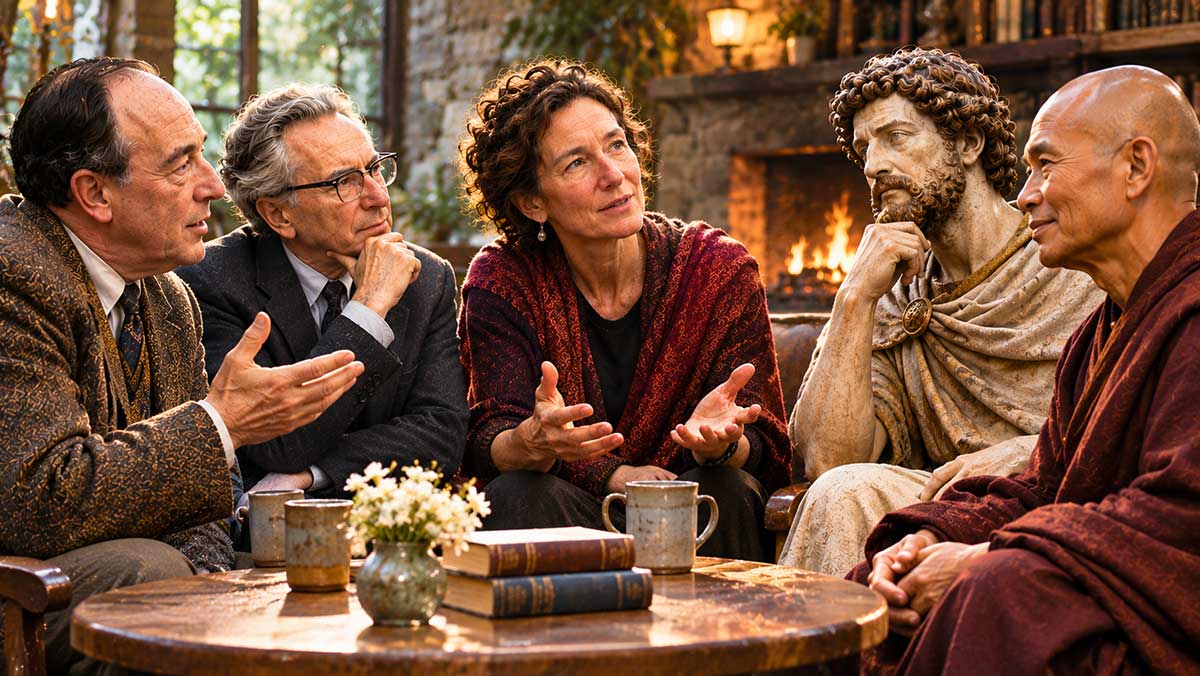
When does surrender become wisdom, and when does it become an excuse for avoiding responsibility? Can we fight injustice without becoming consumed by anger? And is genuine freedom found in controlling our circumstances or in choosing how we respond to them?
Round 1. When Surrender Becomes an Excuse
Nick Sasaki
Anna, we've spent four conversations exploring your ideas about surrender.
We began with ambition and our desire to control life. Then we discussed suffering, faith, morality, and family relationships.
I think you've made a convincing case that excessive control can damage our lives.
But now I want to challenge the central idea of your book.
What if surrender becomes an excuse?
Suppose someone is trapped in an unhealthy marriage, working under an abusive employer, or watching injustice unfold in their community.
Someone tells them, "You need to surrender. Stop trying to control everything. Accept what is happening."
That advice could be dangerous.
How do we distinguish genuine surrender from simply giving up?
Anna Lembke
I think that's one of the most important distinctions in this entire discussion.
Surrender should not mean abandoning responsibility, tolerating abuse, or refusing to confront wrongdoing.
The distinction I would make is between surrendering our demand for a particular outcome and surrendering our capacity to act.
Those are very different things.
We can recognize that we cannot control another person's behavior and still establish boundaries.
We can acknowledge that we cannot guarantee justice and still work to achieve it.
We can accept that life contains uncertainty without becoming passive.
In fact, relinquishing compulsive control may help us recognize more clearly what action is appropriate.
Nick Sasaki
But isn't that a little confusing?
You tell people to surrender control, yet you encourage them to take action.
How can both be true?
Anna Lembke
Consider a person who has been treated unfairly at work.
They may spend hours replaying the incident, imagining confrontations, and trying to anticipate everything their employer might do.
That mental struggle can become exhausting.
Surrender might mean accepting that they cannot control the employer's thoughts or guarantee the employer's response.
But they can document what happened, seek appropriate advice, communicate their concerns, and make decisions about their future.
They are still acting.
They simply aren't making their emotional well-being entirely dependent on controlling the result.
Marcus Aurelius
I would support that distinction.
Acceptance concerns the nature of circumstances.
Duty concerns the conduct we choose within those circumstances.
A person may accept that injustice exists without approving of injustice.
Indeed, the recognition that injustice exists may reveal an obligation to oppose it.
The wise person does not demand that the world already be virtuous before acting virtuously.
Nick Sasaki
Marcus, suppose someone says, "I tried to do the right thing, but nothing changed. Why should I keep trying?"
Marcus Aurelius
I would ask whether the worth of an action depends entirely upon its success.
If honesty is good, it remains good when honesty is inconvenient.
If justice is worthy, it does not become worthless merely through resistance.
We should learn from failure and reconsider ineffective methods.
But we should not conclude that virtue has no value when fortune refuses to cooperate.
Viktor Frankl
I would add that freedom involves more than choosing among pleasant alternatives.
Sometimes responsibility confronts us with a difficult task.
We may be unable to determine whether our efforts will succeed.
But the uncertainty of success does not eliminate the meaning of the effort.
We should ask what the situation requires of us, rather than demanding certainty before we act.
Nick Sasaki
Thich Nhat Hanh, I want to bring you into this.
Some people interpret Buddhist nonattachment as withdrawing from conflict.
But you've spoken about compassion and social responsibility.
How do you distinguish peaceful acceptance from indifference?
Thich Nhat Hanh
When we see suffering, compassion invites us to respond.
If a child is hungry, we do not simply meditate upon hunger.
We offer food.
If people are frightened by violence, we seek ways to protect them.
Mindfulness helps us recognize suffering clearly and respond without allowing hatred to dominate our actions.
Nonattachment does not mean that nothing matters.
It means that we do not cling so tightly to our opinions, fears, and expectations that we lose the ability to respond wisely.
C. S. Lewis
I would go further.
There are moments when refusing to act becomes a moral failure.
Christian love is not simply a pleasant feeling.
It may demand sacrifice, confrontation, and courage.
A person who witnesses cruelty and refuses to intervene when intervention is possible cannot justify that refusal merely by claiming to be spiritually peaceful.
Peace and goodness are not always identical.
Nick Sasaki
Anna, I think we have our first clear agreement.
Surrendering an outcome is not the same as surrendering a responsibility.
But that leads to a harder question.
How do we know which responsibilities are truly ours?
Round 2. When Does Acceptance Become Cowardice?
Nick Sasaki
Viktor, you've experienced circumstances in which human beings were stripped of almost every form of external freedom.
You know what it means to face suffering that cannot simply be removed through determination.
But you've spoken about the responsibility to respond meaningfully.
How do we distinguish accepting what cannot be changed from failing to challenge what can be changed?
Viktor Frankl
The distinction begins with an honest examination of the situation.
If suffering can be prevented, our responsibility may be to prevent it.
If a person is ill and treatment is available, seeking treatment is meaningful.
If someone is being oppressed and resistance is possible, resisting may be a moral responsibility.
But there are circumstances in which the suffering cannot be removed.
Then a different question arises.
What possibilities for meaningful action remain?
We must not confuse the recognition of limits with a celebration of those limits.
Nick Sasaki
Let me offer a difficult example.
Suppose a father has a child with a serious illness.
He consults physicians, seeks treatment, and does everything within his ability.
At some point, he is told that no further treatment is likely to help.
One person tells him to accept the situation.
Another tells him never to give up.
Both believe they are offering love.
How should he decide?
Anna Lembke
That situation requires compassion, careful medical information, and attention to the needs of the child and family.
There is no universal rule that resolves every case.
Continuing treatment may be appropriate in some circumstances.
In others, the burdens of treatment may outweigh the likely benefits.
Surrender should not be used to pressure someone toward either choice.
It may help a person recognize that loving effort cannot guarantee recovery.
But the actual decisions require informed judgment and discussion with the people responsible for care.
Nick Sasaki
Lewis, what would faith contribute in that situation?
C. S. Lewis
Faith may offer the conviction that the child's worth does not depend upon recovery and that love remains meaningful in the face of death.
But faith should not be used to pretend that difficult medical judgments are simple.
Nor should anyone claim certainty about God's intention in a particular tragedy.
Prayer may accompany treatment.
Prayer may accompany the decision to stop burdensome treatment.
The presence of faith does not relieve us of the responsibility to think carefully and act lovingly.
Marcus Aurelius
I would ask the father to distinguish between the outcome he desires and the decisions available to him.
He naturally desires the child's recovery.
No one should condemn that desire.
But he must still examine the evidence, seek wise counsel, and choose according to the child's welfare.
Courage is not the refusal to acknowledge reality.
Sometimes courage requires accepting painful information.
Thich Nhat Hanh
And the father needs compassion for himself.
When someone we love suffers, we may believe that we must find a way to save them.
If we cannot, we may blame ourselves.
But love is not measured by our ability to prevent death.
We can remain present.
We can hold a hand.
We can speak gently.
We can care for the person without demanding that every moment become a battle against what is happening.
Nick Sasaki
Anna, I want to ask something directly.
Could the desire never to give up become another form of addiction to control?
Anna Lembke
It could become compulsive in some situations.
But I would be cautious about labeling perseverance itself as addictive.
Persistence can be admirable and necessary.
The question is whether a behavior remains responsive to evidence, relationships, and the needs of others.
When someone becomes unable to reconsider a course of action, despite mounting harm, we may need to examine whether fear and rigidity are driving the decision.
Surrender can create room for that examination.
Viktor Frankl
And we should not confuse the ability to accept reality with a lack of love.
A person may love profoundly and still recognize that certain outcomes are beyond human command.
Nick Sasaki
Perhaps cowardice is not simply accepting a painful reality.
Perhaps cowardice can appear in two opposite forms.
We may refuse to act when action is required.
Or we may refuse to face the truth when acceptance is required.
Marcus Aurelius
Both can arise from fear.
One fears the cost of action.
The other fears the pain of reality.
Wisdom requires us to examine which fear governs us.
Round 3. Can We Fight Injustice Without Becoming Consumed by Anger?
Nick Sasaki
Let's move from personal suffering to society.
Imagine someone witnessing corruption, discrimination, violence, or the mistreatment of vulnerable people.
They feel angry.
They believe something must change.
And perhaps their anger gives them the energy to act.
Thich Nhat Hanh, you have emphasized compassion and nonviolence.
Can anger ever be useful?
Thich Nhat Hanh
Anger can alert us that suffering is present.
It may reveal that something requires attention.
But anger is not always a wise guide.
When we act entirely from anger, we may lose the ability to see clearly.
We may begin to believe that harming the person responsible will resolve the suffering.
Yet hatred can create more hatred.
Mindfulness invites us to recognize anger, care for it, and transform its energy into compassionate action.
We can resist injustice without making hatred the center of our lives.
Nick Sasaki
But suppose someone says, "If people weren't angry, nothing would ever change."
Would you disagree?
Thich Nhat Hanh
I would distinguish the initial feeling from the continuing motivation.
Anger may awaken us to a problem.
But love and compassion can sustain action more wisely.
If we depend entirely upon anger, we may become exhausted or begin treating others cruelly.
We need a commitment deeper than hostility.
C. S. Lewis
There is a distinction between moral indignation and personal hatred.
To recognize evil as evil is not necessarily wrong.
Indeed, indifference to cruelty may reveal a serious moral deficiency.
But the person who opposes wrongdoing must guard against becoming fascinated by the wrongdoing of others.
It is possible to begin by defending justice and gradually come to enjoy condemning one's opponents.
That is a spiritual danger.
Nick Sasaki
Lewis, how can someone recognize that change in themselves?
C. S. Lewis
They might ask whether they would welcome the genuine repentance and improvement of the person they oppose.
If the answer is no, if they would rather preserve an enemy than see that person become good, then something has gone wrong.
Justice seeks the correction of evil.
Pride may prefer the permanent humiliation of the evildoer.
Those desires are not the same.
Viktor Frankl
I would add that reducing a human being entirely to a category is dangerous.
When we begin to see others merely as representatives of an opposing group, we may cease to recognize their individuality.
That does not mean abandoning moral judgment.
People remain responsible for their actions.
But responsibility should be judged through conduct rather than through the assumption that every member of a group possesses the same character.
Nick Sasaki
Marcus, what about situations where force is necessary?
You were an emperor. You had responsibilities involving law, conflict, and the protection of society.
Surely there were moments when peaceful persuasion was insufficient.
Marcus Aurelius
The duty to protect others may require firm action.
But the necessity of action does not justify cruelty or uncontrolled passion.
One must examine whether the proposed response is proportionate, just, and directed toward a legitimate purpose.
A ruler who acts from wounded pride may call his conduct justice.
Yet his motives may be vengeance.
The wise person must distinguish the two.
Anna Lembke
I think this connects with the psychology of control.
When we encounter something that feels threatening, our minds may become increasingly focused on the source of the threat.
We rehearse arguments.
We seek information that confirms our interpretation.
We may experience temporary satisfaction when we condemn the other side.
But that pattern can become self-reinforcing.
We may lose the ability to distinguish productive action from repetitive emotional engagement.
Nick Sasaki
So someone could spend five hours every day being angry about injustice without actually helping anyone.
Anna Lembke
Yes.
And that doesn't mean their concerns are illegitimate.
It means we should examine whether our behavior is moving us toward meaningful action or simply maintaining a state of distress.
We might ask: What concrete responsibility can I fulfill?
Can I help someone directly?
Can I support a constructive effort?
Can I communicate effectively?
And can I disengage from repetitive conflict when it no longer serves a useful purpose?
Nick Sasaki
That's an interesting application of surrender.
You don't surrender your concern about injustice.
You surrender the need to remain emotionally consumed by it.
Anna Lembke
That's one way to frame it.
We can remain committed without allowing the struggle to occupy every part of our identity.
Thich Nhat Hanh
And when we care for our own suffering, we may become more capable of caring for others.
A person exhausted by hatred may have little energy left for compassion.
Peace within ourselves is not a retreat from the suffering of the world.
It can become a foundation for responding to that suffering.
Round 4. Does Surrender to God Require Giving Up Our Own Will?
Nick Sasaki
I'd like to return to faith.
Lewis, when Christians speak about surrendering to God's will, what exactly are they surrendering?
Their desires?
Their independence?
Their judgment?
Or something else?
C. S. Lewis
Christian surrender involves recognizing that our own will is not the final measure of goodness.
We may desire things that are genuinely good.
We may desire health, friendship, justice, and the well-being of our families.
Those desires are not inherently wrong.
But we are limited in knowledge.
We may not understand every consequence of what we seek.
To surrender to God is to acknowledge that divine goodness is greater than our private preferences.
Yet this does not mean abandoning thought or moral responsibility.
Christianity calls people to love God with their minds, not merely to cease thinking.
Nick Sasaki
But history gives us examples of people claiming that God wanted them to do terrible things.
How can surrender to God be distinguished from surrender to a religious leader who claims to speak for God?
C. S. Lewis
That distinction must be taken seriously.
No human leader becomes infallible merely by invoking divine authority.
Religious claims require examination.
A demand that contradicts love, justice, truthfulness, or the dignity of persons should not be accepted merely through fear or social pressure.
The Christian is accountable to God, not to every person who claims divine authorization.
And conscience must not be silenced for the convenience of an institution.
Nick Sasaki
Anna, you've described your own spiritual development without presenting yourself as someone who has resolved every theological question.
Does the phrase "surrender to God" mean something different to you than it does to Lewis?
Anna Lembke
I think my experience begins with acknowledging the limits of the self.
For much of my life, I placed great confidence in my capacity to analyze and manage circumstances.
Spiritual surrender invited me to recognize that I might not be the ultimate authority over everything.
But I wouldn't want to pretend that my spiritual vocabulary is identical to that of someone deeply rooted in a particular theological tradition.
I think we can explore the psychological and moral significance of surrender without erasing those differences.
Nick Sasaki
Marcus, you speak about accepting nature and living according to reason.
How does that compare with surrender to a personal God?
Marcus Aurelius
The Stoic seeks to live in harmony with the rational order of nature.
We recognize that our individual desires do not govern the universe.
Our task is to cultivate virtue through the judgments and actions available to us.
I would not claim that this is identical to the Christian understanding of a personal relationship with God.
But both perspectives can challenge the illusion that the individual will is supreme.
Thich Nhat Hanh
In Buddhist practice, we examine the illusion of a completely separate self.
Our lives depend upon countless conditions.
The food we eat, the air we breathe, the people who care for us, and the generations before us are all part of our existence.
When we recognize this interdependence, the desire to dominate everything may begin to soften.
We can act with greater humility and compassion.
Viktor Frankl
I would approach the matter through self-transcendence.
Human existence reaches beyond the self.
We find meaning through commitments, relationships, and responsibilities that are not reducible to personal satisfaction.
For a religious person, this may involve an explicit relationship with God.
For another person, it may involve devotion to a meaningful task or love for another human being.
But in either case, the self is not sufficient as the final purpose of existence.
Nick Sasaki
I notice that everyone is challenging the idea that human freedom means doing whatever we want.
But there is still a disagreement about what lies beyond the self.
Lewis speaks about God.
Marcus speaks about reason and nature.
Thich Nhat Hanh speaks about interdependence.
Viktor speaks about meaning and responsibility.
Anna speaks about surrendering the illusion of complete control.
Can these perspectives genuinely learn from one another without pretending that their differences don't matter?
C. S. Lewis
They can learn from one another, certainly.
But mutual respect should not require us to declare all beliefs interchangeable.
If one tradition teaches a personal Creator and another does not, that difference is real.
We should examine it honestly.
Friendship does not require intellectual dishonesty.
Thich Nhat Hanh
I agree that we need not erase differences.
We can listen deeply and recognize goodness in another person's practice.
A Christian may deepen Christian faith.
A Buddhist may deepen Buddhist practice.
And both may become more compassionate through genuine encounter.
Marcus Aurelius
The value of a discussion lies partly in the examination of assumptions.
We should welcome a question that exposes weakness in our reasoning.
The purpose is not to protect our pride.
It is to become wiser.
Anna Lembke
And perhaps that's another expression of surrender.
We can approach disagreement without requiring that the conversation confirm everything we already believe.
We can remain open to learning.
Nick Sasaki
Then surrender may require something surprisingly difficult.
Not abandoning our convictions, but admitting that our understanding of them may still grow.
Round 5. How Do We Live Courageously Without Controlling the Outcome?
Nick Sasaki
We've reached our final round.
I'd like to bring everything together through a practical situation.
Suppose someone wakes up tomorrow facing three problems.
Their business is struggling.
Their adult child is making choices they disagree with.
And someone close to them is seriously ill.
They cannot solve all three problems.
They feel overwhelmed.
They pray, plan, worry, and work harder.
But the uncertainty remains.
Anna, what would you encourage that person to do first?
Anna Lembke
I would encourage them to recognize that they're facing several genuinely difficult circumstances.
Feeling overwhelmed doesn't mean they've failed.
Then I would invite them to distinguish between what requires action and what they're trying to control through worry.
For the business, they might need to examine finances, seek advice, or make difficult decisions.
With the adult child, they might need an honest conversation and appropriate boundaries.
With the ill family member, they might need to provide care, coordinate assistance, and remain emotionally present.
Those are real responsibilities.
But none guarantees a particular outcome.
The person may need to practice acknowledging that limitation repeatedly.
Nick Sasaki
And if they feel guilty whenever they stop worrying?
Anna Lembke
They might ask whether worrying has become confused with caring.
Sometimes people believe that if they stop mentally rehearsing every possible disaster, they're abandoning the people they love.
But constant worry is not proof of devotion.
We can care deeply and still rest.
We can take responsibility without remaining in a permanent state of alarm.
Marcus Aurelius
I would advise the person to meet each duty in its proper time.
Do not attempt to carry every future misfortune in the present moment.
Examine what can be done today.
Do it with honesty and care.
Then allow yourself to recognize that the remainder does not lie entirely within your command.
Nick Sasaki
Viktor, what if the person says, "I don't see any meaning in this. I'm simply exhausted"?
Viktor Frankl
I would not demand that they immediately experience meaning as a feeling.
Meaning is not always accompanied by emotional comfort.
Sometimes it appears through a responsibility we continue to fulfill.
Perhaps the person can sit beside the ill family member.
Perhaps they can speak honestly to their child.
Perhaps they can make one responsible decision about the business.
The task need not be grand.
A meaningful response may begin with one act that remains possible.
Thich Nhat Hanh
And the person needs kindness toward themselves.
When we are suffering, we may become harsh with our own minds.
We say, "I should be stronger. I should know what to do. I should not feel afraid."
But fear is part of being human.
We can recognize it gently.
We can breathe.
We can seek support.
And we can return to the present moment, where a small act of love may be possible.
C. S. Lewis
I would remind the person that faith is not demonstrated through an absence of fear.
Courage is meaningful precisely when fear is present.
And prayer need not be a polished performance.
A person may come before God exhausted, uncertain, and unable to produce elegant words.
That honesty is not necessarily a failure of faith.
Nick Sasaki
Anna, let me ask the question that has been running through all five conversations.
Can someone surrender completely and still remain ambitious?
Can they work hard, build a business, raise a family, defend their principles, and pursue meaningful goals?
Or must they become less attached to those things?
Anna Lembke
I think we need to distinguish commitment from attachment to a guaranteed result.
We can be deeply committed to meaningful work.
We can love our families wholeheartedly.
We can pursue justice and act according to our values.
But we can recognize that the outcomes of those commitments are not entirely ours to determine.
Surrender doesn't have to diminish our commitment.
It may change the way we experience it.
We may become less driven by fear of failure.
We may become more capable of appreciating the present.
And we may become more willing to recognize when our efforts are no longer helping.
Nick Sasaki
But what if surrender doesn't make us happier?
What if someone accepts uncertainty and still feels sad, frustrated, or afraid?
Anna Lembke
Then perhaps we need to surrender the expectation that surrender itself will guarantee happiness.
That may sound paradoxical.
But if we approach surrender as another technique for producing the emotional state we want, we risk turning it into another attempt at control.
We might say, "I've accepted everything. Why am I still uncomfortable?"
And then we begin struggling against our discomfort again.
The invitation is to become more willing to experience life as it is, including its difficult emotions, without making those emotions the measure of whether we're living correctly.
Nick Sasaki
Lewis, does Christianity promise happiness to those who surrender to God?
C. S. Lewis
Christianity offers hope, but it does not promise a life free from suffering.
The central Christian story includes sacrifice, grief, and the Cross.
A faith that promises uninterrupted comfort would have difficulty accounting for its own foundations.
The question is not whether devotion guarantees pleasant circumstances.
It is whether God remains worthy of trust when circumstances are painful.
Nick Sasaki
Marcus, does Stoicism promise peace?
Marcus Aurelius
It teaches the cultivation of judgment and character.
But no person should assume that philosophical discipline will eliminate every painful emotion.
The work of virtue continues throughout life.
We examine our thoughts, correct our errors, and return to our responsibilities.
The aim is not to command every feeling.
It is to avoid becoming enslaved by judgments that lead us away from reason and justice.
Nick Sasaki
Thich Nhat Hanh, does mindfulness remove suffering?
Thich Nhat Hanh
Mindfulness helps us recognize and care for suffering.
It does not require us to pretend that suffering has disappeared.
When we understand our pain, we may become less afraid of it.
And when we recognize the suffering of others, compassion can grow.
We can experience sorrow and still discover moments of gratitude, connection, and peace.
Nick Sasaki
Viktor, does meaning require happiness?
Viktor Frankl
No.
A meaningful life may contain profound suffering.
And a pleasurable life may still feel empty.
Meaning concerns our relationship to responsibility, love, and the possibilities that life presents.
Happiness may arise through meaningful living, but it cannot always be obtained through direct pursuit.
Nick Sasaki
Anna, listening to everyone, I think there's a question I haven't asked clearly enough.
If surrender isn't giving up, isn't guaranteed happiness, and doesn't mean abandoning our responsibilities, what exactly are we letting go of?
Anna Lembke
Perhaps we're letting go of the belief that life must obey us before we can participate in it fully.
We're letting go of the assumption that every painful feeling must be eliminated.
We're letting go of the idea that other people exist to fulfill our expectations.
And we're letting go of the demand that our efforts guarantee the outcomes we desire.
That doesn't mean we stop caring.
It may allow us to care more freely.
We can act from commitment rather than desperation.
We can love without treating another person's choices as a measure of our worth.
We can pursue meaningful work without allowing success or failure to define our entire identity.
And we can remain open to something greater than ourselves.
Nick Sasaki
I'd like to ask each of you one final question.
If someone wants to begin practicing surrender tomorrow, what is one thing they should try?
Marcus?
Marcus Aurelius
Before beginning the day, identify what belongs to your judgment and conduct.
Give those things your best effort.
Do not demand authority over everything else.
Viktor Frankl
Ask what responsibility life is placing before you today.
Then respond through one meaningful action.
Thich Nhat Hanh
Spend a few moments breathing quietly.
Recognize what you are feeling.
Then offer your full attention to someone you love.
C. S. Lewis
Examine what you have been treating as the ultimate source of your security.
Ask whether it has become more important to you than truth, love, or God.
Anna Lembke
Notice one moment when you feel compelled to control an outcome.
Ask whether another action is genuinely necessary or whether you can tolerate the uncertainty without immediately trying to eliminate it.
Nick Sasaki
Those are practical suggestions.
But I want to finish with something more personal.
When I think about the people I've known throughout my life, many of the most admirable were hardworking and determined.
They built families, created businesses, cared for others, and refused to abandon their responsibilities.
I wouldn't want them to lose those qualities.
Yet I've seen how the same determination can become a burden.
A person who once worked hard out of love may eventually feel unable to stop.
A parent who once offered guidance may become consumed by worry.
Someone who began defending an important principle may become so angry that the original purpose of the struggle disappears.
Perhaps the danger isn't determination itself.
Perhaps it's forgetting why we were determined in the first place.
We wanted to build something meaningful.
We wanted to protect people.
We wanted to contribute something good.
But somewhere along the way, the desire to achieve those things can become a demand that life unfold exactly as we planned.
Anna, your book raises an uncomfortable possibility.
What if the freedom we're seeking cannot be found through greater control?
What if it begins when we recognize that our responsibilities are real, but our authority is limited?
We can act courageously without knowing whether we'll succeed.
We can love our families without controlling their futures.
We can defend what we believe is right without allowing hatred to consume us.
And perhaps we can trust God, or continue searching for spiritual truth, without pretending that every mystery has been resolved.
But I still have one question for you.
After everything you've experienced, do you believe surrender is something a person can finally accomplish?
Or is it something we must keep learning throughout our lives?
Anna Lembke
I would think of it as an ongoing practice.
Our desire for control doesn't simply disappear.
We may experience surrender in one part of life and continue struggling in another.
We may become more accepting of uncertainty at work yet remain anxious about our children.
We may learn to release one expectation and discover that we've become attached to another.
I don't think that means we've failed.
It means we're human.
Perhaps the practice is to recognize the pattern, return to humility, and begin again.
And perhaps surrender becomes less about achieving a permanent state of peace and more about learning to participate in life without demanding that we be in charge of everything.
Nick Sasaki
That brings us back to where we began.
Have we made ourselves our own gods?
Perhaps we don't need to answer that question through a grand declaration.
We might begin by noticing the smaller moments.
The moment we insist that someone must agree with us.
The moment we believe our worth depends on one more achievement.
The moment we confuse worrying with loving.
The moment we refuse to accept a reality that no amount of effort can change.
And then we can ask ourselves a different question.
What is genuinely mine to do right now?
Not everything I wish I could control.
Not every outcome I fear.
Just the responsibility before me.
Maybe that's where surrender and courage finally meet.
C. S. Lewis
And perhaps humility begins when we recognize that the good we seek is greater than ourselves.
Viktor Frankl
And responsibility begins when we answer the call of the present moment.
Marcus Aurelius
And virtue begins when we act rightly without demanding command over fortune.
Thich Nhat Hanh
And compassion begins when we release our fear long enough to recognize another person's suffering.
Anna Lembke
And surrender may begin when we discover that we don't have to control everything to live meaningfully.
Nick Sasaki
Thank you, everyone.
We've explored control, suffering, morality, love, and courage.
But perhaps the most interesting part of this discussion is what happens after we leave this table.
Tomorrow, we'll encounter the same uncertainties.
The people we love will still have their own minds.
Our plans will still face unexpected obstacles.
And life will continue presenting questions that have no guaranteed answers.
The challenge is whether we can meet those moments differently.
Whether we can act without demanding certainty.
Whether we can love without possession.
Whether we can defend what is right without losing compassion.
And whether surrender can make us more courageous rather than less.
That's a question each of us will have to answer through the way we live.
Fictional conversation disclaimer: This is an imagined literary, psychological, and philosophical discussion. All dialogue is fictional, not an authenticated transcript or quotation. Anna Lembke's portrayal is an interpretive reconstruction informed by publicly discussed themes from Radical Surrender and her interviews. The historical participants' contributions reflect interpretations of their published teachings. The discussion does not imply that any participant actually met or endorsed another participant's views.
Final Thoughts: What I Learned About Surrender, Faith, and Responsibility

When I began exploring Anna Lembke's Radical Surrender, I wasn't sure I agreed with the idea of surrender. I've always believed that determination, responsibility, and hard work matter. If we want to accomplish something meaningful, we cannot simply wait for life to arrange itself. We have to make decisions, take risks, and keep going when circumstances become difficult. But as I listened to this imagined discussion, I began recognizing a distinction I hadn't fully appreciated. Taking responsibility for our actions is not the same as taking responsibility for every outcome. We can give our best effort without possessing the ability to determine everything that follows.
One of the most meaningful parts of our conversation concerned suffering. Lembke's experiences reminded me that there are moments when our knowledge, preparation, and determination cannot protect us from heartbreak. I was moved by the differences between Lewis, Frankl, Marcus Aurelius, and Thich Nhat Hanh. Lewis approached suffering through faith in God. Frankl focused on the possibility of meaning and responsibility. Marcus emphasized the importance of acting honorably within the limits of our circumstances. Thich Nhat Hanh encouraged compassion and acceptance of impermanence. I don't think these perspectives are interchangeable, but each helped me recognize something valuable. We should never tell someone that suffering was necessary or that their grief must produce a lesson. Yet suffering does not have to erase every possibility of love, faith, or meaning.
The discussion about morality left me with another question. If we surrender our desire to control everything, does that mean we should become less certain about right and wrong? I don't believe it does. I think we can remain committed to truth, goodness, justice, and responsibility without assuming that our own judgments are infallible. In fact, the more deeply we believe in moral truth, the more carefully we should examine our motives. Are we speaking to help someone, or to prove our superiority? Are we defending a principle, or protecting our pride? I found Lewis's concern about pride and Frankl's insistence on personal conscience especially meaningful. Faith and moral conviction should encourage us to become more responsible and compassionate, not less willing to listen.
Our conversation about family relationships felt particularly practical to me. Parents naturally want to protect their children from disappointment. Husbands and wives want their loved ones to make healthy decisions. We offer advice, encouragement, and sometimes warnings, often with the best intentions. But I can see how love may gradually become entangled with the desire for control. We may feel responsible for decisions that belong to another person. We may confuse worrying with caring, or expect gratitude in a form that someone else cannot provide. One question from our discussion stayed with me: "Would you like my advice, or would it help more if I listened?" I think that simple question could change many conversations within families. It reminds us that love involves respecting another person's dignity and freedom.
The final discussion helped me reconcile surrender with courage. I do not want a philosophy that encourages people to accept injustice, ignore suffering, or abandon worthwhile goals. I believe there are moments when we must stand firmly for what is right, protect people who are vulnerable, and accept personal sacrifice. But perhaps courage becomes clearer when it is no longer driven by the need to control every result. We can oppose wrongdoing without surrendering to hatred. We can pursue meaningful work without making success the entire measure of our worth. We can care for our families without believing that every decision they make is ours to command. For me, this is where surrender becomes more than a comforting idea. It becomes a discipline of choosing what we ought to do and accepting that the result may remain uncertain.
What I find most meaningful is the spiritual possibility within this idea. I've long been interested in the belief that humanity belongs to one family under God. If God is the parent of all humanity, then perhaps humility begins with recognizing that no individual, family, nation, or religious community possesses complete authority over everyone else. We are called to care for one another, but caring is different from domination. I see surrender, in this sense, as an invitation to place love above pride and responsibility above the desire for control. It does not answer every question about God, suffering, or the differences between religious traditions. But it invites us to consider whether our relationship with God and with one another might become deeper when we stop treating ourselves as the center of everything.
I finished these five conversations with more questions than answers, and I think that's appropriate. Where in my own life am I still confusing responsibility with control? Have I ever allowed ambition to interfere with the relationships that matter most? Can I accept another person's freedom without becoming indifferent to their well-being? And when I face something I cannot change, can I continue acting with faith and courage rather than allowing fear to determine my response? I'd love to hear what you think. Is surrender a sign of weakness or a form of wisdom? Can we trust God without giving up our responsibility to act? And what is one thing in your own life that you may need to stop trying to control? Share your thoughts in the comments. Your experiences may help someone else see this question differently.
Fictional conversation disclaimer: These reflections respond to an imagined philosophical discussion inspired by Anna Lembke's publicly discussed ideas. The participants' dialogue is fictional, and the personal interpretations expressed here should not be attributed to the real individuals portrayed.
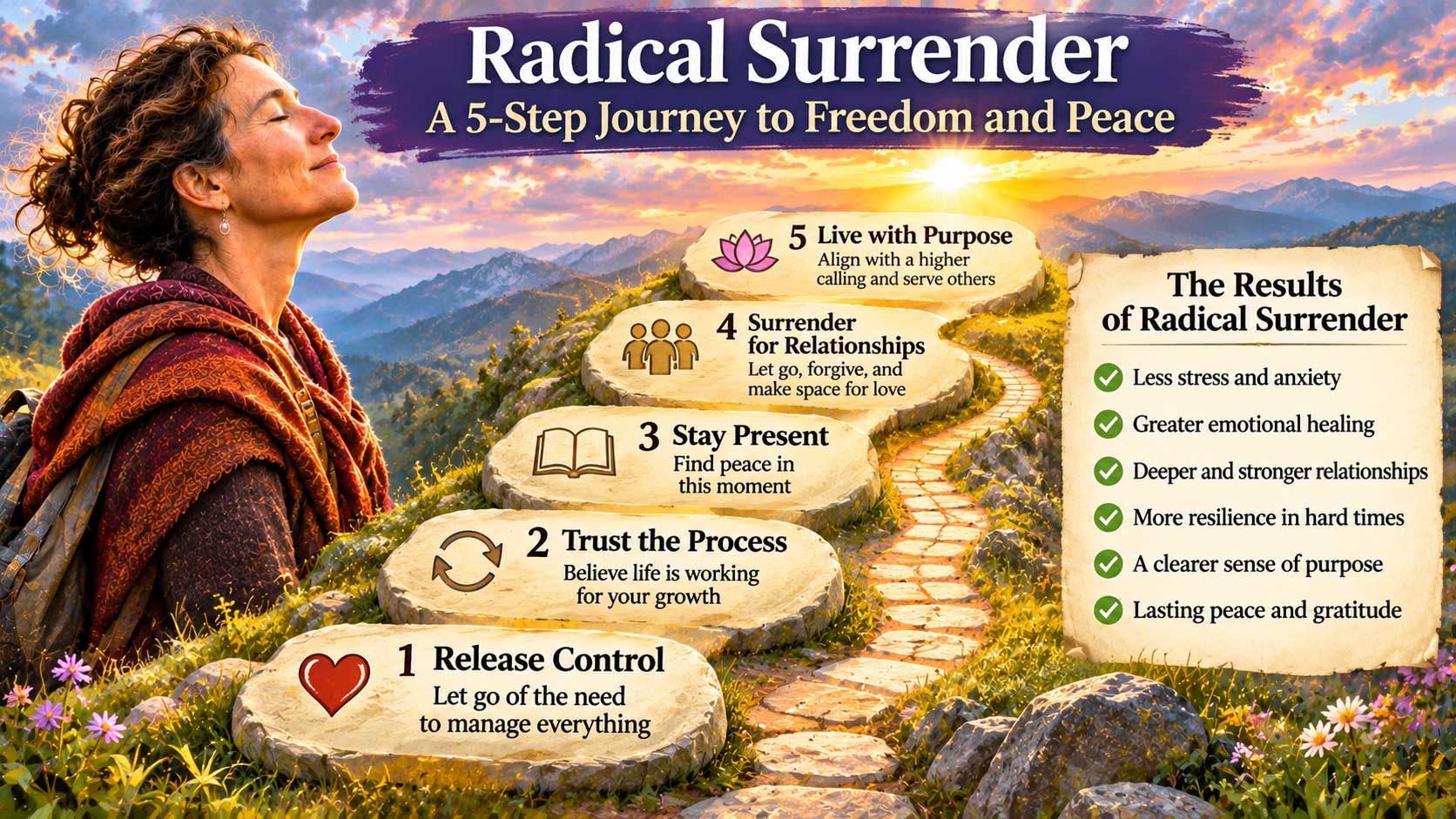
Short Bios:
Anna Lembke
Anna Lembke is an American psychiatrist, Stanford University professor, and specialist in addiction medicine. She is the author of Dopamine Nation: Finding Balance in the Age of Indulgence and Radical Surrender: Letting Go in a World Addicted to Control. Her work examines addictive behaviors, pleasure and pain, compulsive patterns, and the relationship between psychology and human well-being. In this imagined discussion, she introduces the central questions about control, spiritual surrender, and personal responsibility.
C. S. Lewis (1898–1963)
C. S. Lewis was a British writer, literary scholar, and Christian apologist known for Mere Christianity, The Problem of Pain, A Grief Observed, and The Chronicles of Narnia. His writings explore faith, morality, suffering, love, and the relationship between humanity and God. In this conversation, he examines surrender through Christian trust, grace, conscience, and the dangers of pride.
Viktor Frankl (1905–1997)
Viktor Frankl was an Austrian neurologist, psychiatrist, Holocaust survivor, and founder of logotherapy, an approach to psychotherapy centered on the human search for meaning. His influential book Man's Search for Meaning explores the possibility of finding meaning amid extreme suffering. In this discussion, he considers how personal freedom, responsibility, and meaningful action remain relevant when circumstances cannot be controlled.
Marcus Aurelius (121–180 CE)
Marcus Aurelius was a Roman emperor and Stoic philosopher whose private reflections were preserved in Meditations. His philosophy emphasizes reason, virtue, self-discipline, justice, and accepting what lies beyond human control. In this imagined conversation, he distinguishes responsible action from attachment to outcomes and examines the relationship between acceptance and moral courage.
Thich Nhat Hanh (1926–2022)
Thich Nhat Hanh was a Vietnamese Buddhist monk, writer, peace advocate, and influential teacher of mindfulness and engaged Buddhism. His books include The Miracle of Mindfulness, Peace Is Every Step, and The Heart of the Buddha's Teaching. His work explores compassion, nonattachment, interdependence, and the possibility of responding to suffering without hatred. In this discussion, he examines how releasing control can deepen love and understanding.
Nick Sasaki (Moderator)
Nick Sasaki is the creator of ImaginaryTalks.com, a platform exploring meaningful questions through fictional conversations among thinkers, historical figures, writers, and contemporary voices. His discussions bring different philosophical, religious, and cultural perspectives into conversation, encouraging readers to reflect on how ideas can shape everyday life, human relationships, and the possibility of a more peaceful world.
Leave a Reply