

Introduction
What Makes Middlemarch a Masterpiece? Five Literary Scholars in an Imaginary Conversation
Why do intelligent people make terrible decisions? Can someone sincerely believe in God while repeatedly deceiving themselves? And what if the greatest achievement of our lives is something nobody will ever recognize?
These questions lie at the heart of Middlemarch, George Eliot's extraordinary novel about love, ambition, marriage, morality, and the invisible connections between human lives.
First published in 1871–1872, Middlemarch follows Dorothea Brooke, an idealistic young woman searching for a meaningful life; Tertius Lydgate, a talented doctor whose ambitions collide with personal and professional difficulties; and a community of people whose choices affect one another in ways they rarely understand.
But what makes this novel so remarkable isn't simply what happens to its characters.
It's what Eliot reveals about us.
The complete original novel is freely available through Project Gutenberg's edition of Middlemarch. Readers interested in the history of its creation can also explore the British Library's catalogue of Eliot's original Middlemarch manuscript, preserved in four volumes.
Five Scholars. Five Questions. One Extraordinary Novel.
In this second part of our Middlemarch trilogy, we imagine five distinguished literary scholars gathering in an old Warwickshire library to discuss what George Eliot understood about human nature.
Our guests are Gillian Beer, Rosemary Ashton, Barbara Hardy, John Rignall, and Karen Chase.
Each brings a different perspective, drawing on scholarship about Eliot's literary imagination, intellectual development, narrative artistry, European influences, and moral philosophy.
Gillian Beer, whose influential book Darwin's Plots examines relationships between scientific thinking and literary narrative, helps us recognize the complex connections among Eliot's characters.
Rosemary Ashton explores the intellectual and spiritual questions that shaped Eliot's understanding of conscience, faith, and moral responsibility.
Barbara Hardy examines Eliot's remarkable ability to reveal the contradictions of human psychology through narrative form.
John Rignall considers Middlemarch within the wider tradition of European realism, asking what makes Eliot's apparently provincial world so universal.
And Karen Chase challenges the temptation to turn Eliot's complicated characters and ambiguous endings into reassuring moral lessons.
Their imagined conversations explore five questions:
1. What If Nobody in Middlemarch Is Truly the Main Character?
Eliot reveals a world where every person imagines themselves at the center, while their decisions quietly shape the lives of others.
2. Why Do Intelligent, Good-Hearted People Make Terrible Decisions?
Dorothea, Lydgate, Rosamond, and Casaubon show us why intelligence does not guarantee self-knowledge—and why love can become painful when we fall in love with our expectations rather than another person.
3. Can Someone Be Deeply Religious Yet Fail to Be Truly Good?
Through Bulstrode, Harriet, Caleb Garth, and Dorothea, we examine the difference between sincere belief, moral self-deception, and compassion expressed through action.
4. Why Is Middlemarch Considered One of the Greatest Novels Ever Written?
We explore Eliot's interwoven plots, psychological realism, scientific imagery, narrative voice, and extraordinary ability to change how readers perceive other people.
5. What If an Ordinary Life Is a Greater Achievement Than a Famous One?
Eliot's unforgettable Finale raises a question that becomes more meaningful with age: Should we measure our lives by the ambitions we fulfilled, or by the good we brought into other people's lives?
Why This Imaginary Conversation Matters
We often approach great literature looking for answers.
But Eliot's genius lies partly in making us less certain of our judgments.
She shows us that people can be intelligent and foolish, sincere and self-deceiving, loving and selfish—sometimes within the same moment.
And she suggests that understanding another human being requires something more demanding than simply deciding whether that person is right or wrong.
It requires imagination.
For readers interested in exploring Eliot's literary legacy beyond the novel itself, the George Eliot Fellowship offers further resources devoted to her life, works, and continuing influence.
The five conversations that follow are fictional, but the scholars are real, and their areas of expertise provide the intellectual foundation for our exploration.
Their words are imagined, not authentic quotations.
Our hope is that this creative encounter will do something more than explain Middlemarch.
It will encourage us to look again at the people we love, the mistakes we have made, and the ordinary lives we may have underestimated.
Because perhaps the greatest lesson of Middlemarch is not that we should become extraordinary people.
Perhaps it is that we should learn to see how extraordinary other people's lives already are.
(Note: This is an imaginary conversation, a creative exploration of an idea, and not a real speech or event.)
Topic 1: What If Nobody in Middlemarch Is Truly the Main Character?
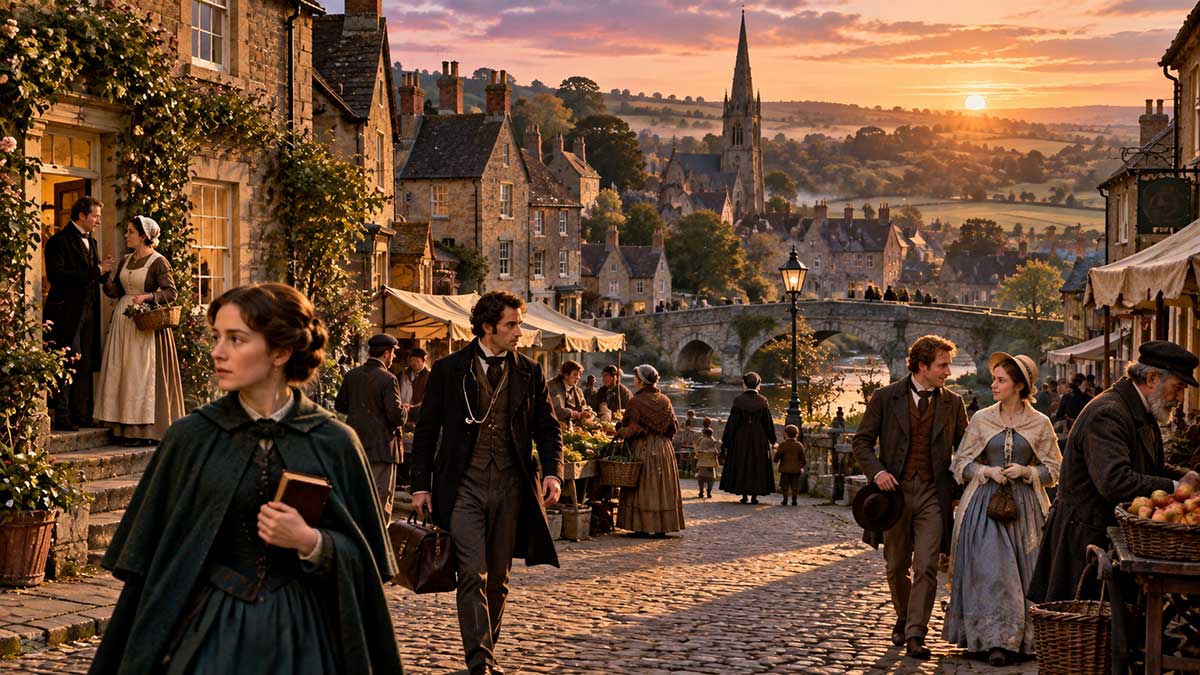
The rain had stopped, but the windows of the old Warwickshire library still carried its traces. Beyond them, the fields stretched into the gathering dusk.
Five scholars sat around a table crowded with books. At its center lay a worn copy of Middlemarch, opened to the Prelude.
Gillian Beer: I have a question that might seem almost absurd. What if we've been reading Middlemarch incorrectly by insisting that Dorothea is its heroine?
John Rignall: That's a dangerous way to begin an evening devoted to George Eliot.
Gillian Beer: Only if you think a novel must have a single center.
Barbara Hardy: Dorothea certainly believes she has been placed at the center of something important. She wants a great life. A life devoted to something larger than herself.
Karen Chase: And readers often believe it too. The Prelude introduces us to Saint Theresa, to the possibility of extraordinary spiritual ambition trapped in an ordinary historical setting. We expect Dorothea to become the subject of a great destiny.
Rosemary Ashton: Yet Eliot does something rather mischievous. Just as we're settling into Dorothea's story, she leads us elsewhere.
John Rignall: To a young doctor who has never met her.
Gillian Beer: Exactly. Tertius Lydgate arrives in Middlemarch with his own plans, his own ambitions, his own conviction that his life is about to become something remarkable.
Barbara Hardy: He doesn't think he's a secondary character in Dorothea Brooke's novel.
Karen Chase: Nor does Rosamond Vincy. I doubt Rosamond has ever regarded herself as secondary to anyone.
The scholars laughed.
Rosemary Ashton: That is one of Eliot's quiet achievements. Every person believes, quite naturally, that the world is organized around the concerns that occupy them.
Gillian Beer: But Eliot knows otherwise. She gives us a world in which lives intersect, sometimes without the people involved understanding how profoundly they affect one another.
John Rignall: We should distinguish two things. A novel can have multiple protagonists and still be little more than several stories placed side by side. Eliot accomplishes something more difficult. She makes those stories mutually dependent.
Barbara Hardy: Take Lydgate. He enters Middlemarch intending to transform medical practice. He has serious scientific ambitions. He wants to investigate disease, improve treatment, and establish himself through meaningful work.
Rosemary Ashton: Yet his future comes to depend on people whose personal histories he barely understands.
Barbara Hardy: Particularly Bulstrode.
Gillian Beer: And Bulstrode's story is connected to Raffles, to Fred Vincy, to the Garth family, and eventually to Lydgate's professional reputation.
Karen Chase: That's the fascinating part. Lydgate imagines his life as a story of scientific achievement. But another man's concealed past becomes one of the forces that determines how the town judges him.
John Rignall: Which raises a troubling question. How much of our lives belongs to us?
For a moment, nobody answered.
Barbara Hardy: Lydgate would like to believe that his intelligence, discipline, and professional integrity will determine his future.
Rosemary Ashton: And Dorothea believes her moral seriousness will enable her to do something significant.
Gillian Beer: But neither lives in isolation. Their intentions enter a world already crowded with other intentions.
She turned several pages.
Gillian Beer: Consider the novel's recurring interest in webs, connections, and relationships. Eliot lived in an intellectual world increasingly attentive to the complexity of natural systems. One cannot always explain the development of a living thing by examining it apart from its surroundings.
John Rignall: You're suggesting that Middlemarch itself behaves almost like an organism.
Gillian Beer: As an analogy, yes. But I would be careful not to make it too neat. The novel's relationships are not harmonious parts of some perfectly functioning body. They involve competition, misunderstanding, dependency, and accidents.
Karen Chase: And omissions. We see an extraordinary number of connections, but never all of them.
Barbara Hardy: There's something else. Eliot doesn't merely show us that people are connected. She makes us experience the difficulty of seeing those connections fairly.
Rosemary Ashton: Explain.
Barbara Hardy: Think of how we first encounter Casaubon. Through Dorothea's imagination, he appears to possess a magnificent intellectual purpose. He is going to unlock the history of religious belief. She imagines that assisting him will give her life meaning.
John Rignall: Whereas Celia sees a dry, aging scholar whom she would rather not marry.
Barbara Hardy: Quite. The same man, two very different perspectives. And the reader, drawn close to Dorothea's hopes, may initially understand why she admires him.
Karen Chase: Until Eliot gradually allows us to see what Dorothea cannot.
Gillian Beer: Which is precisely why I hesitate to call any single character the center. Eliot is constantly moving the point from which we observe her world.
John Rignall: But Gillian, let me challenge that. Dorothea does have a privileged position in the novel. She opens the story, she gives it much of its emotional force, and the Finale returns to her.
Gillian Beer: Certainly. I'm not arguing that all characters have equal narrative importance.
John Rignall: Then perhaps we shouldn't say that nobody is the main character. Perhaps we should say that Eliot gives Dorothea central importance without allowing her to contain the novel's meaning.
Barbara Hardy: That's better. Otherwise we risk replacing one oversimplification with another.
Karen Chase: And I think the distinction matters. Eliot can give Dorothea an extraordinary moral imagination while showing us that Dorothea herself does not understand everyone she encounters.
Rosemary Ashton: Including the man she marries.
Barbara Hardy: Especially the man she marries.
A small silence followed. Rainwater slipped from the branches outside.
Rosemary Ashton: Let me bring in a different example. Fred Vincy.
John Rignall: An unlikely candidate for the center of a great philosophical novel.
Rosemary Ashton: Precisely why he's useful. Fred begins with expectations about inheritance and an easy future. His carelessness over money brings distress to the Garth family, whose financial security is much more fragile than his own.
Barbara Hardy: And Caleb Garth pays a price for trusting him.
Rosemary Ashton: Yes. Fred's personal irresponsibility becomes someone else's material suffering. It is a wonderfully concrete illustration of how an action can travel beyond the person who performs it.
Gillian Beer: Yet that same network can make improvement possible. Caleb's example, Mary's honesty, and Fred's growing willingness to work help him become someone different.
Karen Chase: So relationships are not merely traps. They can also be the conditions of growth.
John Rignall: There's a great difference between saying that people influence one another and showing precisely how they do it. Eliot makes the second task the substance of her art.
Barbara Hardy: And she rarely allows the influence to remain entirely comfortable. Mary loves Fred, but she refuses to reward his laziness. Caleb helps him, but work is still required. Their kindness has standards.
Rosemary Ashton: That's a lovely point. Their relationships are formative because the people involved do not simply flatter one another.
Gillian Beer: Now compare that with Rosamond and Lydgate.
Karen Chase: Two people whose imagined futures are almost incompatible.
Barbara Hardy: And each initially sees the other through a remarkably narrow lens. Lydgate sees beauty and refinement. Rosamond sees social distinction and the promise of a more glamorous life.
John Rignall: They are connected, certainly. But they do not understand the connection they've created.
Gillian Beer: Which returns us to the larger pattern. Being entangled in another person's life does not mean understanding that person.
Karen Chase: Sometimes it means misunderstanding them more intimately.
Barbara Hardy: That might be the most painful sentence spoken this evening.
Rosemary Ashton: And perhaps one of the most useful.
She closed the book in front of her, leaving a finger between the pages.
Rosemary Ashton: But I want to ask whether Eliot's attention to the whole community has a moral purpose. Her intellectual development involved a growing concern with sympathy, with the need to recognize lives beyond one's own immediate interests.
John Rignall: Surely it does. Yet Eliot is too accomplished a novelist simply to preach that we ought to be sympathetic.
Barbara Hardy: She makes sympathy difficult. That's the difference.
Karen Chase: And occasionally she makes our sympathies uncomfortable.
Barbara Hardy: Think of Bulstrode. It's easy to approach him as the town's religious hypocrite, someone whose downfall we might welcome. But Eliot also gives us Harriet, his wife, whose response to his disgrace is profoundly moving.
Gillian Beer: Suddenly the consequences of his wrongdoing extend into the life of someone who did not commit it.
Rosemary Ashton: Harriet's suffering complicates the satisfaction we might otherwise take in seeing Bulstrode exposed.
John Rignall: So even justice has consequences beyond the person being judged.
Karen Chase: And the town's gossip becomes another kind of network. Information travels, changes shape, acquires certainty, and affects people who may have no opportunity to defend themselves.
Barbara Hardy: Lydgate knows that too well.
Gillian Beer: There's an important difference between a connection and an accurate understanding. Rumor connects people while often distorting the truth about them.
John Rignall: Which suggests that Eliot's web is not simply a comforting image of human unity.
Gillian Beer: Not at all. A web can support, but it can also entangle.
Karen Chase: And the narrator can reveal the pattern while reminding us that every perspective remains partial.
Barbara Hardy: Let me make this more personal. When we read a novel, we naturally ask which character we resemble. Are we Dorothea? Lydgate? Fred? Perhaps Rosamond, though fewer readers would volunteer that answer.
Rosemary Ashton: I suspect some of the most enthusiastic Dorotheas have a little Rosamond in them.
John Rignall: And some of the most confident Lydgates might benefit from Caleb Garth's practical judgment.
Barbara Hardy: Exactly. But Eliot's achievement is that she asks us to look beyond identification. Not merely, "Which person am I?" but "What happens to the other people because I am who I am?"
Nobody spoke immediately.
The question seemed to have altered the atmosphere around the table.
Gillian Beer: That brings us very close to the heart of the novel. The consequences of a life are not contained within that life.
Karen Chase: Although I would add that Eliot never lets us calculate those consequences completely. Even a narrator with remarkable insight cannot turn human existence into a finished account book.
John Rignall: And perhaps that is why the novel needs so many characters. Not because Eliot wants to display her ability to manage a large cast, but because one life is insufficient to reveal what a life means.
Rosemary Ashton: Think of Dorothea's decision to help Lydgate when his reputation is under suspicion. She does not solve every problem. She cannot restore all his ambitions. But her confidence and generosity matter deeply to him and to Rosamond.
Barbara Hardy: And Dorothea herself changes through that encounter. She goes to Rosamond carrying her own pain and finds herself drawn into another woman's suffering.
Gillian Beer: There is no simple division between the person who helps and the person who is helped. Both are altered.
Karen Chase: Which also means that Dorothea's importance cannot be measured only by the public achievements she once imagined.
John Rignall: We're approaching the Finale rather early.
Karen Chase: I know. But Eliot's ending has been present in the novel all along.
Barbara Hardy: As good endings often are.
The light had faded enough that Rosemary reached for the lamp. Its glow fell across the worn pages of Middlemarch, illuminating names that had occupied readers' imaginations for generations.
John Rignall: Let me return to the question Gillian posed at the beginning. If nobody is truly the main character, what is the novel's center?
Gillian Beer: I would say its center is relational. It exists in the space between lives, in the consequences of their encounters.
Barbara Hardy: I would place more emphasis on the reader's experience. Eliot teaches us to move between perspectives, to resist the ease of judging from one position alone.
Rosemary Ashton: And I would say the novel's moral center lies in our capacity to recognize the claims of other people upon us.
Karen Chase: I find all three persuasive, but I would resist choosing just one. The richness of Middlemarch may depend on our inability to reduce it to a single organizing truth.
John Rignall: Then I shall offer a modest compromise. Dorothea is a central character. Lydgate is a central character. But the novel's greatest subject is larger than either of them.
Gillian Beer: And what would you call that subject?
John looked toward the darkening window. Across the countryside, scattered lights were beginning to appear in distant houses.
John Rignall: Human life, I suppose. Not as we imagine it when we are alone with our ambitions, but as it actually unfolds among other people.
Barbara Hardy: That's a rather large subject for a small English town.
John Rignall: Yes. And Eliot somehow makes it fit.
Rosemary Ashton: Perhaps that's why the novel becomes more meaningful as we grow older. We begin to recognize how many people have entered our lives and changed their direction without ever knowing it.
Karen Chase: And how often we've done the same for others, for better or worse.
Gillian Beer: Which means the story of any one person can never be told entirely from that person's point of view.
Barbara glanced again at the open novel.
Barbara Hardy: There is something rather beautiful about that. We begin reading Middlemarch expecting to discover what happens to Dorothea Brooke. We finish realizing that her life cannot be understood without the lives around her.
Rosemary Ashton: Nor can theirs be understood without hers.
The scholars fell quiet.
Outside, a light shone in a farmhouse window beyond the trees. Whoever lived there was unknown to the five people gathered in the library. Yet each of them had come to understand, through Eliot's extraordinary novel, that an apparently ordinary house might contain an entire world of hopes, disappointments, loyalties, and unseen consequences.
Gillian Beer: Perhaps that is the final answer to my question. The novel does not take the main character away from us.
She gently closed her copy of Middlemarch.
Gillian Beer: It teaches us to see that everyone else has a story too.
Topic 2: Why Do Intelligent, Good-Hearted People Make Terrible Decisions?
The library had grown quieter.
Outside, the last traces of daylight had disappeared behind the Warwickshire hills. A small fire burned in the hearth, and the five scholars had moved their chairs closer to it.
Barbara Hardy was examining a passage in Middlemarch. She had been silent for several minutes, occasionally smiling to herself.
Barbara Hardy: I have always found it rather alarming that the cleverest people in Middlemarch sometimes make the most spectacular mistakes.
John Rignall: That seems a harsh judgment of Dorothea.
Barbara Hardy: I was thinking of Lydgate.
Rosemary Ashton: Ah. Our brilliant young doctor who can investigate the workings of the human body but cannot understand the woman he intends to marry.
Gillian Beer: Or, perhaps more accurately, cannot recognize how little he understands her.
Karen Chase: There's a distinction worth pursuing. Lydgate doesn't believe he's marrying an intellectual companion. He has rather conventional expectations of a wife. The trouble is that he never examines those expectations seriously.
Barbara Hardy: Exactly. He wants a beautiful, graceful woman who will make his domestic life pleasant while he pursues his scientific ambitions. Rosamond wants a distinguished husband who will carry her into a more elegant social world.
John Rignall: And each believes the other is offering precisely what is needed.
Barbara Hardy: Until marriage reveals that they have been imagining two entirely different futures.
Rosemary Ashton: Which is interesting because neither enters the marriage intending to be cruel.
Karen Chase: Yet they become remarkably capable of hurting one another.
Gillian Beer: Perhaps the first mistake is to assume that good intentions naturally produce good outcomes.
Barbara Hardy: Or that intelligence in one area of life guarantees wisdom in another.
She placed the book on the table.
Barbara Hardy: Think of Lydgate's professional ambition. He understands the importance of questioning established medical practices. He knows that inherited assumptions must be tested against evidence. Yet when it comes to marriage, he behaves as though his first impressions require no examination whatsoever.
John Rignall: That is a delicious irony. He demands evidence in medicine and relies upon appearances in love.
Rosemary Ashton: But isn't Dorothea guilty of something similar? She is morally serious, intellectually curious, and eager to devote herself to a worthy purpose. Yet she mistakes Casaubon's reputation for genuine intellectual greatness.
Karen Chase: She mistakes something else too. She assumes that a man devoted to scholarship must possess the emotional generosity she herself associates with a meaningful life.
Gillian Beer: And Casaubon makes a corresponding error. He assumes that Dorothea's admiration will remain unquestioning, that she will be content to serve his ambitions without developing an independent judgment.
Barbara Hardy: Two people marry, each in love with an imagined version of the other.
John Rignall: That sounds almost like a universal definition of a disastrous marriage.
Rosemary Ashton: Not necessarily disastrous. Some imagined expectations are gradually corrected through affection and patience.
Barbara Hardy: But correction requires a willingness to discover that the other person is not who you expected.
Karen Chase: And sometimes the person you most need to understand is yourself.
A log shifted in the fireplace.
Gillian Beer: There's something important about the relationship between observation and perspective. Eliot repeatedly shows that what we perceive depends upon where we stand and what we expect to see.
John Rignall: Which brings us to the pier-glass.
Barbara Hardy: Yes. One of the most revealing passages in the novel.
Rosemary Ashton: Remind us of the image.
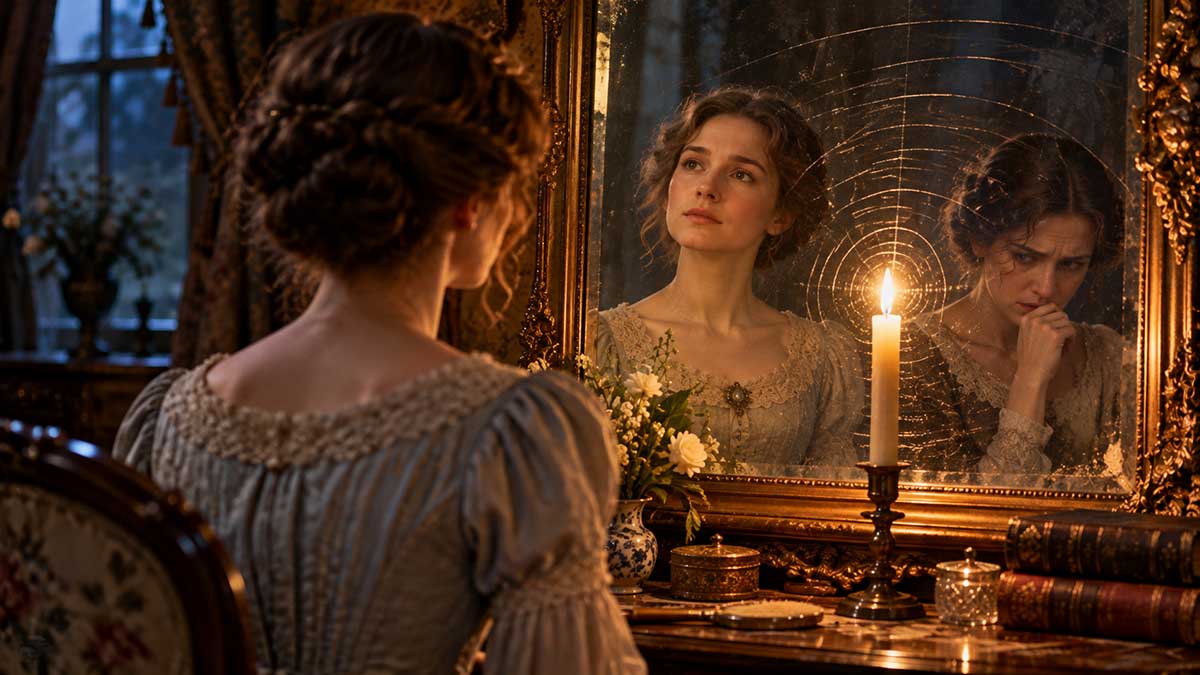
Barbara Hardy: Eliot describes a pier-glass covered with tiny scratches. When a candle is placed before it, those scratches appear to arrange themselves in circles around the candle's reflection. But the apparent pattern comes from the position of the light, not from any special arrangement of the scratches.
Gillian Beer: A wonderful optical analogy for egotism.
Karen Chase: Though the word egotism can make it sound more deliberate than it often is.
Barbara Hardy: Quite. We naturally organize events around ourselves. We assume that other people's actions must somehow relate to our own hopes, disappointments, and anxieties.
John Rignall: Rosamond does that beautifully.
Rosemary Ashton: Beautifully?
John Rignall: In the literary sense. Her interpretations of events are extraordinarily consistent with her desires. She sees what will preserve the picture she has made of her life.
Barbara Hardy: And when the picture begins to collapse, she tries to restore it rather than question it.
Karen Chase: But I want to defend Rosamond against a common simplification. Readers often treat her as merely vain or selfish. Eliot makes her more disturbing than that.
Gillian Beer: How so?
Karen Chase: Rosamond has learned to understand the world through a particular set of expectations. Beauty, refinement, social position, an accomplished marriage—these are not superficial decorations to her. They are the structure through which she imagines happiness.
Rosemary Ashton: So when Lydgate asks her to accept financial sacrifice, she experiences it as more than inconvenience.
Karen Chase: Precisely. She feels the destruction of the future she believed she was promised.
Barbara Hardy: Yet we must be careful not to make understanding her equivalent to excusing her conduct.
Karen Chase: I wouldn't dream of it.
Barbara Hardy: Her decisions about money and the household have real consequences. She sometimes acts without consulting Lydgate, even when she knows how strongly he objects.
John Rignall: And Lydgate's pride makes everything worse.
Rosemary Ashton: He wants to be master of his professional destiny, yet he is reluctant to confront the ordinary realities of debt and household expenditure.
Gillian Beer: They become trapped in a system of mutual disappointment. Each responds to the other's behavior in ways that reinforce the very qualities they dislike.
Barbara Hardy: That's one of Eliot's most penetrating observations. People can participate in creating the circumstances that make them miserable while sincerely believing that the misery has been imposed entirely by someone else.
John Rignall: But surely we shouldn't make every failure a failure of self-knowledge. Lydgate faces genuine obstacles in Middlemarch. Professional rivalries, financial pressures, and the town's suspicion of new medical ideas all contribute to his difficulties.
Gillian Beer: I agree. Eliot doesn't reduce human destiny to psychology. Circumstances matter.
Karen Chase: And chance matters. The timing of events matters. The behavior of people beyond one's control matters.
Rosemary Ashton: Which makes the moral question more difficult. If our decisions are shaped by circumstances, how responsible are we for them?
Barbara Hardy: I don't think Eliot lets us escape responsibility simply because she understands our limitations.
John Rignall: Nor does she let us pretend that responsibility explains everything.
Barbara Hardy: Exactly. Her characters are neither entirely free nor helplessly determined.
Rosemary reached for her tea, discovered it had gone cold, and set it down again.
Rosemary Ashton: Dorothea's story offers a different possibility, doesn't it? She makes a terrible mistake in marrying Casaubon, but she eventually develops a more realistic understanding of him.
Karen Chase: Eventually, yes. But not without suffering.
Rosemary Ashton: She begins by imagining that he possesses the wisdom she lacks. During their marriage, she discovers his insecurity, emotional isolation, and jealousy.
Gillian Beer: Yet she doesn't simply replace admiration with contempt.
Barbara Hardy: That is crucial. She learns to see him more truthfully without entirely surrendering her capacity for compassion.
John Rignall: Even after his codicil attempts to control her future relationship with Will.
Karen Chase: Though we should acknowledge her anger. Eliot doesn't present Dorothea as a saint incapable of resentment.
Barbara Hardy: And that's why her growth matters. She has feelings she must struggle with. Her goodness isn't effortless.
Rosemary Ashton: Perhaps we could say that Dorothea gradually learns the difference between loving an ideal and caring for an actual person.
Gillian Beer: But she also learns that caring for someone does not require accepting that person's judgment of her.
John Rignall: A lesson Casaubon might have benefited from himself.
Barbara Hardy: Indeed. He is an especially painful example of intelligence becoming a prison.
Karen Chase: Because he cannot tolerate the possibility that his life's work may be inadequate?
Barbara Hardy: Yes. He has devoted himself to a grand scholarly project. But the longer he works, the more threatening honest examination becomes. To acknowledge the project's weaknesses would mean confronting the possibility that he has misunderstood his own achievement.
Gillian Beer: There's a tragic contrast with scientific inquiry. Genuine discovery requires the willingness to revise a hypothesis. Casaubon increasingly seems unable to revise the story he tells about himself.
John Rignall: And his insecurity turns Dorothea's vitality into a threat.
Rosemary Ashton: Which is particularly sad because she begins by wanting so desperately to help him.
Karen Chase: He cannot receive her admiration freely because he fears losing it.
Barbara Hardy: Yes. He wants to be loved as a great man, but he is terrified of being known as an ordinary one.
The room fell silent.
For a moment, the scholars seemed less interested in judging Casaubon than in contemplating how recognizable his fear might be.
John Rignall: I wonder whether we are being too confident about the distinction between intelligence and wisdom. It's easy to identify Casaubon's blindness when we already know the outcome of his story.
Karen Chase: That's a good objection.
John Rignall: Imagine meeting him before the marriage. A serious scholar, devoted to a difficult project, respected by some of his contemporaries. How readily would we recognize the dangers in his character?
Barbara Hardy: Perhaps not readily at all.
Gillian Beer: Which is why Eliot's narrative method matters. She can show us the difference between a person's outward presentation and inward experience.
Rosemary Ashton: But even the reader's understanding develops gradually. Eliot doesn't hand us a complete diagnosis at the beginning.
Karen Chase: Nor does she always permit a final diagnosis at the end.
Barbara Hardy: There's something wonderfully unsettling about that. We read the novel believing we are learning to understand its characters. But the more carefully we read, the more aware we become of the limits of our judgments.
John Rignall: Perhaps Eliot is educating our uncertainty.
Gillian Beer: That's a lovely phrase.
Rosemary Ashton: Yet surely the novel offers examples of genuine learning. Fred Vincy, for instance.
Barbara Hardy: Yes. Fred may begin with less intellectual ambition than Lydgate or Dorothea, but he develops a kind of practical wisdom they struggle to achieve.
Karen Chase: Because he finally accepts correction?
Rosemary Ashton: In part. Mary Garth refuses to flatter him. Caleb offers him a model of honest work. Fred gradually abandons the expectation that life owes him comfort without effort.
John Rignall: He stops treating his imagined future as something guaranteed.
Gillian Beer: And begins responding to the actual world before him.
Barbara Hardy: Which may be the most important difference. Fred changes his behavior.
Karen Chase: Whereas Casaubon spends so much energy protecting his image of himself.
Rosemary Ashton: And Lydgate, for all his intelligence, struggles to make the necessary changes until circumstances have become painfully difficult.
John Rignall: But is Fred's development proof that suffering produces wisdom?
Barbara Hardy: No. Plenty of Eliot's characters suffer without becoming wiser.
Gillian Beer: Suffering may create an opportunity for learning, but it does not guarantee that learning will occur.
Karen Chase: And sometimes suffering makes people more defensive, not more understanding.
Rosemary Ashton: Then what makes the difference?
Barbara considered the question for a long moment.
Barbara Hardy: Perhaps the willingness to allow reality to disappoint us.
John Rignall: Explain that.
Barbara Hardy: We all create stories about ourselves. We imagine the lives we deserve, the people we believe we are, the futures we expect. But sooner or later, the world contradicts those stories.
Gillian Beer: And we can respond by revising our understanding or by insisting that the world is wrong.
Barbara Hardy: Exactly. Casaubon protects his imagined greatness. Rosamond protects her imagined marriage. Lydgate clings to his professional self-image longer than is helpful.
Karen Chase: While Dorothea, painfully and imperfectly, becomes capable of acknowledging that her original vision of Casaubon was mistaken.
Rosemary Ashton: And Fred learns that the life he actually wants requires him to become a different kind of man.
John Rignall: That sounds persuasive, but I would add one complication. Sometimes the world contradicts our expectations because the world itself is unjust or mistaken.
Gillian Beer: Quite right. We mustn't turn adaptation into the highest virtue.
John Rignall: Lydgate's medical ambitions are not foolish simply because Middlemarch resists them. Dorothea's desire for meaningful work is not invalid because her opportunities are limited.
Karen Chase: A person may need to revise an illusion without surrendering a worthy aspiration.
Barbara Hardy: Yes. Wisdom isn't merely learning to accept whatever happens.
Rosemary Ashton: Nor is it insisting that everything must happen according to our wishes.
The fire had burned lower. Gillian leaned forward and turned back to the pier-glass passage.
Gillian Beer: I keep thinking about that candle. Eliot's image is so precise. The scratches appear to form a meaningful pattern around the light, but the arrangement is produced by our point of view.
Karen Chase: And yet the scratches are real.
Gillian Beer: Exactly. The events are real. The suffering is real. The other people are real. What may be mistaken is our conviction that everything has been arranged around us.
Barbara Hardy: That may be the most difficult lesson in the novel.
John Rignall: Because we cannot step entirely outside our own perspective.
Rosemary Ashton: But we can become more curious about someone else's.
Karen Chase: And less certain that our first interpretation is the correct one.
Barbara smiled.
Barbara Hardy: I wonder how many of our own decisions would look absurd if George Eliot were permitted to narrate them.
John Rignall: I would prefer not to find out.
Gillian Beer: Particularly if she included our private thoughts.
Rosemary Ashton: And our correspondence.
Karen Chase: And the things we tell ourselves about why we wrote those letters.
They laughed, but the laughter carried a note of recognition.
Barbara Hardy: That's what makes Eliot so extraordinary. She doesn't place herself above human weakness and condemn it from a safe distance. She shows us how plausible our mistakes can feel while we're making them.
John Rignall: And how obvious they become afterward.
Gillian Beer: Though even afterward, we may continue to misunderstand them.
Rosemary Ashton: Perhaps that's why sympathy matters so much. If we know how difficult it is to understand ourselves, we might become a little slower to assume we understand everyone else.
Karen Chase: Slower to judge, perhaps. But not unwilling to judge when judgment is necessary.
Barbara Hardy: Certainly. Sympathy must not become an excuse for avoiding responsibility.
John Rignall: Then what would you say Eliot ultimately teaches us about intelligence?
Barbara looked toward the dark window, where the library's lamplight reflected the five figures around the table.
Barbara Hardy: That intelligence is a wonderful instrument, but a dangerous master. It can help us investigate the world, or it can help us construct increasingly elaborate defenses against truths we don't wish to face.
Gillian Beer: And perhaps genuine wisdom begins when intelligence becomes willing to question its own conclusions.
Rosemary Ashton: Especially its conclusions about the self.
Karen Chase: Or when we become willing to ask someone we trust whether the story we're telling ourselves is actually true.
John Rignall: Provided we're prepared to hear the answer.
A quiet smile passed among them.
Barbara Hardy: That, I suspect, is where most of us encounter our greatest difficulty.
She closed the book gently.
Barbara Hardy: Eliot's characters do not ruin their lives because they are unintelligent. Often, they suffer because they are so certain they already understand what will make them happy.
The fire gave a final small crackle.
Rosemary Ashton: And the tragedy is that some of them discover what they truly needed only after they've made it almost impossible to obtain.
Karen Chase: While others, like Fred, are fortunate enough to learn before it is too late.
Gillian Beer: Not merely fortunate. Willing to learn.
John Rignall: Perhaps that's the distinction we should remember.
Barbara nodded.
Barbara Hardy: A person may be brilliant without ever questioning the story they tell about themselves. But the moment they become capable of saying, "I may have been wrong," something remarkable becomes possible.
No one hurried to add another thought.
The five scholars sat together in the quiet library, each aware that the question had long since ceased to concern only Dorothea, Lydgate, Rosamond, or Casaubon.
It had become a question about themselves.
Topic 3: Can Someone Be Deeply Religious Yet Fail to Be Truly Good?
The rain had returned.
It came softly at first, brushing against the tall windows of the Warwickshire library. Rosemary Ashton stood beside a shelf of nineteenth-century religious and philosophical works, holding a volume of George Eliot's letters.
Rosemary Ashton: There's something about Nicholas Bulstrode that troubles me more than his dishonesty.
John Rignall: More than allowing a dying man to receive brandy after the doctor had forbidden it?
Rosemary Ashton: Not more than the consequences of his actions. I mean something more disturbing about the way he understands himself.
Barbara Hardy: That he believes he's a good man?
Rosemary Ashton: That he may sincerely believe he's doing God's work even while protecting his own interests at the expense of others.
Gillian Beer: You're suggesting that his faith and his dishonesty aren't necessarily separate compartments of his mind.
Rosemary Ashton: Exactly. His religious convictions may be genuine. Yet he has learned to interpret his ambitions in ways that make them appear righteous.
Karen Chase: That's more unsettling than a conventional hypocrite, isn't it? A man who secretly knows he's a fraud is relatively easy to understand. A man who can deceive himself while sincerely praying is much more complicated.
Barbara Hardy: And much more recognizably human.
Rosemary returned to her chair.
Rosemary Ashton: George Eliot's intellectual life gives us an important perspective here. She grew up within a serious Christian environment, read theology deeply, and underwent a profound change in her religious convictions. But she never lost her interest in moral responsibility, compassion, or the spiritual seriousness of human life.
John Rignall: Nor did she treat religious belief as merely an intellectual mistake.
Rosemary Ashton: Precisely. Her fiction contains religious characters of considerable moral dignity, alongside others whose convictions become entangled with vanity or self-interest.
Gillian Beer: Which means we shouldn't interpret Bulstrode as proof that Eliot believed religion inevitably produces hypocrisy.
Rosemary Ashton: That would be a very poor reading of her work.
Barbara Hardy: And an artistically uninteresting one. Bulstrode is compelling because Eliot doesn't permit us to dismiss him so easily.
Karen Chase: Then let's ask the uncomfortable question. Does Bulstrode actually love God, or does he love the image of himself as a man chosen by God?
John Rignall: Must those possibilities exclude one another?
Karen Chase: Perhaps not. That's what makes the question difficult.
Barbara Hardy: His beliefs are not simply a mask he puts on for other people. He has built an entire understanding of his life around them.
Gillian Beer: But that understanding has become remarkably flexible whenever his own interests are threatened.
Rosemary Ashton: Consider his earlier financial dealings. His fortune is connected with morally questionable business activities and the concealment of information that might have reunited Will Ladislaw's mother with her family inheritance. Bulstrode has managed to incorporate that history into a story of providential advancement.
John Rignall: A convenient providence.
Rosemary Ashton: Convenient, certainly. But the crucial point is that he may no longer experience the convenience as suspicious.
Barbara Hardy: He has rehearsed his justification so thoroughly that it has become part of his identity.
Karen Chase: Then his conscience hasn't disappeared. It has been persuaded.
Gillian Beer: That's a remarkable distinction.
Barbara Hardy: And a dangerous one. A person without conscience may know perfectly well that he's acting selfishly. Bulstrode has a conscience, but he has learned how to negotiate with it.
John Rignall: Negotiate? He seems to have obtained remarkably favorable terms.
The scholars smiled.
Rosemary Ashton: Yet Eliot makes clear that he suffers. When Raffles returns, Bulstrode experiences genuine fear, shame, and spiritual torment.
Karen Chase: Although much of that torment concerns exposure.
Rosemary Ashton: Yes. And that's where Eliot's psychological insight becomes so precise. Fear of wrongdoing and fear of being discovered can feel very similar from the inside.
Barbara Hardy: Especially when a person has spent years believing that his public reputation reflects his moral worth.
Gillian Beer: Bulstrode's tragedy may be that he has confused the success of his religious life with the success of his own position in Middlemarch.
John Rignall: But let's not soften the central issue. What happens with Raffles is more than an unfortunate failure of self-knowledge.
Barbara Hardy: Certainly.
John Rignall: Lydgate gives instructions for the sick man's treatment. Bulstrode fails to maintain them and permits Mrs. Abel to give Raffles brandy. He also fails to administer the prescribed opium himself. The circumstances leave a terrible moral ambiguity, but they do not leave us without grounds for judgment.
Karen Chase: And Eliot doesn't give us a simple confession that would settle exactly how to categorize his responsibility.
Rosemary Ashton: Because Bulstrode himself is struggling not to recognize what he may have allowed himself to desire.
Gillian Beer: There is something almost unbearable about the gap between his outward religious certainty and the uncertainty of his own motives.
Barbara Hardy: He wants to believe he hasn't chosen evil. Yet he has permitted events to unfold in a way that serves his interests.
John Rignall: A person can avoid making an explicit decision while still bearing responsibility for what happens.
The rain grew heavier.
For several moments, nobody spoke.
Then Karen leaned forward.
Karen Chase: I want to ask whether Bulstrode's religious language is the problem, or whether any powerful system of belief can be used in this way.
Rosemary Ashton: Eliot's interest extends beyond any one creed. She was deeply concerned with the ways human beings justify themselves.
Barbara Hardy: An ambitious scholar can justify neglecting his wife because his work is important. A doctor can justify pride because his professional goals are noble. A banker can justify questionable conduct because he believes his wealth serves a higher purpose.
Gillian Beer: So the pattern isn't confined to religion.
John Rignall: No. But religion gives Bulstrode's self-justification a particular gravity. He can mistake his own wishes for divine approval.
Rosemary Ashton: Which is why sincere humility matters. Religious conviction need not produce self-righteousness. It can also call a person to examine their motives more severely.
Karen Chase: Does anyone in Middlemarch actually achieve that?
Barbara Hardy: Dorothea comes closer than most, though Eliot doesn't make her infallible.
Gillian Beer: And Caleb Garth offers another model.
John Rignall: Ah, Caleb. A man who seems to regard honest work as a moral calling.
Rosemary Ashton: I find Caleb particularly moving because his integrity is so practical. He doesn't need to announce that he's virtuous. His conduct reveals his principles.
Barbara Hardy: Although he isn't without limitations. His generosity can expose his family to financial hardship, as when he becomes entangled in Fred's debts.
Karen Chase: That's important. Eliot doesn't give us a perfectly wise alternative to Bulstrode.
Rosemary Ashton: No. Caleb's goodness doesn't make him immune to mistakes. But when he discovers wrongdoing, he does not construct an elaborate justification for participating in it.
Gillian Beer: He understands that honest dealing is not merely a reputation to maintain. It is something one must actually do.
John Rignall: And he pays a price for it.
Barbara Hardy: Which is perhaps the difference between moral conviction and moral vanity. One asks, "What is right, even if it costs me?" The other asks, "How can I remain convinced that I am right?"
Karen Chase: That's a rather severe distinction.
Barbara Hardy: Eliot is capable of severity.
Rosemary Ashton: And compassion. We shouldn't forget that.
She opened her copy of Middlemarch to the chapters concerning Bulstrode's disgrace.
Rosemary Ashton: Consider Harriet Bulstrode.
John Rignall: One of the novel's most quietly extraordinary figures.
Rosemary Ashton: When she learns of her husband's public humiliation, she doesn't possess all the details of his wrongdoing. But she understands that his reputation has collapsed and that her own life will be changed by it.
Gillian Beer: She has every reason to feel betrayed.
Barbara Hardy: And she does suffer. Eliot doesn't erase the cost to her.
Karen Chase: Yet she goes to him.
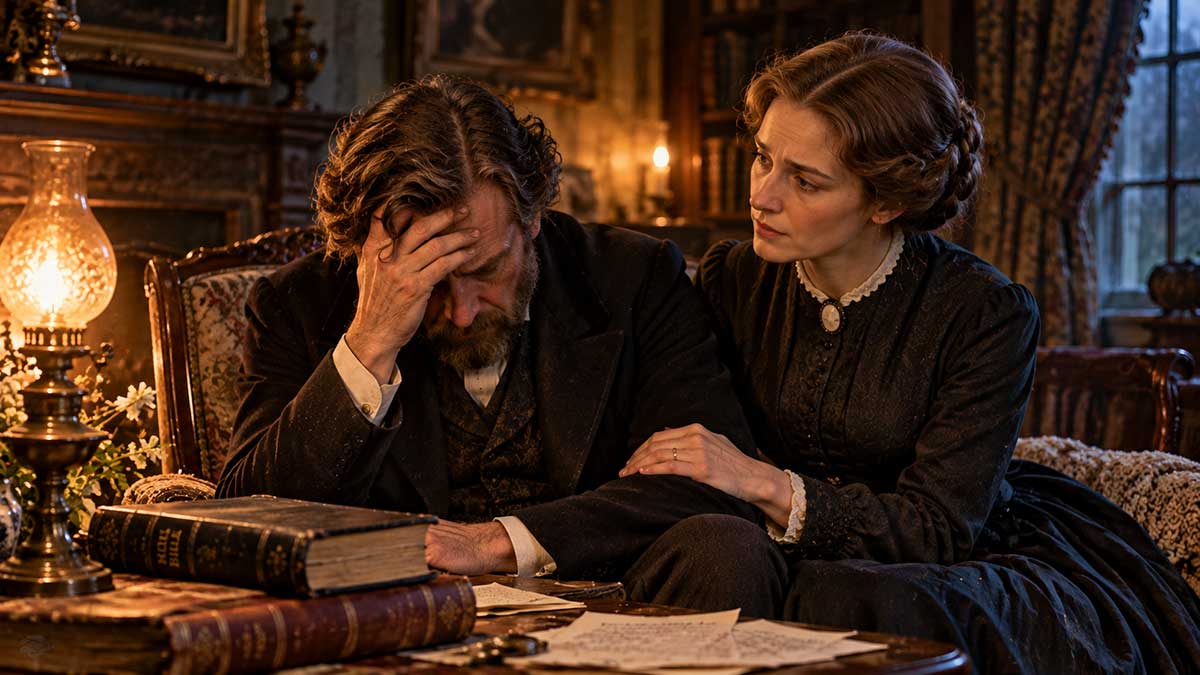
Rosemary Ashton: Yes. She removes her ornaments and dresses plainly, in a gesture that makes visible her decision to share his diminished circumstances. Then she sits beside him.
John Rignall: A scene almost without argument.
Barbara Hardy: Which makes it more powerful. Eliot has given us so much religious language from Bulstrode, so much justification and inward struggle. Then Harriet expresses loyalty through a simple physical presence.
Gillian Beer: But I want to be careful. Her kindness doesn't establish that Bulstrode deserves forgiveness, nor does it undo his wrongdoing.
Karen Chase: And she doesn't know everything the reader knows.
Rosemary Ashton: Precisely. We should not turn her action into a declaration that everything has been forgiven. It is an act of love in the midst of uncertainty and disgrace.
John Rignall: Yet the contrast is unmistakable. Bulstrode has spent years building a public identity around righteousness. Harriet's goodness emerges most clearly when that identity collapses.
Barbara Hardy: And when there is no advantage to be gained.
Karen Chase: Although love is not simply a calculation of advantage.
Barbara Hardy: No. That's what makes it love.
The fire settled into a steady glow.
Gillian Beer: There's an interesting connection with our earlier discussion of the novel's web of relationships. Bulstrode's actions don't remain private. His concealed past affects Raffles, Will's family, Lydgate, Harriet, and the wider town.
John Rignall: And his disgrace reaches people who have done nothing to deserve it.
Rosemary Ashton: Yet Harriet's response also changes the moral meaning of the scene. She cannot undo what happened, but she can decide what kind of person she will be in response.
Karen Chase: So Eliot gives us two very different uses of moral agency. Bulstrode uses his beliefs to protect himself from uncomfortable truths. Harriet acts with compassion even when the truth is painful.
Barbara Hardy: But let's not make her merely the instrument of his redemption. Harriet has her own dignity, her own suffering, and her own choice.
Rosemary Ashton: Agreed.
John Rignall: And Dorothea offers another kind of response to disgrace. When Lydgate becomes implicated in the scandal, she refuses to assume that public suspicion proves his guilt.
Gillian Beer: She offers trust at a moment when he has almost none left.
Barbara Hardy: Yet she isn't simply credulous. She recognizes the need to understand the circumstances.
Karen Chase: Her generosity also helps create the extraordinary meeting with Rosamond.
Rosemary Ashton: Where Dorothea, carrying her own emotional pain, finds herself moved by another woman's distress.
John Rignall: A remarkable contrast with Bulstrode. He interprets other people's lives through his own need for security. Dorothea gradually becomes capable of putting another person's suffering before her own.
Barbara Hardy: Though not without a struggle. That's what gives the scene its humanity.
Gillian Beer: And perhaps it reveals something essential about Eliot's moral imagination. Goodness is not the absence of selfish feelings. It is the ability to act beyond them.
Karen Chase: Then are we saying that actions matter more than beliefs?
Rosemary Ashton: I would phrase it differently. Beliefs matter enormously because they shape how we interpret the world and what we consider worthy of our devotion. But beliefs must be tested by their consequences in human lives.
John Rignall: Otherwise they can become elaborate descriptions of virtues we do not actually practice.
Barbara Hardy: And Eliot is suspicious of moral language that makes us feel good about ourselves without requiring us to become better.
Gillian Beer: Which brings us back to Caleb. He has no need to make his work sound grand. He simply tries to do it honestly.
Karen Chase: Yet I wonder whether we're making ordinary goodness sound easier than it is.
Barbara Hardy: It isn't easy. That's why Eliot pays such careful attention to it.
Karen Chase: Harriet must decide whether to remain beside a disgraced husband. Dorothea must decide whether to help people while her own heart is breaking. Caleb must decide whether to preserve his integrity when doing so costs him an opportunity.
Rosemary Ashton: And those decisions often happen without witnesses who can reward them.
John Rignall: Or without any certainty that the outcome will be favorable.
Gillian Beer: That may be why Eliot's vision is so compelling. She doesn't promise that goodness will make life comfortable.
Barbara Hardy: Nor that it will protect us from disappointment.
Karen Chase: Then what does goodness offer?
Rosemary looked toward the window.
Rainwater moved slowly down the glass, catching the reflection of the lamp.
Rosemary Ashton: Perhaps the possibility of remaining faithful to what we believe is right, even when circumstances make that difficult.
John Rignall: But isn't that what Bulstrode believes he's doing?
Rosemary Ashton: Ah. You've found the weakness in my answer.
Barbara Hardy: A very important weakness.
Gillian Beer: We need something more than fidelity to conviction. We need the willingness to question whether our conviction has become a servant of our own interests.
Karen Chase: And the courage to listen when someone else tells us we've caused harm.
Barbara Hardy: Yes. A conscience that cannot be corrected may become indistinguishable from pride.
John Rignall: Then moral seriousness requires two things that don't always sit comfortably together: commitment and humility.
Rosemary Ashton: Exactly. Commitment to what we believe is good, and humility about our ability to recognize it perfectly.
The room became quiet.
Then Barbara spoke again.
Barbara Hardy: I wonder whether Bulstrode's greatest failure is not simply that he did wrong, but that he repeatedly refused the opportunities to recognize what he was doing.
Karen Chase: And Harriet's greatness is not that she knows everything, but that she responds to what she does know with compassion.
Gillian Beer: While Caleb demonstrates integrity through ordinary conduct, and Dorothea learns to extend sympathy beyond her immediate suffering.
John Rignall: Four very different moral lives, all within the same provincial town.
Rosemary Ashton: And Eliot refuses to reduce them to a lesson that can be memorized and forgotten.
Barbara Hardy: Because the difficulty isn't knowing that honesty is good or that selfishness is dangerous.
Karen Chase: It's recognizing the moment when we're deceiving ourselves.
Gillian Beer: Especially when our intentions appear noble.
John Rignall: Or when we can explain our actions in language that sounds entirely respectable.
Rosemary closed the book.
Rosemary Ashton: There's something deeply moving about Eliot's continued concern with goodness after her own religious convictions changed. She didn't abandon the moral questions that had occupied her youth. She continued asking how human beings might live responsibly toward one another.
Barbara Hardy: And she found a form of storytelling capable of making those questions painfully concrete.
Karen Chase: Perhaps that is why Bulstrode remains so unsettling. He isn't a warning about one particular religion. He's a warning about a possibility within the human conscience.
Gillian Beer: The possibility of becoming so attached to our image of goodness that we stop examining whether we are actually doing good.
John Rignall: And perhaps Harriet offers the counterimage.
Rosemary Ashton: A woman who does not need to announce her virtue.
The rain had begun to ease.
Barbara Hardy: I keep returning to that scene. Bulstrode, whose life has been filled with declarations about righteousness, sits devastated by disgrace. Harriet enters, quietly dressed, and takes her place beside him.
Karen Chase: She doesn't deliver a sermon.
Gillian Beer: She doesn't claim to know everything.
John Rignall: And she doesn't make his wrongdoing disappear.
Rosemary Ashton: No. She simply refuses to let his disgrace determine the limits of her compassion.
Barbara looked down at the open pages.
Barbara Hardy: Perhaps that's one of Eliot's most profound discoveries. We can spend our lives trying to establish that we are good people, while the real test of goodness arrives in an ordinary moment when someone needs us.
Karen Chase: And nobody is keeping score.
Gillian Beer: Except, perhaps, the people whose lives we touch.
Rosemary smiled gently.
Rosemary Ashton: Or perhaps not even they.
The five scholars sat quietly, thinking of Bulstrode's prayers, Caleb's honesty, Dorothea's generosity, and Harriet's silent loyalty.
Then Rosemary added one final thought.
Rosemary Ashton: Eliot seems to ask us a question that no profession of faith, no philosophy, and no reputation can answer on our behalf.
John Rignall: What question?
Rosemary Ashton: When our beliefs are tested by another person's suffering, what will we actually do?
No one answered immediately.
And in the silence, the question seemed to reach far beyond the pages of Middlemarch.
Topic 4: Why Is Middlemarch Considered One of the Greatest Novels Ever Written?

The rain had finally stopped.
Beyond the library windows, the Warwickshire countryside lay beneath a pale moon. The fire had burned low, but none of the five scholars seemed inclined to leave.
John Rignall was standing beside a shelf of nineteenth-century novels. He removed a volume of Madame Bovary, examined its spine, and placed it beside Middlemarch on the table.
John Rignall: I think we've avoided the most obvious question of the evening.
Barbara Hardy: Which is?
John Rignall: Why should anyone read this enormous novel in the first place?
Karen Chase: We've spent several hours discussing it. I hope that's evidence of something.
John Rignall: Evidence of our enthusiasm, certainly. But enthusiasm is not an argument.
Gillian Beer: Nor is calling it a masterpiece.
John Rignall: Precisely. People hear that Middlemarch is one of the greatest novels ever written. They buy it, open it, encounter Dorothea Brooke discussing religious scholarship, and begin to wonder whether they've made a terrible mistake.
Rosemary Ashton: You make it sound rather forbidding.
John Rignall: For some readers, it is. I think we owe them a better explanation than simply saying, "Keep reading. It's brilliant."
Barbara Hardy: Then perhaps we should begin by asking what Eliot accomplishes that another novelist might not.
John Rignall: Exactly.
He sat down and opened the book.
John Rignall: Consider the novel's subtitle: A Study of Provincial Life. It sounds almost modest. We're going to observe a small English town, its marriages, professions, inheritances, and social relationships.
Karen Chase: Hardly the stuff of epic adventure.
John Rignall: Yet by the end, that provincial world seems to contain nearly everything that matters about human existence.
Gillian Beer: Because Eliot refuses to treat the ordinary as simple.
Barbara Hardy: And because she refuses to treat human beings as entirely knowable.
Rosemary Ashton: I think that's where her greatness begins. She takes people who might appear unremarkable from a distance and reveals the extraordinary complexity of their inner lives.
John Rignall: But many great novelists do that. What makes Eliot distinctive?
Barbara Hardy: Her willingness to show how our judgments change when we understand more.
Karen Chase: Give us an example.
Barbara Hardy: Casaubon.
John Rignall: An unfortunate choice if we're trying to persuade readers that the book is enjoyable.
Barbara Hardy: On the contrary. He's an excellent choice.
She turned to the early chapters.
Barbara Hardy: At first, Casaubon appears through Dorothea's admiration. She sees a serious scholar devoted to a great intellectual task. She imagines that marriage to him will allow her to participate in a life of profound significance.
Rosemary Ashton: And her sister Celia sees something quite different.
Barbara Hardy: Exactly. Celia sees an older, unattractive, rather dreary man. Neither perspective gives us the whole person.
Gillian Beer: Then Eliot gradually changes the conditions of observation.
Barbara Hardy: Yes. We see Casaubon's emotional limitations, his jealousy, his fear of intellectual failure. But then Eliot does something remarkable. She asks us to consider his suffering.
Karen Chase: Even though he has caused Dorothea so much pain.
Barbara Hardy: Especially then. Eliot does not require us to approve of Casaubon. She asks us to recognize that his cruelty emerges from a human being who is frightened, disappointed, and increasingly aware of his own inadequacy.
John Rignall: So her achievement is moral complexity?
Barbara Hardy: Partly. But more specifically, she makes moral complexity an experience created by the form of the novel.
Rosemary Ashton: We don't simply receive a lecture about sympathy.
Barbara Hardy: Precisely. We begin with one understanding, encounter new evidence, and discover that our earlier judgment was incomplete.
Gillian Beer: Which makes the reader's mind part of the experiment.
Karen Chase: That's an interesting way to put it.
Gillian Beer: Eliot repeatedly examines the relationship between observation and interpretation. Her scientific imagery is not ornamental. It helps her investigate how people make sense of the world.
John Rignall: Then let's return to the pier-glass metaphor.
Gillian Beer: Gladly.
She drew a small circle on a sheet of paper.
Gillian Beer: Eliot describes a mirror marked by countless fine scratches. Place a candle before it, and those scratches appear to arrange themselves in concentric circles around the reflected light.
Karen Chase: Although the scratches themselves haven't moved.
Gillian Beer: Exactly. The pattern depends on the observer's position. Eliot uses this optical image to explain how people interpret the world as though everything revolves around themselves.
Barbara Hardy: A brilliant illustration of egotism.
Gillian Beer: But notice how much work the image accomplishes. It gives us a physical phenomenon, a psychological insight, and a way of interpreting several characters at once.
Rosemary Ashton: Rosamond, certainly.
Karen Chase: And Lydgate.
John Rignall: And perhaps Dorothea.
Barbara Hardy: And the reader, which is the uncomfortable part.
Gillian Beer: That's why I think Eliot's scientific imagination is so important. She doesn't merely borrow the language of science to make the novel sound intellectually impressive. She uses analogies to make invisible patterns of human thought perceptible.
John Rignall: Yet I would hesitate to explain her greatness entirely through scientific thinking.
Gillian Beer: So would I.
John Rignall: Her work also belongs to a remarkable European literary tradition. She read widely in French and German literature and was deeply engaged with European philosophy. Her fiction participates in a larger exploration of realism, moral choice, and the relationship between individual aspiration and the world.
He touched the copy of Madame Bovary.
John Rignall: Consider Flaubert's Emma Bovary. She imagines a life more romantic and extraordinary than the one available to her. Her desires are shaped by the stories she has absorbed.
Rosemary Ashton: As Dorothea's imagination is shaped by the lives of saints and great intellectual figures.
John Rignall: There are interesting parallels, though we should not collapse the two characters into one another. Emma and Dorothea are profoundly different. But both novels investigate the distance between imagined life and lived experience.
Barbara Hardy: And Rosamond has something of Emma's attachment to elegance and romantic expectation.
Karen Chase: Yet Eliot's method is different from Flaubert's.
John Rignall: Very different. Flaubert's impersonality and irony are not Eliot's characteristic instruments. Eliot's narrator is willing to interrupt, reflect, question, and sometimes appeal directly to our sympathies.
Gillian Beer: Which some readers find intrusive.
Barbara Hardy: And others find indispensable.
Karen Chase: Let's pursue that. Why does Eliot keep speaking to us? Why not simply let the characters act and allow readers to draw their own conclusions?
Barbara Hardy: Because the narrator is not merely supplying information. The narrator is shaping the way we attend to human beings.
Rosemary Ashton: Almost like a companion who occasionally asks us whether we've been too quick to judge.
Barbara Hardy: Yes, though a companion of formidable intelligence.
John Rignall: One who is sometimes rather determined to improve us.
Karen Chase: And are we always grateful?
John Rignall: Not necessarily.
They laughed.
Barbara Hardy: But that's part of the pleasure. Eliot can be witty, skeptical, tender, and severe within the same narrative voice.
Gillian Beer: And her irony is often directed at the limitations of perception rather than simply at human foolishness.
Karen Chase: Still, I wonder whether the narrator's authority creates a problem. If Eliot tells us how to interpret everyone, does she leave enough freedom for readers to disagree?
Barbara Hardy: Oh, I think she does. Consider Dorothea's ending. The narrator gives us a powerful account of the value of her life, yet readers continue to disagree about whether her possibilities were fulfilled.
Rosemary Ashton: Because the novel makes us feel both her happiness and the loss of what she once hoped to achieve.
John Rignall: So even the authoritative narrator cannot eliminate the tension.
Karen Chase: Or perhaps doesn't wish to.
A gust of wind stirred the branches outside.
Gillian Beer: There's another achievement we haven't discussed sufficiently: the architecture of the novel.
John Rignall: The multiple plots?
Gillian Beer: More than that. Eliot allows apparently separate stories to influence one another through relationships that the characters themselves do not fully perceive.
Barbara Hardy: Dorothea and Lydgate are an excellent example.
Gillian Beer: Yes. At first, their ambitions appear almost unrelated. Dorothea wants a life of moral and intellectual significance. Lydgate wants to transform medical practice.
Rosemary Ashton: Both are idealists.
Karen Chase: Both make disastrous marriages.
John Rignall: And both discover that private relationships can determine the fate of public ambitions.
Gillian Beer: Yet their stories eventually intersect in a way that changes their possibilities.
Barbara Hardy: Dorothea's generosity toward Lydgate and Rosamond becomes one of the novel's most moving examples of moral action.
Karen Chase: But Eliot prepares that encounter through hundreds of pages of apparently separate developments.
Gillian Beer: Precisely. The novel's length allows relationships and consequences to accumulate. What appears incidental in one chapter can become essential much later.
John Rignall: Then perhaps we should defend the length.
Barbara Hardy: Carefully.
John Rignall: Why carefully?
Barbara Hardy: Because length is not automatically a virtue. A long novel can simply be a short novel that has forgotten when to stop.
Rosemary Ashton: I hope you're not describing Middlemarch.
Barbara Hardy: Certainly not. I'm saying we need to explain why Eliot requires such breadth.
Gillian Beer: Because she is depicting the slow formation of consequences. A character's fate cannot always be understood through one dramatic decision. It emerges through repeated habits, accumulated misunderstandings, small obligations, and the influence of other people.
Karen Chase: The very things that ordinary life is made of.
John Rignall: So the apparent slowness is connected to the subject.
Barbara Hardy: Yes. Eliot wants us to experience how lives develop over time, not simply witness their most dramatic moments.
Rosemary Ashton: There's something else. A shorter novel might allow us to maintain our initial judgments. But after spending so long with these characters, we become less comfortable with simple conclusions.
Karen Chase: Even about Rosamond?
Rosemary Ashton: Especially about Rosamond.
Barbara Hardy: Though Eliot certainly tests our patience with her.
John Rignall: I sometimes wonder whether Rosamond is the character most likely to reveal a reader's own limitations.
Gillian Beer: Because she's so easy to condemn?
John Rignall: Yes. We see her vanity, her resistance to Lydgate's wishes, her inability to accept the life their circumstances require. Yet we may fail to examine the assumptions that shaped her expectations.
Karen Chase: Or the assumptions Lydgate brings into the marriage.
Barbara Hardy: And that's the beauty of Eliot's method. Every time we settle into a comfortable judgment, another perspective unsettles it.
Rosemary Ashton: The novel almost trains us to become more patient observers of other people.
Gillian Beer: But patience does not mean indecision.
Barbara Hardy: Nor does sympathy require us to abandon moral judgment.
Karen Chase: That distinction is essential. Eliot doesn't say that everyone is equally right. She shows that understanding wrongdoing is more difficult than merely identifying it.
John Rignall: Which may be one reason the novel continues to speak to readers across generations.
He leaned back and considered the books on the table.
John Rignall: But I want to raise a more challenging question. Suppose someone finishes Middlemarch and says, "I understand that it's psychologically sophisticated, structurally impressive, and morally serious. But I didn't enjoy it."
Barbara Hardy: Then I should hope we wouldn't scold them.
Karen Chase: An admirably generous position.
Barbara Hardy: Literature isn't a moral examination in which admiration is compulsory.
Gillian Beer: Nor should we pretend that every reader will respond to the same qualities.
Rosemary Ashton: Some may be drawn to Dorothea's idealism. Others to Lydgate's ambitions. Others to Fred and Mary's developing relationship.
John Rignall: And some may find the narrator's digressions exhausting.
Barbara Hardy: They are entitled to.
Karen Chase: But perhaps we can offer those readers a different way into the novel.
Gillian Beer: Such as?
Karen Chase: Instead of asking them to admire its greatness, invite them to notice something very small.
Rosemary Ashton: For example?
Karen Chase: The moment Dorothea realizes that Casaubon is not the man she imagined. Or the way Mary refuses to flatter Fred. Or Harriet quietly sitting beside Bulstrode after his disgrace.
Barbara Hardy: You're suggesting that the novel's greatness becomes visible through its smallest human details.
Karen Chase: Yes. We often talk about Middlemarch in grand terms: the greatest English novel, a masterpiece of realism, an extraordinary achievement of nineteenth-century literature. But those descriptions can obscure what makes the book moving.
John Rignall: Which is?
Karen Chase: The extraordinary care Eliot gives to moments that might otherwise pass unnoticed.
Rosemary Ashton: That's beautifully put.
Gillian Beer: And it connects the novel's smallest details to its largest structure. An apparently insignificant gesture can have consequences that extend through several lives.
Barbara Hardy: Or reveal something about a character that pages of explanation could not.
John Rignall: Such as Harriet's decision to remain beside Bulstrode.
Rosemary Ashton: Or Dorothea's generosity when she herself is suffering.
Karen Chase: Or Fred discovering that honest work can become a source of dignity rather than humiliation.
The clock on the mantelpiece struck ten.
None of them moved.
Barbara Hardy: I think we've been approaching the question of greatness from the wrong direction.
John Rignall: Have we?
Barbara Hardy: We've been asking what makes Eliot extraordinary. Perhaps we should ask what she makes possible for the reader.
Gillian Beer: A different way of seeing?
Barbara Hardy: Yes. When we first encounter Casaubon, we may laugh at him. When we understand his fear, we may pity him. When we see the harm he causes Dorothea, we may become angry again.
Karen Chase: And none of those responses entirely cancels the others.
Barbara Hardy: Precisely. Eliot teaches us to hold conflicting truths together.
Rosemary Ashton: A person can be ridiculous and tragic.
Gillian Beer: Intelligent and foolish.
John Rignall: Well-intentioned and destructive.
Karen Chase: Loving and selfish.
Barbara Hardy: And perhaps that is closer to actual human experience than the simple categories we so often use.
John Rignall: Then the novel doesn't merely describe life. It changes the quality of our attention to it.
Rosemary Ashton: Which may be a greater achievement than persuading us of any particular conclusion.
Gillian Beer: And it explains why rereading can be so rewarding.
Karen Chase: Because the book changes?
Gillian Beer: Because we do.
The others looked at her.
Gillian Beer: At twenty, a reader may be drawn to Dorothea's longing for a great purpose. At forty, that same reader may understand Lydgate's compromises more painfully. At sixty, Casaubon's fear of wasted effort may become less absurd and more recognizable.
Barbara Hardy: Or Caleb Garth's quiet satisfaction may begin to seem more extraordinary than anyone's youthful ambitions.
Rosemary Ashton: And Harriet's loyalty may acquire a depth that escaped us when we were younger.
John Rignall: So each reading becomes an encounter between Eliot's novel and a different version of ourselves.
Karen Chase: Which means the book is never quite finished with us.
A silence followed.
Outside, the moon had risen above the trees, illuminating the fields beyond the library.
John looked once more at the volume of Madame Bovary beside Middlemarch.
John Rignall: We began by asking why this novel deserves to stand among the greatest works of literature.
Barbara Hardy: Have we answered?
John Rignall: Not with a ranking. And perhaps that's fortunate. Rankings are often less interesting than reasons.
Gillian Beer: Then give us your reason.
John considered the question.
John Rignall: Eliot makes a small town large enough to contain the complexity of human life. She shows us how private dreams collide with circumstances, how people misunderstand one another, and how seemingly minor actions shape destinies.
Rosemary Ashton: That's the scale of her achievement.
Barbara Hardy: But not yet its deepest effect.
Karen Chase: Which is?
Barbara looked around the table.
Barbara Hardy: After reading Middlemarch carefully, we may find it a little harder to dismiss someone as merely foolish, selfish, unsuccessful, or insignificant.
Gillian Beer: Because we begin to suspect that their lives contain more than we can see.
Rosemary Ashton: And that our own lives are no less complicated.
John Rignall: Then perhaps the greatest compliment we can pay Eliot is not that she understood humanity better than everyone else.
Karen Chase: What would it be?
John Rignall: That she helps us understand one another a little better than we did before.
The fire had almost gone out.
Barbara closed her copy of the novel, but kept one hand resting on its cover.
Barbara Hardy: There's something wonderfully appropriate about that. A book famous for its extraordinary intelligence leaves us with a very ordinary task.
Rosemary Ashton: To pay attention?
Barbara Hardy: To pay attention. More carefully, more patiently, and with a little less certainty that we've already understood.
Gillian smiled.
Gillian Beer: And perhaps that's why the novel remains so alive. Every time we return to it, we discover another life we hadn't fully noticed.
John stood and returned Madame Bovary to the shelf.
John Rignall: Then I think we have our answer.
Karen Chase: To why Middlemarch is great?
John Rignall: To why it is worth reading.
He glanced at the worn volume on the table.
John Rignall: It doesn't simply tell us what happened to people who lived long ago.
He paused.
John Rignall: It changes what we notice about the people living beside us now.
No one spoke.
And for a moment, the quiet library seemed filled not only with the imagined inhabitants of Middlemarch, but with all the ordinary, complicated, largely unseen lives that George Eliot had taught her readers to recognize.
Topic 5: What If an Ordinary Life Is a Greater Achievement Than a Famous One?
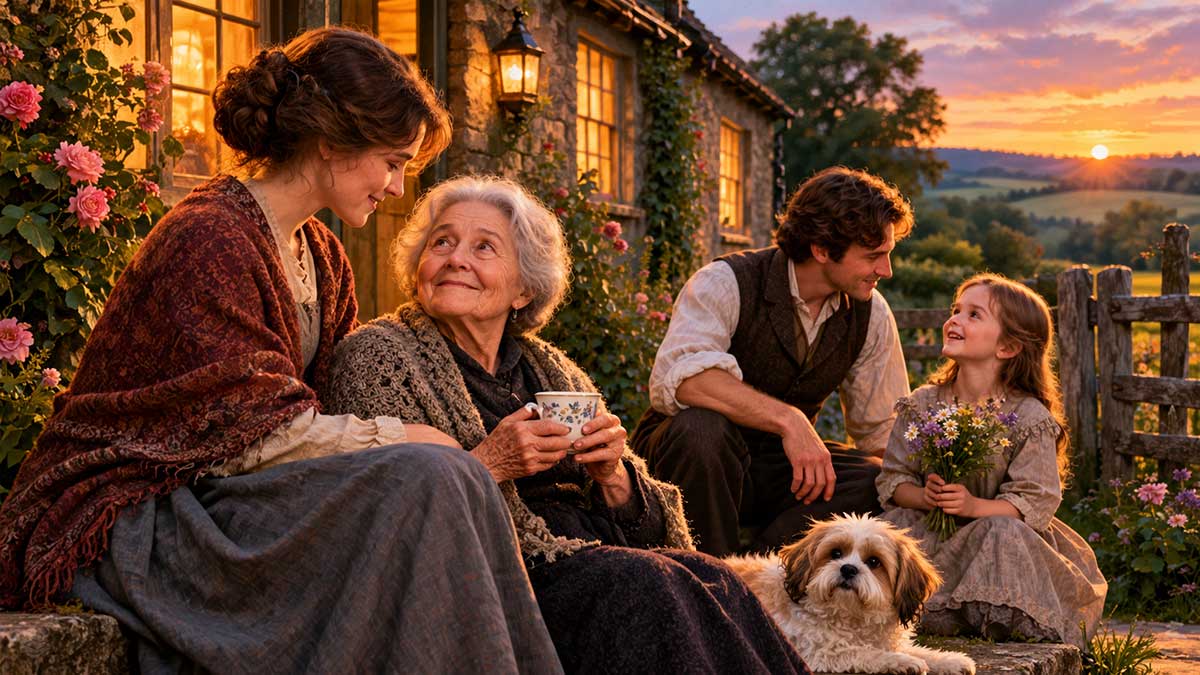
The library clock had passed eleven.
The rain was gone, and the moon shone over the dark fields of Warwickshire. Most of the candles had burned low. Only the lamp at the center of the table remained bright, illuminating five open copies of Middlemarch.
Karen Chase had been studying the final pages for some time.
Karen Chase: I want to ask something that may sound almost sacrilegious after our evening of praising George Eliot.
John Rignall: An excellent way to begin.
Karen Chase: What if the ending of Middlemarch is not entirely comforting?
Barbara Hardy: I should be disappointed if it were.
Rosemary Ashton: You're thinking of Dorothea?
Karen Chase: Yes. We begin with a young woman whose aspirations are almost painfully large. She wants to devote herself to something meaningful. She dreams of intellectual achievement, moral purpose, perhaps even a life that might change the world.
Gillian Beer: And we finish with a woman whose influence is largely private.
Karen Chase: Precisely. Eliot tells us that Dorothea's goodness matters, that her life contributes to the welfare of others. But I wonder whether readers sometimes embrace that conclusion too quickly because it makes the disappointment easier to bear.
John Rignall: You mean we congratulate Dorothea on finding happiness without fully acknowledging what she has lost.
Karen Chase: Exactly.
Barbara Hardy: That's an important distinction. The novel doesn't begin by presenting Dorothea as a young woman who merely wants a happy marriage. She wants a great purpose.
Rosemary Ashton: And her ambitions are not trivial. She possesses intelligence, energy, generosity, and an almost overwhelming desire to be useful.
Gillian Beer: But she has no clear path through which those qualities can develop into the kind of achievement she imagines.
John Rignall: Her first attempt is to attach herself to Casaubon's scholarship.
Barbara Hardy: A disastrous choice, though understandable in the circumstances of her life.
Karen Chase: Then she discovers that the intellectual partnership she imagined was never truly available to her.
Rosemary Ashton: And after Casaubon's death, she makes another choice that some readers find disappointing. She marries Will Ladislaw, relinquishing the property she would otherwise retain under the terms of Casaubon's will.
John Rignall: Yet unlike her first marriage, this is a decision made with a much clearer understanding of the man she loves.
Barbara Hardy: And with a willingness to accept the consequences.
Karen Chase: I agree. But does that settle the question of whether her life fulfilled its possibilities?
Gillian Beer: Perhaps the difficulty lies in the word fulfilled. It suggests that a human life has one proper shape, and that we can determine whether it achieved that shape.
Rosemary Ashton: Yet Eliot herself encourages us to feel the distance between Dorothea's early aspirations and her later circumstances.
Barbara Hardy: She certainly does. We mustn't turn the Finale into a simple celebration of domestic contentment.
John Rignall: Nor should we turn it into a tragedy merely because Dorothea never becomes publicly famous.
Karen Chase: Then what exactly are we meant to feel?
For a moment, nobody answered.
The fire had settled into a bed of glowing embers.
Barbara Hardy: Perhaps more than one thing.
Karen Chase: That's a suspiciously convenient answer from a literary critic.
Barbara Hardy: Only because it's true.
The others smiled.
Barbara Hardy: Eliot makes us feel the loss of Dorothea's unrealized ambitions. But she also makes us recognize that the good Dorothea accomplishes is real. One truth doesn't cancel the other.
Gillian Beer: And her influence cannot be measured simply by looking at the public record of her life.
John Rignall: Which brings us to the remarkable final paragraph.
Rosemary Ashton: The passage about the growing good of the world depending partly upon people who lived faithfully without becoming celebrated.
Karen Chase: It's one of the most beautiful endings in English literature. But I want us to examine it rather than merely admire it.
She turned the book toward the others.
Karen Chase: Eliot doesn't say that Dorothea secretly achieved everything she wanted. She doesn't pretend that her circumstances were ideal. Instead, she asks us to recognize a different kind of significance.
Gillian Beer: A significance that is dispersed through other lives.
Barbara Hardy: And often invisible to history.
John Rignall: Yet if we say that ordinary lives matter more than great achievements, aren't we creating another false distinction?
Rosemary Ashton: I think so. Eliot admired intellectual achievement. Her own life was devoted to creating works of extraordinary ambition.
John Rignall: Exactly. She wasn't arguing that people should abandon great aspirations and settle for small ones.
Gillian Beer: Nor that ambition is inherently selfish. Lydgate's desire to improve medicine is admirable.
Karen Chase: But his life forces us to ask what happens when a worthy ambition remains unfulfilled.
Barbara Hardy: Or when it is fulfilled only partially, and in ways the person himself regards as disappointing.
Rosemary Ashton: Lydgate becomes a successful physician in the conventional sense. He earns money, establishes a respectable practice, and gains social standing.
John Rignall: Yet he never accomplishes the scientific work he originally hoped would define his career.
Gillian Beer: And he comes to regard himself as a failure.
Karen Chase: Which is heartbreaking because his judgment of himself depends so heavily on the distance between his youthful dream and his eventual life.
Barbara Hardy: But perhaps we should ask whether that judgment is entirely fair.
John Rignall: His disappointment is real. He had the ability and ambition to pursue important medical research.
Rosemary Ashton: And the novel gives us reasons to believe that his professional possibilities were genuinely diminished.
Gillian Beer: Yet we cannot know everything that might have happened had he made different choices. The imagined life remains an imagined life.
Karen Chase: That's a crucial point. We often compare the life we actually lived with a perfect version of the life we might have lived.
Barbara Hardy: And the imagined version has the considerable advantage of never having encountered reality.
John Rignall: A rather unfair competition.
Rosemary Ashton: But one that people conduct throughout their lives.
The clock ticked steadily.
Gillian Beer: There's an interesting contrast between Lydgate and Fred Vincy.
Karen Chase: Fred begins with far less impressive ambitions.
Barbara Hardy: And considerably less discipline.
John Rignall: Yet he becomes one of the more contented people in the novel.
Rosemary Ashton: Because he learns to value honest work, develops responsibility, and builds a marriage with Mary Garth on something more durable than fantasy.
Karen Chase: Does that mean Fred succeeds where Lydgate fails?
Barbara Hardy: In some respects, yes. But I would hesitate to make them competitors.
Gillian Beer: Their lives ask us to question what we mean by success.
John Rignall: Lydgate has a grand professional vision but struggles to build a satisfying life. Fred abandons his expectation of easy prosperity and discovers satisfaction in work that once seemed beneath him.
Rosemary Ashton: Yet Fred's happiness doesn't make Lydgate's scientific aspirations foolish.
Barbara Hardy: Nor does Lydgate's disappointment diminish the value of Fred's work.
Karen Chase: Then perhaps Eliot is showing us that human achievement has many forms, and that no single measure can capture them all.
Gillian Beer: Exactly. The danger lies in assuming that a life has value only if it produces a particular kind of visible accomplishment.
John Rignall: But visibility does matter sometimes. A medical discovery can save thousands of lives. A great work of literature can influence generations.
Rosemary Ashton: Of course. Eliot isn't denying the importance of public achievement.
Barbara Hardy: She's questioning whether public achievement is the only kind that matters.
Karen Chase: Or even whether it is always the most reliable evidence of a good life.
John leaned forward.
John Rignall: Let me challenge that. Suppose Dorothea had possessed the opportunity to become a major intellectual figure. Suppose she had written books, founded institutions, or undertaken work that changed the lives of thousands. Wouldn't that have been a greater achievement than the life she actually lived?
Gillian Beer: Greater by what measure?
John Rignall: By the number of people affected.
Barbara Hardy: But we cannot calculate the full effects of either life.
John Rignall: Surely we can make reasonable distinctions.
Karen Chase: Sometimes. But Eliot's conclusion warns us that the most important consequences of a life may be precisely those that cannot be counted.
Rosemary Ashton: Consider Caleb Garth.
John Rignall: A man who would never have imagined himself a historical figure.
Rosemary Ashton: Yet his integrity shapes the lives of the people around him. His example helps Fred become responsible. His work sustains households and livelihoods. His honesty establishes trust.
Barbara Hardy: And none of that requires public recognition.
Gillian Beer: His influence travels through other people.
Karen Chase: But even Caleb's story is not without complications. His generosity sometimes exposes his family to hardship. Goodness doesn't automatically produce perfect judgment.
Rosemary Ashton: No. And that makes him more human.
John Rignall: Still, I wonder whether the phrase ordinary life is misleading. From the outside, Caleb's life appears ordinary. But from within, it contains effort, loyalty, skill, disappointment, and moral choice.
Barbara Hardy: Perhaps no life is ordinary to the person who lives it.
Gillian Beer: Or to those whose lives it changes.
Karen looked down at the book.
Karen Chase: There's something else that troubles me about our language. We keep speaking of Dorothea's influence as though it were compensation for her lost opportunities.
Rosemary Ashton: Isn't it?
Karen Chase: Not entirely. If we say, "She couldn't achieve greatness, but at least she was kind," we risk making her goodness sound like a consolation prize.
Barbara Hardy: That's beautifully observed.
Karen Chase: Her compassion isn't merely what remains after ambition has failed. It's part of what made her aspirations meaningful in the first place.
Gillian Beer: Yes. She wanted to contribute to something larger than herself. That desire doesn't disappear. It takes a different form.
John Rignall: Though not necessarily the form she would have chosen as a young woman.
Karen Chase: Exactly. We must preserve that tension.
Rosemary Ashton: Perhaps Dorothea's development lies in learning that a meaningful life cannot be constructed entirely according to an ideal imagined in youth.
Barbara Hardy: But also that the ideal may contain something worth preserving.
Gillian Beer: Her desire to be useful survives her disappointment.
John Rignall: And her capacity for love becomes more realistic.
Karen Chase: Then her life is neither a simple triumph nor a simple defeat.
Barbara Hardy: Which may be why readers continue arguing about it.
The five scholars smiled.
A faint wind moved through the trees outside.
Rosemary Ashton: I wonder whether George Eliot's own life complicates this question further.
John Rignall: How so?
Rosemary Ashton: She achieved extraordinary literary distinction. She became one of the most celebrated writers of her time. Yet her fiction repeatedly returns to the value of people who will never receive such recognition.
Gillian Beer: Perhaps public success made her more aware of its limitations.
Barbara Hardy: Or perhaps her moral imagination had always been drawn to the unseen dimensions of human life.
Karen Chase: There's a certain generosity in a famous writer using her greatest novel to honor people who will never be famous.
John Rignall: Though we should remember that she also examines the pain of being denied opportunities for achievement.
Rosemary Ashton: Certainly. Eliot doesn't ask us to stop caring about what human beings might become.
Barbara Hardy: She asks us to care about what they actually do for one another.
Gillian Beer: And about the conditions that make their choices possible or impossible.
Karen Chase: Which returns us to the question of Dorothea's unrealized potential.
She paused.
Karen Chase: Perhaps the ending is powerful precisely because Eliot refuses to tell us that everything turned out as it should.
John Rignall: You mean the world remains imperfect.
Karen Chase: Yes. Dorothea's gifts might have found wider expression. Lydgate might have contributed more to medical science. Their losses are real.
Rosemary Ashton: But so is the good that survives those losses.
Barbara Hardy: And so are the moments when they rise above their own disappointment to help someone else.
Gillian Beer: Dorothea's generosity toward Lydgate and Rosamond is especially important. She has every reason to be consumed by her own emotional suffering, yet she becomes capable of seeing theirs.
John Rignall: A remarkable act of moral imagination.
Karen Chase: And one that no conventional account of her public achievements would adequately capture.
Barbara Hardy: Perhaps that's why Eliot's final paragraph is so moving. It turns our attention away from the question of whether Dorothea became historically important and toward the countless effects of her presence in the world.
Rosemary Ashton: Effects that continue through other people.
Gillian Beer: Just as we discussed at the beginning of our evening.
John Rignall: The web of human lives.
Karen Chase: Exactly. We've come full circle.
For a while, the scholars sat quietly.
Then Barbara spoke.
Barbara Hardy: I want to ask a question that has very little to do with literary criticism.
John Rignall: That would be a refreshing change.
Barbara Hardy: When you think about the people who most profoundly influenced your life, how many of them were famous?
Nobody answered immediately.
Rosemary Ashton: Very few.
Gillian Beer: A teacher, perhaps. Someone who recognized an ability before we recognized it ourselves.
John Rignall: Or someone who took us seriously when we were young and uncertain.
Karen Chase: Someone who stayed beside us during a difficult time.
Barbara Hardy: Exactly. We may remember their words decades later. We may make decisions because of something they taught us. We may pass their kindness to people they will never meet.
Rosemary Ashton: And yet their names may never appear in a history book.
Gillian Beer: Their influence is real, even when it cannot be traced completely.
John Rignall: But doesn't that make almost every life potentially significant?
Barbara Hardy: I think Eliot would be quite comfortable with that possibility.
Karen Chase: Although she wouldn't pretend that every action is equally good or every influence beneficial.
Rosemary Ashton: No. The moral question remains. What kind of influence do we leave?
Gillian Beer: And what responsibilities arise from knowing that our actions extend beyond ourselves?
John Rignall: Then perhaps the novel's conclusion isn't telling us that ordinary lives are greater than famous ones.
Karen Chase: What is it telling us?
John Rignall: That fame and greatness are not the same thing.
Barbara Hardy: Nor are obscurity and insignificance.
Rosemary Ashton: And that the value of a life may be revealed through the lives it touches.
The fire gave a small crackle.
Karen turned again to the Finale.
Karen Chase: There's a sadness in Eliot's ending that I don't want us to lose. Dorothea's life is not the extraordinary public career she once imagined. The novel acknowledges that loss.
Barbara Hardy: But it refuses to let that loss become the final judgment upon her.
Gillian Beer: Because her life continues outward through the lives of others.
John Rignall: Which means its full meaning cannot be contained within the boundaries of her own biography.
Rosemary Ashton: Nor measured entirely by the achievements she can claim.
Karen Chase: Perhaps that is Eliot's deepest challenge to us. We spend so much time asking what we will accomplish, what we will become, and whether our lives will be remembered.
Barbara Hardy: And Eliot asks another question.
Karen Chase: Yes.
Gillian Beer: What difference will our presence make to other people?
Rosemary Ashton: And what good might continue because we were here?
The library fell silent.
Outside, the moon had climbed high above the Warwickshire fields. The landscape was almost invisible now, except for the pale outlines of trees and a few distant farmhouse lights.
John looked toward one of those lights.
John Rignall: Somewhere out there, someone is probably doing something quite ordinary. Preparing food for a family. Caring for an elderly parent. Helping a child with a difficult lesson.
Barbara Hardy: Or sitting beside someone who is frightened.
Rosemary Ashton: Or choosing to forgive a small hurt.
Gillian Beer: Or doing a piece of work carefully, though nobody will ever praise it.
Karen Chase: And perhaps none of those people would imagine that their actions belonged in a great novel.
Barbara Hardy: Yet Eliot might have understood their significance better than they do.
John smiled.
John Rignall: That's rather a beautiful thought.
Rosemary Ashton: And a demanding one. It means we cannot dismiss the ordinary simply because it is familiar.
Gillian Beer: Nor assume that the visible record of a life tells us everything worth knowing.
Karen gently closed her copy of Middlemarch.
Karen Chase: I think I understand the ending a little differently now.
Barbara Hardy: How?
Karen Chase: I began by wondering whether Eliot was asking us to accept the disappointment of an unfulfilled life.
She looked around the table.
Karen Chase: But perhaps she is asking us to recognize that no life can be judged solely by the dreams it failed to achieve.
John Rignall: Or by the honors it managed to collect.
Rosemary Ashton: Or even by the happiness it experienced.
Gillian Beer: Because the consequences of a life may continue long after its owner is gone.
Barbara Hardy: And because goodness is not always accompanied by recognition.
A long silence followed.
Then Rosemary spoke softly.
Rosemary Ashton: There's something I find especially moving about the final words of the novel. Eliot reminds us of people who lived faithfully, whose lives were largely unknown, and whose goodness helped make the world what it is.
John Rignall: People who never imagined themselves important.
Gillian Beer: Yet whose influence became part of other lives.
Karen Chase: Perhaps that's why the ending stays with us.
Barbara Hardy: Because sooner or later, most of us discover that the people we loved most were not the people the world celebrated.
No one spoke.
The thought seemed to belong to each of them in a different way.
At last, Gillian looked toward the window.
Gillian Beer: We began this evening by asking whether anyone in Middlemarch was truly the main character.
John Rignall: And now?
Gillian Beer: Now I think Eliot has given us an answer more generous than the question.
Karen Chase: Which is?
Gillian Beer: Every life belongs to a larger story. And none of us can know how far the consequences of our own life may reach.
Barbara rose and placed her book carefully on the shelf.
Barbara Hardy: Then perhaps we should stop asking whether an ordinary life can be great.
Rosemary Ashton: What should we ask instead?
Barbara turned back toward the others.
Barbara Hardy: Whether we've learned to recognize the greatness that may already be present in ordinary lives.
The library clock struck midnight.
Beyond the windows, the countryside rested beneath the moon, quiet and apparently unremarkable.
And somewhere in that darkness, countless lives continued—unrecorded, imperfect, full of small choices whose consequences might reach further than anyone could imagine.
The five scholars gathered their books.
No one felt the need to say anything more.
Final Thoughts: The Greatness of Lives Nobody Remembers
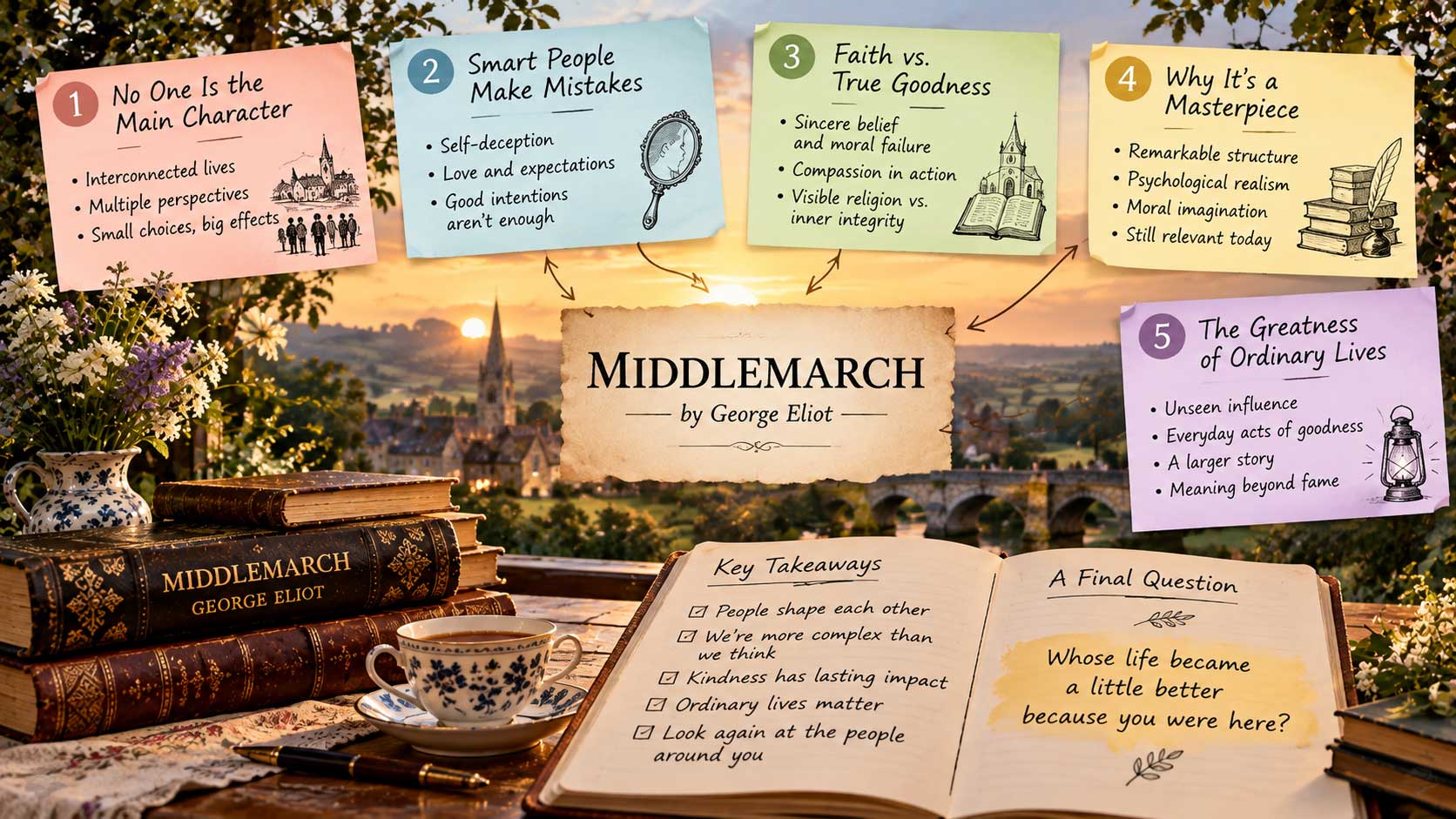
At the beginning of our imaginary conversation, Gillian Beer asked a provocative question:
What if nobody in Middlemarch is truly the main character?
By the end of our five discussions, that question had become something much larger.
What if the meaning of our own lives cannot be understood without considering the lives of everyone we have touched?
George Eliot gives us characters who desperately want to become someone important.
Dorothea dreams of devoting herself to a great purpose.
Lydgate hopes to transform medicine.
Casaubon wants his scholarship to secure his intellectual legacy.
Even Rosamond imagines a future that will distinguish her from the ordinary people around her.
And yet, again and again, their ambitions collide with the reality of human relationships.
Some dreams are abandoned. Others are compromised. Some people discover happiness in unexpected places, while others spend their lives mourning the futures they never achieved.
But Eliot refuses to measure their worth by success alone.
Five Discoveries Worth Remembering
Our five imagined scholarly conversations reveal something remarkable about Eliot's understanding of life.
First, no one lives entirely alone. Our choices influence people we may never fully understand, and their choices shape our own lives in return.
Second, intelligence is not the same as wisdom. We can understand complicated ideas while remaining blind to our own motives, expectations, and mistakes.
Third, goodness requires more than noble beliefs. What matters is how we act when honesty becomes costly, when someone disappoints us, or when compassion demands something of us.
Fourth, great literature changes the way we see people. Eliot doesn't merely ask us to admire her characters. She makes us reconsider our judgments of them.
Finally, an ordinary life can have an extraordinary influence. The people who shape us most profoundly are not necessarily those whose names appear in history books.
The Question Eliot Leaves With Us
Perhaps the most moving part of Middlemarch is that Eliot does not pretend every disappointment can be redeemed.
Dorothea never becomes the public figure her youthful ambitions might have suggested.
Lydgate never fulfills the scientific promise he once imagined.
Their losses matter.
But Eliot also asks us to recognize the good that survives those disappointments.
A compassionate decision.
An honest day's work.
A moment of forgiveness.
A person who remains beside someone when everyone else has turned away.
These actions may never attract attention. They may never be recorded. Sometimes even the people who benefit from them will never understand their full significance.
And yet, they matter.
As we grow older, perhaps our understanding of achievement changes.
We may begin life asking, What great things will I accomplish?
Years later, we may find ourselves asking a different question:
Whose life became a little better because I was here?
That question does not require us to abandon ambition.
It simply reminds us that the worth of a human life cannot be measured by ambition alone.
The five scholars in our imaginary library did not arrive at a perfect agreement about Dorothea's ending, Eliot's moral philosophy, or the meaning of success.
And perhaps they shouldn't have.
Middlemarch is too rich to be reduced to a single lesson.
But one thought remained after their conversation ended.
We may never know the full consequences of the kindness we offer, the patience we practice, or the love we give.
We may never know how far those small acts travel through other lives.
And perhaps that is all right.
Because a life does not have to be famous to be meaningful.
It does not have to be perfect to be good.
And it does not have to be remembered by the world to have helped make the world a better place.
Short Bios:
About the Scholars
Dame Gillian Beer is Emeritus Professor of English Literature at the University of Cambridge and a distinguished scholar of nineteenth-century literature and the relationship between science and storytelling. Her influential book Darwin's Plots: Evolutionary Narrative in Darwin, George Eliot and Nineteenth-Century Fiction explores how scientific ideas interact with literary imagination. In our fictional conversation, she examines the interconnected lives, shifting perspectives, and patterns of influence that make Middlemarch so remarkable.
Rosemary Ashton is Emeritus Quain Professor of English Language and Literature at University College London and a Fellow of the British Academy. A specialist in nineteenth-century intellectual and cultural history, she has written important biographies of George Eliot and George Henry Lewes. Her scholarship illuminates Eliot's intellectual development, religious questioning, and enduring concern with conscience, sympathy, and moral responsibility.
Barbara Hardy (1924–2016) was a distinguished literary critic and Emeritus Professor of English Literature at Birkbeck, University of London. Her influential The Novels of George Eliot: A Study in Form helped establish a deeper appreciation of Eliot's narrative artistry. Her criticism emphasized the relationship between literary structure, psychological insight, and human experience. In this imagined conversation, her perspective brings particular attention to Eliot's complex characters and the emotional power of her storytelling.
John Rignall is Reader Emeritus in English and Comparative Literary Studies at the University of Warwick and President of the George Eliot Fellowship. His publications include George Eliot, European Novelist and The Oxford Reader's Companion to George Eliot. His scholarship places Eliot within the wider European literary tradition, exploring how her work engages with realism, philosophical ideas, and other major novelists.
Karen Chase is Professor Emeritus of English at the University of Virginia and a scholar of Victorian literature. Her publications include Middlemarch in the Twenty-First Century, The Victorians and Old Age, and studies of character and personality in nineteenth-century fiction. In our imaginary discussion, she questions easy interpretations, explores the ambiguities of Eliot's characters, and asks why Middlemarch continues to invite fresh readings.
Editorial Disclaimer
This article is a work of creative literary interpretation. The five scholars are real individuals whose published research informs the discussion, but their conversations, dialogue, and shared setting are entirely fictional. They did not participate in or endorse this imagined exchange. The purpose is to explore George Eliot's Middlemarch through a respectful, research-informed literary thought experiment.
Leave a Reply