

Introduction
On October 14, 1926, A. A. Milne published Winnie-the-Pooh, illustrated by E. H. Shepard. A hundred years later, its characters remain among the most beloved in children's literature.
But there is something remarkable about the world these two men created.
Both had served in World War I. They belonged to a generation that had witnessed extraordinary destruction. Yet together they brought to life a little woodland where a missing tail, a burst balloon, or a friend's birthday could become an event of enormous importance.
Was the Hundred Acre Wood, in some sense, an answer to a world wounded by war?
And why do its imperfect friendships still speak so powerfully to adults living in 2026?
In Part 1 of our centennial celebration, we brought Pooh, Piglet, Eeyore, Rabbit, Owl, and a grown-up Christopher Robin together for an imaginary reunion.
Now, in Part 2, five scholars explore the deeper questions behind Milne's enduring creation.
Children's literature scholar Jean Webb and Milne biographer Ann Thwaite examine the historical world behind the books. Literary scholar Jennifer Harrison challenges our tendency to romanticize Pooh. Researcher Brené Brown explores belonging and vulnerability, while developmental psychologist Alison Gopnik considers what childhood imagination can teach adults.
Their conversation moves through three questions:
Can the Hundred Acre Wood teach us how to live peacefully despite our differences?
Why do imperfect friends sometimes offer the deepest sense of belonging?
And why does returning to childhood stories become increasingly emotional as we grow older?
The answers are not always comfortable. Even the gentlest stories contain selfishness, disappointment, and loss.
Perhaps that is why they remain so meaningful.
(Note: This is an imaginary conversation, a creative exploration of an idea, and not a real speech or event.)
Topic 1: The Peace Hidden in the Hundred Acre Wood
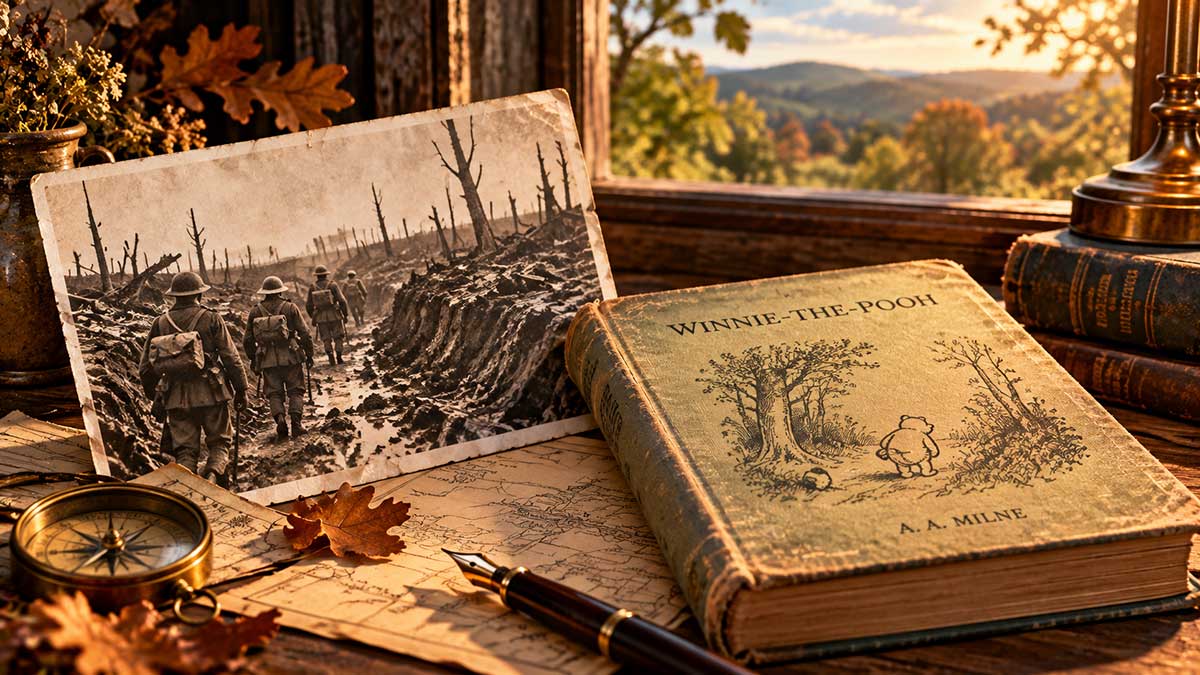
Did two men who knew the horrors of war create one of literature's gentlest worlds?
An imagined conversation featuring Jean Webb, Ann Thwaite, Jennifer Harrison, Brené Brown, and Alison Gopnik.
The Photograph Beside the Book
The room overlooked Ashdown Forest. Beyond the window, the October trees were beginning to turn gold. Five scholars sat around an old wooden table, where someone had placed a first edition of Winnie-the-Pooh beside a black-and-white photograph of soldiers on the Western Front.
For a moment, nobody spoke.
Moderator: I want to begin with these two objects. One shows a world where human beings learned to kill one another on an industrial scale. The other contains a bear who gets his head stuck in a honey pot.
Both belong to the same generation.
A. A. Milne served in the First World War. So did E. H. Shepard, who illustrated his books. They knew what modern warfare could do to human beings.
And yet, in 1926, they gave us the Hundred Acre Wood.
Was that a coincidence?
Jean Webb: I wouldn't call it a coincidence. But I would be careful about calling it a deliberate response to the war, either.
Literature emerges from the world in which its authors live. Milne belonged to a generation that had experienced an extraordinary rupture. Millions of people had died. Families had been devastated. Ideas about progress and civilization had been shaken.
Then, only a few years later, we encounter this small woodland where the greatest emergency might be a missing tail.
That contrast deserves our attention.
Ann Thwaite: It does. But I would like to protect Milne from becoming a symbol of something he may not have intended.
He was a professional writer long before Pooh became famous. He wrote plays, essays, novels, and humorous pieces. He had an established comic sensibility.
We shouldn't assume that every gentle sentence he wrote after 1918 was an attempt to heal the wounds of war.
Jennifer Harrison: And we shouldn't assume the Hundred Acre Wood is quite as gentle as we remember.
Moderator: You think we're romanticizing it?
Jennifer: I think memory has a way of polishing children's books.
Pooh is sometimes selfish. Rabbit is impatient. Eeyore can be rather unpleasant. The animals misunderstand one another constantly.
It's a funny world because its inhabitants are ridiculous.
Alison Gopnik: But isn't that precisely what makes it interesting? They're ridiculous, and they continue living together.
Jennifer: Yes. But I want us to begin with the actual stories, not the inspirational posters people have made from them.
Brené Brown: Fair enough. Though I suspect the reason those posters became popular is that people recognize something they desperately want.
Moderator: What do they want?
Brené: A place where they can be imperfect without becoming disposable.
Ann looked toward the photograph of the soldiers.
Ann: That's a powerful way to put it. But perhaps we should first ask what we actually know about the two men who made this world.
What War Leaves Behind
Moderator: Milne served in the British Army, including on the Western Front. Shepard served as an artillery officer. Both experienced the war firsthand.
Milne later wrote explicitly against war, particularly in Peace with Honour, published in 1934.
Does that strengthen the argument that the Hundred Acre Wood reflects his longing for peace?
Jean: It strengthens our understanding of his moral concerns. But it doesn't establish a direct causal explanation for Pooh.
What interests me is the emotional atmosphere.
Consider what the war did to the idea of security. A generation had discovered that ordinary life could be destroyed almost overnight.
Then consider the Wood. Its geography is intimate. There are familiar paths, recognizable homes, small adventures, and friends who are usually close enough to visit.
It is a world that feels knowable.
Alison: And that's important for children.
Children need spaces where they can explore uncertainty without being overwhelmed by it. A game can contain danger, but the danger exists within a structure that makes exploration possible.
A child pretending to encounter a dangerous animal is doing something very different from a child facing an actual threat.
In play, you can approach fear, experiment with it, and sometimes laugh at it.
Jennifer: Although Pooh's adventures are not always reassuring while they're happening.
Think of the Heffalump trap. Pooh and Piglet become frightened by something they have largely invented themselves.
The comedy depends on the distance between their perception and reality.
Alison: Exactly. That's why it's such a good example.
Ann: I also think we must remember Christopher Robin himself. The stories grew out of a particular child's toys, games, and family life.
We risk overlooking that intimate origin if we make the entire Wood an elaborate response to European history.
Moderator: So we have two possible explanations. One is that Milne created a sanctuary after war. The other is that he was writing affectionate, humorous stories inspired by his son's play.
Ann: They aren't mutually exclusive. But one is more directly documented than the other.
Jean: And historical context can matter even when an author hasn't consciously planned an allegory.
Jennifer: Yes, though I would resist the word sanctuary if it makes the books sound solemn.
The Wood is full of comic embarrassment. Pooh falls into absurd situations. Piglet panics. Owl talks nonsense with tremendous confidence.
Milne wasn't simply comforting readers. He was entertaining them.
Brené: Could humor itself be part of the comfort?
Jennifer smiled.
Jennifer: Now that's an argument I would happily entertain.
Brené: Because there's something disarming about watching someone make a fool of himself and discovering that the world doesn't end.
Pooh gets things wrong, sometimes spectacularly wrong.
And yet he is still Pooh.
Moderator: You make that sound almost radical.
Brené: For anyone who believes a mistake makes them unworthy of love, it can be.
Ann: But Pooh doesn't spend his days worrying about whether he's worthy of love.
Brené: No. That's rather the point.
A small laugh moved around the table.
Moderator: Let me ask a more difficult question. If Milne had lived a peaceful life in a peaceful century, would he still have written Winnie-the-Pooh?
Ann: We cannot know.
Jean: And I wouldn't want to claim that suffering is necessary to produce gentleness.
Jennifer: Or that war deserves credit for a beautiful children's book.
Moderator: That's an important distinction.
Jean: Very important. We can recognize the historical shadow without suggesting that the shadow created everything worthwhile that followed it.
Outside, a gust of wind lifted a few leaves against the window.
Alison: Perhaps the more useful question is not whether the war caused Pooh, but why a world like Pooh's became so valuable to readers.
Moderator: Particularly readers who had known a world very unlike it.
Alison: Yes. And readers who still do.
A World Where Nobody Wins for Very Long
Moderator: Let me bring us to something Jennifer said earlier.
The Hundred Acre Wood isn't actually free of conflict.
Rabbit becomes irritated. Eeyore complains. Pooh makes mistakes. Piglet worries. Owl thinks he knows more than he does.
So why doesn't the whole community fall apart?
Jennifer: Partly because the stories are comic. Their disagreements are generally small enough to be repaired.
We should not confuse that with a complete model of human society.
There are no wars over territory in the Hundred Acre Wood. No organized political factions. No institutions distributing power unequally.
Moderator: True. But even small disagreements can destroy real friendships.
Brené: They certainly can.
And I think we should distinguish two things: agreement and belonging.
Agreement means we share an opinion or preference.
Belonging means I have a place in a relationship or community where I can be seen as a whole person.
Those are not the same.
Ann: Though the characters do sometimes judge one another rather harshly.
Brené: Of course. Belonging doesn't mean everyone behaves beautifully.
Jennifer: Rabbit, in particular, would be a challenging dinner guest.
Alison: He'd organize the seating arrangements.
Jennifer: And then become furious when Pooh sat in the wrong chair.
Moderator: Owl would explain why the seating arrangements were historically significant.
Ann: While getting the history wrong.
The laughter this time was louder.
Moderator: But that's interesting, isn't it? We can describe their faults quite freely without deciding that any one of them should be expelled from the Wood.
Brené: Yes. And I think modern adults sometimes struggle with that distinction.
Someone behaves badly, and we immediately begin defining the entire person by the behavior.
There are circumstances where distance or boundaries are necessary. I don't want to minimize that.
But in ordinary relationships, we've become remarkably quick to turn a disagreement into a judgment of character.
Jennifer: I would challenge the word become. Human beings have always done that.
Brené: Fair correction.
Jennifer: Milne's generation certainly knew plenty about social judgment and exclusion.
Jean: But our means of expressing those judgments have changed. A disagreement that once remained between two neighbors can now become a public performance before thousands of strangers.
Moderator: So perhaps the Wood has something to offer our present moment.
Jennifer: Perhaps. But I would like to know exactly what.
Moderator: Let's take Pooh and Rabbit.
Rabbit frequently becomes frustrated with Pooh's lack of practical intelligence. Yet their relationship continues.
What can we learn from that?
Alison: One possibility is that they don't require everyone to possess the same strengths.
Rabbit plans. Pooh improvises, often badly. Piglet notices dangers. Eeyore notices disappointments.
They experience the same world differently.
And that difference is part of what makes their adventures possible.
Jennifer: Although Rabbit's plans sometimes create the problems.
Alison: Which is wonderful.
Children learn something important from stories where authority and competence are not perfectly aligned.
The character who sounds most certain isn't always correct.
Ann: Milne understood pomposity very well. He was a skilled satirist.
Moderator: And Pooh, who calls himself a Bear of Very Little Brain, sometimes seems to understand friendship better than the supposedly intelligent characters.
Jennifer: Sometimes. But let's not turn him into a secret genius.
His foolishness is real. That's why the jokes work.
Brené: Maybe he doesn't need to be a genius.
Jennifer: Precisely.
Brené: We have this habit of rescuing people from their imperfections by insisting those imperfections are actually hidden strengths.
Perhaps Pooh can simply be foolish in some ways and lovable anyway.
Moderator: That's a lovely distinction.
Jennifer: It's also more faithful to the comedy.
Jean: And it brings us back to the larger question. What kind of community can accommodate people who are not particularly impressive?
The room became quieter.
Brené: A healthier one than a community where everyone must constantly prove their value.
Ann: Provided we don't forget that the characters also have responsibilities to one another.
Moderator: Such as?
Ann: Paying attention. Helping when someone is in difficulty. Recognizing when one's own behavior has caused trouble.
Affection isn't an excuse for carelessness.
Jennifer: Pooh eating Eeyore's birthday honey comes to mind.
Moderator: We'll have to return to that.
Alison: And it's worth noticing that these stories give children room to laugh at adult-like weaknesses without concluding that people who possess those weaknesses are hopeless.
Moderator: In other words, the Wood doesn't divide everyone into heroes and villains.
Jennifer: Not usually. But again, that is partly because of its literary scale. Milne isn't asking these animals to resolve the great injustices of history.
Moderator: Perhaps he is asking them to survive a visit from Rabbit.
Jennifer: A challenge not to be underestimated.
Could the Hundred Acre Wood Survive 2026?
The moderator turned the wartime photograph face down, leaving the book open on the table.
Moderator: Let's bring this into our own century.
Imagine two longtime friends. They have known each other for forty years. They've celebrated birthdays, attended weddings, helped one another through illness.
Then one evening they discover that they have completely opposing political beliefs.
One supports a candidate the other considers dangerous. Their conversation becomes heated.
By the end of dinner, neither wants to speak to the other again.
What would the Hundred Acre Wood tell them?
Brené: I would begin by asking what happened between the disagreement and the decision to end the friendship.
Did they stop listening?
Did they begin humiliating one another?
Did they assume that a political opinion revealed everything about the other person's moral character?
Jennifer: But suppose the disagreement concerns something fundamental. Not merely a preference about taxes or transportation, but a question of another person's rights or safety.
Should friendship always survive?
Brené: No.
And I want to be clear about that.
Healthy relationships require boundaries. Some differences can be negotiated; others may involve behavior that causes genuine harm.
The idea that we must preserve every relationship at any cost is not healthy belonging.
Moderator: Then the Hundred Acre Wood has limits as a model.
Jennifer: Of course it does. It's a fictional woodland populated by toys.
Alison: But models don't have to explain everything to teach us something.
Children learn through simplified situations all the time. A pretend tea party doesn't reproduce the complexity of adult social life, but it allows children to practice taking turns, recognizing another person's intentions, and repairing misunderstandings.
Jean: The same may be true of literature.
The Wood doesn't tell us how to resolve every moral or political dispute.
It gives us a small imaginative space in which we can observe what happens when people with different temperaments remain in one another's lives.
Ann: And perhaps it asks something modest of us.
Not to become Pooh or Piglet, but to remember that another person may have qualities beyond the one that currently irritates us.
Moderator: Suppose the two friends return to the dinner table.
One says, "I still think you're completely wrong."
The other replies, "I think you're wrong too."
Then what?
Brené: Perhaps one of them says, "But I don't want to lose forty years of friendship without trying to understand you."
Jennifer: That's admirable. But it must be genuine. We shouldn't use sentimental language to avoid confronting what the disagreement actually means.
Brené: Agreed.
Alison: There's another possibility. They may discover that their beliefs are rooted in different fears.
One fears losing freedom. The other fears losing security.
Understanding those fears doesn't require agreeing with the conclusions.
Jean: And it might restore a little complexity to the picture.
Moderator: Complexity?
Jean: The moment we reduce a person to a single position, we stop seeing much of the person.
That doesn't mean every position is equally defensible.
It means that human beings are generally larger than any one argument.
Ann: Though we should also remember that some friendships do end, and sometimes for good reasons.
Moderator: So we're not offering unconditional reconciliation.
Brené: No. We're offering a better way to approach disagreement before deciding what the relationship can bear.
Jennifer: That I can support.
Moderator: Then let me ask each of you something, though I don't want five speeches.
What is the single greatest misunderstanding adults have about peace?
Jean: That peace is a natural condition which returns when conflict disappears. It often requires deliberate effort.
Ann: That gentleness means a person has never experienced suffering.
Jennifer: That a gentle story must have a simple meaning.
Alison: That cooperation requires everyone to think alike.
Brené hesitated.
Brené: That peace means never having an uncomfortable conversation.
Moderator: Why that one?
Brené: Because sometimes the conversation we're avoiding is precisely the one that could save the relationship.
Nobody answered immediately.
From outside came the faint sound of a bird calling somewhere among the trees.
Jennifer: I still worry we're asking Pooh to carry too much.
Moderator: Too much moral weight?
Jennifer: Yes. He's a bear who likes honey. He isn't a political philosopher.
Alison: Perhaps that's why people listen to him.
Jennifer: Explain.
Alison: Adults are surrounded by people telling them how to live. Experts, politicians, commentators, institutions.
Children's stories approach us differently.
They don't necessarily demand that we accept an argument. They let us watch a situation unfold.
We laugh at Pooh, and then, sometimes years later, we realize that the joke has something to do with us.
Ann: And Milne was particularly good at allowing the reader to recognize something without explaining it to death.
Jean: Which is why I would hesitate to call the Wood an explicit lesson in peace.
Its power may lie in what it allows us to feel.
Moderator: What does it allow us to feel?
Jean looked again at the old book.
Jean: That life among imperfect companions might still be good.
The Small Courage of Staying
The afternoon light had shifted. Long shadows stretched across the wooden table.
Moderator: I began by asking whether the Hundred Acre Wood was created in response to war.
We haven't reached a definitive answer.
Ann: Nor should we pretend to.
Moderator: But we have discovered something else.
A world can contain foolishness, disagreement, impatience, and fear without becoming a world of enemies.
Jennifer: Within limits. I insist on those two words.
Moderator: Within limits.
Brené: And the limits matter. We cannot ask people to tolerate cruelty simply because we admire kindness.
Alison: But we can ask whether every irritation deserves to become a permanent division.
Jean: Or whether every difference needs to become a contest.
Moderator: I keep thinking about the photograph we started with.
Millions of people were drawn into a war that transformed Europe. Eight years after the Armistice, readers encountered a little bear who couldn't always find his way home, even when home wasn't very far away.
It seems almost absurd to place those two things side by side.
Ann: Absurd, perhaps. But the contrast is moving.
Jennifer: Provided we allow the book to remain funny.
Moderator: I promise not to take the honey away from Pooh.
Jennifer laughed.
Brené: There's something else about that bear.
He doesn't seem terribly concerned with winning.
Alison: Except when there's honey involved.
Brené: Naturally.
But in relationships, he doesn't spend much time trying to establish himself as superior to everyone else.
Ann: Though he certainly enjoys being admired for his poetry.
Jennifer: Especially when the poetry is questionable.
Moderator: Then perhaps even Pooh has an ego.
Jennifer: A small one. With a considerable appetite.
The laughter faded gently.
Moderator: Suppose we could ask Milne one question today.
Not whether he intended to write an antiwar allegory. Not whether Pooh was secretly a philosopher.
Something simpler.
Why did he create a world where these strange little creatures kept finding their way back to one another?
Ann: I suspect he might give us a much less grand answer than we're expecting.
Jennifer: And probably a funnier one.
Jean: That wouldn't make the question less important.
Alison: Nor the answer.
Brené reached for her tea, which had gone cold.
Brené: You know what strikes me? We keep talking about the courage required to confront people.
But there is another kind of courage that rarely receives much attention.
Moderator: Which is?
Brené: The courage to remain kind toward someone who has disappointed you, when kindness is still possible and safe.
Not to surrender your convictions. Not to excuse harmful behavior.
Simply to refuse to turn every disappointment into contempt.
Ann closed her notebook.
Ann: That seems a reasonable thing to take from the Wood, whether or not Milne consciously intended it.
Jennifer: Yes. Though I would phrase it a little less beautifully.
Moderator: How?
Jennifer: People can be terribly irritating. Sometimes they're still worth having around.
Alison laughed.
Alison: That sounds rather like Milne.
The moderator looked through the window toward the trees.
Moderator: Perhaps the Hundred Acre Wood has survived a hundred years because it reminds us of something we know, but frequently forget.
Peace doesn't always begin with a treaty, a grand speech, or an agreement about who was right.
Sometimes it begins with the decision to knock on a friend's door again.
Even after an argument.
Even when you know they may say something foolish.
And perhaps especially when you've said something foolish yourself.
Outside, the October wind moved through the trees.
On the table, the photograph of the Western Front lay beside a book about a bear who loved honey.
For once, nobody felt the need to explain the contrast.
Editor's note: This is a fictional conversation. The participants' dialogue is imagined and does not represent actual statements or endorsements by the scholars. Historical and literary references draw on the published works and documented backgrounds of A. A. Milne and E. H. Shepard. The conversation distinguishes established facts from interpretations of the stories.
Topic 2: Why Imperfect Friends Make the Best Friends

Must we become happier, braver, or more agreeable before we deserve to belong?
An imagined conversation featuring Brené Brown, Jennifer Harrison, Alison Gopnik, Ann Thwaite, and Jean Webb.
The Birthday Presents That Went Wrong
The afternoon had grown warmer in the little room overlooking Ashdown Forest. Someone had opened a window, and the smell of damp leaves drifted inside.
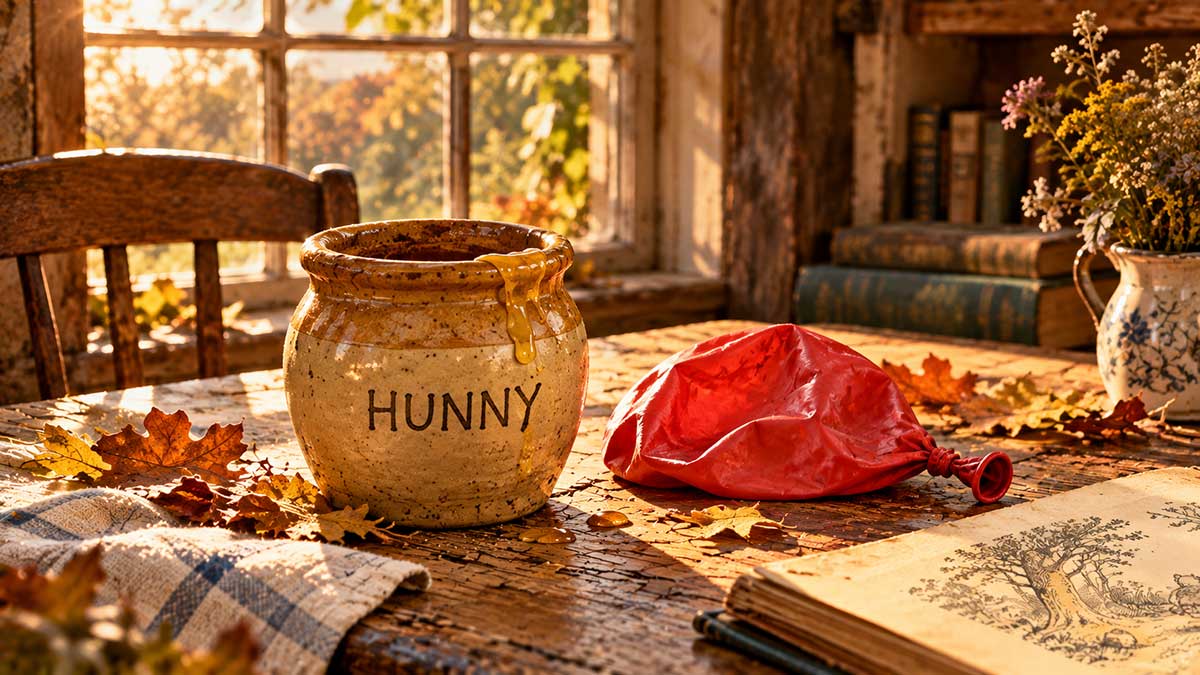
On the table, beside the first edition of Winnie-the-Pooh, sat two peculiar objects.
An empty honey pot.
And a red balloon that had lost all its air.
Moderator: I brought these because I think they represent one of the most beautiful birthday celebrations in literature.
Jennifer Harrison: Beautiful? It's a catastrophe.
Moderator: That's one way of describing it.
Jennifer: Pooh is supposed to bring Eeyore a pot of honey. He eats the honey on the way. Piglet is supposed to bring him a balloon. He falls and bursts it.
Two presents. Two failures.
Alison Gopnik: And one very happy donkey.
Jennifer: Which is the extraordinary part.
Moderator: Eeyore discovers that the burst balloon fits inside the empty pot. He puts it in, takes it out, and finds the whole arrangement surprisingly delightful.
Brené Brown: I love that scene.
Jennifer: I'm sure you do. But before we transform Pooh's appetite into a moral achievement, can we acknowledge that he ate his friend's birthday present?
Everyone laughed.
Brené: Absolutely. It was a terrible thing to do.
Ann Thwaite: And a very Pooh-like thing to do.
Moderator: Yet somehow, despite everything going wrong, Eeyore receives something that makes him happy.
Jean Webb: Because the story refuses the adult assumption that the value of a gift depends entirely on whether it fulfills its intended purpose.
Alison: Children understand that instinctively.
Give a young child an expensive toy, and sometimes the cardboard box becomes the most interesting part.
Jennifer: Though I suspect Eeyore would have appreciated the honey too.
Moderator: What interests me is that nobody arrived with a perfect gift. Nobody behaved perfectly. Yet Eeyore wasn't forgotten.
Brené: And that's where I think the emotional power lies.
Being remembered matters.
For someone who feels invisible, the knowledge that another person thought about them can be more meaningful than the thing they bring.
Jennifer: But there is a danger in making that sound too easy.
Moderator: What danger?
Jennifer: Suppose a friend forgets your birthday every year. Then one year he arrives with an empty jar and announces that his good intentions ought to be enough.
At some point, you might reasonably ask him to try harder.
Brené: Yes. Love without attention can become an excuse for carelessness.
Alison: But the story also shows that people don't always know in advance what will delight another person.
Ann: Milne allows the comedy to do the work. He doesn't interrupt to explain the moral.
Moderator: Which is precisely what we're about to do for the next hour.
Jennifer: Poor Milne.
The scholars laughed, and the moderator moved the empty pot to the center of the table.
Moderator: Let's begin with Eeyore himself.
The Friend Who Is Never Quite Happy
Moderator: Eeyore is gloomy, pessimistic, and occasionally rather ungrateful.
If he were a member of a modern friendship group, I suspect someone would eventually suggest that he needed to work on his attitude.
Brené: Someone would probably send him a motivational podcast.
Jennifer: Rabbit would organize an intervention.
Alison: Owl would deliver a forty-minute lecture on the history of optimism.
Ann: And Pooh would bring something to eat.
Moderator: Which he'd probably finish before arriving.
They laughed.
Moderator: But here's my serious question.
Why does Eeyore continue to belong?
He doesn't become cheerful. He doesn't transform himself into a positive thinker. He doesn't seem especially interested in personal growth.
Yet the others keep visiting him.
Brené: I think we need to distinguish between belonging and approval.
Belonging means that your place in a relationship isn't constantly being put up for reconsideration every time you disappoint someone.
Approval is different. Your friends may disapprove of something you say or do.
A healthy friendship can contain both acceptance and disagreement.
Jennifer: That's a useful distinction, but I'm not entirely convinced Eeyore is the best example of unconditional acceptance.
He's not simply sad. He's often sarcastic. He sometimes seems to enjoy making the others feel guilty.
Moderator: Are you suggesting that Eeyore is manipulative?
Jennifer: I'm suggesting that Milne wrote a comic personality, not a clinical portrait.
We should resist the temptation to turn every fictional character into a diagnosis.
Eeyore is funny partly because he can make even a pleasant occasion sound like an insult.
Alison: And children can recognize that sort of behavior without needing to label it.
They know what it's like when someone complains constantly.
They also know what it's like to be the person who feels left out.
Fiction lets them occupy both positions.
Jean: That's important. A reader may laugh at Eeyore in one moment and sympathize with him in another.
The story doesn't demand that we settle on a single judgment.
Moderator: But suppose Eeyore were real.
Suppose you had a friend who responded to every invitation with a complaint.
You invite him to dinner, and he complains about the food.
You remember his birthday, and he suggests that nobody really cares.
You try to cheer him up, and he tells you that cheering up is pointless.
How long would you keep trying?
Brené: That depends.
Moderator: On what?
Brené: On the relationship, the circumstances, and whether the behavior is hurting you.
I don't believe friendship requires unlimited tolerance.
You can care about someone and still say, "When you speak to me that way, it hurts."
You can offer support without accepting constant mistreatment.
Jennifer: Good. Because sometimes discussions of kindness become discussions of how much unpleasant behavior a decent person ought to endure.
Ann: And the original stories are much more observant than that. Milne doesn't pretend Eeyore is easy company.
Moderator: So what makes the difference between accepting a difficult friend and enabling difficult behavior?
Brené: Whether you're being honest.
Acceptance says, "You matter to me even when you're struggling."
Enabling says, "Because you matter to me, I won't acknowledge the consequences of what you're doing."
Those are very different.
Alison: There's another dimension. People behave differently depending on the relationships around them.
Sometimes a person who appears difficult in one setting becomes surprisingly generous in another.
Jennifer: Eeyore does have moments of unexpected warmth.
Alison: Exactly.
If you define him entirely by his gloom, you stop noticing those moments.
Moderator: That reminds me of something from our earlier conversation.
We talked about how quickly people reduce one another to a single trait.
Jean: Yes. And Milne gives us a community in which characters are recognizable but not entirely reducible to their personalities.
Jennifer: Though Rabbit might disagree.
Moderator: Rabbit would probably insist that he has several excellent qualities.
Ann: And offer to list them alphabetically.
A brief silence followed the laughter.
Moderator: I wonder how many people have lost friendships because they were going through a difficult season.
Not because they became cruel or abusive, but because they became less entertaining.
They were grieving. Or anxious. Or exhausted.
And eventually the invitations stopped.
Brené: That happens.
Sometimes people don't know how to be present with someone whose pain they can't solve.
They become uncomfortable, and they withdraw.
Moderator: Perhaps that's why Eeyore's birthday is so moving.
He hasn't earned a celebration by becoming cheerful.
Jennifer: No. But let's give Pooh and Piglet credit for something specific.
They remember him.
Ann: And they go to see him.
Jean: Which is more meaningful than simply declaring that they care.
Moderator: Maybe that's the beginning of friendship. Not finding someone easy to love, but deciding that they are still worth visiting.
Brené: Yes. Though I would add something.
Sometimes the difficult friend is us.
Nobody spoke for a moment.
Brené: We tend to picture ourselves as the patient Pooh visiting the gloomy Eeyore.
But there are seasons when we're Eeyore.
We're tired. We complain. We assume nobody understands.
And what we hope for is that our friends won't disappear before we find our way back.
Is Piglet Brave Because He Is Afraid?
The moderator picked up a small illustration of Piglet.
Moderator: Let's talk about someone very different from Eeyore.
Piglet.
He's small. He's nervous. He imagines danger everywhere.
And yet, in some of the stories, he acts with remarkable courage.
Alison: Which raises an interesting question.
Can someone be courageous if they're never afraid?
Jennifer: Certainly. Courage doesn't require visible panic.
Alison: No, but fear often makes courage easier to recognize.
If an action costs someone nothing emotionally, we may admire it for other reasons.
But when someone acts despite genuine fear, we're seeing a particular kind of achievement.
Moderator: Give me an example from ordinary life.
Alison: A child who is terrified of speaking in front of the class but stands up and gives a presentation anyway.
Or an adult who is frightened of visiting a friend in the hospital because illness reminds them of someone they've lost.
They go despite the fear.
Brené: That's where vulnerability becomes important.
Courage often requires us to accept uncertainty.
You cannot guarantee that a difficult conversation will go well.
You cannot guarantee that someone will welcome your apology.
You cannot guarantee that visiting a sick friend won't be emotionally painful.
But you can decide that the relationship matters enough to try.
Jennifer: I agree, although I want to rescue Piglet from becoming a motivational speaker.
Moderator: You don't think he'd be good at it?
Jennifer: He'd be terrified of the microphone.
Ann: And spend most of the speech apologizing for taking everyone's time.
Moderator: Which might make him the most charming motivational speaker in history.
Jennifer: Possibly. But the literary point is that his fear is genuinely comic.
Milne isn't merely disguising bravery inside anxiety. He enjoys the absurdity of Piglet's imagination.
Alison: And that's valuable.
Children don't need every frightened character to overcome fear permanently.
They need to see that fear is part of experience and doesn't have to control every decision.
Moderator: But doesn't Piglet remain afraid throughout the books?
Alison: Yes. And that's realistic.
We often tell stories as though courage is a transformation: the frightened person becomes fearless, and then the problem is solved.
But human beings rarely work that way.
You can be brave on Monday and frightened again on Tuesday.
Brené: Or brave and frightened at exactly the same moment.
Jean: There's something especially interesting about Piglet's size.
He knows he's small.
The Wood contains creatures and situations that seem enormous to him.
Yet being small doesn't prevent him from participating in the community.
Moderator: That feels relevant to adults, too.
People often think they need to become more confident before doing something meaningful.
More educated. More successful. More financially secure.
Then they'll speak up, help someone, or pursue something important.
Brené: And sometimes waiting to feel ready becomes a way of avoiding the possibility of failure.
Jennifer: Though preparation is not a bad thing.
Brené: Of course not.
But there's a difference between preparing responsibly and demanding a guarantee that you won't be embarrassed.
Moderator: I know people who are extraordinarily successful professionally but terrified of making a personal phone call.
Ann: A conversation with an estranged family member, perhaps?
Moderator: Exactly.
They can negotiate contracts worth millions, but calling a brother they haven't spoken to in five years feels impossible.
Alison: Because the emotional stakes are different.
Brené: And because they can't control the outcome.
Moderator: What would Piglet do?
Jennifer: Probably worry about it for three days.
Alison: Ask Pooh for advice.
Ann: Receive advice that wasn't especially helpful.
Jennifer: And somehow find himself making the call.
The moderator smiled.
Moderator: That's rather wonderful.
Jennifer: It is. But I want to insist on something.
Piglet's courage is moving because he remains Piglet.
We don't need him to become Christopher Robin or Rabbit or some entirely different creature.
Brené: Yes.
And that's true of people, too.
Growth doesn't always mean becoming someone else.
Sometimes it means discovering that the person you already are can do something you didn't think possible.
Moderator: Even while trembling.
Brené: Especially while trembling.
The Difference Between Fixing Someone and Loving Them
The moderator returned the empty honey pot to the middle of the table.
Moderator: I want to return to Eeyore's birthday.
Suppose someone we love is unhappy.
Our instinct is often to fix the problem.
We offer advice. We recommend books. We explain why things aren't as bad as they seem.
And sometimes the person becomes even more miserable.
Why?
Brené: Because advice can communicate something we didn't intend.
It can sound like, "Your feelings are inconvenient, and I'd like you to change them."
Jennifer: Although sometimes the advice is excellent.
Brené: Absolutely.
I'm not arguing against practical help.
I'm arguing for understanding what the person needs before deciding what to give.
Alison: Children can be surprisingly good at this, especially in play.
They may not possess sophisticated explanations of another person's emotions, but they often recognize that someone wants company, a turn with a toy, or an opportunity to participate.
Ann: And in Eeyore's case, what delights him isn't what Pooh and Piglet expected.
Moderator: He doesn't need the honey or the inflated balloon in the way they imagined.
Jennifer: Though we shouldn't overlook the joke.
The pot and the balloon fit together in a ridiculous way.
Eeyore's pleasure surprises everyone, including the reader.
Jean: Which suggests that we may not always understand another person's happiness from the outside.
Moderator: That's a beautiful observation.
Jennifer: Careful. We're approaching another inspirational poster.
Moderator: I'll try to resist.
Brené: But Jean is right.
Sometimes we decide what someone needs without asking them.
A friend is lonely, so we tell them to join a club.
A parent is grieving, so we tell them to stay busy.
A child is anxious, so we tell them there's nothing to worry about.
Those responses may be well-intentioned, but they can miss the experience of the person in front of us.
Moderator: What should we do instead?
Brené: Start with curiosity.
Ask what would help.
Listen to the answer.
And recognize that the answer may be different from what we would want in the same situation.
Alison: Or the person may not know what would help.
Brené: True.
Alison: In that case, shared activity can sometimes be useful.
You don't necessarily need to begin with a profound emotional conversation.
You might go for a walk, cook together, play a game, or sit in the same room.
Moderator: That sounds very much like the Hundred Acre Wood.
Alison: It does.
The characters are constantly doing things together, even when the activities are rather pointless.
Jennifer: Especially when they're pointless.
Ann: But the pointlessness is part of the charm.
Children's play doesn't always need an external objective.
Moderator: Adults seem to have trouble with that.
We schedule lunch to discuss business. We attend events to network. We call someone because we need information.
Even our friendships can become productive activities.
Alison: That's a significant difference between adult and childhood expectations.
Children can spend an afternoon inventing an elaborate game that produces absolutely nothing measurable.
And the afternoon may still be deeply worthwhile.
Jennifer: Pooh would certainly approve of an afternoon with no measurable results.
Moderator: Provided there was a meal.
Ann: Preferably two.
They laughed.
Then the moderator grew serious.
Moderator: Let me offer a situation.
A woman loses her husband after forty years of marriage.
Her friends want to help.
One sends her articles about grief. Another recommends counseling. Another tells her she should get out more.
All of those things might be useful.
But one friend comes over every Thursday, brings soup, and sits with her.
Sometimes they talk. Sometimes they don't.
Which friend is helping the most?
Brené: We can't know without asking the woman.
Moderator: I expected you to say the one who brings soup.
Brené: She may be doing something profoundly meaningful.
But I don't want to turn presence into another universal prescription.
Some people need company. Others need space. Some need professional support. Some need practical assistance with bills or transportation.
Real care requires attention, not a formula.
Jennifer: Thank you.
Moderator: For what?
Jennifer: For preventing us from concluding that all human suffering can be cured with a pot of honey.
Jean: Although a pot of honey might occasionally help.
Ann: If Pooh hasn't eaten it.
A ripple of laughter moved around the table.
Moderator: So perhaps the lesson isn't that presence always matters more than solutions.
It's that we should stop assuming we know what another person needs.
Brené: Yes.
And when we do get it wrong, we can acknowledge that.
Alison: Which brings us back to the birthday.
Pooh and Piglet get things wrong.
But the story doesn't end with their failures.
Jennifer: It ends with Eeyore finding pleasure in something nobody planned.
Moderator: There's a humility in that.
We can't manufacture another person's happiness.
Ann: No. And Milne understood the comic possibilities of people who believe they can.
Jean: Especially Rabbit.
Jennifer: Poor Rabbit. He's been criticized all afternoon without being invited to defend himself.
Moderator: He'd probably submit a written complaint.
Alison: In triplicate.
The Empty Pot
Outside, the light was beginning to fade.
The moderator picked up the empty pot and turned it slowly in his hands.
Moderator: I want to ask one final question.
Why does this little birthday scene stay with people?
It's not dramatic. Nobody saves the world. Nobody makes a great sacrifice.
A bear eats a present. A pig bursts another one. A donkey discovers that the remains fit together.
Why does that matter?
Ann: Because Milne knew how to make a small event reveal character.
He didn't need to announce that friendship was important.
He could show us Pooh trying, failing, and continuing.
Jennifer: And he trusted readers to enjoy the absurdity.
We shouldn't forget that the scene is genuinely funny.
Alison: It also challenges our assumptions about success.
From an adult perspective, the presents are failures.
From Eeyore's perspective, they become an unexpected source of pleasure.
The outcome doesn't match the intention, but that doesn't make it worthless.
Jean: And the community has made room for an occasion that matters to someone who often feels neglected.
Brené: That's what stays with me.
Eeyore doesn't need to become more entertaining to deserve a birthday.
Piglet doesn't need to become fearless before he can offer friendship.
Pooh doesn't need to become brilliant.
They are imperfect, and their relationships are imperfect.
But they keep making efforts to reach one another.
Jennifer: Sometimes rather inadequate efforts.
Brené: Yes.
Jennifer: I think that's important.
Because I don't want readers to come away believing that good intentions excuse everything.
Brené: Neither do I.
Moderator: Then perhaps there's a distinction between a perfect friendship and a faithful friendship.
Ann: What do you mean by faithful?
Moderator: Not necessarily a friendship without disappointment.
One in which people keep trying.
They apologize when necessary. They learn. They show up.
And they don't demand that the other person become entirely different before being worthy of care.
Jennifer: I can accept that, provided the trying is real.
Alison: And provided people are allowed to change.
Jean: And provided we recognize that no community is sustained by affection alone. It also requires consideration.
Moderator: Then we've made friendship sound rather difficult.
Ann: It often is.
Jennifer: Much more difficult than eating honey.
Brené: And much more worthwhile.
The moderator placed the pot beside the deflated balloon.
Moderator: I keep thinking about the people who don't receive birthday visits anymore.
The elderly neighbor whose friends have died.
The person recovering from illness who doesn't have the energy to be entertaining.
The family member who has become difficult to talk to.
The friend whose sadness makes everyone uncomfortable.
Perhaps the Hundred Acre Wood asks us to remember them.
Not because we can fix their lives.
Not because every relationship can or should be preserved.
But because loneliness becomes a little more bearable when someone remembers that we're still here.
Nobody spoke.
Then Jennifer reached for the balloon.
Jennifer: There's something I like about Eeyore's response.
Moderator: What?
Jennifer: He doesn't pretend the balloon isn't burst.
He doesn't pretend the pot contains honey.
He accepts both objects exactly as they are.
And then he discovers something he can do with them.
Alison: That's a lovely way of describing it.
Jennifer: Don't sound so surprised.
Alison: I was expecting you to object to the sentimentality.
Jennifer: I object to sentimentality when it replaces observation.
Here, the observation is genuinely touching.
Ann: And funny.
Jennifer: Especially funny.
Brené smiled.
Brené: Maybe that's what makes the scene so human.
Nobody gets everything right.
Nobody receives exactly what they expected.
But for a little while, everyone is glad they came.
The moderator looked at the empty pot.
Moderator: A hundred years later, we still spend so much of our lives trying to become impressive.
More successful. More confident. More attractive. More accomplished.
We worry about what we can offer other people.
Perhaps we underestimate something simpler.
Sometimes a friend doesn't need us to arrive with the perfect gift.
Sometimes they just need to hear the knock at the door.
Outside, the October wind stirred the leaves.
And on the table, the empty honey pot and the broken balloon remained exactly where they were.
Neither was what it had been meant to be.
Together, they were enough.
Editor's note: This is a fictional scholarly conversation. All dialogue is imagined and does not represent actual statements by the participants. The discussion draws on the original 1926 Winnie-the-Pooh, particularly the chapter concerning Eeyore's birthday, and on the participants' relevant areas of scholarship. Psychological interpretations are illustrative rather than clinical diagnoses.
Topic 3: The Childhood We Leave Behind, and the Love We Can Keep
Why does a story that delights children sometimes bring adults to tears?
An imagined conversation featuring Ann Thwaite, Alison Gopnik, Jennifer Harrison, Brené Brown, and Jean Webb.
Two Christopher Robins
The afternoon was slipping toward evening in the little room overlooking Ashdown Forest.
The empty honey pot and burst balloon had been moved to the windowsill. Outside, the October trees glowed in the last sunlight.
On the table lay two photographs.
One showed Christopher Robin Milne as a little boy. The other showed him as an adult, years after the world had come to know him as the child who played with a bear named Pooh.
Beside them rested two books: Winnie-the-Pooh, published in 1926, and The House at Pooh Corner, published two years later.
Moderator: We've spent the afternoon talking about friendship, imperfection, and the strange wisdom of a bear who frequently gets things wrong.
But I want to begin our final conversation with something uncomfortable.
The fictional Christopher Robin has brought happiness to millions of people.
The real Christopher Robin did not always find that happiness easy to live with.
Ann Thwaite: That's true. And it's important to distinguish the two.
The Christopher Robin in the books is a literary creation, although he was inspired by Milne's son and his toys.
The real Christopher Robin was a child who grew into a man with his own ambitions, disappointments, relationships, and complicated feelings about his parents.
Those two lives became entangled in ways that neither the child nor his father could fully have anticipated.
Jennifer Harrison: Which is something readers often forget.
We become so attached to fictional characters that we begin treating the real people who inspired them as though they belong to us too.
Moderator: Christopher Robin later wrote about the difficulties of growing up famous for being a little boy.
Ann: Yes. His autobiographical writings reveal a more complicated relationship with the books and with his father than the sentimental picture people sometimes prefer.
He experienced unwanted attention and teasing, and he struggled with being publicly identified with a childhood he wanted to move beyond.
But his life should not be reduced to a single story of resentment.
Alison Gopnik: There's something particularly difficult about having your childhood preserved for other people's enjoyment.
Most of us are allowed to outgrow the person we were at six.
Christopher Robin had millions of strangers who wanted him to remain six forever.
Brené Brown: And they weren't necessarily interested in who he became.
They loved an image of him.
Jennifer: A literary image. That's the crucial distinction.
Milne created a character who became part of other people's emotional lives. The real Christopher Robin had no obligation to remain that character.
Moderator: It's almost heartbreaking.
The world loved the childhood he was trying to leave behind.
Ann: Yes, although we should remember that he also developed a life beyond that association. He served during the Second World War, married, raised a family, and ran a bookshop.
He wasn't simply a victim of his father's success.
Moderator: So perhaps our first mistake is wanting his life to be as simple as the stories.
Jennifer: Exactly.
And our second mistake may be assuming that the stories themselves are simple.
The moderator opened The House at Pooh Corner.
Moderator: There's something I want to discuss about the ending of this book.
Christopher Robin is growing up. The games that once filled his days cannot continue in quite the same way.
For a child, that may seem perfectly natural.
But for an adult, it can be devastating.
Why?
Why Adults Cry at Children's Stories
Alison: Because children and adults experience time differently.
A young child is usually occupied with what can happen next. The world is full of possibilities.
Adults have accumulated a different kind of knowledge.
We know that some possibilities have already disappeared.
Moderator: Such as?
Alison: The house where you grew up may no longer exist. A grandparent who read to you may have died. Your children may be grown. A friendship that once seemed permanent may have faded.
An adult reading about Christopher Robin leaving his childhood behind brings all of that experience to the page.
Brené: And sometimes the sadness arrives before we understand why.
You read a story you loved as a child, expecting comfort, and suddenly you're crying.
Not necessarily because the story is tragic.
Because you recognize something you cannot get back.
Jennifer: But we should be careful about assuming that everyone remembers childhood fondly.
Brené: Absolutely.
Jennifer: For some readers, childhood was frightening or lonely. They may find the Hundred Acre Wood comforting precisely because it represents something they never had.
Jean Webb: That's an important distinction.
Nostalgia isn't always the desire to return to an actual past.
Sometimes it is longing for an imagined past, or for an emotional experience we believe childhood ought to have provided.
Moderator: Safety?
Jean: Safety. Companionship. A sense that someone is looking after you.
Alison: And the freedom to explore without every activity needing to accomplish something.
Moderator: We've talked about that before.
Alison: Because it's worth returning to.
Adults often measure time according to productivity.
Did I accomplish something? Did I earn money? Did I improve myself? Was the afternoon useful?
Children can spend an hour investigating a puddle.
Not because the puddle will advance their careers.
Because it's interesting.
Jennifer: Pooh would be quite successful at investigating puddles.
Ann: Until he fell into one.
Moderator: And then Rabbit would explain why he should have investigated it differently.
The scholars laughed.
Alison: But there's a serious point here.
Play isn't simply an inferior form of adult work. It allows children to explore possibilities, relationships, and ideas without needing to commit immediately to a practical outcome.
Adults can benefit from that openness too.
Moderator: So when we miss childhood, perhaps we're missing the freedom to be unproductive.
Alison: Sometimes.
But I wouldn't reduce childhood to that either.
Children have obligations, frustrations, fears, and complicated emotional lives.
The idea that childhood is carefree is largely an adult fantasy.
Ann: And the real Christopher Robin's experience reminds us of that.
He had an extraordinary childhood in some respects, but extraordinary doesn't necessarily mean uncomplicated.
Moderator: I wonder whether there's something selfish about nostalgia.
We remember our children when they were small, and we wish we could return to those days.
But our children may have no desire to become small again.
Brené: That's a very important observation.
Parents sometimes mourn the loss of a stage of life that their children are delighted to have outgrown.
The parent misses carrying a child in their arms.
The child is thrilled to walk independently.
Both experiences are real.
Jennifer: And neither person is wrong.
Brené: Exactly.
But love requires us to recognize that the person we love is allowed to change.
The moderator looked toward the photographs.
Moderator: So the real Christopher Robin had to grow beyond the little boy the world loved.
Ann: Yes.
And the world wasn't always eager to let him.
The Child Who Became Everyone's Memory
Moderator: Ann, I'd like to ask you something difficult.
Milne gave the world one of its most beloved literary creations.
But did that gift come at a cost to his son?
Ann: Christopher Robin's own accounts suggest that it did.
He later described the strain of having his childhood identity made public and the resentment he felt toward aspects of his relationship with his father.
But a family relationship is rarely explained by one cause.
We should not turn Milne into a villain or Christopher Robin into a symbol of permanent suffering.
Jennifer: There's also a question about artistic ownership.
Once a writer publishes a work, readers begin forming their own relationships with it.
A fictional character can acquire meanings that the author never intended.
But the real person who inspired that character still retains the right to a private life.
Moderator: That's especially relevant today.
Parents post photographs and videos of their children online. Sometimes those children become famous before they're old enough to understand what fame means.
Brené: And the audience may feel entitled to access them.
Alison: The child is developing an identity while thousands or millions of strangers are already assigning one.
That creates a complicated situation.
Children need opportunities to experiment with who they are.
They may want to be brave one day, shy the next, serious in one setting, silly in another.
A public identity can make that experimentation harder.
Moderator: Christopher Robin couldn't simply decide he was no longer Christopher Robin.
Ann: He could decide who he wanted to become, but he couldn't control what the public remembered.
Jennifer: Which is why the difference between the fictional and real person matters so much.
Moderator: Do you think readers owe the real Christopher Robin something?
Jennifer: Respect for his separate identity.
We can love the character without pretending that the real man existed to satisfy our nostalgia.
Brené: I would go further.
We should recognize that loving someone includes allowing them to become someone we didn't expect.
Moderator: Even if we miss who they used to be?
Brené: Especially then.
The moderator was silent for a moment.
Moderator: I think that's one of the hardest parts of being a parent.
When children are little, they need you constantly.
You help them get dressed. You prepare their meals. You answer questions. You hold their hands when they cross the street.
Then one day, they don't need those things anymore.
And you're supposed to be happy.
Alison: You can be happy and sad at the same time.
Moderator: But isn't that contradictory?
Alison: Not at all.
You can celebrate your child's independence while grieving the disappearance of a relationship that existed only during childhood.
The relationship hasn't necessarily ended.
Its form has changed.
Ann: And sometimes parents struggle because they interpret that change as a loss of importance.
Brené: Or a loss of identity.
If you've spent twenty years defining yourself primarily through caring for your children, their independence can leave you wondering who you are now.
Jennifer: Yet from the child's perspective, growing up is precisely what was supposed to happen.
Moderator: So what does a loving parent do?
Brené: Learns a new way to love.
Moderator: That sounds simple.
Brené: I didn't say it was easy.
Alison: It may require replacing control with curiosity.
Instead of assuming you know what your grown child needs, you begin asking.
Instead of arranging every part of their life, you become interested in the life they're creating.
Ann: And you accept that some parts of that life won't include you.
The moderator looked down.
Moderator: That's the painful part.
Ann: Yes.
Jennifer: But the alternative is to ask the child to remain small so that the parent doesn't have to change.
And that would be a terrible burden.
The room grew quiet.
Outside, the last sunlight was disappearing from the trees.
Can We Keep Wonder Without Refusing to Grow Up?
Moderator: Let me ask something more hopeful.
If we can't return to childhood, can we recover any of what made it precious?
Or is that simply another form of nostalgia?
Alison: I think we can recover certain capacities.
Curiosity, for example.
Adults often become experts at predicting what will happen. That expertise is useful, but it can also make the world seem less surprising.
Children are more willing to ask questions whose answers appear obvious to us.
Sometimes those questions reveal that our assumptions aren't as secure as we thought.
Jennifer: Pooh certainly has a talent for asking questions that expose other people's assumptions.
Although sometimes he simply hasn't understood the situation.
Alison: Both can be true.
Moderator: What about play?
Alison: Absolutely.
Adults can play music, paint, tell stories, invent games, explore unfamiliar places, or spend time with friends without demanding a measurable outcome.
We don't have to abandon responsibility to make room for play.
Jean: There's also the question of attention.
The Hundred Acre Wood is a small world.
Its residents pay extraordinary attention to relatively minor events.
A missing tail becomes an adventure. A birthday becomes a significant occasion. A visit from a friend becomes an event worth telling a story about.
Moderator: Whereas adults often overlook those things because we're occupied with larger concerns.
Jean: Sometimes rightly. Responsibilities are real.
But we may lose something when we decide that only large achievements deserve our attention.
Brené: I think relationships suffer from that.
People postpone affection.
They tell themselves they'll visit their parents when work slows down.
They'll call an old friend after finishing a project.
They'll spend more time with their children once they've achieved financial security.
Then one day they realize that the time they were postponing has passed.
Moderator: That's painful.
Brené: It can be.
But I don't want to turn it into another reason for people to feel guilty.
Most adults are trying to manage complicated lives.
The question isn't whether we've missed opportunities.
We all have.
The question is whether there's something we can do now.
Moderator: Such as?
Brené: Call someone.
Jennifer: That sounds suspiciously like an inspirational poster again.
Brené: Then make it a very specific one.
Call the friend you keep meaning to call.
Not every friend. Not everyone you've ever known.
Just one person whose voice you'd genuinely like to hear.
Alison: Or ask your grown child what they've been thinking about lately.
And listen without immediately offering advice.
Ann: Or revisit a place you loved, while accepting that it may have changed.
Jean: Or read a childhood book again, not because it will restore the past, but because you may discover something you couldn't understand the first time.
Jennifer: And please, while reading it, allow the jokes to remain jokes.
Moderator: You really are determined to protect Pooh from becoming a philosopher.
Jennifer: Someone must.
They laughed.
Moderator: Let me propose a situation.
A man in his sixties has spent most of his life working hard.
He's raised a family, built a business, and accomplished many of the things he once dreamed of doing.
But now his children are grown. His parents are aging. Some of his oldest friends have died or moved away.
He begins to wonder whether he spent too much time pursuing success and too little time enjoying the people around him.
What would you tell him?
Alison: I would ask what still interests him.
Not what he's good at. Not what he can monetize.
What genuinely makes him curious?
Brené: I'd ask which relationships he wants to nurture now.
Ann: I'd be careful not to encourage him to judge his entire life by the feelings of one difficult season.
Jennifer: And I'd remind him that nostalgia is an unreliable accountant.
It tends to exaggerate what we've lost and underestimate what remains.
Moderator: That's an interesting phrase.
Jennifer: It can make the past look like a perfect place from which we've been unfairly expelled.
But the past was never perfect.
Jean: And the present isn't necessarily empty.
Moderator: Suppose he says, "But I can't get those years back."
Ann: He'd be right.
Moderator: That's rather unsentimental.
Ann: It's also true.
Brené: And perhaps accepting that truth is what allows him to stop bargaining with the past.
He can't recover the years.
But he may still be able to create meaningful moments with the people who are here.
Alison: He can also discover new forms of enjoyment.
Childhood isn't the only period in which human beings can experience wonder.
Jennifer: Thank goodness.
Moderator: So the goal isn't to become a child again.
Alison: No.
It's to remain capable of discovery.
The Place We Cannot Return To
The moderator turned to the final pages of The House at Pooh Corner.
Moderator: There's something about the ending of this book that has always troubled me.
Christopher Robin is growing older.
We understand that he can't remain in the Hundred Acre Wood forever.
And yet we want him to.
Jennifer: That's one of the tensions that gives the ending its power.
The reader knows that growing up is inevitable, but the fictional world makes us wish time could be suspended.
Ann: And because the books were inspired by a real child, the passage of time has an additional poignancy.
The real Christopher Robin did grow up.
He could not remain the boy his father had written about.
Moderator: What do you think Milne understood about that?
Ann: I would be cautious about claiming to know his private feelings from the fiction alone.
But the ending certainly acknowledges that childhood changes, and that such change can be painful even when it's natural.
Jean: It's also a remarkable example of how children's literature can speak to two audiences at once.
A child may understand that Christopher Robin has other things to do.
An adult may recognize the loss of an entire way of life.
Alison: And those readings don't cancel each other.
Moderator: Let me ask something.
Is the sadness of growing older actually a form of love?
Brené: Sometimes.
Grief often reveals attachment.
We miss what mattered to us.
But I wouldn't say every form of sadness is simply love in disguise. Human emotions are more complicated than that.
Moderator: Fair enough.
But when a parent cries while looking at an old photograph of their child, perhaps the tears aren't necessarily regret.
Brené: No.
They may be gratitude mixed with longing.
The parent is remembering something beautiful that cannot happen in quite the same way again.
Alison: And the child's growth is itself something worth celebrating.
Jennifer: Which creates a lovely contradiction.
We want the child to grow.
And we wish the child could remain small.
Ann: That's part of parenthood.
Moderator: Perhaps part of every relationship.
We want the people we love to change and flourish.
But we also want to keep the versions of them we've known.
Brené: Yes.
And mature love has to make room for both feelings.
Moderator: How?
Brené: By allowing our memories to be precious without making them demands.
You can remember holding your child's hand on the way to school.
You can treasure that memory.
But you cannot require your adult child to keep needing your hand.
The moderator looked toward the darkening forest.
Moderator: That's a difficult kind of love.
Brené: It is.
Alison: But it can also become a richer kind.
You may lose the daily closeness of early childhood and gain the possibility of knowing your child as another adult.
Someone with ideas you never taught them, experiences you haven't shared, and perspectives that may challenge your own.
Ann: Provided you're willing to listen.
Jennifer: And provided they want to talk.
Moderator: So even the most loving relationship has to accept uncertainty.
Brené: Yes.
Moderator: Pooh would not like that.
Jennifer: Pooh lives with uncertainty constantly.
He frequently has no idea what's happening.
Alison: And somehow continues.
The laughter was gentle this time.
What the Hundred Acre Wood Leaves Us
The moderator closed the book.
The room had grown dark enough that someone switched on a lamp. Its warm light fell across the two photographs of Christopher Robin.
Moderator: We've spent the day examining a hundred-year-old children's book.
We began with war.
We talked about imperfect friendship.
And now we've arrived at the sadness of growing older.
I'm struck by how much of this seems to concern one question.
What do we do when the world changes and we cannot stop it?
Jean: We learn to live within the change.
Jennifer: Though I hope we also retain the right to complain occasionally.
Ann: Eeyore would insist upon it.
Alison: And perhaps we remain curious about what the change makes possible.
Brené: While remembering what still matters.
Moderator: What still matters?
Brené: The people.
Not exclusively, of course. Work matters. Purpose matters. Justice matters. Creativity matters.
But relationships are often where those things become personally meaningful.
Jennifer: I'd resist making the books say that relationships are the only thing that matters.
Brené: I wouldn't say that.
Jennifer: Good.
Moderator: Jennifer, you've challenged nearly every comforting conclusion we've reached today.
Jennifer: Someone had to.
Moderator: Then let me ask you the final question.
After a hundred years, why do you think people still love Pooh?
Jennifer considered the question.
Jennifer: Because Milne was an exceptionally observant comic writer.
He understood vanity, anxiety, self-importance, affection, misunderstanding, and the ridiculous things people do when they think they're being sensible.
He placed those qualities inside a small imaginative world where readers could recognize them without feeling attacked.
And Shepard gave that world an unforgettable visual life.
That's more than enough reason for the books to survive.
Moderator: No grand philosophy?
Jennifer: The philosophy, if we want to call it that, emerges from the writing.
It doesn't need to be pasted over it.
Ann: I agree.
And I think we should remember that Milne created something which eventually belonged to readers in ways he could not control.
That was a gift, even if its consequences for his family were complicated.
Jean: The books also invite each generation to discover its own concerns within them.
Readers in 1926 did not live in the same world as readers in 2026.
Yet they could recognize many of the same human weaknesses and affections.
Alison: And children still understand something adults sometimes forget.
That spending time together can be worthwhile even when nothing important appears to happen.
Brené: Perhaps especially then.
The moderator glanced toward the windowsill.
The empty honey pot and deflated balloon were still there.
Moderator: I've been thinking about those birthday presents.
When we're young, we often assume that love will remain available whenever we need it.
There will always be another birthday.
Another afternoon.
Another chance to visit.
Then we grow older.
And we discover that the people we love won't always be there.
Ann: No.
Moderator: So perhaps the great tragedy isn't that childhood ends.
It's that we sometimes continue living as though time were unlimited.
Jennifer: That's a thought worth taking seriously.
Brené: But I hope we don't leave readers with regret.
Moderator: What would you leave them with?
Brené: Possibility.
If there's someone you love, and the relationship is safe and open to connection, there may still be time to reach out.
If there's something you enjoy, there may still be time to do it.
If you've become so busy that you've forgotten how to play, you can begin again.
Not because you'll recover your childhood.
Because you're still alive.
Alison: And being alive still includes the possibility of surprise.
Jean: And friendship.
Ann: And change.
Jennifer: And, occasionally, foolishness.
Moderator: Especially foolishness.
A quiet laugh passed around the table.
Then the moderator asked one last question.
Moderator: Suppose Christopher Robin could return to the Hundred Acre Wood today, not as a child, but as an old man.
Suppose Pooh were waiting beneath the trees.
What do you think Pooh would say?
Jennifer: I'm not going to invent a Milne quotation.
Moderator: I'm not asking you to.
Jennifer: Good.
Alison: Perhaps Pooh wouldn't need to say anything especially wise.
Ann: He might simply be pleased to see his old friend.
Brené: And perhaps that would be enough.
The moderator looked at the book.
Moderator: An old man returns to a place he hasn't visited in many years.
The trees seem smaller than he remembers. The paths have changed. The afternoon is almost over.
He knows he cannot become the little boy who once played there.
But somewhere among the trees, a friend is waiting.
Not to ask what he has accomplished.
Not to remind him of the years he's lost.
Not to demand that he become young again.
Simply to be glad that he has come.
Nobody spoke.
Outside, the October sky had turned a deep blue.
The moderator switched off the lamp beside the window, leaving only the light above the table.
Moderator: A hundred years ago, Milne gave us a bear who was frequently confused about the world.
Perhaps we've spent too much time trying to make him explain it.
Perhaps what we loved was never his ability to answer life's greatest questions.
It was the little world in which a frightened friend could be brave, a gloomy friend could have a birthday, and someone who had been away for a long time might still be welcomed home.
We cannot return to the Hundred Acre Wood.
Not literally.
But we can create small places like it.
At a dinner table.
On a park bench.
During a telephone call.
In a home where someone has been waiting for a visit.
And perhaps, a hundred years from now, that will still be enough to make these stories worth reading.
The scholars began gathering their papers.
Ann carefully closed the first edition.
Jennifer picked up the empty honey pot and smiled at the absurdity of it.
Alison paused at the window to look at the trees.
Brené reached for her phone.
Moderator: Someone you need to call?
Brené: Someone I'd like to hear from.
She slipped the phone into her pocket.
Brené: It can wait until we get outside.
Jennifer: Why?
Brené smiled.
Brené: Because I'd rather give them my full attention.
And together, they stepped out into the cool October evening.
Editor's note: This is a fictional scholarly conversation. All dialogue is imagined and does not represent actual statements or endorsements by the participants. Historical references to Christopher Robin Milne draw on his autobiographical writings and biographical scholarship. The farewell scene discussed here belongs to The House at Pooh Corner (1928), not the original Winnie-the-Pooh (1926).
Final Thoughts : The World We Can Still Create
A hundred years after Winnie-the-Pooh first appeared, we live in a world Milne could scarcely have imagined.
We can communicate instantly across continents, yet many people feel profoundly lonely. We have more information than ever, yet disagreements can end friendships that lasted decades.
The Hundred Acre Wood offers no magical solution.
Pooh is foolish. Piglet is frightened. Eeyore is gloomy. Rabbit is impatient. Their friendships are far from perfect.
But they keep finding reasons to return to one another.
Our scholars reminded us that kindness does not require abandoning our convictions, that accepting someone does not mean excusing harmful behavior, and that nostalgia should never prevent us from appreciating the life we still have.
Perhaps the most moving lesson came from Christopher Robin.
The real boy grew up. His life became more complicated than the stories suggested. And like every child, he had to leave parts of his childhood behind.
We cannot stop that process.
Our children grow older. Our parents age. Friendships change. Some opportunities disappear forever.
But we can still choose how we spend the time that remains.
We can visit a lonely friend, call someone we've been missing, listen without immediately offering advice, or simply enjoy an afternoon without needing to accomplish anything.
We cannot return to the Hundred Acre Wood. But we can make the world around us a little more like it.
And perhaps that is the finest way to celebrate Pooh's hundredth birthday.
Not merely by remembering the stories.
But by remembering one another.
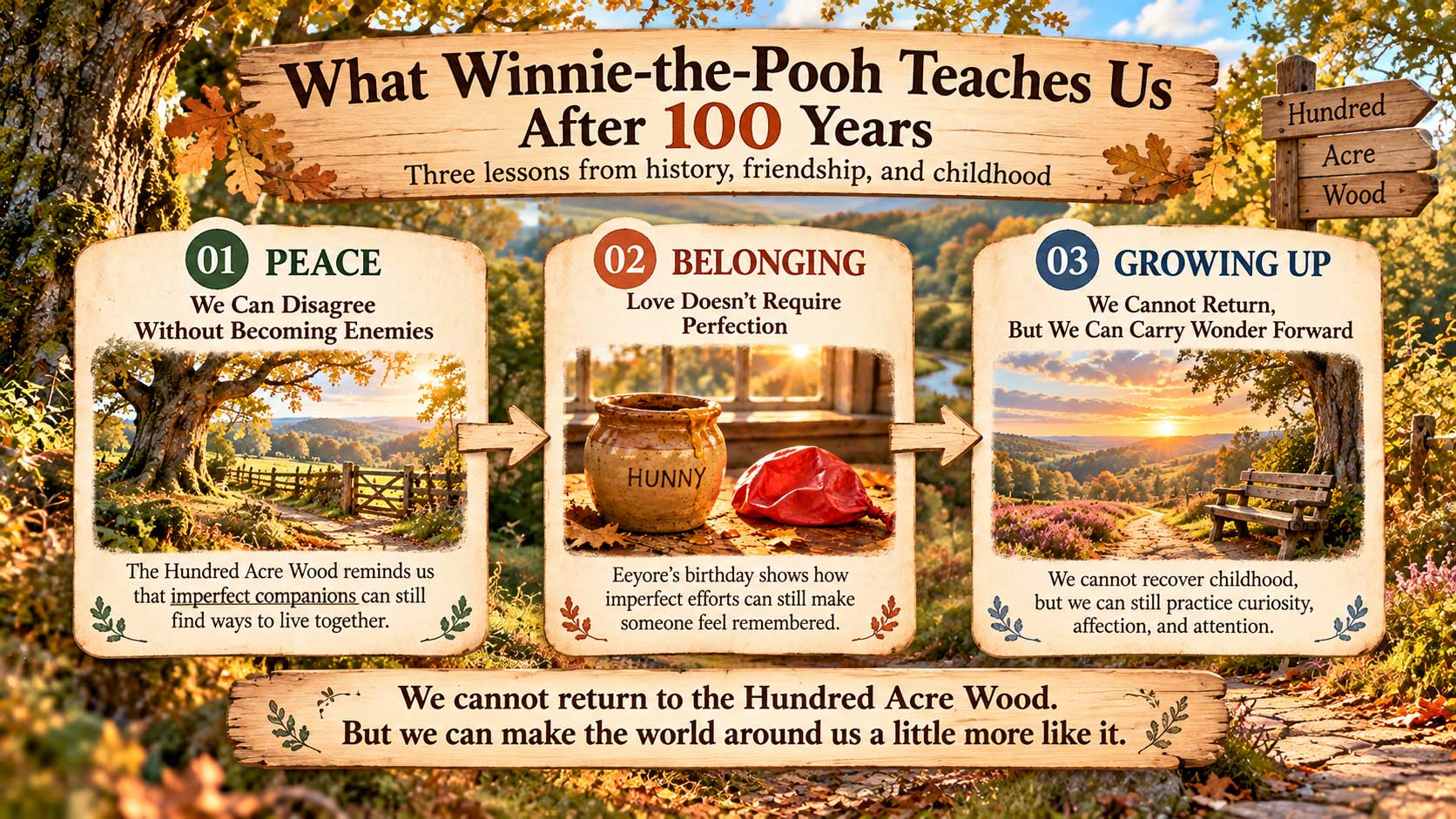
Short Bios:
Jean Webb — Children's Literature Scholar
Jean Webb is a scholar of children's literature associated with the University of Worcester. Her research explores literature's relationship with childhood, culture, and historical change, including the significance of Milne's work in its twentieth-century context.
Ann Thwaite — A. A. Milne's Biographer
Ann Thwaite is an award-winning British biographer and author of A. A. Milne: His Life. Her research provides essential historical context for understanding Milne, his family, and the complicated relationship between the real Christopher Robin and his fictional counterpart.
Jennifer Harrison — Literary Scholar
Jennifer Harrison is a literary scholar and editor associated with Positioning Pooh: Edward Bear after One Hundred Years. Her work encourages readers to consider the literary, cultural, and ethical complexity of Milne's stories beyond their familiar sentimental interpretations.
Brené Brown — Researcher and Author
Brené Brown is a researcher, bestselling author, and speaker known for her work on courage, vulnerability, shame, and belonging. Her books include Daring Greatly, Braving the Wilderness, and Atlas of the Heart.
Alison Gopnik — Developmental Psychologist
Alison Gopnik is a professor of psychology and affiliate professor of philosophy at the University of California, Berkeley. Her research examines how children learn, think, and explore through play. Her books include The Philosophical Baby and The Gardener and the Carpenter.
About the Original Creators
A. A. Milne (1882–1956) was a British author, playwright, and humorist best remembered for Winnie-the-Pooh (1926) and The House at Pooh Corner (1928). A veteran of World War I, Milne later expressed strong antiwar convictions. His stories were inspired in part by his son Christopher Robin and the child's toys.
E. H. Shepard (1879–1976) was a British illustrator and artist whose delicate pen-and-ink drawings helped define the Hundred Acre Wood. He served as an artillery officer during World War I and also illustrated Kenneth Grahame's The Wind in the Willows.
Disclaimer
This article presents an imaginary conversation created for literary exploration and education. The scholars are real individuals, but their dialogue is fictional and does not represent their actual statements, opinions, participation, or endorsements. Interpretations of Milne's intentions and the psychological meaning of his characters are presented as literary perspectives rather than established facts.
Leave a Reply