

Introduction
He was the most powerful man in the world, and he spent his nights writing notes to himself about humility.
Marcus Aurelius ruled Rome from 161 to 180, through fifteen years of plague, a decade of war on the Danube frontier, the betrayal of his best general, and the deaths of most of his children. He never wanted the throne. At sixteen, when he learned he’d been chosen, he was appalled. He wanted books, teachers, and a quiet life. Instead, he got cold army camps, lists of the dead, and the weight of an empire.
In those camps, he kept a private notebook, written in Greek and never meant for anyone’s eyes. We know it today as the Meditations, and nearly two thousand years later, it’s read by soldiers, athletes, leaders, and ordinary people searching for a steadier way to live. You can read the full text in George Long’s classic translation at MIT’s Internet Classics Archive, and his life is well summarized on Wikipedia.
But the Marcus of today’s internet is often a hardened version: the man who feels nothing and conquers everything. The real Marcus was gentler and sadder. He loved his teachers and wrote them tender letters. He wanted to pardon the general who betrayed him. He refused to investigate the rumors about his wife. And he left the empire to a son he couldn’t quite reach.
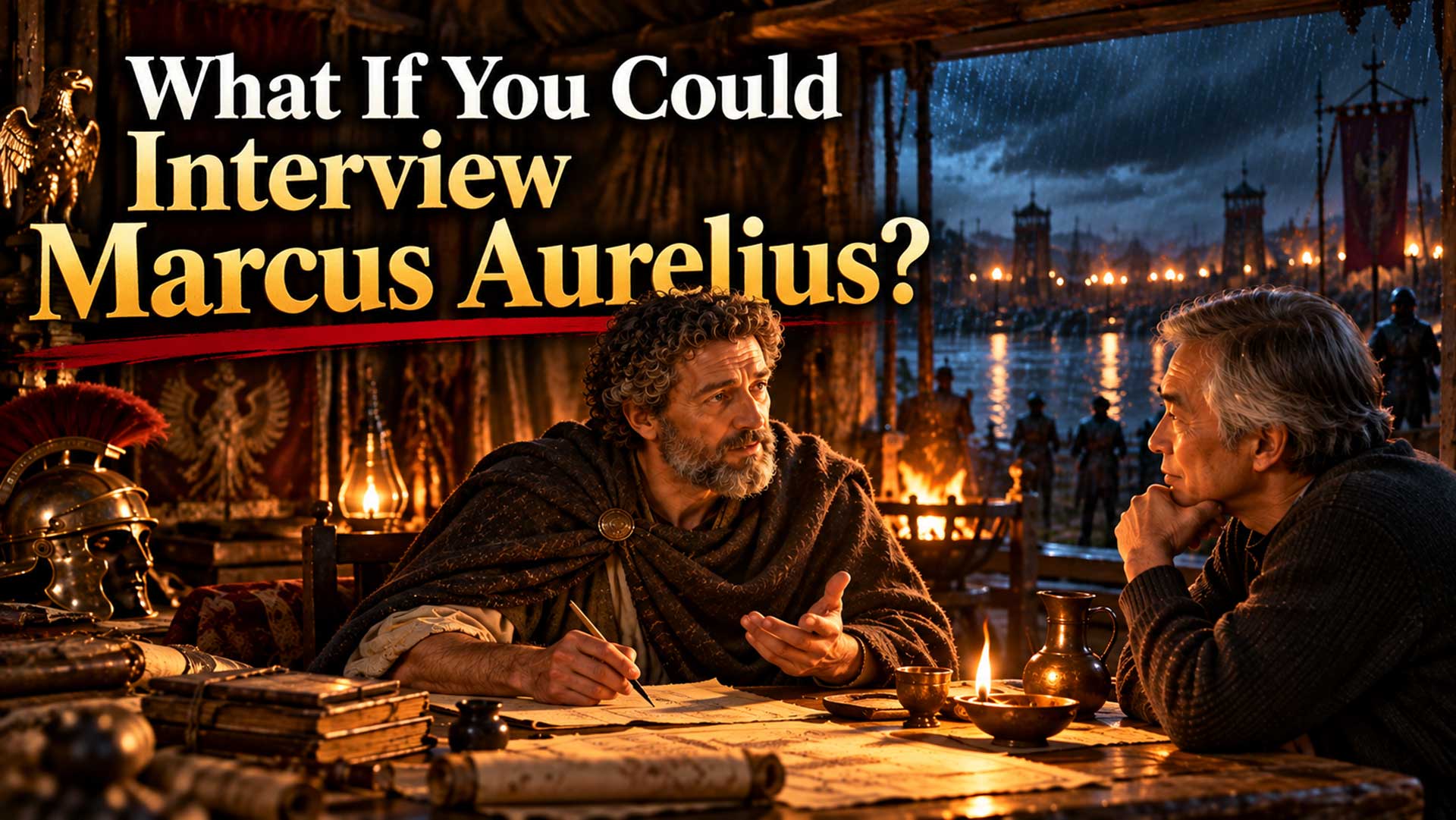
On an autumn night in 179, in the army camp at Vindobona, modern Vienna, I sat with him by a brazier as the rain came down on the Danube. He was 58, tired, and coughing. I was 65, older than he would ever be. I didn’t come to judge an emperor or win an argument. I came as a curious man, with one question of my own beside his. Marcus spent his life asking, “How can I remain peaceful in an imperfect world?” I have spent mine asking, “How can we make this world more loving?”
We talked until dawn.
This is an imaginary conversation. The historical facts have been checked; where the ancient sources are doubtful, Marcus speaks of them as stories people tell. His thoughts and feelings that night are imagined, but I hope they are true to the man.
(Note: This is an imaginary conversation, a creative exploration of an idea, and not a real speech or event.)
Topic 1: The Boy in the Philosopher’s Cloak
Rain on a wooden roof. A brazier glowing in the corner of a plain room at the army camp of Vindobona, on the Danube. Autumn, 179. At a table covered in wax tablets and loose sheets of papyrus, a thin man with a gray beard sits writing by lamplight, wrapped in a soldier’s cloak. He hears the door, raises one hand without looking up, and finishes his line.
Marcus Aurelius: Forgive me. If I stop in the middle of a thought, it runs away and I never catch it again. There. Sit, please, near the fire. You’ve come a long way, I think.
Nick Sasaki: Further than you’d believe. Thank you for letting me in so late.
Marcus Aurelius: Late is when I have time. In the day I belong to the army, the couriers, the petitions. At night, a little of me belongs to me. Not much. You’re welcome to share it.
Nick Sasaki: I’ll admit something to start. I’m sixty-five. I just realized I’m older than you are tonight.
Marcus Aurelius: Then I should be the one asking you questions. What have you learned in the seven years I haven’t had?
Nick Sasaki: That I still have more questions than answers. Which is why I’m here. I want to start with the boy, not the emperor. You lost your father when you were about three.
Marcus Aurelius: I did. I don’t remember him. I remember what people said about him. When I wrote down what I owed to each person in my life, for him I could only write: modesty and a manly character, from his reputation and from what I’m told. Imagine owing your whole debt to a man you know only through other people’s stories.
Nick Sasaki: People who lose a parent that early often grow up fast. And at about eleven, you put on a philosopher’s cloak and started sleeping on the ground. What was that boy looking for?
Marcus Aurelius: You make it sound noble. It was half noble and half a boy being stubborn. I had a teacher, Diognetus. He taught me painting, in theory. In fact, he taught me to stop caring about quails and cockfights and the nonsense of wonder-workers, and he showed me the Greek way of living simply: a plank bed, a hide, a rough cloak. I loved it at once. I think I was looking for something that couldn’t die and leave me. A man can lose a father. He can’t lose a way of living, unless he chooses to.
Nick Sasaki: So philosophy was the father you could keep.
Marcus Aurelius: I’ve never said it that way. I’d prefer to argue with you, but I can’t find a good argument. Yes. Perhaps.
Nick Sasaki: And the sleeping on the ground?
Marcus Aurelius: For a while, I was very proud of it. That’s the joke. A boy sleeps on the floor to conquer his pride, and then he’s proud of how hard his floor is.
Nick Sasaki: I’m told your mother finally talked you into a bed.
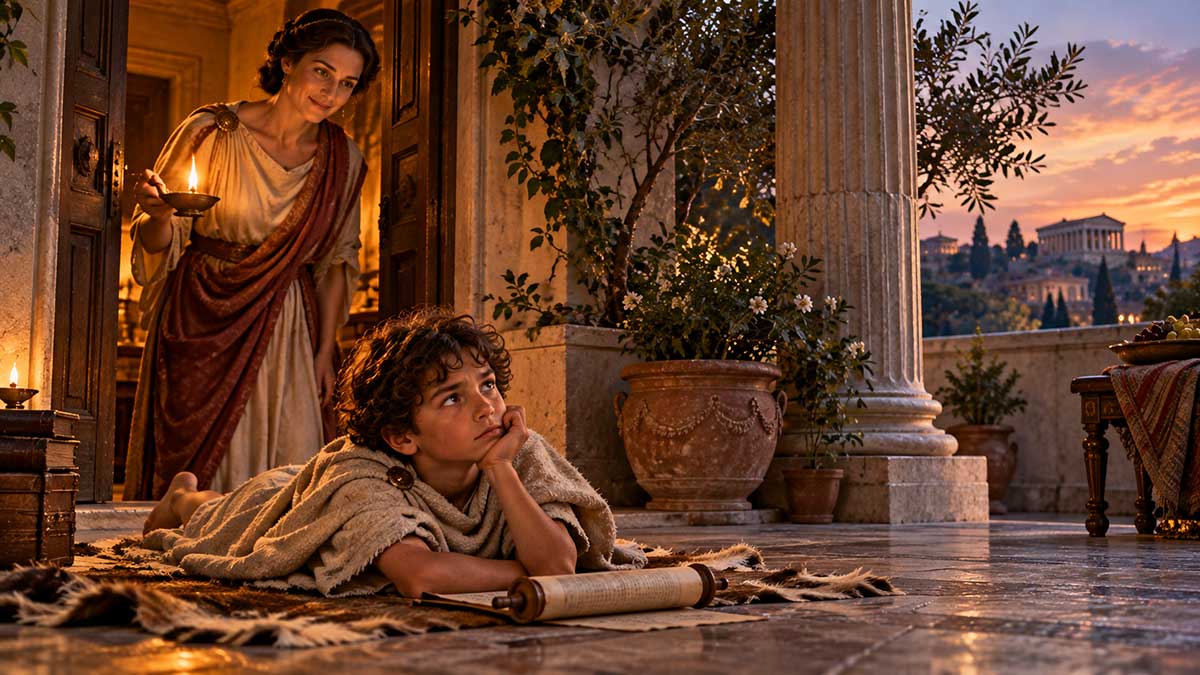
Marcus Aurelius: Who tells you these things? Yes. She didn’t scold. She just kept asking, quietly, every evening, until I was too embarrassed to refuse. My mother, Domitia Lucilla, was the wisest person in my life who never called herself a philosopher. She didn’t remarry. She had money and lived as if she had none. From her I learned not only to avoid doing wrong, but to avoid even the thought of doing it. And to live simply, far from the habits of the rich.
Nick Sasaki: It sounds like she kept you human.
Marcus Aurelius: She kept me from becoming a statue before my time. Philosophers can do that to a child: make him clever about virtue and cold about people. She wouldn’t let me. When I came in from my lessons full of grand words, she’d ask whether I’d eaten. You laugh, but that’s a teaching too. The body isn’t the enemy. The body is a servant you should treat decently.
Nick Sasaki: I think a lot of people now could use that. In my time, there are young men who read you and decide the goal is to feel nothing and need nothing.
Marcus Aurelius: Then they’ve found my floor and missed my mother. Tell them they’re allowed a bed.
Nick Sasaki: I will. What about Hadrian? He noticed you early.
Marcus Aurelius: He called me Verissimus. Most true. A play on my family name, Verus. I was a child and thought it was the finest compliment in the world. Later I wondered whether he was teasing me. Hadrian could be very kind and very sharp in the same breath. A serious little boy who sleeps on the floor is a little ridiculous, you know. He may have been laughing and praising at once.
Nick Sasaki: Did you try to live up to the name?
Marcus Aurelius: Every day. It’s a heavy thing to give a child, a word like that. You spend your life afraid of being false.
Nick Sasaki: And then, at sixteen, you found out you’d been chosen. Hadrian arranged for Antoninus to adopt you, so that one day you’d rule the world. The story goes that you weren’t happy about it.
Marcus Aurelius: I was appalled. That’s the honest word. I had my mother’s house on the Caelian Hill, my books, my teachers. I was told to move into the emperor’s household, and I went the way a man goes to his own funeral. Everyone congratulated me. I remember wanting to be left alone in a room.
Nick Sasaki: Why such dread? Most boys would have been thrilled.
Marcus Aurelius: Because I’d read enough history to know what the palace does to men. It flatters them until they can’t hear the truth. It gives them everything until they want more than everything. I was afraid of who I’d become. I still am, a little. I write myself warnings about it. Don’t be made into a Caesar. Don’t be dyed in the purple. You can see the ink isn’t dry on some of them.
Nick Sasaki: So the notes on this table are partly warnings to yourself.
Marcus Aurelius: Mostly. A good man doesn’t need to keep reminding himself to be good. I need to, so you can draw your own conclusions.
Nick Sasaki: People tell a story about that night. That you dreamed your shoulders were made of ivory, and when you were asked to carry a load, they grew stronger.
Marcus Aurelius: They tell it to make the dream sound like a prophecy. Rome loves omens. They also say that when I was a boy priest of Mars, my crown landed on the god’s head, and that this meant I’d rule. Crowns fall where they fall.
Nick Sasaki: But did you dream it?
Marcus Aurelius: I dreamed something. I was carrying a weight I couldn’t see, and I wasn’t crushed by it. I woke afraid, and then, for a moment, not afraid. I’ve thought about it more than I’d admit to my soldiers. At sixteen, I took it to mean: you’ll be strong enough. Now I’m older, and I wonder whether it meant something else.
Nick Sasaki: What else?
Marcus Aurelius: Ivory is beautiful, and it’s hard, and it’s bone. It comes from a creature that died. Perhaps a man’s shoulders become strong by carrying, but they also become less alive. Perhaps that was the price.
Nick Sasaki: You’ve carried a lot since then.
Marcus Aurelius: More than I imagined that night, and different weights than I feared. I was afraid of the palace. I should have been afraid of the plague, the river, and the dead. Nobody warned me about those.
Nick Sasaki: Let’s talk about those next, if you’re willing.
Marcus Aurelius: I’m willing. Put another log on the fire first. It’s going to be a long autumn, and an honest night needs warmth.
Topic 2: An Emperor in the Worst of Times
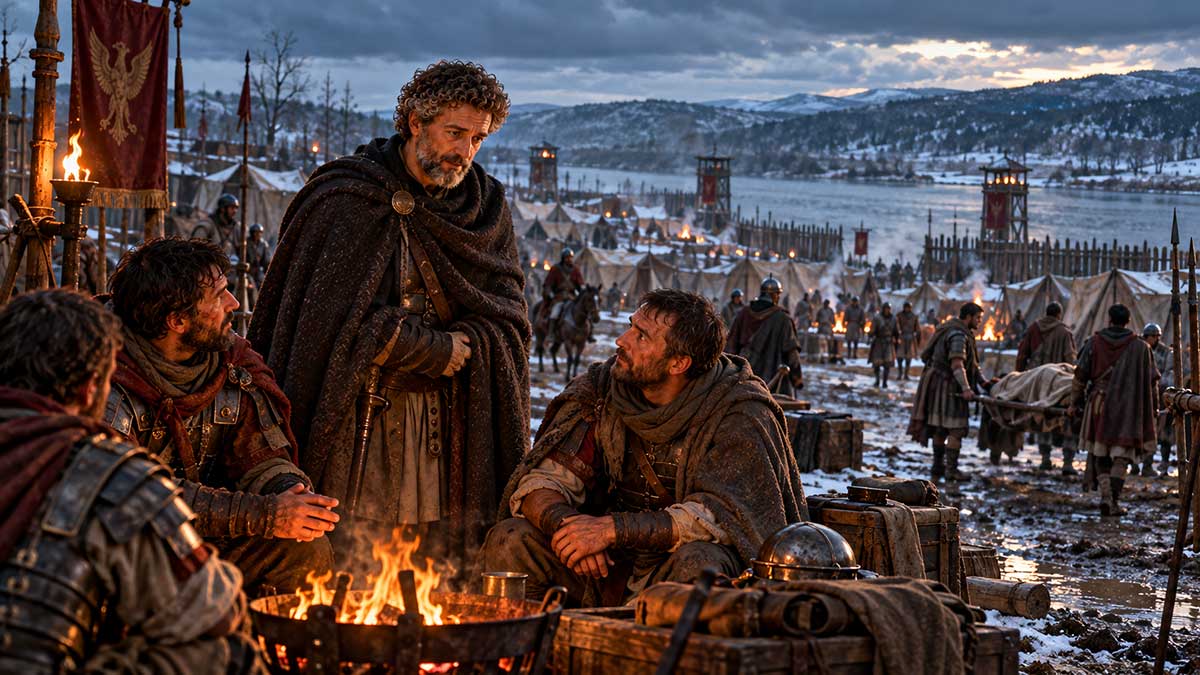
Nick adds a log to the brazier. Sparks rise and fade. Outside, a sentry calls the hour, and somewhere further off, a horse stamps in the mud.
Nick Sasaki: Before the hard years, there were the twenty years waiting. You spent most of your life as the man next in line, at Antoninus’s side.
Marcus Aurelius: The best schooling I ever had, and he never gave a single lecture. I watched him. How he listened to the end of a petition before answering. How he never hurried, and never dawdled. How he could be corrected by anyone and thank them for it. When I wrote down what I owed to people, I wrote more about him than about anyone else. I’m still trying to be half the man he was in an ordinary afternoon.
Nick Sasaki: How did he die?
Marcus Aurelius: Quietly, the way he lived. He had a fever. When the officer of the guard came for the night’s watchword, he gave him one word: aequanimitas. Equanimity. Then he turned over as if to sleep, and he was gone. That was his last order. I’ve been trying to obey it for eighteen years.
Nick Sasaki: And the very next thing you did shocked Rome. You had all the power in the world, and you gave half of it away to your brother, Lucius.
Marcus Aurelius: Adoptive brother. Antoninus raised us both. People expected me to push him aside. I could have.
Nick Sasaki: Most men who get absolute power keep every bit of it. Why didn’t you?
Marcus Aurelius: Two reasons, one good, one less good. The good one: the empire was too large for one man’s eyes, and Lucius was a capable soldier when he chose to be. Two emperors could be in two places. The less good one: I was afraid of being alone with it. Absolute power is a room with no one else in it. I wanted someone to share the room with.
Nick Sasaki: That’s honest.
Marcus Aurelius: I’ve had no time to become dishonest. The gods made sure of that. Within a year, Parthia attacked in the east and Lucius went to fight. He came back victorious, and the army brought something back with it.
Nick Sasaki: The plague.
Marcus Aurelius: It moved with the soldiers, along the roads, into every city. First a fever, then the sores, then death within days, or recovery, and nobody knew why one or the other. It came and went and came again. It’s still with us. It’s in this camp tonight. Whole units emptied. Towns where there was no one left to bring in the harvest. People in your time may know the number. I only know the faces.
Nick Sasaki: Historians estimate five to ten million dead across the empire.
Marcus Aurelius: Millions. I sign letters to families every week, and I can’t make the number mean anything. One face means something. Ten million is weather.
Nick Sasaki: And Lucius?
Marcus Aurelius: In the winter of my eighth year as emperor, he died. Probably the same sickness, though a fever is a fever and the doctors argue. I was with him on the road. We were going home. He liked good food and games and his friends, and the moralists made fun of him for it. I miss exactly those things.
Nick Sasaki: Here’s what I can’t understand. You believe everything happens according to Nature, that it’s all part of a reasonable whole. How does a man who believes that watch millions die, night after night, without either losing his faith or hardening his heart?
Marcus Aurelius: Some nights, I do neither, and some nights, I do both. You want the philosopher’s answer first?
Nick Sasaki: I want the true one first.
Marcus Aurelius: Then the true one. I don’t understand it. I tell myself that death is natural, a dissolving of the elements we’re made from, nothing for Nature to be ashamed of. I write it down so I’ll believe it. Then a courier brings me another list of names, and the writing is just ink.
Nick Sasaki: So why keep writing it?
Marcus Aurelius: Because the alternative is worse. If I let myself rage at Nature, I’ll rage at the soldiers, the doctors, the people who bring me bad news. A ruler who rages can kill a great many people with a word. I can’t stop the plague. I can stop myself from becoming a second plague. That’s the whole of my philosophy on a bad night.
Nick Sasaki: I believe in a loving God, and I’ll admit suffering like that is the hardest thing for my faith too. I don’t think the answer is to explain it away. I think it’s to stay soft enough to keep feeling it.
Marcus Aurelius: Soft. My teachers would frown at that word. But I know what you mean. A man who stops feeling it hasn’t conquered grief, he’s just let a part of himself die. That isn’t philosophy, it’s surrender wearing a philosopher’s cloak.
Nick Sasaki: And there was more grief at home. You buried so many children.
Marcus Aurelius: Faustina and I had many children, twins among them. Most of them are dead. People say I mourned one of my sons for only five days and then returned to work, and they say it as praise, or as an accusation. Five days was what the empire allowed. The mourning wasn’t finished. It just moved indoors.
Nick Sasaki: Into those notebooks?
Marcus Aurelius: Some of it. Some of it into nothing at all. There’s a line I wrote that people may know: one man prays, “How can I keep my little child?” and another prays, “How can I lose him without fear?” I wrote it because I couldn’t do it. You write the thing you need, not the thing you have.
Nick Sasaki: Then came the war here, on the river.
Marcus Aurelius: The tribes north of the Danube came across while the army was still hollowed out by sickness. They reached Italy. Italy, for the first time in centuries. So I came north, and I’ve been here, on and off, for most of ten years. Cold, mud, sieges, negotiations with men whose languages I barely speak. I’m a scholar who learned to be a general in his late forties. The soldiers laugh at me behind my back, I’m sure, and then they follow me anyway.
Nick Sasaki: And to pay for it, the story goes that you sold the palace treasures. Gold cups, statues, even your wife’s silk robes, in an auction that went on for two months.
Marcus Aurelius: The treasury was empty. I didn’t want to crush the provinces with new taxes while they were burying their dead. So yes, we sold things. People came and bid on my plates and Faustina’s clothes, and some of them later offered to give them back, and I told them they could, if they wished, and some did. A robe is a robe. A family losing its farm to a tax collector is something else.
Nick Sasaki: You wanted books and quiet. Instead, you got plague, war, and ten winters on this river. Did you ever resent the life you were given?
Marcus Aurelius: Of course. Do you think I’m made of ivory after all? Some mornings I lie there before dawn and the cold has gotten into my chest, and I don’t want to get up. I tell myself I was made to do the work of a human being, and that I’m lying here like a man made to be warm under blankets. That one’s written down too. Most of what’s on this table is me arguing with myself in the dark.
Nick Sasaki: Who wins?
Marcus Aurelius: The part that gets up. Not every day by much. But it wins. I’ve stopped asking whether I chose this life. I choose it again each morning, or I don’t. That’s all the choosing anyone gets.
Nick Sasaki: There’s a saying in my time that the obstacle becomes the way.
Marcus Aurelius: Ah. Did I say that? I believe I said something like it. Whatever blocks the work becomes the work. The plague blocks the war, the war blocks the books, and so the war becomes the book, and the plague becomes the lesson. I’d prefer the books. But I’m learning things here I’d never have learned in a library. How to be patient with frightened men. How to be wrong in front of others.
Nick Sasaki: You keep coming back to those notebooks. I’d like to tell you what happened to them.
Marcus Aurelius: Something happened to them? They’re on this table. Nobody’s supposed to see them at all.
Nick Sasaki: That’s exactly what I want to tell you about.
Marcus Aurelius: Then I’m afraid of you. Go on.
Topic 3: Begin the Morning
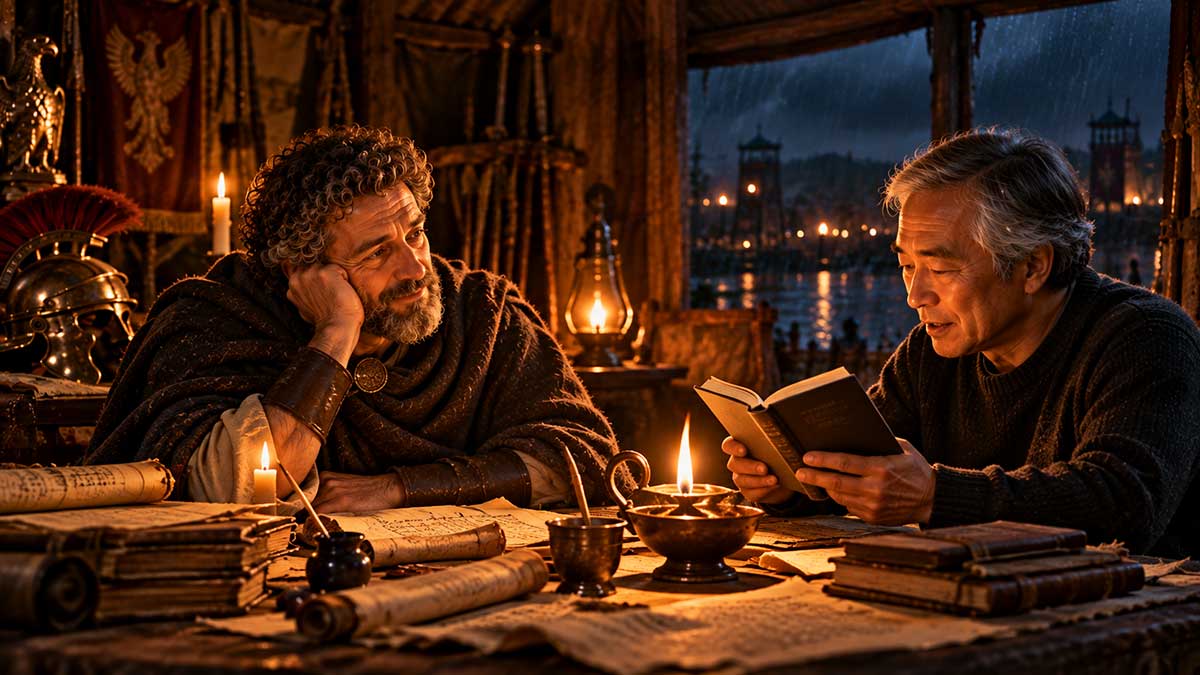
The rain has thinned to a drizzle. Marcus pulls the loose sheets on the table a little closer to himself, the way a man covers a letter when someone leans over his shoulder.
Nick Sasaki: You said nobody’s supposed to see these. I have to tell you something strange. The notes you’re writing at this table are read by millions of people in my time.
Marcus Aurelius: That isn’t strange. That’s a catastrophe.
Nick Sasaki: They survived. Barely. For more than a thousand years, they were copied by hand, and almost lost. Then, about fourteen hundred years from now, a printer in Zürich made them into a book. Today you can buy them in nearly every language. Soldiers carry them. Athletes quote them. People read them in hospital beds. One Chinese premier said he’d read them a hundred times. An American president called them a favorite.
Marcus Aurelius: A hundred times? I haven’t read them a hundred times, and I wrote them. What do they call this book?
Nick Sasaki: Usually the Meditations. Some call it by the old Greek title, “To Himself.”
Marcus Aurelius: To himself. Yes. That was the whole point. These are the words a man says to himself when he’s failing. “Stop being angry.” “Stop wanting praise.” “You’re going to die soon, act like it.” I repeat the same lessons again and again because I keep forgetting them. Anyone who reads this will see a man who couldn’t learn.
Nick Sasaki: Maybe that’s why they trust it. You’re not teaching from a mountain. You’re struggling on the ground with them.
Marcus Aurelius: Hm. I’ll accept that as consolation, not as an argument. Tell me the worst thing. There’s always a worst thing.
Nick Sasaki: There’s a famous film. A kind of play made with moving pictures, watched by millions. You’re in it. And in it, your son kills you, to take the throne.
Marcus Aurelius is silent for a moment. Then he laughs, and the laugh turns into a cough.
Marcus Aurelius: Commodus? He can barely sit through a council meeting. To murder someone, you need patience and a plan. No. He’s here in the camp, probably asleep, or probably not asleep, if he’s found a party. Tell the people who made this play that the truth is sadder and less exciting. I’m being killed by the river, my lungs, and the years.
Nick Sasaki: I’ll make sure people hear it.
Marcus Aurelius: Thank you. Even an emperor dislikes being slandered after his death. Perhaps especially an emperor. We get so little else.
Nick Sasaki: I’d like to read you something you wrote. It’s the opening of one of your books. May I?
Marcus Aurelius: You’ve come this far. I can hardly stop you.
Nick Sasaki: “Begin the morning by saying to thyself, I shall meet with the busy-body, the ungrateful, arrogant, deceitful, envious, unsocial. All these things happen to them by reason of their ignorance of what is good and evil... I can neither be injured by any of them... nor can I be angry with my kinsman, nor hate him. For we are made for co-operation, like feet, like hands, like eyelids, like the rows of the upper and lower teeth.”
Marcus Aurelius: Strange, to hear it in your voice. It sounds wiser than when I wrote it. I wrote that on a morning when I wanted to throw a cup at a senator.
Nick Sasaki: Which senator?
Marcus Aurelius: I’ll take that to my grave, and I mean that. But you chose that passage for a reason.
Nick Sasaki: I did. When I read your book, it feels like you’re always asking one question: how can I stay at peace in an imperfect world? My question has always been a little different. How can we make this world more loving? I don’t want to set them against each other. I just wonder if we’re asking the same question from two ends.
Marcus Aurelius: Say yours again.
Nick Sasaki: How can we make this world more loving?
Marcus Aurelius: “We.” You said “we.” I almost always say “I.” That’s the first difference, and it may be the important one. I was trained to tend my own garden, my own mind, because it’s the only thing truly in my power. The world is not in my power. Other people are not in my power.
Nick Sasaki: I believe that too. I can’t control anyone. I’ve learned that the hard way. But I can choose how I treat them. And sometimes that changes them anyway, not because I forced it, but because love does something control can’t.
Marcus Aurelius: So you also begin with what’s in your power. Your own response.
Nick Sasaki: Yes. But I don’t stop at peace. Peace is the beginning for me. Love is what it’s for.
Marcus Aurelius: Ah. Now I see where we really differ. For me, peace is the fortress. For you, it’s the doorway. Let me think aloud. When I wrote that passage, why didn’t I want to be angry with the busybody and the ungrateful man?
Nick Sasaki: You tell me.
Marcus Aurelius: Partly so that I could stay undisturbed. That’s true. But underneath it, look at the end: we’re made for co-operation. Hands and feet. The reason I mustn’t hate them isn’t only for my peace. It’s because they’re part of my own body, in a sense. If I hate them, I’m a hand cutting off a foot. So yes, there’s love in it. A cold kind, perhaps. Love as a duty to the whole.
Nick Sasaki: And the warm kind?
Marcus Aurelius: The warm kind I’ve known with a few people. My mother. Fronto. Antoninus. Faustina, in our good years. Lucius, who annoyed me. My children, the living and the dead. But I don’t write about that kind much. It doesn’t need instructions. It’s the cold kind I have to remind myself of, for the strangers and the people I don’t like.
Nick Sasaki: Maybe that’s where we meet. You train the cold kind so it doesn’t fail. I hope that someday it warms up.
Marcus Aurelius: That’s a fair hope. I’m not sure Nature promises it. But I’ve seen it happen, once or twice, with a man I disliked for years. You stop fighting him in your mind, and one day you find you’re fond of him. Peace made room, and something grew in the room. So perhaps your question and mine are a seed and a field.
Nick Sasaki: People in my time sometimes read you and decide the goal is to become unbreakable.
Marcus Aurelius: A promontory, yes. I wrote that too, that I should be like a headland that the waves break against while it stands firm. That’s for the storms. It’s not meant to be the whole of a man. A headland that stands firm forever is also alone forever. Nobody wants to live on a promontory. They want to live in a harbor.
Nick Sasaki: There’s one more thing I need to ask you about, and it’s delicate. In your time, there’s a small group called Christians. Many of them have died for their faith. And you wrote, in one line, that they went to death out of mere obstinacy, for show, not with dignity. Many of my readers follow that faith. I’ve learned a great deal from the teachings of Jesus myself. What did you actually know about them?
Marcus Aurelius: Very little. That’s the honest answer, and I’m not proud of it. I knew what governors reported, and what people said in the streets of Rome: that they refused to honor the gods, met in secret, and seemed almost eager to die. Some of them wrote appeals and addressed them to me, defending themselves. I confess I don’t remember reading them closely. There was a plague, and a war.
Nick Sasaki: Some scholars in my time wonder whether that line about Christians was even yours, or added later by someone copying the book.
Marcus Aurelius: Then let me not hide behind that. If I wrote it, I wrote it from outside, about people I’d never sat with. That’s exactly the mistake I warn myself against on every page: judging a man’s actions without knowing his reasons. I teach myself that people do wrong from ignorance. Perhaps I was the ignorant one there.
Nick Sasaki: If you could sit with one of them now, what would you ask?
Marcus Aurelius: I’d ask what they saw that made death look like a door rather than a wall. I tell myself death is natural, nothing to fear. I believe it on good days. They seemed to believe something more, that death wasn’t only natural but hopeful. I’d want to know where that hope comes from. And whether it’s the same thing you meant when you said love does what control can’t.
Nick Sasaki: For many of them, I think it was.
Marcus Aurelius: Then I misjudged people who were trying to answer your question while I was busy answering mine. That deserves a line in the notebook. Not tonight.
Nick Sasaki: You write a lot about forgiving people who wrong you.
Marcus Aurelius: Writing it is easy. You want to know whether I’ve done it.
Nick Sasaki: I think you know what I’m going to ask about.
Marcus Aurelius: Cassius. Yes. Pour yourself some wine, friend. That story is harder than the plague.
Topic 4: The Friend Who Betrayed Him
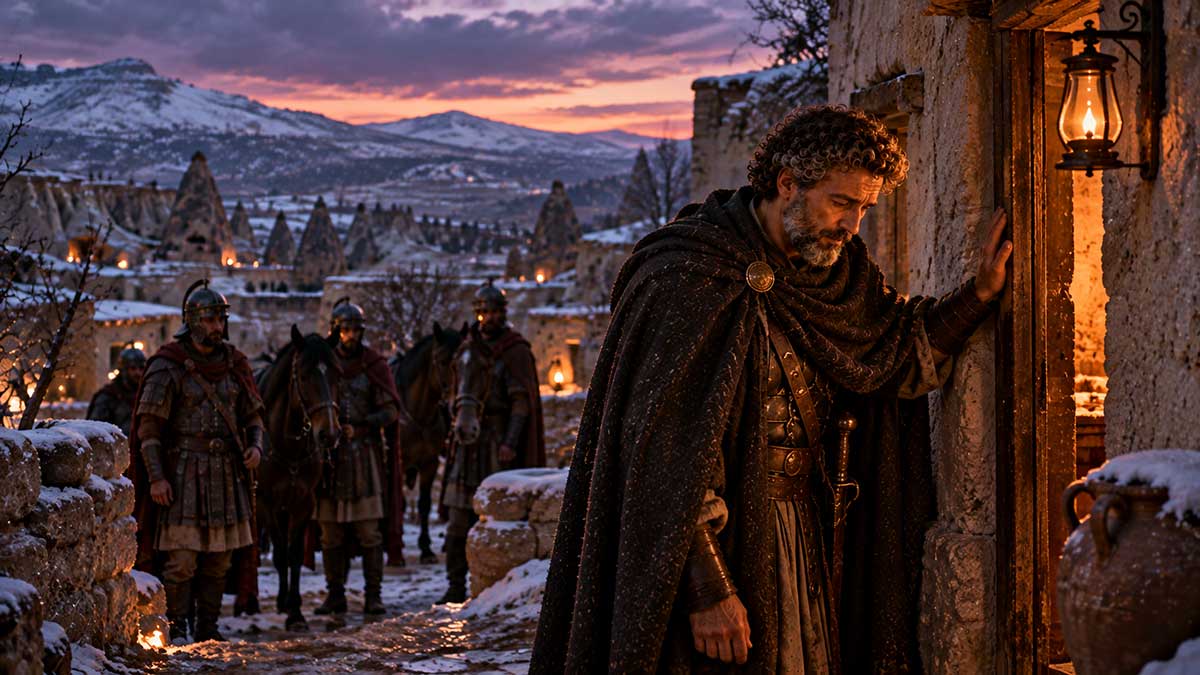
Nick pours a little wine into two clay cups. Marcus waters his heavily, the way a careful old soldier does, and holds the cup without drinking.
Nick Sasaki: Tell me who Cassius was to you, before everything.
Marcus Aurelius: The best general I had. Avidius Cassius. A hard man, Syrian-born, son of one of Hadrian’s officials. He won the Parthian war that Lucius got the credit for. He kept discipline when other commanders let their soldiers turn into tourists. I trusted him with the whole east. Egypt, Syria, the grain that feeds Rome. You don’t give a man that unless you trust him completely.
Nick Sasaki: And four years ago, he declared himself emperor.
Marcus Aurelius: On a rumor that I was dying. I was ill that spring. Someone sent word east that I was finished, and Cassius decided the throne shouldn’t sit empty for long. I can almost understand him. Almost. A man who’s held power in his hands for years, who thinks he knows better, hears that the old philosopher is dead. The empire needs a strong hand. Why not his?
Nick Sasaki: You sound like you’re defending him.
Marcus Aurelius: I’m trying to understand him. It’s the only thing that kept me from hating him. When I first heard, I wanted to march east and see his face when he learned I was alive. That was my first thought. Not philosophy. Wounded pride and a wish to frighten him.
Nick Sasaki: What did you actually do?
Marcus Aurelius: I spoke to the soldiers. I told them the truth: that this wasn’t a war I wanted, that Cassius had been a good servant, and that if he’d only come to me, I’d have given way to the empire’s good if I was truly unfit. And I said, more or less, that the only reward I wanted from this war was to forgive a man who’d wronged me and remain his friend. Some of them thought I was mad. Some of them wept.
Nick Sasaki: Then it ended suddenly.
Marcus Aurelius: Three months. One of his own centurions killed him. Ambushed him, I’m told, when word came that I was on my way. And they sent me his head.
Nick Sasaki: And you refused to look at it.
Marcus Aurelius: I ordered it buried. Somebody thought it would please me, you see. A gift. As if I’d want to look at what was left of a man I’d once trusted with my life. What was in my heart? Grief, mostly. And a strange kind of anger, but not at Cassius. At the centurion, at the gods, at the speed of it. I’d been robbed of the one thing I wanted.
Nick Sasaki: The chance to pardon him.
Marcus Aurelius: Yes. I’d written it out in my mind. Bringing him to me alive. Saying, “You were wrong, and I forgive you, and you’ll live.” Showing the empire that a betrayal could end without blood. I wanted to prove it could be done. And the sword got there first. That’s what I mean when I say I’m not in control of the world. You can prepare your heart perfectly and the world still ends the story before you get your line.
Nick Sasaki: I’ve come to believe forgiveness doesn’t mean pretending what someone did was fine. It means refusing to let resentment run the rest of your life.
Marcus Aurelius: Yes. That’s well put. And it’s also for the living. Cassius was dead. My forgiving him did nothing for him. But it did something for his children, and for the men who’d followed him, and for me.
Nick Sasaki: People in my time admire you for that. But I want to ask honestly: did that mercy cost you anything?
Marcus Aurelius: Of course. My advisers warned me that leniency invites the next rebel. A man who sees that betrayal won’t cost his family their lives may try it himself. They’re not fools. And I didn’t even save everyone. I asked the Senate not to shed blood over this, but some men were already executed before my letters arrived. One of Cassius’s sons was killed. Another was exiled. I couldn’t stop it. His daughter and her husband I could protect, and I did. That’s the record. Partial mercy. I’d prefer it were whole.
Nick Sasaki: And Cassius’s letters, the ones that might have named everyone who supported him?
Marcus Aurelius: Martius Verus took control of Syria and burned them. People are already saying I did it myself, I hear. I’ll tell you the truth: I was glad he did. I didn’t want to know. If I’d read those letters, I’d have had names. Senators who’d smiled at me in council. With names, a man starts watching faces. A man who watches faces long enough becomes a tyrant, one suspicion at a time. Not knowing was a gift. Martius gave it to me.
Nick Sasaki: The same year, you lost Faustina.
Marcus Aurelius sets the cup down. For a moment he looks at the brazier rather than at Nick.
Marcus Aurelius: On the road east. She was traveling with me, to settle the provinces after the revolt. In a village in the mountains of Cappadocia, at the foot of the Taurus, she fell ill, and she died there. I asked that the village be made a city and named for her. Faustinopolis. A poor monument, a town of mud and goats, but it was the place where I last had her.
Nick Sasaki: People in Rome said terrible things about her. And they still do, two thousand years later. That she had lovers. Even that she encouraged Cassius.
Marcus Aurelius: I’ve heard all of it. That she wrote to him, afraid that if I died, Commodus would be killed by whoever took the throne, so she tried to choose that man herself. That she had lovers among gladiators and sailors. Rome loves to imagine an empress’s bedroom. It costs nothing and it pleases everyone.
Nick Sasaki: Did you ever ask her?
Marcus Aurelius: No.
Nick Sasaki: Why not?
Marcus Aurelius: What would asking have done? If it was false, I’d have insulted the mother of my children, who’d buried as many of them as I had, and who traveled with me to cold camps when she could have stayed in Rome. If it was true, I’d have learned something I couldn’t undo. In either case, she was my wife, and I’d chosen to love her. I wasn’t going to make my love depend on an investigation.
Nick Sasaki: That’s very close to something I believe: you can’t make love conditional on the other person becoming who you want them to be.
Marcus Aurelius: Yes. And I’ll tell you the part nobody repeats. If she did write to Cassius, I know why. Fear for her son. A mother who’d buried so many children, thinking her husband was dying, imagining what happens to the boy. I can’t call that wickedness. I can call it desperation. I can call it love making a terrible mistake.
Nick Sasaki: In your notebook, you thanked the gods for her. You called her affectionate and simple, and obedient. That last word would sound odd to modern readers.
Marcus Aurelius: I suppose it would. In my world, it was praise. But don’t fix on the word. Read the other two. Affectionate, because she was, to me and to the children, in ways I wasn’t always. Simple, because for all the silk the gossips talk about, she never asked me to be anything but what I was. I wrote that line after she died. It’s not a judgment. It’s thanks.
Nick Sasaki: What do you want people to know about her?
Marcus Aurelius: That she was more than the stories. That she gave birth to at least thirteen children and stood at too many of their graves. That the soldiers called her Mother of the Camps, and she earned it, in places like this. That whatever she did or didn’t do, she was trying to protect her son. That’s all. Let them keep their gossip. I’ll keep the woman.
Nick Sasaki: Everyone who loved Commodus seems to have been afraid for him.
Marcus Aurelius: Everyone who loved him was afraid for him. And everyone who didn’t love him is afraid of him.
Footsteps sound outside, quick and careless in the mud, and a young man’s voice calls something cheerful to the sentry.
Marcus Aurelius: Speak of the son.
Topic 5: The Son Who Will Follow Him
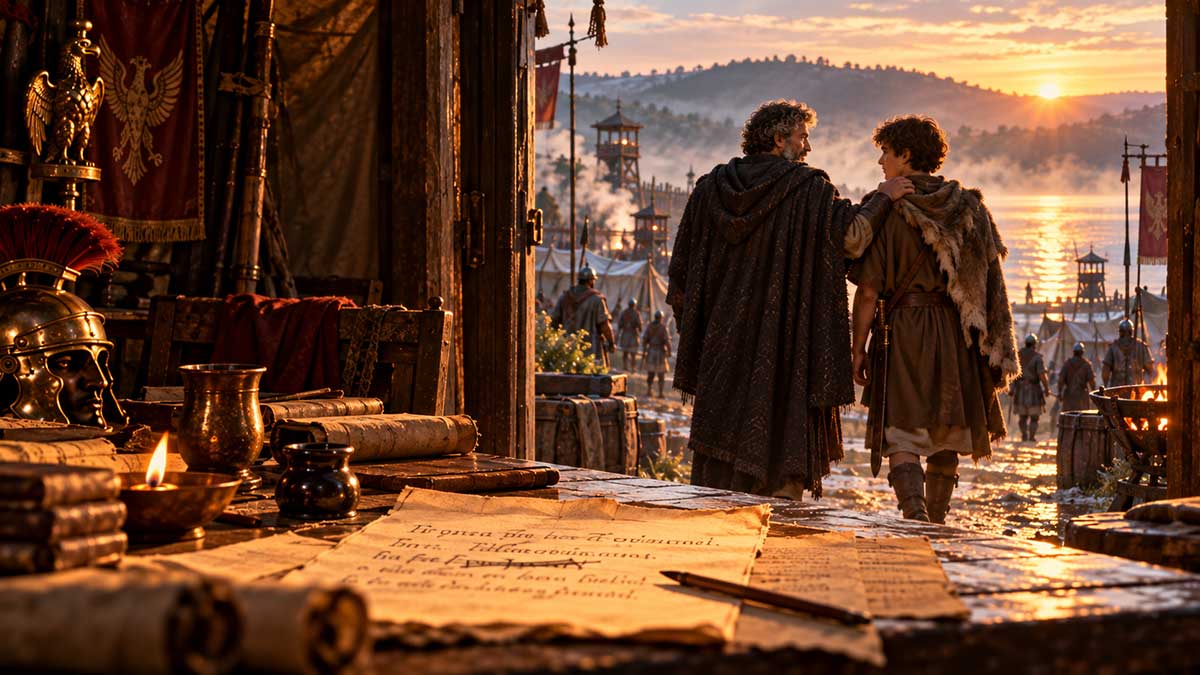
The door swings open without a knock. A tall young man of eighteen steps in, rain on his curls, a hunting cloak thrown over one shoulder. He’s handsome, easy in his body, smiling the way people smile who’ve rarely been told no.
Commodus: Father, you’re still awake. Of course you are. Who’s this?
Marcus Aurelius: A traveler. A guest. Nick Sasaki.
Commodus: Welcome, traveler. You picked the dullest camp in the empire. Mud, mud, and more mud. Father, the men are saying the Quadi will sue for terms before spring. Is it true? Because if it is, we could be in Rome for the games.
Marcus Aurelius: If it’s true, there will be terms to set, and garrisons to place, and the frontier to secure, so that we don’t have to come back in five years and do it all again.
Commodus: Others can do that. You have generals. You always say a ruler should delegate.
Marcus Aurelius: I say a ruler should know what he’s delegating. Go to sleep. We’ll talk tomorrow.
Commodus: You always say tomorrow. Goodnight, traveler. Don’t let him make you read his diary. It’s all about death.
He’s gone as quickly as he came. The door bangs in the wind. Marcus sits very still.
Marcus Aurelius: He’s not cruel, you understand. People will say he was always cruel. He wasn’t. He’s charming. He’s brave on a horse. He can make a room of soldiers laugh in a way I never could. He just doesn’t want any of this. Not the work, not the cold, not the dullness of governing. He wants to be loved, and he wants it now.
Nick Sasaki: You’ve buried so many of your children. He’s the son who lived. What’s it like to be his father?
Marcus Aurelius: It’s like holding something that was saved from a fire. You can’t hold it lightly, and you can’t hold it too tightly either, or you’ll crush what’s left. He had a twin brother. The brother died when they were small. I’ve always felt Commodus carries something of that, a sense that he was the lucky one and must enjoy his luck before it’s taken. Who could blame him?
Nick Sasaki: Hadrian and Antoninus chose their heirs from the best men they could find. You had that choice too, and you chose your son. People in my time still wonder why. I don’t want to judge it. I’d just like to understand it.
Marcus Aurelius: Then understand this first. They had no living sons. Hadrian didn’t choose an outsider over a son. He had no son to pass over. Neither did Antoninus. I have one. If I’d adopted some excellent senator and made him emperor, what happens to Commodus?
Nick Sasaki: You tell me.
Marcus Aurelius: The new emperor kills him. Perhaps not at once. Perhaps with great regret. But a living son of the last emperor is a rival with a name the army loves. Sooner or later, someone would have rallied to him, and the new man would have had no choice. I’d have been signing my son’s death sentence with the same pen I used to sign his rival’s adoption. You ask why I chose my son. I chose not to kill him. Every road led somewhere dark. I took the one where he lived.
Nick Sasaki: Did you ever doubt it?
Marcus Aurelius: Every night. Including this one.
Nick Sasaki: Can I ask something harder? You’ve trained yourself, for years, not to be disturbed by other people’s faults. People do wrong out of ignorance; bear with them; don’t let it shake you. Has that training ever made it harder to fight for him?
Marcus Aurelius doesn’t answer at once. The brazier ticks as it cools.
Marcus Aurelius: You’ve found the crack in the wall. Yes. I think so. When he was younger and I saw something in him I didn’t like, a cruel joke, a laziness, a hunger for applause, I’d tell myself what I tell myself about every man: it’s his ignorance, not mine to control, I must not be disturbed. And I wasn’t disturbed. I stayed calm. I gave him the finest teachers in the world. I wrote him letters from the frontier. And I wasn’t there. Ten years on this river. I disciplined my own heart and called that patience. Perhaps it was. Perhaps some of it was distance in a philosopher’s cloak.
Nick Sasaki: I’ve come to believe that accepting someone isn’t the same as giving up on them. You can love someone as they are and still keep showing up.
Marcus Aurelius: That’s the difference I missed. I accepted him the way I accept the weather. You can’t argue with the weather. But a son isn’t weather. A son needs you to argue with him, and laugh with him, and lose your temper sometimes, so he knows you care enough to lose it. My mother didn’t accept me sleeping on the floor. She didn’t rage either. She just kept coming back, every evening, until I came in out of my stubbornness. I needed that. And I didn’t do it for him. I was busy being calm.
Nick Sasaki: Is it too late?
Marcus Aurelius: You’re asking a man who may not see another autumn. I don’t know. He’s eighteen. At eighteen, I was nothing yet. People change. I’ve seen it. And I’ve seen them not change. I don’t know which he’ll be. I’ve heard what my critics will say: that history goes from gold to iron after me. Perhaps it does. Perhaps they’ll be right. I won’t be here to see.
Nick Sasaki: The night you were adopted, you dreamed your shoulders were made of ivory, and grew stronger under a burden.
Marcus Aurelius: You remember that.
Nick Sasaki: Soon, you’ll hand that burden to him. If you could tell him one thing he’d truly hear, what would it be?
Marcus Aurelius closes his eyes. When he speaks again, his voice is lower.
Marcus Aurelius: Not advice. He’s heard all my advice. He can recite my maxims better than I can, and he laughs at them. I’d tell him: you don’t have to be me. I never wanted you to be a copy of me. Be yourself, but be kind when nobody’s watching. That’s all the empire really needs. Not a philosopher. A man who’s kind when nobody’s watching.
Nick Sasaki: Have you said that to him?
Marcus Aurelius: No. I’ve written it, I think. Somewhere in these. But a father’s notebook isn’t the same as a father’s voice. You’ve made me see that tonight. I don’t thank you for it. It’s a hard thing to see at fifty-eight.
Nick Sasaki: Tomorrow, then.
Marcus Aurelius: Tomorrow. He’s right, you know. I always say tomorrow. Perhaps this time I’ll mean it.
Outside, the rain has stopped. A gray line of light shows under the door. Somewhere down by the river, a trumpet sounds the change of the watch. Nick stands.
Nick Sasaki: The sun’s coming up.
Marcus Aurelius: Then you should go before the camp wakes and starts asking who you are. I wouldn’t know what to tell them.
Nick Sasaki: Tell them a traveler.
Marcus Aurelius: That’s what we all are. Go well, friend.
The door closes. Marcus sits alone at the table as the light slowly turns from gray to gold over the Danube. He sits for a long time without moving. Then he picks up his pen, draws a fresh sheet toward him, and writes. He stops after the first word, looks at it, and crosses it out. “I.” Above it, he writes another word instead, and goes on:
“We tend the quiet within so that it will hold. But a quiet that holds no one is only a wall. Make the clearing, and then do not stand in it alone. Wake him early. Walk with him by the river. Begin there.”
He sets down the pen and goes out into the morning to find his son.
Final Thoughts

I expected to meet a philosopher of calm. I found a man who had built his calm the way a soldier builds a wall, one stone at a time, every night, against grief that never stopped coming.
What surprised me most was how much love was hidden in that wall. His famous instruction to expect difficult people every morning ends not with distance but with co-operation: we are made for each other, like hands and feet. His peace was never meant to shut people out. It was meant to keep anger from poisoning his kindness. Maybe his question and mine are not rivals after all. Peace keeps love from breaking. Love keeps peace from turning cold.
The hardest moment of the night was Commodus. History has judged Marcus for leaving the empire to his son, and history may be right. But when you sit with a father rather than an emperor, the question changes. He didn’t pass his son over, because passing him over might have meant his death. He gave the boy the finest teachers in the world, and then spent ten years on a frozen frontier. In our imagined conversation, Marcus wonders whether some of his famous patience was really distance in a philosopher’s cloak. I don’t know the answer. I’m not sure he did either.
What I do believe is that accepting someone is not the same as giving up on them. We can love a person exactly as they are and still keep showing up, evening after evening, the way his mother did when she coaxed a stubborn boy off the floor and into a bed.
According to one ancient account, in his last days in March 180, when an officer asked him for the watchword, Marcus answered: go to the rising sun, I am already setting. He was sending the man to his son. Commodus became one of Rome’s worst emperors, and a historian of the time wrote that history fell from a kingdom of gold to one of iron and rust.
But the notebook survived. Copied by hand, nearly lost, and finally printed, it reached us. A father’s private words to himself became a gift to strangers he would never meet. Perhaps that’s the last lesson of the night: we don’t control what happens to the people we love, or to the world after us. We only control whether, today, we are kind when nobody is watching.
Short Bios:
Short Bios
Marcus Aurelius (121–180) was Roman emperor from 161 until his death, the last of the so-called Five Good Emperors. Trained in Stoic philosophy from boyhood, he ruled through the Antonine Plague and the long Marcomannic Wars on the Danube frontier. His private notebook, the Meditations, written in Greek during his campaigns, became one of the most widely read works of philosophy in history. He died at Vindobona or near Sirmium on March 17, 180.
Commodus (161–192) was the son of Marcus Aurelius and Faustina the Younger, and the only one of their sons to survive to adulthood. Named co-emperor in 177, he became sole emperor at 18 after his father’s death. His reign became notorious for its cruelty and excess, including his appearances as a gladiator, and ended with his assassination in 192.
Nick Sasaki is a writer and the creator and host of ImaginaryTalks.com, where he invites history’s great minds into conversations about the questions that shape a human life. Like Marcus, he believes we cannot control other people, only how we respond to them, and that the deepest questions are worked out in quiet reflection. But where Marcus sought peace in an imperfect world, Nick has always asked how we can make that world more loving. He came to the emperor’s camp on the Danube with curiosity and respect, hoping to learn what a lifetime of discipline had cost him, and what it had protected.
Leave a Reply