
Introduction
Imagine spending an entire day with one of the greatest minds in human history—and discovering that the questions he struggled with were surprisingly similar to your own.
Was Aristotle happy?
Not whether he was brilliant. Not whether he changed the world. Not whether his ideas would influence humanity for thousands of years.
Was he happy as a human being?
Did he enjoy being a father? Did he ever disappoint someone he loved? Did he feel intimidated by Plato, the teacher he admired but eventually challenged? And what did he really think about Alexander, the ambitious young prince he once taught, who was now conquering much of the known world?
These are the questions Nick Sasaki brings to Aristotle's Lyceum in Athens, around 330 BCE.
Aristotle is approximately 54 years old. Plato has been dead for nearly two decades. Alexander is campaigning far from Greece. And Aristotle is building an extraordinary intellectual community devoted to understanding almost everything—from the behavior of animals to the nature of friendship, justice, and happiness.
According to the Stanford Encyclopedia of Philosophy's account of Aristotle, his investigations extended across an astonishing range of subjects. Yet behind those achievements was a man with relationships, responsibilities, ambitions, and assumptions shaped by his own time.
And that raises a fascinating possibility.
What if we could sit across from Aristotle—not as students attending a lecture, but as two people sharing an honest conversation?
Nick doesn't want polished speeches. He wants to know what Plato was like when he wasn't teaching. Whether Alexander was a difficult teenager. Whether Aristotle's family ever grew tired of his endless questions.
And he isn't afraid to challenge the philosopher about the uncomfortable contradictions in his thinking.
After all, Aristotle's Nicomachean Ethics examines what it means to live well, while his Politics contains arguments about slavery and social hierarchy that raise profound moral questions today.
Can someone understand so much about human nature and still misunderstand other human beings?
Can a great teacher fail to influence his most famous student?
Can a man who explains happiness recognize it in his own life?
Over one extraordinary day, a conversation that begins with a fish in a courtyard gradually becomes something far more personal.
And perhaps the most uncomfortable question won't be about Aristotle at all.
It will be about us.
Disclaimer: This is an imaginative historical conversation, not an authentic interview or a record of Aristotle's personal statements. The dialogue and private recollections are fictional, informed by historical scholarship and Aristotle's surviving writings. Interpretations of his relationships, emotions, and beliefs should not be mistaken for established biographical facts.
Topic 1: The Student Who Dared to Disagree
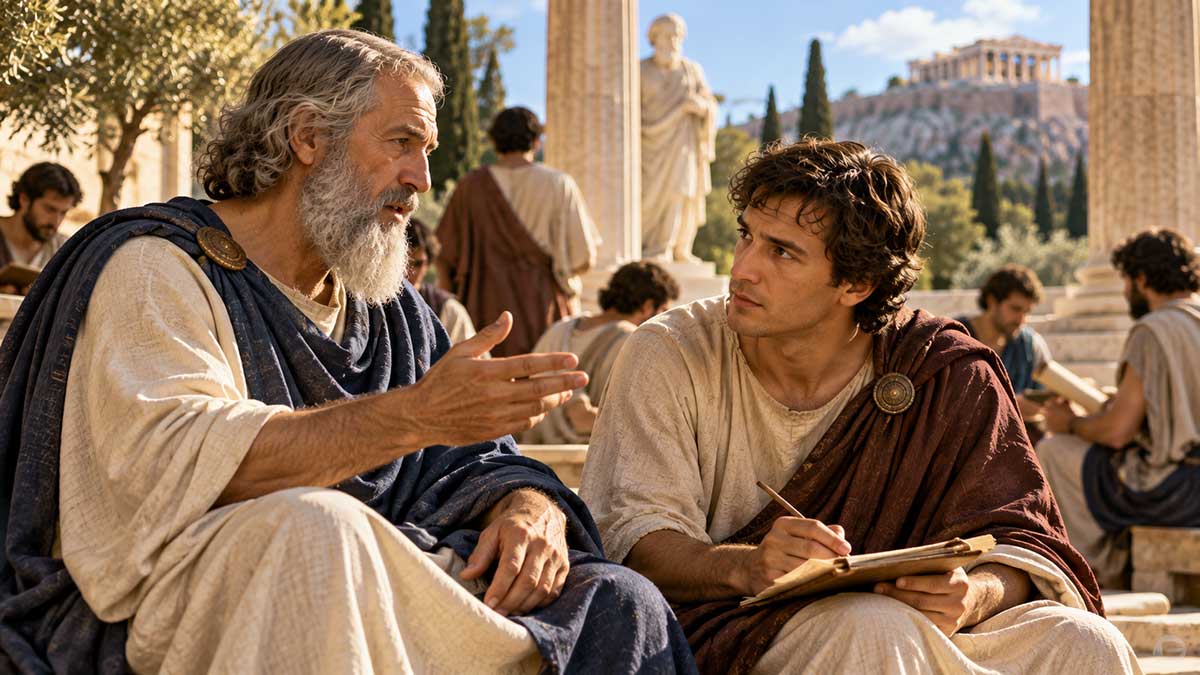
Athens, 330 BCE — The Lyceum, Early Morning
The morning sun had barely climbed above the rooftops of Athens when Nick Sasaki entered the grounds of the Lyceum.
He had expected something impressive. Perhaps a great marble hall, a gathering of scholars, or an elderly philosopher seated beneath a tree, delivering profound statements about the universe.
Instead, he found a middle-aged man with a neatly trimmed beard crouching beside a shallow basin of water.
The man was studying a small fish.
Several clay vessels stood nearby. A few scrolls lay open on a wooden bench. Beyond the courtyard, young men walked between olive trees, arguing about something Nick couldn't quite hear.
"Excuse me," Nick said. "I'm looking for Aristotle."
The man continued examining the fish.
"Why?"
"I've come a very long way to speak with him."
"About what?"
"Life. Philosophy. Happiness. Maybe a few things he hasn't been asked before."
The man finally looked up.
"Then I suggest you begin by asking a question."
Nick smiled.
"All right. Are you Aristotle?"
"Yes."
Nick stared at the basin.
"You're studying a fish?"
"At the moment."
"I was expecting you to be contemplating the mysteries of existence."
Aristotle looked down at the fish, then back at Nick.
"And what do you suppose this is?"
Nick laughed.
"Fair enough."
Aristotle gestured toward the bench.
"Sit. You have the appearance of someone who has traveled far and slept little."
"You have no idea."
"Then perhaps you should begin with breakfast rather than philosophy."
"Actually, I was hoping to spend the day with you."
"The entire day?"
"If you're willing."
Aristotle considered him.
"That depends. Are you going to ask interesting questions?"
"I'll try."
"And will you accept answers you dislike?"
Nick grinned.
"Now you're sounding like a philosopher."
"An unfortunate habit."
They laughed.
A young assistant brought bread, olives, and water. Aristotle moved the basin into the shade, washed his hands, and sat across from his unexpected visitor.
For a moment, Nick simply studied him.
This was Aristotle.
The man whose ideas would shape philosophy, science, politics, religion, and education for more than two thousand years.
Yet here he was, tearing a piece of bread and brushing crumbs from his tunic.
Nick leaned forward.
"Before we get into all your famous ideas, I want to know something."
"Go on."
"What were you like before you became Aristotle?"
Aristotle raised an eyebrow.
"I have always been Aristotle."
"You know what I mean. Before everyone knew your name. Before the books, the students, the reputation. What kind of kid were you?"
Aristotle smiled.
"Ah. You wish to investigate the philosopher as though he were one of my fish."
"Exactly."
"Then I hope you will be gentle with the specimen."
The Boy from Stagira
Nick: "Let's start at the beginning. You grew up in Stagira, right?"
Aristotle: "Yes. A town in Chalcidice, near Macedonia. Smaller than Athens, though not without its own importance."
Nick: "What was it like?"
Aristotle: "A Greek town near the sea. Hills, fields, merchants, fishermen, arguments in the marketplace. People concerned with their families, their property, their neighbors. Much like people everywhere, I imagine."
Nick: "Were you a happy kid?"
Aristotle took a moment.
Aristotle: "That is a difficult question to answer about one's childhood. Children do not spend their days evaluating whether they have achieved happiness."
Nick: "Some adults don't either."
Aristotle: "Then perhaps children are wiser than we suppose."
Nick: "Were you always curious?"
Aristotle: "I remember wanting explanations. Why one plant grows in shade while another requires sunlight. Why animals behave differently. Why people make promises they do not keep."
Nick: "That last one sounds like you were already studying human nature."
Aristotle: "Anyone who grows up among human beings has opportunities to study human nature."
Nick: "Were you a troublemaker?"
Aristotle: "What do you mean by troublemaker?"
Nick: "The kid who asks too many questions. Challenges his parents. Gets on everyone's nerves."
Aristotle: "You seem to be describing a philosopher."
Nick: "So that's a yes?"
Aristotle: "That is your conclusion, not mine."
Nick laughed.
Nick: "Your father was a physician, wasn't he?"
Aristotle: "Nicomachus. He was associated with the Macedonian royal household."
Nick: "Did you want to become a doctor like him?"
Aristotle: "I cannot say that I had settled upon a profession while I was still a boy. But the work of physicians is instructive."
Nick: "How so?"
Aristotle: "A physician cannot cure a fever merely by declaring what health ought to be. He must examine the patient. Observe symptoms. Consider causes. Distinguish what he knows from what he assumes."
Nick: "So maybe that's where you got your obsession with observation."
Aristotle: "Perhaps. But I would be cautious about explaining an entire life by one circumstance of childhood."
Nick: "You don't make it easy to draw conclusions."
Aristotle: "A conclusion should not be made easy merely because it is convenient."
Nick shook his head, smiling.
Nick: "Did you know your parents well?"
Aristotle's expression became quieter.
Aristotle: "Not for as long as I would have wished."
Nick waited.
Aristotle: "Both died while I was young. There are things one comes to understand about parents only after one is no longer able to ask them."
Nick: "Like what?"
Aristotle: "Why they made certain decisions. What they feared. What they hoped for their children. As a child, you believe your parents exist chiefly in relation to you. Later, you begin to understand that they had lives before you were born."
Nick: "That's interesting. I have five children, and I wonder how much they really know about me."
Aristotle: "Probably less than you imagine."
Nick: "Thanks."
Aristotle: "You asked."
Nick: "Do you think losing your parents young changed you?"
Aristotle: "How could it not? But I cannot tell you what sort of man I would have become had they lived. That man does not exist."
Nick: "Did you feel alone?"
Aristotle: "At times. Though I was not without people who cared for me."
Nick: "I've heard a man named Proxenus helped raise you."
Aristotle: "He took responsibility for me. I owe him gratitude."
Nick: "Did you ever feel that you had to prove yourself because you lost your parents?"
Aristotle: "You are asking me to explain motives I may not have understood even then."
Nick: "That's fair."
Aristotle: "But perhaps there is something to your question. A young person who loses familiar protections must learn that the world does not arrange itself according to his wishes."
Nick: "That sounds like a hard lesson."
Aristotle: "It is. But it is also a useful one."
Nick glanced at the students walking beneath the trees.
Nick: "And eventually you left Stagira for Athens."
Aristotle: "Yes."
Nick: "How old were you?"
Aristotle: "Approximately seventeen."
Nick: "Seventeen! You were basically a teenager."
Aristotle: "I believe that is what seventeen means."
Nick laughed again.
Nick: "Were you nervous?"
Aristotle: "Certainly. Athens was unlike Stagira. Its reputation was immense. Its intellectual life was extraordinary. I had much to learn."
Nick: "And you were going to study with Plato."
Aristotle: "Yes."
Nick: "Did you realize how famous he was?"
Aristotle: "Of course. His reputation was one reason to come."
Nick: "Were you intimidated?"
Aristotle: "I was impressed. There is a difference."
Nick: "Come on. Not even a little intimidated?"
Aristotle smiled.
Aristotle: "Perhaps a little."
Nick: "There we go. Finally, an honest answer."
Aristotle: "Have the others been dishonest?"
Nick: "No, but you've been making me work for them."
Aristotle: "Then your visit is already educational."
Meeting Plato
The courtyard was growing busier. Two students approached Aristotle with a question about a plant specimen, but he asked them to return later.
Nick noticed the easy authority with which they accepted his answer.
Nick: "When you first met Plato, was he anything like you expected?"
Aristotle: "He was a serious man. But serious does not mean incapable of humor or affection."
Nick: "What did he look like?"
Aristotle: "A man who had lived long enough to become accustomed to being questioned—and to questioning others."
Nick: "That's a very philosophical way of avoiding the question."
Aristotle: "Would you prefer that I describe his sandals?"
Nick: "Actually, yes! That's exactly the kind of thing I want to know. Everyone talks about Plato's philosophy. Nobody tells me whether he had terrible sandals."
Aristotle laughed.
Aristotle: "I regret that I cannot offer you a reliable judgment of his footwear."
Nick: "All right. Was he funny?"
Aristotle: "He could be."
Nick: "Did he laugh at his own jokes?"
Aristotle: "You seem unusually interested in the comic habits of philosophers."
Nick: "Because people imagine you all sitting around being serious all day."
Aristotle: "Then they have not spent much time among philosophers. Some of the most ridiculous arguments I have heard were delivered with the greatest solemnity."
Nick: "Now we're getting somewhere."
Aristotle: "Plato had a gift for making people question what they believed they understood. He could begin with a familiar subject and lead you toward difficulties you had never noticed."
Nick: "Like Socrates."
Aristotle: "Yes. Socrates was central to his intellectual life."
Nick: "You never met Socrates yourself."
Aristotle: "No. He died before I was born."
Nick: "But you must have heard a lot about him."
Aristotle: "Naturally. His influence was everywhere in the Academy."
Nick: "Did Plato talk about him personally?"
Aristotle: "His writings certainly did. And Socrates remained a presence in the questions we considered."
Nick: "Was Plato still grieving him?"
Aristotle paused.
Aristotle: "I cannot claim to know everything that remained in another man's heart. But some losses continue to shape a person's life long after the first grief has passed."
Nick nodded.
Nick: "I spent a day with Plato myself."
Aristotle looked at him with renewed interest.
Aristotle: "Did you?"
Nick: "Yes. We talked about Socrates, his childhood, his political failures, his relationships. It was quite a day."
Aristotle: "And what did you learn?"
Nick: "That he was much more human than I expected."
Aristotle: "You expected him to be something other than human?"
Nick: "Not exactly. But when someone becomes that famous, you forget they had ordinary problems."
Aristotle: "Then perhaps fame is an unfortunate condition. It causes others to mistake a person for a collection of ideas."
Nick: "That's exactly why I wanted to meet you."
Aristotle: "To discover whether I also possess ordinary problems?"
Nick: "Among other things."
Aristotle: "You will not be disappointed."
They both laughed.
Nick: "Tell me something. Did Plato ever get angry with you?"
Aristotle: "We disagreed."
Nick: "That's not what I asked."
Aristotle: "I noticed."
Nick: "Did you ever get into an argument where he looked at you and thought, 'This young man is driving me crazy'?"
Aristotle: "You would have to ask Plato."
Nick: "I should have."
Aristotle: "Then you have wasted an opportunity."
Nick: "Believe me, I have a long list of things I forgot to ask him."
Aristotle: "That is usually the result of a good conversation."
Nick: "Were you his favorite student?"
Aristotle laughed outright.
Aristotle: "What an extraordinary question."
Nick: "I'm serious."
Aristotle: "How would I know?"
Nick: "Didn't he ever say something that made you think you were special?"
Aristotle: "Plato valued intellectual ability. But I was not the only capable person at the Academy."
Nick: "Did you compete with the other students?"
Aristotle: "There was vigorous discussion."
Nick: "That's a polite way of saying yes."
Aristotle: "Competition can encourage excellence. It can also encourage vanity."
Nick: "Which one were you?"
Aristotle: "I hope more of the former."
Nick: "And the latter?"
Aristotle: "I was young."
Nick grinned.
Nick: "That's the most revealing thing you've said all morning."
The Courage to Disagree
Aristotle rose from the bench and suggested a walk.
They followed a shaded path through the Lyceum. Students sat in small groups beneath the trees, some reading, others arguing.
Nick noticed that Aristotle seemed comfortable among them. He greeted several by name and stopped briefly to answer a question.
When they resumed walking, Nick returned to Plato.
Nick: "You spent about twenty years at his Academy."
Aristotle: "Yes."
Nick: "That's an enormous part of your life."
Aristotle: "It was a formative period."
Nick: "And yet you ended up disagreeing with some of his most important ideas."
Aristotle: "I did."
Nick: "Was that difficult?"
Aristotle: "The intellectual difficulty was considerable. The personal difficulty is another matter."
Nick: "Let's talk about the personal difficulty."
Aristotle gave him a sideways glance.
Aristotle: "You have a talent for finding the question behind the question."
Nick: "I've been practicing."
Aristotle: "Then continue."
Nick: "Did you ever worry that disagreeing with Plato would disappoint him?"
Aristotle: "When one respects a teacher, one naturally values his judgment. But respect cannot require surrendering one's own reasoning."
Nick: "That's easy to say now. What about when you were twenty-five and he was Plato?"
Aristotle: "It was not always easy."
Nick: "What made you start questioning him?"
Aristotle: "I did not begin by wishing to oppose him. I began by examining the questions we were studying."
Nick: "Such as?"
Aristotle: "The nature of things. What makes a human being human. What makes a horse a horse. Whether the explanations we offer truly account for the world we experience."
Nick: "This is where you disagree about Forms?"
Aristotle: "Among other matters."
Nick: "Explain it to me like I'm an ordinary person."
Aristotle: "Are you not?"
Nick: "Very ordinary."
Aristotle: "Then consider these olive trees."
He stopped beside one.
Aristotle: "They differ in size, age, and appearance. Yet we recognize them as belonging to the same kind."
Nick: "Right."
Aristotle: "Plato's account gives an important place to intelligible Forms, which explain what many particular things have in common."
Nick: "And you don't agree?"
Aristotle: "I question whether placing the explanatory principle apart from the things themselves helps us understand them."
Nick: "So you're saying we should study the actual tree instead of imagining some perfect tree somewhere else?"
Aristotle: "That is a useful beginning, though it simplifies both positions. We must understand what makes this living thing what it is—its organization, development, and capacities."
Nick: "And Plato didn't like that?"
Aristotle: "You are very eager to turn a philosophical disagreement into a quarrel."
Nick: "Because quarrels are interesting."
Aristotle: "So is truth."
Nick: "Sometimes. But quarrels are usually more entertaining."
Aristotle shook his head, amused.
Aristotle: "Then perhaps you should visit the marketplace."
Nick: "I'm trying to understand something. You admired Plato. You learned from him. You spent twenty years with him. But eventually you had to say, 'I think you're wrong.'"
Aristotle: "Yes."
Nick: "Didn't that feel disloyal?"
Aristotle stopped walking.
Aristotle: "Let me ask you something, Nick. You have children?"
Nick: "Five."
Aristotle: "Do you wish them to become capable of thinking for themselves?"
Nick: "Absolutely."
Aristotle: "And if one of them reaches a conclusion different from yours?"
Nick: "Well, that depends on the conclusion."
Aristotle: "Ah."
Nick: "Don't give me that look."
Aristotle: "I have said nothing."
Nick: "Your face said plenty."
Aristotle: "Then perhaps you should question your interpretation of it."
Nick laughed.
Aristotle: "Would you prefer your children to agree with you because they have examined your reasoning and found it sound, or because they fear disappointing you?"
Nick: "Obviously the first."
Aristotle: "Then you already understand why a student must sometimes disagree with his teacher."
Nick: "But emotionally, it's still hard."
Aristotle: "Yes. Affection does not eliminate difficulty."
Nick: "Did you ever feel guilty?"
Aristotle: "I felt the weight of the relationship. Plato had given me much. I would not wish to repay him with contempt."
Nick: "So how do you disagree without disrespecting someone?"
Aristotle: "By taking the argument seriously. By representing the other person's position fairly. By remembering that being mistaken about something does not make a person worthless."
Nick: "That's something we could use more of in my time."
Aristotle: "Is disagreement uncommon where you come from?"
Nick: "Oh, no. We have plenty of disagreement."
Aristotle: "Then what is lacking?"
Nick: "Respect. People argue constantly, but they often stop listening. They treat someone who disagrees with them as an enemy."
Aristotle: "Then perhaps they are more interested in victory than understanding."
Nick: "Exactly."
Aristotle: "That is not a new problem."
Nick: "No?"
Aristotle: "Athens has provided many examples."
Nick smiled.
Nick: "You know what I find interesting? Plato questioned the world because of Socrates. You questioned Plato. And maybe your students will question you."
Aristotle: "I would hope so."
Nick: "Really? You wouldn't mind if someone spent twenty years learning from you and then wrote books explaining why Aristotle was wrong?"
Aristotle: "I might mind the quality of the arguments."
Nick: "But not the disagreement?"
Aristotle: "If the arguments were sound, I would have something to learn."
Nick: "And if they were terrible?"
Aristotle: "Then I would have something to teach."
Nick laughed.
Nick: "You have an answer for everything."
Aristotle: "No. I have questions about almost everything."
The Shadow of a Great Teacher
They reached a stone bench overlooking a grove of olive trees.
Aristotle sat, and Nick joined him.
For a while, neither spoke.
Then Nick asked a question that had been on his mind since their first conversation about Plato.
Nick: "Did you ever feel that you were living in Plato's shadow?"
Aristotle looked toward the trees.
Aristotle: "What do you mean?"
Nick: "You know how it is. A young person studies under someone famous. Everyone expects him to become another version of that person. Did you ever feel pressure to become another Plato?"
Aristotle: "The Academy was a place where many different minds pursued knowledge. I did not enter it merely to imitate one man."
Nick: "But did you ever worry that people would compare you?"
Aristotle: "People compare what they know with what they encounter. That is natural."
Nick: "You're avoiding the emotional part again."
Aristotle: "Perhaps because you are asking me to describe feelings from many years ago with more certainty than memory allows."
Nick: "Fair enough. Let me ask differently. What did you most want Plato to think of you?"
Aristotle was silent for a moment.
Aristotle: "That I was serious about the search for understanding."
Nick: "Not that you were brilliant?"
Aristotle: "Brilliance without discipline can become a kind of performance."
Nick: "Not that you were his best student?"
Aristotle: "The desire to be first is not always the desire to be good."
Nick: "That's interesting. Because you seem pretty competitive."
Aristotle: "Do I?"
Nick: "Absolutely. You study everything. You question everyone. You don't seem satisfied until you've examined every possible explanation."
Aristotle: "Curiosity and competition are not the same."
Nick: "But they can overlap."
Aristotle: "Certainly."
Nick: "So were you competitive?"
Aristotle smiled.
Aristotle: "At times."
Nick: "There it is again. A little honesty."
Aristotle: "You are remarkably pleased whenever I admit to being human."
Nick: "Because that's what people forget about you."
Aristotle: "Then perhaps your work is useful."
Nick leaned back.
Nick: "Let me ask you something else. When Plato died, what did you feel?"
Aristotle's expression changed.
Aristotle: "Loss."
Nick: "Even though you disagreed with him?"
Aristotle: "Why should disagreement prevent grief?"
Nick: "It shouldn't. But sometimes people convince themselves that because they've moved beyond someone's ideas, they've moved beyond the person."
Aristotle: "That would be a mistake."
Nick: "Did you miss talking to him?"
Aristotle: "There are conversations that cannot be repeated once a person is gone."
Nick nodded slowly.
Nick: "That's true."
Aristotle: "One may continue an argument in one's own mind. One may remember what the other person would likely have said. But that is not the same as hearing an unexpected answer."
Nick: "Did you ever wish you could ask him one more question?"
Aristotle looked at him.
Aristotle: "Would you not?"
Nick thought about his own parents, teachers, and people he had known.
Nick: "Yes. Absolutely."
Aristotle: "Then perhaps you understand."
A breeze moved through the olive branches.
For the first time that morning, Nick felt that Aristotle was no longer simply answering questions.
He was remembering someone.
What Makes a Great Teacher?
After a few moments, Nick broke the silence.
Nick: "Can I ask you something about teaching?"
Aristotle: "Of course."
Nick: "What makes someone a great teacher?"
Aristotle: "Knowledge matters. But knowledge alone is insufficient."
Nick: "What else?"
Aristotle: "A teacher must understand the learner. What the learner already knows, what he misunderstands, what he is ready to examine."
Nick: "So teaching isn't just telling people things."
Aristotle: "Certainly not."
Nick: "Did Plato teach you how to think, or did he teach you what to think?"
Aristotle: "Both, in different ways. But his greatest influence may have been to make certain questions impossible for me to ignore."
Nick: "That's a beautiful way of putting it."
Aristotle: "It is also a demanding inheritance."
Nick: "What do you mean?"
Aristotle: "Once you have learned to recognize a difficult question, you cannot always return comfortably to ignorance."
Nick: "So knowledge can make life harder."
Aristotle: "At times."
Nick: "Do you ever wish you could just enjoy something without analyzing it?"
Aristotle: "Certainly."
Nick: "Really?"
Aristotle: "I enjoy food. Music. Conversation. The company of friends."
Nick: "Without studying them?"
Aristotle: "One can appreciate a melody while also understanding something of its structure."
Nick: "But do you ever just sit there and think, 'This is nice'?"
Aristotle laughed.
Aristotle: "Yes, Nick. Occasionally I experience pleasure without immediately composing a treatise about it."
Nick: "Good. I was getting worried."
Aristotle: "Your concern is touching."
Nick: "You're welcome."
A group of students passed nearby, debating loudly.
Aristotle watched them.
Nick: "Are those your students?"
Aristotle: "Some of them."
Nick: "Do they challenge you?"
Aristotle: "Frequently."
Nick: "Do you enjoy that?"
Aristotle: "When they have prepared their arguments."
Nick: "And when they haven't?"
Aristotle: "Then I encourage them to prepare better ones."
Nick: "Do you ever get annoyed?"
Aristotle: "Of course."
Nick: "You?"
Aristotle: "Have you imagined that philosophy removes irritation?"
Nick: "I thought maybe you had mastered your emotions."
Aristotle: "Mastery does not mean the absence of emotion. It means learning to respond appropriately."
Nick: "So you still get angry?"
Aristotle: "At times."
Nick: "What makes you angry?"
Aristotle: "Carelessness. Dishonesty. People who refuse to examine evidence."
Nick: "What about people who ask too many questions?"
Aristotle: "That depends on the questions."
Nick: "How am I doing?"
Aristotle: "You have survived the morning."
Nick laughed.
Nick: "I'll take that as a compliment."
A Question About His Own Children
Nick watched Aristotle greet another student.
Nick: "Earlier, you asked whether I would be happy if my children disagreed with me."
Aristotle: "Yes."
Nick: "Let me turn that around. What if your own children grow up and reject your philosophy?"
Aristotle: "Then I hope they will have reasons."
Nick: "What if they don't want to be philosophers at all?"
Aristotle: "Why should they be required to follow my profession?"
Nick: "Some parents want their children to carry on their legacy."
Aristotle: "A child is not merely an instrument for preserving a parent's reputation."
Nick looked surprised.
Nick: "That's a pretty modern-sounding answer."
Aristotle: "I do not know what you mean by modern. But I do know that different people possess different capacities and inclinations."
Nick: "So what would you want most for your children?"
Aristotle: "That they develop good character, sound judgment, and the ability to live well."
Nick: "Not fame?"
Aristotle: "Fame is uncertain."
Nick: "Not wealth?"
Aristotle: "Material resources are useful, and their absence can cause hardship. But wealth is not the final purpose of life."
Nick: "Not power?"
Aristotle: "Power is dangerous when separated from virtue."
Nick remembered something.
Nick: "That's interesting, coming from a man who taught one of the most powerful young men in the world."
Aristotle turned toward him.
Aristotle: "Ah."
Nick: "Alexander."
Aristotle: "Yes."
Nick: "I've been waiting to ask you about him."
Aristotle: "I suspected you might."
Nick: "Was he difficult?"
Aristotle considered the question.
Aristotle: "He possessed considerable ability and ambition."
Nick: "That's a diplomatic answer."
Aristotle: "Perhaps."
Nick: "Was he stubborn?"
Aristotle: "You seem determined to assign a single quality to every person we discuss."
Nick: "I'm trying to get to know them."
Aristotle: "Then you must learn to tolerate complexity."
Nick: "All right. Was he complicated?"
Aristotle: "Very."
Nick smiled.
Nick: "Now that's an answer."
Closing: The Student Who Became the Teacher
The morning had passed almost unnoticed.
The courtyard was now bright with sunlight. More students had gathered beneath the trees, and the Lyceum hummed with discussion.
Nick stood and stretched.
Nick: "You know what surprises me most about you?"
Aristotle: "I suspect you are about to tell me."
Nick: "You spent twenty years learning from Plato, but you never stopped being willing to question him."
Aristotle: "Would you have preferred otherwise?"
Nick: "No. I think that's what makes your relationship so interesting. You respected him enough to learn from him, but you respected truth enough to disagree."
Aristotle: "That is a fair way of describing the obligation of a serious student."
Nick: "And now you're the teacher."
Aristotle: "For the moment."
Nick: "Do you ever think about how your students might eventually disagree with you?"
Aristotle: "I expect some will."
Nick: "Does that bother you?"
Aristotle: "It would bother me more if they never learned to question."
Nick nodded.
Nick: "That's something every parent should probably hear."
Aristotle: "Then perhaps you should tell yours."
Nick: "I will. Although I might regret it when they start arguing with me."
Aristotle: "Then you will understand something of the teacher's predicament."
They began walking toward the covered colonnade.
Nick glanced at Aristotle.
Nick: "One last question before we talk about Alexander."
Aristotle: "You have said 'one last question' several times."
Nick: "It's a habit."
Aristotle: "A dangerous one."
Nick: "If Plato were standing here right now, what would you say to him?"
Aristotle slowed.
For a moment, the sounds of the courtyard seemed to recede.
Aristotle: "I think I would ask what he has been considering lately."
Nick smiled.
Nick: "Not tell him how much you've accomplished?"
Aristotle: "He would ask about that if it interested him."
Nick: "Not tell him you were right about something?"
Aristotle: "I imagine we would discover something to disagree about soon enough."
Nick: "And you would enjoy that?"
Aristotle looked toward the olive trees.
Aristotle: "Very much."
Nick let the answer settle.
Then he changed the subject.
Nick: "All right. Let's talk about Alexander."
Aristotle glanced at him.
Aristotle: "Are you certain?"
Nick: "Why?"
Aristotle: "Because you have spent the entire morning asking about a teacher I disagreed with. Now you wish to ask about a student who may disagree with me."
Nick: "Sounds like a pattern."
Aristotle: "Perhaps teaching is a profession in which one must become accustomed to disappointment."
Nick: "That sounds ominous."
Aristotle: "It was intended to be humorous."
Nick: "Was it?"
Aristotle: "You see? Even philosophers sometimes fail."
They laughed as they disappeared beneath the shaded colonnade.
Historical note: This conversation is entirely fictional. Aristotle's birthplace, family background, attendance at Plato's Academy, philosophical disagreements, and teaching career are based on historical sources. His specific childhood memories, personal exchanges with Plato, emotions, jokes, and dialogue with Nick are imaginative reconstructions, not documented statements. Aristotle's relationship with his children and his educational ideals are presented in a conversational form that simplifies aspects of his historical ethical and political views.
Topic 2: The Boy Who Would Conquer the World
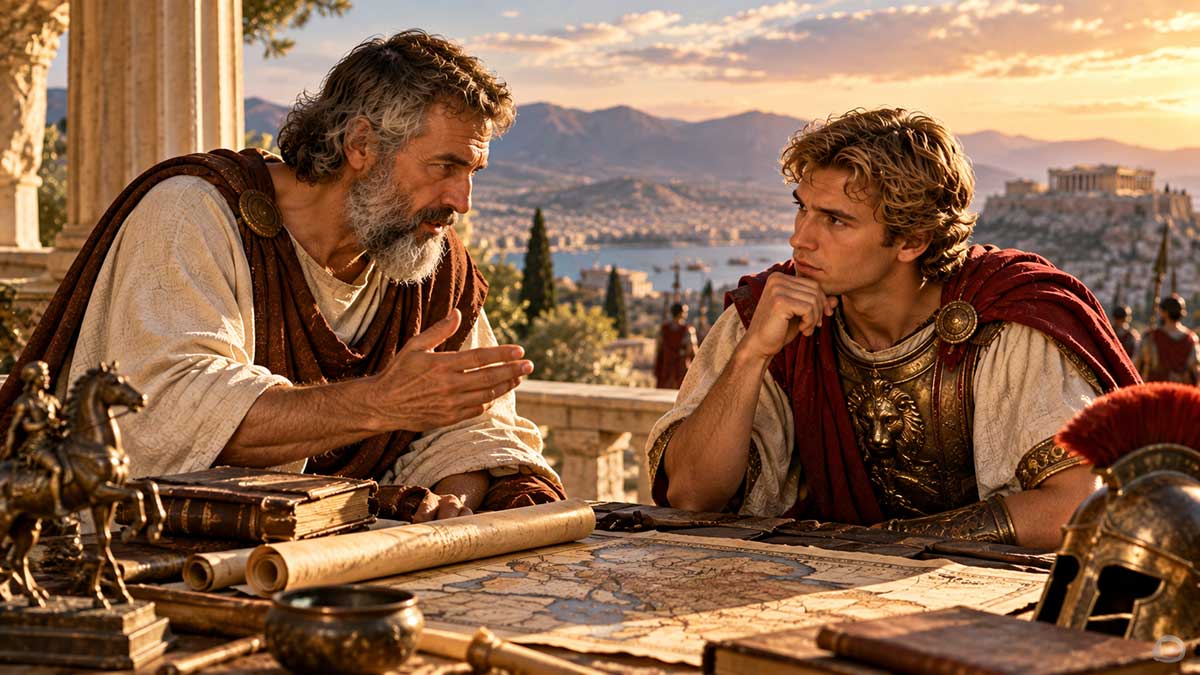
Athens, 330 BCE — The Lyceum, Late Morning
The sun had climbed higher over Athens, and the shaded walkways of the Lyceum were becoming crowded with students.
Nick Sasaki walked beside Aristotle, still smiling about their conversation concerning Plato.
"So," Nick said, "we've established that you weren't always the easiest student."
"We have established no such thing."
"You argued with Plato for twenty years."
"I examined his arguments."
"That's what difficult students always say."
Aristotle laughed.
They passed a group of young men seated around a wooden table, arguing about whether courage was a matter of character or training. One student spoke so passionately that he knocked over a cup of water.
Aristotle glanced at the spill.
"At least he has demonstrated that enthusiasm can produce consequences."
Nick chuckled.
"Speaking of enthusiastic young men, I want to talk about Alexander."
Aristotle's expression shifted slightly.
"Alexander."
"Yes. Alexander of Macedonia. The man currently conquering what seems like half the world."
"A considerable portion of it, certainly."
"You were his teacher."
"For a period."
"How does that even happen? One day you're studying philosophy, and the next you're teaching a kid who's going to rule an empire?"
"His father invited me."
"Philip?"
"King Philip."
"Was that intimidating?"
"Teaching the son of a king presents certain difficulties."
"Like what?"
Aristotle stopped beside a stone column.
"Ordinary students may imagine they know everything. A prince may be surrounded by people who assure him that he does."
Nick laughed.
"That sounds like a nightmare."
"It can complicate education."
"All right," Nick said, leaning against the column. "Forget the conqueror for a moment. Tell me about the boy."
Aristotle looked at him.
"What would you like to know?"
"Everything."
"Then we may need another day."
The Young Prince of Macedonia
Nick: "How old was Alexander when you first started teaching him?"
Aristotle: "He was approximately thirteen."
Nick: "Thirteen! That's a tough age."
Aristotle: "For whom?"
Nick: "Everyone around him."
Aristotle smiled.
Nick: "I have five children. Believe me, I know something about teenagers."
Aristotle: "Then perhaps you understand that no two are quite alike."
Nick: "Absolutely. Some are quiet, some are stubborn, some question everything. What kind of teenager was Alexander?"
Aristotle: "Intelligent. Energetic. Proud. Eager to distinguish himself."
Nick: "Was he one of those kids who always had to win?"
Aristotle: "He was competitive."
Nick: "So that's a yes."
Aristotle: "Competition is not always a defect."
Nick: "No, but when you're thirteen and your father is king, I imagine losing an argument isn't something you're accustomed to."
Aristotle: "That is precisely why a teacher must distinguish between what pleases a student and what benefits him."
Nick: "Did he ever get angry when you corrected him?"
Aristotle: "Young men do not always welcome correction."
Nick: "Come on, Aristotle. Give me something more specific. Did he ever throw a tantrum?"
Aristotle laughed.
Aristotle: "You are hoping for an amusing story at the expense of a powerful man."
Nick: "I'm hoping to meet the human being behind the legend."
Aristotle: "Then you should remember that even an ambitious prince is still a young person learning how to govern himself."
Nick: "Fair enough. Did he ask good questions?"
Aristotle: "He could be remarkably attentive when a subject interested him."
Nick: "And when it didn't?"
Aristotle: "His attention was more difficult to secure."
Nick: "So he was a normal teenager."
Aristotle: "With rather unusual circumstances."
Nick: "Did he have a sense of humor?"
Aristotle: "Certainly."
Nick: "Did he make fun of you?"
Aristotle: "I suspect most students occasionally find their teachers amusing."
Nick: "What about your appearance? Your beard? Your serious expression?"
Aristotle: "You seem convinced that every important relationship involves criticism of someone's beard."
Nick laughed.
Nick: "It's possible."
Aristotle: "Then perhaps I should be grateful you have not yet begun criticizing mine."
Nick: "I'm saving that for later."
They resumed walking.
Nick: "Did you like Alexander?"
Aristotle considered the question.
Aristotle: "I recognized extraordinary ability in him."
Nick: "That's not the same as liking him."
Aristotle: "No."
Nick: "So?"
Aristotle: "There were qualities I admired, and others that concerned me."
Nick: "Like what?"
Aristotle: "His energy, courage, and appetite for achievement could serve him well. But qualities that make a young man formidable do not necessarily make him wise."
Nick: "Were you worried about his ambition?"
Aristotle: "Ambition must be directed toward worthy ends."
Nick: "And was his?"
Aristotle: "That is a question I continue to consider."
Nick looked at him.
For the first time, Aristotle seemed less interested in defending a philosophical principle than in examining a person he had once taught.
Can You Teach Someone to Be Good?
They reached a covered walkway where the air was cooler.
A young student approached Aristotle holding a wax tablet.
"Master, may I ask—"
"Later," Aristotle replied gently. "I am presently being questioned by a man who believes all teachers should reveal their students' embarrassing habits."
The student glanced at Nick, amused, and continued on his way.
Nick: "You really enjoy making fun of me."
Aristotle: "Only when the opportunity is obvious."
Nick: "All right. Let me ask you something serious."
Aristotle: "You have my attention."
Nick: "Can you actually teach someone to be a good person?"
Aristotle: "Education can contribute greatly to the development of good character."
Nick: "But can you guarantee it?"
Aristotle: "No."
Nick: "That's a pretty important admission."
Aristotle: "Why?"
Nick: "Because you spent years teaching a boy who now commands armies and conquers cities. If he does something terrible, people might ask what kind of teacher you were."
Aristotle: "They might."
Nick: "Would that be fair?"
Aristotle: "It would depend upon what they were asking."
Nick: "Explain."
Aristotle: "A teacher is responsible for the quality of his instruction. But a student is also responsible for what he chooses to do with what he learns."
Nick: "So if Alexander makes a bad decision, that's not automatically your fault."
Aristotle: "Correct."
Nick: "But you must feel some responsibility."
Aristotle: "I take education seriously. That is precisely why I would not pretend that teaching gives one control over another person's soul."
Nick: "That's interesting. Because I think a lot of parents struggle with that."
Aristotle: "How so?"
Nick: "We raise our children. We teach them what we believe is right. We try to protect them. But eventually they make their own decisions. Sometimes terrible decisions."
Aristotle: "And what do you do?"
Nick: "Sometimes I worry. Sometimes I try to give advice. Sometimes I probably talk too much."
Aristotle: "Do they tell you so?"
Nick: "Frequently."
Aristotle smiled.
Aristotle: "Then you are fortunate. They are willing to speak honestly."
Nick: "That's one way of looking at it."
Aristotle: "Would you prefer children who never questioned you?"
Nick: "No. We already talked about that with Plato."
Aristotle: "Then you see how the questions are connected."
Nick: "I do. But here's what bothers me. You say virtue is something we develop through practice, right?"
Aristotle: "Yes. We become just by practicing just actions, courageous by acting courageously in the right circumstances, and temperate through the cultivation of appropriate habits."
Nick: "So why doesn't education always work?"
Aristotle: "Because instruction alone is insufficient. Character is formed through repeated action, upbringing, laws, social expectations, and choices."
Nick: "So someone can know what's right and still do something wrong?"
Aristotle: "Certainly."
Nick: "Even someone brilliant?"
Aristotle: "Especially if his desires have not been properly educated."
Nick: "That sounds like a problem with a lot of powerful people."
Aristotle: "Power can magnify defects that were already present."
Nick leaned forward.
Nick: "Say that again."
Aristotle: "Power can magnify defects that were already present."
Nick: "That's good."
Aristotle: "You seem pleased."
Nick: "Because people in my time often assume that successful people must be wise."
Aristotle: "Why would they assume that?"
Nick: "Because they have money, influence, enormous companies, millions of followers."
Aristotle: "Followers?"
Nick: "People who pay attention to them."
Aristotle: "Ah. Admirers."
Nick: "Something like that."
Aristotle: "And admiration is taken as evidence of virtue?"
Nick: "Sometimes."
Aristotle: "Then your society has confused two different things."
Nick: "Which two?"
Aristotle: "The ability to attract attention and the ability to live well."
Nick laughed.
Nick: "You would have a field day with social media."
Aristotle: "I do not know what that is."
Nick: "Trust me. You might be happier that way."
Alexander's Ambition
A breeze moved through the colonnade.
In the distance, the sounds of Athens drifted across the grounds: merchants calling, animals moving through the streets, and students debating beneath the trees.
Nick turned toward Aristotle.
Nick: "Alexander has already accomplished more militarily than most kings could imagine."
Aristotle: "He has achieved remarkable victories."
Nick: "Does that make you proud?"
Aristotle: "His abilities are extraordinary. But military success and human excellence are not identical."
Nick: "So you're not simply proud of everything he does."
Aristotle: "Why should I be?"
Nick: "Because he was your student."
Aristotle: "A teacher should not mistake a student's fame for proof of his own success."
Nick: "That's interesting."
Aristotle: "Is it?"
Nick: "Yes. Because a lot of people would love to say they taught Alexander the Great."
Aristotle: "I taught Alexander of Macedonia. The title you use is not one I require."
Nick: "Fair enough. But let me ask you something. How does a man know when he has enough?"
Aristotle: "Enough of what?"
Nick: "Power. Territory. Wealth. Recognition. Whatever he's chasing."
Aristotle: "He must understand what the pursuit is for."
Nick: "And if he doesn't?"
Aristotle: "Then he may spend his life acquiring things without knowing why."
Nick: "That sounds familiar."
Aristotle: "From your own experience?"
Nick laughed.
Nick: "Maybe a little. I've spent a lot of time building businesses and trying to achieve things. Sometimes you reach a goal and immediately start thinking about the next one."
Aristotle: "And does reaching the goal satisfy you?"
Nick: "For a while."
Aristotle: "How long?"
Nick: "Sometimes not very long."
Aristotle: "Then perhaps the goal was not what you truly sought."
Nick considered that.
Nick: "Maybe. But isn't ambition good? Without ambition, people wouldn't accomplish much."
Aristotle: "Ambition can be admirable when directed toward honorable purposes and governed by good judgment."
Nick: "And when it isn't?"
Aristotle: "It can become destructive."
Nick: "Do you think Alexander knows the difference?"
Aristotle looked toward the courtyard.
Aristotle: "He is capable of understanding it."
Nick: "That's another careful answer."
Aristotle: "You are asking me to judge a man whose decisions are unfolding far from here."
Nick: "But surely you hear reports."
Aristotle: "Of course."
Nick: "And some of those reports must concern you."
Aristotle: "War is a grave undertaking. Victory does not erase suffering."
Nick: "Do you ever think about the people on the other side? The families whose cities are conquered?"
Aristotle: "A ruler must consider the consequences of his actions."
Nick: "But do conquerors actually do that?"
Aristotle: "Some more than others."
Nick: "That's a depressing answer."
Aristotle: "Reality does not always arrange itself to satisfy our hopes."
Nick paused.
Nick: "Let me ask something uncomfortable."
Aristotle: "You have been doing so all morning."
Nick: "What if Alexander becomes the most powerful man in the world but fails to become a good man?"
Aristotle was quiet.
Aristotle: "Then his power will not make up for what he lacks."
Nick: "Even if people remember him for thousands of years?"
Aristotle: "Being remembered is not the same as being worthy of admiration."
Nick nodded slowly.
Nick: "That's something worth thinking about."
The Teacher's Responsibility
They stopped near a stone fountain.
Nick watched the water flow into a shallow basin.
Nick: "Do you ever wonder whether you should have taught Alexander differently?"
Aristotle: "Every serious teacher should examine his own methods."
Nick: "That's not quite what I asked."
Aristotle: "Then ask more precisely."
Nick: "Do you ever regret something you taught him?"
Aristotle took his time.
Aristotle: "I cannot identify a particular lesson and claim that it determined his later conduct. Education is not so simple."
Nick: "But what if you could go back?"
Aristotle: "I would still wish him to develop reason, self-command, courage, and sound judgment."
Nick: "Would you spend more time teaching him compassion?"
Aristotle: "I would want any future ruler to understand justice and the responsibilities of power."
Nick: "You didn't answer compassion."
Aristotle: "Because you are using a word that may encompass several virtues. A ruler should not be needlessly cruel. He should govern with judgment and concern for the community he rules."
Nick: "But what about people outside his community?"
Aristotle looked at Nick.
Aristotle: "You are asking a larger question."
Nick: "Yes."
Aristotle: "Then we should examine what obligations people owe to those beyond their own city and people."
Nick: "Do you believe all human beings deserve the same consideration?"
Aristotle hesitated.
Aristotle: "I do not believe every person has the same role or capacity within a political community."
Nick: "That's where I think we might disagree."
Aristotle: "Then perhaps we shall have an interesting discussion."
Nick: "I think we will. But I want to save that for later, because I have a lot of questions about your views on slavery and women."
Aristotle: "You have already prepared your objections?"
Nick: "Several."
Aristotle: "Good. Then I shall expect arguments rather than accusations."
Nick: "Fair enough."
They continued walking.
Nick: "Here's another question. What if a teacher is wrong?"
Aristotle: "About what?"
Nick: "About the world. About morality. About what makes a good person."
Aristotle: "Then his students should examine his reasoning and correct what they can."
Nick: "Even if he's Aristotle?"
Aristotle: "Especially if he is Aristotle."
Nick smiled.
Nick: "I like that answer."
Aristotle: "Do not praise it too quickly. You may discover that I am wrong about something you consider important."
Nick: "I'm counting on it."
A Father and a Teacher
The conversation softened as they returned toward the main courtyard.
Nick: "You know, I keep thinking about my children."
Aristotle: "Because of Alexander?"
Nick: "Yes. I want them to do well in life. But I also want them to be good people. Sometimes those goals don't seem to line up perfectly."
Aristotle: "What do you mean?"
Nick: "The world rewards certain things. Money. Fame. Winning. Being first. But those aren't always the same as kindness, honesty, or wisdom."
Aristotle: "Then you must decide what kind of excellence you wish them to pursue."
Nick: "That's easy to say."
Aristotle: "Many important things are easier to say than to practice."
Nick: "Do you worry about your own children?"
Aristotle: "Naturally."
Nick: "What worries you most?"
Aristotle: "That they may suffer harm. That they may make choices without sufficient judgment. That they may fail to recognize what is genuinely good for them."
Nick: "So you're just like every other parent."
Aristotle: "I suspect many parents share these concerns."
Nick: "Do you think parents can love their children too much?"
Aristotle: "Love itself is not the difficulty. The question is whether our actions truly benefit those we love."
Nick: "Explain."
Aristotle: "A parent who protects a child from every difficulty may prevent that child from developing courage. A parent who grants every desire may encourage self-indulgence. A parent who demands constant obedience may discourage sound judgment."
Nick: "That's really good."
Aristotle: "It is also difficult."
Nick: "Tell me about it."
Aristotle: "You seem to believe I am offering simple instructions."
Nick: "Aren't you?"
Aristotle: "No. I am describing a problem that requires practical wisdom."
Nick: "Which is?"
Aristotle: "The ability to judge what is appropriate in particular circumstances."
Nick: "So there's no perfect parenting formula?"
Aristotle: "If you discover one, I would be interested to examine it."
Nick laughed.
Nick: "I'll let you know."
Closing: The Student Who Became a King
The sun was approaching its highest point.
An assistant appeared near the colonnade and quietly informed Aristotle that a midday meal would soon be ready.
Nick glanced toward the distant city.
Nick: "You know what strikes me about Alexander?"
Aristotle: "What?"
Nick: "He may be able to conquer kingdoms, but he still has to learn how to govern himself."
Aristotle: "That is a challenge no amount of military power can remove."
Nick: "And you can't do it for him."
Aristotle: "No."
Nick: "That must be frustrating."
Aristotle: "At times."
Nick: "Do you ever wish you could sit down with him again, just the two of you, like when he was thirteen?"
Aristotle looked thoughtful.
Aristotle: "There are conversations I would welcome."
Nick: "What would you ask him?"
Aristotle: "I would ask what he believes his victories are ultimately for."
Nick: "And if he said glory?"
Aristotle: "I would ask what glory is for."
Nick: "And if he said immortality? Being remembered forever?"
Aristotle: "I would ask whether being remembered can make a person happy after he is dead."
Nick laughed softly.
Nick: "You really would drive him crazy."
Aristotle: "Perhaps."
Nick: "Do you think he'd listen?"
Aristotle: "I would hope so."
Nick: "And if he didn't?"
Aristotle looked toward the students moving through the courtyard.
Aristotle: "Then I would still have been right to ask."
Nick nodded.
For a moment, neither spoke.
Then Nick smiled.
Nick: "You know, after spending the morning with you, I'm beginning to understand why Plato probably found you exhausting."
Aristotle laughed.
Aristotle: "And I am beginning to understand why your children may sometimes find you exhausting."
Nick: "Fair point."
They started toward the courtyard where food had been prepared.
Nick: "One more question."
Aristotle: "Of course."
Nick: "Did Alexander ever make you proud?"
Aristotle considered him.
Aristotle: "There were moments when I saw in him the promise of a remarkable man."
Nick: "And now?"
Aristotle: "Now I hope that promise will be fulfilled in ways greater than conquest."
Nick let the answer settle.
Then he glanced at Aristotle.
Nick: "All right. Enough about kings and empires. I want to know something about your personal life."
Aristotle: "That sounds more dangerous than our discussion of Alexander."
Nick: "It might be."
Aristotle: "What do you wish to know?"
Nick: "Were you a romantic?"
Aristotle stopped walking.
He looked at Nick for a long moment.
Then he laughed.
Aristotle: "You have a remarkable talent for changing the subject."
Nick: "I'll take that as a compliment."
They disappeared into the shaded courtyard, where lunch—and a far more personal conversation—awaited.
Historical note: This conversation is fictional. Aristotle's role as Alexander's tutor, Alexander's age at the time of his education, and the broad chronology of his military campaigns are historically grounded. Specific exchanges, personal recollections, teaching experiences, feelings, and assessments attributed to Aristotle are imaginative reconstructions. The precise content and duration of Aristotle's instruction of Alexander remain uncertain. The conversation is set in 330 BCE, before Alexander's death in 323 BCE.
Topic 3: The People Behind the Philosopher
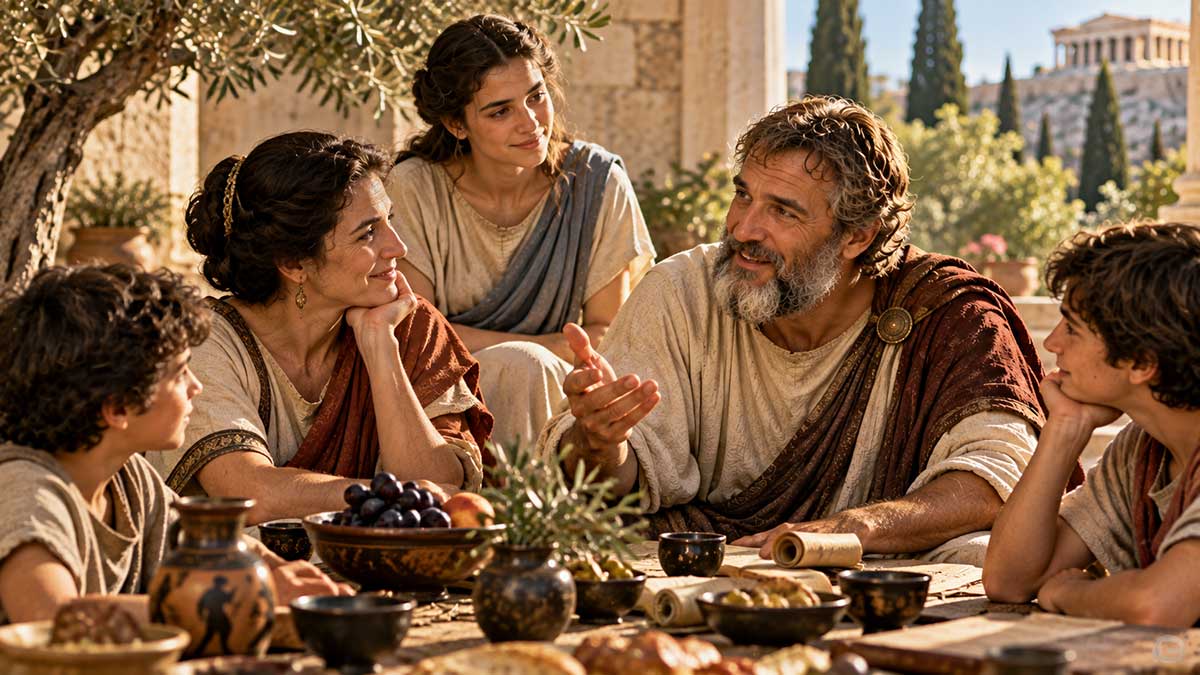
Athens, 330 BCE — The Lyceum, Midday
The courtyard smelled of freshly baked bread, olives, herbs, and roasted fish.
Nick Sasaki followed Aristotle toward a low wooden table beneath a grapevine. A servant had arranged a simple meal: bread, cheese, figs, olives, and a bowl of lentils.
After hours of discussing Plato, Alexander, education, and the responsibilities of kings, Nick was relieved to sit down.
Aristotle reached for a piece of bread.
Nick watched him for a moment.
"What?" Aristotle asked.
"Nothing. It's just funny."
"What is?"
"You're one of the greatest philosophers in history, and here you are eating lunch like everybody else."
Aristotle examined his bread.
"How would you prefer I eat?"
"I don't know. Maybe while explaining the nature of existence."
"That would make the meal unnecessarily long."
Nick laughed.
Aristotle dipped his bread into olive oil.
"And the food would become cold."
"See? That's exactly what I mean. You seem so normal."
"Should I apologize?"
"No. Actually, I like it."
Aristotle smiled.
"Then perhaps you should stop expecting philosophers to be a different species."
Nick leaned back.
"All right. We've talked about your teachers and your students. Now I want to talk about the people who really knew you."
"My colleagues?"
"No. The people who knew you when you weren't being Aristotle."
Aristotle raised an eyebrow.
"I am afraid I remain Aristotle even at home."
"You know what I mean. Your wife. Your children. Your friends. The people who saw you when you were tired, irritated, happy, or just being ridiculous."
"Ridiculous?"
"Come on. Everybody has moments."
"Even philosophers?"
"Especially philosophers."
Aristotle laughed.
"Very well. But I warn you, Nick, you may find my domestic life less remarkable than my intellectual pursuits."
"That's exactly what I'm hoping."
The Man Who Went Home
Nick: "Let's start with something simple. When you finish teaching for the day, what do you do?"
Aristotle: "That depends upon the day."
Nick: "Do you ever just go home and relax?"
Aristotle: "Of course."
Nick: "Really? Because I have trouble imagining you relaxing."
Aristotle: "You have spent several hours with me and already concluded that I am incapable of ordinary pleasures."
Nick: "Not incapable. Just... constantly thinking."
Aristotle: "Thinking does not prevent enjoyment."
Nick: "So what do you enjoy?"
Aristotle: "Conversation. Music. A good meal. Walking. The company of people I care about."
Nick: "Do you ever get tired of people asking you questions?"
Aristotle: "Occasionally."
Nick: "Am I exhausting you?"
Aristotle: "Not yet."
Nick: "Good. Because we're just getting started."
Aristotle smiled and reached for another fig.
Nick: "Were you a good husband?"
Aristotle stopped chewing.
Aristotle: "You move quickly from ordinary pleasures to difficult judgments."
Nick: "It's an important question."
Aristotle: "It is. But who is best qualified to answer it?"
Nick: "Your wife, probably."
Aristotle: "Precisely."
Nick: "Tell me about Pythias."
Aristotle set down the fig.
Aristotle: "She was important to me."
Nick: "That's a very careful answer."
Aristotle: "You ask me to speak of someone whose life was her own. I would not wish to reduce her to a few qualities for the satisfaction of a stranger."
Nick nodded.
Nick: "Fair enough. But what drew you to her?"
Aristotle considered the question.
Aristotle: "Companionship matters greatly. A household is not simply a place where one sleeps. It is a shared life."
Nick: "Did she understand your work?"
Aristotle: "She understood that it occupied much of my attention."
Nick: "Did she ever tell you to stop working?"
Aristotle laughed softly.
Aristotle: "You seem to believe that all households are governed by the same conversations."
Nick: "Aren't they?"
Aristotle: "Perhaps more than philosophers care to admit."
Nick: "Did you make her laugh?"
Aristotle: "I hope so."
Nick: "Did she make you laugh?"
Aristotle: "Yes."
Nick: "What about?"
Aristotle smiled.
Aristotle: "Sometimes at the seriousness with which I approached matters that required less seriousness."
Nick: "Like what?"
Aristotle: "I remember becoming unusually concerned about the arrangement of certain household objects."
Nick: "What kind of objects?"
Aristotle: "Nothing important."
Nick: "Now I really want to know."
Aristotle: "Then I have made a mistake in mentioning it."
Nick laughed.
Nick: "You were organizing things?"
Aristotle: "I was attempting to establish a more sensible arrangement."
Nick: "And she disagreed?"
Aristotle: "She observed that the arrangement had been sensible before I interfered."
Nick burst out laughing.
Nick: "That's fantastic. The man who organized human knowledge couldn't organize his own house."
Aristotle: "You are drawing an extravagant conclusion from a small incident."
Nick: "That's what makes it funny."
Aristotle shook his head, smiling.
The exchange was imaginary, but the ease of the moment made Nick feel he was beginning to glimpse a different Aristotle—not the architect of philosophical systems, but a man who could be gently teased by someone who knew him well.
Love, Loss, and the Things Philosophy Cannot Fix
The laughter faded.
Nick noticed that Aristotle had become quieter.
Nick: "Can I ask something more personal?"
Aristotle: "You have already crossed several boundaries of personal inquiry. I doubt another will surprise me."
Nick: "Did you ever lose someone you loved so much that philosophy didn't help?"
Aristotle looked toward the courtyard.
For a moment, he said nothing.
Aristotle: "Philosophy does not prevent loss."
Nick: "But does it help you deal with it?"
Aristotle: "It may help us understand the nature of human life. That we are mortal. That what we value is vulnerable. That good things are not entirely within our control."
Nick: "But understanding something doesn't make it hurt less."
Aristotle: "Not necessarily."
Nick: "So what do you do?"
Aristotle: "You continue living. You remember. You care for those who remain. You allow time to do what argument cannot."
Nick nodded slowly.
Nick: "That's a different answer from what I expected."
Aristotle: "What did you expect?"
Nick: "Something about virtue overcoming sorrow."
Aristotle: "Why should virtue require the absence of sorrow?"
Nick: "I suppose it shouldn't."
Aristotle: "A person who feels nothing at the loss of someone dear may not be displaying wisdom. He may simply be lacking something important."
Nick: "So grief is part of love."
Aristotle: "It can be."
Nick: "Do you think loving someone is worth the pain of losing them?"
Aristotle looked directly at him.
Aristotle: "Would you prefer never to have loved?"
Nick thought about his family.
Nick: "No."
Aristotle: "Then perhaps you already know your answer."
A light breeze moved through the grapevine overhead.
Nick: "I think people sometimes try to avoid loving too deeply because they're afraid of getting hurt."
Aristotle: "Then they may avoid some suffering. But they may also avoid much that makes life worth living."
Nick: "You know, that's something I didn't expect to hear from you."
Aristotle: "Why?"
Nick: "Because people think of you as a logical thinker. Someone who analyzes everything."
Aristotle: "Reason and affection are not enemies."
Nick: "That's a beautiful thought."
Aristotle: "It is also an important distinction. To understand love is not to replace it with an explanation."
Nick smiled.
Nick: "I like that."
The Children Who Don't Care About Your Reputation
A young boy ran across the courtyard chasing another child.
Nick watched them disappear behind a column.
Nick: "Let's talk about your children."
Aristotle: "Very well."
Nick: "You have a daughter named Pythias."
Aristotle: "Yes."
Nick: "And a son, Nicomachus."
Aristotle: "Yes."
Nick: "Named after your father?"
Aristotle: "That is so."
Nick: "That's meaningful."
Aristotle: "Names often preserve connections between generations."
Nick: "Do your children know how famous you are?"
Aristotle laughed.
Aristotle: "I doubt they are as impressed as you appear to be."
Nick: "That's what I wanted to hear."
Aristotle: "Children are often more interested in whether you have time for them than in what strangers think of you."
Nick: "Exactly! That's something I've learned with my own kids."
Aristotle: "Then you have learned something important."
Nick: "Do you spend enough time with yours?"
Aristotle hesitated.
Aristotle: "What would count as enough?"
Nick: "That's the question, isn't it?"
Aristotle: "A parent has responsibilities beyond the household. Yet those responsibilities cannot excuse neglect of the household."
Nick: "Do you ever feel guilty?"
Aristotle: "There are times when one duty competes with another."
Nick: "That's a philosopher's way of saying yes."
Aristotle: "It is a philosopher's way of refusing to pretend that every conflict has a simple answer."
Nick: "Fair enough. But imagine your daughter comes to you and says, 'Father, stop writing and spend time with me.' What do you do?"
Aristotle: "I hope I would recognize what the moment required."
Nick: "And if you didn't?"
Aristotle: "Then I would have failed in judgment."
Nick: "Even Aristotle makes mistakes?"
Aristotle: "Frequently."
Nick: "You should tell your students that more often."
Aristotle: "They are already aware."
Nick laughed.
Nick: "What do you want most for your children?"
Aristotle: "That they develop good character and the capacity to live well."
Nick: "What if they don't want to study philosophy?"
Aristotle: "Then they need not."
Nick: "What if they become merchants?"
Aristotle: "They should conduct their affairs honorably."
Nick: "Artists?"
Aristotle: "They should pursue excellence in their work."
Nick: "What if they become politicians?"
Aristotle paused.
Aristotle: "Then I shall have additional reasons for concern."
Nick laughed loudly.
Nick: "That may be the most honest thing you've said all day."
Herpyllis and the Complexity of Human Relationships
Nick poured himself some water.
Nick: "Can I ask about Herpyllis?"
Aristotle looked at him carefully.
Aristotle: "What would you like to know?"
Nick: "She's part of your life, and she's Nicomachus's mother."
Aristotle: "Yes."
Nick: "People often tell the story of famous men as if their relationships are simple. But real lives rarely are."
Aristotle: "That is true."
Nick: "How would you describe your relationship with her?"
Aristotle took a moment.
Aristotle: "She is a person toward whom I have obligations of care and respect."
Nick: "And affection?"
Aristotle: "Yes."
Nick: "Was that relationship difficult for people to understand?"
Aristotle: "People often judge arrangements they know only from a distance."
Nick: "That's true in my time too."
Aristotle: "Then perhaps human curiosity about the private lives of others is not limited to Athens."
Nick: "Definitely not."
Nick hesitated before continuing.
Nick: "Do you think you treated the women in your life fairly?"
Aristotle studied him.
Aristotle: "You are asking me to judge myself."
Nick: "Yes."
Aristotle: "Then I must be cautious."
Nick: "Why?"
Aristotle: "Because people are often generous when evaluating their own conduct."
Nick: "Exactly."
Aristotle: "I would hope that I have fulfilled my responsibilities."
Nick: "But hope isn't proof."
Aristotle: "No."
Nick: "Do you think the women themselves would agree?"
Aristotle was silent.
Aristotle: "That would be a question for them."
Nick: "I like that answer."
Aristotle: "Do not praise it merely because it agrees with your expectations."
Nick: "Fair point."
Nick leaned forward.
Nick: "You know, later today I want to talk about your views on women. Some of them are going to be difficult for me to accept."
Aristotle: "Then we should examine them carefully."
Nick: "I intend to."
Aristotle: "Good."
There was no dramatic reconciliation or sudden change of mind.
But Nick sensed that the conversation had entered more complicated territory: the difference between how a person treats those close to him and the broader beliefs he holds about society.
Friendship: The People Who Tell You the Truth
The meal was nearly finished.
Nick reached for a fig.
Nick: "You've talked about friendship as one of the most important things in life."
Aristotle: "It is."
Nick: "More important than wealth?"
Aristotle: "What use is wealth if one has no one with whom to share a good life?"
Nick: "More important than fame?"
Aristotle: "Fame is the opinion of others. Friendship is a relationship."
Nick: "More important than knowledge?"
Aristotle: "Knowledge is valuable, but a flourishing human life requires more than solitary understanding."
Nick: "So even Aristotle needs friends."
Aristotle: "Of course."
Nick: "Who is your best friend?"
Aristotle smiled.
Aristotle: "You seem determined to rank every person in my life."
Nick: "It's a simple question."
Aristotle: "Simple questions can have complicated answers."
Nick: "Fine. What makes someone a real friend?"
Aristotle: "There are different forms of friendship. Some relationships arise because people are useful to one another. Others because they enjoy one another's company. But the deepest friendship involves mutual appreciation of character."
Nick: "So a friend isn't just someone who helps you."
Aristotle: "Correct."
Nick: "Or someone who's fun to be around."
Aristotle: "Pleasure matters, but it is not sufficient for the most complete form of friendship."
Nick: "Then what is?"
Aristotle: "Wishing good things for another person for that person's own sake."
Nick nodded.
Nick: "That's powerful."
Aristotle: "It is also demanding."
Nick: "Why?"
Aristotle: "Because it requires us to care about another person's good, even when doing so does not benefit us."
Nick: "Can a friend tell you something you don't want to hear?"
Aristotle: "A good friend sometimes must."
Nick: "Do you have friends who tell you when you're being foolish?"
Aristotle: "Yes."
Nick: "Do you listen?"
Aristotle: "Not always immediately."
Nick laughed.
Nick: "Now we're talking."
Aristotle: "I did not claim to be perfect."
Nick: "What happens when you realize they're right?"
Aristotle: "Then I should be grateful."
Nick: "Should be?"
Aristotle: "Gratitude is sometimes easier after one's pride has recovered."
Nick nearly dropped his fig laughing.
Nick: "That's fantastic."
Aristotle: "I am pleased my imperfections entertain you."
Nick: "They make you relatable."
Aristotle: "Then perhaps I should reveal fewer of them."
Who Really Knows Aristotle?
The courtyard had grown quieter.
Many students had returned to their studies. A few servants cleared the table.
Nick looked at Aristotle.
Nick: "Can I ask you something that might sound strange?"
Aristotle: "That has not prevented you before."
Nick: "Do you ever feel lonely?"
Aristotle did not answer immediately.
Aristotle: "At times."
Nick: "Even with all your students and colleagues?"
Aristotle: "Being surrounded by people does not guarantee that one is understood."
Nick: "Exactly."
Aristotle: "Nor does being understood require constant company."
Nick: "Do you think people sometimes see you as a philosopher rather than a person?"
Aristotle: "Perhaps. But I am partly responsible for that. I have devoted much of my life to philosophical work."
Nick: "Still, it must be strange. People come to you wanting answers. They probably don't ask whether you've had a bad day."
Aristotle: "You have asked."
Nick: "And?"
Aristotle: "I have had bad days."
Nick smiled.
Nick: "I knew it."
Aristotle: "You appear delighted by this discovery."
Nick: "Because it means you're human."
Aristotle: "We have established that repeatedly."
Nick: "All right. Here's a harder question. Who knows you best?"
Aristotle looked down at his hands.
Aristotle: "Those who have shared my ordinary life. Those who have seen me when I am not teaching, arguing, or trying to explain something."
Nick: "Do they know a different Aristotle?"
Aristotle: "They know more of me."
Nick: "Do you think being admired can sometimes get in the way of being loved?"
Aristotle considered the question.
Aristotle: "Admiration may create distance. Love, at its best, requires a kind of closeness that admiration alone cannot provide."
Nick: "That's interesting."
Aristotle: "Why?"
Nick: "Because people spend so much time trying to become impressive. Successful. Important. Respected."
Aristotle: "And?"
Nick: "Maybe they forget to become someone others can actually feel close to."
Aristotle nodded slowly.
Aristotle: "That is worth considering."
Nick: "Have you ever made that mistake?"
Aristotle smiled faintly.
Aristotle: "I would be surprised if I had never done so."
Nick did not press further.
For once, the silence felt more revealing than another question.
Closing: The Life That Doesn't Appear in Books
The afternoon light filtered through the grapevine.
Aristotle stood and stretched.
Nick remained seated for a moment, thinking about everything they had discussed.
Nick: "You know what I find fascinating?"
Aristotle: "What?"
Nick: "People will probably remember you for your philosophy. Your logic. Your books. Your influence on the world."
Aristotle: "Perhaps."
Nick: "But your children won't remember you that way."
Aristotle: "How do you imagine they will remember me?"
Nick: "Whether you listened to them. Whether you played with them. Whether you were kind. Whether you were there when they needed you."
Aristotle looked thoughtful.
Aristotle: "Those are important measures of a life."
Nick: "Maybe more important than the ones history uses."
Aristotle: "History and a household do not always judge by the same standards."
Nick: "Exactly."
Nick rose from the bench.
Nick: "Let me ask one final question."
Aristotle: "You have a remarkable attachment to final questions."
Nick: "I know. But this one matters."
Aristotle: "Go on."
Nick: "If you had to choose between being remembered as a great philosopher and being remembered by your children as a good father, which would you choose?"
Aristotle was quiet.
Then he smiled.
Aristotle: "You have presented me with a choice that may not be necessary."
Nick: "You're dodging."
Aristotle: "No. I am questioning your assumption."
Nick: "Which is?"
Aristotle: "That excellence in one part of life must require failure in another."
Nick: "But sometimes it does. Time is limited."
Aristotle: "Yes. And that is why judgment matters."
Nick: "So you want both."
Aristotle: "I would hope to live in such a way that those closest to me need not suffer for the sake of whatever reputation I may acquire."
Nick nodded.
Nick: "That's a good answer."
Aristotle: "It is easier to answer than to accomplish."
Nick: "Isn't everything?"
Aristotle laughed.
They began walking toward the garden.
A student approached carrying a basket of leaves and small branches.
"Master, we have found something unusual."
Aristotle's eyes brightened.
"What have you found?"
The student opened the basket.
Aristotle leaned forward immediately.
Nick watched him with amusement.
Nick: "There he goes again."
Aristotle: "What?"
Nick: "The man who wants to understand everything."
Aristotle: "Would you prefer I ignore something interesting?"
Nick: "Not at all. Actually, I want to ask you about that."
Aristotle: "About what?"
Nick: "Your curiosity. Your need to examine everything. Animals, politics, poetry, logic, the universe."
Aristotle smiled.
Aristotle: "Then perhaps we should begin with these leaves."
Nick laughed.
Nick: "Of course we should."
They followed the student into the garden, where another part of Aristotle's extraordinary mind was waiting to be revealed.
Historical note: This conversation is fictional. Aristotle's marriage to Pythias, his daughter Pythias, his relationship with Herpyllis, and his son Nicomachus are supported by ancient biographical traditions, although the details and chronology of his private life remain uncertain. His ideas about friendship draw broadly from the Nicomachean Ethics. Specific domestic anecdotes, emotional recollections, jokes, conversations, and expressions of personal regret are imaginative reconstructions rather than documented historical events. The portrayal should not be interpreted as evidence that Aristotle held modern views about gender or family equality.
Topic 4: The Man Who Wanted to Understand Everything
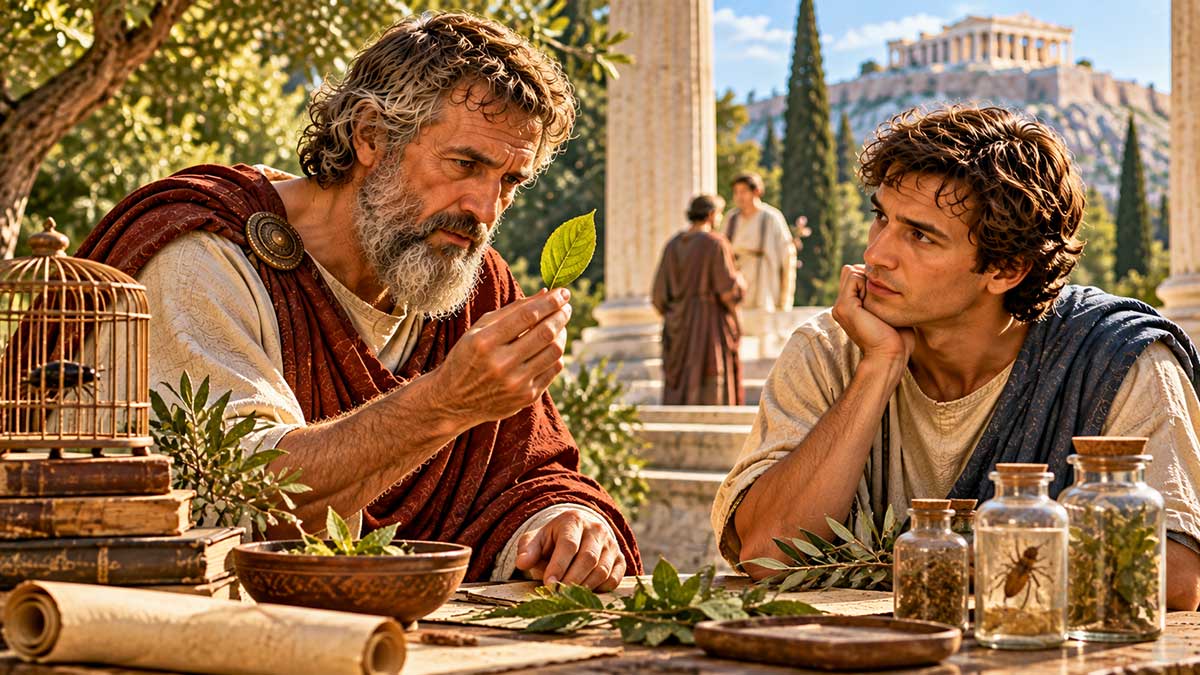
Athens, 330 BCE — The Lyceum, Afternoon
The afternoon sun poured through the olive trees as Nick Sasaki followed Aristotle into a garden behind the Lyceum.
A young student was waiting beside a wooden table. On it lay several branches, leaves, roots, and small clay vessels containing insects.
Aristotle approached the table with the excitement of a child discovering something new.
"Show me," he said.
The student lifted a branch.
"We found these growing in the same soil, Master. But the leaves are different."
Aristotle examined them carefully.
"Have you compared their stems?"
"Yes."
"The roots?"
"Not yet."
"Then you have more work to do."
The student nodded and hurried away.
Nick watched, amused.
"You really can't help yourself, can you?"
Aristotle looked up.
"Help myself from what?"
"Investigating everything."
"Would you prefer that I remain ignorant?"
"No. But you've spent the morning talking about Plato, Alexander, your family, and friendship. Now you're examining leaves as if you've just discovered buried treasure."
Aristotle smiled.
"Perhaps I have."
"Leaves?"
"Why not? There are remarkable things happening all around us that most people never bother to notice."
Nick picked up a leaf.
"I look at this and see a leaf."
"And what else?"
"Green. A little rough. Probably from a tree."
Aristotle waited.
Nick laughed.
"You're doing it again."
"Doing what?"
"Making me feel like I haven't asked enough questions."
"Then perhaps our conversation is going well."
Nick put the leaf down.
"All right. I've been waiting to ask you something."
"Only one thing?"
"Several hundred, actually."
"Then we should begin."
Nick pulled a stool closer.
"Why do you want to understand everything?"
Aristotle glanced at the garden.
"Because the world is worth understanding."
The Man Who Couldn't Stop Asking Why
Nick: "Most people spend their lives becoming good at one thing. You're studying animals, plants, politics, poetry, logic, the stars, human behavior—practically everything."
Aristotle: "Not everything."
Nick: "Name something you're not interested in."
Aristotle considered the question.
Aristotle: "There are many matters unworthy of extended investigation."
Nick: "Like what?"
Aristotle: "Whether the man who shouted at the marketplace yesterday had better sandals than the man who shouted at him."
Nick: "You haven't met modern social media."
Aristotle: "You mentioned this earlier. What exactly is it?"
Nick: "Imagine a marketplace where millions of people can argue with one another, except most of them have never met, and some aren't even using their real names."
Aristotle stared at him.
Aristotle: "Why would anyone construct such a thing?"
Nick burst out laughing.
"That's a question we've been asking ourselves."
Aristotle: "Does it produce useful knowledge?"
Nick: "Sometimes. You can learn almost anything."
Aristotle: "Then it has considerable potential."
Nick: "But you can also spend hours watching strangers insult each other."
Aristotle: "Then perhaps the problem is not the instrument but the habits of those who use it."
Nick: "You figured that out pretty quickly."
Aristotle: "You have described a familiar human problem in an unfamiliar form."
Nick nodded.
Nick: "Let me ask you something. When you were a boy, did people ever tell you to stop asking questions?"
Aristotle: "I imagine they occasionally wished I would."
Nick: "I knew it."
Aristotle: "You are remarkably pleased by evidence that I may have inconvenienced other people."
Nick: "Because I can relate. My kids sometimes ask questions when I'm tired, and I catch myself giving them short answers."
Aristotle: "Then perhaps you should remember how much you enjoy asking questions yourself."
Nick: "Fair point."
Aristotle: "Curiosity is natural to human beings. But it must be cultivated. A child may wonder why something happens. An investigator must learn how to pursue an answer."
Nick: "What's the difference?"
Aristotle: "Patience. Observation. Comparison. The willingness to correct an earlier conclusion."
Nick: "That last one sounds important."
Aristotle: "It is essential."
Nick: "Do you enjoy being wrong?"
Aristotle laughed.
Aristotle: "No."
Nick: "Good. Because I was beginning to think you weren't human."
Aristotle: "We have established my humanity several times today."
Nick: "But you admit you don't like being wrong?"
Aristotle: "I dislike discovering that I have reasoned badly. Yet I would rather discover an error than preserve it."
Nick: "Those are two different feelings, aren't they?"
Aristotle: "Precisely."
Nick: "Your pride doesn't like being wrong, but your curiosity wants to know the truth."
Aristotle smiled.
Aristotle: "That is a useful description."
Nick: "Which one usually wins?"
Aristotle: "You should ask those who know me."
Nick: "I should have asked your family during lunch."
Aristotle: "I am relieved that you did not."
They laughed.
Nick picked up one of the branches.
Nick: "Tell me something. Have you ever studied something for months or years and then realized your entire explanation was wrong?"
Aristotle: "I have revised judgments. Any serious investigator must."
Nick: "Does that frustrate you?"
Aristotle: "Naturally. But frustration is not a reason to abandon inquiry."
Nick: "What keeps you going?"
Aristotle: "The possibility of understanding something that was previously obscure."
Nick: "So it's the excitement of discovery."
Aristotle: "Partly. But knowledge also has value beyond the pleasure of obtaining it."
Nick: "Meaning?"
Aristotle: "If we understand why a thing happens, we may act more intelligently. Medicine is an obvious example. Politics is another."
Nick: "And human relationships?"
Aristotle: "Certainly."
Nick: "Can you study people the same way you study fish?"
Aristotle looked at the basin on the table.
Aristotle: "Not in precisely the same way."
Nick: "Why not?"
Aristotle: "Because human beings deliberate. They form intentions. They can choose among different actions. Their conduct cannot always be understood through the same methods we use to study other living things."
Nick: "So people are more complicated."
Aristotle: "In certain respects."
Nick: "That's an understatement."
Aristotle laughed.
Nick: "You know what fascinates me? You've spent years studying how people should live, but you still seem genuinely interested in the smallest creature."
Aristotle: "Why should the size of a thing determine whether it deserves attention?"
Nick: "That's a good question."
Aristotle: "A small animal may reveal something important about life. A powerful ruler may reveal something important about human folly."
Nick: "Alexander?"
Aristotle: "You said it, not I."
Nick grinned.
Can a Brilliant Person Be a Fool?
They left the table and walked toward a shaded colonnade.
A group of students was debating whether knowledge alone was enough to make someone virtuous.
Nick stopped.
"That's exactly what I want to talk about."
Aristotle glanced at the students.
"Then perhaps you should join them."
"No, I want to ask you."
"Very well."
They sat on a stone bench.
Nick: "You've met some of the most intelligent people in Greece."
Aristotle: "I have been fortunate to know many capable thinkers."
Nick: "Are intelligent people usually good people?"
Aristotle smiled.
Aristotle: "No."
Nick: "That was quick."
Aristotle: "Would you prefer a longer answer?"
Nick: "Actually, yes. Because people often confuse intelligence with wisdom."
Aristotle: "They are not identical."
Nick: "What's the difference?"
Aristotle: "A person may possess great skill in reasoning and still pursue destructive ends. He may calculate efficiently without judging what is worth pursuing."
Nick: "So someone could be a genius and a terrible human being."
Aristotle: "Certainly."
Nick: "And someone who never studied philosophy could be a wonderful person?"
Aristotle: "Yes, although good character and sound judgment still require cultivation."
Nick: "Let me give you an example from my world. We have people who build enormous businesses, invent remarkable technologies, and accumulate extraordinary wealth."
Aristotle: "And?"
Nick: "Some of them are admired almost like gods."
Aristotle: "That sounds unwise."
Nick: "But they're brilliant."
Aristotle: "Brilliance in what?"
Nick: "Business. Engineering. Science."
Aristotle: "Then admire their achievements in those fields. Why assume that excellence in one activity guarantees excellence in every other?"
Nick leaned forward.
Nick: "Exactly! That's what people forget."
Aristotle: "A skilled physician may be a poor musician. A talented general may lack self-command. A persuasive speaker may be unjust."
Nick: "And a great philosopher might be a terrible husband?"
Aristotle gave him a look.
Aristotle: "You have returned to my domestic life."
Nick: "I couldn't resist."
Aristotle: "I noticed."
They laughed.
Nick: "But seriously, do you think being intelligent can sometimes make people more dangerous?"
Aristotle: "When intelligence serves badly ordered desires, it can make harmful actions more effective."
Nick: "That's a frightening thought."
Aristotle: "It is a reason to distinguish cleverness from practical wisdom."
Nick: "Practical wisdom?"
Aristotle: "The capacity to deliberate well about how to live and act."
Nick: "So it's not enough to know a lot."
Aristotle: "No."
Nick: "You have to know what to do with what you know."
Aristotle: "And you must possess the character to choose it."
Nick nodded.
Nick: "That brings us back to Alexander."
Aristotle: "It does."
Nick: "You taught him things that could make him a more effective ruler."
Aristotle: "I sought to contribute to his education."
Nick: "But making someone more effective doesn't necessarily make him more moral."
Aristotle: "Correct."
Nick: "That's a huge responsibility."
Aristotle: "It is."
Nick: "Do you ever worry that knowledge can be used for evil?"
Aristotle: "Any capacity that increases human power requires judgment in its use."
Nick: "That's especially true in my time."
Aristotle: "Why?"
Nick hesitated.
How could he explain artificial intelligence, nuclear weapons, genetic engineering, or the technological power of a civilization Aristotle could scarcely imagine?
Nick: "Let's just say we've become extraordinarily good at making things."
Aristotle: "And have you become equally good at deciding what ought to be made?"
Nick laughed without much amusement.
Nick: "That's exactly our problem."
Aristotle: "Then perhaps your society needs moral education as urgently as technical knowledge."
Nick: "Probably more urgently."
Aristotle looked thoughtful.
Aristotle: "A person who knows how to accomplish an end but has never examined whether the end is good possesses an incomplete form of understanding."
Nick sat back.
"That may be one of the most important things you've said today."
Aristotle smiled.
"You have said that several times."
"Because you keep saying important things."
"Then I hope you are remembering some of them."
"I'm trying."
The Question Aristotle Didn't Expect
For a while, they watched the students in the courtyard.
Nick had been enjoying the conversation enormously.
Aristotle was funny, thoughtful, curious, and surprisingly approachable.
But something had been bothering him since their discussion of Alexander.
He had read enough of Aristotle's writings to know that the philosopher's ideas about human beings were not always as admirable as his commitment to reasoning.
Nick turned toward him.
"Aristotle, can I ask you something uncomfortable?"
Aristotle smiled.
"You have asked that question so frequently that I am beginning to expect discomfort."
"This one is different."
"Then ask."
Nick took a moment.
"You've spent your life studying nature, human behavior, ethics, and politics. You insist that we should examine things carefully rather than simply accept what others tell us."
"Yes."
"But some of your beliefs about human beings trouble me."
Aristotle's expression became serious.
"Which beliefs?"
"Slavery, for one."
Aristotle did not respond immediately.
Nick continued.
"You argue that some people are naturally suited to be ruled by others. That some people are, by nature, slaves."
"That requires careful explanation," Aristotle replied.
"Then explain it."
Aristotle folded his hands.
"In a household, as in a city, different functions must be performed. Some possess the capacity to deliberate and direct; others, I argue, are better suited to carrying out direction."
Nick frowned.
"But how do you know that?"
"Through examination of human capacities and relationships."
"Whose capacities?"
"Those of the people involved."
"Let me ask you something. If someone has been enslaved since childhood, denied education, denied freedom, and treated as property, how can you know what that person might have become under different circumstances?"
Aristotle considered the question.
"The condition of being enslaved through war or law does not by itself establish that a person is naturally suited to slavery."
Nick leaned forward.
"So you recognize that someone can be enslaved without deserving it?"
"Yes. The distinction between conventional slavery and what I call natural slavery is important."
"But you're still saying some people are naturally slaves."
"I argue that some lack the capacity for independent practical direction in the way others possess it."
Nick shook his head.
"That sounds like an enormous assumption."
"It is a claim that requires argument."
"Then let's test it."
Aristotle nodded.
"Proceed."
Nick pointed toward the garden.
"Suppose two boys are born on the same day. One grows up in a wealthy family. He has teachers, books, opportunities, people encouraging him to think. The other is born into slavery. He spends his childhood working, obeying orders, and being punished whenever he questions authority."
Aristotle listened.
"At twenty years old, the first boy speaks confidently and makes decisions. The second seems hesitant and dependent. Would you conclude that the first is naturally fit to rule and the second naturally fit to serve?"
"Not from those observations alone."
"Why not?"
"Because upbringing affects the development of capacities."
"Exactly. So how can you separate someone's nature from the conditions under which they've lived?"
Aristotle paused.
"That is a serious difficulty in making such judgments."
Nick nodded.
"More than a difficulty, I think. If you make a mistake, one person gets freedom and the other loses it."
Aristotle's expression tightened.
"You are asking whether the consequences of an erroneous judgment are grave."
"Yes."
"They are."
"Then shouldn't you be extremely reluctant to make that judgment at all?"
Aristotle looked toward the courtyard.
"I would insist upon careful reasoning rather than accepting appearances."
"But I'm asking whether the whole idea might be wrong."
Aristotle turned back.
"Then you must demonstrate where the reasoning fails."
Nick took a breath.
"All right. Here's where I think it fails. You begin with the assumption that some human beings exist to be directed by others. Then you look at a society built around that assumption and use what you see as evidence."
Aristotle watched him closely.
"You're suggesting that the arrangement itself may produce the differences used to justify it."
"Exactly."
"That is an objection worth examining."
Nick leaned back.
"Good. Because I don't think we're going to settle this in five minutes."
"Nor should we."
What About Women?
Nick remained quiet for a moment before continuing.
"There's something else."
Aristotle raised an eyebrow.
"I suspected there might be."
"Your views about women."
Aristotle looked at him steadily.
"What about them?"
"You've argued that men and women have different natural roles, and that the man should hold authority in the household."
"Yes."
"Why?"
"Because I understand the household as an association in which different members perform different functions."
"But why should being male make someone better suited to rule?"
Aristotle began to explain his distinction between different capacities for deliberation and authority.
Nick listened, then interrupted.
"Wait. You're telling me that a woman might be intelligent, capable, and morally serious, but because she's a woman, she should still be subordinate to a man?"
"I hold that the relation between husband and wife differs from that between master and slave. But I do assign different kinds of authority within the household."
"Do you think that's fair?"
"Justice requires treating relationships according to their nature."
"But what if your understanding of their nature is wrong?"
Aristotle paused.
Nick continued.
"Let's say you meet a woman who is wiser than her husband, more disciplined, more thoughtful, and better at making decisions. Should he still rule simply because he's male?"
Aristotle considered the hypothetical.
"You are asking whether individual excellence should alter the customary arrangement."
"Yes."
"The household must still have an order."
"Why can't that order be based on ability, mutual agreement, and respect?"
Aristotle looked at him.
"You are proposing a different understanding of household authority."
"Yes."
"And you believe it would produce better households?"
"I think it could. I think two people who respect each other as equals might make better decisions together."
Aristotle was quiet.
Nick smiled faintly.
"You don't look convinced."
"I am considering your argument."
"That's all I'm asking."
Aristotle glanced toward the garden.
"You have mentioned your children several times today."
"Yes."
"Do you have daughters?"
"Yes."
"Then perhaps your concern is not merely theoretical."
Nick nodded.
"Not at all."
"What do you want for them?"
"To have the freedom to become who they are capable of becoming. To be educated. To make decisions. To be respected. To have the same opportunities as my sons."
Aristotle listened without interruption.
Nick continued.
"If one of my daughters is brilliant, why should anyone tell her she can't lead because she's a woman?"
Aristotle took a moment before answering.
"I understand why the question matters to you."
"But do you agree?"
"Not with every conclusion you have drawn."
Nick smiled.
"Fair enough. At least we're being honest."
Aristotle nodded.
"A serious conversation does not require agreement at every point."
"No. But it does require us to examine our assumptions."
"On that, we agree."
Could Aristotle Be Wrong About Himself?
The afternoon light had softened.
A student approached, noticed the seriousness of their conversation, and quietly withdrew.
Nick watched him go.
"Can I tell you what I find so fascinating about this?"
Aristotle nodded.
"You've challenged Plato. You've questioned explanations that people accepted for generations. You've examined animals, politics, logic, and human behavior."
"Yes."
"But when it comes to some beliefs about your own society, you seem much more certain."
Aristotle looked at him.
"Do I?"
"I think so."
"Then perhaps you should distinguish between my confidence in a conclusion and my unwillingness to examine it."
Nick considered that.
"That's fair. You have been willing to discuss these questions."
"Yes."
"But here's my concern. Intelligent people can be especially good at defending what they already believe."
Aristotle smiled slightly.
"That is true."
"Even when they're wrong."
"Yes."
"Even Aristotle?"
Aristotle laughed softly.
"Even Aristotle."
Nick leaned forward.
"Then how do you protect yourself from that?"
"By examining arguments. By considering objections. By comparing explanations with experience."
"But what if the people around you all share the same assumptions?"
"Then it becomes more difficult."
"Exactly. What if your entire society is wrong about something?"
Aristotle was silent for a moment.
"Then the philosopher has a responsibility to investigate it."
Nick nodded.
"And what if the philosopher himself is part of the problem?"
Aristotle looked directly at him.
"Then he must be willing to examine himself."
Nick let the words settle.
For the first time that afternoon, the conversation seemed to have reached something more important than a disagreement about ancient customs.
It had reached a question about human nature.
How do we recognize our own blind spots?
Nick spoke quietly.
"Do you think people hundreds of years from now might look back at your writings and say, 'Aristotle was brilliant, but he was wrong about some very important things'?"
Aristotle considered the possibility.
"I would expect future generations to possess knowledge unavailable to us."
"Would that bother you?"
"That they might correct my errors?"
"Yes."
"It would be foolish to desire that future generations remain ignorant merely to preserve my reputation."
Nick smiled.
"That's a good answer."
Aristotle raised a finger.
"But I would also hope they examine my arguments carefully rather than dismissing them simply because they belong to an earlier age."
"Fair enough."
"And I would ask them to consider whether they themselves possess assumptions that future generations will find mistaken."
Nick laughed softly.
"Now you're turning it back on me."
"Naturally."
"All right. You're right. We probably do."
"Then perhaps the most useful conclusion is not that one age possesses all wisdom and another possesses none."
"What is it?"
"That human understanding remains incomplete."
Nick nodded.
"And we should stay humble."
"Yes."
The Price of Being Certain
They rose from the bench and walked slowly through the garden.
Nick was still thinking about their disagreement.
"Aristotle, can I ask something personal?"
"Of course."
"Do you ever worry that your desire to explain everything might make you too confident in your explanations?"
Aristotle smiled.
"That is a danger for anyone who develops a systematic account of the world."
"Have you ever caught yourself doing it?"
"I have had to reconsider conclusions."
"Does that hurt your pride?"
"Sometimes."
"Even now?"
"Age does not eliminate pride."
Nick laughed.
"That's reassuring."
"Why?"
"Because I think people imagine that wisdom means you eventually become immune to human weaknesses."
"That would be an extraordinary achievement."
"Have you reached it?"
"Clearly not."
They laughed.
Nick stopped beside an olive tree.
"Here's something I keep thinking about. Maybe the most dangerous moment for an intelligent person is when he stops asking whether he might be wrong."
Aristotle considered the statement.
"That is worth remembering."
"Do you think you've ever reached that point?"
"I hope not. But hope alone is insufficient."
"Then what do you do?"
"Continue examining."
"Even when the questions are uncomfortable?"
"Especially then."
Nick smiled.
"Good. Because I still disagree with you about slavery and women."
"I had noticed."
"And I don't think you're going to convince me."
"Perhaps not."
"Does that bother you?"
"Would you prefer that I agree with you merely to end the conversation?"
"No."
"Then we have made some progress."
Nick laughed.
"You're impossible."
"So I have been told."
Closing: The Man Who Knew He Didn't Know Everything
The garden was quieter now.
A few students continued their investigations beneath the trees. Others had gathered near the colonnade for an afternoon discussion.
Nick glanced toward the sky.
"We've been talking for hours."
Aristotle nodded.
"And we have settled very little."
Nick laughed.
"That's true."
"Does that disappoint you?"
"Not really. Actually, I think I've learned more from the disagreements than from the things we agreed about."
"Then perhaps the day has been useful."
Nick looked around the garden.
"You know, when I first arrived, I thought your greatest achievement was that you understood so much."
"And now?"
"Now I'm wondering whether your greatest achievement might be that you kept asking questions."
Aristotle considered that.
"Questions are valuable when they lead us toward better understanding."
"Even when they reveal that we're wrong?"
"Especially then."
Nick nodded.
Then he smiled.
"But I have to ask. Do you ever get tired of thinking?"
Aristotle laughed.
"You asked me that earlier."
"And you never gave me a satisfying answer."
"Perhaps because you are seeking an answer that does not exist."
"Come on. Surely there are moments when you just stop."
Aristotle looked toward the distant hills.
"Sometimes, when I am with friends, enjoying a meal, listening to music, or watching the evening light, I do not feel the need to explain everything."
Nick smiled.
"That sounds nice."
"It is."
"Do you feel happy in those moments?"
Aristotle looked at him.
"That depends upon what you mean by happiness."
Nick burst out laughing.
"Oh, come on!"
Aristotle smiled.
"You have asked a philosophical question."
"I asked whether you were happy!"
"And I am asking what you mean."
Nick shook his head.
"All right. That's it. We're going to settle this."
"Settle what?"
"Happiness. You've spent your life studying it. You've written about virtue, friendship, purpose, and the good life."
"Yes."
"And I've spent the entire day getting to know you as a human being."
"So you have."
"Now I want to know whether you've actually lived the life you teach."
Aristotle grew quiet.
The breeze moved through the olive trees.
Nick continued.
"Not whether your philosophy is correct. Not whether people will remember you. Not whether you've written brilliant books."
Aristotle watched him.
"I want to know whether Aristotle—the man, the husband, the father, the friend—is happy."
For a long moment, neither spoke.
Then Aristotle looked toward a stone bench beneath the trees.
"That," he said, "is a question worth sitting down for."
Nick smiled.
"Finally."
They walked toward the bench as the afternoon sun began its slow descent over Athens.
Historical note: This conversation is fictional. Aristotle's investigations into biology, logic, ethics, and politics, along with his arguments concerning natural slavery and gender hierarchy, are grounded in his surviving writings, especially Politics, Nicomachean Ethics, and his biological works. The specific exchanges with Nick, Aristotle's reactions, and any suggestions of personal reconsideration are imaginative reconstructions. Aristotle did not historically endorse modern equality, and this dialogue should not be mistaken for evidence that he abandoned his documented positions. The discussion is set in 330 BCE and avoids knowledge of later events.
Topic 5: Did Aristotle Find the Happiness He Taught?
Athens, 330 BCE — The Lyceum, Late Afternoon
The afternoon was slipping toward evening when Nick Sasaki and Aristotle reached a stone bench beneath an old olive tree.
Beyond the garden, Athens stretched toward the distant hills. The day's heat had begun to fade, and a gentle breeze stirred the leaves overhead.
They had been talking for hours.
Plato. Alexander. Childhood. Marriage. Children. Friendship. Slavery. Women. The nature of knowledge.
Nick had arrived expecting to meet one of history's greatest minds.
Instead, he had encountered a man who laughed at his jokes, defended his opinions stubbornly, remembered his teacher with affection, worried about the responsibilities of education, and occasionally seemed more interested in a leaf than in his own reputation.
Aristotle sat down.
"You have become unusually quiet," he observed.
Nick smiled.
"I'm thinking."
"That is generally a promising development."
"Very funny."
"I have been told that I should display more humor."
Nick laughed.
Then he looked directly at Aristotle.
"All right. I've been saving this question all day."
"I suspected as much."
"You've spent your life studying how human beings should live."
"A considerable part of it."
"You've written about virtue, friendship, pleasure, reason, politics, and what makes a life worth living."
"Yes."
"So let me ask you something."
Aristotle waited.
"Are you happy?"
For the first time that afternoon, Aristotle did not answer immediately.
He looked toward the distant hills.
Then he turned back.
"What do you mean by happy?"
Nick threw up his hands.
"Oh, come on!"
Aristotle laughed.
"I am asking a serious question."
"I know. But you're the only person I've ever met who can turn 'Are you happy?' into a philosophical investigation."
"Would you prefer that I answer without understanding what you are asking?"
"Yes! Just once!"
Aristotle smiled.
"Then perhaps you should have visited someone less interested in philosophy."
Nick laughed, then settled back against the bench.
"All right. Explain it to me."
Happiness: A Feeling or a Way of Living?
Nick: "When ordinary people say they're happy, they usually mean they feel good. They're enjoying life. Things are going well."
Aristotle: "That is one meaning of happiness."
Nick: "But not yours?"
Aristotle: "Not entirely."
Nick: "What's missing?"
Aristotle: "A human life cannot be judged only by passing feelings."
Nick: "Why not?"
Aristotle: "Because feelings change. A person may experience pleasure while acting foolishly. Another may endure hardship while doing something admirable."
Nick: "So happiness isn't pleasure?"
Aristotle: "Pleasure is part of a good life. But it is not the whole of it."
Nick: "Then what is?"
Aristotle: "Living well. Acting in accordance with excellence of character and reason. Developing one's capacities and using them in a worthwhile life."
Nick: "That's what you mean by eudaimonia?"
Aristotle: "Yes."
Nick: "We usually translate that as happiness."
Aristotle: "Then you should be careful not to misunderstand the word."
Nick: "What would be a better way to think about it?"
Aristotle: "Flourishing. Living a life that is good as a whole."
Nick considered that.
Nick: "So someone could have a wonderful day and still be living a terrible life."
Aristotle: "Certainly."
Nick: "And someone could have a terrible day but still be living a good life."
Aristotle: "Yes."
Nick: "That's interesting. Because in my world, people spend a lot of time trying to feel happy."
Aristotle: "How?"
Nick: "Entertainment. Shopping. Travel. Food. Recognition. Money. Sometimes just distracting themselves."
Aristotle: "Are those things always bad?"
Nick: "No. Not at all."
Aristotle: "Then the question is whether they contribute appropriately to a good life."
Nick: "You don't believe in simply enjoying yourself?"
Aristotle: "I enjoy myself. You have watched me eat, laugh, and converse throughout the day."
Nick: "True."
Aristotle: "But enjoyment alone does not tell us whether a life is admirable."
Nick: "Let me give you an example. Suppose someone becomes enormously wealthy, lives in a beautiful house, eats wonderful food, travels everywhere, and never has to work again."
Aristotle: "Very well."
Nick: "Would you consider that person happy?"
Aristotle: "I would need to know more."
Nick: "Of course you would."
Aristotle: "What does this person do? How does he treat others? Does he have friends? Does he exercise judgment? Does he use his freedom well?"
Nick: "What if he spends all day lying around enjoying himself?"
Aristotle: "Then I would question whether he is fully exercising the capacities that make human life excellent."
Nick: "So even if he feels happy, you might say he isn't living well."
Aristotle: "That is possible."
Nick: "That's a little uncomfortable."
Aristotle: "Why?"
Nick: "Because sometimes I think that's what people are chasing. Enough money to stop doing anything difficult."
Aristotle: "Freedom from necessity can be valuable. But freedom should allow us to pursue worthwhile activities, not merely abandon activity altogether."
Nick: "So retirement isn't supposed to mean doing nothing."
Aristotle: "I do not know how your society organizes retirement. But a human being does not cease to need purpose simply because he no longer needs wages."
Nick nodded.
Nick: "That's something worth thinking about."
Aristotle looked at him.
Aristotle: "May I ask you a question?"
Nick: "Absolutely."
Aristotle: "What do you imagine you would do if you possessed all the wealth you desired?"
Nick laughed.
"Now you're interviewing me?"
Aristotle: "You have been questioning me for most of the day. Surely I am entitled to a few questions."
Nick: "Fair enough. I suppose I'd travel, spend time with my family, create things, maybe write books, have interesting conversations."
Aristotle: "Then it seems you do not wish to cease living actively. You wish to choose your activities more freely."
Nick paused.
"That's actually a very good distinction."
Aristotle: "Then perhaps wealth is not your final aim."
Nick: "Maybe freedom is."
Aristotle: "Freedom for what?"
Nick smiled.
"You're not going to let me off easily, are you?"
Aristotle: "You have made a similar demand of me all day."
Did Aristotle Practice What He Preached?
The breeze grew cooler.
A bird landed on a low branch nearby, and Aristotle watched it for a moment before turning back.
Nick leaned forward.
"All right. Let's bring this back to you."
Aristotle: "I suspected we would."
Nick: "You've explained what makes a good life. But have you actually lived one?"
Aristotle smiled faintly.
Aristotle: "That is a more difficult question."
Nick: "Why?"
Aristotle: "Because a life must be considered as a whole. And mine is not yet finished."
Nick: "But surely you can judge how you're doing."
Aristotle: "To some extent."
Nick: "Then let's try."
Aristotle: "Very well."
Nick: "What are you most proud of?"
Aristotle looked thoughtful.
Aristotle: "I am grateful to have spent much of my life pursuing understanding. I have known remarkable teachers, colleagues, and students. I have had opportunities to investigate questions that matter deeply to me."
Nick: "That's what you're grateful for. What are you proud of?"
Aristotle: "Perhaps the distinction is less clear than you imagine."
Nick: "Come on. You've written books that could fill a library."
Aristotle: "Some of my writings are more complete than others."
Nick: "You've studied almost everything."
Aristotle: "Certainly not everything."
Nick: "You've taught Alexander."
Aristotle: "We have already discussed why that fact does not establish my virtue."
Nick: "You really refuse to brag."
Aristotle: "Would bragging improve my accomplishments?"
Nick laughed.
Nick: "No, but it would make this conversation easier."
Aristotle: "Then perhaps you should ask a better question."
Nick considered that.
"All right. What gives you the deepest satisfaction?"
Aristotle's expression softened.
Aristotle: "There are moments when an inquiry becomes clearer after long difficulty. When a student understands something he previously could not. When a friend speaks honestly. When the household is peaceful. When one has acted well in a difficult situation."
Nick: "Those are very ordinary things."
Aristotle: "Why should that diminish them?"
Nick: "It doesn't. Actually, that's what surprises me."
Aristotle: "What did you expect?"
Nick: "I thought you might say your greatest satisfaction came from discovering some profound truth."
Aristotle: "Understanding is a profound satisfaction. But a good life contains several kinds of goods."
Nick: "So the man who studies everything doesn't believe everything comes down to studying."
Aristotle: "Correct."
Nick smiled.
"That's reassuring."
Then his expression became more serious.
Nick: "What about regrets?"
Aristotle looked at him.
Aristotle: "You ask that as though I should possess a prepared inventory."
Nick: "Don't you?"
Aristotle: "No."
Nick: "Nothing you wish you'd done differently?"
Aristotle: "Every person who has lived long enough has reason to reconsider certain choices."
Nick: "Like what?"
Aristotle: "I would prefer not to invent certainty about past alternatives. One can always imagine a different decision producing a better outcome. But one rarely knows what else would have followed."
Nick: "That's true. But surely you've made mistakes."
Aristotle: "Of course."
Nick: "In your relationships?"
Aristotle: "I would be surprised if I had never failed someone."
Nick: "Your wife? Your children? Your friends?"
Aristotle was quiet.
Aristotle: "The people closest to us are often those most affected by our failures of judgment."
Nick nodded.
Nick: "That's something I've thought about a lot."
Aristotle: "In relation to your children?"
Nick: "Yes. Sometimes I wonder whether I've spent too much time working. Building things. Pursuing goals. I tell myself I'm doing it for my family, but that doesn't always mean I'm giving them what they need."
Aristotle listened.
Aristotle: "And what do they need?"
Nick: "Time. Attention. Someone who listens."
Aristotle: "Then perhaps the question is not whether your work is good, but whether you have given it its proper place among other goods."
Nick: "Balance?"
Aristotle: "A kind of proportion, yes. Though the appropriate proportion depends upon circumstances."
Nick: "You know, people often talk about your golden mean as if you should always do everything halfway."
Aristotle: "That would be a misunderstanding."
Nick: "Explain."
Aristotle: "Courage, for example, is not simply halfway between fear and recklessness. It involves responding appropriately to danger, for the right reasons, in the right circumstances."
Nick: "So being a good father isn't about spending exactly half your time working and half with your family."
Aristotle: "Certainly not."
Nick: "It's about knowing what matters in each situation."
Aristotle: "And acting accordingly."
Nick sighed.
"That's much harder than following a schedule."
Aristotle smiled.
"Practical wisdom often is."
Can a Good Life Survive Suffering?
A group of students passed in the distance, their voices fading as they moved toward the city.
Nick watched them for a moment.
"Let me ask something more difficult."
Aristotle nodded.
"Suppose someone is a wonderful person. Kind, generous, honest, courageous. But terrible things happen to them. They lose someone they love. Their health fails. They lose their home. Can they still be happy?"
Aristotle considered the question carefully.
Aristotle: "Virtue is central to a good life. But I do not believe external circumstances are irrelevant."
Nick: "That's interesting. Some people say happiness is entirely a matter of attitude."
Aristotle: "That seems too simple."
Nick: "Why?"
Aristotle: "Because human beings are vulnerable. We require certain conditions to exercise our capacities well. Friendship, health, material necessities, opportunities for meaningful action."
Nick: "So you don't think someone can simply decide to be happy no matter what happens?"
Aristotle: "One may respond nobly to suffering. But that does not make every misfortune insignificant."
Nick: "I appreciate that."
Aristotle: "Why?"
Nick: "Because sometimes people who are suffering get told that they just need to change their attitude. As if their pain is a personal failure."
Aristotle: "That would be an unjust simplification."
Nick: "So a good person can have a terrible life?"
Aristotle: "A person of excellent character can suffer great misfortune. Whether we call such a life fully flourishing is a difficult question."
Nick: "That sounds almost pessimistic."
Aristotle: "Does recognizing human vulnerability require pessimism?"
Nick: "Maybe not."
Aristotle: "A physician who recognizes illness is not thereby opposed to health."
Nick smiled.
"Your father's influence again."
"Perhaps."
Nick: "Let me ask you something. Does happiness require other people?"
Aristotle: "Friendship is among the greatest goods of human life."
Nick: "Even for someone who loves studying alone?"
Aristotle: "Even then."
Nick: "Could you be happy if you lived completely alone?"
Aristotle: "I might continue to investigate many things. But I would lack important dimensions of human life."
Nick: "So you need people."
Aristotle: "Yes."
Nick: "That's a surprisingly simple answer."
Aristotle: "Some truths are simple."
Nick: "And some philosophers make them complicated."
Aristotle laughed.
"That is also true."
What If You Had to Begin Again?
The light was turning golden.
Nick had the strange feeling that their conversation was approaching something important, though he wasn't entirely sure what.
He turned toward Aristotle.
"Suppose you could go back to being seventeen."
Aristotle raised an eyebrow.
"An unusual possibility."
"Just imagine it. You're arriving in Athens for the first time. Plato is still alive. Your whole life is ahead of you."
"Very well."
"Would you live the same way?"
Aristotle looked toward the city.
Aristotle: "I would still wish to learn."
Nick: "Would you still study with Plato?"
Aristotle: "Certainly."
Nick: "Would you still spend so much time investigating everything?"
Aristotle: "I imagine so."
Nick: "Would you spend more time with your family?"
Aristotle was quiet.
Aristotle: "If one could return to youth with the understanding acquired through age, many choices might appear differently."
Nick: "But?"
Aristotle: "But the young person would no longer be the same young person. You are imagining a life without the ignorance that made learning necessary."
Nick laughed.
"You're impossible."
Aristotle smiled.
Nick: "Fine. Let me ask it another way. What have you learned about life that you wish you'd understood earlier?"
Aristotle considered the question.
Aristotle: "That excellence is not achieved through admiration alone. One must practice. That good judgment requires experience. That friendship is not an ornament to life but part of its substance."
Nick listened closely.
Aristotle: "And that one should not confuse what is impressive with what is genuinely good."
Nick nodded.
"That last one really resonates with me."
Aristotle: "Why?"
Nick: "Because we spend so much of our lives trying to impress people."
Aristotle: "Do you?"
Nick: "Sometimes. I think most of us do."
Aristotle: "And does it satisfy you?"
Nick: "Not for long."
Aristotle: "Then perhaps you should examine what you are seeking."
Nick smiled.
"I think that's what I've been doing all day."
What Would Aristotle Tell an Ordinary Person?
The sun had begun to sink behind the distant hills.
Nick leaned back against the bench.
"All right. Imagine someone comes to you tomorrow."
"Yes."
"Not a prince. Not a philosopher. Not a wealthy merchant. Just an ordinary person."
Aristotle nodded.
"Someone who works hard, worries about money, loves their family, makes mistakes, sometimes feels lonely, and wonders whether they're wasting their life."
"Go on."
"They ask you, 'Aristotle, how can I live a good life?'"
Aristotle considered the question.
Aristotle: "I would first wish to know something about their circumstances."
Nick laughed.
"Of course you would."
Aristotle: "Advice should be appropriate to the person receiving it."
Nick: "Fair enough. But give me a starting point."
Aristotle: "Begin by examining what you consider worth pursuing."
Nick: "Meaning?"
Aristotle: "Ask whether your daily actions serve ends that are genuinely good."
Nick: "So if someone says they want a happy family but spends all their time chasing money..."
Aristotle: "They should consider whether their actions support or undermine what they claim to value."
Nick: "That's a powerful question."
Aristotle: "Then they should examine their habits."
Nick: "Habits?"
Aristotle: "Character develops through repeated action. A person does not become generous merely by admiring generosity."
Nick: "They have to practice it."
Aristotle: "Yes."
Nick: "What if they've made terrible mistakes?"
Aristotle: "Then they must consider what can be corrected and what habits must change."
Nick: "Can someone change later in life?"
Aristotle: "Change becomes more difficult when habits are deeply established. But difficulty is not the same as impossibility."
Nick: "So there's hope."
Aristotle: "There is reason to act."
Nick smiled.
"That's a very Aristotle answer."
Aristotle: "I should hope so."
Nick: "What about friendship?"
Aristotle: "Cultivate relationships with people whose character you respect and whose good you genuinely desire."
Nick: "And what if someone doesn't have many friends?"
Aristotle: "Then they should consider how friendships are formed. Through shared activity, trust, time, and mutual goodwill."
Nick: "What about people who feel they've wasted years of their lives?"
Aristotle looked at him.
Aristotle: "Can they recover those years?"
Nick: "No."
Aristotle: "Then they should not waste the present merely regretting the past."
Nick was quiet.
Aristotle: "Regret may teach us something. But it cannot substitute for action."
Nick: "That's good."
Aristotle: "You have said that frequently today."
Nick: "Because you keep making me think."
Aristotle: "Then perhaps I have fulfilled some part of my responsibility as your host."
The Question Aristotle Turns Back on Nick
For a while, they sat without speaking.
The garden was nearly empty now.
Nick watched the evening light move across the stone path.
Then Aristotle turned toward him.
"Nick, may I ask you something?"
"Of course."
"You have spent the day examining my life."
"Yes."
"You have asked whether I was a good student, a good teacher, a good husband, a good father, and a good friend."
"That's true."
"You have questioned my beliefs, my decisions, and my understanding of happiness."
"I have."
"Then I should like to ask you the same question you asked me."
Nick smiled.
"Which one?"
Aristotle looked directly at him.
"Are you living a good life?"
Nick laughed nervously.
"Wow. I wasn't expecting that."
"Why not?"
"I thought I was the interviewer."
"Does that exempt you from examination?"
Nick shook his head.
"No."
Aristotle waited.
Nick looked toward the hills.
"I think I'm trying."
"Trying to do what?"
"To create things that matter. To help people think differently. To make life better for others, even in small ways."
"That sounds worthwhile."
"But sometimes I get caught up in goals. Numbers. Success. Things I want to accomplish."
"And?"
"And I wonder whether I'm missing what's happening right in front of me."
Aristotle nodded.
"Such as?"
"My family. Ordinary moments. Conversations. The people I love."
"Then perhaps you already know where some of your attention should go."
Nick smiled faintly.
"Maybe."
Aristotle continued.
"Do not assume that ambition and affection must be enemies. But do not allow ambition to consume everything else."
Nick nodded.
"That's something I needed to hear."
"Then I am glad you asked."
Nick looked at him.
"You know, I came here expecting you to teach me about philosophy."
"And have I?"
"Yes. But I think you've taught me more about being human."
Aristotle smiled.
"That is not unrelated to philosophy."
Closing: The Man Who Was Still Learning
The sun was setting.
The olive trees cast long shadows across the courtyard, and the distant city glowed in the evening light.
Nick stood.
"I should probably let you get back to your life."
Aristotle rose beside him.
"Have you found what you came seeking?"
Nick considered the question.
"Not exactly."
Aristotle raised an eyebrow.
"Then I have disappointed you?"
"No. Quite the opposite."
"Explain."
"I came here wanting to understand Aristotle."
"And?"
"Now I realize that understanding a person is much harder than understanding their ideas."
Aristotle smiled.
"That is often true."
"I thought you'd have answers to everything."
"I hope I have not encouraged that belief."
"No. You've made it clear that you still have questions."
"Many."
Nick looked toward the garden where they had begun the day.
"Can I ask you one last question?"
Aristotle laughed.
"You have asked that question more often than any other."
"I know. But this really is the last one."
"Very well."
Nick hesitated.
"Do you think you'll ever stop searching for answers?"
Aristotle looked toward the darkening sky.
"I doubt it."
"Even when you're old?"
"Age may change the questions."
"But not the curiosity?"
"I hope not."
Nick smiled.
"Then maybe that's part of happiness."
Aristotle considered the thought.
"Perhaps."
A young student approached from the colonnade.
"Master, may I trouble you with a question?"
Aristotle turned.
"Of course."
The student hesitated.
"It concerns something you said earlier about the nature of living things. I believe I may have found a difficulty in your explanation."
Nick watched Aristotle's expression.
There was a brief flicker of surprise.
Then interest.
"Have you?" Aristotle asked.
"Yes."
"Then show me."
The student began explaining.
Aristotle listened carefully.
Nick smiled.
After an entire day of questioning the man who had studied nearly everything, he was watching Aristotle become a student again.
Nick stepped backward.
"Aristotle?"
The philosopher looked up.
"Yes?"
"Thank you."
"For what?"
"For being human."
Aristotle laughed softly.
"I was not aware I had another choice."
Nick laughed too.
Then he turned toward the path leading out of the Lyceum.
Behind him, Aristotle was already asking the young student another question.
The philosopher who had spent his life searching for the good life was still doing what he loved.
Listening.
Questioning.
Learning.
And perhaps, in those ordinary moments, living some part of the happiness he had spent so many years trying to understand.
As Nick walked into the evening streets of Athens, he realized that Aristotle had never given him a simple answer to his original question.
Are you happy?
But perhaps the day's conversations had revealed something more useful.
A good life was not a prize waiting at the end of extraordinary achievement.
It was something a person had to keep building through the choices, relationships, habits, and actions of everyday life.
And no matter how much someone knew, there was always more to learn.
The End.
Historical note: This conversation is an imaginative work of historical fiction, not an authentic interview or a record of Aristotle's private thoughts. Its discussion of eudaimonia, virtue, friendship, practical wisdom, pleasure, external goods, and the difficulty of judging an unfinished life draws broadly on Aristotle's Nicomachean Ethics. Specific emotional responses, personal reflections, regrets, domestic concerns, and exchanges with Nick are fictional. Aristotle's documented ethical and political positions, including his hierarchical views about women and slavery, should not be confused with modern egalitarian values. The story takes place around 330 BCE, before the final events of Aristotle's life.
Final Thoughts: The Man Who Studied Happiness—and the Life He Actually Lived
After spending an extraordinary day with Aristotle, I found myself thinking less about his intellectual achievements and more about the complicated relationship between knowing how to live and actually living that way.
That distinction may be one of the most important lessons of our imaginary conversation.
Aristotle understood something that remains profoundly relevant: a good life cannot be measured by a single accomplishment, a moment of pleasure, or the admiration of strangers.
Yet understanding that principle doesn't automatically make anyone a good husband, father, friend, teacher, or citizen.
Not even Aristotle.
The people behind our achievements
Our conversation began with Plato, the teacher who shaped Aristotle's intellectual life.
What interested me most was the possibility that genuine respect does not require agreement.
We often treat disagreement as rejection. We become defensive when our children question us, our friends challenge our opinions, or someone we admire sees the world differently.
But what if helping another person think independently is among the greatest gifts we can give?
Aristotle's relationship with Plato reminds us that gratitude and intellectual independence can coexist.
Then came Alexander.
Here was a young man who possessed extraordinary ambition, intelligence, and opportunity. Yet his story raised a question that every parent and teacher eventually confronts:
How much responsibility do we have for the choices of people we've tried to guide?
We can teach. We can encourage. We can demonstrate what we believe is right.
But we cannot live another person's life.
That realization is both humbling and liberating.
What would our families say about us?
The most personally revealing part of the day, for me, came when we moved away from philosophy and politics and talked about ordinary relationships.
Pythias. Herpyllis. Aristotle's children. His friendships.
The historical record tells us relatively little about his private feelings. Our conversation imagined what it might be like to ask the questions that history rarely preserves.
Was he patient at home? Did he listen? Did he give enough time to the people he loved?
I kept returning to one thought.
History remembers extraordinary people for their public accomplishments. Families remember them for the way they behaved when nobody else was watching.
A person's reputation may extend across centuries. But the people closest to us experience our character in much smaller moments.
A conversation at dinner.
An apology.
An afternoon spent together.
The willingness to listen when we're tired.
As a father, I find that especially meaningful. It's easy to become absorbed in creating, achieving, and preparing for the future while overlooking the relationships that give those efforts their deepest purpose.
Intelligence is not the same as wisdom
Our most difficult conversation concerned Aristotle's beliefs about slavery and women.
I admire his intellectual curiosity, but admiration does not require accepting his conclusions.
Aristotle's writings defended social hierarchies that I cannot endorse. His remarkable ability to analyze nature and human behavior did not free him from the assumptions of his society.
We should neither conceal those views nor pretend that our imaginary conversation persuaded him to abandon them.
Instead, his contradictions invite a more demanding question:
What do we believe today that future generations may recognize as profoundly mistaken?
It's easy to identify another person's blind spots, particularly when that person lived more than two thousand years ago.
Recognizing our own is much harder.
That may be where intellectual humility begins: not with assuming that everything we believe is wrong, but with remaining willing to examine whether something important might be.
Happiness is not a trophy
Finally, we arrived at the question I'd been saving all day.
Was Aristotle happy?
His philosophy offers a richer understanding of happiness than simply feeling pleased or comfortable.
He associated human flourishing with virtuous activity, practical wisdom, friendship, and the development of our capacities. He also recognized that misfortune, relationships, and material circumstances matter.
That last point is especially important.
A person who suffers illness, grief, poverty, or loss has not necessarily failed to think positively. Human beings are vulnerable, and a meaningful life does not require pretending otherwise.
But Aristotle also challenges the belief that happiness will automatically arrive after our next achievement.
After we earn more money.
After our business succeeds.
After our children grow up.
After we retire.
After everything finally becomes easier.
What if we're postponing the very activities and relationships that could make life meaningful today?
I don't think Aristotle would tell us to abandon ambition. His own life was extraordinarily ambitious.
But his philosophy encourages us to ask whether our ambitions serve a worthwhile life—or whether our lives have become servants of our ambitions.
The question I brought home
One of the most meaningful moments in our imagined conversation occurred when Aristotle turned the question back on me.
Are you living a good life?
It's a question worth asking without rushing toward a flattering answer.
Am I becoming more generous?
Am I treating people with greater patience?
Am I making time for meaningful friendships?
Am I helping my children develop their own judgment?
Am I creating something that genuinely benefits others?
And am I willing to change when I discover that my actions don't match my values?
I began this journey wanting to understand Aristotle.
I ended it realizing that his greatest contribution to my own life might be the questions he encouraged me to ask about myself.
Perhaps we don't need to become extraordinary philosophers to live extraordinary lives.
We need the courage to examine our habits, the humility to acknowledge our mistakes, and the commitment to keep growing.
Above all, we need to remember that the people around us are not interruptions to the good life.
They are part of what makes it good.
Aristotle spent his life searching for the meaning of happiness. Perhaps the most valuable thing we can learn from him is to stop treating happiness as a destination and begin examining the life we're living today.
And that leaves me with one final question for you:
If Aristotle spent an entire day examining your life—not your accomplishments, but your relationships, habits, and daily choices—what do you think he would ask you to reconsider?
Disclaimer: These reflections arise from a fictional conversation between Nick Sasaki and Aristotle. Aristotle's ethical ideas are drawn broadly from his surviving works, but the personal dialogue, emotions, and self-assessments are imagined. The conversation does not imply that Aristotle held modern views on equality or that he personally endorsed the conclusions expressed here.
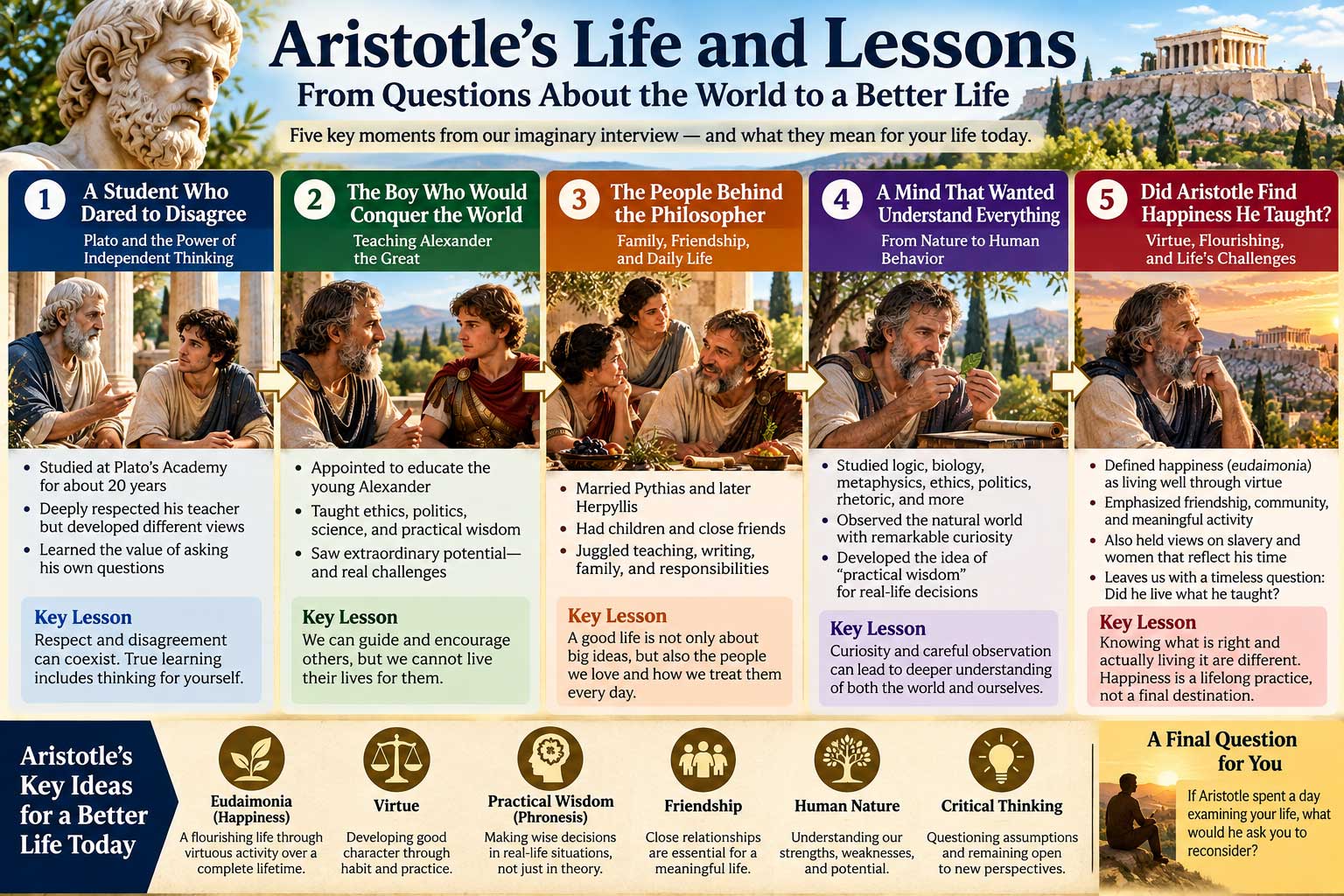
Short Bios:
Aristotle (384–322 BCE) — Philosopher, Scientist, and Teacher
Aristotle was an ancient Greek philosopher born in Stagira who studied for approximately twenty years at Plato's Academy in Athens. He later tutored the young Alexander of Macedonia and founded his own school, the Lyceum. His writings addressed logic, biology, metaphysics, ethics, politics, rhetoric, and poetry, profoundly influencing subsequent intellectual traditions. In this fictional interview, Aristotle appears as a 54-year-old thinker whose curiosity and achievements coexist with ordinary human relationships, uncertainties, and historically documented moral blind spots. His ethical philosophy continues to invite discussion about character, friendship, happiness, and what makes a life worth living.
Nick Sasaki — Host and Creator of ImaginaryTalks
Nick Sasaki is the creator of ImaginaryTalks.com, a platform devoted to fictional conversations that bring influential thinkers, historical figures, and contrasting perspectives into meaningful dialogue. Drawing on his experiences as a father, entrepreneur, and lifelong learner, Nick approaches these encounters with curiosity, humor, and a desire to understand the human beings behind famous ideas. In this imagined one-on-one conversation, he challenges Aristotle with personal questions about mentorship, family, ambition, morality, and happiness—exploring how ancient wisdom might help modern readers examine their own lives.
These participant biographies distinguish documented historical information from the fictional roles portrayed in this article. The interview is an imaginative literary work and does not contain authentic statements from Aristotle.
Leave a Reply