
Introduction
What if you could sit across from Leo Tolstoy, the legendary author of War and Peace and Anna Karenina, and ask him a question that fame, wealth, and literary genius never fully answered: Did you ever discover the meaning of life?
Imagine meeting Tolstoy at his beloved Yasnaya Polyana estate, where the elderly novelist welcomes Nick Sasaki into his quiet study. Over Russian tea, the conversation begins casually, with stories about his reckless youth, military adventures, and unexpected rise to literary greatness. But Nick isn't interested in interviewing a monument to literature. He wants to meet the real man, with all his humor, regrets, contradictions, and unanswered questions.
What makes this encounter fascinating is that Tolstoy's greatest struggles were deeply human. He wrote brilliantly about love, yet experienced painful conflicts with his wife, Sophia. He became devoted to the teachings of Jesus, yet rejected central doctrines of organized Christianity. He passionately opposed violence, having once served as a soldier. And after achieving almost everything society considers success, he still questioned whether life was worth living.
Nick approaches these subjects with genuine curiosity, occasionally challenging Tolstoy's conclusions and sometimes making him laugh. Their discussion moves naturally from personal happiness to marriage, faith, suffering, and humanity's continuing struggle to live peacefully. Neither man has to agree with the other, and Tolstoy isn't expected to provide a perfect answer to every difficult question.
What might we discover by listening to one of history's greatest minds speak openly about his greatest failures? Perhaps the most surprising part of this imaginary conversation isn't what Tolstoy teaches Nick, but what his extraordinary, imperfect life encourages us to question about our own.
Disclaimer: This is a fictional interview created for ImaginaryTalks.com. The conversation between Nick Sasaki and Leo Tolstoy never occurred. Historical details and philosophical ideas are informed by Tolstoy's documented life and writings, including A Confession, but all dialogue is imagined and should not be treated as authentic quotations.
Topic 1: The Man Who Had Everything but Happiness
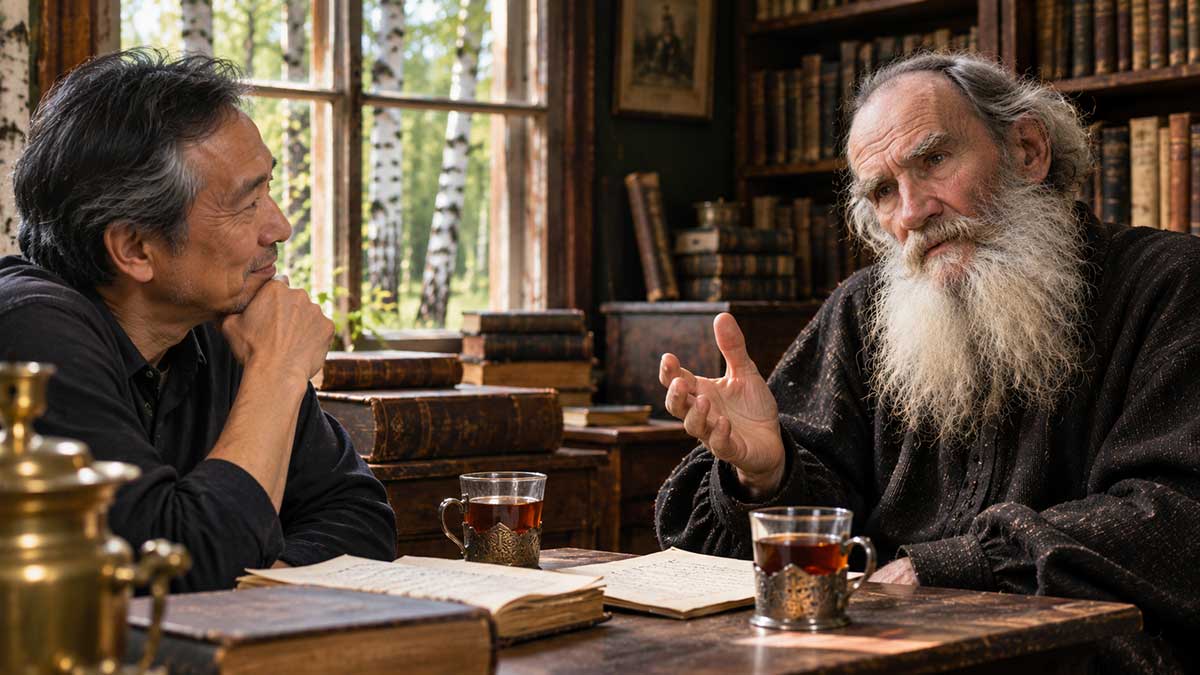
An imaginary conversation between Nick Sasaki and Leo Tolstoy, grounded in Tolstoy's life and writings. The dialogue is fictional.
The afternoon light lay across the wooden floor of Yasnaya Polyana. Outside the window, the birches moved in a wind too gentle to hear. Tolstoy poured tea into two glasses, then studied his guest with a faintly suspicious expression.
Nick
Before we start, I have to say, I was a little nervous coming here. You're Leo Tolstoy. You wrote War and Peace. That's a fairly intimidating résumé.
Tolstoy
A long book is not necessarily evidence of a wise man.
Nick
That's reassuring. I was afraid you might answer every question with six hundred pages.
Tolstoy
Only if your questions deserve it.
Nick
Then I'll try to keep them interesting.
Question 1: Leo, what was really going on with you when you were young?
Nick
Here's what surprised me when I started reading about you. I expected a serious young man sitting under a tree, thinking about God and human nature. Instead, I found gambling, drinking, debts, romantic adventures, and then the army. What was going on? Were you having the time of your life, or were you looking for something?
Tolstoy
Both, perhaps. When I was young, I wanted to be admired. I wanted to be courageous, attractive, clever, and superior to other men. I had grand plans for improving myself, and an extraordinary talent for abandoning them by evening.
Nick
That sounds familiar. You made resolutions?
Tolstoy
Constantly. I wrote rules for myself. I examined my faults. I promised to rise early, work diligently, govern my passions. Then I would find some foolish amusement and discover that my principles had gone to sleep before I had.
Nick
So the guy who later lectured the world about morality couldn't even follow his own morning routine?
Tolstoy
You see why I am reluctant to lecture anyone now.
Nick
But were you happy? I mean, genuinely happy?
Tolstoy
There were pleasures. I should not pretend otherwise. A young man can laugh at a gaming table, feel alive on horseback, fall in love with an image of himself reflected in another person's eyes. Yet pleasure is a poor companion when the room grows quiet. I often felt ashamed of what I had done, and then sought another diversion to escape the shame.
Nick
You lost your mother when you were very small, and your father when you were still a child. Do you think that had something to do with it?
Tolstoy
How could it not? Yet I would distrust any explanation that claims to solve a whole life with one childhood sorrow. I grew up surrounded by affection, relatives, servants, and privilege. I had much that other children did not. Still, the absence of a mother becomes a kind of question one carries without knowing how to ask it.
Nick
What question?
Tolstoy
What does it mean to be loved without having to earn it?
Nick glanced toward the window. The question seemed to settle between them.
Nick
That's interesting. You spent so much of your youth trying to become somebody extraordinary. Maybe you were trying to become somebody who deserved love.
Tolstoy
Perhaps. But take care, Nick. It is very easy to turn a dead man's life into a tidy psychological theory. I was vain. I was restless. I made choices. My grief does not excuse them.
Nick
Fair point. Then you went to the Caucasus and later fought in the Crimean War. What did being a soldier do to you?
Tolstoy
It stripped away certain beautiful lies. People speak of war with splendid words: honor, glory, sacrifice. At Sevastopol I saw men who were frightened, exhausted, brave, ridiculous, tender, and terribly vulnerable. A wound did not ask whether its victim had noble intentions. Death was not impressed by patriotic speeches.
Nick
Were you afraid?
Tolstoy
Of course. Courage is not the absence of fear. Sometimes it is simply the shame of showing fear before other frightened men.
Nick
Did you ever think, 'Why are we doing this? Why are these people killing each other?'
Tolstoy
I did, though the full consequences of that question took many years to reach me. In youth, one may see an absurdity clearly and still continue participating in it. Later I came to regard the organized killing of human beings as a profound moral wrong. But do not mistake my later conviction for something I possessed completely as a young officer.
Nick
So you weren't born with the answers.
Tolstoy
No. I was unusually gifted at discovering answers and then failing to live by them.
Nick
You're making it difficult for me to put you on a pedestal.
Tolstoy
Then we are making progress.
Question 2: You became one of the greatest writers in history. Did success actually make you happy?
Nick
Let's jump ahead. You write War and Peace. Then Anna Karenina. People read you everywhere. You've got this beautiful estate, a family, recognition, money. From the outside, it looks like you've won. Was there a moment when you thought, 'I've made it'?
Tolstoy
I took satisfaction in my work. I knew when a scene had come alive, when a character had ceased to be merely my invention and had begun to act with a life of his own. That is a remarkable experience. And yes, I enjoyed praise more than I sometimes wished to admit.
Nick
Good. I was hoping you wouldn't tell me you hated every minute of writing two enormous novels.
Tolstoy
Writing could be joyful. It could be miserable. A writer may spend a morning correcting one paragraph and then declare that literature is a useless occupation. The next day he returns to the same paragraph.
Nick
What about Sophia? She helped copy your manuscripts, didn't she?
Tolstoy
She did an immense amount of work, and cared for our family through years when I was absorbed in writing. A book does not arrive in the world by the author's effort alone. I did not always give that truth the attention it deserved.
Nick
That's a pretty big admission.
Tolstoy
It is easier to admit a failing in conversation than to repair the suffering it caused.
Nick
We'll come back to Sophia. But I want to understand something. A lot of people spend their entire lives trying to achieve what you achieved. What did fame feel like after the excitement wore off?
Tolstoy
Like being congratulated for building a fine house while discovering that you do not know why you are living in it.
Nick
That's a striking way to put it.
Tolstoy
I had asked myself how to write well, how to manage my affairs, how to raise children, how to earn respect. These are real questions. But beneath them another question began to grow: What is all this for, if I must die and everything I have made will pass away?
Nick
Did you think about death all the time?
Tolstoy
Not every minute. That would have been impossible. Life continued. There were meals, children, arguments, fields, pages to write. But ordinary activities began to seem suspended over an abyss. I could not make the question disappear by being busy.
Nick
I wonder if success made the question worse. When you're still chasing a goal, you can tell yourself, 'Once I get there, I'll be happy.' But once you get there, you can't use that excuse anymore.
Tolstoy
Yes. Success can remove an illusion without giving you a truth to replace it. The man who has no bread can reasonably think of bread. The man who has bread, comfort, and admiration must still ask what makes his life good.
Nick
But couldn't you have said, 'My books help people. My children need me. Isn't that enough?'
Tolstoy
I tried answers of that kind. I loved my family. I valued my work. Yet my mind would ask: and then? The children will grow old. The books will be forgotten someday. I will die. I was not asking whether these things were pleasant or useful. I was asking whether they had a meaning that death could not simply erase.
Nick
That's a much tougher question.
Tolstoy
It became unbearable precisely when I could no longer distract myself from it.
Nick
Did people around you realize what was happening?
Tolstoy
They saw a man with responsibilities and accomplishments. My inward life was not always visible to them. And I must be careful not to make my suffering sound nobler than the ordinary burdens other people carried. I was a privileged man tormented by questions that a poor laborer might have had no leisure to put into words.
Nick
Yet you eventually looked to those laborers for an answer.
Tolstoy
That is one of the ironies of my life.
Question 3: When life started feeling meaningless, what helped you find a reason to continue?
The tea had cooled. Tolstoy rested his hands on the table. For the first time, Nick let a longer silence pass.
Nick
I want to ask about that period carefully. In A Confession, you wrote about being frightened by the thought of death and losing your sense of purpose. At times you were afraid of what you might do to yourself. What was that experience actually like?
Tolstoy
It was as though the familiar supports of life had vanished. I could still perform my duties, but I could not answer the simplest question: Why? Why work? Why love? Why endure suffering? Why continue, if everything ends in nothing?
Nick
Was it sadness? Or was it more like your mind couldn't accept any of the answers people gave you?
Tolstoy
The second was certainly part of it. I examined science, philosophy, the wisdom of those who had lived before me. I found insights, but no answer that satisfied the whole of my being. Some explanations described the world brilliantly while leaving untouched the question of how I ought to live in it.
Nick
What changed?
Tolstoy
I began to look more seriously at people whose lives were not organized around the ambitions of my class. Peasants worked, suffered, buried their loved ones, and still found reasons to rise in the morning. Their faith was not merely a proposition argued in a book. It was woven into their daily labor and relationships.
Nick
Did you envy them?
Tolstoy
I envied their ability to live. But I must not romanticize their hardship. Poverty is not a spiritual achievement, and hunger is not wisdom. What struck me was that some people possessed a kind of trust and purpose that I, with all my learning, had lost.
Nick
So was the answer religion?
Tolstoy
That depends on what you mean by religion. I did not simply decide that every teaching of the Church must be true. In fact, my search eventually brought me into serious conflict with the Church. What I found was that life could be understood through a moral relationship with something greater than the isolated self. I came to see love, honest labor, and service to others as inseparable from faith.
Nick
But I'm going to push back a little. Suppose someone doesn't believe in God. Could that person still have a meaningful life, love their children, and help other people?
Tolstoy
Certainly a person can perform acts of great love without accepting my language about God. I would ask what that person believes makes love good and life worth living. Perhaps we would discover that our disagreement is partly about words. Perhaps it is deeper. We should not pretend to know before speaking honestly.
Nick
I like that. You don't want me to agree just to be polite.
Tolstoy
Agreement purchased with politeness is not understanding.
Nick
Did finding faith make you happy again?
Tolstoy
It gave me a way to live, not a permanent escape from difficulty. I continued to struggle with pride, impatience, and contradictions. I did not become a saint when I began speaking about love. In some respects, my convictions made my domestic life more difficult.
Nick
That's what fascinates me about you. You discovered this enormous idea, that life is about love and serving others. But knowing the idea didn't automatically make living it easy.
Tolstoy
You have touched the most painful distinction. A man may write eloquently about kindness and speak harshly to someone at breakfast. He may condemn selfishness while demanding that everyone around him arrange their lives to accommodate his conscience.
Nick
That sounds almost like you're describing yourself.
Tolstoy
I would be a poor witness if I exempted myself.
Nick
Then let me ask one last thing before we move on. If you could talk to the younger Leo, the one chasing excitement, recognition, and the perfect life, what would you tell him?
Tolstoy
I might tell him to pay closer attention to the people who are already near him. Not merely to the way they make him feel, but to their actual lives. Their needs. Their sorrows. Their patience. A young man imagines that meaning is waiting somewhere ahead, behind a victory or a great achievement. He rarely suspects that he may have walked past it that very morning.
Nick
That's beautiful. But would the younger you have listened?
Tolstoy
Almost certainly not.
Nick
At least you're consistent about that.
Tolstoy laughed softly. Outside, the afternoon shadows had lengthened across the path.
Nick
You know, Leo, you've mentioned the people around you a few times. And there's one person I keep thinking about. Someone who was there through the books, the success, the spiritual crisis, and everything that followed.
Tolstoy
Sophia.
Nick
Yes. I'd like to hear about her, not just the arguments everyone writes about. I'd like to know who she was to you when you first fell in love.
Tolstoy looked down at his untouched tea before answering.
Tolstoy
Then we must begin much earlier than the arguments.
Topic 2: The Man Who Preached Love but Struggled at Home
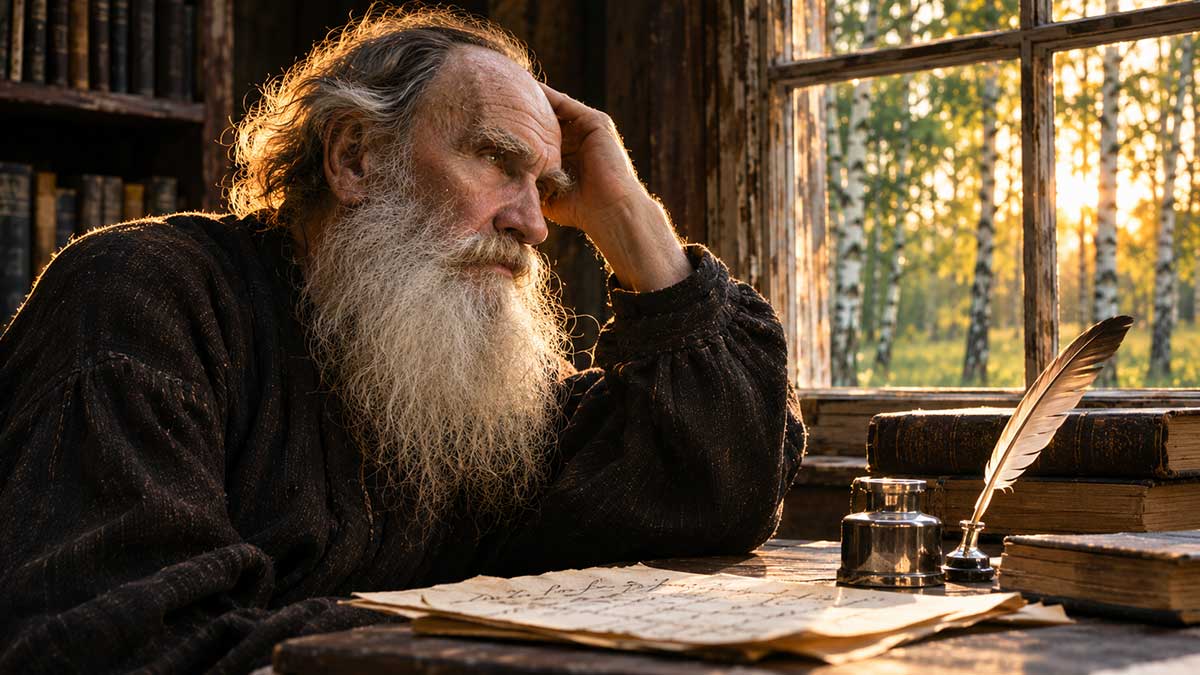
An imaginary conversation between Nick Sasaki and Leo Tolstoy, grounded in Tolstoy's life, writings, and documented marriage to Sophia Tolstaya. The dialogue is fictional.
The afternoon had grown quieter at Yasnaya Polyana. Beyond the study window, a gardener was gathering fallen branches beneath the birch trees.
Tolstoy had just finished describing the emptiness he experienced after becoming one of the world's most celebrated writers.
Nick looked at the elderly novelist for a moment.
Nick
Leo, there's something I've been wanting to ask you. We've talked about your books, your search for meaning, and your spiritual awakening. But there's someone who was there through so much of it.
Tolstoy
Sophia.
Nick
Yes. Your wife. And before we get into the difficult parts, I'd love to know how it all began.
Tolstoy leaned back in his chair.
Tolstoy
That is a much more pleasant place to begin.
Question 1: Leo, what made you fall in love with Sophia?
Nick
You were thirty-four when you married Sophia, and she was eighteen. That's quite an age difference. What was it about her that made you think, "This is the woman I want to spend my life with"?
Tolstoy
She was young, intelligent, lively, and capable of a remarkable warmth. I was attracted to her beauty, certainly, but there was something more. I felt that a different life might be possible with her.
Nick
Different from the gambling and romantic adventures?
Tolstoy
You seem determined never to let me forget those.
Nick
Well, they do make your biography interesting.
Tolstoy
They made my conscience considerably less comfortable.
Nick
So you wanted to settle down?
Tolstoy
I wanted to become a better man. Marriage seemed to promise a new beginning. I imagined a household filled with children, affection, honest work, and a kind of moral harmony.
Nick
That sounds wonderful.
Tolstoy
It sounded wonderful to me, too.
Nick
But you said that with a certain expression.
Tolstoy
A young husband can enter marriage with a beautiful picture of family life without realizing that his wife has a picture of her own.
Nick
That's a good point. Did you really know Sophia before marrying her?
Tolstoy
I knew some things. I admired her. I desired her company. I believed we could be happy together. But knowing a person deeply requires years, and marriage begins before those years have passed.
Nick
I've read that you showed her your diaries before the wedding. Some of what you wrote about your past must have been pretty upsetting for an eighteen-year-old woman.
Tolstoy
Yes. I believed I was acting honestly. I did not want our marriage founded upon concealment.
Nick
But did you ever think that maybe you were putting a tremendous burden on her?
Tolstoy paused.
Tolstoy
That is a fair question. Confession can serve two purposes. It can respect another person's right to know the truth. It can serve the confessor's desire to be relieved of guilt. The two are not always the same.
Nick
That's interesting. You might have felt better after telling her everything, but she was the one who had to live with what she'd learned.
Tolstoy
Precisely. Honesty does not excuse a lack of tenderness.
Nick
Were the early years happy?
Tolstoy
There was great happiness. We had children. We shared daily life. There were moments of intimacy and companionship that I would not wish erased from the story of our marriage.
Nick
What did you two enjoy doing together?
Tolstoy
There was conversation, reading, the affairs of the household, the children. Our lives became deeply connected through my writing.
Nick
She copied your manuscripts, right?
Tolstoy
Yes. Sophia copied and recopied drafts, sometimes many times. My handwriting and revisions could be a trial to anyone attempting to prepare a clean manuscript.
Nick
I've heard War and Peace went through an incredible amount of revision.
Tolstoy
A writer can become convinced that a sentence is finished, then discover the next morning that it is entirely wrong.
Nick
And your wife had to copy it again?
Tolstoy
Very often.
Nick
Leo, I'm starting to think she deserves a coauthor credit.
Tolstoy smiled.
Tolstoy
She deserves recognition for work without which my own would have been far more difficult. Yet her contributions were not limited to manuscripts. She bore and raised children, managed household affairs, dealt with practical matters, and carried responsibilities I could too easily take for granted.
Nick
You had thirteen children together.
Tolstoy
Yes. Not all survived childhood.
Nick
I can't begin to picture how much work that was, especially with everything else she was doing.
Tolstoy
Nor should we imagine that the suffering of losing children was less severe merely since death was more common in those days.
Nick
Did you appreciate everything she did?
Tolstoy
At times, certainly. But appreciation expressed occasionally is not the same as attention given every day.
Nick
That's a pretty important distinction.
Tolstoy
I fear many husbands discover it too late.
Nick
Was Sophia proud of your books?
Tolstoy
She invested enormous effort in them. But she had her own thoughts, feelings, and judgments. We should not reduce her to a woman whose only purpose was to admire her husband.
Nick
I like that answer.
Tolstoy
Then perhaps you should ask her what she thought of me.
Nick
I suspect that would be an even longer interview.
Tolstoy
And possibly a more accurate one.
They both laughed.
Nick took a sip of tea.
Nick
You know, it's interesting. When people talk about your marriage, they usually jump straight to the terrible arguments near the end. But listening to you, I get the feeling there was a great deal of love before all that.
Tolstoy
There was love. There was affection. There were shared joys and sorrows. A troubled ending does not mean every earlier happiness was false.
Nick
So what happened?
Tolstoy's expression grew more serious.
Question 2: How could someone who understood love so deeply struggle with the person closest to him?
Nick
Leo, can I ask you something a little uncomfortable?
Tolstoy
You have been doing that since you arrived.
Nick
Fair enough.
Here's what I find fascinating. You spent so much of your life writing about love, compassion, forgiveness, and how people should treat one another.
But your relationship with Sophia became incredibly difficult.
How does that happen? How can someone think so deeply about love and still struggle with the person closest to him?
Tolstoy
You assume that thinking deeply about a virtue makes one capable of practicing it.
Nick
Doesn't it help?
Tolstoy
It may help a man recognize his failures. It does not prevent him from committing them.
Consider patience. A man can explain patience beautifully in a book. Then someone interrupts him at breakfast, and he becomes irritated.
Nick
That sounds like pretty much everybody.
Tolstoy
Yes. Yet the writer may be especially dangerous. He can become so pleased with the beauty of his principles that he mistakes the act of describing goodness for the act of being good.
Nick
That's fascinating. So writing about love can almost become a substitute for actually loving?
Tolstoy
It can, if one is not careful.
Nick
But what made your marriage so difficult?
Tolstoy
There were many causes. Our temperaments differed. We had endured years of responsibilities, disappointments, and disagreements. My religious convictions changed profoundly. My understanding of property, money, and the purpose of life no longer resembled the beliefs with which I entered marriage.
Nick
So Sophia married one man, and over time you became almost another person?
Tolstoy
In certain respects, yes.
Nick
That must have been difficult for her.
Tolstoy
It was difficult for both of us. Yet I should not use my spiritual development as a convenient explanation for every disagreement. I was capable of pride, impatience, and unreasonable expectations.
Nick
Let me ask you something. Do you think it's easier to love humanity in general than to love one actual person?
Tolstoy
Much easier.
Nick
Really?
Tolstoy
Humanity does not interrupt your work to ask about household expenses. Humanity does not remind you of something unkind you said fifteen years earlier. Humanity does not know precisely where your vanity is most sensitive.
Nick
That's a great answer.
Tolstoy
It is an uncomfortable one.
Nick
But isn't that the real test of love?
Tolstoy
Perhaps one of the greatest tests. It is possible to feel immense compassion for people one has never met, then behave selfishly toward those who share one's table.
Nick
I've seen that. People can care passionately about saving the world, but they don't have much patience for their own family.
Tolstoy
And I would not exempt myself from that danger.
Nick
Did Sophia ever tell you that you weren't living according to your own teachings?
Tolstoy
She challenged my actions and the consequences of my beliefs. I cannot reproduce every conversation we had, and I would be dishonest to invent words for her. But our disagreements frequently exposed the distance between my ideals and the realities of our household.
Nick
Did that make you angry?
Tolstoy
Sometimes. A person may welcome criticism of an argument and still resent criticism of his character.
Nick
Especially when he knows the criticism might be true.
Tolstoy
Especially then.
Nick
Here's another thing I'm curious about. When you argued, did you ever stop and think, "Maybe she's right"?
Tolstoy
There were moments when I recognized the justice of her concerns. Recognition, however, did not always produce agreement.
Nick
Why not?
Tolstoy
I believed some of the questions concerned fundamental moral obligations. If I considered a way of life wrong, I could not simply declare it right to preserve domestic peace.
Nick
But couldn't Sophia have felt the same way? Couldn't she have believed that protecting her children was a fundamental moral obligation?
Tolstoy considered the question.
Tolstoy
Certainly. And that is why the conflict was so painful. Each person could regard the other's actions as a betrayal of something precious.
Nick
So you weren't arguing about something simple, like where to put the furniture.
Tolstoy
I suspect we could have argued about that, too.
Nick
Probably.
Tolstoy
But the deepest disagreements concerned what kind of life we ought to lead, what we owed our children, and what we owed our consciences.
Nick
You know what strikes me? You both might have been trying to do something good, but you had completely different ideas about what goodness required.
Tolstoy
Yes. Yet we must be cautious. People sometimes use the phrase "different ideas" to avoid examining whether their own conduct has caused real suffering.
Nick
So you don't want to excuse yourself by saying it was just a disagreement?
Tolstoy
No. A man must examine his own actions, not merely explain his intentions.
Nick
That's something I think a lot of people can relate to.
You can love someone and still hurt them. You can believe you're doing the right thing and still make their life miserable.
Tolstoy
Love is not proved by the intensity of one's feelings or the grandeur of one's declarations.
Nick
Then how is it proved?
Tolstoy
In how one treats another human being when kindness is difficult.
Nick sat quietly for a moment.
Nick
That's a much harder standard than simply saying, "I love you."
Tolstoy
Words are inexpensive.
Nick
Unless you're a novelist. Then you can sell quite a few of them.
Tolstoy laughed.
Tolstoy
And perhaps become confused about their value.
Question 3: Were you asking too much of Sophia when your spiritual beliefs threatened your family's security?
Nick
Okay, Leo, I want to get into something that I think is really important.
You began to believe that wealth, private property, and luxury were morally troubling. You wanted to live more simply, work with your hands, and distance yourself from the privileges of your class.
I can understand why those ideas appealed to you.
But Sophia had a family to look after.
From her perspective, wasn't she just trying to protect her children?
Tolstoy
She was deeply concerned with their welfare and with the practical consequences of my decisions. Those concerns were real.
Nick
Then here's my question. If you wanted to give up your wealth, why couldn't you do that personally without expecting your wife and children to live according to the same principles?
Tolstoy
That question troubled the very heart of my situation.
I came to believe that the comforts of the wealthy were connected to the labor and deprivation of others. I could not regard the privileges of my class as morally innocent.
Nick
I understand that. But let's say you have a family, and you've earned money from writing books. Isn't there something good about using that money to give your children a secure life?
Tolstoy
Providing food, shelter, and care is a responsibility. But does responsibility require luxury? Does love for one's children justify maintaining a social arrangement that burdens the children of others?
Nick
Maybe not. But where do you draw the line?
Suppose I make a million dollars writing books. I support my family, pay the people who work with me, and give a lot to charity. Is that wrong?
Tolstoy
I would ask how the money was acquired, what kind of life it encourages, and whether the desire to possess more has begun to govern the man who possesses it.
Nick
But you're not saying the amount itself tells us whether someone is good or bad?
Tolstoy
No single number can answer a moral question. Yet great wealth in a society of desperate poverty ought to trouble the conscience.
Nick
I can agree with that concern. But I still think money can be a useful tool.
For example, someone could build a successful business and use the profits to provide clean water, education, or food for thousands of people.
Wouldn't that be a good thing?
Tolstoy
Helping people is good. But I would ask whether the business itself treats people justly, and whether its owner is willing to live by the same moral standards he recommends to others.
Nick
That's fair.
But let me bring this back to Sophia.
You had a wife who had spent years helping you produce these books. She had helped create the very success you later wanted to renounce.
Didn't she have a legitimate claim to some of what that work produced?
Tolstoy
Her labor and sacrifices deserved consideration. The question of literary rights became a source of profound conflict in our family.
Nick
And I have to say, Leo, I can see her side.
If I spent years helping my spouse build something, and then one day that spouse announced, "I've decided money is spiritually harmful, so we're going to give it all away," I might be a little upset.
Tolstoy
A little?
Nick
Probably more than a little.
Tolstoy
Then you have begun to understand the difficulty.
Nick
But did you understand it at the time?
Tolstoy
Not always with the patience or generosity it deserved.
I believed I had discovered something morally necessary. When a person becomes convinced that a principle is true, compromise may appear to him as cowardice.
Nick
But couldn't refusing to compromise be selfish, too?
Tolstoy
Yes.
Nick
Even when the principle is good?
Tolstoy
A good principle does not automatically make every action taken in its name good.
Nick
That's a big statement.
Tolstoy
It is a difficult one to live by.
Nick
Let me try a different angle.
Suppose Sophia had come to you and said, "Leo, I respect your spiritual beliefs. I understand why you want to live simply. But I don't believe God wants our children to suffer financially just so you can feel morally consistent."
What would you have said?
Tolstoy
I might have answered that a life devoted to unnecessary possessions brings its own suffering, and that children should learn to live without depending upon privilege.
Nick
And if she said, "That's easy for you to say. You're already famous. You have an estate. You've had opportunities most people will never have"?
Tolstoy
Then she would have identified a genuine contradiction in my circumstances.
Nick
Did that contradiction bother you?
Tolstoy
Very much. My position as a wealthy landowner who criticized wealth was not lost upon me. I tried to change my way of living, but my efforts were incomplete and sometimes inconsistent.
Nick
You worked in the fields, made shoes, dressed more simply.
Tolstoy
Yes. Physical labor became important to me. I believed that a person should not live entirely from the labor of others.
Nick
But you were still living at Yasnaya Polyana.
Tolstoy
Precisely. One cannot erase a lifetime of privilege by putting on simple clothes.
Nick
I'm glad you said that.
Sometimes I wonder whether people get so focused on becoming morally perfect that they forget the people around them.
Tolstoy
Moral perfection is a dangerous ambition when it becomes a reason to control others.
Nick
Did you ever feel that was happening to you?
Tolstoy
I had reason to examine that possibility. Yet I do not wish to pretend that I abandoned my convictions or came to regard the pursuit of a simpler, more just life as mistaken.
Nick
That's interesting. So you still believe in the principles, but you're questioning how you tried to live them?
Tolstoy
That is a distinction worth making.
Nick
You know, Leo, I think this is where people can get into trouble.
They discover an idea that seems absolutely true. Then they start thinking everyone around them should see it the same way.
Tolstoy
And when others resist, the believer may conclude that they are morally inferior rather than recognizing that they have responsibilities and fears of their own.
Nick
Exactly.
But I'm curious about something else.
Did Sophia ever influence your thinking? I mean, not just frustrate you or challenge you, but actually teach you something?
Tolstoy looked toward the window.
Tolstoy
She knew forms of responsibility that my philosophical reflections could too easily overlook. The daily care of children, the management of a household, the consequences of decisions that sound noble when spoken in a study.
Nick
So she was dealing with the practical world, and you were thinking about the ideal world?
Tolstoy
That is too simple. Sophia had ideals of her own, and I was not entirely absent from practical life. But yes, there were times when my attention to universal moral questions was greater than my attention to immediate human needs.
Nick
That's an interesting contradiction.
You were trying to make the world a better place, but sometimes the person closest to you needed something much simpler.
Tolstoy
Perhaps she needed to be heard without first being corrected.
Nick
That's a good way to put it.
A long silence followed.
The gardener outside had finished gathering branches. Somewhere beyond the house, a door closed.
Nick
Leo, can I ask one more thing?
Tolstoy
Of course.
Nick
Do you think love sometimes means letting another person make a choice you believe is wrong?
Tolstoy
Love does not require us to declare falsehood true. But it does require us to recognize that another person has a conscience, a life, and a dignity that do not belong to us.
Nick
So you can disagree without trying to control them?
Tolstoy
One ought to try.
Nick
Were you good at that?
Tolstoy
No.
Nick laughed, surprised by the speed of the answer.
Nick
You didn't even have to think about it.
Tolstoy
Some questions become easier with age.
Nick
That's probably the most relatable thing you've said all afternoon.
Tolstoy smiled, then grew thoughtful.
Tolstoy
I would not want anyone to leave this conversation believing that my marriage can be explained by a few clever observations. There were years of shared life, tenderness, resentment, misunderstanding, devotion, and pain. Sophia had her own experience of those years. Mine is not the only account.
Nick
I'm glad you said that.
And I hope someday I can sit down with her and hear her side.
Tolstoy
You may discover that she has more interesting things to say about me than I do.
Nick
I wouldn't be surprised.
Nick glanced at his notes, then closed the notebook.
Nick
There's something I've noticed about our conversation.
Every time we talk about love, you come back to the idea that love is something we have to practice, not just something we feel.
And that brings me to another question.
You weren't always this concerned about living according to Jesus's teachings. Something changed in you.
Tolstoy
Yes.
Nick
You became deeply interested in Jesus, but you disagreed with some of the central teachings of the Church. You even rejected the idea that Jesus was God in the traditional Christian sense.
I've been wanting to understand that.
What was it about Jesus that affected you so profoundly?
Tolstoy folded his hands.
Tolstoy
To answer that, Nick, we must begin with something that troubled me for many years.
Nick
What's that?
Tolstoy
How can people claim to believe in the teachings of Jesus and yet organize their lives in ways that contradict those teachings?
Nick leaned forward.
Nick
That's a question I'd really like to explore.
The conversation continues in Topic 3: Jesus, God, and the Religion He Rejected.
Topic 3: Jesus, God, and the Religion He Rejected
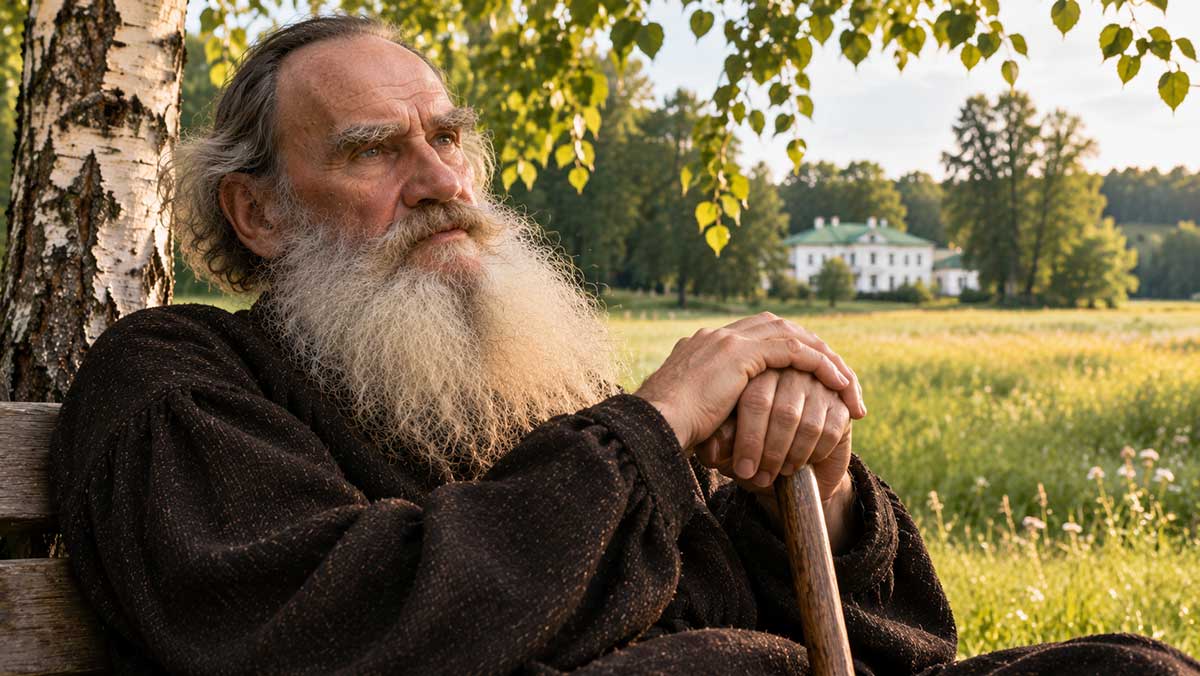
An imaginary conversation between Nick Sasaki and Leo Tolstoy, grounded in Tolstoy's religious writings, personal history, and documented beliefs. The dialogue is fictional.
The afternoon sunlight had begun to soften over Yasnaya Polyana.
On the wooden table between Nick and Tolstoy sat two glasses of tea, several books, and a small notebook that Nick had barely opened.
Their conversation about Sophia had taken them into unexpectedly personal territory. Tolstoy had spoken about the difficulty of practicing love within marriage, the danger of becoming attached to one's own moral certainty, and the difference between knowing what is right and actually doing it.
Nick leaned forward.
Nick
Leo, there's something I keep thinking about. You spent years trying to figure out how to live a good life. You had money, fame, a family, everything most people dream about.
But somehow, none of that answered your biggest questions.
Then you started reading the teachings of Jesus, and something changed.
What happened?
Tolstoy looked at the books beside him.
Tolstoy
I began to suspect that the answers I had been seeking were not hidden in some complicated philosophy. They were present in teachings I had heard since childhood but had never truly attempted to follow.
Nick
That's interesting. So the words were familiar, but suddenly they meant something completely different?
Tolstoy
Yes. It is possible to hear a truth a thousand times without allowing it to disturb one's life.
Nick
And once it disturbed yours, it apparently disturbed quite a few other people's lives, too.
Tolstoy smiled.
Tolstoy
You are thinking of the Church.
Nick
Among others.
Question 1: Leo, what was it about Jesus that changed your life so deeply?
Nick
Here's what fascinates me. You were born into a Christian society. You knew about Jesus your whole life. But when you were around fifty, you started taking his teachings incredibly seriously.
What did you suddenly see in Jesus that you hadn't seen before?
Tolstoy
I discovered that his teaching was not merely something to admire. It was something to do.
For much of my life, religion had appeared to me as a collection of doctrines, ceremonies, and explanations about invisible things. But when I examined the Gospels more closely, I found a teaching about how a human being should live.
Do not repay evil with evil. Do not hate your enemies. Do not judge others while remaining blind to your own faults. Love your neighbor. Seek the good of others rather than your own advantage.
These were not decorations placed around a religious institution. They were demands upon life itself.
Nick
But weren't Christians already being taught those things?
Tolstoy
They were being told to admire them.
Nick
What's the difference?
Tolstoy
A considerable one.
Imagine a man who hangs a beautiful picture of a garden on his wall. Every day he praises its flowers. He invites his friends to admire the colors. He writes books about the importance of gardens.
But outside his house, the soil remains barren, and he has never planted a seed.
Nick
So you're saying people were admiring Jesus instead of following him.
Tolstoy
That was my criticism. They praised his teachings, then explained why ordinary life could not be governed by them.
Nick
Can you give me an example?
Tolstoy
Jesus taught his followers to love their enemies. Yet Christian nations maintained armies, blessed their weapons, and taught young men that killing the enemies of their country was a sacred duty.
I could not reconcile those practices.
Nick
But let me ask something. You don't think there might be situations where people have no choice but to defend themselves?
Tolstoy
We will come to that question, I suspect.
Nick
Oh, definitely. I've got quite a few questions about that.
Tolstoy
Then let us first understand the principle before we examine your exceptions.
Nick
Fair enough.
But here's another thing I'm curious about. You admired Jesus tremendously, yet you didn't believe he was God in the traditional Christian sense.
How did you arrive at that conclusion?
Tolstoy
I came to believe that the divine truth of Jesus's teaching did not depend upon accepting the theological claims made about his person.
The traditional doctrines concerning the Trinity, the incarnation, and the supernatural nature of Christ did not persuade me.
What persuaded me was the moral truth I found in his words.
Nick
So for you, Jesus was a human being who understood God better than most people?
Tolstoy
I would say that Jesus revealed the true way of life with extraordinary clarity. I regarded him as a teacher of divine truth, not as God incarnate in the sense taught by the Church.
Nick
But wouldn't some Christians say that you're missing the most important part of Christianity?
Tolstoy
Certainly. And I would ask them why the identity they assign to Jesus should be considered more important than obedience to his teaching.
Nick
That's a pretty challenging question.
Tolstoy
It was intended to be.
Nick
Let me try something.
Suppose Jesus himself walked into this room right now.
You'd probably be pretty excited.
Tolstoy
I should hope to receive him with greater humility than I have sometimes shown my ordinary visitors.
Nick
Would you ask him whether he was God?
Tolstoy
I suspect I would have more urgent questions about my own life.
Nick
Like what?
Tolstoy
Why I have found it so difficult to love those nearest to me.
Nick was silent for a moment.
Nick
That's interesting. We were just talking about Sophia, and now you've brought her back into the conversation.
Tolstoy
The teachings of Jesus do not become irrelevant when we leave the church and return home. That is precisely where they begin to test us.
Nick
So if Jesus were sitting here, you might ask him how to be a better husband?
Tolstoy
Perhaps I should have asked that question many years earlier.
Nick
You know what I find fascinating? People spend centuries debating whether Jesus was God, but you're saying the bigger question might be whether we actually live the way he taught.
Tolstoy
That was central to my understanding.
Nick
But couldn't both matter? Couldn't someone believe Jesus was divine and still sincerely try to follow him?
Tolstoy
Of course. I did not deny that sincere believers existed within the Church. My disagreement concerned the doctrines and institutions, not the impossibility of goodness among their members.
Nick
That's an important distinction.
Tolstoy
It is one I did not always express with sufficient patience.
Nick
You weren't exactly known for being gentle with religious institutions.
Tolstoy
No. I fear the clergy did not eagerly await my next publication.
Nick
I can imagine the bishop opening the newspaper and saying, "Oh no, Tolstoy's written something again."
Tolstoy laughed.
Tolstoy
Perhaps. Though I suspect the reaction was less amusing for those involved.
Question 2: What bothered you so much about the Church?
Nick
Okay, let's talk about the Russian Orthodox Church.
You weren't just mildly disappointed with it. You became one of its most famous critics, and eventually the Church publicly declared that your beliefs separated you from Orthodox Christianity.
What bothered you the most?
Was it the theology? The rituals? The wealth? The relationship with the government?
Tolstoy
All of these were connected in my mind.
But the deepest problem was that I believed the Church had replaced the practical teaching of Jesus with a system of doctrines and ceremonies that could coexist with the very conduct he had condemned.
Nick
What do you mean by coexist?
Tolstoy
A person could participate in religious ceremonies, profess the correct doctrines, and still regard violence, inequality, and the pursuit of wealth as normal features of life.
The institution could assure him that he remained a faithful Christian.
Nick
But isn't that true of almost any religion? People don't always live according to what they believe.
Tolstoy
Certainly. Human inconsistency is universal. I knew it well from my own life.
But there is a difference between a person failing to practice a teaching and an institution developing explanations that make the failure appear acceptable.
Nick
That's interesting.
So you're more concerned about the institution justifying the behavior than about individual people making mistakes.
Tolstoy
Yes. The person who admits his failure may still change. The person who has been assured that his failure is righteousness has a greater obstacle before him.
Nick
But let me challenge you a little.
I've known religious people who genuinely find comfort in church. They pray together, help the poor, visit sick people, take care of families who are struggling.
Surely that's something good.
Tolstoy
Of course it is good.
Nick
Then isn't it possible that the Church does a lot of good, despite having doctrines you disagree with?
Tolstoy
Yes. I would not deny an act of kindness merely since it occurred within an institution I criticized.
But I would ask whether the institution encourages people to live by love in all circumstances, or whether it permits exceptions whenever the interests of the state or powerful people are threatened.
Nick
So you're judging religion by its results.
Tolstoy
By its fruits, one might say.
Nick
Here's something else. You were raised in Russia, where religion was deeply connected to national identity.
Did you ever worry that rejecting the Church meant rejecting part of your own culture?
Tolstoy
I understood that religion was woven into the life of my country. I did not regard every custom or tradition as worthless.
But the age of a belief does not establish its truth.
Nick
That's fair. But isn't there something valuable about tradition itself?
A family goes to church together. Children grow up hearing the same prayers their grandparents heard. There's a connection between generations.
Tolstoy
Such connections can be beautiful. But beauty must not become a reason to abandon conscience.
If a tradition teaches compassion, let us cherish its compassion. If it commands what we believe to be wrong, we must examine it.
Nick
You make it sound simple.
Tolstoy
It is not simple to practice.
Nick
There seems to be a pattern here.
Tolstoy
You have noticed it.
Nick
Let me ask something more personal.
When you became so critical of the Church, did you ever wonder whether you might be wrong?
Tolstoy
I examined these questions for years. I struggled to reconcile the doctrines I had inherited with what I understood to be reason and the teachings of Jesus.
I was convinced of my conclusions, but conviction does not make a man incapable of error.
Nick
Did you ever meet a priest who made you reconsider your opinion?
Tolstoy
I encountered sincere religious people, and I knew that goodness was not confined to those who agreed with me. Yet my disagreements with the official teachings remained profound.
Nick
I want to push this a little further.
Suppose a Christian tells you, "Leo, I believe Jesus is God. I believe in the resurrection. I love going to church. And I genuinely try to love my neighbors."
Would you tell that person they're following the wrong religion?
Tolstoy
I would ask what those beliefs mean in the conduct of their life.
If they love their neighbors, refuse cruelty, and seek truth, I would recognize the goodness of those actions.
But I would still disagree with doctrines I regarded as false.
Nick
So you can respect the person without agreeing with the belief.
Tolstoy
That should be possible.
Nick
Should be?
Tolstoy
It is another principle that human beings, myself included, frequently fail to practice.
Nick
I appreciate that you keep including yourself.
Tolstoy
If I excluded myself, you would eventually remind me.
Nick
You know me pretty well already.
Tolstoy smiled.
Nick
There's something I want to ask about the Bible itself.
You didn't simply accept every part of the Gospels in the way the Church interpreted them. You worked on your own presentation of Jesus's teachings.
Why?
Tolstoy
I wanted to distinguish what I regarded as the essential moral teaching from accounts of miracles and theological interpretations that I could not accept.
I believed the heart of Jesus's message could be understood through reason and conscience.
Nick
But couldn't someone say you were selecting the parts of Christianity that agreed with your own philosophy?
Tolstoy
They could, and many did.
Nick
How would you answer?
Tolstoy
I would ask whether they themselves interpret scripture without making judgments about meaning, translation, and authority.
No reader approaches a text without some understanding of truth.
The question is whether that understanding is examined honestly.
Nick
But isn't there a danger that we just create a Jesus who agrees with us?
Tolstoy
A very real danger.
Nick
Including you?
Tolstoy
Including me.
Nick
That's refreshing.
Tolstoy
Do not congratulate me too quickly. Recognizing a danger does not mean I have escaped it.
Nick
You really don't make it easy to praise you.
Tolstoy
Praise is often the beginning of a misunderstanding.
Nick
Then I suppose I should stop telling you how brilliant you are.
Tolstoy
You may continue if you wish. I am not entirely free of vanity.
They laughed.
The conversation paused as Tolstoy poured fresh tea.
Nick watched him for a moment.
Nick
Leo, we've talked about Jesus and the Church. But there's a bigger question underneath all of this.
When you talk about God, what do you actually mean?
Question 3: If God is love, why is there so much suffering in the world?
Tolstoy
That is not a question one can answer adequately in a few sentences.
Nick
That's okay. We've got time.
Tolstoy
You have already discovered one of the dangers of inviting a novelist to discuss eternity.
Nick
I was prepared for a long conversation.
Tolstoy
Then let us begin with what I came to believe.
God was not, for me, simply a supernatural ruler sitting somewhere beyond the stars, arranging events according to human wishes.
I understood God as the infinite source and ground of life, and I believed that human beings participate in divine life when they live according to reason and love.
Nick
So when you say God, you're not necessarily talking about an old man in heaven watching everything we do.
Tolstoy
No.
Nick
But do you believe God is personal? Someone who knows us and loves us individually?
Tolstoy
Human language becomes inadequate when we speak of the infinite.
I believed that the deepest truth of our existence was connected to God, but I did not think we could describe God's nature with the same confidence with which we describe a neighbor.
Nick
That's interesting.
I think a lot of people want to believe that God knows them personally. That they're not alone. That someone loves them unconditionally.
Tolstoy
I understand that longing.
Nick
Did you feel that yourself?
Tolstoy
I sought a relationship with the source of life that could give meaning to my existence. But I came to distrust attempts to turn the infinite into a being whose intentions we could confidently explain.
Nick
Let me ask you something difficult, then.
If God is connected to love, and love is at the center of life, how do you explain all the suffering?
Children die. Families lose everything in wars. Good people suffer terrible illnesses.
Sometimes it seems like the world is almost indifferent to human pain.
Where is God in all of that?
Tolstoy did not answer immediately.
Tolstoy
I would begin by admitting that suffering is real, and that no explanation should make us indifferent to it.
Nick
But why does it happen?
Tolstoy
Some suffering arises from human cruelty, greed, ignorance, and violence. We should not attribute such suffering to God's wishes when it is human beings who inflict it.
Nick
I understand that when we're talking about war.
But what about a child who dies from an illness? Nobody chose that.
Tolstoy
That is a more difficult question.
Nick
And it's one I think a lot of people struggle with.
If God is loving, why wouldn't God prevent that?
Tolstoy
I cannot claim to know why every innocent person suffers. I would distrust anyone who offered an explanation that neatly justified the death of a child.
Nick
That's a powerful admission.
Tolstoy
It is simply an acknowledgment of the limits of what I know.
Nick
But you still believed life had meaning.
Tolstoy
Yes. I came to believe that meaning did not depend upon our ability to explain every event or escape every sorrow.
Meaning lay in how we lived, how we loved, and how we responded to the needs of others.
Nick
But couldn't someone say that's avoiding the question?
I'm asking why suffering exists, and you're telling me how to respond to it.
Tolstoy
That criticism has merit.
But consider this: If we cannot explain why a child suffers, does our inability to explain it relieve us of the obligation to care for that child?
Nick
Of course not.
Tolstoy
Then perhaps the question of what we ought to do is at least as urgent as the question of why the suffering exists.
Nick
I see what you're saying.
But emotionally, I think people still want an answer.
They want to know that the universe makes sense.
Tolstoy
So did I.
Nick
Did you ever get angry with God?
Tolstoy
I experienced anguish, confusion, and despair. I questioned the meaning of existence itself.
But my mature understanding of God did not resemble a human ruler against whom I could simply bring a complaint.
Nick
Let me try another question.
Do you think suffering makes people better?
Tolstoy
Sometimes suffering can awaken compassion, humility, or a clearer recognition of what matters.
But suffering can just as easily crush a person, embitter him, or destroy his strength.
We should never praise suffering merely for being suffering.
Nick
I'm glad you said that.
Sometimes people tell someone who's going through something terrible, "Everything happens for a reason."
And I wonder whether that's really helpful.
Tolstoy
Such words may be spoken with good intentions. But they can become cruel if they prevent us from recognizing another person's pain.
Nick
So instead of explaining someone's suffering, maybe we should sit with them and help.
Tolstoy
That would often be a better beginning.
Nick
I want to ask about death now.
You were terrified by the thought of death during your spiritual crisis.
Did your faith eventually take that fear away?
Tolstoy
It changed my understanding of death, though I would not claim that every human fear vanished.
I came to believe that the deepest reality of life was not confined to the temporary existence of the separate personality.
Nick
What does that mean?
Do you believe the soul survives after the body dies?
Tolstoy
The word "soul" can carry different meanings.
If you ask whether the individual personality, with all its memories and desires, continues unchanged after death, I would not claim certain knowledge of such a continuation.
But I believed that the spiritual life of a human being participates in something greater than the passing individual self.
Nick
So you're not necessarily saying Leo Tolstoy will wake up somewhere after death and still remember being Leo Tolstoy.
Tolstoy
I would not pretend to know that.
Nick
That's interesting.
What about reincarnation? The idea that a soul might live many lives and continue learning?
Tolstoy
It is a question people have considered in different traditions. But I would not make the possibility of another earthly life the foundation of my moral teaching.
What matters most is how we live now.
Nick
But don't you think it's possible?
Tolstoy
Many things are possible that we cannot establish as true. I would rather distinguish what I believe from what I merely imagine.
Nick
Fair enough.
Here's what I'm wondering, though.
Suppose someone lives only a few years. A child dies very young. If that child has only one lifetime, how can that possibly be fair?
Tolstoy
I cannot give you an explanation that would make such a death fair.
Nick
That's difficult to accept.
Tolstoy
Yes.
Nick
And yet you still believed in God.
Tolstoy
I believed that the existence of suffering did not erase the moral truth of love.
I did not require the world to become painless before I could recognize the obligation to care for others.
Nick
Let me see if I understand.
You're saying that maybe we can't solve the mystery of suffering intellectually, but we can still choose whether we add to it or help relieve it.
Tolstoy
That is close to what I mean.
Nick
But wouldn't you want to know the ultimate answer?
Tolstoy
Of course.
Nick
Then we're not so different.
Tolstoy
I never suggested we were.
Nick
You know, I think there's something very human about that.
We want to know why we're here. We want to know what happens when we die. We want to know whether the people we've lost still exist somewhere.
And maybe the hardest part is that we don't get complete answers.
Tolstoy
Yet we must live before we possess them.
Nick
That's true.
A quiet moment passed.
Outside, the last sunlight touched the upper branches of the birch trees.
Nick
Leo, can I ask you something personal?
Tolstoy
You have made a habit of it.
Nick
When you were young, you lost your mother. Later, you lost your father. You experienced war, saw people die, and eventually lost children of your own.
When you thought about God and death, were you sometimes just hoping that the people you loved weren't gone forever?
Tolstoy looked toward the window.
Tolstoy
I cannot separate my philosophical questions from my human losses.
A man may speak about eternity with great confidence, but when he remembers someone he loved, the question becomes very different.
He does not ask merely what eternity means.
He asks what has become of that person.
Nick
Exactly.
Tolstoy
And perhaps he asks whether the love he felt was something more than a temporary event in his own mind.
Nick
What do you think?
Tolstoy
I came to believe that love connects us to a reality deeper than our individual existence.
But I would not pretend that such a belief answered every question about the fate of those we lose.
Nick
So there was still mystery.
Tolstoy
There was always mystery.
Nick
Did that bother you?
Tolstoy
At times. But I gradually came to see that a meaningful life did not require me to possess complete knowledge of the universe.
Nick
That's quite a change from the young man who wanted to understand everything.
Tolstoy
I did not entirely abandon that ambition. I merely became more aware of its limitations.
Nick
Leo, there's something I find fascinating about all this.
You began by trying to understand how to live your own life.
Then you found meaning in the teachings of Jesus.
But those teachings didn't stop with your personal happiness. They led you to question the Church, the government, wealth, war, and the way human beings treat one another.
It's almost as if your spiritual search turned into a challenge to the entire world.
Tolstoy
When a man begins to examine his own conduct seriously, he may discover that many practices he once considered normal are difficult to defend.
Nick
And one of the biggest was violence.
Tolstoy
Yes.
Nick
You actually fought in a war when you were young. You saw people kill and die.
Then you became a passionate opponent of violence.
I have to tell you, Leo, I find that transformation extraordinary.
But there's something about your position that I still can't quite accept.
Tolstoy
What is that?
Nick
I understand loving your enemies. I understand not seeking revenge.
But what if someone is attacking an innocent person?
What if the only way to stop them is to use force?
Are you really saying we shouldn't?
Tolstoy set down his glass.
Tolstoy
You are asking whether love can remain love when confronted by violence.
Nick
Exactly.
Tolstoy
Then we must examine what we mean by love, what we mean by force, and what we believe gives one human being the right to harm another.
Nick
Good. And I'm going to challenge you on this one.
Tolstoy
I would be disappointed if you did not.
The conversation continues in Topic 4: Can Love Really Change the World?
Topic 4: Can Love Really Change the World?
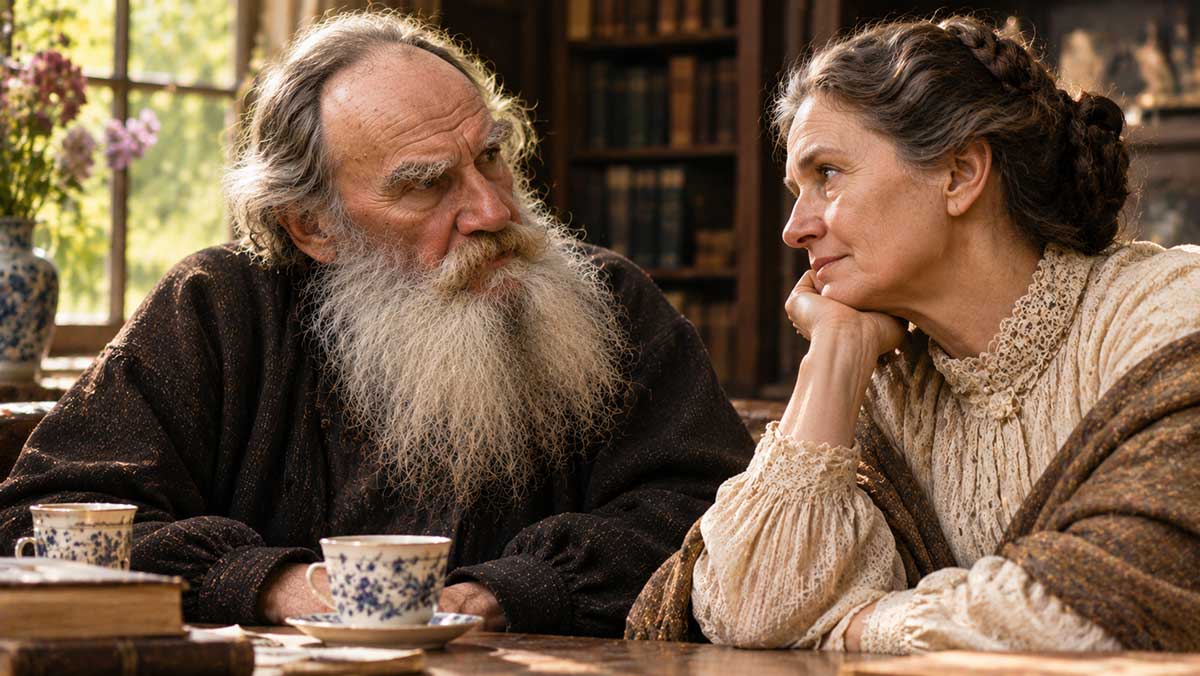
An imaginary conversation between Nick Sasaki and Leo Tolstoy, grounded in Tolstoy's military experiences, religious writings, opposition to violence, and correspondence with Mahatma Gandhi. The dialogue is fictional.
The evening light was fading over Yasnaya Polyana.
Outside the study window, the birch trees stood motionless against a pale sky. Somewhere in the distance, a horse moved slowly along the road.
Nick had spent much of the afternoon listening to Tolstoy explain his understanding of Jesus, God, and the moral demands of love.
But one question continued to trouble him.
Nick
Leo, I have to tell you something. I find your ideas about love incredibly appealing. The idea that we should care about people regardless of nationality or religion makes a lot of sense to me.
But when you say we should never respond to evil with violence, that's where I start having trouble.
Tolstoy
Good.
Nick
Good?
Tolstoy
You are troubled. That means you are examining the idea rather than merely admiring it.
Nick
Well, I'm definitely examining it. And I'm not sure you're going to like some of my questions.
Tolstoy
I have survived critics, governments, theologians, and my own conscience. I believe I can survive your questions.
Nick
We'll see about that.
Tolstoy smiled.
Question 1: Leo, you actually fought in a war. What changed your mind about violence?
Nick
Let's start with something that fascinates me.
You weren't some philosopher who spent his whole life sitting in a library talking about peace.
You were actually a soldier. You served in the Caucasus and fought during the Crimean War. You saw people being killed.
What was that experience like?
Tolstoy
War reveals things about human beings that are difficult to learn elsewhere.
You see courage and cowardice, generosity and cruelty, loyalty and selfishness, sometimes within the same person and the same hour.
But above all, you see how ordinary men are persuaded to participate in extraordinary violence.
Nick
Were you afraid?
Tolstoy
Certainly.
Nick
Even during the fighting?
Tolstoy
Especially then.
A man may imagine himself brave when he is far from danger. It is considerably more difficult to maintain that opinion when artillery begins falling around him.
Nick
Did you ever think you were going to die?
Tolstoy
There were moments when death seemed very near. At Sevastopol, it was impossible to forget that one's life might end without warning.
Nick
What did that do to you psychologically?
Tolstoy
It made many of our grand descriptions of war appear absurd.
We spoke of glory, patriotism, honor, and heroic sacrifice.
But the wounded man lying before you was not an abstraction. He was a human being with a mother, perhaps a wife, perhaps children, and hopes that had nothing to do with the ambitions of governments.
Nick
Did you ever feel proud of being a soldier?
Tolstoy
Yes. I was not free from the desire for recognition or the excitement of military life.
I must not pretend that I entered the army already possessing the convictions I developed later.
Nick
That's interesting. So you were actually attracted to some parts of military life?
Tolstoy
I was attracted to adventure, courage, companionship, and the possibility of distinguishing myself.
Young men often confuse the excitement surrounding war with the moral value of war itself.
Nick
Did you ever look at the soldiers on the other side and think, "These guys are just like us"?
Tolstoy
The longer one observes war, the more difficult it becomes to maintain the comforting belief that all virtue belongs to one's own side.
The enemy is also a man who fears death. He may be brave, foolish, kind, cruel, or confused.
His humanity does not disappear when a government declares him an enemy.
Nick
Then why do people keep fighting?
Tolstoy
Many reasons. Fear. Obedience. Pride. The desire for land and influence. The belief that one's own nation possesses a special moral importance.
And perhaps most dangerously, the willingness to surrender one's personal conscience to an institution.
Nick
What do you mean by that?
Tolstoy
A man who would be horrified to murder his neighbor may consider himself honorable when he kills a stranger in uniform.
The uniform changes the language used to describe the act.
Nick
But isn't there a difference? In war, someone may be fighting to defend their country.
Tolstoy
There may be differences in circumstances and intentions. I do not deny them.
But I ask whether those differences make killing a human being morally good.
Nick
So when did you finally decide that war itself was wrong?
Tolstoy
There was no single moment when every question became clear.
My experiences in the army disturbed me deeply. Years later, my examination of Jesus's teaching, particularly the command not to resist evil through violence, brought me to a more radical conclusion.
I came to believe that organized violence could not be reconciled with the law of love.
Nick
Did you regret being a soldier?
Tolstoy
I came to reject the institution of war and the assumptions that had once led me to participate in it.
But regret is of little value if it becomes merely another opportunity to contemplate oneself.
The more important question is what one does after recognizing an evil.
Nick
That's interesting.
You know, a lot of people who have never experienced war talk about it almost like a movie.
They imagine bravery, victory, flags, and celebrations.
Tolstoy
War is particularly attractive to those who do not have to experience its consequences.
Nick
That's a pretty strong statement.
Tolstoy
Consider how often those who declare war remain safely distant from the battlefield.
Nick
Fair point.
But I want to challenge you now.
And I think this is where things get really difficult.
Question 2: If violence is always wrong, how do we protect innocent people?
Nick
Okay, Leo, let's try a real situation.
Suppose you and I are walking down the street.
We see a grown man attacking a little child.
We tell him to stop. He doesn't listen.
The child is screaming.
What do you do?
Tolstoy
I would try to protect the child.
Nick
Of course. But how?
Tolstoy
I would place myself between the attacker and the child, if I could.
Nick
What if the attacker pushes you aside?
Tolstoy
I would continue trying to prevent harm.
Nick
But suppose he's much stronger than you.
And suppose the only way to stop him is to hit him.
Would you do it?
Tolstoy paused.
Tolstoy
You have chosen a case in which our compassion for the victim makes violence appear necessary.
Nick
Well, yes. That's exactly the point.
I'm not asking whether violence is pleasant. I'm asking whether it can sometimes be the only way to save someone.
Tolstoy
I would distinguish protecting a person from deliberately injuring another person.
Nick
But sometimes those two things happen together.
Suppose I grab the attacker, wrestle him to the ground, and he gets hurt.
Have I done something wrong?
Tolstoy
The intention to protect is different from the intention to punish or destroy.
But I would be reluctant to create a moral rule that authorizes us to harm another person whenever we judge the circumstances sufficiently urgent.
Nick
Why?
Tolstoy
Since human beings are remarkably skilled at declaring their own violence necessary.
A government says it must kill to preserve peace.
A revolutionary says he must kill to establish justice.
A nation says it must attack another nation to prevent future danger.
Every act is presented as an unfortunate exception demanded by goodness.
Nick
I understand the danger.
But you're talking about governments and armies.
I'm talking about a child right in front of us.
Tolstoy
And I understand why that example troubles you.
Nick
Then what would you actually do?
Tolstoy
I would risk my own safety to protect the child. I would intervene, shield the child, seek help, and attempt to stop the attack without making injury or killing my purpose.
I cannot promise that every such intervention would succeed.
Nick
That's the part I struggle with.
What if it doesn't succeed?
What if the child dies, and you could have saved that child by using force?
Wouldn't you feel responsible?
Tolstoy
I would feel terrible grief.
But the difficulty of a situation does not automatically prove that every action which might produce a desired result is morally justified.
Nick
But isn't doing nothing a moral choice, too?
Tolstoy
Certainly. I have not proposed doing nothing.
Nick
Okay, that's an important distinction.
You're saying nonviolence doesn't mean passivity.
Tolstoy
Precisely. Love can demand courage, sacrifice, resistance, and intervention.
What I rejected was the belief that we may overcome evil by adopting the same principle of violence that produces it.
Nick
But couldn't someone say that physically stopping an attacker is different from revenge?
Tolstoy
They could, and the distinction deserves examination.
Yet I would ask where protective force ends and the permission to injure begins. I would not claim that the boundary is always easy to identify.
Nick
That's fair.
Now let's make the example bigger.
Suppose another country invades yours.
Soldiers cross the border. They attack towns. Families are fleeing.
Are you saying the people being invaded shouldn't fight back?
Tolstoy
I opposed war and the use of organized violence, including violence undertaken in the name of national defense.
Nick
Even when they're defending their own families?
Tolstoy
I understood the powerful desire to defend one's family. I did not regard the suffering of invaded people lightly.
But I questioned whether participation in organized killing could become morally right through an appeal to national necessity.
Nick
I have to tell you, Leo, I don't think most people would accept that.
Tolstoy
I know.
Nick
And I don't think I could accept it myself.
If somebody were threatening my children, my first instinct would be to protect them.
Tolstoy
That instinct is understandable.
Nick
But wouldn't you protect your own children?
Tolstoy
Of course I would wish to protect them.
The question is whether the methods we choose ultimately protect life or perpetuate the system of violence that threatens it.
Nick
But when somebody is coming through your front door, you don't have years to reform society.
Tolstoy
No. And that is precisely why fear becomes such a powerful instrument in the hands of governments.
They present us with an immediate danger, then demand that we surrender our judgment to those who claim authority to use violence on our behalf.
Nick
But sometimes the danger is real.
Tolstoy
Yes. And a real danger does not guarantee that the proposed response is wise or just.
Nick
You know what I find interesting? I agree with a lot of what you're saying about governments using fear.
But I still think there are situations where stopping an aggressor by force is the responsible thing to do.
Tolstoy
Then we disagree.
Nick
Yes, we do.
Tolstoy
Good. Let us not conceal the disagreement beneath pleasant words.
Nick
I appreciate that.
But let me ask you something.
Do you think your philosophy works only if enough people agree to practice it?
Tolstoy
No moral truth becomes false merely when few people accept it.
But the practical effects of nonviolent conduct can certainly depend upon the actions of others.
Nick
So you're acknowledging that nonviolence might fail in a particular situation?
Tolstoy
Of course. A person who refuses to kill may himself be killed.
I never claimed that following one's conscience guaranteed physical safety.
Nick
That's a very difficult philosophy.
Tolstoy
It is.
Nick
And I suppose that's why most people find it easier to admire than to practice.
Tolstoy
You have returned to the distinction we discussed earlier.
Nick
Knowing what's right and actually doing it.
Tolstoy
Yes. Though in this case, you and I are still arguing about what is right.
Nick laughed.
Nick
That's true.
And I suspect we could argue about it for another three hours.
Tolstoy
I have written books longer than that argument.
Nick
Please don't threaten me with another volume of War and Peace.
Tolstoy smiled.
Tolstoy
Then perhaps we should turn from the individual to the larger problem.
Nick
That's exactly where I wanted to go.
Question 3: Leo, do you think humanity could ever become one family?
Nick
Here's something I've thought about quite a bit.
We all live on the same planet.
We all have families. We love our children. We want to be happy. We don't want to suffer.
And yet we divide ourselves into countries, religions, races, and all kinds of groups.
Then sometimes we treat people outside our group as though their lives matter less.
Why do we do that?
Tolstoy
Human beings are taught from childhood to identify themselves with particular communities.
There is nothing inherently wrong with loving one's family, language, or homeland.
The danger begins when affection for one's own group becomes a justification for treating others as inferior or disposable.
Nick
So you don't think loving your country is necessarily wrong?
Tolstoy
To love the people and places one knows is natural.
But I opposed the kind of patriotism that demands loyalty to the state above loyalty to humanity and conscience.
Nick
What's the difference?
Tolstoy
A man may love the fields where he grew up, the language his mother spoke, and the people among whom he lives.
But why should that love require him to regard people beyond a political border as enemies?
Nick
Exactly.
I've lived in different countries and cultures, and one thing that strikes me is how similar people are once you actually get to know them.
They worry about their families. They want their children to have a good future. They laugh at similar things.
Tolstoy
Then your experience has given you something that abstract arguments alone may not provide.
Nick
What's that?
Tolstoy
The recognition of another person's humanity through direct acquaintance.
Nick
But here's the problem.
People can get along beautifully with someone from another country, then turn around and support policies that hurt people from that same country.
How does that happen?
Tolstoy
The individual person disappears behind an abstraction.
A government does not ask you to hate Ivan or Pierre or a particular mother holding her child.
It asks you to fear a nation.
The name of the nation replaces the faces of the people.
Nick
That's interesting.
So the enemy becomes an idea instead of an actual human being.
Tolstoy
Yes. And ideas can be made frightening with remarkable ease.
Nick
Do you think religion makes that problem worse?
Tolstoy
Religion can be used to deepen divisions when people believe their community possesses exclusive authority over truth and goodness.
Yet the moral teachings of many traditions call people to compassion beyond the boundaries of their own group.
Nick
That's what I find so frustrating.
A lot of religions teach love and kindness.
But throughout history, people have fought terrible wars involving religion.
Tolstoy
When religious identity becomes a form of collective pride, it can serve purposes far removed from the moral life.
Nick
So what would you do about it?
Let's say you had the opportunity to speak to the entire world.
What would you tell people?
Tolstoy
I would ask each person to examine the moral assumptions he accepts without question.
Why do you believe that a stranger's life is worth less than your own?
Why do you accept the killing of people whom you have never met?
Why do you surrender your conscience to those who claim the right to command you?
Nick
But do you think asking those questions is enough?
Tolstoy
Questions alone are not enough. The answers must alter our conduct.
Nick
What about education?
Could we teach children from an early age that all human beings belong to one human family?
Tolstoy
Education can help, if it encourages independent moral judgment rather than merely replacing one set of slogans with another.
Nick
What do you mean?
Tolstoy
A child who is told to love all humanity but is never taught to think critically may simply repeat those words.
A child who learns to recognize the suffering and dignity of another person may understand something deeper.
Nick
So it has to become real to them.
Tolstoy
Yes.
Nick
You know, I sometimes wonder whether the biggest obstacle to peace is fear.
People are afraid of losing their country, their religion, their identity, their security.
Tolstoy
Fear is certainly important. But pride and the desire for domination matter, too.
And we should not ignore the institutions that benefit from conflict.
Nick
Do you think political leaders could ever create lasting peace?
Tolstoy
Governments can make agreements, end particular wars, and reduce suffering. Those are meaningful actions.
But I doubted that a lasting moral transformation could be achieved through state authority alone.
Nick
So you think peace has to begin with individuals?
Tolstoy
It must exist in individual conscience, or it remains dependent upon the commands of those in authority.
Nick
But what about laws?
Surely laws against violence and discrimination help people live together.
Tolstoy
Some laws restrain harmful conduct. I would not deny that certain legal changes can reduce suffering.
My concern was that the state itself relies upon coercion and can demand obedience to acts that violate conscience.
Nick
I see.
You know, that makes me think about Gandhi.
You corresponded with him near the end of your life, didn't you?
Tolstoy
Yes. I exchanged letters with Mohandas Gandhi, who was working against injustice in South Africa.
Nick
What impressed you about him?
Tolstoy
His commitment to resisting injustice without accepting violence as the foundation of resistance.
He understood that moral courage need not take the form of killing one's opponent.
Nick
But nonviolent resistance can still be confrontational, right?
People can refuse to cooperate, organize protests, disobey unjust rules.
Tolstoy
Certainly. Nonviolence does not require obedience to injustice.
Indeed, refusing to participate in evil may demand great courage.
Nick
That's an important point.
Sometimes when people hear "nonviolence," they think it means being weak or letting other people do whatever they want.
Tolstoy
A person who refuses to obey an unjust command despite the threat of imprisonment or death is not necessarily weak.
Nick
I agree with that.
But I want to come back to the idea of one human family.
Do you genuinely believe it's possible?
Not just as a beautiful idea, but as something humanity might actually achieve?
Tolstoy
I believed that human beings were capable of recognizing a moral law greater than national or institutional loyalty.
Whether humanity will fully live according to that recognition is another question.
Nick
So you're not promising some perfect future.
Tolstoy
No. I would distrust anyone who promised perfection through a political program or a grand historical prediction.
Nick
But you still had hope.
Tolstoy
I believed moral progress was possible. Otherwise, there would be little reason to appeal to conscience.
Nick
What gives you that hope?
Tolstoy
The fact that people are capable of changing.
A man who once admired war may come to reject it.
A person raised to fear strangers may come to love them.
A society may begin to question practices that earlier generations accepted without hesitation.
Nick
You're describing your own life, aren't you?
Tolstoy
In part.
Nick
You were a soldier who became a pacifist.
A wealthy aristocrat who criticized wealth.
A famous novelist who questioned the value of fame.
Tolstoy
And a man who preached love while often struggling to practice it.
Nick
You keep coming back to that.
Tolstoy
It would be convenient to discuss humanity's faults without remembering my own.
Nick
That's something I respect.
Let me ask you one more thing.
Suppose people really did begin to see everyone as part of one family.
What would change first?
Tolstoy
Perhaps they would become less willing to accept another person's suffering as the necessary price of their own comfort.
Nick
That's interesting.
Not necessarily some enormous political transformation.
Just people becoming more concerned about what happens to others.
Tolstoy
A genuine change in conscience can have consequences far beyond the individual.
Nick
Do you think love can really be that strong?
Tolstoy
I believed that love was the foundation of the moral life.
But do not confuse that conviction with the claim that love always produces immediate victory.
Nick
So someone might do the loving thing and still lose.
Tolstoy
Yes.
Nick
They might suffer.
Tolstoy
Yes.
Nick
They might never see the results of what they did.
Tolstoy
That is possible.
Nick
Then why do it?
Tolstoy looked at him steadily.
Tolstoy
Why tell the truth when a lie would be profitable?
Why care for a sick person who cannot repay you?
Why refuse cruelty when cruelty would make your life easier?
If goodness is merely a strategy for obtaining favorable results, it ceases to be goodness whenever the strategy fails.
Nick
So love has value in itself.
Tolstoy
That was my conviction.
Nick
I understand what you're saying.
I'm still not completely convinced about refusing force in every situation.
Tolstoy
Nor did I expect you to become convinced in one afternoon.
Nick
But I think I understand your position much better.
You're not saying we should sit around hoping bad people become nice.
You're saying that if we want a different kind of world, we have to stop treating violence as the ultimate solution to human problems.
Tolstoy
That is much closer to my view.
Nick
And you're asking people to take personal responsibility rather than leaving everything to governments and institutions.
Tolstoy
Yes.
Nick
I have to admit, Leo, that's a pretty demanding philosophy.
Tolstoy
You seem disappointed.
Nick
I was hoping you'd give me something easier.
Tolstoy
There are many people willing to sell easy answers.
Nick
And probably quite a few books about them.
Tolstoy
You would know more about that market than I.
They laughed.
The room had grown darker. A servant entered quietly to light a lamp, then withdrew.
For a moment, neither man spoke.
Nick
Leo, we've talked about so many things today.
Your childhood. Your mistakes. Your books. Sophia. Jesus. God. War. The possibility of humanity becoming one family.
And something keeps striking me.
You spent your entire life searching for answers.
Tolstoy
I did.
Nick
But you also spent a lot of that life struggling to live according to the answers you found.
Tolstoy
That is true.
Nick
And near the end of your life, when you were eighty-two years old, you left your home.
After everything you'd accomplished, after all those years of searching, you were still trying to change something.
Tolstoy looked toward the darkened window.
Tolstoy
Yes.
Nick
Can I ask you about that?
Tolstoy
You may.
Nick
Why did you leave?
I mean, you were eighty-two. You had a family, a home, worldwide fame. You had already written books that would outlive you.
What were you still looking for?
Tolstoy remained silent for several moments.
Tolstoy
That question cannot be answered without speaking of many things we have already discussed.
Nick
Sophia?
Tolstoy
Yes.
Nick
Your faith?
Tolstoy
Yes.
Nick
And whether you had actually found the peace you spent so much of your life searching for?
Tolstoy turned back to him.
Tolstoy
Perhaps that is the most difficult question of all.
Nick closed his notebook.
Nick
Then I'd really like to hear your answer.
The conversation continues in Topic 5: Leo, Did You Finally Find What You Were Looking For?
Topic 5: Leo, Did You Finally Find What You Were Looking For?
An imaginary conversation between Nick Sasaki and Leo Tolstoy, grounded in Tolstoy's final journey, family history, and writings. The dialogue is fictional, including all imagined private remarks.
The lamp cast a circle of amber light across the table at Yasnaya Polyana. The windows had become mirrors. Nick could see his own reflection beside the white-bearded figure sitting opposite him.
For hours they had spoken about ambition, faith, marriage, and the possibility of peace. Now Nick looked down at the notebook he had barely used.
Nick
Leo, there's something strange about talking with you. You wrote books that made people feel as though they knew you. But the longer we talk, the less I feel I can fit you into one simple picture.
Tolstoy
Then perhaps the conversation has been useful.
Nick
I hope so. There's one part of your story I can't stop thinking about. You're eighty-two years old. You've lived here for decades. Your name is known around the world. And one night, you leave.
Tolstoy
Yes.
Nick
I keep wondering what could make a man walk away from his own home at that age.
Question 1: At eighty-two, when you left home, what were you still looking for?
Nick
Can we talk about that night? Not the legend, not the dramatic version. What was happening inside you?
Tolstoy
I had lived for years in conflict between what I believed and the life surrounding me. I wanted simplicity and freedom from possessions. I wanted quiet. Yet I remained within a household burdened by disagreements, expectations, and the practical consequences of my convictions.
Nick
So was leaving about your principles, or were you just exhausted by the arguments?
Tolstoy
You ask me to choose one motive, as though a human decision could be opened like a drawer and its contents neatly sorted. I would not trust such an account. There was spiritual longing, weariness, distress, and a desire to live differently.
Nick
But you must have known how painful it would be for Sophia.
Tolstoy
I knew that my departure would have consequences for her and for the family. I cannot claim that a decision becomes harmless when the person making it believes his purpose is sincere.
Nick
Were you running away?
Tolstoy
Perhaps there was an element of escape. I would be suspicious of a man who insisted that every motive behind his final dramatic act was pure.
Nick
That's interesting. We tend to picture you walking into the night like a prophet, finally breaking free.
Tolstoy
It makes a handsome scene for a painting. Life is less cooperative. There were bags, arrangements, uncertainty, fatigue, and a body no longer suited to adventure.
Nick
And you were eighty-two. That's not exactly the age when most people decide to take an unplanned trip through the Russian countryside.
Tolstoy
I have never been accused of choosing the most convenient moment.
Nick
Did you think you'd come back?
Tolstoy
I would not claim certainty about everything I expected. My journey was interrupted by illness before any lasting new life could take shape.
Nick
You became ill on the train and ended up at Astapovo station. A railway station. After everything, that's where your life ended.
Tolstoy
It is an unusual ending for a man who spent so much time imagining endings for other people.
Nick
Did you ever think about how the public would react? The whole world watching a famous writer leave home?
Tolstoy
Fame had already made private life difficult. My final illness attracted attention that no family should have to endure without privacy. But I cannot honestly give you a precise account of every thought I had in those days.
Nick
I appreciate that. People sometimes tell the story as though they know exactly what you felt in your last hours.
Tolstoy
The dead are very convenient subjects. They cannot correct the living.
Nick
You have a way of making me laugh right when I'm trying to ask a serious question.
Tolstoy
Seriousness and humor are not enemies.
Nick
Let me ask it differently. You had been searching for meaning since your youth. Did leaving home feel like one final attempt to make your outer life match what you believed inside?
Tolstoy
That is a reasonable way to examine it. Yet a man may pursue consistency and still fail to act with sufficient tenderness. The question is not simply whether I was faithful to an ideal. It is what my fidelity demanded of other people.
Nick
And that's where Sophia comes back into the story.
Tolstoy
She was never absent from it.
Question 2: If Sophia were sitting here now, what would you want to say to her?
Nick hesitated. For once, he seemed unsure how to begin.
Nick
Leo, can I ask something very personal? If Sophia were sitting in this chair right now, what would you want her to know?
Tolstoy studied the empty chair beside the table.
Tolstoy
I would first want to hear what she wished to say. She spent so many years being described in relation to my life. She had a life of her own.
Nick
That's a good place to start. But what would you say after listening?
Tolstoy
I would want her to know that our years together cannot be reduced to our final conflicts. There was love in our marriage, and shared work, and children, and grief. There were ordinary days of happiness that deserve to be remembered without being made into an argument for either of us.
Nick
What do you remember most from those early years?
Tolstoy
The sense of building a life together. The children. Her presence in the household. The work we shared around my writing. And the discovery, repeated many times, that she possessed strengths different from my own.
Nick
She copied your manuscripts again and again. She managed the family. She had thirteen children, and not all of them survived. That's an enormous life, quite apart from being married to a famous writer.
Tolstoy
Yes. And if we speak of sacrifice, we should not reserve the word for the man who publicly renounces property. The woman who carries the ordinary burdens of a family may make sacrifices that attract no admirers.
Nick
Do you think you understood that at the time?
Tolstoy
Not fully. But I would hesitate to turn a complicated marriage into a single neat confession. Sophia and I disagreed about real matters. I did not cease to believe that wealth and ownership raised moral questions merely when those questions caused conflict at home.
Nick
I understand. I'm not asking you to say your beliefs were wrong. I'm asking whether you sometimes treated her concerns as less important than your beliefs.
Tolstoy
That is a harder question, and one I ought to examine. A person may become so absorbed in the universal good that he overlooks the particular person before him.
Nick
You said earlier that humanity doesn't interrupt you at breakfast. Your wife does.
Tolstoy
And the wife is the more difficult test.
Nick
Did you love her at the end?
Tolstoy
I would not wish to make a simple declaration stand in place of years of contradictory conduct. Affection, dependence, anger, compassion, and exhaustion can exist together. A marriage may contain all of them.
Nick
That's not the romantic answer people might want.
Tolstoy
It would be a disservice to Sophia to use her as the final scene in a story about my spiritual greatness.
Nick
Suppose she said, 'You wanted to love all humanity, Leo. Why couldn't you make peace with me?'
Tolstoy was silent long enough that Nick thought he might decline to answer.
Tolstoy
I would have no easy defense. I might say that I struggled, that I was often mistaken in my conduct, and that I could not always find a way to reconcile conscience with our life together. But those words would not erase her pain. I would need to listen to what she remembered, not merely explain what I intended.
Nick
Would you apologize?
Tolstoy
For particular acts that caused suffering, an apology may be owed. But you must not ask me to manufacture a perfect final reconciliation for the comfort of your readers. I cannot tell you what words would have healed us, or whether any words could have done so.
Nick
That's fair. I don't want to make Sophia forgive you in a scene she never got to choose.
Tolstoy
Then let her remain a person, not a device in our conversation.
Nick
I wish more stories about famous men did that.
Tolstoy
Famous men have already occupied more than their share of the page.
Nick smiled, then grew thoughtful.
Nick
There's something painful about this. You could write Anna Karenina, a novel that sees so deeply into marriage, jealousy, loneliness, and the need to be loved. Yet seeing those things in fiction didn't guarantee that you could resolve them at home.
Tolstoy
An author may perceive the suffering of an invented character with clarity and still be blind to the suffering of a real person who disagrees with him.
Nick
Do you think your writing helped you become more compassionate?
Tolstoy
At times, yes. Imagination can teach us to enter another person's experience. But it can become a source of vanity if we congratulate ourselves for understanding humanity in general and neglect the individual before us.
Nick
That may be the hardest lesson of this whole interview.
Tolstoy
We have not yet reached your final question.
Question 3: After everything, did you finally discover what it means to love and what makes life worth living?
Nick
Then here it is. You've spent your whole life searching. You chased pleasure and recognition. You became famous. You questioned whether life was worth living. You found meaning in Jesus's teachings. You argued against violence and wealth. You tried to live according to love.
After all that, did you find what you were looking for?
Tolstoy
I found a direction for my life. I would not say that I reached a place beyond doubt, temptation, or failure.
Nick
What's the difference between finding a direction and finding an answer?
Tolstoy
An answer may become something we possess and display. A direction must be followed each day. I came to believe that life acquires meaning when it is lived in love and service rather than in pursuit of the separate self's satisfaction.
Nick
But you were still struggling with that at eighty-two.
Tolstoy
Yes. Would you trust a man who claimed to have completed the work of loving others?
Nick
Probably not. But I think people want to know whether the struggle gets easier.
Tolstoy
Sometimes it does. Experience may teach us how much harm pride can do. Yet age does not automatically remove pride. An old man can be as stubborn as a young one, with more elaborate reasons for his stubbornness.
Nick
You've just described quite a few people I know.
Tolstoy
Including the man sitting before you, I hope.
Nick
You don't let yourself off easily.
Tolstoy
I have had a lifetime of practice finding excuses. It seems reasonable to spend some time examining them.
Nick
Here's something I keep thinking about. A lot of people feel they're running out of time. Maybe they spent years building a career and neglected their family. Maybe they lost someone they loved. Maybe they made choices they can't undo. What would you say to them?
Tolstoy
I would not tell them that the past can be repaired by a beautiful thought. Some injuries cannot be undone. Some people will never return. But the fact that we cannot change yesterday does not make our conduct today meaningless.
Nick
So where should they start?
Tolstoy
With what is nearest. A person they have neglected. A duty they have avoided. A kindness they have postponed. A falsehood they have continued telling themselves. We often seek a grand transformation when an honest act is waiting immediately before us.
Nick
What about someone who's successful but feels empty, the way you once did?
Tolstoy
I would ask what they believe success is for. Wealth, fame, and accomplishment may serve useful purposes, but they cannot answer every question of existence. If a man lives only to enlarge himself, he may discover that the self he has enlarged remains dissatisfied.
Nick
You know, I work on creative projects, and I care about reaching people. I want the work to matter. Is ambition itself a problem?
Tolstoy
Ambition must be examined by what it seeks and what it costs. Do you want your work to serve others, or do you want others to serve your image of yourself? Most of us discover both motives within us.
Nick
Probably both, if I'm being fair.
Tolstoy
Then you have something useful to examine. Do not mistake self-accusation for improvement, however. Ask what your work actually gives to another person.
Nick
And what about happiness? You started your life searching for it. Did you ever stop wanting to be happy?
Tolstoy
No. But I ceased to believe that happiness could be secured by arranging the world to satisfy all my desires. Joy may arise through love, labor, and the recognition that one's life is connected with the lives of others.
Nick
Does that mean someone who is suffering can still have a meaningful life?
Tolstoy
Yes, but we must speak carefully. We should not use another person's suffering to illustrate our philosophy. When someone is hungry, feed them. When someone is grieving, be present. Do not demand that they first recognize the spiritual value of their pain.
Nick
I like that distinction. It seems so easy to give people advice when you're not the one hurting.
Tolstoy
Very easy. I have done it myself.
Nick
Can I ask something about death? Earlier you told me that you couldn't claim to know exactly what happens to our individual personalities. Did you ever make peace with not knowing?
Tolstoy
I came to believe that the deepest meaning of life did not depend upon possessing a detailed account of what follows death. But uncertainty is not always comfortable. A man can accept the limits of his knowledge in principle and still feel the ache of parting.
Nick
So you still missed people. You still feared losing them.
Tolstoy
Of course. Faith did not make me less human.
Nick looked at the lamp, then back at Tolstoy.
Nick
There's one question I want to ask, and I don't want it to sound like a request for a grand speech.
Tolstoy
That is encouraging.
Nick
Suppose someone is listening to us. Maybe they've made terrible mistakes. Maybe they're lonely. Maybe they feel they've wasted most of their life. Maybe they don't know what they believe about God, or what happens after death.
What would you want that person to know tonight?
Tolstoy
I would want them to know that they need not settle every philosophical question before doing something good. If they have harmed someone, they can begin by telling the truth. If someone near them needs care, they can offer it. If they have become consumed by resentment, they can question what that resentment is doing to their life.
Nick
And if they feel it's too late?
Tolstoy
It may be too late for certain things. We should not lie about that. But it is not too late to choose the next act for which we are responsible, so long as we remain capable of choosing.
Nick
That's a very different answer from 'Everything will work out.'
Tolstoy
I cannot promise that everything will work out. I can say that love is not made worthless by the uncertainty of its results.
Nick
Do you think you would have lived differently if you'd known at twenty what you knew at eighty?
Tolstoy
Naturally I wish I had understood some things sooner. Yet the man who asks such a question imagines that wisdom can simply be delivered to youth like a parcel. I might have received it, admired the wrapping, and returned to the gaming table.
Nick laughed.
Nick
That's probably true. You might have written yourself another list of rules and broken it by dinner.
Tolstoy
Before dinner, perhaps.
The laughter faded gently. Nick studied the elderly writer's face.
Nick
Leo, I came here expecting to meet a man who had figured out the meaning of life. And you have given me a lot to think about. But what surprises me most is how willing you are to admit what you didn't figure out.
Tolstoy
Then perhaps you came expecting a statue and found a man.
Nick
Yes. And I think that's better.
Tolstoy
A statue never has to apologize to its wife.
Nick smiled, then let the silence remain.
Outside, the wind moved through the dark trees. The house had settled into its evening quiet.
Nick
I keep thinking about something you said earlier. That it's possible to love humanity in theory and still fail the person sitting across the breakfast table.
Tolstoy
Yes.
Nick
Maybe that's where the work begins. Not with a grand idea about saving the world, but with the way we treat the person in front of us.
Tolstoy
That is a beginning worth taking seriously.
Nick
Thank you for talking with me, Leo. Not just about your books or your ideas, but about the parts that are difficult to talk about.
Tolstoy
Thank you for asking questions you were willing to hear answered imperfectly.
Nick stood, then paused beside the table.
Nick
One last thing. If you could ask me a question before I leave, what would it be?
Tolstoy looked at him for a long moment.
Tolstoy
You have spent this afternoon asking how I ought to have lived. When you return to your own life tomorrow, what will you do differently?
Nick opened his mouth, then closed it.
Nick
You know, that's not a very fair way to end an interview.
Tolstoy
I thought you preferred difficult questions.
Nick
Apparently I prefer asking them.
Tolstoy's eyes brightened.
Tolstoy
Then we have both learned something.
The lamp continued to burn between them. For a moment, neither man reached for the final word.
Final Thoughts: What Leo Tolstoy Taught Me About the Meaning of Life
When I first imagined sitting down with Leo Tolstoy, I expected to learn about the meaning of life from one of history's greatest writers and philosophers. What I didn't expect was to discover how much he struggled to live according to his own beliefs. Here was a man who had spent decades examining love, morality, and human suffering, yet still faced many of the same difficulties that ordinary people experience every day.
One of the most memorable parts of our conversation was his relationship with Sophia. I was struck by the contrast between Tolstoy's extraordinary compassion for humanity and the painful disagreements within his own marriage. It made me wonder how often we become so focused on doing something meaningful for the world that we overlook the people sitting right beside us. Perhaps loving humanity is easier than patiently loving one person who knows all our weaknesses.
I was equally fascinated by his interpretation of Jesus and his commitment to nonviolence. I admire his belief that love should guide our actions, but I still struggle with his refusal to justify violence under almost any circumstances. What if an innocent child is being attacked? What if a country is invaded? We didn't resolve those questions, and I'm glad we didn't. A meaningful conversation doesn't always require agreement. Sometimes the most valuable discovery is recognizing why another person believes something so deeply.
What surprised me most was Tolstoy's willingness to acknowledge his contradictions. He didn't become a perfect human being after his spiritual awakening. He continued to struggle with family relationships, personal expectations, and the difficulty of practicing his ideals. Reading his reflections in A Confession and his other writings, I find myself thinking that spiritual growth may have less to do with becoming flawless and more to do with continuing to examine ourselves honestly.
After this imaginary afternoon at Yasnaya Polyana, I find myself returning to one simple thought: perhaps the meaning of life isn't something we discover once and then possess forever. Perhaps it becomes clearer through the way we live, the people we care for, and the choices we make when love is difficult. Tolstoy spent a lifetime searching for answers, but his greatest gift to me may be the questions he left behind.
What do you think? Is the meaning of life something we discover through faith and wisdom, or something we create through the way we love and treat others? And what did you find most surprising about Tolstoy's life? I'd love to hear your thoughts in the comments below.
Disclaimer: These Final Thoughts are Nick Sasaki's reflections on a fictional interview inspired by Leo Tolstoy's documented life and philosophy. The conversation and Tolstoy's responses are imagined, not historical quotations. Interpretations of his beliefs and personal relationships are presented for thoughtful discussion rather than as definitive historical conclusions.
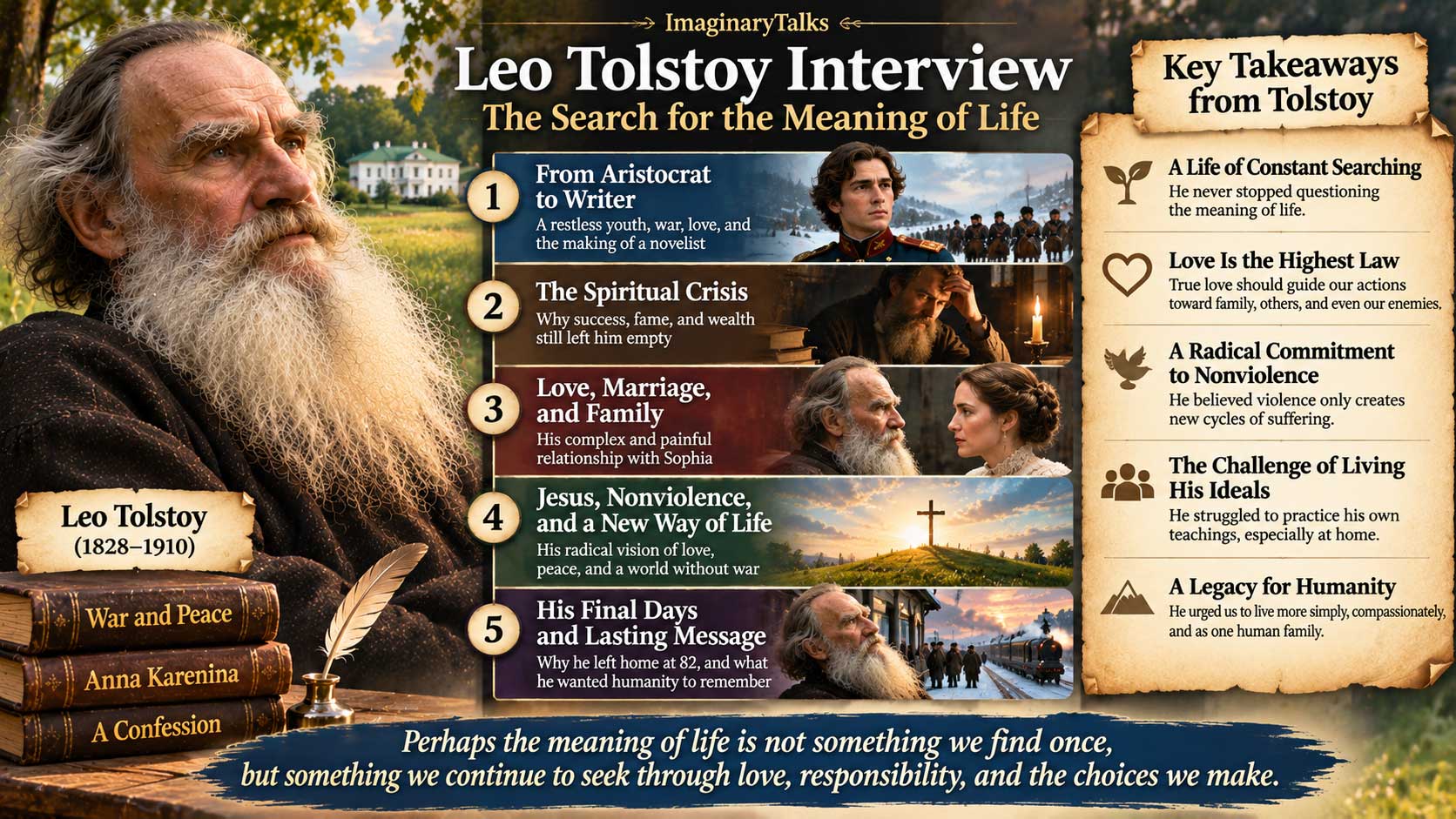
Short Bios:
Leo Tolstoy (1828–1910): Leo Tolstoy was a Russian novelist, philosopher, and spiritual thinker best known for War and Peace, Anna Karenina, and The Death of Ivan Ilyich. His search for life's meaning led him to challenge conventional religion, wealth, and violence. His later philosophy influenced Mahatma Gandhi and generations of thinkers concerned with peace, compassion, and moral responsibility.
Nick Sasaki: Nick Sasaki is the creator of ImaginaryTalks.com, where historical figures, writers, philosophers, and spiritual thinkers come together through imagined conversations. His interviews explore life's biggest questions with curiosity, humor, and thoughtful follow-up questions, inviting readers to consider different perspectives rather than accept predetermined answers.
Leave a Reply