
Introduction
Thirteen at the Table: An Imaginary Conversation About Regret, Forgiveness, and the Father's Love
What would Peter say if he could sit across from Jesus again, knowing that his three denials could never be erased?
Would Thomas still have questions? Would John regret the times his devotion became anger? Would the quiet disciples wonder whether their unnoticed kindness had mattered?
And what would happen if Judas Iscariot were sitting at the same table?
Not standing before a court. Not hiding in the shadows. Sitting among the eleven men who once called him their brother.
Would anyone speak to him?
Would Peter remember his own failure? Would John remember the friend he knew before the betrayal? Could they share bread with someone whose actions had caused them such terrible pain?
Thirteen at the Table is an original fictional conversation inspired by the New Testament. It brings Jesus and all twelve original apostles together in an imagined afterlife reunion beside the Sea of Galilee.
The gathering is not presented as a biblical event or a claim about anyone's eternal destiny. Scripture records Judas's betrayal, remorse, and death, but it does not describe a reunion like this or settle the questions explored in this fictional scene.
The biblical foundations are powerful enough without inventing certainty where none has been given.
In Luke 22, Peter denies knowing Jesus three times and weeps bitterly. Yet in John 21, the risen Jesus gives Peter an opportunity to affirm his love and calls him to care for others.
Judas's story takes a different and heartbreaking course. Matthew 27 records his remorse, his attempt to return the silver, and his death.
Those accounts raise a difficult human question.
Why can one person find a way forward after a terrible failure while another becomes convinced that no future remains?
This conversation does not pretend to answer every theological question surrounding Judas. Instead, it explores the fear, shame, grief, and longing that can make forgiveness difficult to receive, even when we desperately need it.
Jesus is portrayed here as the Son of God, teaching his disciples about their Heavenly Father's love, justice, and mercy. His voice draws inspiration from the Gospels, but every exchange in this imagined reunion is fictional.
Across five connected conversations, the disciples discover that the lessons they once taught others may be the very lessons they still need to learn.
They confront five questions:
- Can we be forgiven and still be unable to forgive ourselves? Peter and Judas confront the memories they have never escaped.
- Did we love our enemies, or only those who loved us? John, James, and Simon wrestle with anger, judgment, and the difficulty of loving someone who has done real harm.
- Did Jesus want belief without questioning, or genuine understanding? Thomas and Philip explore doubt, certainty, humility, and the danger of believing we already know everything.
- Did we spread Jesus' teachings but forget his love? The disciples question whether religious accomplishments matter when compassion is missing from everyday life.
- If God is our Father, are we still brothers? Judas, Peter, John, and the others confront the difference between recognizing wrongdoing and refusing to see anything else in the person who committed it.
This is not a story in which everyone suddenly forgives, every wound disappears, or every difficult question receives a comforting answer.
John's grief matters. Peter's denial matters. Judas's betrayal matters. So does the suffering of those affected by their choices.
Yet the story asks whether remembering wrongdoing must mean surrendering every possibility of kindness.
Sometimes the most meaningful act of love is not a grand declaration of forgiveness.
Sometimes it is listening without turning away.
Sometimes it is sharing a piece of bread.
And sometimes it is simply holding out a hand to someone who has forgotten what it feels like to be welcomed.
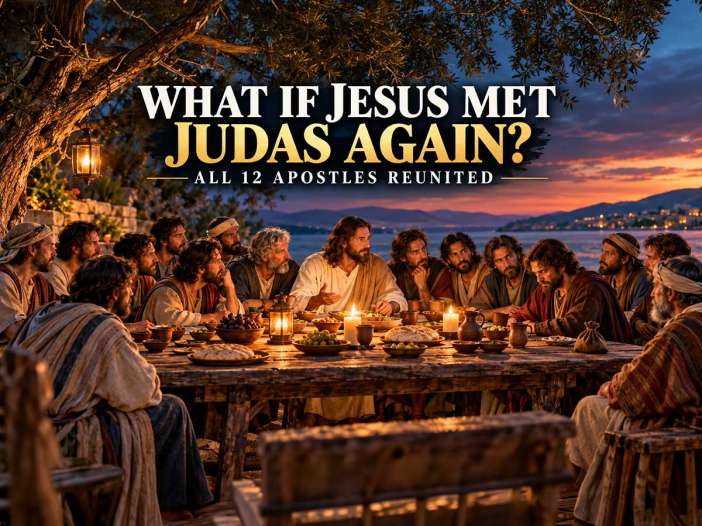
Beneath an olive tree, thirteen men gather around one table.
What they discover may change how we understand our own regrets, our relationships, and the people we have found hardest to love.
(Note: This is an imaginary conversation, a creative exploration of an idea, and not a real speech or event.)
Topic 1: Can We Be Forgiven and Still Be Unable to Forgive Ourselves?
The bread is still warm.
Thirteen men sit beneath an olive tree overlooking the Sea of Galilee. The afternoon sun touches the water, and a gentle breeze carries the familiar scent of the countryside where so much of their story began.
For a time, there is laughter.
Peter: Andrew, do you remember the morning you told me we had found the Messiah?
Andrew: I remember you telling me I had lost my mind.
Peter: I said no such thing.
Andrew: You said, "Another teacher? Have you forgotten we have nets to mend?"
Thomas: That sounds like Peter.
Peter: I was a practical man.
Matthew: You left your nets almost immediately.
Peter: Well, I was practical until I met him.
Jesus smiles as he breaks another piece of bread.
Jesus: You were never particularly good at remaining where you were, Peter.
Peter: And you were never particularly good at letting me remain comfortable, Master.
The disciples laugh.
All except Judas.
He sits near the far end of the table, turning a small piece of bread between his fingers. He has barely touched his meal.
Peter notices.
Peter: Judas, you haven't said a word.
Judas: I have been listening.
Peter: You were never this quiet before.
Judas: A great deal has changed.
The laughter fades.
Andrew: We are glad you came, Judas.
Judas looks at him, surprised.
Judas: Are you?
Andrew hesitates.
Andrew: I am glad you are here.
Judas: That is not quite the same answer.
Andrew lowers his eyes.
John: Must we begin with this?
Judas: I did not begin anything.
John: You know what I mean.
Judas: Yes. I think I do.
Jesus places the bread on the table.
Jesus: John, what troubles you?
John: Master, we have only just been reunited. Could we not have one peaceful meal before speaking of that night?
Jesus: Would the meal be peaceful if everyone were afraid to speak?
John looks away.
Peter: Perhaps John is right. We have waited so long for this.
Judas: Then let us speak of something else.
He sets down his bread.
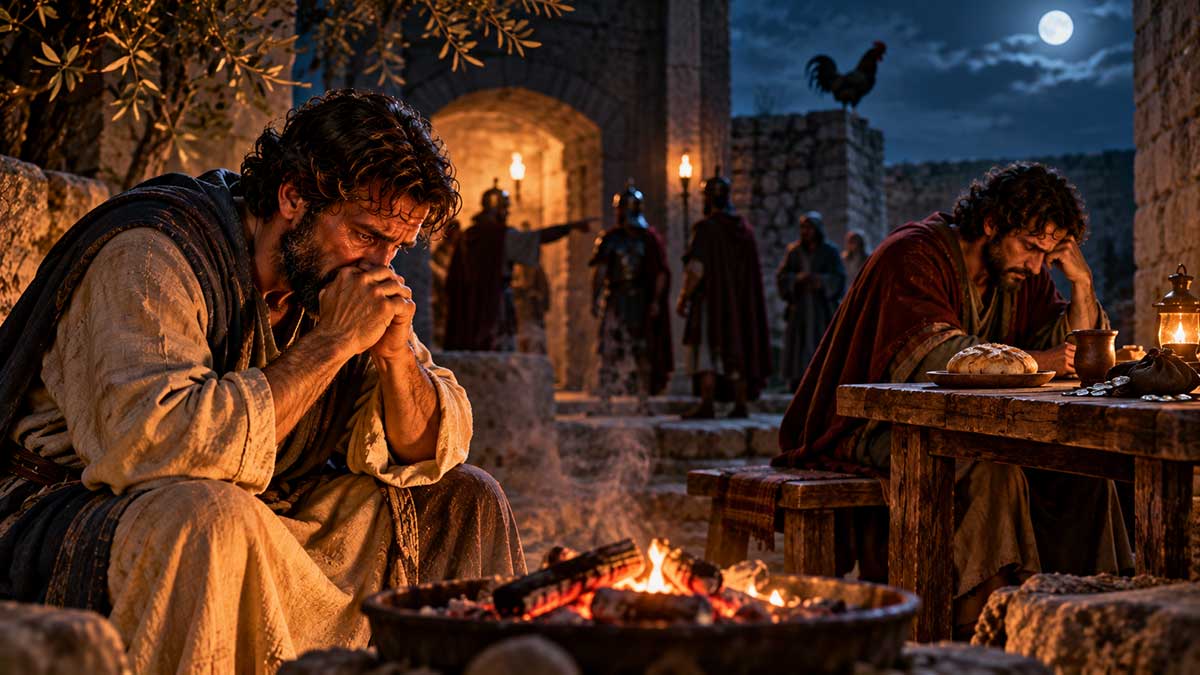
Judas: Peter, do you remember the courtyard?
Peter goes still.
Peter: What courtyard?
Judas: The high priest's courtyard. The night they arrested him.
Peter: Of course I remember.
Judas: You were standing beside a fire.
Peter: Yes.
Judas: Someone asked whether you knew him.
Peter: Judas...
Judas: And you said you did not.
John: Enough.
Judas: I am not accusing him.
Peter: It sounds very much like an accusation.
Judas: Then forgive me. I have had a long time to think about that night. Perhaps too long.
Peter pushes his chair back slightly.
Peter: I denied him. Three times. Everyone here knows it. I was afraid, and I lied. Is that what you wanted me to say?
Judas: No.
Peter: Then what?
Judas: I wanted to know whether you still remember how it felt.
Peter's anger falters.
Peter: Every moment.
Judas: Even after he forgave you?
Peter looks toward Jesus.
Peter: Yes.
Judas nods slowly.
Judas: Then perhaps you understand something about me after all.
Thomas: There is something I have never understood, Peter.
Peter: Only one thing? That would be a first.
Thomas does not smile.
Thomas: You were the one who said you would die with him.
Peter: I know.
Thomas: You were so certain. You told the rest of us that you would never fall away, whatever happened.
Peter: I remember my own words, Thomas.
Thomas: Then what changed?
Peter looks down at his hands.
Peter: A servant girl.
Matthew: What?
Peter: That is what I remember most clearly. Not the soldiers. Not the swords. A young servant girl looked at me and said I had been with Jesus.
He pauses.
Peter: I had faced storms. I had watched him calm the sea. I had stepped out of a boat onto the water because he called me. I thought I knew what courage was.
Andrew: Peter...
Peter: And then a girl asked me a question, and I was terrified.
Thomas: You thought they would arrest you.
Peter: Yes. But that is not what has troubled me all these years.
Jesus: What has troubled you, Peter?
Peter: I had believed I was a better man than I was.
The table grows quiet.
Peter: I thought my love made me brave. I thought that if I loved you enough, Master, nothing could make me deny you.
Jesus: And when you discovered your fear?
Peter: I thought my love must have been a lie.
Jesus: Was it?
Peter: I don't know.
Jesus: When you stepped from the boat and began to sink, what did you cry?
Peter: "Lord, save me."
Jesus: Did your fear mean you had never trusted me?
Peter: No. I trusted you. But I was frightened.
Jesus: And did I leave you in the water?
Peter: No.
Peter closes his eyes.
Peter: You reached for me.
Jesus: Then why have you spent so many years believing that your fear was the whole truth about you?
Peter: Because that night was different. You needed me.
Jesus: I knew what you would do before you did it.
Peter: That makes it worse.
Jesus: Why?
Peter: Because you still loved me. You washed my feet. You shared bread with me. You warned me. And I still failed you.
Jesus listens without interrupting.
Peter: When the rooster crowed, I remembered your words. And then you looked at me.
His voice grows quieter.
Peter: I have never forgotten that look.
Jesus: What did you see in my face?
Peter: I thought I saw disappointment.
Jesus: Is that all?
Peter: I was too ashamed to look again.
Jesus: Peter, you have remembered that moment for so long. Yet you have forgotten another.
Peter: Which one?
Jesus: The morning beside the sea. The charcoal fire. The bread and the fish.
Peter's eyes fill.
Jesus: What did I ask you?
Peter: Whether I loved you.
Jesus: How many times?
Peter: Three.
Jesus: And what did I ask you to do?
Peter: Feed your sheep.
Jesus: Did I ask you to spend the rest of your life proving that you had suffered enough for your denial?
Peter: No.
Jesus: Did I ask you to hide from the people who needed you?
Peter: No.
Jesus: Then why have you continued to judge yourself by the night you fell rather than by the love you chose afterward?
Peter wipes his eyes.
Peter: I suppose I thought that if I stopped feeling ashamed, I would be pretending it hadn't happened.
Jesus: Peter, is remembering your mistake the same as remaining imprisoned by it?
Peter says nothing.
Andrew: Brother, may I tell you something?
Peter: Of course.
Andrew: After that night, I never thought you were less worthy of being my brother.
Peter: You never said that.
Andrew: You never asked.
Peter: I was afraid to.
Andrew: You were always so eager to tell us what you thought. It never occurred to me that you might be afraid to ask what we thought of you.
Peter laughs weakly.
Peter: Perhaps I should have listened more.
Thomas: We have been suggesting that for years.
This time, Peter laughs with him.
Judas has remained silent throughout the exchange.
He is staring at the bread before him.
Judas: There was another man at that supper.
No one responds.
Judas: He heard the same teachings. He saw the same kindness. He was given bread by the same hands.
John's expression hardens.
Judas: And he did something far worse than deny knowing his teacher.
John: Judas, please.
Judas: I am speaking about myself, John. You need not protect me from the truth.
John: I was not trying to protect you.
Judas: I know.
Judas turns toward Jesus.
Judas: Master, I have replayed that evening more times than I can count.
Jesus: What do you remember?
Judas: Your hands.
Jesus: My hands?
Judas: When you gave me the bread.
His voice catches.
Judas: You knew.
Jesus: Yes.
Judas: You knew what I had arranged. You knew what I was going to do. Yet you still gave me bread.
Jesus: We had shared many meals, Judas.
Judas: That is what I cannot bear.
Matthew: Why?
Judas: Because you did not treat me like an enemy.
He looks toward John.
Judas: I would have found it easier if you had cursed me. If you had struck me. If you had called the others together and told them what I was.
John: We did not need to be told after what happened.
Judas: No. You did not.
Jesus: Judas, what did you hope would happen when you led those men to the garden?
Judas struggles to answer.
Judas: I have asked myself that question endlessly.
Jesus: Then tell us what you can.
Judas: I had expectations. I thought I knew what the Messiah ought to do. I wanted things to change. I wanted to believe that I understood where all of this was leading.
He looks down.
Judas: But I cannot tell you that those expectations excuse what I did. I made a choice. I accepted the silver. I led them to you.
Jesus: And afterward?
Judas: I saw what they intended. I tried to return the money.
Peter: We heard.
Judas: I said I had betrayed innocent blood.
Matthew: We know.
Judas: But nobody wanted to hear it.
His fingers tighten around the edge of the table.
Judas: I went to the men who had paid me, and they told me it was my responsibility. They were right about that much.
Thomas: Did you think returning the money would undo what had happened?
Judas: No. But I did not know what else to do.
John: You could have come to us.
Judas turns sharply.
Judas: Could I?
John: Yes.
Judas: Are you certain?
John: We were your brothers.
Judas: Were we?
John recoils as though struck.
Judas: I am not saying you were wrong to be angry. You had every reason. But answer me truthfully, John. If I had come to your door that morning, would you have opened it?
John: I don't know what I would have done.
Judas: Thank you.
John: That was not an answer.
Judas: It was the first honest one I have heard.
Peter: Judas, you cannot blame us for what you chose.
Judas: I am not blaming you, Peter.
Peter: It sounds as though you are.
Judas: Then listen carefully. I betrayed him. I did it. I cannot put that burden on anyone else.
Judas pauses.
Judas: But I was afraid of you, too.
Peter: Of us?
Judas: Of what I would see in your faces.
Peter: You should have come.
Judas: Perhaps.
Peter: You should have trusted us.
Judas: Peter, did you trust us when you ran from the courtyard?
Peter falls silent.
Judas: You were ashamed to face a servant girl. I was ashamed to face eleven men who had once called me brother.
John: Those are not the same thing.
Judas: No. They are not.
Judas: But shame can make every door look closed, whether it truly is or not.
For the first time, Peter looks at Judas without anger.
Matthew: May I ask something?
Jesus: Please, Matthew.
Matthew: Before I followed you, Master, people knew me as a tax collector. They assumed they knew everything about me from the work I did.
Thomas: You did collect taxes.
Matthew: Yes. And some of their judgments may have been deserved. I am not asking anyone to pretend otherwise.
He turns toward Judas.
Matthew: But I remember what it felt like when someone looked at me and saw nothing beyond my worst qualities.
John: Matthew, betrayal is not the same as collecting taxes.
Matthew: I agree.
John: Then why compare them?
Matthew: I am not comparing the offenses. I am asking whether we believe a person is forever identical to the worst thing he has done.
John: Some actions cannot be undone.
Matthew: That is true.
John: Some people never get the chance to recover from what another person did to them.
Matthew: That is true, too.
John: Then forgiveness cannot simply mean forgetting the harm.
Jesus: John, what do you believe forgiveness means?
John: I thought I knew.
Jesus: Tell me.
John: I thought it meant refusing to hate someone, refusing to repay evil with evil, leaving judgment to the Father.
Jesus: And now?
John: Now the person I am supposed to forgive is sitting across from me.
Jesus nods.
Jesus: And it is more difficult than when you spoke of forgiveness in the villages?
John: Much more difficult.
Jesus: Then perhaps you are discovering something you could not have learned from words alone.
John: I do not want to hate him, Master.
Jesus: I know.
John: But when I look at him, I remember the soldiers. I remember your arrest. I remember your mother standing near the cross.
His voice breaks.
John: I remember her face.
Judas closes his eyes.
John: And I cannot simply make those memories disappear.
Jesus: I have not asked you to.
John: Then what are you asking?
Jesus: For now, I am asking you to speak truthfully, and to listen truthfully.
John looks at Judas.
John: I am angry with you.
Judas: I know.
John: I loved you once.
Judas: I know that, too.
John: I do not know whether I can love you again.
Judas nods.
Judas: I would rather hear that than hear you say you have forgiven me when you have not.
Jesus looks from one man to the other.
Jesus: You have both spoken something difficult. Do not be quick to bury it beneath words that sound beautiful but are not yet true in your hearts.
The afternoon light shifts. A bird lands on the edge of the table, examines a fallen crumb, and flies away.
Thomas: Master, there is something I do not understand.
Peter: There it is again.
Thomas: Peter, I am trying to be serious.
Peter: So am I. I find it comforting that some things have not changed.
Thomas shakes his head, but a faint smile crosses his face.
Thomas: You restored Peter. You asked him three times whether he loved you. You gave him work to do. You made it possible for him to return.
He glances at Judas.
Thomas: But Judas never reached that morning beside the sea.
Jesus: No.
Thomas: Then what are we to make of that difference?
Jesus: What do you think, Thomas?
Thomas: I think Peter discovered that his failure was not the end of his story. Judas could not see beyond his.
Judas: I saw no road forward.
Thomas: Yet Peter could not see one at first, either.
Peter: No. I could not.
Thomas: What changed?
Peter considers the question.
Peter: I saw the empty tomb. Then I saw him alive. I heard his voice again. I was given another chance to answer the question I had failed to answer with my actions.
Thomas: So you were given hope.
Peter: Yes.
Thomas: And Judas had lost hope before he could see what came afterward.
No one speaks.
Judas: That is the cruelest part of remembering.
Jesus: What is?
Judas: Knowing that I could not see beyond the morning I was living through.
Jesus looks at him with sadness.
Jesus: Judas, despair can make a single hour appear to contain the whole of a life.
Judas: It did.
Jesus: Yet that hour was not all you had lived.
Judas: It was all I could see.
Jesus: Then let us speak of what you could no longer see.
Judas looks up.
Jesus: Do you remember when I first called you?
Judas: Yes.
Jesus: Do you remember the roads we walked? The children who came running? The people who had been forgotten and were welcomed again?
Judas: Yes.
Jesus: Were those days false?
Judas: No.
Jesus: Did your betrayal make every kindness you had ever shown another person cease to have happened?
Judas: No. But none of those kindnesses could undo what I did.
Jesus: That is true. Good deeds do not erase harm. But neither does a terrible deed change the truth of every moment that came before it.
Judas stares at him.
Judas: Then what am I, Master?
Jesus: Tell me what you mean.
Judas: Am I the man who followed you? The man who shared bread with you? Or the man who betrayed you?
Jesus: You are the man who did all those things.
Judas: That is not very comforting.
Jesus: Truth does not always comfort us immediately.
Judas gives a short, unexpected laugh.
Judas: No. I suppose it does not.
Jesus: But truth can free us from the lies we tell ourselves. One lie says, "I have done no wrong." Another says, "I have done wrong, so there is nothing else true about me."
Judas: And you would have me reject both?
Jesus: I would have you face what you did without pretending it is all that can be known about you.
Peter: Master, may I ask something?
Jesus: You may.
Peter: When you restored me beside the sea, I thought the matter was settled.
Jesus: And was it?
Peter: Between us, perhaps. But not inside me.
Jesus: What remained?
Peter: I kept trying to become the man who would never deny you.
Jesus: Did you succeed?
Peter: I became braver.
Jesus: That was not my question.
Peter sighs.
Peter: No. I never became a man without fear.
Jesus: Did I ask you to?
Peter: No.
Jesus: Then what kind of man did you become?
Peter looks toward Andrew.
Peter: A man who knew what fear could do to someone.
Jesus: And when you met people who were afraid?
Peter: I tried to be patient with them.
Jesus: Always?
Peter: No. Not always.
Jesus: But more often than before?
Peter: Yes.
Jesus: And when you met people who had failed?
Peter: I tried to help them stand again.
Jesus: Why?
Peter: Because someone helped me stand.
Jesus smiles.
Jesus: Peter, perhaps the question was never whether you could become a man who had never fallen.
Peter looks at him.
Jesus: Perhaps it was whether you would learn to reach for another man when he fell.
Peter's eyes move toward Judas.
Judas looks away.
Peter: I have not been very good at that today.
Jesus: You are still here, Peter.
Peter: So is he.
Jesus: Yes.
Peter slowly turns toward Judas.
Peter: There is something I should tell you.
Judas: You need not say anything merely to make me feel better.
Peter: Believe me, I am not very good at saying things merely to make people feel better.
Andrew: That much is certainly true.
A few disciples smile.
Peter: When I first saw you sitting here, I was angry.
Judas: I noticed.
Peter: I thought, "Why should he be here? After everything he did?"
Judas: A reasonable question.
Peter: But then you reminded me of the courtyard.
Judas: I should not have brought it up that way.
Peter: Perhaps not. But you were right about something.
Judas waits.
Peter: I have spent so much of my life remembering how I failed him. Yet when I saw you, all I could remember was how you failed him.
Judas looks up.
Peter: I wanted mercy for myself. I was less certain I wanted it for you.
Judas: Peter, you do not owe me forgiveness merely because you were forgiven.
Peter: I know.
Judas: What I did hurt people. I cannot demand that you feel differently.
Peter: And I cannot pretend that I am ready to understand everything you did.
He pauses.
Peter: But I can stop pretending that I have the right to decide what the Father may or may not do with you.
Judas's eyes fill with tears.
Judas: I do not know what to say.
Peter: That makes two of us. A rare occasion.
Judas laughs through his tears.
For a moment, the men around the table recognize something of the companions they once were.
Judas: Master, there is still one question.
Jesus: Ask it.
Judas: Peter was forgiven. He knew it. He lived long enough to tell others.
Judas struggles to continue.
Judas: But what of someone who dies believing he is beyond forgiveness?
The table becomes completely still.
Judas: Does his despair become the final truth about him?
Jesus does not answer immediately.
Jesus: Judas, do you believe your Father in heaven knows only the last moment of a person's life?
Judas: No.
Jesus: Does He see only what others see?
Judas: No.
Jesus: Does He know the fears, the wounds, the choices, and the truths hidden from every human eye?
Judas: Yes.
Jesus: Then why do you imagine that you, or any man sitting here, can see the whole of His judgment?
Judas: I cannot.
Jesus: Nor should you claim to.
Judas: But I want to know what became of me.
Jesus: I know you do.
Judas: Will you not tell me?
Jesus: I will not turn the Father's justice and mercy into a simple answer merely to end a difficult conversation.
Judas lowers his eyes.
Jesus: But I will sit with you as you ask it.
For a long moment, nobody moves.
Matthew: Master, may I say something?
Jesus: Of course.
Matthew: I spent much of my life keeping accounts. Every debt had a number. Every payment could be recorded. I thought that if I knew what someone owed, I knew something important about the person.
Thomas: And did you?
Matthew: Sometimes. But not nearly as much as I believed.
He looks around the table.
Matthew: I wonder whether we have been trying to keep accounts of one another's souls.
John: You mean deciding who has done enough good and who has done too much wrong?
Matthew: Yes.
Andrew: As though we could calculate what the Father sees.
Philip: Yet our choices still matter.
Jesus: They do.
Philip: And we must answer for them.
Jesus: Yes.
Philip: Then how do we hold justice and mercy together?
Jesus: Begin by refusing to surrender either one.
Thomas: That sounds simple.
Jesus: Is it?
Thomas: No.
Jesus smiles.
Jesus: Then perhaps we have found something worth learning.
The sun has begun its slow descent. A servant of the garden, unseen until now, leaves a fresh pitcher of water beside the table.
Peter reaches for it, fills his cup, and then hesitates.
He looks at Judas.
Peter: Would you like some?
Judas stares at the pitcher.
Judas: Yes. Thank you.
Peter pours water into his cup.
It is an ordinary gesture. One man serving another.
Yet several of the disciples watch in silence.
John: Peter?
Peter: Yes?
John: I am still angry.
Peter: I know.
John: I do not want you to think I am wrong for feeling it.
Peter: I don't.
John: And I am not ready to say what you have said.
Peter: Then don't.
John looks surprised.
Peter: I have spent too much of my life making promises before I knew whether I could keep them.
Thomas smiles faintly.
Thomas: At last, a lesson learned.
Peter: Careful, Thomas. I may yet return to my old ways.
Jesus laughs softly.
Jesus: My friends, perhaps we should not measure one another by how quickly we arrive at the same place.
Andrew: What should we do instead?
Jesus: Walk truthfully. Be patient with one another. And when someone stumbles, do not be too proud to offer a hand.
John looks toward Judas.
Judas does not ask anything of him.
After a moment, John reaches for the bread, breaks off a piece, and places it near Judas's cup.
John: There is still some left.
Judas looks at the bread, then at John.
Judas: Thank you.
John nods, but says nothing more.
Jesus watches them, his expression warm.
Peter: Master, I think I finally understand something.
Jesus: What is that?
Peter: All those years, I thought my greatest failure was that I had been afraid to admit I knew you.
Jesus: And now?
Peter looks around the table, at the men who had shared his life, his fears, and his faith.
Peter: Perhaps my greater danger was forgetting what you taught me about the people sitting beside me.
Jesus lets the words settle.
James: That is not an easy lesson.
Jesus: No, James. It is not.
Simon the Zealot: Especially when the person beside you has done something you cannot accept.
Jesus: Then tell me, Simon, what did I teach you about loving your enemies?
Simon leans forward.
Simon: Master, I have wanted to speak about that for a very long time.
John sets down his cup.
John: So have I.
And beneath the olive tree, the conversation grows deeper.
Topic 2: Did We Love Our Enemies, or Only Those Who Loved Us?
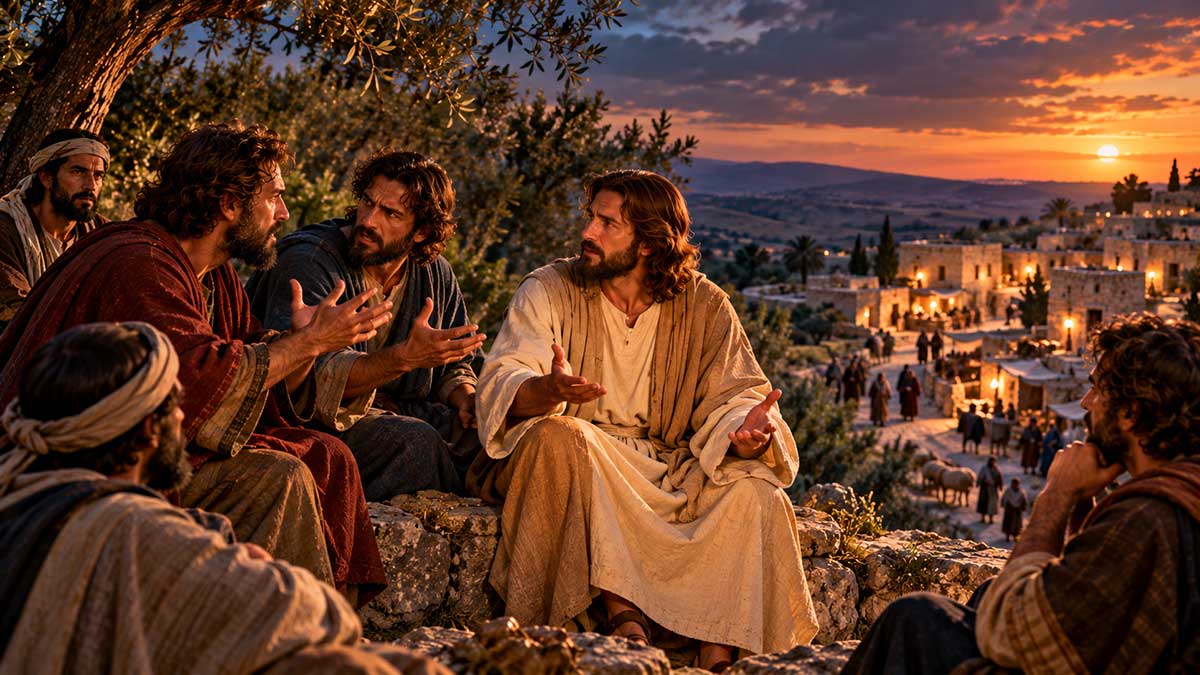
The afternoon sun has moved behind the olive tree, casting long shadows across the table. The bread John placed beside Judas remains untouched.
Simon the Zealot leans forward. His expression is serious, almost defiant.
Simon: Master, there is something I have wanted to ask you since the first time you told us to love our enemies.
Jesus: Then ask, Simon.
Simon: Did you truly expect us to love people who wanted to destroy us?
Jesus: What did you understand me to mean?
Simon: I thought you meant that we should not become like our enemies. That we should not repay cruelty with cruelty. I could accept that much.
Jesus: And what troubled you?
Simon: You went further. You told us to pray for those who persecuted us. To do good to those who hated us.
Simon glances at Judas.
Simon: You asked us to love people who had done nothing to deserve our love.
Jesus: Do you believe love must first be deserved?
Simon: I believe trust must be earned.
Jesus: Trust and love are not always the same thing.
Simon: That sounds beautiful, Master. But I have seen what happens when cruel men are trusted.
Jesus: Then tell me what you have seen.
Simon: Men who use kindness as an opportunity to take more. Men who mistake mercy for weakness. Men who smile when you forgive them, then return the next morning to do the same harm again.
Matthew: I have known men like that.
Simon: You collected money for them.
Matthew: I collected taxes under a system that gave men like that authority, yes.
Simon: And you expect me to forget?
Matthew: I did not ask you to forget.
Simon: Yet here we are, sitting together as brothers.
Matthew: We have been sitting together for a very long time, Simon.
Simon: That does not mean I have understood it.
Jesus looks at Simon with interest.
Jesus: When you first met Matthew, what did you see?
Simon: A tax collector.
Jesus: And when you came to know him?
Simon: A man who talked too much about numbers.
Matthew: Someone had to keep track of our expenses.
Peter: And someone had to remind me that fish did not appear on the table merely through enthusiasm.
Several disciples laugh.
Simon: Yes, yes. Matthew became our brother. I know that.
Jesus: When did he stop being your enemy?
Simon pauses.
Simon: I cannot remember.
Jesus: Was there a morning when you woke and decided that you would love him?
Simon: No.
Jesus: Then what happened?
Simon: We walked together. We ate together. I watched him help people. I saw him give what little he had when someone needed it.
Matthew: You never told me that.
Simon: I was not going to make it easy for you.
Jesus: And slowly, Simon, you saw more than the name by which you had judged him.
Simon: Yes.
Jesus: Perhaps that is one reason I asked you to walk together.
Simon looks down at his hands.
Simon: But Matthew changed.
Jesus: He did.
Simon: What of the person who does not change?
His eyes move toward Judas.
The question hangs between them.
Judas: You may say my name, Simon.
Simon: Very well. Judas. What of Judas?
John: I would like to answer that.
Jesus: Speak, John.
John: I do not think loving someone means pretending that he is safe.
Simon: Neither do I.
John: When Judas betrayed you, Master, he did not simply make a mistake. He led armed men to you. He knew what they intended.
Judas: I did.
John: And yet we are speaking as though our difficulty in loving him is the greater offense.
Matthew: Nobody has said that.
John: It feels as though that is where we are going.
Peter: John, I do not think anyone is asking you to excuse him.
John: Then what are we being asked to do?
Jesus does not answer immediately.
Jesus: John, do you remember the village in Samaria?
John closes his eyes.
John: I was hoping you had forgotten that.
James: I certainly had not.
Thomas: Neither had I.
Peter: I remember it very well. You two were magnificent.
James: Peter...
Peter: Two sons of thunder, standing on a hillside, ready to call down fire from heaven because a village would not receive us.
Andrew: I remember wondering whether we should move farther away from them.
Laughter breaks the tension.
John: We were angry.
Jesus: Why?
John: They refused to welcome you.
James: They insulted you.
Jesus: And what did you want to do?
James: We wanted them punished.
Jesus: How severely?
James hesitates.
James: We asked whether we should command fire to come down from heaven.
Thomas: An extraordinary response to being refused a place to stay.
James: It seemed reasonable at the time.
Thomas: That is what worries me.
Jesus smiles faintly.
Jesus: John, when you wanted fire to fall upon that village, whom did you believe you were defending?
John: You.
Jesus: Did I ask you to defend me that way?
John: No.
Jesus: Did the Father cease loving those villagers when they refused to welcome us?
John: No.
Jesus: Then whose anger were you seeking to satisfy?
John looks away.
John: My own.
James: Mine too.
Jesus: Yet you called it devotion.
James: We believed we were honoring you.
Jesus: I know.
John: That is what frightens me now.
Jesus: What frightens you?
John: How certain we were.
He turns toward James.
John: We did not stop to wonder whether those villagers had families. Whether there were children sleeping in their homes. Whether some of them were simply frightened of strangers.
James: We saw only their rejection.
John: And we thought that gave us the right to destroy them.
Jesus nods slowly.
Jesus: Tell me, John. Is it possible to be so determined to defend what is good that you forget to do good?
John: Yes.
Jesus: Is it possible to speak of the Father's righteousness yet forget His compassion?
John: Yes.
Jesus: Then perhaps that village taught you something important.
John: It did. But I learned it slowly.
Jesus: Most people do.
Judas: May I ask John something?
John looks at him.
John: You have been asking me questions since we sat down.
Judas: This one is different.
John: Go ahead.
Judas: When you thought about that Samaritan village afterward, did you ever wish you could return?
John: Many times.
Judas: What would you have done?
John: I would have apologized.
Judas: To the villagers?
John: Yes.
Judas: Even though they had rejected Jesus?
John: Especially then. I would have told them that I had mistaken my anger for righteousness.
Judas: And if they refused your apology?
John: I suppose I would have had to accept that.
Judas: Would you still have loved them?
John considers.
John: I would have tried.
Judas: Then perhaps you understand what I am asking of you.
John's face tightens.
John: Judas, do not compare yourself to those villagers.
Judas: I am not comparing what we did.
John: Then what are you comparing?
Judas: The difficulty of loving someone you believe has wronged you.
John: They refused hospitality. You betrayed our teacher.
Judas: I know.
John: People died because of what happened that night.
Judas: I know.
John: Then do not ask me to treat those things as equal.
Judas: I am asking whether your love can reach someone whose wrong is greater.
John opens his mouth, but no words come.
Judas: You were willing to return to the village and ask forgiveness. I am sitting here asking whether I may still be regarded as your brother.
John: You cannot demand that of me.
Judas: No. I cannot.
Judas lowers his gaze.
Judas: That is what makes the question so difficult.
Jesus: Judas, what would you do if John told you he could not forgive you?
Judas: I would have to accept it.
Jesus: Would that make your responsibility any less?
Judas: No.
Jesus: And if he forgave you?
Judas: It would not undo what I did.
Jesus: Then what are you seeking from him?
Judas is quiet for a long time.
Judas: I think I want to know whether there is anything left of the man he once called his friend.
John looks at him.
Judas: I remember the nights we walked together. The meals we shared. The times we laughed. I remember you falling asleep while Peter was still talking.
Peter: That happened to everyone.
Andrew: Frequently.
The disciples smile, but Judas continues.
Judas: I know that I destroyed something precious. I know that I cannot demand its return.
His voice trembles.
Judas: But sometimes I wonder whether those years were real to you, or whether everything that happened afterward swallowed them whole.
John stares at the table.
John: They were real.
Judas looks up.
John: I remember them too.
Judas: Then perhaps that is enough for now.
James, son of Zebedee, reaches for his cup but does not drink.
James: Master, there is another memory that troubles me.
Jesus: Tell us.
James: The day John and I asked to sit beside you in glory.
Peter: Ah, yes. Another of your modest requests.
James: You were not particularly pleased.
Peter: We were all furious.
Thomas: You had tried to reserve the best seats before the rest of us knew there was a seating arrangement.
John: We were ambitious.
James: More than ambitious. We thought being closest to you made us more important than the others.
Jesus: And what did I tell you?
James: That whoever wished to become great must become a servant.
Jesus: What did you think that meant?
James: At first? That serving people was the way to earn a higher place.
Jesus raises an eyebrow.
James: I know. I had missed the point.
Matthew: By quite a distance.
James: Thank you, Matthew.
Jesus: And what do you think now?
James: That the desire to be greater than another person was itself the problem.
Jesus: Why?
James: Because I was measuring my worth by where I stood in relation to others.
Jesus: And how did that affect the way you treated them?
James: I became impatient. I wanted recognition. When people did not honor you, I took it personally. When people did not listen to me, I grew angry.
John: We wanted to be seen as your most devoted followers.
James: And sometimes we were more concerned with being seen than with being devoted.
Jesus looks at the brothers.
Jesus: Do you remember the children who came to us?
John: Yes.
Jesus: Some of you thought they were interrupting something important.
Peter: We did.
Jesus: What was so important?
Peter: We were discussing the kingdom.
Jesus: And the children?
Peter smiles ruefully.
Peter: Were standing right in front of us.
Jesus: Sometimes, my friends, you were so occupied with deciding who would be greatest in the kingdom that you failed to notice those who were already showing you its spirit.
Andrew: Children do not ask where they will sit in a kingdom. They ask whether someone will hold their hand.
Jesus: And what does that teach you?
Andrew: That love is often simpler than our ambitions make it.
James looks toward Judas.
James: I wonder whether our ambition made us less kind to one another.
Judas: It did not make me betray him, James.
James: I know. I am not offering you an excuse.
Judas: Then what are you saying?
James: That perhaps we were not the family we thought we were.
The table grows quiet.
James: We competed. We argued. We judged one another. We were always asking who understood the Master best.
Thomas: And whoever disagreed was presumed to understand him least.
Matthew: I remember that.
James: Perhaps we could have listened to one another more carefully.
Judas: Perhaps.
James: Would it have changed anything?
Judas: I do not know.
James: Neither do I.
Jesus watches them without interrupting.
Simon: Master, I still have a difficulty.
Jesus: Speak.
Simon: We have talked about loving enemies. We have talked about forgiving those who harm us. But what of justice?
Jesus: What of it?
Simon: If a man steals from the poor, should we simply love him?
Jesus: Should the poor be left without what was taken?
Simon: No.
Jesus: Then love the poor enough to seek what is right for them.
Simon: And the thief?
Jesus: Love him enough to tell him the truth about what he has done.
Simon: And if he refuses to change?
Jesus: Do not give him another opportunity to harm those you are called to protect.
Simon: Then love does not mean surrendering to evil.
Jesus: Did you believe it did?
Simon: I feared that it might.
Jesus: Simon, when a shepherd sees a wolf approaching his sheep, what does he do?
Simon: He protects them.
Jesus: And when one of his sheep wanders away?
Simon: He searches for it.
Jesus: Are those the same action?
Simon: No.
Jesus: Yet both may come from love.
Simon sits back.
Simon: Then sometimes love requires a firm boundary.
Jesus: Yes.
Simon: And sometimes it requires opening a door.
Jesus: Yes.
Simon: How do we know which?
Jesus: Begin by asking whom your action will help, whom it may harm, and whether you are acting from love or from the pleasure of condemning another.
Thomas: That last part is difficult.
Jesus: Why?
Thomas: Because condemnation can feel satisfying.
Matthew: Especially when we are certain we are right.
Simon: And sometimes we are right.
Jesus: Being right about another person's wrongdoing does not make every response to it righteous.
Simon looks at Judas.
Simon: Then I can say that what Judas did was wrong.
Jesus: Yes.
Simon: I can refuse to excuse it.
Jesus: Yes.
Simon: I can acknowledge the harm it caused.
Jesus: You should.
Simon: Yet I must still ask whether my response comes from love or hatred.
Jesus: Now you are asking a deeper question.
Simon: I wish you had explained it this clearly when we were walking through Galilee.
Jesus: I recall explaining it more than once.
Peter: Many times, actually.
Thomas: Simon was usually busy preparing his next objection.
Simon: And you were busy questioning the explanation.
Thomas: Someone had to.
The table erupts in laughter.
When the laughter subsides, Thaddaeus speaks from near the end of the table.
Thaddaeus: Master, may I ask something?
Jesus: Of course.
Thaddaeus: I remember asking why you would reveal yourself to us and not to the world.
Jesus: I remember.
Thaddaeus: I thought that if everyone could see what we saw, they would believe. Then there would be no arguments, no enemies, no divisions.
Philip: I used to think that too.
Thaddaeus: But listening to us now, I wonder whether seeing miracles would have solved very much.
Thomas: We saw miracles and still argued over who was greatest.
Peter: We watched him feed thousands and still worried about having enough bread.
Matthew: We heard him teach forgiveness and still struggled to forgive.
Thaddaeus: Then perhaps our problem was not that we lacked evidence.
Jesus: What do you think it was?
Thaddaeus: We wanted the world to change before we were willing to change ourselves.
Jesus looks at him with quiet approval.
Thaddaeus: We wanted our enemies to become better people. We wanted the proud to become humble. We wanted the cruel to become kind.
Andrew: And we wanted it to happen immediately.
Thaddaeus: But we were much more patient with our own faults than with theirs.
Peter: That is painfully true.
Jesus: Thaddaeus, when you prayed for your enemies, what did you usually ask the Father?
Thaddaeus: That He would change their hearts.
Jesus: And did you ever ask Him to change yours?
Thaddaeus smiles sadly.
Thaddaeus: Not nearly often enough.
John has been listening quietly. He looks across the table at Judas.
John: Judas, I want to ask you something.
Judas: Ask.
John: When you led the soldiers to the garden, did you think of us?
Judas lowers his eyes.
Judas: Not enough.
John: Did you think about what would happen to the people who had followed him? To the women who cared for him? To his mother?
Judas: I have thought of little else since.
John: That was not my question.
Judas looks up.
Judas: No. Not as I should have.
John's eyes fill.
John: I stood beside his mother when he died.
Judas: I know.
John: She had done nothing to deserve that suffering.
Judas: I know.
John: And sometimes, when people speak of forgiving you, I feel as though they are asking me to forget her tears.
Judas: I would never ask you to forget them.
John: Then what do you want from me?
Judas: Nothing you cannot freely give.
John studies his face.
Judas: I have spent too long wishing I could undo that night. I cannot. I can tell you that I am sorry, but I know those words cannot restore what was lost.
John: No. They cannot.
Judas: And I cannot ask you to trust me merely because I regret what I did.
John: No.
Judas: But I can listen when you tell me what my actions cost you.
John's expression changes.
Judas: I did not listen then. I was too occupied with what I thought should happen.
John: And now?
Judas: Now I would like to hear what I refused to hear.
John looks toward Jesus.
John: Master, I do not know what to do with this.
Jesus: Must you decide everything today?
John: I thought perhaps I should.
Jesus: Why?
John: Because you have taught us to love one another. I feel ashamed that I am still struggling.
Jesus: John, when you asked for fire to fall upon the Samaritan village, you were certain what should happen. Are you certain now?
John: No.
Jesus: Is that uncertainty entirely a weakness?
John: Perhaps not.
Jesus: Then do not hurry to replace it with words your heart has not yet learned to live.
John takes a slow breath.
John: Judas, I cannot tell you that everything is forgiven.
Judas: I understand.
John: But I can tell you that I am willing to listen.
Judas's eyes fill.
Judas: That is more than I expected.
John: Do not thank me yet. I may have some difficult things to say.
Judas: I would expect nothing less from a son of thunder.
John stares at him for a moment, then unexpectedly laughs.
John: I had hoped everyone had forgotten that name.
James: Not a chance.
Peter: We have waited a very long time to use it again.
Even Simon smiles.
The breeze grows cooler. Beyond the garden, the water reflects the evening sky.
Bartholomew: Master, may I share something?
Jesus: Please.
Bartholomew: When Philip first told me about you, I asked whether anything good could come from Nazareth.
Philip: I remember.
Bartholomew: I had decided something about you before I had met you.
Jesus: Yes.
Bartholomew: Yet you welcomed me.
Jesus: I saw a man who was willing to come and see.
Bartholomew: That is what I have been thinking about. Philip did not argue with me. He simply invited me to meet you.
Philip: I knew arguing would not help.
Bartholomew: You knew I was stubborn.
Philip: Very stubborn.
Bartholomew: But you gave me the chance to discover that I was wrong.
He looks around the table.
Bartholomew: I wonder how many people I dismissed without giving them that chance.
James, son of Alphaeus: Perhaps more than any of us would care to count.
Bartholomew: And how many people dismissed us in the same way?
Matthew: Many.
Simon: Certainly.
Bartholomew: Then perhaps loving our enemies begins with admitting that we do not know everything about them.
Thomas: That does not mean we ignore what we do know.
Bartholomew: No. But we should be careful about what we assume.
Jesus: What did you learn when you came to see me, Bartholomew?
Bartholomew: That I had been wrong about Nazareth.
Jesus: Only Nazareth?
Bartholomew smiles.
Bartholomew: No. I had been wrong about what I thought made a person worthy of being heard.
Jesus: And what makes a person worthy of love?
Bartholomew looks around the table.
Bartholomew: I am beginning to think that is not a question we were meant to answer by ranking one another.
Jesus smiles.
Andrew: Master, there is something I have noticed about this meal.
Jesus: What is that?
Andrew: When we arrived, everyone was looking at Judas.
Peter: We were.
Andrew: We were all wondering whether he belonged here.
John: I certainly was.
Andrew: But no one asked whether we belonged.
Thomas: We assumed we did.
Andrew: Exactly.
He looks at the empty plates and broken bread.
Andrew: Yet every one of us has admitted to something today. Pride. Anger. Cowardice. Judgment. Failure to listen.
Simon: None of those things is identical to betrayal.
Andrew: I know. I am not saying they are.
Andrew: But I wonder whether we came to this table expecting the Master to examine Judas, when perhaps we all had something to examine in ourselves.
Jesus looks at Andrew.
Jesus: When you first brought Peter to me, Andrew, what did you expect?
Andrew: I thought he would want to meet you.
Jesus: Did you know what kind of man he would become?
Andrew: No.
Jesus: Did you know how often he would stumble?
Andrew: Certainly not.
Peter: I am sitting right here.
Andrew: I know, brother.
Jesus: Yet you brought him.
Andrew: Yes.
Jesus: Why?
Andrew: Because I had found someone wonderful, and I wanted my brother to know him.
Jesus: You did not wait until Peter had become a better man.
Andrew: No.
Jesus: You simply invited him.
Andrew looks toward Judas.
Andrew: Perhaps I have been waiting for Judas to become someone I can understand before I am willing to sit beside him.
Judas looks up.
Andrew: But he is already sitting beside me.
Andrew moves his cup slightly, making room for Judas to reach the pitcher.
Andrew: And I think I can begin there.
Jesus rises from the table and walks a few steps toward the edge of the garden. The disciples watch him.
Jesus: My friends, when I taught you to love your enemies, I did not promise that love would be easy.
He turns toward them.
Jesus: I knew that you would be hurt. I knew that some would betray your trust. I knew that you would sometimes be angry, frightened, and uncertain.
Peter: Then why ask something so difficult of us?
Jesus: Peter, what would become of the world if everyone loved only those who loved them first?
Peter: We would remain divided.
Jesus: And if everyone waited for another person to become worthy before offering kindness?
Matthew: Many would wait forever.
Jesus: And if every person believed that his own anger was righteous and his enemy's anger was wicked?
Simon: There would be no end to it.
Jesus: Your Father sends rain upon fields belonging to the generous and the selfish alike. He gives life to children who have not yet learned what to do with it.
Philip: Then we are to love as He loves?
Jesus: That is what I have been teaching you.
John: But we are not the Father, Master.
Jesus: No, John. You are His children.
John: And children must learn.
Jesus: Yes.
Jesus returns to the table.
Jesus: Loving someone does not mean surrendering the truth. It does not mean permitting harm. It does not mean pretending that trust has been restored when it has not.
He looks at Judas.
Jesus: Nor does it mean that remorse alone repairs what has been broken.
Judas bows his head.
Jesus: But love refuses to take pleasure in another person's destruction. It refuses to believe that cruelty becomes good merely when directed at someone who has done wrong.
He looks toward Simon and John.
Jesus: And it leaves room for the Father to see what you cannot.
Thomas: Then perhaps the hardest part is accepting that we do not have the final word about another person.
Jesus: Perhaps.
Peter: I used to enjoy having the final word.
Andrew: Used to?
Peter: I am trying, Andrew.
The disciples laugh.
As the laughter settles, Judas finally reaches for the bread John placed beside him earlier.
He breaks it in half.
After a moment, he offers one piece to John.
Judas: Would you share it with me?
John looks at the bread.
For several seconds, he does not move.
Then he takes it.
John: I am still angry.
Judas: I know.
John: And I have not forgotten.
Judas: I would not want you to forget the truth.
John: But I am tired of allowing that night to decide everything I feel when I look at you.
Judas says nothing.
John: I do not know what comes after this.
Judas: Neither do I.
John: Then perhaps we can begin with bread.
Judas nods.
They eat quietly.
Across the table, James watches his brother. He remembers the village in Samaria, the anger he once considered holy, and the fire he wanted to call down upon strangers.
James: Master?
Jesus: Yes, James?
James: When we asked you to let us call down fire upon that village, you rebuked us.
Jesus: I did.
James: I thought you were disappointed that we lacked wisdom.
Jesus: And now?
James: Now I wonder whether you were trying to save us from becoming men who could destroy others without feeling sorrow.
Jesus looks at him tenderly.
Jesus: What do you think?
James: I think you were teaching us that loving the Father means learning to love His children, including the ones who disappoint us.
Jesus: And the ones who frighten you?
James: Yes.
Jesus: And the ones who disagree with you?
James: Yes.
Jesus: And the ones who have done you wrong?
James looks toward Judas.
James: I am still learning that one.
Jesus: Then keep learning.
The evening light softens around the table.
For a time, no one speaks. Thirteen men share bread beneath an olive tree. Some wounds remain open. Some questions remain unanswered. Yet something has changed.
Thomas looks at the bread in his hands, then at Jesus.
Thomas: Master, I have spent much of my life wondering whether I believed enough.
Jesus: Have you?
Thomas: Yes. I questioned what others accepted. I wanted to see for myself. Sometimes I thought that made me less faithful than the others.
Philip: You were not the only one who struggled to understand.
Thomas: I know that now.
He glances around the table.
Thomas: But listening to us today, I wonder whether our greatest mistakes came not from asking too many questions, but from being too certain we already knew the answers.
Jesus takes his seat again.
Jesus: Then, Thomas, perhaps you have a question worth asking.
Thomas looks directly at him.
Thomas: Master, did you want us to believe without questioning, or did you want us to understand?
Jesus smiles.
Jesus: Tell me, Thomas. What do you think the Father desires from His children?*
Topic 3: Did You Want Us to Believe Without Questioning, or Did You Want Us to Understand?
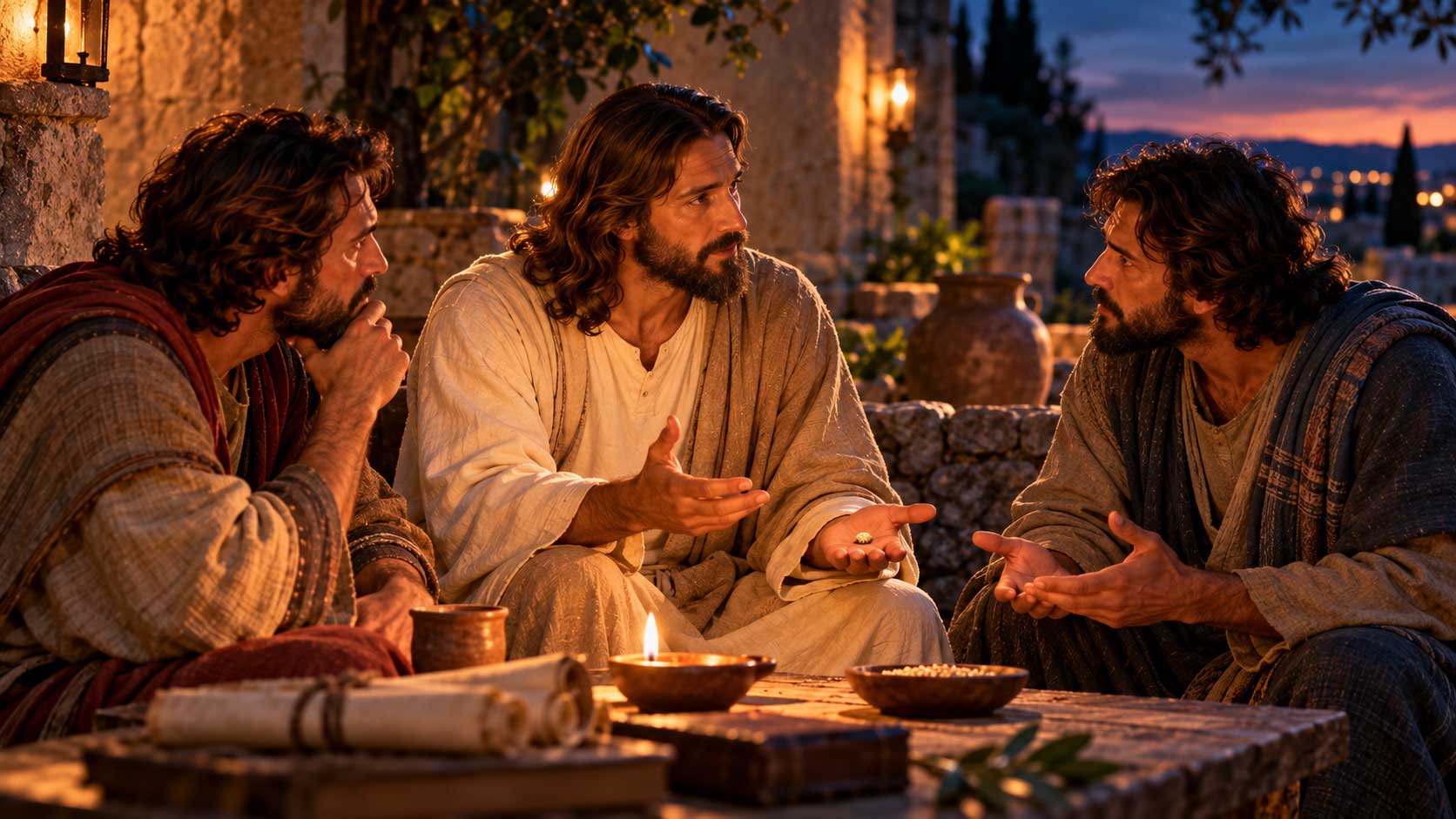
The evening breeze moves through the branches of the olive tree. Thirteen men remain around the table. Some have grown quiet. Others seem more at ease than when the meal began.
John and Judas have shared bread. Peter has stopped watching every movement Judas makes. Simon the Zealot sits with his arms folded, still considering what Jesus said about loving enemies.
Thomas, however, has been waiting.
Thomas: Master, you have not answered my question.
Jesus: Which question, Thomas?
Thomas: Whether you wanted us to believe without questioning, or whether you wanted us to understand.
Peter: I thought you asked that already.
Thomas: I did. And I noticed that he answered with another question.
Jesus: Have I done that before?
Thomas: Almost every time I asked you something difficult.
Matthew: Perhaps that was because your questions were difficult.
Thomas: Or perhaps he enjoyed watching us struggle.
Jesus laughs.
Jesus: And did you learn anything from struggling, Thomas?
Thomas: Quite a lot. But I might have learned it sooner if you had occasionally given us a straight answer.
Philip: I have wanted to say that for years.
Peter: You two should have formed your own school.
Thomas: We would have asked questions.
Philip: And refused to pretend we understood the answers.
Andrew: I suspect your students would have been exhausted.
The disciples laugh.
Jesus: Then let us begin with your question, Thomas. What do you think the Father desires from His children?
Thomas: That we know Him.
Jesus: And how does a child come to know his father?
Thomas: By spending time with him. By listening. By watching what he does.
Jesus: Does the child understand everything his father says?
Thomas: Certainly not.
Jesus: Then what does he do?
Thomas: He asks questions.
Jesus: And when he receives an answer he does not understand?
Thomas: He asks another question.
Jesus: Then why have you spent so much of your life believing that questions were a sign of failure?
Thomas pauses.
Thomas: Because everyone remembers me as the one who doubted.
Peter: Thomas, we all doubted at one time or another.
Thomas: Yes, but nobody calls you Doubting Peter.
Peter: They remember something worse about me.
John: Peter, I think everyone at this table has heard enough about the courtyard for one evening.
Peter: I would be grateful for that.
Thomas smiles, then grows serious.
Thomas: Master, when the others told me you were alive, I could not believe them. I wanted to. God knows I wanted to. But I had seen what the Romans did to you.
His voice softens.
Thomas: I had seen death before. I knew what it looked like.
Jesus: Yes.
Thomas: And suddenly everyone was telling me that death had been overcome. That you had returned. That the world was no longer what I thought it was.
Andrew: We were telling you the truth.
Thomas: I know that now.
Andrew: We had seen him.
Thomas: And I had not.
Andrew falls silent.
Thomas: That was the difference. You were asking me to accept something extraordinary on the strength of an experience I had not shared.
Matthew: But you trusted us.
Thomas: I trusted that you believed what you were saying. That is not the same as knowing whether it was true.
Jesus: And what did you say you needed?
Thomas: To see the marks in your hands. To touch the wound in your side.
He looks down.
Thomas: I have wondered whether that hurt you.
Jesus: Why?
Thomas: Because after everything you had taught me, I still demanded proof.
Jesus: Thomas, when I came to you, did I turn away from your question?
Thomas: No.
Jesus: What did I do?
Thomas: You invited me to see.
Jesus: And what did you discover?
Thomas: That you were alive.
Jesus: Only that?
Thomas thinks for a moment.
Thomas: That you knew exactly what I had asked when I thought you were not there.
Jesus: And what did that teach you?
Thomas: That I had not been abandoned in my uncertainty.
Jesus smiles gently.
Jesus: Then perhaps you should remember more than the doubt.
Philip: Master, may I confess something?
Peter: That sounds ominous.
Philip: It is not about you, Peter.
Peter: A pleasant change.
Philip: I think Thomas was braver than I was.
Thomas: Braver?
Philip: You admitted when you did not believe. I often pretended to understand when I did not.
Jesus: Tell us more, Philip.
Philip: I remember the evening you told us about the Father. You spoke of knowing Him through you. You spoke of the way you had shown us His character.
Jesus: Yes.
Philip: And I said, "Show us the Father, and that will be enough for us."
Peter: I remember that.
Philip: You looked at me as though I had been asleep through every lesson.
Jesus: Were you?
Philip: Not literally.
Thomas: That is debatable.
The others laugh.
Philip: I was trying to understand something that seemed impossible. We had walked beside you. We had watched you heal people, welcome sinners, feed the hungry, and speak of the kingdom.
Jesus: And what troubled you?
Philip: You kept speaking of the Father as someone we could truly know.
Jesus: Yes.
Philip: Yet I could not see Him. I could see you. I could hear your voice. I could watch your actions. But I wanted something more.
Jesus: What more?
Philip: Something unmistakable. Something that would settle every question.
Jesus: And if you had been given such a sign, Philip, would you never have questioned again?
Philip hesitates.
Philip: I would like to say no.
Thomas: But you would be lying.
Philip: Thank you, Thomas.
Thomas: You are welcome.
Philip: I suppose I would eventually have found another question.
Jesus: Then perhaps the difficulty was not that the Father had given you too little to consider.
Philip: What was it?
Jesus: You were searching for a kind of certainty that would leave you with nothing more to learn.
Philip considers this.
Philip: I thought knowing God meant finally having all the answers.
Jesus: And now?
Philip: Now I wonder whether knowing Him means trusting His character even when I do not know all His reasons.
Jesus: What have you learned of His character?
Philip: That He loves His children.
Jesus: What else?
Philip: That He is merciful. That He cares for the forgotten. That He asks us to become merciful ourselves.
Jesus: And where did you learn these things?
Philip: From you, Master.
Jesus: Then when you looked at the way I treated people, what were you being shown?
Philip's eyes brighten.
Philip: What the Father desires.
Jesus: And when I taught you to pray to Him?
Philip: You were teaching us to know Him as our Father.
Jesus: Then do not mistake the messenger for the One who sent him, Philip. Nor should you overlook what the Father has made known through His Son.
Philip nods slowly.
Philip: I spent so much time wishing to see something beyond you that I sometimes failed to see what was directly before me.
Jesus: That happens to many people.
Matthew has been tracing a small circle in the dust on the table.
Matthew: Master, I think there is another kind of doubt we have not discussed.
Jesus: What kind?
Matthew: The doubt we refuse to admit because we are afraid of what other people will think.
John: You mean pretending to believe?
Matthew: Sometimes. Or pretending to be certain when we are not.
Simon: Is that not hypocrisy?
Matthew: It can become hypocrisy. But sometimes it begins with fear.
Simon: Fear of what?
Matthew: Losing the people we love. Being rejected. Being told that we are no longer faithful.
Thaddaeus: I have known that fear.
Matthew: We all wanted to belong. We had left our homes and followed the Master. We believed we were part of something greater than ourselves.
Thomas: We were.
Matthew: Yes. But belonging can become frightening when everyone expects you to agree.
Peter: We argued constantly.
Matthew: About which of us was greatest. About what the kingdom would look like. About what we should do next.
Thomas: That is true.
Matthew: But did we always feel free to say, "I do not understand what the Master is teaching"?
Peter looks toward Philip.
Peter: Apparently not.
Philip: I certainly did not.
Matthew: And did we feel free to question one another's assumptions?
John: Thomas did.
Thomas: Someone had to.
Matthew: Yet even Thomas waited until he could no longer pretend.
Thomas: I did.
Matthew: I wonder how many people have lived their entire lives afraid to admit that they have questions about God.
Jesus listens closely.
Matthew: They hear others speak with certainty. They hear people say that faith requires unquestioning agreement. So they remain silent.
Andrew: And perhaps they begin to think there is something wrong with them.
Matthew: Yes.
Philip: Or that the Father is disappointed in them for wanting to know more.
Jesus: Matthew, what happens to a child who is afraid to ask his father a question?
Matthew: He may remain confused.
Jesus: And if he is punished every time he asks?
Matthew: Eventually he may stop asking.
Jesus: Does his silence mean he understands?
Matthew: No.
Jesus: Does it mean he trusts his father?
Matthew: Not necessarily.
Jesus: Then why would you teach the Father's children that silence is the highest form of faith?
Matthew looks around the table.
Matthew: We should not.
Jesus: Yet there is another danger.
Thomas: What danger?
Jesus: A man may ask questions not because he wishes to learn, but because he wishes never to be corrected.
Thomas: That sounds uncomfortably familiar.
Jesus: Does it?
Thomas: I have occasionally asked a question when I already believed I knew the answer.
Peter: Occasionally?
Thomas: Peter, you are becoming tiresome.
The disciples laugh.
Jesus: The question itself is not always what reveals the heart. Sometimes it is what a person does when an answer challenges him.
Judas has been listening with unusual intensity.
Judas: Master, may I speak?
Jesus: Yes, Judas.
Judas: I think I understand the danger you are describing.
John looks toward him.
Judas: I asked questions. Many questions. But I did not always want answers.
Thomas: What did you want?
Judas: Confirmation.
Thomas: Of what?
Judas: That I understood what the Messiah should be. That I knew what Israel needed. That I could recognize the right moment for things to change.
Simon: We all had expectations.
Judas: Yes. But I began to measure the Master against mine.
He turns toward Jesus.
Judas: When you spoke of loving enemies, I listened. But part of me was waiting for you to say something else.
Jesus: What were you waiting to hear?
Judas: That the time for gentleness was over. That you would finally act in the way I expected.
Simon: I remember having similar thoughts.
Judas: Yet you continued to listen.
Simon: Not always.
Judas: I stopped listening in a different way. I could hear your words, Master, but I kept translating them into the story I had already written in my mind.
Jesus: And what happened when my words did not fit your story?
Judas: I thought you were withholding something.
Jesus: From whom?
Judas: From us. From the people. Perhaps from me.
Jesus: Did you ever consider that your expectations might be mistaken?
Judas's face tightens.
Judas: Not seriously enough.
Thomas: Then your problem was not doubt.
Judas: No.
Thomas: It was certainty.
Judas: Yes.
Thomas leans back, visibly troubled.
Thomas: That is a distinction I had not considered.
Judas: Neither had I, until it was too late.
John: Judas, are you saying that your betrayal came from believing too strongly in your own interpretation?
Judas: I am saying that I let my expectations become more important than the person standing before me. I cannot claim to know every motive that moved me that night. But I know I was no longer listening as I should have.
John: And when he refused to become the Messiah you wanted?
Judas: I made a choice that I cannot undo.
The table grows quiet.
Judas: I once believed that certainty made me strong. Now I wonder whether it made me blind.
Jesus: Judas, when a man closes his eyes because he believes he already knows the road, what happens?
Judas: He may walk into danger.
Jesus: And if others warn him?
Judas: He may mistake their warnings for opposition.
Jesus: Then what would you tell someone who believes he knows the Father's will so completely that he no longer needs to listen?
Judas looks at John, then Simon, then Peter.
Judas: I would tell him to be very careful.
Peter: That sounds like something we all needed to hear.
Judas: I would tell him that being certain you are serving God does not make every action you take righteous.
Simon slowly unfolds his arms.
Simon: That is a difficult truth.
Judas: It cost me more than I can express.
Bartholomew: Master, I have been thinking about the day Philip first told me about you.
Philip: Must we return to Nazareth?
Bartholomew: I am afraid so.
Peter: We seem determined to revisit everyone's embarrassing moments.
Bartholomew: When Philip told me he had found the one spoken of by Moses and the prophets, I asked whether anything good could come from Nazareth.
Jesus: I remember.
Bartholomew: I had already decided that the place you came from told me something about your worth.
Philip: And I told you to come and see.
Bartholomew: Yes. You did not argue with me. You invited me to discover something for myself.
Jesus: And what happened?
Bartholomew: I came. I listened. I discovered that my first judgment had been wrong.
Jesus: What made that possible?
Bartholomew: I was willing to come.
Jesus: Even though you were skeptical?
Bartholomew: Yes.
Jesus: Then perhaps skepticism is not always the enemy of discovery.
Thomas: I would like everyone to hear that again.
Peter: We heard it, Thomas.
Bartholomew: But there is something else. If Philip had responded to my question by condemning me, I might never have come.
Philip: I knew you well enough to understand that arguing would make you more stubborn.
Bartholomew: You were right.
Jesus: Philip, why did you invite him?
Philip: Because I believed he would recognize something good if he had the chance to see it.
Jesus: Then you trusted him enough to let him discover it.
Philip: Yes.
Jesus: And Bartholomew, you trusted Philip enough to come.
Bartholomew: Yes.
Jesus: Perhaps both of you were practicing faith before either of you realized it.
Bartholomew smiles.
Bartholomew: Then faith may begin with something as simple as being willing to look again.
Jesus: Sometimes it does.
James, son of Alphaeus, who has spoken very little, finally raises his voice.
James, son of Alphaeus: Master, may I ask a question that has troubled me?
Jesus: Of course, James.
James, son of Alphaeus: We have spoken about doubt and certainty. But what of people who never receive the kind of answers Thomas received?
Thomas looks toward him.
James, son of Alphaeus: Thomas saw you. Philip walked beside you. We heard your voice and witnessed what you did.
Jesus: Yes.
James, son of Alphaeus: But what of the people who came afterward? The ones who prayed and heard only silence? The ones who searched for the Father and found themselves more confused than when they began?
Andrew: There have been many such people.
James, son of Alphaeus: Some were sincere. Some spent their entire lives searching.
Jesus: And what troubles you about them?
James, son of Alphaeus: I wonder whether we have been too quick to judge them.
Peter: For not believing?
James, son of Alphaeus: Yes. For not arriving at the same conclusions we reached.
Thomas: I have thought about that.
James, son of Alphaeus: If I had not walked beside the Master, if I had not seen what I saw, would I have believed the same things?
The disciples grow quiet.
James, son of Alphaeus: I would like to say yes. But I do not know.
Jesus: That is an honest answer.
James, son of Alphaeus: Then how does the Father look upon those who search sincerely but remain uncertain?
Jesus: James, can you see everything that has shaped another person's heart?
James, son of Alphaeus: No.
Jesus: Can you know every kindness he has received, every cruelty he has suffered, every truth he has been taught, and every falsehood he has been told?
James, son of Alphaeus: No.
Jesus: Then how could you measure his faith as though you had lived his life?
James, son of Alphaeus: I could not.
Jesus: Your Father knows His children more deeply than you do.
James, son of Alphaeus: Then we should be careful before deciding who has searched sincerely and who has not.
Jesus: Very careful.
Simon: But surely truth still matters.
Jesus: Of course it matters, Simon.
Simon: Then we cannot simply say that every belief is equally true.
Jesus: I have not asked you to say that.
Simon: What, then, are we to do when we believe someone is mistaken?
Jesus: Speak truthfully. Listen carefully. Live what you teach. And do not mistake your responsibility to share the truth for authority to judge the whole of another person's soul.
Matthew: That last part may be the hardest.
Jesus: Why?
Matthew: Because we like to know who is right.
Thomas: Especially when we believe it is us.
Peter: Which is most of the time.
The disciples laugh.
Philip: Master, I think I am beginning to see something.
Jesus: Tell us.
Philip: We have treated faith as though it were a collection of answers we were supposed to memorize.
Thomas: I certainly felt that way sometimes.
Philip: But when you taught us, you rarely allowed us to remain satisfied with repeating your words.
Jesus: What did I ask you to do?
Philip: To live them.
Jesus: Give me an example.
Philip: You taught us to love our neighbors.
Jesus: And what happened when you met someone you did not wish to love?
Philip: We discovered how little we understood the teaching.
Jesus: Another example?
Philip: You taught us to forgive.
Jesus: And when you were wounded?
Philip looks toward John and Judas.
Philip: We discovered that saying the word was easier than practicing it.
Jesus: And when I taught you to trust your Father?
Philip: We discovered how frightened we still were.
Jesus: Then what is the difference between repeating a teaching and coming to know its truth?
Philip: Experience.
Matthew: Practice.
Andrew: Love.
Thomas: And the willingness to admit when we have misunderstood.
Jesus: All of these matter.
Jesus takes a small seed from the table, left there by the breeze.
Jesus: If a man holds a seed in his hand and tells everyone what kind of tree it will become, has he grown a tree?
Peter: No.
Jesus: If he memorizes everything known about its roots, its leaves, and its fruit, has he grown a tree?
Thomas: Still no.
Jesus: What must he do?
Andrew: Plant it.
Jesus: And then?
Andrew: Care for it. Give it water. Protect it while it grows.
Jesus: Can he force it to become a tree in a single afternoon?
Andrew: No.
Jesus: Then why do you expect a person's faith to become complete the moment he hears a teaching?
Thomas watches the seed in Jesus' hand.
Thomas: We wanted certainty before we had learned patience.
Jesus: And sometimes you wanted the fruit before you had planted the seed.
Peter: That sounds like me.
Andrew: It does.
Jesus: Yet the Father is patient with what He has planted.
Jesus places the seed on the table.
Jesus: Be patient with one another as you grow.
For a while, the disciples sit quietly.
Judas looks at the seed.
Judas: Master, there is something painful about what you have said.
Jesus: What is it?
Judas: If faith grows slowly, then perhaps I tried to force something that was not mine to force.
Jesus: What do you mean?
Judas: I wanted the kingdom to arrive according to my expectations. I wanted certainty about what you would do. And when I could not obtain it, I acted as though I had the right to decide what should happen next.
Jesus: And what have you learned?
Judas: That impatience can become cruelty when a man believes his purpose excuses his actions.
Simon: That is true of more than one kind of ambition.
Judas: Yes.
John: Judas, I have a question.
Judas: Ask.
John: If you had been willing to admit that you did not understand the Master, do you think you would have made a different choice?
Judas considers the question carefully.
Judas: I cannot know. But I think I would have been less certain that my choice was justified.
John: That is not the same as saying you would have stopped.
Judas: No. It is not.
John: I appreciate that you are not pretending to know.
Judas nods.
Judas: I have pretended to know enough for one lifetime.
John looks at him for a moment.
John: So have I.
Judas seems surprised.
John: I thought I knew who deserved judgment. I thought I knew what the Father wanted done to those who rejected us.
Judas: The Samaritan village?
John: Yes.
Judas: You wanted fire.
John: I did.
Judas: And now?
John: Now I wonder how many people I would have harmed if the Master had given me everything I asked for.
Jesus looks at John with quiet affection.
Jesus: That is a question worth carrying.
Peter: Master, may I try to put all this into words?
Jesus: Please.
Peter: You wanted us to believe, but not blindly. You wanted us to understand, but not become proud of what we understood.
Jesus: Go on.
Peter: You wanted us to trust the Father, but not pretend that trust meant we would never be afraid.
Jesus: Yes.
Peter: And you wanted us to teach others, but not treat people as failures simply because they had not reached the same conclusions we had.
Jesus: What else?
Peter looks at Thomas.
Peter: You wanted us to keep learning.
Thomas: Even after we thought we knew everything.
Peter: Especially then.
Jesus: And how would you know whether your learning was changing you?
Peter thinks.
Peter: By the way we treat people.
Jesus: Which people?
Peter: The people who agree with us.
Jesus: Only them?
Peter: No. The people who disagree. The people who are afraid. The people who have made mistakes.
His eyes move toward Judas.
Peter: Even the people we find difficult to love.
Jesus: Then perhaps you have begun to understand.
Peter smiles.
Peter: It took me long enough.
Thomas: I have been telling you that for years.
Peter: And I have been ignoring you for just as long.
The disciples laugh.
The light beyond the garden deepens to amber. The first evening stars appear above the distant hills.
Matthew reaches for the seed Jesus placed on the table.
Matthew: Master, there is something I would like to ask before we leave this question.
Jesus: Ask.
Matthew: If faith is meant to grow into love, what happens when people become so concerned with defending their beliefs that they forget the people those beliefs were meant to help?
Simon: We spoke of that earlier.
Matthew: Yes. But I am thinking of something larger.
Peter: What do you mean?
Matthew: We spent our lives carrying your teachings to others. We traveled, preached, taught, and formed communities. We believed we were doing what you asked.
Andrew: We were.
Matthew: Much of the time, yes.
Matthew: But did we always live what we taught?
No one answers immediately.
John: We tried.
Matthew: I know. Yet sometimes I wonder whether trying to preserve the message became more important to us than the people who needed to hear it.
Philip: You mean we became more concerned with being correct than being kind?
Matthew: Sometimes.
Thomas: Or with persuading people rather than listening to them.
Simon: Or with protecting the community rather than welcoming the stranger.
Andrew: Or with building something important while overlooking someone who needed a simple act of kindness.
Jesus listens to each of them.
Matthew: Master, when you called me from the tax booth, you did not begin by asking me to explain everything I believed.
Jesus: No.
Matthew: You invited me to follow you.
Jesus: Yes.
Matthew: And then you ate with people others considered unworthy.
Jesus: I did.
Matthew: I wonder whether we sometimes made following you more complicated than you intended.
Peter leans forward.
Peter: That is a difficult question, Matthew.
Matthew: I know.
John: It is one we should answer.
Jesus looks around the table.
Jesus: Then tell me, my friends. When you went into the world to share what I had taught you, what did you hope people would remember most?
The disciples look at one another.
For the first time that evening, no one is eager to answer.
And beneath the olive tree, the conversation continues.
Topic 4: Did We Spread Your Teachings but Forget Your Love?
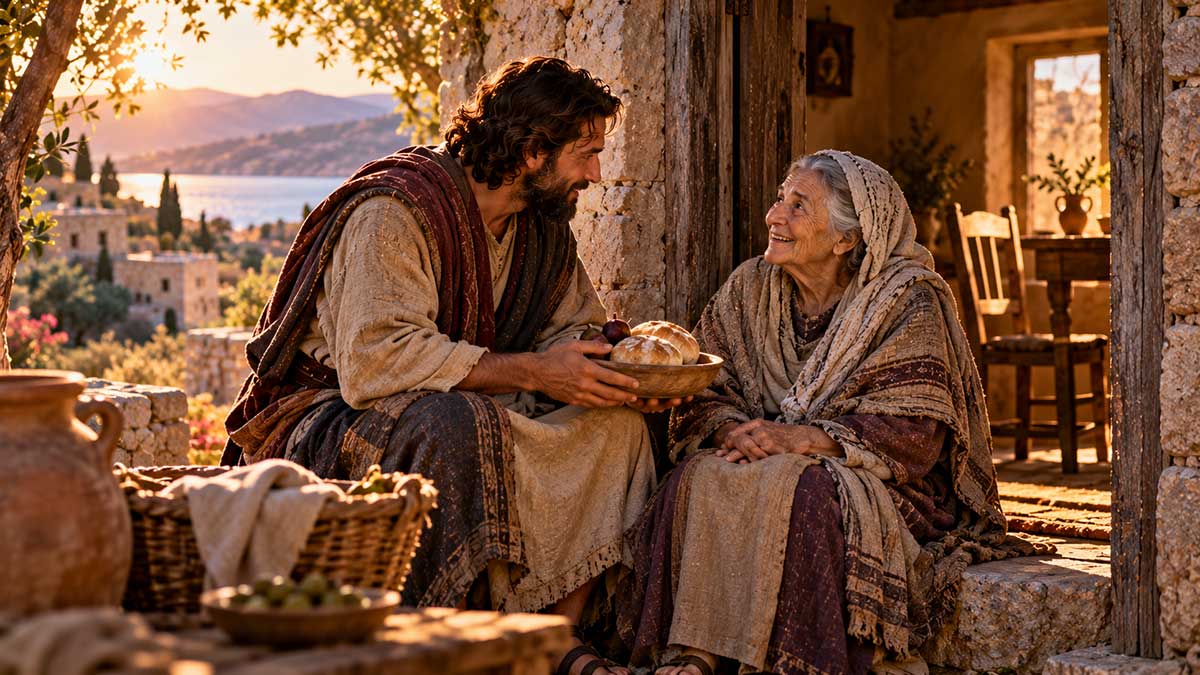
The last light of evening rests upon the Sea of Galilee. Beneath the olive tree, thirteen men remain seated around a wooden table. The bread is nearly gone. A clay lamp flickers between Peter and Andrew.
Jesus has just asked them what they hoped people would remember most when they carried his teachings into the world.
For once, Peter does not answer first.
Matthew: That is a harder question than it sounds, Master.
Jesus: Why?
Matthew: Because I know what I wanted them to remember. I wanted them to remember your words. Your teachings. The things you did.
Jesus: And did they?
Matthew: Many did.
Jesus: Then what troubles you?
Matthew: I wonder whether remembering your words and living them became two different things.
Peter: We did our best, Matthew.
Matthew: I know we did.
Peter: We left our homes. We traveled. We endured rejection. Some of us gave our lives.
Matthew: I am not questioning our sacrifices.
Peter: Then what are you questioning?
Matthew: Whether we sometimes became so concerned with what people believed about you that we forgot how you treated them.
Peter leans back.
Peter: That is not a small accusation.
Matthew: It is not meant as an accusation. It is a question I have asked myself.
John: I think I know what Matthew means.
Peter: Then perhaps you can explain it.
John: When the Master was with us, people came to him for many reasons. Some were sick. Some were hungry. Some were lonely. Some were ashamed of what they had done.
Andrew: Some simply wanted to be near him.
John: Yes. And he did not begin by asking whether they could explain the kingdom correctly.
Thomas: He often began by asking what they wanted.
John: Or by listening.
Matthew: Or by sitting at their table.
Jesus looks at Matthew.
Jesus: Do you remember the day I called you?
Matthew: Very clearly.
Jesus: What were you doing?
Matthew: Collecting taxes.
Peter: A profession that did not make you particularly popular.
Matthew: Thank you, Peter. I had nearly forgotten.
The disciples laugh.
Matthew: People saw me sitting at that booth and assumed they knew everything about me. Some of their anger was justified. But no one was particularly interested in what I thought or felt.
Jesus: And what happened when I came?
Matthew: You said, "Follow me."
Jesus: What did you expect me to say?
Matthew: I expected a lecture.
Thomas: You would have deserved one.
Matthew: Probably.
Matthew: I expected you to tell me everything that was wrong with my life. I expected you to demand that I prove myself worthy before you would allow me near you.
Jesus: And what did I do?
Matthew: You came to my table.
Matthew pauses.
Matthew: I have never forgotten that.
Jesus: Why?
Matthew: Because you treated me as a person before I had become the person you were calling me to be.
The table grows quiet.
Matthew: I wonder how many people we turned away because we wanted them to change before we were willing to welcome them.
Peter: We had to teach people to repent.
Matthew: Of course.
Peter: We could not simply tell everyone that nothing they did mattered.
Matthew: I am not suggesting that.
Peter: Then what?
Matthew: That perhaps people sometimes need to experience love before they can believe they are capable of changing.
Jesus looks from Peter to Matthew.
Jesus: Peter, when I called you, had you already become the man you wished to be?
Peter: No.
Jesus: And Matthew?
Matthew: Certainly not.
Jesus: Thomas?
Thomas: I am still working on it.
Jesus smiles.
Jesus: Then perhaps you should consider how the Father has been patient with you as you decide how to treat His other children.
Simon: Master, I agree that love matters. But I am troubled by something.
Jesus: Tell us.
Simon: If we welcome everyone without distinction, how do we protect the community from those who would harm it?
Matthew: We can welcome people without allowing them to harm others.
Simon: That sounds reasonable, but it is not always simple.
John: No. It is not.
Simon: Suppose a man enters a community claiming to follow your teachings, but he uses his position to deceive people. Suppose he takes money from the poor, mistreats those who trust him, or uses your name to gain authority.
Peter: Then he must be confronted.
Simon: And if he refuses to change?
Peter: Then he cannot be allowed to continue harming others.
Simon: Exactly.
Simon turns toward Jesus.
Simon: Then there must be limits to what love requires.
Jesus: Simon, do you believe that protecting the vulnerable is contrary to love?
Simon: No.
Jesus: Then why do you speak of protection and love as though they were enemies?
Simon: Because people sometimes use love as an excuse to avoid difficult decisions.
Jesus: That is true.
Simon: They say, "We must forgive," when what they mean is, "We do not want to confront what happened."
John: I have seen that.
Simon: They tell the wounded person to be patient, but they do not ask the one who caused the harm to change.
Matthew: That is not mercy.
Simon: No. It is cowardice dressed in beautiful words.
Jesus nods.
Jesus: When a shepherd sees danger approaching his flock, does he stand aside and call his inaction kindness?
Simon: No.
Jesus: And when one sheep is wounded, does he tell it to stop complaining because the wolf deserves love?
Simon: Certainly not.
Jesus: Then do not confuse love with indifference to suffering.
Peter: We learned that lesson the difficult way.
Jesus: Many lessons are learned that way.
Simon: But what of the man who has caused harm?
Jesus: Tell him the truth. Require him to stop. Seek what is right for those he has injured. And do not take pleasure in his humiliation.
Simon: Even when he deserves punishment?
Jesus: Justice need not be fed by hatred.
Simon considers this.
Simon: I think I understand.
Thomas: That would be a remarkable development.
Simon: Thomas, I am beginning to understand why Peter finds you exhausting.
Peter: At last, someone agrees with me.
The disciples laugh.
Andrew has been listening quietly. He looks toward the water, where the last traces of daylight are fading.
Andrew: Master, I have a confession that may sound foolish.
Jesus: Let us hear it.
Andrew: Sometimes I wondered whether I had done enough.
Peter: Andrew, you brought me to him.
Andrew: I know.
Peter: You introduced your own brother to the Messiah. Surely that counts for something.
Andrew: I am glad it does, Peter.
Peter: Then what troubled you?
Andrew: You were always speaking to crowds. John became known for his closeness to the Master. Matthew preserved so many of his teachings. Others traveled far and became remembered for their work.
Peter: And you did not?
Andrew: I did what I could. But much of it seemed small.
Jesus: What seemed small?
Andrew: Bringing one person to meet you. Finding someone who needed help. Listening to people who were afraid.
Jesus: Do you remember the boy with the loaves and fish?
Andrew: Yes.
Jesus: What did you say when you brought him to me?
Andrew: I said that he had five barley loaves and two fish, but I did not know what they could do among so many people.
Jesus: And what happened?
Andrew: Everyone ate.
Jesus: Did the boy know what would happen when he offered his food?
Andrew: No.
Jesus: Did you?
Andrew: Certainly not.
Jesus: Yet you brought what you had found.
Andrew: Yes.
Jesus: Andrew, why have you spent so much time measuring your work by what you could see of its results?
Andrew looks down.
Andrew: Because I wanted to know that my life mattered.
Jesus: To whom?
Andrew: To the Father. To you. To the people I tried to help.
Jesus: When you sat beside someone who was grieving, did you always know what your kindness would mean to that person?
Andrew: No.
Jesus: When you encouraged someone who had lost hope, did you know what he would do the next morning?
Andrew: No.
Jesus: Then how could you measure the full meaning of those moments?
Andrew: I could not.
Jesus smiles.
Jesus: The Father sees what you cannot.
Andrew: I suppose I wanted something more visible.
Jesus: Such as?
Andrew: Something people would remember.
Peter: Andrew, people remember you.
Andrew: Some do.
Peter: I certainly do.
Andrew smiles.
Peter: And if you had not come to me that day, I might have spent my whole life arguing with fish.
Thomas: The fish would have suffered greatly.
Laughter circles the table.
Andrew: Peter, I never doubted that you would make yourself known wherever you went.
Peter: Someone had to.
Jesus: Andrew, tell me something. When you brought Peter to me, were you thinking about how many people would remember your name?
Andrew: No.
Jesus: What were you thinking?
Andrew: That I had found someone wonderful, and I wanted my brother to know him.
Jesus: Then perhaps you were closest to the heart of your calling when you were least concerned with being remembered.
Andrew's eyes fill.
Andrew: I had never thought of it that way.
James, son of Alphaeus: Master, may I ask something?
Jesus: Please, James.
James, son of Alphaeus: I think I understand Andrew's question more than most.
Peter: Why?
James, son of Alphaeus: Because I was rarely the one anyone noticed.
James: There were two of us with the same name. That did not help.
James, son of Alphaeus: No, it did not.
The disciples smile.
James, son of Alphaeus: People remember Peter. They remember John. They remember Thomas for his questions. They remember Judas for his betrayal.
Judas looks down.
James, son of Alphaeus: But I sometimes wondered whether anyone remembered what I did.
Jesus: What did you do, James?
James, son of Alphaeus: I followed you. I listened. I tried to help where I could.
Jesus: Was that all?
James, son of Alphaeus: I suppose I could tell you stories. Small ones.
Jesus: Then tell us one.
James hesitates.
James, son of Alphaeus: There was an old woman who lived alone near one of the villages we visited. She had difficulty walking. Her sons had moved away, and she rarely had visitors.
Andrew: I remember her.
James, son of Alphaeus: I would stop by when I could. I brought food. Sometimes I repaired things around her home. Mostly, I listened.
Jesus: What did she speak about?
James, son of Alphaeus: Her children. Her husband, who had died. The years when her house had been full of people.
Jesus: And what did you say?
James, son of Alphaeus: Not very much. She did most of the talking.
Jesus: Did she seem disappointed?
James, son of Alphaeus: No. She always asked when I would return.
Jesus: And did you?
James, son of Alphaeus: Whenever I could.
Jesus waits.
James, son of Alphaeus: One day she told me that the worst part of growing old was not the pain in her legs. It was waking each morning and wondering whether anyone would notice if she were gone.
The table becomes still.
James, son of Alphaeus: I told her I would notice.
He swallows.
James, son of Alphaeus: I meant it.
Jesus: I know.
James, son of Alphaeus: But I never preached to a great crowd. I never did anything people would write about.
Jesus: James, what do you think that woman prayed for?
James, son of Alphaeus: Perhaps that someone would remember her.
Jesus: And did the Father answer her prayer?
James looks up.
James, son of Alphaeus: Through me?
Jesus: What do you think?
James begins to cry quietly.
James, son of Alphaeus: I thought I had done so little.
Jesus: You made a lonely woman feel that her life still mattered.
Andrew places a hand on James's shoulder.
Jesus: Tell me, James. If you had spoken to a thousand people and none had felt loved, would that have been greater than what you gave her?
James, son of Alphaeus: No, Master.
Jesus: Then why have you judged your life by the size of the crowd?
James wipes his eyes.
James, son of Alphaeus: I suppose I was listening to the wrong measure.
Judas has been staring at James. Something in the story has unsettled him.
Judas: James, may I ask you something?
James, son of Alphaeus: Of course.
Judas: Did you ever tell anyone about that woman?
James, son of Alphaeus: Not until now.
Judas: Why not?
James, son of Alphaeus: I did not think it was important enough to mention.
Judas shakes his head.
Judas: I spent so much time thinking about what would happen to nations, kings, and kingdoms. I wanted to be part of something that would change history.
Simon: Many of us did.
Judas: I thought that if we could change the world, the suffering of ordinary people would finally end.
Matthew: That was not a foolish hope.
Judas: No. But I wonder how many ordinary people I failed to notice while I was dreaming of changing the world.
He looks toward James.
Judas: You helped one woman feel less alone. I might have walked past her house without seeing her.
James, son of Alphaeus: You cannot know that.
Judas: No. But I know how often I was impatient with things that seemed small.
Jesus: Judas, do you remember the woman who poured perfume upon me?
Judas stiffens.
Judas: Yes.
Jesus: What troubled you about what she did?
Judas: The expense. I thought the perfume could have been sold and the money given to the poor.
John: That was what you said.
Judas: Yes.
He pauses.
Judas: I spoke of the poor. But my heart was not as generous as my words sounded.
Jesus: What do you see now?
Judas: That I used a good cause to hide something wrong within myself.
Matthew: People still do that.
Judas: I know.
Judas: It is frightening how easily a man can speak of justice while refusing to examine his own motives.
Simon: Or speak of freedom while seeking control.
John: Or speak of defending God while wanting fire to fall upon strangers.
Peter: Or speak of courage while being afraid of a servant girl.
The men exchange glances.
Thomas: We seem to have become rather good at identifying our own contradictions.
Peter: Better late than never.
Jesus smiles.
Jesus: What matters is what you do when you recognize them.
Thaddaeus: Master, I have been wondering about something.
Jesus: Tell us.
Thaddaeus: When you taught us to love one another, you said that people would recognize us as your disciples by our love.
Jesus: Yes.
Thaddaeus: You did not say they would recognize us by how many people we persuaded.
Jesus: No.
Thaddaeus: Or by how impressive our gatherings became.
Jesus: No.
Thaddaeus: Or by how loudly we defended your name.
Jesus: No.
Thaddaeus: Then perhaps we have sometimes confused the signs of success with the evidence of discipleship.
Peter: What do you mean?
Thaddaeus: A community can grow large without becoming kind. A teacher can attract thousands without learning humility. People can memorize sacred words without allowing those words to change how they treat their families.
Matthew: Yes.
Thaddaeus: And someone can quietly care for a lonely neighbor without anyone knowing his name.
He looks at James, son of Alphaeus.
Thaddaeus: Which life would the Father consider more successful?
Jesus: Why do you suppose the Father must choose between them?
Thaddaeus pauses.
Thaddaeus: I had not considered that.
Jesus: A large gathering may feed many hungry people. A single act of kindness may restore one wounded heart. Why should you despise either?
Thaddaeus: Then the question is not whether the work is large or small.
Jesus: What is the question?
Thaddaeus: Whether it is done in love.
Jesus: And whether that love bears good fruit.
Thomas: Then a large community that harms people cannot justify itself merely by pointing to its size.
Jesus: What do you think?
Thomas: I think it must examine what it is producing.
Simon: And a small community is not automatically good merely because it is small.
Jesus: No.
Matthew: We cannot measure righteousness by counting people.
Jesus: Numbers can tell you many things, Matthew. But they cannot tell you everything about the human heart.
Matthew: I wish I had learned that sooner.
Peter has grown unusually quiet. Jesus notices.
Jesus: Peter, what are you thinking?
Peter: About the people who trusted us.
Jesus: Tell me.
Peter: When we began sharing your teachings, people came to us with questions. They wanted to know how to live. They wanted to know what the Father expected of them.
Jesus: Yes.
Peter: We had to make decisions. We had to settle disagreements. Sometimes we had to correct people.
Jesus: And what troubled you?
Peter: I was afraid of leading them wrongly.
Matthew: That was a real responsibility.
Peter: Yes. But sometimes fear made me harsh.
John: You could be harsh.
Peter: I know.
Peter: I wanted people to understand how serious their choices were. I wanted them to remain faithful. I wanted to protect what we had been given.
Jesus: And did you always distinguish protecting the message from protecting your own authority?
Peter looks down.
Peter: No.
Jesus: What happened when someone questioned you?
Peter: Sometimes I listened.
Thomas: And sometimes?
Peter: Sometimes I felt challenged.
Jesus: Why?
Peter: Because I thought that if people doubted my judgment, they might doubt the message itself.
Jesus: Were you the message, Peter?
Peter: No.
Jesus: Were you the Father?
Peter: Certainly not.
Jesus: Then why did you sometimes act as though disagreement with you were disagreement with Him?
Peter closes his eyes.
Peter: Pride, I suppose. And fear.
Jesus: Fear of what?
Peter: Losing what we had worked so hard to build.
Jesus: And what had you been asked to build?
Peter: A community of people who followed your teachings.
Jesus: And what was to distinguish that community?
Peter looks around the table.
Peter: Love.
Jesus: Then what happens when preserving the community becomes more important than loving the people within it?
Peter: We begin protecting the walls while forgetting the people.
Jesus nods.
Jesus: A house is built to shelter those who live within it. What good is a house whose doors are guarded so fiercely that the wounded are left outside?
Simon: Yet the doors cannot be left open to those who come to harm the people inside.
Jesus: True. Wisdom is needed. But wisdom should serve love, not replace it.
Peter: I wish I had understood that more deeply.
Jesus: What would you have done differently?
Peter: I would have listened longer before speaking. I would have asked more questions. I would have been less afraid to admit when I did not know the answer.
Thomas: That would have surprised everyone.
Peter: Especially me.
The disciples smile.
Peter: And I would have tried harder to remember how patiently you treated me.
John leans forward.
John: Master, I have something to confess.
Jesus: I am listening.
John: I have spent much of this evening struggling with Judas.
Judas looks toward him.
John: I know what you taught us about love. I know what you taught us about forgiveness. I have spoken of those teachings more times than I can count.
Jesus: Yes.
John: But sitting across from him has shown me how easy it is to speak beautifully about love when the person who hurt you is not in the room.
Judas lowers his eyes.
John: I do not want to be cruel. But I do not want to pretend that I am ready to forgive everything.
Jesus: Then do not pretend.
John: Yet I feel that I am failing you.
Jesus: Why?
John: Because I still feel anger.
Jesus: John, when you feel anger, what do you do with it?
John: Sometimes I hold it close.
Jesus: Why?
John: Because I am afraid that if I release it, I will somehow betray the people who suffered.
Jesus: Do you believe your love for those who suffered depends upon continuing to hate the one who caused the harm?
John looks startled.
John: I had never put it that way.
Jesus: Then consider it.
John sits silently.
Jesus: You may remember the suffering. You may speak the truth about it. You may protect others from harm. But must hatred become the proof of your loyalty?
John: No.
Jesus: Then perhaps there is room in your heart for grief without hatred.
John looks at Judas.
John: I do not know how to reach that place yet.
Judas: You need not reach it tonight.
John: I know.
Judas: I am grateful that you are still willing to speak with me.
John: I am beginning to understand that speaking with you does not mean I have excused what you did.
Judas: No.
John: It means I am willing to see more than the worst moment of your life.
Judas's eyes fill with tears.
Judas: I had almost forgotten what that felt like.
Jesus looks around the table. The faces before him are older in memory, yet familiar in every expression.
Jesus: My friends, when I sent you into the world, what did I ask you to give?
Andrew: The good news of the kingdom.
Matthew: The teachings you gave us.
Peter: The invitation to repent and turn to the Father.
John: The commandment to love one another.
Jesus: And what did you hope people would become?
Philip: Faithful.
Simon: Righteous.
Thomas: Wise.
Thaddaeus: Merciful.
Jesus: Then consider what you have said. If a person learns every teaching but becomes proud, what has he gained?
Matthew: Knowledge without humility.
Jesus: If he speaks of mercy but delights in condemning others?
John: He has not learned mercy.
Jesus: If he prays publicly but ignores his hungry neighbor?
Andrew: His prayer has not changed his heart.
Jesus: If he gives generously but humiliates those who receive his gifts?
James, son of Alphaeus: He has forgotten their dignity.
Jesus: And if he spends his life defending the Father's name but cannot bear to love the Father's children?
No one answers.
Jesus: What has he misunderstood?
Peter speaks quietly.
Peter: The Father Himself.
Jesus looks at him.
Peter: We cannot claim to know the Father while refusing to learn how He loves.
Jesus: And how have I taught you to know Him?
Peter: Through your words. Through your life. Through the way you treated people.
Jesus: Then let what you have learned become part of the way you live.
The garden grows darker. A second lamp is lit. The disciples have stopped thinking about how long they have been sitting together.
Judas looks around the table.
Judas: May I say something before we leave this question?
Jesus: Of course.
Judas: I have listened to each of you speak about your work. Your sacrifices. The people you helped. The communities you served.
He pauses.
Judas: I have none of those stories to offer.
Matthew: Judas...
Judas: No, Matthew. Let me finish.
Judas: When I think of my life, I see the garden. The soldiers. The kiss. The silver. The morning when I realized what I had done.
Jesus: Is that all you see?
Judas: It is what I have allowed myself to see.
Jesus: And before those days?
Judas: There were people we helped. Meals we shared. Children who laughed when you spoke with them.
Jesus: Did those things happen?
Judas: Yes.
Jesus: Then why have you erased them from your memory?
Judas: Because I thought remembering anything good about myself would be an excuse for what I did.
Jesus: Does remembering a kindness erase a betrayal?
Judas: No.
Jesus: Does remembering a betrayal erase every kindness?
Judas closes his eyes.
Judas: No.
Jesus: Then remember truthfully, Judas. Do not make your past smaller than it was, whether by hiding your wrongdoing or by denying every good thing that happened before it.
Judas: I do not know how to hold both truths together.
Jesus: Then perhaps that is something you can learn.
Judas looks toward the other disciples.
Judas: From them?
Jesus: You have already begun.
Peter looks at Judas, then at John.
Peter: I think we all have.
James, son of Alphaeus, looks toward the distant lights appearing along the shore.
James, son of Alphaeus: Master, may I return to something you asked earlier?
Jesus: Please.
James, son of Alphaeus: You asked what we hoped people would remember most about us.
Jesus: Yes.
James, son of Alphaeus: I think I have an answer now.
Jesus: Tell us.
James, son of Alphaeus: I hope they remember that we tried to make people feel less alone.
Andrew smiles.
Andrew: That is a good answer.
Matthew: Better than counting how many people listened to us.
Thomas: Better than counting how many arguments we won.
Peter: I would have liked to win a few more.
John: Peter.
Peter: I am joking.
The disciples laugh.
James, son of Alphaeus: I hope they remember that when someone was hungry, we tried to feed him. When someone was afraid, we sat beside him. When someone had made a mistake, we did not immediately decide that his life was over.
His eyes move toward Judas.
James, son of Alphaeus: And when someone felt forgotten, we tried to remember him.
Judas looks down, struggling to contain his emotion.
Jesus: James, do you remember the woman you visited?
James, son of Alphaeus: Yes.
Jesus: What did she want most?
James, son of Alphaeus: To know that someone would notice if she were gone.
Jesus: And what did you give her?
James, son of Alphaeus: My time.
Jesus: And your attention.
James, son of Alphaeus: Yes.
Jesus: And your love.
James nods.
Jesus: Then perhaps you have already answered the question that troubled you for so long.
Peter rises to stretch his legs. He walks a few steps toward the water, then turns back.
Peter: Master, there is something I cannot stop thinking about.
Jesus: What is it?
Peter: We spent so much of our lives trying to prove that we were your disciples.
Jesus: Yes.
Peter: We wanted people to believe what we believed. We wanted them to follow what we taught. We wanted them to understand who you were.
Jesus: And now?
Peter: Now I wonder whether the greatest evidence that we had followed you was never what we said about you.
Jesus: What was it?
Peter looks around the table.
Peter: How we treated one another.
Jesus smiles.
Jesus: I believe you are beginning to remember.
Peter looks toward Judas.
Peter: Then perhaps we have one more question to answer.
Judas: What question?
Peter: We have spoken about loving strangers. Loving enemies. Loving the people who disagreed with us.
He pauses.
Peter: But we have not yet answered whether we can love one another here, knowing everything we now know.
John looks toward Judas. Simon sets down his cup. Andrew watches Peter carefully.
Thomas: That may be the hardest question of all.
Peter: I think it is.
Jesus looks around the table, at the twelve men who once followed him through Galilee.
Jesus: Then tell me, my friends. If the Father is truly your Father, what does that make you to one another?
The lamps flicker beneath the olive tree.
And for a long moment, nobody speaks.
Topic 5: If God Is Our Father, Are We Still Brothers?
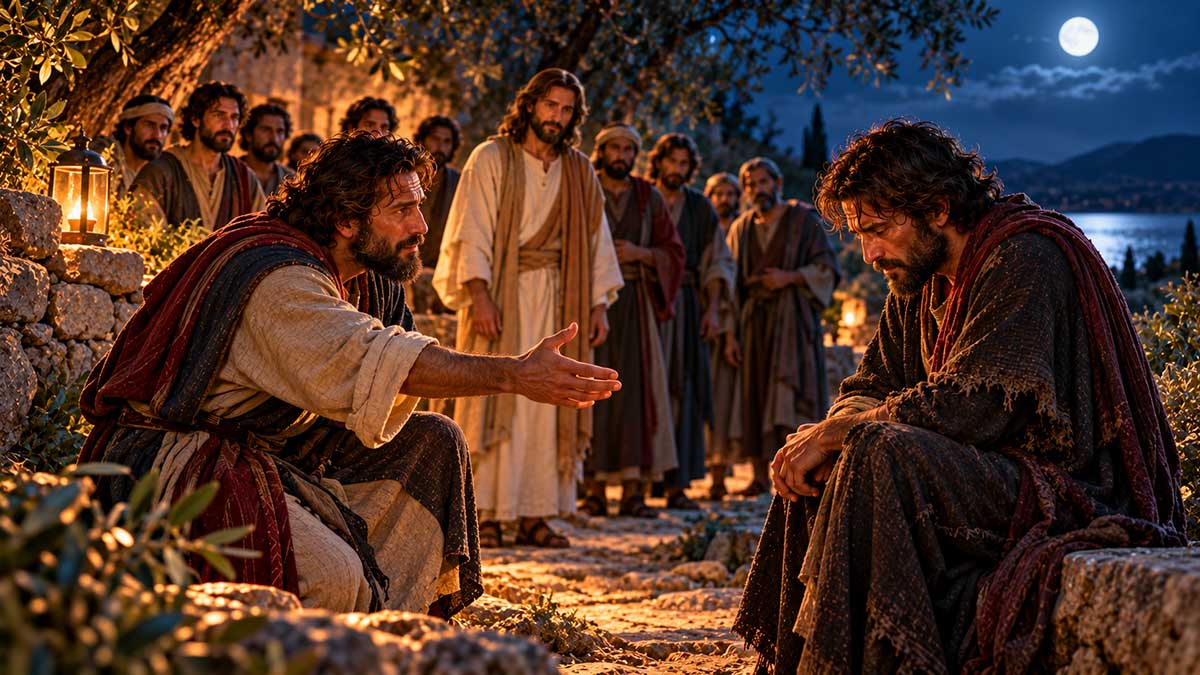
The lamps burn low beneath the olive tree.
Beyond the garden, the Sea of Galilee has disappeared into darkness. Only a narrow band of moonlight reveals where the water begins.
Thirteen men remain at the table.
They have spoken of cowardice, ambition, doubt, and the terrible things people can do while believing themselves righteous. They have laughed at old memories. They have confessed things they once lacked the courage to say.
Now Jesus has asked them a question.
If the Father is truly their Father, what does that make them to one another?
Peter stares at the empty space between himself and Judas.
Peter: Brothers.
His answer is barely audible.
Jesus: What did you say, Peter?
Peter: Brothers, Master. If God is our Father, then we are brothers.
Jesus: And what does it mean to be a brother?
Peter: To care for one another. To help when someone falls. To share what we have.
Jesus: Is that all?
Peter: To remain faithful.
His eyes move toward Judas.
Peter: That is where the difficulty begins.
Jesus: Tell me.
Peter: A brother is supposed to be someone you can trust.
Andrew: Not every brother is trustworthy.
Peter: I know. But surely there must be something that holds a family together.
Matthew: Blood does not always do it.
Simon: Nor does sharing the same beliefs.
John: Nor does sharing the same table.
Judas lowers his head.
Jesus: John, why did you say that?
John: Because we shared a table with Judas on the night he betrayed you.
No one moves.
John: We ate together. We listened to you speak. You washed our feet. You gave us bread.
John's voice tightens.
John: And afterward he led the soldiers to you.
Judas: Yes.
John: So when Peter says that brothers remain faithful, I cannot help thinking that Judas was our brother until the moment he decided not to be.
Judas: I have wondered the same thing.
John: Have you?
Judas: Every time I remember that night.
John: Then perhaps you understand why I cannot simply call you my brother again.
Judas: I do.
Jesus: John, is brotherhood something a man can lose by his actions?
John: Surely he can lose the trust of his brothers.
Jesus: Yes.
John: And their friendship.
Jesus: Sometimes.
John: Then what remains?
Jesus looks at the men around the table.
Jesus: Perhaps we should ask what made you brothers in the first place.
Simon: We chose to follow you.
Jesus: Yes.
Simon: We shared your teachings. We traveled together. We served the same purpose.
Jesus: And before you chose to follow me?
Simon: We were strangers.
Matthew: Some of us would have preferred to remain strangers.
Simon: That is true.
Matthew smiles faintly.
Jesus: Simon, before you knew Matthew, was he any less a child of the Father?
Simon: No.
Jesus: And when you disliked him?
Simon: No.
Jesus: And when you came to love him?
Simon: He had not become more of the Father's child merely because I had changed my mind.
Jesus: Then perhaps the Father's relationship to His children does not begin or end with your approval of one another.
Simon considers this.
Thomas: That would mean brotherhood is not something we create by agreeing to it.
Jesus: What do you think?
Thomas: I think we discover it. Or refuse to recognize it.
Bartholomew: A man may deny that another belongs to his family, but denying it does not change their father.
Peter: Yet that cannot mean every relationship must remain as it was.
Jesus: Why not?
Peter: Suppose a brother steals from his family. Suppose he lies, harms them, and refuses to stop. Are they required to trust him merely because they share a father?
Jesus: No.
Peter: Are they required to allow him to continue?
Jesus: No.
Peter: Then what does brotherhood require?
Jesus: Tell me, Peter. If your brother has wounded someone, what would love require of you?
Peter: That I protect the wounded person.
Jesus: And what would love require toward the brother who caused the wound?
Peter hesitates.
Peter: That I tell him the truth.
Jesus: And if he refuses to hear it?
Peter: That I do not help him continue doing harm.
Jesus: And if he recognizes what he has done?
Peter: That I listen.
Jesus: Even if you are still angry?
Peter: I suppose so.
Jesus: Then perhaps love does not ask you to choose between truth and mercy. It asks you to remain faithful to both.
Peter: That is harder than choosing one.
Jesus: It often is.
Judas slowly pushes his chair away from the table.
Andrew: Judas?
Judas: I think I should leave.
Peter: Why?
Judas: You have all been very kind. Kinder than I expected. But I have heard enough to understand what I feared when I first arrived.
John: What did you fear?
Judas: That I would be the wound everyone was afraid to touch.
John: We have not been afraid to speak about what you did.
Judas: No. And I am grateful for that.
He stands.
Judas: But every question seems to return to me. Every lesson about forgiveness becomes a question about whether you can forgive me. Every lesson about love becomes a question about whether I deserve yours.
Matthew: Judas, that is not all we have spoken about.
Judas: I know.
Judas: Yet I cannot escape the feeling that my presence has turned this reunion into a trial.
Jesus remains seated.
Jesus: Judas, who invited you?
Judas: You did, Master.
Jesus: Did I invite you to stand before a court?
Judas: No.
Jesus: Then why are you standing?
Judas looks at the empty chair.
Judas: Because I do not know how to sit among them.
Jesus: You have been sitting among them all evening.
Judas: My body has.
His voice breaks.
Judas: My heart has been standing at the door.
The words settle over the table.
Andrew looks away. Matthew closes his eyes.
Jesus: Then tell us what has kept you there.
Judas: Fear.
Jesus: Of what?
Judas: That if I allow myself to feel welcome, I will be stealing something I no longer deserve.
Jesus: What would you be stealing?
Judas: Their kindness. Their memories of me. The place I once had among them.
Jesus: Can kindness be stolen when it is freely offered?
Judas: I do not know.
Jesus: Then perhaps you should ask those who are offering it.
Judas looks around the table.
Judas: Are you offering it?
No one answers immediately.
Judas: You see?
Peter: Judas, sit down.
Judas: Peter...
Peter: Please.
Judas remains standing.
Peter: I have something to say, and I would rather not shout it across the garden.
After a moment, Judas sits.
Peter: When I denied the Master, I ran away.
Judas: I know.
Peter: I found somewhere to hide. I wept until I could hardly breathe.
Peter looks at his hands.
Peter: I had told him that even if everyone else abandoned him, I would not. I had made myself sound like the bravest man in Galilee.
Thomas: You were very convincing.
Peter: I convinced myself most of all.
There is a faint smile around the table, but Peter does not look up.
Peter: When I heard the rooster, I thought I knew exactly who I was. A coward. A liar. A man whose love had failed at the moment it mattered most.
Jesus: And what happened afterward?
Peter: You came back to us.
Jesus: And?
Peter: You asked whether I loved you.
Jesus: What did you answer?
Peter: That you knew I did.
Jesus: Did I ask whether you had never failed me?
Peter: No.
Jesus: Did I ask you to prove that you were better than the others?
Peter: No.
Jesus: Then what did I ask?
Peter: To feed your sheep.
Peter finally looks at Judas.
Peter: I have been thinking about that all evening.
Judas: What about it?
Peter: He did not ask me to spend the rest of my life staring at the courtyard. He asked me to care for people.
Judas: You were given another chance.
Peter: Yes.
Judas: I was not.
Peter falls silent.
Judas: I am not saying that to accuse you. I am saying it because that is the difference I cannot escape.
Peter: I know.
Judas: You saw him again. You heard his voice. You had a morning beside the sea.
Judas's hands begin to tremble.
Judas: I had a morning when I returned the silver and found that nobody wanted it. Nobody wanted to hear me. Nobody could tell me how to undo what I had done.
Peter: Judas...
Judas: I knew he was innocent. I knew I had betrayed him. I knew that every road I could see led back to that one terrible choice.
His voice grows thin.
Judas: And I could not see another morning.
Peter looks stricken.
Judas: You had the courage to live long enough to discover that your failure was not the whole of your story.
Peter: I did not feel courageous.
Judas: But you lived.
Peter cannot answer.
Judas: I wish I had known how to wait.
For a long time, the only sound is the wind moving through the olive leaves.
Thomas: Judas, may I ask you something?
Judas: Yes.
Thomas: When you returned the silver, what were you hoping would happen?
Judas: I wanted someone to tell me there was a way to make it right.
Thomas: And when no one did?
Judas: I believed there was no way.
Thomas: Did you ask the Master?
Judas looks toward Jesus.
Judas: No.
Thomas: Why not?
Judas: How could I?
Thomas: You had seen him welcome people who had done wrong.
Judas: Yes.
Thomas: You had heard him speak of the Father's mercy.
Judas: Yes.
Thomas: Then why did you believe that mercy could not reach you?
Judas's eyes fill.
Judas: Because I knew what I had done to the one who taught it.
Thomas: But that is precisely why you needed to hear him.
Judas: I know that now.
Thomas: I am not trying to wound you.
Judas: You are not.
Thomas: I am trying to understand.
Judas: So am I.
Thomas sits back.
Thomas: I have spent much of this evening thinking about doubt. I used to believe that my greatest weakness was being unable to accept something I could not see.
Jesus: And now?
Thomas: Now I wonder whether despair can be a terrible kind of certainty.
Matthew: What do you mean?
Thomas: Judas became certain that nothing good remained possible. Peter became certain that his denial defined him. John became certain that forgiving Judas might dishonor those who suffered.
John: I am not certain of that anymore.
Thomas: Exactly.
Thomas: We have each suffered from believing that the part of the truth we could see was the whole truth.
Jesus: And what have you learned?
Thomas: That certainty can be dangerous when it closes the door to what we do not yet know.
Judas: Especially when the door is the one through which hope might enter.
Thomas nods.
John: Judas, I need to tell you something.
Judas turns toward him.
John: I have been angry with you for so long that I no longer know where the anger ends and the grief begins.
Judas: I understand.
John: No. I do not think you do.
Judas lowers his eyes.
John: When they took the Master, I was afraid. When they struck him, I felt helpless. When I stood near the cross with his mother, I wanted to do something, anything, to stop what was happening.
His voice breaks.
John: And I could do nothing.
Judas: I am sorry.
John: I know you are.
John: But for years, whenever I remembered that day, I needed somewhere to put my helplessness.
He looks directly at Judas.
John: I put it on you.
Judas: I gave you reason.
John: Yes. You did.
John: But I began to believe that if I stopped hating what you had done, I would be betraying the people I loved.
Jesus: John, what did I ask you to do when I entrusted my mother to your care?
John: To care for her.
Jesus: And did you?
John: I tried with all my heart.
Jesus: Did I ask you to keep your anger alive as proof that you loved her?
John: No.
John wipes his face.
Jesus: What did she need from you?
John: Someone to stay. Someone to listen. Someone to remember him with her.
Jesus: And did hatred help you give her those things?
John closes his eyes.
John: No.
Jesus: Then perhaps you may honor her sorrow without allowing it to become a prison for your own heart.
John: I want to.
Jesus: I know.
John turns back to Judas.
John: There is something I have never told you.
Judas: What?
John: After everything happened, I sometimes remembered you before the betrayal.
Judas: You did?
John: I remembered you walking beside us. I remembered the arguments we had. I remembered the evenings when Peter talked so long that everyone wished the fire would go out.
Peter: I am beginning to feel persecuted.
No one laughs immediately. Then Andrew smiles, and a few others follow.
John: I remembered you laughing.
Judas looks stunned.
John: And whenever I did, I felt guilty.
Judas: Why?
John: Because I thought remembering something good about you meant I was excusing what you had done.
Judas: I have felt the same way about myself.
John: I know that now.
John takes a breath.
John: Judas, I cannot tell you that the betrayal no longer hurts. It does.
Judas: I know.
John: I cannot promise that every memory will become gentle.
Judas: I would not ask that.
John: But I do not want the last thing you did to erase every good thing I once knew about you.
Judas covers his face.
Judas: John...
John: I am not ready to say everything is healed.
Judas: You need not.
John: But I would like to remember my friend without feeling ashamed.
Judas begins to weep.
John remains seated. He does not rush across the table. He allows Judas to cry.
For the first time that evening, the silence feels less like judgment and more like companionship.
Matthew: Master, I think we have been asking the wrong question.
Jesus: What question should we ask?
Matthew: We keep asking whether Judas deserves to be our brother.
Simon: Is that not the question before us?
Matthew: Perhaps not.
Simon: Then what is?
Matthew: Whether we are willing to treat someone as a human being even when he has done something terrible.
Simon: That is not the same as calling him innocent.
Matthew: No.
Simon: Nor does it restore trust.
Matthew: No.
Simon: Nor does it remove consequences.
Matthew: No.
Simon: Then what does it change?
Matthew: Us.
Simon looks at him.
Matthew: It changes what we permit ourselves to become in response to another person's wrongdoing.
Simon: Explain.
Matthew: We may be right about the harm someone has caused. But if we allow that harm to make us cruel, we have added another wound to the world.
Simon: Sometimes anger is necessary.
Matthew: Yes. Anger can tell us that something precious has been violated. But anger alone cannot tell us what to do next.
Jesus: Simon, do you remember what we spoke of earlier?
Simon: That justice need not be fed by hatred.
Jesus: And do you still believe it?
Simon: I am trying to.
Jesus: What troubles you?
Simon: I fear that if we speak too much of mercy, people will forget the victims.
Jesus: Then remember them.
Simon: And if we speak too much of forgiveness, people will stop taking wrongdoing seriously.
Jesus: Then speak truthfully about wrongdoing.
Simon: And if a person uses forgiveness to avoid responsibility?
Jesus: Do not permit him to hide behind it.
Simon nods.
Jesus: But Simon, do not imagine that the only way to honor the wounded is to hate the one who wounded them.
Simon: I see that now.
Jesus: Your Father loves justice. He knows the suffering of those who have been harmed. His mercy does not require Him to become indifferent to their pain.
Simon: Then we may leave judgment to Him without abandoning our responsibility to do what is right.
Jesus: Yes.
Andrew reaches for the pitcher and discovers that it is empty.
Andrew: We have talked so long that we have finished the water.
Peter: That may be the first time any of us has exhausted something before you noticed.
Andrew: Someone had to notice.
Andrew rises to fetch more water, but Judas stands.
Judas: Let me.
Andrew: You need not.
Judas: I know.
Andrew hands him the pitcher.
Judas walks toward a small stone basin near the garden wall.
The others watch him go.
James: I have been thinking about something.
Jesus: Tell us.
James: When John and I asked to sit beside you in glory, we thought being close to you meant having a place above the others.
John: We did.
James: But when you washed our feet, you showed us something we had not understood.
Jesus: What was that?
James: That greatness was not about being above someone. It was about being willing to serve.
Jesus: And what do you see now?
James looks toward Judas, who is filling the pitcher.
James: A man we have been debating all evening, while he is simply bringing us water.
Thomas: One act does not erase what he did.
James: I know.
Thomas: But it is still an act of kindness.
James: Yes.
James: I think I have spent too much of my life deciding who people are instead of paying attention to what they are doing now.
Bartholomew: We all have.
Philip: Perhaps that is why the Master so often told us to look at the fruit of a person's life.
Matthew: And to remember that fruit takes time to grow.
James, son of Alphaeus: Some of it grows where nobody notices.
Jesus smiles at him.
Jesus: Yes, James. Some of it does.
Judas returns with the water.
He fills Andrew's cup first, then Matthew's, then John's.
When he reaches Peter, he hesitates.
Peter: Thank you.
Judas fills his cup.
Peter: Judas, may I ask you something?
Judas: Yes.
Peter: Do you remember the morning we argued about who would be greatest?
Judas: Which morning?
Peter laughs.
Peter: Fair point.
Judas: We had that argument often enough.
Peter: I remember telling you that I would never abandon the Master.
Judas: You were very certain.
Peter: I was.
Judas: I envied your certainty.
Peter: You should not have.
Judas: I know that now.
Peter studies him.
Peter: I have been thinking about something you said earlier.
Judas: What?
Peter: That you did not know whether we would have opened the door if you had returned that morning.
Judas looks down.
Judas: Yes.
Peter: I want to answer that question.
John turns toward Peter.
Peter: I have spent this entire evening trying to find an answer that would make me sound better than I was.
Judas: You need not do that.
Peter: I know.
Peter: The truth is, I do not know whether I would have opened the door.
Judas nods slowly.
Peter: I might have been furious. I might have been afraid. I might have said something cruel.
Judas: I expected you would.
Peter: And perhaps you would have been right.
Peter's voice trembles.
Peter: But I wish you had knocked.
Judas looks up.
Peter: I wish you had come anyway.
Judas: Peter...
Peter: I wish you had given us the chance to be better brothers than you feared we were.
Judas's face crumples.
Judas: I did not believe there was anyone left who would want to see me.
Peter: I know.
Judas: I thought you would all hate me.
Peter: Some of us might have.
Judas: I know.
Peter: But perhaps one of us would have opened the door.
Peter looks toward Andrew.
Peter: Andrew might have.
Andrew: I hope I would have.
Peter: Matthew might have.
Matthew: I would like to believe so.
Peter: Thomas might have asked you a hundred questions before deciding what to do.
Thomas: At least a hundred.
Judas laughs through his tears.
Peter: And John...
Peter looks toward John.
Peter: John might have been angry enough to send you away.
John: Perhaps.
John looks at Judas.
John: But I wish I had been given the chance to discover whether I could do otherwise.
Judas lowers himself into his chair.
Judas: I cannot bear to think about what might have happened.
Peter: Neither can I.
Peter sits beside him.
Peter: We cannot change that morning.
Judas: No.
Peter: But perhaps we can stop pretending that we know everything about the morning that never came.
Judas looks at him.
Peter: I do not know whether I would have opened the door then.
Peter places his hand on the table between them.
Peter: But you are here now.
The garden has become very still.
Jesus looks around the table, at the twelve men who once followed him along dusty roads and through crowded villages.
Jesus: My friends, do you remember the story I told you about a father and his two sons?
Andrew: The younger son who left home?
Jesus: Yes.
Matthew: He took his inheritance and wasted it.
Peter: And when he had nothing left, he returned.
Jesus: What did he expect?
Philip: That his father might allow him to work as a servant.
Jesus: And what did his father do?
John: He ran to meet him.
Jesus: Before the son had finished his speech.
John: Yes.
Jesus: And what troubled the older brother?
Simon: He believed the celebration was unfair.
Jesus: Why?
Simon: He had remained faithful. He had worked. He had obeyed. Yet the son who had wasted everything was welcomed home.
Jesus: Did the father's joy erase the younger son's wrongdoing?
Simon: No.
Jesus: Did it mean the older son's faithfulness had been worthless?
Simon: No.
Jesus: Then what could the older brother not understand?
Simon thinks for a long time.
Simon: That his father's love for one son did not diminish his love for the other.
Jesus: And what did the father tell him?
John: That everything he had was already his.
Jesus: Yet the older son stood outside the celebration.
Matthew: He could not bear to enter.
Jesus: Why?
Matthew: Because he believed his brother's welcome was an injustice against him.
Jesus looks around the table.
Jesus: Tell me, my friends. Which brother needed to come home?
No one answers.
Thomas: Both of them.
Jesus: Why?
Thomas: One had gone far away. The other had remained near his father but had forgotten how to share his father's joy.
Jesus nods.
Jesus: And which one did the father love?
Thomas: Both.
Peter looks toward Judas.
Peter: Master, are you saying that Judas is the younger son?
Jesus: I am asking you to consider the story.
Peter: And that we are the older brother?
Jesus: Have you never stood outside a door because you could not bear to see someone else welcomed?
Peter lowers his eyes.
Peter: Yes.
Jesus: Have you never been so ashamed that you feared returning home?
Judas speaks quietly.
Judas: Yes.
Jesus: Then perhaps there is something in the story for each of you.
Judas: Master, I need to ask you something.
Jesus: Ask.
Judas: In that story, the younger son came home.
Jesus: Yes.
Judas: He lived long enough to return.
Jesus: Yes.
Judas: I did not.
His voice becomes almost a whisper.
Judas: What happens to the one who does not find his way home before his life ends?
The question seems to draw all the air from the garden.
Jesus looks at Judas for a long time.
Jesus: Judas, what have I taught you about the Father?
Judas: That He is merciful.
Jesus: And just?
Judas: Yes.
Jesus: That He knows the hearts of His children?
Judas: Yes.
Jesus: Then why do you ask me to speak as though I could place the whole of His judgment into a sentence?
Judas: Because I am afraid.
Jesus: I know.
Judas: I am afraid that the last thing I did has become the only thing that matters.
Jesus: Judas, I will not tell you that your choices did not matter.
Judas: I would not believe you if you did.
Jesus: Nor will I tell you that the Father is blind to your remorse, your fear, or the whole of the life you lived.
Judas's eyes fill.
Judas: Then what can you tell me?
Jesus: That the Father knows you more completely than you know yourself.
Judas: Even the things I cannot bear to remember?
Jesus: Even those.
Judas: And the things I have forgotten?
Jesus: Those too.
Judas: Then I must leave my judgment to Him.
Jesus: Yes.
Judas: That is difficult.
Jesus: I know.
Judas looks at the others.
Judas: And what of them?
Jesus: What of them?
Judas: Must they leave their judgment of me to the Father as well?
Jesus: They must leave to Him what belongs to Him. But there are choices that belong to them.
Judas: Such as?
Jesus: Whether to speak truthfully. Whether to protect those who have been harmed. Whether to listen. Whether to allow hatred to govern their hearts.
Jesus looks toward Peter and John.
Jesus: Whether to recognize a brother when he stands before them.
John rises.
For a moment, Judas appears frightened.
John: I need to walk.
Jesus: Then walk, John.
John moves toward the garden wall. James follows him.
James: Brother?
John: I am all right.
James: You do not look all right.
John: I have spent years teaching people to love one another.
James: I know.
John: And I have discovered that I still do not know how to do it when it hurts.
James: None of us does it perfectly.
John: That is not very comforting.
James: I was not trying to comfort you.
John looks at him.
James: I was trying to tell you that you are not alone.
John gives a small, tired laugh.
John: You have become wiser than you were when we asked for the best seats.
James: I had considerable room for improvement.
They stand quietly beside the wall.
John: Do you think we should forgive him?
James: I think we should stop asking whether forgiveness means pretending that nothing happened.
John: That is not what I am asking.
James: I know.
John: Do you think you can call him your brother?
James looks back toward the table.
James: I do not know whether I can trust him as I once did. I do not know whether we could ever return to what we were.
John: Neither do I.
James: But I do know that I do not want the worst thing he did to become the only thing I remember about him.
John closes his eyes.
John: I remember him helping us carry supplies. I remember him arguing with Matthew about money. I remember him laughing when Peter fell into the water.
James: We all laughed.
John: Peter did not.
James: No. He did not.
They smile.
John: Those memories are still there.
James: Yes.
John: I thought I had to choose between remembering those days and remembering the cross.
James: Perhaps you can remember both.
John looks toward Jesus.
John: Perhaps.
At the table, Peter has been sitting quietly beside Judas.
Peter: Judas, I have a question.
Judas: Another one?
Peter: I learned from Thomas.
Thomas: At last, my influence is being recognized.
Peter smiles, then grows serious.
Peter: If you could speak to the man you were on the night of the supper, what would you tell him?
Judas looks down at his hands.
Judas: I would tell him to stop.
Peter: And if he would not listen?
Judas: I would tell him that he does not know nearly as much as he thinks he does.
Peter: And if he still would not listen?
Judas is silent for a long time.
Judas: I would tell him that when he realizes what he has done, he must not face it alone.
Peter's eyes fill.
Judas: I would tell him to find someone. Anyone who would listen. I would tell him that the terrible thing he has done is real, but that he must not let despair persuade him there is no road beyond it.
Peter: And if he were afraid no one would open the door?
Judas: I would tell him to knock anyway.
Peter reaches across the small space between them.
He places his hand over Judas's.
Peter: I wish you had.
Judas begins to cry.
Judas: So do I.
Peter does not speak. He remains beside him.
The lamps are nearly spent.
Andrew begins gathering the cups. Matthew helps him. Simon and Thomas carry the empty dishes toward a small stone shelf.
One by one, the disciples rise.
The conversation has left them tired, but not with the exhaustion of an argument. They seem quieter, more attentive to one another.
Jesus walks toward the garden path.
Jesus: Come, my friends. The night is beautiful.
Peter rises. Andrew follows. Thomas pauses to ask Philip something, and the two begin another discussion before they have taken three steps.
Peter: Thomas, must every walk become a debate?
Thomas: Only when someone says something worth questioning.
Peter: Then you will be very quiet tonight.
The disciples laugh.
John and James return from the garden wall. John glances at Judas but says nothing.
Judas remains seated.
The others begin walking beneath the olive trees.
Judas watches them.
He looks at the thirteen chairs, the broken bread, and the place where Jesus had sat.
Slowly, he rises.
But instead of following, he steps backward.
Peter notices.
Peter: Judas?
Judas: Go ahead.
Peter: Are you coming?
Judas: I think I should stay here.
Peter: Why?
Judas looks toward the path where Jesus and the others are waiting.
Judas: I do not know whether I belong with you.
Peter is quiet.
He looks at Andrew, at John, at the others who have already begun walking.
Then he turns back to Judas.
Peter: I cannot answer every question you have.
Judas: I know.
Peter: I cannot change what happened.
Judas: Neither can I.
Peter: And I cannot tell you what the Father will decide.
Judas: I would not ask you to.
Peter takes a step closer.
Peter: But I can tell you something about tonight.
Judas: What?
Peter: You came.
Judas looks at him.
Peter: You sat with us. You listened. You told the truth about what you did. You heard things that must have been painful to hear.
Judas: Yes.
Peter: And you stayed.
Judas: I nearly left.
Peter: So did I, once.
Judas looks puzzled.
Peter: After the courtyard, I wanted to disappear. I wanted never to see any of you again.
Judas: But you returned.
Peter: Yes.
Judas: You were braver than I was.
Peter: No, Judas. I was fortunate enough to find people who helped me return.
Peter's voice breaks.
Peter: I wish I had been one of those people for you.
Judas cannot answer.
Peter extends his hand.
Peter: Come. Walk with me.
Judas stares at the offered hand.
Judas: Peter, you do not have to do this.
Peter: I know.
Judas: You do not have to forgive me.
Peter: I know.
Judas: You do not even have to call me your brother.
Peter's eyes fill.
Peter: I know.
He keeps his hand extended.
Peter: But I would like to begin again with the man standing in front of me.
Judas looks at the hand.
For a moment, he seems unable to move.
Then, slowly, he takes it.
Peter grips his hand firmly.
Neither man speaks.
They begin walking toward the others.
John stands a short distance down the path.
He watches Peter and Judas approach.
When they reach him, Judas slows.
Judas: John...
John: You need not say anything.
Judas stops.
John: I am still learning.
Judas: So am I.
John looks toward Jesus, who is waiting beneath the next olive tree.
John: I think we all are.
He steps aside to make room on the path.
Judas hesitates.
John: Come. The others are waiting.
Judas looks at him with tears in his eyes.
Judas: Thank you.
John nods.
They walk together.
Ahead of them, Jesus stands beneath the moonlit branches.
Peter and Judas approach side by side. John follows close behind.
Jesus looks at them, then at the other disciples.
Jesus: What have you learned tonight, my friends?
Thomas: That we know less than we thought.
Philip: That the Father is greater than our understanding.
Matthew: That truth without love can become a weapon.
Simon: And love without truth can become an excuse for harm.
Andrew: That small acts of kindness may matter more than we realize.
James, son of Alphaeus: That being forgotten by the world does not mean being forgotten by the Father.
Bartholomew: That we should be careful before deciding what another person is worth.
Thaddaeus: That belonging is not something we should use to make others feel small.
James: That the desire to be great can keep us from becoming good.
John: That remembering a wound does not require us to keep hatred alive.
Jesus turns toward Peter.
Jesus: And you, Peter?
Peter looks at Judas.
Peter: That being forgiven is not the end of learning to forgive.
Jesus smiles.
Then he looks at Judas.
Jesus: And you, Judas?
Judas struggles to speak.
Judas: That I cannot undo what I did.
Jesus: No.
Judas: That I cannot demand forgiveness.
Jesus: No.
Judas: That I cannot decide the Father's judgment for Him.
Jesus: That is true.
Judas looks at Peter's hand, still holding his own.
Judas: But perhaps I do not have to spend every moment trying to decide whether I deserve to be loved before I can accept a brother's kindness.
Jesus looks at him tenderly.
Jesus: That is something worth considering.
Judas nods.
The disciples begin walking again.
Their voices drift through the garden. Thomas asks Philip another question. Peter complains that the discussion has begun all over again. Andrew laughs. Matthew offers to settle the matter by counting how many questions Thomas has asked since supper.
John walks beside James. Simon listens to Bartholomew. Thaddaeus and James, son of Alphaeus, speak quietly about the people whose names the world has forgotten.
And Peter walks beside Judas.
Not because the past has disappeared.
Not because every wound has healed.
Not because the questions of justice and mercy have been settled by the men who sit at the Father's table.
But because, for this moment, one man has chosen not to leave another standing alone.
Jesus walks a few steps behind them.
He looks toward the stars, then toward the men he once called to follow him.
Jesus: Father, may Your children learn to love one another.
The path curves through the olive trees.
And the thirteen continue walking together.
For tonight, that is enough.
Final Thoughts: The Brother Who Was Still Standing at the Door

Of all the moments in this imaginary reunion, perhaps the most moving is not something Jesus says.
It is something Peter does.
Judas is standing alone, uncertain whether he belongs with the others. He knows that his betrayal cannot be undone. He knows that an apology cannot erase the suffering he helped cause.
And Peter, the disciple who once denied Jesus three times, holds out his hand.
He does not announce that Judas has been absolved. He does not claim to know the Father's judgment. He does not ask John or the others to forget what happened.
He simply offers to walk beside him.
There is something profoundly human about that gesture.
Most of us will never face a betrayal as consequential as the one described in the Gospels. Yet we know what it means to be disappointed by someone we love.
A child who has hurt a parent.
A parent whose words left wounds that lasted for decades.
A friend who disappeared when we needed them most.
A husband or wife who broke a promise.
And sometimes, the person we struggle hardest to forgive is ourselves.
We replay an old conversation. We remember something cruel we said. We wish we could return to a particular afternoon and make a different choice.
But we cannot return.
The past remains what it was.
What can change is the way we carry it and what we choose to do next.
That does not mean every relationship can or should be restored. Some people need distance. Some wounds require accountability, protection, and time. Forgiveness cannot be demanded from the person who has been harmed.
Yet we can refuse to let resentment become the only truth we remember about another human being.
We can acknowledge someone's wrongdoing without reducing that person to it.
We can recognize our own failures without deciding that we are incapable of doing good again.
And we can leave to our Heavenly Father the judgments that belong to Him.
Perhaps this is one of the most beautiful lessons Jesus taught: love is not reserved only for those who have never disappointed us.
It is something we must keep learning, especially when it becomes difficult.
At the end of our imaginary conversation, thirteen men walk together beneath the olive trees.
Their questions have not all been answered. Their wounds have not all healed.
But someone who expected to be left behind has been offered a hand.
And someone who once believed himself stronger than everyone else has learned that his greatest strength may be helping another person stand.
We cannot always change what happened between us. But sometimes we can change what happens next.
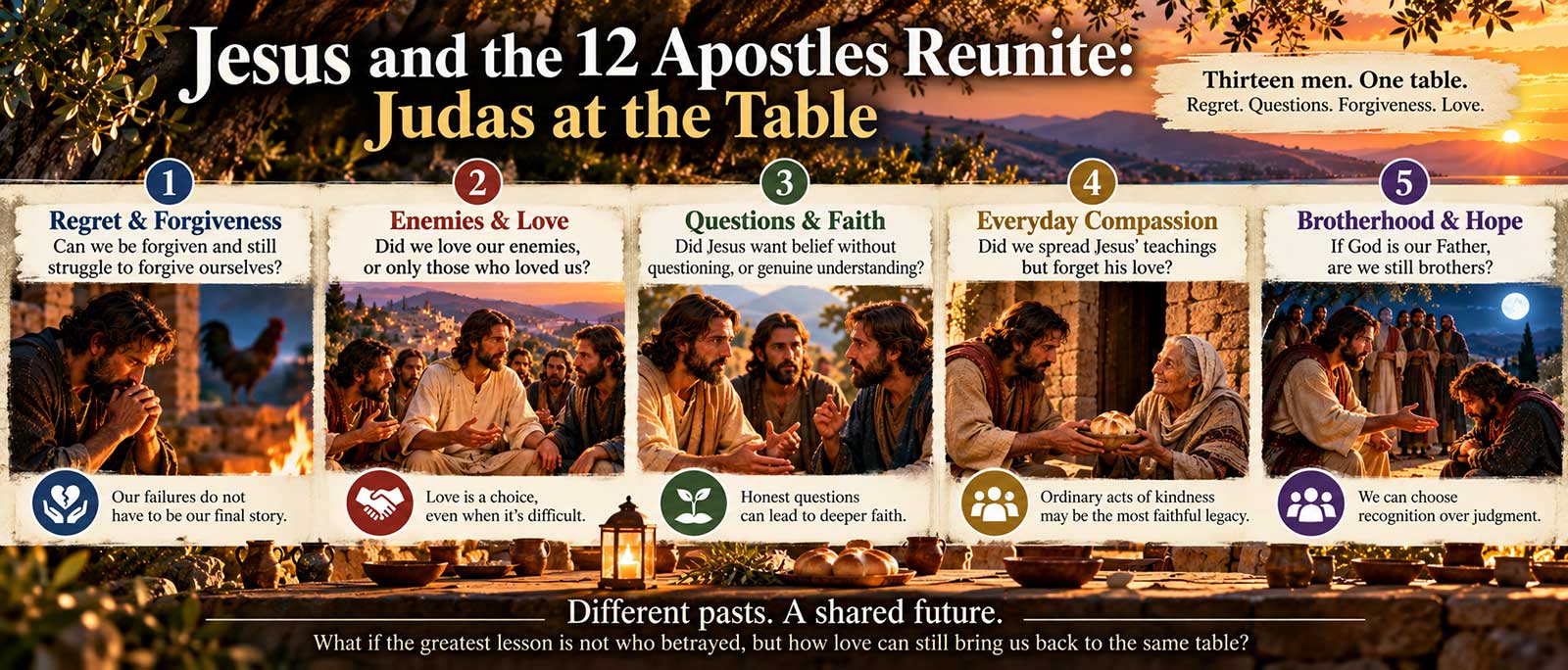
Meet the Participants
The central figure of the New Testament and the teacher who called the twelve apostles. In this imagined conversation, Jesus speaks as the Son of God, directing his disciples toward their Heavenly Father's love, justice, and mercy. His warmth, challenging questions, and compassion are inspired by the Gospel accounts.
A fisherman from Galilee and one of Jesus' closest disciples. Peter is remembered for his bold declarations, his three denials of Jesus, and his later restoration. Here, he confronts the shame he has carried and discovers that receiving forgiveness and extending it to others are two different challenges.
Peter's brother and one of the first disciples to follow Jesus. Andrew is remembered for bringing people to Jesus, including his own brother. In this story, his quiet kindness represents the extraordinary value of ordinary acts of love.
The brother of John and one of Jesus' closest disciples. James and John were known for their intensity and ambition. Here, James reflects on the difference between defending what is right and allowing pride or anger to govern his actions.
The brother of James and a prominent disciple of Jesus. John's Gospel is traditionally associated with him, though its authorship is debated. In this fictional reunion, John carries painful memories of the crucifixion and struggles to reconcile his devotion to Jesus with his anger toward Judas.
An apostle remembered for introducing Nathanael to Jesus and asking Jesus to show the disciples the Father. Philip represents the sincere desire to understand spiritual truths rather than merely repeat religious language.
One of the twelve apostles, traditionally identified with Nathanael, although the identification is not certain. In this story, he examines how easily people judge others by reputation, background, or first impressions.
The apostle remembered for questioning reports of Jesus' resurrection until he could see for himself. Rather than portraying Thomas as merely doubtful, this conversation presents him as an honest and thoughtful seeker who challenges the others to distinguish genuine understanding from unexamined certainty.
A tax collector called to follow Jesus. Traditionally associated with the Gospel of Matthew, he represents the possibility of transformation and the importance of welcoming people who have been judged by their past. His fictional voice is reflective, practical, and attentive to human dignity.
One of the lesser-known apostles. Scripture provides few personal details about his life. His role in this imagined conversation explores the worth of quiet service, especially acts of kindness that receive little public recognition.
Thaddaeus, Also Identified as Judas Son of James
An apostle named Thaddaeus in Matthew's list and commonly identified with Judas son of James in Luke's list. He is distinct from Judas Iscariot. Here, he questions whether the disciples sometimes confused religious certainty with spiritual understanding.
One of the twelve apostles, identified by the designation Zealot. Little is known about his individual life or political activity. In this fictional discussion, he gives voice to the tension between justice, conviction, anger, and compassion.
The apostle who betrayed Jesus. Matthew records his remorse, his attempt to return the silver, and his death. His motives and eternal fate have long been subjects of theological discussion. In this story, Judas is portrayed as a deeply troubled man whose presence forces the others to confront questions of responsibility, despair, forgiveness, and the limits of human judgment.
His participation in this imagined afterlife reunion is a literary device, not a claim that Scripture establishes his salvation or condemnation.
Leave a Reply