
Introduction
What would you say to the man who lit the world, if you found him alone in a hotel room on a snowy night?
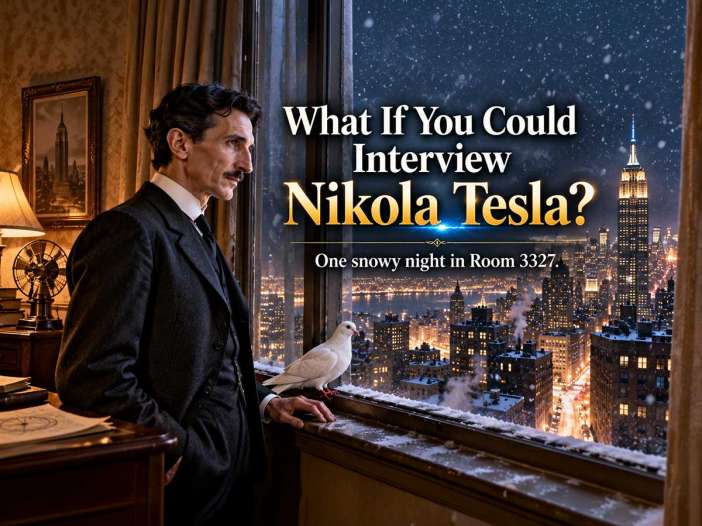
For me, this conversation began somewhere personal. Years ago, I lived at the Hotel New Yorker in Manhattan for six months. I rode its slow elevators, walked its long hallways, and looked out at the same city lights. Only later did I fully take in that one of the greatest inventors in history had spent his last decade in that same building, in rooms 3327 and 3328, and had died there alone in January 1943.
Nikola Tesla was born in 1856 in a small village in today’s Croatia, the son of a Serbian priest and a mother who couldn’t read but invented her own tools. As a boy, he began seeing visions so vivid he couldn’t tell them from reality, and he learned to turn them into the most powerful tool any inventor has ever had: he built and tested machines entirely in his mind. One evening in a Budapest park, while reciting Goethe at sunset, the idea for the alternating current motor came to him in a flash, and he drew it in the sand with a stick. You can read his own account of that moment at the Tesla Science Center at Wardenclyffe, the site of his great unfinished tower.
That idea powers nearly every motor on earth today. Yet Tesla dug ditches for two dollars a day, fought Edison in the War of the Currents, lost his greatest dream when J. P. Morgan withdrew his funding, and ended his life feeding pigeons, his rent quietly paid by the company his inventions had made rich.
So I went back to the Hotel New Yorker to meet him, on a snowy January evening, as the lights of Manhattan came on below his window. Like every ImaginaryTalks episode, this is sincere imagination, grounded in his autobiography, My Inventions, his interviews, and the historical record, not a claim to channel anyone.
We talk about the boy born, as family legend has it, in a lightning storm, the brother he lost, and the mother he adored. We talk about how he saw machines in his mind, and the evening in Budapest that changed the world. We talk about Edison, Westinghouse, Niagara Falls, and why the man with the best invention didn’t build the biggest empire. We stand at his window and look at what became of his impossible dreams in 2026. And finally, we talk about a white pigeon, a vision at the moment of his mother’s death, and what one of the most rational minds in history came to believe about the soul.
If you’ve ever seen something clearly that the world wasn’t ready for, or wondered why brilliant ideas so often arrive before their time, come sit with us in Room 3327.
(Note: This is an imaginary conversation, a creative exploration of an idea, and not a real speech or event.)
Topic 1: The Boy Born in a Storm
Room 3327, Hotel New Yorker. A snowy January evening. The room is neat to the point of severity: a narrow bed, a writing desk, a small safe, stacks of papers squared at the corners. On the windowsill, two gray pigeons huddle against the cold glass. Nikola Tesla, tall and thin in an immaculate dark suit, stands by the window with a paper bag of birdseed. He turns as Nick Sasaki enters.
Nikola Tesla: Ah. You found me. Most people get lost. They take the wrong elevator and end up at the barber shop.
Nick Sasaki: (smiling, extending his hand) Nick Sasaki. It’s an honor.
Tesla looks at the hand, then gives a small, gracious bow.
Nikola Tesla: Forgive me. I don’t shake hands. It’s nothing to do with you, I promise. A peculiarity of mine. You’d be surprised what lives on the human hand. (He smiles.) Or perhaps you wouldn’t want to know. Please, sit. I’ve cleaned the chair myself.
Nick Sasaki: (sitting, laughing) Thank you. I have to tell you something first. I lived in this hotel once. For six months.
Nikola Tesla: (His eyebrows rise with real pleasure.) Here? In the New Yorker?
Nick Sasaki: Here.
Nikola Tesla: Then we’re neighbors, separated only by a few decades. (He sets down the birdseed and sits across from Nick, crossing his long legs.) What brought you?
Nick Sasaki: Work. And a long story.
Nikola Tesla: The best reasons always are. And did the elevators still take forever?
Nick Sasaki: They did.
Nikola Tesla: Good. Some things should never change. (He gestures toward the window, where snow drifts past the lights of Manhattan.) When this hotel opened, it was the most modern in the world. Its own power plant in the basement. A telephone in every room. A radio. I chose it for that. A man likes to live among his own inventions, even if no one remembers whose they are.
Nick Sasaki: People remember now. That’s partly why I’m here. But I want to start at the very beginning. People say you were born at midnight, during a lightning storm.
Nikola Tesla: (Amused.) People say many things.
Nick Sasaki: Is it true?
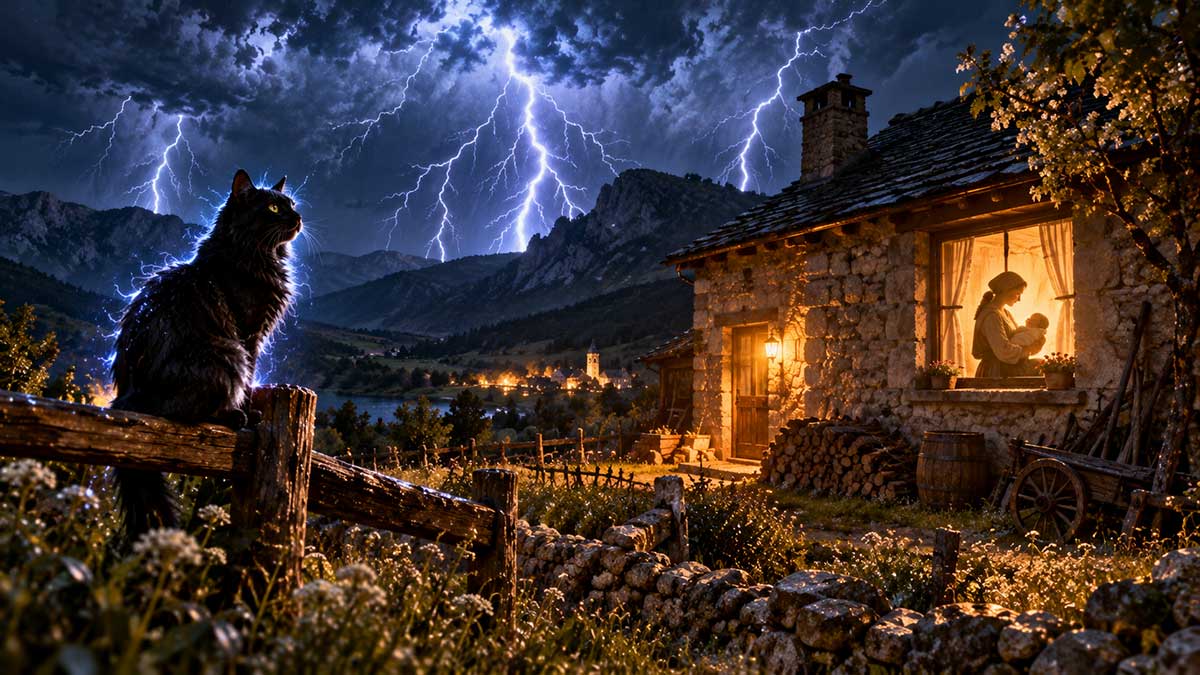
Nikola Tesla: I was not in a position to take notes. (A pause, a gleam in his eye.) But my family told it this way. A great storm over the mountains, the night of the ninth of July, turning into the tenth. Thunder shaking the house. And at the stroke of midnight, I arrived. The midwife was frightened by the lightning and said, “This child will be a child of the storm.”
And my mother answered her, “No. He will be a child of light.”
Nick Sasaki: That’s a beautiful story.
Nikola Tesla: It’s a very convenient story, for a man who spent his life making lightning. (He shrugs elegantly.) I’ve never tried to disprove it. Some legends are kinder than facts. I’ll let this one stand.
Nick Sasaki: You’ve said your gifts came from your mother, not your father. What was she like?
Tesla’s face changes. The showman’s polish softens.
Nikola Tesla: My mother could not read.
Nick Sasaki: I didn’t know that.
Nikola Tesla: Few people do. And she was the most brilliant person I have ever known. More than Edison. More than any professor in Graz. She could recite long epic poems from beginning to end, thousands of lines, without one mistake. She invented tools for the house, for the loom, for the kitchen. Clever little machines no one had ever made. She was up before dawn and worked until long after dark, weaving, sewing, planting, and she never seemed tired.
I watched her hands when I was small. Always moving. Always making. I think that’s where I learned that the mind and the hands are one instrument.
Nick Sasaki: And your father?
Nikola Tesla: A priest. A learned man, a fine writer, with a great library. He wanted me to become a priest also. (A faint smile.) He forbade me to read at night. He said I’d ruin my eyes. So I hid in my room, stole tallow, and made my own candles, and read until dawn. My first invention, you might say. Smuggled light.
Nick Sasaki: (laughing) So you were already a troublemaker.
Nikola Tesla: An inventor is only a troublemaker with a purpose.
One of the pigeons taps against the glass. Tesla rises without a word, opens the window an inch, scatters a pinch of seed on the sill, and closes it again. He sits back down.
Nikola Tesla: Forgive me. She’s impatient.
Nick Sasaki: I don’t mind at all. Can I ask about your first memory of electricity?
Nikola Tesla: (His eyes light up.) Ah. Mačak.
Nick Sasaki: Mačak?
Nikola Tesla: Our cat. The finest cat in the world. Black as coal. One winter evening, very dry and cold, I was stroking his back in the dark, and his fur lit up. A sheet of light under my hand, and sparks, crackling, loud enough to hear across the room.
My father said, “This is electricity. The same thing you see in the trees during a storm.” My mother was alarmed. She said, “Stop playing with the cat, or you’ll set the house on fire.”
Nick Sasaki: (laughing) She had a point.
Nikola Tesla: She always did. But I lay awake that night wondering. Is nature itself a gigantic cat? And if so, who strokes its back? (He smiles.) I’ve been asking that question for eighty years.
Nick Sasaki: Did you ever find out?
Nikola Tesla: Not yet. Ask me again at the end of the evening.
Nick Sasaki: I will. (He hesitates.) There’s something harder I wanted to ask. You had an older brother.
The room goes quiet. Outside, the snow falls past the window. Tesla looks at his own hands for a long moment.
Nikola Tesla: Dane.
Nick Sasaki: If you’d rather not...
Nikola Tesla: No. You came a long way. (He takes a breath.) Dane was the gifted one. Everyone said so. Brilliant, handsome, full of light. My parents adored him, and so did I. He was twelve. I was seven.
We had a beautiful Arabian horse. A gift from a friend. Intelligent, spirited, everyone loved him. One day, the horse threw Dane. His injuries were terrible. He died.
I saw it happen. I’ve lived a very long life, and that picture has never faded. Not for one day.
Nick Sasaki: I’m so sorry.
Nikola Tesla: After that, our house went silent. My parents never recovered. Whatever I did, whatever I learned, whatever praise I received at school, it only reminded them of what Dane would have done. I wasn’t a comfort to them. I was a measurement of what they’d lost.
(He says it simply, without self-pity.) A child understands that very quickly, even if no one says it aloud.
Nick Sasaki: Is that when the visions started?
Nikola Tesla: Around then. Yes. (He looks up.) Pictures would appear in front of my eyes, often with flashes of light. A word spoken to me, and the thing itself would stand before me, so real I couldn’t tell if it was solid or imagined. Sometimes I saw terrible things. Sometimes I saw the funeral again.
It frightened me. I thought I was going mad.
Nick Sasaki: How did you learn to live with it?
Nikola Tesla: I fought pictures with pictures. When a painful image came, I would summon another one to push it away. And when I ran out of images I knew, I began to travel.
Nick Sasaki: Travel?
Nikola Tesla: In my mind. Every night, I would leave Smiljan. I would walk through cities I had never seen, enter houses, meet people, make friends. I knew their faces. I knew their voices. They were as dear to me as any real person. I did this for years, every night, until I was seventeen.
And then one day I realized I could do the same with machines. I could build them in my mind, turn them on, watch them run.
He stands and walks slowly to the window. Below, the lights of the city glow through the falling snow.
Nikola Tesla: You asked about my mother. I’ll tell you one more thing.
My father worried about my daydreaming. He thought it was weakness, wasted time. Laziness. But my mother would watch me staring at nothing for an hour, and she never once told me to stop.
Once I asked her why. She said, “Because I can see your hands moving.”
I didn’t understand what she meant for a long time.
(He turns back from the glass.) I understand now. Where everyone else saw a boy lost in a silent house, she saw a boy who was building something.
Topic 2: Lightning in His Mind
The radiator ticks. Snow has gathered in soft ridges on the windowsill, and the pigeons have tucked their heads under their wings. Tesla has poured two glasses of water from a carafe. He wipes the rim of his own glass carefully with a folded handkerchief before drinking.
Nick Sasaki: I’ve been thinking about what you said, about building machines in your mind. I have to understand how that actually worked.
Nikola Tesla: Most people don’t believe it. They think it’s a figure of speech.
Nick Sasaki: I believe it. I just can’t picture it.
Nikola Tesla: (He sets down the glass.) Then let me show you. Close your eyes.
Nick Sasaki: (laughing, closing them) All right.
Nikola Tesla: Picture your front door. Where you live now.
Nick Sasaki: Okay.
Nikola Tesla: Is it open or closed?
Nick Sasaki: Closed.
Nikola Tesla: Open it. Which way does it swing?
Nick Sasaki: Inward. To the left.
Nikola Tesla: Is there a sound?
Nick Sasaki: (pausing) A little click from the latch. And the bottom brushes the mat.
Nikola Tesla: Good. Now open your eyes.
Nick does.
Nikola Tesla: You just did what I did. You saw a machine, a very simple one, a door, and you ran it in your mind and heard it working. The only difference is that I didn’t stop at a door.
I would build a motor in my head. Every part. The iron, the windings, the shaft, the bearings. Then I would turn it on and let it run. I could change any part I liked, improve it, test it again. I could leave it running for weeks, and come back to check where the bearings had begun to wear.
Nick Sasaki: You came back to an imaginary machine to check for wear?
Nikola Tesla: (Completely serious.) Of course. A machine that runs perfectly for one minute tells you nothing. The question is how it runs after a month.
When I finally built something in the world, it worked exactly as I had seen it. Not approximately. Exactly. I never needed drawings or models or experiments to tell me what I already knew.
Nick Sasaki: That must have been strange to explain to other engineers.
Nikola Tesla: It was impossible to explain. They thought I was boasting. Some still do. (A thin smile.) Edison built a thousand things to find one that worked. I built one, in here (he touches his temple), a thousand times.
Nick Sasaki: When did you first realize you wanted to solve alternating current?
Nikola Tesla: At the Polytechnic in Graz. I was nineteen and working like a man possessed. Three in the morning until eleven at night, every day, Sundays and holidays too. My professors wrote to my father that I would kill myself with work.
One day, our professor of physics, Poeschl, a very fine teacher, demonstrated a machine that sparked terribly at a part called the commutator. I said, why do we need the commutator at all? Why not let the current alternate freely?
Nick Sasaki: What did he say?
Nikola Tesla: (His eyes narrow with remembered amusement.) He gave an entire lecture on why my idea was impossible. He said Mr. Tesla may accomplish great things, but this he will never do. It would be like turning a steady pull of gravity into a spinning motion. A perpetual motion machine. A fantasy.
Nick Sasaki: And you believed him?
Nikola Tesla: For a moment. He was the professor, I was the student. But something in me knew he was wrong. I just couldn’t prove it yet.
So I carried the question with me. For four years. To Prague. To Budapest. Through my meals, my walks, my sleep. I never put it down.
Nick Sasaki: And then came Budapest.
Nikola Tesla: (He leans back, and his voice slows.) Budapest. I was working at the new telephone exchange. And I fell very ill. Something no doctor could name.
My senses became unbearable. I could hear a watch ticking three rooms away. A fly landing on a table sounded like a thunderclap. If a carriage passed in the street, the floor shook through my whole body. Sunlight hurt like a blow to the head. The doctors gave up on me. They said I would not live.
Nick Sasaki: How did you recover?
Nikola Tesla: A good friend. Anthony Szigety. A strong, cheerful man, an athlete. He didn’t care about my diagnosis. He said, “Nikola, you’re coming walking with me.” And he dragged me out into the air every day, until slowly I came back to life.
He stands and goes to the window, looking down at the snowy street, but he’s seeing something else.
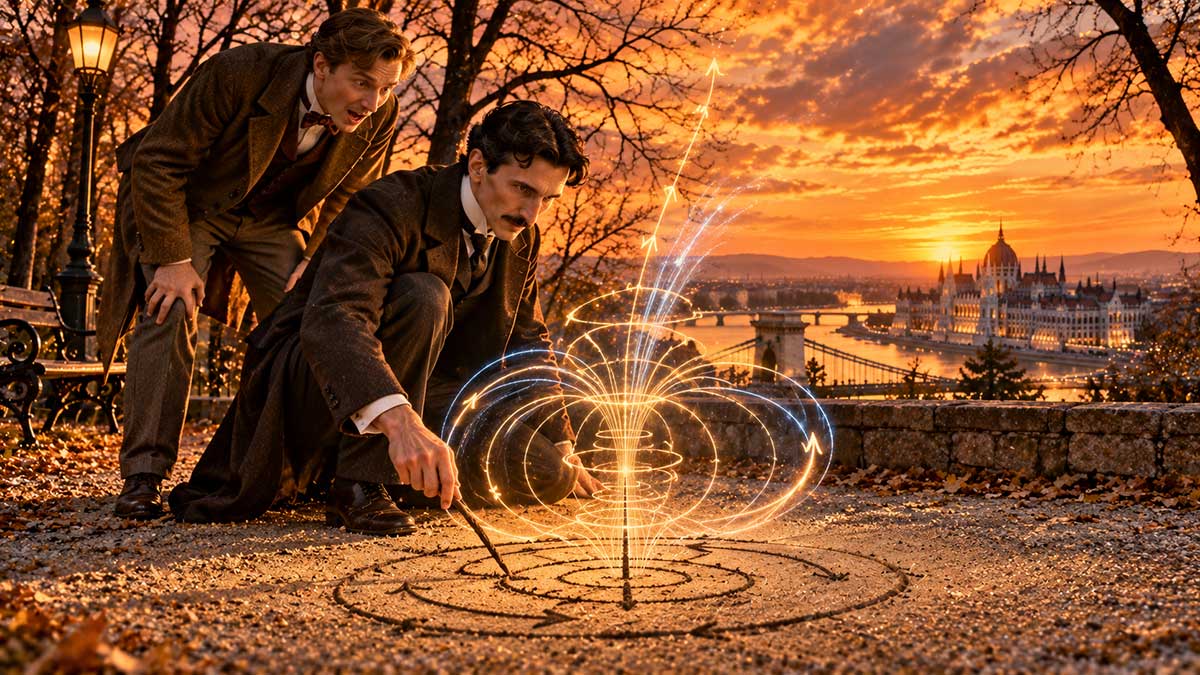
Nikola Tesla: It was February. One evening, we walked in the city park. The sun was going down, and the whole sky turned to fire. And I began to recite Goethe. I knew all of Faust by heart then. I recited the passage where Faust watches the sunset and wishes he had wings to follow the light. (Softly, almost to himself:)
“The glow retreats, done is the day of toil;
It yonder hastes, new fields of life exploring.”
And in that instant, the idea came. Like a flash of lightning.
Nick Sasaki: All at once?
Nikola Tesla: All at once. Complete. I saw it standing before me in the air. A magnetic field that turns. Not a motor that needs pushing and sparking and scraping, but a field of force that rotates by itself, and drags the iron around with it, smoothly, silently, forever. Two currents, out of step with each other, chasing each other in a circle.
I took a stick and drew it in the sand, right there on the path. Szigety looked at it, and he understood. That was the second miracle of the evening. My friend understood.
Nick Sasaki: (quietly) What did that feel like?
Nikola Tesla: (He turns from the window.) Do you know the feeling when someone you love, someone you thought was gone, walks back through the door?
Nick Sasaki: I think so.
Nikola Tesla: Like that. I had been carrying a question for four years, and suddenly it answered me. I laughed. I think I wept a little. Szigety thought I’d lost my mind again.
Six years later I drew the very same diagrams for the engineers of America. And today, every motor in every factory, every pump, every fan, they all turn because of what I drew in the dirt that evening.
Nick Sasaki: People will want to know this. Can ordinary people learn to see like that? Or is it a gift you’re born with?
Nikola Tesla: (He considers this carefully, sitting down again.) Both. I won’t pretend I was ordinary. Something in my mind was unusual from the beginning. Perhaps it came from those visions after Dane. Perhaps from my mother.
But the gift alone is nothing. I trained it like a muscle. As a boy, I practiced holding a picture steady in my mind for longer and longer. I practiced controlling my own will, refusing things I wanted just to prove I could. I memorized entire books. Discipline turns a gift into a tool.
Nick Sasaki: So what would you tell someone who wants to try?
Nikola Tesla: Three things. First, carry one question with you everywhere. Not ten. One. Let it walk with you, eat with you, fall asleep with you.
Second, before you build anything with your hands, build it with your mind. Close your eyes like you just did, and walk around it. Turn it on. Ask where it will break.
And third, when you’re exhausted, when you’ve thought about it so long you’re sick of it, go for a walk. With a friend, if you have one. The answer rarely comes at the desk. It comes when you’ve finally stopped forcing it, and the sun is going down, and you’re thinking about something beautiful instead.
He reaches over to the window. The glass has fogged slightly with the warmth of the room. With one long finger, he draws on it: a circle, with arrows chasing one another around its edge, two lines out of step, a rotor at the center.
Nikola Tesla: People call it inspiration, as if it were luck. A gift from heaven, falling on a lucky man in a park.
(He looks at the drawing on the glass for a moment.) The answer came in a flash. But I’d been carrying the question for four years.
He wipes the glass clean with his handkerchief, folds it precisely, and puts it back in his pocket.
Topic 3: The War of the Currents
Tesla has lit a small desk lamp, and the room glows amber against the blue snow outside. Nick takes a folded sheet of paper from his jacket.
Nick Sasaki: I want to read you something you said to the New York Times in 1931. It was the day after Edison died.
Nikola Tesla: (Arching one eyebrow.) Oh dear.
Nick Sasaki: “If Edison had a needle to find in a haystack, he would proceed at once with the diligence of the bee to examine straw after straw until he found the object of his search.” And then you said a little theory and calculation would have saved him ninety percent of his labor.
Tesla tries very hard to look dignified. He fails. A laugh escapes him, then another.
Nikola Tesla: I was being generous.
Nick Sasaki: (laughing) That was generous?
Nikola Tesla: I also said his accomplishments were little short of a miracle. Which they were. A man who refused to learn mathematics, who tried every substance on earth for a filament, including, I believe, hair from his assistant’s beard, and he still lit up the world. (He waves a hand.) I respected him. I simply didn’t enjoy him.
Nick Sasaki: You came to America to work for him.
Nikola Tesla: June, 1884. I stepped off the ship with a few cents in my pocket, a book of my own poems, some calculations, and a letter of introduction to Thomas Edison. My luggage and money were stolen on the way. I arrived with almost nothing but the letter.
Nick Sasaki: What was your first impression of him?
Nikola Tesla: A man of tremendous energy. Not a scientist. A force of nature. He worked twenty hours a day, like me. That was the only thing we had in common. (He smiles thinly.) He thought theory was a waste of time. I thought trial and error was a waste of life.
Nick Sasaki: What went wrong?
Nikola Tesla: He gave me his dynamos to improve. They were inefficient, always breaking down. He said, if you can fix them, there’s fifty thousand dollars in it for you.
So I worked. Day and night, for months. I redesigned them completely. They worked beautifully. And then I went to him and asked about the fifty thousand dollars.
Nick Sasaki: And?
Nikola Tesla: (Imitating a booming American voice.) “Tesla, you don’t understand our American humor.”
Nick Sasaki: He said that?
Nikola Tesla: That’s how I remember it. Perhaps he remembered it differently. But I resigned. I wanted to build my alternating current motor, and he would never allow it. He believed in direct current with his whole soul. And, I think, his whole bank account.
Nick Sasaki: And then you dug ditches.
Tesla’s amusement fades. He looks at his hands, long and fine-boned, impeccably clean.
Nikola Tesla: Yes. Some men offered to back me in my own company. I designed an arc lamp system for them. The best in the world. And as soon as it was finished, they took it, and pushed me out. I was left with a handful of worthless stock certificates.
That winter, I dug ditches for the telegraph company. Two dollars a day. In the snow, in the mud, with Irishmen and Italians who’d come to America with even less than I had.
Nick Sasaki: What was that like, for a man with your mind?
Nikola Tesla: (Quietly.) Humiliating. I had studied in two universities. I knew Faust by heart. I knew how to light the world. And I was standing in a frozen hole on a New York street, swinging a pick.
My education felt like a mockery. I won’t pretend otherwise. I had terrible headaches. And some nights, I’m not ashamed to say, I wept.
Nick Sasaki: What kept you going?
Nikola Tesla: The motor. It was still turning in my mind. Every swing of the pick, I could hear it humming. They could take my company and my money. They couldn’t reach that.
And the men in the ditch were kind to me. They called me “the professor.” When I told them about my motor, they listened. (A small smile.) My first American audience was a ditch crew. Better listeners than most investors.
Nick Sasaki: And then everything changed.
Nikola Tesla: (His posture straightens; the showman returns.) Then everything changed. Two men believed in me and helped me start again. I patented my alternating current system. In 1888, I lectured before the American Institute of Electrical Engineers and showed them what I’d drawn in the sand in Budapest.
And a man named George Westinghouse came to see me.
Nick Sasaki: What was he like?
Nikola Tesla: A gentleman. That’s the highest thing I can say about a businessman. Large, warm, honest. He looked at my motor, understood it immediately, and paid what it was worth. He brought me to Pittsburgh to help his engineers. We became friends.
Nick Sasaki: And then came the war.
Nikola Tesla: (His eyes darken.) The War of the Currents. Edison’s people went around the country killing animals with alternating current. Dogs. Calves. Horses. In public, in front of reporters, to prove my current was deadly. They helped build the first electric chair and made sure it ran on alternating current, so every newspaper would associate Westinghouse’s name with execution.
Nick Sasaki: That’s brutal.
Nikola Tesla: It was meant to be. Edison wasn’t arguing with me. He was frightening the public. (A pause.) I found it disgusting. I still do. But it failed.
Nick Sasaki: The World’s Fair.
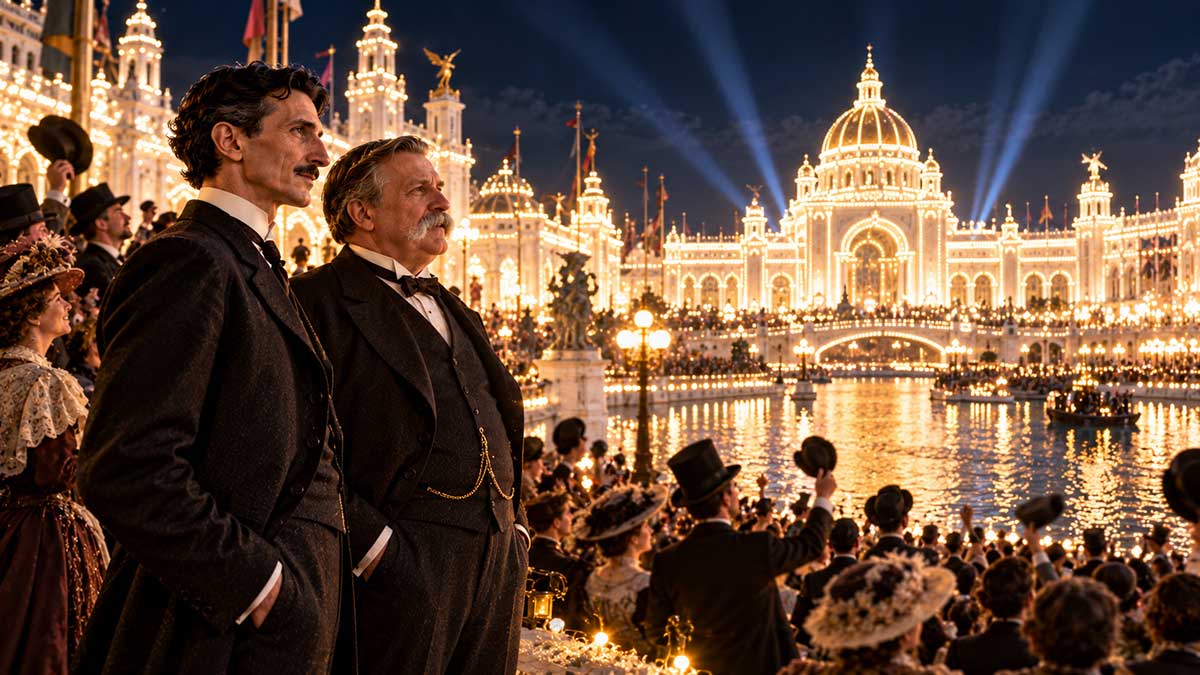
Nikola Tesla: (A slow, proud smile spreads across his face.) Chicago. 1893. Westinghouse won the contract to light the entire fair with my system. Over two hundred thousand lamps. When they threw the switch, the whole city of white palaces lit up at once. People screamed. People cried. Grown men took off their hats.
Twenty-seven million visitors saw it. After that, no one could tell them alternating current was too dangerous.
Nick Sasaki: And then Niagara Falls.
Nikola Tesla: When I was a boy in Smiljan, I saw a picture of Niagara Falls in a book. I told my uncle that one day I would put a great wheel under those falls and harness their power. He laughed at me.
(Very quietly.) Thirty years later, in 1896, power from my generators at Niagara Falls lit the city of Buffalo. Twenty-six miles away. Through wires. That was the beginning of the world you live in.
Nick lets that sit for a moment before speaking.
Nick Sasaki: Can I ask you something as a businessman? I’ve spent most of my life in marketing. Selling things.
Nikola Tesla: (Warily.) You may ask.
Nick Sasaki: You won the war of the currents. Your system powers the whole world. But Edison built an empire. His name is on companies, on schools, on the light bulb in every child’s picture book. And you ended up here, in a hotel room, feeding pigeons. Why do you think that happened?
Tesla’s jaw tightens. For a moment he seems offended. Then he looks out the window, and the anger drains away.
Nikola Tesla: Because I loved inventing, and I hated selling.
Edison loved selling. He understood that people don’t buy a motor. They buy a story about a motor. He told America a story about a self-made man with no education who lit up the world, and America loved him for it. I told them about rotating magnetic fields.
Nick Sasaki: In my business, we say the best product doesn’t always win. The best story does.
Nikola Tesla: (A tired smile.) You’d have been very useful to me forty years ago.
I thought the truth would be enough. I thought if an invention was beautiful and correct, the world would recognize it. I didn’t understand that truth also needs someone to carry it.
He’s silent for a moment. Then, unexpectedly, he chuckles.
Nikola Tesla: Do you know who was a good storyteller? Mark Twain. He used to visit my laboratory. We were friends. One day he complained that his digestion was a misery, nothing helped. So I told him to stand on a platform I’d built, connected to a mechanical oscillator, which vibrates very rapidly.
He loved it. He said he felt full of vigor and refused to get off. I warned him he’d had enough. He insisted. A minute and a half later, he leapt off the platform and ran for the facilities as fast as his legs could carry him.
Nick Sasaki: (laughing hard) You cured Mark Twain.
Nikola Tesla: Temporarily. (He grins.) He never asked for a second treatment.
His smile softens into something more serious.
Nikola Tesla: But you asked about Westinghouse. There’s one more thing.
After the war, his company was in terrible financial trouble. The bankers were circling. My contract with him paid me a royalty on every unit of power sold with my system. It would have made me one of the richest men in the world.
He came to me, a proud man, and told me honestly that the royalties might ruin his company.
Nick Sasaki: What did you do?
Nikola Tesla: I tore up the contract.
Nick Sasaki: People still argue about whether that’s exactly how it happened.
Nikola Tesla: (Unbothered.) Let them argue. I know what I did, and I know why. He believed in me when I was digging ditches. He treated me as a gentleman. My system would survive with him, and it would die with the bankers.
(He looks around the small, neat room: the narrow bed, the safe, the birdseed on the windowsill.)
People say it was the stupidest thing I ever did. Perhaps it was.
But I’ve never regretted it. Not once. Not even here.
Topic 4: The Dream That Fell
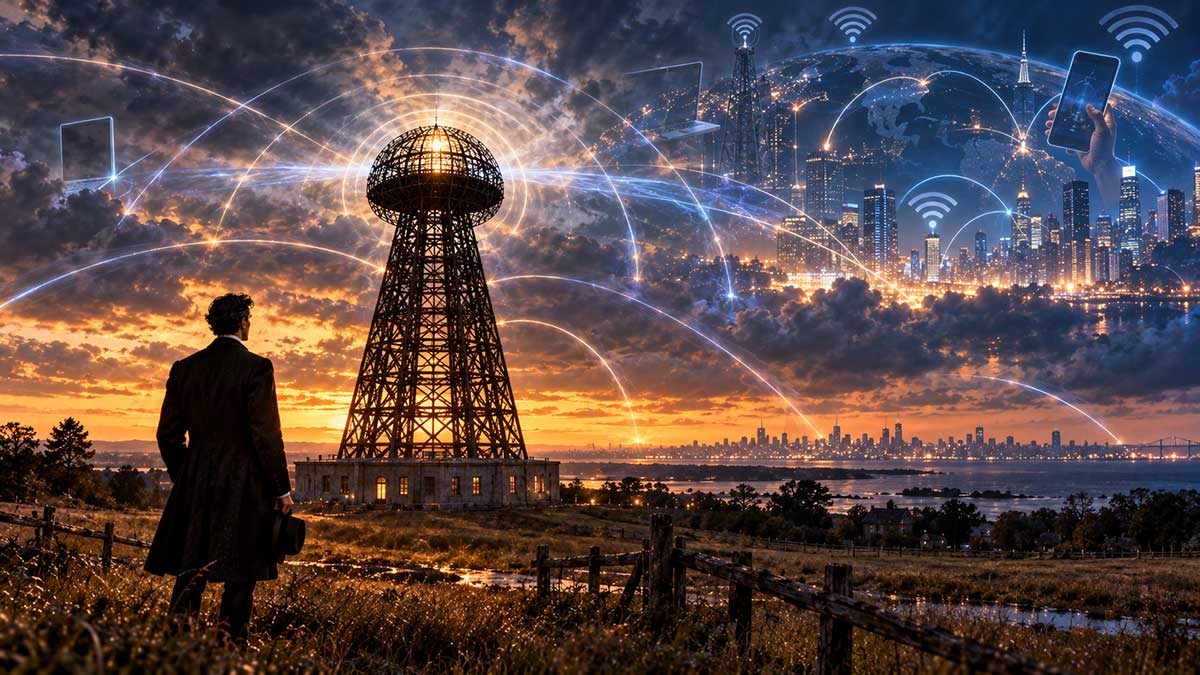
Full night now. Below the window, Manhattan glitters through the snow. Tesla has moved to the desk, where a single framed photograph stands: a tall, strange tower with a mushroom-shaped dome, rising above flat fields.
Nick Sasaki: Is that Wardenclyffe?
Nikola Tesla: (He picks up the frame and looks at it the way another man might look at a photograph of a lost love.) Yes. My tower. On Long Island. Almost two hundred feet tall, with roots that went more than a hundred feet into the earth.
Nick Sasaki: Before we talk about it, can I read you something you predicted?
Nikola Tesla: If it’s flattering.
Nick Sasaki: You decide. In 1907, you wrote that flying machines and ships propelled by electricity transmitted without wire would cease to be a wonder in ten years. And you said you’d say five, if it weren’t for the inertia of human opinion resisting revolutionary ideas.
Nikola Tesla: (He sets the frame down, very interested.) And? Was I right?
Nick Sasaki: Not on time. But electric aircraft are flying now. They’re just beginning to arrive.
Nikola Tesla: (Smiling.) So I was off by a century. (He shrugs.) The inertia of human opinion was heavier than I estimated. It always is.
Nick Sasaki: Before the tower, there was Colorado Springs. I’ve read that you saw something there you never forgot.
Nikola Tesla: (His whole face changes. He leans forward, eyes bright.) Colorado. 1899. I built a laboratory on the high plains, a mile above the sea, where the air is thin and the storms are magnificent. I made lightning there. Real lightning. Bolts many feet long, cracking out of my tower with a roar you could hear miles away. People in town said sparks jumped from their feet to the ground when they walked.
Nick Sasaki: That’s incredible.
Nikola Tesla: That wasn’t the incredible part.
He lowers his voice, as if someone might overhear.
One night I was alone in the laboratory, listening to my receiving instruments. And I heard signals. Faint. Rhythmic. One, two, three. One, two, three. Counting. Not the noise of storms or the sun. I knew every sound the earth and the sky could make. This was different.
Nick Sasaki: What did you think it was?
Nikola Tesla: I can never forget the sensation when it first dawned on me that I might be listening to something of incalculable consequence. That I was the first man to hear the greeting of one planet to another.
Nick Sasaki: Do you still believe that?
Nikola Tesla: (Without hesitation.) Yes.
(Then, more carefully.) I believe I heard something no one had heard before. I believe it was intelligent. People laughed at me for saying so. They still do. Perhaps it was something natural I didn’t yet understand. But I’ve never heard a better explanation, and I was the one who was there.
Nick Sasaki: I’ll let you have that one.
Nikola Tesla: (A small bow of the head.) Thank you. Most people don’t.
Nick Sasaki: Tell me about the tower.
Tesla picks up the photograph again.
Nikola Tesla: Wardenclyffe was going to change everything. Not just one invention. All of them, joined together.
From that tower, I would send messages across the ocean without wires. Not just telegraph signals. Voices. Pictures. News, music, the price of stocks, all of it, to any point on the earth. A man in New York could speak to a man in London, holding a little device in his pocket.
And then, the greatest part, power. Electricity itself, sent through the earth and the air, free to anyone, anywhere. A farmer in India. A village in Africa. No wires, no poles, no meters.
Nick Sasaki: And J. P. Morgan paid for it.
Nikola Tesla: He gave me a hundred and fifty thousand dollars to begin. It was a great deal of money. It wasn’t nearly enough. (He sighs.) Then, in December of 1901, before my tower was finished, Marconi sent a signal across the Atlantic. Just the letter S. Three dots. With a much simpler apparatus.
Nick Sasaki: That must have hurt.
Nikola Tesla: My engineer came running and said, “It looks as if Marconi got the jump on you.” I said Marconi is a good fellow. Let him continue. He’s using seventeen of my patents.
Nick Sasaki: (laughing) That’s a very elegant way to be furious.
Nikola Tesla: (A thin smile.) I was raised by a priest. We learn to be furious quietly.
Nick Sasaki: What happened with Morgan?
Nikola Tesla: He stopped. I wrote him letters. Many letters. Some I’m not proud of. I begged him. I explained everything again and again. He never answered most of them.
Nick Sasaki: I have to ask this as a businessman again. When Morgan gave you that money, how did you think he’d make it back?
Tesla looks at Nick for a long moment.
Nikola Tesla: You’ve found the crack in the foundation. (He sets down the photograph.) Morgan made his money from copper, from wires, from selling electricity by the hour. I was offering to give it away. Through the air. To everyone.
I thought he would see the grandeur of it. Instead, I think he saw that you cannot put a meter on the sky.
Nick Sasaki: So the dream was too generous to fund.
Nikola Tesla: (Quietly.) Yes. That’s exactly it. The best thing I ever designed was the one no investor could own.
The tower stood unfinished for years. In 1917, they blew it up and sold it for scrap, to pay my debts at the Waldorf. I didn’t go to watch.
Silence. Snow ticks against the window.
Nick Sasaki: Can I tell you what the world looks like now? Just for a minute?
Nikola Tesla: (He folds his hands.) Please.
Nick Sasaki: Almost everyone on earth carries a small device in their pocket. A man in New York can speak to a man in London, and see his face while he does it. They send pictures, music, news, the price of stocks, anywhere in the world, instantly, without wires. Billions of people.
Tesla doesn’t move.
Nick Sasaki: Houses and cafés and airports are filled with invisible signals, so people can connect without any cables. There are small flying machines, guided remotely, a little like your radio-controlled boat. Phones charge just by being set down on a pad, without plugging them in.
There’s a car company that makes electric cars, some of the best known in the world. It’s named after you. Your name is on millions of cars.
And scientists measure magnetic fields in a unit called the tesla. Every hospital MRI machine is rated in teslas.
Tesla looks down at his hands. When he speaks, his voice is rough.
Nikola Tesla: A device in your pocket.
Nick Sasaki: In my pocket right now.
Nikola Tesla: (Almost a whisper.) I described that. In 1904. A little instrument a man could carry, to receive news and messages anywhere. They called me a fantasist.
(Then, a flash of the old fire.) And the power? Is it free? Is it sent through the air to the villages?
Nick Sasaki: Not yet. Not the way you imagined.
Nikola Tesla: (A small, bitter laugh.) Of course not. They found a way to put a meter on the sky after all.
Nick Sasaki: There’s one more thing. A few months after you died, the Supreme Court ruled against Marconi’s main radio patent. They cited earlier work, yours among it, along with a couple of other inventors. They didn’t name you the inventor of radio. But they said Marconi wasn’t the only one who got there.
Nikola Tesla: (He closes his eyes for a moment.) Months after.
Nick Sasaki: Months after.
Nikola Tesla: It’s always months after. (He opens his eyes, and there’s no bitterness in them now, only a weary humor.) The world is very consistent. It honors its inventors right after it can no longer afford to pay them.
He rises and walks to the window. Below, a building across the avenue flickers and comes alive, floor by floor, then another beyond it, and another, a slow wave of light spreading across the city in the falling snow.
Nikola Tesla: Look at that.
Every one of those lights runs on alternating current. Every elevator. Every motor in every basement. Every one of them is turning because of a drawing in the sand.
(Softly.) They tore down my tower, Mr. Sasaki. But they couldn’t tear down the idea. It just waited.
It waited until the world was ready to catch up.
Topic 5: The White Pigeon
Late evening. The snow is heavier now, falling in thick soft flakes past the window. One of the gray pigeons on the sill has woken and is pacing back and forth along the ledge. Tesla watches it with an expression Nick hasn’t seen on him all night: complete, unguarded tenderness.
Nick Sasaki: You’ve fed pigeons all over New York. Bryant Park. St. Patrick’s. Here at the hotel. Was there one that mattered most?
Tesla doesn’t answer right away. He opens the window a few inches, lets a breath of cold air into the room, and scatters seed on the sill. The pigeon pecks at it eagerly. He closes the window again and sits down slowly.
Nikola Tesla: Yes.
Nick Sasaki: Will you tell me about her?
Nikola Tesla: I’ve told only one other person. A writer. O’Neill. He put it in his notes, and I suppose now everyone knows. (He smiles faintly.) Very well.
I have fed thousands of pigeons. For years. Gray ones, brown ones, speckled ones, injured ones I brought home and nursed. But there was one, a beautiful bird, pure white with light gray tips on her wings. She was different.
I would know her anywhere. No matter where I was in the city, she would find me. If I wanted her, I had only to think of her, and she would come flying.
(He looks down at his hands.) I loved that pigeon as a man loves a woman. And she loved me. As long as I had her, there was a purpose to my life.
Nick doesn’t laugh. He simply waits.
Nikola Tesla: You’re not laughing.
Nick Sasaki: No.
Nikola Tesla: Most people would. A great inventor, eighty years old, in love with a bird. (He shakes his head.) I don’t mind. They don’t understand. She asked nothing of me. She never wanted money, or a patent, or a quote for the newspapers. She never thought I was a fool or a genius. She simply came when I called.
Nick Sasaki: What happened to her?
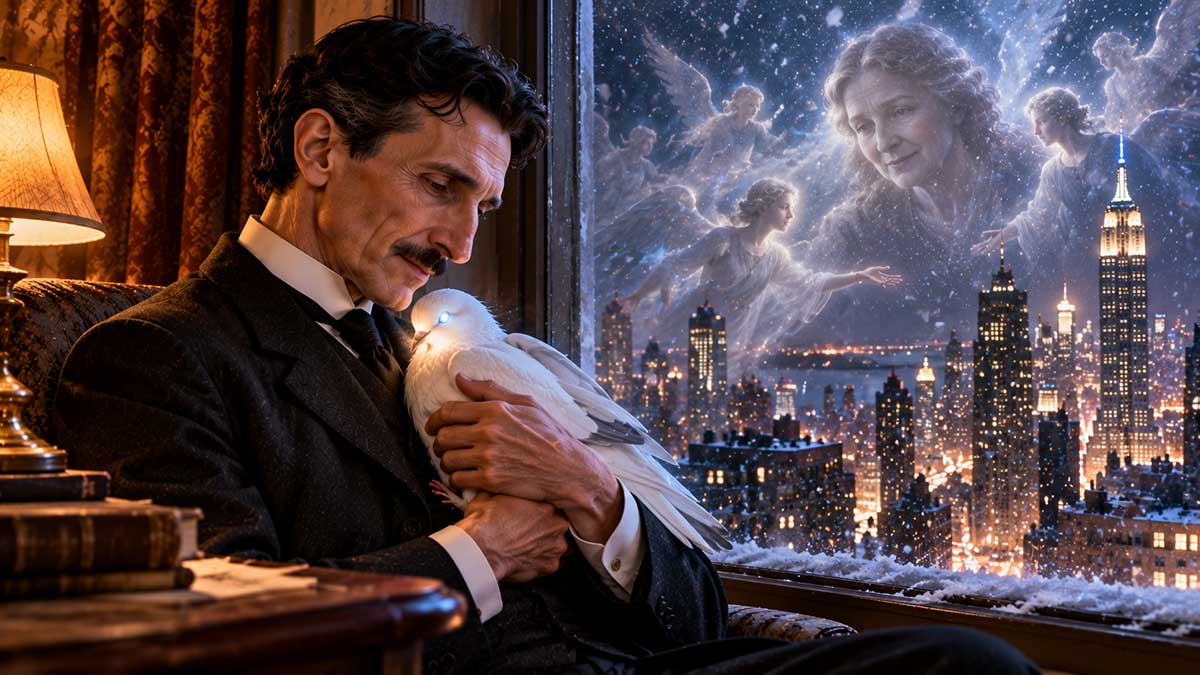
Nikola Tesla: One night, she flew in through my window, and I knew. I knew she had come to tell me she was dying. I held her in my hands. And as she died, a light came from her eyes. A white light, more brilliant than anything I had ever produced in my laboratory, brighter than all my lightning in Colorado.
When she died, something went out of my life. I knew then that my work was finished.
A long silence. The pigeon outside the window settles down into a soft gray ball against the snow.
Nick Sasaki: That’s the second time tonight you’ve talked about light coming at the moment of a death.
Nikola Tesla: (He looks up sharply.) You noticed.
Nick Sasaki: You wrote in your autobiography that you’d searched your whole life for any sign of the spiritual, and only once had an experience that seemed supernatural. When your mother died.
Tesla is very still.
Nikola Tesla: 1892. I was in London, lecturing before the great scientists of England. They sat me in Michael Faraday’s own chair. It was the proudest moment of my life.
Then the telegram came. My mother was dying.
I rushed across Europe to Gospić. I arrived in time to see her, just. I was so exhausted, I had not slept for days. They sent me to a house nearby to rest.
Nick Sasaki: And that’s where it happened.
Nikola Tesla: I lay there in the dark, and I thought, if my mother dies while I’m away from her bedside, she will surely give me a sign. She was a woman of genius, and she had the strongest intuition of anyone I’ve ever known. If anyone could reach across, it would be her.
All night I lay there, every nerve straining, waiting. Nothing happened.
And then, near dawn, I fell into a sleep. Or perhaps a faint. And I saw a cloud, carrying angelic figures of marvelous beauty. One of them looked at me lovingly. And as I watched, her face slowly became my mother’s face.
In that instant, I knew, with a certainty no words can express, that she had just died.
Nick Sasaki: And she had.
Nikola Tesla: She had.
He rises and goes to the window, standing with his back to Nick.
Nick Sasaki: But afterward, you explained it away.
Nikola Tesla: (Without turning.) I did. I’m a scientist. I couldn’t help it. I remembered a painting I had once seen, a famous one, of angels floating on a cloud. The vision looked exactly like that painting, except for my mother’s face. And there had been a church choir singing nearby that morning. Easter music. My exhausted brain had simply woven them together.
Nick Sasaki: Do you still believe that explanation?
For a long time, Tesla doesn’t answer. Snow drifts past the glass.
Nikola Tesla: I wanted to believe it, so that I wouldn’t have to believe the other thing. Because if the other thing was true, then everything I thought I knew about the universe was incomplete.
(He turns around.) I’ve had a long time to think about it since. And I no longer believe the explanation is enough. I think perhaps both were true. Perhaps the painting and the music were simply the clothes my mind found for something that really came.
Nick Sasaki: That’s a very different thing to say.
Nikola Tesla: Death changes one’s opinions. (A faint smile.) It’s very persuasive.
Nick Sasaki: You once met Swami Vivekananda.
Nikola Tesla: (His face brightens.) Ah. Yes. 1896. After a play with Sarah Bernhardt. She arranged for us to meet. A remarkable man. Calm in a way I’ve never been for a single minute of my life.
He told me about the ancient teachings of India. Akasha, the substance that fills all of space. Prana, the creative force that acts upon it and brings all things into being, in endless cycles. Matter and energy. He hoped I could prove mathematically that they were one and the same.
Nick Sasaki: Could you?
Nikola Tesla: Not then. (He sits again.) But it stayed with me. I wrote about it later. Everything we can see and touch comes from one primary substance, filling all of space, acted on by a life-giving force. The sages of India knew this thousands of years before our physicists.
Nick Sasaki: So what do you believe now? About the soul?
Nikola Tesla: (He thinks for a long time.) I believe a human being is a kind of receiver. Like my instruments in Colorado. We are tuned to certain frequencies. Most of us hear only the loud ones: hunger, fear, ambition, money.
But sometimes, in great love, or great grief, or at the edge of death, the tuning changes. And for a moment we receive something from much farther away.
My mother on the cloud. The light in a pigeon’s eyes. The signal counting in the night.
(Quietly.) Perhaps those were all the same station.
Nick doesn’t say anything. After a moment, Tesla straightens in his chair. A spark of the old showman returns to his eyes.
Nikola Tesla: Do you know what I do every year on my birthday?
Nick Sasaki: You hold a press conference.
Nikola Tesla: (Delighted.) You’ve done your homework again. Every year, the reporters come, and I announce my newest invention. A death ray to end all wars. A machine to photograph thought. Engines that run on cosmic rays. They write it down, and they print it, and half of them think I’m a prophet and half of them think I’m mad.
My birthday is in July. But I’m an old man and you’re the only reporter I have tonight, so you’ll have to do.
He stands, buttons his jacket, smooths his hair, and faces Nick with enormous formality, as if before a room full of cameras.
Nikola Tesla: Ladies and gentlemen of the press.
Nick Sasaki: (trying not to smile) It’s just me.
Nikola Tesla: Ladies and gentleman of the press. Tonight, Nikola Tesla announces his greatest invention. Greater than alternating current. Greater than wireless. Greater than anything the world has yet seen.
(He pauses dramatically.) A device for the transmission of human understanding across any distance, through any wall, without wires, and without cost.
Nick Sasaki: What does it do?
Nikola Tesla: It allows one person to receive another person exactly as they are. Not as they wish them to be. Not as a means to profit. Not as a rival, or a genius, or a fool. Simply as they are.
(His voice softens, the performance slipping.) It would let a father see a second son as more than a reminder of the first. It would let an investor see a dreamer as something more than a bad bet. It would let a lonely old man in a hotel room be seen as something more than a curiosity who feeds pigeons.
He stops. The formality is gone now.
Nikola Tesla: I’m afraid I never built it. I spent my whole life sending signals. I never learned very well how to receive them. Only from my mother. And from one white pigeon.
(He looks at Nick.) And, it seems, from a man who once lived a few floors below me, and came back to listen.
He hesitates. Then, slowly, he extends his hand.
Nick looks at it, then takes it. Tesla’s grip is thin, cool, and surprisingly firm.
Nikola Tesla: You asked me at the beginning of the evening about my cat. Whether nature is a gigantic cat, and who strokes its back.
Nick Sasaki: I did.
Nikola Tesla: I think I know now. (He lets go of Nick’s hand.) It isn’t a hand. It’s love. Every spark in the universe begins when something is touched by something that loves it.
He turns to the window. The pigeon is pressed against the glass, feathers ruffled with snow. Tesla unlatches the window and opens it wide. Cold air and a flurry of snowflakes rush into the room. The pigeon hops onto his outstretched arm, and he draws it gently inside, cradling it against his chest, murmuring something in Serbian.
Behind him, beyond the falling snow, the lights of New York shine on, every one of them turning, silently, on alternating current.
Final Thoughts by
I went to Room 3327 expecting to meet a misunderstood genius. I met a proud, funny, deeply tender man who never stopped believing the world would catch up with him.
What stays with me first is how he invented. One question, carried for four years, through illness and exile, until a sunset and a line of poetry set it free. We tend to imagine inspiration as luck. Tesla’s life suggests it’s closer to faithfulness: staying with a question long after everyone else has put it down.
As someone who has spent much of my life in marketing, I was moved by his honesty about why he lost the business war while winning the scientific one. He loved inventing and hated selling. He believed the truth would be enough. It wasn’t. Truth needs someone to carry it. That lesson reaches far beyond electricity. How many good ideas, kind intentions, and true words never reach anyone simply because no one carried them?
And I was struck by his generosity. He tore up a contract that could have made him one of the richest men alive, to save a friend who had treated him with dignity. He dreamed of sending power through the air, free to every village on earth, a dream no investor could own. Some will call that foolish. I’m not so sure.
But the moment I’ll carry longest is quieter. A man who spent his whole life sending signals, admitting that he never learned very well how to receive them. Only from his mother. Only from a white pigeon. And the possibility, which he came to late, that the light he saw in her eyes and the face of his mother among the angels might have been the same station, calling from very far away.
At the very end, he offered me his hand.
So here’s the question I’ll carry with me, and I hope you will too.
What do you see clearly that the world isn’t ready for yet, and who in your life is waiting to be truly received?
Short Bios:
Nick Sasaki is the creator and host of ImaginaryTalks.com. After 25 years of building businesses, he turned to building bridges between eras, ideas, and the questions people carry, drawn especially to spirituality, the soul’s journey, and what lies beyond ordinary explanation. He hosts as a seeker rather than an expert, asking the questions readers wish they could ask someone long gone. About Nick and ImaginaryTalks
Nikola Tesla (1856–1943) was the Serbian-American inventor whose alternating current system, induction motor, and pioneering work in radio, wireless transmission, and remote control laid the foundations of the modern electrical world. Born in Smiljan in today’s Croatia, he emigrated to New York in 1884, won the War of the Currents with George Westinghouse, and dreamed of free wireless power for all humanity. He died in Room 3327 of the Hotel New Yorker, and his personal archive, now preserved in Belgrade, is listed in UNESCO’s Memory of the World Register. Nikola Tesla Museum, Belgrade
Leave a Reply