
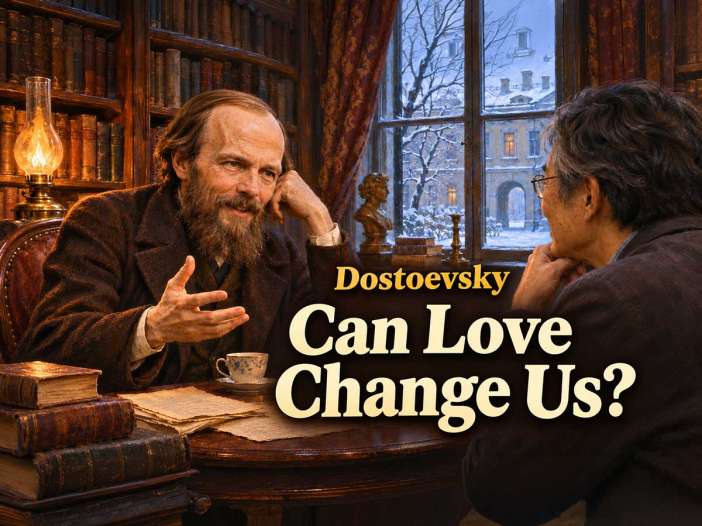
Introduction
A Dostoevsky interview begins with a difficult question: How much of another person do we miss when we think we already know who they are? Behind the angry reply, the embarrassing mistake, or the life that seems to have gone wrong, there may be a person whose story we have barely begun to hear.
Fyodor Dostoevsky had reasons to take that question seriously. He faced a death sentence, endured years of penal servitude, struggled with debt and gambling, and produced novels that placed human motives under extraordinary pressure. The Dostoevsky Museum’s chronology traces the experiences and publications behind that achievement. His life gives this conversation its stakes; his work gives us people worth staying with.
From the anxious letters of a poor clerk in Poor Folk to the fierce disagreements between the Karamazov brothers, he made pride, affection, jealousy, conscience, and faith feel inseparable from the person experiencing them. A reader may begin with a character’s unfamiliar circumstances and suddenly recognize a feeling from their own life. That ability to make another person’s inner experience immediate is one of his great gifts.
In this fictional one-to-one interview, Nick Sasaki meets the writer through the experiences, relationships, and artistic decisions behind his books. Their conversation moves from a childhood kindness recalled in prison to the making of a novel, from Anna’s contribution to his work to the demands of loving an actual person. There is room for humor, hesitation, and the surprise of an answer that leads somewhere Nick did not expect.
The discussion grows more searching when it reaches faith. In The Brothers Karamazov, the suffering of children and the burden of freedom receive arguments that resist easy reassurance. Nick asks how a Christian writer could give those objections such compelling voices. Later, a painting by Holbein opens another question: What might beauty offer when explanation has reached its limits?
You do not need to have read these novels to enter the conversation. Begin with the people, the situations, and the questions they bring close. What does love help us notice? What makes an excuse convincing? Can someone face wrongdoing and still find a possible next step? Dostoevsky’s accomplishment invites us to look carefully enough for those questions to become our own.
Disclaimer: This fictional interview between Nick Sasaki and Fyodor Dostoevsky never occurred. Historical sources inform the article, but the dialogue and settings are creative reconstructions, not authenticated quotations.
Topic 1: The People We Fail to See
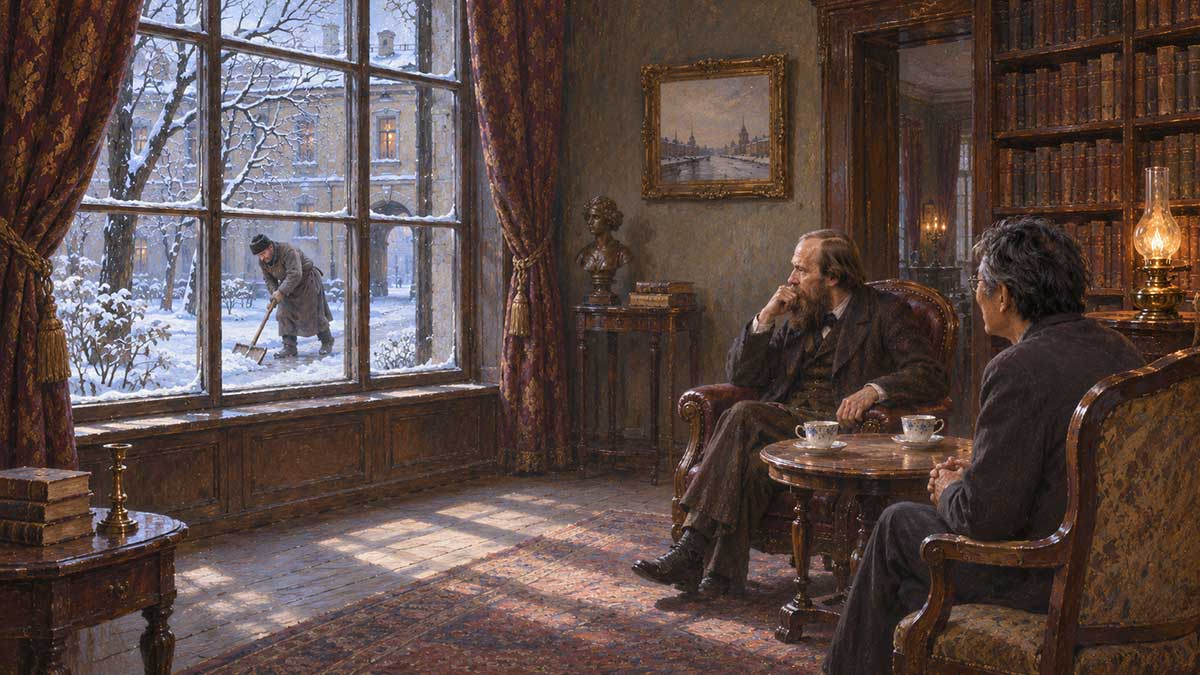
Snow rests along the sill of a sitting-room window in St. Petersburg. Beyond the glass, a porter clears a narrow path across the courtyard. Inside, two chairs face each other beside a small table. Dostoevsky watches the porter finish a strip of pavement before turning to Nick.
The Last Minutes
Nick Sasaki
Fyodor, I want to begin with something you wrote to your brother. At the execution ground, you thought your group would be next. What do you recall most clearly?
Fyodor Dostoevsky
My brother. That is what I told him in the letter. We had heard the sentence. The first three men were taken forward, and I was in the next group. I expected to die almost immediately.
There had been so much I wished to say about life. Then I thought of a person I loved and would never see again.
Nick Sasaki
When you learned you would live, did everything suddenly look different?
Fyodor Dostoevsky
I would be suspicious of an account in which a man receives his life back and becomes wise for the rest of it.
Nick Sasaki
You still had to be yourself the next morning.
Fyodor Dostoevsky
Precisely. The man who has escaped death can still be irritable. He can waste an afternoon, offend a friend, make a foolish decision.
The knowledge is real. Living according to it is another matter.
Nick Sasaki
That makes the experience feel more human to me. We expect the great event to do all the work.
Fyodor Dostoevsky
And then we are disappointed to discover that tomorrow requires something from us.
He adjusts his chair, moving a little closer to the table.
A Memory in Prison
Nick Sasaki
There is another account of yours I want to ask about, “The Peasant Marey.” You are in prison, disturbed by the behavior around you, and a childhood memory comes back. Could you tell us about it?
Fyodor Dostoevsky
I wrote of a day when I was a boy and thought I had heard someone shout that there was a wolf. I ran in terror to a peasant who was ploughing.
Marey stopped his horse. He reassured me, touched my face gently, and watched as I went away. He was a serf on our family’s estate. I was the landowner’s frightened child.
Years later, in prison, I remembered his tenderness. Looking again at the men around me, I had to admit how little I could see into any of them.
Nick Sasaki
The same men were still there. What had changed was how you were looking.
Fyodor Dostoevsky
Yes. I could no longer be quite so certain that what disgusted me exhausted the person before me.
Nick Sasaki
Did that make it easier to live beside them?
Fyodor Dostoevsky
It interrupted my certainty. That was already something.
Nick Sasaki
I like that distinction. You are describing a change in your attention.
Fyodor Dostoevsky
Attention can be difficult in such a place. One wants protection. One becomes watchful, suspicious. Another man’s noise or temper fills the entire room.
A memory can make a little space in that judgment.
Nick Sasaki
Marey probably had no idea that you would still be thinking about him years later.
Fyodor Dostoevsky
He could not have known what use a frightened boy would someday make of that kindness.
Nick Sasaki
That is extraordinary to think about. Someone gives you a few minutes, and those minutes remain available when your life has become completely different.
Fyodor Dostoevsky
You see how poor our accounts of another person can be. We know the occupation, the clothes, the way he speaks. We think we have completed the description.
Nick Sasaki
Then one gesture shows you something the description left out.
Fyodor Dostoevsky
And you must decide whether you will permit it to change your opinion.
Nick Sasaki
What about people who have done terrible things? Readers might wonder whether looking for tenderness lets them escape responsibility.
Fyodor Dostoevsky
A person must answer for what he has done. Seeing him more closely may make the account of his conduct more exacting.
We should be careful with the pleasure of having explained him completely. It can make us careless.
Nick Sasaki
Careless about what?
Fyodor Dostoevsky
What we have actually witnessed. What we have merely assumed. Whether we are listening to him or enjoying the sound of our own verdict.
The Man Writing the Letter
Nick Sasaki
You were interested in people who get overlooked long before prison. Your first novel, Poor Folk, follows a struggling copying clerk, Makar Devushkin, and a young woman, Varvara, through their letters. What did you want readers to notice?
Fyodor Dostoevsky
That the clerk has an opinion of himself.
Nick Sasaki
That sounds simple, but it changes the whole story.
Fyodor Dostoevsky
Consider his boots. A passerby can notice that they are worn and continue walking. Makar must wear them into an office. He wonders who has looked down, who has smiled, what they will say when he leaves.
An expense that another man scarcely considers can occupy a great deal of his thought.
Nick Sasaki
So poverty affects the way he expects other people to see him.
Fyodor Dostoevsky
And the way he explains himself. In a letter he can insist that something does not trouble him, then spend a page describing it.
Nick Sasaki
Which tells us that it troubles him very much.
Fyodor Dostoevsky
You are beginning to read him.
Dostoevsky smiles. Nick glances down at his notes, then leaves them on the table.
Nick Sasaki
Why tell the story through letters?
Fyodor Dostoevsky
A letter is addressed to someone. The writer hopes for a particular response. He may want reassurance, admiration, forgiveness, or simply news that the other person is still there.
That hope enters the sentences. A reader can hear someone trying to keep a relationship alive.
Nick Sasaki
Then we are getting more than information about his circumstances.
Fyodor Dostoevsky
We encounter his manner of presenting them. His hesitation, his vanity, his effort to be generous.
Nick Sasaki
You let him have vanity.
Fyodor Dostoevsky
Would you deprive a poor man of that too?
Nick Sasaki
Fair point.
Fyodor Dostoevsky
It would be a thin kindness to require him to become admirable before we take an interest in him. He may complain, misunderstand, grow jealous. He still has an inner life.
Nick Sasaki
Is there a danger that a writer does the same thing as everyone else, only more elegantly? Takes someone’s difficult life and turns it into an opportunity to show how perceptive he is?
Fyodor Dostoevsky
There is a danger whenever we are pleased with our own sensitivity.
The character must be allowed to inconvenience us. His feelings may refuse the arrangement we have prepared for them.
Nick Sasaki
That seems connected to what you said about judgment. You have to leave some room for the person to surprise you.
Fyodor Dostoevsky
Yes. And a writer must listen closely when the person begins to make excuses.
Nick Sasaki
Even when the excuse sounds convincing?
Fyodor Dostoevsky
Especially then. It may contain something true, placed very carefully beside the thing he wishes to hide.
Nick Sasaki
Have you caught yourself doing that?
Fyodor Dostoevsky
Often enough to have material.
Nick laughs. Dostoevsky rests his hand on the edge of the table.
Nick Sasaki
Then let me ask about a place where those explanations could become very expensive.
Source grounding: the letter to his brother, “The Peasant Marey”, and Poor Folk.
This is a fictional interview inspired by historical sources and Dostoevsky’s writing. The dialogue and setting are creative reconstructions.
Topic 2: Why We Do What Hurts Us
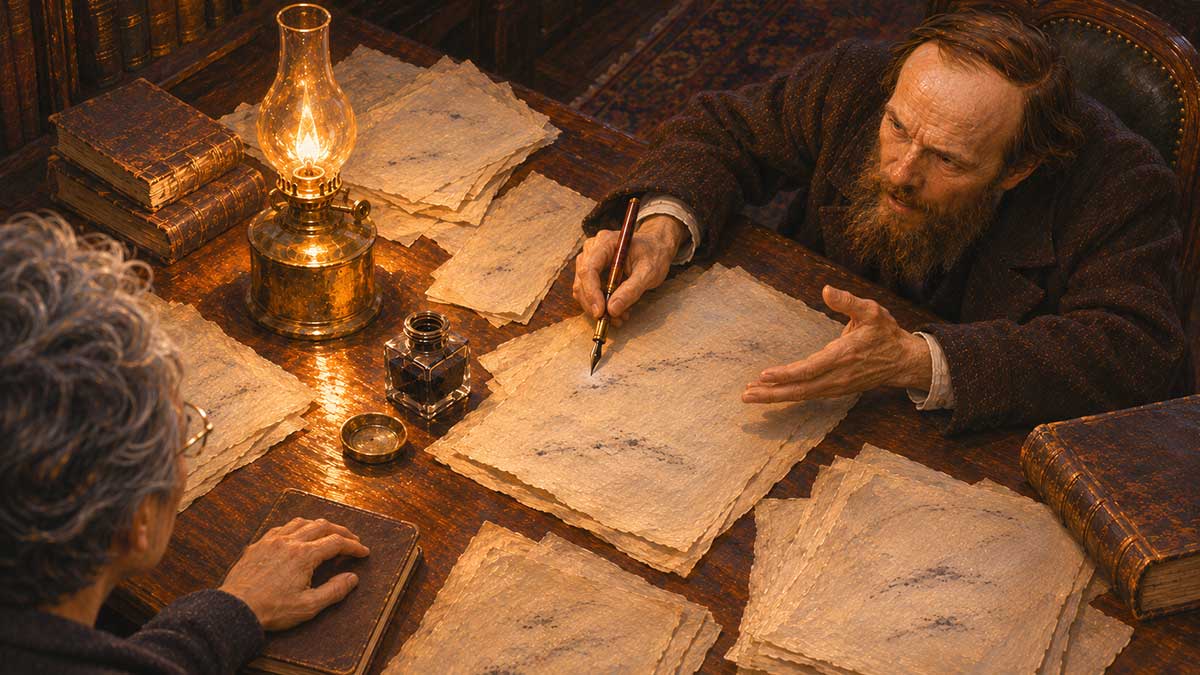
By evening, the conversation has moved into a workroom. A lamp lights a stack of manuscript pages. Nick notices corrections running between the lines. Dostoevsky moves a loose sheet away from the edge of the desk and takes his seat.
The Explanation Before the Bet
Nick Sasaki
At the gambling table, what were you telling yourself just before placing another bet?
Fyodor Dostoevsky
That this time I would behave sensibly.
Nick Sasaki
You could make another bet sound like the sensible choice?
Fyodor Dostoevsky
Certainly. A man who has lost money can become very persuasive about the necessity of recovering it.
There is the debt, the person waiting for money, the difficulty he believes a win could remove. He can bring every obligation he has neglected into the argument for continuing.
Nick Sasaki
In one of your letters, you describe believing you had found the secret: remain calm and control yourself. You had taken your winnings away, decided to leave, then returned and lost a large part of them.
Fyodor Dostoevsky
And the explanation remains available: I failed to follow my own rule. Next time I will follow it.
Nick Sasaki
Then a loss can leave the belief untouched.
Fyodor Dostoevsky
It can give the belief fresh employment.
He looks at Nick, then gives a small, rueful smile.
Nick Sasaki
Did writing about that behavior make it easier to see in yourself?
Fyodor Dostoevsky
Seeing it and stopping it are different tasks. A writer should be careful about presenting his insight as proof of his conduct.
Nick Sasaki
That is something readers may forget. You can describe a trap with extraordinary precision and still get caught.
Fyodor Dostoevsky
A description does not remove the desire. There remains the hour in which the opportunity appears.
Nick Sasaki
The narrator of Notes from Underground seems to make that problem even stranger. He can examine himself endlessly and still act in ways that make him miserable.
Fyodor Dostoevsky
He has many uses for his examination. He can accuse himself before another person does. He can explain why action is impossible. He can take a certain pride in how thoroughly he sees his own faults.
Nick Sasaki
So self-awareness can become another place to hide.
Fyodor Dostoevsky
Listen to how he speaks to the reader. He wants an answer, anticipates it, objects to it. The conversation continues even when no one else is in the room.
Nick Sasaki
That feels familiar. You can spend an entire afternoon winning an argument with someone who is not there.
Fyodor Dostoevsky
And meet the actual person that evening with very little patience left for what they wish to say.
Making the Story Speak
Nick Sasaki
Let me turn to the work itself. You finished The Gambler in about a month with Anna taking down your dictation. What was it like to build a novel aloud that way?
Fyodor Dostoevsky
There was a deadline that could not be treated casually. Anna supplied a skill I needed. I had to learn to make use of it.
At our first meeting, I spoke too quickly. She asked me to slow down to an ordinary conversational pace.
Nick Sasaki
That must have been an interesting introduction: a young woman beginning her career, telling a famous writer how fast he could talk.
Fyodor Dostoevsky
She was correct. The work required a speed at which the words could be recorded.
Nick Sasaki
She was concerned with getting the job done.
Fyodor Dostoevsky
Yes. There is a great deal to be said for that quality.
She took the shorthand away and transcribed it. We could then work with what was on the page. Speaking, hearing, reading, correcting: each gives you a different encounter with a sentence.
Nick Sasaki
Did you discover that something which sounded convincing in your head did not work when you said it aloud?
Fyodor Dostoevsky
A person in one's head can be remarkably accommodating. On the page, his speech must endure the presence of the other people in the scene.
Nick Sasaki
What do you listen for?
Fyodor Dostoevsky
What he wants from the listener. A sentence may contain an explanation, yet its purpose is to obtain forgiveness or provoke jealousy. Someone else hears the request beneath the explanation and refuses to answer it.
Then the speaker must try again.
Nick Sasaki
That is where the tension comes from?
Fyodor Dostoevsky
It is one source. The reader begins to suspect that something is at stake which the speaker has not admitted.
Nick Sasaki
Is that how you keep us close to a character whose behavior is difficult to watch?
Fyodor Dostoevsky
We want to know what he will do when his account of himself no longer suffices.
A man enters a room expecting to command it. Someone laughs. His speech changes. His face changes. There is your scene beginning.
Nick Sasaki
And the writer has to stay with him through that embarrassment.
Fyodor Dostoevsky
Long enough for him to do something with it. He might laugh too. He might become cruel. He might pretend he has not heard.
Nick Sasaki
That gives you several possible people from the same event.
Fyodor Dostoevsky
Or several possibilities in one person.
Letting the Other Voice Finish
Nick Sasaki
How did you give a convincing voice to a character whose beliefs you rejected?
Fyodor Dostoevsky
I had to discover what made the belief necessary to him.
A proposition can be written on a sheet of paper. A person has a history, relationships, expectations. He may need that proposition to justify a decision he has already made.
He may sincerely believe it too. Sincerity does not make the motives simple.
Nick Sasaki
Do you begin with the idea, or with the person?
Fyodor Dostoevsky
They can arrive together. Then the work begins to reveal difficulties in the arrangement.
Perhaps he speaks beautifully about sacrifice and is frightened of a small inconvenience. Perhaps someone apparently incapable of generosity performs it without explanation.
You must notice when the scene resists your first plan.
Nick Sasaki
What happens if you force the plan anyway?
Fyodor Dostoevsky
The reader hears you moving everyone into position.
Nick Sasaki
You have to give the character some freedom.
Fyodor Dostoevsky
Enough that another person's answer can affect him. Conversation involves risk. He may enter intending to expose someone and leave feeling exposed himself.
Nick Sasaki
In Demons, the discussion of ideas becomes frightening through what people actually do to each other.
Fyodor Dostoevsky
Watch what happens when the person before them becomes an obstacle to the arrangement they have decided is necessary. Then watch the language they use to explain the obstacle.
Nick Sasaki
That connects with the gambling question. The explanation can keep getting better as the conduct gets worse.
Fyodor Dostoevsky
A reason deserves examination at the moment we find it particularly convenient.
Nick Sasaki
When a character makes a strong case, readers sometimes assume that you are speaking directly through him.
Fyodor Dostoevsky
They should hear the reply, and see what happens when he must live beside the people affected by his argument.
Nick Sasaki
That asks a lot of a novelist. You have to keep listening after you think you know the answer.
Fyodor Dostoevsky
The people who live beside a novelist have a similar difficulty.
Nick laughs. Dostoevsky glances at the corrected pages.
Nick Sasaki
I suspect Anna could have something to say about that.
Fyodor Dostoevsky
She had work of her own to do, and a practical interest in whether I would permit her to do it.
Nick Sasaki
How did you begin to see her outside those working hours?
Source grounding: Dostoevsky’s correspondence, Anna Dostoevskaya’s memoirs, and Notes from Underground.
This is a fictional interview inspired by historical sources and Dostoevsky’s writing. The dialogue and setting are creative reconstructions.
Topic 3: Seeing Someone Through Love
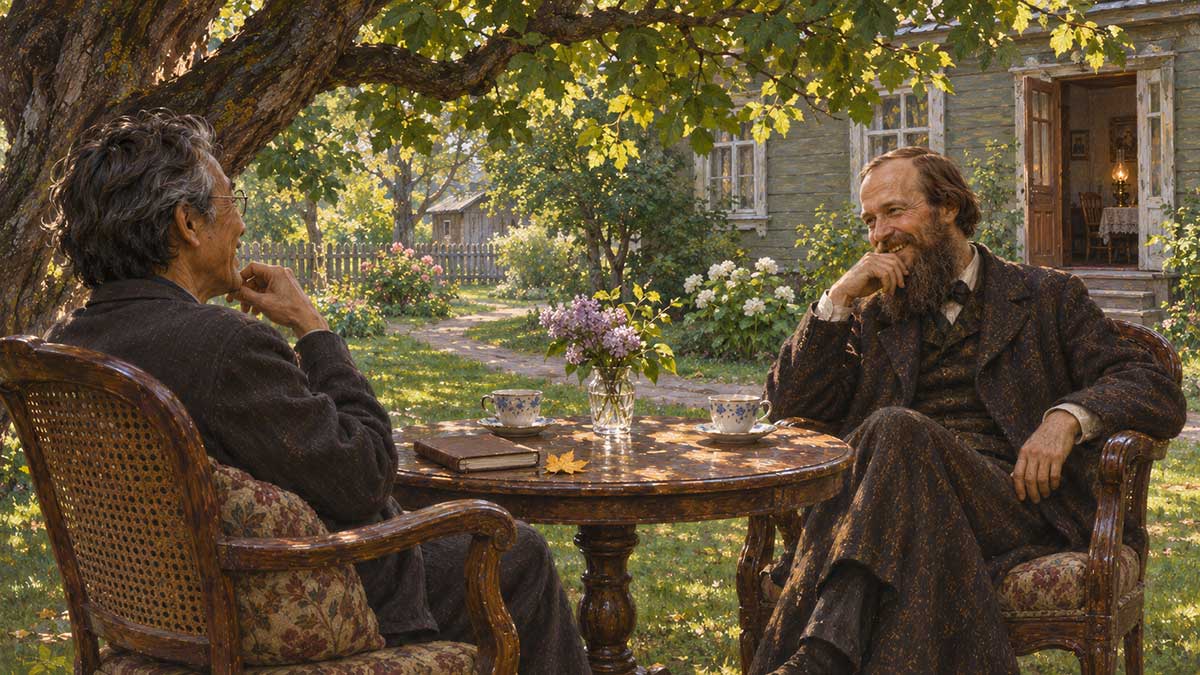
In a garden in Staraya Russa, the chairs have been placed beneath a tree. Afternoon light reaches across the path. An open door leads back into the house. Dostoevsky turns his chair slightly so that he can see Nick without looking into the sun.
Anna’s Own Work
Nick Sasaki
You said Anna had work of her own to do. What did she contribute to your work and life that you could not have supplied yourself?
Fyodor Dostoevsky
Judgment in matters I was quite capable of making worse. She became involved in publishing the books, in the arrangements that allowed them to reach readers. There were practical decisions to make, and she could make them.
Nick Sasaki
That gives a different picture from the familiar account of a patient wife helping a difficult genius.
Fyodor Dostoevsky
The familiar account gives the husband a very comfortable position. Everything concerns him, including the patience.
Anna wished to work. We met through her profession. That deserves a place in the account.
Nick Sasaki
How did you begin to see her outside those working hours?
Fyodor Dostoevsky
We spoke. The work gave us occasions to speak, and the conversation became important in itself.
Nick Sasaki
Then you found an unusual way to propose. You described an older, indebted artist and a young woman, and asked whether she could love him.
Fyodor Dostoevsky
It was easier to submit the matter as a question about a story.
Nick Sasaki
For someone who could write such searching conversations, that is a wonderfully nervous approach.
Fyodor Dostoevsky
The young woman in an actual room has privileges a character does not possess. She can answer and go home.
Nick Sasaki
And you have to wait for that answer.
Fyodor Dostoevsky
Yes. There is no advantage in being the author then.
Nick laughs. Dostoevsky looks down the garden path before continuing.
Nick Sasaki
Was there something she could see in you that you had difficulty seeing?
Fyodor Dostoevsky
I could supply her with reasons to hesitate. She was entitled to weigh them and reach her own judgment.
Being loved can be unsettling in that respect. Another person does not always agree with the account you have prepared of yourself.
Nick Sasaki
We have talked about the excuses someone makes to protect his pride. Could a harsh opinion of yourself become another way of avoiding an honest answer?
Fyodor Dostoevsky
It can end a conversation very efficiently. You announce your defects so completely that the other person has scarcely any room left to speak.
Nick Sasaki
Then accepting love might require you to listen.
Fyodor Dostoevsky
And accept that the other person has a mind.
What Love Allows Us to See
Nick Sasaki
I came across the idea that loving someone means seeing them as God intended them to be. How does that idea strike you?
Fyodor Dostoevsky
It asks a great deal of the person doing the seeing.
To look at another human being before God is to admit that our knowledge of that person is incomplete. We cannot inspect a soul as we inspect a document and announce that every important fact is present.
Nick Sasaki
Does love help us notice something we otherwise miss?
Fyodor Dostoevsky
It can make us attentive to what is easily neglected. A movement of generosity. An effort that fails. A kindness performed awkwardly.
We may have formed an opinion so quickly that we no longer notice these things.
Nick Sasaki
The part I find interesting is the possibility that someone sees something good in you before you can act on it consistently.
Fyodor Dostoevsky
That can give a person courage. It can create an obligation too. Someone has trusted you, and you must decide what to do with that trust.
Nick Sasaki
How do we distinguish recognizing someone’s possibilities from deciding who we want them to become?
Fyodor Dostoevsky
Ask whether we permit an answer we did not prepare.
A man may describe the future of someone he loves in great detail. Then the person chooses differently, and he discovers how much of his affection depended on obedience.
Nick Sasaki
That can happen in families very easily. You want a good life for someone, and you start choosing the details.
Fyodor Dostoevsky
The details can become more precious than the person.
Nick Sasaki
Would seeing someone as God intended require some humility about whether we actually know what that means?
Fyodor Dostoevsky
A considerable amount. Invoking God should make a man careful about claiming to know another soul’s destination.
Nick Sasaki
So the thought should make us more attentive.
Fyodor Dostoevsky
It should make us willing to discover the person. We may find that the discovery requires changes in ourselves.
A leaf lands on the table. Nick moves it aside, then leaves his hand resting beside his notebook.
The Person at the Table
Nick Sasaki
Why can we feel such love for humanity and still struggle to be patient with one person?
Fyodor Dostoevsky
Humanity does not interrupt you at supper.
Nick Sasaki
Or ask the same question for the fourth time.
Fyodor Dostoevsky
The actual person arrives with habits, a voice, an inconvenient need. Our generous feeling must enter a room where other people have their own purposes.
In The Brothers Karamazov, Zosima speaks with a woman who can picture herself serving the suffering. Then she considers what would happen if the person she helped were ungrateful.
Nick Sasaki
The gratitude mattered more than she expected.
Fyodor Dostoevsky
She is candid enough to notice it. That gives the conversation somewhere to go.
Nick Sasaki
What happens to love when appreciation disappears?
Fyodor Dostoevsky
We discover how much appreciation was doing for us.
There is no need to despise the wish to be thanked. But it is useful to recognize when we have made another person responsible for maintaining our good opinion of ourselves.
Nick Sasaki
How would that show up in an ordinary moment?
Fyodor Dostoevsky
You perform a small kindness. You wait. The response seems insufficient. Soon you are explaining the kindness, describing its cost, asking whether the person has noticed.
The act grows less important than the hearing you wish to receive.
Nick Sasaki
I think many people will recognize that conversation.
Fyodor Dostoevsky
A household provides frequent opportunities to become acquainted with oneself.
Nick Sasaki
Anna describes family dinners with the children talking, and you telling them stories or reading fables afterward. What did you enjoy about those evenings?
Fyodor Dostoevsky
A child wants your attention with very little interest in your reputation.
Nick Sasaki
The famous novelist still has to make the story interesting.
Fyodor Dostoevsky
And listen when the child has something to say.
Nick Sasaki
That seems like a place where everything we have been discussing becomes quite small and immediate.
Fyodor Dostoevsky
Small in its occasion. A person can spend an evening concerned with distant questions and fail to hear someone sitting beside him.
Nick Sasaki
You are not making love sound effortless.
Fyodor Dostoevsky
It involves another person. We should expect to be interrupted.
For a moment neither speaks. Through the open doorway comes the sound of a chair being moved.
Nick Sasaki
There is a harder question waiting here. The more you love someone, the less bearable their suffering can become. What happens to faith when love brings you there?
Dostoevsky’s expression grows still. His hand remains on the arm of the chair.
Source grounding: Anna Dostoevskaya’s memoirs and The Brothers Karamazov, Book II, Chapter IV. The thought introduced by Nick about seeing someone as God intended is presented as a question, with no claim that Dostoevsky authored the sentence.
This is a fictional interview inspired by historical sources and Dostoevsky’s writing. The dialogue and setting are creative reconstructions.
Topic 4: How Faith Lives With Doubt
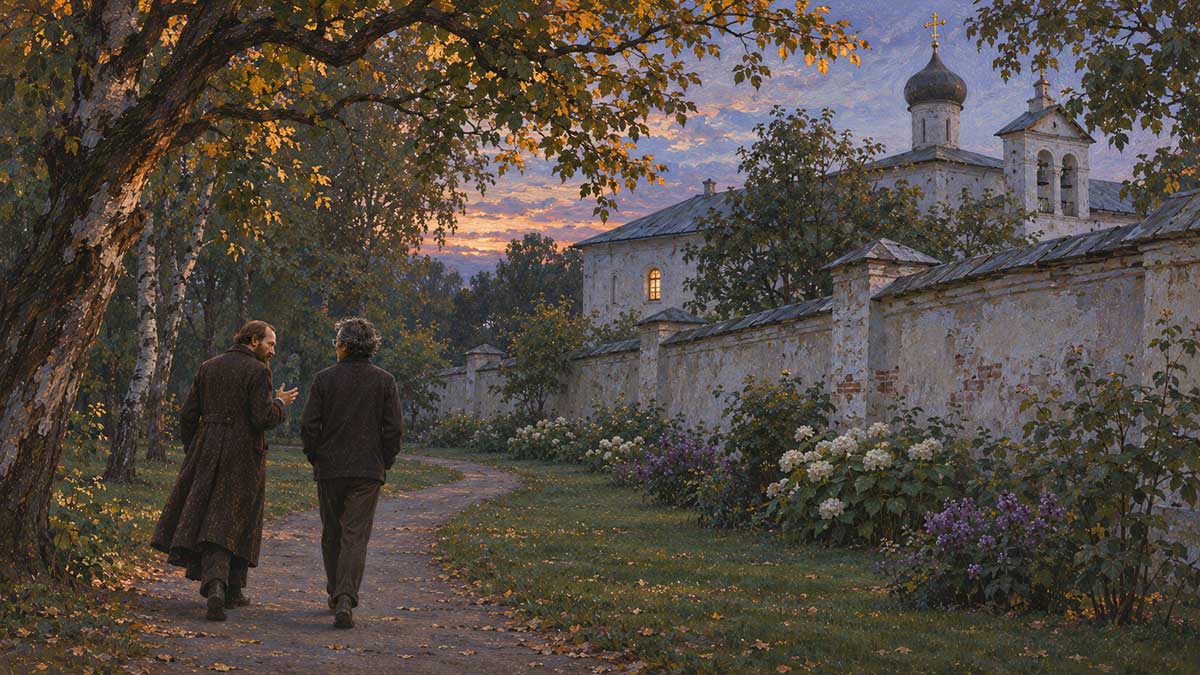
The conversation resumes beside a monastery garden. The path is quiet, and the last light rests on the upper branches. Nick and Dostoevsky walk a short distance before stopping near a bench. The question from the garden in Staraya Russa remains between them.
Belief Without Easy Certainty
Nick Sasaki
I asked what happens to faith when someone you love suffers. In your letter to Fonvizina, you describe both doubt and a longing to believe. How did those two experiences live together in you?
Fyodor Dostoevsky
Uneasily. I wrote of the longing and of what opposed it. I wrote of moments in which I could love and feel myself loved.
A letter can contain both. The person writing it has to live with both after he puts down the pen.
Nick Sasaki
Some readers might expect a religious writer to begin with certainty and then explain it to everyone else.
Fyodor Dostoevsky
I am a Christian. That does not give me the right to describe another person's anguish as if I had settled it.
Christ was at the center of what I wrote to her. My attachment to Him did not require me to pretend that the objections had become inaudible.
Nick Sasaki
What was it about Christ that held you?
Fyodor Dostoevsky
The person I encountered in the Gospels. His treatment of people. The possibility of a love that reaches the human being everyone has finished judging.
One can speak of that love with conviction and still find one's own heart full of resistance.
Nick Sasaki
Did that resistance become part of your work?
Fyodor Dostoevsky
It gave me questions I could not dispose of. A novelist can place those questions in the lives of people who must act, speak, and answer one another.
Nick Sasaki
You have to give the objection a person.
Fyodor Dostoevsky
A person for whom it matters. Otherwise the discussion costs everyone very little.
They sit. Somewhere beyond the garden wall a gate closes.
What Ivan Refuses
Nick Sasaki
In The Brothers Karamazov, Ivan speaks with his younger brother Alyosha, who is devoted to his faith. Ivan brings up the suffering of children. You give that suffering a voice that refuses easy consolation. What did you want readers to face through him?
Fyodor Dostoevsky
The price concealed inside an explanation.
Someone promises that everything will finally be reconciled. Ivan asks about the child who suffered before that reconciliation. He will not permit the child's pain to disappear into an account of the whole.
Nick Sasaki
That is different from simply saying that he cannot believe in God.
Fyodor Dostoevsky
He distinguishes the questions himself. His refusal concerns the terms on which he is being asked to accept the world.
Nick Sasaki
He cannot agree that a future harmony makes the suffering acceptable.
Fyodor Dostoevsky
Yes. And the reader must hear how serious his refusal is.
Nick Sasaki
Why give him such a strong case?
Fyodor Dostoevsky
What would I accomplish by giving him an objection that no suffering person could recognize?
The question already exists. Making Ivan less intelligent would scarcely remove it.
Nick Sasaki
You had lost children yourself. How did you live with that question?
Dostoevsky looks along the empty path. He takes some time before answering.
Fyodor Dostoevsky
I cannot make a child's death serve as an illustration that proves the father's wisdom.
There is the child one misses. There is the other parent grieving. There are the hours one must get through.
Nick Sasaki
Then asking what someone learned can be the wrong first question.
Fyodor Dostoevsky
It can arrive much too soon. We are often impatient with another person's grief. We want the conversation to reach a place where we know what to say.
Nick Sasaki
How do you write an answer without doing that?
Fyodor Dostoevsky
You must attend to what the answer asks of the person receiving it. A beautiful sentence can demand that someone cease protesting before he is ready.
Nick Sasaki
Does Alyosha have to defeat Ivan's argument for his faith to matter?
Fyodor Dostoevsky
Watch what happens between the brothers. There is an argument, and there is the question of whether they will continue to belong to one another.
Nick Sasaki
That gives the reader two things to follow.
Fyodor Dostoevsky
And they can become painfully entangled. A disagreement about God may carry the fear that one's brother will withdraw his affection.
The Burden of Freedom
Nick Sasaki
Ivan then tells Alyosha the story of the Grand Inquisitor. For readers who have not read it, Christ returns to Seville during the Inquisition and is imprisoned by an elderly churchman.
What did the Grand Inquisitor recognize about human beings that you wanted readers to take seriously?
Fyodor Dostoevsky
Their weariness. The difficulty of choosing. Their hunger, and their longing for someone who can tell them what to do with a clear conscience.
Nick Sasaki
The Inquisitor believes that he is giving people something they need.
Fyodor Dostoevsky
He presents himself as the person willing to bear responsibility for their happiness. He accuses Christ of having asked too much of them.
That makes him a difficult figure. He claims compassion for the people whose freedom he would take away.
Nick Sasaki
He can describe control as a kindness.
Fyodor Dostoevsky
And the person offering control may be convinced of the kindness.
Nick Sasaki
People really do need food and security, though. How do we take that seriously?
Fyodor Dostoevsky
We must take it seriously. Hunger is an urgent human need.
The Inquisitor's claim concerns what he may require in exchange, and whether he may decide what human beings are capable of becoming.
Nick Sasaki
He has made a judgment about their limits.
Fyodor Dostoevsky
A judgment he considers merciful. He has little room left for them to surprise him.
Nick Sasaki
We have talked about giving characters convincing arguments. This one can feel almost frighteningly persuasive.
Fyodor Dostoevsky
The temptation should be recognizable. A reader may find a wish of his own inside it: to be relieved of uncertainty, to have his choices made safe.
Nick Sasaki
And Christ does not give him a speech in reply. He kisses him.
Fyodor Dostoevsky
Yes. In Ivan's story, that is the response.
Nick Sasaki
How should a reader approach that moment?
Fyodor Dostoevsky
Attend to what the Inquisitor does afterward. He releases the prisoner. Yet his attachment to his idea remains.
The encounter has affected him. The story leaves us to face the limits of that effect.
Nick Sasaki
So the gesture does not make the whole conflict disappear.
Fyodor Dostoevsky
People do not always surrender a conviction at the moment something touches their hearts.
Nick Sasaki
Then Alyosha repeats the gesture with Ivan.
Fyodor Dostoevsky
His brother has asked whether there is still a place for him in Alyosha's heart. The kiss answers that question.
Nick Sasaki
Alyosha can remain his brother without claiming to have solved every objection.
Fyodor Dostoevsky
The objection still deserves to be heard. Ivan still needs someone to whom he can speak.
The light has almost left the path. Across the garden, a window catches a pale reflection from the sky.
Nick Sasaki
You have given us an answer made through an action. I want to ask about something else that works on us before we can explain it: a painting you saw in Basel.
Fyodor Dostoevsky
Holbein.
Nick Sasaki
What was it about that image that made you stop?
Source grounding: the 1854 letter to Fonvizina and The Brothers Karamazov, Book V, “Rebellion” and “The Grand Inquisitor”.
This is a fictional interview inspired by historical sources and Dostoevsky’s writing. The dialogue and setting are creative reconstructions.
Topic 5: Can Beauty Help Us Begin Again?
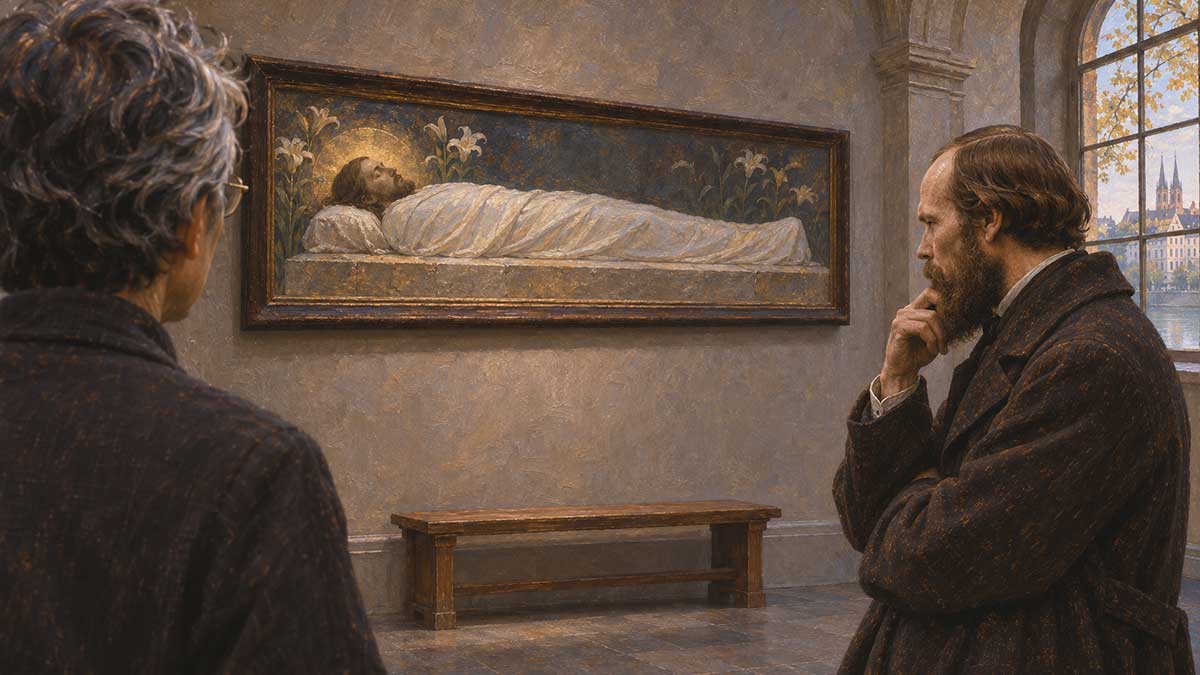
In a quiet gallery in Basel, Nick and Dostoevsky stand before Holbein’s painting of the dead Christ. The narrow image holds their attention. After a time, they sit on a nearby bench, where they can still see it.
Before the Painting
Nick Sasaki
What was it about that image that made you stop?
Fyodor Dostoevsky
Look at the body. The painting asks the eye to remain with death. It gives a believer very little opportunity to hurry past what has happened.
Nick Sasaki
Your response to it found its way into The Idiot. A copy hangs in Rogozhin’s house, and the characters discuss what seeing it could do to someone’s faith.
Fyodor Dostoevsky
A painting can enter a room and become part of the conversation before anyone speaks of it. Consider what it means to live beside such an image, to pass it repeatedly, to look at it in different states of mind.
Nick Sasaki
We often expect religious art to reassure us.
Fyodor Dostoevsky
That expectation is worth examining. The subject here is the death of Christ. We should hesitate before requiring the painter to make it comfortable.
Nick Sasaki
In the same novel, the possibility that beauty could save the world is challenged. What kind of beauty did you want readers to think about?
Fyodor Dostoevsky
I gave the question to people whose experiences make the word difficult. Desire enters it. Pride enters it. A person’s appearance can provoke devotion, envy, or the wish to possess.
You must ask what the speaker is calling beautiful, and what he wants from it.
For me, the beauty of Christ is inseparable from the way He meets a human being. That gives art a demanding possibility: to let another life matter to the person looking.
Nick Sasaki
So the word itself does not settle anything.
Fyodor Dostoevsky
It begins a difficulty. Ippolit presses Myshkin about it. The prince cannot make the question harmless simply by being sincere.
Nick Sasaki
What can beauty awaken in someone that an argument cannot?
Fyodor Dostoevsky
An argument invites a reply. An image may occupy you before you have decided what your reply will be.
Look how long we have sat here.
Nick glances at the painting again.
Nick Sasaki
You can agree with a statement and put it away. This keeps asking for your attention.
Fyodor Dostoevsky
And tomorrow you may find that you have more to ask of it.
Nick Sasaki
Then beauty might change us through the questions it makes us stay with.
Fyodor Dostoevsky
It may. I would want to see what follows when the person leaves the gallery.
What Sonya Offers
Nick Sasaki
Let me ask about someone who has to leave a room and face what he has done. In Crime and Punishment, Raskolnikov is a young man who commits murder after developing a theory about exceptional people and their right to cross moral boundaries.
What can Sonya offer him that he cannot give himself?
Fyodor Dostoevsky
She is another person, with a life his explanations have not arranged.
He can talk to himself for a long time. He can rehearse a defense, an accusation, a reply. Sonya does not always occupy the place he has prepared for her.
Nick Sasaki
She has endured poverty and humiliation herself. Yet she does not respond to his confession by treating him as someone beyond all hope.
Fyodor Dostoevsky
And she does not allow him to make the act disappear. She presses him to acknowledge it.
That combination is difficult for him. He has to face someone who knows and remains concerned with what he will do next.
Nick Sasaki
Does being loved make responsibility harder to evade?
Fyodor Dostoevsky
It can. Another person’s concern may disturb the account in which we have already decided what we are.
Raskolnikov has reasons for wanting distance. Someone who stays close can become very inconvenient to those reasons.
Nick Sasaki
There is a scene where he asks her to read the raising of Lazarus from the Gospel of John. Why place that reading between them?
Fyodor Dostoevsky
Notice the circumstances. The room, her hesitation, his demands. They are reading about a return to life, but the words must be spoken by this woman and heard by this man.
The scene asks whether he can listen to something he has not mastered in advance.
Nick Sasaki
Sonya is doing more than supplying a passage for his benefit.
Fyodor Dostoevsky
She has her own relation to those words. Her own grief and conviction enter the reading. The reader must hear her too.
Nick Sasaki
That matters. It is easy to talk about a character only through what she does for the central figure.
Fyodor Dostoevsky
Then we should ask what she is risking, what she fears, what she wants him to do. Her presence has weight.
Nick Sasaki
Without giving away the ending, how do you distinguish admitting wrongdoing from beginning to change?
Fyodor Dostoevsky
A person can admit an act and remain occupied with the injury to his pride. He can regret a failure, an exposure, a punishment. There is work ahead if he is to face what happened to someone else.
Nick Sasaki
The reader has to wait for that movement.
Fyodor Dostoevsky
And attend to its difficulties. A novelist should be careful about announcing a new life so confidently that the reader no longer feels the life that must be lived.
After the Book Is Closed
Nick Sasaki
When readers recognize something uncomfortable about themselves in your books, what do you hope might happen next?
Fyodor Dostoevsky
I would hope their attention remains awake after the pleasure of recognition has passed.
It can be satisfying to discover a resemblance, even an unpleasant one. You feel that the book has found you. Then there is the next day, and the same person with whom you have been quarreling.
Nick Sasaki
And knowing the name of your habit does not decide what you will do.
Fyodor Dostoevsky
You may even use the book to explain your habit more elegantly.
Nick Sasaki
That sounds like a warning for readers who underline everything.
Fyodor Dostoevsky
They may underline. I have no objection to an interested reader.
Nick laughs, and Dostoevsky’s expression softens.
Nick Sasaki
What would you most want them to carry into their next encounter with another person?
Fyodor Dostoevsky
A willingness to notice what they did not come prepared to notice.
Perhaps the person they expected to dislike says something generous. Perhaps someone they admire speaks cruelly. Perhaps their own reply contains a little desire to wound.
There is something to be done with each discovery.
Nick Sasaki
You are asking the reader to remain involved.
Fyodor Dostoevsky
A book can give another person’s experience a place in your thoughts. What becomes of that afterward depends partly on you.
Nick Sasaki
You have made people who lived in another century feel uncomfortably close to us. Their circumstances are unfamiliar, but suddenly their embarrassment or pride feels like something that happened yesterday.
Fyodor Dostoevsky
Then the reader has helped them speak again.
Nick Sasaki
For someone who has been afraid to begin your books, that seems like a good place to start. Follow a person. See what happens when you stay with them.
Fyodor Dostoevsky
And permit yourself to be surprised.
Nick looks once more at the painting. A visitor enters at the far end of the gallery and pauses, uncertain which way to turn. Dostoevsky moves his coat from the empty place beside him.
Nick Sasaki
Thank you, Fyodor.
Fyodor Dostoevsky
Thank you for the questions.
Source grounding: The Idiot, Crime and Punishment, and Anna Dostoevskaya’s testimony about Holbein.
This is a fictional interview inspired by historical sources and Dostoevsky’s writing. The dialogue and setting are creative reconstructions.
Final Thoughts
Creating this Dostoevsky interview made me think about how quickly I can turn a person into an explanation. A few actions become a character judgment; a disagreement becomes a complete account of someone’s motives. What I value in his fiction is the way another voice, another gesture, or another uncomfortable detail keeps that account open.
The memory of Marey’s kindness stayed with me. I was struck by how an ordinary act could remain meaningful long after the person performing it had returned to his work. It makes me think about the encounters I might dismiss as too small to matter. I cannot know which moments someone else may carry away.
The discussion of gambling and self-deception, echoed in Notes from Underground, gave me a different challenge. Recognizing a pattern can feel like progress, and sometimes it is. Yet I can become absorbed in explaining a habit and give too little attention to my next action. I want to keep that distinction close: a good description of myself still leaves me responsible for what I do.
The account in Anna’s memoirs made her place in the conversation matter even more to me. Her professional skill, judgment, and publishing work deserve attention in their own right. I wanted our interview to make space for the person contributing those abilities. Love becomes more interesting when each person has a voice, work, and purposes that the other must learn to recognize.
I appreciated the seriousness with which Dostoevsky gave faith and doubt a hearing. Ivan’s questions cannot be made smaller simply to make a conversation more comfortable. The brothers’ relationship asks something of me as a reader: can I listen to an objection without withdrawing concern for the person expressing it? That is a question I can bring into conversations far beyond literature.
I finish with a stronger wish to read him closely and to let the experience affect what happens after I close the book. His characters make another person’s life difficult to ignore, and I see hope in that invitation. Which part of this conversation stayed with you? Has someone’s kindness changed how you saw yourself or another person? What would you most want to ask Dostoevsky if you could sit across from him? I would welcome your thoughts in the comments.
Disclaimer: These reflections are Nick Sasaki’s editorial response to a fictional interview. The reconstructed dialogue should not be treated as Dostoevsky’s authenticated speech or as a record of a real meeting.
Short Bios:
Fyodor Dostoevsky (1821–1881) was a Russian novelist whose works include Poor Folk, Notes from Underground, Crime and Punishment, The Idiot, Demons, and The Brothers Karamazov. His fiction explores conscience, freedom, faith, self-deception, and the conflicting motives within human relationships.
Nick Sasaki
Nick Sasaki is the creator of ImaginaryTalks.com and the interviewer in this fictional conversation. His work brings historical figures, writers, and thinkers into accessible discussions of their achievements, ideas, and human experiences, inviting readers to explore what those lives may offer their own.
Disclaimer: These bios identify the real people represented in the article. Their conversation is fictional.
Leave a Reply