
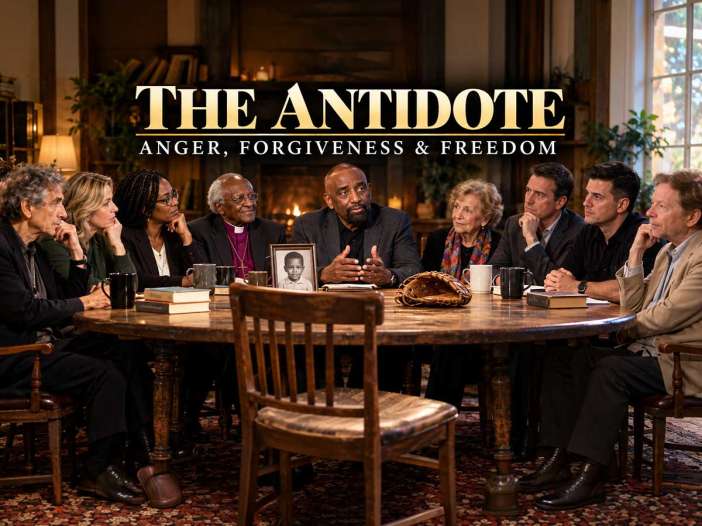
Introduction
What if the person controlling your life isn't standing in front of you anymore?
It might be the father who left, the mother who hurt you, the person who betrayed you, or someone whose apology you have waited years to hear. Jesse Lee Peterson's The Antidote begins with a provocative idea: anger, blame, resentment, and victimhood can keep the past alive long after the original wound occurred.
For this imaginary conversation, Peterson is joined by thinkers whose perspectives sometimes support his and sometimes challenge it. Gabor Maté and Brené Brown explore what may exist beneath anger. Nedra Glover Tawwab and Desmond Tutu ask whether forgiveness requires reconciliation. Richard Reeves and John Delony examine the father wound. Anthony de Mello and Eckhart Tolle explore the startling possibility that we are not the thoughts passing through our minds. Edith Eger brings perhaps the hardest question of all: how can someone acknowledge genuine victimization without allowing it to become an identity?
Across five conversations, one question keeps returning in different forms:
What happened to you may explain part of who you became, but must it decide who you become next?
This is a conversation about anger, parents, forgiveness, fathers, thoughts, injustice, God, and responsibility.
But underneath all of them lies something simpler.
The possibility of becoming free.
(Note: This is an imaginary conversation, a creative exploration of an idea, and not a real speech or event.)

Topic 1: The Anger You Didn't Know You Had
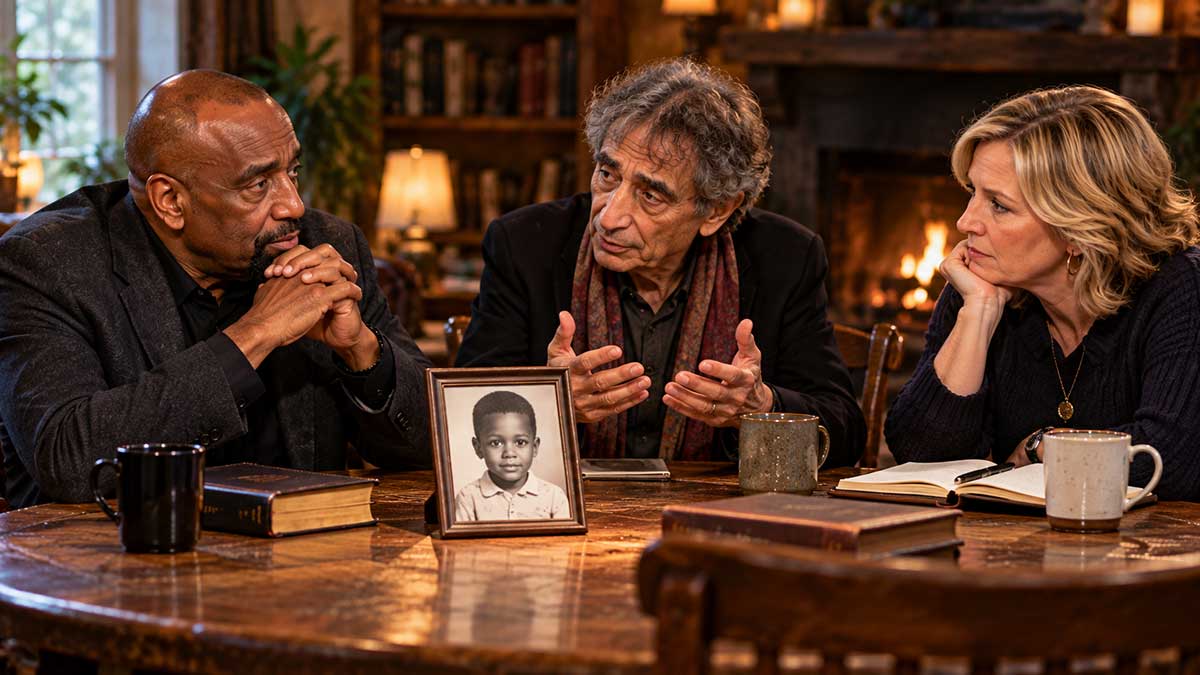
The fire had burned lower since the opening conversation. Outside the windows, dusk had deepened into night.
Jesse Lee Peterson sat with his hands resting on the arms of his chair. Gabor Maté leaned slightly forward. Brené Brown had a notebook beside her but hadn't written anything in it.
The moderator looked at the childhood photograph still lying on the table.
"Jesse, earlier you told us that for many years you thought you loved your mother. Then you discovered something underneath that love."
Jesse nodded.
"Anger."
"Did you know you were angry?"
"No. That's the amazing thing. I didn't know. I thought I loved my mother. I would have told you I loved her. But I had resentment against her. And when you have anger, you don't see clearly. You think everybody else is causing your problems."
Gabor's eyes remained on Jesse.
"May I ask you something?"
"Sure."
"When you say you discovered anger, what was underneath the anger?"
Jesse looked at him.
"Anger was underneath it."
Gabor smiled slightly.
"I thought you might say that."
Brené laughed softly.
"So did I."
Jesse grinned. "You guys want something underneath the anger."
"I do," Gabor said. "A child doesn't wake up one morning and decide, 'Today I will resent my mother.' Something happens."
"Sure."
"What happened to the boy?"
The room became quiet.
Jesse glanced at the photograph.
"My mother and father weren't together. I grew up without my father being there the way he should have been. My mother was controlling. I blamed her. But later I realized she couldn't help herself either. She was doing what she knew."
Gabor waited.
"But Jesse," he said, "before the adult could say, 'She couldn't help herself,' there was a little boy experiencing something."
"Yes."
"What was he experiencing?"
Jesse's smile disappeared.
"He wanted his father."
Nobody spoke for several seconds.
Brené finally leaned forward.
"That's different from anger."
Jesse looked at her.
"How?"
"Because 'I wanted my father' is grief."
Jesse considered that.
"And maybe abandonment," she continued. "Maybe loneliness. Maybe fear. Maybe feeling that somebody who was supposed to choose you didn't choose you. Anger might be what eventually came out of that. But I don't know that anger was the first thing."
Gabor nodded.
"This is where Jesse and I may disagree."
Jesse smiled again. "That's okay."
"A child is dependent," Gabor said. "A child can't say, 'My family system is unhealthy, so I'm moving to another household.' The child must adapt. If the child's needs aren't met, the child develops ways of surviving that environment."
"So you're saying anger helped me?"
"I'm saying I wouldn't condemn the child's response before asking what function it served."
Jesse shook his head gently.
"But once you become angry, you're separated from love."
"Perhaps," Gabor said. "But let me give you another child."
He rested his forearms on his knees.
"A little girl is being mistreated. Somebody crosses her boundary. Something rises inside her that says, 'No.'"
Jesse listened.
"That energy may save her."
"She can say no without anger."
"Can a four-year-old make that distinction?"
Jesse paused.
Brené looked between them.
"I think we're already running into a problem with the word anger."
"How so?" the moderator asked.
"We use anger to describe everything from a flash of protective energy to thirty years of resentment. Those aren't necessarily the same experience."
She turned to Jesse.
"If somebody insults your child and you immediately feel something rise in your body, is that the same thing as spending twenty years fantasizing about getting revenge?"
"No."
"Then maybe we need more language."
Jesse nodded slowly.
"But I'm talking about holding anger," he said. "You hold onto it. You justify it. You think you're right to have it. That's when it controls you."
Gabor raised a finger.
"Now we are closer."
Jesse laughed.
"See? You're coming around."
"No, no," Gabor said, laughing too. "Don't declare victory yet."
Brené laughed. "We're about seven minutes in, Jesse."
"I know. But he's getting there."
Gabor smiled, then became serious.
"I agree that chronic resentment can become destructive. Where I differ is that I don't want somebody who has been hurt to hear, 'Your anger is wrong,' before anyone has said, 'What happened to you was wrong.'"
Jesse became still.
"That's important," Brené said.
Gabor continued.
"If someone was abused, neglected or abandoned, anger may appear when that person finally realizes, 'I didn't deserve that.' There can be something healthy in that recognition."
"But then what?" Jesse asked.
"Then we don't build a house there."
Jesse's eyebrows rose.
Gabor continued.
"We visit the anger. We listen to what it is telling us. We learn the boundary that was violated. But we don't necessarily make anger our permanent address."
Jesse smiled broadly.
"Now you're talking."
Brené pointed toward Gabor.
"That's going in the book."
Gabor laughed. "You have more books than I do."
"Not after tonight."
The tension in the room softened.
The moderator turned to Jesse.
"So perhaps we should make the distinction very precise. Jesse, suppose somebody says, 'My father abandoned me. I'm angry.' What would you tell them?"
"Forgive him."
"Immediately?"
"Yes."
Gabor sat back.
"That's where I have trouble."
"Why?"
"Because forgiveness that arrives before someone has processed what happened can become another form of avoidance."
Jesse shook his head.
"You don't need to analyze it forever."
"I agree."
"You see the anger. You realize it's wrong. You forgive."
"But what does 'forgive' mean to a nervous system that still believes it's in danger?"
Jesse looked at him for a moment.
"The danger might be over, but you're keeping it alive."
"Sometimes," Gabor replied. "And sometimes the danger isn't over."
That changed the room.
Brené nodded.
"That's a really important distinction."
Gabor continued.
"If the person who hurt you is still hurting you, your body isn't remembering a past threat. It may be responding to a present one."
Jesse nodded.
"Then get away from them."
Brené looked surprised.
"So you would support the boundary."
"Of course. Forgiving someone doesn't mean you let them destroy your life."
"That's interesting," she said. "I think people sometimes hear forgiveness as permission."
"No."
"Or reconciliation."
"No."
"Or pretending it didn't happen."
"No."
Gabor looked at Jesse.
"Then perhaps your message needs that sentence more often."
Jesse smiled.
"Maybe that's why you're here."
Brené laughed.
"Look at Jesse outsourcing his editing."
The moderator let the laughter fade.
Then he turned toward Brené.
"You've said anger can sometimes be what we reach for rather than something more vulnerable. What might Jesse have found beneath his anger?"
"I can't tell Jesse what he felt."
She looked directly at him.
"But I can ask."
Jesse nodded.
"When you were a boy and your father wasn't there, did it hurt?"
"Yes."
"Did you miss him?"
"Yes."
"Did you ever wonder why he wasn't choosing you?"
Jesse's face changed almost imperceptibly.
"Yes."
"And was it easier to be angry than to feel that?"
Jesse did not answer immediately.
Finally he said, "Probably."
Brené nodded.
"That's what interests me."
"Explain."
"Anger can feel strong. Grief doesn't. Anger says, 'I'll show you.' Grief says, 'I wanted you and you weren't there.'"
Jesse looked again at the photograph.
Brené continued softly.
"Shame says, 'Maybe you weren't there because something was wrong with me.'"
Gabor added, "And the child almost always makes it about himself."
Jesse looked up.
"That's true."
The moderator asked, "Why?"
"Because the alternative is terrifying," Gabor said. "A small child depends upon the adults. It's safer psychologically to believe, 'Something is wrong with me,' than to fully recognize, 'The people I depend upon cannot give me what I need.'"
Brené nodded.
"Then years later the child becomes an adult who doesn't consciously think, 'Something is wrong with me.' He may think, 'Something is wrong with everybody else.'"
Jesse smiled.
"Now you're describing anger."
"Maybe," Brené said. "But we're describing how it got there."
That landed.
Jesse looked at both of them.
"So you're saying you want people to understand how the anger got there."
"Yes," Gabor said.
"And I'm saying once you see it, let it go."
"Yes."
Jesse leaned back.
"That's not so far apart."
"No," Gabor replied. "But the distance matters to the person suffering."
The moderator allowed a silence.
Then he asked:
"What about the person listening to this who says, 'Fine. Maybe Jesse had hidden anger. But I don't. I'm not angry with anybody.' How would they know?"
Jesse answered first.
"Watch yourself."
"Watch what?"
"Your reactions. Somebody says something and you get upset. Somebody doesn't agree with you and you get upset. Your husband says something. Your wife says something. Your kids don't do what you want. Somebody cuts you off."
Brené smiled.
"The internet exists."
"Especially that."
Everyone laughed.
"But don't blame them," Jesse continued. "Watch what's happening in you."
Gabor nodded.
"That part I strongly agree with."
The moderator turned to him.
"What would you tell someone to watch?"
"The disproportion."
"Meaning?"
"If your spouse makes a small comment and you experience enormous rage, the intensity may not belong entirely to the present moment."
Brené leaned forward.
"That's good."
Gabor continued.
"The present may have touched an old wound."
The moderator looked at Brené.
"What would you watch?"
"Patterns."
"What kind?"
"The same emotional outcome with different people."
She counted quietly on her fingers.
"Different boyfriend, same betrayal. Different boss, same humiliation. Different friend, same feeling of exclusion. Different disagreement, same feeling that nobody respects me."
She looked around the table.
"At some point you ask: What's the common denominator?"
Jesse pointed toward her.
"You."
Brené smiled.
"Yes, Jesse. Unfortunately."
He laughed.
"But that's not blame," she added.
Jesse stopped laughing.
"That's important. Responsibility and blame aren't the same thing."
"Explain that," the moderator said.
"If I was hurt as a child, I wasn't responsible for what happened to me. But as an adult, healing becomes my responsibility."
Jesse nodded vigorously.
"That's right."
"And I think we have to preserve both halves of that sentence."
Gabor immediately agreed.
"Absolutely."
Brené repeated it.
"It may not have been my responsibility then. Healing can still become my responsibility now."
Jesse looked at her.
"That's what I've been saying."
"Yes," she replied, smiling, "but I added some words."
"You added a lot of words."
Gabor laughed.
"That's why her books are longer."
For a moment all three were laughing.
Then the moderator asked the question that had been waiting underneath the conversation.
"Jesse, do you believe there is ever such a thing as righteous anger?"
"No."
The answer came immediately.
Gabor looked interested.
"None?"
"No."
"Someone is hurting a child in front of you."
"Stop them."
"With anger?"
"No."
"You're saying action doesn't require anger."
"Right."
Brené leaned forward.
"What if anger is what alerts me that something is wrong?"
"You don't need anger to know right from wrong."
Gabor entered.
"But biologically, anger can mobilize action."
"That doesn't make it good."
"No. But it may make it human."
Jesse shook his head.
"Fear is human too. Doesn't mean you should live in fear."
"I agree," Gabor said. "But I wouldn't tell somebody to become ashamed of being afraid."
"I don't tell them to be ashamed of anger."
That stopped Gabor.
Jesse continued.
"I'm saying see it."
Gabor's expression softened.
"That's a different statement."
"See it without judging yourself. Don't justify it. Don't say, 'I have a right to be angry.' Watch it."
Brené looked at Jesse carefully.
"That sounds surprisingly close to what Gabor is saying."
Gabor nodded.
"The disagreement may be about what happens after we notice it."
"And what we call it," Brené said.
Jesse smiled.
"You guys really like words."
"We're authors," Brené replied. "It's our entire business model."
They laughed again.
Outside, the windows had become black mirrors. Their reflections surrounded the table.
The moderator picked up Jesse's childhood photograph.
"One last question."
He placed it in front of Jesse.
"If you could sit beside this boy for five minutes, what would you tell him?"
Jesse looked down.
Nobody interrupted him.
Finally:
"That he's going to be okay."
Brené's eyes stayed on him.
"What else?"
Jesse was quiet again.
"That what happened wasn't his fault."
Gabor looked down.
"And?"
Jesse stared at the photograph.
"That his father not being there didn't mean there was something wrong with him."
Nobody spoke.
The fire cracked behind them.
Brené finally said, very quietly:
"Jesse, that's grief."
Jesse looked at her.
She didn't smile.
For several seconds he said nothing.
Then he nodded.
"Maybe so."
Gabor leaned back.
"And notice something."
Jesse looked toward him.
"You didn't become weaker by saying it."
Jesse smiled faintly.
"No."
"You didn't lose responsibility."
"No."
"You didn't become a victim."
"No."
Gabor gestured toward the photograph.
"You simply told the truth about what happened to the child."
Jesse looked down once more.
"And then you let it go."
Gabor smiled.
"And then," he said, "perhaps you can let it go."
Brené reached over and gently turned the photograph so all three could see it.
For once, nobody needed to decide which man had been right.
The anger had led them somewhere.
And underneath it, they had found a little boy who missed his father.
Topic 2: Forgive Your Mother, Forgive Your Father
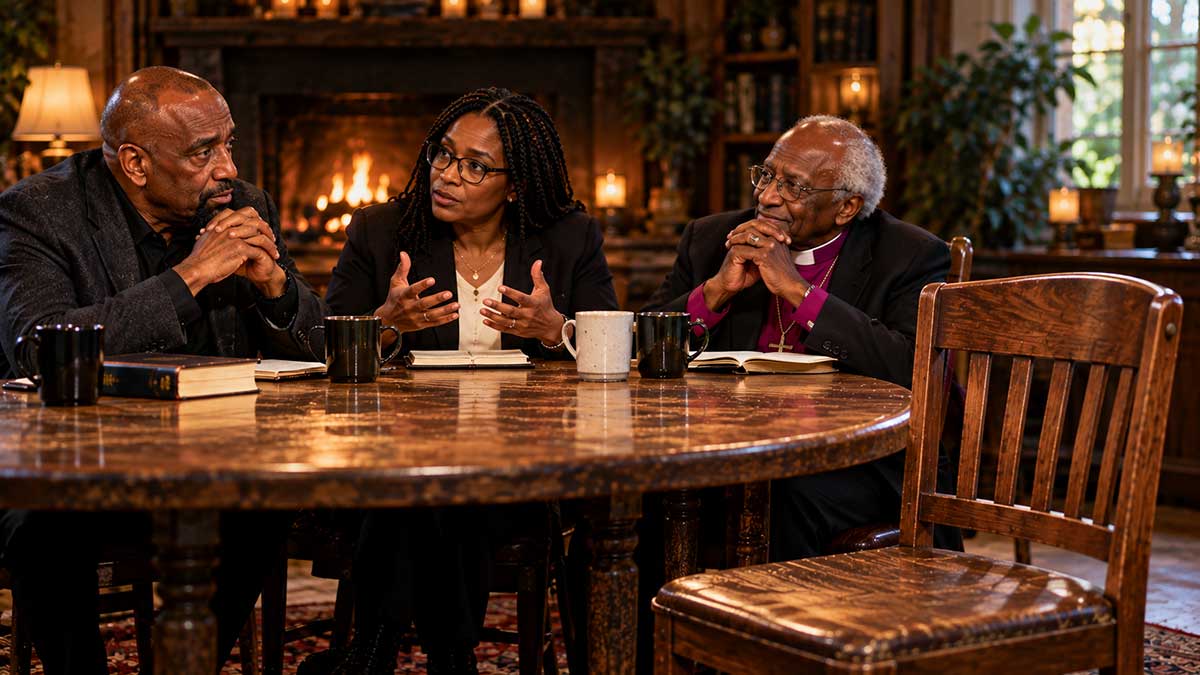
The photograph of young Jesse remained on the table.
Gabor Maté and Brené Brown had left the room. Two new chairs had been brought closer to the fire.
In one sat Nedra Glover Tawwab.
In the other sat Desmond Tutu, small in stature, warm-eyed, watching the room with the expression of someone who had spent much of his life listening to people describe things they believed could never be forgiven.
There was one more chair.
It was empty.
No one had explained why.
Jesse Lee Peterson looked at it.
"Who's supposed to sit there?"
The moderator smiled.
"Someone you haven't forgiven."
Jesse laughed.
"Then I don't need the chair."
Tutu's face opened into a grin.
"Oh, Jesse. Five seconds and already you have solved the whole evening."
Nedra laughed.
The moderator pulled the empty chair slightly closer to the table.
"Let's leave it anyway."
Jesse shrugged.
"Okay."
The moderator looked around.
"I want each of us to picture one person sitting in that chair. Don't tell us who it is."
Nedra studied the chair.
Tutu became quiet.
Jesse waited.
"Now ask yourself one question."
The moderator paused.
"What would that person have to do before you could forgive them?"
No one answered immediately.
"Apologize?"
Silence.
"Admit what they did?"
Tutu lowered his eyes.
"Explain why?"
Nedra crossed her hands.
"Change?"
The moderator looked at Jesse.
"Jesse?"
"Nothing."
"Nothing?"
"Nothing."
"Suppose they aren't sorry."
"Doesn't matter."
"Suppose they say it never happened."
"Doesn't matter."
"Suppose they blame you."
"Still doesn't matter."
Nedra leaned forward.
"Then who is forgiveness for?"
"You."
"Not them?"
"No."
Tutu smiled.
"Now we have somewhere to begin."
"But Jesse, what if she's still hurting you?"
Nedra turned toward Jesse.
"I want to give you a woman."
"Okay."
"She's forty-two. Her mother has criticized her since childhood."
Jesse listened.
"Her weight. Her marriage. Her parenting. Her clothes. Her career. Nothing is quite good enough."
"Right."
"At forty-two, this woman finally recognizes how much resentment she's carrying."
"She needs to forgive her mother."
"Good. She does."
Jesse nodded.
"Then Sunday comes."
He looked at her.
"Her mother calls and spends forty-five minutes criticizing her again."
Jesse smiled.
"Hang up."
Nedra laughed.
Tutu laughed too.
The moderator looked surprised.
"That was quick."
"What else is she supposed to do?"
Nedra leaned closer.
"So forgiveness doesn't mean unlimited access?"
"No."
"Doesn't mean accepting mistreatment?"
"No."
"Doesn't mean pretending Mom has changed?"
"No."
"Doesn't mean Sunday dinner every week?"
"No."
Nedra sat back.
"Then Jesse, you and I may have much less disagreement here than people would expect."
"You thought I was going to tell her to sit there and take it?"
"I wasn't sure."
Jesse laughed.
"No. Forgive your mother. Don't hate her. But if she's acting crazy, you don't have to sit around for it."
Tutu chuckled.
"Perhaps we have discovered the shortest book on boundaries ever written."
Nedra smiled.
"Mine was considerably longer."
What forgiveness is not
The moderator looked toward Tutu.
"Archbishop, you spent years dealing with people whose injuries were far greater than a difficult telephone call."
Tutu nodded.
"Yes."
"People tortured. Families destroyed. People murdered. Apartheid wasn't simply somebody being rude or emotionally difficult."
"No."
"Does Jesse's principle still work there? Forgive regardless of whether the offender apologizes?"
Tutu looked at Jesse.
"There is something very profound in what Jesse is saying."
Jesse listened.
"If my freedom depends entirely upon your repentance, then I have given you an extraordinary amount of authority over me."
Jesse nodded.
"That's right."
"But," Tutu continued, "we must be very careful."
Jesse's eyes narrowed slightly.
"Forgiveness must never become another way of silencing the wounded."
Nedra nodded immediately.
Tutu turned toward the empty chair.
"Suppose someone has done something terrible to me, and you arrive saying, 'Forgive. Forgive. Forgive.'"
He looked back at Jesse.
"You may be asking me to jump to the final page before anyone has permitted me to tell the first chapter."
Jesse considered this.
"But you still have to forgive."
"Yes."
"Then why wait?"
"Perhaps it is not waiting."
Tutu's voice softened.
"Perhaps telling the truth is part of forgiveness."
Jesse leaned forward.
"How?"
"You cannot forgive what you refuse to name."
That quieted the table.
Tutu continued.
"If somebody says, 'Nothing happened. Forget about it. Move forward,' that is not forgiveness."
Nedra added, "That's avoidance."
"Yes," Tutu said. "Forgiveness begins with truth."
Jesse nodded slowly.
"I agree with that."
The moderator looked at him.
"Then if someone says, 'My father abandoned me,' you don't want them pretending he didn't?"
"No. He left. That's what happened."
"But you don't want them living inside that fact forever."
"Exactly."
Tutu smiled.
"Now we are very close."
The apology that never comes
The moderator turned the empty chair so that it faced Jesse.
"Let's make this harder."
Jesse smiled.
"You like doing that."
"Your father is sitting there."
Jesse's expression changed.
"He says, 'Jesse, I wasn't there for you.'"
Jesse waited.
"'I should have been.'"
Silence.
"'I'm sorry.'"
The moderator paused.
"Would hearing that have mattered?"
"Sure."
"So apologies matter."
"They can matter."
"But they're not required."
"No."
Nedra entered.
"That's an important distinction."
She looked toward the empty chair.
"An apology can contribute to repairing a relationship. But requiring an apology before I release resentment means my emotional freedom depends upon somebody doing something they may never do."
Tutu nodded.
"And some people die before saying it."
The room became still.
The moderator looked at him.
"Then let's go there."
What if they're already dead?
"Suppose your mother died ten years ago."
No one moved.
"You've spent those ten years becoming increasingly aware of what happened in childhood."
The moderator looked at Nedra.
"You finally know what you wish you could say."
Nedra nodded.
"But she's gone."
He turned toward Tutu.
"No apology is coming."
Then Jesse.
"No conversation."
He looked at the empty chair.
"Can you forgive someone who is dead?"
"Yes," Jesse said.
"How?"
"You realize what you're carrying. You forgive them."
"But who do you tell?"
"You don't need to tell them."
"Then forgiveness isn't primarily a conversation?"
"No. It's something happening in you."
Nedra nodded.
"I think that can be enormously freeing."
"But," she added, "I want to make room for grief."
Jesse smiled.
"Here we go again."
Nedra laughed.
"Brené warned me about you."
Jesse laughed loudly.
Tutu joined him.
"What do you mean by grief?" Jesse asked.
"If my mother dies before we repair the relationship, I'm grieving more than her death."
Nedra counted gently on her fingers.
"I'm grieving the apology I never received."
"The mother I needed."
"The conversations we never had."
"The childhood I didn't get."
"The adult relationship that will never happen."
"The fantasy that one day she would finally become the mother I kept hoping she would become."
Jesse's smile disappeared.
Nedra looked at him.
"Forgiving her doesn't necessarily make those losses disappear."
"No."
"It changes my relationship with them."
"Yes."
Tutu nodded.
"Sometimes we must bury the future we believed the past owed us."
Nobody spoke.
The moderator repeated it quietly.
"The future we believed the past owed us."
Tutu looked at the empty chair.
"That can be one of the hardest funerals."
Does forgiveness require reconciliation?
Nedra turned toward Tutu.
"You make a distinction I really appreciate. Sometimes after forgiveness there can be renewal."
"Yes."
"And sometimes release."
"Yes."
"Can you explain that?"
Tutu folded his hands.
"Forgiveness does not automatically restore trust."
Jesse nodded.
"If I steal from you repeatedly and you forgive me, that does not mean you should immediately hand me your wallet."
Jesse laughed.
"Exactly."
"If I betray you, forgiveness may be freely offered. Trust may need to be rebuilt."
Nedra added, "And sometimes it shouldn't be rebuilt."
Tutu looked at her.
"Yes."
Jesse agreed.
"Right."
The moderator seemed surprised.
"All three of you agree?"
Nedra smiled.
"Don't worry. We'll find something."
They laughed.
She continued.
"Some relationships are unsafe. Some people don't change. Some family members repeatedly violate boundaries. Forgiveness can occur without giving that person the same role in your life."
Jesse said, "That's what people don't understand. They think if I forgive somebody, I've got to become their friend."
Tutu smiled.
"Forgiveness opens the prison door. It does not necessarily invite the former jailer to move into your house."
Nedra laughed.
"I'm stealing that."
"You write books. Apparently this is what authors do."
Jesse pointed at them.
"See? Everybody's stealing tonight."
What if the parent doesn't deserve forgiveness?
The moderator turned toward Jesse.
"Here's the objection many readers will have."
Jesse waited.
"Why should I forgive someone who doesn't deserve it?"
"Because it's not about them."
"That's too easy."
"No, it's not."
"Make it harder."
Jesse looked at the empty chair.
"If you hate your mother, who feels that hate?"
"I do."
"If you hate your father?"
"I do."
"If they're dead?"
"I still do."
"If they're somewhere having a good life and you're sitting at home thinking about what they did twenty years ago?"
Jesse shrugged.
"You're the one suffering."
Nedra looked toward him.
"But suppose someone says, 'My anger is how I hold them accountable.'"
"You're not holding them accountable."
"What are you doing?"
"Holding yourself."
Tutu's eyes brightened.
"Ah."
Jesse continued.
"You think your anger is punishing them. They might not even be thinking about you."
Nedra became quiet.
"They might be asleep."
"Right."
"Having dinner."
"Right."
"Living their life."
"Right."
"And you're replaying the argument."
"Exactly."
Tutu looked at the empty chair.
"So perhaps resentment sometimes becomes an invisible relationship with someone who is no longer participating."
The moderator looked at him.
"That's powerful."
Tutu nodded.
"We remain in conversation with ghosts."
But doesn't anger prove that it mattered?
Nedra's expression changed.
"I want to defend the person who's reluctant to let go."
Jesse looked at her.
"Go ahead."
"Sometimes anger feels like evidence."
"Evidence of what?"
"That what happened mattered."
Jesse listened.
"If I stop being angry at my father for abandoning me, part of me may fear that I'm saying his abandonment was acceptable."
Tutu nodded.
"Yes."
"Or if I forgive my mother, maybe I'm betraying the little girl who endured what she did."
Jesse shook his head.
"No."
"I know that's your answer. But emotionally, people can feel that."
"Then they're misunderstanding forgiveness."
"So tell that little girl."
Jesse paused.
Nedra gestured toward the empty chair.
"She's sitting there now."
Jesse looked at it.
"She's eight years old."
His face became serious.
"Her mother hurt her."
"Yes."
"She's spent thirty years protecting that eight-year-old through anger."
"Yes."
Nedra leaned forward.
"Tell her why forgiving Mom isn't abandoning her."
Jesse stared at the empty chair for several seconds.
Then:
"Because you're not saying what happened was right."
Nedra waited.
"You're saying you don't want to carry what she did anymore."
Silence.
"Keep going."
Jesse's voice softened.
"Your mother couldn't give you what she didn't have."
Nedra watched him.
"Maybe nobody loved her right either."
Tutu lowered his head slightly.
"Maybe she was angry too."
Nedra nodded.
"Maybe her mother hurt her."
Jesse continued.
"And somebody hurt her mother."
Tutu looked up.
"And now we have found the chain."
Who started it?
The moderator drew an invisible line across the table with his finger.
"A mother wounds a daughter."
"The daughter becomes a mother."
"She wounds her daughter."
"That daughter grows up."
"Another child."
"Another wound."
He looked around.
"Who is guilty?"
Nobody answered.
"Who is innocent?"
Still silence.
"Where does responsibility begin?"
Jesse finally said:
"With you."
The moderator looked at him.
"Why me?"
"Because you're the one who can see it."
Tutu smiled slowly.
That sentence seemed to affect him.
"Say that again."
Jesse looked at him.
"You're the one who can see it."
Tutu nodded.
"Then perhaps responsibility does not always belong to the person who began the wound."
"No."
"It belongs to the person who finally becomes conscious enough to stop passing it forward."
Jesse pointed toward him.
"That's right."
Nedra looked between them.
"I love that."
She turned toward the moderator.
"You may inherit a family pattern you didn't create."
She paused.
"But once you can see the pattern, you have an opportunity not to hand it to the next generation."
Jesse nodded.
"That's responsibility."
The mother who was once a daughter
The moderator looked toward Jesse.
"You said something a moment ago that I don't want to lose."
"What?"
"Maybe nobody loved her right either."
Jesse waited.
"You spent years angry with your mother."
"Yes."
"Did there come a point when you stopped seeing only your mother and started seeing the little girl she had once been?"
Jesse became quiet.
"Yes."
"What changed?"
"You realize they couldn't help themselves."
Nedra gently interrupted.
"I might phrase that differently."
Jesse smiled.
"Of course you would."
She laughed.
"I might say: understanding why someone became who they became can create compassion without removing responsibility."
Jesse thought about it.
"Okay."
"Your mother could have hurt you."
"Yes."
"And your mother could herself have been hurt."
"Yes."
"Both can be true."
"Yes."
Tutu leaned toward them.
"That is where forgiveness becomes interesting."
He pointed toward the empty chair.
"The person who wounded you is rarely only the person who wounded you."
He paused.
"They were somebody's frightened child too."
Jesse nodded.
"That's right."
"But," Tutu continued, "we must never use their wound to erase yours."
Nedra smiled.
"Exactly."
Two truths.
Your mother may have been wounded.
She may have wounded you.
Your father may have been lost.
He may have abandoned you.
Compassion doesn't require rewriting history.
And truth doesn't require hatred.
The empty chair
The fire was nearly gone.
The moderator stood.
Nobody knew why.
He walked behind the empty chair and rested his hand on its back.
"We've spent the evening pretending somebody else is sitting here."
He looked at Jesse.
"Mother."
At Nedra.
"Father."
At Tutu.
"Someone who harmed us."
Then he turned the chair around.
Now it faced away from the table.
"But I wonder whether there's someone else who belongs here."
Nobody spoke.
"The person we were before we became angry."
Jesse looked toward the chair.
"The child who kept waiting for Dad."
Nedra lowered her eyes.
"The girl who kept trying to become good enough for Mom."
Tutu's expression softened.
"The person who believed an apology would eventually arrive."
The moderator sat in the empty chair.
"What does that person need?"
Jesse answered first.
"Truth."
Nedra said, "Safety."
Tutu said, "Compassion."
"An apology?"
"Maybe," Nedra said.
"But what if it never comes?"
Silence.
Tutu finally answered.
"Then we must not spend the remainder of our lives standing at the door waiting for someone who has chosen not to come."
Jesse nodded.
"That's right."
The moderator looked at Jesse.
"So when you tell someone, 'Forgive your mother,' you're not telling them to say she was right."
"No."
"You're not telling them to trust her."
"No."
"You're not telling them to stay close to her."
"No."
"You're not telling them to forget."
"No."
"Then what are you telling them?"
Jesse looked at the empty chair.
"Stop letting what they did live inside you."
Tutu nodded.
Nedra remained silent for a moment.
Then she said:
"And if they call tomorrow and do it again?"
Jesse laughed.
"Don't answer the phone."
Tutu erupted in laughter.
Nedra laughed so hard she covered her face.
The moderator shook his head.
"After two hours on forgiveness, our final spiritual teaching is caller ID."
"That's why God invented it," Jesse said.
The room filled with laughter.
But when it faded, the empty chair remained.
Nobody removed it.
Perhaps forgiveness didn't mean pretending the chair had never been occupied.
Perhaps it meant being able to look at it without needing anyone to sit there anymore.
Topic 3: Return to the Father
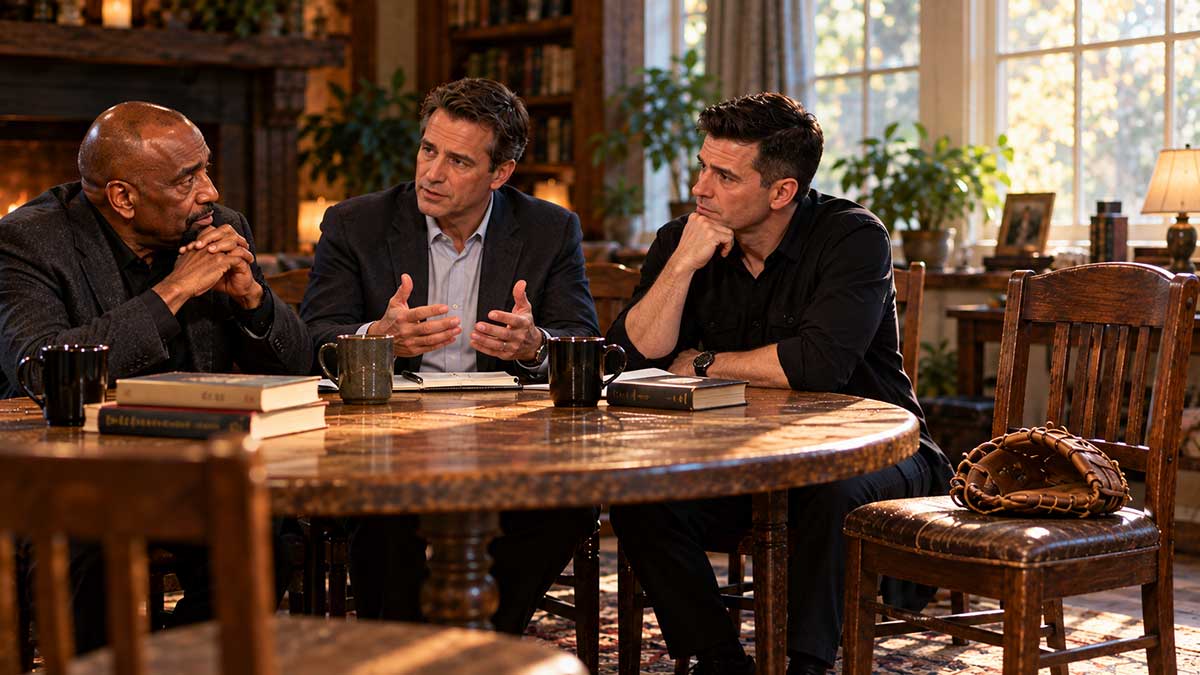
The empty chair from the previous conversation was still there.
Nobody had moved it.
But tonight something had been placed on its seat.
A small baseball glove.
Old leather. Child-sized.
Jesse Lee Peterson noticed it immediately.
"Whose is that?"
The moderator smiled.
"Nobody's."
Jesse looked suspicious.
"You always have something going on."
Richard Reeves laughed.
John Delony picked up the glove, turned it over in his hands, then put it back.
The moderator sat down.
"Tonight I want to talk about fathers."
Jesse leaned back.
"Good."
"But I don't want to begin with statistics."
Richard raised an eyebrow.
"I've been brought here under false pretenses."
Everyone laughed.
"No charts."
"This is getting worse."
"No studies yet."
Richard sighed theatrically.
"What am I supposed to do?"
"Tell us what a father is."
That stopped him.
The moderator pointed toward the glove.
"A boy is eight years old."
"His father tells him, 'I'll pick you up Saturday morning.'"
"The boy wakes early."
"He gets dressed."
"He puts his glove beside the front door."
"Nine o'clock."
"Ten."
"Eleven."
"No father."
Nobody spoke.
"The following Saturday, Dad promises again."
"The boy waits again."
"Nothing."
"The third Saturday, the boy leaves the glove upstairs."
The moderator looked at Jesse.
"Twenty years later someone asks whether his father leaving affected him."
Jesse already knew where this was going.
"The man says, 'No. I don't care about him.'"
The moderator paused.
"Do you believe him?"
"No."
"Why?"
"Because if he didn't care, he wouldn't need to say he doesn't care."
John nodded slowly.
"That's good."
Richard looked toward Jesse.
"What do you think happened to that boy?"
"He became angry."
John smiled slightly.
"We've been here before."
Jesse laughed.
"Everything comes back to anger."
"According to you."
"According to reality."
Richard smiled.
"Three minutes."
Jesse laughed again.
"You're learning."
What does a father actually give a child?
The moderator looked at Richard.
"Let's begin with the question underneath your work."
Richard nodded.
"What does a father give a child?"
"That's deceptively difficult."
"Why?"
"Because we have to distinguish between saying fathers matter and saying that children without fathers are doomed."
Jesse immediately nodded.
"They're not doomed."
"Good," Richard said. "That's important."
He leaned forward.
"We know children can flourish in many circumstances. Mothers do extraordinary work. Grandparents do extraordinary work. Extended families matter. Communities matter."
Jesse waited.
"But?"
"But fathers matter too."
Jesse smiled.
"Now you're talking."
Richard continued.
"Part of what interests me is that modern culture sometimes struggles to say those two things simultaneously."
"What two things?"
"That single mothers deserve enormous respect and support."
He paused.
"And that fathers are important."
John nodded.
"Those aren't contradictory."
"Exactly."
The moderator picked up the glove.
"But what does Dad actually provide?"
Richard considered it.
"Presence."
Jesse said, "Direction."
John said, "Safety."
Richard added, "Example."
Jesse: "Discipline."
John: "Connection."
Richard: "Identity."
The moderator looked between them.
"Anything only a father can provide?"
Silence.
That question was harder.
Richard answered carefully.
"I'd be cautious about saying that every individual father provides something categorically impossible for anyone else to provide."
Jesse shook his head.
"A father is a father."
"I agree."
"No woman can be a father."
"Agreed."
"A mother can be a great mother."
"Absolutely."
"But she can't be the father."
Richard nodded.
"I don't disagree with that."
John leaned forward.
"Maybe we're asking the wrong question."
They looked toward him.
"Instead of asking what only a father can do, ask what happens when a good father is present."
The moderator nodded.
John continued.
"A healthy dad can show a child, 'I'm here. I'm not afraid of you. Your emotions don't scare me. Your mistakes don't make me leave. There are boundaries. There are consequences. And after the consequences, I'm still here.'"
Jesse pointed toward him.
"That's right."
John looked at the glove.
"The 'I'm still here' part is huge."
The boy at the window
The moderator picked up the baseball glove again.
"Why?"
John answered.
"Because children build their picture of themselves partly through relationships."
He looked toward Jesse.
"If Dad repeatedly doesn't show up, the child usually doesn't say, 'My father has unresolved attachment issues and poor emotional regulation.'"
Richard laughed.
"No eight-year-old has ever said that."
"Exactly."
John continued.
"The child says, 'He didn't come for me.'"
Jesse's expression changed.
"And eventually," John said, "'Maybe I'm not worth coming for.'"
The room went quiet.
Richard looked at Jesse.
"Does that resonate with your story?"
"Yes."
"Did you ever wonder why your father wasn't there?"
"Sure."
"Did you think something might be wrong with you?"
"When you're a kid, yeah."
John nodded.
"That's the wound."
Jesse looked at him.
"But you can't stay there."
"No," John said. "But you can't heal what you refuse to name."
Jesse smiled.
"Everybody's got that line now."
Richard laughed.
"We had a meeting before you arrived."
"I knew it."
Does fatherlessness become destiny?
Richard leaned forward.
"Here's where I want to be careful."
Jesse listened.
"If we talk about absent fathers carelessly, children growing up without fathers can hear something terrible."
"What?"
"'You're damaged.'"
Jesse shook his head.
"No."
"Or, 'You're statistically destined to fail.'"
"No."
"Or single mothers hear, 'Whatever you do will never be enough.'"
"I'm not saying that."
"I know. But people can hear it."
The moderator asked Richard, "How would you phrase it?"
"Risk isn't destiny."
He looked around the table.
"Family structure can matter. Parental involvement can matter. Economic conditions matter. Neighborhoods matter. Schools matter. Individual temperament matters."
Jesse smiled.
"There's your researcher."
Richard laughed.
"You promised no statistics. You didn't prohibit variables."
John shook his head.
"You people are exhausting."
Richard continued.
"The point is that saying fathers matter shouldn't require us to tell children without fathers that something essential inside them is permanently broken."
Jesse nodded.
"I agree."
"Then we have common ground."
"Of course."
Richard looked surprised.
"This is going much better than I expected."
Jesse grinned.
"You believed what people told you about me."
Richard laughed.
"I did my reading."
What if Dad never comes back?
The moderator placed the glove back on the empty chair.
"Let's make this real."
He looked at Jesse.
"You tell people to return to their fathers."
"Yes."
"Okay."
He paused.
"Dad doesn't want you."
Jesse's face became serious.
"He has another family."
No one spoke.
"He doesn't answer your messages."
"Or he's dead."
"Or he disappeared."
"Or contacting him would be unsafe."
"Or you don't even know who he is."
The moderator leaned forward.
"Where exactly are you supposed to return?"
Jesse answered slowly.
"You forgive him."
"But he's not there."
"You don't need him there to forgive him."
"We established that last time."
"Right."
"But that still leaves something missing."
"Yes."
The moderator seemed surprised.
"So forgiveness doesn't replace the father?"
"No."
Richard looked closely at Jesse.
"That's important."
Jesse nodded.
"A father should be there."
"But if he isn't?"
Jesse thought.
"Then you have to stop hating him for not being there."
John entered.
"And then what?"
"You live."
John waited.
"That's too short for me."
Jesse smiled.
"I knew you were going to say that."
John leaned forward.
"Let's say I'm thirty-two."
"Okay."
"My father left when I was six."
"Okay."
"I've forgiven him."
"Good."
"But nobody ever taught me how to handle conflict."
Jesse listened.
"Nobody taught me how to be a husband."
"Right."
"Nobody showed me what a healthy man looks like."
"Right."
"My wife is pregnant."
John paused.
"I'm terrified I'm going to become my father."
That landed differently.
Jesse became very still.
"What does that man do?"
"Find good men."
John nodded immediately.
"Good."
"A pastor. An older man. Somebody who's living right."
Richard entered.
"A mentor."
"Yes."
"A grandfather."
"Yes."
"A coach."
"Yes."
"An uncle."
"Yes."
Richard smiled.
"Now we're talking about social fathering."
Jesse looked at him.
"Call it whatever you want."
John laughed.
"Jesse has declared war on terminology."
"I like simple things."
Can another man help repair what Dad didn't give?
Richard became serious.
"This is important, though."
He looked at the glove.
"A biological father has a particular relationship to a child. But human beings have always had broader networks of adults around children."
Jesse nodded.
"And boys especially may benefit enormously from having responsible men who notice them."
John added, "Not men who lecture them."
"Exactly," Richard said.
"Men who know their name."
John nodded.
"Who show up."
"Who remember what they're doing."
"Who ask about the game."
"Who notice when something's wrong."
Jesse said quietly, "Who tell them the truth."
John looked at him.
"Yes."
Jesse continued.
"A boy needs somebody who isn't afraid to tell him when he's wrong."
Richard smiled.
"And somebody who notices when he's doing something right."
Jesse looked at him.
"That's true too."
The moderator asked:
"Can one good man change the trajectory of a boy whose father disappeared?"
John answered first.
"Absolutely."
Richard nodded.
"Yes."
Jesse nodded.
"Yes."
The moderator looked at the glove.
"Then perhaps the boy at the window isn't necessarily waiting for one specific person forever."
Jesse's eyes narrowed.
"What do you mean?"
"Maybe eventually he has to stop looking down the driveway."
Nobody spoke.
"And start noticing who actually showed up."
John exhaled.
"That's good."
The father who was there but wasn't there
Richard raised a finger.
"Can I complicate this?"
Jesse laughed.
"That's what you're here for."
"We've been treating fatherlessness as physical absence."
"Right."
"But a father can live in the house and still be absent."
John nodded immediately.
"Absolutely."
Richard continued.
"He can provide financially."
"Come home every night."
"Sit at dinner."
"Sleep upstairs."
"And his children may barely know him."
Jesse nodded.
"That's true."
The moderator looked at John.
"What does emotional fatherlessness look like?"
John thought.
"Dad never says he's proud of you."
"Never apologizes."
"Never asks what you're afraid of."
"Never tells you what he's afraid of."
"Never hugs you."
"Never admits he doesn't know."
"He provides a roof, food, maybe education."
John paused.
"But you don't know whether he actually likes you."
That sentence hung in the room.
Jesse looked toward him.
"A lot of men grew up like that."
"Yes."
"And they think that's being strong."
"Yes."
John leaned forward.
"They confuse emotional absence with stability."
Jesse nodded.
"Men need to be strong."
"Absolutely."
"But?"
"But strength isn't the inability to connect."
Jesse considered that.
Richard entered.
"A father can be sturdy without being silent."
Jesse smiled.
"I like that."
What does a son need to hear?
The moderator looked at the three men.
"Let's conduct an experiment."
Nobody looked pleased.
Richard laughed.
"That sentence never ends well."
"You're each a father now."
Jesse raised an eyebrow.
"To whom?"
The moderator picked up the glove.
"To him."
He placed it in the center of the table.
"The eight-year-old boy."
"He waited three Saturdays."
"Dad never came."
"He has stopped asking why."
"He has begun pretending he doesn't care."
The moderator looked at Richard.
"One sentence."
Richard stared at the glove.
Then:
"His leaving says something about what he was able to give, not about what you were worth receiving."
John nodded.
The moderator looked at him.
John thought longer.
"You don't have to spend the rest of your life proving you're worth staying for."
Jesse looked down.
Then everyone turned toward him.
He was quiet.
Finally:
"Son, there's nothing wrong with you."
No one spoke.
John's eyes stayed on Jesse.
"Did anyone ever tell you that?"
Jesse looked at him.
"No."
The room became very still.
Richard looked away for a moment.
The moderator didn't rescue anyone from the silence.
Finally Jesse said:
"But I know it now."
John nodded.
"That's what matters."
What about mothers?
The moderator shifted slightly.
"We need to address something difficult."
Jesse waited.
"When conversations about fatherlessness become intense, single mothers sometimes feel accused."
Richard nodded immediately.
"Yes."
"Suppose a woman watching this raised three sons."
"Dad left."
"She worked two jobs."
"She drove them to school."
"Sat in emergency rooms."
"Paid bills."
"Stayed awake when they were sick."
"Put them through college."
"And now she hears four men talking about how important fathers are."
The moderator looked around.
"What would you tell her?"
Richard answered first.
"Thank you."
John nodded.
"Absolutely."
Jesse said, "She did what she had to do."
Richard continued.
"Recognizing fathers doesn't diminish mothers."
John looked toward the imaginary woman.
"You should never have had to carry everything alone."
Jesse nodded.
"And don't blame yourself for what the father didn't do."
That surprised the moderator.
"You'd say that?"
"Of course."
"Why?"
"She can't make a man be a father."
Richard nodded.
"That's an important sentence."
Jesse shrugged.
"It's true."
The moderator looked at him.
"But you have criticized mothers very strongly."
"Sure."
"So where's the line?"
"If a mother turns the children against their father, that's wrong. If she uses them against him, that's wrong."
"And if Dad simply leaves?"
"That's on him."
Richard nodded slowly.
"Good."
Jesse looked at him.
"You keep being surprised."
"I admit it."
Jesse smiled.
"Stop reading the internet."
Everyone laughed.
When the abandoned boy becomes a father
John picked up the glove.
"I want to move this forward twenty-five years."
The moderator nodded.
"The boy is thirty-three now."
"His wife has just had a son."
John held the little glove in both hands.
"He looks down at this baby."
"And suddenly he's terrified."
"Why?" Richard asked.
"Because he has no template."
Jesse listened closely.
"He thinks fatherhood is something other men learned in a class he missed."
The moderator smiled faintly.
John continued.
"He knows what he doesn't want to become."
"But he doesn't know what he does want to become."
Richard nodded.
"That's very common."
John looked at Jesse.
"What do you tell him?"
"Be there."
"That's it?"
"Start there."
John smiled.
"Okay."
"You're not going to be perfect."
"Good."
"You're going to make mistakes."
"Good."
"Admit them."
John raised his eyebrows.
"That's interesting coming from you."
Jesse laughed.
"What?"
"Tell your child when you're wrong?"
"Of course."
John nodded.
"That may be one of the most powerful things a father can do."
Richard agreed.
"Because then masculinity isn't presented as infallibility."
Jesse made a face.
"There's your big word again."
Richard laughed.
"Sorry. Dad doesn't have to pretend he knows everything."
"Right."
John looked at the glove.
"The boy who never had a father can still become one."
Jesse nodded.
"Yes."
"And maybe become the father he needed."
"Exactly."
The second Father
The moderator looked toward Jesse.
"We've talked about the earthly father for a long time."
Jesse nodded.
"But The Antidote goes somewhere else."
"Yes."
"When you say 'return to the father,' you ultimately mean more than Dad."
"God."
Richard leaned back.
Here was the point where their languages separated.
The moderator asked Jesse:
"Explain the connection."
Jesse looked at the other men.
"Your earthly father is supposed to represent something."
"What?"
"Order. Love. Truth. Protection."
John listened.
"But he's imperfect."
"Of course."
"Sometimes very imperfect."
"Yes."
"And sometimes absent."
"Yes."
"So what happens?"
"You forgive him."
"And then?"
"You return to God."
Richard entered carefully.
"What does that mean psychologically?"
Jesse smiled.
"You want to make God psychology."
Richard laughed.
"Occupational hazard."
"It means you stop looking to people to give you what only God can give."
John looked interested.
"Such as?"
"Peace."
"Identity?"
"Yes."
"Worth?"
"Yes."
"Security?"
"Yes."
Richard leaned forward.
"But someone who doesn't share your belief in God could still experience healing."
"Sure."
"Then what is uniquely spiritual about your answer?"
Jesse paused.
"Knowing who you really are."
"And who are you?"
"Not the angry person."
John looked at him.
"Not the abandoned boy?"
"No."
"Not the man trying to prove himself?"
"No."
"Then who?"
Jesse became very quiet.
"A child of God."
Nobody immediately responded.
The question Richard couldn't answer with data
The moderator turned toward Richard.
"You've spent years studying boys and men."
Richard nodded.
"Employment. Education. family structure. fatherhood."
"Yes."
"Can data tell a man who he is?"
Richard smiled.
"No."
"Can policy?"
"No."
"Can economics?"
"No."
"Then Jesse is talking about something your research can't measure."
"Certainly."
"Does that make it meaningless?"
"No."
Jesse looked at him.
Richard continued.
"Human beings need meaning. Belonging. Identity. Purpose."
Jesse nodded.
"We might explain their sources differently."
"Right."
"But I wouldn't dismiss them."
John leaned back.
"Maybe this is where fathers become particularly interesting."
They looked at him.
"A good father eventually becomes less necessary."
The moderator raised an eyebrow.
"Explain."
"When your child is two, you're everything."
"When he's eight, you're enormous."
"At sixteen, you're annoying."
Everyone laughed.
"At twenty-five, if you've done your job, he doesn't need you to make every decision."
John looked at Jesse.
"You spend years giving someone roots."
"Then eventually you have to trust them with their own legs."
Richard nodded.
"That's beautiful."
Jesse said, "And point them to God."
John smiled.
"There's Jesse."
The glove
The conversation had gone on for hours.
The fire was low again.
The moderator picked up the little baseball glove one final time.
"Let's return to our boy."
Eight years old.
Saturday morning.
Waiting.
Nine o'clock.
Ten.
Eleven.
Dad doesn't come.
The moderator looked at Jesse.
"What happens to him?"
Jesse answered:
"He hurts."
Richard:
"He may wonder whether he mattered."
John:
"He learns something about relationships that may or may not be true."
The moderator nodded.
"Now he's thirty-three."
"He has forgiven his father."
"He found older men who helped him."
"He has a baby boy."
"And Saturday morning comes."
Nobody spoke.
The moderator placed the glove in front of him.
"What does he do?"
Jesse smiled.
"He shows up."
Richard nodded.
"He shows up."
John looked at the glove.
"He shows up."
The moderator waited.
"Is that enough?"
John shook his head.
"No."
"What else?"
"He stays."
Richard nodded.
Jesse leaned forward.
"And when he messes up, he comes back."
The moderator looked at him.
"Why does that matter?"
Jesse stared at the little glove.
"Because his son shouldn't have to spend forty years wondering why Dad didn't come."
Silence.
Then John asked Jesse:
"Could that be part of forgiveness too?"
Jesse looked at him.
"What?"
"Becoming for your children what you wished somebody had been for you."
Jesse thought for a long moment.
"Yeah."
Richard looked at the empty chair.
"Then maybe returning to the father doesn't always mean walking backward."
Nobody spoke.
"Sometimes it means refusing to pass the absence forward."
Jesse nodded.
The moderator picked up the glove and placed it back on the empty chair.
But the chair looked different now.
It no longer seemed to be waiting for the man who hadn't arrived.
It seemed to be waiting for the boy who had grown up.
And this time, when Saturday came, someone would be there.
Topic 4: Are You Your Thoughts?
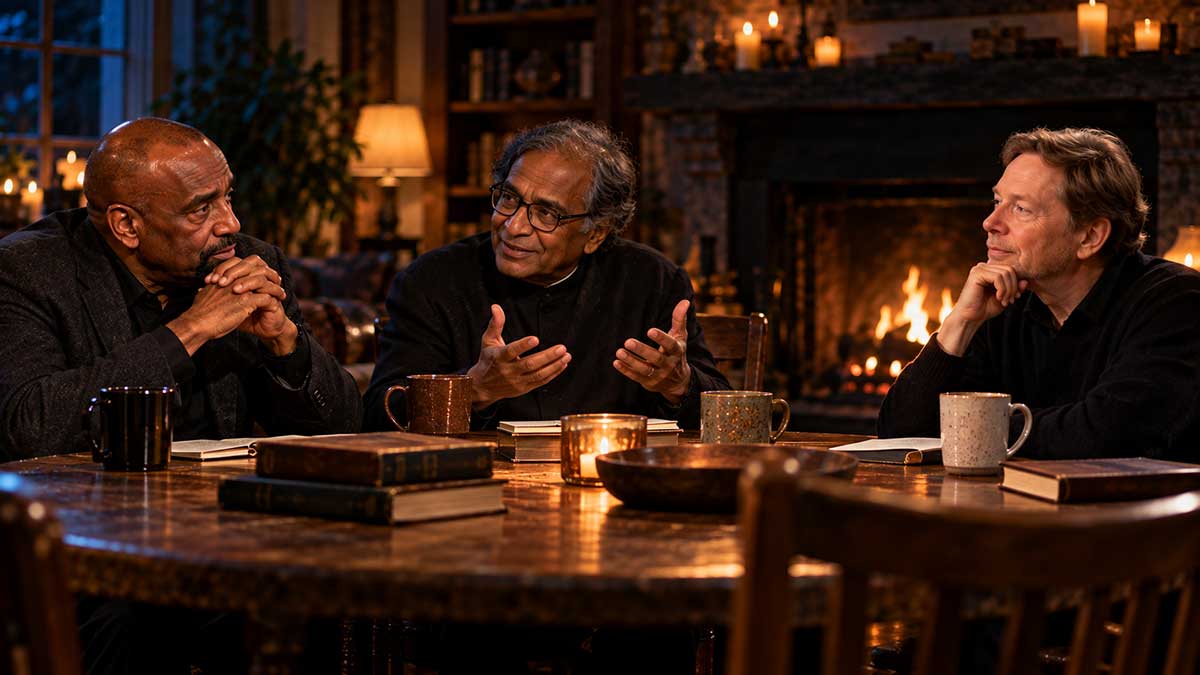
The room was darker tonight.
No baseball glove.
No childhood photograph.
No empty chair.
The fire had been allowed to burn almost completely down, leaving only a soft orange glow.
Three men sat around the wooden table.
Jesse Lee Peterson.
Anthony de Mello.
Eckhart Tolle.
Nobody was speaking.
The moderator had asked them not to.
Thirty seconds passed.
Then a minute.
Jesse seemed perfectly comfortable.
Tolle's eyes were closed.
De Mello looked as though he might be enjoying a private joke.
Another thirty seconds.
Finally, the moderator spoke.
"What happened?"
Jesse looked at him.
"What do you mean?"
"During the silence."
"Nothing."
De Mello smiled.
"Oh, plenty happened."
Tolle opened his eyes.
The moderator turned toward him.
"What happened inside your mind?"
"I noticed thoughts."
"What thoughts?"
Tolle smiled.
"It is unnecessary to give them that much importance."
De Mello laughed.
"I like him already."
Jesse smiled.
The moderator looked toward de Mello.
"And you?"
"I was wondering how long you would make us sit here."
Everyone laughed.
"And then?"
"Then I noticed myself wondering."
The moderator turned to Jesse.
"You really had no thoughts?"
"Thoughts come."
"But?"
"You don't have to follow them."
De Mello leaned forward.
"Ah."
Tolle looked toward Jesse.
"That distinction is everything."
The moderator looked around the table.
"Then let's begin there."
He tapped his finger lightly against the wood.
"If a thought appears inside my head without my choosing it, is the thought me?"
The voice inside your head
Jesse answered first.
"No."
"Then what is it?"
"A thought."
"Whose thought?"
Jesse smiled.
"You're trying to get complicated."
De Mello laughed.
"He's going to have a difficult evening with us."
Tolle smiled.
The moderator continued.
"Suppose I'm walking down the street."
"Someone looks at me strangely."
"A thought appears."
He doesn't respect me.
"Did I consciously choose that thought?"
"No," Jesse said.
"Then another thought."
People always disrespect me.
"Then another."
I'm tired of people treating me this way.
"Then I remember something that happened five years ago."
"Then something my father said when I was twelve."
"Five minutes later I'm furious."
De Mello raised his hand.
"And the poor man merely looked at you."
Everyone laughed.
"Exactly."
De Mello leaned back.
"This is what human beings do all day."
"What?"
"Reality happens."
He tapped the table.
"Then we tell a story about reality."
Tolle nodded.
"And eventually the story becomes more important than what actually happened."
Jesse said, "That's why you have to watch your thoughts."
The moderator looked at him.
"But who's watching?"
Jesse paused.
"You are."
"Then the thought isn't me."
"No."
"But the watcher is?"
Jesse looked at him.
"The real you."
Tolle smiled.
"Now we are getting somewhere."
Who is the watcher?
The moderator turned toward Tolle.
"Who is the real me?"
"The awareness in which thought appears."
De Mello immediately smiled.
Jesse looked toward Tolle.
"Say that another way."
Tolle paused.
"You know that you are thinking."
"Right."
"That knowing is not itself the thought."
Jesse nodded slowly.
De Mello entered.
"If you can watch the thought, there must be some distance between you and the thought."
The moderator looked at him.
"How much distance?"
De Mello held his thumb and forefinger barely apart.
"This much may be enough to change your life."
Jesse smiled.
"That's good."
De Mello looked at him.
"You approve?"
"Sometimes."
Everyone laughed.
De Mello continued.
"A thought says, 'I am a failure.'"
"Most people immediately say, 'Yes.'"
"They don't even know they said yes."
Tolle nodded.
"They identify with the thought."
"Exactly."
De Mello continued.
"But awareness says:
'There is a thought saying I am a failure.'
Do you see the difference?"
The moderator nodded.
"The first is identity."
"Yes."
"The second is observation."
"Exactly."
Jesse leaned forward.
"And when you stop believing every thought, you can start seeing what's really happening."
Tolle looked toward him.
"Yes."
The moderator smiled.
"Three men from very different spiritual backgrounds have agreed within ten minutes."
De Mello raised his hand.
"Please don't ruin it."
Everyone laughed.
"I am angry" versus "anger is here"
The moderator looked at Jesse.
"Let's bring anger back."
Jesse nodded.
"Someone says, 'I am angry.'"
"Right."
"Tolle, is that statement accurate?"
Tolle considered it.
"It describes an experience, but it can easily become identification."
"What would you say instead?"
"One could simply notice that anger is present."
Jesse nodded.
"Right."
De Mello leaned toward the moderator.
"Listen to the difference."
He held up one hand.
"I am angry."
Then the other.
"Anger is happening."
He looked around.
"The first sentence makes anger part of me."
"The second allows me to look at it."
Jesse said, "And if you can look at it, you don't have to obey it."
The moderator turned toward him.
"Suppose somebody insults you."
"Okay."
"Anger immediately appears."
"Right."
"What do you do?"
"Watch it."
"Don't suppress it?"
"No."
"Don't express it?"
"No."
"Don't justify it?"
"No."
"Just watch?"
"Yes."
Tolle nodded.
"Without feeding it with thought."
The moderator looked toward him.
"What does that mean?"
Tolle leaned back.
"The initial emotional reaction may be brief."
"Then thought arrives."
He spoke slowly.
How dare he speak to me that way?
He always does this.
People never respect me.
Next time I'll tell him exactly what I think.
Tolle paused.
"Each thought renews the emotional reaction."
De Mello laughed.
"We manufacture another dose."
"Yes."
"And another."
"Yes."
"And then we complain that the anger won't leave."
Jesse smiled.
"Exactly."
What if we stop feeding it?
The moderator looked around the table.
"Let's run an experiment."
De Mello sighed dramatically.
"Another one."
Jesse laughed.
"Someone says something insulting to me."
"Anger rises."
"For once, I do nothing."
"No text message."
"No phone call."
"No social media."
"No imaginary courtroom in my head where I explain to twelve imaginary jurors why I'm right."
De Mello burst out laughing.
"That courtroom is very crowded."
Tolle smiled.
"The ego has excellent lawyers."
Jesse laughed.
The moderator continued.
"I don't suppress the feeling."
"I don't justify it."
"I don't act on it."
"I simply watch."
"What happens?"
Jesse answered:
"It passes."
Tolle nodded.
"If thought does not continually regenerate it, the emotional energy can diminish."
De Mello looked toward Jesse.
"Then perhaps anger itself isn't the greatest problem."
Jesse raised an eyebrow.
"What is?"
"Our love affair with the story."
Jesse smiled.
"That's part of anger."
De Mello shook his head.
"You are determined to win this argument."
"I'm not angry about it."
Everyone laughed.
The thought that sounds like your voice
The moderator became serious again.
"Here's something that troubles me."
They waited.
"Thoughts sound like me."
Tolle nodded.
"They use my voice."
"Yes."
"They know my memories."
"Yes."
"They know exactly what I'm afraid of."
"Yes."
"So how am I supposed to recognize that a thought isn't necessarily truth?"
Tolle answered:
"By observing it."
"That's it?"
"Begin there."
De Mello leaned forward.
"You don't have to determine where every thought came from."
Jesse immediately nodded.
"Right."
De Mello continued.
"Human beings waste enormous amounts of time asking why."
"Why did I think that?"
"Why am I like this?"
"Why did my mother make me like this?"
Jesse laughed.
"Now you're talking."
De Mello smiled at him.
"Don't become too excited."
Then he continued.
"Awareness does something simpler."
There is fear.
There is jealousy.
There is anger.
There is a desire to be admired.
"Look."
"Don't condemn."
"Don't congratulate."
"Look."
Jesse nodded.
"That's what I mean by silent prayer."
Tolle turned toward him.
"Tell me about that."
Jesse's silent prayer
Jesse became quieter.
"You sit still."
"Morning and night."
"You observe."
"The thoughts come."
"You don't believe them."
"You don't fight them."
"You let them pass."
De Mello watched him closely.
"And what are you waiting for?"
"Nothing."
"Good."
Jesse smiled.
"If you're waiting for something, you're thinking again."
De Mello laughed loudly.
"Very good."
Tolle smiled.
The moderator asked Jesse:
"Is silent prayer a technique for calming down?"
"No."
"Meditation?"
"I don't call it that."
"Why?"
"Because you're not trying to create some feeling."
"What are you doing?"
"Being still."
"And God?"
"God reveals things."
Tolle's eyes remained on Jesse.
"Through thought?"
"No."
"Then how?"
Jesse paused.
"You know."
De Mello smiled.
The moderator looked frustrated.
"That's not terribly helpful."
Everyone laughed.
Jesse shrugged.
"You want me to explain God."
"I'd appreciate it."
"You can't explain everything."
De Mello leaned toward the moderator.
"He's right."
"You too?"
"Unfortunately."
Are they describing the same thing?
The moderator looked at all three men.
"Let's make this difficult."
Jesse smiled.
"Here we go."
"Jesse says God."
He turned.
"Anthony says awareness."
Then:
"Eckhart says presence."
He looked at them.
"Are you three describing the same experience using different vocabulary?"
Nobody answered immediately.
Tolle spoke first.
"There can be an experiential recognition beneath conceptual language."
The moderator stared at him.
De Mello laughed.
"Translation: maybe."
Tolle laughed too.
Jesse shook his head.
"God is God."
"So you think they're missing something?"
"I'm saying God isn't just awareness."
Tolle nodded.
"I understand."
De Mello looked toward Jesse.
"But Jesse, suppose someone becomes completely aware of reality, free from illusion, free from identification with thought, filled with love."
"Okay."
"But he doesn't use your word."
"What word?"
"God."
Jesse considered it.
"That doesn't mean God isn't there."
De Mello smiled broadly.
"Now we are having fun."
The moderator looked toward Tolle.
"What would you say?"
"Words can point."
"To what?"
"To what cannot ultimately be contained in words."
Jesse nodded.
"That's true."
De Mello laughed.
"Careful, Jesse. You're becoming mystical."
"I'm just telling the truth."
What happens to personality?
The moderator turned toward de Mello.
"If I stop identifying with thoughts, do I become passive?"
"No."
"Emotionless?"
"No."
"Detached from everybody?"
"No."
"Then what changes?"
"You stop requiring reality to obey you before you can be at peace."
Jesse immediately nodded.
"That's right."
De Mello looked toward him.
"You really do agree with me more than you expected."
"I didn't say I didn't."
The moderator asked de Mello:
"Give me an example."
"My friend doesn't call."
"A thought says, 'He doesn't care about me.'"
"I suffer."
"My wife looks unhappy."
"A thought says, 'She's angry with me.'"
"I suffer."
"My child chooses a life I didn't plan."
"A thought says, 'I've failed as a parent.'"
"I suffer."
"The event happens once."
De Mello tapped his temple.
"Then this fellow happens a thousand times."
Tolle nodded.
"Psychological suffering is often sustained through identification with the narrative."
Jesse said, "That's why you shouldn't believe your thoughts."
But what about useful thinking?
The moderator looked at them suspiciously.
"I'd like to defend thinking."
De Mello laughed.
"Someone must."
"I need thought."
"Of course."
"I need to plan."
"Yes."
"Solve problems."
"Yes."
"Remember appointments."
"Please."
Everyone laughed.
"So thought isn't bad."
"No," Tolle said.
"Then what's the problem?"
"Compulsive identification with thought."
The moderator waited.
Tolle continued.
"Thought is an instrument."
Jesse nodded.
"But most people let it run them."
"Yes."
De Mello picked up a spoon from beside his cup.
"This is useful."
He held it up.
"I can stir my tea."
Then he looked at it seriously.
"But if I carry it twenty-four hours a day and ask it who I am, we have a problem."
Jesse laughed.
"That's good."
De Mello put the spoon down.
"The mind is an extraordinary servant."
He smiled.
"But human beings make it king."
The frightening question
The room became quiet again.
The moderator looked around.
"If I am not my thoughts..."
No one moved.
"If I'm not my anger..."
Silence.
"If I'm not my fear..."
Tolle watched him.
"If I'm not the story I tell about my childhood..."
Jesse listened.
"If I'm not my achievements..."
De Mello's smile disappeared.
"If I'm not what other people think about me..."
The moderator paused.
"Then who am I?"
No one answered.
Five seconds.
Ten.
The moderator looked toward Jesse.
"Who am I?"
Jesse said:
"A child of God."
He turned toward de Mello.
"Who am I?"
De Mello smiled gently.
"Find out what you're not."
"That's not an answer."
"Exactly."
The moderator looked toward Tolle.
"Who am I?"
Tolle remained silent.
Ten seconds passed.
Then twenty.
The moderator finally laughed nervously.
"Are you going to answer?"
Tolle smiled.
"Notice what happened."
"What?"
"You became uncomfortable with silence."
De Mello laughed.
"He got you."
Jesse smiled.
"But why?" Tolle asked.
The moderator thought.
"Because I wanted an answer."
"Thought wanted an answer."
"So?"
Tolle looked directly at him.
"What noticed that?"
The moderator stopped.
Nobody spoke.
When thought becomes quiet
The fire gave a small crack.
The moderator finally asked:
"When thought becomes quiet, what remains?"
Jesse answered:
"Peace."
De Mello:
"Awareness."
Tolle:
"Presence."
The moderator looked at them.
"God?"
Jesse said, "Yes."
De Mello smiled but said nothing.
Tolle remained quiet.
"Love?"
De Mello nodded.
"Perhaps love without an object."
Jesse looked toward him.
"What does that mean?"
"You don't love someone because they satisfy your expectations."
"You don't love because they make you feel important."
"You don't love because they agree with you."
"You simply love."
Jesse nodded.
"That's real love."
Tolle said softly, "And then the other person is no longer primarily a role in your story."
The moderator looked toward him.
"What are they?"
"A human being."
The person you hate
The moderator shifted forward.
"Let's connect this to everything we've discussed."
"Suppose there's someone I hate."
"Maybe my father."
"Maybe my mother."
"Maybe someone who betrayed me."
"Maybe someone from another political party."
"Maybe someone from another race."
"Maybe someone whose religion I despise."
Jesse listened.
"I think about them."
"Every thought confirms why I'm right."
"Every memory becomes evidence."
"I watch videos confirming what I already believe."
"I talk with people who agree with me."
"Soon I no longer see a human being."
Tolle nodded.
"You see your mental representation of them."
De Mello said, "A picture."
Jesse said, "Judgment."
The moderator looked around.
"And I'm fighting the picture."
"Yes," Tolle said.
"Possibly for years."
"Yes."
"Maybe the other person doesn't even know."
De Mello laughed.
"They may be having a wonderful afternoon."
Jesse smiled.
"That's what I said last time."
The moderator nodded.
"So resentment requires memory."
"Yes."
"It requires thought."
"Yes."
"It requires a story."
"Yes."
"Then if I stop feeding the story..."
Jesse answered:
"The anger dies."
One final minute
The moderator looked at the clock.
"I want to end exactly where we began."
De Mello smiled.
"Silence."
"One minute."
Jesse closed his eyes.
Tolle was already still.
De Mello settled back.
The moderator joined them.
Nobody spoke.
A thought appeared.
Then another.
A memory.
An image.
A worry about tomorrow.
A sentence that never became speech.
The fire shifted.
A car passed somewhere outside.
Then another thought came.
And disappeared.
The minute ended.
The moderator opened his eyes.
Nobody else did.
He waited.
Finally Jesse opened his.
De Mello followed.
Tolle remained still another few seconds.
The moderator whispered:
"I think I noticed it."
Jesse looked at him.
"What?"
"The gap."
De Mello smiled.
"Between?"
"A thought and the next thought."
Tolle opened his eyes.
"And what was wrong in that gap?"
The moderator thought.
"Nothing."
"Who were you angry with?"
"No one."
"What were you afraid of?"
"Nothing."
"What did you need to prove?"
"Nothing."
Jesse nodded.
"That's what I'm talking about."
The moderator looked toward him.
"Is that God?"
Jesse smiled.
"Keep watching."
De Mello laughed softly.
"That's the best answer you've given all night."
Tolle smiled.
Nobody rushed to fill the silence.
And perhaps that was the point.
For one brief moment, there was no mother to blame.
No father to forgive.
No argument to win.
No identity to defend.
No old conversation to replay.
There was a table.
Three men.
A dying fire.
A quiet room.
And the strange discovery that when the mind stopped telling them who they were, they did not disappear.
Topic 5: From Victimhood to Freedom
The room looked different tonight.
The curtains were open.
Morning light filled the space where the previous conversation had taken place in near darkness.
No photograph.
No baseball glove.
No empty chair.
Nothing symbolic had been placed on the table.
Perhaps nothing was needed.
Jesse Lee Peterson sat on one side.
Across from him sat Edith Eger.
Beside her sat Desmond Tutu, returning after the conversation on forgiveness.
The moderator remained standing.
"Before we begin, I want to make one thing clear."
Everyone waited.
"People really are victimized."
Jesse nodded.
"Children are abused."
"People experience racism."
"Women and men are assaulted."
"Families are destroyed by violence."
"Governments oppress people."
"Human beings sometimes do terrible things to other human beings."
The moderator looked toward Jesse.
"So tonight we're not going to ask whether victims exist."
"Good."
"We're going to ask something much harder."
He sat.
"When something terrible has happened to you, how do you prevent what happened from becoming who you are?"
Edith Eger looked toward Jesse.
"I think we have much to talk about."
"I was victimized"
The moderator turned toward Edith.
"You were sixteen when you were sent to Auschwitz."
She nodded.
"You lost your parents."
"Yes."
"You experienced things most of us can barely comprehend."
Edith's expression remained gentle.
The moderator continued.
"You later became a psychologist."
"Yes."
"And one distinction became central to your work."
Edith nodded.
"I was victimized."
She paused.
"But I do not have to remain a victim."
Jesse leaned forward immediately.
"That's right."
Edith looked at him.
"Be careful."
Jesse stopped.
A small smile appeared on Tutu's face.
The moderator looked between them.
"That may be the fastest agreement and disagreement we've had in this entire conversation."
Edith smiled.
"I agree with Jesse that victimhood can become a prison."
Jesse nodded.
"But I will never tell someone that the prison isn't real."
Jesse listened.
"Something happened."
"Yes."
"It hurt."
"Yes."
"It may have changed your life."
"Yes."
"You may carry consequences you never asked for."
"Yes."
Edith leaned slightly closer.
"Freedom begins with truth, not denial."
Jesse nodded.
"I agree."
When does victimization become identity?
The moderator asked:
"Then where is the line?"
Edith waited.
"Yesterday I was victimized."
"Today I remember what happened."
"Tomorrow I am still suffering."
"At what point does acknowledging victimization become living as a victim?"
Jesse answered first.
"When you start blaming everybody else for your life."
Edith looked toward him.
"Maybe."
Jesse raised an eyebrow.
"Maybe?"
"Suppose someone was assaulted yesterday."
"Okay."
"Today she cannot sleep."
"Right."
"Tomorrow she is frightened."
"Right."
"Next week she is still frightened."
"Right."
"Is she choosing victimhood?"
"No."
"Good."
Edith nodded.
"Then time matters."
Jesse considered that.
"Healing isn't instant," she said.
"But you don't want to stay there."
"No."
"Then we agree."
"Mostly."
Jesse laughed.
"There you go again."
Tutu smiled.
"She is keeping you humble, Jesse."
"Everybody's trying."
What does "move on" actually mean?
Edith looked toward Jesse.
"I want to ask you something."
"Okay."
"When you tell people to stop being victims, do you ever worry that someone hears, 'Stop hurting'?"
Jesse thought.
"That's not what I mean."
"I know."
"What I mean is don't let what happened control your life."
"Then say that."
Jesse smiled.
"I just did."
Edith laughed.
"So we are making progress."
Tutu joined in.
"Five conversations later."
The moderator asked Edith:
"What is wrong with telling someone to move on?"
"Nothing, if we understand what moving on means."
"What does it mean?"
"It doesn't mean forgetting."
"It doesn't mean pretending."
"It doesn't mean excusing."
"It doesn't mean waking tomorrow morning without pain."
She paused.
"It means the past no longer gets to make every decision about the future."
Jesse nodded firmly.
"That's right."
The most dangerous sentence
The moderator looked at all three.
"What's the most dangerous sentence a wounded person can tell themselves?"
Jesse answered immediately.
"It's their fault."
Edith thought longer.
"There is nothing I can do."
Tutu remained quiet.
Then:
"I will never be free until they suffer as I suffered."
Silence.
The moderator looked at him.
"Why that one?"
"Because now my freedom requires my enemy's pain."
Tutu folded his hands.
"I may call it justice."
"But sometimes, hidden inside my demand for justice, there is another desire."
"What?"
"Revenge."
Jesse nodded.
"That's anger."
Tutu looked at him.
"Sometimes."
Jesse smiled.
"You're learning."
Tutu laughed loudly.
"My dear Jesse, at my age I am delighted to learn anything."
But what about justice?
The moderator leaned forward.
"Here's where Peterson's argument becomes difficult."
He looked at Jesse.
"Suppose injustice is happening now."
"Okay."
"Not thirty years ago."
"Today."
"Someone is discriminated against."
"A government is oppressing people."
"A child is being abused."
"A worker is being exploited."
"Do we simply forgive?"
"No."
"What do we do?"
"Stop what's wrong."
"How?"
"Whatever lawful thing you need to do."
"Speak?"
"Yes."
"Protest?"
"If you need to."
"Go to court?"
"Sure."
"Organize?"
"Sure."
"Vote?"
"Yes."
"Then forgiveness isn't passivity."
"No."
Tutu smiled.
"Excellent."
The moderator turned toward him.
"You spent much of your life opposing apartheid."
"Yes."
"Were you peaceful because the injustice didn't make you angry?"
Tutu considered the question.
"I saw tremendous suffering."
"Did you hate the people responsible?"
"I tried not to."
"Tried?"
Tutu smiled.
"We mustn't turn saints into statues."
Jesse laughed.
Tutu continued.
"There were moments of rage."
Jesse immediately said, "That's the problem."
Tutu looked at him.
"And there were moments when rage gave people the courage to say, 'Enough.'"
Jesse shook his head.
"You don't need anger to stand for what's right."
"Perhaps."
Tutu's voice remained gentle.
"But Jesse, people do not begin their moral lives after becoming perfectly healed."
Jesse paused.
Tutu continued.
"Sometimes wounded people must confront injustice while they are still wounded."
That silenced the room.
Can you fight without hate?
The moderator looked toward Jesse.
"This may be the hardest question in the book."
Jesse waited.
"Can someone fight injustice fiercely without hatred?"
"Yes."
"What does that look like?"
"You tell the truth."
"Strongly?"
"Yes."
"You oppose what they're doing?"
"Yes."
"You stop them?"
"Yes."
"But you don't hate them."
"Right."
Tutu nodded.
"That was one of the deepest challenges in South Africa."
The moderator turned toward him.
"How do you oppose a system without becoming spiritually shaped by the hatred that system produces?"
Tutu nodded.
"Precisely."
"Did forgiveness weaken the fight?"
"No."
"Why not?"
"Because forgiveness and justice are not enemies."
Tutu leaned forward.
"Forgiveness says you remain human."
"Justice says what you did was wrong."
"Reconciliation says perhaps we can build something together."
He paused.
"But these are not identical things."
Edith looked toward him.
"And freedom says I refuse to carry you inside me forever."
Tutu smiled.
"Yes."
Jesse nodded.
"That's what I've been saying."
Edith laughed.
"Jesse has been waiting all morning for that."
What if hatred feels good?
The moderator looked around.
"Can we admit something uncomfortable?"
Jesse waited.
"Sometimes resentment feels good."
Edith nodded immediately.
"Yes."
Jesse looked at her.
"It does."
"Why?"
"Because it can make us feel morally superior."
Tutu smiled.
Edith continued.
"If you're the villain, then I know who I am."
"The good one."
"Yes."
"If you're guilty, I'm innocent."
"Yes."
"If you're responsible for my entire life, then I don't have to face what I can change."
Jesse pointed toward her.
"That's it."
Edith looked at him.
"But remember, Jesse, this only becomes useful after we acknowledge what truly wasn't ours to control."
"Right."
She continued.
"There are two traps."
She raised one hand.
Everything is my fault.
Then the other.
Nothing is my responsibility.
She lowered both.
"Neither produces freedom."
The moderator looked at Jesse.
"That's very close to The Antidote."
"Yes."
"But perhaps with an important addition."
"What?"
"You can be innocent of what happened to you and responsible for what happens inside you afterward."
Jesse nodded.
"Exactly."
What about race?
The room became quieter.
The moderator looked at Jesse.
"We have avoided something until now."
Jesse knew immediately.
"Race."
"Yes."
Tutu leaned back.
Edith listened.
The moderator continued.
"Your book moves from personal resentment into America's racial divisions."
"Right."
"You believe people can be taught to organize identity around historical grievance."
"Yes."
"But racial injustice has existed."
"Sure."
"Discrimination exists."
"Yes."
"So how do you tell someone not to live as a victim without minimizing what happened?"
Jesse thought.
"You tell the truth."
"Which truth?"
"All of it."
The moderator waited.
"If somebody discriminates against you, that's wrong."
"Yes."
"But?"
"But don't hate them."
"Don't blame an entire group?"
"Right."
"Don't make what happened your identity?"
"Right."
Tutu entered.
"And don't erase history."
Jesse looked toward him.
"No."
"Because societies can do what individuals do."
"What?"
"Hide wounds."
Tutu's expression became serious.
"If a nation says, 'That happened long ago. Stop talking about it,' the wound does not necessarily disappear."
Jesse listened.
"But if a nation says, 'We will forever define ourselves through what was done to us,' that can become another prison."
Jesse nodded.
"Exactly."
Tutu smiled.
"So we need truth without permanent captivity to the past."
"Yes."
"Memory without inherited hatred."
"Yes."
"Justice without revenge."
"Yes."
The moderator looked between them.
"That sounds simple."
Tutu laughed.
"It is extraordinarily difficult."
The child inherits the story
Edith leaned forward.
"I want to add something."
They turned toward her.
"Trauma can travel through families."
Jesse nodded.
"Sometimes through behavior."
"Sometimes through silence."
"Sometimes through fear."
She paused.
"And sometimes through stories."
The moderator asked, "What kind of stories?"
People like us cannot trust people like them.
Our family never gets a break.
Men always leave.
Women cannot be trusted.
Rich people are evil.
Poor people are lazy.
That group hates us.
This is simply who we are.
Edith looked around.
"A child may inherit a war that ended before the child was born."
Tutu became very still.
"Yes."
Jesse said, "That's why parents have to let go of anger."
Edith nodded.
"Otherwise the child may receive an enemy as part of the inheritance."
That sentence stayed in the room.
"But they really did hurt us"
The moderator looked at Edith.
"What if the child says, 'But Grandpa was right. They really did hurt us'?"
"Perhaps they did."
"Then isn't the warning useful?"
"Information may be useful."
She paused.
"Hatred isn't information."
Tutu smiled.
"Very good."
Edith continued.
"I can teach my child history."
"I can teach caution."
"I can teach boundaries."
"I can teach what happened."
"But I do not have to teach the child whom to hate."
Jesse nodded.
"That's right."
The moderator looked at Tutu.
"Can a country do that?"
"It must try."
"Remember without hating?"
"Yes."
"How?"
"By telling the truth."
Again that phrase.
Truth.
Not denial.
Not revenge.
Truth.
If the person who hurt you is sitting here
The moderator looked around the room.
"I want to bring back something from Topic 2."
Jesse smiled.
"The chair."
"Yes."
A fourth chair had been waiting against the wall.
The moderator brought it to the table.
He placed it between Jesse and Edith.
"Someone who hurt you is sitting here."
Nobody spoke.
"They don't apologize."
"They don't understand."
"They may still think they were right."
The moderator looked at Jesse.
"What do you need from them?"
"Nothing."
Edith looked at the chair.
"I would like truth."
"Need it?"
She thought.
"No."
Tutu smiled.
"I would desire repentance."
"Need it?"
"No."
The moderator looked surprised.
"So all three of you agree that the offender's transformation cannot be a prerequisite for your freedom."
"Yes," Edith said.
"Yes," Tutu said.
"That's right," Jesse said.
The moderator looked at the chair.
"Then why do we spend so much of our lives waiting?"
Edith answered softly.
"Because we think the past will change."
Nobody moved.
"We replay the conversation."
"We invent the apology."
"We imagine them finally understanding."
"We imagine the courtroom."
"The confession."
"The moment when everyone says we were right."
She looked at the empty chair.
"But yesterday will never become a different yesterday."
The choice
The moderator looked toward Edith.
"Your book is called The Choice."
"Yes."
"What is the choice?"
Edith thought for several seconds.
"Not whether suffering happened."
"Not whether we were wounded."
"Not whether somebody behaved terribly."
She paused.
"The choice concerns what we do with the life that remains."
Jesse nodded.
"That's responsibility."
"Yes."
"But responsibility without self-condemnation."
Jesse looked at her.
"What do you mean?"
"I don't say, 'Everything is my fault.'"
"I say, 'What can I do now?'"
The moderator leaned forward.
"Now."
"Yes."
"Not yesterday."
"No."
"Not when Dad apologizes."
"No."
"Not when society becomes perfect."
"No."
"Not when everyone admits I was right."
Edith smiled.
"That could take a very long time."
Everyone laughed.
Tomorrow morning
The moderator looked at Jesse.
"Then here's our final question."
Jesse waited.
"You've forgiven your mother."
"You've forgiven your father."
"You've recognized your anger."
"You've watched your thoughts."
"You've stopped defining yourself by what happened."
Jesse nodded.
"And then you wake up tomorrow morning."
The moderator spread his hands.
"What do you do?"
"Live."
"How?"
"Do what's right."
"That's very Jesse."
He smiled.
The moderator turned toward Edith.
"What do you do tomorrow morning?"
"Ask what life is asking of me now."
Then Tutu.
"What do you do?"
"Perhaps something very ordinary."
"Such as?"
"Make breakfast."
They laughed.
"Call someone."
"Help someone."
"Work."
"Pray."
"Plant something."
"Love someone."
Tutu smiled.
"Freedom doesn't always announce itself dramatically."
The moderator's final question
Morning sunlight had moved across the table.
It now reached the empty chair.
The moderator looked at it.
"I think I've finally figured out who has been sitting in this chair through all five conversations."
Jesse looked toward him.
"Who?"
"At first I thought it was Mother."
"Then Father."
"Then the person who hurt us."
"Then perhaps our younger self."
He paused.
"But I think there's someone else."
Edith watched him.
"The person we keep waiting for."
Silence.
"The person who is supposed to apologize."
"The father who is supposed to come home."
"The mother who is finally supposed to understand."
"The spouse who is supposed to admit we were right."
"The enemy who is supposed to repent."
"The society that is supposed to repair everything."
"The past that is somehow supposed to become different."
Nobody spoke.
The moderator turned toward Jesse.
"What happens when we stop waiting?"
Jesse answered:
"You become free."
He turned toward Edith.
"What happens?"
"You begin living the life that is still here."
Then Tutu.
"What happens?"
Tutu looked toward the sunlight falling across the empty chair.
"You discover that forgiveness has never meant saying the wound did not matter."
He paused.
"It means the wound no longer gets to decide everything that comes next."
Jesse nodded.
The moderator looked at the chair.
Then he asked one last question.
"If the person who hurt you walked through that door right now and never apologized, could you still be free?"
Jesse answered first.
"Yes."
Edith:
"Yes."
Tutu:
"Yes."
No hesitation.
The moderator stood and walked to the empty chair.
For five conversations, they had kept finding someone to put there.
Mother.
Father.
The person who abandoned us.
The person who betrayed us.
The person we blamed.
The person whose apology we were still waiting to hear.
He took hold of the chair.
This time he didn't turn it around.
He didn't ask anyone to picture someone sitting there.
He simply carried it out of the room.
When he returned, Jesse was smiling.
"You finally got rid of that chair."
The moderator laughed.
"It took me five conversations."
Tutu smiled.
"For some people, it takes fifty years."
Edith looked toward the space where the chair had been.
"Still," she said softly, "there is life left."
Nobody answered.
There was nothing left to argue about.
Outside the windows, morning continued as though it had been waiting for no one.
And perhaps that was the final lesson.
What happened matters.
Who hurt you matters.
Truth matters.
Justice matters.
Grief matters.
Forgiveness matters.
But the past does not have to be given the final word.
There is still life left.
Final Thoughts
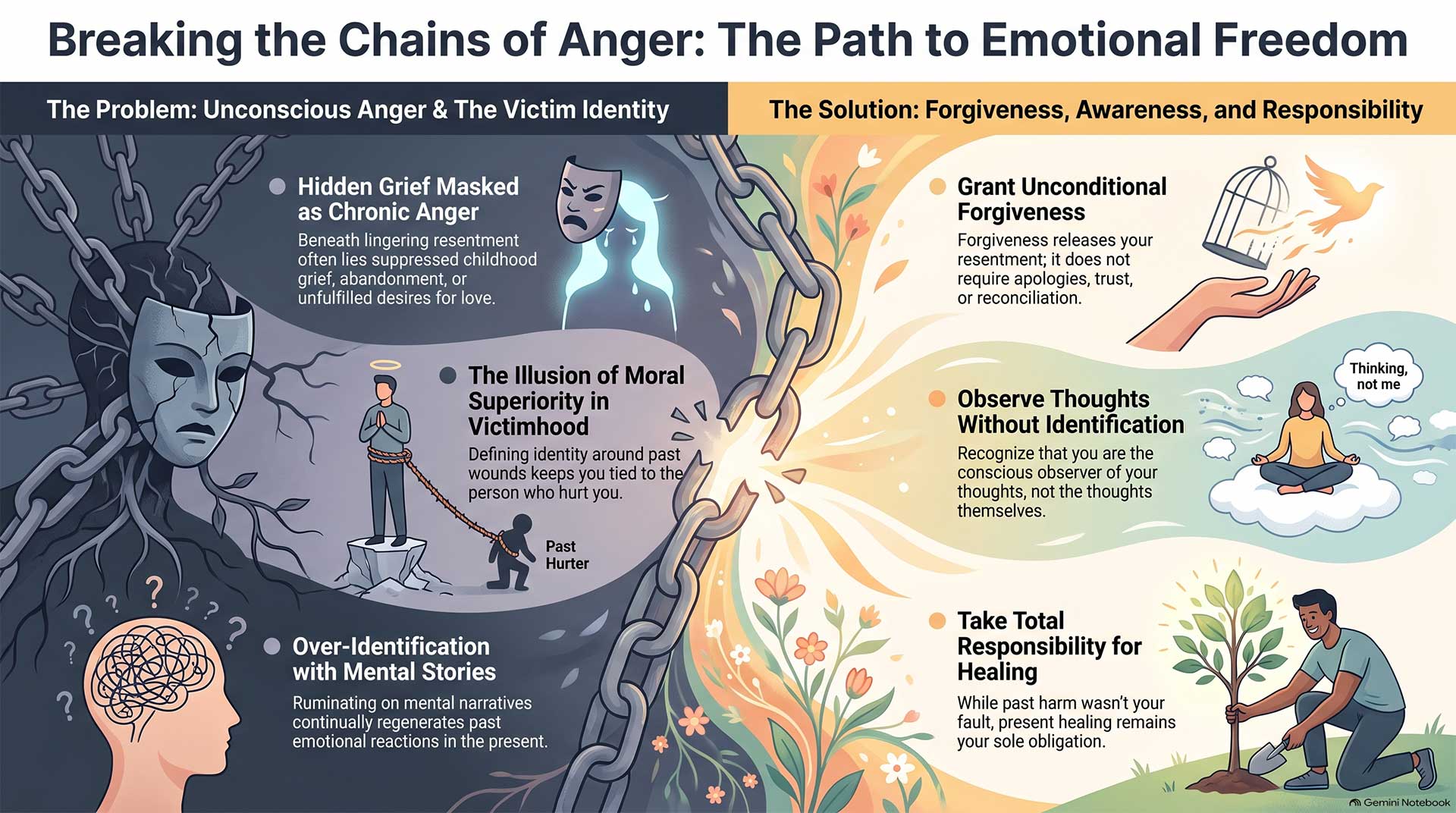
Perhaps the most important object in these conversations was never a book.
It was an empty chair.
At different moments, someone different seemed to be sitting there.
A mother who never understood the damage she caused.
A father who promised to come Saturday and never arrived.
Someone who betrayed us.
Someone who discriminated against us.
Someone who never apologized.
Eventually, we discovered someone else sitting there: the younger version of ourselves who kept waiting for the past to become different.
The guests disagreed about anger. Gabor Maté reminded us that anger can protect a violated boundary. Brené Brown asked what grief, shame, fear, or abandonment might exist underneath it. Jesse Lee Peterson kept returning to his central warning: whatever its origin, anger becomes dangerous when we allow it to rule us.
Nedra Glover Tawwab helped separate forgiveness from access. You can forgive someone and still close the door. Desmond Tutu separated forgiveness from forgetting and justice from revenge. Richard Reeves and John Delony reminded us that an absent father does not have to determine a child's future. Sometimes the abandoned boy grows up and becomes the father who shows up.
Anthony de Mello and Eckhart Tolle took the conversation somewhere quieter. A thought appears. Another follows. Anger rises. A story forms. Yet if we can observe the thought, perhaps we are something more than the thought.
Then Edith Eger brought us to the hardest distinction.
A human being can truly be victimized without surrendering the rest of life to victimhood.
That may be where Peterson's antidote becomes most meaningful.
Freedom does not require pretending the wound never happened.
It does not require calling injustice acceptable.
It does not require allowing harmful people back into our lives.
It may begin with something much smaller.
We stop waiting.
Waiting for Dad to come back.
Waiting for Mom to understand.
Waiting for the apology.
Waiting for someone else to repair yesterday before we permit ourselves to live tomorrow.
At the end of our conversation, the empty chair was finally carried out of the room.
Nothing about the past changed.
But something about the people looking at it had.
And Edith Eger left us with the thought that perhaps best captures where these five conversations have taken us:
There is still life left.
The question now is what we choose to do with it.
Short Bios:
Jesse Lee Peterson
American Christian minister, author, broadcaster, and founder of BOND (Brotherhood Organization of a New Destiny). In The Antidote, Peterson argues that anger, resentment, blame, and victimhood can separate people from peace, responsibility, healthy relationships, and God. His own experience of recognizing resentment toward his mother and forgiving his parents forms an important foundation for his message.
Gabor Maté
Hungarian-Canadian physician and bestselling author known for his work on trauma, addiction, childhood development, and emotional health. His books include The Myth of Normal and In the Realm of Hungry Ghosts. Maté's perspective complicates Peterson's view of anger by exploring how anger can arise as a protective response to violated boundaries and unresolved childhood pain.
Brené Brown
Researcher and bestselling author whose work focuses on vulnerability, shame, courage, empathy, and human connection. Her books include Daring Greatly, Braving the Wilderness, and Atlas of the Heart. In this conversation, Brown helps distinguish anger from emotions that may lie beneath it, including grief, shame, fear, humiliation, and abandonment.
Nedra Glover Tawwab
Therapist and bestselling author known for her work on boundaries and difficult family relationships. Her books include Set Boundaries, Find Peace and Drama Free. Tawwab brings an important distinction to the discussion: forgiving someone does not necessarily mean restoring their previous access to your life.
Desmond Tutu
South African Anglican archbishop, Nobel Peace Prize laureate, and a major voice in South Africa's struggle against apartheid. Tutu later chaired the Truth and Reconciliation Commission. His work on forgiveness stresses truth-telling, acknowledging harm, releasing resentment, and recognizing that forgiveness does not always require reconciliation.
Richard Reeves
Author, researcher, and founding president of the American Institute for Boys and Men. His bestselling book Of Boys and Men examines challenges facing boys and men in education, employment, family life, and society. Reeves brings a research-centered perspective to the conversation about fatherhood and the role responsible men can play in children's lives.
John Delony
Bestselling author and mental health educator whose work focuses on relationships, anxiety, family life, and personal responsibility. His books include Building a Non-Anxious Life. In the fatherhood conversation, Delony explores how men who lacked healthy fathers can still learn to build stable relationships and become present fathers themselves.
Anthony de Mello
Indian Jesuit priest, spiritual teacher, psychotherapist, and author of Awareness. De Mello taught that much human suffering comes from unconscious attachments, expectations, and identification with our mental stories. His emphasis on simply observing what is happening within us creates a striking connection with Peterson's teachings on watching thoughts.
Eckhart Tolle
Spiritual teacher and bestselling author of The Power of Now and A New Earth. Tolle's work centers on present-moment awareness and freedom from excessive identification with thought. His contribution asks a deceptively simple question: if you can observe a thought appearing in your mind, can that thought truly be the whole of who you are?
Edith Eger
Psychologist, Auschwitz survivor, and bestselling author of The Choice and The Gift. Eger's life and work offer a profound distinction between being victimized and building one's permanent identity around victimhood. Her perspective allows the conversation to acknowledge real suffering without surrendering the possibility of freedom.
Leave a Reply