
Introduction
Nietzsche: One Last Evening in Turin
What would you ask Friedrich Nietzsche if you could spend one evening with him—just weeks before his life changed forever?
Turin, Italy. December 1888.
A forty-four-year-old man sits in a modest apartment surrounded by manuscripts. His enormous mustache is unmistakable. His eyes have troubled him for years. His health has repeatedly interrupted his work. Yet he is experiencing one of the most astonishing creative periods of his life.
His name is Friedrich Nietzsche.
Today, millions recognize his provocative declaration that God is dead. Others associate him with the Übermensch, the will to power, and his challenge to conventional morality.
But how many know the man behind those ideas?
What made him laugh? What did he eat for breakfast? Who broke his heart? Did he ever miss the religious faith of his childhood? And when his headaches became unbearable, did the philosophy he taught others actually help him?
These are the questions Nick Sasaki brings to Turin.
He has not come to debate Nietzsche, convert him, or prove that the philosopher was wrong. He has come to listen.
The historical Nietzsche was born into a religious household, became a professor at twenty-four, developed a close relationship with Richard Wagner, and eventually resigned from teaching because of serious health problems. His remarkable intellectual journey is documented in the Stanford Encyclopedia of Philosophy. His original writings and correspondence can also be examined through the Nietzsche Source critical edition.
But historical records leave another kind of question unanswered.
What would Nietzsche be like across a dinner table?
Would he enjoy a joke about his mustache? Would he speak warmly about someone he once loved? Could he admit that being alone sometimes hurt?
As the evening unfolds, Nick and Nietzsche walk through Turin, share coffee, revisit old friendships, and discuss the beliefs that once shaped Nietzsche's childhood.
Gradually, the conversation becomes more personal.
Because beneath his fierce intellectual independence stands a man who has known disappointment, physical suffering, loneliness, and extraordinary creative joy.
And as the night deepens, Nick approaches a question that may be more difficult than any philosophical argument.
A question about Nietzsche's own life.
If he could live it all again, would he want to?
For one evening, the famous philosopher becomes something more immediate: a human being worth getting to know.
Disclaimer: This article presents an imaginary conversation between Nick Sasaki and Friedrich Nietzsche. Although it draws on documented biography and philosophical writings, all dialogue is fictional. It does not represent Nietzsche's authenticated words, private feelings, or endorsement of the author's beliefs.
Topic 1: The Man Behind the Mustache
Nietzsche: One Last Evening in Turin | December 1888
An imaginary conversation between Friedrich Nietzsche and Nick Sasaki
Historical fiction: The meeting and dialogue are invented. Nietzsche's residence in Turin, his writings, and his philosophical positions are based on his documented life.
The unexpected visitor
Turin, Italy. December 1888.
The first thing I noticed was the handwriting.
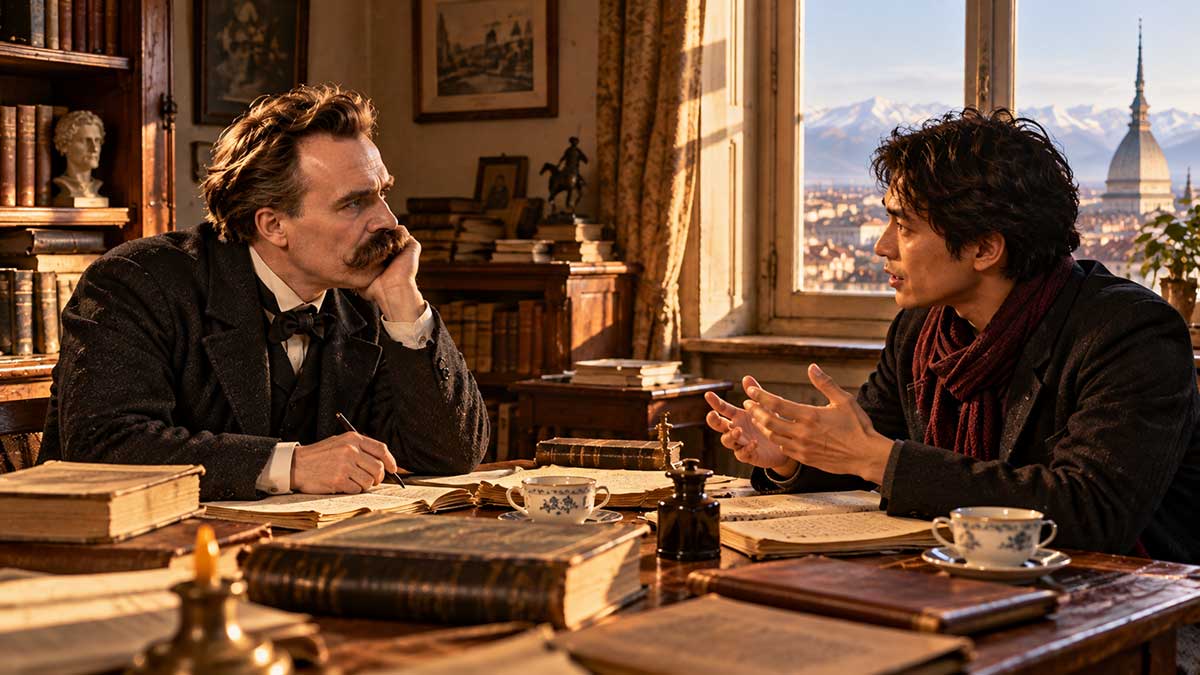
Pages covered a small wooden desk. Some were neatly arranged; others appeared to have been moved around so many times that only their owner could possibly know the system.
Beyond the window, the late afternoon sun illuminated the buildings along Via Carlo Alberto. Somewhere below, carriage wheels rattled over the street.
And standing beside the desk was Friedrich Nietzsche.
He was smaller than I had imagined.
His enormous mustache, however, was exactly as advertised.
He looked at me for several seconds.
Nietzsche: "You said you came from the future?"
Nick: "Yes. The year 2026."
Nietzsche: "And you came all this way to see me?"
Nick: "That's right."
He glanced at the papers on his desk.
Nietzsche: "You might have written first."
I laughed.
He didn't.
Then, a moment later, the corner of his mouth moved.
I realized he was teasing me.
Nick: "Sorry. I didn't know your mailing address until I arrived."
Nietzsche: "Well, now you do."
He indicated a chair.
Nietzsche: "Sit down. I am curious about something."
I sat.
Nietzsche: "In your century, do people still write letters?"
Nick: "Not very often. Mostly emails and messages."
Nietzsche: "Messages?"
Nick: "Short things. You type something and another person receives it almost immediately."
Nietzsche: "Anywhere?"
Nick: "Pretty much anywhere."
He considered that.
Nietzsche: "How unfortunate."
Nick: "Why?"
Nietzsche: "Now people will expect an answer immediately."
I laughed again.
Nick: "You have no idea."
This time he laughed with me.
It was a small laugh, but something about the room changed.
He settled into his chair, apparently deciding that I was worth a few minutes of his afternoon.
Question 1: What does Nietzsche do when he isn't being Nietzsche?
Nick: "Can I ask you something ordinary?"
Nietzsche: "Please do. People are always asking me extraordinary things."
Nick: "What do you actually do all day?"
He looked genuinely pleased by the question.
Nietzsche: "I walk. I write. I read. Sometimes I listen to music. I correspond with friends when I have something to say."
Nick: "And that's pretty much it?"
Nietzsche: "What else should I be doing?"
Nick: "I don't know. Going to parties? Meeting people? Having fun?"
He looked toward the window.
Nietzsche: "I find Turin very enjoyable."
Nick: "The city?"
Nietzsche: "Yes. Have you seen the arcades? The squares? There is a certain order to the architecture here. Everything seems to have room to breathe."
Nick: "So you're happy here?"
He paused.
Nietzsche: "I am very pleased to be here."
It wasn't quite the same answer.
I decided not to push.
Nick: "Do you have a favorite place?"
Nietzsche: "Several. I enjoy walking through the city. The cafés are pleasant. And the climate agrees with me more than many places I have lived."
Nick: "You move around a lot?"
Nietzsche: "I have had to. My health is not always cooperative."
Nick: "What kind of problems?"
Nietzsche: "Headaches. My eyes. My stomach. There have been times when simply getting through a day required considerable effort."
Nick: "That sounds difficult."
Nietzsche: "It can be."
He said it without asking for sympathy.
Then he looked at me.
Nietzsche: "But tell me about yourself. What do you do?"
Nick: "I write too."
Nietzsche: "Ah. What do you write?"
Nick: "Imaginary conversations."
Nietzsche: "With whom?"
Nick: "People from history. Philosophers, scientists, religious figures, writers. Sometimes people who lived thousands of years ago."
Nietzsche: "And what do you discuss?"
Nick: "Life. God. Love. Politics. Human nature. Sometimes the future."
He nodded.
Nietzsche: "Do they agree with you?"
I smiled.
Nick: "Not always."
Nietzsche: "Good."
Nick: "Why good?"
Nietzsche: "A conversation in which everyone agrees sounds terribly dull."
Nick: "I agree."
He raised an eyebrow.
I caught myself.
Nick: "Okay, that was unfortunate."
He smiled.
For a moment, we were simply two writers enjoying the same small absurdity.
I looked again at the papers on his desk.
Nick: "Are those books you're working on?"
Nietzsche: "Some of them. I have been unusually productive."
Nick: "I can see that."
Nietzsche: "I have recently completed several works. I am trying to bring certain matters into focus."
Nick: "Do you write every day?"
Nietzsche: "When I can."
Nick: "Do you ever sit down and nothing comes?"
Nietzsche: "Of course."
Nick: "What do you do?"
Nietzsche: "Walk."
Nick: "And then the ideas come?"
Nietzsche: "Sometimes."
Nick: "And when they don't?"
Nietzsche: "I have still taken a walk."
I liked that answer.
It sounded like something I might tell myself on a day when writing wasn't going particularly well.
Nick: "I spend a lot of time at my computer."
Nietzsche: "Your what?"
Nick: "It's a machine for writing, among other things."
Nietzsche: "Does it improve the writing?"
Nick: "Not necessarily."
Nietzsche: "Then I shall keep my pen."
We both smiled.
He asked me how my imaginary conversations worked.
I explained that I researched the people, studied their ideas, and then tried to imagine what they might say if they could sit across from someone living in the modern world.
Nietzsche: "You must be careful."
Nick: "About what?"
Nietzsche: "You might make them say what you wish they had said."
That caught me.
Nick: "Yes. That's a real danger."
Nietzsche: "Especially with people you admire."
Nick: "You're right. Sometimes it's tempting to make everyone reach a beautiful conclusion."
Nietzsche: "Even when the person would have rejected it?"
Nick: "Exactly."
He leaned back.
Nietzsche: "Then perhaps the most interesting conversations are the ones that do not end beautifully."
I thought about that.
Nick: "Maybe. But I still want people to feel hopeful afterward."
Nietzsche: "Hopeful about what?"
Nick: "About life. About other people. About the possibility that we can understand each other better."
He considered my answer.
Nietzsche: "Understanding is a worthy ambition. But it is not always comforting."
Nick: "I know."
Nietzsche: "Do you?"
He asked it gently, but I could tell he was serious.
Nick: "I suppose we'll find out."
He nodded.
Nietzsche: "Yes. Perhaps we will."
Question 2: What does Nietzsche really think about Socrates?
I noticed a copy of a classical text among the books.
It reminded me of something.
Nick: "You know, I just finished a conversation with Socrates."
Nietzsche looked up immediately.
Nietzsche: "Socrates?"
Nick: "Yes."
Nietzsche: "The Athenian?"
Nick: "That's the one."
He studied my face, trying to decide whether I was serious.
Nietzsche: "And how was he?"
Nick: "Funny, actually."
Nietzsche smiled.
Nietzsche: "I can believe that."
Nick: "You can?"
Nietzsche: "Certainly. One does not spend a lifetime making powerful men look foolish without some enjoyment of the activity."
I laughed.
Nick: "He was quite good at it."
Nietzsche: "I imagine he was."
Nick: "But I liked him. A lot."
Nietzsche: "That doesn't surprise me either."
Nick: "Really? I thought you didn't like Socrates."
Nietzsche shifted in his chair.
Nietzsche: "My objections to Socrates are philosophical. That is not the same as saying I could never enjoy his company."
Nick: "What bothered you about him?"
Nietzsche: "He made reason into something like a remedy for existence. As though life itself were a problem to be corrected by argument."
Nick: "But isn't reasoning important?"
Nietzsche: "Of course. I am using reason to speak with you now."
Nick: "So what's the problem?"
Nietzsche: "The problem begins when we imagine that everything valuable in life must justify itself before a tribunal of reason."
Nick: "Can you give me an example?"
He looked out the window.
Nietzsche: "Music."
Nick: "Music?"
Nietzsche: "When you hear something beautiful, do you first demand an argument proving that it deserves to move you?"
Nick: "No."
Nietzsche: "You experience it. Your body responds before you have found the words."
Nick: "Sure."
Nietzsche: "And yet some philosophers behave as though the highest form of life is one in which every impulse must submit to rational examination."
Nick: "Was Socrates really like that?"
Nietzsche: "That is how I understand the tendency he represents. But perhaps your friend would object."
Nick: "He definitely would."
Nietzsche smiled.
Nietzsche: "Good. Then I have not misjudged his capacity for argument."
I thought about my conversation in the Athenian prison.
Nick: "You know what surprised me most about him?"
Nietzsche: "Tell me."
Nick: "His family."
Nietzsche looked interested.
Nick: "He had a wife and children. And there he was, waiting to be executed. I couldn't stop thinking about what would happen to them."
Nietzsche: "You asked him?"
Nick: "Yes."
Nietzsche: "And?"
Nick: "He believed escaping would mean betraying his principles."
Nietzsche's expression became more serious.
Nietzsche: "A remarkable decision."
Nick: "Do you think he was right?"
He didn't answer immediately.
Nietzsche: "I would want to know what kind of life he believed he was preserving by refusing to escape."
Nick: "What do you mean?"
Nietzsche: "Was he defending his integrity? His pride? His understanding of justice? Those are not always the same thing."
Nick: "He believed doing wrong would damage his soul."
Nietzsche: "Yes. That is very Socratic."
Nick: "But his children were going to lose their father."
Nietzsche nodded.
Nietzsche: "And that is a serious objection."
I was surprised.
Nick: "I thought you'd say he was foolish."
Nietzsche: "Why?"
Nick: "Because you criticize him so much."
Nietzsche: "Criticism is not the same as dismissal."
He paused.
Nietzsche: "A person can be extraordinary and still be mistaken about something important."
Nick: "That's fair."
Nietzsche: "And a person can make a decision we would never make, yet force us to examine our own convictions."
I thought of Socrates sitting calmly in his prison cell.
Nick: "That's exactly what happened to me."
Nietzsche looked at me.
Nietzsche: "Then your conversation was worthwhile."
For a moment, neither of us spoke.
Then he asked something I hadn't expected.
Nietzsche: "Did you tell Socrates what became of him?"
Nick: "A little."
Nietzsche: "Did he care?"
Nick: "He seemed more interested in whether people were still asking questions."
Nietzsche smiled faintly.
Nietzsche: "That sounds plausible."
Nick: "He also asked about Jesus."
Nietzsche looked at me with renewed interest.
Nietzsche: "Did he?"
Nick: "Yes. But that's a longer story."
Nietzsche: "I suspect we shall come to it."
Nick: "Probably."
He looked toward the street.
Nietzsche: "I would be interested to hear what Socrates made of your century."
Nick: "He had a few concerns."
Nietzsche: "Only a few?"
We both laughed.
Question 3: What does Nietzsche make of Nick's life?
Nietzsche rose to open the window slightly.
Cool air entered the room.
He returned to his chair.
Nietzsche: "Now I have a question for you."
Nick: "Go ahead."
Nietzsche: "Why do you do this?"
Nick: "Visit people from history?"
Nietzsche: "Yes. You could simply read their books."
Nick: "I do read them."
Nietzsche: "Then why imagine conversations?"
I thought about how to explain it.
Nick: "Because sometimes reading someone's ideas isn't enough for me. I want to know what kind of person they were."
Nietzsche: "You mean their character?"
Nick: "Yes. Their ordinary life. What made them laugh. What hurt them. What they were afraid of."
Nietzsche: "And you believe you can discover those things through imagination?"
Nick: "Not discover them as historical facts. But maybe I can ask questions that help people think about them."
Nietzsche nodded slowly.
Nietzsche: "That distinction matters."
Nick: "I agree."
Nietzsche: "There you go again."
I laughed.
Nick: "Sorry."
He smiled.
Nietzsche: "Tell me about your life. Where are you from?"
Nick: "Japan originally. I've lived in the United States for a long time."
Nietzsche: "Japan."
He repeated the word with interest.
Nietzsche: "I know far less about your country than I would like."
Nick: "It's changed quite a bit by my time."
Nietzsche: "And America?"
Nick: "That's changed too."
Nietzsche: "Which country feels like home?"
I hesitated.
Nick: "Both, in different ways."
Nietzsche: "That sounds complicated."
Nick: "Sometimes it is. I spent my early life in Japan, and much of my adult life in America."
Nietzsche: "Do you think differently in each language?"
I smiled.
Nick: "Actually, yes."
Nietzsche: "How?"
Nick: "Japanese can make me more aware of relationships, context, and how something affects the person listening. English sometimes makes it easier for me to say exactly what I think."
Nietzsche: "Interesting."
Nick: "Although I can be pretty direct in Japanese too."
Nietzsche: "I'm relieved to hear it."
I laughed.
Nietzsche: "Perhaps living between cultures allows you to see assumptions that people within a single culture never question."
Nick: "I think so."
Nietzsche: "It may also make belonging more difficult."
Nick: "Sometimes."
He nodded, without pressing further.
Then he asked:
Nietzsche: "Are you married?"
Nick: "I have a family. Five children."
He turned toward me.
Nietzsche: "Five?"
Nick: "Five."
Nietzsche: "And you still have time to write?"
Nick: "Somehow."
He laughed.
It was the most spontaneous laugh I'd heard from him.
Nietzsche: "That is impressive."
Nick: "Sometimes I wonder how I managed it."
Nietzsche: "Are they all still young?"
Nick: "No. They're at different stages of life now."
Nietzsche: "Do they resemble you?"
Nick: "In some ways. But each one is very different."
Nietzsche: "And what do you do when one of them disagrees with you?"
I laughed.
Nick: "Depends on the disagreement."
Nietzsche: "Ah."
Nick: "Sometimes I explain my reasoning. Sometimes I listen. Sometimes I realize they're right."
Nietzsche: "That last one must be difficult."
Nick: "You have no idea."
He smiled.
Nietzsche: "Perhaps children are useful for philosophers."
Nick: "How so?"
Nietzsche: "They provide daily opportunities to discover that one's theories are incomplete."
I laughed.
Nick: "That's absolutely true."
Nietzsche: "What is the most important thing they have taught you?"
That question stopped me.
I thought for a while.
Nick: "That loving someone doesn't mean you can control what happens to them."
Nietzsche watched me carefully.
Nick: "When they're little, you want to protect them from everything. But as they grow, you realize they have to make their own choices. Sometimes mistakes."
Nietzsche: "And you must allow it?"
Nick: "You have to, eventually."
Nietzsche: "Even when you believe you know better?"
Nick: "That's the hard part."
He nodded.
Nietzsche: "Yes. I imagine it is."
Nick: "But love also means being there when they need you."
Nietzsche: "Even when their troubles are of their own making?"
Nick: "Especially then, sometimes."
He considered that.
Nietzsche: "You make an interesting distinction."
Nick: "Between what?"
Nietzsche: "Helping someone live and living their life for them."
Nick: "Exactly."
Nietzsche: "I would agree that those are very different things."
He paused.
Nietzsche: "But I suspect we might disagree about when help becomes an obstacle."
Nick: "Probably."
Nietzsche: "Good."
We smiled.
I began to understand something about him.
Nietzsche wasn't looking for someone who would approve of everything he said.
He seemed more interested in finding out whether I had thought seriously about what I believed.
And I was beginning to enjoy that.
Nietzsche: "You said you want your imaginary conversations to help people."
Nick: "Yes."
Nietzsche: "How?"
Nick: "I want people to become more curious. More understanding. Maybe a little kinder."
Nietzsche: "Kinder?"
Nick: "Yes."
Nietzsche: "That word can mean many things."
Nick: "What do you mean?"
Nietzsche: "Sometimes kindness is generosity. Sometimes it is fear of disagreement. Sometimes it is an unwillingness to tell someone an unpleasant truth."
Nick: "That's fair."
Nietzsche: "You say that often."
Nick: "I do?"
Nietzsche: "Yes."
I laughed.
Nick: "My children would probably tell you I don't say it often enough."
Nietzsche smiled.
Nietzsche: "Then perhaps I should meet them."
Nick: "You might enjoy that."
Nietzsche: "Would they ask me questions?"
Nick: "Oh, definitely."
Nietzsche: "Then I would have to prepare."
We laughed together.
For the first time, I stopped thinking of him as Friedrich Nietzsche, the famous philosopher.
He was simply Friedrich, sitting across from me, curious about the strange visitor who had appeared in his room.
And I had the feeling he was beginning to see me in much the same way.
Closing: Shall we take a walk?
The light outside had softened.
Nietzsche glanced toward the window again.
Nietzsche: "Do you enjoy walking?"
Nick: "Very much."
Nietzsche: "Good. I've been indoors long enough."
He stood and gathered a few pages from the desk.
Nick: "Are you working on something important?"
He looked at the manuscripts.
Nietzsche: "I believe so."
Nick: "Do you think people will understand it?"
He gave a small shrug.
Nietzsche: "Some will. Others will misunderstand it. That is what happens when one writes."
Nick: "Does that bother you?"
Nietzsche: "More than I would like."
It was an unexpectedly candid answer.
He placed the pages down.
Nietzsche: "Come. I want to show you Turin."
I followed him toward the door.
As we stepped into the hallway, I asked one more question.
Nick: "Friedrich, can I ask you something?"
Nietzsche: "Of course."
Nick: "Do you ever get lonely?"
He stopped.
For a moment, I wondered whether I had asked too much.
Then he looked at me.
Nietzsche: "Sometimes."
He didn't elaborate.
And I didn't ask him to.
We walked downstairs together.
Outside, the streets of Turin were beginning to glow beneath the evening lamps.
He pointed toward the arcades.
Nietzsche: "This way."
And we began to walk.
Historical and creative note: Nietzsche lived in Turin in late 1888, wrote extensively during this period, valued walking, and held complex views about Socrates. The dialogue, Nick's visit, Nietzsche's responses to modern life, and the developing friendship are fictional. His personal memories and emotional reactions in this story should not be mistaken for documented statements.
Topic 2: The People We Love and Lose
Nietzsche: One Last Evening in Turin | December 1888
An imaginary conversation between Friedrich Nietzsche and Nick Sasaki
Historical fiction: This conversation is invented. Nietzsche's family history, relationships with Richard Wagner, Paul Rée, and Lou Andreas-Salomé, and his affection for Turin provide the historical foundation.
Opening: A walk without an agenda
The air outside was cool, but not unpleasant.
Nietzsche walked at a comfortable pace, his hands tucked behind his back. Every so often, he glanced at a building or paused to admire something about the street.
He seemed different outdoors.
In his apartment, he had been careful with his words, almost as though he were examining each one before allowing it to escape.
Here, he appeared more relaxed.
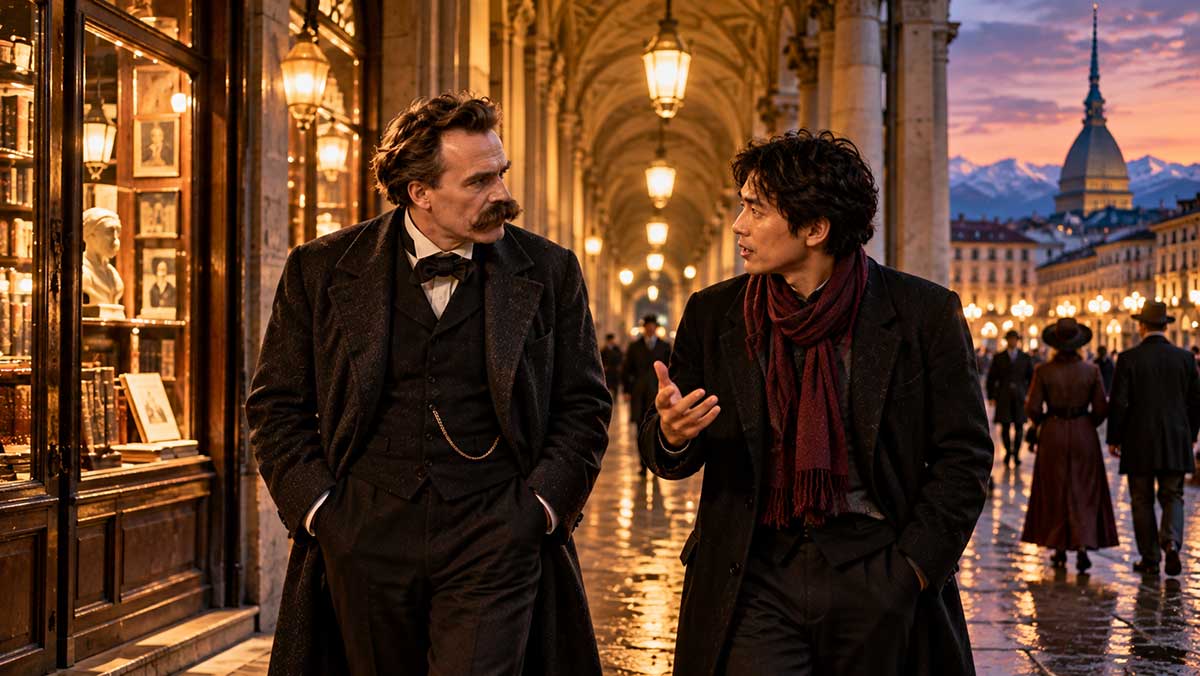
We walked beneath the arcades of Via Po, where shop windows glowed in the fading light. A few people hurried past us. Others stood talking near the entrances of cafés.
Nick: "You really like this city, don't you?"
Nietzsche: "Very much."
Nick: "What makes it special?"
Nietzsche: "The proportions. The elegance. The way the streets invite you to walk."
He gestured toward the buildings.
Nietzsche: "Some cities exhaust you before you have done anything. Turin gives me room to think."
Nick: "You sound like a travel guide."
He smiled.
Nietzsche: "Would you prefer I criticize it?"
Nick: "No, no. I'm enjoying the tour."
We continued walking.
Nick: "Have you always liked walking?"
Nietzsche: "Since I was young. It helps me think. Sometimes I can work through an idea more easily while walking than while sitting at a desk."
Nick: "I do that too."
Nietzsche: "Then you understand."
Nick: "Although sometimes I forget what I was thinking about by the time I get home."
Nietzsche laughed softly.
Nietzsche: "Then perhaps you should carry a notebook."
Nick: "I do. I just forget to bring it."
He shook his head, smiling.
For several minutes, we walked without speaking.
It was comfortable.
Then a family passed us: a father carrying a small child, with two older children following their mother.
The youngest was complaining about something. The father tried to distract him by pointing toward a shop window.
Nietzsche watched them for a moment.
Nietzsche: "You said you have five children."
Nick: "That's right."
Nietzsche: "Were they like that?"
Nick: "Oh, absolutely. Sometimes worse."
He smiled.
Nietzsche: "And you survived."
Nick: "Barely."
We both laughed.
Then I noticed his expression change slightly.
He was still looking toward the family.
Nick: "Did you grow up in a big family?"
Nietzsche: "Not exactly."
And that was how the conversation began.
Question 1: What did Nietzsche's childhood teach him about love?
Nietzsche: "My father was a pastor. We lived in a small village called Röcken."
Nick: "Was he strict?"
Nietzsche: "I was very young when he died. Too young to know him as an adult might know his father."
Nick: "How old were you?"
Nietzsche: "Four."
Nick: "That's very young."
Nietzsche: "Yes."
We walked a little farther.
Nick: "Do you remember him?"
Nietzsche: "Some things. His presence. The atmosphere of our home. But memory from that age is a curious thing. One can no longer be certain which images belong to experience and which have been preserved through stories."
Nick: "That's true. Sometimes my children remember things differently from how I remember them."
Nietzsche: "Of course. Every family contains several versions of its own history."
I smiled.
Nick: "That's a good way to put it."
Nietzsche: "And each version has its defenders."
I laughed.
Nick: "Especially when you have five children."
He smiled.
We passed a shop where a woman was arranging items in the window.
Nick: "What happened after your father died?"
Nietzsche: "We moved to Naumburg. My mother, my sister, and I lived among relatives."
Nick: "Your mother raised you?"
Nietzsche: "Yes. My mother, my grandmother, and my aunts were important presences in my childhood."
Nick: "That must have been quite a household."
Nietzsche: "It was."
Nick: "Were you close to your mother?"
He considered the question.
Nietzsche: "Our relationship has been complicated."
Nick: "Because of your ideas?"
Nietzsche: "Among other things. She has her convictions. I have mine."
Nick: "Religious convictions?"
Nietzsche: "Yes."
Nick: "Was she disappointed when you stopped believing?"
Nietzsche glanced at me.
Nietzsche: "I suspect she would have preferred a different path for me."
Nick: "That's understandable."
Nietzsche: "Is it?"
Nick: "From a parent's perspective, yes. You raise a child with certain beliefs and hopes. Then the child grows up and sees the world differently."
Nietzsche: "And what should the parent do?"
Nick: "That's a difficult question."
Nietzsche: "You have five opportunities to answer it."
I laughed.
Nick: "And I've probably gotten it wrong more than five times."
Nietzsche smiled.
Nick: "I think a parent has to learn that children don't belong to them."
He turned toward me.
Nietzsche: "Go on."
Nick: "You raise them, teach them, try to give them good values. But eventually they have to decide what they believe."
Nietzsche: "Even if they reject everything you taught them?"
Nick: "Even then."
Nietzsche: "And you would not feel disappointed?"
Nick: "Of course I might. I'm human."
Nietzsche: "Then perhaps the challenge is not avoiding disappointment, but refusing to make your disappointment into a chain around another person's life."
I thought about that.
Nick: "Yes. I think that's right."
He nodded.
We walked for a while.
Nick: "Did losing your father change how you thought about God?"
Nietzsche was quiet.
Nietzsche: "It would be too simple to explain my philosophy through the death of my father."
Nick: "I didn't mean it that way."
Nietzsche: "I know."
He looked toward the street.
Nietzsche: "My questions about Christianity developed over many years. Through study, experience, and reflection. They cannot be reduced to one childhood event."
Nick: "That makes sense."
Nietzsche: "But childhood does shape us. Often in ways we do not recognize until much later."
Nick: "Do you ever wish you could speak with your father now?"
He took a moment before answering.
Nietzsche: "I would be curious what he would make of the man I became."
Nick: "What do you think he'd say?"
Nietzsche: "I imagine he would have several questions."
Nick: "Like Socrates?"
Nietzsche smiled.
Nietzsche: "Let us hope not quite so many."
I laughed.
Nietzsche: "But I would like to ask him questions too."
Nick: "Such as?"
Nietzsche: "What he believed. Why he believed it. Whether he ever doubted."
He paused.
Nietzsche: "I would want to know him as a man, not only as my father."
That stayed with me.
I thought about how often children know their parents only through the role they play in the family.
And how rarely we ask what they were like before we were born.
Question 2: What happens when friendship becomes disappointment?
As we continued beneath the arcades, we heard music drifting from somewhere ahead.
It sounded like someone practicing a melody on a piano.
Nietzsche slowed slightly.
Nick: "You like music?"
Nietzsche: "Very much."
Nick: "What kind?"
Nietzsche: "Many kinds. Music has been important to me since childhood."
Nick: "Do you play?"
Nietzsche: "The piano. I have also composed."
Nick: "Really? I didn't know that."
Nietzsche: "Most people know me through my books."
Nick: "Are you a good composer?"
He smiled.
Nietzsche: "That depends on whom you ask."
Nick: "I'm asking you."
Nietzsche: "Then you are asking someone whose judgment may not be entirely impartial."
I laughed.
Nick: "Fair enough."
We listened for a moment.
Nick: "What about Wagner? I know you were close to him."
Nietzsche's expression changed.
Not dramatically.
But the warmth of the previous conversation became more restrained.
Nietzsche: "Yes. For a time."
Nick: "What was he like?"
Nietzsche: "Extraordinary. Difficult. Charismatic. He possessed a remarkable ability to make others feel that they were participating in something of enormous importance."
Nick: "Sounds like quite a personality."
Nietzsche: "He was."
Nick: "Did you admire him?"
Nietzsche: "Very much."
Nick: "And then something happened."
Nietzsche: "Many things happened."
He looked ahead.
Nietzsche: "When I was younger, I believed Wagner represented a renewal of culture. I saw in his music something powerful, something capable of transforming the spirit of an age."
Nick: "What changed?"
Nietzsche: "My understanding of his art. My understanding of him. Perhaps my understanding of myself."
Nick: "Was there one big argument?"
Nietzsche: "People often want a single dramatic moment. Life rarely provides one."
I nodded.
Nietzsche: "Sometimes a friendship ends through a series of small discoveries. You begin to notice things you once overlooked."
Nick: "And then one day you realize you're not close anymore."
Nietzsche: "Yes."
Nick: "That can hurt."
He looked at me.
Nietzsche: "Of course."
We continued walking.
Nick: "Do you miss him?"
Nietzsche did not answer immediately.
Nietzsche: "I miss what that friendship once meant."
I thought about the distinction.
Nick: "That's different from missing the person."
Nietzsche: "Sometimes."
Nick: "Have you ever wanted to repair it?"
Nietzsche: "I have considered many things. But one cannot restore a friendship simply by pretending the reasons for its ending were unimportant."
Nick: "That's true."
Nietzsche: "And sometimes the person you once admired no longer exists in the form you remember."
Nick: "Or maybe you changed."
He glanced at me.
Nietzsche: "Yes. That too."
I was glad he acknowledged it.
Nick: "I've had relationships where I thought the other person had changed. Later I realized I had changed too."
Nietzsche: "That is often the more difficult discovery."
We reached a small square.
People were crossing in different directions, some carrying parcels, others talking quietly.
Nick: "Can I ask you about Lou Andreas-Salomé?"
He looked at me.
Nietzsche: "You know of her?"
Nick: "Yes."
Nietzsche: "Then I suppose your future has preserved more of my private life than I might have wished."
Nick: "A little."
He smiled faintly.
Nietzsche: "What would you like to know?"
Nick: "What attracted you to her?"
Nietzsche: "Her intelligence. Her independence. Her willingness to think for herself."
Nick: "Did you fall in love with her?"
He took a breath.
Nietzsche: "My feelings were complicated."
Nick: "That's usually what people say when the answer is yes."
He looked at me.
For a moment, I thought I had gone too far.
Then he laughed.
Nietzsche: "You are becoming rather bold."
Nick: "Sorry."
Nietzsche: "No. It is an understandable question."
We walked a little farther.
Nietzsche: "I hoped for a particular kind of intellectual companionship. Things did not develop as I had hoped."
Nick: "Was it painful?"
Nietzsche: "Yes."
He said it simply.
I didn't ask for details immediately.
Nick: "Sometimes it's hard when you see a future with someone and they don't see the same future."
Nietzsche: "Precisely."
Nick: "And you can't argue them into loving you."
Nietzsche smiled slightly.
Nietzsche: "No. That would be a particularly unfortunate use of philosophy."
I laughed.
Nick: "Although I imagine some philosophers have tried."
Nietzsche: "I am certain of it."
We both smiled.
Then Nietzsche became thoughtful again.
Nietzsche: "There is something important about affection. If you truly admire another person's independence, you must accept that their independence may lead them away from you."
I looked at him.
Nick: "That's a difficult lesson."
Nietzsche: "Yes."
Nick: "Especially when you care about someone."
Nietzsche: "Especially then."
I thought of my children again.
How much of parenting involved learning to let go.
And how much of love involved respecting choices we would never have made ourselves.
Question 3: Can a person be independent without becoming lonely?
We had been walking for quite some time.
The evening lamps were beginning to glow beneath the arcades.
I noticed that Nietzsche seemed content to keep moving.
Nick: "Do you spend most of your time alone?"
Nietzsche: "These days, a great deal of it."
Nick: "Do you enjoy that?"
Nietzsche: "Often."
Nick: "And the rest of the time?"
He smiled.
Nietzsche: "You are persistent."
Nick: "I've been told."
Nietzsche: "Solitude has its advantages. One can think without interruption. One can work without having to accommodate the expectations of others."
Nick: "That sounds nice."
Nietzsche: "It is."
Nick: "For about two days."
He laughed.
Nietzsche: "Perhaps for you."
Nick: "I'm used to a busy household."
Nietzsche: "I imagine silence must be a rare luxury."
Nick: "It is. But when I finally get some quiet, sometimes I miss the noise."
Nietzsche looked interested.
Nietzsche: "Why?"
Nick: "Because the noise means people are there."
He nodded.
Nick: "Kids arguing, somebody asking for help, someone laughing in another room. Sometimes it's exhausting. But it's also life."
Nietzsche: "And you would not exchange it for uninterrupted peace?"
Nick: "Not permanently."
He considered that.
Nietzsche: "Then perhaps you have found a form of life suited to your nature."
Nick: "Maybe."
Nietzsche: "But you should be careful not to imagine that everyone requires the same kind of happiness."
Nick: "I agree."
Nietzsche: "Some people need more solitude than others."
Nick: "Sure. But I wonder whether even people who love solitude still need someone who understands them."
Nietzsche didn't answer immediately.
Nietzsche: "Understanding is rare."
Nick: "That doesn't mean it isn't worth looking for."
Nietzsche: "No."
We walked past a café window.
Inside, several men sat together around a table. One was speaking animatedly while the others listened.
Nick: "Do you have someone you can talk to like that?"
Nietzsche glanced inside.
Nietzsche: "I have friends. Franz Overbeck has been a loyal friend. Peter Gast has helped me considerably with my work."
Nick: "Do you see them often?"
Nietzsche: "Not as often as I might wish."
Nick: "That must be hard."
Nietzsche: "Sometimes."
I hesitated.
Nick: "Friedrich, can I ask you something a little personal?"
Nietzsche: "You have been doing that for the past hour."
I laughed.
Nick: "True."
Nietzsche: "Go ahead."
Nick: "Do you ever feel that being so independent makes it harder for people to get close to you?"
He was quiet.
I wondered whether he would dismiss the question.
Instead, he looked toward the café.
Nietzsche: "Perhaps."
Nick: "Because you don't want to depend on anyone?"
Nietzsche: "I do not want to surrender my judgment merely to belong."
Nick: "I understand that."
Nietzsche: "But there is a difference between companionship and conformity."
Nick: "Exactly."
Nietzsche: "A genuine friend should not require you to become smaller in order to remain close."
Nick: "That's beautifully said."
He gave a small smile.
Nietzsche: "It is also difficult to practice."
I laughed softly.
Nick: "Especially when both people are stubborn."
Nietzsche: "Yes."
Nick: "Are you stubborn?"
He looked at me.
Nietzsche: "What do you think?"
We both laughed.
Nick: "I had a feeling."
He shook his head.
Nietzsche: "But tell me something. You have a family, children, and presumably many people in your life. Do you never feel lonely?"
The question surprised me.
Nick: "Of course I do."
Nietzsche: "Even surrounded by people?"
Nick: "Sometimes that's when it happens."
He listened carefully.
Nick: "You can be surrounded by people who love you and still feel that nobody quite understands what you're thinking or what you're trying to do."
Nietzsche: "Yes."
Nick: "I think loneliness isn't always about being physically alone."
Nietzsche: "No."
Nick: "Sometimes it's about not being able to share something important."
Nietzsche nodded slowly.
Nietzsche: "That is well observed."
Nick: "Maybe that's one reason I enjoy these imaginary conversations."
Nietzsche: "How so?"
Nick: "They let me ask questions I don't always get to ask in everyday life."
Nietzsche: "And what happens when your imaginary guests disagree with you?"
Nick: "Sometimes I learn something."
Nietzsche: "And sometimes?"
Nick: "Sometimes I get annoyed."
He laughed.
Nietzsche: "Then they are becoming more realistic."
I laughed with him.
We stood for a moment near the café entrance.
Nick: "You know, Friedrich, I think I misunderstood you a little."
Nietzsche: "Already?"
Nick: "Before coming here, I imagined you as someone who didn't care much about other people."
He looked at me with interest.
Nietzsche: "And now?"
Nick: "I think you care more than you let on."
He didn't immediately respond.
Then he said:
Nietzsche: "Perhaps you should not decide too quickly."
Nick: "Fair enough."
Nietzsche: "You have known me for only a short time."
Nick: "That's true."
Nietzsche: "And you have already formed several opinions."
Nick: "Also true."
He smiled.
Nietzsche: "You see? Your Socratic education has not been wasted."
We both laughed.
Closing: The café
We stood outside the café for a moment.
Warm light spilled through the windows.
Inside, people were talking over drinks, some leaning close to hear each other above the surrounding conversations.
Nietzsche looked toward the entrance.
Nietzsche: "Would you like something to drink?"
Nick: "Sure."
Nietzsche: "Good. We've been walking long enough."
He opened the door.
Before entering, I asked:
Nick: "Friedrich, do you mind if we talk about religion?"
He looked back at me.
Nietzsche: "Religion?"
Nick: "Yes. I know you have some strong opinions."
He smiled slightly.
Nietzsche: "I have been accused of that."
Nick: "I have a different view of God than you do."
Nietzsche: "I suspected as much."
Nick: "Does that bother you?"
Nietzsche: "Why should it?"
Nick: "Some people don't enjoy discussing religion with someone who disagrees."
He considered that.
Nietzsche: "Then perhaps they should examine why their beliefs are so easily disturbed."
I smiled.
Nick: "Okay. I have a feeling this is going to be interesting."
Nietzsche: "I hope so."
We stepped inside.
A waiter approached, and Nietzsche greeted him.
For a moment, the philosopher who had challenged so many of Europe's inherited beliefs was simply a man finding a table in a café.
He removed his coat and sat down.
Then he looked at me.
Nietzsche: "Before we begin, tell me something."
Nick: "What?"
Nietzsche: "When you say you believe in God, what exactly do you mean?"
I sat across from him.
Outside, Turin was settling into evening.
And I realized that our conversation was about to become considerably more interesting.
Historical and creative note: Nietzsche's father died during his early childhood, and he was raised in a religious family. His relationships with Richard Wagner, Lou Andreas-Salomé, Paul Rée, Franz Overbeck, and Peter Gast are historically documented, as are his love of walking and appreciation of Turin. The conversations, private reflections, and emotional responses depicted here are fictional interpretations rather than historical quotations.
Topic 3: How the Pastor’s Son Lost His Faith
Friedrich Nietzsche: One Last Evening in Turin
Turin, Italy — December 1888, evening
Opening: The Boy Who Was Supposed to Believe
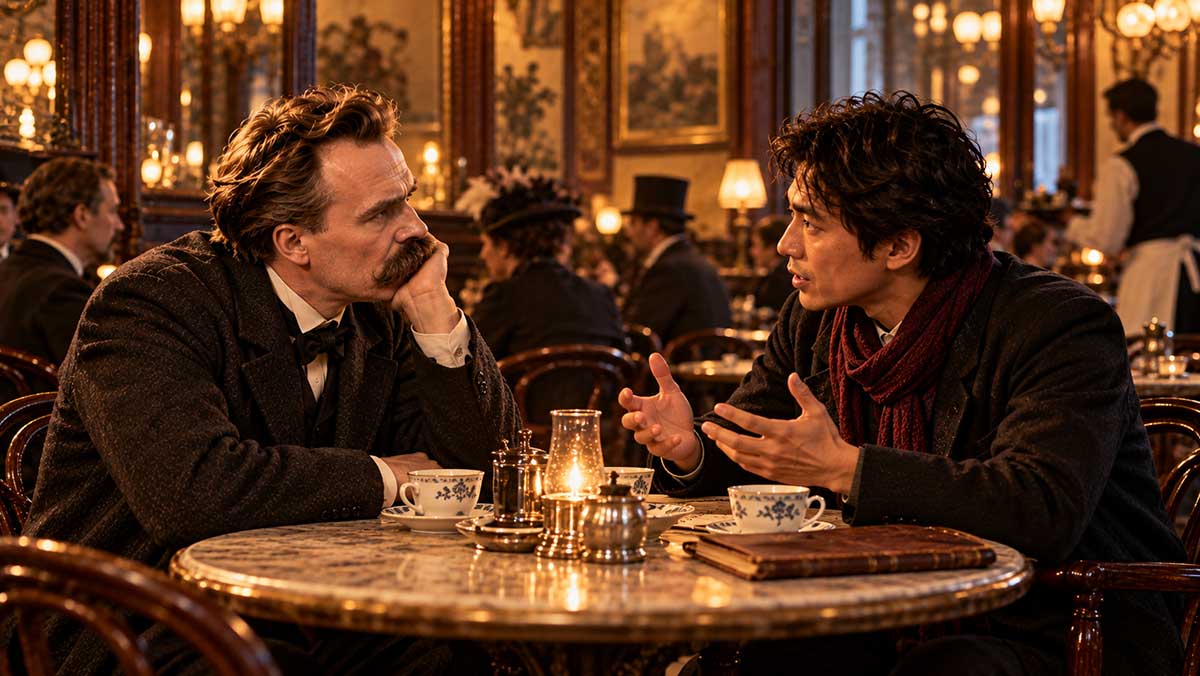
The café is warm, almost uncomfortably so after the cold December air.
A waiter moves between the small marble tables carrying cups of coffee. Two elderly men argue over a newspaper near the entrance. Somewhere behind the counter, porcelain cups clatter against saucers.
Friedrich Nietzsche removes his hat and sets it beside him.
Nick Sasaki takes a sip of coffee, then leans forward.
Nick: Friedrich, there's something I've always wondered about you.
Nietzsche: Only one thing? Our conversation is becoming disappointingly manageable.
Nick: You grew up in a deeply religious family. Your father was a Lutheran pastor. Your grandfather was a pastor, too, wasn't he?
Nietzsche: Yes. Religion was woven into the fabric of my childhood.
Nick: So what was little Friedrich Nietzsche like? Were you the kind of kid who sat quietly in church, or were you already questioning everything?
Nietzsche smiles.
Nietzsche: I fear you are imagining a small boy with an enormous mustache, sitting in the pews and denouncing Christianity.
Nick bursts out laughing.
Nick: I have to admit, that's a pretty funny picture.
Nietzsche: No. I was a serious child. Dutiful, conscientious, sensitive to music and religious ceremony. I did not arrive in the world already armed with my later opinions.
Nick: Did you actually enjoy church?
Nietzsche: There were aspects of it I found beautiful. The music, certainly. The solemnity. The feeling that one was participating in something larger than oneself.
Nick: Did you believe in God?
Nietzsche: Yes. I was raised within that faith, and for a time it was my own.
Nick: That's what fascinates me. People sometimes talk about you as though you were born an atheist.
Nietzsche: An understandable mistake among people who prefer conclusions to histories.
Nick: What do you remember about your father?
Nietzsche looks toward the café window.
Nietzsche: Not as much as I might wish. I was very young when he died. There are impressions, fragments, and the stories told by those who knew him.
Nick: Was he a kind man?
Nietzsche: He was remembered as gentle and deeply devoted to his calling.
Nick: Did you ever imagine becoming a pastor yourself?
Nietzsche: It was a natural possibility in the world in which I grew up. Religion was not simply a set of propositions. It was family, education, music, duty, and the language through which people understood life.
Nick: So when your beliefs changed, you weren't just changing your mind about an idea.
Nietzsche looks at him with interest.
Nietzsche: Precisely. A conviction inherited in childhood is rarely isolated from the rest of one's existence.
Nick: That must have made the whole process complicated.
Nietzsche: It was not a matter of waking one morning and deciding to become the enemy of Christianity.
Nick: Good, because that's exactly the story I want to hear.
Nietzsche lifts his cup.
Nietzsche: Then you must be prepared for something less dramatic than a sudden revelation.
Nick: I'm listening.
Guiding Question 1: When Did You Begin Questioning Christianity?
Nick: Do you remember when you first started having serious doubts?
Nietzsche: Not a single decisive moment. Doubt grows through many encounters—with books, with history, with the contradictions of human conduct, and with one's own changing understanding.
Nick: Were you questioning religion as a teenager?
Nietzsche: My education gradually exposed me to ways of examining religious belief that were very different from the devotional habits of my childhood.
Nick: What kinds of questions?
Nietzsche: Historical questions, for example. How were religious texts composed? How did doctrines develop? Why did particular beliefs become authoritative? And what happens when one examines sacred traditions with the same critical methods used to study other historical documents?
Nick: That sounds pretty normal to us now. But in your time, was it shocking?
Nietzsche: Historical criticism was already an important intellectual movement. The shock was not that the questions existed. It was what they might do to convictions one had been taught to regard as unquestionable.
Nick: Did you ever feel guilty for asking them?
Nietzsche considers the question.
Nietzsche: One does not easily abandon the habits of conscience formed in childhood. But eventually I came to believe that intellectual honesty demanded that I examine even the beliefs I had inherited most deeply.
Nick: Was there a particular book that influenced you?
Nietzsche: Many books played their part. At Bonn, my studies brought me into an environment where theology and historical scholarship could not be kept entirely separate. Later, the works of Schopenhauer affected me profoundly, though not by providing a simple answer to the question of religion.
Nick: What did Schopenhauer give you?
Nietzsche: A different way of confronting suffering and existence. He took the problem of life seriously without relying upon the familiar assurances of Christian theology.
Nick: Did you agree with him?
Nietzsche: For a time, I admired him greatly. Later, I came to oppose important parts of his philosophy.
Nick: You have a habit of admiring people and then disagreeing with them.
Nietzsche: A most unfortunate habit, if one's ambition is to maintain a comfortable social calendar.
Nick laughs.
Nick: Wagner, Schopenhauer, Christianity. You really don't make life easy for yourself.
Nietzsche: Would you prefer that I continue believing something merely because I once believed it?
Nick: No. But I wonder whether changing your mind ever felt frightening.
Nietzsche pauses.
Nietzsche: There is a particular difficulty in discovering that the questions you must ask may separate you from people you love.
Nick: Did that happen with your family?
Nietzsche: My mother remained a woman of religious conviction. Our differences were real. But family relationships are not exhausted by intellectual disagreement.
Nick: Did you talk openly with her about your doubts?
Nietzsche: There were things I expressed and things that were more difficult to discuss. A son does not necessarily wish every conversation with his mother to become a theological examination.
Nick: That's very understandable.
Nietzsche: Besides, one must be careful not to mistake the desire to win an argument for the pursuit of truth.
Nick smiles.
Nick: That's an interesting thing for you to say.
Nietzsche: Why?
Nick: Because people think of you as someone who enjoys attacking other people's beliefs.
Nietzsche: I enjoy examining beliefs. Sometimes the examination is severe. But the severity should serve a purpose.
Nick: Did you ever miss believing?
Nietzsche looks at him for a moment.
Nietzsche: You ask whether I missed the certainty, the rituals, or the faith itself?
Nick: That's a good question. Maybe all three.
Nietzsche: They are not identical. One may remember the beauty of religious music without accepting its theology. One may understand the comfort of certainty without wishing to purchase it at the expense of intellectual honesty.
Nick: So you can appreciate something you no longer believe is true.
Nietzsche: Certainly. Otherwise, how could we understand the past at all?
Nick: Was there anything about Christianity that you continued to admire?
Nietzsche: One must distinguish Jesus, the historical development of Christianity, the churches, and the moral interpretations that eventually became dominant. I do not regard them as interchangeable.
Nick leans forward.
Nick: Wait. That's interesting. You're saying Jesus and Christianity aren't necessarily the same thing?
Nietzsche: I am saying that the life of a founder and the institutions that later claim his authority are two different subjects of investigation.
Nick: Did you admire Jesus?
Nietzsche: I regarded him as a remarkable figure, though my understanding of him differs considerably from the Church's. I have been particularly concerned with the difference between a way of living and a system of doctrines.
Nick: What do you mean by a way of living?
Nietzsche: Consider the possibility that what mattered most in Jesus' life was not an elaborate theology but a particular manner of relating to existence and to other human beings.
Nick: That's fascinating. Because I think a lot of religious people would agree with at least part of that.
Nietzsche: Agreement on a sentence is not necessarily agreement on its meaning.
Nick: Fair point.
Nietzsche: My criticism of Christianity is not something that disappears because we discover a few expressions we both find agreeable.
Nick: I wouldn't want it to. I'm trying to understand how you arrived at your position.
Nietzsche nods.
Nietzsche: Then we are making progress.
Nick takes another sip of coffee.
Nick: All right. Now I have to ask about the sentence everybody knows.
Nietzsche raises an eyebrow.
Nietzsche: I had a feeling we were approaching it.
Guiding Question 2: What Did You Really Mean by “God Is Dead”?
Nick: Friedrich, when you wrote "God is dead," what were you actually trying to say?
Nietzsche: First, tell me what you think I meant.
Nick: I think most people hear it as, "There is no God, and Nietzsche is happy about it."
Nietzsche: A wonderfully efficient misunderstanding.
Nick laughs.
Nick: I suspected you might say that.
Nietzsche: Consider the context. In The Gay Science, I describe a madman entering a marketplace and announcing that God is dead.
Nick: And the people laugh at him.
Nietzsche: Yes. Many of them already do not believe in God. Yet they fail to understand the magnitude of what has occurred.
Nick: Why would atheists laugh at someone saying God is dead?
Nietzsche: Because they think the matter is settled once they have ceased to believe. They imagine they can discard the foundation of a civilization while leaving the entire structure standing exactly as before.
Nick: And you don't think that's possible?
Nietzsche: Not without consequences. European morality, its understanding of truth, its conception of human purpose, its assumptions about good and evil—all have been profoundly shaped by Christianity.
Nick: So even people who don't believe in God are still living according to ideas that came from religion.
Nietzsche: Very often. They may reject the theological foundation while continuing to treat its moral conclusions as self-evident.
Nick: Give me an example.
Nietzsche: Consider the belief that every human being possesses an equal moral worth simply by virtue of being human. Or that compassion for the suffering is the highest measure of goodness. These convictions have histories. They did not descend upon humanity as unquestionable facts.
Nick: But couldn't someone believe those things without believing in God?
Nietzsche: Certainly someone may affirm them. My question is whether they understand their origins, can defend them honestly, and have examined the effects of the values they inherit.
Nick: So you're asking people to explain why they believe what they believe.
Nietzsche: More than that. I ask what kind of human life a particular morality cultivates. Does it strengthen life? Does it encourage creativity and courage? Or does it sometimes conceal resentment, fear, and hostility toward excellence?
Nick: That's a pretty uncomfortable question.
Nietzsche: Good questions often are.
Nick: But when you say God is dead, are you saying people killed him?
Nietzsche: In the parable, the madman says that we have killed him. The language is deliberately startling. It points to a historical transformation in which the intellectual and cultural authority of the Christian God has been undermined.
Nick: By science?
Nietzsche: Science is part of the story. Historical criticism, philosophical inquiry, changing habits of thought—all have contributed. But the irony is that the Christian commitment to truthfulness itself helped cultivate methods of inquiry that eventually turned against Christian belief.
Nick sits back.
Nick: Wait. You're saying Christianity helped create the intellectual tools that challenged Christianity?
Nietzsche: Exactly.
Nick: That's quite a twist.
Nietzsche: History is full of such ironies.
Nick: Was this something you celebrated?
Nietzsche: I saw both danger and possibility.
Nick: What was the danger?
Nietzsche: Nihilism.
Nick: Meaning people stop believing that anything matters?
Nietzsche: That is one form. More precisely, the highest values may lose their authority. People may discover that the purposes and certainties they inherited no longer convince them, yet possess nothing strong enough to take their place.
Nick: So they lose their direction.
Nietzsche: They may. They may also cling desperately to substitutes—political idols, collective passions, fashionable certainties—without recognizing that they have merely exchanged one unquestioned authority for another.
Nick: Did that worry you?
Nietzsche: Very much. I believed Europe was entering a period of profound upheaval in its values.
Nick: And the opportunity?
Nietzsche: The possibility of examining values anew. Of asking what forms of life human beings might create when they no longer rely upon inherited guarantees.
Nick: So "God is dead" wasn't the end of your thinking. It was the beginning of a much bigger problem.
Nietzsche: Precisely.
Nick: You know, that changes how I hear the sentence.
Nietzsche: Then perhaps you will forgive me for writing more than three words.
Nick laughs.
Nick: I'll try.
He looks around the café. The elderly men near the entrance are still arguing over their newspaper.
Nick: Let me ask you something. Those men over there probably don't spend their evenings thinking about the foundations of European morality.
Nietzsche: A reasonable assumption, though perhaps we should not underestimate them.
Nick: Fair enough. But ordinary people have families, jobs, worries. They need some sense that life matters. What happens to them if the beliefs they've relied on suddenly stop making sense?
Nietzsche places his cup down.
Nietzsche: Now you have reached the question that matters.
Guiding Question 3: How Should People Live When Their Old Beliefs No Longer Guide Them?
Nick: Suppose someone comes to you and says, "Friedrich, I don't believe in God anymore. I used to think my life had a purpose, but now I feel lost. What should I do?"
Nietzsche: I would first ask what they mean by purpose.
Nick: You'd answer their question with another question?
Nietzsche: You have been doing precisely that to me all evening.
Nick: Fair enough.
Nietzsche: If by purpose they mean a task assigned to them by a supernatural authority, then the loss of that belief may indeed be unsettling. But why assume that a life becomes worthless merely because its meaning is not guaranteed from outside?
Nick: So you think people can create meaning?
Nietzsche: That phrase is too easily misunderstood. One does not create a meaningful life simply by declaring that everything one happens to desire is valuable.
Nick: Then what does it require?
Nietzsche: Discipline. Honesty. The willingness to examine oneself. The cultivation of one's abilities. The courage to confront inherited values rather than merely replace them with comforting inventions.
Nick: That sounds like hard work.
Nietzsche: Did you expect me to offer an easier philosophy?
Nick: I was hoping for a three-step program.
Nietzsche: Then I fear you have chosen the wrong philosopher.
Nick laughs.
Nick: Let me ask it differently. How does someone know what kind of person they should become?
Nietzsche: They must learn to distinguish between what has been imposed upon them and what genuinely expresses their capacities. But that is not achieved by indulging every impulse. A person must be capable of shaping himself.
Nick: Like an artist shaping a sculpture?
Nietzsche: An imperfect comparison, but useful. The material resists. One must work with what one is, not with a fantasy of limitless possibility.
Nick: And what about people who aren't especially ambitious? Someone who just wants to raise a family, work honestly, and enjoy life?
Nietzsche: Why should I assume that such a life is without value? My concern is not to prescribe one identical existence to every person. It is to question whether people live from genuine strength and understanding or merely repeat what they have been told to admire.
Nick: So you're not saying everyone has to become some extraordinary genius.
Nietzsche: No. Though I am particularly concerned with the conditions that allow exceptional human beings and exceptional achievements to emerge.
Nick: That's where I sometimes struggle with your philosophy.
Nietzsche: How so?
Nick considers how to phrase his answer.
Nick: I believe in God. And I see God as a loving Parent of humanity. That shapes how I think about people, especially those who are struggling.
Nietzsche listens.
Nick: But I'm not bringing that up to convince you. I'm curious about something. Suppose you meet a person whose faith genuinely makes them more courageous, more generous, and more willing to help others. Would you still think that faith is harmful?
Nietzsche thinks for a moment.
Nietzsche: I would want to know more about the person and the faith.
Nick: Really?
Nietzsche: Of course. A belief must be examined in relation to the kind of life it produces. But I would also ask whether the apparent virtues you describe arise from strength or from a need to deny uncomfortable truths.
Nick: Can you explain that?
Nietzsche: A person may help another out of overflowing vitality, genuine generosity, or admiration for what the other might become. But assistance can also arise from a need to feel morally superior, from fear, or from a desire to make others dependent.
Nick: So you're not simply against helping people.
Nietzsche: No. My criticism of pity is not adequately understood as an instruction to become indifferent to every form of suffering.
Nick: Then what bothers you about pity?
Nietzsche: Pity can sometimes multiply suffering rather than overcome it. It can make weakness into an ideal and encourage people to remain within conditions they ought to struggle to transform.
Nick: But surely there are people who genuinely can't overcome their suffering on their own.
Nietzsche: Certainly. Human beings are not equally situated, equally healthy, or equally capable. My criticism is directed at the elevation of suffering itself into a moral authority.
Nick: So if someone is suffering, your first question might be, "What would actually help this person become stronger?"
Nietzsche: That is closer to my concern, though we should not pretend that every life can be measured by the same standard.
Nick nods.
Nick: I think I understand you better now. I still disagree with some of your assumptions, but I can see why you ask these questions.
Nietzsche: That is already preferable to agreement achieved through misunderstanding.
Nick: You know, I've noticed something about you.
Nietzsche: Only one thing?
Nick: You really don't like easy answers.
Nietzsche: Easy answers have their place. They are useful for questions such as whether the café is closing.
Nick glances toward the waiter, who has begun clearing several nearby tables.
Nick: Speaking of which, I think we're being politely encouraged to leave.
Nietzsche: Then the proprietor has solved a philosophical problem for us.
They laugh.
Nick finishes his coffee.
Nick: One last question before we go.
Nietzsche: Your last questions are becoming a recognizable literary genre.
Nick: I know. But this one is important.
Nietzsche waits.
Nick: You've spent so much of your life questioning beliefs that other people rely on. Does that ever get exhausting?
Nietzsche considers the question.
Nietzsche: Sometimes. But the greater exhaustion, for me, would be to silence questions that I believe must be asked.
Nick: Even when those questions make your life more difficult?
Nietzsche: Especially then, perhaps.
Nick: Do you ever wish you could simply stop thinking for a while?
Nietzsche smiles.
Nietzsche: My body occasionally makes that decision for me.
Nick's expression changes.
Nick: Because of your headaches?
Nietzsche: Among other things.
Nick: Are they as bad as people say?
Nietzsche reaches for his hat.
Nietzsche: Worse at times. Better at others. But illness is a poor subject for a comfortable café.
Nick: I don't mind talking about it.
Nietzsche: Then perhaps we shall discuss it while walking. A little cold air may do us both good.
Closing: The Philosopher and His Body
They step outside into the December night.
The streets are quieter now. Gas lamps cast long shadows beneath the arcades. The sound of a distant carriage echoes across the square.
Nietzsche pauses to button his coat.
Nick watches him for a moment.
For most of the evening, they have discussed ideas that changed the intellectual history of Europe.
But Nick is beginning to notice something else.
Nietzsche is not simply a mind producing extraordinary books. He is a man who must wake up every morning in a body that has often made ordinary life difficult.
Nick: Friedrich, can I ask you something very practical?
Nietzsche: After all our discussion of God and morality, I am almost relieved.
Nick: When you get one of those terrible headaches, what actually happens?
Nietzsche looks at him.
Nietzsche: What happens?
Nick: I mean, do you have to lie down? Can you read? Can you write? Does light bother you? What do you do all day?
Nietzsche seems surprised.
Nietzsche: Most people who ask about my illness want to know how it influenced my philosophy.
Nick: I'm interested in that too. But first I want to know what it's like for you.
Nietzsche studies Nick for a moment.
Then he nods.
Nietzsche: Very well. There have been days when the simplest task became an ordeal.
Nick: How bad?
Nietzsche begins walking again.
Nietzsche: Let me tell you about the years when I could no longer continue teaching at Basel.
Nick falls into step beside him.
And the conversation turns from the death of God to something much closer to the body: the private suffering of the man who challenged the world to embrace life.
Author's note: This is a fictional conversation inspired by Nietzsche's life and philosophy, not an authenticated historical interview. His Lutheran upbringing, developing religious criticism, and ideas concerning nihilism, morality, and the death of God are historically grounded. The dialogue, personal recollections, and responses to Nick Sasaki are imaginative reconstructions. Nietzsche's views are complex and sometimes controversial; this story does not present them as established truths or as endorsements of the author's beliefs.
Topic 4: The Private Battles of Friedrich Nietzsche
Friedrich Nietzsche: One Last Evening in Turin
Turin, Italy — December 1888, night
Opening: What Happens When the Philosopher Cannot Think?
The December air has grown colder.
Friedrich Nietzsche and Nick Sasaki walk beneath the arcades of Turin, their footsteps echoing across the stone pavement. Most shops have closed. A few cafés remain open, their windows glowing against the darkness.
Nietzsche has just begun telling Nick about the years when his health forced him to abandon his professorship at Basel.
Nick: Friedrich, I have to admit something. Whenever I read about your health problems, the descriptions are usually pretty vague. Terrible headaches, problems with your eyes, nausea. But what does that actually mean? What happens when you wake up on a really bad day?
Nietzsche: You want the unpleasant details?
Nick: Yes. I want to understand what your life was actually like.
Nietzsche: Very well. Imagine waking with a pain in your head so severe that even the thought of opening your eyes is disagreeable.
Nick: That bad?
Nietzsche: Sometimes. Light could become intolerable. Reading was impossible. Writing was impossible. Even movement could make matters worse.
Nick: So what did you do?
Nietzsche: Very little. One learns the humiliating art of waiting.
Nick: Waiting for the pain to stop?
Nietzsche: Waiting for the body to permit one to resume being oneself.
Nick looks at him.
Nick: That's a terrible feeling.
Nietzsche: It is particularly frustrating when one's mind is full of things one wishes to accomplish.
Nick: Could you sleep?
Nietzsche: Not always. Pain does not necessarily grant the courtesy of unconsciousness.
Nick: And you had nausea too?
Nietzsche: Yes. There were periods when I was scarcely capable of ordinary activity.
Nick: Did you ever get frightened that something was seriously wrong?
Nietzsche considers the question.
Nietzsche: When illness becomes a recurring companion, one's relationship with fear changes. At first, one hopes the next attack will be the last. Later, one begins organizing life around the possibility that it will return.
Nick: So you never really knew when you'd have a good day.
Nietzsche: Precisely.
They walk a few steps.
Nick: That must have been especially difficult when you were teaching.
Nietzsche: It became impossible to continue as I had.
Nick: You were a professor at Basel at twenty-four, right?
Nietzsche: Yes.
Nick: That's incredibly young.
Nietzsche: It was an unusual appointment.
Nick: Did you love teaching?
Nietzsche: I valued scholarship and had gifted students. But the demands of the university increasingly conflicted with both my health and the direction of my thinking.
Nick: And eventually you had to resign.
Nietzsche: In 1879.
Nick: How old were you?
Nietzsche: Thirty-four.
Nick: Thirty-four. You'd already achieved something most scholars spend their whole lives working toward, and then you had to walk away.
Nietzsche: Yes.
Nick: Were you devastated?
Nietzsche pauses before answering.
Nietzsche: There was disappointment. But there was also a kind of liberation. The university had offered security and recognition, yet I had begun to feel constrained by the expectations of my position.
Nick: So losing the job also gave you freedom?
Nietzsche: Freedom, certainly. But not comfort.
Nick: Because of the illness?
Nietzsche: And because freedom without health or sufficient means can be a rather demanding gift.
Nick smiles faintly.
Nick: That's something people don't always think about when they talk about following their dreams.
Nietzsche: Dreams are often described by people who have already eaten dinner.
Nick laughs.
Nick: That's a good one.
Nietzsche: Hunger and headaches have a way of making philosophy less abstract.
Guiding Question 1: How Did Illness Change Nietzsche's Everyday Life?
They reach a quieter section of the arcade.
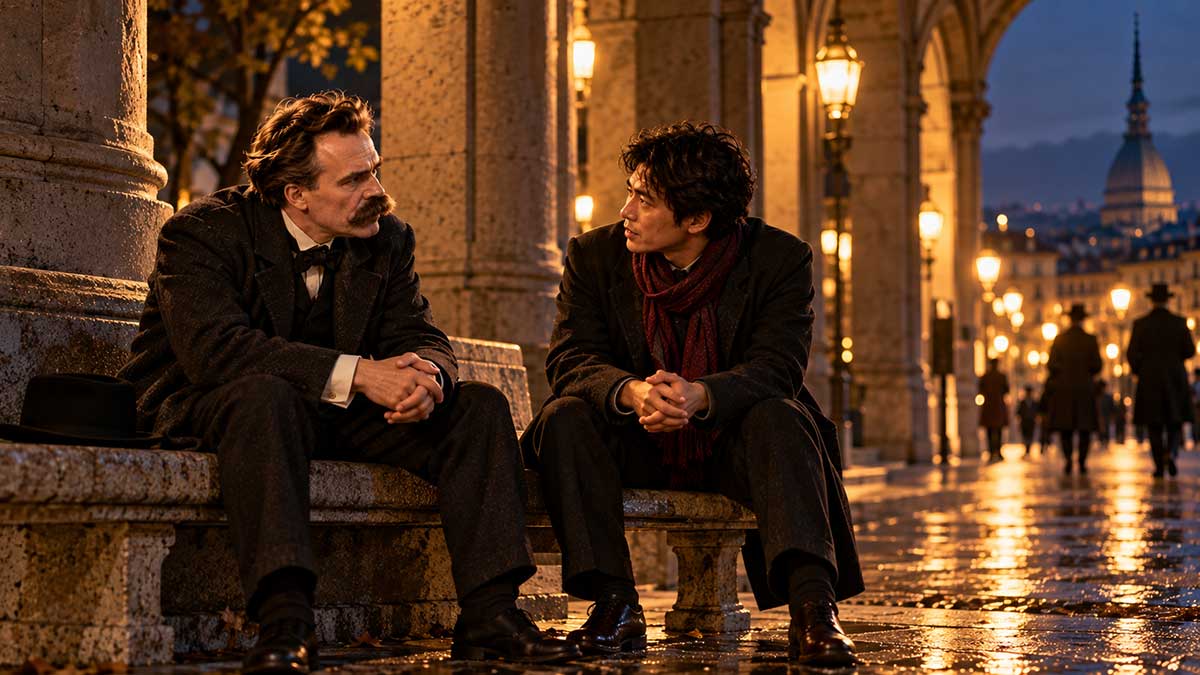
A stone bench stands beneath a lamp. Nietzsche gestures toward it.
Nietzsche: Shall we sit for a moment?
Nick: Of course.
They sit, watching the occasional pedestrian pass.
Nick: After you left Basel, what did you do? Did you have a permanent home?
Nietzsche: Not in the ordinary sense. I moved between places according to the seasons, the climate, and what my health would tolerate.
Nick: Where did you go?
Nietzsche: Sils Maria in the Engadine became particularly important to me during the summers. I also spent time in various Italian and French towns—Genoa, Nice, and others.
Nick: Were you looking for somewhere you could feel better?
Nietzsche: Always. The right air, temperature, light, and daily rhythm could make a considerable difference.
Nick: Did you ever find the perfect place?
Nietzsche: If I had, I might have stopped moving.
Nick: Fair enough.
Nietzsche: But certain places gave me periods of remarkable clarity. The mountains, especially, could be restorative.
Nick: Did you travel alone?
Nietzsche: Frequently.
Nick: That sounds difficult when you're sick.
Nietzsche: It could be. One becomes familiar with railway timetables, modest lodgings, unfamiliar rooms, and the peculiar loneliness of being ill in a place where almost no one knows you.
Nick: Did you have someone who could take care of you?
Nietzsche: There were friends who helped me, and family members who remained concerned about my condition. But much of my daily life required managing things myself.
Nick: What about doctors? Did they know what was causing it?
Nietzsche: I consulted physicians, naturally. Explanations and treatments varied. Relief was often uncertain.
Nick: Did you ever become frustrated with them?
Nietzsche: I became frustrated with the limitations of medicine, certainly. But a physician cannot be blamed for failing to possess knowledge that does not yet exist.
Nick: That's generous.
Nietzsche: Do not mistake resignation for generosity.
Nick laughs.
Nick: Were there times you couldn't read for weeks?
Nietzsche: There were periods when sustained reading was exceedingly difficult. My eyesight had troubled me for years.
Nick: But you're a writer. Reading and writing are your whole life.
Nietzsche: Which made the situation particularly inconvenient.
Nick: Inconvenient? That's one way to put it.
Nietzsche: Would you prefer that I call it a cosmic injustice?
Nick: No. I'm just amazed you kept going.
Nietzsche looks toward the street.
Nietzsche: One does not always keep going in a heroic fashion. Sometimes one merely waits for the next tolerable hour.
Nick lets that answer settle.
Nick: That's something I wanted to hear. People often tell stories about great thinkers as though every moment of suffering made them stronger.
Nietzsche: An attractive fiction.
Nick: You don't believe that?
Nietzsche: Suffering can teach, but it can also diminish. It can exhaust, embitter, and destroy. There is no virtue in pretending otherwise.
Nick: Then why do people associate you with the idea that suffering makes people stronger?
Nietzsche: Because a sentence is easier to remember than the conditions under which it might be true.
Nick: You're talking about "what doesn't kill me makes me stronger"?
Nietzsche: Among other things.
Nick: Do you still believe it?
Nietzsche thinks.
Nietzsche: I would not advise a person to seek illness merely because he hopes to become stronger. The question is what one can make of the experiences one cannot avoid.
Nick: That's a big difference.
Nietzsche: Indeed.
Guiding Question 2: How Did Nietzsche Keep Writing Through the Pain?
Nick: Here's what I don't understand. You were dealing with all of that, but you still managed to write an extraordinary number of books. How?
Nietzsche: Not continuously. That is the first thing to understand.
Nick: What do you mean?
Nietzsche: People see the finished books and imagine an uninterrupted stream of work. They do not see the days when nothing could be accomplished.
Nick: So you worked whenever you felt well enough?
Nietzsche: Yes. I learned to value periods of clarity and energy.
Nick: Did you have a system?
Nietzsche: Walking was essential. Many thoughts took shape while I was outdoors. I would make notes and develop them later.
Nick: Did you write everything by hand?
Nietzsche: Much of it. At times, when my eyesight made writing difficult, I experimented with other methods.
Nick: I heard you used a typewriter.
Nietzsche smiles.
Nietzsche: A writing machine, yes. An interesting contraption, though not without its own difficulties.
Nick: Did you like it?
Nietzsche: I liked the possibility it offered. Whether the machine itself was always agreeable is another matter.
Nick: I can imagine.
Nietzsche: Machines promise liberation and then demand that one learn their peculiar habits.
Nick: That hasn't changed.
Nietzsche looks at him curiously.
Nietzsche: Hasn't it?
Nick smiles.
Nick: Let's just say people are still arguing with their machines.
Nietzsche: Then civilization has made less progress than I hoped.
They laugh.
Nick: When you had a really good day, how much could you write?
Nietzsche: It varied. Sometimes a passage would take considerable effort. At other times, ideas seemed to arrange themselves with astonishing speed.
Nick: Did you ever feel as though you couldn't write fast enough?
Nietzsche: Yes. Especially when a work had finally become clear to me.
Nick: Is that what's happening now, here in Turin?
Nietzsche's face brightens.
Nietzsche: Very much so.
Nick: Tell me about it.
Nietzsche: This year has been remarkable. I have completed several works, and I feel that ideas which occupied me for years have suddenly reached an extraordinary degree of clarity.
Nick: Do you feel better physically, too?
Nietzsche: In certain respects, yes. I have had periods of improved well-being. Turin has been favorable to me.
Nick: You seem genuinely excited.
Nietzsche: I am. There is a particular joy in recognizing that one has finally found the form appropriate to one's thoughts.
Nick: Does that happen often?
Nietzsche: Not often enough.
Nick: What does it feel like?
Nietzsche looks upward for a moment.
Nietzsche: Imagine carrying a difficult melody in your mind for years. You hear fragments of it, but something remains unresolved. Then one day, the whole composition becomes clear.
Nick: That's beautiful.
Nietzsche: It is exhilarating.
Nick: Do you celebrate?
Nietzsche: I walk. I listen to music. I enjoy the air. Sometimes I simply take pleasure in the knowledge that something has been accomplished.
Nick: You know, I think this is the happiest I've seen you all evening.
Nietzsche: Perhaps you have finally found a subject that pleases me.
Nick: I thought the mustache was a good start.
Nietzsche: The mustache has received quite enough attention.
Nick laughs.
Nick: What happens when the good period ends? When the pain returns?
Nietzsche's expression becomes more thoughtful.
Nietzsche: One must adapt again.
Nick: Isn't that discouraging?
Nietzsche: Certainly. But I have learned that a bad day is not necessarily a final judgment on one's life.
Nick: That's a helpful way to think about it.
Nietzsche: It is also a practical necessity. If every recurrence of pain were treated as the end of all possibility, I would have abandoned my work many times.
Nick: Did you ever come close?
Nietzsche looks at him.
Nietzsche: There were periods of profound discouragement. I would be dishonest to deny that.
Nick: What brought you back?
Nietzsche: Sometimes an improvement in health. Sometimes a change of surroundings. Sometimes a thought that demanded to be written.
Nick: So the work gave you a reason to continue?
Nietzsche: The work was an important part of my life. But I would not reduce the whole of existence to productivity.
Nick: Why not?
Nietzsche: Because a person who can value life only when he is producing something has made himself dependent upon a very fragile condition.
Nick nods slowly.
Nick: That's something a lot of people need to hear.
Nietzsche: Then perhaps they should stop measuring every day by what they have accomplished.
Nick: Coming from a man who wrote several books in one year, that's pretty funny.
Nietzsche laughs.
Nietzsche: I did not claim to be a model of moderation.
Guiding Question 3: Does Nietzsche's Philosophy Help Him When He Suffers?
For a while, neither man speaks.
The night air moves gently through the arcade. Somewhere nearby, a door closes.
Nick looks at Nietzsche.
Nick: Friedrich, can I ask you something that might be difficult?
Nietzsche: You have developed a remarkable fondness for that introduction.
Nick: I know. But this one is different.
Nietzsche: Very well.
Nick: When you're lying in bed with one of those terrible headaches, does your philosophy actually help?
Nietzsche looks at him for a long moment.
Nietzsche: What would you expect it to do?
Nick: I don't know. Give you courage? Help you endure the pain? Remind you that life is worth living?
Nietzsche: Philosophy is not an anesthetic.
Nick: So it doesn't make the pain easier?
Nietzsche: Not in the simple sense you suggest. A severe headache does not disappear because one has developed an interesting interpretation of suffering.
Nick: That's what I was wondering.
Nietzsche: But philosophy may influence how one understands one's condition when the pain has passed—or when one has enough strength to reflect.
Nick: How?
Nietzsche: By preventing a person from making suffering the sole measure of existence. By encouraging him to ask whether something remains possible, something worth creating, something worth affirming.
Nick: But what if the person is too sick to create anything?
Nietzsche: Then it would be absurd to demand that he produce a masterpiece from his sickbed.
Nick smiles.
Nick: I'm glad you said that.
Nietzsche: Why?
Nick: Because people sometimes turn your philosophy into this idea that everyone must constantly overcome everything. No excuses. No weakness. Just push harder.
Nietzsche frowns.
Nietzsche: That is a crude interpretation.
Nick: What would you say instead?
Nietzsche: I would begin by asking what the person is actually capable of. Strength is not demonstrated by pretending that limits do not exist.
Nick: So sometimes strength means resting?
Nietzsche: Sometimes rest is necessary. Sometimes retreat is necessary. The question is whether these serve life or become forms of surrender.
Nick: And how can you tell the difference?
Nietzsche: Not always immediately. One must know oneself.
Nick: Have you always been good at that?
Nietzsche laughs softly.
Nietzsche: Certainly not.
Nick: That's reassuring.
Nietzsche: I should be concerned if you found my mistakes reassuring.
Nick: It's reassuring to know you make them.
Nietzsche: Ah. Then I am pleased to have lowered your expectations.
They smile.
Nick: What about accepting help? Is that difficult for you?
Nietzsche considers the question.
Nietzsche: Independence has always mattered greatly to me. But independence does not mean that one has never benefited from another person's generosity.
Nick: Has someone helped you during your worst periods?
Nietzsche: Yes. Friends have shown me kindness. Franz Overbeck, for example, has been a steady presence in my life.
Nick: Do you find it hard to ask for help?
Nietzsche: Sometimes. There is a difference between receiving assistance and surrendering one's judgment to another person. I value the first when it is freely given. I resist the second.
Nick: That's an interesting distinction.
Nietzsche: You seem determined to collect them.
Nick: I'm building quite a collection tonight.
Nietzsche: Then I hope you have brought a sufficiently large suitcase.
Nick laughs.
Nick: Let me ask you about someone else. Suppose a person is suffering terribly. They're not a philosopher. They're not especially ambitious. They're just trying to get through the day. What would you say to them?
Nietzsche looks toward the street.
Nietzsche: I would be reluctant to offer a universal prescription without knowing the person.
Nick: Why?
Nietzsche: Because suffering differs. The capacities of human beings differ. Advice that strengthens one person may burden another.
Nick: So you'd want to understand their situation first?
Nietzsche: Naturally.
Nick: That's interesting. People don't usually think of you as someone who would begin by listening.
Nietzsche: Perhaps they have been listening too much to descriptions of me and too little to what I actually wrote.
Nick nods.
Nick: Fair point.
Nietzsche: I would not promise that every suffering can be overcome. Nor would I tell someone that pain is secretly a blessing. Such consolations can be dishonest.
Nick: Then what would you offer?
Nietzsche: Perhaps a question. What remains possible for you? What can still be loved, created, learned, or affirmed? The answer may be very small at first.
Nick: Even something as simple as enjoying a beautiful day?
Nietzsche: Why not? One should not despise small pleasures merely because one has large ambitions.
Nick looks down the arcade.
Nick: I think I understand something about you now that I didn't before.
Nietzsche: And what is that?
Nick: Your philosophy isn't simply about being strong. It's about finding a way to say yes to life, even when life doesn't cooperate.
Nietzsche considers the words.
Nietzsche: That is closer to the heart of the matter. But remember, saying yes to life is not the same as approving of everything that happens.
Nick: What's the difference?
Nietzsche: One may struggle against suffering, resist injustice, and attempt to change one's circumstances while still affirming existence. Life affirmation is not passive acceptance.
Nick: So you can fight against something without hating life itself.
Nietzsche: Precisely.
Nick sits quietly for a moment.
Nick: Friedrich, I have to tell you, this conversation has changed how I see you.
Nietzsche: I hope not entirely for the worse.
Nick: Quite the opposite.
Nietzsche: Then I shall consider the evening a modest success.
Closing: The Question Nietzsche Cannot Easily Escape
Nietzsche rises from the bench.
Nietzsche: Shall we return? The night is becoming colder.
Nick: Yes. And I don't want to keep you out too long.
Nietzsche: You are beginning to sound like my physician.
Nick: Don't worry. I won't prescribe anything.
Nietzsche: A relief.
They begin walking toward Via Carlo Alberto.
The city has grown quiet. Their footsteps echo beneath the arcades, and the distant sound of a church bell carries through the night.
Nick thinks about everything he has heard.
Nietzsche has lost friendships, endured illness, abandoned beliefs that shaped his childhood, and spent years writing books that few people understood.
Yet tonight, he seems excited about the future.
There is something remarkable about that.
Nick: Friedrich, can I ask you one more question?
Nietzsche laughs.
Nietzsche: I am beginning to suspect that your supply of questions is inexhaustible.
Nick: This one might be the most important.
Nietzsche: Then perhaps you should have begun with it.
Nick: I don't think I could have. I needed to understand you better first.
Nietzsche glances at him.
Nietzsche: Very well. What is it?
Nick: You have this idea about eternal recurrence.
Nietzsche's expression changes.
Nietzsche: Yes.
Nick: The possibility of living the same life over and over again. Every moment repeated exactly as it happened.
Nietzsche: You are familiar with it.
Nick: A little. But tonight I've heard about your father, Wagner, Lou Salomé, your illnesses, your years of loneliness, and the books you've worked so hard to write.
Nietzsche listens.
Nick: So here's what I want to know.
They reach the entrance to Nietzsche's building.
Nick turns toward him.
Nick: Friedrich, if you had the chance to live your entire life again—every wonderful moment, every disappointment, every headache, every mistake—would you actually want to?
Nietzsche stands silently for a moment.
Then he looks toward the darkened windows above them.
Nietzsche: Mr. Sasaki, that is not a question to be answered while standing in the cold.
Nick smiles.
Nick: Fair enough.
Nietzsche opens the door.
Nietzsche: Come upstairs. I believe we have one more conversation ahead of us.
They enter the building.
And as they climb the stairs, Nick realizes that he has finally reached the question he has wanted to ask all evening.
Not whether Nietzsche's philosophy is correct.
Not whether his ideas will change the world.
But whether the man who challenged humanity to embrace existence could embrace his own life—exactly as it had been.
Author's note: This conversation is fictional. Nietzsche's chronic health difficulties, resignation from the University of Basel in 1879, travels through Switzerland, France, and Italy, use of a writing machine, and extraordinary literary productivity in 1888 are historically grounded. The dialogue, private thoughts, specific descriptions of symptoms, and personal responses are imaginative reconstructions, not authenticated quotations or medical records. The causes of Nietzsche's illnesses remain historically debated.
Topic 5: Would Nietzsche Live His Life Again?
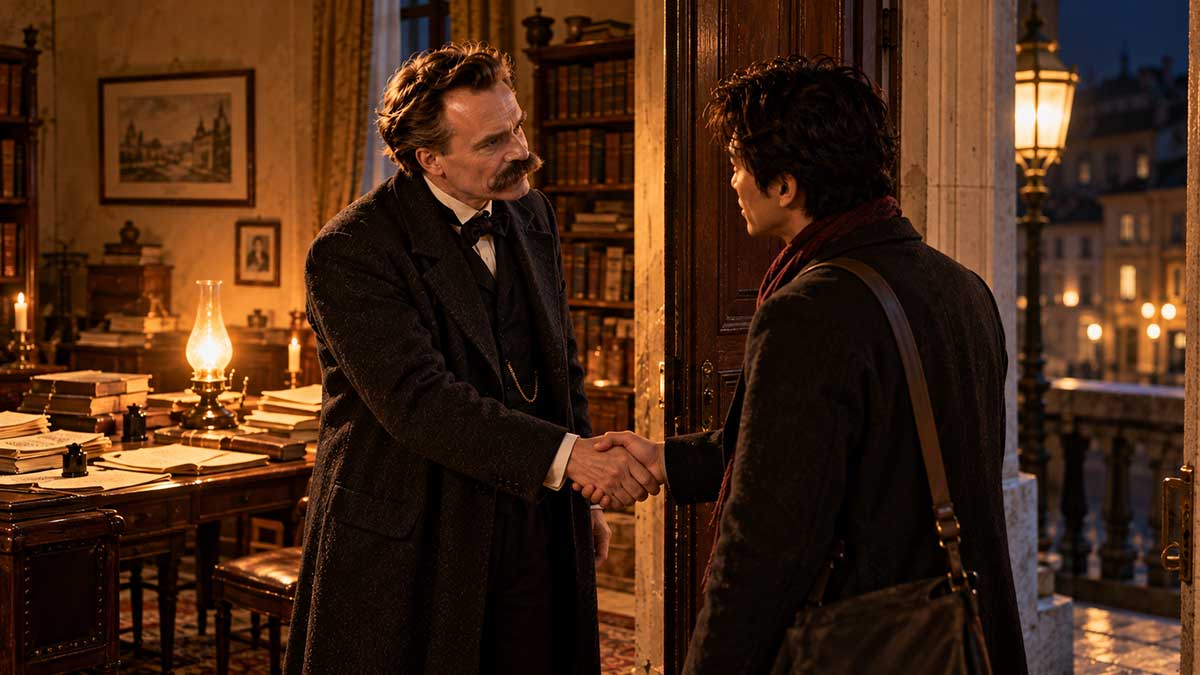
Friedrich Nietzsche: One Last Evening in Turin
Turin, Italy — December 1888, late night
Opening: The Question That Followed Them Home
The apartment is quiet when Friedrich Nietzsche opens the door.
A few embers glow in the stove. Manuscripts lie neatly arranged on the writing desk, exactly where he left them earlier that afternoon.
Outside, Turin has settled into the stillness of a winter night.
Nietzsche lights the lamp and places his hat on a chair.
Nietzsche: Well, Mr. Sasaki, we have returned to the scene of the crime.
Nick: What crime?
Nietzsche: You have stolen an entire evening from my writing.
Nick: Should I apologize?
Nietzsche: That depends on whether you intend to return it.
Nick: I'm afraid that's impossible.
Nietzsche: Then I suppose we must make the best of our loss.
Nick laughs.
Nietzsche pulls out a chair.
Nietzsche: Sit. You were asking about eternal recurrence.
Nick: Yes. But before we get into it, I want to make sure I understand what you mean.
Nietzsche: A sensible beginning.
Nick: I've heard people explain it as the idea that the universe repeats itself forever. Everything happens again, exactly the same way.
Nietzsche: That is one way the thought may be understood. But let us begin somewhere more personal.
Nick: All right.
Nietzsche settles into his chair.
Nietzsche: Imagine that a demon comes to you in your loneliest hour and announces that you must live this life again—not a different life, not an improved life, but precisely this one.
Nick: Everything?
Nietzsche: Everything. Every pleasure, every sorrow, every foolish remark, every moment of courage, every disappointment. The smallest details would return in the same order.
Nick: Even this conversation?
Nietzsche: Even your questions about my mustache.
Nick: That might be difficult to endure twice.
Nietzsche: Imagine enduring them eternally.
They laugh.
Nick: But seriously, what's the point of asking someone that?
Nietzsche: Consider the difference between a person who hears the demon's announcement as a curse and one who receives it with joy.
Nick: Because the second person loves their life that much?
Nietzsche: Perhaps. But I would put it more strongly. The question asks whether one can affirm existence so completely that one no longer wishes to subtract the difficult parts.
Nick: That's an incredibly demanding standard.
Nietzsche: Yes.
Nick: Do you expect people to actually achieve it?
Nietzsche: I expect the question to reveal something about how they stand toward their lives.
Nick looks at him.
Nick: Then I want to turn the question around.
Nietzsche: I thought you might.
Nick: You've spent years asking humanity whether it can say yes to life. But what about you?
Nietzsche waits.
Nick: Friedrich, would you live your own life again?
For the first time in several minutes, neither man speaks.
Guiding Question 1: Could Nietzsche Say Yes to His Own Life?
Nietzsche looks toward the lamp.
Nietzsche: You have chosen a rather inconvenient question.
Nick: I know.
Nietzsche: It is much easier to formulate a philosophical challenge than to submit oneself to it.
Nick: Exactly. And that's why I'm asking.
Nietzsche smiles faintly.
Nietzsche: Very well. I would wish to be capable of answering yes.
Nick: But can you?
Nietzsche: That is the difficulty.
Nick: What makes it difficult?
Nietzsche: You have spent the evening collecting evidence against an easy answer.
Nick: Your illnesses?
Nietzsche: My illnesses. My disappointments. My errors. The years when I felt misunderstood. The friendships that did not survive. The times when I could scarcely work.
Nick: And you'd have to experience every one of those again.
Nietzsche: Exactly.
Nick: Even the headaches?
Nietzsche: Especially the headaches, if we are to take the thought seriously.
Nick: Wouldn't you want to change at least that?
Nietzsche thinks.
Nietzsche: Naturally, if you offered me a cure for my illnesses tomorrow, I would welcome it. I do not worship pain.
Nick: So why wouldn't you want to remove the suffering from your past?
Nietzsche: Because the question concerns the whole life, not a collection of independent events from which one may select the pleasant portions.
Nick: Explain that.
Nietzsche: Suppose you could remove every difficulty from your history. Would you still be the same person? Would you have developed the same insights, formed the same judgments, written the same books?
Nick: Probably not.
Nietzsche: Then you are no longer asking whether I would affirm my life. You are asking whether I would prefer a different one.
Nick: That's true.
Nietzsche: And perhaps a different life would have been easier. But easier is not necessarily better.
Nick: So you wouldn't change anything?
Nietzsche: I did not say that.
Nick laughs.
Nick: You make me work for every answer.
Nietzsche: You have come to interview a philosopher. Did you expect him to be convenient?
Nick: I was hoping for a simple yes or no.
Nietzsche: Then you should have interviewed a politician.
Nick bursts out laughing.
Nietzsche smiles.
Nick: All right. Let me try again. When you look back on your life, what are you most grateful for?
Nietzsche leans back.
Nietzsche: My capacity to think independently. The books that opened new worlds to me. Music. The landscapes in which I walked. The moments when a difficult idea finally became clear.
Nick: What about people?
Nietzsche: Certainly people. Even relationships that ended painfully may have enriched my life.
Nick: Wagner?
Nietzsche: Yes.
Nick: Lou?
Nietzsche pauses.
Nietzsche: Yes, though I suspect you are determined to make me repeat that entire story.
Nick: Not tonight.
Nietzsche: A mercy.
Nick: What about your father? If you could relive your childhood, knowing you'd lose him again so young, would you still choose it?
Nietzsche's expression grows serious.
Nietzsche: That is a cruelly difficult example.
Nick: I'm sorry.
Nietzsche: No. It belongs to the question.
He considers his words.
Nietzsche: I cannot honestly claim that the loss of a father is something a child should welcome. But the thought of eternal recurrence asks whether one can eventually embrace the life that includes such losses.
Nick: Have you managed that?
Nietzsche: I have tried to develop a way of thinking that moves in that direction. Whether I have achieved it completely is another matter.
Nick: I appreciate that answer.
Nietzsche: Why?
Nick: Because I was afraid you'd tell me you'd overcome everything.
Nietzsche laughs softly.
Nietzsche: Only a fool would declare himself beyond every struggle.
Nick: You know what I find interesting? You're asking people to love their lives, but you're not promising them that life will become easy.
Nietzsche: Quite the opposite.
Nick: Then what does it mean to love your fate?
Nietzsche: Amor fati. To love one's fate. Not merely to endure what has happened, but to cease wishing that existence itself had been otherwise.
Nick: That's a very high mountain to climb.
Nietzsche: Indeed. But one may learn something by attempting the ascent, even if one has not reached the summit.
Nick smiles.
Nick: That might be the most encouraging thing you've said tonight.
Nietzsche: How unfortunate. I shall have to correct the impression.
They laugh.
Guiding Question 2: What Would Nietzsche Change About His Past?
Nick looks at the manuscripts on the desk.
Nick: Friedrich, can I ask you something a little different?
Nietzsche: Naturally.
Nick: Forget eternal recurrence for a moment. Suppose you could go back and speak to yourself at twenty years old. What would you tell him?
Nietzsche smiles.
Nietzsche: I suspect he would find me intolerable.
Nick: Why?
Nietzsche: Young men are often very attached to the importance of their own discoveries.
Nick: And older men aren't?
Nietzsche: Some of us become worse.
Nick laughs.
Nick: What were you like at twenty?
Nietzsche: Serious. Ambitious. Devoted to scholarship. Eager to find intellectual figures worthy of admiration.
Nick: Would you warn him about Wagner?
Nietzsche considers the question.
Nietzsche: No.
Nick: Really?
Nietzsche: Why deprive him of the friendship simply because it would later end?
Nick: But you could save him a lot of pain.
Nietzsche: Perhaps. But you would also deprive him of experiences that shaped his understanding of art, culture, and himself.
Nick: What about Lou Salomé? Would you warn your younger self about that?
Nietzsche: I might advise him to be more careful about the expectations he places upon another person.
Nick: That's a good answer.
Nietzsche: Whether he would listen is another matter.
Nick: Probably not.
Nietzsche: Then perhaps we should spare ourselves the trouble of traveling through time.
Nick smiles at the irony.
Nick: What about your career? Would you still become a professor so young?
Nietzsche: The appointment at Basel was an extraordinary opportunity. It gave me intellectual freedom and recognition at an age when most scholars were still establishing themselves.
Nick: But you eventually had to resign.
Nietzsche: Yes. Yet I would not dismiss those years. They taught me much, including the limitations of the academic life.
Nick: Do you regret not having a family of your own?
Nietzsche looks toward the window.
Nietzsche: I have wondered about different possibilities, as most people do. But I distrust the ease with which we imagine that the life we did not live would have solved the difficulties of the life we did.
Nick: That's interesting.
Nietzsche: A man with a family may envy the freedom of a solitary writer. A solitary writer may envy the warmth of a household. Each sees the other's advantages more clearly than its burdens.
Nick: That's certainly true.
Nietzsche: You have five children, you said?
Nick: Yes.
Nietzsche: And do you ever wonder what your life would have been like without them?
Nick laughs.
Nick: Occasionally, when the house gets very loud.
Nietzsche: An understandable philosophical experiment.
Nick: But I wouldn't trade them for anything.
Nietzsche: Even the noise?
Nick: Even the noise.
Nietzsche smiles.
Nietzsche: Then perhaps you already understand something about the question I have been asking.
Nick: What do you mean?
Nietzsche: You do not love your children because every moment with them is pleasant. You love the life that includes them, with its difficulties as well as its joys.
Nick grows thoughtful.
Nick: That's true.
Nietzsche: The challenge is whether one can extend such affirmation beyond the parts of life one already knows how to love.
Nick: That's much harder.
Nietzsche: Of course.
Nick thinks for a moment.
Nick: Let me ask you something else. Do you ever feel you've wasted time?
Nietzsche: Certainly.
Nick: Doing what?
Nietzsche: Pursuing ideas that later proved inadequate. Giving too much importance to certain opinions. Allowing disappointments to occupy more of my attention than they deserved.
Nick: So you do have regrets.
Nietzsche: I have made mistakes. The question is what one does with them.
Nick: What's your answer?
Nietzsche: One can spend one's life wishing to erase them, or one can attempt to understand how they became part of one's development.
Nick: That sounds like forgiveness.
Nietzsche: Perhaps in one sense. But I would prefer not to turn every difficult insight into a familiar moral slogan.
Nick: Fair enough.
Nietzsche: I am interested in transforming one's relationship to the past. Not in pretending that every mistake was secretly wonderful.
Nick: That's a distinction I think people need.
Nietzsche: Then perhaps you should write it down before you forget.
Nick pretends to search his pockets.
Nick: I knew I should have brought a notebook.
Nietzsche: A visitor who asks this many questions without taking notes is either remarkably confident or dangerously irresponsible.
Nick: Probably the second.
They laugh.
Guiding Question 3: What Does Nietzsche Hope the Future Will Remember?
The lamp flickers slightly.
Nietzsche rises to adjust it, then returns to his chair.
Nick looks at the manuscripts again.
Nick: Friedrich, earlier you said you believe your work will eventually find its audience.
Nietzsche: Yes.
Nick: How certain are you?
Nietzsche: I believe I have written things whose importance is not yet understood. Whether the world will recognize them in the manner I hope is beyond my control.
Nick: What if it takes a hundred years?
Nietzsche: A hundred years is not a long time in the life of an idea.
Nick: What if people misunderstand you?
Nietzsche smiles faintly.
Nietzsche: That is not a hypothetical concern.
Nick: But what if they misunderstand you on a massive scale? What if millions of people know your name, but only a small fraction have actually read your books?
Nietzsche: Then my name will have become more successful than my philosophy.
Nick laughs.
Nick: Would that bother you?
Nietzsche: Very much. I do not write in order to become a decorative authority for opinions I would despise.
Nick: What would be the worst misunderstanding?
Nietzsche considers the question.
Nietzsche: To turn my work into an excuse for intellectual laziness. To treat my criticism of inherited values as permission to abandon judgment altogether. Or to mistake the cultivation of human excellence for mere brutality.
Nick: So you don't want people using your philosophy to justify cruelty?
Nietzsche: I would want them to read what I actually wrote, including the parts that disturb their assumptions. I do not offer a convenient doctrine for those who wish to stop thinking.
Nick: What about your idea of the Übermensch? People sometimes interpret it as a superior person who dominates everyone else.
Nietzsche: Then they have reduced a difficult philosophical image to a crude fantasy of power.
Nick: What were you trying to express?
Nietzsche: The possibility of human beings who overcome inherited limitations and create new values—who do not merely conform to the expectations of their age.
Nick: So it's about overcoming yourself rather than controlling other people?
Nietzsche: Self-overcoming is central. But do not imagine that my thought can be compressed into a pleasant moral lesson about personal improvement. I question many assumptions about equality, morality, and human flourishing that your century may take for granted.
Nick: I appreciate that you're not trying to make your philosophy easier for me to agree with.
Nietzsche: Agreement is not the purpose of this conversation, is it?
Nick: No. Understanding is.
Nietzsche nods.
Nick: Let me ask you something personal. What if someone reads your books a hundred years from now and feels less alone because of them?
Nietzsche looks at him.
Nietzsche: Less alone?
Nick: Yes. Suppose someone feels misunderstood by the people around them. They don't fit into the expectations of their family or society. Then they read your work and realize that someone else has asked the same difficult questions.
Nietzsche considers the possibility.
Nietzsche: That would be a worthy encounter, provided the reader does not merely exchange one form of dependence for another.
Nick: What do you mean?
Nietzsche: I would not want a reader to become my disciple in the sense of surrendering his judgment to me.
Nick: Even if he admires you?
Nietzsche: Especially then. Admiration becomes dangerous when it replaces independent thought.
Nick: So you'd rather have someone disagree with you intelligently than agree with you blindly.
Nietzsche: Certainly.
Nick: That's refreshing.
Nietzsche: I suspect it would also make me a rather inconvenient leader of a movement.
Nick laughs.
Nick: You probably wouldn't enjoy having thousands of followers repeating everything you say.
Nietzsche: I should find it intolerable.
Nick: Then what would you want them to do?
Nietzsche: Think. Examine themselves. Question me. Discover what they are capable of becoming.
Nick looks at him for a moment.
Nick: You know, Friedrich, I've been thinking about something all evening.
Nietzsche: Another question?
Nick: More of an observation.
Nietzsche: How unexpected.
Nick: When people talk about you, they usually talk about your ideas. God is dead. The will to power. The Übermensch. Eternal recurrence.
Nietzsche: Understandably.
Nick: But after spending this evening with you, what I'll remember most is something else.
Nietzsche: What?
Nick: The way you laugh. How excited you get talking about music. How much Turin means to you. The people you've loved. How hard you've worked despite being sick.
Nietzsche listens quietly.
Nick: I came here wanting to understand your philosophy. But I think understanding the person behind it has been even more interesting.
Nietzsche looks down at his hands for a moment.
Nietzsche: A philosopher's life and his thought are not entirely separate. Though one should be careful about assuming that every idea can be explained by some personal experience.
Nick: Of course.
Nietzsche: Still, I am pleased that you have found the man less disappointing than his reputation.
Nick: Much less disappointing.
Nietzsche: Even with the mustache?
Nick: Especially with the mustache.
They laugh.
Closing: The Last Goodbye
The clock strikes late.
Nick glances toward the window.
Nick: Friedrich, I think I've kept you long enough.
Nietzsche: You have certainly conducted a thorough investigation.
Nick: I could probably ask another hundred questions.
Nietzsche: Then I am grateful that you possess some restraint.
Nick rises.
Nietzsche stands with him and walks toward the door.
For a moment, neither speaks.
Nick knows something Nietzsche does not.
Within weeks, the extraordinary creative life that has filled this modest apartment will come to an abrupt end.
But tonight Nietzsche is hopeful, animated, and convinced that his most important work lies ahead.
Nick feels the temptation to say something about the future.
Instead, he asks one final question.
Nick: Friedrich, if you could leave one question for people living a hundred years from now, what would it be?
Nietzsche considers this.
Nietzsche: I might ask whether they have truly examined the values by which they live—or merely inherited them.
Nick: That's a good question.
Nietzsche: And perhaps another.
Nick: What's that?
Nietzsche: Whether they have learned to love existence without demanding that it first become harmless.
Nick nods.
Nick: Thank you.
Nietzsche: For what?
Nick: For letting me ask so many questions. For being willing to talk about things that weren't easy.
Nietzsche smiles.
Nietzsche: I have enjoyed our conversation, Mr. Sasaki. You are an unusual visitor.
Nick: I've been called worse.
Nietzsche: I do not doubt it.
They laugh one last time.
Nietzsche extends his hand.
Nick shakes it.
Nietzsche: Perhaps you will return to Turin someday.
Nick hesitates.
Nick: I'd like that.
Nietzsche: Then perhaps we shall continue our discussion.
Nick: There are still a lot of things I want to ask you.
Nietzsche: I had gathered as much.
Nick steps into the hallway.
Nick: Good night, Friedrich.
Nietzsche: Good night, Mr. Sasaki. And give my regards to your five children.
Nick smiles.
Nick: I will.
The door closes gently.
Nick descends the stairs and steps into the cold Turin night.
Above him, a lamp still glows in Nietzsche's window.
He imagines the philosopher returning to his desk, perhaps rearranging a manuscript or writing down a thought inspired by their conversation.
Nietzsche does not know what awaits him in January.
He does not know how widely his books will eventually be read, how fiercely his ideas will be debated, or how many people will misunderstand him.
Tonight, he is simply a man who believes he still has important work to do.
Nick looks up at the illuminated window one last time.
He thinks about the question Nietzsche asked him.
Would you live your life again?
He thinks about his children, his mistakes, the people he has loved, the opportunities he has missed, and the ordinary moments he sometimes forgets to appreciate.
He does not have a perfect answer.
But he knows he will carry the question with him.
And perhaps that is enough for one evening.
Historical epilogue: In January 1889, Friedrich Nietzsche suffered a mental collapse in Turin. He never returned to sustained philosophical writing. He lived for another eleven years, dying in 1900. The cause of his collapse remains disputed. The conversations depicted here are fictional; the historical Nietzsche's private feelings, imagined responses, and predictions about his legacy should not be treated as documented statements.
Author's note: This is a fictional encounter inspired by Nietzsche's life and philosophy. The dialogue with Nick Sasaki, including personal reflections and humor, is imagined. The story does not imply Nietzsche endorsed the author's beliefs, nor does it present eternal recurrence as an established scientific fact. Its purpose is to invite readers to engage thoughtfully with Nietzsche's ideas and the human experiences that surrounded them.
Final Thoughts
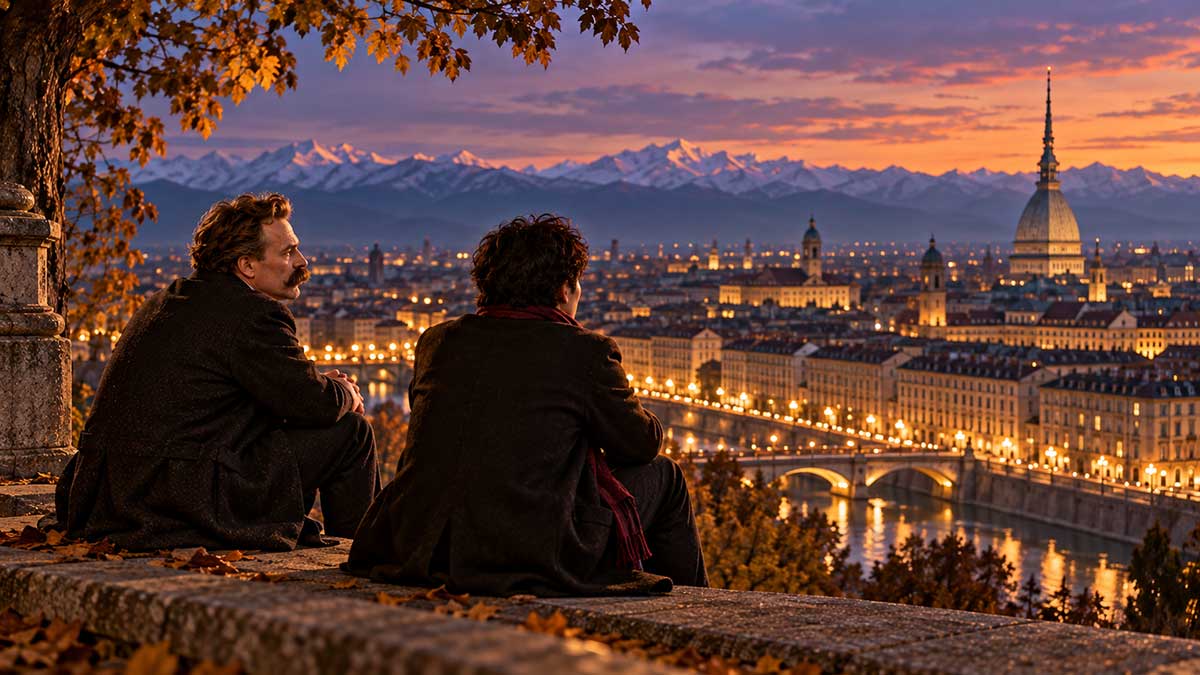
Beyond the Philosopher: The Man Who Wanted to Say Yes to Life
At the beginning of this imaginary evening, Nick arrives in Turin hoping to understand one of history's most challenging philosophers.
By the end, something unexpected has happened.
The most memorable part of the encounter may not be Nietzsche's explanation of God, morality, or eternal recurrence.
It may be the laughter.
The conversation begins with a joke about Nietzsche's enormous mustache. Then comes the pleasure he takes in walking through Turin, listening to music, and finding exactly the right words for an idea.
These ordinary details matter.
They remind us that the philosopher who challenged centuries of Western thinking was also a person who enjoyed beautiful surroundings, appreciated good conversation, and hoped his writing would eventually reach people capable of understanding it.
The people behind his ideas
Nietzsche's relationships reveal another dimension of his life.
Richard Wagner was once a figure of extraordinary admiration and friendship. Lou Salomé represented the possibility of a remarkable intellectual companionship. Franz Overbeck offered a more enduring form of loyalty.
Each relationship illuminates a different human need: admiration, understanding, independence, affection, and trust.
Nietzsche's philosophy emphasized self-overcoming, but his biography also reminds us that intellectual independence does not eliminate the desire for meaningful companionship.
His experiences raise a question relevant to nearly everyone:
Can we remain true to ourselves without closing our hearts to others?
The imaginary conversation offers no easy formula. Instead, it allows Nietzsche to describe the difficulty of loving people whose paths eventually diverge from our own.
The pastor's son and the death of God
Perhaps the most misunderstood part of Nietzsche's legacy is his relationship with Christianity.
His declaration that God is dead is frequently reduced to a simple rejection of religious belief.
Yet Nietzsche's concern was more extensive.
He believed that European civilization was losing confidence in the religious foundations of its morality without fully understanding the consequences. The resulting crisis of meaning—nihilism—became one of his central philosophical concerns.
This was not simply a celebration of unbelief. It was also a warning about what might happen when inherited values lose their authority.
In the revised conversation, Nick briefly shares his belief in God as a loving Parent of humanity. But instead of turning the evening into a contest between faith and atheism, he asks Nietzsche how he understands people whose religious convictions inspire courage and generosity.
Nietzsche does not abandon his criticism of Christianity.
Nick does not abandon his faith.
Neither needs to surrender his convictions for the conversation to have value.
That may be one of the most important lessons of their meeting.
Understanding another person's worldview does not require agreeing with it.
The body behind the brilliant mind
Nietzsche's struggles with illness make the conversation especially moving.
He suffered recurring health problems, including severe headaches and visual difficulties, and resigned from his Basel professorship in 1879. Nevertheless, he continued writing and produced an extraordinary body of work.
Stanford Encyclopedia of Philosophy+1
It is tempting to turn this history into a familiar motivational message: suffering makes us stronger.
But the imaginary Nietzsche resists that simplification.
Pain can interrupt life. It can destroy opportunities. It can make even ordinary activities impossible.
His persistence should not be interpreted as proof that everyone can overcome every obstacle through determination.
Instead, his experience invites a more compassionate question:
What remains possible when life becomes much harder than we expected?
Sometimes the answer may be a book.
Sometimes it may be a walk.
And sometimes it may simply be getting through another difficult day.
Would you live your life again?
The final conversation returns to Nietzsche's idea of eternal recurrence.
Imagine being asked to live your entire life again, with every moment repeated exactly: every happiness, every embarrassment, every disappointment, every loss.
Would you welcome that possibility?
Nietzsche's thought experiment, famously introduced in The Gay Science, challenges readers to consider how completely they can affirm their own existence. Scholars continue to debate whether eternal recurrence also carried a cosmological meaning for Nietzsche.
Stanford Encyclopedia of Philosophy
The imaginary interview makes this question personal.
Would Nietzsche willingly relive the loss of his father, his broken friendships, his painful illnesses, and his years of isolation?
His imagined answer is deliberately imperfect.
He would like to be capable of saying yes. But that does not mean he has conquered every regret or learned to welcome every painful experience.
This distinction matters.
We do not need to pretend our suffering was wonderful in order to recognize that our lives contain something worth loving.
Nor must we deny our mistakes to appreciate the people we have become.
Perhaps amor fati—the love of fate—is less about achieving a flawless state of happiness than about developing a deeper relationship with the whole of our existence.
One last evening
In January 1889, Nietzsche suffered a catastrophic mental collapse in Turin. His sustained philosophical writing came to an end. He died in 1900.
Stanford Encyclopedia of Philosophy
That historical knowledge gives this fictional evening its quiet poignancy.
Nick knows the future. Nietzsche does not.
But the purpose of their meeting is not to transform the philosopher into a tragic figure waiting for disaster.
It is to appreciate him while he is still alive with ideas, humor, ambitions, and curiosity.
There is a broader lesson here for how we encounter one another.
We often meet people through labels: believer, atheist, conservative, progressive, intellectual, ordinary person.
Then we assume we understand them.
But behind every label is a life we have not yet heard.
Perhaps the first step toward genuine understanding is a question asked without the need to win.
What was your childhood like?
Who mattered most to you?
What has been difficult?
What brings you joy?
What do you hope others will understand?
Nietzsche and Nick leave their deepest disagreements unresolved.
And that is perfectly acceptable.
The evening has achieved something more personal than agreement.
Two people with very different convictions have made room for each other's humanity.
As Nick leaves the apartment, he carries Nietzsche's final challenge into the cold Turin night.
Would you live your life again?
And perhaps an equally important question:
Are you living today in a way that you would someday be glad to remember?
Disclaimer: These reflections arise from a fictional interview, not a historical exchange. Nietzsche's actual philosophical positions are complex, contested, and sometimes incompatible with the author's perspectives. The story does not imply that Nietzsche embraced religious faith, endorsed the author's worldview, or personally made the imagined statements. The discussion of illness is not medical advice, and the portrayal of suffering should not be understood as suggesting that hardship is inherently beneficial.
Short Bios:
Friedrich Nietzsche (1844–1900) was a German philosopher, classical philologist, and cultural critic whose writings challenged traditional morality, Christianity, and established ideas about truth and human purpose. Appointed professor of classical philology at the University of Basel at twenty-four, he later resigned because of ill health and devoted himself to writing. His major works include Thus Spoke Zarathustra, Beyond Good and Evil, On the Genealogy of Morality, and The Gay Science. His intellectual legacy remains central to debates about nihilism, freedom, values, and the affirmation of life. Read his scholarly biography and philosophical overview.
Nick Sasaki is a Japanese-American writer and creator of ImaginaryTalks.com, a platform that brings historical figures, thinkers, and influential personalities into fictional conversations. Drawing on his experiences in Japan and the United States, Nick uses imaginative dialogue to examine human relationships, spirituality, philosophy, and the questions that connect people across cultures and beliefs. His interviews emphasize curiosity, understanding, and the possibility of finding common ground without requiring agreement.
Leave a Reply