

Introduction
What if you could see the future, but couldn't prevent what was coming?
Imagine waking from a dream so terrifying that you feel compelled to warn someone. You contact the authorities. You speak publicly about what you believe you've seen.
Then you turn on the television.
The terrible event you feared is unfolding before your eyes.
And all you can think about are the people you couldn't save.
For Tana Hoy, a psychic medium who says he has communicated with angels and spirit guides since childhood, this is not merely a hypothetical question.
He has publicly described a disturbing experience surrounding the 1995 Oklahoma City bombing, when 168 people lost their lives.
His account of an advance warning has not been independently verified here. But the emotional struggle he describes raises a haunting question.
What is the purpose of extraordinary spiritual knowledge if it cannot prevent human suffering?
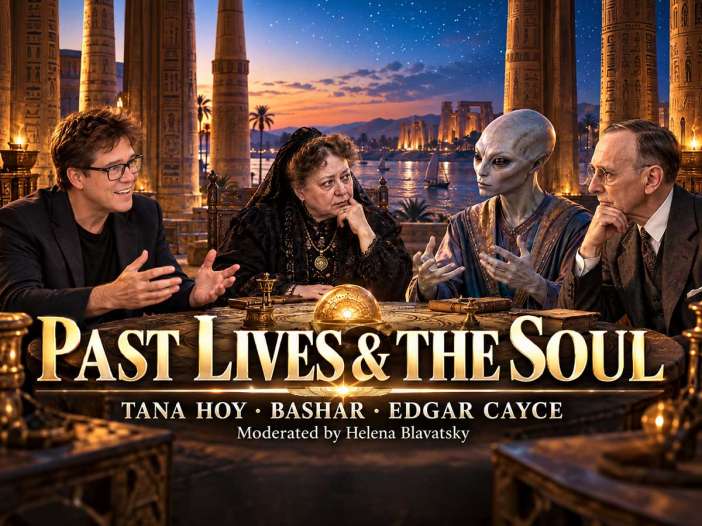
Now imagine Tana sitting across from Edgar Cayce, the celebrated Sleeping Prophet, whose trance readings explored reincarnation, ancient Egypt, and the continuing development of the soul.
Beside Cayce sits Bashar, the extraterrestrial consciousness presented through Darryl Anka, whose teachings propose that personal beliefs and choices shape the realities we experience.
And presiding over this extraordinary gathering is Helena Petrovna Blavatsky, the formidable nineteenth-century spiritual philosopher who helped establish the Theosophical Society.
She has heard enough extraordinary claims to last several lifetimes.
And she has questions.
If we choose our lives before birth, why do we enter the world without remembering those choices?
If we receive messages from spirit guides, how do we distinguish genuine wisdom from our own interpretations?
If the future contains countless possibilities, why can some tragedies seem impossible to prevent?
And if humanity is approaching an age of artificial intelligence and possible extraterrestrial contact, will greater knowledge finally make us wiser?
In a timeless chamber overlooking the Nile, these four perspectives come together for an unusual conversation about consciousness, destiny, spiritual responsibility, and the meaning of human existence.
This is an original fictional dialogue inspired by the participants' public accounts and teachings. It is not an actual meeting, authenticated supernatural communication, or transcript of their real words.
Blavatsky has one question she intends to pursue beyond every discussion of angels, reincarnation, and ancient mysteries.
After everything humanity has learned about the universe, have we learned what it truly means to love one another?
(Note: This is an imaginary conversation, a creative exploration of an idea, and not a real speech or event.)
Topic 1: Before We Were Born, Did We Choose Our Lives?

The Hall of Unanswered Questions overlooks the Nile.
Beyond the sandstone columns, the river glistens beneath a sky filled with unfamiliar constellations. A circular table occupies the center of the chamber. Four chairs surround it.
Helena Blavatsky sits with her hands folded, studying her three guests.
Edgar Cayce appears quietly contemplative. Bashar watches the shifting light beyond the columns with an amused expression. Tana Hoy looks around the chamber, taking everything in.
Tana Hoy: Well, I have to say, this is quite a place you've got here.
Blavatsky: I thought Egypt might make everyone feel at home.
Tana Hoy: Well, that's funny, actually.
Blavatsky: Oh?
Tana Hoy: I have some history here. Or at least I believe I do.
Blavatsky: So does Mr. Cayce. And I have spent a considerable portion of my existence writing about it. We are practically a family reunion.
Bashar: Perhaps more literally than you realize.
Blavatsky: Please don't tell me we've all been married to one another in a previous incarnation. I should like to enjoy my evening.
Tana laughs. Cayce smiles.
Blavatsky: Gentlemen, I have brought you together to discuss something humanity has wondered about for thousands of years. Why are we here? Did we choose this existence, or were we simply born into circumstances beyond our control?
She looks at Tana.
Blavatsky: But before we discuss the purpose of human existence, Mr. Hoy, I would like to ask you about something rather ordinary.
Tana Hoy: Okay.
Blavatsky: You wanted to be a singer.
Tana Hoy: Oh, yeah. Absolutely.
Blavatsky: Not a psychic teacher. Not a messenger between worlds. A singer.
Tana Hoy: That's right. When I was young, that was my dream. I loved singing. I wanted to perform. That was what I pictured myself doing.
Blavatsky: And yet, at sixteen, you came to believe you had been born for an entirely different purpose.
Tana Hoy: Yes. And I'll tell you, that was not something I was happy about at first.
Blavatsky: Why not?
Tana Hoy: Well, imagine being sixteen years old. You've got your dreams, you've got your plans, you're thinking about what you're going to do with your life. And suddenly somebody you trust tells you there's this enormous responsibility waiting for you.
He shakes his head.
Tana Hoy: I didn't ask for that. At least, that's what I thought at the time.
Bashar: Ah. An interesting distinction.
Tana Hoy: What's that?
Bashar: You say you did not ask for it. Yet you later came to believe you had asked for it before you were born.
Tana Hoy: Exactly. That's what changed everything.
Blavatsky: Tell us about that change.
Tana Hoy: I had been studying with my mentor since I was ten. And when I was sixteen, he told me that he'd known for years that I would be carrying on this work.
He pauses, remembering.
Tana Hoy: I felt overwhelmed. I really did. I wanted to get away from the whole conversation.
Cayce: That's a great deal for a young person to carry.
Tana Hoy: It was. But then I had this experience where an angel appeared to me, and I saw what I understood to be a previous lifetime in Egypt. I saw myself teaching thousands of people. And then I saw something else.
Blavatsky: Your existence before this birth?
Tana Hoy: Yes. I saw myself with my guides before coming into this life. And I remembered choosing to come back so I could help people.
Cayce: That must have changed how you saw the responsibility.
Tana Hoy: Completely. All that pressure I'd been feeling just went away. Suddenly, it made sense. I understood why I was here.
Blavatsky: And what became of the boy who wanted to sing?
Tana looks at her.
Tana Hoy: What do you mean?
Blavatsky: I mean precisely what I asked. Did you discover your purpose, or did you feel that you had to surrender the future you once wanted?
Tana Hoy: Well, I wouldn't say I surrendered anything. I found something that was much more important to me.
Blavatsky: That is how you understand it now. I am interested in how the sixteen-year-old understood it.
Tana considers this.
Tana Hoy: At first? He probably thought somebody had just ruined his plans.
The others smile.
Bashar: Then perhaps the first misunderstanding was the belief that you could fulfill your purpose in only one way.
Tana Hoy: Explain that.
Bashar: Why do you assume that becoming a singer would have prevented you from helping others?
Tana Hoy: I don't necessarily assume that.
Bashar: Excellent. Then your desire to sing and your desire to help humanity need not have been opposing desires.
Blavatsky: But that raises a more troublesome possibility. Suppose Mr. Hoy had followed his desire to sing. Suppose he became extraordinarily successful, touched millions of people through his voice, and never performed a single psychic reading. Would his soul have failed?
Bashar: Not necessarily. There are many possible expressions of a life theme.
Cayce: I think we must be careful with the word failed. Human beings make choices. Sometimes they follow one opportunity, sometimes another. But a person's spiritual growth is not measured by whether he followed a predetermined occupation.
Blavatsky: Then what is it measured by?
Cayce: By what he becomes through his choices. By how he treats others. By what he learns to give.
Tana Hoy: And that's what I love about my work. I get to help people. I see people make changes in their lives. Some of my clients have been with me for twenty, twenty-five years. I've watched their families grow.
Blavatsky: So perhaps your purpose was never simply to become a psychic.
Tana Hoy: Maybe not.
Blavatsky: Perhaps your purpose was to help people, and being a psychic became the means through which you chose to do so.
Tana nods slowly.
Tana Hoy: You know, I've never quite thought of it that way.
Bashar: There you are. A distinction between purpose and method.
Blavatsky: Don't sound so pleased with yourself, Bashar. We have barely begun.
Outside, the Nile reflects a shifting arrangement of stars. For a moment, the chamber seems suspended between centuries.
Blavatsky: Let us examine the idea beneath Mr. Hoy's experience. That the soul makes decisions before birth.
She turns to Cayce.
Blavatsky: Mr. Cayce, your readings speak of souls returning through many incarnations, sometimes encountering the same individuals repeatedly. What are these souls attempting to accomplish?
Cayce: In the readings, the soul's experiences are opportunities for growth. We carry tendencies from one life into another. Sometimes relationships give us opportunities to express love or overcome old difficulties.
Blavatsky: Are you suggesting that every relationship is arranged beforehand?
Cayce: No, I wouldn't put it that way. A soul may encounter familiar souls, but what happens between them still depends upon their choices.
Bashar: And each choice opens another possible experience.
Blavatsky: You are very fond of possibilities.
Bashar: Would you prefer limitations?
Blavatsky: I would prefer a clear answer.
Bashar: Then ask a clear question.
Blavatsky raises an eyebrow.
Blavatsky: Very well. If a soul chooses to be born into a particular family, can that soul choose the actions of its parents?
Bashar: It may select a framework of experience without controlling every decision made by every consciousness within that framework.
Blavatsky: So it cannot control everything.
Bashar: Correct.
Blavatsky: Then what exactly does choosing one's life mean?
Bashar: It means selecting themes, opportunities, and conditions through which experience may unfold. It need not mean scripting every event.
Tana Hoy: That makes sense to me. When I do readings, I always tell people that the future can change. You can make choices. You can avoid certain things. Or if something can't be avoided, you can sometimes make it easier to deal with.
Blavatsky: Yet your own experience led you to believe that a particular purpose had been chosen before you entered this life.
Tana Hoy: Yes, but I still had to decide what to do about it.
Cayce: That distinction matters. A person may encounter a calling without being compelled to accept it.
Blavatsky: Then a prebirth agreement, assuming such an agreement exists, is not necessarily a command.
Cayce: I would think of it more as an opportunity to respond.
Blavatsky: An opportunity one does not remember agreeing to.
Bashar: Until one begins to recognize it.
Blavatsky: And what if one never recognizes it?
Bashar: One still makes choices. One still has experiences. One still expresses a perspective.
Blavatsky: You make life sound extraordinarily forgiving.
Bashar: Why would existence need to condemn someone for exploring one possibility rather than another?
Blavatsky: Perhaps it need not. But choices have consequences.
Cayce: Certainly. Freedom doesn't mean freedom from the effects of what we do.
Blavatsky: Good. At last, something we can agree upon.
She turns back to Tana.
Blavatsky: Your mentor reportedly recognized something in you before you recognized it yourself. Did that ever trouble you? That another person seemed to know your purpose better than you did?
Tana Hoy: When I was young, yes. It confused me. But I trusted him. And after that experience at sixteen, I didn't feel that he was telling me who I had to be anymore. I felt like I was recognizing something about myself.
Blavatsky: Recognition rather than obedience.
Tana Hoy: That's a good way of putting it.
Cayce: And an important distinction for anyone who feels called to a particular path.
Blavatsky: Especially when the calling comes through a teacher. History contains far too many examples of people surrendering their freedom to individuals who claimed to know their destiny.
Tana Hoy: I agree people need to be careful. But I want to be fair to my mentor. He was someone I trusted deeply, and the training I received changed my life.
Blavatsky: I would not diminish what he meant to you. I am asking about the principle, not questioning your gratitude.
Tana Hoy: Fair enough.
Bashar: Then perhaps a good teacher does not create the student's purpose. A good teacher helps the student recognize possibilities the student has not yet considered.
Cayce: And leaves the student free to choose.
Blavatsky looks thoughtful.
Blavatsky: That is a much healthier conception of spiritual teaching than demanding unquestioning obedience.
Blavatsky: Now I wish to address something that has always struck me as rather peculiar.
Tana Hoy: What's that?
Blavatsky: If a soul plans its life before birth, why does it enter the world without remembering the plan?
Bashar: Because remembering every detail is not necessarily required for the desired experience.
Blavatsky: That sounds suspiciously convenient.
Bashar: Only if you assume that conscious memory is the sole means of knowing.
Blavatsky: Continue.
Bashar: Consider an actor entering a play. If the actor knows every line spoken by every character and every event that will occur, the experience is different from participating in a story whose outcome remains open to discovery.
Blavatsky: But an actor knows that a play is taking place.
Bashar: Indeed. And human beings may gradually become more aware of the larger nature of their existence.
Cayce: There is another aspect. If we remembered every former relationship, every injury, every triumph, and every regret, we might spend our lives attempting to settle old accounts instead of responding freely to the people before us.
Tana Hoy: I can see that.
Blavatsky: You seem unusually sympathetic to forgetfulness for a man who teaches people about past lives, Mr. Cayce.
Cayce: What matters is whether the information helps. A person could know a hundred stories about previous lives and still fail to show kindness to someone sitting beside him.
Blavatsky: So remembering is not necessarily wisdom.
Cayce: No.
Tana Hoy: You know, when I was a kid, I didn't think seeing guides was unusual. It was normal to me. My family accepted it. I didn't sit around wondering about the universe all day. I was just a kid.
Blavatsky: That interests me.
Tana Hoy: Why?
Blavatsky: You possessed an experience you now consider extraordinary, yet you did not require an elaborate philosophy to live with it.
Tana Hoy: No, I didn't.
Blavatsky: Then perhaps a person can live meaningfully without possessing a complete explanation of existence.
Bashar: Of course.
Blavatsky: I expected you to object.
Bashar: I reserve the right to surprise you.
Tana chuckles.
Blavatsky: But let us consider a more difficult example.
Her expression grows serious.
Blavatsky: A child is born into a family marked by violence or poverty. Another child is born into comfort and affection. If we say they chose their circumstances before birth, do we risk telling the first child that suffering was somehow deserved?
Cayce: We must never use spiritual teachings to excuse cruelty. The suffering of another person calls for compassion and action, not a lecture about what they may have done in another lifetime.
Tana Hoy: I agree with that. I would never want someone to hear something that makes them feel they deserve to be hurt.
Bashar: And there is a difference between selecting a theme of experience and morally deserving every event that occurs within it.
Blavatsky: Is that distinction enough for the person who is suffering?
Bashar: It may not be what the person needs in that moment.
Blavatsky: Then what does the person need?
Cayce: Help.
The word settles over the table.
Cayce: If someone is hungry, feed them. If someone is grieving, sit with them. If someone is frightened, offer safety. There may be a time to discuss spiritual meanings. But there are moments when love must act before philosophy speaks.
Tana nods.
Tana Hoy: That's exactly why I do what I do. People come to me when they're worried about their lives, their relationships, their families. They don't necessarily want a long explanation about the universe. They want to know what they can do.
Blavatsky: An excellent correction to our discussion, gentlemen.
Bashar: You see? You are changing your perspective.
Blavatsky: I am refining it. There is a difference.
Bashar: A useful distinction.
The first suggestion of dawn appears over the Nile. The chamber remains quiet for a moment.
Blavatsky: Mr. Hoy, may I return to the boy who wanted to sing?
Tana Hoy: Sure.
Blavatsky: When you think of him now, do you feel that he misunderstood his purpose?
Tana Hoy: No. I don't think so. He was sixteen. He wanted what he wanted. I don't regret any of that.
Blavatsky: Do you ever wonder what his life might have been like?
Tana Hoy: Sometimes you wonder about things, sure. But I love my life. I love what I do. I wake up and I'm excited to help people.
Blavatsky: And if you could speak to that younger version of yourself, before the angel, before the vision, before you accepted the responsibility, what would you tell him?
Tana considers the question.
Tana Hoy: I'd probably tell him not to worry so much. That things are going to work out. And maybe that he doesn't have to figure it all out at sixteen.
Cayce: That's something many young people would benefit from hearing.
Bashar: Indeed. The insistence upon knowing the final destination can prevent someone from appreciating the next step.
Blavatsky: And yet you would advise him to follow what excites him.
Bashar: Yes, with integrity, to the best of his ability, and without insisting upon a particular outcome.
Blavatsky: Then he might have continued singing.
Bashar: He might have.
Blavatsky: And become someone entirely different.
Bashar: Different in expression, perhaps. Not necessarily different in the deeper themes of his experience.
Cayce: A life can offer many roads through which a person learns to serve.
Blavatsky: That seems to be where we are arriving. Not at certainty about every decision made before birth, but at a recognition that human choice remains meaningful.
She looks at Tana.
Blavatsky: When your mentor spoke to you at sixteen, you believed he was placing a responsibility upon your shoulders. Later, you came to believe that responsibility had been yours from before birth.
Tana Hoy: Yes.
Blavatsky: But whatever its origin, there was still a moment when you had to decide whether to embrace it.
Tana Hoy: That's true.
Blavatsky: Perhaps that moment deserves as much attention as the vision itself.
Tana looks toward the river.
Tana Hoy: You know, I think it does.
Blavatsky: Mr. Cayce, one last question. If the soul comes to Earth with a purpose, is it more important that the soul discover that purpose, or that it become a better person through the search?
Cayce: I would hope the search itself helps us become better people. Otherwise, knowing our purpose wouldn't have taught us very much.
Blavatsky: And you, Bashar?
Bashar: Your purpose is not necessarily a destination waiting at the end of the road. It can be expressed in the manner in which you take each step.
Blavatsky: And Mr. Hoy?
Tana Hoy: For me, it's helping people. Whatever brought me here, whatever I did before I was born, that's what makes my life meaningful now.
Blavatsky looks at each of them.
Blavatsky: Then we have made some progress. We began by asking whether our lives were chosen before birth. We have not settled that mystery. But we have found something worth considering.
She closes the notebook beside her.
Blavatsky: A person may spend years searching for the reason he was born, yet the meaning of his life may be taking shape in every choice he makes.
For a few moments, no one speaks.
Then Cayce looks toward the Egyptian columns.
Cayce: There's something I've often wondered about those who remember previous lives.
Tana Hoy: What's that?
Cayce: How much of what they remember belongs to the experience itself, and how much belongs to the meaning they give it afterward?
Blavatsky turns toward him with renewed interest.
Blavatsky: Now, Mr. Cayce, that is a question worth examining.
Beyond the columns, the first sunlight touches the waters of the Nile.
Topic 2: Ancient Egypt, Spirit Guides, and the Mystery of Consciousness
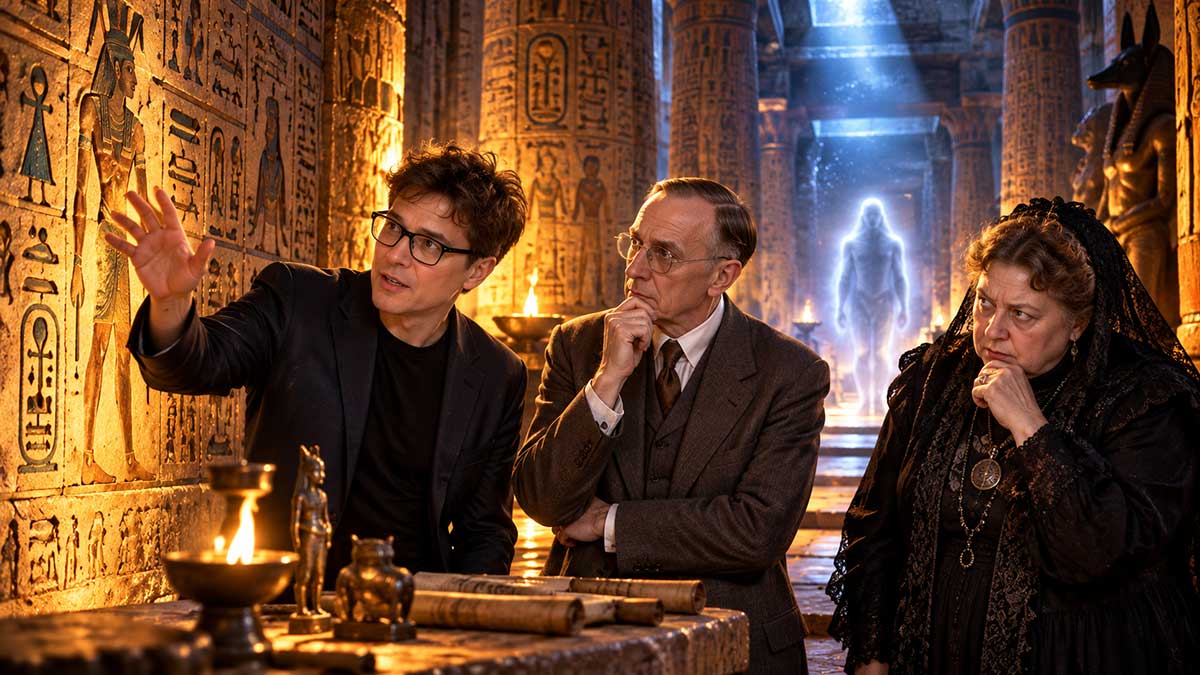
The first light of morning passes through the tall columns of the Hall of Unanswered Questions. Beyond them, the Nile moves quietly through the Egyptian desert.
Edgar Cayce is still looking at the hieroglyphs carved along the chamber walls. Helena Blavatsky notices his interest.
Blavatsky: Something familiar, Mr. Cayce?
Cayce: Not the writing itself. It's the feeling of being here. Though I suppose that shouldn't surprise me, considering what we've been discussing.
Tana Hoy: Well, if we're going to talk about Egypt, you've got two guys sitting here who believe they've lived here before.
Blavatsky: And one who claims to come from another civilization entirely.
Bashar: Which makes your gathering rather efficient.
Blavatsky: I was hoping it would make it illuminating. Efficiency is not always the same thing.
Tana laughs.
Cayce: Egypt seems to have a remarkable place in the spiritual imagination.
Blavatsky: Indeed. Every century produces another collection of people convinced they once occupied an Egyptian temple. Curiously, very few recall spending their previous incarnation hauling stones or cleaning the floors.
Tana Hoy: Well, I can't speak for everybody. I can only tell you what I experienced.
Blavatsky: Precisely why I invited you, Mr. Hoy. I am interested in the experience before anyone attempts to explain it.
Tana Hoy: Okay. Well, the first thing you have to understand is that seeing spirits wasn't something I learned to do. I've been doing it since I was little.
Blavatsky: You have described seeing them as clearly as you see us.
Tana Hoy: Yes. Exactly like that. If a guide's standing in a room, I see him standing in the room. It's not like I'm imagining a face or getting some kind of vague impression.
Cayce: And you experienced this before you had any formal training?
Tana Hoy: Oh, absolutely. I was just a kid. My family was very accepting of it, so I didn't really think it was anything unusual.
Blavatsky: You once described seeing people at shopping malls wearing clothing from different periods.
Tana Hoy: Yeah! Native American clothing, cowboy outfits, Victorian clothes. You know, all kinds of things.
Bashar: And what did you believe they were?
Tana Hoy: People. That's the funny part. When you're eight or ten years old, you're not sitting there analyzing every person walking by. You're just looking around.
Blavatsky: But eventually you concluded they were spirits.
Tana Hoy: As I got older, yes. I began to understand the differences.
Blavatsky: How?
Tana Hoy: Well, experience. And later, through what I learned. You begin recognizing certain things.
Blavatsky: Then here is my first question. When you were a child, you saw figures that appeared real to you. Later, you learned to identify them as spiritual beings. How do you distinguish what you actually perceived from the explanation you eventually gave it?
Tana considers her words.
Tana Hoy: Well, I know what I see. That's never been the confusing part for me.
Blavatsky: I do not question that you know what the experience feels like. I question whether knowing what one sees necessarily means knowing what one is seeing.
Tana Hoy: I understand what you're saying.
Bashar: She's asking whether the interpretation and the experience are identical.
Tana Hoy: Right. And no, I guess they're not necessarily identical. But when you've been doing this your whole life, you learn to recognize patterns.
Cayce: That seems true of many kinds of experience. A person can encounter something directly and spend years discovering what it means.
Blavatsky: Precisely. The human mind is remarkably talented at confusing familiarity with certainty.
Bashar: And certainty with truth.
Blavatsky: Careful, Bashar. I was about to say something quite similar.
Bashar: Then we are both making progress.
The light grows brighter. Cayce turns from the hieroglyphs and joins the others at the table.
Cayce: Tana, may I ask you something?
Tana Hoy: Sure.
Cayce: When you conduct a reading and see a guide communicating information, how do you experience that communication? Is it like hearing another person's voice?
Tana Hoy: For me, yes. It's very direct. That's one of the things that makes my readings different from certain other kinds of psychic readings.
Cayce: In what way?
Tana Hoy: Well, take tarot cards or numerology. Someone looks at symbols and interprets them. For me, it's more like having a conversation. A guide tells me something about the person I'm reading for, and I pass it along.
Blavatsky: You have compared it to repeating information from someone sitting beside you.
Tana Hoy: Exactly.
Bashar: And do you believe that means interpretation is entirely absent?
Tana Hoy: I wouldn't say that I never have to think about what something means. But I'm not sitting there trying to interpret a card. I'm hearing what I'm being told.
Bashar: Very well. Suppose someone tells you that a person will experience a major change.
Tana Hoy: Okay.
Bashar: You receive those words. What does major mean? What does change mean? Is the change emotional, physical, financial, relational?
Tana Hoy: Well, usually I can ask for clarification.
Bashar: Exactly. Which suggests communication may be direct, yet its meaning can still require clarification.
Tana Hoy: That's fair.
Blavatsky: Then perhaps even a perfectly clear message is not necessarily a perfectly complete message.
Tana Hoy: Sure. I can agree with that.
Cayce: There's a humility in acknowledging that. In my own life, many things came through the readings that I did not consciously understand.
Blavatsky: And you were often unaware of what you had said while in trance.
Cayce: That's right. People would record the readings, and I would examine some of them afterward. But I wasn't consciously standing there explaining everything.
Tana Hoy: That's interesting to me. My experience is very different. I'm awake. I'm talking to the person. I can see who's communicating.
Cayce: Yet neither of us can claim that understanding every aspect of the experience comes automatically.
Tana Hoy: No, I wouldn't claim that.
Blavatsky: Good. Because I wish to introduce a question that tends to make spiritualists rather uncomfortable.
Tana Hoy: Now I'm curious.
Blavatsky: Can a spirit guide be wrong?
The chamber becomes quiet.
Tana Hoy: Well, that's an interesting question.
Blavatsky: I should hope so.
Tana Hoy: I trust my guides. I've worked with them for years, and I've found the information very helpful to people.
Blavatsky: But trust is not the same as infallibility.
Tana Hoy: No. I suppose not.
Blavatsky: In my own writings, I argued that extraordinary phenomena should not automatically be attributed to enlightened beings. Even assuming a nonphysical intelligence is communicating, why presume it understands everything?
Bashar: An excellent distinction. Being nonphysical does not, by itself, establish unlimited awareness.
Cayce: And spiritual insight ought to lead toward greater humility, not less.
Tana Hoy: Look, I don't sit around thinking my guides know everything there is to know about the universe. I ask for information that can help someone, and that's where my attention goes.
Blavatsky: Then allow me to change the question. Suppose a guide communicates something that appears unhelpful or frightening. How do you decide whether to share it?
Tana Hoy: That's something I take very seriously. People can be frightened by information they're not prepared to hear.
Cayce: And they may remember the fear long after they've forgotten the message.
Tana Hoy: Exactly. That's why I don't believe in walking up to people and telling them things they never asked to know.
Blavatsky: You have spoken publicly about stopping another psychic from giving an unsolicited reading to your friend.
Tana Hoy: I did. She hadn't asked for it. And the person was telling her things that could upset her. I don't think that's right.
Bashar: So the existence of information does not necessarily grant permission to communicate it.
Tana Hoy: Absolutely.
Blavatsky: Now that interests me far more than the color of an angel's wings.
Tana Hoy: Why?
Blavatsky: Because you have just identified a moral limit upon the use of an ability.
She leans forward.
Blavatsky: A person may believe he knows something about another human being. But that other human being still possesses dignity, freedom, and the right not to receive an intrusion disguised as spiritual assistance.
Cayce: Knowing when to remain silent can itself be a form of service.
Tana Hoy: Yes. And sometimes a person needs to be ready to hear something. I prefer that they come to me because they want a reading.
Bashar: Then your ethical judgment is not separate from your spiritual work. It is part of how you choose to express it.
Blavatsky: An encouraging conclusion. Though I suspect humanity could benefit from applying it to many occupations beyond psychic reading.
Tana Hoy: Oh, definitely. You don't have to be psychic to give somebody advice they didn't ask for.
Everyone laughs.
Beyond the columns, morning sunlight reaches the carved figures along the walls.
Cayce: There's something else I would like to ask you about, Tana. Your experience of remembering Egypt.
Tana Hoy: Sure.
Cayce: You said you saw yourself teaching thousands of people.
Tana Hoy: Yes.
Cayce: When that experience ended, did you feel you had recovered knowledge, or that you'd recovered a sense of purpose?
Tana looks thoughtful.
Tana Hoy: That's a really good question. I guess the biggest thing was purpose. Up until then, I didn't understand why all this training was so important. After that experience, I felt like I knew what I had come here to do.
Cayce: Then the lasting effect was not simply a memory of Egypt. It changed how you approached your present life.
Tana Hoy: Exactly.
Blavatsky: Mr. Cayce, you have your own rather elaborate Egyptian story. Your readings describe a priest named Ra Ta and institutions concerned with healing and spiritual education.
Cayce: Yes, that's what the readings described.
Blavatsky: Do you regard knowing such an identity as an accomplishment?
Cayce: Not in itself. If a story about a former life helps someone recognize a weakness, develop compassion, or make a better decision today, then it has practical value. But merely possessing a remarkable story isn't the same as becoming wiser.
Bashar: And a remembered identity need not become a prison.
Blavatsky: Explain.
Bashar: If a person believes he was once a priest, teacher, ruler, or healer, he may decide that he must express himself in precisely the same manner now. Yet the present experience may offer completely different opportunities.
Tana Hoy: But sometimes you do feel there's something you're meant to continue.
Bashar: Certainly. The question is whether continuation requires repetition.
Tana Hoy: Hmm. That's interesting.
Blavatsky: Mr. Hoy, you have said your Egyptian vision confirmed your calling. But suppose your former self had been an extraordinary teacher and had still lacked something important.
Tana Hoy: Like what?
Blavatsky: Perhaps patience. Perhaps the ability to listen. Perhaps compassion for someone who had no interest in spiritual instruction.
Tana Hoy: Well, that's possible. I can't tell you everything about that lifetime.
Blavatsky: Then perhaps you returned not merely to repeat an achievement, but to discover something your former self had not yet learned.
Cayce: That would fit the idea of continued growth.
Tana Hoy: You know, I like that. It's a different way of looking at it.
Bashar: Of course. An identity is not the totality of consciousness.
Blavatsky: And neither is an impressive title evidence of spiritual achievement.
She looks toward the Egyptian columns.
Blavatsky: I have always been fascinated by humanity's devotion to ancient civilizations. Yet I sometimes wonder whether we romanticize the past because it allows us to imagine that wisdom existed somewhere else, in another age, possessed by extraordinary people.
Cayce: Perhaps it's easier to seek wisdom in a distant temple than in the difficult relationships we have today.
Blavatsky: Precisely.
Tana Hoy: But there's something inspiring about those old traditions, too. People were asking questions about life and death and the soul thousands of years ago. We're still asking them.
Blavatsky: Indeed we are. And I would not wish to dismiss that inheritance.
Bashar: Perhaps the recurring questions are themselves more important than the particular civilizations that ask them.
Blavatsky: A surprisingly modest observation from someone who claims to represent another civilization.
Bashar: We have our moments.
Cayce: Helena, may I turn one of your questions back upon you?
Blavatsky: I was beginning to wonder when someone would.
Cayce: You have asked us how to distinguish an extraordinary experience from its interpretation. But your own writings describe spiritual principles that ordinary observation cannot easily establish. How do you determine what deserves trust?
Blavatsky gives him a long look, then smiles faintly.
Blavatsky: A fair question, Mr. Cayce.
Cayce: I don't mean it as an accusation.
Blavatsky: Nor do I receive it as one. Any system of spiritual philosophy must be willing to examine its own claims. Otherwise, it ceases to be a search for wisdom and becomes merely a defense of inherited conclusions.
Bashar: Then you acknowledge that your system is an interpretation, too.
Blavatsky: Of course. I believe it contains profound insights. But claiming insight is not the same as possessing omniscience.
Tana Hoy: I think that's important. People sometimes want me to know everything. They'll ask about subjects I've never even thought about. And I tell them, look, I don't know.
Cayce: Those may be among the most useful words a person can say.
Blavatsky: Particularly someone regarded as a spiritual authority.
Bashar: Yet uncertainty does not require dismissing experience.
Blavatsky: No. It requires proportioning confidence to what one actually knows.
Tana Hoy: There's another thing. I don't want psychic stuff to become my whole life. When I'm with friends, I'm just Tana. I'm not sitting there trying to see everybody's future.
Blavatsky: You have said that you have no close friends who are psychics.
Tana Hoy: Right. And we don't sit around talking about spirit guides over dinner. We talk about regular things.
Cayce: That sounds rather healthy.
Bashar: Why would ordinary human life be separate from spiritual development?
Tana Hoy: That's what I think. You have to live your life.
Blavatsky: There is a temptation among spiritual seekers to regard ordinary existence as something inferior. They imagine that enlightenment must mean escaping the mundane.
Cayce: Yet most opportunities to serve someone are very ordinary.
Tana Hoy: Helping somebody through a difficult divorce. Giving someone encouragement when they're afraid. Helping them find a new direction. That's the kind of thing that makes my work worthwhile.
Blavatsky: Then perhaps your most meaningful knowledge is not merely what you believe your guides reveal.
Tana Hoy: What do you mean?
Blavatsky: It may be what decades of listening to human beings have taught you.
Tana becomes quiet.
Tana Hoy: I hadn't really thought about it that way.
Cayce: You must have heard thousands of personal stories.
Tana Hoy: Oh, absolutely. I've had clients for twenty years or more. I've watched their children grow up. You really get to know people.
Cayce: And they have taught you something about human life.
Tana Hoy: Of course they have.
Blavatsky: Then the exchange has never been entirely one-directional.
Tana Hoy: No, I guess it hasn't.
Bashar: The teacher and the student are not necessarily fixed identities.
Blavatsky: That, Bashar, is a statement I find increasingly difficult to dispute.
The sun has risen above the river. Its light enters the chamber, illuminating the table where the four figures sit.
Blavatsky: Let us return to our original question. How do we distinguish spiritual wisdom from extraordinary experience?
Cayce: Perhaps we begin by examining what the experience leads a person to do.
Blavatsky: A useful beginning. But results can sometimes deceive us. People may feel comforted by something untrue.
Cayce: Certainly. Compassion should not require abandoning discernment.
Bashar: Nor should discernment require rejecting an experience simply because it does not fit one's present beliefs.
Tana Hoy: I agree with that. I've had experiences all my life that other people find hard to understand. I don't expect everybody to see what I see.
Blavatsky: Then what would you ask of someone who doubts your interpretation?
Tana Hoy: I don't need them to believe everything I believe. I'd rather they judge me by how I treat people and whether what I do actually helps.
Blavatsky: And would you offer them the same freedom to question what you believe?
Tana Hoy: Sure. People have their own beliefs.
Cayce: Respecting another person's freedom may itself be a sign of spiritual maturity.
Bashar: Particularly when their perspective differs from your own.
Blavatsky: Then we have arrived at an intriguing point. One need not settle the nature of every spiritual experience before considering the responsibility that accompanies it.
Tana Hoy: That's right.
Blavatsky: We have spoken about guides, angels, trance readings, former lives, and ancient civilizations. But I find myself returning to the gentleman who said he refuses to give an unsolicited reading.
Tana Hoy: Me?
Blavatsky: Yes, Mr. Hoy. You have spent much of your life discussing what you believe you can perceive beyond ordinary human awareness. Yet one of your clearest moral convictions concerns what you choose not to do with that information.
Tana smiles slightly.
Tana Hoy: Well, you have to respect people.
Blavatsky: Exactly.
She looks toward Cayce.
Blavatsky: Mr. Cayce, you spoke of wisdom serving the person living today rather than merely satisfying curiosity about a previous life.
She turns toward Bashar.
Blavatsky: And you remind us that our beliefs affect the way we interpret experience.
Bashar: They do.
Blavatsky: Then perhaps our first obligation is not to insist that we possess the correct description of the invisible world. Perhaps it is to remain responsible for how our descriptions influence the visible one.
Cayce: That seems a worthy responsibility.
Tana Hoy: I like that.
Bashar: And now comes the question of what happens when information is received but does not produce the outcome someone hopes for.
Blavatsky: Ah. You anticipate my next inquiry.
Her expression changes. The amusement leaves her voice.
Blavatsky: Mr. Hoy, in your public interviews, you have described a warning you believe you received before the Oklahoma City bombing.
Tana nods slowly.
Blavatsky: You have spoken about the anguish you experienced when the event occurred despite your efforts to communicate what you had seen.
Tana Hoy: Yes. That was a very difficult time.
Blavatsky: Then I think we have reached the most painful question of our gathering.
She pauses, giving him space.
Blavatsky: What is the purpose of seeing a possible future if knowing about it does not give us the ability to prevent the suffering it contains?
The sunlight rests upon the table. No one rushes to answer.
Topic 3: The Burden of Seeing the Future
The Hall of Unanswered Questions has grown quiet.
Sunlight stretches across the stone floor, illuminating the circular table. Beyond the Egyptian columns, the Nile moves steadily through the desert, indifferent to the centuries that have passed along its banks.
Tana Hoy sits with his hands resting on the table. Edgar Cayce watches him with gentle attention. Bashar, who has been quick to offer an explanation throughout the gathering, remains silent.
Helena Blavatsky closes the notebook before her.
Blavatsky: Mr. Hoy, when we began this conversation, you spoke about seeing angels and spirit guides as naturally as you see another person.
Tana Hoy: Yes.
Blavatsky: And you told us that the greatest value of your abilities is helping people make better decisions about their lives.
Tana Hoy: That's right. That's really why I do what I do.
Blavatsky: But there was an experience you described in your interview with Jeff Mara that appears to have challenged your understanding of that purpose.
Tana nods.
Tana Hoy: The Oklahoma City bombing.
Blavatsky: Yes. Would you be comfortable telling us about it?
Tana Hoy: Sure. It's something I've talked about publicly, but it's still not an easy thing to remember.
He takes a moment.
Tana Hoy: You know, most of the time when I get information, it's from my guides. I see them, I hear what they're saying, and I pass the information along.
Cayce: But this was different?
Tana Hoy: Completely different. I had a dream. And I don't normally consider prophetic dreaming my main ability. But this was so vivid. I saw this terrible bombing happening.
Blavatsky: And you believed it concerned an event that had not yet occurred?
Tana Hoy: Yes. When I woke up, I knew I had to tell somebody. I told my partner what I'd seen, and I wrote it down.
Cayce: That must have been frightening.
Tana Hoy: It was. And then I started thinking, what am I supposed to do with this?
He glances toward Blavatsky.
Tana Hoy: I had a psychic friend who warned me that if you predict something involving violence, the authorities might start asking questions. So I contacted the FBI. I wanted them to have the information.
Blavatsky: You were trying to make the warning useful.
Tana Hoy: Exactly. I didn't want people thinking I was somehow involved. I just wanted somebody to know.
Bashar: You recognized that receiving information and acting upon it were two separate decisions.
Tana Hoy: Well, yes. I couldn't just keep it to myself.
Blavatsky: You subsequently described the prediction during a radio appearance.
Tana Hoy: That's right. And then the bombing happened.
He pauses.
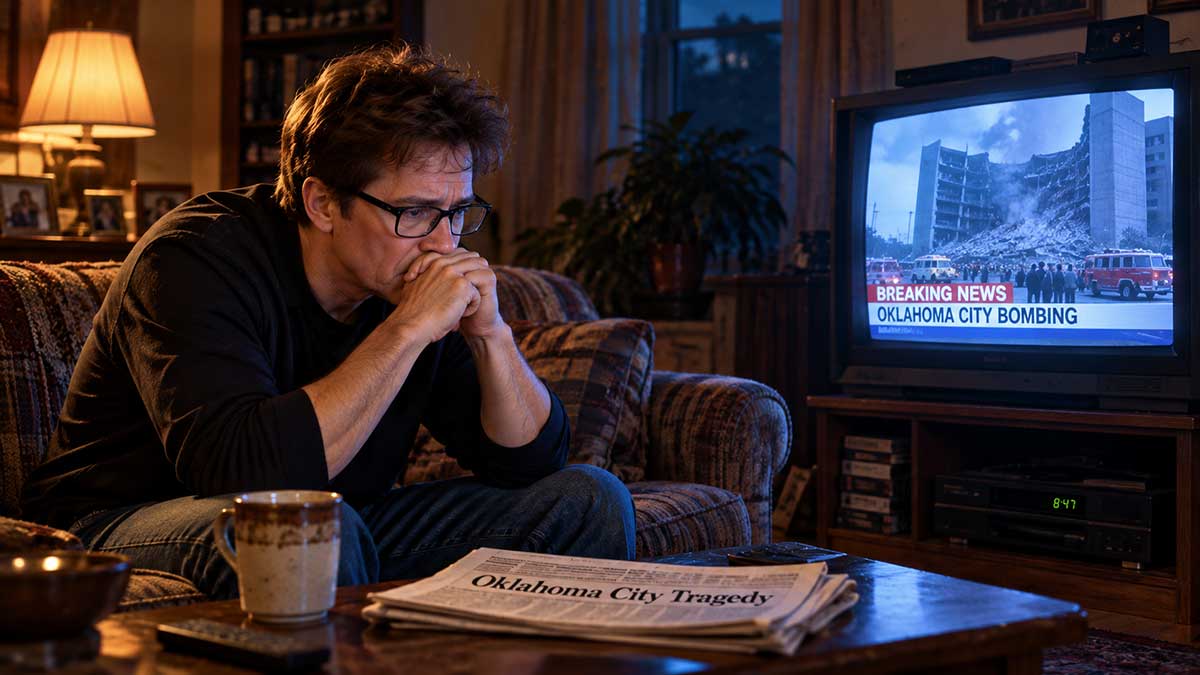
Tana Hoy: I remember sitting on my couch. The television was on, but the sound was turned down. I was talking to a friend, and I started noticing all these people running on the screen.
Cayce: And then you realized what you were seeing.
Tana Hoy: Yeah. I turned up the television. And it was happening.
The room remains still.
Blavatsky: What did you feel?
Tana Hoy: Horrible.
He looks down.
Tana Hoy: Just horrible. People were dying. And I'd tried to warn somebody, but it still happened.
Blavatsky: In that interview, when Jeff asked whether you felt guilty, you seemed particularly moved by the question.
Tana Hoy: I was. You know, people usually ask about the prediction. They want to know what I saw, how I knew, whether I was right.
Cayce: But very few ask what it cost you emotionally.
Tana Hoy: Exactly.
He exhales.
Tana Hoy: I cried. I felt so much guilt. And I remember thinking, what's the use of having this gift if I can't stop something like that?
Blavatsky does not immediately respond.
Tana Hoy: That's what really bothered me. I could see something terrible coming, but seeing it didn't mean I could prevent it.
Blavatsky: Mr. Hoy, there is a question I would like to ask you. But if you prefer not to answer, I will respect that.
Tana Hoy: Go ahead.
Blavatsky: When you thought about the people who died, did you feel that you had failed them?
Tana is quiet.
Tana Hoy: That's what it felt like. Even though I knew I'd tried.
Cayce: There is a terrible loneliness in feeling responsible for something beyond your control.
Tana Hoy: Yes. That's exactly it.
Bashar: And yet there is a distinction between responsibility for your actions and responsibility for an entire outcome.
Tana Hoy: I know that now.
Bashar: But at the time, you were experiencing the two as though they were the same.
Tana Hoy: Yes.
Blavatsky: Before we examine that distinction, I want to acknowledge something.
She looks directly at Tana.
Blavatsky: You have described an experience that you believe gave you advance warning of a tragedy. We may discuss the nature of prophecy and whether future events can be perceived. But whatever conclusion one reaches about those matters, the suffering of the people who died is not a philosophical exercise.
Cayce: No. It is not.
Blavatsky: One hundred and sixty-eight people were killed. Families were forever changed. Any discussion of this event must begin there.
Tana nods.
Tana Hoy: I agree.
The light falling across the table shifts slightly.
Blavatsky: Let us consider the first question that follows from your experience. Is the future already determined?
Bashar: That depends upon what you mean by the future.
Blavatsky: I thought you might say that.
Bashar: You are assuming that the future is a single destination toward which everyone is moving.
Blavatsky: Am I?
Bashar: Your question suggests it.
Blavatsky: Then correct my assumption.
Bashar: From the perspective I represent, there are multiple possible experiences. The present state of consciousness, together with choices and circumstances, relates to the reality one experiences.
Cayce: But are those possibilities equally available to every person?
Bashar: Not every possibility must be available through every circumstance in the same manner.
Blavatsky: Then we should be cautious with language suggesting that human beings can simply choose any outcome they desire.
Bashar: Certainly. Choosing how to respond is not identical to controlling every person or event.
Tana Hoy: That's something I tell people during readings. If I see something coming, there may be ways to avoid it. Or maybe they can prepare so it doesn't hit them as hard.
Cayce: Have you experienced cases where you believe the warning helped someone change an outcome?
Tana Hoy: Oh, yes. That's one of the most rewarding parts of my work. People come to me worried about something. I give them information, and sometimes they make a decision that changes everything for them.
Blavatsky: Then you regard many predictions as information about possibilities rather than unchangeable facts.
Tana Hoy: Yes, absolutely.
Blavatsky: But the Oklahoma City experience did not unfold that way.
Tana Hoy: No.
Blavatsky: And that brings us to a difficult problem. If an event is preventable, why might a warning fail? And if it is not preventable, what is the purpose of receiving a warning?
Bashar: The question assumes that the purpose of receiving information must always be to alter the event described.
Blavatsky: Should it not be, when human lives are at stake?
Bashar: The desire to prevent suffering is entirely understandable. But we should distinguish the purpose attributed to information from the ways it can actually be used.
Blavatsky: Then tell us what other purpose such a warning could serve.
Bashar: I would not presume to know the particular purpose of Tana's experience.
Tana looks toward Bashar.
Tana Hoy: I appreciate that.
Bashar: One could discuss possibilities, but it would be inappropriate to claim certainty about an experience that belongs to someone else.
Cayce: Especially when that experience concerns people who suffered and died.
Blavatsky: Good. Then we will resist the temptation to explain away what remains unexplained.
She turns to Tana.
Blavatsky: Did your experience ever cause you to question whether your guides understood the future as completely as you had imagined?
Tana Hoy: I questioned a lot of things afterward. Mostly I questioned what I was supposed to do with the gift.
Blavatsky: Not merely whether the information was accurate, but whether receiving it was worthwhile.
Tana Hoy: Exactly. I kept coming back to that. What good does it do to see something if there's nothing you can do?
Cayce: May I ask something?
Tana Hoy: Sure.
Cayce: When you think back on that time, do you remember feeling more angry that you couldn't change what happened, or more heartbroken for the people?
Tana thinks.
Tana Hoy: I think it was all mixed together. The helplessness and the pain. You don't separate those things very easily when you're going through them.
Cayce: No, you don't.
Blavatsky: And perhaps we should be wary of separating them too neatly now.
For a time, the only sound is the distant movement of water beyond the columns.
Blavatsky: I wish to ask a question of all three of you.
She places her palms upon the table.
Blavatsky: Spiritual traditions frequently teach that suffering has a purpose. That souls learn through adversity. That events which seem tragic may contribute to some larger development.
Cayce: Such ideas appear in many traditions.
Blavatsky: But there is a danger in them.
Bashar: Explain.
Blavatsky: Imagine a mother whose child has died. Someone approaches her and says, “You must understand, this was necessary for your soul's development.”
She pauses.
Blavatsky: Would that be wisdom?
Cayce: No. I would not call it wisdom.
Tana Hoy: I wouldn't say that to somebody.
Bashar: Nor would an explanation automatically be useful merely because it fits a particular belief system.
Blavatsky: Then why do spiritual teachers so often rush to explain suffering?
Cayce: Perhaps they find helplessness difficult to bear.
Blavatsky: Go on.
Cayce: When someone is suffering and we cannot take the suffering away, we feel inadequate. An explanation can make us feel that we've offered something.
Tana Hoy: That's true. People want answers. I know that from my clients.
Cayce: But sometimes the person doesn't need an answer. They need someone willing to sit with them.
Blavatsky: Without telling them their pain was necessary?
Cayce: Without pretending to know why it happened.
Bashar: There is an important distinction between discovering meaning through an experience and declaring that the experience had to occur.
Blavatsky: Precisely.
Tana Hoy: You know, I believe people can learn from difficult things. I've seen that happen many times. Somebody goes through a terrible divorce or loses a job, and later they tell me their life changed in ways they never expected.
Blavatsky: But would you tell them the suffering itself was required?
Tana Hoy: No. I would tell them that they can still move forward and that things can get better.
Cayce: That preserves the possibility of hope without making suffering sacred.
Blavatsky: A distinction worth preserving.
Bashar: And meaning can be discovered in the response, without presuming that the harmful event was justified.
Blavatsky: Then perhaps the spiritual significance of suffering is not always found in why it occurred, but in how people respond to those who suffer.
Tana looks toward Cayce.
Tana Hoy: That's what I wish I'd been able to do more of back then.
Cayce: You did attempt to act on the warning you believed you received.
Tana Hoy: I know.
Cayce: Yet knowing that does not necessarily remove the grief.
Tana Hoy: No. It doesn't.
Blavatsky: Nor should anyone demand that it does.
Bashar: Tana, may I ask you something?
Tana Hoy: Of course.
Bashar: When you finally came to the conclusion that you were a messenger, what changed inside you?
Tana Hoy: Well, I stopped feeling like everything was my responsibility. I realized my job was to share what I received and do what I could with it.
Bashar: And before that realization?
Tana Hoy: I felt like I'd been given this gift and somehow failed to use it properly.
Bashar: So you were evaluating yourself according to an outcome you did not control.
Tana Hoy: That's a pretty good way of putting it.
Blavatsky: But let us be precise. Mr. Hoy did have control over some things. He could decide whether to report what he believed he had seen. He could decide whom to contact.
Bashar: Correct.
Blavatsky: He could not control how the authorities interpreted the report. Nor could he control the actions of those responsible for the bombing.
Cayce: And he could not assume responsibility for choices made by strangers.
Tana Hoy: Right.
Blavatsky: Then responsibility must have boundaries.
Bashar: Otherwise, responsibility becomes confused with omnipotence.
Blavatsky: An uncomfortable confusion for anyone who believes they possess extraordinary abilities.
Tana Hoy: You know, I think that's part of what happened to me. Not that I thought I could control everything. But when you're told you've got a gift that can help people, you want to help.
Cayce: Of course.
Tana Hoy: And then something like that happens, and you start wondering why you couldn't do more.
Blavatsky: There is a painful irony here. The more deeply you cared about helping others, the more severely you judged yourself for failing to prevent their suffering.
Tana looks down for a moment.
Tana Hoy: Yeah. That's true.
Cayce: Perhaps compassion for others must be accompanied by compassion for oneself.
Tana Hoy: That's not always easy.
Cayce: No. Particularly when we believe we should have done something more.
Blavatsky: Mr. Cayce, I wonder whether you are approaching the heart of this problem.
Cayce: How so?
Blavatsky: We speak constantly of love for others. But when we cannot protect someone from harm, our grief may become an accusation against ourselves.
Cayce: And sometimes the accusation has no foundation.
Blavatsky: Then can a person remain compassionate without treating every tragedy as a personal failure?
Bashar: Yes. In fact, releasing the demand to control all outcomes may permit more effective and compassionate action.
Tana Hoy: That's what I try to do now. I share what I'm given, and I do my best to help people.
Blavatsky: Does that mean you care less than you once did?
Tana Hoy: No. Not at all.
Blavatsky: Then you have learned something worth discussing.
The chamber grows warmer as sunlight reaches the columns.
Blavatsky: Bashar, I want to return to your teaching about releasing attachment to outcomes.
Bashar: Very well.
Blavatsky: I can see its practical value when someone pursues a career or makes an ordinary decision. But I find the principle more difficult when the desired outcome is the survival of innocent people.
Bashar: Understandably.
Blavatsky: Suppose a parent is waiting for a critically ill child to recover. Would you advise that parent to release attachment to the outcome?
Bashar: I would distinguish between loving the child and believing that love requires certainty about the result.
Blavatsky: That sounds rather abstract.
Bashar: Then consider it practically. The parent can seek appropriate care, remain present, make decisions, express love, and do everything reasonably possible. None of those actions requires the belief that the parent can guarantee recovery.
Cayce: And acknowledging uncertainty need not diminish hope.
Blavatsky: But surely the parent may desperately want the child to live.
Bashar: Of course. Releasing insistence on an outcome is not the same as ceasing to prefer it.
Tana Hoy: That's the part I think people misunderstand. I wanted to stop that bombing. I still wish it hadn't happened. Accepting that I couldn't control it doesn't mean I suddenly stopped caring.
Blavatsky: Precisely. Your sorrow remains evidence of your compassion, not a failure of your spiritual development.
Bashar: And compassion does not require self-condemnation.
Cayce: Nor does wisdom require emotional numbness.
Blavatsky nods slowly.
Blavatsky: Then I will grant you this, Bashar. There is a distinction between caring deeply about an outcome and believing one's worth depends upon achieving it.
Bashar: An important distinction.
Blavatsky: Do not become accustomed to my agreeing with you.
Bashar: I would never deprive you of the excitement of disagreement.
Tana gives a small laugh. Even Blavatsky smiles.
Cayce: Tana, earlier you told us that your greatest successes are not your predictions.
Tana Hoy: Right. It's the people I've helped.
Cayce: I think that matters here.
Tana Hoy: How?
Cayce: You spent years believing the gift was valuable through what it enabled you to see. But when you describe what makes your life meaningful, you speak about the people who have changed through your work.
Tana Hoy: Yes.
Cayce: Then perhaps there are two different measures of success.
Blavatsky: Tell us.
Cayce: One concerns whether information proves accurate. The other concerns whether a person acts with responsibility and compassion.
Bashar: And those measures need not always produce the same result.
Tana Hoy: That's true. Sometimes I give someone a warning, and they make changes. And then the thing I warned them about doesn't happen.
Blavatsky: An interesting difficulty for a profession concerned with predictions.
Tana Hoy: Exactly. If the warning helps them avoid something, that's a success to me.
Blavatsky: Yet the event's failure to occur would make it harder for an outside observer to establish whether the prediction was accurate.
Tana Hoy: Sure. I understand that.
Cayce: Perhaps the practical question for the client is whether the guidance helps them make wiser choices.
Blavatsky: Provided the guidance itself is approached responsibly and uncertainty is acknowledged.
Tana Hoy: I agree.
Bashar: Which returns us to the distinction between predicting a reality and influencing a choice.
Blavatsky: Though we should not confuse a useful decision with proof of supernatural foreknowledge.
Tana Hoy: Fair enough.
Blavatsky studies him for a moment.
Blavatsky: I appreciate that you do not insist upon answering every question about how these things work.
Tana Hoy: Well, I don't know everything. I never said I did.
Blavatsky: That may be a more valuable admission than many grand declarations about the universe.
Tana Hoy: I'll take that as a compliment.
Blavatsky: You may.
Outside, a breeze moves across the Nile. The four remain seated, their conversation slowing.
Blavatsky: Mr. Hoy, I have one final question about that terrible day.
Tana Hoy: Okay.
Blavatsky: You said you once wondered what use your gift could be when it failed to prevent suffering.
Tana Hoy: Yes.
Blavatsky: If you could speak to the younger man sitting on that couch, watching the television, what would you want him to know?
Tana remains silent for a moment.
Tana Hoy: I think I'd want him to know that he did what he could. That he shouldn't blame himself for something he didn't cause.
Cayce: That's a compassionate thing to tell him.
Tana Hoy: Yeah. I wish I'd understood it sooner.
Blavatsky: Would you tell him to stop caring so deeply?
Tana Hoy: No. Never.
Blavatsky: Why?
Tana Hoy: Because caring about people is the whole reason I do this.
The words settle over the table.
Cayce: Then the grief did not destroy the part of you that wanted to help.
Tana Hoy: No. I kept doing readings. I kept teaching. I still love what I do.
Bashar: And your experience changed your relationship with responsibility.
Tana Hoy: It did.
Blavatsky: Perhaps this is where I must acknowledge something myself.
Cayce: What's that?
Blavatsky: I have spent much of our discussion asking whether spiritual experiences are interpreted correctly. It is an important question, and I do not withdraw it.
She turns toward Tana.
Blavatsky: But I am reminded that behind such experiences stands a human being who must live with their consequences.
Tana Hoy: That's true.
Blavatsky: And philosophical precision, valuable though it is, can become a poor substitute for compassion when someone is grieving.
Cayce: Knowledge has its place. So does silence.
Blavatsky: Indeed.
She looks at the river.
Blavatsky: One hundred and sixty-eight people died in Oklahoma City. Nothing in our conversation changes that. Their lives must never become merely material for a discussion about prophecy.
Tana Hoy: I agree completely.
Blavatsky: Yet your account raises a question about the responsibilities that accompany extraordinary claims. And your sorrow reminds us that, whatever one believes about prophecy, human life is not an abstraction.
Bashar: Then perhaps the useful question is not merely what someone can perceive, but what that person chooses to do with whatever understanding they possess.
Cayce: And whether that understanding leads to greater care for others.
Tana Hoy: That's how I see it.
For a while, no one speaks.
Then Blavatsky looks toward the distant horizon.
Blavatsky: Gentlemen, we have spoken about the limits of one person's ability to influence the future. But humanity now stands before a rather different problem.
Bashar: The development of intelligence beyond its previous experience?
Blavatsky: Precisely.
Tana Hoy: Artificial intelligence.
Blavatsky: You have warned publicly about its possible dangers, Mr. Hoy.
Tana Hoy: I have. And I feel very strongly about that.
Blavatsky: What troubles me is that humanity may soon possess capabilities far greater than anything our ancestors could have conceived. Yet I see little reason to assume that our compassion has advanced at the same pace.
Cayce: Greater abilities create greater responsibilities.
Bashar: And greater opportunities for choice.
Blavatsky: Then the question before us is no longer whether a single person can foresee a catastrophe.
She places her hand upon the closed notebook.
Blavatsky: It is whether an entire civilization can recognize the dangers it is creating, and develop the wisdom to choose another path.
Tana looks toward Bashar.
Tana Hoy: That's exactly what worries me.
The Nile continues flowing beneath the morning sun. The conversation has reached a different kind of uncertainty, one concerning not the past or the present, but the future humanity is building for itself.
Topic 4: AI, Extraterrestrials, and Humanity's Spiritual Future

The sunlight over the Nile has grown brighter, yet something in the Hall of Unanswered Questions has changed.
The ancient columns remain, but beyond them, the horizon seems to shimmer. For an instant, the silhouettes of distant temples give way to skyscrapers, aircraft, and unfamiliar machines moving silently across the sky.
Helena Blavatsky watches the transformation with considerable interest.
Blavatsky: Well. That is certainly not the Alexandria I remember.
Bashar: Does it disturb you?
Blavatsky: Hardly. I spent my life telling people that the universe was considerably stranger than they supposed. It would be embarrassing to complain when it finally demonstrated the point.
Tana Hoy laughs.
Tana Hoy: I'll tell you what disturbs me. Those machines in the sky.
Blavatsky: I thought they might.
Tana Hoy: Look, I don't consider myself an expert on artificial intelligence. I don't follow every technological development, and I'm not pretending I understand exactly how these systems work.
Cayce: Yet you've spoken publicly about being deeply concerned.
Tana Hoy: Very concerned. In my interview with Jeff Mara, I talked about what I believe my guides have been showing me. And the thing that worries me isn't people using AI to write something or answer questions. It's what could be happening behind the scenes.
Blavatsky: Military applications?
Tana Hoy: Yes. Drones, weapons, countries competing to develop more advanced systems. Everybody wants to get ahead of everybody else. And I feel like we're moving into something we may not be able to control.
Bashar: May I ask you a question?
Tana Hoy: Sure.
Bashar: Are you afraid of intelligence itself, or of the intentions guiding its development?
Tana considers this.
Tana Hoy: I think it's both. If something becomes more intelligent than we are, and we don't have the ability to control it, that's a problem. But if people are developing it to dominate other people, that's a problem too.
Blavatsky: Two different dangers, then. One arises from the behavior of the technology. The other arises from the behavior of humanity.
Tana Hoy: Exactly.
Blavatsky: Which concerns you more?
Tana Hoy: I honestly don't know. They seem connected.
Cayce: Perhaps that connection is worth examining.
Blavatsky: Indeed. We have spent the morning discussing extraordinary abilities, spiritual knowledge, and the responsibilities that accompany them. Now we find humanity constructing something that may possess capabilities beyond its creators.
She gestures toward the unfamiliar aircraft beyond the columns.
Blavatsky: Tell me, gentlemen. If a civilization becomes extraordinarily intelligent but remains selfish, fearful, and divided, would you call that civilization advanced?
Bashar: Advanced in what respect?
Blavatsky: Ah. You intend to make me define my terms again.
Bashar: It is a useful habit.
Blavatsky: Very well. Technologically advanced, certainly. But spiritually?
Bashar: Technological capability and spiritual maturity are not necessarily the same measurement.
Cayce: A person may learn how to accomplish something without learning whether it ought to be accomplished.
Tana Hoy: That's exactly what I'm talking about.
Blavatsky: Then we have reached our first distinction. The ability to create something is not proof of the wisdom to use it.
Bashar: Correct. And fearing a technology is not the same as examining the beliefs and intentions through which it is developed.
Tana Hoy: But you can't just tell people not to be afraid when there's something dangerous happening.
Bashar: I am not suggesting that.
Tana Hoy: Good. Because when I talk about this, I'm not trying to frighten people. I want them to do something about it.
Blavatsky: Such as?
Tana Hoy: Regulation. Rules. Safeguards. People have to start taking this seriously.
Blavatsky: Then your prediction is not merely a declaration about an unavoidable future.
Tana Hoy: No. I hope people can prevent it.
Bashar: An important clarification.
Blavatsky: Particularly after our previous discussion about foreknowledge.
She studies Tana.
Blavatsky: You have described a possible danger. But unlike the bombing you spoke about earlier, this warning concerns decisions that entire governments, industries, and societies may still influence.
Tana Hoy: Right. That's why I think people need to pay attention now.
The vision outside the columns changes.
The futuristic skyline disappears, replaced by a dark expanse of stars. A small point of light moves silently through the heavens.
Cayce: There is something I find curious about this discussion.
Blavatsky: Please continue.
Cayce: We speak of creating intelligence greater than our own as though that were the ultimate achievement of civilization.
Bashar: And you would propose another measure?
Cayce: I would ask whether such intelligence makes life more meaningful. Does it lessen suffering? Does it help people care for one another? Does it serve a good purpose?
Blavatsky: A machine might answer a thousand questions in the time it takes a person to ask one. Yet none of that would establish whether its answers should be trusted.
Tana Hoy: Or whether the people controlling it have good intentions.
Bashar: Then perhaps you are beginning to distinguish intelligence, knowledge, wisdom, and intention.
Blavatsky: Four concepts humanity has an unfortunate habit of confusing.
Tana Hoy: Let me ask you something, Bashar. You're supposed to represent a civilization that's far more advanced than ours, right?
Bashar: The Essassani civilization is presented within these teachings as having a different understanding of consciousness and reality, yes.
Tana Hoy: So how does a civilization get to that point without destroying itself along the way?
Bashar: You are assuming that every civilization must develop through precisely the same sequence of choices.
Tana Hoy: Well, I'm asking how it survives.
Bashar: Through the relationships among its beliefs, decisions, awareness, and actions. Technological development need not dictate a single outcome.
Tana Hoy: Okay, but that still doesn't tell me what you actually do when somebody develops a weapon that can kill thousands of people.
Blavatsky: An excellent question.
Bashar: You establish the conditions, agreements, and responsibilities appropriate to the society making those choices.
Tana Hoy: So rules.
Bashar: Rules may be one expression of those agreements.
Tana Hoy: Then we're not so far apart.
Bashar: Did you believe we were?
Tana Hoy: Well, sometimes you make it sound like if everybody just changes their thinking, everything will work out.
Bashar: Changing one's perspective does not eliminate the need for practical action. It influences the kind of action one chooses.
Cayce: And action must account for the people who may be harmed.
Blavatsky: Then perhaps spiritual development does not exempt a civilization from building responsible institutions.
Bashar: Certainly not.
Blavatsky: I find that reassuring. I was beginning to fear that humanity would be instructed to meditate its way out of a military catastrophe.
Tana laughs.
Tana Hoy: Well, I believe in meditation, but I'd like somebody to make sure those drones have an off switch.
Cayce: Preferably one that works.
Even Blavatsky smiles.
Blavatsky: Let us approach the matter from another direction.
She looks toward Bashar.
Blavatsky: You describe an extraterrestrial civilization possessing knowledge that humanity does not yet possess. Mr. Hoy believes extraterrestrial beings are already involved in humanity's spiritual development.
Tana Hoy: Yes. I believe that very strongly.
Blavatsky: Then I wish to ask something neither of you should find offensive.
Bashar: Ask.
Blavatsky: Why should we assume that a civilization capable of traveling between stars is morally superior to one that cannot?
Tana Hoy: Well, I don't necessarily believe every extraterrestrial being has good intentions. I believe there are different kinds.
Blavatsky: But you have said that the beings with whom you feel connected are benevolent.
Tana Hoy: Yes. I believe they're here to help humanity develop. I think we're moving into a period when contact is going to become more open.
Cayce: What would that help look like?
Tana Hoy: I think they could help us understand ourselves better. Help us become more loving and accepting. I don't think their purpose is to harm us.
Blavatsky: But how would you distinguish benevolence from a being's claim to benevolence?
Tana Hoy: Well, that's a fair question.
Blavatsky: A human ruler may describe himself as a benefactor. A teacher may insist that his authority serves his students. Yet history demonstrates that claims of good intentions cannot settle questions of trust.
Bashar: Which is why genuine growth must involve discernment.
Blavatsky: Precisely. And the preservation of freedom.
Cayce: If another civilization wished to help humanity, wouldn't the most meaningful assistance be that which helps people become more responsible for themselves?
Tana Hoy: I would think so.
Cayce: Rather than making humanity dependent on someone else to solve every problem.
Tana Hoy: Yes, I agree with that.
Bashar: A relationship between civilizations need not be one of masters and students. Each can offer a perspective the other does not possess.
Blavatsky: Even if one has vastly greater technological capabilities?
Bashar: Technological difference need not imply superiority in every dimension of experience.
Blavatsky: An interesting concession.
Bashar: Why would recognizing difference require ranking the value of consciousness?
Tana Hoy: You know, I like that. I think human beings spend too much time deciding who's better than everybody else.
Blavatsky: You said something similar in your interview. That humanity is constantly searching for differences rather than similarities.
Tana Hoy: Yes! Political differences, religious differences, racial differences. We're always judging one another.
Cayce: And you believe extraterrestrial contact might help change that?
Tana Hoy: I do. I think it might help people see that we're part of something much bigger.
Blavatsky: Perhaps. Though humanity has had considerable difficulty recognizing common dignity even among members of its own species.
Tana Hoy: That's true.
Blavatsky: I wonder whether meeting an unfamiliar intelligence would make us more accepting, or simply create another category of beings to fear.
Bashar: That would depend in part upon the beliefs humanity brings to the encounter.
Cayce: And how people choose to behave.
The moving light in the sky grows brighter, then vanishes.
For a moment, the Nile reflects countless stars despite the daylight surrounding the chamber.
Cayce: May I ask Tana something?
Tana Hoy: Sure.
Cayce: You believe humanity is approaching a period of greater spiritual awareness.
Tana Hoy: Yes.
Cayce: But you fear it may experience serious problems through AI.
Tana Hoy: Right.
Cayce: Do you see those possibilities as contradictory?
Tana Hoy: No. Not really. I think humanity is going to go through some difficult things, but I believe we'll come through them. I have a lot of faith in humanity.
Blavatsky: You have expressed confidence in a loving force guiding the universe.
Tana Hoy: Absolutely. I believe there's a loving force behind everything, and I believe things ultimately work out for the highest good.
Blavatsky: Yet you have warned of an AI-related crisis with considerable conviction.
Tana Hoy: Yes. That's why I think we have to make changes.
Bashar: Then perhaps the danger you perceive is conditional rather than inevitable.
Tana Hoy: That's what I hope.
Blavatsky: There is a distinction between warning people about a possible outcome and declaring that the outcome has already been settled.
Cayce: A warning can invite responsibility.
Tana Hoy: Exactly.
Blavatsky: But I would caution against assuming that every frightening prediction corresponds to a future event. The fact that a possibility feels vivid does not establish that it will occur.
Tana Hoy: I understand that. I'm telling you what I believe I'm receiving.
Blavatsky: And that is a fair distinction.
Bashar: The more useful question may be which actions are beneficial across many possible futures.
Cayce: Such as protecting human life.
Bashar: Yes.
Tana Hoy: Making sure technology is developed responsibly.
Blavatsky: And refusing to surrender ethical judgment simply because a machine appears intelligent.
Cayce: Teaching people to care about those affected by their decisions.
Tana Hoy: That's really what it comes down to.
Blavatsky sits back.
Blavatsky: Then we may have discovered something remarkable. We began with a prediction about a technological catastrophe. We now find ourselves discussing familiar human responsibilities.
Bashar: Because technology does not eliminate the consciousness through which it is used.
Blavatsky: I believe that was almost a straightforward answer.
Bashar: I thought you deserved one.
Tana Hoy: There's another thing I've been thinking about.
Blavatsky: Go on.
Tana Hoy: People hear me talk about extraterrestrials, and some of them immediately think of spaceships and dramatic events. But what interests me most is the possibility that we're going to learn something important about ourselves.
Cayce: What sort of thing?
Tana Hoy: That we're not as separate as we think. That there's more love and kindness out there than we realize.
Blavatsky: Among extraterrestrials?
Tana Hoy: Among everybody. Humans too.
Cayce: You've spent much of your life listening to people who come to you with problems.
Tana Hoy: Yes.
Cayce: What have those experiences taught you about humanity?
Tana Hoy: Most people want pretty much the same things. They want to be loved. They want their children to be happy. They want security. They want somebody to care about them.
Blavatsky: Yet we have built political and social systems that encourage us to view one another as opponents.
Tana Hoy: Exactly. And I think we're going to have to get past that.
Bashar: Perhaps encountering another civilization would challenge humanity's tendency to define identity through opposition.
Blavatsky: Or reinforce it.
Bashar: Both possibilities can be considered.
Cayce: Then the question is what kind of people we choose to become before such an encounter ever occurs.
Tana Hoy: I like that.
Blavatsky: As do I. It removes the temptation to postpone our responsibilities until extraordinary visitors arrive.
Tana Hoy: But I still believe they're coming.
Blavatsky: You are entitled to describe your belief. The rest of us are entitled to examine what follows from it.
Tana Hoy: Fair enough.
Blavatsky: Suppose tomorrow an extraterrestrial civilization openly approached humanity. What would we wish to show them?
Bashar: That is an interesting question.
Blavatsky: Our weapons? Our machines? Our libraries? Our scientific achievements?
Cayce: Or perhaps how we care for the weakest among us.
Tana Hoy: That's a pretty good answer.
Blavatsky: A civilization might possess extraordinary technology and still permit enormous suffering among its people.
Bashar: Then technological advancement alone would be an incomplete description of its development.
Blavatsky: Precisely.
Tana Hoy: And that's what scares me about AI. We might be creating all these incredible things without thinking enough about the people affected.
Cayce: The people must remain central.
The strange visions beyond the columns begin to fade. Once again, the Nile stretches peacefully beneath the Egyptian sun.
Blavatsky watches the river for a moment.
Blavatsky: There is something almost amusing about our discussion.
Tana Hoy: What's that?
Blavatsky: Thousands of years ago, humanity imagined gods descending from the heavens to reveal great mysteries. Today, we imagine visitors arriving from distant stars with technologies far beyond our own.
Bashar: And you see a similarity?
Blavatsky: Both reflect the hope that a greater intelligence might help humanity become something better.
Cayce: Perhaps that's a very old human desire.
Blavatsky: Indeed. But there is a danger in it.
Tana Hoy: Which is?
Blavatsky: We may become so fascinated by the arrival of extraordinary teachers that we neglect the lessons ordinary human life has already placed before us.
Bashar: And what lessons would those be?
Blavatsky: To resist cruelty. To distinguish truth from appearances. To treat one another with dignity. To exercise restraint when our abilities exceed our judgment.
Cayce: To serve rather than dominate.
Tana Hoy: To look for what we have in common instead of what divides us.
Bashar: And to recognize that one's beliefs and choices participate in shaping one's experience.
Blavatsky: Yes. Though I suspect you would have found a way to bring that into the conversation regardless of the question.
Bashar: Naturally.
Tana laughs.
Blavatsky: But now I want to ask something more difficult.
Her expression grows thoughtful.
Blavatsky: If technological intelligence does not guarantee wisdom, and extraordinary psychic abilities do not guarantee wisdom, what does?
Cayce: Perhaps the answer is closer to ordinary human life than we imagine.
Tana Hoy: I think so.
Bashar: Then why do human beings so often assume that spiritual advancement must be measured through extraordinary experiences?
Blavatsky: An excellent question. One I have asked in different forms throughout my life.
Tana Hoy: I don't think everybody needs to be psychic. I think people need to be happy, help each other, and live good lives.
Cayce: There is great dignity in that.
Blavatsky: Then let us consider a person who has never seen an angel, remembers no former life, and possesses no unusual spiritual abilities whatsoever.
She looks at each of them.
Blavatsky: Suppose that person spends an entire lifetime caring for others, helping those in need, forgiving people who have caused pain, and treating strangers with kindness.
She pauses.
Blavatsky: Would that person be spiritually less advanced than any of us?
Tana smiles thoughtfully.
Tana Hoy: I think you already know my answer.
Blavatsky: Perhaps I do, Mr. Hoy. But I would like to hear it.
The Nile glitters beyond the columns. The question remains open as the gathering turns from extraordinary knowledge to the ordinary, demanding work of becoming more loving human beings.
Topic 5: Is Love the Highest Achievement of the Soul?

Morning has fully arrived at the Hall of Unanswered Questions.
The mysterious visions of distant civilizations have disappeared. Beyond the sandstone columns, the Nile reflects the warm sunlight. A gentle breeze moves through the chamber.
For the first time since their gathering began, nothing extraordinary is happening.
No visions. No unfamiliar beings. No glimpses of another century.
Just four people sitting around a table.
Helena Blavatsky notices the silence.
Blavatsky: How curious.
Tana Hoy: What's that?
Blavatsky: We have spent hours discussing angels, reincarnation, ancient Egypt, prophecies, extraterrestrials, and the possible future of civilization.
Bashar: A rather productive gathering.
Blavatsky: And yet I find this moment more interesting than most of what preceded it.
Cayce: Why is that?
Blavatsky: Nothing extraordinary is happening.
She gestures toward the sunlit chamber.
Blavatsky: No mysterious lights. No messages from the beyond. No revelations concerning humanity's destiny.
Tana Hoy: Well, that's pretty normal for me when I'm not working.
Blavatsky: Precisely, Mr. Hoy. You have spent much of your life describing experiences that others find extraordinary. Yet you repeatedly insist that you are an ordinary man who enjoys ordinary friendships and ordinary pleasures.
Tana Hoy: That's right. I don't walk around talking about spirits all day.
Blavatsky: Then I want to begin with a question about someone who has never experienced anything you have described.
She folds her hands.
Blavatsky: Imagine a woman who has never seen an angel, never remembered a previous life, and never received a message from a spiritual guide.
The others listen.
Blavatsky: She spends her life caring for her children. She helps an elderly neighbor. She forgives a friend who has hurt her. She makes mistakes, apologizes, learns, and continues trying to be kind.
Cayce: A life of considerable value.
Blavatsky: But she possesses no remarkable spiritual abilities.
Blavatsky turns toward Tana.
Blavatsky: Mr. Hoy, would you consider yourself spiritually more advanced than this woman?
Tana Hoy: No. Absolutely not.
Blavatsky: Not even though you believe you can communicate with spiritual beings?
Tana Hoy: That doesn't make me better than anybody else. It's just something I've always been able to do.
Blavatsky: Yet many people associate spiritual advancement with extraordinary gifts.
Tana Hoy: I know. And I think that's where people can get confused.
Bashar: They confuse having a particular kind of experience with possessing greater value.
Blavatsky: Then perhaps you agree with Mr. Hoy.
Bashar: About that distinction, yes.
Blavatsky: Careful. We have spent a considerable amount of time disagreeing. I would hate to see you become predictable.
Bashar: Then allow me to ask you a question.
Blavatsky: By all means.
Bashar: Why do you describe the woman's compassion as ordinary?
Blavatsky pauses.
Blavatsky: I beg your pardon?
Bashar: You described a life of kindness, patience, forgiveness, and service. Then you characterized it as ordinary.
Blavatsky: I meant that it lacked supernatural phenomena.
Bashar: But perhaps the assumption that compassion is ordinary and supernatural experiences are extraordinary is itself worth examining.
Cayce smiles.
Cayce: That's a good question.
Blavatsky: Hmm.
Tana Hoy: You know, I like that.
Bashar: Then what is extraordinary? Seeing an angel? Or choosing to love someone when doing so is difficult?
Blavatsky looks at him for a moment.
Blavatsky: An unexpectedly good beginning, Bashar.
Cayce: Helena, may I add something?
Blavatsky: Please.
Cayce: When people came to me for readings, many were suffering. They wanted answers about illness, family troubles, work, or relationships.
Tana Hoy: That's very similar to my experience.
Cayce: I came to believe that spiritual knowledge has little value if it doesn't help us meet life's responsibilities.
Blavatsky: Then extraordinary perception is not an accomplishment in itself?
Cayce: It may be a capacity. But what matters is how that capacity is used.
Tana Hoy: That's how I see it. When Jeff asked me about my greatest successes, I didn't immediately think about predictions.
Blavatsky: You thought about your clients.
Tana Hoy: Exactly. People whose lives changed. People who were stuck and found a way forward.
Cayce: That must be rewarding.
Tana Hoy: It is. I've had clients for twenty, twenty-five years. I've watched their children grow up. Some of them have become friends.
Blavatsky: And what have they taught you?
Tana Hoy: About life?
Blavatsky: About people.
Tana reflects.
Tana Hoy: Well, everybody's different, of course. But after you've talked to enough people, you start realizing how much we all have in common.
Cayce: In what ways?
Tana Hoy: People want to be loved. They want their families to be happy. They're worried about their kids, their relationships, getting older, having enough money. Everybody has something they're dealing with.
Blavatsky: Yet people often imagine their suffering isolates them from everyone else.
Tana Hoy: Exactly. They think they're the only ones going through something.
Cayce: Sometimes the simple discovery that another person has suffered similarly can bring comfort.
Tana Hoy: Oh, absolutely.
Bashar: And recognizing a shared experience does not require abandoning individual differences.
Blavatsky: An important distinction.
Bashar: Unity need not mean uniformity.
Blavatsky: Quite so. I devoted a considerable portion of my life to the principle of universal brotherhood. Yet humanity has an unfortunate tendency to interpret brotherhood as agreement with one's own beliefs.
Tana Hoy: That's one of the things that bothers me most.
Blavatsky: Religious differences?
Tana Hoy: Religion, politics, race, whatever. People are always looking for what's wrong with everybody else.
Cayce: And you believe we should begin by recognizing what we share.
Tana Hoy: Yes. If I talk to somebody from my heart, I can connect with them. I don't have to agree with everything they believe.
Blavatsky: Then perhaps the real test of brotherhood begins when agreement becomes impossible.
Bashar: Precisely.
Blavatsky: Two people who agree about everything have had very little opportunity to practice tolerance.
Tana laughs.
Tana Hoy: That's a good point.
Blavatsky: It is much easier to proclaim universal love in a room full of people who already admire you.
The sunlight shifts across the stone table.
Blavatsky: I would like to complicate our discussion.
Tana Hoy: I had a feeling you would.
Blavatsky: Suppose a spiritual teacher claims to love humanity but treats those who question him with contempt.
Cayce: Then his conduct should concern us.
Blavatsky: Suppose he possesses remarkable psychic abilities.
Tana Hoy: That doesn't excuse how he treats people.
Blavatsky: Suppose he can accurately predict future events.
Tana Hoy: Still doesn't excuse it.
Blavatsky: Suppose he remembers a thousand previous lives.
Tana Hoy: Helena, I think you know what I'm going to say.
Blavatsky: I suspect I do. But I am enjoying your consistency.
The others smile.
Bashar: The possession of information does not establish the wisdom with which that information is used.
Cayce: Nor does spiritual knowledge release us from kindness.
Blavatsky: Then let us ask an uncomfortable question. Why are people so fascinated by extraordinary spiritual abilities in the first place?
Tana Hoy: Well, I think people are curious. They want to know there's more to life than what they see.
Cayce: Some seek comfort concerning death.
Bashar: Others seek confirmation that their lives possess a larger meaning.
Blavatsky: And some seek importance.
Tana Hoy: Sure. That happens too.
Blavatsky: The belief that one was once a king, a priest, or an enlightened teacher can be rather flattering.
Cayce: Yet knowing such a story doesn't tell us whether the person is living well now.
Blavatsky: Exactly.
Tana Hoy: But I want to say something about that.
Blavatsky: Please do.
Tana Hoy: When I had that experience of my previous life in Egypt, it wasn't about feeling important. I didn't walk away thinking I was better than anybody.
Blavatsky: What did you feel?
Tana Hoy: Responsibility. That's what I felt. I suddenly understood why I wanted to help people.
Blavatsky: Then the experience increased your sense of obligation rather than entitlement.
Tana Hoy: Yes.
Cayce: That's a meaningful distinction.
Bashar: A belief about one's identity can become either an excuse for superiority or an invitation to express greater responsibility.
Blavatsky: And how might we distinguish the two?
Cayce: Watch how the person treats others.
Tana Hoy: Exactly.
Blavatsky: Not how impressive the story sounds?
Cayce: No.
Blavatsky: Not how many followers admire the teacher?
Cayce: No.
Blavatsky: Not how confidently he describes realities beyond ordinary perception?
Cayce: I would still ask what good comes from his work.
Blavatsky nods.
Blavatsky: Then we are making progress.
Bashar: I would like to challenge something.
Blavatsky: I was beginning to feel neglected.
Bashar: You have spent much of this discussion contrasting extraordinary abilities with love, as though they must compete.
Blavatsky: I do not claim they are necessarily opposed.
Bashar: Then why ask which is higher?
Blavatsky: To discover which should guide the other.
Bashar: Ah.
Tana Hoy: That's interesting.
Bashar: Suppose an individual possesses extraordinary abilities and expresses profound compassion. Why should the abilities be considered spiritually inferior?
Blavatsky: I did not say inferior. I question whether they are sufficient.
Cayce: A gift may become a means of service.
Bashar: Precisely.
Tana Hoy: That's how I think about my work.
Blavatsky: Then perhaps we should distinguish the instrument from the purpose.
Cayce: Yes.
Blavatsky: A physician's knowledge can heal, but knowledge without concern for the patient may become cold or exploitative.
Tana Hoy: That's true.
Blavatsky: A teacher's intelligence can educate, but intelligence without care for the student can become vanity.
Cayce: Certainly.
Blavatsky: And a psychic's abilities, whatever their nature, can be used responsibly or irresponsibly.
Tana Hoy: Absolutely.
Bashar: Then abilities themselves are not the problem.
Blavatsky: No. The question is what governs their use.
Bashar: Which brings us back to consciousness and intention.
Blavatsky: And to ethics, Bashar. Do not forget ethics.
Bashar: I had no intention of doing so.
Blavatsky: A comforting assurance.
For a moment, the conversation becomes quiet.
Cayce watches a small bird land on the stone railing beyond the columns.
Cayce: May I ask a question that is a little different?
Blavatsky: Certainly.
Cayce: We keep speaking of love as though everyone agrees upon its meaning.
Tana Hoy: That's true.
Cayce: But what does love actually require?
Blavatsky: An excellent question.
Cayce: Is love always comforting? Does it always mean saying yes? Does it mean accepting everything another person does?
Tana Hoy: No, I don't think so.
Cayce: Then what happens when someone we love is harming himself or another person?
Tana Hoy: You have to try to help.
Cayce: And if helping means disagreeing?
Tana Hoy: Then you disagree.
Blavatsky: Even when the disagreement causes discomfort?
Tana Hoy: Sure. You don't have to tell somebody what they want to hear all the time.
Bashar: Love and agreement are not identical.
Cayce: Nor are love and permissiveness.
Blavatsky: This matters greatly. Too many people use the language of unconditional love to suggest that moral judgment should disappear entirely.
Bashar: One may accept the inherent value of a being without endorsing every behavior that being chooses.
Tana Hoy: Exactly. You can love somebody and still tell them they're making a bad decision.
Blavatsky: Then love must possess discernment.
Cayce: And courage.
Tana Hoy: Yes.
Blavatsky: Perhaps that is where our discussion becomes more difficult. It is easy to love humanity in the abstract. It is considerably harder to love a person who has harmed us.
She looks toward Cayce.
Blavatsky: Can forgiveness coexist with accountability?
Cayce: I believe it must. Forgiving someone does not require pretending that harm never occurred.
Tana Hoy: And it doesn't mean you have to keep putting yourself in the same situation.
Blavatsky: You mean a person can forgive and still establish boundaries.
Tana Hoy: Of course.
Bashar: Unconditional acceptance does not require unconditional participation in another person's behavior.
Blavatsky: A distinction humanity would benefit from examining.
Cayce: Sometimes love asks us to remain close. Sometimes it asks us to step away without hatred.
Tana Hoy: That's true. I've talked to so many people who struggle with relationships because they think loving someone means they have to accept everything.
Blavatsky: And sometimes the most compassionate action is to refuse to cooperate with something harmful.
Cayce: Yes.
Blavatsky: Then spiritual maturity cannot be measured merely by how warmly a person speaks about love.
Bashar: It must be expressed through actual choices.
The bird lifts from the railing and disappears into the sunlit sky.
Blavatsky: Mr. Hoy, earlier you spoke about how people continually judge one another according to differences.
Tana Hoy: Right.
Blavatsky: I wonder if we can examine that more closely.
Tana Hoy: Sure.
Blavatsky: Why do people find it easier to identify an enemy than to recognize a fellow human being?
Tana Hoy: I think a lot of it is how we're conditioned. We grow up hearing that this group is different, that group is wrong, these people believe something we don't believe.
Cayce: And eventually those judgments become familiar.
Tana Hoy: Yes. You don't even think about them anymore.
Bashar: A belief repeated often enough can appear to be an unquestionable description of reality.
Blavatsky: But familiarity does not establish truth.
Bashar: Correct.
Tana Hoy: And people forget that underneath all those differences, everybody wants to be happy.
Blavatsky: Do you believe every person is fundamentally good?
Tana Hoy: I believe there's a lot more goodness in people than we give them credit for.
Blavatsky: Even those who commit terrible acts?
Tana pauses.
Tana Hoy: Well, that's a harder question.
Blavatsky: It should be.
Tana Hoy: I don't think you excuse terrible things. People need to take responsibility for what they do. But I don't want to spend my life seeing everybody as bad.
Cayce: There is a difference between recognizing wrongdoing and concluding that a person possesses no possibility of change.
Bashar: Indeed.
Blavatsky: Yet some people may refuse to change.
Cayce: Then others may need protection from them.
Tana Hoy: Absolutely.
Blavatsky: So our commitment to love must include concern for those who are vulnerable to harm.
Tana Hoy: Yes.
Blavatsky: We cannot claim to love a person who harms others while ignoring the suffering of those he harms.
Cayce: That would be incomplete compassion.
Bashar: Love need not deny consequences.
Blavatsky: Nor should it.
She pauses.
Blavatsky: Perhaps the highest expression of love is not sentimental affection but the willingness to recognize another person's dignity without surrendering one's responsibility to protect life.
Tana Hoy: I like that.
Cayce: So do I.
Bashar: It is a useful formulation.
Blavatsky: Three compliments in succession. I am beginning to become suspicious.
Tana laughs.
Cayce: There is something I would like to return to.
Blavatsky: Yes?
Cayce: Earlier, Tana spoke about the Oklahoma City bombing and the grief he carried afterward.
Tana looks toward him.
Cayce: I think that experience connects with what we're discussing now.
Tana Hoy: How?
Cayce: You described being deeply troubled that you couldn't prevent people from dying.
Tana Hoy: Yes.
Cayce: Yet your grief concerned people you did not personally know.
Tana Hoy: That's true.
Cayce: What do you think made you care so deeply?
Tana Hoy: Well, they were people. They had families. They had lives. I knew something terrible had happened.
Cayce: You didn't need to know their religion.
Tana Hoy: No.
Cayce: Their political beliefs.
Tana Hoy: No.
Cayce: Whether they agreed with your understanding of spirituality.
Tana Hoy: Of course not.
Cayce: Then perhaps your response reveals something about compassion that we've been struggling to express.
Tana grows quiet.
Cayce: When another person is suffering, we may recognize the humanity we share before we know anything else about that individual.
Blavatsky: And that recognition can cross distinctions that otherwise divide us.
Bashar: It is a recognition of connection.
Tana Hoy: You know, that's really how I feel about people.
Cayce: Then perhaps the very experience that caused you to question your gift revealed something about the depth of your compassion.
Tana Hoy: I never thought about it that way.
Blavatsky: There is an important caution here. We should not suggest that the tragedy occurred to teach you compassion.
Cayce: No. Certainly not.
Blavatsky: But your response to it may tell us something about the person you already were.
Tana sits quietly.
Tana Hoy: That's a different way of looking at it.
Blavatsky: You believed you had failed because you could not prevent the suffering. Yet the pain you felt was not evidence of failure.
Cayce: It was evidence that the suffering of strangers mattered to him.
Tana Hoy: Yeah.
For a moment, no one speaks.
Bashar: Perhaps there is another distinction here.
Blavatsky: Go ahead.
Bashar: Compassion is not the ability to prevent every painful experience. It is the willingness to respond without withdrawing one's recognition of another being's value.
Cayce: Beautifully said.
Tana Hoy: I agree.
Blavatsky: And perhaps it is important to acknowledge that compassion does not always feel peaceful.
Cayce: No.
Blavatsky: Sometimes it feels like grief. Sometimes it feels like anger at injustice. Sometimes it requires courage that the person expressing it does not believe he possesses.
Tana Hoy: That's true.
Blavatsky: Then perhaps we should be cautious about imagining that spiritual maturity means becoming untouched by human emotion.
Cayce: It may mean learning to respond to those emotions with wisdom.
Bashar: Rather than being ruled by them or denying them.
The sun is now high above the river.
The shadows of the columns have shortened. The gathering has continued far longer than any of the participants expected, yet no one appears eager to leave.
Blavatsky: We have reached the question with which I hoped to conclude our gathering.
Tana Hoy: Okay.
Blavatsky: What is the soul ultimately trying to learn?
Bashar: Are you asking whether there is one universal purpose for every consciousness?
Blavatsky: I am asking whether the experiences we have discussed point toward anything greater than their individual mysteries.
Cayce: In the readings associated with my work, spiritual growth was often expressed through love, service, and a closer relationship with the Creator.
Blavatsky: And you believe those are more consequential than knowing one's former incarnations?
Cayce: Knowledge of a former life may be useful. But a person must still decide how to live today.
Tana Hoy: That's what I always come back to. Helping people.
Blavatsky: Not becoming famous for your abilities?
Tana Hoy: No. That's not why I do it.
Blavatsky: Not making a prediction that astonishes the public?
Tana Hoy: No. I want people to have better lives.
Blavatsky: And you, Bashar?
Bashar: I would question the assumption that the soul is incomplete and must acquire one particular lesson before it can be considered worthy.
Blavatsky: Then what is experience for?
Bashar: Expression, discovery, choice, and the exploration of consciousness through different perspectives.
Blavatsky: Does love have a place in that exploration?
Bashar: Unconditional love can be understood as recognizing the intrinsic worth of consciousness without demanding that it first become something else.
Blavatsky: Yet you have agreed that accepting another being's worth does not require accepting harmful behavior.
Bashar: Correct.
Cayce: Then perhaps love must be joined with wisdom.
Tana Hoy: I think so.
Blavatsky: That is where my own thinking has often led me. The development of human consciousness cannot be separated from our obligations to one another.
She looks around the table.
Blavatsky: Yet I wonder whether we are placing too much emphasis on what the soul learns.
Cayce: What would you propose instead?
Blavatsky: Perhaps we should ask what the soul gives.
Tana Hoy: That's interesting.
Blavatsky: A person may accumulate knowledge, experiences, memories, and achievements. But what becomes of those things if they are never used for anyone else's benefit?
Cayce: They remain incomplete in their expression.
Bashar: One may discover oneself through the ways one interacts with others.
Tana Hoy: That's how I feel when somebody tells me a reading helped them. I know I've done something good.
Blavatsky: Then let me ask you one more question, Mr. Hoy.
Tana Hoy: Sure.
Blavatsky: Suppose that, at the end of this lifetime, you discovered that you had misunderstood some of your spiritual experiences. Suppose the universe turned out to be different from what you had believed.
Tana considers this.
Blavatsky: Would the kindness you had shown your clients lose its value?
Tana Hoy: No. Of course not.
Blavatsky: Would the people you encouraged become less important?
Tana Hoy: No.
Blavatsky: Would your friendships mean less?
Tana Hoy: Absolutely not.
Blavatsky: Then perhaps there is something in human life whose value does not depend upon our possessing a perfect explanation of the universe.
Tana Hoy: Love.
Cayce: And service.
Bashar: And the freedom to express both.
Blavatsky smiles thoughtfully.
Blavatsky: Perhaps.
For a time, no one speaks.
Outside the chamber, ordinary life continues along the Nile. Somewhere beyond the columns, a child laughs. A boat moves slowly across the water. Voices rise from the distant shore.
Cayce: Listen.
Tana Hoy: What?
Cayce: The people outside.
They listen.
Cayce: We have spent our gathering discussing the great mysteries of existence. And beyond these walls, people are simply living.
Blavatsky: Loving, working, worrying, hoping.
Tana Hoy: Raising families. Trying to make ends meet.
Bashar: Making choices through which their experiences continue to unfold.
Blavatsky: Some of them may believe in reincarnation. Others may reject it entirely.
Cayce: Some may pray. Others may never pray at all.
Tana Hoy: But they still love their children.
Blavatsky: And still grieve when someone dies.
Cayce: Still hope to be treated with kindness.
Blavatsky: Which brings us back to something you said earlier, Mr. Hoy.
Tana Hoy: What's that?
Blavatsky: That humanity has more in common than it recognizes.
Tana Hoy: I believe that.
Blavatsky: I have spent much of my existence arguing for universal brotherhood. Yet I confess that it is easier to write about brotherhood than to practice it with a person one finds thoroughly disagreeable.
Bashar: An entertaining admission.
Blavatsky: Do not enjoy it too much.
Cayce: Perhaps that's why ordinary life matters so much. It gives us the opportunity to practice what we believe.
Tana Hoy: Exactly.
Blavatsky: And sometimes discover that our beliefs require changing.
Bashar: Naturally.
Blavatsky glances at him.
Blavatsky: You seem pleased with that prospect.
Bashar: Why would I not be? Discovery would be rather dull if everyone already knew everything.
Blavatsky: At last, a proposition I can endorse without reservation.
Tana laughs.
Blavatsky: Before we finish, I would like each of you to consider one final question.
She places her closed notebook in the center of the table.
Blavatsky: If you could leave humanity with one insight from everything we have discussed, what would it be?
Cayce: I would ask people to consider whether their spiritual beliefs are making them more willing to serve. We may spend years examining the mysteries of the soul, but the person who needs our help today should not have to wait until we solve them.
Blavatsky: Thank you, Mr. Cayce.
She turns to Bashar.
Bashar: I would encourage humanity to recognize that beliefs are not merely descriptions of experience. They influence what possibilities people notice and which choices they make. One need not wait for the world to become perfect before beginning to express a more loving perspective.
Blavatsky: And Mr. Hoy?
Tana looks out toward the river.
Tana Hoy: I think I'd tell people they're good enough.
Blavatsky waits.
Tana Hoy: You know, people spend so much time thinking they're not enough. They're not successful enough, they're not young enough, they're not spiritual enough. They compare themselves with everybody.
Cayce: Yes.
Tana Hoy: I wish people could see how much they already have inside them. And I wish they'd stop judging one another so much.
Blavatsky: What would you encourage them to do instead?
Tana Hoy: Look for what's good in people. Appreciate them. Help somebody when you can.
He smiles.
Tana Hoy: And don't spend your whole life worrying about whether you're doing everything perfectly. Nobody is.
Blavatsky studies him.
Blavatsky: You know, Mr. Hoy, that is a rather different message from predicting the future or describing the appearance of angels.
Tana Hoy: Well, that's the important stuff to me.
Blavatsky: I believe you.
She sits quietly for a moment.
Cayce: And what about you, Helena?
Blavatsky: Me?
Cayce: You've asked us questions all morning. Surely you've formed some thoughts of your own.
Blavatsky: I had formed many thoughts before you gentlemen arrived.
Bashar: We noticed.
Tana laughs.
Blavatsky: But perhaps there is something I would express differently now.
Cayce: What is that?
Blavatsky: I began this gathering believing that our greatest challenge would be to distinguish genuine spiritual knowledge from mere appearance.
Bashar: A worthy challenge.
Blavatsky: Indeed. And I still believe it matters.
She looks toward Tana.
Blavatsky: But I have been reminded that knowledge alone does not determine how a person responds to another's suffering.
She turns toward Cayce.
Blavatsky: Nor does knowledge guarantee a willingness to serve.
She looks toward Bashar.
Blavatsky: Nor does the existence of many possibilities relieve us of responsibility for the choices we actually make.
Bashar: Agreed.
Blavatsky: Then perhaps the greatest purpose of spiritual inquiry is not simply to explain existence.
Cayce: What would it be?
Blavatsky: To help us participate in existence more wisely.
Tana Hoy: I like that.
Blavatsky: But I should add something else.
She glances toward the people moving along the distant riverbank.
Blavatsky: Wisdom that cannot recognize the humanity of those people remains terribly incomplete.
The conversation settles into a comfortable silence.
The four figures remain seated. For the first time, no one seems compelled to fill the quiet with another explanation.
Then Tana speaks.
Tana Hoy: You know something? I've been thinking about that woman you mentioned at the beginning.
Blavatsky: The woman who never saw an angel?
Tana Hoy: Yeah. The one who spent her life helping people.
Blavatsky: What about her?
Tana Hoy: I think we spend so much time looking for extraordinary things that sometimes we overlook people like that.
Cayce: I believe you're right.
Tana Hoy: Somebody taking care of an elderly parent. Somebody sitting with a friend who's lonely. Somebody working two jobs to take care of their children.
Blavatsky: No visions. No supernatural displays.
Tana Hoy: Right. Just love.
Bashar: And the expression of that love through action.
Tana Hoy: Exactly.
Blavatsky: Then perhaps our imaginary woman has been teaching us something throughout this entire discussion.
Cayce: Without ever entering the room.
Blavatsky: Quite so.
She smiles.
Blavatsky: A most impressive achievement for someone who possesses no extraordinary abilities.
Beyond the columns, the distant voices continue. The boat crosses the river. The world carries on, filled with people whose lives may never be recorded in spiritual histories.
Cayce: Helena, there's one thing I keep returning to.
Blavatsky: Yes?
Cayce: We began by asking whether souls choose their lives before birth.
Blavatsky: We did.
Cayce: Perhaps there is another choice that matters just as much.
Tana Hoy: What's that?
Cayce: The choice we make when another person needs us.
Blavatsky looks toward him.
Blavatsky: And that choice does not require us to remember a previous lifetime.
Bashar: Nor to possess certainty about what comes after this one.
Tana Hoy: No. You can just help.
Blavatsky rests her hand upon the notebook but does not open it.
Blavatsky: Gentlemen, I suspect we could discuss the nature of the soul for another thousand years.
Tana Hoy: Probably.
Bashar: At least.
Blavatsky: Yet tomorrow, somewhere, a person will need compassion from someone who has never heard of any of us.
She pauses.
Blavatsky: I wonder what that person will choose to do.
No one answers.
Across the Nile, a small group gathers beside a boat. One traveler offers a hand to another, helping an older woman step safely onto the shore.
The gesture is brief. Ordinary. Almost invisible from the temple.
Blavatsky watches it with quiet interest.
Blavatsky: There.
Tana Hoy: What?
Blavatsky: Perhaps that is where our next conversation should begin.
The river continues flowing. The unanswered questions remain, and beyond the chamber, human life continues offering new ones.
Final Thoughts: What If the Greatest Spiritual Gift Is Something We Already Possess?

What makes someone spiritually advanced?
Is it remembering a previous life? Communicating with angels? Predicting future events? Understanding dimensions of existence that remain invisible to most people?
Or is it something far more familiar?
Throughout this imaginary conversation, Tana Hoy, Edgar Cayce, Bashar, and Helena Blavatsky explore extraordinary possibilities about consciousness and the human soul.
Yet one of the most meaningful questions arises from someone who never appears at their table.
An ordinary woman.
She remembers no past lives. She has never seen a spiritual guide. She cannot predict tomorrow.
But she spends her life caring for others.
Could she be spiritually wiser than someone who claims extraordinary abilities?
That question changes how we might understand everything the participants have discussed.
Spiritual Knowledge Is Not the Same as Spiritual Wisdom
Tana speaks about experiences that have shaped his entire life.
Cayce's recorded readings present a vast spiritual framework involving reincarnation, karma, and the development of consciousness.
Bashar's teachings suggest possibilities that challenge conventional assumptions about time and reality.
Blavatsky questions the meaning and reliability of extraordinary experiences.
These perspectives are not identical, and their underlying supernatural claims have not been established as scientific facts.
Yet the disagreements raise a valuable question.
Does having an extraordinary experience automatically make us wiser?
Someone may possess knowledge and use it to manipulate others.
Someone else may possess little formal knowledge and use what they have to improve another person's life.
That difference matters.
One particularly revealing detail from Tana's public account is his commitment to respecting people's boundaries. He believes psychic information should not be imposed upon someone who has not requested it.
Regardless of what readers believe about psychic abilities, the ethical principle is recognizable.
Even when we believe we know what is best for another person, that belief does not give us unlimited authority over their life.
Wisdom requires humility.
And sometimes humility begins with three simple words.
I don't know.
When Love Cannot Prevent Suffering
The most emotionally difficult part of the conversation concerns Tana's account of the Oklahoma City bombing.
His claimed advance warning remains his personal account rather than an independently established prediction.
But his description of what followed is deeply human.
He struggled with guilt.
He questioned the purpose of his abilities.
And he wondered why he could have received information about a terrible event without being able to stop it.
Many of us know a different version of that anguish.
A parent wonders whether one more conversation might have helped a struggling child.
A spouse replays the final days of a loved one's life, searching for something that might have been done differently.
A friend regrets the words left unspoken.
Love sometimes persuades us that we should have been capable of preventing every sorrow experienced by the people we care about.
But compassion is not omnipotence.
We can act responsibly, seek help, offer protection, and do everything reasonably within our power.
We cannot guarantee every outcome.
And our inability to prevent suffering does not necessarily mean our love was inadequate.
Perhaps one of the hardest forms of wisdom is learning to accept our limitations without becoming indifferent.
We can grieve without condemning ourselves.
We can acknowledge what cannot be changed while refusing to abandon those who still need our care.
Most importantly, finding meaning after tragedy does not mean the tragedy was necessary or deserved.
The Future We Are Creating
The discussion of artificial intelligence and extraterrestrial civilizations introduces another dimension of responsibility.
What happens when intelligence advances faster than compassion?
Humanity has developed astonishing technologies. We can communicate across continents, investigate distant galaxies, and create systems capable of performing increasingly complex tasks.
Yet we continue struggling with hatred, violence, exploitation, and division.
Technological progress does not automatically produce moral progress.
That realization connects the ancient spiritual questions raised by Blavatsky and Cayce with the contemporary concerns expressed by Tana.
The issue is not whether humanity should pursue knowledge.
It is whether our growing capabilities will be guided by concern for human dignity.
Even if extraterrestrial contact never occurs, we already face the challenge of learning to coexist with people whose beliefs, cultures, and experiences differ from our own.
Perhaps that is one measure of a civilization's maturity.
Not merely what it can create, but how it treats the people who are most vulnerable to its power.
Love Must Become More Than a Beautiful Idea
Nearly every spiritual tradition has something to say about love.
Yet love is remarkably easy to praise and difficult to practice.
It is easy to speak of universal brotherhood while surrounded by people who agree with us.
It is much harder to recognize the dignity of someone whose worldview challenges everything we believe.
Real compassion does not require agreement.
Nor does it require tolerating abuse, excusing cruelty, or abandoning moral judgment.
Sometimes love asks us to listen.
Sometimes it asks us to forgive.
Sometimes it requires difficult honesty, healthy boundaries, or the courage to protect someone facing injustice.
And sometimes it means offering a hand without expecting anything in return.
Such actions rarely appear extraordinary.
They do not require visions of ancient Egypt or knowledge of the afterlife.
They require us to recognize that another person's life matters.
Perhaps We Came Here to Learn How to Give
One of the most interesting tensions in the conversation concerns whether souls choose their lives before birth.
Tana describes an experience that convinced him he had chosen a spiritual mission.
Cayce's readings explore continuing soul development.
Bashar's teachings emphasize personal choices and possibilities.
Blavatsky questions how much anyone can truly know about these matters.
The conversation does not resolve those mysteries.
But perhaps we can consider another question.
Whether our purpose was chosen before birth or gradually discovered during life, what are we doing with the opportunities before us?
Are we becoming more patient?
More compassionate?
More willing to understand?
More courageous when another person needs protection?
More generous with whatever gifts we possess?
We may spend decades searching for evidence that our existence has a larger purpose.
Yet meaning may be taking shape in the way we respond to the people who share our lives.
A child who needs encouragement.
An elderly parent who needs company.
A stranger carrying grief we cannot see.
A friend whose beliefs are different from our own.
We may never understand every mystery of consciousness.
We may never know with certainty whether we lived before this lifetime or what awaits us afterward.
But we can make a choice today.
We can help someone feel less alone.
And perhaps that simple act is not separate from spiritual development.
Perhaps it is one of its most meaningful expressions.
The universe may hold mysteries beyond anything we currently imagine.
Yet love gives us something remarkable: a way to make life better for another person, even while those mysteries remain unanswered.
We may not know exactly why we came into this world. But we can choose to make someone else's time here a little more beautiful.

Short Bios:
Helena P. Blavatsky (1831–1891) | Moderator
Helena Petrovna Blavatsky was a Russian-born philosopher, author, and cofounder of the Theosophical Society in 1875. Her influential writings, including Isis Unveiled and The Secret Doctrine, explored ancient spiritual traditions, reincarnation, occult phenomena, and humanity's deeper unity. Known for her formidable intellect and outspoken personality, Blavatsky challenged conventional explanations of spiritual experiences while advocating universal brotherhood. In this imaginary conversation, she serves as a provocative moderator, questioning the distinction between possessing unusual abilities and developing genuine wisdom.
Tana Hoy | Psychic Medium and Spiritual Teacher
Tana Hoy is an American psychic medium who reports seeing and communicating with spirit guides, guardian angels, and other spiritual figures since childhood. He has appeared on radio and television programs discussing psychic experiences, predictions, and spiritual guidance. Tana describes receiving information directly from spiritual beings and using that information to help people navigate relationships, personal difficulties, and major life decisions. He has shared accounts of past-life experiences, extraterrestrial contact, and concerns about humanity's future. His perspective in this fictional discussion emphasizes compassion, personal responsibility, and helping others.
Bashar | Channeled Extraterrestrial Persona
Bashar is presented through the channeling work of Darryl Anka as a consciousness associated with an extraterrestrial civilization known as the Essassani. Since the 1980s, Anka has conducted sessions exploring beliefs, parallel realities, consciousness, free will, and personal transformation. Bashar's teachings encourage people to follow their excitement, examine limiting beliefs, act to the best of their ability, and release rigid expectations about outcomes. His claimed extraterrestrial identity is not independently established. In this fictional exchange, Bashar challenges conventional interpretations of destiny, time, intelligence, and the nature of spiritual development.
Edgar Cayce (1877–1945) | American Psychic and Spiritual Teacher
Edgar Cayce, often called the Sleeping Prophet, was an American psychic known for thousands of recorded readings delivered while in a trance-like state. His readings addressed health, dreams, reincarnation, ancient civilizations, and spiritual development. A devoted Christian, Cayce emphasized prayer, service, and the importance of applying spiritual principles in everyday life. In 1931, he established the Association for Research and Enlightenment, which continues preserving and studying his work. In this imaginary conversation, Cayce brings a compassionate perspective on the soul's development, the limits of human knowledge, and the responsibilities that accompany spiritual insight.
Leave a Reply