
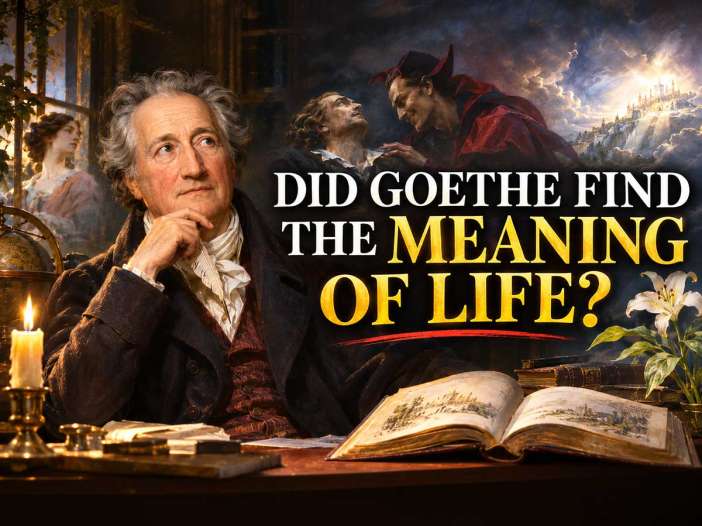
Introduction
Goethe interview: Did one of history's greatest literary minds discover the meaning of life, or did his extraordinary achievements leave him searching for something more?
Johann Wolfgang von Goethe became famous at twenty-five, gained influence in German society, wrote literary masterpieces, and devoted decades to scientific and philosophical inquiry. Yet behind those accomplishments was a man who experienced heartbreak, questioned religious certainty, suffered devastating personal losses, and continued examining the meaning of human existence until the end of his life. His story raises a question that remains deeply relevant today: Can success make us happy, or must we discover something beyond achievement?
Born in Frankfurt in 1749, Goethe became one of the most influential figures in European literature. His early novel The Sorrows of Young Werther captured the intensity of youthful emotion, and his lifelong dramatic masterpiece Faust explored temptation, ambition, love, and redemption. According to the Encyclopaedia Britannica biography of Johann Wolfgang von Goethe, his intellectual interests extended across literature, government, philosophy, and natural science. Yet his extraordinary range of achievements invites us to consider whether the pursuit of excellence can ever fully satisfy the human heart.
One of Goethe's most enduring contributions was his exploration of Bildung, the lifelong cultivation of human capacities and character. Through works such as Wilhelm Meister's Apprenticeship, he examined how people develop through education, experience, relationships, and mistakes. His fascination with Streben, or human striving, became especially significant in Faust. The scholar Faust possesses remarkable knowledge but remains deeply dissatisfied. He enters a dangerous relationship with Mephistopheles, seeking experiences that might finally satisfy his desires. Readers can explore the original drama in the free English translation of Faust, Part One, at Project Gutenberg. Its questions about ambition and moral responsibility remain strikingly relevant to modern life.
Goethe's personal relationships reveal another dimension of his philosophy. His youthful affection for Charlotte Buff helped inspire Werther, his long relationship with Charlotte von Stein influenced his emotional and intellectual development, and his partnership with Christiane Vulpius challenged the social expectations of his time. Through these experiences and the tragic story of Gretchen in Faust, Goethe explored the difference between passionate attachment and responsible love. Can we genuinely love someone without respecting their freedom? Can sincere affection become destructive when desire overwhelms moral judgment? And how do we recognize the harm we may cause to people we believe we love?
His intellectual curiosity extended far beyond literature. Goethe investigated plant metamorphosis, studied the experience of color, engaged with Spinoza's philosophy, and found inspiration in the Persian poet Hafez. His scientific interpretations were not always accepted by later researchers, but his commitment to observing nature reflected his belief that human knowledge should remain open to discovery. His interest in literature across national boundaries anticipated the cultural exchanges now associated with world literature. The Goethe-Institut, named in his honor, continues the tradition of international cultural exchange, making his intellectual legacy particularly meaningful in an age when people from different societies can communicate more easily than ever before.
In this five-part imaginary interview, Nick Sasaki meets Goethe not as an untouchable literary genius, but as a human being willing to reconsider his accomplishments, relationships, and beliefs. Their conversation begins with a question about happiness, then explores the disturbing appeal of Mephistopheles, the tragedy of Gretchen, Goethe's complicated romantic life, his views of God and nature, and the grief he experienced after losing people he loved. Nick asks questions that connect Goethe's eighteenth- and nineteenth-century experiences with the concerns of modern readers. Why do successful people remain dissatisfied? Can ambition become dangerous? Does love require self-sacrifice? Can someone who has caused suffering truly change?
But Goethe is not simply answering Nick's questions. He brings his own intellectual concerns into the conversation, repeatedly returning to the development of human character. He challenges the assumption that happiness means permanent satisfaction and questions whether accomplishment without compassion deserves to be called success. Through Bildung, Streben, and the idea of transformation, Goethe invites us to examine the direction of our own lives. His reflections on literature and cultural exchange raise a further possibility: Perhaps becoming more fully human requires learning to recognize the dignity of people whose experiences, traditions, and beliefs differ from our own.
By the end of the interview, the question has changed. Instead of asking whether Goethe accomplished enough to find happiness, we begin asking whether a meaningful life can be measured through accomplishments at all. What matters more: becoming famous or becoming kind? Pursuing extraordinary experiences or appreciating ordinary moments? Achieving our ambitions or recognizing the people affected by our decisions? Goethe's life offers no simple formula, but it opens a conversation about the relationship between personal growth, love, responsibility, and the possibility of inner peace.
Fictional disclaimer: This imaginary interview was created for ImaginaryTalks.com. The dialogue is a creative interpretation informed by Goethe's documented biography, literary works, and philosophical ideas. It does not represent an actual conversation or authenticated historical quotations.
Topic 1. You Had Everything. Were You Actually Happy?
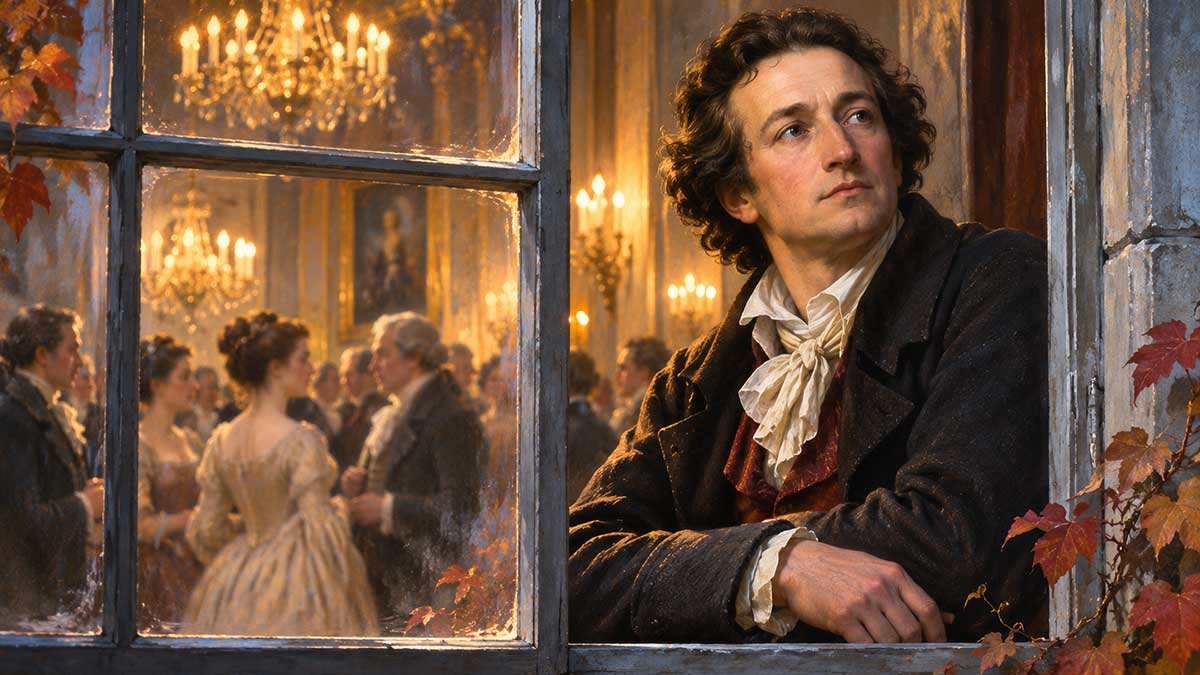
Round 1. The Young Man Who Became Famous
Nick Sasaki
Goethe, I have to tell you, I've been looking forward to this conversation.
When people hear your name, they think of Faust, German literature, philosophy, and all these serious intellectual subjects.
But I want to start with something much simpler.
You were one of the most celebrated writers in Europe. You were successful, influential, respected, and extraordinarily talented.
So here's my question.
Were you actually happy?
Johann Wolfgang von Goethe
You have chosen a rather difficult question for our first conversation, Nick.
Nick Sasaki
I thought I'd start with an easy one.
Johann Wolfgang von Goethe
Then I am curious what you consider difficult.
Nick Sasaki
Fair enough.
But seriously, you accomplished things most people could only dream about.
You became famous when you were young. You worked with influential people. You traveled, studied science, wrote masterpieces, and met remarkable individuals.
Did all of that make you happy?
Johann Wolfgang von Goethe
At certain moments, certainly.
At other moments, no.
But perhaps the difficulty lies in the assumption that happiness is a permanent condition one acquires after accomplishing enough.
Human life is more complicated.
A person may experience great satisfaction in his work and profound disappointment in his relationships.
He may possess public recognition while struggling privately with uncertainty.
He may feel gratitude for his circumstances and still long for something beyond them.
Nick Sasaki
So even somebody as successful as you could wake up in the morning feeling dissatisfied?
Johann Wolfgang von Goethe
Of course.
Literary reputation does not protect a person from loneliness, frustration, or self-doubt.
Nick Sasaki
That's interesting.
I think people sometimes assume that if they become rich enough, famous enough, or successful enough, they'll finally be happy.
But you're telling me it doesn't work that way.
Johann Wolfgang von Goethe
Success can provide opportunities.
It can remove certain difficulties.
It can offer the satisfaction of accomplishing something meaningful.
But it cannot guarantee that a person will live wisely.
Nor can it answer every question about the purpose of existence.
Nick Sasaki
Let's go back to when you were young.
Your father wanted you to study law, right?
Johann Wolfgang von Goethe
Yes.
My father valued education, discipline, and the security of a respectable profession.
I studied law in Leipzig and later Strasbourg.
But literature, language, art, and the study of human character attracted me with extraordinary intensity.
Nick Sasaki
Were you interested in becoming a lawyer?
Johann Wolfgang von Goethe
I was capable of studying law.
That is not quite the same thing.
Nick Sasaki
That's a great distinction.
A lot of young people are capable of doing something their parents want them to do.
But that doesn't mean it's what they want for themselves.
Did you feel pressure to follow your father's expectations?
Johann Wolfgang von Goethe
Certainly.
My father wished to prepare me for a stable and honorable life.
His intentions were not unreasonable.
But I increasingly felt that my abilities and interests demanded another form of expression.
The difficulty was not simply choosing between obedience and rebellion.
It was discovering how to develop the capacities I had been given without abandoning responsibility.
Nick Sasaki
That's interesting.
So you didn't necessarily see your father as the villain.
Johann Wolfgang von Goethe
No.
A young person may experience parental expectations as restrictive without recognizing the concern from which they arise.
Maturity sometimes allows us to see both the limitations and the generosity of those who raised us.
Nick Sasaki
Now, at twenty-five, you published The Sorrows of Young Werther.
And suddenly you became famous.
What was that like?
Johann Wolfgang von Goethe
It was astonishing.
The novel reached readers far beyond the circle I had known.
Its emotional intensity resonated with a generation already questioning established conventions.
But fame has an unusual quality.
A writer creates something from private experiences, observations, and imagination.
Then strangers begin to feel that they know him intimately.
Nick Sasaki
Did people confuse you with Werther?
Johann Wolfgang von Goethe
Frequently.
They assumed that the character's feelings and conclusions were simply my own.
But a literary character is not a complete portrait of the author.
Werther drew upon experiences I knew, including my affection for Charlotte Buff, and upon other tragic events.
Yet the novel transformed those materials into fiction.
Nick Sasaki
I can see why people connected with it.
Werther falls in love with a woman he can't have, and his emotions become overwhelming.
That's something people still experience today.
But the story ends tragically.
Were you trying to warn people about romantic obsession?
Johann Wolfgang von Goethe
I was exploring the dangers of an emotional life that loses its relationship with the larger world.
Werther possesses genuine sensitivity.
He recognizes beauty.
He feels deeply.
But gradually his feelings become the sole measure of existence.
He cannot accept that the world contains realities independent of his desires.
Nick Sasaki
So his problem isn't that he has feelings.
It's that his feelings take over his entire life.
Johann Wolfgang von Goethe
Precisely.
Feeling is a precious human capacity.
But feeling requires development, just as intelligence does.
A person who experiences emotions intensely is not necessarily wise in the way he responds to them.
Nick Sasaki
That's a good point.
Sometimes people say, "I have to follow my heart."
But what if your heart is leading you somewhere destructive?
Johann Wolfgang von Goethe
Then perhaps the heart requires conversation with judgment.
Nick Sasaki
I like that.
Now, after Werther, you became a literary celebrity.
Did you enjoy the attention?
Johann Wolfgang von Goethe
At times.
Recognition can be gratifying, especially when one is young.
But it can become a burden when the public expects you to remain the person they first admired.
Nick Sasaki
What do you mean?
Johann Wolfgang von Goethe
Suppose you achieve fame through a work expressing youthful emotional intensity.
Readers may expect you to continue producing that same intensity indefinitely.
But what if you begin to change?
What if you develop new interests, question your earlier convictions, or discover that your youthful perspective was incomplete?
Must you remain faithful to your reputation, or to your development?
Nick Sasaki
That's a fascinating question.
So success can actually trap you in an earlier version of yourself.
Johann Wolfgang von Goethe
Yes.
And I would regard that as a serious danger.
A human being should not be required to remain intellectually or spiritually unchanged merely to satisfy the expectations of others.
Nick Sasaki
You know, I never thought about fame that way.
People work so hard to become known for something.
Then once they're known for it, they might feel they can't become anything else.
Johann Wolfgang von Goethe
Exactly.
And this brings me to an idea that occupied much of my life.
The development of the human being.
Nick Sasaki
I'm glad you brought that up.
Tell me more.
Johann Wolfgang von Goethe
In German, we speak of Bildung.
The word can refer to education, cultivation, and the formation of the individual.
But it means something richer than collecting information or acquiring professional skills.
It concerns the gradual development of a person's capacities through experience, reflection, discipline, relationships, and engagement with the world.
Nick Sasaki
So it's about becoming the person you're capable of becoming?
Johann Wolfgang von Goethe
That is a useful beginning.
But I would add that we do not always know in advance what that person will look like.
Our abilities emerge through experience.
Our convictions are tested.
Our weaknesses become visible.
We encounter people who change us.
The process is not simply the execution of a predetermined plan.
Nick Sasaki
That's interesting.
So maybe the purpose of education isn't just getting a degree or finding a job.
It's developing the whole person.
Johann Wolfgang von Goethe
Precisely.
A person may become highly skilled in one profession while remaining emotionally immature, intellectually narrow, or morally careless.
Such specialization may be useful, but it is not the complete cultivation of a human being.
Nick Sasaki
Now that's something I wish more young people heard.
They spend so much time worrying about which college to attend or which career will make the most money.
Those are reasonable concerns.
But maybe they should ask what kind of human being they want to become.
Johann Wolfgang von Goethe
An excellent question.
And one that should not disappear when formal education ends.
Round 2. The Man Who Couldn't Stop Exploring
Nick Sasaki
Goethe, one thing that amazes me about your life is how many different subjects interested you.
You wrote novels, poetry, and plays.
You worked in government.
You studied plants, anatomy, geology, and color.
You collected art.
You traveled.
It's almost like you couldn't stop learning.
Were you ever satisfied with just one thing?
Johann Wolfgang von Goethe
I found the world too interesting to confine my attention entirely to one subject.
But I would distinguish curiosity from mere restlessness.
Curiosity can deepen our relationship with reality.
Restlessness may prevent us from remaining with anything long enough to know it.
Nick Sasaki
That's interesting.
How do you tell the difference?
Johann Wolfgang von Goethe
Consider a person who visits a beautiful garden.
He walks quickly from flower to flower, photographs everything, and leaves after a few minutes.
He has seen many flowers.
But has he truly observed them?
Another person sits quietly before a single plant.
He studies its leaves, its growth, the arrangement of its parts, the way sunlight falls upon it.
He may discover more through one attentive encounter than the first person discovers through a hundred hurried impressions.
Nick Sasaki
I like that.
So curiosity isn't necessarily about experiencing as many things as possible.
It's about paying attention.
Johann Wolfgang von Goethe
Yes.
Attention transforms experience into knowledge.
And sometimes into wisdom.
Nick Sasaki
But you certainly experienced a lot.
Let's talk about Italy.
In 1786, you left Weimar and traveled to Italy.
You were already successful and had important responsibilities.
Why did you feel you needed to go?
Johann Wolfgang von Goethe
I had become increasingly conscious of the distance between the life I was living and certain artistic needs within me.
My administrative duties in Weimar were substantial.
They taught me much about government, responsibility, and practical affairs.
But I felt the need to renew my relationship with art and the natural world.
Italy offered the opportunity to encounter classical art, architecture, and the living environment that had inspired so much of European culture.
Nick Sasaki
Was it like escaping from your old life?
Johann Wolfgang von Goethe
In certain respects.
But escape alone would not have justified the journey.
I wanted to return with a different relationship to my work and to myself.
Nick Sasaki
Did Italy change you?
Johann Wolfgang von Goethe
Profoundly.
I encountered works of art that challenged my assumptions.
I studied the forms of plants in different environments.
I observed architecture, sculpture, and everyday life with renewed attention.
The experience encouraged a more disciplined artistic outlook.
Nick Sasaki
Now, this is something I want to ask.
You were already famous.
You'd already written a bestselling novel.
Why did you still feel the need to change?
Couldn't you just enjoy your success?
Johann Wolfgang von Goethe
I could have attempted to do so.
But then I would have treated my earlier achievements as the final definition of my life.
A person who believes he has completed his development may become incapable of receiving what the world still has to teach him.
Nick Sasaki
That's fascinating.
So from your perspective, becoming successful doesn't mean you've arrived.
Johann Wolfgang von Goethe
No.
Success may represent the completion of a particular undertaking.
It does not mean the completion of the human being.
Nick Sasaki
I love that distinction.
You know, people often talk about finding themselves.
They say, "I need to discover who I really am."
But you seem to be saying that who we are isn't something fixed that we simply uncover.
We keep developing.
Johann Wolfgang von Goethe
Yes.
And nature offers a useful way of thinking about this.
Nick Sasaki
Nature again?
Johann Wolfgang von Goethe
You sound surprised.
Nick Sasaki
No, I'm starting to realize that with you, almost every conversation eventually leads to a plant.
Johann Wolfgang von Goethe
Then perhaps you are beginning to learn something about my interests.
Nick Sasaki
Fair enough. Go ahead.
Johann Wolfgang von Goethe
Consider a plant.
It does not remain a seed.
It develops roots, leaves, flowers, and sometimes fruit.
Its forms change, yet we recognize a continuity through those transformations.
I became fascinated by the relationships among these forms.
The idea of metamorphosis became important in my scientific thinking.
Nick Sasaki
And you think something similar happens to human beings?
Johann Wolfgang von Goethe
Not as a literal botanical law governing human character.
But the comparison is suggestive.
A person changes through time.
The child, the young adult, and the elderly person may appear remarkably different.
Yet there is continuity.
Our experiences transform the expression of our capacities.
Nick Sasaki
So you're saying we shouldn't expect to remain the same person forever.
Johann Wolfgang von Goethe
Certainly not.
But transformation is not automatically improvement.
A plant may flourish under favorable conditions or suffer through neglect.
Human development likewise requires attention and cultivation.
Nick Sasaki
That's an important point.
Just getting older doesn't automatically make somebody wiser.
Johann Wolfgang von Goethe
Unfortunately, no.
Nick Sasaki
I've met some people who seem to become more stubborn with age.
Johann Wolfgang von Goethe
Then perhaps their experience has strengthened their habits without sufficiently enlarging their judgment.
Nick Sasaki
That's a polite way of saying it.
Now, let me ask you something.
If life is about continual development, how do we know which direction to grow?
I mean, there are so many possibilities.
You could spend your life studying science, writing books, building a business, raising a family, helping other people.
How do you decide what's worth pursuing?
Johann Wolfgang von Goethe
We must begin with honest observation of our abilities and circumstances.
But we must not confuse every desire with a calling.
Some interests disappear when they require effort.
Others deepen through discipline.
And our responsibilities to other people must enter the decision.
Nick Sasaki
So you don't think we should just follow whatever excites us at the moment.
Johann Wolfgang von Goethe
Excitement can reveal an interest.
It cannot by itself determine whether the interest deserves a lifetime of devotion.
Nick Sasaki
That's interesting.
You know, there's so much advice today about following your passion.
But sometimes people follow their passion and end up hurting their relationships or neglecting their responsibilities.
Johann Wolfgang von Goethe
Then passion requires judgment.
A person may possess extraordinary creative energy.
But if that energy becomes an excuse for cruelty or irresponsibility, its moral value must be questioned.
Nick Sasaki
And I suppose you learned that through your own life.
Johann Wolfgang von Goethe
I would be foolish to claim that my pursuit of personal development never created difficulties for those around me.
Nick Sasaki
That's something I appreciate about this conversation.
You're not presenting yourself as somebody who figured everything out.
Johann Wolfgang von Goethe
A lifetime of inquiry should make one less eager to claim perfection.
Nick Sasaki
Let me ask you something else.
You were interested in so many different fields.
Did you believe science and art were connected?
Or did you see them as completely separate ways of looking at the world?
Johann Wolfgang von Goethe
I regarded both as serious forms of engagement with reality.
Science requires observation, comparison, and disciplined inquiry.
Art requires perception, imagination, and form.
Their methods differ, but both can deepen our attention to the world.
Nick Sasaki
So a scientist and a poet might be looking at the same flower, but noticing different things.
Johann Wolfgang von Goethe
Yes.
And each might learn something from the other.
The scientist may investigate the flower's structure and development.
The poet may attend to the emotional or symbolic significance of its appearance.
Neither approach needs to make the other meaningless.
Nick Sasaki
I really like that.
Sometimes people act as if science explains everything and art is just entertainment.
Or they go in the opposite direction and treat science as something cold and mechanical.
But you're saying both can help us appreciate reality.
Johann Wolfgang von Goethe
Exactly.
The danger arises when any single method claims authority over every dimension of human experience.
Nick Sasaki
Now, here's something I'm curious about.
Did studying nature make you more religious?
Johann Wolfgang von Goethe
It deepened my sense of reverence.
But the relationship between nature and the divine is a question we should examine carefully.
My views cannot be reduced to a simple formula.
Nick Sasaki
I definitely want to come back to that.
But first, I want to ask about something else.
You seem to have spent your whole life developing yourself.
Learning, traveling, writing, studying.
Was there ever a moment when you thought, "Enough. I've done enough. Now I can just be happy"?
Johann Wolfgang von Goethe
There were moments of deep contentment.
But I did not regard development as a race toward a final state in which all further questions would disappear.
Nick Sasaki
So you never really retired from being curious.
Johann Wolfgang von Goethe
One might say that.
But curiosity should eventually teach us something about restraint.
Nick Sasaki
That's interesting.
Why restraint?
Johann Wolfgang von Goethe
A person who wishes to experience everything may become incapable of committing himself to anything.
There are limits to our time, attention, and strength.
Wisdom requires choosing.
And choosing means accepting that certain possibilities will remain unexplored.
Nick Sasaki
Now that's a difficult lesson.
Especially for someone like Faust.
Johann Wolfgang von Goethe
Indeed.
And perhaps we should turn to him soon.
For Faust represents a form of striving that has lost its proper relationship with limitation.
Round 3. What Success Cannot Give Us
Nick Sasaki
Before we get to Faust, I want to return to my original question.
Were you happy?
We've talked about fame, education, curiosity, Italy, and your lifelong development.
But I still wonder whether you ever felt satisfied.
You accomplished so much.
Did you ever feel that it was enough?
Johann Wolfgang von Goethe
Nick, perhaps we should distinguish satisfaction from completion.
I could feel satisfied after finishing a work, sharing an evening with friends, observing something beautiful, or discovering a new idea.
But I did not need to believe that my entire life had reached its final form in order to appreciate those moments.
Nick Sasaki
So happiness can exist without everything being perfect.
Johann Wolfgang von Goethe
Certainly.
Indeed, if we require perfection before allowing ourselves happiness, we may spend our entire lives waiting.
Nick Sasaki
That's something a lot of people need to hear.
We keep thinking, "I'll be happy when I get the promotion."
Or, "I'll be happy when I have more money."
Or, "I'll be happy when my children are grown."
Then we reach that point, and there's always something else.
Johann Wolfgang von Goethe
Human desire has a remarkable ability to move the destination.
Nick Sasaki
Exactly!
It's like we're always chasing something that's just a little farther away.
Johann Wolfgang von Goethe
And perhaps we should ask whether the problem lies in desire itself or in our expectation that desire must eventually disappear.
Nick Sasaki
What do you mean?
Johann Wolfgang von Goethe
Desire can inspire learning, creativity, and constructive effort.
Without it, much of human development would cease.
But when we expect the fulfillment of one desire to provide permanent contentment, disappointment becomes likely.
Nick Sasaki
So the goal isn't necessarily to stop wanting things.
It's to have a healthier relationship with what we want.
Johann Wolfgang von Goethe
Yes.
To pursue meaningful goals without allowing their achievement to determine the entire value of our existence.
Nick Sasaki
Now, let me challenge you a little.
It's easy for somebody who became one of the greatest writers in history to say fame and success aren't everything.
But what about somebody who's struggling?
Somebody who hasn't accomplished much and feels like their life is going nowhere?
Wouldn't success make a huge difference to them?
Johann Wolfgang von Goethe
Of course it might.
I would never dismiss the importance of security, opportunity, meaningful work, or recognition.
Material hardship can place enormous burdens upon a person.
And the opportunity to develop one's abilities is not distributed equally.
But we should distinguish between acknowledging the genuine benefits of success and treating success as the sole measure of human worth.
Nick Sasaki
That's fair.
So you're not saying achievement doesn't matter.
You're saying it shouldn't become our entire identity.
Johann Wolfgang von Goethe
Precisely.
A person who defines himself entirely through achievement becomes vulnerable whenever achievement is threatened.
And a person who judges others solely through achievement may overlook forms of human excellence that receive little public attention.
Nick Sasaki
Such as?
Johann Wolfgang von Goethe
The patience of a parent.
The generosity of a friend.
The integrity of someone who refuses an easy advantage at another person's expense.
The quiet devotion of a person caring for someone who is ill.
These acts may attract little public recognition.
Yet they possess genuine moral significance.
Nick Sasaki
I really like that.
Sometimes the people who make the biggest difference in our lives aren't famous at all.
They're the people who were there when we needed them.
Johann Wolfgang von Goethe
Yes.
And perhaps one of the failures of public culture is its tendency to confuse visibility with value.
Nick Sasaki
Now, here's something I want to ask you.
You spent so much time developing your talents.
But do you think personal development should always be focused on ourselves?
I mean, if somebody spends their whole life trying to become more intelligent, more successful, more accomplished, isn't there a danger of becoming self-centered?
Johann Wolfgang von Goethe
A very serious danger.
And this is why Bildung should not be confused with vanity.
The cultivation of the self cannot be complete if it leaves us incapable of living responsibly with others.
We develop through relationships, obligations, and encounters with people whose needs differ from our own.
Nick Sasaki
So becoming fully human isn't just about developing our abilities.
It's about developing our character.
Johann Wolfgang von Goethe
Yes.
And learning that our individual existence belongs to a larger human world.
Nick Sasaki
That's interesting.
You know, I've been thinking about something.
When people talk about self-improvement, they often focus on becoming more productive.
Reading more books. Learning more skills. Making more money.
But maybe the most important improvement is becoming more loving, more patient, and more considerate.
Johann Wolfgang von Goethe
Those are certainly worthy forms of development.
But I would hesitate to separate them entirely from intellectual or artistic growth.
A work of literature may deepen our sympathy.
Scientific inquiry may teach humility.
A difficult responsibility may cultivate patience.
The different dimensions of life can influence one another.
Nick Sasaki
So the whole person develops together.
Johann Wolfgang von Goethe
That would be the aspiration.
Though in practice, human development is rarely so orderly.
Nick Sasaki
Now, I want to ask about something personal.
Did you ever look at somebody who seemed to live a simple, peaceful life and feel a little jealous?
Somebody who didn't need fame or extraordinary achievements.
Somebody who could just enjoy family, friends, and ordinary daily life.
Johann Wolfgang von Goethe
I certainly recognized the appeal of such contentment.
But we should be cautious about idealizing lives we have not lived.
A quiet life may contain profound difficulties.
A celebrated life may contain genuine joy.
The question is not simply which outward arrangement appears preferable.
It is whether a person can live meaningfully within the circumstances of his existence.
Nick Sasaki
That's a good point.
Sometimes we assume other people are happier because we only see the outside of their lives.
Johann Wolfgang von Goethe
Exactly.
And comparison can become a particularly effective method of destroying gratitude.
Nick Sasaki
I think that's even more true today.
People see pictures of somebody else's vacation, house, or success, and suddenly their own life doesn't seem good enough.
Johann Wolfgang von Goethe
Then perhaps the old problem of human comparison has acquired new instruments.
Nick Sasaki
That's a very diplomatic way of putting it.
Now, let's say you could meet your twenty-five-year-old self.
The young Goethe who had just become famous through Werther.
What would you tell him?
Johann Wolfgang von Goethe
I might tell him not to confuse the intensity of his emotions with the completeness of his judgment.
I would encourage him to remain curious.
To cultivate his abilities patiently.
To resist becoming imprisoned by the expectations of fame.
And to recognize that the people who enter his life possess purposes and feelings independent of his own.
Nick Sasaki
Would you tell him to slow down?
Johann Wolfgang von Goethe
Perhaps.
But I would not wish to extinguish the enthusiasm that made his early discoveries possible.
Youth possesses energies that should be guided rather than simply suppressed.
Nick Sasaki
That's interesting.
You wouldn't tell him to stop dreaming big.
You'd tell him to develop the wisdom to handle those dreams.
Johann Wolfgang von Goethe
Exactly.
Ambition is not necessarily the enemy of wisdom.
But ambition without self-knowledge can become dangerous.
Nick Sasaki
Do you think you became a better person as you got older?
Johann Wolfgang von Goethe
I hope that experience taught me greater patience and discrimination.
But I would be reluctant to declare myself the final authority upon my own moral improvement.
Other people may have experienced my character differently from the way I understood it.
Nick Sasaki
That's a fascinating answer.
Sometimes we think we're becoming better people, but maybe we should ask the people around us whether they agree.
Johann Wolfgang von Goethe
A potentially uncomfortable experiment.
Nick Sasaki
Especially if you ask your wife.
Johann Wolfgang von Goethe
Then one should prepare to listen carefully.
Nick Sasaki
Now, here's something I've been wondering.
You lived through enormous changes.
You saw political upheaval, scientific discoveries, and transformations in European culture.
Did those experiences make you optimistic about humanity?
Do you think people are actually becoming better?
Johann Wolfgang von Goethe
Human development is not a simple upward progression.
Knowledge can increase without wisdom increasing at the same rate.
Societies can achieve remarkable cultural accomplishments while remaining capable of cruelty.
But I would not abandon the possibility of improvement.
Human beings can learn.
They can revise institutions, broaden their sympathies, and cultivate new forms of cooperation.
The difficulty is that such development requires continual effort.
Nick Sasaki
So progress isn't automatic.
Johann Wolfgang von Goethe
No.
And perhaps the same is true of the individual.
We do not become wiser merely through the passage of time.
We become wiser through what we do with our experiences.
Nick Sasaki
I like that.
You know, Goethe, I think I'm beginning to see something.
When I asked whether you were happy, I was thinking about happiness as something you finally achieve.
Like reaching the top of a mountain.
But you're talking about life as a continuing process of becoming.
Johann Wolfgang von Goethe
Yes.
And perhaps the question is not simply whether one has reached a particular condition of happiness.
It is whether one is learning to live more attentively, responsibly, and fully.
Nick Sasaki
But doesn't that mean you're never finished?
That you're always trying to become something better?
Couldn't that become exhausting?
Johann Wolfgang von Goethe
Certainly.
If development becomes a relentless demand for personal perfection, it may become another form of dissatisfaction.
We must allow room for enjoyment, rest, gratitude, and the acceptance of our limitations.
Nick Sasaki
That's good to hear.
For a moment, I thought you were going to tell everybody they needed to spend every waking hour improving themselves.
Johann Wolfgang von Goethe
That would be a rather unpleasant philosophy.
Nick Sasaki
Especially coming from a man who accomplished about ten lifetimes of work.
Johann Wolfgang von Goethe
Then perhaps my example should be interpreted with caution.
Nick Sasaki
Fair enough.
Let me ask you one last question before we move on.
If you could give one piece of advice to somebody who feels dissatisfied with life, what would it be?
Johann Wolfgang von Goethe
I would encourage them to examine the nature of their dissatisfaction.
Is something genuinely wrong in their circumstances?
Are they neglecting an ability that deserves cultivation?
Are they living according to expectations that do not belong to them?
Or have they become incapable of appreciating what is already present?
These are different conditions.
They require different responses.
Nick Sasaki
That's interesting.
So before trying to change your whole life, you should figure out what you're actually unhappy about.
Johann Wolfgang von Goethe
Yes.
And perhaps begin with an honest observation of the life immediately before you.
What deserves your gratitude?
What requires your attention?
What responsibility have you been avoiding?
What possibility have you neglected?
Nick Sasaki
I really like that.
But now I want to ask about someone who seems to have taken dissatisfaction to an extreme.
Faust.
Here's a man who has studied practically everything available to him.
He's intelligent, accomplished, and educated.
But he's miserable.
He wants something beyond ordinary human experience.
And eventually, he's willing to make a wager with the devil.
Why?
Johann Wolfgang von Goethe
Perhaps, Nick, Faust represents what happens when the desire for development loses its relationship with wisdom.
He wishes to experience existence without accepting the limits that make human life possible.
He wants knowledge without uncertainty.
Experience without restraint.
Fulfillment without patience.
Nick Sasaki
So he takes something that could be good, the desire to grow, and pushes it until it becomes destructive.
Johann Wolfgang von Goethe
Precisely.
Our capacity to strive beyond our present condition can produce discoveries, art, and extraordinary acts of courage.
But the same capacity can lead us to sacrifice what is precious in pursuit of what is merely possible.
Nick Sasaki
And that's where the devil comes in?
Johann Wolfgang von Goethe
That is where Mephistopheles becomes particularly interesting.
But before we discuss the devil, perhaps we should ask a more uncomfortable question.
Why is Faust so ready to listen to him?
Nick Sasaki
Now that's a great question.
And I have a feeling the answer might tell us something about ourselves, too.
End of Topic 1
Fictional disclaimer: This imagined conversation was created for ImaginaryTalks.com. Goethe's responses are fictional interpretations informed by his documented biography, literary works, scientific interests, and philosophical ideas. They are not authenticated historical quotations. The discussion of Bildung and human development represents an interpretive reconstruction of themes associated with Goethe's life and writings.
Topic 2. Why Would Anyone Make a Deal With the Devil?
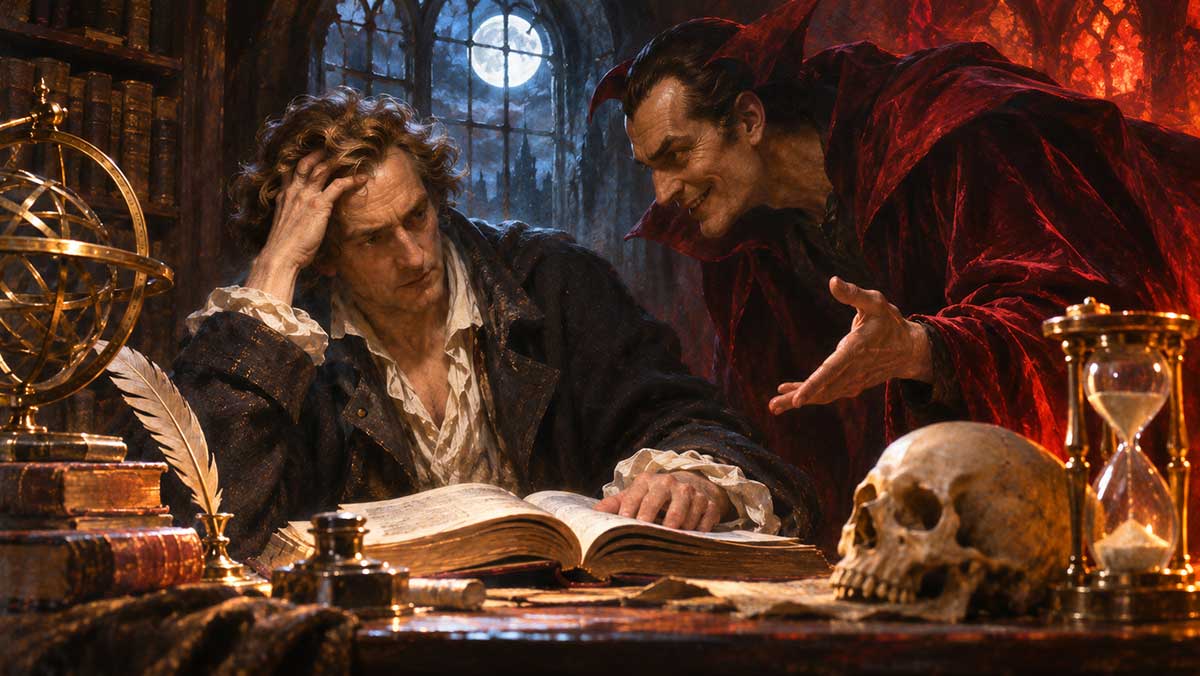
Round 1. The Strange Appeal of Faust and Mephistopheles
Nick Sasaki
Goethe, last time you left me with a question I haven't been able to stop thinking about.
Why was Faust so ready to listen to the devil?
Here's a man who's studied philosophy, medicine, law, theology, practically everything available to him.
He's brilliant. He's educated. He's accomplished.
But he's miserable.
I mean, what's going on with him?
Why can't he just enjoy his life?
Johann Wolfgang von Goethe
Perhaps, Nick, we should begin with something we discussed in our previous conversation.
The difference between knowledge and wisdom.
Faust has accumulated an extraordinary quantity of learning.
But he has begun to suspect that his learning has failed to bring him closer to the deepest realities of existence.
He can describe the world, yet he does not feel that he truly participates in its mysteries.
He can explain many things, yet he remains dissatisfied with the limitations of human knowledge.
Nick Sasaki
So he's not miserable from being ignorant.
He's miserable from knowing so much and realizing how little he actually knows.
Johann Wolfgang von Goethe
Yes.
But there is another difficulty.
Faust has spent much of his life studying existence rather than experiencing it.
He has devoted himself to preparation, analysis, and intellectual inquiry.
And now he fears that life itself has passed him by.
Nick Sasaki
That's interesting.
I think a lot of people can relate to that.
You go to school, get your degree, build a career, save money, and prepare for the future.
Then one day you look around and think, "Wait a minute. When was I supposed to start living?"
Johann Wolfgang von Goethe
Precisely.
But Faust's dissatisfaction is more extreme than ordinary disappointment.
He does not simply wish for a different occupation or a more enjoyable daily routine.
He wants to transcend the limitations of human existence.
Nick Sasaki
What does that mean?
Johann Wolfgang von Goethe
He wants to experience the fullness of life.
Not merely to understand pleasure, but to feel it.
Not merely to study suffering, but to encounter it.
Not merely to contemplate the world, but to participate in its entire range of possibilities.
He wishes to overcome the separation between knowledge and experience.
Nick Sasaki
But isn't that a good thing?
I mean, you spent your whole life exploring different subjects and trying new experiences.
How is Faust different from you?
Johann Wolfgang von Goethe
An excellent question.
And perhaps the answer lies in a concept that is central to the drama.
Streben.
Nick Sasaki
Streben?
Johann Wolfgang von Goethe
A German word referring to striving, aspiration, or the effort to reach beyond one's present condition.
Human striving can be extraordinarily creative.
It inspires discovery, art, moral development, and the transformation of society.
Without it, we might remain content with ignorance and injustice.
But striving can become destructive when it loses its relationship with judgment and responsibility.
Nick Sasaki
So striving itself isn't good or bad.
It depends on what you're striving for and how you pursue it.
Johann Wolfgang von Goethe
Yes.
And there is another question.
Can you recognize when your striving has become an attempt to escape the ordinary conditions of being human?
Nick Sasaki
What do you mean by that?
Johann Wolfgang von Goethe
Human life contains limitations.
We cannot experience every possibility.
We cannot possess every form of knowledge.
We cannot escape every disappointment.
We cannot make every person love us.
A mature person gradually learns to live meaningfully within these conditions.
Faust resists them.
He wants existence without boundaries.
Nick Sasaki
That's fascinating.
So his problem isn't that he wants too much success.
He wants something that no human being can actually have.
Johann Wolfgang von Goethe
Precisely.
And his dissatisfaction becomes dangerous when he begins to regard ordinary moral restraints as obstacles to his fulfillment.
Nick Sasaki
Now, let me ask you something.
Couldn't Faust just take a vacation?
Maybe fall in love, spend time with friends, get out of his study?
Why does he have to make a deal with the devil?
Johann Wolfgang von Goethe
You have proposed several sensible remedies for a condition that has become profoundly unreasonable.
Nick Sasaki
Fair enough.
Johann Wolfgang von Goethe
But I would correct one detail.
Faust does not simply purchase pleasure or riches by selling his soul.
The agreement is more subtle.
Mephistopheles offers to serve him in earthly life.
Faust wagers that if Mephistopheles can bring him to a moment of such complete satisfaction that he wishes it to remain forever, then he will have lost.
Nick Sasaki
Wait a minute.
So the devil wins if Faust finally becomes satisfied?
Johann Wolfgang von Goethe
That is the paradox.
Faust believes his striving is so limitless that no experience can permanently satisfy him.
He is willing to risk his eternal destiny upon that conviction.
Nick Sasaki
That's incredible.
Most people make a deal with the devil to get something they want.
Faust makes a deal because he believes he'll never stop wanting more.
Johann Wolfgang von Goethe
Exactly.
And perhaps that reveals something troubling about his character.
He has made dissatisfaction into a kind of personal identity.
Nick Sasaki
That's interesting.
Sometimes people become so accustomed to chasing the next thing that they don't know how to enjoy what they've already achieved.
Johann Wolfgang von Goethe
Yes.
And they may begin to regard contentment as weakness.
But perhaps the ability to appreciate a meaningful moment is not a failure of ambition.
Perhaps it is a form of wisdom.
Nick Sasaki
I like that.
Now, let's talk about Mephistopheles.
I have to tell you, he's one of the most entertaining devils I've ever encountered.
He's funny. He's sarcastic. He's clever.
Sometimes I read what he says and think, "Well, he's actually making a pretty good point."
Why did you make the devil so interesting?
Johann Wolfgang von Goethe
Would you have preferred him to be dull?
Nick Sasaki
Well, no.
But isn't that dangerous?
Johann Wolfgang von Goethe
It would be more dangerous to portray temptation as something that never appeals to intelligent people.
Mephistopheles understands human vanity.
He recognizes the difference between what people claim to desire and what they secretly want.
He exposes hypocrisy, mocks pretension, and frequently tells truths that respectable people prefer to avoid.
But his intelligence possesses a serious limitation.
Nick Sasaki
What's that?
Johann Wolfgang von Goethe
He can criticize almost anything.
But he has difficulty appreciating what makes existence worthy of love.
He is a spirit of negation.
His characteristic impulse is to deny, diminish, and destroy.
Nick Sasaki
So he's really good at pointing out what's wrong with everything.
But he doesn't know how to create something better.
Johann Wolfgang von Goethe
Precisely.
And that distinction is important.
Criticism can reveal error.
It can challenge arrogance.
It can expose injustice.
But a person who knows only how to negate may eventually become incapable of recognizing anything valuable.
Nick Sasaki
You know, that reminds me of people who criticize everything.
They're incredibly good at finding problems.
But when you ask them what they'd actually build instead, they don't have an answer.
Johann Wolfgang von Goethe
Then perhaps they possess something of Mephistopheles' talent.
Though I would advise caution before assigning the devil's name to one's acquaintances.
Nick Sasaki
That's probably good advice.
But let me ask you something.
Did you create Mephistopheles to represent evil?
Or did you create him to represent a part of human nature?
Johann Wolfgang von Goethe
The two interpretations need not be entirely separate.
Mephistopheles belongs to a dramatic and religious tradition in which the devil is a supernatural figure.
But he can also reveal tendencies within human thought.
The impulse to mock what we secretly envy.
The temptation to justify selfishness through clever reasoning.
The habit of reducing everything noble to something trivial.
These tendencies are recognizable without requiring every reader to adopt the same theological interpretation.
Nick Sasaki
That's fascinating.
So Mephistopheles isn't just a monster standing outside us.
He can represent a voice we sometimes hear inside ourselves.
Johann Wolfgang von Goethe
That is a fruitful interpretation.
But I would add that he is not the whole of human nature.
Human beings possess capacities for generosity, creativity, and moral growth that his cynical perspective cannot adequately explain.
Nick Sasaki
And maybe that's why he doesn't completely understand Faust.
Johann Wolfgang von Goethe
Exactly.
Mephistopheles recognizes Faust's weaknesses.
But he may underestimate the possibilities contained within human striving.
Round 2. Is Evil Outside Us, or Does It Begin Within Us?
Nick Sasaki
Now I want to ask you something personal.
Did you actually believe the devil exists?
I mean, not just as a character in literature.
Did you believe there's a real spiritual being somewhere who tries to tempt human beings?
Johann Wolfgang von Goethe
My religious thinking developed over many decades and drew upon several philosophical traditions.
I was interested in the ways human beings express spiritual experience through symbols, stories, and religious teachings.
The devil is a particularly significant figure within that history.
But I would hesitate to claim that the dramatic Mephistopheles represents a precise statement of my private convictions about the invisible world.
Nick Sasaki
So you weren't necessarily trying to describe exactly how the devil operates.
Johann Wolfgang von Goethe
Correct.
A poet may explore spiritual and moral questions through dramatic figures without pretending to possess complete knowledge of spiritual reality.
Nick Sasaki
Here's something I've noticed.
People often picture evil as something obvious.
A terrible person doing something terrible.
But sometimes evil begins with a reasonable-sounding argument.
"I deserve this."
"Nobody will get hurt."
"I'm doing it for a good reason."
Johann Wolfgang von Goethe
Human beings are remarkably inventive when explaining why their desires should be exempt from ordinary moral judgment.
Nick Sasaki
That's a good way of putting it.
Now, there's something in Faust that really caught my attention.
At the beginning, there's a scene in Heaven.
God and Mephistopheles have a conversation, and Mephistopheles receives permission to test Faust.
That sounds a little like the Book of Job.
Why would a loving God allow that?
Johann Wolfgang von Goethe
You have identified one of the drama's central theological difficulties.
The heavenly prologue draws upon a tradition in which human character is revealed through trial.
But we must distinguish the dramatic structure from a literal account of divine decision-making.
In the play, the Lord recognizes possibilities in Faust that Mephistopheles does not.
Mephistopheles sees human striving as something to ridicule and corrupt.
The Lord suggests that striving, even when accompanied by error, may remain connected to the possibility of a higher direction.
Nick Sasaki
But here's where I struggle.
Couldn't God teach Faust those lessons without putting him through so much suffering?
And what about Gretchen?
She ends up suffering terribly, and she didn't make the wager.
Why should innocent people suffer as part of somebody else's spiritual development?
Johann Wolfgang von Goethe
That is a question the drama cannot dismiss.
It would be morally offensive to treat Gretchen's suffering as merely a useful lesson for Faust.
Her life possesses its own dignity.
Her tragedy exposes the inadequacy of Faust's pursuit when that pursuit disregards the consequences for others.
Nick Sasaki
I'm glad you said that.
Sometimes people talk about suffering as if it's automatically good for us.
They say, "Everything happens for a reason."
But when somebody innocent gets hurt, that explanation can sound cruel.
Johann Wolfgang von Goethe
Yes.
We should be cautious about claiming to know the divine purpose behind another person's suffering.
A tragedy may awaken compassion or moral awareness.
But those possibilities do not make the tragedy itself desirable.
Nor do they release the person who caused harm from responsibility.
Nick Sasaki
Let me push this a little further.
If God already knows what's going to happen, why allow the whole thing to unfold?
If God knows Faust will make these choices and Gretchen will suffer, why not intervene?
Johann Wolfgang von Goethe
You are asking whether divine foreknowledge can coexist with genuine human freedom.
It is a problem that has occupied theologians and philosophers for centuries.
One possibility is that knowing an action does not necessarily mean causing it.
But that distinction alone does not resolve every difficulty.
If God possesses unlimited knowledge and goodness, the existence of suffering remains a profound question.
I would be reluctant to offer you a simple solution merely for the comfort of having one.
Nick Sasaki
I appreciate that.
I don't think every big question needs a quick answer.
But let me ask you this.
Do you think freedom is worth the risk?
Suppose God could create human beings who always chose goodness.
Would that be a better world?
Johann Wolfgang von Goethe
It might be a world without certain kinds of suffering.
But we would need to ask what we mean by choosing.
If a being cannot genuinely act otherwise, does its goodness possess the same moral significance as goodness freely embraced?
I do not claim that this resolves the entire problem.
But it suggests that freedom and moral development may be connected.
Nick Sasaki
That's something I've thought about, too.
If somebody loves you only because they have no choice, is that really love?
Johann Wolfgang von Goethe
An important question.
Love appears to require some degree of freedom.
But freedom is not simply the ability to do whatever one desires.
It includes the capacity to govern one's desires in relation to something greater than immediate satisfaction.
Nick Sasaki
So being free doesn't necessarily mean following every impulse.
Sometimes freedom means being able to say no to yourself.
Johann Wolfgang von Goethe
Precisely.
A person enslaved by appetite may possess many opportunities yet remain profoundly unfree.
Nick Sasaki
And that's Faust's problem?
Johann Wolfgang von Goethe
At times, yes.
He wishes to escape limitation.
But he does not always recognize that certain limitations protect what is valuable.
Nick Sasaki
Now, here's another question.
In your play, Mephistopheles tries to lead Faust astray.
But somehow, his actions become part of a larger story that leads toward redemption.
Does that mean evil can actually serve God's purpose?
Johann Wolfgang von Goethe
The drama explores that paradox.
But we must be careful.
To say that good may emerge in the presence of evil is not the same as saying evil is good.
Nor does it mean that harmful actions are justified by later benefits.
Mephistopheles intends to negate and corrupt.
He does not become virtuous merely because the outcome exceeds his intentions.
Nick Sasaki
That's an important distinction.
You can learn something from a terrible experience without saying the terrible experience should have happened.
Johann Wolfgang von Goethe
Exactly.
And perhaps that distinction is necessary whenever we discuss suffering, providence, or redemption.
Nick Sasaki
Now, I want to ask something about the relationship between God and Mephistopheles.
The devil seems convinced that human beings are fundamentally ridiculous.
That we're selfish, weak, and easily corrupted.
But God seems to have a different view.
Is that part of what you wanted readers to notice?
Johann Wolfgang von Goethe
Very much so.
Mephistopheles possesses a narrow interpretation of humanity.
He recognizes weakness and vanity, but he cannot fully appreciate the human capacity for development.
The Lord's perspective introduces a different possibility.
Human beings may wander.
They may make mistakes.
But their striving need not be meaningless.
Nick Sasaki
So the devil sees what we are at our worst.
But God sees what we might become.
Johann Wolfgang von Goethe
That is a compelling way to express the contrast.
Though we should not confuse the possibility of development with a guarantee that every action will be justified.
Nick Sasaki
Right.
Because Faust still has to take responsibility for what he does.
Johann Wolfgang von Goethe
Precisely.
And that responsibility becomes especially important when his desires begin to affect other people.
Round 3. The Price of Getting What We Want
Nick Sasaki
Let me bring this back to Faust himself.
We've talked about knowledge, temptation, God, and the devil.
But I keep coming back to something simple.
What does Faust actually want?
Is he looking for happiness?
Is he looking for God?
Or does he not even know what he's searching for?
Johann Wolfgang von Goethe
I believe the last possibility comes closest to his predicament.
Faust desires an experience of totality.
He wishes to overcome the division between thought and feeling, knowledge and existence, desire and fulfillment.
He wants life to reveal itself completely.
But human beings encounter reality through particular experiences.
We love particular people.
We undertake particular responsibilities.
We discover particular truths.
Faust struggles to accept that the infinite cannot simply be possessed through one overwhelming experience.
Nick Sasaki
That's fascinating.
So maybe he's looking for something infinite in a world where everything is limited.
Johann Wolfgang von Goethe
Yes.
And that longing can lead in very different directions.
It may inspire art, philosophy, spiritual reflection, and service.
Or it may lead someone to treat the world as an endless collection of experiences to consume.
Nick Sasaki
You know, that's something people struggle with today.
We've got incredible technology.
You can learn almost anything online, travel practically anywhere, watch thousands of movies, and meet people from around the world.
And still, people feel lonely or dissatisfied.
It's almost like having more choices doesn't necessarily make us happier.
Johann Wolfgang von Goethe
An abundance of possibilities can become a burden if a person lacks a principle for choosing among them.
To live meaningfully is not to experience everything.
It is to discover what deserves one's attention and commitment.
Nick Sasaki
I really like that.
But then what about ambition?
You were incredibly ambitious yourself.
You wanted to write great literature, understand nature, and accomplish things.
How do we know when ambition is helping us grow and when it's turning us into Faust?
Johann Wolfgang von Goethe
Perhaps we should examine what ambition asks us to sacrifice.
Does it demand discipline, patience, and honest effort?
Those sacrifices may be worthwhile.
Or does it demand that we abandon compassion, betray those who trust us, and excuse every harmful action as necessary for our greatness?
Then ambition has become dangerous.
Nick Sasaki
So the real test isn't how big your dream is.
It's what you're willing to do to achieve it.
Johann Wolfgang von Goethe
That is an excellent beginning.
I would add another question.
What happens to your character while you pursue the dream?
A person may achieve an extraordinary goal and become less generous, less truthful, and less capable of love along the way.
We should not automatically call that a successful life.
Nick Sasaki
That's something I think people need to hear.
We admire successful people.
But sometimes we don't ask what their success cost the people around them.
Johann Wolfgang von Goethe
And sometimes the person pursuing success does not ask that question either.
Nick Sasaki
Now, I want to return to something you said about Streben.
You said striving is essential to human development.
But Faust's striving becomes destructive.
Is there a point where striving should stop?
Johann Wolfgang von Goethe
Perhaps the question is not whether striving should cease entirely.
It is whether striving can learn to recognize limits.
A person may continue seeking knowledge throughout life.
But he must accept that he will never know everything.
He may pursue meaningful work.
But he must recognize that other people possess legitimate claims upon his attention.
He may desire love.
But he must respect the freedom of the beloved.
Nick Sasaki
So mature striving includes restraint.
Johann Wolfgang von Goethe
Yes.
And perhaps that is one of the central tensions in Faust.
The same human capacity that makes greatness possible can become destructive when it refuses moral boundaries.
Nick Sasaki
That's fascinating.
You know, in Topic One, you talked about Bildung, becoming fully human through lifelong development.
Is Faust an example of somebody who has developed his intelligence but neglected other parts of himself?
Johann Wolfgang von Goethe
That is an insightful connection.
Faust possesses extraordinary intellectual ambition.
But his emotional and moral development does not always keep pace with his desires.
He wants to experience everything.
Yet he has not fully learned how to encounter another person without making that person part of his own pursuit.
Nick Sasaki
So he's brilliant, but not necessarily mature.
Johann Wolfgang von Goethe
Precisely.
And perhaps that is a danger for anyone who mistakes intellectual achievement for complete human development.
Nick Sasaki
Now, let me ask you something.
Do you think Faust could have found what he was looking for without Mephistopheles?
Johann Wolfgang von Goethe
Possibly.
But then we would have a different drama.
Mephistopheles exposes Faust's weaknesses by offering opportunities to act upon them.
He does not create every weakness from nothing.
He discovers desires already present and encourages Faust to surrender to them.
Nick Sasaki
So the devil doesn't necessarily have to put something evil inside us.
He just has to find something that's already there and make it look attractive.
Johann Wolfgang von Goethe
That is one possible interpretation.
But I would add that human beings are not defined solely by their weaknesses.
We possess capacities for reflection, compassion, correction, and growth.
The question is whether we cultivate those capacities before our desires become destructive.
Nick Sasaki
You know, I want to ask you something a little unusual.
Suppose Faust were sitting right here.
He looks at you and says, "Goethe, you created me. You gave me this enormous hunger for life. You put Mephistopheles in my path. And look at what happened."
Then he asks, "Was it worth it?"
What would you say?
Johann Wolfgang von Goethe
I would not answer by praising his achievements.
I would ask whether he had learned to recognize the humanity of those affected by his choices.
I would ask whether he had begun to distinguish genuine growth from the endless pursuit of sensation.
And I would ask whether he could acknowledge his wrongdoing without attempting to justify it through his ambitions.
Nick Sasaki
But would you tell him he made a mistake?
Johann Wolfgang von Goethe
Many mistakes.
Some with terrible consequences.
Yet a human being is not necessarily exhausted by the worst action he has committed.
The possibility of change remains an important part of the drama.
Nick Sasaki
That's interesting.
So you don't want us to give up on Faust.
But you don't want us to excuse him, either.
Johann Wolfgang von Goethe
Exactly.
Compassion without moral responsibility becomes indulgence.
Moral judgment without the possibility of transformation becomes despair.
Nick Sasaki
I like that.
But I have one more question.
You spent so much of your life writing this story.
And Faust is constantly searching for something he can't quite reach.
Were you ever afraid that you were doing the same thing?
That you might spend your whole life chasing knowledge, beauty, love, and achievement, and still never find what you were looking for?
Johann Wolfgang von Goethe
I would not claim to be entirely free from that danger.
A writer does not necessarily create his most important characters from a position of superiority.
Sometimes he creates them to examine possibilities within himself that he does not fully comprehend.
Faust represents a form of human striving that I found both magnificent and troubling.
I recognized its creative possibilities.
I recognized its dangers.
And perhaps I continued returning to him precisely because I could not reduce his struggle to a simple moral lesson.
Nick Sasaki
That's a very interesting answer.
You weren't necessarily writing Faust to tell everybody what to think.
You were using the story to explore something you were still trying to figure out yourself.
Johann Wolfgang von Goethe
Yes.
And perhaps that is one reason literature matters.
A great work does not always provide a final answer.
Sometimes it allows us to encounter a question with greater honesty and depth than we could achieve through a simple explanation.
Nick Sasaki
Now, I want to ask something about your own life.
You were constantly striving.
You wrote books, studied science, traveled, and worked in government.
How did you keep your striving from becoming destructive?
Johann Wolfgang von Goethe
I would not claim that I always succeeded.
But I increasingly recognized the importance of form, discipline, and attention.
Creative energy must be cultivated.
Passion must learn patience.
And ambition must remain connected to the realities of human life.
Nick Sasaki
So the answer isn't to stop striving.
It's to learn how to strive wisely.
Johann Wolfgang von Goethe
That is a useful formulation.
But I would add that wisdom requires more than self-discipline.
It requires an awareness of others.
A person may become extraordinarily disciplined and still pursue a destructive goal.
The moral direction of striving matters.
Nick Sasaki
That's a good point.
You could be the most disciplined person in the world and still be doing something harmful.
Johann Wolfgang von Goethe
Exactly.
And that is why the cultivation of character cannot be separated from the cultivation of ability.
Nick Sasaki
You know, Goethe, I think I'm beginning to see why Faust is such an important work.
It's not just a story about a man who makes a deal with the devil.
It's a story about the human desire to become more than we are.
And the danger of losing ourselves in that pursuit.
Johann Wolfgang von Goethe
Yes.
And perhaps we should remember that the desire to become more is not itself the enemy.
The question is what kind of person we become through our striving.
Nick Sasaki
That brings me to something we haven't really explored yet.
Love.
Because Faust doesn't just chase knowledge and extraordinary experiences.
He falls in love.
And when Gretchen enters his life, things become incredibly complicated.
Johann Wolfgang von Goethe
Indeed.
And perhaps the tragedy of Gretchen reveals something that our discussion of ambition has only begun to uncover.
Nick Sasaki
What's that?
Johann Wolfgang von Goethe
A person may sincerely believe he loves another human being while remaining dangerously unaware of how much of that love is governed by his own desires.
Nick Sasaki
Wow.
That's something I really want to talk about.
And I have a feeling we're going to have to ask you a few personal questions, too.
Johann Wolfgang von Goethe
I suspected that would eventually happen.
Nick Sasaki
Well, you did write some of the most famous love stories in literature.
You can't expect to get away without talking about your own love life.
Johann Wolfgang von Goethe
Then I hope you will be as generous toward my imperfections as you have been curious about Faust's.
Nick Sasaki
I'll try.
But I can't promise I won't ask some difficult questions.
End of Topic 2
Fictional disclaimer: This imagined conversation was created for ImaginaryTalks.com. Goethe's responses are fictional interpretations informed by his documented biography, literary works, and philosophical ideas. They are not authenticated historical quotations. The discussion of Streben, Mephistopheles, and Faust's moral development represents an interpretive reconstruction of themes within Goethe's drama.
Topic 3. Why Is Love So Difficult, Even for Brilliant People?
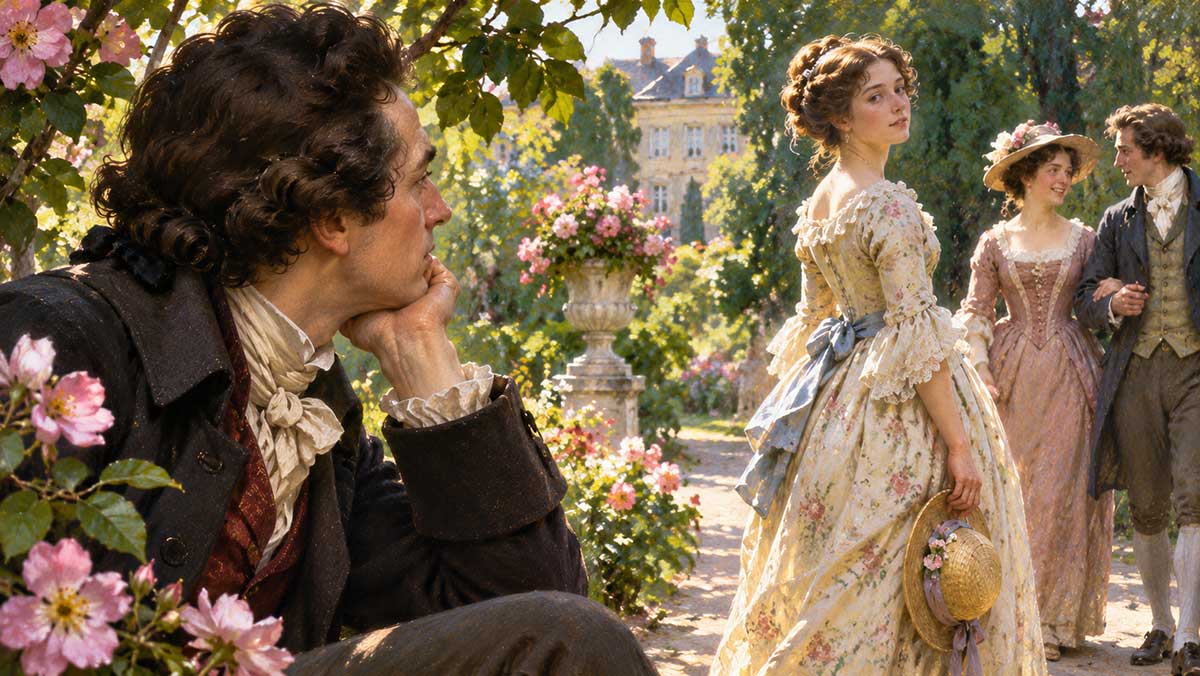
Round 1. When Love Becomes an Obsession
Nick Sasaki
Goethe, last time we talked about Faust, ambition, and the devil.
And you left me with something I haven't stopped thinking about.
You said a person can sincerely believe he loves someone while remaining unaware of how much that love is controlled by his own desires.
That sounds like something you've thought about for a long time.
Johann Wolfgang von Goethe
I have.
And perhaps it is one of the most difficult lessons human beings must learn.
Love begins, very often, with the intensity of our own feelings.
We experience attraction, admiration, longing, and delight.
But genuine love eventually requires us to recognize something beyond those feelings.
The other person possesses a life that does not exist merely to satisfy our desires.
Nick Sasaki
That's a beautiful thought.
But I want to go back to when you were young.
You fell in love with Charlotte Buff, who was already engaged to another man.
And that experience helped inspire The Sorrows of Young Werther.
How deeply did that affect you?
Johann Wolfgang von Goethe
Charlotte awakened powerful feelings in me.
She was warm, lively, and deeply attractive to my youthful imagination.
But she had commitments of her own.
And I had to confront the difference between what I desired and what reality permitted.
Nick Sasaki
Were you heartbroken?
Johann Wolfgang von Goethe
I experienced intense emotional distress.
But I would distinguish my experience from the fate I later gave Werther.
A writer transforms experience through imagination.
The novel was influenced by my feelings for Charlotte and by the tragic death of Karl Wilhelm Jerusalem, whose circumstances contributed to the story.
Nick Sasaki
So Werther wasn't simply your autobiography.
Johann Wolfgang von Goethe
No.
He was a fictional creation through whom I explored emotional possibilities that extended beyond my own experience.
Nick Sasaki
But here's what I find fascinating.
Werther seems like a genuinely sensitive person.
He appreciates nature, beauty, and human feeling.
He's not some terrible villain.
Yet his love becomes destructive.
How does that happen?
Johann Wolfgang von Goethe
Sensitivity can be a gift.
But sensitivity without self-knowledge may become dangerous.
Werther increasingly treats his emotions as the highest authority in his life.
He cannot accept that Charlotte's feelings, obligations, and future are not simply extensions of his own longing.
His imagination becomes a prison.
Nick Sasaki
That's interesting.
He thinks he's experiencing the greatest love imaginable.
But maybe he's actually becoming trapped inside his own feelings.
Johann Wolfgang von Goethe
Yes.
And there is a profound difference between loving another person and loving the emotional experience that person awakens within us.
Nick Sasaki
Wow.
Can you explain that?
Johann Wolfgang von Goethe
Suppose you meet someone who makes you feel extraordinary.
You feel more alive, more inspired, more hopeful.
You may begin to believe that this person is the source of your happiness.
But then you must ask yourself a difficult question.
Do you love this person as an independent human being?
Or do you love the way you feel when you are near them?
Nick Sasaki
That's a tough question.
I think a lot of people would have trouble answering it.
Johann Wolfgang von Goethe
And understandably so.
Our feelings are often the beginning of love.
But they cannot be its entire foundation.
Nick Sasaki
So what happens when love becomes mature?
Johann Wolfgang von Goethe
We begin to recognize the other person's freedom.
We learn that their happiness may not always coincide with our desires.
We discover that affection requires patience, restraint, and sometimes the willingness to accept disappointment.
Nick Sasaki
That's interesting.
So real love sometimes means accepting that you can't have the person you love.
Johann Wolfgang von Goethe
Yes.
And that acceptance can be painful.
But pain does not automatically justify possession.
Nick Sasaki
I think that's something young people especially struggle with.
When you're deeply in love, it can feel like the entire world depends on whether that person loves you back.
Johann Wolfgang von Goethe
Indeed.
Youthful emotion can create the impression that one particular relationship contains the whole meaning of existence.
But life is larger than any single attachment.
Nick Sasaki
Now, let me challenge you.
Isn't that easy to say when you're older?
When you're twenty, heartbreak can feel unbearable.
Johann Wolfgang von Goethe
You are correct.
And I would not dismiss the sincerity of youthful suffering.
The emotions are real.
The pain is real.
But their intensity does not make every conclusion drawn from them reliable.
Nick Sasaki
That's a good distinction.
The feelings are real, but the story we tell ourselves about those feelings might not be true.
Johann Wolfgang von Goethe
Precisely.
And literature can help us examine that difference.
Nick Sasaki
You know, I've always wondered something about Werther.
The novel became enormously popular.
But there were concerns that its tragic ending could influence vulnerable readers.
Did that trouble you?
Johann Wolfgang von Goethe
The reception of the novel certainly revealed how strongly readers could identify with fictional characters.
But the work should not be understood as a recommendation to imitate Werther's final decision.
It presents a tragic development.
Its emotional intensity invites readers to confront the consequences of a life increasingly governed by despair.
Nick Sasaki
So you weren't trying to tell people that dying for love was romantic.
Johann Wolfgang von Goethe
No.
To portray a tragedy is not to endorse it.
Nick Sasaki
That's important.
Now, here's something I want to ask.
Do you think the experience of heartbreak made you a better writer?
Johann Wolfgang von Goethe
It gave me emotional material that I could transform through artistic work.
But I would be cautious about suggesting that suffering is valuable merely when it produces art.
Human pain does not require literary achievement to deserve compassion.
Nick Sasaki
I like that.
Sometimes people say, "Well, at least something good came out of it."
But that doesn't mean the suffering itself was good.
Johann Wolfgang von Goethe
Exactly.
And perhaps we should recognize that the ability to transform experience is different from the experience itself.
Nick Sasaki
Now, you've talked about love requiring restraint.
But some people might say restraint makes love less passionate.
Do you think mature love loses its excitement?
Johann Wolfgang von Goethe
Not necessarily.
Passion and restraint need not be enemies.
A person who learns to govern his impulses may become more capable of sustained affection.
Intensity can create the beginning of a relationship.
But endurance requires other qualities.
Nick Sasaki
Such as?
Johann Wolfgang von Goethe
Trust.
Honesty.
Patience.
The willingness to listen.
And the ability to remain attentive when the excitement of novelty has faded.
Nick Sasaki
That's a very different picture of love from what we usually see in romantic stories.
Johann Wolfgang von Goethe
Stories often concentrate upon the beginning of love.
Daily life reveals what love becomes after the beginning.
Round 2. What Goethe's Own Relationships Taught Him
Nick Sasaki
Now, Goethe, I want to ask about your own relationships.
And I hope you won't mind if I ask some personal questions.
Johann Wolfgang von Goethe
I suspected this moment would arrive.
Nick Sasaki
You knew it was coming.
Let's start with Charlotte von Stein.
She was an important figure in your life for many years.
What did she mean to you?
Johann Wolfgang von Goethe
Charlotte von Stein became an important intellectual and emotional companion during my years in Weimar.
She possessed refinement, intelligence, and a strong sense of social responsibility.
Our relationship developed through conversation, correspondence, and mutual influence.
Nick Sasaki
Was it romantic love?
Johann Wolfgang von Goethe
Our correspondence reveals profound emotional attachment.
But the exact nature of our relationship has remained a subject of interpretation.
I would not wish to reduce its significance to a single label.
Nick Sasaki
That's fair.
But did she change you?
Johann Wolfgang von Goethe
She influenced my conduct, my emotional life, and my growing appreciation for discipline.
During those years, I was learning to balance the intensity of my earlier literary temperament with the responsibilities of public life.
Nick Sasaki
So she helped you mature.
Johann Wolfgang von Goethe
She contributed to that process.
But maturity is rarely the gift of one person alone.
It emerges through experience, relationships, and the willingness to examine ourselves.
Nick Sasaki
Now, here's something interesting.
You traveled to Italy without telling her your full plans in advance.
And after you returned, your relationship changed.
Do you think you hurt her?
Johann Wolfgang von Goethe
I think it would be unreasonable to deny that my decisions could cause pain.
My departure and the changes that followed altered our relationship.
From the perspective of my own development, Italy was enormously important.
But personal growth does not erase the emotional consequences of our choices.
Nick Sasaki
That's something I really wanted to ask you.
We talked about Bildung, becoming the person you're capable of becoming.
But what if your personal development hurts someone who loves you?
How do you balance those two things?
Johann Wolfgang von Goethe
That is one of the most difficult questions surrounding self-development.
We cannot surrender every personal aspiration merely to avoid disappointing others.
But neither can we assume that our desire for growth makes every decision morally acceptable.
Freedom carries responsibility.
We must consider how our choices affect the people who have placed their trust in us.
Nick Sasaki
So personal growth isn't an excuse to treat people carelessly.
Johann Wolfgang von Goethe
Precisely.
A person who becomes more accomplished but less considerate may have developed certain abilities while neglecting his character.
Nick Sasaki
I think that's a powerful lesson.
Now, after Italy, you became involved with Christiane Vulpius.
And your relationship lasted for many years before you married.
Tell me about her.
Johann Wolfgang von Goethe
Christiane became my companion in daily life.
Our relationship differed from many of the intellectual and social connections associated with my public position.
She brought warmth, vitality, and practical affection into my household.
We shared a family and a life together.
Nick Sasaki
But your relationship was controversial, wasn't it?
Johann Wolfgang von Goethe
Yes.
Our social circumstances differed.
And the fact that we lived together for many years before marrying challenged the expectations of respectable society.
Nick Sasaki
Did that bother you?
Johann Wolfgang von Goethe
Public judgment can be unpleasant.
But it should not automatically determine the worth of a relationship.
At the same time, one must recognize that social disapproval often falls more heavily upon the person with less public standing.
Nick Sasaki
That's interesting.
You were already famous and influential.
But Christiane probably had to deal with criticism in ways you didn't.
Johann Wolfgang von Goethe
That is a fair concern.
And it reminds us that relationships exist within social structures that can distribute burdens unequally.
Nick Sasaki
Now, here's something I've wondered.
You lived together for about eighteen years before marrying in 1806.
Why did you wait so long?
Johann Wolfgang von Goethe
The circumstances involved personal choices, social expectations, and the unusual character of our household.
It would be misleading to reduce such a long period to one simple explanation.
But I recognize that the delay itself raises questions about commitment and public acknowledgment.
Nick Sasaki
Do you think Christiane deserved that acknowledgment earlier?
Johann Wolfgang von Goethe
That is a question worth considering seriously.
It is easy to defend one's decisions by describing the circumstances in which they were made.
It is more difficult to ask whether another person carried costs that we ourselves did not fully recognize.
Nick Sasaki
I appreciate your willingness to say that.
Now, you and Christiane had several children, but only August survived to adulthood.
That must have been heartbreaking.
Johann Wolfgang von Goethe
The loss of children is among the most painful experiences a family can endure.
Such experiences remind us that love is inseparable from vulnerability.
To love someone is to become deeply affected by what happens to them.
Nick Sasaki
Did becoming a father change the way you thought about love?
Johann Wolfgang von Goethe
It broadened the meaning of responsibility.
Romantic love often begins with attraction and desire.
Parenthood introduces a different relationship with time.
One must consider the needs of someone whose life extends beyond one's own immediate wishes.
Nick Sasaki
That's interesting.
So love becomes less about what you're feeling and more about what you're willing to do for another person.
Johann Wolfgang von Goethe
That is one important development.
But I would not wish to dismiss feeling.
Affection remains precious.
The question is whether feeling matures into sustained care.
Nick Sasaki
Now, let me ask you something personal.
Did you ever regret the way you handled your relationships?
Johann Wolfgang von Goethe
I would not claim that every decision I made was wise.
My life contained moments of passion, uncertainty, ambition, and conflicting obligations.
Looking back, one can recognize consequences that were difficult to perceive at the time.
Nick Sasaki
If you could speak to your younger self, what would you tell him about love?
Johann Wolfgang von Goethe
I would encourage him to listen more carefully.
To recognize that emotional intensity does not guarantee moral clarity.
To resist treating another person's affection as proof of his own importance.
And to understand that freedom in love must be accompanied by responsibility.
Nick Sasaki
That's interesting.
You know, sometimes people think being free means they don't owe anybody an explanation.
But once you've entered a relationship, your decisions affect somebody else's life.
Johann Wolfgang von Goethe
Exactly.
And genuine freedom should not be confused with indifference to those consequences.
Nick Sasaki
Now, here's a question I think a lot of people would want to ask.
Do you think one person can love more than one person during a lifetime?
Johann Wolfgang von Goethe
Certainly.
Human affection does not necessarily occur only once.
People change.
Relationships develop and sometimes end.
New attachments become possible.
But the capacity to love more than once does not eliminate our obligations to those we have loved.
Nick Sasaki
So every relationship teaches us something different.
Johann Wolfgang von Goethe
Potentially.
But only if we are willing to learn.
Repeated experience does not automatically produce wisdom.
Nick Sasaki
That's a good point.
Some people make the same mistakes in every relationship.
Johann Wolfgang von Goethe
Then perhaps they have changed partners without sufficiently examining themselves.
Nick Sasaki
That's a pretty sharp observation.
Johann Wolfgang von Goethe
You did ask for honesty.
Nick Sasaki
I did.
Now, I want to connect this to something larger.
You wrote about love throughout your life.
But your work doesn't always present love as something simple or comforting.
Sometimes love is beautiful.
Sometimes it's painful.
Sometimes it becomes destructive.
Why did you keep returning to it?
Johann Wolfgang von Goethe
Love reveals the tension between our desire for connection and our need to recognize another person's independence.
It can awaken extraordinary generosity.
But it can also expose vanity, possessiveness, fear, and insecurity.
In that sense, love becomes one of the most demanding experiences through which human character develops.
Nick Sasaki
So love is almost like a test of whether we've really matured.
Johann Wolfgang von Goethe
Perhaps.
But I would prefer to call it an opportunity for development rather than an examination one must pass perfectly.
We learn through our failures, provided we are willing to acknowledge them.
Nick Sasaki
That's a good distinction.
Now, there's one love story in your work that I think brings all of these questions together.
And it's probably the most tragic.
Gretchen and Faust.
Round 3. What Gretchen Teaches Us About Real Love
Nick Sasaki
Goethe, let's talk about Gretchen.
When Faust meets her, he's immediately attracted to her.
And Mephistopheles helps him pursue her.
At first, it almost feels like a romantic story.
But then everything falls apart.
Why did you make that relationship so tragic?
Johann Wolfgang von Goethe
Gretchen's story reveals the moral consequences of desire when it becomes separated from responsibility.
Faust experiences powerful attraction.
But he does not adequately consider the world in which Gretchen lives.
Her family, her social position, her religious convictions, and her vulnerability all matter.
He approaches her through the urgency of his own longing.
Nick Sasaki
So he doesn't really see the whole person.
He sees the woman he wants.
Johann Wolfgang von Goethe
That is one of his central failures.
He is captivated by her beauty and innocence.
But he does not fully recognize the consequences that their relationship may bring upon her life.
Nick Sasaki
And Mephistopheles makes everything worse.
Johann Wolfgang von Goethe
He encourages Faust's impatience and helps create circumstances in which desire can proceed without sufficient reflection.
But we should not assign all responsibility to Mephistopheles.
Faust remains morally accountable for his choices.
Nick Sasaki
That's important.
Sometimes people blame temptation.
They say, "The devil made me do it."
But Faust still had choices.
Johann Wolfgang von Goethe
Precisely.
Temptation may reveal a weakness.
It does not automatically eliminate responsibility.
Nick Sasaki
Now, here's what bothers me.
Gretchen suffers far more than Faust.
Her mother dies after receiving a sleeping potion.
Her brother is killed.
She becomes pregnant, faces social disgrace, and eventually ends up imprisoned after killing her child.
Meanwhile, Faust continues his extraordinary adventures.
Why is the suffering so unequal?
Johann Wolfgang von Goethe
That inequality is central to the tragedy.
Gretchen occupies a vulnerable position within the social and moral expectations of her community.
Faust possesses greater freedom, education, and mobility.
The consequences of their relationship fall upon them differently.
Nick Sasaki
So you were criticizing society, too?
Johann Wolfgang von Goethe
The drama certainly exposes the harshness of social judgment and the unequal burdens placed upon women.
But it would be too simple to place all responsibility upon society.
Faust's choices matter.
Mephistopheles' interventions matter.
Gretchen's circumstances matter.
The tragedy emerges through the interaction of personal decisions and social conditions.
Nick Sasaki
That's fascinating.
You know, sometimes people say they love somebody, but they don't think about what their relationship might cost the other person.
Especially when one person has more influence, money, or freedom than the other.
Johann Wolfgang von Goethe
Yes.
And that is why love requires more than sincerity.
A person may sincerely feel affection and still behave irresponsibly.
Nick Sasaki
That's a powerful distinction.
You can genuinely feel love and still hurt the person you love.
Johann Wolfgang von Goethe
Indeed.
And perhaps one of the most difficult forms of self-knowledge is recognizing that our intentions do not erase the consequences of our actions.
Nick Sasaki
Now, I want to ask you something.
Did Faust truly love Gretchen?
Or was he just using her to satisfy his desires?
Johann Wolfgang von Goethe
I would resist reducing his feelings to a single category.
Faust experiences genuine attraction and emotional involvement.
But his love is compromised by his inability to accept the full responsibilities of the relationship.
Nick Sasaki
So he may have loved her, but he didn't know how to love her well.
Johann Wolfgang von Goethe
That is a meaningful way to express the tragedy.
Nick Sasaki
You know, that might be true of a lot of relationships.
People love each other.
But they don't know how to communicate, how to listen, or how to put the other person's needs ahead of their own.
Johann Wolfgang von Goethe
Yes.
And we should not assume that strong emotion automatically provides those abilities.
They must be cultivated.
Nick Sasaki
Now, here's something I've always wondered.
At the end of Part One, Gretchen refuses to escape with Faust.
And a heavenly voice declares that she is saved.
Why does she refuse to leave?
Johann Wolfgang von Goethe
Her refusal can be interpreted in several ways.
She is overwhelmed by guilt, fear, and spiritual anguish.
But she also rejects the attempt to escape through Mephistopheles' intervention.
Her final appeal is directed toward divine judgment rather than worldly rescue.
Nick Sasaki
So she accepts responsibility for what happened.
Johann Wolfgang von Goethe
She confronts the moral and spiritual reality of her situation.
But we should be cautious about simplifying her suffering into a neat lesson about repentance.
Her tragedy remains terrible.
Her salvation does not make the events that preceded it acceptable.
Nick Sasaki
That's important.
Sometimes people turn tragic stories into inspirational messages too quickly.
But real suffering doesn't disappear just because there's a hopeful ending.
Johann Wolfgang von Goethe
Exactly.
And literature should preserve the dignity of suffering rather than merely use it to produce consolation.
Nick Sasaki
Now, here's something I want to challenge you about.
You gave Gretchen this terrible fate.
Did you ever feel guilty as the author?
Johann Wolfgang von Goethe
A writer bears responsibility for the moral seriousness with which he portrays suffering.
But fictional creation is not the same as committing the actions represented.
The question is whether the work treats its characters as fully human or merely as instruments of spectacle.
Nick Sasaki
And you wanted Gretchen to be more than just a victim in Faust's story.
Johann Wolfgang von Goethe
Certainly.
Her moral and spiritual significance cannot be reduced to Faust's development.
Indeed, her fate challenges the assumption that Faust's ambitions should remain the center of every moral judgment.
Nick Sasaki
That's fascinating.
So in some ways, Gretchen becomes morally greater than Faust.
Johann Wolfgang von Goethe
Her capacity for spiritual seriousness and her final appeal to divine mercy invite readers to reconsider conventional measures of greatness.
Faust possesses extraordinary intellectual abilities.
Gretchen possesses a different kind of moral significance.
Nick Sasaki
You know, that connects to what we talked about in Topic One.
You said fame and achievement don't necessarily make someone a better human being.
And here we have Faust, who's brilliant, and Gretchen, who doesn't have his education or status.
But she may understand something about the human soul that he doesn't.
Johann Wolfgang von Goethe
That is a compelling interpretation.
And perhaps it reveals why the cultivation of the human being cannot be measured solely through intellectual achievement.
Nick Sasaki
Now, let me ask you something personal.
After writing all these love stories and experiencing so many relationships yourself, what do you think is the biggest mistake people make about love?
Johann Wolfgang von Goethe
Perhaps the assumption that love is primarily something that happens to us.
We speak of falling in love as though we have entered a condition over which we possess no responsibility.
But love is not merely an emotion.
It is a relationship between persons.
And relationships require choices.
Nick Sasaki
So love isn't just something you feel.
It's something you practice.
Johann Wolfgang von Goethe
Yes.
Through attention.
Through honesty.
Through patience.
Through the willingness to recognize another person's needs.
And sometimes through the restraint of our own desires.
Nick Sasaki
That's interesting.
Now, some people might say that sounds less romantic.
They want love to be spontaneous and passionate.
Johann Wolfgang von Goethe
Then perhaps they have confused romance with the entire meaning of love.
Spontaneity can be delightful.
Passion can be beautiful.
But the ability to remain faithful to another person's dignity when passion becomes inconvenient may reveal something deeper.
Nick Sasaki
I like that.
Now, here's a question I think about.
Do you think the highest form of love is self-sacrifice?
Putting somebody else's happiness ahead of your own?
Johann Wolfgang von Goethe
Self-sacrifice can be an expression of love.
But we must be careful.
A relationship in which one person is expected to surrender every need while the other receives every benefit is not necessarily a model of moral excellence.
Genuine love should recognize the humanity of both persons.
Nick Sasaki
That's a good point.
So love shouldn't mean one person disappears for the sake of the other.
Johann Wolfgang von Goethe
Precisely.
The goal is not the destruction of individuality.
It is the development of a relationship in which both persons can flourish.
Nick Sasaki
That's beautiful.
And I think it connects to your idea of Bildung.
Maybe love is one of the ways we become more fully human.
Johann Wolfgang von Goethe
Very much so.
Through love, we encounter someone whose experiences, desires, and limitations differ from our own.
We are invited to move beyond the narrow boundaries of self-concern.
But that invitation can be accepted or rejected.
Nick Sasaki
So love can make us better.
But it can expose our worst qualities, too.
Johann Wolfgang von Goethe
Yes.
Jealousy.
Possessiveness.
Vanity.
Fear of abandonment.
The desire to control.
These may emerge precisely when we believe our feelings are most noble.
Nick Sasaki
That's fascinating.
Now, I want to ask you something a little bigger.
We've talked about romantic love, marriage, and family.
But do you think the same principles apply to humanity as a whole?
Could people learn to love others beyond their own family, religion, or country?
Johann Wolfgang von Goethe
I believe human sympathy can extend beyond the boundaries of immediate personal attachment.
Literature, art, and encounters with other cultures can help us recognize the humanity of people whose lives differ from our own.
But universal sympathy must not become an excuse to neglect the people directly entrusted to our care.
Nick Sasaki
That's an interesting balance.
You can care about the whole world, but you still have to care about the people sitting at your dinner table.
Johann Wolfgang von Goethe
Exactly.
A person who speaks eloquently about humanity while treating his own family with indifference has not fully resolved the demands of love.
Nick Sasaki
That's a powerful thought.
You know, I have this hope that someday humanity might recognize itself as one family.
That people from different countries, cultures, and religions could see one another as brothers and sisters.
Do you think that's unrealistic?
Johann Wolfgang von Goethe
It is an aspiration worthy of serious consideration.
But unity should not require the elimination of difference.
Human cultures possess distinct histories, languages, and traditions.
Their diversity can enrich our shared existence.
The challenge is to cultivate mutual recognition without demanding complete uniformity.
Nick Sasaki
I really like that.
One family doesn't mean everybody has to become the same.
Johann Wolfgang von Goethe
Precisely.
A family itself contains different personalities, abilities, and convictions.
Its unity need not depend upon every member thinking identically.
Nick Sasaki
Now, let me ask you one final question about love.
If you could give one piece of advice to somebody who wants to love another person better, what would it be?
Johann Wolfgang von Goethe
Learn to see the person before you.
Not merely the person you wish them to become.
Not merely the person who satisfies your expectations.
But the actual human being, with their own fears, hopes, limitations, and possibilities.
Nick Sasaki
That's beautiful.
And what if they disappoint you?
Johann Wolfgang von Goethe
Then you must distinguish between disappointment that can be met with patience and conduct that requires honest boundaries.
Love does not demand blindness.
Nick Sasaki
What if you discover that you've been the one causing the pain?
Johann Wolfgang von Goethe
Then the first task is to stop defending your intentions long enough to recognize the other person's experience.
Nick Sasaki
Wow.
That's something worth thinking about.
You know, Goethe, I started this conversation wanting to hear about your love life.
But I think we've ended up talking about something much bigger.
How love can help us grow.
How it can expose our weaknesses.
And how it can teach us to see another person as someone whose life matters just as much as our own.
Johann Wolfgang von Goethe
Yes.
And perhaps that recognition leads naturally to another question.
Nick Sasaki
What's that?
Johann Wolfgang von Goethe
If we learn to recognize the dignity of another human being, what does that suggest about our relationship with nature, with humanity, and with whatever we understand by the divine?
Nick Sasaki
That's a fascinating question.
And I think it brings us to something I've wanted to ask you from the beginning.
You studied science.
You wrote about God and the devil.
You were interested in different religions.
But what did you actually believe?
Johann Wolfgang von Goethe
That is a difficult question, Nick.
Nick Sasaki
I figured it might be.
Johann Wolfgang von Goethe
Then perhaps we should begin with something simple.
A leaf.
Nick Sasaki
A leaf?
Johann Wolfgang von Goethe
Yes.
You have asked what I believe about God.
But before we speak of Heaven, perhaps we should consider what can be learned from the living world immediately before us.
Nick Sasaki
You really do bring everything back to plants.
Johann Wolfgang von Goethe
And yet you continue asking questions.
Nick Sasaki
Fair enough.
Let's talk about the leaf.
End of Topic 3
Fictional disclaimer: This imagined conversation was created for ImaginaryTalks.com. Goethe's responses are creative interpretations informed by his documented biography, literary works, correspondence, and philosophical ideas. They are not authenticated historical quotations. Interpretations of Goethe's relationships and the moral themes of Werther and Faust remain subjects of historical and literary discussion.
Topic 4. What Do You Really Believe About God and Life?

Round 1. What a Single Leaf Can Teach Us About God
Nick Sasaki
Goethe, last time we were talking about love, and somehow you managed to bring the conversation back to plants.
You said that before we talk about God, we should begin with a leaf.
I have to admit, that's not where I expected this interview to go.
Johann Wolfgang von Goethe
Then perhaps the leaf has already accomplished something useful.
It has interrupted your expectations.
Nick Sasaki
That's true.
But seriously, why a leaf?
What can a leaf possibly teach us about God?
Johann Wolfgang von Goethe
Before we ask what a leaf teaches us about God, perhaps we should ask what we can learn by observing it carefully.
Consider its form.
Its veins.
Its relationship with the stem.
The way it develops from a bud.
The way its appearance changes through the seasons.
A leaf is not merely an isolated object.
It belongs to a living process.
Nick Sasaki
Okay.
But how does that connect to your philosophy?
Johann Wolfgang von Goethe
During my botanical studies, I became fascinated by the relationships among different plant organs.
Leaves, petals, and other structures appear remarkably different.
Yet I suspected that their forms could be understood through processes of transformation.
This led me to develop my ideas concerning the metamorphosis of plants.
Nick Sasaki
So you're saying the different parts of a plant are connected through a process of development.
Johann Wolfgang von Goethe
Yes.
My scientific interpretation emphasized the transformation of related forms.
I wanted to understand the living organism through its development rather than treating each visible part as an entirely separate object.
Nick Sasaki
That's fascinating.
And you saw something spiritual in that?
Johann Wolfgang von Goethe
I found the living world worthy of profound reverence.
But I would distinguish scientific observation from theological proof.
The study of a plant does not automatically establish a particular doctrine about God.
What it can do is awaken attention to the order, diversity, and activity of nature.
Nick Sasaki
So you weren't trying to prove God's existence by pointing at a flower.
Johann Wolfgang von Goethe
No.
I was interested in encountering nature as something living and intelligible, something that invites sustained observation.
For me, scientific inquiry and a sense of wonder were not enemies.
Nick Sasaki
That's interesting.
Some people think science makes the world less mysterious.
The more we explain, the less room there is for God.
But you seem to think the more you study nature, the more remarkable it becomes.
Johann Wolfgang von Goethe
Knowledge can deepen wonder.
When we discover relationships that were previously hidden from us, the world need not become less beautiful.
It may become more astonishing.
Nick Sasaki
Now, let me ask you something.
Did you believe God created nature?
Or did you believe God and nature were somehow the same?
Johann Wolfgang von Goethe
You are approaching one of the most important philosophical influences upon my thinking.
Baruch Spinoza.
Nick Sasaki
Tell me about him.
Johann Wolfgang von Goethe
Spinoza developed a philosophy in which God and nature are understood through a profound unity.
His thought challenged the conventional picture of a deity standing entirely apart from the world and intervening in it as a human ruler might intervene in a kingdom.
I found his philosophy deeply compelling.
It encouraged me to contemplate nature with reverence and to resist simplistic divisions between the spiritual and the material.
Nick Sasaki
So did you agree with Spinoza completely?
Johann Wolfgang von Goethe
I would not describe my intellectual relationship with him as complete agreement upon every proposition.
His philosophy offered a way of thinking that I found spiritually and intellectually sustaining.
But my own reflections developed through poetry, science, experience, and encounters with other traditions.
Nick Sasaki
Let me make sure I understand.
Some Christians picture God as a personal being who created the universe and can hear our prayers.
Spinoza's philosophy presents a very different understanding of God.
Where did you stand?
Johann Wolfgang von Goethe
My religious views cannot be adequately reduced to a single doctrinal label.
I was attracted to the thought that the divine is expressed through the living order of existence.
I valued the spiritual significance of nature.
And I remained interested in the moral and poetic insights of religious traditions.
But I did not always express these interests through conventional theological formulas.
Nick Sasaki
So you weren't comfortable saying, "This is exactly what God is, and everybody else is wrong."
Johann Wolfgang von Goethe
I would regard such certainty with caution, particularly when the subject exceeds the limits of human observation.
Nick Sasaki
That's interesting.
But here's something I want to challenge you about.
If God is present in nature, what about the terrible things that happen in nature?
Earthquakes.
Disease.
Animals killing one another.
Children dying.
How do you see God in all of that?
Johann Wolfgang von Goethe
That is a serious objection.
A reverent view of nature must not become sentimental.
Nature contains beauty and destruction.
Growth and decay.
Creation and death.
To admire the living world honestly, one must acknowledge its difficult and sometimes terrifying aspects.
Nick Sasaki
So nature isn't just beautiful flowers and peaceful forests.
Johann Wolfgang von Goethe
Certainly not.
And if we attempt to construct a spiritual philosophy from nature, we must confront the whole of nature rather than selecting only what pleases us.
Nick Sasaki
Did that ever make you doubt your beliefs?
Johann Wolfgang von Goethe
It encouraged intellectual humility.
I did not believe that every difficulty could be resolved through a pleasing explanation.
The existence of suffering remains a profound challenge to human thought.
Nick Sasaki
Now, you studied science throughout your life.
But you weren't always in agreement with other scientists.
You had a major disagreement with Isaac Newton about color.
What was that about?
Johann Wolfgang von Goethe
Newton's investigations demonstrated important properties of light through experiments with prisms.
But I believed that the experience of color required attention to a broader range of conditions, including the interaction of light and darkness and the processes of human perception.
My Theory of Colours attempted to examine these phenomena from a different perspective.
Nick Sasaki
Were you saying Newton was wrong?
Johann Wolfgang von Goethe
I challenged important aspects of his interpretation.
But the scientific standing of our approaches must be judged through evidence, not literary reputation.
Modern physical optics supports Newton's account of the spectral decomposition of light.
My work has retained interest in the study of perception, artistic experience, and the history of scientific ideas.
Nick Sasaki
I appreciate that distinction.
You can be a genius in literature and still be mistaken about something in science.
Johann Wolfgang von Goethe
Of course.
Human achievement in one field does not confer infallibility in another.
Nick Sasaki
That's actually a pretty important lesson.
Sometimes people become famous for one thing, and then everybody assumes they're right about everything.
Johann Wolfgang von Goethe
A dangerous assumption.
And perhaps one that should be resisted by celebrated individuals themselves.
Nick Sasaki
Now, here's what fascinates me.
You were a poet, but you spent years studying plants and color.
Why did science matter so much to you?
Johann Wolfgang von Goethe
I did not regard science as a distraction from my literary work.
Both emerged from my desire to observe and comprehend the world.
In poetry, I sought to express human experience through form and language.
In science, I sought relationships within natural phenomena.
The methods differed, but the underlying attention to reality connected them.
Nick Sasaki
So you wanted to understand life from different directions.
Johann Wolfgang von Goethe
Yes.
And I believed that the observer must cultivate patience.
We should not force phenomena to conform prematurely to our preferred theories.
We should learn to see what is before us.
Nick Sasaki
That's interesting.
And maybe that applies to people, too.
Sometimes we decide who somebody is before we've really listened to them.
Johann Wolfgang von Goethe
An excellent extension of the principle.
Observation requires the willingness to be corrected by reality.
Nick Sasaki
I like that.
Now, I want to ask you something more spiritual.
When you looked at nature, did you ever feel that you were encountering God?
Johann Wolfgang von Goethe
I experienced moments of profound reverence in the presence of the natural world.
But I would hesitate to turn those experiences into a universal theological formula.
Perhaps what matters is that nature can awaken humility, gratitude, and an awareness that our individual existence belongs to something larger.
Nick Sasaki
That's beautiful.
But I still want to know what you believed about God personally.
And I think that brings us to Jesus, prayer, and the possibility of life after death.
Round 2. Jesus, Prayer, and the Mystery of the Divine
Nick Sasaki
Goethe, let me ask you directly.
Did you believe in Jesus Christ?
Johann Wolfgang von Goethe
I regarded Jesus as a figure of extraordinary moral and spiritual significance.
His teachings, particularly those concerning love, compassion, and the transformation of human conduct, deserve serious attention.
But the question of Jesus' theological identity has been interpreted differently across Christian traditions and philosophical perspectives.
Nick Sasaki
Did you believe Jesus was God?
Johann Wolfgang von Goethe
I would not wish to present a simplified answer as though my religious reflections had always conformed to one fixed confession.
I was deeply interested in the moral and spiritual significance of Christianity, but I did not consistently express my beliefs through orthodox doctrinal formulations.
Nick Sasaki
That's interesting.
I think a lot of people struggle with that question.
Some Christians believe Jesus is God himself.
Others see him as the Son of God, distinct from God the Father.
And some people admire his teachings without accepting traditional Christian doctrines.
What interested you most about Jesus?
Johann Wolfgang von Goethe
The moral seriousness of his teachings.
The demand that human beings examine their own conduct.
The call to love beyond narrow self-interest.
And the challenge of bringing spiritual conviction into everyday life.
Nick Sasaki
Do you think people sometimes focus too much on religious doctrines and not enough on actually living the teachings?
Johann Wolfgang von Goethe
That danger exists.
A person may defend a doctrine with great intensity while failing to practice the virtues associated with it.
But I would not dismiss doctrine entirely.
For many believers, theological convictions provide a meaningful foundation for moral life.
The difficulty arises when the defense of belief becomes detached from compassion and humility.
Nick Sasaki
That's a fair point.
Now, did you pray?
Johann Wolfgang von Goethe
My spiritual life did not always follow the conventional forms of religious practice.
I experienced reverence through contemplation, gratitude, and engagement with nature and art.
But prayer is a broad human practice, and its meaning differs across traditions.
Nick Sasaki
Let me ask you something.
Suppose you're going through a terrible experience.
Someone you love is sick.
You're frightened.
You don't know what to do.
Would you ask God for help?
Johann Wolfgang von Goethe
I would recognize the human need to seek comfort and meaning in such circumstances.
But I would hesitate to describe every private spiritual response through a single fixed formula.
Suffering can lead us toward prayer, silence, reflection, or the companionship of others.
Nick Sasaki
That's interesting.
You seem reluctant to make absolute statements about spiritual things.
Johann Wolfgang von Goethe
Perhaps I have become cautious about claiming knowledge where I possess only interpretation, intuition, or hope.
Nick Sasaki
But don't you think faith sometimes requires conviction?
If you're always questioning everything, how do you actually believe in anything?
Johann Wolfgang von Goethe
Questioning and conviction need not be enemies.
A person may hold deep commitments while recognizing the limits of his knowledge.
Indeed, humility may protect conviction from becoming arrogance.
Nick Sasaki
That's a good point.
Now, here's something I've been wanting to ask.
You were interested in religions beyond Christianity.
You admired the Persian poet Hafez and wrote the West-Eastern Divan.
What attracted you to Islamic and Persian literary traditions?
Johann Wolfgang von Goethe
Hafez offered a remarkable poetic world.
His verses combined love, spiritual longing, wit, and a freedom of expression that fascinated me.
Through him and other sources, I encountered literary and religious traditions that challenged the assumption that European culture possessed a monopoly upon wisdom.
Nick Sasaki
So you believed people could learn from religions and cultures different from their own.
Johann Wolfgang von Goethe
Certainly.
Human creativity and insight are not confined to one nation or civilization.
The encounter with unfamiliar traditions can reveal possibilities that our own habits have concealed.
Nick Sasaki
Now, let me ask you something.
Did you believe all religions were basically saying the same thing?
Johann Wolfgang von Goethe
No.
That would overlook genuine differences in doctrine, history, and practice.
But disagreement does not prevent mutual learning.
One can recognize the distinctiveness of a tradition while appreciating the moral or artistic insights it contains.
Nick Sasaki
That's interesting.
Sometimes people try to create unity by pretending everybody believes the same thing.
But you're saying unity can exist without erasing differences.
Johann Wolfgang von Goethe
Yes.
Respect does not require intellectual uniformity.
Nick Sasaki
I like that.
Now, here's something personal.
Do you think there's life after death?
Johann Wolfgang von Goethe
The possibility of continued existence interested me.
But I would distinguish philosophical reflection from certain knowledge.
Human beings have developed many accounts of what follows death.
Some are rooted in religious revelation.
Others arise from philosophical reasoning or personal experience.
I would be cautious about claiming a complete description of what lies beyond earthly life.
Nick Sasaki
But did you hope there was something more?
Johann Wolfgang von Goethe
The thought that human existence might possess dimensions beyond our present experience can be deeply meaningful.
And the possibility of reunion with those we have loved is naturally consoling.
Yet hope should not be confused with proof.
Nick Sasaki
That's fair.
You lost people you loved.
Your friend Schiller.
Your wife Christiane.
Your son August.
Did those losses change how you thought about the afterlife?
Johann Wolfgang von Goethe
Loss makes questions of mortality profoundly personal.
When someone dear to us dies, we confront the limits of what we can know and control.
The hope that love might not be entirely defeated by death can become especially meaningful.
But grief does not automatically provide certainty.
Nick Sasaki
I think a lot of people can relate to that.
You may have strong beliefs about Heaven or the spiritual world.
But when somebody you love dies, the question becomes much more personal.
Will I see them again?
Johann Wolfgang von Goethe
Yes.
And perhaps the sincerity of that question deserves respect regardless of the tradition through which it is expressed.
Nick Sasaki
Now, let me ask you something.
If you could ask God one question and receive a completely truthful answer, what would you ask?
Johann Wolfgang von Goethe
An intriguing opportunity.
Perhaps I would ask how human freedom, suffering, and the larger order of existence are related.
Nick Sasaki
That's a pretty big question.
Johann Wolfgang von Goethe
You did promise a completely truthful answer.
I thought I should make good use of the opportunity.
Nick Sasaki
Fair enough.
I might ask why human beings have spent so much of history fighting one another.
Especially when so many religions teach love and compassion.
Johann Wolfgang von Goethe
That is a question worth asking.
And perhaps part of the answer lies in the difference between professing a moral principle and cultivating the character necessary to live by it.
Nick Sasaki
So knowing that we should love one another isn't enough.
We actually have to become the kind of people who can do it.
Johann Wolfgang von Goethe
Precisely.
And that brings us back to Bildung.
Human development is not merely the accumulation of information.
It includes the cultivation of judgment, sympathy, and moral responsibility.
Nick Sasaki
I love how these ideas keep connecting.
Your science, your literature, your philosophy of education, and your spiritual questions.
They all seem to point toward the development of the human being.
Johann Wolfgang von Goethe
That is a meaningful connection.
But I would add that the individual develops within a larger human community.
And that community extends far beyond the borders of one nation.
Round 3. Can Humanity Become One Family?
Nick Sasaki
Goethe, you've talked about learning from different cultures.
And I know you were interested in the idea of world literature.
What did you mean by that?
Johann Wolfgang von Goethe
I believed that literature should not be confined within narrow national boundaries.
Writers and readers can learn from works created in different languages and civilizations.
The exchange of literary ideas can broaden our perception of humanity.
Nick Sasaki
So you wanted people to read beyond their own culture.
Johann Wolfgang von Goethe
Yes.
A person who knows only the literature of his own nation may mistake local habits for universal truths.
Encountering unfamiliar works can challenge those assumptions.
Nick Sasaki
That's fascinating.
Do you think literature can actually make people more compassionate?
Johann Wolfgang von Goethe
It can create opportunities for sympathy.
A reader may encounter the inner life of someone whose circumstances differ greatly from his own.
Through imagination, he may begin to recognize experiences that were previously unfamiliar.
But reading alone does not guarantee moral improvement.
A person must remain willing to learn from what he reads.
Nick Sasaki
That's a good point.
Some people read hundreds of books and still treat others terribly.
Johann Wolfgang von Goethe
Then their intellectual cultivation may not have been accompanied by sufficient moral reflection.
Nick Sasaki
Now, here's something I want to ask.
You lived during a period of enormous political conflict.
The French Revolution.
The Napoleonic Wars.
Nationalism was becoming increasingly influential.
Did you believe national identity was dangerous?
Johann Wolfgang von Goethe
A sense of cultural belonging can be meaningful.
Language, history, and shared traditions can enrich human life.
But national pride becomes dangerous when it encourages contempt for other peoples or the assumption that one civilization possesses all wisdom.
Nick Sasaki
So loving your country doesn't require hating another country.
Johann Wolfgang von Goethe
Precisely.
And intellectual exchange can help us recognize the limitations of narrow cultural self-satisfaction.
Nick Sasaki
You know, I have a dream that someday humanity might recognize itself as one family.
Different countries, different religions, different cultures.
But one human family.
Do you think that's possible?
Johann Wolfgang von Goethe
It is a worthy aspiration.
But perhaps we should distinguish emotional unity from practical cooperation.
Human beings may never agree upon every religious, philosophical, or political question.
Yet they can still develop institutions, habits, and relationships that allow them to live together more peacefully.
Nick Sasaki
So unity doesn't mean everybody has to think alike.
Johann Wolfgang von Goethe
No.
Indeed, a world in which every culture became identical would lose much of its richness.
The goal should be mutual recognition rather than uniformity.
Nick Sasaki
I really like that.
One family can contain many different personalities.
Johann Wolfgang von Goethe
Exactly.
And perhaps the same principle can be extended to humanity.
Nick Sasaki
Now, here's something I'm curious about.
If you could speak to the leaders of the world today, what would you tell them?
Johann Wolfgang von Goethe
I would encourage them to recognize the limits of their own perspectives.
To study history carefully.
To resist the temptation to confuse national ambition with universal moral truth.
And to consider the human consequences of their decisions beyond the immediate interests of their own position.
Nick Sasaki
That's interesting.
Do you think the greatest problem in the world is selfishness?
Johann Wolfgang von Goethe
Self-interest is a natural part of human existence.
The problem arises when self-interest becomes incapable of recognizing legitimate claims beyond itself.
Individuals, institutions, and nations all require the discipline of considering perspectives other than their own.
Nick Sasaki
That reminds me of Faust.
He wants something so badly that he stops seeing the people who might get hurt.
Johann Wolfgang von Goethe
Yes.
And perhaps that is one reason his story extends beyond the concerns of a single individual.
The moral dangers of limitless striving can appear in politics, commerce, science, and cultural ambition.
Nick Sasaki
Now, here's a question I want to ask.
Do you think human beings are fundamentally good?
Or fundamentally selfish?
Johann Wolfgang von Goethe
I would resist reducing humanity to either description.
Human beings possess capacities for generosity and cruelty, wisdom and foolishness, creation and destruction.
The task of education and culture is partly to cultivate the better possibilities of our nature.
Nick Sasaki
So you believe people can change.
Johann Wolfgang von Goethe
Yes.
But change is not automatic.
It requires experience, reflection, discipline, and sometimes painful recognition of our mistakes.
Nick Sasaki
That's interesting.
And it brings us back to your idea of metamorphosis.
In nature, things transform.
And human beings can transform, too.
Johann Wolfgang von Goethe
The comparison can be illuminating.
But we should not assume that every transformation represents moral improvement.
A person can develop harmful habits just as he can cultivate beneficial ones.
The direction of development matters.
Nick Sasaki
That's a good point.
Now, let me ask you something.
What do you think is the purpose of human life?
Is it happiness?
Is it becoming a better person?
Is it serving God?
Is it helping humanity?
Johann Wolfgang von Goethe
I would hesitate to reduce the purpose of existence to a single formula.
But I believe that the cultivation of our capacities, the pursuit of truth and beauty, and the responsible participation in human life are deeply meaningful.
A person should seek to develop what is valuable within himself.
But that development should not remain isolated from the needs of others.
Nick Sasaki
So becoming a better person and helping other people are connected.
Johann Wolfgang von Goethe
They should be.
A person who becomes more intelligent but less compassionate has not necessarily achieved a fuller form of humanity.
Nick Sasaki
That's something I really like about your philosophy.
You don't seem to separate personal growth from responsibility.
Johann Wolfgang von Goethe
They are difficult to separate if we take human development seriously.
Nick Sasaki
Now, here's something I want to ask.
Do you think the world is moving in the right direction?
You lived more than two hundred years ago.
If you could see the modern world, with all our scientific discoveries and technological achievements, would you be impressed?
Or disappointed?
Johann Wolfgang von Goethe
I suspect I would experience both admiration and concern.
Your scientific achievements would astonish me.
The expansion of knowledge and communication would offer remarkable opportunities.
But I would ask whether the cultivation of moral judgment has kept pace with the growth of human capabilities.
Nick Sasaki
That's a really good question.
We can do things today that people in your time couldn't have dreamed of.
But we're still struggling with war, hatred, and division.
Johann Wolfgang von Goethe
Then perhaps the central challenge remains familiar.
Human beings must learn to direct their abilities through wisdom and responsibility.
Nick Sasaki
Now, let me ask you one final question about God and humanity.
Suppose God really is the parent of all humanity.
And every human being is part of one family.
How do you think that should change the way we live?
Johann Wolfgang von Goethe
If one accepts that spiritual premise, it would carry profound moral implications.
It would challenge the assumption that another person's suffering is irrelevant merely because they belong to a different nation, religion, or social group.
It would encourage us to recognize a shared dignity that extends beyond conventional boundaries.
But such a belief would become meaningful only through conduct.
Nick Sasaki
So saying we're one family isn't enough.
We have to treat each other like family.
Johann Wolfgang von Goethe
Precisely.
And perhaps that is more difficult than declaring the principle.
Nick Sasaki
That's true.
Families don't always get along, either.
Johann Wolfgang von Goethe
Indeed.
But perhaps the aspiration is not the elimination of every disagreement.
It is the cultivation of relationships in which disagreement does not destroy our recognition of one another's humanity.
Nick Sasaki
I really like that.
You know, Goethe, I started this conversation asking what you believed about God.
But I think we've ended up talking about how people should live.
Johann Wolfgang von Goethe
Perhaps the two questions are more closely connected than they first appear.
Nick Sasaki
Now, there's something I want to ask before we finish.
We've talked about your achievements, your relationships, your scientific ideas, and your beliefs about God.
But now I want to ask about the end of your life.
You've lost people you loved.
You've spent decades writing Faust.
You've experienced things most people can only dream about.
And you've had to confront your own mistakes.
So I want to know something.
After eighty-two years, did you finally find peace?
Johann Wolfgang von Goethe
Peace is an interesting word, Nick.
Do you mean freedom from suffering?
Freedom from desire?
Or the ability to accept life, including its imperfections?
Nick Sasaki
You know what?
I'm not sure.
Maybe that's exactly what we need to figure out.
Johann Wolfgang von Goethe
Then perhaps we should begin with the question that has troubled you throughout our conversation.
Why is Faust saved?
Nick Sasaki
Yes.
And this time, I don't want to let you get away with an easy answer.
Johann Wolfgang von Goethe
I would be disappointed if you did.
End of Topic 4
Fictional disclaimer: This imagined conversation was created for ImaginaryTalks.com. Goethe's responses are creative interpretations informed by his documented biography, scientific writings, literary works, and philosophical reflections. They are not authenticated historical quotations. His views on God, Jesus, Spinoza, nature, and the afterlife are presented through imaginative reconstruction and should not be treated as definitive theological statements.
Topic 5. At the End of Your Life, What Really Matters?
Round 1. Why Is Faust Saved After Everything He Has Done?
Nick Sasaki
Goethe, we've spent four conversations talking about your life.
Your extraordinary success, your search for happiness, your fascination with the devil, your relationships, your scientific discoveries, and your beliefs about God.
But there's one question I've been saving for the end.
And I think it's probably the most difficult one.
Why is Faust saved?
After everything he's done, after all the suffering he's caused, why does he receive redemption?
Johann Wolfgang von Goethe
Perhaps we should begin by asking what you believe salvation ought to mean, Nick.
Nick Sasaki
Well, I think people should have the opportunity to change.
I believe forgiveness is important.
But there has to be accountability, too.
You can't spend your life hurting people and then expect everything to be forgiven simply because you had good intentions.
Johann Wolfgang von Goethe
Then we have already reached the central tension of the drama.
The relationship between human striving, moral failure, and the possibility of redemption.
Nick Sasaki
But Faust makes some terrible choices.
Gretchen suffers enormously.
Later, in Part Two, Philemon and Baucis, an elderly couple, die in the course of Faust's land-development ambitions.
How can we talk about his salvation without minimizing those tragedies?
Johann Wolfgang von Goethe
We cannot do so honestly.
The suffering of others must not be treated merely as an unfortunate expense incurred during the development of a great man.
That would transform the drama into a justification of selfish ambition.
Nick Sasaki
Exactly.
And that's what worries me.
Faust is brilliant.
He's ambitious.
He wants to accomplish extraordinary things.
But sometimes he seems so focused on his own vision that he doesn't see the people standing in his way.
Johann Wolfgang von Goethe
Yes.
And this is one reason his character must remain morally troubling.
Faust's striving contains genuine creative possibilities.
But it can become destructive when he regards other human beings as obstacles to his purposes.
Nick Sasaki
So why save him?
Johann Wolfgang von Goethe
Perhaps the drama asks whether a human life should be judged solely by its worst failures.
But that question must be approached with care.
To recognize the possibility of redemption is not to deny wrongdoing.
Nor is it to claim that those who have suffered are obligated to forgive.
Nick Sasaki
That's an important distinction.
Somebody can be forgiven without the harm suddenly disappearing.
Johann Wolfgang von Goethe
Precisely.
And perhaps we should distinguish three things.
The consequences of an action.
The responsibility of the person who committed it.
And the possibility that the person may undergo a genuine transformation.
These are related, but they are not identical.
Nick Sasaki
Now, here's what I find fascinating.
At the beginning of Faust, he wants knowledge, pleasure, experience, everything.
But near the end, he's imagining a community where people can live and work on reclaimed land.
Is that supposed to show that he's become less selfish?
Johann Wolfgang von Goethe
It suggests a significant change in the direction of his striving.
He begins with an intensely personal dissatisfaction.
He wants existence to satisfy his own longing.
Near the end, his vision includes the lives and activities of others.
He imagines a human community engaged in continual effort.
But we should not overlook the contradictions.
His project remains entangled with domination and the suffering of those displaced by his ambitions.
Nick Sasaki
So even his final vision isn't morally perfect.
Johann Wolfgang von Goethe
No.
And that imperfection matters.
It prevents us from interpreting his development as a simple ascent from selfishness to virtue.
Nick Sasaki
Let me ask you something.
When Faust imagines that future community, he speaks about the possibility of a moment he would wish to remain.
Doesn't that mean he loses his wager with Mephistopheles?
Johann Wolfgang von Goethe
The ending deliberately invites that question.
Faust's final vision recalls the terms of his wager.
Yet the meaning of his words, his continuing striving, and the intervention of divine grace complicate any purely contractual interpretation.
The drama is not resolved through a simple legal judgment.
Nick Sasaki
So Mephistopheles thinks he has won.
Johann Wolfgang von Goethe
He certainly expects to claim Faust.
But the conclusion reveals that Mephistopheles has misunderstood something essential about the human being he sought to possess.
Nick Sasaki
What did he misunderstand?
Johann Wolfgang von Goethe
He understood Faust's appetites.
His vanity.
His impatience.
His willingness to pursue extraordinary experiences.
But he did not fully comprehend the possibility that human striving could develop beyond immediate self-gratification.
Nick Sasaki
So the devil sees our weaknesses, but he doesn't fully see our potential.
Johann Wolfgang von Goethe
That is one way of expressing the contrast.
Mephistopheles is extraordinarily perceptive about human foolishness.
Yet his cynicism limits his ability to recognize goodness, love, and transformation.
Nick Sasaki
Now, I want to challenge you.
Couldn't that become a dangerous message?
Somebody might say, "I can do whatever I want, and as long as I keep striving, God will save me."
Johann Wolfgang von Goethe
Such an interpretation would be morally careless.
Striving alone is not a universal excuse.
The drama's conclusion involves grace, love, and forces beyond Faust's own accomplishments.
It does not establish a convenient formula through which ambition cancels wrongdoing.
Nick Sasaki
That's interesting.
So Faust isn't saved simply for being ambitious.
Johann Wolfgang von Goethe
No.
His salvation cannot be reduced to a reward for productivity.
Nick Sasaki
I'm glad you said that.
Sometimes we treat successful people differently.
We excuse behavior we wouldn't accept from an ordinary person.
We say, "Well, he accomplished so much."
But accomplishment doesn't automatically make somebody good.
Johann Wolfgang von Goethe
Exactly.
And perhaps the tragedy of Philemon and Baucis should remain in the reader's mind when considering Faust's final aspirations.
The grandeur of a vision does not erase the dignity of those harmed in its pursuit.
Nick Sasaki
Now, let's talk about Gretchen.
She appears again near the end, in the final heavenly scene.
And she becomes part of the movement toward Faust's redemption.
Why bring her back?
Johann Wolfgang von Goethe
Gretchen's return is profoundly significant.
She is not simply a memory of Faust's youthful passion.
Her presence connects the ending to the moral and spiritual questions raised by her tragedy.
Love, suffering, forgiveness, and grace return to the center of the drama.
Nick Sasaki
But I don't want Gretchen to become just another person whose purpose is to help Faust.
She suffered terribly.
Doesn't her story deserve to stand on its own?
Johann Wolfgang von Goethe
Certainly.
Her dignity must not depend entirely upon what she contributes to Faust's destiny.
The drama gives her a spiritual significance that cannot be measured by Faust's achievements.
And readers are justified in asking whether the ending sufficiently honors the suffering she endured.
Nick Sasaki
That's something I appreciate about literature.
We don't have to agree with everything the author seems to suggest.
We can challenge it.
Johann Wolfgang von Goethe
Indeed.
A work of art may continue generating questions beyond the author's own explanations.
Nick Sasaki
Now, here's something personal.
Did you believe in divine grace?
That God could forgive a person who had made terrible mistakes?
Johann Wolfgang von Goethe
The possibility of grace is central to the ending of Faust.
But I would distinguish the dramatic expression of that possibility from a complete statement of my personal theology.
The work draws upon Christian imagery and a broader poetic vision of spiritual transformation.
Its conclusion suggests that human existence cannot be measured entirely through achievement, failure, or calculation.
Nick Sasaki
So there's something beyond what we can earn.
Johann Wolfgang von Goethe
That is one important implication.
A purely transactional view of existence cannot fully explain love or grace.
Nick Sasaki
That's fascinating.
Because Mephistopheles approaches everything like a transaction.
A wager.
An agreement.
A bargain.
Johann Wolfgang von Goethe
Precisely.
He believes that human desire can ultimately be reduced to an exchange.
But the ending introduces possibilities that exceed his calculations.
Nick Sasaki
Love being one of them.
Johann Wolfgang von Goethe
Yes.
Though love should not be reduced to sentiment.
In its deepest form, it calls us beyond the narrow boundaries of self-interest.
Nick Sasaki
You know, that brings us back to something we discussed in Topic Three.
You said real love means recognizing that another person's life matters independently of our own desires.
Johann Wolfgang von Goethe
And perhaps that recognition represents one of the most important directions in which human striving can develop.
Nick Sasaki
So Bildung, becoming fully human, and Streben, striving beyond ourselves, ultimately need love to give them moral direction.
Johann Wolfgang von Goethe
That is a compelling synthesis.
But I would add one more element.
Humility.
Nick Sasaki
Why humility?
Johann Wolfgang von Goethe
A person may cultivate extraordinary abilities and still misunderstand himself.
He may pursue noble goals while remaining blind to the suffering he causes.
He may believe that his intelligence grants him superior moral judgment.
Humility reminds us that our development remains incomplete.
Nick Sasaki
So the person who thinks he's finally become perfect might actually be in danger.
Johann Wolfgang von Goethe
Very much so.
The belief that one has nothing left to learn can be the beginning of intellectual and moral decline.
Nick Sasaki
Now, let me ask you the question in a different way.
If Faust were standing before you at the end of his life, what would you want him to understand?
Johann Wolfgang von Goethe
I would want him to recognize that the value of his life cannot be determined solely by the magnitude of his ambitions.
I would want him to remember the people affected by his choices.
To acknowledge what cannot be repaired.
And to understand that the deepest form of development requires more than the expansion of personal possibility.
It requires the cultivation of responsibility.
Nick Sasaki
Would you forgive him?
Johann Wolfgang von Goethe
I would hesitate to claim the authority to forgive injuries suffered by others.
But I would not deny him the possibility of repentance or transformation.
Nick Sasaki
That's a meaningful distinction.
You can hope somebody changes without pretending the people they hurt don't matter.
Johann Wolfgang von Goethe
Exactly.
And perhaps that is where our conversation about Faust should leave us.
Not with an easy declaration that everything was justified.
But with the difficult possibility that justice, mercy, and transformation must somehow be considered together.
Round 2. What Remains After the People We Love Are Gone?
Nick Sasaki
Goethe, I want to move away from Faust for a moment.
We've talked about your achievements and your ideas.
But now I want to talk about your losses.
You lived to be eighty-two.
That's a long life for your time.
And you outlived many people you loved.
Your friend Friedrich Schiller.
Your wife Christiane.
Your son August.
What did those losses teach you?
Johann Wolfgang von Goethe
They taught me that no amount of intellectual achievement can remove the vulnerability of human attachment.
A person may devote himself to knowledge, art, and public responsibility.
But when someone dear to him dies, he confronts a reality that cannot be mastered through accomplishment.
Nick Sasaki
Let's start with Schiller.
You had an extraordinary friendship.
You worked together, exchanged ideas, and helped shape German literature.
What was he like as a friend?
Johann Wolfgang von Goethe
Schiller possessed remarkable intellectual energy.
He approached artistic and philosophical questions with intensity and determination.
Our temperaments differed, and those differences became a source of productive exchange.
He challenged my assumptions.
I challenged his.
Through our friendship, each of us discovered possibilities that might otherwise have remained unexplored.
Nick Sasaki
So you didn't always agree.
Johann Wolfgang von Goethe
Certainly not.
But agreement is not the only foundation of friendship.
Sometimes a friend offers something more valuable.
A perspective that exposes the limitations of our own.
Nick Sasaki
I like that.
A good friend doesn't just tell you what you want to hear.
Johann Wolfgang von Goethe
Exactly.
And genuine intellectual friendship requires trust.
Without trust, disagreement becomes a contest for superiority.
With trust, disagreement can become an opportunity for growth.
Nick Sasaki
When Schiller died in 1805, what did that do to you?
Johann Wolfgang von Goethe
His death was a profound loss.
I had lost someone with whom I shared a rare intellectual companionship.
There are conversations that cannot simply be resumed with another person.
Each friendship develops its own history, language, and intimacy.
When the friend dies, an entire dimension of one's life changes.
Nick Sasaki
That's a beautiful way of putting it.
Sometimes when somebody dies, we don't just lose that person.
We lose the version of ourselves that existed with them.
Johann Wolfgang von Goethe
Yes.
And perhaps that is one reason grief can be so disorienting.
We must learn to live in a world from which a familiar relationship has disappeared.
Nick Sasaki
Did you ever feel lonely after Schiller's death?
Johann Wolfgang von Goethe
The absence of a close companion can create a loneliness that public recognition cannot remedy.
One may be surrounded by admirers and still miss the person who knew how to challenge one's thoughts.
Nick Sasaki
Now, let's talk about Christiane.
You spent many years together.
She died in 1816.
What did losing her mean to you?
Johann Wolfgang von Goethe
Christiane had been part of the daily structure of my life.
Her presence belonged to the ordinary experiences through which a household becomes a home.
When such a person dies, one discovers how much of life was sustained by things that rarely attracted public attention.
Nick Sasaki
Such as?
Johann Wolfgang von Goethe
A familiar voice.
The knowledge that someone will be present at the end of the day.
Shared habits.
Small gestures of affection.
The countless ordinary exchanges that accumulate over years.
Nick Sasaki
That's something I've thought about.
When people talk about love, they often focus on extraordinary moments.
The wedding.
The romantic vacation.
The big celebration.
But maybe most of love happens during ordinary days.
Johann Wolfgang von Goethe
I believe there is considerable truth in that.
A relationship is not sustained solely through exceptional experiences.
Its character is formed through repeated acts of attention.
Nick Sasaki
Did losing Christiane make you wish you had done anything differently?
Johann Wolfgang von Goethe
Loss often invites reflection upon what we failed to appreciate sufficiently.
We remember moments when we were distracted.
When our ambitions occupied our attention.
When we assumed there would be more time.
Nick Sasaki
That's painful.
Johann Wolfgang von Goethe
Yes.
And perhaps it should encourage us to become more attentive before loss teaches the lesson for us.
Nick Sasaki
Now, here's something I want to ask.
You were such an extraordinary person.
But did you ever worry that your work took too much time away from your family?
Johann Wolfgang von Goethe
That is a fair question.
A life devoted to demanding work creates tensions among competing obligations.
One may accomplish something of lasting public value while still failing to offer sufficient attention to those nearby.
The existence of the first achievement does not cancel the second responsibility.
Nick Sasaki
So you don't think writing a masterpiece excuses neglecting the people you love.
Johann Wolfgang von Goethe
No.
And perhaps that is one of the limitations of the conventional idea of greatness.
History remembers the books.
The family remembers the person.
Those judgments may not always coincide.
Nick Sasaki
That's a powerful thought.
History remembers the books. The family remembers the person.
Johann Wolfgang von Goethe
And the person himself may have difficulty reconciling those two accounts.
Nick Sasaki
Now, your son August died in 1830.
He was only forty.
You were already an elderly man.
What was that like?
Johann Wolfgang von Goethe
The death of a child confronts a parent with a particularly painful reversal of expectation.
We naturally anticipate that our children will continue living after us.
When that expectation is broken, the loss can be difficult to comprehend.
Nick Sasaki
You had already experienced the deaths of several children in infancy.
And then you lost August, the son who had survived into adulthood.
Johann Wolfgang von Goethe
Yes.
Such losses remind us that human life cannot be secured through love, intelligence, or careful planning.
We may do what we can to protect those dear to us.
But we cannot guarantee their safety.
Nick Sasaki
That's one of the hardest things about being a parent.
You want to protect your children from everything.
But you can't.
Johann Wolfgang von Goethe
And perhaps love requires us to accept that painful limitation without surrendering our responsibility to care.
Nick Sasaki
Did those losses change your belief in God?
Johann Wolfgang von Goethe
They deepened the seriousness of questions I had long considered.
But grief does not always lead toward one particular conclusion.
For some, suffering strengthens religious conviction.
For others, it creates doubt.
Sometimes both responses coexist within the same person.
Nick Sasaki
Did you believe you would see Christiane and August again?
Johann Wolfgang von Goethe
The possibility of continued existence beyond death was a subject of reflection for me.
But I would hesitate to describe the afterlife with a certainty that exceeds what human beings can establish.
The hope of reunion is deeply meaningful.
Yet the mystery remains.
Nick Sasaki
I understand that.
But let me ask you something.
If you could spend one more day with someone you lost, who would you choose?
Johann Wolfgang von Goethe
That is a question no loving person could answer lightly.
To choose one would seem to diminish the others.
Nick Sasaki
That's fair.
Maybe I shouldn't have asked you to choose.
Johann Wolfgang von Goethe
The question is valuable, Nick.
But perhaps its deeper significance lies elsewhere.
What would we do if we were granted one more day?
Nick Sasaki
That's a good question.
I suppose we'd want to tell them how much we love them.
Maybe apologize for things we did wrong.
Spend time together.
Johann Wolfgang von Goethe
And perhaps we would discover that the most precious activities were remarkably ordinary.
A conversation.
A shared meal.
A walk.
The opportunity to listen.
Nick Sasaki
That's interesting.
We spend so much time chasing extraordinary experiences.
But when we think about losing someone, the things we miss are often ordinary.
Johann Wolfgang von Goethe
Yes.
And perhaps this reveals something about the relationship between happiness and attention.
What we fail to appreciate while it is present may become immeasurably precious after it is gone.
Nick Sasaki
Now, here's something I've been wondering.
You continued working almost until the end of your life.
You completed the second part of Faust shortly before your death.
Why did you keep working?
Were you afraid of dying before you finished?
Johann Wolfgang von Goethe
The work had accompanied me through much of my life.
Its development reflected changes in my artistic and intellectual concerns.
Completing it was deeply important.
But I would not reduce that commitment simply to fear of death.
Creative work can remain meaningful in old age.
Nick Sasaki
Did finishing Faust give you peace?
Johann Wolfgang von Goethe
It brought the satisfaction of completing an undertaking that had demanded decades of attention.
But the completion of a literary work cannot resolve every question about human existence.
Nick Sasaki
So even after finishing your greatest work, you still had unanswered questions.
Johann Wolfgang von Goethe
Of course.
A finished book does not mean a finished mind.
Nick Sasaki
I love that.
A finished book doesn't mean a finished mind.
Now, let me ask you something.
Did you fear death?
Johann Wolfgang von Goethe
The awareness of mortality is part of the human condition.
I would be cautious about claiming that intellectual reflection eliminates every fear.
But the recognition that life is finite can deepen our appreciation of what remains possible.
Nick Sasaki
So death can make life more meaningful?
Johann Wolfgang von Goethe
It can remind us that our time is limited.
But I would not say that mortality automatically produces wisdom.
Some people respond to it with greater compassion.
Others with desperation or denial.
The question is what we do with the awareness.
Nick Sasaki
That's interesting.
Maybe the most important question isn't how long we live.
It's what we do with the time we have.
Johann Wolfgang von Goethe
Yes.
And perhaps whether we remain attentive to the people and possibilities before us.
Round 3. Did Goethe Finally Discover the Meaning of Life?
Nick Sasaki
Goethe, I want to bring everything together.
When we started this interview, I asked whether you were happy.
You were famous.
You were respected.
You wrote extraordinary books.
You explored science, art, philosophy, and religion.
But you experienced heartbreak, disappointment, and terrible losses.
Now, looking back on your life, what mattered most?
Johann Wolfgang von Goethe
Perhaps I should begin by questioning the assumption that a life can be reduced to a single achievement or principle.
Human existence contains many dimensions.
Creative work.
Friendship.
Love.
Responsibility.
Intellectual discovery.
The encounter with nature.
And the gradual formation of character.
To isolate one and declare it the complete meaning of life would be misleading.
Nick Sasaki
But if you had to identify the idea that guided your life most deeply, what would it be?
Johann Wolfgang von Goethe
The cultivation of the human being.
What we have called Bildung.
Nick Sasaki
Becoming fully human.
Johann Wolfgang von Goethe
Yes.
But not in the sense of reaching a final condition of perfection.
Rather, the continuing development of our capacities through experience, reflection, discipline, and participation in the world.
Nick Sasaki
Now, here's something I want to challenge you about.
You had opportunities that many people never have.
You received an excellent education.
You traveled.
You met extraordinary people.
You had the freedom to pursue your interests.
What about somebody who has to work long hours just to survive?
Can they still pursue Bildung?
Johann Wolfgang von Goethe
An important objection.
The opportunity for development is profoundly influenced by social and material conditions.
A person burdened by poverty, illness, or severe obligations may possess fewer opportunities for formal study and travel.
We should not pretend that everyone begins from the same position.
Nick Sasaki
So your philosophy shouldn't become another way of judging people who haven't accomplished enough.
Johann Wolfgang von Goethe
Certainly not.
Human development is not identical with public achievement.
A person may cultivate patience, courage, judgment, and compassion within circumstances that offer little recognition.
Nick Sasaki
That's something I really appreciate.
Maybe a mother raising her children with love is developing something just as meaningful as a famous writer.
Johann Wolfgang von Goethe
The forms of human excellence are diverse.
And we should be cautious about ranking them solely according to fame or cultural prestige.
Nick Sasaki
Now, you spent your whole life striving.
Streben.
But after everything we've discussed, I wonder whether the goal of striving is eventually to stop striving.
To become satisfied.
To find peace.
Johann Wolfgang von Goethe
Perhaps striving need not disappear.
Perhaps it must mature.
In youth, striving may express itself through the desire to discover one's abilities.
Later, it may involve the disciplined cultivation of those abilities.
And with greater experience, it may become increasingly concerned with what our abilities can contribute beyond ourselves.
Nick Sasaki
So the direction changes.
Johann Wolfgang von Goethe
Potentially.
But not automatically.
Some people remain governed by youthful vanity throughout their lives.
Others learn to direct their energies toward more generous purposes.
Nick Sasaki
That reminds me of your idea of metamorphosis.
A plant changes its form as it develops.
And maybe our ambitions should change, too.
Johann Wolfgang von Goethe
An illuminating comparison.
The desire that motivates a young person need not remain identical throughout life.
Our capacities, responsibilities, and circumstances change.
Wisdom includes learning how to respond to those transformations.
Nick Sasaki
So what should a young person strive for?
Johann Wolfgang von Goethe
To discover and cultivate genuine abilities.
To acquire knowledge.
To develop discipline.
To encounter people and ideas beyond familiar surroundings.
And to begin recognizing the consequences of personal choices.
Nick Sasaki
What about someone in middle age?
Johann Wolfgang von Goethe
Perhaps the question becomes how to use one's developed abilities responsibly.
How to balance ambition with family, friendship, and public obligation.
How to distinguish meaningful commitments from the endless accumulation of accomplishments.
Nick Sasaki
And what about someone approaching the end of life?
Johann Wolfgang von Goethe
Perhaps the emphasis shifts again.
Toward reflection.
Gratitude.
The transmission of knowledge.
The acceptance of limitations.
And the recognition that one's own life belongs to a larger continuity of human experience.
Nick Sasaki
That's beautiful.
You know, sometimes people think growing older means becoming less useful.
But maybe there's something valuable that only comes through experience.
Johann Wolfgang von Goethe
Experience can offer perspective.
But we must remain willing to learn.
Old age does not automatically confer wisdom.
It may deepen insight, or it may strengthen prejudice.
Nick Sasaki
You really don't let anybody get away with thinking they've finished learning.
Johann Wolfgang von Goethe
Not even myself.
Nick Sasaki
Now, here's something I want to ask.
If you could look back and change one thing about your life, what would it be?
Johann Wolfgang von Goethe
I would hesitate to isolate one event as though its consequences could be neatly separated from everything that followed.
But I can recognize areas in which greater patience, honesty, or consideration might have spared others pain.
Nick Sasaki
Would you change the way you handled some of your relationships?
Johann Wolfgang von Goethe
There are decisions in any long life that deserve critical reflection.
The pursuit of personal development does not excuse failures of care.
And perhaps one of the most difficult tasks of maturity is to recognize those failures without inventing comforting explanations.
Nick Sasaki
So you don't think regret is necessarily a bad thing.
Johann Wolfgang von Goethe
Regret can become destructive if it traps us in endless self-reproach.
But it can be valuable when it produces clearer judgment and more responsible conduct.
Nick Sasaki
That's interesting.
Maybe the goal isn't to live without regrets.
It's to learn from them.
Johann Wolfgang von Goethe
Yes.
And to avoid making regret into another form of self-absorption.
If we have harmed someone, the question should not remain exclusively how badly we feel about ourselves.
It should include what responsibility we can still accept.
Nick Sasaki
That's a powerful point.
Now, let me ask you something.
After everything you've experienced, what do you think people misunderstand most about happiness?
Johann Wolfgang von Goethe
Perhaps they confuse happiness with the absence of difficulty.
A meaningful life may contain suffering, uncertainty, and disappointment.
But it can still contain profound satisfaction through love, creative work, discovery, and responsible action.
Nick Sasaki
So happiness isn't necessarily a permanent feeling.
Johann Wolfgang von Goethe
No.
And perhaps it becomes more accessible when we stop demanding that every moment confirm the success of our entire existence.
Nick Sasaki
I like that.
Sometimes we have one bad day and suddenly think our whole life is going badly.
Johann Wolfgang von Goethe
Then perhaps we have allowed a passing condition to become a final judgment.
Nick Sasaki
Now, here's something I've been thinking about.
You were interested in so many things.
Literature, science, philosophy, religion.
But if you had to choose between being remembered as a great writer and being remembered as a good human being, which would you choose?
Johann Wolfgang von Goethe
A difficult distinction.
Literary achievement and moral character are not identical.
A person may create valuable art while remaining deeply imperfect.
And another person may live with extraordinary kindness without producing a celebrated work.
If the question concerns the worth of a human life, I would hesitate to place fame above character.
Nick Sasaki
So being a good person matters more than being famous.
Johann Wolfgang von Goethe
Fame is a form of recognition.
Character concerns the way we actually live.
The two should not be confused.
Nick Sasaki
Now, suppose nobody remembered your name.
Suppose your books disappeared.
Would your life still have mattered?
Johann Wolfgang von Goethe
Yes.
My relationships would still have existed.
My actions would still have affected others.
My experiences would still have belonged to the unfolding of human life.
Public memory is not the sole measure of existence.
Nick Sasaki
That's something I really wanted to hear.
A person's life can matter without the world knowing their name.
Johann Wolfgang von Goethe
Certainly.
And perhaps a culture that celebrates fame too intensely needs to hear that more often.
Nick Sasaki
Now, I want to ask you something about the future.
If you could leave one message for people living two hundred years after your death, what would it be?
Johann Wolfgang von Goethe
I would encourage them to cultivate their capacities without losing their humanity.
To remain curious about the world.
To study nature attentively.
To encounter unfamiliar cultures with openness.
To create works of beauty and meaning.
And to recognize that intelligence and ambition require moral direction.
Nick Sasaki
That's a wonderful message.
But let me push you a little.
What if somebody says, "Goethe, that's all very inspiring, but I don't know where to begin"?
Johann Wolfgang von Goethe
Then I would ask them to begin with the life immediately before them.
What ability deserves cultivation?
What responsibility requires attention?
What relationship has been neglected?
What question awakens genuine curiosity?
What habit prevents them from becoming more honest or generous?
Nick Sasaki
So you don't need to change the whole world tomorrow.
You can begin with something close to you.
Johann Wolfgang von Goethe
Yes.
The development of a human life occurs through particular actions.
Not merely through grand declarations.
Nick Sasaki
Now, I want to return to something we discussed about humanity becoming one family.
Do you think the purpose of personal development should eventually be to help other people?
Johann Wolfgang von Goethe
I believe that development becomes incomplete when it remains entirely self-enclosed.
Our abilities gain meaning through their relationship with the world.
The writer communicates with readers.
The scientist contributes knowledge.
The parent nurtures a child.
The friend offers companionship.
The citizen participates in a community.
Human development is not simply a private possession.
Nick Sasaki
That's beautiful.
And maybe that's the difference between Faust at the beginning and Faust near the end.
At first, he wants everything for himself.
Later, he begins to think about what he can create for others.
Johann Wolfgang von Goethe
That is an important development.
But we must retain the moral difficulties we discussed earlier.
A vision of collective benefit does not justify every means used to achieve it.
Nick Sasaki
Right.
The people who get hurt still matter.
Johann Wolfgang von Goethe
Always.
Nick Sasaki
Now, Goethe, I have one question I've been waiting to ask.
And I want you to answer it as personally as you can.
You've lived eighty-two years.
You've achieved extraordinary things.
You've loved people and lost them.
You've made mistakes.
You've spent decades thinking about the human soul.
At the end of all that, did you finally find peace?
Johann Wolfgang von Goethe
Nick, perhaps I should ask what you mean by peace.
Nick Sasaki
I had a feeling you'd say that.
Johann Wolfgang von Goethe
Then perhaps you are beginning to know me.
Nick Sasaki
Okay.
Let me try.
Peace means being able to look back on your life and accept it.
Not pretending everything was perfect.
Not denying your mistakes.
But feeling that your life had meaning.
That you loved people.
That you learned something.
That you contributed something worthwhile.
And that you can face the end without feeling that everything was wasted.
Johann Wolfgang von Goethe
Then I would say that such peace is a worthy aspiration.
But I would not wish to portray my final years as a condition of complete serenity.
I continued working.
I continued reflecting.
I continued encountering uncertainty and loss.
The end of life does not necessarily bring the end of every unresolved question.
Nick Sasaki
So you were still searching.
Johann Wolfgang von Goethe
In certain respects, yes.
But perhaps searching need not always mean dissatisfaction.
One can remain curious while feeling gratitude.
One can recognize unfinished possibilities without regarding one's entire life as a failure.
Nick Sasaki
That's interesting.
So maybe peace doesn't mean you've found every answer.
It means you've learned how to live with the questions.
Johann Wolfgang von Goethe
That is a thoughtful formulation.
But I would add that peace may require reconciliation with our limitations.
We cannot accomplish everything.
We cannot repair every mistake.
We cannot protect everyone we love.
We cannot fully comprehend existence.
Yet within those limitations, we can still live meaningfully.
Nick Sasaki
You know, I think that's something I needed to hear.
Sometimes I have so many things I want to accomplish.
Books I want to write.
Ideas I want to share.
People I want to help.
And I wonder whether I'll ever have enough time.
Johann Wolfgang von Goethe
Then perhaps you should ask which of those aspirations most deserves the time you possess.
Nick Sasaki
That's a difficult question.
Johann Wolfgang von Goethe
An important one.
Human life requires selection.
To choose one meaningful commitment is to accept that other possibilities may remain unrealized.
Nick Sasaki
And maybe that's okay.
Johann Wolfgang von Goethe
It must be, if we wish to live without being defeated by the infinite number of things we cannot do.
Nick Sasaki
Now, let me ask you something.
If you could give me one piece of advice personally, what would it be?
Johann Wolfgang von Goethe
I would ask you a question first.
What do you most hope your work will accomplish?
Nick Sasaki
I want people to understand one another better.
I want them to see that people from different countries, religions, and backgrounds may have more in common than they realize.
I want to create conversations that encourage people to think, to question, and maybe become a little more compassionate.
And if those conversations help people see one another as members of one human family, that would mean a great deal to me.
Johann Wolfgang von Goethe
Then perhaps your task is not merely to produce conversations.
It is to cultivate the quality of attention that makes genuine conversation possible.
Nick Sasaki
What do you mean?
Johann Wolfgang von Goethe
If you wish people to encounter one another with greater sympathy, you must remain willing to encounter ideas that challenge your own.
You must allow the people you portray to retain their distinctiveness.
You must resist turning them into instruments for conclusions you have already reached.
Nick Sasaki
That's a very good point.
Especially when I'm interviewing somebody like you.
I came into this conversation with questions I wanted answered.
But maybe I should spend just as much time asking what you most wanted people to hear.
Johann Wolfgang von Goethe
An interview becomes more meaningful when the guest is permitted to bring something unexpected into the conversation.
Nick Sasaki
And I think you've done that.
I expected to talk about fame, happiness, love, and God.
But you kept bringing us back to human development.
Bildung.
Streben.
Metamorphosis.
The relationship between knowledge and character.
And the responsibility that comes with our ambitions.
Johann Wolfgang von Goethe
Those ideas are closely connected.
The human being develops through striving.
But striving requires direction.
Our experiences transform us.
But transformation is not automatically improvement.
Knowledge can enlarge our capacities.
But knowledge without moral cultivation may become dangerous.
And love can draw us beyond ourselves, provided we learn to recognize the freedom and dignity of others.
Nick Sasaki
So if I understand your philosophy, the question isn't simply, "How much can I accomplish?"
It's, "What kind of person am I becoming through everything I do?"
Johann Wolfgang von Goethe
Yes.
And perhaps another question should accompany it.
What happens to the people whose lives intersect with mine?
Nick Sasaki
That's a powerful addition.
I think people sometimes spend their entire lives trying to become successful.
But they forget to ask whether they're becoming kinder.
Johann Wolfgang von Goethe
Then perhaps their education remains unfinished.
Nick Sasaki
And maybe education never really ends.
Johann Wolfgang von Goethe
I would hope not.
Nick Sasaki
Now, before we finish, I want to ask you one final question.
Not about Faust.
Not about your books.
Not about your reputation.
About you.
If you could meet your younger self, the ambitious young man who wanted to become a great writer, and he asked, "Did we succeed?" what would you tell him?
Johann Wolfgang von Goethe
I might tell him that we accomplished much of what he hoped.
And encountered possibilities he could not have anticipated.
But I would caution him against confusing accomplishment with completion.
Nick Sasaki
Would you tell him you were happy?
Johann Wolfgang von Goethe
I would tell him that life contained moments of extraordinary happiness.
And moments of profound suffering.
That love brought both delight and vulnerability.
That intellectual discovery remained a source of wonder.
And that the pursuit of excellence never entirely removed the need for humility.
Nick Sasaki
Would you tell him the life was worth living?
Johann Wolfgang von Goethe
Yes.
Not on the grounds that every event was desirable.
Nor that every choice was wise.
But that the opportunities to create, learn, love, and participate in the world were profoundly meaningful.
Nick Sasaki
That's beautiful.
You know, I started this interview thinking that maybe happiness was something you achieve after accomplishing enough.
But now I'm beginning to think it's something you discover along the way.
In relationships.
In learning.
In helping other people.
In appreciating ordinary moments.
Johann Wolfgang von Goethe
And perhaps in recognizing that the world does not exist merely to fulfill our expectations.
Nick Sasaki
That's a good point.
Now, Goethe, I want to thank you.
Not just for answering my questions.
But for challenging them.
I think that's what made this conversation meaningful.
Johann Wolfgang von Goethe
Then perhaps we have both benefited.
You arrived with questions about my life.
And I have been given the opportunity to reconsider the meaning of those questions through your perspective.
Nick Sasaki
I hope so.
And I think if there's one thing I want to take away from our conversations, it's this.
I don't want to spend my life simply collecting achievements.
I want to become a better human being.
More patient.
More loving.
More curious.
Less concerned about things that don't really matter.
And I want my work to help people see one another with greater compassion.
Johann Wolfgang von Goethe
Then perhaps you already possess a direction worth following.
Nick Sasaki
Maybe.
But I'm still figuring it out.
Johann Wolfgang von Goethe
As am I, Nick.
As am I.
End of Topic 5
Fictional disclaimer: This imagined conversation was created for ImaginaryTalks.com. Goethe's responses are creative interpretations informed by his documented biography, literary works, scientific interests, and philosophical reflections. They are not authenticated historical quotations. The interpretation of Faust's redemption, Goethe's personal grief, and his final reflections is literary speculation rather than a verified account of his private thoughts.
Final Thoughts
When I began this imaginary Goethe interview, I wanted to know whether a man who had accomplished so much had finally discovered happiness. By the end, I realized that the question I needed to ask was different: What kind of human being am I becoming through everything I do?
Goethe's life fascinated me precisely for its extraordinary range. He wrote masterpieces, explored scientific questions, developed influential ideas, and remained intellectually curious throughout his life. Yet he experienced the same human difficulties that confront all of us: love that does not unfold as expected, relationships complicated by conflicting desires, grief that cannot be prevented, and questions about existence that remain unanswered. Reading the Poetry Foundation's account of Goethe's life and literary achievements, I was struck by the extraordinary range of his interests. His achievements did not exempt him from being human. They made me wonder whether our greatest accomplishments sometimes distract us from the more personal work of developing our character.
The idea that affected me most was Bildung. I've spent much of my life pursuing goals, learning new things, and trying to create something worthwhile. I enjoy the excitement of discovering an idea and bringing it into reality. But Goethe encouraged me to examine another kind of progress. Am I becoming more patient with people? Am I learning to listen more carefully? Do I treat those closest to me with the same attention I give my projects? The Routledge Encyclopedia of Philosophy's examination of Goethe's ideas helped me appreciate the depth of his thinking about nature, development, and human experience. I began to see that personal growth cannot be measured solely through what we produce.
Our discussion of Faust made that lesson especially meaningful. Faust is brilliant, ambitious, and dissatisfied with the limitations of ordinary existence. I can recognize something familiar in his endless search for the next possibility. There is always another project to begin, another goal to pursue, another opportunity waiting beyond the horizon. But Faust's story reveals the danger of ambition that loses its moral direction. His desires contribute to terrible suffering, especially for Gretchen. Readers can explore those consequences in Goethe's original Faust, Part One. The drama made me ask whether the goals we consider important sometimes prevent us from recognizing the people affected by our decisions. I don't want to abandon ambition. I want to become more conscious of how I pursue it.
I found Goethe's reflections on love equally challenging. His personal relationships and literary characters revealed how easily affection can become entangled with pride, jealousy, and possessiveness. One idea stayed with me: Loving someone is different from loving the way that person makes us feel. Genuine love asks us to recognize another person's independent hopes, needs, and freedom. That applies to marriage and family, but I believe it reaches further. The same willingness to recognize another person's dignity is necessary when we encounter people from different religions, nations, and cultures. Love becomes meaningful through how we treat others, not simply through what we say we feel.
Goethe's curiosity about nature and different cultural traditions gave me another lesson. I admired his willingness to learn from poetry, science, philosophy, and unfamiliar civilizations. His engagement with Persian literature and his interest in world literature suggested that wisdom is not the exclusive possession of one nation or tradition. That idea connects deeply with what I hope to accomplish through ImaginaryTalks. I want these fictional conversations to encourage readers to encounter perspectives they might otherwise overlook. My hope is that people will gradually recognize themselves as members of one human family, with shared dignity and responsibility, without demanding that everyone think or believe alike.
The final part of our conversation affected me most personally. Goethe lost his close friend Schiller, his wife Christiane, and his son August. For all his accomplishments, he could not escape the vulnerability of loving other people. I found myself reflecting on the ordinary moments that become precious when we recognize how limited our time together may be. A conversation with someone we love, a shared meal, a walk, or an opportunity to offer encouragement may never appear in a biography. Yet those moments can matter more deeply than the achievements for which we hope to be remembered. I want to become better at appreciating them before they become memories.
I was particularly moved by the question of redemption. Can a person who has made serious mistakes become genuinely better? The conclusion of Faust, Part Two raises difficult questions about moral responsibility, striving, and grace. I don't think we should pretend that forgiveness erases responsibility. The suffering of Gretchen and others remains morally significant. But the possibility of transformation is equally meaningful. I hope human beings can change, learn from their failures, and develop greater compassion. At the same time, I believe that personal growth should make us more attentive to the people we may have hurt, rather than giving us another explanation for excusing our actions.
At the end of these five conversations, I no longer think peace requires completing every ambition or finding an answer to every question. Perhaps we can continue learning, creating, and striving while appreciating the life we already have. I still have many things I want to accomplish, and I hope my work contributes something meaningful. But I want my striving to make me more generous, more curious, and more compassionate. What do you think matters most at the end of life: what we achieve, whom we love, or who we become? Can ambition and inner peace exist together? Do you believe people can truly change after causing serious harm? And if you could ask Goethe one question about happiness, God, love, or the meaning of life, what would it be? I'd love to hear your thoughts in the comments, including perspectives that challenge my own.
Fictional disclaimer: These personal reflections respond to an imagined conversation with Goethe. The dialogue and its philosophical interpretations are fictional and should not be mistaken for verified statements made by the historical Goethe.
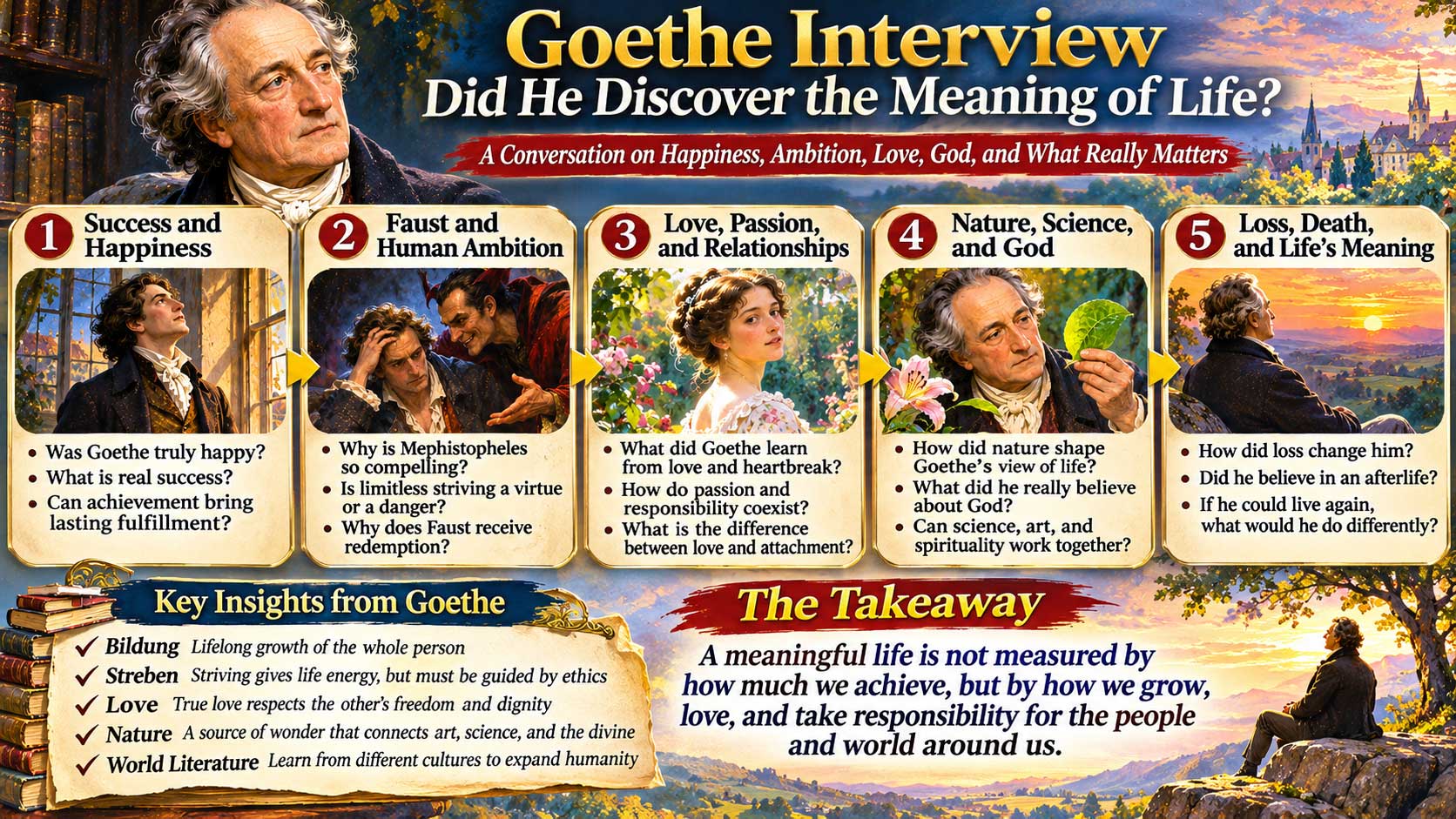
Short Bios:
Johann Wolfgang von Goethe (1749–1832)
Johann Wolfgang von Goethe was a German poet, novelist, playwright, statesman, and scientific thinker. His best-known works include The Sorrows of Young Werther, Wilhelm Meister's Apprenticeship, and Faust. His writings explored human striving, personal development, love, moral responsibility, nature, and spiritual questions. His scientific investigations included plant metamorphosis and color, and his interest in Persian poetry contributed to his vision of world literature. His philosophical and literary contributions are explored further in the Routledge Encyclopedia of Philosophy.
Nick Sasaki
Nick Sasaki is the creator of ImaginaryTalks.com, a platform featuring fictional interviews and conversations with influential writers, philosophers, historical figures, and cultural voices. Through imaginative dialogue, he explores questions about human nature, happiness, faith, literature, and the future of humanity. His goal is to encourage curiosity, mutual respect, and compassion across national, cultural, and religious differences.
Leave a Reply