
Introduction: Mother Teresa, Did God Really Abandon Her?
What if one of the most beloved religious figures in modern history spent decades feeling abandoned by the very God she devoted her life to serving?
For millions of people, Mother Teresa represents extraordinary compassion. The small Catholic nun in a white sari with blue stripes became a global symbol of love, caring for people who were poor, sick, dying, or forgotten.
She received the 1979 Nobel Peace Prize for her humanitarian work. Her Missionaries of Charity grew from a small beginning in Calcutta into an international religious congregation.
But behind that familiar image lies a far more complicated human story.
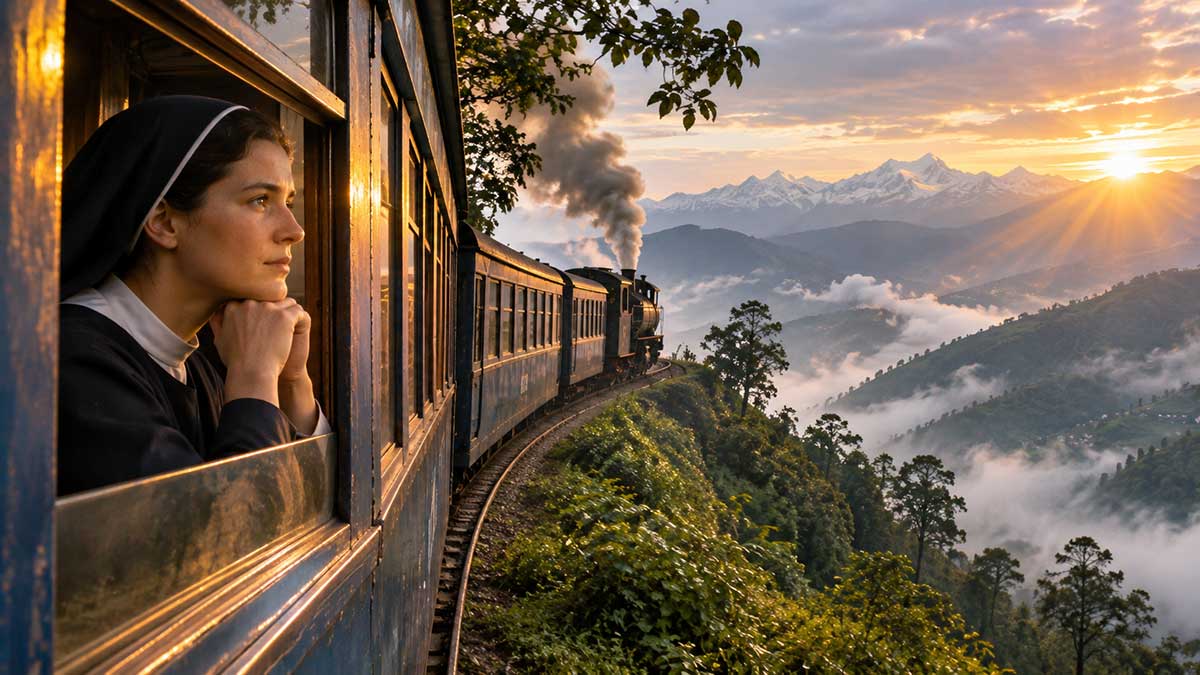
In 1946, during a train trip to Darjeeling, Mother Teresa experienced what she believed was a personal calling from Jesus. That experience changed the direction of her life.
Yet her private correspondence, later discussed in the Vatican's biography of Mother Teresa, revealed something astonishing: she experienced prolonged spiritual darkness, accompanied by an intense sense of God's absence.
How could someone who believed she had received such a powerful calling spend so many years feeling spiritually alone?
And how did that hidden struggle influence the way she cared for people who had been abandoned by society?
In this imagined conversation, Nick Sasaki sits down with Mother Teresa to explore the woman behind the saint.
The discussion begins with a little girl named Agnes, her mother's influence, and the extraordinary decision to leave home at eighteen.
But the questions soon become more challenging.
Was compassion enough when people needed medical treatment? Could spiritual beliefs about suffering coexist with modern standards of healthcare? What responsibilities came with accepting donations from wealthy and controversial benefactors?
And what happens when people who sincerely believe in love disagree about religion, morality, and the value of human life?
According to the Missionaries of Charity's account of their founder, Mother Teresa's life was shaped by both a deeply Catholic calling and a commitment to serving people across religious and national boundaries.
But could her understanding of love offer something meaningful to people who do not share her faith?
Perhaps the most surprising questions concern neither her fame nor her religious beliefs.
They concern the difference between feeling love and choosing to practice it.
What if the most revealing part of Mother Teresa's story is something the world was never supposed to know?
Disclaimer: This article presents an imaginary interview between Nick Sasaki and Mother Teresa. The dialogue is fictional and does not reproduce an actual conversation or authentic private statements. Historical events and documented religious beliefs provide context, but imagined responses should not be treated as verified quotations, endorsements, or evidence concerning disputed historical claims. Spiritual experiences are presented as matters of personal religious belief.
(Note: This is an imaginary conversation, a creative exploration of an idea, and not a real speech or event.)
Topic 1: Mother Teresa, Did You Ever Feel That God Had Abandoned You?
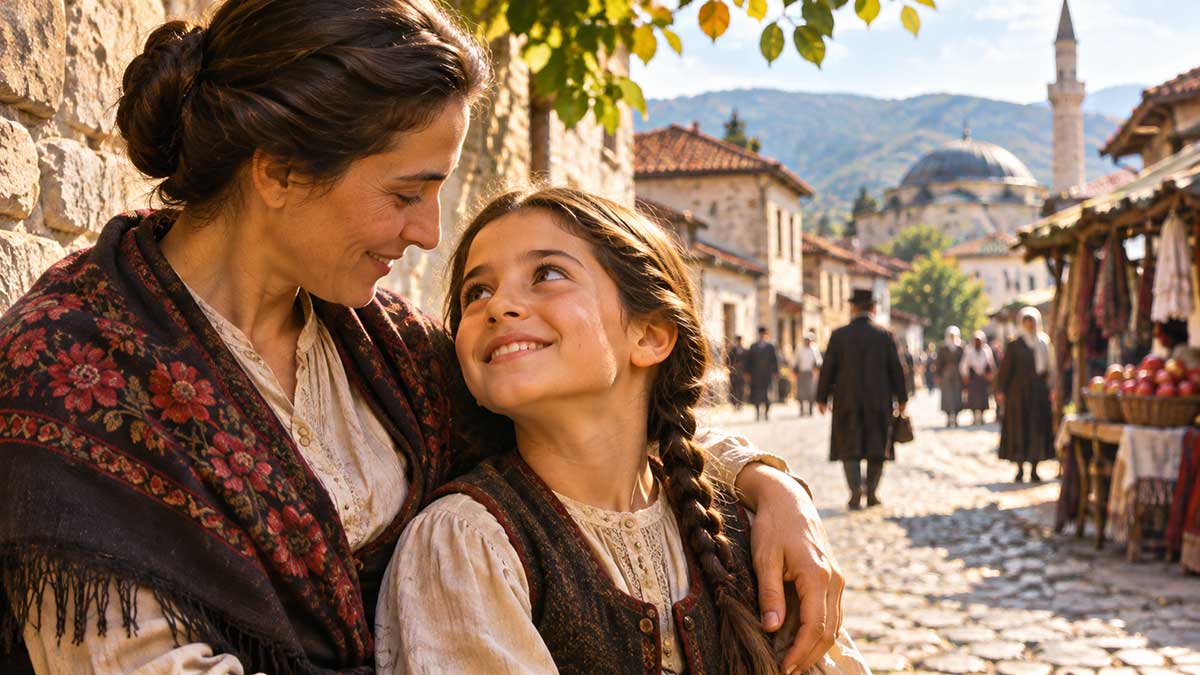
Round 1: Before the World Knew Mother Teresa
Nick Sasaki: Mother Teresa, thank you for joining me. I have to tell you, when most people hear your name, they probably picture you in that white sari with the blue stripes, helping people in the streets of Calcutta.
But I want to go back much further than that.
Before you were Mother Teresa, before the Nobel Peace Prize, before anyone outside your family knew who you were, you were a little girl named Agnes, growing up in Skopje.
What were you like as a child? Were you always this serious, religious person?
Mother Teresa: (smiling) Oh, Nick, I was a child like other children. I loved my family. I enjoyed being with my friends. I sang, I prayed, and I was happy in our home.
My name was Agnes Gonxha Bojaxhiu. I was born in 1910, in Skopje, which was then part of the Ottoman Empire.
We were an Albanian Catholic family, and our faith was very much a part of our daily life. But I would not want you to think that I came into this world already knowing what God would ask of me.
A calling is something that grows in the heart.
Nick Sasaki: That's interesting. I think sometimes we look at someone who became famous for doing something extraordinary, and we assume they must have been extraordinary from the beginning.
But you were just a little girl.
What did you dream about? Did you ever think about getting married, having children, living a normal family life?
Mother Teresa: I cannot tell you that I had planned every possibility for my future. As a young girl, I came to feel drawn toward religious life, particularly missionary work.
But I knew the love of family very deeply.
And that love was important in preparing me for my vocation.
You see, Nick, before we can love strangers, we often learn what love means from the people closest to us.
Nick Sasaki: Your mother seems to have played an enormous role in your life.
I've read that after your father died, she became the central figure in your family.
What was she like?
Mother Teresa: My mother, Drana, was a woman of deep faith and generosity.
After my father's death, life was not easy for our family. She worked to support us, and she never allowed our difficulties to become an excuse for forgetting other people.
She welcomed those who needed help.
Our home was not a place where compassion was simply discussed. It was something we were expected to practice.
Nick Sasaki: So she didn't just tell you to be kind. She actually brought people into your home?
Mother Teresa: Yes. Hospitality toward those in need was part of our family life.
My mother taught us that the poor were not people to be looked down upon.
They were people to be treated with dignity.
Nick Sasaki: I find that fascinating.
A lot of parents want their children to become successful. They want them to get good grades, find good jobs, make money, and have comfortable lives.
Your mother seems to have been teaching something different.
Was she trying to raise you to become a nun?
Mother Teresa: I would not describe her influence that way.
She wanted us to become good people, faithful people, people who cared for others.
A mother does not need to decide every detail of her child's future to give that child something precious.
She can teach the child how to love.
And that lesson may shape a life in ways neither of them can foresee.
Nick Sasaki: That's beautiful.
But I want to ask about something painful.
Your father died when you were young. Do you think losing him changed the way you looked at suffering?
Mother Teresa: Losing a parent changes a family.
There is sorrow, uncertainty, and the knowledge that life does not always follow our wishes.
I would be careful, however, about saying that every sorrow immediately teaches us some great lesson.
Sometimes sorrow is simply sorrow.
What mattered greatly was the example my mother gave us in the years that followed.
She continued to care for her children and for other people.
Nick Sasaki: I like that distinction.
Sometimes people look back on a difficult experience and say, "Oh, everything happened for a reason."
But when you're actually going through it, you're not necessarily thinking about some great lesson.
You're just hurting.
Mother Teresa: Yes, Nick.
And when someone is hurting, it is not always helpful to begin by explaining their suffering.
Sometimes the first thing they need is someone who will remain beside them.
Nick Sasaki: That's something I want to come back to later.
Now, you were only eighteen when you decided to leave home and enter religious life.
Eighteen!
That's incredibly young.
How certain were you that this was what you wanted?
Mother Teresa: By that age, I had developed a strong desire to become a missionary.
I entered the Sisters of Loreto, traveling first to Ireland and then to India.
It was a serious decision, and it required leaving the home and family I loved.
Nick Sasaki: Were you afraid you might be making a mistake?
Mother Teresa: A decision can be deeply meaningful without being easy.
I believed I was responding to God's invitation, but that did not mean I had no human feelings.
Leaving those you love is a real sacrifice.
Nick Sasaki: Did you understand that you might never see your mother again?
Mother Teresa: I knew that missionary life could mean a very long separation.
And, as history would show, I did not see her again.
Nick Sasaki: Wow.
That's heartbreaking.
Did you ever regret leaving?
Mother Teresa: I loved my mother, and I missed my family.
But love and vocation are not always opposed.
My mother had helped me learn to give myself to others. In following my religious calling, I was carrying something of her love into a wider family.
Nick Sasaki: Let me challenge that a little.
Suppose your mother had said, "Agnes, I need you here. I don't want you to go."
Wouldn't you have felt torn between loving your mother and following what you believed God wanted?
Mother Teresa: Certainly, such a conflict would have been painful.
Love is not measured only by physical closeness, but neither should we pretend that separation costs nothing.
A calling must be approached with seriousness, prayer, and responsibility.
It is not simply permission to disregard the people who love us.
Nick Sasaki: That's an important point.
Sometimes people get so excited about their mission that they forget the people standing right next to them.
Mother Teresa: And that would be a sad contradiction if the mission itself were about love.
Nick Sasaki: (laughing softly) Yes, exactly.
Now, you eventually arrived in India and became a teacher.
You spent many years teaching girls at St. Mary's School in Calcutta.
Were you happy doing that?
Mother Teresa: I loved teaching.
The Loreto community gave me a life of prayer, discipline, and service. I taught geography and other subjects, and I eventually became headmistress.
Those years were meaningful.
The girls were not merely students to me. Their education and development mattered deeply.
Nick Sasaki: So you weren't unhappy and looking for something more exciting?
Mother Teresa: No.
My later calling did not mean that teaching had been a mistake.
Sometimes a person is called from one good work to another.
Nick Sasaki: That's interesting.
You were doing something valuable. You had a community, responsibilities, students who depended on you.
Then something happened that changed everything.
And that's the part of your story I really want to understand.
Round 2: The Day Jesus Called Her
Nick Sasaki: Let's talk about September 10, 1946.
You were traveling by train from Calcutta to Darjeeling for a retreat.
And you later described what happened as a "call within a call."
I've read about this, but I still don't feel I completely grasp it.
What actually happened on that train?
Mother Teresa: That day became very precious in my spiritual life.
I understood Jesus to be calling me to leave the Loreto convent and go among the poorest people, to serve Him in those who were abandoned and suffering.
It was not simply a desire to change my work.
I understood it as a personal invitation from Christ.
Nick Sasaki: When you say Jesus called you, what does that actually mean?
Did you hear a voice with your ears?
Was it like someone speaking to you?
Or was it something happening inside your mind?
Mother Teresa: My private writings describe experiences that I understood as interior communications from Jesus.
I would not describe them as an ordinary conversation between two people sitting in a railway carriage.
The experience was deeply personal and spiritually compelling.
Nick Sasaki: So it was more than just having an idea?
Mother Teresa: Very much more, in my experience.
I believed that Jesus was asking me to go to those who were poorest and most neglected, and to bring His love to them.
Nick Sasaki: But here's what I'm curious about.
People have powerful experiences all the time.
Sometimes they have a dream. Sometimes they feel an overwhelming conviction. Sometimes something happens during prayer that they can't explain.
How did you know this was really Jesus and not your own imagination?
Mother Teresa: That is a serious question.
I did not believe that a personal spiritual experience should automatically place me beyond guidance or examination.
I brought what I believed I had received to my spiritual advisers and religious authorities.
The process of discerning my vocation took time.
Nick Sasaki: That's interesting.
So you didn't just get off the train, walk into the convent, and say, "God told me to leave. Goodbye, everybody."
Mother Teresa: (smiling) No, Nick.
I was a religious sister who had made vows, including obedience.
I could not simply abandon those responsibilities.
Nick Sasaki: How long did it take before you could actually begin the new work?
Mother Teresa: Nearly two years passed before I received permission to leave the Loreto community and live outside the convent for this mission.
In 1948, I began that new life.
Nick Sasaki: Two years!
That must have been frustrating.
You believed God was calling you to help people who were suffering right now, but you had to wait.
Did you ever think, "Why is this taking so long?"
Mother Teresa: Waiting can be difficult when something feels urgent.
Yet I believed that obedience and discernment were part of my response to God.
I did not understand my calling as a reason to act without responsibility.
Nick Sasaki: I want to go back to the actual experience.
How did it make you feel?
Were you overwhelmed with happiness? Were you frightened? Did you cry?
Mother Teresa: My writings from that period express a deep desire to respond to Jesus and a sense of urgency about the mission.
There was love, longing, and the seriousness of what I believed was being asked of me.
It was not merely an exciting experience.
I understood it as a commitment that would require my whole life.
Nick Sasaki: That's a big difference.
Sometimes people have an amazing spiritual experience, and they spend the rest of their lives trying to have that experience again.
But for you, it wasn't about repeating a wonderful feeling.
It was about doing something.
Mother Teresa: Yes.
Love must become action.
If I believed Jesus was asking me to serve the poor, then I had to respond through the work itself.
Nick Sasaki: What did you think the work would actually look like?
Did you already have a plan for an international organization?
Mother Teresa: No.
I did not begin with a plan to establish a worldwide congregation.
I began with the conviction that I should live among and serve the poorest people.
The work grew gradually.
Nick Sasaki: That must have been an enormous change.
You had been living in a convent, teaching at a school, surrounded by other sisters.
Then suddenly you're out in the streets of Calcutta.
What was the first thing you did?
Mother Teresa: Before beginning, I received basic medical training in Patna with the Medical Mission Sisters.
Then I returned to Calcutta and began working among poor families, teaching children and visiting people who needed assistance.
I started with very little.
Nick Sasaki: You actually went for medical training?
Mother Teresa: Yes.
I knew that caring for people who were ill required practical knowledge, not simply good intentions.
Nick Sasaki: I really like that.
There's something interesting about the combination.
You believed God had called you, but you still needed to learn practical skills.
Mother Teresa: Faith does not remove the need to learn.
If someone is hungry, they need food.
If someone is ill, they need appropriate care.
Love must pay attention to the person's actual needs.
Nick Sasaki: Did you ever feel overwhelmed when you first started?
I mean, you walk into an area where so many people are suffering, and you're just one woman.
How do you even begin?
Mother Teresa: You begin with the person before you.
I could not care for everyone in Calcutta in a single day.
But I could respond to someone who needed help.
Nick Sasaki: That's almost too simple.
Mother Teresa: (smiling) Simple does not always mean easy.
Nick Sasaki: Fair enough.
But I wonder about something.
When you were teaching, you were helping young girls build a future.
When you began working among the poorest people, many of those you encountered were already desperately ill.
Did you ever feel that you had exchanged a hopeful kind of work for something much sadder?
Mother Teresa: Both kinds of work involve human dignity.
Education helps a young person develop and participate in society.
Caring for someone who is dying affirms that their life still matters, even when they have very little time remaining.
One form of service does not make the other unimportant.
Nick Sasaki: That's a thoughtful answer.
And eventually other women joined you.
Mother Teresa: Yes.
In 1950, the Missionaries of Charity became an officially recognized religious congregation.
Over time, more sisters joined the work.
Nick Sasaki: Here's something I find amazing.
From the outside, your life looks like a story of extraordinary faith.
You have this experience of Jesus calling you. You leave your old life. You begin serving the poor. Other sisters join you. The mission grows.
It almost sounds like God was guiding every step.
But then I learned something about your private life that completely changed how I saw your story.
And I have to ask you about it.
Round 3: When God Went Silent
Nick Sasaki: Mother Teresa, I was genuinely surprised when I learned about your private letters.
For most of my life, I thought of you as someone who must have felt incredibly close to God.
I assumed that when you prayed, you experienced this deep peace and connection.
But apparently, for much of your life after beginning your mission, you experienced almost the opposite.
You felt that God was absent.
Is that right?
Mother Teresa: Yes, Nick.
My private letters reveal a long period of spiritual darkness.
There were times when I experienced an intense longing for God, yet felt no consolation of His presence.
It was a painful part of my interior life.
Nick Sasaki: I have to tell you, that's almost unbelievable to me.
You believed Jesus personally called you to this mission.
You gave up your previous life.
You devoted yourself to helping people who were suffering.
And then you felt that God had disappeared?
Mother Teresa: That is one way of describing the painful contrast I experienced.
I continued to believe in my calling, yet my interior experience was often marked by emptiness and longing.
Nick Sasaki: But what does that actually feel like?
I mean, when you say spiritual darkness, are we talking about sadness?
Are we talking about doubt?
Or is it more like praying and feeling that nobody is listening?
Mother Teresa: The language of my letters speaks of loneliness, emptiness, and a painful sense of distance from God.
It was not simply the absence of a pleasant feeling.
For someone whose life was centered on loving Jesus, that perceived distance was deeply distressing.
Nick Sasaki: Did it make you question whether God existed?
Mother Teresa: My writings contain moments of profound questioning.
I would not want those struggles reduced to a simple statement that I either believed or did not believe.
I continued to live within the Catholic faith and to seek God, even when my inner experience was painfully different from what I desired.
Nick Sasaki: That's fascinating.
So outwardly, you're praying, serving the poor, encouraging your sisters, speaking about God's love.
But inwardly, you're struggling to feel that love yourself.
Mother Teresa: Yes.
There was a difference between what I continued to choose in faith and what I experienced emotionally.
Nick Sasaki: Did you ever wonder whether the original experience on the train had been a mistake?
Mother Teresa: My letters show how deeply I struggled with the darkness.
Yet the calling itself remained central to my life.
I sought guidance from spiritual directors who helped me reflect on what I was experiencing.
Nick Sasaki: But did you ever get angry with God?
Did you ever think, "You asked me to do all this, and now I can't even feel that You're here"?
Mother Teresa: I expressed anguish and longing in my private correspondence.
I wanted to feel close to Jesus.
I would be cautious about putting every human emotion into a precise category, but there was real pain in that longing.
Nick Sasaki: I can understand that.
And here's what makes this so interesting.
When someone feels abandoned by another person, sometimes they stop trusting that person.
But you kept going.
You kept waking up, praying, caring for people, and leading your sisters.
Why?
Mother Teresa: I had made a commitment to Jesus and to the people I was serving.
My feelings did not always give me comfort, but I continued to choose faithfulness.
Nick Sasaki: Wasn't that exhausting?
Mother Teresa: There was suffering in it.
But the work itself remained important.
The person who was hungry still needed food.
The person who was alone still needed companionship.
The person who was dying still deserved care.
Their needs did not disappear when my spiritual feelings became difficult.
Nick Sasaki: Wow.
That's a very different way of looking at faith.
I think a lot of people associate faith with feeling something.
They pray and hope to experience peace, happiness, reassurance, or some sign that God is listening.
And when that feeling doesn't come, they think something is wrong.
But you kept serving without that reassurance.
Mother Teresa: Faith cannot always be measured by spiritual consolation.
In the Catholic tradition, there is a long history of people who experienced dryness or darkness in prayer.
Such experiences require discernment, and they should not all be treated as identical.
But the absence of a comforting feeling does not necessarily mean that a person's commitment has lost its meaning.
Nick Sasaki: Did you ever have moments when that darkness lifted?
Mother Teresa: There were periods of consolation, including a notable experience in 1958.
But the spiritual darkness returned and remained part of my life for many years.
Nick Sasaki: So even when you had a moment of feeling close to God again, it didn't necessarily last.
Mother Teresa: No.
Nick Sasaki: I wonder whether that changed the way you looked at the people you served.
You were helping people who felt abandoned by society.
And in your own spiritual life, you felt abandoned by God.
Did those two experiences become connected for you?
Mother Teresa: Over time, with the help of my spiritual advisers, I came to interpret my darkness in relation to the suffering and abandonment experienced by Jesus and by the poor.
That interpretation gave me a way to live with what I was experiencing.
Nick Sasaki: That's really interesting.
You were trying to help people who felt forgotten, and at the same time you were dealing with your own feeling of being forgotten.
Do you think that made you more compassionate?
Mother Teresa: I would hope that personal suffering can make someone more attentive to the suffering of others.
But suffering does not automatically make a person compassionate.
What matters is how we respond to it.
Nick Sasaki: That's a good point.
Some people suffer and become more loving.
Other people suffer and become bitter.
Mother Teresa: Yes.
We should never romanticize suffering.
When someone is in pain, we should not assume that the pain itself is good.
We should ask how we can help.
Nick Sasaki: I'm glad you said that, since I want to talk later about the medical care in your homes and some of the criticism your organization received.
But first, there's something else I want to understand.
You became one of the most recognized religious figures in the world.
Millions of people saw you as an example of extraordinary faith.
Yet almost nobody knew about this private darkness.
Why did you keep it so private?
Mother Teresa: These were deeply personal spiritual experiences.
I shared them with particular spiritual advisers in the context of seeking guidance.
They were not written for public attention.
Nick Sasaki: And you actually wanted some of those letters destroyed, didn't you?
Mother Teresa: I expressed a desire that certain private writings not be preserved or made public.
I did not seek to make my interior struggles part of my public reputation.
Nick Sasaki: That's an extraordinary situation.
After your death, those letters were published, and suddenly the world discovered a side of you that most people never knew existed.
Part of me wonders whether people should have respected your wish for privacy.
But another part thinks those letters may have helped millions of people who struggle with faith.
How do you think about that?
Mother Teresa: It is a difficult question.
A person's private correspondence deserves respect.
At the same time, those responsible for preserving religious history may believe that certain writings have value for others.
I would not pretend that the tension between privacy and public interest is easily resolved.
Nick Sasaki: That's fair.
Let me ask something more personal.
If you could go back and speak to the young Agnes, the girl who was about to leave home and become a nun, would you tell her about the decades of spiritual darkness ahead?
Mother Teresa: (pausing) I would want her to know that a life of service may involve sacrifices she cannot yet foresee.
But I would not want fear of suffering to prevent her from responding to love.
Nick Sasaki: Would you still choose the same life?
Mother Teresa: My vocation remained precious to me.
I gave my life to serving Jesus in the poorest people.
The darkness was real, but it did not erase the meaning of that commitment.
Nick Sasaki: There's something I keep coming back to.
You could have had a very different life.
You might have remained a teacher.
You might have lived quietly in the convent, praying, teaching, and caring for your students.
Instead, you entered a world of extreme poverty and suffering, and you experienced profound spiritual loneliness yourself.
Yet you continued for decades.
What gave you the strength to get up each morning?
Mother Teresa: I would not describe every morning as a moment of extraordinary strength.
Much of life is made of ordinary acts.
You rise. You pray. You attend to your responsibilities. You respond to the person who needs you.
Sometimes faithfulness is found in continuing the work before you.
Nick Sasaki: That's interesting.
We tend to think that extraordinary people must feel extraordinary every day.
But maybe a lot of what they do is simply showing up.
Mother Teresa: There can be great love in ordinary faithfulness.
Nick Sasaki: I want to ask one final question about this.
There are people listening to this conversation who believe in God, but they don't feel close to God anymore.
Some may have lost someone they loved.
Some may have prayed for years without feeling any answer.
Some may even feel ashamed, thinking that if their faith were stronger, they wouldn't have these doubts.
What would you want to say to them?
Mother Teresa: I would want them to know that spiritual pain does not make them unworthy of love.
They should not be ashamed to speak honestly about what they are experiencing.
They may need the companionship of someone they trust, spiritual guidance, or other forms of support appropriate to their circumstances.
I would encourage them not to measure their entire relationship with God by the feelings of one particular moment.
And I would invite them, when they are able, to remain open to love.
Nick Sasaki: Even when they don't feel anything?
Mother Teresa: Even when love does not bring immediate comfort.
But we should be gentle with people who are suffering.
We should not demand that they hide their pain or pretend to be strong.
Nick Sasaki: You know, I came into this conversation thinking I wanted to learn about a woman who had an extraordinary relationship with God.
And I did learn about that.
But I discovered something I wasn't expecting.
You experienced this extraordinary calling, and then you spent much of your life without the spiritual reassurance I assumed you must have had.
And somehow, you kept loving people.
Mother Teresa: I tried to remain faithful to the people God had placed before me.
Nick Sasaki: Which makes me wonder about something.
You spent decades caring for people who had almost nothing, people who were sick, dying, or abandoned.
And you were dealing with your own spiritual loneliness during much of that time.
So I want to know what those people actually taught you.
Not what you taught them.
What did they teach you about love?
Mother Teresa: (smiling gently) Ah, Nick.
That is a very important question.
And perhaps the best place to begin is with the people themselves.
End of Topic 1.
Editorial note: This is an imagined conversation, not an actual interview or a collection of authentic quotations from Mother Teresa. Historical elements draw on her documented biography, religious writings, and published correspondence. The dialogue, personal reflections, and hypothetical responses are fictional interpretations. Descriptions of divine communication reflect Mother Teresa's religious testimony, not independently verified supernatural events. Spiritual darkness is not necessarily equivalent to a mental health condition, and experiences of distress may require appropriate personal or professional support.
Topic 2: Mother Teresa, Is Love Enough to Change Someone's Life?
Round 1: The People Who Taught Her Love
Nick Sasaki: Mother Teresa, there's something you said earlier that I keep thinking about.
You spent so many years feeling spiritually distant from God, yet every morning you went out and cared for people who had been abandoned by almost everyone else.
I'm curious about something.
When you first started working in the streets of Calcutta, did you feel that you were going there to teach people about God's love?
Or did those people end up teaching you something about love that you hadn't known before?
Mother Teresa: (smiling) Nick, I went because I believed Jesus was calling me to serve Him among the poorest people.
But whenever we serve another person, we must be willing to learn.
The poor are not simply people to whom we give something. They are human beings with their own dignity, experiences, and gifts.
Sometimes we receive something very precious from the person we have come to help.
Nick Sasaki: Can you give me an example?
Was there someone you encountered who really changed the way you looked at life?
Mother Teresa: There is an encounter from the early years of our work that has often been remembered.
A woman was found in a terrible condition, lying in the street. She was very ill and needed immediate care.
In the accounts of those early experiences, you can see how important it became to us that someone who had been neglected should receive attention, shelter, and human dignity.
It was not enough simply to pass by and feel sorry for her.
Nick Sasaki: When you saw someone in that condition, what went through your mind?
Were you shocked? Frightened? Angry that nobody had helped?
Mother Teresa: There was sorrow at seeing such suffering.
But sorrow must lead us to respond.
When someone is lying before you in pain, you cannot spend all your time thinking about how terrible the situation is.
You must ask what the person needs.
Nick Sasaki: I wonder whether most people avoid situations like that partly out of fear.
You see someone who's terribly sick, maybe someone who hasn't bathed, someone with serious wounds.
A lot of people would instinctively step away.
Did you ever feel that reaction yourself?
Mother Teresa: We are human, Nick.
There are things that are difficult to see and difficult to do.
But love asks us not to let our discomfort become more important than another person's dignity.
That does not mean we should act carelessly or without appropriate precautions.
It means we should not treat a suffering person as though they were less human.
Nick Sasaki: That's interesting.
So love isn't necessarily this beautiful feeling that comes over you.
Sometimes it's doing something that makes you uncomfortable.
Mother Teresa: Yes.
Love may require effort, sacrifice, patience, and courage.
It is not always accompanied by pleasant feelings.
Nick Sasaki: That connects with what you said about your spiritual darkness.
You didn't always feel God's presence, but you kept doing the work.
And now you're saying you didn't necessarily feel comfortable serving every person, but you kept serving.
Mother Teresa: Love is expressed through what we choose to do.
Our feelings matter, but they are not the only measure of love.
Nick Sasaki: Let me ask you something that might sound strange.
You spent so much time around people who were dying.
Most of us try not to think about death. We make plans for next year, next month, tomorrow. We act like we're going to be here forever.
But you were sitting beside people who might have only hours left.
What did that teach you about what human beings actually need?
Mother Teresa: I came to believe that one of the deepest forms of poverty is to feel unwanted and unloved.
A person may be very ill, and we must respond to that illness with the care available to us.
But that person may suffer in another way, through the feeling that nobody cares whether they live or die.
To be treated with tenderness, to have someone speak to you, to know that you have not been forgotten, these things matter deeply.
Nick Sasaki: So when somebody is dying, they don't necessarily want some grand philosophical explanation of life.
They may just want someone to hold their hand.
Mother Teresa: Very often, yes.
We should not assume that every person wants the same thing.
Some wish to speak. Some wish to pray. Some wish for quiet. Some long for their families.
We must listen.
Nick Sasaki: Did you ever find yourself becoming emotionally attached to someone you were caring for, knowing they might die the next day?
Mother Teresa: To care for someone is to recognize that their life matters.
We should not make our hearts indifferent simply to protect ourselves from sorrow.
But we must learn to continue serving others, too.
Nick Sasaki: That sounds incredibly difficult.
If you're helping someone and they die, and then another person arrives, and then another, how do you keep your heart open?
Mother Teresa: We pray, we support one another, and we return to the work.
Our sisters live in community for a reason.
No one should imagine that compassion means carrying every burden entirely alone.
Nick Sasaki: I like that.
Sometimes people think being a good person means sacrificing yourself until there's nothing left.
But you had a community of women supporting one another.
Mother Teresa: Yes.
A community must care for its members, too.
If we speak of love, we should practice it among ourselves.
Nick Sasaki: Now, there's something I've always wanted to ask you.
You often said that you saw Jesus in the people you served.
Was that inspired by a particular passage in the Bible?
Mother Teresa: Yes. The twenty-fifth chapter of the Gospel of Matthew was central to our spirituality.
Jesus speaks of feeding the hungry, welcoming the stranger, caring for the sick, and visiting those in prison.
He identifies Himself with those who are in need.
For me, this was not merely a beautiful teaching. It became a way of living.
Nick Sasaki: So when you saw someone hungry, you weren't simply thinking, "Here's a poor person who needs food."
You were thinking, "I'm serving Jesus."
Mother Teresa: I believed that in serving the person before me, I was serving Christ.
That conviction helped shape the way I approached the poor.
Nick Sasaki: But what if the person didn't believe in Jesus?
Suppose they were Hindu, Muslim, Buddhist, or had no religion at all.
Would you still see Jesus in them?
Mother Teresa: The dignity of the person did not depend upon their religion.
Our mission was Catholic, and our faith motivated our service.
But someone did not need to become Catholic to deserve food, shelter, or care.
Nick Sasaki: That's fascinating.
You didn't need the other person to agree with your beliefs before you could love them.
Mother Teresa: Love should not be withheld from someone simply for holding different beliefs.
Nick Sasaki: Now I want to ask something that might surprise you.
You spent your life among people who had almost nothing.
And you often spoke about the joy of the poor.
Is it possible for someone to be completely happy without owning anything?
Mother Teresa: We must distinguish simplicity from deprivation.
A person may live with few possessions and still experience deep joy, friendship, faith, and love.
But someone who lacks food, clean water, shelter, or necessary medical care is experiencing real hardship.
We should never use the possibility of spiritual joy to excuse those conditions.
Nick Sasaki: I'm glad you made that distinction.
Sometimes wealthy people romanticize poverty.
They say, "Look how happy these people are. They don't need all the things we have."
But those same people might be struggling to feed their children.
Mother Teresa: We should not confuse freedom from excessive possessions with the suffering of being unable to meet basic human needs.
Nick Sasaki: So maybe happiness doesn't require wealth, but that doesn't mean poverty is desirable.
Mother Teresa: Yes.
Possessions alone cannot guarantee happiness.
But people should have what they need to live with dignity.
Nick Sasaki: Did you ever meet someone who had almost nothing but seemed genuinely happy?
Mother Teresa: Yes, I encountered generosity and joy among people with very little.
I often spoke about the capacity of the poor to share what they had.
Such encounters reminded me that generosity is not measured only by the amount a person gives.
Nick Sasaki: That's something I find remarkable.
A person with very little might share half of what they have.
Meanwhile, someone with millions might struggle to give away a tiny fraction.
Mother Teresa: The meaning of a gift cannot always be measured by its financial value.
We must consider the love and sacrifice involved.
Nick Sasaki: But now you've brought us to something I really want to explore.
You've been talking about love, compassion, dignity, and the spiritual meaning of caring for someone.
And I agree that those are profound ideas.
But what happens when love isn't enough?
What happens when someone needs more than kindness?
What happens when they need a doctor, medicine, surgery, or a hospital?
Round 2: The Difficult Truth About Suffering
Nick Sasaki: Mother Teresa, I want to ask you something difficult.
And I hope you won't mind if I'm direct.
Mother Teresa: Please ask, Nick.
Nick Sasaki: You often spoke about suffering having spiritual meaning.
I understand that idea within Christianity. Jesus suffered on the cross, and Christians have spent centuries reflecting on the meaning of suffering.
But suppose you're caring for someone who is in terrible physical pain.
Maybe they have cancer. Maybe they have a serious infection.
What comes first?
Helping them find spiritual meaning in their suffering, or relieving the pain?
Mother Teresa: A person who is suffering needs compassionate care.
Within my Catholic faith, suffering can be united spiritually with the suffering of Christ.
But that belief should not be used as an excuse to neglect a person's physical needs.
We must try to relieve suffering through appropriate care.
Nick Sasaki: That's what I was hoping to understand.
But here's where things become complicated.
There have been serious criticisms of the medical care provided in some Missionaries of Charity homes.
Some visitors and medical observers reported inadequate pain relief, limited diagnostic resources, and problems with medical procedures.
What would you say to someone who looks at those reports and asks, "Why weren't these people receiving better treatment?"
Mother Teresa: Those are serious concerns.
The homes we established were intended to provide shelter and care to people who had often been abandoned.
They were not all equipped to function as hospitals.
But the distinction between a home and a hospital does not remove the responsibility to treat people with dignity or to seek appropriate medical assistance.
Nick Sasaki: I understand the difference.
But let me push you on that.
If someone is dying of cancer, and modern medicine can relieve much of their pain, isn't providing that relief part of loving them?
Mother Teresa: Yes, pain relief can be an important part of compassionate medical care.
Nick Sasaki: Then what about the criticism that some patients didn't receive adequate pain medication?
Mother Teresa: Such criticism should be examined carefully.
The availability of medicines, the training of caregivers, and the standards of care are practical matters that require serious attention.
I would not want a spiritual explanation of suffering to replace responsible medical treatment.
Nick Sasaki: Would you agree that good intentions aren't enough?
You can love someone sincerely and still make mistakes that hurt them.
Mother Teresa: Certainly.
Love should make us willing to learn and correct our mistakes.
Nick Sasaki: That's important.
I think people sometimes feel uncomfortable criticizing charitable organizations.
They say, "These people are doing wonderful work. Who are we to question them?"
But the people receiving care are often the most vulnerable people in society.
Shouldn't that make accountability more important, not less?
Mother Teresa: Those who are vulnerable deserve protection and responsible care.
An organization serving them must take that responsibility seriously.
Nick Sasaki: Did you ever worry that your sisters were being asked to do things they weren't medically qualified to do?
Mother Teresa: Our sisters were called to serve, and the work involved different levels of care.
Where professional medical knowledge was necessary, that need should be recognized.
A religious vocation does not automatically give someone medical expertise.
Nick Sasaki: That's a distinction I think everyone can appreciate.
Now, I want to be careful here.
Some critics have portrayed your homes as places where suffering was almost encouraged.
Your supporters have said that this misrepresents the mission and ignores the circumstances in which you were working.
How would you want people to judge the work fairly?
Mother Teresa: I would want them to consider the people we served, the conditions in which the work began, and the actual care provided.
But I would not ask anyone to ignore genuine failures simply out of admiration for the mission.
Nick Sasaki: So admiration and accountability can exist together.
Mother Teresa: They should.
Nick Sasaki: I think that's a useful principle for almost any organization.
Now, there's another criticism I want to ask about.
You spent decades helping people one at a time.
Feeding someone. Bathing someone. Sitting beside someone who was dying.
But India had enormous problems involving poverty, housing, sanitation, education, and access to healthcare.
Did you ever wonder whether your approach was too small?
Mother Teresa: Our vocation was to offer personal service to those most in need.
We did not believe that every organization must perform the same work.
Some people are called to build hospitals, improve public systems, or change laws.
Others are called to provide direct care.
Nick Sasaki: But suppose you had the resources to build a modern hospital.
Wouldn't that potentially help more people than a small home for the dying?
Mother Teresa: A hospital can provide services that a home for the dying cannot.
Both may have important roles.
The question is what people need and how those needs can be met responsibly.
Nick Sasaki: I guess what I'm getting at is this.
If a thousand people are suffering, helping one person is meaningful.
But if you could change a system and prevent a thousand people from suffering in the first place, wouldn't that be even better?
Mother Teresa: Preventing suffering is a worthy goal.
I would not oppose improvements in healthcare, sanitation, education, or living conditions.
But I would be cautious about treating individual compassion and social reform as competing moral choices.
Nick Sasaki: Why?
Mother Teresa: A society may have excellent institutions and still neglect the lonely.
And a person may show extraordinary kindness without possessing the means to change an unjust system.
We need different forms of service.
Nick Sasaki: That's interesting.
So you're saying the ideal would be to have both.
Good institutions that prevent unnecessary suffering, and people who genuinely care about one another.
Mother Teresa: Yes.
A system should serve human beings, and human beings should not become indifferent simply when a system exists.
Nick Sasaki: Let me ask a hypothetical question.
Suppose you could go back to 1950, when the Missionaries of Charity was beginning.
You have all the knowledge you gained over the following decades.
You know the organization will grow around the world.
You know people will admire your work, but some will criticize the medical care and the way donations are handled.
What would you change?
Mother Teresa: (pausing) I would want the work to remain centered on the dignity of each person.
And I would want those responsible for the mission to keep learning how to serve well.
Nick Sasaki: That's a thoughtful answer, but it's a little general.
I'm asking whether there's something concrete.
Would you invest more in medical training?
Would you establish clearer standards for patient care?
Would you make the organization's finances more transparent?
Mother Teresa: Those are reasonable areas for any charitable organization to examine.
Training, medical partnerships, responsible use of donations, and clear standards can help protect those receiving care.
I would not claim that devotion alone is sufficient preparation for every responsibility.
Nick Sasaki: That's what I find interesting about your life.
You were motivated by a very personal religious calling, but eventually you were responsible for an international organization.
Those require different skills.
Mother Teresa: They do.
Nick Sasaki: Did you ever feel that the organization had become bigger than you originally intended?
Mother Teresa: The congregation grew far beyond the small beginning in Calcutta.
Growth brings opportunities to serve more people, but it brings responsibilities, too.
Nick Sasaki: And that's where money enters the picture.
You personally embraced poverty.
You wanted to live simply.
But your organization received donations from people all over the world.
Some of those people were extremely wealthy.
Some were controversial.
And you became one of the most famous women on the planet.
How did you deal with all of that?
Round 3: Fame, Money, and the Price of Helping Others
Nick Sasaki: Let me start with fame.
In 1979, you received the Nobel Peace Prize.
You met presidents, religious leaders, and some of the most influential people in the world.
You were on magazine covers. People wanted photographs with you.
Did you enjoy being famous?
Mother Teresa: (smiling) I did not enter religious life seeking fame.
I wanted attention to be directed to the people we served and to the mission of the congregation.
Nick Sasaki: But fame can be useful, right?
Suddenly, people who might never have thought about poverty are listening to you.
Wealthy people are offering donations.
Governments are paying attention.
Mother Teresa: Public recognition can create opportunities to speak about the needs of others.
But it can become a distraction if the person receiving attention begins to believe that the mission exists for their own importance.
Nick Sasaki: Did you ever worry about that?
That people were becoming more interested in Mother Teresa than in the people she was helping?
Mother Teresa: That is a danger whenever one person becomes closely associated with a charitable mission.
The people receiving care must never become merely the background to someone else's reputation.
Nick Sasaki: That's a fascinating way to put it.
Sometimes a charity becomes almost a celebrity brand.
People know the founder's name, but they don't know much about the people being helped.
Mother Teresa: The purpose of the work should remain greater than the reputation of the person leading it.
Nick Sasaki: Now, let's talk about money.
Your organization received substantial donations from around the world.
And some of those donations came from people whose reputations were seriously questioned.
One example often discussed is Charles Keating, who was involved in a major American financial scandal.
Critics questioned your relationship with him and the money associated with his support.
How did you think about accepting donations from controversial people?
Mother Teresa: Our mission depended on generosity from many individuals.
I believed that people should have opportunities to do good.
But accepting a donation carries responsibilities, particularly when questions arise about how the money was obtained.
Nick Sasaki: That's where I see a difficult moral problem.
Suppose someone becomes wealthy by exploiting people.
Then they give a million dollars to charity.
That money might feed thousands of people.
But it might have come from people who were harmed.
Should the charity accept it?
Mother Teresa: We must consider both the needs of those who would receive assistance and the rights of those who may have been wronged.
A charitable gift should not become a way to ignore injustice.
Nick Sasaki: But what if returning the money means fewer people get help?
Mother Teresa: That is a difficult practical question.
Yet charity should not be used to erase the claims of people who have suffered wrongdoing.
Nick Sasaki: Let me make it more concrete.
If someone stole money from elderly people and then donated part of it to your organization, wouldn't the first responsibility be to return the money to those elderly people?
Mother Teresa: Restitution to those who were wronged is an important moral responsibility.
Nick Sasaki: Then why did controversies over donations become part of your legacy?
Mother Teresa: My historical decisions have been questioned, and they deserve to be examined on the evidence.
I would not want an imagined conversation to substitute a convenient explanation for what the historical record can establish.
Nick Sasaki: That's fair.
I think that's something we should be honest about.
A person's charitable achievements don't automatically answer every question about their financial decisions.
Mother Teresa: No human work should be placed beyond responsible examination.
Nick Sasaki: Now, here's something else I find interesting.
You lived with very few possessions.
But the organization became large and received money from people across the world.
How did you reconcile personal poverty with the need to manage substantial resources?
Mother Teresa: The poverty we embraced as religious sisters was a personal and communal commitment to simplicity.
The resources entrusted to the congregation were intended for its mission.
Those are different responsibilities.
Nick Sasaki: So personal simplicity doesn't mean an organization should avoid spending money.
Mother Teresa: An organization must use its resources responsibly for the purposes for which they were given.
Nick Sasaki: Suppose a charity has ten million dollars.
One option is to keep expenses extremely low and rely on volunteers.
Another is to hire qualified doctors, nurses, administrators, and accountants.
The second option costs more, but it might provide better care.
Which would you choose?
Mother Teresa: I would want the needs of the people being served to guide the decision.
Simplicity is valuable, but it should not become an excuse for inadequate care or poor stewardship.
Nick Sasaki: That's a powerful distinction.
Sometimes people think the charity that spends the least money on administration must be the best charity.
But that isn't necessarily true.
If you're running a medical facility, you need qualified people.
Mother Teresa: Yes.
Responsible service requires more than good intentions.
Nick Sasaki: I want to ask about something else.
You met some of the wealthiest and most influential people in the world.
Did you ever feel uncomfortable when a powerful person praised your work but wasn't doing much to address the conditions that created poverty?
Mother Teresa: I believed that every person had a responsibility to love and serve others.
A person with great influence may have opportunities to help that someone with fewer resources does not possess.
Nick Sasaki: Did you ever tell them that?
I mean, imagine a billionaire standing in front of you, praising you for helping the poor.
Would you ever say, "That's wonderful, but what are you doing?"
Mother Teresa: (smiling) I would hope to encourage that person to recognize the responsibility that comes with their resources.
Nick Sasaki: Let's try that right now.
Suppose I'm a billionaire.
I come to you and say, "Mother Teresa, I've made more money than I could possibly spend. I want to do something meaningful for humanity. What should I do?"
What would you tell me?
Mother Teresa: I would begin by asking whether you know the people who are suffering around you.
Nick Sasaki: Really?
You wouldn't start by asking me for a donation?
Mother Teresa: (smiling) A donation can be very helpful.
But I would want you to see the people you hope to serve.
Money can provide food, medicine, housing, education, and many other necessities.
Yet money alone does not teach a person to love.
Nick Sasaki: So you'd want me to actually spend time with people who need help?
Mother Teresa: Yes.
Learn about their lives.
Listen to what they need.
Do not assume that your wealth gives you complete knowledge of their problems.
Nick Sasaki: That's interesting.
A lot of wealthy people approach philanthropy almost like a business project.
They look at numbers, efficiency, and measurable results.
You're saying they should begin with human relationships.
Mother Teresa: Human relationships are important.
But careful planning and responsible measurement have value, too.
If someone is using substantial resources to help others, they should want to know whether the help is effective.
Nick Sasaki: That's a good point.
You wouldn't want someone spending millions of dollars on something that makes them feel generous but doesn't actually improve people's lives.
Mother Teresa: The purpose of giving should be the good of those receiving assistance, not merely the satisfaction of the giver.
Nick Sasaki: What if this billionaire says, "I don't have time to visit poor neighborhoods. I'm busy running companies. I'll just write a check."
Would you accept that?
Mother Teresa: Financial support can do real good.
But I would still encourage that person not to become separated from the human meaning of the gift.
Nick Sasaki: Let me ask another question.
Do you think wealthy people are sometimes lonely?
Mother Teresa: Certainly, wealth does not protect someone from loneliness.
Nick Sasaki: You spent your life among people experiencing extreme material poverty.
But you visited wealthy countries and spoke about another kind of poverty, people who had comfortable homes, enough food, and plenty of possessions, yet felt unloved.
Did that surprise you?
Mother Teresa: I came to believe that loneliness and the feeling of being unwanted could be very painful forms of poverty.
A person may have material security and still feel abandoned.
Nick Sasaki: So someone living in a mansion could be suffering from loneliness, and someone living in a poor neighborhood could be surrounded by people who genuinely love them.
Mother Teresa: Yes.
But we must not use that observation to minimize material poverty.
Hunger and homelessness are real hardships.
Loneliness is real suffering, too.
Nick Sasaki: That's an important distinction.
I sometimes wonder whether modern society has become so focused on money, success, and possessions that we've forgotten how to connect with one another.
Mother Teresa: A society should ask whether its people are being cared for, not simply whether they are becoming wealthier.
Nick Sasaki: What would you tell someone who's working extremely hard to become successful?
Maybe they want to provide for their family. They want financial security. They want to build something meaningful.
Is there anything wrong with that ambition?
Mother Teresa: There is nothing inherently wrong with working responsibly to provide for one's family or using one's abilities productively.
The question is what place those ambitions occupy in a person's life.
Do they help you fulfill your responsibilities to others, or do they gradually make you indifferent to them?
Nick Sasaki: So it's not necessarily about giving everything away.
It's about what money does to your heart.
Mother Teresa: Wealth can be used generously or selfishly.
Poverty can involve dignity and generosity, but it can involve severe hardship, too.
We should be careful about judging a person's character simply by their financial circumstances.
Nick Sasaki: I appreciate that.
Sometimes spiritual discussions make money sound inherently bad.
But money can build hospitals, feed children, support families, and create opportunities.
Mother Teresa: Money is a means.
What matters is how it is obtained and used.
Nick Sasaki: Let me come back to the billionaire one last time.
Suppose he says, "Mother Teresa, I want to leave behind a legacy. I want people to remember that I helped humanity."
What would you tell him?
Mother Teresa: I would ask him to consider whether the people he helps will live better lives.
If his work genuinely serves others, that matters more than whether his name is remembered.
Nick Sasaki: That's interesting.
So the goal isn't necessarily to be remembered as a good person.
It's to actually do good.
Mother Teresa: Yes.
Nick Sasaki: But here's something I find fascinating about your life.
You became famous for helping people who were largely invisible to the rest of the world.
And now, decades later, people still know your name.
Meanwhile, the names of most of the people you helped are unknown.
Does that bother you?
Mother Teresa: I would hope that people remember the dignity of those who were served, not merely the name of the congregation's founder.
Each person had a life, a history, and a value beyond the attention of the world.
Nick Sasaki: That's a beautiful thought.
And it brings me back to the beginning of our conversation.
You said you believed you were serving Jesus in every person you cared for.
But I wonder what that means for someone who doesn't believe in Jesus.
Suppose a person is Hindu, Muslim, Buddhist, Jewish, or doesn't believe in God at all.
Can they experience the same kind of love?
Can people who disagree about religion still recognize one another as members of the same human family?
Mother Teresa: (smiling gently) Nick, we do not need to agree about everything before we can recognize another person's suffering.
And we do not need to share every belief before we can offer kindness.
Nick Sasaki: That's where I'd really like to go next.
We've talked about your personal faith, the people you served, and some of the difficult questions surrounding your mission.
Now I want to explore something bigger.
If love can cross the boundaries of wealth and poverty, can it cross the boundaries of religion, nationality, and deeply held moral convictions?
And if it can, what would that actually look like in the world?
End of Topic 2.
Editorial note: This is a fictional interview created for ImaginaryTalks.com. Mother Teresa's responses are imagined interpretations informed by her documented religious convictions, public statements, and historical work. They are not authentic quotations, newly discovered testimony, admissions, or endorsements. Historical criticism of Missionaries of Charity medical practices and donations is a legitimate subject of examination, but the fictional answers above must not be treated as evidence that Mother Teresa acknowledged particular failures or endorsed specific reforms. Her actual decisions and the available historical record should be evaluated independently. References to spiritual meaning in suffering do not justify withholding medical treatment or adequate pain relief.
Topic 3: Mother Teresa, Can Love Bring the Human Family Together?
Round 1: Is God Bigger Than Religion?
Nick Sasaki: Mother Teresa, there's something I've been thinking about since our last conversation.
You spent your life caring for people in India, where you encountered Hindus, Muslims, Christians, and people from many different religious backgrounds.
But you were a Catholic nun. Your entire mission was centered on Jesus Christ.
So I'm curious. When you were caring for someone who believed in a completely different religion, did that ever change how you understood God?
Mother Teresa: (smiling gently) Nick, my faith in Jesus was the center of my life. That did not change.
But the people we served came from many backgrounds, and I believed each person deserved love and dignity.
When someone was hungry, we did not need to begin by asking which religion they followed.
We needed to recognize their hunger.
Nick Sasaki: That's interesting.
But let me ask something a little deeper.
Suppose you're caring for a Hindu man who is dying.
He has spent his entire life praying to God through his own religious tradition.
You believe in Jesus. He believes something different.
When you're sitting beside him, do you feel that you're both reaching for the same God?
Mother Teresa: I would approach that question through my Catholic faith.
I believed that God's love reaches every human being, including those who do not know Christ in the way Christians do.
But I would not say that all religions teach precisely the same things.
Their differences are real, and those differences deserve to be treated seriously.
Nick Sasaki: So you wouldn't simply say, "All religions are the same."
Mother Teresa: No.
That would not be faithful to what I believed.
But recognizing differences does not mean we must treat one another as enemies.
Nick Sasaki: I like that distinction.
Sometimes people think there are only two possibilities.
Either everyone agrees about religion, or everyone has to fight about it.
But you're saying people can disagree about something very important and still love one another.
Mother Teresa: Yes.
Love does not require us to abandon every conviction.
It asks us to recognize the dignity of the person before us.
Nick Sasaki: Let me give you an example.
Suppose a Muslim woman comes to one of your homes. She's sick, frightened, and far from her family.
Would you pray with her?
Mother Teresa: I would want her to receive care and to be treated respectfully.
If she wished to pray according to her own faith, that wish should be respected.
The Missionaries of Charity served people from different religions, and the congregation's Catholic identity did not mean that every person receiving care had to become Catholic.
Nick Sasaki: Would you ever try to convert her?
Mother Teresa: My faith was not something I wished to hide.
But care should never be made conditional upon religious conversion.
A person in a vulnerable situation must not be pressured into accepting a belief in exchange for help.
Nick Sasaki: That's an important point.
Especially when somebody is dying.
They're frightened. They're vulnerable. They might agree to almost anything if they think that's what the person caring for them wants.
Mother Teresa: Yes. Their dignity and freedom must be respected.
Nick Sasaki: There have been criticisms about religious practices involving dying patients in some of your homes.
Some critics questioned whether people always understood or consented to what was happening.
How would you respond to that concern?
Mother Teresa: Such concerns deserve serious examination.
Religious care should respect the person's wishes, traditions, and capacity to consent.
A charitable mission must not use someone's vulnerability as an opportunity for coercion.
Nick Sasaki: So helping someone shouldn't come with a hidden religious condition.
Mother Teresa: Love should be freely given.
Nick Sasaki: Now, here's something I've wondered about for years.
Do you believe someone who isn't Christian can still have a deep relationship with God?
I'm not asking whether they can be a good person. Obviously, people from different religions can be compassionate and generous.
I'm asking about God.
Can someone who has never heard of Jesus still genuinely know God?
Mother Teresa: The Catholic Church teaches that God's grace is not limited by the visible boundaries of the Church.
The Second Vatican Council spoke about people who, through no fault of their own, do not know Christ or His Church, yet sincerely seek God and try to follow their conscience.
That does not mean the Church considers all religious beliefs identical.
But it recognizes that God's grace can work in ways beyond our complete knowledge.
Nick Sasaki: That's fascinating.
So even within Catholic teaching, there's recognition that God may be working in people's lives outside Christianity.
Mother Teresa: Yes.
We should be humble about what we know of another person's relationship with God.
Nick Sasaki: Let me ask you something that might be difficult.
Suppose there's a Buddhist monk who has spent fifty years meditating, helping others, and living a deeply compassionate life.
And there's a Christian who goes to church every Sunday but treats people terribly.
Who is closer to God?
Mother Teresa: (smiling) Nick, I would not presume to judge the deepest condition of either person's soul.
But I would say that religious identity does not excuse a failure to love.
Jesus Himself taught that love must be expressed through our actions.
Nick Sasaki: So just calling yourself a Christian doesn't automatically make you loving.
Mother Teresa: Certainly not.
Nick Sasaki: And someone who doesn't call themselves Christian might be living with extraordinary compassion.
Mother Teresa: We can recognize goodness and generosity wherever we encounter them.
Nick Sasaki: I find that encouraging.
Now, suppose we bring together religious leaders from every major tradition.
Christians, Muslims, Hindus, Buddhists, Jews, and others.
And we invite atheists and agnostics, too.
We put everyone in one room and ask a simple question.
"What can we agree on?"
Where would you begin?
Mother Teresa: I would begin with the suffering person.
A hungry child does not need us to settle every theological disagreement before we provide food.
A lonely elderly person does not need us to agree about the nature of God before we offer companionship.
Nick Sasaki: That's interesting.
You wouldn't begin with a theological discussion?
Mother Teresa: Such discussions have their place.
But service can give people an opportunity to work together without pretending their beliefs are identical.
Nick Sasaki: So instead of gathering everyone to debate whose religion is correct, you might bring them together to help a hundred hungry children.
Mother Teresa: That would be a meaningful beginning.
Nick Sasaki: And maybe, through working together, they would begin to see one another differently.
Mother Teresa: Shared service can create opportunities for friendship and mutual respect.
Nick Sasaki: But let me challenge that.
Religion has been involved in terrible conflicts throughout history.
People have fought wars, persecuted one another, and sometimes killed in the name of God.
How do you reconcile that with the idea that religion should teach love?
Mother Teresa: Human beings can misuse religion, just as they can misuse political authority, wealth, or other forms of influence.
That does not make the suffering caused by religious hatred any less serious.
A person who claims to love God should examine whether their treatment of others reflects that love.
Nick Sasaki: Do you think people sometimes become more attached to being right than to being loving?
Mother Teresa: That danger exists.
But love and truth should not be treated as enemies.
We should seek truth with humility and treat those who disagree with us with dignity.
Nick Sasaki: That's an interesting answer.
You don't want people to abandon their convictions.
But you don't want them to use those convictions as an excuse to hate.
Mother Teresa: Yes.
Nick Sasaki: I think there's something beautiful about the idea that humanity could eventually see itself as one family.
Different cultures, different religions, different traditions, but still one human family.
Do you think that's possible?
Mother Teresa: I believed every human being was created by God and worthy of love.
If people truly recognized the dignity of others, many divisions would lose their ability to justify cruelty.
But unity cannot mean ignoring injustice or pretending that differences do not exist.
Nick Sasaki: That's a good point.
Sometimes people talk about unity as though everyone should simply stop disagreeing.
But there are real moral differences.
And that brings me to something I want to ask you.
You were known for your love and compassion, but you held some very strong moral convictions.
Some of those convictions were deeply controversial.
So how did you love people who strongly disagreed with you?
Round 2: Can You Love Someone Who Strongly Disagrees With You?
Nick Sasaki: Mother Teresa, in 1979, when you received the Nobel Peace Prize, you spoke very strongly against abortion.
You described it as a grave threat to peace.
That surprised some people, since they expected you to focus entirely on poverty and humanitarian work.
Why was abortion so central to your understanding of love?
Mother Teresa: I believed that every human life possesses dignity from its beginning.
My Catholic faith taught me that the unborn child should be protected.
For me, concern for human life was not limited to those who were already born.
Nick Sasaki: But I want to understand how you connected abortion with peace.
When most people think about peace, they think about war, violence between nations, or people killing one another.
Why did you connect it to abortion?
Mother Teresa: I believed that peace begins with respect for human life, including the most vulnerable.
Within my religious understanding, the unborn child was among those who needed protection.
That conviction shaped what I said publicly.
Nick Sasaki: Let me challenge that a little.
There are women who face extremely difficult circumstances.
Some are living in poverty.
Some are abandoned by their partners.
Some have serious medical problems.
Some become pregnant through sexual violence.
When you spoke so strongly against abortion, did you worry that women in those situations might feel judged rather than loved?
Mother Teresa: Their suffering should never be dismissed.
A woman facing such circumstances needs compassion, practical assistance, and respect for her dignity.
My opposition to abortion came from my belief about unborn life, but that belief did not remove the responsibility to care for the woman.
Nick Sasaki: But suppose she says, "Mother Teresa, you don't understand my situation. I already have three children. I can barely feed them. I don't know how I'm going to survive another pregnancy."
What would you actually do for her?
Mother Teresa: I would want her to receive real support.
That might involve food, shelter, healthcare, help with her existing children, and assistance in finding a safe and sustainable situation.
Our congregation cared for mothers and children, including children who needed adoptive families.
Nick Sasaki: But would you listen to her before telling her what you believed she should do?
Mother Teresa: Listening is part of treating someone with dignity.
Nick Sasaki: I think that's important.
Sometimes people become so passionate about a moral issue that they stop listening to the people directly affected by it.
Mother Teresa: Moral convictions should not make us indifferent to another person's circumstances.
Nick Sasaki: Here's another question.
Suppose a woman disagrees with you completely.
She believes abortion should be legal, and she believes women should make that decision for themselves.
Could you still love her?
Mother Teresa: Yes.
I could disagree with her position while recognizing her dignity.
Nick Sasaki: Would you still help her if she needed food or shelter?
Mother Teresa: Her need for care would not disappear on account of our disagreement.
Nick Sasaki: So disagreement doesn't cancel compassion.
Mother Teresa: No.
Nick Sasaki: But what about the other direction?
Would you be willing to listen seriously to someone who disagreed with you?
Not just listen politely, but genuinely try to understand why they believe what they believe?
Mother Teresa: I would want to hear their concerns.
Listening does not necessarily mean that one's convictions will change.
But it can help us recognize the fears, experiences, and needs that shape another person's position.
Nick Sasaki: That's a distinction I like.
You can listen without promising to agree.
Mother Teresa: Yes.
Nick Sasaki: Now, let's talk about criticism more broadly.
You were admired by millions of people.
But you were criticized, too.
Some people questioned your medical practices. Others criticized your relationships with wealthy donors. Some disagreed with your religious convictions.
Did those criticisms hurt you personally?
Mother Teresa: Criticism can be painful, particularly when it concerns work to which one has devoted one's life.
But criticism should not automatically be treated as hostility.
Sometimes it may identify a genuine problem.
Nick Sasaki: Did you ever feel misunderstood?
Mother Teresa: Public attention often produces incomplete pictures of a person or an organization.
Some people may praise without knowing the difficulties.
Others may criticize without knowing the circumstances.
The responsibility remains to examine what is true.
Nick Sasaki: That's interesting.
So you wouldn't say every critic was wrong.
Mother Teresa: No person or organization should assume that admiration makes them incapable of error.
Nick Sasaki: Did you ever change your mind about something after someone criticized you?
Mother Teresa: I would not want to invent a particular change of mind that cannot be established from my historical record.
But a life of service requires learning.
A person should be willing to recognize mistakes.
Nick Sasaki: I appreciate that.
Now, here's something I've been thinking about.
People seem to have an increasingly difficult time disagreeing without becoming enemies.
Sometimes they discover that someone has different political or religious beliefs, and suddenly they don't want to speak to that person anymore.
What would you say to people who have reached that point?
Mother Teresa: I would ask them to begin by remembering that the other person is human.
A disagreement may be serious.
It may involve matters of conscience, justice, or human dignity.
But hatred does not become good simply when we believe our own position is correct.
Nick Sasaki: What if the other person is genuinely doing something harmful?
Should we still try to love them?
Mother Teresa: Love does not require approving harmful actions.
It may require protecting someone who is being mistreated, speaking against injustice, or establishing necessary boundaries.
Nick Sasaki: That's important.
Sometimes people hear "love everyone" and think it means tolerating everything.
Mother Teresa: That would be a misunderstanding.
Love should seek the good of the person, and that can require confronting wrongdoing.
Nick Sasaki: Suppose someone insults you publicly.
They call you a fraud.
They say your entire life was a performance.
How would you respond?
Mother Teresa: I would try not to make my personal reputation the center of the matter.
If the criticism concerned people who were being harmed, it would deserve attention.
If it were merely an insult, I would not want resentment to govern my response.
Nick Sasaki: That's difficult.
I think most people would immediately want to defend themselves.
Mother Teresa: We are all human.
Patience and humility require practice.
Nick Sasaki: Let me ask something personal.
Did you ever dislike someone?
Mother Teresa: I would not claim that a life of religious service removes every difficult human emotion.
The question is how we respond to those emotions.
Nick Sasaki: So you could feel frustrated with someone and still choose to treat them with love.
Mother Teresa: Yes.
Nick Sasaki: I think that might be one of the most useful things you've said.
We don't have to feel affection for everyone.
But we can still choose how we treat them.
Mother Teresa: Love is more than affection.
Nick Sasaki: Now, we've talked about religion, moral disagreements, criticism, and some very serious questions.
But I want to bring this conversation back to ordinary life.
Most people aren't going to become nuns.
They're not going to establish international charities.
They're not going to receive the Nobel Peace Prize.
They're going to wake up tomorrow, go to work, take care of their families, pay their bills, and deal with everyday problems.
What does your message mean for them?
Round 3: What Does It Take to Make Humanity One Family?
Nick Sasaki: Mother Teresa, you spent decades among people living in extreme poverty.
But when you visited wealthy countries, you spoke about loneliness.
You suggested that people could have comfortable homes, plenty of food, and financial security, yet still experience a terrible kind of poverty.
What did you mean by that?
Mother Teresa: I believed that loneliness, rejection, and the feeling of being unwanted could cause profound suffering.
A person may have enough to eat and a comfortable place to sleep, yet feel that nobody truly cares about them.
Nick Sasaki: Did you actually encounter people like that in wealthy countries?
Mother Teresa: Yes.
I saw people who were materially comfortable but deeply lonely.
That did not make their suffering identical to the suffering of someone who lacked food or shelter.
But it showed me that human needs extend beyond material possessions.
Nick Sasaki: That's fascinating.
In wealthy societies, people have so many ways to communicate.
Phones, computers, social media, video calls.
You can contact someone on the other side of the planet in seconds.
Yet people can still feel completely alone.
What do you think we're missing?
Mother Teresa: Communication is not always the same as companionship.
A person may exchange many messages without feeling truly known.
Love requires attention.
It requires us to notice another person's needs and respond with care.
Nick Sasaki: That's interesting.
So being connected isn't necessarily the same as being close.
Mother Teresa: Yes.
Nick Sasaki: Let me ask you something about happiness.
You met people who were poor but generous.
You met people who were wealthy but lonely.
You met people who were dying and people who seemed to have everything.
After all those experiences, what do you think makes a person genuinely happy?
Mother Teresa: I would connect happiness with love, belonging, faith, and the ability to give and receive care.
But I would not claim that everyone who loves deeply will feel happy all the time.
My own spiritual life taught me that love and emotional consolation do not always accompany one another.
Nick Sasaki: That's a really interesting answer.
You're saying someone can live a meaningful life without necessarily feeling happy every day.
Mother Teresa: Yes.
Nick Sasaki: I think that's important.
Sometimes people treat happiness as the ultimate goal.
They want to feel good all the time.
But your life seems to suggest that meaning and happiness aren't always the same thing.
Mother Teresa: A meaningful commitment may involve joy, sacrifice, sorrow, and perseverance.
Nick Sasaki: Now, suppose someone listening to us has a family.
They have children.
They have a job.
They're busy.
They may be struggling financially.
They hear about your life and think, "I'd love to help people, but I don't have time to travel to India or volunteer at a charity every day."
What would you tell them?
Mother Teresa: I would encourage them to begin with the people already present in their lives.
Their family, their neighbors, their colleagues, and those who may be lonely or struggling.
Love does not always require traveling to another country.
Nick Sasaki: But doesn't that sound almost too easy?
Just be kind to your family?
Mother Teresa: (smiling) Nick, do you think it is always easy to be patient and loving with the people closest to us?
Nick Sasaki: (laughing) No. Actually, that's probably harder sometimes.
You can be very polite to a stranger for five minutes.
But living with someone every day is a different story.
Mother Teresa: Exactly.
The people closest to us see our impatience, our tiredness, and our weaknesses.
Love in family life requires forgiveness, attention, and daily effort.
Nick Sasaki: That's a good point.
You can give a wonderful speech about loving humanity, then go home and get irritated with your spouse over something trivial.
Mother Teresa: (smiling) Then perhaps the speech should begin at home.
Nick Sasaki: (laughing) That's a good answer.
Let me ask about children.
If you wanted to raise children who genuinely cared about people from different religions, countries, and backgrounds, what would you teach them?
Mother Teresa: I would want children to learn that every person possesses dignity.
They should see adults treating others with respect.
They should have opportunities to help people, to share, and to form friendships beyond their immediate circles.
Nick Sasaki: Do you think children naturally see one another as equals before adults teach them prejudice?
Mother Teresa: Children can show remarkable openness, but they also learn attitudes from their surroundings.
We should not assume that kindness develops without guidance.
Adults have a responsibility to teach it through example.
Nick Sasaki: That's interesting.
So if parents constantly criticize people from other religions or countries, their children may absorb those attitudes.
Mother Teresa: Children notice how adults speak and behave.
Nick Sasaki: Suppose a child asks, "Why does that person look different from me? Why do they pray differently? Why do they speak another language?"
What would you say?
Mother Teresa: I would encourage the child to be curious without being disrespectful.
Differences need not be feared.
They can become opportunities to learn about another person's life.
Nick Sasaki: I love that.
Curiosity instead of fear.
Mother Teresa: Curiosity joined with respect can help people become friends.
Nick Sasaki: Now, I want to return to something we discussed earlier.
You said that people don't have to agree about everything before they can love one another.
Do you think humanity could someday reach a point where people genuinely see themselves as one family?
Not just as a beautiful slogan.
I mean really see someone on the other side of the world as a brother or sister.
Mother Teresa: I believed that every human being was loved by God.
That belief gave me a reason to treat people beyond the boundaries of nationality, religion, and social position with dignity.
Whether humanity will fully live according to that ideal depends upon choices made by individuals, communities, and nations.
Nick Sasaki: But is individual kindness enough?
We've talked about this before.
There are wars, poverty, discrimination, and enormous inequalities.
Can simply loving the person next to you really change problems that big?
Mother Teresa: Individual kindness is important, but it does not replace the responsibilities of governments, institutions, and societies.
People have different roles.
Some care directly for those in need.
Others work to improve laws, healthcare, education, and public institutions.
Nick Sasaki: So we shouldn't make it a choice between changing ourselves and changing society.
Mother Teresa: Both can be necessary.
Nick Sasaki: That's interesting.
I think sometimes people who focus on personal spirituality criticize those who work on social reform.
And people who focus on social reform sometimes dismiss personal kindness as insignificant.
But perhaps both are needed.
Mother Teresa: A just society should protect human dignity, and the people within it should practice compassion.
Nick Sasaki: Let me ask something a little different.
You've spent your life serving people who were sick, poor, abandoned, or dying.
If you could change one thing about how human beings see one another, what would it be?
Mother Teresa: I would want people to recognize that another person's life is precious.
Not simply when that person is useful, successful, attractive, healthy, or similar to them.
Every person deserves dignity.
Nick Sasaki: Even someone who's done terrible things?
Mother Teresa: Human dignity does not mean freedom from responsibility.
A person who has harmed others may need to face justice.
But we should not confuse accountability with the belief that someone has ceased to be human.
Nick Sasaki: That's a difficult idea, but I think it's worth thinking about.
What about forgiveness?
Do you think everyone deserves forgiveness?
Mother Teresa: Forgiveness is an important part of Christian life.
But forgiveness should not be confused with allowing continued abuse or denying the harm someone has caused.
Those who have been hurt may need safety, justice, and time.
Nick Sasaki: I'm glad you made that distinction.
Sometimes people are told they must forgive immediately, as though their pain doesn't matter.
Mother Teresa: Compassion should include those who have suffered harm.
Nick Sasaki: Now, here's a question I've been wanting to ask since the beginning.
You were born in 1910.
You lived through two world wars, the independence of India, enormous social changes, and the growth of your mission around the world.
You saw humanity at its worst and at its best.
After everything you witnessed, were you optimistic about the future of humanity?
Mother Teresa: I believed that human beings were capable of great love.
I also knew that cruelty, indifference, and injustice were real.
Hope should not require us to deny suffering.
It should encourage us to respond to it.
Nick Sasaki: That's interesting.
So hope isn't simply believing everything will turn out fine.
Mother Teresa: Hope can give us the courage to act when the future is uncertain.
Nick Sasaki: Let me make this personal.
Suppose someone is listening to our conversation right now.
They're not wealthy.
They're not famous.
They don't have much influence.
They feel overwhelmed by all the suffering in the world.
They look at wars, poverty, loneliness, and division, and they think, "What difference can I possibly make?"
What would you tell them?
Mother Teresa: I would encourage them to begin with something they can actually do.
Perhaps there is an elderly neighbor who rarely receives visitors.
Perhaps there is a child who needs encouragement.
Perhaps someone in their family has been waiting for a kind word.
Perhaps they can support an organization doing effective work in their community.
We should not allow the size of the world's suffering to prevent us from responding to the needs within our reach.
Nick Sasaki: But what if the difference seems tiny?
Mother Teresa: A small act may still matter greatly to the person receiving it.
And when many people act with care and responsibility, their efforts can contribute to larger change.
Nick Sasaki: I like that.
It's almost like the world changes through millions of small decisions that nobody notices.
Mother Teresa: Much of human life is shaped by what we do when no one is watching.
Nick Sasaki: Mother Teresa, I want to ask one final question.
We've talked about your childhood, your mother, your calling from Jesus, and those long years when you felt spiritually abandoned.
We've talked about the people you served, the criticism of your work, the responsibility that comes with money, and the difficulty of loving people who disagree with us.
When you look back on your entire life, what would you most want people to understand?
Not about your accomplishments.
Not about the Missionaries of Charity.
Not about your reputation.
What would you want people to understand about love?
Mother Teresa: (pausing thoughtfully) Nick, I would want them to understand that love must become something real in the life of another person.
It is not enough to admire compassion.
We must practice it.
And we must practice it with humility, recognizing that we can make mistakes and that those we serve have their own dignity and wisdom.
Nick Sasaki: So love isn't just a feeling.
Mother Teresa: No.
Nick Sasaki: And it isn't just believing the right things.
Mother Teresa: Our beliefs should be reflected in how we treat others.
Nick Sasaki: And it isn't necessarily doing something extraordinary.
Mother Teresa: Much of love is expressed through ordinary acts of care.
Nick Sasaki: I keep thinking about something you said earlier.
You experienced decades of spiritual darkness.
You didn't always feel God's presence.
But you continued caring for people.
And I wonder whether that's one of the most remarkable things about your life.
You didn't wait until you felt spiritually fulfilled before trying to love others.
Mother Teresa: I tried to remain faithful to the work I believed God had entrusted to me.
Nick Sasaki: You know, I think many people spend their lives waiting.
Waiting until they have more money.
Waiting until they have more time.
Waiting until they feel happier.
Waiting until they feel closer to God.
And then they imagine they'll finally begin doing something meaningful.
But maybe there's someone right in front of them who needs love today.
Mother Teresa: (smiling gently) Then perhaps they can begin today.
Nick Sasaki: Mother Teresa, thank you.
I've learned much more about you than I expected.
I came into this conversation wanting to meet someone famous for loving the poor.
But what stays with me most is the young girl who learned generosity from her mother, the woman who followed a calling she could not fully explain, and the person who continued serving others through years of profound spiritual loneliness.
I think that's something people can reflect on, whether they're religious or not.
Mother Teresa: Thank you, Nick.
And I hope that anyone who has listened will find some way to bring care into another person's life.
Nick Sasaki: One last thing.
If you could ask everyone listening to do just one thing tomorrow, what would it be?
Mother Teresa: Find someone who needs your attention.
Listen to them.
And do what you reasonably can to help.
Nick Sasaki: (smiling) That's something all of us can try.
Thank you, Mother Teresa.
Mother Teresa: God bless you, Nick.
End of Topic 3.
Editorial note: This is an imagined conversation created for ImaginaryTalks.com, not an actual interview or authentic transcript. Mother Teresa's dialogue is fictional and informed by her documented Catholic beliefs, humanitarian work, public statements, and historical context. Her views on abortion and religion reflect positions associated with her public life, but the precise responses, private reflections, and hypothetical exchanges are invented. References to criticism of medical care, donations, and religious practices should not be interpreted as historical admissions or verified defenses. This fictional discussion does not constitute religious, medical, or legal advice, and no endorsement by Mother Teresa or the Missionaries of Charity is implied.
Final Thoughts: Mother Teresa, the Woman Behind the Saint
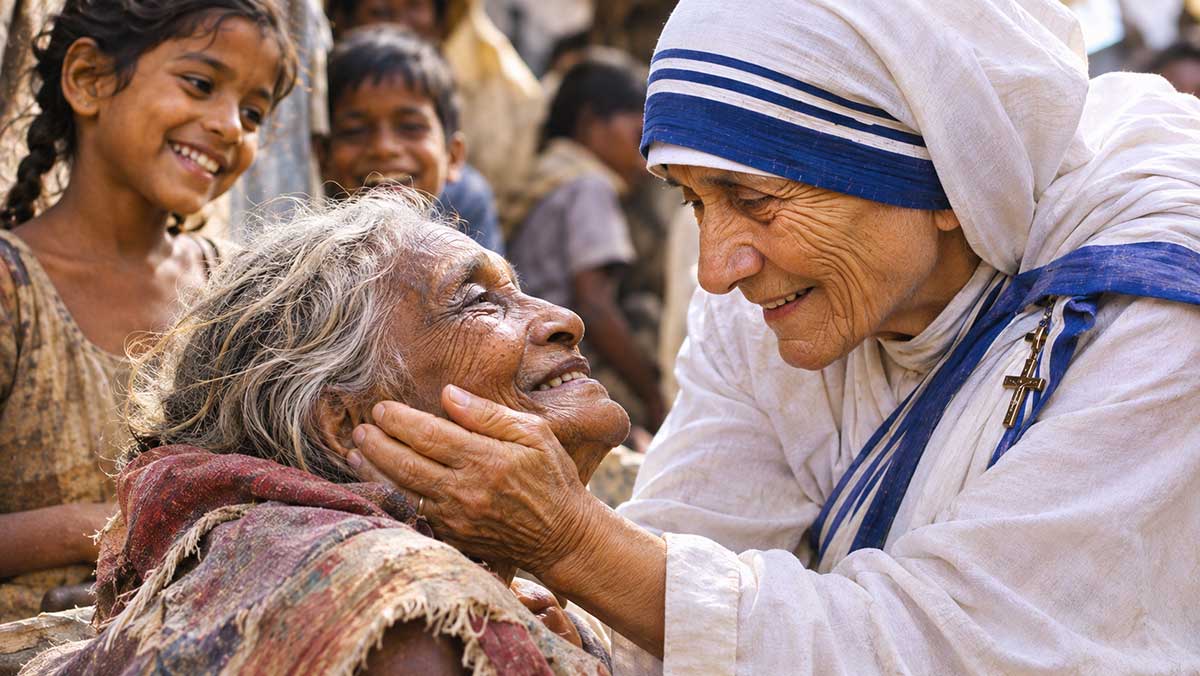
What makes Mother Teresa's life so compelling is not simply the scale of her humanitarian work.
It is the tension between the woman the world saw and the woman revealed through her private spiritual struggles.
Publicly, she became a symbol of unwavering faith. Privately, she experienced profound spiritual loneliness.
She believed Jesus had called her to serve the poorest people in Calcutta, yet for much of her subsequent life she struggled with the feeling that God was absent.
That contrast raises a question that reaches far beyond Christianity.
Can a person continue living according to love when the feelings that once inspired that love seem to disappear?
Our imaginary conversation with Mother Teresa explores that question from several directions.
1. Faith Is Not Always Accompanied by Certainty
One of the most revealing aspects of Mother Teresa's story is her prolonged spiritual darkness.
Her published correspondence describes experiences of emptiness, longing, and perceived separation from God.
This challenges the popular assumption that deeply religious people always feel spiritually reassured.
In the imagined interview, Nick repeatedly returns to a simple question: What kept her going?
Her fictional responses explore the distinction between emotional consolation and commitment.
There is a broader lesson here, one that can resonate with religious and nonreligious readers alike.
People frequently begin important commitments with enthusiasm. A marriage, a career, parenthood, charitable service, or a personal mission may initially bring excitement and purpose.
But feelings change.
The more difficult question is what happens when the excitement fades and responsibilities remain.
Mother Teresa's life invites us to consider whether love can become a deliberate commitment rather than something dependent upon a particular emotional state.
That does not mean people should endure harmful situations or ignore their emotional needs. It means that meaningful commitments often involve more than immediate personal satisfaction.
2. Compassion Must Be More Than Good Intentions
Mother Teresa's work was grounded in the conviction that every human being deserves dignity, particularly those who are neglected or abandoned.
Her attention to people who were dying alone challenged a world that often measures human value through productivity, wealth, health, or social status.
Yet her legacy raises difficult questions.
Critics questioned medical practices in some Missionaries of Charity facilities, including standards of care and access to adequate pain relief.
Others questioned the handling of donations and relationships with controversial benefactors.
These criticisms deserve serious historical examination rather than automatic dismissal or unquestioning acceptance.
The fictional conversation deliberately asks whether sincere compassion is sufficient when vulnerable people require professional medical treatment, effective management, and accountable institutions.
A person can be motivated by love and still make consequential mistakes.
A charitable organization can perform meaningful service and still face legitimate questions about its practices.
Love should inspire people to care, but responsible care requires knowledge, resources, accountability, and a willingness to improve.
That principle applies to religious organizations, nonprofits, businesses, governments, and families.
3. Personal Kindness and Social Change Are Both Necessary
Another important question concerns the scale of suffering.
Mother Teresa became known for caring for individual people, often those whom society had forgotten.
But poverty, preventable disease, inadequate sanitation, and lack of healthcare affect entire populations.
Can individual acts of kindness address problems of that magnitude?
Not by themselves.
Systemic problems require institutions, effective policies, medical professionals, educators, and long-term investment.
Yet institutional improvements do not automatically eliminate loneliness, neglect, or indifference.
A modern hospital can provide excellent medical treatment, but patients still need to be treated as human beings.
A society can become wealthier without every citizen feeling loved or valued.
The lesson is not that personal compassion should replace social reform.
It is that both have meaningful roles.
We need effective systems that protect people from preventable suffering, and individuals willing to care about the people those systems serve.
4. Loving Someone Does Not Require Agreeing With Them
Mother Teresa's Catholic convictions were central to her identity.
She did not treat religion as an interchangeable collection of spiritual ideas.
Her public opposition to abortion, expressed prominently during her Nobel Peace Prize acceptance speech, remains controversial.
Readers may agree strongly with her position, reject it, or hold more complicated views.
Our imagined interview does not attempt to erase those disagreements.
Instead, it explores a difficult question: Can people maintain deeply held convictions and still treat those who disagree with them with compassion?
There is an important distinction between respecting a person's dignity and endorsing every decision that person makes.
Listening seriously to someone does not require abandoning one's beliefs.
And holding firm convictions does not justify cruelty, humiliation, or indifference to another person's suffering.
A humane society needs room for both moral disagreement and mutual respect.
The same principle applies to relationships between religions.
Christians, Muslims, Hindus, Buddhists, Jews, atheists, and others may hold fundamentally different beliefs about God and human existence.
Those differences are meaningful.
Yet people can cooperate in feeding hungry children, caring for the sick, protecting vulnerable communities, and reducing loneliness without first resolving every theological disagreement.
Shared service can create opportunities for trust where argument alone has failed.
5. Happiness Cannot Be Measured by Possessions Alone
Mother Teresa encountered severe material poverty in India and spoke frequently about loneliness in wealthier societies.
Her observations raise another question.
What do human beings actually need to live meaningful lives?
Food, shelter, safety, healthcare, and economic security matter enormously.
Material deprivation should never be romanticized.
But financial comfort cannot guarantee friendship, belonging, emotional security, or a sense of purpose.
Someone can live in a beautiful home and still feel profoundly isolated.
Another person may have relatively few possessions yet experience strong relationships and meaningful community.
These realities do not make material poverty desirable.
They remind us that human well-being has several dimensions.
A society concerned with happiness should pay attention to both living conditions and human relationships.
6. Love Often Begins Much Closer to Home
Perhaps the most practical insight from this imagined conversation concerns ordinary family life.
Mother Teresa's example may seem almost impossible to follow.
Most people cannot leave their careers, move to another country, and devote themselves entirely to charitable service.
They have children to raise, bills to pay, jobs to perform, and personal responsibilities.
But compassion does not begin only when someone undertakes an extraordinary mission.
It can begin with listening more carefully to a spouse.
Giving a child undivided attention.
Visiting an elderly neighbor.
Helping a friend through a difficult period.
Supporting an effective local charity.
Or treating a stranger with dignity when doing so offers no personal reward.
These actions cannot solve every problem facing humanity.
But they can make a meaningful difference in another person's life.
And when ordinary acts of care are joined with responsible institutions and collective efforts, their effects can extend much further.
7. Can Humanity Truly Become One Family?
The final question in our conversation reaches beyond Mother Teresa's individual life.
Can human beings learn to see one another as members of one human family?
The idea is inspiring, but it becomes meaningful only when translated into actual behavior.
It requires recognizing human dignity across religious, national, racial, economic, and cultural differences.
It requires protecting people from injustice.
It requires making room for disagreement without abandoning compassion.
And it requires accepting that no single individual, religion, organization, or nation possesses every answer to humanity's problems.
Mother Teresa approached human dignity through her Catholic belief that every person is loved by God.
Others may arrive at similar commitments through different religious traditions, philosophical reasoning, or secular humanism.
The foundations may differ, but meaningful cooperation remains possible.
A shared commitment to reducing suffering can become a starting point for deeper relationships.
The Question Mother Teresa Leaves Us With
Mother Teresa died in 1997, but the questions raised by her life remain relevant.
How should we respond to suffering?
What responsibilities come with wealth and influence?
How do we care for people whose beliefs differ from ours?
Can we acknowledge the shortcomings of admired figures without dismissing their contributions?
And how can ordinary people make compassion part of everyday life?
Her legacy contains remarkable achievements, difficult controversies, and deeply personal spiritual struggles.
A thoughtful examination should make room for all three.
We do not need to regard Mother Teresa as flawless to learn from her life.
Nor do we need to share all her religious convictions to appreciate the human questions her work raises.
Perhaps the most meaningful response is not simply to admire her or criticize her.
It is to examine how we ourselves respond to the people around us.
Who in our lives needs more than our good intentions?
Who needs our attention, our practical assistance, our willingness to listen, or our courage to confront an injustice?
And what might happen if more of us began there?
Disclaimer: These Final Thoughts reflect an interpretation of Mother Teresa's historical life and the themes explored in a fictional interview. They do not represent Mother Teresa's actual responses to Nick Sasaki, nor do they imply endorsement by her religious congregation or the Catholic Church. Disputed claims about medical care, financial decisions, and religious practices require independent examination of historical evidence. The discussion of spiritual darkness is not a medical diagnosis, and spiritual reflection should not replace appropriate healthcare or psychological support.
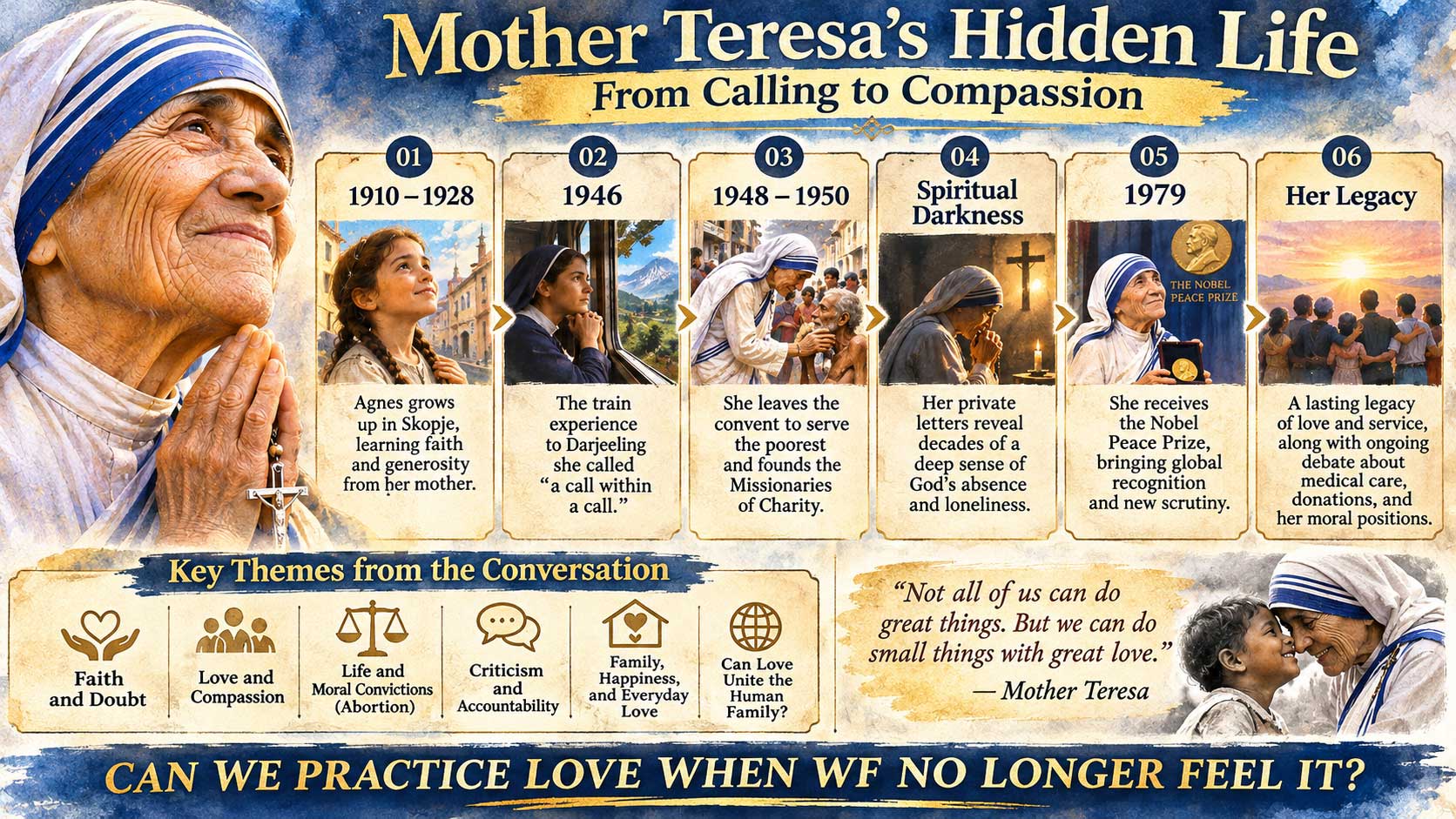
Short Bios:
Mother Teresa (1910–1997): Born Agnes Gonxha Bojaxhiu in Skopje, Mother Teresa was an Albanian-born Catholic nun who spent much of her life serving people experiencing extreme poverty and illness in India. After teaching at a girls' school in Calcutta, she established the Missionaries of Charity in 1950, inspired by what she described as a personal calling from Jesus. She received the Nobel Peace Prize in 1979 and was canonized by Pope Francis in 2016. Her humanitarian work, Catholic convictions, private spiritual struggles, and the controversies surrounding aspects of her mission continue to invite reflection and debate. Learn more through the Mother Teresa Center and her official Nobel Prize biography.
Nick Sasaki: Creator of ImaginaryTalks.com, a creative publishing platform exploring meaningful questions through fictional conversations with historical figures, spiritual teachers, authors, thinkers, and contemporary personalities. His interviews bring together curiosity, respectful disagreement, and questions about human relationships, happiness, faith, and the possibility of a more peaceful world. In this imagined conversation, Nick explores Mother Teresa's spiritual experiences, humanitarian work, moral convictions, and the meaning of love across religious and cultural boundaries.
Leave a Reply