
Introduction
What if you could build a million-dollar business doing something you love—writing novels?
Japanese bestselling novelist Keisuke Matsuoka, author of 『小説家になって億を稼ごう』 (Become a Novelist and Earn 100 Million Yen), offers an intriguing starting point: instead of waiting for a brilliant plot, begin by creating characters so believable that their choices generate the story.
In this imagined seven-chapter masterclass, Matsuoka takes us from the frightening blank page to the business of publishing, royalties, audiobooks, translations, and building a long-term author career.
To demonstrate, he creates an original American novel, Seven Days to Come Home, about Claire Bennett, a Los Angeles professional who returns to California's Central Coast after her father's death. She intends to sell his house and leave within a week. Instead, she discovers seven unfinished promises that force her to reconsider everything she believes about him.
As Claire's story unfolds, we learn how to develop characters, construct a compelling plot, write emotionally powerful scenes, approach publishers, survive rejection, and create multiple opportunities for earning income.
But beneath the business lessons lies a more personal question:
Can a story become financially valuable precisely because it first becomes emotionally valuable to someone else?
This fictional conversation explores how a writer might pursue both meaningful storytelling and commercial success—without confusing one with the other.
(Note: This is an imaginary conversation, a creative exploration of an idea, and not a real speech or event.)
Chapter 1 — Before I Write, I Cast
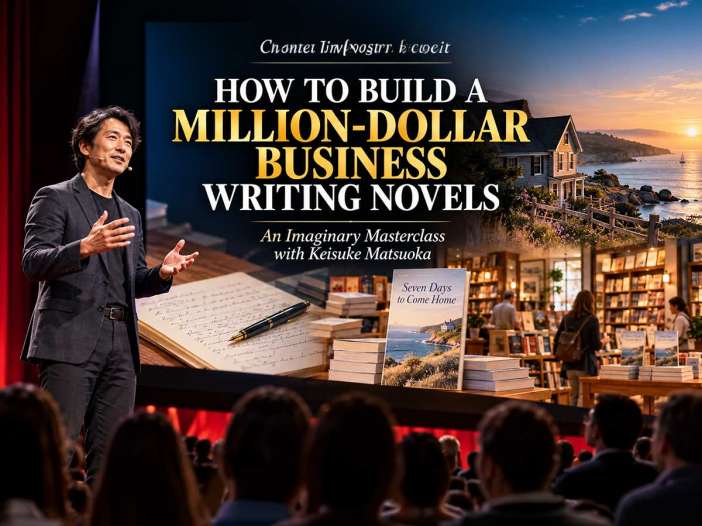
What if bestselling Japanese novelist Keisuke Matsuoka stepped onto an American stage to teach aspiring authors how to create novels, reach readers, and build a writing business? This fictional keynote is inspired by his book 『小説家になって億を稼ごう』.
The lights dim.
On the enormous screen behind me, there is nothing but a white rectangle.
A blank page.
I stand beside it for a moment.
“Ladies and gentlemen, this is where most novels die.”
A few people laugh.
“Not in a publisher's office. Not in a bookstore. Not because a critic wrote a terrible review.
“Right here.
“On a perfectly innocent blank page.”
I turn toward the screen.
“Imagine you've decided to write a novel. Perhaps you've wanted to do it for twenty years. Perhaps you've been telling your friends, ‘Someday, I'm going to write a book.’
“And today, for some mysterious reason, someday has arrived.
“You make coffee. You open your laptop. You type the words Chapter One.
“Then you stare.
“And stare.
“And suddenly you remember that your kitchen cabinets need cleaning.”
Laughter moves through the auditorium.
“Why is beginning so difficult?
“Because most aspiring novelists think they must begin with a brilliant plot.
“A murder in a locked room. A secret government conspiracy. Two people falling in love despite impossible circumstances.
“But I want to suggest something different.
“Before I write a novel, I don't begin with a plot. I begin with people.
“And sometimes, I begin with photographs.”
I click the remote.
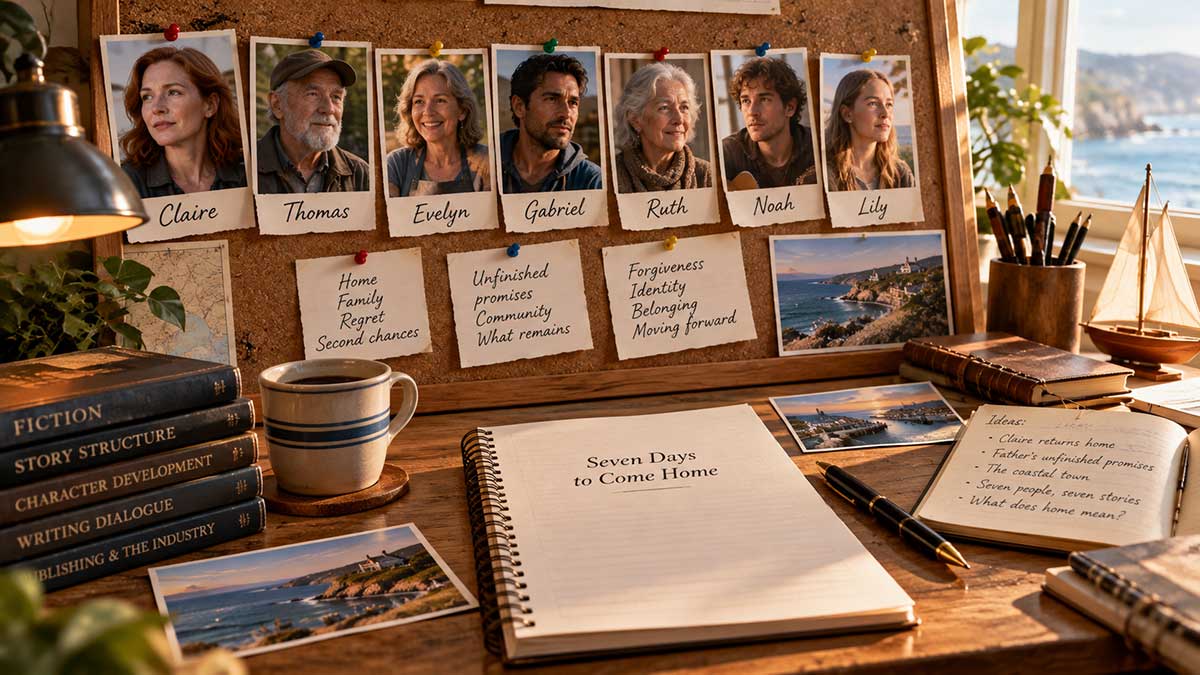
Seven faces appear on the screen.
Amy Adams. Bryan Cranston. Viola Davis. Oscar Isaac. Meryl Streep. Paul Mescal. Sadie Sink.
The audience murmurs in recognition.
“Now, before anyone calls Hollywood, let me clarify something. None of these actors has agreed to appear in our movie.
“We don't have a movie.
“We don't even have a novel.
“And I certainly haven't asked any of them for permission to be in my imagination.”
The audience laughs.
“But these photographs give us something extraordinarily useful.
“A face.
“A posture.
“A way of imagining how someone might look across a room when they're disappointed. Or frightened. Or trying very hard not to cry.
“Of course, these are only visual references. The characters we're about to create will be entirely fictional.
“Let's see what happens.”
The First Photograph
I enlarge Amy Adams's photograph.
“Let's call her Claire Bennett.
“She's thirty-nine years old.
“She lives in Los Angeles. She works as a brand strategist for a successful advertising agency.
“She's excellent at her job.
“When a company has a public-relations crisis, Claire knows exactly what to say. When a product launch goes wrong, she knows how to fix it. When two executives are fighting, she can usually get them to agree.
“She's the kind of person who can organize a complicated international campaign with forty-seven moving parts.
“But she cannot call her father.”
I pause.
“Now we have something interesting.
“Not because she's a brand strategist.
“Not because she's thirty-nine.
“But because she possesses a contradiction.
“Claire knows how to repair relationships between strangers, yet she cannot repair the most important relationship in her own life.”
I look out at the audience.
“When you create a character, don't stop at age, occupation, and appearance.
“Ask yourself three questions.
“What does this person want?
“What are they afraid of?
“And what do they believe about themselves that might not be true?”
I turn back to Claire.
“She wants control. She fears being disappointed. And she believes she stopped needing her father a long time ago.
“That's what she tells herself, anyway.”
The Second Photograph
Bryan Cranston appears.
“This is Thomas Bennett.
“Claire's father.
“Seventy-two years old.
“He's a carpenter and boat repairman in a small fictional town on California's Central Coast called Bellwether Cove.
“He can repair almost anything.
“A broken window. A leaking roof. A fishing boat that hasn't run in ten years.
“If your porch collapses, Thomas is the man you call.
“If your car won't start, he'll probably be there before the tow truck.
“And if you can't afford to pay him, he may tell you the bill got lost.”
A few people smile.
“Everyone in town loves Thomas Bennett.
“Except, perhaps, his daughter.”
I allow the silence to settle.
“Claire remembers something different.
“She remembers school plays where an empty seat waited for her father.
“Birthdays when he arrived late.
“A college graduation he missed because somebody's fishing boat needed repairs.
“She remembers hearing people say, ‘Your father is such a wonderful man.’
“And thinking, Then why couldn't he be wonderful to me?”
I glance toward Thomas's photograph.
“Now, here is where we must be careful.
“We could make Thomas a saint.
“Or we could make him a terrible father.
“Both choices would be easy.
“But real people are rarely that simple.
“Thomas genuinely loves his daughter.
“He also genuinely failed her.
“Both things can be true.
“And the moment we allow both to be true, our character begins to breathe.”
I click the remote again.
“There's one more detail.
“Thomas died three weeks ago.”
The auditorium grows quiet.
“Claire has returned to Bellwether Cove to sell his house.
“She plans to stay seven days.
“Then she will return to Los Angeles.
“She believes this will be simple.
“She is very, very wrong.”
Five More Lives
Five photographs fill the screen.
“Now we need other people.
“Not because a novel requires seven characters.
“Not because seven is a magical number.
“But because people become more interesting when they encounter other people who want different things.”
I point to Viola Davis.
“Evelyn Brooks. Sixty-two. Owner of the Harbor Light Café.
“She knows everyone in town.
“She has a remarkable gift for telling people the truth.
“Except when the truth might hurt someone she loves.
“Thomas helped save her café years ago. Evelyn knows something about his final months that Claire doesn't.”
I move to Oscar Isaac.
“Gabriel Reyes. Forty-three. Marine mechanic. Claire's childhood friend.
“He stayed in Bellwether Cove when Claire left.
“He believes loyalty means staying.
“Claire believes independence means leaving.
“Neither has ever forgiven the other for making a different choice.”
Meryl Streep appears.
“Ruth Whitcomb. Seventy-eight. Retired school librarian.
“She spent forty years helping children discover books.
“She knows thousands of words.
“But she hasn't spoken to her son in twelve years.
“Think about that.
“A woman who spent her life teaching people to communicate cannot find the words to reach her own child.”
Next, Paul Mescal.
“Noah Sullivan. Twenty-seven. Musician.
“He writes beautiful songs.
“He has almost no audience.
“He works seasonal jobs, plays in bars where people talk over him, and has decided that perhaps it's time to grow up and get a proper job.
“Thomas once promised to help him finish a recording studio.
“Thomas died before he could.”
Finally, Sadie Sink.
“Lily Parker. Eighteen.
“She's leaving for college in a few weeks.
“She's intelligent, restless, impatient, and absolutely certain that Bellwether Cove is too small for her dreams.
“Thomas used to let her work in his workshop after school.
“She knew him in a way Claire never did.
“And that fact is going to make Claire furious.”
I step away from the screen.
“Seven people.
“Seven faces.
“Seven different histories.
“Do we have a plot yet?”
I shake my head.
“No.
“And that's perfectly fine.”
The Question That Creates a Novel
I walk toward the edge of the stage.
“Now let me tell you something that may save you months of frustration.
“When you're building a character, don't ask only what happens to them.
“Ask what happens because of who they are.
“Claire doesn't want to stay in Bellwether Cove.
“Gabriel doesn't want her to sell the workshop.
“Evelyn doesn't want Claire to learn a painful truth too quickly.
“Ruth wants to reconnect with her son but is terrified of being rejected.
“Noah wants to abandon music.
“Lily wants to leave town.
“Already, these people want things that conflict.
“And when desires collide, stories begin.”
I pause.
“Imagine putting Claire and Gabriel in the same room.
“She wants the workshop emptied by Friday.
“He wants it preserved.
“Now imagine Gabriel says, ‘Your father built this place for people who needed help.’
“And Claire answers, ‘Yes. Everyone except his own daughter.’
“Do you see?
“I didn't need an explosion.
“I didn't need a murder.
“I needed two people with different memories of the same man.”
I let the words settle.
“A plot is not simply a sequence of events. It is what happens when people with different desires are forced to make choices.”
The Workshop
The screen changes.
A weathered house stands above the Pacific Ocean.
A narrow road winds between cypress trees. Wildflowers move in the coastal wind. Beyond the cliffs, the water glitters beneath the afternoon sun.
“This is Bellwether Cove.
“And that house belonged to Thomas Bennett.”
I turn toward the audience.
“Let's try something.
“I'm going to write a scene.
“Not a chapter. Just a few moments.
“And I want you to watch what happens when we allow Claire to be Claire.”
The lights soften.
I begin.
Claire arrived at 3:17 on a Tuesday afternoon.
She knew the exact time because she had checked her phone while parking.
The house looked smaller than she remembered.
The blue paint had faded. The porch railing leaned slightly to the left. A wind chime made from old silverware hung beside the door.
Her father had promised to replace it when she was eleven.
Apparently, he'd never gotten around to it.
Claire opened the trunk of her rental car.
Three empty cardboard boxes.
Packing tape.
A black marker.
Seven days, she told herself.
More than enough time.
I stop.
“Now, notice something.
“Claire didn't fall to her knees and sob.
“She didn't deliver a speech about how complicated her relationship with her father had been.
“She checked the time.
“She noticed something he had failed to repair.
“She brought boxes.
“Those details tell us who she is.”
I continue.
The front door opened with the same stubborn scrape she remembered from childhood.
Inside, the house smelled of cedar, coffee, and the faint metallic scent of tools.
She walked past the kitchen without looking at the table.
She knew what was there.
Two chairs.
Her father's chair.
And the chair where she had once waited for him to come home.
She went directly to the workshop.
That was where she found the cards.
I turn toward the screen.
A wooden workbench appears.
They were tucked inside the shallow drawer beneath the vise.
Seven index cards, held together with a rubber band.
On the first card, in her father's uneven handwriting, were four words:
“For Gabriel. The boat.”
The second read:
“For Ruth. Blue box.”
The third:
“For Evelyn. The sign.”
Claire frowned.
She looked at the remaining cards.
Noah.
Lily.
The footbridge.
And finally—
“For Claire.”
She stared at her name.
Then she turned the card over.
There was nothing written on the back.
I stop speaking.
The room is silent.
“Now,” I say softly, “we have a problem.”
A few people laugh nervously.
“We have seven unfinished promises.
“We have a daughter who wants to leave.
“We have a father who can no longer explain himself.
“And we have six other lives that may be changed by what Claire chooses to do.”
I look back at the audience.
“Did I plan every detail of that scene before creating the characters?
“No.
“But once I understood Claire, I knew she would arrive with packing boxes instead of flowers.
“Once I understood Thomas, I knew he would leave unfinished projects rather than a beautifully written farewell speech.
“And once I understood the people around them, I began to see what those projects might mean.”
Your First Assignment
I return to the center of the stage.
“Now, I want to give you something practical.
“Tonight, don't try to write a novel.
“Don't even try to write Chapter One.
“Find three photographs.
“They can be actors, models, or ordinary people whose images you have permission to use privately as references.
“Give each person a name.
“Write down their age, occupation, and one important memory.
“Then answer three questions.
“What do they want?
“What are they afraid of?
“And what do they believe that might be wrong?”
I smile.
“Then do something even more interesting.
“Put two of them in a room.
“Give them something to disagree about.
“And listen.”
I glance toward the seven portraits.
“Of course, they won't literally speak to you.
“But if you've imagined them deeply enough, you may begin to recognize what each would say—and what each would refuse to say.
“That is the beginning of character-driven fiction.”
The First Promise
I turn once more toward the image of the workshop.
“Before we finish, I want to return to Claire.”
The scene appears again.
Claire placed the seven cards on the workbench.
She looked at her father's handwriting.
For Gabriel.
For Ruth.
For Evelyn.
For Noah.
For Lily.
For the town.
And finally, for Claire.
She felt something rise in her chest.
Not grief.
Not yet.
Anger.
Even now, she thought, he had left her work to do.
She gathered the cards and walked toward the trash can.
Then she stopped.
Because beneath the rubber band was one more piece of paper.
Not an index card.
A photograph.
It showed a little girl standing beside a half-built wooden sailboat.
Her father knelt beside her, holding a hammer.
The girl was laughing.
Claire recognized the boat.
She recognized the hammer.
But she couldn't remember the last time she had seen her father look at her that way.
She sat down.
For the first time since arriving, she forgot to check her phone.
I allow a long silence.
“Ladies and gentlemen, that is where I would end our first chapter.
“Not because we know what happens next.
“But because we want to.”
I point toward the blank page that appeared at the beginning of the presentation.
“An hour ago, Claire Bennett didn't exist.
“Neither did her father.
“Neither did that photograph.
“And yet, for a moment, perhaps some of you felt something for her.
“That's extraordinary, isn't it?
“We can create someone from nothing—and make another person care.”
I smile.
“So when you go home tonight, don't worry about writing a bestseller.
“Don't worry about finding an agent.
“And please, don't begin calculating your future royalties.”
The audience laughs.
“First, create someone worth knowing.
“Give that person something to love.
“Something to fear.
“Something to lose.
“And something they desperately need to understand.
“Because the first secret of building a successful novel-writing business is surprisingly simple.
“Before readers can buy your books, they must have a reason to care about the people inside them.”
I glance toward Claire's photograph one final time.
“And tomorrow, we're going to discover what happens when those people refuse to behave the way their author expected.”
The screen fades to black.
Editorial note: This is an original, fictional keynote inspired by Keisuke Matsuoka's writing book. The dialogue, story, and casting references are invented for this educational presentation and are not actual statements or endorsements by Matsuoka or the actors mentioned.
Chapter 2 — When Characters Begin to Move
How do you make fictional characters so real that they begin to surprise even you?
The screen lights up again.
Seven photographs appear, exactly where we left them.
Amy Adams. Bryan Cranston. Viola Davis. Oscar Isaac. Meryl Streep. Paul Mescal. Sadie Sink.
I look at the audience.
“Yesterday, we created seven people.
“Today, we're going to do something dangerous.
“We're going to let them make decisions.”
A few people laugh.
“And if you've ever written fiction, you know why that's dangerous.
“Characters have a terrible habit of refusing to cooperate.”
I walk toward the screen.
“Imagine you've carefully planned a romantic scene.
“Your hero is supposed to confess his love.
“You've chosen the perfect restaurant. The lighting is beautiful. The violinist is playing something sentimental.
“And just as your hero is about to say, ‘I've loved you all my life,’ you realize something.
“He would never say that.
“Not this man.
“He would probably make a joke, spill his wine, and leave before dessert.”
The audience laughs.
“Now you have a choice.
“You can force him to deliver the speech because it's in your outline.
“Or you can listen to the person you've created.
“Sometimes, the second choice leads to a much better story.”
The Difference Between a Puppet and a Person
I click the remote.
Two sentences appear.
Claire returns home and learns that her father was a wonderful man.
Claire returns home determined to sell her father's house, but the people who loved him keep interfering with her plans.
“Which one makes you curious?”
I pause.
“The first sentence tells us what the author wants Claire to learn.
“The second creates a situation in which Claire might learn something—or might refuse to.
“That's a very important distinction.
“A puppet does what the writer commands.
“A believable character acts according to what she wants, what she fears, and what she believes.
“And sometimes, what she believes is wrong.”
I point to Claire's photograph.
“Claire believes her father chose everyone else over her.
“She's carried that belief for decades.
“Now suppose I want her to forgive him by page fifty.
“Can I simply make her forgive him?”
I shake my head.
“Of course I can. I'm the writer.
“I can make her do anything.
“But the reader will know.
“The reader will feel that something has been forced.”
I take a step forward.
“So instead of asking, ‘How do I make Claire forgive her father?’ I ask something else.
“What would have to happen for a woman like Claire to begin questioning the story she's told herself?”
Two People, One Workshop
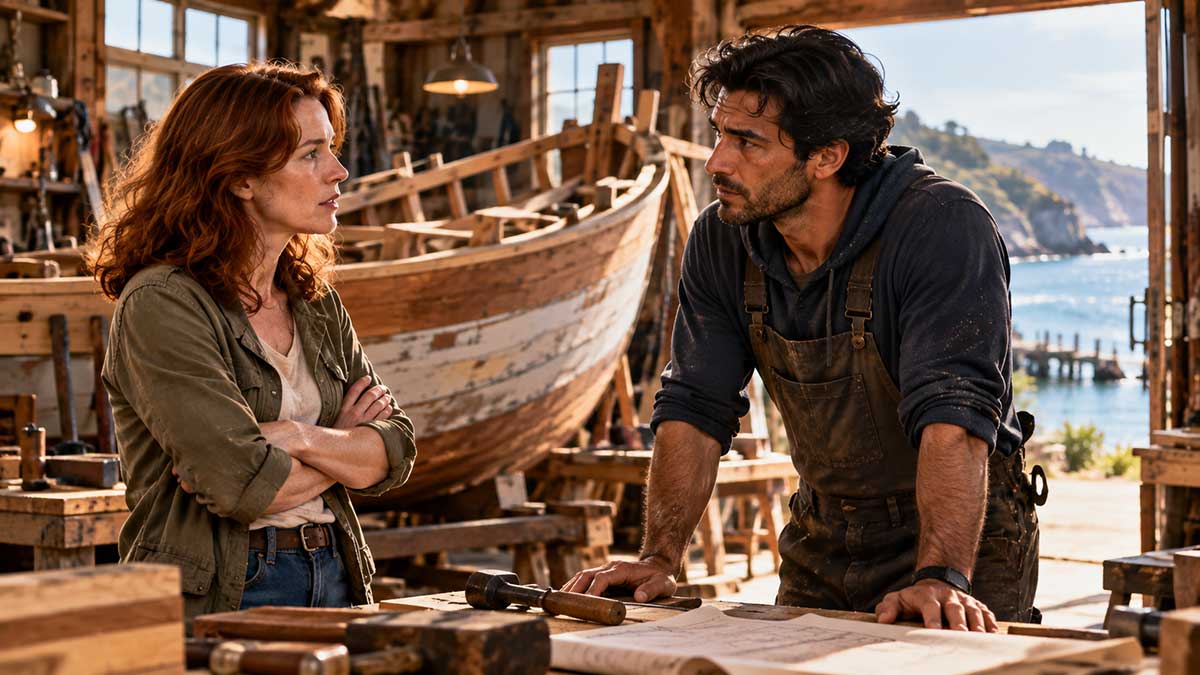
The screen changes to the interior of Thomas Bennett's workshop.
Late-afternoon sunlight enters through dusty windows. Tools hang on the walls. A half-finished wooden cabinet stands near the door.
“Let's return to Bellwether Cove.
“It's the second morning after Claire's arrival.
“She's already packed three boxes.
“And she's about to meet Gabriel Reyes.”
I begin reading.
Claire had labeled the boxes before breakfast.
KEEP.
DONATE.
DISCARD.
The system was working beautifully until Gabriel Reyes walked through the workshop door carrying two cups of coffee.
“You still organize the world into three categories?” he asked.
Claire looked up.
“Hello to you, too.”
Gabriel set one cup beside her.
“Evelyn said you were here.”
“Evelyn seems to know everything.”
“She considers it a public service.”
Claire glanced at the coffee.
“I don't drink it with sugar anymore.”
“I know.”
“You don't know anything about me anymore.”
Gabriel leaned against the workbench.
“Apparently, I know how you take your coffee.”
A ripple of laughter moves through the audience.
I pause.
“Notice something.
“Gabriel didn't walk in and announce, ‘Claire, I represent your unresolved relationship with your hometown.’
“He brought coffee.
“He teased her.
“And within five lines, we can feel that these two people have a history.”
I continue.
Gabriel noticed the boxes.
“What's all this?”
“I'm clearing out the workshop.”
“I can see that.”
“Then why ask?”
He picked up a small wooden sailboat from the bench.
“Your father made this.”
“My father made a lot of things.”
“He made this for you.”
Claire reached for it.
“Then put it in the keep box.”
Gabriel didn't move.
“What are you doing with the building?”
“Selling it.”
“You can't.”
Claire stopped.
“Excuse me?”
“There are people depending on this place.”
“It's a workshop, Gabriel. Not a hospital.”
“You don't understand.”
“Then explain it to me.”
He looked at the tools hanging on the wall.
“Your father promised—”
“My father promised a lot of things.”
Gabriel turned toward her.
“And he kept most of them.”
Claire felt her face grow warm.
“That's wonderful. I'm glad he was so reliable.”
“Claire—”
“Do you know what he promised me when I was eleven?”
Gabriel said nothing.
“He promised he'd come to my school play.”
She picked up a roll of packing tape.
“Apparently, somebody's boat was more important.”
For a moment, the only sound was the wind against the windows.
Then Gabriel said quietly, “I remember that night.”
Claire looked at him.
“You weren't there.”
“No.”
He put down the wooden boat.
“But I remember.”
I stop.
The audience waits.
“Now,” I say, “something interesting has happened.
“I originally intended Gabriel to explain why Thomas was such a wonderful man.
“But when I put Gabriel and Claire together, that explanation felt wrong.
“Gabriel is loyal. He's protective. And he resents Claire for leaving.
“Claire is defensive. She's grieving. And she's spent twenty-eight years feeling that her father chose someone else over her.
“If Gabriel begins praising Thomas, Claire will not suddenly become grateful.
“She'll become angrier.
“So I let that happen.
“And then Gabriel says something I hadn't planned.
“‘I remember that night.’
“Now I have a new question.
“What does Gabriel remember?”
When the Story Surprises Its Writer
I turn toward the audience.
“Some people describe this experience by saying, ‘My characters took over the story.’
“Of course, fictional characters don't literally take control of your computer.
“What's happening is more interesting.
“You've created a sufficiently detailed model of a human being that you can begin predicting how that person would respond.
“And when you place two such people in conflict, their responses may suggest possibilities you hadn't consciously planned.
“It's a form of imaginative discovery.
“Not magic.
“Not surrendering your responsibility as a writer.
“It's what happens when preparation gives imagination something to work with.”
I click the remote.
Three questions appear.
What does each person want right now?
What is each person unwilling to admit?
What happens when those two things collide?
“Let's apply them.
“Claire wants to finish packing and leave.
“Gabriel wants to protect the workshop.
“Claire won't admit that her father's absence still hurts.
“Gabriel won't admit that he may have helped Thomas avoid confronting his daughter.
“Now their argument is no longer about real estate.
“It's about loyalty, guilt, and the different ways people remember the same man.”
Enter Evelyn Brooks
I enlarge Viola Davis's photograph.
“Now let's add a third person.
“Evelyn Brooks.
“Owner of the Harbor Light Café.
“She has known Thomas for thirty years.
“She cares about Claire.
“And she knows something neither Claire nor Gabriel is ready to discuss.”
I return to the scene.
The workshop door opened.
Evelyn Brooks stood in the doorway holding a paper bag.
“Good,” she said. “You're both here.”
Claire looked at Gabriel.
“Did you call her?”
“No.”
“I didn't need an invitation,” Evelyn said. “I brought breakfast.”
She placed the bag on the workbench.
“Blueberry muffins. Still warm.”
Gabriel reached for one.
Evelyn slapped his hand.
“Those are for Claire.”
“There are six.”
“And she looks hungry.”
Claire almost smiled.
Almost.
Evelyn surveyed the boxes.
“You've been busy.”
“I'm trying to get everything finished before Friday.”
Evelyn's expression changed.
“Friday?”
“The sale closes next week. I have to be back in Los Angeles before then.”
“What sale?”
Claire looked from Evelyn to Gabriel.
“The house.”
Evelyn lowered herself onto a wooden stool.
“Thomas didn't tell you?”
Claire felt a familiar irritation.
“Tell me what?”
Evelyn glanced at Gabriel.
Gabriel looked away.
“Evelyn,” Claire said, “please don't do that.”
“Do what, honey?”
“Look at him as though I'm not in the room.”
Evelyn folded her hands.
“Your father was trying to arrange something for this workshop.”
“What kind of something?”
“A way for it to keep helping people.”
Claire laughed once, without humor.
“Of course he was.”
Evelyn watched her carefully.
“You sound angry.”
“I'm selling a house, Evelyn. I'm not applying for sainthood.”
“Nobody asked you to.”
“Then why does everyone keep telling me what my father wanted?”
Evelyn was silent.
Then she said, “Because none of us knows what you want.”
Claire opened her mouth.
And found that she had no answer.
I let the silence linger.
“Did you notice what Evelyn did?
“She didn't defend Thomas.
“She didn't criticize Claire.
“She asked a question that changed the conversation.
“Because Evelyn is a different person from Gabriel.
“Gabriel confronts.
“Evelyn observes.
“And Claire, who is prepared to fight Gabriel, isn't prepared for Evelyn to ask what she wants.”
The Power of Different Voices
I walk to the opposite side of the stage.
“One of the common weaknesses in early fiction is that every character sounds like the author.
“They use the same vocabulary.
“They explain themselves in the same way.
“They make jokes with the same rhythm.
“And they all seem to understand the story's theme.”
I smile.
“Real families don't work like that.
“Put five people around a Thanksgiving table and ask them what happened on last year's vacation.
“You may get six versions of the story.”
The audience laughs.
“That's because people don't merely remember events.
“They remember what those events meant to them.”
I gesture toward the photographs.
“Claire uses precise language because precision makes her feel safe.
“Gabriel speaks directly, sometimes too directly.
“Evelyn uses humor to soften difficult truths.
“Ruth chooses words carefully, afraid of saying something that cannot be taken back.
“Noah often says less than he feels.
“Lily asks the questions everyone else is avoiding.
“And Thomas?
“Thomas preferred fixing something with his hands to explaining something with words.
“Now imagine these people sharing a meal.
“Do you think they'd all agree?”
I shake my head.
“Good.
“Agreement is pleasant in life.
“But in fiction, disagreement often reveals character.”
A Promise That Creates a Problem
The screen returns to the seven index cards.
“Let's look at one of Thomas's unfinished promises.
“Remember the first card?
“‘For Gabriel. The boat.’
“Perhaps Thomas promised to help repair a fishing boat belonging to a family whose livelihood had been interrupted.
“That's a reasonable promise.
“But let's complicate it.
“The boat is sitting in the workshop's covered storage area.
“The buyer of Thomas's property expects that space to be cleared before closing.
“Gabriel has been repairing the boat with Thomas for months.
“Now Thomas is gone.
“And Gabriel needs another week to finish.”
I pause.
“Claire has a contract.
“Gabriel has a promise.
“Both have legitimate reasons for wanting what they want.
“Now suppose Claire agrees to give Gabriel two days.
“That's generous, isn't it?
“But the delay means she must reschedule the removal company.
“And the removal company has already been booked for another job.
“Now Claire's schedule is falling apart.
“And Claire hates it when schedules fall apart.”
A few people laugh.
“This is how stories grow.
“Not by adding random disasters.
“But by allowing one meaningful decision to create consequences.”
The Scene That Changes Everything
I turn toward the screen.
“Let's return to Gabriel's unfinished sentence.
“‘I remember that night.’
“What did he mean?
“I could decide he knows a secret that completely excuses Thomas.
“Perhaps Thomas saved someone's life that evening.
“Perhaps he was secretly protecting Claire.
“Perhaps a dramatic misunderstanding explains everything.”
I shake my head.
“But that would be too convenient.
“Sometimes writers become so eager to make a character lovable that they erase the character's mistakes.
“I don't want to erase Thomas's mistake.
“He missed his daughter's school play.
“That happened.
“And it hurt her.
“What if Gabriel remembers something that makes the event more complicated without making it disappear?”
I begin.
Claire waited for Gabriel to continue.
He rubbed his thumb against the handle of his coffee cup.
“Your father came to the marina that night,” he said.
“I know. Somebody needed help.”
“Yeah.”
“And apparently he couldn't say no.”
Gabriel looked toward the window.
“No. He couldn't.”
Claire crossed her arms.
“So what's your point?”
“I was sixteen. My dad had taken our boat out alone. The engine died offshore. The radio wasn't working.”
Claire's expression changed slightly.
“I remember your father being rescued.”
“Your dad went out with the harbor crew to help bring him back.”
“And he missed my play.”
Gabriel nodded.
“Yes.”
“He could have told me.”
“I know.”
“He could have called.”
“I know.”
“He could have said he was sorry.”
Gabriel lowered his eyes.
“He should have.”
Claire looked at him for a long moment.
“Then why are you telling me this?”
Gabriel's voice was quiet.
“Because I was there when he got back.”
“And?”
“He sat in his truck outside the marina for almost an hour.”
“What was he doing?”
“Holding the flowers he'd bought for you.”
Claire looked away.
Gabriel continued.
“I asked him why he didn't just take them home.”
“What did he say?”
“He said he didn't know how to walk into a room after he'd disappointed someone.”
The workshop was silent.
Claire stared at the floor.
Then she said, “He could have tried.”
Gabriel nodded.
“Yes. He could have.”
I stop.
For several seconds, I say nothing.
Then I look at the audience.
“That's the answer I wanted Gabriel to give.
“Not because it makes Thomas innocent.
“But because it makes him human.
“He did something good for Gabriel's family.
“He also hurt his daughter.
“And then, because he was ashamed, he made the hurt worse by remaining silent.”
I pause.
“Claire doesn't forgive him.
“Not yet.
“And she shouldn't.
“Because emotional change must be earned.”
Your Second Assignment
I return to center stage.
“Now let's turn this into something you can use.
“Take the three characters you created yesterday.
“Choose two who want different things.
“Put them in a room.
“Give them a practical problem.
“Not a philosophical debate.
“A late payment.
“A missing key.
“A family dinner.
“A house that needs to be sold.
“Then write a conversation.
“But here's the rule.
“Neither character is allowed to explain their deepest feelings directly.”
I smile.
“If one character is angry because she feels abandoned, don't let her say, ‘I feel abandoned.’
“Let her complain about the boxes.
“Let her argue about the schedule.
“Let her notice that someone else knows how her father took his coffee.
“People often reveal their deepest feelings while talking about something else.”
I hold up two fingers.
“And when the scene is finished, ask yourself two questions.
“Did each character behave according to their own desires?
“And did the scene change something?”
I lower my hand.
“If the answer to both is yes, you may have the beginning of a compelling story.”
The Unexpected Decision
The screen returns to the workshop.
“Let's see what Claire does next.”
Gabriel had finished his coffee.
Evelyn was wrapping the remaining muffins.
Claire stood beside the workbench, looking at the seven cards.
“How long?” she asked.
Gabriel looked up.
“What?”
“The boat. How long to finish it?”
He hesitated.
“With the right parts? Four or five days.”
“You said you needed another week.”
“I was allowing for problems.”
Claire gave him a look.
“That's my job.”
Gabriel almost smiled.
“I know.”
She picked up her phone.
“I'll call the removal company.”
Evelyn stopped folding the paper bag.
“Claire?”
“I'm not promising anything. I'm just asking whether they can move the appointment.”
Gabriel set down his cup.
“Thank you.”
“Don't thank me yet.”
She walked toward the door.
Then she stopped.
“Gabriel?”
“Yeah?”
“The flowers.”
He waited.
“What kind were they?”
Gabriel thought for a moment.
“Yellow daisies, I think.”
Claire nodded.
“They were my favorite when I was eleven.”
She went outside.
Gabriel remained where he was.
Evelyn watched the doorway.
“Well,” she said softly, “that's a beginning.”
I look out at the audience.
“Notice what Claire did.
“She didn't suddenly announce that she loved her father.
“She didn't decide to abandon her life in Los Angeles.
“She made one small decision.
“She agreed to consider moving a schedule.
“That's all.
“But for Claire, who has spent years protecting herself through control, that small decision matters.”
I pause.
“Character development is not always a dramatic transformation. Sometimes it's a tiny choice that the person we met on page one would never have made.”
The seven photographs return to the screen.
“Yesterday, we created seven people.
“Today, we put three of them in a workshop.
“They disagreed.
“They revealed things they hadn't intended to reveal.
“And one of them changed her mind—just a little.
“Now we have something more than character biographies.
“We have consequences.
“And consequences need structure.
“Because if we keep following every interesting conversation, we may end up with a beautiful collection of scenes that never becomes a novel.”
I smile.
“So next, we're going to take these living, unpredictable people and do something that sounds almost impossible.
“We're going to organize their lives into a story.
“Not by imprisoning them inside an outline.
“But by building a structure strong enough to hold their choices.”
I glance at the seven cards.
“And perhaps, by the time we reach the final one, we'll discover what Thomas Bennett wanted his daughter to understand.”
The lights fade.
Editorial note: This is an original fictional keynote inspired by Keisuke Matsuoka's writing book. The dialogue and the novel Seven Days to Come Home are invented for educational storytelling purposes and are not actual statements by Matsuoka.
Chapter 3 — Three Lines, One Novel

How do you turn a collection of fascinating characters into a story that readers cannot put down?
The screen behind me shows a beautiful mess.
Seven photographs.
Forty-three handwritten notes.
A map of California's Central Coast.
Three coffee-stained napkins.
And a yellow sticky note that says:
Something happens with the boat.
I turn toward the audience.
“Ladies and gentlemen, congratulations.
“You are now novelists.”
Laughter.
“You have seven characters. They have desires, regrets, fears, and complicated relationships.
“You've written a few scenes that made you feel something.
“And your desk looks as though a detective has been investigating a very disorganized criminal.”
More laughter.
“But now comes the question that separates a promising collection of scenes from a completed novel.
“Where is this story going?”
I gesture toward the screen.
“Yesterday, Claire Bennett agreed to give Gabriel a little more time to finish a boat.
“She learned something painful about her father.
“She began to question a belief she had carried since childhood.
“All of that is interesting.
“But what happens next?
“Do we follow Gabriel to the marina?
“Do we visit Ruth Whitcomb and her mysterious blue box?
“Do we find out why Noah is abandoning music?
“Or do we spend forty pages describing the beautiful California coastline?”
I smile.
“Actually, I could spend forty pages describing the coastline.
“But my editor would probably ask me to remove thirty-nine.”
The audience laughs.
“Today, we're going to learn how to give our story a shape.
“And we're going to begin with something so small that it can fit on an index card.”
Three Lines That Hold an Entire Novel
I click the remote.
The chaotic notes disappear.
Three empty lines appear.
“Before writing hundreds of pages, try writing three sentences.
“Not a synopsis of everything that happens.
“Not a list of all your characters.
“Just three sentences that capture the movement of the story.”
I type the first.
1. A woman returns to her California hometown to sell her late father's house and discovers seven promises he left unfinished.
“That's our beginning.
“We have a person, a place, a situation, and a problem.
“Now the second.”
2. As she tries to fulfill the promises before the sale closes, she uncovers conflicting memories of her father and risks losing the life she has carefully built.
“That's our struggle.
“Notice that the problem is no longer simply completing seven tasks.
“Claire's understanding of her father is changing.
“And that threatens the identity she has built around leaving him behind.”
I type the third.
3. When the final promise forces her to choose between walking away and preserving something meaningful, she discovers that coming home does not require surrendering the life she chose.
I step back.
“There.
“An entire novel in three sentences.
“Does that mean we know every scene?
“No.
“Does it mean we know exactly how Claire will make her final decision?
“No.
“But we know what kind of journey we're taking.”
I look at the audience.
“A three-line synopsis is not a prison.
“It's a compass.
“And a compass is especially useful when your characters begin leading you into the woods.”
The Difference Between a Plot and a List
The screen changes.
Seven numbered boxes appear.
- Fix the boat.
- Return the blue box.
- Repair the café sign.
- Finish the recording booth.
- Deliver the scholarship letter.
- Repair the footbridge.
- Give Claire the workshop key.
I turn toward the audience.
“Now we have a problem.
“This looks organized.
“Very organized.
“And perhaps a little boring.”
A few people laugh.
“Claire completes one promise.
“Then another.
“Then another.
“By the time she reaches number six, readers may feel they're watching someone complete a home-maintenance checklist.”
I pause.
“So let's ask a better question.
“How can completing one promise make another promise more difficult?”
I draw an arrow from the boat to the workshop.
“The boat is occupying the storage space that must be cleared before the property sale.
“Claire agrees to let Gabriel finish repairing it.
“But that delays the moving company.
“And the delay creates a problem with the buyer.
“Now the first promise has consequences.”
I draw another arrow.
“Perhaps the money Thomas set aside for Noah's recording booth was also intended to help repair the footbridge.
“Now Claire must decide how to use a limited amount of money.
“She cannot fulfill both promises exactly as written.”
Another arrow appears.
“Suppose Ruth's blue box contains letters connected to Thomas's past.
“One of those letters reveals a mistake that hurt Evelyn.
“Suddenly, returning the box may damage a friendship.”
I step away from the screen.
“Now we're getting somewhere.
“Because a novel is not simply a sequence of tasks.
“It's a chain of choices and consequences.
“The strongest plot events don't merely happen after one another. They happen because of one another.”
The 10–20–10 Method
I click the remote.
A single page appears, divided into three sections.
“Now I'd like to show you a practical way to expand our three-line synopsis.
“For this demonstration, we'll use a forty-line outline.
“Ten lines for the beginning.
“Twenty lines for the middle.
“Ten lines for the ending.
“I call it our 10–20–10 working structure.”
I pause.
“Forty lines.
“Not forty chapters.
“Not forty pages.
“Forty lines.
“You can write them on a few sheets of paper.”
I point to the first section.
“Why ten lines for the beginning?
“Because we need to establish who Claire is, what she wants, and why she cannot simply walk away.”
The First Ten Lines: A Woman Who Wants to Leave
I begin typing.
Beginning — Lines 1–10
Working outline for Seven Days to Come Home
- Claire returns to Bellwether Cove after her father's death.
- She plans to clear his house before the scheduled sale closing.
- She discovers seven unfinished promises in his workshop.
- Gabriel confronts her about selling the property.
- Claire remembers how often Thomas disappointed her.
- Gabriel reveals what happened the night Thomas missed her school play.
- Evelyn hints that Thomas had plans for the workshop.
- Claire reluctantly gives Gabriel time to finish repairing the boat.
- She learns that fulfilling the promises may interfere with the sale.
- Claire decides to investigate the promises before making any further commitments.
I turn toward the audience.
“Notice what happens by line ten.
“Claire hasn't become a different person.
“She still wants to leave.
“She still feels angry.
“But she has made one decision she would not have made at the beginning.
“She's willing to investigate.
“That's enough to move the story forward.”
I look back at the outline.
“Now comes the difficult part.
“The middle.”
The Twenty Lines That Make Readers Care
I smile.
“Many aspiring writers can imagine a wonderful beginning.
“And they can imagine a beautiful ending.
“But somewhere around page eighty, they discover that their characters are eating lunch.
“Then they're driving somewhere.
“Then they're thinking about lunch again.”
Laughter.
“That's the danger of the middle.
“Without meaningful complications, your novel becomes a diary of ordinary activities.
“So let's make things harder for Claire.”
Middle — Lines 11–30
11. Claire visits Ruth to deliver the blue box. 12. Ruth refuses to open it and asks Claire to take it away. 13. Claire discovers that Thomas once tried to reconcile Ruth with her estranged son. 14. Noah reveals that Thomas promised to help finish his recording booth. 15. Claire finds that Thomas left behind less money than she expected. 16. Evelyn explains how Thomas once helped save the Harbor Light Café. 17. Claire begins to admire his generosity but resents its cost to their family. 18. Lily reveals that Thomas helped her apply for a scholarship. 19. A problem with the boat threatens Gabriel's repair deadline. 20. Claire uses her professional skills to organize help from the town. 21. The effort briefly succeeds, and Claire feels she belongs. 22. Ruth's blue box reveals an old decision Thomas concealed. 23. Claire learns that his decision caused real harm to someone he cared about. 24. Evelyn admits she knew more than she previously revealed. 25. Claire feels manipulated by the people defending her father. 26. The buyer's representative warns that the property must be cleared as agreed. 27. Claire argues with Gabriel and accuses the town of using her father's memory. 28. She prepares to abandon the remaining promises and leave. 29. Lily challenges Claire's assumption that leaving means cutting every tie. 30. Claire finds evidence that Thomas had begun planning a future for the workshop without expecting her to sacrifice her own.
I step back.
“Twenty lines.
“Now our middle has movement.
“Claire begins with resentment.
“She discovers generosity.
“She experiences belonging.
“Then she discovers something painful that makes her question everything again.
“That's important.
“Emotional development is rarely a straight line.”
I draw a wave across the screen.
“Hope.
“Disappointment.
“Connection.
“Betrayal.
“A new understanding.
“Readers don't need constant explosions.
“They need meaningful changes.”
The Last Ten Lines: An Ending Worth Earning
I point to the final section.
“Now we need an ending.
“But there's a danger here.
“We could simply have Claire read a beautiful letter from her father.
“He explains everything.
“She cries.
“Everyone hugs.
“The music swells.
“And we go home.”
A few people laugh.
“There's nothing wrong with tears.
“I like tears.
“But if the letter solves every problem, Claire hasn't truly changed.
“She's simply received information.
“I want her to make a choice.”
Ending — Lines 31–40
31. Claire asks Evelyn and Gabriel to explain Thomas's unfinished workshop plan. 32. She learns that Thomas wanted the workshop to remain useful to the community. 33. Claire discovers that the plan was incomplete and cannot simply be implemented as written. 34. She must decide whether to proceed with the sale or seek a negotiated alternative. 35. Gabriel acknowledges that he judged Claire unfairly for leaving town. 36. Ruth takes a first step toward contacting her son. 37. Noah completes a recording that helps bring the community together. 38. Claire proposes a practical arrangement that preserves the workshop's purpose without requiring her to abandon her career. 39. The buyer agrees to revised terms, and Claire fulfills the final promise in her own way. 40. Before leaving Bellwether Cove, Claire understands that her father loved her imperfectly—and that she can carry that love forward without denying the hurt.
I let the audience study the page.
“Forty lines.
“Beginning, middle, ending.
“Is it a finished novel?
“Of course not.
“But we now have something we can build upon.”
I pause.
“And here's the most important part.
“The outline is allowed to change.”
Writing Backward from the Ending
I click the remote.
The forty-line outline disappears.
Only the final image remains.
Claire stands inside her father's workshop.
Sunlight falls across the workbench.
A photograph of her childhood rests beside an old wooden sailboat.
“Now we're going to try something that may sound backward.
“Because it is.”
The audience laughs.
“Instead of asking what happens next, let's imagine the emotional destination.
“At the beginning, Claire believes that leaving Bellwether Cove was the only way to protect herself.
“At the end, she should understand that she can acknowledge her father's failures without allowing those failures to define the rest of her life.
“That's our destination.
“Now we work backward.”
I write a question on the screen.
What must Claire do at the end that she could not have done at the beginning?
“Perhaps she must ask Gabriel for help.
“Perhaps she must admit that she doesn't know what the right decision is.
“Perhaps she must risk disappointment by trusting someone.
“Whatever we choose, it must be a genuine action.
“Not merely a speech.”
I type another question.
What belief must she surrender before she can make that choice?
“Claire believes that depending on other people makes her vulnerable.
“She believes that love is unreliable.
“She believes that if she controls every detail, she cannot be hurt.”
I turn toward the audience.
“Then we need scenes that challenge those beliefs.
“Gabriel helps her when she hasn't asked.
“Evelyn tells her a truth she doesn't want to hear.
“Ruth demonstrates the cost of remaining silent.
“Noah risks sharing a song before he knows whether anyone will like it.
“Lily prepares to leave town without rejecting the people who raised her.”
I smile.
“Do you see what we've done?
“Every character now has a reason to exist beyond filling a space in our cast.”
The Character Who Refuses the Outline
I turn toward Ruth Whitcomb's photograph.
“Now let me show you why we must remain flexible.
“In our outline, line eleven says Claire visits Ruth to deliver the blue box.
“Line twelve says Ruth refuses to open it.
“That's interesting.
“But what if, while writing the scene, we discover something else?”
The screen changes.
A small cottage overlooks a garden of lavender and rosemary.
I begin.
Ruth Whitcomb opened the door wearing a blue cardigan and an expression of polite suspicion.
“Claire Bennett,” she said. “You have your mother's eyes.”
Claire held out the box.
“I found this in Dad's workshop.”
Ruth looked at it.
For a moment, she seemed unable to breathe.
“Where did you find that?”
“In a cabinet.”
“Did you open it?”
“No.”
Ruth stepped backward.
“Good.”
Claire waited.
“Would you like me to leave it here?”
Ruth looked toward the kitchen.
There were two cups on the table.
One had been used.
The other was clean.
“No,” Ruth whispered.
Claire frowned.
“I'm sorry?”
“Please take it away.”
“But my father—”
“Your father made a promise he had no right to make.”
Claire felt a small chill.
“What promise?”
Ruth closed her eyes.
“To bring my son home.”
I stop.
The auditorium is quiet.
“Now suppose that line surprises me.
“‘Your father made a promise he had no right to make.’
“I hadn't planned those exact words.
“But suddenly, Ruth is more complicated.
“Maybe she doesn't want reconciliation.
“Maybe her estrangement from her son involved something we don't yet understand.
“Maybe Thomas was trying to help but crossed a boundary.
“Now I have to decide whether this new possibility improves the novel.”
I pause.
“That's the writer's responsibility.
“Not to follow every surprise.
“Not to worship the outline.
“But to judge which discoveries make the story more truthful, more coherent, and more moving.”
The Four Questions That Save a Scene
I return to center stage.
“When you're outlining a novel, I recommend asking four questions about every major scene.
“First: Who wants something?
“Second: What prevents them from getting it?
“Third: What choice do they make?
“And fourth: What changes because of that choice?”
I gesture toward Ruth's cottage.
“Claire wants to deliver the box.
“Ruth refuses to accept it.
“Claire must decide whether to respect her refusal or investigate further.
“And the conversation changes Claire's understanding of her father's promises.
“That's a scene.
“Now imagine Claire simply drives to Ruth's house, hands over the box, and drives away.
“Nothing changes.
“Unless the delivery reveals something important, we probably don't need that scene.”
I smile.
“Your readers have lives.
“They have jobs, families, appointments, and laundry.
“They're giving you their time.
“Make every scene earn it.”
The Danger of Planning Too Much
The screen shows a mountain road winding above the Pacific Ocean.
“Some writers love outlining.
“Others hate it.
“Some feel safe with a detailed map.
“Others feel that too much planning kills the excitement of discovery.
“I understand both reactions.
“But consider this.
“If you're driving from Los Angeles to San Francisco, it's useful to know your destination.
“You may choose the coastal highway.
“You may stop for lunch in a town you hadn't planned to visit.
“You may discover a beautiful beach and spend an extra hour there.
“But if you have no idea where you're going, you may drive in circles until you run out of gas.”
Laughter.
“Your outline is the destination and the main road.
“Your characters are the people traveling with you.
“And sometimes, one of them will say, ‘I think we should turn left.’
“Listen.
“Then decide whether the detour is worth taking.”
Your Third Assignment
I return to the three-line synopsis.
“Tonight, take the characters you created in our first two chapters.
“Write three sentences.
“Sentence one: Who is your protagonist, and what disrupts their ordinary life?
“Sentence two: What makes their problem increasingly difficult?
“Sentence three: What meaningful choice must they eventually face?
“Then expand those sentences into forty short lines.
“Ten for the beginning.
“Twenty for the middle.
“Ten for the ending.
“Don't worry about beautiful language.
“Don't write dialogue yet.
“Just identify the major changes.
“And when you've finished, read the outline aloud.
“Ask yourself:
“Does every major event create consequences?
“Does the protagonist make meaningful choices?
“Do the supporting characters have desires of their own?
“And does the ending require the protagonist to become someone who could not have made that choice at the beginning?”
I pause.
“If the answer to those questions is yes, you have something valuable.
“Not a guaranteed bestseller.
“But a foundation strong enough to support one.”
The Photograph on the Workbench
The screen returns to Claire.
She's standing in the workshop late at night.
The house is quiet.
Outside, the Pacific wind moves through the cypress trees.
I begin.
Claire spread the seven cards across the workbench.
For Gabriel.
For Ruth.
For Evelyn.
For Noah.
For Lily.
For the town.
For Claire.
She studied them for a long time.
Then she found a pencil and a sheet of paper.
At the top, she wrote:
THINGS DAD DIDN'T FINISH.
Below it, she drew seven boxes.
She stared at the page.
Then, slowly, she crossed out the title.
She wrote something else.
THINGS I DON'T UNDERSTAND.
Claire sat back.
For the first time, she wasn't trying to complete her father's work.
She was trying to understand it.
I stop.
“That's a small moment.
“No explosion.
“No shocking revelation.
“Just a woman changing the title on a piece of paper.
“But it tells us something important.
“Claire's goal is beginning to change.
“She arrived to finish a job.
“Now she wants answers.
“And eventually, she may discover that the answers are not as simple as she hoped.”
I look out at the audience.
“That's what a good outline should help us create.
“Not a predictable series of events.
“But a meaningful progression of choices.”
The forty-line outline returns to the screen.
“Yesterday, we had seven people.
“Today, we have a novel-shaped journey.
“But there is still a problem.
“A perfectly organized outline can produce a terribly boring book.
“Because knowing what happens is not the same as making readers feel that it's happening.
“Next, we're going to take one ordinary scene and transform it into something readers can see, hear, and feel.
“We're going to turn words into a movie inside the reader's mind.”
I smile.
“And we're going to begin with a photograph.
“A little girl.
“A wooden sailboat.
“And a father who never learned how to say what mattered most.”
The screen fades to black.
Editorial note: This is an original fictional keynote inspired by Keisuke Matsuoka's book 『小説家になって億を稼ごう』. The dialogue, fictional novel, and teaching examples are imaginative adaptations rather than verified statements by Matsuoka.
Chapter 4 — Make Readers See the Movie

How do you transform ordinary sentences into scenes readers can see, hear, and feel?
The screen behind me is black.
I stand at the center of the stage, holding a single sheet of paper.
“Ladies and gentlemen, I have some terrible news.”
I pause.
“Our novel is boring.”
The audience laughs.
“I'm serious.
“We've created seven interesting characters. We've given them complicated relationships. We've constructed a three-line synopsis and a forty-line outline.
“We know where our story begins, where it might end, and what happens along the way.
“And yet, if I write it badly, nobody will want to read it.”
I look down at the paper.
“Let me demonstrate.”
I read aloud.
Claire entered her father's workshop. She saw a photograph of herself as a child. It reminded her of happier times. She felt sad because she missed her father, even though she was still angry with him.
I lower the paper.
“Beautiful, isn't it?”
Laughter.
“An emotional masterpiece. I expect Hollywood to call any minute.”
More laughter.
“But what went wrong?
“We have all the necessary information.
“Claire enters the workshop.
“She finds a photograph.
“She remembers her father.
“She feels sadness and anger.
“Everything is technically correct.
“And yet, almost nothing happens inside your imagination.”
I turn toward the screen.
“Now, let's try again.”
The Same Moment, Written Differently
A photograph appears.
A little girl stands beside a half-built wooden sailboat. Her father kneels next to her, holding a hammer.
I begin reading.
The photograph had curled at the corners.
Claire held it beneath the workshop lamp, careful not to touch the faded image with her thumb.
She was eleven.
Her hair was tied back with a yellow ribbon. One of her front teeth was missing. She was laughing so hard that her eyes had almost disappeared.
Beside her, Thomas Bennett knelt on the wooden floor, holding a hammer.
He was laughing, too.
Claire stared at his face.
She couldn't remember the last time she'd seen him look so happy.
Then she noticed the boat.
Not a real boat. A small wooden sailboat, perhaps three feet long, its unfinished hull balanced on two paint cans.
She remembered the smell of sawdust.
The sound of the hammer.
Her father's hand covering hers as he showed her how to drive a nail straight.
“Don't fight the wood,” he'd told her. “Listen to it.”
She had laughed because wood didn't talk.
He'd said everything talked if you knew how to listen.
Claire lowered the photograph.
On the workbench, beneath a layer of dust, sat the same wooden sailboat.
Still unfinished.
She reached toward it.
Then stopped.
For a moment, she was eleven again, waiting for her father to come back and help her finish something.
I stop.
The auditorium is quiet.
“Now,” I say softly, “which version made you feel something?”
I don't wait for an answer.
“Both versions communicate essentially the same information.
“But the second gives your imagination something to work with.
“A curled photograph.
“A yellow ribbon.
“A missing tooth.
“The smell of sawdust.
“A father's hand guiding a child's hand.
“And an unfinished boat.”
I hold up the paper.
“The difference between telling readers what a character feels and allowing them to experience that feeling is often the difference between a forgettable novel and a memorable one.”
Your Reader Is the Director
I walk toward the edge of the stage.
“Here's something I want you to remember.
“When you write a novel, you're not simply communicating information.
“You're giving your reader the materials to create a movie inside their own mind.
“And the extraordinary thing is that every reader directs a slightly different movie.”
I gesture toward the audience.
“Some of you imagined Claire with Amy Adams's face.
“Others imagined someone completely different.
“Some of you pictured the workshop as a small shed.
“Others saw a large building overlooking the Pacific.
“That's the magic of fiction.
“The writer provides the words.
“The reader supplies an entire world.”
I pause.
“But there's a balance.
“If I describe every nail in the workshop, every knot in the wood, every crack in the paint, and the precise dimensions of every shelf, you may become exhausted before Claire even reaches the photograph.”
The audience laughs.
“On the other hand, if I simply write, ‘She entered the workshop and felt sad,’ I haven't given you enough.
“So how do we decide what to describe?”
I click the remote.
Three words appear.
Notice. Select. Reveal.
“First, notice what exists in the scene.
“Second, select the details that matter.
“Third, use those details to reveal something about the character or the story.
“Don't describe everything.
“Describe what changes the reader's understanding.”
Why Claire Notices the Wrong Things
The screen shows Thomas's workshop.
Tools hang neatly on the wall. A workbench stands beneath a dusty window. The Pacific Ocean is visible beyond the trees.
“Let's imagine three people entering this room.
“Claire.
“Gabriel.
“And Lily.
“Would they notice the same things?”
I shake my head.
“Claire notices the unfinished projects.
“The crooked shelves.
“The unpaid bills.
“The things her father promised to fix but never did.
“Gabriel notices the tools.
“The quality of the wood.
“The repaired engine parts.
“The evidence of a man who spent his life helping people.
“Lily notices the little pencil marks Thomas made beside the workbench.
“Measurements.
“Names.
“Small reminders written in the margins of ordinary life.
“Same room.
“Three different experiences.”
I look toward the audience.
“That's because description isn't merely about the world.
“It's about the person looking at the world.”
I click the remote.
Two sentences appear.
The workshop was messy.
Claire counted eleven unfinished projects before she reached the door.
I smile.
“The second sentence doesn't just describe the workshop.
“It tells us something about Claire.
“She counts unfinished things.
“She notices failures.
“That's the lens through which she sees her father.”
I pause.
“Now imagine that later in the novel, she enters the same workshop and notices something different.
“Not the unfinished projects.
“But the names written on them.
“Gabriel.
“Evelyn.
“Noah.
“Lily.
“People her father had tried to help.
“Nothing in the room has changed.
“But Claire has.
“And the reader can feel that change without a paragraph explaining it.”
The Power of What People Don't Say
I click the remote.
The screen shows Claire and Gabriel standing beside the half-repaired fishing boat.
“Now let's talk about dialogue.
“Many beginning writers make their characters say exactly what they feel.
“For example.”
I read.
Claire said, “Gabriel, I'm angry with you because you don't understand how emotionally abandoned I felt by my father.”
Gabriel replied, “Claire, I'm frustrated because I believe your father was a good man, and your criticism threatens my memories of him.”
I look up.
“Very efficient.
“We've saved everyone the trouble of going to therapy.”
The audience laughs.
“But people rarely speak this way.
“Especially when they're hurt.
“They talk around the truth.
“They change the subject.
“They argue about something small because the real issue feels too dangerous.”
I turn back to the screen.
“Let's rewrite the conversation.”
Gabriel was tightening a bolt beneath the boat's engine.
Claire stood beside him with a clipboard.
“The buyer's representative wants the storage area cleared by Thursday.”
“I heard you the first three times.”
“Then why is the boat still here?”
“Because boats don't repair themselves.”
“Neither do contracts.”
Gabriel slid out from beneath the engine.
“You always were good at making everything sound like a business meeting.”
Claire tightened her grip on the clipboard.
“And you always were good at avoiding deadlines.”
“Your father didn't think everything had to happen on a schedule.”
“Yes,” Claire said. “I remember.”
Gabriel looked at her.
“That's not what I meant.”
“It's what you said.”
He wiped his hands on a rag.
“You know, he kept that little sailboat you made together.”
Claire looked toward the workshop.
“He kept a lot of things.”
“Claire—”
“Did he ever finish it?”
Gabriel said nothing.
She nodded.
“That's what I thought.”
I stop.
“Notice what they're really discussing.
“Not the boat.
“Not the contract.
“Not the deadline.
“They're discussing Thomas.
“Gabriel remembers a man who kept promises to other people.
“Claire remembers a man who left promises unfinished at home.
“And neither is ready to admit how much the disagreement hurts.”
I pause.
“Subtext is what a character means but cannot—or will not—say directly.”
Silence Is Also Dialogue
The screen changes to Ruth Whitcomb's cottage.
A blue box sits on the kitchen table.
“Remember Ruth?
“She hasn't spoken to her son in twelve years.
“Thomas promised to help bring them together.
“Now Claire has arrived with the box.
“Let's imagine what happens if Ruth finally opens it.”
I begin.
Ruth lifted the lid.
Inside were three letters, a faded photograph, and a small brass key.
She touched the photograph first.
It showed a boy of about eight standing beside a bicycle.
“He hated that bicycle,” she said.
Claire sat across from her.
“Why?”
“It was red.”
“What's wrong with red?”
“He wanted blue.”
Ruth smiled faintly.
“His father bought it anyway. Said red was safer because drivers would see him.”
She turned the photograph over.
On the back, in a child's handwriting, were the words:
I LOVE YOU MOM.
Ruth set it down.
For a long time, neither woman spoke.
Then Ruth reached for the first letter.
Her hand trembled.
Claire quietly moved the box closer.
I stop.
“Now imagine I added this sentence:
“‘Ruth felt overwhelming sadness because she missed her son.’
“Would it improve the scene?”
I shake my head.
“No.
“We already know.
“Her trembling hand tells us.
“The photograph tells us.
“The silence tells us.
“And Claire's small act of moving the box closer tells us something about Claire, too.”
I look at the audience.
“Sometimes the most powerful line in a scene is the one you choose not to write.”
Make the Reader Turn the Page
I move to the center of the stage.
“Now let's discuss pacing.
“You've created beautiful descriptions.
“You've written dialogue full of subtext.
“You've developed characters who feel real.
“But there's still a danger.
“Your reader may admire your writing and then put the book down.”
A few people laugh.
“Why?
“Because beautiful writing is not the same as forward movement.
“A story needs questions.
“Not necessarily mysteries.
“Not necessarily cliffhangers.
“But questions that make the reader want to continue.”
I click the remote.
Three sentences appear.
Claire opened the drawer.
Claire opened the drawer and found an envelope.
Claire opened the drawer and found an envelope addressed to someone who had been dead for twenty years.
I pause.
“Which sentence makes you want to read the next one?”
I smile.
“Exactly.
“Curiosity is one of the writer's most valuable tools.
“But curiosity doesn't always require a shocking secret.
“Sometimes the question is emotional.
“Will Ruth call her son?
“Will Noah play his music in public?
“Will Gabriel apologize to Claire?
“Will Claire finally allow herself to remember something good about her father?”
I gesture toward the screen.
“Every major scene should leave something changed.
“A relationship.
“A decision.
“A piece of information.
“A possibility.
“And ideally, it should create a reason to keep reading.”
The Scene That Was Too Beautiful
I return to the workshop.
“Now I want to confess something.
“Writers sometimes fall in love with their own sentences.
“We write a paragraph describing the sunset.
“We think it's magnificent.
“We read it aloud.
“We congratulate ourselves.
“And then we realize it has absolutely nothing to do with the story.”
The audience laughs.
“Let's imagine I've written this.”
I read slowly.
The sun descended toward the western horizon, casting a magnificent tapestry of crimson, amber, and violet across the vast and timeless Pacific Ocean, whose restless waves seemed to whisper the eternal secrets of humanity's longing for connection.
I lower the paper.
“Not terrible.
“Perhaps a little enthusiastic.”
Laughter.
“But what does it tell us about Claire?”
I shake my head.
“Almost nothing.
“Now let's try this.”
The sun was setting when Claire carried the last box to her car.
The ocean beyond the house had turned the color of copper.
Her father used to stop working at this hour.
He would stand beside the workshop door and watch the light disappear.
Claire had always thought he was wasting time.
Now she stood in the same place.
And stayed until the sun was gone.
I pause.
“The sunset is still there.
“But now it belongs to the story.
“It reveals something about Claire's changing relationship with her father's memory.”
I look at the audience.
“That's what revision does.
“It doesn't merely make sentences prettier.
“It makes them more meaningful.”
The Art of Revision
The screen fills with manuscript pages.
Some are covered in red marks. Others contain entire paragraphs crossed out.
“Now let me tell you something encouraging.
“Your first draft doesn't have to be beautiful.”
I pause.
“In fact, it probably won't be.”
The audience laughs.
“That's normal.
“Writing a first draft is like building a house.
“You need walls before you can choose the curtains.
“And if the kitchen is in the wrong place, buying more beautiful curtains won't solve the problem.”
I click the remote.
Four words appear.
Structure. Scene. Sentence. Sound.
“That's one useful order for revision.
“First, structure.
“Does the story make sense? Are the characters' decisions believable? Does the ending feel earned?
“Second, scene.
“Does each scene change something? Is there conflict, discovery, or meaningful emotional movement?
“Third, sentence.
“Can you replace vague words with precise ones? Remove unnecessary explanations? Choose stronger verbs?
“And finally, sound.
“Read the manuscript aloud.
“Listen for awkward rhythms.
“Repetitions.
“Dialogue that no human being would ever say.
“And sentences that seem to require a professional athlete's lung capacity.”
Laughter.
“Don't spend three hours polishing a paragraph that may disappear when you restructure the chapter.
“Fix the house before you decorate it.”
A Different Kind of Emotional Scene
The screen shows the Harbor Light Café.
It's late afternoon.
Evelyn is wiping down the counter. Claire sits alone with a cup of tea.
“Let's see whether we can use everything we've learned in one short scene.
“We'll use setting.
“Selective detail.
“Subtext.
“Silence.
“And a small change.”
I begin.
The Harbor Light Café was nearly empty.
Evelyn had turned off the music. Outside, fog pressed against the windows, turning the harbor lights into pale circles.
Claire sat at the counter with a cup of tea she hadn't touched.
“You look tired,” Evelyn said.
“I'm fine.”
“That's not what I said.”
Claire looked down.
Evelyn placed a slice of lemon cake beside her.
“I didn't order this.”
“I know.”
“I'm not hungry.”
“I know that, too.”
Claire picked up the fork.
For a while, Evelyn wiped glasses and Claire moved pieces of cake around her plate.
Then Claire said, “Did he ever talk about me?”
Evelyn stopped wiping.
“Your father?”
Claire nodded.
“All the time.”
Claire gave a short laugh.
“That's funny. He barely talked to me.”
Evelyn set down the glass.
“He didn't know how.”
“That's what everyone keeps saying.”
“Because it's true.”
Claire pushed the cake away.
“Being bad at something doesn't excuse never trying.”
Evelyn pulled out the stool beside her.
“No,” she said. “It doesn't.”
Claire looked up.
For the first time since returning, someone had agreed with her without immediately defending Thomas.
Evelyn folded her hands.
“He loved you, Claire. And he failed you. I don't think you have to choose which one was real.”
Claire stared at the untouched tea.
Outside, a fishing boat sounded its horn through the fog.
“I don't know what I'm supposed to do with that,” she whispered.
Evelyn slid the cake back toward her.
“Maybe nothing tonight.”
Claire looked at the cake.
Then she took a bite.
I stop.
The auditorium remains quiet.
“Did you notice what changed?
“Claire didn't forgive her father.
“She didn't make a dramatic announcement.
“But for the first time, she allowed someone to sit beside her while she was uncertain.
“And she ate the cake.”
A few people smile.
“Sometimes, that's enough.
“A believable character doesn't need to transform in every scene.
“But something should move.”
Your Fourth Assignment
I return to the center of the stage.
“Tonight, take one scene from your developing novel.
“Write it in five plain sentences.
“Who is there?
“Where are they?
“What happens?
“What does the protagonist want?
“What changes?”
I pause.
“Then rewrite it as a fully dramatized scene.
“Choose three sensory details.
“Not twenty.
“Three.
“Make sure at least one detail reveals how your viewpoint character sees the world.
“Give two characters something they disagree about.
“Let one important feeling remain unspoken.
“And end with a choice, a discovery, or a question that changes what happens next.”
I smile.
“Then read the scene aloud.
“If you find yourself explaining emotions the reader can already feel, try removing those explanations.
“Trust your reader.
“They are not merely receiving your story.
“They are helping create it.”
The Photograph, Revisited
The screen returns to the old workshop.
Claire is standing beside the unfinished wooden sailboat.
“Before we finish, I want to return to the photograph.
“The one Claire found on her first day.
“Let's imagine that she's now been in Bellwether Cove for four days.
“She has argued with Gabriel.
“She has spoken with Evelyn.
“She has met Ruth.
“She has begun to understand that her father's promises were more complicated than she expected.
“And now she returns to the workshop.”
I begin.
Claire found the sailboat beneath a canvas sheet.
It was smaller than she remembered.
The hull was smooth, but the mast had never been attached.
She ran her hand along the wood.
Near the bow, someone had carved two letters.
C.B.
Claire Bennett.
She remembered doing it.
Her father had held the boat steady while she pressed the carving tool into the wood.
“Careful,” he'd said. “You can't put the wood back once you've cut it away.”
She had asked him what happened if she made a mistake.
He'd smiled.
“Then we figure out how to make something good out of it.”
Claire closed her eyes.
For years, she'd remembered the promises he broke.
She had forgotten the afternoons when he kept them.
She stood there for a long time.
Then she found the little wooden mast, still wrapped in brown paper.
Beside it lay a small tin of brass fittings.
She opened the tin.
Inside was a folded note.
In her father's handwriting, it said:
“For Claire. When she's ready.”
I stop.
The screen remains still.
“Now we have a new question.
“What did Thomas mean by when she's ready?
“Ready to forgive?
“Ready to remember?
“Ready to build something?
“We don't know yet.
“And neither does Claire.”
I look toward the audience.
“But we care enough to find out.
“That's what good prose can do.
“It turns an ordinary object into something emotionally significant.
“A photograph.
“A wooden boat.
“A folded note.
“None of these things is extraordinary by itself.
“But because we know Claire, they matter.”
I walk toward the front of the stage.
“Ladies and gentlemen, we've now created characters, discovered their conflicts, built a structure, and learned how to bring individual scenes to life.
“We have the beginnings of a real manuscript.
“But writing a manuscript and building a writing business are not the same thing.
“Because the moment you finish your novel, you face an entirely different question.
“How do you get a stranger to read it?”
I smile.
“And perhaps an even more frightening question.
“How do you persuade a publisher—or a reader—to pay for it?”
The audience laughs.
“Next, we're leaving the workshop in Bellwether Cove and entering the world of literary agents, editors, publishers, bookstores, and contracts.
“Because even the most beautiful story needs a path to its readers.”
The screen fades to black.
Editorial note: This is an original fictional keynote inspired by Keisuke Matsuoka's book 『小説家になって億を稼ごう』. The dialogue, fictional novel, and teaching examples are imaginative adaptations rather than verified statements by Matsuoka.
Chapter 5 — From Manuscript to Bookstore

How does an unknown writer turn a finished novel into a published book—and begin building a real writing business?
The screen behind me shows a beautiful bookstore.
Warm wooden shelves. Soft yellow lights. A table stacked with new releases.
In the center sits a novel.
Seven Days to Come Home.
On the cover, a narrow California road winds toward the Pacific Ocean. A small white house stands above the cliffs.
I walk toward the screen.
“Ladies and gentlemen, look at that.”
I point to the book.
“Our novel.
“Four hundred pages. A beautiful cover. A title that makes people curious.
“And best of all, it's sitting in a bookstore.”
I pause.
“There's only one problem.”
I turn toward the audience.
“It doesn't exist.”
Laughter.
“Well, not as a published book.
“We've created the characters. We've developed the plot. We've written emotional scenes.
“But a novel sitting on your computer is not a publishing business.
“It's a manuscript.
“And the distance between a manuscript and a bookstore can be much greater than the distance between Los Angeles and New York.”
I smile.
“Today, we're going to cross that distance.”
The First Customer Isn't Always a Reader
The screen changes.
A literary agent sits at a desk surrounded by manuscripts.
“Imagine you've finished Seven Days to Come Home.
“You've revised it.
“You've shared it with thoughtful readers.
“You've corrected its weaknesses.
“And now you're ready to publish.”
I pause.
“What do you do?
“Do you email your manuscript to a hundred publishers?
“Do you walk into Barnes & Noble and ask the manager to put it on the shelf?
“Do you print five thousand copies and store them in your garage?”
I look toward the audience.
“Please don't begin with the garage.”
Laughter.
“In the United States, if you're pursuing a traditional deal with a major commercial publisher, one common route begins with a literary agent.
“An agent helps identify appropriate publishers, submits your work, negotiates terms, and represents your professional interests.
“Not every publisher or publishing path requires an agent. But for many major trade imprints, having one is the usual route.”
I click the remote.
A simple diagram appears.
Writer → Literary Agent → Publisher → Bookstores and Readers
“Now, here's something surprising.
“Before the public can fall in love with your novel, you may first need to persuade one busy professional that the manuscript deserves attention.
“And that professional may receive more submissions in a week than you could comfortably read in a month.”
I pause.
“So how do you stand out?
“Not by announcing that you've written the next great American novel.
“Not by telling the agent that your mother cried when she read it.
“Although I hope she did.”
Laughter.
“You stand out by showing that you understand your story—and can communicate its appeal clearly.”
The Query Letter: Selling Curiosity in a Few Paragraphs
The screen shows a blank email.
Subject: Query: SEVEN DAYS TO COME HOME — Adult Contemporary Fiction
“Let's imagine we're approaching an agent who represents contemporary commercial fiction.
“We've checked the agent's submission guidelines.
“We know the agent is open to queries.
“And we've prepared a professional letter.”
I begin reading.
Dear [Agent Name],
When 39-year-old brand strategist Claire Bennett returns to California's Central Coast to sell her estranged father's house, she expects seven days of packing and paperwork—not seven unfinished promises that could unravel everything she believes about him.
Each promise draws Claire deeper into the lives of the people her father helped: a mechanic struggling to save a family's fishing boat, a librarian afraid to reconcile with her son, and a young musician on the verge of abandoning his dream. But as Claire uncovers the cost of her father's generosity, she discovers that the town's beloved handyman was neither the hero everyone remembers nor the father she believed had abandoned her.
With the property sale approaching, Claire must choose whether to walk away as planned or risk trusting the people—and the imperfect love—she has spent years avoiding.
Seven Days to Come Home is a completed adult contemporary novel of approximately 85,000 words, exploring family estrangement, forgiveness, and the meaning of home.
Thank you for your time and consideration.
I look up.
“That's not a complete query letter.
“We'd personalize it appropriately, add relevant author information, and follow the agent's precise requirements.
“But notice what we've done.
“We haven't described every character.
“We haven't listed all seven promises.
“We haven't explained the ending.
“We've identified the protagonist, her problem, the stakes, and the emotional reason a reader might care.”
I pause.
“A good query letter doesn't summarize everything in your book. It persuades someone that your book is worth discovering.”
The Most Important Word in Publishing
I click the remote.
One word appears.
REJECTION
The audience laughs.
“Yes.
“That word.
“Let's imagine we've sent our query to ten carefully selected agents.
“Three never respond within their stated response windows.
“Four send polite form rejections.
“Two say the project isn't right for their lists.
“And one asks to read the manuscript.”
I pause.
“Now, which of those outcomes tells us we're a failure?”
I shake my head.
“None of them.
“Publishing decisions depend on many factors.
“An agent may already represent a similar novel.
“An editor may love your manuscript but doubt how to position it in the current market.
“A publisher may have limited space on its list.
“And sometimes, the manuscript genuinely needs more work.
“The challenge is learning to distinguish rejection from useful information.”
I turn toward the audience.
“An author who wants to build a business cannot treat every rejection as a verdict on their worth.
“But neither should they dismiss all criticism.
“Sometimes the most valuable thing an agent or editor can give you is a reason to improve the book.”
The Meeting That Changes the Manuscript
The screen shows a small conference room in a New York publishing office.
A fictional editor named Sarah Mitchell sits across from our imaginary author.
“Let's suppose an agent loves Seven Days to Come Home.
“She submits it to several publishers.
“And an editor responds.”
I shift my voice slightly.
“I love Claire,” Sarah says. “I love the setting. And I think the relationship with her father could be very moving.”
The author smiles.
“Thank you.”
“But I have a concern.”
The smile fades.
“The seven promises feel too convenient.”
I pause.
“Now, as writers, we have a choice.
“We can become defensive.
“Or we can become curious.”
I continue.
“What do you mean?” the author asks.
Sarah opens the manuscript.
“Claire finds a card. She completes a task. She learns a lesson. Then she finds another card and repeats the process.”
“That's the structure.”
“I know. But I want the promises to interfere with one another. I want Claire to make choices that have consequences.”
The author looks down at the manuscript.
“So you think I should remove some promises?”
“Maybe. Or connect them more deeply. For example, what if completing the boat repair creates a problem for the property sale? What if Thomas's attempt to help Ruth caused someone else pain?”
I stop.
“Now, isn't that interesting?
“The editor isn't trying to destroy our novel.
“She's trying to make it stronger.
“And perhaps she's right.”
I smile.
“Professional authors must learn something difficult.
“You can love your manuscript without believing every sentence in it is sacred.”
Your Book Is Not Your Baby
I walk toward the audience.
“Writers often say, ‘My novel is my baby.’
“I understand the feeling.
“You've spent months or years creating it.
“You've worried about it.
“You've stayed awake at night thinking about it.
“You've probably spent more time with your characters than with some members of your family.”
Laughter.
“But here's my advice.
“Love your book deeply.
“Then remember that it's a book.”
I pause.
“Books can be revised.
“Chapters can be moved.
“Characters can be combined.
“Scenes can be removed.
“And sometimes, the sentence you love most is the sentence that needs to go.”
I look at the audience.
“Imagine a carpenter who refuses to sand a table because he loves the wood too much.
“The customer runs a hand across the surface and gets a splinter.
“The carpenter says, ‘But that's my artistic vision!’”
The audience laughs.
“No.
“Good craftsmanship includes caring about the person who will use what you've made.
“And good writing includes caring about the person who will read it.”
Traditional Publishing or Self-Publishing?
The screen splits in two.
On the left: a major publishing house.
On the right: an author working at a laptop.
“Now, let's discuss a decision every aspiring American novelist should understand.
“Traditional publishing or self-publishing?
“Both can be legitimate ways to reach readers.
“Both require serious work.
“And neither guarantees success.”
I point to the left.
“In traditional publishing, the publisher typically takes responsibility for producing and distributing the book, subject to the contract.
“The publisher may provide editorial work, cover design, production, sales representation, and marketing support.
“The author may receive an advance against royalties.
“But the publisher also makes many commercial decisions, and the author usually receives a smaller percentage of the book's selling price than in many direct self-publishing arrangements.”
I turn right.
“In self-publishing, the author—or the author's business—takes responsibility for bringing the book to market.
“That can include editing, cover design, formatting, distribution, pricing, advertising, and customer acquisition.
“The author generally retains more control and may earn a larger share per sale.
“But the author also bears more of the cost and business risk.”
I pause.
“Let's compare them.”
Traditional publishing | Self-publishing | |
|---|---|---|
Editorial and production | Usually arranged by publisher | Arranged and funded by author |
Creative control | Shared, depending on contract | Generally greater |
Upfront payment | May include an advance | Usually none |
Per-sale author earnings | Contract-dependent royalties | Platform-dependent revenue less costs |
Bookstore distribution | Often stronger established channels | Possible, but can require more effort |
Marketing | Shared responsibilities; varies widely | Primarily author's responsibility |
Financial risk | Publisher bears major production costs | Author bears business expenses |
I look toward the audience.
“Which one is better?
“That depends on your goals.
“If you dream of working with a major publishing team and seeing your book widely distributed in physical bookstores, traditional publishing may appeal to you.
“If you want greater control over pricing, release schedules, and the business around your books, self-publishing may appeal to you.
“Some authors use both models for different projects.
“The important thing is to understand what you're choosing.”
The Contract Nobody Wants to Read
The screen shows a thick publishing agreement.
I hold up an imaginary stack of pages.
“Congratulations!
“A publisher wants your novel.
“They've offered you a contract.
“You're excited.
“You call your family.
“You celebrate.
“And then someone hands you forty pages of legal language.”
Laughter.
“Suddenly, writing four hundred pages of fiction seems easy.”
I smile.
“But this document matters.
“Because you're not merely selling a physical book.
“You may be licensing rights to your intellectual property.”
I click the remote.
Several phrases appear.
Territory. Language. Format. Royalty. Advance. Reversion. Subsidiary Rights.
“Territory: Where can the publisher exploit the rights you've granted?
“Language: Which language editions are covered?
“Format: Print, ebook, audiobook, or other formats?
“Royalty: How is your compensation calculated?
“Advance: What money is paid before additional royalties become payable?
“Reversion: Under what conditions can rights return to you?
“And subsidiary rights: Who controls opportunities such as translation, audio, or screen adaptation?”
I pause.
“I'm not suggesting you become a publishing attorney overnight.
“But you should understand the business you're entering.
“And before signing a consequential agreement, qualified professional advice can be worth far more than the fee.”
How Much Does an Author Actually Earn?
The screen shows a hardcover novel with a price tag.
$25
I turn toward the audience.
“Now comes the question everyone has been waiting for.
“How much money do you make?”
A few people laugh.
“Suppose a hardcover novel sells for twenty-five dollars.
“Does the author receive twenty-five dollars?”
I shake my head.
“No.
“The retailer receives a share.
“The publisher has production, distribution, overhead, and other costs.
“And the author's compensation depends on the contract.”
I click the remote.
“For a simple hypothetical example, suppose the author earns a royalty equal to ten percent of the suggested retail price.
“That's two dollars and fifty cents per copy.
“If the book sells ten thousand copies, that would generate twenty-five thousand dollars in royalties under that assumption.”
I pause.
“But remember, this is an illustration—not a standard contract for every book.
“Some royalty arrangements use different percentages, escalating rates, or net receipts rather than list price.
“And if the author received an advance, those royalties generally must first earn out the advance before additional royalty payments become due.”
I look at the audience.
“Here's the important distinction.
“Book sales are not the same as author income. And author income is not the same as profit.”
I smile.
“We'll return to that when we discuss the million-dollar writing business.
“For now, remember that a professional writer needs to understand the numbers.”
The Cover That Makes a Stranger Stop
The screen returns to the bookstore.
Two versions of Seven Days to Come Home appear.
The first has a cluttered cover with seven portraits, a boat, a café, a footbridge, a blue box, and a giant handwritten letter.
The second shows a weathered house above the Pacific Ocean, with a narrow road leading toward it.
I point to the first.
“This cover is trying to tell the entire story.
“It's very hardworking.
“Unfortunately, it's also exhausting.”
Laughter.
I point to the second.
“This cover communicates a feeling.
“Home.
“Distance.
“Memory.
“Perhaps regret.
“And it leaves room for curiosity.”
I turn toward the audience.
“Your cover is not merely decoration.
“It's a promise to the reader.
“It tells them what kind of experience they might expect.
“A thriller should not look like a gardening manual.
“A lighthearted romance should not look like a funeral announcement.
“And a reflective family novel should probably not feature a spaceship exploding over the Pacific Ocean.”
The audience laughs.
“Unless we've made some very surprising changes to Chapter Six.”
A Bookstore Is Not the Finish Line
The screen shows a woman picking up Seven Days to Come Home from a bookstore display.
“Let's imagine our novel has finally been published.
“A stranger walks into a bookstore.
“She notices the cover.
“She reads the description.
“She opens the book.”
I pause.
“Think about that moment.
“She doesn't know you.
“She doesn't know how long you worked on the manuscript.
“She doesn't know how many times you revised Chapter Four.
“She doesn't know how difficult it was to find an agent.
“She simply wants a good story.”
I look at the audience.
“Your book must now stand on its own.
“And if she buys it, reads it, and loves it, something wonderful may happen.
“She tells a friend.
“That friend tells another friend.
“Someone recommends it at a book club.
“Someone posts a thoughtful review.
“Someone finishes the last page and immediately looks for your next novel.”
I smile.
“That's how a writing career begins to grow.
“Not simply because one book exists.
“But because readers begin to trust your name.”
The First Reader
The screen darkens.
A small living room appears.
A woman in her late fifties sits beside a window, reading Seven Days to Come Home.
“Let's imagine one reader.
“Her name is Susan.
“She lives in Ohio.
“She hasn't spoken to her father in five years.
“She bought our novel because she liked the cover.
“She didn't know anything about Claire Bennett.
“She didn't know about the workshop or the seven promises.
“But now she's reached the scene where Claire discovers the unfinished wooden sailboat.”
I pause.
“Susan reads the passage about Thomas holding the hammer.
“She remembers her own father teaching her how to ride a bicycle.
“She remembers how impatient he was.
“How he shouted when she fell.
“How he came running when she scraped her knee.
“She remembers things she hasn't thought about in years.”
I look down.
“And when Susan closes the book that evening, she picks up her phone.
“She doesn't call her father.
“Not yet.
“But she opens his contact information.
“And for the first time in five years, she doesn't immediately close it.”
The auditorium is silent.
I look up.
“Now tell me.
“What is that worth?”
I pause.
“I'm not asking about the twenty-five-dollar cover price.
“I'm asking about the possibility that something you invented could help a stranger see her own life differently.”
I let the question remain unanswered.
“That's the part of publishing that no royalty statement can measure.”
Your Fifth Assignment
I return to center stage.
“Now, let's make today's lesson practical.
“If you're writing a novel, I want you to do four things.
“First, identify your book's likely readership.
“Who is most likely to enjoy it? What emotional experience are they looking for?
“Second, write a one-paragraph pitch.
“Tell us who your protagonist is, what they want, what stands in their way, and why the outcome matters.
“Third, research the publishing routes available to you.
“Study agents and publishers that represent your kind of fiction. Understand the costs and responsibilities of self-publishing.
“And fourth, begin thinking like a professional.
“Not because money should replace your love of storytelling.
“But because if you want writing to become your career, you must learn how the business works.”
I pause.
“Remember this.
“A good manuscript gives you something worth offering.
“A good publishing strategy helps you find the people who may want it.”
The Book in the Window
The screen returns to the fictional bookstore.
Seven Days to Come Home sits in the window.
I look at it for a long moment.
“Imagine that it's six months after publication.
“You walk past a bookstore and see your novel displayed among the new releases.
“You stop.
“You look through the glass.
“There's your title.
“Your name.
“The story that once existed only in your imagination.”
I smile.
“Perhaps you remember the first day you opened a blank document.
“Perhaps you remember the seven photographs on your wall.
“Perhaps you remember writing Claire's first line.
“Perhaps you remember wondering whether anyone would ever care about her.”
I pause.
“And now, somewhere, a stranger is reading your words.”
I turn toward the audience.
“That's a beautiful moment.
“But I want to warn you about something.
“The first time you see your book in a bookstore, you may believe you've reached the finish line.
“You haven't.
“You've reached the starting line of a different journey.”
The bookstore image fades.
A sales report appears.
Some numbers are encouraging.
Others are disappointing.
I look toward the screen.
“Because after publication comes a question no writer can avoid.
“What happens if your book doesn't sell?”
I pause.
“And perhaps an even more complicated question.
“What happens if it does?”
I smile.
“Next, we're going to talk about rejection, disappointing launches, unexpected success, second novels, and the habits that turn a one-book achievement into a long-term writing career.
“Because the goal is not merely to publish a novel.
“It's to become the kind of writer who can keep writing.”
The screen fades to black.
Editorial note: This is an original fictional keynote inspired by Keisuke Matsuoka's book 『小説家になって億を稼ごう』. The dialogue, fictional novel, and teaching examples are imaginative adaptations rather than verified statements by Matsuoka. Publishing and financial examples are illustrative and depend on individual contracts and circumstances.
Chapter 6 — What If Nobody Buys It? What If Everybody Does?

How do you turn one published novel into a lasting writing career—whether your first book disappoints or becomes an unexpected bestseller?
The screen behind me shows two identical books.
Both are titled Seven Days to Come Home.
Both have the same cover: a weathered house overlooking California's Pacific coast.
Both contain the same story.
The same characters.
The same four hundred pages.
But beneath the first book, a number appears.
427 copies sold.
Beneath the second:
427,000 copies sold.
I turn toward the audience.
“Ladies and gentlemen, I have a question.
“Which author is the better writer?”
A few people laugh.
“It's a trick question.
“Because both authors wrote exactly the same book.”
I let that settle.
“Same sentences.
“Same emotional scenes.
“Same ending.
“But one book barely finds an audience.
“The other becomes a bestseller.
“Now, perhaps you're thinking, ‘That's impossible. Surely a great book will eventually find its readers.’
“I wish that were always true.
“But the publishing world is not a machine that automatically rewards artistic merit.
“Timing matters.
“Distribution matters.
“Marketing matters.
“Competition matters.
“Sometimes luck matters.
“And sometimes a book that deserves an audience never finds one.”
I pause.
“That's why, if you want to build a million-dollar business writing novels, you must understand something that has nothing to do with beautiful sentences.
“You cannot control whether your first book becomes a bestseller. But you can build a career that doesn't depend entirely on one book.”
The Launch Nobody Notices
The screen changes.
A small apartment.
A laptop.
A woman sitting at a kitchen table.
“Let's imagine that you are the author of Seven Days to Come Home.
“You've spent eighteen months writing and revising it.
“You've invested in professional editing.
“You've worked with a cover designer.
“You've built a website.
“You've told your friends.
“You've announced the release on social media.
“And finally, publication day arrives.”
I smile.
“You wake up at six in the morning.
“You check your sales dashboard.
“Three copies.”
The audience laughs sympathetically.
“By noon, seven copies.
“By evening, eleven.
“And then you discover that your mother bought four.”
More laughter.
“Now, eleven sales on launch day don't necessarily tell you how the book will perform over its lifetime.
“But I know how you feel.
“You expected fireworks.
“Instead, you hear crickets.”
I pause.
“You begin asking yourself questions.
“Was the book terrible?
“Did I waste eighteen months?
“Should I have written a thriller instead?
“Should I have become an accountant?”
I look at the audience.
“An accountant may have more predictable income.
“But accountants have problems, too.”
Laughter.
“Here's what I want you to understand.
“A disappointing launch is not the same as a failed writing career.
“It is information.
“And your next decision matters more than your first reaction.”
The Dangerous Story Writers Tell Themselves
I click the remote.
Two sentences appear.
My book didn't sell.
I am not a real writer.
I point to the first.
“This may be a fact.
“You can measure sales.
“You can compare your results with your expectations.
“You can examine your marketing.”
I point to the second.
“This is a story you're telling yourself.
“And it may be completely wrong.”
I pause.
“Remember Claire Bennett?
“Our protagonist?
“She has spent years telling herself that her father didn't love her.
“She has evidence.
“He missed important moments.
“He failed to communicate.
“He disappointed her.
“But as we've discovered, the conclusion she built from those experiences may be incomplete.”
I turn toward the audience.
“Writers do something similar.
“We experience rejection.
“Then we create an entire identity around it.
“An agent says no.
“We decide we're untalented.
“A book receives a bad review.
“We decide nobody understands us.
“A launch disappoints.
“We decide we should never write again.”
I shake my head.
“Don't confuse an event with your identity.
“A book can fail commercially without making its author a failure.”
What the Numbers Can Teach You
The screen changes to a fictional sales dashboard.
“Now, let's become practical.
“Suppose your novel sold 427 copies during its first several months.
“What should you investigate?”
I click the remote.
Four questions appear.
Did the right readers see the book?
Did the cover and description attract them?
Did the opening pages persuade them to continue?
Did readers enjoy the experience enough to recommend it?
“Notice the order.
“If nobody knows your book exists, rewriting Chapter Twelve may not solve your problem.
“If readers see your cover but never click, perhaps your packaging doesn't communicate the genre clearly.
“If people read the description but don't buy, perhaps the promise isn't compelling.
“And if readers begin the book but consistently complain about pacing, perhaps the manuscript needs attention.”
I pause.
“Not every complaint is valid.
“Not every negative review identifies a real problem.
“But repeated patterns can be useful.
“The professional writer learns to separate noise from evidence.”
I smile.
“And please don't argue with reviewers.
“If someone says your novel was boring, sending them a twelve-page explanation of why they misunderstood Chapter Three is unlikely to improve your reputation.”
The audience laughs.
“Readers are allowed to dislike your book.
“Your job is to learn what you can—and keep writing.”
The Second Book
I click the remote.
A new blank document appears.
At the top:
Chapter One.
I look toward the audience.
“Now comes the most important question.
“What will you write next?”
I pause.
“Many aspiring authors think the first book is the entire business.
“They pour every dream into it.
“Every expectation.
“Every financial hope.
“And when it doesn't become a bestseller, they feel that the whole enterprise has collapsed.
“But a long-term writing career is rarely built on one manuscript alone.
“It's built through repeated creation.
“Repeated learning.
“Repeated opportunities to reach readers.”
I walk toward the screen.
“Imagine that Seven Days to Come Home is your first novel.
“You now know how to finish a manuscript.
“You know how to revise.
“You've learned something about your readers.
“You understand more about publishing.
“You've made mistakes.
“Good.
“You have experience that you didn't possess before.”
I pause.
“So perhaps your second novel will be stronger.
“Perhaps you'll write another emotionally compelling family story.
“Perhaps you'll explore a different coastal town.
“Perhaps you'll create a new cast of characters whose lives intersect in unexpected ways.
“And perhaps readers who loved Claire Bennett will be curious about your next book.”
I smile.
“That's the beginning of an author brand.
“Not a logo.
“Not a clever slogan.
“But a recognizable promise.
“Readers begin to know what kind of emotional experience they can expect from your work.”
One Reader Is Not a Small Thing
The screen shows a simple email.
Subject: Your book meant something to me.
“Now imagine that after your disappointing launch, you receive a message from a reader.
“Let's call her Susan.
“She's the woman we met in the previous chapter.
“She lives in Ohio.
“She hasn't spoken to her father in five years.
“She writes to you.”
I begin reading.
Dear Author,
I finished Seven Days to Come Home last night.
I bought it because I liked the cover, but I wasn't expecting it to affect me so deeply.
My relationship with my father has been difficult for years. Like Claire, I've spent a long time remembering everything he did wrong.
Your story didn't convince me that those things didn't matter.
It reminded me that people can be more complicated than the memories we carry of them.
I haven't called my father yet.
But this morning, I wrote him a letter.
Thank you.
I lower the paper.
The auditorium is quiet.
“Now, let me ask you something.
“Would you rather have 427 sales and this letter?
“Or 427,000 sales and no letters?”
I pause.
“Actually, I'd like both.”
The audience laughs.
“There's nothing wrong with wanting commercial success.
“Money allows writers to keep writing.
“It pays the bills.
“It creates freedom.
“It can support a family.
“But I want you to understand that even when the numbers disappoint you, the work may still have value.
“Don't allow a sales dashboard to become the only instrument you use to measure your life.”
What If the Book Becomes a Bestseller?
The screen changes.
A bookstore display.
A national bestseller list.
An interview invitation.
A crowded signing event.
“Now let's explore the opposite possibility.
“Suppose Seven Days to Come Home becomes an unexpected hit.
“A book club recommends it.
“Readers begin discussing Claire and Thomas online.
“A popular podcast features the novel.
“Sales accelerate.
“Your publisher orders additional copies.
“Suddenly, people want interviews.
“Bookstores want appearances.
“Readers want to know when your next novel is coming.”
I pause.
“Wonderful.
“Right?”
I smile.
“Yes.
“But success creates its own problems.”
The audience laughs.
“Yesterday, nobody knew your name.
“Today, everyone wants something from you.
“Your agent wants to discuss another contract.
“Your publisher wants your next manuscript.
“A producer wants to talk about film rights.
“Your inbox fills with invitations.
“And your family would occasionally like to see you.”
I pause.
“Here's the danger.
“You became a writer because you wanted to write.
“But now you may spend your entire day doing everything except writing.”
Protect the Work That Created the Success
I walk toward the front of the stage.
“Imagine you're a carpenter.
“You build a beautiful table.
“People love it.
“Suddenly, everyone wants to interview you about tables.
“You travel around the country talking about tables.
“You appear on television discussing the future of tables.
“You launch a podcast called Table Talk.”
Laughter.
“But you never build another table.
“Eventually, what happens?”
I pause.
“People stop buying your work because there is no new work.”
I look at the audience.
“An author business needs time for creation.
“Not just promotion.
“Not just social media.
“Not just meetings.
“Actual writing.”
I click the remote.
Three words appear.
Create. Connect. Continue.
“Create the work.
“Connect it with readers.
“And continue creating.
“That's a simple framework.
“But it's surprisingly easy to forget when success becomes noisy.”
The Business of More Than One Book
The screen shows a bookshelf.
One novel appears.
Then a second.
Then a third.
Then a fourth.
“Let's imagine that over several years, you publish four novels.
“The first sells modestly.
“The second finds a larger audience.
“The third becomes popular with book clubs.
“And readers who discover the third begin buying the first two.”
I pause.
“This is one reason a backlist matters.
“Your earlier books can remain available and continue reaching new readers.
“Of course, that doesn't happen automatically.
“Some books go out of print.
“Some sell very little.
“Some require continued marketing.
“But when your books remain available, each new release can introduce readers to work you've already created.”
I gesture toward the shelf.
“Now you have more than a single product.
“You have a catalog.
“And a catalog can become the foundation of a writing business.”
I smile.
“Think of it this way.
“If you own one small apple tree, a poor harvest can be devastating.
“If you've planted an orchard, you have more opportunities for fruit.
“But remember—you still have to care for the trees.”
Should You Write a Series?
I click the remote.
Three book covers appear.
Seven Days to Come Home.
The House Across the Harbor.
The Summer We Stayed.
“Now, here's an interesting question.
“Should our second book be a sequel?”
I pause.
“Perhaps.
“Readers may want to return to Bellwether Cove.
“They may want to know what happened to Gabriel.
“Whether Ruth contacted her son.
“Whether Noah continued making music.
“And whether Claire ever returned to the workshop.”
I smile.
“But we should be careful.
“Not every successful novel needs a sequel.
“Sometimes a story ends exactly where it should.
“And extending it merely because readers loved it can weaken what made it special.”
I turn toward the audience.
“Instead, perhaps we write a companion novel.
“A different protagonist.
“A different emotional conflict.
“The same coastal town.
“Or perhaps we create an entirely new story with similar emotional appeal.
“The business question is not simply, ‘How can I sell more copies?’
“It's also, ‘What kind of stories can I continue writing with genuine enthusiasm?’”
The Author Who Tried to Please Everyone
The screen changes to a writer sitting at a desk surrounded by sticky notes.
One says:
More romance.
Another:
Less romance.
Another:
Make it darker.
Another:
Make it funnier.
Another:
Add a murder.
I look at the audience.
“Now imagine you read every review of your first novel.
“One reader says it needs more romance.
“Another says the romance distracted from the family story.
“One wants more suspense.
“Another says the quiet scenes were the best part.
“And someone suggests adding a serial killer.”
The audience laughs.
“Now, if you try to satisfy every reader, what happens?
“You lose your voice.
“Because readers don't all want the same thing.
“Some love literary fiction.
“Some love thrillers.
“Some love romance.
“Some love science fiction.
“And some readers simply don't enjoy your particular style.
“That's okay.”
I pause.
“Your task is not to write a book everyone loves.
“Your task is to write a book that deeply satisfies the readers it is meant for.”
I smile.
“A sustainable writing business is built on trust, not universal approval.”
The Writer's Calendar
The screen shows an ordinary weekly calendar.
Not glamorous.
Not exciting.
Just a few blocks of time.
“Now let's talk about something that rarely appears in inspirational speeches.
“Scheduling.”
A few people laugh.
“Yes.
“Scheduling.
“Because the difference between wanting to be a writer and becoming a working writer often involves what you do on ordinary Tuesdays.”
I click the remote.
A sample weekly routine appears.
Activity | Illustrative weekly time |
|---|---|
Drafting new fiction | 12 hours |
Revising and editing | 6 hours |
Reading and studying craft | 3 hours |
Reader communication | 2 hours |
Publishing and business administration | 3 hours |
Planning and review | 2 hours |
“That's twenty-eight hours.
“Not a prescription.
“Not a magic formula.
“Some writers have full-time jobs.
“Some are raising children.
“Some have health limitations.
“Some can write for six hours at a time.
“Others write in thirty-minute sessions.
“The important thing isn't copying someone else's schedule.
“It's creating a routine you can sustain.”
I pause.
“Writing businesses are built on ordinary days.
“Not only on days when inspiration arrives.”
Returning to Bellwether Cove
The screen changes.
Thomas Bennett's workshop.
The sun is setting.
Claire stands beside the unfinished wooden sailboat.
“Now, I want to return to our novel.
“Because Claire is facing a problem surprisingly similar to the one a writer faces after publication.
“She thought she had one job.
“Sell the house.
“Finish the paperwork.
“Return to Los Angeles.
“But the more she learns about her father's unfinished promises, the more she realizes that completing a task and understanding its meaning are not the same thing.”
I begin reading.
Claire sat on the workshop floor with the seven cards spread around her.
The boat was almost finished.
Noah's recording booth had been repaired.
Evelyn's café sign was hanging above the entrance again.
But Ruth still hadn't called her son.
The footbridge remained closed.
And the final card—
For Claire.
—still lay unanswered.
She picked it up.
The words were written in her father's familiar uneven handwriting.
She had spent the week trying to complete everything he had left unfinished.
Now she wondered whether she had misunderstood the assignment.
Perhaps he hadn't expected her to finish everything.
Perhaps he'd simply wanted her to meet the people whose lives had touched his.
She looked toward the window.
Outside, Gabriel was helping Lily carry a box of tools to his truck.
Noah stood beside the old boat, talking with Evelyn.
They were laughing about something.
Claire couldn't hear what.
For years, she had imagined her father's life as a series of choices made against her.
Now she was beginning to see it as a life that had continued in her absence.
That realization hurt.
But it also made room for something she hadn't expected.
Curiosity.
I stop.
“Notice that Claire hasn't reached her final transformation.
“She still has questions.
“She still feels hurt.
“But she's no longer trying to reduce her father's entire life to a single conclusion.
“And that's progress.”
The Promise You Make to Yourself
I walk toward the audience.
“There's one more thing I want to discuss.
“Not the promise your publisher makes.
“Not the promise your agent makes.
“The promise you make to yourself.”
I pause.
“Imagine that you publish your first novel.
“It sells poorly.
“You feel disappointed.
“You wonder whether to continue.
“Now imagine that you publish your first novel.
“It becomes a bestseller.
“You feel overwhelmed.
“You wonder whether you can ever write something as good again.
“Different circumstances.
“Same question.
“Will you continue?”
I look slowly across the auditorium.
“Not because you're guaranteed success.
“Not because every book will be profitable.
“But because you've discovered that creating stories is meaningful work you want to keep doing.”
I smile.
“That's the kind of commitment that can support a career.
“Not blind persistence.
“You must still evaluate your finances, improve your craft, and make intelligent business decisions.
“But you don't have to allow one launch to determine the rest of your creative life.”
Your Sixth Assignment
I return to center stage.
“Tonight, I want you to imagine two possible futures for your first novel.
“In the first, it sells only a few hundred copies.
“What will you learn?
“What expenses can you afford?
“What feedback will you examine?
“And what would make it worthwhile to write another book?”
I pause.
“In the second, your novel becomes a bestseller.
“What opportunities would you accept?
“What would you decline?
“How would you protect time for your next manuscript?
“And what kind of relationship would you want with your readers?”
I smile.
“Then write one more thing.
“A realistic plan for your next twelve months.
“Not a fantasy about becoming famous.
“A plan for creating work, improving your skills, understanding your market, and reaching readers.
“Because dreams become more useful when they are connected to actions.”
The Last Night Before the Sale
The screen returns to Bellwether Cove.
Night has fallen.
The workshop windows glow with warm light.
“Let's visit Claire one more time.
“Tomorrow is the scheduled closing date.
“She has spent six days trying to understand her father's unfinished promises.
“And now, for the first time, she realizes that the final decision belongs to her.”
I begin.
Claire stood beside the workbench.
The house was almost empty.
Three boxes remained.
KEEP.
DONATE.
DISCARD.
She looked at the labels.
Then she picked up the marker.
For a moment, she hesitated.
Finally, she crossed out the word DISCARD.
Underneath, she wrote:
NOT YET.
She stepped back.
The change was small.
Almost ridiculous.
But it made her smile.
Her phone buzzed.
A message from the buyer's representative.
“Please confirm you're ready for tomorrow's closing.”
Claire looked at the screen.
Then she looked around the workshop.
At the tools.
At the boat.
At the photographs.
At the seven cards.
For the first time since arriving, she didn't know what the right answer was.
And for the first time, she wasn't ashamed of that.
She picked up her phone and called Gabriel.
“Can you come over?” she asked.
“Everything okay?”
Claire looked at the final card.
“I don't know.”
There was a pause.
Then Gabriel said, “I'll be there in ten minutes.”
Claire set down the phone.
She opened the workshop door.
Outside, the ocean was dark, but she could hear the waves.
She left the porch light on.
I stop.
The auditorium is silent.
“Six days ago, Claire arrived with a plan.
“She knew what to keep.
“What to donate.
“What to discard.
“She believed uncertainty was a weakness.
“Now she's willing to say three words she couldn't say before.
“‘I don't know.’
“And she's willing to ask for help.”
I pause.
“That's character development.
“Not a dramatic personality transplant.
“A believable change earned through experience.”
The screen shows the two books again.
427 copies.
427,000 copies.
I look toward the audience.
“Now, which author has the better future?”
I smile.
“We still don't know.
“Because a writing career is not decided by one sales report.
“It's shaped by what the author learns, creates, and chooses next.”
I turn toward the final image.
A blank page.
“Tomorrow, we're going to talk about the question that brought many of you here.
“Can you really build a million-dollar business writing novels?
“What would the numbers look like?
“How many books would you need to sell?
“What other rights might generate income?
“And what does a successful writing life actually mean?”
I pause.
“But before we discuss money, I want you to remember Claire.
“She's standing in her father's workshop.
“The sale is approaching.
“She has a decision to make.
“And for the first time, she knows she doesn't have to make it alone.”
I smile.
“That's where we'll leave her tonight.
“Because the ending of a good novel should not merely tell us what happened.
“It should reveal who the protagonist has become.”
The lights fade.
Editorial note: This is an original fictional keynote inspired by Keisuke Matsuoka's book 『小説家になって億を稼ごう』. The dialogue, fictional novel, and teaching examples are imaginative adaptations rather than verified statements by Matsuoka. Sales figures and business scenarios are hypothetical.
Chapter 7 — Can You Really Build a Million-Dollar Writing Business?

The economics of bestselling novels, multiple income streams, and the deeper meaning of a successful writing life.
The screen behind me is completely black.
Then a single number appears.
$1,000,000
I stand beside it, saying nothing.
After several seconds, I turn toward the audience.
“One million dollars.
“It's a beautiful number, isn't it?”
A few people laugh.
“Perhaps you've imagined it.
“One million dollars in book sales.
“One million dollars in royalties.
“One million dollars sitting peacefully in your bank account while you write novels beside the ocean.”
I smile.
“I particularly like the ocean part.”
Laughter.
“But tonight, we're going to do something that may be even more exciting than dreaming.
“We're going to calculate.
“Because if you want to build a million-dollar writing business, you must understand exactly what that number means.”
I click the remote.
Three phrases appear.
One million dollars in book sales.
One million dollars in author revenue.
One million dollars in personal profit.
I point toward them.
“These are three very different achievements.
“And confusing them is one of the easiest ways to misunderstand the business of writing.”
The Million-Dollar Illusion
I walk toward the screen.
“Suppose your novel sells for twenty dollars.
“And suppose fifty thousand readers buy it.
“Twenty dollars multiplied by fifty thousand copies equals one million dollars.”
Hypothetical consumer book sales
Copies sold
50,000
Retail price
$20
$1,000,000
Retail sales value, before retailer shares, publishing costs, royalties, and other expenses.
“Wonderful!
“You've sold a million dollars' worth of books.
“But did you personally earn one million dollars?”
I shake my head.
“Not necessarily.
“If you're traditionally published, the publisher and retailers receive portions of the money, and your royalties depend on your contract.
“If you're self-published, you may receive a larger portion of each sale, but you may also pay for editing, cover design, advertising, production, and other services.
“And then there are taxes.”
I pause.
“Taxes have a remarkable ability to appear just when you're beginning to feel wealthy.”
The audience laughs.
“That's why I want you to think like both an artist and a business owner.
“The artist asks, ‘Will this story move people?’
“The business owner asks, ‘How does the money actually flow?’
“You need both questions.”
How Many Books Would You Have to Sell?
I click the remote.
A chart appears.
“Let's imagine you earn different amounts per copy after the retailer or publisher's share, but before your own business expenses and taxes.
“How many copies would you need to generate one million dollars in author revenue?”
Author revenue per copy | Copies needed for $1 million |
|---|---|
$1 | 1,000,000 |
$2 | 500,000 |
$4 | 250,000 |
$5 | 200,000 |
$8 | 125,000 |
I turn toward the audience.
“Notice something.
“The same million-dollar goal can require very different sales volumes depending on how your books are priced, distributed, and contracted.
“These are arithmetic examples, not promises about what any platform or publisher will pay.
“And author revenue still isn't necessarily profit.”
I pause.
“Now you may be thinking, ‘Two hundred thousand books? That's impossible!’
“It's difficult.
“Very difficult.
“But here's the question I want you to consider.
“Must all two hundred thousand sales come from one novel?”
I smile.
“Of course not.”
The Power of a Bookshelf
The screen changes.
A single book appears.
Seven Days to Come Home.
Then another.
The House Across the Harbor.
Then a third.
The Summer We Stayed.
Then two more.
A shelf of five novels.
“Imagine you publish five novels over several years.
“Some sell better than others.
“Some find readers slowly.
“One might become a book-club favorite.
“Another might attract attention after a new release introduces readers to your earlier work.
“Now suppose, purely for illustration, that each book eventually sells forty thousand copies.
“Five books.
“Forty thousand copies each.
“Two hundred thousand copies.”
I pause.
“At five dollars in author revenue per copy, that's one million dollars in cumulative author revenue.”
Illustrative five-book catalog
Books
5
Copies per book
40,000
Revenue per copy
$5
$1,000,000
Cumulative author revenue across the catalog, before business expenses and taxes. This is an ambitious hypothetical, not a typical sales forecast.
“Does this mean you can simply write five novels and expect to earn a million dollars?
“No.
“Many books sell far fewer copies than this.
“And writing five novels takes considerable time and skill.
“But the example reveals an important business principle.
“You don't necessarily need one enormous hit. You need to understand how a growing body of work can create multiple opportunities to earn.”
I walk toward the audience.
“That's why a backlist can be so valuable.
“A book doesn't always stop earning when the next book comes out.
“If its rights, distribution, and reader demand allow it to remain available, it can continue reaching people for years.”
A Novel Is More Than a Printed Book
The screen shows Seven Days to Come Home in several forms.
A hardcover.
A paperback.
An ebook.
An audiobook.
A Japanese translation.
A screenplay.
I smile.
“Now here's where the business becomes especially interesting.
“You wrote one story.
“But that story may reach people through several formats and markets.”
I point toward the hardcover.
“Print editions.”
The ebook.
“Digital editions.”
The audiobook.
“Audio.”
The translated cover.
“Foreign-language rights.”
And finally, the screenplay.
“Film or television adaptation rights.”
I pause.
“Now, before you begin shopping for a house in Beverly Hills, let me explain something.
“Not every book receives these opportunities.
“Many never sell translation or screen rights.
“And a film option does not mean a movie will actually be made.
“But the underlying principle matters.
“Your manuscript is intellectual property.
“And the rights associated with it can have economic value.”
The Phone Call from Hollywood
I click the remote.
A fictional Hollywood producer appears on the screen.
“Let's imagine something wonderful happens.
“A producer reads Seven Days to Come Home.
“She loves the story.
“She calls your agent.”
I shift my voice.
“We think this could make a beautiful film.”
“Wonderful,” the agent replies.
“We're interested in optioning the rights.”
I turn toward the audience.
“Now, if you're a new writer, you may hear the word Hollywood and stop listening.”
Laughter.
“But your agent keeps listening.
“Because an option is generally an agreement giving a producer an exclusive opportunity to acquire specified adaptation rights during a defined period, subject to the contract.
“The producer may pay an option fee.
“If the project moves forward, additional payments may become due under the agreement.
“But many optioned projects are never produced.”
I pause.
“So an option can be exciting.
“It can also expire without a film ever being made.
“And the rights you grant matter enormously.
“That's why competent representation and legal review are important.”
I smile.
“Remember: a producer saying, ‘I love your book,’ is not the same as a studio depositing ten million dollars into your account.”
What About Audiobooks?
The screen shows a recording studio.
A narrator sits before a microphone.
“Now imagine Seven Days to Come Home becomes an audiobook.
“A listener downloads it before driving across the country.
“Another listens while walking her dog.
“Someone else hears Claire's story while recovering from surgery.
“Same novel.
“Different experience.”
I pause.
“Audio can create another way to reach readers and earn revenue.
“But the economics depend on the distribution model, licensing arrangement, production costs, and royalty terms.
“If you retain the relevant rights, you may choose how to produce and distribute the audiobook.
“If a publisher controls those rights, your income follows the agreement.
“The lesson is simple.
“Don't merely ask how much money a book might earn.
“Ask which rights you control, which rights you've licensed, and what each agreement actually pays.”
The Reader Who Lives in Japan
The screen changes to Tokyo.
A woman sits on a train reading a Japanese-language edition of Seven Days to Come Home.
I smile.
“Now this is especially interesting to me.
“We created a fictional story set on California's Central Coast.
“Claire Bennett lives in Los Angeles.
“Her father repairs boats.
“Her emotional struggle concerns an American family.
“And yet, a reader in Japan may understand her perfectly.”
I pause.
“Why?
“Because regret isn't uniquely American.
“Neither is love.
“Neither is the pain of wishing you'd said something before it was too late.
“A strong story can cross cultural boundaries.”
I gesture toward the screen.
“Of course, translation requires more than replacing English words with Japanese words.
“Language carries culture.
“Humor.
“Memory.
“Unspoken expectations.
“A skilled translator must help the story live naturally in another language.”
I pause.
“And commercially, translation rights may be licensed to foreign publishers under separate agreements.
“Sometimes those agreements involve advances and royalties.
“Sometimes the terms differ considerably.
“Again, nothing is guaranteed.
“But each new language can create an opportunity to reach a different readership.”
Build a Business, Not Just a Bestseller
I return to the center of the stage.
“Now, suppose you have five novels.
“Several are available in ebook and print.
“Two have audiobooks.
“One has a translation deal.
“You maintain a website where readers can learn about your work.
“You have an email list of people who voluntarily signed up to hear about new releases.
“And you're writing your sixth novel.”
I pause.
“That's beginning to look like a business.
“Not because it's enormous.
“Not because you're famous.
“But because you've developed a repeatable process.”
I click the remote.
Five words appear.
Create → Publish → Reach → Learn → Repeat
“Create a compelling novel.
“Publish it through a suitable route.
“Reach the readers most likely to enjoy it.
“Learn from the results.
“And repeat—with better skills and a stronger understanding of your audience.”
I look toward the audience.
“Now, here's an important warning.
“Don't confuse building a business with endlessly promoting yourself.
“You still have to write books people want to read.
“An email list cannot rescue a novel that consistently disappoints its intended audience.
“Advertising cannot permanently replace trust.
“And a beautiful website is not a substitute for a finished manuscript.”
I smile.
“Your greatest business asset is still your ability to create stories that matter to readers.”
The Million-Dollar Plan
The screen displays a five-year calendar.
“Let's imagine a hypothetical writer who wants to build a substantial author business.
“What might a five-year plan look like?”
I pause.
“Not a prediction.
“Not a guarantee.
“A planning exercise.”
Year | Main objective |
|---|---|
1 | Finish, revise, and professionally prepare the first novel; establish a publishing strategy |
2 | Publish the first novel and draft the second; study reader response and actual economics |
3 | Release additional work if ready; strengthen discoverability and reader relationships |
4 | Expand the catalog; evaluate audio, translations, or other rights where commercially justified |
5 | Review cumulative revenue, costs, readership, and sustainability; reinvest selectively |
I look toward the audience.
“Notice that I haven't promised you'll make a million dollars in year five.
“Because no responsible teacher can promise that.
“What I can tell you is that this plan creates assets.
“Finished manuscripts.
“Published books.
“Professional relationships.
“Reader trust.
“Knowledge.
“And the ability to write another novel.”
I pause.
“Those assets can support a business.
“But whether that business reaches one million dollars depends on demand, execution, costs, rights, and many factors beyond the writer's control.”
What Would You Do with a Million Dollars?
The screen returns to the enormous number.
$1,000,000.
I stand beneath it.
“Now I want to ask you a different question.
“Suppose you succeed.
“Suppose your writing business generates one million dollars in revenue.
“After expenses and taxes, you have enough money to live comfortably.
“What would you do?”
I pause.
“Would you buy a bigger house?
“Travel?
“Help your children?
“Support a cause you believe in?
“Perhaps all of those things.”
I smile.
“But I hope there's one more answer.
“I hope you would write another book.”
The audience laughs softly.
“Because if you spend ten years building a writing business and eventually become too busy to write, something has gone wrong.
“The purpose of the business should be to support the work and the life you want.
“Not to consume both.”
The Seventh Promise
The screen goes dark.
Then a familiar image appears.
Thomas Bennett's workshop.
Morning sunlight streams through the windows.
The wooden sailboat sits on the bench, its mast finally attached.
I turn toward the audience.
“Now, ladies and gentlemen, we have one unfinished piece of business.
“Claire Bennett.
“Seven days ago, she returned to Bellwether Cove to sell her father's house.
“She found seven unfinished promises.
“She discovered a father she didn't fully understand.
“And last night, she called Gabriel because she no longer knew what to do.”
I pause.
“Let's finish our novel.”
The lights soften.
I begin.
Gabriel arrived just after eight.
Claire was standing beside the workbench, holding the final card.
For Claire.
He looked at the three remaining boxes.
“You changed the labels.”
Claire glanced down.
KEEP.
DONATE.
NOT YET.
“I'm experimenting with uncertainty,” she said.
Gabriel smiled.
“How's that going?”
“Terribly.”
He laughed.
Then he noticed the card in her hand.
“You found the key?”
Claire looked up.
“What key?”
Gabriel hesitated.
“Your father didn't tell you?”
She gave him a look.
“Gabriel, we've established that my father was not an enthusiastic communicator.”
Gabriel nodded.
“Fair point.”
He walked to the old cabinet beneath the window.
Inside, behind a tin of brass screws, was a small envelope.
He handed it to her.
On the front, in Thomas's handwriting, were two words.
My Claire.
Claire stared at them.
Not Claire.
Not For Claire.
My Claire.
She opened the envelope.
Inside was a brass key and a folded letter.
I pause.
The screen shows the letter.
I continue.
Claire,
If you're reading this, I probably ran out of time.
That's something I was always good at.
Running out of time for the things that mattered most.
I know I missed too much.
Your school play. Your graduation. More birthdays than I want to count.
I kept telling myself I'd make it up to you.
Then one year became another.
And after a while, I didn't know how to begin.
I wish I'd been braver.
I could fix a broken engine, but I never learned how to repair the silence between us.
I'm sorry.
You don't owe me forgiveness.
And you don't owe this town anything.
The key is for the cabinet where I kept the plans for the workshop.
I wanted it to become a place where people could learn to build things, repair things, and help one another.
But I never finished arranging it.
That was my responsibility, not yours.
If selling the house is the right thing for your life, sell it.
I only ask one thing.
Before you decide, look at the little sailboat we started together.
I kept it because those afternoons were some of the happiest of my life.
I know I didn't give you enough of them.
I wish I had.
Love,
Dad.
I stop.
The auditorium is silent.
Then I continue.
Claire read the letter twice.
On the third reading, the words began to blur.
Gabriel stood near the doorway.
He didn't speak.
Claire folded the letter carefully.
“He knew,” she whispered.
Gabriel waited.
“He knew he hurt me.”
“Yes.”
“Why couldn't he say it when he was alive?”
Gabriel looked down.
“I don't know.”
Claire nodded.
For once, she didn't need an explanation.
She walked toward the little sailboat.
The mast stood straight now.
The sail was made from a piece of white cotton.
Near the bow were two uneven letters.
C.B.
Claire ran her finger over them.
“I remember making this,” she said.
Gabriel smiled.
“He told me.”
“I was terrible with the hammer.”
“Apparently, you hit his thumb.”
Claire laughed.
Then she cried.
Not because everything was forgiven.
Not because the past had changed.
But because, for the first time in years, she could remember loving her father without feeling that she was betraying the little girl he'd disappointed.
I allow a long silence.
The Choice
The screen shows the workshop door opening to the morning light.
I continue.
At nine o'clock, Claire called the buyer's representative.
“I need to discuss the closing,” she said.
There was a pause.
“Ms. Bennett, we're scheduled to complete the sale today.”
“I know.”
“The buyer has already made arrangements.”
“I understand. I'm not assuming they'll agree to a change.”
Claire looked at the workshop plans spread across the table.
“But I'd like to propose something.”
Over the next several hours, Claire spoke with the buyer, the real-estate professionals, Gabriel, Evelyn, and a local nonprofit representative.
The buyer was not interested in keeping the entire property available for community use.
Claire had expected that.
What she hadn't expected was the buyer's willingness to discuss separating the workshop's future from the main house, provided the legal, financial, and property arrangements could be resolved.
It wasn't simple.
There were questions about access, insurance, boundaries, maintenance, and money.
The scheduled closing was postponed by mutual agreement while the parties explored revised terms.
For once, Claire didn't pretend the details were easy.
She made calls.
She asked questions.
She negotiated.
And when she didn't know something, she said so.
Three weeks later, the revised arrangement was completed.
The main house was sold.
The workshop remained under a separate community-use arrangement supported by local residents and a nonprofit partner.
Claire contributed some of the proceeds to help establish it.
Gabriel agreed to oversee repairs.
Evelyn organized volunteers.
Lily helped build the workshop's website before leaving for college.
Noah offered to teach a music-recording workshop.
And Ruth donated a shelf of books.
It wasn't the exact future Thomas had imagined.
It was something they had built together.
I pause.
“Notice something.
“Claire didn't abandon her career in Los Angeles.
“She didn't suddenly become a carpenter.
“She didn't decide that the only way to honor her father was to sacrifice the life she'd built.
“She used the skills she already possessed.
“Organization.
“Negotiation.
“Communication.
“And she learned to ask other people for help.”
I smile.
“She didn't become a different woman.
“She became a fuller version of herself.”
Seven Days Later, and Years After
The screen changes.
The workshop is filled with people.
Children are building wooden boxes. Gabriel is showing a teenager how to use a hand tool safely. Evelyn is serving coffee.
Claire stands beside the doorway.
I continue.
On the workshop's opening day, Claire returned from Los Angeles.
The sign above the entrance was simple.
BENNETT COMMUNITY WORKSHOP.
Underneath, in smaller letters:
MAKE SOMETHING GOOD.
Claire smiled when she saw it.
Her father had used those words when she was eleven.
“What happens if I make a mistake?” she'd asked.
“Then we figure out how to make something good out of it.”
Inside, Ruth was speaking with a middle-aged man near the bookshelves.
Claire recognized him from the photograph in the blue box.
Ruth's son.
They weren't embracing.
They weren't crying.
They were talking.
After twelve years, talking was enough for one afternoon.
Across the room, Noah was helping Lily adjust a microphone.
Evelyn was arguing with Gabriel about where to hang a photograph.
“Too high,” she said.
“It's perfectly level.”
“Level isn't the same as right.”
Claire laughed.
Then she noticed the little sailboat.
It sat on a shelf beside the entrance.
The white sail caught the afternoon light.
Beneath it was a small handwritten card.
Built by Thomas and Claire Bennett.
Finished by Claire, with help.
Claire stood looking at it.
For years, she had believed that coming home meant returning to the person she'd once been.
Now she understood something different.
Home wasn't a place that demanded she stay.
It was a place she could choose to love.
I stop.
The audience is quiet.
“That's where I would end the novel.
“Not with a perfect family.
“Not with every wound healed.
“But with people who have begun making something good out of what remains.”
What Did We Really Build?
The screen shows the seven photographs from our first chapter.
Claire.
Thomas.
Evelyn.
Gabriel.
Ruth.
Noah.
Lily.
I turn toward the audience.
“Ladies and gentlemen, seven chapters ago, these people didn't exist.
“We began with photographs.
“We gave them names.
“We gave them fears.
“We placed them in conflict.
“We built an outline.
“We wrote scenes.
“We imagined a finished manuscript.
“We explored publishing, rejection, sales, and the economics of an author business.
“And now we have something that feels like a story.”
I pause.
“Could Seven Days to Come Home become a bestselling novel?
“Perhaps.
“Could it earn a million dollars?
“Perhaps.
“Could it sell only a few hundred copies?
“That's possible, too.
“But the work we've done gives us something real to develop.
“A coherent premise.
“Characters with emotional depth.
“A structure.
“A readership to consider.
“And a publishing strategy to investigate.”
I smile.
“That's where professional authorship begins.”
Your Final Assignment
I click the remote.
The million-dollar number returns.
But beneath it, a new sentence appears.
What will you create next?
I look out at the audience.
“Tonight, I want you to write down three goals.
“First, a creative goal.
“What kind of novel do you want to write?
“Not what you think will make the most money.
“What story do you genuinely want to tell?”
I pause.
“Second, a professional goal.
“What must you learn to bring that story to readers?
“Craft?
“Editing?
“Publishing?
“Marketing?
“Financial planning?”
I hold up a third finger.
“And finally, a personal goal.
“What would a successful writing life actually look like for you?
“Would it mean earning enough to write full-time?
“Working from home?
“Traveling?
“Supporting your family?
“Or simply knowing that somewhere, someone is reading a story that once existed only in your imagination?”
I lower my hand.
“Be specific.
“Because if you don't define success for yourself, the publishing industry will happily define it for you.
“And its definition may change every Tuesday.”
The audience laughs.
The Last Page
The lights begin to dim.
The screen shows a blank page.
I stand beside it, just as I did at the beginning of our masterclass.
“Remember this?”
I point toward the page.
“Seven chapters ago, it frightened us.
“We didn't know what to write.
“We didn't have a plot.
“We didn't have characters.
“We didn't have a publishing strategy.
“We had nothing but a white rectangle and a dream.”
I pause.
“Then we created Claire Bennett.
“We gave her a father she couldn't understand.
“We gave her seven unfinished promises.
“We gave her a reason to return home.
“And eventually, we gave her a reason to stay connected without surrendering her freedom.”
I look toward the audience.
“Now, imagine that somewhere in America, a woman named Susan is reading our novel.
“She finishes the last page.
“She closes the book.
“She sits quietly for a while.
“Then she picks up her phone.”
I pause.
“Perhaps she calls her father.
“Perhaps she doesn't.
“Perhaps she simply remembers something good.
“Something she had forgotten.
“Something she wasn't ready to remember until now.”
I let the silence settle.
“And perhaps, somewhere else, a young man reads Noah's story and decides not to give up music.
“Perhaps an older woman reads Ruth's story and writes a letter she's been afraid to write.
“Perhaps a daughter reads Claire's story and realizes she can love her father without pretending he never hurt her.”
I smile.
“That's what novels can do.
“They create experiences that continue inside the reader long after the book is closed.”
I look once more at the enormous number on the screen.
$1,000,000.
“Now, don't misunderstand me.
“I want you to succeed.
“I want you to sell books.
“I want you to build a business that gives you freedom.
“If you can earn a million dollars doing work you love, wonderful.
“Learn the craft.
“Understand the numbers.
“Protect your rights.
“Build your catalog.
“Treat your readers with respect.
“And keep writing.”
I pause.
“But don't wait until you've earned a million dollars to believe that your work matters.
“Because the value of a story begins long before the first sale.
“It begins when you create someone worth caring about.
“And it grows every time a reader discovers something of themselves in the life you've imagined.”
The screen slowly changes.
The number disappears.
In its place, seven photographs appear once more.
Then six fade away.
Only Claire remains.
Standing beside the Pacific Ocean.
Holding a small wooden sailboat.
I speak one final time.
“Ladies and gentlemen, you don't need a million-dollar idea to begin.
“You need a person.
“A problem.
“A reason to care.
“And the courage to write the first sentence.
“After that, you build.
“One scene.
“One chapter.
“One book.
“One reader at a time.
“And perhaps, one day, you'll look back at the life you've created and realize that the greatest thing writing gave you wasn't simply money.
“It was the freedom to spend your days making something that didn't exist before.
“Something that could matter to someone you'll never meet.”
I smile.
“Now, go write your novel.”
The lights fade.
The audience rises.
And on the screen, beneath the image of Claire and the wooden sailboat, one final sentence appears:
MAKE SOMETHING GOOD.
Editorial note: This is an original fictional keynote inspired by Keisuke Matsuoka's book 『小説家になって億を稼ごう』. The dialogue, fictional novel, and teaching examples are imaginative adaptations rather than verified statements by Matsuoka. All financial projections and publishing scenarios are illustrative, not income guarantees.
Final Thoughts

A million-dollar writing business doesn't begin with a million dollars.
It begins with a character, a conflict, and a reader who wants to know what happens next.
Across seven chapters, our imagined Keisuke Matsuoka has shown how a novelist can transform a blank page into a manuscript, a manuscript into a published book, and a growing catalog of books into a potential business.
The financial lessons matter: understand royalties, protect publishing rights, distinguish revenue from profit, and build beyond a single release. There are no guaranteed bestsellers, and even excellent books can struggle commercially.
Yet Seven Days to Come Home offers another lesson.
Claire Bennett cannot undo her father's mistakes. She cannot recover their lost years. But she can choose what to create from what remains.
Perhaps writing is much the same.
We cannot guarantee that every novel will succeed. We can only bring imagination, discipline, and care to the work—and keep improving.
Build the business so you can continue writing. Write the stories so the business has something worth sharing.
And remember the words Claire discovers in her father's workshop:
Make something good.
Short Bios:
Keisuke Matsuoka (松岡圭祐) — Featured Author and Imaginary Speaker
Keisuke Matsuoka is a Japanese novelist known for commercially successful mystery, suspense, and entertainment fiction, including the Senrigan and Bannou Kanteishi Q series. His nonfiction book 『小説家になって億を稼ごう』 explores the craft and business of becoming a successful novelist. In this article, he appears as a fictional TED-style speaker; the dialogue is imagined, not an actual lecture or transcript.
Claire Bennett — Fictional Protagonist
A 39-year-old Los Angeles brand strategist who returns to her California hometown to sell her estranged father's house. Discovering seven unfinished promises challenges her understanding of love, responsibility, and home.
Thomas Bennett — Claire's Father
A deceased 72-year-old carpenter and boat repairman beloved by his community. Generous but emotionally inarticulate, Thomas leaves behind both acts of kindness and painful family regrets.
Evelyn Brooks — Café Owner
The 62-year-old owner of the Harbor Light Café. Warm, perceptive, and outspoken, Evelyn helps Claire recognize that loving someone does not require denying their mistakes.
Gabriel Reyes — Marine Mechanic
Claire's 43-year-old childhood friend, who stayed in Bellwether Cove and worked closely with Thomas. His loyalty and unresolved resentment bring him into conflict with Claire.
Ruth Whitcomb — Retired Librarian
A 78-year-old former school librarian estranged from her adult son. Her unfinished reconciliation reflects the danger of allowing silence to become permanent.
Noah Sullivan — Musician
A 27-year-old musician considering abandoning his ambitions. Thomas's unfinished recording booth becomes an opportunity for Noah to reconsider his future.
Lily Parker — College-Bound Student
An ambitious 18-year-old preparing to leave Bellwether Cove. Her relationship with Thomas helps Claire understand that leaving home and loving home are not opposites.
Leave a Reply